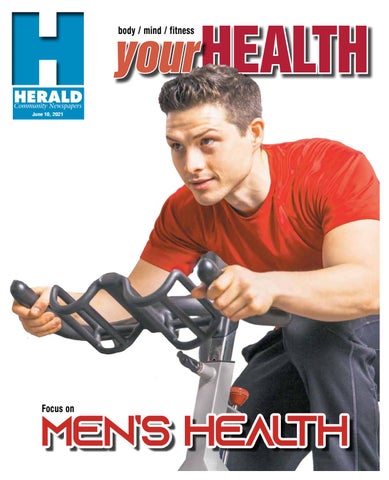
your HEALTH body / mind / fitness
June 10, 2021
Focus on
NATIONALLY RECOGNIZED EXPERTISE, RIGHT HERE ON LONG ISLAND. Mount Sinai South Nassau in Oceanside is proud to be recognized by U.S. News & World Report as a High Performing Hospital in multiple specialties, conditions, and procedures including urology, heart failure, diabetes/endocrinology, orthopedics, and COPD. This success is due to the tireless commitment of our physicians, nurses, and support staff who tackle and treat the most complex medical challenges every day.
1134242
Book an appointment today at mountsinai.org/southnassau
Live your best life
I
Steps to a healthier you
f you’re like most men, you probably have a career plan and a retirement plan. And maybe even a plan for starting or providing for your family. But do you have a plan for keeping yourself healthy? While some health issues are beyond your control, there are several ways you can keep your mind and body strong and healthy. June is Men’s Health Month — a good reminder for men to pay a little more attention to their health than usual. Start your healthy living plan today! Hang out with friends and family You might think you’re too busy for a boys’ night out or lunch with your mom. But activities like these, which we so missed during the throes of the pandemic, may save your life. Research shows that social ties can help you survive health problems, make you happier, and even prolong your life. One study even found that social bonds can protect your physical health as much as quitting smoking. So, now, with vaccines in place, we can begin to reconnect with family and friends we’ve so sorely missed. Eat a healthy diet Take-out food may be tasty and easy. And certainly throughout the pandemic, many of us turned to take out frequently, also comfort foods and snacking were a coping mechanism for many. Now’s the time to get back on track and return to healthier lifestyle. If take-out is still your thing, be smart about the kind of quick food choices you make. Too many fatty foods and sugary drinks increases your risk of developing heart disease, diabetes, and cancer. And you’ll risk packing on the pounds. Instead, work on eating more vegetables, fruits, lean proteins, and whole grains Break a sweat We all know how important exercise is: it can reduce your risk of heart disease, stroke, diabetes, colon cancer, and other health problems. It can also keep your weight down and sharpen your judgment. Plus, you will likely sleep better and live longer. Even the most diligent guys may have been sidetracked during the pandemic. With stay at home orders and just general malaise, along with binge-watching TV, losing focus last year was understandable. But there’s no reason now not to pick up the pace and refocus on your fitness goals. So try to get at least two and a half hours of moderate-intensity activity every week. Even yard work counts! Unplug and take a break Small amounts of stress can energize you and sharpen your ability to perform well. But too much stress over time can cause serious physical and mental health problems, including heart disease, diabetes, digestive problems, sleeplessness, and depression. To de-stress, get some exercise, meet up with friends and at long last take a break from the smart phone and computer screens. Get the sleep you need It seems like there are never enough hours in the day. As a result, at least 25 percent of Americans are sleepdeprived. Too little sleep is linked to obesity, accidental
trauma, heart disease, depression, and diabetes. It also puts you at risk of car accidents due to drowsy driving. Sleeping seven to nine hours per night can improve your work performance, your physical safety and your body’s ability to fight disease. Check your skin Men don’t usually pay attention to their skin, outside of shaving in the mirror. This June, spend a little time looking for new or unusual growths on your skin and help detect skin cancer in its early stages. Keep the “ABCD” rule in mind and be on the lookout for moles with the following characteristics: √ Asymmetry (one side is bigger than the other) √ Uneven borders (lines around the mole are jagged or uneven) √ Red or uneven color (moles should be one color, generally brown) √ Large diameter (moles shouldn’t be bigger than 6 mm, which is about the size of a pencil eraser) √ Pay attention to any moles that change in appearance, either in size, color or border. If you have concerns about a mole, contact your provider or a dermatologist. Lend a hand Studies have found that helping other people can decrease blood pressure, stress levels, and chronic pain. It can also reduce your likelihood of having depression and can even help you live longer. And helping others doesn’t have to be a big deal. You can donate to a fundraising drive, mow a neighbor’s grass or run a race for a charity. Throughout Covid-19, neighbors — and communities — supported one another in ever greater numbers. Let’s keep it going. Limit alcohol Happy hour, hitting the bar and watching the ball game with your pals can be a fun time. But too much alcohol can lead to injuries, cancer, psychological problems, damaged relationships, and high blood pressure. Try to limit alcohol to two drinks — such as a bottle of beer or one and half ounces of hard alcohol—per day if you drink. Health providers recommend drinking even less. Drink in moderation, if you drink at all. And be sure to always have a designated driver whenever you consume alcohol. Schedule a doctor’s appointment Research shows that men are less likely to see a doctor than women, putting their health at risk and helping women generally outlive them by at least five years. One of the best ways to maintain your health is to see your provider at least once a year. During your checkup, your provider will check your blood pressure, blood glucose levels and cholesterol, as well as recommend other screenings based on your age and risk factors. This appointment is also a great time to ask any questions or talk about any concerns you have about your health. Above photo: Stay on top of your health guys. The sooner you do it the better.
That snooze matters Sleep well, live better It’s well-established that sleep is essential to our physical and mental health. But despite its importance, a troubling percentage of people find themselves regularly deprived of quality sleep. Though there’s a wide range of causes and types of sleeping problems, expert consensus points to a handful of concrete steps that promote more restful sleep. For many, trying to implement all these strategies can be overwhelming. But remember it’s not all-or-nothing; start with small changes and work your way up toward healthier sleep habits, also known as sleep hygiene. Create A Sleep-Inducing Bedroom Make your bedroom a place of comfort and relaxation. Though this might seem obvious, it’s often overlooked, contributing to difficulties getting to sleep and sleeping through the night. Focus on maximizing comfort and minimizing distractions. Use a high-performance mattress and pillow: A quality mattress is vital to making sure that you are comfortable enough to relax. It also ensures, along with your pillow, that your spine gets proper support to avoid aches and pains. Choose quality bedding: Your sheets and blankets play a major role in helping your bed feel inviting. Look for bedding that feels comfortable to the touch and that will help maintain a comfortable temperature during the night. Avoid light disruption: Excess light exposure can throw off your sleep and circadian rhythm. Blackout curtains over your windows or a sleep mask for over your eyes can block light and prevent it from interfering with your rest. Cultivate peace and quiet: Keeping noise to a minimum is an important part of building a sleeppositive bedroom. If you can’t eliminate nearby sources of noise, consider drowning them out with a fan or white noise machine. Earplugs or headphones are another option to stop abrasive sounds from bothering you when you want to sleep. Find an agreeable temperature:
You don’t want your bedroom temperature to be a distraction by feeling too hot or too cold. The ideal temperature can vary, but most research supports sleeping in a cooler room that is around 65 degrees. Optimize Your Sleep Schedule Taking control of your daily sleep schedule is a powerful step toward getting better sleep. : Set a fixed wake-up time: It’s close to impossible for your body to get accustomed to a healthy sleep routine if you’re constantly waking up at different times. Pick a wake-up time and stick with it, even on weekends or other days when you would otherwise be tempted to sleep in. Budget time for sleep: If you want to make sure that you’re getting the recommended amount of sleep each night, then you need to build that time into your schedule. Considering your fixed wake-up time, work backwards and identify a target bedtime. Whenever possible, give yourself extra time before bed to wind down and get ready for sleep. Be careful with naps: To sleep better at night, it’s important to use caution with naps. If you nap for too long or too late in the day, it can throw off your sleep schedule and make it harder to get to sleep when you want to. The best time to nap is shortly after lunch in the early afternoon, and the best nap length is around 20 minutes. Adjust your schedule gradually: When you need to change your sleep schedule, it’s best to make adjustments little-by-little and over time with a maximum difference of one to two hours per night6. This allows your body to get used to the changes so that following your new schedule is more sustainable. Craft pre-bed routine: If you’ve a hard time falling asleep, it’s natural to think that the problem starts when you lie down in bed. In reality, though, the lead-up to bedtime plays a crucial role in preparing you to fall asleep quickly and effortlessly. Above photo: A good night’s sleep is just as important as regular exercise and a healthy diet.
HEALTH MEMO
E
Incisionless surgery addresses enlarged prostate in men with frequent urination
Reluctant to even consider very day for 15 years, surgery, Dr. Funk relied on Wantagh dentist Dr. Arnold prescription therapies to Funk, 70, battled the urge manage and treat his BPH, and the frequent need to urinate. which worked “to a degree,” he “I was always looking for a says. However, exasperated by bathroom and waking up three or the impact of BPH on his quality four times during the night,” said of life, in the fall of 2020 he the grandfather of three. “In fact, I took the advice of his urologist, joked that I was always the first Dr. Stanley Ring, to consult with one in the bathroom and the last Dr. Michael Herman, Director of one out.” Urology at Mount Sinai South The symptoms were the result Nassau. of an enlarged prostate, or benign Dr. Herman recommended prostatic hyperplasia (BPH), which Aquablation, an incisionless generally affects men 50 and Aquablation is one of the surgery that combines the older. In the United States, there state-of-the-art surgical precision of a heat-free waterjet are over 12 million men under a techniques that Dr. Herman uses and robotic surgical technology doctor’s care for BPH, of whom to treat non-cancerous and to remove enlarged prostate two million are looking for cancerous prostate conditions. tissue. In clinical studies, men alternative treatment options. who had Aquablation had a very low rate of BPH is caused when noncancerous cells of the irreversible complications, such as incontinence, prostate divide to make more cells, forming a mass ejaculatory dysfunction, and erectile dysfunction. “I that restricts flow in the urinary tract. If left thought I should give it a try,” said Dr. Funk. “It untreated, BPH has the potential to lead to serious seemed to be better than other methods.” complications, ranging from urinary tract infections Dr. Funk had the procedure in November 2020 and stones in the bladder or kidney to urinary and, one week later, the sensation and sudden urge retention and kidney damage.
to urinate were gone. Today, he wakes up perhaps once a night and can go five to six hours without needing to use the restroom. “I absolutely would recommend this procedure,” says Dr. Funk. “It’s lifechanging.” “Aquablation is a potentially life-transforming treatment for the thousands of men on Long Island and in New York City coping with the inconvenient, disruptive, and uncomfortable symptoms of an enlarged prostate,” said Dr. Herman. “Like Dr. Funk, patients eligible for Aquablation have been pleased with the results.” Aquablation is just one of the potentially lifechanging state-of-the-art surgical techniques that Dr. Herman and Mount Sinai South Nassau Prostate Health use to treat non-cancerous and cancerous conditions in the prostate and urinary tract. Dr. Herman and the program’s surgeons also specialize in robotically assisted or laparoscopic minimally invasive surgery, radiosurgery, brachytherapy, cryotherapy, and active surveillance. The program also provides comprehensive education and counseling for patients and their primary physicians in prostate health. Mount Sinai South Nassau Prostate Health is a service of the hospital’s Urology Program, which is ranked “High Performing” in U.S. News & World
Report’s Annual “Best Hospitals” rankings. Joined by Dr. Herman, urologists at Mount Sinai South Nassau excel in diagnosing and treating problems involving the male and female urinary tract and the male reproductive organs. From alleviating BPH to treating cancer to restoring fertility as well as treating kidney stones and addressing incontinence, the care the hospital’s urology experts deliver touches all aspects of life. For more information or to schedule an appointment, call (516) 390-2850 or visit southnassau.org/urology.
One Healthy Way Oceanside, NY 11572 877-SOUTH-NASSAU (877-768-8462) www.mountsinai.org/southnassau
Health memos are supplied by advertisers and are not written by the Herald editorial staff.
IT TAKES A SPECIAL PERSON TO SAVE A SPECIAL PET YOUR MONTHLY PET SPONSORSHIP WILL: Help fund major operations and provide ongoing medical care.
Ensure that abused, neglected, or abandoned animals receive constant love and attention.
Make you an essential part of a grateful pet’s life!
DON’T WAIT - ACT NOW!
1.877.BE.MY.PAL (1.877.236.9725) sponsor @ animalleague.org animalleague.org/sponsorapet
1133439
Choose a special pet to sponsor today!
HEALTH MEMO
Complete reversal of Alzheimer’s:
H
It could happen
ave you ever imagined a day when Alzheimer’s was eradicated from the planet? I know I have. The recent findings of an experimental treatment found to completely eradicate Alzheimer’s in mice is taking us one step closer to making this a reality. Alzheimer’s disease is characterized by the loss of memory, difficulty with cognitive tasks, and the presence of amyloid plaques in the brain. These mysterious plaques are speculated to choke the brain of its memory and ability to properly function. This recent report found that by slowly reducing the levels of certain enzymes (BACE1) in these mice that they can either prevent or reverse the formation of amyloid plaques in the brain. Many scientists conjecture that removing, or preventing amyloid plaques is the key to an eventual cure for Alzheimer’s. While this research is important in helping scientist crack the Alzheimer’s code, we must proceed with caution. Despite the pharmaceutical companies spending Billions of dollars, not a single drug has been FDA approved for the treatment of Alzheimer’s and/or dementia. Thus, prevention is the
only available medicine. And, the treatment of hearing loss is the single most modifiable factor for preventing dementia. (Lancet Journal, July 2017).
(516) 788-7830 ilovehearing.com
Health memos are supplied by advertisers and are not written by the Herald editorial staff.
Get out there and get moving Start the countdown to a better workout
Cardio Workouts Versus Weights Is your goal to lose body fat or simply gain muscle? Or is it a combination of both? If you
want to lose the extra weight, then cardio workouts are the thing for you. If it is big muscles that you are after, then add weights training to your weekly routine. If you want to drop the weight and achieve better muscle definition, then your weekly program should include cardio workouts plus weight training. The best types of cardio workouts for fat loss include ‘weight bearing’ exercise like fast walking, jogging, aerobics, football, soccer, tennis, squash, snow skiing and so on. Weight supported exercise like swimming and cycling are less effective in shifting unwanted fat stores. For a safe and effective weight training program see a gym instructor or a personal trainer rather thandesigning your own. They can tailor a weights program to your needs and provide instruction on how to handle the weights correctly without injuring yourself. Flatten The Spare Tire Carrying a spare tire (excess fat) around your middle is a burden on one of our most important internal organs — the heart. So, if you get rid of the bulge, you’ll be happy and your ticker will be over the moon too! Try these strategies to deflate the spare tire. Clock up some ‘incidental activity’ time. This includes things like walking around the office, taking the stairs instead of the elevator and yard work. The more incidental activity you do, the more calories you will burn during the day. Remember — every little bit counts! Block out some ‘me’ time. Make a one-hour appointment with yourself, three to four times a
week. And consider this appointment as important as any other work-related appointment or meeting. It’s important not to let other things override your exercise time. Think Beyond The Gym We learned during the pandemic that there are
plenty of fitness alternatives to a gym workout. Throwing a frisbee to your kids in the park or taking the dog for a walk or jog counts as physical activity. So if the gym is not your scene, try and think of what you really like doing and just do it. The most important thing is to move your body, get the heart pumping and have fun while doing it. Find an exercise buddy. An exercise buddy can help you get motivated and keep motivated. You will both benefit from the partnership. Make a schedule that works for you. You’ve probably heard that it’s best to exercise in the morning to kick-start your metabolism for the day and help you sleep at night. You may have also read that your workout will be more productive if it’s done between 4 and 6 p.m. when your body temperature is highest. The most important thing about your workout schedule is that it fits you. If you’re not a morning person, a workout plan that requires you to get up two hours early every day may not last. The same goes if you’re consistently “running on empty” after work — force yourself into an evening workout regimen and you’ll likely throw in the towel before long. Find a time that works for you, whether in the morning, during your lunch break or in the evening, and stick with it. Above photo: You’re ready to work out. Whether you let your workout routine lapse during the Covid-19 crisis or just recently gave up the recliner and set aside the bowl of chips to pursue a healthier lifestyle, take the one body you’ve been given and make it look and work its best.
1132191
Drop the remote — let’s go! After a long bout of ‘couch potato Olympics’, brought on for many by the pandemic, getting started — or restarted with your fitness regimen can be a battle. The best place to begin is to look at all the positives of getting active and staying active: √ It burns body fat and helps to deflate the old spare tire around your waistline. √ It’s a natural stress buster. √ It helps to control your blood cholesterol. It reduces the ‘bad’ cholesterol while √ Increasing the ‘good’ cholesterol in your blood. √ It gives your heart a good workout, helping to keep it pumping strong. √ It increases certain chemicals in the brain that make you feel good. √ It increases muscle mass. √ It reduces the risk of developing some diseases and can add years to your life. √ It can assist in boosting your self-esteem, via a better body image. √ It helps to keep your bowel habits regular. √ It gives you the opportunity to meet new friends. √ It helps you to sleep better — so you’ll feel more refreshed and lively throughout the day. √ It’s great for your bones — helping to keep them strong. √ It can help to maintain strength, stamina, flexibility and a high metabolism — all things that we tend to lose with age.
24-48 hour turnaround time corporate testing group sizes ranging from 20 - 5,000
YOUR PREMIER SOURCE FOR CONCIERGE CARE SOLUTIONS
thousands of satisfied customers
GAIN
most major insurances accepted
ENTRY
no additional out-ofpocket fees
WITH OUR COVID PCR & ANTIBODY TEST RESULTS
TEST RES U IER
HE
C AC
RE
S LT
PRE M
home appointments available
EP W TED E V E RY
camps
airports
sport venues
hospitals
events
Schedule your test today!
The Greater Five Towns, Long Island & Five Boroughs
718.500.4888 info@premierassist.com www.premierassist.com
1134264
SERVICING
Restore Your Hearing at I Love Hearing At I Love Hearing, we use a special MEET OUR TEAM process to ensure that our clients receive the ideal hearing loss solutions for their needs. 3 Hearing aid fitting
Dr. Amy Sapodin,
Au.D., F-AAA, CCC-A
3 Hearing aid repair 3 Hearing testing 3 Hearing protection 3 Tinnitus therapy
Dr. Alison Hoffmann, Au.D., F-AAA, CCC-A
3 Ear wax management 3 Auditory therapy & rehabilitation Seth Dank,
Yoga:
It’s not just for women
(516) 788-7830 | ilovehearing.com 30 Merrick Avenue North, Suite 109, East Meadow, New York 11554
Jessica Gibson,
1133434
Clinical Audiologist, M.A., F.A.A.A
Clinical Specialist
How to take the plunge when you’re a dude who routinely feel tight after traditional strength training sessions. Yoga can improve stamina. Numerous studies have indicated the positive effects yoga can have on muscle endurance. Researchers at the University of Wisconsin, La Crosse, have found that the regular practice of Hatha yoga provided a significant boost to chest and abdominal strength and endurance. Such improved stamina can have a trickledown effect on men who practice yoga and also adhere to strength training regimens and/ or participate in competitive sports. Yoga can help men maintain a healthy weight. The Harvard Medical School notes that researchers discovered that people who practiced yoga for at least 30 minutes once a week for at least four years gained less weight during middle adulthood than those who did not. That might be linked to additional research that found people who practiced yoga were more mindful eaters than those who did not, making them less likely to overeat, eat when sad or stressed or eat in response to certain cues, including the smell of food. Fewer men than women may practice yoga, but that does not mean men cannot benefit just as much from this ancient practice.
Above photo: Sometimes in yoga’s recent history, a gender shift occurred. Yoga, which traditionally had been practiced only by men, began to be dominated by women. Today, an average yoga class will have more female than male students. However, don’t dismiss it. The real results of regular yoga practice are quite practical, and you don’t need any special equipment — just a few square feet of space and a mat.
1134358
The popularity of yoga has grown considerably in the 21st century. But while women have embraced yoga en masse, men have been more hesitant to do so. Although in the past few years, more men have decided to give it a try, anyone who has recently visited a yoga studio can attest that the participants in many classes remain overwhelmingly female. That’s unfortunate for men, who can benefit from practicing yoga in myriad ways. The misconception is that yoga is a lighter form of fitness training, better suited to women, may cause some men to miss out on the health benefits. One reason for this misconception is that yoga has become associated with flexibility rather than strength. However, evidence shows that the mind-body practice can also be very effective in increasing overall strength and building muscle, making it a valuable part of any man’s fitness routine. Yoga can protect against muscle imbalances. Yoga requires various muscle groups to work together to perform certain exercises. This can reduce the risk of muscle imbalances that can develop when men design workout routines that target specific muscle groups. Yoga can improve flexibility. When performed correctly, various yoga exercises improve flexibility. For example, the big toe pose can help men and women lengthen and strengthen their hamstrings, while the downward facing dog pose stretches various areas of the body, including the shoulders, calves and arches. Yoga is not the only way for men to improve their flexibility, but it can be an effective supplement to exercise routines for men
MEET LONG ISLAND’S TEAM FOR BRAIN & SPINE CARE Nassau Neurosurgeons Michael H. Brisman, M.D. Trigeminal Neuralgia Brain Tumors
Suffolk Neurosurgeons William J. Sonstein, M.D. Spine Surgery
Ramin Rak, M.D. Spine Surgery Brain Tumors
Alan Mechanic, M.D.
Jeffrey A. Brown, M.D.
Artem Y. Vaynmen, M.D.
Neuropathic Facial Pain
Spine Surgery
General Neurosurgery Spine Surgery
Stephen T. Onesti, M.D.
Donald S. Krieff, D.O.
Spine Surgery
Spine Surgery
Sachin N. Shah, M.D.
Zachariah M. George, M.D.
Spine Surgery
Spine Surgery
Vladmir Y. Dadashev, M.D.
Alexandros D. Zouzias, M.D.
Spine Surgery
Spine Surgery
Benjamin R. Cohen, M.D.
Daniel M. Birk, M.D.
Spine Surgery
Spine Surgery
Xavier P.J. Gaudin, D.O.
Raymond Baule, M.D.
Spine Surgery
Spine Surgery
Jonathan L. Brisman, M.D. Neurovascular Neurosurgery Endovascular Neurosurgery Brain Tumors
Brian J. Snyder, M.D. Parkinson’s Surgery Epilepsy Surgery Pain Surgery
John A. Grant, M.D. Pediatric Neurosurgery Neurovascular Neurosurgery Brain Tumors
Paolo A. Bolognese, M.D. Chiari I Malformation Syringomyelia
Robert N. Holtzman, M.D. General Neurosurgery Spine Surgery
Neuropsychology
Yusef I. Mosley, M.D. Spine Surgery
Gad Klein, Ph.D.
Neuroendovascular Surgery
John Pile-Spellman, M.D.
Neuropsychology
Neuroendovascular Surgery
Neuro-Oncology
Sundeep Mangla, M.D. Neuroendovascular Surgery
Neuro-Oncology
(844) NSPC-DOC | nspc.com Scan here to request a consultation
In-Network with The Empire Plan (NYSHIP)
Jae Choi, M.D. Aneurysm Neurology
1133457
Jai Grewal, M.D.