TheJewishStar.com
Honest Reporting • Torah-True • Kosher and Fat-Free
Nov. 13-19, 2026 • Toldot • 3 Kislev 5787 • Vol. 25, No. 36
Reach the Star: Editor@TheJewishStar.com • 516-622-7461
NY Times shrugs off its ‘blood libels’ amid twisted genocide lies
Ambassador Leiter tells Chabad emissaries it’s fight time
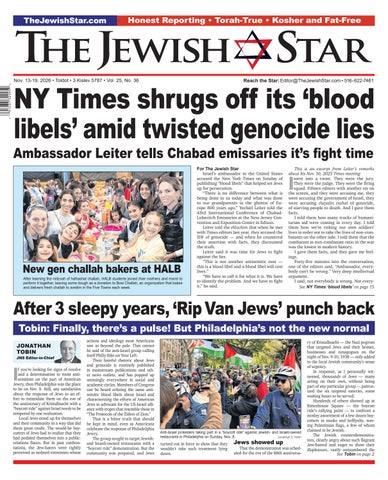
New gen challah bakers at HALB
After learning the mitzvah of hafrashat challah, HALB students joined their mothers and morot to perform it together, leaving some dough as a donation to Boei Challah, an organization that bakes and delivers fresh challah to aveilim in the Five Towns each week.
For The Jewish Star Israel’s ambassador to the United States accused the New York Times on Sunday of publishing “blood libels” that helped set Jews up for persecution. “There is no difference between what is being done to us today and what was done to our grandparents in the ghettos of Europe 800 years ago,” Yechiel Leiter told the 43rd International Conference of ChabadLubavitch Emissaries at the New Jersey Convention and Exposition Center in Edison. Leiter told the shluchim that when he met with Times editors last year, they accused the IDF of genocide — and when he countered their assertion with facts, they discounted the truth. Leiter said it was time for Jews to fight against the lies. “This is not another antisemitic rant — this is a blood libel and a blood libel will cost lives.” “We have to call it for what it is. We have to identify the problem. And we have to fight it,” he said.
This is an excerpt from Leiter’s remarks about his Nov. 10, 2025 Times meeting: went into a room. They were the jury. They were the judge. They were the firing squad. Fifteen editors with another six on the screen, and they were accusing me, they were accusing the government of Israel, they were accusing chayalei tzahal of genocide, of starving people to death. And I gave them facts. I told them how many trucks of humanitarian aid were coming in every day. I told them how we’re risking our own soldiers’ lives in order not to take the lives of non-combatants on the other side. I told them that the combatant to non-combatant ratio in the war was the lowest in modern history. I gave them facts, and they gave me feelings. Forty-five minutes into the conversation, one of the editors said, “Ambassador, everybody can’t be wrong.” Very deep intellectual argument. I said, not everybody is wrong. Not everySee NY Times ‘blood libels’ on page 15
I
After 3 sleepy years, ‘Rip Van Jews’ punch back Tobin: Finally, there’s a pulse! But Philadelphia’s not the new normal JONATHAN TOBIN
JNS Editor-in-Chief
I
f you’re looking for signs of resolve and a determination to resist antisemitism on the part of American Jewry, then Philadelphia was the place to be on Nov. 8. Still, any satisfaction about the response of Jews to an effort to intimidate them on the eve of the anniversary of Kristallnacht with a “boycott ride” against Israel needs to be tempered by one realization. Local Jews stood up for themselves and their community in a way that did them great credit. The would-be boycotters of Jews had to realize that they had pedaled themselves into a publicrelations fiasco. But in past confrontations, the Jew-haters were rightly perceived as isolated extremists whose
actions and ideology most Americans saw as beyond the pale. That cannot be said of the anti-Israel group calling itself Philly Bike on Your Left. Their hateful rhetoric about Jews and genocide is routinely published in mainstream publications and other news outlets, and has popped up seemingly everywhere in social and academic circles. Members of Congress can be heard echoing the same antisemitic blood libels about Israel and characterizing the efforts of American Jews to advocate for the US-Israel alliance with tropes that resemble those in “The Protocols of the Elders of Zion.” That is a bitter truth that should be kept in mind, even as Americans celebrate the response of Philadelphia Jewry. The group sought to target Jewishand Israeli-owned restaurants with a “boycott ride” demonstration. But the community was prepared, and Jews
Anti-Israel protesters taking part in a “boycott ride” against Jewish- and Israeli-owned restaurants in Philadelphia on Sunday, Nov. 8. Jonathan S. Tobin
turned out in force to show that they wouldn’t take such treatment lying down.
Jews showed up
That the demonstration was scheduled for the eve of the 88th anniversa-
ry of Kristallnacht — the Nazi pogrom that targeted Jews and their homes, businesses and synagogues on the night of Nov. 9-10, 1938 — only added to the local Jewish community’s sense of urgency. In response, as I personally witnessed, thousands of Jews — many acting on their own, without being part of any particular group — patronized the six targeted eateries, some waiting hours to be served. Hundreds of others showed up at Rittenhouse Square — the boycott ride’s rallying point — to confront a motley assortment of a few dozen boycotters in masks and keffiyehs, waving Palestinian flags, a few of whom claimed to be Jewish. The Jewish counterdemonstrators, clearly angry about such flagrant Jew-hatred and eager to show their displeasure, vastly outnumbered the See Tobin on page 2
November 13-19 • 3 Kislev 5787 — THE JEWISH STAR
2
Lizzy confronts exec over Meta’s Jew hate By Canaan Lidor An American influencer who receives regular death threats challenged a Meta executive at a gathering in Poland on Monday over the company’s handling of antisemitic harassment, prompting a discussion of AI tools to counter Jew-hatred online. Lizzy Savetsky, a New York-based content creator with hundreds of thousands of followers on Meta-owned Instagram, interrupted Edo Haveman, the company’s director of public policy for the Benelux region, as he described the firm’s policies against hateful content. “I just filed a harassment report five minutes ago,” she told him. Haveman said he hoped her complaint would be addressed promptly, and acknowledged Meta’s moderation systems weren’t always effective. The exchange took place during a panel discussion organized by the Eu-
ropean Jewish Association on the anniversary of the Kristallnacht pogrom, ahead of a delegation visit to the Auschwitz-Birkenau former German death camp. Haveman and Jeff Bullwinkel, Microsoft’s vice president for Europe, the Middle East and Africa, both attended the event and are scheduled to visit Auschwitz with the delegation. On Kristallnacht, Nov. 9–10, 1938, Nazis and their supporters burned hundreds of synagogues across Germany and Austria. The event is widely viewed as the opening shot in the campaign of violence against European Jews that culminated in the Holocaust. Savetsky, who is Jewish, said she has received death threats since she began publicly supporting Israel in 2021. “I’m pretty disappointed, I have to say, in the policing of the hate and the threats [online],” she said, adding that
she reports threats to the New York Police Department and has been in contact with the FBI. A World Jewish Congress study published earlier this year found that reporting content to platforms had little effect on whether it was removed. Of 754 antisemitic social media posts reported by Jewish community members across Europe between February 2025 and April 2026, 613 — about 81% — were still online when researchers checked them in May. A separate report published this year by the group StopAntisemitism found that TikTok removed antisemitic content at a higher rate than Instagram. TikTok removed nearly half of about 50 reported accounts and took action against 48% of 324 flagged posts, while Meta removed 33% of 36 reported Instagram accounts and took action against 40%
Social media influencer Lizzy Savetsky speaks at a European Jewish Association conference in Krakow, Poland, on Nov. 9. Yoav Dudkevitch
of 175 flagged posts. The volume of antisemitic content online jumped after the Hamas-led massacres in Israel on Oct. 7, 2023, and has not returned to pre-Oct. 7 levels, the Online Hate Prevention Institute said in an overview last year based on almost
10,000 items of antisemitic content. Haveman said Meta was preparing to use large language models to speed the identification and removal of hateful content from Facebook and Instagram. “AI and specifically LLMs are gonna help us a lot to act even quicker,” he said. He also expressed willingness to explore a mechanism through which Jewish organizations and prominent Jewish social media personalities could escalate serious complaints. Bullwinkel outlined Microsoft’s Azure AI Content Safety system, launched in 2023, which allows organizations to configure filters against harmful content. He invited the European Jewish Association to take part in an upcoming roundtable in Israel on combating AI-generated hatred and using artificial intelligence to preserve Holocaust memory. —JNS
Philly stood up, but don’t expect an encore… Continued from page 1 bikers. Despite the best efforts of police to keep the two groups separated, the situation got ugly at times, with taunts turning to pushing and shoving before the cops cleared a path for the anti-Israel bikers to escape and begin their ride around the city. But wherever they pedaled, accompanied by some sympathizers on foot, they were greeted by large numbers of Jews waving Israeli flags, chanting and singing their defiance, and demanding that the bikers have the guts to take off their masks and show their faces. This was a profoundly encouraging development, and one in marked contrast to most of the responses of American Jews in the three years since the Hamas-led Palestinian Arab terror attacks on Israeli communities on Oct. 7, 2023. With a few exceptions, Jews have largely failed to aggressively respond to the pro-Hamas mobs that overran city streets and college campuses.
Imperative to respond
The infamous “shelter in place” advisory put out by Columbia University and echoed by the school’s Hillel chapter in April 2024, when anti-Israel demonstrators took over part of the campus, was not an isolated phenomenon. There was, of course, at least one large pro-Israel demonstration: the mass rally held in Washington, DC, in November 2023. But as a general rule, the Jewish response was to stay home rather than confront those who chanted for Jewish genocide (“From the river to the sea”) and terrorism against Jews wherever they live (“Globalize the intifada”). Whether justified or not, it gave the country the impression that Jews were either unwilling to express solidarity with the nearly half of the world’s Jewish population that lives in Israel, or that they lacked the courage to answer those who singled them out for abuse and intimidation. Why, then, did Greater Philadelphia Jewry turn out in such numbers this time? Perhaps it was the Kristallnacht anniversary and the obvious parallels to Nazi efforts to target Jewish businesses. Previous “pro-Palestinian” marches had attempted to target some Jewish-
Peddling lies about Israel and Jews
While anti-Israel protesters marched in Philadelphia on Sunday, Jews and allies participated in a food crawl in support of Jewish- and Israeli-owned restaurants. Jonathan S. Tobin
As hatred and bigotry against the Jewish minority become normalized throughout society, it’s clear Jews must prepare for more such challenges. owned restaurants. But the prospect of a seemingly more organized effort to re-enact the tragic events of the 1930s — in the city where American independence was born and where the Liberty Bell, inscribed with a Torah verse (Leviticus 25) — was just too much for many people to accept passively. Nor should one dismiss the fact that this particular dispute involved food — something that resonates more with American Jews than rhetoric about Zionism — even if only one of the six targeted restaurants, a falafel place called Goldie that had been an early target back in December 2023, is certified kosher. According to a later report in the Philadelphia Inquirer, an anonymous spokesperson for the boycotters denied any knowledge of Kristallnacht. But there was no denying the vile nature of the boycott. Though the group falsely claimed it had chosen its targets because they were somehow connected to the Israeli military, the only common denominator among the six restaurants was Jewish ownership and cuisine seen as appealing to the Jewish community. So the Nazi analogy wasn’t confined to the calendar; it would have applied to such an action no matter what day of the year it occurred. To their credit, local political leaders,
including Pennsylvania Gov. Josh Shapiro and Philadelphia Mayor Cherelle Parker, condemned the event, the latter saying that “singling out businesses because their owners are Jewish is unacceptable and has no place in our city.” Sen. John Fetterman (D-Pa.) rightly derided the boycott as a “sick parade of rank antisemitism.” Even left-wing Philadelphia District Attorney Larry Krasner criticized the plan, warning those who dislike Israeli Prime Minister Benjamin Netanyahu and Israel’s war against Hamas that “the leadership of the Israeli government is your target, ... as opposed to blaming all Israelis, or all Jewish Israelis, or all Jews all over the world for their beliefs, for their faith, for their ethnicity.”
Not like Skokie
At various points while Jews milled about upscale Rittenhouse Square awaiting the start of the day’s events, the conversation turned to what happened in the late 1970s in Skokie, Illinois, and whether that was analogous to what Jews were experiencing now. The planned march of American neo-Nazis through the Chicago suburb, home to a large population of Holocaust survivors, is an important chapter in American Jewish history. After prolonged legal battles, in which Jews played prominent roles on both
sides, the march never took place. Still, the trauma of survivors who feared a replay of their tragic past lingers in the community’s collective memory. The uniforms and swastikas of the would-be Skokie marchers evoke the sort of imagery that haunts the Jewish imagination in a way that masks, keffiyehs and Palestinian flags do not — at least not yet. But the dilemma faced by those who turned out in Philadelphia on the eve of Kristallnacht is far worse than that of the embattled Skokie survivors. There is a great deal of difference between what didn’t happen in Skokie and what did happen in Philadelphia — and it has nothing to do with the fact that the former played out in the courts rather than the streets. It’s that for all the anger the Nazis provoked, they were a tiny, isolated group of extremists widely despised by virtually all of American society. But though the Philly boycott riders clearly miscalculated in their choice of targets and timing, they are far from isolated. It’s true that the owners of these restaurants don’t deserve to be treated this way just because they are Jewish. Nor is any American Jew responsible for the actions of Israel’s government.
But the problem with the boycott isn’t only that it targeted innocent people. It’s that the line the boycotters are peddling — that Jews are committing “genocide” or supporting an “apartheid state” — is a lie. The growing support in American society for isolating Israel and opposing its efforts to defend its population against genocidal Palestinian terrorists and their Iranian sponsors is based on misinformation that has been mainstreamed in the corporate media. The election of open antisemites like Michigan Senatorelect Abdul El-Sayed and many others on the far left is the product of the normalization of Jew-hatred in journalism and popular culture. Under these circumstances, the events of the past three years — including the murders of Jews in Washington, DC, and Boulder, Colorado, the arson attack on Shapiro’s official residence in Harrisburg on Passover and numerous other incidents around the globe — are what happens when such “pro-Palestinian” rhetoric is seen as acceptable discourse. So, too, is the fact that so many Jewish institutions have had to be fortified in response to constant threats of violence. All of it is the natural result of the widespread acceptance of these falsehoods about Israel and the antisemitic tropes that accompany them. As long as such misinformation is ubiquitous in the allegedly responsible press, as well as on popular podcasts and social media, the public can’t be surprised that incidents such as the boycott ride happen. In fact, Americans should be prepared for many more such incidents in the coming months and years. We can only hope that other communities will respond as Philadelphia’s Jews did when the need arises. But no one should pretend that this small victory is a sign that the beliefs of these Jew-haters are being marginalized or thrown back into the fever swamps of the far left and far right, where they belong. As hatred and bigotry against the Jewish minority become normalized throughout society, it’s clear Jews must prepare for more such challenges. Jonathan S. Tobin is editor-in-chief of JNS.
3
THE JEWISH STAR — November 13-19 • 3 Kislev 5787
JOIN US FOR A
National Diabetes Awareness Month Event Join us in-person or virtually as we raise awareness about Diabetes Attendees will: Learn about our Diabetes programs Watch a food demonstration Receive free A1C screenings and schedule on-spot appointments Attend a panel discussion covering topics such as healthy habits that make the biggest difference, diabetic foot care, medication management, and diabetic nutrition.
Thursday, November 19 from 12PM-1PM In-Person EHS Clinical Learning Center Classroom 1A 19-09 Plainview Avenue Far Rockaway, NY 11691 Virtually at bit.ly/2026-EHS-Diabetes-Event
PANELISTS:
Sheldon Markowitz, MD Chief of Endocrinology
Ramy Elattal, DPM Chief of Podiatry
Stephanie Cordaro RDN, CDCES Senior Hemodialysis Dietitian
SCAN THE QR CODE TO REGISTER
Motunrayo Fadugba PharmD, BCACP, CDCES Clinical Pharmacist
Snacks and refreshments will be available. Call 718-869-7100 if you have any questions.
Israeli expert: Pickaxe Mt. site must be destroyed By Yaakov Lappin Iran is working to convert its fortified Pickaxe Mountain tunnel complex into a substitute uranium enrichment site to replace facilities said to have been destroyed at Fordow and Natanz, Brig. Gen. (res.) Prof. Yaakov (Jacob) Nagel, a senior fellow at the Washington-based Foundation for Defense of Democracies and former acting head of Israel’s National Security Council, told JNS. Following international media and think tank reports of movement and construction work at the deep underground site, known in Farsi as Kuh-e Kolang Gaz La, Nagel said the roots of the problem trace back to the 2015 nuclear deal brokered by the Obama administration. “There is no doubt that Iran is planning to use the Pickaxe Mountain infrastructure as an alternative base, in their assessment a protected one, in order to replace the enrichment sites that were hit at Fordow and Natanz. The terrible 2015 agreement allowed them to develop advanced centrifuges that enrich at a rate 10 times faster than before, and some of them survived,” Nagel said. Moving such centrifuges to Pickaxe Mountain, in central Iran close to the Natanz nuclear complex, along with some of the enriched material, is a real danger, he warned. He added that the enrichment level of any relocated material matters less than it might seem. “Material enriched to 20% or even less can be enriched quickly to 90% plus. This is true even if it takes relatively longer than material enriched to 60%. Enrichment to 20% takes about 70% of the time required for enrichment to 90%,” he said. “The bigger problem is the ability to also transfer to this site laboratories and capabilities for building the weaponization program, for building the weapon system. It is not clear what has already been done and what is planned, but this site must disappear, or reach a state in which it cannot be used, so that Iran does not enter the zone of immunity,” Nagel said. Turning to the Taleghan 2 facility at the Parchin military complex southeast of Tehran, where satellite imagery has shown recent reconstruction, Nagel said Iran has long denied any nuclear connection to the site specifically to try to shield it from attack. “According to foreign reports, development of components related to the [nuclear] weapon system was car-
A satellite view of an entrance to the Pickaxe Mountain tunnels in Vantor Iran.
ried out at this site, under a cover of denial of dual-use capabilities, so it makes sense that it will apparently remain a target in any future plan,” he said. Asked about a Sept. 10 Wall Street Journal report that Iran has resumed accelerated assembly of ballistic missiles from stockpiles of pre-manufactured components inside underground facilities, Nagel said the effort appears limited in scope. “I join the assumption that Iran is trying to rehabilitate some of its underground production capabilities, but at a pace that is at least an order of magnitude smaller than what was planned, but it is still troubling and requires handling,” he said. As for the best options on Iran going forward, Nagel said, “A heavy siege by sea, air and land, if it is accompanied by American patience over time, six to nine months, holds within it the potential to collapse the economy and bring the people back out into the streets. I’m not sure there will be patience and I’m not sure it will bring the people out into the streets, but this, combined with a few more actions, brings potential.” He was skeptical of American appetite for a ground operation at Pickaxe Mountain. “It’s possible the US has aerial strike capabilities against the site, even though that would be difficult,” he said.
lower cost homeowners insurance let our team of experts design a much lower cost quality policy for you free quote
➤ commercial insurance policies ➤ life & disability insurance ➤ car insurance ➤ self employed health insurance ➤ long term care insurance
Rabbi S.M. Leiner, cLtc
Independent Insurance broker P.O. box 7655 at 600 Franklin Ave. Garden city, ny. 11530
Moses10987@aol.com
917-543-0497 Attention: AFFLUENT Clients — Tax Free, Guaranteed, Return of FULL PREMIUM PAID, for CERTAIN Insurance Coverage.
According to assessments in Israel in recent months, the joint Israeli-American campaign that began on Feb. 28 — called Operation Roaring Lion by Israel and Operation Epic Fury by the US — massively degraded Iran’s missile industry, striking nearly every significant site in the missile production chain. Brig. Gen. (res.) Yossi Kuperwasser, head of the Jerusalem Institute for Strategy and Security and former head of the Research Division of IDF Military Intelligence, told JNS in July that the missile production chain was hit especially hard. “Enormous damage was caused to the Iranian nuclear program, and also to the ballistic missiles that are part of the Iranian nuclear program. The ability to produce new missiles was damaged,” he said, adding that the uranium conversion facility at Isfahan “was essentially destroyed.” International Atomic Energy Agency Director-General Rafael Grossi told Bloomberg on Sept. 10 that satellite imagery had picked up construction activity at Pickaxe Mountain, though the agency has not inspected the underground complex. “There are some indications that there is movement around this construction site,” Grossi said. “We don’t have any concrete information as to activities that may be taking place there.” The Institute for Science and International Security, the think tank founded by former nuclear weapons inspector David Albright, reported on Sept. 17 that satellite imagery showed Iran had placed earthen roadblocks across roads leading to the site’s western tunnel entrances in late July and early August, restricting vehicle access. The eastern tunnel portals had been partially backfilled with dirt earlier in the year. The institute said the continued restrictions reinforce its assessment that the facility is not being used for normal operations, while cautioning that valuable equipment or materials may remain inside. The institute also reported in late September that Iran is “rapidly reconstructing” the Taleghan 2 facility at Parchin. An earlier institute report, on July 10, documented what it called “significant activities indicative of an Iranian commitment to repair and reconstruct the site,” including excavation around bomb-penetration holes in the facility’s roof and additional concrete reinforcement. —JNS
DESK of RABBI S.M. LEINER- INSURANCE BROKER 917-543-0497 Note the ACCOLADES from our CLIENTS RE: SYNAGOGUES and YESHIVOS Dear Rabbi Leiner, Thank you for replacing the Insurance for our Synagogue, with a Savings of almost 50%. B.F. Executive Director RE: REAL ESTATE CORPORATION Dear Rabbi Leiner, You and Your Experts, have saved our Corp. Very Substantial Sums, with your Quality Insurance Replacement on our Real Estate Buildings. Thank you, M.B. Pres. RE: HOMEOWNERS INSURANCE Dear Rabbi Leiner, Our Insurance Company Refused to renew our Insurance Homeowners Policy. However, You and Your Experts were able to Secure for us other Insurance Coverage, even at a much lower Premium, than the Prior Canceled Insurance Policy. Thank You So Much. Mrs. D.S.
1361097
November 13-19 • 3 Kislev 5787 — THE JEWISH STAR
4
5
PRE-ALIYAH PLANNING WEBINARS October - March | Online Join Nefesh B’Nefesh for informative webinars covering every step of Aliyah, from required documents and planning your move to benefits, healthcare, and finding a job. Get the tools and confidence to start your new life in Israel.
NBN ON TOUR Wednesday, November 18 · West Hempstead Join us for an informal meetup with Nefesh B'Nefesh Aliyah experts! Be a part of the open conversations, practical planning advice, and a room full of others sharing the same incredible goal.
www.nbn.org.il/events-calendar WORKING IN PARTNERSHIP TO BUILD A STRONGER ISRAEL THROUGH ALIYAH
THE JEWISH STAR — November 13-19 • 3 Kislev 5787
UPCOMING OVERSEAS EVENTS
November 13-19 • 3 Kislev 5787 — THE JEWISH STAR
6
Vernikov rips Blakeman’s ‘petty’ Stefanik hit By Rikki Zagelbaum and Rebecca Szlechter Bruce Blakeman, the Jewish Nassau County executive who lost the New York governor’s race to Gov. Kathy Hochul, a Democrat, by almost 20 points, is drawing widespread criticism for attacking his former GOP primary rival, upstate Rep. Elise Stefanik. “Elise Stefanik is a selfish, do-nothing politician that didn’t lift a finger to help Republican candidates in New York this year,” Blakeman wrote on Thursday. “She had one moment of glory in what was otherwise an unremarkable career.” Stefanik, who made national news with her tough questioning of university presidents about Jew-hatred on their campuses, was President Donald Trump’s pick for US ambassador to the UN, but he later said it was important for her to stay in Congress. She then ran for governor but did not get Trump’s endorsement, which went to Blakeman. She dropped out of the race and said she would not seek reelection, citing family obligations. “Elise Stefanik was and is a star in the Republican Party. You should have never primaried her,” said Inna Vernikov, a Republican member of the New York City Council and co-chair of the council’s bipartisan task force on Jew-hatred. “Nassau County ran a grift, pushed out a very competent and worthy candidate in Elise and lied to voters and donors about your prospects via fake polling,” Vernikov said. “No elected Republican with half of a brain ever believed you had a shot of winning governor and beating Hochul.” “At her young age, Elise did more for our country and party, and accomplished more for New York, especially for its Jewish community and college students, than you and the entire
Nassau County Executive Bruce Blakeman joins President Donald Trump on stage during Trump’s visit to the Nassau County Police Department’s Rep. Elise Stefanik questions the presidents of Harvard, the University of Penn- David S. Mack Center for Training and Intelligence in Uniondale on Aug. sylvania and MIT at a House committee hearing on campus antisemitism, Dec. 5, 14. Trump endorsed Blakeman’s campaign for governor during the event. 2023. Office of Rep. Stefanik Tim Baker, LI Herald
Nassau County boys club can ever imagine possible,” she said. “She has got more intelligence, charisma, political acumen, courage and grit than all of you combined, and you have some chutzpah to attack her after your failed grift of a campaign.” Vernikov called Blakeman’s post “petty and childish.” “Don’t be bitter,” she said. “Reflect on your own missteps.” The council member told JNS that “with the blue tsunami we experienced this past Tuesday, I don’t believe any Republican could have won the governor’s race.” “That being said,” she added, “to play the blame game the day after you get politically annihilated against your opponent and attack the star Republican you helped push out, who never lost a single election, flipped a seat from blue to
red plus-21, raised historic amounts of money for the party, rose to be the highest-ranking female Republican in the history of Congress and exposed and demolished Ivy Leagues for their non-action against vile antisemitism, is just bitter and petty.” Moshe Spern, president of United Jewish Teachers, which represents more than 1,000 Jewish public school educators and staff in New York City, called Blakeman’s post “a horrible take and really unfortunate.” “You couldn’t even carry Nassau County. That’s on you,” he wrote. “Maybe less awful AI videos and next time focus more on the needs of the people.” Stefanik responded that she knew “feelings are raw in the aftermath of Tuesday’s result, so I will cut some slack.” “While I don’t know from experience, as
I have never lost any of my seven elections, I know that this is a tough loss in New York and I imagine it takes time to process. I’m going to give some upstate grace, whether deserved or not,” she wrote. “The reality is, with time, we will need everyone to be part of the solution, including local county-level officials, because we so desperately need it in our state and country.” “I voted for Bruce and straight Republican ticket and have worked for decades helping Republicans across the state and country including him,” she wrote. “Over the past decade, I have worked hard to campaign, support and raise over $100 million to help boost Republicans up and down the ticket across the country and the state.” She added that everyone has to be a “constructive part of the effort to rebuild Republican support as we learn from this historic loss.” —JNS
Israeli view: Dem anti-Israel shift here to stay By Rikki Zagelbaum After Democrats retook both houses of Congress in what has been widely described as a “blue tsunami” — unseating Republicans in decades-long GOP strongholds — Israeli experts told JNS they doubt the growing anti-Israel cohort in Congress is a blip that a pendulum swing will correct next cycle. “It’s an evolving trend that shows greater signs of permanence than temporary quality,” Dan Diker, president of the Jerusalem Center for Security and Foreign Affairs, told JNS. Diker, who co-hosts a JNS podcast, noted that Michigan’s Democratic senator-elect, Abdul ElSayed, who in January will become the first Muslim to serve in the Senate, joins anti-Israel Reps. Rashida Tlaib of Michigan and Ilhan Omar of Minnesota — as well as Mayor Zohran Mamdani, a harsh critic of the Jewish state. He called it a “shocking development” that Mamdani — who pledged during his campaign to have Israeli Prime Minister Benjamin Netanyahu arrested if he came to New York — was elected. The mayor “sounds exactly like El-Sayed, but within the context of New York City politics,” he said. “Look at the evolution.” “The major shift now is that this assault, which had been more on the fringes, on the left fringes of American politics since the 1960s, has now moved into the center of American politics and has now embedded itself in the US Senate,” he said. “That’s the danger. It’s become part of the legitimate mainstream discourse in America.” El-Sayed, who declined to say whether the Iranian regime — which has killed hundreds of Americans since 1979 — is more dangerous than the Jewish state, is “the poster child for the redgreen assault,” Diker said. “There is a many-decades-long trend toward the penetration of the red-green assault, talking in far-left American terms about colonialism and im-
The James A. Garfield Monument in front of the US Capitol.
perialism and apartheid and occupation and racism,” he said. “These are fake. These are slanders and libels that I think the American Jewish leadership and Israel underestimated and underemphasized and, in fact, tabled, brushed under the rug, to their great peril. We see the results of this nearly 60-year trend playing out right now in America.” During the campaign, El-Sayed called the Israeli government “bloodthirsty” and said it is “as evil as Hamas.” After a terrorist attacked Temple Israel, a synagogue with a preschool in West Bloomfield, Mich., in March, El-Sayed said that “hurt people hurt people” — a remark he later apologized for. Eytan Gilboa, a professor at Bar-Ilan University and Reichman University and an expert on US-Israel relations, told JNS that the political shift away from support for Israel in the United States is likely to endure.
Fotocitizen, Pixabay
“Unfortunately, I think it will continue,” he said. “Right now, I think the exit polls show that 69% of American Jews voted for the Democrats, and this is compatible with the 70% we know of American Jews who usually support Democratic candidates. It seems that even in Michigan, there was a huge split in the Jewish community.” An exit poll of Jewish early voters in Michigan, commissioned by the Jewish Majority, an advocacy group that opposes anti-Zionism in politics, found that 57% backed El-Sayed. The poll, which had a large margin of error, was taken before outgoing Rep. Haley Stevens (D-Mich.), who lost the Democratic primary to El-Sayed, endorsed Republican Mike Rogers. In New York, 30% of Jews voted for Mamdani, Gilboa said. “Many anti-Zionist Jews think that antisemi-
tism in the United States increased because of the war and if the war stopped, then perhaps there would not be so much antisemitism,” he said. “I think that they are very naive and don’t really understand what is happening.” Progressives and social democrats want to “completely change the American political and social system,” Gilboa said, and he expects that coalition to “gain power until the majority of Americans see where they are leading the United States.” Martin Sherman, founder and CEO of the Israel Institute for Strategic Studies, is concerned yet hopeful. “Certainly, I’m worried,” he told JNS. “I’m not sure that Israel can continue to rely on the United States as its sole strategic prop. I don’t think we can work on the assumption that this is going to go away by itself.” “I’ve warned that this is going to have strategic consequences, and it’s going to affect not only Israel but the Jews,” he said. “Israel should invest between $2 billion and $3 billion a year in public diplomacy, which for Israel is very affordable.” That investment, he said, would be but a “few percentage points of the state budget.” “It’s no less strategically important than Israel’s strategic air fleet, air force,” he said. “This is something that has to be confronted very vigorously. Hopefully, it’s not too late to make an assertive assault on public opinion in the United States and in Europe.” Danny Ayalon, Israel’s ambassador to the United States from 2002 to 2006, is also hopeful. “Is everything lost?” he told JNS. “Of course not.” “It is up to Israel now, with the Jewish community in the United States, with the evangelical communities in the United States, with all our supporters in the United States, whether it is in business, defense,” he said. “We should, first of all, fight back and try to isolate those anti-Israelis, anti-Zionists, who basically are also anti-Jewish and antisemites. It is high time to do that.” —JNS
Making Jewish journalism great again.
THE JEWISH STAR — November 13-19 • 3 Kislev 5787
For 24 years, kosher and fat free.
7
November 13-19 • 3 Kislev 5787 — THE JEWISH STAR
8
NEWS BRIEFS Nazi, Soviet echoes in Tokyo protest Emmanuel Navon, Israel’s designated ambassador to Japan, accused the organizers of a protest outside the Israeli Embassy in Tokyo on Nov. 3 of hypocrisy, saying they claim to oppose discrimination yet have called for the Jewish state’s destruction. The organizers are a very small group of Palestinians in Japan who “team up with the [Japanese] Communist Party,” Navon told JNS on Nov. 4. He called them “vocal but marginal.” In a Japanese-language post on X, Navon wrote: “The organizer of tonight’s demonstration says, ‘We prohibit discrimination based on ethnicity or nationality.’ Last time, they shouted, ‘Abolish Israel,’ ‘Destroy the embassy’.” “This denies the Jewish people’s right to self-determination. That is discrimination based on ethnicity,” he wrote. Denying Israelis the right to have their country’s embassy in Japan, he added, is discrimination based on nationality. In a separate post on Nov. 5, Navon said protesters at a Nov. 4 demonstration outside the embassy held a placard that read, “Israel is the enemy of humanity.” The post paired a photo of the placard with antisemitic illustrations from the Nazi and Soviet regimes. “The Nazis depicted Jews as spiders that prey on people. Soviet propaganda used the same imagery, labeling it ‘Zionism.’ And now, ‘Israel’ is branded as the enemy of humanity,” Navon wrote. “The name of the target may change, but the logic remains the same. It casts Jews and their state as absolute evil, justifying their elimination as ‘justice’,” he added. Japan has historically not had a large Jewish community, Navon noted. “You do have a significant community of Jewish business people from Europe, America and Israel. There is a nice Jewish community center in Tokyo. There are also a few Chabad houses in Tokyo and other cities like Kyoto, Osaka and Kobe. The size of the Jewish community in Japan doesn’t compare, though, to countries like the United States, France or the United Kingdom,” he said. —Amelie Botbol and JNS Staff
Feds seize Florida man’s relic haul
Feds have yanked two Hebrew Torah scrolls and Mesopotamian tablets up to 5,000 years old from a Florida collector who allegedly smuggled them past customs, prosecutors announced. Agents raided Matthew Weinberg’s Miramar Beach home in March and hauled off a stash that included a bronze Isis nursing Horus and a Bronze Age terracotta idol from Cyprus. The probe began in July 2025, when customs officers opened a shipment from the United Arab Emirates labeled as two terracotta trinkets worth under $200. Inside: cuneiform tablets valued at more than $15,000. Investigators found WhatsApp chats in which Weinberg and a dealer schemed to dodge customs — plus ChatGPT queries about antiquities import laws. Some packages were addressed to his grandmother, who died in 2021. Of roughly 117 shipments, about 109 slipped through. Weinberg forfeited the artifacts, which will go home to Iraq, Egypt and Cyprus. He also surrendered $75,000 and is banned from the antiquities trade for two years.
Israel opens Sinai archives at 70
Israel’s Defense Ministry on Nov. 8 launched a website marking 70 years since the 1956 Sinai Campaign. According to the ministry, the site features more than 4,500 photographs, along with documents and maps, many of them previously unpublished. The same day, President Isaac Herzog called for national unity, rebuilding public trust and healing divisions at a ceremony on Mount Herzl in Jerusalem marking the anniversary. “Our national resilience is measured not only by our ability to stand against our enemies, but also by our ability to stand alongside one another,” Herzog said. He praised the leadership of then-Prime Minister David BenGurion during the campaign, drawing a parallel between the courage shown in 1956 and that shown by Israeli soldiers, security personnel and civilians since the Hamas-led attacks of Oct. 7, 2023. The campaign, known in Israel as Operation Kadesh, was launched against Egypt on Oct. 29, 1956, during the Suez Crisis. It ended with Israel’s capture of the Sinai Peninsula and the Gaza Strip, from which Israel withdrew under international pressure by March 1957.
Toronto dental dean drilled over slides
The University of Toronto’s dentistry dean is out of the top job after a probe found his lecture slides were loaded with antisemitic imagery. Dr. Anil Kishen resigned as dean of the Faculty of Dentistry, the university said. One cartoon, used in a lecture on the immune system, showed a beak-nosed figure lounging in a tub of cash. Another, illustrating how inflammation chokes blood flow, showed a figure in Palestinian colors being strangled while wrapped in an Israeli flag. Provost Trevor Young said the images were antisemitic even if Kishen didn’t mean them that way, and that he had “limited knowledge” of anti-Jewish tropes. Kishen called them “visual analogies.” Israeli President Isaac Herzog with participants in the Voice of the People conference in Budapest in October. Máté Fülöp
Herzog’s Voice of People draws 2,500 applicants
Voice of the People, which Israeli President Isaac Herzog initiated last year, received 2,500 applications for its second round — more than double the number for its inaugural cycle, organizers said. The first cohort, which had 20 initiatives, concluded with an international conference in Budapest, Hungary, in October. Network participants are divided equally among Israel, the United States and the rest of the Diaspora. Applicants are screened by an algorithm and only then evaluated by staff, “precisely to eliminate Jewish politics,” one of the program’s initiators said. One first-cohort initiative was OneBayit, a nonprofit founded by Joshua Buchalter, a recent immigrant to Israel from South Africa, which connects Jewish travelers with Jewish families abroad for Shabbat and holiday meals. “Last year, OneBayit was just an idea. This year, I got to present what we’ve built and how far we’ve come,” Buchalter said of the Budapest conference, which Herzog attended. Gvira Milworm, CEO of Temech, a nonprofit that helps haredi women enter the Israeli job market, served on the inaugural council and will remain on it for the second cohort. Neither Temech nor Milworm receives funding from Voice of the People, she told JNS; the benefit, she said, has been “making connections that I would not have made any other way.” Temech said the network has a level of diversity rarely found in Jewish nonprofits, and Milworm hopes the second cohort will include more haredim. That diversity was by design, Herzog said in Budapest. He recalled not recognizing most of the names recruited to the council — a sign, he said, that they came from outside the Jewish peoplehood circles he knew well. “We wanted to see people outside the system who go in and take a leadership role,” he said. — Canaan Lidor, JNS
Cori Bush’s new gig: foreign agent Twice-defeated “Squad” firebrand Cori Bush has a new gig — registered foreign agent. The former Missouri congresswoman signed up under the Foreign Agents Registration Act last month to lead “educational fact-finding missions to the West Bank” for a Belgian nonprofit, the International Federation for Rights and Development, Justice Department filings show. An Oct. 26 agreement with the Chicago-based Truth and Conciliation Commission budgets Bush $6,000 a month for three months — $25,000 in all, counting registration and compliance costs. Her job: buttonhole at least 200 people, mostly current and former members of Congress, in November and December, and set up trips. Bush toured Judea and Samaria in October, posting that she stood “with the Palestinians who are being attacked by (invaders) settlers.” She routinely blames AIPAC for her primary losses to Wesley Bell in 2024 and again this year — and once slammed Bell for taking “AIPAC-funded trips to Israel.”
Sotheby’s ordered to return Nazi loot
A French court has ordered Sotheby’s to undo the $1.5 million sale of a Nazi-looted Camille Pissarro and hand it back to the heirs of Jewish banker Salomon Flavian, the Art Newspaper reported. The 1902 harbor scene, “Fishing Dock and Duquesne Basin,” sold at Sotheby’s London in June 2024 under what the auction house called a settlement with Flavian’s heirs. Lawyers for seven descendants said only two relatives were in on that deal, brokered by Toronto-based Mondex Corp. The Nazis seized Flavian’s collection in 1941. Sotheby’s argued British collector Edward Le Bas bought the canvas in 1939, but the court sided with the family. The work appears in a 1947 French register of looted art.
Bat Yam sues Iran for $65M
The Israeli city of Bat Yam is taking the ayatollahs to court. The municipality sued the Islamic Republic of Iran in Tel Aviv District Court, seeking 208 million shekels (about $65 million) over the Iranian ballistic missile that slammed into a residential building in June 2025, during Operation Rising Lion, killing nine, including children, and injuring hundreds. The suit says the strike wrecked about 150,000 square meters — among the worst missile damage Israel has seen — forcing mass evacuations, hotel stays and a costly cleanup. Mayor Zvika Brot and Nitsana Darshan-Leitner of Shurat HaDin, which filed the case, went to New York last week to serve papers on Iran’s UN mission. The “murderous terror regime … cannot hide behind sovereign immunity,” Darshan-Leitner said. Iran has 60 days to respond or face a default judgment. The city hopes to collect from the roughly $1.1 billion Israel owes Iran over the Eilat-Ashkelon pipeline — money Israel refuses to pay an enemy state.
Israel first to post Somaliland envoy
Israel just made diplomatic history in the Horn of Africa. Ambassador Michael Lotem presented his credentials to Somaliland President Abdirahman Mohamed Abdullahi at the Presidential Palace in Hargeisa in late October — the first ambassador from any UN member state accredited to the breakaway republic. “This is a historical day,” Abdullahi declared, calling it proof of “how closely our countries are growing together.” The two nations recognized each other on Dec. 26, 2025. Foreign Minister Gideon Sa’ar visited Somaliland in January, and Somaliland opened an embassy in Jerusalem in June. The strategic prize: Somaliland sits on the Gulf of Aden, across from Yemen, launchpad for Iran-backed Houthi attacks on Israel. Abdullahi has said security cooperation could begin by year’s end and hasn’t ruled out an Israeli military presence. Israel has already trained 50 Somaliland water engineers.
Judge shoots down feds’ gun suit
A Maryland federal judge blew away the Justice Department’s suit against Montgomery County’s gun restrictions Monday — as a local Orthodox synagogue took its own fight to the appeals court. US District Judge Theodore Chuang ruled the feds failed to show a pattern of constitutional violations by police — but ducked the big question of whether the county’s rules trample the Second Amendment. He also nixed an injunction and slammed the case shut. The ordinance bans guns in and within 100 yards of public gathering spots — including privately owned houses of worship. The county is home to about 45% of the state’s Jews. The Justice Department told JNS it is “assessing the decision and next steps.”
Making Jewish journalism great again.
THE JEWISH STAR — November 13-19 • 3 Kislev 5787
Seeking truth. Trusting our readers.
9
Your Safety is Our #1 Concern— And the Experts Agree At Mount Sinai South Nassau, patient safety isn’t just a priority— it’s a standard, one we work on every day. And the experts agree. We’ve earned national recognition for patient safety, including an “A” Hospital Safety Grade from The Leapfrog Group and the Healthgrades Patient Safety Excellence Award. That means better outcomes for our patients with lower risk of infections or hospital acquired conditions. When it comes to your health, nothing matters more than knowing you’re in a place where patient safety matters most. Learn more at mountsinai.org/southnassau
WE FIND A WAY
595820V1
November 13-19 • 3 Kislev 5787 — THE JEWISH STAR
10
Horn at Kristallnacht: Pick freedom over safety
A 1981 painting by artist Ruth Schloss depicting Anne Frank at Bergen-Belsen was discussed by Yad Vashem chairman Dani Dayan (pictured with author Dara Horn and NBC4 anchor Adam Kuperstein) during a Kristallnacht commemoration in Manhattan. Rebecca Szlechter
perstein, an anchor at NBC 4 New York. “If I have to define why Yad Vashem should exist in one sentence, the sentence will be this,” said Dayan, a former Israeli consul general in New York. “Six million Jews murdered in the Shoah deserve an institution that is exclusively dedicated to them.” Dayan said an exhibit at Yad Vashem includes a 1981 painting by Ruth Schloss that depicts Anne Frank — known worldwide as a young diarist — at Bergen-Belsen, her head shaved, in a striped concentration-camp uniform. Frank should be remembered not only as a gifted writer but also as one of the 6 million European Jews murdered in the Holocaust, Dayan said. The painting restores the reality of her fate to the public image of her life, he told attendees. Dayan said that “never again” must come with action. “If this leader has an implemented plan, a program to fight modern antisemitism, then he’s entitled to say ‘never again’,” Dayan said. “If he hasn’t, that’s just a shallow cliché.” Holding the event in New York was particu-
larly important to him. “New York is very personal for me,” he said. “I spent four years here representing the State of Israel, so everything that happens in Jewish New York is very personal for me.” “To bring the message of Yad Vashem to New York, to the largest Jewish community outside of Israel, of course, is especially significant,” he added. Kuperstein told attendees that he is the “proud grandson of four Holocaust survivors.” “I am proud and publicly a Jew,” he said. The news anchor recalled growing up hearing survivors’ stories of atrocities, resilience and joy. His father, a historian who worked with the US Holocaust Memorial Museum in Washington, devoted much of his life to Holocaust education, inspiring Kuperstein’s commitment to ensuring that younger generations understand what happened. The commemoration, Kuperstein said, was a chance to remember Kristallnacht as a warning of how quickly hatred and words can turn into violence.
Lillian Feintuch, a Holocaust survivor, told JNS that “we are all here to show that we are still alive, and the world should always know about the Holocaust.” Feintuch grew up in Hungary, where she saw Jewish men beaten in the streets. Authorities came to her family’s home and ordered them to “pack up a few things and come to the ghetto,” she said. She survived the Holocaust along with her parents and three brothers — “a miracle,” she said. “Nothing ever should happen like that.” She urged that the Holocaust be taught widely. “They should give lessons in the schools, not only Jewish schools,” she said, “so that children will learn what happened to the Jews and other groups targeted by the Nazis.” Rabbi Eric Greenberg, a former director of interfaith affairs at the Anti-Defamation League, told JNS that “we need to both battle antisemitism and educate our neighbors about what Jews are.” The program included a musical tribute by Steven Skybell, star of the Yiddish-language “Fiddler on the Roof,” and Azi Schwartz, cantor of Park Avenue Synagogue, a Conservative congregation on Manhattan’s Upper East Side. Conductor and pianist Zalmen Mlotek, artistic director of the National Yiddish Theatre Folksbiene, accompanied them. The musicians performed traditional Jewish music using arrangements from the “Mannheim Siddur,” a choir book that survived the burning of the Mannheim synagogue on Kristallnacht. Holocaust survivors also took part in a candle-lighting ceremony, then joined the performers onstage as the audience sang “Hatikvah,” Israel’s national anthem. Horn closed by returning to the idea of freedom as the legacy of Jewish history, telling the audience that the Jewish people can share with the world its commitment to continuing its story. “Our children are not going to be safe. Our grandchildren are not going to be safe. Instead, they’re going to be free,” she said. “This freedom is the legacy that we carry throughout the world as Jews and that we can offer to everyone — that sense of freedom and responsibility of choosing life.” —JNS
Germany is still not safe for Jews, Merz warns By Rikki Zagelbaum Standing inside Munich’s Ohel Jakob Synagogue, which shares its name with a nearby synagogue the Nazis burned during Kristallnacht 88 years earlier, German Chancellor Friedrich Merz warned on Monday that Jew-hatred was once again “omnipresent” in Germany. The Nov. 9 event marked both the anniversary of the 1938 pogroms and the 20th anniversary of the synagogue’s opening. “We see it and hear it on our streets, in our cities, in the cities of our European neighbors and throughout the world, in parliaments, in associations and in schools,” Merz said in German. “Sometimes it is disguised in the language of anti-colonial liberation struggles or criticism of Israel,” he said. “Ladies and gentlemen, from time to time it is justified through the distortion of history.” Among those listening was Charlotte Knobloch, president of the Jewish Community of Munich and Upper Bavaria, who was 6 years old during the Nazi pogrom of Nov. 9-10, 1938, when synagogues were burned, Jewish homes and businesses were ransacked, and Jews were murdered across Germany and Austria. Merz quoted the biblical verse from which the synagogue takes its name, “How beautiful are your tents, O Jacob, your dwelling places, O Israel” (Numbers 24:5). “I cannot imagine how this must have sound-
ed in the ears of those who, in Munich and other German cities, were awakened on the night of Nov. 9-10, 1938, by armed squads breaking into their businesses, their homes and the centers of Jewish communal life with stones, axes and gasoline canisters,” he said. “You, dear Mrs. Knobloch, experienced it,” Merz told the 94-year-old, who also serves as vice president of the European Jewish Congress and the World Jewish Congress. “You experienced what no human being — and what no 6-year-old child, no child at all — should ever have to experience.” “How must this psalm have sounded in the ears of the millions of men, women and children who, in the days and years that followed, were arrested and deported to hell on earth, to the hell of the concentration camps?” he asked. Germany logged a record 8,725 antisemitic incidents in 2025, up from 8,627 in 2024, according to the Berlin-based Federal Association of Departments for Research and Information on Antisemitism (RIAS). That was more than triple the 2,480 incidents recorded in 2022. The 2025 total included 178 assaults and 257 threats. Israel-related Jew-hatred accounted for 68% of all incidents. Merz also addressed the Oct. 7, 2023, Hamasled terrorist attacks on the Nova music festival and southern Israeli communities, calling them barbaric. He lamented that Jewish institutions
German Chancellor Friedrich Merz.
in Germany must rely on heavy security. “An institution with police officers standing outside may be secure — yes, probably. But it is also a horrifying sight,” he said. “High walls, bulletproof glass, armed security personnel outside Jewish institutions: These are constant reminders that normal, open, visible Jewish life in Germany is still not possible,” Merz said. Antisemitic incidents in Germany surged af-
ter Oct. 7. RIAS documented 2,787 between Oct. 7 and the end of 2023 — an average of about 32 a day, compared with just over seven a day before the attacks. Merz questioned whether Germany had done enough to understand and combat the causes of Jew-hatred. He urged Germans to speak out against antisemitism, “listen” when Jews report it and take “an interest in Israel’s fate.” “We know from historical research that antisemitism, hatred of Jews, has flared up particularly in times of crisis, in times of upheaval,” he said. “The long history of Jewish life in Munich has also been marked by cycles of expulsion, persecution and violence. “We are living in a time of renewed historical upheaval. That is why we are now facing a test of the ‘never again’ that we proclaim so often and on so many occasions.” “As a federal government, we are doing — and we will continue to do — everything within our power to protect Jewish life in our country and throughout the world,” Merz said. Germany stands “unwaveringly alongside Israel,” he said. “The fact that there is a country in the world, a state in which Jewish women and men are not a vulnerable minority in need of protection, where they can find refuge if barbarism once again prevails in their countries of origin — that, too, is part of our historical responsibility,” he said. —JNS
THE JEWISH STAR — November 13-19 • 3 Kislev 5787
By Rebecca Szlechter Jews are always going to be hunted, according to Dara Horn, author of the 2021 book “People Love Dead Jews.” “We’re never really going to be safe,” she told JNS at a Nov. 8 event in Manhattan marking 88 years since Kristallnacht, the “night of broken glass” pogrom of November 1938 that foreshadowed the Holocaust. “What I think is important about that is that the opposite of safety isn’t just danger,” Horn said. “The opposite of safety is freedom.” Horn said the event, which the Yad Vashem USA Foundation held at the New-York Historical Society and which drew 450 people, was particularly moving because Holocaust survivors were there to share their experiences and their views of current events. She had spoken with some of them before the program and was struck by their courage and by their concerns about what is happening today, she said. Jewish life has increasingly come to revolve around security, the author said: US and Israeli institutions operate under guard, and communities weigh the costs of self-defense. Jewish tradition makes individuals responsible for their choices, accountable for their actions and charged with rebuilding after disaster, Horn said. Rather than raise children in a protective bubble, she said, Jews should empower young people to shape their own lives. “What we are trying to build is a Jewish life where our children have the freedom and agency to decide their own future,” she said. In her remarks to the audience, Horn described Jewish history as the story of Jews choosing to live their lives and honor their traditions despite the horrors they faced. “The State of Israel exists in spite of the Holocaust,” she said. “Not because of it.” She praised an installation at Yad Vashem, Israel’s Holocaust memorial, that she said tells the story of the Shoah through the structure of the Passover Haggadah and carries an uplifting message. The display shows how Jews have drawn courage from their religious tradition even when others sought to kill them, she said. Dani Dayan, chairman of Yad Vashem, joined Horn in a conversation moderated by Adam Ku-
11
November 13-19 • 3 Kislev 5787 — THE JEWISH STAR
12
Israeli artists strike gold at the Tower of David By Steve Linde, JNS A new exhibition pairing contemporary Israeli art with ancient gold artifacts is launching the Tower of David Jerusalem Museum’s year-long cultural program marking the 60th anniversary of the city’s reunification. “Gold — Touches of Gold in Contemporary Israeli Art” features works by 16 Israeli artists from three generations, shown together with ancient gold jewelry, coins and other archaeological finds, exploring humanity’s enduring fascination with the precious metal. The exhibition, which opened at a gala on Oct. 29, runs through March 2027. Marie Shek curated the show; Ravit Nenner-Soriano curated its archaeological display. The participating artists are Elham Rokni, Nelly Agassi, Moshe Gershuni, Aram Gershuni, Alma Gershuni, Dafna Shalom, Leor Grady, Elena Ceretti Stein, Yoram Chisin, Yifat Bezalel, Miriam Cabessa, Yoav Brener, Lilac Sasson, Joshua Borkovsky, Gabriel Klasmer and Mosh Kashi. Their works employ gold leaf, gold powder, metallic paint, threads and fabrics, as well as materials that imitate gold, to examine themes including holiness, power, identity, migration, memory, tradition and belonging. “The bond between Jerusalem and gold runs deep, from the Midrash and Jewish tradition to the city’s very name in song,” said Eilat Lieber, director and chief curator of the Tower of David Jerusalem Museum. “But ‘Gold’ reaches beyond history. It speaks to something timeless in the human spirit: the yearning for what is pure, true and eternal, a yearning that grows strongest in times of hardship and uncertainty,” she said. Lieber said the works “search for light within darkness, for the spark at the heart of things,” adding that “it is in the tension between shadow and beauty that they lift us from the everyday toward the sublime.” “As we open the 60th anniversary year of Jerusalem’s reunification, the Tower of David Jerusalem Museum continues to tell the story
Elham Rokni’s “Hoopoe” (2024), on display in the “Gold” exhibition at the Tower of David Jerusalem Museum. Elad Sarig
A view of the “Gold — Touches of Gold in Contemporary Israeli Art” exhibition at the Tower of David Jerusalem Museum, Oct. 29. Dor Pazuelo
of this city through its contrasts: the fleeting and the eternal, creation and preservation,” she said. “‘Gold’ adds a vital contemporary layer to that story, one alive with Israeli talent and inspiration.” The museum, which opened in 1989 and completed a major renewal in 2023, is housed in Jerusalem’s ancient citadel near Jaffa Gate. Its archaeological remains stretch from the Hasmonean and Herodian periods through the Byzantine, Mamluk and Ottoman eras. Alongside the contemporary art is a previously unseen collection of ancient gold jewelry, as well as gold coins from the Hellenistic, Roman and Byzantine periods. The display presents gold as a material whose significance has endured even as the civilizations that prized it rose and fell. The citadel itself has yielded gold from Jerusalem’s past. During excavations there in the 1980s, archaeologists uncovered a hoard of Byzantine-era gold coins — one of the first gold hoards found in an archaeological excavation in Jerusalem. Among the contemporary works are those of the late Moshe Gershuni, one of Israel’s most influential artists, alongside pieces by his son, Aram Gershuni, and granddaughter, Alma Gershuni. Moshe Gershuni used gold in abstract, expressive works addressing Jewish identity, memory, war, religion and nationalism. Aram Gershuni employs it differently, in realistic painting, where golden hair can evoke the halos of Renaissance art. “Of course I have the great pride of a father being in the same exhibition as my daughter,” Aram Gershuni said. Alma Gershuni, representing the family’s third generation of artists, combines classical techniques with a contemporary approach. Her work in the exhibition draws on “The
Ancient gold ornaments on display in the “Gold” exhibition at the Tower of David Jerusalem Museum. Elad Sarig, Israel Antiquities Authority
Man with the Golden Helmet,” a painting long attributed to Rembrandt, in which light falls prominently on the helmet rather than the subject’s face. “It’s a painting that I connected with deeply: the man, his gaze, and Rembrandt’s unusual choice to put the spotlight, the light, on the helmet and not the face of the man,” she said. “It’s very focused light, while the rest of the painting is very dark — so this is what inspired me.” Other artists use gold to explore their own cultural and personal histories. Rokni draws on imagery associated with Persian carpets and migration, connecting her Persian heritage with her identity as a contemporary Israeli artist. Agassi works with gold powder, threads, fabrics and jewelry, transforming soft, intimate materials into sculptural objects. Shalom combines gold with Braille, using an image of two hands forming the word “we” to explore the relationship between sight and touch, and between the visible world and the language of the blind. Grady employs traditional gold-thread embroidery associated with Yemenite Jewish culture to address memory, tradition and historical narratives he believes have been marginalized. “Embroidery is an act of repetition,” Grady said. “As I repeat it again and again, this thin, fragile thread, so easily torn, becomes over time a mass of gold, a heap of strength.” One work features the Hebrew word ga’agua, or longing, embroidered on raw linen alongside an image of the Sea of Galilee. “We are in Jerusalem, speaking of ‘Jerusalem of Gold,’ and so perhaps we might also imagine a ‘Kinneret of Gold,’” Grady said. “Perhaps water is sacred. Perhaps the sacred lies in the chol, the sand and the everyday, and the everyday is sacred. Or perhaps it is life itself that is holy.” Ceretti Stein incorporates gold into paintings influenced by Renaissance art and Eastern Orthodox icons, while Bezalel combines pencil and gold leaf in drawings that bring Christian iconography into dialogue with Jewish concepts of holiness. For Cabessa, gold is associated with spirituality, renewal and healing. Brener uses its changing appearance in different light to encourage viewers to move around his works, connecting physical perception with cosmic and metaphysical themes. Sasson uses gold leaf in works dealing with Iran, partly covering pages from books on Iranian art and architecture. Borkovsky uses gold leaf and powder in meditative paintings, including works from his “Kaaba” series. Klasmer uses both gold and imitation gold in his explorations of color, line and texture, while Kashi presents a porcelain sphere covered in gold leaf as a focal point for contemplation. For Chisin, gold is closely connected with loss, trauma and memory. Although he grew up surrounded by art, he began working as an artist only 16 years ago.
Alma Gershuni’s “The Man with the Golden Helmet” (2026), on display in the “Gold” exhibition at the Tower of David Jerusalem Museum. Elad Sarig
Curator Marie Shek at the Tower of David Jerusalem Museum, Oct. 29. Elad Sarig
“I divide my time between Israel, Paris and the Hamptons. Each of these places is central to my inspiration, because the light in each is so distinct,” he said. “Here, the light is harsh and intense; elsewhere, it is softer, much like the differences between the places themselves.” For the exhibition, he created a work titled “Or.” “In Hebrew, or means light; in French, it means gold,” Chisin said. “Gold” also has personal significance for its curator. “For me, presenting this exhibition here, at the Tower of David, closes a circle in my career,” Shek said. She began her curatorial career at the museum about 30 years ago and has since curated some 50 exhibitions in Israel and abroad. She said “Gold” will be her last. “Gold is a healing material and a symbol of eternal beauty. It has captivated me throughout my life,” Shek said. “In this exhibition I sought to bridge my dreams with the reality in which we live, and to create a space that reminds us that even within a complex reality, there is room for beauty — and for hope that the world can be more beautiful.” The museum’s program of cultural and educational events continues through the Hebrew year 5787, leading up to the 60th anniversary of Jerusalem’s reunification in 2027.
13
THE JEWISH STAR — November 13-19 • 3 Kislev 5787
Are you a journalist (or sales pro) who values truth, Torah and Israel? Are you repressed in a workplace overrun by woke truthiness, debased values and Israel-hate? Is your professionalism challenged when truth falls victim to scorched earth politics? If you’re ready to come home, consider an opportunity at The Jewish Star, where Torah-true honest reporting and ethical business practices are a priority.
News Reporter
Editor
Multimedia Sales
Our team covers news that matters to Modern Orthodox communities in Metro New York (Long Island, Queens, Manhattan’s Upper East Side and Upper West Side, Riverdale and Westchester).
Responsibilities •Lead a growing team of correspondents •Initiate and refine story ideas •Assign and write articles •Edit staff and freelance submissions •Verify rights to submitted art •Organize print and web layouts, working with page designers and AI software •Expand our digital footprint (including website, e-newsletters and social media) •Help plan Jewish-centric events •Work with the Publisher and the RCI team on a range of common projects
Selling advertising in The Jewish Star is just part of this job. Our staff’s toolkit is exceptionally broad, including • Religious and secular publications • Websites • Content generation and editing services • In-person and digital events • Digital, email, radio and SM marketing • Direct mail • Commercial printing • Local, regional, national, int’l reach
Assignments include community events; school, business and health news; local personalities; Jewish institutions; holidays and entertainment; antisemitism and antizionism; politics; Jewish America; the impact of developments in Israel on our local communities, and more. Position offers expert mentoring, starting salary of $36,400 to $39,520 plus a full benefits package that includes medical, dental, 401(k) and Jewish and secular holidays — all in a supportive, collegial and kosher environment. Reply: Candidates with reporting and news-writing experience (professional or collegiate) are invited to email a cover letter, resume and 4 to 6 clips or links to Publisher@TheJewishStar.com. Put REPORTER in subject line.
Employees are trained by the best in the business, in a supportive, collegial and kosher environment. Competitive Required compensation (salary and commission •News reporting experience $45K-$90K) plus a full benefits package •Copy editing and proofing skills •Familiarity with and sensitivity to Jewish that includes medical, dental, 401(k) and paid Jewish and secular holidays. issues •Experience with editorial contributors Reply: Send a cover note and resume •Ability to meet deadlines to Publisher@TheJewish Star.com. •Attention to detail •Familiarity with web and SM conventions Latch your career to a rising Star, a 24-yearSalary: Starting at $50,960 to $62,400 old independent news operation that is part plus a full benefits package that includes of RCI (Richner Communications Inc), a 100medical, dental, 401(k) and paid Jewish employee family-owned company with offices and secular holidays. in Garden City and Riverdale. Positions are Reply: Cover letter, resume, 4 to 6 clips full-time in-person or hybrid (but part-time or links to Publisher@TheJewishStar.com. and freelance inquires may be considered).
1350682
Wear your Jewish Star proudly in a kosher environment and help make Jewish journalism great again.
14
15
Chabad.org
November 13-19 • 3 Kislev 5787 — THE JEWISH STAR
THE JEWISH STAR — November 13-19 • 3 Kislev 5787
Tradition! 6,500 Chabad shluchim from 100 countries pose at 770 Reported by Chabad.org More than 6,500 rabbis and Jewish leaders from more than 100 countries gathered in New York last week for the 43rd International Conference of Chabad-Lubavitch Emissaries, the largest rabbinic conference in the world and one of the largest Jewish gatherings outside Israel.
The conference took place while antisemitism remained at historic levels and the landscape of American Jewish life was undergoing a seismic shift. The emissaries arrived as new research confirmed that the “surge” in Jewish engagement since Oct. 7 was holding, and that many
of the newly engaged were turning to Chabad. A newly released study by the Jewish Federations of North America found that the surge had grown to 38 percent of American Jews this year, seven points higher than in 2025. Among communally engaged Jews in the surge, the plurality turned to Chabad.
For decades, Chabad has championed a strong, proud and confident expression of Jewish life. It is an approach that refuses to let antisemitism set its terms. It reflects the vision of the Rebbe, Menachem M. Schneerson, of righteous memory, whose teachings continue to guide the emissaries and inspire Jews of all backgrounds.
Around the world, Chabad emissaries put up giant menorahs in city squares and open new Jewish centers on campuses, in cities and suburbs, even in places with few Jews. Chabad’s growth has come while American Jewish life as a whole has been shifting. Between 2001 and 2020, the number of Chabad
congregations in the United States nearly tripled, from 346 to 1,036. Over the same period, the number of Conservative congregations fell 36 percent and the number of Reform congregations fell 15 percent. Many Jewish denominations have struggled to fill pulpits. Chabad, by contrast, has seen a
steady rise in young rabbis and their wives volunteering for new posts, both in established Jewish centers and in places with few Jews, such as rural Arizona. During the four-day conference, the rabbis attended workshops and programs and reconnected with colleagues they may not see the
rest of the year. Sessions focused on sustaining Chabad’s rapid growth. Topics included building campaigns, new CTeen and CKids chapters, and outreach to Jews in isolated areas. Other sessions looked at ways artificial intelligence can free up emissaries’ time for the personal relationships at the center of their work.
Chabad shluchim draw strength at the Rebbe’s Ohel in Queens NY Times ‘blood libels’… By Rebecca Szlechter Coming to the annual Kinus gathering of Chabad-Lubavitch emissaries, who travel to New York from more than 100 countries, is “when the lone trees come back to the forest,” according to Rabbi Zvi Drizin, director of Chabad at Southern Methodist University in Dallas. Rabbi Drizin talked to JNS at the Ohel, the burial place of the Lubavitcher Rebbe, Menachem Mendel Schneerson. He was one of 6,500 emissaries, or shluchim, who came that day to the site in the Old Montefiore Cemetery in Cambria Heights, Queens, where people greeted each other with “Mazal tov,” embraced and wished each other a forthcoming “Shabbat shalom.” “The shluchim are carrying the weight of the Jewish people. From facing terrorism, war-torn countries and natural disasters to everyday human struggles, they absorb it all,” said Rabbi Mendy Kotlarsky, director of the International Conference of Chabad-Lubavitch Emissaries. “But here, at the Rebbe’s resting place, they draw the strength they need to keep going, to return home and be the ones who uplift, who rebuild and give hope to millions of Jews across the globe,” he said. For Rabbi Drizin, Kinus is a chance for emissaries, who spend much of the year working independently, to remember that they are part of
something much larger — a homecoming that gives them the support and “nourishment” they need to continue their work. The visit to the Ohel is central to that process. Rabbi Mendel Shmotkin, executive vice president and CEO of Lubavitch of Wisconsin, said that “for so many of us, it’s coming back home.” Rabbi Mendy Dubrowski, a Chabad emissary in Tampa, Florida, whose father the Rebbe dis-
patched to the city in 1983, said that the Ohel visit is both personal and collective. After years away studying and receiving rabbinic ordination, Rabbi Dubrowski returned to Tampa to expand his father’s work. The family now operates multiple centers across the city. At the Ohel, he said, emissaries bring their individual challenges together and seek strength to continue. He compared the gathering to sol-
diers of different ranks standing together before their commander. “The atmosphere for those that are lucky enough to be here is one of hope,” Rabbi Dubrowski said. “When we are strengthening and reinforcing each other, there’s nothing we can’t accomplish and overcome.” Rabbi Shmotkin said that Rabbi Jonathan Sacks, the late former chief rabbi of the United
Chabad shluchim pray at the Ohel, the resting place of the Lubavitcher Chabad shluchim write messages to leave at the gravesite of the Lubavitcher Rebbe on Rebbe, in Cambria Heights on Nov. 6. Yisroel Teitelbaum, Chabad.org Nov. 6. Yisroel Teitelbaum, Chabad.org
Hebrew Congregations of the Commonwealth, described the Rebbe as sending emissaries to search for every Jew with love, in response to the many who had hunted Jews with hatred. That approach resonates particularly today, as Jews navigate rising antisemitism, according to Rabbi Shmotkin. Rather than letting hatred define Jewish life, Chabad stresses strengthening Jews’ understanding of and connection to their own heritage, he said. “When I am comfortable with my Judaism, when I know exactly what it is and somebody out there doesn’t like it, well, what a shame, how ignorant somebody out there is,” he said. In Wisconsin, he has seen more parents seek Jewish education for their children, increased synagogue attendance and more people taking on Jewish ritual commandments since Oct. 7, 2023, he said. Rabbi Chaim Greisman, a Chabad emissary in Stockholm, said that he has seen a similar reconnection among Jews in his community since Oct. 7. Many had assumed that they could live like anyone else and be accepted, but the Oct. 7 attacks and their aftermath prompted some to reconsider where they belonged and to reconnect with Jewish life, the Swedish rabbi said. Rabbi Greisman said that Chabad focuses on
Jewish identity rather than making opposition to antisemitism the center of communal life. “We’re not supposed to be anti-antisemites,” he said. “We’re supposed to be Jews and live as proud Jews.” That approach is reflected in the everyday work of his community, including helping people take on Jewish practices they may never have considered. A 90-year-old Hungarian Holocaust survivor recently put on tefillin for the first time, on his birthday, Rabbi Greisman said. Rabbi Drizin, the Dallas rabbi, said that “we, as Jews, don’t have an antisemitism problem. People who are antisemites have that problem.” He compared Jew-hatred to racism: Responsibility lies with those who harbor prejudice, not with the people targeted by it, he said. Chabad empowers Jews to be courageous and confident in their Judaism, regardless of how much antisemitism they encounter, he added. “Our world, as Jews, has to be to make sure there are Jews that are embodying what it means to be Jewish,” Rabbi Drizin said. At SMU, a private school with United Methodist heritage that is nonsectarian in its teaching, the Jewish student population is growing. The rabbi estimates that about 2 percent of the senior class is Jewish, compared with at least 8 percent of the freshman class. —JNS
Continued from page 1 body thinks that we’re committing genocide. John Spencer is a leading expert on urban warfare. He teaches at West Point. He said that there’s never been a war that’s had a lower noncombatant ratio. Douglas Murray is an accomplished journalist. He was embedded with our troops for four months. He said, “There’s never been a more morally fought war.” So it’s not everybody. But if you people think that it’s everybody, maybe it’s because of you, the New York Times. He said, “Ambassador, what do you mean?” Well, I said, [on July 25] you published a picture of a little boy by the name of Muhammad, 18 months old, and it was on a third of the front page of your paper. He was held by his mother. He had an emaciated body with a protruding spine. Anybody who saw the picture immediately thought of the Holocaust. It conjured up images of the men hanging on the barbed wire in the concentration camps. So now we were the perpetrators of genocide. Once we were the victims and now we’re the Nazis. And you neglected to mention that the little boy is suffering from a genetic disease, cerebral
palsy and other illnesses. And you also cropped out from the picture his brother [who] was perfectly healthy. And the senior editor of the New York Times said to me, “Ambassador, don’t you think you’re making too much of a misappropriation?” I said no. That’s not a misappropriation. That’s a blood libel! There is no difference. There is no difference. Listen closely. There is no difference between what is being done to us today and what was done to our grandparents in the ghettos of Europe 800 years ago. This is a blood libel. This is very serious. We have to know how to identify what the enemy is and who the enemy is. This is not another antisemitic rant. Please understand, this is a blood libel and a blood libel will cost lives. And the reason why they are accusing us of genocide is to prepare the next genocide against us. Hitler didn’t just happen. It was decades in preparation — of demonizing and delegitimizing Jews — and now through the state of Israel, through the Jewish state, there is an attempt to delegitimize and disenfranchise Jews as Jews. We have to call it for what it is. We have to identify the problem. And we have to fight it.
November 13-19 • 3 Kislev 5787 — THE JEWISH STAR
16
WINE & DINE Tarts and pies: Thanksgiving’s sweet finale Kosher Kitchen
JONI SCHOCKETT
For The Jewish Star
E
veryone loves Thanksgiving turkey and all the side dishes, and everyone is full after the feast — but everyone still waits for dessert, the final act of this scrumptious meal. Pumpkin pie, pecan pie and, of course, apple pie top the popularity charts on this most traditional American day. But the Pilgrims never had a pecan, apple or pumpkin pie. In fact, they rarely used sugar, which had to be shipped across the Atlantic and was very expensive. It was also thought of as more of a medicine than a food! The Native peoples of the region already knew how to tap maple trees and boil the sap into maple sugar, but it is not clear that it was present at that feast. Dessert at the first Thanksgiving was not what we think of as dessert. As far as historians can tell, it most likely consisted of seasonal fruits such as plums, grapes and berries. Some historians think there may have been a plum tart seasoned with rosemary and cinnamon. The crust, if there even was one, would have been made with stoneground whole wheat flour and animal fat. Maybe the Pilgrims did not yet have the sweet tooth that we Americans have now. There is no way to pinpoint the exact year pies became traditional Thanksgiving fare. For most of their history, pies were filled with meat, and the crusts were thick, hard and inedible — more containers than food, meant to soften in the juices of the meat and vegetables. By the late 1700s, one American cookbook listed a few sweet pies, and crusts had been thinned and refined a bit, but they were still best suited to savory foods. So how did we go from that to a dish that became the centerpiece of “Waitress,” a hit Broadway musical? Believe it or not, pumpkin pie was already a Thanksgiving fixture by the 1800s, while pecan pie didn’t catch on nationally until the 20th century. Whatever the “tipping point,” pies became popular and have remained the number-one dessert choice on Thanksgiving ever since. So, is it pumpkin pie? Apple pie? Pecan pie? What is your favorite? Whatever it is, be sure to save room for dessert. I am sure it will be spectacular!
Apple Ginger Cranberry Pie in Iced Vodka Crust. bakerbettie.com
Apricot Almond Bars.
bakeorbreak.com
Apple Ginger Cranberry Pie in Iced Vodka Crust (Pareve)
Ice-cold vodka makes a flaky, delicious crust. CRUST: • 2-1/2 cups unbleached flour • 2 Tbsp. sugar • 1 tsp. salt • 1-1/2 sticks pareve trans-fat-free margarine, chilled • 1/2 cup very chilled solid shortening (you can use trans-fat-free) • 1/4 cup frozen vodka (place the vodka in a cup in the freezer for about 30 minutes) • 1/4 cup ice-cold water (add 1/4 cup water to 3 ice cubes, let stand 10 minutes, discard the ice and measure 1/4 cup water) • FILLING: • 3 pounds baking apples such as Northern Spy, Cortland, Baldwin or a mix • 1 cup fresh large cranberries • 1/4 cup unbleached flour • 3/4 cup sugar, more or less depending on how tart or sweet you want the pie • 1 tsp. cinnamon • 1/4 tsp. nutmeg • 1/4 tsp. allspice • 3 Tbsp. crystallized ginger • 2 Tbsp. pareve plant butter, cut into small pieces • 1 Tbsp. melted plant butter • 1 to 2 Tbsp. Demerara sugar CRUST: Place half the flour, sugar and salt in the bowl of a food processor. Pulse once to blend. Add the chilled margarine and shortening and pulse until the dough spins around in a solid mass. Add the rest of the flour, sugar and salt and pulse until the dough is broken up, about 4 to 7 pulses. Remove the top, scrape down the sides, and pour the iced vodka evenly over the dough. Replace the top, pour the iced water into the feed tube, and pulse several times to blend. When the dough holds together well, discard any remaining water. Place the dough on a clean surface, divide in half and form each half into a disc. Do not worry if the dough is a bit sticky. Cover with plastic wrap and refrigerate for several hours or overnight. When ready to make the pie, preheat the oven
Chocolate Chewies.
alattefood.com
Upside Down Cranberry Walnut Cake.
12tomatoes.com
to 400 degrees. (Adjust the temperature for a convection oven.) Flour a clean surface and remove one of the discs from the refrigerator. Place it on the flour and sprinkle the top with flour. Cover with parchment or waxed paper and roll the disc out, giving it a quarter turn frequently, to about 12 to 13 inches in diameter. Roll it up onto the rolling pin and unroll over a 10-inch pie plate. Ease gently into the
pie plate and set aside. Prepare the filling: Place the ginger in the bowl of a food processor and pulse until finely minced. Set aside. Peel, core and slice the apples and place in a large bowl. Add the cranberries and toss. Place the flour, sugar, cinnamon, nutmeg, allspice and minced ginger in a small bowl and mix well. SprinSee Joni on page 18
WE NOW ACCEPT WIC TM
Prices Good Sunday, November 15th through Friday, November 20th, 2026
Bowl & Basket Cranberry Sauce
Tulips 7 Stems
Fleischmann’s Corn Bread Mix
5
Whole Berry or Jellied
5
3
$ 99
2/$
2/$
14 oz
Bowl & Basket Pumpkin Pie Filling
Tuscanini Thin Crust Pizza
2
$ 99 8.3 oz
36 Rolls
5
Manischewitz Potato Pancake (Latke) Mix
6
$ 99 96 oz
99¢
Veha’erChanukah Chanukah Veha’er OilororJelled JelledLights Oil 1:45 Hour - 44 Pack Lights
$ 99 1 Liter
79 $299
4
$ 99 17.5 oz
Persian Cucumbers
3
$ 99 14 oz
2
5/$
.5 oz
Bag Only
2
Twizzler’s Twists, Pull & Peel, Cherry Bites, Jolly Rancher Ropes
Simply Orange Juice
Sweet Blueberries
Butternut Squash
$ 99 10 oz - 16 oz
3
$ 99 EA
LB
4
$ 99 32 oz
$ 99 12 oz
2
12 oz
99¢
4
2/$
Gefen Mini Soup/Salad Croutons
4
Fancy Eggplant
Package
J & J Cottage Cheese
$ 99 16 oz
General Mills ¢ Rice or Corn Chex
Unger’s Deep Dish Pie Crust
Lieber’s Onion Rings
1
7
77
Birds Eye Butternut Squash
$ 99 12 oz
6 oz
Simply Lev Extra Light Olive Oil
Hour - 44 Pack $1:45 99 $ 99
Upstream Tilapia
$ 99 12 oz
69¢
Imperial Canola Oil
Ha’olam Sliced American Cheese
3
44 Pack
$ 99
Richfield Soups
3/$
Cazenove Chanukah Candles
Rhodes Roll Dough
8 Pack
10
2
1
$ 79 6 oz
15 oz
Poland Spring Sparkiling Water
$ 99 29 oz
Kemach Graham Pie Crust
3
$ 99 52 oz
79¢
LB
LB LB
Minute Roast
1299
$
LB
11
Chicken Bones
Chicken Cutlets
99
¢ LB
9
2
99 LB
Breaded Chicken Cutlets
$ 99 LB
$ 99 LB
$
8
Gound Beef
$ 99 LB
9
With Purchase of $100 Non-Sale Items
Salted or Unsalted
Beef Stew
$ 49 LB
LB
12-15 lb Empire Frozen Turkey
Roasted Pistachios
Shoulder London Broil
Sunflower Seeds
5
$ 99 LB
Tuna Blocks
Cured Fish Plates
LB
EA
2999
$
|
1999
$
Sweet Onion Dip
2
$ 99 LB
7
$ 69 LB
Untrimmed
6
$ 99 LB All Vacuum Packed Sliced Deli BUY 1 GET 1 50% OFF
Savings Plaza | 11 Lawrence Lane, Lawrence, NY | (516) 371-6200 | info@kolsavemarket.com | /kolsavemarket Hours: Sunday-Tuesday: 7am-8pm | Wednesday: 7am-10pm | Thursday: 7am-11pm | Friday: 7am-5 pm We reserve the right to limit quantities. No rain checks. Not responsible for typographical errors.
THE JEWISH STAR — November 13-19 • 3 Kislev 5787
KOLSAVE FRESH FLOWERS STARTING AT $5.99! ORDER NOW ON
17
November 13-19 • 3 Kislev 5787 — THE JEWISH STAR
18
JONI: Tarts and pies for Thanksgiving finale… Continued from page 16 kle over the apples and toss to mix. Mound the filling into the pie shell and dot with the plant butter pieces. Roll out the second disc and cover the pie. Roll the edge of the bottom crust up over the top crust and crimp the edges. Cut 3 or 4 (2-inch) slashes in the top crust. Brush with melted plant butter and sprinkle with Demerara sugar. Place on a foillined, rimmed baking sheet to catch any drips. Bake for 60 to 75 minutes until golden and bubbly. Serves 8 to 10.
No-Bake Apple, Cranberry and Walnut Pie/Tart (Pareve)
A student in my 8 am English class once walked in and presented me with this recipe right before Thanksgiving. I made it, and it was a big hit! Now I make it for my gluten-free friends. CRUST: • 2-1/2 cups toasted walnuts • 1-1/2 cups dates (Medjool work best) • FILLING: • 4 to 5 firm apples such as Northern Spy, Fuji, Granny Smith or Cortland, or a mixture • 1 Tbsp. freshly squeezed lemon juice • 2 cups water • 1/4 cup pareve plant butter • 1 cup unfiltered apple cider • 1/2 tsp. cinnamon • 1/4 tsp. allspice • 2 Tbsp. honey or golden syrup • 1/4 cup golden brown sugar or pure dark maple syrup • 1/4 to 1/3 cup fresh cranberries Preheat the oven to 400 degrees. Place the walnuts in a single layer on a cookie sheet and toast in the oven for about 5 to 10 minutes. Remove from the oven and immediately pour onto a plate or into a bowl to cool. When cool, place half the nuts and half the dates in the bowl of a food processor. Pulse until the mixture is evenly chopped but not minced. You should be able to see pieces of nut about the size of a baby pea. Squeeze a bit of the dough gently; if it holds together, it is done. If not, pulse a bit more. Repeat with the other half. Press the dough firmly into a greased 9-inch pie plate or tart pan, pressing it up the sides. Refrigerate. Peel, core and thinly slice the apples. Place in a large bowl, add the water and lemon juice and set aside. Heat a large skillet. Add the plant butter and melt completely. Drain the apples and toss with a paper towel to absorb excess water. Place in the skillet and stir to coat the apples. Cook for 3 to 4 minutes, stirring constantly but very gently. Add the apple cider, cinnamon, allspice, honey, sugar or maple syrup and cranberries. Cook for 8 to 12 minutes, until the mixture begins to bubble, the apples are soft and the cranberries begin to burst. Remove the apples and cranberries with a slotted spoon and place in a bowl to cool completely. You can cover and refrigerate them. Continue to reduce the syrup, stirring often, until you have about 1/2 to 2/3 cup. Pour into a measuring cup with a spout and let cool completely. It will thicken as it cools. Place the apples and cranberries in a colander to drain any liquid, then mound them evenly in the crust. Brush the syrup over the apples, drizzling any extra so you use all of it. Chill the tart and serve. Serves 8.
Pumpkin Pie (Pareve)
This is the best version I have ever made. It is creamy and delicious! • 1 pareve frozen deep-dish pie crust • 4 Tbsp. pareve plant butter, melted • 2 cups pure pumpkin puree • 3 extra-large eggs • 1-2/3 cups unsweetened vanilla almond milk • 1 cup dark brown sugar
No Bake Apple, Cranberry and Walnut Pie/Tart. alldayidreamaboutfood.com
Pareve Pumpkin Pie.
• 2 Tbsp. unsulfured molasses • 1-1/2 tsp. ground cinnamon • 1/2 tsp. ground nutmeg • 1/2 tsp. ground allspice • 1/8 to 1/4 tsp. ground cloves • Tiny pinch salt Prebake the pie crust according to package directions. Or line the frozen crust with parchment and fill with pie weights or dried beans. Bake in a preheated 425-degree oven for 7 to 9 minutes. Remove the crust from the oven and reduce the temperature to 375 degrees. Carefully discard the beans and remove the parchment. Prick the bottom of the crust about 10 times with a fork and return it to the oven for another 10 minutes or until lightly golden. Let cool. Reduce the oven temperature to 350 degrees. Place all the filling ingredients in the bowl of an electric mixer and mix until smooth and well blended, about 3 minutes on medium speed. Place the pie crust on a foil-lined, rimmed baking sheet. Pour the filling into the crust and bake for 45 to 60 minutes or until a tester inserted in the center comes out clean. Let cool and refrigerate. May be made two days ahead. Serves 8 to 10.
Apricot Almond Bars (Pareve)
I often include a recipe like this because it is vegan as written and can be made gluten-free. You can also use sugar-free preserves to cut the sugar. Use any kind of preserves you like; I like plum and raspberry. 1 cup plant butter 3/4 cup dark brown sugar, firmly packed 1 tsp. pure vanilla extract 1/2 tsp. pure almond extract 1-2/3 cups old-fashioned oats (not instant) 1/2 cup finely ground almonds or almond flour 1 cup plus 2 Tbsp. unbleached flour 1 tsp. baking powder Pinch salt JAM FILLING: 1-3/4 to 2 cups apricot jam — regular, all-fruit, low-sugar or sugar-free 1/2 to 2/3 cup chopped or slivered almonds
sallysbakingaddiction.com
Optional: 1/2 cup unsweetened shredded coconut 2 Tbsp. Demerara sugar for sprinkling on top Preheat the oven to 350 degrees. Melt the plant butter just until some solid remains, then stir to melt completely. Place the sugar, extracts, oats, ground almonds, flour, baking powder and salt in a large bowl and mix well. Add the melted plant butter and mix until the mixture is crumbly but well moistened. Press about two-thirds of the mixture into a 9-by-13-inch baking pan, reserving the rest. Bake for 25 to 35 minutes or until lightly golden. Remove from the oven and let cool. Mix the jam with the coconut, if using, to soften it for spreading. You can also heat the jam in the microwave for about 30 seconds to soften. Spread the jam over the cooled crust, then drop small pieces of the remaining dough over the jam to cover it almost completely. Sprinkle with the almonds and Demerara sugar. Bake for about 25 to 30 minutes or until golden brown. Makes 12 to 24 bars.
Upside-Down Cranberry Walnut Cake (Pareve)
4 cups fresh cranberries, washed well and patted about halfway dry • 1 cup sugar • 1 cup coarsely chopped walnuts • 4 extra-large eggs • 1 cup trans-fat-free vegetable shortening or other solid shortening • 2 sticks pareve trans-fat-free margarine • 2 cups sugar • 2 cups flour • 1-1/2 tsp. pure vanilla extract • 1/2 tsp. pure almond extract Preheat the oven to 325 degrees. Grease the bottom of a 3-quart glass baking dish (a 9-by-13-inch Pyrex). Line with waxed paper that hangs over the two short ends of the dish. Lightly grease the waxed paper. Do not use nonstick spray for this. Toss cranberries, 1 cup sugar and walnuts together in a bowl. Immediately spread the mixture
evenly over the bottom of the baking dish. Set aside. In a mixer, beat the 2 cups sugar, margarine and shortening on high until light and fluffy, about 4 to 5 minutes. Add the eggs one at a time, beating after each addition, and mix on medium until completely blended. Add the vanilla and almond extracts. Turn the mixer to very low and add the flour about 1/4 cup at a time until well incorporated. Turn the mixer to high for a few seconds to make sure the batter is smooth. The batter will be very thick. Carefully spoon the batter over the cranberries and gently smooth the top. I put dollops of batter over the berries and then connect them by spreading lightly with a knife. Bake at 325 degrees for 45 to 60 minutes, until a cake tester inserted in the cake part comes out clean. You will be able to see the cranberries bubbling, and the cake will be golden brown on top. Let cool. To serve, gently lift the waxed paper just a bit to loosen. Place a platter over the cake and invert the cake and platter together. Don’t move the baking dish; let the cake fall onto the platter, then gently lift off the baking dish. Slowly and gently pull off the waxed paper and put back any berries that stick to it. Decorate the platter with orange wedges, fresh cranberries or whole walnuts in the shell. Serves 12 or more.
Chocolate Chewies (Pareve)
This recipe is from the famed Gottlieb’s Bakery in Savannah, GA. While the bakery is gone, this recipe and many others are still available. Perfect for little ones and chocoholics of all ages. • 12 oz. confectioners’ sugar (no scale? — box is about 16 oz., so use three-quarters of a box) • 1/4 cup plus 1 to 2 Tbsp. (1-1/4 oz.) cocoa powder • 2 Tbsp. unbleached flour • 3 large egg whites • 8 oz. chopped pecans (I used a mix of pecans and walnuts) • 8 oz. pareve chocolate chips or chunks Line two cookie sheets with parchment and preheat the oven to 350 degrees. Place the sugar, cocoa and flour in the bowl of an electric mixer, off the stand, and mix with a fork until evenly blended. Return the bowl to the stand and add the egg whites one at a time, starting on low speed and increasing to medium as you add them. Scrape down the sides several times. When well blended, turn the mixer to high and beat for one full minute. Return to low speed, add the nuts and chips and blend well. Drop by tablespoonfuls onto the parchment, 2 inches apart. Bake for 15 minutes, rotating the pans front to back halfway through. Let cool on the paper on a flat surface. Repeat with fresh parchment until all the dough is used. Place the cooled cookies, still on the paper, in the freezer on a flat surface for one hour. (I put them back on the cooled cookie sheets.) Remove from the freezer, peel the cookies from the paper and store in an airtight container. Makes about 2 dozen. Joni Schockett writes for The Jewish Star from her home in New England.
19
THE JEWISH STAR — November 13-19 • 3 Kislev 5787
Keep Your Independence
Your Health. Your Culture. Your Parker.
Customized Health Care On-site or at Home •
Short Term Rehabilitation / Sub-Acute Care
•
Home Health Care
•
Long Term Care Facility
•
Medical House Calls - Parker At Your Door
•
Dialysis - community / on-site
•
Dementia GUIDE Model
•
Palliative care
•
Willing Hearts, Helpful Hands
•
Hospice - community / on-site
•
Research and Grants
1356388
271-11 76th Avenue | New Hyde Park, NY 11040 parkerinstitute.org | 877-727-5373
כוכב של שבת
November 13-19 • 3 Kislev 5787 — THE JEWISH STAR
20
Jewish Star Torah columnists: Rabbi Benny Berlin, spiritual leader of BACH Jewish Center in Long Beach; Rabbi Avi Billet of Anshei Chesed, Boynton Beach, FL, mohel and Five Towns native; Rabbi Binny Freedman, rosh yeshiva of Orayta, Jerusalem; Dr. Alan A. Mazurek, of Jerusalem and Florida; Rabbi Dr. David Wiseman, member of Young Israel of Hewlett. Contributing writers: Rabbi Lord Jonathan Sacks zt”l, former chief rabbi of United Hebrew Congregations of the British Commonwealth; Rabbi Yossy Goldman, president South African Rabbinical Association; Rabbi Dr. Tzvi Hersh Weinreb, OU executive VP emeritus. To submit commentary, inquire at: Editor@TheJewishStar.com. Contact our columnists at: Columnist@TheJewishStar.com.
Fri Nov 13 / 3 Kislev
Fri Nov 27 / 17 Kislev
Fri Nov 20 / 10 Kislev
Fri Dec 4 / 24 Kislev
Toldos Five Towns candles: 4:21 • Havdalah 5:29 Scarsdale candles: 4:20 • Havdalah 5:21 Vayetzei Five Towns candles: 4:15 • Havdalah: 5:24 Scarsdale candles: 4:14 • Havdalah: 5:17
Vayishlach Five Towns candles: 4:11 • Havdalah: 5:20 Scarsdale candles: 4:11 • Havdalah: 5:14 Vayeshev • Shabbos Mevarchim • Chanukah Five Towns candles: 4:10 • Havdalah: 5:18 Scarsdale candles: 4:09 • Havdalah: 5:13
Five Towns Candlelighting: From the White Shul, Far Rockaway, NY Scarsdale Candlelighting: From the Young Israel of Scarsdale, Scarsdale, NY
Esau wasn’t chosen. He also wasn’t rejected. RABBI LORD JONATHAN SACKS ZT”L
I
t is one of the most emotionally affecting scenes in the Torah. Jacob, dressed in Esau’s clothes, has taken Esau’s blessing. He leaves and, shortly thereafter, Esau enters. What is remarkable is not what happens next but how the Torah describes it: “Who are you?” asked his father Isaac. “I am your son, your firstborn, Esau,” he replied. Isaac was seized with a violent fit of trembling. “Who then was it that hunted game and brought it to me? I ate it all before you came, and I blessed him — and he will be blessed.” When Esau heard his father’s words, he burst into a loud and bitter cry. He said to his father, “Bless me, me too, my father!” … And Esau wept aloud. (Genesis 27:32-38) In general, the Torah is sparing in its details, especially about the emotional state of its characters, leaving the reader to supply what the text omits. Emmanuel Levinas was surely correct in seeing this as an invitation to Midrash, summoning the reader to complete the text in dialogue with the written word. The Torah is more like radio than television, actively enlisting the imagination of its hearers. So we are dealing here with a passage unusual in its literary explicitness and psychological depth. As readers, we feel with — and for — Isaac and Esau. We enter into Isaac’s dawning realization that he has been deceived. We identify too with Esau, whose first thought is not betrayal or revenge but simple, sharp and shocking disappointment (“Bless me — me too, my father”). Then comes Isaac’s helplessness (“So what can I possibly do for you, my son?”) and Esau’s weeping — all the more poignant because he is a man of the fields, rough and impetuous, not a man given (as Joseph will later be) to tears. Father and son, deceived and disappointed, are robbed of what should have been a moment of great tenderness (son feeding father, father blessing son). We can imagine the painting Rembrandt might have made of it. hy this detail? In Torah, form follows function. Nothing is accidental. Our sympathies are drawn throughout the chapter to Esau rather than Jacob. It is not that Esau was the rightful heir of the covenant, or that history has taken a wrong turn.
W
Not all are chosen … but each is precious in the eyes of G-d.
Manifestly this is not so. Rebecca favors Jacob, and in Bereishit, mothers know their children better than fathers do. Esau — the hunter, the man who “despised his birthright” — was clearly not destined to be the faithful follower of an invisible, transcendent G-d. The Abrahamic covenant must pass through Jacob, “a quiet man, staying among the tents.” Why then does the Torah go out of its way to enlist our sympathies with Esau, to see things from his perspective? First we must take a wider look at what the rest of the Torah tells us about him and his descendants. The first insight is that Esau does receive a blessing from Isaac: Of the cream of the land your home shall be, of the dew of heaven above. By your sword you will live, and your brother you will serve; but when you break loose, you will throw off his yoke from your neck. (Genesis 27:39-40) The “cream of the land” and the “dew of heaven” are not so circumscribed, Isaac implies, that there will not be enough for both sons. As for Jacob’s supremacy, it will last only as long as he does not misuse it. If he acts with unwarranted high-handedness, Esau will simply “throw off his yoke.” There is a basis here for coexistence. The second insight comes when Esau “marries out,” taking two Hittite women as wives. This was “a source of bitterness” to Isaac and Rebecca. Esau “understood that the Canaanite girls were displeasing to his father Isaac” and tries to ameliorate the situation by taking a third wife, Machlath, daughter of Ishmael. The gesture fails: He does not divorce the other wives, and he has not internalized that Ishmael, too, was rejected as an heir to the Abrahamic covenant. Esau is not overly endowed with intelligence, but he cares for his father and does not wish to cause him distress.
T
he third passage comes 20 years later, when the brothers finally meet again. Jacob is full of fear before the encounter — fear that leads him to elaborate preparations involving prayer, diplomacy and war. Yet when the moment comes, Esau runs to meet Jacob, embraces him, weeps and shows none of the hostility he had once harbored. Esau, true to character, is swift to anger, equally swift to forget. When Jacob, pressing on him a gift of cattle and flocks, uses the deeply significant phrase “please accept my blessing,” Esau shows no sign of understanding the hint. He does not harbor a grudge, not because he forgives but because he forgets. The fourth passage (Bereishit 36) is the list of Esau’s descendants. It contains the statement, “These are the kings who ruled in the land of Edom before any king reigned in Israel.” And it closes with a contrast: Esau’s tribes dwell “eretz achuzatam (in their hereditary lands),” while Jacob lives “be-eretz megurei aviv (in the land where his father had lived as an alien).” Esau’s descendants establish themselves geographically and politically long before Jacob’s. Not for them the twists and turns of covenantal history — exile, slavery, redemption and the wilderness years. Both may eventually inherit the cream of the land and the dew of heaven, but for one the route is straightforward; for the other, anything but. The fifth insight concerns the later relationship between the Israelites and the Edomites. G-d tells the Israelites, “You are passing by the borders of your brothers, the descendants of Esau … be very careful not to provoke them. I will not give you even one foot of their land” (Deuteronomy 2:4-5). No less emphatic is the command: “Do not abhor an Edomite, since he is your brother” (Deuteronomy 23:8). Whatever the tensions of
the biblical era, the Israelites were commanded to respect both the Edomites and their land. Putting these facts together, what are we to infer? At the simplest level, there is a humanity here that defies all stereotypes. Esau is a child loved by his father, whom he loves in return. So striking is this that, despite the generally negative evaluation of Esau in the midrashic literature, it shines through. Rabbi Shimon ben Gamliel said: “No man ever honored his father as I did mine, yet I found that Esau honored his father even more than I did.” The Midrash tends, for good pedagogic reasons, to cast biblical characters as wholly good or wholly bad. Yet the Torah itself teaches a different and equally important message, one that demands a certain maturity to appreciate: Even heroes have their faults and non-heroes their virtues, and those virtues are important to G-d. “The Holy One, blessed be He, does not withhold the reward of any creature,” said the Sages. The Esau who emerges from the Torah has none of Abraham’s faith, Isaac’s steadfastness or Jacob’s persistence. He is carved of an altogether coarser grain. But he is not without his humanity, his filial loyalty and a decent if quick-tempered disposition. It was the sectarians of Qumran, not the rabbis, who divided humanity into “children of light” and “children of darkness.” here is, however, something far more fundamental at stake in the story of Esau: the very concept of chosenness. The book of Bereishit is, among other things, a profound meditation on what it means to be chosen and what it means not to be chosen. To be chosen means — as Jacob discovers — a life of high demands and great hardship (“Few and evil have been the days of my life,” he tells Pharaoh). But not to be chosen is also deeply disturbing. We see this when Hagar is sent away, in the relations between Joseph and his brothers, but most explicitly in the case of Leah and Rachel: “[Jacob] loved Rachel more than Leah … [G-d] saw that Leah was senuah (hated).” I have translated this last phrase literally to give it its full, shocking force. Leah, of course, was not hated. She merely felt rejected. Yet the sense of rejection cuts so deep that the Torah compares it to the feeling of being hated. And one who feels rejected may hate in return. That is why the brothers “hate” Joseph (the verb is used three times in chapter 37). Love chooses. But choice creates estrangement, which leads to tension, which can sometimes erupt into conflict and even violence. This theme is signaled almost at the beginning of the biblical narrative, where G-d’s choice of Abel’s offering and not Cain’s leads to fratricide. The choice of one does not mean the rejection of the other. Esau is not chosen, but he is also not rejected. He too will have his blessing, his heritage, his land. He too will have children who become kings. He too will have his virtues recognized, above all his love and respect for his father. See Sacks on page 26
T
After boycott ride, Avraham shows way forward Jewish Star columnist BACH Long Beach
H
ow do we process what we saw in the news this past week? On the eve of Kristallnacht — the anniversary of the November night in 1938 when synagogues burned across Germany and Austria and Jewish shop windows were shattered in the streets — activists in Philadelphia organized a “boycott ride” past Jewish- and Israeli-owned restaurants. Their flier declared, “These Zionist establishments must go! Not in our city!” So what is our response? Last week’s parsha, Chayei Sarah, offers us three. When Avraham Avinu comes before the
No reason to be passive. No reason to despair.
children of Ches to buy a burial place for Sarah, he introduces himself with a puzzling phrase: “Ger v’toshav anochi imachem (I am a stranger and a resident among you)” (Bereishis 23:4). How can a person be both at once? Rashi, drawing on the Midrash (Bereishis Rabbah 58:6), reads it as a quiet negotiation: If you are willing, I will be a stranger and buy the land. If not, I am a resident, and I will take it by right. Rav Soloveitchik saw in this verse the permanent double identity of the Jew who lives in a largely non-Jewish society (“Reflections of the Rav”). It describes exactly what it means to be a Jewish American. We are toshav. We live here. We keep the law, pay our taxes, vote, serve and take pride in our civic duties. This is not merely good manners but a Torah obligation. The prophet Yirmiyahu told the exiles in Babylon to seek the peace of the city where they lived and to pray on its behalf, because in its peace they would find their own (Yirmiyahu 29:7). The Mishnah teaches us to pray for the welfare of the government (Avos 3:2). And yet we are also ger. We are not in charge here. However comfortable our lives may be, we are still in galus. A week like this
one reminds us of that, and it needs to be recognized honestly — not with bitterness or panic, but with clear eyes. Those who forget that they are gerim will be shocked by every boycott ride. Those who forget that they are toshavim will withdraw from a society they have every right and every obligation to help shape. Avraham held both truths, and so must we. he second response is hidden in the timing of Sarah’s passing. Just before her death, in the closing verses of Parshas Vayera, the Torah pauses to report a seemingly minor bit of family news: A girl named Rivka has been born (Bereishis 22:23). The Midrash explains why (Bereishis Rabbah 58:2). Before Hashem lets the sun of one righteous person set, He causes the sun of another to rise. Standing over Sarah, Avraham could see only loss. He could not yet see that the next mother of the Jewish people was already in the world. The Ramchal gives this idea a framework. In “Daas Tevunos” he describes two systems through which Hashem governs creation. The first is hanhagas hamishpat, the governance of justice — the world of cause and effect, where human beings make real choices and live with
T
their consequences. The second is hanhagas hayichud, the governance of Divine unity, in which Hashem moves history exactly where He intends it to go, toward its ultimate repair, no matter how things look on the surface. An analogy from science may help. A single molecule of gas bounces unpredictably in every direction, yet trillions upon trillions of them together obey precise laws of pressure and temperature. From up close, the choices of more than eight billion human beings look like chaos. Zoom out and a pattern emerges. Both views are true at the same time. So too with history. We live inside hanhagas hamishpat. Our choices matter, and we must act. But hanhagas hayichud is unfolding at the same time. That is no reason to be passive. It is a reason not to despair. he third response is, to my mind, the most important. Last week I wrote in these pages about vayakam Avraham, how Avraham rose from before his dead and went on to build. This week I want to stay a moment longer with what came before he rose. Avraham came “lispod l’Sarah v’livkosah (to eulogize Sarah and to weep for her)” (BereSee Berlin on page 26
T
What the Alter of Slobodka knew about love RABBI DR. DAVID WISEMAN
I
s it possible that Esau really deceived Yitzchok and hid who he truly was? Yitzchok’s love for Esau — where does it stem from? Isaac favored Esau because he had a taste for game; but Rebekah favored Jacob. (Bereishit 25:28) A story is told of Rav Nosson Tzvi Finkel, the Alter of Slobodka, who had two students in his yeshiva who were friends. With one of them, the Alter was extremely involved,
Every decent actor has to nail the accent along with the wardrobe.
heaping praise on him and following up with him on a regular basis. With the other, not so much. This second student could never figure out why he couldn’t build the same kesher, or relationship, with the tzaddik. At the shiva house, when this second student was in mourning, Rav Nosson Tzvi paid a visit and provided an answer to the puzzle that had thus far eluded the talmid. His answer was eye-opening, a profound statement in chinuch: “You see, I recognize your strengths, and that you have the desire, passion and skill set to be successful in your studies. When you come to me to hear your praises, it is to satisfy the yetzer hara. That is not the relationship I want to build with you, nor the one you need. It could even be damaging if it goes to your head. But your friend doesn’t find all his joy and success within the walls of the yeshiva. His interests are more diverse. When he comes to my home to visit, his goal is to sustain his yetzer tov. Therefore, I give him what he needs.”
Obviously, the fact that the Alter would think to find a unique way to offer comfort during the student’s time of mourning is noteworthy. But he also reminds all of us that our love has to be showered upon our children and students in the most productive way possible. e know that there are children who give their parents a “run for their money.” They are difficult at home and difficult in school. For these children, parents devote their energy and their tefillot, their prayers. The parents’ focus is getting him or her back on track. We can understand how Yitzchok’s love could stem from this motivation. He has a wayward son, but he is still his son, and he will provide love and guidance in the hope that it will be enough. But another lesson is to never forget the “easy” kids who provide bliss and blessing and make parenting, well, easy! They also need our prayers and our energy. Often, as children mature, it is the early shiner who falls through the cracks and feels
W
lost, and the troublemaker who figures things out. It should not surprise anyone! Think of all the energy and conversations, even the yelling and disappointment. When all of it comes from a place of love and concern, it can’t help but offer long-term results (our subject Esau notwithstanding). Through it all, our children understand deep down that we care for them. As our children grow older, they still need our constant prayers and encouragement, because our tefillot have an energy of their own. Why didn’t Yaakov disguise his voice when he dressed in Esau’s clothes and made himself hairy? Every decent actor has to nail the accent along with the wardrobe to inhabit the role. We begin with an important thought from Rav Mayer Twersky. He explains why Esau, the exemplar of honoring one’s father, would speak so gruffly when performing his big mitzvah. He simply could not help it! If you hang around gruff lowlife hunters and murSee Wiseman on page 26
Those who hate Zion forget how Torah begins RABBI DR. TZVI HERSH WEINREB
Orthodox Union
Z
ion has always had its despisers. Recently, their numbers have increased. AntiZionism has been adopted as a fervent cause by a frightening variety of individuals and groups. What is particularly disturbing is the antiZionism of sectors of our own nation, including liberal or secular Jews and some elements of the so-called ultra-Orthodox, the Charedim. As regular readers of my weekly Torah
The entire book of Bereshit is a song of love and praise to the Glorious Land.
column know, I often draw upon my own experiences and reminiscences to express my thoughts and opinions. But I am also careful to draw upon traditional, if lesser-known, rabbinic commentators. This week, I will reflect upon how my family and my wife’s family shaped my own ardent Zionism. I will then turn to an encounter with a group puzzled by the anti-Zionism of certain otherwise devout Jews. My parents and maternal grandparents were meticulously observant Orthodox Jews, a challenge in their times. In many ways, they were typical Yankees — very Americanized in their work, lifestyle and politics. They contributed to Zionist charities and cheered the birth of the State of Israel. But Zionism was not their priority. My paternal grandparents were different. The term “Charedim” was unknown then, but they were religiously devout in every aspect of their lives. My grandfather was a shochet, a synagogue supervisor, and a secretary and scribe for a Chassidic Rebbe of great renown. He constantly studied Torah with me, and the themes he stressed were ahavat Torah,
ahavat Yisrael and ahavat Eretz Yisrael — love of Torah, love of fellow Jews and love of the Land of Israel. I was, therefore, not surprised to learn at his funeral that he had invested his meager earnings in a burial plot on Jerusalem’s Har HaMenuchot. He passed away in 1970, when such an arrangement was far less common than it is today. turn next to my wife Chavi’s grandparents. One grandfather was a famous Chassidic Rebbe with many followers, whom he convinced to leave Poland and emigrate to what was then Palestine. He visited the Land of Israel from Poland several times in the preHolocaust years and dedicated many of his musical compositions to the theme of the return to Zion. He escaped the Holocaust and spent several years in the United States, but as soon as he could, he departed for Israel. He lies buried on the Mount of Olives. Chavi’s other grandfather and grandmother are buried nearby on that holy mountain. Both came to the Land before World War I. As a very young man, her grandfather left Poland on his own and trekked — on foot, by boat and by donkey — through central Europe, across
I
the Mediterranean and through Turkey, Syria and Lebanon until he reached Jerusalem. All of these relatives lived fully Chassidic lives, with the observances, melodies, stories and dress that entailed. By today’s terminology, they were Charedim, yet they were devoted Zionists to the core. I should add that when I was courting Chavi, her maternal grandfather insisted on interviewing me privately. He wanted to determine whether I was sufficiently Zionistic to marry his “favorite” granddaughter. Baruch Hashem, I passed his test. I hesitate, however, to share my experiences with religiously committed Jews who are anti-Zionist. I appreciate and even admire many of their beliefs and practices. But I am increasingly perturbed, especially recently, by their anti-Zionist demonstrations and accusations. I will share but one anecdote from when I served as executive vice president of the Orthodox Union. s a matter of principle, and carefully following the guidelines set by Rabbi Joseph B. Soloveitchik, of blessed memSee Weinreb on page 26
A
THE JEWISH STAR — November 13-19 • 3 Kislev 5787
RABBI BENNY BERLIN
21
22
November 13-19 • 3 Kislev 5787 — THE JEWISH STAR
TheJewishStar.com Honest Reporting • Torah-True • Kosher and Fat-Free • Established 2002 Published weekly except during certain religious and civil holidays by The Jewish Star LLC
New York City office: 5676 Riverdale Ave Suite 311, Bronx NY 10471 • LI office: 2 Endo Blvd, Garden City NY 11530
Here’s how to reach The Jewish Star — Write: Editor@TheJewishStar.com. Call: 516-622-7461 Editor & Publisher: Ed Weintrob 516-408-6040 Jewish Star Associate: Nechama Bluth 516-408-6007 Advertising: Publisher@TheJewishStar.com News: Editor@TheJewishStar.com Content: The Publisher endeavors to ensure that our content is within the bounds of normative halachah and hashkafah. Anyone who feels anything we publish may be inappropriate in this regard is urged to bring the item in question to the attention of the Publisher. Advertising accepted at sole discretion of the Publisher and should conform to standards appropriate for distribution in an Orthodox community. Kashrut: The Jewish Star is not responsible
for the kashrut of any product or establishment featured in its pages. If you have questions regarding any establishment or product, including its supervision, please consult your rabbi for guidance. All submissions become the property of The Jewish Star and may be edited and used by the Publisher, its licensees and affiliates, in print, on the web and/or in any media that now exists or will exist in the future in any form, including derivative works, throughout the world in perpetuity, without additional authorization or compensation. The individual or entity submitting material affirms that it holds the copyright or otherwise has the right to authorize its use in accordance with these terms for submissions. Opinions: Views expressed by columnists and other writers do not necessarily reflect the position of the Publisher or of The Jewish Star LLC.
Distribution: The Jewish Star is available free in kosher food establishments, stores, synagogues, and curb-side newsboxes on Long Island, in New York City and Westchester. To request free delivery to your location, write Publisher@TheJewishStar.com. Copyright: All content is copyright and may not be republished or otherwise reproduced without written permission by The Jewish Star; to do so without permission is against the law and halacha. For content reproduction write to Publisher@TheJewishStar.com. The Jewish Star subscribes to JNS. It, or its contributors, own the copyrights on material attributed to them. The length and content of JNS material and all other submitted material may be edited by The Jewish Star. Proud member: American Jewish Press Association.
This newspaper contains words of Torah. While it is not considered shaimos, please dispose properly.
OPINION COLUMNISTS
To comment on or to contact any of our columnists, write: Columnist@TheJewishStar.com. Columnists express their own opinions and do not represent the views of The Jewish Star, its staff or affiliates. Among our regular opinion columnists are: Ben Cohen, research fellow,, Foundation for Defense of Democracies; Stephen Flatow, president, Religious Zionists of America-Mizrachi and father of Alisa Flatow, murdered in an Iranian-sponsored Palestinian terrorist attack in 1995; Fiamma Nirenstein, Italian-Israeli journalist; Melanie Phillips, British journalist; Thane Rosenbaum, Distinguished University Professor at Touro University (published by Jewish Journal); Jonathan S. Tobin, editor-in-chief, Jewish News Syndicate.
Former refusenik asks: Who speaks their names? ALEXANDER SMUKLER
T
he death of Boris Kochubiyevsky in Israel in October at the age of 90 reminded me of a time when the names of Jewish political prisoners were known throughout the free world. Their photographs appeared at demonstrations; their cases reached the US Congress; and the successful struggle for their freedom united millions of Jews. I remember that time not from history books, but from my own life. In 1968, Kochubiyevsky, a Jewish engineer from Kyiv whose father was murdered at Babi Yar, wrote to Soviet leader Leonid Brezhnev: “I am a Jew. I want to live in Israel.” For challenging Soviet policy and demanding the right to emigrate, he was sentenced to three years in a labor camp. His trial took place in the same Kyiv courtroom where Mendel Beilis had faced the notorious blood libel accusation in 1913. Kochubiyevsky eventually reached Israel. His courage helped inspire the international movement for Soviet Jewry. I was eight when he wrote his letter. On Aug. 3, 1980, I applied to emigrate to Israel and began my own 11-year ordeal as a refusenik. I joined the underground Soviet Jewish movement. We organized Hebrew classes, circulated publications, documented discrimination and maintained contacts with Jewish organizations in the West. The Soviet government had created a remarkable contradiction: Our passports identified us as Jews, while the state restricted our ability to study Jewish history, practice Judaism, learn Hebrew or emigrate. We also confronted a fundamental question: If the gates finally opened, who would leave Mother Russia, who would stay and what would happen to those who remained? Millions of Jews and their relatives eventually left the former Soviet Union. Hundreds of thousands stayed.
Sofia Rosenfeld.
savesofia.ru
Mikhail Kriger.
SOTAvision
Boris Kochubievsky.
Pavel Kushnir.
WikiCommons
ment of terrorism, Kushnir began a dry hunger strike, refusing food and water. He died before his case could be heard. According to reports, only 11 people attended his funeral. I remember demonstrations where thousands demanded freedom for Soviet prisoners they had never met. How could a Jewish prisoner die in such isolation in today’s inter-
connected world? Evgenia Berkovich, a Jewish theater director and poet, was arrested in 2023 over her production “Finist the Brave Falcon,” which examined Russian women recruited by radical Islamist groups. Convicted of publicly justifying terrorism, she was sentenced to six years in prison, See Smukler on page 26
Svetlana Petrinchuk and Evgenia Berkovich.
Lev Shlosberg.
yabloko.ru
Zamoskvoretsky Court of Moscow
Artyom Kriger.
SOTAvision
W
hen communism collapsed, I believed the era of Jewish prisoners of conscience in Russia had ended forever. I was wrong. On July 27, 2024, Pavel Kushnir, a 39-yearold Jewish pianist who opposed Russia’s invasion of Ukraine, died in pretrial detention in Birobidzhan. His supposed threat to the Russian state was a YouTube channel with reportedly only five subscribers. The location was bitterly ironic. Birobidzhan, capital of the Soviet-created Jewish Autonomous Region, was once promoted as an alternative to Jewish national aspirations in Israel. Arrested for alleged public encourage-
Pidyon shvuyim, the redemption of captives, is a profound responsibility toward those deprived of freedom.
Amid haggling, Israel’s democracy keeps working I
srael’s politicians have entered that familiar period when campaign promises acquire qualifications, sworn adversaries become possible partners, and red lines turn out to have convenient openings. Israeli President Isaac Herzog’s selection of Gadi Eisenkot to try to form a government has begun another round of coalition bargaining. There will be reasons to criticize the deals. But amid the maneuvering, Jewish communities abroad should recognize something consequential: Israel’s democracy is functioning. As an Israeli citizen whose politics are on the right, I have preferences about the government that emerges. My confidence in Israel, however, cannot depend on whether my preferred politicians assemble the winning coalition. Eisenkot received recommendations from factions representing 67 Knesset members, compared with 46 for caretaker Prime Minister Benjamin Netanyahu. United Torah Judaism’s seven members recommended neither. Those numbers explain Herzog’s decision. They do not guarantee Eisenkot a government. Recommending someone for the assign-
Central Elections Committee Chairman Justice Noam Sohlberg presents the official results of the 26th Knesset election to President Isaac Herzog, on Nov. 4. Kobi Gideon, GPO
ment is considerably easier than agreeing on what he should do with it. Consider Yisrael Beytenu leader Avigdor Lieberman, who has made universal service and opposition to sweeping exemptions for Haredi men central to his political identity. He is now defending negotiations with the Haredi parties and a possible compromise on conscription. Lieberman maintains that he has not abandoned his principles. The election re-
My confidence in Israel cannot depend on whether my preferred politicians assemble the winning coalition.
sults, he argues, require flexibility to replace Netanyahu and avoid another election. Perhaps a responsible agreement can be reached. Voters are nevertheless entitled to ask why flexibility became so attractive immediately after they finished voting. Politicians should explain which commitments they are modifying, what they expect in return, and why the public should accept the exchange. Lieberman remains firmly opposed to a minority government dependent on Arab parties. That leaves Eisenkot confronting the difference between a coalition united against an incumbent and one united around a governing program.
Fighting antisemitism can’t wait for democracy BEN COHEN
Global Focus
H
ere’s an interesting one: Does a country need to be democratic to commemorate the Shoah and apply its moral lessons? That question arose at the plenary conference held in Buenos Aires earlier this month by the International Holocaust Remembrance Alliance (IHRA). According to Rabbi Yehuda Kaploun, the State Department’s special envoy to monitor and combat antisemitism, the answer is an emphatic “no.” Launched in 1998 by former Swedish Prime Minister Göran Persson, the IHRA is an intergovernmental organization that now has 35 member states. All of them would qualify as “democracies” insofar as they operate under the rule of law and guarantee the freedoms of speech, conscience, assembly and so forth that are essential for open societies. Its conditions of membership state very clearly that “IHRA will only accept countries commonly seen as democracies (i.e. not countries with authoritarian, dictatorial, or totalitarian regimes) to full membership.” It is this clause that triggered Kaploun’s ire, because it kept representatives of Saudi Arabia and the United Arab Emirates away from the parley in Buenos Aires.
Antisemitism did not die with the Shoah.
The Arbeit macht frei (“Work sets you free”) gate at Auschwitz.
“Excluding states that may not be ‘commonly seen as democracies’ risks shutting IHRA out of the very places where its mission is most in demand,” he wrote in an Oct. 26 letter to the organization’s secretary-general, Michaela Küchler. Is Kaploun right to demand that the IHRA abandon what he called its “archaic membership requirements”? To my mind, the answer is a qualified “yes.” istorically, there are very good reasons not to trust authoritarian states with such delicate matters as Holocaust education and awareness. For one thing, such entities are hardly averse to carrying out mass slaughter based on ethnicity — much as China, Turkey and Russia, to name but three examples, have done and continue to do.
H
WikiCommons
To embrace, hypothetically speaking, China in such endeavors would make a mockery of both the Shoah and the ongoing persecution of the Uyghur minority in China’s northwestern Xinjiang region. Additionally, such states are prone to distorting and instrumentalizing the Shoah, which means they cannot be engaged with in good faith. The clearest historical example was the Soviet Union, which revised the narrative of the Shoah to exclude not just antisemitism as the foundation of the slaughter, but the Jewish identities of the victims themselves. Until the Cold War ended, Soviet Jews murdered by the Nazis were referred to only as “Soviet citizens,” because highlighting their Jewishness would have undermined the vicious anti-Zionist campaign the USSR
waged on both the domestic and international fronts. The only time Soviet Jews’ status as Jewish victims of the Nazis was recognized was when Soviet propaganda outlets used them as a stick with which to beat Israel, portraying Israeli leaders as Nazis inflicting on the Palestinians what was inflicted upon Jews during World War II. Those are important caveats that should always be borne in mind when dealing with non-democracies on questions of tolerance and intergroup understanding. But do they justify excluding unquestionably authoritarian states like Saudi Arabia and the UAE from the IHRA’s work? In this very practical sense, Kaploun is correct: They don’t and they shouldn’t. A blanket ban on them is counterproductive, since it overlooks the possibility of meaningful, if tentative, change from within. Should we dismiss any attempts at cultural transformation from above until these states become full-fledged democracies? Or is it better for the IHRA to engage and encourage reform of their historical curricula while remaining clear-eyed about the inherent limitations of such an approach? larger problem is that excluding nondemocracies suggests that antisemitism is a feature only of authoritarian states. Sadly, democracies are equally vulnerable to its poisonous appeal, as Germany so neatly demonstrated when the Nazis emerged as the largest party in both national elections in 1932, paving the way for Hitler’s appointment as chancellor the following year. Moreover, the heavy presence of antisemitism in democratic countries today is arguably more alarming. See Cohen on page 27
A
THE JEWISH STAR — November 13-19 • 3 Kislev 5787
N
STEPHEN FLATOW
aftali Bennett faces his own questions. His campaign emphasized Israelis who serve, and his party has backed Eisenkot. But Bennett’s relative public quiet as Lieberman explores a conscription compromise leaves reservists and their families waiting for answers. They deserve specifics: obligations, timetables and enforcement. Another declaration of solidarity will not shorten the next deployment. As a religious Zionist, I respect serious Torah study. I also believe Israel needs a fairer distribution of national responsibility. Any agreement should explain how it will deliver that. The Arab members of Knesset present another test of political judgment. Their voters are Israeli citizens. Their ballots carry the same democratic weight as mine. Coalition negotiations must respect that fact while subjecting prospective partners to scrutiny. A party’s positions on Hamas, Israel’s security and the Jewish state matter. Eisenkot’s conditions for cooperation include accepting Israel as a Jewish and democratic state and recognizing Hamas as a terrorist organization whose military and governing power must be dismantled. Those are substantive requirements. The public deserves to know whether parties offering support will meet them, and what that support would require in return. The allegations of Qatari and other foreign interference demand similar precision. The initial claims have not publicly established that the election was stolen. The investigation remains open, and the Shin Bet security agency has described potentialSee Flatow on page 26
23
November 13-19 • 3 Kislev 5787 — THE JEWISH STAR
24
EXHIBITION
AT THE MUSEUM OF JEWISH HERITAGE IN PARTNERSHIP WITH THE JEWISH HISTORICAL INSTITUTE IN WARSAW
FROM TO
SEP. 18, 2026 FEB. 14, 2027
In New Zealand, conflict’s distant, hate is local N
ew Zealand is geographically fortunate. Surrounded by the ocean, it has no hostile neighbors, no rockets threatening its cities and no terrorist armies gathering on its borders. Israel lives in a starkly different geopolitical reality. It faces enemies who have repeatedly sought its destruction, recurring missile attacks and the trauma of Oct. 7, 2023. Yet in peaceful New Zealand, thousands of miles from the Middle East, Jewish citizens and Israeli visitors are confronting intimidation and violence. How has a country without Israel’s immediate security threats allowed a distant conflict to become a source of fear for its Jewish community? On Nov. 1, 2026, a coalition of Jewish and non-Jewish organizations issued a statement warning about hostility toward Jews, Israelis and Israel supporters. Signatories included Jewish, Christian, Māori and Iranian community representatives. New Zealand’s reputation for tolerance is increasingly at odds with the experiences of people who openly identify as Jewish or support Israel. The coalition cited threatening online behavior, concerns acknowledged by New Zea-
Geographic isolation offers no immunity.
The Moses statue in Myers Park Auckland is a full-scale copy of Michelangelo's famous Renaissance sculpture. Rafael Ben-Ari, Adobe
land Police, and harassment of Israeli travelers. In one reported incident, an Israeli was hospitalized after an unprovoked assault by someone shouting “dirty Jew.” If reports are accurate, an Israeli ironically traveled halfway around the world, away from military and terrorist threats, only to encounter antisemitic violence in a country celebrated for peace and hospitality. New Zealand’s closest major neighbor, Australia, is a friend and ally. New Zealand’s children do not grow up expecting rocket sirens to interrupt school. n Oct. 7, Hamas-led terrorists invaded southern Israel, killed approximately 1,200 people and abducted 251 hostages. Families were murdered in their homes, young
O
people massacred at a music festival, and civilians subjected to horrific brutality and sexual violence. Still, some activists dismiss Israel’s security concerns while offering simplistic judgments about its response to terrorism. It is easy to demand that another country risk its citizens’ lives when your population faces no comparable danger. Israel deserves the same scrutiny as any other nation, not a double standard. The International Holocaust Remembrance Alliance (IHRA) working definition of antisemitism makes clear that criticism of Israel comparable to criticism of other countries is not antisemitic. It identifies denying Jewish selfdetermination, applying double standards
J
Stevens showed courage, Michigan's Jews did not ALAN NEWMAN
E
leanor Roosevelt is often credited with saying, “Some people are going to leave a mark on this world, while others will leave a stain.” Michigan Democratic Rep. Haley Stevens’ brave decision to support Republican Senate candidate Mike Rogers will be seen as a mark of courage. The reported majority of Michigan Jews who voted for or supported the victorious Dr. Abdul El-Sayed will now carry the stain of useful fools. Michigan faced a moment of moral and political consequence. On Nov. 3, voters chose El-Sayed as their next US senator. While his victory was part of a dramatic Democratic “blue wave” and essentially a rebuke of President Donald Trump, his election should trouble every American who believes that the Democratic Party, and particularly its Jewish constituency, should maintain a principled opposition to antisemitism and an appreciation for the US-Israel relationship. El-Sayed’s record deserved scrutiny. The conclusions warranted condemnation. His candidacy deserved rejection. His election demands concern and disgust. He repeatedly characterized Israel’s conduct in Gaza as genocide, opposed Ameri-
Silence is not neutrality. It is a pathetic choice.
Senator-elect Abdul El-Sayed and Rep. Haley Stevens. El-Sayed by Conlan Houston, WikiCommons; Stevens official portrait
can military assistance to Israel, questioned the idea of Israel as a Jewish state and used rhetoric that alarmed Jewish leaders. After the March terrorist attack on Temple Israel, a West Bloomfield synagogue with a preschool, he condemned the violence but added, “Hurt people hurt people” — a remark that shifted blame toward Israel. El-Sayed maintained a tight, affirming campaign alliance with radical podcaster Hasan Piker, a Jew- and America-hater. That alone should have been enough to sway thoughtful voters. His actions and statements should have prompted serious questions about his judgment, his understanding of Jewish vulnerability and his willingness to confront the antisemitism that has become increasingly visible in American life. hat makes this election particularly consequential is Stevens’ extraordinary intervention. After narrowly losing the
W
August Democratic primary to El-Sayed, Stevens pledged to support her party’s nominee, but his rhetoric and associations became increasingly difficult to reconcile with her convictions. In a dramatic decision two days before the election, she withdrew her support and endorsed Rogers. It was a remarkable act of political courage, particularly in a party where crossing the aisle can carry enormous professional consequences. Stevens chose conscience over party loyalty. She recognized that some political disagreements are not ordinary disputes over taxes, spending or domestic policy. They concern the fundamental question of whether Jewish Americans and the Jewish state deserve the same consideration, security and dignity afforded to everyone else. Maybe, just maybe, Stevens’ protest will prompt others in her party to press for a “course correction” away from the progressive left. Republicans, for their part, might rein in their far right, with Vice President JD
Vance pausing to reconsider his relationship with the likes of Tucker Carlson. Stevens’ decision drew an angry response from Senate Minority Leader Chuck Schumer, who called it a “despicable betrayal.” The irony is extraordinary: Schumer himself is Jewish and a self-declared shomer, or “guardian,” of his people. Michigan Democratic Sen. Elissa Slotkin, also Jewish, sharply criticized Stevens as well. But the most troubling stain may not be ElSayed’s election. It may be the behavior of all the American Jews who knowingly voted for him, funded his campaign, excused his rhetoric or remained silent when confronted about positions that threaten Israel’s legitimacy and undermine Jewish security. Next Yom Kippur, they can beat their chests for those sins. ewish political loyalty should never be a substitute for Jewish self-respect. A Democratic registration card, a lifelong allegiance to a party or hostility toward Trump cannot excuse indifference to the consequences of elevating a politician whose views on Jews and Israel are so deeply troubling. Jews who recognize the dangers but refuse to speak out because of partisan convenience are participating in a particularly painful form of moral abdication. They are forgetting a bloody history lesson, and it is pitiful. There is something especially offensive about Jews helping to legitimize political practices that make other Jews feel increasingly isolated and vulnerable. The obligation to speak out should be greater, not smaller, when the failings come from within our own community. Silence is not neutrality. It is a pathetic choice. Michigan’s election was about more than one Senate seat. It was a test of political judgSee Newman on page 27
J
THE JEWISH STAR — November 13-19 • 3 Kislev 5787
SHANE SHMUEL
and holding Jews collectively responsible for Israel’s actions as examples that may constitute antisemitism, depending on context. If human rights are the guiding principle, where is comparable outrage over atrocities in Sudan, killings and persecution of civilians in Nigeria or horrific violence and displacement in the Democratic Republic of the Congo? Why is public attention so uneven? Selective outrage is not a principled defense of human rights. It is a double standard demanding explanation. Condemning Israel while ignoring the threats it faces is moral judgment divorced from reality. Would those targeting Israelis accept being harassed or attacked because of their nationality or their government’s decisions? Would they hold innocent people responsible for policies beyond their control? That is the standard they impose on Israelis. ewish values teach human dignity, individual responsibility and rejection of collective guilt. We do not teach our children to attack innocent people because of nationality or ethnicity. We teach them to remember history, confront hatred and recognize others’ humanity. Why should Israelis traveling peacefully in New Zealand face harassment because they are Israeli? Why should Jewish New Zealanders feel unsafe over events thousands of miles away? Political disagreement never justifies intimidation or violence. When innocent people are targeted because they are Jewish or Israeli, that is not legitimate protest. It is antisemitism, and it must be condemned without qualification. New Zealanders have every right to criticize Israel, advocate Palestinian self-determiSee Shmuel on page 27
25
November 13-19 • 3 Kislev 5787 — THE JEWISH STAR
26
Sacks…
A
Continued from page 20 It is no accident that our sympathies are drawn to him, as if to say for all time to all humanity: Not all are chosen for the rigors, spiritual and existential, of the Abrahamic covenant, but each has his or her place in the scheme of things, each has his or her virtues, talents and gifts, and each is precious in the eyes of G-d. As G-d will later tell Jonah of the people of Nineveh, “Should I not be concerned about that great city?” (Jonah 4:11). Or as the Psalm puts it, “The L-rd is good to all; He has compassion on all He has made” (Psalms 145:9). To be chosen does not mean that others are rejected. To be secure in one’s relationship with G-d does not depend on negating the possibility that others too may have a (different) relationship with Him. Jacob was loved by his mother, Esau by his father; but what of G-d, who is neither father nor mother, but both and more than both? Am I loved more than my brothers or sisters? Less? Once asked, the question cannot but lead to sibling rivalry (one of the central themes of Bereishit). But it is an invalid question. A good parent loves all their children and never thinks of giving one “less” love. Love is not quantifiable. It rejects comparisons. Jacob is Jacob, heir to the covenant. Esau is Esau, enjoying his own heritage and blessing. What a simple truth, and how beautifully, subtly, it is conveyed. It is one of the Torah’s most profound messages to humanity — and how deeply the world needs to hear it today. Rabbi Lord Jonathan Sacks (1948-2020) was chief rabbi of the United Hebrew Congregations of the Commonwealth from 1991 to 2013.
nother truth is that Yaakov’s essence was emet, and this truthful side of him could not just take on Esau’s voice and manner of speech. The Beit HaLevi explains that Esau had a plan set up with Yitzchok. Nearly 50 years after the sale of the birthright, Esau still worried that Yaakov would take the blessings from him. He figured that Yaakov would try some trick or ruse to “steal” the brachot — presumably by imitating Esau — and, like a chess player, he planned his countermove: Esau would walk in speaking like Yaakov. But Yaakov made only a superficial, cosmetic change to receive Yitzchok’s blessings and kept his voice and tone unaltered. Esau’s plan backfired. As with any deception, justified as it may be, there are consequences. The long-term cost of Esau’s tears is the galut in which we presently find ourselves. Thousands of years of exile is a steep price. The short-term consequence was doled out measure for measure. Yaakov had the tables turned on him when Lavan switched the bride under the wedding canopy. Yaakov, like Esau, made contingencies to prevent any foul play or shenanigans. He had signs that only Rachel was aware of, and still Lavan succeeded in replacing Rachel with her older sister, Leah. Of course, gam zu l’tovah — this was for the best, and the children of Yaakov were a direct result. Rabbi Dr. David Wiseman, who practices dentistry in Cedarhurst and Queens, has been leading a weekly Torah class at the Young Israel of Hewlett for over 20 years.
Berlin…
Weinreb…
Continued from page 21 ishis 23:2). The man who had just come down from the Akeidah did not skip the tears. In the Torah scroll, the letter kaf in v’livkosah is written smaller than the letters around it. Rav Samson Raphael Hirsch understood this to mean that Avraham kept his weeping private. Private is not the same as denied. His grief was real, but it did not take over the public work still in front of him. That is the balance we need right now. When I was growing up, I never imagined seeing a ride through an American city declaring that Jewish establishments do not belong there. My children are growing up in a world where that happens. That is something to cry about, and we should not pretend otherwise. But tears that are acknowledged can be carried, while tears that are denied tend to harden into fear or anger. So we cry over what this week revealed. We remember that we are both strangers and residents. And we hold on to the promise hidden in these verses, that the next sun is already rising. Like Avraham, we may be standing inside a moment of loss while the answer has already been born. Rabbi Benny Berlin is spiritual leader of BACH in Long Beach. www.bachlongbeach.com.
Wiseman…
Continued from page 21 derers, you can’t help but be influenced. The harsh tone and cursing become second nature and can’t simply be turned off. Yaakov, one could say, had the same issue. He spent his time with like-minded people whose speech was more refined and included Hashem in their parlance. He could not simply turn off the yeshiva bachur within him, even if it meant being caught in this role-playing.
Continued from page 21 ory, the Orthodox Union works closely with non-Jewish clergy on certain common causes. We were instructed to avoid theological topics and limited the agenda of our meetings to matters of common concern. One of our main objectives was to join in advocating state aid for parochial schools. In planning for one of those meetings, the Catholic leadership asked us to explain the behavior of the Charedim, then in the news. They inquired, “How can they be anti-Zionist? Isn’t Zionism a requirement for all who believe in the Bible? Don’t the prophets foretell the return of the Jewish people to Zion?” It was my good fortune to be chosen by our group to educate the bishops about the antiZionism of a group of fundamentalist Jews. Not an easy task! But enough anecdotal material. Permit me to conclude with some traditional commentary. May I introduce you to Rav Dovid Tzvi Hoffmann, of blessed memory (1843-1921). He was rector of the Hildesheimer Rabbinical Seminary in Berlin, a major halachic authority and the author of a magnificent array of Talmudic and biblical studies. His yahrzeit fell recently, on the 19th of Cheshvan. He wrote commentaries in German on several of the chumashim, notably Leviticus (Vayikra). His volume on Genesis (Bereshit) went untranslated for quite some time, until a Hebrew translation by the exceptionally capable Asher Wasserteil appeared decades later. he work appears in two volumes. In his introduction to the volume that includes this week’s Torah portion, Toldot, the translator gathers numerous quotations reflecting Rav Hoffmann’s perspective on the book of Bereshit. First, the translator’s own opening remarks: “It seems to me that the author’s dominant theme is the centrality of the Land of Israel in the book of Genesis. It is as if the entire book of Bereshit is a song of love and praise to
T
the Glorious Land.” He then shares some quotes from commentary based on Rav Hoffmann’s work. Here’s one: Abraham understood the importance of his journey to this Land and to none other. It was not a random destination. The L-rd chose it, and only it! It was predetermined as the ultimate destination of His people. It was the place, the only place, where His people could achieve a land from which to spread the L-rd’s glory to all the inhabitants of Earth. Natural beauty, diverse surroundings, fertile ground, plentiful water. The ideal environment for Divine abundant blessing. These eloquent words are the basis of Rav Hoffmann’s commentary, which climaxes in the requests of both Jacob and Joseph to return to the Land of Israel, if only to be buried there. For Rav Hoffmann, Zionism is the opening theme of the Bible. For this leader of Central European Jewry at the turn of the 20th century, anti-Zionism stands in stark contrast to the sacred beginning of our Torah. Rabbi Dr. Tzvi Hersh Weinreb is executive vice president emeritus of the Orthodox Union.
Smukler…
Continued from page 22 later reduced on appeal to five years and seven months. Her co-defendant, playwright Svetlana Petrinchuk (who wrote the play), was also convicted and is serving five years and 10 months. I appealed publicly for attention to her case shortly after her arrest. Today, she remains imprisoned. In October, Sofia Rosenfeld, a Russian-Israeli scientist specializing in Arctic birds, was sentenced to three and a half years in prison over two donations totaling approximately $25 to the late dissident Alexei Navalny’s Anti-Corruption Foundation. Her family maintains that she set up the recurring donations before Russian authorities designated the organization extremist. During the Soviet period, we struggled for the right to reach Israel. Rosenfeld holds Israeli citizenship, yet it has not protected her from imprisonment in Russia. Lev Shlosberg, a Jewish journalist and opposition politician from Pskov, received an aggregate sentence of 11 years and one month in August. Unlike Soviet refuseniks, Shlosberg chose to remain in Russia and challenge its government. We demanded the right to leave. He defended the right to stay. erhaps most disturbing is the Kriger family’s story. Mikhail Kriger, a veteran human rights activist and opponent of the Ukraine war, was sentenced to seven years in prison in 2023. During the trial, when Kriger’s brother Pavel gave his nationality as Jewish, the judge asked whether he spoke Russian — an exchange painfully familiar to those who remember Soviet attitudes toward Jewish identity. Mikhail’s nephew, Artyom Kriger, a journalist with the independent outlet SOTAvision, was arrested in 2024. He was sentenced last December to five and a half years for alleged involvement with an extremist organization, and his conviction was upheld on Oct. 22. That is an uncle serving seven years and a nephew serving five and a half — two generations of one Jewish family behind bars. There is no established evidence that these prisoners were prosecuted because of their Jewish ancestry. Their cases concern political expression and opposition activity. But Jewish solidarity has never required that persecution be motivated exclusively by antisemitism. During the 1970s and 1980s, the names of Boris Kochubiyevsky, Yuli Edelstein, Anatoly
P
(now Natan) Sharansky, Yosef Begun and Ida Nudel became symbols of an extraordinary international campaign. Jewish organizations lobbied governments, organized demonstrations and ensured that prisoners knew they were not forgotten. Some organizations have intervened in contemporary cases, including the Russian Jewish Congress in Berkovich’s case. But where is a comparable international movement today? Why are Berkovich, Rosenfeld, Shlosberg and the Krigers not household names in Jewish communities? do not believe Jewish prisoners deserve greater freedom than non-Jewish prisoners. But I believe our historical experience imposes a particular responsibility to speak out against political repression. In September, Nobel Peace Prize laureate Dmitry Muratov called on Steve Witkoff and Jared Kushner, President Trump’s envoys in negotiations with Russia, to raise the issue of Russian political prisoners in their meetings with Vladimir Putin. I strongly support that appeal. Both men are Jewish Americans with access to high-level discussions involving Russia. They could personally request the release of Berkovich, Rosenfeld, Shlosberg, the Krigers and other prisoners of conscience. In Jewish tradition, pidyon shvuyim — the redemption of captives — expresses a profound moral responsibility toward those deprived of freedom. For Witkoff and Kushner, such an appeal could be a meaningful mitzvah. It would not end the war in Ukraine or resolve Russia’s political crisis. But it might save lives and reunite families. Boris Kochubiyevsky lived to see the collapse of the Soviet Union and the liberation of Soviet Jewry. Pavel Kushnir died in Russian custody. Others remain imprisoned. I remember what it meant when someone in Washington, Jerusalem or London spoke our names. The generation of Soviet refuseniks taught us that Jewish solidarity can change history. The least we can do to honor that generation is to remember those still waiting for freedom. Alexander Smukler, a former refusenik, was president of the National Coalition Supporting Eurasian Jewry (NCSEJ).
I
Flatow…
Continued from page 23 ly serious foreign financing. Any substantiated wrongdoing must be addressed. Meanwhile, the Central Elections Committee approved the results. Its chairman, Supreme Court Justice Noam Sohlberg, said the suspicions did not cast doubt on Arab citizens’ voting and warned against undermining confidence in the outcome. Israel can investigate suspected interference while proceeding with its democratic responsibilities. Indeed, that is what a confident democracy should do. hat comes next will probably test everyone’s patience: negotiations over conscription, control of the Knesset agenda, ministries, budgets and the terms of a possible unity government. Expect declarations of principle, reports of breakthroughs and indignant denials. Some negotiating positions will prove more durable than others. The important questions concern the resulting agreements. Will they strengthen security? Share national obligations more fairly? Produce a government capable of making decisions? Can the participants explain their compromises honestly? Eisenkot’s success is uncertain. Further deadlock remains possible. Democratic procedures cannot guarantee political wisdom or spare a country another election. Continued on next page
W
Cohen…
Continued from page 23 In the three years since the Hamas pogrom of Oct. 7, 2023, neither Saudi Arabia nor the UAE has exactly been the main threat facing Jewish communities. The same cannot be said of Spain or Ireland, where antisemitism has overwhelmed the public response to the war in Gaza, shattering any trust or regard that Jews might have had for the nationals of those countries. That is also true of France, Belgium, the United Kingdom, Canada, Sweden, Greece, Australia and even the United States. All these states, where antisemitic incidents are a near-daily occurrence, are members of the IHRA. That fact has done nothing to stem the tide. Indeed, in Spain and Ireland especially, not only have the leaders of these countries failed to call out antisemitic sentiment; they have actively stoked it. This sheds light on an even deeper problem. The experience of Jews across the world since Oct. 7 has graphically exposed the fleeting impact of decades of Holocaust education. here are two basic ways of teaching the Shoah to successive postwar generations for whom it is a distant event in black and white, neither of which is satisfactory. The first is to focus primarily on the Jewish victims. But we should be smart enough to realize that such a method will inevitably suffer pushback from those who insist that even talking about the Shoah is a slippery means of eliding Israel’s supposed crimes against the Palestinians. The second is to teach the Shoah as a universalist lesson, with far less emphasis on its Jewish character. However, that would mean precisely instrumentalizing 6 million Jews as an example of why ethnic hatred and racism are wrong in general, playing down or outright ignoring the libels about Jews that motivated the Nazi murder machine. The conclusion I draw from this is that Holocaust education is important for Jews, less so for non-Jews. The horrors of Auschwitz are not by themselves sufficient to persuade increasingly hostile publics that Israel has a right to exist, and that their Jewish fellow citizens who identify with Israel have every right to do so without fearing violence or discrimination. That is why the focus needs to be less on the past and more on the present, in as many countries as possible, whether democratic or not. Antisemitism did not die with the Shoah, as the IHRA’s own definition of antisemitism proves. Simply put, we don’t have the luxury of worrying about a country’s democratic credentials before deciding whether to engage. Ben Cohen is a research fellow with the Foundation for Defense of Democracies.
T
Shmuel…
Continued from page 25 nation and protest peacefully. They are free to criticize any country. Those rights do not extend to threats or nationality-based harassment. The coalition criticized slogans such as “from the river to the sea” and “globalize the intifada,” which many understand as threatening Israel’s existence or encouraging violence. It highlighted the Free Palestine Party, which it says received NZ$82,000 in public election broadcasting funding, and alleged that its leader, Paul Hopkinson, celebrated Oct. 7 as a victory for Palestinian resistance. It also criticized activist John Minto for reportedly publishing photographs of Israeli visitors and encouraging hostile attention toward them. hese allegations raise questions about enforcement. New Zealand designated Hamas in its entirety as a terrorist entity in 2024 and has laws addressing material support for terrorism, harmful digital communications and harassment. Offensive political speech is not automatically criminal. But have authorities examined the reported incidents, and what conclusions have they reached? Freedom of speech is fundamental. It does not confer a right to threaten people or facilitate violence. The law must protect Jewish citizens and Israeli visitors as firmly as everyone else. The coalition also challenged New Zealand’s media, arguing that coverage has too often relied uncritically on Hamas-controlled sources without sufficient balance or context. Journalists must scrutinize claims from all sides, report civilian suffering honestly and distinguish verified facts from propaganda. Māori, Christian, Jewish and Iranian representatives have united around a principle beyond politics: Jews and Israelis deserve the same safety and dignity as everyone else. The coalition calls on politicians to act responsibly, journalists to uphold professional standards and police to respond decisively to threats and violence. New Zealand must reflect urgently on where this hostility could lead. The antisemitic terrorist attack on a Chanukah celebration at Australia’s Bondi Beach last December is a stark warning of the devastating consequences of hatred. Geographic isolation offers no immunity. New Zealand must act to prevent a similar tragedy on its own soil. New Zealand cannot control the Middle East’s geopolitical realities. But it can control how it treats Jews and Israelis within its borders. Jewish citizens and Israeli visitors must be able to live without fear. If New Zealand cannot meet that basic standard, the problem is not in the Middle East. It is in New Zealand. Shane Shmuel is community liaison for the Australian Jewish Association.
T
Newman…
Continued from page 25 ment, communal solidarity and moral courage. Haley Stevens demonstrated that there are moments when principle must outweigh party. Some people leave memorable marks through courage and conviction. Others leave reputational stains through opportunism, silence and the abandonment of principle. The question before Michigan’s Jewish voters and El-Sayed’s enablers was simple: Do you choose to protect your people? The answer appears to be no. Alan Newman, author of the novel “Good Heart,” holds leadership positions at AIPAC, StandWithUs and other organizations.
27
THE JEWISH STAR — November 13-19 • 3 Kislev 5787
Continued from previous page They do require leaders to seek authority through established institutions and parliamentary support. That is happening in Israel, despite war, bereavement, bitter divisions and enemies committed to its destruction. Jewish newspapers rightly report the threats facing the Jewish state. We should also make room for the resilience of a country whose citizens keep insisting on a say in its future. Israel’s politicians will bargain. Its citizens will argue. I expect to join them. Through it all, Israel rises to the responsibility of governing itself. That deserves recognition — and a measure of pride. Stephen M. Flatow is president of the Religious Zionists of America-Mizrachi and the father of Alisa Flatow, who was murdered by Iranian-sponsored Palestinian terrorists in 1995.
? t e Y L A P A Are Y
Additional Mileage Options Available.
HOT DEALS! r Supe eal! D n a d Se
2026 Nissan Altima SV
PALs Advantage! Fr Delivery! NO Lease En&d Retu (Up $500 in Sav rn F ings)!
Collision Warning, 8-Way Power Drivers’ Seat, Remote Start, LED Lighting, Apple CarPlay, Android Auto, and More!
$
N
199
month* 36m lease, 5k miles/year 24 M SUV onth Dea l!
2027 Hyundai Kona SEL Sport AWD Heated Front Seats, Push Button Start, Wireless Apple CarPlay, Wireless Android Auto, Wireless Phone Charger, and More!
$
279
month* 24m lease, 7.5k miles/year
ded Loa Deal! p u k Pic
H
2026 Honda Ridgeline RTL AWD Power Sunroof, Push Button Start, Leather, Heated Front Seats, Navigation, Wireless Apple CarPlay, Wireless Android Auto, Wireless Charger, and More!
$
H
Requires Loyalty.
399
month* 36m lease, 7.5k miles/year
You Know Us. Let Us Know You!
Plaza Auto Leasing & Sales
718.975.9000
WhatsApp PALS Daily Lease Deals
2753 Nostrand Avenue | Brooklyn, NY 11210 | www.PlazaAutoLeasing.com
Lowest Prices. Any Make. Any Model. Any Time. Huge Invenry. Open: Monday - Thursday - 6pm | Friday 9am - 1pm
*Expires 11/30/26 or while supplies last, whichever comes first. "Subject to tier 1+/A+ credit approval". Due at lease signing: 1st-month payment, Registration Fee and applicable taxes, and Bank Fee/CCR of $1,445. Some deals may require lease loyalty or lease conquest. Some deals may require a security deposit. Residency restrictions may apply. Car(s) pictured in this ad, are for representation purposes only. **72 Month Estimated Finance Payment. Not responsible for typographical errors.
| Plaza Auto Leasing & Sales is a dba of Crystal Motors of Bayside Ltd. | DCA Lic#: 1312589 | DMV#: 7084665 |