


Since 2006, US presidents have issued proclamations in recognition of the contributions Jewish people have made to the growth and success of the United States. Jewish American Heritage Month, celebrated in May, was again acknowledged this year. In his May 4 proclamation, President Donald Trump included the following tribute: Since the earliest days of our Republic, Jewish Americans have helped build the cause of liberty and sustain the greatness of our Nation. Among them was the iconic Haym Salomon, an early supporter of the war for independence. As stories tell us, Salomon was instrumental in the success of our Continental Congress and Founding Fathers, and rallied support for freedom.
On July 4, which will mark 250 years since the signing of the Declaration of Independence, we will pay homage to the brave actions taken by 56 delegates who mutually pledged “our lives, our fortunes and our sacred honor” as they signed the document, fully aware of the fact that their signatures were acts of treason against the British Crown.
The pride and determination of these Founding Fathers were bolstered by a Jewish man who was also in search of liberty. Haym Salomon, a Sephardic Jew whose ancestors had fled the
The
new nation could never have emerged without the financial genius of Haym Salomon.
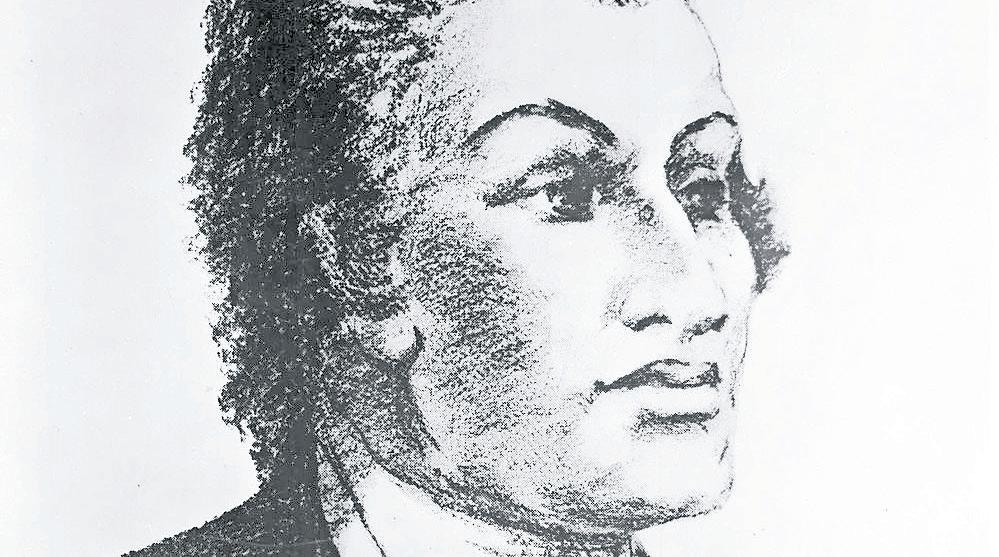
Portuguese Inquisition 300 years earlier, left his birthplace in Poland amid political upheaval and rising insecurity for Jews. Upon his arrival in New York City in 1775, he witnessed British oppression and quickly identified himself with the cause of the patriots, joining the Sons of Liberty.
Arrested by the British in New York for his loyalty to the patriot cause, Salomon escaped to Philadelphia in 1778. There, he flourished as a banker and financial broker. Fluent in multiple languages, his business acumen and personal integrity earned him the trust and respect of European financial houses.
The War of Independence, which began in 1775, had the support of some 40% to 45% of the population. Funding the war, especially when taxation was not permitted under the Articles of Confederation, required financial deftness and determination.
Salomon played a crucial role by brokering French and Dutch loans, selling bills of exchange and personally advancing non-interestbearing loans (which were never repaid) in order to support the war effort. In short, Salomon bankrolled the early Continental Congress and likely kept the fledgling republic afloat.
Albert Bushnell Hart, a professor emeritus of history at Harvard University, noted of Salomon: “It looks as though his credit was better than that of the whole thirteen United States of America.”
Robert Morris, superintendent of finance for
the Continental Congress from 1781 to 1784, appointed Salomon as official broker to the Office of Finance. According to entries in Morris’s diary, Salomon made private loans to prominent statesmen such as James Madison, Thomas Jefferson and James Monroe, on which Salomon would not charge interest.
Madison wrote a letter to Edmund Randolph (who would later become US Secretary of State) on Sept. 30, 1782, in which he referred to Salomon’s generosity:
I am almost ashamed to reiterate my wants so incessantly to you, but they begin to be so urgent that it is impossible to suppress them. The kindness of our little friend in Front Street near the Coffee House is a fund which will preserve me from extremities, but I never resort to it without great mortification, as he obstinately rejects all recompense.
An entry in the Congressional Record dated March 25, 1975, records California Rep. George Danielson as saying,
When Morris was appointed Superintendent of Finance, he turned to Salomon for help in raising the money needed to carry on the war and later to save the emerging nation from financial collapse. Salomon advanced direct loans to the government and also gave generously of his own resources to pay the salaries of government officials and army officers. With frequent entries of “I sent for Haym Salomon,” Morris’ diary for the years 1781-84 records some 75 transactions between the two men.
Over those three years, Salomon’s fundraising and personal lending helped provide $650,000 for the American cause — approximately $15.1 million in today’s money.
He also raised thousands of dollars for food and clothing for the Continental Army and personally guaranteed all debts incurred by the Revolutionary forces. Simon Wolf, in his 1895 book “The American Jew as Patriot, Soldier and Citizen,” sums up the role played by Salomon, noting that “the monetary contribution by Haym Salomon to the successful issue of the
Revolutionary struggle was doubtless the largest made by any individual.”
The Jewish population of the 13 colonies at the time of the war was only 2,500 out of a total of 2.5 million. It is estimated that as many as 90% of American Jews supported the patriot cause, including Haym Salomon’s brother-inlaw, Lt. Col. Isaac Franks (his wife’s brother), who served in George Washington’s army. By 1781, with the war in its sixth year and resources dwindling, Gen. George Washington was in dire need of $20,000 for a crucial battle. He sent word to Morris, who responded that the troops were on the verge of mutiny. According to a widely reported account, Washington wrote back: “Send for Haym Salomon.”
The money, secured by loans through Salomon’s brokerage company, was raised within days, enabling Washington’s troops to continue on to Yorktown and deliver the decisive blow that forced Lord Cornwallis to surrender, leading to the war’s end.
Salomon sacrificed nearly his entire fortune to American independence. When he died suddenly in Philadelphia on Jan. 6, 1785, at just 44 years old, he left his wife and young children penniless, as the government had not repaid most of the money that Salomon had advanced. His contribution went mostly unacknowledged for many years. But in 1975, the US Postal Service issued a stamp in his honor, describing him with these words: “Financial hero — Businessman and broker: Haym Salomon was responsible for raising most of the money needed to finance the American Revolution and later to save the new nation from collapse.”
Happy 250th birthday, America — with gratitude to our founders, the brave soldiers who fought gallantly and those like Salomon.
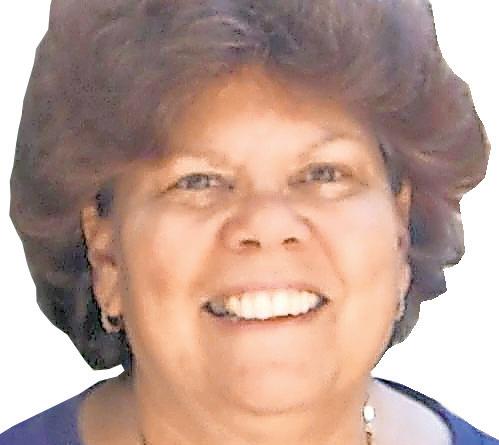
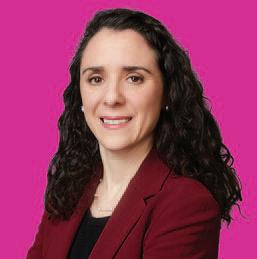
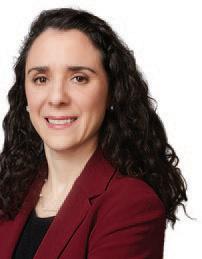
Ferne Hassan, a speaker for CAMERA, broke ground by co-producing “Jihad for Kids,” a video that revealed how the Palestinian Authority was training children to become suicide martyrs.
Write: Columnist@TheJewishStar.com
Ret. LI Congressman

Every Fourth of July is cause for parades, hot dogs and backyard barbecues. But this year’s commemoration is special. It marks the unprecedented success of the greatest experiment in history: 250 years of representative government, which has provided more people with more freedom and opportunity, attained more international power and done more for justice and peace around the world than any nation in history.
I say this not as a super patriotic or chauvinistic extremist, but as someone who has studied history and experienced 28 years as a member of Congress. I know that even among too many of its own citizens, America is not held in universally high regard. Indeed, recent polling shows that only 29 percent of the members of one of our major political parties are proud to be Americans. Among many countries, including some we have liberated or defended, support for America is considerably less. This disdain, especially among our own citizens, is regretful and shameful — and without foundation.
Unlike the overwhelming majority of countries that have been ruled by dictators and, in many cases, tyrants,
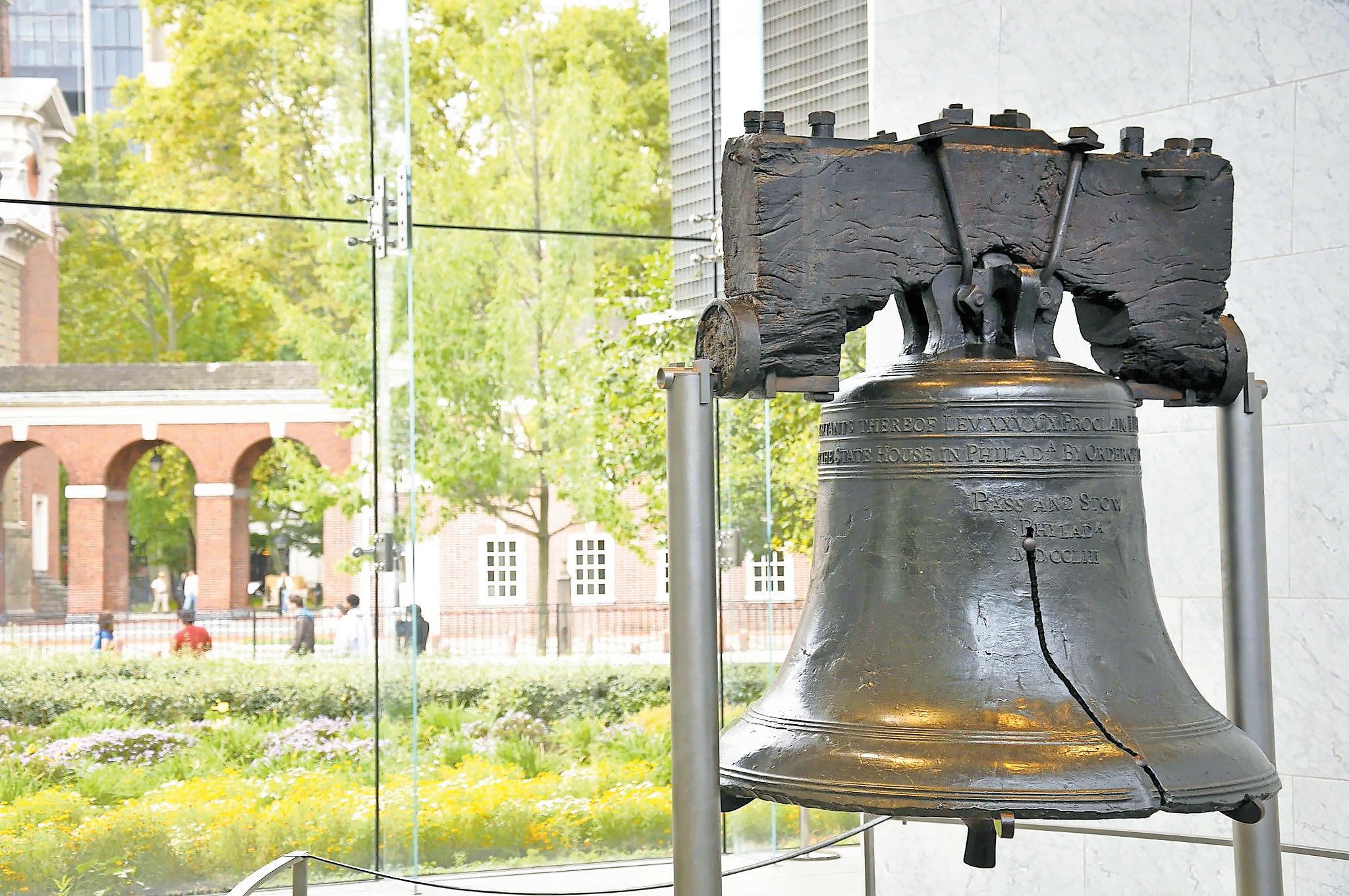
the United States has always been a representative democracy, with the people having the final word in choosing our leaders.
Having traveled to many countries during my time in Congress, including emerging democracies and countries liberated from Soviet domination, I’ve seen firsthand how much their people cherish the right to vote and being able to take part in the political process.
Similarly, they admire and attempt to emulate our freedoms of speech, religion and assembly and a free press. Before the naysayers go apoplectic,
I acknowledge the imperfections in our history. Women’s suffrage wasn’t achieved until the second decade of the 20th century. The evil of slavery, though ended by the bloody Civil War, will forever stain our history, as will the injustice of Jim Crow. The beauty of our system, though, is that our founding fathers saw America as an evolving experiment, as expressed in the words of the Constitution, “to form a more perfect union.”
Uniquely, the US is a nation of immigrants from countless countries, many of whom were warring with one another before arriving on our shores.
It hasn’t always been easy, but so many peoples from disparate cultures have come together to form a common union while maintaining their own traditions, resulting in a beautiful mosaic, a stained-glass window. Waves of immigrants give our nation new and needed lifeblood.
All my grandparents were immigrants who came here with no money and little formal education. Nothing was handed to them when they got here, yet they worked hard to achieve the American Dream, and each generation has done better than the one before it. At various times, of course, there have been intense debates over what our immigration policy should be.
At times those debates were shameful, such as when exclusion laws were adopted against Chinese immigration, and when the State Department refused to admit Jews attempting to escape Hitler’s Germany. There were also the dangerous excesses of the Biden years, when at least 10 million immigrants entered the country illegally, without examination for criminal or terrorist activity.
I believe that while immigration brings needed energy and vitality, it must follow laws that are strictly enforced. A nation without borders isn’t a nation. And to the naysayers, I would note that more legal immigrants enter our country each year than any other nation.
Emerging democracies want to emulate our freedoms.
In foreign policy, America tried to avoid foreign wars into the 20th century. Attempts at isolationism and Fortress America were shattered by two world wars and the Cold War, when we realized we could no longer rely on two huge oceans to shield us from “foreign wars.”
After World War II, when we had a monopoly on nuclear weapons and the world’s strongest economy, we adopted the Marshall Plan and established defensive alliances such as NATO to rebuild Europe and prevent Soviet expansion. In the ensuing eight decades, Europe has been rebuilt, the Iron Curtain has come down and, for the first time in centuries, there was no invasion of one European country by another until Russia’s invasion of Ukraine in 2022.
None of this stability would have been possible without American leadership. We have every reason to be proud of what our nation has achieved at home and throughout the world. Happy birthday, America! Published in the LI Herald.
Write: Columnist@TheJewishStar.com
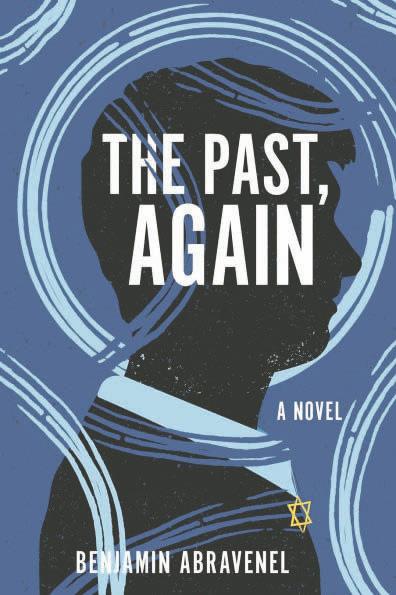
The Past, Again is a contemporary novel exploring identity, family relationships, antisemitism, media culture, and the lingering weight of history through the story of a Jewish family confronting rising public hostility after a viral incident. The novel blends family drama with timely social issues that are especially relevant to the growing threat of antisemitism in America.
By Rikki Zagelbaum, JNS
Some Jewish New Yorkers and others concerned about Mayor Zohran Mamdani’s antiIsrael views have warned that the successes of three Mamdani-backed candidates in Democratic primaries last week suggest that Jewhatred is rising to unprecedented levels in the Big Apple.
But Rabbi Ari Berman, president of Yeshiva University, believes that the results simply confirmed a threat that was already present.
“I don’t think it’s new,” he told JNS. “This is an effort that was there beforehand. There were some wins and some losses, and it’s important to be mindful.”
While the Democratic Party has embraced some politicians with antisemitic and anti-Israel views, Rabbi Berman stopped short of saying that antizionism drove voters in the primaries or that the electorate shares the views of antiIsrael candidates.
“The research, as far as I know, hasn’t yet been done to know whether antizionism was a driving factor in the electorate, or whether people were voting on incumbency fatigue and pocketbook issues,” the Yeshiva president said.
“With that said, it is clear that there’s an organized effort by certain politicians, led by Zohran Mamdani, to attack Zionists and American values like free enterprise, self-determination and capitalism,” he said.
Brad Lander, the antizionist Jewish former city comptroller who accuses Israel of “genocide,” trounced Rep. Dan Goldman by more than 31 points in the primary for New York’s 10th Congressional District, which stretches from Lower Manhattan to Park Slope.
Darializa Avila Chevalier, who was part of the anti-Israel encampment at Columbia University, unseated a five-term congressman who chairs the Democratic Hispanic caucus in the
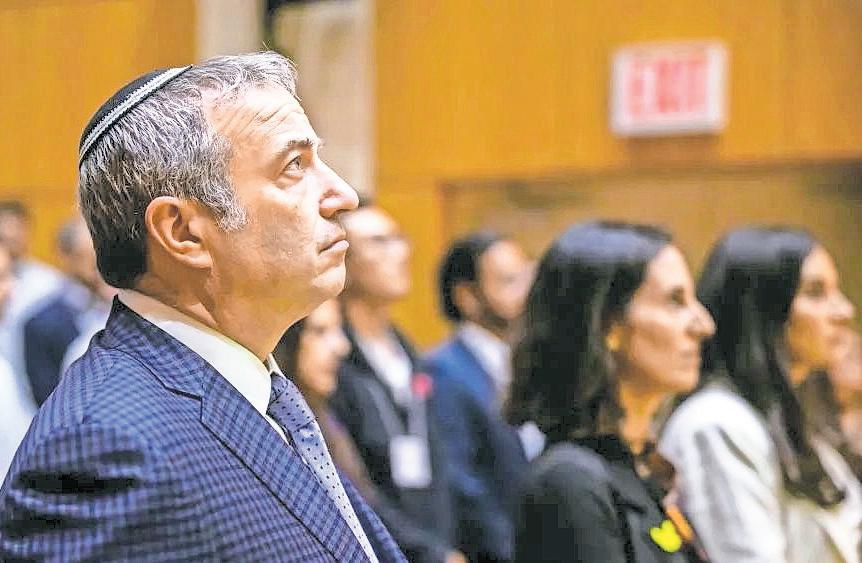
House, and New York state Assembly member
Claire Valdez won a race for an open seat. Valdez won by more than 20 points, and Chevalier by 3.5 points.
Rabbi Berman said that there is what he described as a socialist party at the helm of the attack on America’s core values. Antizionism is “the core element” of that effort, he said.
“For someone to deny the rights of the Jewish people to have a state, while comfortably accepting all of the Christian and Muslim states that exist in the world, it’s a double standard, it’s discrimination and it’s antisemitism,” he said.
“Antizionist, anti-capitalist, anti-American
ideals — it’s all part of a broader agenda,” he said. “It’s very clear. It’s self-stated.”
“It’s important to know that and to respond collectively and appropriately,” he said.
The Brooklyn coffee shop Poetica said two days before the primary that it was returning Goldman’s money and that the congressman’s business wasn’t welcome because he supports Israel.
Inna Vernikov, a Republican member of the City Council who is part of its Jewish Caucus and co-chair of its bipartisan task force on Jew-hatred, told JNS that the shop’s action, “while masked as righteous ‘antizionism,’ was
a clear move to exclude Jews from public life.” It is essential not to normalize that, and it must be opposed “with every fiber of our being,” she said.
JNS asked Rabbi Berman if the primary results keep him up at night.
“No,” the Yeshiva president said. “I think it’s an important moment for us to rally. I think that there is an organized effort, and we need to think about this consciously and embody, really, the core values of our community.”
Rabbi Berman does not fear for the safety of YU, which is located in the Washington Heights neighborhood of upper Manhattan.
“We’re not concerned about the university,” he told JNS. “We are concerned about New York and our community, that we need to be represented by people who actively oppose hate and work to actually bring people together.”
“I’m concerned about America,” he said. “This is our concern.”
Rabbi Jonah Pesner, director of the Religious Action Center of Reform Judaism, told JNS that he worries about the election results.
“We are deeply concerned by public leaders who vilify Jews and others who support Israel, including many who also strive for peace, support Palestinian rights and mourn the suffering of innocent civilians,” said the senior vice president of the Union for Reform Judaism.
“We reject the false choice between Jewish safety and Palestinian dignity,” said.
He added that the Reform Judaism movement will work with leaders across political and ideological lines when they share its values but will not tolerate rhetoric or actions that threaten Jewish safety.
“We will speak out forcefully when their words or actions undermine Jewish safety, demonize supporters of Israel or deny Israel’s right to exist and thrive in security,” Pesner said.


By The Jewish Star
JNS
Jewish comedy legend Mel Brooks celebrated his 100th birthday on Sunday, as he prepares to release the long-awaited sequel to his 1987 movie, “Spaceballs.”
“Spaceballs: The New One” is due out on April 23, reprising his fan-favorite roles as Yogurt and President Skroob.
Producer Josh Gad hailed Brooks as a once-in-a-generation talent who “continues to surprise and thrill us.” The EGOT winner, whose classics include “The Producers,” “Young Frankenstein” and “Blazing Saddles,” marked the milestone with birthday wishes pouring in from Ben Stiller, NASA and Jewish groups.
Brooks was married to Anne Bancroft until her death in 2005.
Israel’s health system went into full emergency mode on Monday — on purpose. The Health Ministry launched a nationwide earthquake drill simulating mass casualties, power failures, transportation shutdowns and widespread destruction. Officials said the exercise tested coordination with emergency agencies and the ability to keep hospitals running during a catastrophic disaster. Health Ministry chief Moshe Bar Siman Tov called earthquake readiness one of Israel’s toughest challenges. Israel is also dispatching an aid delegation to earthquake-hit Venezuela.
A Los Angeles public-school teacher says she married a man from Gaza to help him obtain US citizenship — sparking fierce backlash. Laura Pinho, who advises a Students for Justice in Palestine chapter, said her marriage was driven by support for the Palestinian cause. Records show she married Salem Abu Amra through Utah’s remote marriage system. Pinho also launched a GoFundMe that has raised more than $12,000 for him. Critics point to social-media posts they describe as
antisemitic, while analyst Eitan Fischberger alleged Abu Amra’s online activity glorifies violence and urged federal authorities to investigate.
A Jewish clinical intern says Boston Medical Center retaliated after she reported antiIsrael displays on a co-worker’s desk. A federal civil-rights complaint alleges she was isolated, denied mentoring and hit with a negative evaluation after raising concerns. Filed by the Louis D. Brandeis Center, the complaint accuses the hospital of violating federal antidiscrimination laws and seeks to remove the evaluation, provide a recommendation and strengthen protections for Jewish students and interns. The medical center had not responded publicly to the allegations at the time of the filing.
Artificial intelligence is taking on one of Judaism’s greatest mysteries. Israel’s Antiquities Authority has joined a five-year, $2.9 million European research project using AI, chemical testing and handwriting analysis to uncover where the Dead Sea Scrolls were written and copied. Researchers will study about 250 parchment, papyrus and ink samples, hoping to reveal who produced the ancient manuscripts, where they worked and how knowledge spread through Judea more than 2,000 years ago.
Israeli attorney Arsen Ostrovsky told Australia’s antisemitism commission he was bombarded with online abuse after surviving the Bondi Beach terror massacre. He said bloodied photos taken after the attack were doctored into fake images portraying him as an actor or “trauma tourist” while he was awaiting surgery. Ostrovsky called the campaign “dehumanizing” and warned the fight against antisemitism is a battle for Australia’s future. The commission is investigating the circumstances surrounding the December 2025 massacre.

By Steve Linde, JNS
Since the Hamas massacre of Oct. 7, 2023, Rachel Lester has produced viral videos viewed by millions around the world.
In her new book, “Digital Warrior: Inside Israel’s Battle for the Narrative After October 7,” the former Israel Defense Forces spokeswoman, who made aliyah from Los Angeles, argues that Israel’s fight for global public opinion has become as critical to its security as the war on the battlefield.
Israel still has much to learn about winning the digital war, she said. “The battlefield and the information war aren’t separate fronts anymore — they’re the same war.”
Lester, 31, traces her conviction to years of watching Israel lose ground online, beginning during her college years in the United States after leaving what she described as a strongly pro-Israel environment.
She said the turning point came during Operation Guardian of the Walls in 2021, when international criticism led to US pressure on Israel to end its military campaign.
“I saw how a series of PR nightmares led [former] President Joe Biden to pressure Israel to stop fighting, and Israel had no choice but to comply,” she said. “That was, I think, a turning point for the higher-ups in the IDF — they saw that international perception shaped our freedom to operate militarily.”
But it was the Hamas massacre of Oct. 7, 2023, and its aftermath that convinced her the information war

had become inseparable from military operations.
She pointed to the explosion at Gaza City’s Al-Ahli Hospital on Oct. 17, 2023, initially blamed on Israel before evidence showed it had been caused by a misfired Palestinian Islamic Jihad rocket.
“For about four hours, the international news was reporting that an IDF strike had killed 500 people,” she recalled. “The reaction of the world was immediate and extreme.”
“It didn’t matter what the truth turned out to be,” she said. “Whoever shapes the first narrative shapes public opinion, diplomatic pressure and ultimately the strategic environment in which military decisions are made.”
Lester credits her upbringing in Los Angeles and her education at the University of Southern California’s School of Cinematic Arts with teach-

ing her how to communicate Israel’s story to audiences unfamiliar with the Middle East.
While still a student, she created a viral YouTube video titled “Harry Potter and the Threats to Israel,” using scenes from the film series combined with real news reports to explain Israel’s security challenges.
“I realized that there was a vacuum in the world of hasbara in explaining the Israeli-Palestinian conflict in ways that would actually resonate with young Americans’ emotions, rather than rely on them to process facts,” she said.
That lesson shaped the hundreds of videos she later produced for the IDF’s official social media channels.
One of her most successful videos after Oct. 7 began with the line, “We need to talk about civilians in Gaza.” Rather than focusing on Israeli

victims, Lester said she highlighted Hamas’s cruel treatment of Gaza’s own civilian population.
“The video performed so well because I was talking about a subject the world actually cared about,” she said. “You have to frame and reframe your narrative in ways that your audience will want to hear — otherwise, you’re just preaching to the choir.”
Lester also addresses the challenges facing Jewish and pro-Israel students on North American campuses, many of whom feel overwhelmed by anti-Israel content online.
She encourages them to research issues they do not fully understand rather than becoming discouraged.
“Once I actually understand all the facts, I no longer feel overwhelmed,” she said. “I feel empowered to help change the narrative.”
Looking back some 1,000 days after Oct. 7, Lester believes Israel still misunderstands several key aspects of the information war. First, she argued, facts alone are not enough.
“Facts don’t win the digital war, emotions do,” she said. “We need to change our strategy on a national level to appeal to people’s emotions.”
She also called for a broader range of Israeli voices to represent the country internationally.
“There should be more young, Black, Arab, Druze, Muslim people representing Israel in the media and on social media,” she said. “If I could make one thing happen in the Ministry of Foreign Affairs, I would set up a program to teach English to cohorts

of diverse Israelis so that people in the West can relate to Israelis on a more human level.”
Finally, Lester warned that Israelis must better understand how individual actions can affect the country’s international standing.
“When enough politicians say despicable things and enough soldiers post videos of themselves doing horrible things on social media, Israel gets brought to the International Court of Justice on the charge of genocide,” she said.
“The IDF must punish soldiers who act inappropriately more severely (and publicly), and do a constant, widespread information campaign about social media etiquette,” she added.
Lester said the initial response to her book has been overwhelmingly positive, with interview requests arriving from media outlets around the world. The book has drawn praise from prominent pro-Israel voices, including Lt. Col. (res.) Jonathan Conricus, a former international spokesman for the IDF, and journalist Emily Schrader, both of whom endorsed it on the back cover.
She plans to spend the coming months speaking on college campuses across the United States to promote Digital Warrior and share her journey from being a lone soldier in the IDF to fighting Israel’s battle for the truth on social media.
“I look forward to bringing my personal story to every community and audience eager to hear it,” she said.


















By Rebecca Szlechter, JNS
Around 500 people gathered on Sunday at the Museum of Jewish Heritage in lower Manhattan for lessons, lectures, social play and vendors at the New York Jewish Mah Jongg Festival.
“I think people really just want to connect,” mahjong historian Gregg Swain told JNS at the event, which also takes place on Monday. “Nowadays, it’s just so easy to spend time doing something mindless on the computer. Mahjong really allows people to connect in different ways.”
Swain said that the game, which has Jewish roots, offers something increasingly rare in a digital world: face-to-face interactions across generations.
“The other day, I was playing a game, and I’m in my 70s,” she said. “There was somebody else in their 50s, and two people were in their 20s.”
“Only around the mahjong table would you find something like that,” she said.
In mahjong, players begin with 13 tiles on their racks and take turns drawing and discarding tiles to build a winning combination. Players aim to complete a specific pattern, known as a “hand,” from the annual National Mah Jongg League guide, known as the “card.”





The first player to complete a valid hand and declare “mahjong” wins the round.
Donna Kassman and Dara Collins, founders of Modern Mahjong, led instructional sessions at the festival, teaching newcomers the basics of the game, sharing strategies and explaining the 2026 National Mah Jongg League guide.
Kassman discouraged new players from feeling intimidated by experienced mahjong players and told attendees that the game can be learned with practice.
“Don’t be intimidated by people who play,” she told the crowd.
Kassman and Collins also reminded players to carefully study the annual National Mah Jongg League guide and understand the different tile combinations needed to win.
“I thought I could learn something new about Jewish mahjong, but also about Chinese mahjong, which I haven’t learned yet,” Daniela Taitel of Rye, NY, told said.
Taitel, who runs a company that organizes mahjong events and fundraisers, said that the game has created a strong community in Westchester County.
“Every Wednesday, we host mahjong events,” she said. “We’re about 200 women strong, and half of them are here today.”
Mahjong’s appeal has expanded beyond its traditional audience, according to Taitel.
“Mahjong’s demographic has widened, so it’s not just your grandmother’s game anymore,” she said. “It’s open to everybody.”
During her presentation at the museum, Swain traced the





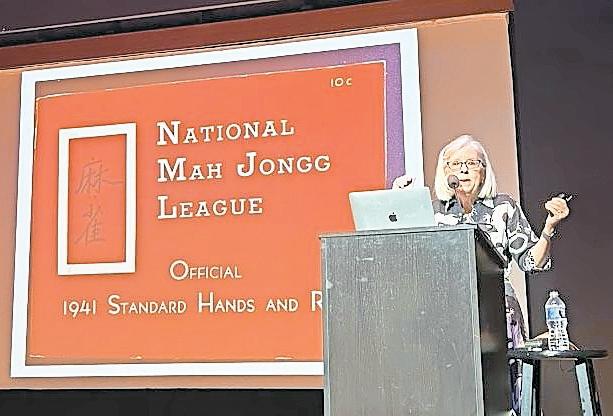
ways that the Chinese game became rooted deeply in American Jewish culture during the 1920s and 1930s.
She told attendees that as Jewish women organized social gatherings and charitable fundraisers, mahjong evolved from a pastime into a way to strengthen community ties.
The game was played everywhere from wealthy Manhattan homes to crowded Lower East Side tenements, providing friendship and relief during difficult periods, including the Great Depression, Swain told the crowd.
The creation of the National Mah Jongg League in 1937 helped standardize American rules and transformed the game into a uniquely American Jewish tradition, while supporting charitable causes through annual membership
cards, she said.
Swain also challenged what she said is a common misconception about the game.
“Many people like to think that it really is thousands of years old,” she told attendees.
Earlier Chinese card games date back centuries, but the version recognizable today emerged only in the mid-19th century, with later marketing efforts emphasizing its ancient origins to make it appear more exotic, she said.
Hasia Diner, professor emerita of history at New York University, said that mahjong’s popularity among Jewish women grew as their leisure time expanded in postwar America.
As household technology reduced the time that women spent on chores, the game offered women “a way to do
something pleasurable, just for themselves,” Diner, who wasn’t involved in the event, said.
Jewish Community Centers later hosted organized games, but mahjong first spread via informal family and friendship groups on a grassroots level, according to Diner.
The game also reflected the Americanization of Jewish life, according to the scholar.
Rather than replacing Jewish traditions, mahjong gave women “an avenue to a bigger, more fun world” while preserving strong family and community bonds, Diner said. “Playing mahjong did not threaten Jewish solidarity and bonds” but became a meaningful social outlet instead, she said.
Beyond the history lessons, the festival centered on community.
Players gathered around tables throughout the museum, compared strategies and shared stories, reflecting what many attendees described as the game’s greatest appeal: bringing people together.
“It’s a wonderful escape and vacation from the trials of everyday life,” Swain said. “When you’re sitting down at the mahjong table, all you’re really worried about is those little tiles in front of you and what you’re going to do to win.”





















Wandering Nation
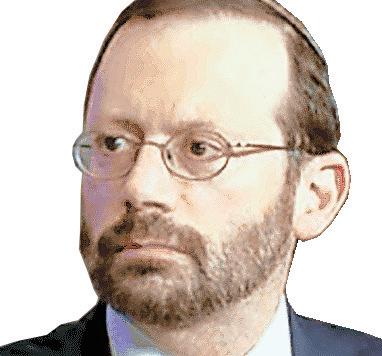
n the heart of Southeast Asia, thousands of miles from Jerusalem, lies a small island nation whose story bears a striking and often overlooked resemblance to that of the Jewish state.
Singapore, a gleaming city-state of fewer than 6 million people, is not only home to a vibrant Jewish community but has also forged a quiet yet profound partnership with Israel — one rooted in shared history, common challenges and a remarkably similar worldview.
The Jewish story in Singapore began in the 19th century, when the island was transformed into a British trading hub. Drawn by opportunity and tolerance, Jewish merchants, primarily from India’s Baghdadi community, settled there in 1840. Like Jewish communities elsewhere, they arrived with little but faith and determination, and quickly set about laying the foundations for Jewish life.
At the center of that life stood the synagogue.
The historic Maghain Aboth Synagogue, completed in 1878, became the beating heart of the community, followed later by the Chesed-El Syn-

agogue, built in 1905 by the community’s great benefactor Sir Manasseh Meyer. Both are still in use today. They were not merely houses of prayer. They were anchors of identity, places where a farflung Jewish Diaspora could gather, preserve tradition and pass it on to the next generation.
By the early 20th century, though numbering only in the hundreds, Singapore’s Jews had become an integral part of the colony’s economic and civic life. They excelled in trade, finance and real estate, contributing to the city’s rapid development while maintaining a strong sense of communal cohesion.
And perhaps, most remarkably, they did so in an environment relatively free of antisemitism — something that, in that era, was all too rare.
But history soon intervened.
When the Japanese invaded Singapore in 1942, the Jewish community — then numbering roughly 1,500 — was swept into the upheaval. Many were interned in camps such as Changi and Sime Road, where they endured deprivation, uncertainty and fear.
And yet, even in those grim conditions, Jewish life did not disappear.
One of the most poignant accounts from that time comes from Harry Elias, who was just a child when he was interned with his family. Years later, he recalled how, even behind barbed
See Singapore on page 12
By Michael Freund Wandering Nation
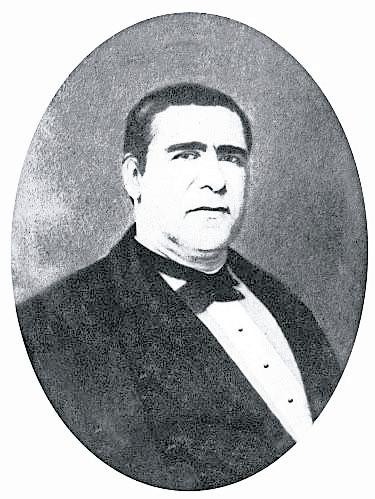
In the middle of the 19th century, one of the most influential men on the southern Pacific island of Tahiti was a Jewish merchant named Alexander Salmon (originally Solomon).
He was not a rabbi, communal leader or scholar. Nor did he come from one of the great centers of Jewish life in Europe or the Middle East. Born in 1820 in Hastings, England, Salmon would travel across the globe and settle in Tahiti.
Eventually, this English Jewish merchant married into Tahitian royalty, became a trusted adviser and secretary to the ruling dynasty and left an imprint on the island that is still remembered today.
His story constitutes a littleknown chapter in Jewish history, linking the Jewish people
to a distant corner of the South Pacific that most would never associate with Judaism.
When people think of Tahiti — the largest island in French Polynesia — they generally picture turquoise waters, lush mountains and whitesand beaches. Located more than 4,000 miles southwest of California, the island is synonymous with tropical paradise. But beneath the postcard imagery lies a fascinating historical connection to the Jewish people that stretches back nearly two centuries.
In the early 1800s, the island was undergoing a profound change. European traders, missionaries and adventurers were arriving in increasing numbers, bringing with them new ideas, new technologies and growing foreign influence. Tensions simmered between the Pōmare dynasty, which founded the Kingdom of Tahiti in 1788, local clans and rival European powers, particularly Britain and France.
Salmon arrived in Tahiti in 1841 and quickly established himself as a successful merchant and businessman. His intelligence, ambition and commercial skills made him prominent in Tahitian society.
His life took an extraordinary turn in January 1842 when he married Princess Ariʻitaʻimaʻi, a high-ranking chiefess of the Teva clan and a close relative of Queen Pōmare IV. Queen Pōmare IV reportedly

suspended a Tahitian law prohibiting Polynesians from marrying foreigners for three days to allow the union to proceed.
The marriage placed Salmon at the center of Tahitian political and social life. He served as secretary to Queen Pōmare IV and became a trusted adviser during a pivotal period. He fathered several children, and after his daughter Titaua Salmon married Scottish merchant John Brander, the Salmon-Brander clan became one of the most influential in Tahiti for generations.
Another of Salmon’s daughters, Johanna Marau Taʻaroa Salmon, better known as Queen Marau, married King Pōmare V and became the last Queen of Tahiti. Their son, Alexander Salmon Jr., later played a significant role in the history of Easter Island, where
he became a major landholder and local power broker.
In an era when Jews in many parts of the world faced discrimination and legal restrictions, Salmon found himself occupying a position of influence in a Pacific monarchy. Though largely secular in practice, his Jewish identity remained part of his background amid the islands’ complex cultural shifts.
At the same time, Tahiti was increasingly falling under French influence. France established a protectorate over the islands in 1843 and formally annexed them in 1880. The transition marked the end of the independent Tahitian monarchy and ushered in a new colonial era. Salmon witnessed much of this transformation firsthand until his death on Aug. 6, 1866, in Papeete, the capital of French Polynesia.
Although his Jewish background was only one aspect of his identity, Salmon’s story stands as a remarkable example of how Jews often found themselves participating in and helping shape events far from the traditional centers of Jewish life. Contemporary observers, including naval officers and the author Herman Melville, noted Salmon’s theatrical personality and outsized influence.
For many decades after Salmon’s era, however, there was little organized Jewish presence in Tahiti. The islands were simply too remote to attract large numbers of Jewish settlers. Unlike communities that emerged in the Caribbean, South America or Southeast Asia, Tahiti never developed a substantial Jewish population.
That began to change in the 20th century, particularly after the upheavals of decolonization in North Africa. In the 1960s, a small number of Sephardic Jews, primarily from Algeria, along with some from Morocco and Tunisia, settled in French Polynesia. Most were French citizens seeking new opportunities in overseas territories.
Though modest in number, these newcomers laid the foundation for a renewed Jewish presence. In 1982, members of the community established the Association Culturelle des Israélites et Sympathisants de Polynésie (ACISPO). Eleven years later, in 1993, they dedicated the Ahava V’Achva Syna-
gogue, meaning “Love and Friendship,” in Papeete. The synagogue, nestled amid tropical flora such as palm, pomegranate, date and mango trees, includes a mikvah and social hall, with Torah scrolls donated from Paris and Los Angeles. Its very existence is noteworthy. There are few places on earth more geographically isolated than Tahiti. The nearest major Jewish communities are thousands of miles away. Obtaining kosher food can be challenging. Rabbis visit only periodically. Jewish educational resources are limited. Yet the synagogue continues to function as a focal point for local Jewish life, serving a largely Sephardic community. Today, the Jewish population of French Polynesia numbers fewer than 200. On ordinary Sabbaths, synagogue attendance may be modest. But during the High Holidays and major festivals, the community gathers in large numbers to pray together, celebrate their heritage and maintain a connection to Jewish tradition. Few tourists today encounter the story of a Jewish merchant from England who became part of a Polynesian royal dynasty and the tiny Jewish community that continues to thrive thousands of miles from any major center of Jewish life. In a place famous for its natural wonders, this story may be one of Tahiti’s most remarkable treasures of all.

Summer 2026 Starts Here.
2026 Summer Bucket List
❑ See a real Lunar Module ❑ Watch a Giant-Screen Movie ❑ Walk the Air & Space Trail ❑ Discover Aviation History ❑ Sit in an Airplane Cockpit ❑ Eat Astronaut Ice Cream

This year, skip the airport lines, expensive hotels, and rising travel costs. America’s 250th anniversary is happening right here in your own backyard.
Join us for a summer-long celebration of aviation, innovation, exploration, and discover with special exhibits, family events, and full-dome films on Long Island’s largest screen!
From early air fields to the Moon, Long Island helped shape America’s story. Come celebrate where history took flight. Scan the QR code or visit www.cradleofaviation.org/celebrate250

and

wire, the Jewish community found ways to preserve its identity.
In the camp, Jewish inmates were able to organize a kosher kitchen. It may sound like a small detail. In truth, it was anything but.
The kitchen ensured that Jews could continue to observe kashrut even in captivity, a quiet but powerful assertion of dignity. More than that, it became a source of hope. In a place defined by hardship, it provided a sense of normalcy, a connection to tradition and a reminder that even in the darkest of times, one’s identity need not be surrendered.
Think about that for a moment. In a prison camp, under enemy occupation, with the future uncertain and survival far from guaranteed, Jews in Singapore insisted on keeping kosher.
It is a detail that encapsulates something

profound about the Jewish people.
Because Jewish survival has never been only about enduring physically. It has always been about remaining spiritually intact, about holding fast to who we are, even when the world around us collapses.
In this, the Jews of Singapore were no different from their brethren elsewhere. The setting may have been Southeast Asia rather than Europe, but the instinct was the same.
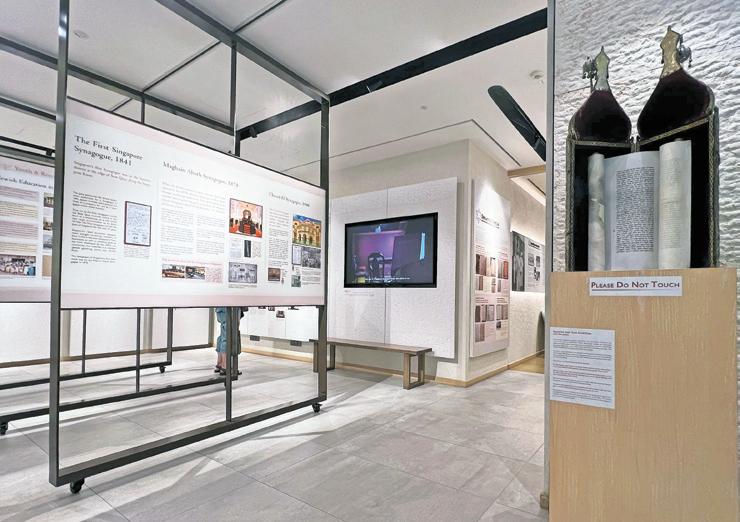

After the war, like so many Jewish communities, Singapore’s Jews found themselves at a crossroads. Many emigrated to Israel and the West, leading to a sharp decline in numbers. But the community did not vanish. Instead, it adapted, and in recent decades, it has experienced a quiet but remarkable revival.
Indeed, Jewish life in Singapore is once again vibrant.
The community — now around 2,500

Our team covers news that matters to Modern Orthodox communities in Metro New York (Long Island, Queens, Manhattan’s Upper East Side and Upper West Side, Riverdale and Westchester).
Assignments include community events; school, business and health news; local personalities; Jewish institutions; holidays and entertainment; antisemitism and antizionism; politics; Jewish America; the impact of developments in Israel on our local communities, and more.
Position offers expert mentoring, starting salary of $36,400 to $39,520 plus a full benefits package that includes medical, dental, 401(k) and Jewish and secular holidays — all in a supportive, collegial and kosher environment.
Reply: Candidates with reporting and news-writing experience (professional or collegiate) are invited to email a cover letter, resume and 4 to 6 clips or links to Publisher@TheJewishStar.com. Put REPORTER in subject line.
•Lead a growing team of correspondents
•Initiate and refine story ideas
•Assign and write articles
•Edit staff and freelance submissions
•Verify rights to submitted art
•Organize print and web layouts, working with page designers and AI software
•Expand our digital footprint (including website, e-newsletters and social media)
•Help plan Jewish-centric events
•Work with the Publisher and the RCI team on a range of common projects
Required
•News reporting experience
•Copy editing and proofing skills
•Familiarity with and sensitivity to Jewish issues
•Experience with editorial contributors
•Ability to meet deadlines
•Attention to detail
•Familiarity with web and SM conventions
Salary: Starting at $50,960 to $62,400 plus a full benefits package that includes medical, dental, 401(k) and paid Jewish and secular holidays.
Reply: Cover letter, resume, 4 to 6 clips or links to Publisher@TheJewishStar.com.
Are you repressed in a workplace overrun by woke truthiness, debased values and Israel-hate? Is your professionalism challenged when truth falls victim to scorched earth politics?
If you’re ready to come home, consider an opportunity at The Jewish Star, where Torah-true honest reporting and ethical business practices are a priority.
Wear your Jewish Star proudly in a kosher environment and help make Jewish journalism great again.
Selling advertising in The Jewish Star is just part of this job. Our staff’s toolkit is exceptionally broad, including
• Religious and secular publications
• Websites
• Content generation and editing services
• In-person and digital events
• Digital, email, radio and SM marketing
• Direct mail
• Commercial printing
• Local, regional, national, int’l reach
Employees are trained by the best in the business, in a supportive, collegial and kosher environment. Competitive compensation (salary and commission $45K-$90K) plus a full benefits package that includes medical, dental, 401(k) and paid Jewish and secular holidays.
Reply: Send a cover note and resume to Publisher@TheJewish Star.com.
Latch your career to a rising Star, a 24-yearold independent news operation that is part of RCI (Richner Communications Inc), a 100employee family-owned company with offices in Garden City and Riverdale. Positions are full-time in-person or hybrid (but part-time and freelance inquires may be considered).
strong, locals and expats alike — gathers at the Jacob Ballas Jewish Community Centre, where a Sunday school and preschool educate the next generation and kosher dining and shopping help sustain daily Jewish life.
Synagogues remain active, communal institutions thrive, and kosher food is available not only for residents but also for the steady stream of Jewish visitors and businessmen who pass through the city.
It is a remarkable example of continuity in a place where Jews have now lived for nearly two centuries.
Yet Singapore’s connection to the Jewish people extends beyond its own community. When Singapore gained independence from Malaysia in 1965, it faced a daunting reality: a small, vulnerable nation surrounded by larger neighbors, uncertain of its future. It was a situation that bore an uncanny resemblance to that of Israel.
And so, Singapore turned to the Jewish state.
Its founding father, Lee Kuan Yew, famously described Singapore as “an Israel in a Malay-Muslim sea,” recognizing the parallels between the two countries. Both were small, resource-poor states navigating complex and sometimes hostile environments. Both needed to build strong defenses, resilient economies and unified societies.
Israel responded.
Jewish survival has never been only about enduring physically. It has been about remaining spiritually intact, about holding fast to who we are, even when the world around us collapses.
In Singapore’s early years, Israeli advisers played a crucial role in building its armed forces, helping to shape what would become one of the most capable militaries in Asia. The relationship, though often discreet, was deep and consequential.
What began as a quiet security partnership has since blossomed into broad cooperation in technology, innovation and trade: two small nations still proving that brains and determination can outmatch size and resources.
But the similarities go far beyond security. Both Singapore and Israel have built societies that emphasize education, meritocracy and national responsibility. And both have understood that survival requires constant vigilance and adaptability.
There is also a shared mindset. Neither country can afford complacency. Neither can take its future for granted. And both have internalized the same lesson: that resilience is not a luxury but a necessity.
For Singapore, the Jewish story is not something distant. It is embedded in the nation’s history, in its synagogues, its institutions and the contributions of Jewish citizens who helped shape its development. For Israel, Singapore represents something equally powerful — a reminder that even in the most unlikely places, Jewish life can take root and endure.
In an age of growing division, the relationship between Singapore and Israel offers a compelling example of what is possible: two small nations, two unlikely success stories. Two peoples who understand what it means to persevere. Singapore may not be Jewish, and Israel may not be Southeast Asian. Yet in spirit, in struggle and in success, they are kindred.













































































































































“Happily, the Government of the United States, which gives to bigotry no sanction, to persecution no assistance, requires only that they who live under its protection should demean themselves as good citizens. … May the children of the stock of Abraham who dwell in this land continue to merit and enjoy the good will of the other inhabitants, while every one shall sit in safety under his own vine and fig tree and there shall be none to make him afraid.” From George Washington’s Letter to the Jews of Newport, Aug. 18, 1790
Jewish Star Torah columnists: Rabbi Benny Berlin, spiritual leader of BACH Jewish Center in Long Beach; Rabbi Avi Billet of Anshei Chesed, Boynton Beach, FL, mohel and Five Towns native; Rabbi Binny Freedman, rosh yeshiva of Orayta, Jerusalem; Dr. Alan A. Mazurek, former ZOA chair, retired neurologist, living in Great Neck, Jerusalem and Florida.
Contributing writers: Rabbi Sir Jonathan Sacks zt”l, former chief rabbi of United Hebrew Congregations of British Commonwealth; Rabbi Yossy Goldman, president South African Rabbinical Association; Rabbi Dr. Tzvi Hersh Weinreb, OU executive VP emeritus.
To submit commentary, inquire at: Editor@TheJewishStar.com. Contact our columnists at: Columnist@TheJewishStar.com.
Thu July 2 / 17 Tammuz
Fast of Shiva Asar B’Tammuz
Fri July 3 / 18 Tammuz
Pinchas
Five Towns candles: 8:11 • Havdalah: 9:20
Scarsdale candles: 8:12 • Havdalah: 9:21
Fri July 10 / 25 Tammuz
Matot-Masei
Five Towns candles: 8:09 • Havdalah: 9:17
Scarsdale candles: 8:10 • Havdalah: 9:18
Fri July 17 / 3 Av
Devarim
Five Towns candles: 8:05 • Havdalah: 9:13
Scarsdale candles: 8:06 • Havdalah: 9:13
Five Towns Candlelighting: From the White Shul, Far Rockaway, NY
Scarsdale Candlelighting: From the Young Israel of Scarsdale, Scarsdale, NY
rabbi Sir
Just beneath the surface of this week’s parsha, Pinchas, is an exceptionally poignant story. It occurs in the context of Moses’ prayer that G-d appoint a successor as leader of the Jewish people.
One hint is given in the words of G-d to Moses: “After you have seen you also will be gathered to your people, as your brother Aaron was.” Rashi is intrigued by the apparently superfluous word “also” and makes the comment that “Moses desired to die as Aaron had died.”
In what sense was Moses envious of his brother? Was it that he, like Aaron, wished to die painlessly? Surely not. Moses was not afraid of pain. Was it that he envied his brother’s popularity? Of Aaron it was said that when he died, he was mourned by “all the Children of Israel”, something the Torah does not say in the case of Moses. This too cannot be the answer. Moses knew that leadership does not mean popularity. He did not seek it. He could not have done what he had to do and achieve it.
The Ktav Sofer gives what is surely the correct interpretation: Aaron had the privilege of knowing that his children would follow in his footsteps. Elazar, his son, was appointed as High Priest in his lifetime. Indeed to this day Kohanim are direct descendants of Aaron. According to Ktav Sofer, Moses longed to see one of his sons, Gershom or Eliezer, take his place as leader of the people. It was not to be.
Rashi arrives at the same conclusion by noting a second clue.
The passage in which Moses asks G-d to appoint a successor follows directly after the story of the daughters of Zelophehad, who asked that they be permitted to inherit the share in the Land of Israel that would have gone to their father, had he not died. Rashi links the two episodes:
“When Moses heard G-d tell him to
Education is a conversation across the generations.

give the inheritance of Zelophehad to his daughters, he said to himself, ‘The time has come that I should make a request of my own — that my sons should inherit my position.’ G-d replied to him, ‘This is not what I have decided. Joshua deserves to receive reward for serving you and never leaving your tent.’ This is what Solomon meant when he said, ‘He who keeps the vineyard shall eat its fruit and he that waits on his master shall be honored.’ Moses’ prayer was not granted.”
Thus, with their ears attuned to every nuance, the Sages and Rashi reconstructed a narrative that lies just beneath the surface of the biblical text. What happened to Moses’ children? Was he, the great leader, inwardly disappointed that they did not inherit his role? What deeper message does the text communicate to us? Is there something of continuing relevance in Moses’ disappointment? Did G-d in any way provide him with consolation?
Moses and Aaron epitomize the two great roles in Jewish continuity — horim and morim (parents and teachers). A parent hands on the Jewish heritage to their children; a teacher does likewise to their disciples. Aaron was the archetypal parent; Moses the great example of a teacher. Aaron was
succeeded by his son; Moses by his disciple Joshua.
The Sages at various points emphasized that Torah leadership does not pass automatically across the generations. The Talmud states:
Be careful not to neglect the children of the poor, for from them Torah goes forth, as it is written, “the water shall flow out of his buckets”, meaning “from the poor among them” goes forth Torah. And why is it not usual for scholars to give birth to children who are scholars? Rabbi Joseph said that it might not be said that Torah is their legacy. Rabbi Shisha, son of Rabbi Idi, said that they should not be arrogant towards the community. Mar Zutra said, because they act high-handedly towards the community. Nedarim 81a Were Torah leadership to be dynastic, a matter of inheritance, Judaism would quickly become a society of privilege and hierarchy. To this, the Sages were utterly opposed. Everyone has a share in Torah. It is the shared patrimony of every Jew. Nowhere is this more clearly stated than in the great words of Maimonides: With three crowns was Israel crowned — with the crown of Torah, the crown of priesthood, and the crown of sovereignty. The crown of priesthood
was bestowed on Aaron. ... The crown of sovereignty was given to David. ... The crown of Torah, however, is for all Israel, as it is said, “Moses commanded us the Torah, as an inheritance of the congregation of Jacob.” Whoever desires it can win it. Do not suppose that the other two crowns are greater than the crown of Torah, for it is said, “By Me, kings reign and princes decree justice. By Me, princes rule.” Hence we learn the crown of Torah is greater than the other two crowns.
This is one of the great egalitarian statements in Judaism. The crown of Torah is available to whoever seeks it. There have been societies which sought to create equality by evenly distributing power or wealth. None succeeded fully. The Jewish approach was different. A society of equal dignity is one in which knowledge — the most important kind of knowledge, namely Torah, knowledge of how to live — is available equally to all. From earliest times to today, the Jewish people have predominantly been communities built around schools, sustained by communal funds so that none should be excluded.
The Sages drew a strong connection between home and school, parent and teacher. Thus, for example, Maimonides rules:
A duty rests on every scholar in Israel to teach all disciples who seek instruction from him, even if they are not his children, as it is said, “And you shall teach them diligently to your children.” According to traditional authority, the term “your children” includes disciples, for disciples are called children, as it is said, “And the sons of the prophets came forth.”
In the same vein he writes elsewhere:
Just as a person is commanded to honor and revere his father, so he is under an obligation to honor and revere his teacher, even to a greater extent than his father, for his father gave him life in this world, while his teacher who instructs him in wisdom secures for him life in the World to Come.
The connection runs in the opposite direction also. Consistently throughout the Mosaic books, the role of a parent is defined in terms of teaching and instruction.
“You shall teach these things diligently to your children.”
“It shall come to pass that when your child asks you ... thus shall you say to him.”
Education is a conversation across the generations, between parent and child. In the one verse in which the Bible explains why Abraham was chosen as the father of a new faith it says, “For I have chosen him, so that he will direct his children and his household after him to keep the way of the Lord by doing what is right and just.”
Abraham was chosen to be both a parent and an educator.
Moses was therefore denied the chance to see his children inherit his role, so that his personal disappointment would become a source of hope to future generations.
Torah leadership is not the prerogative of an elite. It does not pass through dynastic succession. It is not confined to those descended from great scholars. It is open to each of us, if we will it and give it our best efforts of energy and time. But at the same time, Moses was given a great consolation. Just as, to this day, Kohanim are the sons of Aaron, so are all who study Torah the disciples of Moses.
Some are given the privilege of being a parent; others, the privilege of being a teacher. Both are ways in which something of us lives on into the future. Parent-as-teacher, teacheras-parent: these are Judaism’s greatest roles, one immortalized in Aaron, the other made eternal in Moses.
RABBI BENNY BERLIN
Jewish Star columnist BACH Long Beach
Before World War II, Rav Shneur Kotler got engaged. After the war, his kallah wrote him a letter breaking the shidduch. Her family was gone. The dowry her father had promised was gone. Her health had been broken by years of suffering.
“I had nothing left to offer,” she wrote, and was letting him go.
Rav Shneur Kotler wrote back one line.
“You lost your family. You lost your money. You lost your health. Did you think you were going to lose your chassan?”
That story offers a remarkable lens through which to read the Mishnah that introduces the Three Weeks.
The Mishnah in Ta’anis (4:6) lists five tragedies that occurred on Shiva Asar B’Tammuz:
•The Luchos were broken.
•The Korban Tamid ceased.
•The walls of Yerushalayim were breached.
•A Sefer Torah was burned.
•An idol was erected in the Beis HaMikdash.
Five wounds. Five moments that appeared to announce that the bond between Hashem and His people had been severed.
But there is another way of reading that Mishnah.
The Midrash in Shemos Rabbah (43:1) compares the Luchos to a kesubah, the marriage document between Hashem and Klal Yisrael. Another Midrash, Shemos Rabbah (46:1), describes what happened in the immediate aftermath of the Golden Calf. The Luchos were suspended between Heaven and earth, part in Hashem’s grasp and part in Moshe’s, and Moshe tightened his hold and pulled them away.
Think about that for a moment. Moshe fought to hold onto the very Luchos he was about to shatter. Why?
Because he understood that what looked like the end was actually a question.
When Hashem appears to pull away, do we loosen our grip, or do we hold on even tighter? Rabbi Akiva put it simply in Berachos (61b). Torah is to a Jew what water is to a fish. You do not negotiate with water. You do not decide you can live without it for a while and come back to it later. When something is your life, you hold on even when holding on makes no obvious sense. Moshe grabbed the Luchos because he refused to accept that the relationship was over, and the Torah itself tells us why. “Ki hu chayecha v’orech yamecha (This is your life and the length of your days)” (Devarim 30:20).
That refusal is the avodah of these weeks.
From Shiva Asar B’Tammuz through Ti-
sha B’Av, the halachos of mourning intensify steadily, as the Shulchan Aruch in Orach Chaim 551 spells out. Every passing week carries additional reminders of what has been lost. But mourning is not the same as surrender.
Eichah opens with a line that cuts both ways. “Kol rodfeha hisiguha bein hametzarim” (Eichah 1:3). On the surface it describes our enemies overtaking us in the narrow straits. But the Bnei Yissaschar hears something else in those words. Those who become rodfim, those who actively pursue Hashem, can find Him specifically bein hametzarim, during these very days of concealment and loss. The narrowing is not Hashem shutting the door. It is an invitation to chase harder.
The Midrash in Shir HaShirim Rabbah (5:2) puts it even more directly. “Pischu li pesach k’chudo shel machat,” Hashem says. Open for Me an opening no wider than the eye of a needle, and I will open for you an entrance as wide as the Ulam of the Beis
See Berlin on page 26
RABBI DR. tzvI hERsh wEINREB Orthodox Union
Are you feeling depressed? Then dance! Feeling lazy? Work! Angry? Smile! Hostile? Act friendly!
These are not merely glib bits of advice when there is nothing better to say. Rather, they reflect a deep common wisdom that teaches us that our behavior influences our emotions.
When we feel down in the dumps, the best thing we can do is to pretend, however artificially, that we are happy. To smile, to dress well, to be active and enthusiastic. Acting happy is one of the best antidotes for depression.
This insight into the mysterious workings of the human psyche turns out to be more than just common-folk wisdom. In medieval
rabbinic literature, it is the unknown author of the Sefer HaChinuch who consistently uses the maxim, “After one’s actions, one’s feelings follow.”
For him, this psychological fact is the reason for many of the rituals of Judaism. They are designed to provide us with a pattern of activity which will implant in us a desired set of inner attitudes and feelings.
Thus, for example, all of the many and detailed rituals which comprise the Passover service serve the purpose of stimulating inner attitudes of freedom and gratitude.
Not only were medieval rabbis aware of this profound psychological truth, but the much later thinkers also prescribe action and activity as a way of influencing one’s inner emotional life. William James, more than one hundred years ago, noted in his Principles of Psychology that outer behavior has a powerful effect upon internal emotions. In the psychological jargon of the late nineteenth century, this was known as the James/Lange theory.
We all have witnessed this phenomenon in our everyday lives. We know kindergarten teachers whose babytalk and immature classroom conversational styles have influenced their out-of-school personalities, so that even in adult conversation they demonstrate a peculiar childishness. And I know personally of several shochetim, ritual slaughterers, who have consciously fought the tendency toward cruelty to animals, which their profession has instilled in them.
The fact that some of the wisest women I know are kindergarten teachers, and some of the gentlest fellows around are shochetim, is simply testimony to the efforts they have invested to undoing the powerful impact of the behaviors which they perform every day.
What about the soldier, the person whose task involves violence and the harming of other people? Does his behavior, however necessary to defend his life and the lives of his dear ones, change him into a violent and cruel human being? I think that the answer is yes, and I have spoken to many soldiers who have corroborated this and report feeling hardened and callous after their battlefield experiences.
It is no wonder then that Pinchas, the hero of this week’s Torah portion, after he thrusts a spear through the viscera of a Jewish prince and a Midianite princess, is granted the “covenant of peace.” He committed a bloody act of violence, warranted only in rare and extreme situations, and that single act posed the danger of his deep internal transformation from a priest of peace to a violent murderer. The Almighty found it necessary to bless him with a special gift, His own Divine Brit Shalom. It was none other than Golda Meir, whose
See Weinreb on page 26
As my wife and I spent our last Shabbat in Yerushalayim before returning to the United States for the summer, conversations in both Israel and America kept returning to the same urgent question: what makes a leader?
In America, the discussion centers on President Donald Trump. In Israel, with elections expected in October and existential challenges on every front, it centers on Prime Minister Netanyahu. Both men are unquestionably leaders, yet both are also lightning rods, loved and hated with unusual intensity. Their examples force us to ask not only what makes a leader, but what makes a Jewish leader.
The end of last week’s parsha, Balak, and the beginning of this week’s, parshat Pinchas, describe the heroic act of Pinchas ben Elazar, grandson of Aharon. As a child learning these parshiyot with Rashi, I saw him as a superhero — while a plague was devastating B’nei Yisrael,
Pinchas acted decisively, stopped the plague, and restored Hashem’s honor. For this he was rewarded with Kehuna and Shalom. At first glance, he seems like the obvious model of leadership.
Yet Rashi and Chazal teach that the matter is more complex. Pinchas acted properly, but as a kanai, a zealot. Zealotry can be necessary and even holy, but it is dangerous and difficult to distinguish from violence unless guided by Divine sanction. That is why Hashem Himself had to defend Pinchas before the people.
The Midrashim connect Pinchas with Eliyahu, another great zealot who will one day herald the arrival of Moshiach. Both are pivotal and consequential, but neither is presented as the national leader. Zealotry may save a moment; leadership must sustain a people.
To understand Jewish leadership, one must look at three distinct personalities, all of whom shared the same three basic attributes, that best served Am Yisrael at their time.
First, of course, Moshe Rabenu, the most important leader of the Jewish people, leading us out of Mitzrayim, through 40 contentious years in the desert. Forever our teacher, who enabled us to hear Hashem speak to us directly.
Second is Yehoshua, who accepted the mantle from his teacher and mentor Moshe, and led B’nei Yisrael in battle to successfully conquer and settle Eretz Canaan and rename it Eretz Yisrael.
Third is David HaMelech, sweet singer of Israel, fierce warrior and the first to completely unite the Jewish people in our homeland, Eretz Yisrael. This gave him the right to be father of Melech HaMoshiach.
And what three attributes did they all share?
We read that in the final pasuk of last week’s haftara from the navi Micha,6:8: What does Hashem seek from you: only the performance of justice, the love of kindness, and walking humbly with your G-d
1) Justice: A leader can act justly only if grounded in Torah. Moshe received Torah directly from Hashem; Yehoshua never departed from Moshe’s tent; and David HaMelech remained connected to Torah even while leading
the nation in battle.
2) Love of Kindness: Moshe’s leadership begins with empathy for a suffering Jew and continues with repeated pleas for Hashem to forgive B’nei Yisrael. Yehoshua, even after the sin of Achan, addresses him gently as “my son” and urges him toward confession and teshuva. David too shows kindness repeatedly, most notably by sparing Shaul and later protecting Mephiboshet, Shaul’s descendant, despite the political risk.
3) Humility: Moshe is described as the most humble man on earth. Yehoshua remains faithfully at Moshe’s side and never seeks honor for himself. David credits Hashem for his success, accepts rebuke from Natan with the words chatati,” and is willing to humble himself publicly for the glory of Hashem.
This is what we should look for in a leader.
Micha teaches that Hashem seeks these qualities from all of us, not only from those who lead. In Israel I have met countless young men and women who display justice, kindness and humility.
Our future leaders are out there; we as a people must strive to be worthy of them.
Shabbat Shalom.
Write: Columnist@TheJewishStar.com


























































































































Irecently had dinner in an Italian restaurant that makes these amazing little garlic knots. They are crispy on the outside and fluffy soft on the inside — the kind of bread that pulls apart in yeasty-soft layers as the steam rises from between them.
The baker takes the knots, hot from the oven, breaks them into rectangles of nine knots and quickly places them in a parchment-lined basket. The bread itself is heavenly but then comes the magic — he takes a ladle-full of large amounts of minced garlic that has bathed for hours in an olive oil/butter bath and floods the knots. A dusting of Parmesan cheese tops the delicacy.
The perfume fills the restaurant. As all eyes look towards the servers carrying the baskets of hot garlic knots.
To some people, garlic is truly “the stinking rose,” and I have met people who vehemently dislike garlic’s pungency and aftereffects. To others, garlic triggers effusive passion; a dish without garlic may not be worth eating.
Garlic is an ancient food, cited in the Book of Ezra. At one point, the returning soldiers are urged to eat lots of garlic to arouse sexual passion and increase the likelihood of many offspring. Ancient cultures revered garlic for its medicinal purposes, and some thought it was an aphrodisiac.
Research shows that garlic does have antiinflammatory, anti-cancer properties, and that it lowers the risk of heart disease. In China, Italy and Korea, the average consumption is eight to twelve cloves of garlic per person per day. While that may sound like a lot, you can increase your intake to six cloves a day simply by cooking with garlic at most dinners and some lunches. The health properties may just be an added benefit to the deliciousness of the “stinking rose.”
• 1 oz. sun-dried tomatoes in oil, drained and finely chopped
• 8 oz. cream cheese, softened
• 1 to 2 Tbsp. milk
• 1 tsp. finely minced garlic
• 1 tsp. grated onion
• Pinch black pepper
• 1 tsp. dried parsley flakes
• 1 to 2 oz. smoked salmon, finely minced
Finely mince the tomatoes and set aside. Place softened cream cheese in a food processor and process with milk until smooth. Add tomato mixture and pulse once or twice. Add the garlic, onion, pepper and parsley; pulse once or twice. If the mixture is too thick, add a bit more milk. Scrape the cheese mixture into a bowl and add the salmon. Blend with a fork until evenly mixed. Cover with plastic wrap and refrigerate until serving. Serve with crackers or croutons.
• 1 package frozen puff pastry
Filling:
• 1 (8-oz.) package goat cheese, brickstyle cream cheese, or Gruyere, grated
• 1/4 cup sour cream
• 1 tsp. garlic powder


• 1/4 tsp. black pepper
• 1/4 tsp. salt
• 1/2 tsp. parsley flakes
• 1 Tbsp. fresh chives, minced
Topping:
• 3/4 cup roasted garlic cloves
• 1 Tbsp. of canola oil
• 2 Tbsp. butter
• 2 Tbsp. olive oil
• 3 scallions, white and green, chopped
• 1/2 lb. mixed mushrooms (I use about 10 oz.
• 1 Tbsp. fresh thyme leaves
• 1 tsp. garlic powder
• 1 tsp. onion powder
• 1/4 tsp. salt
• 1/4 tsp. black pepper
• 1/2 tsp. parsley flakes
• 1/4 cup white wine or garlic cooking wine
Defrost the pastry as directed.
For filling: Place all ingredients in the bowl of a food processor and pulse a few times until mixed and smooth. Set aside.
For topping: To roast garlic, preheat the oven to 400 degrees. Place the peeled cloves in a bowl and toss with about 1 tablespoon of canola oil. Place on a foil-lined, rimmed baking sheet.
Roast until soft and brown, 20-30 minutes. Shake the pan a few times to turn the cloves. Let cool.
Place the butter and olive oil in a large, heavy skillet over high heat. Heat until the butter foams; add the onions and cook until translucent and just starting to turn golden. Add the mushrooms and cook them until they start to brown. Add the roasted garlic, seasonings and wine; cook until the liquid evaporates, about 3-5 minutes. Set aside. Heat oven to 425 degrees. Place the puff pastry sheet on cookie sheet. Spread the cheese mixture to within 1/2- inch of the edge. Fold edges up a bit to make a rim, pinching at the corners. Top with the mushroom mixture and garlic. Bake until golden brown, about 30 minutes.
I love this on the grill and even in the oven in winter.
• 1/3 cup extra-virgin olive oil
• 4-6 large garlic cloves, minced
• 1/4 cup minced fresh dill
• 2 tsp. salt
• 1 tsp. freshly ground black pepper
• 1 (3-lb.) whole filet of salmon, skin on, scored into serving pieces
• 1 tsp. lemon zest, plus lemon wedges for serving
Place a large (5-to-7 inches wide and 16-to20 inches long) untreated cedar plank in a clean container (I use an aluminum steam table tray). Fill the container with about 2-3 inches of water and place a heavy pot on top of the plank. Fill the pot with water to weigh the cedar plank down
Continued from page 19
and keep it under water. Let soak for at least 2 hours or even overnight.
Pour the olive oil in a medium sized bowl and add the garlic, dill, salt, pepper and lemon zest. Mix well and let sit for about 20 to 30 minutes or overnight.
Heat the grill on high or make a hot charcoal fire. Place the plank on the fire and close the cover or tent with foil. Let heat for about 5 minutes or until you see smoke.
Brush both sides of the salmon with the olive oil mixture.
Carefully slide the salmon onto the center of the hot plank. Move the plank off direct heat and close the grill cover. Cook for 10 minutes and then baste with more of the marinade. Cook another 5 minutes and baste again; repeat after 5 more minutes. Check for doneness. It will probably need a few more minutes of cooking time. If you have an instant read thermometer, the temperature should be 125-130 degrees for medium — the flesh will be barely opaque in the middle.
Carefully slide the the plank with the salmon onto a heatproof platter. Let rest for 5 minutes. Serve with lemon wedges and, if you like, dill sauce. Serves 6 to 8.
• 1/4 cup extra virgin olive oil, plus more for greasing pan
• 2 lbs. ready-made pizza dough
• 5 to 15 cloves garlic, to taste, finely minced
• 1/2 -1 tsp. kosher salt
• 1 Tbsp. finely chopped fresh parsley
• 1/2 cup finely grated parmesan cheese
Preheat the oven to 400 degrees. Line 2 large, rimmed baking sheets with parchment paper and lightly oil the paper. Set aside. Divide the 2 pounds of dough in half and place one half under a lightly dampened cloth towel. Place the other half on a lightly floured surface and roll out the dough to about 10-inches square.
Use a very sharp knife and cut thin strips, 1/2 to 3/4-inch wide. You should have 12-15 strips from this piece. Take one strip and gently tie it into a knot, tucking the ends under the bottom. Place the knots on the prepared baking sheets and repeat until all the dough is tied in knots. Bake for about 20 minutes or until golden brown.
Meanwhile, mix the oil with the minced garlic and add more oil if the sauce is too thick. Set aside.
Remove the knots from the oven and immediately place in a large bowl. Pour the garlic oil over the knots and toss gently to coat. Pour onto

a platter and sprinkle generously with cheese and a bit of salt, and the parsley. Serve immediately. Makes 24 to 30 knots.
This is great as a side dish, hot or cold, tossed with pasta or as a salad topper. Use as much or as little garlic as you like.
• 6 cups julienned zucchini and summer squash
• 1 cup fresh basil
• 1/4 cup fresh parsley
• 1/4 cup pine nuts
• 3-8 cloves garlic, to taste, peeled
• 2/3 cup extra virgin olive oil
• 1/4 to 1/2 cup grated parmesan cheese, to taste
• Salt and freshly ground pepper to taste
• Additional grated cheese for topping
OPTIONAL: Cut the zucchini and summer squash into matchstick-size pieces. Heat a large pot of water and bring to a boil. Blanch the vegetables for about 2 minutes. Drain and set aside. Place the basil, parsley, pine nuts, garlic, and oil into the bowl of a food processor and process until smooth. Remove to a bowl and add the grated cheese, salt and pepper to taste. Mix well. Top with grated cheese. Serves 6 to 10.
PS: You can add all kinds of things to this such as sauteed mushrooms, roasted, halved cherry tomatoes, or other veggies you like.
There is nothing as delicious as garlicky onions and mushrooms topping a juicy grilled burger.
• 1 large or 2 medium-size yellow


onion(s)
• 1 large or two medium-size red onion(s)
• 1/4 to1/3 cup canola oil
• 10 oz white mushrooms, sliced
• 4 to 6 cloves garlic, more to taste, peeled and thinly sliced
• Salt and freshly ground pepper to taste
• Optional: red pepper flakes, to taste
Peel and thinly slice the onions. Set aside. Heat a large skillet and add the oil. Add the onions, breaking the slices into rings as you put them into the skillet.
Let them sit over medium-low heat for 2 to 3 minutes. Stir and continue to sauté the onions
until they begin to turn golden brown. Lower the heat a bit and continue to caramelize the onions. When they are deep golden brown, add the sliced mushrooms. Mix and let cook until the mushroom exude their juices and then reabsorb them. This may take 10 to 15 minutes more. When the mushrooms begin to brown, add the garlic slices. Continue to cook another 3 to 5 minutes. Season with salt and pepper to taste. If you like, add some red pepper flakes for heat during the last minute of cooking. Makes about 2 cups. Serve over hamburgers or mashed potatoes.
Write: Columnist@TheJewishStar.com



At Mount Sinai South Nassau, patient safety isn’t just a priority— it’s a standard, one we work on every day. And the experts agree.
We’ve earned national recognition for patient safety, including an “A” Hospital Safety Grade from The Leapfrog Group and the Healthgrades Patient Safety Excellence Award.
That means better outcomes for our patients with lower risk of infections or hospital acquired conditions.
When it comes to your health, nothing matters more than knowing you’re in a place where patient safety matters most.
Learn more at mountsinai.org/southnassau
Published weekly except during certain religious and civil holidays by The Jewish Star LLC New York City office: 5676 Riverdale Ave Suite 311, Bronx NY 10471 • LI office: 2 Endo Blvd, Garden City NY 11530 Here’s how to reach The Jewish Star — Write: Editor@TheJewishStar.com. Call: 516-622-7461 ext 291
Editor & Publisher: Ed Weintrob
516-622-7461 ext 291
Jewish Star Associate: Nechama Bluth
516-622-7461 ext 241
Content: The Publisher endeavors to ensure that our content is within the bounds of normative halachah and hashkafah. Anyone who feels anything we publish may be inappropriate in this regard is urged to bring the item in question to the attention of the Publisher.
Advertising is accepted at the sole discretion of the Publisher and should conform to standards appropriate for distribution in an Orthodox community. Send us your news! Editor@TheJewishStar.com
Advertising: Publisher@TheJewishStar.com
Kashrut: The Jewish Star is not responsible for the
kashrut of any product or establishment featured in its pages. If you have questions regarding any establishment or product, including its supervision, please consult your rabbi for guidance.
Submissions: All submissions become the property of The Jewish Star and may be edited and used by the Publisher, its licensees and affiliates, in print, on the web and/or in any media that now exists or will exist in the future in any form, including derivative works, throughout the world in perpetuity, without additional authorization or compensation. The individual or entity submitting material affirms that it holds the copyright or otherwise has the right to authorize its use in accordance with The Jewish Star’s terms for submissions.
Opinions: Views expressed by columnists and other writers do not necessarily reflect the position of the Publisher or of The Jewish Star LLC.
Distribution: The Jewish Star is available free in kosher food establishments, stores, synagogues, and curb-side newsboxes on Long Island, in New York City and elsewhere. To request free delivery to your location, write Publisher@TheJewishStar.com.
Copyright: All content is copyright and may not be republished or otherwise reproduced without written permission by The Jewish Star; to do so without permission is against the law and halacha. For content reproduction write to Publisher@TheJewishStar.com.
The Jewish Star subscribes to JNS. It, or its contributors, own the copyrights on material attributed to them. The length and content of JNS material and all other submitted material may be edited by The Jewish Star.
Member: American Jewish Press Association. This newspaper contains words of Torah. While it is not considered shaimos, please dispose properly.
Mitchell Bard, foreign policy analyst, authority on USIsreal relations; Ben Cohen, senior analyst, Foundation for Defense of Democracies; Stephen Flatow, president, Religious Zionists of America-Mizrachi and father of Alisa Flatow, murdered in an Iranian-sponsored Palestinian terrorist attack in 1995; Yisrael Medad, Americanborn Israeli journalist and political commentator; Rafael Medoff, founding director of David S. Wyman Institute for Holocaust Studies; Fiamma Nirenstein, Italian-Israeli journalist, author of 13 books, leading voice on Israeli affairs, Middle Eastern politics and antisemitism; Melanie Phillips, British journalist; Moshe Phillips, national chairman, Americans for a Safe Israel; Thane Rosenbaum, Distinguished University Professor at Touro University (published by Jewish Journal); Jonathan S. Tobin, editor-in-chief, Jewish News Syndicate.
The end of the political career of New York Democratic Rep. Dan Goldman is filled with irony. He was a child of immense privilege who may wind up best remembered for being a victim of discrimination. He was also a man whose rapid rise in public life was fueled by rabid partisanship and the weaponization of the law against political opponents.
But his career came to an abrupt end earlier this week, when he was brought down by an even more extreme faction of his party that had decided he wasn’t sufficiently ideologically pure to suit the current political fashion of delegitimizing Jewish identity on the left.
This heir to the Levi Strauss Jeans fortune, who led the first attempt to impeach President Donald Trump on flimsy politicized charges, has led a life that is hardly typical of most American Jews. Yet the arc of his political career may well illustrate the end of an era for American Jewry. He might have thought his good looks, money and impeccably partisan record assured him a bright political future, but in the end, his Jewish identity did him in.
Barring a theoretical comeback in a future when the woke and the Jew-haters no longer dominate his party, not only is his career finished. He’s also linked forever with a story in which a fashionable Brooklyn coffee-shop chain publicly refunded his purchase by declaring that he should be refused service along with “racists, fascists, homophobes, genocide-enablers or anyone in between. Too bad we didn’t recognize you right away, or we would have turned you away.”
In Zohran Mamdani’s party, only those who bend the knee to antisemitic ideology have a place.

The exchange of the very liberal Goldman for another very liberal Democrat as the representative of district that stretches from Lower Manhattan through Park Slope in Brownstone Brooklyn isn’t particularly significant. The same is true of what happened in other districts on primary day, when candidates backed by Mayor Zohran Mamdani also won seats. Liberal pundits can downplay the significance of these contests by saying that the divisive ideological battles that now define Gotham’s politics are not like those elsewhere. They’re not entirely wrong when they say New York City is not America.
Yet Dan Goldman’s story, both the primary defeat and the coffee-shop incident, is still important. What happened in his district is actually typical of what has become normalized in Democratic Party politics in recent years. Over the last century, Jews have been among the most dedicated and loyal supporters of the Democrats. But if they want to be accepted today, they must be willing to pay an entrance fee that requires them to disavow Israel and Jewish peoplehood, crucial elements of their identity.
This is the inevitable result of the hijacking of the Democratic Party by ideological “progressives” who have been indoctrinated in the toxic theories of critical race theory, intersectionality and settler-colonialism. They are primarily seen as the impetus for the divisive “anti-racist” movement that has done so much to exacerbate and widen racial disharmony in the United States and elsewhere.

But as we’ve seen since the atrocities and mass murder committed during the Hamas-led Palestinian-Arab attacks on Israel on Oct. 7, 2023, they are the driving force behind the surge of antisemitism that followed. And rather than being restricted to disturbing events on college campuses where Jews were targeted by mobs of activists chanting for Jewish genocide (“From the river to the sea”) and terrorism against Jews everywhere (“Globalize the intifada”), the same trend is now dominating Democratic Party politics.
Mamdani’s trio of primary victories, like the rise of the Nazi-tattooed, Israel-bashing Graham Platner in Maine and of the Islamist-supporting Abdel El-Sayyed in Michigan as credible Senate candidates, is not merely a sign of changing times. It may well be the death knell for an era of Jewish acceptance. And with loud voices touting antisemitic Israel-bashing gaining acceptance in high places, though not similar electoral success, on the right, it does raise serious questions about whether American exceptionalism with respect to Jews and much else is now in jeopardy.
Jews have achieved inclusion in virtually every sector of American society, business, the arts and government. The United States also offered them influence and even power.
And, as journalist Batya Ungar-Sargon persuasively argues in her new book, “The Jews and
the Left,” that didn’t begin in the 20th century. From the earliest days of the republic that is now about to celebrate its 250th birthday, Jews were not merely tolerated as they have at times been elsewhere but included as equal partners in the American experiment. And they took advantage of the opportunities offered by a country in which political liberty and economic freedom prevailed.
Dating back to the beginning of the 20th century, the vast majority of them, whether rich or poor, embraced the Democratic Party and political liberalism, rightly or wrongly, as representing the values that had enabled their acceptance and prosperity.
But Goldman’s political fate illustrates the way the sea change in the Democratic Party with respect to the demonization of Israel and Zionism is altering the landscape for Jews.
Goldman — who probably thought that his money and then incumbency, once obtained, would lead to an indefinite, unchallenged hold on the seat he won in 2022 — wasn’t merely defeated in the Democratic primary. His loss to former New York City comptroller Brad Lander was an epic trouncing, by the stunning margin of 65.8% to 34%.
The reason for his defeat was no secret. As the man who led the first partisan impeachment of Trump in 2019, Goldman likely believed he had earned a permanent hold on the affection of even the most left-wing members of his party. But he was, as the Jew-haters at Brooklyn’s Poetica coffee shops pointed out, a “genocide” enabler. Which is to say, he was a supporter of the State of Israel, even if he was not a particularly enthusiastic one
Lander, like Goldman, is also Jewish and a veteran political liberal. But unlike the soon-tobe former congressman, he understood how the Democratic Party in New York City and much of the rest of the country now operates. While he has claimed, at times, to be a “liberal Zionist” and an opponent of antisemitism, he has adjusted his position on the war being waged by Iran and its terrorist proxies to destroy Israel to one that puts him in sync with current liberal fashion.
He has frequently repeated the key mantras of Hamas propaganda that falsely accuse the Jewish state of “genocide” in Gaza. And, like the
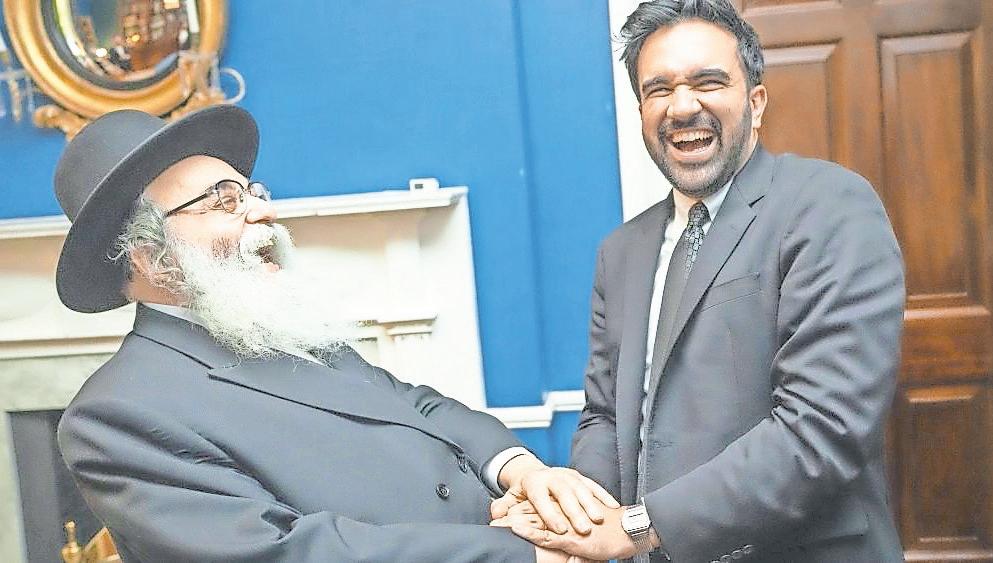
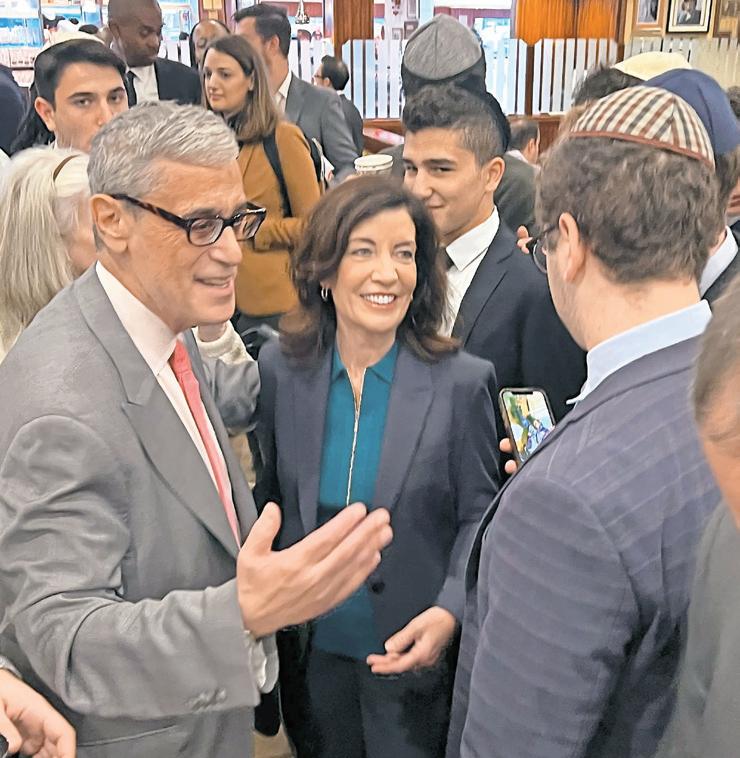
Igrew up inside a political machine. My father and the friends he came up with ran the Brooklyn machine reformers love to denounce. I know what a machine looks like from the inside, how it rewards loyalty, protects its own and decides races before the voters ever do.
In 2010, when a group calling itself the New Kings Democrats came to tear that machine down, I was one of the people defending it. The insurgents had a case, and parts of it were true. Machines become closed and selfdealing and certain of their own permanence. The New Kings Democrats promised something better: transparency, accountability, power
handed back to the people. They swore they would end bossism for good.
The New Kings Democrats was the farm team for what would become the city’s Democratic Socialists of America. Same meetings, same righteousness, same appetite for other people’s power. They simply had not picked the jersey yet.
This week, they proved they never wanted to end the machine, they wanted to own it.
Mayor Zohran Mamdani’s hand-picked slate ran the table in New York’s Democratic congressional primaries on June 23. Brad Lander knocked off Dan Goldman in the Tenth. Claire Valdez took the open Seventh. Darializa Avila Chevalier unseated Adriano Espaillat, the sitting chairman of the Congressional Hispanic Caucus, by roughly 2,000 votes in the Thirteenth. Three endorsements, three wins and a mayor who is now the most powerful political boss the city has produced
in a generation.
The reformers did not kill the machine. They built a bigger one, and here is the part that should turn your stomach: It is more hypocritical than anything my father’s generation ever ran. The old bosses never insulted you. They knew they were a machine. They traded favors and protected their friends, and never once called it a moral awakening.
This crowd does all of it and demands ap-
plause for its virtue. They anoint candidates, crush dissent and hand out congressional seats like party favors while lecturing the rest of us about democracy. They have no problem with bossism, with concentrated, unaccountable power. Their only problem, it turned out, was who held it. Now that they do, the speed limit is gone.
The Democratic Socialists of America is not some grassroots accident. It is the new machine — a credentialing operation that decides who is ideologically pure enough to advance and excommunicates anyone who steps out of line. It swapped the clubhouse and the patronage job for the rose emoji and the purity test, and it is every bit as disciplined and unforgiving as the bosses it replaced. The one thing Tammany never did was insist that it was saving your soul while it counted the votes.
These are not your father’s Democrats. They

There are a few group-based contexts where this concept can be helpful — for example, in the case of Germany after World War II, where the process of de-Nazification led many Germans, particularly those born in the aftermath of the war, down the path of moral masochism.
Signund Freud wrote that “the true masochist always turns his cheek when he has a chance of receiving a blow.”
Freud’s observation lay at the core of his explanation of “moral masochism,” one of three types that he identified (the other two being “erotogenic masochism” and “feminine masochism.”)
While psychoanalysis, which Freud fathered, is focused on individuals and not groups, its conceptual architecture has been applied to group settings with varying degrees of success; when it comes to moral masochism, there is a more persuasive case for its application to group psychology, in part because Freud argued that of the three types, this one is notably less tied to human sexuality.
One of the byproducts of moral masochism is that those in thrall to it often experience feelings of virtue. As the French philosopher Pascal Bruckner argued, “self-criticism becomes a form of self-congratulation.”
Moral masochism is driven by feelings of guilt; visibly displaying one’s conscience and sense of rectitude by atoning is thus a form of compensation. It eases the pain that guilt induces and even encourages the subject to look for more reasons to feel guilty, just so that the same psychic experience can be repeated.
is an opportunity for Lander to absorb more guilt at belonging to his people.
I once had a German colleague who felt obliged to confess to me that her grandfather had served in the SS, emphasizing that she hoped this knowledge would not wreck our friendship and that she was truly sorry for the slaughter of 6 million Jews by the Nazis. I was slightly taken aback by both her words and her anxious tone, so I reassured her that any negative judgment would be reserved for her grandfather, not her. She was even more taken aback by this response, and I can still see the look of relief on her face.
But what of the Jews and moral masochism? The question here is less straightforward because the Germans really were guilty of one of history’s most atrocious crimes. With the Jews, particularly since the creation of Israel in 1948, there is a much stronger divergence between
the historical record and its interpretations. The birth of the Jewish state was not a crime, but many people, particularly in the current climate, forcefully insist otherwise, and not a few Jews feel overwhelmed by this claim.
Which brings me to the Democratic Party primaries in New York. While it wasn’t all gloom and doom this past week — Micah Lasher, a supporter of Israel, won the nomination for the 12th District, and Richie Torres, the incumbent congressman for the 15th District, who has a long record of supporting Israel in Congress, was comfortably renominated — the night of June 23rd will be remembered for the sweeping victories of Democratic Socialists of America-affiliated candidates endorsed by New York’s virulently anti-Zionist Mayor Zohran Mamdani.
These are candidates who clashed with the mainstream of New York’s Jewish community from the outset since they made opposing Israel’s supposed “genocide” in Gaza a central plank of their campaigns. Some went even further. The crudely antisemitic Darializa Avila Chevalier, notorious for having attended a rally on Oct. 8, 2023 that celebrated the mass slaughter and rape carried out by Hamas terrorists in Israel the day before, spoke about the “very visual similarities” between Jewish settlement in Judea and Samaria, and the displacement of black and Latino residents by wealthy landlords in her Uptown Manhattan and Bronx district.
Yet many Jews still supported these candidates, donated money to them and distributed campaign fliers on their behalf. One of them — Brad Lander, who defeated the incumbent Dan
attacks on Israel.
This is where the concept of moral masochism comes in.
In his capacity as an identifying Jew, Lander brings to mind Freud’s observation about offering one’s cheek whenever a blow is incoming. Every supposed Israeli offense is an opportunity for Lander to absorb more guilt at belonging to a people that has, in his view, dispossessed the Palestinians of their rights and their homeland. He then expresses that guilt through moral grandstanding and by distancing himself from Israel and the majority of Jews who support it.
A psychoanalyst might say that this was a problem; a political consultant, however, would laud him for his sound electoral strategy.
It may be that many of the left-wing Jews who vote against Jewish interests — and a secure, thriving Israel capable of defending itself is absolutely a Jewish interest — consciously feel that by joining in with the “genocide” rhetoric, they are creating the conditions for a Jewish communal life dissociated from Zionism and Israel that will be respected and even cherished by their non-Jewish comrades.
One can imagine that such a community would institutionalize moral masochism — for instance, by holding annual religious services to mourn the Palestinian nakba (“disaster” or “catastrophe”) of the establishment of the modernday Jewish state in 1948, or by removing the Is-
Extreme socialism is now on the march in America, with the demonization of Israel as the principal weapon in its arsenal.
Claire Valdez, Brad Lander and Darializa Avila Chevalier, three extremists backed by Mayor Zohran Mamdani, emerged victorious last week from their Democratic primaries in New York City’s 7th, 10th and 17th congressional districts.
Valdez and Chevalier are affiliated with the ultra-left, anti-American Democratic Socialists of America.
On social media, Valdez has boasted of having “wiped my hand on the American flag.” Chevalier, a convert to Islam, has called for the abolition of police, prisons and the country’s borders. She also co-founded Columbia University Apartheid Divest, a Muslim Brotherhood front group whose goals are the “full eradication of Western civilization” and the cultivation of “unrest and violence in America.”
If elections to New York’s legislature are included, seven out of eight DSA-affiliated candidates won victory this week.
The support of Mamdani, who actively campaigned for these candidates, was critical to this alarming advance for extremism.
Yet the commentator and “Morning Joe” host Joe Scarborough declared that the person most responsible for this march of extremism in New York City wasn’t Mamdani, but the Israeli Prime Minister Benjamin Netanyahu.
What was shaping views now, he said, were images that Israel had brutalized children and women in Gaza “with bombing that looks indiscriminate on TV day in and day out for years” and would be “able to level half of Lebanon.”
Scarborough did not draw the reasonable conclusion that these images had persuaded millions of people to believe libelous falsehoods that had been propagated to delegitimize the State of Israel as a prelude to its destruction. Instead, he suggested that these lies were true, and so he was holding Netanyahu responsible for the antizionism which had powered those election campaigns.
A moment’s thought shows how ludicrous this is. Hatred of the Jewish homeland not only long predated Netanyahu’s first period as prime minister but predated the establishment of the State of Israel itself.
It’s true, however, that antizionism was a driving force in these elections. All three House

candidates ran campaigns that focused on ending US support for Israel.
All three of them used the “genocide” libel against the Jewish state. Chevalier doubled down on the support she had voiced for Hamas the day after the terrorist group led the attack against Israel on Oct. 7, 2023.
Ahijab-wearing Palestinian Arab, Aber Kawas, who won the primary for the New York State Senate, has written extensively on her blog about her support for “imprisoned heroes,” including the “Holy Land Five” (convicted of terrorism financing) and Ahmed Ferhani, an Algerian man who pleaded guilty in 2012 to planning a mass shooting at a Manhattan synagogue.
For his part, Mamdani referred last week to the pro-Israel lobby group AIPAC and its supporters as “monsters,” channeling the key antisemitic conspiracy theory that accuses the Jews of controlling America in the pursuit of diabolical goals.
The true monsters are surely the Iranian regime, Hamas, Hezbollah — and Mamdani himself, who works for Israel’s destruction and hugely increases the physical danger to Jews living in and visiting New York.
These New York election results have demonstrated that anti-Zionism has become the principal driver of Democratic Party politics, just as it has of progressive culture in general.
The elections demonstrated the menacing alliance between Islamism and ultra-leftism — embodied by Mamdani — that has the whole of America in its sights.
Islamists and leftists are united in the two
things that drive them: their desire to end America and the West, and their deranged loathing of Israel and the Jewish people.
This loathing isn’t just the glue binding these two otherwise opposing groups together. It’s the Islamists’ key weapon against America itself.
The “Jewish question” is now turning into the driver of Democratic Party politics. Hatred of Israel is a Trojan horse for the agenda of Islamisation, the process of conquering America and the West for Islam.
Tragically, however, many American Jews whose support for the Democrats is tribal and unshakeable continue to back Mamdani even now.
The
‘Jewish question’ is now turning into the driver of Democratic Party politics.
Brad Lander, a former New York City comptroller who is Jewish and who defeated Rep. Dan Goldman in the primary for New York’s 10th Congressional District, is a close ally of the mayor. He declared that he would be “one of the Jewish members of Congress most willing to stand up for Palestinian human rights,” and that he would “stand firmly against bigotry aimed at Jews.”
This was humbug.
Last month, Lander went to the Al-Khoei
Foundation, an Islamic center in Queens, identified by American security agencies as allied to the Iranian regime. There, he accused Israel of a “desecration” of Judaism by committing genocide in Gaza and potentially also in Lebanon. He said he hoped to partner with Reps. Ilhan Omar of Minnesota and Rashida Tlaib of Michigan — two members of the Israel-hating “Squad” in the House of Representatives — just as he had with Mamdani.
He even recited in Arabic a verse from the Quran that said: “He is Allah who is one, Allah the eternal refuge … nor is there to him any equivalent.” Following his remarks, the Imam at the mosque prayed to the Mahdi — the Shia Muslim messiah — to kill infidels with his sword.
The anti-Israel group IfNotNow celebrated Lander’s win as “a blueprint for the future for both the Jewish community and the Democratic Party.”
“He ran a bold, unapologetically Jewish campaign that rejected pro-war lobbies like AIPAC and the endless flow of U.S. weapons to Israel,” stated the group’s executive director, Morriah Kaplan.
But Lander is actively running interference for Islamists determined to kill Jews, exterminate Israel and conquer the West.
Defaming and delegitimizing Israel and Zionism is not only deeply unjust. It’s a direct onslaught on Judaism and leads inexorably to attacks on Jews.
After Lander’s opponent, Goldman, visited a coffee shop in Brooklyn with his 7-year-old daughter, the cafe subsequently posted the message: “We don’t serve racists fascists homophobes genocide enablers or anyone in between. Too bad we didn’t recognize you right away, or we would have turned you away.”
A journalist on Fox & Friends had reported that people in line for a food bank in New York City had been talking to her, too, about AIPAC. As a studio presenter said, “They believe that the United States is taking the money that could go to them and is donating it to Israel.”
Many wonder why the interests of so many Americans have become identified with events taking place thousands of miles away. Back in 2023, a Harvard-Harris poll found that twothirds of Americans between the ages of 18 and 24 agreed that “Jews as a class are oppressors and should be treated as oppressors.”
Most New York voters, who may assume that all the libels they are fed about Israel are true, nevertheless almost certainly don’t put Israel at the top of their concerns above the cost of living.
But Israel now stands proxy for something
See Phillips on page 27
raeli flag from its place alongside the Stars and Stripes in their synagogues and temples.
In such an environment, guilt and its acceptance would be externally perceived as a virtue, marking out the “good” Jews from the “bad” ones. And in order to maintain that virtue, those Jews would be required to absorb and atone for more and more guilt, even if that guilt is imagined.
Yet history shows that such strategies are only successful for a short period of time. Many Soviet Jewish Communists faithfully followed Lenin’s instruction to oppose Zionism and any form of Jewish nationalism, as well as antisemitism. Doing so didn’t protect them from Stalin’s purges. To give a more recent example, a handful of French Jews support the antisemitic farleft party La France Insoumise, but their existence didn’t prevent the party’s leader, Jean-Luc Mélenchon, from mocking the Jewish name of convicted pedophile Jeffrey Epstein in a speech
that was nationally broadcast.
The bitter truth is two-fold. Socialism has historically had at best an ambivalent and at worst an openly hostile attitude towards the very idea of Jews as a separate community. As Karl Marx memorably put it, the emancipation of the Jews is the emancipation of society from Judaism. And, as I have argued in this column before, a growing element of the left increasingly sees Jews as expendable and is no longer enamored with those Jews who denounce Israel.
I suspect that the roughly one in three Jewish New Yorkers who voted for Mamdani, thus helping to unleash the next phase of the left’s antiZionist crusade, will have to learn these truths the hard way. Some will resist and break with this course. Others will double down on their moral masochism and thereby make guilt the foundation of their identities — until the nonJews among them decide that they are no longer useful.
Write: Columnist@TheJewishStar.com

For most of my life, I looked back at the Jews of the 1930s with a question I could never quite answer: Why didn’t they see it?
Why didn’t they recognize what was unfolding around them? Why did so many continue believing that reason would ultimately prevail, that institutions would protect them, that the political rhetoric wasn’t meant literally or that the hatred would eventually burn itself out?
Those questions become harder to ask with confidence when we look honestly at the world today.
Perhaps we owe the Jews of the 1930s an apology.
Perhaps they saw far more than we ever gave them credit for. Perhaps they understood exactly what was happening but found themselves trapped by institutions they trusted, political coalitions they had spent generations building and a natural human reluctance to believe that civilized societies could unravel as quickly as they eventually did.
That possibility should make every Jew stop and think.
History rarely repeats itself exactly, but it often rhymes with unsettling precision. The slogans change. The technology changes. The politics change. But human nature changes very little. Every generation convinces itself that it is more enlightened than the one before it; yet every generation eventually discovers that prejudice has an extraordinary ability to reinvent itself while insisting it is something entirely different.
Today’s antisemitism rarely introduces itself honestly. It often disguises itself as activism, social justice, anti-colonialism, academic theory or political purity. It changes vocabulary without changing intent. Hatred has always been remarkably adaptable. It learns the language of the moment because it makes it easier to recruit people who would never knowingly associate themselves with antisemitism.
That is what makes this moment so dangerous.
There are candidates seeking public office who have been trafficking in antisemitic rhetoric or repeatedly associating themselves with those who do. There are elected officials who cannot bring themselves to condemn antisemitism with the same clarity they demand on virtually every other form of hatred. There are universities where Jewish students increasingly question whether they can openly express their identity without becoming targets. There are institutions that seem more comfortable explaining antisemitism than confronting it.
The apology we owe is for assuming we would have done better.
None of this should feel normal. Yet one of the most troubling aspects of this moment is not what antisemites are doing. History teaches us that antisemites will always exist.
The more difficult question is why so many Jews continue struggling to acknowledge what is directly in front of them. Too many remain emotionally invested in political movements, ideological coalitions or institutions that have changed dramatically while their own assump-

tions have not.
Loyalty is an admirable quality until it becomes blindness.
Many American Jews spent decades helping build institutions dedicated to civil rights, education, philanthropy and social progress. That history deserves respect. Their contributions helped strengthen American society in countless ways. The problem is that some of those same institutions no longer consistently return that loyalty. Coalitions evolve. Priorities change. New ideological frameworks emerge. Relationships that once felt reciprocal sometimes become transactional or disappear altogether.
Recognizing that reality is not betrayal. Pretending it isn’t happening may be.
One of the hardest things for any individual
or community to do is to admit that a strategy that once worked no longer does. Success creates habits. Habits become assumptions. Assumptions become doctrine. Eventually, people defend the strategy long after the conditions that made it successful have disappeared. That is not wisdom. It is inertia.
There is also a profound difference between tolerance and appeasement. Judaism has always valued dialogue, learning and engagement with people who see the world differently. Those values remain strengths. They become weakness only when dialogue replaces judgment or when engagement becomes an excuse to ignore conduct that should never be excused. Extending goodwill does not require suspending common sense.
See Rosenberg on page 27
Acoffee shop in Brooklyn recently turned a cup of coffee into a moral X-ray.
Rep. Dan Goldman entered Poetica Coffee with his daughter, after which the shop said it would have refused him service had workers recognized him. The issue was not his district, his voting record in full or some ordinary dispute over public policy. The issue was Israel. (In the Democratic primary election a few days later, Goldman would be obliterated by antizionist Brad Lander.)
The scene was minor enough to unfold at a counter and major enough to reveal the nature of the age. A Jewish pro-Israel Democrat became untouchable. AIPAC, a lawful American pro-Israel organization, became the stain placed on his public life.
America is being trained to stare at AIPAC while far more dangerous machinery moves behind the scenes. That is the trick. The sleight of hand. AIPAC is the hand they want us to watch.
No serious citizen should place AIPAC above scrutiny. It is a lobby. Its endorsements can be challenged. Its spending can be debated. Its strategy can be questioned. That is the price of influence in a republic.
But the obsession with it has become something more revealing than ordinary political criticism. It has become a theater of selective suspicion, a way to turn Jewish civic participation into a national scandal while more dangerous networks are treated as too delicate, too complicated or too politically

protected to examine.
Timing makes the fraud impossible to miss.
On June 22, the US Treasury Department issued General License X to Iran, authorizing the production, delivery and sale by the Iranian regime of crude oil and petrochemical and petroleum products through Aug. 21. While antiIsrael activists were busy turning AIPAC into a national ghost story, Washington opened a temporary commercial lane for the regime that built the Islamic Revolutionary Guard Corps, armed Hezbollah, backed Hamas, strengthened the Houthis and perfected the art of turning revenue into regional menace.
Money given room to breathe in Tehran does not remain in a clean room. It moves through the organs of the regime.
A Jewish organization is demonized while an Islamist organization gets a free pass.
It can become a drone part, a missile component, a militia payroll, a smuggling network, a propaganda campaign, a tunnel budget or the next diplomatic pressure point on Israel’s throat. Fungibility is not a theory. It is how hostile regimes survive.
Yet the loudest moral accountants keep returning to AIPAC, as if the Jews invented in-
fluence. Labor organizes. Churches organize. Corporations organize. Climate groups organize. Arab and Muslim organizations organize. Universities organize. Unions organize. Every community that understands power enters the public square with money, structure and strategy. Only when Jews’ and Israel’s allies do it is ordinary political advocacy repainted as conspiracy.
That is the tell. The objection is not lobbying. The objection is Jewish effectiveness. The outrage is not over money in politics. It is over money that helps defend the Jewish state. If foreign influence were truly the concern, the same voices would be demanding a full accounting of Iranian regime-linked pipelines, campus donations and nonprofit relationships, Qatar-touched institutions, Iran-adjacent influence networks and every organization that launders hostility towards Israel through the language of social justice.
America must recover its eyesight.
American Muslims are not the enemy. Muslim citizens, physicians, soldiers, police officers, parents, students and neighbors are not responsible for the ambitions of Tehran or the ideology of Hamas. Many are themselves endangered by the same radicals who claim to speak for them. But a serious country cannot confuse civil-rights language with immunity from scrutiny. No organization, Jewish, Christian, Muslim, secular, left or right should be placed behind glass and declared too fragile for examination.
For example, the Council on AmericanIslamic Relations (CAIR) describes itself as a civil-rights organization and denies any wrongdoing on its part. That denial deserves to be represented accurately. Questions about CAIR’s Islamist advocacy, Muslim Brother-
Continued from page 22
vast majority of Senate Democrats, he is in favor of an arms embargo on Israel that would essentially force it to surrender to foes whose goal is a real genocide of the population of the one Jewish state on the planet. He has also campaigned against the supposed “corrupt” and “foreign” influence of AIPAC, the main pro-Israel lobby, which his ally, Mamdani, smeared as “monsters.”
Since the war on the Jews has, incredibly, become even more important to the base of the Democratic Party than the economic issues that once motivated most of its members, the fact that Goldman’s wife, Corrine Levy Goldman, is an enthusiastic supporter of Israel who criticized woke Jew-haters on social media meant that he was toast.
Lander is not as radical as Darializa Chevalier, who defeated another incumbent, Rep. Adriano Espaillat, in the primary in New York’s 13th district. Chevalier actually took part in a demonstration on Oct. 8, 2023, where she helped celebrate Hamas and defend the massacre of Jews.
But with his willingness to repeat the blood libels about Jews committing “genocide” — when, in fact, they are the intended victims of an actual genocide planned by Palestinian Arabs and their supporters — made him acceptable to the new dominant faction within his party. Like the management of Poetica, left-wing Democrats will make an exception for Jews willing to support the slaughter of half of the world’s Jewish population that resides in the world’s only Jewish state.
Antizionism is antisemitic by definition, since it seeks to deny rights to Jews that no one would think to take away from any other people and to normalize their delegitimization and victimization by bloodthirsty terrorists.
The real “genocide enablers” are not those
Jews who won’t endorse patently false accusations of Israeli criminality. That label is better applied to those who cheer for Hamas, Hezbollah and Iran, or who regularly regurgitate antisemitic propaganda about Israelis.
Some liberals point to Lander’s Jewish background and the ubiquitous presence of anti-Zionist Jews in Mamdani’s coterie, as well as sprinkled throughout the intersectional left’s efforts to purge Israel-supporters, whether or not they are Jews. But that effort to refute accusations of antisemitism rings hollow.
These Jews are the 21st-century version of past instances in which Jews joined their oppressors, either out of a misguided belief that this would earn their acceptance or a genuine conviction that Jewish identity and beliefs were evil, as was the case with Communist theorist Karl Marx.
That was also true of the Jewish Bolsheviks who made up the Yevsektsiya, the bureau devoted to eradicating Jewish life in the first decades of the Soviet Union. Mamdani’s Jews and members of anti-Zionist groups like Jewish Voice for Peace and IfNotNow, who have joined the shock troops of the far left’s attempt to revive Communism, are their heirs.
The question facing Americans is whether the victories earned by these forces of intolerance for Jews are just a passing phase that will soon fade or a turning point for American society.
When considering this question, it’s possible to consider the coffee-shop incident as just another instance in which an era of hyper-partisanship has legitimized the sort of uncivil behavior that has been directed at conservative Republicans. For example, in 2018, then-White House Press Secretary Sarah Huckabee Sanders (now governor of Arkansas) was asked to leave a Red Hen
restaurant in Lexington, Virginia, because its owner was opposed to the Trump administration.
But the manager of Poetica, who took to social media to denounce Goldman (who had only purchased a cup of coffee as a thank you for its staff allowing his 7-year-old daughter to use the restroom) and actually posted a screenshot of him at their cash register, wasn’t acting as a partisan. The point of his action was the conviction that discriminating against the overwhelming majority of Jews who won’t join attacks on the besieged Jewish state is what righteous liberals are obligated to do.
This nasty behavior is significant because it was the reason that Goldman was defeated in a district where people who share this hateful belief predominate. And as Democratic primaries around the country show, such results are no longer outliers.
The mainstream liberal media has normalized antisemitism since Oct. 7. With blood libels like the New York Times’ absurd claim that Israelis trained dogs to rape Palestinian prisoners accepted as truth rather than fiction, we can’t be surprised that rank-and-file liberal Democrats, who make up more than 90% of its readership, should draw conclusions from such screeds.
Anyone who won’t parrot these lies is someone whom they think deserves to be targeted for discrimination. And once you go there, it isn’t much of a leap to decide that such persons don’t merely deserve to be voted out of office, but to be targeted for humiliation and, ultimately, violence.
All of Goldman’s wealth, his attempt to use the law to target Trump and his perfect liberal voting record didn’t save him from this kind of treatment. And the same will be true of every other liberal Jew who won’t bend the knee to the left on Israel as did Lander.
Continued from page 17
HaMikdash. The smallest movement toward Him is met with something beyond anything we could create on our own.
The Apter Rav once sat with a student who listed every difficulty weighing on him. When the man finished, the Rebbe said quietly that he had forgotten something. He had forgotten that the Korban Tamid had not been brought that day.
The Rebbe was not minimizing the man’s pain. He was expanding his vision. Every single day we are missing something. Twice a day Klal Yisrael once stood before Hashem and simply said we are here.
That daily meeting no longer exists, and we should feel its absence not just on Shiva Asar B’Tammuz but every morning we wake up without a Beis HaMikdash.
But feeling the loss and accepting it are two entirely different things.
Rav Shneur Kotler’s kallah thought she had nothing left. His answer was that she still had her chassan. During these weeks, when the galus feels long and the Beis HaMikdash feels impossibly far, Hashem is asking Klal Yisrael something remarkably similar. So much has been lost. So much has been broken. The Luchos have been shattered. The kesubah seems far away. But did you think you were going to lose your chassan?
Moshe’s answer was to hold tighter. Ours should be the same.
We are not losing our chassan. Rabbi Benny Berlin is spiritual leader of BACH in Long Beach. www.bachlongbeach. com. Write: Columnist@TheJewishStar.com
Continued from page 17
womanly wisdom found expression in the remark, “We can perhaps someday forgive you for killing our children, but we cannot forgive you for making us kill your children.”
In the context of recent battles in which the Israeli army was engaged, we must recognize that today’s soldiers, to whom I have spoken, resent being forced to kill and are fully aware that violent behavior produces an inner streak of violence that must be expunged.
I take this opportunity to stress what we all should know and tell the world, that the Israeli army is uniquely careful to avoid unnecessary acts of violence, and debriefs its soldiers after they emerge from the tests of battle in a manner designed to avoid the incubation of cruel psychological tendencies, and to restore sensitivity toward the lives of others.
There are times when each of us must act sternly, in a tough and harsh manner. Sometimes we must discipline others and be quite strict with them. At those times, we must vigilantly avoid permitting those justified behaviors to affect who we are and how we really feel. We must struggle to retain our humanity, gentleness, and compassion, even when our outer behavior necessitates firmness and even severity.
It is also very helpful to remember:
•That a tool is available to reverse feelings of violence that threaten to emerge in us, by acting kindly and compassionately;
•That we can reverse tendencies towards sloth by energetic productive activity;
•And that when we are depressed and emotionally down, the best available prescription is to exuberantly sing and joyously dance.
Write: Columnist@TheJewishStar.com
It is possible to argue that such extremism is a prescription of political doom for the left. Antisemitism has always been a political loser in American politics. Most Americans never voted for the woke catechism of diversity, equity and inclusion (DEI) that is inextricably linked to Jew-hatred. Trump’s 2024 victory was largely the result of a sense that Democrats had tipped too far to the left on a host of social and cultural issues that most citizens regarded as bizarre and wrongheaded.
But in 2026, Democrats appear to be doubling down on the very same laundry list of woke beliefs with hatred for Israel at the very top. And, though antisemites have been repeatedly defeated in Republican primaries this year, the willingness of Vice President JD Vance to continue to legitimize the far-right’s Jew-hating podcasters like Tucker Carlson and their enablers like Megyn Kelly illustrates that similar ideas are also having an impact on the GOP and the political right.
Turning these trends around will require genuine leadership by America’s political, cultural and religious thought leaders in the coming months and years, as well as punishment at the polls for Mamdani and his fellow extremists outside of deep urban enclaves. Trusting in the common sense and decency of the American people has been a formula for Jewish acceptance and success for the last 250 years.
Contrary to the prevailing narrative that Jewish liberals have long accepted about this country, Jews are not victims in America, but fellow stakeholders in a republic where Jewish life was cherished. But the demise of Dan Goldman forces even the most sanguine observers to ponder whether that faith in the exceptional nature of the American experiment in constitutional democracy will continue to be justified.
Write: Columnist@TheJewishStar.com
Continued from page 23
are not even Alexandria Ocasio-Cortez’s Democrats. This slate makes AOC look like a conservative, and she knows it. The radical of 2018 is the moderate of 2026. She didn’t move an inch. The ground moved under her.
Consider how they win, because the method gives the game away. Avila Chevalier ran on slogans and silence. Put a real question to her, and she vanishes — off the set, out of the room, unwilling to sit across from a reporter and defend a single position under pressure.
The old machine at least had to face the press. This one has learned it can win without ever answering a hard question. A press that can actually confront a candidate is not an inconvenience. It is the check. When you can win a seat in Congress without once being made to answer for what you believe, the machine has already won, and the rest of us simply have not been told yet.
Then there is Lander, the chameleon. I have watched this man my whole adult life in New York politics. A few years ago, he stood roughly where Goldman stood; two Jewish politicians. Today, he is thrilled to fly to Washington and link arms with the progressive, anti-Israel “Squad.” His convictions are a weathervane. He becomes whatever the moment pays out, and the moment now pays out at the edge, so to the edge he goes, flag planted, insisting that he was there all along.
And presiding over all of it is the mayor. One week ago, Mamdani stood on a stage in Brooklyn, called AIPAC “monsters” and railed about “millions in dark money.” He said the only thing that AIPAC fears more than democracy is an end to “Netanyahu’s wars,” referring to the prime minister of Israel.
He said it in the same week that a man was federally indicted for plotting to gun down
AIPAC employees. Even after leaders from the Anti-Defamation League and the American Jewish Committee warned that this is precisely the language that gets people killed, the mayor did not retreat. He reached for cover, claiming that he was merely quoting the Marxist Antonio Gramsci. That is “the tell.” A man confident in his own words does not hide behind a dead theorist’s.
The loudest crusader against “dark money” and foreign influence is the same man who will not sit for one honest interview about his own movement.
So here is the question New York City should be screaming:
Who funds this? Who benefits? Which interests — from Doha to the donor class bankrolling this faction — quietly cheer a New York that turns on the Jewish state while their champion plays the tribune of the common man?
A machine this comfortable with power owes the public those answers. It refuses to give them, and almost no one with a platform is demanding them.
I do not recognize this Brooklyn. I do not recognize this city. And I am afraid I am starting not to recognize this country.
I defended a machine once, and I will not pretend I did not. But the machine my father and his friends ran never lied to you about what it was. The one that won last Tuesday is younger, hungrier and far more dishonest because it does everything the old bosses did and calls it a revolution.
That is the difference, and it is the whole difference. A machine that admits it is a machine can at least be held to account. A machine convinced that it is a moral cause answers to no one.
In the borough that raised me, that is what now holds the keys, and it will not stop at the seats it acquired on Tuesday.
Warren H. Cohn is the founder of RocketshipPR and media adviser to the American Middle East Press Association.
Write: Columnist@TheJewishStar.com
Continued from page 24
else: a nation state that’s supposedly grinding the faces of the poor and disadvantaged. So a vote for those who hate “oppressor” Israel is a vote for the “oppressed” everywhere.
Tragically, many liberal American Jews sign up to this warped, perverse and hateful mindset because this is now the dominant thinking in the Democratic Party.
Anti-Zionism, which shockingly has now framed the demonization of Israel as conscience itself, has driven liberals off their moral compass. As a result, they are pawns in a far bigger game being played: to conquer America and the West for Islam.
The Democrats are turning into an extremist party posing an increasingly acute danger to America. And Jews who still support it are debauching Judaism, betraying the Jewish people and aiding the mortal enemies of the West.
Write: Columnist@TheJewishStar.com
Continued from page 25
The most painful lesson of Jewish history is not simply that antisemitism exists. The painful lesson is how often intelligent, accomplished, and well-intentioned people convince themselves that obvious warning signs were temporary, exaggerated or someone else’s problem. Like every generation, we tell ourselves that this time is different.
None of this is an argument for fear. It is an argument for clarity. Jewish history should produce confidence, resilience and a willingness to see the world as it is, rather than as we wish it were. The Jewish people have survived because they adapted, learned, rebuilt and refused to surrender their identity, even when circumstances demanded extraordinary courage.
If we truly want to honor the Jews of the 1930s, then we should stop asking why they failed to recognize the danger and start asking whether we are willing to recognize our own. We should examine our assumptions with the same honesty that we expect when studying history. We should measure people and institutions by what they do, not merely by what they say about themselves.
Perhaps the apology we owe is not for judging the Jews of the 1930s too harshly. Perhaps it is for assuming we would have done better.
History has a way of humbling that kind of certainty. The question facing the Jewish community today is not whether we know enough about the past. The question is whether we are willing to learn from it while there is still time to do so.
Write: Columnist@TheJewishStar.com
Continued from page 25
hood-linked history or its role in the political ecosystem surrounding Israel-hatred should not be treated as forbidden speech.
The Holy Land Foundation case should have ended America’s innocence about how charitable language can be exploited by terror networks. The federal record exposes Hamas support structures, fundraising mechanisms and Muslim Brotherhood-linked documents that remain part of the public memory, whether polite society wishes to discuss them or not.
That memory does not convict every Muslim organization. It does make willful amnesia dangerous. It reminds America that soft words can carry hard agendas, nonprofit language can conceal militant purpose, and the vocabulary of relief can be manipulated by movements that sanctify Jewish death. Scrutiny is not big-
otry. Scrutiny is what a free country owes itself when hostile ideologies learn to speak in the accent of rights.
The antizionist political class wants one kind of transparency and one kind only. It wants Jewish donors mapped, Jewish influence dissected and Jewish organizations treated as hidden engines of American policy.
But when the question turns towards Iranian money, Islamist organizing, campus radicalization, foreign-regime patronage or activist networks that excuse Hamas while condemning Israel for surviving Hamas, the microscope becomes a blindfold.
That is not morality. It is misdirection. A sleight of hand.
AIPAC did not build tunnels under Gaza.
AIPAC did not hide rockets in Lebanese villages. AIPAC did not teach the Houthis to menace sea lanes. AIPAC did not create the IRGC.
AIPAC did not turn support for the Oct. 7 massacre into a slogan on American campuses.
AIPAC did not train a generation of activists to call Jewish self-defense genocide while treating Islamist violence as liberation.
Those things have authors. They have funders. They have clerics, commanders, diplomats, donors, institutions, couriers, apologists and enablers. They have names that many in public life would rather not say because naming them requires courage, while blaming AIPAC requires only fashion.
The watchdogs bark at the synagogue while the arsonists inventory the fuel.
If America wants transparency, let it have all of it: Follow every dollar. Examine every lobby. Audit every foreign gift. Investigate every nonprofit pipeline. Expose every attempt by any regime, movement or ideology to purchase influence in American life.
But do it honestly. Do it even-handedly. Do it without pretending that a Jewish organization is sinister while an Islamist organization is automatically noble. Do it without treating
AIPAC as the villain in a play in which the IRGC, Hamas, Hezbollah, the Houthis and the Muslim Brotherhood’s long shadow drift quietly offstage.
The issue is not that AIPAC should never be watched. The issue is that AIPAC is being used to stop Americans from watching everything else.
That is how the oldest trick works. One hand rises in the light while the other moves in the dark. Today, the raised hand is marked “AIPAC.” The hidden hand moves oil, influence, ideology, missiles, campus rage, diplomatic cover and foreign money through the body of the West.
America should stop admiring the trick. It should look at the hand that is moving in the dark.
Moshe David, a US Army officer veteran, writes about antisemitism, Jewish identity, Torah and Israel.
Write: Columnist@TheJewishStar.com