June 26-July 2, 2026
11 Tammuz 5786 • Chukat-Balak Vol. 25, No. 20
Reach the Star: Editor@TheJewishStar.com 516-622-7461 x291



June 26-July 2, 2026
11 Tammuz 5786 • Chukat-Balak Vol. 25, No. 20
Reach the Star: Editor@TheJewishStar.com 516-622-7461 x291
By Ed Weintrob, The Jewish Star
Mayor Zorhan Mamdani catapulted into the role of Democratic kingmaker on Tuesday, when his personally endorsed socialist, antzionist insurgents defeated stalwarts of the middle-of-the-road Democratic establishment.
It was a clean sweep for a mayor after he appeared to go out of his way to irritate traditionally-Jewish voters leading up to the Democratic primary, deploying historic antisemitic tropes, picking fights and declining opportunities to deescalate. The Democratic nomination is tantamount to victory in the New York City districts that were in play on Tuesday.
Mamdani’s wins were with candidates who are emphatically antizionist, some facing suggestions of overt antisemitism.
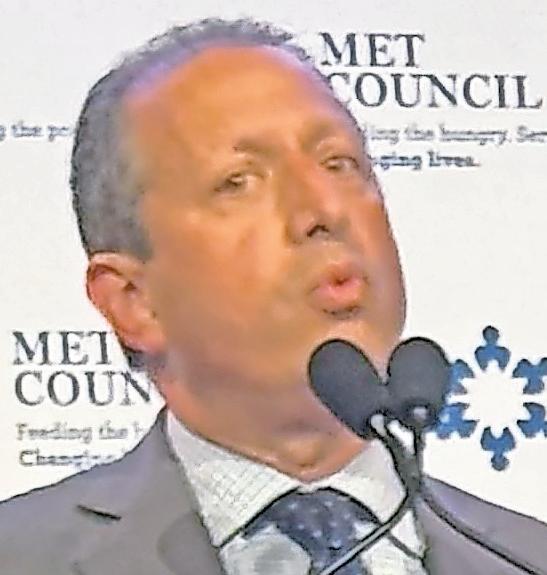
•In the 13th District, including Upper Manhattan and some of the Bronx, Darializa Avila Chevalier — who, like the mayor, is a member of Democratic Socialist of America — defeated five-term incumbent Adriano Espaillat, 32,734 (49.41%) to 30,399 (45.89%), with 96.11 percent counted.
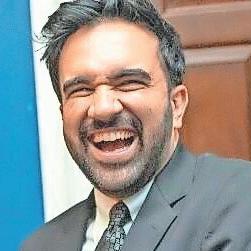
•In the 7th District, including waterfront neighborhoods in Brooklyn and Queens, Brooklyn Borough President Antonio Reynoso was destroyed by Assemblymember Claire Valdez, a DSA member like Chevalier,

By Ed Weintrob, The Jewish Star
Rep. Ritchie Torres, one of Israel’s most reliable Democratic friends on Capitol Hill, easily defeated two antizionist opponents in his Bronx district.
Torres was always favored in the heavily Jewish Riverdale neighborhood, but he also polled well in Black and Latino parts of the expansive 15th District.
While Israel may have been top-of-mind to Riverdale voters, those in other parts of the district responded favorably to Torres’
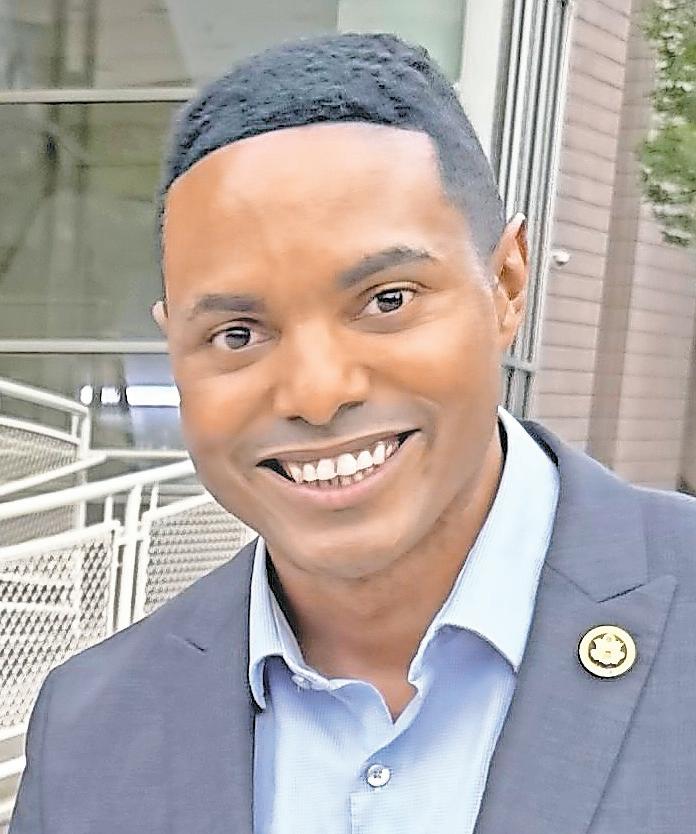
See Torres on page 2 Rep. Ritchie Torres.
Continued from page 1
37,531 (56.06%) to 23,960 (35.79%), with 97.51 percent counted.
While both candidates have been critical of Israeli policies, Valez trumped Reynoso in her demonization of the Jewish state. Reynoso lost despite being endorsed by the retiring incumbent, Nydia Velazquez. The district is derisively referred to by some as Brooklyn’s “Commie Corridor.”
“We haven’t just won an election, we have declared that this movement is durable that is growing,” Valdez told her victory party.
She pledged to continue to fight for Palestinian “liberation.”
“We’ll use our money to save lives here instead of destroy them abroad,” she said.
•In the 10th District, stretching from Lower Manhattan through Brownstone Brooklyn to left-wing Park Slope, former City Comptroller and veteran antizionist Brad Lander overwhelmed incumbent Rep. Dan Goldman, 55,060 (65.81%) to 28,445 (34%), with 97.46 percent counted.
Lander is an anti-Israel progressive but is not a member of Democratic Socialists of America.
While Goldman has said he would scrutinize the specifics of Israeli militaryaid requests, he has been supportive of the Jewish state and refused to join Lander in saying that Israel is guilty of genocide.
At Lander’s victory party, Mamdani compared Lander to Mr. Rogers. “We need a good neighbor,” the mayor said.
Lander told CNN on Tuesday night that it’s time to “reset” the US relationship with Israel.
•In Manhattan’s 12th CD, Mamdani stayed out of the race to succeed retiring Rep. Jerrold Nadler and that’s where the most establishment-like candidate, Micah Lasher, came out of top.
Lasher defeated Assemblymember Alex Bores, 40,106 (39.14%) to 35,822 (34.96%). Jack Kennedy Schlossberg pulled 11,036 votes (10.77%) and George Conway 6,212 (6.06%).
Lasher was endorsed by Nadler and former Mayor Mike Bloomberg, In some other races of interest:
•In Queens’ 6th CD, Rep. Grace Meng, a staunch supporter of Israel, defeated a challenge from the left by for US diplomat Chuck Park, 18,134 (56.85%) to 13,674 (42.87%), with 97.53% counted.
•State Comptroller Tom DiNapoli easily fended off a challenge by former Raj Goyle and non-profit housing executive Drew Warshaw. DiNapoli’s positivity toward Israel was a factor in the race.
•Aber Kawas, a Mamdani-blessed state Senate candidate in Queens, a DSA member who has downplayed the 9/11 terror attacks, won an open seat.
Rabbi YossY Goldman S. African Rabbinical Assn.
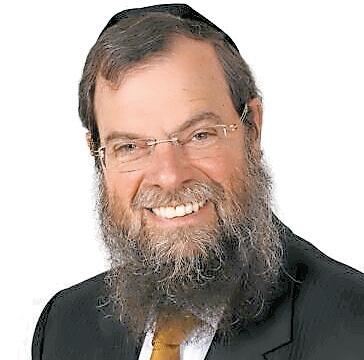
For 24 years, I produced and presented the only Jewish radio program in South Africa. The studio I used was in the same premises as a very popular radio station, and I often chatted to the presenters and managers during my weekly visits.
On one occasion, I approached the news editor and asked why the station had recently been devoting an inordinate amount of radio time to Jewish issues, not necessarily Israel.
At first, he denied it. But when I challenged him to check his programming schedules, he did and then had to acknowledge that I had a point. So when I asked for an answer as to why it was so, he said simply, “What should I tell you, rabbi. Jews are news.”
It has been many years since that conversation, but Jews are still news — and more than ever.
Today, Israel is in the news more than any other country in the world. A tiny country of some 10 million souls, occupying land smaller than New Jersey, continues to dominate international headlines and, more often than not, the reporting is negative, if not harshly critical.
I recently conducted a speaking tour in Australia. There is no question that Jewish Australians are bitterly disappointed in their national government leadership for doing nothing to curb the outbreak of antisemitism after the Hamasled terrorist attacks in southern Israel on Oct. 7, 2023.
They believe that their inaction gave license to the terrorist murderers of 15 people on Bondi Beach last Chanukah, in addition to other violent acts, like the firebombing of synagogues and Jewish businesses. They are shocked that this could happen in Australia, which was always a very safe and secure place for Jews. And so, they rightly feel quite vulnerable and anxious.

But is it any different from New York, the biggest Jewish city in the world, where the city’s new mayor, Zohran Mamdani, has just called AIPAC “monsters”?
Or Toronto, London, Paris or Rome? Unfortunately, not.
Gross, crude, vitriolic and violent antisemitism has erupted across the world, including in the most “civilized” centers of enlightenment and sophistication.
When I asked my Australian hosts which topic in my repertoire of lectures they preferred me to address, the reactions were interestingly different. One rabbi said his people were too tired of the subject of antisemitism, so he chose a different theme. Another rabbi said the opposite. His people were still reeling from Bondi, and they really needed to hear something constructive on that issue.
For me, having grown up in a free and fair America — a country of kindness and tolerance, where Jews were able to rise to the highest offices in every area of life, from Washington to Hollywood — it is almost impossible to grasp how it came to be that Jew-hatred has now become normalized. And I’m sure I speak for millions of my brothers and sisters in “the land of the free and the home of the brave.”
By Ed Weintrob, The Jewish Star
While most Jewish leaders and media expressed dismay over President Trump’s Iranian peace deal, some are sticking with the president.
The Jewish Star’s cover last week screamed, “TRUMP TO ISRAEL: DROP DEAD,” and the Brooklyn-based Jewish Press topped its cover with one word, “Bretrayal,” but not everyone agrees.
The Republican Jewish Coalition urged American Jews to trust Trump.
Continued from page 1
message of community service.
With 96% of the vote counted, here’s the tally: Torres 23,306 (71.96%), Michael Blake 7,062 (21.81%), Jose Vega 1,802 (5.56%).
“Tonight, the people of the Bronx have spoken,” Torres told his victory celebration at Michaelangelo’s Restaurant of Arthur Avenue.
“The people of the Bronx have chosen love over hate. Hope over fear, and unity over division.”
“It is the honor of my life to represent every member of the Bronx family from every corner of our borough,” he said.
“President Trump has earned the trust of the Jewish community as he and his team work toward a final agreement,” RJC national chairman Norm Coleman and CEO Matt Brooks said. “This is the same president who moved the US embassy to Jerusalem, delivered the Abraham Accords peace agreements, tore up Obama’s disastrous JCPOA, ended the war in Gaza and brought all of the hostages home.”
Critics of the deal say it appears to be even worse than the one crafted under Obama, which Trump continues to denounce.
In last week’s Five Towns Jewish Times, publisher and editor Larry Gordon began by suggesting that the war’s goals, articulated by Trump, were too ambitious.
“I think it’s important to understand that the idea of completely wiping out Iran is not going to happen,” Gordon wrote.
Nevertheless, he feels certain that the US will see to it that “Iran never has the ability to build nuclear weapons.”
Referring to the JCPOA that former President
Barack Obama signed with Iran in 2015 and which Trump cancelled in 2018, Gordon wrote that “it’s silly to suggest that the two agreements are the same.”
“It’s Obama’s fundamental dishonesty that moved him to say that there is no difference between the two deals,” he continued. “The new Trump deal prohibits Iran from possessing nuclear weapons of any size, shape, or under any circumstances.”
However, the MOU actually states simply that Iran reaffirms it “shall not procure or develop nuclear weapons.”
“It was wrong and unconscionable for Mr. Trump to refer condescendingly to Prime Minister Netanyahu as he did recently,” Gordon conceded, adding that “Trump is a great friend of Israel and he always will be.”
Ending the war now is “not just about gas prices or endangering US troops. More than anything, the focus here is on the November elections and the need for the Republicans to retain or even increase their majorities in the House and Senate,” Gordon concluded.
“The goal here is to maintain if not widen the Republican majority in the House in November as well as maintain the current Republican majority in the Senate. At the end of the process in November, the US and Israel will have no choice but to finish the bombing of Iran and openly call for regime change. At the same time, Israel will have the opportunity to finish off Hezbollah and the Houthis. It’s at this point that we will finally be able to conclude once again that Donald Trump is indeed the best friend Israel ever had in the White House.”
‘What should I tell you, rabbi? Jews are news.’
Were we naive?
Back in 1964, Jewish novelist Harvey Swados had a private audience with Rabbi Menachem Mendel Schneerson, the Lubavitcher Rebbe. In those earlier years, it was much easier to book such appointments, and Swados had a lengthy conversation with the Rebbe, which he later wrote up in detail.
When they were discussing the Holocaust, Swados asked: “Rabbi, could it happen again?” When I first read his account, I was absolutely shocked by the Rebbe’s answer: Morgen in di fri — “Tomorrow morning.”
Over the years, I struggled to come to terms with the Rebbe’s reply. Another Holocaust tomorrow morning? In America? I confess that I really couldn’t get my head around those words.
The Rebbe did qualify, adding that G-d would not allow it to happen again. But as far as the nations of the world were concerned, it could happen again tomorrow morning.
Sadly, all these years later, the Rebbe’s words ring all too true. Demonstrators and podcasters alike call for the destruction of Israel and the death of Jews wherever they may be — and get away with it! And they are becoming more brazen by the day.
The second of this week’s two Torah portions is Balak, where the heathen prophet Balaam attempted to curse the people of Israel, and instead, pronounced the most beautiful words of praise and blessings. Among them, he described Israel as being: “A nation that dwells alone and shall not be reckoned among the nations” (Numbers 23:9).
Indeed, we are alone. And now, even our one friend and trusted ally is also speaking in veiled tones. We certainly could use some friends in high places. But the United Nations is a sad joke, and the European Union isn’t far behind. And now, it turns out that we cannot rely on the Trump administration either.
The words of Rabbi Pinchas ben Yair in the Talmud (Sotah 49a) ring truer than ever: “Upon whom can we rely? Only on our Father in Heaven.”
Of course, we need each other, and we need a strong and powerful Israel. We also need a united Israel, where all the different factions can stand together in times of war and danger. We don’t have to agree on everything. That is impossible. But we could at least not undermine the Jewish state by our internal bickering. We each need to do good and do better.
In the final blessing of the Amidah, Sim Shalom, we say, “Bless us, our Father, all of us as one.” The rabbis comment that when we are together, as one, then through our unity we bring down upon us the blessings of G-d.
We surely need it now. Among the nations of the world, we are alone. Still, with Almighty G-d protecting us, we are never alone.
Write: Columnist@TheJewishStar.com
JonAThAn S. TobIn JnS Editor-in-Chief
After months of cooling his heels as Secretary of State Marco Rubio took the lead on a number of foreign-policy initiatives, including the war on Iran, Vice President JD Vance has now emerged from the shadows. Having opposed the war from the start, Vance’s stock rose within Trumpworld as the president grew frustrated with Iran’s refusal to surrender.
As a Memorandum of Understanding was agreed to between the United States and Iran, with Israel cut out of the process, it was Vance taking questions about the issue on the White House podium. He was then dispatched to Switzerland to negotiate a conclusion to the war that would presumably ensure freedom of navigation in the Strait of Hormuz, lower gas prices and somehow also accomplish the key initial goal of the war: ending the threat of an Iranian nuclear program.
Persuading Trump to sideline the highly competent Rubio — and being allowed to both shelve and insult America’s Israeli allies — was no small triumph for the vice president. Putting Vance at the helm of American foreign policy represented a victory for the neo-isolationist and anti-Israel wing of the administration and the Republican Party. It also further solidified, at least for the moment, the vice president’s status as the frontrunner to succeed Trump in 2028.
Nevertheless, the veep should have been more careful about what he had wished for.
It was one thing to argue that the war on Iran wasn’t worth the price the president was paying for it in terms of public disapproval of the conflict and higher gas prices, both of which seemed sure to hurt the GOP in the fall midterm elections. It’s quite another to be tasked with coming up with an agreement to conclude a war without being saddled with responsibility for a pact with Iran that is almost certain to be construed by America’s enemies and allies, not to mention the electorate, as a humiliating defeat.
Trump may have been joking when he said, “If it works out, I’m going to take the credit. If it doesn’t work out, I’m blaming JD.” But having been put behind the wheel for a test ride to see if his approach to world affairs is better than Rubio’s, the vice president is going to be hardpressed to avoid driving the country and the administration into a ditch from which it will not easily be extricated.
Vance put himself in the situation because Trump was frustrated with the war. The joint USIsraeli military strikes had succeeded in inflicting enormous damage on Iran’s military as well as its nuclear and missile programs, and eliminated most of its senior leaders. But whether or not, as critics of Israel have asserted, Israeli Prime Minister Benjamin Netanyahu oversold the president with claims that the Islamist terror regime would soon collapse in the face of these devastating blows, Tehran wasn’t surrendering.
It countered these attacks by menacing shipping in the Strait of Hormuz, thus raising fuel prices worldwide and putting economic pressure on Trump to stop the war. In return,

the United States placed a blockade on Iranian ports that threatened the Iranians with economic collapse. But the impulsive Trump lacked the patience to wait out the Islamists and agreed to first a ceasefire in April and then the MoU that, at least temporarily, ended the war.
As it stands, that document sets up Iran to have won the conflict. Washington is already unfreezing assets that will result in the regime getting billions in funds that it can use to solidify its tyrannical hold on power, as well as reinforce its beleaguered Hamas and Hezbollah terror auxiliaries. Even worse, Trump appears to be willing to allow Iran to keep its missiles and to include the current conflict in Lebanon in the deal, thus enabling the Hezbollah terrorists to survive and to continue threatening northern Israel with continued attacks.
In exchange for this, the Islamists look to being let off the hook with recycled promises about not building nuclear weapons that — short of restarting a war that he is apparently tired of — Trump lacks the leverage to enforce.
If he doesn’t reverse course, then there will be no avoiding comparisons of this attempt at appeasement to former President Barack Obama’s 2015 Iran nuclear deal that Trump had rightly criticized as disastrously weak.
And the man he sent to Lake Lucerne to wrap up a deal along these lines and do it in a way that won’t look like an abject defeat is Vance.
It’s true that, at least until he was sent to Switzerland to accomplish this impossible feat, Vance at least got the opportunity to do something he and his fellow neo-isolationists had been itching to do for many months: to insult and treat Israel like a vassal state.
At a White House presser on June 18, Vance had mischaracterized the MoU with Iran to make it not sound as if it were an American defeat. Contrary to his assertions, the economic benefits to Tehran for simply agreeing not to threaten traffic in the Strait of Hormuz will not await proof of its good behavior. In addition to lifting the blockade on Iranian ports, allowing them to resume the sale of oil, the release of billions in frozen funds immediately gives the Islamist regime a lifeline that will enable it both to
21st century” — Iran — “just as the United States dealt with the Nazis of the 20th century.”
Israel is no vassal state. The United States gets enormous benefits from its alliance with this democratic Middle East partner in terms of weapon development and intelligence. As Vance himself stated in 2024, it’s the ideal MAGA ally since, unlike Europe, Israel fights alongside America.
Still, Vance’s willingness to characterize Iran’s possession of weapons to threaten other nations as morally equivalent to Israel’s military was troubling. “You can’t tell a country, whether Israel or Iran, they’re not allowed to have any selfdefense,” he said.
And yet, Vance revealed his own bias against Israel when, perhaps channeling the blood libels spread by leftist antisemites and his podcaster friend Tucker Carlson, he warned the Israelis that those who decried an American decision to surrender were simply being bloodthirsty.
“I guess my response to them would be: What is your exact proposal? You’re a country of 9 million people. You can’t just kill your way out of solving every single national security problem that you have,” said Vance.
survive and continue funding its terrorist proxies, Hamas and Hezbollah.
It’s also clear now that the United States has no intention of forcing the Islamic regime to give up the ballistic missiles it has built to threaten Israel and its Arab neighbors.
Among other things, Vance also told an obvious lie when he claimed that the release of funds to Iran was somehow not as bad as Obama’s similar gesture. Contrary to his assertion, Obama did not send US taxpayer dollars to Iran but, like Trump, also unfroze Iranian assets.
But savoring his moment at the same podium from which Rubio had informed the press about America’s efforts to decisively defeat Iran, Vance turned his ire on the Jewish state. He scolded Israelis, including members of the government, for having the temerity to criticize the United States for abandoning the war, strengthening an enemy nation and betraying the persecuted people of Iran by ensuring that their tyrants will stay in power.
He warned them that they had no recourse but to accept whatever Trump did because “Donald J. Trump is the only head of state in the entire world who is sympathetic to the nation of Israel at this moment in time, and he happens to be the head of state of the world’s superpower.”
What’s more, he added, “If I was in the cabinet of the Israeli government, I might not be attacking the only powerful ally that I have anywhere left in the entire world.”
The not-so-subtle message to Jerusalem was that it was a vassal state that had better shut up about being betrayed in this manner. And while Democrats who appeased Tehran knew that they had to put up with being criticized for their feckless behavior, Trump and Vance made it clear that they won’t tolerate Israelis doing the same to them.
That was a pointed reference to Israeli Finance Minister Bezalel Smotrich and National Security Minister Itamar Ben-Gvir, who, unlike Netanyahu, didn’t hold back when it came to expressing their feelings about what the Americans did. And while the two often say and do outrageous things that do not aid Jerusalem’s cause, Ben-Gvir wasn’t wrong when he said the United States ought to have dealt with “the Nazis of the
That accusation was as reckless as it was unfair. Israel isn’t trying to kill its way out of anything. It was viciously attacked on Oct. 7, 2023, by Iranian minions who carried out the worst mass slaughter of Jews since the Holocaust. It was the target of direct missile barrages launched on April 14 and Oct. 1, 2024. And it was attacked by missiles, rockets and drones throughout the war that started on Feb. 28, leading to casualties, damage and sending much of the country into bomb shelters day after day.
Had America been similarly attacked, we know very well that Trump and Vance would have exacted a far greater revenge on the assailants than the targeted strikes that Israel executed on Iranian targets.
Being able to vent his contempt and lack of sympathy for an ally that fought side by side with American forces and who were essential to the success America achieved may have given Vance some satisfaction. But it won’t get him out of the fix in which he now finds himself.
Simply put, the Iranians know that Vance’s position in the talks is weak. That’s why they are treating him with the same contempt that they once treated Obama’s envoys, as they continually take back any concessions he says he’s wrung out of them, making it clear that if he wants an agreement, then it will have to be on their terms.
We don’t know yet how the negotiations will end. Perhaps Trump’s natural aversion to bad deals and his unwillingness to be a party to a deal that will rightly be characterized as an abject surrender that will not achieve any of America’s war goals will cause him to recall Vance and return to war. He ought to know that as unpopular as the war may be, ending it in defeat will be even more unpopular. Having invested so much political capital in the conflict already, he won’t win it back by mimicking Obama’s appeasement. Or perhaps he is so sick of the conflict and too panicked by gas prices, plummeting polls and the prospect of a Democratic sweep of the midterms to reverse course again.
Either way, he has set up Vance to fail. Trashtalking Israel may earn him cheers from the antisemitic groyper wing of the GOP, but neither they nor his fellow Israel-bashers at mainstream media outlets like the New York Times will win him the 2028 GOP presidential nomination. And if the vice president is the architect of an end to the war that will be the moral equivalent of President Joe Biden’s retreat from Afghanistan, then it may earn him a place in history, but not one that will be a stepping stone to the Oval Office.
Write: Columnist@TheJewishStar.com
By Aaron Bandler, JNS
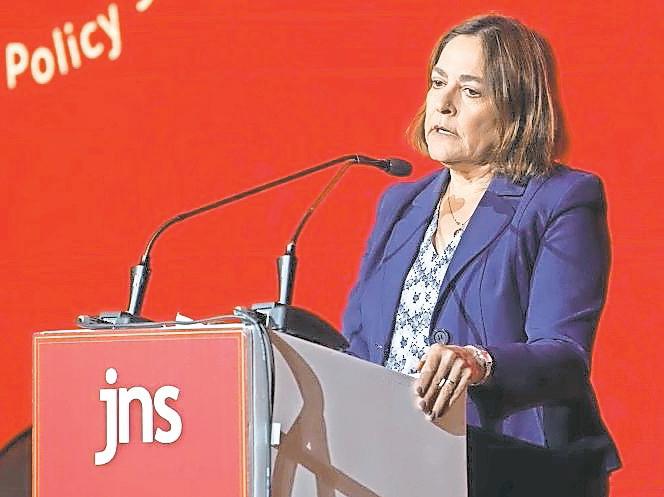
Despite the rapid spread of misinformation against the Jews and Israel, Caroline Glick, international affairs adviser to Israeli Prime Minister Benjamin Netanyahu, said that she is hopeful that the truth will eventually win out.
Speaking at the Second Annual JNS International Policy Summit in Jerusalem, Glick focused on what she called the “eighth front” in Israel’s war: the battle over information and the spread of anti-Jewish incitement.
“In the same time that information is spreading, disinformation is also being spread deliberately and with malice of forethought,” she said.
False narratives spread quickly, Glick said, because rather than encouraging people to think about how to solve problems, it causes people “to think about who to blame for your problems,” which is a “much easier sell” and aligns with people’s existing prejudices.
As an example, she cited an interview with Jeremy Boreing, co-founder and former CEO of the Daily Wire, in which he said that whenever he posts pro-Israel content on social media, he is inundated with accounts accusing him of being Jewish, which he is not, and targeting him with antisemitic attacks.
Glick said many of those accounts appear to be automated bots activated in response to pro-Israel messaging and designed to divert attention from the original content.
She argued that some online influencers have discovered that antisemitic content generates significantly more engagement than their usual material.
Such influencers, especially among the “woke Right,” have found that “disseminating antisemitic messaging and giving approval to others to feel comfortable in their own anti-
semitism or to adopt antisemitism as a calling card, even if they hadn’t really thought too much about Jews in the past” is a way to get more subscribers, Glick said.
Glick also accused major media outlets and universities — the “general institutions” that people rely on for truth-telling — of contributing to what she called a broader “complex of un-truth.”
She pointed to how the New York Times won a Pulitzer Prize for using a front-
page image of a child with cystic fibrosis as a “blood libel” to say Israel is deliberately starving civilians in Gaza. The Times edited the child’s brother out of the photo, who appeared “healthy” and “well-fed,” according to Glick.
The Netanyahu adviser further criticized academic disciplines such as “settler-colonial studies,” which she described as ideologically driven rather than grounded in fact.
“I live in Efrat, I’ve never seen a colonialist in my neighborhood, and it’s all just subur-
ban housewives,” Glick said. “And by the way, that’s where King David was born.”
She also cited Qatari funding of U.S. academic institutions as an example of how someone can “take over an institution through donations, then you can introduce entire spheres of so-called academia that are all false.”
“We have one commodity that’s on our side, and it’s little, but it’s important: it’s called truth,” she said. “It’s not the ‘Israeli narrative’ that we’re telling. These are actually the facts.”
Despite the challenges posed by online disinformation and institutional bias, Glick said she believes enough people remain committed to factual reporting and objective reality to reverse the trend.
“There are enough people in this world who care about the truth to get us over the hump,” Glick said. “Truth will win out.”
She urged supporters of Israel to remain focused on what she described as the enduring mission of safeguarding the Jewish state and Jewish continuity.
“The eternal nature of Israel is true,” Glick said, adding that the job of this generation is to “steer this forward and maintain our faith with that basic truth.”
“We have to protect our lives, our country, our people and move forward on this road to Jewish eternity,” Glick said. “That’s our job, and we’re doing a really good job.”
She also praised Netanyahu’s leadership, saying that he is “going to be spoken of the way that we speak of King David and Joshua,” predicting that future generations would remember his role during the current period in Israeli history.
“We should realize how lucky and blessed we are to be living at this time as we move forward with a new era of Jewish history,” Glick said.







Why Choose EHS?
• New patients welcome
• Easy scheduling
• Same-day appointments available
• Convenient access with locations in Far Rockaway and Rockaway Beach
• Comprehensive care for adults, children, and families
• Coordinated specialty referrals
• Multilingual support Our Programs
• Preventive Care and Annual Checkups
• Pediatric Care
• Women’s Health Services
• Chronic Disease, Diabetes and Blood Pressure Monitoring and Management
• Acute Illness Treatment, Sick Visits and Ongoing Care
• Men’s Health Services



The Walsh Ambulatory Pavilion, 19-20 Brookhaven Avenue, Far Rockaway, NY 11691
EHS Primary Care at Rockaway Beach, 105-38 Rockaway Beach Blvd, 2nd Floor, Rockaway Park, NY 11694
EHS Pediatrics, 495 Beach 20th Street, Far Rockaway, NY 11691 Call 718-EHS-DOCS (347-3627) or visit ehs.org/primarycare to schedule an appointment �����������������������������

By Rikki Zagelbaum, JNS
A month after 75-year-old Albert (“Avrumie”) Itzkowitz was gunned in a Flushing park, his family says that the still-unsolved murder was an act of Jew-hatred.
“Myself and my family feel this is an antisemitic attack,” his youngest son, Tzvi Yonie Itzkowitz, told JNS. “It happened in broad daylight, and we want some semblance of closure, and we want to know what happened.”
In its first interview with any media outlet since the May 18 murder, the family said that investigators have yet to identify a suspect or publicly explain a motive.
“My dad deserves justice,” Itzkowitz said.
The shooting left Kew Gardens Hill resident, a longtime baker and mashgiach, dead near the lake in Kissena Park in Flushing, a place he frequented regularly. He was found shortly before 5 pm with gunshot wounds to his neck and back and pronounced dead at the scene.
His murder, less than three weeks after Avrumie Itzkowitz lost his wife to cancer, was ruled a homicide.
“She was diagnosed in January,” Itzkowitz said. “We lost her April 30.”
Avrumie Itzkowitz for decades worked in his family’s G&I Kosher Bakery on Main Street, which his parents opened in the early 1960s, when the area’s Orthodox Jewish growth was still in its infancy.
“He was the sweetest, kindest man, always had a smile on his face for everybody,” Itzkowitz said. “Family and friends alike. He was just the sweetest, simple man.”
He said, “I have memories growing up in the bakery,” which his father sold it when he was 8 years old. “A walk from the bakery to the house could take three times as long as it should just because he was talking to people

on the street,” he recalled.
Avrumie Itzkowitz was also a member of the Queens Hatzalah for many years.
“When Queens Hatzalah was first starting in the neighborhood, there was a push for local business owners to join, because they were there, they were on Main Street, they were in the neighborhood at all times,” Itzkowitz said.
“He happily joined and was part of it for many, many years,” he said.
Avrumie Itzkowitz is survived by five married children and 21 grandchildren — a number that includes the spouses of three of his

18 biological grandchildren, whom he considered his grandchildren, according to his son.
After repeated calls to his father went unanswered on May 18, family members grew concerned.Hours later, a sister attempting to reach him on FaceTime instead found herself speaking with someone who identified himself as a member of the New York City Police Department.
“For about an hour, an hour and a half, we’re just sitting at the kitchen table with nothing,” Itzkowitz said. “Our minds were racing. I was thinking maybe he passed out.
Maybe he got lost. We had no idea.”
The family says that investigators have remained in regular contact and have been “very kind and sympathetic,” but that no information has emerged in the weeks since the killing.
“They told us they went around the whole neighboring area collecting video from neighbors’ cameras and street cameras,” Itzkowitz said. “But there’s no video in the park proper, which is a problem here.”
The family believes that the circumstances surrounding the killing point to an antisemitic motive.
“The family immediately thought that, in broad daylight, in a safe neighborhood, visibly Jewish, yarmulke, beard, and his beard was even longer than usual because we were grieving my mom —” Itzkowitz said, trailing off.
“We think it was antisemitic,” he told JNS. Kissena Park was a place his father “considered safe,” Itzkowitz said. “We all did.”
The killing has shaken the community and heightened safety concerns.
Itzkowitz noted that Jews account for a disproportionate share of hate-crime victims in New York City.
Though he described his father as a humble man, rather than a “celebrity,” Itzkowitz said the case deserves greater public attention.
“He was such a good person, and so kind and sweet and nice and smiled for everybody,” he said. “If there were more resources or more people on this and more attention to it as a hate crime, it could lead to more resources on the case.
“I feel, and the family feels, that a visibly Jewish Orthodox man gunned down in broad daylight — we feel is an antisemitic attack,” he said.


Build the foundation for your career with Nassau Community College’s new Introduction to Basic Construction Skills course.

Learn more about our













By Leora Mahler, The Jewish Star
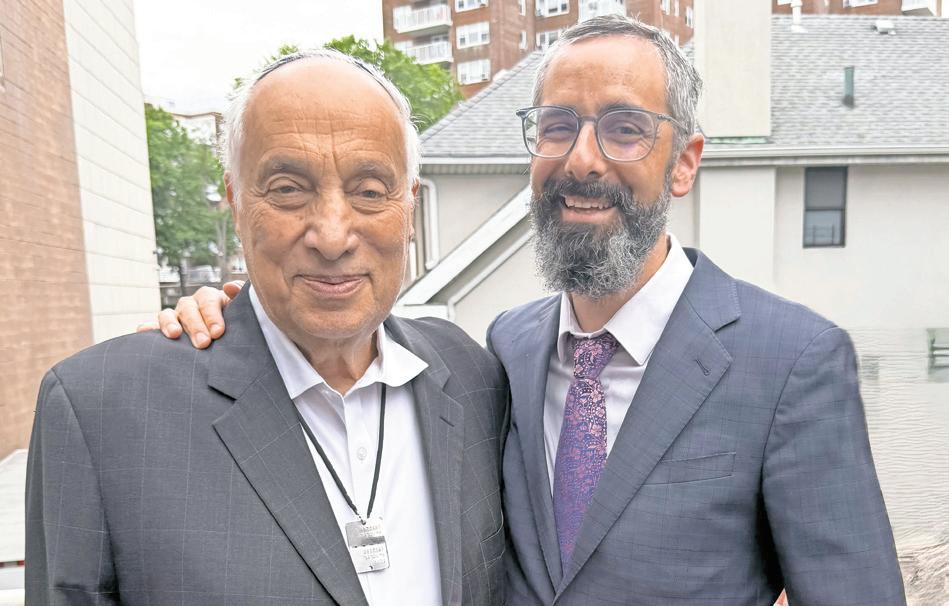
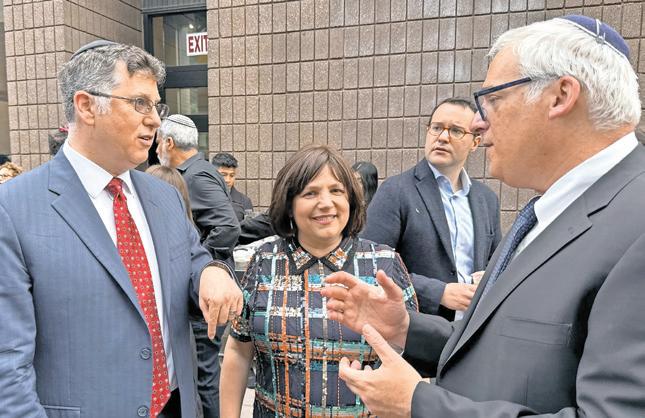
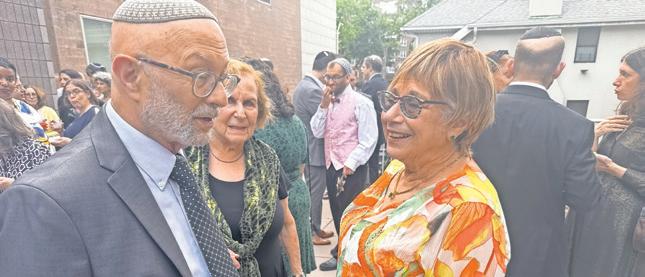
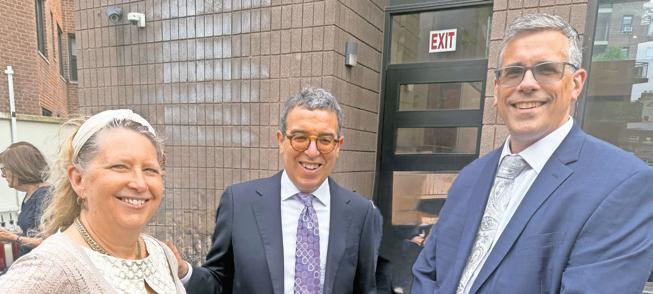
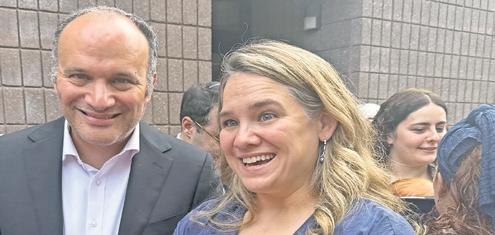
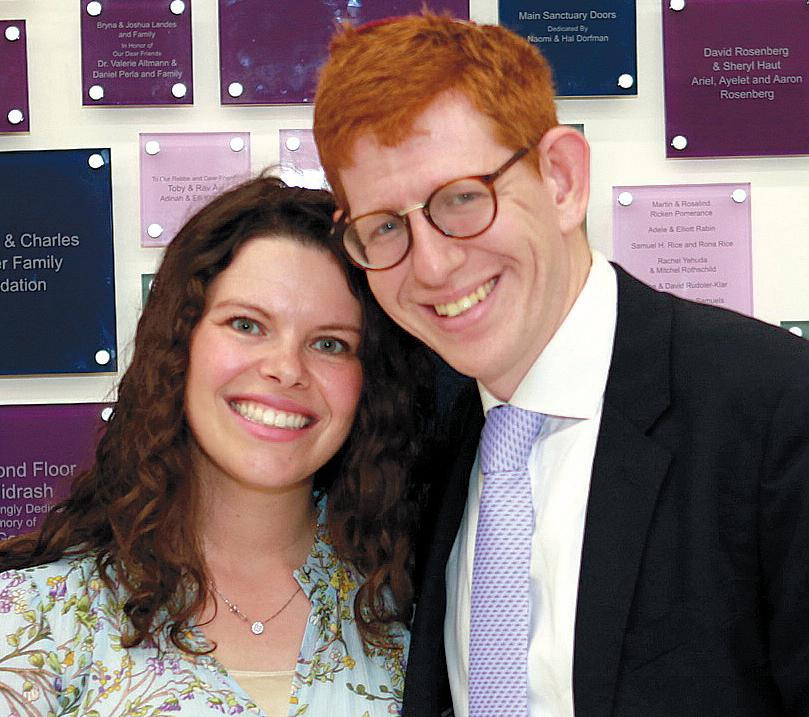
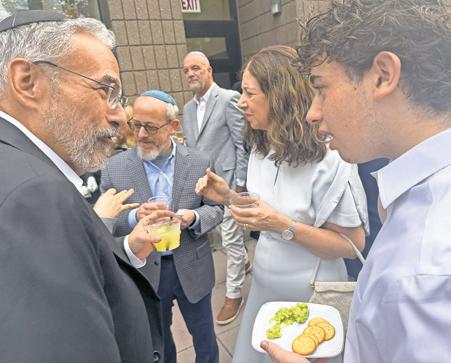
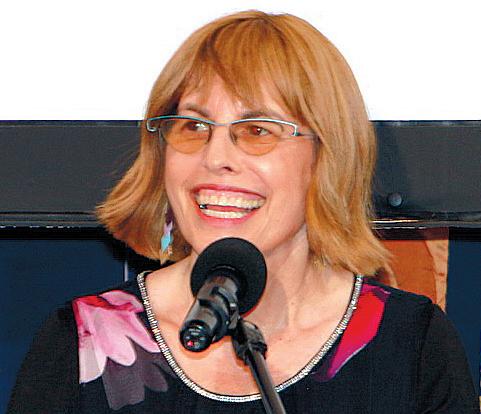
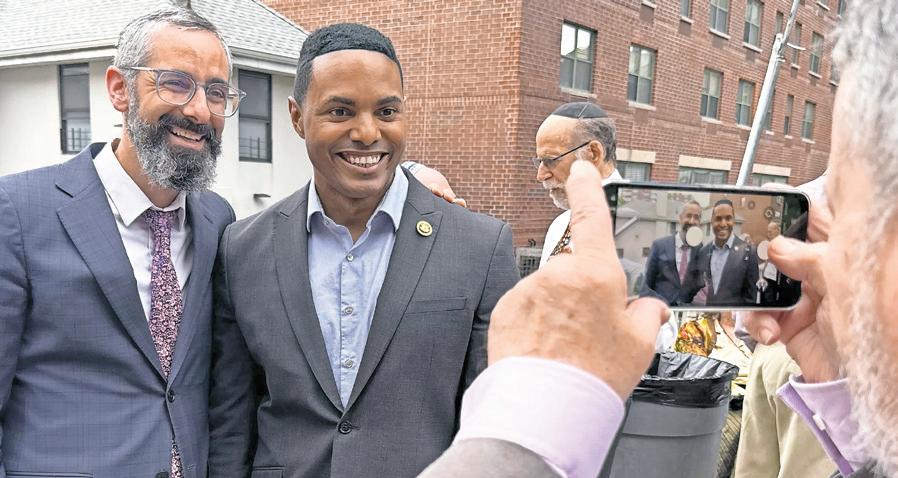
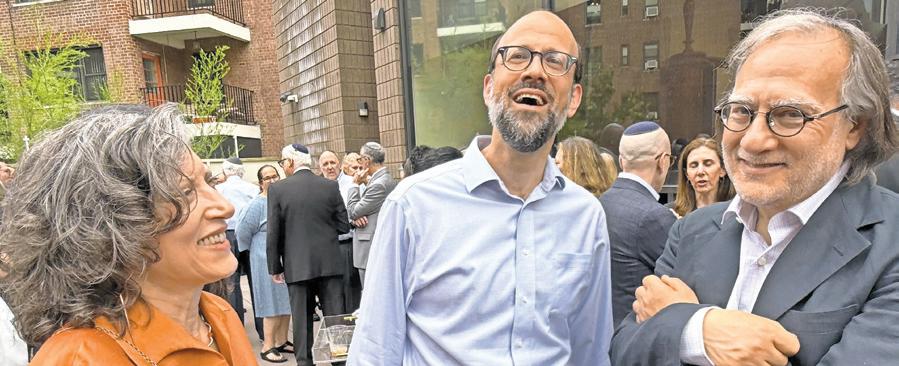
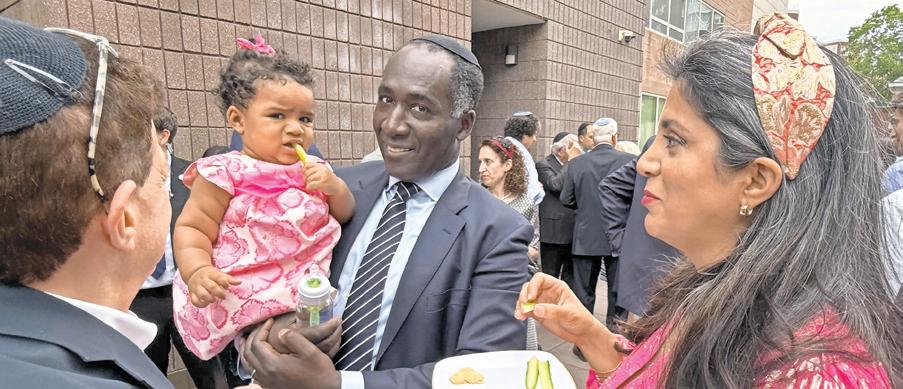
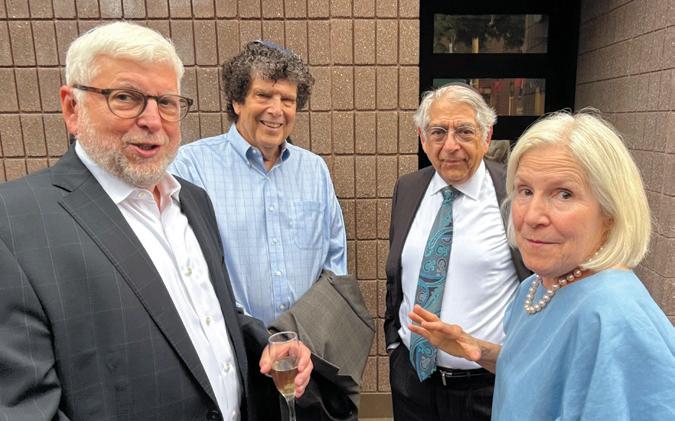
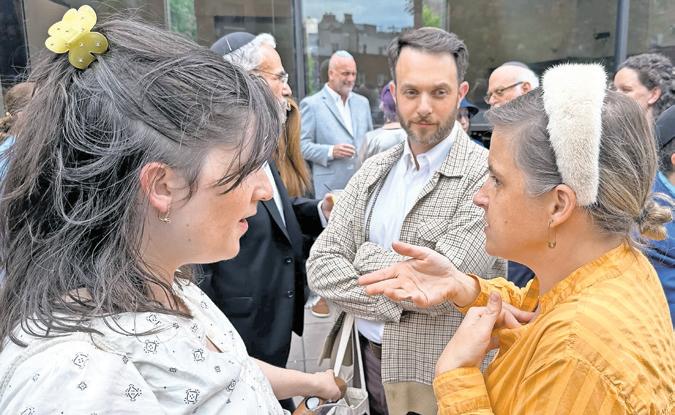
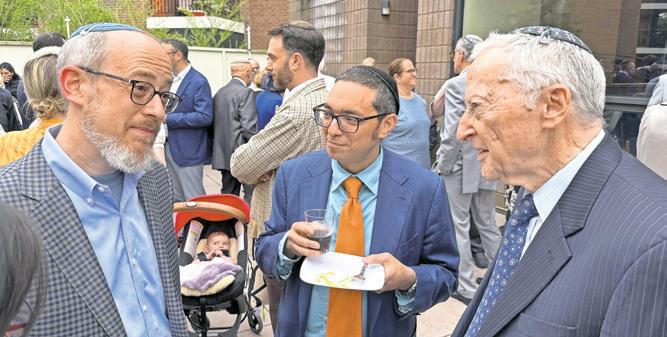
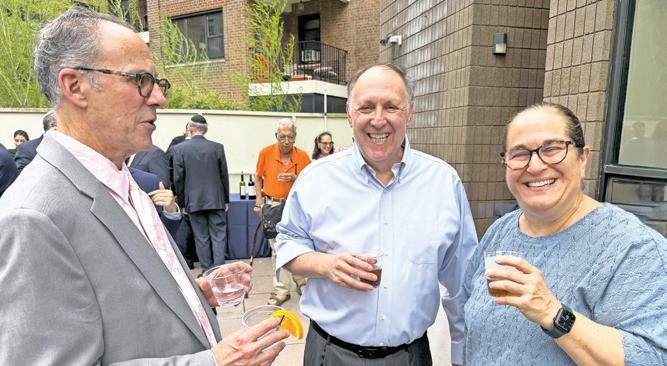
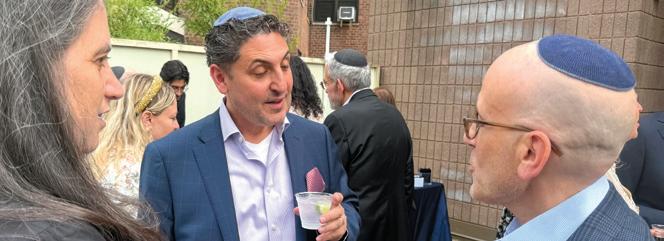
The Hebrew Institute of Riverdale drew 400 attendees to its 50th annual dinner on June 14, honoring two couples and featuring a video showcasing five generations of shul members.
Senior Rabbi Steven Exler called the gathering “an opportunity to say ‘wow, what have we accomplished in 50 years [and] where do we want to go from here’?”
HIR, a Modern Orthodox congregation founded by Rabbi Avi Weiss, is affectionately known as The Bayit.
Rabbanit Bracha Jaffe said the dinner was an opportunity to recognize the shul’s values which, according to its mission statement, is to warmly embrace “all Jews” in “a place of love and welcome.”
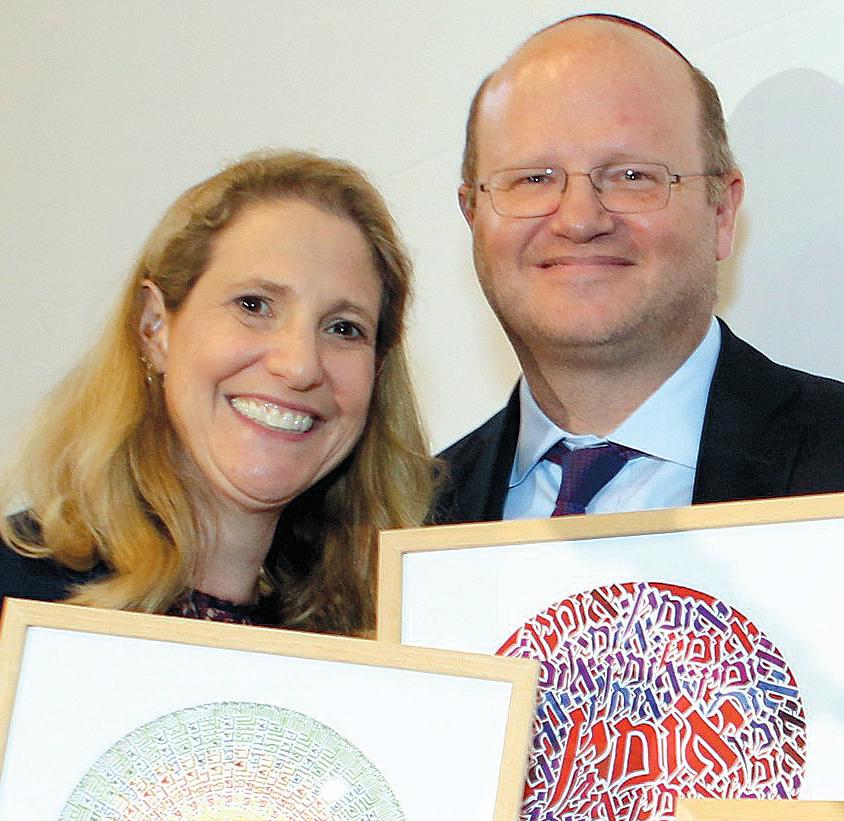
The Guest of Honor Award was presented to Rabba Sara Hurwitz and her husband Josh Abraham in recognition of Rabba Sara’s retirement from 23 years of clergy service. Rabba Sara was the first publicly ordained female Orthodox rabbi — in 2009 — and is stepping down to fully focus her efforts on Yeshivat Maharat.
Maharat, an institution that ordains women within Modern Orthodoxy, was founded by Rabba Sara and Rabbi Weiss in 2009. What began with three students has grown significantly over its 17 years, graduating 107 women and currently enrolling 50.
The students’ goal, after four years learning Talmud, halacha and pastoral training, is to receive smicha
Rabbanit Bracha observed that Rabba Sara “created opportunities that never existed before.”
“Young girls can imagine and grow up with what it means to have Orthodox feminine leadership,” she said.
Rabba Sara told The Jewish Star that Maharat, located in the HIR building on Henry Hudson Parkway, “is a flourishing institution and [we’re] very proud of what we’ve grown.”
She said that “my arm was twisted” before agreeing to accept the Bayit’s honor, but she realized that it was “important for me and for the community … to have an opportunity for them to share gratitude.”
“Even though I’m stepping back from my role I’m not stepping back from being present in the community,” she said.
The Community Service Award was presented to Tobey Linhart and Yonah Goldschmidt, honored for their deep involvement in the shul over the past seven years. Whether delivering chicken soup and challah on Friday afternoons, creating a women’s megillah reading, or organizing athletic activities to bring the community together, the couple has been instrumental in “building the social community,” Rabbi Exler said.
As the family prepares to move to Israel this August, the dinner served as a formal goodbye.
Yonah explained how honored he felt to be surrounded by his community and family, while Tobey described the evening as “totally surreal and very overwhelming.”
“It was such an honor to speak about our time there.”
She also shared that “the most meaningful moment for me at the dinner was having my kids sing in front of the community,” noting that the HIR is a very family forward community.”
Tobey joked that “HIR is notorious for having bad kiddush … but the dinner [catered by Ephi’s Catering] is the one time a year where there’s excellent food so we really liked that.”
Rabbanit Bracha said that volunteers packaged the leftovers and donated them to the Friendly Fridge, a gesture that, she noted, “really aligns with our values.”
Leora Mahler, who is entering her senior year at SAR, is an intern at The Jewish Star.













At Mount Sinai South Nassau, patient safety isn’t just a priority— it’s a standard, one we work on every day. And the experts agree.
We’ve earned national recognition for patient safety, including an “A” Hospital Safety Grade from The Leapfrog Group and the Healthgrades Patient Safety Excellence Award.
That means better outcomes for our patients with lower risk of infections or hospital acquired conditions.
When it comes to your health, nothing matters more than knowing you’re in a place where patient safety matters most.
Learn more at mountsinai.org/southnassau
By Rikki Zagelbaum, JNS
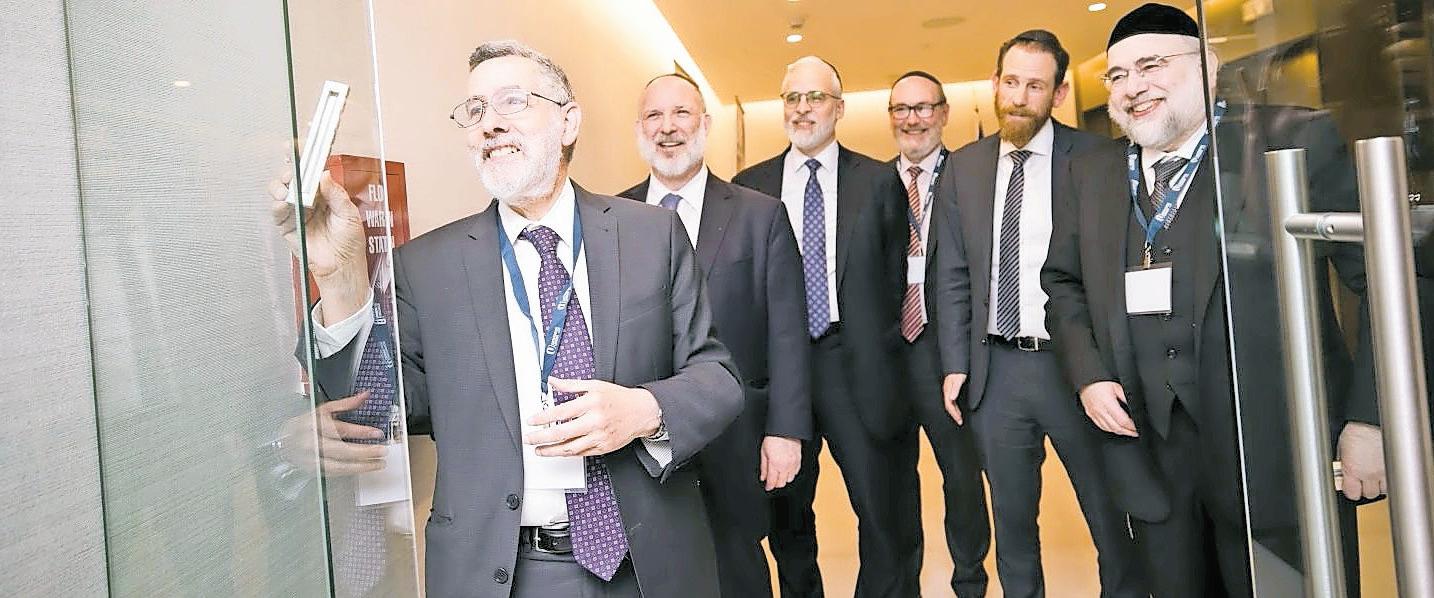
Rabbi Menachem Genack, 78, had been speaking to JNS for about 45 minutes when, with a smile, he recalled a story about Rabbi Yosef Kahaneman, a Lithuanian rabbi known as the Ponevezher Rav, who often received backlash for his dream of rebuilding the famed Ponevezh yeshiva after the Holocaust.
“People would tell him, ‘You’re dreaming’,” Rabbi Genack told JNS. “‘Yes,’ he would reply. ‘But I’m not sleeping’.”
The longtime chief executive officer at OU Kosher, the Orthodox Union’s kashrut division, spoke just ahead of his planned retirement on July 1 after 45 years at the kosher certifier.
As his time at the OU winds down, Rabbi Genack has been thinking about Rabbi Kahaneman’s remark. “His vision, his determination, what he built — it’s very inspiring,” he said.
The story has stayed with him as he transformed the kashrut division from a one-man operation into a global enterprise that today supervises and certifies more than 1.3 million
products developed in 105 countries worldwide.
The division also now funds much of the organization’s broader work, including its youth outreach programs and publishing arm, OU Press.
But when Rabbi Genack arrived at the OU in 1980, he was the department’s sole full-time rabbi.
“I wouldn’t say something had to be fixed” at the OU, he told JNS. “It needed to be built.”
He determined that what the OU needed more than anything was “a clearer articulation of standards.” He assembled a small team to develop an ingredient-review department, establish consistent standards and expand the OU’s reach among major food manufacturers.
Growing up, Rabbi Genack didn’t have a dream job, but in high school, and later as a student of Rabbi Joseph B. Soloveitchik, he discovered a love of Torah learning that would help shape the course of his life.
“There was no one like the Rav,” Rabbi










Genack said. “He was an extraordinary pedagogue. He was so generous.”
“The Rav gave me direction and guided me toward this path,” he said. “One of the things he told me was that he didn’t want to see the OU become an absolute monopoly. He wanted to see the ‘little brothers’ succeed as well.”
“There was a communal responsibility, and we did that,” Rabbi Genack said. “If other agencies met high halachic standards, we accepted them.”
Politics, too, was part of Rabbi Genack’s inheritance.
Raised in Forest Hills by Holocaust survivors and fervent Zionists, he grew up in a home where Israel, Zionism and public affairs were constant subjects of conversation.
When he was 4, his family moved to Israel, but his parents decided that the hardships of the state’s early years made life too difficult.
“There simply wasn’t enough food to go around,” Rabbi Genack said. “It was a difficult time.”
Though his family returned to the United States, his father’s “dominant interests” remained “Israel, Zionism and politics,” he said. “Politics was something that was discussed in our house a lot.”
“Especially for Jews,” he came to realize, “we have to have a voice.”
In 1994, he founded NORPAC, a bipartisan political action committee that strengthens support for Israel on Capitol Hill. He also developed a close relationship with former President Bill Clinton, the subject of his 2000 book, “Letters to President Clinton: Biblical Lessons on Faith and Leadership.”
About halfway through the conversation, Rabbi Genack recalled that as a child he saw President John F. Kennedy. In September 1963, two months before Kennedy was assassinated, he saw the president drive near Flushing Meadows Park.
“They stopped all the traffic on Main Street,” he recalled. “I was standing on the side of the highway when the president’s car passed by. We waved to him.”
As the OU expanded over the decades, Rabbi Genack said that the organization faced countless challenges.
“The OU was viewed as Orthodox, but limited to a particular constituency,” he said. “I wanted it to speak to the entire Orthodox community, so when I hired people, I looked across different communities — many different yeshivot and backgrounds.”
“I wanted the OU to look like the Orthodox world, so that it could speak to and communicate with the broader American Jewish community and beyond,” he said.
He also focused heavily on establishing trust and credibility.
“Through the quality of the people we worked with, through integrity, through implementing standards consistently,” Jews around the world began to trust the organization’s certifications and decisions, he said.
“Mistakes were undoubtedly made, but you build trust on that basis,” he said.
In recent years, Orthodox Jewry has grown,
in his view, “both in strength and in numbers.” But alongside that growth have come challenges for American Jewry that he never expected to confront.
“Especially when you look at places like Lakewood and the yeshiva world, the Orthodox community has become much stronger,” he said. “But the challenges facing American Jewry are also very profound. The risk of rapid assimilation. The level of antisemitism that we’re seeing. The security challenges facing the State of Israel.”
“These are things I never imagined seeing in my lifetime,” he said.
Rabbi Moshe Elefant, chief operating officer and executive rabbinic coordinator of OU Kosher, is slated to succeed Rabbi Genack. He told JNS that the transition has been in the works for five years.
The two first met 39 years ago, when Rabbi Genack interviewed Rabbi Elefant for a position at the organization.
“I thought Rabbi Genack would ask a lot of questions about kashrus, about my knowledge of kashrus, which wasn’t very extensive other than that I ate kosher my whole life,” Rabbi Elefant said.
“But he really wasn’t focused on testing me in kashrus,” he said. “He was trying to figure out who I am, what kind of personality I had, whether I’d fit in with the organization. I guess he decided I did.”
Though the two have drastically different personalities — Rabbi Elefant noted that Rabbi Genack is much more reserved and “scholarly” than he, while he is more “out there” — their relationship has been strong from the beginning. Rabbi Elefant said their differences even extend to their personal kosher practices. He follows a stricter standard for dairy, while Rabbi Genack is careful about a separate restriction involving certain grains.
“I only eat cholov Yisroel, and he’s careful about yoshon,” Rabbi Elefant said, laughing. “So when we get samples in the office, all the dairy samples go to him, and all the cake comes to me.”
Rabbi Elefant said that Rabbi Genack’s vision from the start was that if “anybody, for whatever reason, wants to keep kosher, wherever they are in the world, because of the OU they’ll be able to do so.”
“That was his vision,” Rabbi Elefant said. “He built it, literally, brick by brick.”
For Rabbi Genack, the work was never only about food certification. It was about making Jewish life easier to sustain in an era of assimilation.
“The OU should be an eloquent spokesman for the principles we represent,” he said.
“Part of the OU’s mission is contained in the word itself — union, unity,” he said. “To promote unity within Orthodox Jewry. That’s something that unfortunately is often lacking.”
“The money we make from kashrut should be used to help people, promote Torah and strengthen Jewish life,” he said. “If kosher products are available in every store with an OU, at the same price, that makes it possible to live as a Jew in the United States.”
By The Jewish Star
From JNS and other sources
Fans of “Fauda” are getting a heads-up before the hit Israeli drama revisits the horrors of Oct. 7.
Producers warned viewers that Episodes 7 and 8 of Season 5 contain scenes and sounds tied to the Hamas massacre that may be difficult to watch. In a social media message, broadcaster Yes said those struggling with the material can skip the episodes and return the following week without losing the overall storyline.
The new season was extensively rewritten following the attacks and filmed largely in Israel and Hungary. The series, which debuted in 2015 and is seen in 190 countries, is also streaming internationally on Netflix.
Actor Idan Amedi, a fan favorite from earlier seasons, does not appear after being seriouswly wounded while serving in Gaza.
Israel’s Health Ministry says two suspected Ebola cases have tested negative, easing fears after travelers returned from the Democratic Republic of the Congo.
The two individuals remain under medical care, but officials stressed there are currently no confirmed Ebola cases in Israel. In fact, the country has never recorded a verified infection despite several scares over the past decade.
Health officials reminded the public that Ebola is not airborne and spreads only through direct contact with bodily fluids from someone showing symptoms.
The announcement comes as Congo continues battling an outbreak. According to the World Health Organization, more than 1,000 cases and 254 deaths have been reported there.
With quiet returning to Israel’s northern border, President Isaac Herzog is urging Israelis to pack their bags and support communities battered by months of Hezbollah attacks.
During a visit to Metula, Israel’s northernmost town, Herzog called on families to travel north, visit local attractions and spend money at struggling businesses.
“Now is the time to come to the north,” Herzog said, describing border communities as “the heart of the land.”
His appeal came after Israel and Hezbollah agreed to halt fire over the weekend, prompting the lifting of security restrictions across dozens of northern communities.
Herzog said Israel’s ultimate victory will be measured not only by security, but by families returning and helping the region flourish again.
Israel needs a stronger sales pitch — and less victimhood.
That was the message from Tzipi Hotovely, head of Israel’s National Public Diplomacy Directorate, speaking at the JNS International Policy Summit in Jerusalem.
“Israel is fighting the world’s fight,” Hotovely said, arguing that the Jewish state should frame its struggle as a battle between good and evil rather than focus on suffering alone.
She pointed to a massive Hezbollah tunnel discovered near the northern border that she said was designed to create “10 times October 7” in Galilee communities.
Hotovely also urged Israel to emphasize its 4,000-year connection to the land and better coordinate its messaging around the world.

Long Island business leader Jon Held, a founding supporter of Birthright Israel on Long Island, was honored at a gala in Westbury that raised over $2 million on June 11.
“We don’t have the luxury of standing on the sidelines,” Held told nearly 300 participants at the event, in the Glen Oaks Club. “Every young Jew who boards a Birthright plane comes home more resilient, proud and connected to their Jewish identity — that is worth fighting for and worth celebrating.”
“The young adults who travel to Israel because of this community come home more grounded, more confident, more connected. Long Island feels that, the Jewish world feels that. That is what Jon helped build,” said Elias Saratovsky, president and CEO of Birthright Israel Foundation.
Israel is looking east as it expands one of its fastest-growing strategic partnerships.
A senior Israeli defense delegation led by Defense Ministry Director General Maj. Gen. (res.) Amir Baram traveled to India for high-level talks aimed at boosting military cooperation and defense industry ties.
Baram met with India’s defense minister, defense secretary and top military officials as both countries explored new joint opportunities.
Calling India a “key strategic partner,” Baram said the relationship goes beyond business and reflects shared values and mutual trust.
The visit underscores Israel’s effort to strengthen alliances, expand defense exports and deepen cooperation with one of the world’s largest and most influential democracies.
A senior Israeli lawmaker is warning that the West risks repeating the mistakes of the 1930s.
Speaking at the JNS International Policy Summit in Jerusalem, Likud MK Amit Halevi compared radical Islamist movements to Nazi Germany and said Israel is fighting a threat that endangers the entire Western world.
Halevi accused Iran of spreading instability through terror proxies across the Middle East and criticized Western leaders for what he called dangerous appeasement.
He also took aim at ongoing diplomatic outreach to Tehran, warning that failing to confront the regime could have global consequences.
“Israel is fighting for you,” Halevi said in a message directed at President Trump, arguing that the Jewish state remains on the front lines of a broader struggle.
Knesset Speaker Amir Ohana unloaded on Mayor Zohran Mamdani during the JNS International Policy Summit in Jerusalem, accusing him of fueling antisemitism and hostility toward Israel supporters.
Ohana pointed to Mamdani’s recent description of AIPAC as “monsters” and fired back with a headline-grabbing response of his own.
“The real monster in NYC is the antisemite currently occupying Gracie Mansion,” Ohana declared, drawing applause from the audience.
The Likud lawmaker noted he attended New York’s Israel Day Parade earlier this month despite the mayor’s absence. His remarks underscored growing tensions between pro-Israel leaders and some elected officials over rising antisemitism and debates over Israel’s war against Hamas.
Israeli President Isaac Herzog is traveling to Romania for a two-day visit focused on Holocaust remembrance, diplomacy and ties with the country’s Jewish community.
The trip begins in Iași, where Herzog will mark the 85th anniversary of the infamous Iași pogrom, one of the deadliest massacres of Romanian Jews during World War II. He will also participate in the reburial of 22 newly identified victims and visit Holocaust memorial sites.
The president will then continue to Bucharest for meetings with Romanian leaders, an address to Parliament and discussions with Jewish community representatives.
Israeli officials say the visit reflects both countries’ commitment to preserving Holocaust memory while strengthening cooperation between the longtime allies.
US Ambassador Mike Huckabee delivered a full-throated defense of Israel at the JNS International Policy Summit, declaring that the bond between the two countries remains “unbreakable.”
The former Arkansas governor said President Trump remains committed to Israel’s security and vowed that Iran will never be allowed to obtain a nuclear weapon.
Huckabee pointed to Trump-era moves such as relocating the US Embassy to Jerusalem and recognizing Israeli sovereignty over the Golan Heights as proof of that commitment.
Mixing policy with faith, Huckabee argued that America’s founding values are deeply rooted in biblical principles and praised the Jewish people’s historic role in shaping ideas of freedom and individual rights.
Switzerland is moving to crack down on public displays of Nazi imagery.
Under legislation advancing through the Swiss government, people caught displaying swastikas, Nazi gestures or other extremist symbols in public could face fines of about $250.
The proposed law would also cover online platforms, recorded media and visible tattoos featuring Nazi imagery. Exceptions would be allowed for educational, journalistic, scientific and cultural purposes.
Swiss officials said the measure is needed amid a rise in antisemitic incidents across the country.
If approved, the law would mark one of Switzerland’s most significant efforts to combat modern manifestations of Jew-hatred and extremist ideology in public spaces.
A Los Angeles rabbi says he’s relieved that a California raisin-company heir has been arrested on hate-crime charges — but wonders why it took so long.
Rabbi Zushe Cunin of Chabad of Pacific Palisades said his community endured weeks of fear and anxiety before authorities arrested Bruce Lion, 64, who is accused of making antisemitic threats against him.
According to prosecutors, Lion faces felony hate-crime charges tied to threats allegedly directed at the rabbi during a Shabbat gathering.
Cunin told JNS that neighbors of all backgrounds were shocked by the alleged behavior. While welcoming the arrest, he said the experience reinforced a larger lesson.
“We live with pride. We live with strength,” the rabbi said. “The way we get rid of darkness is with light.”
An end-of-year celebration at New York’s United Nations International School was canceled after students allegedly filled yearbooks with swastikas, antisemitic messages and homophobic remarks.
School officials launched an investigation after discovering hate-filled messages in more than 30 yearbooks. Nearly 20 students have reportedly been identified as potentially involved.
Administrators quickly confiscated the yearbooks, canceled the eighth-grade social event and announced plans to replace the books with new copies.
The school stressed that the offensive content was handwritten by students and not printed by the publisher.
Israeli Consul General Ofir Akunis condemned the incident, warning that antisemitic hate speech in schools “must never be tolerated” and urging educators and community leaders to confront it directly.
What started as a small snack giveaway has turned into a full-scale pro-Israel campaign across the New York area.
Volunteers with the grassroots group IMPACT have handed out roughly 6,000 bags of Israeli Bamba and Bissli snacks while distributing antiBDS literature in New York City, Long Island and Westchester.
The effort began outside Brooklyn’s Park Slope Food Coop after the co-op voted to boycott Israeli products. Instead of protesting, organizers decided to flood the area with Israeli snacks and information about the Boycott, Divestment and Sanctions movement.
Kosher Kitchen JoNI
SchocKEtt Jewish Star columnist
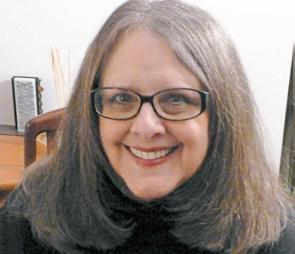
For most of my childhood, my dad grilled on a black enameled round grill. He filled it with charcoal, sprayed it with lighter fluid, let it sit for several minutes and then ignited the coals. I can remember the smell, a sickly chemical odor that made me run for the Cheerios; I was sure my food would taste like the gasoline he put in the lawn mower. Of course, it never did — he claimed it all burned off — but I still wonder how much of that stuff made it into the food we ate.
Then one day I looked out on the very large deck he had just built and saw the reason for his hard work that summer. There on the newly stained wood was a huge, brand new gas grill.
From then on, the sky was the limit — from meats to vegetables, chicken to fish, even fruits got the grill treatment, and he never looked back. The lighter fluid became a distant, bad memory.
That new grill needed new culinary creations, so he worked in the kitchen to create perfect sauces that became legendary; shish kebobs that were heavenly, fish fresh from the ocean, and creative smores that were much more than graham crackers and chocolate. I still make (or try to make) the sauce he used on his grilled chicken.
Sauces make grilled food so much better. A burger is delicious, one basted with a sweet or spicy or smokey sauce is pure delight. Chicken, steaks and fish are all elevated by the addition of a delicious sauce.
Sauces go back to ancient times and different regions in the country have their own favorite sauces.
The Pilgrims thought tomatoes were poisonous, so tomato based sauces were noy popular in the colonies for hundreds of years. During the Civil you could find sauces flavored heavily with the sugar, tomatoes, and molasses that were available on the sugar plantations.
Further southwest into Texas and you enter the heart of slow cooking, true barbecue. They use rubs and mops, fiery, thin sauces that are literally mopped onto slow-cooking meat using a smaller version of what looks like an old-fashioned cotton floor mop. This hot sauce reflects the many varieties of hot peppers that grow in that region. Maryland and Pennsylvania tend to favor mustard based sauces
Up to Kansas City and the sauces are thick, rich smokey tomato/molasses blends. This flavor has found its way back to the New England states and is a favorite here as well.
The sauces of America make grilling fun and interesting. So, take your choice and enjoy your summer by the grill. BTW — the measurements are only suggestions and approximates. These are meant to be bases for your own imaginations and family likes and dislikes. So have fun and get creative and let the kids help!!
• 2 cups ketchup
• 1 cup water, apricot nectar, pomegranate juice or half and half apple juice and water
• 1/2 small onion, grated
• 1/3 cup apple cider vinegar, more or less, to taste
• 5 Tbsp. dark brown sugar, to taste
• 5 Tbsp. lt. brown sugar or molasses to taste
• 1-1/2 tsp. freshly ground black pepper

• 1-1/2 tsp. onion powder
• 1-1/2 tsp. ground mustard
• 1 Tbsp. lemon juice
• 1 Tbsp. kosher Worcestershire Sauce, to taste
Place all ingredients in a large saucepan. Mix well. Heat over medium-low heat until it begins to boil. Reduce heat and simmer, partially covered, for about 45 to 60 minutes to reduce and thicken. Stir frequently, taste, and adjusting seasonings and ingredients adding more sugar or spices as you like. Makes about 4 cups.
Pepper Barbecue Sauce for Everything (Pareve)
This is great hot or cold. The sauce Is terrific with thinly sliced roast beef, chicken, or turkey instead of other condiments.
• 1 Tbsp. extra virgin olive oil
• 1 to 2 heads of garlic, roasted, about 10 to 20 large cloves
• 2 to 4 large cloves garlic raw
• 1/2 cup canola oil
• 1 yellow onion
• 1/3 cup crushed pineapple, juice reserved
• 2 cups Ketchup
• 1 cup water or pineapple juice
• 2/3 cup dark brown sugar, firmly packed
• 3 Tbsp. Golden Syrup, corn syrup or molasses
• 1/3 cup kosher Worcestershire sauce
• 1/3 cup apple cider vinegar
• 3 Tbsp. chili powder
• 1 tsp. Instant coffee (I use decaf)
• Kosher salt to taste
• Freshly cracked black pepper to taste
• OPTIONAL: 1/2 to 1-1/2 tsp. cayenne pepper and/or 1/2 to 1 to 1/2 tsp. red pepper flakes, to taste. Finely minced jalapeno or other hot peppers



















































































































































Continued from page 12
Preheat the oven to 400 degrees. Cut off the tops of the garlic heads and drizzle with the olive oil. Wrap in foil and roast for 35 to 50 minutes until golden and softened. Remove from oven and let cool.
Squeeze each clove of roasted garlic from the skin into a small bowl and discard the skin. Set aside. Process the onion and raw garlic in a food processor until coarsely chopped.
Place the canola oil in a large heavy saucepan. Heat the pan over medium heat for about 10 seconds. Add the onions to the pan. Sauté until the onions turn golden brown, 10 to 15 minutes.
Place the roasted garlic in the food processor bowl and add the remaining ingredients. Process until smooth. Add the sauce to the onions, stir well and bring to a gentle boil. Reduce heat and simmer very gently for 20 to 25 minutes to reduce and thicken. Stir frequently to avoid scorching. Let cool. Taste and adjust seasonings. Makes about 4 to 5 cups sauce.
Note: It is great on mashed potatoes, rice or even brushed on sweet corn before grilling.
This is a great barbecue sauce for ribs, chicken or even hamburgers. It can be as hot as you like or as mild as you want. Divide the recipe in half and then add the “heat” to the half for adults for a family barbecue.
• 2 cups Ketchup
• 1/2 cup blackstrap molasses
• 1/4 to 1/3 cup Bourbon, less or more, to taste
• 1 to 3 (or more) Tbsp. hot pepper sauce
• 2 Tbsp. kosher Worcestershire sauce
• 1 tsp. paprika
• 2 cloves garlic, pressed through a garlic press
• 1 tsp. onion powder
• 2 heaping tbsp. dark brown sugar, more or less, to taste
• 3 Tbsp. canola oil
Combine all ingredients except the oil in a saucepan. Bring to a boil over medium heat and stir often. Reduce heat to simmer, stirring frequently, until thickened. Add the oil and whisk to blend. Let cool. Taste and adjust seasonings as desired. Refrigerate until ready to use. Can be made several days ahead.
This was originally a sauce for chicken wings. I have used it on boneless, skinless chicken breasts and thighs; it is delicious.
• 1/2 cup olive or Canola oil
1 cup beer, any kind will do, even flavored beers like cranberry or honey or apple
• 1/2 cup Tamari or soy sauce
• 1/8 cup lemon juice
• Pinch salt and pepper
• 2 tsp. freshly grated ginger
• 2 to 4 cloves garlic, minced
• 1/8 to 1/4 cup dark brown sugar
Place all the ingredients in a large bowl and whisk to blend. Makes about 2 cups. This sauce is great on chicken wings or chicken pieces
This is all about that mustard taste, so adjust all ingredients as you like. For the true mustard lovers, this is great basted on hot dogs, burgers, streaks, veggies or on chicken.
• 4 Tbsp. extra virgin olive oil
• 3 to 5 garlic cloves, minced
• 3 Tbsp. kosher Worcestershire sauce
• 3 Tbsp. balsamic vinegar, dark or white
• 3 tsp. yellow or Dijon mustard
• 3 Tbsp. tamari or soy sauce


• Freshly grated black pepper to taste
• Kosher salt to taste
• OPTIONAL: A pinch of sugar or a drizzle of honey
Whisk all ingredients together. Taste and adjust seasonings. Baste on chicken pieces or hot dogs as they grill. Makes about 1/2 cup. Can be easily doubled.
Rubs are combinations of dry spices and sometimes a bit of liquid to make the rub into a paste. They are rubbed into the meat before cooking and impart a rich flavor to whatever they are on.
Kansas City Rub (Pareve)
• 1 cup dark brown sugar, firmly packed
• 6 to 8 Tbsp. paprika
• 2 Tbsp. freshly cracked black pepper
• 2 to 6 tsp. kosher salt, to taste
• 2 Tbsp. chili powder
• 2 to 3 Tbsp. garlic powder
• 2 to 3 Tbsp. onion powder
• 2 to 3 tsp. cayenne pepper
Mix all ingredients together and store in an airtight container for up to 4 months. Makes about 2 cups.

Lemon Herb Rub For Salmon or Chicken (Pareve)
• 2 Tbsp. freshly grated lemon zest
• 2 tsp. lemon pepper
• 1 to 2 tsp. dried dill
• 2 Tbsp. granulated garlic or garlic powder
• 1 Tbsp. granulated onion
• 1/4 to 1/2 tsp. kosher salt
• 1/4 to 1/2 tsp. ground ginger
• Pinch sugar
Mix all ingredients together and rub gently on salmon or chicken before grilling. Alternatively, you can add some of the mixture to about 3 tbsp. of olive or canola oil and baste the fish as it grills.
• 2 Tbsp. oregano
• 2 Tbsp. thyme
• 1 Tbsp. parsley
• 2 Tbsp. granulated garlic or garlic powder
• 1 Tbsp. onion powder
• OPTIONAL: 2 Tbsp. freshly grated lemon zest
Mix together and sprinkle on chicken or fish that has been rubbed with olive oil. Makes about 1/2 cup.
• 2 tsp. freshly grated lemon zest
• 1 Tbsp. fresh oregano
• 1 Tbsp fresh thyme
• 2 to 4 cloves regular garlic
• 1/4 tsp. kosher salt
• 1/3 cup extra virgin olive oil.
• 1 to 2 Tbsp. freshly squeezed lemon juice
• 1 Tbsp. capers, drained and rinsed
Whisk all ingredients together and let stand for about 20 minutes for flavors to meld. Divide in half. Brush half on raw food and let stand for about 15 minutes. Use the rest to brush on as the food grills. Makes about 3/4 cup.
Write: Columnist@TheJewishStar.com
















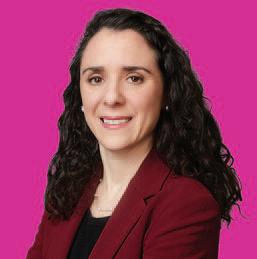

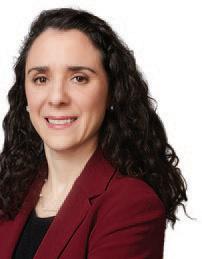



Jewish Star Torah columnists: Rabbi Benny Berlin, spiritual leader of BACH Jewish Center in Long Beach; Rabbi Avi Billet of Anshei Chesed, Boynton Beach, FL, mohel and Five Towns native; Rabbi Binny Freedman, rosh yeshiva of Orayta, Jerusalem; Dr. Alan A. Mazurek, former ZOA chair, retired neurologist, living in Great Neck, Jerusalem and Florida.
Contributing writers: Rabbi Sir Jonathan Sacks zt”l, former chief rabbi of United Hebrew Congregations of British Commonwealth; Rabbi Yossy Goldman, president South African Rabbinical Association; Rabbi Dr. Tzvi Hersh Weinreb, OU executive VP emeritus.
To submit commentary, inquire at: Editor@TheJewishStar.com. Contact our columnists at: Columnist@TheJewishStar.com.
Fri June 26 / 11 Tammuz
Chukas-Balak
Five Towns candles: 8:11 • Havdalah: 9:20
Scarsdale candles: 8:13 • Havdalah: 9:23
Thu July 2 / 17 Tammuz
Fast of Shiva Asar B’Tammuz
Fri July 3 / 18 Tammuz
Pinchas
Five Towns candles: 8:11 • Havdalah: 9:20
Scarsdale candles: 8:12 • Havdalah: 9:21
Fri July 10 / 25 Tammuz
Matot-Masei
Five Towns candles: 8:09 • Havdalah: 9:17
Scarsdale candles: 8:10 • Havdalah: 9:18
Five Towns Candlelighting: From the White Shul, Far Rockaway, NY
Scarsdale Candlelighting: From the Young Israel of Scarsdale, Scarsdale, NY
rabbi Sir JonaThan SaCkS zt”l
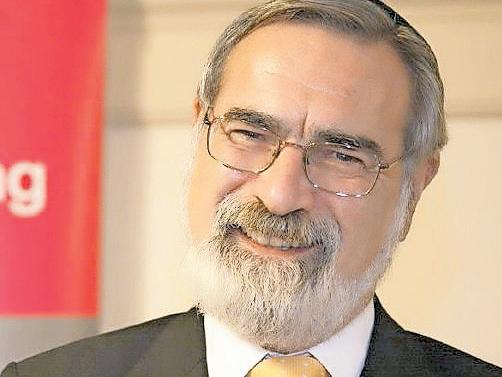
The story of Bilaam, the pagan prophet, begins with a bewildering set of non-sequiturs. It involves a sequence of events that seems to have no logic.
First, the background. The Israelites are approaching the end of their 40 years in the wilderness. Already they have fought and won wars against Sihon, King of the Amorites and Og, King of Bashan. They have arrived at the plains of Moab — today, southern Jordan at the point where it touches the Dead Sea. Balak, King of Moab is concerned, and he shares his distress with the elders of Midian. The language the Torah uses at this point is precisely reminiscent of the reaction of the Egyptians at the beginning of the book of Exodus.
[The Egyptian Pharaoh] said to his people: “Here, the children of Israel are more numerous and powerful than us...” and he was disgusted at the Children of Israel. Exodus 1:9-12
[Balak, the King of Moab] was very fearful because of the people, because it was numerous, and Moab was disgusted at the Children of Israel. Numbers 22:3
The strategy Balak adopts is to seek the help of the well-known seer and diviner, Bilaam. Again there is a literary evocation, this time of the words of G-d to Abraham:
G-d to Abraham: “I will bless those who bless you, and those who curse you I will curse.” Genesis 12:3
Balak to Bilaam: “I know that whoever you bless is blessed and whoever you curse is cursed.” Numbers 22:6
This time the parallel is ironic (indeed the Bilaam story is full of irony). In the case of Abraham, it was G-d who blessed. In the case of Bilaam, the power was thought to reside in Bilaam himself. In fact the earlier statement of G-d to Abraham already prefigures the fate of Moab — one who tries to curse Israel will himself be cursed.
The historical background to the Bilaam narrative is well-attested. Several Egyptian pottery fragments dating from the second millennium BCE have been found containing execration texts — curses — directed against Canaanite cities. It was the custom among pre-Islamic Arabs
When G-d speaks and we do not listen, He does not intervene to save us from our choices.

to hire poets thought to be under Divine influence to compose curses against their enemies.
As for Bilaam himself, a significant discovery was made in 1967. A plaster inscription on the wall of a temple at Deir Alla in Jordan was found to make reference to the night vision of a seer called Bilaam — the earliest reference in archaeological sources to a named individual in the Torah. Thus, though the story itself contains elements of parable, it belongs to a definite context in time and place.
The character of Bilaam remains ambiguous, both in the Torah and subsequent Jewish tradition. Was he a diviner (reading omens and signs) or a sorcerer (practicing occult arts)? Was he a genuine prophet, or a fraud? Did he assent to the Divine blessings placed in his mouth, or did he wish to curse Israel?
According to some midrashic interpretations he was a great Prophet, equal in stature to Moses. According to others, he was a pseudo-prophet with an “evil eye” who sought Israel’s downfall. What I want to examine here is neither Bilaam nor his blessings, but the preamble to the story, for it is here that one of the deepest problems arises, namely: what did G-d want Bilaam to do? It is a drama in three scenes. In the first, emissaries arrive from Moab and Midian. They state their mission. They want Bilaam to curse the Israelites. Bilaam’s answer is a model of propriety: Stay the night, he says, while I consult with G-d. G-d’s answer is unequivocal: But G-d said to Bilaam, “Do not go with them. You must not put a curse on those people, because they are blessed.” Numbers 22:12
Obediently, Bilaam refuses the emissaries. Balak then redoubles his efforts. Perhaps more distinguished messengers and the promise of significant reward will persuade Bilaam to
change his mind? He sends a second set of emissaries and gifts. Bilaam’s reply is exemplary:
“Even if Balak gave me his palace filled with silver and gold, I could not do anything great or small to go beyond the command of the L-rd, my G-d.” Numbers 22:18
However, he adds a fateful rider:
“Now stay here tonight as the others did, and I will find out what else the Lord will tell me.” Numbers 22:19
The implication is clear. Bilaam is suggesting that G-d may change His mind. But this is impossible. That is not what G-d does. Yet to our surprise, that is what G-d seems to do:
That night G-d came to Bilaam and said, “Since these men have come to summon you, go with them, but do only what I tell you.” Numbers 22:22
Problem 1: first G-d had said, “Do not go.”
Now He says, “Go.” Problem 2 appears immediately:
Bilaam got up in the morning, saddled his donkey and went with the princes of Moab. But G-d was very angry when he went, and the angel of the Lord stood in the road to oppose him. Bilaam was riding on his donkey, and his two servants were with him. Numbers 22:21-22
G-d says, “Go.” Bilaam goes. Then G-d is very angry. Does G-d change His mind — not once but twice in the course of a single narrative? The mind reels. What is going on here? What is Bilaam supposed to do? What does G-d want? There is no explanation. Instead the narrative shifts to the famous scene of Bilaam’s donkey — itself a mystery in need of interpretation:
When the donkey saw the angel of the L-rd standing in the road with a drawn sword in his hand, it turned off the road into a field. Bilaam beat it to get it back on the road.
Then the angel of the L-rd stood in a narrow path between two vineyards, with walls on both sides. When the donkey saw the angel of the L-rd, it pressed close to the wall, crushing Bilaam’s foot against it. So he beat it again.
Then the angel of the L-rd moved on ahead and stood in a narrow place where there was no room to turn, either to the right or to the left. When the donkey saw the angel of the L-rd, it lay down under Bilaam, and he was angry and beat it with his staff. Then the L-rd opened the donkey’s mouth, and it said to Bilaam, “What have I done to you to make you beat me these three times?”
Bilaam answered the donkey, “You have made a fool of me! If I had a sword in my hand, I would kill you right now.”
The donkey said to Bilaam, “Am I not your own donkey, whom you have always ridden, to this day? Have I been in the habit of doing this to you?”
“You have not,” he said.
Then the L-rd opened Bilaam’s eyes, and he saw the angel of the L-rd standing in the road with his sword drawn. So he bowed low and fell facedown. Numbers 22:23-31
The commentators offer various ways of resolving the apparent contradictions between G-d’s first and second reply. According to Nahmanides, G-d’s first statement, “Don’t go with them” meant, “Don’t curse the Israelites.” His second — “Go with them” — meant, “Go but make it clear that you will only say the words I will put in your mouth, even if they are words of blessing.” G-d was angry with Bilaam, not because he went but because he did not tell them of the proviso.
In the nineteenth century, Malbim and R. Zvi Hirsch Mecklenberg suggested a different answer based on close textual analysis. The Hebrew text uses two different words for “with them” in the first and second Divine replies. When G-d says, “Don’t go with them” the Hebrew is imahem. When He later says “Go with them” the corresponding word is itam
The two prepositions have subtly different meanings. Imahem means “with them mentally as well as physically,” going along with their plans. Itam means “with them physically but not mentally,” in other words Bilaam could accompany them but not share their purpose or intention. G-d is angry when Bilaam goes, because the text states that he went im — with — them — in other words, he identified with their mission. This is an ingenious solution.
The only difficulty is verse 35, in which the angel of G-d, having opened Bilaam’s eyes, finally tells Bilaam, “Go with the men.” According to Malbim and Mecklenberg, this is precisely what G-d did not want Bilaam to do.
The deepest answer is also the simplest. The hardest word to hear in any language is the word “No.” Bilaam had asked G-d once. G-d had said “No”. That should have sufficed. Yet Bilaam
See Sacks on page 22
RABBI BENNY BERLIN
Jewish Star columnist BACH Long Beach
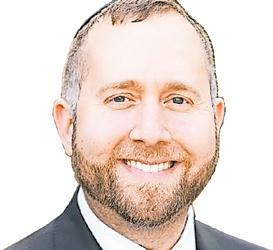
Iam writing this at 4:30 in the morning because my kids got up and are watching Torah videos. I grumpily tell my wife that they need to get back into a routine. Where is that red-light green-light clock we bought months ago?
Does anyone else find that discipline is harder in the summer? Routine relaxes when school lets out. There is more flexibility, more travel, more late nights. In many ways that looseness is healthy. But for those of us who require structure, summer can be genuinely hard.
Discipline gets a bad rap. A quick Google search turns up quotes about how it stifles creativity, kills spontaneity, boxes people in. There is truth to the value of stretching and experimenting. But being tamid, being consistent no matter how circumstances change,
is one of the most important principles in all of Judaism.
It is no coincidence that this principle frames the entirety of Jewish law. The Rema opens the Shulchan Aruch with the words “Shivisi Hashem l’negdi tamid” (Rema, Orach Chaim 1:1). The final siman of Orach Chaim concludes with the word “tamid” (Shulchan Aruch, Orach Chaim 697:3).
From the very first ruling to the very last, Jewish life is bookended by the same ideal. Consistency. When halacha anchors your life, wherever the summer takes you, however relaxed the schedule becomes, there is still a day-in and day-out connection with G-d.
That is precisely what the Korban Tamid was. Every morning and every evening, without interruption, an offering was brought in the Beis HaMikdash (Bamidbar 28:3–8). Next Thursday (July 2), on Shiva Asar B’Tammuz, Jews around the world will fast.
The Mishnah in Maseches Ta’anis (4:6) records five tragedies that occurred on this date — one of them is that the Korban Tamid was
Summer disrupts the schedule — and no one is watching.
discontinued. That consistency was broken. And it made the list of why we mourn. A remarkable Midrash, quoted in the introduction to the Ein Yaakov, records a debate among the Tanaim about the most fundamental verse in the Torah (Hakdamah to Ein Yaakov). Ben Zoma points to Shema Yisrael. Ben Nanas argues for V’ahavta l’reiacha kamocha. Then Shimon ben Pazi offers a surprising candidate. “Es hakeves echad ta’aseh baboker v’es hakeves hasheni ta’aseh bein ha’arbayim (One lamb in the morning and one lamb in the afternoon).”
Imagine you are stranded on a desert island and can bring a single verse on a parchment. I can assure you that the daily lamb offering would not be the first thing to come
to mind. Yet the conclusion of the Midrash is that the halacha follows Shimon ben Pazi. Because when you build real consistency into your life, the breathtaking big ideas, the oneness of G-d and the love for your fellow, follow naturally from it.
In Parshas Balak (23:10), Bilaam declares, “Tamos nafshi mos yesharim (Let me die the death of the righteous).”
The Ohr HaChaim explains that Bilaam wanted to go on living a life of greed and immorality and simply die righteous, collecting the reward of a tzaddik without ever having lived as one.
The Ohr HaChaim then adds a striking personal observation. He knew people who told him that if he could guarantee they would die one moment after doing teshuvah, they would repent immediately. What they could not imagine was waking up the next morning and continuing to live as righteous people. They wanted to die righteous. They did not want to live righteous.
What a tragedy to miss the point so completely. See Berlin on page 22
RABBI DR. tzvI hERsh wEINREB Orthodox Union
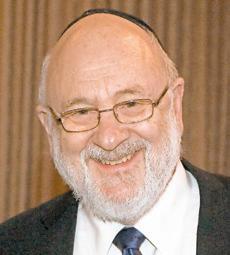
Everyone has his or her own voice. Some express it loudly and clearly, some mumble or whisper. Our voices can be expressed through speech, the written word, postures and gestures, and song.
In a book he wrote for managers of organizations coping with the complex challenges of the 21st century work environment, Stephen Covey makes the following statement: “There is a deep, innate, almost inexpressible yearning within each one of us to find our voice in life.”
That statement is the basis for his book, “The 8th Habit: From Effectiveness to Greatness,” designed to help organizational leaders find their voices and inspire others to find theirs.
Each of the great leaders of the Jewish people, from biblical times to the present, had his or her own distinctive voice. The voice of
Abraham was heard throughout his world; the voice of Isaac was almost silent in comparison. Moses described his own voice as defective, yet he was capable of supreme eloquence. Joshua’s voice is never described as wanting in any way, yet we have few examples.
Some of our great leaders, including Moses, expressed their voices in song. We have the Song of the Sea in which the voice of Moses dominates; his sister Miriam responds to Moses’ song in her own voice; the prophetess Deborah and King David are exemplary in their ability to use the medium of song to express their unique and distinctive voices.
The above are examples of how individual Jewish heroes found and expressed their voices. This week’s Torah portion, Chukat, provides an example of an entirely different kind of a voice: not of one person but that of an entire group, an entire nation. It is the Song of the Well, of the Be’er:
The well where the L-rd said to Moses, “Assemble the people that I may give them water.”
Then Israel sang this song:
Spring up, O well — sing to it —
The well which the chieftains dug, Which the nobles of the people started With the sceptre, and with their own staffs. And from the wilderness to Mattanah, and from Mattanah to Nahaliel, and from Nahaliel to Bamoth.”
(Numbers 21:16-19)
This is much briefer then the song Moses led when the people of Israel miraculously crossed the Sea. But part of this passage too, at least in the synagogues with which I am familiar, is chanted melodically.
Ihave long been impressed by the fact that this week’s Torah portion, in which the Song of the Well appears, describes a critical transition in the leadership of the Jewish people.
Ihave written about this before, and unfortunately it is time to revisit it again.
We had been living through constant attacks from Iran, from Hezbollah in Lebanon, periodic clashes with Hamas in Gaza and occasional salvos from the Houthis in Yemen. However, with the onset of the American Operation Epic Fury in concert with Israel’s Roaring Lion, it appeared the evil Iranian ayatollah regime — the bankroller and mastermind of all the proxy terrorist threats — was near its end.
It was the final Yom Tov of Pesach in Israel. President Trump had issued an ultimatum to Iran: Open the Straits of Hormuz by 3 am Israel time and capitulate or face total annihilation.
At 1:15 am, we were awakened by sirens and a particularly vicious, loud interception of incoming Iranian missiles that shook the windows
and sent us scrambling to the miklat. There I was informed by my son-in-law (he had kept his cellphone on to hear the alerts, as permitted despite the chag) that Trump had agreed to a twoweek ceasefire with Iran to allow it to comply.
The overwhelming feeling of disappointment that descended upon us in Israel, as well as supporters of Israel around the world, was beyond measure.
At the time, I wrote about how in Hebrew the word for disappointment is meuchsav, from the same root as the word kozev, liar. This is a word we had been reciting in Hallel every day since Pesach began. We read aloud
David HaMelech’s words, which have their origin in Tehillim 116:11: “Ani amarti b’chafzi kol ha’adam kozev (I said in my haste all men are liars).”
Kozev, a liar, and meuchsav, disappointment, are both related to expecting one result and getting another. If we expect truth and get a lie, we are disappointed. If we expect a beneficial result and get a harmful one, we start to think everything is a lie and everyone is a liar.
Did I think Trump was a liar?
It’s not the first time we lacked apparent leaders. If we expect truth and get a lie, we are disappointed.
From the time of the Exodus from Egypt, the Jewish people essentially have had three leaders: Moses, Aaron, and Miriam. In this week’s parsha, Miriam dies and is buried; Aaron too is “gathered unto his people” and is mourned; and Moses learns that his leadership role will come to an end sooner than he had thought, before the Jewish people enter the Promised Land.
This is indeed a story of transition, of the end of an era, of the passing of the mantle of leadership to a new generation.
No wonder then that the song sung in this week’s parsha is so very different from the song sung by Moses at that triumphant moment near the beginning of his leadership career.
Our Sages tell us in the Talmudic tractate of Sotah that the Song of the Sea was sung by the people responsively. That is, Moses said the first phrase, which the people said after him. He proceeded then to the second phrase, and the people echoed him. Moses was an authoritative leader, and the people were obedi-
See Weinreb on page 22
President Trump seems to firmly believe what he says, but he appears to be lying to himself. He has said in the past that you don’t negotiate with terrorists, that you can’t trust the Iranian regime, and that he will never accept a nuclear Iran. When he said those things, he was telling the truth.
As a confirmed Trump supporter, grateful for his unparalleled backing of the Jewish state, I argued no. Bombastic, capable of hyperbole like no one else, yes. But as a true friend and ally of both Israel and the Jewish people, he had surpassed any president in history, and perhaps any foreign leader in any era. I believed he was nobody’s fool, would correct the mistakes of the great King Cyrus — Koresh — whom he emulated in his support for the Jews, suppress his inner Achashverush, and quickly realize whether his so-called “deal” was legitimate or not, and act accordingly.
Now, more than three months later, I’m not so sure. Because liars can exist in two forms: those who lie to others and those who lie to themselves.
Yet his current words and actions negate those very statements, pointing to the exact contrary. This cognitive dissonance — holding two conflicting ideas in one’s head at the same time — is the definition of lying to oneself.
For evidence of this, we see clearly in Parshat Shelach, where the nesiim (the princes or presidents of the tribes of Israel), with the exception of Yehoshua and Calev, convince themselves they cannot conquer and inherit the land.
This despite witnessing the Exodus from Egypt, the mightiest empire of the time. Despite the numerous open miracles performed by G-d for them all to see — from the plagues to the splitting of the sea, to routing the evil Amalekites, to providing constant water and mana in the desert, and even providing real meat when
Mazurek on page 22
Published weekly except during certain religious and civil holidays by The Jewish Star LLC New York City office: 5676 Riverdale Ave Suite 311, Bronx NY 10471 • LI office: 2 Endo Blvd, Garden City NY 11530 Here’s how to reach The Jewish Star — Write: Editor@TheJewishStar.com. Call: 516-622-7461 ext 291
Editor & Publisher: Ed Weintrob
516-622-7461 ext 291
Jewish Star Associate: Nechama Bluth
516-622-7461 ext 241
Content: The Publisher endeavors to ensure that our content is within the bounds of normative halachah and hashkafah. Anyone who feels anything we publish may be inappropriate in this regard is urged to bring the item in question to the attention of the Publisher.
Advertising is accepted at the sole discretion of the Publisher and should conform to standards appropriate for distribution in an Orthodox community. Send us your news! Editor@TheJewishStar.com
Advertising: Publisher@TheJewishStar.com
Kashrut: The Jewish Star is not responsible for the
kashrut of any product or establishment featured in its pages. If you have questions regarding any establishment or product, including its supervision, please consult your rabbi for guidance.
Submissions: All submissions become the property of The Jewish Star and may be edited and used by the Publisher, its licensees and affiliates, in print, on the web and/or in any media that now exists or will exist in the future in any form, including derivative works, throughout the world in perpetuity, without additional authorization or compensation. The individual or entity submitting material affirms that it holds the copyright or otherwise has the right to authorize its use in accordance with The Jewish Star’s terms for submissions.
Opinions: Views expressed by columnists and other writers do not necessarily reflect the position of the Publisher or of The Jewish Star LLC.
Distribution: The Jewish Star is available free in kosher food establishments, stores, synagogues, and curb-side newsboxes on Long Island, in New York City and elsewhere. To request free delivery to your location, write Publisher@TheJewishStar.com.
Copyright: All content is copyright and may not be republished or otherwise reproduced without written permission by The Jewish Star; to do so without permission is against the law and halacha. For content reproduction write to Publisher@TheJewishStar.com.
The Jewish Star subscribes to JNS. It, or its contributors, own the copyrights on material attributed to them. The length and content of JNS material and all other submitted material may be edited by The Jewish Star.
Member: American Jewish Press Association. This newspaper contains words of Torah. While it is not considered shaimos, please dispose properly.
Mitchell Bard, foreign policy analyst, authority on USIsreal relations; Ben Cohen, senior analyst, Foundation for Defense of Democracies; Stephen Flatow, president, Religious Zionists of America-Mizrachi and father of Alisa Flatow, murdered in an Iranian-sponsored Palestinian terrorist attack in 1995; Yisrael Medad, Americanborn Israeli journalist and political commentator; Rafael Medoff, founding director of David S. Wyman Institute for Holocaust Studies; Fiamma Nirenstein, Italian-Israeli journalist, author of 13 books, leading voice on Israeli affairs, Middle Eastern politics and antisemitism; Melanie Phillips, British journalist; Moshe Phillips, national chairman, Americans for a Safe Israel; Thane Rosenbaum, Distinguished University Professor at Touro University (published by Jewish Journal); Jonathan S. Tobin, editor-in-chief, Jewish News Syndicate.
American businessman Ronald S. Lauder stood at the Jerusalem Post conference in New York earlier this month and said what many have been saying for years. Since Oct. 7, Jewish organizations in the United States have spent more than $600 million fighting antisemitism through advertising, media campaigns and public messaging.
“Has it helped?” he asked the room. “Has all that money stopped or even slowed down the hatred against us? The answer is no.” He’s right. And he’s not the first person to say it.
In the mid-1990s, marketing consultant Gary Wexler sat in a meeting in Israel and watched the infrastructure of what became the global campus movement against Israel get mapped out in front of him. He came back and tried to warn the people with the power to respond. Nothing happened. In 2003, Frank Luntz was commissioned by major Jewish philanthropists to find out why American Jewish college students weren’t pushing back against campus attacks on Israel.
His conclusion was blunt: The community was talking to itself. He built a detailed language guide showing that persuadable audiences were reachable, but only if someone actually tried. The organizations took the report, thanked him and went back to their gala dinners.
Now, Lauder, who has served as president of the World Jewish Congress since 2007, is calling for a $1 billion dedicated government agency — an “Iron Dome for public relations” — led by someone who actually knows public relations and news, not a political appointee. He wants Israel to respond to disinformation twice as hard and without hesitation, and he’s proposing that intelligence resources, including Mossad and the Israeli Security
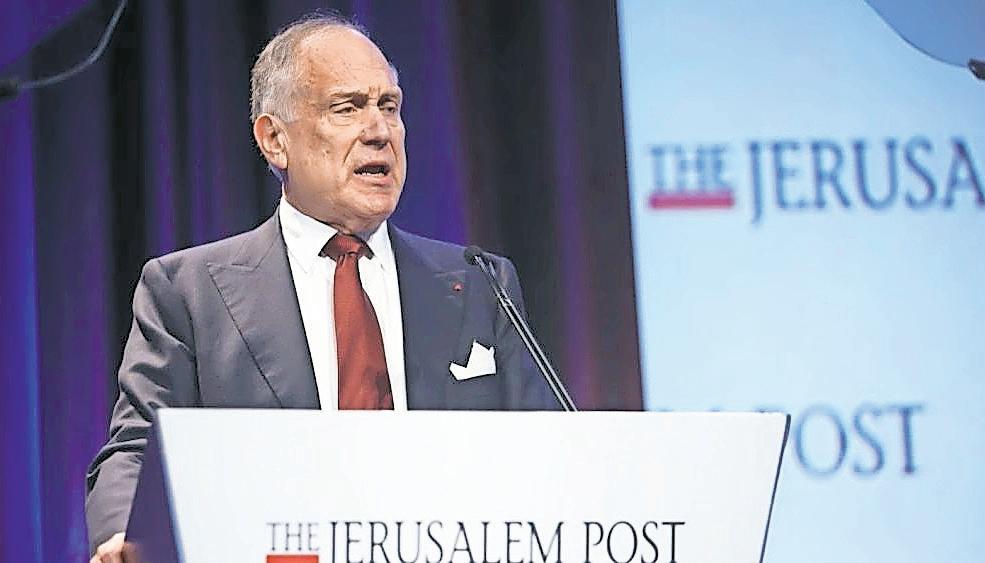
Agency (Shin Bet), be used to track where the lies originate. He’s saying Diaspora Jews need to fund this and fight alongside Israel, because what happens to Israel’s image in Western media markets lands on our doorsteps, too.
Thirty years after Wexler’s warning. Twenty-two years after Luntz’s research. The question worth asking isn’t whether the need is real. It’s why it took this long, and what that delay has actually cost.
Some will argue the community has been responding — that $600 million in spending proves the institutions weren’t asleep. That argument disintegrates the moment you look at what the money bought: Awareness campaigns aimed at people who already agreed. Reports distributed to people already convinced. The 2025 Nation Brands Index ranked Israel last among 50 nations for the second consecutive year, the steepest single-year drop in its nearly 20-year history, below Russia, below Kenya, below Namibia. If $600 million moved the needle in any direction, it moved it the wrong way.
Writing in the Algemeiner, the same week as Lauder’s speech, organizational psychologist Dr. Jonathan Myers identified the “why.” The problem isn’t that Jewish organizations have been lazy. It’s that they’ve been solving the wrong one.
Monitoring antisemitism, counting incidents, publishing analyses, flagging content to platforms … all of it treats Jew-hatred as a problem of misinformation. The thinking goes: Correct the facts, and the hatred recedes. But antisemitism isn’t primarily rational. It’s emotional. It spreads through feeling, not argument, and it survives because it offers simple explanations for complicated problems. Conspiracy narratives drawing on works like the “Protocols of the Elders of Zion” don’t keep resurfacing during moments of international crisis because people find them logically persuasive, but because they’re emotionally satisfying to people already primed to receive them.
You can’t counter that with a fact sheet. The behavioral science on this is very clear.
Myers goes further. The actual target audience — the people whose minds can still be changed — isn’t the committed ideologue. It’s what he calls the movable middle: People who haven’t formed hard views yet and are still susceptible to whichever nar-
rative reaches them first and most often. That audience is large. It’s reachable. And for decades, the organizations with the resources to reach it have been spending their money talking to themselves instead.
Meanwhile, the other side has been systematically shaping that same audience’s perceptions using AI-driven tools designed for exactly this kind of influence at scale. Jewish organizations haven’t built anything comparable. They’ve barely acknowledged that the gap exists.
The suppression isn’t only coming from outside the community. Western media has played its own role in ensuring that the full picture of what happened on Oct. 7 never fully reached the public. When the Times published a detailed, sourced account of the sexual violence Hamas committed during the attack, a faction inside the newsroom worked to undermine it, leaking internal documents to outside media rather than letting the reporting stand. The atrocities were documented. They were real. And portions of the press corps decided the story was inconvenient enough to bury.
That’s not a failure of the information war. That’s the information war. You can read a full account of that pattern here. When the institutions responsible for informing the public are selectively deciding which atrocities count, the argument that Jewish organizations just need better messaging misses half the problem.
The numbers on the ground reflect the cumulative cost of that failure. In 2025, 21 Jews were murdered in antisemitic attacks across the Jewish Diaspora, the highest death toll in 30 years. The Diaspora Affairs Ministry documented 815 severe antisemitic incidents, including roughly 124 million antisemitic posts on X alone. In Toronto, Jews are 3.6% of the population and were the target of 35% of the city’s hate crimes. Jewish students are hiding their identities on campuses in cities their families have called home for generations.
The ideology driving those numbers was seeded deliberately, over decades, while the institutions meant to respond held fundraising dinners.
Someone was paying attention, even when the institutions weren’t. After Oct. 7, ordinary Diaspora Jews, most of them without plat-

It seemed so close. So tantalizingly, maddeningly close. The end of the Iranian regime will, however, have to wait for another day and perhaps another president in the distant future.
Over the last year, the United States and Israel inflicted more damage on the Tehran regime’s military and nuclear capabilities than was ever dreamed of during the Islamic Republic’s near half-century of existence.
When Supreme Leader Ayatollah Ali Khamenei was eliminated on Feb. 28, the first day of the war, it seemed more likely than not that the regime would no longer be around to celebrate its 50th birthday in 2029.
But if President Donald Trump’s Memorandum of Understanding with Iran’s leaders comes to fruition, the clock will have decidedly been reversed.
By some estimates, it jumps backwards by 10 years, restoring many of the provisions of the fatally flawed 2015 nuclear deal engineered by the Obama administration, which Trump withdrew from three years later. That deal also allowed Iran to declare that it would never pursue a nuclear weapon, while ultimately providing it with the means to do exactly that.
Given the amount of bandwidth that will be doubtlessly expended on criticizing the Iran MoU’s provisions, my purpose here is not to reinvent the wheel but to point to a deeper, more sustained threat that the MoU does not — indeed, cannot — address.
It’s obvious that by enabling the regime to survive and potentially rebuild, the agreement is a blow foremost to the Iranian people, who rose up yet again against the vile
regime ruling them in January, as well as to the people of Israel, who continue to face Iran’s terrorist proxies, along with the regime itself.
But it also needs to be said that the MoU is a blow to the Jewish people as a whole.
Much of the violence, abuse, discrimination and insecurity piled upon Jews worldwide since Hamas, Iran’s proxy, carried out its Oct. 7 pogrom in southern Israel can be sourced to Tehran.
On nearly every continent — in Europe, North America, Australia and other territories — Iran has sponsored terror attacks against Jewish targets.
This is part of a long-established pattern, the most notorious example being the bombing of the AMIA Jewish center in Buenos Aires in 1994, in which 85 people were killed and more than 300 wounded. No Iranian or Hezbollah operative has ever stood trial for this atrocity, while the regime has sponsored further attacks against Jews on foreign soil in the intervening decades, including a 2012 bombing targeting Israeli tourists in the Bulgarian resort of Burgas and several attempts to carry out similar outrages from Georgia to Peru, and from India to Cyprus.
There is an important political dimension to this violence and terror. Like Nazi Germany and the Soviet Union before it, the Islamic Republic’s propaganda operations have grasped the value of antisemitism — always “a light sleeper,” in the inimitable words of the late intellectual Conor Cruise O’ Brien — in reaching foreign audiences in those countries (and that’s most of them) where the history of anti-Jewish agitation remains deeply embedded in the national culture.
Moreover, as with both the Nazis and the Soviets, antisemitism has always been a central plank of the regime’s ideology, focused upon Israel but drawing in older themes, especially the notion that Jews are inherently disloyal to the countries in which they live
Imagine what would happen if a known antisemite like Mayor Zohran Mamdani, Maine Senate candidate Graham Platner, Nation of Islam leader Louis Farrakhan or white supremacist David Duke mocked Israel’s right to self-defense when attacked.
There would be a legitimate uproar. But such an outcry and feather-ruffling have been conspicuously absent since one of the most antisemitic and outrageous comments ever made was uttered on June 18. Perhaps because they happened to have been said by the man who is the vice president of the United States, JD Vance?
I understand why Jewish organizations would be reluctant to challenge such a powerful man, who could become commander-inchief in a heartbeat if something happened to the 80-year-old president.
Listen to what Vance told the New York Times when asked how he would respond to Israeli cabinet ministers who oppose the memorandum of understanding he reached with
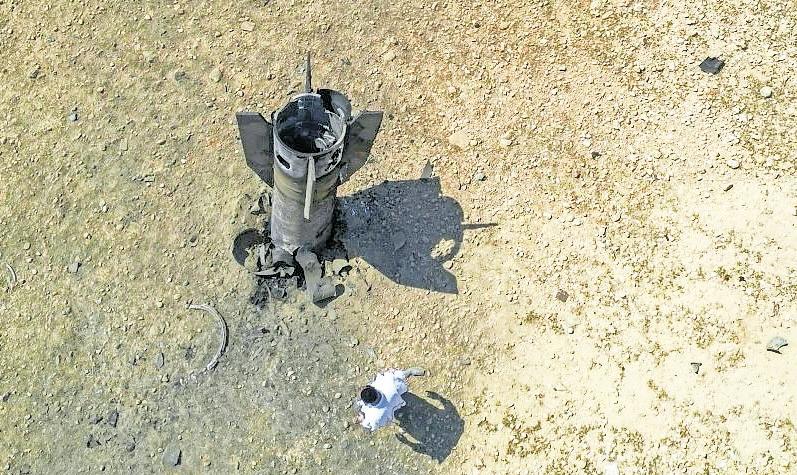
The war may be over for Trump. But for Israel and Diaspora Jewry, its next phase is just beginning.
because of their Zionist affiliations.
The Islamic Republic’s founder, Ayatollah Khomeini, stated in his 1943 book “Kashf al-Asrar” (“Unveiling of Secrets”) that Jews were agents of foreign domination who poisoned the moral values of the societies where they lived, writing, “Jews and other enemies of Islam had worked over centuries to weaken Islam and corrupt Muslim societies.”
This wretched legacy has resulted in openly genocidal rhetoric on Iranian media channels. Just this week, the unctuous Scot-

Iran. “I guess my response to them would be: What is your exact proposal?” he said. “You’re a country of 9 million people. You can’t just kill your way out of solving every single national security problem that you have.”
Excuse me? That is pure antisemitism. Jews are not killers. Israelis are not killers.
The world’s greatest experts on urban warfare have concluded that Israel has done more
to avoid civilian deaths among its enemies than any army in the history of humankind on this earth.
We want peace more than anyone. But to achieve it, we are not willing to lay down our arms, surrender, drop dead and disappear without a fight.
Our low numbers are not a coincidence, and they should never be ridiculed. We have
tish neo-Nazi David Miller, a fixture on the regime’s Press TV mouthpiece, declared that even if Israel was eliminated, the struggle would nevertheless continue “because Jewish supremacism is not only in Occupied Palestine. The Jewish Empire exists everywhere that the Zionists exist, because they cannot exist without infiltrating, expanding, extracting and ultimately genociding (sic).”
In other words, it’s us or the Jews.
Given the fondness of Miller and his cohorts for slogans such as “dismantle Zionism,” it doesn’t take a great leap of the imagination to figure out where they want this foul rhetoric to end up.
Projecting forwards, it is sadly far easier to envisage the worst-case scenarios than the more benign ones.
For all the enormous blows that Israel’s armed forces have inflicted upon Hezbollah
See Cohen on page 22
endured pogroms, plagues, a Holocaust and a massacre on Oct. 7, 2023, that our enemies have pledged to repeat again and again with the support of their sponsors Vance met at a summit in a Swiss castle.
This was not the only outrageous statement uttered ahead of the summit.
“If I was in the cabinet of the Israeli government, I might not be attacking the only powerful ally that I have anywhere left in the entire world,” Vance said during a White House news briefing.
That is not true. Israel maintains many alliances with many countries, especially those threatened by the prospect of a nuclear Iran.
“The other thing that I would say is that over the last three months, two-thirds of the defensive weapons that have protected your homeland have been built by American hands and paid for by American tax dollars,” he said, forgetting the strong cooperation between the Israeli and American allies in Iran during “Operation Epic Fury/Roaring Lion.”
The Culture for Peace Institute that I head seeks nothing more than a just peace. But the vice president’s memo does not and will not promote or advance peace.
What Vance said should still be slammed by every Jewish organization, or he will believe he could get away with his antisemitism.
After Oct. 7, Vance’s initials changed. They became “Jews’ Demonizer.”
Former Lawrence Mayor Martin Oliner is an international tax lawyer and president of the Culture for Peace Institute.
Write: Columnist@TheJewishStar.com
Shockingly, only 37% of American Jews consider themselves Zionists — believers in the fundamental, millennia-long aspiration of the Jewish people for liberation. When asked for an explanation as to why a majority of American Jews don’t identify as Zionists, author and scholar Dara Horn replied simply, “They’re dumb.”
Horn, who wrote the “People Love Dead Jews,” goes on to explain that a century ago in the United States, it was the “J-word” — Jew — that was viewed as a slur, such that very few organizations used Jew or Jewish
Zionism is the persistence that freed us from tyranny and propels us forward.
in their names, opting for euphemisms like Union of Hebrew Congregations or the American Israelite newspaper.
Today, it’s the “Z-word” that Jew-haters’ use to revile us — Zionism or Zionists — words that historically and still represent the movement of the Jewish people to throw off the yoke of tyranny, establish a free nation and spread the spirit of self-determination to other aspiring peoples. Regrettably, today’s haters have hijacked the term and turned it into a curse — one that makes many American Jews uncomfortable, embarrassed or ashamed.
In fact, Jews who deny identification with Zionism are denying their bond with Am Yisrael because ultimately, it is Zionism that got us here. The culture and values of Zionism have allowed us to persevere through 3,000 years of persecution and a devastating Holocaust, finally to emerge as a free people, to thrive as never before in Israel, our ancient, indigenous homeland.
While Zionism wasn’t a defined movement until the late 1800s, the spirit of Zionism has infused the arc of Jewish history — survival and achievement — for millennia. It was only after Israel’s founding that the enemies of the Jews, instigated by

May 2021.
the Soviets, began a campaign to turn gardenvariety antisemitism into hatred of Zionism, leading to its current association with “white colonialist-oppressors.”
Thus, today’s ultra-leftists repeat the insidious mantra: “We don’t mind Jews; it’s just Zionists we hate.” Lamentably, this campaign to denigrate “Zionism” and delegitimize Israel has been notoriously successful. Notwithstanding, the truth is, discomfort by American Jews with the term Zionism stems from a misunderstanding of its historical and actual meaning. Zionism embodies
Afew weeks ago, I reached out to a family foundation about Holocaust education programming, including an upcoming webinar for educators. I expected a routine exchange about programming, students and funding. Instead, it quickly turned into something else entirely: a test of how organizations connected to Jewish causes are increasingly expected to answer for Israel, Gaza and American politics. This foundation sits outside the Jewish philanthropic world. Over the years, it has supported a range of education-related initiatives I have worked on across different nonprofits. The relationship had always been defined by mission and impact. This time, however, a routine donor update shifted into a set of assumptions about what Jewish organizations are presumed to represent.
Hochul
Then came the response from the foundation’s director that changed the nature of our relationship entirely. He said its board members had begun questioning their support for Jewish nonprofit work because of concerns related to Israel and broader regional conflict. They wanted to know how these organizations viewed Israel’s “relentless war/destruction/genocide in Gaza,” and whether or not they were affiliated with or supportive of AIPAC and its lobbying efforts on behalf of US.support for Israel.
The reference to AIPAC stood out immediately. It blurred the distinction between organizations with very different missions. One focused on combating antisemitism and protecting Jewish communities, and the other engaged in political advocacy related to US-Israel relations.
In that moment, Jewish organizations appeared to be viewed through a single lens, with little distinction between very different roles.
I clarified that the work in question focuses on protecting Jewish communities and others affected by hate, and that it is not a foreignpolicy effort. The foundation director then re-
Routine donor update turns into a political litmus test. For Jews, the door to aid is closed.
sponded, adding that the “bloodshed inflicted on the Palestinians” by Israeli Prime Minister Benjamin Netanyahu “seems to contradict the Jewish ‘never again’ point of view.”
In invoking “never again,” he used a Holocaust-rooted expression of Jewish resistance as the basis for his critique. His message implied that Jewish organizations fighting antisemitism and supporting Jewish communities were now, through Israel, being held responsible for the kind of mass violence they said they would never allow to happen again.
What struck me was the inversion. “Never again” was no longer a statement of Jewish determination. It had become a reason to question
whether a US-based Jewish organization should be supported at all.
This dynamic is part of what novelist, essayist and literature professor Dara Horn explores in her book “People Love Dead Jews.” She argues that people are often comfortable expressing sympathy for Jewish suffering when it is safely in the past, but less comfortable with Jews acting on their own behalf in the present. Here, the Holocaust was invoked as a historical lesson, while a contemporary Jewish organization addressing antisemitism was judged through assumptions about Jewish identity, influence and power.
This reflects a broader double standard in which Jewish organizations are often expected to carry responsibility for Israel’s actions in defending itself and protecting its citizens in ongoing security and military conflicts. Even when people insist that criticism of Israel can be separated from Jews as a people, in practice, that distinction often collapses in moments like these. The common thread is not only disagreement about Israel, but a broader pattern of external

Across the country, Jewish families and individuals are concerned about the explosion of antisemitism around the world. This rise in antisemitism, both online and in our communities, can feel overwhelming — but we know we are not without solutions.
In New York, Gov. Kathy Hochul is setting an example of what taking action to fight antisemi-
The governor’s taken decisive action.
tism looks like. Since taking office, she has invested over $131 million to protect organizations at risk of hate crimes,helping provide the security and screening that gives congregants peace of mind to worship, knowing they will be safe. But the investment needed to combat the rising tide of antisemitism isn’t just financial. It requires decisive policy action, changing hearts and minds through education, working together, and recommitting ourselves to upholding our shared commitment to justice, equality, and freedom for all.
After we saw the abhorrent protests outside Park East Synagogue on the Upper East Side — including pro-terror signs and hateful rhetoric that crossed the line into harassment — Gov. Hochul took quick action.
Blocking entrances to any house of worship is unacceptable. In this year’s state budget, she signed buffer zone legislation into law, establishing a 50-foot security perimeter around houses
of worship to ensure the safety of all.
This kind of leadership is what we need to lower the temperature and send a strong message that hate will not be tolerated in New York.
Gov. Hochul has also taken decisive action to fight and prevent hate crimes. She has expanded the list of crimes eligible to be charged as hate crimes and cracked down on those who mask their identities to commit crimes, ensuring that no one can evade accountability. In the face of rising antisemitism on college campuses, she mandated Title VI anti-discrimination coordinators to protect all in higher education.
As we saw when she proudly marched in the Israel Day Parade, Gov. Hochul has time and again chosen to stand with and march alongside the Jewish community. From being the first governor to visit Israel following Hamas’ heinous terrorist attack on October 7, to her all-of-government approach to fighting antisemitism, she
has taken on the tough fights on behalf of Jewish New Yorkers, even when it wasn’t easy. On issues like combating antisemitism, we need a pragmatic center that pulls people together — someone who doesn’t just listen but acts on what she is hearing from everyday New Yorkers concerned about their safety. I firmly believe the center must hold for New Yorkers to stay together – something I have worked over many years.
Gov. Hochul is a champion for the Jewish community during a very difficult and stressful period. She has demonstrated time after time that she is a leader who listens and acts to keep New Yorkers safe, from combating antisemitism to addressing so many other issues facing our community.
Betty Cotton, of Purchase NY, is a member of Women for Hochul. Bruce Blakeman is the Republican nominee for governor; his campaign has been invited to submit a column on this subject.


More than 500 graduates received degrees during Touro University’s 52nd annual commencement ceremony on May 31 at Alice Tully Hall at Lincoln Center.
The ceremony honored graduates of the university’s Lander Colleges and featured remarks from university leaders, an honorary degree presentation, student speakers and academic awards.
Touro University President Dr. Alan Kadish told graduates they are entering a rapidly changing world marked by advances in artificial intelligence, rising antisemitism and geopolitical uncertainty.
“Resilience and flexibility are the two most important things that you need to take forward into the future,” Kadish said. “Use the skills and talent you have built at Touro to deal with the challenges, deal with them flexibly, deal with them with resilience, and you’ll succeed.”
He encouraged graduates to remain grounded in Torah values as they begin their careers and adult lives.
“To earn His benefit, to earn His providence, requires our effort to interact with it, to learn Torah, to view it in our lives,” Kadish continued. “You can depend on Hashem’s beneficence, but you have to use the skills that you’ve learned throughout your life and at Touro.”
The university awarded an honorary doctorate to Shlomo Yehuda Rechnitz, an entrepreneur, philanthropist and composer. Introducing Rechnitz, Rabbi Moshe Krupka, Touro’s executive vice president, cited his support for Jewish educational institutions and community organizations.
In his address, Rechnitz spoke about the opportunities and responsibilities graduates will face. He also addressed antisemitism and encouraged graduates to respond through personal achievement and character.
“Your response to darkness cannot simply be outrage, it must be excellence,” Rechnitz said.
He urged graduates to pursue success while remaining committed to their Jewish identity and values.

An evening highlights followed Rechnitz’s address, when Krupka introduced a musical tribute recognizing Rechnitz’s work as a composer. Joined by members of the Shira Choir and Yussi Sonnenblick, a 1995 alumn of Touro’s Graduate School of Jewish Studies and a current professor at the university, Rechnitz participated in a performance of his song “V’Hareinu.”
Audience members joined in the singing while illuminating the hall with cellphone flashlights.
The university also recognized Dr. Stanley
Boylan, who is transitioning to a new role as vice president for university affairs after 50 years of service to Touro.
In addition, 15 graduates received special recognition for academic achievement.
Four valedictorians addressed the graduating class: Joseph Levy and Batya Zitron of the men’s and women’s divisions of Touro’s Lander College of Arts & Sciences, Moshe Tzvi Ostreicher of Touro’s Lander College for Men, and Mina Schulman of Touro Lander College for Women.

Ostreicher reflected on the relationships formed during students’ years at the university.
“Class of 2026, we are ready to move forward in the journey of life,” he said. “But continue to carry Touro University with you. Carry the people, the arguments, the afternoons that became something more than you expected. Carry the relationships that made us who we are, standing here today.”
Reported by Touro University.
Photos by Mika Hirsch.
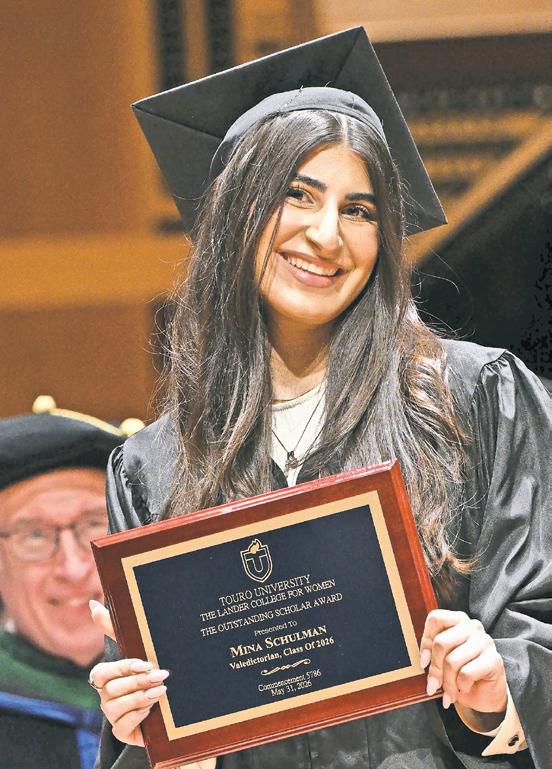
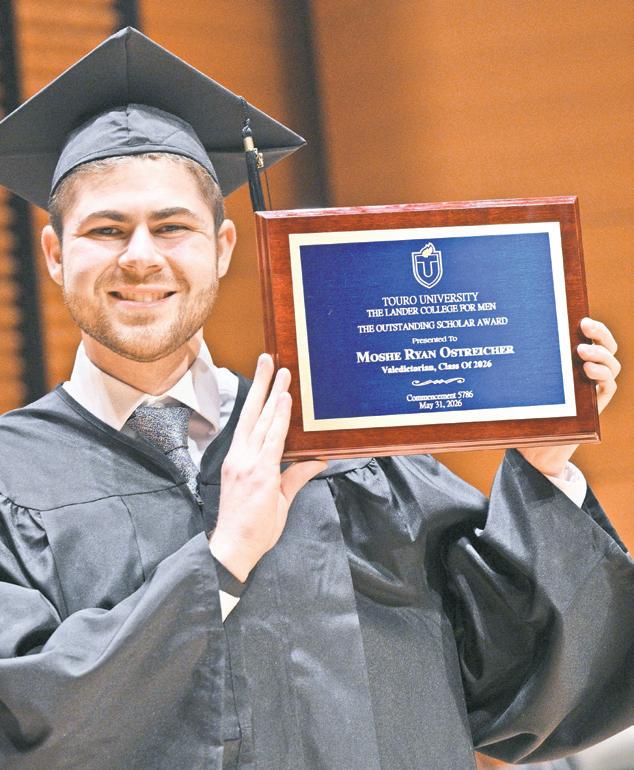
Continued from page 16
asked a second time. In that act lay his fateful weakness of character. He knew that G-d did not want him to go. Yet he invited the second set of messengers to wait overnight in case G-d had changed His mind.
G-d does not change His mind. Therefore Bilaam’s delay said something not about G-d but about himself. He had not accepted the Divine refusal. He wanted to hear the answer “Yes” — and that is indeed what he heard. Not because G-d wanted him to go, but because G-d speaks once, and if we refuse to accept what He says, G-d does not force His will upon us. As the Sages of the Midrash put it: “Man is led down the path he chooses to tread.”
The true meaning of G-d’s second reply, “Go with them,” is, “If you insist, then I cannot stop you going - but I am angry that you should have asked a second time.” G-d did not change His mind at any point in the proceedings. In scenes 1, 2 and 3, G-d did not want Bilaam to go. His “Yes” in scene 2 meant “No” — but it was a “No” Bilaam could not hear and was not prepared to hear.
When G-d speaks and we do not listen, He does not intervene to save us from our choices. “Man is led down the path he chooses to tread.”
Continued from page 17
Rav Elyashev was once offered the honor of serving as sandek at his great-grandchild’s bris, with the reminder that this carries a segulah for reaching great heights in Olam HaBa. He smiled and declined. He said he did not want to enter Olam HaBa through a back door. He wanted to arrive through his consistent daily connection.
Next Thursday, Shiva Asar B’Tammuz asks us something pointed. When summer disrupts the schedule, when no one is watching, what still gets done? Which mitzvah, which commitment, which act of growth remains nonnegotiable? What is the one thing that stays tamid?
By asking that question and answering it honestly, we do not only mourn the Korban Tamid that was lost. We reach, in our own small way, for the consistency that once filled the Beis HaMikdash every single day.
Am I a tamid?
Rabbi Benny Berlin is spiritual leader of BACH in Long Beach www.bachlongbeach.com.
Write: Columnist@TheJewishStar.com
Continued from page 17
ent followers. Moses was the active composer of the song, the choirmaster as it were, and the people were but the choir.
In our parsha, two of the leaders pass from the scene, and Moses learns that his leadership authority is waning. The Song of the Well is an entirely different leadership song from the Song of the Sea. In this week’s song, the entire people sing as one. It begins not “Then Moses sang this song,” but rather “Then Israel sang this song.” The leadership passes from one Divinely chosen charismatic leader to the people as a whole.
The people find their voice, and it is the voice of song. How beautifully this is expressed in the Midrash Yalkut Shimoni (Chukat Note 764):
After 40 years, the people finally matured and began to sing a song on their own accord, saying, “Master of the Universe, it is now incumbent upon You to do miracles for us and for us to sing, as it is written: ‘It has pleased the L-rd to deliver us and that is why we sing our
But G-d was not prepared to let Bilaam proceed as if he had Divine consent. Instead He arranged the most elegant possible demonstration of the difference between true and false prophecy.
•The false prophet speaks. The true prophet listens.
•The false prophet tells people what they want to hear. The true prophet tells them what they need to hear.
•The false prophet believes in his own powers. The true prophet knows that he has no power.
•The false prophet speaks in his own voice. The true prophet speaks in a voice not his (“I am not a man of words” says Moses; “I cannot speak for I am a child” says Jeremiah).
The episode of Bilaam and the talking donkey is pure humor — and, as I have pointed out before, only one thing provokes Divine laughter, namely human pretension.
Bilaam had won renown as the greatest prophet of his day. His fame had spread to Moab and Midian. He was known as the man who held the secrets of blessing and curse. G-d now proceeds to show Bilaam that when He so chooses, even his donkey is a greater prophet than he. The donkey sees what Bilaam cannot
song all the days of our lives’.” (Isaiah 38:20)
Jewish history has known epochs in which there were clear leaders, gifted and often charismatic individuals who, by virtue of their wisdom or heroism, seemed ordained by the Almighty Himself to lead our people. But we have also known times, such as the present, when such prominent leaders are not apparent.
It is at times such as these that we all must assume leadership responsibilities. It is at times such as these that we cannot afford to humbly refrain from acting as leaders in our own families and communities. It is at times such as these that we must, each of us, find our own voices and sing the songs of leadership.
Write: Columnist@TheJewishStar.com
Continued from page 17
they complained and wanted it. And, of course, the most miraculous of all: Hashem Himself came down to the mountaintop of Har Sinai and spoke to them directly, at least for the first two commandments.
And yet they didn’t. They couldn’t. They wouldn’t believe.
“We can’t go up to the land,” they said. Yes, it’s beautiful, flowing with milk and honey and enormous fruit. But the people are giants, too strong, the city fortifications too powerful. We can’t do it. G-d can’t do it.
They lied to themselves and demoralized everyone else.
We who have been through 3,000 years of Jewish history should not be surprised. In fact, Dovid HaMelech in Tehillim has told us, “al tivtechu banedivim, b’ven adam she’en lo teshua (put not your faith in nobles, for in human beings there is no salvation) (Tehillim 146:3).
We must only put our faith in Hashem.
We must be like Calev and Yehoshua, who said respectively, “alo naaleh v’yarashnu ota, ki yachol nuchal la (we shall surely ascend and conquer it, for we can surely do it!)” (13:30); and “tova ha-Aretz, me’od, me’od (the Land is very, very good” (14:7).
We must not — we dare not — despair.
We must urge our leaders, whether they be Trump or Netanyahu or others: Remove the evil from those who have caused so many die — Jews and Israelis, and also Americans and Iranians — to suffer and die.
Finish the job. Now.
Write: Columnist@TheJewishStar.com
see: the angel standing in the path, barring their way. G-d humbles the self-important, just as He gives importance to the humble. When human beings think they can dictate what G-d will say, G-d laughs. And, on this occasion, so do we.
Some years ago, I was making a television program for the BBC. The problem I faced was this. I wanted to make a documentary about teshuvah, repentance, but I had to do so in a way that would be intelligible to non-Jews as well as Jews, indeed to those who had no religious belief at all. What example could I choose that would illustrate the point?
I decided that one way of doing so was to look at drug addiction and recovery. Addicts develop behaviors that they know are self-destructive, but they are part of their lifestyle. To break these habits involves immense reserves of will. An addict looking to address these selfdestructive behaviors must acknowledge that the life they have led is harmful to them and to others, and needs to change. That seemed to me a secular equivalent of teshuvah, which could illustrate the message to viewers.
I spent a day in a rehabilitation center, and it was heartbreaking. The young people there — they were aged between 16 and 18 — all
Continued from page 18
forms or organizational backing, decided that they weren’t waiting anymore.
Writers, researchers and educators who had never thought of themselves as advocates became ones because the gap was there and nobody was filling it.
They tracked how narratives shifted in real time. They built audiences on platforms working against them and showed up in comment sections where coordinated disinformation went unanswered because leaving the field wasn’t acceptable. They work at midnight. They take the threats, the suspended accounts, the accusations that they’re paid Israeli operatives, a smear designed to discredit them before their arguments can land. They are exhausted. They haven’t stopped.
And they are doing, without resources, what $600 million in institutional spending failed to do with them.
Lauder is right that the global Jewish Diaspora needs to be a partner in this fight.
What he didn’t say — and what the institutions still haven’t seemed to recognize — is that part of the Diaspora has already been fighting it alone for two and a half years. Myers has laid out the strategic framework for what comes next.
The research exists. The behavioral science is documented. The tools exist. The people doing the work are already doing it online and in the streets.
What’s been missing isn’t a plan. It’s the decision to act on one.
Melissa Brodsky is a content strategist who became an “accidental activist” after October 7. Follow her on Facebook and on Substack.
Write: Columnist@TheJewishStar.com
Continued from page 19
and Hamas, including eliminating most of the rapists and murderers who participated in the Oct. 7 massacre, both Lebanon and Gaza continue to present a grave threat — and, just as was the case with former President Joe Biden’s administration, Trump in his present state of mind will take a dim view of any military initiatives undertaken by the
came from broken families. Many of them had suffered abuse. Other than the workers at the center, they had no networks of support. The staff were exceptional people. Their task was astonishingly difficult. They would succeed in getting the addicts to break the habit for days, weeks at a time, until then they would relapse and the whole process would have to begin again. I began to realize that their patience was little less than a human counterpart of G-d’s patience with us. However many times we fail and have to begin again, G-d does not lose faith in us, and that gives us strength. Here were people doing G-d’s work.
I asked the head of the center — a social worker — what it was that she gave the young people to make a difference to their lives and give them the chance to change. I will never forget her answer, because it was one of the most beautiful I ever heard. ‘We are probably the first people they have met who care for them unconditionally. And we are the first people in their lives who cared enough to say “No.”’
“No” is the hardest word to hear, but it is also often the most important — and the sign that someone cares. That is what Bilaam, humbled, eventually learned and what we, too, must discover if we are to be open to the Voice of G-d.
Israel Defense Forces to squash the terrorists in these territories.
It is more than conceivable, therefore, that Israel could once again — and soon — find itself fighting these deadly enemies without the support of the United States, and with Jewish communities around the world facing a deluge of propaganda that will inevitably result in more incidents of the venomous violence that has accelerated over the last two-and-a-half years.
Added to that, it’s hard to see where this might end.
Trump’s second spell in the White House could be followed by a president drawn from the insurgent left of the Democratic Party or from the antisemitic isolationist faction of the Republican Party. At every level of government — federal, state and municipal — anti-Israel, anti-Jewish candidates are growing in both numbers and confidence. The same is true for other countries, like Canada and those in Western Europe, where Jews reside in relatively large numbers.
The Iran war may be over for Trump, at least for now. But for Israel and for Diaspora Jewry, its next phase is only just beginning.
Write: Columnist@TheJewishStar.com
Continued from page 3
the spirit of Jewish survival: self-determination, extraordinary achievement and a yearning for freedom. These values have enabled the Jews to remain bonded and survive as a people, succeed materially and throw off the chains of tyranny.
In short, Zionism is a beacon of liberation — for its own people, Am Yisrael — and for others who seek greater security, self-determination and independence. Zionism has been a lifeline for the Jewish people — and it remains one today.
Why American Jews feel uneasy about Zionist identity. According to a Jewish Federations of North America (JFNA) survey, 88% of American Jews agree that “Israel has the right to exist as a Jewish and democratic state,” and over 70% affirmed they are “emotionally attached to Israel. However, just 37% self-identify as Zionists. What explains this contradiction? Perhaps the most telling reason is that American Jews misconceive what
Continued from previous page
Zionism is and, most notably, what it is not Indeed, the survey found that more than one in four American Jews think Zionism means “supporting whatever action Israel takes,” and 35% agreed that Zionism means “believing Israel has a right to the West Bank and Gaza Strip.” A smaller number of American Jews believe that Zionism means “believing Jews are superior to Palestinians.” None of this is accurate — few, if any, Jewish leaders in Israel or the United States espouse these notions; rather, it is a product of propaganda from today’s most prevalent vocal antisemites: Anti-Zionists on both the left and right.
The 3,000-year-old spirit of Zionism still lives. While technically, the Zionist movement was founded in the late 19th century, the spiritual values of Zionism date back to biblical times. They include the millennialong determination of Jews to achieve freedom, especially in the land of Israel, as the God of the Torah promises. Very simply, Zionism is the persistence that freed us from tyranny, motivated the formation of our nationstate, and propels us to continue surviving and spreading Jewish innovation to benefit the world.
Soviets campaign to delegitimize Israel. In the 1960s, the Soviet Union began a concerted effort to delegitimize the Jewish State of Israel, transposing classic antisemitic tropes (such as world conspiracy, dual loyalty, exploitation) into Marxist-Leninist language. Against all evidence, they accused Zionists of leading a global plot similar to that spelled out in the “Protocols of the Elders of Zion,” and they equated Zionism with Nazism. They promoted a narrative in which Israel colonized its homeland and oppressed and committed genocide against the newly invented “Palestinian people.”
In the past, Jews, including American Jews, the words “Jew” or “Jewish” had taken on a tainted, antisemitic flavor. Today, as the JFNA survey indicates, it is “Zionism” and “Zionist” that grate on the ears and sensibilities of many American Jews — and many Americans in general.
It’s no wonder that 60% of American adults hold a negative view of Israel, the Zionist state.
To reject Zionism is to reject Jewish peoplehood and freedom. If you believe in the right of the Jewish people to self-determination and you support a state in our indigenous homeland, you are — like it or not — a Zionist. To deny one’s identification with Zionism is to allow Jew haters to hijack our identity — to associate Jews with despicable falsehoods and attribute to us crimes of colonization, genocide and apartheid.
On the other hand, those who stand proudly as Zionists affirm the righteous journey of Jews to persevere as a coherent people, to finally achieve liberation in our homeland and to emerge as one of the strongest, most diverse and most advanced democracies on earth. Zionists can also take pride in Israel’s contributions to the world — making it safer, wealthier, healthier and happier — because those achievements spring from Zionism’s same optimism, ingenuity and determination.
Those who condemn (or deny) Zionism are at best spreading unconscionable lies … and at worst are promoting hate of the Jewish people, heroes of one of history’s most inspiring and successful stories of liberation.
Write: Columnist@TheJewishStar.com
Continued from page 20
definition, where Jews are judged and categorized through assumptions imposed from the outside rather than through their lived reality.
A similar line of thinking has surfaced in other conversations.
Several years ago, during a discussion about intersectionality with a foundation that approached its work through a strong socialjustice framework, I was asked whether I considered Jews to be “white.” I felt blindsided. It didn’t feel like a neutral question so much as one with an expected answer, and I understood that getting it wrong could affect future funding decisions.
From my experience living in Israel, Jewish communities come from many ethnic backgrounds, including the Middle East
and North Africa. I answered as honestly as I could: Jews are a diverse people with different histories, cultures and backgrounds.
Later that day, I researched the question more closely and found that this framing is common in some academic and activist spaces, where Jews are often categorized as “white,” and therefore associated with power and privilege. Whatever the intent, it can flatten Jewish identity into a simple binary of oppressor versus oppressed.
Only afterward did I realize that I had given what may have been the “wrong” answer. The conversation made clear that Jews were expected to be understood in a particular way within that framework. It felt like I had failed a test I didn’t know I was taking. The irony is that Jews have historically been persecuted precisely because they were seen as outsiders, not as members of a privileged majority.
These patterns do not remain confined to individual conversations. Increasingly, they
shape how foundations and donors evaluate nonprofit organizations, shifting the basis of judgment away from mission and outcomes, and toward questions of identity, representation and ideological alignment — a trend noted by The Economist in its analysis of pandemic-era philanthropy.
While donors and foundations have every right to support whatever organizations they choose, philanthropy works best when organizations are judged by mission, impact and integrity — and when donors can ask hard questions without turning nonprofits into proxies for broader political or ideological debates.
What gets lost is not just trust, but the ability to have an ordinary conversation about the work itself on its own terms, without it becoming something else entirely.
Jennifer Bressler is a development and fundraising professional.
Write: Columnist@TheJewishStar.com
Are you a journalist (or sales pro) who values truth, Torah and Israel?

Our team covers news that matters to Modern Orthodox communities in Metro New York (Long Island, Queens, Manhattan’s Upper East Side and Upper West Side, Riverdale and Westchester).
Assignments include community events; school, business and health news; local personalities; Jewish institutions; holidays and entertainment; antisemitism and antizionism; politics; Jewish America; the impact of developments in Israel on our local communities, and more.
Position offers expert mentoring, starting salary of $36,400 to $39,520 plus a full benefits package that includes medical, dental, 401(k) and Jewish and secular holidays — all in a supportive, collegial and kosher environment.
Reply: Candidates with reporting and news-writing experience (professional or collegiate) are invited to email a cover letter, resume and 4 to 6 clips or links to Publisher@TheJewishStar.com.
Put REPORTER in subject line.
•Lead a growing team of correspondents
•Initiate and refine story ideas
•Assign and write articles
•Edit staff and freelance submissions
•Verify rights to submitted art
•Organize print and web layouts, working with page designers and AI software
•Expand our digital footprint (including website, e-newsletters and social media)
•Help plan Jewish-centric events
•Work with the Publisher and the RCI team on a range of common projects
Required
•News reporting experience
•Copy editing and proofing skills
•Familiarity with and sensitivity to Jewish issues
•Experience with editorial contributors
•Ability to meet deadlines
•Attention to detail
•Familiarity with web and SM conventions
Salary: Starting at $50,960 to $62,400 plus a full benefits package that includes medical, dental, 401(k) and paid Jewish and secular holidays.
Reply: Cover letter, resume, 4 to 6 clips or links to Publisher@TheJewishStar.com.
Are you repressed in a workplace overrun by woke truthiness, debased values and Israel-hate? Is your professionalism challenged when truth falls victim to scorched earth politics?
If you’re ready to come home, consider an opportunity at The Jewish Star, where Torah-true honest reporting and ethical business practices are a priority.
Wear your Jewish Star proudly in a kosher environment and help make Jewish journalism great again.
Selling advertising in The Jewish Star is just part of this job. Our staff’s toolkit is exceptionally broad, including
• Religious and secular publications
• Websites
• Content generation and editing services
• In-person and digital events
• Digital, email, radio and SM marketing
• Direct mail
• Commercial printing
• Local, regional, national, int’l reach
Employees are trained by the best in the business, in a supportive, collegial and kosher environment. Competitive compensation (salary and commission $45K-$90K) plus a full benefits package that includes medical, dental, 401(k) and paid Jewish and secular holidays.
Reply: Send a cover note and resume to Publisher@TheJewish Star.com.
Latch your career to a rising Star, a 24-yearold independent news operation that is part of RCI (Richner Communications Inc), a 100employee family-owned company with offices in Garden City and Riverdale. Positions are full-time in-person or hybrid (but part-time and freelance inquires may be considered).