When word reached Esther that her people stood condemned, she hesitated. She was, after all, inside the palace. She had proximity to power, status, access, and the illusion of insulation. Mordechai answered her with one of the most unsparing sentences in the Tanach: “Al tedami b’nafshech l’himalet beit hamelech mikol haYehudim, (Do not imagine that you, of all the Jews, will escape because you are in the king’s palace)” (Esther 4:13).
I have returned to that verse again and again since October 7.
Not because America is Shushan. It is not. America has been, by almost every measure, the most generous diaspora home our people has ever known. Its promise has been real, its blessings extraordinary, its civic ideals worth defending. But gratitude is not blindness. And the palace was never a covenant.
For generations, American Jews believed that proximity meant protection. We were inside. We had become, by most external measures, the most successful diaspora community in Jewish history. And we mistook success for safety. We mistook access for belonging. We mistook America’s hospitality for an exemption from Jewish history.
That illusion has collapsed. Not gradually. Not politely. Not in the abstract. It collapsed on the campuses where Jewish students were
See Like Esther on page 3
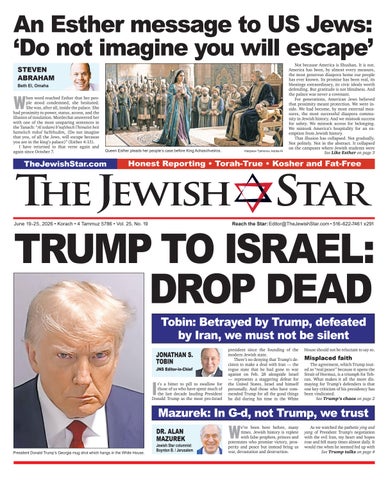
TRUMP TO ISRAEL: DROP DEAD
t’s a bitter to pill to swallow for those of us who have spent much of the last decade lauding President Donald Trump as the most pro-Israel
president since the founding of the modern Jewish state.
There’s no denying that Trump’s decision to make a deal with Iran — the rogue state that he had gone to war against on Feb. 28 alongside Israel — represents a staggering defeat for the United States, Israel and himself personally. And those who have commended Trump for all the good things he did during his time in the White
e’ve been here before, many times. Jewish history is replete with false prophets, princes and potentates who promise victory, prosperity and peace but instead bring us war, devastation and destruction.
House should not be reluctant to say so.
Misplaced faith
The agreement, which Trump touted as “real peace” because it opens the Strait of Hormuz, is a triumph for Tehran. What makes it all the more dismaying for Trump’s defenders is that one key criticism of his presidency has been vindicated.
As we watched the pathetic ying and yang of President Trump’s negotiation with the evil Iran, my heart and hopes rose and fell many times almost daily. It would rise when he seemed fed up with
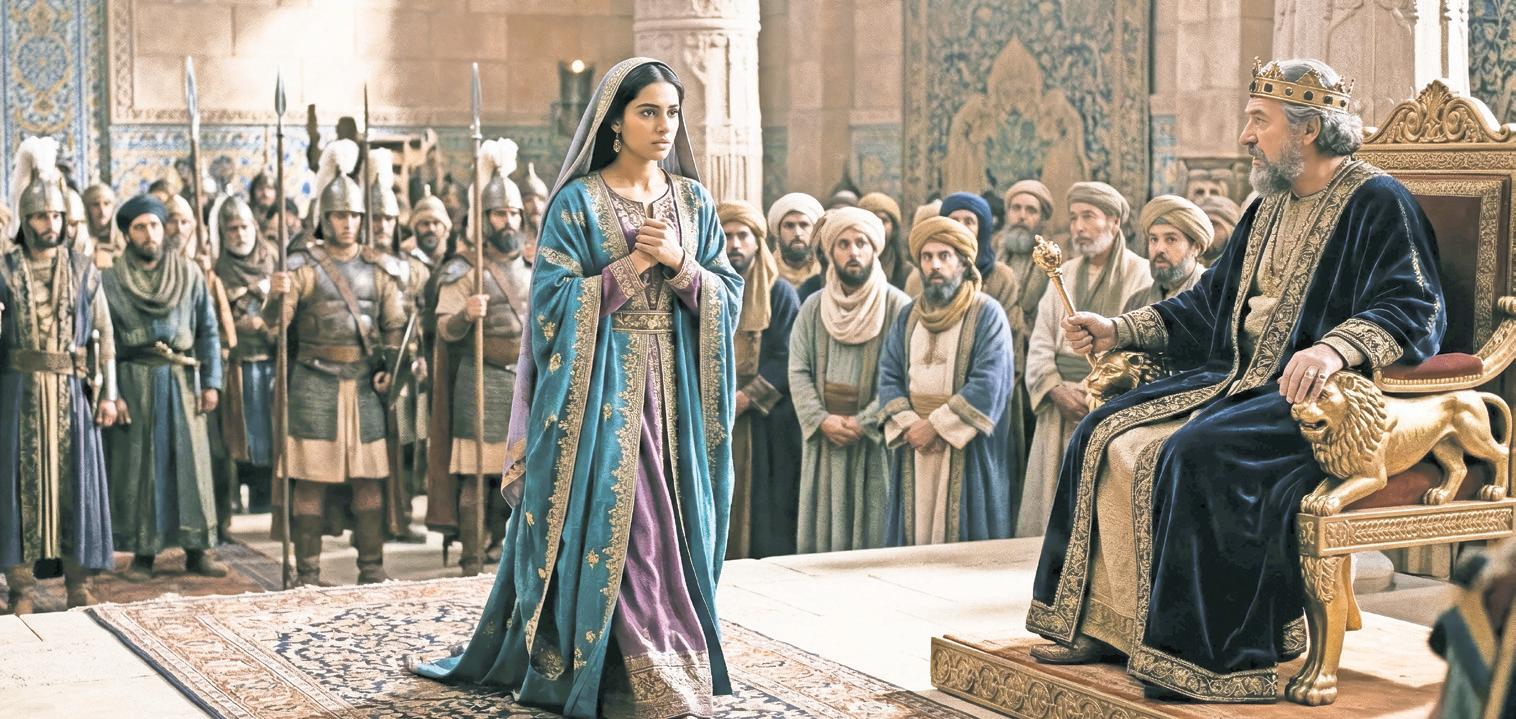
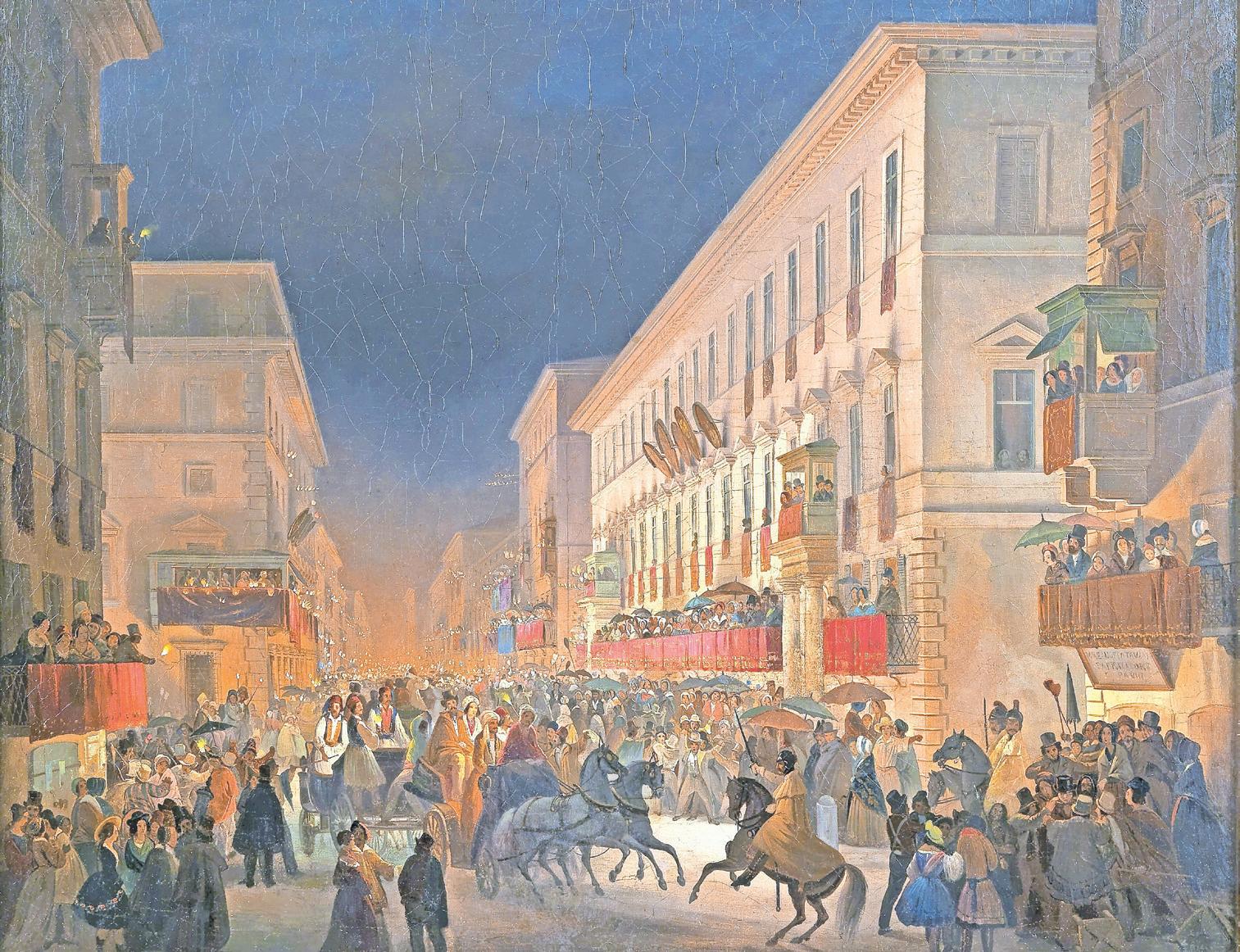
Queen Esther pleads her people’s case before King Achaschveiros. Vladyslav Tykhonov, Adobe AI
President Donald Trump’s Georgia mug shot which hangs in the White House.
Trump’s chaos and incoherence led to failure…
The lack of precision and intellectual consistency in the president’s policy pronouncements have always been derided by his critics. But as long as Trump stuck to his instinctive distrust of the “expert” class that had guided American foreign policy for generations, that really didn’t matter. The approach that guided his decisions to move the US embassy in Israel from Tel Aviv to Jerusalem; pursue the Abraham Accords, rather than stick to futile efforts to broker peace with the Palestinians; and hit Iran hard to end its bolstering of international terrorism and give up its nuclear ambitions has led to success.
The same was true of other successes he achieved, such as securing the border that former President Joe Biden had left undefended, allowing millions of illegal immigrants to flood the country; toppling Nicolás Maduro, the dictator of Venezuela; or forcing elite American universities to stop tolerating and encouraging campus antisemitism because of their woke DEI policies.
So long as that was true, the president’s braggadocio and wild social-media posts filled with hyperbolic threats and boasts were merely a matter of style and manners.
But the failure in Iran can be traced back to the chaos that always lay underneath everything he did.
Trump could have stuck to a principled stand on Iran, despite setbacks and problems, until victory. Launching a war with all of its unpredictable outcomes and variables was not the same as issuing executive orders or posting on social media. He lacked the ability to stand his ground because his mindset tends to seek immediate gratification and quick victories. Trump is a strong man, but his unpredictability and belief in his genius in deal-making were not enough to sustain him when things got difficult.
That left him vulnerable to the influence of those — like Steve Witkoff, his special envoy to the Middle East, and adviser and son-in-law Jared Kushner — whose approach to Iran resembled that of members of past Democratic administrations.
Aman with a coherent set of foreign-policy principles, as opposed to one with an unquenchable desire for short-term triumphs, might have understood that Witkoff, Kushner and Vice President JD Vance (the putative leader of the neo-isolationists within the administration) were leading him toward the same misguided stand on Iran as Obama.
His devoted MAGA fans refused to believe it. They repeatedly chided anyone who expressed fears that he was on track to surrender the gains that the war had achieved. They said any indication that he might mimic Obama’s betrayal of the West on Iran was simply a matter of Trump playing three-dimensional chess while deceiving and trolling his critics. So deep is their faith in him that some will keep on insisting on this long after it’s become obvious that they have been deceived.
Repeating Obama’s blunder
Trump’s claims notwithstanding, Iran’s nuclear ambitions have not been snuffed out. The pact leaves open the possibility that they can keep their remaining nuclear material. The promises they have made about not seeking nuclear weapons are merely recycled lies with which they had fooled the president’s predecessors. They are no more trustworthy than those in President Barack Obama’s dangerously weak 2015 Joint Comprehensive Plan of Action (JCPOA) that Trump had rightly derided as worthless for the past 10 years.
Indeed, though Trump’s proposed terms for ending Iran’s nuclear program are somewhat tougher than Obama’s, both rely on Tehran, which is to say, they are equally meaningless. Why, after so much bellicose rhetoric as well as tangible military success in the war, did Trump ultimately fold, handing both his domestic critics and his Iranian antagonists such a victory?
The United States and Israel had inflicted devastating losses on Iran’s military, as well as its missile and nuclear programs, along with much of the country’s infrastructure, with which it had threatened the region. But Iran did have the power — via drone and missile fire — to menace shipping in the Persian Gulf, thus impacting the price of oil.
Thanks to the energy independence that Trump’s policies had helped achieve, Americans felt the impact of that problem less than most other people around the world. Yet it still led to higher gas prices at the pump in the United States. Given that Trump had not made a compelling case for war to the American people, that fact increased the conflict’s unpopularity, exacerbating the Republican Party’s deficit in the polls about the outcome of this fall’s midterm elections.
doing far more damage to its economy than the spike in oil prices was having on the West, until Tehran gave up or the regime imploded.
But he didn’t do either of those things. He folded under pressure and abandoned the gains that Washington and Jerusalem had achieved.
Even worse, he accepted Iran’s premise that an end to the fighting must also cover Jerusalem’s efforts to force the Hezbollah terrorists in Lebanon to stop firing on northern Israel and cede power in Beirut. That also led to Trump’s much-publicized abusive comments about Israeli Prime Minister Benjamin Netanyahu, his erstwhile faithful partner in the war, about his temerity in prioritizing the defense of his people over the president’s pursuit of futile diplomacy with Iran.
The damage inflicted on Iran during the first two months of fighting was real and set back its ability to spread mayhem throughout the region. It will take years for it to rebuild its military and reconstitute its nuclear and missile threats.
And there is always the possibility that Trump could reverse course and resume the attacks once it becomes clear that Iran is simply retooling its infrastructure of terror and aggression.
But does anyone in Washington and Jerusalem, and elsewhere in the West — and most importantly, in Tehran — seriously believe he will do that now that he’s declared that this accord has resolved all of the world’s concerns about Iran? The Iranians know that he has had enough of the fighting; that made them even more intransigent. As they did during the negotiations with Obama and his envoys, they had his measure and acted accordingly.
Trump’s claims notwithstanding, Iran’s nuclear ambitions have not been snuffed out.
nature foreign-policy “achievement,” he has left a dangerous problem for his successors to solve that will be far worse and much harder to eliminate than it would have been for him had he not surrendered.
Iran’s tyrants can, with justice, say that they survived a fearsome assault by the United States and Israel, and ultimately forced a superpower to give up. Still, it will take time for them to get back to where they were on Oct. 6, 2023, before the confident launching of the cruel war on Israel by their “resistant front” with the atrocities of Oct. 7.
The losses sustained by the Iranian regime, as well as by Hamas and Hezbollah, in the fighting that took place during the last 33 months were not imaginary. All are far weaker than they were then.
But there is also no doubt that Iran’s prospects have improved since the start of the year, when it seemed as if the regime that had murdered tens of thousands of its citizens who protested its tyrannical rule was on its last legs. By threatening to topple the Islamist terrorists but failing to make good on those threats, Trump did terrible damage to his standing throughout the world, as well as that of the United States.
Much like Obama’s going back on his talk of taking action against the regime of Bashar Assad in Syria if it crossed a “red line” by using chemical weapons on its people, Trump has shown the Middle East that he, too, can be cowed into backing down.
The American and Israeli attacks had shown Iran’s military weakness, but Tehran can now, as it did previously, claim to be the “strong horse” of the region that won’t reverse course in the face of Western attacks.
The deal with Iran is also a blow to the USIsrael alliance.
The months of close cooperation between the two nations’ militaries had demonstrated just how powerful and important the bond between Washington and Jerusalem had become.
By ending the war without achieving its goals and chiding the Israelis to stop defending themselves, Trump has sent the world a message that while not completely left on its own, the Jewish state has been put in a precarious position.
But their faith in his judgement is misplaced. Rather than endure more months of criticism, high oil prices and sinking popularity ratings in pursuit of the goals on which he had staked so much American blood and treasure, Trump has simply folded on one of the key foreign policy priorities he had adhered to since he entered politics in 2015.
That created enormous pressure — amplified by those inside the administration, led by Vance, who were already opposed to his tough policy on Iran — to end the war without achieving any of its initial goals.
The interests of the two nations aren’t identical, though they do mostly overlap. And Israel isn’t giving up and will continue to do what it Continued from page 1
The oil may now flow, but the flow of cash to Iran guarantees it will go on fomenting terror and war even after Trump leaves office.
Though not explicitly stated, the point of starting the war was to make Iran surrender its nuclear material, as well as its ballistic missiles and its decades-long policy of fomenting terror around the region. Washington had rightly left its intentions about overthrowing the Islamist regime vague, hoping that the pounding Tehran’s forces had taken, coupled with the elimination of much of its leadership, would lead to that result or force the slain Supreme Leader Ayatollah Ali Khamenei’s successors to give in to American demands.
Folding under pressure
The president could have kept striking Iran until it bowed to his will. Or, once he agreed to a loose ceasefire in April, could have kept enforcing a blockade on Iran’s ports, which was
Trump has now made the same mistake as Obama by relaxing sanctions and even unfreezing billions of Iranian funds held by the United States and its allies. As Lee Smith aptly noted in Tablet magazine, the transfer of $20 billion in frozen assets by the United Arab Emirates, with $3 billion already delivered to Tehran, perhaps in cash stacked on wooden pallets like those sent by the 44th president to pay off the Islamist terrorists a decade ago, is key to understanding what has just happened.
The money that Trump’s surrender will make available to the Iranian government will prop it up and likely ensure both its longevity and its ability to sustain its Hezbollah and Hamas terrorist allies in Lebanon and Gaza.
Consequences of surrender
The oil may now flow, as the president trumpeted on Truth Social, through the Straits of Hormuz, and gas prices may decline. But the flow of cash to Iran is a guarantee that its regime will go on fomenting terror and war in the future, even after Trump leaves office in January 2029. As Obama did with his sig-
His hyperbolic and inaccurate statements — “If it were not for me, there would be no Israel right now” — could be excused while he was actually supporting Israel, though now that he is undermining its security in this manner, they leave a bitter taste in the mouths of friends of the Jewish state.
A lost opportunity
See Tobin on page 22
The deal will likely ensure both the Iranian government’s longevity and its ability to sustain its Hezbollah and Hamas terrorist allies.
President Donald Trump arrives at Beijing International Airport on May 13. Daniel Torok, White House
Like Esther, ‘Do not imagine you will escape’…
Continued from page 1
told their grief was politically inconvenient; in the faculty lounges, unions, newsrooms, and feeds where rape was contextualized, kidnapping rationalized, massacre aestheticized, and Jewish fear treated as manipulation.
October 7 did not create the new reality. It revealed it. The massacre revealed the nature of Israel’s enemies. The reaction to the massacre revealed something more painful: the fragility of Jewish belonging in the West.
And still, too many American Jews do not understand what has happened.
That sentence is harsh, and I do not write it lightly. A rabbi should be careful with rebuke; there is a sharpness that wounds without healing. But there are also moments when pastoral softness becomes a form of dishonesty.
So let me say it plainly: many American Jews are clueless about the world in which they now live. Not stupid. Not bad. Clueless. They believe they still live in the America of their grandparents’ gratitude, their parents’ upward mobility, or the liberal imagination of their own university years. They believe that if Jews are useful enough, progressive enough, patriotic enough, polite enough, or sufficiently embarrassed by their own particularism, we will be spared the ancient verdict that has followed us across continents: that Jews are tolerated until we are needed as symbols, scapegoats, or sacrifices.
But the world has changed, and the old consensus is gone.
For decades, the architecture of American Jewish security rested on a comforting assumption: that Israel had a right to exist, that Jews had a right to defend themselves, that antisemitism was a civic evil. That consensus is now failing, and it is failing from both ends of our politics at once.
On the left the demolition is nearly finished. Israel has been recast not as a small country making agonizing choices in a hostile region, but as a flattened moral category: colony, apartheid, genocide. Many liberal Jews are only now discovering that the coalitions to which they gave their loyalty, their money, and their moral imagination never intended to reciprocate.
They marched for everyone else’s vulnerability and learned that Jewish vulnerability was subject to ideological review. Their dead were complicated. Their hostages were invisible. Their grief required context. The betrayal is not that the left criticizes Israel, for Jews have criticized Jewish power since the prophets. The betrayal is that, in too many progressive spaces, the only permitted Jew is the victim of the past or the dissenter from his own people. The living, sovereign Jew who refuses to apologize for Jewish survival is intolerable.
The development fewer of us have absorbed is occurring on the right. A growing faction now meets every alliance with a single transactional question: what does this do for America? It answers accordingly. The vice president has said aloud what had until now been said mostly in private, that while American and Israeli interests often align, they sometimes diverge, and Washington will follow its own. Israel may like that or it may not, he added, but the United States will pursue what it judges best for itself, because that is what the president was elected to do.
We taught Israel as falafel and flags and summer trips, not as the most audacious renewal in modern Jewish history.
Hatred can alert a Jew to danger, but it cannot sustain Jewish life. We remain Jews because we are heirs to a covenant, because Torah teaches not only how to survive but how to sanctify survival. Because Abraham still matters, as do Sinai, and Shabbat, and Hebrew, and Jerusalem, and Jewish learning and marriage and children and memory and argument and obligation and peoplehood.
There is nothing inherently scandalous in that. Nations do not keep permanent friends; they keep permanent interests, and leaders are elected to serve their own people. The scandal, if there is one, is that we ever imagined ourselves exempt. The left increasingly calls Israel a villain. The right increasingly risks calling Israel someone else’s problem. The arguments could not be more different. The destination converges.
The Psalmist says it more plainly than I would dare: “Al tivtechu vinedivim, b’ven adam she’ein lo teshu’ah (Put not your trust in princes, in mortal man, who holds no power to save)” (Psalm 146:3).
No party owns us. We are not a political constituency in search of a permanent host. We are a covenanted people, and a serious Judaism judges every political movement from within the covenant rather than letting every movement sit in judgment over Judaism.
That is the first lesson we must relearn. The age of automatic alliances is over, and outgrowing it will serve us far better than mourning it.
Jews illiterate in Judaism
The second lesson is harder: our deepest crisis is not external. It is internal.
It is tempting to write only about antisemitism. That essay is easier; it places the danger outside the camp, and it asks nothing of us. And antisemitism is real and rising. But hatred from without is not our only problem. Our more dangerous weakness is that we have raised too many Jews who are fluent in America and illiterate in Judaism.
colonizer, why abduction and rape are not resistance, and too many had no language with which to answer.
This is not their failure alone. It is ours.
We confused institutional affiliation with conviction. We mistook a rabbi, a preschool, a camp, a federation campaign, and a Birthright trip for the actual forming of Jews who could stand upright in a hostile world. We became experts at explaining Judaism to the world and amateurs at transmitting it to our own. We built museums to Jewish death more effectively than schools for Jewish life.
A thin Judaism may survive a hospitable America. It will not survive a thickening hostility.
Which is why the question beneath all the others is not how to fight antisemitism. It is why being Jewish is worth the fight. Why raise Jewish children when the world offers easier identities? Why defend Israel when it brings social punishment?
The answer cannot be that antisemites hate us. Hatred can alert a Jew to danger, but it cannot sustain Jewish life. We remain Jews because we are heirs to a covenant that has outlived every empire that tried to erase it. Because Torah teaches not only how to survive, but how to sanctify survival. Because Abraham still matters, as do Sinai, and Shabbat, and Hebrew, and Jerusalem, and Jewish learning and marriage and children and memory and argument and obligation and peoplehood.
Israel matters because Jewish sovereignty matters. After 2,000 years of dependence on the mercy of others, the Jewish people returned to history not as an idea, not as a tolerated minority, but as a nation responsible for its own defense.
Many American Jews still do not feel the moral weight of that transformation. They speak as though Jewish power were uniquely corrupting and Jewish powerlessness somehow noble. This is a diaspora fantasy. Powerlessness did not make us pure. It made us vulnerable. Jewish power, like all power, is dangerous, and must be disciplined and criticized and morally examined. But Jewish powerlessness was catastrophic.
We handed a generation tikkun olam without Torah, identity without obligation, social justice without covenant.
I choose that word with care, and I want to be precise about what it does not mean. Illiteracy is not disagreement. Some of the most serious Jews I know hold views very different from mine; they criticize Israeli governments and rabbinic leadership and communal orthodoxy of every kind, but they do it Jewishly, from inside the tradition, which is itself a form of fidelity.
The illiterate Jew is not the one who argues with me. He is the one who has no ground of his own and so stands on whatever ground is nearest: someone else’s history, someone else’s morality, someone else’s verdict on whether his own people deserves to live.
That is the Jew October 7 found unprepared. Not wicked. Not weak. Unarmed.
We handed a generation tikkun olam without Torah, identity without obligation, social justice without covenant.
We taught them to march for every vulnerable people on earth and to feel faintly embarrassed centering their own. Then the world demanded that they explain why Jews have a right to live, why a people returning to the one land it never stopped facing in prayer is not a
Israel should be held to high moral standards. It should not be required to achieve moral perfection in order to justify Jewish survival.
This, too, we failed to teach.
We taught Israel as falafel and flags and summer trips, not as the most audacious renewal in modern Jewish history: the Hebrew revolution, the ingathering of exiles, the rescue of Mizrachi Jews, the burden of borders, the trauma of terrorism, the complexity of the Palestinians, the failures of Israeli leadership, and the sheer improbability that Jews now govern themselves in the land of their ancestors.
So our children arrived at college and were told that Israel is a project of settler colonialism, and many had never been given what they needed to see the inversion. A Jew who does not know his own history will borrow someone else’s.
You cannot inherit a covenant by osmosis
This is why American Jews must stop outsourcing Jewish identity to rabbis, schools, camps, federations, Israel and Holocaust memory. Every Jewish home must become more serious. We need more Torah, more He-
See Abraham on page 22
We built museums to Jewish death more effectively than schools for Jewish life.
Trump talks of peace, but there is no peace…
Iran’s duplicity and sneering responses, only to fall when he would halt his military efforts and seemingly succumb to the oldest tricks in the Iranian bazaar, stalling and dragging things on, making believe they were walking out or had to check with “the boss in the back” (in this case the non-existent, dead or barely alive “Supreme Leader” who no one has seen or heard from).
Hasn’t Trump or Witkoff or Kushner ever been to an Arab shuk? These self-proclaimed “world class negotiators” have been played like rubes. Any of my former neighbors in Great Neck could have done a much better job — and in fluent Persian no less!
As we enter an exceedingly inauspicious time for making deals, with the advent of the month of Tammuz and the arrival of the 17th of Tammuz and the three-week period leading to Tisha B’Av, the prospects look increasingly somber.
Didn’t anyone tell Trump about Jewish history, that Jerusalem was besieged and two of our Holy Temples were destroyed during this time of the year. Even Saddam Hussein knew enough Jewish history to dub his scud missiles Tammuz-17, as he fired off 42 of them toward Israeli targets.
The Haman-like Iranian mullahs know both Jewish and Persian history, and may have purposely delayed so that a “deal” would come together during these three weeks (like Haman himself, who figured Adar was the perfect time to kill the Jews since Moshe Rabenu died in the month of Adar; Baruch Hashem, Haman didn’t realize Moshe was also born then too).
Trump, who considers himself a king, heir to the mantle of Cyrus the Great who was called G-d’s anointed in Isaiah, should know what happened to the kings of Israel and Judah who abandoned G-d:
•Shaul Hamelech lost his kingship, and even the great Shlomo Hamelech saw his kingdom split in two.
•King Yeravam died ignominiously and lost not only the succession of the throne to his descendants, but any right to the World to Come!
•King Achav (Ahab) had the blood from his mortal wounds licked up by dogs.
•Tzidkiyahu, last king of Judah, saw his sons killed before his eyes, was then blinded and died imprisoned in Bavel.
•And Antigonus Mattityahu II, the last Hashmonean king, was handed over by Herod to the Romans for execution. Pretty awful stuff.
And world leaders who betrayed their people, their cause, themselves, suffered even more. To name a few particularly rotten ones:
•King John I of England, arch nemesis of Robin Hood, bankrupted the treasury, lost Normandy to France and betrayed his Barons who forced upon him the Magna Carta, forever weakening the monarchy. He eventually died of dysentery.
•King Charles (the Bad), traitorous to his own
country, kept flipping sides during the 100 years war with France and was burnt alive (accidentally?) in bed, in brandy-soaked sheets.
•Ferdinand II of Spain, Ivan the Terrible, Louis XV of France (beheaded, French Revolution), Leopold I of Belgium — look them up. All terrible, to name a few. Betrayed their people and themselves.
Trump, who has done some remarkable things, does not want to go down in history like that, after having taken many actions on behalf of Israel and the Jewish people.
I remember seeing him at a gathering of the Israel America Council. After being introduced by Miriam Adelson, he was classic, hilarious Trump, skewering the news media, excoriating liberal Jews for not voting for him despite all he’d done for Israel, and delivering an impassioned program to maintain America’s standing in the world and protect the Jewish state.
After that there was a brief concert by the Shalva band, which consists of young people with developmental disabilities. A young man
with Down’s syndrome, overcome with emotion as they closed out a performance with “G-d Bless America,” rushed to embrace the president. Now that’s something you don’t do with Secret Service agents around, and I instinctively flinched, fearing for the young man’s safety.
Trump didn’t back away or withdraw but opened his arms to the boy’s rushing embrace and held him close. That’s the real Donald Trump, someone few people see publicly.
Our ‘world class negotiators’ have been played like rubes.
That is why I am so deeply disappointed by his actions to secure a deal, seemingly at any cost.
Let him recall the words of Yirmiyahu the navi most identified with this tragic time period, who from exile in Bavel condemns those who falsely proclaim peace:
Peace, peace but there is no peace. (Yirmiyahu 8:11)
Let President Trump read those solemn and prescient words from the Bible, our Holy Tanach, and not be misled.
We, the People of this Book, must be the ones to awaken him to the danger, alert him and his Jewish advisers to the fact they are being led down a suicidal path by trusting any agreement with this evil regime.
Only we, the Jewish people can avert this evil decree. As we say every Yom Kippur: “Teshuva, Tefilla u’Tzedaka maavirin et ro’ah ha’gezera.” Hashem yerachem (may G-d have mercy). Shabbat shalom.
Write: Columnist@TheJewishStar.com
Congressman Tom Suozzi Is Fighting Hard to Protect the Jewish Community From Hate Crimes
Vote for Congressman Tom Suozzi in the Democratic Primary on Tuesday, June 23rd Vote Early Through Sunday, June 21st Tom Suozzi Introduces Federal Buffer Zone Bill Protecting Synagogues, Religious Institutions
“Rep. Tom Suozzi...introduced the SACRED Act this week…a new bill aimed at protecting attendees at religious institutions from harassment and threats by demonstrators – a phenomenon seen repeatedly outside synagogues.”
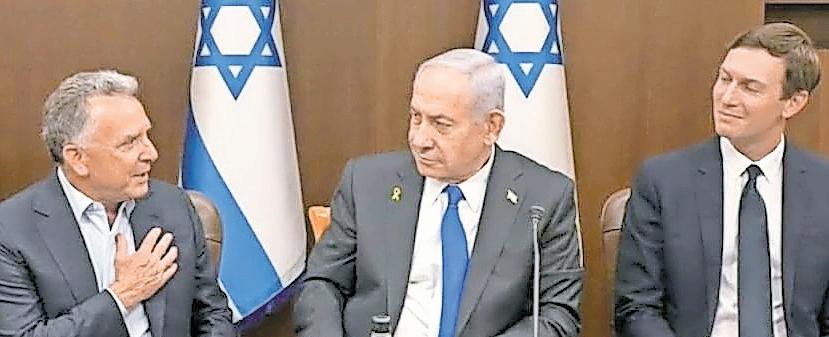
US special envoy to the Middle East Steve Witkoff and President Trump son-in-law Jared Kushner flank Prime Minister Benjamin Netanyahu at an Israeli Cabinet meeting in Jerusalem on Oct. 9, 2025. GPO
Walsh Ambulatory Pavilion
Episcopal Health Services is proud to introduce the Walsh Ambulatory Pavilion , a state-of-the-art
Services Include:
• Primary Care
• Behavioral Health
• Obstetrics & Gynecology
Maternal Fetal Medicine
• Endocrinology
• Endoscopy Colonoscopy
• EHS Cancer Center
Medical Oncology
Radiation Oncology
19-20 Brookhaven Avenue, Far Rockaway, NY 11691
Call 718-347-3627 or visit ehs.org/walsh to schedule an appointment today! For the EHS Cancer Center, please email cancercenter@ehs.org.
‘Staggering rise’ in anti-Jewish hate in NYC
Possibly up 150% in May (but that depends on who’s counting and how)
By Menachem Wecker, JNS
The New York City Police Department said that anti-Jewish hate crimes were up 70.8% in the city last month compared to May 2025. If it compared statistics from the months in a broader way, the increase was more than double that— 150%.
Under Mayor Zohran Mamdani, who overturned many of his predecessor’s executive orders protecting Jews and Israelis hours into his tenure, the city has twice changed the way it reports hate crimes after the Big Apple recorded a 182% increase in antisemitic hate crimes in Mamdani’s first month on the job.
In February, the city shared only “confirmed” hate crimes but not “reported” ones. After a backlash, it said in March that it would record “confirmed” and “reported” hate crimes separately.
Mamdani’s spokeswoman has said that synagogues that host pro-Israel events violate international law, and the mayor has said several times that he would have the Israeli prime minister arrested in New York City. Jewish leaders have told JNS that the mayor isn’t doing enough to protect Jews in the city.
A JNS analysis suggests that since the city reported hate crime statistics for “confirmed” and “reported” incidents separately for March, the city has suggested that there is no percentage change in the 103 anti-Jewish “confirmed” hate crimes in that span in 2026 compared to 2025. But if the city also shared the statistics for “reported” anti-Jewish hate crimes, it would suggest that the 140 reported anti-Jewish hate crimes in the city from March to May are a 32% increase over similar incidents from March to May in 2025.
Last month, the NYPD said that there were 41 “confirmed” anti-Jewish hate crimes in the city, which it said was a 70.8% increase on the 24 “confirmed” in May 2025. When the department shared statistics last month on “reported” hate crimes, it said that 60 such reports targeted Jews. It didn’t provide information on how that compared to reported incidents in May 2025.
The 41 “confirmed” hate crimes targeting Jews in New York City last month represent more than 60% of the total number of “confirmed” hate crimes, 68, that month. Jessica Tisch, commissioner of the NYPD, has said that Jews make up about 10% of city residents.
On June 3, 2025, the NYPD reported that
there were 24 “reported” hate crimes in the city. The city is now referring to that 24 number as “confirmed,” which suggests that 100% of the reported anti-Jewish hate crimes in the city in May 2025 were subsequently confirmed.
That is not the case with other categories. In May 2025, two of three anti-Asian hate crime reports were confirmed, as were five out of six reports of anti-black hate crimes, according to city data. One of two gender-based reported hate crimes was confirmed, and in total, according to NYPD data, 39 of the 42 reported hate crimes in New York City in May 2025 have been confirmed subsequently.
If NYPD shared with the public that there were 24 “reported” hate crimes targeting Jews in New York City in May 2025, all of which were confirmed, and that last month, the total number of “confirmed” and “reported” hate crimes targeting Jews was 101, it would then reveal that total reports of anti-Jewish hate crimes in the city was up 150%, compared to the prior year.
The 60 “reported” anti-Jewish hate crimes in New York City in May 2026 include the 41 “confirmed” hate crimes targeting Jews, the NYPD said. The department didn’t say why it reported the percentage increase in “confirmed” anti-Jewish hate crimes but not in “reported” anti-Jewish hate crimes.
Rafael Mangual, a fellow at the Manhattan Institute and contributing editor of its City Journal who studies urban crime, told JNS that the NYPD is right to use the number of “confirmed” hate crimes.
“The way it is doing it now makes more sense” and is “more standardized” with how other departments report the data, he said. “The initial report is really just a matter of how many boxes did the initial set of allegations from the complainant check off.”
Comparing months to the corresponding time period the prior year isn’t especially helpful when it comes to hate crimes, according to Mangual, who thinks that the numbers are so small that random chance could be playing a role. The year-to-date number tells a more clear story, he said.
He added that it is alarming that such a large percentage of religion-based hate crimes target Jews given how many Jews live in the city.
Mark Goldfeder, a professor at Touro Law Center and director of its clinic on Jew-hatred, told JNS that “the development is still deeply serious.”
“On NYPD’s own confirmed numbers, antiJewish hate crimes rose 70.8% year over year in May,” Goldfeder, who also directs the National Jewish Advocacy Center, said. “On the broader reported numbers, if compared to the way NYPD presented the data last year, anti-Jewish hatecrime reports rose from 24 to 60, which is a 150% increase. Either way, the signal is unmis-
takable. Jews remain the leading target of hate crimes in New York City by a staggering margin, and the trend is moving in the wrong direction.”
“The methodological change is also important,” he said. “Separating reported from confirmed incidents may improve transparency, but it can also make year-over-year comparisons harder unless NYPD clearly explains which number it is comparing to prior years. The public should not have to guess whether ‘reported,’ ‘investigated’ and ‘confirmed’ are being used consistently across releases.”
“For communities trying to understand risk, clarity matters almost as much as the raw number,” he told JNS. “The bottom line is that Jewish hate crimes are not a marginal category in New York City. They are the dominant hate-crime category, and the city needs to treat them with the urgency the numbers demand.”
NYPD data also show discrepancies in prior months. On May 4, the city said that 30 “confirmed” hate crimes, of 38 “reported” ones, targeted Jews in the city in April 2026. It said that in April 2025, there were 43 “confirmed” antiJewish hate crimes in the city. On May 7, 2025, though, the NYPD said that 41 “reported” hate crimes targeted Jews in that April, meaning that the NYPD has now confirmed two more antiJewish hate crimes in April 2025 than the total number reported as of early May last year. Last month, the NYPD said that amounted to a 30.2% decrease in “confirmed” anti-Jewish hate crimes. If it used the “reported” statistic, the decrease would be significantly smaller — about 11.6%
On April 2, NYPD said that 32 “confirmed” hate crimes out of 42 “reported” ones targeted Jews in the city in March, which it called an 11% decrease from 36 such “confirmed” incidents in March 2025. On April 3, 2025, the department said that 39 “reported” hate crimes targeted Jews. That would be a 7.7% increase in reported such incidents, rather than an 11% decrease.
On March 2, the NYPD said that 21 “confirmed” hate crimes targeted Jews in the city in February, and for the first time, it said it wasn’t sharing “reported” data. It didn’t share a percentage increase. On March 3, 2025, the department said that 28 reported hate crimes targeted Jews.
And on Feb. 2, the NYPD said that 31 “reported” anti-Jewish hate crimes targeted Jews the prior month, a 182% increase over the 11 reported in January 2025. On Feb. 4, 2025, the NYPD said that 18 “reported” hate crimes targeted Jews, suggesting that seven of those reports were downgraded in the following year.
Last month, five hate crimes in the city targeted Muslims, or about 7%, per NYPD data.
The department also said that 60 of the 98 (61%) “reported” hate crimes in the city targeted Jews last month, and that five (about 5%) targeted Muslims.
An NYPD counter terrorism officer, on Sept. 18, 2025. Michael Appleton, Mayoral Photography Office
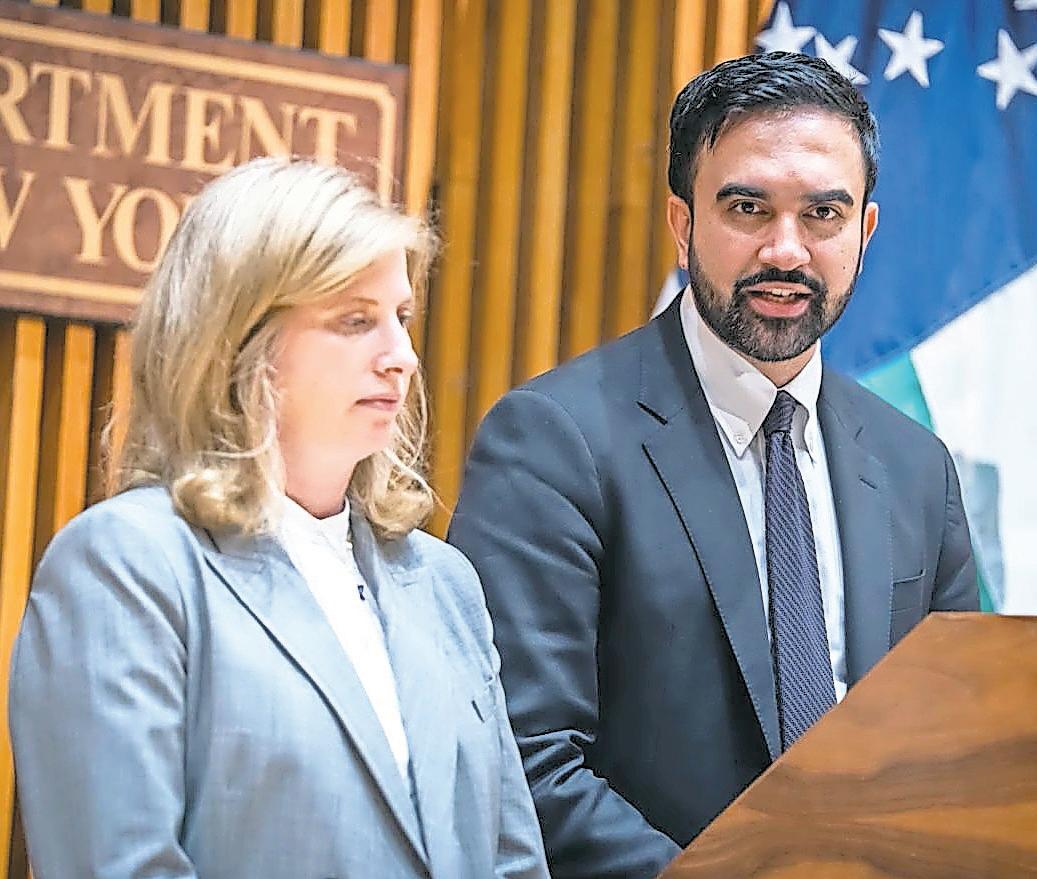
Mayor Zohran Mamdani briefs the media about security for the Israel Day Parade alongside Police Commissioner Jessica Tisch, on May 28. Ed Reed, Mayoral Photography Office
Goldman won’t join Lander in ‘genocide’ charge
By Debra Nussbaum Cohen, JNS
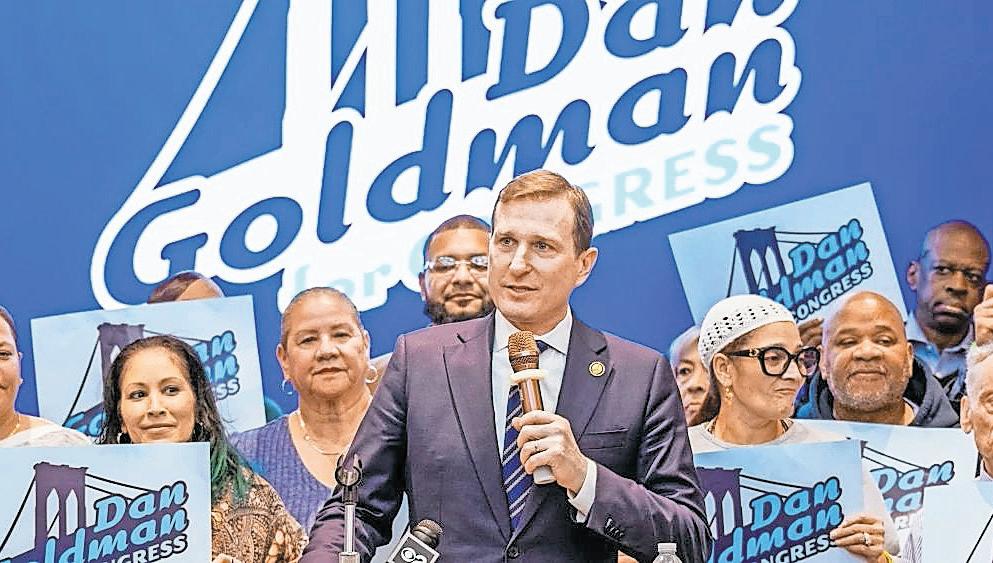
Rep. Dan Goldman drew on the recent New York Knicks NBA finals win in his opening statement during his second televised debate with former city comptroller Brad Lander, who is running to unseat him in New York’s 10th Congressional District.
“We cannot afford to put a rookie in the game,” he said. “We have to put our best players on the court.”
He referred often to Lander’s lack of federal government experience as his opponent being a “rookie.”
Both men are Jewish.
Lander has been an antizionist long before Oct. 7 who now accuses Israel of “genocide.” He is backed by Mayor Zohran Mamdani who opposes Israel’s existence as a Jewish state and has threatened to arrest Israeli Prime Minister Benjamin Netanyahu if he visits the Big Apple.
Goldman supports Israel but has declined to tie his support to a blank check.
Lander called Goldman a “corporate Democrat” who takes donations from Walmart, American Express and AIPAC. Goldman has acknowledged that he has a PAC that accepts corporate donations but only to distribute the monies to candidates in other Democratic races, he said.
The two are fighting to win the Democratic primary for a district, which spans from Manhattan below 14th Street to the Brooklyn communities of Red Hook, DUMBO and Sunset Park.
The hotly contested district is between 20% and 30% Jewish, according to the moderator of Monday night’s debate. It also leans heavily progressive.
Both candidates identify as progressive Democrats but the differences in their approaches to governing bring the distinctions between them into sharp relief.
Goldman, 50, is a two-term member of Congress. Lander, 56, is a former city comptroller and member of New York City Council, who lost to Mamdani in the 2025 mayoral election.
A mid-May Emerson College poll suggested that Lander would best Goldman by 34 percentage points (57% to 23%), with particularly strong support among likely voters under age 40. It wasn’t clear, with election day a week away, if the month-old polling data, which suggested 20% were undecided, is still reliable.
At a campaign rally held Sunday in a Brooklyn park, Lander stood on stage with Mamdani and Mohsen Madawi, a former Columbia University student who organized the April 2024 Gaza solidarity tent encampment on campus. US Immigration and Customs Enforcement
detained Madawi when he went to an immigration appointment in Vermont to apply for citizenship. A federal judge ordered him released after two weeks, but the Trump administration is seeking to deport him. In a legal filing made public on June 10, an immigration judge ordered Madawi deported to Jordan. Madawi is appealing.
With Lander and the mayor by his side, Madawi wore a keffiyeh over his black t-shirt. Lander’s campaign has touted that rally, and other recent efforts, as examples of JewishMuslim cooperation. In the debate Monday night, Lander demanded that Goldman also accuse Israel of “genocide.”
Goldman demurred. “We should focus less on terminology which has very specific legal
meanings,” he said.
“Legal terminology is very complicated and somewhat beside the point,” Goldman said, a few minutes later. “We need to surge aid to Palestinians to give them the ability to rebuild.”
“I am focused now on a ceasefire agreement, which would give the Palestinians the state they deserve and self-determination,” he said. “That’s what we should all be focused on.”
“That is pro-Israel and pro-Palestinian, which is what we should all be focused on,” Goldman said.
In a discussion of artificial intelligence, which both men agree must be regulated by the federal government, Goldman criticized Lander for splicing together two unrelated sentences in a video published shortly after their first televised debate on June 2.
He said that he was “disappointed” to see Lander do so. “It’s funny that you can add two words from different sentences to make a point,” he said.
Lander did not see anything wrong with that. “You said the words that we put together,” he said.
Goldman stressed the need to take Congress back from the Republican majority.
The way to end partisan gerrymandering and dark money flooding elections “is by winning,” Goldman said.
“If the Democrats do not win, we cannot change any of those things. We need to fight fire with fire, fight them tooth and nail and make sure that it’s a level playing field,” he said. “Donald Trump is taking a hatchet to our democracy and boosting billionaires.”
Election day is June 23, and early voting has already begun. The winner of the Democratic primary is all but guaranteed to win the general election the staunchly blue district.
The Jewish Star contributed to this report.
Rep. Dan Goldman, facing a primary challenge in his Brooklyn-Lower Manhattan district next Tuesday from antizionist Brad Lander, at a campaign event in Manhattan on Jan. 6. Goldman campaign
Are you a journalist (or sales pro) who values truth, Torah and Israel?
News Reporter
Our team covers news that matters to Modern Orthodox communities in Metro New York (Long Island, Queens, Manhattan’s Upper East Side and Upper West Side, Riverdale and Westchester).
Assignments include community events; school, business and health news; local personalities; Jewish institutions; holidays and entertainment; antisemitism and antizionism; politics; Jewish America; the impact of developments in Israel on our local communities, and more.
Position offers expert mentoring, starting salary of $36,400 to $39,520 plus a full benefits package that includes medical, dental, 401(k) and Jewish and secular holidays — all in a supportive, collegial and kosher environment.
Reply: Candidates with reporting and news-writing experience (professional or collegiate) are invited to email a cover letter, resume and 4 to 6 clips or links to Publisher@TheJewishStar.com. Put REPORTER in subject line.
Editor
Responsibilities
•Lead a growing team of correspondents
•Initiate and refine story ideas
•Assign and write articles
•Edit staff and freelance submissions
•Verify rights to submitted art
•Organize print and web layouts, working with page designers and AI software
•Expand our digital footprint (including website, e-newsletters and social media)
•Help plan Jewish-centric events
•Work with the Publisher and the RCI team on a range of common projects
Required
•News reporting experience
•Copy editing and proofing skills
•Familiarity with and sensitivity to Jewish issues
•Experience with editorial contributors
•Ability to meet deadlines
•Attention to detail
•Familiarity with web and SM conventions
Salary: Starting at $50,960 to $62,400 plus a full benefits package that includes medical, dental, 401(k) and paid Jewish and secular holidays.
Reply: Cover letter, resume, 4 to 6 clips or links to Publisher@TheJewishStar.com.
Are you repressed in a workplace overrun by woke truthiness, debased values and Israel-hate? Is your professionalism challenged when truth falls victim to scorched earth politics?
If you’re ready to come home, consider an opportunity at The Jewish Star, where Torah-true honest reporting and ethical business practices are a priority.
Wear your Jewish Star proudly in a kosher environment and help make Jewish journalism great again.
Multimedia Sales
Selling advertising in The Jewish Star is just part of this job. Our staff’s toolkit is exceptionally broad, including
• Religious and secular publications
• Websites
• Content generation and editing services
• In-person and digital events
• Digital, email, radio and SM marketing
• Direct mail
• Commercial printing
• Local, regional, national, int’l reach
Employees are trained by the best in the business, in a supportive, collegial and kosher environment. Competitive compensation (salary and commission $45K-$90K) plus a full benefits package that includes medical, dental, 401(k) and paid Jewish and secular holidays.
Reply: Send a cover note and resume to Publisher@TheJewish Star.com.
Latch your career to a rising Star, a 24-yearold independent news operation that is part of RCI (Richner Communications Inc), a 100employee family-owned company with offices in Garden City and Riverdale. Positions are full-time in-person or hybrid (but part-time and freelance inquires may be considered).
Summer weddings and Jerusalem’s centrality
The HuffPost website recently featured a young Jewish writer explaining what she wanted for her wedding: “I want Jewish traditions involved. I want the whole traditionfilled party — a chuppah, the breaking of the glass, and being lifted up in chairs while loved ones dance the hora around me. ‘My Big Fat Jewish Wedding,’ if you will.”
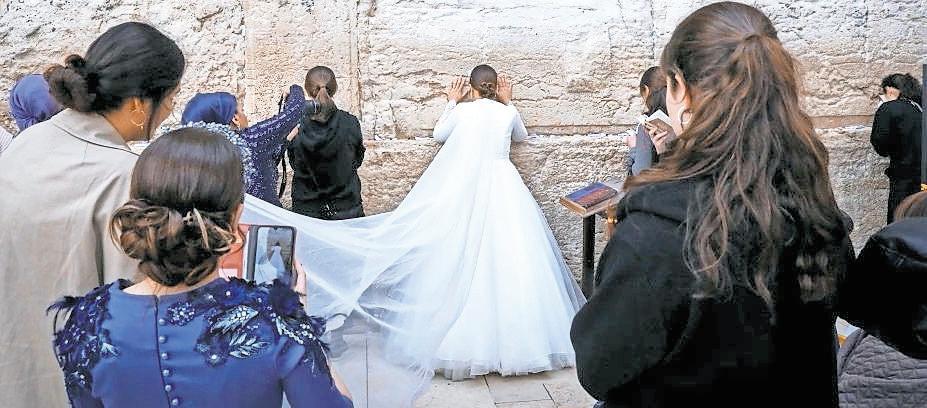
The writer seemed to have no idea what “the breaking of the glass” was all about. Tragically, this wedding season, far too many young Jews will celebrate their weddings and also have little appreciation or knowledge of what this “tradition” is all about: Jerusalem.
The “breaking of the glass” is not the only time under the chuppah that young brides and grooms will hear about our holiest city. The ancient, traditional service also includes the blessing: “May there soon be heard in the cities of Judah, and in the streets of Jerusalem, the voice of joy and gladness, the voice of the bridegroom and the voice of the bride ... .” But what are “the cities of Judah, and the streets of Jerusalem?”
Last month, when an op-ed by Sen. Chris Van Hollen (D-Md.) attacking Israel was published in the New York Times, it contained the idea that the American government should declare that it considers “Gaza and the West Bank, including East Jerusalem, as part of Palestine.”
What the piece did not explain is what East Jerusalem is. The area Van Hollen refers to isn’t “East Jerusalem” at all; it’s just Jerusalem. The same Jerusalem Van Hollen is calling “East Jerusalem.” What’s more, there is no political entity known as “East Jerusalem” — not now, and not at any point in history.
“East Jerusalem” is simply Jerusalem. Every biblical mention of a specific location in Jerusalem refers to an area that Van Hollen wants Israel to surrender. The term “East Jerusalem” doesn’t appear in the Torah because it is a modern political invention. When Israel’s enemies created this false name for Jerusalem’s Old City and surrounding neighborhoods, including the Western Wall, it was meant to sever the connection between Israel and Judaism’s holiest sites.
Today, Israel’s control of the parts of Jerusalem that the Israeli Defense Forces liberated in 1967 is consistently and vehemently contested by Arabs, who claim those areas rightfully belong to them. This claim is a cornerstone of the daily anti-Israel propaganda disseminated by Van Hollen and his J Street supporters. At traditional weddings, when the guests shout “Mazel Tov!” the groom recites this verse from Psalm 137: “If I forget thee, O Jerusalem, let my right hand forget its cunning. Let my tongue cleave to the roof of my mouth if I do not
remember you, if I do not make Jerusalem above my greatest joy.” (Psalm 137)
What we are talking about is what Van Hollen is calling “East Jerusalem.” This is not a thing that is limited to weddings. The Jewish holidays — every one of them — are inextricably bound to Jerusalem and its Holy Temple, the Beit Hamikdash.
Nearly 2,000 years after the Romans destroyed the Holy Temple, Jews still mourn its loss. We grieve the destruction of the actual, physical building. We are not at peace with the fact that our holy site has been co-opted by another religion and that the religious shrines of others have been built atop the ruins of ours. It is a bitter irony that these Islamic shrines are now used by extremists to incite hatred and violence against the Jewish people and Israel.
No matter how many Jews live in Jerusalem, no matter how many yeshivahs flourish there, no matter how beautiful the modern city of Jerusalem is, Jewish destiny is left unfulfilled so long as we are without our Holy Temple. And that is why we break the glass.
With Birthright and gap-year programs, there are now more opportunities for American Jews to visit Jerusalem’s Old City than ever before. These programs bring their participants to visit the Western Wall (Kotel), but seldom focus on the ways that Jews for centuries mourned the destruction of Jerusalem and the Holy Temple each day through prayer and ritual.
Every summer, two Jewish memorial days focus on the loss of the Holy Temple and the destruction of Jerusalem, starting with July 2, the memorial fast day on the 17th of Tammuz, and, three weeks later, starting on the evening of July 22, 2026, and ending after sundown on July 23, Tisha B’Av.
It is the saddest day on the Jewish calendar — the annual remembrance of the destruction of the First and Second Temples in ancient Jerusalem, along with other calamities throughout the generations.
This summer, Jerusalem should be recalled under the chuppah, on its memorial days and whenever the Van Hollens of this world try to claim that our holy city is someone else’s “East Jerusalem.”
Write: Columnist@TheJewishStar.com
A bride prays at the Western Wall in the Old City of Jerusalem. Yael Zamir, Flash90
Breaking the glass, remembering Jerusalem. Adobe
Paper-hunting journalist sues over Mamdani stall
By The Jewish Star
From JNS and other sources
A veteran investigative reporter and one of New York City’s best-known lawyers are taking Mayor Zohran Mamdani to court, accusing his administration of dragging its feet on requests for records tied to Israel and antisemitism policies scrapped on his first day in office.
Journalist Richard Behar and attorney Randy Mastro say City Hall has repeatedly delayed responses to Freedom of Information Law requests seeking documents about Mamdani’s rollback of executive orders involving antisemitism and Israel. According to the lawsuit, some records may not be released until late this year.
Mastro argues the delays amount to obstruction, while Behar says journalists have a duty to uncover how major government decisions are made. The lawsuit seeks records tied to the city’s adoption of the IHRA antisemitism definition, anti-boycott policies involving Israel and the removal of webpages promoting New York’s business ties with Israel.
Grave-marker fix snag
Legislation aimed at correcting the grave markers of Jewish American war dead has stalled in Congress after becoming entangled in a broader surveillance fight. Supporters say nearly 900 Jewish service members may be buried overseas beneath crosses instead of Stars of David. Advocates remain optimistic the bipartisan measure will ultimately pass.
The toast of Riverdale
Three Riverdale electeds cheered the
diplomatic ties and reverses restrictions involving Israeli goods and official contacts. Israeli Foreign Minister Gideon Sa’ar hailed the decision, while Prime Minister Janez Janša said Slovenia would pursue a more balanced foreign policy. Israel is also moving ahead with plans to open an embassy in the country.
Envoy hits Pride harassment
Israel’s ambassador to Italy condemned harassment directed at pro-Israel marchers during Bologna Pride. Demonstrators carrying a rainbow flag featuring a Star of David were reportedly insulted and shoved after being labeled “baby killers.” No injuries were reported, but the clash fueled debate over whether Jewish and pro-Israel participants are being excluded from LGBTQ spaces across Europe.
French plan pooh-pooh’d
as
Tel Aviv mega rehab
A new rehabilitation hospital is set for north Tel Aviv thanks to a nearly $70 million donation. The planned facility will become Israel’s largest rehabilitation center, with roughly 540 beds and advanced treatment programs. The project addresses growing demand from wounded soldiers, trauma victims and an aging population.
First airport hotel
Israel’s busiest gateway is finally getting a hotel. Brown Hotels won approval for a five-star, 260-room property beside Ben-Gurion Airport’s Terminal 3. The seven-story complex will feature runway views, a rooftop deck, pool, spa and conference space. Construction is slated to begin in 2028 as part of a broader airport expansion plan. Developers say the project will bring a new level of convenience and luxury to travelers using Israel’s main international hub.
El Al taps Starlink
El Al says passengers will soon enjoy faster internet in the skies. Israel’s flagship airline signed a deal with Elon Musk’s Starlink to provide satellite-based connectivity across its fleet. The service is expected to roll out gradually beginning in 2027, giving travelers improved browsing and streaming capabilities during flights.y.
‘Genocidal’ chase: Not hate
Santa Monica’s police chief says a man accused of chasing a couple while shouting “you are genocidal” did not commit a hate crime under California law. Prosecutors still charged the suspect with criminal threats and battery. Police said investigators found no evidence the victims were targeted because of a protected identity, though Jewish leaders said the incident remains deeply troubling.
Slovenia axes curbs
Slovenia’s new government has scrapped a series of measures imposed on Israel by the previous administration. The move restores normal
Israel’s embassy in Paris says France cannot serve as an honest broker in efforts to revive a two-state solution. The sharp response came after French officials hosted a major conference backing Palestinian statehood. Israeli officials argue Palestinian leaders have repeatedly rejected statehood proposals and continue to reward terrorism, making France’s approach unrealistic and one-sided.
Doctors rip Lancet
Israel’s leading medical association blasted a campaign seeking its suspension from the World Medical Association. The effort, highlighted in The Lancet, accuses Israeli doctors of failing to condemn alleged abuses in Gaza. Israeli medical leaders called the move a dangerous politicization of medicine and warned that targeting physicians because of nationality would undermine international cooperation.
Nab 14 at shul protest
London police arrested 14 people after anti-Israel demonstrators gathered outside a synagogue hosting a real-estate event tied to Israel. Jewish leaders condemned the protest as intimidation directed at worshippers. Organizers of the rally said they were protesting property sales connected to Judea and Samaria. The incident comes amid rising concern about antisemitism across Britain.
Palestine Action ban
A British appeals court ruled that the government acted lawfully when it banned Palestine Action under counterterrorism laws. Judges said the group’s activities went beyond peaceful protest and included violence and property destruction. Supporters of the ban cited attacks on Jewish institutions and defense facilities, while critics argued free-speech rights were being curtailed.
Smith College acts
Smith College rejected a proposal to divest from companies linked to Israel. The recommendation came from pro-Palestinian student and alumni groups. A college advisory panel said the measure failed to meet standards for mission alignment, financial responsibility and campus consensus, ending its path forward for now.
Somaliland ties
Israeli Foreign Minister Gideon Sa’ar hosted Somaliland President Abdirahman Mohamed Abdullahi in Jerusalem, highlighting rapidly expanding ties. Sa’ar revealed the leaders had met previously in private and welcomed Somaliland’s decision to open an embassy in Jerusalem. Both sides said cooperation between the two governments continues to grow.
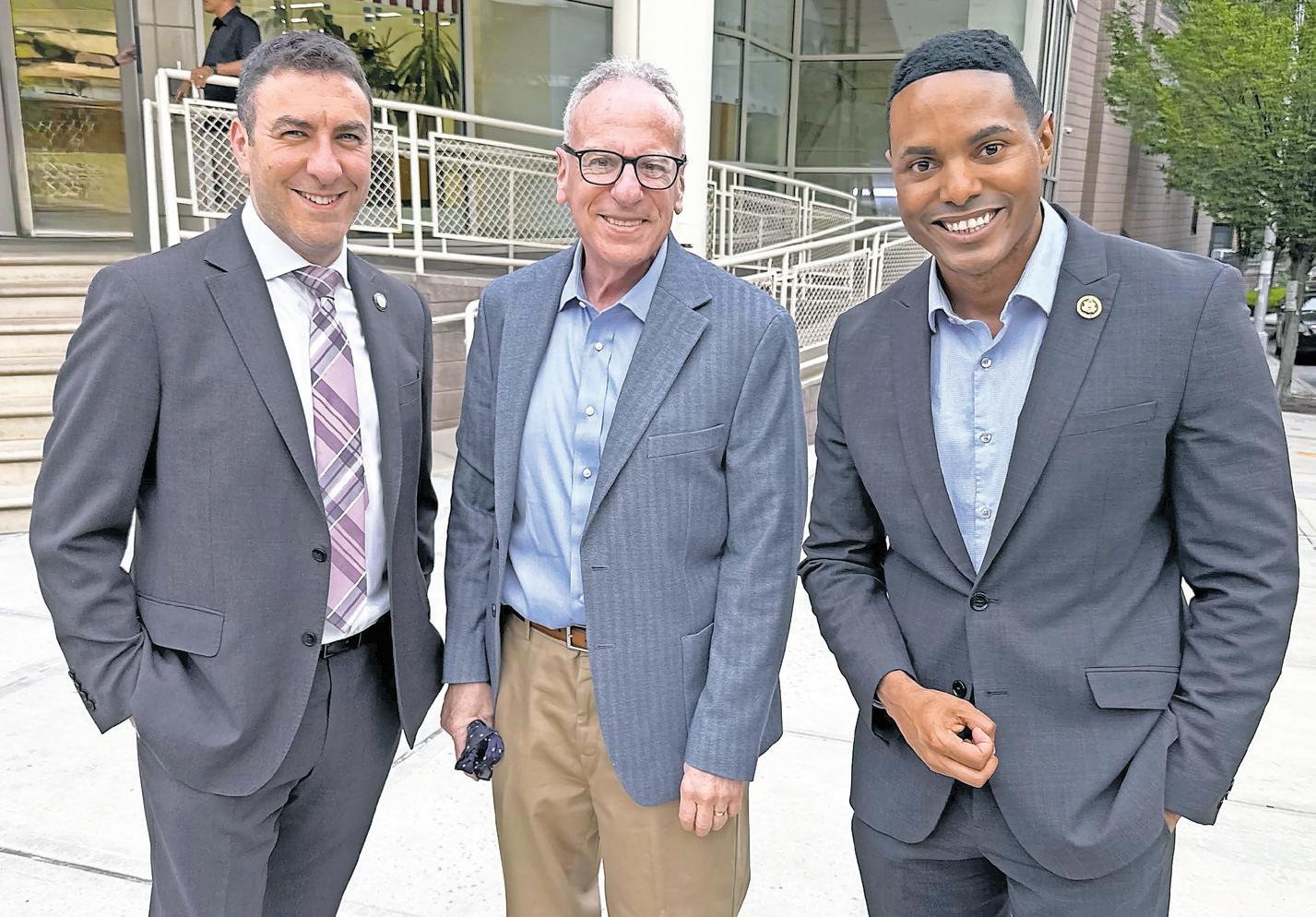
Riverdale Jewish Center (affectionately known
The Bayit) at its 50th annual dinner on Sunday night. They’re pictured outside the Modern Orthodox shul on Henry Hudson Parkway, after shaking hands and chatting with congregants. From left: City Councilman Eric Dinowitz, Assemblyman Jeffrey Dinowitz, and Rep. Ritchie Torres. The senior Dinowitz and Torres are both on the ballot in next Tuesday’s Democratic primary Ed Weintrob, The Jewish Star
WINE AND DINE
New cookbook showcases Jewish traditions
By Nechama Bluth, The Jewish Star
Every week, thousands of viewers watch Melinda Strauss prepare Shabbos meals in her kitchen — sharing kosher recipes, Jewish traditions and family stories along the way.
Now the Modern Orthodox food creator is bringing those recipes from social media to print with her first cookbook.
Strauss, a resident of Woodmere, has spent nearly 15 years creating Jewish food content online, sharing recipes, family traditions and insights about Jewish life with audiences around the world.
For five years, she has posted weekly Shabbos menus on TikTok (@therealmelindastrauss), often explaining the stories behind the dishes she prepares for her family. One recipe in particular became a favorite among her followers: roasted broccoli, which they began calling “Nora’s Broccoli.”
During a phase when her daughter Nora would eat only broccoli, Strauss began roasting it every week for Shabbos. Soon, followers were making the dish themselves.
“People started telling me their kids were finally eating broccoli because of this recipe,” Strauss recalled.
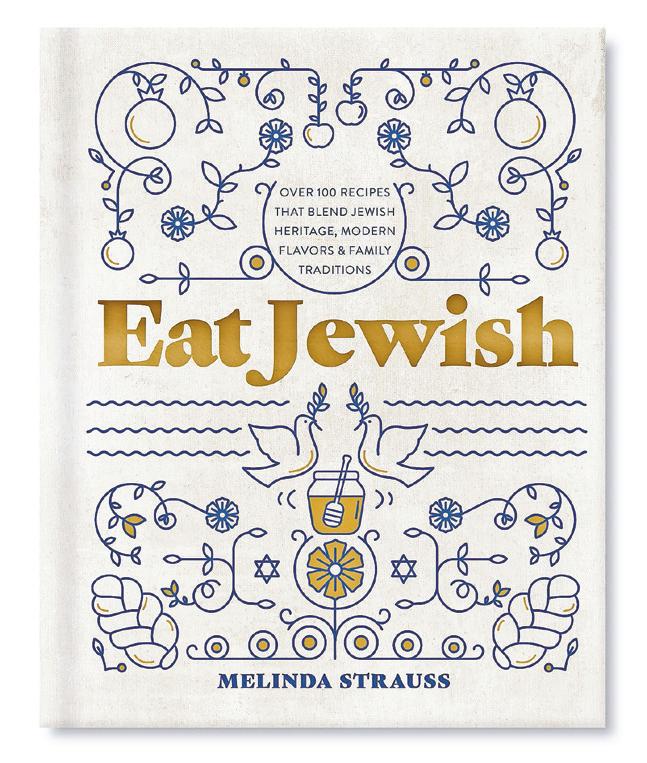
That response helped inspire the idea for a cookbook — “Eat Jewish: Over 100 Recipes That Blend Jew-
ish Heritage, Modern Flavors, and Family Traditions” — a place to collect the recipes and stories she had been sharing online.
Strauss said she is often asked whether people who are not Jewish can cook her recipes. Her answer, she said, is simple.
“Jewish food, like all food, tells a story,” Strauss said. “And stories are best when we share them.”
Family plays a central role throughout the book. Strauss’ father wrote the foreword, and many of the recipes are connected to memories from her childhood.
Some of her earliest food memories involve her grandmother, Savtah Adina, who lived across the street from the family in Seattle. Strauss remembers sitting on the kitchen counter while her grandmother prepared large weekly meals.
Although she was usually not allowed to cook — that role was reserved for her older sisters — Strauss often served as the family’s taste tester.
“That’s really where my love of food began,” she said.
Today, Strauss uses her social media platforms to explain Jewish traditions, holidays and foods to a wide audience that includes both Jewish and non-Jewish viewers.
“What I’ve found is that food becomes the bridge,” she said. “It sparks questions and starts conversations.”
The cookbook expands on that idea by combining recipes with stories about Jewish traditions and family life.
At a time when many Jews feel the weight of rising antisemitism and the ongoing war in Israel, Strauss said she hopes the book will also serve as a reminder of Jewish resilience and pride.
“This cookbook is more than recipes,” she said. “It’s a way of celebrating who we are.”
Strauss also sees the growing community of Jewish food creators online — particularly Orthodox women — as part of a broader shift.
Social media has created opportunities for women to build careers as recipe developers, authors, educators and entrepreneurs, she said.
For Strauss, the journey has meant blending her passion for cooking with her Jewish values and education.
“I hope people feel inspired to raise their own voices,” she said. “We need more people telling the Jewish story through food, through traditions and through joy.”
Nechama Bluth is associate for The Jewish Star.
‘Eat Jewish’ recipes from Melinda Strauss
Labneh Cheese
Makes 3/4 cup (180 ml)
One of Strauss’ favorite things about visiting Israel is the Israeli breakfast, and more specifically, the cheese! Cheese just tastes better in Israel, and her favorite to pair with Turkish Cheese Borekas (page 174), chopped salad, Jerusalem bagels, lox, and shakshuka is labneh. Labneh is a tangy, creamy Middle Eastern cheese that I love topped with za’atar and olive oil. The best part? Labneh is made with just two simple ingredients: whole-milk yogurt and salt. The liquid that drains from the yogurt as it strains is called whey, and there are several ways to use it once your labneh is ready. You can discard it, add it
to your compost, mix it with protein powder for smoothies, or even feed it to your animals.
The labneh can be stored in the refrigerator in an airtight container for up to 2 weeks.
• 1 cup (240 ml) whole-milk Greek yogurt
• 1/4 tsp. kosher salt
• Extra-virgin olive oil, for garnishing
• Za’atar (page 39), for garnishing
1. In a small bowl, add the yogurt and salt. Using a rubber spatula, stir until the salt is fully incorporated.
2. Set a mesh strainer over a large bowl, and line the strainer with cheesecloth or a clean linen cloth, with about 3 to 4 inches (7.5 to 10 cm) of cloth hanging over the sides. Add the yogurt to the strainer, using the spatula to scrape it from the bowl. Lay the remaining cloth over the top and transfer to the refrigerator. Chill until the yogurt has thickened and there is liquid (that’s the whey!) in the bottom of the bowl, at least 24 hours and up to 48 hours. Discard the whey or use it as desired.
3. To serve, transfer the labneh to a clean serving bowl or plate. Use the back of a spoon to swirl a shallow well in the center. Top with a drizzle of olive oil and a sprinkle of za’atar. You can serve labneh with veggies, pita, and crackers, or dollop it onto anything you’d like.
Slow Cooker Oxtail Soup
Makes 1 cup (240 g)
In Strauss’ family, they call this Kitchen Sink Soup, because it includes just about everything but the kitchen sink! This hearty oxtail soup,
filled to the brim with beef, marrow, vegetables, herbs, barley, split peas, and so much flavor, reminds her of her Savtah Adina, who made this recipe for her family whenever she wanted to use up all the vegetables in her refrigerator. The biggest change Strauss made to the recipe was switching from a pressure cooker to a slow cooker. Just mix all the ingredients together in the slow cooker, set it for 10 hours, and walk away until it’s done. If you are unable to get your hands on beef oxtail at your local butcher, short ribs can be used instead.
Did You Know a Jewish Person Invented the Slow Cooker?
The slow cooker was actually invented in the 1930s by a Jewish inventor named Irving Naxon to provide a way to cook a meal slowly over a long period of time, inspired by the Jewish tradition of preparing cholent before Shabbos on Friday evening to cook in the residual heat from the bakery ovens for Shabbos lunch on Saturday.
The soup can be stored in the refrigerator in an airtight container for 3 to 4 days and in the freezer for up to 6 months.
• 2 lbs. (910 g) beef oxtail
• 6 marrow bones
• 1 package (16 oz or 455g) frozen mixed vegetables
• 2 medium carrots, chopped
• 2 medium stalks celery, chopped
• 1 medium parsnip, chopped
• 1 medium turnip, chopped
• 1 medium yellow onion, chopped
• 1 cup chopped fresh parsley
• 1 cup chopped fresh dill
• 1/2 cup (100 g) pearl barley
• 1/4 cup (50 g) split peas
• 2 Tbsp. Onion Soup Mix (page 38)
• 2 tsp. salt
• 1/2 tsp. black pepper
• 7 cups (1.7L) beef stock
1. In an 8- to 10-quart (7.5 to 9.5 L) slow See ‘Eat Jewish’ cookbook on page 14
Melinda Strauss prepares “Nora’s Broccoli” with her daughter Nora. Sheneur Menakerran
‘Eat Jewish’ cookbook from Melinda Strauss…
Continued from page 12
cooker, add the oxtail, marrow bones, frozen vegetables, carrots, celery, parsnip, turnip, onion, parsley, dill, barley, split peas, onion soup mix, salt, and pepper. Pour in the beef stock, making sure everything is completely covered. This will pretty much fill up your entire slow cooker to the top. Cover the slow cooker, set it to low, and let it cook for 10 hours.
2. Remove the lid to help the soup cool down. If serving right away, ladle into soup bowls. If not, wait until the soup is completely cool before transferring to a container for storage, about 1 hour.
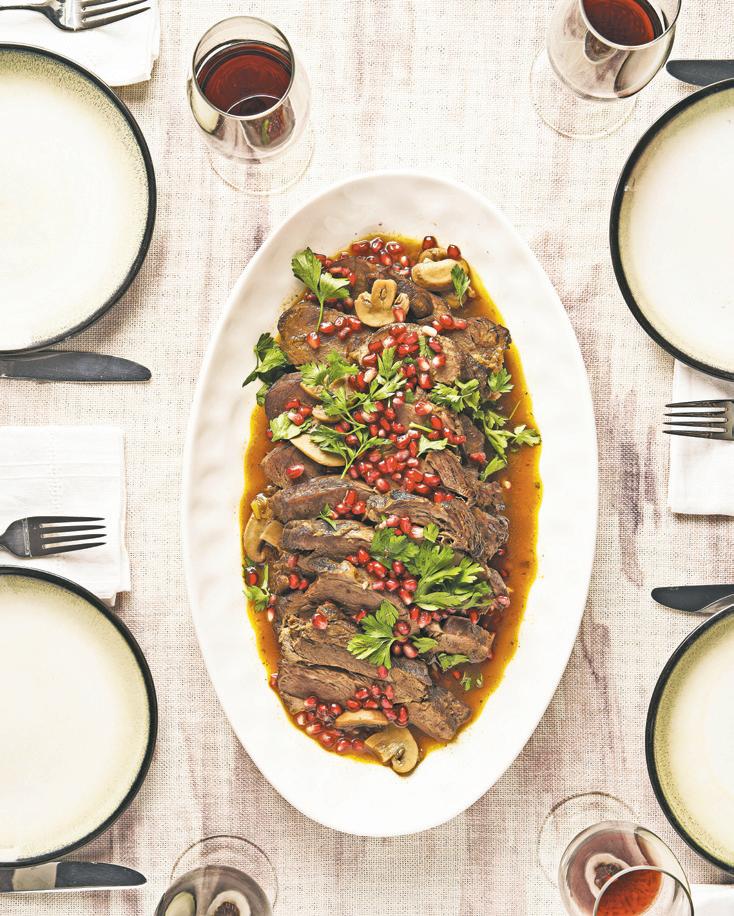
Pomegranate-Braised Pot Roast
Serves 8 to 10
Strauss likes to think of this as her Rosh Hashanah pot roast, because during the Jewish New Year we eat symbolic foods, each with a special meaning — and many of them are in this recipe, including pomegranate seeds, dates, and leeks. For me, pot roast is all about the balance: tender, slow-cooked meat, flavorful vegetables, and a rich, savory gravy that ties it all together. It’s simple, hearty, and always a crowd-pleaser, making it perfect for everything from cozy family dinners to festive holiday meals.
Pomegranates
represent the 613 Jewish Commandments
Pomegranates are said to contain 613 seeds, symbolizing the 613 commandments in the Torah. These seeds represent the many good deeds we hope to accomplish in the coming year.
The pot roast can be stored in the refrigerator in an airtight container for 4 to 5 days and in the freezer for up to 6 months.
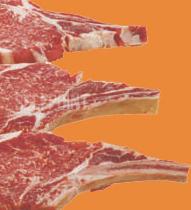
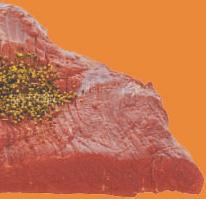
• 4 lbs. (1.8 kg) chuck roast
• 3 tsp. kosher salt, divided
• 1-1/2 tsp. black pepper, divided
• 4 Tbsp. extra-virgin olive oil, divided
• 2 leeks, white and light green parts sliced into thin rounds
• 1 cup thinly sliced mushrooms
• 2 cloves garlic, minced
• 1 cup (240 ml) beef stock
• 1 cup (240 ml) pure pomegranate juice
• 1 Tbsp. honey
• 1 Tbsp. Dijon mustard
• 1 Tbsp. Onion Soup Mix (page 38)
• 1 tsp. paprika
• 1 tsp. garlic powder
• 1/2 tsp. dried ground thyme
• Pomegranate seeds, for garnishing
• Fresh thyme, for garnish
1. Pat the roast dry with paper towels and season with 2 teaspoons of the salt and 1 teaspoon of the pepper.
2. In a large, heavy-bottomed pot with a lid, heat 2 tablespoons of the oil over medium-
high heat until it shimmers, about 2 minutes. Add the meat and sear it all over, about 5 minutes per side. Transfer to a large plate.
3. Reduce the heat to medium. Add the remaining 2 tablespoons oil, the leeks, and mushrooms; cook, stirring occasionally, until beginning to caramelize, 4 to 5 minutes. Add the garlic and cook until fragrant, about 30 seconds. Add the stock and juice; stir until the browned bits loosen from the bottom of the pot. Stir in the honey, mustard, soup mix, paprika, garlic powder, dried thyme, the remaining 1 teaspoon salt, and the remaining 1/2 teaspoon pepper. Return the meat to the pot and bring to a boil over medium-high heat. Reduce the heat to low, cover, and let simmer until the meat is tender and the sauce has reduced by half, 2 to 3 hours.
4. Transfer the meat to a cutting board and let rest for 15 minutes. Cut into 1/4-inchthick (6 mm) slices. Serve warm on a platter topped with the sauce, pomegranate seeds, and fresh thyme.
Yakir’s Biscoff Babka Buns
Makes 24 buns
Babka is a beloved Jewish dessert that we’d never gatekeep! The classic fillings are chocolate and cinnamon, but the options are endless — like hazelnut spread or my personal favorite, Biscoff Creamy Cookie Butter. This babka is made into individual buns in muffin tins instead of a traditional loaf shape. If you want to make loaves instead of buns, this recipe makes two large babka loaves.
This recipe holds a special place in Strauss’ heart because a follower of hers on social media, Marcy Tatelbaum, used to make it for her son, Yakir. “They called him their Cookie Monster because he loved cookies and desserts,” Tatelbaum said. Yakir was tragically killed in Gaza after the October 7 attack, forever a hero who fought to protect us all. This babka is in his honor.
Why Is Babka Such a Popular Jewish Food?
Babka originated in Eastern European Jewish communities, particularly in Poland and Ukraine, as a way to use leftover challah dough. Filled with cinnamon or poppy seeds, rolled, twisted, and baked, its name, meaning “little grandmother” in Polish, reflects its roots. In the late nineteenth century, Jewish immigrants brought babka to the United States, where it became a bakery staple. While traditionally simple, American tastes introduced richer fillings like chocolate, transforming it into the beloved treat it is today.
The buns can be stored in an airtight container at room temperature for 3 to 4 days and in the freezer for 3 months.
Babka Dough
• 1 cup (240 ml) warm water
• 1 Tbsp. active-dry yeast
• 1/2 cup (100 g)
• granulated sugar
• 3 large eggs, beaten separately, divided
• 1/2 cup (120 ml) plus
• 1/2 tsp. neutral oil, divided
• 1/2 tsp. kosher salt
• 4-1/2 cups (560 g) all-purpose flour, plus more as needed
Biscoff Filling
• 3/4 cup (180 ml) Biscoff Creamy Cookie
Butter
• 1/4 cup (55 g) packed brown sugar
• 3 Tbsp. neutral oil
• 1 tsp. ground cinnamon
• 1/4 tsp. kosher salt
Topping
• 1/2 cup (120 ml) Biscoff Creamy Cookie
Butter
1. Make the dough: In a large bowl or the bowl of a stand mixer fitted with the whisk attachment, add the warm water, yeast, and granulated sugar and whisk at low speed until dissolved, about 10 seconds. Set aside for 10 minutes for the yeast to activate; the top will be frothy when it is ready.
2. Add 2 of the beaten eggs, 1/2 cup (120 ml) of the oil, and 1/2 teaspoon salt, and whisk at low speed until fully combined, about 30 seconds. Switch to the dough hook attachment and add the flour. Mix at low speed until no flour is visible and the dough is sticking to the sides of the bowl, about 2 minutes. Increase the speed to medium-low and mix until the dough is smooth and no longer sticking to the sides of the bowl, 2 to 3 minutes. If the dough is still sticking, add a little more flour, 1/4 cup (30 g) at a time, up to an additional 1/2 cup (65 g).
3. Brush the dough with the remaining 1/2 teaspoon oil to prevent sticking. Transfer the dough to a clean, large bowl, cover with a clean kitchen towel, and let the dough rest in a warm area until it has doubled in size, about 1 hour and 30 minutes.
4. Preheat the oven to 350°F (175°C/gas 4). Prepare two 12-cup or four 6-cup muffin pans with paper baking cups or grease with cooking oil. On a lightly floured surface, use a rolling pin to roll out the dough into a large rectangle, about 16 by 24 inches (41 by 61 cm).
5. Make the Biscoff filling: In a small bowl, add the ¾ cup (180 ml) Biscoff spread, brown sugar, 3 tablespoons oil, cinnamon, and 1/4 teaspoon salt; stir until smooth. Spread the mixture onto the rolled-out dough in a thin, even layer all the way to the edges. From a long side, gently roll the dough up tightly, jelly-roll fashion.
6. With a sharp knife, cut the roll into twenty-four 1-inch-thick (2.5 cm) slices. Hold a slice in two hands and stretch it slightly. Twist your hands in opposite directions, then tuck the ends under and pinch them together. Place the babka, seam side down, in the muffin tin. Repeat with the remaining slices. Cover the buns with a clean kitchen towel and set aside until fluffed up and pillowy, about 30 minutes.
7. Brush the buns with the remaining beaten egg. Bake until golden brown and a toothpick inserted into the center comes out clean, 18 to 20 minutes. Let cool slightly in the pans, about 10 minutes, then transfer the buns directly to a wire cooling rack to cool completely, about 1 hour.
8. In a small microwave-safe bowl, melt the 1/2 cup (120 ml) Biscoff spread until it’s a pourable liquid, about 30 seconds. Drizzle over the babka buns. Serve immediately, or after the topping has cooled — either way is great.
Zucchini Bread
Makes 1 tube-pan loaf or about 24 muffins
Strauss debated whether to place this recipe under side dishes or desserts, but there’s something special about serving a sweet side dish that always brings me joy. She’s not entirely sure where the Ashkenazic tradition of sweet dishes like raisin noodle kugel, cranberry crunch kugel, carrot muffins, pumpkin bread, and zucchini bread began, but it’s one I’ve always loved. Her savtah used to make this recipe in a tube pan, and she still uses her pan to make it in her kitchen.
Strauss adapted it to be a bit less sweet and cakier, and you can use a Bundt pan if you prefer. Sweet zucchini bread pairs well with a variety of dishes, such as cheese blintzes, lox with cream cheese, Apple Cider–Roasted Chicken (page 120), Dry-Rub Brisket (page 100), grilled salmon, or even alongside a bowl of Chicken Soup (page 62).
The zucchini bread can be stored on the counter in an airtight container for 3 to 4 days and in the freezer for up to 6 months.
Cooking Spray, for greasing
• 1-1/2 cups (300 g) granulated sugar
• 1 cup (240 ml) vegetable oil
• 3 large eggs
• 1 tsp. freshly grated lemon zest
• 1/2 tsp. vanilla extract
• 2 medium zucchini, grated and squeezed dry
• 2-1/2 cups (300 g) all-purpose flour
• 1 tsp. ground cinnamon
• 2 tsp. baking powder
• 1/2 tsp. baking soda
• 1/2 tsp. kosher salt
• 1/4 tsp. ground nutmeg
• 1/4 tsp. ground ginger
• 1 can (8 oz, or 225g) crushed pineapple
1. Preheat the oven to 375°F (190°C/gas 5) and grease a tube or Bundt pan with cooking spray.
2. In a large bowl, add the sugar, oil, eggs, lemon zest, and vanilla and whisk until well combined. Add the zucchini and, using a rubber spatula, stir until evenly incorporated.
3. In another large bowl, add the flour, cinnamon, baking powder, baking soda, salt, nutmeg, and ginger; whisk to combine. Add the egg mixture and, using a rubber spatula, stir until a thick batter forms. Fold in the crushed pineapple.
4. To the prepared pan, add the batter, using a rubber spatula to scrape the sides of the bowl. Bake until the top is golden and a toothpick inserted in the center comes out clean, 50 to 55 minutes.
5. Let cool slightly, about 10 minutes. Set a wire cooling rack on top of the pan and carefully invert, allowing the bread to fall onto the rack. Gently tap the pan to loosen the bread if necessary. Serve warm or at room temperature.
At Mount Sinai South Nassau, patient safety isn’t just a priority— it’s a standard, one we work on every day. And the experts agree.
We’ve earned national recognition for patient safety, including an “A” Hospital Safety Grade from The Leapfrog Group and the Healthgrades Patient Safety Excellence Award.
That means better outcomes for our patients with lower risk of infections or hospital acquired conditions.
When it comes to your health, nothing matters more than knowing you’re in a place where patient safety matters most.
Learn more at mountsinai.org/southnassau
Jewish Star Torah columnists: Rabbi Benny Berlin, spiritual leader of BACH Jewish Center in Long Beach; Rabbi Avi Billet of Anshei Chesed, Boynton Beach, FL, mohel and Five Towns native; Rabbi Binny Freedman, rosh yeshiva of Orayta, Jerusalem; Dr. Alan A. Mazurek, former ZOA chair, retired neurologist, living in Great Neck, Jerusalem and Florida.
Contributing writers: Rabbi Sir Jonathan Sacks zt”l, former chief rabbi of United Hebrew Congregations of British Commonwealth; Rabbi Yossy Goldman, president South African Rabbinical Association; Rabbi Dr. Tzvi Hersh Weinreb, OU executive VP emeritus.
Five Towns Candlelighting: From the White Shul, Far Rockaway, NY
Scarsdale Candlelighting: From the Young Israel of Scarsdale, Scarsdale, NY
The Korach rebellion: Power versus influence
The Korach rebellion was an unholy alliance of individuals and groups united by their grievances with Moses’ leadership.
•There was Korach himself, a member of the tribe of Levi, angry (according to Rashi) that he had not been given a more prominent role.
•There were the Reubenites, Datan and Aviram, who resented the fact that the key leadership positions were taken by Levites rather than members of their own tribe. Reuben had been Jacob’s firstborn, so some of his descendants felt that they should have been accorded seniority.
•Then there were the 250 “leaders of the community, chosen from the assembly, men of repute” who felt aggrieved (according to Ibn Ezra) that after the sin of the Golden Calf, leadership had passed from the firstborn to a single tribe, the Levites. Plus ca change, plus c’est la meme chose
The Korach story is an all too familiar tale of frustrated ambition and petty jealousy — what the Sages called “an argument not for the sake of heaven.”
What is most extraordinary about the episode, however, is Moses’ reaction. For the first and only time, he invokes a miracle to prove the authenticity of his mission:
Then Moses said:
By this you will know that the L-rd sent me to do these deeds; it was not my idea. If all these men die as others do, and share the common fate of all humanity, then the L-rd has not sent me. But if the Lord creates something entirely new, so that the ground opens its mouth and swallows them and all they have, and they go down alive to Sheol, then you will know that these men have provoked the L-rd. Num. 16:28-30
In effect, Moses uses his power to eliminate the opposition. What a contrast this is to the generosity of spirit he showed just a few chapters earlier, when Joshua came to tell him that Eldad and Medad were prophesying in the camp, away from Moses and the seventy elders. Joshua regarded this as a potentially dangerous threat to Moses’ leadership and said, “Moses, my lord, stop them!” Moses’ reply is one of the most majestic in the whole of Tanach: Are you jealous for me? Would that all the Lrd’s people were prophets, that the L-rd would put His spirit upon them all! Num. 11:29
The two dimensions of leadership are power and influence.
What was the difference between Eldad and Medad on the one hand, and Korach and his co-conspirators on the other? What is the difference between Moses saying, “Would that all the L-rd’s people were prophets,” and Korach’s claim that “All the community is holy, every one of them, and the L-rd is in their midst. Why then do you set yourselves above the L-rd’s people”? Why was the first, but not the second, a legitimate sentiment?
Is Moses simply being inconsistent? Hardly. There never was a religious leader more clearsighted. There is a distinction here which goes to the very core of the two narratives. The Sages, in one of their most profound methodological observations, said that “the words of the Torah may be poor in one place but rich in another.” By this they meant that, if we seek to understand a perplexing passage, we may need to look elsewhere in the Torah for the clue. A similar idea is expressed in the last of Rabbi Ishmael’s thirteen rules of biblical interpretation:
Where there are two passages which contradict each other, the meaning can be determined only when a third passage is found which harmonizes them.
In this case, the answer is to be found later in the book of Bamidbar, when Moses asks G-d to choose the next leader of the Israelites. G-d tells him to take Joshua and appoint him as his successor:
So the L-rd said to Moses, “Take Joshua, son of Nun, a man infused with My spirit, and lay your hand upon him. Have him stand before Elazar the priest and the entire community, and in their sight, give him this charge. Give over to him some of your majesty, so that the entire Israelite community will obey him.” Num. 27:18-20
Moses is commanded to perform two acts over and above presenting Joshua to the priest and people. First he is to “lay his hand” on Joshua. Then he is to give Joshua “some of [his] splendor.” What is the significance of these two gestures? How did they differ from one another? Which of them constituted induction into office?
The Sages, in Midrash Rabbah, added a commentary which at first sight only deepens the mystery: “Lay your hand on him” — this is like lighting one light from another. “Give him some of your splendor” — this is like pouring from one vessel to another.
In fact it is this statement that will enable us to decode the mystery.
There are two forms or dimensions of leadership. One is power, the other, influence. Often we confuse the two. After all, those who have power often have influence, and those who have influence have a certain kind of power. In fact, however, the two are quite different, even opposites.
We can see this by a simple thought-experiment. Imagine you have total power, and then you decide to share it with nine others. You now
have one-tenth of the power with which you began. Imagine, by contrast, that you have a certain measure of influence, and now you share it with nine others. How much do you have left? Not less. In fact, more. Initially there was only one of you; now there are ten. Your influence has spread.
Power operates by division, influence by multiplication. With power, the more we share, the less we have. With influence, the more we share, the more we have.
So deep is the difference that the Torah allocates them to two distinct leadership roles: king and prophet. Kings had power. They could levy taxes, conscript people to serve in the army, and decide when and against whom to wage war. They could impose non-judicial punishments to preserve social order. Hobbes famously called kingship a “Leviathan” and defined it in terms of power.
The very nature of the social contract, he argued, was the transfer of power from individuals to a central authority. Without this, there could be no government, no defense of a country and no safeguard against lawlessness and anarchy.
Prophets, by contrast, had no power at all. They commanded no armies. They levied no taxes. They spoke G-d’s word but had no means of enforcing it. All they had was influence — but what influence!
To this day, Elijah’s fight against corruption, Amos’ call to social justice, Isaiah’s vision of the end of days, are still capable of moving us by the sheer force of their inspiration. Who, today, is swayed by the lives of Ahab or Jehoshaphat or Jehu? When a king or queen dies, their power ends.
When a prophet dies, their influence begins. Returning to Moses: here was a man who occu-
pied two leadership roles, not one. On the one hand, though monarchy was not yet in existence, Moses had the power and was the functional equivalent of a king. He led the Israelites out of Egypt, commanded them in battle, appointed leaders, judges and elders, and directed the conduct of the people. He had power.
But Moses was also a prophet, the greatest and most authoritative of all. He was a man of vision. He heard and spoke the word of G-d. His influence is incalculable. As Jean-Jacques Rousseau wrote, in a manuscript discovered after his death:
… an astonishing and truly unique spectacle is to see an expatriated people, who have had neither place nor land for nearly two thousand years … a scattered people, dispersed over the world, enslaved, persecuted, scorned by all nations, nonetheless preserving its characteristics, its laws, its customs, its patriotic love of the early social union, when all ties with it seem broken. The Jews provide us with an astonishing spectacle: the laws of Numa, Lycurgus, Solon are dead; the very much older laws of Moses are still alive. Athens, Sparta, Rome have perished and no longer have children left on earth; Zion, destroyed, has not lost its children. Rousseau, Cahiers de brouillons, notes et extraits, no. 7843 (Neuchâtel).
The mystery of Moses’ double investiture of Joshua is now solved.
•First, he was told to give Joshua his authority as a prophet. The very phrase used by the Torah — vesamachta et yadecha, “lay your hand” on him — is still used today to describe rabbinic ordination, which we call semichah, meaning, the “laying on of hands” by master to disciple.
•Second, he was commanded to give Joshua the power of kingship, which the Torah calls
See Sacks on page 22
Here is one word we can’t do without: Boker
RABBI BENNY BERLIN
Iwas pounding on the keys angrily as I composed an email to my 12th grade teacher. It was clear to me that there was a double standard. Both another student and I had handed in the same answer to a question, yet I had received a lower grade than the student whom I perceived to be the teacher’s favorite.
The teacher later admitted that it had been an honest mistake. But in the moment, all I felt was fury, and I sat down, wrote him an angry email, and hit send before I could think twice.
When we later spoke, he did not focus on what I had written. He focused on the fact that I had sent it. He told me, “Please take this rule for the rest of your life. You can never send an email or a text while you are angry. Ever. Because you will always regret it.”
That lesson has stayed with me for decades.
There is another version of this same idea, not from the side of the person who is angry, but from the side of the person trying to calm them down. Pirkei Avos teaches, “Do not appease your fellow in the time of his anger” (4:18).
When I was working on a college campus, a group of students were very upset about something. My instinct was to run toward peace immediately. But my supervisor advised me to wait until the next day. Any calm argument I made at that moment would have fallen on deaf ears. By giving people a little time to cool down, I was able to have a much more productive and rational conversation.
Moshe shows us this in the most powerful way in Parshas Korach. Korach and his band of rebels gather against Moshe and Aharon and accuse them, “Why do you raise yourselves above G-d’s assembly?” (Bamidbar 16:3). It is a deeply personal attack. They publicly challenge Moshe’s integrity and leadership before the entire nation.
If I were Moshe, I think I would have exploded. After everything he had sacrificed for this nation, after defending them time and again, even
Never email or a text while you are angry. Ever.
pleading, “If You do not forgive their sin, mecheini na misifrecha” (“Erase me now from Your book”) (Shemos 32:32), now they accuse him?
But Moshe does not respond that way. He simply says one word to Korach and his followers.
Boker.
“In the morning Hashem will make known who is His” (Bamidbar 16:5).
The Ohr HaChaim explains that Moshe was giving Korach and his followers the night to recognize their error and turn back on their own. He was not stalling. He was offering them a chance to reconsider before the consequences became irreversible.
The Mesillas Yesharim adds a deeper dimension to the idea of waiting until morning. He explains that night is a metaphor for confusion and distorted judgment. In the darkness, “one may
mistake a pillar for a man, or a man for a pillar” (Mesillas Yesharim, Chapter 3). We see things, but not as they truly are. Morning, therefore, represents clarity. It is the moment when reality comes back into focus and we can see the world as it really is.
Moshe was not merely postponing the confrontation. He was giving Korach the opportunity to move from the darkness of anger and confusion to the clarity of truth.
We feel this in our own lives constantly. Someone posts something vile online about Israel or about the Jewish people, and our fingers itch to type an immediate, blistering response. But what does that actually accomplish when the other side is not interested in listening anyway?
Stephen Covey wrote, “Between stimulus and response there is a space. In that space lies our freedom and power to choose our response. In those choices lie our growth and our happiness.”
Halachah anticipated this thousands of years earlier. Chazal instituted the get mekushar, a deliberately complicated, folded and tied divorce
Think about Korach: Are you a giver or a taker?
To continue to embrace new opportunities and challenges is a wonderful character trait. We should never become complacent with our lives or our achievements. If we can do more, we should; nay, we must.
Then again, sometimes people who have everything in life inexplicably decide to go looking for completely new challenges and end up losing everything they had.
I am thinking specifically of the biblical gentleman named Korach, who bears the title of this week’s Torah portion. Korach truly had everything. He was clever, wealthy and from an aristocratic family.
Yet he decided to contest his cousins, Moses and Aaron, for the leadership of the Jewish people and, specifically, for the position of High Priest.
‘Better
RABBI DR. tzvI
CLet us be happy with our blessings and not pursue what other people may have.
Moshe, of course, wasn’t looking for yichus (“status”). He was a most reluctant leader. Back at the Burning Bush, G-d had to argue with him quite a bit before he would accept the position. Likewise, his brother Aaron was appointed by G-d Himself (no nepotism here whatsoever). Nevertheless, Korach challenged them — gathering hundreds of his friends, neighbors and rabble-rousers in a revolt and a mutiny against Moses and Aaron.
In the end, we read of several Divine miracles that led to the vindication of Moses and Aaron, and the unnatural deaths of Korach and his henchmen. They were swallowed up by the
they learn from me’ and do what’s right
onflict resolution is one of the most important tasks in human relations. Open up any newspaper and you will read of schoolchildren bullying each other, of married couples who are in bitter conflict, of political parties enmeshed in verbal warfare, and of nations literally at war. What are some of the strategies available to foster conflict resolution?
One of the most interesting strategies can be found in an ancient endeavor known by the generic term of martial arts. I once watched a brief film on the subject in which I observed a fascinating technique. The participant in the battle was instructed not to fight his opponent head on, not to counter aggression with aggression. Rather, he was instructed to yield to the attack, to move paradoxically backwards as if to surrender, and not to move forward in the attack
mode. In a sense, he was directed to surprise his opponent by reacting unpredictably. This strategy can be applied to many situations in life in which there is strife and discord.
In this week’s parsha, Korach, we read of such discord as Korach and his cohorts rebel against Moses. Among this band are Dathan and Abiram, the sons of Eliav, who have long been thorns in Moses’ side. They challenge his authority and threaten outright revolt against his leadership. A civil war looms.
Moses’ initial response is not one of anger. He tries verbal persuasion, he calls for Divine intervention, and only then does he indignantly express his anger. But before he reaches that point, he tries something that goes almost unnoticed by most commentators.
He sends for them. He adopts a conciliatory attitude, and invites them into dialogue. He does not “come out fighting,” at least not until his invitation to discussion and perhaps even compromise is rebuffed.
I have been reading a biography of a great Hasidic leader in early 20th century Poland, Rabbi Israel Danziger, known today by the title
of his book of inspirational homilies, Yismach Yisrael. He was heir to the leadership of the second largest Hasidic sect in pre-World War II Europe, a sect known by the name of the town near Lodz where he and his father before him held court. His father was Rabbi Yechiel Danziger, and the name of the town was Alexandrow.
The biography contains documentation of several talks Rabbi Israel gave describing many of the lessons he learned from his sainted father. In one of those talks, he tells of the time that he was sent with several of his father’s emissaries to visit the court of another Hasidic rebbe. He describes how that rebbe’s personal secretary made the delegation wait their turn on a long line.
He describes how when they finally got into the rebbe’s reception room, they were treated perfunctorily, if not coldly, and the request they
were instructed to make of this rebbe was callously rejected by him. They returned to Alexandrow feeling chastised. Rabbi Israel, who led the delegation, reported back to his father and relayed to him every detail of his disappointing experience.
About a year later, the other Hasidic rebbe needed a great favor of Rabbi Yechiel. He sent a delegation to Alexandrow, headed by his own son.
The delegation arrived, and much to Rabbi Israel’s surprise, his father issued orders that they be welcomed warmly and be shown gracious hospitality. Rabbi Yechiel further instructed that the delegation be given an appointment during “prime time” and not be asked to wait on line at all. Rabbi Yechiel himself waited at his door for them, ushered them in to his private chambers, seated them comfortably, and personally served them refreshments. He listened to their request for a favor of him and granted it generously. Then, as Jewish tradition prescribes, he bid them farewell only after first escorting them part of the way along the route of their return journey.
RABBI YossY
S. African Rabbinical Assn.
See Berlin on page 22
See Weinreb on page 23
See Goldman on page 22
A Jewish man in Kfar Chabad, Israel, looks up at a poster of the Lubavitcher Rebbe, Rabbi Menachem Mendel Schneerson, Aug. 26, 2012. Nati Shohat, Flash90
Published weekly except during certain religious and civil holidays by The Jewish Star LLC New York City office: 5676 Riverdale Ave Suite 311, Bronx NY 10471 • LI office: 2 Endo Blvd, Garden City NY 11530 Here’s how to reach The Jewish Star — Write: Editor@TheJewishStar.com. Call: 516-622-7461 ext 291
Editor & Publisher: Ed Weintrob
516-622-7461 ext 291
Jewish Star Associate: Nechama Bluth 516-622-7461 ext 241
Content: The Publisher endeavors to ensure that our content is within the bounds of normative halachah and hashkafah. Anyone who feels anything we publish may be inappropriate in this regard is urged to bring the item in question to the attention of the Publisher.
Advertising is accepted at the sole discretion of the Publisher and should conform to standards appropriate for distribution in an Orthodox community. Send us your news! Editor@TheJewishStar.com
Advertising: Publisher@TheJewishStar.com
Kashrut: The Jewish Star is not responsible for the
kashrut of any product or establishment featured in its pages. If you have questions regarding any establishment or product, including its supervision, please consult your rabbi for guidance.
Submissions: All submissions become the property of The Jewish Star and may be edited and used by the Publisher, its licensees and affiliates, in print, on the web and/or in any media that now exists or will exist in the future in any form, including derivative works, throughout the world in perpetuity, without additional authorization or compensation. The individual or entity submitting material affirms that it holds the copyright or otherwise has the right to authorize its use in accordance with The Jewish Star’s terms for submissions.
Opinions: Views expressed by columnists and other writers do not necessarily reflect the position of the Publisher or of The Jewish Star LLC.
Distribution: The Jewish Star is available free in kosher food establishments, stores, synagogues, and curb-side newsboxes on Long Island, in New York City and elsewhere. To request free delivery to your location, write Publisher@TheJewishStar.com.
Copyright: All content is copyright and may not be republished or otherwise reproduced without written permission by The Jewish Star; to do so without permission is against the law and halacha. For content reproduction write to Publisher@TheJewishStar.com.
The Jewish Star subscribes to JNS. It, or its contributors, own the copyrights on material attributed to them. The length and content of JNS material and all other submitted material may be edited by The Jewish Star.
Member: American Jewish Press Association. This newspaper contains words of Torah. While it is not considered shaimos, please dispose properly.
OPINION COLUMNISTS
Mitchell Bard, foreign policy analyst, authority on USIsreal relations; Ben Cohen, senior analyst, Foundation for Defense of Democracies; Stephen Flatow, president, Religious Zionists of America-Mizrachi and father of Alisa Flatow, murdered in an Iranian-sponsored Palestinian terrorist attack in 1995; Yisrael Medad, Americanborn Israeli journalist and political commentator; Rafael Medoff, founding director of David S. Wyman Institute for Holocaust Studies; Fiamma Nirenstein, Italian-Israeli journalist, author of 13 books, leading voice on Israeli affairs, Middle Eastern politics and antisemitism; Melanie Phillips, British journalist; Moshe Phillips, national chairman, Americans for a Safe Israel; Thane Rosenbaum, Distinguished University Professor at Touro University (published by Jewish Journal); Jonathan S. Tobin, editor-in-chief, Jewish News Syndicate.
Deal leaves Israel to face old dangers alone
Israel is now trying to find a new balance in the uncomfortable world into which President Donald Trump has pushed it — a world that Vice President JD Vance described with his characteristic detachment from anything not American: “Certainly Israel will have a seat at the table in the new Middle East.”
The new understandings with Iran — because it is absurd to call it an agreement or peace — is like a fog settling over a weary and wounded country. It is an affront to so many who fought, to the reservists, and to the memory of soldiers who believed they were fighting for a genuine solution to the Iranian problem, the great nuclear and terrorist threat hanging over Israel. For now, that will not be the outcome.
Israel is absent from the table where this non-agreement has been crafted, even as Iranian officials proudly parade it before the world in anticipation of its formal signing. Their satisfaction is obvious, and for precisely the same reasons that Israelis ask how Trump, after so much shared effort and sacrifice, arrived at such a meager conclusion.
History may well record that this was how a president abandoned the struggle against the world’s most dangerous regime — a state founded on oppression and the murder of its own people, and internationally on the construction of an empire of terrorist proxies: Hezbollah, Hamas, the Houthis, the Iraqi Hezbollah factions and countless Shi’ite militias, backed by the great autocratic powers of China and Russia, to which Iran supplies drones, the very same kind Hezbollah launches against Israel. How extraordinary that Trump should walk away from the battle for democracy and from the defense of the Jewish people at a moment when antisemitism is resurging across the globe.
Throughout this long war for survival, Israel placed its trust and admiration in the man who moved the American embassy to Jerusalem and who appeared finally to understand the siege under which Israel has lived since its birth — and especially since Oct. 7, 2023.
Israeli Prime Minister Benjamin Netanyahu and Trump undoubtedly cultivated a personal bond. Today, it feels like a relationship — and a shared set of values — coming undone.
The joint campaign that reached all the way to Tehran was extraordinary. The destruction of Iran’s nuclear infrastructure and ballistic missile capabilities intended to dominate Israel and threaten the wider region remains an indelible achievement.
But now Israel watches as its closest friend prepares to hand billions of dollars to the Islamic Revolutionary Guard Corps. It sees the nuclear issue endlessly discussed but still unresolved, and Lebanon left hanging in uncertainty.
People in northern Israel are deeply worried. They know all too well what Hezbollah missiles
and drones have done to their lives since 2023: homes abandoned, schools closed, jobs lost, families uprooted, people killed and wounded, communities devastated.
In the midst of an election campaign, Netanyahu’s political opponents have descend upon him from every direction.
Yair Golan calls him “weak, sick and without influence.” Yair Lapid declares that “even Trump understands you care only about your own interests.” Benny Gantz and Gadi Eisenkot join the chorus.
Attacking Netanyahu has once again become a national pastime. For his part, the prime minister vowed on Monday night to prevent Iran from acquiring a nuclear weapon “with or without an agreement.”
“Iran will not have nuclear weapons. As long as I am prime minister of Israel, this will not happen,” the premier told reporters in his first press conference since Trump concluded his peace deal with the Islamic regime on Sunday.
Asked about reported disagreements with the Trump administration, Netanyahu said, “He is the US president, I’m the Israeli prime minister — we often see eye to eye and there are also instances where we see less eye to eye.”
Still, Netanyahu acknowledged that the “historic” joint US-Israeli operation against Tehran “saved the State of Israel from the threat of nuclear annihilation.”
The wound is fresh and it is difficult to know what course to take, given that the United States remains the indispensable pillar of the Western alliance.
Clearly, Netanyahu could never have renounced American support when Israel embarked on the long war forced upon it after Oct. 7. But now every strategic choice must be reconsidered in an atmosphere where any independent move risks damaging relations with Washington.
His central mission—to free Israel and the wider world from the Iranian nuclear threat — has once again been thrown into doubt. The ayatollahs promise much, as Iran always does while consistently deceiving.
Yet those promises ring hollow in the face of 440 kilograms of uranium enriched to 60%, another 150 kilograms enriched to 20%, and tons of additional nuclear material still awaiting processing. If the centrifuges remain in Iran and are eventually restored with the funds now flowing back to the regime, they can once again produce weapons of mass destruction, even if on a longer timetable than before the war.
As for Lebanon, Israel cannot accept a peace that merely gives Hezbollah another opportunity to dig tunnels, accumulate weapons and money, and prepare for a Lebanese version of Oct. 7.
Trump’s chosen course reflects domestic American realities: high fuel prices, mounting political pressure ahead of the midterm elections, the burden of a distant conflict and the prospect of American coffins returning home draped in flags.
Over time, it also became evident that the enemy would never truly make peace. Trump is not a man who thinks in terms of the coming of the Mahdi, which Ayatollah Ruhollah Khomeini identified in 1979 as the horizon of a final war against the infidels.
Today’s Iran is far less the heir of the Persian Empire than the sword of revolutionary Islam, seeking first Shi’ite domination over Sunni Islam and ultimately global religious victory. It cares little about casualties, destruction or hunger, least of all among its own people, whom it routinely eliminates whenever they fail to conform to the dictates of the Islamic Republic.
Netanyahu understood this reality well when he addressed the US Congress in 2015 to oppose then-President Barack Obama’s nuclear agree-
See Nirenstein on page 23
Israeli Prime Minister Benjamin Netanyahu on June 15.
Ma’ayan Toaf, GPO
UN’s fatal formula for the Israeli-Pal conflict
The antics of Colombia’s outgoing leftist president, Gustavo Petro, have dominated headlines about the United Nations over the last week.
Petro arrived in New York to chair a special debate on the Middle East at the Security Council, which Colombia is currently chairing, on the heels of a tweet that read simply, “Heil Hitler.” The Colombian leader later attempted to clarify that the intent behind the post had been ironic. He had, he explained, been commenting on an editorial in a Colombian newspaper, ahead of the second round of the country’s presidential election, that endorsed the conservative candidate for his commitment to “order, authority and economic freedom.”
If those three things are the core ingredients of Nazism, then we must all be pretty deluded!
Petro then doubled down. While sitting in the chair’s seat in the Security Council, he used the war in Gaza as the primary illustration for his contention that the world is “going back to the era of the Nazis.”
When Ambassador Jennifer Locetta, the US representative, opened her remarks by underlining that “the United States condemns any antisemitic rhetoric and any comments that reduce the atrocities of the Holocaust,” Petro rebuked her, asserting that his goal was not to diminish the Nazi Holocaust but to warn against “a Holocaust now, targeting the people of the Third World.”
We are dealing with ideology before anything else.
The overarching point here is that the United Nations is regarded by politicians like Petro as a benign forum for this kind of bombastic, cavalier rhetoric. And there is no issue more suitable in that regard than the conflict between Israel — the Jewish state built in the wake of the Shoah — and the Palestinians.
For most of its existence, the motley tyrannies with membership of the UN General Assembly, along with a significant portion
of the world body’s own bureaucracy, have demonized Israel through comparisons with the Nazis, as well as with the former apartheid regime in South Africa and repeated, patently false, accusations of “genocide.” The cluster of pro-Palestinian member states, together with a complex of UN committees and protocols dedicated to serving Palestinian propaganda, has ensured that.
That is perhaps why I was struck not so much by Petro’s words — entirely natural coming from a man who invoked the repugnant comparison between Israel and the Third Reich in the aftermath of the Oct. 7 2023 Hamas-led
pogrom — but those of the outgoing SecretaryGeneral António Guterres.
Guterres is not as distasteful as Petro, with his patronizing smirk and his list of tired, far-left talking points. That said, he is a hypocrite.
For much of his 10-year term, Guterres sounded like he both understood and was concerned by the rise in antisemitic discourse and agitation pegged to Israel’s alleged offenses. But after Oct. 7, he insisted that the bestial Hamas assault “did not happen in a vacuum,” a classic example of subtly blaming the victim. He also placed the Israel Defense Forces on a blacklist of militaries around the world that abuse children, alongside the rapists of Hamas and Palestinian Islamic Jihad.
Speaking to Security Council on June 10, Guterres faithfully repeated the mantra that has guided the UN’s approach to the Middle East for far too long. “We must address the crisis that lies at the root of wider regional instability,” he said (my emphasis.) “The IsraeliPalestinian conflict has gone unresolved for decades.”
This formula reflected the sentiments behind the declaration of the UN’s Alliance of Civilizations in 2006, which argued that the “Israeli-Palestinian issue has taken on a symbolic value that colors cross-cultural and political relations ... well beyond its limited geographic scope,” as well as claiming that “the Palestinian issue ... is a major factor in the widening rift between Muslim and Western societies.”
The core idea here does not reflect reality as it is, but an interpretation that the United Nations seeks to impose.
If the Israeli-Palestinian conflict is seen as the anchor of the region’s broader woes, that is not because the cold data bears it out, but because much of the world has been swayed
See Cohen on page 23
In exile, we forgot our history as shepherds
When I visited Thailand recently, I couldn’t help but notice the abundance of water. The island was lush and green; palm trees and tropical plants seemed to grow effortlessly, with no visible irrigation systems feeding them.
In Israel, I have become accustomed to a different landscape. Here, drip irrigation lines snake across parks, shopping centers, train stations and private gardens. This Israeli innovation has helped transform a dry country into a thriving agricultural success story, fulfilling founding father and first prime minister David Ben-Gurion’s vision of making the desert bloom. Yet despite our achievements, Israel remains a desert.
Nothing grows here automatically. Every tree, every vineyard, every field requires effort, planning, and often, a carefully managed water system. We in Israel understand that if we do not plant, cultivate and nurture the land, little will flourish on its own.
In Thailand, the greenery fades into the background. It becomes scenery. It doesn’t need man’s effort to thrive naturally and become abundant. Here in Israel, we know what it takes to make things grow.
But there is a part of our landscape that often goes unnoticed — not only by visitors, but by many Israelis themselves.
It’s not the irrigation systems. It is the shepherds.
More specifically, our Jewish shepherds.
For many Jews around the world, the image of a Jewish shepherd belongs to the Bible. Shepherds are Abraham, Moses and David. They are figures from ancient history, not people one expects to encounter in modern life.
Today, roughly half of the world’s Jewish population lives outside Israel, with millions residing in North America. For many of them, the idea of a Jewish shepherd is almost unimaginable. It doesn’t fit the desired image of a contemporary Jew, shaped by the university, leading a professional career and living in an urban community.
Even many Israelis follow this paradigm, and they live in the same geographic region as these shepherds! But geography means little if you stay in your own comfort zone.
When I lived in Tel Aviv, I never ventured beyond the city. Everything seemed to be there: work, culture, entertainment, opportunity. Jerusalem felt distant. Judea and Samaria seemed completely foreign. That place, which I wrongly called “the West Bank,” felt disconnected from me and my life.
Had someone told me then about young Jewish shepherds tending flocks across the hills of Judea, I would not have believed
them. I would have dismissed it as romantic mythology.
Yet for the past 20 years, I have lived in Judea and have come to know these shepherds personally. I have watched them grow from children into young adults. I know their families. I am part of their community. They are not relics of the past. They are part of Israel’s present. And, I believe, a crucial part of its future.
Throughout Jewish history, shepherding was more than an occupation. Abraham was a shepherd. Moses was a shepherd. King David tended sheep before he became king. The role required patience, responsibility, endurance and leadership. It demanded a deep connection to both people and land.
That tradition has not disappeared.
Across the hills of Judea and the Jordan Valley, young Jewish shepherds still rise before dawn. They spend long days outdoors in conditions most people would find difficult. Their work is physically demanding, often isolated and largely invisible to the wider public.
Yet their presence shapes the landscape.
Recent years have also brought increasing challenges. According to the 2025 annual summary of the Hatzalah Judea and Samaria Emergency Hotline, dozens of shepherds were injured in violent incidents while tending their flocks. The report recorded 119 casualties resulting from attacks on shepherds and Jewish farms, including 74 shepherds themselves.
Whatever one’s political views, these numbers highlight a reality unfamiliar to most Israelis and virtually unknown to many Jews abroad. And the shepherds continue their work, despite the risks.
Spanish Prime Minister Pedro Sánchez (left) with Colombian President Gustavo Petro on Aug. 24, 2022. Spanish Ministry of the Presidency
A young shepherd tends to sheep and goats grazing in a field of wildflowers at the Gefen Ami Farm in the Hebron foothills in Judea and Samaria, on Feb. 24. Chaim Goldberg, Flash90
In fight over brit milah, who is out for blood?
RABBI
HAYIM LEITER
Letter from Efrat
practice male genital mutilation. All these years as a mohel, I was under the impression I was performing a deeply spiritual act, continuing a 4,000-year-old unbroken chain. But thanks to Dr. Max Pemberton’s recent article in the Daily Mail, my eyes have opened to the true nature of the procedure. It turns out everything Judaism ever taught me was a lie, and I owe him a debt of gratitude.
Or perhaps Pemberton is hiding behind a medical degree to peddle recycled anti-circumcision propaganda.
As someone who’s spent his career working to perfect the craft of brit milah and protect those who undergo it, I am deeply troubled by the anonymous accounts detailed in the article. Reports of post-procedural complications are distressing. But Pemberton’s presentation, while emotionally evocative, is anecdotal and not supported by the data.
Circumcision complications, especially at the neonate stage, are rare, occurring less than 0.5% of the time. And of these aberrations, the large majority relates to bleeding issues, which are easily resolvable with no long-lasting effects. These statistics are actually low as compared to most procedures. But the complication rate increases 20-fold for those
Some masquerade as saviors of newborns while peddling lies.
circumcised between ages of one and nine, and ten-fold for those over age 10.
Although there’s a clear benefit for undergoing the procedure at a young age, the question of consent still remains. Many who argue against circumcision claim the parents have violated the child’s autonomy due to lack of consent. But by definition, that’s parenting. From vaccinations, to education, to even ear piercings — parents make these decisions for their children.
These choices are often done with the best intentions in mind. There is no way to know if one day they will resent the path chosen for them. And many who resent their circumcision do so for fanciful reasons. They’ve been sold a bad bill of goods. The anti-circumcision movement purports the solution to all sexual woes can be found in the foreskin.
From the 16 functions to the 20,000 nerve endings contained therein, the foreskin has become a mythical sexual pot of gold. Many of the men and women waging war against the practice do so on faulty grounds. Two of the 16 functions listed are protection from sunburn and frostbite, and the number of nerve endings has never been officially researched. There is no doubt that there is a difference in sensation pre- and post-circumcision, but this result is solely dependent on the individual. There are those who have had the procedure done later in life who are unhappy with the result, and there are those who feel that it’s an improvement. These reactions have been documented in peer-reviewed studies, indicating one definitive correlation: those who feel positive about the procedure have increased sexual satisfaction, while those who regret it
show a marked decrease. This is not to say it’s all in one’s head (no pun intended), but there is definitely more going on than just the presence or absence of a piece of skin.
The one area Pemberton and I agree on is regulation. Circumcision should not be a free-for-all that anyone can perform. The Jewish community has never treated it that way. In England, organizations such as Milah UK and The Initiation Society effectively regulate the safe practice of the ancient rite with measurable results. The solution to undesired outcomes is not a ban, but rather increased oversightin communities that lack proper regulations.
However, it’s easy to take governmental oversight too far. When it comes to Female Genital Mutilation (FGM), one could easily draw the wrong conclusions. At first glance, FGM seems identical to circumcision: both involve removal of skin in the same region of the body. But beyond that they are vastly dissimilar.
Brit milah is a religious rite intended to elevate the male members of the community to full status. There is no intention nor is the result a conclusive loss of sexual sensation. FGM is the opposite. The intention is to keep the woman subservient to her husband, while experiencing little to no sexual pleasure. The practice is unlike a bris in the Jewish community; when FGM is done traditionally, it puts women in life-threatening danger due to its lack of hygiene and commitment to medical standards.
Circumcision has been proven to be medically beneficial. Studies have shown that beyond preventing the transmission and contraction of sexual diseases, it also reduces both penile and cervical cancers. A child is more likely to have a negative event with his foreskin
See Leiter on page 23
Naked and exposed: Jews still forced to run
ROBERT SOFFER
Advocate for Israel
In 1547, during Rome’s Carnival, crowds gathered for a ritual designed to remind Jews of their place. Then it began: the sharp slap of bare feet against ancient cobblestones. Jewish boys — stripped completely naked, terrified, exposed — were forced to sprint through the streets as mobs spat, laughed and jeered.
This was the Corsa degli Ebrei, the “Race of the Jews,” a ritual of humiliation and abuse that took place along the Corso, or main street, of Rome. It was sanctioned by the pope, funded by the state and applauded by the public.
The purpose was not entertainment. It was humiliation elevated to public policy.
Jewish dignity existed only by permission. Jewish safety existed only until revoked.
We comfort ourselves by imagining such cruelty belongs to another age. It does not. The race never really ended. Only the route changed.
Today, the setting has changed, and now the mobs gather on college campuses, across social media and in public life. The methods evolve; the purpose does not. The goal is still to shame
The message to Jews is unchanged: Your vulnerability will remain on display for all to see.
— isolate, silence and strip Jews of equal standing and civil protection.
We saw this in December 2023, during congressional testimony in which the presidents of several major US universities were asked whether calls for the genocide of Jews violated their codes of conduct. Their answers — conditional, legalistic, evasive — revealed a truth too many still refuse to confront: When it comes to Jewish safety, institutions suddenly lose their moral vocabulary.
As Jews, we still show up. We vote. We build. We give. We lead. We participate in civic life not out of fear, but out of conviction — because responsibility, justice and democracy are deeply rooted in Jewish tradition.
Yet synagogues are attacked. Jewish students are harassed. Neighborhoods are defaced. And the problem is not isolated; it is becoming normalized.
In 2025, the Anti-Defamation League recorded 6,274 antisemitic incidents in the United States — an average of 17 anti-Jewish incidents every single day. Physical assaults reached historically elevated levels, and deadly antisemitic attacks in recent years underscored the continuing danger. Jews comprise barely 2.4% of the population in America, yet remain the overwhelming target of religious hate crimes.
This is not a spike. It is a cultural shift.
The pattern is not confined to the United States. Across Europe, Canada and Australia, antisemitic intimidation, vandalism and violence have surged since the Hamas-led terrorist attacks in southern Israel on Oct. 7, 2023. Jewish schools now require armed security. Synagogues increasingly resemble fortified buildings. Jewish families debate whether wearing a Star of David, displaying a mezuzah or speaking Hebrew in public is worth the risk.
These are not signs of a healthy society. They are unmistakable warning signs.
And when these acts occur, the leaders who rely on Jewish support often retreat. They grow cautious, then vague, then silent. They fall back on the safest sentence in modern politics: “We condemn all forms of hate.” A phrase broad enough to offend no one and protect no one. Without consequences, condemnation is
theater. It costs nothing. It changes nothing. Worse, some political leaders continue to seek Jewish support even as they align themselves with coalitions and activist movements that tolerate or encourage antisemitism.
For too long, Jews have accepted a political arrangement in which our dependable support is taken for granted and our acquiescence assumed.
See Soffer on page 23
A brit milah ceremony is performed in the Mea She’arim neighborhood of Jerusalem on Dec. 29, 2024. Chaim Goldberg, Flash90
“Carnival in Rome, the Feast of Moccoletti,” oil on canvas by Ippolito Caffi, 1852. Public Domain
SACKS: Korach rebellion: Power v. influence…
Continued from page 16
“splendor” (perhaps “majesty” would be a better translation). The nature of this role as head of state and commander of the army is made quite clear in the text. G-d says to Moses: “Give him some of your splendor so that the whole Israelite community will obey him ... At his command, he and the entire community of the Israelites will go out, and at his command they will come in.” This is the language not of influence but of power.
The meaning of the Midrash, too, is now clear and elegantly precise. The transfer of influence (“Lay your hand on him”) is “like lighting one light from another.” When we take a candle to light another candle, the light of the first is not diminished. Likewise, when we share our influence with others, we do not have less than before. Instead, the sum total of light is increased. Power, however, is different. It is like “pouring from one vessel to another.” The more we pour into the second, the less is left in the first. Power is a zero-sum game. The more we give away, the less we have.
Tobin…
Continued from page 2
must to defend itself. However, an opportunity to transform the region by defeating Tehran has been lost. And that will make future conflicts — that Trump’s deal, like Obama’s, will help foment — even more bloody and dangerous for the Jewish state, as well as moderate Arab states that must continue to fear what Iran will do in the years to come.
Domestically, Trump’s decision also strengthens the wing of his party that was soft on Iran and uninterested in defending Western interests in the Middle East. And those in the Democratic Party who no longer support Israel and opposed efforts to forestall the Iranian threat that Obama had encouraged have also been handed a victory. They can say that Trump wasted American lives and vast amounts of scarce military assets only to accept the same humiliation that Obama achieved without firing a single shot.
A Vance win
Vance, whose 2028 presidential prospects seemed on the wane in recent months, is a major beneficiary of this decision. His claim on NBC’s Meet the Press that every conflict, including World War II, ended in negotiation illustrated his lack of understanding of both the war and history. Yet that absurd statement puts him on Trump’s side in the current foreign-policy debate, which strengthens his chances of being the president’s successor and next leader of the GOP. [Editor’s note: WWII did was not ended through negotiations but unconditional surrender]
Trump may remain a better guardian of American security, as well as a more reliable friend of Israel and the Jewish people than his Democratic predecessors. But sadly, his war on Iran will now be spoken of with the same derision that he had used to describe the failed conflicts in Afghanistan and Iraq, even though that needn’t have happened had Trump been a man of stronger convictions and headed a less chaotic administration.
This, then, is the solution to the mystery of why, when Joshua feared that Eldad and Medad (who “prophesied within the camp”) were threatening Moses’ authority, Moses replied, “Would that all the Lord’s people were prophets.” Joshua had confused influence with power. Eldad and Medad neither sought nor gained power. Instead, for a while, they were given a share of the prophetic “spirit” that was on Moses. They participated in his influence. That is never a threat to prophetic authority. To the contrary, the more widely it is shared, the more there is.
Power, however, is precisely what Korach and his followers sought - and in the case of power, rivalry is a threat to authority.
“There is one leader for a generation,” said the Sages, “not two.” Or, as they put it elsewhere, “Can two kings share a single crown?”
There are many forms of government — monarchy, oligarchy, and democracy — but what they have in common is the concentration of power within a single body, whether person, group or institution (such as a parliament). Without this monopoly of the legitimate
The fact that stopping Iran’s nuclear ambitions and terrorism was as much in America’s interests as that of any other country will be forgotten and even downplayed by many of the president’s supporters. And the growing antisemitic movement on both the left and the right will pick up and endlessly repeat the false narrative that it was Israel that led the United States to pursue a conflict that couldn’t be won.
We should not lose faith in Israel’s ultimate victory over the evil ideology that governs Iran and animates its terrorist allies. It is a more formidable nation than it was before Oct. 7 and will — no matter who leads it in the coming years — do what it must to defend itself.
Yet, like the failure to eliminate Hamas in Gaza after Oct. 7, Trump’s decision to breathe new life into the Tehran regime will mean that more wars will have to be fought in the coming years to achieve that necessary goal. That’s a tragedy that could have been averted had Trump proved to be wiser and more steadfast than he turned out to be.
Write: Columnist@TheJewishStar.com
Abraham…
Continued from page 3
brew, more Shabbat, more Israel education, more peoplehood, more willingness to disappoint polite society, not less.
And we must become less embarrassed by particularism. This may be the hardest work of all.
We have been trained to believe the highest moral posture is universalism; we say easily that we care about humanity and uneasily that we owe something specific to Jews.
But Judaism never taught love of humanity as an escape from responsibility for one’s own people. Judaism demands both universalism and particularism, and much of American Jewish life has lost the balance, teaching our children to march for everyone else’s pain and to feel ashamed of centering their own. That must end.
use of coercive force, there is no such thing as government. That is why in Jewish law “a king is not allowed to renounce the honor due to him.”
Moses’ request that Korach and his followers be swallowed up by the ground was neither anger nor fear. It was not motivated by any personal consideration. It was a simple realization that whereas prophecy can be shared, kingship cannot. If there are two or more competing sources of power within a single domain, there is no leadership. Had Moses not taken decisive action against Korach, he would have fatally compromised the office with which he had been charged.
Rarely do we see more clearly the stark difference between influence and power than in these two episodes: Eldad and Medad on the one hand, Korach and his fellow rebels on the other.
•The latter represented a conflict that had to be resolved. Either Moses or Korach would emerge the victor; they could not both win.
•The former did not represent a conflict at all. Knowledge, inspiration, vision — these are
The task now is not first to defend Jews. It is to form them.
We need rabbis who will speak honestly, educators who will teach deeply, parents who will stop assuming their children will remain Jewish by osmosis, philanthropists who will fund formation and not only crisis management, and young Jews with the courage to be unfashionable.
That courage is the gift I most want to leave my own children: the absolute confidence that the fleeting verdict of a university quad or a social media feed weighs nothing against the eternal chain into which they were born.
America is not Egypt, Spain or Germany. But neither is America exempt from history, for no nation is. “It cannot happen here” was never a Jewish sentence. It is an American article of faith, and Jews of all people should know the difference between faith and evidence.
Mordechai did not end his message to Esther with a warning. He told her that if she stayed silent, “relief and deliverance would arise for the Jews from another place” (Esther 4:14). Deliverance was coming; the only question was whether she would have the courage to take part in it.
That is our question, too. Deliverance will not arrive from the political princes we have spent decades courting. It never does. The palace was never the point. The covenant is.
The world has changed. The only question worth our strength is whether we will.
Steven Abraham is spiritual leader of Beth El Synagogue, a 450-family Conservative congregation in Omaha, Nebraska. Follow him on Substack at rabbistevenabraham.substack.com
Berlin…
things that can be shared without loss. Those who share them with others add to spiritual wealth of a community without losing any of their own.
To paraphrase Shakespeare, “The influence we have lives after us; the power is oft interred with our bones.”
Much of Judaism is an extended essay on the supremacy of prophets over kings, right over might, teaching rather than coercion, influence in place of power. For only a small fraction of our history have Jews had power, but at all times they have had an influence over the civilization of the West.
People still contend for power. If only we would realize how narrow its limits are. It is one thing to force people to behave in a certain way; quite another to teach them to see the world differently so that, of their own accord, they act in a new way. The use of power diminishes others; the exercise of influence enlarges them. That is one of Judaism’s most humanizing truths. Not all of us have power, but we are all capable of being an influence for good.
Trust that the version of yourself who exists after a night’s sleep will see more clearly. And perhaps most importantly, it means having faith that truth does not always need to be defended immediately. Sometimes all it needs is a little light.
Boker.
Rabbi Benny Berlin is spiritual leader of BACH in Long Beach www.bachlongbeach.com.
Tehran can again claim to be the ‘strong horse’ of the region that won’t reverse course in the face of Western attacks.
You cannot inherit a covenant by osmosis. It must be chosen, taught, practiced, and renewed, at home, on purpose, generation after generation, or it thins to nothing in a single one.
So the task now is not first to defend Jews. It is to form them. That requires a massive reinvestment in learning because a people that cannot read its own texts will borrow its convictions from whoever is loudest. A return of the practices that make us distinct — Shabbat, the calendar, the dignity of obligation — not as nostalgia but as the architecture of resilience, the muscle memory that lets a person stand upright when the room turns against him.
Continued from page 17 document, specifically for Kohanim, who were known to divorce in a fit of anger and could never remarry their wives afterward (Bava Basra 160b). The purpose was to slow the Kohen down, giving him time to think through the decision and regain clarity before taking a step that could not be undone.
That is exactly what Moshe was offering Korach. Not a delay. A night. A chance for the darkness to lift and for clarity to return.
Boker.
One word. It means wait until tomorrow.
Goldman…
Continued from page 17
Write: Columnist@TheJewishStar.com earth, together with their households. And there were further miraculous demonstrations clearly demonstrating that Aaron — and not Korach — was meant by G-d to be the High Priest.
But what motivated Korach? Rashi asks the question as follows: “Korach, who was a clever man, what did he see in this act of folly?” While Rashi shares the Midrashic explanation in much detail, allow me to offer a simple answer.
The opening words of the parshah are: “Vayikach Korach/And Korach took…” But it doesn’t actually specify what exactly he took. The commentators explain that it means he took himself off to a side to argue with Moshe, or he took his like-minded villains, like the infamous Datan and Aviram, to join him in his rebellion. Once, I heard a stunningly simple interpretation from the late South African Chief Rabbi, CK Harris, who said that the words meant simply that Korach was a “taker.” In this world, there are givers and takers. Korach was the latter. He had enough blessings and good fortune in his life to be completely content. But he always wanted more and more, never satisfied with what he had, no matter how much it may have been.
Basically, when you are a taker, you are perennially unhappy. No matter how good things may be, it’s never good enough.
In Psalm 115, part of the Hallel prayer, we contrast the awesome, infinite power of the Almighty with the impotence of the idols worshipped by the pagans of old. Among other things that we say are: “They have eyes but cannot see.”
Korach, too, had eyes but did not see. He failed to notice how much he had before embarking on a campaign to discredit Moses in the hope of bringing himself more honor and glory. He may have been clever and wealthy, but he was emotionally impoverished. He had everything one needs to be happy, and yet he was miserable. As some would say, he was a “misery.”
Continued on next page
Iam reminded of the story of the farmer who sent his son to boarding school. His son came home after the first term with a glowing report card. He got the second-highest marks in the whole school. But instead of appreciating his son’s achievement, the grumpy father said, “This is what I work so hard for to send you to such a fine boarding school? You couldn’t come in first!”
So, the next term, the son worked even harder and, with tremendous effort, got the top marks in the whole school. Nu? Do you think the grouchy farmer was happy? This was his reaction. “Well, if you got the top marks, I guess it can’t be much of a school!” Poor boy.
Thursday, June 18, is the third of Tammuz and marks the 32nd yahrzeit of my saintly mentor and teacher, Rabbi Menachem Mendel Schneerson.
The Lubavitcher Rebbe could be described as the diametric opposite of Korach. If Korach was a taker, then the Rebbe was a giver par excellence. He gave and gave and never stopped giving over a lifetime of service to our community, the Jewish people, and indeed, to the world. And he always saw the good in everyone.
Yes, he challenged us all to do more and to achieve as much as was humanly possible, often beyond our own belief and self-estimation. But he most definitely appreciated whatever good people did manage to do, even the smallest things.
So, let us be happy with our blessings and grateful for our good fortune, and not pursue what other people may have. May we all be givers and not takers. As they say, takers may eat better, but givers sleep better.
Write: Columnist@TheJewishStar.com
Weinreb…
Continued from page 17
In his narrative, Rabbi Israel expresses amazement at his father’s conduct. He describes how he approached his father and asked him directly, “Why did you treat them so well? Did you not recall how that rebbe and his followers treated us not so long ago? Did you have to give them such an effusive welcome after they embarrassed us so much?”
I found Rabbi Yechiel’s response, in Yiddish of course, so impressive that I committed it to memory verbatim. He said, “Better that they learn from me how to be gute yidden and menschen, than I learn from them how to be boors and brutes!”
The biography does not tell the rest of the story. But when I related the story to an audience of chassidim a short while ago, I heard part of the rest of the story. An elderly man in the audience approached me and said, “I am a descendant of that other rebbe. And our family tradition has it that when his delegation returned with news of their special treatment and of the granted favor, the rebbe burst into tears and cried, ‘He is a better Jew than I am. We must learn a musar haskel (a lesson in ethics) from him.’” This is a lesson we can all benefit from as we attempt to resolve the conflicts we face, and as we strive to increase the numbers of gute yidden in our ranks and create more menschen in the world.
Write: Columnist@TheJewishStar.com
Nirenstein…
Continued from page 18 ment with Iran. Today, the lies are the same, but Netanyahu cannot travel to Congress to speak against Trump’s peace initiative. He can only continue fighting — under siege politically at home until the next elections — and once again confront the loneliness that has so often defined Israel’s struggle against its gravest dangers.
Write: Columnist@TheJewishStar.com
Cohen… Sopinsky…
Continued from page 19
by a decades-long propaganda effort that was first initiated by the Soviet Union and its Arab allies, and is now eagerly echoed by a raft of states in the democratic world, such as Spain and Ireland. At its most basic, this argument essentially holds that resolving this conflict is the key to the peace of the world.
But Palestinians are no more human than the other religious and national minorities in the Middle East, like the Kurds and the Yazidis, who have faced actual genocide and who have never carried out an atrocity like Oct. 7 against the populations complicit in their oppression. Nor are they more deserving of selfdetermination than the Uyghurs or the Tibetans, two nationalities that continue to endure occupation and persecution at the hands of the Communist Party of China.
When it comes to a realist calculus, the idea of assigning the conflict such an elevated position veers on the nonsensical. There are no natural resources involved. The Jews of Israel — the villainous colonialists in this rubric — are not operating on behalf of any one mother country, as has been the case with colonialism in general.
And the Palestinians — the passive victims by the same set of considerations — are a component of a Greater Arab nation numbering 500 million people. The corruption, the kleptocracies and the vast social, gender-based and economic inequalities that plague the Arab world would not be alleviated one jot by the creation of an independent Palestinian state.
What this tells us is that we are dealing with ideology before anything else. I doubt that Guterres would call himself an antizionist (at least, not publicly). However, his words and the similar utterances of secretaries-general before him carry the fundamental tropes advanced by those who seek Israel’s elimination: Nothing is more important, more significant, more morally repugnant and more urgent than this one conflict out of a global total of 65 — the highest number recorded since World War II, which gave rise to the United Nations in the first place.
Moreover, it doesn’t even regard Israelis and Palestinians as equally culpable. All the blame is placed upon Israel (and the Jews). That is why the world body retains a committee solely dedicated to the advancement of Palestinian rights; a special rapporteur for the human rights of Palestinians “under occupation”; and a series of mechanisms that ensure wildly disproportionate attention on Israel in the full range of the UN’s committees and agencies. Lurking behind this imbalance is the key formula — a mass “return” to Israel of the descendants of the original Palestinian refugees, which would effectively destroy Israel as a Jewish, democratic state.
Is it any wonder, then, that Petro and others like him regard the agency as the unrivaled forum for defaming Israel, spurred by its institutionalized bias against the Jewish state?
If we are to prevent similar Petro-like outbursts in the future, then we need to focus on changing how the United Nations operates. At the end of this year, it will have selected a new secretary-general, who will inherit both unprecedented financial disarray as well as a crisis of identity and focus across its agencies. Given the scale of the problem against a background of increasing conflict around the world, it should be patently obvious to Guterres’s successor that there are many more pressing issues than the Palestinian one.
Acting on that knowledge will take courage, but it will also help with rescuing the United Nations as a body that all the states in the international system, including Israel, can regard with confidence.
Write: Columnist@TheJewishStar.com
Continued from page 19
I was reminded of how foreign this world can seem during a conversation at a recent event in Jerusalem. It was already late in the evening when I mentioned that I needed to leave early because I wake up at 5 am.
The woman sitting across from me looked surprised.
“What are you,” she asked, “some kind of farmer?”
There was a note of disbelief in her voice.
I explained that while I am not a farmer myself, many of my neighbors are. I told her that I lived in Judea.
“Don’t you miss the city?” she asked.
I told her that I never really lived in one.
Then I said something that seemed to puzzle her even more: “Historically, Jews were farmers and shepherds. We belong to these hills.”
She disagreed.
“We belong in cities,” she said. “Let other people do the farming.”
The exchange stayed with me.
For centuries, exile shaped Jewish life. Most Jews lived in cities because they had little choice. Agricultural life in the land of Israel became a distant memory, preserved in prayers and texts but largely absent from everyday experience.
For generations, Jews were conditioned to believe that our role was to survive on someone else’s land, rather than cultivate our own. Exile taught us how to flourish in foreign capitals, how to build communities in other people’s countries and how to adapt to circumstances beyond our control. We became merchants, professionals, scholars and city dwellers because history often left us no alternative. We weren’t allowed to work the land.
But eventually, reality asserts itself.
A people whose foundational history is rooted in shepherds and harvests cannot permanently forget who they are. A nation that prayed for 2,000 years to return to its homeland cannot forever believe that its destiny lies elsewhere. We know this land is ours not merely because we fought for it, died for it and rebuilt it, but because our history, faith and civilization grew from it.
The Jewish shepherds of Judea are not creating something new. They are restoring something very old.
And they may not attract much attention. They don’t pose for magazine covers or give interviews on podcasts. Most Israelis never meet them. But they are here.
Like the drip irrigation lines that quietly sustain the country’s greenery, they often go unnoticed. Yet without them, the landscape would look very different.
Write: Columnist@TheJewishStar.com
if there were such lasting implications, the Jewish people would have been the first to feel them.
I’ll concede that routine medical circumcision is not a necessity. Just as the AAP has left the decision to circumcise up to the parents, I, too, see the value in an even-handed approach to the practice. Outside of the religious context, parents should be given the information and be encouraged to make an informed decision. But people like Pemberton and his cohort are not interested in educating the public. The anti-circumcision movement is out for blood. They masquerade as the saviors of newborns while peddling lies. And they will not stop until circumcision is outlawed. As one who toils in the safety of babies, it is my duty to speak up for our age-old rite because one’s mutilation is another’s freedom.
Rabbi Hayim Leiter is a mohel and founder of Magen HaBrit, an organization that protects the ceremony of brit milah and the children who undergo it.
Write: Columnist@TheJewishStar.com
Leiter… Soffer…
Continued from page 20
than a complication with its removal, according to statistics. Circumcision also significantly reduces the likelihood of urinary tract infections. While this may seem trivial, UTI’s can lead to hospitalization and sepsis, the latter of which contributes to thousands of deaths annually.
On a statistical level, there generally isn’t an indication of the psychological effects of circumcision. Just as much as Pemberton can quote men he’s interacted with who are experiencing lasting trauma, I can report that Jews have not experienced this trauma as a collective.
The Jewish community isn’t one for “manning up” as he put it. We don’t suppress dissension. Ours is a tradition deeply rooted in open debate at all levels. Those who oppose the practice have made their voices heard. But
Continued from page 20
We have allowed our security to be treated as conditional rather than guaranteed.
This is the old lesson repeating itself: Jews are welcomed when useful and abandoned when the partisan cost rises. Yet too many within our own community still cling to the illusion that quiet compliance will save us, blind to the reality that we are already standing starkly exposed.
In Rome, the Corsa degli Ebrei was a public spectacle meant to broadcast vulnerability. Today, the spectacle is less literal but no less deliberate. It unfolds in classrooms, corporate boardrooms, protest encampments, online mobs and political debates. The message to Jews remains unchanged: You may participate, but your protection may vanish when it becomes costly. You may contribute, but loyalty to you may yield to political convenience. And your vulnerability will remain on display for all to see.
This is what connects the Jewish boys forced to run naked through the streets of 16th-century Rome to Jewish students hiding Stars of David on American campuses today. To Jewish parents afraid to send their children to Jewish schools. To Jews who lower their voices in public, remove Hebrew from social-media profiles or quietly question whether visible identity is still safe.
The “Race of the Jews” continues every time institutions decide that defending Jews is optional. But this cycle is not inevitable.
It ends when humiliation, literal or metaphorical, is no longer tolerated as the price of Jewish participation in public life.
It ends when institutions are forced to uphold the values they so confidently advertise.
It ends when people of good faith — students, parents, alumni, voters, donors and citizens — insist that antisemitism carries consequences.
It ends when leaders understand that antisemitism is not made acceptable by sophistication, activism, ideology or silence.
It ends when Jewish security and dignity are treated as absolute, not conditional.
It ends when Jews are treated with the same dignity, protection and civic acceptance afforded to all other communities.
It ends when Jews and their allies insist, consistently and publicly, that antisemitism is a moral failure that must be confronted wherever it appears.
There must be no more such races. Not again. Not here or anywhere. Not ever.
Robert M. Soffer is a retired business executive who advocates for Israel. A former officer in the US Air Force during the Vietnam War, he is committed to the principle of peace through strength. Write: Columnist@TheJewishStar.com