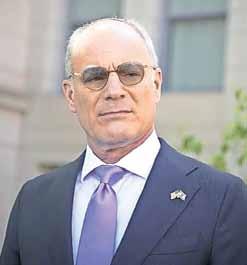
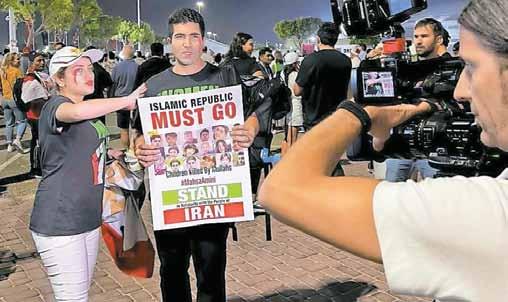
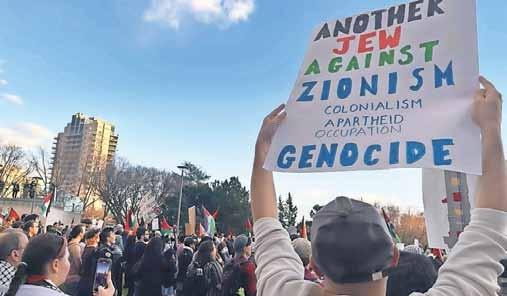
As the father of a terror victim, as a Zionist and as an Israeli citizen, I quake with the report of every missile strike or terror attack against the Jewish state.
That is not a figure of speech. It is not political theater. It is the involuntary reaction of someone who knows what a phone call can mean, what a headline can hide, and how quickly an ordinary day can become the day that divides a family’s life into before and after.
The targets are always civilians.
They are people going about their lives, trying to make a shekel, waiting for a bus, walking along a street, taking a child to school, visiting a parent, finishing a shift at work or sitting down for dinner when a missile or terrorist strikes.
And so, 24 hours after the latest wave of missile attacks, I am off to Israel. I am no hero for doing this. It’s just who I have become.
Iran’s latest missile barrage against Israel on June 7 was not an abstraction. It was not some distant geopolitical chess move. It was an attack on a living country — on families, on hospitals, on children, on the elderly, on the frightened and the defiant alike.
According to reports, Iran fired roughly 10 or 11 ballistic missiles toward Israel in several waves. The missiles were intercepted, thank G-d. But “intercepted” is not the same as harmless.
Every siren is a warning that murder is incoming.
Every scramble to a shelter is a reminder that Israeli children grow up learning how many seconds they have to live. Every hospital that moves patients underground is a
rebuke to those who pretend this is a normal dispute between equal sides.
A normal country does not force newborns, cancer patients, trauma victims and the elderly into underground wards because a terrorist regime has decided to test its missiles again.
Israel’s military response was swift. Israeli aircraft struck Iranian military and air-defense targets. The message was necessary: A regime that fires ballistic missiles at Israeli civilians cannot expect immunity because it hides behind distance, proxies or diplomatic fog.
But the deeper story is not only about this latest exchange. It is about the moral exhaustion that much of the world demands from Israel.
Israel is expected to absorb attacks, calculate proportionality under fire, comfort its traumatized citizens, keep its airport open if possible, reassure investors, educate its children, protect its hospitals, bury its dead when defenses fail, and then explain itself to governments and commentators who have never had to race a grandchild to a safe room.
No other country is asked to live this way. When missiles are fired at Israel, the first question in too many capitals is not, “Who fired them?” It is, “How will Israel respond?” The world rushes past the aggression and begins grading the victim’s restraint. That moral reflex is rotten.
Iran is not a misunderstood neighbor — it is the world’s leading sponsor of anti-Israel terrorism. It arms, funds and inspires the forces that have turned civilian life in Israel into a target list: Hezbollah in Lebanon, Hamas and Palestinian Islamic Jihad in Gaza, the Houthis in Yemen and other militias across the region. Its leaders speak openly of Israel’s destruction, and its weapons are aimed at the Jewish state’s cities. This is not resistance. It is a strategy of civilian terror.
I know something about that strategy. My daughter Alisa was murdered in 1995 in an Iranian-sponsored Palestinian Islamic Jihad attack. She was 20 years old. She wasn’t a soldier. She wasn’t a policymaker. She was a young woman in Israel with her whole life ahead of her. That is the point of terrorism. It doesn’t seek military victory in the ordinary sense. It seeks to make ordinary life impossible. It seeks to frighten parents, empty streets, cancel flights, close schools and convince Jews that sovereignty is too costly to bear.
Israel’s answer, for more than 75 years, has been the opposite.
The Jewish state builds. It votes. It argues. It innovates. It treats the sick. It buries its dead and sends its children back to school. It absorbs immigrants. It rescues strangers. It fights wars it did not seek and then goes back to planting trees, opening businesses, studying Torah, serving in the army, raising families and living.
That is why I am going.
Not because I am fearless. I am not. Not because I think nothing can happen. I know better than most that something can always hap-
Vance discounts Israel’s Iran worries
Vice President JD Vance told Fox News that he doesn’t care whether or not Israel likes President Donald Trump’s push to end the war with Iran.
“Israel may like that, they may not like that,” Vance said in reference to ongoing diplomatic talks mediated by Pakistan. “But fundamentally, we think this is in the best interest of the United States of America.”
“Over the last year and a half, we’ve created the space necessary where the president believes — and I think that he’s right — that we can get the long-term settlement to Iran’s
nuclear deal,” the vice president told Fox News’ Jesse Watters.
He spoke after the Islamic Republic and its regional terrorist proxies fired multiple missile barrages at Israel from Sunday night into Monday, breaking a fragile ceasefire that had been in place since April 8.
Asked about Trump’s discussions with Israeli Prime Minister Benjamin Netanyahu, Vance said that Washington and Jerusalem “have a lot of shared interests, but we also have some situations where our interests diverge.”
Asked if the Iranian negotiators were “trying to play” their US counterparts, Vance responded, “Everybody’s always trying to play everybody.”
The White House has been “very involved in these negotiations,” he noted. “We’re going to take the attitude of: Accomplish the president’s mission — but verify over the long term that the Iranians are keeping their end of the bargain. It’s a tall order, but it’s one that the president has put us in a good position to achieve.”
The “number one thing” that was wrong with the 2015 Joint Comprehensive Plan of Action
(JCPOA) negotiated by President Barack Obama, which Trump pulled out from in 2018, was the lack of a “proper inspections regime to ensure that the Iranians could never build a nuclear weapon,” Vance said.
“That is one of the big differences between what happened then and what the president of the United States would get to, assuming we are ultimately able to make a deal,” he added. The plan being discussed now, like the one signed by Obama, would kick a final resolution of the Iranian nuclear question down the road. —With JNS
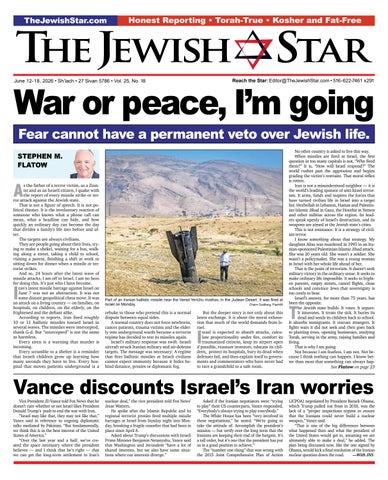
Part of an Iranian ballistic missile near the Vered Yericho moshav, in the Judean Desert. It was fired at Israel on Monday. Chaim Goldberg, Flash90
STepHen M. FlaToW
Met Council: AI should aid, not replace, workers
By Rikki Zagelbaum, JNS
David Greenfield, chief executive officer of Met Council, believes that nonprofit leaders have a choice when it comes to artificial intelligence: learn how to use it or risk being left behind.
“We’re the first organization in the country that’s told our staff we’re not going to lay anyone off because of AI,” he told JNS following a June 4 artificial intelligence summit hosted by the Met Council and the Robin Hood Foundation on June 4. “We believe that AI should be used to help people. It should be human-centered, and it really should be a tool rather than a replacement.”
Greenfield, who leads the largest US Jewish nonprofit that fights poverty, said that nonprofits must learn to harness AI while ensuring it remains a tool for workers rather than replacing them.
Met Council is training employees in AI, paying staff two hours per week to learn the technology and providing each department with an AI budget to experiment with new tools, he said, noting that the organization recently developed a digital food pantry that uses artificial intelligence to predict demand and route deliveries and an in-house intake bot named “Reggie.” The bot helps connect clients with the appropriate Met Council department, whether they are seeking food assistance, senior housing, domestic violence services or Holocaust survivor support.
“We have to be competitive the same way forprofit businesses are, and we want to make sure our clients are being handled faster, that they’re happy and getting the best experience they can get,” Greenfield said.
artificial intelligence FutureWorks Commission, which is tasked with advising the state on its response to the impact artificial intelligence has on the workforce and economy, he said.
One of the panel’s main goals is to “put the people and the humans back into the AI conversation,” he said. “I think it’s very important that we protect individuals’ jobs and their autonomy.”
“Ideas like universal basic income are not good ideas,” he said. “The idea that we’re going to pay you $1,000 to stay home for the rest of your life is a terrible idea. People want to wake up in the morning. They want to have something to do. They want to be part of a society. They want to feel like they’re accomplishing things.”
Greenfield told last week’s event that his fear that artificial intelligence will concentrate wealth and power in the hands of a small number of technology companies “keeps him up at night.”
“I really think they’re creating a society where a quarter of 1% is going to amass all of the wealth and then all of the power,” he said. “They’re literally telling everybody. They’re not even being shy about it. They’re saying, ‘We’re gonna take away your jobs. We’re gonna give you $1,000 a month. Just stay at home and be happy, be fortunate to live in our AI utopia’.”
Many recent college graduates are struggling to find entry-level work as companies increasingly turn to AI, Greenfield said.
The technology has allowed Met Council to expand its reach this year from 325,000 people to more than 350,000 without adding to staff members’ workload.
“Nobody went to social work school for six
If people lost their jobs, were abused by spouses or are homeless, Met Council will not rely on technology to make decisions about how to help them, according to Greenfield. “We’re not relying on technology to make decisions,” he said. “We’re going to rely on technology to assist us.”
years to become a social worker, so they could spend five of 10 hours a day filling out paperwork,” he said. “To the extent that we can get rid of the paperwork, get rid of the bureaucracy and really focus on the issues that matter, we’re able to make it a better experience for our staff.”
Gov. Kathy Hochul appointed him to a new
“We have college-educated students who have graduated and can’t find jobs. A lot of that is due to AI and the fact that AI is fast replacing entry-level work.”
“That’s not good for society. That’s not good for humans. That’s not good for any of us,” he continued. “I think we have to push back, and I think one of the ways to push back is to model how we use AI for good.”
The unexpected Jewish side of Woody Guthrie
By Jonathan D. Salant, JNS
The folk singer best known for “This Land Is Your Land” also wrote lyrics celebrating Chanukah.
That lesser-known side of Woody Guthrie is the focus of “Dust Bowls and Jewish Souls: Another Side of Woody Guthrie,” a documentary that premiered June 4 at the Toronto Jewish Film Festival.
Steven Pressman, a former journalist and filmmaker from San Francisco, said the project began four years ago when he visited an exhibit at New York’s Morgan Library and Museum. Among Guthrie artifacts, he discovered lyrics for a Chanukah song.
“Like most of us, I knew ‘This Land Is Your Land’ and the Dust Bowl stuff and not much more,” Pressman told JNS. Seeing the lyrics prompted a question: “What on earth does Woody Guthrie have to do with Chanukah?”
The answer lies largely in Guthrie’s family and professional relationships. His second wife, Marjorie Guthrie, was Jewish, and her mother, Aliza Greenblatt, was a celebrated Yiddish poet. Guthrie became interested in Jewish traditions and holidays, while his longtime record label, Folkways, was founded by Jewish American producer Moe Asch, son of noted Yiddish author Sholem Asch.
The Guthrie household incorporated elements of Jewish life. Family members displayed a menorah during Chanukah and attended Passover seders. Home movies show daughter Nora Guthrie holding the afikoman.
Son Arlo Guthrie, who later became a prominent folk singer, even had what Pressman described as a bar mitzvah of sorts.
One of Guthrie’s Jewish-themed compositions, “The Many and the Few,” contains 20 stanzas, most devoted to the Chanukah story. The song begins with Cyrus the Great, the Persian ruler who allowed Jews to return to Jerusalem and rebuild the Temple.
As Pressman dug deeper, he came to see Guthrie in a different light.
“Suddenly, I came to realize that this iconic American cultural figure … was immersed in this Jewish world,” he said.
The Guthrie family played a key role in making the documentary, providing photographs, home mov-
ies and other archival material. Two of Guthrie’s three surviving children, Arlo and Nora, were interviewed on camera.
Associate producer Lisa Stark, a former television reporter, said the family’s willingness to share personal footage helped bring the story to life.
The videos showed ordinary family moments, including Friday-night meals and gatherings with Greenblatt, whom the children knew as their Bubby.
Pressman said he never expected Guthrie to become the subject of one of his films, all of which previously focused on Jewish themes.
“I never imagined making a Jewish film about Woody Guthrie,” he said. “When we started finding out all
these threads, it just opened my eyes completely.”
Neither Pressman nor Stark describes the Guthries as observant Jews. Still, the children born to Marjorie Guthrie were Jewish according to Jewish law, and the family maintained strong ties to Greenblatt and aspects of Jewish culture.
The film also shines a spotlight on Greenblatt herself. Pressman credited Aaron Lansky, founder of the Yiddish Book Center in Amherst, Massachusetts, with helping connect the story of the famed Yiddish poet to that of her son-in-law.
Lansky had developed a relationship with Marjorie Guthrie after the founding of the center in 1980. According to Pressman, Lansky helped
uncover links between two worlds that had rarely been considered together: Guthrie’s place in American folk music and Greenblatt’s role in Yiddish literary culture.
Marjorie Guthrie later served on the Yiddish Book Center’s board and helped raise funds for the organization.
Pressman emphasized that the documentary does not claim to have discovered Guthrie’s Jewish connections. Rather, he said, it is the first project to assemble the various strands of the story into a single narrative.
“We can’t take credit for discovering the story,” he said. “What we can take credit for is telling it in a broader way that puts it all together.”
The filmmakers believe many viewers will encounter this aspect of Guthrie’s life for the first time.
The documentary also touches on contemporary concerns about antisemitism. Pressman noted that Guthrie wrote about prejudice and injustice decades ago, addressing both racism and antisemitism.
Quoting Guthrie’s hope that humanity might one day “get rid of the fascists,” Pressman said the singer would likely be disappointed that such hatred remains.
Whether the film changes minds, he said, is uncertain. But it offers a reminder that one of America’s most celebrated folk singers had a meaningful connection to Jewish life — a story that has largely remained outside the spotlight.
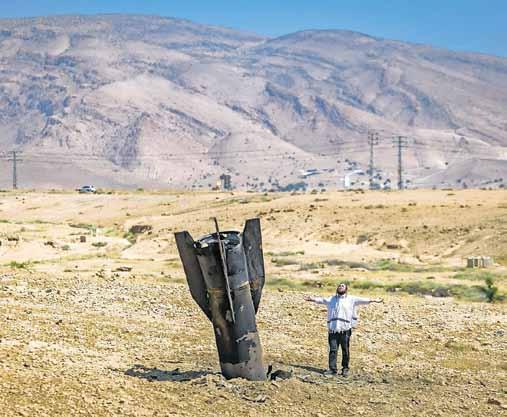
Met Council CEO David Greenfield at the group’s annual Legislative Breakfast on May 31.
Woody Guthrie.
Courtesy of Woody Guthrie Publications
Radiation Oncology
Leaders in Advanced Cancer Treatment on the Rockaway Peninsula
Led by Mark Ashamalla, MD, Chief of Radiation Oncology, the EHS Cancer Center delivers precise, highly targeted radiation therapy using advanced technology and personalized treatment plans.
Comprehensive Radiation Oncology Services
Our team treats a wide range of cancers, including breast, lung, prostate, brain and gynecologic cancers, using advanced techniques designed to target tumors while protecting healthy tissue.
Advanced Technology for Better Outcomes
• TrueBeam® linear accelerator
• Intensity-modulated radiation therapy (IMRT)
Why Choose EHS?
• Coordinated care across oncology, primary care, and specialty teams
• Advanced technology designed to maximize precision and ������������������
• Image-guided radiation therapy (IGRT)
• Stereotactic Radiosurgery (SRS) and Stereotactic Body
Radiation Therapy (SBRT) for highly targeted treatment
• Evidence-based care supported by research and clinical trials
• Compassionate, patient-centered support for you and your family
The EHS Cancer Center at the Walsh Ambulatory Pavilion 19-20 Brookhaven Avenue | Far Rockaway, NY 11691 ehs.org/radiationoncology | 718-869-7101
MDA midwife pushes broader women’s health role HEALTH, MIND & BODY
By Judy Lash Balint, JNS
Israeli midwife Gila Zarbiv believes midwives should play a much larger role in women’s health care than they currently do.
A hospital midwife, researcher, mother of four and volunteer with Magen David Adom, Zarbiv is working to expand women’s access to midwifery care and move women’s health closer to the center of Israel’s healthcare system.
When her MDA phone may rings while she is writing research, studying for her Ph.D. or spending time with her family in Jerusalem. If it involves a woman in labor, a postpartum emergency or another nearby health crisis, she grabs her midwife kit and heads out the door.
Born in Pittsburgh, Zarbiv made aliyah after graduating from Yeshiva University in 2007 with degrees in biology and Judaic studies. Because Israeli midwives must first train as nurses, she enrolled at Hadassah Ein Kerem’s Henrietta Szold School of Nursing, graduating in 2012, completing midwifery training in 2014 and earning a master’s degree in women’s health in 2020.
Now in the final year of a Ph.D. program at Ben-Gurion University
of the Negev, she is studying healthsystems policy and management, focusing on how to expand midwifery models of care in Israel.
“I will always be clinical,” Zarbiv told JNS. “But midwives are more than clinicians. We need to be in policy. We need to be in leadership. We need to be in research. We need to be at every table where women’s health is being discussed.”
In Israel, midwives are central to
hospital labor and delivery wards, caring for women through uncomplicated births. Outside the delivery room, however, their role remains limited.
Zarbiv sees that as a missed opportunity.
“If any country needs to implement full-scope, independent and autonomous midwifery care, it’s Israel,” she said.
Her vision is one of continuity of care, with women supported by midwives before birth, during labor and throughout the postpartum period.
The need became even more apparent after the Hamas attacks on Oct. 7, 2023, when ambulances could not always reach women quickly and pregnant women could not always get safely to hospitals in frontline areas.
In response, MDA and the Israel Midwives Organization launched the First Contractions volunteer midwife program in 2024, integrating trained midwives into the emergencyresponse system. What began with a small group in northern Israel has grown into a nationwide network of Jewish, Arab, Christian and Druze midwives linked directly to MDA dispatchers.
When a woman in labor calls
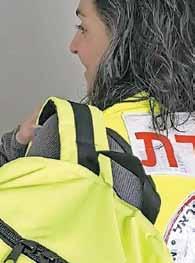
MDA’s 101 emergency line, the nearest volunteer midwife can be dispatched alongside medics and paramedics. MDA equips volunteers with birth kits, medical equipment and identifying vests.
Since the beginning of 2026, MDA teams have treated 6,123 pregnant women, many in active labor. Approximately 590 births took place at home or in ambulances en route to hospitals.
“That is a health-systems change,” she said, noting that MDA now relies on midwives to help develop training programs and educate emergency personnel.
One recent call involved a postpartum woman suffering from severe preeclampsia. Her blood pressure had reached 200/100, and she was experiencing serious neurological symptoms.
Another call involved a woman in preterm labor at 33 weeks. By the time Zarbiv arrived, the mother was already pushing. She helped position the mother, maintained a calm atmosphere and guided the delivery of a premature but healthy baby.
Postpartum care remains one of Zarbiv’s greatest concerns. Women discharged after birth may develop
BELMONT PARK VILLAGE
New Luxury Outlet Experience
complications ranging from bleeding and infection to depression, hypertension and breastfeeding difficulties.
In one of her earliest MDA calls, Zarbiv arrived at the home of a woman who had just delivered and was refusing examinations.
“Shalom, I’m Gila,” she told the woman. “I’m a midwife. I’m with you.”
The woman’s first question was whether the service cost money.
“No,” Zarbiv replied. “I’m absolutely free.”
Zarbiv noted that MDA’s volunteer midwife program reflects the diversity of Israeli society, with Jewish and Arab responders working side by side.
“People need to know that we treat everyone,” she said.
Balancing hospital shifts, emergency calls, academic research and public advocacy, Zarbiv hopes to move midwives from the margins of policy into the heart of women’s health care.
“MDA’s volunteer midwife program shows that when midwives are trained, equipped and dispatched as part of the emergency system, they change outcomes and change the experience of care,” she said.
For Zarbiv, the next step is ensuring that lesson extends far beyond emergency response.
Long Island’s
Kept Shopping Secret
Just off the Cross Island Parkway, shop designer fashion finds from Coach, lululemon, Valentino, and more, at up to 65% off every day.
Dine at award-winning restaurants, stroll through pedestrian-only streets, and turn a quick trip into a day’s escape.
Magen David Adom midwife Gila Zarbiv.
Defending key Hebron site from PA rejectionism
By Lt. Col. (res.) Maurice Hirsch
Why would anyone oppose making a 3,500-year-old historical and religious site accessible to the disabled? Why would anyone resist protecting such a site from the elements?
In modern Hebron stands the Me’arat HaMachpelah (Cave of the Patriarchs), believed to be the burial site of Abraham and Sarah, Isaac and Rebecca, and Jacob and Leah. Genesis 23:1-20 records Abraham’s purchase of the site from Ephron the Hittite. Herod built the current structure about 2,000 years ago. About 600 years later, Muslims claimed the site, calling it the Ibrahimi [Abraham] Mosque.
The Me’arat HaMachpelah has always been of substantial significance to the Jewish people. Thus, for example, in a letter written by the Rambam (Rabbi Moshe ben Maimon) in October 1165, he related to Rabbi Yaphet bar Eliyahu the Judge the story of his visit to both the Temple Mount in Jerusalem and the Me’arat HaMachpelah in Hebron:
And on the first day of the week, the ninth day of the month of Marcheshvan, I left Jerusalem for Hebron to kiss the graves of my forefathers in the Cave of Machpelah. And
on that very day I stood in the Cave and I prayed, praised be G-d for everything.
At the time, Jerusalem and much of the Land of Israel were under Crusader rule, ensuring Christian access to holy sites and limited Jewish access.
Jews continued to live in Hebron through the centuries, though access to the site became limited after the Ayyubid Muslim conquest.
The Jewish presence in Hebron was devastated in 1929, when Arab neighbors carried out a massacre, murdering 67 people. Many of the victims were slain in Beit Hadassah, built in 1893 with funds donated by the Jewish communities in North Africa, India and Baghdad. At the time, Beit Hadassah served as a hospital treating both Jews and Arabs.
The last remnants of the Jewish community in Hebron were ethnically cleansed by the Jordanians, who invaded Israel in 1948. Under Jordanian rule, the synagogue in the modernday neighborhood of Avraham Avinu [Abraham our Father], originally built in 1540, was turned into an animal pen.
After a long absence, the Jews returned to Hebron and the Me’arat HaMachpelah on June 8, 1967, during the SixDay War, when the town was liberated.
For many years thereafter, while Muslims continued using the site, the Me’arat HaMachpelah was gradually opened for Jewish prayer, and worshippers faced recurring terrorist attacks. By the early 1990s, the site had become a joint place of worship for Jews and Muslims. This joint use ended in 1994, when Jewish terrorist Baruch
Goldstein murdered 29 Muslims during their prayers in the cave.
After that event, the site was divided: The larger, covered area, including the Hall of Isaac and Rebecca, was allocated to the Muslims, while the smaller areas—the Halls of Abraham and Sarah, Jacob and Leah, and an open courtyard — were allocated for Jewish prayer. For 10 days each year, the entire site is open exclusively to Muslims, and for another 10 days, exclusively to Jews.
Since, for decades, access to the Jewish part of the site required climbing at least 59 stairs, it was practically inaccessible for the disabled. After much discussion on the subject, Israeli authorities attempted, in the last several years, to coordinate with the Palestinian Authority to add an external elevator. The elevator would also have served disabled Muslims seeking access during the 10 special days.
The PA objected to the addition, claiming that the site is an exclusively Islamic holy site and that adding the elevator would merely “strengthen the settlement in this area.”
While noting the objections and even as the PA submitted legal challenges against the plan, Israel nonetheless proceeded to install an external elevator, thus making the site disabled-accessible. The elevator serves all the disabled people, including Muslims.
In recent years, the need arose to cover the site’s open courtyard. This courtyard, located in the section designated for Jewish prayer, had a temporary covering that was ultimately destroyed by weather and age. Due to the covering’s dilapidated condition, substantial flooding occurred, inundating the courtyard and rendering it unsafe, and allowing
water to seep into the structure itself.
The discussion of the need to replace that covering began in 2008. Once more, the Israeli authorities tried to coordinate with the PA over the following years, but again to no avail.
Once again, the PA rejected any Jewish presence in the Cave and rejected any measure that would facilitate Jewish freedom of worship in any part of the building. Subsequently, the PA claimed that, because UNESCO had recognized the Cave as a World Heritage Site, it needed to consult UNESCO.
Later, as is commonplace with the biased U.N. organizations, in 2017, UNESCO ignored 3,000 years of history and the unequivocal Jewish connection to the site, and recognized the Me’arat HaMachpelah merely as a Palestinian heritage site.
Following ongoing delays by the PA, by September 2025, the Israeli authorities lost patience and decided to proceed with the necessary works.
In an attempt to prevent adding a permanent roof, the PA again submitted a petition to Israel’s High Court. On May 19, 2026, the court issued its decision, once again rejecting the PA’s baseless claims and clearing the way for completion of the roofing.
Criticizing the decision, the PA Ministry of Awqaf (Endowments) and Religious Affairs condemned the “seizure of the airspace of the Ibrahimi Mosque under a plan described as the roofing project of the inner courtyard.”
The PA added that the “Ibrahimi Mosque, including all its courtyards, halls and airspace, is an Islamic endowment exclusively for Muslims, with no sovereignty of the occupation [i.e., Israel] over it, adding that administrative, legal and planning authority
rests solely with the Awqaf and the Hebron Municipality under international law.”
In the same way as the PA claims of Muslim exclusivity over the site are historically, factually and religiously baseless, the claim that international law gives sole “administrative, legal and planning authority” over the site to the “Awqaf and the Hebron Municipality” lacks any legal foundation.
The PA consistently rejects any concept of Jewish history — nationalistic or religious — in the Land of Israel and its holy sites. This rejectionism is central to the dogmatic PLO-PA ideology and is further emboldened by organizations such as UNESCO, which replace real history with Palestinian propaganda.
Experience shows that Israel demonstrates great flexibility in respecting religious freedom.
While the PA and other Muslim authorities reject sharing sites of joint religious significance, Israel has been willing to limit the freedoms of its own Jewish citizens and accept detrimental arrangements. These agreements give the PA or the Waqf Islamic trust, and therefore Muslims, preferential treatment, which reinforces their dogmatism.
Only if the PLO-PA accepts that the Jewish presence in the Land of Israel has 3,500-yearold roots, and that sites such as the Temple Mount and the Me’arat HaMachpelah were first Jewish, can progress be made.
This recognition would not abrogate Muslim connections to these sites, but would reflect Palestinian acceptance of Jewish history, as the League of Nations Mandate for Palestine declared, the “historical connection of the Jewish people” to this land. —JNS
The new elevator at the Me’arat HaMachpelah in Hebron, in 2023.
Tzipi Shlissel, TPS-IL
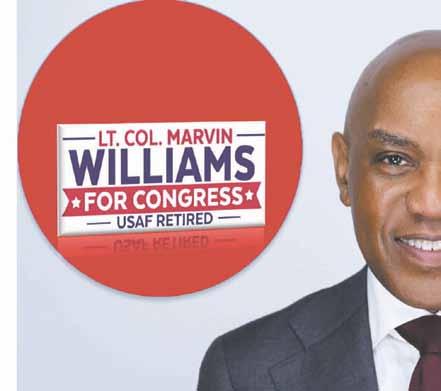
MARVIN WILLIAMS for CONGRESS NY-04
Marvin Williams is a lifelong New Yorker, devoted father, military veteran, and America First Republican leader running to serve Long Island with integrity and independence. Marvin served nearly 30 years in the United State military both in the reserves and active duty; holding senior leadership roles responsible for national security missions, crisis response, and large-scale operations. Marvin is an unequivocal supporter of Israel. He did not spend his life preparing for politics. He spent it leading, serving and putting mission first. Elect Marvin Williams for Congress to represent NY-04
Surprise: Huckabee cheers Dem Clinton on Israel
By The Jewish Star
From
JNS
and other
sources
US Ambassador to Israel Mike Huckabee surprised some observers by praising former President Bill Clinton’s handling of Israeli-Palestinian peace talks. Huckabee said he wishes more Democrats understood what Clinton learned during negotiations with Yasser Arafat in the 1990s. Sharing video of Clinton’s 2024 remarks, Huckabee highlighted Clinton’s claim that the Palestinians rejected a deal that would have created a state on nearly all of the West Bank. Huckabee also singled out Sen. John Fetterman as one of the few Democrats who shares that view.
Israel rolls out tourism comeback
Israel is betting big on American visitors. The Tourism Ministry has launched a $6.9 million campaign dubbed “I AM ISRAEL” aimed at bringing US travelers back after nearly three years of war battered the tourism industry. The campaign will feature videos, influencers, media partnerships and social media promotions across Hulu, Disney+, YouTube and other platforms. About 400,000 Americans visited Israel last year, making the US the country’s largest tourism market. UN official admits she checked nothing
A senior UN official is under fire after acknowledging she did not personally review evidence behind allegations that Israeli security forces committed sexual violence against Palestinians. Pramila Patten, the UN’s special representative on sexual violence in conflict, said verification was “not my job” and that she compiled information provided by others. Israeli officials blasted the admission, arguing it undermines the credibility of a report that treated allegations against Israel as verified while casting doubt on testimony from Israeli hostages held by Hamas.
Colombia prez sparks Nazi firestorm
Colombian President Gustavo Petro is facing outrage after posting “Heil Hitler” on social media in response to a newspaper column backing a conservative candidate in this month’s presidential runoff. Jewish groups and Israeli officials blasted the remark, with the Anti-Defamation League calling it “monstrous and unacceptable.” Petro, who cut ties with Israel during the Gaza war, is backing a left-wing candidate in the June 21 vote. Frontrunner Abelardo de la Espriella, nicknamed “El Tigre,” has pledged to reopen strong ties with Israel and move Colombia’s embassy to Jerusalem.
AMIA victims recalled 32 years later
The United States and Argentina joined forces in Washington to honor victims of the 1994 AMIA Jewish community center bombing in Buenos Aires, which killed 85 people and wounded more than 300. Speakers re-
Jewish ID of WWI heroes finally noted
More than a century after their deaths on the battlefields of World War I, five Jewish American soldiers have finally received headstones bearing Stars of David instead of crosses at a US military cemetery in France. The June 2 ceremony at Meuse-Argonne American Cemetery honored Pvt. Samuel Tamkin, Pfc. Barney Bardman, Pvt. Samuel A. Backer, Pvt. Hyman Aronoff and Pfc. Maurice W. Akabas, whose graves had been incorrectly marked for decades. The changes came after years of research by Operation Benjamin, a nonprofit dedicated to correcting burial records for Jewish service members. Officials called the effort a long-overdue step toward ensuring the fallen are remembered accurately and with the faith they lived by.
membered the attack as the deadliest terror strike in Argentine history and renewed calls for justice against those responsible. Argentine officials pointed to court findings linking Hezbollah and Iran to the bombing. “Memory is the first form of justice,” Argentine Ambassador Alejandro Oxenford said, urging the world not to forget the victims or the decades-long fight to hold the perpetrators accountable.
Strong shekel headache
Israel’s booming economy has a new problem: success. The Bank of Israel stepped in last month to buy roughly $800 million in foreign currency after the shekel surged to levels that alarmed exporters and high-tech firms. While a strong currency reflects confidence in Israel’s economy, it also raises costs for companies earning dollars but paying workers in shekels. Economists say the growing challenge highlights the tension between Israel’s global tech success and the needs of businesses operating at home.
Dutch snub Kanye visit
A Dutch Holocaust museum has rejected a proposal to host rapper Kanye West, despite an invitation from a local mayor. Museum officials said the site is a sensitive memorial space and should not be used to rehabilitate public figures associated with antisemitic remarks. West, now known as Ye, has repeatedly drawn condemnation for praising Hitler, spreading antisemitic rhetoric and promoting Nazi imagery. Jewish groups also protested his recent concerts in the Netherlands, calling attention to his long record of anti-Jewish statements.
Israel, Honduras ties
Israel and Honduras have signed a new agreement aimed at boosting cooperation in technology, agriculture, water management, health care and security. Officials from both countries hailed the deal as another step in strengthening relations that date back more than seven decades. Honduras has been one of Israel’s strongest allies in Latin America and moved its embassy to Jerusalem in 2021. The new accord is expected to encourage greater collaboration between Israeli innovators and Honduran government agencies.
Bibi, US eye ‘lawfare’
Israeli Prime Minister Benjamin Netanyahu met with senior US legal advisers in Jerusalem to discuss what officials called growing legal and economic warfare against Israel and other democracies fighting terrorism. The talks focused on international efforts to isolate Israel through court actions, sanctions campaigns and boycotts. Israel is battling cases at both the International Court of Justice and International Criminal Court over the Gaza war. Foreign Minister Gideon Sa’ar thanked the Trump administration for its support, saying both countries face similar legal and diplomatic challenges on the world stage.
Hamas aid at UK charity
One of Britain’s largest Islamic charities privately worried that aid money sent to Gaza may have ended up in Hamas hands, according to a whistleblower report. Internal discussions at Penny Appeal allegedly raised concerns that some funds could have reached terror-linked groups after aid entered
ular Bamba peanut snack after members of the Park Slope Food Coop voted to stop carrying Israeli goods. UJA blasted the boycott as “divisive and hate-driven” and plans to hand out the snacks during New York’s Israel Day parade. The vote has reignited debate over Israel-related boycotts in the city.
Oxford Hamas praise
The first Palestinian president of Oxford Union is facing calls to resign after messages surfaced in which she suggested Hamas members could one day be viewed as heroes. Arwa Elrayess also described the Oct. 7 attacks as a predictable response to years of conflict, comments that drew sharp condemnation from Jewish groups and fellow students. Critics say her remarks normalize terrorism and make Jewish students feel unsafe. Activists are now demanding action from Oxford University.
Bust in kippah slap
Gaza following the Oct. 7 attacks. The charity is now facing an investigation by Britain’s Charity Commission. Penny Appeal insists it conducted proper oversight and remains confident the money was spent as intended.
Slovenia Pal’ flag yank
Slovenia’s new prime minister wasted little time making a statement. Within an hour of taking office, Janez Janša ended the display of a Palestinian flag that had flown over a government building under the previous administration. Janša called the move part of a broader shift away from what he described as governmentbacked antisemitism. Political rivals quickly pushed back, with Slovenia’s president raising a Palestinian flag at her own official residence.
Israel eyes Pacific pals
Israel says reopening its embassy in Fiji is part of a broader strategy to strengthen ties with friendly nations around the globe. The Pacific island nation has fewer than a million residents but holds influence among regional countries and at the United Nations. Israeli Ambassador Maya Yaron said the renewed diplomatic presence will focus on agriculture, health care, innovation and security cooperation. Israel also hopes stronger ties will boost tourism and economic partnerships throughout the Pacific region.
Bamba sparks buyout
The UJA-Federation of New York is responding to a Brooklyn food coop’s boycott of Israeli products with a snack-filled counterattack. The group purchased 20,000 bags of Israel’s pop-
A Connecticut man was arrested after allegedly unleashing antisemitic abuse on visibly Jewish pedestrians and knocking a kippah off one victim’s head. Police say he approached three Jews on a New Haven street June 2, shouting slurs including “baby killers,” “get out of my city,” and “go back where you belong.” Investigators say he also asked the victims if they liked “genocide.” The suspect tried to shove a bystander who intervened, hurled a rolled-up newspaper, then slapped a victim’s yarmulke to the ground, police said. Video footage reportedly backed up the victims’ accounts. Smith faces bias intimidation and disorderly conduct charges.
Congressional travel
Despite a sharp decline in congressional travel abroad this year, Israel remains lawmakers’ favorite destination for privately funded overseas trips. According to data compiled by LegiStorm, more than one-quarter of the roughly $1.6 million spent on privately sponsored congressional travel through April went toward Israel visits. Fourteen trips were funded by groups including the American Israel Education Foundation, the J Street Education Fund and the US Israel Education Association.
Greek Hamas warning
A top Greek security official is sounding the alarm after authorities arrested a Palestinian asylum seeker accused of Hamas ties and terror training. The 37-year-old suspect was detained in Crete, where he reportedly worked at a hotel after arriving from Gaza last year. Greek officials say he confessed to preparing for a terrorist attack in Europe following training in Malaysia. Citizen Protection Minister Michalis Chrisochoidis suggested the case could be linked to broader Hamas networks targeting Israelis and Jews. Greece welcomes thousands of Israeli tourists annually, and officials fear terrorist cells may be expanding across Europe.
Meuse-Argonne American Cemetery in Romagne-sous-Montfaucon, France. Dudva via WikiCommons
And the Experts Agree
At Mount Sinai South Nassau, patient safety isn’t just a priority— it’s a standard, one we work on every day. And the experts agree.
We’ve earned national recognition for patient safety, including an “A” Hospital Safety Grade from The Leapfrog Group and the Healthgrades Patient Safety Excellence Award.
That means better outcomes for our patients with lower risk of infections or hospital acquired conditions.
When it comes to your health, nothing matters more than knowing you’re in a place where patient safety matters most.
Learn more at mountsinai.org/southnassau
WINE AND DINE
Food creators win hearts, 1 recipe at a time
By Tania Shalom Michaelian, JNS
When Chef Vlad Briantsev plates
a dish in a VIP suite at Inter Miami Stadium, his audience includes David Beckham, Lionel Messi and their families. But Briantsev, a 30-year-old Jewish chef who grew up in his parents’ Chicago restaurant, is thinking about a much wider table.
Through his social media content, he is quietly doing something that governments, think tanks, and advocacy organizations have struggled to achieve: making Jewish identity appealing to people who never sought it out.
He is one of a new generation of Jewish food creators carrying that message at a particularly resonant moment: Israeli cuisine, once little known beyond its borders, has emerged as one of the world’s most vibrant food cultures, and after several extraordinarily difficult years, the restaurants are opening up again, and chefs at its heart are finding their footing again.
Briantsev is one of three prominent Jewish food creators who recently completed the inaugural cohort of the Birthright Israel Onward Storytellers Program, a new fellowship designed to empower Jewish creatives and digital changemakers to share authentic narratives about Judaism and Israel with global audiences.
The others are Matt Cowan, a Jewish food content creator based in Orange County, California, who has a close working relationship with celebrity chef Gordon Ramsay; and Jana Magen, a Mexico City-based cookbook author who leads culinary trips to Israel for Latin American families.
Together, they represent an emerging and largely under-covered phenomenon: Jewish food influencers who are using the universal language of cuisine as a non-confrontational, extraordinarily effective form of public diplomacy.
“Food is the most effective way to cross boundaries and barriers and touch people,” Briantsev says. “This may be the most effective public diplomacy Israel and the Jewish people have these days.”
The Storytellers Program was founded by Jacqueline Korren, who had been working in Silicon Valley before Oct. 7, 2023, changed the trajectory of her career, and, she says, her sense of identity.
“I lost my voice in my Jewish and non-Jewish communities,” she recalls. “I went on a journey to try to find it again.”
That journey led her to a Birthright pilot program at Reichman University focused on public diplomacy and counterterrorism, where she had a crystallizing realization: Jewish people were fighting two wars simultaneously — one military, one cultural.
“Regardless of your views on the military war,” Korren says, “we as Jews had to show up online differently. I understand that culture is the bridge. It’s what makes humans con-
nect — our shared hobbies, interests, and the ways we share time.”
She pitched an incubator for Jewish creators as her final project during the fellowship. It was the first time in Birthright’s history that the organization agreed to test a fundamentally different kind of program. She became its founder and director.
The inaugural cohort, which concluded last summer, brought together 43 participants from the United States, Canada, Argentina, Costa Rica, Australia, Mexico, Switzerland and the United Kingdom — all between the ages of 18 and 35. Fifty percent, Korren notes, had never done Birthright. They were not primarily Israel advocates; they were creators with genuine audiences who happened to be Jewish, trying to figure out how to wield that identity without jeopardizing everything else they had built.
“Moving away from reactive and defensive narrative and classic hasbara was a guiding principle, Korren explains. “We don’t need to explain or defend ourselves. We need to show confidence.”
The goal, she says, is to ensure that Jewish and Israeli culture enters mainstream media, not through institutional channels, but through trusted voices people already follow.
Of all the creative niches represented in the Storytellers cohort, food creators occupy a uniquely powerful position. Food is intimate, shareable, and — crucially — non-threatening. It asks nothing of the viewer politically. It simply invites them to the table.
Briantsev, who competed on Season 21 of “Hell’s Kitchen,” an American reality cooking competition hosted by Ramsay, a British chef, before building a career cooking in luxury restaurants and eventually for celebrity clients, has been deliberate about how he weaves Jewish identity into his content.
“I want to present Jewish values without screaming it,” he says. “I’m talking about the values of community, support, and caring for each other. When you deliver that through food, the message comes across in a much more effective way.”
He also uses his platform to advocate for Israeli cuisine specifically. “Israeli food, in my opinion, is some of the highest-quality, freshest and healthiest food out there. I hope that through my videos I’m also inspiring other Jews to express their Jewishness.”
Matt Cowan arrived at Jewish food content from a different direction. He had spent years building influencer programs for chefs and recognized a gap in the social media landscape. “I’ve always been obsessed with Jewish cuisine, and I realized that not many people on social media platforms promote it,” he says. “Food is one of the great unifiers in the world, and it’s also a Jewish value to feed people and invite them to a meal around the table. Food is a core part of Jewish culture.”
His experience of being in Israel on Oct. 7 and the complex aftermath — including losing friends who expressed support for Hamas — has infused his work with a quiet urgency.
Jana Magen’s path began even earlier. At 19, she pivoted from kindergarten teaching to enroll at Le Cordon Bleu in Mexico City, driven by an obsession with food she could no longer ignore. COVID-era lockdowns became a creative turning point: she threw herself into social media content and recipes, eventually writing multiple cookbooks and building a following across Latin America.
Today, she works with Israeli destination organizations to guide culinary tours to Israel for families, using food as a bridge to culture, identity, and connection. For her audience, many of whom may have limited or skewed exposure to Israel, a week of eating their way through Tel Aviv and Jerusalem markets can be quietly transformative.
The culinary landscape these creators are showcasing has undergone a remarkable transformation. Israel’s food scene — once limited in variety and ambition — has evolved into one of the most dynamic in the world, building on a rich Eastern Mediterranean tradition and the influence of waves of immigration from North Africa, the Levant and beyond.
From the hummus joints and shuk markets of Jerusalem to the inventive tasting menus emerging from Tel Aviv’s restaurant scene, Israeli cuisine has become internationally recognized as a destination in its own right.
That recognition has not been without its challenges. After years of extraordinary difficulty — the disruption of COVID-19 followed by the upheaval that followed Oct. 7 — restaurants across Israel are finding their
footing again, with new openings and a renewed sense of energy in dining rooms that were, not long ago, largely empty.
For Magen’s culinary tour participants, arriving at this particular moment carries its own quiet significance: they are not visiting a frozen postcard, but a living, resilient food culture — one that is actively rebuilding and reasserting itself.
What distinguishes these creators from traditional advocates or official spokespeople is not just their medium but their audiences. People follow food influencers because they genuinely enjoy their content — not because they are interested in Middle Eastern geopolitics.
That dynamic creates a rare opening. “In influencer culture, people follow people that they trust,” Korren notes. “Creators who are Jewish and have large audiences are being followed because people like what they do and say. People find value in that.”
This reach is especially significant at a moment when institutional proIsrael voices have struggled to break through — or have, in some cases, actively alienated younger and more diverse audiences.
Gidi Mark, CEO of Birthright Israel, puts it plainly: the program has “a long-term vision to build a community of creators and changemakers who shape the digital and cultural discourse long after the program ends.”
Korren frames the target audience carefully. “We’re not targeting people who hate us,” she says. “We’re talking to people who just didn’t know.”
The gap between hostility and ignorance is significant — and food, she and these creators believe, is one of the few cultural currencies capable of bridging it without triggering defensiveness on either side.
There is a broader argument underlying all of this, one that Korren articulates with a sense of historical urgency. Despite representing a tiny fraction of the global population, Jewish people have historically exercised an outsized influence in culture, science, business, and the arts. The Storytellers Program is an attempt to apply that same disproportionate impact to the digital sphere — and to do so on Jewish terms.
“We are the narrators of our own story,” she says. “It is our responsibility, and if we don’t do it, someone will do it for us. For the past two years, we’ve been watching many ‘someone elses’ do it for us. It’s time now for us to define our own narrative about who we are and how we want to be known.”
For Briantsev, Cowan and Magen, that narrative is being written one dish at a time — in stadium suites, on Instagram reels, and around culinary tour tables in Jerusalem. They are not politicians or spokespeople. They are people who love to cook, who happen to be Jewish, and who have realized that in a fractured world, the most powerful invitation they can extend is a simple one: come eat with us.
Birthright Israel Onward introduced its Storytellers Program in the summer of 2025 with Chelsea Jacobson and Aurele Tobelem (pictured). Avraham Edery
Chef Vlad Briantsev. Matt Cowan.
Jana Magen.
Are you a journalist (or sales pro) who values truth, Torah and Israel?
News Reporter
Our team covers news that matters to Modern Orthodox communities in Metro New York (Long Island, Queens, Manhattan’s Upper East Side and Upper West Side, Riverdale and Westchester).
Assignments include community events; school, business and health news; local personalities; Jewish institutions; holidays and entertainment; antisemitism and antizionism; politics; Jewish America; the impact of developments in Israel on our local communities, and more.
Position offers expert mentoring, starting salary of $36,400 to $39,520 plus a full benefits package that includes medical, dental, 401(k) and Jewish and secular holidays — all in a supportive, collegial and kosher environment.
Reply: Candidates with reporting and news-writing experience (professional or collegiate) are invited to email a cover letter, resume and 4 to 6 clips or links to Publisher@TheJewishStar.com. Put REPORTER in subject line.
Editor
Responsibilities
•Lead a growing team of correspondents
•Initiate and refine story ideas
•Assign and write articles
•Edit staff and freelance submissions
•Verify rights to submitted art
•Organize print and web layouts, working with page designers and AI software
•Expand our digital footprint (including website, e-newsletters and social media)
•Help plan Jewish-centric events
•Work with the Publisher and the RCI team on a range of common projects
Required
•News reporting experience
•Copy editing and proofing skills
•Familiarity with and sensitivity to Jewish issues
•Experience with editorial contributors
•Ability to meet deadlines
•Attention to detail
•Familiarity with web and SM conventions
Salary: Starting at $50,960 to $62,400 plus a full benefits package that includes medical, dental, 401(k) and paid Jewish and secular holidays.
Reply: Cover letter, resume, 4 to 6 clips or links to Publisher@TheJewishStar.com.
Are you repressed in a workplace overrun by woke truthiness, debased values and Israel-hate? Is your professionalism challenged when truth falls victim to scorched earth politics?
If you’re ready to come home, consider an opportunity at The Jewish Star, where Torah-true honest reporting and ethical business practices are a priority.
Wear your Jewish Star proudly in a kosher environment and help make Jewish journalism great again.
Multimedia Sales
Selling advertising in The Jewish Star is just part of this job. Our staff’s toolkit is exceptionally broad, including
• Religious and secular publications
• Websites
• Content generation and editing services
• In-person and digital events
• Digital, email, radio and SM marketing
• Direct mail
• Commercial printing
• Local, regional, national, int’l reach
Employees are trained by the best in the business, in a supportive, collegial and kosher environment. Competitive compensation (salary and commission $45K-$90K) plus a full benefits package that includes medical, dental, 401(k) and paid Jewish and secular holidays.
Reply: Send a cover note and resume to Publisher@TheJewish Star.com.
Latch your career to a rising Star, a 24-yearold independent news operation that is part of RCI (Richner Communications Inc), a 100employee family-owned company with offices in Garden City and Riverdale. Positions are full-time in-person or hybrid (but part-time and freelance inquires may be considered).
Dana Oberson roots Israeli spaces in their place
By Sharon Altshul, JNS
When people hear the name Oberson in Israel, many think of fashion.
For decades, Gideon Oberson and his family helped shape Israeli couture, dressing generations of women and building one of the country’s most recognizable design brands. His daughter, Dana Oberson, inherited the creative gene but chose a different medium.
Instead of fabrics, she works with stone. Instead of runways, she designs homes, hotels and public spaces that draw inspiration from Israel’s landscapes, history and layered identities.
With the publication of her new monograph, “House of Oberson: A Design Legacy,” published by Rizzoli, Israeli architect Dana Oberson invites readers into a world where architecture is about more than buildings.
“Israel has beautiful sites,” Oberson told JNS. “I wanted to share them with the world at the highest level possible.”
For Oberson, design is a way of sharing place, identity and the relationship between people and their surroundings. Her projects range from luxury private homes to hospitality developments. All draw heavily on Israel’s landscapes, history and diverse communities, creating spaces that feel rooted in their environment rather than imposed upon it.
Her parents, whose families knew each other before fleeing to Italy during turbulent times in Europe, married young and built their lives
around design and fashion. After arriving in Israel, they began making dresses at home.
Yet Oberson did not ultimately follow her father’s path.
After serving in the IDF, she studied graphic design at the Bezalel Academy of Arts and Design. There, she discovered architecture’s unique ability to operate across multiple dimensions and scales.
“What fascinated me was the possibility of more than one dimension and the change of scale,” she said. “One day you can be designing a chair, and the next you can be working on an entire building.”
Oberson rejects short-lived trends in favor of timeless designs shaped by
climate, landscape and local context. Rather than beginning with a preconceived style, she studies the site, the sun, the topography, the views and the people who will ultimately live there.
One project featured prominently in the book is a contemporary stone villa in the hills of Neve Ilan, in the heart of the Judean Hills. Built on a sloping site overlooking forested hills and distant views toward the Mediterranean, the home uses locally sourced Jerusalem stone to create a dialogue between past and present.
For Oberson, the challenge was not simply to build a house but to create a home connected to its surroundings and history while meeting
contemporary needs.
The project also reflects a broader theme running through her work: architecture’s role in places where multiple histories and communities intersect.
Rather than imposing a universal design language, she seeks to create buildings that belong to their location.
That approach extends even to large-scale developments. Oberson is currently involved in a project of approximately 300 homes, each individually designed with distinct landscaping and architectural elements.
“Each home must have its own personality,” she said.
As one of Israel’s leading archi-
tects, Oberson has navigated a profession traditionally dominated by men. She often finds herself the only woman in the room.
“Israel is still a male-dominated country,” she observed, noting the imbalance visible in many sectors, including politics.
Yet she views her perspective as an advantage rather than an obstacle.
“I’m blonde, but stupid I am not,” she recalled telling one boardroom full of skeptical colleagues, a remark that quickly commanded attention.
Today, her firm is recognized internationally for projects that blend minimalist aesthetics with Mediterranean influences, natural materials and a strong sense of place. The new monograph documents that evolution while offering a broader reflection on contemporary Israeli architecture.
Ultimately, Oberson hopes readers come away with a deeper appreciation for the landscapes and stories embedded in the built environment.
Her dream project? A budgetless one in a beautiful place — overlooking the sea, in the barren desert or in the snow.
More than luxury, however, the dream represents creative freedom: a chance to design slowly, intentionally and without compromise.
For Oberson, architecture at its best is not about creating landmarks. It is about creating spaces that belong.
“It’s not about building a house,” she said. “It’s about creating a home.”
Note the ACCOLADES from our CLIENTS
RE: SYNAGOGUES and YESHIVOS
Dear Rabbi Leiner,
Thank you for replacing the Insurance for our Synagogue, with a Savings of almost 50%.
B.F. Executive Director
RE: REAL ESTATE CORPORATION
Dear Rabbi Leiner, You and Your Experts, have saved our Corp. Very Substantial Sums, with your Quality Insurance Replacement on our Real Estate Buildings. Thank you, M.B. Pres.
RE: HOMEOWNERS
Dear Rabbi Leiner, Our Insurance Company Refused to renew our Insurance Homeowners Policy. However, You and Your Experts were able to Secure for us other Insurance Coverage, even at a much lower Premium, than the Prior Canceled Insurance Policy. Thank You So Much. Mrs. D.S.
The contemporary stone villa in Neve Ilan, designed by Dana Oberson, was built on a sloping site overlooking the Judean Hills and, in the distance, the Mediterranean Sea. Inset: Israeli architect Dana Oberson. Shiran Kamar, insert by Amit Geron
Jewish Star Torah columnists: Rabbi Benny Berlin, spiritual leader of BACH Jewish Center in Long Beach; Rabbi Avi Billet of Anshei Chesed, Boynton Beach, FL, mohel and Five Towns native; Rabbi Binny Freedman, rosh yeshiva of Orayta, Jerusalem; Dr. Alan A. Mazurek, former ZOA chair, retired neurologist, living in Great Neck, Jerusalem and Florida.
Contributing writers: Rabbi Sir Jonathan Sacks zt”l, former chief rabbi of United Hebrew Congregations of British Commonwealth; Rabbi Yossy Goldman, president South African Rabbinical Association; Rabbi Dr. Tzvi Hersh Weinreb, OU executive VP emeritus.
Five Towns Candlelighting: From the White Shul, Far Rockaway, NY
Scarsdale Candlelighting: From the Young Israel of Scarsdale, Scarsdale, NY
Moving beyond the fringe in our Judaism
rabbi Sir
JonaThan SaCkS zt”l
Our Torah portion ends with one of the great commands of Judaism — tzitzit, the fringes worn on the corners of our garments as a perennial reminder of our identity as Jews and our obligation to keep the Torah’s commands:
The L-rd said to Moses: “Speak to the Israelites; tell them to make fringes on the corners of their garments throughout all the generations. To the fringe, on each corner, they should attach a blue cord. And this shall be your fringe: seeing it, you shall remember all the L-rd’s commands and keep them. You will not then go astray, following the lusts of your heart or of your eyes. This is to remind you to keep all My commands, to remain holy to your G-d.” Num. 15:3740
So central is this command, that it became the third paragraph of the Shema, the supreme declaration of Jewish faith. I once heard the following commentary from my teacher, Rabbi Dr Nachum Rabinovitch. He began by pointing out some of the strange features of the command. On the one hand, the Sages said that the command of tzitzit is equal to all the other commands together, as it is said: “Look at it and recall all the commandments of the L-rd and observe them.” It is thus of fundamental significance.
On the other hand, it is not absolutely obligatory. It is possible to avoid the command of fringes altogether by never wearing a garment of four or more corners.
Maimonides rules: “Even though one is not obligated to acquire a [fourcornered] robe and wrap oneself in it in order to [fulfil the command of] tzitzit, it is not fitting for a pious individual to exempt himself from this command” (Laws of Tzitzit, 3:11). It is important and praiseworthy but not categorical. It is conditional: if you
have such a garment, then you must put fringes on it. Why so? Surely it should be obligatory, in the way that tefillin are.
There is another unusual phenomenon. In the course of time, the custom has evolved to fulfil the command in two quite different ways: the first, in the form of a tallit (robe, shawl) which is worn over our other clothes, specifically while we pray; the second in the form of an undergarment, worn beneath our outer clothing throughout the day.
Not only do we keep the one command in two different ways. We also make different blessings over the two forms. Over the tallit, we say, “who has sanctified us with His commandments, and commanded us to wrap ourselves in a fringed garment.” Over the undergarment, we say, “who has sanctified us with His commandments, and commanded us concerning the precept of the fringed garment.”
Why is one command split into two in this way?
Rabbi Rabinovitch gave this answer: there are two kinds of clothing.
There are the clothes we wear to project an image. A king, a judge, and a soldier all wear clothing that conceals the individual and instead proclaims a role, an office, a rank. As such, clothes, especially uniforms, can be misleading. A king dressed as a beggar will not (or would not, before television) be recognized as royalty.
A beggar dressed as a king may find himself honored. A policeman dressed as a policeman carries with him a certain authority, an aura of power, even though he may feel nervous and insecure. Clothes disguise. They are like a mask, hiding the person beneath. Such are the clothes we wear in public when we want to create a certain impression.
But there are other clothes we wear when we are alone, that may convey more powerfully than anything else the kind of person we really are: the artist in his studio, the writer at his desk, the gardener tending the roses. They do not dress to create an impression. To the contrary: they dress as
Did you know that the mitzvah of tzitzit is not categorical? We are not obligated to wear a garment of four or more corners.
they do because of what they are, not because of what they wish to seem.
The two kinds of tzitzit represent these different forms of dress.
When we engage in prayer, we sense in our heart how unworthy we may be of the high demands G-d has made of us. We feel the need to come before G-d as something more than just ourselves. We cover ourselves in the robe, the tallit, the great symbol of the Jewish people at prayer.
We conceal our individuality — in the language of the blessing over the tallit, we “wrap ourselves in a fringed garment.” It is as if we were saying to G-d: I may only be a beggar, but I am wearing a royal robe, the robe of your people Israel who prayed to You throughout the centuries, to whom You showed a special love and took as Your own. The tallit hides the person we are and represents the person we would like to be, because in prayer we ask G-d to judge us not for what we are, but for what we wish to be.
The deeper symbolism of tzitzit, however, is that it represents the commandments as a whole (“look at it and recall all the commandments of the L-rd”) — and these become part of what and who we are only when we accept them without coercion, of our own free will.
That is why the command of tzitzit is not categorical. We do not have to keep it. We are not obligated to buy a four-cornered garment. When we do so, it is because we choose to do so. We obligate ourselves. That is why opting to wear tzitzit symbolizes the free acceptance of all the duties of Jewish life.
This is the most inward, intimate, intensely personal aspect of faith, whereby in our innermost soul we dedicate ourselves to G-d and His commands. There is nothing public about this. It is not for outer show. It is who we are when we are alone, not trying to impress anyone, not wishing to seem what we are not.
This is the command of tzitzit as undergarments, beneath, not on top of, our clothing. Over this we make a different blessing. We do not talk about “wrapping ourselves in a fringed garment” — because this form of fringes is not for outward show. We are not trying to hide ourselves beneath a uniform. Instead, we are expressing our innermost commitment to G-d’s word and call to us. Over this we say the blessing, “who has commanded us concerning the precept of tzitzit” because what matters is not the mask but the reality, not how we wish to appear, but what we really are.
In this striking way tzitzit represent the dual nature of Judaism. On the one hand it is a way of life that is public, communal, shared with others across the world and through the ages. We keep Shabbat, celebrate the festivals, observe the dietary laws and the laws of family purity in a way that has hardly varied for many centuries. That is the public face of Judaism — the tallit we wear, the cloak woven out of the 613 threads, each one a command from G-d.
But there is also our inner life as people of faith. There are things we can say to G-d that we can say to no-one else. He knows our thoughts, hopes, fears, better than we know them ourselves.
We speak to Him in the privacy of the soul, and He listens. That internal conversation — the opening of our heart to Him who brought us into existence in love — is not for public show. Like the fringed undergarment, it stays hidden. But it is no less real an aspect of Jewish spirituality. The two types of fringed garment represent the two dimensions of the life of faith — the outer persona and the inner person, the image we present to the world and the face we show only to G-d.
Allowing ourselves to see beyond the obvious
The night my son gashed his forehead in the shower, I was supposed to be at a bar mitzvah.
Sara and I had the babysitter arranged, the clothes pressed, and we were walking out the door when we heard the cry. Eitan had slipped, and within minutes I was Facetiming a doctor friend out of state who looked at the wound and told me to get medical glue that night before scarring set in.
I drove to urgent care in what felt like a race against a closing clock, walked in with Eitan just as they were locking the doors, and they took him in. The glue worked. The healing was clean. Had we arrived 20 minutes later, we probably would have spent hours waiting in an emergency room.
I missed the bar mitzvah. The family was incredibly gracious. And somewhere that night, after Eitan was settled and the adrenaline had worn off, I caught myself thinking that the timing was almost perfect. Not perfect in the way we usually mean it. Perfect in the way things sometimes are when Hashem is quietly arranging the pieces.
That thought stayed with me as I learned the parshiyos of these weeks. I realized that there is a pattern running through them, one that reveals
The spies saw what they saw. Their interpretation was wrong.
one of the most honest and uncomfortable truths the Torah teaches us about ourselves.
It begins in Beha’aloscha. The people complain about the manna, remembering Egypt and its cucumbers, watermelons, leeks, onions, and garlic. The Sifri, cited by Rashi to Bamidbar 11:5, explains that those flavors were withheld for a reason — they are harmful to nursing mothers; Hashem had designed the manna with their
health in mind but all they could see was what they were missing.
The pattern reaches its fullest expression in Sh’lach. The spies return from Canaan with their frightening report. The land, they say, consumes its inhabitants. Everywhere they went they saw funerals, mourning, and people burying their dead.
But that is not the whole story. Rashi to Bamidbar 13:32 explains that Hashem had arranged those deaths deliberately. The inhabitants were so occupied with their grief that they paid no attention to the strangers walking through their cities. The funerals were not evidence that the land was cursed; they were the very means through which Hashem was protecting the spies.
Thinking about both marathons and mitzvahs
There is a fascinating idea about the human psychology involved in observing the commandments of the Torah. The Talmud states that “one who is commanded to do something, and does it, is greater than one who is not commanded to do it and still does so.”
It’s very intriguing because it’s counterintuitive. One would have imagined that someone who does a good deed without being instructed
to do so should be greater than someone who is simply following instructions. Surely, those who go beyond the call of duty and volunteer are superior to those who are only performing what they were ordered to do.
The explanation given is that human nature is such that what we must do, we resist. What we don’t have to do, we embrace — and even want to do it.
Think of your own family situation. Mom is handing out chores to the children after dinner.
“Ellen, won’t you clear off the table, please?”
Well, Ellen doesn’t exactly spring into action. But her brother Mark, who wasn’t asked, jumps up and offers, “I’ll do it, Mom.”
Now, the last time Mom asked Mark to do
Why is it so difficult to fulfil a commandment?
something, he was an immovable object. A statue. No response. And if there was a response, it was a sigh, “Why me, Mom?!”
But as soon as Mom asks Ellen to do it, suddenly, Mark is a man on fire.
And that precisely is the mystery of human psychology. As soon as something becomes a command, we resist it, we even bristle; we play deaf, dumb and blind. But when it’s someone else’s command and an optional extra for us,
then often very quickly we are happy to offer our help.
So the Talmud teaches that before we become a bar or bat mitzvah, we can’t wait to do the commandments that we are not yet obligated to do. Little kids in religious communities dream of the day when they will be able to wear their very own pair of tefillin. They play with it as kids, wrapping their father’s or grandfather’s tefillin whenever they can.
But as soon as they are over bar or bat mitzvah age, and Judaism’s commandments become obligations, then they are rather slow to respond. The tefillin are exciting at first, but all too quickly can become a burden.
Caleb and Nachbi were 2 men at a crossroads
Imagine standing at a crossroads. We have all been there. We have all experienced moments in our life’s journey when we had to make a crucial choice and decide whether to proceed along one road or along another. (Except for Yogi Berra, of course, who famously said, “When you come to a fork in the road, take it.”)
We have also experienced moments much further along in our journey, often many years later, when we reflected back upon our deci-
sion and wondered what would have been if we had pursued the alternative road.
Now imagine standing at a crossroads together with a close friend. Both of you face an identical choice, either this road or that. One of you chooses one road, and the other selects the other. Each would have an intriguing tale to tell if comparing the results many years later.
I have been fascinated by the experiences of survivors of the Holocaust. I especially remember discussions I had with one of them (let’s call him Mr. Silver). He would tell me about the hellish years he spent fleeing and fighting the Nazis in the forests of Poland. He had a companion then (let’s call him Simon).
Mr. Silver and Simon were boyhood friends who together witnessed the murder of their parents, and together they managed
The choice and the consequences are ours.
to escape and join the partisans. Eventually, they were both caught and incarcerated in prisons and concentration camps.
In his story, Mr. Silver compared his attitude throughout those horrific times with the attitude of his friend Simon. “You know me,” he would say, “and you know how I’ve always seen the bright side of things, the hopefulness of every situation, however dire.” Indeed, I assured him that I could vouch for his consistent optimism.
“As much as I was an idealist,” he would con-
tinue, “so was Simon a hard-core realist. He saw things as they were and dealt with them accordingly. He had no illusions whatsoever of hope.”
Many years after my conversation with Mr. Silver, I met Simon and, together with him, was able to compare the life he led subsequent to the Holocaust, and subsequent to his crossroad decisions, with the life of Mr. Silver.
Simon, after the war, chose not to marry and chose to live in a rather remote American community with little contact with other Jews. Mr. Silver married, raised a large family with numerous grandchildren, and was very much involved with Jewish causes, and eventually chose to live out his final years in the state of Israel.
Two individuals at the same crossroads, making different decisions, with starkly different life outcomes.
We shouldn’t despair over disappointments
Ihave written about this subject before; unfortunately it is time to revisit it again.
It was about two months ago, on Shvii Shel Pesach (the seventh and, in Israel, final yom tov of Pesach). We had been living through constant attacks from Iran, Hezbollah in Lebanon, periodic clashes with Hamas in Gaza, and occasional salvos from the Houthis in Yemen. However, with the onset of the American Operation Epic Fury, working in concert with Israel’s Roaring Lion campaign, it appeared the evil Iranian ayatollah regime — the bankroller and master-
mind behind these proxy terrorist threats — was nearing its end.
President Donald Trump had issued an ultimatum to Iran: open the Straits of Hormuz and capitulate or face total annihilation. At 1:15 am, we were awakened by sirens and a particularly violent interception of incoming Iranian missiles that shook the windows and sent us scrambling to the miklat
There, I learned from my son-in-law that Trump had agreed to a two-week ceasefire to allow Iran to comply. The overwhelming feeling of disappointment that descended upon us in Israel, and among supporters of Israel around the world, was beyond measure.
At the time, I wrote about how the Hebrew word for disappointment, meuchsav, comes from the same root as kozev, liar. It is a word we had been reciting daily during Pesach in Hal-
After
lel, from David HaMelech’s words in Tehillim 116:11: “Ani amarti b’chafzi kol ha’adam kozev (I said in my haste, all men are liars).”
The connection is clear — both involve expecting one thing and receiving another. If we expect truth and receive a lie, we are disappointed. If we expect a beneficial outcome and receive a harmful one, we begin to suspect everything is false and everyone is a liar.
At the time, I wrestled with whether I thought the president was a liar. As a longtime Trump supporter, grateful for his un-
paralleled support of the Jewish state, I concluded that he was not. Bombastic? Certainly. Prone to hyperbole? Absolutely. But as a friend of Israel and the Jewish people, he had surpassed every American president and perhaps any foreign leader in history.
I believed he would quickly recognize whether a proposed deal with Iran was legitimate and act accordingly.
Now, more than three months later, I am less certain.
There are two kinds of liars: those who lie to others and those who lie to themselves.
Trump appears to believe what he says. Yet he has repeatedly stated that one cannot negotiate with terrorists, that the Iranian regime cannot be trusted, and that he would never accept a nuclear Iran. I believe he meant those state-
Editor & Publisher: Ed Weintrob
516-622-7461 ext 291
Jewish Star Associate: Nechama Bluth
516-622-7461 ext 241
Content: The Publisher endeavors to ensure that our content is within the bounds of normative halachah and hashkafah. Anyone who feels anything we publish may be inappropriate in this regard is urged to bring the item in question to the attention of the Publisher.
Advertising is accepted at the sole discretion of the Publisher and should conform to standards appropriate for distribution in an Orthodox community. Send us your news! Editor@TheJewishStar.com
Advertising: Publisher@TheJewishStar.com
kashrut of any product or establishment featured in its pages. If you have questions regarding any establishment or product, including its supervision, please consult your rabbi for guidance.
Submissions: All submissions become the property of The Jewish Star and may be edited and used by the Publisher, its licensees and affiliates, in print, on the web and/or in any media that now exists or will exist in the future in any form, including derivative works, throughout the world in perpetuity, without additional authorization or compensation. The individual or entity submitting material affirms that it holds the copyright or otherwise has the right to authorize its use in accordance with The Jewish Star’s terms for submissions.
Distribution: The Jewish Star is available free in kosher food establishments, stores, synagogues, and curb-side newsboxes on Long Island, in New York City and elsewhere. To request free delivery to your location, write Publisher@TheJewishStar.com.
Copyright: All content is copyright and may not be republished or otherwise reproduced without written permission by The Jewish Star; to do so without permission is against the law and halacha. For content reproduction write to Publisher@TheJewishStar.com.
The Jewish Star subscribes to JNS. It, or its contributors, own the copyrights on material attributed to them. The length and content of JNS material and all other submitted material may be edited by The Jewish Star.
OPINION COLUMNISTS
LKashrut: The Jewish Star is not responsible for the
Mitchell Bard, foreign policy analyst, authority on USIsreal relations; Ben Cohen, senior analyst, Foundation for Defense of Democracies; Stephen Flatow, president, Religious Zionists of America-Mizrachi and father of Alisa Flatow, murdered in an Iranian-sponsored Palestinian terrorist attack in 1995; Yisrael Medad, Americanborn Israeli journalist and political commentator; Rafael Medoff, founding director of David S. Wyman Institute for Holocaust Studies; Fiamma Nirenstein, Italian-Israeli journalist, author of 13 books, leading voice on Israeli affairs, Middle Eastern politics and antisemitism; Melanie Phillips, British journalist; Moshe Phillips, national chairman, Americans for a Safe Israel; Thane Rosenbaum, Distinguished University Professor at Touro University (published by Jewish Journal); Jonathan S. Tobin, editor-in-chief, Jewish News Syndicate. Published weekly except during certain religious and civil holidays by The Jewish Star LLC New York City office: 5676 Riverdale Ave Suite 311, Bronx NY 10471 • LI office: 2 Endo Blvd, Garden City NY 11530 Here’s how to reach The Jewish Star — Write: Editor@TheJewishStar.com. Call: 516-622-7461 ext 291
Opinions: Views expressed by columnists and other writers do not necessarily reflect the position of the Publisher or of The Jewish Star LLC.
Member: American Jewish Press Association. This newspaper contains words of Torah. While it is not considered shaimos, please dispose properly.
ast week, I watched my daughter walk across a stage at Ferkauf Graduate School to receive her doctorate in psychology.
Ferkauf is part of Yeshiva University, and the ceremony reflected that. They sang the national anthem. Then they sang “Hatikvah,” the Israeli national anthem, the song of Jewish hope and return.
I did not expect to be as moved as I was.
Part of it was simple pride. I have been blessed with children and grandchildren, and each milestone still catches me off-guard. But this was something else. After everything that has happened on university campuses since Oct. 7, watching a room full of people rise for “Hatikvah” without disruption, without protest, without ugliness felt like a gift.
I carried all of that with me a week later, when I stood at a family wedding watching a badeken, one of the most moving parts of a Jewish wedding. Before the celebration begins, the groom comes to see his bride and gently lowers a veil over her face. It is an ancient ritual with biblical roots — a moment of quiet holiness before all the joy and noise that follows. Families press close. There are often tears. Standing there, it was impossible not to feel the weight of it.
I was standing next to my aunt, one of my mother’s sisters-in-law, though that phrase does not begin to describe what they were to each other. She and my mother were as close as sisters. They did everything together. My mother passed away 23 years ago. And so, standing next to my aunt, I was grateful beyond words to be beside her. And I ached, quietly, for my mother.
The young woman being married was my first cousin’s daughter, the fourth generation of my mother’s family to build a beautiful life in this country.
That number stopped me.
My mother’s family fled Hungary in 1956 during the Hungarian Revolution. But their story of survival began long before that. During the Holocaust, my mother’s family had been loaded onto a deportation train headed to Auschwitz.
Miraculously, a bridge along the route exploded and the train was rerouted. They survived. After the war, they returned to Debrecen and continued their lives as best they could. Then, when the Hungarian Revolution came, they fled again and made their way to the United States.
They built families here. Large ones. My mother was one of 10 siblings. One was lost in Hungary. The rest settled in this incredible country and built lives that their parents could not have imagined. A first-generation planting roots. A second generation growing up American, of which I am one. A third generation, my own children, raising families of their own.
One of our daughters, who is getting married this summer, is part of that third generation of this large, sprawling Hungarian family. The bride at this wedding is part of the fourth generation. What struck me standing there is that these two young women are almost exactly the same age, and yet an entire generation apart. One generation does not sound like much until you understand what my family lived through to cross it.
Our daughter who is getting married this summer was born two weeks before my mother died.
My mother was weak by then, worn down by cancer. Cancer had taken so much from her by then. But she asked for her earrings. And her lipstick. She wanted to look beautiful for the baby.
She held her that day.
Two weeks later, my dear mother was gone.
Our youngest, now in high school, carries her name.
That image has stayed with me for 23 years.
A woman summoning whatever she had left, putting on her earrings, waiting to hold and see a child who would never remember her but would somehow carry her forward anyway.
This summer, she is getting married.
I thought about all of that as we moved from the badeken to the chuppah, under which the couple would be married.
At the end of the ceremony, as has become common at Jewish weddings since the Hamasled terrorist attacks in southern Israel on Oct. 7, the prayer for the IDF was recited, a way of holding those who defend the Jewish state close even in moments of celebration.
When it was over, came the words Jews have carried for centuries, drawn from Psalm 137: “If I forget thee, O Jerusalem.” Just before the end of the ceremony, these ancient words remind us that even at the height of joy, Jerusalem and the Jewish people are never forgotten. We remember the destruction of the two holy Jewish Temples that once stood there, and we long for them still. Even in our happiest moments, we remember.
Ihad heard the prayer for those who defend the State of Israel at other weddings since Oct. 7, including at the weddings of three of my own children. I knew it was coming. But when it came, something in me gave way anyway. Standing there under the chuppah surrounded by four generations of family, I thought of the brave young men and women defending Israel at this very moment, putting their lives on the line to protect the Jewish people and the land they love. Pride, grief, longing, gratitude, all of it at once.
The same feeling that had caught me offguard in that auditorium a week earlier, listening to “Hatikvah” rise from a room full of people who knew exactly who they were and took great pride in it.
That is what I kept thinking about as the evening unfolded, standing beside the last person in the room who had known my mother from when she was a young woman until the day she died. Since Oct. 7, something shifted for many American Jews. Things that once felt settled no longer do. And yet.
There was a young woman standing under a veil, beginning her life.
There was a graduating class rising for “Hatikvah.”
There is a daughter of mine getting married this summer, carrying forward a life my mother started but did not live to see completed.
There are brave young men and women in uniform, defending a people and a country that the Jewish people deserve. A country I love.
Families still press close at the badeken Older generations still watch younger ones with that particular expression, protective
Breaking the glass at a Jewish wedding. Even in our happiest moments, we remember Zion, Jerusalem. Flash90
Coming to grips with war and peace in Lebanon
The war launched by Hamas through its Oct. 7, 2023 pogrom in southern Israel has been a multifront conflagration in which all roads lead to the regime in Tehran.
From Gaza to Iraq to Yemen — and as far afield as the metropolitan centers of Europe, North America and Australia — Iran and its proxies have made every effort to internationalize a conflict whose ultimate goal is the destruction of the Jewish state.
It is in Lebanon, however, where Iran’s regional hegemony has had the most impact. As the Trump administration deliberates over an interim peace agreement with Iran that could lead to a more sustained deal, the Israel Defense Forces have been pulled back into Lebanon to deal with the ongoing threat posed by Iran’s Hezbollah proxy.
One day after the Hamas massacre, Hezbollah’s terror operatives launched drones, rockets and anti-tank missiles across Israel’s northern border, forcing the IDF to fight on a second front alongside Gaza. During those hostilities, Israel eliminated several key Hezbollah leaders, including its Secretary-General Hassan Nasrallah, and carried out an ingenious attack
What’s
that killed or disabled thousands of Hezbollah fighters when the pagers they were carrying exploded.
Nearly two months after Israel launched a ground offensive in September 2024, US and French diplomats brokered a ceasefire.
In the 18 months since that deal was signed, the border has been restive, but Hezbollah has been largely contained. That changed on March 2, when the terror group once again attacked Israel, this time in retaliation for the elimination of Iranian “Supreme Leader” Ayatollah Ali Khamenei on Feb. 28, the opening day of the combined US-Israeli military operation against the Tehran regime.
Another ceasefire was agreed in mid-April, which proved hopelessly fragile. According to the Israelis, in the weeks since that one broke down, Hezbollah has fired more than 1,000 rockets and surface-to-air missiles at Israel. It has also introduced First Person View (FPV) drones to the battlefield. Compact, cheap, easily maneuverable, and most of all deadly, FPV drone attacks have so far claimed the lives of at least 10 IDF personnel. Since May 17, Hezbollah has attempted an average of 50 FPV attacks daily.
Israel has stepped up its response, executing 135 attacks on Hezbollah targets in two days alone. Israeli fighter jets have also resumed attacks on Beirut, in one instance targeting Ali al-Husni, the commander of the missile unit of the Imam Hossein Division, an Iranian formation that operates alongside Hezbollah.
The United States is broadly supportive of Israel’s counter-offensive, though reportedly nervous that repeated attacks on Beirut could vex the Iranians to the point that they eschew a deal to end the war. Ending the fighting in Lebanon is also one of the official demands stated by the Iranian regime as a condition for a deal with the US.
An Israeli peace settlement with Lebanon would indeed be historic, conceivably opening
the door to similar agreements down the line with Saudi Arabia and even Syria (until recently an Iranian ally) and Iraq (which for now remains an Iranian ally).
At each of those rounds of talks, the Israelis and the Lebanese reached an agreement on extending the ceasefire. However, that decision was never implemented for the simple reason that Lebanon’s legitimate government doesn’t control the south of the country. Hezbollah and its Iranian paymasters remain in power there.
Over the last year, Lebanese President Joseph Aoun and his cabinet have become cautiously more open to the idea of a peace deal with Israel and more amenable to sticking their heads above the parapet when it comes to criticizing Hezbollah. Disarming and dismantling Hezbollah is an established goal of international policy, enshrined by U.N. Security
Council Resolution 1701, passed a full 20 years ago, which states that the Lebanese Armed Forces (LAF) are the only legitimate military formation in the country. It is increasingly a domestic imperative in Lebanon as well.
Resolution 1701 was never applied on the ground because the LAF is not equipped, trained or willing to dislodge Hezbollah from its southern fiefdom, and because Hezbollah has infiltrated Lebanon’s military and its key political institutions.
The abiding fear in Lebanon is that a serious attempt by the government to disarm Hezbollah would spark the country’s Shi’ites, who compose nearly 30% of the population, into launching a renewed civil war. But if Hezbollah remains armed and continues terrorizing Israeli communities in the north, then war with Israel is inevitable.
See Cohen on page 22
Antizionism means we are no longer in charge
Jewish American Heritage Month was celebrated by Mayor Zohran Mamdani at a reception he hosted, with food supervised by Tarnopol Kashrus services (a Satmar-agency) and wine from Herzog in California (nothing from the Shiloh or Psagot wineries).
At the Gracie Mansion on May 18, the were speeches galore. The mayor announced that he will be adding $26 million in funding to prevent hate crimes to his proposed 2027 fiscal year budget.
Of course, many believe that if Mamdani had come out more strongly against anti-Jewish groups these past few months, perhaps much of the sum he is now allotting might not have to be expended at all.
Mostly boycotted by major Jewish organizations, the reception included the antizionist Jewish Voice for Peace and Jews for Racial and Economic Justice; the progressive New Jewish Agenda; and Rabbi Moishe Indig, a leader in
the Satmar Chassidic community. Bend the Arc, the social-justice activist group represented by its CEO Jamie Beran, among others, was a cosponsor of the event.
The progressive Rabbi Abbey Chava Stein was there, too. Another rabbi, David Niederman, executive director of United Jewish Organizations of Williamsburg, shared a belly laugh with the mayor.
In related news, a Jewish Heritage reception held by New York Gov. Kathy Hochul was also heavily populated by non-Zionists.
In a post on X, Stein translated an observation from Der Blatt, the widely read Yiddish weekly news sheet of the Rav Aharon (not Rav
Zevulon) Satmar branch, that read: “Zionist organizations and their followers throw childish ‘tantrum’ seeing that their dream to paint Mamdani as antisemitic falls apart” and “Mayor Mamdani promises the leading New York Jewish activists to continue his support of the ‘heimish’ [aka, ultra-Orthodox] community.”
I don’t know if J Street was invited or participated. That organization did, however, achieve headline status after Yechiel Leiter, Israel’s ambassador to the United States, spoke of its activities during a National Task Force to Combat Antisemitism gathering at the Museum of the Bible in Washington just one day later on May 19. Referring to its advocacy for an arms em-
bargo to Israel, Leiter bluntly stated: “The worst thing about J Street is it’s duplicitous. How can you be pro-Israel and advocate for an arms embargo on a state that’s fighting a seven-front war against Iranian proxies?”
But what drew attention was his next line: “They are like a cancer in the heart of the Jewish community.”
What we are witnessing in this recent alignment of political forces is the formation of — or better, the attempt at — a new Jewish establishment. The interrelations, mutual assistance, reciprocal promotions and collaborative support lead to a synergistic effect of empowerment.
Moreover, the Jewish groups and individual Jews engaged in this effort — in the works for some two decades now — are being abetted in their new status reinforcement by forces that are essentially inimical to Jewish communal existence, in general, and fundamental principles of Jewish life, in particular.
The Democratic Socialists are openly hostile to Israel, as even the American Jewish Committee knows. The Satmar Chassidic sect in Kiryas Joel in Upstate New York and the Williamsburg neighborhood in Brooklyn, remains staunchly antizionist. The progressive Jewish groups are, too.
Another factor to take into account is that, after 50 years of championing by most of the Jewish establishment that Israel needs to yield up Judea and Samaria to maintain a Jewish majority and democratic character, American Jewry has a demographic problem of its own.
American Jewry’s segments with economic and financial power, and political and cultural influence, are in a “demographic decline,” as Haaretz reported.
Smoke rises from Southern Lebanon during an Israeli military operation on May 28. Ayal Margolin, Flash90
Members of Neturei Karta, an antizionist Chassidic Jewish sect, protest in support of Mayor Zohran Mamdani near a demonstration against recent actions by the mayor outside of his home in Gracie Mansion on the Upper East Side on May 26. Liri Agami, Flash90
Good effort to douse modern-day blood libels
Yechiel Leiter, Israel’s ambassador to the United States, deserves kudos for taking on the Sisyphean task of refuting pernicious falsehoods about the Jewish state. The result of his and his team’s research is a booklet called “Manufacturing a Modern Blood Libel: Genocide, Starvation and the Language of Dehumanization,” which he introduced in a May 28 video on social media.
Explaining the impetus for the project, he describes the way in which insidious accusations against Israel began to spread around the world in the immediate aftermath of the Hamas-led massacre on Oct. 7, 2023, “while families still searched for their loved-ones on blood-stained streets and before any military ground operation had begun.”
It’s time, he says in the clip, to “set the record straight,” pointing to recent “fictitious claims that Israel trains dogs to rape prisoners,” published in the New York Times opinion section. Such outrageous assertions, he adds, “are no different than [those] of the Middle Ages — that Jews use blood in their food and poison wells.”
He concludes by reminding viewers that “hateful lies spread faster than truth,” urging the public to download and read the free booklet, in
Yechiel Leiter’s booklet targets grotesque falsehoods about Israel.
order to “understand the facts, restore meaning to words and [restore] dignity to the State of Israel and the Jewish people.”
The timing of the compendium’s release couldn’t be more auspicious, as it coincided with the decision by the United Nations to add Israel, alongside Hamas, to a blacklist of entities guilty of conflict-related sexual violence. This is despite the United Nations having been furnished with ample evidence that while Hamas used sexual assault as a tool of war in Gaza, Israel did no such thing.
Thankfully, the latest report — this one by the Civil Commission on Oct. 7th Crimes by Hamas Against Women and Children, titled “Silenced No More; Sexual Terror Unveiled” — is available with the pamphlet offered by Leiter and his embassy staff. But, of course, it’s of no interest to UN Secretary-General António Guterres or his antisemitic ilk.
Calling Guterres’s “political” move a “moral disgrace,” Israeli Ambassador to the United Nations Danny Danon declared a freezing of all relations with the secretary-general’s office. Good for Danon.
The question is whether it will make any difference in the larger scheme of things. The same can be asked about Leiter’s important endeavor.
Which brings us to the age-old and tiresome refrain about Israel’s “poor public diplomacy.”
Indeed, whenever the world attacks the Jewish state, the response by concerned Israelis and pro-Zionist voices in the Diaspora is to blame a lack of sufficient hasbara. The anti-Israel chorus, at home and abroad, has a different view: that the problem isn’t one of P.R., but rather of evil policies.
Both attitudes are wrong, certainly the latter. The former, at least, contains a plea for us to do better at making our case. The trouble is that the outcry involves finding fault with the government for not conveying a sound, swift message.
There’s a hoot. One need only observe the ideological splits within the country to realize that exposure to the same information doesn’t lead to uniformity of thought or agreement on courses of action.
Furthermore, though there’s endless proof that private enterprises get things done more cheaply and efficiently than state-run ones, Israelis still have trouble letting go of the illusory comfort of the nanny state on the one hand, and the oft-unreasonable tantrums against it on the other.
Meanwhile, there have been very successful campaigns by pro-Israel NGOs and independent influencers, as well as a plethora of articles and podcasts by brilliant pundits who’ve been working tirelessly to defend the Jews and the Jewish state against vilification.
But let’s not kid ourselves about the effect of the above on the Israel-haters. They aren’t pre-
occupied with getting to the truth of the matter. Nor do they allow themselves to be confused by facts. The above-mentioned New York Times travesty is a perfect example. Did Nicholas Kristof, the author of the piece averring that Israel trains dogs to sodomize Palestinians, have a change of heart when told by veterinarians or canine experts that this is physically impossible?
Uh, no.
This brings us back to Leiter. A glance at the comments on his clip about the booklet illustrates that it’s impossible to combat willful ignorance through logic or data.
Here’s a sample of the remarks:
•“Israel’s government members support the assassination of moderate Jews like Israel’s PM Rabin and the mass murder of Christians and Muslims in the West Bank. This is a fact, not any libel. Shame on you for defending this.”
•“Your propaganda failed. The whole world sees what a violent and pedophilic and genocidal psychopathic entity the Jewish state is.”
•“The most vicious of lies being that we are told that you are our greatest ally and do not interfere in US politics and culture.”
•“Christians were 50% of Palestine; now that the Israeli Jews have ethnically cleansed them, they are only 2%.”
•“Does [the booklet] mention IDF war crimes? Like this shocking video [below] of evil incarnate, where IDF forces waited for paramedics to arrive to kill them.”
This isn’t to say that the likes of Leiter shouldn’t waste their breath. On the contrary, it’s imperative to “sing to the choir.”
Those who grasp that Israel is a beacon, not a bully, must be equipped with the intellectual implements to counter enemy arguments. They also need reinforcement in the face of mendacious onslaughts.
Leiter’s welcome initiative provides just that.
Write: Columnist@TheJewishStar.com
Moral inversion: When victims become suspects
In every major conflict, the battle over memory begins almost as quickly as the battle itself. Facts remain the same, but the starting point of the story gradually shifts. Events are reordered, context is selectively applied, and responsibility is redistributed. What begins as an argument about history eventually becomes an argument about morality.
Since the Hamas massacre of Oct. 7, 2023, this process has unfolded with remarkable speed. The deadliest mass murder of Jews since the Holocaust initially shocked the world. Civilians were slaughtered in their homes, families were executed, children were murdered, and hundreds of hostages were dragged into Gaza. The brutality was documented by the perpetrators themselves.
Yet as months passed, the defining event that triggered the current phase of the conflict increasingly receded from public discussion. In many political and media conversations, the narrative came to begin not with the massacre itself, but with Israel’s military response.
How Oct. 7 and Iran’s democratic struggle reveal the cost of ideological blind spots.
This shift is more significant than it appears. When the beginning of a story changes, so does its moral architecture. The focus moves from the perpetrators of violence to the conduct of those responding to it. The central question is no longer what happened on Oct. 7, but whether Israel’s reaction was proportionate, acceptable or justified. Legitimate debates about military strategy and civilian casualties become detached from the event that made those debates inevitable in the first place.
The consequences extend beyond the IsraeliPalestinian conflict. They shape how contemporary antisemitism is understood. Across parts of academia, activism and public discourse, antisemitic hostility is increasingly discussed as though it were primarily a reaction to Israeli policy. Such arguments overlook a historical reality that long predates the modern State of Israel.
Antisemitism survived kingdoms, empires, republics and revolutions. It flourished when Jews were stateless and when they possessed a state. Its forms evolved, but its underlying logic remained remarkably resilient.
None of this renders criticism of Israeli policy illegitimate. Democracies require criticism. The distinction lies elsewhere. A line is crossed when the right of Jewish self-determination is treated as uniquely suspect, when standards applied to Israel are not applied elsewhere, or when violence against Jews is routinely explained through context while violence committed in their defense is stripped of context altogether. At that point, political disagreement begins to intersect with a much older and darker tradition.
What is often overlooked is that this same pattern of selective moral framing has appeared in another struggle far removed from Gaza: the Iranian fight for freedom.
For many Iranians, the phenomenon is painfully familiar.
Over the past decade, millions of citizens have repeatedly challenged the Islamic Republic through nationwide uprisings — from the protests of 2017 and 2019 to the “Woman, Life, Freedom” movement that captured international attention in 2022. Their demands have been neither revolutionary nor extremist. They have asked for accountable government, individual liberty, national sovereignty and an end to clerical authoritarianism. The response of the state has been imprisonment, torture, executions and systematic repression.
Yet the Iranian democratic movement has often encountered a peculiar hesitation abroad. Support has frequently been filtered through ideological considerations unrelated to the aspirations of the protesters themselves.
Rather than focusing on the victims of state violence, debates often shift toward the political identity of the opposition, the symbolism present at diaspora rallies or whether segments of the movement fit comfortably within prevailing activist frameworks. The result is a subtle but consequential inversion: the character of the victims receives greater scrutiny than the conduct of their oppressors.
Yechiel Leiter, Israel’s ambassador to the US States, on April 14. Arie Leib Abrams, Flash90
An Iranian fan with a protest banner at the World Cup in Berlin on Nov. 21, 2022. Standardwhale via WikiCommons
Ruthie BluM
KAMYAR BehRANG
Iranian journalist
Are antizionists really just self-hating Jews?
One of the most common accusations leveled against antizionist Jews is that they are “self-hating Jews.” The phrase is provocative. It is also odd and unhelpful. After all, many antizionist Jews sincerely care about justice, human rights, and the future of both Israelis and Palestinians. They would vehemently deny harboring any hatred toward Jews or Judaism.
So why does the accusation persist?
Let’s be objective and honest. If Zionism is merely a political movement, then opposing it should be no different than opposing any other political ideology. One can oppose socialism without hating workers. One can oppose capitalism without hating business owners. Why can’t someone oppose Zionism without hating Jews?
The answer lies in a deeper question: What exactly are Jews?
Most antizionist arguments rest upon a particular understanding of Jewish identity. Jews, we are told, are simply adherents of a religion. Judaism is a faith like Christianity, Islam or Hinduism. It is a collection of beliefs and practices. It is not a people, nation, tribe or extended family.
From that premise, opposition to Zionism follows naturally. If Jews are merely a religious group, then they have no more claim to national self-determination than Methodists or Buddhists. There is no Jewish peoplehood, no shared ancestry, no collective national identity, and therefore, no basis for a Jewish state.
The problem is that this definition of Jewish identity does not merely undermine Zionism. It undermines millions of Jews.
Consider the reality of contemporary Jewish life in America. Most Jews are not Orthodox. Most are not Conservative. Most are not Reform. The fastest-growing category is the unaffiliated. Millions of Jews rarely attend synagogue. They do not observe Shabbat. They do not keep kosher. Some identify as agnostic; others openly identify as atheists. Yet they still consider themselves Jewish.
Why? Because Jewish identity has never been exclusively about religious belief. A Jew may reject every theological proposition in the Torah and still feel deeply connected to Jewish history, Jewish culture, Jewish ancestry, Jewish memory and the Jewish people.
The descendants of Holocaust survivors remain Jewish whether they pray or not. Soviet
Jews who risked everything to preserve their identity under communism did not do so be cause they were meticulous practitioners of Jewish law. Countless Jews throughout history maintained their Jewish identity through family, memory, kinship and shared destiny long after religious observance had faded.
In other words, Jewish peoplehood is what allows secular Jewish identity to exist. Remove Jewish peoplehood and what remains? If Ju daism is merely a religion, then an atheist Jew is not really Jewish. A secular Jew is not really Jewish. A culturally affiliated Jew is not really Jewish. Millions of American Jews suddenly be come people with Jewish grandparents, rather than Jews themselves.
That is why antizionist rhetoric is self-de structive. The issue is not that antizionist Jews oppose a particular Israeli government or mili tary policy. Israelis themselves debate those is sues every day. The issue is that many antizionist arguments depend upon denying the very con cept that allows non-observant Jews to define themselves as Jews in the first place.
And so, the ones who should feel most threat ened are not the religiously active Jews but the marginally affiliated ones: the Jew who eats matzah at the Passover seder and then bread the next night. The Jew who lights Chanukah candles next to the Christmas tree. For these Jews, peoplehood is often the primary pillar of identity.
And yet many antizionist Jewish activists come from precisely this demographic. They are often secular Jews who reject religious definitions of identity in their own lives. Yet when arguing against Zionism, they frequently adopt a framework that defines Jew ishness almost exclusively in religious terms. In attempting to delegitimize Jewish peoplehood, they are undermining the very basis upon which they themselves continue to claim a Jewish iden tity.
That’s why many Jews are bewildered when they see keffiyeh-clad Jewish activists. Not be cause they assume every antizionist Jew secretly hates Jews. But because these people believe that they are speaking against a state, when in reality they are speaking against the concept that explains why they themselves are still Jew ish.
Tragically, more than anyone, they are harm ing themselves.
Daniel Friedman is a professor of political sci ence at Touro University and the author of the forthcoming book, “No Greater Proof: 500 Years of Christianity’s Love-Hate Relationship With Is rael.”
Write: Columnist@TheJewishStar.com
A protest at the Alberta Legislature in Edmonton, Canada, on Oct. 18, 2023. Jenari, Shutterstock
Touro University
GREENBLATT: Graduation, wedding, earrings…
Continued from page 18
and proud, and a little heartbroken at how fast it all moves. They carry with them everything that the Jewish people have lost, and everything that has been built in its place. And they dream, as I do, of everything that is still to come. Nobody at that wedding gave speeches about Jewish continuity. Nobody needed to. It was simply there, in the room, in every face. Jewish life is not only built around surviving difficult periods. It is built around refusing
Berlin…
Continued from page 17
The same event that was saving them became, in their eyes, proof that everything was wrong. In their 2001 paper, “Bad Is Stronger Than Good,” Roy Baumeister and his colleagues reviewed decades of psychological research and found that negative experiences generally have a greater impact on us than positive ones of equal size. Criticism stays with us longer than praise. One bad event can outweigh many good ones.
People naturally scan for danger before they notice blessing. That tendency is what allowed our ancestors to survive long enough to build a civilization. The person who noticed the predator hiding in the grass lived to see another day.
But what helped us survive physically is precisely what made it harder for the spies to see spiritually. A mind wired to search for what is wrong will often struggle to recognize the quiet ways Hashem is taking care of us.
That night with Eitan, my first reaction was frustration. Why couldn’t we just stick to the plan? The simcha we had looked forward to, the evening we had arranged, all of it flipped upside down. I sat in that urgent care waiting room feeling the disruption, the sense that nothing had gone the way it was supposed to.
But the longer I thought about it, the more I noticed the details I had overlooked. The doctor who happened to answer his phone. The urgent care that happened to still be open, arriving literally as they were closing. The treatment that spared Eitan a much harder experience.
The cut was real. Missing the simcha was real. Seeing Hashem’s hand does not erase the difficulty.
But there is a quiet kindness running underneath the difficulty itself, the same kindness that withheld the flavors the people craved, the same kindness that filled a foreign land with funerals so that twelve men could walk through unnoticed.
That, perhaps, was the tragedy of the spies. There really were funerals. They were not wrong about what they saw. They were wrong in how they interpreted what they saw.
Sometimes faith is not seeing different facts. Sometimes it is seeing the same facts and trusting that Hashem may be telling a different story than the one we first imagine.
Rabbi Benny Berlin is spiritual leader of BACH in Long Beach www.bachlongbeach.com.
Write: Columnist@TheJewishStar.com
Goldman…
The yetzer hara — that little voice of temptation inside our heart that always gets us into trouble — works much harder when we are commanded to do a mitzvah. But if it’s only an optional extra, then it’s not as serious, so we are left to our own devices. Nisht geferlich, as they say in Yiddish. And that’s why the reward for doing something we are commanded to do is greater than the reward when we are not commanded. Because it’s emotionally more challenging and harder to do when it’s a mitzvah, a commandment.
to stop living during them. Around celebrating anyway. Not because the world is safe or simple; it is not. But because joy in the face of hardship is itself an act of faith. It is what has always carried us forward.
There is humor in Jewish families. Noise. Argument. Music. Food. Memory. And a refusal, across every generation, to let the darkness have the last word. Ever.
That is the stubborn optimism that brought my grandparents here. That kept my mother’s
To explain, let me use something current and topical.
On June 14, more than 20,000 people of otherwise sane mind will be running the Comrades Marathon. This is a very famous race in South Africa that draws athletes from all over the world to run nearly 55 miles from Durban to Pietermaritzburg. Some are even from my own synagogue. I wish them well.
These people train for and dream about it; they plan and prepare for months before the actual race.
Now, if I told you that, according to Jewish law, it’s a halachah that every Jew must run 87 kilometers straight and that you had to do it because it’s a mitzvah, would you? Would anyone?
If I pronounced from my pulpit that it was a religious requirement to engage in an activity that would result in three heart attacks, 543 cases of dehydration, the winner on a drip in hospital, seven broken legs, 1,389 torn ligaments, 47 cases of sunstroke and thousands of ruined running shoes, would this be acceptable? Or would the Minister of Health step in and actually ban such a religion?
But since it’s not a commandment, law, obligation or requirement of any kind and only optional, we see 20,000 people doing it happily — spending fortunes of money and undergoing months of training. All completely voluntarily.
Now, if I told you that in my shul, we have two morning minyans every day and that you must be there for one of them every morning, will you get up for the 6 am early minyan or the later 7 am one?
I can talk from my pulpit until I need a drip, until I’m green in the face, about commandments and obligations: “You must, you should, please!” But, ladies and gentlemen, at the end of the day, if you don’t want to do it, nothing and no one can make you do it.
It’s my job to teach you what we should and should not do. But if you don’t want to, then my words will remain just that — words, and empty ones at that.
So, let’s forget about doing it for God, for Torah, for Judaism, for the shul, the rabbi or the cantor. Let’s do it not out of obligation, but out of joy. Because we want to do it. Because we are Jewish and proud, and we want to do the right thing, and then we will indeed enjoy it.
I promise you, compared to the Comrades Marathon, Judaism is easy. Simple even.
In this week’s Torah portion, Sh’lach, we read the story of the spies who were commanded by Moses to do a reconnaissance mission to the Promised Land ahead of the Israelites entering the land. Unfortunately, the spies messed up badly and returned with a deliberately negative report, designed to discourage the people from ascending to Israel.
It was a tragic mistake, and it cost the Jewish people an extra 40 years of wandering in the wilderness.
Later, we also read of a man who deliberately violated the Sabbath by collecting wood on the holy day.
I was wondering how these individuals may have responded if they weren’t “commanded” about these things. Would they have behaved in the same way? We’ll never know, but it’s an intriguing thought.
Still, I have to believe that we all want to do the right thing, whether commanded to or not.
Write: Columnist@TheJewishStar.com
family on that rerouted train, alive, when they should not have been. That put earrings on a dying woman who wanted to look beautiful for a baby she would hold and see only once.
My mother would have loved that wedding, as she loved every family celebration, every moment we were all together.
I thanked G-d for my grandparents, who escaped and found their way here. For the country that took them in and let them build something. For my mother, who did not live to see
In this week’s Torah portion, Sh’lach, we witness individuals at the crossroads who make radically different decisions and whose lives thereby played out very differently.
Let us focus, for example, on the personalities of Nachbi ben Vofsi, prince of the tribe of Naphtali, and of Caleb ben Yefuneh, prince of the tribe of Judah. Up until the dramatic moment described in this week’s parsha they led almost identical lives. They both experienced the Exodus from Egypt, the miraculous splitting of the Red Sea, the revelation at Mount Sinai, and opportunities for leadership of their respective tribes.
They were both assigned to spy out the land of Canaan, and they both crisscrossed the Promised Land and returned to give their reports. But then we read (Num. 13:30-31), “Caleb … said, ‘Let us by all means go up, as we shall gain possession of the land, and we shall surely overcome.’ But the men who had gone up with him (one of whom was Nachbi) said, ‘We cannot attack that people, for they are stronger than we’.”
Two individuals — one full of hope and trust and confidence, the other frightened, albeit very realistic.
How differently their lives played out from this point forward. Nachbi perished in ignominy in the desert while Caleb remained a prince, enhanced his reputation, and was granted his reward, the city of Hebron.
We all face crossroads in our lives, some of great significance and some seemingly trivial. Our choices can be Nachbi-like, practical and safe but ultimately cowardly. Or they can be informed by hope, trust and confidence, and ultimately brave and heroic.
The choice is ours, and so are the consequences for the rest of our lives.
Write: Columnist@TheJewishStar.com
ments when he made them. Yet his recent words and actions appear to contradict them.
That is the essence of cognitive dissonance — holding two conflicting ideas at the same time.
For an example, we need only look to this week’s parasha, Shelach. The nesi’im (leaders of the shevatim), with the exception of Yehoshua and Calev, convinced themselves that they could not conquer the Land of Israel.
This was despite witnessing the Exodus from Egypt, the mightiest empire of its day. Despite the plagues, the splitting of the sea, the defeat of Amalek, the daily provision of water and man, and even the revelation at Har Sinai, where Hashem spoke directly to the nation.
Yet they could not believe.
Yes, they acknowledged the land was beautiful, flowing with milk and honey. But they focused instead on giants, fortified cities and powerful enemies. They convinced themselves that victory was impossible.
They lied to themselves, and in doing so demoralized everyone else.
After 3,000 years of Jewish history, we should not be surprised.
all of this but whose presence was in that room anyway. For my children and grandchildren, who are the answer to everything her generation survived.
G-d bless America. And may G-d bless and protect the State of Israel.
Jason Dov Greenblatt was executive vice president and chief legal officer to Donald Trump and The Trump Organization, and the president’s adviser on Israel.
Write: Columnist@TheJewishStar.com
Indeed, Dovid HaMelech already warned us in Tehillim 146:3: “Al tivtechu binedivim, b’ven adam she’ein lo teshuah (Put not your trust in nobles, nor in human beings, in whom there is no salvation).”
Our faith can rest only in Hashem. We must emulate Calev and Yehoshua, who declared: “Aloh na’aleh v’yarashnu otah, ki yachol nuchal lah (We shall surely ascend and possess it, for we can surely do it)” (13:30).
And again: “Tovah ha’aretz me’od me’od (The land is very, very good” (14:7).
We must not, and dare not, despair.
We should continue urging our leaders — whether Trump, Netanyahu or others — to remove the evil that has brought suffering and death not only to Jews and Israelis, but to Americans, Iranians and many others as well.
Finish the job. Now.
Shabbat shalom.
Write: Columnist@TheJewishStar.com
Cohen…
Continued from page 19
That is perhaps why Aoun has shown a degree of willingness to seize the reins, expressing agreement with the goal of disarming Hezbollah and approving talks with Israeli representatives. Israel has made no secret of its desire for peace with Lebanon — a country that has plagued Israelis ever since the Palestine Liberation Organization established a presence there in the early 1970s. Three major wars — in 1982, in 2006 and in 2024 — have drained the Israelis in terms of both blood and treasure, compelling their young men and women to fight in a land over which they advance no territorial claim nor seek political control, in marked contrast to both Syria and Iran over the last five decades.
With conflict reigniting in Gaza, the Iranian regime still intact and Trump’s exit from the White House less than three years away, Israel badly needs calm and stability on its northern front. Lebanon needs it no less if it is to become a truly independent state with one sovereign authority and no paramilitaries operating within its borders — the sole reason why Israel makes repeated incursions into Lebanese territory.
The mutual interest is clear. What’s needed now is an unprecedented combination of political courage and military determination to bring Lebanon into a post-Hezbollah era.
After all, in the Middle East, there are plenty of triggers to start wars, but fleeting opportunities to forge peace can be as infrequent as once in a generation. This, make no mistake, is one of those opportunities.
Write: Columnist@TheJewishStar.com
Continued from page 19
The overall Jewish birthrate of 1.5 children per adult indicates a replacement-rate inability. The exception of 3.3 on average for the Orthodox is a bit more upbeat. There’s an even higher rate for the Chassidic community, though some sects stand against the formation of the modern-day State of Israel and remain ambivalent on the sub-
ject of Zionism, similar to how they felt on the eve of the Holocaust.
Adding to all that intermarriage and conversion to other faiths, what American Jews face is a distinct demographic decline for the nonOrthodox. I need to point out that even many of those remaining Jews who claim to be Jewish do so out of their liberal and cultural politics — not through their religious identity, observance level and or knowledge about their heritage.
Bundists, Communists and antizionist rabbis doomed European Jewry to mass slaughter prior to 1939. What they intend upon doing now is to undercut traditional Jewish communal structures and power. Their antizionism is a replacementtheory charade, substituting a much-distilled Judaism that lacks its national identity character and bolsters a collapse of the Jewish communal framework.
Their danger is real.
Write: Columnist@TheJewishStar.com
Behrang…
The connection between these two cases is not political but methodological. In both instances, reality is filtered through ideological expectations. In both instances, solidarity becomes conditional.
In both instances, foundational facts are displaced by secondary arguments. Oct. 7 is pushed to the margins of discussions about antisemitism. The brutality of the Islamic Republic is pushed to the margins of discussions about Iran. The victims remain visible, but only after passing through an increasingly complex set of political qualifications.
This pattern is particularly dangerous because it obscures a deeper reality. The Islamic Republic is not merely another authoritarian state. It is one of the principal sponsors of the very forces that have destabilized the Middle East for decades. The regime that imprisons Iranian women, executes dissidents and crushes democratic aspirations at home is also a patron of militant movements that reject coexistence, pluralism and peace. The ideological ecosystem that fuels regional extremism abroad is inseparable from the machinery of repression that operates inside Iran.
Seen from this perspective, the struggle against antisemitism and the struggle for a free Iran are not entirely separate questions. Both involve a broader contest between democratic societies and movements that reject liberal pluralism. Both reveal how easily moral clarity can be sacrificed when events are viewed through ideological lenses. And both demonstrate the dangers of confusing explanation with justification.
Historical integrity requires something remarkably simple: honesty about where a story begins.
Oct. 7 cannot be detached from any serious discussion of contemporary antisemitism.
Nor can the conduct of the Islamic Republic be separated from any honest assessment of the Iranian freedom movement. When those realities are removed from the frame, analysis gradually gives way to narrative management, accountability becomes selective, and victims are transformed into subjects of suspicion.
The health of democratic discourse depends on resisting that temptation. It requires the willingness to confront terrorism without qualification, oppose antisemitism without excuses, and support democratic movements without ideological litmus tests. Above all, it requires the intellectual discipline to begin with reality rather than with the conclusions we hope reality will support.
The first casualty of ideological politics is often truth. The second is solidarity with those who need it most.
Kamyar Behrang, an Iranian journalist based in Washington, is senior news editor at Iran International.
Write: Columnist@TheJewishStar.com
FLATOW: I’m heading to Israel…
Continued from page 1
pen. Not because I dismiss the danger. I feel it in my bones.
I am going because Israel is not an idea I support from a safe distance. It is part of my life and my family’s story. It is part of the Jewish people’s answer to centuries of helplessness.
There is a special cruelty in the way Israel’s enemies time their attacks. They know they are not only aiming at military systems. They are aiming at weddings, school trips, business meetings, Shabbat tables, airport reunions and summer plans. They want Jews everywhere to ask: Is it safe to go? Is it wise to visit? Should we wait?
Sometimes, caution is necessary. Israelis understand that better than anyone. But fear cannot become the permanent veto
over Jewish life. The Zionist answer has never been that the danger is imaginary. The Zionist answer is that danger will not have the last word. That does not mean recklessness. It means clarity. It means understanding that when Iran fires missiles at Israel, the issue is not only Israel’s security. It is whether the civilized world still knows the difference between a country defending its citizens and regimes or terrorist armies trying to murder them.
Israel’s enemies count on distance. They count on fatigue. They count on the world becoming bored with Jewish anxiety and impatient with Israeli self-defense. They count on Jews abroad gradually detaching, deciding that support is fine in theory but too complicated in practice.
They should not count on me.
I am boarding a plane not as a statement of courage, but as an act of belonging. I will worry. I will check the alerts. I will think of my family. I will remember Alisa. And I will land, God willing, in the country that our enemies have tried again and again to make unlivable. Yet they have failed.
The missiles may shake the windows. They may send children to shelters and patients underground. They may delay flights and rattle nerves. But they will not erase the simple truth that Israel lives because Jews decided that we would no longer ask permission to survive. That is why Israel responds.
That is why Israel endures.
And that is why, after the missiles, I am going anyway.