As mayoral decay rots NYC: 2 women pillars of strength
c
Tisch and Menin hold the city on their shoulders
As Mayor Zohran Mamdani disrupts the city’s civil and economic norms, targeting Jewish New Yorkers for special abuse, two highpositioned Jewish women hold the city and its Jewish communities Atlas-like on their shoulders.
While comparing Police Commissioner Jessica Tisch and City Council President Julie Menin to the biblical Queen Esther would be a stretch — their relationships with New York’s Achashverosh is not warm and fuzzy but transactional — Mamdani is compelled, at least for the moment, to hear them out: the politically astute Menin because she’s a gatekeeper to City Council action on his agenda; hyper-professional Tisch because she keeps the city safe despite the mayor’s anti-law-enforcement proclivities.
At the Met Council’s early morning Legislative Breakfast on Sunday, preceding the Israel on Fifth Parade, both women reaffirmed their Jewish pride and pledged anew to defend their community in its hour of need.
“I was raised to believe deeply in Am Israel,” Tisch told an estimated 500 people in attendance at the event, an annual magnet for political insiders. “That’s how my parents raised me and that is how I am raising my kids. My
Jewish identity is not something that I put on and that I take off. It is who I am and who I will always be.”
Standing with the mayor at official functions, the police commissioner often wears a Jewish star.
Menin began her remarks directly.
“I am so proud to be the first Jewish speaker of the New York City Council,” she said.
“In this pivotal moment, we are fighting against a scourge of antisemitism the likes of which our city has not seen in a very long time,” Menin continued. “I don’t need to tell all of you the fight that we have on our hands.”
Referring to studies that report one-third of young people in New York believe the Holocaust was either a myth or exaggerated, Menin said that “as a daughter of a Holocaust survivor, this is shameful. It’s unconscionable. It’s unacceptable.”
“Today, we proudly march for Jewish culture, for Jewish heritage, and for the Jewish state,” she said.
Tisch offered an assurance to those preparing to march in Sunday’s parade, and for whom the prevalence of antisemitism in New York is palpable.
“I worry so that you shouldn’t have to, so that you can sleep easier at night,” she said.
See Women on page 5
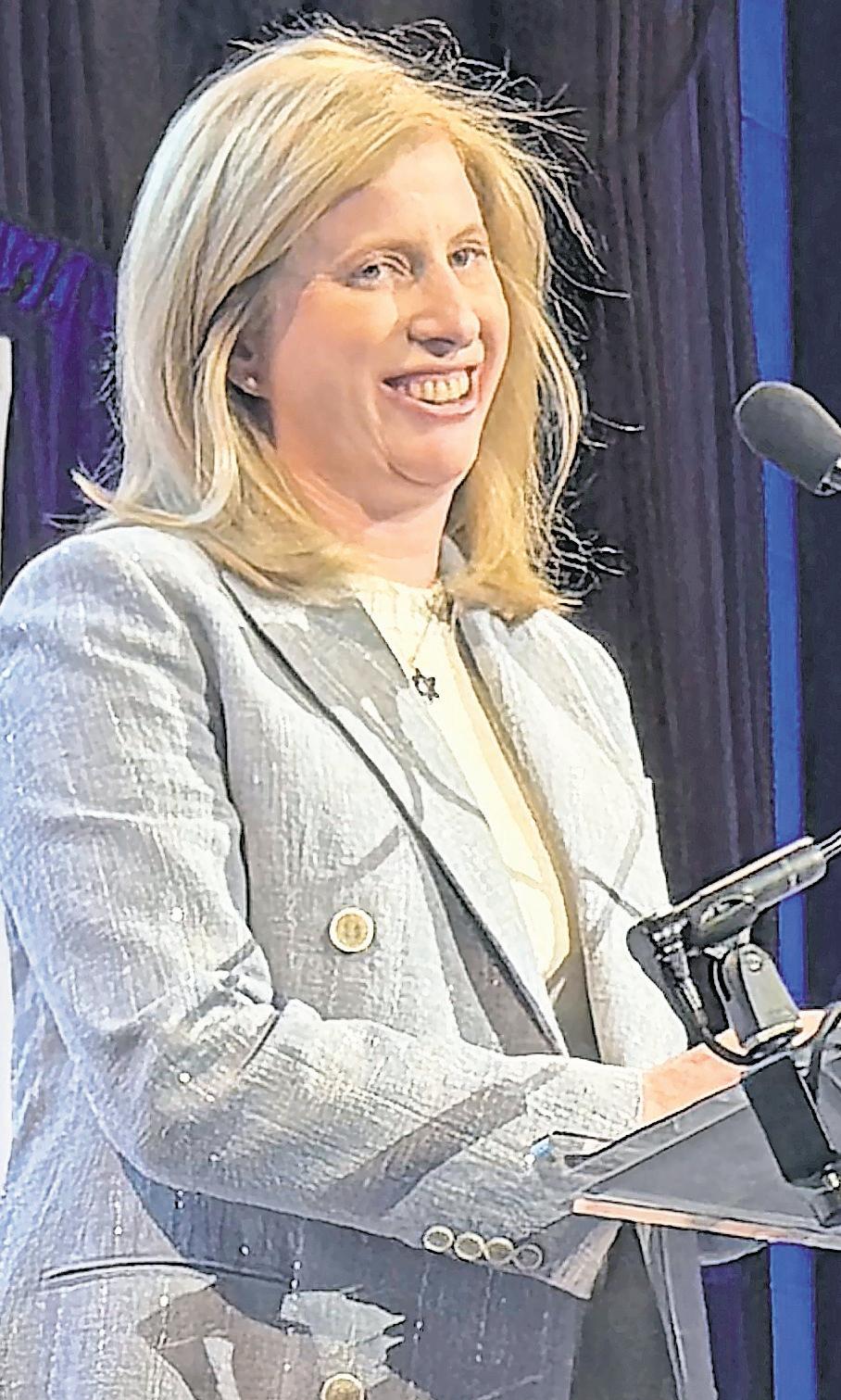
Council Speaker Julie Menin voiced her Jewish pride at Sunday’s Met Council breakfast.
Police Commissioner Jessica Tisch told the Met Council she’d continue to keep New Yorkers safe.
Outgoing
Ed Weintrob, The Jewish Star
Perspective by Ed Weintrob
The Jewish Star
By Debra Nussbaum Cohen, JNS
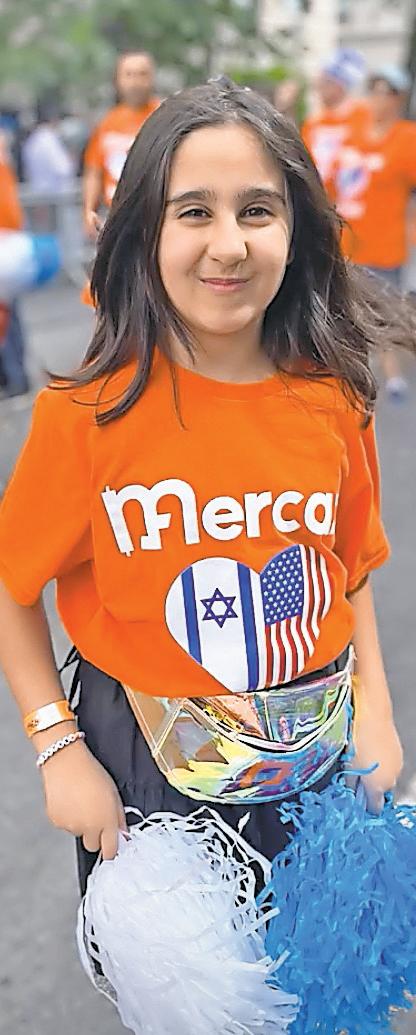
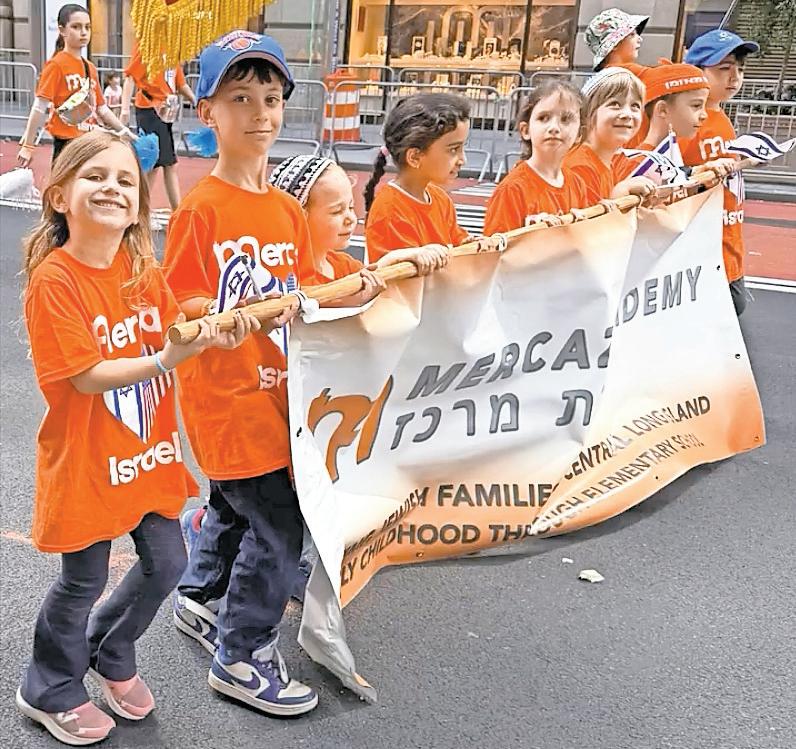
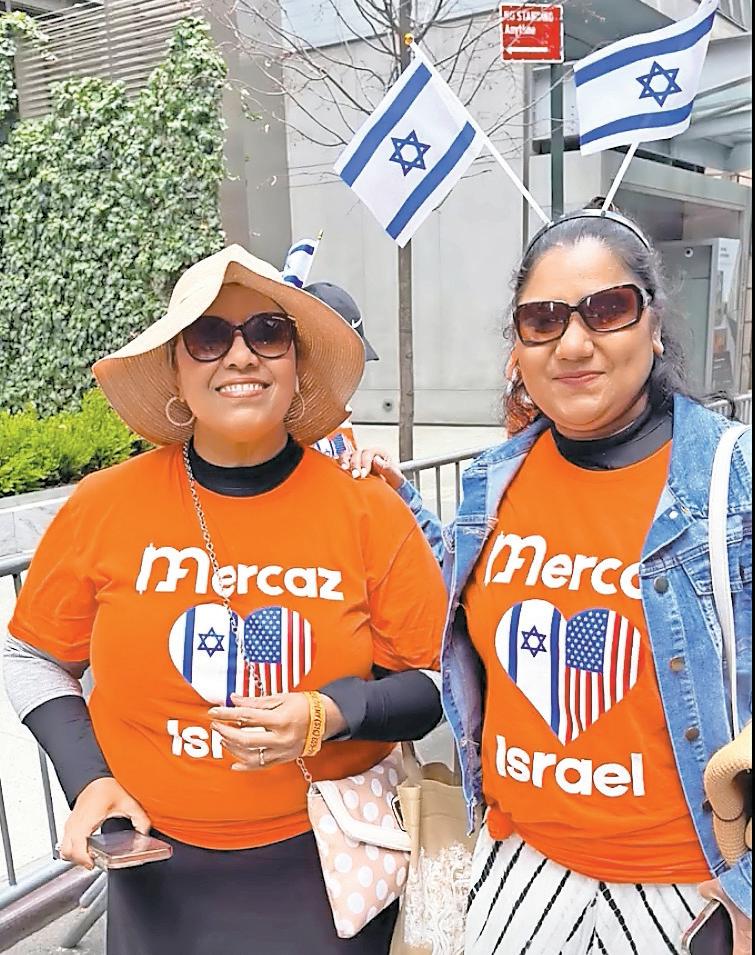
This year’s Israel Day on Fifth parade, held on Sunday, May 31, was large, joyful and proud after two years of more-somber events focused on freeing Israeli hostages from Gaza.
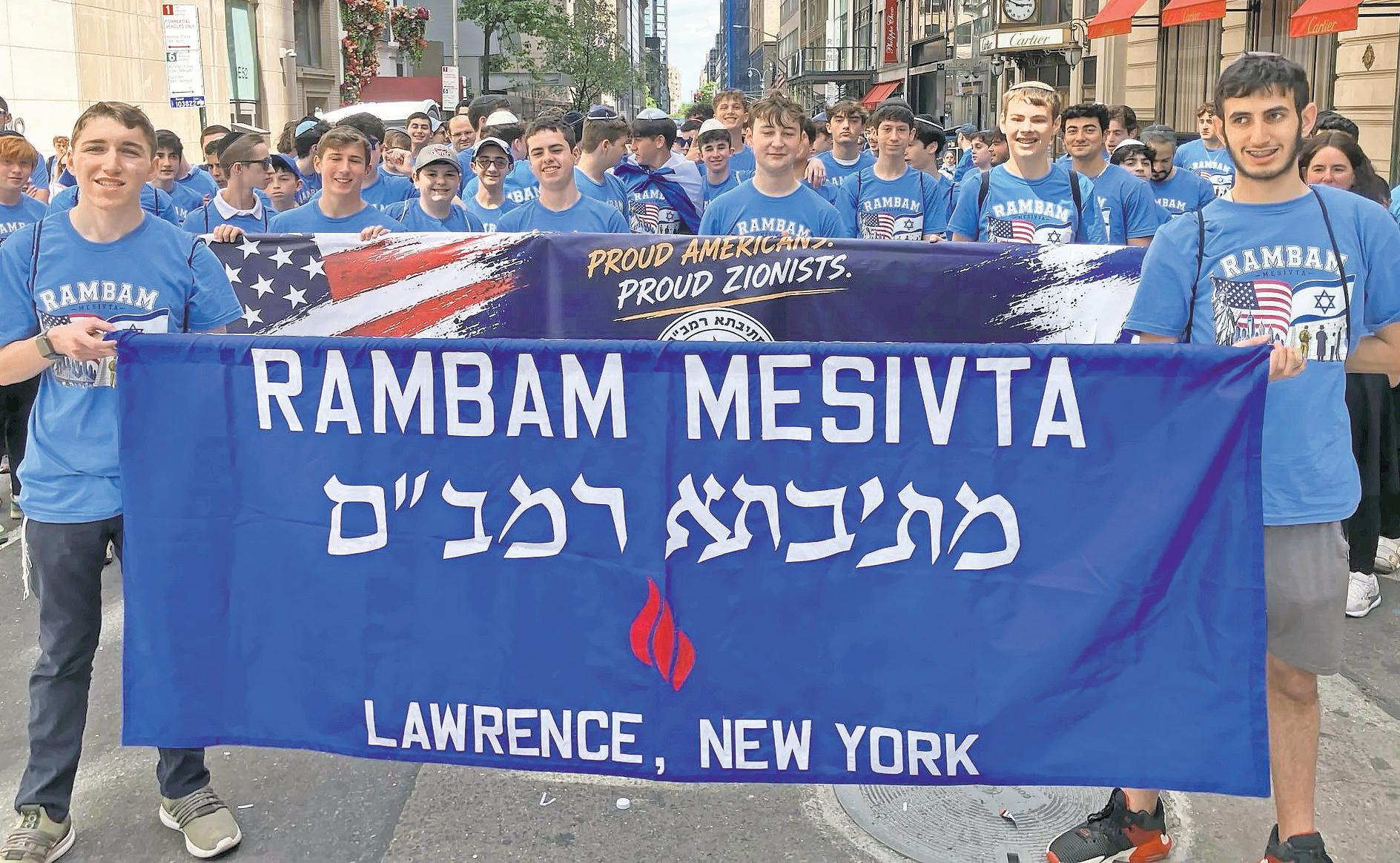
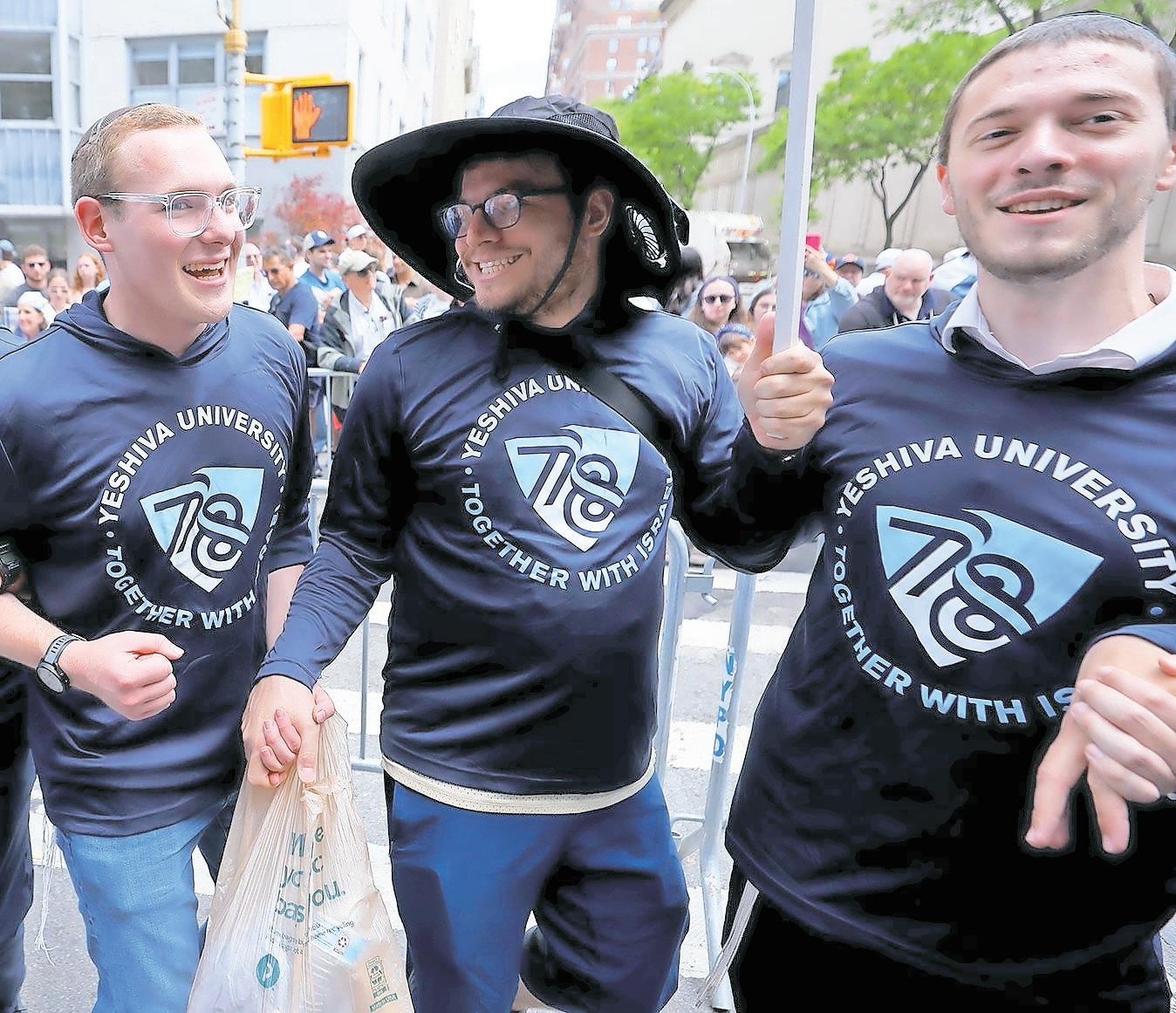
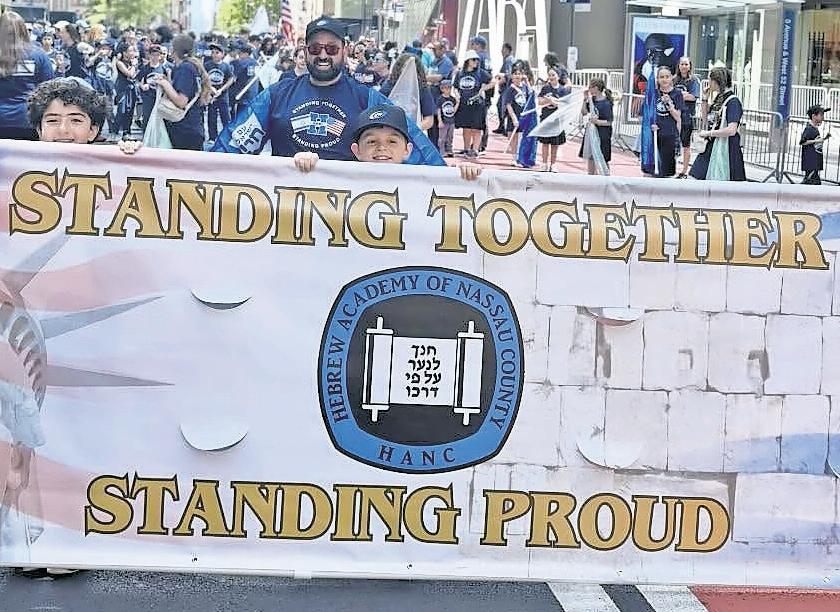
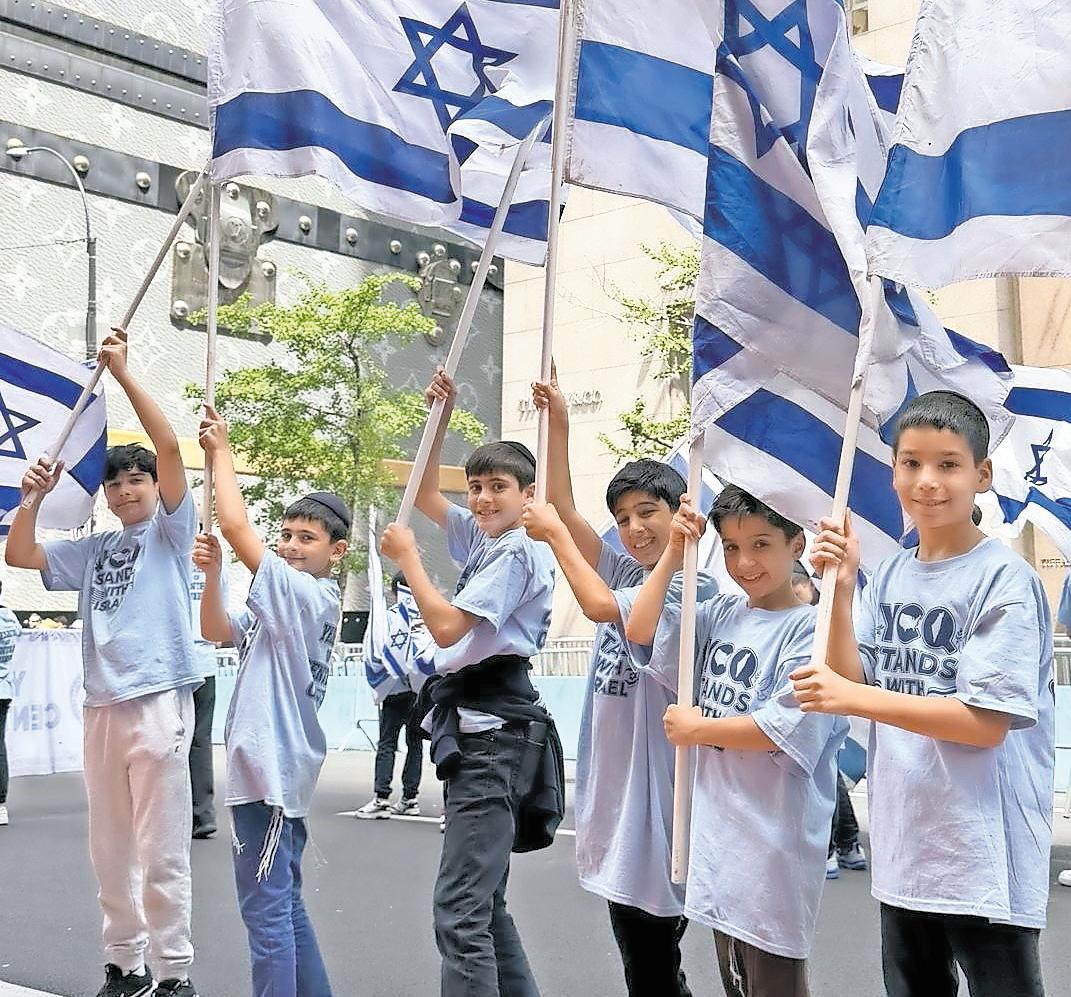
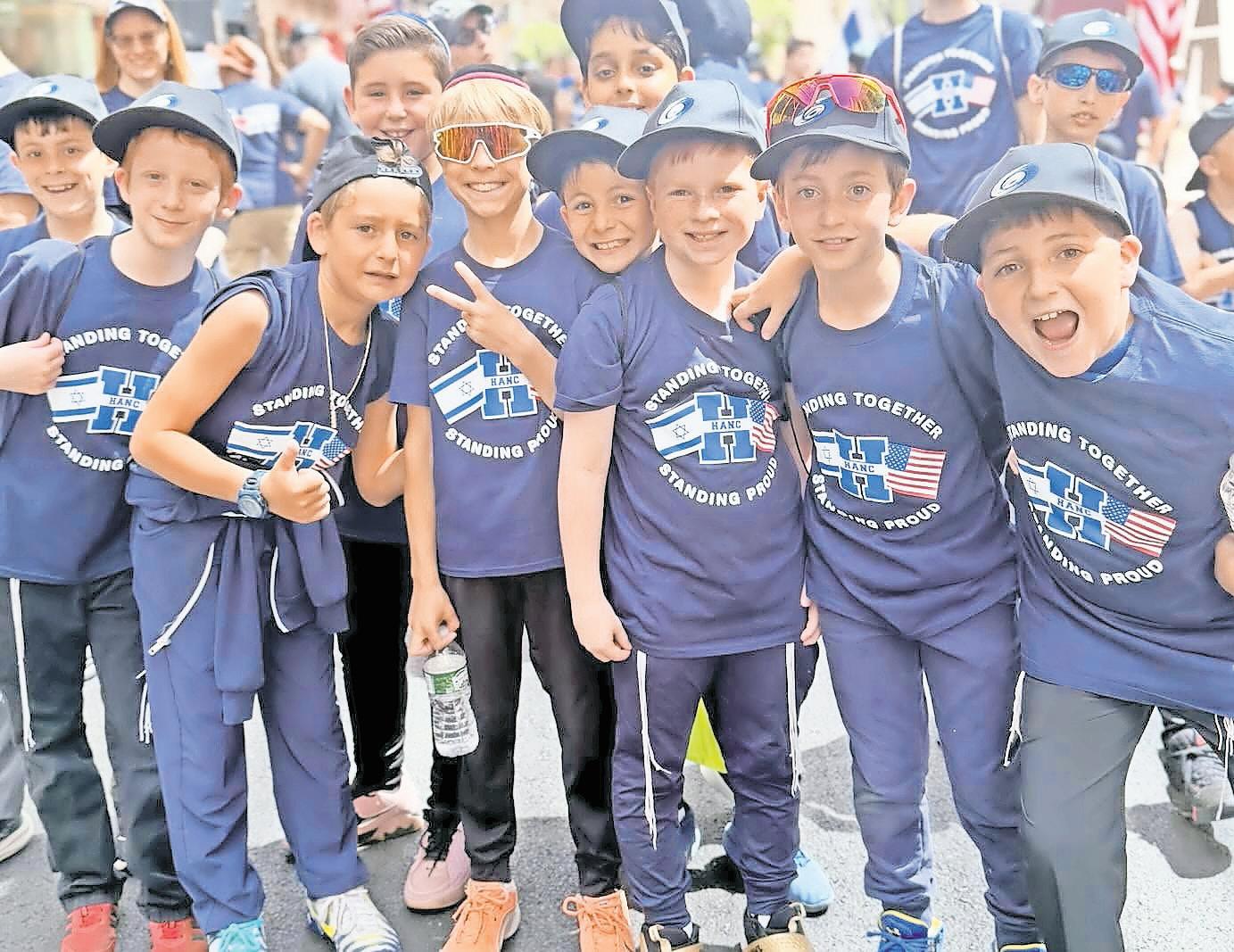
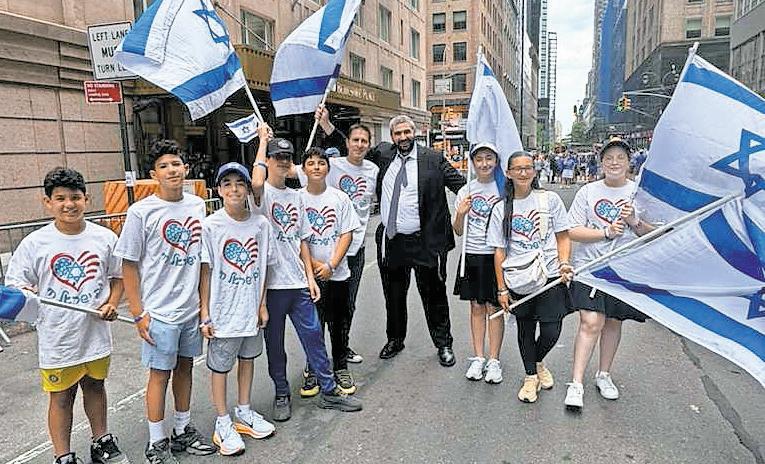
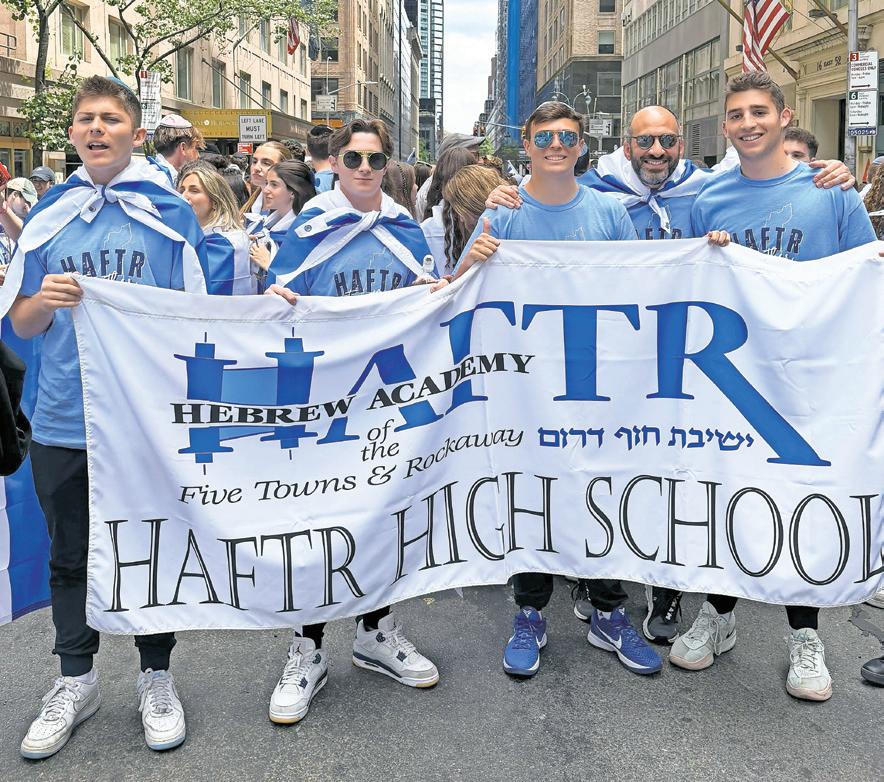
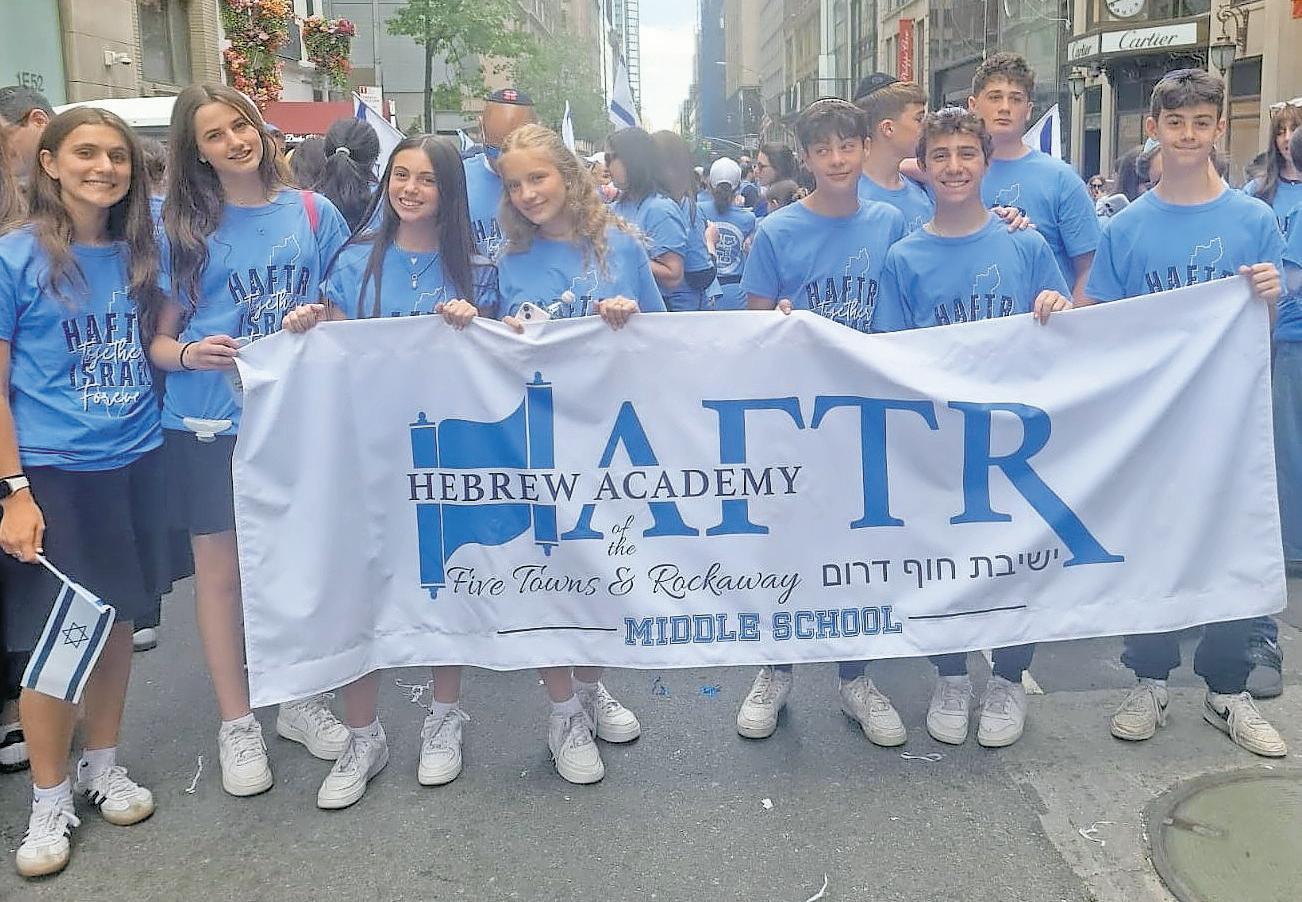
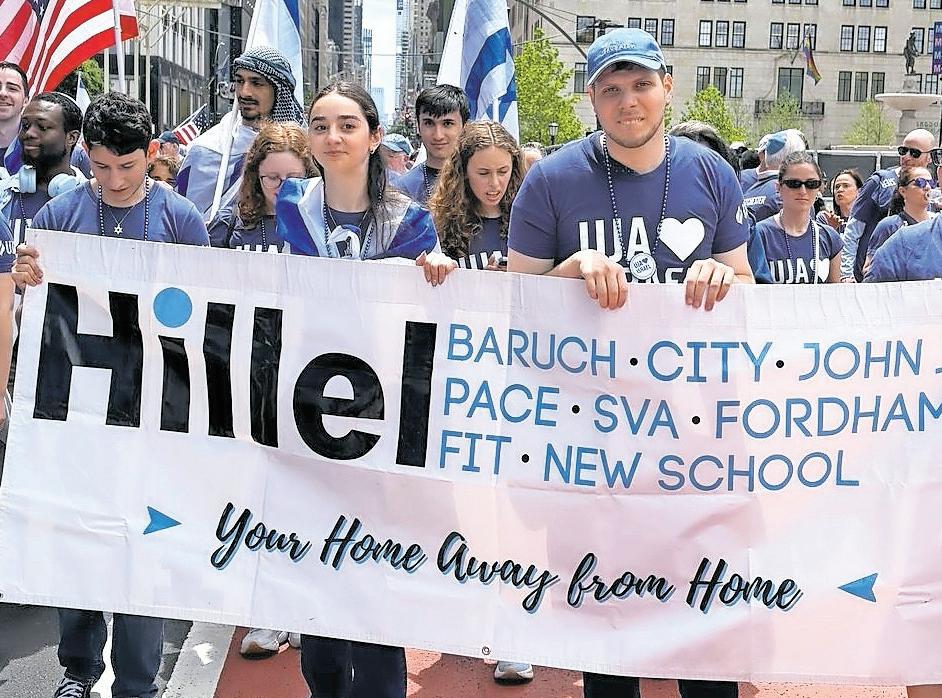
An estimated 50,000 people marched slowly up New York’s storied Fifth Avenue, including more than 70 groups from Jewish schools near and far, ranging from Manhattan’s pluralistic Heschel School to Philadelphia’s Modern Orthodox Kohelet Yeshiva and a Baltimore day school.
Who knew that there is a yeshiva with a marching band and pom-pom girls? Brooklyn’s Yeshiva of Flatbush came out in force with students playing drums and brass instruments, and female students waved blue-and-white pompoms.
There was the Jewish motorcycle club Chai Riders, whose members slowly motored up the avenue. Some wore their leathers, and one biker had a large Israeli flag waving from the back of his kosher hog. Another wrapped around the front.
There was also a large contingent of Mummers, from the Quaker City String Band in Philadelphia, who wore fantastically decorated sequinned outfits, replete with headdresses and full make-up, while playing upbeat tunes on saxophone, banjo and accordion.
The marching contingent from UJA-Federation of New York was very large, as befits a main
See 50,000 march on page 5
50,000 march and cheer at Israel Day Parade SKA
YU HS for Girls (Central)
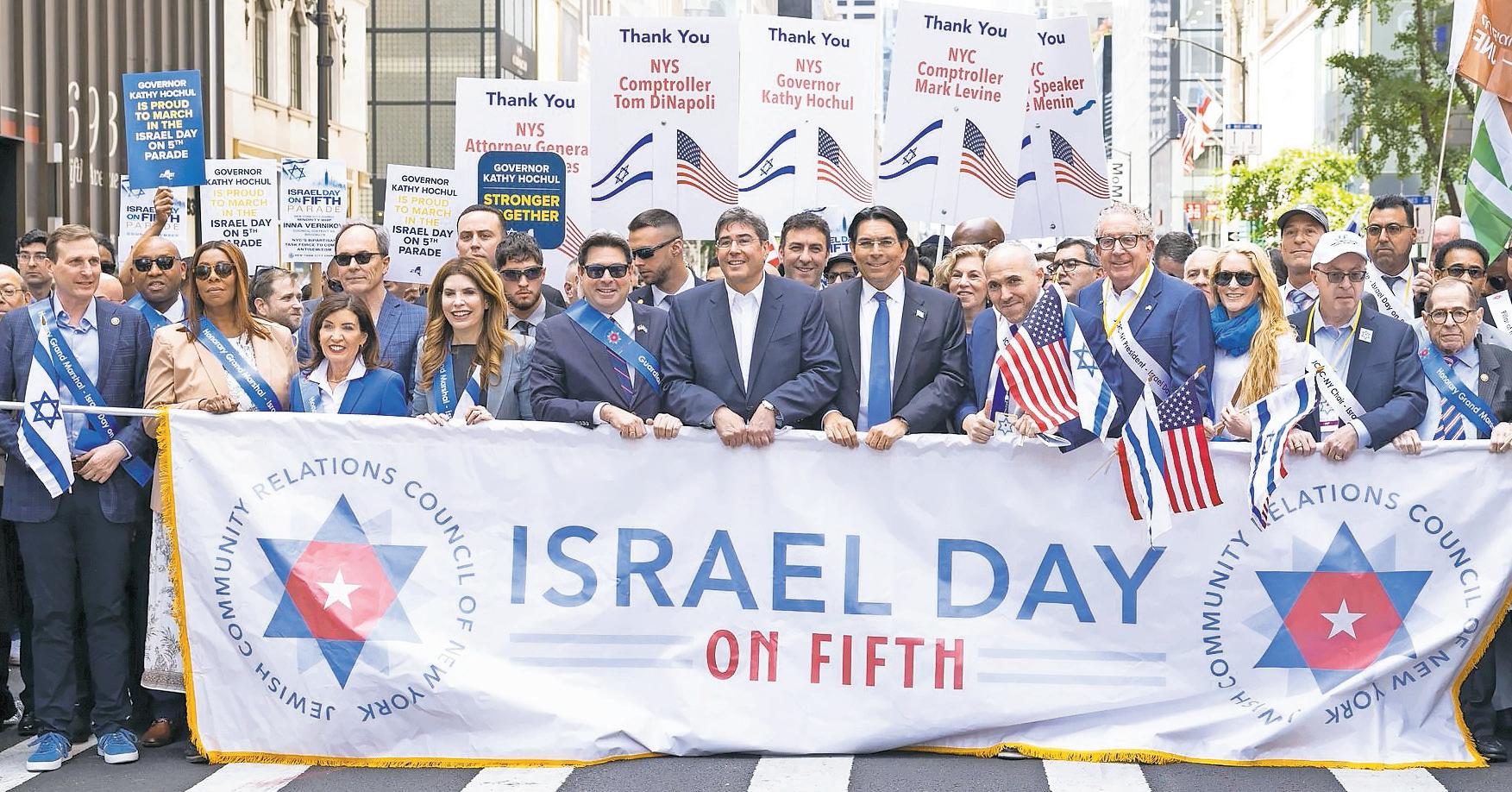
READY TO MARCH: These political leaders were proud to show their support for Israel, lining up to start Sunday’s Israel Day on Fifth Parade. Among those pictured, from left: Rep. Dan Goldman, who is facing a competitive chalenge in the June 23 primary in NY’s 10th CD from antizionist Brad Lander; state Attorney General Tish James; Gov. Kathy Hochul; City Council Speaker Julie Menin; UJA-Federation of CEO Eric Goldstein (at center); Israeli Ambassador to the United Nations Danny Danon, Jewish Community Relations Council of NY CEO Mark Treyger, and (at far right) retiring Rep. Jerrold Nadler.
Yeshiva University
c Hebrew Academy of Nassau County
Yeshiva of Central Queens
SAR High School
Brandeis
c Hebrew Academy of Five Towns & Rockaway
c Davis Renov Stahler Yeshiva High School
Mercaz Academy Hillel
Women…
Continued from page 1
“Today is a joyful day and I want you to feel that joy — because if you don’t, it means that I am not doing my job well,” Tisch said.
“I know how meaningful it is for so many of you, to have a Jewish police commissioner,” she added. “It is a responsibility that I feel deeply in my mind, in my bones, and in my heart.”
Both Tisch and Menin received awards at Sunday’s breakfast.
David Greenfield, Met Council CEO and executive director, said that Tisch has “protected our Jewish community with real focus and resolve.”
When he travels around the world, he encounters positive feedback over the fact “that our amazing police commissioner, everywhere she goes, she proudly wears the star of David,” he said.
Turning to Menin, Greenfield said that soon after she was chosen to lead the City Council, the speaker worked “to put together a package of bills to combat antiemitism, carrying her family’s history into her fight every single day.”
• • •
There is no assurance that Menin and Tisch will be able, long-term, to restrain Mamdani’s generally destructive and specifically antisemitic tendencies. But they’re the best of what we’ve got right now, and they’re pretty darn good. They need our encouragement, our support — and our gratitude.
At Met breakfast, Hochul signs a law
By Ed Weintrob, The Jewish Star
Gov. Kathy Hochul signed “Keeping New Yorkers Safe” legislation at Sunday morning’s Met Council Legislative Breakfast. The law establishes 50-foot security perimeters at houses of worship in which protests are not allowed.
“You have no right to harass someone walking into a synagogue with their family to carry on a tradition that has been there for centuries and centuries, and have to put up with people screaming vile epithets,” Hochul said. “That is wildly unAmerican and it’s definitely not how we do it in New York.”
Now, she said, “that will be not just condemned, but prohibited.”
Moving beyond politics, Met Council CEO and Executive Director David Greenfield spoke about his organization’s work.
“When New Yorkers have nowhere to turn, they turn to my council,” he said. “Across eight programs, we meet people at the hardest moments of their lives — food on an empty table, a hot meal, a familiar face … the rent covered before the eviction notice, the safe way out for victims of domestic violence, benefits secured, a career is launched, a crisis answered — whatever the need, Met Counsel is there.”
Greenfield emphasized that although Met Council is a Jewish organization, “we proudly serve New Yorkers of every race, every faith, every background.”
“Demand for food is rising. Demand for housing is rising. When New Yorkers are hurting, Met council responds first — that’s the work they do each and every day,” said Mark
Mark Treyger, CEO of the Jewish Community Relations Council-NY.
Rep. Grace Meng of Queens said programs to feed the hungry are under attack and that she would oppose cuts “and do everything in my power to blunt their impact.”
“I’m also working with my colleagues to double down on the fight against antisemitism and hate in all its forms,” she said. “We have all read the statistics, but numbers don’t tell the whole story. It’s different to see
swastikas on synagogues right in our own neighborhoods, to hear chants of support for Hamas, and to fear for one’s safety because of religious identity.”
Eric Goldstein, CEO of UJA-Federation of NY, praised Met Council for doing work that “is so holy and precious in this moment.”
He thanked the many government officials in attendance for their ongoing support of Met Council initiatives, pointing out that “we can
supplement government, we can’t substitute for government.”
Senate Minority Leader Chuck Schumer, famous for assuring Jewish audiences that he is their shomer, their watchdog, ommited that pitch from his talk at the breakfast. He said the resurgence of antisemitism keeps him up at night. Referring to members of his family who were murdered in the Holocaust, he said, “I worry about the future my grandchildren are going to inherit.”
50,000 march and cheer at Israel Day Parade…
Continued from page 2
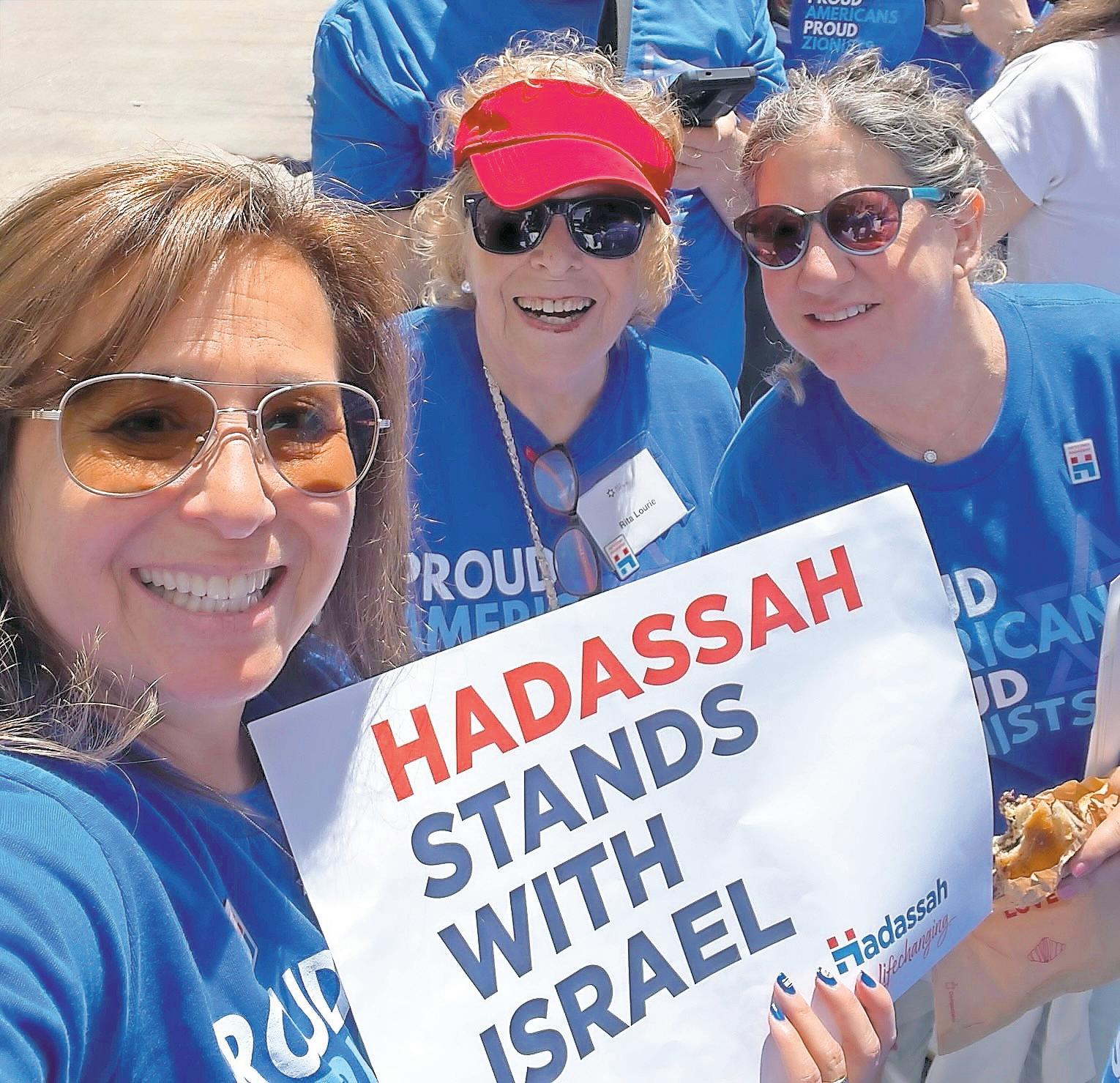
sponsor of the parade, with marchers wearing the organization’s t-shirts bearing their home location on the back — Manhattan, Queens, Brooklyn and Westchester among them. Many carried signs stating “proud New Yorkers, proud Zionists.”
Jews in uniform led the day’s procession, including the New York City Fire Department’s Ner Tamid Society, and the New York City Police Department’s Shomrim Society, all in formal dress. A little boy sat on his father’s shoulders, wearing his dad’s fire department dress uniform hat.
Detective Joshua Zucker came in from his precinct in Marine Park, Brooklyn, one of about 300 members of the NYPD’s Shomrim Society, he told JNS.
Jordan Natan, a Class 1 special law enforcement officer, came from Hackensack, with special permission from his higher-ups.
“I wanted to be here with my fellow officers to show my support for Israel,” he said.
Lieutenant Shevach Bercovitz, who goes by the nickname Shevy, is based in Mineola, Long Island, and formerly led the Nassau County Police Department Shomrim Society. He is in charge of pre-arraignment prisoner processing, he said. His uniform had several colorful bars showing his Jewish identity and involvement in crises, including Hurricane Sandy.
New York City Council member Eric Dinowitz, who chairs the body’s Jewish caucus and is co-chair of its bipartisan task force on Jew-hatred, mingled among the day’s marchers.
He has participated for many years — the first time on a float with the Jewish a cappella group 613, of which he was then a member, he said. He’s been marching annually since he was
elected to the City Council representing part of the Bronx six years ago.
“Thousands and thousands of New Yorkers are marching to show their solidarity with the very idea of a democratic Jewish state,” Dinowitz told JNS mid-parade. “It is a beautiful sight to behold. We are more than just our traumas of our history and skyrocketing antisemitism.”
“We are joyful and prideful of our heritage and our love of Judaism and our love of Israel,” he said. “The amount of happiness and pride is unmatched.”
Despite much controversy before the parade, centered on the fact that Zohran Mamdani, mayor of New York City and a longtime anti-Israel activist, did not participate this year, protests at the parade seemed to come entirely from Jews.
The New York City Police Department kept the few protesters, including from the anti-Zionist Chassidic group Neturei Karta, a couple of blocks from the parade. Members of the small Chassidic group carried Palestinian flags and banners stating that they represent authentic Judaism. A small group representing Standing Together, which brings Jews and Arabs together in Israel, was not permitted to march in the parade because of what it said were its pro-peace signs.
The parade organizer, Jewish Community Relations Council of New York, approves the t-shirts and signs carried by every group in the parade.
Some 50 college and university teachers marched with a contingent from the Academic Engagement Network. Some were Jewish, some not.
Ruby Aguirre teaches forensic psychology at the John Jay College of Criminal Justice in Manhattan. “I am a Christian,” she said. “It’s impor-
tant that allyship is put on the forefront of recognizing the hostile environments that students are exposed to on campus now.”
“Standing alongside our colleagues and peers at this difficult time is key,” she said.
Faculty members came to march from as far away as Oregon and California, according to Miriam Elman, executive director of the Academic Engagement Network.
“They don’t have a parade like this in their cities,” she said. “We are the support system for beleaguered faculty.”
Due to a spike in the number of recorded hate crimes against Jews in New York City, the level of security at Sunday’s parade was unprecedented.
Uniformed police officers were on Manhattan streets many blocks away hours before the parade began, and the streets surrounding the parade route were barricaded off for several blocks, with enormous cement cubes, heavy garbage trucks and police barriers preventing anyone dangerous from entering the parade space.
Nevertheless, participating groups appeared to have privately hired security guards marching with them as well.
Academic Engagement Network was among them.
“Paying for extra security — that’s the Jewish tax,” Elman said. “It’s outrageous that we have to have it for our events.”
Brian Feinberg, who came in from Ft. Lee, grew up marching in the parade with his father, who had been one of the youngest members of the Palmach, the main pre-state paramilitary organization.
He still comes every year. “The logistics this year are a little crazy,” he said. “Security has been very, very tight as it has to be, unfortunate-
ly. Otherwise there are people who want to do us harm.”
Feinberg wasn’t really concerned about his personal safety at the parade this year and thought there were fewer spectators, likely out of fear, he said
Another spectator, who spoke with JNS, would allow herself to be identified by her first initial “R,” concerned about professional repercussions at the investment firm where she works if she used her full name.
“In today’s environment, supporting Israel is a political statement even though it shouldn’t be,” she said. “I am at risk in my field to take that stance, unfortunately.”
Her partner said that he has attended the parade for many years and isn’t fond of the large “frozen zone” that police created. The empty space of about 12 feet, enclosed by metal police barriers, separated spectators from parade marchers.
“It changes the whole vibe,” he said. “I used to be able to high-five the marchers.”
Molly Ruttenberg, who lives in Union Square, came with her friend Allie Levine, who lives on the Upper East Side. The pair is in their early 30s.
“I wanted to show my support to the Jewish community and to Israel, especially in this time of so much divisiveness in the city and just wanted to have a good time,” Ruttenberg said. It was her first time at the parade. “The current situation definitely made it more of a priority to be here,” she said.
Her friend came to the parade “because of community,” Levine said. “Especially in today’s times, it’s more important than ever to show up, proud and loud.”
SIGNING IT: After speaking at Sunday’s Met Council Legislative Breakfast, Gov. Kathy Hochul signs “Keeping New Yorkers Safe” legislation, mandating buffer zone to protect houses of worship with 50-foot security perimeters in which protests are not allowed. Happily watching, from left: Met Council CEO and Executive Director David Greenfield, City Council Speaker Julie Menin, and UJA-Federation of New York CEO Eric Goldstein. Ed Weintrob, The Jewish Star
HEALTH, MIND & BODY
Malawian children in Israel for heart treatments
By Steve Linde, JNS
Ten children from Malawi arrived in Israel this week to undergo life-saving cardiac treatment, marking a milestone in the growing humanitarian and medical partnership between the Jewish state and the southeastern African nation.
The young patients, accompanied by eight mothers and a nurse, will receive treatment at the Sylvan Adams Children’s Hospital at Wolfson Medical Center in Holon under the auspices of Save a Child’s Heart (SACH), the Israeli nonprofit that provides cardiac care to children from developing countries.
The youngsters, aged 2 to 19, were identified during SACH’s firstever medical screening mission to Malawi in May 2025. Many suffer from congenital heart defects or rheumatic heart disease, a potentially life-threatening condition that can develop following untreated streptococcal infections, the organization said in a press release.
While SACHS treated its first Malawian patient in 2019 and a second in 2024, this is the first time a group of children from the country has traveled to Israel together for treatment.
“My son Prince needed heart sur-
gery, and we waited for almost a year after the doctors from Save a Child’s Heart came to Malawi on their mission and examined him,” said Magret Pitani, mother of 8-year-old Prince Pitani. “During that time, I was anxious and constantly praying to God that my son would receive this life-saving opportunity to travel to Israel for cardiac care. When we learned that the flights were finally booked, I felt hope and relief for the first time in a long time.”
Fiskani Ngwira, mother of 3-year-
old Zakiyah, described the uncertainty leading up to the journey.
“I didn’t know if this trip was really going to happen,” she said. “I kept praying to God for this opportunity for my daughter. Now we are finally here, and we are so happy. The doctors, volunteers, and everyone at Save a Child’s Heart have been so kind and accommodating to us. Zakiyah will soon go through surgery, and we are filled with hope.”
The children were selected dur-
ing a four-day screening mission conducted by Save a Child’s Heart at Queen Elizabeth Central Hospital in Blantyre, Malawi, in May 2025.
During the mission, Israeli and Malawian medical teams screened approximately 150 children. Eightyeight were diagnosed with treatable heart conditions and identified as candidates for surgery or catheterization procedures through the Israeli organization.
The Israeli delegation was led by senior pediatric cardiologists Dr. Hanita Shai and Dr. Akiva (Aki) Tamir, who worked alongside Malawian physicians led by Dr. Yamikani Chimalizeni. In addition to diagnosing patients, the mission focused on training local medical teams and strengthening Malawi’s long-term capacity to provide pediatric cardiac care.
The newly arrived children are among the first patients identified during that screening mission to begin treatment in Israel.
SACH Executive Director Simon Fisher said the initiative reflects both humanitarian and diplomatic cooperation between the two countries.
“We are hopeful the breakthrough with children coming to Israel will also serve to facilitate an invitation
for Israel’s designated ambassador to Malawi to be invited to Lilongwe to submit his credentials,” Fisher said.
The project is part of Save a Child’s Heart’s broader vision of helping establish a future center of excellence for pediatric cardiac care in Malawi. Relations between the organization and Malawi have deepened in recent years. In April 2024, SACH hosted an official delegation led by Malawi Foreign Minister Nancy Tembo and other senior officials at its Legacy Heritage Children’s Home in Holon, shortly after Malawi opened its first embassy in Israel. Momentum continued in April 2025, when Israeli Deputy Foreign Minister Sharren Haskel visited Malawi and announced the launch of expanded Save a Child’s Heart activities in the country.
Founded in 1995, Save a Child’s Heart has treated more than 8,000 children from 75 countries, regardless of nationality, religion or financial background. The organization has also trained hundreds of doctors and medical professionals worldwide, helping expand access to pediatric cardiac care far beyond Israel’s borders.
Reported by SACH.
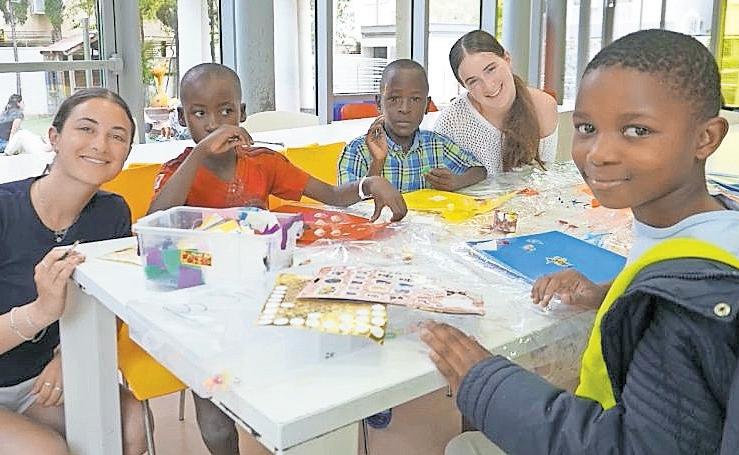
Save a Child’s Heart volunteers with children from Malawi on June 1. SACH
Primary Care and Pediatric Services
EHS Primary Care and Pediatrics Teams
Why Choose EHS?
• New patients welcome
• Easy scheduling
• Same-day appointments available
• Convenient access with locations in Far Rockaway and Rockaway Beach
• Comprehensive care for adults, children, and families
• Coordinated specialty referrals
• Multilingual support Our Programs
• Preventive Care and Annual Checkups
• Pediatric Care
• Women’s Health Services
• Chronic Disease, Diabetes and Blood Pressure Monitoring and Management
• Acute Illness Treatment, Sick Visits and Ongoing Care
• Men’s Health Services
The Walsh Ambulatory Pavilion, 19-20 Brookhaven Avenue, Far Rockaway, NY 11691
EHS Primary Care at Rockaway Beach, 105-38 Rockaway Beach Blvd, 2nd Floor, Rockaway Park, NY 11694
EHS Pediatrics, 495 Beach 20th Street, Far Rockaway, NY 11691 Call 718-EHS-DOCS (347-3627) or visit ehs.org/primarycare to schedule an appointment �����������������������������
1,400 Jewish New Yorkers challenge Mamdani
By Debra Nussbaum Cohen, JNS
Mayor Zohran Mamdani ought to take “immediate and concrete action to protect the city’s Jewish community,” according to an open letter signed by 1,395 Jews in the city, including 76 spiritual leaders.
The letter calls on the mayor to support protective legislation for Jewish institutions, denounce rhetoric that demonizes Zionists, and to “unequivocally condemn, not merely discourage, calls to globalize the intifada.”
“Jewish New Yorkers need something very simple from our mayor: a clear and unequivocal recognition that excluding, stigmatizing or targeting Jews because of a core Jewish value, support for Jewish self-determination in our historic homeland, is discrimination,” the signatories affirm in the letter, which the Jewish Majority organized and which was published last Thursday.
“Being a Zionist does not mean supporting every policy of the State of Israel or any particular Israeli politician,” the letter adds. “It simply means affirming the right of the Jewish people to national dignity and self-determination, a belief held by the overwhelming majority of the Jewish community.”
Jonathan Schulman, executive director of the Jewish Majority, told JNS that “most Jews link the normalization of anti-Zionism to the rise in antisemitism, and the most prominent proponent of that is Mayor Mamdani.”
It is a problem that most of the Jews surrounding Mamdani, either in his administration or as participants in his transition committees, are anti-Zionists or non-Zionists, according to Schulman.
“It’s a real distortion of the majority Jewish opinion,” he said. “The Mamdani administration is lifting up fringe voices as if they’re representative of the community. When he appoints a faith liaison from Jewish Voice for Peace, which works to undermine Israel, it is really tokenism.”
Miriam Grossman, a Reconstructionist spiritual leader and longtime member of the rabbinical council of the antizionist Jewish Voice for Peace, is City Hall’s faith liaison.
Mamdani, who has promised to arrest Israeli Prime Minister Benjamin Netanyahu arrested if he visits New York City, discarded many of his predecessor’s executive orders protecting Jews and Israel. He has said, via his spokeswoman, that synagogues hosting pro-Israel events violate international law.
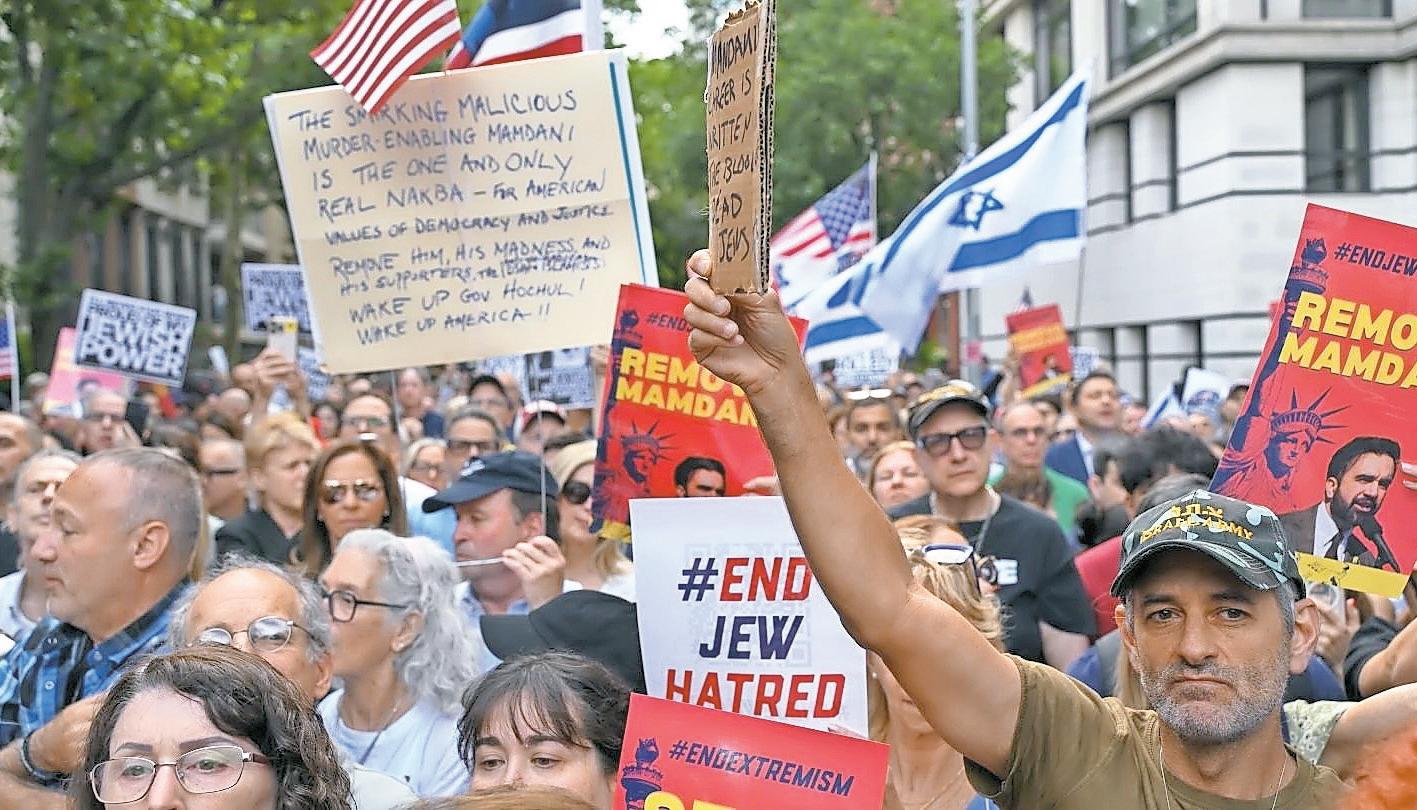
The letter is part of a growing groundswell of public opposition to the mayor, which has included demonstrations, such as one held Monday evening near Gracie Mansion, the official mayoral home.
Jews represent close to 10% of New York City’s residents, by some counts, and were the targets of nearly 60% of hate crimes in the city in April, according to New York City Police Department data.
The Jewish Majority’s mission is to ensure that mainstream Jewish voices
BELMONT PARK VILLAGE
are accurately represented in the media and politics.
Signatories to the open letter include rabbis and cantors of every denominational affiliation who live and work in every part of New York City and in suburbs beyond in the state. The majority of those who signed are laypeople.
Anne Etra, who lives on the Upper East Side and leads a small nonprofit, said that the open letter, which she signed, is “a good start and important to say.”
“New York Jews need to toughen up. Nobody can tell them that they don’t deserve to be safe,” she said. “It’s their city as much as anyone else’s, and the mayor is not a mayor for all citizens.”
Schulman said that his group includes clergy who aren’t constituents of Mamdani’s, because what happens in the five boroughs affects spiritual leaders far beyond the city’s borders.
Rabbis may be based as far as upper Westchester and have congregants who work in New York City, come into the city to dine or have children attending one of New York City’s colleges or universities he said.
Schulman added that he knows rabbis who say that their congregants have stopped going out to dinner at kosher and Israeli restaurants in the city, “because they worry that a mob might attack them for eating there.”
The mayor needs to take note, according to Schulman.
“It is very dangerous how Mamdani is creating this hostile environment for Jews,” he said.
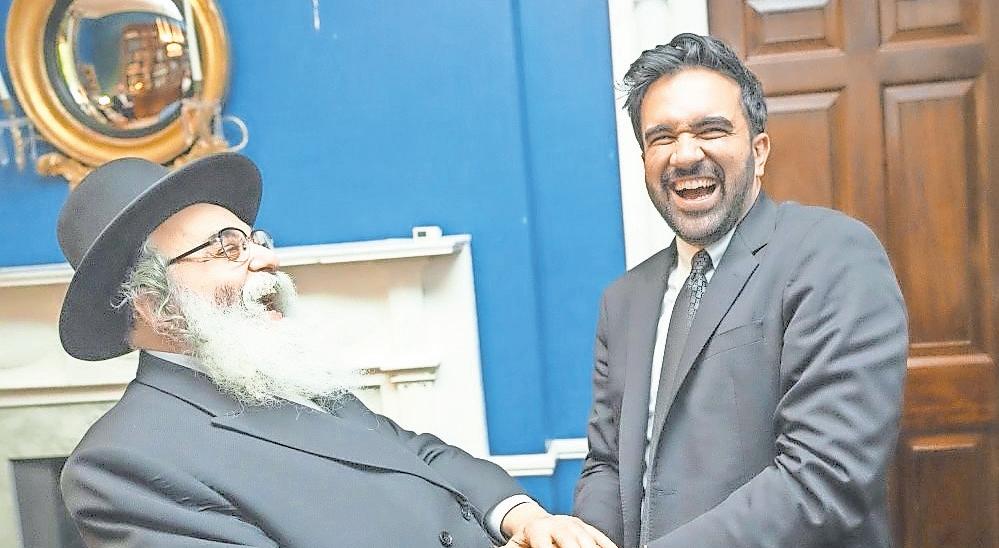
Mayor Zohran Mamdani laughs it up Rabbi David Niederman, executive director of United Jewish Organizations of Williamsburg, at a Jewish American Heritage Month celebration at Gracie Mansion on May 18,. Michael Appleton, Mayoral Photography Office
An NBN event kicks off summer ‘aliyah season’
Nefesh B’Nefesh launched the 2026 summer aliyah season this week with two celebratory community events.
The first event, on Monday in New Jersey, welcomed over 450 attendees. An event in Toronto drew 200 people on Tuesday.
The gatherings — organized together with Israel’s Ministry of Aliyah and Integration, the Jewish Agency for Israel, Keren Kayemeth LeIsrael, and Jewish National Fund-USA — brought together a diverse range of people making aliyah from North America this summer, including 478 families.
Throughout the summer, Nefesh B’Nefesh is expected to facilitate the arrival of olim on 47 group aliyah flights through ElAl Airlines. The flights, staffed by Nefesh B’Nefesh teams to assist throughout the aliyah process, will depart from major hubs across the United States, including New York, New Jersey, Miami, Boston, and Los Angeles.
This week’s events kicks off what is anticipated to be a robust summer aliyah season. Participants connected with fellow olim, engaged with aliyah advisers and partner organizations, and celebrated their approaching journey home. The evenings featured music, community programming, and resources designed to support olim as they prepare for their futures in Israel.
“The summer aliyah season represents an important moment for both the olim and the State
of Israel,” said Co-Founder and Executive Director of Nefesh B’Nefesh, Rabbi Yehoshua Fass. “It is incredibly meaningful to see hundreds of olim taking this significant step and beginning their aliyah journey together. These events provide an opportunity for families, friends and their local communities to celebrate that decision and ensure that every Oleh feels supported as they prepare for their futures in Israel.”
The summer months consistently represent one of the busiest periods of the year for North American aliyah, with over 2,300 expected to immigrate in the coming weeks and months. Many of this summer’s olim are expected to arrive from communities across the United States and Canada, including New York, New Jersey, Florida, California, Ontario, and Quebec. Upon arrival, many choosing to live in Jerusalem, Tel Aviv, Beit Shemesh, Ra’anana, Modiin, Haifa, and communities across Israel’s northern and southern regions.
Special guests at the kickoff events included Director-General of Israel’s Ministry of Aliyah and Integration, Deganit Sankar-Lange; Director-General of the Ministry of the Negev and Galil, Yohanan Mali; Director-General of the Ministry of Labor, Rubi Shemesh; Director of the Jewish Agency’s Aliyah and Absorption Unit, Eran Berkovich; and Nefesh B’Nefesh Co-Founders Rabbi Yehoshua Fass and Tony Gelbart.
Reported by NBN.
A family at this week’s aliyah event in New Jersey, anticipating their journey home. Matt Capowski
Reflections on two holy cities: Hebron and Safed
By Lyn Julius, JNS
The last survivor of the 1929 Hebron massacre has just died at the age of 100. Yitzhak Ben-Hebron was 4 years old when Arab rioters murdered 67 Jews and wounded dozens more.
Born Yitzhak Halali in 1925, Ben-Hebron survived because his mother had pushed a heavy sewing machine across the door of his family’s home to keep out the rioters. They fled to the neighboring Avraham Avinu synagogue. From there, they escaped through the upper windows to avoid the mob.
The massacre, which targeted a community that had been living there for centuries, is the most notorious of the 1929 Palestine riots but is often overshadow by other deadly attacks. The trouble began in Jerusalem and spread to Safed, a town high up in the Galilee hills.
Together with Hebron, Jerusalem and Tiberias, Safed is one of the holy cities of Judaism. It was settled in the 15th and 16th centuries by refugees from the Spanish Inquisition. Rabbis Isaac Luria, Joseph Caro, Solomon Elkabetz and Moses ben Jacob Cordovero helped make it a leading Kabbalistic and spiritual center.
In later centuries, the Sephardi Jews were joined by ultra-Orthodox Ashkenazim. Today, the city boasts at least 15 synagogues.
Visiting Safed in northern Israel, you’d never guess that the city — with its picturesque cobbled streets, narrow alleys and ubiquitous steps climbing the hillside — had ever been other than peaceful.
But the silence of picture-postcard Safed is deceptive and conceals a violent history. The Arabs of Safed are known for their extremism and cruelty towards Jews. Already in 1834, Safed’s Jews suffered a pogrom. The godfather of the 1970s Palestinian hijackings was the (Christian) terrorist Wadie Haddad, a founding leader of the Popular Front for the Liberation of Palestine.
He long led Israel’s list of wanted terrorists, dying in 1978. His house still stands there.
On that fateful day in August 1929, Arab rioters, incited by the Mufti of Jerusalem, Haj Amin al-Husseini, rampaged through the Jewish quarter of Safed with axes and knives.
An eyewitness reported: “They looted and set fire to houses, urging each other on to continue with the killing. They slaughtered the schoolteacher, Aphriat, together with his wife and mother, and cut the lawyer, Toledano, to pieces with their knives. Bursting into the orphanages, they smashed the children’s heads and cut off their hands. I myself saw the victims. Yitshak Mammon, a native of Safed who lived with an Arab family, was murdered with indescribable brutality: He was stabbed again and again, until his body became a bloody sieve, and then he was trampled to death. Throughout the whole po-
grom, the police did not fire a single shot.”
Although honorable Arabs saved Jews, some 20 Jews were slaughtered, and 80 were injured.
Less than two decades later, the strategically important city dominating the Eastern Galilee was the scene of a fierce battle — one of the first of Israel’s 1948 War of Independence. The police station, still today pockmarked with bullet holes, stands as a silent witness to the hostilities, which broke out in April 1948 between Arabs and Jews even before the British mandate for Palestine had ended.
The Jews, numbering 1,200, faced 12,000 Arabs, both Muslims and Christians. They were hopelessly outnumbered; the British authorities advised them to evacuate their women and children. But the British could not guarantee the Jews’ safety, and so, the Jews decided to stay put.
They turned their balconies into low, concrete defensive walls. Some 200 Haganah and Palmach men and women drove back an Arab attack. They lost 42 fighters. The Jews only had one home-made mortar known as the “Davidka.” These guns (the Palmach had six) weren’t very effective, but they made a huge noise.
The Arabs panicked at the sound, which blended with the thunderclaps and lightning flashes of a storm. It was thought that the Jews had a secret weapon, possibly even an atomic bomb.
Incredibly, 12,000 Arabs fled overnight, never to return. Among them were the families of Mahmoud Abbas, the present leader of the Palestinian Authority, and Queen Rania, the spouse of King Abdullah of Jordan.
Safed became a Jewish city. Contrast that with Hebron, where the remaining survivors heeded advice by the British authorities to evacuate their homes. Hebron would remain Judenrein until 1967.
Yitzhak Ben-Hebron changed his name from Halali to indicate his association with his birthplace. He was one of a few hundred Jews to return to Hebron after Israel reconquered the city during the Six-Day War in June 1967. Still, the Jews remain a besieged minority in an Arab town, in need of army protection.
Two massacres, two holy cities, two very different destinies.
DO YOU HAVE WHAT IT TAKES TO SUCCEED IN MULTIMEDIA SALES?
At The Jewish Star, selling advertising for the newspaper is just part of the job.
Our staff’s toolkit includes an exceptionally broad range of useful products (including both religious and secular publications and websites; digital, email, radio and social media marketing; in-person events; direct mail; commercial printing, and more) — whatever it takes to build business and raise revenue for our commercial and non-profit partners.
Employees are trained by the best in the business, in a supportive, collegial and kosher environment.
These F/T positions (P/T schedules may be arranged) offer competitive compensation ($40k-$90k) with excellent commission and bonus opportunities, paid holidays (including Jewish holidays), time off, medical and 401(k).
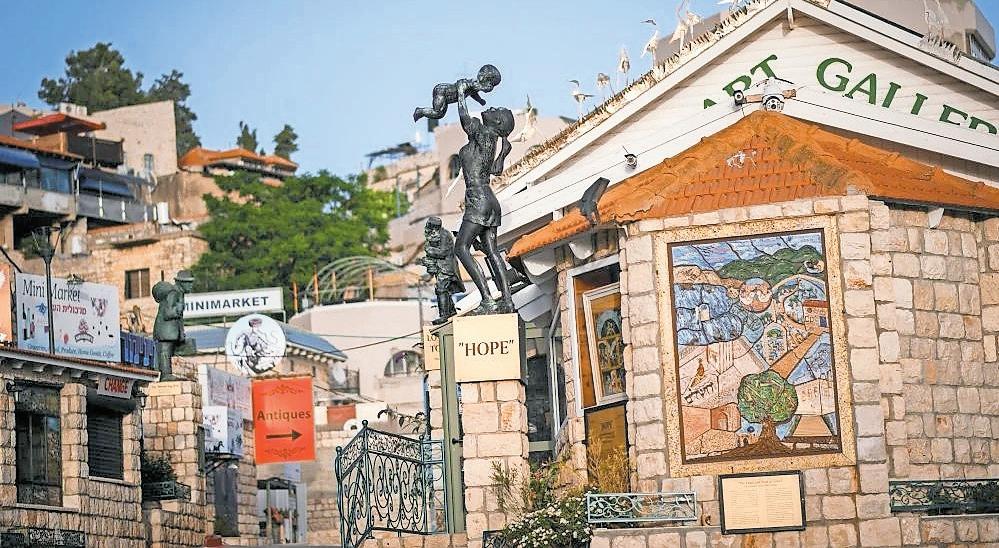
Sculptures and art galleries line the artist quarters of the Old City in Safed. Mendy Hechtman, Flash90
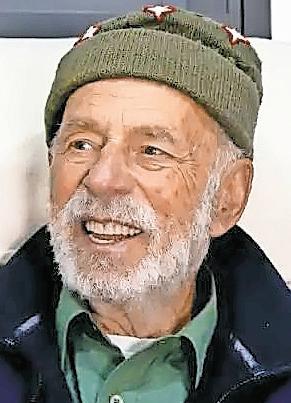
Yitzhak Ben-Hebron, who survived the 1929 Hebron massacre, at a gathering in Kiryat Arba in 2019.
And the Experts Agree
At Mount Sinai South Nassau, patient safety isn’t just a priority— it’s a standard, one we work on every day. And the experts agree.
We’ve earned national recognition for patient safety, including an “A” Hospital Safety Grade from The Leapfrog Group and the Healthgrades Patient Safety Excellence Award.
That means better outcomes for our patients with lower risk of infections or hospital acquired conditions.
When it comes to your health, nothing matters more than knowing you’re in a place where patient safety matters most.
Learn more at mountsinai.org/southnassau
WINE AND
DINE
Michelin winner: Kosher a standard, not a barrier
By Anna Rahmanan, JNS
Israeli-born chef Raz Shabtai learned that his restaurant Mutra, in North Miami, had become the world’s first kosher eatery to earn a Michelin star during a livestreamed ceremony on May 28.
“It’s beautiful, humbling, honoring,” he told JNS.
Michael Werzberger, a partner and investor in the restaurant, said that the “Michelin star proves that talent and dedication will be recognized for what they truly are.”
“Kosher is not a barrier,” he said. “It’s a standard.”
The Michelin Guide states that Shabtai “has brought his take on Middle Eastern cuisine to Miami.”
“Named for his grandmother, this is a place where snagging a seat at the chef’s counter is a must,” it states. “The menu is hyperlocal and rotates often, so don’t be surprised when something runs out. Fear not, however, as the excellent staff will help you discover your new favorite.”
Notable dishes include “a show-stopping plate of beets in a pool of ajo blanco and topped with beetroot sorbet,” per the guide. “The signature lamb kebab with smoked aubergine cream and tomato oil is pure comfort, as is chicken a la Tunis, juicy and flavorful with harissa-studded chickpea tomato stew.”
“Muhallebi, a creamy Middle Eastern milk pudding, is a sweet and satisfying finale,” it adds.
Mutra is the first restaurant under strict kosher supervision to earn a Michelin star, and it is the only restaurant in Miami to receive a new star. It also has a Hebrew sign at its entrance stating, “you are blessed when you arrive, and you are blessed when you leave.”
The ruling on the restaurant shows that the guide is “extremely true to the food, how you execute your dishes,” the chef said.
Mutra, which opened in February 2025, is named for Shabtai’s grandmother, whose cooking and hospitality continue to influence the restaurant’s philosophy.
The Jerusalem-born chef has said that the menu draws heavily on childhood memories and the flavors of the city where he grew up.
Werzberger, the partner and investor, said that the restaurant began after Shabtai worked for his family.
“Chef Raz was working as my private chef when he prepared one of the most memorable holiday meals my family had ever experienced,”
See Michelin winner on page 16
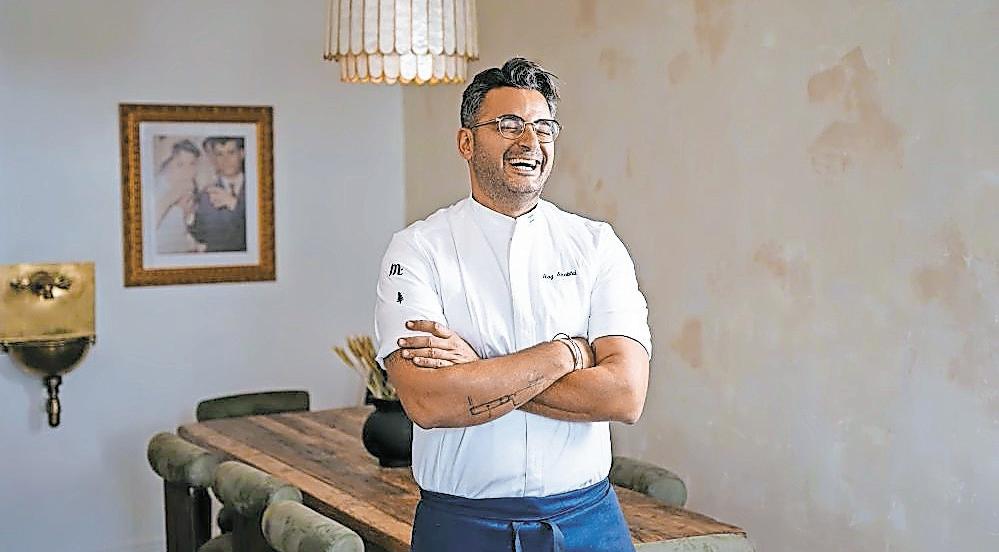
Israeli-born chef Raz Shabtai leads Mutra, a North Miami restaurant that is the first kosher eatery to win a Michelin star. NA Photography
A family photo displayed at Mutra.
NA Photography Raz Shabtai in his Michelin star-winning kosher restaurant Mutra. NA Photography
Dining room of Michelin star-winner Mutra. NA Photography
Exterior of Mutra restaurant in North Miami. NA Photography
Michelin winner: Kosher a standard, not a barrier…
Continued from page 14
he said. “We never knew what that style of Michelin-caliber cuisine even looked like, because we had never experienced it before in the kosher world.”
That experience led Werzberger to encourage Shabtai to open a restaurant.
“I felt the kosher world deserved to experience that level of culinary creativity,” Werzberger said.
Another partner in the venture, Noa Figari, originally worked with Shabtai as a real-estate agent and helped locate the restaurant’s North Miami space, before joining as Mutra’s director of operations.
The restaurant’s menu changes every three to four months and features dishes rooted in Middle Eastern and Israeli culinary traditions made with contemporary techniques.
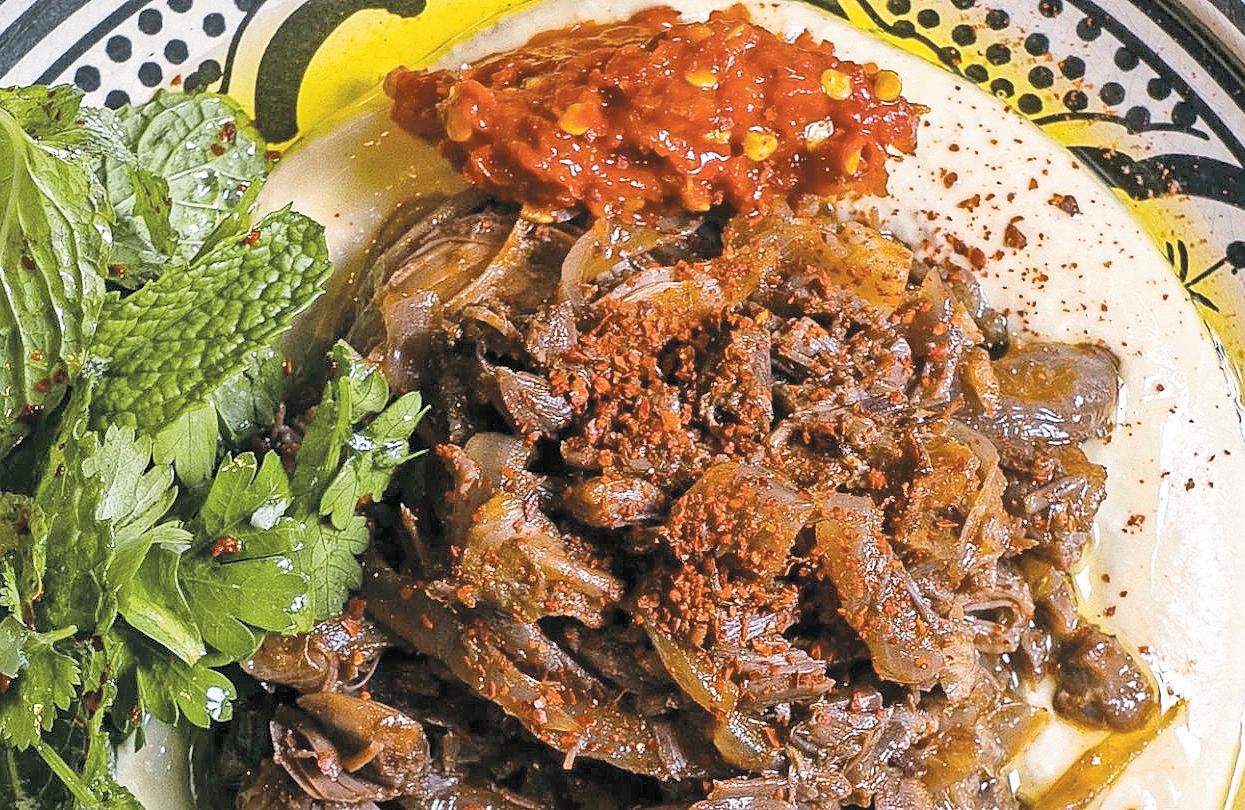
Current offerings include “1 perfect falafel,” a falafel croquette served with tahi-amba and Israeli salad and “chicken liver dreaming to become foie gras,” a chicken liver pâté with silan, pistachio crumble and shallots.
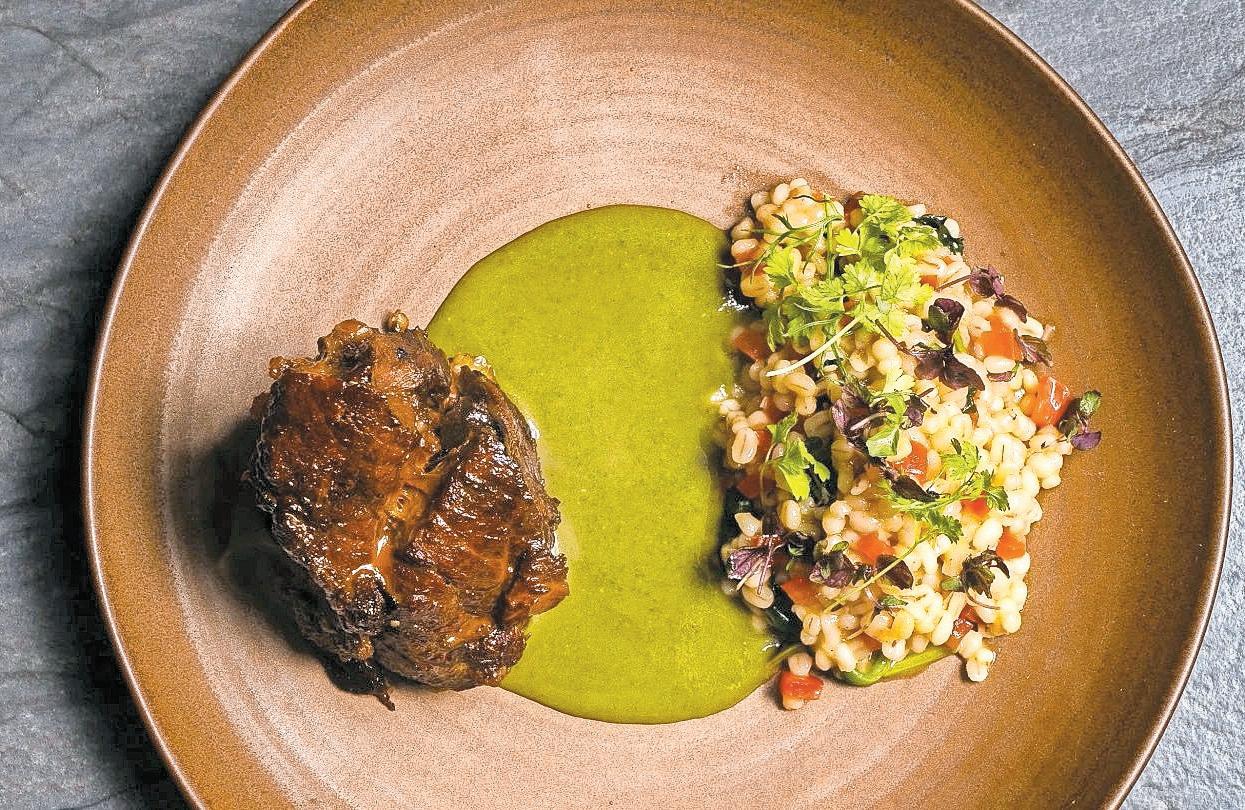
Continuing the theme of inventive names, the restaurant also offers “let’s ruin something pretty,” a roasted beet dish with beet sorbet, ajo blanco and almonds. Other menu items include “Israeli Nam-Tok,” “Tunisian Mole” and the restaurant’s signature “chef’s cut butchered in house.”
Shabtai said that the team tried to operate at a Michelin-star level from its earliest days, despite not knowing if inspectors had ever visited.
“We always acted as if we had a Michelin star,” he said. “We didn’t say, ‘We want a Michelin star’ when we opened, but it was a way of operating.”
He described Michelin inspectors as anonymous evaluators, who assess restaurants based on quality of ingredients, technique, the chef’s philosophy, execution and consistency.
“When Michelin judges you, they don’t just judge you when coming in once,” he said. “The inspector, when he arrives, has a view of if I’m the guest, why do I want to come back here?”
That philosophy, he said, extends beyond the food and encompasses hospitality from the moment guests arrive.
For Werzberger, the award carries significance beyond a single restaurant.
“From the first dish I tasted from Chef Raz, I knew he was different from any other chef whose cooking I had ever experienced,” he said. “He has a gift that I wanted to share with the world, and especially with the glatt kosher community.”
The recognition comes as South Florida’s ko-
sher dining scene has expanded in recent years, fueled by a growing Jewish population and increased demand for upscale kosher options.
Shabtai hopes that the achievement encourages other chefs and restaurateurs to pursue similar ambitions.
“I hope that one day an investor, chef, cook comes and says, ‘I can do it also,’” he said.
Asked what comes next, Shabtai and Werzberger suggested that the Michelin star is only the beginning.
“This recognition will affect what we do, because it now becomes the starting point for what we are planning next, with God’s help,” Werzberger said. “Mutra is not just a kosher restaurant. It is a new experience.”
Shabtai was more direct about his ambitions. “I want two stars,” he said. “At Mutra and another project we are working on.”
Original beets three ways at Mutra.
NAPhotography
Tunisian Mole at Mutra.
NA Photography
Hummus at Mutra.
NAPhotography
House made ice creams and sorbets at Mutra.
NA Photography
Chicken Satay Skewer with Grilled Local Lettuce at Mutra.
Chicken Liver Dreaming to Become Foie Gras at Mutra
A menu item at Mutra.
NA Photography
ElAl heads to ’Frisco, Arkia takes aim at Tokyo
By The Jewish Star from JNS
and other sources
•ElAl will resume nonstop flights between Tel Aviv and San Francisco on Oct. 25 after a six-and-a-half-year hiatus. The airline will offer three weekly flights, with round-trip economy fares starting at $1,199. The move comes as United Airlines remains absent from the route. ElAl says strong demand from business travelers and the large Israeli community in Northern California drove the decision. The carrier will operate 45 weekly nonstop US flights this winter, serving six American cities.
•Israeli carrier Arkia will launch twice-weekly nonstop flights to Tokyo beginning Oct. 25, ending ElAl’s monopoly on the route. One-way fares will start at $750. The airline said growing demand for Far East travel helped spur the expansion. Arkia recently launched service to Vietnam and is also flying nonstop between Tel Aviv and New York. CEO Oz Berlowitz called Japan the airline’s next logical destination after strong performance on its existing long-haul routes.
Airport worker’s antiIsrael rant probed
London Stansted Airport is investigating after a woman who claimed to work there allegedly shouted “Free Palestine” and other insults at passengers arriving from Israel. Witnesses said she cursed at airport staff who tried to stop her before walking away. A Jewish advocacy group welcomed the probe, saying travelers should not face harassment at airports. The incident comes amid growing concern about antisemitism in Britain, where thousands of antisemitic incidents were recorded last year.
Fiji embassy opens in landmark move
Foreign Minister Gideon Sa’ar inaugurated Israel’s new embassy in Fiji, calling it a historic milestone in
relations between the two countries. The opening comes nine months after Fiji established an embassy in Jerusalem. Sa’ar and Prime Minister Sitiveni Rabuka praised growing cooperation and signed agreements covering security and diplomatic training. Israel said the new mission in Suva will serve as a regional hub for relations throughout the South Pacific as Jerusalem seeks to expand its diplomatic footprint.
US envoy praises Argentina leader
America’s antisemitism envoy called Argentine President Javier Milei “a model for the world” during a visit to Buenos Aires. Rabbi Yehuda Kaploun praised Milei’s strong support for Jewish communities and Israel at a time of rising global antisemitism. Argentina currently holds the presidency of the International Holocaust Remembrance Alliance and has become one of Israel’s closest allies in Latin America under Milei’s leadership.
Colombia candidate backs Israel ties
Colombian presidential frontrunner Abelardo de la Espriella has pledged to reopen strong ties with Israel and establish an embassy in Jerusalem. The conservative candidate led the first round of voting and will face a runoff election later this month. His position marks a sharp contrast with outgoing President Gustavo Petro, who severed relations with Israel during the Gaza war. Israeli officials publicly congratulated de la Espriella after his first-round victory.
Israeli doctors save unborn baby
Doctors at Beilinson Hospital in Petach Tikvah performed Israel’s first prenatal surgery to save a fetus endangered by a rare placental tumor.
Israel Bonds honors Great Neckers
Dr.
Jews at Tomb for daytime prayers
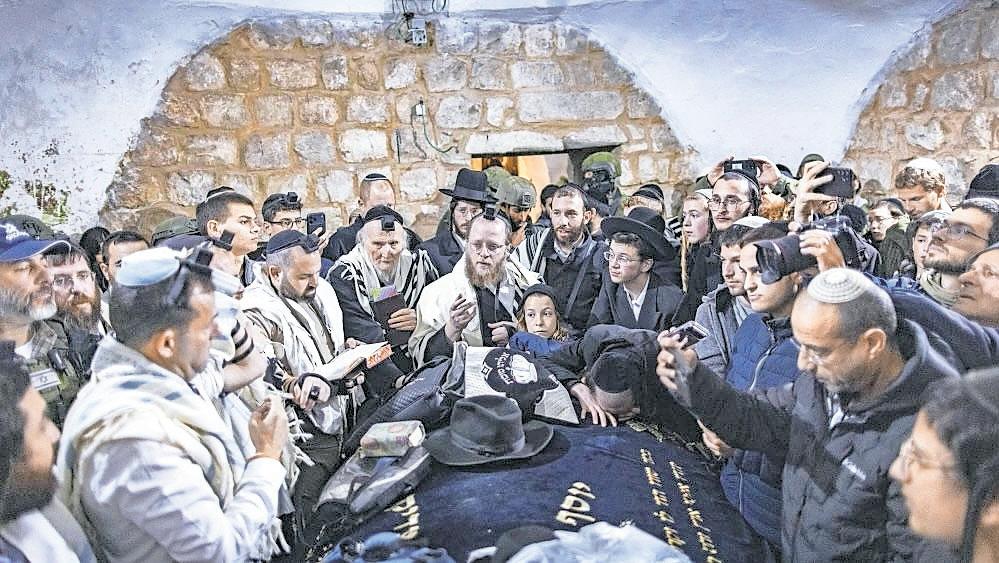
For the first time in 26 years, Jews held an afternoon prayer service Sunday at Joseph’s Tomb in Nablus — a flashpoint holy site that has long been at the center of Israeli-Palestinian tensions. Knesset member Zvi Sukkot and Samaria Regional Council head Yossi Dagan joined worshippers, with participants unfurled a giant Israeli flag and calling for a permanent Israeli presence. Joseph’s Tomb became a symbol of the Second Intifada after Druze Border Police officer Madhat Yusuf was killed there in 2000. Israel later evacuated the compound, which was subsequently damaged by Palestinian rioters. Pictured (by Chaim Goldberg, Flash 90): Jews praying at the site on Jan. 29.
The mother was 25 weeks pregnant when scans revealed the growth was causing heart failure in the unborn baby. Surgeons entered the uterus and sealed blood vessels feeding the tumor, cutting off its blood supply. The mother has since been discharged and remains under medical supervision.
Judge tosses antiIsrael protest suit
A federal judge dismissed a lawsuit by Jewish Voice for Peace South Florida accusing Miami Beach officials of violating activists’ free-speech rights during anti-Israel demonstrations. US District Judge Rodolfo A. Ruiz II ruled the complaint relied on vague and unsupported allegations and failed to adequately state its claims.
The suit challenged restrictions on protests near the Miami Beach Convention Center and enforcement of a city ordinance barring obstruction of traffic. The case was dismissed without prejudice, allowing the group to file an amended complaint by June 19.
Israel eyes AI leadership role
Israel aims to become a global leader in artificial intelligence by focusing on practical real-world applications, according to Maj. Gen. (res.) Erez Eshel, head of the National Artificial Intelligence Directorate. Speaking at an economic conference, Eshel said Prime Minister Benjamin Netanyahu has made AI a national priority.
School board member blasted over salute
An Arizona school board member is facing calls to resign after appearing to give a Nazi salute during a public meeting. Kimberly Fisher allegedly said “Heil, heil” after a discussion about scheduling. Education groups, Jewish organizations and fellow officials condemned the gesture and demanded her resignation. Fisher later claimed she was expressing frustration with board leadership, but critics said invoking Nazi imagery has no place in public service.
Israel tech posts record numbes
Israel’s high-tech sector posted record results in 2025, generating $85 billion in exports and attracting nearly $15 billion in investment. The industry accounted for roughly half of Israel’s economic growth and maintained its status as a global innovation powerhouse. But a new report also warned of rising relocation requests and a growing shift of senior executives and research activity abroad. Officials say keeping jobs and investment in Israel remains a major challenge.
Spanish Jews sue over Zionism test
Firebomber praise sparks fury
A radical student group barred from the University of Colorado is under fire after publicly backing the man convicted in Boulder’s deadly antisemitic firebombing.
The Students for Justice in Palestine chapter hailed Mohamed Sabry Soliman — who killed 82-year-old Karen Diamond and injured 28 others in a 2025 attack on a pro-hostage rally — as someone who “took direct action” and declared, “We stand with him.”
Soliman, who pleaded guilty, was sentenced this month to life without parole plus 2,128 years on murder and other charges.
The university has banned the group from hosting campus events. The Anti-Defamation League blasted the post as “unacceptable and simply horrific,” warning that its message is “dangerous.”
Israel explains it push deeper into Lebanon
Israel’s ambassador to the United Nations said the Jewish state had “no choice” but to expand military operations in southern Lebanon as Hezbollah intensified attacks on northern Israeli communities.
Speaking during an emergency UN Security Council session, Ambassador Danny Danon defended the move after Israeli troops advanced farther into Lebanese territory and captured the strategic Beaufort Castle.
France, Britain, Russia and China criticized Israel’s actions, while the United States backed Jerusalem’s campaign against the Iran-backed terror group.
President Donald Trump said Israel and Hezbollah had agreed to avoid further attacks, but Prime Minister Benjamin Netanyahu warned that Israel would strike targets in Beirut if Hezbollah aggression continues.
Oscar winner blasts Hollywood bias
The Oscar-winning director of “Son of Saul” says a wave of antisemitism has made Jewish-themed films toxic in today’s movie industry.
ADL, and Israel Bonds CEO Dani Naveh. Capt. Fred Shaw
Rather than competing directly in chips and large-language models, Israel plans to capitalize on applying AI to industries and infrastructure. Officials also highlighted new international partnerships and plans for expanded computing power and AI training programs.
A Spanish Jewish advocacy group plans legal action against a Barcelona bathhouse after staff allegedly questioned Jewish visitors about Zionism before forcing them to leave. Video from the incident shows employees asking whether patrons were Zionists and telling them, “Free Palestine.”
Jewish organizations and Israel’s Foreign Ministry condemned the episode as blatant antisemitism. Community leaders are demanding a full investigation by Spanish authorities.
Hungarian filmmaker László Nemes, whose Holocaust drama won the Academy Award for Best Foreign Language Film in 2016, told Britain’s Guardian newspaper that the film likely wouldn’t even make today’s Oscar shortlist.
“There’s an orgy of antisemitism,” Nemes said, arguing that anything connected to Jews is increasingly shunned by cultural gatekeepers.
Nemes said his latest film, “Orphan,” about a Jewish teenager grappling with Holocaust trauma, has struggled to find a US distributor despite strong reviews. He blamed what he called the growing politicization of cinema and anti-Israel cultural boycotts.
Paul and Drora Brody, pictured with Rabbi Dale Polakoff of Great Neck Synagogue, were honored at an Israel Bonds event at the Mariner Estate in Great Neck on May 27. The Brodys are long-time advocates for the Jewish State. They served for 14 years as chairpersons of the Israel Day Concert in Central Park and brought Mike Huckabee and Pete Hegseth on missions to Jerusalem and Judea and Samaria before their current appointments. Paul Brody is president of ZOA Long Island and Queens. Speakers at the event included Jonathan Greenblatt, CEO of
Proudly Jewish.
Zionist.
Jewish Star Torah columnists: Rabbi Benny Berlin, spiritual leader of BACH Jewish Center in Long Beach; Rabbi Avi Billet of Anshei Chesed, Boynton Beach, FL, mohel and Five Towns native; Rabbi Binny Freedman, rosh yeshiva of Orayta, Jerusalem; Dr. Alan A. Mazurek, former ZOA chair, retired neurologist, living in Great Neck, Jerusalem and Florida.
Contributing writers: Rabbi Sir Jonathan Sacks zt”l, former chief rabbi of United Hebrew Congregations of British Commonwealth; Rabbi Yossy Goldman, president South African Rabbinical Association; Rabbi Dr. Tzvi Hersh Weinreb, OU executive VP emeritus.
To submit commentary, inquire at: Editor@TheJewishStar.com.
Five Towns Candlelighting: From the White Shul, Far Rockaway, NY
Scarsdale Candlelighting: From the Young Israel of Scarsdale, Scarsdale, NY
It’s the greatest challenge that Moses faced
It was the worst crisis in Moses’ life. Incited by the ‘mixed multitude’, the Israelites complain about the food:
If only we had meat to eat. We remember the fish we ate in Egypt at no cost - also the cucumbers, melons, leeks, onions and garlic. But now we have lost our appetite; we never see anything but this manna. Num. 11:4-6
It was an appalling show of ingratitude, but not the first time the Israelites had behaved this way. Three earlier episodes are recorded in the book of Exodus (chapters 15-17) immediately after the crossing of the Red Sea. First at Marah they complained that the water was bitter. Then, in more aggressive terms, they protested at the lack of food (“If only we had died by the L-rd’s hand in Egypt! There we sat round pots of meat and ate all the food we wanted, but you have brought us out into this desert to starve this entire assembly to death”). Later, at Refidim, they grumbled at the absence of water, prompting Moses to say to G-d, “What am I to do with these people? They are almost ready to stone me!”
The episode in this week’s Torah portion — at the place that became known as Kivrot Hataavah — was not, then, the first such challenge Moses had faced, but the fourth. Yet Moses’ reaction this time is nothing less than complete despair:
“Why have You treated Your servant so badly?” asked Moshe of the L-rd. ‘Why have I found so little favor in Your sight that You lay all the burden of this people upon me? Was it I who conceived all this people? Was it I who gave birth to them all, that You should say to me, “Carry them in your bosom, as a nursemaid carries a baby,” to the land that You swore to their fathers? Where am I to get meat to give all this people when they come wailing to me, “Give us meat to eat”? I cannot bear all this people alone; the burden is too heavy for me. If this is how You treat me, kill me now, if I find any favor in Your sight, and let me not see my own misery. Num. 11:11-15
It is an extraordinary outburst. Moses prays to die. He is not the last prophet of Israel to do so. Elijah, Jeremiah and Jonah did likewise — making us realize that even the greatest can have their moments of despair. Yet the case of Moses is particularly puzzling. He had faced,
Being a prophet does not help someone carry out administrative or other burdens of leadership.
and overcome, such difficulties before. Each time, G-d had answered the people’s requests. He had sent water, and manna, and quails. Moses knew this. Why then did the fourth outburst of the people (‘If only we had meat to eat’) induce in this, the strongest of men, what seems nothing less than a complete breakdown?
Equally strange is G-d’s reaction:
Gather for Me seventy of Israel’s elders, whom you know to be the people’s elders and officers, and bring them to the Tent of Meeting. Let them stand there with you. I will come down and speak with you there, and I will take some of the spirit that is on you and place it upon them; they will share the burden of the people with you, and you will not have to bear it alone. Num. 11:16-17
To be sure, this is a response to Moses’ complaint, ‘I cannot carry all these people by myself.’ Yet both complaint and response are puzzling. In what way would the appointment of elders address the internal crisis Moses was undergoing? Did he need them to help him find meat? Clearly not. Either it would appear by a miracle or it would not appear at all. Did he need them to share the burdens of leadership? The answer is again, No. Already, not long before, on the advice of his father-in-law Yitro, he had created an infrastructure of delegation. Yitro had said this: What you are doing is not good. You will be worn away, and this people along with you. It is too heavy a burden for you. You cannot carry it alone. Now listen to me, let me advise you; and may G-d be with you. You speak for the people before G-d and bring their concerns to Him. And you must acquaint them with His precepts and laws and make known to them the path they are to walk and the way they must act. You, as well, must seek out among the people capable men — G-d-fearing, trustworthy men, who despise corruption; and appoint them over the people as leaders of thousands, hundreds, fifties, and tens.
Ex. 18:18-21
Moses acted on the suggestion. He therefore already had assistants, deputies, a leadership team. In what way would this new appointment of seventy elders make a difference?
Besides which, why the emphasis on spirit in G-d’s reply: “I will take of the spirit that is on you and put the spirit on them?” In what way did the elders need to become prophets in order to help Moses?
Being a prophet does not help someone in carrying out administrative or other burdens of leadership. It helps only in knowing what guidance to give the people — and for this, one prophet, Moses, is sufficient. To put it more precisely, either the seventy elders would deliver the same message as Moses or they would not. If they did, they would be superfluous. If they did not, they would undermine his authority (precisely what Joshua feared in Num. 11:28.)
Aware of the multiple difficulties in the text, Ramban offers the following interpretation: Moses thought that if they had many leaders, they would appease their wrath by speaking to their hearts when the people started complaining. Or it is possible that when the elders prophesied, and the spirit was on them, the people would know that the elders were established as prophets and would not all gather against Moses but would ask for their desires from them as well.
Both suggestions are insightful, but neither is without difficulty.
The first — that the elders would become peacemakers among the people — did not call for a new leadership cadre. Moses already had the heads of thousands, hundreds, fifties and tens. The second — that their presence would diffuse the people’s anger by giving them many people, not one, to complain to — is equally hard to understand.
We recall that when the people had one other person to turn to with their concerns (Aar-
on), this led to the making of the Golden Calf. Why did G-d not ‘take of the spirit’ that was on Moses and place it on Aaron at that time? It would have prevented the single greatest catastrophe in the wilderness years? Besides which, we do not find that the seventy elders actually did anything at Kivrot Hataavah. The text even says, “When the spirit rested on them, they prophesied, but they did not do so again.” How then did this once-and-never-to-be-repeated flow of the prophetic spirit make a difference?
The more we reflect on the passage, the more the difficulties multiply.
Yet something happened. Moses’ despair disappeared. His attitude was transformed. Immediately thereafter, it is as if a new Moses stands before us, untroubled by even the most serious challenges to his leadership. When two of the elders, Eldad and Medad, prophesy not in the Tent of Meeting but in the camp, Joshua senses a threat to Moses’ authority and says, “Moses, my lord, stop them!”
Moses replies, with surpassing generosity of spirit, ‘Are you jealous for my sake? Would that all the L-rd’s people were prophets and that the L-rd would put his spirit on them.’ In the next chapter, when his own brother and sister, Aaron and Miriam, start complaining about him, he does nothing: “Now Moses was a very humble man, more humble than anyone else on the face of the earth.” Indeed, when G-d became angry at Miriam, Moses prayed on her behalf.
The despair has gone. The crisis has passed. These two challenges were far more serious than the request of the people for meat, yet Moses meets them with confidence and equanimity. Something has taken place between him and G-d and he has been transformed. What was it?
To understand the sequence of events we must first place them in their historical context. Rabbi Moshe Lichtenstein, in his insightful book on Moses’ leadership, Tzir veTzon (Alon Shvut, 5762) notes that there is a marked change of tone between the book of Exodus and the book of Numbers. The complaints do not change, but G-d’s and Moses’ responses do. In Exodus, G-d does not get angry with the people, or if He does, Moses’ prayers are able to turn away wrath. In Numbers, the response — sometimes G-d’s, sometimes Moses’ — are more unforgiving. What has changed?
R. Lichtenstein — correctly in my view — suggests that the early volatility of the people is forgivable. To be sure, they should have had faith in G-d, but they had never been faced with the Red Sea, or the desert, or lack of food and water before. Their greatest offence — making the Golden Calf — leads to a long pause in the narrative, essentially from Exodus chapter 25 to Numbers chapter 11. During this period, in response to Moses’ prayer for forgiveness, G-d instructs the people to build a Tabernacle which will ensure His constant presence among them.
rabbi Sir JonaThan
Let’s be honest: What really gets us upset?
Arabbi and his wife spent their careers on a college campus, pouring themselves into the lives of Jewish students. Shabbos after Shabbos, their table overflowed with guests. Their home was a place of warmth, Torah learning, and genuine sacrifice.
One Shabbos night, someone asked their children a simple question. “What matters most to your parents?”
The children answered without hesitation.
“Not eating on the couch.”
The parents were stunned. We host dozens of students every week. We have built our lives around this work. And what the children absorbed was a rule about furniture.
The father asked, “Why do you think that?”
The oldest child said, “That is when you get most upset. That is when you are most angry.”
What gets us upset reveals a lot about what we care about. What we feel in our kishkes tells the honest story of our values, far more honestly than our jobs or our speeches ever could.
That same principle helps explain one of the most surprising emotional moments in the Torah.
At the opening of Parshas Beha’alotecha, Rashi asks a seemingly simple question. Why does the Torah juxtapose the mitzvah
of the Menorah with the conclusion of last week’s parsha, which described the elaborate dedication offerings brought by the nesiim? Each nasi brought stunning gifts during the historic dedication of the Mishkan.
Rashi quotes the Midrash that “chalshah da’ato.” Aharon was distressed. (Rashi to Bamidbar 8:2, citing Midrash Tanchuma, Beha’alotecha 5)
He had not been included. Neither he nor Shevet Levi had brought any offerings.
At first glance, Aharon’s reaction seems surprising. Why should the Kohen Gadol be so troubled by missing a ceremony? Why should this matter so much to him?
The answer is that Aharon was not upset because he missed the celebration. He was upset because he missed an opportunity to draw close to the Shechinah. He longed for his own act of devotion, his own expression of love and service before Hashem.
His distress revealed the truest thing about him. And that is precisely why Hashem does not dismiss his feelings. Hashem validates them. In effect, Hashem tells Aharon that what troubles him reveals what he values most.
Hashem responds with the gift of the Meno-
Our mission: Keep the fire of Yiddishkeit lit
My wife and I are in Sydney as part of a speaking tour of Australia. As we landed here, before we even went to our hotel, straight from the airport, we stopped at Bondi Beach, the scene of the horrific massacre on Dec. 14, the first night of Chanukah. I felt I had a moral obligation to go and say a prayer for the 15 martyred souls of that shocking terrorist attack. It’s quite frightening to see a city renowned
Once
for its beauty and tranquility become a hotbed of overt Jew-hatred. Speaking to Australians, it’s clear that they are still traumatized by this most unimaginable disaster. I gave a talk on antisemitism at one of the synagogues here, and many in the audience came over to thank me afterwards, saying, “Rabbi, we needed to hear that.”
I suppose it is quite understandable that the typical response to such events might be to hide one’s Jewishness from being outwardly visible. Don’t go to shul. Wear a baseball cap, not a kippah. Tuck that chai necklace, that Star of David, inside your shirt. But I encouraged people to do the reverse.
Of course, we should be careful and responsible and not throw caution to the wind. Like I
Ialways say, “Trust in G-d, but lock your car.” Still, to become closet Jews is exactly what our enemies want. And so, we dare not give them the very satisfaction they seek. We should overcome our fears, be proud of our identity and not conceal it from the world.
At the end of the day, whether Jew-haters will achieve their desire depends on us, not them. My favorite quotation from David Ben-Gurion, one of Israel’s founding fathers and
its first prime minister, is: “It doesn’t matter what the nations say. It matters what Israel does.”
Whether it is condemnation of Israel in the United Nations or international media, defamatory statements may sting but have little effect. What matters most is what Israel does, despite such venomous words of hate, disdain and distortion.
I recall that on the Lubavitcher Rebbe’s 25th yahrzeit, David Suissa, editor of the Jewish Journal in Los Angeles, wanted to know the Rebbe’s response to antisemitism. It was pro-semitism! Jews should be more Jewish, not less. The Rebbe launched 10 mitzvah campaigns encouraging us to live more active Jewish lives.
again, we’re standing on the cliff’s edge
magine an old-fashioned cowboy Western. A stagecoach has been ambushed by outlaws who have killed the driver. The horses, spooked by gunfire, bolt down a winding road toward a cliff. Inside the coach, the hero regains consciousness and desperately tries to reach the reins before disaster strikes.
You sit on the edge of your seat, wishing you could leap into the screen and stop the horses yourself.
That is how I feel, sitting in Israel, reading
these parshiyot. We read B’haalotcha last week (while those in chutz la’Aretz are getting to it this week while we read Shlach). In Shlach, B’nei Yisrael make the unforgivable mistake of the sin of the Spies, refusing to enter the Land, a error that will cost most of that generation — including their great leaders Moshe, Aharon and Miriam — their lives.
I want to urge our coreligionists outside of Israel — and to reach back and warn our forefathers in B’haalotcha — to stop your foolish complaining, bitterness, anger and fear. Trust in Hashem! You are heading for a cliff!
That’s also how I feel as I review the parsha and write this, because President Donald Trump has still not made his decision about whether to proceed with an extension of the “ceasefire” with Iran or resume the war and fin-
‘Not by armies and not by strength, but by My Spirit.’
ish the job.
A good part of me wants to grab the president by the shoulders and say, “What are you doing? You’ve won — G-d of Israel is on your side, just finish the job, don’t snatch defeat from the jaws of victory! You are being played by this evil regime who has no intention of complying with any ‘deal,’ if you don’t eliminate them, not just you and your presidency but the fate of the world (and especially Israel which appears bound to
follow your lead) will go over a cliff.”
Perhaps that sounds melodramatic. Yet our parshiyot — and much of Sefer Bamidbar — remind us that we have been here before. Throughout Jewish history, we see the same pattern. There was chet ha’egel, the sin of the Golden Calf; there were the complaints in B’haalotcha; the sin of the Spies; Korach’s rebellion and the sins at Ba’al Peor Later came Shaul HaMelech’s failure to eradicate Amalek, divisions within the kingdom and ultimately the destruction of both Temples.
I call this the Plan A and Plan B outline of Jewish history.
Hashem gives us instructions and tells us where they lead. That is Plan A. We object, complain, fear, divide and resist;
Seeking and then winning a second chance
During my first year in high school, I struggled academically and socially. But I knew one thing: I liked to write, and I sought to learn how to do so.
Toward the end of the year, I learned that there was a special track in the English department — “Journalism for Sophomores” — that was open to those who did well in their freshman English courses. But I was merely passing freshman English.
Nevertheless, I applied for entry into the journalism class. I was turned down. But I per-
sisted and made it my business to arrange for an interview with Mr. Joe Brown, the instructor for the class and also the adviser for the student newspaper.
I will never forget Mr. Brown, because he was impressed by my perseverance and gave me a second chance, explaining that many freshmen often become overwhelmed by the novelty of their new environment and don’t always excel to their full potential. He would allow me into the elite journalism class with the condition that I would prove myself by doing extra essays, and doing them well, during the first six weeks of the semester.
I fulfilled his conditions and spent not one, but three years in the special journalism section under his tutelage. I enjoyed it, learned a great deal, became one of the editors of the prize-winning student newspaper, and was elected editor-in-chief of the senior yearbook. To this day, every time I put a
The
pencil to paper or fingers to a computer keyboard, I think of Joe Brown.
In this week’s Torah portion, Beha’alotecha, we read of a group of people who, like me, were unable to fulfill their responsibilities the first time around. In their case, it was the mitzvah of bringing the Passover offering on the 14th day of the month of Nisan, which they failed to do. For them, it was not the strangeness of a new school that prevented them from doing the mitzvah properly. Rather it was because “they were unclean, having come into contact with a dead body, so that they could not keep the Passover on that
day” (Numbers 9:6).
They could easily have taken the approach of shrugging their shoulders and saying something like, “We tried our best, but circumstances were such that we were unable to perform the Passover sacrifice. We have a good excuse, so let’s move on.”
But that was not their reaction. Instead, “... they came before Moses and before Aaron on that day.” They wanted, nay demanded, a second chance.
“Unclean though we are by reason of a corpse, why must we be debarred from presenting the L-rd’s offering at its set time with the rest of the Israelites?” (Numbers 9:7) They persisted and insisted upon having the same benefits of the rest of the people, those who did not suffer the set of circumstances that denied this particular group of men this type of privilege. Our Jewish identity must not weaken.
Published weekly except during certain religious and civil holidays by The Jewish Star LLC New York City office: 5676 Riverdale Ave Suite 311, Bronx NY 10471 • LI office: 2 Endo Blvd, Garden City NY 11530
Here’s how to reach The Jewish Star — Write: Editor@TheJewishStar.com. Call: 516-622-7461 ext 291
Editor & Publisher: Ed Weintrob
516-622-7461 ext 291
Jewish Star Associate: Nechama Bluth
516-622-7461 ext 241
Content: The Publisher endeavors to ensure that our content is within the bounds of normative halachah and hashkafah. Anyone who feels anything we publish may be inappropriate in this regard is urged to bring the item in question to the attention of the Publisher.
Advertising is accepted at the sole discretion of the Publisher and should conform to standards appropriate for distribution in an Orthodox community. Send us your news! Editor@TheJewishStar.com
Advertising: Publisher@TheJewishStar.com
Kashrut: The Jewish Star is not responsible for the
kashrut of any product or establishment featured in its pages. If you have questions regarding any establishment or product, including its supervision, please consult your rabbi for guidance.
Submissions: All submissions become the property of The Jewish Star and may be edited and used by the Publisher, its licensees and affiliates, in print, on the web and/or in any media that now exists or will exist in the future in any form, including derivative works, throughout the world in perpetuity, without additional authorization or compensation. The individual or entity submitting material affirms that it holds the copyright or otherwise has the right to authorize its use in accordance with The Jewish Star’s terms for submissions.
Opinions: Views expressed by columnists and other writers do not necessarily reflect the position of the Publisher or of The Jewish Star LLC.
Distribution: The Jewish Star is available free in kosher food establishments, stores, synagogues, and curb-side newsboxes on Long Island, in New York City and elsewhere. To request free delivery to your location, write Publisher@TheJewishStar.com.
Copyright: All content is copyright and may not be republished or otherwise reproduced without written permission by The Jewish Star; to do so without permission is against the law and halacha. For content reproduction write to Publisher@TheJewishStar.com.
The Jewish Star subscribes to JNS. It, or its contributors, own the copyrights on material attributed to them. The length and content of JNS material and all other submitted material may be edited by The Jewish Star. Member: American Jewish Press Association. This newspaper contains words of Torah. While it is not considered shaimos, please dispose properly.
In the end, despite worries about disruptions, the possibility of official indifference to security considerations and the unprecedented absence of the mayor of New York City, Gotham’s annual Israel Day Parade went off without a hitch. More than 50,000 people marched up Fifth Avenue on May 31 to the cheers of spectators of all ages and backgrounds.
Yet the key question to be asked about the parade is not why one man absented himself from it. Rather, it is, as some on the Jewish left claim, that an expression of support for Israel’s ongoing and successful struggle to survive and thrive in a hostile world is no longer a cause that brings together most Jews. That is the conceit of commentary in publications like The Forward, reflected in the results of a poll published by a group run by those connected to the Democratic Party.
The issue at the heart of this controversy is not about whether or not it’s acceptable for a mayor of the largest Jewish city outside of Israel to boycott a major Jewish event of the year. It’s whether the project to normalize antizionism — a belief that is indistinguishable from antisemitism, and behind efforts to target American Jews for intimidation and violence, and Israelis for genocide — is succeeding.
Celebration of Jewish life
The parade is far from the largest ethnic or religious one held every year in Manhattan. Processions celebrating St. Patrick’s Day, Puerto Rico and the Dominican Republic, let alone the Macy’s Thanksgiving Day televised marketing extravaganza, are far larger. But the fact that this annual celebration of the Jewish state requires far more extensive security than those popular events speaks volumes about the surge
of antisemitism that American Jews are currently experiencing.
There was a lot of criticism of Mamdani’s decision to be the first mayor to boycott the parade since its inception in 1965 — and understandably so.
The event is the single citywide affair that honors the heritage and interests of one of the area’s largest ethnic and religious groups. Slightly less than 1 million of the Big Apple’s nearly 9 million residents are Jewish. Every previous mayor and most other major elected officials on the municipal and state level have felt it obligatory to show up for it. The sight of politicians elbowing their way to the front rank of the parade is as familiar at Israel’s day in the sun as at the other ones devoted to other constituencies.
But this year, the city’s mayor was only present in the form of humorous cardboard cutouts of him and his wife, Rama Duwaji, carried by some wags in the crowd, in which they were depicted as waving Israeli flags. Some social-media accounts used AI to produce images of the pair
Mamdani’s absence from the Israel Day shindig was appropriate. But efforts to deny his antisemitism by citing a skewed poll point to deeper problems.
as if they were Thanksgiving Day balloons, in which they were similarly shown as holding the blue-and-white emblem of the Jewish state.
Nevertheless, the 34-year-old chief executive of the nation’s largest city was right to stay away.
Say what you will about a demagogic politician dedicated to reviving Marxism — one of history’s bloodiest and costliest failures — as if the catastrophic events and slaughter brought on by it never happened. But on this issue, at least he wasn’t a hypocrite. Having centered his entire career as an activist and elected official primarily on his devotion to the cause of eliminating the one Jewish state on the planet, Mamdani’s presence on Fifth Avenue would have made little sense. More than that, it would have been offensive.
Those, like the mayor, who support international efforts to deprive Jews of rights they wouldn’t think of denying to any other group, have no place in a demonstration that celebrates Jewish life and the achievements of Jewish state.
Mamdani also wisely chose not to interfere with the parade. Instead, Police Commissioner Jessica Tisch, the parade’s honorary grand marshal, ensured that the New York City Police Department did what it does best. Tisch, who at times seems to be acting as the antisemitic mayor’s ambassador to the Jewish community, allowed Mamdani to stay away without being
OPINION COLUMNISTS
Mitchell Bard, foreign policy analyst, authority on USIsreal relations; Ben Cohen, senior analyst, Foundation for Defense of Democracies; Stephen Flatow, president, Religious Zionists of America-Mizrachi and father of Alisa Flatow, murdered in an Iranian-sponsored Palestinian terrorist attack in 1995; Yisrael Medad, Americanborn Israeli journalist and political commentator; Rafael Medoff, founding director of David S. Wyman Institute for Holocaust Studies; Fiamma Nirenstein, Italian-Israeli journalist, author of 13 books, leading voice on Israeli affairs, Middle Eastern politics and antisemitism; Melanie Phillips, British journalist; Moshe Phillips, national chairman, Americans for a Safe Israel; Thane Rosenbaum, Distinguished University Professor at Touro University (published by Jewish Journal); Jonathan S. Tobin, editor-in-chief, Jewish News Syndicate.
Jew-hater
accused of undermining the event.
While the mass turnout produced the usual feel-good vibe, it’s also true that Jewish New York, which turned out in far larger numbers in 1967 (when a reported quarter-million people attended just weeks before the Six-Day War, when many believed that a second Holocaust was in the offing), 1977 (when a reported 300,000 people marched and attended) or even in 2002 (when a reported 1 million turned out months after the 9/11 attacks), no longer exists.
Post-Oct. 7 world
The vast majority of American Jews still support Israel. But many liberal and left-wing Jews have largely internalized and/or accepted the barrage of smears aimed at it. Others even believe the blood libels about it committing “genocide” in Gaza or being an “apartheid” state — false rhetoric that has been mainstreamed by corporate media outlets like the New York Times.
The Jewish world of 2026 can still mobilize many members of Jewish organizations, as well as schools and synagogues, to show up for the parade. But after the events of the last 32 months since the Hamas-led Palestinian Arab terror attacks on Israel on Oct. 7, 2023, it’s not surprising that many individuals are probably afraid to turn up at a pro-Israel gathering. They know the statistics that show that antisemitic attacks have become commonplace in New York and other cities across America. And they are aware of the fact that the mayor has egged on mobs that have besieged synagogues, where pro-Israel events have been held, as well as support those who have turned college campuses into hostile environments for Jews.
Yet what is deeply concerning is the effort to treat Mamdani and the general anti-Israel movement that has seemingly captured the base of the Democratic Party as being distinct from Jewhatred. When pundits in left-wing publications disingenuously claim that opposition to Israel’s existence as a Jewish state isn’t antisemitism, they aren’t merely making an indefensible argument. They know that Jewish security in a Middle Eastern state where Jews couldn’t defend themselves is an invitation to the genocide that Palestinian supporters of Hamas and other terror groups dream about.
And they also recognize the purpose of efforts to demonize Israel and to distract from and/or
Confronting the many poisons of antizionism
Many of the responses to a chilling Instagram post from Maureen Galindo, who is running for the Democratic nomination in Texas’s 35th Congressional District, depicted her statement advocating the corralling of “American Zionists” into an internment camp as proof of her mental illness.
I have no doubt that Galindo — a breathtakingly stupid individual who nonetheless says she is a “marriage and family therapist” by trade, and who came first in the March 2026 Democratic primary with 30% of the vote [before losing the runoff after her internment camp remarks were widely circulated] — is deeply disturbed. She is clearly in thrall to her perverted fantasies of state-orchestrated violence against those with whom she disagrees. But I’d also argue that her mental stability is beside the point.
Were Galindo a Hamas politician in Gaza or one of the handful of female parliamentarians in Iran, a statement like hers would hardly be remarkable. In the West, however, where we consider ourselves sufficiently civilized to automatically eschew such proposals as heinous incitement, we have a tendency to fall back on the term “mental illness” to describe those who go
Maureen Galindo, a Texas Democrat who ran for Congress, is not an outlier.
against the grain.
I don’t want to play that game. The solution for someone like Galindo is not therapy. Rather, we should take her at her word and recognize her as the budding genocidaire that she clearly is. As the scholar Naya Lekht correctly observed in a post on X, Galindo belongs among the volunteer women who served as guards at Nazi concentration camps, “known for brutality and active participation in mass murder operations.”
Galindo later replaced her Instagram post with a pathetic attempt to portray the reaction against her as a distortion of what she originally said. “Billionaire Zionists” were, she insisted, organizing a “blitz campaign” falsely claiming that she “wants Jews in warehouses.”
Actually, the post she took down was far more graphic.
Galindo pledged to turn the Karnes detention center near San Antonio “into a prison for American Zionists,” adding that the facility could also function as “a castration processing center for pedophiles, which will probably be most of the Zionists.”
She wasn’t just simply using dehumanizing language in associating “billionaires” and “pedophiles” with Jews: Galindo announced a plan of action to launch a second Shoah, along with a venue to begin its implementation.
To cover herself — in the slimy, cowardly manner that comes naturally to Jew-haters — she resorted to the trick of replacing “Jews” with “Zionists,” so that any legal scrutiny of her comments would conclude that she was targeting, however distastefully, a political group that she opposes rather than an ethnic group with immutable characteristics.
Just because the First Amendment sets an extremely high bar for speech to be deemed as incitement to imminent violence doesn’t mean that we are obliged to give Galindo a pass. We know exactly what she means, even if she worded her
remarks in such a way as to give herself some legal wiggle room.
Galindo is emblematic of a process that I’ve previously described as the “Nazification” of anti-Zionism. She should not be seen as an outlier, but rather as a faithful representative of the monstrosity that anti-Zionism, which I prefer to call “antizionism,” has become.
The fact that not a single one of the organizations that celebrated the Hamas massacre in Israel on Oct. 7, 2023, has condemned Galindo is no accident. She speaks for them. Her agenda is their agenda. The pogromists who have gathered in mobs outside synagogues in New York — egged on by the city’s Islamist Mayor Zohran Mamdani — share her views. The student encampments displaying signs urging the exclusion of “zios” share her views. The social-media influ-
encers and podcasters of left and right, who have bonded through their hatred of Jews, share her views.
Every single one of their utterances contains the inner logic that Galindo articulated, in a faithful reflection of the historical trajectory of antisemitism as described by the late Holocaust scholar Raul Hilberg: “You have no right to live among us as Jews; you have no right to live among us; you have no right to live.” The only change is replacing the word “Jews” with “Zionists”; the fundamental intent is exactly the same. Jews in America need to equip themselves with the tools to fight back, and they need to do so quickly. That means embracing the selfdefense and weapons-training programs that are increasingly available to members of the commu-
See Cohen on page 26
hoaxes Palestinian allies mistakenly believe
The preposterous accusation that Israel’s defense forces used dogs to rape Palestinian prisoners — published on May 11 by New York Times columnist Nicholas Kristoff — only dramatizes mainstream media’s campaign to slander and dismantle the Jewish state. In fact, such lies, innuendo and misinformation occur daily these days in reporting on Israel.
No wonder that, although for decades a wide majority of Americans supported Israel, that trend has recently reversed. According to a February 2026 Gallup poll, 41% of Americans sympathize more with the Palestinians, versus 36% who sympathize more with Israel. Like American mainstream media, supporters of Palestinians are mostly “progressives” — leftist Democrats and independents, and young people, ages 20 to 35. Indeed, the Gallup poll reveals that 65% of Democrats, 41% of Independents, and 53% of Americans aged 18 to 34 side with the Palestinians over Israel.
Specifically, according to polls, the top five reasons most Americans support Palestinians over Israel include 1) humanitarian empathy for victims of the Gaza conflict; 2) perceptions of Israeli occupation and a power imbalance; 3) the cause’s alignment with progressive values; 4) opposition to US foreign policy and aid; and 5) support for a two-state solution.
However well-meaning supporters of the Palestinians may be — and however noble their reasons sound on the surface — the truth is, these justifications are hoaxes: misinformation, fantasies and outright slanders. In short, progressives who support Palestinians are either at best victims of massive media propaganda or, at worst, themselves authors of anti-Israel slanders, such as the
New York Times.
Hoax #1: The humanitarian crisis and civilian suffering in Gaza. Media would have Americans believe that Israel killed more than 70,000 innocents (mostly women and children) in Gaza and caused the starvation of tens of thousands more — adding up to a cruel, disproportionate and unnecessary response to Hamas’s attack on Israel on Oct. 7, 2023.
Disgracefully, such media reports seldom mention that Israel’s war with Hamas in Gaza ensued only because the Palestinians started it, as they have started every war with Israel, as part of their 78-year campaign to destroy
the Jewish state.
The media also fail to note that the Gaza death toll includes some 35,000 Hamas fighters and represents what experts call the lowest ratio of civilians to fighters — about 1:1 — in military history. Finally, while the media hammer unsubstantiated reports of “imminent starvation” in Gaza, they ignore the fact that hunger never reached starvation levels, largely because Israel delivered some two million tons of humanitarian aid to Gazan civilians.
They also forget to mention that huge amounts of aid were stolen by Hamas and sold for a profit on the black market to their own people at exorbitant prices.
Hoax #2: Palestinians live under Israeli occupation. The media rarely ever tells Americans historical facts about the land of Israel, especially that the Romans renamed it “Palestine” in 135 C.E., hundreds of years before Arabs arrived there. Nor do they clarify that before Hamas invaded Israel on Oct. 7, 2023, no Israeli — civilian or military — had set foot in Gaza since 2005. For 18 years, Gazans were self-governing.
While Israelis live in Judea and Samaria (aka the West Bank) with Palestinians, none of this territory “belongs” to the Palestinians; it is legally disputed land. In fact, there has never been a country called “Palestine,” nor have the Palestinians ever held sovereignty anywhere. Israel governs part of this territory according to the Oslo Accords, signed by the Palestinian Authority, but the Palestinians rule themselves on all civil and security issues day to day in most of this territory. In short, it’s a lie that Palestinians live under Israeli
Jewish and pro-Israel activists protest against Mayor Zohran Mamdani outside his Gracie Mansion home on May 26. Liri Agami, Flash90
Pro-Palestinian demonstrators outside the UEFA Europa League match between Maccabi Tel Aviv and Aston Villa in Birmingham, England, Nov. 6, 2025. Flash90
The humanitarian crisis Mandla Mandela ignores
While more than 50 vessels participating in a Turkish-led flotilla associated with networks linked to the Humanitarian Relief Foundation (İHH), a Turkish NGO, were being boarded last week by Israeli naval forces, Mandla Mandela — a traditional leader of the Mvezo Traditional Council in the Eastern Cape — was in Libya as part of the Global Sumud Flotilla Relief Convoy. A traditional leader entrusted with representing communities facing severe water insecurity is publicly aligning with that flotilla. That is not a coincidence. It is a verdict on priorities.
Mandela’s participation in the Global Sumud Flotilla campaign is not a private political opinion. It is a public declaration of where his attention, energy and symbolic capital are directed. And the communities of the Eastern Cape — the people he is constitutionally and culturally obligated to represent — are not the beneficiaries of that declaration. They are its casualties.
South Africa does not lack for crises demanding urgent attention. The statistics are not background noise; they are an indictment. South Africa’s official unemployment rate stands at 32.7%, while the broader expanded definition rises above 43%.
The
Millions of South Africans remain trapped in long-term economic despair. Gender-based violence has reached levels so severe that government ministers themselves have described it as a second pandemic. South Africa continues to record among the highest femicide rates in the world. Millions live in food poverty. Child malnutrition remains entrenched. The public healthcare system operates under chronic strain. The education system continues producing outcomes that limit opportunity before many children have even reached adulthood.
This is the country in which Mandela, a member of parliament for the African National Congress since 2009 and the grandson of Nelson Mandela, has chosen to spend his political capital on international flotilla campaigns.
Traditional leadership in South Africa is not intended to be a platform for international political theater. It carries recognized obligations toward the welfare, development and representation of local communities. Under South Africa’s traditional governance framework, traditional councils are expected to assist in iden-
tifying community needs, participate in development initiatives and support service delivery within the communities they represent.
Yet in parts of the Eastern Cape, families still live without reliable water infrastructure while their traditional leader participates in international flotilla campaigns thousands of kilometers away. In communities under Mandela’s own leadership, children are still carrying buckets for water before school. That contrast is impossible to ignore.
The Eastern Cape is living through a humanitarian failure that has become so normalized that many South Africans barely register it anymore. It is one of the poorest provinces in a country already defined by inequality.
In rural communities across the province, families do not turn on a tap. They walk. They carry. They ration. Children arrive at school already exhausted from the morning’s water run, if they arrive at all. Clinics operate without a reliable water supply, which means that the most basic standards of hygiene — the foundation of any functional healthcare environment — can-
not be guaranteed. Schools lack functioning sanitation. Households lack flushing toilets. Water schemes exist on paper — and on paper only. Infrastructure has repeatedly been promised, partially implemented, and then abandoned to dysfunction and neglect.
This is not a natural disaster; it is a governance failure. It is the predictable consequence of leaders who have found it more rewarding to perform solidarity on an international stage than to deliver services to the people who depend on them.
The IHH, the Turkish organization closely associated with the Mavi Marmara flotilla in 2010, does not have a record that warrants unquestioning humanitarian credibility. During that confrontation, activists aboard the vessel violently resisted Israeli forces using knives, clubs, and improvised weapons, leading to a deadly clash in which 10 activists were killed. The incident remains internationally contested and politically charged to this day.
Israel’s Foreign Ministry has characterized the current flotilla campaign as a political provocation rather than a legitimate humanitarian mission, arguing that it serves Hamas propaganda objectives more than civilian aid delivery. Importantly, the convoy is not part of the internationally recognized humanitarian framework established under U.N. Security Council Resolution 2803 and related coordination mechanisms for assistance to the Gaza Strip.
Imagery and documentation emerging from previous Sumud-linked campaigns, including overt political theatrics, social-media spectacle and public displays involving symbols and gestures associated with Hamas, have reinforced concerns that these flotillas are designed as ideological performances as much as humanitarian initiatives.
And yet, this is the campaign with which a
See Segal on page 26
After locking doors, judging those who survived
When critics invoke the 1946 bombing of the King David Hotel in Jerusalem to condemn the Zionist movement or sneer that Jews living in Judea and Samaria “came from Brooklyn,” they are not merely making an argument about Israeli history. They are implicitly removing the same critical context — that Jews did not always have a choice about where to go. Two English-speaking democracies made that choice for them. And neither has ever said it was sorry.
In 1905, as hundreds of thousands of Jews were fleeing pogroms in the Russian Empire, Britain enacted the Aliens Act. The word “Jew” never appeared in it; it did not need to.
Arthur Balfour, the very man who would later issue the declaration bearing his name, backed the bill as prime minister, warning of the “undoubted evils” of immigration that was “largely Jewish.” The act introduced Britain’s first modern peacetime immigration controls and classified impoverished refugees as “undesirables.” The door that had previously been open to all who could afford the passage was quietly closed. Nineteen years later, the United States went
Much
further. The Johnson-Reed Act of 1924, building on the Emergency Quota Act of 1921, which had already sharply restricted immigration, set quotas calibrated to the 1890 census — deliberately chosen because it predated the great wave of Eastern European Jewish immigration, and therefore minimized the slots available to Jews, Italians and Poles. Poland, with a prewar Jewish population of 3.5 million, received an annual quota of 6,524 visas. Romania, home to nearly a million Jews, received 377.
These were not merely inconveniences but often death sentences.
In 1939, the MS St. Louis set sail from Hamburg carrying 937 Jewish refugees. Cuba turned all but 28 of them away. The United States turned them away; the German quota from the 1924 act had been filled. The ship returned to Europe. Roughly 250 of its passengers subsequently perished in the Holocaust.
That same year, hundreds of thousands of German and Austrian Jews were waiting for American visas, while the annual German quota was only a fraction of that demand. Between 1933 and 1941, tens of thousands of quota slots that might have been used for refugees went unfilled, in part because US State Department officials deliberately tightened administrative barriers to Jewish immigration.
When more than 900 people seeking refuge are turned away by Cuba, denied refuge by the United States and Canada, and roughly a quarter are later murdered, the conversation about Jewish history is missing a significant chapter if the governments that closed their doors have never fully reckoned with their role.
That missing chapter is never cited when the King David Hotel bombing is invoked. The Irgun carried out the attack on July 22, 1946,
against the British administrative headquarters in Jerusalem — the nerve center of a mandatory government that, under the 1939 White Paper, had severely capped Jewish immigration to Palestine at the very moment European Jews were attempting to flee extermination.
The bombing was not born in a vacuum of civilized alternatives. Those alternatives had been tried. Jewish organizations petitioned the Roosevelt administration for years to ease visa restrictions or invoke executive authority to admit refugees above quota. Legislators introduced the Wagner-Rogers Bill in 1939, which would have admitted 20,000 German refugee children outside the quota. Roosevelt took no action, and it died in committee.
Thirty-two nations gathered at Evian in July 1938 at Roosevelt’s own invitation to address the refugee crisis. At the conference
itself, only the Dominican Republic made a substantial offer of resettlement and even that promise — of up to 100,000 places — ultimately yielded fewer than 1,000 arrivals.
When the slaughter became undeniable, the United States and Britain convened again, this time in Bermuda in April 1943. Jewish organizations were barred from attending. The British Foreign Office had privately warned that Germany might switch from extermination to expulsion, flooding the Allies with Jewish refugees. Critics have argued that the conference was designed, in part, to forestall that outcome. It produced nothing. The quotas held. The White Paper held.
The events of that period cannot be surgically separated from the decade of closed doors that preceded it.
With Nelson Mandela’s grandson spewing antisemitic rhetoric, a 2021 billboard in Johannesburg is a reminder of the country’s strong ties to Israel. StandWithUs
In Hamburg on May 13, 1939, the Heldenmuth family boards the MS St. Louis, a German luxury liner carrying 937 Jewish refugees from Nazi Germany to Cuba. Public Domain
SACKS: The greatest challenge Moses faced…
Continued from page 20
Much of the second half of Exodus, the entire book of Leviticus, and the first ten chapters of Numbers are dedicated to the details of the Sanctuary, the service that was to take place there, and the reconstitution of Israel as a holy nation camped, tribe by tribe, around it.
The whole of this sequence of 53 chapters, all of which is set in the desert at Sinai, is a kind of meta-historical moment, a break in the journey of the Israelites from place to place. Time and space stand still. Between the twin events of the Giving of the Torah and the construction of the Tabernacle, the Israelites are turned from an undisciplined mass of fugitive slaves into a nation whose constitution is the Torah, whose sovereign is G-d alone, and at whose center (physically and metaphysically) is the Sanctuary (the Mishkan), the visible sign of G-d’s Presence. The Israelites are no longer what they were before they came to Sinai. They are now “a kingdom of priests and a holy nation.”
Hence Moses’ despair when they grumbled about the food. They had done so before. But they were different before. They had not yet gone through the transformative experiences that shaped them as a nation.
What caused Moses’ spirit to break was the fact that, no sooner had they left the Sinai desert to begin the journey again, they reverted to their old habits of complaint as if nothing had changed. If the revelation at Sinai, the experience of Divine anger at the Golden Calf, and the long labor of building the Tabernacle had not changed them, what would or could? Moses’ despair is all too intelligible.
For the first time since his mission began, he could see defeat staring him in the face. Nothing
— or so it seemed — not miracles, deliverances, revelations, or creative labor, could change this people from a nation that focused on food into one that grasped the significance of the unique ethical-spiritual destiny to which they had been called. Perhaps G-d, from the perspective of eternity, could see some ray of hope in the future. Moses, as a human being, could not. “I would rather die,” he utters, “than spend the rest of my life laboring in vain.”
We now reach the point of speculation. I may be wrong (and the Netziv puts it another way in his introduction to Haamek Davar, section 5) but I interpret the sequence of events as follows: There can come a time in the life of any truly transformative leader when the sun of hope is eclipsed by the clouds of doubt — not about G-d, but about people, above all about oneself.
Am I really making a difference? Am I deceiving myself when I think I can change the world? I have tried, I have given the very best of my energies and inspiration, yet nothing seems to alter the depressing reality of human frailty and lack of vision. I have given the people the word of G-d Himself, yet they still complain, still they think only about the discomforts of today, not the vast possibilities of tomorrow.
Such despair (lehavdil, Winston Churchill, who suffered from it, called it the “black dog”) can occur to the very greatest (to repeat, not only Moses but also Elijah, Jeremiah, and Jonah prayed to die). Moses was the very greatest. Therefore G-d gave him the greatest gift of all — one that no one else has ever been given.
G-d let Moses see the influence he had on others
For a brief moment G-d took ‘the spirit that is on you and put it on them’ so that Moses could
neirot means “when you kindle the lights.” But there are much simpler words for “kindling” than beha’alotecha, which literally means “when you raise up.”
see the difference he had made to one group, the seventy elders. Moses needed nothing more. He did not need their help. He did not need them to continue to prophesy.
All he needed was a transparent glimpse of how his spirit had communicated itself to them.
Then he knew he had made a difference. Little could he have known that he — who encountered almost nothing from the Israelites in his lifetime but complaints, challenges, and rebellions — would have so decisive an influence that the people of Israel 3,300 years later would still be studying and living by the words he transmitted; that he had helped forge an identity that would prove more tenacious than any other in the history of humankind; that in the full perspective of hindsight he would prove to have been the greatest leader that ever lived.
He did not know these things; he did not need to know these things. All he needed was to see that seventy elders had internalized his spirit and made his message their own. Then he knew that his life was not in vain. He had disciples. His vision was not his alone. He had planted it in others. Others, too, would continue his work after his lifetime. That was enough for him, as it must be for us. Once Moses knew this, he could face any challenge with equanimity (except, many years later, at Kadesh, but that is another story).
Understood thus, there is a message in Moses’ crisis for all of us (that, surely, is why it is recounted in the Torah).
I remember when my late father z”l died and we — my mother and brothers — were sitting shiva. Time and again people would come and tell us of kindnesses he had done for them, in some cases more than 50 years before. I have since discovered that many people who have
tion with far less pain. The question is whether we ever learn.
sat shiva have had similar experiences. How moving, I thought, and at the same time how sad, that my father z”l was not there to hear their words. What comfort it would have brought him to know that despite the many hardships he faced, the good he did was not forgotten. And how tragic that we so often keep our sense of gratitude to ourselves, saying it aloud only when the person to whom we feel indebted has left this life, and we are comforting his or her mourners.
Perhaps that just is the human condition. We never really know how much we have given others — how much the kind word, the thoughtful deed, the comforting gesture, changes lives and is never forgotten. In this respect, if in no other, we are like Moses. He too was human; he had no privileged access into other people’s minds; without a miracle, he could not have known the influence he had on those closest to him. All the evidence seemed to suggest otherwise.
The people, even after all G-d — and Moses — had done for them, were still ungrateful, querulous, quick to criticize and complain. But that was on the surface. For a moment G-d gave him a glimpse of what was beneath the surface. He showed him how Moses’ spirit had entered others and lifted them, however briefly, to the level of prophetic vision.
G-d did this for no other person — not then, not now. But if it was enough for Moses, it is enough for us. The good we do lives after us. It is the greatest thing that does. We may leave a legacy of wealth, power, even fame, but these are questionable benefits and sometimes harm rather than help those we leave them to. What we leave to others is a trace of our influence for good. We may never see it, but it is there. That is the greatest blessing of leadership. It alone is the antidote to despair, the solid ground of hope.
Continued from page 21
rah. Every morning, you will clean the ash from the night before, prepare the wicks, and kindle the lights. Not once, as the nesiim had their one magnificent day, but every single day for as long as the Mishkan stands.
The Ramban adds that this consolation extends far beyond the Mishkan and even beyond the Beis HaMikdash. The light of Aharon’s Menorah would continue through the candles of Chanukah, carried forward through generations. (Ramban to Bamidbar 8:2)
Your gift, Aharon, will have nitzchiyus. You will not merely connect to Hashem for a single moment. Your service will illuminate Jewish homes long after the offerings of the nesiim have become history. Perhaps the most searching question we can carry into this week is the simplest one. What bothers us?
What genuinely cuts through us? What leaves us disappointed, frustrated, or heartbroken?
Because what disturbs us most often reveals what matters most to us, what we genuinely cherish, and what we believe is worth fighting for.
Aharon’s anguish over missing the nesiim’s dedication revealed a soul on fire for closeness to Hashem. And Hashem answered that fire with the most enduring gift imaginable, a mission that returned every single morning and whose light still has not gone out.
Rabbi Benny Berlin is spiritual leader of BACH in Long Beach www.bachlongbeach.com.
Write: Columnist@TheJewishStar.com
Continued from page 21
This week’s Torah portion (in the Diaspora) is Beha’alotecha. It begins with the instructions regarding the kindling of the menorah in the sanctuary of old. Beha’alotecha et ha-
Rashi explains that “when you raise up” is used to teach that the Kohen who kindles the menorah must ensure that the flames are well-lit and burning securely, so that they don’t flicker and become extinguished, as often does when a candle is lit. If we walk away and then come back, we may well find that the lights have gone out. Therefore, the Kohen was instructed to wait until the flames were burning strongly and independently and would not be snuffed out when he turned his back on them.
Similarly, the light of Yiddishkeit kindled in our hearts, families and communities dare not flicker and fail. Our Jewish identity — feelings of who and what we are — must not weaken, falter or fade away due to the winds of hate in this world.
Sure, it’s easier to stay home than go to synagogue. It’s simpler to put on a baseball cap than wear a yarmulke. But that goes against the grain. Our neshamah — our G-dly spark — needs to stand strong and dignified, tall and proud.
The winds of hate will pass. No, those who hate us will not suddenly come to love us. I’m not naive, and neither should you be. But if we yield to their pressure, and let their venom and violence intimidate us, then we hand them the victory they crave but do not deserve.
Like the light of the menorah of old, may the Jewish flame inside each of us burn brightly. And, slowly but surely, the truth and justice of Israel’s cause and the inherent nobility of the Jewish people will be recognized by the entire world.
Write: Columnist@TheJewishStar.com
Continued from page 21
we fail and suffer the consequences. Hashem relents and fulfills His covenant with us. He gets what He wants. That’s plan B.
We could have arrived at the same destina-
To understand this pattern, consider the haftara of Parshat B’haalotcha, also read on Shabbat Chanukah The prophet Zechariah, speaking after the destruction of the First Temple and the Babylonian exile, offers a vision that many commentators see as extending beyond his own era into the End of Days.
Three elements stand out.
•First is the opening call: Rani v’Simchi bat Tzion “(Sing and be glad, O daughter of Zion”). This is more than poetry. It is a command.
At a time when the word “Zionist” is often used as an insult, Zechariah challenges us to proclaim our connection to Zion proudly and without apology. Zion has always meant Jerusalem. The world has repeatedly sought to separate the Jewish people from Jerusalem, whether by conquest, denial or distortion.
Zechariah’s message is simple: Do not hide your Judaism. Do not hide your Zionism. Declare both openly and proudly.
•Second is perhaps the most famous verse in the haftara: Lo b’chayil v’lo b’koach, ki im b’ruchi, amar Hashem (“Not by armies and not by strength, but by My Spirit, says Hashem”).
The Jewish people are grateful for military strength. Israel’s accomplishments in defending itself are extraordinary. But Zechariah reminds us that military power alone does not bring redemption.
The ruach of Hashem does.
That ruach, referenced repeatedly in B’haalotcha, is the source of our strength, resilience and ability to overcome impossible odds. It comes through Torah and mitzvot. Military power may protect us, but spiritual power sustains us.
•Finally, the haftara presents Yehoshua the Kohen Gadol. Exiled along with the Jewish people, he stands accused by Satan, yet Hashem defends him. He is called an ud mutzal mei’eish (a firebrand rescued from the flames).
Is that not our story as well?
We are the children and grandchildren of survivors — survivors of the Holocaust, survivors of expulsions from Arab lands,
survivors of persecution and exile. Against staggering odds, Jews rebuilt communities, rebuilt Jerusalem and rebuilt Jewish sovereignty in our ancestral homeland.
Zechariah describes those who participate in this mission as anshei mofet (people of wonder, miracle workers).
The term fits.
We constantly recount extraordinary stories of survival, resilience and providence. We have witnessed events that seem impossible by any normal historical standard. Ours is a nation of miracle workers because it is a nation sustained by faith.
It is no accident that this message is symbolized by the Menorah, the centerpiece of Parshat B’haalotcha and the emblem of the State of Israel itself. The Menorah represents light, wisdom and divine presence.
So if you are looking for chizuk, read the parsha and the haftara carefully.
At times, it may feel as though we are racing toward the edge of a cliff. Yet we possess extraordinary resources, gifts provided by Hakadosh Baruch Hu through the Torah, the Prophets and the enduring covenant with the Jewish people. We need only open the Book.
Shabbat Shalom.
Write: Columnist@TheJewishStar.com
Continued from page 21
Most fascinating is the fact that Moses did not know what to tell them. As far as I can tell, this is the first time in the Bible, and quite possibly the first time in the history of the human race, that a group of people asked for a second chance. Moses was unaware of a precedent for the privilege that this group was requesting.
So Moses, having the kind of access that none of us has today to the Divine, said to them, “Stand by, and let me hear what instructions the L-rd gives about you.” (Numbers 9:8)
Continued on next page
TOBIN: No parade for antizionist Jew-hater…
Continued from page 22
deny the mass atrocities committed by its foes, such as the New York Times’ blood libel about Israelis training dogs to rape Palestinian foes. It is part of the drive to strip the Jewish state of support and render it vulnerable to the mass murder for which Oct. 7 was only the trailer. Just as troubling is the question of whether a growing number of Jews support this insidious campaign.
A CNN exit poll claimed that Mamdani got 32% of the Jewish vote last November. A subsequent — and more accurate — poll claimed that the figure was only 26% and that most of those who did cast their ballots for him did so despite his antizionism, not because of it. Given that many Jews are dyedin-the-wool partisans who will always vote for the Democratic candidate and that many considered the alternatives unacceptable, particularly the disgraced former Gov. Andrew Cuomo, that explanation makes sense. But even the CNN poll acknowledged that the overwhelming majority of Jews in one of the deepest-blue enclaves in the nation voted against Mamdani.
Younger Jews antizionist?
However, a new poll produced by the Jewish Voters Resource Center, a left-wing outlet associated with the Jewish Democratic Council of America, produced some troubling results
Continued from previous page
The L-rd gave them a second chance. He told Moses that forevermore in the history of the Jewish people, when individuals are faced with circumstances that prevent them from bringing the Passover offering in its proper time, “they shall offer it in the second month.” G-d, in His infinite mercy, gave a second chance, a kind of a do-over session, to a group of people who could have easily given up, but who did not want to be left out and therefore persevered in their search for a spiritual privilege. There is so much to be learned from this story. Although we cannot play G-d, we can certainly emulate Him and give others a second chance. We need not strictly enforce all of our rules but can recognize that there are circumstances in the lives of men that prevent them from doing the right thing the first time around and who, therefore, require a little “slack.”
But the great lesson for me in the story is the value of perseverance, of not taking no for an answer but continuing to knock upon the doors of opportunity.
These men who were “unclean because of their contact with a corpse” are among the heroes (in their case, unnamed heroes) of the entire biblical narrative. Had they not persevered, we would never have learned of the Almighty’s provision of a Pesach Sheni, an opportunity to compensate for the excusable failure to do it right the first time.
So I learned much from Mr. Joseph Brown about how an empathic teacher can bring out the best in a confused youngster. But I also learned, very early in my own life, about the value of persistence.
’Tis a lesson you should heed, Try, try again.
If at first you don’t succeed, Try, try again.
I am tempted at this point to hold a contest and offer a prize to the reader who can identify the source of that famous quote. But I will forego that temptation and tell you that it was first published in A Teacher’s Manual, by early 19th century educator Thomas H. Palmer.
Or in the words of another relative unknown, William Ward:
Four steps to achievement: plan purposefully, prepare prayerfully, proceed positively, pursue persistently. Or, finally, in the words of the famous Goethe: In the realm of ideas everything depends on enthusiasm; in the real world, all rests on perseverance.
Write: Columnist@TheJewishStar.com
that underline worries about the acceptance of antizionism. Its questions were largely worded to produce results that demonstrate opposition to President Donald Trump and the current Israeli government. And its sample was disproportionately made up of people with only tenuous claims to being members of the community, with only 76% of respondents saying they considered themselves Jewish by religion. It also bears noting that nearly half (49%) said they got their news from the New York Times.
With such a skewed sample, it probably isn’t surprising that it reported that a quarter of all of the people claiming to be Jews that it polled supported the replacement of Israel with the chimerical idea of a “binational” state in which Jews there would be left defenseless. A stunning 51% of those polled under the age of 35 supported that idea. A majority also said they opposed the war against Hamas. But the result that probably gratified the partisan funders of the survey was the one that said that 52% of those polled claimed that Trump was antisemitic.
A poll that was worded in a less partisan manner — and in which those who had no real ties to the Jewish community and didn’t practice Judaism were not over-represented — would have produced different results. Suffice it to say that anyone — let alone anyone Jewish who has any sympathy or sense of connection with, or
Cohen…
Continued from page 23
nity. It means boycotting, undermining and relentlessly attacking any politician, like Mamdani, who seeks to destroy the national rights and the general security of the Jewish people through the elimination of the State of Israel.
Above all, it means educating ourselves and our allies outside the community about the lethal nature of antizionism.
The current tool communal organizations are using to determine whether something is antisemitic — the definition of antisemitism promoted by the International Holocaust Remembrance Alliance — is simply not up to this task. While it contains examples of when rhetoric directed against Israel is antisemitic, it does not include the terms “Zionism” or “anti-Zionism,” nor does it state explicitly that the goal of eliminating Israel “from the river to the sea” correlates to the elimination of Jews.
What’s required is a new definition that puts anti-Zionism, which is the primary expression of antisemitism in this century, front and center.
This would involve acknowledging Zionism, understood as the spiritual and political redemption of the Jewish people in their own state, as an integral, non-negotiable component of Jewish identity. It would involve interrogating and exposing the concepts — such as nakba and “genocide” — that undergird attempts to portray the Palestinian Arabs as the passive, innocent victims of rapacious Jewish colonists. It would stigmatize attempts to exclude Jews from the public square through groundless accusations such as “dual loyalty,” proudly asserting that there is no tension and no contradiction between being a patriotic American and supporting the Jewish state.
As the late President John F. Kennedy once stated, Israel, like America, “carries the shield of democracy and honors the sword of freedom.”
As I witnessed for myself at a symposium on anti-Zionism held last weekend in Toronto, where I was among the panelists, a good number of scholars and activists have now begun this important work in earnest.
The goal is not to seek an accommodation with the anti-Zionists or to engage them in the honest debate that they are morally and intellectually incapable of. It is to silence them, defeat them and drive them out of public life. After nearly three years of unceasing harassment,
knowledge of, what Israelis think — would not support the destruction of Israel or stand against the war to degrade Hamas, Hezbollah and their Iranian sponsors.
It’s undoubtedly true that some Jews believe that a man with Jewish grandchildren, who is also the most pro-Israel president in history, as well as the one who has devoted the most resources and policy actions to combating Jew-hatred, is an antisemite. There are reasonable critiques to be made of the president, his administration and its policies, including those related to Israel.
Still, the accusations against him in this case aren’t rational or based on anything but a fashionable belief that “anyone I don’t like is Hitler.” This is a function of the hyper-partisan spirit of the times, when politics has replaced the role that religion plays in most people’s lives. It also speaks to how those who only get their information about Israel or any other topic from the Times and other mainstream liberal outlets are among the least informed people in the world.
Normalizing antisemitism
Whatever we think about the poll and the biased actors promoting it, the notion that such attitudes constitute a justification for Mamdani’s antizionism is risible. Suffice it to say that Democratic partisans who have consistently sought to overturn the decisions of the democratically
violence and terrorism aimed at Jews inside and outside the State of Israel, we cannot settle for anything less.
Write: Columnist@TheJewishStar.com
Sinkinson…
Continued from page 23
“occupation.”
Hoax #3: US foreign policy and military aid are biased against the Palestinians. American media virtually never mention that the United States has, on numerous occasions, negotiated with the Palestinians and Israel to establish a Palestinian state. In the years 2000, 2001 and 2008, the United States presented generous offers to the Palestinians, granting them independent territory in almost all of Judea and Samaria, and a capital in Jerusalem.
More recently, Presidents Barack Obama and Donald Trump offered to help the Palestinians form a state, but the Palestinians refused all offers. Instead, they renewed their terrorist campaigns and rocket attacks on Israel and were later joined by the Iranian terrorist proxy group, Hezbollah from Lebanon. US military aid to Israel has been motivated by efforts of jihadists over the decades to attack American military and to destroy Israel. Such aid to Israel is used exclusively for defensive actions.
Hoax #4: The Palestinian cause aligns with progressive identity-based values. Ultra-leftists divide the world into “oppressed” people and “oppressors.”
Not only do progressives consider people of color (like Palestinians) oppressed, but they also consider LGBTQ+ people and women generally to be oppressed. Mainstream media never point out the irony — that Palestinians are some of the least progressive people on earth, since they oppose all non-Muslims (no matter their color) and all LGBTQ people. Palestinian culture also staunchly denies personal and civil liberties to women, treating them as property of men.
Studies have also ranked Palestinians as the most antisemitic people in the world.
Hoax #5: The Palestinian goal is to form an independent state alongside Israel. Legacy media never reveal the true political goals of the Palestinian Arabs because they contra-
elected government of Israel and the will of the overwhelming majority of the voters that put it into office to empower Palestinians who cheered for Oct. 7 are in no position to judge what is in Israel’s best interests. Those who rationalize or apologize for Mamdani’s bigotry cannot claim to have even a modicum of concern about the safety of Jews.
The absence of the antisemitic mayor from a parade for Israel wasn’t an insult to the Jews of New York. His presence and that of his wife, who cheered online posts about the largest mass slaughter of Jews since the Holocaust, would have been.
Instead, the outrage of those who actually care about the unprecedented surge of Jew-hatred that is confronting American Jews should be focused elsewhere. They should be focused on the way left-wing ideologues in academia, journalism and politics, as well as right-wing podcasters, are normalizing Mamdani’s belief in the destruction of Israel and the slaughter that would entail. The spillover of this campaign of hate into portions of the Jewish community that are ignorant of the truth about the war on the Jewish state and the consequences that would follow the adoption of antizionist solutions is deplorable. It’s also a much greater problem than which politicians show up for a parade.
Write: Columnist@TheJewishStar.com
dict the progressive narrative.
Ask yourself: Have you ever heard of a Palestinian leader who speaks in favor of two states for two peoples and who demands a “two-state solution”? You haven’t, because the Palestinians — whether radical Hamas or the “moderate” PA — have one goal only: to end the State of Israel. The spoken and published words of Palestinian leaders, both secular and religious, consider Israel an occupier of Muslim land. Indeed, polls confirm the majority of Palestinians reject the two-state solution. Progressives who insist Israel is preventing a two-state solution are perpetuating a hoax. American support for the Palestinians is a hoax — a product of both traditional and social media. They parrot the narrative of Israel’s enemies — the lie depicting the Palestinians as an innocent people fighting to free their indigenous land from colonialist Jews. Although this fictional narrative appeals to many uninformed progressives, it has no factual basis.
Write: Columnist@TheJewishStar.com
Continued from page 24
traditional leader of the Eastern Cape has chosen to associate his name and his platform.
The South African Zionist Federation has no illusions about the political environment in which we operate. We understand that criticizing international activism campaigns invites accusations of deflection. We reject that framing entirely.
The Eastern Cape Flotilla is not a rhetorical device. It is not a counter-campaign designed to score points. It is a direct, accountable initiative aimed at bringing sustainable water infrastructure to communities that have been failed by the people elected and appointed to serve them. The project is entirely reliant on public support and donations, with every rand raised directed toward water infrastructure and implementation. Projects will be developed in collaboration with local communities and stakeholders. Progress will be transparently reported. Outcomes will be measurable.
This is the distinction between performance and substance, and between symbolism and delivery. Between a flotilla designed for headContinued on next page
lines and a “flotilla” designed to deliver clean water. We do not need a fleet of yachts crossing the Mediterranean to make a difference in the Eastern Cape. We need kindness, accountability and a truck carrying water infrastructure to communities that have been waiting far too long.
South Africa is a country where help is needed everywhere. The scale of need — in housing, healthcare, education and protecting women and children from violence — is beyond what any single organization can solve. We do not pretend otherwise. But we are responsible for what we choose to prioritize with the resources and attention available to us. And we have chosen to direct those resources toward the Eastern Cape because the Eastern Cape has a traditional leader who has chosen to look elsewhere.
While Mandela travels with flotilla activists abroad, families in communities under his own traditional leadership are still living without reliable water infrastructure at home. That is the reality behind the slogans.
The Eastern Cape Flotilla is live. We invite individuals, businesses and civil society organizations to support it — not because it is symbolic, but precisely because it is not.
Headlines do not fill buckets. Water does.
Angie Segal is head of media at the South African Zionist Federation (SAZF).
Write: Columnist@TheJewishStar.com
Mermelstein
Continued from page 24
Nor can Jewish presence in Judea and Samaria be reduced to a caricature of Americans from Brooklyn, pursuing a nationalist adventure. The Jewish population that built pre-state Israel was not primarily composed of people with comfortable alternatives. It was composed in very large measure of individuals who fled — or were expelled or escaped Europe, excluded by the West — and found the only door still open in British Mandatory Palestine.
Ideology and desperation often overlapped. But the comfortable observer who cites one while ignoring the other is not doing history. He is doing something easier.
Britain has developed a genuine culture of formal apology. Former British Prime Ministers David Cameron and Gordon Brown: the former for Bloody Sunday and the latter for the persecution of Alan Turing. The United States apologized to Japanese Americans interned during World War II. These were meaningful acts.
The Johnson-Reed Act and the Aliens Act belong in the same reckoning. Not because an apology would resolve any contemporary dispute, but because it would impose a measure of historical humility on countries and institutions that now speak so confidently about Jewish power.
Aformal accounting would not require anyone to excuse every Israeli action. It would require something more basic — that Jewish actions be judged with the same historical context demanded for everyone else.
The King David Hotel bombing can be condemned. Settlement policy can be debated. Israeli military conduct can be scrutinized. But none of these arguments should proceed as if Jewish statelessness, Western exclusion and the closing of the world’s doors were irrelevant background noise.
The MS St. Louis is not a footnote either. The governments that closed those doors in 1905 and 1924 helped write the history their successors now judge from a position of moral distance, and have never been asked to account for it.
Neither Britain nor the United States has offered that accounting. Perhaps it’s time that they did.
Alexander Mermelstein is a recent graduate of the University of Southern California’s Public Policy and Data Science program.
Write: Columnist@TheJewishStar.com
Fetterman: Pro-Hamas Platner a ‘ghoul’
Pennsylvania Senator John Fetterman hammered fellow Democrat and Maine Senate candidate Graham Platner as a “ghoul” and “Nazi sympathizer” on Tuesday.
Speaking at the American Jewish Committee’s annual global forum in Washington alongside Sen. Dave McCormick (R-Pa.), Fetterman cited Platner, a former US Marine who recently covered up an SS skull-and-crossbones tattoo he says he got while drinking on leave in Croatia, as an example of Democrats who have gained prominence from opposing the Jewish state.
“We’re old enough to remember that if somebody had a Nazi tattoo, they’re a Nazi sympathizer,” Fetterman said. “But now that’s OK. People will defend that, or they’ll just kind of explain that away.”
In recent days, Platner, who polls suggest could unseat Sen. Susan Collins (R-Maine) in a
key race for control of the Senate, has also been the subject of media reports about sexual messages that he sent to as many as a dozen women after his marriage in 2023. Primary elections in Maine are on June 9.
“This is the guy that was absolutely cheering Hamas,” Fetterman said. “There was a video that Hamas put online where they go and beat and torture IDF soldiers, and he said, ‘I dig it’,” Fetterman said, referring to comments that Platner posted on social media in 2014.
“What kind of ghoul lurks on the internet back in 2014 celebrating that kind of barbarity?” the senator said. “Well, that’s the kind of guy that would have that kind of tattoo.”
The Pennsylvania Democrat called the antiIsrael turn among many members of his party “heartbreaking” but said that he would not change his own views.
He named J Street, the liberal Jewish group that describes itself as pro-Israel but has recently reversed course on its support for military aid to Israel, and Chris Rabb, the Democratic nominee for a Pennsylvania congressional seat who has made opposing Israel a centerpiece of his campaign, as pushing for the “disgusting” proposal to cut off US support for Iron Dome.
“I’m a student of history, and what history has consistently demonstrated is that people and society will turn their back on the Jewish community when they’re under siege,” Fetterman said.
“In my party as a Democrat, I early on assumed that this was going to happen, and I announced to all of them, ‘I plan to be the last man standing,’” he said.
“If it isolates me, then so be it,” he said. “It’s been the easiest choice I’ve ever made here in my political career.” —JNS