
Why haven’t we won yet?

By Yoni Ben Menachem Jerusalem Center for Security and Foreign Affairs
The war between the United States and Israel on one side and Iran on the other, which has now entered a temporary pause ahead of fragile negotiations, raises a central question: How is it that a military confrontation with the world’s strongest power has not ended in a clear American strategic victory?
The US wielded overwhelming military force, launching massive airstrikes and deploying sophisticated naval assets. Still, the two primary objectives — reopening the Strait of Hormuz and fully eliminating Iran’s nuclear program — remain unfulfilled.
According to senior security officials, there are several explanations for the survival of the Iranian regime.
First, the constraints of traditional military force. Air and naval superiority no longer en-
sure decisive victory when the adversary relies on asymmetric tactics.
Iran avoided direct confrontation with the US Instead, it employed attrition tactics and restricted its adversary’s operational latitude.
The primary instrument in this approach was its arsenal of ballistic missiles and drones. These relatively inexpensive, hard-to-intercept weapons have redefined the dynamics of conflict.
They forced the US Navy to maintain a distance from Iranian shores to avoid missile range and made any approach toward Iranian territory a significant risk.
In doing so, Iran effectively offset part of its opponents’ technological edge.
The maritime sphere clearly illustrated this shift. The US Navy failed to impose full control over the Strait of Hormuz and avoided deep offensive operations. Rather than serving as a decisive force, it became primarily a support-
ing instrument. This represents a conceptual shift, as naval dominance has long been considered a cornerstone of American deterrence.
Second, while the US destroyed Iran’s formal navy, it did not target the small fast boats operated by the Islamic Revolutionary Guard Corps, for reasons that remain unclear. These vessels enforce Iran’s de facto ability to threaten, or close, the Strait of Hormuz.
Third, Iran’s capacity to preserve internal unity. Contrary to expectations, the campaign did not trigger collapse or widespread revolt.
Segments of the opposition, including reformists, adopted a protective national stance, recognizing that regime collapse could fracture the state. This undercut one of Washington’s core assumptions for quick pressure.
Large-scale protests that erupted last January, involving tens of thousands of demonstrators, subsided after approximately 35,000 people were reportedly killed by the Basij militia.
The public was both intimidated by the regime and waiting for President Donald Trump’s cue for renewed protests, per his earlier promises.
Security sources indicate the regime’s handling of earlier protests set a precedent during the war — malevolent security, strong deterrence, and readiness for extreme force kept Iran’s home front stable.
Fourth, Iran has sustained strategic flexibility. It has not yielded on essential issues — its nuclear program or its missile capabilities — and has maintained a policy of ambiguity and pressure.
Iran’s control of the Strait of Hormuz is now a pivotal tool for exerting economic and security leverage over both the US and the global economy. A decisive outcome is also tied to political constraints. As the campaign dragged on, domestic pressure on Trump within the US
Nimitz-class aircraft carrier USS Geore HW Bush (CVN 77) sails in the Indian Ocean in th US Central Command’s area of responsibility, on April 23. US Navy
Felder storms out of NY council’s Jew-hate meet
By Debra Nussbaum Cohen, JNS
An Orthodox member of the New York City Council stormed out of the first meeting of the council’s newly formed Task Force to Combat Antisemitism after the mayor’s antisemitism tsar said she could not definite antisemitism.
Phylisa Wisdom, executive director of the Mayor’s Office to Combat Antisemitism, said that City Hall’s policy is not to define hate, includingJew-hate.
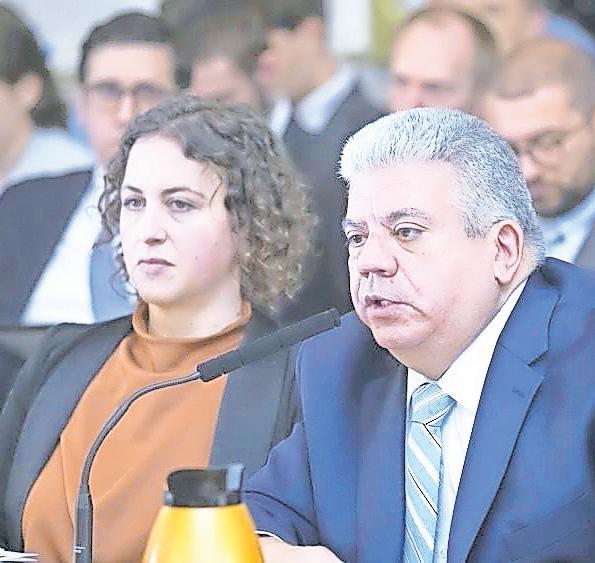
Eric Dinowitz, the council member from Riverdale and co-chair of the bipartisan task force, pressed Wisdom during the hearing, last Wednesday.
“The vast majority of the Jewish community values the IHRA definition,” Dinowitz said, of the International Holocaust Remembrance Alliance’s working definition of Jew-hatred.
“Where cities have laid out that antiZionism is a proxy for ‘Jew,’ they saw a decrease in incidents,” he told Wisdom, who assumed her position in February.
“The policy of this administration,” Wisdom responded, “is that we will continue to not have a codified definition of any form of hate.”
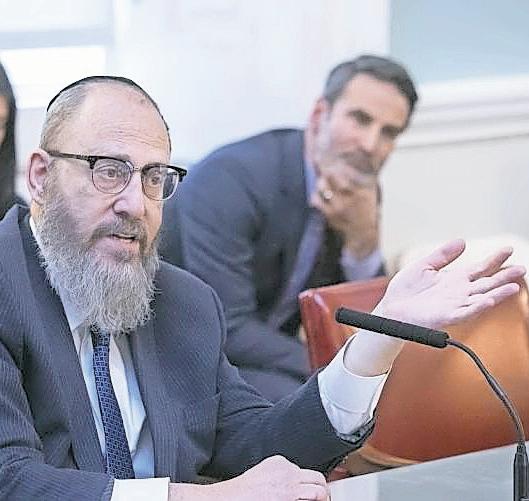
Simcha Felder, who represents heavily Orthodox neighborhoods in Brooklyn, including Borough Park and Midwood, questioned whether Wisdom has ever experienced real Jew-hatred.
The Orthodox council member also pointed out that the state law mandating Holocaust education in public schools is widely ignored. “It would be very helpful if children at a young age got that education,” he said. “Schools throughout the state are in violation of state law.”
He also said that elected officials’ tendency to link Jew-hatred and Islamophobia in the same breath, even when data shows no equivalence in incidence, normalizes anti-Jewish sentiment.
After Wisdom said city policy was not to define hate, Felder stormed out.
“The last straw was when they asked her about determining whether or not something is a hate crime, and she said that she and her assistant are going to decide case-by-case whether something is a hate crime or not,” he told JNS, of Wisdom. “That was outrageous. She is not competent to decide. I don’t think she should have been hired.”
“That was nuts, and that’s why I exploded,” he said.
“I can’t recall ever hearing something so absurd from someone in the administration,” added Felder, who has represented his area in the state Senate and in the City Council for a combined 21 years. “That’s unconscionable and unacceptable.”
Among contemporary examples that are part of the IHRA working definition is singling the Jewish state out for unique criticism and denying its right to exist. One of Zohran Mamdani’s first actions as mayor in January was to revoke his predecessor’s executive order using the IHRA definition as city policy.
During the newly formed task force’s inaugural hearing, which ran for five hours, Brooklyn District Attorney Eric Gonzalez, senior NYPD officials and representatives of the Mayor’s Office to Combat Antisemitism testified, including about what city data confirms is a deepening crisis.
Jews, who make up about 10% of the city’s population, are targets of more than half of all hate crimes committed there. The hearing illuminated

pointed disagreements about the problems of Jews being targeted by verbal attacks and slurs, which are considered protected free speech.
Michael Gerber, NYPD deputy commissioner for legal matters, testified that Jews accounted for more than 50% of confirmed hate crime victims in New York City in both 2024 and 2025 — a proportion that has held steady.
In 2025, there were 566 confirmed hate crimes in the city and 327, or 58%, were antisemitic. In the first quarter of 2026, 78 of 143 confirmed hate crimes, again more than half, targeted Jewish people, he said.
Brooklyn is home to what Gonzalez described as the largest Jewish population of any county in the United States and has borne a disproportionate share of Jew-hatred. In 2025, Brooklyn recorded 239 hate crime incidents, 62% of which targeted Jews. In the first quarter of 2026, the majority of Brooklyn hate crimes continued to target Jews.
Dinowitz, a former teacher and Bronx Democrat who co-chairs the task force with Inna Vernikov, a Brooklyn Republican, said that about a quarter of anti-Jewish hate incidents in the city have been directed at children or at places children frequent, including schools and playgrounds. Dinowitz and Vernikov are Jewish.
“Throughout our history as a people, we have seen inaction leading to the persecution and eviction of Jewish people from their homes,” Dinowitz said at the hearing. “Today we will not be a government of inaction that allows Jews to be persecuted because we are looking the other way.”
One of the hearing’s most contentious issues concerned how the NYPD counts and reports hate crime data.
JNS has reported that after the city recorded a 182% increase in Jew-hatred in the city in the first month of Mamdani’s mayoral administration, in January, that the city has twice changed the way it reports hate crime statistics.
Gerber said that in early March, the NYPD stopped using what he called “hodgepodge numbers,” which he described as figures that did not reflect confirmed hate crimes or the full universe of incidents flagged for investigation by the department’s Hate Crimes Task Force.
Although many have suspected that Mamdani ordered the change in data reporting, NYPD Commissioner Jessica Tisch has said that she made the decision on her own, and Gerber reiterated that at the hearing.
Tisch “ordered us to stop using” the earlier figures and “it was not at the directive or initiative of anyone at City Hall,” he said. “We should have done a better job explaining what we were doing, and on reflection should have made those changes in one step rather than two.”
In February, the city said it would only report “confirmed” hate crimes rather than including suspected hate crimes that are being investigated. In March, it said it would report both “confirmed” and “reported” hate crimes. JNS has reported that the city’s decisions make it difficult to compare 2026 statistics with those from prior years and that different city and police sites have varied counts of hate crimes, including anti-Jewish ones.
“The fact that a victim is a member of a protected class is not enough,” Gerber said, of what is classified as a hate crime. “The law requires more before we can bring that charge.”
The legal threshold, which requires prosecutors to prove beyond a reasonable doubt that a perpetrator was motivated at least in part by bias, was a recurring source of frustration for council members.
Several pressed Gerber and Gonzalez on where the legal lines fall.
Chanting in support of Hamas outside a synagogue is protected speech, as is screaming an antisemitic slur at someone on the street, according to Gerber. He said that something would rise to the level of “hate crime” only if there is a specific threat of violence or obstruction.
Blocking the entrance to a synagogue or school is a crime, and those who do so are subject to arrest, he said. But anti-Israel graffiti on a restaurant isn’t necessarily considered a hate crime, and the NYPD would have to prove the motivation was anti-Jewish rather than political, he said.
Dinowitz, the task force co-chair, said that police officers misread the use of “Zionist” and “Zio,” which perpetrators use as stand-ins for “Jew.”
“There are people using this as a proxy,” he said. “Kosher restaurants being graffitied with the word ‘Zionist,’ there should be no question that those are hate crimes,” he said. “What you’ve delivered is the ‘out.’ If you just use the word ‘Zionist’ instead of ‘Jew,’ you may be okay.”
Gerber told the council members on the task force that his hands are tied.
“We have to follow the law, which distinguishes between religion and political viewpoints,” he said. “It is not lost on me that this may well be an anti-Jewish hate crime, but we have to prove that.”
Vernikov, the Republican co-chair of the task force, cited a recent incident which upset Jewish parents in her South Brooklyn district. Two nights earlier, protesters marched through the heavily Jewish area carrying Palestinian flags and some covered their faces with keffiyahs. They paused outside a synagogue, where a rabbi was helping a bar mitzvah boy prepare. Parents called her office, frightened.
Gerber said that based on the video he reviewed, the protestors did not stop or block entrances, which meant that their actions were not criminal. He acknowledged that the department did not have enough uniformed officers on site, because the anti-Israel group stood previously at a commercial site to protest without marching.
“They were on the sidewalk,” Gerber said. “We can’t say the sidewalk is open to the public except for them. That would be content-based speech regulation.”
“What can I tell my constituents, so they can feel that their children will be safe?” Vernikov said.
Vernikov noted that the task force invited all five district attorneys of New York City’s boroughs, but Gonzalez, of Brooklyn, was the only one to appear before the task force.
He established a Hate Crimes Bureau when he took office in 2017, and six prosecutors and four analysts and clerks staff the bureau, he said.
“Jewish life should be lived openly, proudly and safely,” Gonzalez testified. “No one should be afraid riding the subway, going to shul, visiting friends or opening a Jewish-owned business.”
While the Manhattan and Queens district attorneys offices each receive more than $1 million in dedicated hate crime funding from the city, his office, which handles the highest volume of antisemitic hate crimes, has received $50,000, he told the council.
“I asked for $1.1 million,” he said. “We received $50,000 to fight all hate crimes. The increase in incidents has not been matched by more funding.”
Gonzalez described a conviction rate of more than 90% on cases brought to trial but noted that juries sometimes convict on the underlying crime, like assault or vandalism, but acquit on the hate crime enhancement.
Juvenile offenders and people with serious mental illness are among the most significant perpetrators, he said, and argued for more investment in prevention and education.
“When I confront young people who have been arrested, they don’t understand the history or the meaning of a lot of these symbols,” he said. “Social
media plays a role. The education piece, which is not happening, is critical.”
Gale Brewer, a council member who represents the Upper West Side, said that of a dozen middle schools in her district, only four have taken students on an educational trip to a Holocaust museum in the city.
“It is a free program. I will badger the others and they will go,” she said. “We’re not doing enough. We have to focus on prevention.”
Wisdom, who runs the Mamdani administration’s office on hate crimes testified that her office added another staffer and is embarking on a listening tour of Jewish community leaders.
The office plans to release a report before the High Holy Days summarizing what it heard from the Jewish community and how that will shape policy over the remaining years of the mayor’s term, Wisdom told the task force.
The public portion of the hearing included vivid personal accounts and sharp criticism.
A Queens public school educator described a student doing a Hitler salute in his classroom, but the city’s Education Department and district superintendent didn’t follow up after the principal filed a report.
A subway rider, who wears a kippah, described his fear riding public transit after a masked group took over a subway car last year. “I am openly identifiably Jewish,” he said. “This is an unacceptable breach of public safety.”
Not all testimony supported the task force.
Leo Ferguson, who identified himself as scholar in residence at Jews for Racial and Economic Justice, called the committee “not serious” and accused Vernikov, who has faced criticism in the past for her comments about Muslims, of undermining its credibility.
He argued that Jewish community safety cannot be separated from the safety of other communities.
Dinowitz pressed officials to commit to specific next steps: more granular reporting on perpetrator demographics and enhanced training protocols for police, who too often dismiss reports of antisemitic attacks as political speech.
Gerber agreed to bring the request for disaggregated age data back to Tisch, the police commissioner.
“This work has to lead somewhere meaningful,” Dinowitz said, at the close of the hearing. “Anything that forces a Jewish person to hide their Star of David or remove their yarmulke is a problem we have to address. We have to do the work to get it done.”
New York City Council members Eric Dinowitz from Riverdale and Inna Vernikov from Brooklyn at the first meeting of the council’s bipartisan Task Force to Combat Antisemitism, which they co-chair, on April 22. John McCarten, NYC Council
Simcha Felder, a New York City Council member from Brooklyn, is pictured as the council’s Task Force to Combat Antisemitism holds its first hearing. John McCarten, NYC Council
Phylisa Wisdom, head of the Mayor’s Office to Combat Antisemitism, with Brookliyn DA Eric Gonzalez. Wisdom said she would not attempt to define antisemitism. John McCarten, NYC Counci


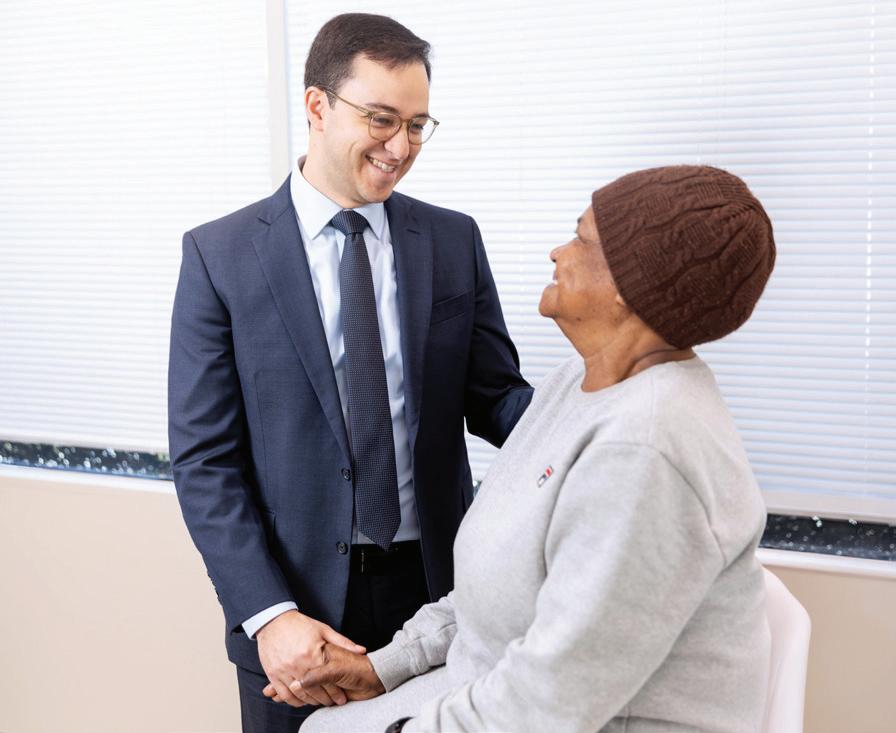
Walsh Ambulatory Pavilion







Episcopal Health Services is proud to introduce the Walsh Ambulatory Pavilion , a state-of-the-art
Services Include:
• Primary Care
• Behavioral Health
• Obstetrics & Gynecology
Maternal Fetal Medicine
• Endocrinology
• Endoscopy Colonoscopy
• EHS Cancer Center

Medical Oncology
Radiation Oncology





19-20 Brookhaven Avenue, Far Rockaway, NY 11691
Call 718-347-3627 or visit ehs.org/walsh to schedule an appointment today! For the EHS Cancer Center, please email cancercenter@ehs.org.

c
‘Most of all, we must emulate the righteous among nations. We must have the same moral compas. We must do what is right and make sure that it does not happen again.’
Twins tells 5 Towns their Shoah experiences
For The Jewish Star
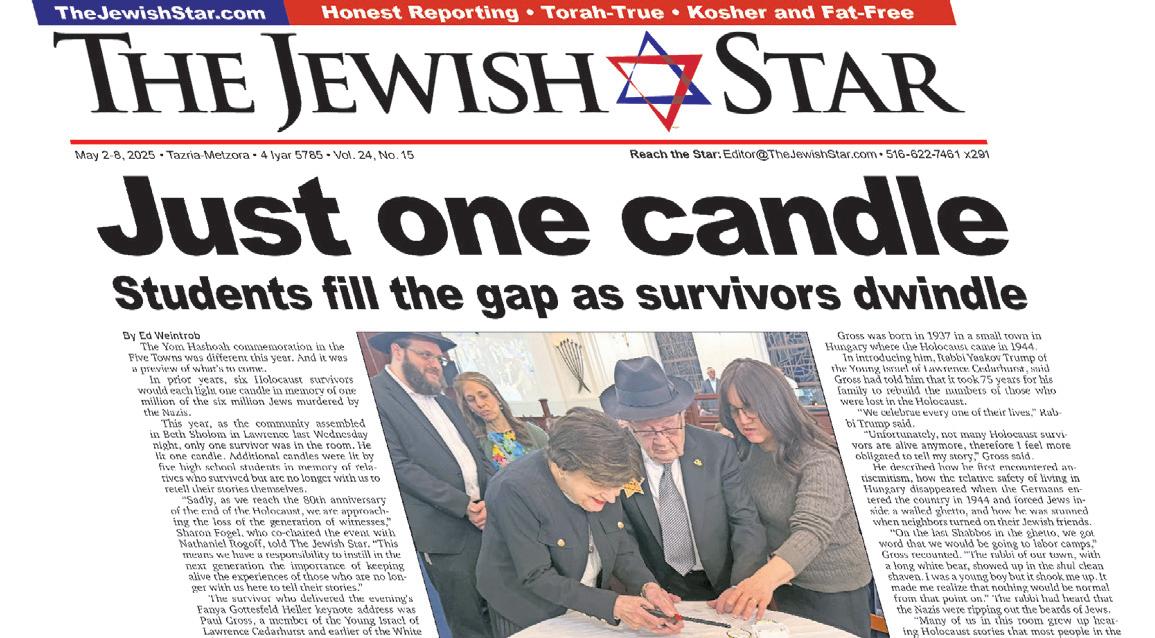
More than eight decades after they were hidden as Jewish children in Nazi-occupied France, twin brothers Henry and Bernard Schanzer stood before a packed sanctuary in Lawrence on April 13 and delivered a message that was at once deeply personal and urgently contemporary: remembrance is not optional.
The 90-year-old brothers told the Greater Five Towns Holocaust Community Yom Hashoah Commemoration, at Congregation Beth Sholom, of a childhood shaped by terror, loss and survival.
Their testimony traced a path from Belgium to Vichy France, from orphanages and farms to eventual refuge in America — while warning that the antisemitism that nearly destroyed their family has not disappeared.
“Unfortunately, antisemitism remains epidemic and is increasing,” they told the audience. “We must make sure that it does not happen again — never again.”
Born in Belgium in 1935, the Schanzer twins were just 5 years old when Nazi Germany invaded the country on May 10, 1940. Within days, 13 members of their extended family crowded into a small van and fled south ahead of the advancing German army, enduring aerial bombings as they made their way toward France.
Their family eventually settled in Saint-Étienne, in what became Vichy France. For nearly two years, the brothers said, their parents managed to shield them and their older sister, Anna, from the worsening realities of the war. They attended summer camp, took family photographs and even vacationed in the French countryside.
The brothers displayed some of those images, and said that the innocence they captured only underscored the enormity of what would soon be lost.
“We show these pictures to underscore the cruelty and inhumanity of the Nazis and their helpers who murdered one and a half million such innocent children,” they said.
A new normal
That fragile sense of normalcy ended in the summer of 1942, after the roundup of more than 10,000 Jews in Paris sent fear through Jewish communities across France. Jew-
ish immigrants who had dutifully registered with French municipal authorities years earlier suddenly found those same records turned against them.
“The registration turned out to be a trap,” the brothers explained, noting that French police now knew exactly where Jewish families lived.
Their parents sensed danger and moved quickly to protect their children.
In August 1942, the 7-year-old twins were sent away to stay with Gentile acquaintances in the countryside. Their sister and cousin were sent to a boarding school in Lyon. The brothers vividly remembered the final moments with their father, Bruno, at the bus station.
“He placed each one of us on his knee, he kissed us and he hugged us,” they recalled. “Then suddenly everything started shaking. He was shaking. We were shaking. Our father was crying.”
They never saw him again.
On Aug. 26, 1942, French authorities carried out a roundup of Jews in Saint-Étienne. Bruno Schanzer, along with multiple relatives, was arrested and sent first to a transit camp and then deported on Sept. 2 to Auschwitz aboard a convoy of people packed into cattle cars. Only 30 survived.
“Our father was not among them,” the brothers said quietly. Their mother, Bella, narrowly escaped arrest that same day after bribing a French policeman who had identified her at a bus depot. Returning to Saint-Étienne, she found their apartment already seized and learned that much of the family had been taken.
From there began a desperate and shifting series of hiding places that would keep the children alive.
Moved and moved again
The twins were first placed with a couple who quickly grew cold as the danger intensified, then were turned over to police in Saint-Étienne and held effectively as hostages in a Catholic orphanage while authorities searched for their mother. There, they were marched to church daily, given rosaries and expected to assimilate into Catholic life.
Yet even as children, they instinctively clung to their Jewish identity.
“When everybody concentrated on counting the rosary beads, we would

mumble under our breath, ‘G-d save us, G-d destroy them’,” they recalled.
After roughly two months, rescue came in dramatic fashion. Acting on Bella Schanzer’s request, members of the Jewish rescue organization OSE quietly removed the boys from the orphanage during a walk to church, simply taking them by the hand and leading them away.
“There was absolutely no noise,” they said. “We just walked away.”
What followed was a succession of lifesaving interventions by righteous non-Jews who risked everything to protect them.
The Schanzers repeatedly paused during their speech to name those rescuers, insisting their story could not be told without them: Madame Jeanne Bonhomme, a Saint-Étienne dress shop owner; her mother, Adolphine Dorel, known affectionately as “La Mémé” (grandma); and Count Xavier and Countess Marie-Francoise de Virieu, members of the French Resistance who sheltered members of the family in their castle.
“We owe our survival to righteous Gentiles of blessed memory and our resourceful mother,” they said.
Bonhomme helped Bella obtain false papers and a new identity, then secured work for her at the marquis’ castle. When the twins’ sister and cousin were endangered at boarding school, the marquis arranged to bring
Why we have not yet defeated
mounted, making further escalation more difficult. In these circumstances, even overwhelming military superiority does not guarantee strategic success.
Modern wars are fought at a dis-
tance with missiles, drones and other unmanned systems. In this context, even weaker states can deter and avoid rapid defeat.
Fifth, the absence of a large-scale ground operation inside Iran is key. It is extremely difficult to topple a de-
termined authoritarian regime using air power alone.
The conclusion emerging from the war is clear; Iran was not defeated militarily, not because it won, but because it adapted to the new rules of warfare. It combined relatively inex-
feel less like a formal lecture and more like an intimate family remembrance — two brothers helping each other carry memories too large for one voice alone.
Their survival remained precarious until the war’s closing months. In late 1943, after another Jewish child hiding in the area was denounced and arrested, La Mémé rushed the twins into the woods overnight while German forces searched nearby.
They were not finally reunited with their mother until August 1945. Their father never returned. Neither did many aunts, uncles and cousins.
Finding a home in USA
In 1946, Bella Schanzer brought her four surviving children to the United States, settling on the Lower East Side of Manhattan. The brothers described their mother as a determined 45-year-old widow who “worked very hard to provide for her family” and emphasized education above all else.
them there as well.
Meanwhile, the boys were moved to La Mémé’s isolated farm in SaintPal-de-Mons, their fifth refuge. There, amid sheep, a cow, no indoor plumbing and nights of hunger, they slowly found a measure of stability.
The brothers described La Mémé as “wise and worthy,” a woman who shared whatever little food she had and fiercely protected them as her own.
Whispering in G-d
At night, hidden under blankets, they whispered the Shema prayer until they fell asleep — their only remaining tether to their parents and to Judaism. One morning, hearing the murmurs, La Mémé asked what they were saying.
“We told her we were saying a prayer,” they recounted. “She asked, ‘Why don’t you teach it to me and we will all say it together’?”
It was one of many moments in the address when humor and tenderness briefly cut through the darkness. The brothers frequently traded lines and teased each other throughout the speech, offering flashes of levity even as they recounted trauma.
They joked about childhood photographs, arguing over who got the better clothes, and laughed over their inability to distinguish weeds from vegetables on La Mémé’s farm.
That interplay made the testimony
That insistence shaped the rest of their lives.
Henry Schanzer became an attorney. Bernard Schanzer became a physician and later served as a captain in the US Air Force Medical Corps during the Vietnam War. Their sister became a French teacher.
In 1980, Yad Vashem posthumously recognized Jean Bonhomme and La Mémé as Righteous Among the Nations, honoring the women who had saved them. The brothers said Bonhomme herself was astonished by the praise, insisting she had done “nothing exceptional, nothing extraordinary — only what was right.”
That phrase, they suggested, remains the moral center of their story.
“Ordinary men became mad,” they said of the Holocaust. “Most of all, we must emulate the righteous among the nations. We must have the same moral compass.”
The brothers closed not with despair, but with a challenge.
Displaying photographs of their children, grandchildren and greatgrandchildren, they called their thriving family “the revenge” — living proof that Hitler failed to extinguish the Jewish future.
Still, they stressed that survival is not enough. Memory must lead to vigilance, and vigilance must lead to action.
“We are allies,” they said. “We will do what is right. We must make sure that it does not happen again.”
Iran not militarily…
pensive capabilities, strategic thinking, operational flexibility and strict internal control, thereby preventing its adversaries from achieving their objectives.
The key question now is what the next phase holds. For now, the
Iranian regime’s sole achievement is survival.
Will economic pressure eventually break Iran? Will Trump’s naval blockade compel surrender? Or will only a blockade plus massive infrastructure strikes suffice? The answer is unclear.
Henry and Bernard Schanzer at Congregation Beth Sholom in Lawrence, where they delivered the Fanya Gottesfeld Heller keynote address during the Greater Five Towns Community Yom Hashoah Commemoration on April 13. Ed Weintrob, The Jewish Star
The Brain Health Center
Getting ahead of cognitive decline
MEMORY
Are you getting forgetful?
Are you worried about dementia? Feeling depressed?

DON’T WAIT TO TAKE ACTION!
✦ Medical exam by memory specialists, neurologist, and psychiatrist
✦ Cognitive exam by computerized and clinical tests
✦ Genetic lab testing
✦ Blood based biomarkers test
✦ Treatment with FDA approved infusion therapy LEQEMBI and KISUNLA
✦ Deep Brain Stimulation therapy
✦ Photobiomodulation therapy
(TRANSCRANIAL MAGNETIC STIMULATION)
TREATING
DEPRESSION, ANXIETY, PTSD, AND IMPROVING MEMORY

✦ FDA approved, non-invasive
✦ Clinically proven to alleviate symptoms of depression without causing systemic side effects
✦ Diminishes symptoms of Obsessive Compulsive Disorder
✦ Promising for patients looking for non-drug options for PTSD
✦ Minimizes symptoms of Anxiety
✦ Well-tolerated, effective, and has high remission rates
BALANCE & DIZZINESS SLEEP
ACUTE / CHRONIC DIZZINESS
LIGHTHEADEDNESS
VERTIGO
TINNITUS
IMBALANCE AND FALLS

✦ Exam by board certified Neurologist
✦ Exam by clinical Audiologist
✦ Computerized diagnostics
✦ Physiological testing
✦ Vestibular Physical Therapy
✦ Virtual Reality Therapy
PERSONALIZED SOLUTIONS FOR A HEALTHY NIGHT’S SLEEP

✦ Do you snore?
Or has someone told you that you hold your breath while sleeping?
✦ Do you have excessive daytime sleepiness after a full night’s rest?
✦ Do you have high blood pressure that is hard to control even with medicine?
✦ Have you fallen asleep while driving or at a stop sign?
✦ Is your memory getting worse?
Sleep problems can come from neurological & psychiatric problems or obstructive sleep apnea
DRUG-FREE, NON-INVASIVE TREATMENT FOR NICOTINE ADDICTION

✦ Reduces craving
✦ Increases cognitive control
✦ Studies showing increased quitting rates
✦ Drug free treatment with TMS (Transcranial Magnetic Stimulation) -
FDA Approved, paid by insurance
VAPING IS AS BAD AS CIGARETTE SMOKING AND A DEADLY HABIT CAUSING CANCER
NON-INVASIVE TREATMENT FOR ADOLESCENT DEPRESSION (Ages 15+)

High school and college age can be very traumatic for young people.
✦ Intense sadness, hopelessness, and loss of interest
✦ Irritability, low energy, sleep and appetite changes, withdrawal and poor school performance
✦ Triggered by stress, trauma, or genetics
✦ When medications and therapy aren’t enough
Significant symptom improvement and lowered anxiety and depression
TRANSCRANIAL MAGNETIC STIMULATION
FDA approved & Paid by insurances
2 Executive Blvd., Montebello/Suffern, NY 10901 | T. (845) 889-5088, (845) 889-5099
401 S Van Brunt St., Ste 302, Englewood, NJ 07631 | T. (201) 947-4777
*** Accepting Fidelis, Medicare, Clover, Aetna, UHC, Cigna and other major insurances ***
War accelerates health-care revolution in Israel HEALTH, MIND & BODY
By Howard Blas, JNS
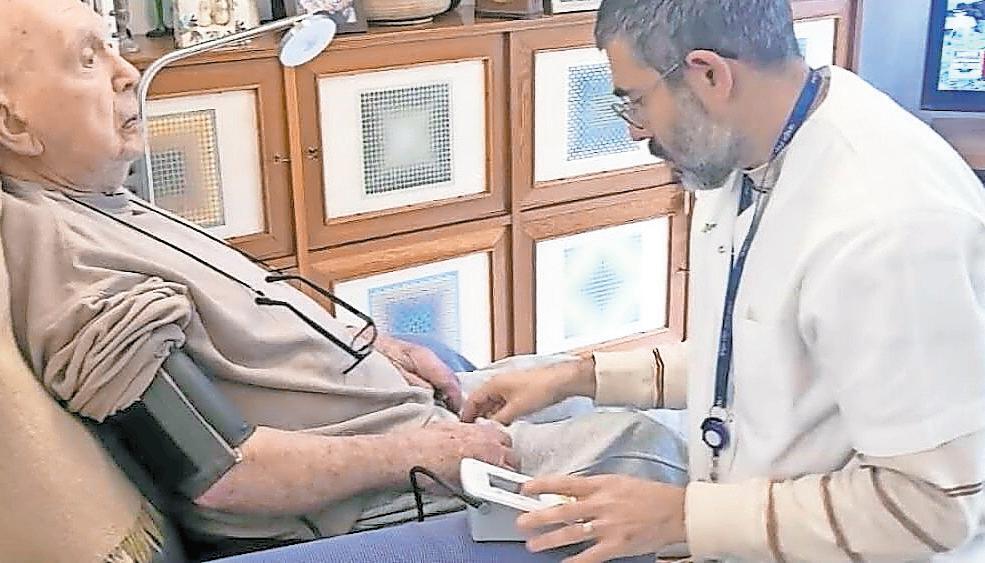
During the war against Iran and Hezbollah, Matan Tal, a senior nurse in Israel’s northern district, received an urgent call from the caregiver of 94-year-old Yoash Tadmor, a resident of Kibbutz Yehiam, about 14 miles southeast of the Lebanese border. Tadmor was suffering from shortness of breath, swelling and a history of heart failure.
Tal, an experienced emergency room nurse and a resident of the same kibbutz, responded immediately. He examined the patient at home, consulted with a physician and promptly began administering diuretics.
The intervention — carried out while missiles flew overhead — kept Tadmor out of the hospital. He has since recovered.
The war has accelerated a quiet transformation in the country’s health-care system, with increasing reliance on hospital-level treatment delivered in patients’ homes — often with better outcomes than traditional hospitalization.
A new large-scale study by Clalit Health Services, Israel’s largest healthcare provider, suggests that in-home care not only reduces strain on hospitals but can also outperform

them in key measures, including mortality and readmission rates.
The study analyzed 6,670 patients treated either at home or in hospitals for conditions such as pneumonia, heart failure and urinary tract infections. It found that 30-day mortality was 5.8% among patients treated at home, compared to 9.1% in hospitals. Readmission rates were also lower — 13% versus 16% — and 84% of patients said they would prefer home care in the future.
The shift has been accelerated by wartime conditions, particularly in the early days of “Operation Roaring Lion,” when unprotected hospital
wards were evacuated, and thousands of patients were transferred to homebased care.
“It is my community in the kibbutz, so I want to serve and give all I can to make people feel better,” Tal said.
Tal said home visits allow for more accurate assessments and closer interaction with family members and caregivers, often preventing conditions from worsening.
“In most cases, we can treat at home,” he said. “If we treat chronic conditions properly, they won’t become acute and require hospitalization.”
In Beersheva, geriatric nurse Anas-
EDITOR WANTED


The Jewish Star is seeking a new editor who will be responsible for expanding local news coverage, recruiting and managing staff and freelance contributors, and editing and enhancing material from The Star’s wire services.
Candidates should have news reporting and editing experience, an understanding of what interests Modern Orthodox Jewish communities, and a drive to excel in a professional, collegial environment.
While our primary competitors emphasize one-dimensional and biased political coverage, The Jewish Star’s team of veteran journalists is committed to the highest professional standards — insisting on journalistic and commecial integrity and a pursuit of truth that’s grounded in an adherence to Torah values and a love of Israel.
Serving diverse Modern Orthodox communities on Long Island, in Queens, Riverdale, Upper Manhatan and Westchester, The Jewish Star is an independent newspaper produced by Richner Communications, a 100 employee family-owned company that publishes the Pulitzer Prize winning Riverdale Press and dozens of community newspapers, websites and shopping guides.
This full-time in-person or hybrid position (starting at $50,024-$60,320) offers Jewish holidays, vacation, health insurance, and 401k.
Join The Jewish Star … and help make Jewish journalism great again.
tasia Sergievski Rabinovich has seen similar benefits. Visiting patients at home allows her to assess not only medical needs but also living conditions — an important factor in areas frequently impacted by Iranian missile fire.
She recalled visiting Diana, an 84-year-old Holocaust survivor, after nearby missile strikes damaged her apartment.
“I went there and didn’t know what I would find,” Rabinovich said.
She found shattered windows, broken glass in the bedroom and essential medications buried under debris. With the patient’s daughter stranded
abroad, Rabinovich arranged for medical care, coordinated volunteers to clean the apartment and ensured temporary repairs were made.
Rabinovich and her team provide a range of treatments, including antibiotics and IV therapies, effectively creating what she described as “a hospital at home.”
“We prevent hospitalizations,” she said. “It is better for patients in their own environment, in their own bed, with family.”
This approach has also required medical teams to operate under fire. Dr. Moshe Sagi, head of home hospitalization in Clalit’s Tel Aviv-Jaffa district, recalled taking cover from incoming missiles while en route to treat a patient.
Despite the risks, Sagi has championed advanced home care, including the use of portable ultrasound devices to diagnose conditions such as pneumonia, pleural effusions and blood clots.
In one case, he identified acute gallbladder inflammation in a patient initially thought to have pneumonia, enabling timely hospital transfer and life-saving treatment. Without that diagnosis, Sagi said, the patient likely would not have survived.









Dr. Moshe Sagi, internal medicine specialist in Clalit’s Tel Aviv-Jaffa District, and Neta Nahmani, a home hospitalization nurse, enroute to a home-care day during the war. CHS
Nurse Matan Tal cares for Yoash Tadmor at his home, on March 24,. CHS

High Performing Heart Care, Right Here on the South Shore
Mount Sinai South Nassau is proud to be named a high performing hospital in heart attack and heart failure by U.S. News & World Report ® year after year.
Our comprehensive heart care, including award-winning expertise in minimally invasive treatments to address blockages, has made us the premier choice for cardiac care on the South Shore. Cardiac surgeons from the world-renowned Mount Sinai Fuster Heart Hospital in Manhattan also now see patients at our Oceanside campus for pre and post operative evaluation and rehabilitation. The Mount Sinai Fuster Heart Hospital at The Mount Sinai Hospital is ranked No. 2 in the nation for Cardiology, Heart, and Vascular Surgery by U.S. News & World Report ®, outranking every cardiac program on the South Shore.
Learn more at mountsinai.org/southnassau
SCHOOLS
HAFTR marks Yom Hazikaron in 5 Towns





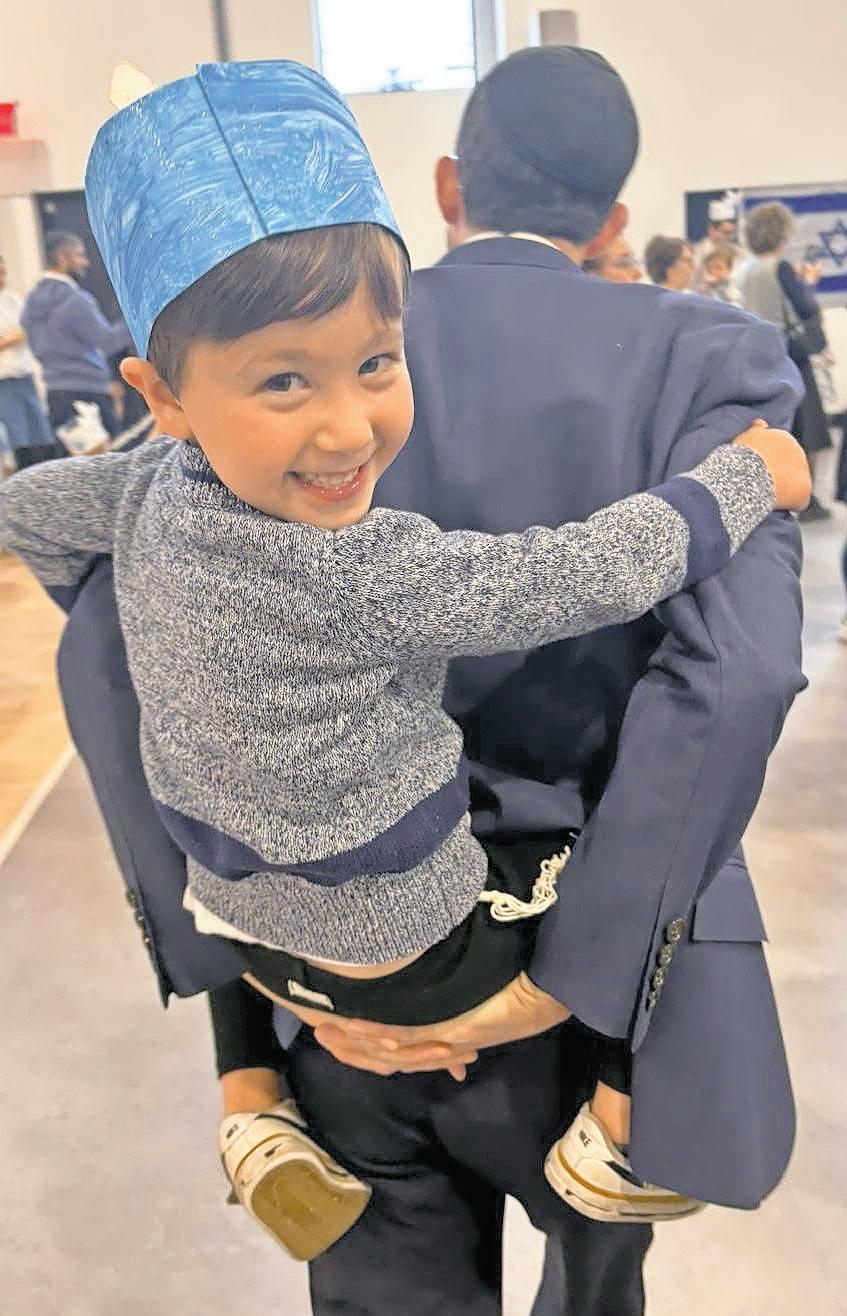



HALB and Lev Chana cheer Midinat Yisrael



HAFTR waves its flags for the Jewish state




Former Riverdalian wins Israel’s top civilian honor
By Michelle Mullen, Riverdale Press
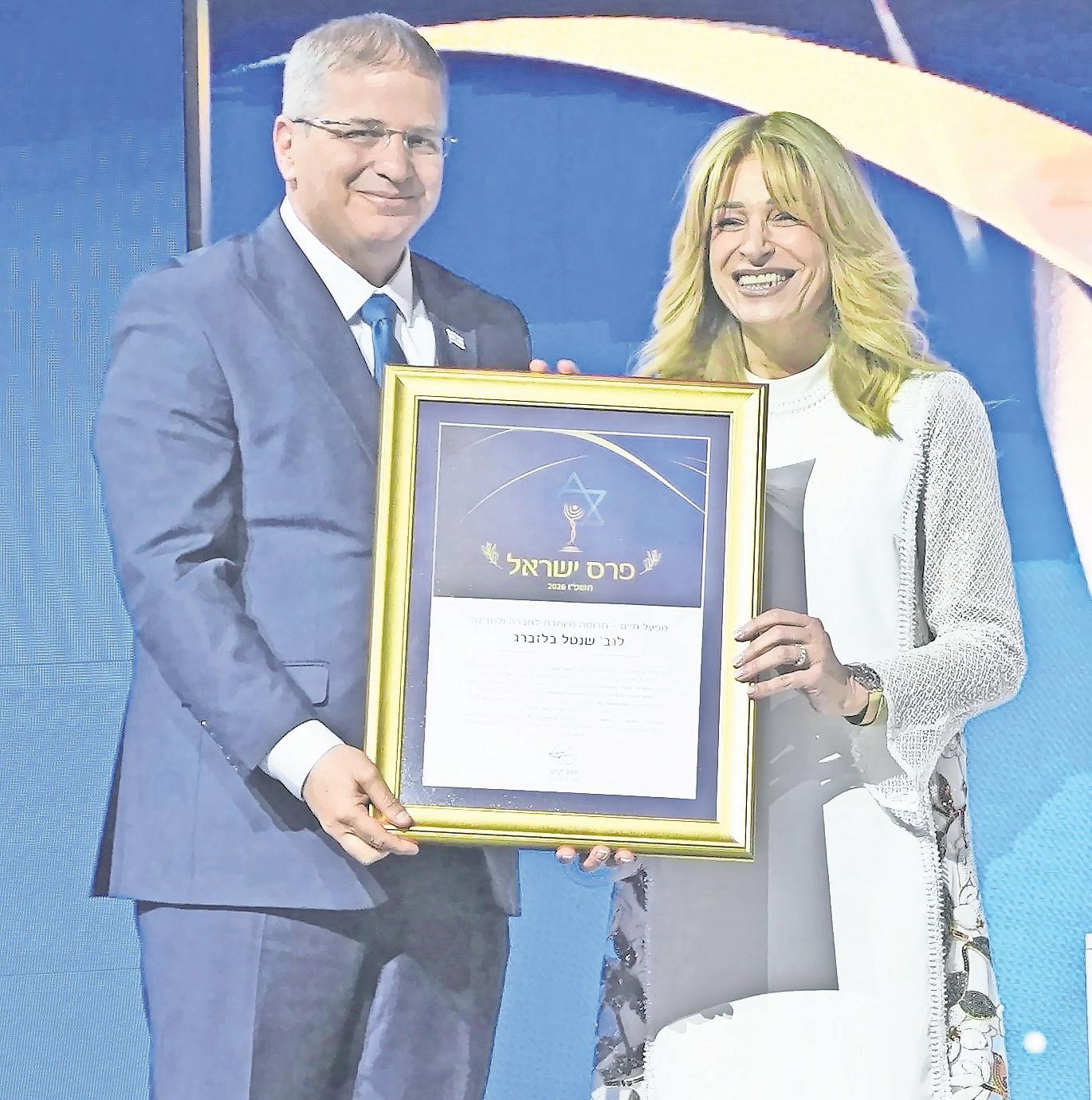
Former Riverdale resident Chantal Belzberg received the Israel Prize for Lifetime Achievement, the country’s highest civilian honor, for her work supporting victims of terror and their families.
First awarded in 1953, the prize is presented annually on Yom Haatzmaut. This year, Chantal, who co-founded the Israel-based organization OneFamily with her husband, Marc Belzberg, was recognized for building a nationwide support system for bereaved families and survivors of attacks.
Chantal, born and raised in Belgium, moved to New York in the fall of 1986, after she and Marc were married. The two first crossed paths in New York the year prior, when Chantal was in town for a friend’s wedding. Her husband would be the one to introduce her to Riverdale, having settled into an apartment in the Century highrise in the late ’70s.
“He said Riverdale is a beautiful neighborhood, you will love it,” Chantal told the Riverdale Press. “So that’s how I found out about it. I mean, I had heard of New York, but I had not heard of Riverdale.”
Over the next five years, Chantal and Marc Belzberg welcomed three children before relocating to Israel in 1991. The family made their home in Jerusalem, where they would build their lives and begin the work that led to the creation of OneFamily.
The organization’s origins trace back more than two decades, after
the Aug. 9, 2001, suicide bombing at Jerusalem’s Sbarro restaurant that killed 16 people and injured more than 100 civilians. At the time, the Belzberg’s were overseas visiting family in Canada, but the attack coincided with their daughter’s 12th birthday.
“We had planned the [her Bat Mitzvah] for the end of August, so her friends will be back in town from summer vacation, and everybody will be back from vacation,” Chantal said.
The attack led them to cancel their daughter’s coming-of-age celebration, framing the moment as what Marc described as an “educational project” — sending their daughter to visit victims and bereaved families alongside them and begin to understand, firsthand, what was needed in the aftermath.
“We just decided it wasn’t the right thing to come back to Israel to have a big party,” Marc said. “This is something we’re going to take care of on a long-term basis. These are the families that need us.”
What began as a small, immediate response grew into a long-term effort supporting families affected by violent incidents across Israel. The nonprofit now serves more than 20,000 individuals, providing emotional, financial and rehabilitative assistance tailored to each family’s needs.
Over the years, OneFamily has developed a wide range of programs aimed at helping families rebuild their lives. These include therapeutic retreats and support groups for widows, parents and siblings, as well as specialized programs for children, or-
phans and those who have been physically wounded.
The organization also provides direct financial assistance, mentorship programs pairing young people with volunteers and community-based activities such as camps, workshops and peer support networks designed to reduce isolation and foster long-
REPORTER WANTED


term resilience.
“The fundamental underlying idea is that you need to rebuild their social and support systems with people who went through exactly what they went through,” Marc said.
The scope of that work expanded dramatically after the attacks of Oct. 7, 2023, which sharply increased the
number of families requiring longterm care. Chantal and her team mobilized quickly, scaling operations to meet the surge in need.
In practice, that approach has meant creating what the Belzbergs describe as new support networks — connecting families who share similar experiences of loss and helping them navigate the long-term effects of trauma together. Programs range from group therapy and holiday retreats to creative outlets like art workshops and community events, all designed to restore a sense of stability and belonging.
Chantal learned she would be awarded the Israel Prize just days before Passover.
She described the award as a collective acknowledgment — not only of her work, but of the families who have endured loss and the staff and volunteers who support them.
“It feels like it’s for them, like the country giving them one big hug,” she said.
In announcing the prize, Israel’s Education Minister Yoav Kisch said Chantal Belzberg and her fellow laureates represent “compassion, mutual responsibility and light,” and that their work reflects a broader national commitment to those affected by tragedy.
Even after more than two decades, she said the work continues to be driven by its impact on the families themselves.
“We rebuild lives,” Chantal said. “We really can show people that there is life alongside the pain and the trauma.»





is looking to add a full-time reporter to our team as we expand our coverage of local news that’s important to Modern Orthodox communities on LI and in Queens, Riverdale and Westchester.
is looking to add a full-time reporter to our team as we expand our coverage of local news that’s important to Modern Orthodox communities on LI and in Queens, Riverdale and Westchester.
Position offers expert mentoring, a starting salary of $36,400 to $39,520, and a menu of benefits including all Jewish holidays.
Salary ($35,000–$38,000) offers a menu of benefits including all Jewish holidays.
Candidates who have reporting and news-writing experience (professional or collegiate) are invited to email a resume with clips or links to Jobs@TheJewishStar.com.
Candidates who have reporting and news-writing experience (professional or collegitate) are invited to email a resume with clips or links to Jobs@TheJewishStar.com






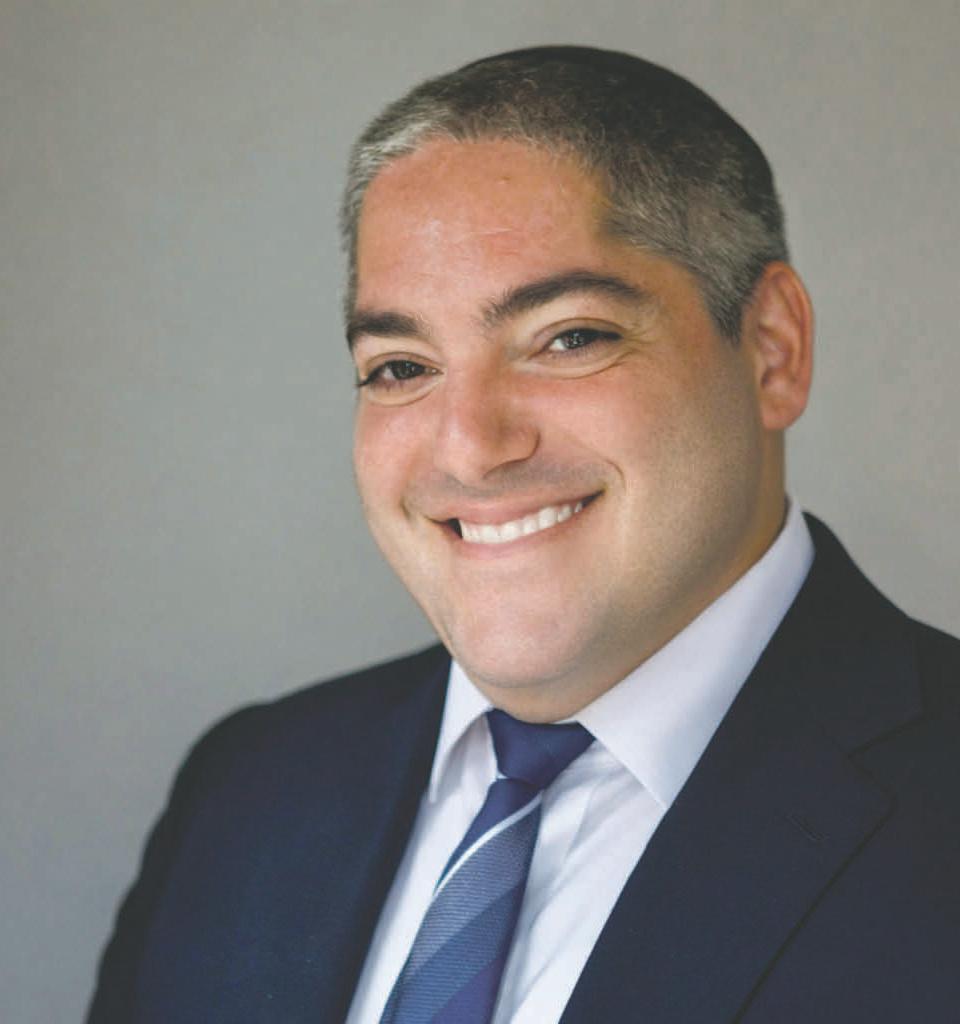


















Former Riverdale resident Chantal Belzberg, co-founder of Israel-based nonprofit OneFamily, was awarded this year’s Israel Prize for Lifetime Achievement. Courtesy Meir Pavloski
DeSantis redistricting targets pro-Israel House Dems
By Mike Wagenheim, JNS
Several pro-Israel, Democratic House members, including several Jews, could face tough races in their bids to be reelected to Congress if proposed redistricting maps, which Florida Gov. Ron DeSantis, a Republican, unveiled on Monday, come to pass.
“The proposed map is a blatant attempt to push out pro-Israel, Democratic champions in Congress,” Brian Romick, president of Democratic Majority for Israel, told JNS.
“It’s bad for our country, it’s bad for those who care about Israel, and it’s a violation of Florida’s redistricting constitutional amendment,” Romick said. “We urge lawmakers to reject this shameless partisan stunt.”
The Florida legislature must approve the maps for them to take effect.
Some analysts warn that the governor’s plan could backfire based on a projected Democratic wave this year. Some also predict that Democrats could flip Republicanheld seats in south Florida, where millions of registered Democrats would be combined in some Republican-held districts.
DeSantis aims to eliminate four of eight Democratic-friendly congressional districts within the Sunshine state’s 28-member congressional delegation. A special session of the legislature, where Republicans hold a supermajority, is considering the measure.
The Broward and Palm Beach County districts, represented by Democrats Debbie Wasserman Schultz and Lois Frankel, are projected to favor Republicans come election time if the new maps are implemented. Both of the congresswomen are pro-Israel Jews.
“DeSantis drew up illegal, partisan maps in a backroom and made sure Fox News got them before lawmakers did,” Wasserman Schultz told JNS.

“This clear effort to steal more seats for Republicans shows his total contempt for Florida voters, who voted two-to-one in favor of a ban on partisan gerrymandering in our Constitution,” Wasserman Schultz said.
“This nakedly partisan scheme breaks state law,” she told JNS. “While Republicans focus on cherry-picking their voters, I’ll keep
fighting for better jobs and schools and take on the healthcare and housing high-cost crisis that Republicans continue to ignore.”
DeSantis has said that the maps are a response to Florida’s population growth and to court rulings about how to consider racial demographics when drawing electoral maps.
Rep. Jared Moskowitz, another Jewish,
pro-Israel Democrat, would see much of his current district drawn into the area that Wasserman Schultz now represents. That could potentially force a primary faceoff between the two.
The Orlando-area district held by Democrat Darren Soto, who is pro-Israel, would favor Republicans under DeSantis’s proposal, as would the Tampa-area district of Democrat Kathy Castor, who has generally supported Israel.
Richard Stark, president of the Florida Democratic Party Jewish Caucus, told JNS that he is “personally outraged” that the governor is redistricting a state that already favors Republicans “overwhelmingly.”
“All of the congressional seats that are affected are pro-Israel,” Stark told JNS.
JNS sought comment from Rep. Randy Fine (R-Fla.), the lone Jewish House Republican in the state.
“South Florida is home to one of the largest Jewish communities in the country, which is why most of South Florida is represented by Democrats, because historically, and certainly under Trump, it’s only Democrats who share democratic and Jewish values,” Halie Soifer, CEO of the Jewish Democratic Council of America, told JNS.
Soifer criticized DeSantis for failing to bring the maps up for a referendum, as Democrats did when they sought to redistrict in Virginia and California.
“They appear to have forgotten that you can’t gerrymander away a deeply unpopular president with an approval rating below 40%,” Soifer said. “No matter the maps, voters’ views and voices cannot be erased, which is why we’re confident this gerrymandering effort may backfire on the GOP and benefit Democrats in November.”
DO YOU HAVE WHAT IT TAKES TO SUCCEED IN MULTIMEDIA SALES?

At The Jewish Star, selling advertising for the newspaper is just part of the job.
Our staff’s toolkit includes an exceptionally broad range of useful products (including both religious and secular publications and websites; digital, email, radio and social media marketing; in-person events; direct mail; commercial printing, and more) — whatever it takes to build business and raise revenue for our commercial and non-profit partners.
Employees are trained by the best in the business, in a supportive, collegial and kosher environment.
These F/T positions (P/T schedules may be arranged) offer competitive compensation ($40k-$90k) with excellent commission and bonus opportunities, paid holidays (including Jewish holidays), time off, medical and 401(k).
Florida Gov. Ron DeSantis.
WINE AND DINE
Tasty spring soups for Shabbat and everyday
Kosher Kitchen
JoNI SChoCKETT Jewish Star columnist
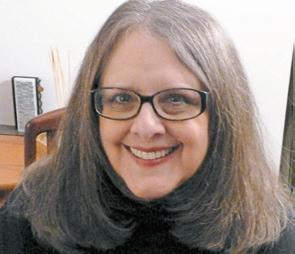
Soups are perfect starters for any meal, holiday or otherwise. Some can even be a complete meal for a hurried spring evening when people are rushing to get to sports events, meetings, and more. And while we all think of chicken soup to start a festive or Shabbat meal, there are countless other soups out there to whet the appetite and start a celebration.
I am a soup lover. From chicken to cold blueberry to split pea and multi beans, I love soups. Soups warm and nourish the whole body and soothe the soul.
When we were sitting shiva for my dad many years ago, people brought more cakes and pastries than I could eat in a lifetime, but three friends brought soup. Three different kinds. I didn’t know it those first few days, but those soups got me through one of the most difficult times of my life. I couldn’t eat the deli platters or the Shabbat dinner or the bagels, but I could sip warm soup. I was so grateful for those soups. Slowly, I felt stronger and healthier. It is a gift I have emulated through the years.
Soup can also be a quick dinner. My kids often had spring sports right after school, making dinner later and rushed. I often made soup and a quick sandwich for a fast dinner with minimal clean up. It filled tummies but did not overfill them and the leftovers were a great snack. My kids loved the soups I made all year round.
Soups are so often associated with cold New England and northeast winters, but spring soups and cold summer soups are delicious and can be a light meal on a summer’s day when it is absolutely too hot to cook.
Holiday meals traditionally begin with soup, chicken soup in particular, but in the spring, try starting with a soup that incorporates delicious spring veggies like asparagus and spring onions, broccoli and more. Chag sameach for all the lovely spring holidays and incorporate some delicious soup as you celebrate.
Barley Mushroom Soup with Zucchini (Pareve)
• 1 cup dried porcini mushrooms
• 3 Tbsp. olive oil
• 2 large onions, chopped
• 2 leeks, white part only, chopped
• 2 to 3 carrots, chopped


• 2 to 4 large cloves garlic, minced
• 1/4 cup fresh parsley, minced
• 1 tsp. grated fresh ginger
• 3 cups white mushrooms, sliced
• 3/4 cup pearl barley
• 6 to 10 cups vegetable broth, (bought or homemade)
• 1 or 2 zucchini, sliced
Salt and freshly ground black pepper to taste
Place the porcini mushrooms in a small, deep bowl. Cover with hot water about an inch higher than the top of the mushrooms. Let soak for 30 minutes or until the mushrooms are soft. Add more boiling water as needed to keep the mushrooms covered.


Heat the olive oil in large soup pot over medium heat. Add the onion and leeks. Sauté until translucent and add the garlic, ginger and parsley. Sauté for another few minutes, stirring often, until the vegetables are soft, 6 to 10 minutes total time.
Drain the porcini mushrooms, reserving the liquid. Add them and the white mushrooms to the onion mixture and sauté until the mushrooms begin to give off their juices. Add the porcini liquid, the vegetable broth, carrots, and the barley. Stir, cover and simmer for 30 to 45 minutes until the barley is soft. Add the zucchini rounds and cook for another 15 to 30 minutes. Season with salt and pepper to taste. Serves 6 to 8
Cold Tomato Soup with Avocado and Chives (Pareve or Dairy)
This is great as a first course for either fish or chicken. You can substitute chopped cucumbers or sliced celery for the avocado.
• 2 lbs. ripe tomatoes
• 1 to 2 garlic clove, minced
• 1 cup chicken broth or vegetable broth
• juice of 1 small lemon
• salt and pepper to taste
• 1/4 tsp. Tabasco sauce (or more if you like)
• 1/2 avocado, diced
• 1/2 cup cucumber, seeded and diced
• thin lemon slices
• OPTIONAL: sour cream when using veggie broth
• 2 tsp. minced fresh chives

Fill a large pot with salted water. Bring to a boil. Make a cross cut in the tomato skins on each side of the tomato and place three or four in the water at a time. Let boil for 20 to 30 seconds and then plunge the tomatoes into a bowl of ice water. Repeat with the rest of the tomatoes. When all done, discard the boiling water and rinse the pot.
Peel the tomatoes and gently squeeze to remove the seeds. Chop coarsely. Place the tomatoes, garlic, broth, and lemon juice in the pot and stir to blend. Add the Tabasco sauce, salt and pepper. Mix well. Place small batches of the mixture in a blender and puree until very smooth. Place the soup in a large glass or metal bowl and place the bowl in the freezer or over a larger bowl filled with ice. Stir every 5 minutes, chilling for about 20 minutes or until very cold. Taste to adjust seasonings.
Divide the diced avocado or cucumber into bowls and pour the soup into each bowl. Garnish with chopped chives and thin lemon slices. Serves 4 to 6.
NOTE: Top with a dollop of sour cream and sprinkle the chives over the sour cream.
Light and Delicious Roasted Cauliflower Soup. Adobe AI
Cold Tomato Soup with Avocado and Chives. bluezones.com
Cantaloupe Soup with Mint and Citrus.
Leek Zucchini Soup.
Almost Minestrone Soup with Quinoa. Adobe AI















































































































































JONI: Healthy soups for the springtime season…
Continued from page 12
Leek Zucchini Soup (Pareve)
This is one of the easiest soups I have ever made. It is delicious and creamy yet has nothing fattening in it. Dieter’s Dream. It is also very forgiving and you can use more or less of any of the ingredients.
• 1/3 cup extra virgin olive oil
• 6 to 8 long leeks white/light green part should be about 6 to 10 inches long
• 6 to 8 zucchinis about 7 to 8 inches long
• 3 large carrots
• 2 stalks celery
• 2 to 3 qt. boxes Vegetable broth
• 1 to 2 Tbsp. vegetable bouillon (I use a kosher vegetarian bouillon paste that I like)
Cut off the dark green part of the leeks. Cut the leeks in half lengthwise, discard the first layer, and wash thoroughly. Wash the leek running water through the length of the leek. Cut the leeks into thin slices. So you have half-round pieces.
Heat a large soup pot over medium-low heat and add the oil. Add the leeks and cover. Cut the celery and carrots into slices and add to the pot. Wash the zucchini and trim the ends. Cut into slices and add to the pot. Stir together and cover. Simmer over low heat for about 15 minutes to let the veggies begin to steam. Add the vegetable broth and cover. Simmer for 45 to 60 minutes until all veggies are mushy. Turn off heat and let cool for about 15 minutes. Use an immersion blender and emulsify the soup until smooth. Soup will be thick. Add a spoonful of the bouillon paste and mix with the immersion blended. Add more to taste. Heat a bit and serve. Serves 10+.
Light and Delicious Roasted Cauliflower Soup (Pareve)
• 1 head cauliflower, broken into florets
• 5 Tbsp. olive oil, divided
• 2 large onions, diced
• 2 leeks, diced, white part only
• 1 to 3 cloves garlic
• 2 stalks celery
• 1 carrot
• 2 qts. veggie stock
• 2 to 4 tsp. good quality vegetarian bouillon. I use a kosher vegetrin paste version that’s not too salty
• Freshly ground black pepper, to taste
• Fresh chives for garnish
Preheat the oven to 400 degrees. Line a large rimmed baking sheet with foil. Set aside. Spray the foil with non-stick spray or line with a piece of parchment paper. Cut the cauliflower into small florets. Place in a bowl and toss with 2 tablespoons of the olive oil. Pour out onto the prepared baking sheet and spread evenly. Drizzle with about 1/4 cup of water, cove lightly with foil and place in the oven for about 10 minutes.
Uncover and roast an additional 15 minutes or until golden in many places and very tender. Meanwhile, place the remaining olive oil in a large, heated skillet. Add the onion, leeks, and garlic and sauté until evenly light golden, 10 to 13 minutes. Add the carrots and celery and sauté until softened, 6 to 10 minutes.
Remove the cauliflower and place all but a few small florets in a large soup pot. Add the sautéed veggies and mix. Add the veggie stock and heat over medium heat until simmering. Simmer for 15 to 25 minutes, until the veggies are very soft.
Using an immersion blender, puree the soup until smooth. Add 2 teaspoons of the vegetable bouillon. Use the immersion blender to mix in the bouillon. Adjust seasonings, adding more bouillon if needed. Add some salt and pepper to taste and serve hot.
Serves 8+.
NOTE: Garnish with the reserved florets, chives, parsley, sour cream for a dairy meal, croutons, and my kids love it with a few red pep-

per flakes for some spice.
Tomato (Juice) Soup
I had this at a very elegant Bridal shower. It was served in beautiful crystal mugs with a tiny wedge of lime on each glass. The caterer generously shared the recipe with me and I have served it often to rave reviews. It can easily be doubled. It’s OK to keep the simplicity a secret!
• 6 cups tomato juice
• 1/2 small can tomato paste
• 2 Tbsp. freshly squeezed lemon juice
• grated peel of 1/2 lemon
• 1/2 tsp. Curry powder (or to taste)
• 1/2 tsp. Salt (or to taste)
• 1/2 tsp. Pepper (or to taste)
• 1/3 cup scallions, minced
• 3/4 to 1 cup sour cream (low fat or fat-free is Ok but the taste is a little different.)
Blend all ingredients except sour cream in a blender. Season to taste. Chill completely. Just before serving, whisk in sour cream. Garnish with a few pieces of chopped scallion or basil and a dollop of sour cream. Serve with a great, crusty bread (or, as in my house, bagels and cream cheese) and perhaps cold pasta salad. It also makes a great first course for a company dairy meal.
Note: This really does not work as well with yogurt.
Almost Minestrone Soup with Quinoa (Pareve)
• 1/4 cup extra virgin olive oil
• 1 to 2 large onions, diced
• 2 to 3 leeks, white and light green part only, thinly sliced
• 4 to 8 stalks celery, sliced
• 1 lb. carrots, peeled and sliced
• 1/2 lb. Butternut squash or sweet potatoes, diced
• 1 green pepper, seeded and diced
• 1 red pepper, seeded and diced
• 3 to 6 cloves garlic, minced (as many as you like)
• 1/2 head cabbage, shredded
• 1 cup corn kernels, frozen is best, but canned, drained and rinsed works
• 2 bay leaves
• 2 qts., vegetable or no-chicken or chicken stock
• 1 to 2 large (28 ounces) cans crushed or diced tomatoes with liquid

• OPTIONAL: 1 can chickpeans, drained and rinsed
• Several fresh basil leaves, minced or 1 tsp. dried basil
• 1/2 to 1 cup quinoa, thoroughly rinsed
Heat a large soup pot. Add the olive oil, the onions and leeks. Sauté until translucent, about 4 to 10 minutes. Add the celery, carrots, and squash, and sauté for 5 minutes. Add the peppers and mix for about 1 minute. Add the garlic and mix for 1 minute. Add the cabbage and mix for 1 minute. Add the corn and bay leaves. Cover and reduce heat to low. Let veggies soften for 3 to 5 minutes.
Add the stock and tomatoes and mix well. Let simmer gently, partially covered, for 25 to 35 minutes. Add the chick peas, oregano and basil and mix. Simmer for an additional 15 minutes. Add the quinoa and simmer for an additional 30 to 40 minutes, stirring frequently so the quinoa does not stick. Taste, add salt and pepper and adjust seasonings. Serves 10+.
Cold Blueberry Borscht (Dairy)
Make this the day before. Serve for a light dinner or a first course.
• 6 cups fresh blueberries (reserve 2 cups of the largest and best)
• 3-1/2 cups water
• 1/2 to 1 cup pomegranate or pomegranate blueberry juice • 1/2 cup sugar
2 to 3 Tbsp. maple syrup
1/3 tsp. ground ginger
2 cups plain yogurt, Greek is extra creamy
1 cup sour cream
1 to 2 tsp. sugar • 1/4 tsp. pure vanilla extract
Place 4 cups of blueberries, water, juice, sugar and maple syrup in a large saucepan. Bring to a boil and reduce heat. Simmer for 2 to 4 minutes, until some of the berries begin to pop. Remove from heat. Let cool 10 minutes. Add the yogurt and process in a food processor or blender until smooth. Place in a covered container and refrigerate overnight.
Just before serving, mix the sour cream, sugar and vanilla together.
Serve the soup, add some fresh berries and add a dollop of the sour cream. Serves 4 to 6.
Cantaloupe Soup with Mint and Citrus (Pareve)
• 2 to 3 large cantaloupes, very ripe
• 1 large bunch fresh mint leaves
• 1/4 cup freshly squeezed lime, lemon or orange juice, more or less, to taste
• superfine sugar, to taste
• Sliced lemon, lime or orange for garnish Peel the melon, discard the seeds and cut into small pieces. Place in a food processor with the lime juice and about 6 to 10 small mint leaves. Puree until smooth. Add sugar to taste. Cut the rest of the mint leaves into thin strips by piling them up, rolling them into a cigar shape, and cutting into thin strips.
Serve the soup in bowls or cups and garnish with the strips of mint and fruit slices. You can also garnish this with some sour cream or crème fraiche, sliced strawberries, or even a drizzle of liquid cream. Serves 4 to 6.
Write: Columnist@TheJewishStar.com

Tomato (Juice) Soup.
onceuponachef.com
Cold Blueberry Borscht. lemontreedwelling.com
Barley Mushroom Soup with Zucchini.
Proudly Jewish. Proudly Zionist.

Jewish Star Torah columnists: Rabbi Benny Berlin, spiritual leader of BACH Jewish Center in Long Beach; Rabbi Avi Billet of Anshei Chesed, Boynton Beach, FL, mohel and Five Towns native; Rabbi Binny Freedman, rosh yeshiva of Orayta, Jerusalem; Dr. Alan A. Mazurek, former ZOA chair, retired neurologist, living in Great Neck, Jerusalem and Florida.
Contributing writers: Rabbi Sir Jonathan Sacks zt”l, former chief rabbi of United Hebrew Congregations of British Commonwealth; Rabbi Yossy Goldman, president South African Rabbinical Association; Rabbi Dr. Tzvi Hersh Weinreb, OU executive VP emeritus.
To submit commentary, inquire at: Editor@TheJewishStar.com.
Contact our columnists at: Columnist@TheJewishStar.com.
תבש לש בכוכ
Fri May 1 / 14 Iyar
Emor (Friday is Pesach Sheni)
Five Towns candles: 7:32 • Havdalah: 8:42
Scarsdale candles: 7:33 • Havdalah: 8:38
Fri May 8 / 21 Iyar
Behar-Bechukotai
Five Towns candles: 7:39 • Havdalah: 8:49
Scarsdale candles: 7:40 • Havdalah: 8:46
Fri May 15 / 28 Iyar
Bamidbar • Shabbos Mevarchim
Five Towns candles: 7:46 • Havdalah: 8:56
Scarsdale candles: 7:47 • Havdalah: 8:55
Thu May 21 / 5 Sivan
Erev Shavuot
Five Towns candles: 7:52 • Scarsdale: 7:53
Five Towns Candlelighting: From the White Shul, Far Rockaway, NY
Scarsdale Candlelighting: From the Young Israel of Scarsdale, Scarsdale, NY
Faith as a journey, from the beginning to end
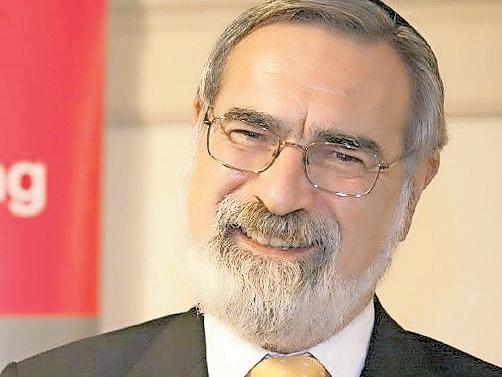
In its account of the festivals of the Jewish year, this week’s parsha contains the following statement:
For seven days you shall live in huts [succot]. All those native-born in Israel must live in huts, so that future generations may know that I had the Israelites live in huts when I brought them out of the land of Egypt; I am the L-rd your G-d.” —Vayikra 23:42-43
What precisely this means was the subject of disagreement between two great teachers of the Mishnaic era, Rabbi Eliezer and Rabbi Akiva. According to the Talmud Bavli (Succah 11a), Rabbi Eliezer holds that the reference is to the Clouds of Glory that accompanied the Israelites on their journey through the desert. Rabbi Akiva maintains that the verse is to be understood literally (succot mammash). It means “huts” – no more, no less.
A similar difference of opinion exists between the great medieval Jewish commentators. Rashi and Ramban favor the “Clouds of Glory” interpretation. Ramban cites as proof the prophecy of Isaiah concerning the end of days:
Then the L-rd will create over all of Mount Zion and over those who assemble there a cloud of smoke by day and a glow of flaming fire by night; over all the glory will be a canopy. It will be a shelter and shade from the heat of the day, and a refuge and hiding place from the storm and rain. —Isaiah 4:5-6
Here the word succah clearly refers not to a natural but to a miraculous protection.
Ibn Ezra and Rashbam, however, favor the literal interpretation. Rashbam explains as follows: the festival of Succot, when the harvest was complete and the people were surrounded by the blessings of the land, was the time to remind them of how they came to be there. The Israelites would relive the wilderness years during which they had no permanent home. They would then feel a sense of gratitude to G-d for bringing them to the land. Rashbam’s prooftext is Moses’ speech in Devarim 8: And when you eat and are satisfied, you shall bless the L-rd your G-d for the good land that He has given you. Take care not to forget the L-rd your G-d. … Otherwise, when you have eaten and been satisfied, and have built fine houses and lived in them,
People remember G-d in times of distress but forget Him in times of plenty.

when your herds and flocks have grown abundant, and your silver and gold is abundant, and all that you have has grown abundant, your heart may become proud, forgetting the L-rd your G-d who brought you out of Egypt, the house of slaves… you might be tempted to say to yourself, ‘My power, the strength of my own hand, have brought me this great wealth.’ But remember the L-rd your G-d, for it is He who gives you the power to do great things, upholding the covenant that He swore to your ancestors, as He is doing on this day. —Devarim 8:10-18
According to Rashbam, Succot (like Pesach) is a reminder of the humble origins of the Jewish people, a powerful antidote to the risks of affluence. That is one of the overarching themes of Moses’ speeches in the book of Devarim and a mark of his greatness as a leader. The real challenge to the Jewish people, he warned, was not the dangers they faced in the wilderness, but the opposite, the sense of wellbeing and security they would have once they settled the land.
The irony — and it has happened many times in the history of nations — is that people remember G-d in times of distress but forget Him in times of plenty. That is when cultures become decadent and begin to decline.
A question, however, remains. According to the view that the succot are to be understood literally as huts in the wilderness, what miracle does the festival of Succot represent?
Pesach celebrates the deliverance of the Israelites from Egypt with signs and wonders. Shavuot recalls the giving of the Torah at Mount Sinai, the only time in history when an entire people experienced an unmediated revelation of G-d. On the “Clouds of Glory” interpretation, Succot fits this scheme. It recalls the miracles in the wilderness, the forty years during which they ate mannah from heaven, drank water from a rock, and were led by a pillar of cloud by day and of fire by night. (In 1776, Thomas Jefferson chose this image as his design for the Great Seal of the United States.)
But on the view that the succah is not a symbol but a fact — a hut, a booth, nothing more — what miracle does it represent? There is nothing excep-
tional in living in a portable home if you are a nomadic group living in the Sinai desert. It is what Bedouin do to this day. Where then is the miracle?
A surprising and lovely answer is given by the Prophet Jeremiah (2:2):
Go and proclaim in the hearing of Jerusalem: “I remember the devotion of your youth, How, as a bride, you loved Me and followed Me through the desert, through a land not sown.”
Throughout Tanach, most of the references to the wilderness years focus on the graciousness of G-d and the ingratitude of the people: their quarrels and complaints, their constant inconstancy. Jeremiah does the opposite. To be sure, there were bad things about those years, but against them stands the simple fact that the Israelites had the faith and courage to embark on a journey through an unknown land, fraught with danger, and sustained only by their trust in G-d.
They were like Sarah who accompanied Abraham on his journey, leaving “his land, birthplace and father’s house” behind. They were like Tzipporah who went with Moses on his risk-laden mission to bring the Israelites out of Egypt. There is a faith that is like love; there is a love that calls for faith. That is what the Israelites showed in leaving a land where they had lived for 210 years and travelling out into the desert, “a land not sown”, not knowing what would befall them on the way, but trusting in G-d to bring them to their destination.
Perhaps it took Rabbi Akiva, the great lover of Israel, to see that what was truly remarkable about the wilderness years was not that the Israelites were surrounded by the Clouds of Glory but that they were an entire nation without a home or houses; they were like nomads without a place of refuge. Exposed to the elements, at risk from any surprise attack, they nonetheless continued on their journey in the faith that G-d would not desert them.
To a remarkable degree, Succot came to symbolize not just the forty years in the wilderness but also two thousand years of exile. Following the destruction of the Second Temple, Jews were
scattered throughout the world. Almost nowhere did they have rights. Nowhere could they consider themselves at home. Wherever they were, they were there on sufferance, dependent on a ruler’s whim.
At any moment without forewarning they could be expelled — as they were from England in 1290, from Vienna in 1421, Cologne, 1424, Bavaria 1442, Perugia, Vicenza, Parma and Milan in the 1480s, and most famously from Spain in 1492. These expulsions gave rise to the Christian myth of “the wandering Jew” — conveniently ignoring the fact that it was Christians who imposed this fate on them.
Yet even they were often awestruck by the fact that — despite everything — Jews did not give up their faith when (in Judah Halevi’s phrase) “with a word lightly spoken” they could have converted to the dominant faith and put an end to their sufferings.
Succot is the festival of a people for whom, for 20 centuries, every house was a mere temporary dwelling, every stop no more than a pause in a long journey. I find it deeply moving that Jewish tradition called this time zeman simchatenu, “the season of our joy.” That, surely, is the greatness of the Jewish spirit that, with no protection other than their faith in G-d, Jews were able to celebrate in the midst of suffering and affirm life in the full knowledge of its risk and uncertainty. That is the faith of a remarkable nation.
R. Levi Yitzchak of Berditchev once explained why the festival of Nissan has two names, Pesach and Chag haMatzot
The name Pesach represents the greatness of G-d who “passed over” the houses of the Israelites in Egypt. The name Chag haMatzot epresents the greatness of the Israelites who were willing to follow G-d into the wilderness without provisions. In the Torah, G-d calls the festival Chag haMatzot in praise of Israel. The Jewish people, however, called it Pesach to sing the praise of G-d. That, it seems, is the argument between R. Eliezer and R. Akiva about Succot. According to R. Eliezer, it represents G-d’s miracle, the Clouds of Glory. According to R. Akiva, however, it represents the miracle of Israel — their willingness to continue the long journey to freedom, vulnerable and at great risk, led only by the call of G-d.
Why then, according to Rabbi Akiva, is Succot celebrated at harvest time? The answer is in the very next verse of the prophecy of Jeremiah. After speaking of “the devotion of your youth, how — as a bride — you loved Me,” the Prophet adds (Jeremiah 2:3):
Israel is holy to G-d,
The first fruit of His harvest.
Just as, during Tishrei, the Israelites celebrated their harvest, so G-d celebrates His — a people who, whatever else their failings, have stayed loyal to Heaven’s call for longer, and through a more arduous set of journeys, than any other people on earth.
Making room for each other as well as for Torah
Iwill be honest with you. When Sefiras HaOmer comes around, my first thought is usually about the itch of an unshaved beard and the longing for my favorite music that I cannot listen to during this time. These are the mourning signs we observe because 24,000 of Rabbi Akiva’s students died during this period (Yevamot 62b), because they did not treat each other with respect.
But I have been sitting with a question. The
Torah (Vayikra 23:15) tells us “tisperu chamishim yom (count 50 days).” This is supposed to be a joyful count toward Shavuos, toward the giving of the Torah, the way you count the days before something you have been waiting for. So how did grief come to define a period that was designed to feel like anticipation?
To answer this question, I want to share a story I heard.
I recently listened to Rachel Goldberg Polin being interviewed about her new book, “When We See You Again.” Rachel is the mother of Hersh, who was taken hostage by Hamas on October 7th and murdered after 328 days. She told a story about her son on the Dan Senor podcast that I have not been able to stop thinking about. Hersh had reached a point in his life where
he told his parents, honestly and directly, that he was not going to be observing Shabbos the way he was raised. For Rachel and her husband Jon, this was painful in the way only a parent who loves something deeply can feel pain.
But Hersh said, “I will always be respectful.” And what that looked like was this. Every Friday night, every Shabbos morning, Hersh kept going to shul with his father. Sometimes he would stumble through the door at four or five in the morning on Saturday after a night out with his
friends and still be up at 8:30 to go. Rachel finally asked him in the summer of 2023, “why are you still doing this?”
He said, “because I do not want my dad to sit alone in shul.”
Rachel spoke about how when someone does something that is not easy, not natural, not even motivated by their own relationship with G-d, but purely because they love someone and something matters to the person they love, that is kedusha. That is holiness. I was floored when I heard that, because that story captures something essential about what these days of the Omer are asking of us.
Rabbeinu Bachya writes that before the Jewish people could receive the Torah at Sinai, they
Spiritual versus superstitious: There’s a difference
We’re sandwiched between some interesting ideas this week. Last Shabbat, we read Kedoshim and the command to be holy and live a life of distinctiveness. Next week is Lag B’Omer, which, among other things, celebrates the life of Rabbi Shimon Bar Yochai, the author of the Zohar, the Bible of Jewish mysticism and the man known as the father of Kabbalah. People often confuse holiness and spiritual-
Key
ity. Many individuals and movements are deeply spiritual, but they aren’t necessarily holy. Too many dabble in the occult for the wrong reasons.
Holiness, however, is a lifelong pursuit. Too often, people look for a quick fix in what they perceive as spirituality, when it is nothing more than superstition or exploitation. Many out there are successfully selling dubious products by marketing them as spirituality.
Do you really believe that red strings and holy water (sold at way above market value) will protect you from the dark forces of evil? Fraudulent practitioners are playing on the fears and insecurities of an ignorant public.
The question is: Are we religious or superstitious? Are we being spiritual out of fear or wis-
words of
More than 60 years ago, I and about a dozen of my fellow Yeshiva classmates were preparing for our semicha examinations. A committee of several esteemed rabbis helped us prepare for and eventually administer the oral examinations. Ultimately, they signed our semicha documents, ordaining us as full-fledged Orthodox rabbis.
One of those rabbis was Pinchas Mordechai Teitz, of blessed memory. He was then known as the founder of the Orthodox Jewish community in Elizabeth, NJ. On the first day that we met
Torah:
‘Bubbe meises’ isn’t the real thing.
dom?
Back in the 1970s, we lived in Brooklyn before we moved to South Africa in 1976. We stayed in an apartment building in the Crown Heights neighborhood, where many observant Jews now live. Since we don’t use the bell on Shabbat, visitors had a hard time getting into the building to see us. Either we had to make a pre-arranged time when we would come to the entrance to open for them, or they would have to wait for a
resident to come in or leave the building. Often, the caretaker, a Russian man named Peter who was very familiar with Jewish tradition, would be at the entrance. But he was decidedly and deliberately unhelpful for visitors attempting to gain entry. His standard line was: “Push da button! Superstition!”
Peter claimed that not pushing the bell on Shabbat was mere superstition, and he was having no part of it.
Of course, we believe that there is nothing superstitious about keeping Shabbat, but not everyone sees it that way. Many people suffer from ignorance, naiveté or religious immaturity. Not everyone understands the difference between
‘To be Holy is to be
him, he shared some of his background with us.
He was born in the small town of Subot, Latvia, just outside the larger city of Dvinsk, now known as Daugavpils. As a child he was close to both of that city’s major rabbinic figures, Rav Yosef Rosen (the Rogatchover Gaon) and Rav Meir Simcha (the Ohr Sameach).
At that time, I had not heard of either of those two rabbinic giants. Thanks to Rabbi Teitz, however, I was motivated to study the writings of Rav Meir Simcha: Ohr Sameach al HaRambam, Ohr Sameach al HaShas (which my dear friend, Rabbi Dovid Greenwald discovered some years later in a post-Holocaust archive), and his commentary on Chumash known as Meshech Chochma.
I also learned much from Rabbi Teitz about Rav Meir Simcha, especially about his kind devotion toward his diverse constituents. One heroic example of this kindness is his refusal to aban-
When I was in high school, my mother arranged for me to get a ride to school once a week with one of the teachers. We lived in Manhattan, and as the high school I attended was in Riverdale, having a ride that morning saved me a good hour I would have spent on public transportation. It also meant leaving our apartment at 7:30 am instead of 6:30, for which I was understandably grateful.
One morning as we were driving up the West Side Highway, a car barreled down an entrance ramp and slammed into our car. Thrown across
the highway, the teacher managed to regain control as the engine sputtered off, and we pulled back onto the shoulder behind the offending vehicle. I waited in the car while he went off to exchange information with the other driver. Fortunately, no one was injured.
When he came back to the car, I silently prayed it would not be able to start, as I had a test I was not ready for and there was no better excuse than being stuck on the highway with a teacher! Alas, after a couple of turns, his car started. After a tentative moment, we resumed our drive up the highway, albeit with the engine making some funny noises and significant body damage to the front right corner of the vehicle.
The teacher had been in the middle of a funny story when were interrupted, and as soon as we were driving safely, he picked up where he had left off.
sanctified in the midst of the Israelites (kiddush Hashem).”
This verse is the culmination of the passage beginning with verse 26. Rabbi Yehuda Copperman, in his outstanding “supercommentary” on Meshech Chochma, summarizes the entire passage as follows:
Ldon his community when it was under siege during the first World War, insisting that “as long as there are nine Jews remaining in Dvinsk, I will be the tenth!”
ike any great writer, Rav Meir Simcha expressed his personal kindness in his commentary to this week’s Torah portion, Emor. The passage which he brings to our attention extends from Chapter 22 verse 26 until verse 32. This latter verse proclaims: “Do not profane My holy name (chillul Hashem) — so that I may be
‘Keep my commands … do not profane My holy name.’ Don’t worry.
I could not believe he was just resuming his story. After a few minutes I could not contain myself and blurted out, “Aren’t you upset your car got creamed? The whole front of your car is messed up and you now will have to go to the garage … aren’t you the least bit upset?”
I don’t remember most of what I learned in high school, but I still remember his response: “Look, I can be upset he creamed the front of my car, or I can be happy about it; but either way, the front of the car will still be destroyed, so I might as well be happy!”
There is a fascinating thought worth noting in this week’s portion of Emor. Hashem tells Moshe: “Speak to the kohanim, the sons of
“This is a beautiful example of the author’s teachings about the essentials of Jewish thought. It is based upon our understanding of the sequence of these verses:
1. The prohibition against offering an animal less than eight days old as a sacrifice (verse 27);
2. The prohibition against slaughtering an animal and its own offspring on the same day (verse 28);
3. One may only slaughter animals in an “acceptable” fashion (verse 29);
Aharon, and say to them, [each of them] shall not become impure amongst his people” (Vayikra 21:1).
Rashi, noting the obvious repetition of the command to speak, quotes the Talmud (Yevamot 114a), which explains it to mean that the kohanim must also pass this on to the younger children, who are also obligated not to become impure.
The problem with this explanation is the text implies that it is all meant for the adults. Why would we take this to refer to teaching the children?
Rav Moshe Feinstein, in his Darash Moshe, notes that the word used twice for speaking here, emor, is a warmer, softer form of speech, as opposed to daber, which also means speak, but harshly and more directly. This is the tone one is meant to use with children.
Published weekly except during certain religious and civil holidays by
New York City office: 5676 Riverdale Ave Suite 311, Bronx NY 10471 • LI office: 2 Endo Blvd, Garden City NY 11530 Here’s how to reach The Jewish Star — Write: Editor@TheJewishStar.com. Call: 516-622-7461 ext 291
Editor & Publisher: Ed Weintrob
516-622-7461 ext 291
Jewish Star Associate: Nechama Bluth
516-622-7461 ext 241
Content: The Publisher endeavors to ensure that our content is within the bounds of normative halachah and hashkafah. Anyone who feels anything we publish may be inappropriate in this regard is urged to bring the item in question to the attention of the Publisher. Advertising is accepted at the sole discretion of the Publisher and should conform to standards appropriate for distribution in an Orthodox community. Send us your news! Editor@TheJewishStar.com
Advertising: Publisher@TheJewishStar.com
Kashrut: The Jewish Star is not responsible for the
kashrut of any product or establishment featured in its pages. If you have questions regarding any establishment or product, including its supervision, please consult your rabbi for guidance.
Submissions: All submissions become the property of The Jewish Star and may be edited and used by the Publisher, its licensees and affiliates, in print, on the web and/or in any media that now exists or will exist in the future in any form, including derivative works, throughout the world in perpetuity, without additional authorization or compensation. The individual or entity submitting material affirms that it holds the copyright or otherwise has the right to authorize its use in accordance with The Jewish Star’s terms for submissions.
Opinions: Views expressed by columnists and other writers do not necessarily reflect the position of the Publisher or of The Jewish Star LLC.
Distribution: The Jewish Star is available free in kosher food establishments, stores, synagogues, and curb-side newsboxes on Long Island, in New York City and elsewhere. To request free delivery to your location, write Publisher@TheJewishStar.com.
Copyright: All content is copyright and may not be republished or otherwise reproduced without written permission by The Jewish Star; to do so without permission is against the law and halacha. For content reproduction write to Publisher@TheJewishStar.com.
The Jewish Star subscribes to JNS. It, or its contributors, own the copyrights on material attributed to them. The length and content of JNS material and all other submitted material may be edited by The Jewish Star.
Member: American Jewish Press Association. This newspaper contains words of Torah. While it is not considered shaimos, please dispose properly.
Mamdani’s New York
JONATHAN S. TObIN
JNS Editor-in-Chief
Former Rep. Eliot Engel outlived the paradigm he once exemplified, but not by much. The former member of Congress, who died on April 17 at the age of 79, was one of the last of his kind.
The Bronx native, whose district included Riverdale, was a die-hard political liberal who was an ardent supporter of a raft of causes dear to the hearts of left-wing Democrats like singlepayer health insurance for all, abortion rights and gun control. But he was just as passionate in his support for Israel and utterly opposed to efforts to pressure it to make concessions to its foes that seek its destruction.
That combination of positions is rarely found in the current political environment. In fact, it’s something that no one who hopes to have a future in the Democratic Party could possibly adopt in 2026. That is why it was almost fitting that in the week following Engel’s passing, the Democrat who runs New York City once again made clear that his support for the war on the Jewish state was his priority.
Mayor Zohran Mamdani’s decision to veto a bill that would have created buffer zones around New York educational institutions in for protec-
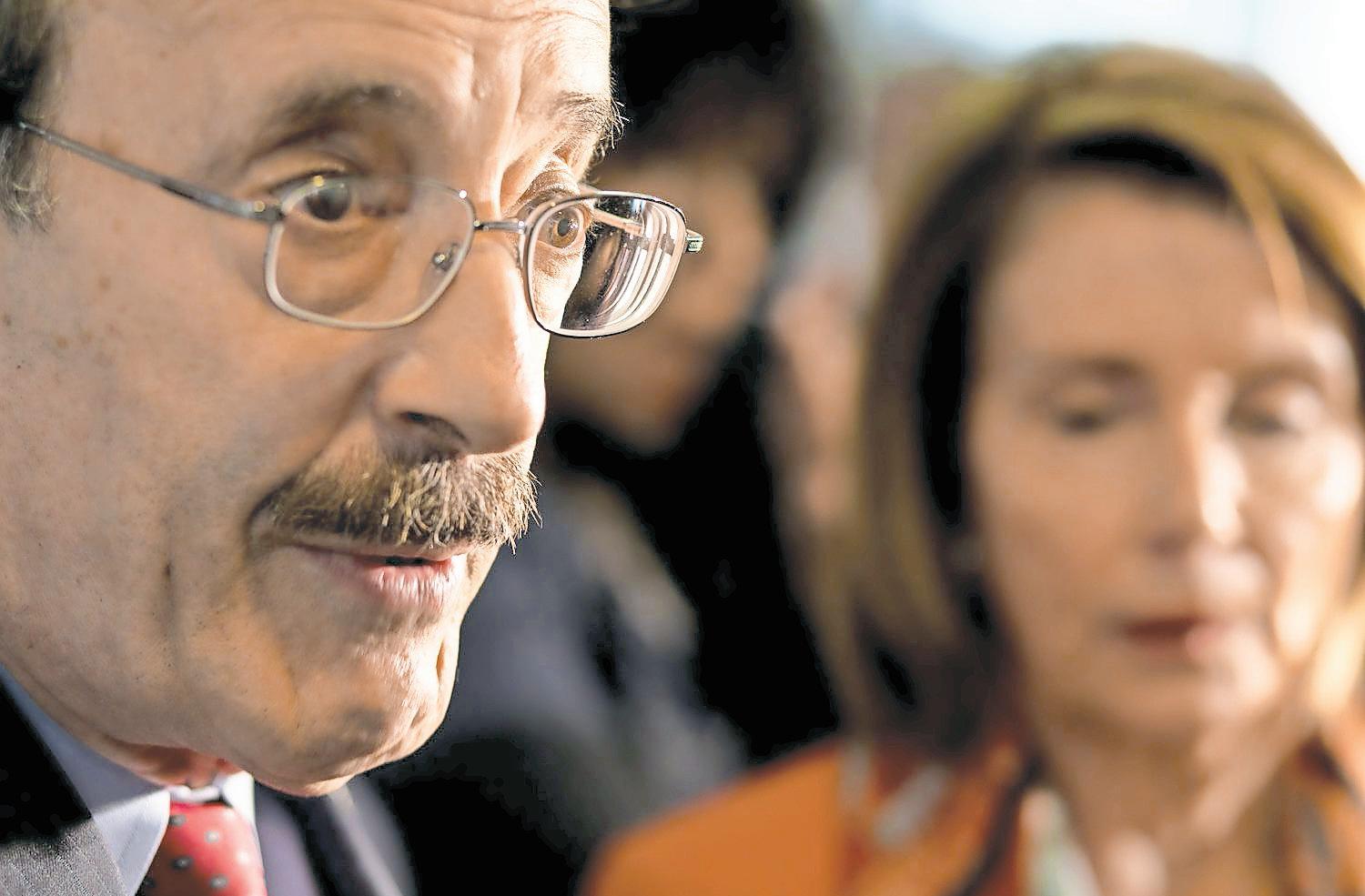
tion against efforts to harass students and staff sent an unmistakable signal to New Yorkers. It showed the left-wing Democrats responsible for his election last year that he was not abandoning his lifelong opposition to the existence of Israel.
The mayor chose not to veto a similar bill that only affected houses of worship because it was passed with a veto-proof majority.
The impetus for the bills was the appalling targeting of Jews on college campuses since the
Editor’s note about Tobin’s column
While Jonathan Tobin is correct in assessing that an anti-Israel drift has accompanied the Democratic Party’s ongoing leftward shift, he can barely bring himself to grudgingly acknowledge that there are still pro-Israel Democrats — and that Rep. Ritchie Torres, the current member of Congress from Engel’s very own Bronx district, both supports a menu of so-called progressive causes and has been one of Congress’ loudest and most consistently unapologetic advocates for the Jewish state and the fight against antisemitism in the US.
The blind spot afflicting Tobin — who is the highly prolific editor-in-chief of Jewish News Syndicate, one of America’s two major Jewish news services, and who for years has
been featured prominently in our pages — is likely because he has DDS (Democrat Derangement Syndrome). This is something he demonstrates frequently even as he calls out those with TDS (Trump Derangement Syndrome). Both DDS and TDS are dangers to the body politic and especially to Jews.
Should Rep. Torres lose his June Democratic primary against an anti-Israel progressive, it would be fair to assign part of the blame to Republican-firsters like Tobin who, in urging that Jews abandon the Democratic Party, put Republican Party interests ahead of Jewish and Israeli concerns.
Of course, far too many Democrats have abandoned Israel and the Jews while most Republicans
— including President Trump — have more generally championed our causes.
But it is simply wrong to argue that New York City voters, in particular, should abandon their Democratic affiliation. Doing so means they cannot vote in Democratic primaries which typically determine an election’s ultimate winner.
Those in Rep. Torres’ district who’ve followed Tobin down the Republican rabbit hole in a Democratic city ought to be plagued by guilty consciences if Torres falls on primary day and his district — which for many years was represented by the unabashed Israel advocate Eliot Engel — elects someone who hates Israel and, at best, will only tolerate American Jews.
—Ed Weintrob, Editor and Publisher
OPINION COLUMNISTS
Mitchell Bard, foreign policy analyst, authority on USIsreal relations; Ben Cohen, senior analyst, Foundation for Defense of Democracies; Stephen Flatow, president, Religious Zionists of America-Mizrachi and father of Alisa Flatow, murdered in an Iranian-sponsored Palestinian terrorist attack in 1995; Yisrael Medad, Americanborn Israeli journalist and political commentator; Rafael Medoff, founding director of David S. Wyman Institute for Holocaust Studies; Fiamma Nirenstein, Italian-Israeli journalist, author of 13 books, leading voice on Israeli affairs, Middle Eastern politics and antisemitism; Melanie Phillips, British journalist; Moshe Phillips, national chairman, Americans for a Safe Israel; Thane Rosenbaum, Distinguished University Professor at Touro University (published by Jewish Journal); Jonathan S. Tobin, editor-in-chief, Jewish News Syndicate.
Hamas-led Palestinian-Arab terror attacks on Israeli communities on Oct. 7, 2023, as well as the siege by a pro-Hamas mob last fall against people entering a synagogue on the Upper East Side.
In the same week, Phylisa Wisdom, the leftwing activist that Mamdani appointed to head an office to combat antisemitism, told a New York City Council hearing that she could not define the term.
The point of that statement was not merely to demonstrate that Mamdani’s administration would not use the widely accepted International Holocaust Remembrance Alliance’s working definition of the term. By not adopting any definition, especially the IHRA document that rightly linked efforts to destroy the one Jewish state on the planet and call Jews Nazis to Jew-hatred, she was similarly signaling antisemites that the city government didn’t take the subject seriously.
Taken together with other developments like the recent Senate vote where 40 out of 47 Democrats voted to cut off arms sales to Israel, it’s no longer possible to deny the obvious. At a time when Jewhatred has surged to unprecedented levels in New York and around the globe, the Democratic Party and the government of the city with the world’s largest Jewish population outside of Israel are both largely hostile to the cause that Engel held dear.
How has this happened?
The hijacking of liberal political institutions like the Democratic Party by so-called progressives is linked to the same trend that has occurred in academia, as well as in the arts and popular culture. Advocates of toxic ideologies like critical race theory, intersectionality and settler-colonialism that exacerbate racial divisions, as well as falsely labeling Israel and Jews as “white” oppressors, have assumed a dominant position throughout these sectors of American life. They’ve made it difficult for people who support Jewish rights and Zionism to stay within them while making them safe places for antisemites.
Rep. Eliot Engel, with House Minority Leader Nancy Pelosi, speaks with reporters at the Hebrew Home at Riverdale in 2019. Riverdale Press file photo
From UK to Vietnam, harassment in overdrive
GLOBAL FOCUS BEN COHEN
I’m going to start with a confession. When my younger son told me that he and his Israeli girlfriend would be heading to Italy for a short vacation in a month or so, my brow furrowed immediately.
“Do your old Dad a favor,” I told him. “Please don’t speak Hebrew in public or tell anyone that you’ve traveled from Israel. Just stick to English and say you’re from New York, OK? Otherwise, I’m going to be nervous the whole time you’re there.”
I’m admitting this not because I’m proud of having made that request, but because I think it will resonate with a lot of other Jewish and Israeli parents in a similar position. In truth, I loathe having to advise my son and his girlfriend not to converse in our ancient tongue, the national language of the State of Israel. But I’m a parent before anything else, and so obviously, I want to do what I can to minimize any risks my two boys and their partners might face when they are among strangers.
As much as I might be faithfully mimicking the stereotype of the anxious Jewish parent, I would challenge anyone who thinks I’m being overcautious by way of a series of incidents last week targeting Israeli tourists in Vietnam.
Video of the three incidents was widely distributed online and picked up in a couple of media reports as well. The offenders were the same in all three: two British women — by some accounts, a mother and her daughter — harassing Israelis they encountered with the foulest screeched abuse.
One might reasonably conclude that the sole reason these two creatures traveled thousands of miles to Vietnam was not to imbibe its fascinating culture, or its breathtaking vistas, or its Frenchinflected cuisine. They went there to harangue Israelis, among whom Vietnam is a popular destination, proudly broadcasting the results on their social-media feeds.
The incidents are instructive because they show the depth to which the antisemitic tropes promoted by the pro-Hamas movement in Western countries have infected its acolytes.
In the first incident, the women — who are always behind the camera, so you can only hear their voices — were inside a casual dining restaurant where an Israeli couple were quietly enjoying their lunch.
When the young Israeli woman they were harassing calmly told them to desist, the British women responded in taunting tones. “Oh, they’re gonna cry, ‘I didn’t have my lunch in peace’.” one of them said in the voice of a playground bully. “Oh dear, victim, victim,” the other one chimed in. “Because we’re goyim aren’t we, we’re just goyim, we’re just worthless animals.”
Actually, most Jews will tell you that animals carry far more worth than a couple of gutter antisemites who have no idea about the provenance of the word goyim, which in its original meaning is the Hebrew word for “nation,” and who have eagerly swallowed lies spread online about “Jewish supremacism.” But they weren’t done. The two women began singing (or at least attempted to do so), the words: “Boom, boom Tel Aviv, this is what you get for all your evil deeds.”
They then started to laugh hysterically before interrogating the couple as to whether they opposed “genocide.”

“Say ‘Free Palestine,’” they urged, as the Israelis calmly carried on eating.
When the Israeli woman eventually responded, saying “we got your opinion, now can you shut the [expletive] up,” the women answered as though they had been insulted. “Don’t you dare,” one of them screamed. “Everywhere you go, you are hated — nobody likes you.”
Then their unvarnished antisemitism emerged: “110 countries you’ve been thrown out of,” said one of them, citing one of the most popular (and laughably inaccurate) antisemitic barbs that mocks the historic persecution of Jewish communities. As the Israeli couple exited the restaurant, the women called them “rats,” invoking the same term for Jews that the Nazis used.
It was a similar story at the next venue where this pestilent duo appeared. At the entrance to what looked like a Buddhist temple, they regaled a group of fit, tanned young Israelis with chants of “Free Palestine” before challenging them to a fight, which, fortunately for them, the bemused Israelis turned down, because these women
wouldn’t have lasted a minute.
In the last venue, again a restaurant, the women had the temerity to present themselves as “documentary filmmakers.” When an unsuspecting young woman replied “Israel” to the question “where are you from?” the abuse followed like clockwork.
Discovering that most of the diners were Israelis, one of the women burst out, “You lot are Zionists, you don’t belong in … in …” Having apparently forgotten where she was, the other woman helped her out by finishing her sentence with the word “Vietnam.”
Even 10 years ago, spectacles like these would have largely been dismissed as regrettable yet marginal phenomena. That is no longer possible. The scenes from Vietnam that I described are not an aberration. Rather, they are a faithful representation of what the movement to eliminate the State of Israel has become: openly and proudly antisemitic, and an unmistakable physical threat to Jews.
See Cohen on page 23
LI and Scarsdale join Jew-hate parade. Who cares?
If you’re worried about the fate of global Jewry, well … it’s not getting any better. Actually, it’s getting worse.
Never before have Jews assimilated into Western societies this successfully only to discover that the countries that granted them citizenship feel no responsibility to protect them from ancient enemies who migrated from their ancestral home.
So much for all that presupposed global power that Jews hold in abundance. Here it is, inexplicably, useless in defending the people who purportedly control all the levers.
The good news is that the only people paying attention to antisemitism are the antisemites themselves. Most Jews, and most everyone else, haven’t noticed a thing.
Meanwhile, despicable incidents zigzag from every direction. Some that go unnoticed and unpunished lead to upgrades in antisemitism. The dormancy of Jew-hatred has awakened without shame.
So, here’s a refresher on recent events. There’s no obligation to sound the alarm. If you do or say
nothing — or default to bashing Israel — you’re in good company.
Arecent poll on Long Island reveals that many residents believe that Jews have exaggerated the Holocaust. Fully a third think that it’s time for Jews to “move on.” Teaching the Holocaust in public schools is a waste of taxpayers’ money.
So much for the “Never Again” slogan, the opening of the Holocaust Memorial Museum in Washington, and the Oscar haul of “Schindler’s List.”
This is Long Island, where Jews have lived in great numbers for decades! What’s up with all those friends and neighbors? Go figure: The people of Casper, Wyoming somehow have more feeling for Jewish history.
In another bastion of Jewish residency, Scarsdale, in Westchester County, flyers promoting an event hosted by the Israel Culture Club at the high school were found in the urinal of the boy’s bathroom. What’s more, the daughter of a school board member posted the photo of such antisemitic performance art on Instagram with her approval.
Speaking of school boards, in Michigan, Amir Makled, an attorney who represented pro-Hamas protesters at the University of Michigan, received the Democratic Party’s nomination for the university’s Board of Regents.
Makled’s social media posts show him to be a terrorist fanboy who should be deported, not elected to a position where he will help direct the governance of one of the finest public universities in the country. He defeated a Jewish former member of the Obama administration who was

the target of pro-Hamas mobs. What does that tell you?
Of course, Makled is from Dearborn, Michigan, where the mayor and the entire city council are Muslims in a Muslim-majority city — the same city where we first heard chants, “Death to America!”
In Michigan, antisemitic activism is not just confined to its flagship university. One of its two senatorial slots may be handed to an avowed anti-Israel Islamist. Democratic Senate candidate
told CNN just this past week that there is no difference between Israel’s government and Hamas.
Most of his rallies are replete with anti-Israel rhetoric. He had already scrubbed his social media accounts of thousands of posts aligned with the Jew-hating progressive agenda. A recent campaign rally featured progressive streamer Hasan Piker, who has said that America “deserved” what it received on 9/11, and that Hamas is the “lesser of two evils” when compared to Israel.
There are now Mayor Mamdanis everywhere — progressives who stake all their political capital on slandering Israel with the false charge of genocide.
And the sources of support for such candidates are growing. Yale University just released data indicating that 10 percent of voters aged 18 to 34 agree with antisemitic statements such as that Jews are guilty of dual loyalty and exert disproportionate and pernicious influence. Hardly anyone over age 65 believes such nonsense.
An Echelon poll shows that nearly half of all Democrats believe that the United States takes its orders from Israel. Half of all Democrats under the age of 50 have a “very unfavorable” opinion about Israel and believe it to be an apartheid state that systematically oppresses Palestinians. Hardly any Republicans feel that way.
For the first time since Israel’s founding in 1948, Americans sympathize more with the Palestinians than with the Jewish state. The Pew Research Center released even more dire findings: 80 percent of all Democrats view Israel unfavorably. Six in 10 Americans feel “somewhat
Abdul El-Sayed
A urinal in Scarsdale High School: antisemitic expression in a heavily Jewish town.
Vietnam, which is a magnet for young Israeli travelers, has to import its Jew-haters. Ed Weintrob, The Jewish Star
Geopolitical limitations of John Lennon’s dream
MOSHE
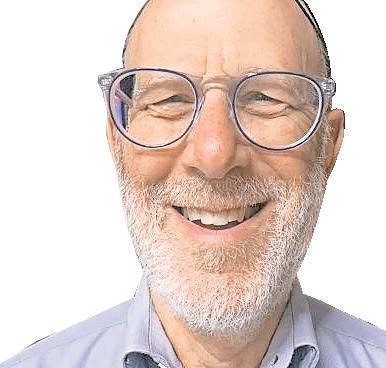
John Lennon’s death in December 1980 shocked the world. As a member of the Beatles, he helped define the cultural upheavals of the 1960s. Their message — simple, powerful and deeply appealing — was that love, not power or ideology, could unite humanity.
“All You Need Is Love” was more than a beautiful song, incorporating, one can assume purposefully, “La Marseillaise,” the French revolutionary anthem calling citizens to rise against tyranny, set within musical textures spanning Bach to Brubeck as only the Beatles’ originality could. It became a creed. If all we need is love, then the Vietnam war, the other main issue of the day, could be solved.
The assumption was that beneath political systems and cultural differences, people ultimately wanted the same things.
John Lennon’s more radical vision — most clearly expressed in “Imagine” — suggested a world stripped of borders, nations and competing loyalties. As former Soviet refusenik and later, an Israeli statesman, Natan Sharansky argued, such a utopian vision, however appealing, risks ignoring the realities of regimes and ideologies that do not share those assumptions.
The belief — call it hope — that the world could unite under these universalistic aspirations seeded themes that shaped decades of social thought. It helped fuel the movements for women’s equality, civil rights and environmental responsibility. Noble causes all. Former President
There was a sense that the Middle East was bending in a favorable direction.

Richard Nixon had bravely opened the door to China, and less than 30 years later, former President Ronald Reagan challenged Gorbachev to tear down the wall that had divided East from West — something ultimately accomplished by the people of East Germany.
Democracy’s righteousness was on the rise, and geopolitics was cooperating. Maybe it wasn’t all love, but the sense was that things were bending in a favorable direction. Live and let live was at hand.
Even at the height of the inspired optimism, glitches in the path of 1967’s “Summer of Love” generation were easily overlooked. Headlines, often from the Middle East, were troubling but siloed. The Arab-Israeli wars of 1967 and 1973, both coordinated attacks on the Jewish state by regional Muslim-majority states, along with the rise of modern terrorism, were treated as aberrations to the underlying assumptions. Such disturbances were too far from the West to get in the way of the optimism.
Small but persistent voices cautioned that not all cultures and communities shared the West’s assumptions. They argued that appeals to
shared humanity (noble as they were) would not be appreciated by the Communist or increasingly radical Muslim ideologies representing large swaths of the global population. Undeterred, the West continued to proffer increasing empathy, dialogue and goodwill. Surely, they would win the day.
It did not.
Overtures of conciliation — by governments, universities and international bodies — were often interpreted not as invitations to mutual recognition, but as opportunities to advance asymmetrical aims. Wealth, particularly from oil revenues, amplified this dynamic, extending influence into all of these institutions.
Simultaneously, Israel’s repeated efforts at negotiation and compromise were often dismissed by its neighbors and repeatedly broke down in the Palestinian arena.
As Israel became more effective in defending itself, early sympathy for a tiny, exposed nation gave way in many quarters to growing criticism of its methods. In some cases, this shift reflected a deeper discomfort with Jewish power itself — admiration proving easier when Jews were
vulnerable than when they exercised sovereignty and force. Over time, segments of governments, academia and international institutions moved beyond rejecting Israel’s overtures for peace to questioning Israel’s very legitimacy as a Jewish state.
Concrete efforts illustrate the pattern. In 1978, then-President Jimmy Carter brokered a peace agreement between Israel and Egypt, conditioned on Israel’s return of the Sinai Peninsula. Egypt’s Arab allies rejected the accord, diplomatically isolating Cairo for years. Egyptian President Anwar Sadat was assassinated in 1981, in part the price for making that peace.
In 2000, then-President Bill Clinton invested significant political capital in Israeli-Palestinian negotiations at Camp David. When those talks failed — a failure Clinton later attributed largely to PLO chief Yasser Arafat — the Second Intifada followed, resulting in more than 1,000 Israeli civilian deaths.
Nearly a decade later, former President Barack Obama’s Cairo address again appealed to shared values and mutual respect between the West and the Muslim world. These efforts reflected a genuine belief in convergence; however, they did not produce the broader transformation anticipated.
Aharder truth emerged: Universalist democratic values do not automatically resonate across all societies. In Communist oligarchies as well as the Middle East, Israel has faced not merely political opposition but, in too many quarters, a sustained refusal to accept its legitimacy as a Jewish state.
Repeated efforts at negotiation and compromise have not yielded acceptance and have, at times, intensified hostility. This dynamic is reflected in Iran’s cultivation of a “ring of fire” of proxy forces surrounding Israel, whose sustained attacks on civilian populations culminated in the Hamas-led terrorist attacks in southern Israel on Oct. 7, 2023.
And yet, many in the West continue to hold cherished ideals as guiding principles, despite continued assaults on Israel. Indeed, Israel’s self-
See Manheim on page 23
Grieving Engel: Loss to DC, Israel and all Jews
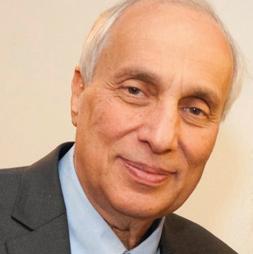
Eliot Engel listened. He spoke with clarity and purpose. And he never forgot where he came from; he never forgot his Jewish roots.
Rep. Eliot Engel, who passed away on April 10 at the age of 79, knew the heights of Washington well. For more than 32 years in the House of Representatives, he rose to chair the powerful House Foreign Affairs Committee while representing his district in the Bronx with distinction, including the synagogues of Riverdale, where our own congregation is situated.
He was widely regarded as one of the leading liberal voices in Congress. His advocacy for Kosovo and the Albanian people, and his insistence that America stand with them in their struggle against Serbia, has become part of his enduring legacy.
One of the true tests of leadership is not simply standing with the powerful; it is standing with the vulnerable. That was a defining feature of Engel’s life. He raised his voice for the indigent, both in America and abroad, as well as for American veterans — our heroes, too often forgotten. In a word: If there was a need, you could count on him to be there.
Acknowledging the congressman’s noble contributions, a major memorial will soon be held, no doubt to be attended by the who’s who of New York and even national politics.
But standing at the entrance to the cemetery before his modest graveside service, I could not help but recall the words of Pirkei Avot (“Ethics of Our Fathers”): “Be careful in your dealings with the ruling authorities, for they do not befriend a person except for their own needs … they appear as friends when it serves their interests, but do not stand by a person in the hour of distress.”
The past six years were difficult for Engel and his family. After a bruising electoral defeat, he was unfairly portrayed as having strayed from his liberal ideals. Little mercy was shown, even as it became clear that he was quietly struggling with his health.
Yet he carried himself with dignity, reminding us that the measure of a public servant lies not only in how one handles victory, but in how one endures defeat. As he battled Parkinson’s disease, the congressman to whom so many had turned for help was, too often, left to face his own struggles alone.
What stood out most to me, however, was that for all his universalism, he never forgot where he came from. He never forgot his Jewish roots, his family’s history shaped by European pogroms or his unwavering commitment to the State of Israel. On many occasions, he told me that one of the great privileges of serving in Congress was the opportunity to affirm the vital
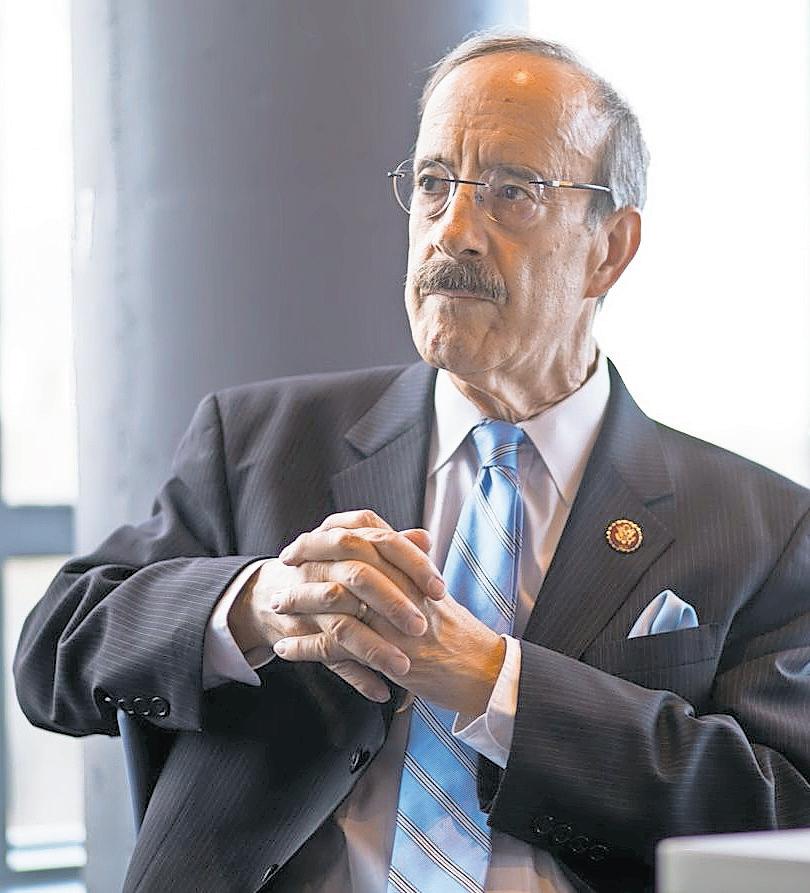
importance of the American-Israeli alliance.
He did so publicly, from the Well of the House, and privately, in moments witnessed by few. I recall looking up from the Western Wall during the Gulf War in the early 1990s, as Scud missiles fell on Israel, and seeing Engel approaching with his assistant. When others were leaving, he was running toward.
In more recent years, as some of his liberal colleagues distanced themselves from Israel, Engel remained steadfast — fierce and unapologetic in
his defense of the Jewish state. He understood something that eludes many: that a strong sense of identity and a deep connection to one’s roots do not stand in tension with a universal mission. It is, in fact, a prerequisite for it.
Like all politicians, Engel understood the importance of being seen and heard, but he was a humble man at heart. In all the demonstrations I was involved in organizing, he never used his clout to demand the microphone upon arrival while others were speaking, as other politicians often did. Nor did he enter rooms announcing himself. He listened. And when called upon, he spoke with clarity and purpose.
I think of a High Holiday service when Engel chose not to move from synagogue to synagogue to be seen, but instead remained seated for hours, praying quietly alongside our community.
The Talmud teaches that after one’s time in this world, we are asked: “Did you act faithfully?” Engel can answer in the affirmative. He was faithful to his family, whom he often said were his highest priority. He was faithful to the America he loved. He was also deeply and enduringly faithful to the State of Israel, for which he fought day in and day out.
It has been said that more important than the dates etched on a gravestone is the dash between them — the sum of a life lived.
Eliot Engel’s dash shines brightly. It reflects a rare synthesis of action, conviction, dignity and humility.
May his memory be a blessing.
Write: Columnist@TheJewishStar.com
Rep. Eliot Engel during a visit to Manhattan College, in Riverdale, in 2019. Julius Constantine Motal, Riverdale Press
A press photo of John Lennon to promote his “Walls and Bridges” album, 1974. Bob Gruen, Capitol Records via WikiCommons
Bad news on our doorsetep: A new world order
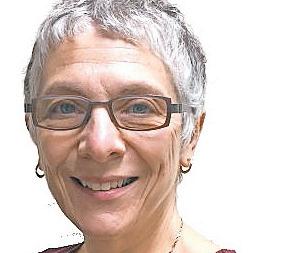
Most people in America are against the war with Iran, as they are in Britain, too. Very few, however, actually understand why this war is as necessary as it is unavoidably complex.
Few seem aware that Iran has been actively at war against America for the past 47 years. Few seem to grasp that Iran’s fanatical Islamic regime has killed hundreds of US servicemen, perpetrated numerous attacks on US bases, committed countless terrorist atrocities and taken Americans hostage.
Few grasp that US and Israeli intelligence had discovered that Iran was poised to create both a nuclear bomb and a missile arsenal so enormous and so buried underground that no one would ever be able to tackle the mortal threat posed by the regime.
Instead, the American and British public have been fed a remorseless mainstream media narrative framed entirely by obsessive hatred of US President Donald Trump and Israeli Prime Minister Benjamin Netanyahu. This presents the war as a reckless choice into which Trump was bounced by Netanyahu, that it was always going to be a disaster, and that it’s already been lost.

Israel, however, which is desperate for the Iranian regime to be prevented from ever harming it again, fears that Washington is once again leaving it hanging out to dry. The Israeli public thinks that Trump’s ceasefire — and then its extension — shows that he hasn’t got the commitment to see this thing through. They fear that he seeks to make a deal he can call victory, but that will leave the Tehran regime in a position where it can rearm and come back even more deadly than before.
Others, though, think that Trump is displaying strategic brilliance. They point out that he’s flipped the script over the Strait of Hormuz by turning Iran’s supposed chokepoint for the world into a deadly weapon against the regime itself.
America’s blockade of the Strait is causing Tehran to lose hundreds of millions of dollars a day in vital revenue, while the buildup of oil will potentially cripple the oil wells themselves and put them out of further use.
The fact is that this war is neither won nor lost. Both sides say they have the upper hand. Everything depends on Trump. His repeated outbursts on Truth Social, which often
seem to contradict each other, are giving many people severe emotional whiplash.
No one knows how this is going to end. But it’s very alarming that opposition to the war in America is feeding into a growing general public animus against Israel.
Public opinion shows that the majority of Americans are now more sympathetic to the Palestinian Arabs than to the Israelis. In a Pew Research Center survey conducted in March, 60% of US adults held an unfavorable view of Israel, including 80% of Democrats and 41% of Republicans.
This animus, reversing decades of general public support for Israel, is due to three things: the education system, social media and increasing political hostility on both sides of the aisle.
Some of this is due to the funding of antiIsrael materials in the education system by Qatar. But mostly, it’s due to the Marxist, “anticolonialist” and anti-Western orthodoxy that has been standard in the universities for years, which has now infused the K-12 syllabus in schools and frames Israel falsely as a colonialist oppressor.
With the education system having widely replaced teaching how to think with what to think, young people have become vulnerable to the enormous pressure of the fashionable consensus. This is disseminated, in turn, by social media, which presents cranks and oddballs as having credibility, and who are accordingly believed by the credulous and ignorant.
At the same time, the political world is increasingly abandoning the rational center ground for extremism. The left has entered into an unholy alliance with Islamists in the common aim of overturning the West — even though their intended replacement societies are the polar opposite of each other — and of hatred of Israel, the Jewish people and Judaism.
Last week, 40 of 47 Democrats voted for a resolution blocking the sale to Israel of bulldozers, while 36 opposed the sale of thousandpound bombs — in the middle of a war in which America and Israel are fighting side by side.
The frontrunner in Maine’s Democratic Senate primary, Graham Platner, who has a Naziassociated tattoo on his chest, wrote in 2014 of Hamas military tactics: “From a strictly professional standpoint, this was a damn fine looking and successful raid against a superior opponent. I dig it.”
The Republican Party is fracturing along similar lines, with a significant faction claiming that Israel drags the United States into foreign wars — a charge now given rocket fuel by the war against Iran — such as the 2003 war in Iraq. This claim is idiotic and untrue. Israel’s prime minister at the time, Ariel Sharon, advised Washington against the Iraq war, while successive US presidents have repeatedly restrained Israel from doing what it has needed to do to keep itself safe.
Now the left is joining the right in this particular canard. Last weekend, the former Democratic presidential candidate and US vice presi-
Lebanon ceasefire doesn’t stop the media’s lies
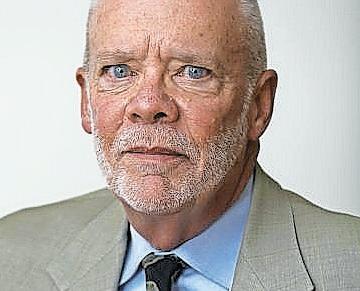
The Al Jazeera headline announcing the latest ceasefire reads, “People of Beirut wary of trusting Israel will uphold Lebanon ceasefire” — hiding the fact that Hezbollah has been egregiously violating the last November 2024 ceasefire since the day it was signed.
Even as Israel continues rectifying Hezbollah’s transgressions of the earlier agreement, the US has pressured the Lebanese government and Israel into another ceasefire. The sole function of this seems to be to eliminate, at least temporarily, a key distraction from ongoing US-Iran peace talks.
The new Israel-Lebanon ceasefire is bound to fail for two reasons. First, a fundamental goal of Hezbollah is to destroy Israel. The terror group has never abided by a ceasefire, and there’s no reason to expect they’ll start now. Indeed, they’re not party to this ceasefire agreement and haven’t acknowledged it.
Second, a key element of this ceasefire, as with the 2024 version, is the commitment of Lebanon’s “shell” government to enforce the agreement upon Hezbollah. Unfortunately, nothing has changed in Lebanon’s inability to bring Hezbollah to heel.
Despite the ceasefire, a third factor is also des-
tined to remain unchanged — the mainstream media’s incessant demonization of Israel. As Israel responds aggressively to Hezbollah’s widespread violations of the 2024 ceasefire, legacy media, as usual, depict Israel’s defensive measures as focused persecution of innocent Lebanese civilians.
In truth, Israel is exercising its legitimate rights precisely according to the ceasefire accords and its need to protect tens of thousands of Israeli residents in the country’s north. For starters, the media fail to cover the very cause of Israel’s military actions: Hezbollah’s abject failure to abide by the ceasefire, including disarmament and vacating Lebanon’s south, which borders Israel.
Furthermore, media reports on Israel’s military maneuvers — as they so often did when covering the Gaza war — attribute responsibility for endangering civilians to Israel, rather than to belligerent terrorists who directly create the danger.
Indeed, a recent headline in the New York Times focused on Israel’s disruption of Lebanese life, rather than its root cause: “Thousands of Lebanese Try to Head Home After Israel-Lebanon Truce.”
Mainstream media neglect to mention that Hezbollah’s fighters regularly conduct operations in residential areas, schools and other public spaces in zones forbidden to them by the last ceasefire agreement. Additionally, media headlines highlight total deaths from military attacks, without mentioning how many terrorists were killed. In fact, as of mid-April, Israel estimates that out of those killed in its military operations in
Instead of reporting on the root problems causing civilian deaths and displacement, new outlets eagerly cover proposals to restrict defensive arms sales to Israel.
southern Lebanon, 78% were Hezbollah terrorists.
Finally, media coverage is scant on the utter failure of the Lebanese army so far to enforce the ceasefire stipulations on Hezbollah — or, for that matter, to influence Hezbollah’s ongoing aggression and military build-up. Mainstream media also fail to explain that Hezbollah’s recent rocket attacks on Israel were launched at the behest of Iran, which seeks to maintain its hegemony in Lebanon through its Hezbollah proxy.
Instead of reporting on the root problems causing Lebanese civilian deaths and displacement, the media eagerly covers proposals to restrict defensive arms sales to Israel. In short, the goal of the media in this conflict isn’t to report the facts of the whole story, but to discredit Israel with omissions, half-truths, innuendo and lies.
Hezbollah has massively violated the last ceasefire. It specified that only the Lebanese Armed Forces (LAF) would be deployed in Southern Lebanon, the area south of the Litani River. It also affirmed that all non-state armed groups would be disarmed. But none of this has happened.
Rather, Hezbollah has maintained and expanded its presence in Southern Lebanon. And it has rearmed, not disarmed. Since the ceasefire began, for example, UNIFIL has discovered hundreds of Hezbollah weapons caches in Southern Lebanon. Hezbollah continues to smuggle weapons into Lebanon. Also, on several occasions, the terrorist group has fired mortars, rockets and drones into Israel. In total, Hezbollah violated the ceasefire 1,925 times and shows no sign of cooperating with a new ceasefire now.
The purpose of this ceasefire is primarily to remove an obstacle to US-Iran peace negotiations. Thus, the US State Department said the truce was a “gesture of goodwill” by Israel intended to enable “good-faith negotiations towards a permanent security and peace agreement” between the two
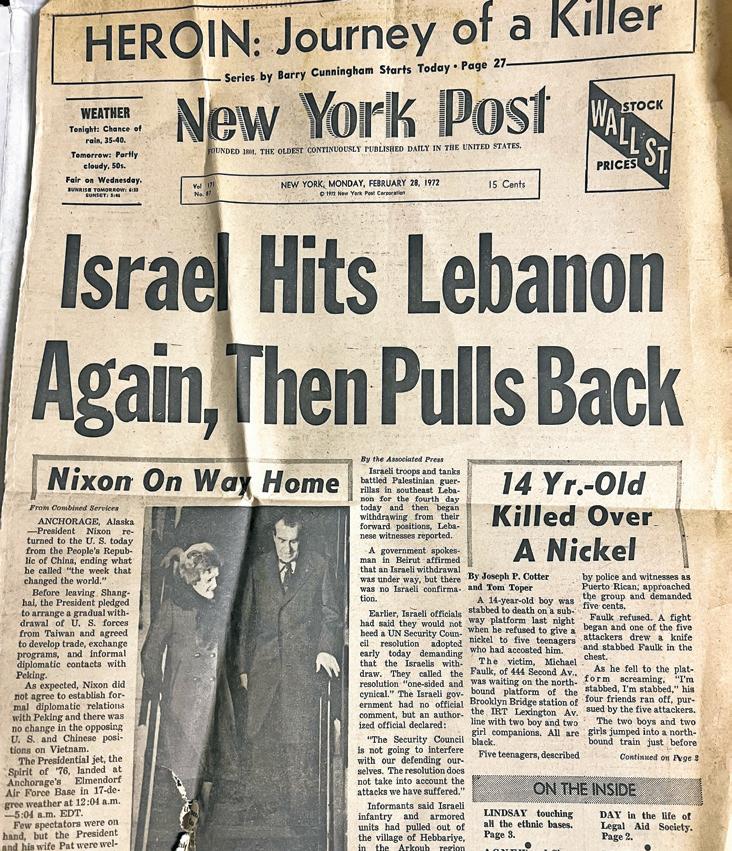
parties. Moreover, a day after the ceasefire was announced, Iran’s foreign minister said, “in line with the ceasefire in Lebanon,” the Strait of Hormuz was “declared completely open” (only to be closed again by Iran’s IRGC forces). Opening the Strait, through which 20% of the world’s oil transits, has been a key obstacle to ending the Iran war.
Lebanon’s government isn’t a sovereign body and cannot exercise authority. Above all, it hasn’t fulfilled its obligations under the last ceasefire — disarm Hezbollah and remove them from Southern Lebanon — and won’t be able to do it now. As recently as last month, the LAF refused to enforce an order by the Lebanese government banning Hezbollah’s military activities, demanding weapons surrender and restricting the group to a political role.
See Phillips on page 23 Old news: Israel in and out of Lebanon, 1972.
US forces patrol the Arabian Sea near on April 20. US Navy
TOBIN: It’s Zohran Mamdani’s New York now…
Changing demographics
The situation in New York City, however, is also one that is a function of demography.
Engel, who was born, raised, educated and died in the Bronx, was a product of a now-bygone era of life in Gotham when Jews and white ethnic groups like Irish and Italian-Americans were important, if not dominant forces, in local politics. It was once axiomatic that mayoral aspirants would precede their campaigns with visits to the “three I’s” — Ireland, Italy and Israel — to signal their identification with core constituencies. But in the current age of Mamdani, perhaps the equivalent would be the two “P’s” — Pakistan and “Palestine.”
That is partly a product of factors like the enormous increase in immigrants from South Asia and other Muslim-majority countries. It’s also a function of the way hostility to Israel — and backing for Palestinian Arabs, whose national identity is inextricably linked with their century-long war on Zionism and the Jews — has become not so much an intellectual fashion on the left as it is the new orthodoxy.
It’s also the result of the flight from New York of those groups that made the outer boroughs — specifically Brooklyn, Queens and Engel’s native Bronx, along with little Staten Island, which remains a red outlier in a deep-blue city — a check on the power of the left-wing elites who run Manhattan. While the Jewish population of New York City has remained relatively stable in recent decades due to the high birth rates of Orthodox and Chassidic enclaves, the decline of the non-Jewish, white ethnic population has had an enormous impact on New York politics.
Approximately half of New Yorkers are Hispanic or African-American. But even their influence has been offset by others like Asians, South Asians and other diverse groups in a city where voter turnout is low in many areas where the population
Berlin…
had to make room for one another. Not metaphorically. As a prerequisite.
The capacity to hold space for another person had to come before the capacity to hold a relationship with G-d. Rav Soloveitchik develops this idea in his essay “The Community,” explaining that G-d modeled this from the very beginning. Creation was an act of tzimtzum, of contraction. G-d withdrew and made room for us to exist. That is how real relationships work. You cannot give yourself to someone who has no room to receive you.
Rabbi Akiva’s students understood Torah brilliantly. But they competed with one another instead of making room for each other; thus on Shavuos, they could not spiritually receive the Torah anew.
It was not that they hijacked Sefiras HaOmer. It was that they failed it. The count is meant to shape us into k’ish echad b’lev echad, one people with one heart (Rashi, Shemot 19:2). We mourn the fact that they could not get there.
Hersh Goldberg Polin did not go to shul because he had resolved his theology. He went because his father was there, and he could not bear the thought of his father sitting alone. He dragged himself out of bed after four hours of sleep, week after week, year after year, not for G-d but for his father. And perhaps that is exactly the point.
When we make room in our hearts for the people beside us, even when it costs us something, we are already doing the work that opens us to something larger. The work that opens us up to G-d. That is the real counting of the Omer. Not just the beard. Not just the longing for the music. Each day is a question. Am I becoming someone with enough room in my heart for someone else?
When Shavuos comes, if we have done this
is economically disadvantaged.
That population shift explains why a New York that elected a Republican like Rudy Giuliani as mayor twice (1993 and 1997) and then an independent like Michael Bloomberg three times (2001, 2005 and 2009), despite the overwhelming registration advantage of the Democrats, simply doesn’t exist anymore. That’s something former Gov. Andrew Cuomo learned when he was easily defeated by Mamdani in a mayoral primary and then again last fall in the general election.
That’s why the city is now governed by radicals like Mamdani. And where once it was represented in Congress by Democrats and Republicans who were uniformly pro-Israel, that is no longer the case.
The ranks of New York City’s congressional representatives are now increasingly filled with those like left-wing “Squad” ringleader Rep. Alexandria Ocasio-Cortez of Queens and the Bronx and those aligned with her.
There are still those who are supportive of the Jewish state — like Rep. Nicolle Malliotakis, the city’s sole Republican, from Staten Island; and Democrats Ritchie Torres from the Bronx Hakeem Jeffries, the minority leader, from Brooklyn. But with each incoming class arriving in Washington, their ranks become thinner.
And in keeping with these demographic and ideological shifts, the number of Jews in Congress from New York City has also declined. In 1992, when Engel was serving the second of his 16 terms, he was one of eight Jews representing the city. Now, with Rep. Jerry Nadler (who began his career as a steadfast backer of Israel and is leaving it as just one more liberal who has abandoned it) retiring from Congress at the end of the year, there may be only one: Rep. Dan Goldman.
Goldman is a lukewarm supporter of Israel who represents a district in Manhattan and Brooklyn with a significant Jewish population. He is currently facing a stiff primary challenge from former
right, we will not just be celebrating the giving of the Torah. We will be ready to receive it.
Rabbi Benny Berlin is spiritual leader of BACH in Long Beach, www.bachlongbeach.com.
Write: Columnist@TheJewishStar.com
authentic spirituality based on traditional Jewish mysticism, and unfounded, baseless and nonsensical superstitions.
We fret unnecessarily about spooky stuff like a black cat running in front of us or, G-d forbid, walking under a ladder or breaking a mirror, and getting seven years of bad luck. We shouldn’t be so gullible.
Many remember when a mother or grandmother sewed a button back on for you while you were wearing the shirt, and she would put some of the string in her mouth. Believe it or not, that was not superstition. There is a legitimate reason for that. We try not to do things in the same way as they are done for the dead — in this case, when sewing shrouds onto a dead body.
Likewise, we don’t pour water from a jug backwards. Those are all practices to do with the dead, and we try to stay far away from them while we’re alive. They are not superstitions but authentic traditions based on Kabbalah.
On the other hand, if some guy from Israel in a black hat and beard tells you that there is a mistake in your ketubah and that’s why your marriage is failing — and he offers to fix it for you for a handsome fee — I suggest you throw him out.
A lot of things are plain bubbe meises! That’s the equivalent of “old wives’ tales.” Now, I fully believe that our bubbes, our dearly beloved Jewish grandmothers, were very wise and worthy of listening to, but bubbe meises is just plain garbage.
How can we know what is real and what is
New York City Controller Brad Lander, a Jewish opponent of Israel who’s running with the endorsement of Mamdani.
Goldman is under enormous pressure on the issue of Israel — to the point where he felt compelled to distance himself from his wife and campaign treasurer, Corrine Levy Goldman, because of her online outrage about the Palestinian Arab terrorist attacks on Oct. 7, 2023.
Throwback to bygone era
No matter the outcome of the midterms in New York, in the foreseeable future, there will be no one representing the city in the same manner as Engel. Engel was no great orator nor did he possess much charisma. During the course of his long career that stretched from 1989 to 2021, he was best known for his somewhat comical efforts to get seen on national television on the evenings of presidential State of the Union addresses. He always arrived in the House chamber for the joint session hours early so he could secure a seat on the aisle where the president walked in and out, and he could count on a chance to shake hands while the whole country was watching.
While it was a bit ridiculous, his defense of the practice also seemed to hark back to the days when politics was not a blood sport in a bifurcated nation. In 2015, at a point when he was a leading opponent of President Barack Obama’s Iran nuclear deal, he said that, “It’s an honor to shake the hand of the president of the United States, no matter who it is.” He only discontinued that practice in 2017, when the hand he would have shaken was that of President Donald Trump, a disturbing sign of changing times.
When Engel ascended, by means of seniority, to the positions of ranking minority member (2013-2019) and then chairman (2019-2021) of the House Foreign Relations Committee, he didn’t hesitate to use that perch to pursue policies that would protect Israel’s security.
fake, what to believe and what to reject out of hand? How are we to determine what is genuine and authentic from what is hocus pocus, and perhaps, even dangerous?
Good question. And the famous Jewish answer applies: “Ask your rabbi.”
Are you observing mitzvot out of fear or superstition? I suppose it’s better than not observing anything at all. But the bottom line is that we should be doing the right things for the right reasons. Not out of fear, insecurity or superstition, but out of a sincere faith, belief and understanding of our Jewish traditions, which have been sanctified by generations of observance over millennia.
Are you grappling with a problem? Don’t run to the gypsy lady and her crystal ball. A timehonored response might be to check your mezuzahs or your tefillin, or even better, to wear your tefillin more regularly.
And if you need wise counsel, there is sage advice available in every organized Jewish community, too. Don’t be shy. Ask the question. Answers abound.
Write: Columnist@TheJewishStar.com
No one thought of him as a giant of Capitol Hill. In some ways, he was a typical liberal Democrat, hard-working, dutiful and respected. That sustained him for many years. Yet in an era in which politics is conducted on social media and with behavior that legislators of the past would have shunned, at a certain point, it was no longer enough.
Engel lost his seat in 2020, when he was easily defeated in a primary by Jamal Bowman, a radical foe of Israel. Part of the problem was Engel’s age and the impression that, as a veteran congressman, he had lost interest in his district. But it was equally true that Engel’s particular brand of ardent pro-Zionist politics was out of fashion in his party. Bowman was part of the second class of the hardleft congressional “Squad,” alongside its founding members: AOC and Reps. Ilhan Omar and Rashida Tlaib of Michigan, and Ayanna Pressley of Massachusetts.
Bowman’s tenure only lasted two terms — not because of his extremism, but due to his incompetence and bad behavior (he was caught pulling a fire alarm in the Capitol to avoid having to attend a vote).
Suffice it to say that a Democratic Party, where it is now axiomatic that taking contributions from supporters of the AIPAC pro-Israel lobby is political poison, is not one in which someone like Eliot Engel could hope to win a Democratic primary in New York City, let alone aspire to serve in Congress for three decades.
Engel’s passing came the same week during which events in Washington and New York illustrated the new reality in which the Democrats have become the anti-Israel party. That provided a tragic counterpoint to the memory of his career. In the years to come, it’s highly unlikely that someone like Engel will again represent the city in Washington. And American Jews, New Yorkers and all Americans will be worse off because of it.
Write: Columnist@TheJewishStar.com
It is well known that pagan idolators sought to appease their gods via human sacrifices, burning their own sons and daughters at the stake, scarring their own bodies and disfiguring themselves. Cruelty, sadism, revenge! As Hosea (13:2) puts it, they are zovchai adam, they sacrifice humans. So it was until the Holy One Blessed Be He caused the light of Torah to shine… teaching us the values of compassion and sympathy and kindness and mercy, with no distinction between Kohanim who must be treated with honor; Leviim whom we must gladden; Yisraelim whom we must treat charitably and not treat as chattel; the ger toshav whom we must sustain; the eved Kenaani whom we must not degrade; and animals to which we may not cause pain.
“Think too of the prohibition against having one’s non-Jewish employees work for us on our Sabbath, the prohibition against muzzling work animals, and the fact that danger of death or serious illness overrides Torah proscriptions. In short, The Torah and its commandments teach mercy, kindness, compassion — all the ways of His Blessed Name.
The Meshech Chochma eloquently concludes: Be careful, my children, not to teach cruelty, but rather “Keep my commands and fulfill them … do not profane My holy name.”
4. Do not profane the L-rd’s name = (chillul Hashem);
5. Sanctify the L-rd, i.e. be a “holy” people (kiddush Hashem).”
Rabbi Copperman, of blessed memory, the founder of the Michlalah Jerusalem College for Woman, thus offers us a very helpful but very brief sketch of Rav Meir Simcha’s lesson: Avoid cruelty, even to animals, so that you may be a “holy people.”
Rav Meir Simcha’s full text is both more elaborate and more convincing. Here it is, subject to my own translation:
His “holy name” expresses His creation and maintenance of the Universe; His desire to preserve them and not, heaven forbid, to destroy them and thereby profane His own name. … There is therefore a mitzvah to act in a holy manner to sanctify His name, and to thereby “illuminate the eyes of the rest of Israel” as to how to worship the Master of All Creation.
At moments like this, rereading the brilliant and instructive words of Rav Meir Simcha, I vividly recall the man who introduced me to this great sage and spiritual master. I remember Rabbi Pinchas Mordechai Teitz, who passed away decades ago.
I can never forget his many kindnesses as he Continued on next page
PHILLIPS: Bad news birth of new world order…
Continued from page 21
dent, Kamala Harris, spoke about the war to a Democratic convention, saying that Trump “got pulled into it by Bibi Netanyahu, let’s be clear about that.”
And Rahm Emanuel, the White House chief of staff under former president Barack Obama, said on Bill Maher’s TV talk show that there should be no more US taxpayer support for Israel, which should “get the same deal that any one of our allies does,” and that the United States “should never spill any blood for the State of Israel’s security.”
This was an odious and twisted remark.
American military assistance to Israel requires much of that funding to be spent on American-made defense systems. This means that the United States profits hugely from the aid flowing back into the American economy through
Continued from previous page
coached us in our studies, encouraged us to surmount the difficulties we encountered, and complimented us on our accomplishments. And all this with a smile, a humorous anecdote, and a warm handshake — sometimes even a hug. If kindness equals holiness, he was indeed a holy man.
Reflect on kind individuals that you have experienced in your lifetimes. Can you redefine them to yourselves as having been holy people?
I close by sharing with you exemplary individuals whom I identify as supremely kind and distinctively holy. I write these words on the fourth day of Iyar, Yom HaZikaron, the day in which we recall those heroes and heroines of the wars and victims of terror that have so deeply bereaved the State of Israel since its inception.
There are too many to list by name in this weekly column. But they were all exemplary of kindness. Those who were killed in active duty were infinitely kind in their dedication to our defense and for having made the ultimate sacrifice. When one hears descriptions of the many victims of terror from their friends and family, one invariably hears tales of their profound kindness during their tragically interrupted lives.
Yes, they were kind. But they are known in Hebrew as kedoshim, holy souls! Indeed! To be kind is to be holy! A lesson for us all from the kind and holy author of Meshech Chochma, Rav Meir Simcha HaKohen.
Write: Columnist@TheJewishStar.com
Freedman…
Continued from page 17
The first usage of the word refers to Moshe’s instructing the kohanim in the limitations they will need to accept upon themselves, something difficult to accept and thus best given over softly and warmly. The second time the verse repeats the enjoinder to speak, it is referring to the kohanim themselves being responsible to pass this along to their children as well. It’s not easy to teach children limits, and sharing the idea is a better strategy than merely issuing a command.
Furthermore, Rav Moshe deduces that the second usage implies that the kohanim must have a positive feeling towards the mitzvot. In fact, he points out, even if your children see you are willing to sacrifice for Torah, that is not what will connect them to tradition. What really impacts our children is when they see we love it.
“Precisely when children hear their parents say that mitzvot are not a sacrifice at all, we simply love them and they enrich our lives and fulfill us, which is when the children are receiving a good education” (Darash Moshe, Emor pg. 97).
How many of us wish our kids would love learning more, but neglect to ask ourselves how much we love learning? How often do we wish our kids would be more scrupulous about wearing tzitzit, saying blessings, or even keeping Shabbat, without considering whether our kids are seeing us enthusiastic about them?
If I had to choose the factor that impacted me
supporting domestic manufacturing, defense jobs and technological development.
Other allies, such as Japan and Germany, have thousands of US troops stationed on their soil at huge expense. And Israel is a unique ally in that it provides America with priceless intelligence, military expertise and technological developments.
These Democrats are singing from the same Jewish-conspiracy song sheet as the vicious Republican faction led by podcast host Tucker Carlson.
Disturbingly, Vice President JD Vance has refused to repudiate this faction. So if he becomes the Republican presidential candidate in 2028 against an anti-Israel Democrat, Israel’s supporters may feel presented with a choice between the devil and the deep-blue sea.
the most Jewishly growing up, it would without hesitation be the unbridled enthusiasm many of my teachers, and especially my parents, had for Jewish learning, Shabbat, and mitzvot.
Our children will learn far more from what they see us do and how we do it than they ever will from what we say.
The things that really last in life are the things we love, and while there are no guarantees, the degree to which we love what we do will have the most impact on the next generation’s values. If we want our children to love Shabbat, they have to see us loving Shabbat. If they perceive Shabbat as a chore that forces us to give up sports games and cell phones, why would we expect them to want to do it?
But if Shabbat is filled with moments and experiences we love and the enthusiastic energy permeates the home, who wouldn’t want that as a part of their life?
This is not to say there is no value in carrying on with the things we need to do even when we don’t want to do them. We are not talking about living life; we are speaking of the possibility of elevating our experiences to loving life.
Nike, the bastion of Western consumer culture, has taught us to Just Do It. Judaism says don’t just do it — love doing it! The allusion to the kohanim, who are meant to be our role models, tells us the same.
And my teacher, with his one simple comment, shared with me an ideal: it wasn’t just about living life, it was about loving life.
Rabbi Freedman is Rosh Yeshiva of Orayta in Jerusalem. Write: Columnist@TheJewishStar.com
Cohen…
Continued from page 19
It’s no accident that its crudest motifs — “baby-killers,” “inbreds,” “110 countries” and so forth — are also its most popular because we are not dealing with a mere political campaign, but with a hate movement.
Ironically, many of the thinkers and writers who historically framed pro-Palestinian discourse would probably be dismissed for being too “zio-friendly” among the new crop of activists, who crave simple, bombastic slogans and eschew more nuanced critique. As an illustration, I recently revisited an essay by by the late Columbia University academic Edward Said (author of the oft-studied “Orientalism”), who probably did more than any other late 20th-century intellectual to position Israel in the public mind as a colonial interloper occupying Arab land.
Yet in that essay, Said offered such observations as, “Ethnic cleansing is ethnic cleansing whether it is done by Serbians, Zionists or Hamas”; “The notion that the Jews never suffered and that the Holocaust is an obfuscatory confection created by the Elders of Zion is one that is acquiring too much, far too much currency”; and, most of all, this: “There is now a creeping, nasty wave of antisemitism and hypocritical righteousness insinuating itself into our political
Israel’s governing class is all too aware of this deeply troubling American trajectory. Concern about Trump’s successor has meant that Israel has begun to develop its own arms industry to reduce its dependency on the United States. The Jewish state is also acutely aware that many American Jews are turning against it, since some three-quarters of them are signed up to the Democratic Party and to progressive ideologies that are anti-Israel and anti-West.
Israel is accordingly developing new partnerships, notably with India and Africa. Whatever the eventual outcome of the Iran war, it is clear that Israel has become the main regional power in the Middle East.
If the Tehran regime finally bites the dust, Israel will be at the heart of trade and infrastructure links that will hugely reduce the
thought and rhetoric.”
It’s bizarre to say so, but one can imagine Said being howled down were he to return from the dead and direct these words to the blue-haired identitarians, unreconstructed communists and Western Islamists who run the pro-Hamas movement in our own time.
It’s equally bizarre to say that, on this point, it’s hard to find fault with Said. The “creeping, nasty wave of antisemitism” he warned of has finally overwhelmed the movement he helped to nurture.
Write: Columnist@TheJewishStar.com
blackmail power of Russia, China and North Korea, the evil empire that has revolved around the Iranian regime.
Growing anti-Israel animus in the United States isn’t just a warning sign for American Jews. It suggests that America is going the same way as Europe, if more slowly. Britain and Europe are in the process of succumbing to Islamization and destroying their own historic culture and identity. If Republicans can’t hold the line for the defense of civilized values, then America will be lost. This is an inflection point for civilization, and Israel is poised to become the fulcrum of a new world order.
Israel is very concerned that it may be losing America. America should be no less concerned that it’s losing Israel.
Write: Columnist@TheJewishStar.com
through psychedelic granny glasses.
Most American Jews have trained their minds elsewhere. Hating Donald Trump is a fulltime job, after all. Who has time to envision a more ominous future for global Jewry?
If Israel is not important to you, if rising antisemitism somehow doesn’t apply to you — either because you’re ignorant, naive, or simply too smug — then best of luck. You’ll need it. At some point you might be reminded that you no longer belong — if you ever did Published in JewishJournal.com.
Rosenbaum Manheim…
Continued from page 19
unfavorably” toward Israel, a massive jump since 2022.
Sensing the public mood within their own party, 36 Democratic senators voted on a measure to block the sale of 1,000-pound bombs to Israel, with an even greater number, 40, voting to bar the sale of bulldozers. Israel uses them to demolish homes that terrorists have boobytrapped with explosives.
No matter. Democrats decreed that they can’t have them.
Republicans ultimately defeated the measures, but 40 out of 47 Democrats voted to block the sale of such military hardware.
Seriously? NATO nations refuse to join the United States in putting an end to the menacing Islamic regime of Iran. Israel remains the one reliable American ally that also happens to know how to pack a punch. And Democratic senators wish to withhold weapons to Israel; armaments used in its own defense against the common enemy of global terror?
What message does that send?
And get this: Ten of the 40 Democratic senators are Jewish! That’s a whole lot of tribal Benedict Arnolds. Like the two Jewish co-founders of the Women’s March who were surprised to discover that their progressive sisters were unrepentant antisemites, these Jewish senators have yet to realize that their grand bargain with snickering Social Democrats is doomed to fail.
Jewish Democrats sure can’t take a hint. At what point does one come to realize that they’re at a party to which one is no longer invited?
After serving three terms in the Senate, a centrist like Joe Lieberman got elected to a fourth term by running as an Independent. Democrats had ousted him. Today his former party is unrecognizable, having been captured by the improbable conjuring of an Islamic left.
The Jewish Democrats of FDR are giving way to the Muslim voting bloc of AOC — and the two groups get along no better than the Middle East variety.
Jews in the United Kingdom have found themselves shipwrecked on a similarly sinking vessel called the Labour Party. The difference is that British Jews are clear-eyed about their circumstance. American Jews are blindly peeking
Continued from page 20
Write: Columnist@TheJewishStar.com defense is broadly opposed in much of Western society. Pundits and even Jewish organizations offer ever more far-reaching suggestions on how Israel should conciliate in the face of terror. Which brings us back to Lennon.
His message of love — hopeful, expansive, humane — inspired genuine moral progress. It fostered hope that humanity might ultimately converge toward those ideals. In too many parts of the world, however, that expectation collided with societies that did not share those assumptions. Moshe R. Manheim is a retired clinical social worker and psychotherapist who lives in Rehovot, Israel. Write: Columnist@TheJewishStar.com
Sinkinson…
Continued from page 21
Mainstream media outlets hide, deny and twist these realities; instead, they malign Israel. Media focus not on the causes of the conflict but casts blame on Israel for the consequences of necessary self-defense and, likely, will blame Israel when the latest ceasefire fails, as it inevitably will. Hence, headlines read “Lebanon Mourns After Israeli Onslaught Kills More Than 300 People (the New York Times)” and “At least 254 killed after Israel hits Lebanon with massive wave of airstrikes (the Guardian),” making Israel appear the party responsible for all the war’s negative consequences. Israel is doing what it needs to protect its people and control its territory. This means completely emptying Southern Lebanon of terrorists and the places they hide. These are necessary measures to ensure, in particular, security for northern Israel and its citizens. Indeed, Hezbollah’s attacks on Israel have forced around 60,000 residents of Israel’s north to flee their homes. As in Iran, Israel’s best course will be to placate President Donald Trump and obey the ceasefire provisions, including those of self-defense when necessary. Like supporters of Israel, the job of Israel’s allies is to continue telling the truth about the evil of Hezbollah, the uselessness of the Lebanese government and the need to expel the terrorists from Southern Lebanon to protect Israeli citizens. Write: Columnist@TheJewishStar.com