April 17-23, 2026
30 Nissan 5786
Tazria-Metzora
Vol. 25, No. 11
Reach the Star:
Editor@TheJewishStar.com
516-622-7461 x291

April 17-23, 2026
30 Nissan 5786
Tazria-Metzora
Vol. 25, No. 11
Reach the Star:
Editor@TheJewishStar.com
516-622-7461 x291
My
grandfather did not survive so we would simply
but so that we’d live: as Jews, with faith, dignity, responsibility.
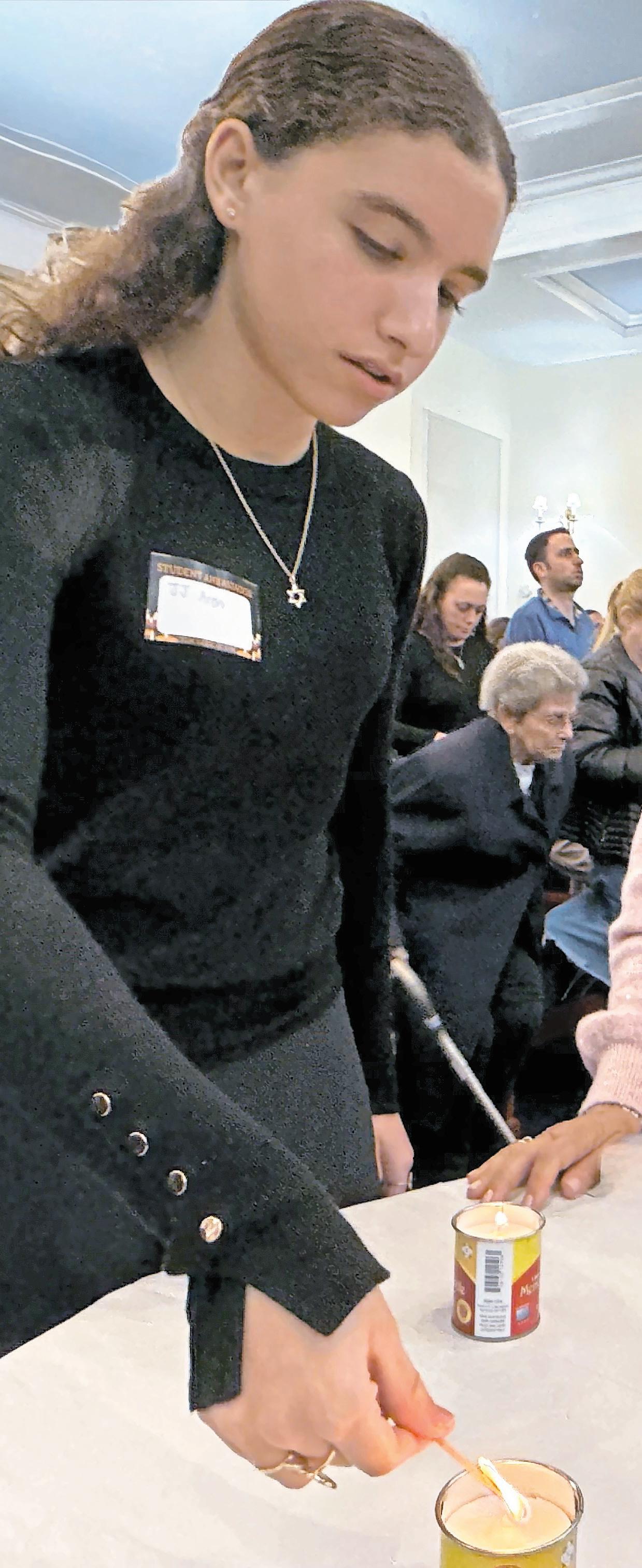
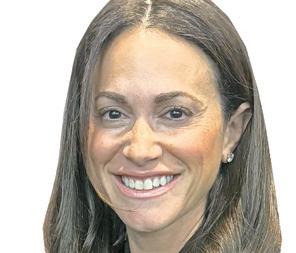
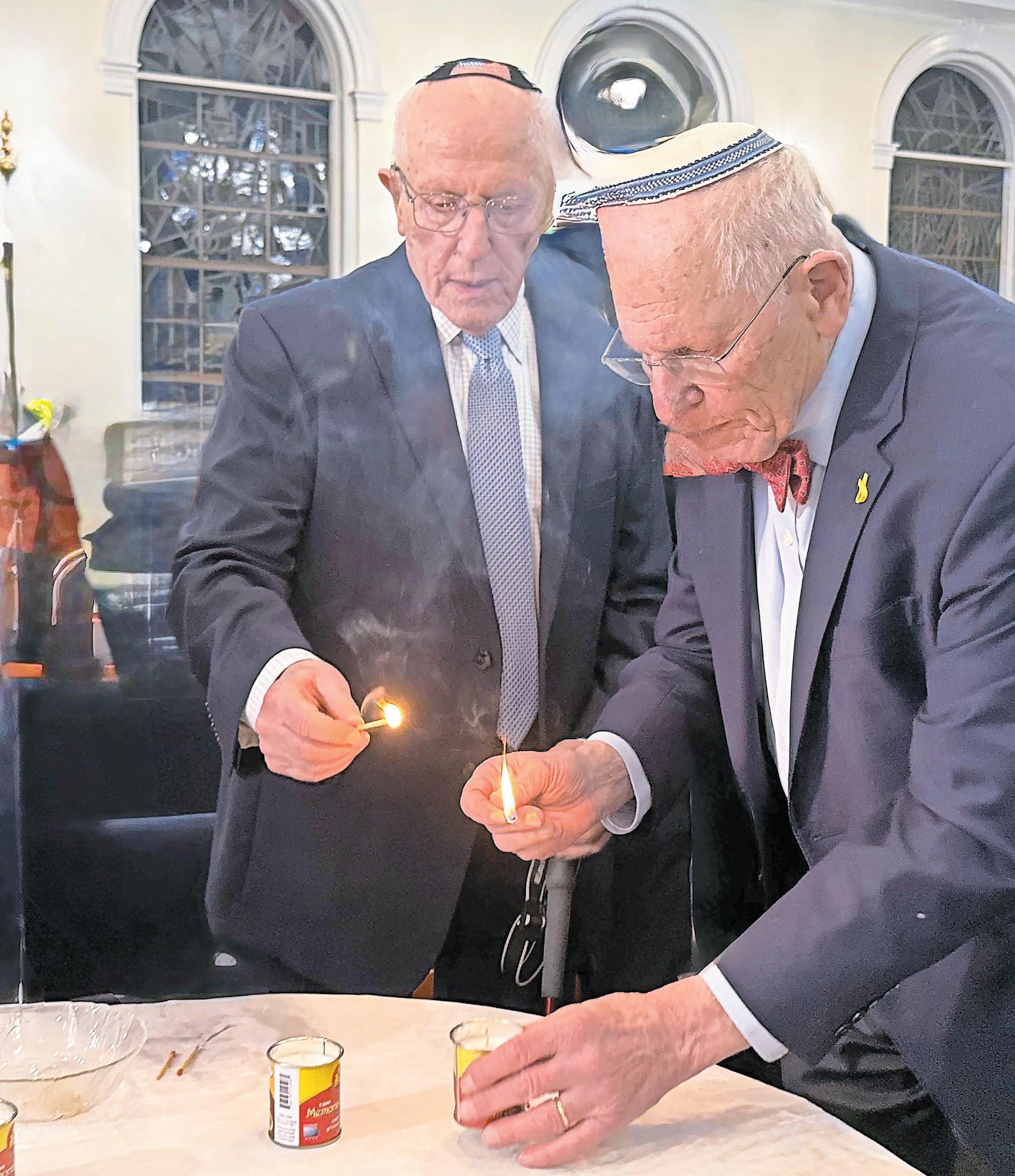
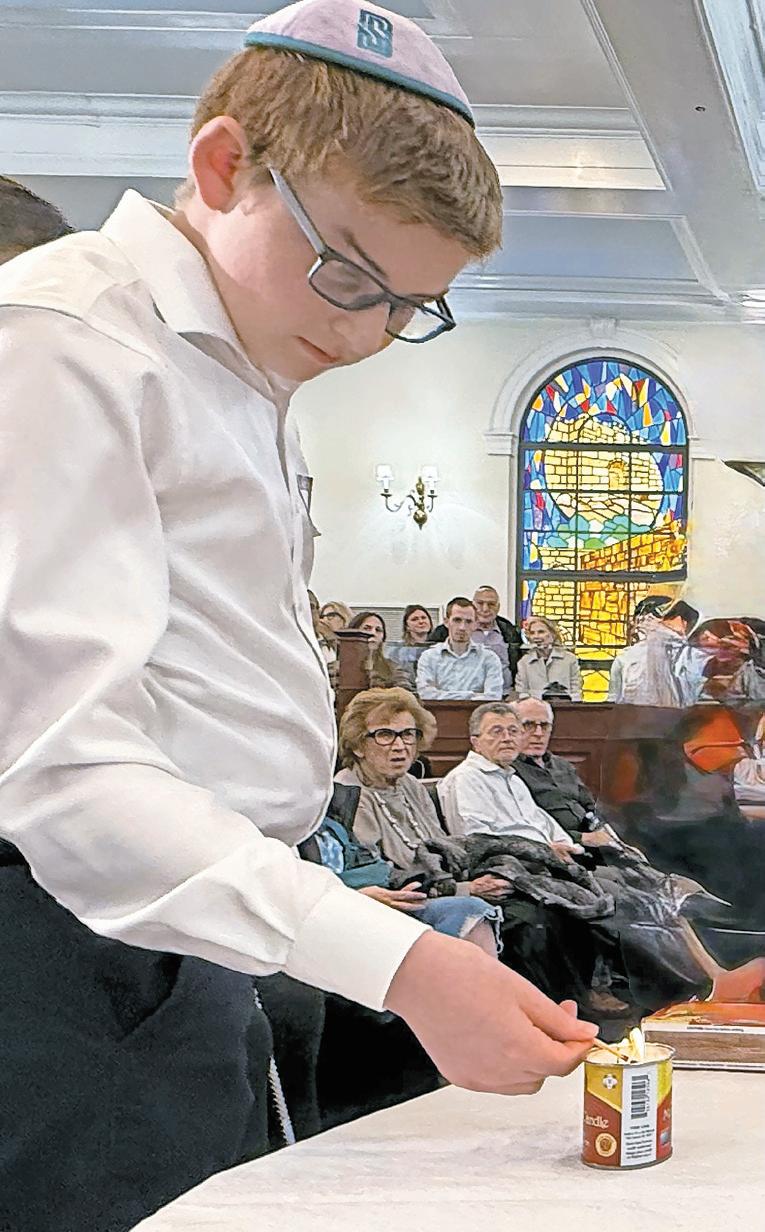
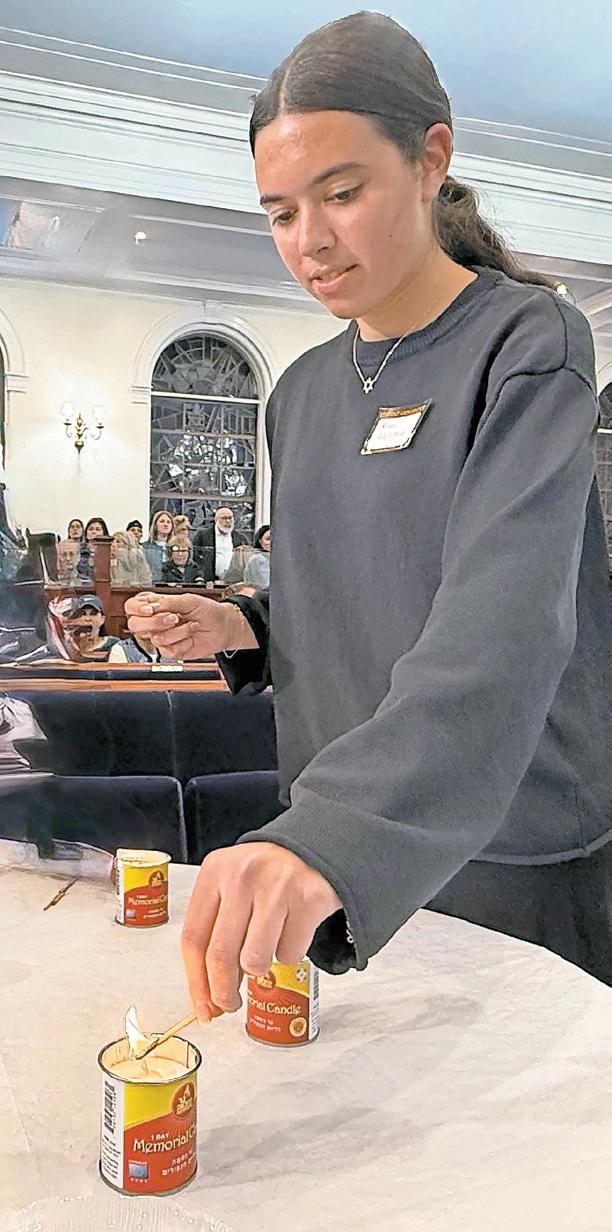
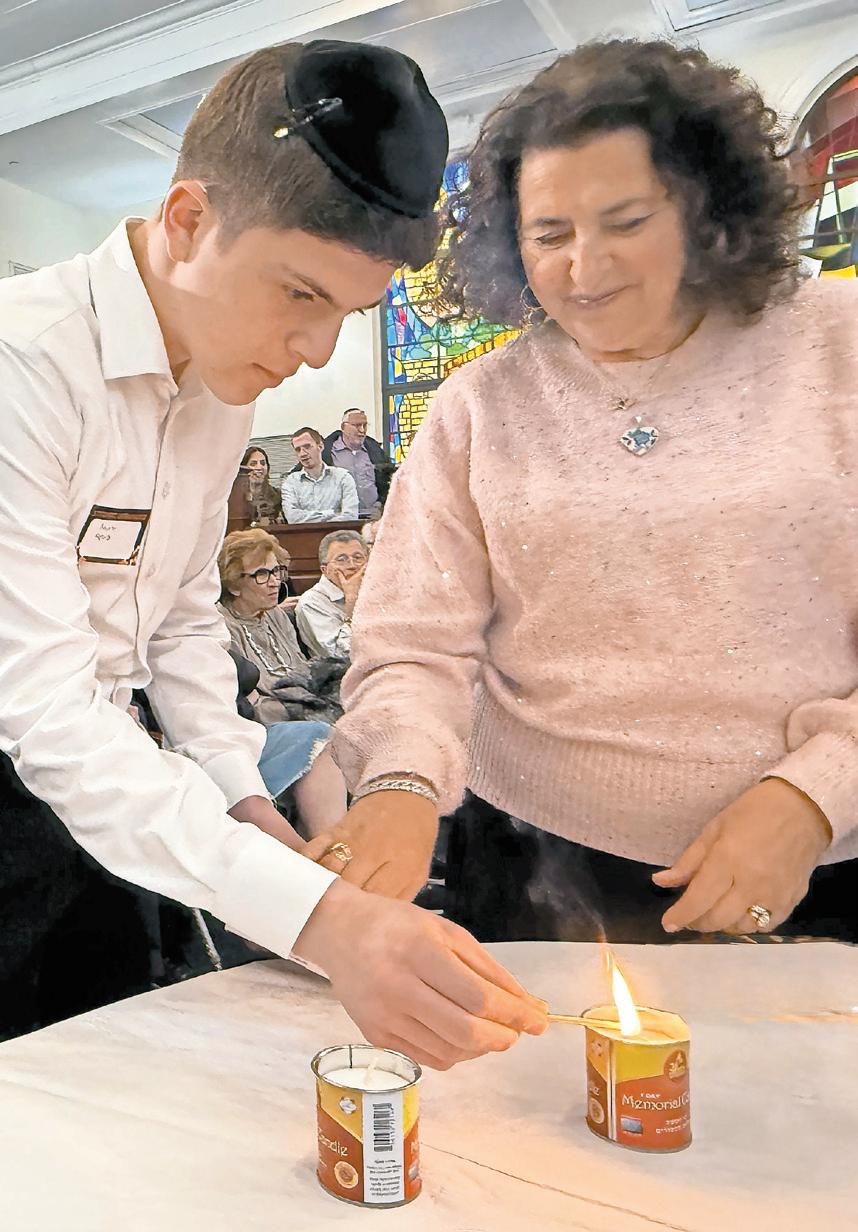
Dana Frenkel delivered this address at the Greater Five Towns Community Yom Hashoah Commemoration on Monday night at Congregation Beth Sholom in Lawrence. Frenkel, of Woodmere, co-chairs the event with Nathaniel Rogoff.
We have just emerged from Pesach, from the story that defines us as a people. It is a story we are commanded not merely to tell, but to live: “Bekal dor vedur hayev adam lirot et atzmo k’ilu hu yatza mimitzrayim (in every generation, a person must see himself as if he had come out of Egypt).”
But there is another command that runs throughout the Torah, repeated again and again: “zachor (remember).”
In Judaism, remembering is never passive. It is not simply recalling the past, it is allowing the past to shape the present and obligate the future. That is why the Torah commands not only what to remember but how — to see ourselves as if we were there, to feel, to internalize, and to carry that memory forward into the way we live our lives.
And that is why, alongside zachor, there is another command — sharper and more demanding: “Lo ta’amod al dam re’echa (Do not stand idly by the blood of your neighbor).” Because true remembrance cannot remain in the realm of thought or emotion alone; it must lead to responsibility and action.
The Shoah was not only a tragedy of hatred, it was a tragedy of indifference.
Rabbi Jonathan Sacks taught that the opposite of love is not hate, it is indifference. Evil flourishes not only through those who per-
See Yom Hashoah on page 2
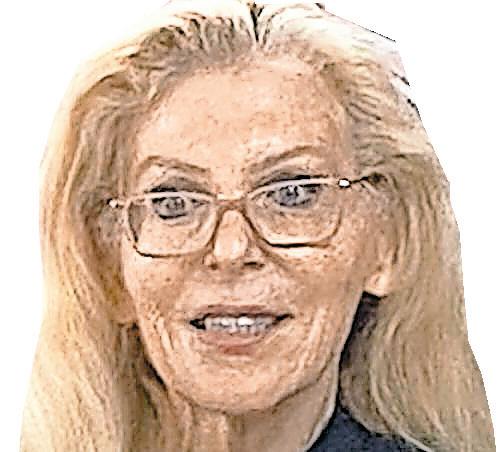
knew as a child in the 1950s that the numbers I saw on my parents’ arms represented something very dark and serious.
•My father Jakub Rybsztajn (who is being remembered on his first yahrzeit this Shabbos) always wore long sleeves to hide them.
•My mother (who is being remembered on her fourth yahrzeit this Shabbos) didn’t hide them and pointed to the symbol embedded between them, a faded Jewish Star.
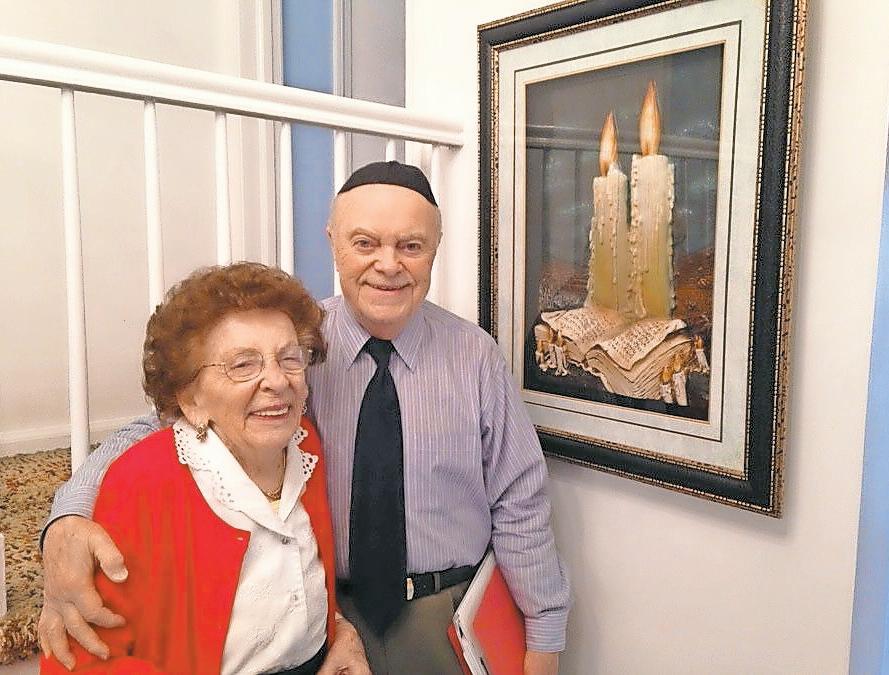
My parents were known in the Five Towns Community as Jack and Bonnie. Sometimes, Jakub and Bronia or Yakub and Shprintza. Sometimes Mr. and Mrs. Rybstein or Rybsztajn. The names could change but the numbers didn’t. Neither did the memories or the losses.
Rosh Chodesh Iyar is their yahrzeit although their passing is separated by three years. Even here the dates and numbers have a special meaning — May 2, 2022 and April 29, 2025, both Rosh Chodesh Iyar.
91is the number of immediate family members exterminated, remembered on a list my father compiled and
Yomdistributed to relatives. My father was one of five children and my mother one of nine, all exterminated in the concentration camps.
127is the number in the blessings my father gave the many who came to him, for a long life like Chaya Sarah.
My mother would say with a little smile, “We were nine children and I was the only one who survived.”
She survived Auschwitz and the death march, not allowing the two women around her to give up; finally running off and hiding in an abandoned farm, to be liberated two weeks later by the Russian army.
My father was placed on top of a dead body pile by two cousins outside the Langenstadt concentration camp because although unconscious he still had a pulse. He was found by an American soldier who removed him to recover at an army hospital. It took three months until he could eat.
My parents were married in Belgium in 1946 and came to the United States in 1950. They were married 77 years.
I miss them. May they rest in peace. They were and will always be number one to me. •
In Hebrew, the letters of Iyar mean “I am Hashem your healer,” making the weeks between Pesach and Shavuos a time for spiritual, emotional and physical healing, as well as personal development and selfimprovement.
Iyar is related to the Hebrew word ohr (light). My parents always said that they felt the darkness of the concentration camps
would be followed by light. And now they have the same yahrzeit, Rosh Chodesh Iyar. Write: Columnist@TheJewishStar.com
Continued from page 1
petrate it, but through those who fail to resist it.
There is a striking contrast to this idea in this past week’s parsha, Shemini. After the tragic death of Nadav and Avihu, the Torah tells us: “vayiddom Aharon (and Aaron was silent).”
But not all silence is the same.
There is a silence of grief, of standing humbly before Hashem in a moment beyond words. And then there is another kind of silence — the silence of indifference, the silence of those who see suffering and choose not to respond. The tragedy of the Shoah was not only the hatred of those who acted, but the silence of those who did not.
This past May, I had the privilege of traveling with my father to Mauthausen concentration camp, the very camp from which my paternal grandfather, Leo Kotowitz, was freed after years of unimaginable suffering.
My father and I arrived exactly 80 years to the day after his liberation. We stood together in the arrivals bunker, preserved in its original form, knowing that this was the very room in which my grandfather once stood — where he was processed, stripped of identity and, after transport from Auschwitz, thrust into a reality of unimaginable cruelty.
It is difficult to describe what it feels like to stand in a place where time collapses, where past and present converge so completely that history no longer feels distant.
Mauthausen was built adjacent to a neighborhood and the area for the sickest people left to die was closest to the road, where local farmers and citizens could not possibly have been unaware of the horrors taking place in their backyard.
The camp was built around brutality, constructed beside a quarry, designed for backbreaking labor, where human beings were forced to carry impossibly heavy stones up steep, unforgiving steps under conditions that defy comprehension. We walked into that quarry. We stood where he stood.
My grandfather stood there as a prisoner, and my father and I stood there as free Jews.
My grandfather did not survive so that we would simply remember. He survived so that we
would live — as Jews, with faith, with dignity, and with responsibility.
We are the heirs of that memory. But memory alone is not enough.
On this Yom Hashoah, let’s ask ourselves: what does our remembering require of us?
We are living in a moment when truth is often obscured and moral clarity blurred — when the Jewish people, and the State of Israel, are judged in ways that defy logic and fairness. We see a world in which violence can be justified, terror can be excused, and those who defend life are accused in the language of those who desecrate it.
“Lo ta’amod al dam re’echa” demands that
we refuse to be silent, that we speak with clarity (even when it is uncomfortable), that we stand with our people (not only in grief, but in dignity and in truth).
But the Torah’s vision of responsibility goes even deeper. Because to not stand idly by is not only about what we oppose, it is about what we uphold. It is about recognizing that our strength as a people has never been only in our ability to survive, but in our commitment to live with purpose, with faith, and with responsibility.
So that when we say “Never Again,” it is not only a reflection on the past, but a commitment in the present.
And that commitment is expressed in how we
live. In our commitment to Torah and mitzvot, in the lives we build as ovdei Hashem, and in the choices we make each day to remain connected to Hashem, to our people, and to the values that have sustained us across every generation. Because that is what our enemies have always sought to destroy — not only our bodies, but our spirit, our identity, and our relationship with the Ribono Shel Olam.
The most powerful response, the truest act of defiance, is to deepen that very connection: to learn more Torah, to perform more mitzvot, and to live with greater emunah, pride, and clarity about who we are and what we stand for.
Write: Columnist@TheJewishStar.com









Episcopal Health Services is proud to introduce the Walsh Ambulatory Pavilion , a state-of-the-art �������������������������������������������������
Services Include:
• Primary Care
• Behavioral Health
• Obstetrics & Gynecology
Maternal Fetal Medicine
• Endocrinology
• Endoscopy Colonoscopy
• EHS Cancer Center

Medical Oncology
Radiation Oncology





19-20 Brookhaven Avenue, Far Rockaway, NY 11691
Call 718-347-3627 or visit ehs.org/walsh to schedule an appointment today! For the EHS Cancer Center, please email cancercenter@ehs.org.











By Olivia Young and Alexa Lewis
The Riverdale Press
Eliot Engel, the former Democratic congressman who represented Riverdale and other parts of the northern Bronx during his long political career, died April 10 at 79 years old.
Engel was regarded for his staunch support of Israel, and for pushing liberal legislation that spanned affordable healthcare, gun control, international human rights, and reducing US dependency on imported oil. He lost his seat in 2022 to Jamaal Bowman, a Democratic Socialist and opponent of the Jewish State who allied with pro-Hamas protesters following the terror group’s invasion of Southern Israel on Oct. 7, 2023.
Engel’s family announced his death in a statement, saying Engel died “surrounded by family and loved ones in the borough that raised him: The Bronx.”
“During his over 44 years in public service, Eliot Engel fought tirelessly for his constituents at home and for peace and security around the world,” the statement reads. “We love and miss him dearly.”
According to reporting by the Associated Press, Engel died of complications from Parkinson’s disease.
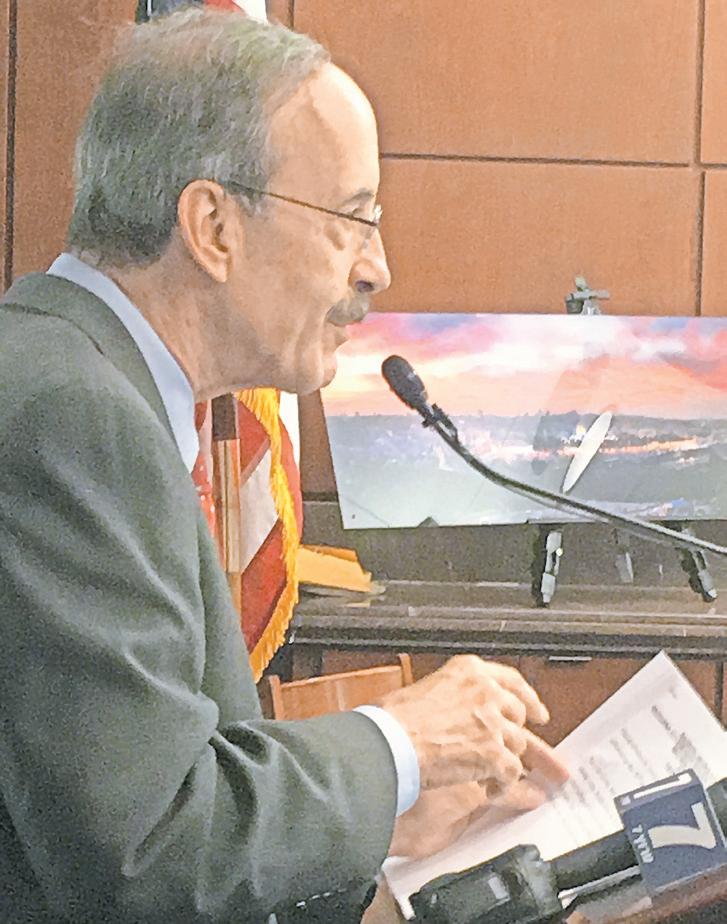
Engel was born Feb. 18, 1947, in the Bronx, a grandson of Jewish immigrants from Ukraine. He held a bachelor’s degree in history and a master’s degree in school counseling from Lehman College and a law degree from New York Law School.
His political career began after working as a guidance counselor in New York’s public schools for several years. He entered Congress in 1989 after serving in the state assembly from 1977 to 1988.
Engel defeated 10-term incumbent Mario Biaggi for the House seat. While Biaggi resigned shortly before the Democratic primary after he was convicted on corruption charges, when Engel entered the race Biaggi was still a force in Bronx politics. Former editor of the Riverdale Press, Bernard “Buddy Stein, said that challenging Biaggi at the time took guts.
The congressman had earned a reputation for securing an aisle seat annually at State of the Union addresses so he could appear on television shaking the president’s hand. But in 2017, Engel said he would not shake Trump’s hand as he believed the new president had no interest in working with Democrats.
Assembly member Jeffrey Dinowitz said he met Engel at 17 years old while campaigning for George McGovern. The two remained close throughout their lives as family friends, Dinowitz said, and described Engel’s death as like losing a brother.
“He had a heart of gold,” Dinowitz said. “He was very caring.”
As a born Bronxite raised in public housing, Dinowitz said Engel never forgot that he came from a modest background and was loyal to his borough and the needs of the community.
Rep. Ritchie Torres, who now represents parts of Engel’s congressional district, said “Engel was a giant of New York politics and one of the greatest champions the Bronx has ever had in Congress. He served for more than three decades with unyielding dedication, fighting for his constituents and standing up for democracy around the world.”
In conceding to Bowman in July 2020, Engel said that serving the people of the Bronx and Westchester had been the greatest privilege of his life.
«I take particular pride in always showing up, always being present, always listening, and always caring deeply about those whom it’s been an honor to serve as their congressman,» Engel said.




By Debra Nussbaum Cohen, JNS
To mark his first 100 days in office, Zohran Mamdani, mayor of New York City, talked about how many potholes he has filled. He should be focusing on mending his relationship with New York City’s Jews, according to Jewish leaders.
“Unfortunately, in his first 100 days, Mayor Mamdani has done nothing to allay the concerns I expressed before the election regarding his stance on Israel and the safety of Jewish New Yorkers,” Elliot Cosgrove, who leads Park Avenue Synagogue, a Conservative congregation on Manhattan’s Upper East Side, told JNS.
Mamdani has said that he would have the Israeli prime minister arrested in the Big Apple, and his spokeswoman said that synagogues violate international law by hosting pro-Israel events.
“At a moment when anti-Israel rhetoric is increasingly bleeding into antisemitic violence, from Bondi to West Bloomfield, Mich., his refusal to recognize that danger, coupled with the voices he elevates and the company he keeps, reflects a troubling mix of naïveté and negligence toward the very communities he has been entrusted to protect,” Cosgrove said.
Ammiel Hirsch, spiritual leader of the Stephen Wise Free Synagogue, a Reform congregation on the Upper West Side, told JNS that he hopes that Mamdani “avoids rhetoric and policies that reflect his antagonism towards Israel.”
“There is enough for him to do


just to run the city. One place to start would be to cease accusing Israel of ‘genocide.’ It is a modern-day blood libel,” Hirsch said.
Moshe Davis, who ran the mayoral office to combat Jew-hatred under Mamdani’s predecessor, and a frequent critic of the current mayor, told JNS that Mamdani could have made better choices than attending and hosting Passover events that emphasized aspects of the holiday other than the redemptive one that pines for “next year in Jerusalem.”
“One hopes the mayor actually opened the traditional Haggadah during his many Seder photo-ops this year rather than just using our traditions for optics,” Davis said.
“Had he, he would have learned that we are an ancient nation with an ancestral homeland,” Davis said.
“Mayor Mamdani claims he’s not an antisemite and says he’ll commit resources to fight anti-Jewish hate. So far, it seems like the Jewish community’s concerns are not a priority for this administration.”
Abby Stein, a progressive rabbi who grew up Chassidic and identifies as transgender, stood behind Mamdani at the mayor’s event on Sunday evening, marking 100 days in office. Stein held a sign saying “pothole politics” and wore a shirt saying “rabbis for ceasefire.”
Stein told JNS that Jews ought to be impressed with Mamdani, since the mayor attended Shabbat and Rosh Hashanah services at Stein’s independent synagogue.

The mayor “sat through the whole 2.5-hour service and really enjoyed it,” Stein said. “Most Jews don’t do that.”
Stein, who served on Mamdani’s transition committee after his election, insisted that the mayor is “1,000,000% not antisemitic.”
She also thinks that the mayor showed his concern for Jews by naming Phylisa Wisdom, whose appointment drew extensive criticism, to lead the mayoral office to fight Jewhatred.
“The fact that we got someone ap-




pointed to the antisemitism office in a month is saying something,” Stein said. “These are important things.”
Davis, who held the role before Wisdom, said that under Mamdani, New York City is seeing an alarming rate of Jew-hatred.
NYPD statistics bear that out, including more than a 180% increase in Jew-hatred in the city in Mamdani’s first month in office. Despite changing the way it reports hate crime statistics twice already during Mamdani’s mayoralty, the New York City Police Department has still recorded
a disproportionate percentage of hate crimes targeting Jews.
“Instead of action, we get photoops with friendly Jewish audiences, silence on his wife’s support for terror and appearances alongside those who chant ‘strike, strike Tel Aviv,’” Davis said. “Anti-Jewish hate crimes make up more than 55% of all hate crimes in this city.”
Davis also said that he gave the mayor a 100-day plan to protect Jewish New Yorkers in January, before he left his city role.
“We are all still waiting,” he said.

Are you getting forgetful?
Are you worried about dementia? Feeling depressed?

DON’T WAIT TO TAKE ACTION!
✦ Medical exam by memory specialists, neurologist, and psychiatrist
✦ Cognitive exam by computerized and clinical tests
✦ Genetic lab testing
✦ Blood based biomarkers test
✦ Treatment with FDA approved infusion therapy LEQEMBI and KISUNLA
✦ Deep Brain Stimulation therapy
✦ Photobiomodulation therapy
(TRANSCRANIAL MAGNETIC STIMULATION)
TREATING
DEPRESSION, ANXIETY, PTSD, AND IMPROVING MEMORY

✦ FDA approved, non-invasive
✦ Clinically proven to alleviate symptoms of depression without causing systemic side effects
✦ Diminishes symptoms of Obsessive Compulsive Disorder
✦ Promising for patients looking for non-drug options for PTSD
✦ Minimizes symptoms of Anxiety
✦ Well-tolerated, effective, and has high remission rates
ACUTE / CHRONIC DIZZINESS
LIGHTHEADEDNESS
VERTIGO
TINNITUS
IMBALANCE AND FALLS
✦ Exam by board certified Neurologist
✦ Exam by clinical Audiologist
✦ Computerized diagnostics
✦ Physiological testing
✦ Vestibular Physical Therapy
✦ Virtual Reality Therapy

✦ Do you snore?
Or has someone told you that you hold your breath while sleeping?
✦ Do you have excessive daytime sleepiness after a full night’s rest?
✦ Do you have high blood pressure that is hard to control even with medicine?
✦ Have you fallen asleep while driving or at a stop sign?
✦ Is your memory getting worse?
Sleep problems can come from neurological & psychiatric problems or obstructive sleep apnea
DRUG-FREE, NON-INVASIVE TREATMENT FOR NICOTINE ADDICTION

✦ Reduces craving
✦ Increases cognitive control
✦ Studies showing increased quitting rates
✦ Drug free treatment with TMS (Transcranial Magnetic Stimulation) -
FDA Approved, paid by insurance
VAPING IS AS BAD AS CIGARETTE SMOKING AND A DEADLY HABIT CAUSING CANCER
NON-INVASIVE TREATMENT FOR ADOLESCENT DEPRESSION (Ages 15+)

High school and college age can be very traumatic for young people.
✦ Intense sadness, hopelessness, and loss of interest
✦ Irritability, low energy, sleep and appetite changes, withdrawal and poor school performance
✦ Triggered by stress, trauma, or genetics
✦ When medications and therapy aren’t enough
Significant symptom improvement and lowered anxiety and depression
TRANSCRANIAL MAGNETIC STIMULATION
FDA approved & Paid by insurances
2 Executive Blvd., Montebello/Suffern, NY 10901 | T. (845) 889-5088, (845) 889-5099
401 S Van Brunt St., Ste 302, Englewood, NJ 07631 | T. (201) 947-4777
*** Accepting Fidelis, Medicare, Clover, Aetna, UHC, Cigna and other major insurances ***
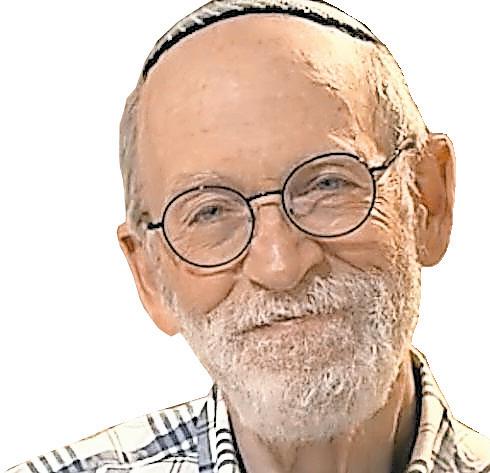
This article was published 27 years ago in the Long Island Jewish World, where the author penned a column for many years. He is now a resident of Riverdale.
[He] had nothing to fear from [the dream] being frustrated, because it is in the nature of a dream that it always remains in the power of the one dreaming it. —AB Yehoshua, “A Journey to the End of the Millennium”
Actually, it was the grandfather, Abdullah, who first dreamed the dream. After the First World War the British had not known quite what to do with this son of Sharif Hussein of Arabia whose support the British gratefully accepted against the Ottomans, but to whom overly grand promises were made, The British share of the vanquished Ottoman Turkish empire was vast, but the resources with which to govern it were limited; the war, though fought to a successful conclusion, had left the treasury depleted and the army, now largely demobilized, undermanned.
Someone was needed to police the territory east of the Jordan River. The makeshift idea was for Abdullah to be installed for a period, enough time for him to impose some order; in the meantime, the British hoped to come up with some long-term role for him. As things turned out, he was the emir who came to dinner: He came and never left.
From his vantage point across the Jordan River, Abdullah could observe the Jews trickling into Palestine in wavelets. He was neither afraid nor resentful. From the time of his first meeting with Chaim Weizmann in 1922 in London, until his death 29 years later, Abdullah, alone
among Arab public figures, met personally and through his deputies dozens of times with Zionist representatives, struggling to deal realistically with the challenge presented by the Jews and their aspirations in the region.
Perhaps on a personal level he could identify with people who ventured from one place to another in search of a place to call home. Ethnically and religiously, he may also have felt a kinship with these fellow sons of Abraham.
Maybe he was just being practical. He envisioned the Jews, with their resources and technological expertise, being of considerable help to his emirate, and later, kingdom. As well, through them he might extend the reach of his realm from the Jordan River to the sea. In any event he appears not to have viewed the Jews as interlopers without credible ties to the land to which they were streaming.
Abdullah’s dream, however, suffered from a certain vagueness and myopia. He knew he wanted to reach some sort of entente with the Jews, but he could not quite master the means of getting there. He first tried to sell the Zionists on the idea of accepting his benevolent rule, under which he would guarantee the Jews civil and religious rights, but not national and political sovereignty. (Does this sound familiar? It should — it is the very mirror image of the “autonomy plan” long offered by the Likud to the Palestinians.) It was summarily rejected by the Jews.
But the dialogue continued, and the dream lived on.
Though Abdullah was never able to realize the dream, it was bequeathed to his grandson, Hussein, who witnessed his grandfather’s assassination while still a teenager and who would, within two years thereafter, ascend to the throne himself. Hussein proved to be an able and precocious student, learning fast and well the teachings of his grandfather.

Lesson Number 1: Above all, survive.
Through over a half century of rule, Hussein survived multiple assassination attempts, domestic military confrontation (from the PLO in Black September 1970) and external threats.
He survived ruling a poor land of meager resources, governing a population 60 to 70 percent Palestinian and therefore not reflexively loyal to him. He survived despite being uncomfortably dependent on the good graces of regimes that had killed and/or supplanted his relatives (Iraq, Syria, Saudi Arabia) and doled out kindnesses parsimoniously.
He learned to pacify, to navigate, to modulate, to charm. Though he made some losing bets (being snookered by Nasser in 1967, and backing into Saddam’s corner in 1991), he always managed to recover. And survive.
Lesson Number 2: Survival is not an end in and of itself — it is a means to an end.
The end is multifaceted: Honor, prosperity and, yes, the dream.
Successive Israeli governments, of the right and of the left, came to understand that they could
Continued on next page
is looking to add a full-time reporter to our team as we expand our coverage of local news that’s important to Modern Orthodox communities on LI and in Queens, Riverdale and Westchester.
is looking to add a full-time reporter to our team as we expand our coverage of local news that’s important to Modern Orthodox communities on LI and in Queens, Riverdale and Westchester.
Position offers expert mentoring, a starting salary of $36,400 to $39,520, and a menu of benefits including all Jewish holidays.
Salary ($35,000–$38,000) offers a menu of benefits including all Jewish holidays.
Candidates who have reporting and news-writing experience (professional or collegiate) are invited to email a resume with clips or links to Jobs@TheJewishStar.com.
Candidates who have reporting and news-writing experience (professional or collegitate) are invited to email a resume with clips or links to Jobs@TheJewishStar.com
talk to King Hussein, and they did. It was an open secret, officially and formally denied but privately readily acknowledged.
The talks could never be successfully closed because there was always a gap that could not be bridged. A corollary to Lesson Number 1 was that in this neighborhood it could be fatal to get too far out in front of your constituency and allies, especially when your negotiating partner is making it clear that you must go even further.
So the dream lay dormant until Oslo and then, finally, almost anticlimactically, it sprung to life: Peace between the Hashemite Kingdom and the state of the Jews.
Like most people, Hussein bin Tallal was many things, some of them contradictory. Warrior and peacemaker, blunderer and visionary, Arab monarch and man of the people, patriot and citizen of the world. Survivor. Often belittled and derided, at other times venerated and, increasingly, even loved. His passing in xxxxxx elicited a pronounced and genuine sadness in places far beyond his poor, dusty kingdom and on the part of individuals of backgrounds widely at variance with his own.
I should know; I am one of them.
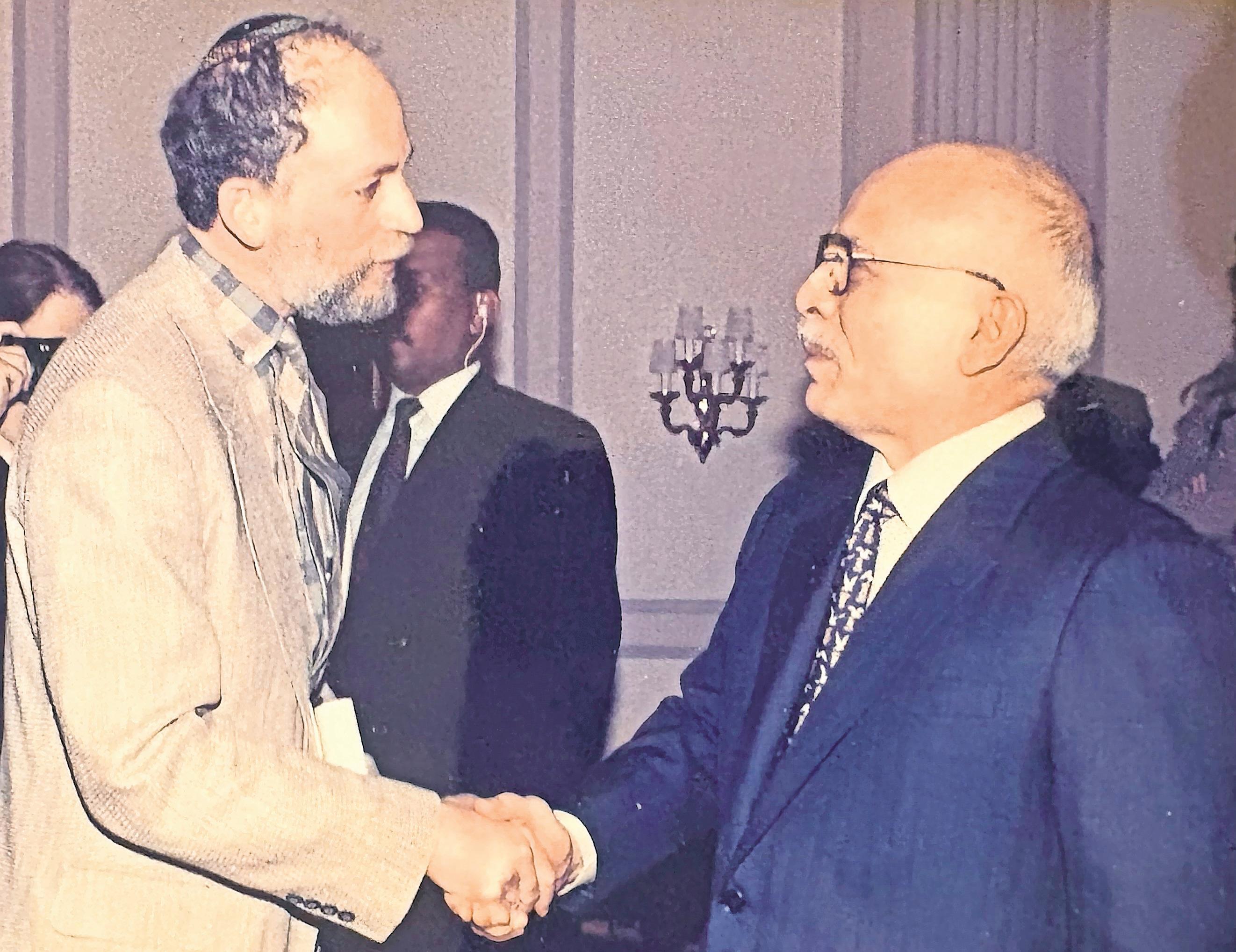
Three years earlier our paths crossed for about one minute. Though exceedingly brief, the encounter lasted long enough to reinforce my admiration for an embattled, courageous and sensitive man. Now, when I hear his name mentioned, I think of more than just the talking head in the news, the figure of history; I think of the man with whom I shook hands and who addressed me as “friend.” The sense of loss is personal.
It was three years ago this very month my wife and I took advantage of a three-day group trip to Jordan that supplemented a Jewish media conference. As soon as we crossed the Sheik Hussein Bridge it was clear we were in another world. As our bus driver Abdullah and our guide Sami led us through the northern Jordanian countryside, we were in a world alien and vaguely threatening to us; we seemed to have traveled back in time.
Though some of the homes we passed were rather handsome, bearing attractive stone facing, the vast majority of dwellings were primitive, made of cinder block and topped by tin roofs. We might as well have been in a section of a Yishuv theme park bearing the name, “Palestine 1930.” The rocky, windswept landscapes were punctuated by simple villages, unpaved roads and watchtowers. But this was Jordan near the close of the 20th century.
We were to visit Um Qais, one of the 10 Roman Decapolis cities, and Jerash, where we walked among the ruins of a Greco-Roman city, before reaching Amman and our hotel, the luxurious Forte Grand on Queen Noor Street (at that time also housing the Israeli embassy while its own building was being constructed).
Even these architectural sites, as fascinating as they were, were indicative of Jordan’s poor financial state. Their counterparts in Israel are slickly and modernly done up, replete with fancy signage and supplemented with multi-media presentations. By contrast, in Jordan, little appeared to have been done to retard the deterioration of the structures; the signs were old, many broken, with misspelled English words. Herds of sheep seemed to graze just about anywhere they or their shepherds pleased.
Conflicting rumors had been circulating since early afternoon as we killed time in Amman (not an easy thing to do). The king would see us. The king would not see us. The king might see us. His Majesty had a cold or had left the country. Just when the group’s skepticism of an audience with the king reached near unanimity, the definitive word reached us. The king would indeed see us this evening.
We entered the palace grounds at exactly 6:30 pm. The sky was absolutely clear and dark and studded with stars. Soldiers surveyed us warily as we filed past a fountain to enter a wing ringed by scowling Circassian guards in their distinctive black hats and black uniforms. We sat in red-upholstered chairs in an elegant beige carpeted hall, tastefully decorated with green and beige drapery.
The buzz that pervaded the room as people chatted came to an abrupt halt as first the outer doors and then the inner doors were shut. The hush allowed me to reflect briefly on the curious impact of royalty upon us at the close of the 20th century; it has retained its ancient capacity to
astonish us, almost against our will.
Security agents took their positions and then, finally, a few minutes later, Hussein appeared. After being presented with a gift, he addressed us.
The king’s speech was unremarkable. He invited us to keep returning to his country, and he hoped we would see progress with each successive visit. He expressed a sense of urgency to make up for lost time. It was an exciting moment in time, a real beginning to cooperation between peoples that he hoped would serve as an example to others. He was happy to see no more war.
“We’ve been through much over the years,” he said. “Yours is a sacred past.” He looked forward to a future full of hope.
Then he was done.
The king remained at the front of the room to take leave of us as we filed past. I approached him, extended my hand and introduced myself. His handshake was firm and his gaze locked in on my eyes.
I told him I came from New York and that it was a great honor to meet him. I wished him continued
success in his efforts to help bring peace to the region. He smiled warmly at me and with that characteristic nod and tilt of his head said, “Thank you, my friend. I hope we have a chance to meet again in the future.”
I knew then, of course, that another meeting was most unlikely. Three years later, not long after willing himself out of his sickbed to encourage Israelis and Palestinians to come to terms at Wye Plantation, the king was dead.
Hussein went from teenaged tribal chieftain to world-class statesman. Along the way he stumbled, shed blood, coped, managed and built. He dispatched his fierce Arab Legion soldiers against our dear IDF boys. His killed some of ours, and ours killed some of his. When the time came, the king paid shiva calls in Bet Shemesh.
Despite all the bloodshed and death, the dream survived. His Majesty’s hope that he and I would meet in the future would go unfulfilled. But then again, he did bequeath us a future.
The king is dead; long live the king.
Columnist@TheJewishStar.com
• Sharif Hussein bin Ali (1853–1931): Emir of Mecca and leader of the Great Arab Revolt, ancestor to the reigning monarchs.
• King Abdullah I bin Al Hussein (1946–1951): Founder of the Hashemite Kingdom of Jordan.
• King Talal bin Abdullah (July 20, 1951 to Aug. 11, 1952): Reigned briefly before abdicating due to health reasons.
• King Hussein bin Talal (Aug. 11, 1952–Feb. 7, 1999): He ruled for over four decades, transforming the nation.
• King Abdullah II bin Al Hussein (Feb. 7, 1999 to Present): The current monarch.
JEWISH STAR April 17-23, 2026 • 30 Nisan 5786 9

Mount Sinai South Nassau is proud to be named a high performing hospital in heart attack and heart failure by U.S. News & World Report ® year after year.
Our comprehensive heart care, including award-winning expertise in minimally invasive treatments to address blockages, has made us the premier choice for cardiac care on the South Shore. Cardiac surgeons from the world-renowned Mount Sinai Fuster Heart Hospital in Manhattan also now see patients at our Oceanside campus for pre and post operative evaluation and rehabilitation. The Mount Sinai Fuster Heart Hospital at The Mount Sinai Hospital is ranked No. 2 in the nation for Cardiology, Heart, and Vascular Surgery by U.S. News & World Report ®, outranking every cardiac program on the South Shore.
Learn more at mountsinai.org/southnassau
By Eyal Levi, Israel Hayom
Imagine you are a fighter in an elite unit of the Israel Defense Forces. In two days, a critical mission in Lebanon awaits. Before the operation, you are taken for a final drill at one of the military’s training grounds to sharpen your combat edge and make sure every shot you fire hits the enemy’s kill zone.
You enter the training compound according to procedure. Everything is advancing smoothly. Then, in the very last room, a split second before the finish line, a corporal leaps from a hiding spot and shouts at you: “Bang, bang!” That’s it — you’ve been neutralized.
Congratulations. You have just had a close encounter with one of the IDF’s enemy simulators — a soldier who outsmarted you and caught you in a moment of inattention. From that incident, you are meant to emerge stronger and equipped with lessons that will sharpen your performance in real combat, against a real enemy.
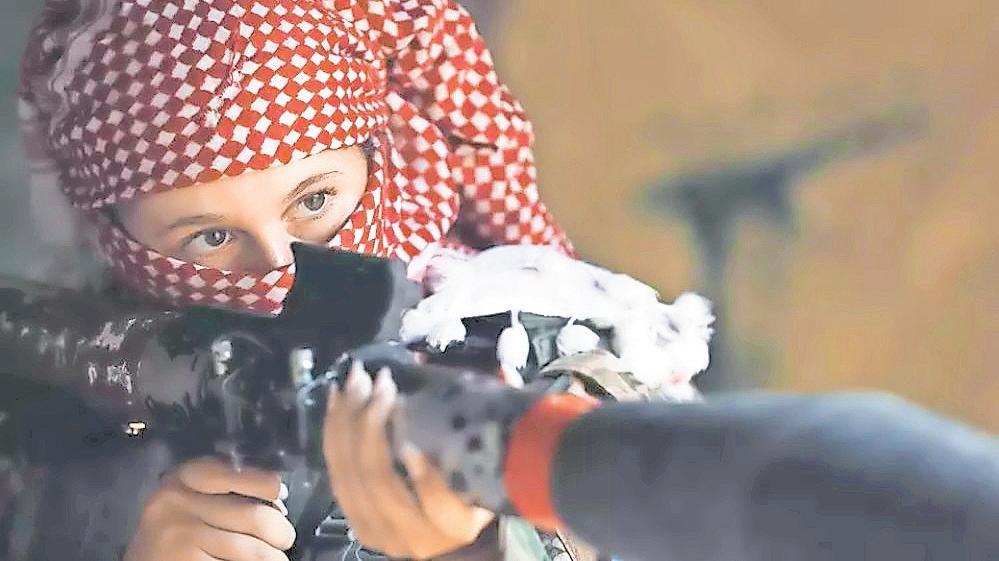
The Red Unit was established six years ago and consists of 80 female fighters. Over the course of three and a half months, they undergo specialized training, and their primary mission is to get inside the mind of a Hamas terrorist or a Hezbollah fighter, understand how the enemy operates and what drives him, and then simulate him as realistically as possible in drills against IDF troops.
“When I enlisted, I didn’t know the Red Unit existed,” 2nd Lt. S., a company commander in the unit, said. “My assignment sheet said ‘Enemyforces simulator.’ It sounded cool to get to know the enemy, to understand how he operates. I was excited, and in training, a whole new world was opened up to me.
“You start with the foundations of the enemy’s culture, you study the balance of power in Lebanon and Gaza, and gradually you work your way into their military, their hierarchy. You get into the smallest details, so that you really absorb what it means to be a Hezbollah or Hamas terrorist.”
The unit’s name is no accident. In the IDF, “blue” represents Israeli forces and “red” represents the enemy. To embody their roles properly, the unit’s soldiers walk around their base in southern Israel wearing red insignia, and in drills they sometimes carry Kalashnikov rifles, just like Hamas operatives.
Until the Red Unit was established, infantry companies in the IDF used to detach a platoon from their own ranks to simulate enemy forces, a practice that disrupted training by reducing their available strength. The Red Unit soldiers are trained to make life difficult for IDF troops, to surprise and neutralize.
The Red Unit consists of two companies. One focuses on enemy simulation in the north, with a concentration on Hezbollah; the other focuses on Hamas in the south. Every six months, the companies rotate.
It is not uncommon for the “bad guys” to win after an ambush they laid for IDF fighters works as intended, and it has already happened that the battalion commander on the other side — a decorated, experienced fighter — showed up at the end of a drill to commend the simulators.
Second Lt. S., the most senior of the three commanders, enlisted in August 2022. She is convinced that the Hamas onslaught on Oct. 7, 2023, was a turning point for the Red Unit.
“It was very hard then to be an enemy simulator, because until then we had treated it as kind of fun, and suddenly simulating Hezbollah and Hamas became psychologically complicated, because you know that in the drill the goal is to ‘kill’ IDF soldiers, right after so many had been killed in reality.”
2nd Lt. S. and 2nd Lt. A. recalled that after the war broke out, they took part in a major drill held in one of the communities, in which they simulated terrorists taking over houses in a residential area.
“I was a ‘terrorist’ under a house in which there were hostages, and the fighters had to ‘kill’ us. It was complicated to shout ‘Bang, bang, bang’ while wearing camouflage uniforms in a civilian environment, because people were watching from balconies, and it could have frightened them. Only on second thought did I feel that we were there for them, training fighters to protect them.”
Since the Oct. 7 surprise attack, the unit has repeatedly surprised soldiers at bases, testing the









EThEl G. hOfMAN

ag B’Omer (which begins this year on the evening of Monday, May 4) has been extra special for me — I was married on that day, and my wedding anniversaries were always celebrated with a backyard family picnic.
In Israel, it’s bonfires and barbecues. Since many Israelis live in high-rise apartments in cities and towns across the country, families and friends go to local parks schlepping grills and all the fixings for a festive meal. In Tel Aviv, smoke from hundreds of grills wafts over Hayarkon Park. It’s a carefree time, even during these dark days with Israel embroiled in war on multiple fronts.
But it wasn’t always bonfires and barbecues. When my friend Alisa was growing up in Jaffa, she remembers: “We just went to the beach, dug a hole in the sand and dropped in little potatoes. Then we covered the potatoes with hot embers, roasted them till they were brown and crisp, and ate them with brown eggs.”
I’d never tasted brown eggs until I visited Kibbutz Hagoshrim, south of the Lebanese border. The Turkish cook called the Sephardic-style brown eggs charinadu, explaining that “oil keeps the water from evaporating during the long simmering process.” The result is that it makes them delicious, smooth and creamy.
My friend Shani, who came to the United States from Iran in the early 1980s, recalls celebrating at a wealthy uncle’s home — a feast with platters piled high with cardamom meatballs smothered in tahini sauce, jeweled rice and dishes made with carob. Carob sustained Rabbi Shimon bar Yochai and his son, Rabbi Elazar, when for 13 years they hid in a cave from their oppressors, so it’s customary to eat carob dishes at Lag B’Omer.
Growing up on the Shetland Islands, carob was unavailable. Instead, we used chocolate for a recipe dubbed Chocolate Crispies. My brothers and I would melt the chocolate in a pan with a bit of butter and honey, stir in cornflakes and maybe throw in a handful of dried currants. Then the mixture was spooned into heaps like haystacks and cooled on the windowsill for a special holiday treat. No baking needed.
The recipe below includes powdered carob along with dark chocolate. Powdered carob and
carob chips are available in organic markets and stores like Whole Foods and Moms Organic. The recipe for veggie cheddar pasties is a variation of the portable Cornish meat pasties that workers would pack for lunch in the mines. These days, they are still easy to eat out of hand … while keeping the other one available for grilling.
Enjoy the day!
Makes 12
Cook’s Tips:
•Substitute 1 Tbsp. of instant coffee granules dissolved in 1 cup of water to make 1 cup of cold strong coffee.
Ingredients:
• 12 eggs
• 1 cup cold strong coffee (see Cook’s Tips above)
• 2 black tea bags
• brown skins of 2 large onions
• 1/2 cup vegetable oil
Directions:
Place eggs in a large heavy saucepan with 3 to 4 inches of water to cover.
Add the coffee, tea bags, onion skins and oil. Stir gently and bring to a simmer.
Cover and reduce heat to the lowest setting. The liquid should never be more than barely simmering.
Cook for 6 hours, adding more hot water as needed.
Remove from liquid. Refrigerate until ready to serve in the shell.
Serves 6
Cook’s Tips: •Cut larger potatoes into 1-inch chunks. Can use fingerling potatoes.
Ingredients:
• 1-1/2 pounds baby potatoes, halved
• 1/4 cup vegetable oil
• Kosher salt, freshly ground pepper, garlic powder, dried parsley to sprinkle
Directions:
Preheat oven to 400 degrees.
Cover a sheet pan with foil. Pour oil over and spread evenly. Sprinkle with salt, freshly ground pepper, garlic powder and parsley (may add other seasonings of choice).
Place potatoes, cut side down, in pan in one layer. Spray with nonstick baking spray. Sprinkle with more salt and pepper.
Bake in preheated oven for 35 to 40 minutes,


or until tender when pierced with a sharp knife.
Peel potatoes off the foil and serve.
Note: To make ahead of time, refrigerate cooked potatoes. Remove to room temperature an hour before needed. Then zap in the microwave for 3 to 4 minutes at high.
Air-Fryer Method: Toss potatoes in 2 tablespoons of vegetable oil. Sprinkle with salt, pepper and garlic powder. Set to air fry at 400 degrees. Arrange potatoes in the pan, cut side down, at rack position. Spray lightly with nonstick baking spray. Cook for 15 minutes. If needed, cook 5 minutes longer or until tender when pierced with a sharp knife.
Serves 4 to 6
Cook’s Tips: •May use beef, turkey or a mixture of both. •Meatballs may be prepared ahead of time. Cover with plastic wrap, refrigerate and cook the next day. •Wrap in lettuce leaves to eat in hand or stuff into pita bread with Israeli salad and tahini sauce spooned over top. •Invest in a meat thermometer. It’s essential to check doneness in all meats.
Ingredients:
• 1 small onion, cut into rough pieces
• 2-inch piece fresh ginger, peeled and sliced
• 1/4 lemon, sliced and cut into quarters
• 3 Tbsp. finely snipped mint leaves
• 1 pound ground lamb
• 1 large egg, lightly beaten
• 1/2 cup breadcrumbs
• 1/2 tsp. salt
• 1/2 tsp. freshly ground pepper
• 1 tsp. cinnamon
• 1-1/2 tsp. ground cardamom
• Vegetable oil for frying
Directions: In the food processor, place the onion, ginger and lemon. Pulse to chop finely. Transfer to a bowl.
Add the mint, lamb, egg, breadcrumbs, salt, pepper, cinnamon and cardamom. Mix well. Chill for 50 to 60 minutes. Shape into 16 to 20 balls. Preheat oven to 350 degrees. Spray a baking sheet with nonstick baking spray. Set aside. Cover the bottom of a heavy saucepan with about one-third cup of oil. Heat over mediumhigh heat. Add the meatballs and brown on all sides.
Transfer to prepared baking sheet. Bake for 15 minutes until cooked through. (Ground lamb should be cooked to 155 degrees to 160 degrees.) Serve with tahini sauce drizzled over top.
Tahini Sauce (Pareve)
Makes a scant 1/2 cup
Cook’s Tips: •Stir tahini well to make a smooth mixture. •Tahini is a paste of toasted
See For Lag B’Omer on page 14















































































































































Continued from page 11
ground hulled sesame seeds, olive oil and lemon juice.
Ingredients:
• 1/3 cup tahini
• 2 Tbsp. lemon juice
• Pinch salt to taste
• 1 to 2 Tbsp. cold water
Directions:
In a small bowl, mix the tahini and lemon juice.
Stir in salt to taste and enough water to make a sauce thin enough to drizzle over meatballs.
Makes 8
Cook’s Tips: •Use store-bought puff pastry.
•Buy grated sharp cheddar cheese. •Substitute a mixture of favorite herbs and spices for 21 Seasoning (granulated garlic, granulated onion, fresh ground pepper, parsley, oregano). •Don’t worry if pasties aren’t picture-perfect. Just make sure pastry edges are moistened to tightly seal the filling.
Ingredients:
• 1-1/2 cups frozen peas and carrots, thawed and drained well
• 1 cup grated sharp cheddar cheese
• 1 tsp. dried sage
• 2 tsp. Trader Joe 21 seasoning or homemade mixture
• 2 sheets (17.3-ounce package) puff
pastry, thawed
• 3 Tbsp. Dijon mustard
• 1 egg beaten
Directions:
Preheat oven to 400 degrees.
Line a large-rimmed cookie sheet with foil.
Spray with nonstick baking spray and set aside.
In a small bowl, toss together the peas and carrots, cheese, sage and 21 Seasoning. Set aside.
On a lightly floured board, roll out one sheet of pastry to approximately 10×10 inches.
Cut into 4 squares. Spread a thin layer of mustard over the center of each square.
Spoon 2 Tbsp. vegetable mixture on top. Moisten opposite pastry edges with water. Fold over to cover vegetables and crimp to seal, pinching the ends. Place on prepared cookie sheet.
Brush with beaten egg. Repeat with the remaining sheet.
Bake in preheated oven for 20 minutes until risen and nicely brown.
Cool on a wire tray.
Serve warm or at room temperature.
Serves 4
Cook’s Tips:
•Tapioca is a starch extracted from the root of the cassava plant. Pearl tapioca is used mainly for puddings. Must use instant tapioca in this recipe.
Ingredients:
• 1-1/2 cups 2% milk or whole milk
• 1 egg
• 1-1/2 Tbsp. instant tapioca
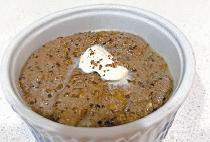

• 1 Tbsp. powdered carob
• 1 Tbsp. sugar or to taste
• Vanilla ice-cream (optional)
Directions:
In a medium nonstick saucepan, whisk the egg and milk to combine. Whisk in the tapioca, carob and 1 tablespoon sugar. Let stand for 5 minutes.
Cook over high heat, stirring often, until the mixture comes to a rolling boil. Cook for 2 minutes whisking constantly. Remove from heat. Add sugar to taste.
Pour into a bowl. Let stand for 30 minutes to cool and thicken.
Spoon into small glasses and top with a tiny scoop of cream or ice-cream (optional).
Serves 2 to 3
Cook’s Tips: •Use frozen cubed mango.
•Pour into a thermos flask to stay chilled.
Ingredients:
3/4 cup orange juice
1 Tbsp. powdered carob
3 cups frozen mango
1 ripe banana, cut into 6 to 8 pieces
1 cup vanilla yogurt
Orange wedges to garnish (optional)
Directions:
Pour orange juice into a blender jar or food processor. Add the remaining ingredients. Blend or process until smooth.
Pour into glasses and eat with a spoon.
Makes 12 Cook’s Tips:
•Substitute milk chocolate for dark.
•Use 1 cup of chocolate chips for chopped chocolate.
Ingredients:
• 6 ounces dark chocolate, chopped coarsely
• 1 Tbsp. powdered carob
• 4 Tbsp. butter or margarine
• 2 Tbsp. honey
• 3 cups cornflakes
Directions:
Prepare a 12-cup muffin pan with paper cups. Set aside.
Place the chocolate, carob, butter or margarine, and honey in a microwave dish. Microcook at 30-second bursts until the chocolate is soft and just beginning to melt. Stir to make a smooth mixture.
Place the cornflakes in a very large bowl. Pour the warm chocolate mixture over top, stirring to mix well.
Spoon into paper cups in a muffin pan. Press down to make sure that the mixture is tightly packed.
Chill for 1 hour or until chocolate is hardened.
Ethel G. Hofman is a widely syndicated American Jewish food and travel columnist, author and culinary consultant.

By Sarah Ogince, JNS
A humble childhood, a meteoric rise to power, a fatal love affair, a confrontation with a giant.
It’s no surprise that the life of King David, as told in the book of Samuel, has attracted generations of filmmakers, with the second king of Israel played by Gregory Peck and Richard Gere, among others. Recently, the first season of “House of David” drew 22 million viewers in its first two weeks on Amazon Prime last year, with a second season released on March 27. David also features in a new animated musical and a four-part biopic from Fox Nation.
Unlike previous adaptations, however, these new David shows are produced by Christian filmmakers, part of a wave of faith-based programming that began with “The Chosen,” a sleeper-hit series dramatizing the life of Jesus.
“There’s a lot of interest in leadership and heroes, flawed or otherwise, right now,” says David Wolpe of Sinai Temple in Los Angeles and author of the biography “David: Divided Heart.”
“David’s is the fullest story in the Bible,” Wolpe says. “Moses’s story isn’t so much about Moses, but David’s story is all about David.”
Still, the strong interest in David from a Christian perspective might seem surprising, given the central role he plays in Jewish tradition, where his name is synonymous with national glory and endurance. But David has long been important to Christians, though their interpretations of his tumultuous life sometimes differ.
The Bible devotes two books, Samuel 1 and 2, to David’s biography (he also appears briefly in Kings 1 and Chronicles). But Christians rely on a different text to understand David — one that, according to tradition, he authored.
“Christians have an image of David’s spirituality — David’s relationship with G-d — that comes from the Psalms” (Tehillim), says John Goldingay, professor emeritus of Old Testament at Fuller Theological Seminary and author of “1 and 2 Samuel for Everyone.”
“When they look at the Psalms, they see people declaring their trust in G-d, praising G-d, thanking G-d for what He’s done, and also pleading with G-d to act on their behalf. And they infer that that’s how David lived his life.”
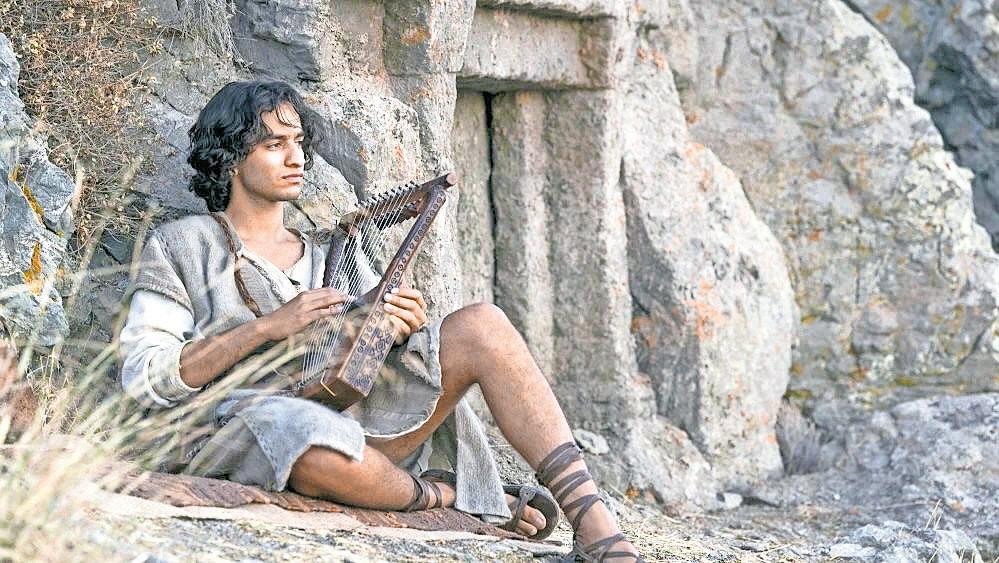
In “House of David,” the young David plays the lyre and sings psalms in Hebrew — skills that Egyptian-American actor Michael Iskander acquired for the role — while he tends his father’s sheep in the hills around Bethlehem.
Jenn Levine, who served as the show’s Jewish consultant, says the filmmakers were careful to match the psalm to the story: “There were occasions where they would say, ‘Which psalm would be appropriate for a scene where this is happening,’ and I would dive in and present them with some options.”
The music of the psalms returns during David’s confrontation with the giant Goliath in the
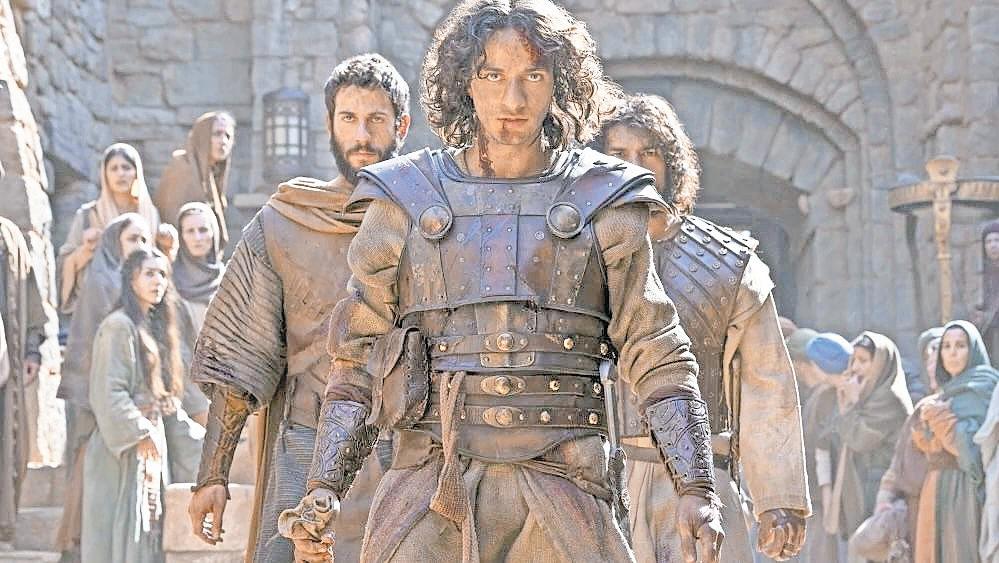
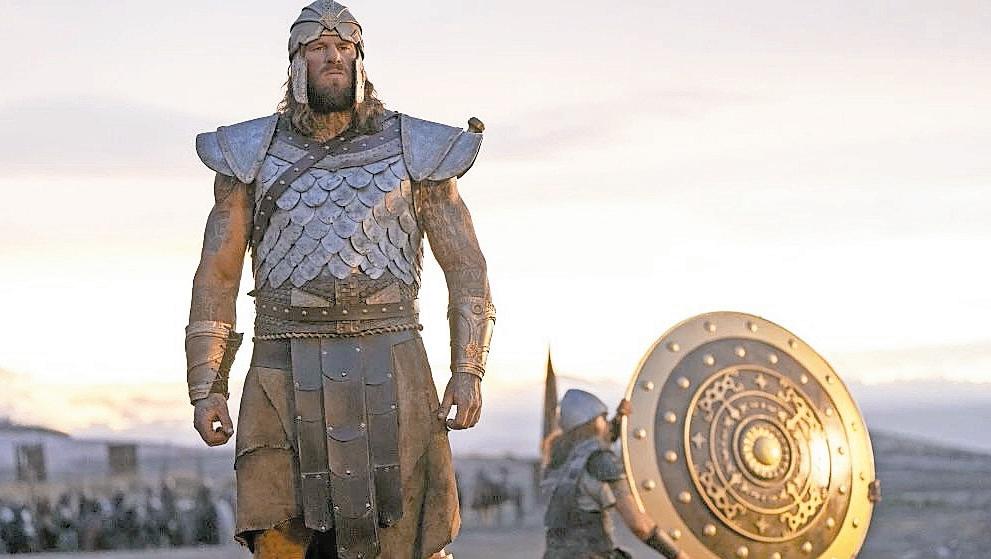
first season finale. The most well-known episode in David’s life (and the source of countless underdog analogies), the battle is portrayed as a simple triumph of good over evil and faith over fear.
But a closer look at the episode reveals a side of David that is absent from the new shows. In the lead-up to their fight, David and Goliath exchange insults across the battlefield. “It becomes almost like a playground spitting battle,” says Rabbi Yitzchak Etshalom, host of the podcast “Between the Lines of the Bible.” In a frequently quoted line, David loudly proclaims that while Goliath will attack him with armor and a sword, his own weapon of choice is “the name of the L-rd.”
“He doesn’t mention the slingshot or the rocks,” Etshalom notes, weapons that David will skillfully employ to disable Goliath before using the giant’s own sword to cut off his head.
Jewish tradition, too, attributes the Psalms to David’s authorship. Yet generations of Jewish scholarship on the books of Samuel yield a more nuanced portrait of a leader whose faith was tempered by a healthy dose of pragmatism.
“The story of Goliath highlights David’s bravery, no question. But it also shows his strategy,” Rabbi Etshalom says. “He’ll do whatever it takes to win.”
Giants make for exciting television. In “House of David,” producers used AI to make Martyn Ford, the 6-foot 8-inch British bodybuilder cast as Goliath, even taller — to chilling effect.
The darker side of David becomes unavoidable later in his story, most famously in his affair with Bathsheba, the wife of one of his generals, Uriah the Hittite. To cover up the scandal, David orchestrates the general’s death before marrying Bathsheba. Later, she will become the mother of King Solomon, David’s successor.
“House of David” has not dramatized the episode with Bathsheba (the new season covers the internecine conflicts that follow his triumph over Goliath). But the story has long troubled both Jewish and Christian readers. Early Christian polemics compared David unfavorably with Jesus, who never sinned. Perhaps as a result, a well-
known discussion in the Talmud seeks to prove that David’s actions were not actually a violation of Jewish law. More recently, the story has been used by faith leaders to excuse the personal failings of powerful men.
The text itself, however, is unequivocal about David’s guilt. He is severely punished for his sin, his life spared only after confession and repentance.
“Our heroes are human. They make mistakes,” Rabbi Etshalom says. “They’re not judged on their perfection, but on how they deal with setbacks — and how they deal with their own failures.”
Just before the episode with Bathsheba, in the seventh chapter of 2 Samuel, G-d tells David that his dynasty will endure forever. Both Jews and Christians would come to understand this promise as a reference to a future redeemer, who would be a descendant of David.
Early Christians saw David as a precursor of Jesus. Like David, the New Testament asserts, Jesus was born in Bethlehem; he is known as the “good shepherd,” and the gospels refer to him as both “son of David” and “king of the Jews.”
For Jews, David’s flaws and contradictions, like those of many other biblical characters, became an opportunity for deeper study — and debate.
The new David adaptations may not reveal the full complexity of his character, but even the most basic summary of his life raises questions that lead to deeper discussion.
“Any interest in the characters of the Hebrew bible is a positive thing,” Wolpe says. “There is such tremendous biblical illiteracy in the United States compared to how important those figures were to the people who shaped this nation that I think getting to know at least something about them is almost an unalloyed good.”
However it is told, David’s life carries a lesson that both religious traditions can embrace.
“Here’s this extraordinary, mysterious, upand-down guy, and G-d works through him,” Goldingay says. “G-d works with the world, with Israel, with us, as we are. Because what alternative does He have?”
Jewish Star Torah columnists: Rabbi Benny Berlin, spiritual leader of BACH Jewish Center in Long Beach; Rabbi Avi Billet of Anshei Chesed, Boynton Beach, FL, mohel and Five Towns native; Rabbi Binny Freedman, rosh yeshiva of Orayta, Jerusalem; Dr. Alan A. Mazurek, former ZOA chair, retired neurologist, living in Great Neck, Jerusalem and Florida.
Contributing writers: Rabbi Sir Jonathan Sacks zt”l, former chief rabbi of United Hebrew Congregations of British Commonwealth; Rabbi Yossy Goldman, president South African Rabbinical Association; Rabbi Dr. Tzvi Hersh Weinreb, OU executive VP emeritus.
To submit commentary, inquire at: Editor@TheJewishStar.com. Contact our columnists at: Columnist@TheJewishStar.com.
Fri April 17 / 30 Nissan
Tazria-Metzora
Five Towns candles: 7:18 • Havdalah: 8:28
Scarsdale candles: 7:18 • Havdalah: 8:21
Fri April 24 / 7 Iyar
Achrei Mot-Kedoshim
Five Towns candles: 7:25 • Havdalah: 8:35
Scarsdale candles: 7:26 • Havdalah: 8:30
Fri May 1 / 14 Iyar
Emor (Friday is Pesach Sheni)
Five Towns candles: 7:32 • Havdalah: 8:42
Scarsdale candles: 7:33 • Havdalah: 8:38
Fri May 8 / 21 Iyar
Behar-Bechukotai
Five Towns candles: 7:39 • Havdalah: 8:49
Scarsdale candles: 7:40 • Havdalah: 8:46
Five Towns Candlelighting: From the White Shul, Far Rockaway, NY
Scarsdale Candlelighting: From the Young Israel of Scarsdale, Scarsdale, NY
S
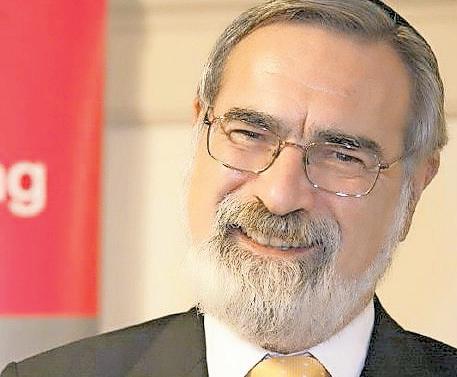
The sidrot of Tazria and Metzora contain laws which are among the most difficult to understand. They are about conditions of “impurity” arising from the fact that we are physical beings, embodied souls, and hence exposed to (in Hamlet’s words) “the thousand natural shocks that flesh is heir to.”
Though we have immortal longings, mortality is the condition of human existence, as it is of all embodied life.
Rambam explains:
We have already shown that, in accordance with the Divine wisdom, genesis can only take place through destruction, and without the destruction of the individual members of the species, the species themselves would not exist permanently. ... He who thinks that he can have flesh and bones without being subject to any external influence, or any of the accidents of matter, unconsciously wishes to reconcile two opposites, namely, to be at the same time subject and not subject to change. —Maimonides, Guide for the Perplexed, III:12
Throughout history there have been two distinct and opposing ways of relating to this fact: hedonism (living for physical pleasure) and asceticism (relinquishing physical pleasure). The former worships the physical while denying the spiritual, the latter enthrones the spiritual at the cost of the physical.
The Jewish way has always been different: to sanctify the physical — eating, drinking, sex and rest — making the life of the body a vehicle for the Divine Presence. The reason is simple. We believe with perfect faith that the G-d of redemption is also the G-d of creation. The physical world we inhabit is the one G-d made and pronounced “very good.”
To be a hedonist is to deny G-d. To
be an ascetic is to deny the goodness of G-d’s world. To be a Jew is to celebrate both creation and Creator. That is the principle that explains many otherwise incomprehensible features of Jewish life.
The laws with which the parsha begins are striking examples of this:
When a woman conceives and gives birth to a boy, she shall be teme’ah for seven days, just as she is during the time of separation when she has her period... Then, for thirty-three additional days she shall have a waiting period during which her blood is ritually clean. Until this purification period is complete, she shall not touch anything holy and shall not enter the Sanctuary.
If she gives birth to a girl, she shall have for two weeks the same teme’ah status as during her menstrual period. Then, for sixty-six days after that, she shall have a waiting period during which her blood is ritually clean.
She then brings a burnt-offering and a sin-offering, after which she is restored to “ritual purity.” What is the meaning of these laws? Why does childbirth render the mother teme’ah (usually translated as “ritually impure,” better understood as “a condition which impedes or exempts from a direct encounter with holiness”)? And why is the period after giving birth to a girl twice that for a boy?
There is a temptation to see these laws as inherently beyond the reach of human understanding. Several rabbinic statements seem to say just this. In fact, it is not so, as Maimonides explains at length in the Guide. To be sure, we can never know — specifically with respect to laws that have to do with kedushah (holiness) and taharah (purity) — whether our understanding is correct. But we are not thereby forced to abandon our search for understanding, even though any explanation will be at best speculative and tentative.
The first principle essential to understanding the laws of ritual purity and impurity is that G-d is life. Judaism is a profound rejection of cults, an-

cient and modern, that glorify death. The great pyramids of Egypt were grandiose tombs.
Arthur Koestler noted that without death “the cathedrals collapse, the pyramids vanish into the sand, the great organs become silent.” The English metaphysical poets turned to it constantly as a theme. As TS Eliot wrote in “Whispers of Immortality”: Webster was much possessed by death
And saw the skull beneath the skin… Donne, I suppose, was such another…
He knew the anguish of the marrow
The ague of the skeleton…
Freud coined the word Thanatos to describe the death-directed character of human life. Judaism is a protest against death-centred cultures.
“It is not the dead who praise the L-rd, nor those who go down into silence” (Psalm 114) “What profit is there in my death, if I go down into the pit? Can the dust acknowledge You? Can it proclaim your truth?” (Psalm 30). As we open a Sefer Torah we say: “All of you who hold fast to the L-rd your G-d are alive today” (Deut 4:4). The Torah is a tree of life. G-d is the G-d of life. As Moses put it in two memorable words: “Choose life” (Deut. 30:19).
It follows that kedushah (holiness) — a point in time or space where we stand in the unmediated presence of G-d — involves a supreme consciousness of life. That is why the paradigm case of tumah is contact with a corpse. Other cases of tumah include diseases or bodily emissions that remind us of our mortality. G-d’s domain is life. Therefore it may not be associated in any way with intimations of death.
This is how Judah Halevi explains the purity laws:
A dead body represents the highest degree of loss of life, and a leprous limb is as if it were dead. It is the same with the loss of seed, because it had been endowed with living power, capable of engendering a human being. Its loss therefore forms a contrast to the living and breathing. The Kuzari, II:60
The laws of purity apply exclusively to Israel, argues Halevi, precisely because Judaism is the supreme religion of life, and its adherents are therefore hyper-sensitive to even the most subtle distinctions between life and death.
A second principle, equally striking, is the acute sensitivity Judaism shows to the birth of a child. Nothing is more “natural” than procreation. Every living thing engages in it.
Sociobiologists go so far as to argue that a human being is a gene’s way of creating another gene. By contrast, the Torah goes to great lengths to describe how many of the heroines of the Bible — among them Sarah, Rebecca, Rachel, Hannah and the Shunamite woman — were infertile and had children only through a miracle.
Clearly the Torah intends a message here, and it is unmistakable.
To be a Jew is to know that survival is not a matter of biology alone. What other cultures may take as natural is for us a miracle. Every Jewish child is a gift of G-d.
No faith has taken children more seriously or devoted more of its efforts to raising the next generation. Childbirth is wondrous. To be a parent is the closest any of us come to G-d himself. That, incidentally, is why women are closer to G-d than men, because they, unlike men, know what it is to bring
new life out of themselves, as G-d brings life out of himself.
The idea is beautifully captured in the verse in which, leaving Eden, Adam turns to his wife and calls her Chava “for she is the mother of all life.”
We can now speculate about the laws relating to childbirth. When a mother gives birth, she undergoes great risk. Throughout the centuries, childbirth has been a life-threatening danger to mother and baby alike, and even today there are ever-present risks for many. Furthermore, during the process of childbirth, a woman is separated from what until now had been part of her own body (a fetus, said the rabbis, “is like a limb of the mother”) and which has now become an independent person.
If that is so in the case of a boy, it is doubly so in the case of a girl – who, with G-d’s help, will not merely live but may herself in later years become a source of new life. At one level, therefore, the laws signal the detachment of life from life.
At another level, they surely suggest something more profound. There is a halachic principle: “One who is engaged in a mitzvah is exempt from other mitzvot.”
It is as if G-d were saying to the mother: for forty days in the case of a boy, and doubly so in the case of a girl (the mother-daughter bond is ontologically stronger than that between mother and son): I exempt you from coming before Me in the place of holiness because you are fully engaged in one of the holiest acts of all, nurturing and caring for your child. Unlike others you do not need to visit the Temple to be attached to life in all its sacred splendor.
You are experiencing it yourself, directly and with every fiber of your being. Days, weeks, from now you will come and give thanks before Me (together with offerings for having come through a moment of danger).
But for now, look upon your child with wonder. For you have been given a glimpse of the great secret, otherwise known only to G-d.
Childbirth exempts the new mother from attendance at the Temple because her bedside replicates the experience of the Temple. She now knows what it is for love to beget life, and, in the midst of mortality, to be touched by an intimation of immortality.
It has been a distressing time for our brethren in Israel. Sirens sound. Families run in and out of bomb shelters. A ceasefire holds, then falters, then holds again. People yearn for yishuv hadaas, for peace of mind. Life feels frenetic, unsettled.
And yet, if you ask the average Israeli how they are doing, most will tell you they are fine. More than fine, actually. According to global happiness surveys, Israel consistently places
among the happiest countries in the world. How does that work?
I once heard a striking insight from Rabbi Yechezkel Freundlich (of Congregation Beth Sholom in Lawrence) that’s rooted in the Ramban on this week’s parsha
Parshas Tazria-Metzora discusses tzaraas, the spiritual condition associated with lashon hara and other moral failures. Most people know the version that affects the skin, but the Torah describes something stranger: tzaraas does not begin on the person — it begins on the house.
“When you come into the land,” the Torah says, “I will place an affliction on a house” (Vayikra 14:34). The walls develop a discoloration, stones turning red or green. The kohen inspects, quarantines, removes the affected stones. If the
Tzaraas begins on the house.
affliction spreads, the entire structure must be taken apart.
The Ramban explains that this is not a natural phenomenon. We understand that skin can change color — but stones in a wall changing overnight, a garment developing a stain without cause, those are in an entirely different category. Tzaraas is not a medical condition but a spiritual one.
When the Jewish people live in closeness with Hashem, the Shechinah rests among them.
When something fractures in that relationship, the walls of the home bear witness. This sensitivity exists specifically in Eretz Yisrael, a land uniquely attuned to holiness.
The Gemara in Arachin 12b tells us that tzaraas on houses did not begin right away when the Jewish people entered the land. It began only after 14 years, seven of conquest under Yehoshua and seven of settling and dividing the land. Only then, the Ramban says, did the people reach yishuv hadaas, a settled mind, the kind of closeness with Hashem where even the walls of their homes could reflect their spiritual state. That kind of awareness is not handed to a people. It is built, slowly, over years of planting and constructing and holding on.
We have clocks, wristwatches, phones and more to tell us exactly what time it is. We have all those devices that come with alarms to wake us up. But in the days and weeks between Passover and Shavuot, we count time during Sefirat Ha’Omer.
Every night we count one of the 49 days spanning the Exodus from Egypt to the Revelation at Sinai.
Of course, “the inexorable march of time” is indeed relentless and unstoppable, whether we take notice of it or not.
What is the most common excuse for everything from not doing one’s homework to not making it to synagogue? “Sorry, but I had no time.”
What the person is saying is that while they did manage to get a number of things done that day, the item under discussion was not at the top of their agenda, so they didn’t get around to it.
So, the next time your spouse asks you to do something and you don’t manage it, don’t respond that you ran out of the time. Because, effectively, what you will be saying is that while you had 10 different things to get done that day, the request from your husband or wife came in at
number 11.
We prioritize what is important to us. So not making the Top 10 says something.
People make time for what is important to them. That is true even when it comes to something like entertainment. How many hours do we sit in front of the computer or TV?
And how often, after a particular program, did you say to yourself: “What a waste of time!”
And what about going out to a movie or show?
We all do it, some more often than others. It’s part of our social life. But it takes hours when you consider getting ready, transportation to and from the event, the length of the event itself, etc. Do you know how many business meetings you could have had in the hours you spent on it?
Of course, relaxation and entertainment are necessary diversions to take our minds off the day-to-day rat race and the pressures of busy lifestyles. I’m not arguing that we must all sit home and read a book. We need a balanced life.
And if we are completely honest with ourselves, we will acknowledge that if we thought going to shul on Shabbat was important and that we might enjoy it, we would be there more often.
That “no man is an island” and “it takes a village” are just two of the clichés used to convey the realization that people cannot “go at it alone.”
But just as it is vital that each of us learns that we are ultimately limited in what we can accomplish by ourselves, it is equally vital that we learn of the benefits of occasional solitude and of the need to sometimes just be alone.
In this week’s double Torah portion, TazriaMetzora, we read in great detail about an individual who is afflicted by a condition known as
tzara’at, often translated as leprosy. It is a condition characterized by specific discolorations of the skin and understood by our sages to be the consequence of immoral behavior, particularly malicious gossip.
The Torah prescribes that such an individual rend his clothes and let his hair grow. He is considered ritually unclean and “he shall dwell apart; his dwelling shall be outside that camp.” (Leviticus 13:46)
Opinions vary as to why he must be removed from society. Some say simply that he is quarantined because his condition is contagious. Others insist that since his misdeeds caused harm to others, he must be punished by living apart from others.
I prefer the view that believes a period of solitude is imposed upon this individual to afford him an opportunity to think, to reconsider his ac-
This is not the column I expected to write. On the eve of the end of Passover in Israel, I was filled with hope that the holiday’s final day would be as many of our Chazal have indicated: a day of truly miraculous happenings. And why not? It was the day of the glorious splitting of the Re(e)d Sea, an open miracle by HaKadosh Baruch Hu. It is a day of segulah, et ratzon, an auspicious time to request from Hashem both personal and national reward and success, a day of Seudat HaMoshiach.
Hearing of President Donald Trump’s auda-
cious ultimatum to Iran — open the Strait of Hormuz by 8 pm Eastern Time or face total annihilation and destruction — I expected to awaken to the joyous news that the back of this menace had been broken, the war was over, Israel and the US and the entire free world were no longer threatened by Iran, perhaps even news that Moshiach himself had arrived.
Alas this was not to be. In Jerusalem, we were awakened at 1:15 am to blaring sirens and a particularly vicious Iranian attack. We had not yet made it out of our apartment when we were shaken by a loud boom. In our miklat, my son-inlaw informed us that Trump and Iran had made an agreement: a two-week ceasefire in return for opening the strait.
We were almost there, on the cusp of the Geulah (redemption)! We had a leader in Trump who seemed to be the tikkun, the repair for the
tions, and to resolve to live a new moral lifestyle. He is afforded the social isolation necessary for thoroughgoing introspection, a chance to think for himself.
There is a lesson here about the benefits of solitude that is of renewed relevance in our day and age.
Some years ago, American Scholar carried an essay by William Deresiewicz titled “Solitude and Leadership,” which he delivered to the plebe class at the US Military Academy at
West Point. Deresiewicz eloquently conveys the message to these future military leaders that leadership demands a mindset which can only come about with frequent and sustained periods of solitude.
He emphasizes the importance of thinking and writes, “Thinking means concentrating on one thing long enough to develop an idea about it.”
He further highlights the importance of concentrating, and writes that it means “gathering yourself together into a single point rather than letting yourself be dispersed everywhere into a cloud of electronic and social input.”
Ralph Waldo Emerson made Deresiewicz’s point long ago when he said, “He who should inspire and lead his race must be defended from traveling with the souls of other men, from living,
Persian King Koresh.
As the Rashba explains, Hashem is lamenting the fact that Cyrus did not do all he was supposed to do; had he done so, the final Geula would have arrived and we would not now be awaiting the “real Moshiach.”
As I sat in the miklat filled with disappointment, I wondered if Trump, the new Koresh, would fail as his predecessor did. When one stops and deliberates, things become clear.
First, I don’t think it was an overreach to believe miraculous things would happen on this
Shvii shel (last day of) Pesach To Hashem all is possible. And while we don’t depend on miracles, we gratefully accept them when they are offered. The last three years in particular have proven that.
Second, I don’t think President Trump is a liar. Bombastic, capable of hyperbole like no one else, yes, but as a true friend and ally of both Israel and the Jewish people he has surpassed any president in history. And I believe he is nobody’s fool and will quickly and clearly realize if his socalled deal is legitimate or not.
Finally, this Iranian regime is composed of liars.
This agreement quickly fell apart, victim of duplicity and falsehood by the Iranian leadership. And that means Trump’s initial ultimatum will be reinstated.
Thus, my ini-
Published weekly except during certain religious and civil holidays by The Jewish Star LLC New York City office: 5676 Riverdale Ave Suite 311, Bronx NY 10471 • LI office: 2 Endo Blvd, Garden City NY 11530 Here’s how to reach The Jewish Star — Write: Editor@TheJewishStar.com. Call: 516-622-7461 ext 291
Editor & Publisher: Ed Weintrob
516-622-7461 ext 291
Jewish Star Associate: Nechama Bluth
516-622-7461 ext 241
Content: The Publisher endeavors to ensure that our content is within the bounds of normative halachah and hashkafah. Anyone who feels anything we publish may be inappropriate in this regard is urged to bring the item in question to the attention of the Publisher. Advertising is accepted at the sole discretion of the Publisher and should conform to standards appropriate for distribution in an Orthodox community. Send us your news! Editor@TheJewishStar.com
Advertising: Publisher@TheJewishStar.com
Kashrut: The Jewish Star is not responsible for the
kashrut of any product or establishment featured in its pages. If you have questions regarding any establishment or product, including its supervision, please consult your rabbi for guidance.
Submissions: All submissions become the property of The Jewish Star and may be edited and used by the Publisher, its licensees and affiliates, in print, on the web and/or in any media that now exists or will exist in the future in any form, including derivative works, throughout the world in perpetuity, without additional authorization or compensation. The individual or entity submitting material affirms that it holds the copyright or otherwise has the right to authorize its use in accordance with The Jewish Star’s terms for submissions.
Opinions: Views expressed by columnists and other writers do not necessarily reflect the position of the Publisher or of The Jewish Star LLC.
Distribution: The Jewish Star is available free in kosher food establishments, stores, synagogues, and curb-side newsboxes on Long Island, in New York City and elsewhere. To request free delivery to your location, write Publisher@TheJewishStar.com.
Copyright: All content is copyright and may not be republished or otherwise reproduced without written permission by The Jewish Star; to do so without permission is against the law and halacha. For content reproduction write to Publisher@TheJewishStar.com.
The Jewish Star subscribes to JNS. It, or its contributors, own the copyrights on material attributed to them. The length and content of JNS material and all other submitted material may be edited by The Jewish Star.
Member: American Jewish Press Association. This newspaper contains words of Torah. While it is not considered shaimos, please dispose properly.
Mitchell Bard, foreign policy analyst, authority on USIsreal relations; Ben Cohen, senior analyst, Foundation for Defense of Democracies; Stephen Flatow, president, Religious Zionists of America-Mizrachi and father of Alisa Flatow, murdered in an Iranian-sponsored Palestinian terrorist attack in 1995; Yisrael Medad, Americanborn Israeli journalist and political commentator; Rafael Medoff, founding director of David S. Wyman Institute for Holocaust Studies; Fiamma Nirenstein, Italian-Israeli journalist, author of 13 books, leading voice on Israeli affairs, Middle Eastern politics and antisemitism; Melanie Phillips, British journalist; Moshe Phillips, national chairman, Americans for a Safe Israel; Thane Rosenbaum, Distinguished University Professor at Touro University (published by Jewish Journal); Jonathan S. Tobin, editor-in-chief, Jewish News Syndicate.
THANE ROSENBAUM
Distinguished University Professor Touro College
Now that negotiations with Iran have predictably broken down before they ever got started, we can finally get back to the destruction of Iran’s “civilization” that Donald Trump promised with all the subtlety and panache of a drunken sailor.
The president who apparently doesn’t drink nonetheless can’t hold his tongue. Who will ever forget this decidedly unpresidential rant:
“A whole civilization will die tonight, never to be brought back again,” he wrote on Truth Social, perhaps hoping to end the war with a dystopian threat. “Open the F — in’ Strait [of Hormuz], you crazy bastards, or you’ll be living in Hell — JUST WATCH! Praise be to Allah.”
He directed his fury toward Iran’s oil and gas industry, and bridge and tunnel infrastructure. “There will be nothing like it!!! I don’t want that to happen, but it probably will.” Holy shit!
News flash: our president is neither a graduate of the Emily Post Charm School or Georgetown’s School of Foreign Service. Manners and diplomacy are most definitely not his specialty; temperament even less so.
The president can’t seem to help himself. Maintaining composure is like an Artemis II moonshot. He lashes out with zero self-restraint. To him, Barack Obama was the epitome of decorousness — and a failed strategy of charming the Ayatollahs out of enriching uranium.
Trump shoots from the hip as bullets ricochet all over the globe. He is by far the world’s least diplomatic and measured political leader — and many of his most ardent supporters love him for it. The current occupant of the White House takes great pleasure in saying exactly what’s on his mind the moment he formulates a thought. Deliberation is dispensed with; so, too, is studied preparation.
President Trump is a case study in impulsivity and indiscretion. Indeed, he barely knows what he’s saying half the time he opens his mouth.
Both of his presidencies would have been far better served and received had he forsworn social media — and off-the-cuff, repetitive rallies — altogether. G-d help those who are tasked with briefing him for the day. Clearly he won’t listen.
Surely, not the most endearing traits for the leader of the free world to possess. In the end, however, does it matter? His delivery system may be deplorable, but his decision-making has often been correct.
Is he wrong about ending the “civilization” of Iran — as in, would you call beating a woman to death for revealing a strand of hair, or hanging homosexuals from cranes, an advanced society? Civilization is a misnomer for the Iranian people. For 50 years they have been thwarted from any progress in societal aims.
Trump once again misspoke. Isn’t bringing civilization back to Iran what we sought to accomplish in striking Iran in the first place — alongside another clear-eyed, level-headed country, Israel? Iran’s theocracy is a death cult, and not a country designed for human fulfillment.
These Islamists are decidedly anti-civilization. They remain infatuated with the halcyon days of the 9th century; fixated, with a steely determination, on dragging the entire Western World back to those primitive, ruthless times. Stoning women and adhering strictly to Sharia law is but a preview of how much worse it may become for all of us unless we forcefully reclaim and protect our own civilizational trajectory and progress.
Democrats and MAGA Firsters question whether Iran posed an “imminent threat.” Seriously? A half century of shouting “Death to America!” — the only nation in the world that resorts to such eliminationist rhetoric while threatening to “wipe Israel from the map” — and enriching weapons-grade uranium when they are drowning in oil, is insufficient evidence of an eternal threat? From all the clamor, one
These Islamists are decidedly anti-civilization, fixated on dragging the entire Western World back to primitive, ruthless times.

would think America just started a war with Tahiti or Luxembourg.
We are not living in a time of Abraham Lincoln, Winston Chuchill or Abba Eban — political leaders who spoke with eloquence and knew how to sell an agenda. Public expression is widely coarsened; talking points are ticked off with vulgarity. Trump recently addressed a business summit by reassuring the audience, “You can ask me anything you want. You can talk sex, whatever the hell you want.”
Democrats Gavin Newsom, Kamala Harris, Rashida Tlaib, Ruben Gallego have all recently resorted to language unbecoming of their high office and public presence. Rep. Susie Lee unleashed a torrent of expletive-filled recriminations on social media against President Trump. Lovely.
Democrat spokesperson and antisemitic psycho Hasan Piker responded to a Vietnamese refugee from communism with [language so vulgar we cannot event suggest it here—Editor]. Nice.
Of course, the president should be held to a much higher standard. He shouldn’t be known for rhetorical cringe. Lose the live wire and loose cannon, Mr. President. Instead, sell your policies and make the case for this war with Iran. Messaging should be your mantra; not endless insults of Joe Biden, Tucker Carlson and CNN. Trump would do well to examine the presi-
the American people behind defeating their mortal enemies. Let’s not hold our breath.
The tragedy is that Trump, who successfully sold real estate and a hit reality TV show, should be able to accomplish this effortlessly — if he could simply control his worst impulses and focus less on boasting and more on articulating the cause. After all, he’s already made some gutsy but correct calls that should have, if not for his outsized personality handicaps, drowned out his detractors.
There’s an enormous disconnect in believing that one must positively approve of Trump, the person, in order to begrudgingly recognize that he has had the right idea on several highly significant public and foreign policies. You can both despise him and appreciate some of the good he has accomplished — especially if you are Jewish. Finally sealing our southern border has been a godsend. Responding to crime after years of lax criminal and immigration enforcement is long overdue. Correcting for lopsided trade and tariff imbalances makes fiscal sense. Taking a hard line on the deportation of criminals who have no legal status in our country is bad optics but arguably correct. Stemming the flow of dangerous narcotics surely saves lives.
Recognizing that Palestinian intransigence, rejectionism, and terrorism is the cause of their own self-inflicted problems was always true but never acknowledged by prior presidents. Further expanding the once unthinkable Abraham Accords has happened entirely under Trump’s watch.
Removal of dictators from our region is surely in America’s national security interest. Far too many countries in the United Nations and NATO are not our true allies, unlike Israel, which so demonstrably is.
Every president knew that Iran was a nuclear threat, and that its sightlines extended much farther than Israel. For decades we saw how conciliatory gestures and laughably one-sided negotiations neither appeased nor neutralized Islamists. Meanwhile, thousands of American military personnel and diplomats lost their lives with no president deciding to take the war to them. Now, with the mullahs on their knees just begging for a knock-out punch, be thankful for a vulgar man in the Oval Office eager to deliver the final blow.
Write: Columnist@TheJewishStar.com
Shortly after Russia invaded Ukraine in February 2022, I asked one of Kyiv’s diplomats how he would explain the difference between Russian and Ukrainian national identities to outsiders unfamiliar with the history and culture of each country.
He thought for a moment, then said: “The difference is that we Ukrainians look in a forward direction, to the future. The Russians are stuck in the past with their historical grievances.”
Much the same observation can be made about the Palestinians and their supporters, both inside and outside the Arab world. As is the case with the Russian regime, for them, history is not a guide to achieving a better future but a straitjacket that keeps them tied down in the past, eternally litigating bygone events in the expectation of attaining an absolute justice that is always out of reach.
This notion of history as a trap lies at the heart of an important new book with the invitingly provocative title, “The Arab Case for Israel.” It is essential reading for anyone who has wondered why the Palestinian cause has never achieved its goals.
Written by someone who grew up in Arab societies and has been immersed in Arab politics throughout his career, AbdulHussain admirably addresses the key aspects of the Israeli-Palestinian-Arab conflict in his collection of essays. These include the mythology surrounding the establishment of the modern-day State of Israel and the displacement of an Arab population, Qatar’s ongoing “soft power” war on
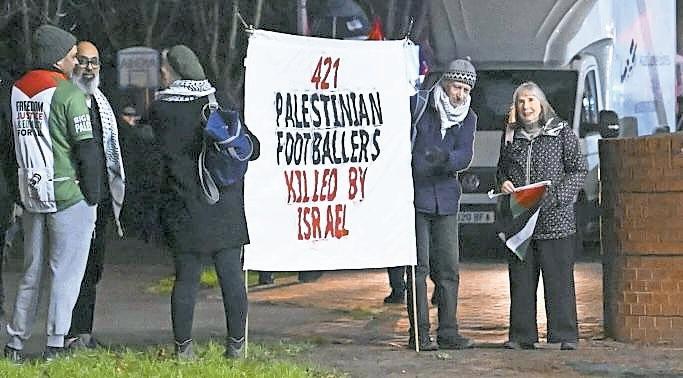
Israel, and Iran’s strategy of using Arab proxies from Lebanon to Yemen to fight for its goal of annihilating the Jewish state.
But it is in the opening chapter, which shares the same title as the book itself, that he outlines his own approach to the conflict, in an engaging synthesis of personal biography with political analysis.
Abdul-Hussain explains that he is the son of an Iraqi Shia father and a Lebanese Shia mother, born in Lebanon prior to the eruption of the civil war in 1975. His family’s experience was a reminder of Leon Trotsky’s dictum that “you may not be interested in war, but war is interested in you.” Though his parents showed little interest in politics, the sectarian strife in Lebanon compelled them to move to Iraq, then under the boot of Saddam Hussein.
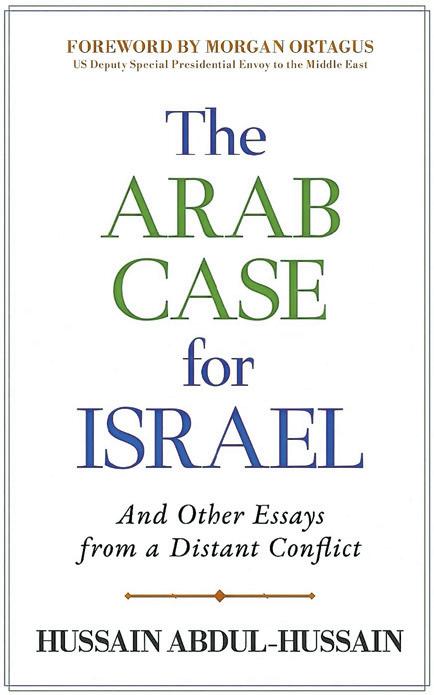
I was taught in Iraq, where we called Khomeini the hypocrite and Saddam the hero.”
As a teenager in Lebanon, Abdul-Hussain was open-minded, befriending members of the country’s Christian community and flirting with Marxist groups. Yet, as he incisively notes, “all the identities that I grew up or experimented with while in Lebanon had one thing in common: They all hated Israel.”
Even so, Abdul-Hussain’s intellectual curiosity overcame these received viewpoints. He began reading Israeli newspapers online, going on to learn the Hebrew language. He would even drive to the border with Israel, engaging in conversations with troops from the Israel Defense Forces stationed there and earning the opprobrium of the Hezbollah fighters who spotted him chatting away.
TIn 1982, however, the family returned to Lebanon, with Abdul-Hussain’s father narrowly escaping the military conscription imposed by the Iraqi dictator as the war with Iran raged. In the predominantly Shia city of Baalbek, where the family settled, he writes, “posters of Ayatollah Khomeini were everywhere, and everyone was cursing Saddam Hussein — the opposite of what
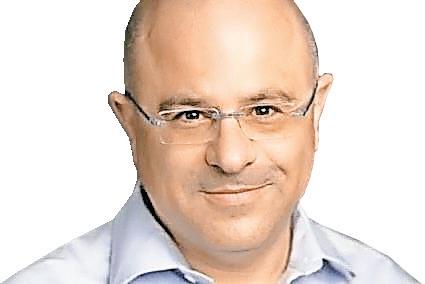
There is a moment every Israeli traveler knows. You are standing in a European airport — at the check-in counter, passport control or in the security line — and you reach into your bag. The small navy-blue booklet comes out, its cover bearing a menorah flanked by two olive branches, with the words “State of Israel” printed in English and Hebrew, and something in the air changes.
A glance. A pause that lasts half a second too long. An expression that requires no translation. You have not said a word. You have done nothing except exist with the wrong document in your hand.
Since Oct. 7, 2023, and through the cascade of war that followed, traveling through Europe with an Israeli passport has become an exercise in performed invisibility. You tuck the document face down. You slide it under your palm on the counter. You are now an expert at the swift, low transfer from pocket to official hand and back, minimizing the risk that anyone nearby might read the words on its cover.
Dimitry Kochenov, the “Passport Professor,” whose 2019 MIT Press book Citizenship dissects the global passport hierarchy with surgical pre-
For Israeli passport holders, airports in Berlin and Amsterdam, Paris and Brussels are not neutral transit zones. Middle East foreign policy will not be determined solely by the Palestinian agenda.
hat willingness to consider the Israeli perspective, along with his desire to learn about Israeli society, deepened when AbdulHussain moved to the United States in 2004. Jews, he realized, “were like everybody else. They wanted to live a decent life while enjoying their heritage and passing it onto their children, like every other community on this planet.” As an Arab who grew up in a cauldron of hatred, many of his observations are telling and touching.
See Cohen on page 22
cision, writes that a passport “carries borders in one’s pocket,” and is not a neutral identity document but a condensed statement of one’s place in the global hierarchy. He is right. What he could not have fully anticipated is that for the Israeli traveler in today’s Europe, the passport carries something more visceral than hierarchy. It has become a target.
Kochenov argues that passports judge people “by the color of their passport and nothing else,” making the document a practical measure of worth. The Israeli experience in European airports is that framework made flesh, a moment of eye contact, an awkward silence.
The check-in agent takes slightly longer than necessary, expressionless in a way that nonetheless conveys something dark. The security officer’s questions drift from the procedural into something more editorial. The fellow passenger in the boarding line registers the navy booklet in your hand and shifts their weight, almost imperceptibly, away. The duty-free cashier whose warmth, freely extended to the travelers before and after you, runs briefly cold. No accusation is made. None is needed. The passport has already spoken.
It is the setting that makes all this so suffocating. Europe is not incidental here. This is the continent that spent centuries constructing the legal, theological and eventually biological architecture of Jewish exclusion. This is the continent whose 20th century produced the definitive proof of where that logic leads. And this

is the continent that built its postwar identity around the vow of “never again.”
The airports of Berlin and Amsterdam, Paris and Brussels are not neutral transit zones. They are built on specific ground, and Israelis moving through them carry that history in their bodies, not just their passports. When a fellow passenger gives you that look across the departure lounge, you are not simply a citizen of an unpopular state. You are a Jew in Europe being scrutinized. The layers do not separate cleanly.
In Citizenship, Kochenov argues that for most of the world, citizenship is primarily a liability rather than an asset, a blood-based allocation of burdens and privileges that reproduces global inequality at every border crossing. The Israeli passport was never a mobility superpow-
er, long excluded from Arab states and fraught with complications across parts of Asia. But within the Western world, particularly Europe, it has carried full visa-free access, indistinguishable in practical terms from any other Western passport. A gateway, not a gate. This is eroding. The formal visa arrangements remain unchanged, but the human texture of crossing has shifted in ways no bilateral agreement captures. Hostility leaves no paper trail. A look costs nothing and proves nothing. And yet it accumulates, checkpoint by checkpoint, until a flight becomes something to get through rather than enjoy. There is a word that goes missing in the respectable discourse about Israeli policy and its contested morality. That word is antisemitism.
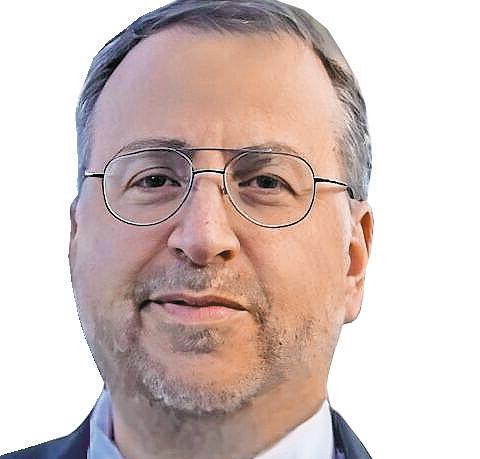
During Passover, a friend asked me to recommend one book that explains why someone should be a Zionist. The nuance of the question can easily be missed: There are many very good books I could recommend to someone who wants to understand Israeli history or to get advice on how to defend against lies about the Jewish state and people.
No one in our time is going to become a Zionist by reading Theodor Herzl, construed as the modern-day movement’s founding father. So the question is an important one, as Zionism is increasingly misunderstood.
There’s no good reason not to call ourselves ‘Zionist.’
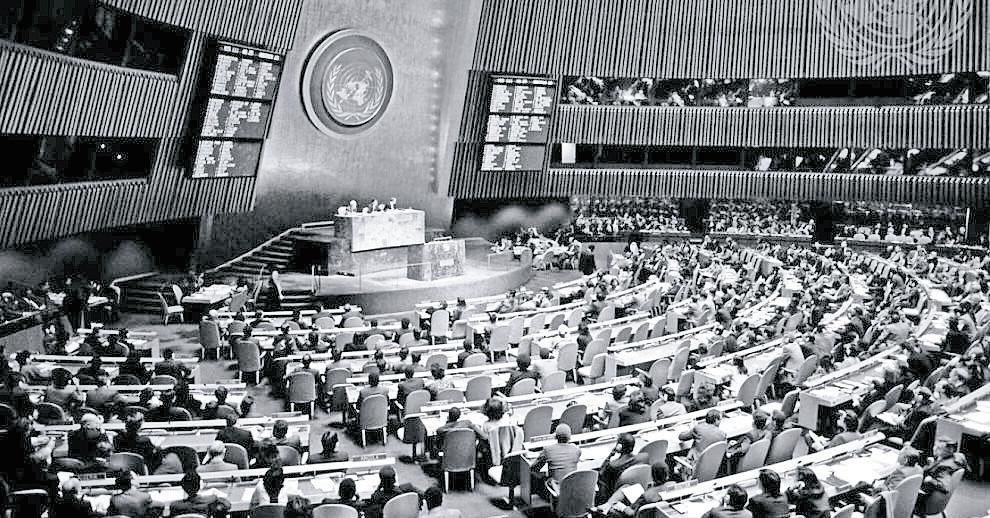
In fact, a survey conducted by the Jewish Federations of North America revealed that just 37% of American Jews stated that they identified as Zionists. Another 15% said that they were antiZionist/non-Zionist. A huge 48% of those surveyed, it can be surmised, are pro-Israel but not
Zionists, and I would argue that a big reason for this is that we have allowed Zionism to become a dirty word.
There’s no good reason for any Jew who is pro-Israel to resist using the term Zionist to describe themselves. Zionism is a team sport, and
the object of the game remains what it has always been: the saving of Jewish lives.
But what recent book conveys that? One published in 2025 came to mind right away, and unfortunately, it has caught the attention of far too few American Jews.
The book is Rabbi Tuly Weisz’s “Universal Zionism: The Movement Powering Today’s Jewish-Christian Alliance.” Born and raised in Ohio, where he served as spiritual leader of an Orthodox synagogue, he and his young family moved to Israel in 2011. His viewpoint is at once fresh and original, yet anchored in Jewish tradition and traditional Zionism.
The book is divided into four specific parts. In his substantial introduction, Weisz shares his personal story and prepares his readers for what is to come later by grounding his ideas with his thoughts about what happened after the Hamasled terrorist attacks in southern Israel on Oct. 7, 2023. Here, Weisz writes, “What proved even more shocking than the Oct. 7 attacks was the global response that began on Oct. 8.” But even in that section of the book, he displays an amazing faith and positivity that “G-d has made an eternal promise never to abandon Israel.”
The two middle sections of the book lead
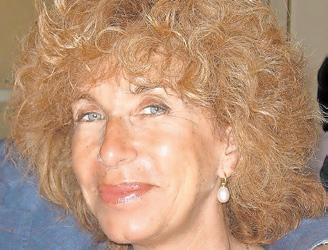
According to a nine-column front-page headline in La Repubblica, one of Italy’s leading daily newspapers, the world can witness how difficult life supposedly is for Christians in Israel.
Indeed, the situation is portrayed as a “shock” for Christianity as a whole, especially for Cardi-
Cardinal Pizzaballa saga overlooks the reality of religious freedom in the Holy Land.
nal Pierbattista Pizzaballa, the Latin Patriarch of Jerusalem, who is depicted as a heroic figure “in conflict with [Israeli Prime Minister Benjamin] Netanyahu over the horrors of Gaza,” and allegedly prevented by wicked Jews from going to pray at the Church of the Holy Sepulchre.
Thus, the narrative goes, Christians are prevented from praying and living their faith in the Holy Land.
The obvious danger posed by Iranian missiles — frequently aimed at Jerusalem and which have struck the Old City — has led to temporary Israeli security restrictions affecting mosques, synagogues and the Church of the Holy Sepulchre alike. Yet Iran’s aggression is pushed aside in favor of highlighting supposed Israeli cruelty. The implicit suggestion echoed across much of the Italian media is clear: poor Christians in the hands of the Jews.
The facts tell a different story. In 1948, there were approximately 30,000 Christians in Israel; today, the number is close to 200,000. Christians
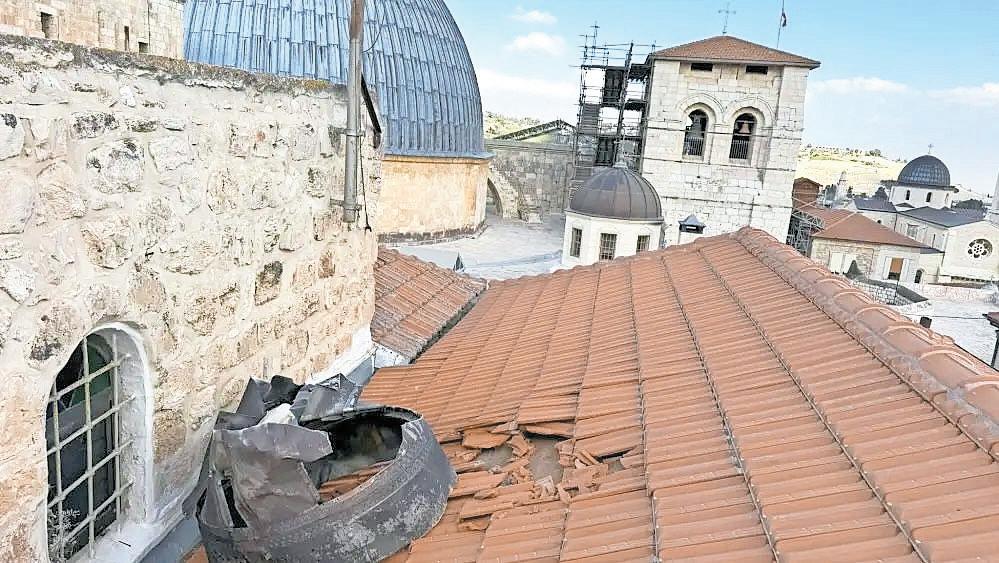
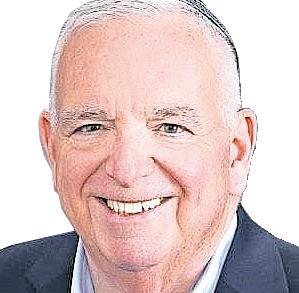
Last week marked another anniversary of my daughter Alisa’s murder in a 1995 Iraniansponsored terrorist attack — an attack that forced a question the United States is still struggling to answer. And that is not only who carries out acts of terror, but who finances them — and whether America is willing to confront those financial networks when they operate in plain sight.
That question is back in the news with a newly announced settlement between the US government and the Iranian-linked Alavi Foundation over its Manhattan skyscraper at 650 Fifth Ave.
The deal has been framed as accountability. Victims of Iranian terror will receive hundreds of millions of dollars in compensation. The foundation itself will be dismantled. On paper, it sounds like justice.
But look more closely.
A newly created entity, the Amir Kabir Foundation, will take control of the same building, with overlapping leadership, similar institutional structures and continued access to the very revenue streams that made the property so valuable in the first place.
After nearly two decades of litigation, the question is not simply what was won, but what was preserved. I have been thinking about that question for a long time.
In the 1990s, long before this case became a headline, I set out to do something that was widely dismissed at the time — to seize Iranian assets in the United States as part of my effort to hold

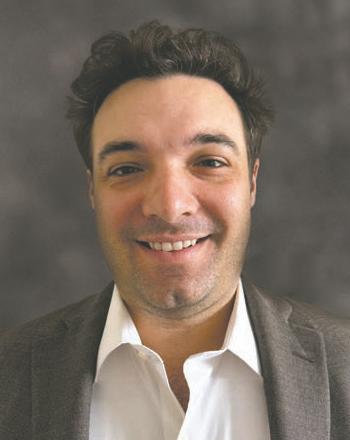
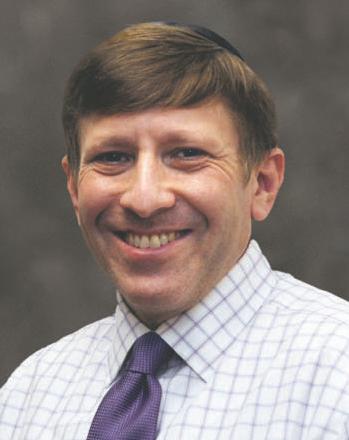
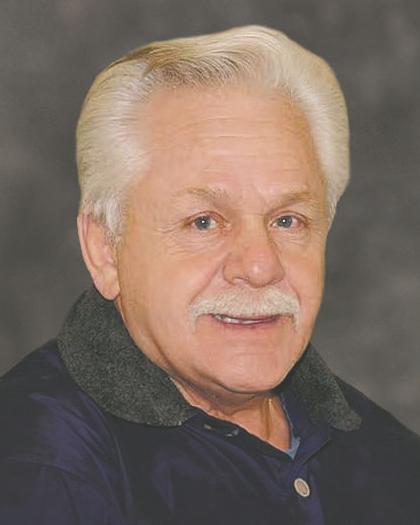











Continued from page 17
Those 14 years were not quiet. They were years of war and grief and uncertainty. Yehoshua buried soldiers. Families mourned. People went to sleep not knowing what tomorrow would bring. And still, over the course of those years, the land became theirs. Not because the fighting stopped. Because they remained.
Yishuv hadaas is not what you feel before you commit to a place. It is what you earn by having committed. It accumulates in the walls you repair and the fields you plant and the children you raise in the same rooms where you once trembled. You do not wait until it feels safe to plant. You plant, and eventually the settling comes.
This is the paradox the happiness surveys cannot fully capture. A people can live with sirens and still experience joy at the same time, not because it is numb to the danger, but because it knows what it is building toward, and it has already built enough to trust the direction.
Next week is Yom HaAtzmaut, marking 78 years since the founding of the State of Israel. A people returned after two thousand years of exile, rebuilt a homeland from desolation, established cities and yeshivos and hospitals and armies, and continued to grow through wave after wave of loss and threat. This is not yet the settled calm the Ramban describes. But it is the foundation that makes that calm possible, 14 years stretched across generations, still in progress, still unfinished.
On Yom HaZikaron, we pause and confront the cost. Each name is a world. Each family carries a wound that does not close, a place at the table that remains empty, a silence where a voice once was. We do not rush past that pain. We stand within it long enough to recognize what has been given, and what has been sacrificed.
And then, on Yom HaAtzmaut, we move forward, not away from that reality, but deeper into it. We celebrate because of what those lives made possible, and because the people who gave everything for this land would have wanted nothing less.
Seventy-eight years in, we are still building. The sirens have not stopped. The settling is not yet complete. But yishuv hadaas does not arrive all at once. It is earned, stone by stone, year by year, through the steady persistence of a people that refused to stop building.
Until even the walls begin to hold something sacred.
Rabbi Benny Berlin is spiritual leader of BACH in Long Beach, www.bachlongbeach.com.
Write: Columnist@TheJewishStar.com
ness of every day, every hour and every minute. We know this intellectually, but when we make a point to mark every night for 49 days, it must surely influence our thinking and mindset.
Let’s hope we can prioritize what is truly important. Let’s try and value time — our time and those of others. Indeed, that is one of the lessons of the season.
Sefirat Ha’Omer reminds us not to pass the time, but to make the time.
Write: Columnist@TheJewishStar.com
breathing, reading, and writing in the daily, timeworn yoke of their opinions.”
These opinions of a famous 19th century essayist and one of his contemporary counterparts stress and amplify a message implicit in this week’s Torah portion — that time by oneself, reflecting and engaging in serious introspection, is an essential component of self-improvement and a prerequisite not only for membership in society, but for leadership of society.
Jewish sources go much further than Emerson and Deresiewicz. The latter restrict their insightful comments to the importance of solitude in everyday, mundane affairs. Our tradition teaches that solitude is necessary for spiritual growth and for religious leadership.
The sages of the Talmud insist upon the necessity of cheshbon hanefesh (self-reckoning).
The Jewish ethical treatises of medieval times recommend that one regularly withdraw from society to engage in such self-reckoning. Chassidim, and most particularly the followers of Rabbi Nachman of Breslov, engage in daily periods of hitbodedut (solitary contemplation).
The secular writers quoted above are helpful in that they make it clear that solitude need not entail mystical practices or spiritual techniques. Rather, solitude provides an opportunity for thinking on one’s own and for concentrating deeply without the undue influences of one’s social surroundings.
I personally am convinced that occasional solitude would be a healthy antidote to the blind conformity which is imposed upon us by our contemporary world.
Once again, the Torah, in the midst of a passage which seems out of tune with modernity, gives us a lesson essential for coping with modernity.
Write: Columnist@TheJewishStar.com
be signed out of despair or fear, but out of a conviction that — as a friend and an ally — the State of Israel is much more valuable to the Arabs than ejecting it and constructing in its stead a Palestine that would, at best, be a mediocre state.”
Should the fantasy of eliminating Israel become reality, he warns, Arab nations would be at the mercy of Islamists who will transform them into failed states, replacing the promise of modernity with the politics of vengeance.
The chapter closes with Abdul-Hussain expressing hope that other Arab intellectuals will feel confident enough to echo his views. In that sense, the current war with Iran is a significant opportunity.
It’s hard not to smile at the irony of antisemitic pundits in the United States and Europe pontificating that Israel dragged Americans into a war they did not choose when the loudest voices calling for the war to continue emanate from Saudi Arabia and the United Arab Emirates.
The last month of missile barrages has brutally confirmed what many Arabs suspected about the Tehran regime’s true intentions, proving to all but the most witless Hamas acolytes that Israel’s disappearance would not miraculously deliver regional peace overnight.
Abdul-Hussain’s work gives the reader a glimpse of something more profound: a shared future where debates about history and responsibility are civil and rational, and where securing a prosperous destiny for all the region’s children is the guiding principle. Moreover, as he stresses, the Arab world is far bigger than the Palestinians alone. Arab nations should no longer feel that any ties with Israel should be determined solely by the Palestinian agenda.
As the Abraham Accords indicate, many Arabs have already arrived at that position.
Abdul-Hussain’s book is a clarion call for the remainder to follow suit. That includes the Palestinians, who face the same choice they always faced: to move on from their narrative of historical victimhood or to be swallowed by it.
Write: Columnist@TheJewishStar.com
Not a criticism of a government. Not anger at a military operation. Not the entirely legitimate range of political positions one might hold about Gaza or the strikes on Iran. Antisemitism: the ancient, persistent, shape-shifting conviction that Jewish presence is itself the problem, that Jewish people carry their guilt collectively and wear it on their passports.
Sharon Pardo is a senior fellow at the Jewish People Policy Institute (JPPI), as well as a professor of European studies and international relations in the Department of Politics and Government at Ben-Gurion University of the Negev. Write: Columnist@TheJewishStar.com
me to recommend the work so strongly. In “Political Zionism” and “Religious Zionism,” Weisz provides a very solid review of these two wings that comprise mainstream Zionism. From Herzl to Rav Kook, from the Balfour Declaration to the 1967 Six-Day War — and nearly every other important event and figure — he introduces his readers to the basics of Zionism.
In the final section, Weisz explains his conception of “Universal Zionism.” He invites Christians into the Zionist movement and writes, “At the heart of Universal Zionism lies a simple but radical proposition: the Bible still means what it says about the Land of Israel. Jews and Christians who take Scripture seriously must support complete Jewish sovereignty over the … biblical heartland of Judea and Samaria.”
He goes further, writing, “Imagine churches and synagogues in every city becoming centers for Israel education.” Weisz seems to see his “Universal Zionism” idea as especially necessary after Oct. 7 and writes, “over time it became painfully clear: to Hamas, the real battlefield is in the global court of opinion.”
On this point, it is hard to argue with Weisz. When nearly half of American Jews must be more than just a little mystified by the word Zionism, there’s something wrong. Very wrong. Far too many American Jews have a strong emotional attachment to Israel, but don’t want to call themselves Zionist or be labeled by the term.
The longing by Jews for the Land of Israel was found through the dispersion for nearly 2,000 years. It drew Jews from every corner of the world to resettle our ancient homeland. This includes a common religion, a shared history and a consciousness of a bitter exile, filled with violence and oppression.
And yet, this is what makes the Zionist movement so polarizing and makes many American Jews uncomfortable. The task of the hour is to better explain the movement’s history and link to the present day — and to be proud of it and exhibit that pride to the world.
Write: Columnist@TheJewishStar.com
17
My late father would tell the story of the guy who was always late. When people demanded that he get his act together, he responded: “Actually, it was about 10 years ago that I once overslept, and I simply haven’t been able to make up the time I lost since then. So I’m still running late!”
There’s more truth to that than you might think. As American founding father, author, scientist and inventor Benjamin Franklin said, “Lost time is never found again.”
The saintly Chofetz Chaim once asked a wealthy man for some help with a project, and the man replied, “Sorry, rabbi, but I have no time.” The Chofetz Chaim looked at him sympathetically, and said, “You really have no time? What a shame. How absolutely impoverished you must be.”
One man who clearly appreciated the value of time was Rabbi Sholom Ber of Lubavitch (18601920). He once remarked that “a summer’s day and a winter’s night is a year!”
So, back to the beginning: Why count time? To sensitize ourselves to the absolute precious-
tial feelings of disappointment were understandable but short-lived, replaced by hope. Because we know Hashem is in charge and if we but recognize that loudly and publicly and thank Him as David Hamelech did poetically even when he was faced with mortal danger, we will merit those extraordinary miracles and gifts Hashem longs to grant us.
As our national anthem says: od lo avda tikvatenu (we have not yet lost hope) and b’ezrat Hashem (we never will).
Shabbat shalom.
Write: Columnist@TheJewishStar.com
“Israelis glorify their own who fell in battle defending the Jewish state,” he says, “but almost never vilify the enemies that they fought in these battles.”
Abdul-Hussain emphasizes that his book is not the product of a resigned realist imagination. “Arab peace with Israel,” he asserts, “should not
What is happening to Israeli travelers in European airports is not a political protest. Political protest is a banner unfurled outside an embassy. What is happening at the check-in counter is something older and more reflexive, updated for the current news cycle but drawing from the same well.
Kochenov wrote about the global architecture of citizenship, not about Jews in Europe. Yet his words — citizenship systems as instruments of “complacency, hypocrisy and domination” — land with uncomfortable precision on this continent and in this moment.
Europe mourns its historical antisemitism in museums and memorial days, in plaques and pedagogy, in solemn ceremonies at the sites of its greatest crimes. It is considerably slower to recognize the live version standing in its passport control lines, clutching a navy-blue booklet embossed with a menorah, waiting to be waved through or held up, welcomed or made to feel like a problem that needs processing.
The Israeli traveler learns to expect it. Learns to minimize the exposure of that booklet, to read the room before reaching into your bag — to brace for the weight of judgment that arrives before a single word is exchanged. That is what it means to carry your place in the world in your pocket and know that in Europe, in 2026, that place is unwelcome.
The booklet has not changed. Europe has simply stopped pretending.
in Israel are flourishing, which is certainly not the case in the Palestinian territories.
Consider Bethlehem, a city of profound importance to Christians as the birthplace of Jesus. In 1993, the year of the Oslo Accords, when control of the city was transferred to the Palestinian Authority and Israel withdrew, Christians constituted approximately 60–65% of the population. Today, that figure has fallen to roughly 15%. Christians have fled Palestinian rule, pushed out by discrimination, intimidation and the erosion of their cultural and religious freedoms.
Media reactions to the recent Jerusalem episode have been paradoxical, reflecting what increasingly appears to be an antisemitic fantasy that has gained traction since Oct. 7, 2023. An imagined defense of vulnerable victims is transformed into an accusation against Jews. In this fictional scenario, Iran and its bombardment disappear, replaced by the caricature of a supposedly anti-Christian Zionist monster.
The reality is that Christians in Israel live with equal rights and full freedom of worship, maintaining access to their holy sites. In contrast, Jewish communities across much of the Arab world have largely disappeared after
decades of persecution, expulsion and violence. Yet little is said about this. Nor is much attention given to Christians persecuted and killed in parts of the Islamic world.
Before accusing Jews of persecuting Christians, it would be wise to reflect on history. The role played by elements within the Church in centuries of persecution of Jews — including pogroms and silence during the Holocaust — has not been forgotten.
Iranian missiles pose a real danger. For 47 years, the regime firing them has sought the blood of infidels — all infidels. Even sites considered sacred in Islam, such as Al-Aqsa Mosque, or Christianity’s Church of the Holy Sepulchre, are not immune to the threat posed by the Iranian regime’s aggression.
Write: Columnist@TheJewishStar.com
Continued from page 20
the Islamic Republic accountable for my daughter’s murder.
Following a trail that began with little more than a database search and a series of title reports, we uncovered what seemed increasingly clear — that the Alavi Foundation was not an ordinary charity, but an instrument of the Iranian government, tied directly to a valuable office tower in Manhattan.
We went to court with what we believed was a straightforward argument: This was Iranian money, held behind a charitable facade, and it should be subject to seizure.
The response from the US government was swift — and dismissive.
Federal lawyers produced an affidavit asserting that the foundation had no connection to Iran. The courts accepted it. The governing legal doctrine required proof of “day-to-day control” by a foreign government. Without that, the assets were deemed untouchable.
It did not matter what the building represented. It did not matter what the evidence suggested. In fact, much of that evidence would later surface in the government’s own case. We had not met the standard, and the case was dismissed.
At the time, it felt like failure. In retrospect, it was something else: an early test of whether the United States was prepared to treat economic infrastructure tied to hostile regimes as part of the battlefield.
Years later, the government answered that question differently and more honestly.
In its own filings, the U.S. Department of Justice ultimately described what we had been arguing all along: that the building was tied to an Iranian government-owned bank, that its ownership had been concealed through a web of front companies and that the structure had been orchestrated at the highest levels of the Iranian regime. What had once been dismissed as insufficient proof became the government’s central claim. Using legal theories that closely tracked the
arguments we had advanced, the Justice Department brought its own case against the Alavi Foundation. This time, the government was willing to say plainly what it had once resisted — that these were hidden Iranian assets, and they could be reached.
The result was a landmark forfeiture. The building we had once tried to seize was finally taken, and its proceeds designated, in part, for victims of terror.
That shift matters. It reflects a broader evolution in how the United States confronts statesponsored terrorism — not only through military means, but through financial and legal pressure.
But evolution is not the same as resolution. Because what the latest settlement reveals is that even when the United States recognizes the threat, it does not always follow through to its logical conclusion.
The government extracted substantial financial penalties and compensation. That is meaningful. But the structure of the deal raises an unavoidable question: If the same networks, the same leadership circles and the same institutional DNA remain in place under a new name, has the underlying problem truly been addressed?
Or has it simply been repackaged?
Some observers have described this as a shell game — accountability on paper, continuity in practice. It is an uncomfortable description. It is also difficult to dismiss.
I encountered this tension decades ago. It hasn’t disappeared.
The Alavi case shows how long it can take for the United States to recognize a threat — and how difficult it remains to confront it fully.
We have learned how to seize the assets. We are still learning how not to give them back.
Write: Columnist@TheJewishStar.com
Continued from page 11
alertness of guards to ensure vigilance does not slip again.
The Red Unit’s fighters are required to improvise, be creative, and hold up under pressure. They must be physically capable because they sometimes need to cover long distances on foot and stay sharp during extended drills. They train extensively at firing ranges so that in training engagements, they serve as the most credible possible adversary. But they also know that right now they are not at a level of combat readiness that would allow them to be sent to the front, and that was never the plan.
The Red Unit may be young, but it has unit pride and the beginning of a tradition. Men, perhaps unsurprisingly, are not missed in their service landscape.
“Not at all,” 2nd Lt. S. wanted to make clear. “This is an extraordinary unit of female empowerment, and it also demonstrates the strength of women. If something physical needs to be done, like carrying heavy equipment, they don’t need any man to help them.”
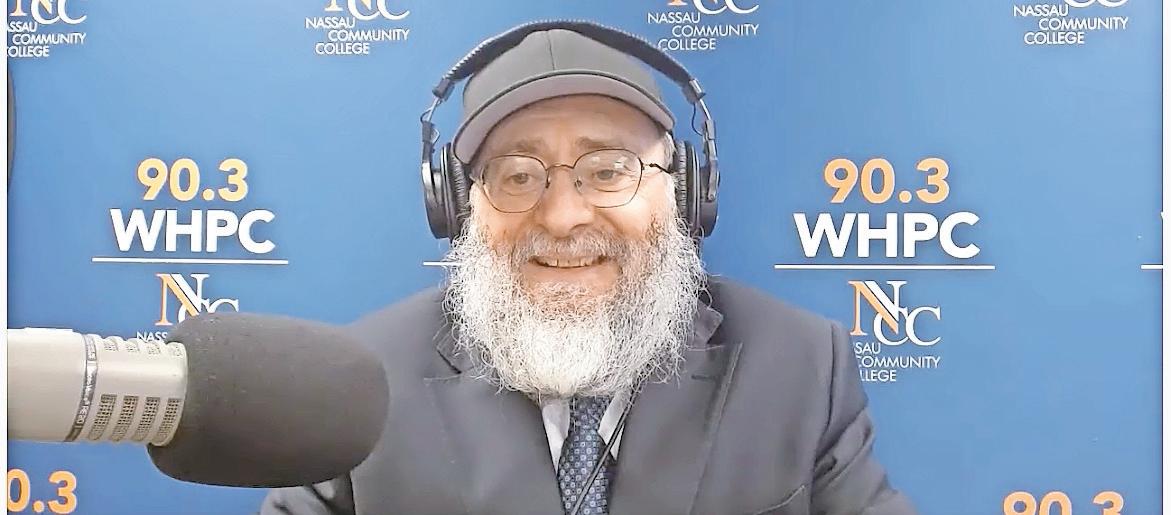
Amid renewed attention to the tone of public discourse — including President Trump’s recent use of coarse language — a Long Island rabbi is encouraging a different approach, one rooted in respect, connection and intentional communication.
Rabbi Anchelle Perl, director of Chabad of Mineola and host of the “Jewish Talk” radio program on Sunday mornings, has launched a “Reclaim the F-Word” initiative promote more thoughtful speech in everyday life.
“When leaders speak with dignity, they elevate the room,” Rabbi Perl said. “When parents model thoughtful speech, children inherit that mindset. A society is shaped not only by its laws, but by its conversations.”
“Not long ago, certain words were clearly out of bounds in public life. Today, they’ve become conversational punctuation,” he continued. “This is not just a linguistic shift — it’s a cultural one. Instead of complaining, we are proposing something constructive: a reclamation project.”
“If the world had more moments of genuine connection, we might need fewer harsh words,” Rabbi Perl said.
At the center of the initiative is a reframing of the letter “F” as a symbol for positive values. Rather than focusing on restricting language, the campaign encourages people to associate “F” with concepts such as faith, focus, forgiveness, forward progress, fortitude and farbrengen (a Chassidic gathering centered on conversation, storytelling and shared experience).
“None of this is catastrophic,” he said, “but none of it is insignificant either. Language shapes atmosphere. It influences how we disagree, how we lead, and how we treat one another.”
While the message carries a serious goal, Rabbi Perl hopes the campaign will feel approachable.
“My two favorite F-words?” he joked. “Farbrengen — and French fries. Don’t underestimate what good conversation over a plate of fries can accomplish.”

LEGAL NOTICE
ASSESSOR’S NOTICE OF COMPLETION OF THE FINAL ASSESSMENT ROLL
THE ASSESSOR OF THE COUNTY OF NASSAU HEREBY GIVES NOTICE that he has completed the 2026/2027 final assessment roll, which will be used for the 2027 levy of Town and
County Taxes in the Towns of Hempstead, North Hempstead and Oyster Bay, and the City of Glen Cove and the City of Long Beach, and for the 2026/2027 levy of school taxes in such Towns and in the City of Long Beach. A certified electronic copy of the roll was filed with the Department of
Assessment on April 1, 2026. The electronic roll may be examined on public terminals located in the offices of: DEPARTMENT OF ASSESSMENT NASSAU COUNTY