




By Jessica Russak-Hoffman, JNS
Why are these Passover seders different from all others?
Some Orthodox Jews are opting to personalize their Passover liturgy and accessorize it with everything from Klingon, the “Star Trek” language and superheroes to “Seinfeld” and Taylor Swift.
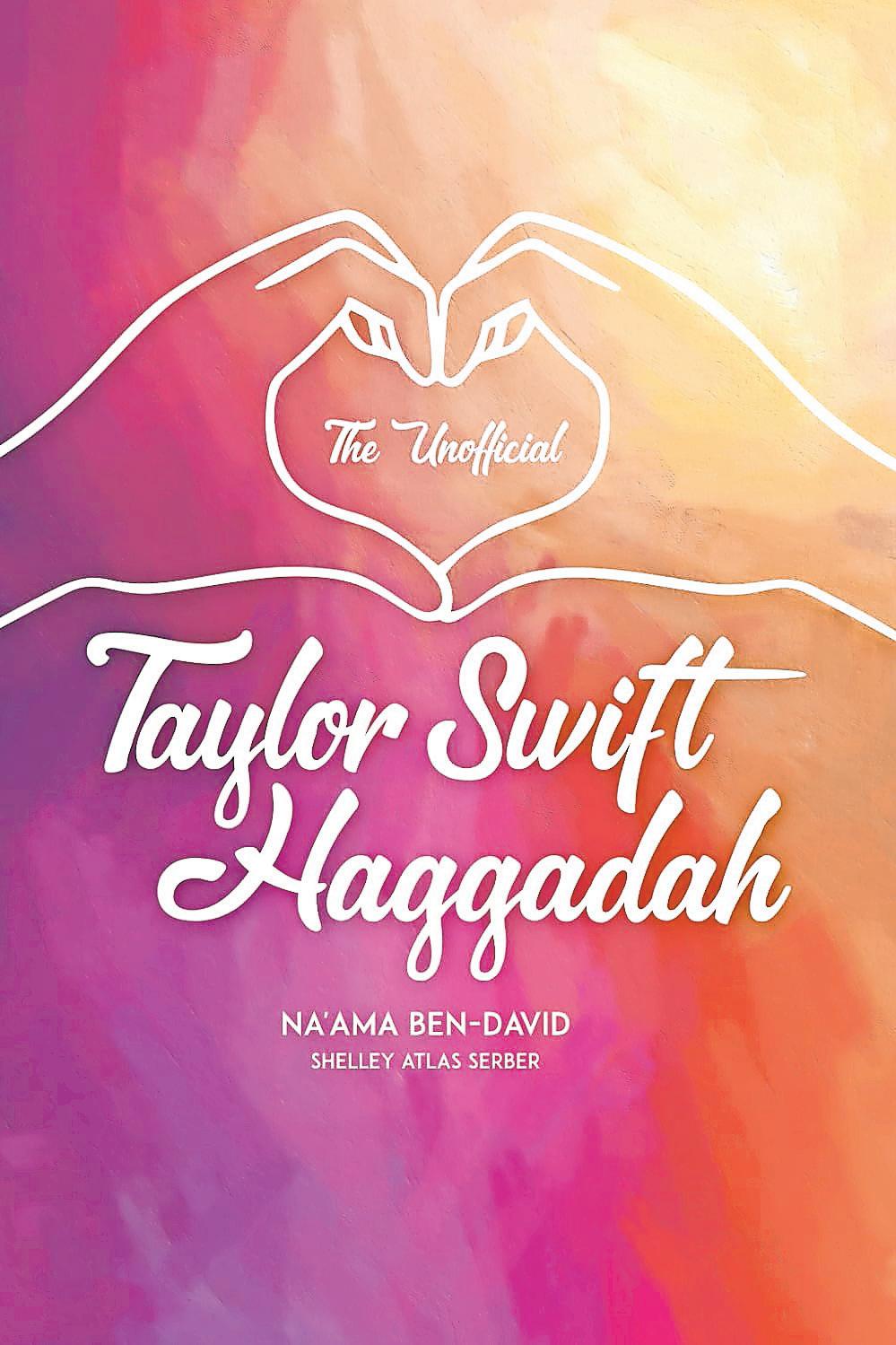
Shelley Atlas Serber, a graphic designer in West Hempstead, illustrated the “Unofficial Taylor Swift Haggadah,” which was penned by Na’ama Ben-David, an educator in New York.
“We actually received photos of young kids, who were sitting through the Pesach seder, and their parents and grandparents were completely shocked,” Serber told JNS. “Because they were engrossed in the Taylor Swift Haggadah and following along completely.”
The Swiftie Haggadah, which was published independently in 2024 and runs $22 on Amazon, includes the standard Hebrew text and is “a full working, proper Haggadah,” according to Serber.
“The messages that we got were beautiful, thanking us for producing this and keeping the kids and all Swifties really engaged and at the table,” she said. “I thought it was absolutely amazing.”
Serber said that the book “sold a few thousand copies in two weeks.”
Rabbi Steven Burg, international CEO of Aish, told JNS that “incorporating pop culture is awesome.”
At the Orthodox outreach institution that he leads, “the stuff that we do is always trying to see how pop culture can speak to Judaism,” Rabbi Burg said.
“It depends on the family. If a person has a family that’s not so into pop culture, I wouldn’t necessarily go out of my way to bring it in just for this reason,” he said. “If it’s something that families are attuned to, then I think it may be a good way to engage the kids on that level.”
JNS spoke to some of the members of a 4,400-member “Orthodox Ladies United in Fandom” Facebook group.
Members of the group often share their interests in science fiction, music, Broadway, literature and other popculture areas and organize speakers, book clubs and in-person gatherings.
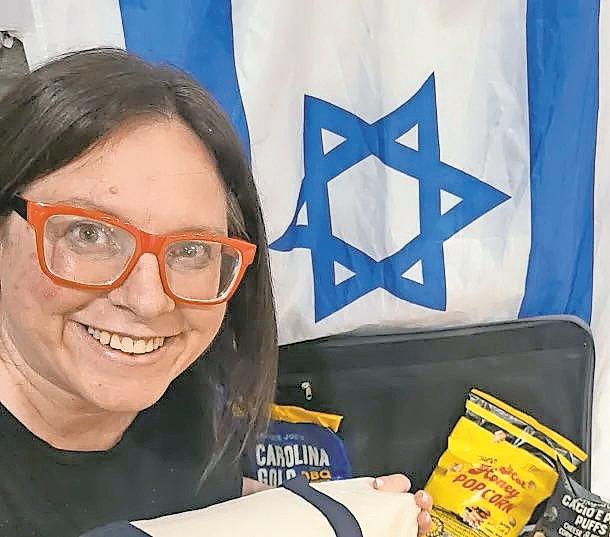
Group members said that their passions can find their way onto the seder table via themed Haggadahs, parody songs and creative reinterpretations of familiar rituals.
Kelly Klapper, who serves as the Youth and Education Director at Congregation Beth Sholom-Chevra Shas in Syracuse, told JNS that she and her husband, an energy engineer, host a “nerd seder with friends almost every year.”
“In addition to the Four Questions in Swedish Chef or Klingon, we also open with the song ‘Tradition’ from ‘Fiddler,’ and we make up our own versions of ‘Chad Gadya’ and ‘Who Knows One’,” she told JNS, of the muppet, “Star Trek” language, Broadway tune and Passover songs, respectively.
Marci Yesowitch Hopkins, a technical writer who lives in the Boston area, said her seder table includes readings from the self-published, 2025 “The Story of the House of MaqSwel Haggadah” ($16 on Amazon), which bills itself as having “excerpts from the Torah, Talmud, Mishnah and Kabbalah in the original Klingon.”
“It keeps it interesting and different,” she said, adding that they use a variety of fandom Haggadot at her table, including a Dry Bones Haggadah for her husband. “Everyone likes different Haggadot. Having variety makes people happy.”

“Being able to approach the Haggadah from wherever we are in our lives really makes it fun,” she said. “When we were reading Harry Potter, I was able to relate to simple things, like the four sons to the Hogwarts houses and the different teaching styles.”
“You can really feel like it’s a lived experience when it’s related to something you already enjoy,” Yesowitch Hopkins said.
Esther Kustanowitz, a Jewish popculture writer and co-host of the podcast Bagel Report, appears to have shaped the trend of contemporary Haggadah additions.
Kustanowitz has created multiple themed Haggadahs, including ones inspired by “Wicked” and “Schitt’s Creek.” She uploads them to an online platform (ReCustom.com) where users can mix and match and personalize their seder texts.
“You can come to Jewish meaning through many pipelines, and popculture fandom is a significant one,” Kustanowitz said.
“It’s like meeting a new friend through an old friend and feeling a synergy you hadn’t expected,” she said.
The appeal for Kustanowitz lies in uncovering unexpected connections.
“Finding meaning in something previously unconsidered — and growing to love it because of something else that you also love — is an incredibly
positive way to connect to Jewish life and meaning,” she said. “It’s a memorable and meaningful entry point that centers personal connection.”
Other users on ReCustom have uploaded Haggadot based on the Beatles, “Golden Girls,” “Star Trek,” “Star Wars,” “Seinfeld” and multiple Disney characters and films.
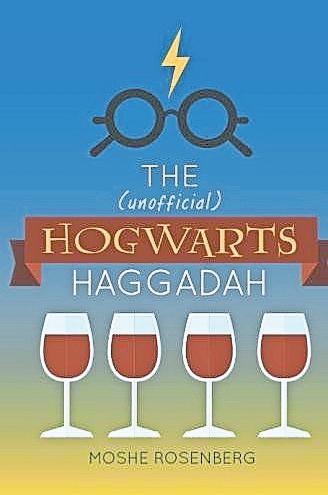
Commercial versions have also appeared. Amazon users can purchase “Curb Your Haggadah” ($10 on Amazon), based on the Larry David show “Curb Your Enthusiasm,” and the “(Unofficial) Hogwarts Haggadah” by Rabbi Moshe Rosenberg ($16 at Eichler’s Flatbush), based on the “Harry Potter” series.
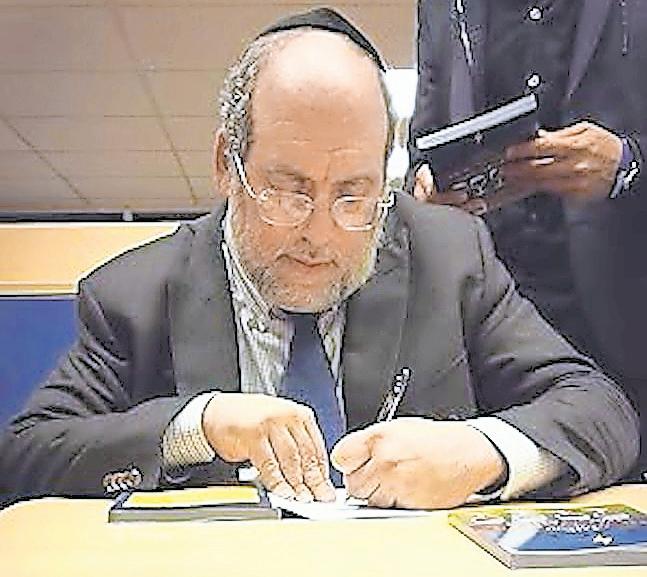
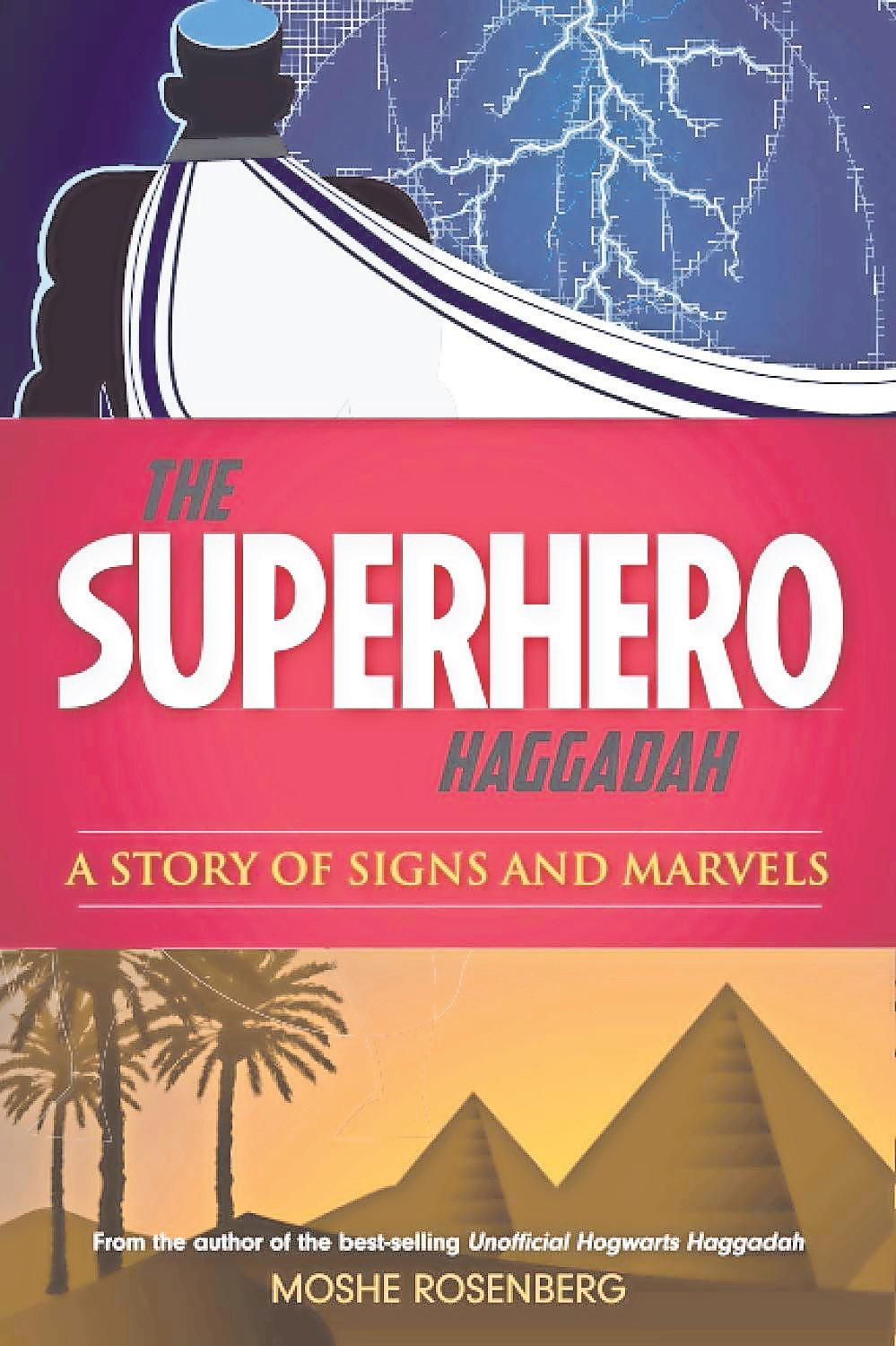
Rabbi Rosenberg, spiritual leader of Congregation Etz Chaim in Kew Garden Hills and a Judaic studies teacher at SAR Academy in Riverdale, is also the author of “The Superhero Haggadah” ($28 from Amazon) based on Marvel characters.
Michal Schick, who founded the “Orthodox Ladies United in Fandom” Facebook group, said that “using a fandom Haggadah is really no different from any other Haggadah with an organizing principle.”
“Whether that principle is fandom, commentary from a specific rav, stories from Jewish history or any other theme, the point is to give yourself new ways to think about the Pesach story and the seder,” Schick said.
She noted that searching for un-
expected parallels between fictional narratives and the Haggadah can create meaningful insight.
“The best part of a fandom Haggadah is finding those connections to the story and the seder, specifically because they are non-traditional and unexpected,” she said.
Schick thinks that Rabbi Rosenberg’s Marvel-themed Haggadah is particularly inventive when it compares the character of Nebula to the fourth child in the seder, the one who is unable to ask.
“If you know that character and what she’s been through, it’s a really interesting way to look at both her and the fourth child,” said. “That enhances the experience of the seder.”
The key factor, she added, is how the material is approached.
“As far as secularizing the seder, while I wouldn’t say that can’t happen, I think it relies on approach and intent,” she said, noting that if one takes the commandment to remember the Exodus seriously, “then a fandom Haggadah will only enhance that.”
“If you go in with a more lackadaisical attitude, it might not be the best choice,” Schick said. “But finding those unexpected connections, even in secular texts, can help us bond to this story and mitzvah.”
Rabbi Rafi Mollot, host of the YouTube channel Torah for Every Soul, told JNS that whether fan Haggadahs are appropriate depends on how they are used.
“If it’s with an attitude of ‘Our old traditions aren’t good enough, so we need to spruce it up with some pop culture,’ that’s anathema to Pesach,” the Orthodox rabbi said. “It isn’t leaving slavery and exile, that’s embracing it.”
“If it’s a springboard to connect to authentic Judaism and highlight the beauty, meaning and relevance of our tradition, it could be justified in a case of need,” Rabbi Mollot said.
“The Torah and our own tradition contain enough beauty for us to look within to find meaningful and enjoyable ways to celebrate our holidays and ignite the spark of inspiration,” he added. “Even in those who have been estranged from their Jewish heritage, if done right.”
Are you getting forgetful?
Are you worried about dementia? Feeling depressed?

DON’T WAIT TO TAKE ACTION!
✦ Medical exam by memory specialists, neurologist, and psychiatrist
✦ Cognitive exam by computerized and clinical tests
✦ Genetic lab testing
✦ Blood based biomarkers test
✦ Treatment with FDA approved infusion therapy LEQEMBI and KISUNLA
✦ Deep Brain Stimulation therapy
✦ Photobiomodulation therapy
(TRANSCRANIAL MAGNETIC STIMULATION)
TREATING
DEPRESSION, ANXIETY, PTSD, AND IMPROVING MEMORY

✦ FDA approved, non-invasive
✦ Clinically proven to alleviate symptoms of depression without causing systemic side effects
✦ Diminishes symptoms of Obsessive Compulsive Disorder
✦ Promising for patients looking for non-drug options for PTSD
✦ Minimizes symptoms of Anxiety
✦ Well-tolerated, effective, and has high remission rates
ACUTE / CHRONIC DIZZINESS
LIGHTHEADEDNESS
VERTIGO
TINNITUS
IMBALANCE AND FALLS

✦ Exam by board certified Neurologist
✦ Exam by clinical Audiologist
✦ Computerized diagnostics
✦ Physiological testing
✦ Vestibular Physical Therapy
✦ Virtual Reality Therapy

✦ Do you snore?
Or has someone told you that you hold your breath while sleeping?
✦ Do you have excessive daytime sleepiness after a full night’s rest?
✦ Do you have high blood pressure that is hard to control even with medicine?
✦ Have you fallen asleep while driving or at a stop sign?
✦ Is your memory getting worse?
Sleep problems can come from neurological & psychiatric problems or obstructive sleep apnea
DRUG-FREE, NON-INVASIVE TREATMENT FOR NICOTINE ADDICTION

✦ Reduces craving
✦ Increases cognitive control
✦ Studies showing increased quitting rates
✦ Drug free treatment with TMS (Transcranial Magnetic Stimulation) -
FDA Approved, paid by insurance
VAPING IS AS BAD AS CIGARETTE SMOKING AND A DEADLY HABIT CAUSING CANCER
NON-INVASIVE TREATMENT FOR ADOLESCENT DEPRESSION (Ages 15+)

High school and college age can be very traumatic for young people.
✦ Intense sadness, hopelessness, and loss of interest
✦ Irritability, low energy, sleep and appetite changes, withdrawal and poor school performance
✦ Triggered by stress, trauma, or genetics
✦ When medications and therapy aren’t enough
Significant symptom improvement and lowered anxiety and depression
TRANSCRANIAL MAGNETIC STIMULATION
FDA approved & Paid by insurances
2 Executive Blvd., Montebello/Suffern, NY 10901 | T. (845) 889-5088, (845) 889-5099
401 S Van Brunt St., Ste 302, Englewood, NJ 07631 | T. (201) 947-4777
*** Accepting Fidelis, Medicare, Clover, Aetna, UHC, Cigna and other major insurances ***
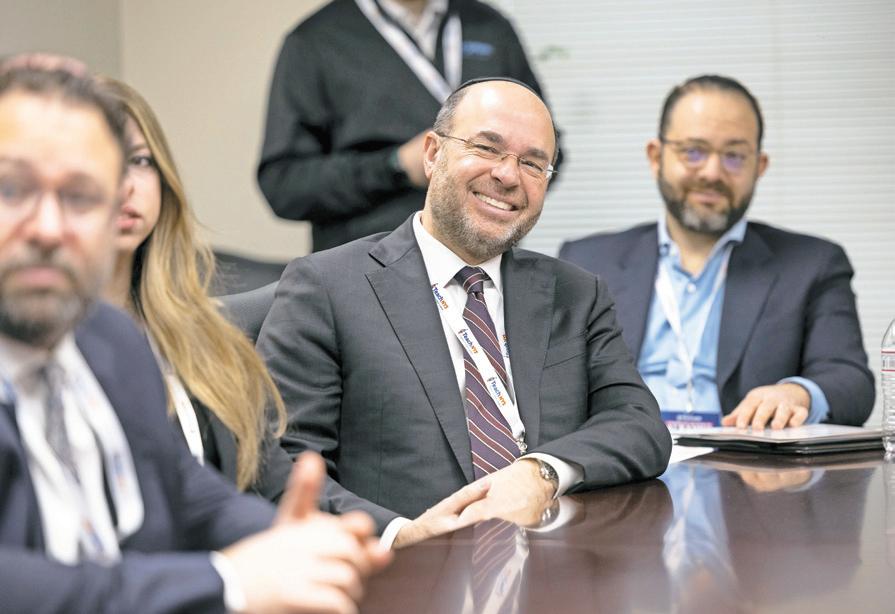
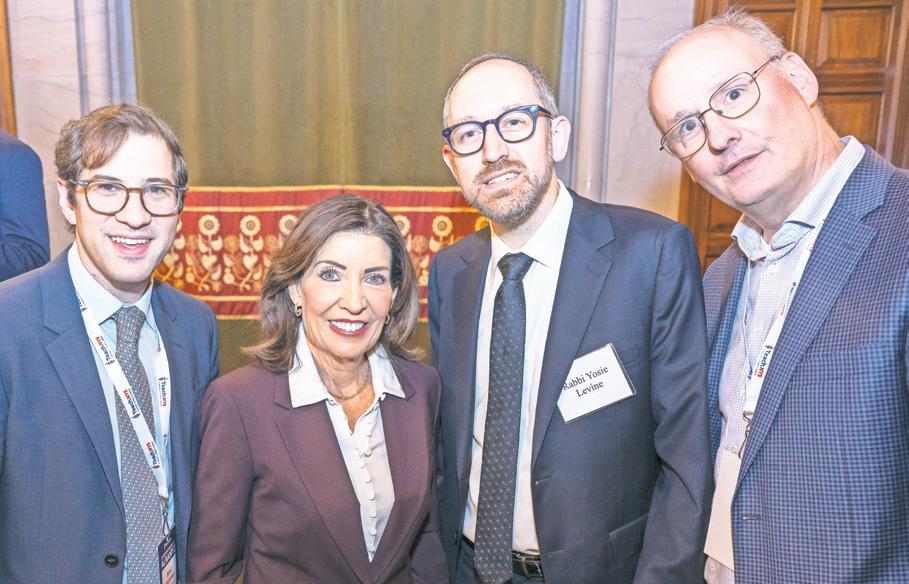
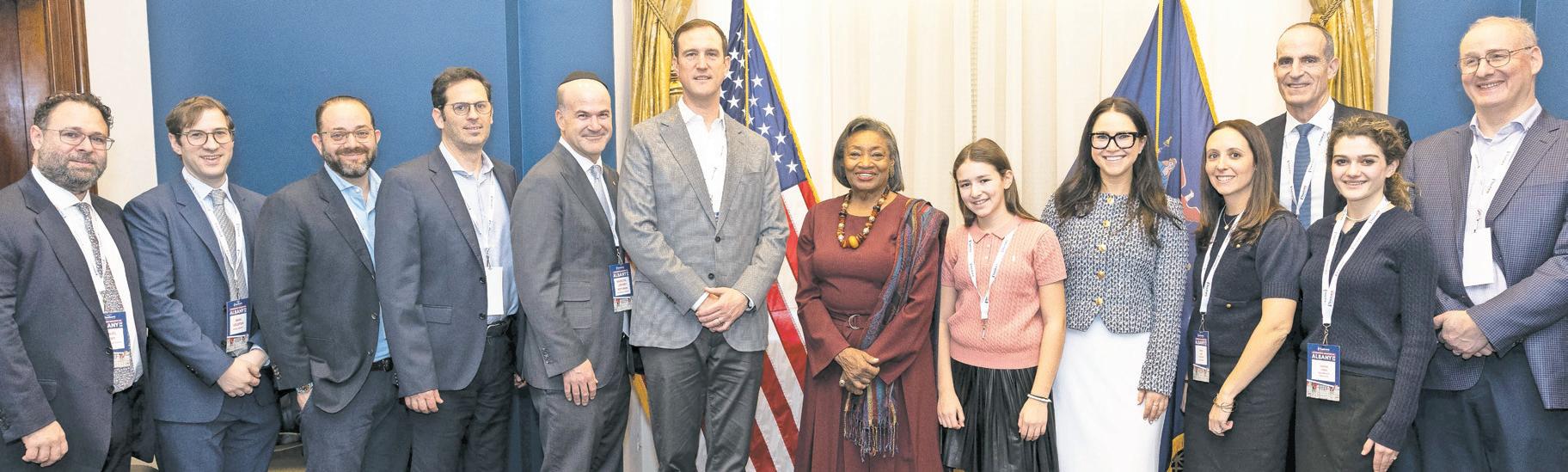
Parents, educators and community leaders from across New York returned from the annual Teach NYS Albany mission to significant developments: the state Senate and Assembly released budget proposals that include nearly $500 million in combined programs supporting nonpublic schools statewide. If enacted, the funding would provide significant support for Jewish day schools and yeshivas across New York.
The developments follow years of sustained advocacy and a week of direct meetings in Albany, where participants met with Governor Kathy Hochul and state lawmakers to push for increased support for both classroom needs and school security.
Among the key components of the proposals are $90 million for the Nonpublic School Safety Equipment program, $100 million for STEM instruction, and $6 million for arts and music education.
For most families, safety remains the most immediate concern and security was a central focus throughout the mission. As antisemitic incidents continue to rise nationwide, Jewish day schools are facing growing pressure to maintain strong security measures, often at a significant cost.
A new report from Teach Coalition found that the average Jewish day school now spends more than $400,000 annually on security, more than double what schools spent before October 7, 2023. These costs are rising far faster than other school expenses, and in many cases are being
passed on to parents through dedicated fees or higher tuition.
“For too long, Jewish families have been forced to pay an antisemitism tax, spending over $1,000 per child each year just to keep their kids safe,” said Sydney Altfield, CEO of Teach Coalition.
For school leaders, these pressures are felt every day in conversations with parents.
“We’ve had countless conversations with parents who want to make sure their children are safe,” said Rabbi Binyamin Krauss, principal of SAR Academy in Riverdale. “The challenge is that nonpublic schools already have high costs, and many families struggle to continue paying tuition, which is rising in part because of the growing security situation.”
Both the Senate and Assembly proposals include $90 million for the Nonpublic School Safety Equipment program, maintaining Governor Hochul’s historic investment. These funds help schools cover the cost of security personnel, surveillance systems, and other measures that have become essential in today’s environment.
At the same time, the proposed $100 million for STEM instruction reflects the continued growth of a program that began in 2017 with just $5 million and has expanded significantly through ongoing advocacy. The proposals also include $6 million for arts and music education.
For Teach Coalition, which has advocated on behalf of Jewish day schools and yeshivas for more than a decade, this year’s proposals reflect both real progress and the continued importance of showing up and making the case in Albany.
“When parents, students, and community leaders come to Albany and share their experiences, lawmakers listen,” said Altfield. “These investments are the result of years of persistent advocacy, and we will continue working to ensure that every student has access to a strong education in a safe environment.”


As budget negotiations continue, advocates say the proposed funding represents significant progress, as the community cannot be expected to shoulder the burden of security costs alone.
Reported and photos by Teach NYS







By Debra Nussbaum Cohen, JNS
The American Israel Public Affairs Committee has become a wedge issue in Democratic midterm primaries, with progressive candidates, even beyond the far-left flank, seeing it as a point of pride to refuse to accept support from the pro-Israel group.
“For the first time, people are saying openly that being pro-Israel doesn’t necessarily mean support for the government of Israel,” Lauren Strauss, professor of modern Jewish history at American University in Washington, told JNS.
“What AIPAC has always stood for is that they support whoever is the current government of the State of Israel,” said Strauss, who directs the university’s undergraduate Jewish studies program. “That has become increasingly problematic for many American Jews and for many candidates running for office.”
What has clearly happened is increased hostility to Israel, and saying you’re against AIPAC is saying that,” said Morton Klein, national president of the Zionist Organization of America.
As a one-issue organization, AIPAC has always been resolutely bipartisan, which is increasingly challenging in these politically divided times.
AIPAC did not respond to a JNS request for comment.
Hadar Susskind, president and CEO of the progressive group New Jewish Narrative, which states that “peace and justice are the birthright of Israelis, of Palestinians and of all people,” told said that AIPAC “is absolutely a giant and arguably the number one issue in midterms across the country.”
“For people I talk to from everywhere, regardless of their political affiliation and personal background and district, AIPAC is a major issue in a way that is very different than it’s ever been before,” Susskind said.
In a campaign video in late February, the former NYC comptroller says, “I’m Brad Lander, a lifelong progressive, and I’m running for Congress.”
“A lifelong progressive?” says Mayor Zohran Mamdani in the commercial. “You mean you haven’t sold out to special interests?”
“Or AIPAC either,” Lander says, with a shrug, as the two walk through a subway station.
“That’s impressive,” Mamdani says, shaking his head.
Lander is running against incumbent Rep. Dan in a hotly contested race in New York’s 10th District, which represents lower Manhattan and western edges of Brooklyn.
Goldman, who identifies as progressive, is seen as the more moderate candidate of the two and has extensive government experience, including as lead counsel in the first im-
peachment inquiry against President Donald Trump.
But in a district that voted heavily for Democratic Socialist Mamdani, Goldman’s stances on Israel may prove to be a liability in the primary on June 23.
AIPAC is pouring tens of millions of dollars into fighting candidates it considers insufficiently pro-Israel, often doing so through PACs with innocuous names, in a shift over the past election cycle into tactics that are often referred to as “dark money.”
The issue of limiting US military aid to Israel is turning out to be the sledgehammer driving the wedge deeper.
In the recent special primary to fill the vacant congressional seat in New Jersey’s 11th District, former congressman Tom Malinowski lost by 1.7 percentage points to Analilia Mejia, who has accused Israel of committing genocide in Gaza.
Malinowski, a Democrat who long supported Israel, apparently raised AIPAC’s ire when he said that he “would not deny anything Israel needs to defend itself” but left open the possibility of placing limits on aid.
In response, the United Democracy Project, an AIPAC Super PAC, spent at least $2.3 million to oppose Malinowski in ads sponsored by one group called “Elect Women,” for instance.
None of the ads mentioned Israel.
The Super PAC began 2026 with $96 million in its coffers, nearly triple the $35 million it reportedly spent in the 2024 primaries.
In Illinois’ primary races on March 17, those who lost were candidates whom AIPAC targeted. AIPAC’s “Elect Illinois Women” and other Super PACs funded by the Israel advocacy group were active in the race.
In a campaign email sent out the next day, Lander wrote, of the Illinois races, “though AIPAC spent over $20 million, they never even talked about Israel. We’re next.”
“My opponent accepts crypto and AIPAC support and winks at millions of dollars of outside spending on his behalf,” the former city comptroller said. “We don’t.”
Running ads behind shadow organizations is adding to Democratic sour feelings about AIPAC, according to Susskind, who leads the progressive group.
“People across the Democratic party are feeling that they have become the primary example of some of the abuses of dark money in politics,” he told JNS, of AIPAC.
AIPAC is “fighting a losing rear guard battle within Democratic politics,” Susskind said. “Both the constituency and the elected officials are not with them.”
Strauss, of American University, said that the moment “is an existential issue for AIPAC as an organization.”




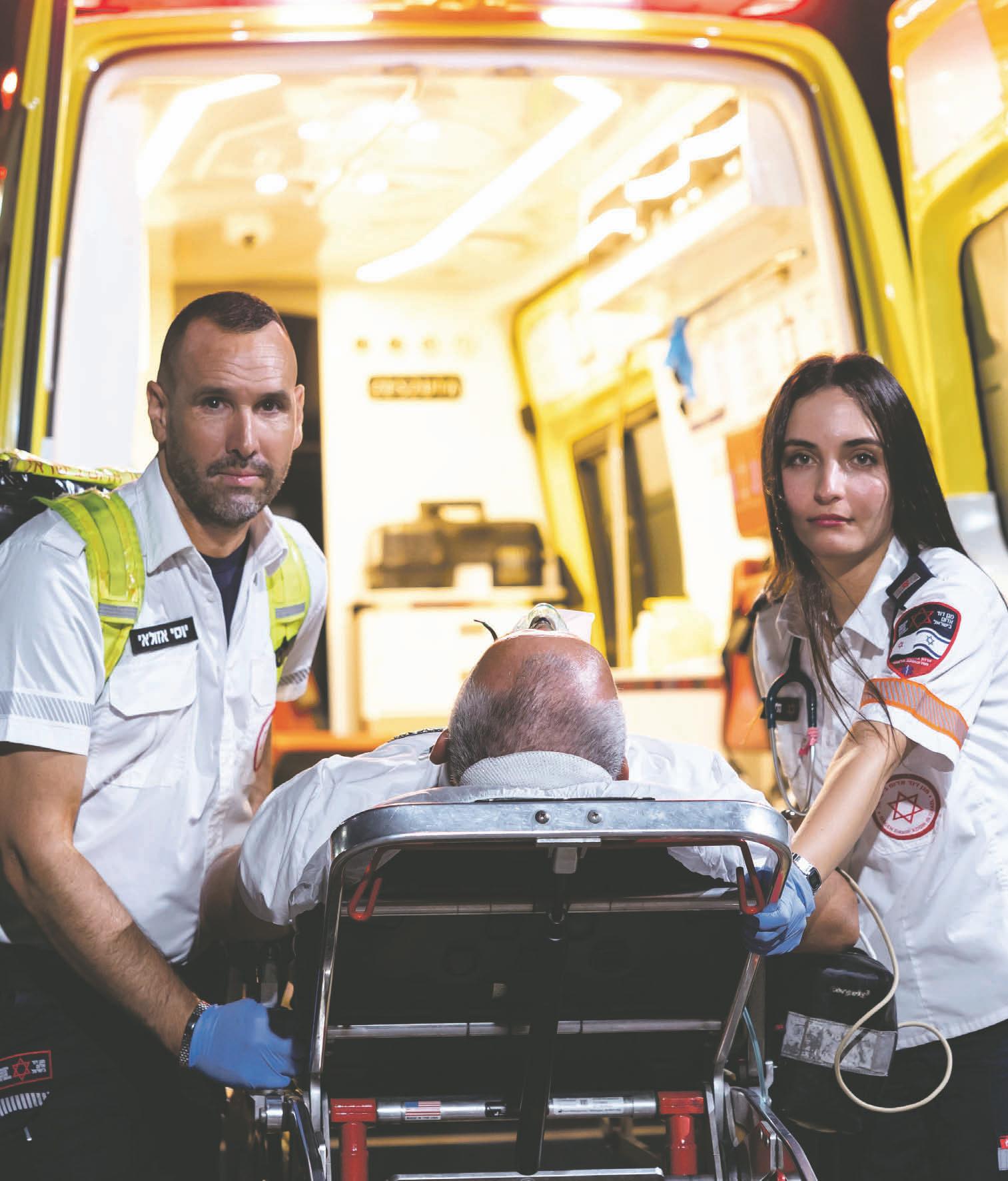
There are many ways to support Israel and its people, but none is more transformative than a gift to Magen David Adom, Israel’s emergency services system. Your gift to MDA isn’t just changing lives — it’s literally saving them — providing critical care and hospital transport for everyone from victims of heart attacks to rocket attacks.
By Howard Blas, JNS
As Iranian and Hezbollah missile attacks continue across Israel, people with disabilities and the elderly face unique and often overlooked challenges — from reaching shelters in time to coping with overstimulating environments once inside.
In response, the Home Front Command and a range of civil society initiatives are working to ensure that vulnerable populations remain safe, informed and supported.
For many, the obstacles are immediate and practical. Individuals who are deaf or hard of hearing may not hear warning sirens. Those with mobility impairments may struggle to access shelters. People with autism can find crowded, noisy spaces overwhelming.
“The most important thing is planning ahead and knowing the safest place,” said Tami Durst, the Home Front Command’s professional academic officer and desk commander for people with disabilities. “It is proven that following the guidelines and getting to a shelter on time saves lives.”
The Home Front Command has adapted its emergency guidance to reach diverse populations, offering materials in multiple languages, including English, Russian and Amharic, and tailoring content for different disabilities.
Services include sign-language training videos with subtitles, phone alerts using repeated vibrations or flashing lights for those who are
deaf, and simplified, illustrated materials for people with intellectual disabilities.
“Booklets have illustrations and simply explain things such as what a missile is,” Durst said.
The agency conducts daily Zoom sessions for people with disabilities, partnering with organizations such as ALUT (autism), Elwyn (multiple disabilities) and Migdal Or (visual impairments).
In Israel, families can call 104 for assistance or request group briefings.
Beyond government efforts, nonprofit organizations are playing a critical role.
Access Israel estimates that roughly 25% of Israel’s population — about 2.6 million people — are individuals with disabilities or older
adults who may need assistance during emergencies.
Shavvim, an advocacy and media platform focused on disability issues, estimates that more than 1.6 million Israelis live with disabilities, a number that has risen sharply since Oct. 7, 2023, due to injuries and trauma.
Both groups operate initiatives known as “purple” campaigns, a reference to the color associated with International Day of Persons with Disabilities.
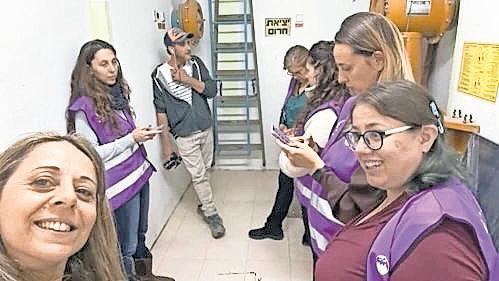
Access Israel’s Purple Vest Mission mobilizes trained volunteers to assist individuals in reaching accessible shelters, relocating to protected housing when necessary and obtaining essential supplies during prolonged emergencies.
“Emergencies do not affect ev-
eryone equally,” said Michal Rimon, founder of the Purple Vest Mission and CEO of Access Israel. “For people with disabilities and older adults, it takes more time to reach safety; even a few seconds can mean the difference between safety and tragedy.”
Jamie Lassner, executive director of Accessibility Accelerator and a volunteer with the initiative, said the program’s impact lies in preparation.
“They understand accessibility, they understand disability, and they act with urgency, compassion and dignity,” she said. “That preparation is no longer theoretical. It is saving lives.”
Shavvim operates a “Purple Hotline,” offering emergency assistance and rights-based support for people with disabilities and their families.
The hotline grew out of an operations center established after the Oct. 7, 2023, attacks, fielding calls from individuals unable to reach shelters, access medication or evacuate safely. It also assisted newly injured reservists in navigating rehabilitation systems and the families of children with complex needs.
“We received calls from wheelchair users who couldn’t get to a safe room, from people needing food or medicine, and from parents struggling to care for children with special needs during constant alerts,” said Idan Motola, founder and CEO of Shavvim.
The hotline, relaunched on March 1 after a previous pause, has assisted more than 4,500 people to
date. Among its efforts, volunteers distributed hundreds of tablets to children with autism spending extended periods in shelters.
Motola said hotline operators were called, inter alia, by families without protected spaces and from those unable to obtain medication or food, calls from parents of children with complex needs who could not evacuate safely, and from newly injured reservists encountering Israel’s rehabilitation and welfare systems for the first time.
“We received calls from wheelchair users who couldn’t get to a safe room or shelter, and from people with food requests, those with husbands on reserve duty, those needing to buy medicine and people needing help babysitting kids while they ran an errand. We also got requests for tablets for families of children with autism spending a lot of time in the shelter. We gave out 250!”
Shirly Pinto Kadosh, Israel’s first deaf member of Knesset and a longtime advocate for accessibility, said the initiative addresses critical gaps.
“People with disabilities in Israel still face dangerous barriers during war and daily life alike,” she said. “The Purple Hotline is meant to ensure that no one is left alone when systems become impossible to navigate.”
As the war continues, organizers said the goal is not only to respond to immediate needs but to build lasting systems of support that extend beyond times of crisis.
How’s your memory?
As families gather around the Seder table during Passover, storytelling becomes a powerful act of memory — retelling the journey from slavery to freedom and passing traditions from one generation to the next.
“These traditions highlight just how essential memory is, not only as a cognitive function but as a deeply human connection that shapes who we are,” said Dr. Jeff Shenfeld, medical director of the Brain Health Center.
While many people can easily recall stories repeated year after year, Dr. Shenfeld said, more recent memories — like appointments, names or familiar events — may become harder to retain.
As people live longer than previous generations, he said, a key question is whether those added years are lived in good health. More individuals are experiencing challenges related to memory loss, depression, balance issues and sleep disturbances — conditions that can affect not only patients, but also their families and caregivers.
The Brain Health Center provides care for individuals experiencing neurological and emotional changes, Dr. Shenfeld said. It focuses on early detection and treatment of conditions including mild cognitive impairment, Alzheimer’s disease, depression, dizziness, vertigo and sleep-related disorders.
All services are conducted in-house by
board-certified physicians in neurology, psychiatry and internal medicine, allowing for what Dr. Shenfeld described as a comprehensive and personalized evaluation.
Issues involving memory, sleep and balance can be difficult to identify and manage. The center uses diagnostic testing and a range of treatment approaches to determine the underlying causes of symptoms, he said.
“Our multidisciplinary team evaluates you as a whole person — not just a set of symptoms,” he continued.
“We consider your medical history, lifestyle, risk factors, and current medications when developing a fully customized treatment plan.”
Treatment does not rely solely on medication, Dr. Shenfeld added, also emphasizing education and lifestyle changes that may improve brain health. Transcranial Magnetic Stimulation, a non-invasive, FDA-approved treatment used for patients with depression or memory decline, is available, he said.
Dr. Shenfeld said the center aims to provide care in a supportive environment, with staff who speak English, Yiddish and Hebrew to better serve patients and their families.
With offices in Englewood, NJ (201-9474777) and Suffern, NY (845-889-5088) the Brain Health Center serves patients seeking care for memory, mood, balance and sleep concerns
Reported by TheBrainHealthCenter.com
Episcopal Health Services in Far Rockaway is now offering low dose radiotherapy (LDRT), using its new TrueBeam linear accelerator, which recently received FDA clearance to treat adults with medically refractory osteoarthritis.
The new RAPID Program (Radiation for Arthritis & Painful Inflammatory Disorders) is led by Mark Ashamalla, MD, chief of Radiation Oncology at EHS’ Walsh Ambulatory Pavilion.
According to the Centers for Disease Control and Prevention, osteoarthritis is a degenerative joint disease that can affect the many tissues of
the joint. It is the most common form of arthritis, affecting more than 32.5 million adults in the US.
Unlike radiation used for cancer treatment, LDRT uses very low doses that work by reducing inflammation in the treated area. Each treatment is brief and usually delivered over several visits. Patients can return to normal activities and work immediately afterward as there is no recovery time required and side effects are rare.
“LDRT is an evidence-based treatment that is safe, effective, and non-invasive for inflammatory and degenerative conditions of the tendons,
joints, and other soft tissues of the body,” said Dr. Ashmalla. “Studies show an 80% response rate with a patient achieving a steady state in terms of their pain and func5on.”
It has been used internationally for decades to treat inflammatory conditions such as arthritis and tendon disorders. The Rapid Program is specifically designed to help patients over the age of 40 with conditions such as osteoarthritis (knee, hip, shoulder, elbow, hand, ankle, and other joints); plantar fasciitis; calcific tendonitis; tennis elbow; other tendon or ligament in-
flammation; dupuytren’s disease; as well as keloids and hypertrophic scars.
LDRT can be very helpful for patients who have not experienced relief from traditional treatments such as physical therapy, medications, injections and even weight loss management. It can also provide benefits for patients before considering joint replacement or other invasive procedures.
To schedule a consultation, visit ehs.org/rapid or call 718-869-7101.
Reported by EHS.





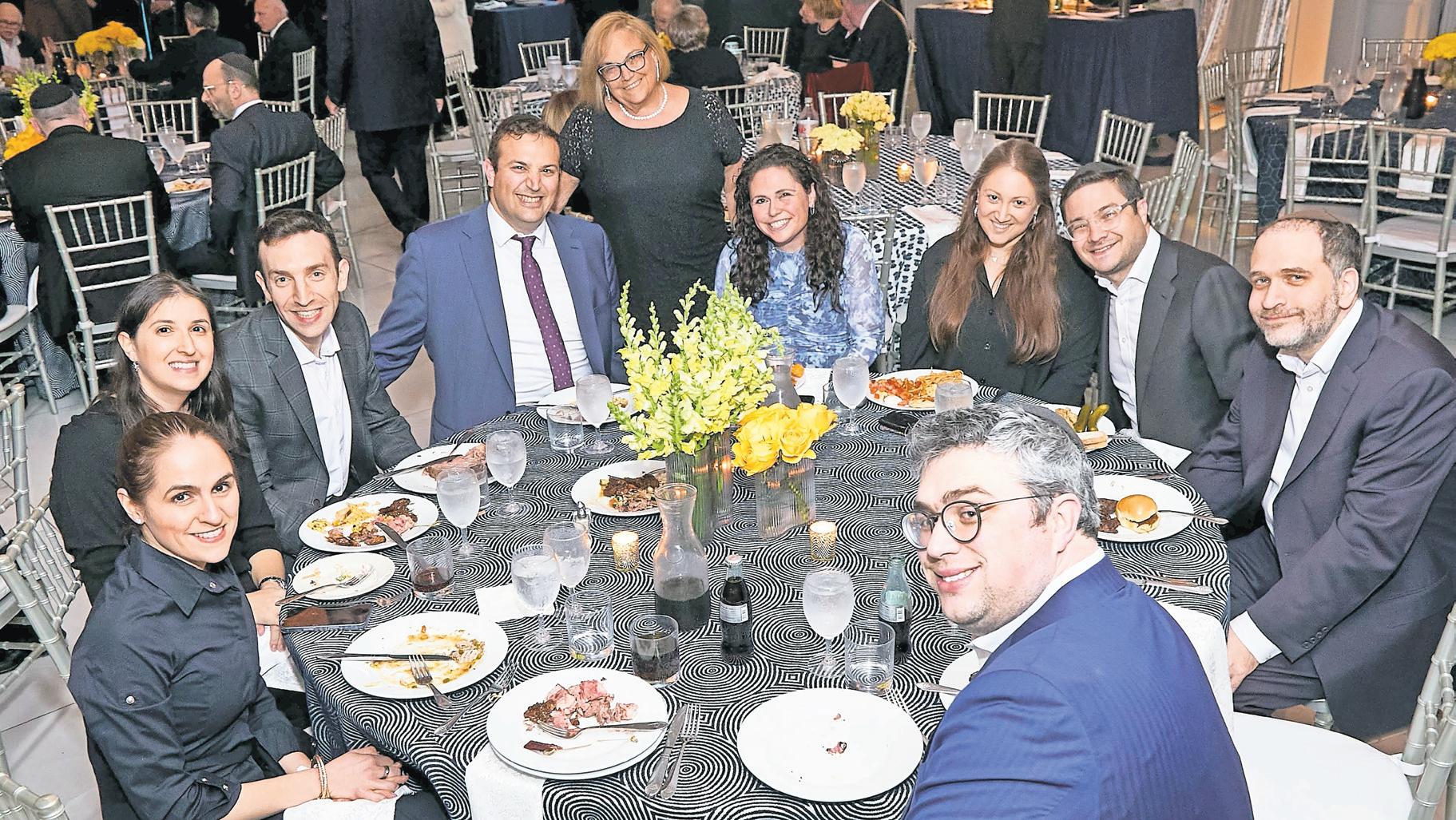
More than 500 members and friends of the Young Israel of Woodmere gathered for the shul’s 65th annual dinner.
Reflecting the heart and soul of one of the largest Orthodox synagogues in North America, the event departed from the traditional model of honoring individuals. Instead, it was dedicated to celebrating what defines the shul itself — its role as a makom tefillah, a sacred place of prayer that serves every member of the community across all stages of life.
With over 1,200 member families and more than 6,600 minyanim held annually, attendees were united under the theme, “One Kehillah. Many Minyanim. One Purpose.”
A video presentation featuring 23 of the shul’s volunteer baalei tefillah woven together in a rendition of Adon Olam captured the spirit of a community joined in prayer.
The evening also included a heart-
felt prayer for members of the United States military, acknowledging their service and sacrifice, particularly in a time of global uncertainty and conflict. The moment underscored the community’s deep sense of gratitude and responsibility.
“A makom tefillah is not defined by its walls but by the people who fill it with sincerity, with kavana, and with a shared sense of purpose,” reflected Rabbi Shalom Axelrod. “What we witnessed at this year’s annual dinner is the living expression of a community that turns to tefillah not only in moments of need, but as a constant foundation of its identity.”
“Every day, I see a community that lives its values — where tefillah is constant, where people show up for one another, and where the shul is not just a place people come to but a place they belong to,” said YIW Executive Director Steven Myers.
Reported by YIW.


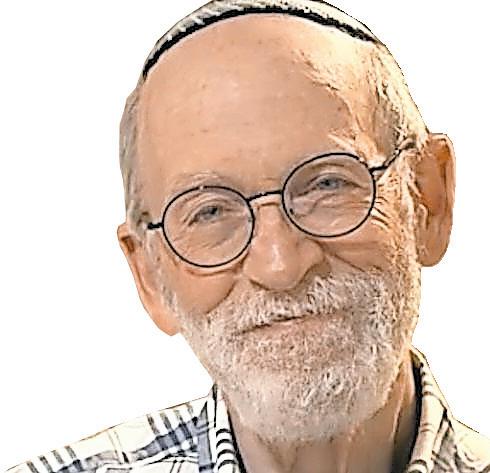
This article was published 23 years ago in the Long Island Jewish World, where the author penned a column for many years. He is now a resident of Riverdale.
The room was full of ghosts — including my own.
It was the 25th anniversary reunion of my Yeshivah of Flatbush High School graduating class. As it approached — weeks, then days, then hours — my mood swung from anticipation to dread and back again.
Who would I find there? There were people I was curious to see again. Would they have any interest in seeing me? What had they accomplished in the intervening quarter century? What had I done? The inevitable comparisons would be made, though not, of course, aloud.
The whirring of evaluation would inevitably take place in dozens of hearts and minds. How would I measure up?
There was also the physical dimension. Some, astonishingly, had changed hardly at all. The prime example was Eliot B., my teammate on the varsity basketball team. Eliot was our point guard (before the term “point guard” was invented). Slight of build then (and now), quick, smooth and efficient, Eliot is still there in the VCR of the mind: me, gliding down the wing, looking over to my left; Eliot, dribbling deftly, confidently down the center of the court. As he approaches the foul line, I angle to the hoop. If I am free, the ball finds its way into my hands, softly, affording me a layup. If he
has the opening, he pulls up for the jump shot. Eliot hadn’t changed.
Some had changed — and so dramatically that at first glance they looked like total strangers, the spouses of classmates perhaps. Until they would turn to me, smile, extend a hand: “How ya’ doin’?” I’d glance at the name tag affixed to the figure before me. No, it couldn’t be. So much weight gained (or, in one or two annoying cases, lost); so much gray; so little hair. Yipes.
Others had changed just enough to induce a double or triple take. Is that …? No … Yes, it is. Well, well.
Of course, not all were friends of mine back then anyway. We all had our particular circles, and though many circles overlapped, many remained separate solar systems in the universe that was our school. I was reminded of this at one point as I turned from one conversation and found myself greeting Harriet S. We hadn’t had much to do with each other between 1964 and 1968. It was more than a little awkward when, after the usual “Hi! How are you?” we just kind of nodded and grinned.
And nodded and grinned some more.
At the first opportunity, Harriet and I were relieved to be able to escape from each other. See ya’ in 2018.
Still, there we were, 25 years later. Most with our spouses — however reluctant they may have been to attend — feeling as though they were crashing someone else’s family gathering. For most, though certainly not all of us, our first and only spouses. Doctors, professors, computer wonks, therapists, lawyers, homemakers, teachers. Each with 25 years’ worth of bumps and bruises, neuroses, tales and laughs.
Each of us was also accompanied by a ghost: a 17-year-old kid, bewildered or confident. Already on track for a career, or just beginning to

realize how little he or she knew about what the future would bring, and unnerved by that realization.
The ghost had perhaps already loved and lost, or been loved and had spurned another. But more of the same was in store, and the ghost knew nothing of it.
The ghost was serene: it knew nothing of the fits and starts to come — the academic majors, the extracurricular minors, the professions, the relationships, the various endeavors embarked upon with the most fervent of hopes and the steeliest resolve, only to be discarded like yesterday’s newspaper when they didn’t work out. The quests for love, fulfillment and growth were, in some cases, redeemed and in others frustrated.
ly after the accident took place. I was in a taxi with relatives who were visiting and who had invited me to travel with them that day. We encountered a traffic jam where I knew there shouldn’t have been one; nine months in the city had taught me such things.
I noticed a scooter across the street painted a familiar color. I rolled down the window and asked a passerby for details, and became increasingly alarmed as he related that two Americans had been hurt and taken to Shaarei Zedek Hospital.


The curves, the forks in the road, the blind alleys, the detours were not knowable to that most callow ghost. The ghost imagined a future, and perhaps could even envision that not all would go according to plan. But a future there would surely be.
Except, that is, for two ghosts in attendance that evening, each without a corporeal partner.
I had myself dropped off there and burst into the emergency room, only to learn that Harvey had just been pronounced dead. Neil was unconscious and would have to be transferred to Hadassah for further care. I climbed in the ambulance with him, and off we went on our final journey together. As I would do again some months later, I held his hand and murmured words of hope and comfort to him. My speech was as much for my benefit as for his. There was no response then, as there would be no response later.

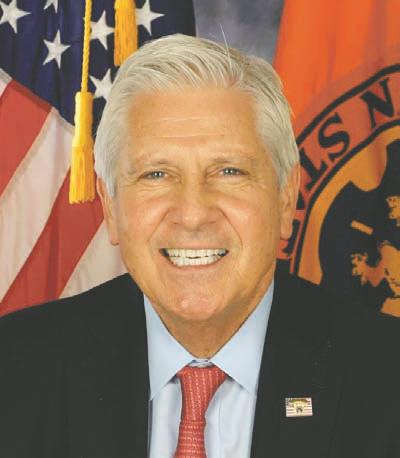

One, Neil S., was my best friend in high school, in summer camp, in the catering halls where we earned pocket money, and on through college. Together we went to the theater, played ball, debated politics, dated and demonstrated. Finally, we were roommates while at Hebrew University in Jerusalem.
I say “finally” because that is where it ended. I would have to leave him there, lying on a strange bed, his body wasted and, in truth, barely recognizable, when I departed at the end of June 1971. And when I took his hand in mine as he lay in the deepest of sleeps in Hadassah Hospital, and as I whispered my goodbyes, I feared that I would never see him again.
And I never did.
The beginning of the end began on the day before erev Pesach. Neil had changed his plans at the last moment. He would not be accompanying us to a kibbutz for Pesach. He had decided to stay in the apartment we shared with Harvey and Jerry, two other American students also at Hebrew U for the year. Harvey and he would stay behind.
So on erev-erev Pesach there were pots and utensils to be kashered so that food could be prepared during the holiday. And Harvey had a motor scooter to whisk them around Jerusalem as they made their appointed rounds.
Even though our sages tell us to approach each day as if it were our last, I would later wonder whether Harvey or Neil had an inkling — the barest of hints … a premonition — that this bright spring morning would be the last one they would see. At a nondescript intersection in Sanhedria, they collided violently with an army truck.
By chance, I happened upon the scene short-
Neil remained in a coma for six months before passing away. I received the news by telephone from Jerusalem in the fall. They said they couldn’t reach his parents, and I suspect they were relieved by that. I was asked to perform that miserable task, something I couldn’t bring myself to do. It had fallen to me to call Harvey’s parents six months earlier from halfway around the world. Somehow, the distance between Flatbush and Bensonhurst seemed greater. This time it cut too close to the bone. Instead, I phoned one of Neil’s uncles whom I knew and broke the news to him. He would pass it on.
At the 25th anniversary reunion of the Class of 1968, the room was full of ghosts — the ghosts of adolescence past, the ghosts of youth, ghosts with dreams.
Two ghosts were there without corporeal partners. One of them was our senior class president, my best friend.
Neil.
I don’t know why he had to die when he did, why the rich potential within him had to be snuffed out, any more than I know why babies are born diseased or deformed, or innocents maimed. I was later reminded of a Norman Mailer essay in which he employed the phrase “a calculus at heaven” to describe the unknowable. A calculus at heaven dictated Neil’s passing, and the equation eluded my feeble powers of comprehension.
What I do know is that I began missing Neil on a clear spring day in 1971, continued missing him on a gray day in October of that same year, and have missed him ever since.
A ghost in attendance at the reunion of the high school Class of 1968 reminded me that erev-erev Pesach was approaching.
I didn’t need to be reminded.
Write:
By Amelie Botbol, JNS
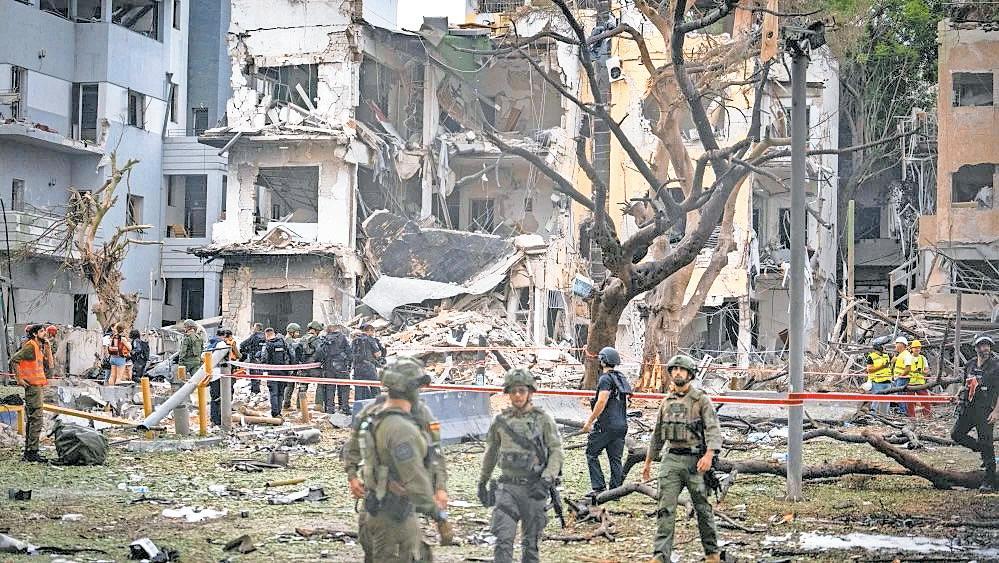
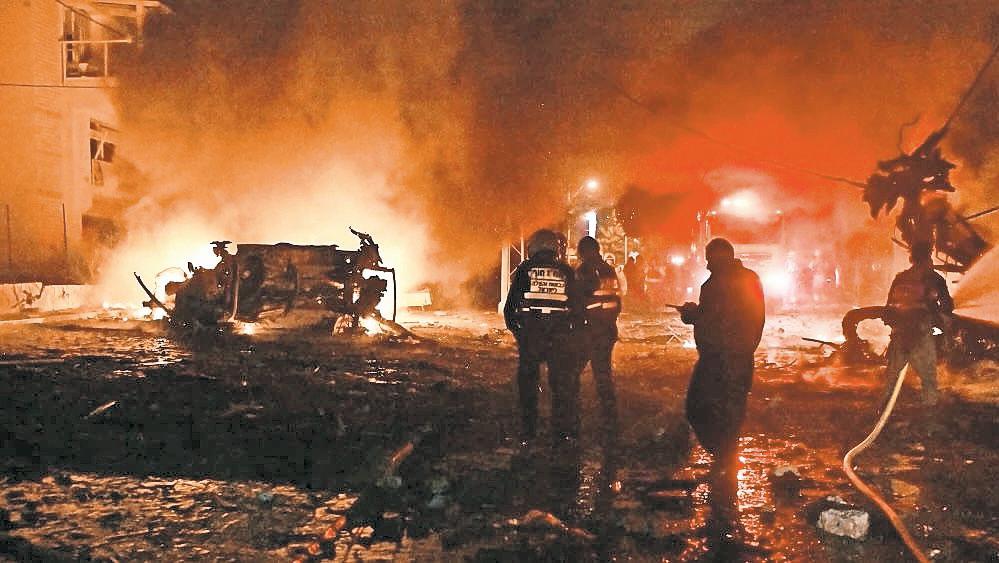
RISHON LEZION, Israel — Sirens send people running for shelter. For Magen David Adom crews, they signal something else: it’s time to get on the road.
At an MDA station in Rishon LeZion, paramedic Yedidya Meir, senior EMT Gad Yair Mimran and EMT Keren Mesika have been living onsite since late February, responding to missile strikes across central Israel as part of the Home Front Command.
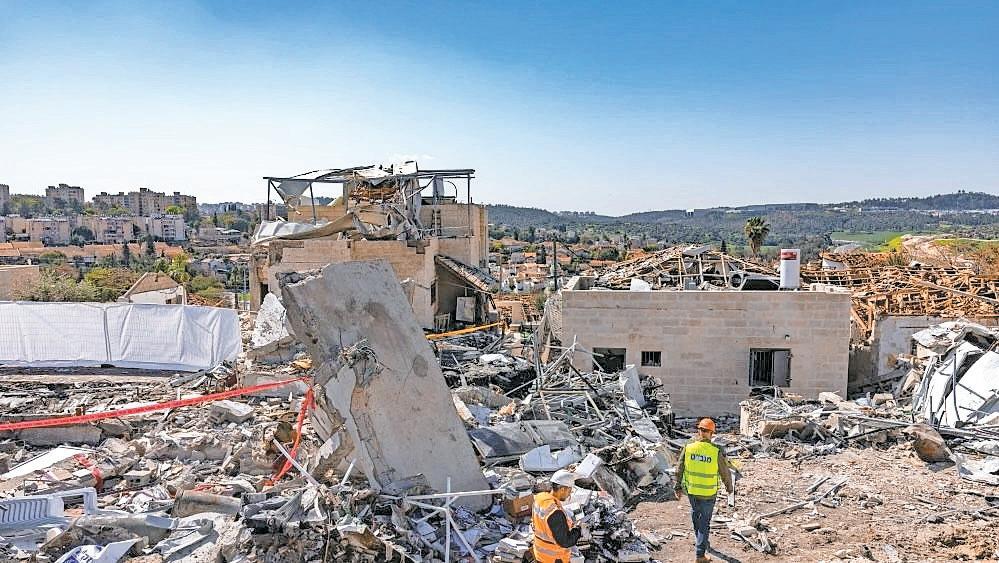
As the war with Iran continues, emergency teams like theirs are often among the first to arrive at impact sites, treating the wounded, searching for victims and helping residents in shock.
Magen David Adom, Israel’s national emergency medical service, operates with 36,000 volunteers, 3,000 employees, nearly 2,000 ambulances and 650 motorcycles. In the Ayalon region — which includes Rishon LeZion, Holon and surrounding cities — crews have responded to repeated missile alerts and impacts in recent weeks.
While this is Meir’s first rotation at the station as a paramedic, both Mimran and Mesika served during a previous round of fighting in June 2025.
Mimran recalled responding to a strike in Rehovot during that conflict.
“Our shelter started trembling,” he said. “We went out to the site. It was chaos. We started evacuating the wounded. As more alarms were heard, we would seek shelter, then return and continue the evacuations.”
When sirens sound, calls quickly flood in. Crews deploy immediately, often heading toward areas where explosions or falling debris have been reported. Nearly every alert results in a dispatch.
Most injuries, Mimran said, are caused by blast impact. In severe cases, that can include
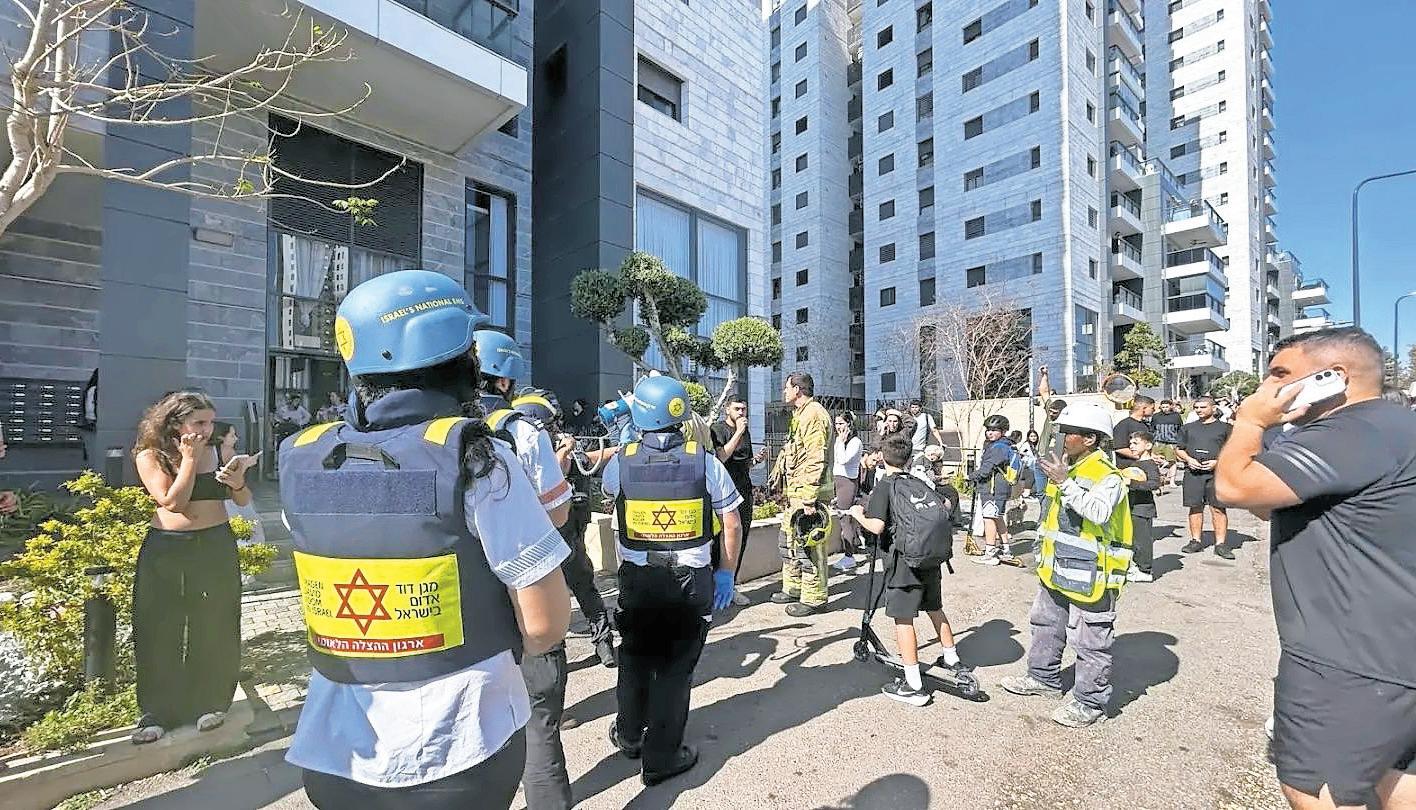
traumatic wounds requiring rapid evacuation to hospitals.
Other calls involve fires sparked by falling debris or smaller munitions, as well as people injured while rushing to shelter.
A significant portion of MDA’s work involves treating anxiety.
“The point is to give that person back a sense of control over what happens around them,” Meir said. “When someone is overtaken by anxiety, they feel helpless, unable to cope with the situation.”
“We introduce ourselves, explain that they are being evacuated, and ask whether they want to take anything from their home or notify someone,” he added. “Restoring that sense of control helps them emerge from the situation with strength.”
The team operates a mobile intensive care
unit — a yellow ambulance equipped to treat severe injuries. It carries two beds, monitoring equipment and supplies for life-saving treatment.
Mesika treats patients in the back, Mimran drives and Meir provides care en route.
The work is relentless. Crews must be ready to respond day or night, often with little rest between calls.
Mesika, an army nurse who lives in Bat Yam, also responded to a strike there last year.
“About 25 buildings surrounding the one that was hit will have to be demolished because their infrastructure was compromised,” she said.
A Ukrainian family of five who had fled war in their home country was killed in that attack.
In civilian life, the three medics have careers outside emergency response. Meir is a civil engineer, Mimran a software developer and Mesika
an economist in a high-tech company. That expertise can prove critical in the field. Meir said his background helps him assess damaged buildings and determine potential risks.
“Every building is supported by pillars that anchor it to the ground,” he said. “If a pillar is damaged, an engineer must determine whether the structure can be rehabilitated or must be demolished and rebuilt.”
Across Israel, newer buildings are designed to withstand earthquakes and, in some cases, better absorb the shockwaves from missile blasts. Many include reinforced safe rooms, which officials say have saved lives during attacks.
At one site in Rishon LeZion, a missile fragment struck a residential building’s roof. A family inside remained shaken but uninjured.
At another stop, the team was redirected to transport a patient unrelated to the war — a reminder that routine medical needs continue even amid conflict.
At a nearby hospital, Sarit, 53, of Rishon LeZion, described the moment a fragment landed near her home.
“There was an alarm and we entered the safe room in my house. I was with my daughters — my eldest doesn’t live with us — and my brother joined us,” she said. “About 30 seconds later, we heard a huge explosion and realized it was very close.”
“We called the police and went outside to find our garden destroyed. The damage was caused by the blast,” she added.
Sarit was taken to the hospital as a precaution.
“Safe rooms save lives. Don’t take it lightly — enter protected spaces when there is an alarm,” she said. “It saves lives, and it saved ours.”
As the conflict continues with no clear end, MDA crews remain on constant alert — moving toward danger as others take cover, and working to stabilize lives in its aftermath.












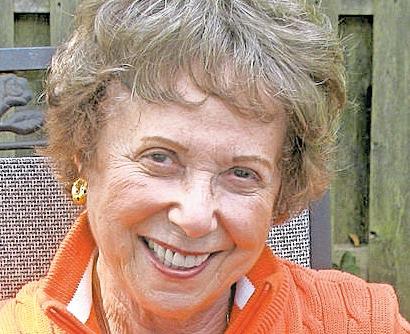
EThEl G. hoFmAN
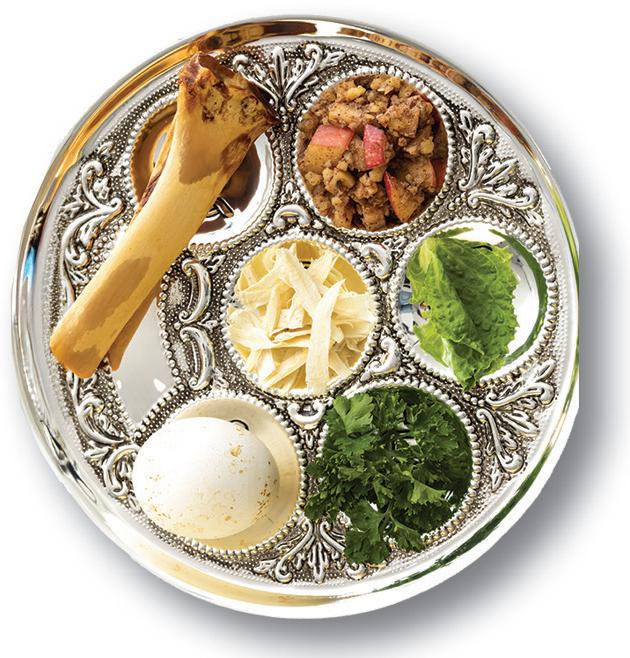
According to a Pew Report, almost 70 percent American Jews — secular as well as observant — attend a Passover Seder to read the Haggadah and recount our flight from Egyptian slavery to freedom.
Of course, food is another highlight of the Seder, and much of the celebration revolves around specific foods and prohibitions.
Although Ashkenazi Passover dishes are heavy on matzah, eggs and dairy products, which were easily available in Eastern Europe, these traditional dishes can be lightened with fresh fruits and vegetables, in tune with contemporary dietary recommendations. In contrast, Sephardic Passover dishes are light and lively, heavy on fresh produce, exotic spices and zesty seasonings — all part of the ancient Mediterranean diet.
At the Hofman house, the first seder features an Ashkenazi meal with dishes that have been adapted to add generous amounts of fruits and vegetables. The second night features a Sephardic meal (definitely more appealing to the diet conscious).
Consider serving fish along with the traditional brisket or chicken. Instead of salmon, look for steelhead trout. It looks an awful lot like salmon, but it’s not; it’s softer and flakier. Don’t try to divide it into neat portions; just spoon into pieces. Native to Alaska and the West coast, it’s one of the healthier types of fish with plenty of lean protein and omega-3 fatty acids. Just make sure you buy farm-raised, as wild steelhead is an endangered species, depending on where it’s from.
The recipes below do not include kitniyot Happy Passover!
Ingredients:
• 1 cup dried apricots, cut up
• 1/4 cup dried cherries
• 3 large dried peaches (about 4 ounces) cut in chunks
• 1/4 cup walnuts or pecans
• 2 Tbsp. packed fresh mint leaves
• 3 to 4 Tbsp. sweet wine
• 2 Tbsp. honey or to taste
Directions:
Place dried fruits in a bowl and cover with boiling water. Let stand 30 minutes or so to soften. Drain well. Place in a food processor and pulse to chop coarsely.
Add the nuts, mint, 3 tablespoons wine and honey. Process to chop finely. Transfer to a bowl. Add more honey or wine as desired.
Place in serving bowl, cover tightly with saran wrap and refrigerate. Serve at room temperature. Makes 2 to 2-1/2 cups.
Ingredients:
• 1 Tbsp. olive oil
• 1/2 medium sweet onion, sliced thinly
• 1 medium green zucchini (about 1-1/2 cups), cut julienne
• 1 medium yellow zucchini (about 1-1/2 cups), cut julienne
• 3 medium tomatoes, snipped coarsely
• 1 cup shredded carrots
• 1/2 cup grated parsnip
• 1/4 cup snipped fresh dill, packed
• 1/4 cup snipped fresh parsley, packed
• 6 to 7 cups vegetarian broth (substitute chicken to make a meat soup)
• 2 tsp. lemon-pepper seasoning or to taste
Directions:
In large pot, heat olive oil over medium heat. Add all the remaining ingredients. Bring to boil. Reduce to simmer. Cook for 10 to 15 minutes, or until veggies are softened. Serve hot. Makes 6 to 8 servings.
Ingredients:
2 medium sweet potatoes, peeled and cut in chunks
1 medium baking potato, peeled and cut in chunks
2 Granny Smith apples, unpeeled, cored and cut in chunks
4 oz. plus 2 Tbsp. margarine, melted
10-oz. package frozen chopped spinach, thawed and squeezed dry
1-1/2 cups bagged shredded carrots
1/2 cup canned crushed pineapple, welldrained
1/2 cup raisins
1/2 cup matzah meal
1/3 cup sugar
1/3 cup frozen orange-juice concentrate, thawed


Directions:
Preheat oven to 350 degrees. Spray a 9-inch square baking dish with nonstick cooking spray. Coarsely chop the potatoes and apples in the food processor. In a large bowl, place potatoes, apples, about 1 stick melted margarine and all remaining ingredients. Stir to mix well. Spoon into prepared baking dish. Drizzle with remaining margarine.
Bake in preheated oven for 1-1/4 hours, or until firm and nicely browned. If browning too quickly, cover loosely with aluminum foil. Serve warm or at room temperature. Serves 10 to 12.
Ingredients:
• 2 to 2-1/2 lb. fillet steelhead trout
• 3 Tbsp. fresh lemon juice
• 1 tsp. kosher salt
• 2 tsp. fresh ground black pepper
• 1 Tbsp. za’atar
• 2 Tbsp. finely snipped parsley
Directions:
Preheat oven to 400 degrees. Place steelhead trout fillet on prepared baking pan. Sprinkle all over with lemon juice, salt, pepper and za’atar. Bake in preheated oven for 18 minutes. Cooked when a knife is inserted and flakes are opaque. Before serving, sprinkle with parsley.
Serve hot, warm or even at room temperature. Serves 8.
Ingredients:
• 1-1/4 cups pineapple or apricot preserves
• 3 Tbsp. orange juice
• 1 tsp. potato starch
• 1/2 tsp. cinnamon
• 2 15-oz. cans tangerine sections, drained
• 1 pineapple, peeled, cored and cut in 1-inch cubes
• 1 cup blueberries
• 1/4 cup pistachio halves or slivered almonds (optional)
Directions:
In large saucepan over medium heat, stir together the preserves, orange juice, potato starch and cinnamon. Stir constantly until melted and combined. Bring to boil. Cook for 1 minute, stirring constantly.
Remove from heat. Fold in the tangerines, pineapple and blueberries. Transfer to a serving bowl.
Just before serving, scatter pistachios or slivered almonds over top. Serve at room temperature. Serves 8.
Write: Columnist@TheJewishStar.com














































































































































































































































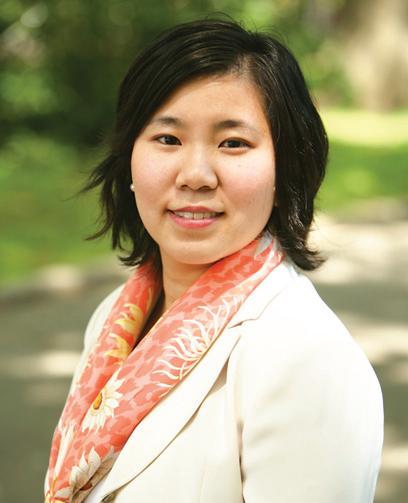







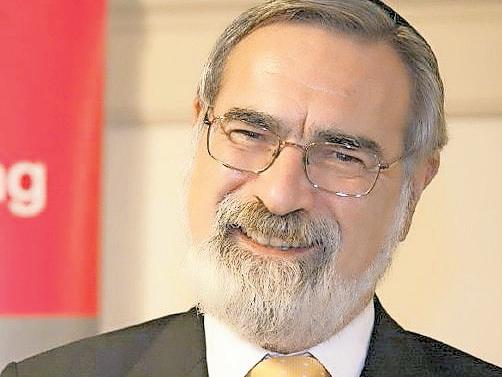
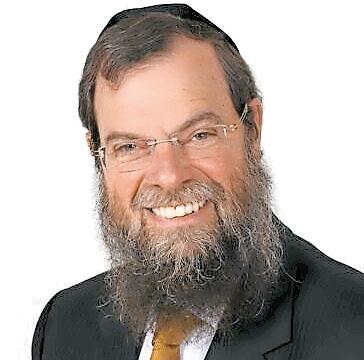
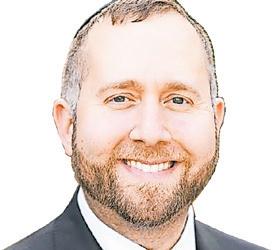
Jewish Star Torah columnists: Rabbi Benny Berlin, spiritual leader of BACH Jewish Center in Long Beach; Rabbi Avi Billet of Anshei Chesed, Boynton Beach, FL, mohel and Five Towns native; Rabbi Binny Freedman, rosh yeshiva of Orayta, Jerusalem; Dr. Alan A. Mazurek, former ZOA chair, retired neurologist, living in Great Neck, Jerusalem and Florida.
Contributing writers: Rabbi Sir Jonathan Sacks zt”l, former chief rabbi of United Hebrew Congregations of British Commonwealth; Rabbi Yossy Goldman, president South African Rabbinical Association; Rabbi Dr. Tzvi Hersh Weinreb, OU executive VP emeritus.
To submit commentary, inquire at: Editor@TheJewishStar.com. Contact our columnists at: Columnist@TheJewishStar.com.
Fri March 27 / 9 Nissan
Tzav • Shabbos HaGadol
Five Towns candles: 6:56 • Havdalah: 8:06
Scarsdale candles: 6:56 • Havdalah: 7:57
Wed April 1 / 14 Nissan
Erev Pesach • First Seder
Five Towns candles: 7:01 • Scarsdale: 7:01
Thu April 2 / 15 Nissan
Second Seder
Five Towns candles: 8:03 • Scarsdale: 8:02
Fri April 3 / 16 Nissan
Five Towns candles: 7:03 • Scarsdale: 8:13
Scarsdale candles: 7:03 • Havdalah: 8:05
Tue April 7 / 20 Nissan
Five Towns candles: 7:07 • Scarsdale: 7:08
Wed April 8 / 21 Nissan
Five Towns candles: 8:09 • Havdalah: 8:18
Scarsdale candles: 8:09 • Havdalah: 8:11
Fri April 10 / 23 Nissan
Five Towns candles: 7:10 • Havdalah: 8:20
Scarsdale candles: 7:11 • Havdalah: 8:13
Five Towns Candlelighting: From the White Shul, Far Rockaway, NY
Scarsdale Candlelighting: From the Young Israel of Scarsdale, Scarsdale, NY
Pesach is the oldest and most transformative story of hope ever told. It tells of how an otherwise undistinguished group of slaves found their way to freedom from the greatest and longest-lived empire of their time, indeed of any time. It tells the revolutionary story of how the supreme Power intervened in history to liberate the supremely powerless. It is a story of the defeat of prob-
ability by the force of possibility. It defines what it is to be a Jew: a living symbol of hope.
Pesach tells us that the strength of a nation does not lie in horses and chariots, armies and arms, or in colossal statues and monumental buildings and overt demonstrations of power and wealth. It depends on simpler things: humility in the presence of the G-d of creation, trust in the G-d of redemption and history, and a sense of the non-negotiable sanctity of human life, created by G-d in His image — even the life of a slave or a child too young to ask questions.
Pesach is the eternal critique of power used by humans to coerce and diminish their fellow humans.
Ed Weintrob, Editor & Publisher
Nechama Bluth, Jewish Star Associate
Stuart Richner, President, Richner Communications






It is the story more than a hundred generations of our ancestors handed on to their children, and they to theirs. As we do likewise, millennia later, we know what it is to be the people of history, guardians of a narrative not engraved in hieroglyphics on the walls of a monumental building but carried in the minds of living, breathing human beings who, for longer than any other, have kept faith with the future and the past, bearing witness to the power of the human spirit when it opens itself to a greater power, beckoning us to a world of freedom, responsibility and human dignity.
Pesach is more than simply one festival among others in the Jewish calendar, more even than the anniversary of Israel’s birth as a free people setting out on its journey to the Promised Land. It emerged, in four ways, as the central event around which most of Judaism turns.
First, close examination shows us that the Torah narrative of Genesis from Avraham to Yaakov is a series of anticipations of the exodus, focusing our attention on, and heightening our anticipation of, what would eventually take place in the days of Moshe.
Second, remembering “that you were once slaves in Egypt” is the single most frequently invoked reason for the commandments. The Exodus was not just an event in history. It forms an essential part of the logic of Jewish law.
Third, key elements of Jewish law and faith are best understood as a protest against and alternative to the Egypt of the pharaohs, even where the Torah does not state this explicitly. Knowledge of that ancient world gave us fresh insights into why Judaism is as it is.
Fourth, sustained meditation on the contrasts between Egypt and the society of the Israelites were called on to create reveals a fundamental choice that civilizations must make — then, now and perhaps for all time. There is nothing antiquarian about the issues Pesach raises: slavery, freedom, politics, power, state, society, human dignity and responsibility. These are as salient today as they were in the days of Moshe. Pesach can never be obsolete.
At the heart of the festival is a concrete historical experience. The Israelites, as described in the Torah, were a fractious group of slaves of shared ancestry, one of a number of such groups attracted to Egypt from the north, drawn by its wealth and power, only to find themselves eventually its victims. The Egypt of the pharaohs was the longest-lived empire the world has known, already some 18 centuries old by the time of the Exodus.

For more than a thousand years before Moshe, its landscape had been dominated by the great pyramid of Giza, the tallest man-made structure in the world until the construction of the Eiffel Tower in 1889. The discovery in 1922 by the English archaeologist Howard Carter of the tomb of a relatively minor pharaoh, Tutankhamun, revealed the astonishing wealth and sophistication of the royal court at that time.
If historians are correct in identifying Rameses II as the pharaoh of the exodus, then Egypt had reached the very summit of its power, bestriding the narrow world like a colossus.
At one level it is a story of wonders and miracles. But the enduring message of Pesach is deeper than this, for it opens out into a dramatically new vision of what a society might be like if the only Sovereign is G-d, and every citizen is in His image.
It is about the power of the powerless and the powerlessness of power. Politics has never been more radical, more ethical or more humane.
Heinrich Heine said, “Since the Exodus, freedom has spoken with a Hebrew accent.” But it is, as Emmanuel Levinas called it, a “difficult freedom,” based as it is on a demanding code of individual and collective responsibility.
Pesach makes us taste the choice — on the one hand the bread of affliction and bitter herbs of slavery; on the other, four cups of wine, each marking a stage in the long walk to liberty.
As long as humans seek to exercise power over one another, the story will continue and the choice will still be ours.
This article was excerpted from the KorenSacks Machzor.
The first time that matzah is mentioned in the Torah is not in the story of the Exodus or even in the book of Exodus. The very first time is in Genesis 19:3, where the two angels come to Sodom to destroy the city and to save Lot and his family. Lot grew up in his uncle Abraham’s house and learned about hospitality from him. He therefore invited these strangers to his home — “he made them a feast and baked matzahs
for them.” Rashi says it was Passover then. Only generations later, on the eve of the actual Exodus, would the Israelites be commanded to bake matzah in preparation for their hasty departure from Egypt and to take them along with them as they journeyed into the wilderness.
Rabbi Yaakov Duschinsky, the late Av Beth Din of Cape Town, South Africa observes that it is no coincidence that the Matzah of Hospitality precedes the Matzah of Freedom. This teaches us that we cannot truly enjoy our own freedom unless we first share it with others.
Long before matzah became a symbol of freedom and independence from foreign domination, the Torah records it as a symbol of hospitality, where even in the wick-
Observing Passover means including others,
ed city of Sodom, Lot was faithful to Abraham’s tradition of kindness.
True liberation is not merely the absence of slavery. To be free means to be a human being with genuine human feelings of love, caring, sharing, kindness and generosity. The matzah of Lot symbolizes that hospitality is the first step toward transforming selfish bondage into sincere and genuine friendship.
Primo Levi, the Jewish Italian chemist, author and a survivor of Auschwitz, recounts
that when the Nazis left the concentration camp in January 1945 in anticipation of its liberation by the Russians, the only ones left behind were the sick and those unable to move. Levi describes how he and two other survivors lit a fire to keep their fellow inmates warm.
“When the stove began to spread its heat, something seemed to relax in everyone there,” he wrote. One of the survivors proposed that they each give a slice of bread to those of us who had helped make the fire and brought them life-saving warmth in that bitter European winter.
Levi writes that only a day earlier, such a gesture would have been unimaginable. In
Irecently called my bebbe in Israel and asked how he was doing. It was not easy to hear. His children have not been in school. The family runs to the mamad with a regularity that has become, in the most heartbreaking sense of the word, routine. He described life lived under suspended tension, not quite war in the total sense, not quite peace in any meaningful sense, just an ongoing weight
pressing down on daily life in Eretz Yisrael.
And then he said something I was not expecting. He said, I think we are somewhere in the middle of something. I think we are watching it happen.
He meant the Geulah.
That word has been sitting with me ever since, and as Pesach approaches and we prepare to lift the arba kosos, I find myself thinking that the four cups are asking something more of us this year. They are not simply a commemoration of something that happened long ago in Egypt; they are a template, the Torah’s own map of how redemption actually unfolds.
The most familiar explanation traces the
four cups to four expressions Hashem uses in Parshas Vayera, “I will take you out from under the burdens, I will rescue you from their service, I will redeem you with an outstretched arm, and I will take you to Me as a people” (Shemos 6:6–7).
The Yerushalmi in Pesachim (10:1) connects the four cups to these four expressions of redemption.
The Torah Temimah explains that if these were simply four synonyms, there would be
no reason for four separate cups. The significance lies precisely in the opposite. Each stage is genuinely distinct, independently real, and worthy of its own recognition.
Why does redemption unfold gradually rather than arriving all at once?
The Midrash in Shir HaShirim Rabbah (2:2) describes two sages walking together at dawn as the first light appeared. One turns to the other and says that this is how Geulah comes to Klal Yisrael. First a single small glimmer, then slowly and steadily the light spreads until the entire sky is illuminated. Redemption comes in stages because if it arrived all at once it would overwhelm. It
Nothing concentrates the mind like sitting in a shelter as missiles are intercepted above your head.
From the first pre-alert warning blaring from multiple cellphones in the middle of the night, to the rush to the shelter at the noxious but necessary siren — being careful not to trip, escorting my dazed wife who had taken an Ambien — and finally sitting half-awake with your equally weary neighbors in pajamas, you have time to think. You start with your own mortality but
quickly push that aside. Then come your children and grandchildren — and then all of Klal Yisrael — but that becomes overwhelming. You circle back to yourself and your spouse, taking some morbid comfort that if you “go,” you go together.
Then come the practical thoughts. Who will tell the kids where everything is — where the assets are, where certain valuables are hidden? Like many parents, we never had that conversation. You make a mental note — but it’s 2 in the morning.
And then your mind widens again.
You realize you are not alone. Thousands are sitting in shelters at that very moment, thinking similar thoughts. You give thanks to the armed forces protecting you, to those who had the foresight to build shelters everywhere, and to Hashem for providing the
framework that makes it all work.
And then the question comes: Nu, HaKadosh Baruch Hu, how is this all going to turn out?
In my half-awake state, I hear a voice — sounding suspiciously like Larry David — answering: It’s going to turn out “pretty, pretty good.”
Because, in a sense, we already know. We have the script. It’s in the Tanach. Hashem gave it to us — our most precious posses-
sion that is filled with answers, many hidden, waiting to be uncovered.
Many of us are familiar with the idea of the war of Gog u’Magog. It’s been invoked often since Oct. 7. While no one fully understands it, our sources describe a great conflict at the end of days (acharit hayamim) when nations converge on Israel before the coming of Moshiach.
The prophets Yechezkel, Zechariah, Yoel and Daniel all speak of it. Yechezkel, in particular, devotes Chapters 38 and 39 to this war. Explaining it fully would take volumes. But one point is clear: it is not hidden in obscure texts. It is stated openly in Navi. And that is why people draw parallels today.
What we are experiencing does not feel
There was a time when I would only go out of my way to listen to speakers older and more experienced than I. More recently I have sought out younger rabbis and teachers whose ideas feel fresh and often right on target, shaped by a rapidly changing world.
Once, during a visit to Israel, I sat in on a series of lectures which were designed to prepare the audience for the upcoming Passover holiday. The speaker, a brilliant young rabbi, spent most of his opening lecture elaborating
upon what he considered the most difficult task with which we are all confronted on the first night of Passover. The task is described in the following famous passage:
“In each and every generation, a person must see himself as if he personally left Egypt. As it is written, ‘And you shall explain to your son on that day that it is because of what the Lord did for me when I went free from Egypt
(Exodus 13:8)’.”
The requirement is explicit in the biblical text: the L-rd did it for me, when I went free from Egypt.
The young rabbi candidly confessed that he had never been able to fulfill this requirement. Indeed, he didn’t think it was possible to envision ourselves as if we personally had experienced slavery and redemption.
“This,” he insisted, “is the most difficult
task we are faced with on the Seder night.”
Iwas struck by his assertion. While I had always found it easy to imagine slavery and to feel the joy of redemption, his words lingered. Was it truly so simple?
As I reflected, a long-forgotten memory resurfaced — a lecture I had heard years earlier from Rabbi Yekutiel Yehudah Halberstam, the Klausenberger Rebbe, a Shoah survivor who endured Auschwitz and lost his family. He recounted a mentor who claimed he could vividly remember the slavery in Egypt — the backbreaking labor, the squalid condi-
tions, even the faces of his tormentors. The Klausenberger Rebbe confessed that when he first heard his mentor make those claims, he had difficulty believing them.He thought that his mentor had made such a claim just for the effect it would have upon his listeners. He stressed that sometimes it is justified for a speaker to resort to hyperbole to make his point more dramatic and more graphic.
But over the years, the rebbe said he had come to realize that his mentor was telling the absolute truth.
“It took the experiences I had during the horrible years of the Holocaust,” he exclaimed, “for me to realize why my mentor was able to recall his experiences in ancient Egypt’s tyranny.”
Published weekly except during certain religious and civil holidays by The Jewish Star LLC New York City office: 5676 Riverdale Ave Suite 311, Bronx NY 10471 • LI office: 2 Endo Blvd, Garden City NY 11530 Here’s how to reach The Jewish Star — Write: Editor@TheJewishStar.com. Call: 516-622-7461 ext 291
Editor & Publisher: Ed Weintrob
516-622-7461 ext 291
Jewish Star Associate: Nechama Bluth
516-622-7461 ext 241
Content: The Publisher endeavors to ensure that our content is within the bounds of normative halachah and hashkafah. Anyone who feels anything we publish may be inappropriate in this regard is urged to bring the item in question to the attention of the Publisher. Advertising is accepted at the sole discretion of the Publisher and should conform to standards appropriate for distribution in an Orthodox community. Send us your news! Editor@TheJewishStar.com
Advertising: Publisher@TheJewishStar.com
Kashrut: The Jewish Star is not responsible for the
kashrut of any product or establishment featured in its pages. If you have questions regarding any establishment or product, including its supervision, please consult your rabbi for guidance.
Submissions: All submissions become the property of The Jewish Star and may be edited and used by the Publisher, its licensees and affiliates, in print, on the web and/or in any media that now exists or will exist in the future in any form, including derivative works, throughout the world in perpetuity, without additional authorization or compensation. The individual or entity submitting material affirms that it holds the copyright or otherwise has the right to authorize its use in accordance with The Jewish Star’s terms for submissions.
Opinions: Views expressed by columnists and other writers do not necessarily reflect the position of the Publisher or of The Jewish Star LLC.
In the 30 months since the Hamas-led Palestinian Arab terror attacks in southern Israel on Oct. 7, 2023, Jews around the world have found themselves under siege. The unspeakable atrocities committed against men, women and children that day, combined with the distorted coverage of the Jewish state’s subsequent war of self-defense against its assailants, set off a global tsunami of antisemitism.
While much of this hatred has been promoted by extremists, including right-wing podcasters and left-wing academics, it has nevertheless made itself felt throughout American society. In both popular culture and legacy media, tropes of Jew-hatred focusing on the State of Israel and its supporters have been normalized to the point of becoming commonplace.
That wave of hatred has helped incite and inspire a series of violent attacks on Jewish targets, the latest being the assault on a Michigan synagogue in which 140 young children were at pre-school.
According to the New York Times and the rest of the liberal media, however, the real problem facing American society today is Islamophobia.
Pattern of gaslighting
No one should be subjected to discrimination or abuse based on their faith or ethnicity. But the drumbeat of concern about Islamophobia is part of a recurring pattern. Every time an act of Islamist terror occurs, the same thing happens. The liberal establishment begins to act as if the priority must be to prevent anyone from drawing conclusions about both the reach and motives of radical Muslims who believe they are at war with the West. This is nothing less than gaslighting.
As has been the case since the Al-Qaeda attacks on America on Sept. 11, 2001, which set off the first round of worries about Islamophobia, there is no objective evidence of widespread bias against Muslims or Arabs in the United States. The discussion of antisemitism is invariably preceded by citations of hate-crime statistics, including the litany of incidents in which Jews have been targeted. But that is not the case with Islamophobia because that sort of proof is lacking.
Over the course of the last quarter century since 9/11, FBI hate-crime statistics have consistently shown that the number of incidents involving Jews being attacked dwarfs those of any other religious group, including Muslims. The claims of a backlash against Muslims after 9/11 or the Oct. 7 attacks are always anecdotal and/or the product of radical Islamist groups like the Council of American-Islamic Relations (CAIR), which was founded as a front group for those raising funds for Hamas terrorists in the United States.
This isn’t surprising. The purpose of claims related to a trend of discrimination against Muslims isn’t so much a response to a real problem as it is an attempt to distract public attention away from one that actually exists. Accusations of Islamophobia — sometimes, but not always, accompanied by lip service to the plague of anti-Semitism — are rooted in an effort on the part of Islamists and their allies and enablers, to flip the script.
Instead of focusing on the way antisemitism, and even advocacy for violence against Jews and Israel, is normative discourse among Muslims and those who purport to represent them, like CAIR, we are instead lectured about America failing adherents of Islam.
This should be seen in the same context as much of the commentary about Israel since the Oct. 7 attacks — namely, the falsehood that Israel is committing “genocide” in Gaza.
Accusing Jews of what antisemites do
Distribution: The Jewish Star is available free in kosher food establishments, stores, synagogues, and curb-side newsboxes on Long Island, in New York City and elsewhere. To request free delivery to your location, write Publisher@TheJewishStar.com.
Copyright: All content is copyright and may not be republished or otherwise reproduced without written permission by The Jewish Star; to do so without permission is against the law and halacha. For content reproduction write to Publisher@TheJewishStar.com.
The Jewish Star subscribes to JNS. It, or its contributors, own the copyrights on material attributed to them. The length and content of JNS material and all other submitted material may be edited by The Jewish Star.
Member: American Jewish Press Association. This newspaper contains words of Torah. While it is not considered shaimos, please dispose properly.
Mitchell Bard, foreign policy analyst, authority on USIsreal relations; Ben Cohen, senior analyst, Foundation for Defense of Democracies; Stephen Flatow, president, Religious Zionists of America-Mizrachi and father of Alisa Flatow, murdered in an Iranian-sponsored Palestinian terrorist attack in 1995; Yisrael Medad, Americanborn Israeli journalist and political commentator; Rafael Medoff, founding director of David S. Wyman Institute for Holocaust Studies; Fiamma Nirenstein, Italian-Israeli journalist, author of 13 books, leading voice on Israeli affairs, Middle Eastern politics and antisemitism; Melanie Phillips, British journalist; Moshe Phillips, national chairman, Americans for a Safe Israel; Thane Rosenbaum, Distinguished University Professor at Touro University (published by Jewish Journal); Jonathan S. Tobin, editor-in-chief, Jewish News Syndicate.

Israel is accused of genocide because that is what Palestinian Arabs intend for Jews. The orgy of mass murder, rape, torture, kidnapping and wanton destruction was a trailer for what Hamas and the Palestinians wish to do to all of Israel. Therefore, what better way to avoid discussion of that awful fact than to engage in mirroring and accuse the Israelis of what their opponents are actually guilty of doing?
Totalitarian movements are, as scholar Hannah Arendt (who was no fan of Israel) wrote in The Origins of Totalitarianism, invariably accusing their opponents of being guilty of crimes that they have committed, thereby reversing the roles of perpetrators and victims.
The same sort of thinking is at work when Israel is accused of behaving like the Nazis by those who applaud groups like Hamas that seek to follow in the footsteps of those responsible for the Holocaust.
News organizations like the Times and PBS promote the myth of Islamophobia not just because they are fooled by Muslim advocates. They do so because it minimizes the way they have enabled the very real surge in Jew-hatred.
They’ve treated advocacy for the destruction of Israel as within the Overton Window of acceptable discourse, something they have never done with respect to any other nation
or people. They’ve mainstreamed blood libels against Israel and treated those who advocate for Jewish genocide on college campuses and elsewhere as idealists and human-rights supporters.
The liberal media’s taking up a largely mythical problem of Islamophobic discrimination also excuses their failure to adequately cover the problem of Muslim and Arab antisemitism, both in the United States and elsewhere.
The Islamist regime in Iran, and its terrorist auxiliaries and allies such as Hamas, Hezbollah and the Houthis, are not merely at war with the one Jewish state on the planet, which they seek to destroy. They are also at war with all those who do not share their faith. Their goal is to spread their brands of fanatical Islam throughout the world, both in moderate Muslims countries and nations where Christians and other faiths form the majority.
Americans have good reason to fear the spread of hatred that has become normative in nations where Islamists dominate. That is why immigration and even refugee absorption from such countries is so problematic, because it leads to an influx of people who are largely indoctrinated in beliefs that are anti-
It’s becoming increasingly clear that when it comes to geopolitical bellicosity, there is no word for “Uncle” in Arabic or Farsi.
In its war with Iran, the United States is learning what Israel has long known about its Islamist enemies: perpetually locked and loaded in apocalyptic, messianic, end-ofdays dreamscapes, they will respond to total defeats by not surrendering and then, like psychopaths, emerge from the darkness and claim victory.
Therein lies a war strategy where to the survivors go the spoils.
No matter what weapons they have left, they won’t put them down. No matter how many losses they have suffered — the numbers of their own people who get killed or who they themselves murder — they will never cry “Uncle!” Survival alone leads them to issue new threats, renewed promises to teach mightier nations a lesson — blowhards without the capacity to deal any significant blows.
That pretty much sums up Iran’s situation right now as it desperately hangs on in a war it lost the moment it started. Whether it goes by the American name given to this joint Unit-
Iran desperately hangs on in a war it lost the moment it started.
ed States-Israeli operation (Epic Fury) or Israel’s (Roaring Lion), Iran has retaliated with all the fierceness of a tattered Persian rug.
During the first 18 days of the war, 18 of its senior leaders were assassinated. Everyone — the Supreme Leader, the Intelligence Minister, security and nuclear policymaker, the Commander of the Islamic Revolutionary Guard Corps (along with his predecessor back in June’s 12-Day War), the Defense Minister, the Chief of Staff of Iran’s armed forces, and the Commander of the IRGC’s paramilitary force — are now all dead.
Fearing for his life, the current Supreme Leader has yet to make a public appearance, an impotence that has as much to do with his manhood (fertility treatments in Europe?) as it does his political authority. These days, having a lofty position in Iran’s political establishment is both a dubious honor and death sentence. Israel has made it a game of Whack-a-Mullah.
As for weaponry, the United States and Israel have taken 290 Iranian missile launchers out of commission. Only an estimated 130 are still operational. Israeli intelligence believe that fewer than 500 ballistic missiles are still in Iran’s arsenal (2,410 were fired but most were destroyed by air-defense systems early in the war), out of approximately 3,000 ballistic missiles and tens of thousands of drones when the Ayatollah’s smack-talk was at its loudest.
Both the missile and drone stockpiles have been severely degraded. Iran’s missile launches have plummeted by 92 percent.
Drones are another matter entirely, however. Iran is now largely reducing this war to a game of drones. While drone launches are reportedly down by as much as 73 percent, Iran nonetheless had tens of
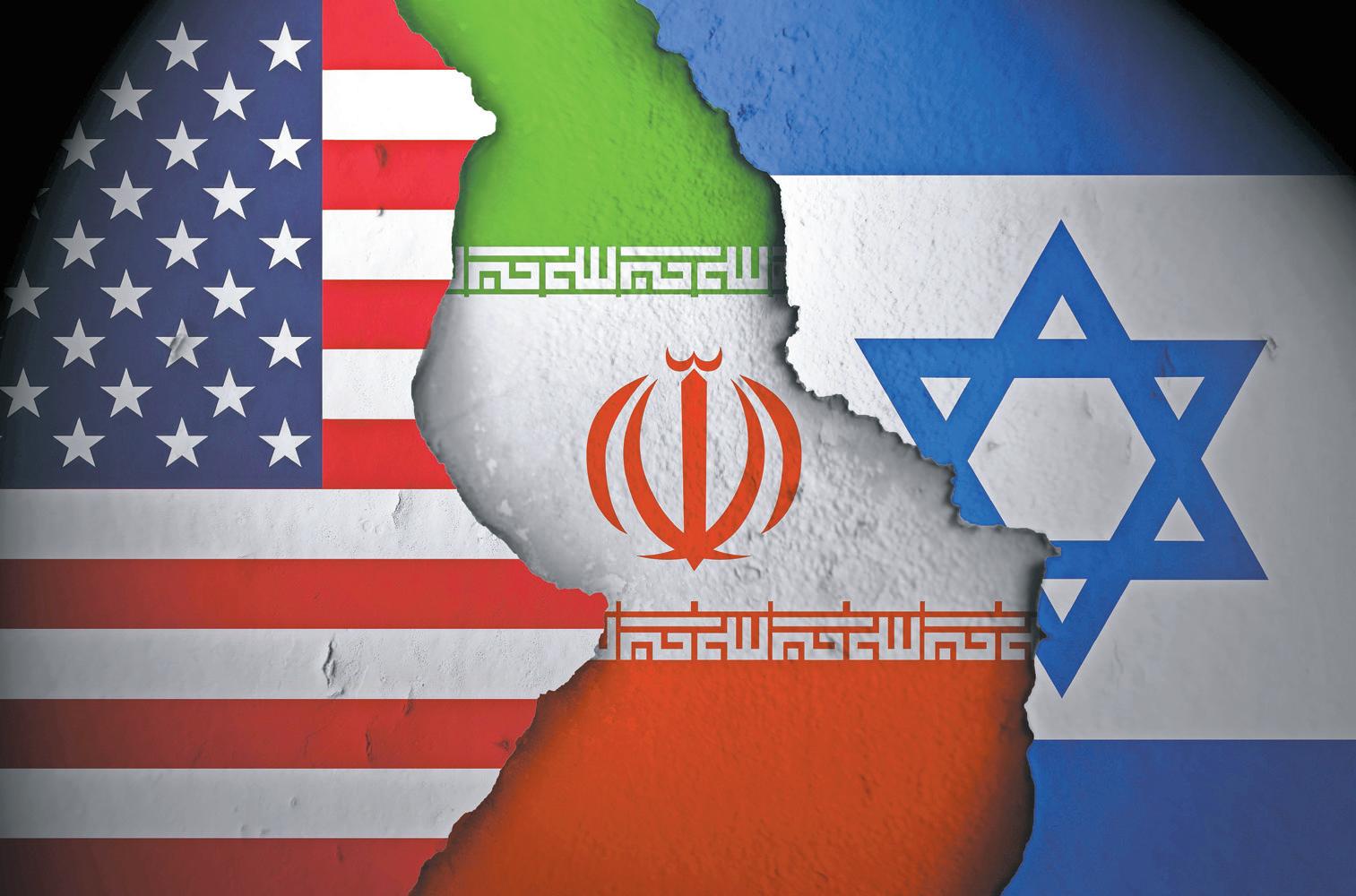
thousands of Shahed one-way attack drones at its disposal at the outset of the campaign.
The problem is that unlike missiles, drones are far less expensive to manufacture and much faster to deploy. Bombarded factories can be easily rebuilt. These drones have placed energy facilities in Qatar, Saudi Arabia, Kuwait, Bahrain and the United Arab Emirates in jeopardy.
It has created a chokehold on the shipping lanes for oil tankers through the Strait of Hormuz, which has led to increased energy prices worldwide. With air superiority claimed by the United States and Israel, and without an air force or navy of their own, Iran has decided that economic pain is a legitimate war aim
— and that its fellow Gulf neighbors should pay a price for siding with the Americans and Zionists. The Gulf states are finally getting a glimpse of what it feels like to be Israel.
Meanwhile, America’s own supply of weaponry is dwindling just as 2,500 Marines are headed to the region either to put boots on the ground or serve as a deterrent to Iran’s menacing activities in the region. Gulf states such as the Emirates are asking the United States to supply them with air-defense missiles, anti-drone interceptors and radar equipment.
Perhaps the most shocking discovery is that the ballistic missiles in Iran’s arsenal, we
See Rosenbaum on page 26
The war against Iran is having a clarifying effect, shining a light on those who are prepared to stand with civilization against barbarism and flushing out those who are not.
The usual suspects — those who hate Israel and despise America — are willing Iran to win, or more to the point, willing that President Donald Trump and Israeli Prime Minister Benjamin Netanyahu lose.
Many have no idea that throughout the years, hundreds of American soldiers were killed by Iranian proxies in Iraq and in repeated terrorist attacks on US bases. They are ignorant of the thousands of missiles amassed by Hezbollah, which is currently firing hundreds of them at Israeli citizens from Lebanon every day.
To characterize this war as “wanton bloodshed and destruction” is not only wantonly to dismiss Iran’s bloody record and the mortal threat it has increasingly posed to America, Israel and the West. It also grossly misrepresents as “chaos” the astoundingly precise,
This war is clarifying who is for civilization and against barbarism—and who is not.
targeted, steady destruction of Iran’s entire military machine and apparatus of internal repression.
Much of Iran’s regular navy is now lying at the bottom of the sea, while its fast-attack craft, midget submarines and mine-laying capabilities are being liquidated. Its air defenses have been largely obliterated so that America’s non-stealth B-1 bombers are generally flying unimpeded over Iranian airspace.
Yes, Iran’s extortion racket in the Straits of Hormuz is causing a major problem. But that can be addressed by eliminating Iran’s ability to hit shipping.
And if the regime is totally defanged in accordance with the aims of this war, the oil weapon at this infamous maritime chokepoint won’t be used ever again — a hitherto unthinkable boon that would be very much worth the short-term pain.
As for Tehran’s gambit of bombing the Gulf states to make them pressurize Trump to end the war, that’s spectacularly blown up in its face. The Gulfies are so appalled by the Iranian attacks that they are putting huge pressure on Trump to finish the job of bringing the regime down.
None of this is to be at all Pollyanna-ish about the war. This week, Israel was still being barraged by missiles, including illegal cluster munitions, as a result of which Iran succeeded in murdering at least two Israelis and four West Bank Arabs. And obviously, there’s no telling how this war will end.
But it has demonstrated with clarity the cowardice of Britain and Europe, which have refused to join this fight against one of the great evils of the world. Trump’s blunt language may not be to everyone’s taste, but he is entirely correct to be furious at their response.
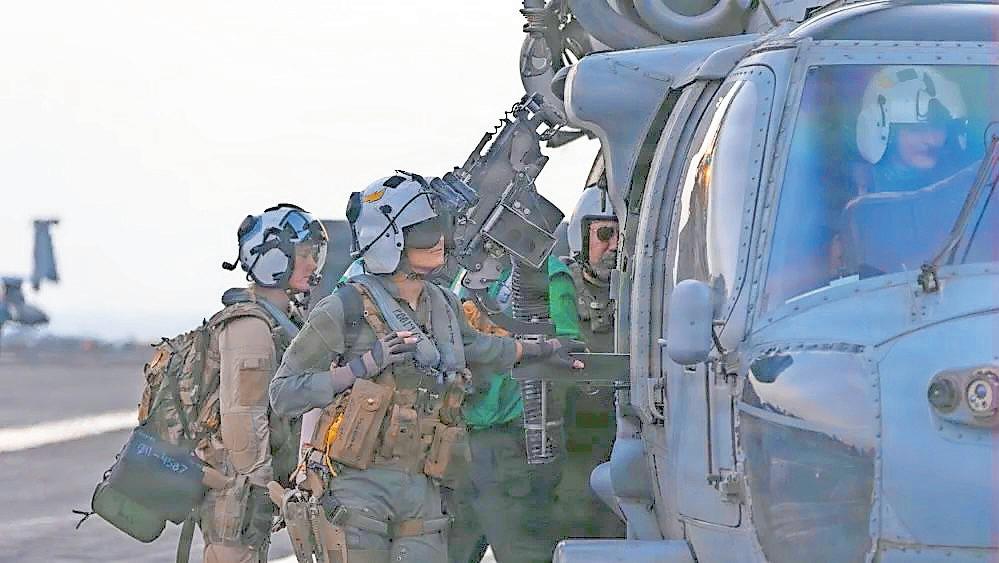
Iran is a menace not just to Israel and America, but to Europe and the rest of the world. As the biggest state sponsor of terrorism, it has left a bloody trail of innocent victims and has been poised to achieve a nuclear-weapons arsenal.
Yet UK Prime Minister Keir Starmer has repeatedly and wrongly declared that the war is illegal under international law, a claim repeated by the Europeans. The European Union’s chief foreign-policy officer, Kaja Kallas, stated: “Iran is not our war.”
But Britain and Europe, which won’t lift a finger to fight this threat to civilization, rely parasitically on the United States to defend them against all such dangers.
Britain was once a byword for martial grit,
loyalty to allies and a bloody-minded refusal to kowtow to tyranny. Trump, who has sentimental ties to Britain, rightly declared that Starmer is “no Winston Churchill.”
Increasingly, Britain is irrelevant on the world stage. Its refusal to join the war has camouflaged the embarrassing truth that it doesn’t have warships to send. For decades, it has been steadily emasculating its defenses to feed the voracious and limitless welfare state. At the same time, Britain has been genuflecting to its increasingly assertive and politically powerful Muslim community, giving into its demands that British society adapts to Islamic precepts in accordance with the Islamist agenda of infiltrating, intimidating and
JAMIE

Every Passover, we ask the same question: Why is this night different from all other nights? This year, for the first time since Oct. 7, the answer is freedom. Real, hard-won and finally ours.
Every living hostage is home. Every murdered hostage has been given the dignity of a Jewish burial. After 738 days that felt like lifetimes, the circle has closed.
For two-and-a-half years, my heart broke on a rolling basis. Not a dramatic, one-time shattering, but a daily, quiet, relentless breaking. I know I wasn’t alone. Every one of us who carried the faces of the hostages into the supermarket, into carpools, into Shabbat dinners knows what that weight felt like. We smiled at our kids while the names scrolled in our minds. We set beautiful tables while the hostage families sat at empty ones.
Still, we suffered through not one but two Passovers with our people in tunnels. How do you sing “Dayenu” when your brothers and sisters are starving? How do you lean back in your chair, the ritual symbol of freedom, when freedom for your own family feels like a taunt? Those seders were a wound. We observed them because we are Jewish, and we keep going. Wounded but unbreakable. That is who we are.
Then came Oct. 13. The final 20 living hostages came home. I watched the footage the way you watch something you have regularly prayed for; you’re almost afraid to believe it is real.
Our enemies rose against us. This lesson was lived.
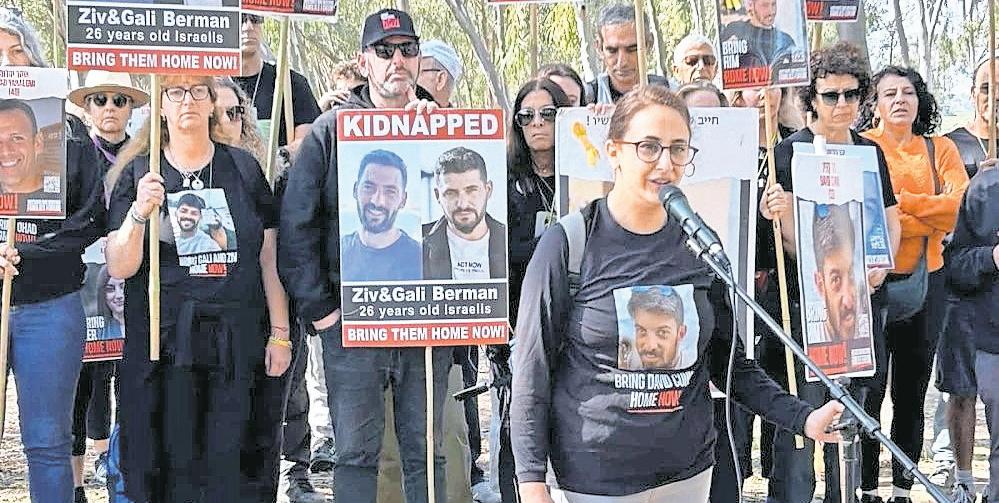
Among them: Matan Angrest, Alon Ohel, Avinatan Or and the Cunio brothers. Sons, brothers, fathers, husbands. The exhale every Jewish mother had been holding for over two years.
Then, in January, the body of Sgt. 1st Class Ran Gvili was finally brought home. His family could say goodbye with the full dignity of Jewish burial. Grief found its proper container. The circle, at last, was complete.
Twenty men will once again sit as free people at seder tables this Passover. Their presence makes this night different from all other nights. Their freedom sweetens every cup of wine we lift.
Ali Larijani, the 67-year-old former head of Iran’s Supreme National Security Council, died a terrorist’s death last week. For much of his career, however, he lived as a diplomat, and was feted as one by regional and Western nations alike.
Back in 2007, Larijani addressed the annual Munich Security Conference in Germany. Arriving in the city off the back of a Holocaust-denial conference hosted by the regime in Tehran, Larijani no doubt got a tremendous kick out of telling an audience in Germany, of all places, that it was an “open question” as to whether the Nazi slaughter of 6 million Jews had occurred.
He did much the same two years later at Munich in 2009, telling one questioner that Iran’s leaders did not share European “sensitivities” or “perspectives” when it came to querying the veracity of the extermination program.
He would have likely done so again in 2011 had his earlier denialist statements not resulted
Iran fertilized antiZionist lies, turning them into common-sense notions.
And yet we are not fully at rest. I write these words to the soundtrack of freedom’s price: fighter jets overhead, air-raid sirens, ambulances racing past. These are not abstract sounds of war. They are the active, costly, daily work of ensuring that the freedom our people just fought to reclaim will endure. The lesson of these past few years is that freedom is never simply given. It is guarded.
This is what Passover has always shown us.
Our sages teach that each of us must view ourselves as personally going through the process of redemption. And in each generation, our enemies rise against us. These were not les-
sons learned from a text. They were lived. You are not retelling someone else’s story this Passover. You are not a tourist in someone else’s journey. You are the Exodus. That is the ancient story writing itself through you.
This year at the seder, raise that first cup knowing that freedom was not handed to us. It was fought for, prayed for and never abandoned. Every generation is called to live that truth, not just recite it.
This year, we did. This is the story of Passover. This has always been our story.
Happy Passover! Chag Kasher v’Sameyach! Write: Columnist@TheJewishStar.com
in a ban on his attendance — a classic example of a European state realizing far too late that to stop the horse from bolting, the stable door would need to be shut first.
In the various high-level roles he held on behalf of the Islamic Republic, chief nuclear negotiator among them, Larijani never lost sight of the regime’s core goal of eliminating the State of Israel.
Now that he has himself been eliminated — the latest in a long line of terrorists and terror enablers from Gaza to Lebanon to Iran to have been felled by an Israeli strike since the Oct. 7, 2023 pogrom — the question remains as to whether Iran can continue to be the world’s primary state sponsor of anti-Zionist ideology, assuming that the regime survives the current US-Israeli onslaught in truncated form.
Iran took on that position following the collapse of the Soviet Union and its allied communist states from 1989 onwards. During the Cold War, Soviet anti-Zionism, a central plank of Moscow’s foreign policy, morphed into what I call “antizionism” — a toxic ideology that has never been as strong or as visible as today, nearly four decades after the demise of the USSR. What was being opposed was not Zionism as the vast majority of Jews understood the term, but a defamatory caricature that drew heavily on older antisemitic tropes.
This expressed itself in two principal ways: violence and propaganda.
The Soviets backed the Arab side in the regional wars of 1967 and 1973. They supported various left-wing terrorist groups in Western countries, led by such figures as the Venezuelan militant Ilyich Ramírez Sánchez (also known as “Carlos”), a KGB and East German Stasi asset
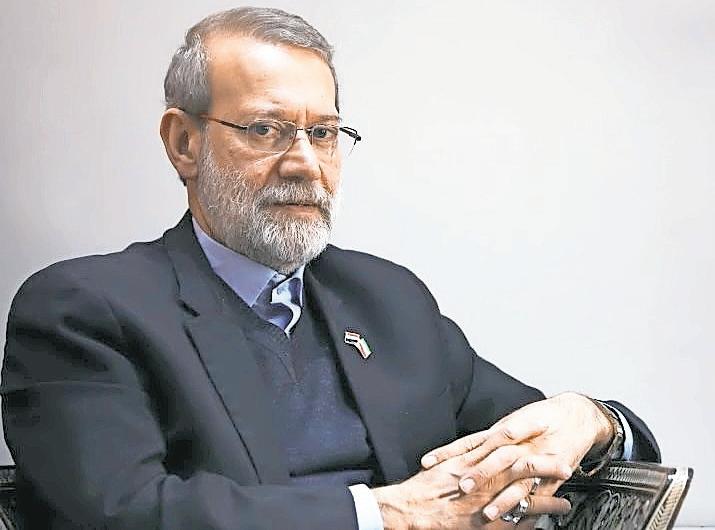
who operated on behalf of the Popular Front for the Liberation of Palestine. And they sponsored a slew of propaganda initiatives, in the form of pamphlets with titles like “Beware: Zionism,” as well as UN General Assembly resolutions, among them the infamous equation of Zionism with racism approved by the world body in 1975.
Iran adopted an even more radical approach. The 1990s are remembered as a quieter time in the Middle East, mainly because Israel and the PLO were immersed in negotiations for much of that decade. Still, Iran executed deadly attacks against Israeli and Jewish targets, including the Israeli Embassy in Buenos Aires in
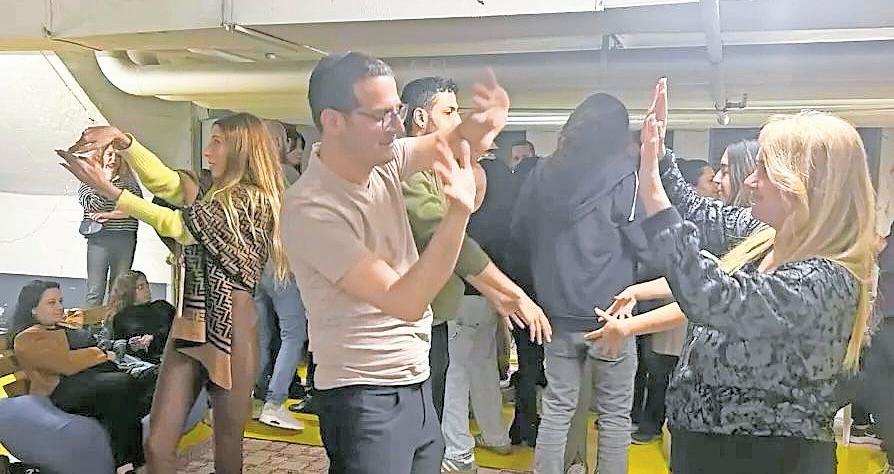
They file in gradually, descending the two flights of steps leading to the bomb shelter. Some remain silent, heads down. Others exchange knowing glances, shrugging as if to say, “Here we go again.”
Newcomers to this particular space follow veterans, learning the rhythm, the corners, the spots where cell reception is best. The last one to enter when the air-raid siren stops wailing pulls the heavy door shut and lefts the handle until it clicks — a required act to stave off blast-damage.
The room has white walls, dingy from basement dust, visible via the 100-watt bulb in a hanging socket. The chairs along the walls are an accidental collection — plastic, folding, upholstered, one with a cracked armrest, another too low to be useful — brought down by residents realizing that “Operation Epic Fury/Roaring Lion” will be going on for a while.
Laughter and gaping yawns intermingle, the language of disrupted REM cycles. All phones are out, with owners scrolling for updates on aerial interceptions and impact sites, while checking social media and snapping selfies. Or playing computer games, thumbs in furious motion.
This has been the ritual for the past three weeks, since the morning of Feb. 28. Repeating it daily in regular intervals, at all hours, is sufficient for creating bonds with people who were once strangers, a cast of diverse characters who happen to reside in adjacent buildings.
There’s a woman in her 70s with broken Hebrew and a heavy Russian accent. She seems more perturbed about having to leave her apartment upstairs so often than worried about injury or death.
Beside her, a petite Filipina stands as if she’s just stepped out rather than rushed in — hair neat, clothes pressed, expression composed. She offers a small, steady smile to anyone who meets her eye, a gesture that has become part of the ambiance.
Cross-legged on the floor is a 20-something Canadian whose Israeli parents moved to Toronto before she was born. Cradling a small poodle in her lap, she is busy tapping out messages to her mother and father who — she announces, smiling — “are more stressed out about the situation than I am.”
To her right is a middle-aged couple who made aliyah from France several years ago. They, too, have a dog — a tiny puppy happily seeking and receiving attention.
Near the door, a divorced father with a fiveyear-old boy smiles at the sight of his child play-
ing with the canines. It’s a welcome distraction from his having been forced out of bed to head for safety.
At his mom’s home in Herzliya, he’s able to sleep through the night in her fortified room.
Then there’s the real-estate agent who bemoans the fact that he doesn’t dare get any shuteye for fear he won’t hear the alert or siren. He says he’s considering moving to his parents’ house in another part of the country for the duration of the war, since in any case, his business is currently at a standstill.
Across from him is a guy from Germany with brightly painted fingernails and a pile of silver bracelets stacked from wrist to elbow.
“Tel Aviv has the best LGBT community,” he declares. “But maybe I need to go back to Berlin for a bit, to have a little peace and quiet.”
A man speaking Swedish to his three Israeli children nods.
“We managed to get a flight tomorrow night to Larnaca,” he says. “From there to Paris and on to Stockholm. Better for them to be with their grandparents for Passover.”
It is Friday, ahead of Shabbat. The following night, for the first time since the war began,
Tel Aviv isn’t targeted. Perhaps the sudden thunderstorm is responsible for pausing enemy launches to the center. Or maybe not.
And though the temporary calm should feel like a relief, no one really sleeps. News about mass destruction and casualties in Dimona and Arad make that impossible.
In any case, the alerts return, one after another, on Sunday morning. During one of these excursions to the shelter, a group of women spills in, decked out in Lululemon attire, ready for their workout in a nearby gym.
Another girl appears, with her face covered in a mud mask.
“Sorry for looking like I belong in a horror movie,” she apologizes. “What can I do? It’s supposed to stay on for at least half an hour.”
A young man looks up, unfazed. After all, he’s wearing a fleece, adult-sized onesie with a Mickey Mouse theme.
A soldier on furlough — with his rifle slung over the shoulder of his Pokémon pajamas — is equally nonchalant. He calls out that getting caught by a siren while in the shower is even more problematic than engaging in cosmetic treatments.
When the sound of various pings and ring tones signal the “all clear,” everyone moves toward the exit, expressing with humor the false hope that they won’t have to see one another again in the near future.
Missiles, rockets and drones aside, the most explosive aspect of these endless gatherings is the utter — uncanny — absence of politics. It’s one of many miracles marking this war.
Write: Columnist@TheJewishStar.com


Margaret Tietz is proud to provide the Jewish community with the highest quality short - term Subacute Rehabilitation , Clinically Complex Care and a State -of -the- Art Virtual Reality System. Combined with a beautiful new Synagogue, renovated gym, and recreation center, you'll rehab comfortably and confidently in our fully kosher facility. At Margaret Tietz, we will get you back on your feet...and back home quickly. Quick recoveries - is where we excel!




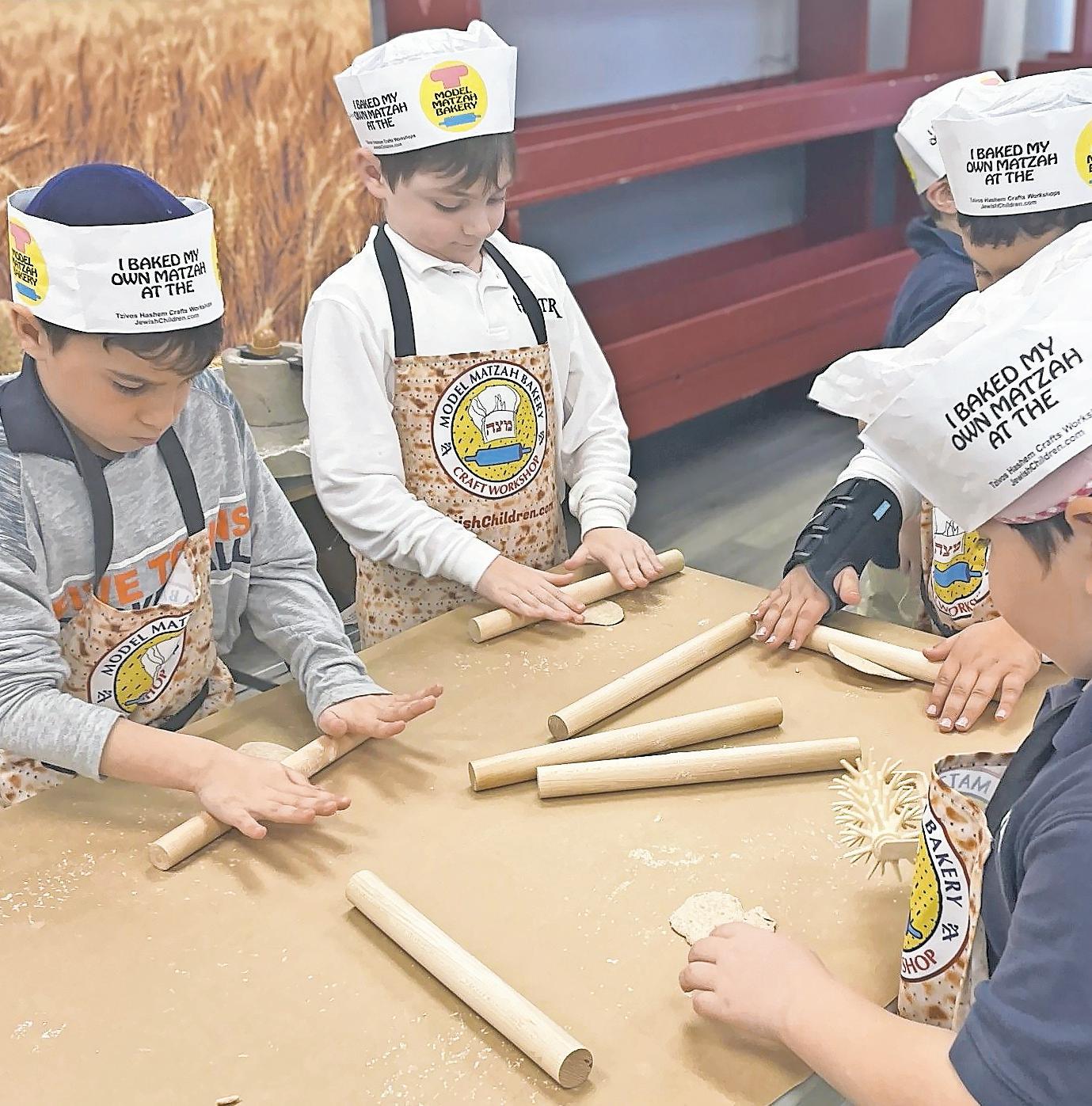
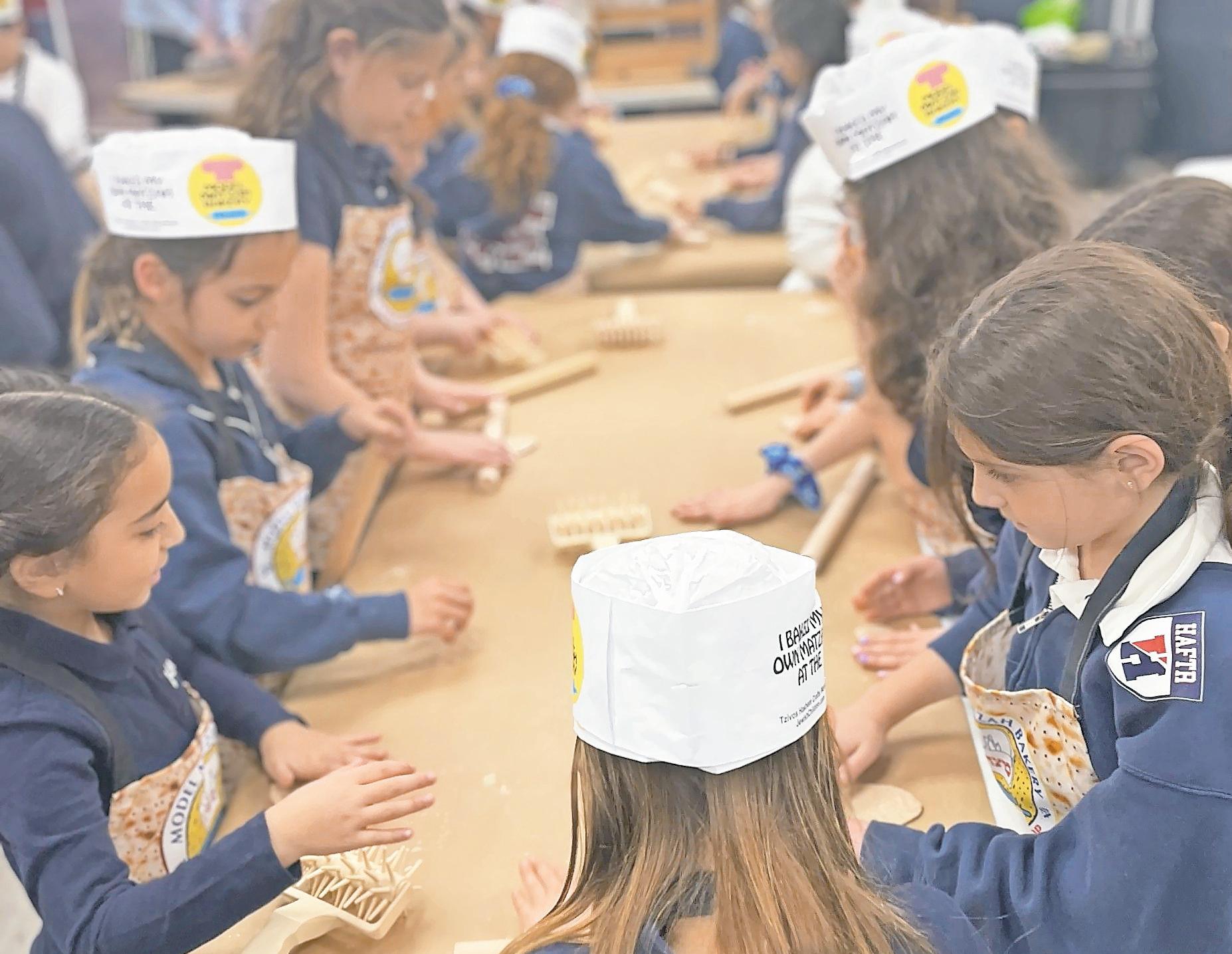

At The Jewish Star, selling advertising for the newspaper is just part of the job.
Our staff’s toolkit includes an exceptionally broad range of useful products (including both religious and secular publications and websites; digital, email, radio and social media marketing; in-person events; direct mail; commercial printing, and more) — whatever it takes to build business and raise revenue for our commercial and non-profit partners.
Employees are trained by the best in the business, in a supportive, collegial and kosher environment.
These F/T positions (P/T schedules may be arranged) offer competitive compensation ($40k-$90k) with excellent commission and bonus opportunities, paid holidays (including Jewish holidays), time off, medical and 401(k).
Continued from page 19
the camps, the unwritten law was: “Eat your own bread, and if you can, that of your neighbor, too.” To be ready to share their meager rations of bread with others was a powerful proof that the zombie-like inmates were becoming human once again.
That’s why right at the beginning of the Passover seder, we declare: “Let all who are hungry come and eat.”
Of course, that really isn’t the opportune time. You should have done that weeks ago; after all, you’re already seated at the seder table. And now you are inviting guests?
The answer is that we are reminding ourselves that a seder without guests is not a seder. Hospitality must precede freedom. Only if we show kindness and hospitality, as did Lot back in Genesis, can we then move on to celebrate the Matzah of Freedom.
As we make that invitation, suddenly, the “bread of affliction” is transformed into the “bread of hospitality and freedom.”
Later on in the seder, we stand and open the door for Elijah the Prophet. Some rabbis suggest that when we make the invitation for anyone who is hungry to join us, we should also open the door as we do for Elijah. If we truly want to help those in need, then our doors and hearts should be open, and all who wish to celebrate should be invited in.
If any of our festivals is about sharing and a sense of community, it is Passover. Whereas charity is a fundamental of Jewish life, before the holiday there is a special mitzvah to provide ma’ot chittim, literally “wheat money” — but figuratively, it’s providing the wherewithal for the less fortunate to make Passover. It is, after all, the most expensive holiday on the Jewish calendar.
Before we can celebrate our own festival of freedom, we need to know that we have done our duty to help others feel free, too.
Whether we are inviting the less privileged to join us at our seder or not, we are expected to contribute to the local charitable fund in our communities to help the less fortunate purchase provisions needed for Passover.
May we merit to celebrate Pesach and enjoy the Matzah of Freedom with our own families. And may we ensure that every Jew has what they need to celebrate Passover in freedom, too. Let our Matzah of Compassion bring the Matzah of Freedom to one and all. Write: Columnist@TheJewishStar.com
Continued from page 19
would blind.
But that image carries a demand as well. If redemption unfolds in stages, gratitude must unfold in stages too. The Shelah HaKadosh writes that the angels waited until the Egyptians drowned before wanting to sing Shirah. Dayenu does not let us make that mistake. Each stage of the seder demands its own acknowledgment before the next one arrives, because each moment of kindness stands on its own, and a moment that passes unrecognized is a moment lost (Shelah, Maseches Pesachim, Ner Mitzvah).
We make that mistake constantly. We tell ourselves we will feel grateful when it is finally over, when things are calm, when the complete picture comes into focus.
My bebbe in Israel is not waiting for that moment. He is counting.
Every morning his children wake up and go about their lives, every Shabbos table set under pressure and lit with candles anyway, every unexpected shift in a situation that looked immovable, each of these is its own cup, its own moment of Ki Leolam Chasdo, its own Dayenu.
And then there is the fourth cup. Rav Asher Weiss points out that halacha does not permit any interruption between the third and fourth cups, while pauses are permitted between the earlier ones (see Shulchan Aruch, Orach Chaim 474; Minchas Asher, Pesach 20). This is not arbitrary.
The first three stages, the physical dimensions of redemption, can unfold with space between them. The fourth stage, VeLakachti, the drawing close, the formation of relationship, cannot be interrupted or deferred. The Ramban, in his introduction to Sefer Shemos, explains that the book is called the Book of Redemption even though it concludes with the construction of the Mishkan, because physical freedom without the return of the Divine Presence is not yet the whole story.
Freedom from is only the beginning. The question that follows is always, freedom to what.
Rabbi Akiva stood at the ruins of the Beis Hamikdash and laughed while his colleagues wept (Makkos 24b). He was not dismissing the destruction. He was already tasting what came next. He could feel the fourth stage before it arrived because he refused to stop counting, refused to wait for the complete picture before expressing gratitude for the partial one. That capacity to feel redemption before it fully arrives is precisely what allowed him to stand in ruins and still believe.
That is the courage the arba kosos ask of us this Pesach. Not to wait for complete redemption before we acknowledge it. Not to postpone gratitude until the story is finished. But to lift each cup with full awareness of exactly where we are in the unfolding, to recognize Ki Leolam Chasdo in the stages we can already see, and to trust that the cup we have not yet reached is already being poured.
Chag Kasher V’Sameach.
Rabbi Benny Berlin is spiritual leader of BACH in Long Beach, www.bachlongbeach. com.
Write: Columnist@TheJewishStar.com
Continued from page 19
like isolated conflicts. It feels connected — stretching back through Oct. 7, through the founding of the State of Israel, and even to the devastation of World War II.
After the loss of 6 million kedoshim, including 1.5 million children, a Jewish state rose from the ashes. That alone is extraordinary.
We read a parallel vision in Yechezkel 37 — the Valley of Dry Bones. The people declare, “Our bones have dried and our hope is lost.” And yet, Hashem restores them.
Centuries later, after the Shoah, we declared: od lo avda tikvatenu, our hope is not lost.
That, too, is a kind of resurrection.
History, in this view, is not random. It unfolds with purpose.
The Gemara in Sanhedrin describes the bones in Yechezkel’s vision as belonging to members of Shevet Ephraim, who left Egypt too early and were struck down. Yet they, too, would be restored.
Immediately following that vision, Yechezkel speaks of unity — the reunification of the tribes under one king. And then, in the very next chapter, comes the war of Gog u’Magog.
Seen as one continuous narrative, a pattern emerges: loss, return, unity — and then final confrontation.
Our tradition also speaks of Moshiach ben Yosef, a precursor to Moshiach ben David. Rav Kook suggested that this role might not be a single person, but the builders of modern Israel — even those who were not traditionally observant.
Those who built, fought and, in many cases, gave their lives. They brought us to this moment. And we are watching it unfold.
“Hear O Israel, Hashem is our G-d, Hashem is One.”
Even Eliyahu Hanavi once misunderstood where to find Hashem — expecting Him in dramatic displays. But he was taught otherwise: Do not look for Him in the wind, in an earthquake or in fire, but in the kol demama daka, the still, small voice.
You can hear that voice clearly in a shelter.
Chazal tell us that the future redemption will surpass even Yetziat Mitzrayim. Standing in that shelter, you begin to understand what that might mean.
Chag Sameach v’Kasher.
Write: Columnist@TheJewishStar.com
Continued from page 19
The rebbe explained that two essential qualities are required on Seder night: koach hadimyon, the power of imagination, and mitleid, empathy.
We often rely too heavily on reason and intellect. But to truly fulfill the Seder’s command, we must allow ourselves to imagine — to feel — beyond reason. Only then can we see ourselves as having endured slavery and experienced freedom.
This applies beyond Passover. To give charity properly, we must feel another person’s poverty. To comfort the sick, we must share in their suffering. That is empathy, and it depends on imagination.
These are not easy traits to develop. The young rabbi, in his own way, was right.
When I later shared the rebbe’s insight with him, he listened thoughtfully, then smiled.
“But the Klausenberger Rebbe didn’t say that learning to imagine and to empathize were easy.”
He was correct.
Creative imagination and true empathy are difficult to achieve. They may be among the hardest tasks of Passover.
Yet they are also its essence. Through them, we connect not only to our past, but to one another — and to the meaning of freedom itself.
Chag Sameach!
Write: Columnist@TheJewishStar.com
Continued from page 20
thetical to the values of Western civilization and invariably antisemitic.
Nor, contrary to the Times, is fear of such groups imposing Muslim religious law (Sharia) on other societies unfounded. That is not merely the historical pattern of Islamic communities, but the reality in Western Europe, where the infusion of immigrants from the Middle East and North Africa has resulted in authorities fearing to enforce the law at all in some places. This creates an environment in which Islamist hate crimes can be excused or ignored, and those who protest such policies are treated as troublemakers rather than truth-tellers.
More than anything else, the talk of Islamophobia is a stick with which to beat critics of Islamic hate. It is an attempt to silence those who have the temerity to notice the connection between the antisemitic incitement that is commonplace in Islamist discourse in the West and attempts to intimidate Jews and target them for violence.
It is no surprise that every time an act of Islamist violence happens, it is now followed by talk of the need to prevent Islamophobia.
The Times commended, in retrospect, President George W. Bush’s almost obsessive fear of offending Muslims during his administration’s “war on terror.” Bush’s insistence
that Islam was “a religion of peace” became something of a joke during his presidency. Two decades later, that knee-jerk effort to deny the obvious about Islamist hate and antisemitism is no longer merely risible. It is a deliberate effort to prevent effective action against the Jew-hatred that has surged throughout American society, largely with the assistance of the same media outlets so determined to decry Islamophobia.
The point of contemporary bigotry and bias against Jews is, as author Dara Horn has written, to erase them and work toward a final solution of eliminating Jewish civilization. The focus on Islamophobia is just that. Those who are serious about actually preventing discrimination and hate shouldn’t fall for this big lie.
Write: Columnist@TheJewishStar.com
Continued from pag 21 have since come to learn, can travel 4,500 kilometers from Tehran. European capitals are all potential targets.
Suddenly, blasé NATO nations that have refused to assist the United States even in the small task of securing the Strait of Hormuz, may have to finally concede that this is their war, after all. Iran always maintained that its ballistic missiles were short-range, just as their uranium enrichment was only for civilian purposes.
Both claims have repeatedly been shown to be false. Yet, there are still those who insist that Iran poses no threat to anyone aside from Jews (and the Iranian people). Islamists are bewitched by the West’s gullibility. They know that charges of Islamophobia repel all criticism and dissent.
When terrorists openly tell you who they are, believe them. The next world, to them, is more beguiling than the present one; and the West does place a higher value on human life. Presume that the ravings are insane, but easily acted upon.
I realize that no one in your building on Park Avenue, or in the gated communities of Boca Raton or Brentwood, would ever behead a fellow human being. Barbarism comes naturally to Islamists, who have nothing in common with your friends and neighbors.
We are getting terribly sloppy and indifferent to terrorism. We forgot all about those color-coded warnings that heightened anxieties after 9/11, and the 300 people seriously wounded in the Boston Marathon bombing, in which three lost their lives and 17 lost limbs.
Our memories are so dim and our will to live so diminished, we don’t seem worried by the fact that our Department of Homeland Security, and TSA agents, are not getting paid just when security over our homeland is needed more than ever. After 9/11 we were vigilant about borders and entry into the United States. Today we have over 20 million unvetted illegal immigrants living among us. Odds-makers are taking side bets on sleeper cells suddenly awakening.
What will it take for the rest of us to awaken?
Some of this can be blamed on heavy doses of stupidity and neglect. But it’s also true that we’ll accept any excuse not to speak ill of terrorists (or, heaven forbid, take action against them) because it forces an honest look at Islam — and that would constitute political incorrectness in the United States and a hate crime in Europe.
Americans live in fear of insulting Muslims; Europeans fear inciting them. As for Islamist Iran that can’t be persuaded to surrender, we need a Dutch Uncle to read them the Riot Act.
Write: Columnist@TheJewishStar.com
Continued from page 21
Continued from page 22 conquering the West. The country is unable to defend itself because it no longer even acknowledges its own historic identity.
However, America, which has been gazing in dismay at the sad decline of the mothership of liberty across the Atlantic, has been having its own clarifying moment during this war.
Joe Kent just resigned as director of the US National Counterterrorism Center in protest against the war. He falsely claimed that Washington attacked Iran “due to pressure from Israel and its powerful American lobby.”
He claimed that Israel had drawn America into the 2003 Iraq war, even though Israel had actually warned the United States against that campaign. He also claimed that his wife had died “in a war manufactured by Israel,” whereas, in fact, she had been murdered in 2019 by an Islamic State suicide bomber in America’s war to destroy ISIS.
In other words, Kent outed himself as a profound antisemite — in keeping with his association with the poisonous, Jew-hating MAGA faction led by Tucker Carlson.
It’s a relief that Trump has finally started to speak against this faction. However, Vice President JD Vance has once again dodged the elephant in the room.
Speaking about Kent’s resignation, Vance said it was fine to disagree, but those working for the Trump administration had to go along with whatever the president decided to do. So it was right for Kent to resign.
This was a wholly inadequate response. What Vance should have said was that Kent’s comments were antisemitic and totally unacceptable, whether made by someone in or out of government office.
Just as he had previously done with antisemitic comments made by Carlson and the neo-Nazi Nick Fuentes, Vance was again presenting the “big tent” approach for welcoming disagreement over different opinions.
But Jew-hatred can never be acceptable as a mere difference of opinion. It is utterly unacceptable and should be given no house room in a tent of any size.
If Trump and Vance don’t clearly repudiate and shun the Carlson faction, the Republican Party will be damaged. As a result, America may be thrown to the wolves of a Democratic party in thrall to anti-American, anti-West, anti-white racists, Islamists, antisemites and other cultish ideologues.
The war has now brought this internal threat out into the open. We can all see from Kent’s words that this poison has infected the heart of the Trump administration.
Defeating Iran will transform the whole world for the better and lead to new alliances that support rather than menace civilization.
If America doesn’t see this through, however, and the butchers of Tehran survive to fight another day, the United States will be catastrophically weakened, and the axis of evil comprising Russia, China and North Korea will accordingly be immeasurably strengthened.
In other words, Trump is playing double or quits — and the hearts of the rest of us are in our mouths.
In America, the war is sorting out the wimps from the warriors, realists from the fantasists and people of integrity from the morally depraved. But for Britain and Europe, the war is increasingly demonstrating that they are simply over.
Write: Columnist@TheJewishStar.com
1992; the AMIA Jewish Center in Buenos Aires in 1994; and, one day after the AMIA bombing, the destruction of a Panamanian civilian airliner in which all of its 21 passengers, over half of whom were Jewish, were killed.
As with the Soviets, the violence was matched by an outpouring of propaganda. Much of this sought to undermine the truth of the Holocaust, which the Iranians depicted as a fabrication designed to provide a colonial entity with a moral shield. Key regime figures, among them the recently eliminated Supreme Leader Ayatollah Ali Khamenei and former President Akbar Hashemi Rafsanjani, dismissed the Shoah as “Zionist propaganda” and ranted about “the false slogan of the murder of millions of Jews.”
This set the stage for subsequent President Mahmoud Ahmadinejad’s later projects.
In addition to the 2006 conference in Tehran, which drew speakers from die-hard neo-Nazi circles, leftist anti-imperialist groups and even followers of the anti-Zionist Haredi sect Neturei
Karta, there was also a 2016 competition inviting cartoons that crudely mocked the Holocaust. In this way, Iran was able to mobilize a global cohort of malcontents who gave the world a glimpse of the kind of obscene messaging that flooded social media after the Oct. 7 massacre.
Whereas in the last century, hatred of Jews was cultivated and promoted by states like tsarist Russia, Nazi Germany, the Soviet Union, and later on, various Arab countries, in this one, the animosity is more of a horizontal phenomenon, spread across social media and civil society political campaigns by individuals and NGOs.
Anti-Zionism is now essentially a cult with various branches, bringing together such ostensibly disparate figures as New York City’s Islamist mayor, Zohran Mamdani, far-left advocacy groups like Code Pink and neo-traditionalist antisemites like the podcast host Tucker Carlson, all of whom agree on core themes: the Jewish connection to Israel is fabricated, Israel has committed and is committing genocide, Israelis are not a nation but a collection of interlopers. Even so, we should not play down the importance of state participation in a situation like this one. Over decades, Iran proved itself adept at
fertilizing the lies that reside at the heart of antiZionist ideology, turning them into commonsense notions among adherents.
Thanks in large part to the Soviet Union and Iran, mere critics of Israel — that is, those whose voiced disapproval of the Jewish state is proportionate and directed at its actions, rather than its very existence — are a dying breed.
Fealty to totalitarian entities like the Islamic Republic goes hand in hand with the desire to expunge Israel from the society of states (which is, by the way, why it’s pointless to ask keffiyehclad demonstrators why they are unmoved by human-rights emergencies elsewhere in the world, because for them, it’s not about human rights to begin with).
Moreover, antagonism toward Israel grounded in Holocaust denial and distortion is not a luxury that the Islamic Republic indulges in only when its leaders are feeling secure. Rather, it is integral to the nature of the regime, however strong or weak it happens to be.
Thanks to Israel, powerful deniers like Khamenei and Larijani are dead. But the open sewer from which they emerged continues to reek.
Write: Columnist@TheJewishStar.com