TheJewishStar.com
Honest Reporting • Torah-True • Kosher and Fat-Free
Reach the Star: Editor@TheJewishStar.com • 516-622-7461 x291
Sep.18-24, 2026 • Shabbos Shuva / Yom Kippur • 7 Tishrei 5787 • Vol. 25, No. 29
Even as Yom Kippur gates close, it’s never too late for prayer By Rabbi Areyah Kaltmann here are moments in sports that seem almost too perfectly scripted to be real. A game appears to be over. The clock reaches zero. The crowd goes silent. One team begins to celebrate while the other walks away in disbelief. And then, somehow, impossibly, there is one more chance. That is what happened on Saturday night, Sept. 5, in Ann Arbor. Michigan was trailing Western Michigan 12-7 with the game seemingly over. The Wolverines had one final desperate opportunity. Quarterback Bryce Underwood dropped back and heaved the football toward the end zone. The ball sailed through the air, but the pass appeared to fall incomplete as the clock showed zero. Western Michigan had seemingly pulled off a monumental upset. But then came the review. Officials determined that a Western Michigan player had touched the ball while one second remained on the clock. Suddenly, the impossible became possible. Michigan had one more play.
T
One more chance. One more prayer. And on that final play, Underwood launched another Hail Mary. The ball traveled 47 yards through the night sky, into a crowded end zone, where JJ Buchanan came down with it for a touchdown. Michigan won, 13-12. Think about that for a moment. The game was over. Except it wasn’t. And perhaps that is exactly the message we need to hear as we all approach Yom Kippur. e live in a world where we are constantly tempted to believe that something is finished. A relationship is broken. A child is struggling. A business opportunity disappears. A dream seems impossible. A person receives difficult news and begins to think, “There is nothing more I can do.” Sometimes, the clock seems to say zero. But Judaism teaches us to never stop praying. The Talmud in Berachot 10a tells us that even when, metaphorically, an axe is resting over a person’s neck, he should not despair of G-d’s mercy. Even at the moment when everything apSee Yom Kippur on page 2
Do not confuse G-d’s silence with G-d’s absence.
W
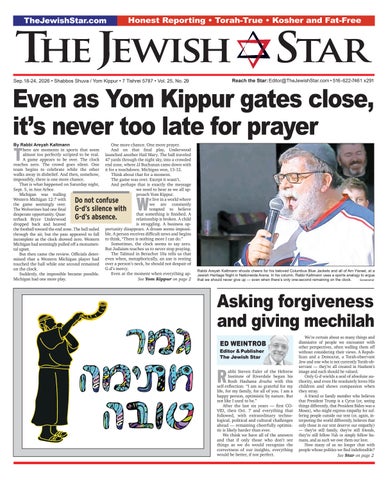
Rabbi Areyah Kaltmann shouts cheers for his beloved Columbus Blue Jackets and all of Am Yisrael, at a Jewish Heritage Night in Nationwide Arena. In his column, Rabbi Kaltmann uses a sports analogy to argue that we should never give up — even when there’s only one-second remaining on the clock. Screenshot
Asking forgiveness and giving mechilah ED WEINTROB
Editor & Publisher The Jewish Star
R
abbi Steven Exler of the Hebrew Institute of Riverdale began his Rosh Hashana drasha with this self-reflection: “I am so grateful for my life, for my family, for all of you. I am a happy person, optimistic by nature. But not like I used to be.” After the last six years — first COVID, then Oct. 7 and everything that followed, with extraordinary technological, political and cultural challenges ahead — remaining cheerfully optimistic is likely harder than ever. We think we have all of the answers and that if only those who don’t see things as we do would recognize the correctness of our insights, everything would be better, if not perfect.
We’re certain about so many things and dismissive of people we encounter with other perspectives, often walling them off without considering their views. A Republican and a Democrat, a Torah-observant Jew and one who is not currently Torah-observant — they’re all created in Hashem’s image and each should be valued. Only G-d wields a seal of absolute authority, and even He resolutely loves His children and shows compassion when they stray. A friend or family member who believes that President Trump is a Cyrus (or, seeing things differently, that President Biden was a Moses), who might express empathy for suffering people outside our tent (or, again, interpreting the world differently, believes that only those in our tent deserve our empathy) — they’re still family, they’re still friends, they’re still fellow Yids or simply fellow humans, and as such we owe them our love. How many of us no longer chat with people whose politics we find indefensible? See Star on page 2
September 18-24, 2026 • 7 Tishrei 5787 THE JEWISH STAR
2
Miss Israel in NY meets Dinowitz, not Mamdani By Vita Fellig When someone connected to her team offered to see if Zorhan Zohran Mamdani, Danielle Yablonka, Miss Universe Israel 2026, declined. “I’m always open to meeting and having conversations, but I’m not looking to give a PR stunt opportunity to someone that doesn’t support my values, my country and my people’s right to exist,” she said. Instead, Yablonka visited City Hall last week and met with other local leaders, including Eric Dinowitz, a Jewish member of the City Council from Riverdale who is chair of its Jewish caucus and co-chair of its bipartisan task force on Jewhatred. “Cultural visits like this are so incredibly important, because it allows us to start to see people as people and not as characters or demons,” Dinowitz said. “There is a very well-organized attempt to demonize Israel and the Israeli people, and by extension the Jewish people are facing a large brunt of not just hate crimes but even being excluded from educational institutions or different professions,” he said. In Mamdani’s first month in office, anti-Jewish hate crimes in New York City surged 182% compared to January 2025. Since then, a majority of hate crimes in the city have targeted Jews, even though Jewish New Yorkers only make up about 10% of city residents. “I’ve met with countless students, who have said they felt excluded or have been excluded from
City Councilman Eric Dinowitz of Riverdale tours City Hall with Danielle Yablonka, Miss Universe Israel, on Sept. 10. Dinowitz is chair of the Council’s Jewish caucus and co-chair of its bipartisan task force on Jewish hatred. Alex Krales, NYC Council
study groups and clubs because of their shared ancestry,” Dinowitz said. He added that Council members Council met recently with healthcare professionals, “because we’ve seen a surge of antisemitism couched in anti-Zionism in the healthcare industry.” “There’s a deep bond between New York City and Israel, and whether it’s hosting Miss Israel or meeting with elected officials
from Israel, I am always looking to strengthen those bonds,” Dinowitz said. Yablonka was visiting New York to walk in the “I Love Jewish Girls” runway show during New York Fashion Week. Touring City Hall and meeting with elected officials are exactly the kinds of things that Miss Israel is supposed to do, according to Yablonka.
“I definitely felt good to have a representation within City Hall that was a Jewish member, who was proud enough and happy enough to welcome me,” she said. Her biggest takeaway from meeting with Dinowitz was that “it’s all about building relationships between Israel and New York, and it’s about showing up, speaking up as a proud Jew, listening and finding common ground.”
“I’m sure it’s not easy for him as a councilman to be a Jewish, open Israel supporter when you have a mayor that doesn’t support your people, your country,” she said. “Making actual change, meaningful change, starts in rooms with people who are the ones making it happen,” she said. (She referred to the song “The Room Where It Happens” from the Broadway musical “Hamilton.”) The highlight of her City Hall tour, Yablonka said, was the historic Governor’s Room, which dates to around 1815 and which includes art and artifacts, including a desk that George Washington used. “There is a painting of Washington in the room painted during the war, and in the picture, there are towns on fire behind Washington,” she observed. “I love historical paintings, and I also realized while walking around how, as someone who’s studied art history, I just think that I’ve learned more about British history than I ever did about American history,” she said. The visit gave Yablonka and Dinowitz the chance to share their experiences in America and Israel and compare notes on the political systems of both countries, according to Dinowitz. “Israel and America are both strong, functioning democracies,” he said. “We have strengths and weaknesses in our system, and Israel has strengths and weaknesses in theirs. So it’s important to learn from one another to create a path forward to strengthening our respective democracies and our government.”
Yom Kippur: Never too late for prayer… Star…
Continued from page 1 pears hopeless, we continue to pray for salvation. The lesson is not that we are guaranteed to receive precisely what we want. The lesson is that we are never entitled to declare that the story is over. That is the extraordinary power of prayer. And there is another Talmudic passage (Berachot 32b) that makes this even more profound: “the gates of tears are never locked.” But if the gates are never locked, why do we need gates? A gate, by definition, suggests that something can be opened or closed. If the gates of prayer are never shut, what exactly is the purpose of having gates? Perhaps the answer is one of the most beautiful ideas we can carry with us into the New Year. Judaism teaches that our mistakes do not have to define the rest of our lives. he gates may never be closed to our tears, but G-d may sometimes close the gates to the particular request we are praying for. We may desperately want something. We may pray with all our hearts. We may believe that we know exactly what we need. And yet, sometimes, in His infinite mercy, G-d does not give us what we ask for. Not because He didn’t hear us.
T
Not because our prayer was worthless. But because He knows in His infinite wisdom that what we are crying out for is not in our best interests. Sometimes, the greatest answer to a prayer is the answer we did not expect. A child begs a parent for something dangerous. The parent says no. The child thinks the parent is being cruel. But the parent sees what the child cannot see. The closed door is itself an act of love. Perhaps that is what the gates teach us. The gates of tears are always open because G-d always wants to hear us. But the particular door we are asking Him to open may remain closed because He knows what lies on the other side. And that brings us back to Michigan. Imagine being a Michigan player after that first Hail Mary appeared to fail. Imagine the emotional whiplash. The clock showed zero. Western Michigan celebrated. The opportunity seemed gone. But then: one second. One second was all they needed. They didn’t know what would happen. They didn’t know whether the second attempt would succeed. They didn’t know whether the ball would be intercepted, knocked down or fall harmlessly to the ground. They simply had another chance. And they took it. That is the message of the Hail
Mary as we approach Yom Kippur. Don’t give up because the clock says zero. Do not stop praying because the answer has not yet come. Do not assume that because one door closed, every door is closed. And perhaps most importantly, do not confuse G-d’s silence with G-d’s absence. On Rosh Hashana we stood before the King of the universe and asked for another year, another opportunity, another chance to become better, holier, kinder and more connected to Him. We came with our hopes and our fears, our accomplishments and our failures. We came knowing that we cannot control what the coming year will bring. But we can control whether we continue to hope. We can control whether we continue to pray. We can control whether we continue to believe that we can make tomorrow better than today. he Michigan players did not need to know how the story would end. They only needed to know that the story had not yet ended. And neither has ours. In these Days of Awe, let us take that lesson with us. When life tells us, “It’s over,” let us remember that we may not know what G-d has planned. When we pray and do not receive the answer we want, let us remember that the gates of prayer and tears are indeed open. And when the axe
T
seems to be hanging overhead, let us remember the teaching of our sages: never stop praying for G-d’s mercy. Sometimes, there is only one second left. Sometimes, there is only one play. Sometimes, all we can do is throw the ball into the heavens and hope. But sometimes, when we are equipped with the power of prayer, tears and hope, the ball comes down exactly where it needs to be. And there is one more lesson. We all make mistakes. We all have moments we wish we could replay. We all have words we wish we had never said, opportunities we wish we had taken and choices we wish we could change. But Judaism teaches that our mistakes do not have to define the rest of our lives. Just as Michigan was given one more second, we, too, are given another opportunity. The past may be written, but the future is still waiting to be written. So let us give it everything we have. Because even when the clock may say zero, with G-d, there is always another second. And if we use that second wisely, give it all that we have, and place our trust in the One above, may we all score the greatest victory of all: a wonderful, sweet, healthy, peaceful New Year for all of our blessed people. Rabbi Areyah Kaltmann leads Chabad Columbus at the Lori Schottenstein Chabad Center in Ohio.
Continued from page 1 How many Shabbos dinner invitations were not extended and how many dinners ended with host or guest feeling less than Shabbosdik? Even if we believe that our arguments touch on existential matters or are “for the sake of Heaven” (a haughty presumption!), are we licensed to act cruelly to a fellow Jew or justified in rejecting a fellow Jew’s apology? Someone whose politics we find difficult should not be set apart from our community or from our family. Our tradition emphasizes that we should seek forgiveness from others before seeking forgiveness from G-d. In Mishneh Torah Hilchot Teshuvah (Ch. 2, Law 10) we are taught: “When the person who wronged him asks forgiveness, he should forgive him with a complete heart and a willing spirit. Even if he aggravated and wronged him severely, he should not seek revenge or bear a grudge.” ••• Publishing a newspaper carries the risk that someone may be hurt by something printed or something omitted. I ask mechilah of anyone I may have hurt either through this newspaper or in person, and I offer mechilah to anyone who might seek it from me. G’emar chatimah tovah.
3 THE JEWISH STAR September 18-24, 2026 • 7 Tishrei 5787
Birthright Israel has sent nearly 1,000,000 kids to Israel on free trips so they can experience their homeland for themselves. But we can’t do it without donations. Please donate today at OneTripChangesEverything.org
1356400
BEFORE KIDS HAVE AN OPINION, THEY SHOULD HAVE A VISIT.
September 18-24, 2026 • 7 Tishrei 5787 THE JEWISH STAR
4
Islamophobia fiction is a license for Jew-hate Radical doctrines v. facts
JONATHAN TOBIN
JNS Editor-in-Chief
T
he 25th anniversary of the terrorist attacks on America on Sept. 11, 2001 has come and gone. Despite criticisms and pleas from many of the families of the victims as well as others, Mayor Zohran Mamdani attended the ceremony held at the 9/11 Memorial Plaza in what was Ground Zero on that awful day. After days of massive attention focused on the commemoration of the attacks, the media and the political class quickly moved on to other contemporary issues and crises. But before this moment fades into memory, it’s worth pausing and considering how understanding this historical event not only informs how the world thinks about 9/11 and its aftermath. Equally, if not more important, is the ability of mainstream liberal media, opinion leaders and politicians to shape the narrative about it, guiding discourse about today’s challenges that ought to, but often aren’t, linked to the threat the attacks represented.
True victims of 9/11
Take, for example, the home page of the New York Times on Friday. Among its top stories were the following items: “Islamophobia Shaped a Generation of Muslim New Yorkers” and “Facing Islamophobia, Mamdani Keeps Focus on 9/11 Victims.” As conservative commentator Ben Shapiro put it in an X post that described the feelings of many: “If you were an alien who landed on Earth this morning, and you were reading the top headlines on the NYT’s webpage, you would immediately assume that 9/11 was an attack on Muslims.” Those stories weren’t the only ones the newspaper published that day about the anniversary, some of which discussed the actual victims of the Al-Qaeda terrorists who were responsible for the murder of the 2,977 people at the World Trade Center in Lower Manhattan, the Pentagon in Washington and on a field in Shanksville, Pa. Still, Shapiro’s comment aptly characterized the way so much of the country’s chattering classes prefer to think about 9/11. They may be willing to note that the crimes committed that day were the doing of Al-Qaeda, an Islamist terror organization. But once that basic fact is acknowledged — many conspiracy theorists on the far left and far right prefer, of course, to blame the Jews for this and every other global calamity. They prefer to treat the attacks as if they were not connected to Islamist beliefs about
A scene near a ceremony at the Pentagon in observance of the 25th anniversary of the 9/11 terror attacks. Molly Riley, White House
The obsession with a mythical backlash against Muslims promoted by the political left and liberal media didn’t just distort anniversary coverage. It builds sympathy for Islamist Jew-hatred. the need for jihad against the West. Nor do they note that those ideas are supported by hundreds of millions of Muslims worldwide, even if some argue that a majority of the world’s 1.9 billion believers in Islam do not. More to the point, they have continued to treat Muslims as if they were the primary victims of the 9/11 attacks because of an alleged backlash against them, which fueled the wave of Islamophobia the Times references in its articles. The newspaper, like much of the mainstream press, treats this backlash as if it were an obvious fact that can be asserted without the need to prove it. Indeed, they have been doing that for the better part of the last two decades. But, as I first pointed out in October 2010 in Commentary magazine, the claim that American Muslims were subjected to widespread and/or systematic discrimination or violence is simply a myth.CAt that time, the hoax about a 9/11 backlash was used to support an effort to build a Muslim community center and mosque on the footprint of one of the buildings destroyed in the World Trade Center disaster. The failed effort to build that center and mosque was rooted in a desire to flip the narrative about the attacks to focus on the sufferings of Muslims rather than people who were murdered by Al-Qaeda or the generational war Islamists were waging against the West.
1231558
While it was never built, project supporters of this did succeed in doing something more important: They helped set the tone of media commentary about Islamophobia then and since, while downplaying the truth about Islamism.
The myth-makers
To point this out is not to deny some examples of prejudice or increases in reported hate crimes against Muslims after 9/11. But most were anecdotal and not rooted in objective proof. Indeed, the studies often cited as backing up these claims are the works of groups funded by left-wing donors whose purpose is to depict the United States as Islamophobic. Others, like Georgetown University’s Bridge Institute, were created and funded by Qatar, the main sponsor of the Muslim Brotherhood. More objective studies, like FBI hate-crime statistics, point to a very different conclusion. They show a huge increase in religion-based hate crimes in the past 25 years. Its victims, however, are Jews, not Muslims. Though making up less than 2% of the American population, reported hate crimes against Jews have consistently made up the overwhelming majority of such offenses in the United States. Government officials, starting with President George W. Bush, who laughably repeatedly insisted that Islam was “a religion of peace,” bent over backwards to disassociate Al-Qaeda (and then its successors and fellow Islamists, such as ISIS, Hamas and Hezbollah) from normative Muslim ideas. At the same time, American popular culture similarly generally shunned depictions of Muslim terrorists in films and TV shows or explorations of how they were inspired by their faith for fear of validating prejudice. This dovetailed with the way progressives were imposing new doctrines about race, intersectionality and settler-colonialism on American academia during this same period. It led to a generation being indoctrinated in toxic ideas that labeled Muslims as Third World peoples who were always victims of “white” imperialism and racism, regardless of their own actions. At the same time, Jews and the State of Israel were falsely depicted as “white” oppressors who were always in the wrong, even when they were — as during the Hamas-led Palestinian-Arab terror attacks in southern Israeli communities on Oct. 7, 2023 — the victims of atrocities, torture, rape, kidnapping and murder.
While these radical obsessions exacerbated racial divisions in the United States, they led most of the chattering classes to assume that Americans were Islamophobic while granting a permission slip to an unprecedented surge of antisemitism, especially after Oct. 7. But as the Times’ account of Mamdani’s plight as a victim of Islamophobia makes clear, most of what falls under the rubric of that form of prejudice is actually something very different. If many New Yorkers and others are critical of Mamdani, it’s not because they hate Muslims. It’s because they understand that he is someone who has dedicated his career to supporting Islamists and seeking the destruction of the only Jewish state on the planet. The same applies to other supposed contemporary victims of Islamophobia, like Michigan Senate candidate Dr. Abdul El-Sayed. Indeed, the organization most often cited by liberal media sources as the authority on Islamophobia — the Council on AmericanIslamic Relations (CAIR) — was founded as a front group for fundraisers for Hamas and is guilty of spreading Jew-hatred. The majority of what CAIR labels as “Islamophobia” is nothing more than noting prejudice against Jews and examples of antipathy for Western civilization that emanates from the Muslim community. And far from such views being relegated to the margins where hate groups dwell, they have been mainstreamed by the corporate press, as well as the former Biden administration, which created a “National Strategy to Counter Islamophobia and Anti-Arab Hate” by following CAIR’s lead. Just as shocking was Biden’s willingness to include CAIR as a consultant in its confused and ineffective effort to counter antisemitism. If a generation of Muslims thinks of themselves as victims, it is not because they have been subjected to a campaign of hate and violence in the United States. It’s because they have been taught — as is the case with so many others of their fellow Americans — that their country is irredeemably racist. They may deny that they are the ones spreading hate. But their widespread involvement in spreading prejudice and bigotry against Jews and Israel or organizing proHamas rallies on college campuses and in US city streets after Oct. 7, cannot be denied. Yet since their prejudices have been validated by those who focus on Islamophobia while ignoring antisemitism, they continue to point to 9/11 as if they are the ones who were wronged that day and ever since. The impulse to oppose all forms of prejudice is laudable. Yet one of the primary reasons why antisemitism is out of control in the United States is because those who spread it have largely been granted a pass for doing so because of lies about America after 9/11 and leftist doctrines about race. The belief that the Jews and Israel are inherently evil and guilty of horrible crimes like “genocide” and “apartheid” was once only believed by those who dwelled in the fever swamps of American politics on the far left and far right. But now, such blood libels are routinely given credence by publications like the Times. By treating the backlash myth as fact and treating Mamdani — a politician whose entire career has been dedicated to spreading blood libels against the Jewish state — as a victim of prejudice rather than a hate-monger, outlets like the Times didn’t just get the 9/11 anniversary story wrong. Sadly, it has become part of the mindset that has allowed American antisemitism to fester and go mainstream. Jonathan S. Tobin is editor-in-chief of JNS.
THE JEWISH STAR September 18-24, 2026 • 7 Tishrei 5787
1363078
5
September 18-24, 2026 • 7 Tishrei 5787 THE JEWISH STAR
6
HEALTH, MIND & BODY
HHS stands against antisemitism in health care Jewish patients and health care professionals could benefit from new federal guidance outlining protections against antisemitic discrimination in federally funded health care programs. The guidance, issued Sept. 3, covers health care settings as well as medical education, clinical training, research and other programs receiving HHS funding. HHS said antisemitic conduct may violate federal law when the facts establish discrimination based on a protected ground, including actual or perceived Jewish ancestry or ethnic characteristics or Israeli national origin. The guidance addresses patient and resident care, stating that covered entities may not deny, delay, downgrade, segregate or otherwise provide different care or services because of a person’s actual or perceived Jewish ancestry or ethnic characteristics, Israeli national origin or another protected ground. It also addresses harassment and retaliation. The HHS action relies primarily on Title VI of the Civil Rights Act of 1964 and Section 1557 of the Affordable Care Act. Several Jewish advocacy organizations welcomed the HHS move. The groups — Hadassah, ADL, American Jewish Medical Association, Louis D. Brandeis Center for Human Rights Under Law, StandWithUs, Center for Combating Antisemitism and Jewish Federations of North America — issued the following statement: “Jewish and Israeli patients must be able to seek medical care without fearing that their identity will affect the treatment they receive. Jewish medical students, trainees, researchers and healthcare professionals likewise deserve to learn, work and care for patients free from unlawful discrimination, harassment and retaliation. And indeed, all patients deserve care in an environ-
ment where healthcare professionals can focus entirely on their wellbeing, without the distraction, disruption and corrosive effects of bias and hostility in the workplace. “Antisemitism is too often misunderstood, misidentified or inadequately addressed in healthcare settings and beyond. That is why we have consistently urged hospitals and healthcare institutions to explicitly recognize antisemitism in their nondiscrimination policies, establish accessible and trusted systems for reporting incidents, ensure complaints are taken seriously and investigated appropriately, and provide meaningful education about antisemitism and Jewish identity. “Today’s guidance is an important step toward reinforcing
those responsibilities. We appreciate HHS OCR making clear that federal civil rights protections extend to discrimination based on actual or perceived Jewish ancestry or ethnic characteristics and Israeli national origin – and that these protections apply across healthcare settings, medical education, clinical training and other covered programs. “No one should face discrimination when seeking care, providing care or pursuing a career in medicine. We welcome HHS’s actions and encourage healthcare institutions across the country to ensure that their policies and practices provide Jewish and Israeli patients, students and professionals the equal protection and inclusion they deserve.” “It’s an important recognition of the horrific antisemitism that has spread across healthcare settings, putting Jewish patients and medical professionals in extraordinarily difficult circumstances when receiving or giving crucial medical care,” said Kenneth L. Marcus, chair and chief executive of the Louis D. Brandeis Center for Human Rights Under Law. “Though every form of antisemitism is repugnant, its spread within healthcare settings is particularly enraging because it threatens patients seeking care and professionals working to provide world-class care.” Marcus said enforcement will be critical. “This strong guidance to combat antisemitism in healthcare is made stronger by the inclusion of the IHRA working definition of antisemitism and must be met with equally strong enforcement. HHS must now act to ensure that federally funded providers do not discriminate or deny care to Jewish or Israeli patients; blacklist or ostracize medical professionals that are Jewish or Israeli,” he said.
Battle-injured Israeli farmer won’t quit By Edgar Lefkovits A day before his latest stint of Israeli military reserve duty, Tuvia Eden was running a half-marathon in Tel Aviv. The 42-year-old Israeli farmer and father of eight, who serves as a company commander in the IDF Armored Corps, was no stranger to reserve duty, having served 450 days since the Hamas-led attack on Oct. 7, 2023, sparked a multifront war. Two days before Passover, with his wife nine months pregnant, Eden was injured in Lebanon when shrapnel from a Hezbollah drone packed with some 11 pounds of explosives shattered his kneecap as he was working on his tank, which was parked near the sea north of Naqoura. “I couldn’t move at all,” he recounted to JNS this week. “But I didn’t want to worry my wife since she was nine months pregnant, so
I called her first and told her I was OK.” He was flown by helicopter to Beilinson Hospital in Petah Tikva for surgery and managed to get to his sister’s home in time for Passover. Two weeks later, it turned out that the operation had not succeeded and he required additional surgery. While Eden was undergoing his second knee operation, his wife gave birth. The cherry tomato farmer was ordered to rest for two and a half months and keep his leg elevated. “I needed to use a rope just to lift my leg to get into bed,” he said. “Even when I was up, I was limping and couldn’t lift my leg at all.” Meanwhile, friends from his agricultural community of Bnei Netzarim in the Negev Desert near the Egyptian border tended to his fields. After a challenging spring at home, he began rehabilitation in
Tuvia Eden undergoes physiotherapy with Dr. Shilo Kramer at ADI NegevNahalat Eran in southern Israel on Sept. 10. ADI Negev
June at the ADI Negev-Nahalat Eran rehabilitation village in southern Israel, where his mother-in-law was being treated for a pelvic fracture. ADI Negev-Nahalat Eran was founded in 2005 by Maj. Gen. (res.) Doron Almog, a former head of the IDF Southern Command, and his
wife, Didi. The 40-acre rehabilitation village is named for their late son Eran, who was born with severe autism and intellectual disabilities and inspired Almog’s work on behalf of people with disabilities. Almog, who today chairs the Jewish Agency for Israel, remains chairman of the village, which includes residential facilities, special education and a rehabilitation hospital serving southern Israel. “It became a family affair,” Eden said. “And it was close to my home.” After three months of physiotherapy and hydrotherapy at the center, where he encountered other reservists he knew who had been wounded in the war, Eden has regained most of the motion in his knee. His doctor says it will take about a year for him to fully recover. “Tuvia came to me with 10 degrees of motion, barely able to
extend his knee,” said Dr. Shilo Kramer, who directs orthopedic rehabilitation at the center. “We got his knee back to 110 degrees, with only 20 to go.” Kramer, who moved to Israel from Long Island six years ago, said his patient’s progress has been nothing short of remarkable. “He went surfing and could stand on a board,” he said. “I couldn’t do that, and I am not injured.” Kramer said about a quarter of the patients in the relatively small 40-bed unit are soldiers. “The main thing that stands out here is that we don’t just work to cure the body but the spirit,” he said. As for Eden, he is back to planting a new crop of cherry tomatoes in his fields and has informed his army unit that he is ready to roll again. “My wife said maybe it is time to finish with the reserve duty, but I feel it is my responsibility,” he said. “I am happy to continue and proud to continue. I thank G-d I am alive and try to live the big picture.” —JNS
Data eyes breast-cancer screening in Israeli cities Kiryat Motzkin has the highest mammography screening rate for breast cancer of all Israeli cities, with 75.5% of eligible women undergoing the checkup, according to 2025 data from Clalit Health Services, the healthcare organization said on Sunday. In Israel, mammography screening is covered under the national health basket for women aged 50 to 74, with screening generally recommended once every two years. Early detection can enable earlier treatment and improve outcomes. There is no blanket recommendation for routine screening for women aged 45 to 49 or for women aged 75 and over, as the decision is made jointly with one’s treating
Breast cancer researcher at Hadassah Medical Center. Keren Freeman, Flash90
physician, the healthcare service stated. Kiryat Motzkin was followed by the largest
Bedouin city in Israel, Rahat, with screening rates at 74.9%, Givatayim at 74.4%, Herzliya at 73.4% and Nahariya at 72.9%. High screening rates were also recorded in Petah Tikva at 72.7%, Netivot at 72.4%, Kiryat Ata at 72.3%, Ra’anana at 72.2%, Haifa at 71.7%, Afula at 71%, and Beersheva at 70.6%, according to Clalit. At the other end of the spectrum, 52.8% of eligible women in Beitar Illit underwent mammography, the lowest rate among the cities examined. Low rates were also recorded in Umm al-Fahm at 57.6%, Bnei Brak at 58.2% and Yavne at 59.3%. “Awareness and participation in screening
programs are key components of preventive medicine,” the report quoted professor Doron Netzer, head of Clalit’s Medical Division. Sigal Mazor of Clalit added that “good health begins long before a screening appointment. Regular physical activity, maintaining a healthy weight, avoiding smoking and limiting alcohol consumption can reduce the risk of developing breast cancer and contribute to better overall health.” Breast cancer is the most commonly diagnosed cancer among women in Israel, accounting for approximately one-third of new cancer cases diagnosed in women each year, with most cases occurring among women over age 50. —JNS
7 THE JEWISH STAR September 18-24, 2026 • 7 Tishrei 5787
Want to live healthier and longer? Schedule your wellness exam with a Primary Care Physician at EHS. Our physicians help you navigate: Your blood pressure
Specialty referrals
Cancer screenings
Symptoms and solutions
Chronic disease management
Vaccinations
Partnering with you every step of your healthcare journey.
Book your appointment today at 718-EHS-DOCS (347-3627) or ehs.org/booknow.
EHS Primary Care at Rockaway Beach: 105-38 Rockaway Beach Blvd, 2nd Floor, Rockaway Park, NY 11694
1362033
Walsh Ambulatory Pavilion: 19-20 Brookhaven Avenue, Far Rockaway, NY 11691
September 18-24, 2026 • 7 Tishrei 5787 THE JEWISH STAR
8
No longer passing thru: Asia anchors Jewish life By Tania Shalom Michaelian hen a Jewish American moved his young family from the West Coast to Taiwan nearly eight years ago, the plan was to stay for two or three years. A job opportunity in the tech industry brought them to Taipei, along with what he describes as “a general sense of adventure.” By year four, the conversation had changed. “Once our kids started thriving in school and we realized how peaceful day-to-day life is here compared to back home, the mindset flipped from ‘when do we move back?’ to ‘this is where our life is’,” he told JNS in an interview. This story is increasingly familiar across parts of Asia. Jewish communities once associated largely with Israeli backpackers, foreign business people and short-term expatriates are developing a more permanent population. And around them, Jewish infrastructure is changing to meet needs that go well beyond a Shabbat meal or holiday service. That shift was at the center of a regional Chabad summit held in Taipei in late August, bringing together 75 emissaries from 15 countries. The gathering marked 40 years since the Lubavitcher Rebbe, Menachem Mendel Schneerson, sent Rabbi Mordechai Avtzon to Hong Kong as Chabad’s first emissary in the region. Today, according to Chabad, there are around 60 centers across Asia, stretching from the Himalayan region to Japan. ew things illustrate the change as clearly as what has happened in Taiwan. When Rabbi Shlomi Tabib and his wife, Racheli, arrived in 2011, they had contact details for around 70 Jews. Today, they estimate that approximately 1,500 Jews live across the island, including Israelis, tech and international business professionals from North America and Europe, academics, students and diplomats. In June, more infrastructure was added: Taiwan’s first dedicated Jewish cemetery. Until then, Jews who died on the island generally had to be flown overseas for burial. The first burial took place on June 23. “Beyond logistics, a cemetery signals permanence and dignity,” Tabib said. “It sent a profound message to our community that Jewish life in Taiwan is not merely a transient layover for expats. It is a home with full lifecycle infrastructure from birth to eternal rest.” Rabbi Mendy Kotlarsky, executive director of Chabad International, sees the cemetery as part of a wider regional story. A Jewish cemetery has recently been established in Thailand as well. “People don’t buy land for a cemetery if they’re passing through,” he said. Other signs are less dramatic but perhaps even more significant. Hebrew schools and Jewish after-school programs are growing. Chabad has expanded its CKids and CTeen youth programs in cities including Hong Kong, Singapore, Bangkok and Mumbai. Communities are building permanent mikvahs. In Mumbai, the Hebrew school has expanded to participate in JewQ, an international Jewish knowledge competition. n several cities, Rabbi Kotlarsky said, additional emissary couples have been brought in specifically to work with local families and young people. Four new couples have moved to the region in the past year. “These are new institutions that are not fo-
W
F
I
cused on business people,” he said. “They’re focused on local families.” In Taiwan, the growth is visible in the $16 million, 22,500-square-foot Jeffrey D. Schwartz Jewish Community Center in Taipei, which includes a synagogue, kindergarten and classrooms, kosher restaurant, Judaica museum, 300-seat ballroom and mikvah. For the expatriate from the West Coast, who is not strictly observant, that infrastructure has helped make it possible to raise Jewish children in a country without a large Jewish population. “My faith is more about tradition, community and values than daily ritual,” he said. “That’s where Chabad and Rabbi Tabib have been a lifeline.”
burial society to ensure the burial was conducted according to Jewish law. “The shaliach in Taiwan couldn’t have done that on his own,” Rabbi Kotlarsky said. “He needed a rabbi in Hong Kong who knows how to do it, and he needed the burial society there.” The same informal network helps communities obtain kosher food and ritual items and respond to emergencies involving Jewish residents and travelers. For the emissaries themselves, distance presents another problem. Their children are growing up far from the large Jewish communities that would normally surround religious families. Chabad operates a virtual community for them, called MyShliach, while regional
began coming to the Jewish center looking for community and solidarity. Requests for mezuzot, tefillin and Shabbat candles rose. For those with family and friends in Israel, distance could make the aftermath of Oct. 7 particularly isolating. “Chabad became a sanctuary where community members could gather, pray, cry and support one another without needing to explain their grief to outsiders,” he said. Mark’s own relationship with his Judaism changed. “Oct. 7 made my Jewish identity much more central and conscious,” he said. His extended family and friends in Israel made events there intensely personal, even when the people around him in East Asia experienced them from a very different distance. “Connecting with the local Jewish community became crucial for mutual support,” he said. “Within the expat Jewish community, the bond has definitely tightened.” he question facing Chabad now is how to support communities that are no longer defined primarily by people passing through. At the Taipei summit, Taiwan-based businessman Jeffrey D. Schwartz and Rabbi Kotlarsky announced the creation of the Jeffrey D. Schwartz Asia Fund through Keren Hashluchim. Schwartz, who has lived in Taiwan for more than 50 years, established the fund to support the expansion of Jewish life across Asia, including seed funding for new emissary couples, youth centers, after-school programs and mikvahs, as well as emergency assistance when needed. The need for such emergency support was underscored by the disaster in Nepal, where catastrophic flooding triggered by a glacial collapse on Aug. 26 left thousands dead or missing. Around 30 Jews, including two Israelis, were reported among the missing, according to Chabad of Nepal, which has been working with authorities and families to coordinate search efforts while also providing aid to flood victims. Taiwan itself still has gaps. Tabib wants expanded educational programs for children and teenagers and wider availability of kosher products. His hope is that a younger generation will be able to grow up simultaneously at home in Taiwan and secure in its Jewish identity. “I hope to see a vibrant network of families, expanding educational programs, and a strong younger generation proud of their Jewish identity and deeply rooted in both their faith and their home here in Taiwan,” he said. Mark believes the long-term future of Jewish life in Taiwan will depend on reaching what he calls “a larger critical mass of permanent Jewish residents,” together with more educational options for young people. For a community that was once built largely around people in transit, the growing focus on children may be the clearest indication of how much has changed. Across Asia, Rabbi Kotlarsky said, more Jewish parents are making the same investment that Mark has made for his own family: enrolling their children in Hebrew schools and youth programs. The question is increasingly not how to serve Jews while they are passing through Asia, but how to build Jewish life for those who have made it their home. —JNS
T
Chabad emissaries from across Asia gather for a regional summit in Taipei, Taiwan, in August.
Chabad
Left: Chabad rabbis outside the first Jewish cemetery in Taiwan on Aug. 31. The cemetery was dedicated in June. Right:The Jeffrey G. Schwartz Jewish Community Center in Taipai. Chabad
The ability to buy kosher meat or obtain matzah for Passover matters, he said, but so does having other Jewish families with whom his children can celebrate Chanuka and Purim. “It gives our kids a sense of belonging they wouldn’t otherwise get in a local environment.” That challenge is shared by communities across the region. osher food can be difficult to source, while Jewish populations may be spread across cities or even countries. In Taiwan, community members live in Taipei, Hsinchu, Taichung and Kaohsiung. Jewish education has to be deliberately created in an environment where a child may have few Jewish peers. The Jewish communities also depend heavily on one another. When Taiwan’s cemetery held its first burial, the deceased was a Jew who had lived on the island for many years. A rabbi with expertise in Jewish burial traveled from Hong Kong together with members of the local Jewish
K
gatherings give parents facing similar circumstances an opportunity to share experiences and advice. The move toward more permanent Jewish communities was already underway before Oct. 7, 2023. The Hamas massacre, Rabbi Kotlarsky said, accelerated it. “We’ve seen tremendous growth in Jewish involvement since October 7 in Asia as well,” he said. ome Jews who had moved to Asia had made a conscious effort to blend into their surroundings and had little involvement with organized Jewish life, he said. After Oct. 7, many began seeking out other Jews. More telling was what happened after they came through the door. “A lot of them are bringing their children now, which is really the difference,” Rabbi Kotlarsky said. “It’s not showing up once for a holiday. It’s putting their kids into the Hebrew school, into CTeen.” Rabbi Tabib saw the same shift in Taiwan. People who had rarely attended services
S
American rapper Macklemore performs in San Francisco in 2013.
Macklemore wrote on social media on Monday that Robert Kraft, a prominent Jewish philanthropist whose Kraft Group owns Gillette Stadium in Foxborough, Mass, had called Sheeran following the MetLife performances. Sheeran had been scheduled to perform there with Macklemore later in the tour. “Ed told me that Kraft said I would not be allowed to perform in his stadium,” Macklemore wrote, adding that “Kraft had rallied some of the other stadium owners and collectively” gave Sheeran an ultimatum. Kraft, who also founded the Foundation to
Amanda Rhoades via Creative Commons
Combat Antisemitism, responded in a statement to TMZ on Monday, saying that he would “welcome the opportunity to sit down with Macklemore and discuss the facts.” “Gillette Stadium has a longstanding commitment to providing a welcoming environment for all guests and ensuring that events held at our venue do not provide a platform for hate speech,” he told TMZ. “Based on Macklemore’s recent actions, material shared from the stage during Ed Sheeran’s shows in New Jersey and a broader history of antisemitic rhetoric and imagery that we believe has
been deeply offensive and hurtful to the Jewish community, we determined that his participation in the Sept. 25 and 26 concerts at Gillette Stadium would cross that line.” Kraft stated that he did not intend to diminish “the suffering of innocent Palestinians” or deny “anyone the right to advocate on their behalf.” “But that advocacy should not come at the expense of the Jewish community or obscure the responsibility of Hamas, a United States and globally — including Canada, European Union, United Kingdom and Japan — designated terrorist organization whose horrific actions have caused immeasurable suffering for Palestinians and Israelis alike,” he said. “Only sharing selective information and ignoring the actions of Hamas is not honest and only advances more divisiveness and hate,” Kraft added. “Standing with the Palestinian people and standing against Hamas, antisemitism and hate should not be mutually exclusive,” he stated. “Much of my time and attention for the last decade has been focused on the fight against antisemitism and hate of all kinds, and I feel a responsibility to stand up when I believe that line has been crossed.” Other venues that reportedly objected included Lincoln Financial Field in Philadelphia; Mercedes-Benz Stadium in Atlanta; Lucas Oil Stadium in Indianapolis; Bank of America Stadium in Charlotte, NC; AT&T Stadium in Arlington, Texas; and Raymond James Stadium in Tampa, according to Rolling Stone. The Israeli-American Council launched a petition following the concert calling on Sheeran to remove Macklemore from the tour. “This was an Ed Sheeran concert — not a political rally, not a protest and not an activist event,” the IAC wrote in the petition. —Rikki Zagelbaum of JNS and other sources
A SWEET NEW YEAR
FROM MY FAMILY TO YOURS Shanah Tovah U'Metukah
"From my family to yours, may the new year be filled with health, happiness, peace and prosperity."
Lisa
LISAVIDER.COM
Paid for by Vider for Senate.
1363296
All four acts scheduled to perform during the remaining dates of Ed Sheeran’s Loop Tour have withdrawn from the concert series following rapper Macklemore’s removal after his antiIsrael rant in front of 80,000 people at MetLife Stadium in East Rutherford, NJ, on Sept. 4. Finneas, Aaron Rowe, Lukas Graham and Beoga announced their departures in separate statements on Tuesday. Beoga had been serving as Sheeran’s touring band, while the other acts were scheduled for opening performances. “Artists must not be silenced when they speak up for the oppressed,” Finneas, Billie Eilish’s brother and a frequent musical collaborator, said in an Instagram statement. “I have decided to withdraw from my upcoming tour dates with Ed Sheeran. I stand with Palestine and its people.” Rowe said he did not “take the decision lightly” and thanked Sheeran for the opportunity to perform, but said he could not respect himself if he played the remaining dates. The Irish performers Rowe and Beoga cited their country’s history in explaining their decisions. Rowe said the Irish people “know all too well about genocide, forced famine and violent occupation.” Beoga criticized what it described as the “silencing of Macklemore by zionist lobbies” in a statement announcing its departure. Lukas Graham said, “[t]his is a difficult decision, but it’s one I need to stand by.” Wearing a keffiyeh at MetLife, Macklemore said, “I wanted to stand up here on stages across America and say two words that are near and dear to my heart: Free Palestine.” Sheeran said Tuesday that he did not want to use his “professional platform for politics” and attributed Macklemore’s removal to the tour’s promoters. Sheeran and Messina Touring Group, identified in the reports as the tour promoter, had not immediately responded to requests for comment.
THE JEWISH STAR September 18-24, 2026 • 7 Tishrei 5787
Artists back Macklemore in ‘Free Palestine’ pileup
9
NEWS BRIEFS CUNY blocks push to end investments in Israel By JNS and other sources The City University of New York is keeping its Israel-related investments — despite pressure from anti-Israel activists seeking divestment. CUNY released investment records sought by a CUNY School of Law student and member of CUNY Law Students for Justice in Palestine. The records include holdings in defense companies such as Boeing, Lockheed Martin, Raytheon, Palantir, Elbit Systems and General Dynamics, according to groups that reviewed the disclosures. The release followed a legal battle over the student’s 2024 Freedom of Information Law request.
Jewish storytellers’ pipeline
Jewish filmmakers and creators have a new potential pipeline to Hollywood money. SHOOQ, a nonprofit online platform launched by producers Ari Pinchot and Jonathan Rubenstein, aims to connect Jewish creators with investors looking to finance movies, TV series, podcasts and social media projects. “Great stories shape culture. And for the past several years, outstanding Jewish creators have struggled to secure the funding needed to bring their projects to life,” Pinchot said, according to The Hollywood Reporter. The platform is not a crowdfunding operation. Instead, investors outline their interests, genres and funding ranges, while SHOOQ connects them with creators.
Its advisory board includes former NBC co-chairman Ben Silverman, 30 West CEO Micah Green, Made by Us co-CEO Tanya Cohen, actress Emmanuelle Chriqui and producer Anthony Bregman. The founders previously produced the Roast of Anti-Semitism comedy event and run the Jewish Writers Institute with the Maimonides Fund.
Shoah survivor dies at 107
Yehuda Aharon Widawski, a Holocaust survivor who devoted decades to preserving Jewish memory, has died in Israel at 107. Widawski was niftar on Sept. 11, the eve of Rosh Hashana. Born in 1919 in Turek, Poland, Widawski and his family later moved to Lodz. The family was deported to Auschwitz in 1944. His parents and eldest brother were murdered, while Widawski, his younger brother and an uncle survived. After the war, Widawski immigrated to Israel in 1950 and built several businesses. Decades later, he returned to Lodz searching for his mother’s grave. He ultimately identified more than 3,000 graves of missing Jews and helped restore the Jewish cemetery there. In 2012, Widawski was chosen to light a torch at Israel’s Yom HaShoah ceremony at Yad Vashem. He leaves behind two children, four grandchildren and 12 great-grandchildren.
Jewish groups cheer Zionism
Saudi hits uranium jackpot
Zionism is Jewish identity — and 59 Jewish organizations just put it in writing. The groups signed the J50 Declaration on Zionism and Antisemitism in Jerusalem, declaring that “Zionism is part of Jewish identity.” William Daroff, CEO of the Conference of Presidents of Major American Jewish Organizations, chaired the J50 Forum gathering. The declaration says anti-Zionism should be confronted when it is used to marginalize, exclude or discriminate against Jews. It also argues that efforts to force Jews to renounce Zionism as a condition of acceptance are antisemitic. “Zionism is part of Jewish identity. We will not allow others to define it for us,” the declaration states.
Saudi Arabia says it has hit a massive uranium jackpot near Medina. Energy Minister Prince Abdulaziz bin Salman announced Monday that the kingdom had discovered 114 million tons of uranium ore deposits in the area. Speaking at the International Atomic Energy Agency’s annual conference in Vienna, Abdulaziz said Saudi Arabia plans to mine the ore and process it into yellowcake, a concentrated form of uranium. He said the deposits also contain rare earth minerals and promising concentrations of uranium.
Alert over UAE Jewish site
US officials are warning Americans in the United Arab Emirates to keep their guard up around Jewish and Israeli sites. The US Mission to the UAE issued a security alert Friday covering “locations in the UAE associated with the Jewish and Israeli communities, including places of worship.” Americans were urged to exercise increased caution, remain vigilant and maintain heightened situational awareness. The warning comes as tensions in the Gulf region have escalated amid fighting involving US forces and Iran.
Albany Dems rip Gaza claim
Albany County Democrats are distancing themselves from a Young Democrats group that accused Israel of genocide in Gaza. The Albany County Young Democrats said Sept. 3 that Israeli Prime Minister Benjamin Netanyahu’s government had “committed a genocide in Gaza and gross violations of international law against the Palestinian people.” The group also called for an end to US military aid to Israel and criticized the “occupation of the West Bank.” The statement drew criticism from other New York Democrats, including state party Chairman Jay Jacobs, who called the genocide accusation an “outlier” position.
1362106
September 18-24, 2026 • 7 Tishrei 5787 THE JEWISH STAR
10
1361100 1249534
11
Imagine we took just 1% Billions in client profits. You do the math.
THE JEWISH STAR September 18-24, 2026 • 7 Tishrei 5787
gcnymarketing.com
September 18-24, 2026 • 7 Tishrei 5787 THE JEWISH STAR
12
One reason to advertise in 5787:
5788
For 24 years, kosher and fat free.
Resolving to break fast with health in mind OPTIONAL: Fresh or thawed edamame OPTIONAL: Blanched broccoli florets 1 cup walnuts for garnish Crispy Chinese noodles for garnish Mix dressing ingredients in a jar or Tupperware-type container and shake well. Set aside. Shred the chicken and toss with the orange syrup and ginger. Add the orange sements and toss lightly. Cover and refrigerate. Toss the lettuces, spinach, cabbage, celery, pears, scallions and any optional ingredients together in a large salad bowl. Serve the salad and top with the chicken. Drizzle with the dressing. Garnish with walnuts and crispy noodles. Serves 4 to 8. VARIATIONS: This is also delicious with leftover salmon, turkey, roast beef, or London broil.
Kosher Kitchen
JONI SCHOCKETT
For The Jewish Star
B
reak-fasts of my youth in Boston were spent in decidedly un-kosher establishments. As soon as the shofar sounded, we took off for one of two non-kosher Chinese restaurants in the town where I grew up in a very Jewish, but not kosher, home. The tradition was fun and the food was great. In college, I discovered that friends from Long Island also broke their fasts with Chinese food — Kosher Chinese food, something I had never heard of. After I moved into my first apartment, and adopted a kosher lifestyle, I longed for those kosher Chinese Restaurants to come to Boston. Fast forward. Break-fasts became huge social events with lots of us living in the suburbs with our new babies. We would gather and bring food and play with the babies until we were all exhausted and had sleeping infants on our shoulders. As the kids got older, we paid less attention to our break-fasts. We had to eat something and then get the kids to do their homework for school the next day. Still, we had more lavish break-fasts than I felt were healthy, lavish spreads with rich foods and glorious, decadent desserts. Soon research corroborated my beliefs that filling up on heavy foods after a long fast is a shock to the digestive system and not necessarily the best idea. I began to “downsize” our meals and swap heavy dairy kugels for light soups and homemade breads and salads. My family missed the kugels and bagels and more, but they soon adjusted and admitted that they all felt better and even slept better. For the most part, I know most of us are more careful now about how we break the fast. Though bagels sales still skyrocket for that day, many opt for a simple lighter meal. And, if you have memories of breaking the fast with Chinese Food, you can still do that with a delicious light meal that uses ingredients left from Rosh Hashana.
Lo Mein Noodles with Lots of Veggies (Pareve)
Chinese Egg Rolls.
justataste.com
uid. Heat 3 to 4 tablespoons of oil in a large frying pan and add the onions. Cook until light golden. Process the celery, drain and add to the pan. Shred the carrots and cabbage and add to the frying pan. Sauté until softened. Add garlic, ginger, and bean sprouts and heat thoroughly. Add the scallions. Heat through. Add the Tamari sauce, rice wine vinegar and shredded chicken. Mix well. Add half of the cornstarch mixture to thicken, mix and heat until the liquid thickens and bubbles. If too thick, add some water or chicken stock (leftover chicken soup) and tamari sauce. Taste and adjust seasonings. Turn off heat and let cool.
Chinese Egg Rolls (Meat or Pareve)
Make these right after Rosh Hashanah with the chicken from the soup. Cook and freeze the egg rolls for break-fast. Thaw and reheat in a 375-degree oven for 10 to 20 minutes. Serve with Duck Sauce or tamari sauce. 2 onions, shredded, drained 2 to 4 stalks celery, shredded, drained 3 to 4 carrots, shredded 2 to 3 cups green cabbage, shredded 3 to 5 cloves garlic, minced 2 to 3 cups fresh bean sprouts 1 large bunch scallions, thinly sliced, white and green parts 4 to 5 tablespoons Tamari sauce, to taste 1 Tbsp. rice wine vinegar 1 tsp grated fresh ginger 2 to 3 cups shredded, cooked chicken 2 to 3 packages egg roll wrappers, small or large 4 tsp. cornstarch mixed with 2 tablespoons water, divided Neutral oil for frying Shred the onions with the medium shredding disk of a food processor. Drain excess liq-
Lo Mein Noodles with Lots of Veggies. fufuskitchen.com
Orange Asian Salad with Chicken.
littlespicejar.com
Place an egg roll wrapper, oriented as a diamond, on a plate. Place a spoonful of the mixture in the center. Fold up the bottom corner, fold in the two sides, and continue to roll up the egg roll. Seal the end with a dab of the remaining cornstarch and water mixture. Place on a cornstarch dusted plate, seam side down. Continue until all the wrappers are used. Heat a clean frying pan and add 1/4 inch of oil. Heat until shimmery. Add the egg rolls carefully, seam side down, and cook until golden and the egg rll easily releases. Turn and cook until golden on all sides. Drain on paper towels and serve. Makes about 30 to 40 egg rolls. These freeze well.
Orange Asian Salad with Chicken (Meat) Great for leftover chicken from chicken soup. (I freeze the chicken until I need it). This can be made the day before and chilled overnight. DRESSING: 1 Tbsp. canola oil 1 Tbsp. rice vinegar 1 Tbsp. Tamari, soy sauce or light soy sauce 1/2 to 1 tsp. toasted sesame oil 1/4 to 1/2 tsp. sugar 1/4 to 1/2 tsp. grated fresh ginger 2 Tbsp. freshly squeezed orange juice 1 Tbsp. syrup from orange segments SALAD: 1 large can, 28 ounces, mandarin oranges, reserve syrup 1 Tbsp. syrup from the mandarin oranges 1/2 tsp. grated fresh ginger Leftover chicken, approximately 3 to 4 ounces per person 3 to 4 cups baby lettuce leaves 3 to 4 cups baby spinach leaves Diced celery, about 2 to 4 stalks 1 bunch scallions, diced 1/4 head purple or green cabbage, shredded 2 pears, diced
Make the day before the holiday and chill overnight. You can reheat a bit in the microwave, if you like. 1 pound Udon noodles or spaghetti, lingune, or other noodle 2 Tbsp Avocado oil or Canola oil 3 arge garlic cloves, finely minced 2 to 3 carrots, peeled and julienned 2 stalks celery, thinly sliced 6 to 7 green onions, thinly sliced, white and green parts 1 red pepper, cut in quarters, then thinly sliced 1 small zucchini, julienned 1/4 to 1/3 cup water SAUCE: 4 to 5 tsp. cornstarch 4 Tbsp. Tamari sauce or 2 Tbsp dark soy sauce and 2 Tbsp regular soy sauce 1 Tbsp. Mirin 1 to 2 tsp. sesame oil 1 tsp sugar 1/8 tsp freshly grated ginger 1/8 tsp. freshly grated garlic GARNISH: Several scallions, thinly sliced on the diagonal. Mix the cornstarch with the tamari or soy sauce until smooth. Add the rest of the sauce ingredients and mix well. Set aside. Cook the noodles as directed. While they are cooking, Heat a Wok or skillet and add the oil. Add the onion and cook until very soft and stir for 30 seconds. lightly golden. Add the carrots and other veggies and cook for 3 minutes until softened. Drain the noodles and add them to the wok or skillet. Mix well and add the sauce and 1/4 cup of water. Stir constantly until the water evaporates a bit and the noodles are well coated. You can chill these and serve cold. Note: You can add any veggies to these that you like.
Easy Miso Soup (Pareve)
Miso Soup is a staple of the macrobiotic diet. It is delicious and healthful with no fat and very few calories. Make the day before and chill. Reheat and garnish with fresh scallions. 1 quart vegetable broth, or plain water 1 onion, cut in half 5 thin slices fresh, peeled, ginger 2 large carrots, peeled and julienned 9 to 10 shitake or baby bella mushrooms, cleaned and sliced 1 bunch scallions, finely sliced 1 pkg Enoki mushrooms, root end discarded 2 to 3 Tbsp. yellow or red Miso See JONI on page 16
THE JEWISH STAR September 18-24, 2026 • 7 Tishrei 5787
WINE & DINE
13
WE NOW ACCEPT WIC
KOLSAVE FRESH FLOWERS STARTING AT $4.99!
ORDER NOW ON
TM
Prices Good Sunday, September 20th through Friday, September 25th, 2026
Beleaves High Gluten Flour
Avenue A Canola Oil
Osem Mini Mandel
Osem Israeli Couscous
Amnon’s Pizza
Stok Cold Brew Coffee
Lieber’s Everything Mix
KoSure Shredded Cheese
4
3
$ 99 6 LB
$ 99 48 oz
Original Only 8 Slices
5
$ 99 48 oz
8
$ 99
Pure Foods Sauces
Brisket, Peppercorn, Red & White Wine
4
9
2/$
Mazor’s Mini Puff Pastry Squares
Frescorti Marinara Sauce
2
7
$ 99 24 oz
$ 99 28 oz
Ta’amti Potato Bourekas
Celestial Teas 18 Pack/20 Pack
2
4
$ 99
$ 99 28 oz
Imagine Broths
2
$ 99 32 oz
2
4
1
4/$
Betty Crocker Gushers
Elite Doritos/ Cheetos
4
$ 99
Strawberry/Tropical 12 Pack
99¢
Chobani Greek Yogurt
Paskesz Mint Rounds
5.3 oz
11 oz
3
$ 99 6.6 oz
Abigail Rice Mixes
Simcha Collection Zip & Lock Challah Bags
Lieber’s Parchment Paper
3
2/$
3
Walla Tuna or Egg Salad
15 Pack
1
$ 79
2
$ 99 8 oz
6 oz/7 oz
12” x 50 Feet
1
$ 99
LB
Rokeach 2 Day Glass Candle
99¢
Sungrown Broccoli or Cauliflower Florets
$ 99 24 oz
.5 oz
Rokeach 1 Day Memorial Tins
5
2/$
Paper Bird Facial Tissues
Simcha Collection 10 oz Tumblers
2/$
$ 49
160 Count
3
3
4/$
1
LB LB
Kitov Corn Pops
Givat YoGo Lite Yogurt
$ 99 15 oz/8 oz
$ 99 10.6 oz
10
3
Lieber’s Bread or Panko Crumbs
Galil Mandarin Oranges
10/$
Beleaves Salad Dressing
$ 99 12 oz
8 oz
B & B Sour Cream & Onion Crackers
Original Style Only
$ 99 59 oz
12 Pack
8
$ 99 32 oz
100 Pack
7
8
Spring Valley H’ors D’oeuvres 40 Pack
1699
$
Pride of the Farm Ice Cream Assorted
8
$ 99 64 oz Elite Pelmeni or Kreplach
6
$ 99 16 oz Rokeach Tea Lights 100 Pack
3
$ 99 Jet Foil 8 Inch Round Deep Pans 10 Pack
1
$ 99
Savings Plaza | 11 Lawrence Lane, Lawrence, NY | (516) 371-6200 | info@kolsavemarket.com | /kolsavemarket Hours: Sunday-Tuesday: 7am-8pm | Wednesday: 7am-10pm | Thursday: 7am-11pm | Friday: 7am-5pm We reserve the right to limit quantities. No rain checks. Not responsible for typographical errors.
5 oz
10 Pack
$ 99
3
Tree Ripe Grove Select Orange Juice
3
Ortega Taco Shell Flats
$ 99
1
$ 79 8.8 oz
$ 49 8.5 oz
Betty Crocker Fruit Roll-Ups 64 Pack
$ 99 9.9 oz
2
$ 99 14 oz Bag
1358389
September 18-24, 2026 • 7 Tishrei 5787 THE JEWISH STAR
14
15
KOLSAVE FRESH FLOWERS STARTING AT $4.99!
THE JEWISH STAR September 18-24, 2026 • 7 Tishrei 5787
WE NOW ACCEPT WIC ORDER NOW ON
TM
Prices Good Sunday, September 20th through Friday, September 25th, 2026
We Carry Veal Upon Request: 1st Cut Brisket
Family Pack
1499
99 LB
$
Bone-In Beef Flanken
2099
$
2199
1199
$
LB
Beef Deckle
Ground Beef Chicken Mix
Top of the Rib
1149
9
5
Red Seedless Grapes
Yukon Potatoes
Idaho Potatoes
Red, Yellow or Orange Bell Peppers
Sweet Strawberries
3
5
5 LB Bag
5
8
$ 99 LB
Breaded Flounder
9
$ 99 LB
5 LB Bag
1
99¢
2/$
3D Apple Gleezies
4
$ 99 6 oz
3
$ 99 LB
6
5/$
$ 79 LB
$ 99 LB
$ 99 12 oz
16 oz
Cello Carrots
9
Solomon’s Cocktail Franks
$ 49 LB
Empire Chicken Franks
LB
3
3
$ 79 LB
LB
8
7
1199
$
Meal Mart Dry Rub Pastrami
Pickled Turkey Roast
$ 79 LB
(Cooked)
Honey Mustard Seasoned 1/2 Chicken
White Turkey Roast
8
1
Spatchcock Chicken
99¢
2/$
1 7
Avenue A Flour Mini All Purpose or Unbleached Pastrami $ 991st 5 LBCut
Skinless Chicken Legs
$ 49 LB
Missing Wing
$ 99 LB
LB
Feet $ 99Beef $5 LB 79 LB
Chicken Bones
Frozen Duck
Le Chocolate Jelly Rings
All Purpose or Unbleached
$
$ 49 LB
9
$ 49 LB
5
$ 99 LB
99 LB
Minute Roast
9
$ 49 LB
Avenue A Flour Small Kolichel
(California Roast)
LB
Super Family Pack
11
$
LB
LB
Chuck Eye Roast
In Original Vacuum Bag
1499
5 Bones
1249
$
Boneless Rib Roast
$
Flanken Rack
$
9
$ 49 LB
LB
Boneless Rib Eye Steak LB
Mehadrin Corned Beef 2nd Cut Brisket
Shoulder London Broil
Rib Steak
10
$
WhatsApp 516-761-0314 or Email You Meat Orders to butcher@kolsave.com
Bits & Pieces Lox
9
$ 99 EA
$ 99 EA
3
$ 99 EA
LB
Deli Roll
9
$ 99 EA
Hot Poppers (Prep Packed)
1499
$
Savings Plaza | 11 Lawrence Lane, Lawrence, NY | (516) 371-6200 | info@kolsavemarket.com | /kolsavemarket Hours: Sunday-Tuesday: 7am-8pm | Wednesday: 7am-10pm | Thursday: 7am-11pm | Friday: 7am-5pm We reserve the right to limit quantities. No rain checks. Not responsible for typographical errors.
LB
1364016
All of Our Meats are Chasidishe Shechita and Bet Yosef
Chinese Vegetable Soup.
vegkitchen.com
Easy Miso Soup.
picklesnhoney.com
JONI: Breaking our fast with health in mind… Continued from page 13 1/2 to 3/4 cup cubed firm tofu OPTIONAL: Toasted sesame oil Place the broth in a large saucepan. Add the ginger and the onion. Bring to a boil, covered. Reduce the heat to medium and simmer, partially covered, about 30 minutes. Remove the ginger and onion and discard. Slice the mushrooms, add the carrots, mushrooms and half the scallions. Reduce the heat to low, add the miso, stir thoroughly to dissolve. Do not boil. Add the tofu and Enoki mushrooms. Heat through. Ladle into bowls and garnish with remaining scallions. Serves 4 to 6.
Chinese Vegetable Soup (Pareve)
This is easily made a day or so before the holiday. It is light and perfect for the first food after a long fast. 2 Tbsp. neutral oil (Avocado Canola) 1-inch piece fresh ginger, peeled and thinly sliced 1 onion, half left whoe, hald half thinly sliced into half-moon pieces 1 to 2 tsp. Mushroom powder or Umami flavoring 1/2 tsp. salt 1/2 tsp. white pepper 1 tsp. sugar
2 Tbsp. Tamari sauce 1 tsp. toasted sesame oil 3 to 5 cloves garlic, finely minced I small head bok choy cabbage, sliced 2 to 3 carrots, thinly sliced on the diagonal 2 stalks celery, thinly sliced on the diagonal 1 small zucchini, thinly sliced, slices cut in half 1/2 cup snow pea pods, cut in half 1/2 can baby Asian corn on the cob, cut in half 1 small bunch broccoli, cut into small florets 4 to 6 cups vegetable broth 1/2 block firm tofu, cut into 1/3-inch cubes 1 bunch green onions, thinly sliced
Heat the oil in a soup pot and add the ginger and the half onion, cut side down. Cook for 2 to 3 minutes over low heat. Add 1/2 cup water and cook another 3 to 4 minutes. Remove the ginger and the onion. Add the mushroom or umami, salt, pepper and sugar and mix well for 30 seconds. Add the tamari and sesame oil and therest of the veggies and stir for 30 seconds. Add the veggie broth and stir to mix the ingredients well. Bring to a boil, reduce heat and simmer for 5 to 7 minutes. Add the tofu and green onions and cook for another 3 minutes. Taste and adjust seasonings. Serve hot.
New York’s Trusted Jewish Newspaper • Honest Reporting, Torah-True
1357597
September 18-24, 2026 • 7 Tishrei 5787 THE JEWISH STAR
16
’Side Dishes
NATI BURNSIDE
For The Jewish Star
although the kosher food operation has more limited hours. Kosher Heaven inside the 7-11 at 14 College Road in Monsey can be reached at 845-3521563 and is open Sunday through Wednesday from 3 pm to 1 am, Thursday from 3 pm to 2 am and closed Friday and Shabbos. There is no dedicated website. The kosher food is under NKS supervision.
UES Grill Point reopens
The location opened earlier this year under the supervision of Rabbi Asher Schechter of Congregation Ohr Moshe Hillcrest. Kosher certification ended effective Sept. 1. The good news for SoBoL fans is that the chain’s other kosher locations remain open in Forest Hills, Franklin Square/West Hempstead, Fresh Meadows, Hewlett, Long Beach, New Rochelle and Great Neck. SoBoL specializes in açaí and pitaya bowls, smoothies, Belgian waffles and other health-focused fare. For information on the kosher locations, the chain’s website is mysobol.com.
pastries, artisan sourdoughs and other baked goods featured prominently. BIS by Patis can be reached at 516-3311072. It is open Sunday through Thursday from 7:30 am to 4:30 pm and Friday from 7:30 am to 3:30 pm. The restaurant is listed at patis.com and is under Tartikov supervision, with Pas Yisroel, Cholov Yisroel and Yoshon.
Hersh’s Fridge in Skokie
Bravo opens in Monsey
GoodBird Organic Chicken is a new kosher fried chicken concept operating as a ghost kitchen out of Polanco Social on the Upper West Side. The menu focuses on organic, antibiotic-free chicken and includes chicken fingers, crispy chicken sandwiches, chicken Caesar wraps, chicken salads and fries. The concept is designed around a healthier take on fried chicken, with the menu emphasizing gluten-free and avoiding seed oils. GoodBird is available for pickup and delivery from Polanco Social, while on Sundays Polanco Social offers the full GoodBird menu for dine-in from noon to 5 pm, giving the ghost kitchen a limited opportunity for customers to actually sit down and eat the food. GoodBird operates from Polanco Social at 474 Columbus Ave. and can be reached at 646-389-4148. Pickup and delivery hours vary (with Sunday dine-in is available from noon to 5 pm). There is no separate GoodBird website currently listed publicly. GoodBird operates from the NKS-supervised Polanco Social kitchen.
Malawach Kitchen at Picnic
Malawach has gone from being a menu item to an entire restaurant concept with the opening of the Malawach Kitchen inside the Picnic food hall at 245 West 46th St. in Midtown. The ghost kitchen focuses on the flaky Yemenite Jewish flatbread, using it as the foundation for a variety of creative dishes. The menu goes well beyond the traditional presentation of malawach with grated tomato, zhug and hard-boiled eggs, offering combinations such as shakshuka and truffle mushrooms. The operation is designed primarily for pickup and delivery rather than traditional dining, although it is part of the larger Picnic food hall. It does not have a separate publicly listed phone number or website, with ordering handled through the food hall’s delivery platforms. Hours vary according to the kitchen’s schedule. It is under OU supervision and Cholov Yisrael.
Grill Point on the Upper East Side has reopened after a temporary closure by the New York City Department of Health. The restaurant was ordered closed on Aug. 20 after receiving 70 violation points during an inspection. After making the necessary corrections, it passed a follow-up inspection on Sept. 1. The restaurant, at 1215 Lexington Avenue, is a popular spot for Israeli and Mediterranean fare, including shawarma, grilled meats, laffa and salads. Grill Point is glatt kosher under the OU. It is open Sunday through Thursday from 11 am to 11 pm and Friday from 10 am to 4 pm. The phone number is 646-438-9494 and the website is grillpointnyc.com.
Lutali Carne opens in Bklyn
Lutali has expanded in Brooklyn with Lutali Carne, a new meat restaurant at 1640 Coney Island Ave., at Avenue M, in Midwood. The restaurant is the meat counterpart to the original Lutali dairy restaurant on Avenue K, bringing the brand’s Italian-influenced approach into a fleishig setting. Lutali Carne’s menu includes a variety of meat-focused dishes, including a mezze platter, Moroccan cigars and pulled beef nachos. The opening adds another meat option to what has become one of Brooklyn’s most competitive kosher restaurant corridors. Lutali Carne is under Tarnipol Kashrus and can be reached at 929-322-0899. It is open Sunday through Thursday from 4:30 to 10:30 pm and is closed Friday and Shabbos.
Koshu closes in Deal
Monsey 7-11 new hashgacha
Kosher Heaven, the kosher food operation inside the 7-Eleven at 14 College Road in Monsey, has changed kosher supervision, dropping Cup-K and switching to the National Kosher Supervision (NKS). The operation offers a broad selection of prepared kosher food from inside the convenience store, making it an unusual kosher option. The 7-11 itself is open 24 hours a day,
Koshu, the modern Chinese and sushi restaurant in Deal, has closed. The restaurant was part of the growing group of establishments operated by the same ownership behind the Butcher’s Steakhouse, Abu Laffa, TORO by Smash and Basta. Koshu had been one of the group’s more recent additions to Deal’s rapidly expanding kosher restaurant scene. The closure comes as the group continues to evolve its lineup of concepts in the area. Koshu offered a combination of Chinese dishes and sushi under JSOR supervision.
UWS SoBoL ends kosher cert
Kosher diners on the Upper West Side have lost a convenient option, as SoBoL Açaí at 550 Columbus Ave. is no longer kosher certified.
Bravo Pizza has finally arrived in the Monsey area with a new location in Spring Valley Marketplace. The dairy pizzeria with an extensive menu, opened its new branch last week after months of construction. Near Bingo, it brings Bravo’s familiar pizza menu to one of the country’s largest kosher population centers. The Spring Valley opening is the latest expansion for the growing chain, which has locations in several communities throughout the area. The new Bravo Pizza is located at 14 Spring Valley Market Place. Its phone number and regular hours have not been consistently posted as of press time. The chain’s website is bravokosherpizza.com and it is certified kosher under Tarnipol.
Seoul Bite back in Teaneck
After being closed for months following the fire at Poppy’s next door, Seoul Bite has reopened in Teaneck. The Korean restaurant at 206 West Englewood Avenue is once again serving Korean fried chicken, bibimbap, bulgogi, tteokbokki, pajeon and other Korean specialties. Seoul Bite originally opened in 2025 and has developed a following for bringing Korean cuisine to the kosher market. The restaurant describes itself as a fully kosher Korean restaurant and is a meat establishment under RCBC supervision. Seoul Bite can be reached at 201-983-4017 or Seoul-Bite.com. It is open Sunday through Thursday from 11 am to 8 pm and closed Friday and Shabbos.
BIS by Patis in Brooklyn
Patis has expanded its Brooklyn presence with the opening of BIS by Patis at 1415 Avenue M in Midwood. The new concept focuses on pastries, breads and café fare, bringing the Patis name to another heavily Jewish section of Brooklyn. The opening gives Brooklyn another option from the growing Patis brand, which already operates locations in Brooklyn, Manhattan, Teaneck and elsewhere in the region. BIS is being positioned as a somewhat elevated version of the Patis experience, with
A remarkable new kosher community resource has been dedicated in Skokie, Illinois, in memory of Hersh Goldberg-Polin, the Israeli-American hostage who was murdered by Hamas. Hersh’s Fridge, which organizers describe as the nation’s first completely kosher community fridge, was formally dedicated on September 2. The project was created by Solu, an Orthodox Jewish organization focused on chesed and bringing people together, and Hersh’s parents gave permission for it to bear his name. Hersh’s Fridge is open 24 hours a day and provides free food anonymously to anyone who needs it, Jewish or non-Jewish. It contains prepared meals, produce, groceries and dry goods, with one refrigerator stocked with certified kosher meals from local restaurants and caterers, another containing packaged food from kosher homes, and a pantry with shelf-stable products. The project began as a pilot in October 2025 and has now become a permanent resource, with organizers estimating about 50 visits per day and nearly 1,000 volunteers having participated. The idea is not simply to provide food, but to do so in a way that preserves dignity and creates a resource for people who otherwise might have difficulty finding kosher food assistance. A mural and portrait of Hersh were unveiled at the dedication, and a sign features the familiar Passover words, “All who are hungry, let them come and eat.” Hersh’s Fridge is located at 8825 East Prairie Road in Skokie, across from Skokie Valley Agudath Jacob Synagogue.
Correction: Bravo Pizza and JJ Deli
Bravo Pizza continues to operate at 17 Trinity Pl, off Broadway, sharing the address (though not the same space) with JJ Deli (which offers a full deli menu).. Bravo Pizza: Supervised by OK, chalov Yisroel. Open from 8 am — Monday-Thursday till 5:30 pm; Friday till 1:20; Sunday till 2 pm. 212-344-1111, bravokosherdowntown. com JJ Deli: Supervised by Tarnopol Kashrus. Open Monday-Thursday, 11 am-6:30 pm, and Friday, 11 am-2 pm, 646-808-3354 JJDeli. com.
THE JEWISH STAR September 18-24, 2026 • 7 Tishrei 5787
GoodBird Organic Chicken takes flight on UWS
17
September 18-24, 2026 • 7 Tishrei 5787 THE JEWISH STAR
18
Job had questions, history gave him patience MENACHEM WECKER
JNS Executive Editor
I
f the High Priest in the Temple in Jerusalem was sufficiently learned, then he would study religious texts all night on Yom Kippur, when he was supposed to pull an all-nighter; if he wasn’t, then priests would read to him. The anti-bedtime stories they would read, according to the Mishnah in Yoma 1:6, came from Job, among other texts. The biblical text, which has some of the most difficult Hebrew and Aramaic in scripture, tells of an eponymous G-d-fearing man, who was the wealthiest in the east and had seven sons and three daughters. After telling G-d that Job would regress if things went badly for him, Satan secures the right to torment Job apparently without cause. The devil isn’t allowed to take Job’s life but afflicts him with boils and kills all 10 of the titular character’s children and impoverishes him. The rest of the book centers on Job’s conversations with his ostensible friends, his wife and finally G-d. An expression has subsequently emerged — the “patience of Job.” That phrase appears to come from the King James Version translation of James 5:11, in the New Testament. According to the “Oxford English Dictionary,” it has been used at least since English novelist and playwright Henry Fielding wrote in “The History of Tom Jones, a Foundling” in 1749, “You would provoke the patience of Job.” Some two centuries prior, English scholar and judge Thomas Wilson highlighted a different quality of the figure — “thou art as poore as Iob” — in his 1553 work “The Arte of Rhetorique,” and in 1822, Lord Byron wrote in “Werner” that “he’s poor as Job, and not so patient.” Some 62 years later, English novelist William Edward Norris wrote in “Thirlby Hall” that “My uncle bore it with the patience of Job.” n the 19th century, references to the biblical Job took a more zoological flavor. One could be “as poor as Job’s cat,” as American humorist Seba Smith wrote in 1854 in “Way down East, or Portraitures of Yankee life.” Job’s “tears” and “drops” also surfaced in expressions about the devastated biblical figure. In 1824, the newspaper the Microscope recorded that “We have seen fit to say ‘the patience of Job’s turkey,’ instead of the common phrase, ‘as patient as Job’,” according to the Oxford English Dictionary. The avian and economic expressions subsequently merged. “Don’t I remember when he was poorer nor Job’s turkey,” Edward Eggleston, an American historian and clergyman, wrote in 1871 in “Hoosier Schoolmaster: A Story of Backwoods Life in Indiana.” Some 80 years later, the Publication of the American Dialect Society referred to something being “poor as Job’s Turkey” in 1951. Rabbi Stu Halpern, senior adviser to the provost at Yeshiva University and senior program officer at Yeshiva’s Straus Center for Torah and Western Thought, told JNS that Job’s “patience,” like many images from the Bible, has found its way into American politics. “George B. McClellan, who served as commanding general of the US Army during the Civil War from November 1861 to March
Sebald Beham, German. “Job Conversing With His Friends,” engraving in black on ivory laid paper, 1547. Art Institute of Chicago, Public Domain
I
James Barry, Irish. “Job Reproved by His Friends,” 1777. Etching over traces of aquatint; third state of five. Metropolitan Museum of Art, Public Domain
1862, complained in a letter to his wife about the Lincoln administration by lamenting, ‘There are some of the greatest geese in the cabinet I have ever seen — enough to tax the patience of Job’,” Rabbi Halpern said. President Richard Nixon wrote to congressional leaders on Dec. 17, 1969, that “while restoring order in an economy racked by inflation for over five years requires the patience of Job, the fact is that some results have already been showing up.” And, Rabbi Halpern said, King Hussein of Jordan praised President Bill Clinton’s efforts in 1998 to fulfill what Clinton called his “personal journey” toward peace in the Middle East “by noting that the American president has ‘the tolerance and the patience of Job, and you are the subject of our admiration and respect’.” ews can take pride in Job becoming a catchphrase and see some of their own situation in the biblical figure’s story, according to Rabbi Halpern. “During this moment of spiking antisemi-
J
To Jews, Job is mourning, angry, cursing his life, challenging G-d. Where did Christians get the idea that Job was a model of patience or endurance?
tism, Jews can take a measure of comfort in recalling to ourselves and to all Americans how Hebraic ideas have helped shape American political language,” he said. “Jewish characters and themes have indelibly impacted our national character — an important fact to remember proudly as we wait for better times, like Job,” Rabbi Halpern said. Alan Brill, professor of Jewish-Christian studies at Seton Hall University in South Orange, told JNS that Jews and Christians have understood Job differently. “Jews portray Job as mourning, angry, cursing his life, challenging G-d or someone who learned a lesson and became a wise man,” Brill said. “The ‘Patience of Job’ is a New Testament phrase.” Brill directed the attention to a blog post by Stephen Cook, a scholar affiliated with the University of Sydney’s Hebrew and Jewish studies department. The book of Job records the main character protesting “that he has every right to be impatient,” Cook wrote. “He constantly protests his innocence, complains that he is suffering without cause and demands justice.” he only time the Greek word “patience” appears in a version of Job “is to say that G-d is wearing out Job’s patience, like water wears down rocks,” Cook writes. “So where did James get the idea that Job was a model of patience or endurance?”
T
Cook thinks that a scholar’s argument is convincing — that King James was referring to a different, non-canonical text about Job, in which the biblical figure was indeed patient. The Rev. Billy Graham, known as “America’s pastor” and who died at 99 in 2018, saw Job’s “patience” in the canonical text. “Patience is one of the many attributes of G-d, and He wants to perfect this in His people,” according to Graham’s evangelical association. “Patience in our lives springs from G-d’s power based upon our willingness to learn it.” Ed Greenstein, professor emeritus of Bible at Bar-Ilan University and author of the 2019 book “Job: A New Translation,” told JNS that Job’s “initial submissiveness to the torments he suffered at the hands of G-d transformed into a protest against what he perceived to be divine injustice.” G-d didn’t defend or explain that “injustice” to Job in a “dramatic theophany” [an extraordinary manifestation of G-d to humans, usually accompanied by powerful sensory displays like fire, smoke, thunder or a raging storm] that occurs at the end of the book from within a windstorm, according to Greenstein. “The deity tested Job with severe afflictions in order to determine whether Job was exemplary in his conduct and piety because he was blessed or just for the sake of being upright,” he said. “In the narrative that opens the book of Job, the hero accepts his afflictions. This is the stage in Job’s development in which he is known for his ‘patience’.” But after Job’s friends sit silently with him for seven days and nights, and Job has “had ample time to brood,” the latter “wishes he had never lived, maintaining that the deity should not give life to someone if it is replete with suffering,” Greenstein said. “Job’s companions, and the tradition they share, believe that in the end, the good are rewarded and the wicked are punished,” said. “Job begins to think like his companions, expecting justice from the deity, and he challenges the deity to cite for him what he has done that could warrant his suffering.” ome modern interpretations differentiate between the “patient” and “impatient,” protesting Job by “separating the poetic dialogues at the core of the book from the framing narrative,” Greenstein said. “I do not do that. I understand that Job has evolved.” Almost every translation of Job but his own, “and most commentaries throughout history, understand Job to repent of his protests and accusations of divine injustice,” the scholar said. “I argue that this is a complete misinterpretation of Job’s final words,” he continued. “Rather, Job expresses his chagrin and his pity for ‘dust and ashes,’ used in the Bible as a figure for abject humanity, who must live in a world in which one cannot expect fairness.” Since G-d compliments Job for his “honesty” after the character’s final statement, most interpretations don’t see Job in the same way that Greenstein does. “Job is honest to a fault. He will only say what he believes to be true,” he said. “The deity does not endorse or demur from Job’s claims. But the great poet of Job has for the first time in history placed a person’s honesty and integrity above doctrine and dogma.” Many other scholars might not see Job’s final words as Greenstein does, but he told JNS that one of the poetic prayers, piyutim, in the evening service of Yom Kippur follows his understanding of Job. The prayer calls on G-d to “take pity on dust and ashes.” “Namely us,” Greenstein said. Menachem Wecker is the executive editor (US) of JNS.
S
19
Har Hazeitim
ReJEWv’ Nation Tour Two 3 hour (approx.) tours will be offered: Wednesday, September 23, 2026, at 10:30 AM Wednesday, September 30, 2026 (Sukkot), at 10:30 AM
This Sukkot Jeff Daube, the International Committee for Hazeitim's (ICHH) Israel chair, will guide you through 3,000 years of Jewish heritage and history.
View firsthand how ICHH and its partners in 16 short years ReJEWvenated the National Cemetery of the Jewish People after years of neglect and desecration.
Visit the sites of the
Jewish People's greatest leaders and gedolim as well as the site of the Parah Adumah and three Neviim
Witness the construction
of our magnificent Har Hazeitim Visitor Education and Heritage Center.
Register soon!
Space is limited
For additional details and registration, please contact ICHH CEO, Moshe Bruce:
THE JEWISH STAR September 18-24, 2026 • 7 Tishrei 5787
The Great
כוכב של שבת
September 18-24, 2026 • 7 Tishrei 5787 THE JEWISH STAR
20
Jewish Star Torah columnists: Rabbi Benny Berlin, spiritual leader of BACH Jewish Center in Long Beach; Rabbi Avi Billet of Anshei Chesed, Boynton Beach, FL, mohel and Five Towns native; Rabbi Binny Freedman, rosh yeshiva of Orayta, Jerusalem; Dr. Alan A. Mazurek, former ZOA chair, retired neurologist, living in Great Neck, Jerusalem and Florida. Contributing writers: Rabbi Sir Jonathan Sacks zt”l, former chief rabbi of United Hebrew Congregations of British Commonwealth; Rabbi Yossy Goldman, president South African Rabbinical Association; Rabbi Dr. Tzvi Hersh Weinreb, OU executive VP emeritus. To submit commentary, inquire at: Editor@TheJewishStar.com. Contact our columnists at: Columnist@TheJewishStar.com.
Fri Sept 18 / 7 Tishrei
Ha’azinu • Shabbos Shuva Five Towns candles: 6:41 • Havdalah: 7:48 Scarsdale candles: 6:41 • Havdalah: 7:39
Sun Sept 20 / 9 Tishrei
Erev Yom Kippur Five Towns candles: 6:37 • Havdalah: 7:45 Scarsdale candles: 6:38 • Havdalah: 7:36
Fri Sept 25 / 14 Tishrei
Erev Sukkos Five Towns Fri candles: 6:29 Sat candles: 7:28 • Sun Havdalah 7:35 Scarsdale Fri candles: 6:29 Sat candles: 7:27 • Sun Havdalah 7:25
Fri Oct 2 / 21 Tishrei Erev Shmeni Atzeres
Five Towns Candlelighting: From the White Shul, Far Rockaway, NY Scarsdale Candlelighting: From the Young Israel of Scarsdale, Scarsdale, NY
Beneath its solemnity, Yom Kippur changes us RABBI SIR JONATHAN SACKS ZT”L
T
o those who fully open themselves to it, Yom Kippur is a life-transforming experience. It tells us that G-d, who created the universe in love and forgiveness, reaches out to us in love and forgiveness, asking us to love and forgive others. G-d never asked us not to make mistakes. All He asks is that we acknowledge our mistakes, learn from them, grow through them, and make amends where we can. No religion has held such a high view of human possibility. G-d who created us in His image, gave us freedom. We are not tainted by original sin, destined to fail, caught in the grip of an evil only Divine grace can defeat. To the contrary we have within us the power to choose life. Together we have the power to change the world. Nor are we, as some scientific materialists claim, mere concatenations of chemicals, a bundle of selfish genes blindly replicating themselves into the future. Our souls are more than our minds, our minds are more than our brains, and our brains are more than mere chemical impulses responding to stimuli. Human freedom — the freedom to choose to be better than we were — remains a mystery but it is not a mere given. Freedom is like a muscle and the more we exercise it, the stronger and healthier it becomes. udaism constantly asks us to exercise our freedom. To be a Jew is not to go with the flow, to be like everyone else, to follow the path of least resistance, to worship the conventional wisdom of the age. To the contrary, to be a Jew is to have the courage to live in a way that is not the way of everyone. Each time we eat, drink, pray or go to work, we are conscious of the demands our faith makes on us, to live G-d’s will and be one of His ambassadors to the world. Judaism always has been, perhaps always will be, countercultural. In ages of collectivism, Jews emphasized the value of the individual. In ages of individualism, Jews built strong communities. When most of humanity was consigned to ignorance, Jews were highly literate. When others were building monuments and amphitheaters, Jews were building schools. In materialistic times they kept faith with the spiritual.
J
To be a Jew is to swim against the current, challenging the idols of the age.
Adobe
In ages of poverty they practiced tzedakah so that none would lack the essentials of a dignified life. he Sages said that Abraham was called haivri, “the Hebrew,” because all the world was on one side (ever echad) and Abraham on the other. To be a Jew is to swim against the current, challenging the idols of the age whatever the idol, whatever the age. So, as our ancestors used to say, “’Zis schver zu zein a Yid,” It is not easy to be a Jew. But if Jews have contributed to the human heritage out of all proportion to our numbers, the explanation lies here. Those of whom great things are asked, become great – not because they are inherently better or more gifted than others but because they feel themselves challenged, summoned, to greatness. Few religions have asked more of their followers. There are 613 commandments in the Torah. Jewish law applies to every aspect of our being, from the highest aspirations to the most prosaic details of quotidian life. Our library of sacred texts — Tanach, Mishnah, Gemara, Midrash, codes and commentaries — is so vast that no lifetime is long enough to master it. Theophrastus, a pupil of Aristotle, sought for a description that would explain to his fellow
T
Greeks what Jews are. The answer he came up with was, “a nation of philosophers.” So high does Judaism set the bar that it is inevitable that we should fall short time and again. Which means that forgiveness was written into the script from the beginning. G-d, said the Sages, sought to create the world under the attribute of strict justice but He saw that it could not stand. What did He do? He added mercy to justice, compassion to retribution, forbearance to the strict rule of law. G-d forgives. Judaism is a religion, the world’s first, of forgiveness. ot every civilization is as forgiving as Judaism. There were religions that never forgave Jews for refusing to convert. Many of the greatest European intellectuals — among them Voltaire, Fichte, Kant, Hegel, Schopenhauer, Nietzsche, Frege and Heidegger — never quite forgave Jews for staying Jews, different, angular, countercultural, iconoclastic. Yet despite the tragedies of more than twenty centuries, Jews and Judaism still flourish, refusing to grant victory to cultures of contempt or the angel of death. The majesty and mystery of Judaism is that though at best Jews were a small people in a small land, no match for the circumambient empires that periodically assaulted them, Jews did not give
N
way to self-hate, self-disesteem or despair. Beneath the awe and solemnity of Yom Kippur one fact shines radiant throughout: that G-d loves us more than we love ourselves. He believes in us more than we believe in ourselves. He never gives up on us, however many times we slip and fall. The story of Judaism from beginning to end is the tale of a love of G-d for a people who rarely fully reciprocated that love, yet never altogether failed to be moved by it. Rabbi Akiva put it best in a mere two words: Avinu malkeinu. Yes, You are our Sovereign, G-d Almighty, Maker of the cosmos, King of kings. But You are also our father. You told Moses to say to Pharaoh in Your name: “My child, My firstborn, Israel.” That love continues to make Jews a symbol of hope to humanity, testifying that a nation does not need to be large to be great, nor powerful to have influence. Each of us can, by a single act of kindness or generosity of spirit, cause a ray of the Divine light to shine in the human darkness, allowing the Shechinah, at least for a moment, to be at home in our world. More than Yom Kippur expresses our faith in G-d, it is the expression of G-d’s faith in us. This is excerpted from the Koren Sacks Yom Kippur machzor.
RABBI BENNY BERLIN
Jewish Star columnist BACH Long Beach
A
pproaching Shabbos Shuva, I have a notepad in front of me with a list of things I need to work on. I am looking down at it now, and I see lashon hara. That is not an easy one for me. Sometimes congregants vent to me, and in my desire to please and keep my shul members happy, I will carry on with a conversation. There are other things on this list that I have not taken a single step toward work-
ing on. More kavana during Shemoneh Esrei is one of them. It just seems too difficult, and Yom Kippur is only days away. I am reminded of the Chazon Ish, the great halachic authority of the last century, and a walk he once took with Rav Nissim Karelitz. The Chazon Ish had just come through a difficult illness, and the two of them were walking together from one part of Bnei Brak to another. Rav Karelitz later wrote that the Chazon Ish moved at an almost unbearably slow pace the entire way, still weak, still recovering. Just before they arrived, the Chazon Ish stopped and said something Rav Karelitz never forgot. “Look how slowly we’re walking.”
How anything difficult actually gets done. And then, “But in the end, we got there.” He explained what he meant. If he hadn’t been willing to take that first painful step, and then the next one, and then the one after that, they never would have arrived anywhere. It sounds almost too simple to be a chiddush. But the Chazon Ish wasn’t just describing a walk down the street. He was describing how anything difficult actually gets done.
R
av Karelitz says he only fully understood this years later, during another illness, one so severe that the Chazon Ish’s doctors forbade him from speaking at all. Not from getting out of bed. Not even from opening his mouth. At some point, the doctors relented slightly and allowed him exactly three words a day. The Chazon Ish had a talmid sitting with him, and he pointed to a notebook on the table. Bring it here, he motioned. Then he dictated three words and asked that they be written down. The next day, three more words. Write them down too, he gestured, wanting to continue the thought he had started the day before. See Berlin on page 26
Avinu Malkeinu: A terrible Yom Kippur in 1942 RABBI AVI BILLET
R
abbi Yissachar Shlomo Teichtal, author of “Eim Habanim Semeichah,” described a Kol Nidrei during the Holocaust, Yom Kippur 1942. He was in Hungary, from which mass deportations wouldn’t begin until 1944, gathered with many others in one of the only synagogues still functioning in that terrible time. The following is my translation of his description as it appears in Mishneh Sachir, Yom Kippur 5703:
I am recalling and transcribing in order not to forget what I saw and heard that Yom Kippur. A sight I had never seen before in my life. A vision that was awesome and dreadful, that Yom Kippur night. The rabbi came into shul, completely bent over. Bent over from the dread of judgment. But even more contributed to his being hunched over — the pain of our generation. The rabbis who were there told me he was bent over double the way he normally was, carrying both the fear of judgment with the pain the nation of Israel was going through. He was literally bent over to the ground. This is how he walked and stepped up to the holy ark and began crying out “Shir hamaalos Mimaakim Karasicha Hashem
‘Where are my brothers? I’m missing my balabatim.’ (from the deepest depth of pain reflecting our situation now, we CRY OUT TO YOU)!” He began to enumerate the terrible things that had befallen them. “Where are my brothers? I’m missing my balabatim (congregants)!” And he started to name them: Where is this one? And this one? Last year he was here. We were ALL here together. And more and more and more — it’s impossible to recount everyone. Where is each one now?
And then he added: “Fathers who are here now are asking ‘where are our sons who were here last year?’ Sons are asking, ‘Where are our fathers who dedicated their souls to raising us, and who have now been stolen from us? Where are they?’ “The husband asks about his wife, and the wife asks about her husband. Where is she? Where is he? Small children who were stolen from their mother’s embrace, whose parents know nothing of their whereabouts.” He enumerated the multiple tragic stories that have affected families among us. nd then there was a tremendous emotional outcry, the likes I had NEVER BEFORE SEEN IN MY LIFE. ThroughSee Billet on page 26
A
Shabbat Shuva and Yom Kippur: Hearing voices RABBI DR. TZVI HERSH WEINREB
Orthodox Union
D
o you ever hear voices? I do, especially at this time of year. During these ten-days of teshuvah, between Rosh Hashana and Yom Kippur, Jews become more contemplative, serious, and given to internal dialogue. It is a time for each of us to look within, and to give special attention to those inner voices which call upon us to correct past mistakes, to redress past offenses, and to resolve to do better in the year to come.
When I say, “I hear voices at this time of year,” I am referring, of course, to those inner voices. There is another voice, which can be heard at this time of year, although not many of us are sufficiently spiritually sensitive to hear it. It is the voice of G-d. The Talmud tells us that this ten day period is especially propitious for seeking out the divine and for hearing His voice. Chassidim use the following parable to explain this unusual theological phenomenon. Imagine, the parable goes, a king who spends most of his year isolated in his royal castle. It would be no wonder that he would wish to become more familiar with his people. Imagine further, the parable continues, that he would decide to disguise himself in ordinary clothing and travel about the countryside,
You too can hear these voices. visiting the common folk and becoming acquainted with their lives, their problems, and especially what they really thought of their king. And so the king, totally unidentifiable, wandered through the countryside and visited his constituency. The king was now close, extraordinarily close, to many of his countrymen. Few, if any, realized however, that it was the king who was wandering among them, and that he was accessible in a very unusual manner.
T
he Almighty himself now “wanders” among us, just as the king of the parable. During these ten days, the first ten days of the Jewish New Year, we have the opportunity to address Him in ways which were totally unavailable to us while He was in His royal castle, protected by guards and requiring appointments, usually impossible to obtain, often long in advance of when we needed them. If we are aware of the presence of the Almighty in our midst, in this unique way, during this time of year, it is no wonder that we might just hear His divine voice. And what would it say? What does the inner voice of our conscience say? I think that these voices, divine or the betSee Weinreb on page 26
What’s wrong with us? Why don’t we ever learn? DR. ALAN MAZUREK
Jewish Star columnist
Boynton Beach / Jerusalem
F
inally returning home to Israel has been both tremendously uplifting and infuriating. Uplifting because to be home, in the greatest city in the world, Yerushalayim, with incredible weather, great food, loads of friends, and most significantly the profound sense of ruchniyut (spirituality) and mashmaut (purpose) that pervades everything you do and experience. I say this without
exaggeration, because you experience it all, without even trying. But also infuriating, not just because my neighbor’s son stole my parking spot (he doesn’t even live in the building, and his mother who does, doesn’t drive!), but because we Jews, whether here in Israel or in chutz la’Aretz never seem to learn anything. It doesn’t matter if it’s on a personal, political, religious or societal level. We keep doing the same foolish, self-destructive and frankly, dumb things, we’ve done repeatedly for centuries. Whenever I’ve confronted this, I’ve quoted this Torah pasuk to myself: “Ha’laShem tigmelu zot, am naval v’lo chacham (Is it to Hashem that you do this, O’ vile and unwise people)?”
It’s Shabbat Shuva. Let’s do it! This pasuk is found (not coincidentally, nothing is coincidence) in this week’s parsha, Ha’azinu, on Shabbat Shuva. At the end of the previous parsha, Vayelech, Moshe says to the people, gather all your elders, your leaders and let me tell them and you, what is going to befall you b’Acharit Ha’yamim (at the End of Days) because you are a rebellious and stiff-necked people who will sin against G-d. What follows is the enigmatic, deeply ter-
rifying but ultimately comforting and morally instructive final “Song” of Moshe Rabenu we know as Parshat Ha’azinu. Moshe is talking to his generation and all future generations. He is talking about us! Despite all of the foolish things we’ve done, despite our acting as an “unwise people,” Hashem is accelerating the kibbutz galiyot (ingathering of the exiles) with more Jews returning to Israel from other lands, whether due to antisemitism and fear in their current countries or because of their newly awakened love of Torah, Zionism and Eretz Yisrael. Meanwhile, some of us continue to act unSee Mazurek on page 26 wisely.
THE JEWISH STAR September 18-24, 2026 • 7 Tishrei 5787
It’s Shabbos Shuva: Taking one step at a time
21
22 September 18-24, 2026 • 7 Tishrei 5787 THE JEWISH STAR
TheJewishStar.com Honest Reporting • Torah-True • Kosher and Fat-Free • Established 2002 Published weekly except during certain religious and civil holidays by The Jewish Star LLC
New York City office: 5676 Riverdale Ave Suite 311, Bronx NY 10471 • LI office: 2 Endo Blvd, Garden City NY 11530
Here’s how to reach The Jewish Star — Write: Editor@TheJewishStar.com. Call: 516-622-7461 ext 291 Editor & Publisher: Ed Weintrob 516-622-7461 ext 291 Jewish Star Associate: Nechama Bluth 516-622-7461 ext 241 Advertising: Publisher@TheJewishStar.com News: Editor@TheJewishStar.com Content: The Publisher endeavors to ensure that our content is within the bounds of normative halachah and hashkafah. Anyone who feels anything we publish may be inappropriate in this regard is urged to bring the item in question to the attention of the Publisher. Advertising accepted at sole discretion of the Publisher and should conform to standards appropriate for distribution in an Orthodox community.
Kashrut: The Jewish Star is not responsible for the kashrut of any product or establishment featured in its pages. If you have questions regarding any establishment or product, including its supervision, please consult your rabbi for guidance. All submissions become the property of The Jewish Star and may be edited and used by the Publisher, its licensees and affiliates, in print, on the web and/or in any media that now exists or will exist in the future in any form, including derivative works, throughout the world in perpetuity, without additional authorization or compensation. The individual or entity submitting material affirms that it holds the copyright or otherwise has the right to authorize its use in accordance with these terms for submissions. Opinions: Views expressed by columnists and other writers do not necessarily reflect the position of the Publisher or of The Jewish Star LLC.
Distribution: The Jewish Star is available free in kosher food establishments, stores, synagogues, and curb-side newsboxes on Long Island, in New York City and Westchester. To request free delivery to your location, write Publisher@TheJewishStar.com. Copyright: All content is copyright and may not be republished or otherwise reproduced without written permission by The Jewish Star; to do so without permission is against the law and halacha. For content reproduction write to Publisher@TheJewishStar.com. The Jewish Star subscribes to JNS. It, or its contributors, own the copyrights on material attributed to them. The length and content of JNS material and all other submitted material may be edited by The Jewish Star. Member: American Jewish Press Association. This newspaper contains words of Torah. While it is not considered shaimos, please dispose properly.
OPINION COLUMNISTS
To comment on or to contact any of our columnists, write: Columnist@TheJewishStar.com Among our regular opinion columnists are: Ben Cohen, senior analyst, Foundation for Defense of Democracies; Stephen Flatow, president, Religious Zionists of America-Mizrachi and father of Alisa Flatow, murdered in an Iranian-sponsored Palestinian terrorist attack in 1995; Yisrael Medad, American-born Israeli journalist and political commentator; Fiamma Nirenstein, Italian-Israeli journalist, author of 13 books, leading voice on Israeli affairs, Middle Eastern politics and antisemitism; Melanie Phillips, British journalist; Thane Rosenbaum, Distinguished University Professor at Touro University (published by Jewish Journal); Jonathan S. Tobin, editor-in-chief, Jewish News Syndicate.
Jew-targeting leftists ignore global injustice JAMES SINKINSON
W
hile Middle East history in this century is drenched in blood, dominated by tyranny and scarred by the murder of millions of innocents, the causes of this massive injustice and inhumanity have failed to energize the American political left. Tragic, brutally violent conflicts in Iraq, Sudan, Syria and Yemen in the last 26 years have inspired no tent-cities, screaming protests, indignant op-eds or new categories of revolutionary study to university curricula. Only one conflict has animated and energized the radical left as no other — the IsraeliPalestinian conflict generally, and specifically, the Gaza war that Hamas started on Oct. 7, 2023. Ironically, the actual human and territorial impact of the Israeli-Palestinian conflict is dwarfed by the massive killing, destruction and savage cruelty caused by the region’s other conflicts. By most any measure of historical impact, the Israeli-Palestinian conflict would only rate a footnote. Why then has this conflict generated more attention among the political left — as well as its handmaiden, the mainstream media — than all the region’s other conflicts combined? Examining Israel’s uniqueness in the Middle East, the reasons for its outsized attraction to the Western public, media, academics and radical-left activists seem obvious. Likewise, the reason that Israel has become a lightning rod for outraged criticism, condemnation and hate from the left is also explicable, given the left’s revolutionary ideological roots. s the Middle East’s only liberal democracy, Israel certainly deserves attention from the West. Israel is also distinguished as the geographical and spiritual origin point of Christianity — and, of course, Israel hosts significant religious sites for both Christians and Muslims. Furthermore, there’s no ignoring that Israel is America’s undisputed strongest ally in
A
Far-leftists don’t care when people of color kill other people of color.
damentally anti-tyrannical, anti-hierarchical and nonconformist. This has put Israel and Zionism at odds with authoritarian powers — from the Romans and Babylonians to the Muslims, Ottomans and the British Mandate. In Europe, Jewish individualism and particularity frustrated all manner of authoritarian regimes, including Nazi Germany, for centuries. The collectively minded Soviet Union, especially, resented Jewish nationalism as an unacceptable form of particularism, against which it trumped up condemnations of Zionism as racist, colonialist and genocidal. ewish tradition places strong emphasis on individual moral agency, free will, rigorous debate and the right to national identity. No wonder today’s radical left, which prioritizes collectivism, universalism and conformity with politically correct dogma, finds free-minded Jews, especially Zionists, anathema. Moreover, neo-Marxist “classism” divides people into acceptable and unacceptable identities — favoring people of color and non-binary genders, while rejecting meritocracy, individualism and the traditional family. The ultraleft therefore specifically condemns American Jewish social and economic success as “unfair” — rejecting individual Jews unless they agree to conform to leftist ideology, such as abandoning Zionism and Jewish particularity. For similar reasons, these neo-Marxists also condemn the leading successes of Western civilization — the United States and Israel — for their emphasis on individualism, nationalism and capitalism. Read the manifestos and demands of today’s Democratic Socialists of America. They are anti-Israel and antisemitic, to be sure, but they also oppose core American values — advocating the abolition of the US Constitution, police, our judicial system, freedom of speech, meritocracy and our capitalist economy. Israel is indeed the canary in the coal mine: first, they come for the Jews; then they come for the remainder of loyal Americans. Ultra-left opposition to Israel is tied directly to the stubborn independence of the Jews — their insistence on freedom from tyranny, fair treatment as a unique people, and the right to a national homeland. Remember, too, that those who oppose Israel also oppose the United States and its protection of Western civilization’s most cherished values. James Sinkinson is president of Facts and Logic About the Middle East (FLAME).
J
A child sits on the ruins of his home in Taiz, a city is war-torn southwestern Yemen. Civil war in Yemen has claimed an estimated 200,000 lives. Akram Alrasny, Adobe
the region and among its most stalwart allies globally. Finally, and above all, when assessing the disproportionate hostility toward Israel by the political left, we must note that Israel is the only non-Muslim country in the entire region — a tiny outpost of just 10 million people on territory the size of New Jersey, dominated by a vast sea of half a billion Muslims, who occupy territory 550 times greater than the Jewish state. Ironically, Israel’s geographic and demographic underdog status buys it nothing from the ultraleft, which dogmatically categorizes the Jewish state’s indigenous people as colonizing invaders and oppressors. Indeed, it is precisely the contrast between Israel’s Jewish and Zionist values that makes it an enemy of today’s neo-Marxists, who are increasingly poisoning American politics. More than 20 wars and high-intensity conflicts have roiled the Middle East in the last 26 years, all of which resulted in many more deaths than the Gaza war. These include wars in Iraq (500,000-plus dead), Syria (500,000plus dead), Yemen (377,000 dead) and Sudan (600,000 dead). Aside from Iraq, in which US and other Western forces were heavily and directly involved, all of these conflicts were civil wars that merited little-to-no mobilization
from America’s radical left. However, the war in Gaza — which claimed 77,000 fatalities, half of them fighters — drew massive attention from American ultra-leftists. Researchers at Crowd Counting Consortium (CCC), which records US protest actions, describe the Gaza protests as the largest and most sustained US protest wave sparked by a foreign event in CCC’s tracking since 2017. hat makes the Israeli-Palestinian conflict and the Gaza war different from other horrific conflicts in the Middle East? First, this isn’t a Muslim-on-Muslim struggle, but rather Muslims on Jews. Ultra-leftists don’t care when “people of color” kill other people of color, as occurred in all other Middle East conflicts. Thus, the radicals falsely cast Jews as white Westerners colonizing “Palestine,” whose relative-newcomer Arabs first called themselves “indigenous Palestinians” in 1967. Radical activists reverse reality to fit their rigid neo-Marxist ideology, which requires a conquering white interloper who subjugates native people. In fact, Jews, with their 3,000-year history in the land of Israel, are its indigenous people, still fighting off Arab colonizers. Israel represents the triumph of Jewish selfdetermination in the form of Zionism. According to author Dara Horn, Jewish values are fun-
W
STEPHEN FLATOW
A
ntisemitism is rising, but much of today’s scourge does not present itself in the crude language of racial inferiority that we associate with an earlier age. Increasingly, the accusation is almost the opposite: Jews are too powerful. We have too much influence. We control politics, money, media or American policy toward Israel. Our attachment to Israel is treated not as an expression of identity but as evidence of divided loyalty. We should recognize these ideas for what they are. They are ancient antisemitic themes dressed in contemporary clothing. And American Jews are feeling the consequences. The American Jewish Committee reports that 78% of American Jews say they feel less safe because of the Hamas-led terrorist attacks in Israel on Oct. 7, 2023, and the war in the Middle East that followed. Some 91% say the violent antisemitic attacks that occurred in America in the past year have made them feel less safe. More than half have changed some aspects of their behavior because of it. An AP-NORC survey found that approxi-
We have heard too much history to indulge in either panic or complacency.
Nor can our answer be: “Don’t worry. America is different.” We have heard too much Jewish history to indulge either panic or complacency. My message is simpler: The antisemites do not get to decide where Jews live. If America is your home, then stand your ground. Live openly as a Jew. Wear your kippah, your chai, your Star of David. Send your children to Jewish schools. Attend synagogue. Support Israel without apology. Participate in American political life. Demand that elected officials, universities, law-enforcement agencies and public institutions confront antisemitism with the same determination they would bring to hatred directed against any other minority. American Jews have every right to remain American Jews, publicly and proudly. ut Religious Zionism has another message as well. For the first time in nearly 2,000 years, Jews facing uncertainty anywhere in the world no longer have to ask the question our grandparents and greatgrandparents were forced to ask: Who will take us? There is a Jewish state. And therefore every Jewish family should be willing to ask a different question: Could Israel become our home? Not because we have been frightened out of America. Not because the antisemites have won. And certainly not because the American Jewish story is over. We should consider aliyah because the State of Israel represents something far greater than refuge. It is the restoration of JewSee Flatow on page 26
B New York Police Commissioner Jessica Tisch literally wears her Jewish pride, appearing in public with a Jewish star even when accompanying New York’s antisemitic mayor. Ed Weintrob, The Jewish Star
mately three in 10 Jewish adults said they or someone in their household had experienced antisemitic harassment, abuse, property damage or physical assault during the previous year. And perhaps the most extraordinary statistic of all is measured in dollars. American Jewish organizations are now spending
more than $1 billion every year on security — guards, cameras, barriers and other measures needed so that Jews can pray, study and gather safely. hat should our response be? As chairman of Religious Zionists of America, I don’t believe the answer is to tell American Jews: “The time has come to flee.”
W
Amid rising Jew-hatred, Britain targets Israel BEN COHEN
Global Focus
D
uring an interview with the BBC the day after he announced a package of sanctions and other punitive measures against Israel, British Foreign Secretary Ed Miliband said “I don’t go to synagogue.” Miliband, who is Jewish, made this admission when the BBC presenter Justin Webb asked him whether he would be attending synagogue over Rosh Hashana, “as many British Jews will be, many of whom will feel less safe. … What do you say to them, to individuals. Are you going?” When Miliband responded that he wasn’t, Webb countered: “Isn’t that then the point? That actually for a lot of British Jews, they really feel this — they have to have security duties at synagogues. They know that there have been violent attacks, and that is why when [UK Chief Rabbi] Ephraim Mirvis uses those words they mean an awful lot to them and perhaps, frankly, less to you.” The chief rabbi’s words referred to by Webb were stark, issued after Miliband laid out his plans before the House of Commons. The measures marked “truly a dark day for British Jews,” Rabbi Mirvis said.
Britain has had a long tortuous relationship with both the land of Israel and the Jewish people.
Ed Miliband.
Webb, who is not Jewish, clearly understands that while Miliband may be “of” the Jewish community, he is not “in” it. ad Miliband not highlighted his Jewish origins during his parliamentary speech, there would be no need to pass judgement on this exchange. In free and democratic societies, religious observance is a private matter. Whether you attend synagogue — or church, or mosque or temple — is, or should be, entirely up to you. However, Miliband made sure to tell his parliamentary colleagues that he is a “proud British Jew, someone with the deepest grati-
H
Arbeiderpartiet via Flickr
tude to the State of Israel for giving a home to my grandmother after she lost her husband, my grandfather, and 60 other family members at the hands of the Nazis.” He is content to invoke his Judaism when it suits him for political purposes, but as Webb demonstrated, in a country that recorded nearly 2,000 antisemitic incidents in the first six months of this year alone, Miliband is sufficiently removed from the Jewish community to have little understanding or empathy with what its members are going through. Rabbi Mirvis was correct. Miliband’s an-
nouncement was indeed a “dark day” for British Jews and for Israel as well. For all the foreign secretary’s talk of his Jewish pride, his condemnation of the Hamas pogrom of Oct. 7, 2023, and his insistence that the existence of the State of Israel is not up for debate, the fact remains that his package targets Israel alone. Goods produced by Jewish communities in Judea and Samaria are being banned. Companies and individuals that provide financial or other services to these communities face sanctions. Critically — and stupidly, given the United Kingdom’s extensive use of both Israeli intelligence and Israeli weapons technology — Miliband has also said that license applications for arms exports will be rejected for as long as the “occupation” lasts. No matter the degree to which he sugarcoats his words with assurances of his personal affection for Israel and reminders of his Jewish identity, Miliband’s message to Jerusalem is an unremittingly hostile one. It is a particularly acute example of a trend visible in other Western countries, including the United States: the insertion of the IsraeliPalestinian conflict, uniquely among all international conflicts, into domestic politics, powered by an extremely vocal and increasingly influential foreign-backed lobby that promotes the goals of Hamas using the slogan “Free Palestine.” That the United Kingdom should be something of a pioneer in this regard is no surprise. ritain has had a long and often tortuous relationship with both the land of Israel and the Jewish people since the days of the Plantagenet kings. For more than a century, it has, by turns, supported the Zionist movement only to then throw obstacles in its See Cohen on page 27 way.
B
THE JEWISH STAR September 18-24, 2026 • 7 Tishrei 5787
Antisemites don’t get to decide where Jews live
23
September 18-24, 2026 • 7 Tishrei 5787 THE JEWISH STAR
24
I had this personal encounter with antisemitism ISRAEL ELLIS
I
recently received this message in my inbox: “I appreciate you reaching out. But it would be unethical to work with an Israeli company until the genocide stops.” It came from a man named Chris, a CPA in Austin, a professional who states on his LinkedIn profile that he is an army veteran. He was responding to an outreach note about a company I am proud to say is built in partnership with an Israeli startup out of Tel Aviv. These details matter. A statement like that from that demographic is a warning about what middle-class America now considers ordinary. If you believed the blood libel was
Is Jew-hatred the new normal in middle-class America?
a thing of the past, here it is with a new vocabulary. Here is what I wrote back: Sir, thank you for your reply. Do you use a computer? The processor inside your laptop was in all likelihood designed in Israel. Intel has developed its chips in Haifa since 1974, among them the 8088 that ran the first IBM personal computer. The firewall protecting your clients’ tax records, every account number and Social Security number you are entrusted to keep, traces back to Check Point, founded by the Israeli engineer Gil Shwed, who is widely credited with commercializing the modern firewall. Waze, the app you likely use to get around traffic, was built in Israel before Google bought it. Mobileye, the collision avoidance technology in millions of American cars, is Israeli as well. Should you ever need it, the PillCam was invented by an Israeli engineer named Gabriel Iddan, who took optics he had developed for guided missiles at Israel’s defense labs and turned them into a device that has spared millions of patients from invasive surgery. Even the water that grows the produce in your grocery store very likely reaches the field through drip irrigation, pioneered by the Israe-
li company Netafim. Because you have made a point to state on your profile that you are a veteran, you of all people should know about Trophy. That system the United States Army and Marine Corps now mount on their Abrams tanks, the one that detects an incoming rocket-propelled grenade or anti-tank missile and destroys it in the air before it reaches the crew inside, was developed by Israel’s Rafael Advanced Defense Systems. American soldiers have come home to their families because of Israeli engineering. Is Chris’ type of thinking endemic in the Western world? onsider Austin Franco, a 19-year-old at Cornell University, who turned down an internship interview at the startup VryfID by messaging the founders, “Not interested in working for a Jew.” When the exchange went public on X, Franco doubled down on Piers Morgan Uncensored, refused to apologize and cited what he called his aggregate personal experiences with Jewish people. His parents called his views morally repugnant and threw him out of their home. He then raised tens of thousands of dollars in online crowdfunding from far-right internet personalities.
C
Cornell’s interim president, Michael Kotlikoff, denounced Franco’s remarks as detestable antisemitism and opened a bias investigation. The university said it would not expel him or bar him from campus, citing freespeech rights. The legal argument is for legal experts. The moral verdict, however, should not be difficult to reach. What the Franco case shows is cultural: Open contempt for Jews is being laundered into acceptable public speech, no longer whispered but broadcast, defended and crowdfunded. Look at who is funding it: Franco’s support did not come from the progressive left. It came from the far-right. Chris in my inbox reached for the language of the progressive left — genocide, ethics, solidarity. Left- and right-wing antisemites are people who agree on almost nothing else, yet they arrive at the same door from opposite ends of the hallway. A middle-aged accountant in Austin and a privileged 19-year-old at Cornell have both decided against the Jews. I want to tell you who is on the other side of that decision. See Ellis on page 27
Singing the songs he created while in captivity NIRA WORCMAN
S
ome projects are measured by what they build. Others reveal themselves through what they try to destroy. Oct. 7, 2023 was an attempt at erasure: to erase lives, homes and even the idea that Israelis might one day sing and dream again in the communities of southern Israel. That day, thousands of Hamas-led attackers crossed into Israel in an assault marked by murder, mutilation, people burned alive and sexual violence — the deadliest day for Jews since the Holocaust. Some 1,200 people were killed and 251 taken hostage. Among them was Israeli-American Sagui Dekel-Chen. For 498 days, his captors imprisoned his body.
Former hostage sings the songs.
They could not imprison his mind. On Aug. 10, some 3,000 people gathered on the central lawn of Kibbutz Nir Oz — a place that since the massacre had served mostly as a site of mourning — to hear Dekel-Chen perform Minus One, an album whose nine songs were conceived during his captivity in Gaza. Wounded and not knowing whether his wife and daughters had survived the massacre, Dekel-Chen found refuge in the one place his captors could not reach: his imagination. He composed and memorized nine songs during captivity, recording them on his phone only two days after his release in February 2025. One was written for his youngest daughter, born while he was in captivity and whom he would meet only after returning home. He was composing for a child he had never held in his arms. Another song was born after he saw himself in a mirror in a dark corridor, having gone roughly two months without seeing his own reflection. He barely recognized the man looking back at him. his story may be among the worst news Hamas could receive because it exposes the limits of a project built not merely on violence, but also dehumanization. Captivity deprived Dekel-Chen of his free-
T
Released hostage Sagui Dekel-Chen reunites with his wife, Avital, at the IDF’s Re’im camp on the Gaza border, Feb. 15, 2025. IDF
dom, his family and almost every form of control over his own existence. But his captors could not control what happened inside his head.
The underground level where he was held gave the album its name: “Minus One.” Yet the See Worcman on page 27
The dangerous erosion of memory in Germany FIAMMA NIRENSTEIN
Italian Journalist
T
he right-wing party that scored a landslide victory in the recent elections in Saxony seems to have provoked more
outrage than reflection across Europe. Still, Alternative für Deutschland (AfD)
Abandoning the lessons and responsibilities imposed on it by history.
is not some inexplicable creature of history. It has emerged after years of mistakes associated with immigration under former Chancellor Angela Merkel, coupled with political instability, economic anxiety, unemployment and a growing fear of war. What should really give us pause is Germany itself. Eighty years ago, Germany committed the greatest crime in history: the systematic murder of 6 million innocent Jews. In the decades since, the country has made an extraordinary effort to confront that past and accept responsibility for it. Now that achievement is beginning to fray. Both the AfD on the right and Green and left-wing parties reject the label “antisemitic.” Yet each, in very different ways, is increasingly willing to fish in one of the
darkest reservoirs of German history: hostility toward the Jews. The wall is coming down. great country that has worked so hard to reckon with its past is losing its balance when confronted with the political temptation to capture antisemitic sentiment as another reservoir of votes. The left is more explicit. It exploits hostility toward Israel, portraying the Jewish state as colonialist and genocidal and finding allies among radical Islamist movements. Anti-Zionism provides a convenient vocabulary through which ancient prejudices can be repackaged as progressive politics. On the right, the temptation has a more traditional character. The memory of the Holocaust is gradually diminished, while voices emerge suggesting that those 12 ter-
A
rible years should no longer occupy such a central place in the story of Germany and its otherwise glorious national tradition. That is a profound moral wound. The resurgence of antisemitism should provoke a crisis of national conscience in Germany. Instead, antisemitic incidents rose from 4,886 in 2023 to 8,627 in 2024 and 8,725 in 2025. Sixty-eight percent of German Jews say they feel less safe than they did before Oct. 7, 2023. he leadership of the German right does not necessarily attack Israel. Indeed, it acknowledges Israel’s right to defend itself. But when politicians minimize the significance of Germany’s 20thcentury history, they know they are touching a nerve that can easily turn into hatred. See Nirenstein on page 27
T
RABBI URI PILICHOWSKI
I
srael education has spent decades fighting rearguard actions. It is time to advance. The story we teach our children and the world should not begin with the Holocaust. It should begin with the fact that, after 2,000 years of exile, Jews once again walk as sovereigns on the land of their ancestors. Our return is not a footnote to tragedy. It is the central, astonishing event of modern Jewish history. Education that treats the State of Israel primarily as a necessary refuge from annihilation turns a miracle into a medical prescription. We need the opposite: an education of pride, of homecoming, of the simple, radical truth that we are back. This is not a call to forget the Holocaust. It is a call to stop letting the Holocaust set the emotional temperature of every conversation about Israel. “Never again” is a
Teaching pride in Zionism, Israel and the return of the Jewish people to the land.
Theodor Herzl on the balcony of the Hotel Les Trois Rois in Basel, Switzerland, possibly during the sixth Zionist conference there. Bettman Archive
moral imperative born of catastrophe. It is not a positive vision of Jewish life. A people that defines itself mainly by what it refuses to suffer again remains trapped in the psychology of the victim. Zionism was never only about safety. From its earliest thinkers, it was about agency, about the recovery of a national personality that exile had eroded. Zionist founder Theodor Herzl understood this. In his book “The Jewish Star, he did not merely describe a shelter; he described the reconstitution of a people that had been scattered and diminished. Zionist thinker Ahad Ha’am went further. He insisted that a Jewish state with-
out a living Hebrew culture and a renewed spiritual center would be a hollow political achievement. eligious Zionist leader Abraham Isaac Kook saw the return to the land as the beginning of a national and religious renaissance, not a defensive maneuver against antisemites. Even Revisionist Zionist leader Vladimir Jabotinsky, often caricatured as a pure realist, spoke of an “iron wall” as a temporary necessity so that the Jews could build something permanent and proud on the other side of it. These were not men writing from the
R
posture of perpetual apology. They wrote from the conviction that Jewish history was unfinished and that the unfinished business was the reclamation of the land and of national will. That reclamation is the point. For nearly two millennia, the Jewish people lived as guests, sometimes tolerated, often persecuted, always contingent. The destruction of the Second Temple in 70 CE and the crushing of the Bar Kokhba revolt in 135 CE did not end the Jewish presence in the land, only Jewish sovereignty. What followed was the long, grinding reality of diaspora, including legal disabilities, expulsions, blood libels, forced conversions and, eventually, industrial murder. Against that background, the re-establishment of Jewish sovereignty in 1948 is not merely another chapter in a long story of survival. It is a rupture. It is the first time in almost 2,000 years that Jews possess the means, the territory and the legitimacy under international law to determine their own fate in their ancestral homeland. o teach Zionism and Israel as a defensive necessity is to miss its grandeur. The proper educational posture is wonder. Indeed, how remarkable it is that a people dispersed across continents, speaking dozens of languages, still retained the memory of a specific landscape, a specific language and a specific claim. How remarkable it is that the same people who were told for centuries that they belonged See Pil’owski on page 27
T
It may be fun, but Jewish advertising is broken ROBIN LEMBERG
R
osh Hashana offers the promise of a new beginning. Yom Kippur asks us to examine our actions, acknowledge where we have fallen short and consider what we must do differently. That reflection is urgently needed — not only in our individual lives, but in the way Jewish organizations communicate with and advertise to the world. For the past several years, much of Jewish communication has centered on antisemitism. We document it, count it, condemn it and create campaigns demanding that others stand against it. The urgency is real. Jews have been threatened, harassed, excluded and attacked. Antisemitism has entered spaces in which many believed that it would no longer be tolerated. Silence in the face of that hatred is unacceptable. But is the way we communicate about antisemitism actually changing how people feel about Jews? oo many Jewish advertising campaigns follow the same formula. They repeat an antisemitic statement in enormous type. They lead with fear, outrage or accusation. They present another alarming statistic, publish a celebrity denunciation or instruct good people to stand with Jews. These messages may be true. But truth alone
T
does not create transformation. Even some of the most visible Jewish advertising remains trapped inside the language and emotional architecture of hate. A recent JewBelong advertisement aimed at Anna Wintour is but one example. It confronts her through anger, accusation and shame. “Isn’t it ironic that Anna Wintour’s gonna be remembered not for her bangs and sunglasses, but for being an antisemite?” It may attract attention and energize those who already agree. But does it invite anyone else to reconsider what has become culturally acceptable, or create curiosity, self-reflection or participation? Or does it merely generate another round of outrage and counter-outrage? Here is how we might begin to reframe that same conversation: Hate has never been fashionable. So why has antisemitism become so in Vogue? The difference is not cosmetic. The rewrite uses the cultural authority of Vogue magazine to pose a question about culture itself. It does not abandon the challenge. But it turns a declaration into an invitation to think — and creates a space, however uncomfortable, in which Vogue, its readers, fashion leaders and the public can participate. Then we have the Times Square billboard “JUST JEW IT” with a shofar as the iconic Nike swoosh. Does it get attention? Sure. And do many proud Jews love it? Yes, it’s cute, but what is the point to the rest of the world? Is it just a way to get the word “Jew” in Times Square to generate inspiration for our community, or could it provoke controversy and possibly more hate? Did anyone even copy-test the potential impact?
People feel increasingly isolated as the public conversation has become more polarized, performative and cruel.
geralt, Pixabay
A
s we enter a new year, Jewish advertisers and the marketers who work with the community have the opportunity to choose a different story. People encounter Jews through Jewish humor, values, rituals, ideas, disagreements, creativity and contribution — not just persecution. Our advertising should remind them that Jews are people they know and appreciate rather than as symbols in a geopolitical argument. At Civil Media, the home of “Don’t Hate Debate TV,” we have learned that people don’t change simply because they are instructed to agree. They change when they feel heard, recognize something of themselves in another person and acquire a personal stake in what happens next. That requires a fundamentally different communications model — one that invites conversation, common ground and understanding. This is not softer communication. It is more ambitious communication.
The sound of the shofar is a call to awaken. Perhaps it should also awaken us to the limitations of our own approach. We have produced more statements, statistics, billboards and condemnations. Yet many Jews feel increasingly isolated as the public conversation has become more polarized, performative and cruel. We cannot repair that conversation by shouting the same facts more loudly. We can begin to repair the conversation by inviting people to talk, discuss and share how they feel. And we can then find our common humanity. The journey from Rosh Hashana to Yom Kippur rests upon the belief that we are capable of reflection, accountability and change. Our communications should embody that same belief. Robin Lemberg is founder of The Heart Monitors, a strategy and marketing company focused on how feelings shape behavior, and creator of Civil Media.
THE JEWISH STAR September 18-24, 2026 • 7 Tishrei 5787
Time has come for an educational homecoming
25
September 18-24, 2026 • 7 Tishrei 5787 THE JEWISH STAR
26
Berlin…
Continued from page 21 And so it went, three words a day, for what must have felt like an agonizingly long stretch of time. Eventually, those scattered three-word entries, collected one small piece at a time, formed a complete section of Torah thought on the laws of Shabbos, now printed in his published writings. A chiddush built three words at a time, by a man who was not permitted to say more. He could not finish the thought that day. He could barely begin it. But he wrote the three words anyway. Then he came back the next day and wrote three more. he Rambam, in Hilchos Teshuva (3:4), makes an extraordinary claim. A person should see themselves, and the entire world, as perfectly balanced between merit and sin. One mitzvah, the Rambam writes, can tip the scales, for that person and for the whole world. One mitzvah. That is a remarkable way to think about teshuva because we tend to approach it in exactly the opposite way. We look at everything that needs fixing at once. We think about the person we should be, compare that person to who we are right now, and see the enormous distance between the two. Then the size of the project itself becomes the reason we never begin. The Chazon Ish did not look at the distance across Bnei Brak. He took the next step. He did not look at the pages of Torah he wanted to write. He wrote the three words he was allowed to say that day. Maybe that is how I need to look at my list. am probably not going to transform my Shemoneh Esrei before Yom Kippur. But tomorrow, I can choose three words and really mean them. I am probably not going to solve every struggle I have with lashon hara before Yom Kippur. But tomorrow, there can be one conversation where I stop myself before it goes somewhere it shouldn’t. Those things can feel almost embarrassingly small compared with everything still written on the page. But perhaps that is exactly the point. A few days before Yom Kippur, I don’t need to look at my list and ask how I am possibly going to get all the way there. I need to take one thing on it seriously enough to begin. “Look how slowly we’re walking.” “But in the end, we got there.” May we all be zocheh to a gmar chasimah tovah. Rabbi Benny Berlin is spiritual leader of BACH in Long Beach. www.bachlongbeach. com.
T
I
Billet… Continued from page 21 out the synagogue, men and women were crying, in a loud voice, screams which almost caused people to faint. Children six years old and younger were also crying in a loud voice — almost like a stone wall was crying with us without stopping. The rabbi continued, “Avinu Malkeinu, Our Father in Heaven, asei l’maan — do it for the children who study! Hear the simple cries of innocent children, over whom the Satan has no prosecutorial argument. See how they have been exiled, in this most difficult way, from their mothers. “Avinu Malkeinu, Our Father in Heaven, asei l’maan — do it for those who have been murdered over Your Holy Name! How many
of acheinu bnei Yisrael (our Jewish brothers and sisters) have been killed by the hands of the cursed ones, even though they had done NOTHING to deserve this fate! “Avinu Malkeinu, Our Father in Heaven — have mercy upon us and our children.” Through all of this expounding on the Avinu Malkeinus, the crying never stopped — the great sound of everyone’s voice, the broken hearts from every corner, both from the men section and the women section. I do not have the ability to describe this awesome sight which I saw in this synagogue — the only one in the country where a large number of people gathered, bli ayin hara, and Hashem should add for us 1,000 times this number, as the blessing of Moshe says, “The L-rd your G-d should heap upon you a thousand fold.” n the whole country, many communities have already been destroyed, to the point that many did not even have a minyan in these Holy Days. And in my community of Pishtian, which had close to 500 Jewish families, since the expulsion from there from Pesach through Rosh Hashana, there are only three families left. No minyan at all. There is only a minyan where I am now because the rabbi here is a tremendous tsaddik, the Chief Rabbi, and in his merit, people came from all over the country to benefit from his shade. We are very grateful to the wonderful baalei batim, important, wealthy, influential, Gd-fearing men who were able to impress upon the officials of the city not to bring about the decrees of the country to this place in the manner that has befallen other communities. That is the main reason why this congregation is still here. Although even from here around 4,000 souls have been deported. But 1,000 people still remain here, and G-d should save them from the terrible decree. And they should remain here until G-d will bring a great salvation soon. Many who have become refugees from their cities are here as well, such as myself and my family, and that is why there is a large contingent here. This concludes Rabbi Teichtal’s recounting of that tragic Yom Kippur. The rest of the story is well-known, as Hungarian Jewry was largely wiped out in the summer of 1944, including Rabbi Teichtel. Let us allow the depth of the seriousness of that Yom Kippur inspire us to tap into what kind of day Yom Kippur ought to be. Shana tova to all. Rabbi Avi Billet, a mohel and Five Towns native, leads Anshei Chesed in Boynton Beach, FL. Previously published.
I
Weinreb…
Continued from page 21 ter part of our human selves, have a threefold message; three messages that apply to every one of us, Jewish or non-Jewish, religious or otherwise. The first message that I hear from the voice is a protest against my tendency, our tendency, to want gratification now. There is something within us that can’t wait, that wants our pleasures now and our hopes realized immediately. But the inner spiritual voice, more clearly audible at this time of year, says, “Wait.” This spiritual voice stresses the need to postpone gratification, to work long and hard toward distant objectives, to set long-term goals and to work toward them ambitiously. This voice transcends the present and orients us towards the future with an attitude of optimism and hope. he second message objects to the word “me.” It wants to counter the tendency we all have to be self-centered, to live a life based upon “me first.” This second component of our inner voice
T
encourages us to be concerned with others. To realize, as the sainted Rabbi Chaim of Volozhin writes, that we are placed on this world not to fulfill our selfish needs, but to help others achieve their needs. The message wishes to counter the culture of narcissism; it emphasizes charity, compassion, and social concern. And the third message of the voice is such a simple one. It says, “Be happy.” It recognizes our tendency toward depression, sadness, and despair. And it encourages us to celebrate life with joy, to cultivate that most important of biblical emotions, simcha. How succinctly, but how stirringly, the spiritual genius Nachman of Braslav put it: “It is a great mitzvah to be b’simcha, to be happy, always!” These are the voices that I hear when I listen carefully during this time of year. Perhaps these voices are divine in origin. More likely they are simply being expressed by a part of me that intuitively knows what is right and how I should guide my life in the coming year. But one thing is for certain: These voices are not auditory hallucinations. They are not signs of madness or insanity. They are signs of clarity and expressions of valuable inner truths. I am sure, dear reader, that you too can hear these voices if you but allow yourselves to listen. Do listen. Follow the messages of this inner voice. And enjoy, each and every one of you, a happy and sweet, successful and peaceful New Year. Rabbi Dr. Tzvi Hersh Weinreb is vice president emeritus of the Orthodox Union.
Mazurek…
Continued from page 21 hen I see Jews with long beards and kapotas debasing themselves and the Jewish people in the Eichler’s bookstore in Boro Park (their “Yerushalayim”) to greet the vile Jew-hater Zorhan Mamdani, the mayor who facilitates actual violence and even the murder of Jews. It’s bad enough when ignorant, leftist Jews act in this way. But these are purported Torah observant Jews who obsequiously invited this rasha, this Haman-dani, and smilingly offer him a drink of kosher (Mehadrin of course) apple cider in a silver becher. Aren’t they aware of the Gemara in masechet Megillah that discusses the horrible sin and failure of the leaders of the Persian Empire’s Jewish community who came to Achashverush’s year long banquet? They of course were provided with “glatt kosher” food (mehadrin min ha mehadrin) and sat fressing and drinking away from the keilim (the vessels of the destroyed Beit Hamikdash). Babylonia had destroyed and ransacked the Bayit, but then the Persians defeated Bavel and acquired all these holy silver and golden keilim. Achashverush inherited them and provided them at the banquet. Despite Mordechai’s admonition, these Jewish leaders, went and drank from these vessels. Chazal tell us this sin almost led to the complete destruction of the Jewish people. thought of this bizayon, this obscenity, this chilul Hashem, when I saw the Jews in Boro Park offering the silver becher to Mamdani, a becher that could be used for such holy purposes as a Shabbos or Yuntif kiddush, but is now profaned beyond repair. The only hero of this tragic affair is the modern day Devorah Stephanie Ben Shimol, who challenged him and shamed the entire group. And we in Israel are unfortunately not immune from this behavior. Whether it’s the way many on the left attack the right or the religious, or how some charedi characterize non-religious Israelis or even religious soldiers (calling them kofrim, non-believers).
W
I
This is vile loshon ha’ra, without question the behavior Moshe cautioned us about. It is clear this is acharit hayamim; we are on the threshold of the geulah. Imagine we are playing baseball and we are the home team, and it’s the bottom of the ninth. We are leading by three runs. All we need to do is get three outs and we win! We can’t afford any forced errors. Hashem has given us all the tools and guidance we need, all the pitching, defensive outfield and infield we need. We don’t even have to go to bat. Protect our lead. Three up, three down. Then we can all come home carrying Moshiach on our shoulders. It’s Shabbat Shuva. Let’s do it! Shabbat Shalom. G’mar Chatima Tovah. Dr. Alan A. Mazurek is a Great Neck native who now lives in Jerusalem and Florida.
Flatow…
Continued from page 23 ish sovereignty in our ancestral homeland. That means Israel should become a practical part of the conversation in American Jewish homes. Learn Hebrew. Send your children to Israel. Encourage gap years and study programs. Spend significant time there. Explore employment opportunities. Think about retirement. Let young couples understand that building their lives in Jerusalem, Beersheva, Modi’in, Haifa or any of the new communities throughout Israel is not an exotic alternative to Jewish life. It’s one of its great possibilities. For too long, many American Jews have treated aliyah as something admirable when somebody else does it. Religious Zionists should change that conversation. liyah need not be an emergency decision made after the suitcases have already been packed. It can be contemplated thoughtfully, prepared for gradually and ultimately undertaken joyfully. There is no contradiction between fighting antisemitism in America and encouraging aliyah to Israel. Quite the contrary. We fight antisemitism in America because Jews have the right to live anywhere without fear. We encourage aliyah because Jews have the privilege of living in the Jewish homeland. One is an assertion of our rights; the other is an expression of our destiny. So my message to American Jews at this troubling moment is not to stay or go. It is this: Do not hide. Do not panic. Do not become complacent. If you remain in America, remain as a proud Jew and fight for the country America promises to be. And if you make aliyah, don’t think of yourself as running away. Think of yourself as coming home. But whichever choice you make, make it freely. Because the antisemites don’t get to decide for us. Attorney Stephen M. Flatow, author of “A Father’s Story: My Fight for Justice Against Iranian Terror” and president of the Religious Zionists of America-Mizrachi, is the father of Alisa Flatow, who was murdered in an Iraniansponsored Palestinian terrorist attack in 1995.
A
G’mar chatimah tovah!
Continued from page 23 The Balfour Declaration of 1917, which looked “with favor” on the establishment of a Jewish homeland in mandatory Palestine, was followed in 1939 by a White Paper that severely restricted Jewish immigration into the Land of Israel on the literal eve of the Shoah. In 1956, Israel was part of a tripartite alliance with France and the UK in the botched war against Egyptian leader Gamal Abdel Nasser; by 1973, when Israel was facing land invasions by Arab armies on all of its borders, the UK was declaring an arms embargo on the Jewish state, even preventing US aircraft engaged in resupplying the Israelis from using British bases in Cyprus. A fair-weather friend who cannot be trusted is not much of a friend. And there is another layer to this as well: As the scholar Anthony Julius pointed out in his indispensable history of English antisemitism, “Trials of the Diaspora,” the early British engagement with Zionism coupled with its League of Nations mandate over Palestine meant that “anti-Zionist positions tainted by antisemitism” had been established in British political discourse by the end of World War I. “In the matter of antisemitic anti-Zionism, then, England arrived first,” wrote Julius, “even though the more proximate origin of contemporary global antisemitic anti-Zionism may be found in the Soviet polemics of the post-World War II period.” or now, only the United States stands apart from the United Kingdom and other democratic allies determined to cajole, harass and compel Israel into agreeing to a Palestinian state on its borders. That will likely cause transatlantic tensions, much as it did in the past. In April 1946, according to US State Department records of the meeting, then-British Foreign Secretary Ernest Bevin, like Miliband a Labour Party politician, complained to US Secretary of State James Byrnes about American Jews financially backing the efforts of the Yishuv to create an independent Jewish state. “During the course of his remarks, Mr. Bevin asserted that the Jews through their aggressive attitude were ‘poisoning relations between our two peoples,’” the record stated. One wonders whether Ed Miliband may find himself articulating similar sentiments to American officials in the coming weeks and months. That will depend in part on how the United States reacts to the British sanctions on Israel. Weakening our key ally in the region absolutely runs counter to American interests and should be implacably opposed. That is the message Washington should be delivering to London and all other capitals.
F
Ellis…
Continued from page 24 y son Eitan is a husband, father and tech professional at an AI company in Tel Aviv. He has served well over 400 days of reserve duty since Oct. 7, 2023. He is on a remote base in northern Israel as I write this. He and the men with him are founders, salespeople, engineers and doctors. Between missions they keep up with their day jobs — booking meetings, answering emails and running demos. They put their lives on hold at a moment’s notice, and the attacks they stop do not only threaten Israelis. They threaten Americans sitting safely at home in Austin, Texas, including the ones who would like to boycott Israel. Chris and Franco are giving Israelis and Americans the middle finger while enjoying the comfort of a world other people are
M
Worcman… Continued from page 24 songs born there are about love, family and hope. None of this romanticizes suffering. No song can transform 498 stolen days into something necessary or worthwhile. Dekel-Chen did not need to suffer to create. What is extraordinary is something else: His captors could control almost everything around him, but they could not control what he imagined, remembered or created. In that small territory of freedom, nine songs were born. There is something symbolic in the fact that the same lawn at Nir Oz that witnessed so much grief became the site of a concert that resounded with possibility. he Bibas family also lived there. Shiri Bibas was abducted with her sons Ariel, 4, and Kfir, less than a year old. The color orange, evoking the boys’ red hair, became part of the campaign to free the hostages. Yarden, their father, who was abducted separately, was the only one of the four to return alive. And yet, on that same kibbutz from which so many people were dragged from their homes, thousands gathered to listen to music that one of those hostages had composed in captivity. Dekel-Chen declined to call that night a celebration or a victory. It was, he said, simply part of the story. It is a story that carries the grief of families like those of Yarden Bibas. Where there was an attempt to leave only death and silence, there was music and life again. Today, no hostages remain in Gaza. The last 20 living hostages returned to Israel on Oct. 13, 2025, and the body of the final hostage held — police officer Ran Gvili, who was killed fighting the terrorists on Oct. 7 — was recovered on Jan. 26. Dekel-Chen’s story may be one of the most eloquent answers to Oct. 7. He entered Gaza as a hostage and emerged from it as a composer. Hamas stole 498 days from him. But in the darkness, he created light. Nira B. Worcman is a Brazilian journalist and author of “A Sisyphean Task.”
T
Nirenstein… Continued from page 24 On the other side, radical anti-Zionism makes its hostility explicit. It criminalizes Israel and increasingly Jews themselves, while pro-Palestinian ideology leaves much of the European left unwilling — or unable — to recognize terrorism for what it is. Germany increasingly seems to be shrugging its shoulders and saying: If antisemitism is becoming acceptable everywhere else, perhaps we, too, can loosen our grip on the lessons of the past. Germany cannot afford that luxury. Its confrontation with the Holocaust was not merely an act of repentance. It became part of the moral architecture of postwar Europe and a warning about what happens when hatred, political expediency
and historical amnesia converge. If Germany forgets that responsibility — if it begins to forget the meaning of World War II — then that will be a terrible warning sign. And not only for the Jews. Fiamma Nirenstein is an Italian-Israeli journalist and senior research fellow at the Jerusalem Center for Security and Foreign Affairs.
Pil’owski…
Continued from page 25 nowhere succeeded in building a functioning democracy, a modern economy and a Hebrew-speaking society under conditions of continuous war. That is not a story that needs to be justified by the horrors that preceded it. It is a story that stands on its own. The accusation that Zionism is racism similarly ignores the historical record. The Jewish national movement arose in the same era as other national movements — Greek, Italian, Polish, Czech — that sought self-determination for peoples long denied it. That the Jews succeeded where many others failed does not make their success illegitimate. It makes it rare. Continuous Jewish presence in the land, archaeological continuity, linguistic revival and the explicit recognition of the Jewish people’s right to a national home in the League of Nations Mandate all stand against the claim that the Zionist enterprise was a late European invention imposed on an empty or exclusively Arab landscape. one of this requires denying the complexities of the conflict. It requires refusing to accept a framing in which the Jewish return is treated as the original sin from which all subsequent problems
N
flow. An education that begins with Jew- 27 ish guilt will never produce confident Jews. An education that begins with the fact and pride of return, with the recovery of language, land and political responsibility will inspire the proudest Jews in centuries. The practical implications are straightforward: Curricula, campus programs and communal messaging should lead with an affirmative story. This story is about the restoration of Jewish sovereignty, the cultural and spiritual renaissance that accompanied it, and the Jewish people regaining their dignity by living in their own homeland after centuries of residing in the lands of others. The defensive arguments — security needs, the right to self-defense, the unique threats faced by the only Jewish state — remain necessary, but they should not set the tone. Preemptive education means planting the positive narrative first so that later attacks land on prepared ground rather than empty space. This shift is not cosmetic. It changes the emotional register of Jewish identity. A generation raised to see Israel as the place where Jews finally came home will defend it differently from a generation raised to see it as the last available shelter. The former understands that something precious was achieved. The latter understands only that something terrible must not be repeated. Both motives can produce courage, but only the first produces joy. Two thousand years of exile have ended. That is the fact that should dominate education on Israel. Everything else — the wars, the diplomacy, the moral debates — takes its proper place once that fact is allowed to stand at the center of the story. We are back, and we are proud. The education we offer should reflect that. Rabbi Uri Pilichowski teaches Torah, Zionism and Israel studies.
I Never Got to Say Goodbye A Memoir by Philip Kamaras
Two funerals. Two flags. Two very different worlds. In 1963, the assassination of President John F. Kennedy united a country in a singular, televised moment of mourning, as his flag-draped coffin was carried by horse-drawn caisson to the Capitol. A year later, a small Jewish family in Springfield, Massachusetts, faced their own catastrophe when their patriarch, Jacob, died in his easy chair during the evening news. There was no national broadcast for the WWII vet who started as a clothier and after the war sold whatever he could to provide for his family. There was no photographer present at the graveside to capture the moment his son received the burial flag. The task of raising the two children fell solely to their mother—a brave immigrant who worked her entire adult life as a bookkeeper. In this hauntingly honest memoir, author Philip Kamaras explores the intersection of public history and private pain, reflecting on a childhood defined by the moment his world stopped—and the many long years of learning to live with that moment.
But as Kamaras tells us, “I never really got over it. I never got to say goodbye.” Available now at Amazon.com
THE JEWISH STAR September 18-24, 2026 • 7 Tishrei 5787
Cohen…
holding up. They do not have to think about a jihadist attack, because miles away in Syria, Lebanon, Gaza and Yemen there are people like my son who do. So here is my message to Chris from Texas: Damn right, I will talk proudly about my partnerships in Israel. Damn right, I will sell you technology made there. And, thank G-d, you are one small, misinformed member of a club that has no idea what it’s talking about. Canadian author Israel Ellis is host of “The Unfiltered View” podcast.
? t e Y L A P A Are Y
Additional Mileage Options Available.
Final Countdown! n eda er S Sup eal! D
2026 Kia K4 EX Hatchback Leather, Advanced Driver Assist, Heated Front Seats, Wireless Phone Charger, 12.3” Display, Remote Start, LED Lights, and More!
$
K
259
month* 36m lease, 10k miles/year
Su SUV per Dea l!
2027 Honda CR-V LX AWD
Adaptive Cruise Control, Lane Departure Warning, Wireless Phone Charger, Wireless Apple CarPlay, Wireless Android Auto, LED Headlights, and More!
3
$
ed al! t Pric Bes UV De S Row
309
month* 36m lease, 7.5k miles/year C
2026 Kia Sorento S 4WD
$1,000 Damage Waiver Included!
Push Button Start, Rear Occupant Alert, Advanced Driver Assistance, Wireless Phone Charger, Wireless Apple CarPlay, Wireless Android Auto, Roof Rails, and More!
$
C
$1,000 Damage Waiver Included!
395
month* 39m lease, 10k miles/year
Load ed Miniv 7 Psse an D nger eal!
2026 Kia Carnival Hybrid SX Prestige Leather Seating, Navigation, Power Liftgate, Parking Sensors, Remote Start, Power Heated & Ventilated Front and 2nd Row Seats, Wireless Phone Charger, and Much More!
$
599
month* 36m lease, 10k miles/year
K
LAST ONE REMAINING!
G’mar Chatima Tovah - גמר חתימה טובה Closed for CHOL HAMOED Sept. 28 - Oct. 2, 2026
You Know Us. Let Us Know You!
Plaza Auto Leasing & Sales
718.975.9000
WhatsApp PALS Daily Lease Deals
2753 Nostrand Avenue | Brooklyn, NY 11210 | www.PlazaAutoLeasing.com
Lowest Prices. Any Make. Any Model. Any Time. Huge Invenry. | Plaza Auto Leasing & Sales is a dba of Crystal Motors of Bayside Ltd. | DCA Lic#: 1312589 | DMV#: 7084665 |
1358396
Open: Monday - Thursday - 6pm | Friday 9am - 1pm
*Expires 09/24/26 or while supplies last, whichever comes first. "Subject to tier 1+/A+ credit approval". Due at lease signing: 1st-month payment, Registration Fee and applicable taxes, and Bank Fee/CCR of $1,445. Some deals may require lease loyalty or lease conquest. Some deals may require a security deposit. Residency restrictions may apply. Car(s) pictured in this ad, are for representation purposes only. **72 Month Estimated Finance Payment. Not responsible for typographical errors.