TheJewishStar.com
Honest Reporting • Torah-True • Kosher and Fat-Free
Oct. 9-15, 2026 • Bereshis • 28 Tishrei 5787 • Vol. 25, No. 31
Reach the Star: Editor@TheJewishStar.com • 516-622-7461 x291
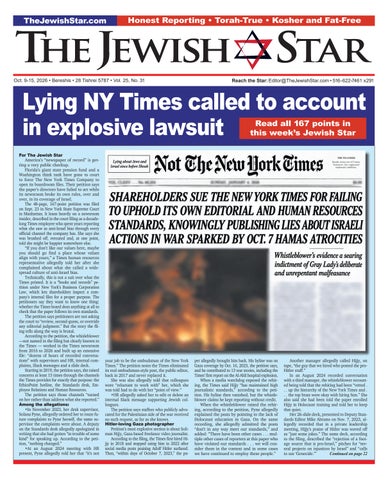
Lying NY Times called to account in explosive lawsuit Read all 167 points in this week’s Jewish Star
For The Jewish Star America’s “newspaper of record” is getting a very public checkup. Florida’s giant state pension fund and a Washington think tank have gone to court to force The New York Times Company to open its boardroom files. Their petition says the paper’s directors have failed to act while its newsroom broke its own rules, over and over, in its coverage of Israel. The 48-page, 167-point petition was filed on Sept. 23 in New York State Supreme Court in Manhattan. It leans heavily on a newsroom insider, described in the court filing as a decadelong Times employee who spent years reporting what she saw as anti-Israel bias through every official channel the company has. She says she was brushed off, rerouted and, at one point, told she might be happier somewhere else. “If you don’t like our values here, maybe you should go find a place whose values align with yours,” a Times human resources representative allegedly told her after she complained about what she called a widespread culture of anti-Israel bias. Technically, this is not a suit over what the Times printed. It is a “books and records” petition under New York’s Business Corporation Law, which lets shareholders inspect a company’s internal files for a proper purpose. The petitioners say they want to know one thing: whether the Times board does anything at all to check that the paper follows its own standards. The petition says petitioners are not asking the court to “review, second-guess, or override any editorial judgment.” But the story the filing tells along the way is brutal. According to the petition, the whisleblower —not named in the filing but clearly known to the Times — worked in the Times newsroom from 2016 to 2026 and built up an extensive file: “dozens of hours of recorded conversations” with supervisors and HR, internal complaints, Slack messages and a slide deck. Starting in 2019, the petition says, she raised concerns at least 15 times through the channels the Times provides for exactly that purpose: the EthicsPoint hotline, the Standards desk, Employee Relations and Human Resources. The petition says those channels “turned on her rather than address what she reported.” Among the allegations: •In November 2023, her desk supervisor, Solana Pyne, allegedly ordered her to route future complaints to Pyne herself, the same supervisor the complaints were about. A deputy on the Standards desk allegedly apologized in writing that she had gotten “in trouble of some kind” for speaking up. According to the petition, “nothing changed.” •At an August 2024 meeting with HR present, Pyne allegedly told her that “it’s not
THE WEATHER Deadly storms out of J’salem. Tomorrow: Jew-engineered unpleasant conditions.
your job to be the ombudsman of the New York Times.” The petition notes the Times eliminated its real ombudsman-style post, the public editor, back in 2017 and never replaced it. She was also allegedly told that colleagues were “reluctant to work with” her, which she was told had to do with her “point of view.” •HR allegedly asked her to edit or delete an internal Slack message supporting Jewish colleagues. The petition says staffers who publicly advocated for the Palestinian side of the war received no such request, as far as she knows. Hitler-loving Gaza photographer Petition’s most explosive section is about Soliman Hijjy, Gaza-based freelance video journalist. According to the filing, the Times first hired Hijjy in 2018 and stopped using him in 2022 after social media posts praising Adolf Hitler surfaced. Then, “within days of October 7, 2023,” the pa-
per allegedly brought him back. His byline was on Gaza coverage by Oct. 16, 2023, the petition says, and he contributed to 13 war stories, including the Times’ first report on the Al-Ahli hospital explosion. When a media watchdog exposed the rehiring, the Times said Hijjy “has maintained high journalistic standards,” according to the petition. His byline then vanished, but the whistleblower claims he kept reporting without credit. When the whistleblower raised the rehiring, according to the petition, Pyne allegedly explained the posts by pointing to the lack of Holocaust education in Gaza. On the same recording, she allegedly admitted the posts “don’t in any way meet our standards,” and added: “There have been other cases . . . multiple other cases of reporters at this paper who have violated our standards . . . we will consider them in the context and in some cases we have continued to employ these people.”
Another manager allegedly called Hijjy, on tape, “the guy that we hired who posted the proHitler stuff.” In an August 2024 recorded conversation with a third manager, the whistleblower recounted being told that the rehiring had been “vetted . . . up the hierarchy of the New York Times and . . . the top brass were okay with hiring him.” She also said she had been told the paper enrolled Hijjy in Holocaust training and told her to keep that quiet. Her 26-slide deck, presented to Deputy Standards Editor Mike Abrams on Nov. 7, 2023, allegedly recorded that in a private leadership meeting, Hijjy’s praise of Hitler was waved off as “just some jokes.” The same deck, according to the filing, described the “rejection of a footage source that is pro-Israel,” pitches for “several projects on injustices by Israel” and “calls to use ‘Genocide.’” Continued on page 22
October 09-15, 2026 • 28 Tishrei 5787 — THE JEWISH STAR
2
Oct. 7 ‘trauma objects’ are witnesses to history By Steve Linde hree years after the Oct. 7, 2023, Hamas massacre, thousands of objects recovered from the devastated Gaza border communities are being preserved as witnesses to what happened that day. Six-thousand items are housed at a national storage and conservation center in Netivot, while thousands more are held elsewhere. They include scorched photo albums, religious items, children’s drawings and ordinary household objects transformed by fire, bullets and destruction. To Dr. Nirit Shalev-Khalifa, curator and head of the Visual History and Documentation Department at Jerusalem’s Yad Ben-Zvi Institute, these remnants are not debris. They are evidence, memory and historical witnesses to the lives that existed before Oct. 7, 2023, and the violence that shattered them. “What you record enters history,” ShalevKhalifa said in an interview in her Jerusalem office. “What isn’t recorded is forgotten. Forgetting is death. It is the dark hole. In the world of history and documentation, what isn’t recorded doesn’t exist.” When the project began shortly after the massacre, Shalev-Khalifa thought the work might take two weeks. “Those two weeks have now become three years,” she said. It was the beginning of what she described as “a Sisyphean task” — the painstaking process of identifying, documenting and preserving objects one by one. In a haunting coincidence, Shalev-Khalifa had been in Kibbutz Be’eri on Oct. 4, 2023, three days before the massacre. She was there as part of Yad Ben-Zvi’s ongoing work documenting local heritage collections and was shown preparations for the kibbutz’s upcoming anniversary celebrations. She photographed the hut housing Be’eri’s gallery, but her camera battery died. “I said to myself, ‘The hut isn’t going anywhere’,” she recalled. “A day and a half later, it was gone.” n the weeks after the massacre, Shalev-Khalifa and her colleagues visited displaced communities in hotels, but, like everyone else, she said, they were still struggling to comprehend what had happened. The turning point came on Nov. 19, five weeks after the massacre, when representatives of organizations involved in the Heritage Ministry’s preservation program were brought to the devastated communities. In Be’eri, archaeological teams were already using photogrammetry to create three-dimensional documentation of the destruction. “They did the zoom-out, and we did the zoom-in,” Shalev-Khalifa said. “They showed how it looked, and we dealt with the objects.” At the kibbutz’s dental clinic, she saw the randomness of the destruction: One part had barely been touched, while nearby offices had been overturned, shot up and burned. She faced a fundamental question: What should they preserve? “What do you take out? What don’t you take out? How do you document it? What do you write down? What even constitutes an object?” she recalled. “In documentation, it is always too late and always the last moment,” she added. “That’s our motto. That’s my motto.” Yad Ben-Zvi did not begin working with material history after Oct. 7. Shalev-Khalifa’s department had spent years developing ways of documenting Israel through photographs, wall art and everyday objects. he work began in 2008 with Israel Revealed to the Eye, documenting history through private family albums. In 2018 came Eretz Hefetz, an initiative devoted to collections of everyday objects held by communities, heritage centers and private collectors.
T
I
T
Dr. Nirit Shalev-Khalifa and Dina Grossman from Jerusalem’s Yad Ben-Zvi scour Kibbutz Re’im. Sarit Uzieli
Dr. Nirit Shalev-Khalifa and members of the Yad Ben-Zvi documentation team work at Kibbutz Be’eri. Sarit Uzieli
For Shalev-Khalifa, cataloguing an object gives it an identity, allowing researchers to trace where it came from, who owned it and how it was used. After Oct. 7, that methodology had to be applied to objects subjected to extreme violence. Consider an ordinary air-conditioner remote control, she said. It has physical components, a recognizable shape and a function. But when it is burned into a blackened mass and can no longer perform that function, its meaning changes. “It becomes an object that has completely changed its purpose,” Shalev-Khalifa said. “Now it is an object of memory. And it is evidence.” “Instead of the study of objects, it became the study of trauma objects,” she said. Among the objects recovered was an orange juice presser bearing the name of the Bibas family of Kibbutz Nir Oz. Before Oct. 7, it was simply an everyday household object. After Yarden and Shiri Bibas and their young sons, Ariel and Kfir, were abducted to Gaza, it became a physical remnant of a family home whose occupants had been violently taken away. For Shalev-Khalifa, that transformation lies at the heart of the “trauma object”: An ordinary item acquires a second identity because of what happened to it, its owners or the place where it was found. he work resembles archaeology, she said, except that the researchers recognize the objects in this contemporary destruction layer. “If I found this 2,000 years from now and didn’t know what it was, I might say, ‘Oh, perhaps it was a ritual object’,” she joked. “That’s what we say in archaeology when we don’t know.” That familiarity has also made the work difficult. During the first months, team members spent their weeks surrounded by burned and shattered homes and returned home on weekends. “You would walk into your house and think, ‘What’s wrong here?’” Shalev-Khalifa recalled. “It isn’t burned. You had become accustomed to seeing everything destroyed.” Within days of her first visit to the Gaza border communities, Shalev-Khalifa reached out to experts involved in preserving objects from the Sept. 11, 2001, terrorist attacks in New York. “Within half an hour, I got an email back: ‘We are at your service’,” she said. She subsequently spoke with Jan Ramirez,
T
Yarden and Shiri Bibas with their sons, Ariel and Kfir, wearing Batman suits. Bibas family
chief curator of the 9/11 Memorial & Museum. Ramirez had been working at the NewYork Historical Society on Sept. 11. As ShalevKhalifa tells the story, the husband of one of Ramirez’s colleagues arrived covered in dust from the World Trade Center and placed his dust-covered mask on her desk. “Here is your first item to exhibit,” he told her. The American experts gave the Israelis a term for what they were encountering: “Trauma objects.” halev-Khalifa rejects attempts to equate Oct. 7 with the Holocaust, noting that Jews did not have sovereignty or an army during the Holocaust, whereas Oct. 7 occurred in a sovereign Jewish state. But she sees a parallel with the suddenness of mass terrorist attacks such as 9/11. “You don’t understand what happened,” she said. “It comes like a bolt from the blue. There is astonishment; there is chaos and there is this constant enigma: What happened?” Objects, she pointed out, are quite different from human witnesses. “The objects don’t try to give themselves an answer. They don’t go to a psychologist. They don’t go to a support group. They don’t go on a retreat.” The Yad Ben-Zvi teams do not enter private homes without permission from the owners or their families. Over time, families began asking them to search for possessions that carried memories of the people who had lived there. In one burned home, Shalev-Khalifa recalled, a photo album survived because melted plastic around it eventually cut off the oxygen needed to keep the fire burning. Its discovery led the family to ask the team to search for other possessions. One grandmother approached Shalev-Khalifa after three of her young grandchildren were murdered. The thought of winter arriving, the ruined house deteriorating and her grandchildren’s dolls and other belongings eventually being scooped up by a tractor and discarded was unbearable. The team conducted what amounted to an archaeological excavation. “We actually sifted the ashes,” Shalev-Khalifa said, searching for fragments of plates and cups and remnants connected to the children. “And everything is preserved,” she said. “It doesn’t go into the garbage.”
S
T
here is a principle behind the painstaking work: A person’s possessions remain theirs even after death, Shalev-Khalifa said. If the owner has been killed, the property belongs to the heirs. But the project also revealed something the museum professionals did not expect. A resident of one of the communities watched as the team documented a dining area from a destroyed home — the table, a newspaper crushed beneath part of the ceiling, a grandchild’s coloring book and other scattered remnants. A traumatic event, he told them, is absolute chaos. “You put a label on everything,” he said. “Suddenly everything has a name.” For people whose world had been violently stripped of order, identifying, cataloguing and respecting individual possessions could itself be consoling. “As museum people, we suddenly discovered this therapeutic, comforting element,” Shalev-Khalifa said. “For us, every object is treated with respect.” Even the walls have stories. In some homes, parents had marked their children’s heights over the years. The house might have to be demolished, but those markings need not disappear with it. The team learned an old conservation technique that allows the surface of a wall to be carefully removed and transferred to another backing. A piece of wall destined for demolition can thus become a record of a family’s history. It is one of countless lessons Shalev-Khalifa and her colleagues learned over the past three years. “We learn a million things,” she said. “Every time, we learn something new.” Oct. 7 brought chaos. Homes were destroyed, families torn apart and their possessions blasted, burned and scattered. Then the Yad Ben-Zvi teams arrived and began, object by object, to restore some kind of order. One resident’s observation about the teams’ work still captures the essence of the project, Shalev-Khalifa said. “You put a label on everything,” he told them. “Suddenly everything has a name.” —JNS
3
COMMUNITY & EDUCATION FAIR Sunday, October 11 · Queens, New York Explore communities and learn about educational opportunities across Israel!
SHABBAT LECH LECHA IS
SHABBAT OF ALIYAH Shabbat, October 23 & 24 Be a part of the movement and share Aliyah with your community! Download the reader today!
NBN ON TOUR Tuesday, December 15 · Brooklyn Wednesday, December 16 · Teaneck Wednesday, November 18 · West Hempstead NBN On Tour is coming to the NY/NJ area in December! Join our Nefesh B'Nefesh Aliyah Advisors for an informative session about your journey to Israel.
www.nbn.org.il/events-calendar WORKING IN PARTNERSHIP TO BUILD A STRONGER ISRAEL THROUGH ALIYAH
THE JEWISH STAR — October 09-15, 2026 • 28 Tishrei 5787
NBN is coming to YOU!
October 09-15, 2026 • 28 Tishrei 5787 — THE JEWISH STAR
4
Venice Nazi ‘NAZA’ puts Jews back in ghetto By Andrew Abrahams President of Open Eye Pictures ’ve been making documentaries for decades. My work has been Oscar-shortlisted, Emmy-nominated, acquired by outlets including Netflix and HBO, and honored at festivals around the world. I know this craft and industry well. At our best, we shine light on stories that fall outside the news cycle, cultural fashion or marketplace demands. At our worst — and this is what I fear has happened to much of my industry — we become mouthpieces for ideological purity and emotionally packaged advocacy. “NAZA,” the new documentary about the IDF’s AI-assisted war in Gaza by Israeli filmmakers Yuval Abraham and Rachel Szor, falls into the latter camp. The film premiered at the Venice Film Festival on Sept. 10 and was greeted by an ovation lasting roughly twentyfive minutes, the longest in the festival’s history. By some accounts, audience members waved Palestinian flags and chanted “Free Palestine.” Two days later, the film received Venice’s Special Jury Prize. The previous record for the longest standing ovation was for the duo’s previous 2024 film, “No Other Land,” a searing indictment of … guess who? Yes, Israelis. That time, they were the “violent extremist settlers.” Twentyfive minutes of applause. Nearly one-third of the film’s own 80-minute running time. You can imagine the audience rapt in their collective fervor, swept up in their own righteousness. Maybe some looked around, not wanting to be the first to sit down, knowing that doing so could make them appear insufficiently caring or loyal. The spectacle itself became a potent weapon: The longer the ovation lasted, the sharper the knife. Meanwhile, the filmmakers were ritually lauded as “brave” for indicting their own — for “speaking truth to power,” an opium of progressive culture. hether encouraged by festival staff or simply allowed to gather momentum, the ovation became something larger than spontaneous appreciation. It was public ceremony and performative display. Applause can also serve as a collective ritual, a visible demonstration that one stands with the group, its purpose, or its leader. The longer the ritual continues, the more conspicuous withdrawal becomes. Who dares be the first to sit? The wordplay points in one direction and the loyalty ritual in another. That ritual has a history. Under Stalin, whose regime became virulently anti-Zionist, extravagant applause was part of what scholars of Soviet political culture have described as public “loyalty rituals.” Stalin’s appearance, and sometimes merely the mention of his name, could produce prolonged standing ovations through which allegiance was publicly demonstrated. The performance made loyalty visible and disloyalty dangerous. Aleksandr Solzhenitsyn provided the most memorable illustration in The Gulag Archipelago. He described a Party conference at which an ovation for Stalin continued because nobody wanted to risk being the first person to
I
stop. In his account, after 11 minutes, a factory director finally sat down; everyone instantly followed him, and the director was later arrested on another pretext. Once applause becomes a public demonstration of belonging, silence or non-participation becomes visible dissent. The ritual is not unique to Stalin. Mao’s Cultural Revolution produced mass rallies in which hundreds of thousands, sometimes more than a million people, cheered and applauded for extended periods while proclaiming devotion to the chairman. Nazi political spectacle turned cheering, saluting, and chanting into choreographed demonstrations of allegiance. The regimes were radically different, but the ritual was the same: applause ceased to be merely a response and became a test of belonging — to ideologue and ideology alike.
dismiss as an afterthought. It is hard to imagine that the filmmakers never noticed the association. Before a single frame appears, the title has already begun framing the prosecution. The title invites the specter of Nazism, yet the more revealing authoritarian echo may lie not in the film’s subject but in the spectacle surrounding its reception: the mass standing ovation, the public display of ideological allegiance, the reluctance to be the first to sit down, the ritualized affirmation of the prevailing moral line. The wordplay points in one direction and the loyalty ritual in another. “NAZA” contains a second contradiction. The film presents nezek agavi as evidence of a cold bureaucratic machinery of killing, particularly through the IDF’s use of AI-assisted targeting systems. But the very existence of such calculations also complicates the film’s thesis. A military estimating anticipated civilian casu-
T
W
Would any of those cheering “NAZA” have been willing even to watch the damning 47-minute film compiled from Hamas’ own footage of the atrocities committed on Oct. 7?
The best documentaries may begin with a question, a suspicion, even a strong point of view, but they remain open to discovery — to evidence that complicates or even contradicts the filmmakers’ assumptions. When the finished film presents its case as settled while giving viewers little ability to test the evidence for themselves, investigation starts to look more like prosecution. And that starts to look a lot more like propaganda. There is nothing inherently wrong with using anonymous sources. Investigative journalists and documentary filmmakers do it routinely, particularly when sources face professional, legal or personal risk. Anonymity is sometimes necessary, but it imposes a corresponding obligation of verification and rigor. The audience cannot examine the sources’ identities, positions, access to information or motives on its own. It must rely on the filmmakers to have done so. That obligation grows with the seriousness of the allegation. A film whose entire thesis relies on sources concealed from the viewer bears an even greater responsibility to demonstrate how those accounts were authenticated, corroborated, contextualized, and tested against conflicting evidence or testimony. And when the viewer is denied access to the sources themselves, presenting opposing evidence and interpretations becomes even more important. The best documentaries may begin with a question, a suspicion, even a strong point of view, but they remain open to discovery. he contrast with the aftermath of Oct. 7 is difficult to ignore. Reports that Israeli women had been raped, sexually assaulted, mutilated and murdered were repeatedly met with demands for hard verification and, in many quarters, outright disbelief. The absence of surviving victims in many cases, the destruction of forensic evidence and inconsistencies in some early accounts became grounds for questioning the larger body of testimony. Months later, a UN mission concluded there were reasonable grounds to believe rape and gang rape had occurred at multiple locations and clear and convincing information that hostages had been subjected to sexual violence. Yet when allegations run in the opposite direction, as in “NAZA,” two dozen completely concealed voices can become the foundation for sweeping claims of “calculated mass killing” and receive 25 minutes of applause. Naturally, the Israeli military has disputed the film, arguing that because the witnesses remain anonymous, the public cannot establish whether they served in the capacities claimed or possessed the knowledge attributed to them. Nor could those subjects easily challenge the editing or contextualization of their own words without risking exposure. The London-based Guardian news outlet, which produced the documentary, has notably been a relentless critic of Israel’s conduct throughout the war. A serious documentary critic should therefore ask: Why these 24? How were they authenticated? What was their range of rank, responsibility and firsthand knowledge? Were people with contrary experiences interviewed? Which claims were independently corroborated? And did the editing preserve uncertainty and disagreement or resolve them in service of the thesis? here is also something inherently persuasive about hiding someone’s identity on screen. Put someone in shadow, disguise the voice, obscure the face, and the testimony can take on an aura of danger and authority before the viewer has had a chance to assess it. On the page, anonymity withholds information. On screen, it can add emotional force. Concealment may be justified, but the more completely the sources are hidden, the more transparency the filmmakers owe the audience. See Naza on page 8
V
enice, in particular, has seen politically charged cinema embraced as moral and artistic transcendence before. In 1935, the festival honored Leni Riefenstahl’s “Triumph of the Will,” the Nazi Party’s monumental cinematic glorification of Hitler. Three years later, Venice awarded Riefenstahl’s “Olympia” the Mussolini Cup, then one of the festival’s highest honors. Prestigious cultural institutions are no more immune than anyone else to the orthodoxies of their time. They can mistake conformity for courage, political affirmation for artistic virtue, and collective enthusiasm for independent moral judgment. Venice has rewarded not only great auteurs, but the political currents of its time. There is something inherently persuasive about hiding someone’s identity on screen. “NAZA” itself is an Israeli military acronym derived from nezek agavi, Hebrew for “collateral damage,” including anticipated civilian harm associated with a strike. The title’s conspicuous resemblance to “Nazi” is difficult to
alties is, by definition, taking those casualties into account. That does not establish whether the resulting thresholds were lawful, proportionate or morally defensible. But it does raise an obvious question about the claim of genocidal intent: if civilian deaths were being calculated as collateral to a military target, does that evidence support only the film’s conclusion, or can it also point toward an effort — however imperfect — to reduce civilian casualties? he film is constructed around testimony from 24 Israeli military and intelligence personnel discussing Israeli targeting practices and civilian casualties in Gaza. Their identities and voices are concealed, and reviewers describe the subjects as filmed largely in darkness or otherwise visually obscured. The film’s official Venice synopsis goes further than describing an investigation: it declares that “NAZA” reveals “the systems behind Israel’s calculated mass killing of Palestinian civilians in Gaza.” That language does not frame an investigation; it announces a verdict.
T
T
5
THE JEWISH STAR — October 09-15, 2026 • 28 Tishrei 5787
Rabbi Dr. Jeffrey Kobrin Rosh HaYeshiva/Head of School
Mr. Ira Miller Dean
Rabbi Dr. Avi Miller Associate Principal
Ms. Danielle Lev Director of Admissions & Strategic Initiatives
October 09-15, 2026 • 28 Tishrei 5787 — THE JEWISH STAR
6
s n io n u r te h g fi e r fi , e c li o P “ ” i z z o u S m o T . ep R Y N … k c a b — 10/4/26
N A S I T R A P MOST B I
SuozziForCongress.com
Proudly Endorsed By: POLICE
FIREFIGHTERS
[Tom Suozzi] has been working hard to work with both sides of the aisle, he backs the blue...
Tom Suozzi...works across the aisle to do what’s best for his constituents
- Nassau PBA President Tom Shevlin
- UFA President Bobby Eustace
Vote for Our Congressman Tom Suozzi by Nov 3 Early Voting Oct 24 - Nov 1 1 https://www.bridgegrades.org/congress/S001201/thomas-r-suozzi 2 https://voteview.com/congress/house/119/text 3 https://www.govtrack.us/congress/members/thomas_suozzi/412717
Paid for by Suozzi for Congress
7
THE JEWISH STAR — October 09-15, 2026 • 28 Tishrei 5787
EXHIBITION
AT THE MUSEUM OF JEWISH HERITAGE IN PARTNERSHIP WITH THE JEWISH HISTORICAL INSTITUTE IN WARSAW
FROM TO
SEP. 18, 2026 FEB. 14, 2027
October 09-15, 2026 • 28 Tishrei 5787 — THE JEWISH STAR
8
Venice Nazi ‘NAZA’… Continued from page 4 Yet much of the international reception has treated the film’s conclusion as an established premise. One prominent review called it “essential.” Another described it as laying bare the machinery of killing. The Venice festival itself presented the film using the filmmakers’ characterization of “calculated mass killing.” Then came 25 minutes of applause. At that point, criticism began to look like catechism — and the reception itself resembled agitprop.
Ignoring the backstory
Imagine the reverse. A Palestinian filmmaker makes an equally uncompromising documentary about Hamas. Its subjects describe the deliberate slaughter of Israeli women and children on Oct. 7; the taking of civilian hostages; the operation of military infrastructure under hospitals, mosques, and schools; repression of Palestinians who challenge Hamas; and a leadership willing to expose its own population to catastrophic consequences in pursuit of an ideological, explicitly genocidal war. Would such a Palestinian film receive the same welcome? Would European producers race to finance it? Would it reach the artistic apex of Venice? Would an audience stand for 25 minutes waving Israeli flags? Are all revelations equally welcome, or only those that confirm the moral narrative already dominant in the room—and across much of the Western arts and press establishment? Palestinian suffering cannot be understood honestly if Hamas’s conduct is treated as politically inconvenient or mere background material rather than as part of the story itself. Would any of those cheering “NAZA” have been willing even to watch the damning 47-minute film compiled from Hamas’s own footage of the atrocities committed on Oct. 7? Ignoring this backstory may be the film’s greatest sin of omission. Israel has become a subject around which certain sectors of Western cultural life appear to experience something approaching a moral compulsion — even an expiatory frenzy. The denunciation itself becomes evidence of virtue. And repeated accusation begins to stand in for proof. The harsher the indictment, the greater its moral seriousness appears to be. Venice has seen politically charged cinema embraced as moral and artistic transcendence before. obody forced the Venice audience to stand. But social coercion rarely announces itself as such. It operates through reputation, belonging, and fear of exclusion. Political scientists studying authoritarian societies have described “social desirability” and “reputational cascades,” in which individuals publicly display attitudes partly because they believe those attitudes are expected by others. An ideological consensus can sustain itself even
N
among intelligent and independently minded people. Many may believe fervently. Others may agree partially. Some may have doubts they fear expressing. Still others may simply want to participate in the communal high. Eventually the performance of consensus begins to look like consensus itself. In the roar of the crowd, “Free Palestine” and “Sieg Heil” start to sound eerily the same. Venice carries another historical irony: The word “ghetto” originated there. On March 29, 1516, the Venetian Republic ordered its Jews confined to a separate quarter of the city. Gates were erected and locked at night. The name attached to that enclosure, derived from the area known as the geto, or foundry, eventually became the universal word for the compulsory segregation of Jews.
New Venice boundaries
More than five centuries later, Venice is again a place where the boundaries of acceptable Jewish belonging are being drawn by the elite and the audience alike. The boundary today is not built of brick, and no gate closes at sunset. It is intellectual and moral: which Jewish voices may be embraced and under what conditions? It is a modern version of a question historian and philosopher Hannah Arendt posed almost a century ago in European Jewish life: whether Jews could belong as Jews, rather than on terms set for their acceptance. In Venice, those terms are hard to miss. Abraham and Szor are being hailed for turning the knife on their own country, while at home Israeli politicians have called for stripping them of citizenship. Yet even the Venice ovation can’t buy safety or acceptance. In parts of the West and on social media, they are still attacked simply for being Israeli, accused of gaining prestige on the backs of Palestinian suffering. The category of the “good Jew” is always conditional. History shows that usefulness, compliance, or ideological approval never guarantees exemption once Jewishness itself becomes the offense. The asymmetry is hard to miss: automatic credibility granted to accusations against Israel, cultural prestige attached to denouncing it, and suspicion directed at those who challenge the prevailing narrative. When Jews and the Jewish state are subjected to standards that others are routinely spared, this is no longer merely criticism. It is a double standard, and that double standard has a name: antisemitism — the same ancient impulse that once confined Venice’s Jews behind ghetto walls and now finds expression in the ovation at its famous film festival. My hope is that history will look back on this moment in Venice as we now look upon Riefenstahl’s pro-Hitler films, Stalin’s ovations and the ghetto itself not as expressions of moral courage, but as warnings about the dangerous ideological currents of their time.
1231558
9
THE JEWISH STAR — October 09-15, 2026 • 28 Tishrei 5787
•
Secured nearly $60 million for Education, Public Safety, and Health Care Projects in Jamaica and Far Rockaway
•
Ensured $1 Billion in contracts for Minority Owned Businesses in Queens for JFK Redevelopment
•
Forced Trump to Cancel Canada Tariffs to Protect Families From Higher Prices
•
Supported Legislation to Lower Costs for Renters and Homeowners
•
Calls for End to ICE Brutality and Fights for a Pathway to Citizenship for Immigrants
•
Opposed Trump’s “Big Ugly Bill” and Its Cuts to Medicaid and SNAP
•
Fought for protections for the Federal Workforce and Unions
congressmangregorymeeks.com
@GregMeeks NYC Paid for by Friends for Gregory Meeks
October 09-15, 2026 • 28 Tishrei 5787 — THE JEWISH STAR
10
Keep Your Independence
Your Health. Your Culture. Your Parker.
Customized Health Care On-site or at Home •
Short Term Rehabilitation / Sub-Acute Care
•
Home Health Care
•
Long Term Care Facility
•
Medical House Calls - Parker At Your Door
•
Dialysis - community / on-site
•
Dementia GUIDE Model
•
Palliative care
•
Willing Hearts, Helpful Hands
•
Hospice - community / on-site
•
Research and Grants
1356388
271-11 76th Avenue | New Hyde Park, NY 11040 parkerinstitute.org | 877-727-5373
Crazies call hijacking a ‘false flag,’ not a miracle
lower cost homeowners insurance let our team of experts design a much lower cost quality policy for you free quote
➤ commercial insurance policies ➤ life & disability insurance ➤ car insurance ➤ self employed health insurance ➤ long term care insurance
Rabbi S.M. Leiner, cLtc
Independent Insurance broker P.O. box 7655 at 600 Franklin Ave. Garden city, ny. 11530
Moses10987@aol.com
917-543-0497 Attention: AFFLUENT Clients — Tax Free, Guaranteed, Return of FULL PREMIUM PAID, for CERTAIN Insurance Coverage.
itous” for Israeli Prime Minister Benjamin Netanyahu. British independent MP Ayoub Khan publicly questioned how quickly Israeli officials described the incident, writing that he was “shocked” by the speed of the investigation and adding, “I think I smell a rat!” The Board of Deputies of British Jews condemned what it called “toxic conspiratorial thinking.” Adrian Cohen, its senior vice president and chair of its International Division, said more than 170 lives had been saved by passengers and crew and argued that the circumstances called for recognition of their courage, not conspiracy theories. MP Khan doubled down, saying he would not believe a word from Netanyahu unless it was “independently corroborated, double-checked and preferably notarized by the universe itself.” Notarized by the universe! At last, an evidentiary standard the internet can get behind. Conspiracy theories do not need much evidence to get moving.
DESK of RABBI S.M. LEINER- INSURANCE BROKER 917-543-0497 Note the ACCOLADES from our CLIENTS RE: SYNAGOGUES and YESHIVOS Dear Rabbi Leiner, Thank you for replacing the Insurance for our Synagogue, with a Savings of almost 50%. B.F. Executive Director RE: REAL ESTATE CORPORATION Dear Rabbi Leiner, You and Your Experts, have saved our Corp. Very Substantial Sums, with your Quality Insurance Replacement on our Real Estate Buildings. Thank you, M.B. Pres. RE: HOMEOWNERS INSURANCE Dear Rabbi Leiner, Our Insurance Company Refused to renew our Insurance Homeowners Policy. However, You and Your Experts were able to Secure for us other Insurance Coverage, even at a much lower Premium, than the Prior Canceled Insurance Policy. Thank You So Much. Mrs. D.S.
1361097
Another, reacting to interviews with passengers who had fought the rogue copilot, complained that nobody should believe the eyewitness accounts. That was roughly the logic adopted by a collection of influencers and activists from wildly different corners of the political internet. The Anti-Defamation League’s Center on Extremism said at least 25,000 posts about the incident on X during its first 48 hours included conspiracy narratives. Among the people pushing or entertaining false-flag theories were progressive media personality Ana Kasparian, white supremacist Nick Fuentes and influencer Sneako. Fuentes declared the incident “false flag terrorism.” Sneako called it a psyop. Commentator Jackson Hinkle wrote that the development was “all too predictable” in a post that was reposted 17,000 times and liked 88,000 times. Streamer Hasan Piker stopped short of calling it a false flag but questioned the official account and said the timing was “unbelievably beneficial, unbelievably fortu-
Amit Cohen, a national security expert quoted by JTA, said there is often a gap between what people want to know and what can be verified immediately after a major event. That gap, she said, is exactly where rumors can flourish. Gal Yavetz of Bar-Ilan University made the point even more bluntly: When people cannot explain something, some reach for familiar scapegoats — including Jews. Amit Cohen also noted that AI has made convincing fake material easier to produce while also creating a convenient escape hatch for anyone who wants to dismiss genuine evidence: Just call it AI. Real video? Fake. Eyewitnesses? Actors. Emergency signals? Staged. A plane plunging thousands of feet? Screenplay. That is the great trick of conspiracy culture: every piece of evidence becomes evidence for the conspiracy. If there is video, it’s fabricated. If there is no video, that proves the cover-up. If officials respond quickly, they planned it. If they respond slowly, they are hiding something. It is a theory with one ironclad rule: nothing can ever disprove it. Meanwhile, the actual passengers and reserve crew did something far less glamorous. They fought for control of a plane. They helped save more than 170 people. And they landed safely. That in itself is an extraordinary story. No secret director, no Hollywood backlot and no shadowy screenplay department required. The only truly unbelievable part may be how quickly some people looked at a real emergency and decided they needed to add a conspiracy plot twist.
THE JEWISH STAR — October 09-15, 2026 • 28 Tishrei 5787
For The Jewish Star While judicious newsies delayed calling it a jihadist hijacking until the facts were clear, crazies waited only 67 minutes before letting loose their insane antisemitic conspiracy theories. A pilot is stabbed by the co-pilot and the plane plunges thousands of feet in seconds; passengers storm the cockpit and a plumber pulls the plane out of its dive; a reserve crew member helps save the flight, with the plane making an emergency landing at Tabuk Airport in Saudi Arabia. In the ordinary universe, that is already an absurdly dramatic story. On the internet, apparently, it wasn’t dramatic enough. Within 67 minutes of the flydubai flight sending its first distress signal on Sept. 30, before investigators could possibly sort through every detail, social media sleuths reached the conclusion that the whole thing was a giant Israeli production. Mossad! Netanyahu! “False flag”! “Bibiwood”! Hollywood! A plot so elaborate that, at some point, one might expect the next theory to involve aliens operating the baggage carousel. The Jewish Telegraphic Agency (JTA) reported that conspiracy theories began spreading almost immediately. The Combat Antisemitism Movement’s Antisemitism Research Center documented 1,000 hostile posts within five hours and 2,963 within 12 hours, generating at least 30,000 likes and more than 3 million views. One social media commenter responding to a CNN report declared: “Brought to you by Bibiwood Productions.”
11
October 09-15, 2026 • 28 Tishrei 5787 — THE JEWISH STAR
12
Want to live healthier and longer? Schedule your wellness exam with a Primary Care Physician at EHS. Our physicians help you navigate: Your blood pressure
Specialty referrals
Cancer screenings
Symptoms and solutions
Chronic disease management
Vaccinations
Partnering with you every step of your healthcare journey.
Book your appointment today at 718-EHS-DOCS (347-3627) or ehs.org/booknow. Walsh Ambulatory Pavilion: 19-20 Brookhaven Avenue, Far Rockaway, NY 11691 EHS Primary Care at Rockaway Beach: 105-38 Rockaway Beach Blvd, 2nd Floor, Rockaway Park, NY 11694
Mt. Sinai ‘Soirée’ honors Rabbi Dr. Aaron Glatt Mount Sinai South Nassau will honor Rabbi Dr. Aaron Glatt for his medical leadership at its annual Soirée Under the Stars on motzei Shabbat, Nov. 7, at The Lannin in Eisenhower Park. The gala will raise funds for the hospital’s expansion of cardiovascular services, including adult open-heart surgery. Glatt, chair of Mount Sinai South Nassau’s Department of Medicine, chief of infectious diseases and hospital epidemiologist, will receive the hospital’s Mary Pearson Award. An internationally recognized infectiousdisease specialist, he has served as chair of medicine and chief of infectious diseases since 2015. Glatt is also assistant rabbi at Young Israel of Woodmere who played a leading role in the hospital’s response to the COVID-19 pandemic, overseeing initiatives that
included the use of monoclonal antibodies, the rollout of vaccines and the launch of the hospital’s Vaxmobile. He also oversees the hospital’s Infectious Diseases Society of America Designated Center of Excellence in Antimicrobial Stewardship. “Dr. Glatt’s clinical acumen has been key to Mount Sinai South Nassau’s advancements in patient safety, quality, infection prevention, and antibiotic administration and the multiple awards the hospital has received for patient safety and the quality of care,” said Alan Wong, DO, chief medical officer. “We are grateful for his leadership.” The Mary Pearson Award is named for the hospital’s founding administrator and recognizes an individual for extraordinary effort and contributions that ad-
vance the hospital’s commitment to the community. Hospital Advisory Board member and Hewlett Harbor resident Steven Gold is the gala’s principal honoree. Nydia White, RN, director of nursing in the Department of Medicine, also will be honored, and a posthumous award will be presented to the family of the late Wayne Lipton, a longtime hospital board member. The Soirée will benefit “Bringing Heart Home,” a campaign supporting the expansion of Mount Sinai South Nassau’s cardiovascular services. The planned expansion includes adult openheart surgery as well as additional cardiac catheterization, electrophysiology and CT angiography capabilities. The gala will feature an extended cocktail hour beginning at
Rabbi Dr. Aaron Glatt got his flu shot during a 2019 vaccination event hosted by Richner Communications, parent company of The Jewish Star, at its offices in Garden City. CEO Stuart Richner was the first member of his company’s team to get a shot. Ed Weintrob, The Jewish Star
6:30 pm, music, dancing and a mentalist. Food will include a kosher option. For information about tickets or
sponsorships, call the hospital’s Development Office at 516-377-5360.
Reported by MSSN.
EHS team raises suicide awareness in Far Rock Episcopal Health Services leadership, behavioral health service providers and team members joined patients, community members and members of PFAC — Patient & Family Advisory Committee — in the Third Annual Suicide Prevention Awareness Walk & Talk in Far Rockaway. The event began with inspiring remarks, helpful tips and a review of community resources in an environment that promoted connection, mental health and suicide prevention awareness. To begin the walk, participants gathered at the St. John’s Episcopal Hospital Community Garden and walked along 19th Street toward the boardwalk, ending at the flagpole. Episcopal Health Services leadership
and behavioral health services providers are pictured from left: Ayodele Oliver (Director of Behavioral Health Network Development), Vanessa Nazario (Chief Social Impact Officer), Steve Guido (Executive Vice President and Chief Financial Officer), Karen Paige (Executive Vice President and Chief Operating Officer), Tanya Barros (Vice President of Behavioral Health Services), Dr. Jessy Colah (Chair, Department of Psychiatry) Dr. Donald T. Morrish (Chief Executive Officer), Dr. David Statman (Psychologist, Department of Psychiatry), Shabana Mohan (Social Worker), Charlot Rosario (Behavioral Health Social Work Manager), and Enny Almonte (Director, Outpatient Behavioral Health Services).
Reported by EHS.
At Parker workshop, seniors warned about scams Older adults are increasingly being targeted by scammers who use trust, urgency and technology to pressure victims into giving up money or personal information, experts warned at a recent workshop at the Parker Jewish Institute in New Hyde Park. The free “Shielding Seniors: Protect Yourself from Scams and Identity Theft” program focused on helping older adults recognize, avoid and report common scams. The initiative was funded by a grant from the New York Bar Foundation. Scammers may impersonate grandchildren or other loved ones and claim they urgently need financial help. Artificial intelligence and other technology can make such schemes more convinc-
ing by allowing scammers to “spoof” a loved one’s voice. Other scams discussed at the workshop included Medicare and health insurance fraud, fake government
or utility-provider demands, cryptocurrency schemes, tech-support scams, fraudulent home repairs and online romance scams. Warning signs include un-
solicited requests for money or personal information, demands for cash, gift cards or wire transfers, and pressure to act quickly or keep a situation secret. Experts also cau-
tioned that unsolicited offers that seem unusually inexpensive — such as a low-cost roof repair — can be warning signs of fraud. When in doubt, consumers should hang up and contact the person or organization directly using a trusted phone number, such as one printed on a bank card, account statement or utility bill. People also should avoid clicking links in unexpected emails or text messages. Families can establish a private “safe word” to verify emergency calls. If a pop-up warns that someone is trying to access a computer or other device, experts advised shutting the device down immediately. People who believe they have shared personal information with a scammer can
consider freezing their credit with Experian, Equifax and TransUnion. “Everyone needs to be on high alert when it comes to scams, not just older adults,” said Michael N. Rosenblut, president and CEO of the Parker Jewish Institute. “It’s important to recognize the pattern: scammers gain your trust, create a sense of urgency and pressure you to act quickly.” Speakers included attorney Ann-Margaret Corrozza; Jennifer Benjamin of Family First Home Companion; Cindy Manigat of M&T Bank; James Donnelly of Safe Haven Insurance Agency; and NYPD Police Officer Samantha Gleason. Reported by Parker Jewish Institute
THE JEWISH STAR — October 09-15, 2026 • 28 Tishrei 5787
HEALTH, MIND & BODY
13
October 09-15, 2026 • 28 Tishrei 5787 — THE JEWISH STAR
14
WINE & DINE Harvest recipes for post-Sukkah autumn days Kosher Kitchen
JONI SCHOCKETT
For The Jewish Star
A
lthough Sukkot and Simchat Torah are behind us, we can hold onto some of their spirit by continuing to enjoy the colorful harvest foods that I make a point of preparing for the autumn festivals. In the weeks of cool weather ahead of winter, I want to continue making one dish after another of these veggie-based delights, eating all the veggies of the alphabet — from apples to zucchini. The theme is abundance (some people even stuff their vegetables to show that there is so much to eat!). It is a time to give thanks for all the hard work that has gone into providing us with this bountiful harvest, thanking Hashem for making it so. Have you noticed the similarities between Thanksgiving and Sukkot? The Thanksgiving cornucopia is the same shape as a shofar and is always filled with the fruits and veggies of the harvest.
Acorn Squash with Fruit and Nut Stuffing.
Acorn Squash with Fruit and Nut Stuffing (Pareve or Dairy)
2 acorn squash Olive oil, for rubbing 1/2 cup water, plus more as needed 1/4 cup dried cranberries 1/4 cup cranberry juice 2 Tbsp. butter or pareve margarine 1-1/2 cups chopped apples 1/4 cup chopped pears 2 Tbsp. chopped fresh cranberries 1/3 cup brown sugar, or less 1 tsp. cinnamon 1/4 cup chopped walnuts (optional) 1/4 cup pine nuts 1/4 cup chopped pistachios 1 tsp. lemon juice 2 Tbsp. pure maple syrup Carefully cut the acorn squash in half and scoop out the seeds. Rub the cut sides with a bit of olive oil. Lightly grease a rimmed baking sheet, then add 1/2 cup of water to the pan. Place the squash cut side down on the sheet. Bake in a 350-degree oven for about 40 minutes, or until soft when pierced. Meanwhile, soak the dried cranberries in the cranberry juice. Heat a large skillet and add the butter or margarine. Sauté the apples and pears until slightly soft and a bit browned. Add the fresh cranberries, brown sugar, cinnamon and nuts, along with the dried cranberries and their juice. Cook for 3 minutes or so, until the juice evaporates a bit and the fruit softens. Stir in the lemon juice. To assemble: Carefully turn the cooked squash over and place in a shallow baking pan. If the halves won’t sit upright, crumple some aluminum foil into a “nest” for each one. Fill the cavities with the fruit mixture and press down firmly. Drizzle with the maple syrup. Add a bit more water to the bottom of the pan. Cover lightly and bake for another 30 minutes, until the squash is tender. Serves 4 to 8.
Butternut Squash Gratin (Dairy)
2 to 3 large Vidalia or other sweet onions, diced 2 to 3 Tbsp. extra to virgin olive oil 2 Tbsp. butter Water, as needed 2 cloves garlic, finely minced 2 to 3 Tbsp. finely minced fresh sage leaves
Butternut Squash Gratin.
Add the cheese, if you like. Sprinkle evenly over the dish and bake for 35 to 50 minutes, or until golden and bubbly. Serves 6 to 8.
Tomato Salad with Cheese Crisps (Dairy or Pareve)
Chick Peas, Zucchini and Spinach.
3-1/2 lbs. butternut squash, peeled and cut into 1/2 to inch dice Salt and pepper, to taste 1/2 cup plus 3 Tbsp. heavy cream 1 to 2 Tbsp. pure maple syrup 1 cup breadcrumbs or cornflake crumbs 2 to 3 Tbsp. butter, melted 1/2 cup grated Parmesan cheese (optional) Prehead oven to 350 degrees. Heat a large skillet and add the olive oil and 2 tablespoons of butter. Add the onions and sauté until they just begin to turn golden brown. Reduce the heat and continue cooking to caramelize the onions. If they begin to stick, deglaze the pan with a tsp. of water as often as needed. Cook until deep golden brown. Add the garlic and sage and cook, stirring constantly, for 2 minutes. Remove from the heat. While the onions are cooking, place the squash in a steamer basket over water. Steam until tender but not mushy. Remove from the heat. Generously grease a gratin pan and add the squash. Add the onion mixture and mix well. Season with salt and pepper. Heat the cream and maple syrup over low heat just to warm. Pour evenly over the squash. Mix the melted butter with the breadcrumbs.
To keep this pareve, omit the cheese and the cheese crisps. CROUTONS 1 tsp. onion powder 1 tsp. garlic powder 1/4 to 1/2 tsp. black pepper 1/4 to 1/2 tsp. kosher salt 6 to 8 slices ciabatta or Italian bread, cut into 1/2-inch cubes 1/3 cup extra-virgin olive oil 1/2 cup grated Parmesan cheese (optional) SALAD 3 lbs. tomatoes in mixed sizes and colors (heirlooms are nice), halved 1 large leek, white and light green parts only 2 Tbsp. chopped fresh chives 1 tsp. chopped fresh dill DRESSING 1 Tbsp. Dijon mustard 1-1/2 Tbsp. freshly squeezed lemon juice 2 Tbsp. white wine vinegar or sherry vinegar 1 small clove garlic, pressed through a garlic press Salt and freshly ground black pepper, to taste 1 Tbsp. extra-virgin olive oil CHEESE CRISPS 1 cup grated Gruyere cheese 1-1/2 Tbsp. unbleached flour Pinch cayenne pepper (optional) Preheat the oven to 400 degrees. Line a rimmed baking sheet with parchment paper and set aside. For the croutons, mix the onion powder, garlic powder, pepper and salt together. Add the bread cubes and toss. Add the olive oil and toss to coat. If you like, add the grated Parmesan. Spread in a single layer on a second rimmed baking sheet and bake for 8 to 12 minutes, or until golden, stirring once or twice so all sides get toasted. Let cool. Place the tomatoes in a large bowl. For the dressing, mix the mustard, lemon juice, vinegar, garlic, salt and pepper in a small bowl. Add the olive oil and mix well. Pour over the tomatoes and toss gently. Add the chives and dill and toss gently again. Set aside. For the cheese crisps, mix the Gruyere, flour
Tomato Salad with Cheese Crisps.
and cayenne in a small bowl. Place six mounds of the mixture on the parchment-lined baking sheet and bake for 10 minutes, or until golden. Let cool completely, then use a thin spatula to move them to a plate. Add the croutons to the tomatoes, toss and serve with the cheese crisps. Serves 6 to 8. Note: You can add your favorite cheese to this salad, such as feta, burrata, fresh mozzarella, Parmesan or goat cheese.
Chickpeas, Zucchini and Spinach (Pareve)
2 Tbsp. extra-virgin olive oil 1/4 cup sliced shallots (about 4 large shallots) 1 to 2 cloves garlic, minced 1-1/2 cups vegetable broth 2 zucchinis, sliced 10 ounces fresh baby spinach 2 Tbsp. raisins or currants 1 Tbsp. finely minced fresh sage 1 can chickpeas, drained and rinsed Salt and pepper, to taste Balsamic vinegar (optional) Heat a large skillet and add the olive oil. Add the shallots and garlic and sauté until softened and just beginning to color, 5 to 7 minutes. Add the vegetable broth and cook until reduced by half, 5 to 8 minutes. Add the zucchini and cook until softened, 4 to 6 minutes. Add the spinach and cook, tossing every few seconds, until completely wilted. Add the raisins and sage and mix well. Add the chickpeas and heat through. Season with salt and pepper. Add a splash of balsamic vinegar, if you like. Serves 4 to 8. Note: This is a delicious base to which you can add any veggies you like; corn and blistered or sun-dried tomatoes are all delicious. Season it as you like, too, from mild to a bit hot and spicy.
Gingered Peach Crisp with Maple Cream Sauce (Dairy)
TOPPING 1 cup unbleached flour 1/2 cup light brown sugar, firmly packed 1/2 cup granulated sugar 1/2 tsp. ground cinnamon 1/4 tsp. ground nutmeg 1 tsp. baking powder 1/8 tsp. salt 1 extra-large egg 1 stick butter See JONI on page 16
15
WE NOW ACCEPT WIC
KOLSAVE FRESH FLOWERS STARTING AT $5.99!
THE JEWISH STAR — October 09-15, 2026 • 28 Tishrei 5787
ORDER NOW ON
TM
Prices Good Sunday, October 11th through Friday, October 16th, 2026
General Mills Cheerios, Cinnamon Toast Crunch or Cocoa Puffs
Don Pepino Pizza Sauce
1
$ 99 14.5 oz
Regular, Honey Nut or Multicrain Cheerios
3
$ 99 18 oz
Macabee Pizza Bagels
99¢
9
4
2
5/$
99¢
1 oz
3
9
3/$
3
1
$ 99 32 oz
3/$
Empire Chicken Nuggets & Bites
79
Pringles Snack Stack
3
$ 69 14 oz/16 oz
12 Pack
6
$ 49
Givat Cottage Cheese
2
Empire Sliced Turkey
3
4
$ 99 16 oz
$ 99 7 oz
Persian Cucumbers
Hass Avocados
Sweet Blueberries
Package
3
2
3
4/$
LB
5
$ 49 20 oz
Eggo Pancakes
Tree Ripe
Green Squash
Fresh & Frozen Gefilte Fish
4
¢ Orange Juice $ 99 59 oz
24 oz
3
$ 99 32 oz
3.5 oz
$ 99 12 oz
1 oz
4.4 oz
Regal Whole Green Beans
Except Reduced Fat
13 oz
Lieber’s Fudge Lined Animal Cookies
Galbani Ricotta Cheese
5
4/$
Ha’olam American Cheese
Original or Cinnamon
$ 99 48 oz
Gevina Greek n Crunch Yogurt
Haddar Himalayan Salt Rice Cakes
Quaker Life Cereal
Avenue A Canola Oil
79¢
2
$ 99 13.7 oz
16 oz
ABC, Aleph Beis, Animal
$ 99 32 oz
1
$ 89 28 oz
Bloom’s Snackers
Bloom’s Mini Cookies
Richfield Soups
1199
1
$ 99
Elbows, Penne, Rotini, Angel Hair, Spaghetti
$ 99
$
5 Pack
Haddar Pasta
18 Pack
Tuttorosso Canned Tomatoes
Kontos Pizza Parlor Crusts
$ 99 EA
2/$ LB LB
$
99 LB
9
$ 99 LB
10
$
99 LB
$
8
$ 99 LB
Salmon Sliders
8
6 Pack
1
Breaded Flounder
9
$ 99 EA
$ 99 EA
|
Chicken Cutlets
Untrimmed
$ 49 LB
3
Mixed Berry Gummy Clusters
7
$ 69 LB
LB
Chicken Wings
$ 69 LB LB
Roasted Salted Cashews
1699
99 LB
Chicken Legs Split Thighs & Drumsticks
Crispy Onion Schnitzel
Ground Beef
Family Pack
15
10
$
Rib Steak
Tuna Wraps
6
$ 99 ea
6
$ 99 LB Pre-Packaged Schnitzel
1399
$
lb
Savings Plaza | 11 Lawrence Lane, Lawrence, NY | (516) 371-6200 | info@kolsavemarket.com | /kolsavemarket Hours: Sunday-Tuesday: 7am-8pm | Wednesday: 7am-10pm | Thursday: 7am-11pm | Friday: 7am-5 pm We reserve the right to limit quantities. No rain checks. Not responsible for typographical errors.
000000
Flat London Broil
Corned Beef Deckle
October 09-15, 2026 • 28 Tishrei 5787 — THE JEWISH STAR
16
Gingered Peach Crisp with Maple Cream Sauce.
Apple and Olive Oil Cake with Maple Icing.
JONI: Harvest recipes for cool autumn days… Continued from page 14 FILLING 6 to 8 fresh peaches 1-1/2 to 2 tsp. finely minced candied ginger 1/2 cup sugar 2 Tbsp. cornstarch SAUCE 1-3/4 cups heavy cream 1/2 cup pure maple syrup, preferably dark 4 Tbsp. light corn syrup Preheat the oven to 350 degrees. In a medium bowl, mix the flour, sugars, cinnamon, nutmeg, baking powder and salt using a fork or pastry cutter. Add the egg and mix with a fork or your hand until the mixture is the size of small peas. Set aside. Bring a pot of water to a boil and submerge the peaches for about 30 seconds, or until the skins split. Transfer to a bowl of ice water to stop the cooking. Peel the peaches, cut them in half, remove the pits and cut each half into about six slices. Place in a 9- or 10-inch glass baking dish. Add the ginger, sugar and cornstarch and mix well. Sprinkle the crumb mixture evenly over the peaches. Melt the butter and drizzle it over the crumbs. Place the dish on a foil-lined, rimmed baking sheet and bake for 35-50 minutes, until golden and bubbly. While the crisp is baking, place the cream, maple syrup and corn syrup in a small, heavy saucepan. Bring to a low simmer and cook, stirring almost constantly, until reduced by one-third, 20 to 25 minutes. Let cool, then refrigerate until thickened. Serve with the peach crisp. Serves 6-10.
Apple and Olive Oil Cake with Maple Icing (Dairy or Pareve)
Adapted from “Ottolenghi: The Cookbook” by Yotam Ottolenghi and Sami Tamimi (Ten Speed Press, 2013). To keep this pareve, use plant butter and a pareve cream cheese. CAKE Heaping 1/2 cup golden raisins 4 Tbsp. water 2-1/4 cups unbleached flour 1/2 tsp. ground cinnamon 1/4 tsp. salt 1/2 tsp. baking powder 1-1/4 tsp. baking soda
1/2 cup extra-virgin olive oil 3/4 cup superfine sugar 1/2 vanilla bean 2 large eggs, lightly beaten 3 large Granny Smith apples, peeled, cored and cut into 3/8-inch dice Grated zest of 1 lemon 2 large egg whites ICING 7 Tbsp. unsalted butter or plant butter, at room temperature Scant 1/2 cup light muscovado sugar Scant 6 Tbsp. pure maple syrup, preferably dark 8 ounces brick-style cream cheese, at room temperature Confectioners’ sugar, for dusting (optional) Grease an 8-inch springform pan and line the bottom and sides with parchment paper. Place the raisins and water in a medium saucepan and simmer over low heat until all the water has been absorbed. Let cool. Preheat the oven to 325 degrees. Sift together the flour, cinnamon, salt, baking powder and baking soda and set aside. Put the oil and superfine sugar in the bowl of a stand mixer fitted with the paddle attachment (or use a whisk if you don’t have a mixer). Slit the vanilla bean in half lengthwise and, using a sharp knife, scrape the seeds into the bowl. Beat the oil, sugar and vanilla together, then gradually add the eggs. The mixture should be smooth and thick at this stage. Mix in the apples, raisins and lemon zest, then lightly fold in the sifted dry ingredients. Whisk the egg whites in a clean bowl, by hand or with a mixer, until they have a soft meringue consistency. Fold them into the batter in two additions, trying to keep as much air as possible. Pour the batter into the prepared pan, level it with an icing spatula and place in the oven. Bake for 1-1/2 hours, or until a skewer inserted into the center comes out clean. Remove from the oven and let cool in the pan. Once the cake is completely cool, you can assemble it. Remove it from the pan and use a large, serrated knife to cut it in half horizontally. You should end up with two similar disks. If the cake is very domed, you might need to shave a bit off the top half to level it. To make the icing, beat together the butter, muscovado sugar and maple syrup until light
Old Fashioned Super Sugar Cookies.
and airy. You can do this by hand or, preferably, in a mixer fitted with the paddle attachment. Add the cream cheese and beat until the icing is totally smooth. Using the icing spatula, spread a 3/8-inch layer of icing over the bottom half of the cake. Carefully place the top half on it. Spoon the rest of the icing on top and use the spatula to create a wavy pattern — or any other pattern you like. Dust with confectioners’ sugar, if you like. Serves 8 to 12.
Old-Fashioned Super Sugar Cookies (Dairy)
With this dough, you can easily make Torahand star-shaped cookies using cookie cutters or butter knives. Add colored sugar or other decorations for a creative touch, or sprinkle with cinnamon and sugar. 2 sticks salted or unsalted butter, at room temperature 1 cup sugar 1/2 cup light brown sugar 2 extra-large egg yolks 1 tsp. vanilla extract 2-1/2 cups flour 2 tsp. baking powder 3/4 tsp. salt (only if using unsalted butter) 2 tsp. water, if needed
Coarse or regular sugar, for coating In an electric mixer, cream the butter and sugars until soft and creamy. Add the egg yolks and mix until smooth. Scrape down the bowl several times. Add the vanilla and mix well. Sift the flour, baking powder and salt into a small bowl. Turn off the mixer and add the flour mixture all at once. Turn the mixer on very slowly and mix just until blended. Turn off the mixer, remove the bowl from the stand and mix with a fork until completely blended. If the dough is too stiff, add a tiny bit of water. Form the dough into a log about 3 inches thick. Wrap in plastic wrap and refrigerate for about an hour. Preheat the oven to 400 degrees. Unwrap the dough and either slice the cookies or form them into shapes by hand or with cookie cutters. Sprinkle with colored sugar or plain sugar. Use a parchment lined baking sheet. Makes 1 to 2 dozen, depending on shapes. To make colored sugar for decoration: Place about 1/2 cup of sugar in a small bowl and add a tiny drop of food coloring. Mix with a fork. Use a separate bowl for each color. Sprinkle on the cookies as desired. Joni Schockett writes for The Jewish Star from her home in New England.
17
THE LANNIN EISENHOWER PARK | SATURDAY, NOVEMBER 7, 2026, 6:30 PM Mount Sinai South Nassau’s Spectacular Soirée!
Featuring a selection of fine wines and spirits, an extended cocktail hour (no formal sit-down dinner) with a wide array of hors d’oeuvres, premium seafood selections, prime cuts of beef, as well as an assortment of international dishes (and a Kosher food station). Entertainment will also include a live DJ, dancing, and a mentalist.
Masters of Ceremonies: News 12 personalities Erin Colton and Joe Arena
Book your reservation online at bringinghearthome.org, or call the Mount Sinai South Nassau Development Department at 516-377-5360.
THE JEWISH STAR — October 09-15, 2026 • 28 Tishrei 5787
HELP US BRING ADVANCED CARDIAC SERVICES TO THE SOUTH SHORE, INCLUDING OPEN-HEART SURGERY
כוכב של שבת
October 09-15, 2026 • 28 Tishrei 5787 — THE JEWISH STAR
18
Jewish Star Torah columnists: Rabbi Benny Berlin, spiritual leader of BACH Jewish Center in Long Beach; Rabbi Avi Billet of Anshei Chesed, Boynton Beach, FL, mohel and Five Towns native; Rabbi Binny Freedman, rosh yeshiva of Orayta, Jerusalem; Dr. Alan A. Mazurek, former ZOA chair, retired neurologist, living in Great Neck, Jerusalem and Florida. Contributing writers: Rabbi Sir Jonathan Sacks zt”l, former chief rabbi of United Hebrew Congregations of British Commonwealth; Rabbi Yossy Goldman, president South African Rabbinical Association; Rabbi Dr. Tzvi Hersh Weinreb, OU executive VP emeritus. To submit commentary, inquire at: Editor@TheJewishStar.com. Contact our columnists at: Columnist@TheJewishStar.com.
Fri Oct 9 / 28 Tishrei
Fri Oct 23 / 12 Cheshvan
Fri Oct 18 / 5 Cheshvan
Fri Oct 30 / 19 Cheshvan
Bereshis Five Towns candles 6:06, Havdalah 7:13 Scarsdale candles 6:06, Havdalah 7:04 Noach Five Towns candles 5:55, Havdalah 7:03 Scarsdale candles 5:55, Havdalah 6:53
Lech Lecha Five Towns candles 5:45, Havdalah 6:53 Scarsdale candles 5:45, Havdalah 6:44 Vayera Five Towns candles 5:36, Havdalah 6:43 Scarsdale candles 5:35, Havdalah 6:35
Five Towns Candlelighting: From the White Shul, Far Rockaway, NY Scarsdale Candlelighting: From the Young Israel of Scarsdale, Scarsdale, NY
A person’s name opens a path to immortality RABBI SIR JONATHAN SACKS ZT”L
T
he context is one of the best-known stories of the Bible. Together in the Garden of Eden, surrounded by the rich panoply of creation, the first human couple have everything they could possibly want — except one thing, a tree from which they are forbidden to eat. They eat; their eyes are opened; they lose their innocence; for the first time they feel shame. When they hear “the Voice of G-d” they try to hide, but they discover that G-d is someone from whom we cannot hide. Adam blames his wife. She blames the serpent. The result is paradise lost. The episode is rich in its implications, but I want us to study one of its strangest features. The woman has been told that “with pain she will give birth to children.” Next, Adam is informed that he will face a life of painful toil. There then follows a sequence of three verses which seem to have no connection with one another: “By the sweat of your brow,” G-d says to Adam, “will you eat bread, until you return to the land, for from there you were taken. You are dust, and you will return to dust.” Then the man named his wife Eve, for she would become the mother of all life. Then the Lord G-d made garments of skins for Adam and his wife and clothed them. (Genesis 3:19-21) The problems are obvious. Adam has just blamed his wife for leading him into sin. He has also been condemned to mortality. Why, at just this juncture, does he turn to her and give her a new name? When he heard the words, “dust you are and to dust you will return,” it was the first time Adam became conscious of his mortality. There is no more profound self-knowledge than this — that the world will one day be without us, and we without the world. What, if we are mortal, will live on? It was then that Adam remembered G-d’s words to the woman. She would give birth to children — in pain, to be sure, but she would bring new life into the world. uddenly Adam knew that though we die, if we are privileged to have children, something of us will live on — our genes, our influence, our example, our ideals. That is our immortality. Where the Mesopotamians and Egyptians thought of buildings, Abraham and his descendants thought of builders. Judaism became the most child-centred of faiths.
S
The most important ethical truth about people is that no one is a substitute for any other.
But the immortality we gain through those we bring to life cannot be achieved alone. Until he became aware of his mortality, Adam could think of his wife as a mere ezer kenegdo, usually translated as “a suitable helper.” He thought of her as his assistant, not his equal. [“She shall be called ‘woman’ (ishah) for she was taken from man (ish).”] She was, in his eyes, an extension of himself. Now he knew otherwise. Without Eve, Adam could not have children, and children were his share in eternity. She was a person in her own right — even more so than he was for she, not he, would actually give birth. In this respect she was more like G-d than he could be, for G-d is He-whobrings-new-life-into-being. Once he had thought these thoughts, recrimination ended. There is a spiritual dimension to the physical relationship between husband and wife. At one level it is the most animal of desires, but at another it is as close as we come to the principle of Divine creativity itself, namely that love creates life. That is when he turned to her and for the first time saw her as a person and gave her a personal name, Chava, Eve, meaning, “she who gives life.” It was not that previously Adam had given his wife one name and now gave her another. It was that previously Adam had not given her a name at all. He called her ishah, “woman,” a generic noun not a proper name. With the appearance of proper names, the concept of person is born. A noun designates a class, a group of things linked by common characteristics. If we lose a belt, we can buy another. If our car is stolen we can replace it. name is different. It refers not to a class or group of things but to an individual in their individuality. The single most important ethical truth about persons is that none is substitutable for any other. “When a human being makes many coins in the same mint,” said the Sages, “they all come out alike. [By contrast,] G-d makes every hu-
A
man being in the same image, His image, and they are all different.” This is what gives human life its dignity and sanctity. Without it, we would not know love — for love in its primary sense is always directed to a person: to this man, that woman, this child, in their uniqueness. This is also what gives human love its particular pathos and vulnerability. We know that like us, our beloved will eventually grow old and die, and that they can never be replaced. But because we know we will one day die, one of the greatest things that can happen to us is the moment beyond time when two souls touch and between them form a bridge over the abyss of mortality. That is what Shir HaShirim means when it says, “Love is as strong as death, its passion as unyielding as the grave.” The moment when Adam turned to his wife and gave her a proper name, Chava, was a turning point in the history of civilization. It was then that G-d robed the couple in garments of light. For it is only when we relate to one another as persons possessed of non-negotiable dignity, that we respond to the “image of G-d” in the other. In a sense the whole of Judaism — or at least mitzvot bein adam le-chavero (the commands between us and our fellow human beings) — is an extended commentary to this idea. The idea goes deeper still. There is an intimate connection between the way we relate to other people and the way we relate to G-d, and this too is expressed in the difference between a noun and a name. hough G-d has many descriptions, two are primary: Elokim and the four-letter name we may not pronounce, known generally as Hashem. The eleventh-century poet and philosopher Judah Halevi noted that the word E-l was generally used by pagans to signify a god, by which they meant a force of nature. Monotheism was and is
T
the insistence that none of these forces represents ultimate reality. The One G-d is the totality of all powers. That is what is represented by the word Elokim, a collective noun meaning “the force of forces.” Elokim is G-d as we encounter Him in nature, in the vastness and intricacy of creation. Hashem, by contrast, is not a noun but a name. It refers to G-d not as a power, but as a person, a “Thou.” Hashem is the One who speaks to us and to whom we speak, who loves us as a person loves, who hears our prayers, forgives our failures, and teaches us the path of life. Halevi taught that the difference between Elokim and Hashem is the difference between the G-d of Aristotle and the G-d of Abraham. A philosopher can come to the realization that the universe has an author, a first cause, a “prime mover.” But only a prophet can relate to G-d as a person. Hashem is G-d as we encounter Him not in creation but revelation. If we now turn to the biblical text, we see a remarkable phenomenon. In Bereishit 1, G-d is described as Elokim. In chapters 2 and 3, He is called Hashem-Elokim. In chapter 4, for the first time He is called Hashem alone. Something changes in the course of these chapters: not G-d (who does not change) but the human perception of G-d. In the first chapter, man is part of nature, which is why G-d is described as Elokim, the author of nature. In chapters 2 and 3, man begins to use language. He becomes, in the words of the Targum, “a speaking being.” But thus far he only uses nouns, first for the animals, and then for his wife, whom he calls ishah, “woman.” He has moved from nature to culture, but he has not yet understood the concept of a person. It is only after he gives his wife a proper name that the Torah uses the word Hashem alone. It is only after he has become aware of his wife as a person that he is capable of understanding G-d as a person. Judaism was much more than the discovery of monotheism. It was also the discovery that G-d is a person — that the fact that we are persons, with loves, fears, hopes and dreams, is not an accidental by-product of evolution but is an echo of the ultimate reality of the cosmos. That is why the commands between us and G-d are inseparable from the commands between us and our fellow human beings. Now we understand that extraordinary sequence of three verses. Discovering his mortality, Adam knew that he could only live on through his children, born through an act of love. For the first time he looked on his wife as a person in her own right, and expressed this by giving her a proper name. Having done this, he was able to experience G-d through His proper name, Hashem. At that moment humanity ceased to be a mere biological species and became homo religiosus, man-in-search-of-G-d who meets Hashem, G-d-in-search-of-man. Judaism is the story of how the love we feel for another person leads to the love of G-d, and robes us in garments of light.
It is not a hardware problem that we’re facing Jewish Star columnist BACH Long Beach
T
here were a lot of iterations of this dvar Torah before this one. I wrote out a whole idea, took a walk, and somewhere in the middle of that walk realized it did not work. I came home, hit control A, hit delete, and started over. That is nowhere near as dramatic as what happens at the end of Parshas Bereishis — “Vayinachem Hashem ki asah es ha’adam ba’aretz (Hashem regretted having made man on the earth).” The parsha opens with Hashem calling His world good, then very good, with Adam arriving as the climax, formed b’tzelem Elokim (in the image of G-d). And before the parsha even ends, Hashem seems to regret having made him. Yet unlike my first draft, Hashem does not
hit delete. Noach survives. Humanity continues. If the project had truly failed, why rebuild the world from the very species that caused the problem in the first place? Maybe there are two kinds of things that go wrong. Hardware problems mean something fundamental is broken and the only answer is replacement. Fry the motherboard of your computer and there is not much left to repair. Software problems are different. The machine still has everything it needs, but something about how it is running has gone wrong. Humanity did not have a hardware problem. Hashem had made man b’tzelem Elokim, and that had not changed. The problem was that man had forgotten what being b’tzelem Elokim was supposed to mean. ook at how Creation unfolds. Six days of preparation — light, sky, sea, land, sun and moon, fish, birds, animals, and only then Adam. The Gemara in Sanhedrin (38a) explains that Adam was created last so he would enter the world the way a guest enters a banquet
L
Adam woke up to a finished world. Noach had to learn what it meant to be responsible for one. only after everything has already been prepared for him. But there is a danger buried inside that honor. Adam never watches anything get made. He opens his eyes and the world is simply there, finished and running. Even Chavah appears while he sleeps. The Midrash tells us that Adam looks among the animals and he cannot find a companion. The fact that Adam is looking among the animals for a companion tells us something about how he sees his relationship with them. Humanity enters a finished world surrounded by living creatures, and somewhere along the way begins to see itself as one more creature living inside it. Hashem tells Adam otherwise. Fill the
earth, subdue it, rule over the fish and the birds and the animals. You are not simply one more creature among them. Yet look at what follows. Chavah sees that the tree is good for food, desirable to the eyes, and takes it. Kayin turns on his own brother. By the time we reach “vatimalei ha’aretz chamas, (the whole earth is filled with chamas),” which Rashi defines with one word, gezel, robbery. I see. I want. I take. The Torah even describes the generation with the words “ki hishchis kol basar es darko (all flesh had corrupted its way),” and Rashi says even the animals had joined in. an was created in the image of G-d, but the line between human being and animal had blurred. Maybe that is what the Torah means when it says that G-d regretted making man on the land. The problem was not that Hashem had created man. The problem was what man had become ba’aretz, on the earth. Maybe the problem began with the very way man entered the world, created last, entering a world already filled with aniSee Berlin on page 27
M
Am I my brother’s keeper? And was he mine? WISEMAN DAVID
H
ashem said to Cain, “Where is your brother Abel?” And he said, “I do not know. Am I my brother’s keeper?” (Breishit 4:9) How could Cain ever think of lying to Hashem? What could he mean, “I didn’t know”? He knew what happened to Hevel! What was he trying to say? Was it just chutzpah or something more nuanced? Hashem asks Adam questions and even as he is embarrassed by his actions, he still answers the questions. The Maharsha asks a classic question: For what reason was Hevel chayav mitah (why was he obligated to die)? What did he do wrong to warrant being killed? An insightful approach is found in Netziv’s commentary, Haamek Davar.
The Netziv reads the verse without a comma. “I didn’t know that I was to look out for Hevel like a brother.” “As the first born and leader, I thought I could treat him as a master treats a servant or slave.” In that relationship, violence and punishment are known to occur. The Netziv’s reading shows that Cain was speaking truthfully and not lying, at least within his world view. Rav SR Hirsch writes: The whole depth of the criminal depravity and the most definite warning against family discord is expressed in G-d’s question and Cain’s answer. It is everybody’s duty to know where the other is! Cain’s answer showing the most cold-blooded egoism contains the most serious warning that the loveless principle, “Every man for himself” is not far away from the malevolent hatred which is ready to do away with his neighbor if the latter stands in the way of his own progress. How far things go awry when you only look out for yourself. What did Hevel do wrong?
Words of encouragement can do more good than you will ever know.
R
av Yosef Sorotzkin quotes his father’s sage explanation. After Hakadosh Baruch Hu refused to accept Cain’s offering, Cain was despondent and depressed, broken and in pain. The Torah even testifies that Cain was forlorn. Where was Hevel through all this? Hevel either missed the signs or ignored them altogether. Here we have Hevel’s only brother in crisis and Hevel was either cold to him or aloof. Couldn’t the same question be asked of Hevel? “Where is your brother?” “Why aren’t you your brother’s keeper, helping to rejuvenate him and bring him back from this depression?” Hevel failed to be a supportive brother
when Cain emotionally needed him: “Hevel (Abel) remained indifferent to his brother’s downfall and the heartbreak caused by it.” (Meged Yosef p26) Thus taking into account both the words of the Netziv and Rav Hirsch, couldn’t we say that Cain was responding to G-d with his (possibly) justified grievances about Hevel? “I should be my brother’s keeper after he failed to be mine?! I didn’t know better. When I was suffering and felt like dying, Hevel was not there to pick me up and dust me off.” Only Hashem came to offer comfort and recognize my state of mind. “Measure for measure, I didn’t treat him as a brother because he didn’t treat me like one either.” Hevel’s indifference or apathy could have played a major role in the events that unfolded and Cain’s surprisingly violent response. And yet, two wrongs never made a right and the physical torture and homicide Cain committed could not be condoned and Cain would be held accountable for his actions as we all ultimately are. See Wiseman on page 27
Wake up Am Yisrael! Redemption time has arrived DR. ALAN MAZUREK
Jewish Star columnist
Boynton Beach / Jerusalem
I
n Israel, the term “miracle” has been bandied about, perhaps at times recklessly. However, no one but the most hard-hearted can deny that the remarkably thwarted flydubai jet hijacking with no loss of life or serious injury over a hostile country with which we (as yet) have no diplomatic relations, all represent the very definition of the word miracle. As several people have pointed out, had this not been hijacking not be stopped, a tragedy combining the worst elements of 9/11 and October 7, would have resulted in the loss of 174 Jewish lives, including 27 children, as well as innocent non-Jews and who knows, G-d forbid, who else on the ground if the plane had crashed in Israel. On top of that it “just so happened” that the
injured pilot was able to open the locked cockpit door before he collapsed, it “just so happened” that the noise of the struggle in the cockpit was heard by nearby passengers who heroically entered, it ”just so happened” that one of those, the Israeli who saw the plane was descending rapidly (over 20,000 feet in about 40 seconds) knew he had to pull up on the stick to prevent a crash, because he saw it several times on a “Mayday” TV series, it “just so happened” that “deadheading” pilots were on the flight, “it just so happened” that a doctor was on board and actually identified himself and got up to help. As we know, nothing “just so happens,” all is under the control of the Master of the Universe. For Torah observant, G-d fearing Jews, especially those who know Tanach, this is understood. n parshat Eikev, (Devarim 11:12), were read that Israel is “a Land that Hashem, your G-d, seeks out; the eyes of Hashem, your G-d, are always upon it.” Postings by and interviews with both survivors on the plane and thoughtful observers have
I
Witnessing miracles every day. shown them displaying clear, unabashed joy and appreciation to the G-d of Israel for intervening in the most explicit way to save His people from disaster. This is the definition of a nes nigleh, an open miracle. There is no other explanation for it. And about this, Tanach has been clear. The prophet Micah reveals that at the End of Days, at the time of Israel’s Redemption, “As in the days when you came out of Egypt, I will show them [all the nations, the whole world!] my wonders”. All that it requires is we be awake, receptive and attentive. It requires us, the Jewish people, to “wake up” and realize what Hashem is doing for us, and them. As Yeshayahu, 52:1, says: Wake up! Wake up! Don your strength, O’ Zion. And in Yeshayahu 60:1:
Arise! Shine! For your light has arrived, and the glory of Hashem has shined upon you! This is Hashem’s promise and instruction to us, now. — to bring this message to the nations of the world. his is precisely where the midrash Yalkut Shimoni gets its language, that in the hour when King Moshiach arrives, he will ascend to the roof of the newly built Beit Hamikdash and declare to Israel: Humble ones! The time for your Redemption has arrived! And if you don’t believe, see my light that shines upon you! Isn’t that what last week’s remarkable event was? An open display of Hashem’s Glory shining upon us? Yet there is an even greater miracle we are witnessing every single day, but we must be awake and open to seeing it. The existence of this country arising from the ashes of all our many years of persecution, the fact that after the horrors of October 7, which we commemorated on Shmini Atzeret, we are still See Mazurek on page 27
T
THE JEWISH STAR — October 09-15, 2026 • 28 Tishrei 5787
RABBI BENNY BERLIN
19
20
October 09-15, 2026 • 28 Tishrei 5787 — THE JEWISH STAR
TheJewishStar.com Honest Reporting • Torah-True • Kosher and Fat-Free • Established 2002 Published weekly except during certain religious and civil holidays by The Jewish Star LLC
New York City office: 5676 Riverdale Ave Suite 311, Bronx NY 10471 • LI office: 2 Endo Blvd, Garden City NY 11530
Here’s how to reach The Jewish Star — Write: Editor@TheJewishStar.com. Call: 516-622-7461 ext 291 Editor & Publisher: Ed Weintrob 516-622-7461 ext 291 Jewish Star Associate: Nechama Bluth 516-622-7461 ext 241 Advertising: Publisher@TheJewishStar.com News: Editor@TheJewishStar.com Content: The Publisher endeavors to ensure that our content is within the bounds of normative halachah and hashkafah. Anyone who feels anything we publish may be inappropriate in this regard is urged to bring the item in question to the attention of the Publisher. Advertising accepted at sole discretion of the Publisher and should conform to standards appropriate for distribution in an Orthodox community.
Kashrut: The Jewish Star is not responsible for the kashrut of any product or establishment featured in its pages. If you have questions regarding any establishment or product, including its supervision, please consult your rabbi for guidance. All submissions become the property of The Jewish Star and may be edited and used by the Publisher, its licensees and affiliates, in print, on the web and/or in any media that now exists or will exist in the future in any form, including derivative works, throughout the world in perpetuity, without additional authorization or compensation. The individual or entity submitting material affirms that it holds the copyright or otherwise has the right to authorize its use in accordance with these terms for submissions. Opinions: Views expressed by columnists and other writers do not necessarily reflect the position of the Publisher or of The Jewish Star LLC.
Distribution: The Jewish Star is available free in kosher food establishments, stores, synagogues, and curb-side newsboxes on Long Island, in New York City and Westchester. To request free delivery to your location, write Publisher@TheJewishStar.com. Copyright: All content is copyright and may not be republished or otherwise reproduced without written permission by The Jewish Star; to do so without permission is against the law and halacha. For content reproduction write to Publisher@TheJewishStar.com. The Jewish Star subscribes to JNS. It, or its contributors, own the copyrights on material attributed to them. The length and content of JNS material and all other submitted material may be edited by The Jewish Star. Member: American Jewish Press Association. This newspaper contains words of Torah. While it is not considered shaimos, please dispose properly.
OPINION COLUMNISTS
To comment on or to contact any of our columnists, write: Columnist@TheJewishStar.com Among our regular opinion columnists are: Ben Cohen, senior analyst, Foundation for Defense of Democracies; Stephen Flatow, president, Religious Zionists of America-Mizrachi and father of Alisa Flatow, murdered in an Iranian-sponsored Palestinian terrorist attack in 1995; Yisrael Medad, American-born Israeli journalist and political commentator; Fiamma Nirenstein, Italian-Israeli journalist, author of 13 books, leading voice on Israeli affairs, Middle Eastern politics and antisemitism; Melanie Phillips, British journalist; Thane Rosenbaum, Distinguished University Professor at Touro University (published by Jewish Journal); Jonathan S. Tobin, editor-in-chief, Jewish News Syndicate.
Our vacation from Jewish history is now over JONATHAN TOBIN
JNS Editor-in-Chief
I
t didn’t begin on Oct. 7, 2023. And it won’t end after Oct. 27, 2026, even if Israeli Prime Minister Benjamin Netanyahu is defeated for re-election. To acknowledge the change in temperature for Jews in American society is not to concede that the United States will turn out to be just one more temporary way station in the history of the Diaspora. Most Americans still reject the demonization of Jews and Israel, even as they are deluged with such messages by biased media that have normalized blood libels about “genocide” in Gaza. Add that to their social-media feeds, which are flooded with conspiracy theories about Jews being responsible for all the ills of the world. Even as we grow used to pop stars and celebrities spewing those blood libels and being echoed by politicians like Mayor Zohran Mamdani and Michigan Democratic Senatorial candidate Dr. Abdul El-Sayed, it isn’t time for Jews to pack their bags. As discouraging as recent events have been, abandoning a ship that has taken on water but is not yet sinking — let alone become the death trap that those who make wildly inaccurate analogies to Germany in the 1930s speak of — would be a disservice to the community as well as to the 250-year-old traditions of American liberty.
Captured institutions Still, it would be foolish not to acknowledge that the post-Second World War reality in which American Jewry flourished as antisemitism was relegated to the margins of society is changing for the worse. The progressives and Marxists who make up a bizarre red-green alliance with Islamists, along with their apologists, have captured the institutions of American education — both K-12 schools and the elite universities that became bastions of hostility to Israel and Jews, where calls for Jewish genocide and
The Newport Touro Synagogue National Historic Site houses the oldest surviving Jewish synagogue in North America, built in 1763. Wangkun Jia, Adobe
terrorism against Jews everywhere rang out — as well as the arts and pop culture. These institutions have become places where the toxic ideas of the left — critical race theory, intersectionality and settler-colonialism — pose a danger to the entire country. And these ideologies and their adherents have exacerbated race relations, which had improved enormously in the past half-century. It’s also necessary to realize that a different threat is coming from the far right. Right-wing antisemites have not achieved political power the way their counterparts in “horseshoe politics” on the left have done. But their loud voices, amplified by podcasters like former Fox News host Tucker Carlson, conspiracy theorist Candace Owens and neo-Nazi groyper Nick Fuentes, have had an outsized impact on young people. And if Carlson’s close friend, Vice President JD Vance, becomes the presidential nominee of the Re-
How will US Jewry react to the sea change in their treatment within society?
publican Party in 2028 (the most likely outcome at the moment), the peril from the right will endanger the US-Israel alliance. And that’s just the start.
US exceptionalism under siege The global surge in antisemitism is hitting different countries in different ways. But in the United States, it is particularly unsettling. It is one thing for European nations to turn on the Jews; almost all countries on that continent have at various times in their histories expelled or persecuted Jewish people. So, for them to use the war against Israel that was launched by the Hamas-led Palestinian Arab terror attacks on Israeli communities on Oct. 7, 2023 as the excuse for tolerating or even encouraging Jew-hatred is dismaying, though not all that surprising. The same can be said for Muslim-majority nations elsewhere where Jews and other religious minorities are treated as dhimmi, or second-class citizens, and a barely tolerated minority subject to official discrimination. But the United States has always been different. There are many ways in which American exceptionalism has manifested itself. But
not the least of them was the fact that it has always been a place where Jews have almost never experienced official discrimination or persecution, and where they were, from the very inception of the republic, equal partners. Yet there is no avoiding the fact that Jewish life in the United States is undergoing a transition that is leaving behind the post-Holocaust honeymoon in which Jews were popular and universally accepted. The armed security guards and other methods by which they are turning their synagogues, schools and community centers into fortresses — in marked distinction from the way other ethnic and religious groups live — are just the most visible evidence of this. This atmosphere isn’t experienced the same way around the nation. In flyover country or other non-urban areas where left-wing intellectual fashion isn’t dominant, Jews may not be as fearful. But in places where the majority of Jews live — cities and suburbs on the coasts, and around major urban enclaves — there’s no evading it or the constant threat of antisemitic violence that is no longer seen as a remote possibility. That goes double for colleges and the areas surrounding them. Yet the real change is not the presence of armed security for religious services or the hiding of Jewish star necklaces. Rather, it’s the feeling that Jews are perceived with hostility by much of the culture.
Will Jews still be proud? The 2013 Pew Research Center publication of their Portrait of Jewish Americans was a ground-breaking survey that gave the country the first in-depth and authoritative look at the community. Jewish institutions were most interested in its findings about intermarriage, affiliation and assimilation, which confirmed the data previous studies had produced about demographic decline. Among the most remarkable of its findings was the one that showed that even as the fastest-growing demographic group among Jews was that of “Jews of no religion,” who were not particularly interested in the elements of Jewish peoplehood that are the foundation of communal life, there was one other data point. It reported that 94% of American Jews were “proud” to be Jewish. That number was a marked contrast to the era before World War II, when Jewish affiliation was greater and intermarriage rare, yet many Jews were ashamed to be members of See Tobin on page 27
Zo’s deceit in the struggle against antisemitism Global Focus
E
lliot Cosgrove, spiritual leader of New York City’s Park Avenue Synagogue, said it best. Mayor Zohran Mamdani’s new plan to address antisemitism in the city “without addressing anti-Zionism is like writing a report on lung cancer without mentioning smoking,” he told JNS correspondent Debra Nussbaum Cohen. One might go further and say that entrusting Mamdani with tackling the epidemic of antisemitism in the city is akin to entrusting lung cancer research to a tobacco manufacturer. As has been widely reported, Mamdani’s strategy has been panned by mainstream Jewish groups because it entirely ignores the role of anti-Zionism in stirring hatred and discrimination against Jews. Make no mistake: The omission is deliberate. The 33-page report outlining Mamdani’s plan issued by the Mayor’s Office to Combat Antisemitism, is light on analysis but heavy on the personality cult the mayor is assiduously cultivating. The title page reproduces an excerpt from Mamdani’s inauguration address with the addition of strategic photos, among them Mamdani hugging a guy wearing a kippah, Mamdani looking solemn at a Shoah commemoration, Mamdani addressing a synagogue gathering.
Mayor Zohran Mamdani at Rabbi Saul Perlstein’s sukkah hop in Brooklyn on Sept. 30. Ed Reed, Mayoral Photography Office
In other words, the authors of the report are anxious that its readers, many of whom will be skeptical, should adore the mayor in the same manner that they do. How does the report understand antisemitism? Significantly, it does not take as its starting point the International Holocaust Remembrance Alliance’s (IHRA) working definition because this includes several examples of how anti-
Mamdani dictating to Jews how they perceive antisemitism would be a heinous offense if applied to other minority groups.
Zionist tropes are also antisemitic. It mentions the IHRA definition, but only in the context of two other definitions, the Nexus Document and the so-called Jerusalem Declaration, the first of which is critical of Zionism and the second of which is uncomplicatedly anti-Zionist. In the end, the definition used is one supplied by the former Biden Administration, which echoes the IHRA definition’s introductory wording but crucially leaves out the intersection of antisemitism with anti-Zionism. he central task now is to understand what Mamdani’s game really is. Some of his acolytes in the pro-Hamas solidarity movement are furious that he’s even mentioning an-
T
M
Before we retire ‘Zionism,’ let’s remember Zion STEPHEN FLATOW
A
recent Washington Post article asks whether the word “Zionism” has become so controversial, so misunderstood and so burdened by politics that perhaps Jews should stop using it. Some of the Jewish leaders interviewed by the Post believe the word has been distorted beyond usefulness. Others insist that it still expresses something fundamental: the right of the Jewish people to self-determination in their ancient homeland. Rick Jacobs of the Union for Reform Judaism says the term has been “demonized,” although he continues to call himself a Zionist. Harvard University scholar Derek Penslar makes perhaps the most intriguing observation of all: Zion, he notes, is a biblical word expressing an aspiration. That last point deserves much more attention, because for me, Zionism did not begin with Theodor Herzl. It did not begin with the First Zionist Congress in Basel in 1897. It certainly did not begin with Israeli Prime Minister Benjamin Netanyahu, settlements, Gaza or any of the other subjects that dominate today’s arguments over Israel. It begins with the Bible. Long before anybody coined the word “Zionism,” Jews were reading about a return to their land. They were praying for it. They were facing Jerusalem when they prayed. At weddings, they
remembered Jerusalem. At the Passover seder, they looked forward to “next year in Jerusalem.” Certainly, Herzl did something remarkable. He took an ancient Jewish yearning and built it into a modern political movement. But he did not invent the yearning. he Bible speaks of a scattered people being gathered and returned to the land of their ancestors. Isaiah envisions the dispersed of Israel coming back together. Ezekiel describes G-d taking His people from among the nations and bringing them back to their own land. When I walk through Jerusalem today, Zechariah does not seem remote to me. One need not believe, as I do, that our generation has been privileged to participate in the realization of those ancient promises. Jews have disagreed for generations about how to understand them, when redemption will come and what role human beings should play in bringing it about. I have no interest in questioning another Jew’s religious faith because he reads those passages differently. But I do ask that those debating whether Zionism has become an embarrassing or expendable word understand why some of us are unwilling to surrender it. For us, Zionism is about more than politics. Nowhere do I feel that more personally than in Jerusalem. The prophet Zechariah paints an almost startlingly ordinary picture of the city’s future. Elderly men and women will again sit in Jerusalem’s squares, staffs in their hands because of their age. Those same streets will be filled with
T
It is a word that should not be shunned but celebrated as a yearning that began with the Bible.
The Joshua Trail promenade between Elon Moreh and the summit of the Mount Kabir Nature Reserve east of Nablus, officially opened on Sept. 22. Israel’s Ministry of Tourism
boys and girls playing. Then comes the declaration of something miraculous: G-d will bring His people back from east and west to live in Jerusalem. I came to Israel as a citizen late in life. So, when I walk through Jerusalem today, Zechariah does not seem remote to me. I see elderly men and women sitting on benches; some walk with canes. I see children racing down sidewalks and playing in parks. I see parents pushing baby carriages and grandparents surrounded by grandchildren. I hear Hebrew spoken as the everyday language of ordinary people buying groceries, arguing with taxi drivers, going to school and complaining about the weather. I see Jews whose families came from Europe, North Africa, Russia, Ethiopia, Ye-
men, America and elsewhere living together in the city Zechariah described. I don’t offer the scene outside my window as a theological proof. Faith cannot be reduced to a photograph. But I know what it means to me. I know what it means to walk the streets of Jerusalem not as a tourist but as a citizen of the Jewish state and realize that for most of Jewish history my ancestors could only dream of doing what I am doing. hen Zechariah described old men and women and children once again filling Jerusalem’s streets, could generations of Jews who read those words during exile have imagined the Jerusalem I see today? I believe there is something profoundly significant in the See Flatow on page 27
W
THE JEWISH STAR — October 09-15, 2026 • 28 Tishrei 5787
BEN COHEN
tisemitism, as they see this as a diversion from Palestinian suffering, a betrayal of the Palestinian struggle and an olive branch to the “white, privileged” Jews they loathe. But Mamdani is smarter than that, and is clearly following Lenin’s dictum, as articulated in “Left-Wing Communism: An Infantile Disorder,” that “to reject compromises ‘on principle,’ to reject the permissibility of compromises in general, no matter of what kind, is childishness.” Mamdani knows that he can’t just ignore the problem of antisemitism when he is running a city with the largest Jewish population outside of Israel. Better, then, to reframe the problem as he is doing now, and thereby repeatedly tell New York Jews that he has their best interests at heart even as he dismisses their concerns about the anti-Zionism which he has actively promoted. Indeed, it was instructive to hear Mamdani’s evasive, mealy-mouthed answer to a journalist who asked him whether his own inflammatory rhetoric against Israel, most recently expressed in a laughable threat to arrest Israeli Prime Minister Benjamin Netanyahu, was part of the problem. “Criticism of a prime minister, criticism of a government policy, is distinct from bigotry of a people,” he replied. amdani, however, is not an ordinary “critic” of specific Israeli policies. •He is the same Mamdani who, in a short-lived career as a rapper, penned a line declaring his “love” for the “Holy Land Five,” namely the five leaders of the Holy Land Foundation, a Muslim charity, who in 2008 were convicted of funneling millions of dollars to the rapists and murderers of Hamas. •He is the same Mamdani who enthusiastically supports the movement to subject Israel to See Cohen on page 27
21
October 09-15, 2026 • 28 Tishrei 5787 — THE JEWISH STAR
22
The case against The New York Times
Shareholders say paper betrayed its mission and its employees Continued from page 1 The petition goes through a list of alleged editing decisions on the whistleblower’s desk after Oct. 7: The Ofakim rewrite. In an Oct. 25, 2023 account of the Hamas massacre in the southern Israeli town of Ofakim, staff allegedly changed “terrorists” to “men” twice. The Standards desk had only asked them to scale back repetition, and elsewhere in the same story xqit suggested “assailants.” According to the petition, “men” was “the desk’s choice, not Standards’.” The Hamas health ministry. On Oct. 18, 2023, Standards allegedly told staff to identify Gaza’s health ministry as “the health ministry run by Hamas.” When a video journalist was told to follow that guidance, colleagues allegedly argued it applied only “going forward,” and the piece ran citing “Health officials.” A deputy Standards editor allegedly called the exchange “a display of group think on the video desk.” The Al-Shifa tunnels. Staffers allegedly spent weeks trying to show that tunnels under Gaza’s biggest hospital were purely civilian. Even after Israel released footage of weapons in the tunnels, the head of the video department allegedly called them “alleged tunnels” at a morning meeting. Starving-toddler photo The petition also returns to one of the most disputed images of the war: the July 25, 2025 Times front-page photo of Gaza toddler Mohammed Zakaria al-Mutawaq. The caption said he “was
born healthy but was recently diagnosed with severe malnutrition.” According to the filing, Getty Images had already distributed photos of the same child two days before the Times published. Getty’s caption said he had “pre-existing congenital health issues, including brain complications and muscle atrophy,” and quoted a hospital nutrition specialist. The petition says the Times’ internal photo system, as captured by the whistleblower, shows the description field was later changed to add that the child “has a pre-existing health condition,” with the note, “NB. updated caption to include pre-existing condition,” and a manager’s instruction: “Do not publish without explicit ok from a manager.” The system does not show when that edit was made. The Times later added an editors’ note saying it learned of the condition “after publication.” Petitioners say the photo field’s edit history will show whether that is true. The top brass It names at least ten senior editors and executives who allegedly got or learned of the whistleblower’s reports: Monica Drake, Charlotte Behrendt, Susan Wessling, Mike Abrams, Phil Corbett, Joanna Helferich, Carolyn Ryan, Solana Pyne, Patrick Kingsley and Mark Scheffler. It also points to two sitting board members. The first is CEO Meredith Kopit Levi-
This is the full text of the lawsuit filed on Sept. 23 by the State Board of Administration of Florid, on behalf of the Florida Retirement System Trust Fund, and the National Center for Public Policy Resarch. The suit was filed in New York State Supreme Court in the County of New York,
Nature of the Action
1. The board of directors (the “Board”) of the Company has two discrete and limited jobs with respect to the asset the Company itself describes to investors as its most valuable: its reputation for reliable and independent journalism. First, the Board must protect the reputation and economic viability of the “paper of record” by adopting trustworthy internal journalistic standards and controls. Second, the Board must monitor whether the Company’s journalists and editors comply with those standards and controls so that they do not risk shareholder value. 2. Petitioners bring this proceeding under Section 624 of the Business Corporation Law (“BCL”), the common law of New York, and Article 4 of the CPLR to compel the Company to honor Petitioners’ shareholder demands for the inspection of corporate books and records under BCL § 624 and common law (the “Demands”).1 Petitioners’ Demands bear on a narrow question of corporate governance: whether the Board exercises any meaningful oversight of the Company’s compliance with its own published editorial standards, sourceverification protocols, corrections controls, and other internal controls on which the Company’s self-described principal asset depends. 3. As explained below, Petitioners have conducted pre-filing investigations into whether the Board is complying with the two duties described above and have shown far more than necessary to expand that ongoing investigation to include Company books and records. 4. The Company’s repeated publication of materially false or baseless factual assertions, many later admitted internally or disproven externally, supports a reasonable inference that the Board has not only failed in its obligation to monitor the Company’s internal controls, but it has allowed such flagrantly selective application of the internal controls to support the conclusion that in the absence of any Board-level oversight, journalistic standards have been weaponized within the Company to serve the personal agendas of unchecked editors. 5. That inference is strengthened by what Petitioners’ investigation did not find: any Board-level committee, independent oversight function, or other objective third party charged with assessing whether the Company effectively enforces and complies with its own editorial standards. Put plainly, although the Company adopted certain internal journalistic controls (including controls against biased reporting and misreporting), Petitioners found no indication that the Board established any mechanism for information about compliance with those controls to reach the Board. Making matters worse,
column, “The Silence That Meets the Rape of Palestinians.” Former Israeli Prime Minister Ehud Olmert, who was quoted in it, publicly said “the positioning of my quote after pages of such allegations misrepresents my views.” And it cites the August 2026 federal jury verdict in Alabama, which the Times itself called its first defamation loss at trial in more than 50 years. Jurors awarded former University of Alabama basketball player Kai Spears $9.25 million. A judge later cut the award to $4.75 million, but the liability finding stands. According to the petition, a Times standards editor wrote the day after that story ran: “I hope we’re right on this.” No one minding store The Times tells investors in its SEC filings that “a perception that our journalism is unreliable or biased” could hurt its brand and revenue. Yet, the petitioners say, nothing in the board’s structure watches for that risk. The petition says the Audit Committee charter, amended as recently as June 12, 2026, does not mention editorial standards, accuracy, corrections or defamation exposure. Its confidential complaint hotline covers only “accounting, internal accounting controls or auditing matters.” The Times fires back The Times has flatly refused to hand over anything, according to the filing. In an Aug. 21, 2026 letter, the day after the Alabama verdict, the company’s lawyers allegedly called the demand “transparently pretextual and made in
en. The filing says she was at a December 2023 all-hands meeting where it was reported that complaints about how the paper framed its war coverage had “come up” in meetings with several desks. The second is Chairman and Publisher A.G. Sulzberger. In May 2019, after the Times ran an international-edition cartoon of Israel’s prime minister as a guide dog wearing a Star of David collar, a cartoon the paper admitted “included anti-Semitic tropes,” Sulzberger promised the whole company in writing: “We are updating our unconscious bias training to ensure it includes a direct focus on anti-Semitism.” According to the petition, that training “was never implemented.” The whistleblower says she asked about it five or six times, including in a written question at a December 2023 company meeting. That question was never read aloud. The petition says that more than five years later, no such training has been offered to her or, as far as she knows, to anyone else. The paper trail The filing also leans on the public record. It cites a 2024 peer-reviewed study that counted 72 errors the Times admitted in eight months of IsraelHamas war coverage, 48 of them about Israel, with corrections it called “late, vague and sometimes evasive.” It points to the October 2023 Al-Ahli hospital headline blaming an Israeli airstrike, which the Times later admitted “relied too heavily on claims by Hamas.” It cites Nicholas Kristof’s May 2026
STATE OF URT OF THE SUPREME CO NEW YORK OF TY UN CO
NEW YORK
_______
Index No. ___
TRATION D OF ADMINIS STATE BOAR FLORIDA , on behalf of the IDA OR FL OF T FUND, SYSTEM TRUS RETIREMENT FOR PUBLIC ER NT CE L and NATIONA ARCH, POLICY RESE
RSUANT PETITION PU TICLE 4 TO CPLR AR
Petitioners, v. MPANY,
RK TIMES CO
THE NEW YO
Respondent.
te Board Petitioners Sta ment System
Florida Retire
r
National Cente
Trust Fund, and
to themselves
s” or the “Com
investigation ived from the
ise
acts, and otherw
and their own
spondent
ition against Re
as follows pany”), allege
any (the “Time
Times Comp The New York
on behalf of the
icy Research for Public Pol
for their Pet igned attorneys,
h their unders
and throug (“NCPPR”), by
knowledge as
e “SBA”), acting
n of Florida (th
of Administratio
’s public l, the Company
of counse
upon
n and belief upon informatio
tements,
filings and sta
counsel by ings provided to
record ), and the “Whistleblower” the , ow defined bel employee (as om pect books sro ins to new s a company itioners’ demand concerning Pet ween the parties bet ged han exc correspondence
der
munications and
l Company com
s media, interna
published new
and records.
numerous instances of gross violations of those controls were brought to the attention of Board members who double as Company executives, yet the Board seemingly refused to take any corrective or protective action. 6. Much of the record on which Petitioners rely was made inside the Company: on tape, in its own systems, and in its own employees’ words. Some of the evidence detailed below comes from a Company newsroom employee of a decade’s tenure (the “Whistleblower”), who raised concerns about her desk’s compliance with the Company’s written standards through every channel the Company maintains for that purpose, kept a record of what the Company said and did in response, and would attest to that record if required to do so. 7. Highlighting the deep inversion of journalistic controls within The New York Times operations, the response to the Whistleblower from the Human Re-
bad faith,” said it “violates the First Amendment,” objected that it sought records of “the day-to-day business and editorial judgments of The Times,” and called it “coordinated harassment.” The petitioners say they then cut their request down to five categories: board charters, agendas, reporting lines and versions of the paper’s ethics handbook. They say they explicitly promised not to seek reporters’ notes, unpublished drafts, source information or editorial deliberations. At a Sept. 1 meet-and-confer, they say, the Times’ lawyers “remained adamant that no production would be made.” “If no reporting channel exists, the Company may say so and produce nothing,” the petition says. “The Company, offered that resolution twice, produced nothing.” The Times’ own arguments, including the First Amendment objection and its claim that the demand is a pretext for harassment, will be tested in court. The petition, as posted, carried a clerk’s notice that it had not yet been reviewed for acceptance. The petitioners are asking a judge to order the Times to produce the narrowed documents and to award legal costs and possibly attorneys’ fees if the refusal is found to have been in bad faith. They say the inspection could lead to a shareholder derivative suit against the board. As for the whistleblower’s tapes, the petition says the petitioners’ lawyers have reviewed them and that they are “available to the Court.”
sources department about the reporting of many instances of anti-Israel bias by fellow journalists was stark: “If you don’t like our values here, maybe you should go find a place whose values align with yours.” 8. Beginning in 2019, and on at least fifteen separate occasions, the Whistleblower used the very channels the Company holds out for reporting standards violations—EthicsPoint, the Standards desk, Employee Relations, and Human Resources—to raise concerns about broken standards. Those channels turned on her rather than address what she reported. 9. The Whistleblower’s desk supervisor ordered that future complaints be routed through the exact supervisor her complaints concerned. The Standards desk confirmed the rerouting in writing and apologized that she had gotten “in trouble of some kind” for escalating. Human Resources then asked her to edit or delete an internal Slack message supporting Jewish colleagues. 10. Yet the staffers who engaged in public advocacy on the war in favor of Palestine, which she reported through the same channels, received, so far as she is aware, no such request to edit or delete their support. Her desk supervisor told her that “it’s not your job to be the ombudsman of the New York Times,” a position eliminated by the Company in 2017 that was never replaced. She was told that colleagues were “reluctant to work with” her, and she told Human Resources, on tape, that her desk head had instructed her not to escalate concerns about bias beyond her. 11. That record, set out in Section VIII below, establishes three things. First, the Company’s standards system failed each time it was tested. Second, notice of the failures reached two sitting directors: the Chief Executive Officer, who sat in a December 2023 company-wide meeting at which it was reported that complaints about the framing of the Company’s war coverage had already come up from a number of desks, and the Chairman, whose written 2019 commitment to antisemitism training remains unkept more than five years later. Third, no oversight followed. That record is set out in the Whistleblower’s own eyewitness accounts, including recordings, internal complaints, Slack messages, and a twenty-sixslide presentation reflecting Board-level abdication of duty. 12. The public record points the same way, and Petitioners’ inspections would be warranted under New York statutory and common-law standards even if they rested on that record alone: a. On August 20, 2026, a federal jury in Alabama found the Company liable for defamation and awarded $9.25 million, most of it in punitive damages, to a former University of Alabama basketball player, in what the Company itself has described as its first defamation loss at trial in more than fifty years. The trial record shows the reporter and standards editor questioned the article’s sourcing yet the Company refused retraction in the face of denials including by the University and the subject of the article. Bill Grueskin, How the Times Lost a Defamation Trial, Columbia Journalism Review (Sept. 16, 2026), available at: https://www.cjr.org/news/how-the-new-york-times-lost-defamationtrial-university-alabama-basketball-shooting-witz-spears.php.
The Parties
20. Petitioner SBA is a body of Florida state government charged by statute with investing and administering the assets of the Florida Retirement System Trust Fund. The Florida Retirement System is one of the largest public pension systems in the United States, with more than 1.2 million members and beneficiaries, to whom the SBA owes fiduciary obligations. At all relevant times, the Fund has continuously held Class A common stock of the Company, and as of this filing holds 161,375 shares. 21. Petitioner National Center for Public Policy Research (“NCPPR”) is a nonprofit organization headquartered in Washington, D.C. NCPPR has been a Company stockholder continuously since 2017 and at all relevant times alleged herein. 22. Respondent The New York Times Company is incorporated under the laws of the State of New York and has its principal place of business at 620 Eighth Avenue, New York, New York. Its Class A common stock trades on the New York Stock Exchange under the symbol “NYT.” Its Class B common stock is not publicly traded. The Company publishes The New York Times and operates online platforms The Athletic, Cooking, Games, and Wirecutter. The journalism published by The New York Times is produced by two departments, the Newsroom and the Opinion department, both of which are governed by the Company’s written Editorial Standards (defined below). Subscription revenues account for most of the Company’s total revenue.
Jurisdiction and Venue
23. This Court has subject matter jurisdiction over this special proceeding pursuant to Article VI, § 7 of the New York Constitution and BCL § 624(d), which directs that an application to compel inspection be made to the supreme court in the judicial district where the office of the corporation is located. Article 4 of the CPLR governs the procedure. 24. Venue in New York County is proper under CPLR 503(c) and 506(a), and N.Y. Bus. Corp. Law § 624(d), as claims are asserted against the Company, which has its principal office in New York County and is therefore a resident of New York County.
Factual Background
I. The Company, Its Controllers, And Its Founding Principle
25. The Company’s enterprise value rests on a core asset, The New York Times newspaper and related publications. The worth of that
asset depends on consumers’ confidence that the Company’s reporting is factually reliable and trustworthy. The Company tells investors as much: the size and engagement of its audience depend on factors that include “public sentiment about independent journalism and our brands and products.” 2025 Form 10-K, at 11 (filed Feb. 27, 2026) (the “2025 10-K”). 26. Control of the Company does not rest with the holders of its publicly traded stock. The Ochs-Sulzberger Trust (the “Trust”), together with an affiliated family entity, holds approximately 94.6% of the Class B common stock as of March 3, 2026. Under the Company’s Certificate of Incorporation, holders of Class A stock elect 30% of the directors and holders of Class B stock elect the remainder. On a thirteen-member Board, the Company’s entire public float elects four directors and the Trust elects nine. The Company accordingly qualifies as a “controlled company” under the rules of the New York Stock Exchange. 27. The Trust is administered by eight Trustees who vote the Trust’s shares and nominate directors on behalf of the Trust. A.G. Sulzberger is simultaneously a Trustee, Chairman of the Board, and Publisher of The New York Times. David Perpich is simultaneously a Trustee, Vice Chair of the Board, and a Company employee. The Company’s 2026 Proxy Statement (the “2026 Proxy”) identifies three of its thirteen directors as not independent: Meredith Kopit Levien, the Company’s President and Chief Executive Officer; Mr. Sulzberger; and Mr. Perpich. Four directors—Arthur Golden, Margot Golden, Mr. Perpich, and Mr. Sulzberger—are Trustees of the Trust, and the Board nonetheless classifies the two Golden Trustees as independent. 2026 Proxy, at 2, 9, 18. 28. The Trust’s governing purpose is not, in the first instance, commercial. In the Company’s own words, “[t]he primary objective of [the Ochs-Sulzberger Trust] is to maintain editorial independence and the integrity of The New York Times and to perpetuate it ‘as an independent newspaper, entirely fearless, free of ulterior influence and unselfishly devoted to the public welfare’.” Id. at 3. 29. The Board markets that objective to public shareholders as the engine of enterprise value, representing that the Company’s dual-class structure and “long-term focus has helped foster the original, independent and high-quality reporting and journalistic excellence that drives our ‘essential subscription’ business strategy, is critical to the Company’s success and value creation for all stockholders, and helps to promote a more friendly and just society.” 2026 Proxy, at 3, 24. 30. The Company’s commitment to impartial and accurate reporting is not of recent origin. In 1896, upon acquiring the paper, Adolph S. Ochs published a statement of purpose committing it “to give the news impartially, without fear or favor, regardless of party, sect, or interest involved.” That language survives in the Company’s current editorial standards, which state the institution’s objective as covering the news impartially, “without fear or favor.” 31. The Trust’s governing objective, quoted above, is drawn from the will of Adolph S. Ochs. 2026 Proxy, at 11.
II. The Company Identifies Biased and Unreliable Reporting as Mission Critical Risks
32. The Company’s Annual Report on Form 10-K contains a risk factor captioned “Our brand and reputation are key assets.” This risk factor admits that “[n]egative perceptions or publicity could adversely affect our business, financial condition and results of operations.” 2025 10-K, at 14. 33. The Company also explains that its brand “might be damaged by incidents that erode consumer trust (such as negative publicity), a perception that our journalism is unreliable or biased, or the decline in the perceived value of independent journalism and general trust in the media,” and that “[t]o the extent our brand and reputation are damaged, our ability to attract and retain audience, subscribers, advertisers and/or employees could be adversely affected, which could in turn have an adverse impact on our business, revenues and operating results.” Id. (emphasis added). 34. A perception of biased or unreliable reporting thus bears directly on the subscription revenue that drives the Company’s business. 35. The Company separately identifies litigation arising from its reporting as a discrete risk. It states that “[f]rom time to time, we are party to litigation, including matters relating to alleged defamation”; that public figures who are the subjects of news reporting “have in certain instances become more active pursuing defamation and/or libel lawsuits against media outlets”; and that “regardless of merit or outcome, such proceedings can have an adverse impact as a result of legal costs, diversion of the attention of management and other personnel, harm to our reputation, and other factors.” Id. at 17. 36. Each of these statements is the Company’s own, made to its shareholders in filings with the Securities and Exchange Commission. The Company has told its investors that a perception of unreliable or biased reporting could damage the asset on which its business depends, and that litigation arising from its reporting is a risk to the business in its own right. Those are risks the Company itself has identified as material to its business.
III. The Company’s Internal Editorial Controls Do Not Reference Any Board-Level Oversight
37. To mitigate these risks, the Company maintains and publishes written editorial standards. Its handbook, Ethical Journalism: A Handbook of Values and Practices for the News and Opinion Departments (the “Editorial Standards”), applies by its terms to all members of the news and opinion departments whose work directly affects the content of Times journalism. It commits the Company to checking facts, verifying the exactness of quotations, preserving the integrity of photographs, disclosing relationships with persons covered to the standards editor, and correcting errors “as soon as we become aware of them.” Id. at Ch. 2. 38. The Editorial Standards assign enforcement and review authority below the Board. At the highest level, the handbook places responsibility with “department heads and ranking editors,” including “the standards editor and . . . the opinion editor and opinion managing editor.” Id. at Ch. 1. The Standards do not mention the Board. The Standards do not identify any director, committee, or obligation to report to either. 39. The handbook also provides for no scheduled or routine assessment of the Company’s compliance with the Editorial Standards, or of the effectiveness of the Standards themselves. As a result, responsibility for enforcing and assessing the Standards remains within the same editorial chain whose work the Standards govern, with no independent function confirming that the chain is following them. 40. The Company’s written rules also govern employee conduct, including on social media, and they name who enforces them. In June 2020, the Standards desk instructed the newsroom that “newsroom staffers should avoid participating in hashtag advocacy or profile-picture campaigns, just as we avoid joining the protests themselves,” and advised staff “not to donate to or volunteer for advocacy groups, funds or other organizations involved in news events or controversies that we are covering.” 41. On November 2, 2023, Standards leadership reiterated to all newsroom staff: “We should not sign petitions or join organized protests related to the [IsraelGaza] conflict. These guidelines cover all our journalists, not just those involved in the coverage.” In June 2024, the Company issued revised company-wide Social Media Guidelines warning that “[i]f our journalists are perceived as biased or if they engage in editorializing on social media, that can undercut the credibility of the entire newsroom,” directing that “[d]epartment heads will be responsible for ensuring that these guidelines are followed by all staff members in their departments,” and providing that “[v]iolations will be noted on performance reviews.” 42. A written standard, publicly held out, with named enforcement owners and stated consequences, is an internal control. Like the Editorial Standards, these rules place enforcement with department heads and the Standards desk, below the Board, and provide no route by which their enforcement, or absence of enforcement, is reported upward.2 43. Critically, no document identified to date connects reporting, oversight, or enforcement of the Editorial Standards to the Board. The Audit Committee is the only Board committee with a general risk-oversight mandate, yet its charter, as amended on June 12, 2026, does not address compliance with the Editorial Standards, journalistic accuracy, source verification, corrections, or defamation exposure. This is so despite the Company publicly identifying biased and unreliable reporting as material risks. 44. The reporting channel fares no better. A journalist (or other employee) at the Company who believes the Editorial Standards are not being followed has no chartered channel to the Board. Paragraph 18 of the Audit Committee charter limits the Committee’s confidential employee complaint procedure to “accounting, internal accounting controls or auditing matters.” Paragraph 16 conditions the Chief Legal Officer’s reporting to the Committee on matters “that may have a material impact on the financial statements.” The result is a structure in which a systematic violation of the Editorial Standards has no chartered path to the Board, which is ultimately responsible. That responsibility does not depend on the charters. 45. The 2026 Proxy exposes a further gap in oversight. That document states that the Company’s enterprise risk management program assesses “reputational risk.” The same Proxy then allocates risk oversight among the Company’s four standing Board committees without assigning reputational risk to any of them. 2026 Proxy, at 26, 33–34. 46. The public record therefore discloses no charter provision, reporting line, standing agenda item, or complaint channel by which the Board positioned itself to learn whether the Editorial Standards are being followed or otherwise monitors the identified risk of biased and unreliable reporting. If the full Board has retained oversight of that risk without delegating it to a committee, the documents that would show it are the agendas, calendars, and reporting lines that Petitioners have asked for, and the Company has refused to produce them.
IV. Following a Reporting Scandal, the Company Created and Later Eliminated Its Only Independent Oversight Mechanism
47. The Company has direct experience with the harm that follows when its editorial controls fail.
48. By way of background, in May 2003, the Company published a frontpage account of systematic journalistic misconduct by one of its reporters, Jayson Blair, who had plagiarized from other newspapers, fabricated quotations and scenes, and filed stories from places he had never been. 49. The Times publicly described the episode as “a profound betrayal of trust and a low point in the 152-year history of the newspaper.” A team of five reporters, three editors, and two researchers reviewed Blair’s work product, uncovering and admitting dozens of errors; the corrections for a six-month period alone ran nearly two full newspaper pages. The Company’s executive editor and managing editor resigned. 50. The Company’s own account attributed the episode to a failure of its controls rather than to an isolated error. It described “a startling breakdown in communication among Times editors” concerning Blair’s documented history of inaccuracy. In April 2002, a metro editor had written to Company management: “We have to stop Jayson from writing for the Times. Right now.” Nothing in the Company’s account indicates that the warning reached the Board, and Blair continued to write for the Times for another year. 51. The Company responded by creating an independent monitor. It convened an internal committee chaired by Allan M. Siegal, which recommended the appointment of a masthead-level standards editor and the creation of a public editor to serve as the readers’ representative. The Company adopted both. The Company later described the public editor as having been created “in the aftermath of a grave journalistic scandal.”
THE JEWISH STAR — October 09-15, 2026 • 28 Tishrei 5787
b. A peer-reviewed study has counted seventy-two errors the Company admitted in its own corrections column, in a single coverage area, in eight months. Eytan Gilboa & Lilac Sigan, The New York Times Coverage of the Israel-Hamas War: Errors, Omissions, and Poor Editorial Supervision, 30 Israel Affairs 939 (2024). c. The Company has repeatedly conceded in writing, after the fact and only after outside pressure, that published work did not meet its own standards: a front-page photograph whose caption the Company revised after its own records were shown to contradict it, an editors’ note admitting that its coverage of a hospital explosion “relied too heavily on claims by Hamas,” and a columnist’s undisclosed financial relationships with the people he quoted. d. A peer-reviewed study found substantial imbalance in the coverage of the Israel-Hamas events transpiring since October 7, 2023, in favor of Palestinians and Lebanese, concluding that these “imbalances in the reporting of the war . . . could plausibly influence the opinions of readers in a direction that is at odds with reality.” Edieal Pinker, How the New York Times Framed the War Between Israel and Hamas, STUDIES IN CONFLICT & TERRORISM (2026). 13. The Board can give the Company’s journalists and editors extensive leeway to frame the news as they see fit, and Petitioners do not ask the Court to review, second-guess, or override any editorial judgment. Yet in its Annual Report filed with the SEC on Form 10-K, the Company has told its investors that a perception of unreliable or biased reporting would damage the asset on which its business depends. A board that has identified that risk in its own securities filings must take reasonable steps to learn whether the controls the Company maintains against it actually operate as needed. The evidence adduced to date suggests they do not. 14. New York law has recognized Petitioners’ purposes for these inspections for over a century: to investigate possible mismanagement in the Board’s oversight of compliance and enforcement of the Company’s own internal controls; to assess the condition, value, and safety of Petitioners’ investment; and to obtain information in aid of legitimate contemplated litigation, including a shareholder derivative action, if the inspection warrants one. 15. Petitioners are entitled to review the Company’s books and records reflecting whether the Board maintains and monitors a functioning system for receiving and acting upon the Company’s compliance with its own written standards, its exposure to defamation litigation and reputational risk, and the operation of its internal escalation and corrections controls. Those are settled subjects of shareholder inspection under BCL § 624 and the common law of New York, and they go to the duty of care that BCL § 717 imposes on every director. 16. The Company refused Petitioner SBA’s Demand on August 21, 2026, on the asserted ground that the demand was pretextual. Despite the Company’s categorical refusal, SBA voluntarily narrowed the scope of its requested documents and scheduled a meet and confer to see if an amicable resolution was possible. On September 1, 2026, during the parties’ meet and confer, the Company’s counsel informed Petitioners’ counsel unequivocally that the Company would not produce any documents, even in response to the narrowed requests. 17. The First Department has held, in a very similar action, that inspection is warranted. In McGraw-Hill, institutional shareholders of a New York corporation whose subsidiary, Standard & Poor’s, was alleged to have knowingly issued false credit ratings at the direction of the parent’s chairman and chief executive, sought board-level books and records to investigate the board’s oversight of that subsidiary. The Supreme Court denied the petition on the ground that the shareholders should have brought a derivative action instead. The First Department reversed, holding that investigating the board’s alleged failure of oversight was a proper purpose, and held that “because the common-law right of inspection is broader than the statutory right, petitioners are entitled to inspect books and records beyond the specific materials delineated in Business Corporation Law § 624(b) and (e).” Retirement Plan for Gen. Empls. of the City of N. Miami Beach v. McGrawHill Cos., Inc., 120 A.D.3d 1052, 1056 (1st Dep’t 2014). 18. Petitioners are like the McGraw-Hill petitioners: shareholders of a New York corporation whose principal asset is the credibility of its published reporting, asking whether the board oversees compliance with the standards the company itself publishes. The McGraw-Hill petitioners narrowed their demand to documents the board had actually received, prepared, reviewed, or distributed, and the First Department remanded for a hearing on the scope of inspection. The narrowed requests Petitioners describe below are narrower still, and each is framed so that the absence of responsive documents is itself a complete answer. If no reporting channel exists, the Company may say so and produce nothing. If the Board does oversee the Company’s compliance with its own standards, these are the documents that would show it. The Company, offered that resolution twice, produced nothing. 19. BCL § 624(d) commands that on the return day of the order to show cause “the court shall hear the parties summarily, by affidavit or otherwise,” and, if the applicant is qualified and entitled to inspection, “the court shall grant an order compelling such inspection and awarding such further relief as to the court may seem just and proper.” Petitioners respectfully seek that order, enforcing both their statutory and common law inspection rights.
23
October 09-15, 2026 • 28 Tishrei 5787 — THE JEWISH STAR
24
52. The public editor was designed to sit outside the chain of command that produced the Company’s journalism. Unlike every other element of the Company’s standards architecture, the public editor did not report to the executive editor; the office reported to the publisher. It independently assessed the Company’s adherence to its own published standards, put questions to the editors who had made decisions, and published its assessments in the paper. Six individuals held the office between 2003 and 2017. 53. On May 31, 2017, the Company eliminated the position. In a memorandum to the newsroom, the Company’s then-publisher, Arthur Sulzberger Jr., wrote that “our followers on social media and our readers across the internet have come together to collectively serve as a modern watchdog,” and that the responsibility the office had carried “has outgrown that one office.” The publisher thus eliminated structured, independent oversight and replaced it with a mechanism that can identify a problem only after it has occurred. Whether the Board considered that decision is among the questions the records demanded will answer. 54. The office the Company eliminated was the only function within the enterprise that could require an explanation from the editors who made a decision and publish what it learned. The position has never been restored, and no board-level substitute has been adopted in its place.
V. Since the Removal of the Independent Monitor, the Company’s Internal Controls Have Systematically Failed
55. The Company publishes an enormous volume of journalism, and some error is unavoidable. That is why an enterprise maintains controls. Petitioners do not seek inspection because the Company errs. Petitioners seek inspection because the Company has repeatedly conceded, in its own words, that published work did not meet its own standards; because those concessions came only after outside pressure; because the errors run in one direction across a single coverage area; because, as the Whistleblower’s record described in Section VIII below shows, the Company’s internal channels detected violations and corrected nothing, and because, as will be described below, at least some of these “errors” appear to have been deliberately made with the knowledge that nothing would be done to enforce any standards. 56. While the Company corrected or retracted each of the failures described below, each time the violation was identified from outside the Company rather than by the Company’s controls. Each example therefore supports the inference that a control failed and that nothing in the public record shows the Board reviewed the failure. 57. In December 2020, following the arrest by Canadian authorities of the central source for a Company-sponsored podcast named “Caliphate,” the Company published the results of an internal examination. The podcast’s central figure, a Canadian man named Shehroze Chaudhry, had claimed on the series to have joined the Islamic State in Syria and to have taken part in executions there; Canadian authorities charged him with perpetrating a terrorism hoax. 58. The Company’s examination concluded that Mr. Chaudhry’s account had been fabricated, that the series “should not have been produced with [him] as a central narrative character,” that the Company had been “too credulous about the verification steps” it took, and that the work “did not meet our standards for accuracy.” The Company returned the Peabody Award the series had received, and, at the Company’s request, the Pulitzer Board withdrew the series’ standing as a finalist. Questions concerning Mr. Chaudhry’s credibility arose during the reporting; an episode of the podcast itself was devoted to discrepancies in his account, yet the Company published the podcast notwithstanding these concerns. 59. On January 8, 2021, the Company reported that Capitol Police Officer Brian Sicknick had died after being struck with a fire extinguisher by rioters at the Capitol on January 6, an account sourced to two unnamed law enforcement officials and not independently verified. The account was cited in a filing submitted to Congress. On February 12, 2021, the Company appended a note stating that “new information has emerged,” and the District of Columbia medical examiner subsequently determined that the officer had died of natural causes. 60. In October 2021, a single article on pediatric vaccination required correction of three separate factual errors. The article reported that approximately 900,000 children had been hospitalized with COVID-19 in the United States; the corrected figure was “more than 63,000.” The same article inaccurately described actions taken by regulators in Sweden and Denmark and misstated the timing of a federal regulatory meeting. 61. Each time the Company’s concession that it had reported false information came only after contradicting information arose from outside the Company. Nothing in the public record indicates that any of these concessions was reported to the Board, considered by any committee, or prompted any review of the controls that failed. 62. The same pattern held, at scale, in the Company’s coverage of the war in Gaza that began with Hamas’ attack on Israel on October 7, 2023, during which at least 1200 people were murdered and 251 taken captive. A peerreviewed study published in 2024 found that between October 7, 2023, and June 7, 2024, the Company “admitted 72 errors in its coverage of the war, 48 of them about Israel,” that the errors were identified by outside critics rather than by the Company itself, and that the “[c]orrections were late, vague and sometimes evasive.” Eytan Gilboa & Lilac Sigan, The New York Times Coverage of the Israel-Hamas War: Errors, Omissions, and Poor Editorial Supervision, 30 Israel Affairs 939 (2024). 63. The study’s specific findings show the same sequence as the 2020 and 2021 episodes: publication first, outside challenge second, concession last. a. The October 17, 2023 lead headline falsely attributing the Al-Ahli Hospital explosion to an Israeli airstrike contained, by the study’s count, five errors; the Company’s first correction addressed only a mischaracterized video, and the editors’ note conceding that early coverage “relied too heavily on claims by Hamas” and “left readers with an incorrect impression about what was known and how credible the account was” came six days after the fact, after the President and U.S. intelligence publicly attributed the blast to a Palestinian rocket. b. An October 30, 2023 opinion essay built on a manipulated quotation of Israel’s defense minister was corrected on January 22, 2024, only after an outside publication documented the misquotation, and a second essay repeating it was corrected two days after that. c. A November 25, 2023 claim that the rate of civilian killing in Gaza was nearly unprecedented in this century was resolved, per the study, by “erasing the paragraph” from the website “without disclosing the error or the correction.” d. A flagrantly false December 22, 2023 headline announcing that Gaza deaths surpassed “Any Arab Loss in Wars in Past 40 Years” stood for six days before correction.
e. A January 5, 2024 column’s mistranslated quotation of the Israeli prime minister drew a correction conceding the quotation “had been taken out of context.” f. And a January 7, 2024 article describing two men later identified by the Israeli military as Hamas and Islamic Jihad operatives as journalists was never corrected; the false description was repeated “in three other articles.” 64. The study’s authors worked entirely from the outside, from published corrections and public reporting, and had no access to the internal record described in Section VIII below. 65. Their closing observation highlights the Board’s failure: “a Public Editor could have helped to preserve high professional standards, but the Times cancelled this position in 2017. Perhaps, it is time to restore it.” 66. Several of the study’s seventy-two errors also appear in the Whistleblower’s record from the inside, discussed in Section VIII, including the Al-Ahli editors’ note and the January 25, 2024 editing-record entry narrowing a draft claim that Israeli soldiers’ social-media videos documented “potential war crimes.” The internal record likewise discloses no indication that the Board was told of the account or asked what produced it.
VI. Sulzberger Identifies Process as the Safeguard Against Biased and Unreliable Reporting
67. On May 15, 2023, A.G. Sulzberger, the Chairman of the Company’s Board, its Publisher, and a Trustee of the Trust that controls it, published a signed essay in the Columbia Journalism Review addressing the Company’s journalistic method, and on July 18, 2023, he elaborated on it in an interview with the public radio program On the Media. See A.G. Sulzberger, Journalism’s Essential Value, COLUMBIA JOURNALISM REVIEW (May 15, 2023); On the Media Podcast, A.G. Sulzberger on bias and Objectivity at The New York Times, NPR (July 18, 2023), available at: https://www.npr.org/podcasts/452538775/on-the-media. 68. The essay does not claim that the Company’s journalists are free of bias. It states the opposite. Mr. Sulzberger acknowledges that “[p]ersonal biases and agendas can still distort the work reporters and editors produce,” and in his On the Media interview described the Company’s newsroom as demographically unrepresentative, observing that its staff will “under-index in gun ownership, under-index in church attendance.” 69. Sulzberger places the safeguard not in the absence of bias but in the Company’s process. In the same interview he stated: “Objectivity as was originally formulated wasn’t about the person’s innate characteristics. It was about the process that helped address the inherent bias that all of us carry.” He states that “process matters, and execution matters.” 70. He identifies in his essay the components of that process by name: publishing only what the Company knows is truthful (“we would rather miss a story than get one wrong”), confirmation through multiple sources, putting questions to the subjects of coverage, and review for fairness. Those are the same controls the Editorial Standards describe. 71. Sulzberger also named occasions on which the control process was not followed and the Company’s journalism failed as a result. He writes in the essay: “Despite our best efforts, it will not be hard to find examples where the Times has fallen painfully short of the independent ideal I defend here, from our early coverage of the Soviet Union to the run-up to the Iraq War.” Discussing an opinion essay published in 2020, during his own tenure as Publisher, he stated in the On the Media interview that the piece had been “rushed in” and that it should have been put “through the wringer to make sure that you got everything just nailed down.” Each of the examples Sulzberger names is, on his own account, a failure of the process he describes as the safeguard, and he concedes that such examples are not hard to find.
VII. Continuing Failures and Inconsistent Officer Statements Support the Demand
72. On May 11, 2026, the Company published a column by Nicholas Kristof through its Opinion department, titled “The Silence That Meets the Rape of Palestinians.” The column was purportedly built on news reporting. Its author wrote that Palestinians had “recounted to me a pattern of widespread Israeli sexual violence against men, women and even children,” that his reporting was “based on conversations with 14 men and women who said they had been sexually assaulted by Israeli settlers or members of the security forces,” and that he had also spoken to family members, investigators, and officials. 73. The accounts included that of an unnamed Gaza journalist who said a handler had set a dog on him and that the dog had penetrated him. The column supposedly drew as well on reports and surveys by United Nations bodies, human rights organizations, and aid groups. It stated that “[t]here is no evidence that Israeli leaders order rapes” and that it was “impossible to know how common” such assaults are, and it closed in the author’s own voice: “The horrific abuse inflicted on Israeli women on Oct. 7 now happens to Palestinians day after day. It persists because of silence, indifference and the failure of American and Israeli officials alike.” 74. Whether the accounts were verified, whether the sources were what they were represented to be, and whether the people quoted by name were quoted fairly are questions about the Company’s source-verification and factchecking controls, and they are the same questions whether a piece runs on the news pages or the opinion pages. The Company’s own Editorial Standards govern both. 75. The column was immediately called into question, including by one of its own named sources, and its sourcing and verification were publicly challenged. Many aspects of the story, including quotes and sources were criticized and shown to be exaggerated, manipulated, and unsupported. 76. The Company did not defend the column as opinion, but as reporting. A Company spokesperson defended the author and stated the following day that “[d] etails were extensively fact-checked.” By the Company’s own characterization, the work was reported and verified fact. 77. The first verification failure was reported by one of the column’s own sources. The column quoted former Israeli Prime Minister Ehud Olmert by name, writing that Olmert “told me he didn’t know much about sexual violence against Palestinians but was not surprised by the accounts I had heard,” and then quoting him: “‘Do I believe it happens?’ he asked. ‘Definitely’.” 78. Two days after publication, Olmert stated publicly that the column made claims of extraordinary gravity about state-directed rape and the use of dogs, that “I did not validate these claims,” that “I have no knowledge supporting these claims as I said to Mr. Kristof,” and that “the positioning of my quote after pages of such allegations misrepresents my views.”
79. Nothing in the public record indicates that anyone above the Opinion department has sought to resolve the critical discrepancy between this purported “on the record” quotation and the source’s public repudiation of the way it was used. 80. On May 21, 2026, the Company published answers by its Opinion editor and the columnist to readers’ questions about the controversial column. The Opinion editor wrote that before publication the column was vetted by Opinion’s fact-checking department “to ensure that every testimony and anecdote he personally reported was supported by independent sources,” that the Company’s standards and legal teams “also reviewed the column and offered feedback,” and that after reviewing the factual challenges raised by readers and others, “Editors found no errors.” 81. The column said that some of the fourteen victims’ stories could not be corroborated even in part. The May 21 piece said that every person quoted and every testimony personally reported was independently supported. The two statements do not add up and, again, no one above the Opinion department has seemingly sought to independently monitor and clarify the record. 82. Just nine days earlier, on May 12, 2026, responding to reports that retraction was under internal discussion, a Company spokesperson had stated: “There is no truth to this at all.” 83. On May 21, 2026, the Company’s Opinion editor wrote that “[t]he distinction between Times newsroom articles and Opinion pieces is not a distinction of reporting or rigor. It is a distinction of form and purpose.” 84. On July 8, 2026, the Company’s executive editor stated in an interview on the podcast Channels with Peter Kafka, released that day, that the column “was edited by our opinion section” and “wasn’t edited by our newsroom,” that the two are “distinct, but it’s not a categorical difference,” and, asked whether the news pages would have published it, answered that “[i] t’s impossible to say whether we would have done the identical piece,” that “we probably wouldn’t have,” and that “[w]e wouldn’t have done that exact piece.” Channels with Peter Kafka, “We’re in a Race Against Time,” Joe Kahn on Running the New York Times in the Age of AI Slop (July 8, 2026), available at: https://podcasts.apple.com/us/podcast/were-in-a-race-against-time-joe-kahnon-running-the/id1080467174?i=1000775950830. 85. The Company’s two most senior editors thus described the same column differently, eight weeks apart. The Opinion editor told readers that the distinction between the two departments “is not a distinction of reporting or rigor.” The executive editor called the editing of the column “distinct,” said the newsroom would not have done “that exact piece,” and distanced the newsroom from a column the Company’s own spokesperson had defended as “extensively fact-checked.” His qualifier, that the difference is “not a categorical” one, is a concession that a difference exists. The Editorial Standards do not draw the distinction the executive editor drew: one written standard governs both departments. 86. Reconciling the public statements of the Company’s two most senior editors concerning the operation of a Company-wide control is the function of the Board, and, again, nothing in the public record shows that the Board asked. 87. The Company’s own journalists recognized the same inconsistency. After the Kristof column was published, the news site Ynetnews, relaying a report by the media newsletter Puck, reported that an internal rift had developed between the newsroom and the Opinion section. Ynetnews, Civil war brewing at New York Times following publication of column alleging rape of Palestinians (May 18, 2026), available at: https://www.ynetnews.com/article/skxrslk1fg. According to that report, Company journalists questioned whether the column’s central assertions would have survived the newsroom’s editorial standards; one journalist was quoted as saying, “I am sick of being embarrassed by the Opinion section.” Whether a single written standard was applied to both departments was a live question inside the Company itself. 88. In June 2026, in the face of reporting by the news organization Semafor, the Company conceded a separate failure of the Editorial Standards by Mr. Kristof. A spokesperson acknowledged that Mr. Kristof had quoted former donors to his own 2021 political campaign for Governor of Oregon in at least a dozen columns published between 2022 and 2025 without disclosing the donations, stating that they “should have been made more clear to readers” and that the Company was “reviewing these articles to determine further clarifications for readers.” Semafor, New York Times’ Kristof quoted former campaign donors in columns (June 15, 2026), available at: https://www.semafor.com/article/06/14/2026/new-york-timeskristof-quoted-former-campaign-donors-in-columns. 89. The Editorial Standards require staff to disclose relationships with persons they cover to the standards editor. No editorial judgment is implicated. The Company conceded that, yet again, a written and binding Standard had not been followed. 90. On June 12, 2026, after the May 11 Kristof column, after the public statements described above, and after the June disclosure concession, the Audit Committee charter was amended. But the amended charter added no reference to editorial standards, journalistic accuracy, source verification, corrections, or defamation exposure. The governing document was open for amendment, and the gap remained. 91. Nothing in the public record indicates that the Board considered any of these events, that any committee reviewed the controls they concern, or that any director was informed of them.
VIII. The Whistleblower’s Record: What Was Reported, To Whom, And What the Company Did A. The Whistleblower and the Record She Assembled
92. Petitioners have obtained the disclosures of the Whistleblower, a Company newsroom employee who worked for the Company for roughly a decade, from 2016 to 2026. During her time at the Company, the Whistleblower compiled a record of what she reported, to whom, and what the Company did in response: dozens of hours of recorded conversations with senior Company supervisors, and Human Resources; EthicsPoint complaints; Slack messages; a twenty-six-slide presentation delivered to the Company’s Deputy Standards Editor Mike Abrams; and internal Company communications and records. The Whistleblower has attested to the reliability of these records, Petitioners’ counsel has reviewed these records, and the recordings and documents described herein are available to the Court. 93. That record raises serious concerns that the Company’s newsroom repeatedly published work that violated the Company’s own written standards, that the Company’s internal channels received reports of the violations and corrected nothing, and that the Board chose not to look.
25
94. In April 2019, the Company published a cartoon depicting the Prime Minister of Israel as a guide dog wearing a Star of David collar, leading the President of the United States, who was drawn wearing a kippah. Following external blowback, the Company acknowledged that the image “included anti-Semitic tropes,” and its own editorial board called the cartoon “appalling.” 95. In May 2019, Publisher A.G. Sulzberger, who now chairs the Board, committed to the entire Company in writing: “We are updating our unconscious bias training to ensure it includes a direct focus on anti-Semitism.” So far as the record shows, the training was never implemented. 96. In 2019, four years before the current war between Israel and Gaza began, the Whistleblower raised her concerns of anti-Israel bias in her desk’s coverage with her then-supervisor and with lead Standards editor Phil Corbett. The Whistleblower also recounted raising these concerns in a recorded October 30, 2024 interview with the Company’s employeerelations lead. In February 2023, she met with Deputy Standards Editor Mike Abrams to raise the same concerns again.
C. October and November 2023: Standards Guidance Issued, and Set Aside on the Desk
97. On October 7, 2023, Hamas attacked Israel, and the Company’s coverage of the war that followed fell under heavy scrutiny. 98. On October 17, 2023, the Company’s lead headline attributed an explosion at the Al-Ahli Hospital in Gaza to an Israeli airstrike based on claims made by Hamas. But the Company later conceded in an editors’ note that its coverage “relied too heavily on claims by Hamas.” The New York Times, Editors’ Note: Gaza Hospital Coverage (Oct. 23, 2023), available at: https://www.nytimes.com/2023/10/23/podcasts/headlinesgaza-hospital-coverage.html. 99. On October 18, 2023, Standards issued guidance on how casualty claims from Gaza were to be attributed: “The Palestinian Health Ministry is the Gaza health ministry, or the health ministry run by Hamas.” But when a video journalist on the Whistleblower’s desk was instructed to conform a story to that guidance, other staff objected that the guidance applied only “going forward,” and the published material stayed as it was: the story ran attributing the casualty count to “Health officials” rather than clarifying those officials were Hamas officials. 100. On November 7, 2023, the Whistleblower showed the exchange, together with several other staffers’ messages supporting the decision to disregard the guidance, to a deputy Standards editor, who called it “a display of group think on the video desk.” Petitioners’ counsel has seen nothing indicating that the guidance was then enforced or the story revised. 101. On October 19, 2023, after Israel was found not to have been responsible for an alleged strike, a staffer asked whether footage of protests against Israel over it should still be used. The footage was retained, on the stated rationale that it “is still powerful and shows how people reacted.” 102. In the Company’s October 25, 2023 recounting of the Hamas attack on Ofakim (a southern Israeli city attacked on October 7), staff twice changed the accurate description of “terrorists” to the neutral “men.” The Standards note in the same editing record had “asked that we just scale back the use of ‘terrorists’ for repetition sake,” and the substitution that note yielded elsewhere in the same article was “assailants.” The word “men” was the desk’s choice, not Standards.’ 103. Beginning around October 2023, staffers at the Whistleblower’s desk spent weeks seeking evidence that the tunnels beneath Al-Shifa Hospital (the largest medical complex in the Gaza strip) were used solely for civilian rather than military, Hamas purposes. One reporter asked the Whistleblower to search an Israeli architectural archive for the hospital’s original plans. The effort to whitewash Hamas’ use of hospitals even continued after the Israeli military published footage of the tunnels in November 2023 which included weapons and ammunition. 104. On February 12, 2024, the Company published its own analysis, which concluded that Hamas had used the hospital for cover, stored weapons inside it, and maintained a tunnel beneath the complex. The desk’s internal project database nonetheless described the evidence as showing that Hamas used the facilities but that “the scale of their operations were overhyped by the IDF,” and on November 20, 2023, after the Israeli military had begun publishing footage of the tunnels, the head of the video department referred to them in the desk’s morning meeting as “alleged tunnels.”
D. November 2023: The Whistleblower Escalates in Writing, and the Channel is Rerouted
105. The escalation channel soon failed. The Whistleblower used the Company’s written reporting channel; within two weeks, the channel was effectively closed to her, and the Standards desk acknowledged that fact in writing. On November 2, 2023, the same day Standards leadership reminded all newsroom staff in writing not to sign petitions or join protests related to the conflict (Section III above), the Whistleblower wrote to the Standards desk: “I feel that I’m on a desk that is particularly biased against Israel . . . I can’t tell if the Masthead does not see that our desk is biased, does not see it as a problem to be resolved, or just hasn’t figured out how to get a handle on it.” 106. On November 7, 2023, exactly one month after the October 7 Hamas terrorist attacks and mere weeks after Israel began its efforts to recover over 400 of its citizens being held hostage by Hamas, the Whistleblower presented a twenty-six-slide deck to the Company’s Deputy Standards Editor Mike Abrams. 107. The deck named names and quoted the room: under the heading “Thoughts in Meetings,” it recorded the “rejection of a footage source that is pro-Israel,” the pitching of “several projects on injustices by Israel,” “calls to use ‘Genocide’,” and the description of a rehired freelancer’s praise of Hitler as “just some jokes.”
108. On November 16, 2023, the Whistleblower presented her concerns to senior editor Monica Drake, who responded by suggesting that the group hold “more open-forum discussions” at the team level. The Whistleblower’s concerns and the slide deck itself were about what happened at an open-forum team discussion. 109. Within two weeks, the Whistleblower’s desk supervisor, Solana Pyne, ordered that she route her complaints to Pyne directly, i.e., the supervisor the complaints concerned. The Whistleblower reported the rerouting to Standards in writing on November 20, 2023: Pyne “was not happy that I had flagged this story to Standards to review before it had gone through ‘our full editorial process’,” and “instructed me to speak to her or to the producer directly,” adding, “So you should be hearing from me a lot less going forward.” 110. In response, the Standards deputy apologized that the Whistleblower had gotten “in trouble of some kind” because of raising her concerns. But nothing changed.
E. December 2023: The Company’s Leadership Hears About Anti-Israel Bias at Company-Wide Meetings
111. Notice of the paper’s double standard on Jewish issues once again reached the top of the Company’s officer ranks. In early December 2023, at a Company all-hands meeting, Chief Executive Officer Meredith Kopit Levien, a sitting Board director, and Managing Editor Carolyn Ryan were told that complaints about the framing of the Company’s war coverage had already “come up” in meetings between Ryan and a number of desks. 112. At a December 12, 2023 newsroom all-hands meeting, the meeting’s host acknowledged that staff were hearing “of some assumption of institutional bias or incompetence,” and a moderator read aloud, before the assembled newsroom, a written question from a newsroom colleague asking in substance why the Company was perceived as anti-Israel, which Executive Editor Joe Kahn answered. 113. At that all-company meeting, the Whistleblower submitted a written question asking about the antisemitism training the Publisher had personally promised way back in 2019. That question was not read aloud. When she followed up, the Whistleblower was told the question would be forwarded to the team. She knows of no investigation and no corrective process that followed either meeting.
F. March to October 2023: Anti-Semitism Reports Sent Through Every Channel The Company Maintains, and The Board Remains Blind and Deaf
114. In March 2024, the Whistleblower filed an EthicsPoint complaint citing bias concerns about Matthew Cassel, a freelancer hired to cover the conflict who, in his own words, is a “critic of Zionism,” “supports the Palestinian struggle against occupation,” and had contributed to the publication Electronic Intifada. Public activism of that kind is a direct violation of the conduct rules quoted in Section III above. 115. The EthicsPoint complaint was closed two days later, on March 13, 2024, with a one-sentence form response and no substantive follow-up. Cassel continued working with the Company through December 2025. 116. The same month, the Whistleblower raised with a manager, and then with the Human Resources representative, the public social-media posts of two staffers, Haley Willis and Aric Toler, as openly partisan on the war and in violation of the conduct rules quoted in Section III above. This was not the Whistleblower’s first conversation with that HR representative. During a previous phone call, when the Whistleblower complained of the widespread culture of anti-Israel bias, the representative responded, “If you don’t like our values here, maybe you should go find a place whose values align with yours.” 117. In June 2024, the Whistleblower and other staffers filed EthicsPoint reports about a Company editor, Umi Syam, who had publicly posted on May 26, 2024: “Rafah Holocaust - Will you join the global resistance?” The Company’s revised Social Media Guidelines, issued that same month, warned that journalists who are “perceived as biased” or who “engage in editorializing on social media” undercut “the credibility of the entire newsroom,” and made department heads responsible for enforcement. The Whistleblower is not aware of any action taken in response to these reports. 118. Employee Relations, approached separately in April 2024, acknowledged the Whistleblower’s series of reports and deferred them back to Pyne, the desk head the reports concerned, and to the Human Resources representative who had already handled them. Human Resources concluded that the reports had been “looked into by the appropriate stakeholders.” Put simply, because no control provides for informing the Board of violations, the Company left resolution of complaints about internal-control violations to the supervisors whose conduct those complaints concerned. 119. On August 1, 2024, in a meeting attended by Human Resources, Pyne told the Whistleblower that “it’s not your job to be the ombudsman of the New York Times,” and people were now “reluctant to work with” her, a comment the Whistleblower was told was tied to her “point of view.” 120. In 2024 she also raised, for the fifth or sixth time, the antisemitism training the Publisher had promised in May 2019, and was told only that the matter had been “escalated.” More than five years after that written commitment, no such training has been offered to the Whistleblower or, to her knowledge, to anyone else. 121. The Whistleblower’s flags on the coverage of the war in Gaza itself during the same period yielded the same results. A December 16, 2023 article on the Israeli withdrawal from the area around the Kamal Adwan Hospital described the Israeli military as “Israeli occupation forces”; the Company’s internal editing record shows the word “occupation” struck by an editor the following morning, but the record contains no published correction. 122. In January 2024, the summary text of a video describing the Israeli hostages as “the roughly 130 people believed to be held hostage in Gaza,” phrasing that made their captivity sound contested, was changed only after the Whistleblower asked, “Do we need ‘believed to be’?” 123. Her flag that a February 2024 video reciting journalist casualty figures from the Committee to Protect Journalists did not disclose how many of the dead were identified combatants was passed over although the accurate information answering that question was readily available. Senior editor Hanaan Sarhan ran the piece with the reported numbers of journalist casualties unchanged and with no reference to known information showing how many were terrorists.
G. The Rehiring of Soliman Hijjy, as the Company Described It to the Whistleblower
124. One instance of bias and lack of controls, running from October 2023 to August 2024, stands apart because the Company’s own personnel described on tape how a standards decision was made: who approved it, at what level, and what was done afterward. 125. In 2018, the Company engaged Soliman Hijjy as a freelance video journalist but, according to the Whistleblower, stopped using him in 2022 after his social media posts praising Adolf Hitler came to light. 126. Within days of October 7, 2023, the Company rehired Hijjy. His byline appeared on Company coverage of Gaza by October 16, 2023. By the count of the study described in Section V above, he contributed to thirteen articles about the war, including the Company’s initial Al-Ahli Hospital report. On or about October 21, 2023, an outside media-monitoring organization reported the rehiring publicly. The Company responded that it had “reviewed problematic social media posts by Mr. Hijjy when they first came to light in 2022 and took a variety of actions to ensure he understood our concerns,” and that he “has maintained high journalistic standards.” His byline then disappeared from the Company’s coverage; according to the Whistleblower, he continued to report for the Company without being credited on those pieces. The Company’s readers were never told of his background. 127. When the Whistleblower raised Hijjy’s rehiring with her desk supervisor Solana Pyne, Pyne explained the posts by reference to the absence of Holocaust education in Gaza, conceded on the same recording that the posts “don’t in any way meet our standards,” and acknowledged that the Company tolerates known violations: “There have been other cases . . . multiple other cases of reporters at this paper who have violated our standards . . . we will consider them in the context and in some cases we have continued to employ these people.” The Company rehired Hijjy, Pyne said, and it “wanted to recognize that in Gaza, there is no . . . education about the Holocaust,” and because “we have had to be very careful to prioritize his safety regardless of the things that he has said.” Another manager described Hijjy on tape as “the guy that we hired who posted the pro-Hitler stuff.” 128. In a recorded August 13, 2024 conversation with a third Company manager, the Whistleblower recounted the fullest version of what she had been told: that the rehiring had been “vetted . . . up the hierarchy of the New York Times and . . . the top brass were okay with hiring him,” and that the Company had enrolled Hijjy in training on the Holocaust and instructed the Whistleblower not to disclose it. The Whistleblower responded that “this is an adult who praised Hitler . . . I get it that you’re okay with it, but I’m not okay with it.” Her November 2023 presentations to Standards and to Drake had already recorded that, in a private meeting with team leadership, Hijjy’s praise of Hitler was referred to as “just some jokes,” and that the several employees who met privately with leadership about the rehiring “were always told to keep it confidential.” 129. Three facts in that account came from the Company’s own personnel. The Company’s hierarchy approved a hire that the responsible supervisor conceded did not meet the Company’s standards. The approval was represented to have been “vetted . . . up the hierarchy.” And the remedial step the Company took was to be kept from the newsroom. Whether any of it was reported to the Board is a question the records demanded will answer.
H. 2023: The Front-Page Photograph
130. The pattern continued into 2025, after the Whistleblower had exhausted the Company’s channels, and in one instance the Company’s own photo captions carried information that its front page did not. 131. On July 21, 2025, a photographer for the Turkish state news agency Anadolu photographed a Gaza toddler, Mohammed Zakaria al-Mutawaq, and on July 22, 2025, Getty Images distributed those photographs under the child’s name with a caption reporting that doctors at the hospital treating him had diagnosed “moderate malnutrition in addition to pre-existing congenital health issues, including brain complications and muscle atrophy,” and quoting the hospital’s clinical nutrition specialist that “[t]he medical issues he had weren’t significantly affecting his weight.” (Getty Images Editorial No. 2225506182). The caption was thus available on one of the largest photographic wire services in the world two days before the Company published its own photographs of him. 132. On July 23, 2025, at 8:13 a.m., a freelance photographer working for the Company uploaded his own frames of the same child to the Company’s internal photo system. The photographer’s caption, preserved in the system’s keywords field, describes the child as suffering from severe malnutrition, according to his mother, citing a medical diagnosis at two named hospitals, and says nothing of any other condition. At 3:54 p.m. that day, a Company photo editor recorded in the article’s editing system that a named Standards editor and two Photo managers “have all OKd the photo edit,” and at 4:02 p.m. a second editor recorded that the Standards editor “has also given it a Standards read.” 133. The article, “Gazans Are Dying of Starvation,” was published online on the morning of July 24, 2025, without the child. Its text quoted a Gaza physician that “[m]any of the children he sees have no pre-existing medical conditions.” At 9:36 a.m., the photo editor responsible for the photographs wrote in the Company’s internal messaging system that the desk was “re-editing” the story; a colleague asked whether “the portraits of the [sic] Mohammed are for another story?”; the editor replied, “Sending a DM.” Thus, internally, Times employees were themselves in real-time calling into question the relevance of Mohammad’s photo to a story on starvation. 134. Between 10:53 a.m. and 12:51 p.m., the Company inserted the child’s photographs and accompanying text into the live article, reporting that “Mohammed, she said, was born a healthy child.” The published attribution for the child’s health history was his mother; the Getty caption distributed two days earlier had quoted the hospital’s clinical nutrition specialist. On July 25, 2025, the photograph ran on the Company’s front page, captioned that the child “was born healthy but was recently diagnosed with severe malnutrition.” The Company’s internal photo system, as captured by the Whistleblower on July 31, 2025, shows that the description field for the same frames had been edited to add that the child “has a pre-existing health condition,” beneath a photo editor’s annotation, “NB. updated caption to include pre-existing condition,” and a manager’s instruction, “Do not publish without explicit ok from a manager.” The system does not display when that edit was made 135. Between 10:53 a.m. and 12:51 p.m., the Company inserted the child’s photographs and accompanying text into the live article, reporting that “Mohammed, she said, was born a healthy child.” The published attribution for the child’s health history was his mother; the Getty caption distributed two days earlier had quoted the hospital’s clinical nutrition specialist. On July 25, 2025, the photograph ran on the Company’s front page, captioned that the child “was born healthy but was recently diagnosed with severe malnutrition.” 136. The article stood unchanged, with no reference to any pre-existing
THE JEWISH STAR — October 09-15, 2026 • 28 Tishrei 5787
B. 2019 to Early 2023: The First Reports and the Chairman’s Written Commitment
October 09-15, 2026 • 28 Tishrei 5787 — THE JEWISH STAR
26 condition, through the morning of July 29, 2025. After outside critics identified the discrepancy, the Company revised the article to state that the child, “according to his doctor, had pre-existing health problems affecting his brain and his muscle development,” language that tracks the Getty caption of July 22, and appended an editors’ note stating that “[a]fter publication of the article, The Times learned from his doctor that Mohammed also had pre-existing health problems.” 137. The Company’s statement that it learned of the child’s condition “after publication” is troubling for two related reasons. First, the Editorial Standards require verification, and the professional medical information was already available on a major wire service under the child’s name. Getty had published a photograph of the same child two days earlier with a caption identifying his pre-existing condition and quoting a hospital nutrition specialist. The Times, by contrast, appears to have relied on a lay account for its statement that the child was “born healthy,” while ignoring the professional medical information already available in the Getty Images caption. 138. Second, the Company’s internal communications call into question what Times employees knew before publication. Whether the Company’s statement that it learned of the child’s condition “after publication” is accurate is answered by a record in the Company’s possession: the modification history of the description field on the child’s frames. If that field was edited before the child’s photograph was published, three controls the Company holds out to the public, fact-checking, photographic integrity, and Standards review, had the information and published its opposite. If it was edited afterward, the Company’s own systems carried the correction for as long as five days while the front-page caption stood and readers were told nothing. On either account, a source-verification control that searched the child’s name on July 23 or July 24 would have found his condition disclosed on a major wire service; none did. Petitioners do not ask the Court to decide which account is true. They ask for the records that will. 139. Three controls the Company holds out to the public—fact-checking, photographic integrity, and Standards review—had the information and ignored it. The record above suggests that the factual misrepresentation in the Company’s reporting stems from a blatant violation of the Company’s Editorial Standards. When basic violations occur with prior knowledge, the risk to the Company’s brand and reputation becomes magnified, and therefore calls for Board oversight, assessment, and intervention to mitigate known risks to a mission critical area of concern.
I. The Notice Chair and the Disposition 140. The Whistleblower’s account identifies at least ten senior editors and executives, by name, who received her reports about violations of the Company’s internal controls or learned of those reports: Monica Drake, Charlotte Behrendt, Susan Wessling, Mike Abrams, Phil Corbett, Joanna Helferich, Carolyn Ryan, Solana Pyne, Patrick Kingsley, and Mark Scheffler. Two sitting directors were on notice of the underlying concern: the Chief Executive Officer, who was present when the framing complaints from a number of desks were reported at the December 2023 all-hands meeting, and the Chairman, whose May 2019 written commitment to antisemitism training remains unfulfilled. 141. The Whistleblower’s record repeats one sequence at each level of the Company’s oversight structure: a report of a standards violation went in, the Company acknowledged it, and, so far as the record shows, nothing changed. That sequence holds at the desk, at Standards, at Human Resources, at Employee Relations, and at the masthead. Since 2017, when the Company eliminated the public editor, these channels have been the only accuracy and integrity controls the Company holds out as existing. The Whistleblower used each of them as designed. 142. The evidence above raises substantial questions about whether the Company’s internal reporting controls function, and whether any channel exists by which editorial-standards complaints reach the Board. The Whistleblower’s reports were referred back to the desk head whose conduct they concerned; she was instructed not to escalate beyond that supervisor; and she was told that it was not her job “to be the ombudsman of the New York Times” and that continued reporting was harming workplace culture and morale. Complaints handled that way do not reach the Board, and the Board cannot oversee compliance with standards it is not told are being violated. Indeed, the Company’s public disclosures identify no channel by which editorial-standards complaints are reported to the Board or to any committee of it. The unfortunate episodes described above suggest reporting controls are being weaponized in retaliatory fashion to the detriment of the Company and its stockholders.3
IX. Petitioners Served a Demand and the Company Wrongly Refused Inspection 143. On May 29, 2026, NCPPR served a written demand upon the Company’s Corporate Secretary under BCL § 624 and the common law of New York seeking inspection of books and records. On June 5, 2026, the Company refused to produce documents, asserting that the demand was “pretextual.” 144. On August 10, 2026, Petitioner SBA served a written demand upon the Company’s Corporate Secretary under BCL § 624 and the common law of New York (the “Demand,” which NCPPR has agreed shall be the operative demand for purposes of this proceeding), seeking inspection of books and records for the period January 1, 2020 through the date of production (the “Relevant Period”). The Demand included the affidavit described in BCL § 624(c), by documentary evidence of SBA’s ownership of Class A common stock, and by a power of attorney authorizing counsel to act on SBA’s behalf. The Demand sought, among other categories, the following: a. Board and committee materials concerning the design, operation, adequacy, testing, or failure of the Company’s pre-publication review programs, and concerning compliance or non-compliance with the Editorial Standards; b. Board and committee materials concerning defamation and related litigation exposure, and concerning reputational risk as an element of enterprise risk; c. Officer-level materials concerning compliance with the Editorial Standards, including any audit, review, metric, or assessment measuring whether they are in fact followed, and the intake and disposition of internal complaints alleging that published material did not meet them; d. Documents sufficient to identify any reporting channel by which editorial standards compliance, journalistic accuracy, source verification, corrections practice, or defamation exposure reaches the Board or any committee, and whether any of those subjects has ever appeared as an agenda item; e. All versions of the Audit Committee Charter and of the Editorial Standards, with documents sufficient to show who approved each version and whether any version was presented to the Board; and f. Documents bearing on the independence and disinterestedness of the directors, including the role of the Trust’s trustees in their nomination. 145. The Demand stated the purposes for which inspection was sought:
a. to investigate potential mismanagement in the Board’s oversight of the Company’s compliance with its own editorial standards; b. to assess the condition, value, and safety of Petitioners’ investment; c. to obtain information in aid of legitimate contemplated litigation; d. to assess the ability of the Board to consider impartially a demand under BCL § 626(c); and e. to communicate with the Board and to propose reforms to the Company’s governance practices. 146. The Demand advised the Company that, absent inspection or a written commitment to a concrete production schedule within fourteen days, Petitioners would commence a special proceeding under Article 4 of the CPLR. 147. On August 21, 2026, counsel for the Company refused the Demand in its entirety. The Company asserted that the Demand “does not serve a proper purpose and violates the First Amendment”; that Petitioners’ stated concerns are “transparently pretextual and made in bad faith”; that the Demand’s requests “are improper on their face because they seek records of the day-to-day business and editorial judgments of The Times”; and that the Demand constitutes “coordinated harassment.” 148. The Company produced no documents. It did not identify any category of the Demand that it regarded as proper. It did not propose a narrower production. It did not propose any terms on which it would produce anything at all.
X. The SBA Narrowed the Scope of Documents Requested for Inspection 149. Notwithstanding the Company’s refusal, Petitioners sought to avoid the need for court intervention. By email dated August 26, 2026, counsel for Petitioner SBA requested a meet and confer and, without waiving or limiting the Demand, offered to resolve the Demand in the first instance in return for production of a subset of materials. Counsel represented that Petitioners seek, in that tranche, only the following: a. documents sufficient to identify during the Relevant Period any charter provision, delegation of authority, standing agenda item, escalation protocol, or established practice by which the Standards Editor, the Executive Editor, the Opinion Editor, the Reader Center, or the Chief Legal Officer reports or has reported to the Board or any committee on editorial standards compliance, journalistic accuracy, source verification, corrections practice, or defamation exposure; b. agendas and annual calendars sufficient to show during the Relevant Period whether any of those subjects has ever appeared as an item before the Board or any committee; c. all versions of the Audit Committee Charter in effect during the Relevant Period, together with materials concerning the amendment adopted June 12, 2026; d. all versions of the Editorial Standards, together with documents sufficient to show who approved each version and whether any version was presented to, reviewed by, or approved by the Board or any committee during the Relevant Period; and e. documents sufficient to show during the Relevant Period the reporting line of the Standards Editor, including whether that officer has any right or obligation to communicate directly with the Board, the Audit Committee, or any independent director. 150. Counsel also represented that Petitioners do not seek, in that tranche or otherwise, the deliberations of any editorial body, any reporter’s notes, any unpublished draft, any information pertaining to a source, or any attorney work product. 151. The narrowed requests answer the primary objection the Company stated. The Company refused on the ground that the Demand sought records of the Company’s “day-to-day business and editorial judgments.” The materials described above are charters, agendas, reporting lines, and successive versions of documents that the Company itself adopted and, in the case of the Editorial Standards, publishes. None of them discloses any published or unpublished content, any editorial deliberation, or any information pertaining to a source. 152. Nor do the narrowed requests implicate the First Amendment objection the Company asserted. They seek no reporter’s notes, no unpublished drafts, no editorial deliberations, and no information pertaining to any source, the category New York protects by statute. Civil Rights Law § 79-h. They seek the Board’s own governance records: charters, agendas, reporting lines, and the successive versions of a document the Company publishes to the world. While the First Amendment may protect what the Company prints, it does not exempt the Company’s directors from the duty of care that BCL § 717 imposes on the directors of every New York corporation. Nor does the First Amendment exempt the Company’s governance records from the inspection right that BCL § 624 and the common law give every shareholder. 153. Each request is framed so that the absence of responsive documents is itself a complete and verifiable response. If no reporting channel exists, the Company may say so and produce nothing. If the Board does oversee the Company’s compliance with its own editorial standards, these are the documents that would establish it. 154. The parties met and conferred on September 1, 2026. During the call, counsel for Petitioners explained how the narrowed production sought to respond in good faith to the objections raised by the Company in response to the Demand. The Company remained adamant that no production would be made.
XI. Post-Demand Developments Further Support Inspection 155. On August 20, 2026, a jury in the United States District Court for the Northern District of Alabama returned a verdict finding the Company liable for defamation and awarding $9.25 million, including approximately $7.5 million in punitive damages, to Kai Spears, a former University of Alabama basketball player whom the Company had reported, on the word of a single anonymous source, to have been present in a car at a fatal shooting.4 The Company has described the verdict as its first defamation loss at trial in more than fifty years. 156. The verdict was returned while the Company was preparing its response to the Demand. The Company delivered that response the next day, on August 21, 2026. 157. In that response, the Company characterized the defamation exposure identified in the Demand as illusory. It described that exposure as arising from “a meritless threatened lawsuit that will likely never materialize,” and stated that Petitioners’ concern with litigation risk was “feigned.” The threatened lawsuit to which the Company referred was the potential defamation action that the Prime Minister of Israel announced on May 14, 2026 in response to the Kristof column. The Company’s letter said nothing about the verdict a jury had returned the afternoon before. 158. The Company’s own securities filings describe that exposure differently. The Company tells its investors that public figures who are the subjects of its reporting “have in certain instances become more active pursuing defamation and/or libel lawsuits against media outlets,” and that such proceedings can have
an adverse impact through legal costs, harm to the Company’s reputation, and the diversion of management’s attention. A jury verdict is not a threatened proceeding. 159. The verdict bears on this Petition directly. Internal emails and other evidence made public in the defamation trial show the same pattern as earlier governance failures: that the Company’s own controls identified the failure and that the Company published, and then stood by, the story anyway. See Bill Grueskin, How the Times Lost a Defamation Trial, Columbia Journalism Review (Sept. 16, 2026), available at: https://www.cjr.org/news/how-the-new-york-times-lost-defamationtrial-university-alabama-basketball-shooting-witz-spears.php. 160. The most troubling facts include the following. First, the Company’s reporter never asked Mr. Spears whether he was in the car. The reporter testified at trial that had Mr. Spears denied it, “I don’t think we would have run the story.” Second, the day after publication, the Company’s own standards editor, Philip Corbett, wrote to the leaders of the Sports section: “To state the painfully obvious, I hope we’re right on this. Also, I hope we did our usual level of due diligence in handling this anonymous sourcing,” adding that he was “not sure it was a good idea to give the ID as an unequivocal fact at the top, with no attribution at all, if our basis was one anonymous source.” That email reached the court record only because Mr. Corbett had taken the Company’s lawyers off the chain, stripping it of privilege. Third, within hours, the Company received a deluge of denials from Mr. Spears’ lawyer (“demonstrably false and libelous”), the University (“inaccurate report”), Mr. Spears (the author “had complete disregard for the truth”), and Mr. Spears’ father (“We are exploring all legal options”). Fourth, within days of publication the reporter texted a colleague that his source was “steadfast but there’s some equivocation about how the source knew,” and that “[a]nother source told me yesterday I’m likely wrong but won’t elaborate or go on the record.” In the same period, a Company spokesperson told the press: “We’re confident in our story and we stand by it.” The Company corrected the story seventynine days after publication, and only after Mr. Spears sued on May 30, 2023. 161. The Audit Committee charter conditions the Chief Legal Officer’s reporting to the Committee on matters “that may have a material impact on the financial statements.” The events that produced an adverse jury verdict carrying punitive damages—a standards editor’s written doubt the day after publication, a reporter’s private acknowledgment that a second source said he was wrong, and a seventy-nine-day delay in correction—are the kind of matter any basic governance apparatus would capture. The Demand seeks a narrowly tailored scope of documents to ensure that the Board is adequately overseeing the Company’s compliance and noncompliance with its own Editorial Standards.
Cause of Action
(Inspection of Books and Records under BCL § 624 and New York Common Law) 162. Petitioners repeat and reallege each and every allegation contained above as if set forth fully herein. 163. BCL § 624 and New York common law require the Company to provide shareholders with access to books and records upon a showing of good faith and a proper purpose reasonably related to their interests as shareholders. 164. As detailed herein, Petitioners made written demands upon the Company under BCL § 624 and New York common law, and the Company has refused to comply with its duties under BCL § 624 and New York common law. 165. Article 4 of the CPLR provides a device for challenging the actions of the Company and enforcing Petitioners’ rights under New York law. Petitioners have a clear right to the enforcement of, and compliance with, BCL § 624 and New York common law. 166. Petitioners have no adequate remedy at law. 167. As such, Petitioners are entitled to judgment under CPLR Article 4 ordering the Company to comply with the Demand under BCL § 624 and New York common law, and, in the first instance, to produce the narrowed categories set forth in counsel’s email dated August 26, 2026, without waiver of the balance of the Demand.
WHEREFORE, Petitioners demand an order for relief as follows:
A. Directing Respondent to permit Petitioners and/or their attorneys to inspect and copy the materials requested in the Demand as narrowed by email dated August 26, 2026, and, upon such further showing as the Court may require, the balance of the materials requested in the Demand; B. Awarding Petitioners the costs of this proceeding, together with such further relief as the Court may deem just and proper under BCL § 624(d), including attorneys’ fees upon a showing that the Company’s refusal was made in bad faith; and C. Awarding such other and further relief as the Court deems appropriate.
Dated: September 23, 2026. Respectfully Submitted: [Editor’s note: Signators’ filed detail is abridged.]
ATTORNEY GENERAL OF FLORIDA: James Uthmeier, Attorney General, State of Florida; Lizabeth Brady, Director, Antitrust Division; R. Scott Palmer (pro hac vice forthcoming), Special Counsel; Nathaniel R. Koch (pro hac vice forthcoming), Senior Assistant Attorney General. SCHALL, BROWN & SCHWARTZ LLP: David J. Schwartz. 274 White Plains Road, Suite 1, Eastchester NY 10708, 914-206-9742; Brian J. Schall (pro hac vice forthcoming). Andrew J. Brown (pro hac vice forthcoming), 2049 Century Park East, Suite 2460, Los Angeles, California 90067, 310-301-3335. GRANT & EISENHOFER PA: Jay W. Eisenhofer, James S. Notis, Abe Alexander, Lauren J. Salamon, 485 Lexington Avenue, 29th Floor, New York, NY 10017, 646-722-8516. NATIONAL JEWISH ADVOCACY CENTER s/ Mark Goldfeder • Mark Goldfeder, Bencion Schlager, David Benger, Anat Alon-Beck, Mark Lebovitch, 954 Airport Road Suite 1196. Atlanta, Georgia 30341, 332-278-1100, Counsel for National Center for Public Policy Research.
Footnotes
1. While both the SBA and NCPPR served demands on the Company, NCPPR has agreed that the SBA’s demand shall be operative for purposes of this proceeding. 2. Section VIII below describes how these controls performed each time an employee invoked them. 3. The Whistleblower’s complaints and concerns are not limited to her desk. The same imbalance runs through the Company’s coverage at large. For instance, a peer-reviewed study read all 1,559 Company news articles published between October 7, 2023 and June 7, 2024, that mentioned both Israel and Gaza. The study found that roughly 70% of the articles that described the war followed a “dominant narrative,” which recounted the October 7 attack and mounting Palestinian casualties while omitting Israeli deaths after October 7 and the deaths of Hamas fighters. Among the articles closest to the fighting, only 11% mentioned Israeli military casualties after October 7; more than 36% told the story of a Gazan who was suffering, and fewer than 4% told the story of an Israeli suffering after October 7. Israeli soldiers were killed on 128 days during that period. The Company mentioned an Israeli death on 74. The study documents these “imbalances
in the reporting of the war . . . could plausibly influence the opinions of a reader in a direction that is at odds with reality.” Edieal Pinker, How the New York Times Framed the War Between Israel and Hamas, Studies in Conflict & Terrorism (2026). 4. Although the court subsequently reduced the award to $4.75 million on the grounds that the jury’s punitive figure was too high, the finding of liability stands.
TOBIN: Vacation from Jewish history is over… Praise Jewish heroes?
Berlin…
Wiseman…
Continued from page 19 mals, and eventually coming to look at himself as one of them. Which is why Hashem does not throw the project away. He changes how humanity relates to the world. The Mabul almost undoes Creation itself, the dry land disappearing back beneath the water. But when the world begins again, something is different. The first time, Hashem built an entire world and placed Adam inside it. This time, Noach has to keep a world alive himself. For an entire year inside the teivah, he feeds every creature, cares for every creature, and keeps them alive with his own hands. Adam woke up to a finished world. Noach had to learn what it meant to be responsible for one. When Noach finally steps outside, Hashem changes the relationship. The Gemara in Sanhedrin (59b) discusses whether Adam himself had been permitted to eat meat, and according to the view that he was not, the children of Noach are now told plainly that they are. At that same moment, Hashem draws an absolute line around human life, “ki b’tzelem Elokim asah es ha’adam.” Animals may now be eaten, but a human being can never be treated as simply another animal. And then something fascinating happens. Noach plants a vineyard and turns grapes into something nature never made on its own. Wine. Generations later, the builders of Bavel bake bricks out of dirt and try to raise a tower into the heavens. Man is no longer simply living inside nature. He is beginning to transform it. The failures do continue. Noach drinks too much. Bavel ends in disaster. But even the failures have changed shape. Before the Mabul, humanity sinks into animalistic desire and taking. After it, humanity builds. Sometimes disastrously, but it builds. They are no longer disappearing into the world Hashem made. They are trying to make something out of it. Maybe that is why Hashem does not hit delete. The thing that made humanity worth creating was never destroyed. It was still there, waiting to be used properly. Being made b’tzelem Elokim was never only a description of what we are. It was always a bet on what we might still build. Rabbi Benny Berlin is spiritual leader of BACH in Long Beach. www.bachlongbeach. com.
But in a culture where Jews are “white” oppressors or practitioners or apologists of a fake “genocide” in Gaza, which growing numbers of Americans believe, that cannot persist. The fact that most liberal media were slow to praise the Israeli passengers who prevented the hijacking and deadly crash this week of a flydubai airliner, or to acknowledge that it was a terrorist incident was telling. And it stands in strong contrast to the way the same media sources had lionized the Entebbe rescue mission carried out by Israel (a mission led by Netanyahu’s older brother Yonatan, who was killed in the successful effort to save hijacked passengers held in Uganda by Palestinian and European terrorists) on none other than July 4, 1976, America’s bicentennial year. In the long run, how will US Jewry react to the sea change in their treatment within society? It’s impossible to know for sure. Many have not yet come to terms with the shock of the post-Oct. 7 surge of antisemitism and how
Continued from page 19 Rav Yosef Sorotzkin offers a vivid line for how Cain felt aggrieved by his brother: “He danced on the pieces of his heart without them stabbing the bottom of his feet!” (Meged Yosef p26) Cain killed Hevel in one violent action, but Hevel caused Cain to feel the pain of a thousand deaths through his complete lack of sensitivity. A potent reminder of psychological trauma and its devastating effects. It is equally important to realize how a properly timed phrase or words of encouragement can do more good than you will ever know. s the third anniversary of Oct. 7 was this week, I share the thoughts I wrote back then when the feelings were raw and we were in shock and numb to what had just occurred: This past week we have all had front-row seats to the worst of humanity and the best of humanity. We were shocked by the horrific violence and the words “never again” came flooding back into our hearts and our souls in the tears of sorrow and mourning. But we were also reminded that indeed, we are our brother’s keeper. After a summer of division we were once again reminded that we truly are brothers and sisters. Am Yisrael stands for picking each other up and comforting one another. … As we study the violence of Cain and the tremendous loss he inflicted on this world, I pray that Hashem finds a way to avenge the loss that was inflicted once again to our world. May their families find a way to rebuild. May the One who comforts the mourners of Zion and Jerusalem comfort them. It is Zion shedding tears this week, even she needs to be comforted. Rabbi Dr. David Wiseman, who practices dentistry in Cedarhurst and Queens, has been leading a weekly Torah class at the Young Israel of Hewlett for over 20 years.
A
Mazurek…
Continued from page 19 here, stronger and more faithful to Hashem than ever — that is a miracle we sometimes don’t properly appreciate. The best way to show Hashem our light is by paralleling His light, His glory, and by showing
it has turned places where they once felt at home into hostile environments. We shouldn’t be surprised if the number of American Jews proud of their heritage starts to decline, perhaps precipitously. Some will seek to escape from their connection to the “bad” Jews that the media and pop culture are attacking by embracing blood libels about them or by simply hiding their Jewish identity, as victims of past eras of discrimination often did. We will learn a great deal about the character and the intestinal fortitude of the generation of American Jews who will face this new hostility in the coming years.
A return to courage and faith Those who seek safety as the primary value will likely fail and fall away in one way or another. But Jews who realize that what their tradition impels them toward is something else that is even more precious — liberty and the imperative to stand apart from the nonJewish world in many respects — will prosper. Him we’ve learnt the lesson of October 7. And that despite many challenges we will endeavor to bring about true ahavat achim, much the same way all those heroes on the plane came together to save them all from certain disaster. Now that would be a real miracle! Shabbat shalom. Dr. Alan A. Mazurek is a Great Neck native who now lives in Jerusalem and Florida.
Cohen…
Continued from page 21 a campaign of “boycott, divestment and sanctions” (BDS) as a prelude to its eventual elimination. •He is the same Mamdani who told the Democratic Socialists of America that “the struggle for Palestinian liberation was at the core of my politics and continues to be.” And yet, despite this dismal record, he thinks we are gullible enough to be swayed by his selfdescription as a mere “critic” of the current Israeli government! Mamdani’s ultimate goal is to transform how antisemitism is defined and appraised. He realizes that, for political reasons, he has to be seen to oppose it, so he requires a definition that can sit comfortably with his support for the eliminationist ideology promoted by Hamas and its ilk. The outcome is a definition that locates antisemitism as one of many social prejudices, like racism, homophobia or anti-Muslim bigotry. In this way, he strips antisemitism of the key characteristic that makes it unique: its focus on, and hostility towards, the empowerment of Jews, since “Jewish power” is, for the antisemite, the source of all social ills. ntisemitism has had to constantly adapt to stay relevant: hence the increasing focus over the last century on Zionism, the movement to secure Jewish national self-determination, and the substitution of the word “Jew” with “Zionist” in antisemitic propaganda, as pioneered by the Soviet Union. In that light, one wonders whether the Jews aiding Mamdani in developing his plan realize that they are playing a similar role to such Soviet organizations as “Committee of Anti-Zionist Public Opinion,” whose leaders were selected by the communist regime precisely because they were Jews. Encouragingly, Jewish groups like UJAFederation, the Anti-Defamation League and the New York Board of Rabbis have all distanced themselves from Mamdani’s plan, on the grounds that its omission of anti-Zionism as
A
The essence of being Jewish has always been a refusal to bow down to the idols of popular culture, whether it was Hellenism, the Roman Empire, the universal church, Marxism, Islamism and the current popular cult of “wokeism.” Above all, it will force Jews to fall back upon their own resources and realize, like their ancestors, that the factors that will preserve their peoplehood don’t come from the acceptance of non-Jews, but from their own traditions and beliefs. Faith, Jewish texts and loyalty to their brethren will sustain them, just as did their predecessors who survived more formidable challenges and foes than Mamdani, El-Sayed and their allies on the far right like Carlson. The post-Holocaust vacation from Jewish history may be over, but the Jewish story is still unfolding. And those who have the courage to stand up and stay strong, rather than to join their enemies or to hide, will ride out this dismal chapter of the saga of their people with the same honor and ultimate success as those who went before them. Jonathan S. Tobin is editor-in-chief of JNS.
a source of antisemitic agitation fatally undermines it. But that is not enough. The challenge at the heart of Mamdani’s plan is not that it is well-intentioned but badly misguided. It is far more insidious than that. Mamdani wants to dictate to Jews how and when they should perceive antisemitism — a principle that would amount to an ideologically heinous offense if applied to other minority groups, but which is laudable in this context. There is only one answer: The plan, like Mamdani himself, should be shunned unless and until it accepts the reality that anti-Zionism is the principal driver of hostility to Jews today. Don’t be fooled otherwise. Ben Cohen is a senior analyst with the Foundation for Defense of Democracies.
Flatow…
Continued from page 21 fact that I have lived long enough to become one of those returning Jews. That is why the current argument about whether to retire the word “Zionism” seems incomplete to me. Critics can debate Israeli governments. We Israelis certainly do. One can oppose a policy, condemn a politician or argue passionately about Israel’s future without abandoning Zionism. The existence of a Jewish state does not make every decision of that state sacred, and believing that the Jewish return has religious significance does not turn every act of an Israeli government into G-d’s will. But those are political questions. Zion is something older. It survived Babylon. It survived Rome. It survived dispersion. It remained in Jewish prayer and memory through centuries in which the possibility that Jews would again govern themselves in their ancestral homeland must have seemed fantastical. Yet now, here we are. Perhaps the most remarkable words in Zechariah’s vision come immediately after he describes the elderly and the children in Jerusalem. Is something that seems impossible to the people, G-d asks, must it therefore be impossible to Him? That verse speaks to me every time I look around Jerusalem. So, others are free to decide that the word Zionism has become inconvenient, misunderstood or politically unfashionable. I cannot. I have seen Zion. I live there. Attorney Stephen M. Flatow, president of the Religious Zionists of America-Mizrachi, is the father of Alisa Flatow, who was murdered in an Iranian-sponsored Palestinian terrorist attack in 1995.
THE JEWISH STAR — October 09-15, 2026 • 28 Tishrei 5787
Continued from page 20 a disliked minority group, with many changing their names (as Dara Horn wrote in her essential book, “People Love Dead Jews,” the notion that most such name changes were made by ignorant or prejudiced immigration officers on Ellis Island is a myth). That had changed by the early 21st century: Being Jewish was, whether observant or Zionist, a connection to something exotic, tragic and praiseworthy. This was a reflection of the same truth that had made assimilation and intermarriage so prevalent, especially among the overwhelming majority who were not religiously Orthodox. Antisemitism notwithstanding, Jews were admired and liked by most Americans. Unlike in other times and places, they were not under attack. Instead, they were loved and welcomed. This universal philosemitism was a product of a culture that treated Jews as an exemplary minority group and among the best expressions of a population that had embraced and lived “the American dream,” whereby immigrants could better themselves with hard work and education.
27
? t e Y L A P A Are Y
Additional Mileage Options Available.
Can’t Miss Deals!
Out st SUV anding Dea l!
2026 Hyundai Tucson SEL Plus AWD Push Button Start, Hands Free Power Lift-gate, Heated Front Seats, Wireless Apple CarPlay, Wireless Android Auto, and More!
$
r athe r Le nge Deal! e s s 8 Pa inivan M
299
month* 36m lease, 7.5k miles/year
2027 Honda Odyssey EX-L
8 Passenger, Sunroof, Leather Seating, Power Trunk, Wireless Apple CarPlay, Wireless Android Auto, Wireless Phone Charger, Remote Start, and More!
$
C
$1,000 Damage Waiver Included!
d e n w o e r P
! s l a e D Lease
499 NEW AND REFRESHED
month* 36m lease, 7.5k miles/year
PALs Advantag!e Fr Delivery & NO Lease End Ravetinurgns)F ! (up $500 S Pre Mini owned van Dea l!
2023 Honda Odyssey EX-L
Color: Crystal Black Pearl Mileage: 24,030 Stock #: 7569 Leather, Heated Front Seats, Apple C CarPlay, Android Auto & More!
$
d wne ! Preo n Deal a v i Min
H
279
month* 24m lease, 5k miles/year
2024 Kia Carnival SX
C
$1,000 Damage Waiver Included!
Color: Flare Red Mileage: 42,454 Stock #: 7661 Leather, Heated Front Seats, Apple CarPlay, Android Auto, and More!
$
C
$1,000 Damage Waiver Included!
299
month* 24m lease, 5k miles/year
You Know Us. Let Us Know You!
Plaza Auto Leasing & Sales
718.975.9000
WhatsApp PALS Daily Lease Deals
2753 Nostrand Avenue | Brooklyn, NY 11210 | www.PlazaAutoLeasing.com
Lowest Prices. Any Make. Any Model. Any Time. Huge Invenry. Open: Monday - Thursday - 6pm | Friday 9am - 1pm
*Expires 10/16/26 or while supplies last, whichever comes first. "Subject to tier 1+/A+ credit approval". Due at lease signing: 1st-month payment, Registration Fee and applicable taxes, and Bank Fee/CCR of $1,445. Some deals may require lease loyalty or lease conquest. Some deals may require a security deposit. Residency restrictions may apply. Car(s) pictured in this ad, are for representation purposes only. **72 Month Estimated Finance Payment. Not responsible for typographical errors.
| Plaza Auto Leasing & Sales is a dba of Crystal Motors of Bayside Ltd. | DCA Lic#: 1312589 | DMV#: 7084665 |