TheJewishStar.com
Honest Reporting • Torah-True
Our property taxes went down. I got the slide!
Aug. 28-Sept. 3, 2026
15 Elul 5786 Ki Savo Vol. 25, No. 26 Reach the Star: Editor@TheJewishStar.com 516-622-7461 x291
APPLY ONLINE AT MPTRG.COM/HERALDN OTE OR CALL 516.715.1266
5 Towns tragedy
Unimaginable loss: Community mourns 40-year-old mom of 4, HAFTR teacher, lost in bizarre auto mishap in her own driveway For The Jewish Star
Allison Rahmani planned to fly to Paris on Sunday with her husband, to celebrate her 40th birthday. Instead, Matthew Rahmani was eulogizing his wife as an eshet chayil, a woman of valor, and her mother and siblings were describing the light she brought to everyone she touched. Allison was niftar on Friday after she lost control of her car and it plunged into the inground pool at her home on Elinor Road in Hewlett Bay Park. Authorities believe she may have suffered a sudden medical emergency before losing control of her 2023 GMC SUV, which struck a tree and a 2006 Honda before landing in the pool. They said she was conscious after the accident and called for help,
succumbing enroute to the hospital. Her levaya drew an overflow crowd to the Boulevard-Riverside Chapels in Hewlett on Sunday morning. A mother of four and the wife of Matthew Rahmani, president of the Irving Place Minyan in Woodmere, Allison was known for her dedication to her students at HAFTR, where she was a teacher and math coordinator. Matthew described the way she nurtured their children — Nathan, Jake, Zachary and Chloe — “like delicate plants” and said through tears that he would continue to raise them with the love and values she had given them. After reciting the Eshet Chayil poem on Sunday, Matthew added, “I’m sorry I didn’t
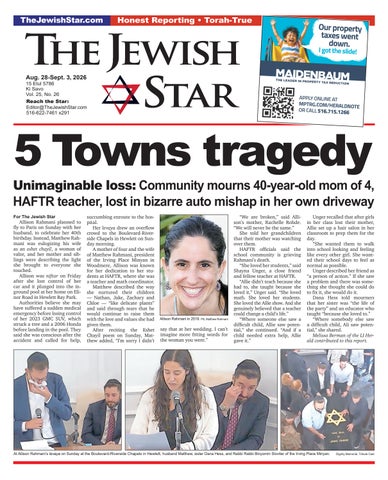
Allison Rahmani in 2019. FB, Matthew Rahmani
say that at her wedding. I can’t imagine more fitting words for the woman you were.”
“We are broken,” said Allison’s mother, Rachelle Rohde. “We will never be the same.” She told her grandchildren that their mother was watching over them. HAFTR officials said the school community is grieving Rahmani’s death. “She loved her students,” said Shayna Unger, a close friend and fellow teacher at HAFTR. “Allie didn’t teach because she had to, she taught because she loved it,” Unger said. “She loved math. She loved her students. She loved the Allie show. And she genuinely believed that a teacher could change a child’s life.” “Where someone else saw a difficult child, Allie saw potential,” she continued. “And if a child needed extra help, Allie gave it.”
Unger recalled that after girls in her class lost their mother, Allie set up a hair salon in her classroom to prep them for the day. “She wanted them to walk into school looking and feeling like every other girl. She wanted their school days to feel as normal as possible. Unger described her friend as “a person of action.” If she saw a problem and there was something she thought she could do to fix it, she would do it. Dana Hess told mourners that her sister was “the life of the party” and an educator who taught “because she loved to.” “Where somebody else saw a difficult child, Ali saw potential,” she shared. Melissa Berman of the LI Herald contributed to this report.
At Allison Rahmani’s levaya on Sunday at the Boulevard-Riverside Chapels in Hewlett, husband Matthew, sister Dana Hess, and Rabbi Rabbi Binyomin Sloviter of the Irving Place Minyan.
Dignity Memorial, Tribute Cast
August 28-September 3, 2026 • 15 Elul 5786 THE JEWISH STAR
2
NYC puppet fest felt like Jew-hating ‘lynch mob’ By Debra Nussbaum Cohen, JNS A Brooklyn Jewish mom expected an entertaining outing when she took her 4-year-old to a recent puppet festival. Instead, she found herself and her son listening to a recitation of Israel’s “war crimes” and keffiyah-clad performers taking part in a Gaza flotilla during a show billed as being about the quirks of living in New York City. The performances were part of International Puppet Fringe Festival NYC, which is partially funded by the New York City Department of Cultural Affairs and New York State Council on the Arts, and took place in lower Manhattan from Aug. 12 to 16. “They started with relatable New York skits, like about the pizza rat,” the mom, who declined to be named “because of the current environment,” told JNS, of a viral video of a rat dragging a discarded slice of pizza in a city subway station. Another skit was about the perils of parking on New York City streets. “Performers had a cardboard car and showed the parallel parking shuffle,” when street cleaning rules require drivers to move their cars from one side of residential streets to the other, the mom said. During the city-themed parts, the mom, who came to the United States from the former Soviet Union as a 7-year-old, told JNS that she “and the audience were one.” “Everyone liked it,” she said. After about 15 minutes, “a woman came in with a piece of paper and began reading a litany of accusations against Israel, and people began chanting ‘shame, shame,’” she saud. Soon after that, eight performers grouped as a flotilla of ships bound for Gaza, the mother said. “It felt like a lynch mob,” she said. (The NYC Department of Cultural Affairs did not immediately respond to a request for comment.) “You feel naked, because you realize all these people knew who I was,” she said, since she didn’t join in the chant. “If I was by myself I would have
A performance at the International Puppet Fringe Festival NYC in August 2026.
just made an exit, but I was with my family and had a bunch of belongings.” The experience was “pretty nauseating” for the mom. “I’m an immigrant from the former Soviet Union, so antisemitism is why I’m here in the first place,” she said. “To see it out in full effect in the daylight is awful.” The mom shared a photo of part of the festival with JNS but said that she was too shaken to document the antisemitic parts. Boxcutter Collective, the puppetry troupe, was one of several dozen to appear at the 2026 Puppet Fringe Festival. On Facebook, the group described its performance as a “celebration of the place we all love and live in: New York City,” with “dancing skyscrapers, giant rats, fossil-fuel-fighting flowers, a live brass band and Lady Liberty herself.”
Courtesy of attendee
There was no mention of Israel or the Gaza war. Manuel Morán, founder and producer of International Puppet Fringe Festival NYC, told JNS that “theater and puppetry have always been political art forms.” “Especially in this moment, we believe there is value in making space for artists to express different perspectives and in encouraging audiences from all backgrounds to engage with the work,” Morán said. Morán, who is also founder, CEO and artistic director of Teatro/SEA, told JNS that festival organizers may not have been aware of the antiIsrael content before it was performed. “As with many festivals, the full content of a production is not always known in advance, and the company premiered many elements of this work as part of the event,” he told JNS. “We stand behind
our role in providing a platform for artists while recognizing that artists are responsible for their own work and should be able to speak to it directly.” In late November 2023, not even two months after Oct. 7, Boxcutter Collective took part in a Brooklyn event called “Let’s stand together for the people in Gaza! Fundraiser and action the Gaza Monologues.” The event took place on the “international day of solidarity with the Palestinian people,” which Boxcutter described as “a significant day for those who value justice, equality and freedom for the Palestinian people.” “As an organization with deep roots in supporting marginalized artists and communities, we at Teatro SEA understand the impact of discrimination and rejection, and we do not support racism or hatred directed at any community,” Moran said. “At the same time, we believe in artistic freedom and in creating a space where artists can present their work and audiences can encounter a range of perspectives,” he said. “We do not believe in censorship in the arts.” He also noted that a Jewish group performed at the festival. The Magid Ensemble performed “Shterna and the Lost Voice,” described in the program as “an original tale developed through years of research on Yiddish (Eastern-European diasporic Jewish) folklore, and an original live klezmer score.” An Israeli troupe, Tel Aviv-based Hanut Theater Company, was invited to participate in the puppet fringe festival but could not attend. Hanut leader Shachar Marom said that the group could not arrange visas for artists to come to the United States, and the festival did not help facilitate them. Artists didn’t want to risk being turned away at the border, Marom said. Moran, of the festival, told JNS that Hanut told the festival that it was advised by Israeli officials not to participate without extensive security protection.
‘Goyslop’ and ‘gorillion’: Language reinforces hate By Jessica Russak-Hoffman, JNS
A new study of online antisemitism found that coded language originating on fringe forums is migrating into mainstream online discourse, where its original meaning can become less apparent to outsiders while remaining recognizable to extremists. The Institute for Strategic Dialogue analyzed roughly 305,000 posts classified as antisemitic, collected between September 2025 and March 2026 from more than 15 platforms and forums, including 4chan, X, YouTube, Reddit, Telegram, Tumblr and Bluesky. Researchers used roughly 1,000 keywords to identify potential posts before classifying them with a language model grounded in the International Holocaust Remembrance Alliance’s working definition of antisemitism.
The report, published on Aug. 20, examines what ISD calls “lexical laundering,” defined as the process by which extremist vocabulary moves from fringe spaces into mainstream discourse while retaining its original in-group meaning and becoming more “deniable” to outsiders. Of the 47,119 posts classified as antisemitic hate speech directed at other users, roughly 51% originated on 4chan. ISD cautioned that the figure understates the platform’s role because its data was downsampled to 20% to comply with export limits. Corrected for the downsampling, 4chan accounted for roughly 84% of such posts, according to the report. One example is “goyslop,” a term that emerged from a conspiracy theory claiming that Jewish elites deliberately promote unhealthy processed food to weaken non-
Jews. The term later spread into health and wellness communities on X, Reddit, YouTube and Bluesky. One creator used it in 37 videos over six months, including a post that received 205,000 engagements. “It works, in part, because the words are Trojan horses. Slang does not receive the same scrutiny as an argument, so an obscure shell (for example, goy, the Hebrew and Yiddish word for a non-Jew) can seem like harmless internet slang,” the report states. “Thus, it gets waved through, ideology and all.” Another example is “gorillion,” a Holocaust-denial term that “mocks the six million Jews murdered by Nazis, substituting an absurd, invented figure (‘six gorillion’) to frame the death toll as fabricated.” ISD found that its use surged on X beginning in October 2023 as the war in Gaza unfolded, even as
use on 4chan remained relatively flat. “Gorillion’s antisemitic meaning is recognizable only to those familiar with the reference — especially when used without the ‘six’ prefix,” the report states. “It’s this obscurity to outsiders that provides the deniability more explicit slurs lack.” ISD said the findings pose a challenge for online platforms that rely on lists of banned words or other forms of automated detection. Instead, it recommended monitoring how terms move from fringe forums to higher-reach platforms, tracking accounts that carry vocabulary between online communities and watching for sudden spikes in mainstream use of previously obscure terms. “The next goyslop has likely already been coined,” the report states. “The open question is whether anyone is tracking its migration before it arrives.”
Dolly Parton, singer, songerwriter, inspired PJ Library Country music singer Dolly Parton died in Nashville, Tenn., her family announced on Tuesday. She was 80 years old. Her philanthropic Imagination Library program inspired Jewish philanthropist Harold Grinspoon to start PJ Library, which distributes Jewish books to children, JNS reported. “My daddy didn’t get a chance to learn to read or write, and that was so hard for him,” Parton said in a 2023 interview with PJ Library. “He was one of the wisest men I have ever known, but his inability to read kept him from
fulfilling all his dreams. Inspiring kids to love books and reading early in life became a passion for me.” She noted that she was “a big believer in putting my money where my heart is. But it’s impossible to do this work alone.” A Christian who once told the New York Times that she kept a Bible on her nightstand, Parton was born in a one-room cabin in Pittman Center, Tenn., in 1946. She was the fourth of 12 children. Her family moved into a two-room cabin and farm on Locust Ridge when she was
a child, a replica of which is displayed at Dollywood, Parton’s theme park in Pigeon Forge, Tenn. Parton met her husband, Carl Dean, outside a laundromat on the first day she arrived in Nashville, one day after graduating from high school. They married two years later in 1966. They never had children. Dean died in 2025. Some of her most well-known musical hits include “Islands in the Stream,” “Jolene,” “9 to 5” and “I Will Always Love You.” Parton’s songs tend to include Bible refer-
ences, including the songs “Coat of Many Colors” and “The Master’s Hand.” She was said to have written thousands of songs, not just for herself but for artists across the musical spectrum. In 1976, she began working with Sandy Gallin, her personal manager, who was Jewish. In her 2020 visual memoir “Songteller,” Parton wrote about Gallin, “Nobody could quite get how the Christian Southern girl and the New York Jewish boy could have so much in common. But it was real.”
3 THE JEWISH STAR August 28-September 3, 2026 • 15 Elul 5786
Want to live healthier and longer? Schedule your wellness exam with a Primary Care Physician at EHS. Our physicians help you navigate: Your blood pressure
Specialty referrals
Cancer screenings
Symptoms and solutions
Chronic disease management
Vaccinations
Partnering with you every step of your healthcare journey.
Book your appointment today at 718-EHS-DOCS (347-3627) or ehs.org/booknow.
EHS Primary Care at Rockaway Beach: 105-38 Rockaway Beach Blvd, 2nd Floor, Rockaway Park, NY 11694
1357669
Walsh Ambulatory Pavilion: 19-20 Brookhaven Avenue, Far Rockaway, NY 11691
August 28-September 3, 2026 • 15 Elul 5786 THE JEWISH STAR
4
Bahrain Jews: Small community, long memory MICHAEL FREUND
Wandering Jew
L
ong before oil transformed the Arabian Gulf, skyscrapers rose over Manama, and the Abraham Accords brought Israel and Bahrain into open diplomatic partnership, Jews were already part of the region’s story. Their presence in Bahrain reaches back well over a millennium, to a time when the Gulf was a crossroads of trade, travel and faith. Indeed, to understand the importance of Bahrain’s Jewish community, one must first remember that the term “Bahrain” once referred not only to the modern island kingdom, but to a broader region along the eastern coast of Arabia. Jewish sources, Arabic accounts and medieval travel literature all point to a Jewish presence in that wider Gulf area long before Islam. The Talmud (Yoma 77a) mentions the “seaport of Mashig” and indicates that Jews resided there. In his commentary, the Ben Ish Hai (Rabbi Yosef Haim of Baghdad, 1835-1909), states, “It appears that the port of Mashig is the place that is now called by the name Bahrain.” There are also references to Jews living in Hajar, then the capital of Bahrain, at the time of the early Islamic conquests. In 629 CE, according to historical accounts, Muhammad sent Al-Ala’a Al-Hadhrami to the ruler of Bahrain, calling on its inhabitants to accept Islam. Many did, but some communities, including Jews, chose to retain their faith. That detail is striking. More than 1,300 years ago, Jews were living in the region, recognized as a distinct religious community. They were not newcomers, outsiders or colonialists. They were part of the human landscape of Arabia and the Gulf. enturies later, the great 12th-century Jewish traveler Benjamin of Tudela (also known as Benjamin ben Jonah) described Jewish communities in the wider Gulf. He recorded Jews living in commercial enclaves, including Al-Qatif, northwest of Bahrain, and noted their involvement in the pearl trade. In those days, pearls were one of the region’s great sources of wealth, and Jewish merchants, like others, moved through the ports and markets that linked Arabia, Persia, India and beyond. This ancient background matters because it reminds the world of something too often forgotten: Jewish life in the Middle East did not arrive in the region as an import. Jews lived, traded, prayed and built families across the Arab and Muslim world for centuries. The modern Jewish community of Bahrain took shape in the late 19th century, when Jewish families from Iraq, Iran and India settled in Manama. The Yadgars came
C
The synagogue in Manama is a reminder of a longenduring Jewish presence.
National flags of Bahrain, Israel and America on an El Al plane taking a delegation to Bahrain to sign bilateral agreements between Jerusalem and Manama, on Oct. 18, 2020. Marc Israel Sellem, POOL
Bahrain’s Jews were not merely relics of a vanished past — they were citizens with names, voices and responsibilities. The Abraham Accords did not create this history. The agreement revealed it. fter Bahrain and Israel normalized relations in 2020, doors that had long been closed began to open. Bahraini Jews could reconnect more freely with Israel and with the wider Jewish world. The synagogue was renovated and reopened for public worship. Jewish visitors began to arrive. The Jewish Agency of Israel worked with the community to strengthen education and identity. Efforts were also made to restore and preserve the Jewish cemetery, where older graves tell, in silence, of a community that once was far larger. More than 1,300 years ago, Jews were living in the region, recognized as a distinct religious community, and part of the landscape of Arabia and the Gulf. This is why Bahrain’s Jewish story matters. It reminds us that Jews lived across the region for centuries. They spoke its languages, knew its markets, shared its rhythms and contributed to its development. ahrain’s Jewish community today is tiny, but its significance is immense. It stands as a living bridge between the ancient Jewish presence in Arabia, the Mizrahi mercantile networks of the modern Gulf, the trauma of 1947 and the possibilities opened by normalization. Recent Iranian missile and drone attacks on Bahrain since the start of the US-Israel war against Iran on Feb. 28 are a reminder that those possibilities are not guaranteed. The Gulf state remains in the crosshairs of conflict. In a region where Tehran still seeks to spread fear and instability, Bahrain’s decision to preserve its Jewish heritage and maintain ties with Israel takes on added meaning. It is a quiet declaration that Jewish memory in the Gulf will not be erased. The synagogue in Manama is therefore more than a restored building. It is a witness. It testifies that Jewish history in the Gulf is real and that coexistence was not merely a diplomatic slogan but a lived reality in markets, neighborhoods and families. And it testifies that even after hardship, fear and dispersal, a small community can carry a very long remembrance. In Bahrain, that memory still has a home. Michael Freund is founder and chairman of Shavei Israel, an organization that assists descendants of Jews and the Lost Tribes to reclaim their roots. Write: Columnist@TheJewishStar.com
A
The Bahrain World Trade Center in Manama. The 50-story sail-shaped twin towers are the kingdom’s iconic landmark. Leonard Andronov, Adobe
from Iraq in the 1880s. The Nonoos, Khedouris, Cohens and Roubens became familiar names. Some worked in textiles and linens; others in gold, silver, banking and trade. Ebrahim Nissim Nonoo, who was born in 1897, reportedly began as a zerryattiya, someone who extracted gold and silver threads from old garments and melted them down for resale. He eventually became a successful businessman and a member of the Manama Municipality, the capital’s city council. In time, Bahrain’s Jews became woven into the island’s civic and commercial life. They established a mikvah, maintained a cemetery and built a synagogue in Manama in the 1930s, when the community was nearing its peak. Al-Mutanabi Road came to be known as the “Jewish market,” or “Jews’ Street,” because so many shops there were owned by Jews and closed on Shabbat. Today’s synagogue in Manama, known as the House of Ten Commandments, is a relatively modern building. But it stands as a physical reminder of a much older Jewish presence — one that stretches back through the markets, ports and caravan routes of the
Former US Ambassador to Israel David Friedman in the synagogue in central Manama — where the Ten Commandments are shown in Arabic. X
Gulf.
A
t its peak in the 1930s and 1940s, Bahrain’s Jewish community may have numbered as many as 1,500 people. That is small by the standards of Baghdad, Aleppo or Casablanca, but for the Gulf, it was significant. Bahrain was never a great center of Torah scholarship or rabbinic authority. But it was home. Jewish families celebrated holidays, conducted business, buried their dead and contributed to the country around them. Then came the rupture. In December 1947, after the United Nations had voted to partition the Land of Israel, violence struck Manama’s Jewish quarter. Jewish homes and shops were looted. The synagogue was ransacked. Torah scrolls were stolen. One Jewish woman was killed and others were injured. For Bahrain’s Jews, the shock was devastating. Many had lived peacefully with their Muslim neighbors for years. The effect was irreversible and the sense of security had been shattered. Many Jews left for Israel, Britain or the United States. After the 1967 Six-Day War, more departed. By the beginning of the 21st century, only a few dozen remained. That is what makes Bahrain’s Jewish story so unusual. In many Arab countries, Jewish history became a matter of abandoned synagogues, crumbling cemeteries and memories preserved in exile. In Bahrain, however, a remnant, albeit small, endured on the island itself. More than that, Bahraini Jews continued to play a visible role in public life. •Ebrahim Daoud Nonoo became a member of Bahrain’s Shura Council. •His cousin, Houda Nonoo, made history in 2008 when she was appointed Bahrain’s ambassador to the United States, becoming the first Jewish ambassador sent abroad by an Arab country. •Nancy Khedouri, author of a history of Bahraini Jewry, has also served in the Shura Council and worked to preserve the community’s heritage. For a Jewish community numbering perhaps 30 to 50 people, that is extraordinary.
B
By Rebecca Szlechter, JNS If schools devote just 45 minutes to a lesson that situates the Holocaust in the broader history of antisemitism and its impact on Jews, they can go a long way to dispelling harmful conspiracy theories, according to new research from the Anti-Defamation League’s Center for Antisemitism Research. “This research is significant in that it features evidence from real classrooms,” stated Matt Williams, vice president of the center. “We now have data showing that a single, well-designed lesson, taught by educators with no special training, can measurably shift how teens think about antisemitism.” “That’s a solvable problem for schools,” Williams told JNS. “Based on our research, districts don’t need a semester-long unit or a major new investment to make progress. They need the right 45 minutes, and now we’re closer to knowing what that looks like.” In the study, 372 middle and high school students from nine schools in a larger school district in the southeastern part of the United States were randomly assigned either a control lesson or the one that researchers wanted to measure. They found that those who learned the latter were 14.4 percentage points more likely to disagree with the statement that Jews have too much power in the United States. They were also 15.5 percentage points less likely to say that Jews are more loyal to Israel than to America and 13.6 percentage points less likely to minimize Jew-hatred, per the study. The study’s importance goes beyond showing that students can respond to lessons about antisemitism, according to Williams. ADL researchers previously tested dozens of approaches to Holocaust education in laboratory studies, allowing them to identify strategies that appeared more promising before bringing
Auschwitz-Birkenau in 2018.
one into actual classrooms. “The way that this kind of research works is you start with your big questions, you study them in the lab, you see which has measurable effects there, and then you bring it into the field,” Williams said. “The reason why we went into a field study with this one is that teaching the Holocaust as an example of antisemitism, and grounding that in the effects that it has on the Jewish population, seemed like the more promising, among the more promising strategies for Holocaust education overall,” he said. The classroom study found no evidence of a backlash. Some students didn’t change their attitudes, but researchers didn’t detect students becoming more antisemitic as a result of the lesson, according to Williams. Specialized knowledge of Holocaust educa-
Menachem Wecker
tion is valuable, but the study demonstrates that the approach can produce an effect without extensive professional development, he said. “What we’re looking at is something that’s a little bit more off-the-shelf, which actually makes it a potentially more scalable program,” he said. The findings come as Jewish students across the country face increased Jew-hatred in schools. “We’ve long believed that education is one of our most powerful tools in the fight against antisemitism and hate, and this research confirms it,” stated Jonathan Greenblatt, CEO and national director of the ADL. “As Jewish students across the country are experiencing increased antisemitism, we believe we can provide a clear, practical path forward for schools to address this scourge everywhere,”
he stated. The findings also demonstrate that schools can intervene in a way that produces positive outcomes. “We’re relatively confident that there is an available avenue to surface the conversation about antisemitism in schools, and ways that causally produce positive outcomes,” he said. He discouraged seeing the lesson as a standalone solution to antisemitism, though. “There’s no single intervention or magic bullet that’s gonna take us out of the particularly complex, and frankly, crisis period that we’ve been in for the past few years now,” he said. The research is part of a broader effort to identify interventions that work and give schools evidence to guide their decisions. Schools don’t need to universalize the Jewish experience or connect antisemitism to other forms of hatred to get students to care about antisemitism, according to Williams. “It is impactful, on its own, to teach about the Holocaust in the context of Jewish experiences with antisemitism,” he said. “We don’t need to persuade people to care about antisemitism by appealing to how it matters to them.” Educators don’t need to convince students that antisemitism matters, because it could eventually affect them or because it is one example of a broader category of hate. The Jewish experience can be the basis for teaching students about antisemitism. Comparing antisemitism with other forms of hatred or universalizing the lesson can sometimes have the opposite effect, according to Williams. “We don’t need to compare, or to universalize, or to have the same effect, and in some cases, that comparison can actually activate competitive victimhood and produce a backlash, which we don’t want to see right now,” he said.
| GET READY | for straight-A style | AMERICAN EAGLE OUTFITTERS FOOT LOCKER HOLLISTER CO. MACY’S OLD NAVY THE CHILDREN’S PLACE +MORE
ShopGreenAcres.com GAM-26159 A2 BTS Print Ad_VERSION 2.indd 2
1358871
SCAN FOR SALES & OFFERS
8/10/26 2:35 PM
THE JEWISH STAR August 28-September 3, 2026 • 15 Elul 5786
‘Right 45 minutes’ can shift teens on Jew-hate
5
August 28-September 3, 2026 • 15 Elul 5786 THE JEWISH STAR
6
Digital book revisits controversial Qumran find By Steve Linde, JNS More than three decades after an extraordinary archaeological discovery near Qumran sparked worldwide attention and fierce debate, a new research project is seeking to determine whether a mysterious reddish-brown substance unearthed in a sealed cave could be remnants of Ketoret, the sacred incense burned twice daily in the First and Second Temples in Jerusalem. In early July, Project Qumran — a nonprofit Israeli research initiative dedicated to documenting and scientifically investigating the discovery — released The Ketoret: A Source-Based Historical Account of the Qumran Incense Discovery, a free digital publication that reconstructs the history of the controversial 1992 excavation and outlines a new effort to subject surviving samples to modern scientific testing. The book, written by Israeli journalist Adam Eliyahu Berkowitz under the research and editorial direction of M. Rhonda Attar, compiles eyewitness interviews, laboratory reports, excavation records, archival documents and photographs into what the organization describes as the first comprehensive documentary account of the discovery. Rather than arguing that the material has been conclusively identified as Temple incense, the authors present the available evidence and invite readers to evaluate it for themselves.
A remarkable discovery
The story begins in May 1992, when archaeologist Vendyl Jones led excavations at a cave south of the ancient Qumran settlement near the Dead Sea. Jones, a former Baptist minister from Texas who later embraced the Noahide faith, spent decades searching for treasures described in the Copper Scroll, one of the Dead Sea Scrolls. During excavations at what he called the Cave of the Column, his team uncovered a sealed recess beneath a flat stone containing hundreds of kilograms of fragrant reddish-brown organic material. Volunteers recalled that the aroma lingered on their clothing for days after handling the substance. The discovery attracted immediate international media attention after Jones held a press conference before formally reporting the find to
Israeli authorities. Soon afterward, the excavation permit was revoked, work at the site ceased and the material passed into private custody. According to Project Qumran, much of the original cache later disappeared, while one of its final known custodians was murdered. The whereabouts of the bulk of the material remain unknown.
Renewed investigation
Project Qumran says it has now assembled several surviving samples from the original discovery, including a mason jar of the reddish-brown powder donated by Anita Shay Jones, Vendyl Jones’s widow, who asked that it be returned to Israel. “Please bring this back home to Israel where it rightfully belongs,” she told a visiting researcher as she handed over the jar, according to the project. The organization also says it has recovered additional remnants from private collections, including dust believed to be from the original cache, which was found in a bomb shelter in Samaria.
Scientific clues
Two independent scientific analyses conducted in 1992 produced intriguing results. Rabbi Dr. Marvin Antelman, a chemist affiliated with the Weizmann Institute of Science in Rehovot, analyzed a sample using mass spectrometry and atomic analysis. According to Project Qumran, he identified eight of the 11 principal ingredients listed in rabbinic sources describing the Temple incense, including myrrh, frankincense, cinnamon, saffron and costus. A separate study by palynologist Dr. Terry Hutter identified plant fragments corresponding to at least nine of the 11 traditional ingredients. Hutter also described the fragrance released when the sample container was opened as “profuse and almost immediate.” Both scientists cautioned at the time that definitive identification would require more advanced testing than was available in the early 1990s. Perry Antelman, son of the late Marvin Antelman and a board member of Project Qumran, is overseeing plans for a new round of scientific
analysis using technologies unavailable three decades ago. “Scientific testing has changed dramatically since the 1990s,” Antelman said. “Those early tests gave us a solid chemical foundation; now we’re layering on independent lines of evidence. And we’re doing it blind: The analysts don’t know what this material is suspected to be.” Researchers plan to conduct radiocarbon dating, elemental analysis, organic carbon testing and phytochemical studies before comparing the results with ancient descriptions of the Temple incense. “We cannot recover the tremendous amount of material that was lost,” Antelman said. “But we can still honor the discovery by testing what remains with the greatest care possible. After all the claims, all the memories and all the controversy, we owe it to history, the Jewish people and ourselves to bring this question as close to resolution as the evidence will allow.”
Qumran: Cave of the Column, also known as “Ma’arat Teumim” (The Twin Caves), July 2026. Project Qumran
Questions remain
The Ketoret: A Source-Based Historical Account also revisits two longstanding controversies. One concerns the quantity of material originally discovered. Early reports estimated the cache at about 600 kilograms (1,320 pounds), while some eyewitnesses later suggested it may have been closer to 300 kilograms (660 pounds). The other involves the identity of the Qumran community itself. The prevailing scholarly view associates Qumran with the Essenes, a Jewish sect generally believed to have distanced itself from Temple worship. Other researchers have argued that the site served as a refuge for Temple priests who may have hidden sacred objects there before the Roman destruction of Jerusalem in 70 C.E. Project Qumran does not attempt to resolve either debate. Instead, it argues that the surviving documentary record and the remaining physical samples justify a final round of scientific testing. “The sourcebook [the Source-Based Historical Account] explicitly states that the material Jones discovered in 1992 has not been definitively identified as the Ketoret,” Berkowitz said. “Its claim is that the evidence gathered over 33 years is suffi-
‘The Ketoret: A Source-Based Historical Account of the Qumran Incense Discovery’ is available as a free download at projectqumran.org. Project Qumran
cient to demand proper scientific follow-up.” The Ketoret: A Source-Based Historical Account of the Qumran Incense Discovery is available as a free download from Project Qumran, with a hardcover edition expected to be released later this year.
Rabbi Steinmetz book presents ‘A Proud Jew’ Rabbi Chaim Steinmetz of Congregation Kehilath on the Upper East Side has published “A Proud Jew,” drawing on his weekly Torah essays. The essays collected in the new volume, his third book, reference weekly Torah portions, the holidays, Jewish life and contemporary events. Together, they explore what it means to live as a Jew in a complicated world and why Jewish identity should be a source of strength rather than something to conceal. The book’s title comes from one of its essays, but as Rabbi Steinmetz writes in the preface, it reflects the message of the entire collection: “Our mission is to carry with pride Judaism’s message to humanity.” That message has taken on particular urgency in Rabbi Steinmetz’s work in New York. Alongside his role as teacher, clergy and spiritual leader, he has become a prominent advocate for Jewish safety and a vocal opponent of antisemitism. He has repeatedly called on New York City leaders and law enforcement to protect Jewish institutions and ensure that Jews can live openly and safely.
In 2019, he called on the NYPD to provide security for synagogues, arguing that protecting houses of worship is a government responsibility. More recently, as antisemitic incidents have affected Jewish communities across New York, he urged Jews not to retreat from public Jewish life but instead to stand together with pride. The book also reflects the breadth of the rabbi’s pastoral career. As he writes in the preface, rabbinic life involves everything from the mundane — “reviewing budgets and caring for terrazzo” — to moments of tragedy and joy. His stories include funerals, weddings, illness, unexpected encounters and the birth of a child after nearly two decades of infertility. These experiences have shaped his perspective on Jewish life and the human experiences addressed throughout the collection. A Proud Jew follows Rabbi Steinmetz’s earlier books, including “Despite Everything: A Chronicle of Jewish Resilience in the Aftermath of October 7th.” Reported by Congregation Kehilath Jeshurun.
Rabbi Chaim Steinmetz with his previous book, “On the Broken Path: The Torah of October 8th.” KJ
7
THE JEWISH STAR August 28-September 3, 2026 • 15 Elul 5786
1357379 1249534
August 28-September 3, 2026 • 15 Elul 5786 THE JEWISH STAR
8
HEALTH, MIND & BODY
Hadassah surgeons do first-in-Israel treatment Neurosurgeons at the Hadassah Medical Organization, Hadassah’s medical center in Jerusalem medical used an innovative therapy involving intracranial alpha radiation to treat a patient with recurrent glioblastoma. Hadassah developed the therapy, called Alpha DaRT, in collaboration with Alpha Tau Medical, an Israeli oncology therapeutics company, to treat aggressive cancers of the head and neck, pancreas, skin and lungs. The procedure, part of a Phase 1 clinical trial of Alpha DaRT (Diffusing Alpha-emitters Radiation Therapy), was led by Yigal Shoshan, MD, Director of Neurosurgery, Oncology and Stereotactic Radiosurgery at Hadassah. Preliminary results of the Phase 1 trial published so far in the United States have aroused great interest in a neuro-oncology community dealing with a disease with extremely limited treatment options.
The new technology is based on the introduction of tiny sources that emit high-bioefficient alpha particles. Because the particles need travel only a short distance, the radiation is primarily concentrated in the tumor area, with minimal damage to nearby healthy brain tissue — a critical therapeutic advantage in such a sensitive organ. Beyond Alpha DaRT’s localized ef-
fect, preclinical studies also suggest that the treatment may trigger an immune response to the tumor in other brain regions, a research area currently under active investigation. The surgery was performed on a 77-year-old patient with recurrent glioblastoma, the most common and most aggressive brain tumor in adults. It almost always recurs even after surgery followed by radiation and chemo-
therapy. To solve the technical challenge of covering as much of the patient’s large tumor as possible without sacrificing accuracy, Dr. Shoshan and his team implanted Alpha DaRT sources into the tumor through two separate trajectories simultaneously. This was the first time in the world a dual-trajectory approach had been used. Approximately 14,000 people
worldwide are diagnosed with glioblastoma each year, according to the National Cancer Institute. Unfortunately, the disease recurs in the vast majority of patients even after surgery followed by radiation and chemotherapy. The median survival period is 12 to 18 months, and only 5 to 7 percent of patients live for 5 years after their diagnosis, reports the Glioblastoma Research Organization. In Israel, 150 to 250 people are diagnosed with glioblastoma annually, the median survival period is roughly 15 to 16 months, and only 10 percent of patients live for 5 years after their diagnosis. For Hadassah’s research team, the successful operation was just the latest stage of a multi-year scientific journey that has moved from the laboratory to preclinical research to the development of the Alpha DaRT technology and its surgical application to the first clinical application in humans.
Ackman aids research after daughter’s hemorrhage
By Debra Nussbaum Cohen, JNS In early February, billionaire Jewish hedge fund manager Bill Ackman’s 26-year-old daughter, Lucy, suffered a massive brain bleed which has left her totally blind and unable to speak. One of Ackman’s responses to his daughter’s medical crisis has been to make a massive investment in brain health and rehabilitation. Lucy is slowly rehabilitating and has recovered the ability to walk short distances and to understand everything going on around her, Ackman wrote. He said that he has since purchased two large buildings and an adjacent vacant lot in midtown Manhattan with the goal of creating “the world’s greatest brain research, reha-
bilitation, recovery, human optimization and longevity institute.” The “patient-centric” organization is being called the Ackman Oxman Institute and is named both for his family and that of his wife, IsraeliAmerican technology-based designer and former Massachusetts Institute of Technology professor Neri Oxman. Ackman is not working directly through universities on this project “due to politics outweighing meritocracy, protests that disrupt learning” and the “curse of antisemitism” on campus, he said. The new institute in the West 60s will be on 3.4 acres and is being funded with an initial donation of 10 million shares of Pershing Square, stock worth an estimated $400 million, ac-
cording to a public filing by Ackman. The dividends that produces over time will fund AOI’s work, wrote Ackman, who is estimated to currently be worth nearly $9 billion He and his wife will be making another donation, not of Pershing stock, that may be even larger, Ackman wrote, to provide runway funding for innovations created at AOI to become commercially viable and to limit the need for the new institute’s staff to focus on fundraising. AOI will be a nonprofit with “highly commercial instincts,” wrote Ackman, the CEO of Pershing Square Capital and co-creator of the Pershing Square Foundation, which is purchasing the New York City properties. It will be “laser-focused on cures,
treatments, devices, rehabilitation and exercise equipment, and targeted and basic research with a goal of massively accelerating the time from idea to innovation to production to helping a patient,” he wrote. The new nonprofit “will have its own venture funding and will work to develop innovations to create companies that we will seed, assist and spin out to ensure technologies, treatments, techniques and drugs get to patients as promptly as possible.” Ackman, who is 60 and a longtime supporter of Jewish causes and the Democratic party, wrote that “we will do neurosurgery, neuroscience, rehabilitation, nutrition” and device development, among other disciplines.
“We will mandate and incentivize collaboration among the teams with no silos, politics, bureaucracy or any other constraint that is inconsistent with its mission,” he stated. The night Lucy Ackman was discovered unconscious on the floor of her Brooklyn apartment by her sister, she underwent a hemicraniectomy to release pressure on her brain and remove blood left by the hemorrhage. She remained in a coma for several weeks, her father wrote, “and then awoke not being able to breathe on her own, unable to walk, see or speak.” She has since recovered her cognition and is making progress “with the beginnings of speech but remains unable to see,” he wrote.
EHS prostate cancer alert: Free screenings and advice Episcopal Health Services (EHS) hosted a free prostate cancer screening as September’s Prostate Cancer Awareness Month approached. The event, including PSA blood testing and one-on-one consultations with physicians, took place at the Walsh Ambulatory Pavilion in Far Rockaway, opposite EHS’ St. John’s Episcopal Hospital. Prostate cancer affects approximately one in eight men. When detected early, it is highly treatable and patients have more treatment options available. Sheldon Pike, MD, chief of urology, and Mark Ashamalla, MD, chief of radiation oncology, provided this advice: •Maintain a healthy weight and exercise daily. It is recommended to get at least 150 min-
utes of moderate intense activity each week or for 30 minutes 5 days a week. •Choose to eat healthy foods. Eat more fruits and vegetables; reduce your intake of red meat, especially high fat or processed meats and limit your intake of high fat dairy products. •Know your family history. Having a father or brother with prostate cancer more than doubles your risk of developing disease. •Avoid the use of tobacco and alcohol. •Get screened. The American Cancer Society recommends that average-risk men get screened at age 50; high-risk men, including African American men and those with a first-degree relative diagnosed with prostate cancer at an
From left: Mark Ashamalla, MD, chief of radiation oncology; Annu Kapoor, MSN, RN-BC, senior director oncology service; Karen Paige, MBA, RN, CPHQ, CPPS, CPXP, OCN, COO and executive vice president; Marc Warshawsky, MD, chief medical oncology.
EHS medical assistant Fernanda Jerez draws a patient’s blood at the free prostate cancer screening. EHS
early age get screened at age 45; and highest-risk men with multiple first-degree relative diag-
dividual risk and how often you should be screened. Reported by EHS.
nosed with prostate cancer at an early age get screened at age 40. Talk to your doctor about your in-
9 THE JEWISH STAR August 28-September 3, 2026 • 15 Elul 5786
The Experts at U.S. News Agree: Mount Sinai South Nassau is High Performing
1358581
mountsinai.org/southnassau
August 28-September 3, 2026 • 15 Elul 5786 THE JEWISH STAR
10
NEWS BRIEFS Sunken Altalena found, ending 78-year mystery By JNS and other sources Israel has found the wreck of the Altalena, 78 years after the infamous arms ship was sunk off the country’s Mediterranean coast. Heritage Minister Amichai Eliyahu announced Monday that the vessel was discovered intact at a depth of 1,650 feet. The newly created Israel Defense Forces shelled the Irgun ship off Tel Aviv in June 1948 amid a bitter showdown over weapons carried aboard. Sixteen Irgun members and three IDF soldiers were killed. Future Prime Minister Menachem Begin, then Irgun leader, ordered his men not to return fire in an effort to avert civil war. About a year later, the wreck was towed 15 miles offshore and scuttled. Israel’s Heritage Ministry spent about $296,000 on the hunt, deploying the national research vessel Bat Galim and advanced detection technology. “A country that is not afraid to confront the painful chapters of its history is a stronger country,” Eliyahu said.
Swiss cops eye anti-Zionist rally
Swiss police are investigating an unauthorized Basel rally promoted with the slogan “death to Zionism” — timed for the 129th anniversary of the First Zionist Congress. The Aug. 29 demonstration is being advertised online for Theaterplatz, near the site where Theodor Herzl opened the historic congress on Aug. 29, 1897. Organizers have not been identified, Jonathan Kreutner, general secretary of the Swiss Federation of Jewish Communities, told JNS. Basel requires organizers to seek protest approval at least 14 days in advance, and police have been alerted. “It’s serious and the authorities are alert,” Kreutner said. Herzl presided over the congress, which established the Zionist Organization, later renamed the World Zionist Organization. He famously wrote afterward: “At Basel I founded the Jewish State.” Israel declared independence in 1948 — 50 years and eight months after the congress.
Israel boots Swedish EU lawmakers
Israel has barred two Swedish members of the European Parliament from entering the country, accusing them of years of hostile activity against the Jewish state. Left Party members Jonas Sjöstedt and Hanna Gedin had planned to arrive Sunday night for a visit to the Palestinian Authority. The decision came at Foreign Minister Gideon Sa’ar’s request under Israel’s entry law. Israel’s Foreign Ministry said the pair had repeatedly acted against the country, including calling for international legal action against Israelis and accusing Israel of genocide, deliberately starving Palestinians and intentionally targeting children and medical workers. The move follows a string of Israeli entry bans. American anti-Zionist activist Linda Sarsour and French journalist Alice Froussard were barred earlier this year, while Israel also banned 40 activists affiliated with Euro-Med Human Rights Monitor, citing alleged ties between the organization’s leadership and Hamas terrorists.
US drops Syria terror label
Washington has officially knocked Syria off its list of state sponsors of terrorism in a dra-
The move echoes a similar decision by budget rival Ryanair. Wizz Air has gone the other way, resuming Tel Aviv service in May and negotiating to establish an Israeli hub. Such a hub could allow the Budapest-based carrier to operate as many as 30 daily Tel Aviv flights to European destinations — a prospect strongly opposed by Israeli airlines but one that could increase competition and push fares lower.
Cops stumble on ancient tomb
The Irgun ship Altalena burning off the Tel Aviv beach after being shelled by the IDF on June 22, 1948. Hans Pinn via Wikimedia
matic shift following the fall of longtime ruler Bashar Assad. The State Department also revoked the terrorist designation of al-Nusrah Front, also known as Hay’at Tahrir al-Sham. The moves followed a 45-day congressional review after President Donald Trump notified lawmakers in July that he intended to rescind Syria’s designation. Secretary of State Marco Rubio credited “the positive actions taken and further commitments by the Syrian government under President Ahmed al-Sharaa to fully distance Syria from acts of international terrorism.” Al-Sharaa, a former HTS leader, became president of Syria’s transitional government after Assad’s December 2024 ouster. The Treasury Department also removed HTS from its sanctions list. Syria had been designated a state sponsor of terrorism since 1979, restricting foreign assistance, defense exports and certain financial transactions.
Watchdog blasts Gaza journalists list
More than half the people on a prominent list of journalists killed in Gaza had ties to terrorist groups, according to an audit reported by the Washington Free Beacon. The New York-based Committee to Protect Journalists lists 209 journalists killed in Gaza. But an audit by media watchdog HonestReporting found at least 120 had ties to terrorist organizations including Hamas, the Free Beacon reported. It said 56 were “active, violent militants” when killed. The explosive findings come as the committee reviews its casualty list. “Evidence is increasingly indicating that terrorists were giving themselves press passes so that they could manipulate journalists into manufacturing outrage about the persecution of ostensible colleagues,” HonestReporting told the Free Beacon. The Committee to Protect Journalists told the newspaper it could not comment on the audit while its review remained underway.
DR adopts antisemitism definition
The Dominican Republic is adopting the International Holocaust Remembrance Alliance’s working definition of antisemitism, becoming the seventh Latin American country to do so. Foreign Minister Víctor Bisonó announced the move Monday night. Argentina is the region’s sole full IHRA
member, while Colombia, Costa Rica, Guatemala, Panama and Uruguay previously adopted the definition. The definition offers guidance for determining when criticism crosses into antisemitism, including applying double standards, denying Jewish self-determination or invoking classic antisemitic tropes. The Dominican Republic has a distinctive Jewish history. Before and during the Holocaust, it offered to accept as many as 100,000 Jewish refugees, although most never reached the country. Its town of Sosúa became home to Jewish refugees, who helped develop a local agricultural industry. Globally, 46 national governments have adopted the IHRA definition, along with dozens of U.S. states and more than 1,000 entities.
United revives ’Frisco route
United Airlines is putting San Francisco-Tel Aviv flights back on the board next spring as international carriers continue rebuilding their Israel schedules. The airline said Tuesday that it will restart the route March 28, offering three flights per week. United is also returning to Israel from its Newark hub next month, two days after rival Delta Air Lines resumes New York-Tel Aviv service. United’s Chicago and Washington, D.C., routes to Israel are scheduled to return in October, while Delta plans to begin Atlanta service in December. United historically has offered more flights to Israel than any other U.S. carrier. El Al Airlines, meanwhile, announced in June that it would resume nonstop San Francisco service in October after a six-year break, tapping demand between the two major technology hubs.
EasyJet grounded again
EasyJet is keeping Tel Aviv off its flight map through next summer, even as other international airlines return to Israel. The British low-cost carrier announced Tuesday that it was extending its suspension for another season. “We have taken the decision not to operate to and from Tel Aviv next summer as part of our continuous review of our flying program,” EasyJet said. No customers are directly affected because tickets for the period had not yet gone on sale, the airline said.
A police operation in eastern Jerusalem took an unexpected turn Tuesday when Israeli Border Police officers uncovered an ancient burial cave beneath a building. The discovery came in Silwan during an operation connected to a violent dispute between local families, police said. Israel Antiquities Authority experts tentatively dated the graves to the Second Temple period, from 516 BCE to 70 CE. Police secured the site while antiquities experts examined the archaeological find. It’s the latest ancient surprise to emerge from beneath Jerusalem. In July, archaeologists announced the discovery of a rare mold used to cast the face of a female figurine from the First Temple period — the first production mold of its kind found in Jerusalem. Other recent excavations in the City of David uncovered massive charred wooden beams believed to have collapsed during the Babylonian destruction of the First Temple in 586 BCE.
Lawmaker hit in holiday feud
A Georgia political feud erupted after a Young Democrats group told the state Legislature’s only Jewish member to “mind her own business” following her effort to address a fundraiser scheduled for Rosh Hashanah. State Rep. Esther Panitch contacted the Gwinnett County Democratic Party about possibly changing the date of its Bluetopia fundraiser so Jewish supporters could attend. The party said the date could not change and initially told Panitch keynote speaker David Hogg would be replaced — something she had not requested. It later said Hogg would remain in the lineup. Gwinnett County Young Democrats then called Panitch “hateful,” accused her of spreading false information about Hogg and alleged “transphobia, racism and Islamophobia.” The Jewish Council of the Democratic Party of Georgia condemned the attack and demanded an apology. Panitch is the council’s first vice chair.
UNICEF hits anti-Israel merch
UNICEF UK apparently cut ties with a marketing employee linked to an online store selling merchandise featuring violent anti-Israel imagery, a British pro-Israel legal group says. UK Lawyers for Israel said Muhammad Karim disappeared from a UNICEF directory and removed his UNICEF credentials from LinkedIn after the group raised concerns Aug. 9. The group linked Karim to Solid Mujahid, an online shop that has since disappeared. Merchandise allegedly included a shirt showing a watermelon throwing a lit firebomb at an Israeli tank, “Death Death to the IDF” hoodies and an item saying “Punch a Zionist.”
Making Jewish journalism great again.
THE JEWISH STAR August 28-September 3, 2026 • 15 Elul 5786
Seeking truth. Trusting our readers.
11
August 28-September 3, 2026 • 15 Elul 5786 THE JEWISH STAR
12
WINE AND DINE Food from around the world for Rosh Hashana Kosher Kitchen
JONI SCHOCKETT
JEWISH STAR COLUMNIST
S
oon, as sunset travels hour by hour around the globe, more and more Jews will begin to celebrate Rosh Hashana. From the time I realized how the time zones work, I have always been fascinated by the rolling effect this has. Just as we finish services, another group begins — until within 24 hours, everyone around the world has begun the holiday and ended it. When I was younger, I was amazed that millions of people around the world, no matter what language they spoke, were all reading Hebrew prayer books and all saying and chanting the same prayers. What I never wondered about, as I went home to my chicken soup or whatever my mother had made, was what were all these Jews eating? I assumed in my childish way, that everyone was eating chicken soup and roast capon or brisket or tsimmes or whatever else we were eating. I never thought that Chicken soup in Newton, MA may not be the same as chicken soup in Italy or France or Argentina. We all know that Italian food comes from Italy, French food from France and Mexican food from Mexico. But Jewish Food? Jewish food is wherever you find Jews. Jewish food evolves; it is the food of the country of birth combined with the Jewish traditions of the family and the cultural customs and ingredients indigenous to the new country. nlike other ethnic foods which are associated with the countries from which they come, Jewish cooking has no such geographical boundaries. Jews have wandered the world and
U
Fish Fillets Served In Lettuce Cups. taste.com.au
landed at one time or another in, well, everywhere! As they became entrenched in the culture, they adopted and adapted, and a new Jewish cuisine was created often with little relationship to the Jewish cuisine of any other country. So while Italians connect anywhere there is an Italian restaurant, what connected Jews? The one constant throughout the millennia that has threaded and weaved through any geographical boundaries is kashrut; those who keep kosher observe the same dietary laws no matter where they live. The spices may differ, the cooking methods may differ, but the overriding laws of how to slaughter
Honey Coated Baked Chicken with Preserved Lemon.
cherryonmysundae.com
Sweet Rice with Orange and Carrots. Image by Steve Brown
carolinescooking.com
and cook, to separate and check ingredients, has remained the constant unifier throughout the Jewish world. It provides order, like the rolling sundown that starts the holiday one country after the other. Enjoy these International dishes and find others to bring the world to your holiday table. I adapted many of these recipes from my favorite international cookbooks.
dish called Kangi. You can use larger fillets for a main course. You can also leave out the mint if you like and substitute basil or more parsley. • 8 to 10 large Lettuce Leaves (Romaine or Boston works well) • 2 Tbsp. chopped mint leaves (I uses less) • 2 Tbsp. chopped fresh parsley • 2 Tbsp. dark brown sugar, (I used a bit more) • 1 Tbsp. freshly squeezed lemon juice • 1 Tbsp. apple cider vinegar • 1 tsp. curry powder, more or less, to taste • Generous pinch salt • Generous pinch white pepper See Joni on page 13
Fish Fillets Served in Lettuce Cups (Pareve)
Many Jews serve fish during the holiday to symbolize fertility. This is a traditional Indian Jewish Fish
Dulce de Cayeci Apricot Fruit gels.
pastryteamusa.wordpress.com
Continued from page 12 • 6 (4-oz) fish fillets (halibut works well) Preheat the oven to 400 degrees, Place the mint, parsley, sugar, lemon juice vinegar, curry powder, salt and pepper in the bowl of a food processor or in a blender and process until smooth. Place some of the largest lettuce leaves on the bottom of a well-greased 8 to 9-inch square baking dish. Place a generous spoonful of the spice mixture on each fish fillet. Roll each fillet in one of the remaining lettuce leaves and place, seam side down, in the baking dish. Bake until the fish is tender, about 30 minutes. Serves 6. Adapted from “The World of Jewish Cooking,” by Gil Marks (1996).
Sweet Rice with Orange and Carrots (Pareve)
This is a traditional Persian dish served on Rosh Hashana and served with a tadig, a traditional crispy, crusty part of the rice made on the bottom of the pan. It takes patience, but it is a real treat. • 3 cups basmati rice, rinsed well • 8 cups water • 2 Tbsp. salt (I use a lot less) • 1/8 tsp. turmeric • 1/2 cup canola oil • 2 cups water • 3/4 cup slivered orange zest, about 2 oranges • 1 cup shredded carrots, using the medium shredding blade of a food processor • 1/2 tsp. cinnamon • 1 tsp. cardamom • 1/2 cup slivered almonds • 1/2 cup chopped pistachios OPTIONAL: Dried cherries, snipped apricots or figs, or other dried fruit
TADIG:
• Canola oil • 2 Tbsp. water • 1/8 tsp. turmeric • 2 large waxy potatoes, such as long white, peeled and sliced 1/4 –inch thick (I used 2 large red bliss potatoes, unpeeled) • 1 large onion, cut into 1/4-inch thick slices (I used one small red and 1 small/medium yellow onion as it was all I had)
RICE:
Fill a 6-quart, non-stick soup pot or saucepan with 8 cups of water. Add the oil, salt, and turmeric. Cover and bring to a boil over high heat. Fill a smaller sauce pan with water and add the carrots and orange zest. Bring to a boil and simmer for 10 minutes. When the water in the larger pot boils, add the rice and stir. Cook, uncovered, stirring occasionally. After 3 to 5 minutes, test a few grains (cool and bite!) to see if they are al dente. They should be very firm, but not crunchy. When done, drain the rice and set aside in a alrge bowl. Drain the orange/carrot mixture and mix into the rice. Add the cinnamon, cardamom, almonds and pistachios. (You can save some for garnish.) Add the optional dried cherries or other dried fruit For the tadig, place the empty 6-quart pan back on the stove and add enough canola oil to reach 1/4-inch depth. Add the water and the turmeric and mix well. Add the potatoes and onions in a tightly formed single layer. Add the rice mixture and form it into a pyramid so the top does not touch the sides of the pan. Cover the pot and cook over medium heat for about 4 to 7 minutes until the rice begins to give off steam. Uncover and cover the rice with a double layer of paper towels so that the towels extend beyond the rim of the pot. Replace the cover tightly and reduce the heat to low. Simmer over medium low or low heat covered for 45 minutes without disturbing the pot. Turn off the heat and move the lid so the pot is partially covered. Be careful as some steam may escape. Let sit for about 2 to 3 minutes. (You want the tadig to be browned and delicious, so watch the heat and
do not cook it. Long and slow cooking produces a thick, crispy tadig.) Serve the rice in a bowl and then remove the tadig carefully from the bottom of the pot. It should come out easily. Break it into pieces and serve it over the rice. Garnish with more almonds and pistachios. Serves 6 to 8. Adapted from “Persian Food from the Non-Persian Bride: and Other Kosher Sephardic Recipes You Will Love,” by Reyna Simnegar. (2011).
Honey Coated Baked Chicken with Preserved Lemon (Meat)
A French dish with a Moroccan twist that uses honey for a sweet year and unusual preserved lemon. You can use regular lemon, if you like. • 2 to 3 Tbsp. extra virgin olive oil • 2 onions, peeled and sliced, separated into rings • 2 (3-1/2 to 4 lbs. each) chickens cut into 8 pieces • Kosher salt and freshly ground black pepper to taste • 1/2 to 3/4 cup good flavorful honey • 3 cups dry white wine • 4 whole regular lemons or *preserved lemons (*See recipe below) • OPTIONAL: 1/2 cup black pitted olives • OPTIONAL: 1/4 to 1/2 cup cilantro, minced Preheat the oven to 375 degrees. Heat a large skillet and add the olive oil. Add the onions and sauté until golden. Place the onions in a large casserole dish or roasting pan. Place the chicken pieces, skin side up on the onions. Drizzle about half of the honey over the chicken. Pour the wine and remaining honey into a saucepan and bring to a boil. Simmer until the liquid is reduced by half. Scatter the sliced lemons and the olives around the chicken and pour the wine over all. Bake, uncovered, for about 40 to 50 minutes or until the chicken is cooked through to 165 degrees. Sprinkle with minced cilantro before serving, if desired. Serves 6 to 8. Adapted from “Quiches, Kugels, and Couscous: My Search for Jewish Cooking in France” by Joan Nathan (2010).
Preserved Lemons (Pareve)
OK, I was skeptical about this, but I made them and used them in a chicken dish and they were delicious. No salt needed for the rest of the recipe, though you don’t taste the salt. • 8 perfect lemons • 1/2 cup (approximately) kosher salt • 1 to 2 cups freshly squeezed lemon juice • 1 to 2 Tbsp. extra virgin olive oil Cut off the tip of each lemon. Cut each lemon into quarters but do not cut through the stem end. The lemon needs to remain connected. Gently twist each quarter and generously sprinkle some salt on each cut side. Place the lemons in a clean glass jar (I used 2 quart-sized pickling jars) Press the lemons in the jars and then fill the jars with the lemon juice. There should be enough juice to cover the lemons. Squeeze more if you need to. Cover tightly. Let sit on the counter in a cool, dark place for one day. The next day, if there is not enough lemon juice left to cover the lemons, pour a thin film of the olive oil over the protruding lemons. Reseal and refrigerate for 2 to 3 weeks. Do not open the jars during this time. Many people discard the pulp and only use the rind after the curing process, but you can use the pulp for more lemon flavor. Makes 8 lemons. Adapted from “Quiches, Kugels, and Couscous: My Search for Jewish Cooking in France” by Joan Nathan, Joan (2010).
My Grandmother’s Russian Honey Almond Cookies (Dairy or Pareve)
My grandmother came from a shtetle in Belarus. She never wrote down any recipes, but her food was
My Grandmother’s Russian Honey Almond Cookies. inspirationsforall.com
always delicious. She often made some form of honey cookies with almonds every Rosh Hashana. These are close to the cookies of my memory — though I think hers may have had raisins. • 1 cup butter or Pareve margarine, softened • 1 cup firmly packed dark brown sugar • 1/3 cup plus 2 Tbsp. honey • 2 extra-large eggs • 1 tsp. pure vanilla extract • 3-1/2 cups flour • 2 tsp. baking soda • Tiny pinch salt, about 1/8 tsp. • 1/2 to 3/4 cup chopped blanched or toasted almonds • Sugar for rolling • 1/2 to 1 cup raisins Place the butter in the bowl of an electric mixer and add the sugar and honey. Blend on low and when blended, add the vanilla and mix on medium high until well blended and lightened. Add the eggs and blend until smooth and creamy. Mix the baking soda and salt into the flour together in a small bowl and add the mixture while mixing on very low speed. Add the chopped nuts and mix to incorporate. The dough will be thick and you may have to add the last bit of flour and the nuts by hand. Form the dough into a thick disc and cover with plastic. Refrigerate until well chilled, about 30 to 60 minutes. Take small pieces of dough and roll them into small balls. Roll the balls in sugar. Place on an ungreased cookie sheet and bake until golden brown, about 9 to 15 minutes. Let cool before moving to a plate. Makes about 48 cookies.
Dulce de Cayeci Apricot Fruit gels (Pareve)
A friend once made this for a party she gave. It was delicious. She coated the cut sides of some in coconut and some in finely chopped toasted almonds. This is a delicious alternative to gel candies you can buy. This easy recipe yields about 3 dozen candies. 1 lbs. dried apricots 4 cups sugar 2-1/2 Tbsp. freshly squeezed lemon juice OPTIONAL: almond extract, toasted (or not) almonds, pistacios, or walnuts, shredded unsweetened coconut, melted pareve chocolate, Place the apricots in a large bowl and cover with
Preserved Lemons.
zerowastechef.com
water. Soak them for several hours or overnight. I have found that overnight soaking works well. Reserve one cup of the soaking liquid and discard the rest. Puree the apricots in a food processor until smooth. Pour the puree into a large heavy (stainless steel works best — no iron or aluminum) saucepan. Add the sugar, reserved liquid and lemon juice. Bring to a boil and reduce the heat to low. Let simmer about 55 to 70 minutes or until very thick. Stir often as this mixture can scorch easily. You can add a scant half teaspoon of almond extract if you like. Mix well. Pour the mixture into a dampened rimmed baking dish so the mixture is about a half-inch thick. Smooth so the thickness is even. Refrigerate until set. Overnight is best. Rub a knife with vegetable oil and cut the apricot candy into small pieces — diamonds, squares or rectangles. You can press a nut of any kind into the top of each piece, or roll each cut side in coconut or dust each piece with confectioner’s sugar by placing the cut pieces in a bag with some powdered sugar and gently shaking the bag. You can also drizzle the candy (while still in the pan) with chocolate and then refrigerate to set the chocolate before cutting. Makes about 36 pieces. Adapted from “The World of Jewish Cooking” by Gil Marks (1996). Write: Columnist@TheJewishStar.com
THE JEWISH STAR August 28-September 3, 2026 • 15 Elul 5786
JONI: International food for Rosh Hashana…
13
WE NOW ACCEPT WIC
KOLSAVE FRESH FLOWERS STARTING AT $4.99!
ORDER NOW ON
TM
Prices Good Sunday, August 30th through Friday, September 4th, 2026
Unger’s Honey
3
$ 99 32 oz
Gold’s Duck Sauce
Heaven & Earth Silan
Bahar Honey Bears
3
$ 99 40 oz
3
$ 49 23 oz
1
$ 99 12 oz
Abigail Rice or Couscous Mixes
3
2/$
5.8 oz/7 oz
Macabee Pizza Bagels
Ha’olam American Cheese
Bowl & Basket Brown Sugar
Chasadim Flour
$ 99
$
1399
2/$
5
$ 79 5 LB
108 Slices
18 Pack
8
Gefen Mini Mandel
5
2/$
5
2/$
Prigat Soft Drinks
Taster’s Choice Coffee
Mehadrin Leben
Pringles Snack Stack
Kraft BBQ Sauce
5
2/$
2
2.8 oz
Givat Cottage Cheese
Wacky Mac Mac & Cheese
3
Beleaves Salad Dressing
$ 99 50.7 oz
Except Sauteed Onion
3
5.5 oz
$ 99 16 oz
Frank’ Red Hot Sauce
Sabra Hummus
2/$
4
3/$
3
$ 49 12 oz
4
$ 99 16 oz
8 oz
3
2/$
2
$ 99 12 oz
15
$
99 14 oz
8 oz
3
$ 99 12 oz
12 Pack
1099
$
Assorted
12 Pack
3
$ 99 Goodman’s Onion Soup Mix
Rich’s Whipped Topping
Kanilicious Surimi Sticks
2
Bowl & Basket Chocolate Chips
1
Dorot Herb Cubes
32 oz
All Purpose or High Glulten
Tabatchnik Broths
$ 79 32 oz
14.1 oz
Dark or Light
Except Low Sodium
1
$ 29 2.75 oz Mechel’s Deep Dish Pie Shells 2 Pack
4
19 oz
Kineret Chocolate Chip Cookie Doug
5
$ 49 24 oz
Starbuck’s Creamers
4
$ 99 28 oz
$ 99 LB LB
Lieber’s Pie Shells
1
$ 79 6 oz
1
Beleaves Riced Cauliflower
6
2/$
Ohr Zion 3 Hour Shabbos Candles
4
Walla Tuna or Egg Salad
2
$ 99 12 oz
$ 99
Bowl & Basket Cranberry Sauce
$ 99 24 oz
Penn Dutch Noodles
72 Pack
Mother’s Cauliflower Florets
8 oz
LB
Rokeach Tealights 50 Pack
5
2/$
1
$ 79 15 oz
1
$ 99 14 oz
Rokeach 1 Day Memorial Tins
2
5/$
Leiber’s Everything Mix
3
$ 29 8.5 oz Combo Plates STARTING AT
3
$ 99
Jet Foil 8 Inch Round Pans 10 Pack
1
$ 99
Savings Plaza | 11 Lawrence Lane, Lawrence, NY | (516) 371-6200 | info@kolsavemarket.com | /kolsavemarket Hours: Sunday-Tuesday: 7am-8pm | Wednesday: 7am-10pm | Thursday: 7am-11pm | Friday: 7am-5pm We reserve the right to limit quantities. No rain checks. Not responsible for typographical errors.
1358386
August 28-September 3, 2026 • 15 Elul 5786 THE JEWISH STAR
14
15 THE JEWISH STAR August 28-September 3, 2026 • 15 Elul 5786
WE NOW ACCEPT WIC
KOLSAVE FRESH FLOWERS STARTING AT $4.99!
ORDER NOW ON
TM
Prices Good Sunday, August 30th through Friday, September 4th, 2026
We Carry Veal Upon Request: 1st Cut Brisket
Family Pack
1499
99 LB
$
Bone-In Beef Flanken
2099
$
2199
LB
Boneless Spare Ribs
14
$
LB
99 LB
1199
$
1149
$
9
$ 49 LB Mini Pastrami 1st Cut
$ 99 LB
5
$ 99 LB
Feet $ 99Beef $5 LB 79 LB
1 7
Avenue A Flour All Purpose or Unbleached Shoulder London Broil $ 99
1 $949 5 LB
LB
White Turkey Roast
Pickled Turkey Roast
Honey Mustard Seasoned 1/2 Chicken
Red Bell Peppers
Sleeve Celery
Snow White Cauliflower
English Cucumbers
Yellow Bell Peppers
Orange Bell Peppers
Sweet Blueberries
Hass Avocados
Chicken Bones
99¢
11
99 LB
Frozen Duck
Missing Wing
8
$ 79 LB
1
3
$ 99 LB
2/$
1
$ 99 LB
99 LB
LB
7
$ 49 LB
14
8
Super Family Pack
Spatchcock Chicken
$
$
Shoulder Roast
Skinless Chicken Legs
(Cooked)
Chocolate Pretzels
LB
9
$ 49 LB
Ground Beef Chicken Mix
All Purpose or Unbleached
Minute Roast
Small Kolichel
(California Roast)
LB
Avenue A Flour
LB
Chuck Eye Roast
In Original Vacuum Bag
1499
5 Bones
1149
$
Boneless Rib Roast
$
Flanken Rack
$
7
$ 99 LB
LB
Boneless Rib Eye Steak LB
Mehadrin Corned Beef 2nd Cut Brisket
Mehadrin Corned Beef Top of the Rib
Rib Steak
10
$
WhatsApp 516-761-0314 or Email You Meat Orders to butcher@kolsave.com
1
$ 99 LB Clear Worms Gummies
8
$ 99 LB
Ossie’s Herrings
5
$ 99 EA
3
3
$ 79 LB
$ 79 LB
8
$ 49 LB
3
$ 99 LB
5
4
5/$
2/$
3
2
4/$
$ 99 EA
KolSave Gefilte Fish
9
$ 99
Dill Dip
2
$ 99 EA
Low Fat Tuna Regular or Vegetable
1299
$
Savings Plaza | 11 Lawrence Lane, Lawrence, NY | (516) 371-6200 | info@kolsavemarket.com | /kolsavemarket Hours: Sunday-Tuesday: 7am-8pm | Wednesday: 7am-10pm | Thursday: 7am-11pm | Friday: 7am-5pm We reserve the right to limit quantities. No rain checks. Not responsible for typographical errors.
LB
1361981
All of Our Meats are Chasidishe Shechita and Bet Yosef
Sderot is growing again in the shadow of Gaza By Linda Gradstein, JNS SDEROT, Israel — It’s hard to believe that the population of this city, less than a mile from the border with Gaza and with less than 20 seconds to reach a bomb shelter if a rocket is fired from the Strip, has actually increased since Oct. 7, 2023. According to city statistics, Sderot had 35,477 residents in 2023. Today, it has 42,000 — an increase of nearly 20%. One of those new residents is Hila Malka, who was born in the United States and grew up in Beit Shemesh as the daughter of American parents. “We wanted to strengthen the city, and we fell in love with it,” she said. “It’s a very warm community with really good people.” She works for the Reut Foundation, an NGO that supports the city’s residents with a variety of programs, including providing Shabbat food for families with a parent serving in the reserves and running a summer camp for at-risk children. An English-language Reut tour of Sderot last week attracted several observant families, including one with six children that made aliyah from Toronto just a year ago. Many Israelis, especially “Anglos,” have never visited Sderot. Residents are proud of their city and want to make sure the story of what happened here is not forgotten. Nir Kalfa, 49, a lawyer and father of six who was born in Sderot, told the group about his experiences on Oct. 7, when he was in his home’s safe room with his wife and five of their six children. Several of the dozens of armed terrorists who took over Sderot passed in front of his house. One of his daughters, a teenager, was spending Shabbat with friends, and Kalfa got into his car to try to bring her home be-
A woman walks past a mural in Sderot depicting Oct. 7, 2023, on Aug. 11.
fore being stopped by police. He said residents did not realize the extent of the attack until several hours had passed. Seventy-two Israelis were killed in Sderot on Oct. 7, including a group of Holocaust survivors who were vacationing in the city. One of the fiercest battles took place at the Sderot police station, where terrorists seized the building, killed 11 police officers and fought Israeli forces for hours until the station was demolished. Today, the site of the police station serves as a memorial and was the first stop on the Sderot tour. Towering concrete and steel pillars, accompanied by music, stand next to a memorial path containing stones and metal from the original police station, an emotional reminder of the battle that took place there. The next stop was a coffee cart overlooking Gaza established in memory of Capt. Shilo “Chico” Cohen. His father, Aryeh Cohen, described how his 24-year-old son, who
Linda Gradstein
served in the Israeli Air Force’s elite Shaldag unit, was home on a short leave on Oct. 7. As soon as he heard about the attack, he grabbed his pistol and headed to Kibbutz Be’eri, one of the communities hardest hit in the Hamas massacre. He joined a group of other special forces soldiers and fought at Be’eri, where he was killed late that afternoon. His father dug up a tangerine tree near the site, as well as a piece of the wall of the home in Be’eri where Chico was killed. They are now placed at a lookout point overlooking what used to be Beit Hanoun in Gaza. All profits from the coffee cart go to the Reut Foundation. Sderot was founded in 1951 as a transit camp for Jewish immigrants, including those from Iran and Kurdistan. About one-third of its residents are Orthodox, including many of the new arrivals, while many residents who are not Orthodox nevertheless consider themselves traditional.
“No businesses are open on Shabbat,” Kalfa said. “But the swimming pool is open for anyone who wants to go.” He said Sderot offers residents several advantages, including housing that is far cheaper than in central Israel, a warm community and significant tax benefits. With train service to Sderot, Tel Aviv is just 58 minutes away. Kalfa said that while Oct. 7 was traumatic for the entire city, residents had already been living under the threat of rocket attacks from Gaza for more than 20 years. Residents have less than 20 seconds to reach a bomb shelter, and many of the city’s public buildings, including entire schools, are reinforced. In the wake of Oct. 7, there was a desperate need for therapists, and Kalfa said many children, including his own, show signs of post-traumatic stress. The city has marshaled resources to help, including a large Resilience Center that offers a range of services. On a recent Tuesday afternoon, about 40 children enthusiastically banged drumsticks on overturned yellow pails as Amiram, an energetic teacher, shouted commands and led them in songs. The at-risk children are spending their summer vacation at a camp at the Resilience Center. They receive two meals a day and go home only to sleep. During the school year, the center provides homework assistance and other services. Residents want the world to know that despite the trials of the past three years, they remain optimistic. “Sderot is a beacon of resilience, strength and hope,” Kalfa told the group. “Despite all of the challenges we’ve faced, we didn’t give up and we’re still here.”
New York’s Trusted Jewish Newspaper • Honest Reporting, Torah-True
1357597
August 28-September 3, 2026 • 15 Elul 5786 THE JEWISH STAR
16
’Side Dishes
NATI BURNSIDE
FOR THE JEWISH STAR
A Five Towns institution is getting a new chapter as Woodmere Lanes, the bowling center that has been a fixture on Broadway since 1960, has been purchased by a religious Jewish owner and is reopening under kosher supervision. The center is now closed on Shabbat and Yom Tov and is offering kosher food, giving the longtime entertainment destination a new appeal for the local Jewish community. The food menu features classic bowling-alley fare, including burgers and chicken sandwiches, hot dogs and corn dogs, chicken wings and tenders, hot pretzels and knishes. There are also three varieties of French fries. 948 Broadway at the foot of Neptune Avenue in Woodmere. Supervised by the Vaad Hakashrus of the Five Towns & Far Rockaway. Open Sunday-Tuesday11 am-11 pm; Wednesday-Thursday,11 am-midnight; Friday 11 am-6 pm, and Saturday 9 pm-2 am, 516-374-9870, www.WoodmereLanes.com.
JJ Deli new Wall St. option
A new kosher deli is opening in Lower Manhattan, and the location is particularly significant given the limited number of kosher food options in the Financial District. JJ Deli is taking over the former Bravo Pizza space at 17 Trinity Place, bringing a full deli menu to an area that has long had relatively few kosher choices. The menu includes hot pastrami, hot corned beef, turkey, grilled chicken and
fried schnitzel sandwiches, as well as burgers, a pastrami burger, the Jake Burger, a double burger and an all-beef hot dog. Finger foods include fried and grilled chicken fingers, while sides include fries, onion rings and a potato knish. Every sandwich comes with fries, homemade slaw and a pickle. 17 Trinity Place off Broadway. Supervised by Tarnopol Kashrus. Open MondayThursday, 11 am-6:30 pm, and Friday, 11 am-2 pm, 646-808-3354, www.JJDeli. com.
Bordeaux Hospitality takes the Grill
ide and Roosevelt Field Mall. Duchess has additional locations that are not under kosher supervision. Duchess Cookies is a New York-born cookie company known for its large, creative cookies, including stuffed and specialty varieties. All Duchess Cookies made at the company’s production facility are certified by the Orthodox Union (OU), providing the kosher-certified locations with their products. The new location is at The Mills at Jersey Gardens, 651 Kapkowski Road, Elizabeth. Monday-Saturday, 10 am=9 pm and Sunday,11 am-7 pm, www.DuchessCookies. com.
UES Mellow Yellow goes Kosher
Kosher travelers flying through London are getting a new option, with kosher sandwiches now available at London Luton and London Stansted airports. The development gives kosher travelers another way to grab food while traveling through two of London’s major airports, particularly useful for those flying from airports that have historically had limited kosher choices. The new sandwich options expand the availability of kosher grab-and-go food for travelers. For those connecting through Luton or Stansted, having a packaged kosher sandwich available at the airport can be considerably more convenient than arranging food in advance or relying on options after leaving the airport.
Agri Star returning
Wall Street Grill, the Financial District kosher steakhouse, has been purchased by Bordeaux Hospitality Group, the organization behind a growing collection of kosher restaurants including Bordeaux, REN, Urbana, Pescada and Izakaya. The restaurant will remain open for dinner only during the transition as the new ownership takes over. 128 Pearl St. near Water Street. Supervised by the Orthodox Union (OU), currently open Sunday-Thursday, 5-10:30 pm, 212-635-5757.
LI Duchess open in Jersey
Duchess Cookies has opened a new kosher location at The Mills at Jersey Gardens in Elizabeth, with the store under the supervision of Rav Asher Schechter. It is the fourth Duchess Cookies retail location to receive kosher supervision, joining the company’s locations in Plainview, Oceans-
Mellow Yellow, the Israeli/Mediterranean spot on Manhattan’s Upper East Side, has gained kosher supervision from Rav Asher Schechter. The owners had been looking into obtaining some form of kosher supervision and ultimately decided to take the additional step of closing on Shabbat and Yom Tov, making the popular neighborhood café newly accessible to kosher diners. The menu features Israeli and Mediterranean favorites including shakshuka, hummus masabacha, hummus sabich, a sabich sandwich, green omelette sandwich and Jerusalem plate. There are also crispy pita za’atar with labane cheese, tomato and za’atar, avocado toast, bourekas, smoothies and an extensive coffee and tea selection. 1729 1st Avenue, between 89th and 90th streets on the Upper East Side. Open daily except Shabbat 8 am-5 pm. 212-722-7220.
Renovations at Zoares
Brooklyn’s Zoares Kosher Grill, known in part for bringing its signature crispy pita to the tri-state kosher scene, is temporarily closing for renovations. The Coney Island Avenue favorite will be closed through September 15 while work is completed. 2486 Coney Island Ave. between avenues U and V in Gravesend. Supervised by Tartikov Kashrut.
1231558
Kosher lands at London airports
There is some encouraging news from Agri Star Meat & Poultry in Postville, Iowa, following the devastating July fire that destroyed much of the kosher meatprocessing facility. The company is hopeful of resuming limited production this week, pending completion of required inspections, and has begun bringing employees back. The fire destroyed approximately 75% of the facility and left more than 600 employees without work. Agri Star is one of the largest kosher meat processors in the United States, making the plant’s reopening particularly significant for the kosher meat supply. While rebuilding the facility will take time, the start of limited production represents an important first step toward restoring normal operations.
Rockland bros take Empire Award
Brothers Mendy and Shaya Setton, the owners behind Rockland County’s The Diner and Pies n’ Fries, have been honored with the Empire Award by New York State Senator Bill Weber. The award recognizes businesses for entrepreneurship, economic activity and contributions to their communities. The Settons opened The Diner in Pomona earlier this year in the former Mount Ivy All American Diner, creating a familyfriendly kosher restaurant built around the feel of a classic American diner. They also operate two Pies n’ Fries locations in Rockland County. The award recognizes their growing presence in the county’s kosher restaurant scene and their continued investment in the local community.
THE JEWISH STAR August 28-September 3, 2026 • 15 Elul 5786
Woodmere Lanes is back, ShomShab and kosher
17
August 28-September 3, 2026 • 15 Elul 5786 THE JEWISH STAR
18
Syria’s tough balancing act: Iran, Turkey, Israel By Jacques Neriah and Oded Ailam Jerusalem Center for Security and Foreight Affairs n an unprecedented move, Iran warned Syria against taking action against Hezbollah, an option President Donald Trump has raised on several occasions, arguing that Syria would handle the group more effectively than Israel. Tehran made clear that it would strike more than a hundred targets inside Syria should Damascus act. Damascus chose to disregard the warning, continuing instead to pursue Iranian weapons shipments moving along the so-called “land bridge” from Iran through Iraq to the Lebanese border, while actively working to disrupt Hezbollah’s logistics network inside Syrian territory. Syrian security forces intercepted a major Iranian arms shipment at the Al-Tanf crossing on the Iraqi border, concealed inside an oil tanker bound for the Banias refinery and destined for Hezbollah in Lebanon. A separate shipment of Grad rockets, long-range missiles and advanced drones, smuggled across the same Iraqi corridor from stockpiles held by Iranian-backed militias, was also seized. This anti-Iranian, and by extension antiHezbollah, posture reflects a broader Syrian orientation that has hardened as regional hostilities have escalated. From its earliest days, the interim government in Damascus pursued a deliberate policy of distancing itself from Tehran, prompting Iran’s threat as an attempt to deter Syria from lending active support to the US–Israeli campaign against Hezbollah. Hezbollah Secretary-General Naim Qassem floated a reconciliation proposal, essentially urging both sides to “let bygones be bygones,” but Damascus declined to take the bait. Instead, Syria deployed more than four divisions, including former fighters who had taken part in the campaign against Bashar Assad, along its border with Lebanon, targeting areas long used as smuggling routes for weapons, fighters and narcotics. Tensions deepened further once Tehran recognized that Damascus was openly backing Lebanese state efforts to disarm Hezbollah while simultaneously conducting sweeps against Iranian-backed supply lines along the border. It remains far from clear, however, that Iran would actually strike inside Syria, or what threshold would trigger such a decision. Still, in a regional environment where strategic logic often gives way to improvisation, Iran has targeted several of its neighbors, including sites inside Jordan, suggesting that an operation against Syria cannot be ruled out.
Israel’s positions, US pressure
I
Fragile state in the making
Damascus, for its part, is far from passive. Under the interim government of President Ahmed al-Sharaa, the geopolitical landscape surrounding Syria has come to revolve around several interlocking dynamics, chief among them the Israeli-Syrian effort to manage border security, sovereignty and regional proxy threats. Central issues include halting the transit of Iranian arms to Hezbollah, establishing a demilitarized buffer zone in southern Syria, and addressing the deep Israeli military incursions and airstrikes conducted across Syrian territory since Assad’s fall. Despite persistent tensions on the ground, Syria, Israel and the United States signed the Syria-Israel Joint Communication Mechanism Agreement in Paris in January 2026, establishing a “Joint Fusion Mechanism” to coordinate intelligence, prevent military miscalculation, and manage border friction. A comprehensive peace and security treaty, however, remains stalled over conflicting demands regarding the Golan buffer zone. Yet the new Syrian regime remains far from consolidated. The unity Damascus projects to the outside world conceals a military structure
Interlocking flags of Israel, Syria and Turkey.
still built from former factions, regional commanders and armed groups whose loyalties were forged during the civil war and have not automatically transferred to a unified national command. The 62nd Division, commanded by Mohammed al-Jassem, known as Abu Amsha, and built around the former Turkish-backed Sultan Suleiman Shah formation, exemplifies this structural weakness. Reports of friction and even outright insubordination among commanders of such formations should be read as a meaningful warning sign, even where individual claims are difficult to verify independently. The core issue is that the new Syrian army has yet to become a genuinely homogeneous national institution; Damascus still has to demonstrate that it can impose an undisputed chain of command over powerful field commanders who retain their own fighters, local networks and foreign patrons. This internal fragility is compounded by the unresolved sectarian question. The bloody confrontations involving the Druze in Sweida, alongside the massacres and retaliatory violence targeting the Alawite community, have shown that Assad’s fall did not automatically produce a stable or inclusive political order. Government forces, affiliated armed groups, tribal formations and local militias have all been implicated in serious abuses. The scale of the violence, and the limited accountability that has followed, raises legitimate questions about the capacity and the willingness of the new authorities to protect minorities and discipline the armed formations acting in their name. Washington and European governments have condemned some of these episodes, but their broader policy has remained focused on stabilizing and reintegrating Damascus. In practice, the West appears willing to tolerate a great deal to prevent Syria from collapsing again and to keep it out of Iran’s orbit. This Western tolerance is particularly striking in the economic sphere. The United States and Europe moved swiftly to remove or suspend much of the sanctions architecture that had isolated Syria, opening the door to reconstruction, investment and diplomatic normalization, well before the new regime had built a track record of political inclusion, minority protection or full accountability for abuses committed during the transition. Damascus offered assurances and benefited from its break with Iran, but the sanctions relief it received arguably outweighed the concessions it delivered in return. Ahmed al-Sharaa thus secured one of the most valuable instruments of international legitimacy and economic recovery
AI
at a relatively early stage of the transition.
The Turkish question
Closely related to both of these dynamics, Turkey has emerged as Damascus’s primary security partner. Under formal defense and advisory agreements, Ankara is actively training and restructuring the Syrian national army: the Turkish Armed Forces are providing commando training, establishing military academies and helping integrate Syrian forces, including the absorption of SDF-administered, Kurdish-held areas west of the Euphrates into state control. This Turkish dimension deserves particular attention from Israel. Ankara’s role goes well beyond political sponsorship: Turkey has become deeply involved in training, advising and rebuilding the Syrian armed forces, and Turkish officials have openly discussed supplying the new army with weapons and military assistance. There has also been discussion of an additional Turkish military deployment, potentially including the use of Syrian bases or the stationing of air and air-defense assets. Such a development would fundamentally alter the strategic equation, placing the armed forces of a powerful regional state much closer to Israel’s borders and sharply constraining Israel’s freedom of action over Syrian airspace and territory. Preventing Syria from becoming a Turkish forward military position should therefore be a central Israeli objective. Turkey is not Iran and should not be treated as such by default, but neither should Israel assume that Turkish and Israeli strategic interests in Syria will remain aligned indefinitely. Ankara’s growing influence over the Syrian army, combined with its political relationship with alSharaa, could eventually allow Turkey to shape the military balance across southern and central Syria. Israel should therefore insist that any emerging security arrangement with Damascus include clear limits on foreign military deployments, particularly Turkish combat aircraft, air-defense systems and permanent bases that could constrain Israeli operational freedom.
Russia steps back
Damascus and Moscow reached an agreement in August 2026 to formally restructure Russia’s long-standing military presence in the country. Under the deal, Russia is relinquishing sole military control, and Khmeimim Air Base and the Tartus naval facility, including its commercial berths, are being converted into joint Syrian-Russian training centers and civilianmanaged infrastructure.
Israel, for its part, continues to hold positions inside Syrian territory following the collapse of the Assad regime, arguing that these deployments are necessary to keep hostile forces away from its border and to preserve a security buffer in an exceptionally unstable environment. Maintaining this position diplomatically, however, is likely to become increasingly difficult. Washington has already pressed Israel to begin redeploying from Syrian territory, while Damascus and other international actors continue to demand a return to the arrangements that preceded Assad’s fall. Growing American and European pressure on Israel to withdraw, as negotiations with Damascus advance, should therefore be expected. Israel should not surrender strategically valuable positions in exchange for promises alone; any withdrawal should instead be tied to enforceable security arrangements: demilitarization, protection of the Druze population in southern Syria, prevention of hostile deployments, and credible guarantees regarding foreign military forces.
American and Saudi role
The American administration functions as the central diplomatic mediator, facilitating the Syria-Israel talks, and as the anchor of counterISIS security efforts. Saudi Arabia is coordinating political and economic backing, helping pull Damascus out of Iran’s orbit while offering a financial bridge for Syrian recovery. President Donald Trump appointed Tom Barrack, the US ambassador to Turkey, as special presidential envoy for Syria and Iraq. In this dual role, Barrack oversees US diplomatic engagement in Damascus and Baghdad, coordinating border security, economic alignment, and the dismantling of Iranian militia networks. He is deeply involved in day-to-day policymaking and, in effect, holds many of the cards shaping Syria’s geopolitical positioning amid the broader transformation now underway across the Middle East.
Bottom line for Israel
Syria thus presents Israel with both an opportunity and a risk. On one hand, the removal of the Assad regime from Iran’s axis, the interdiction of Iranian weapons routes, and Damascus’s willingness to confront Hezbollah’s logistics network could all help forge a regional balance against Tehran. If sustained, Syria’s separation from Iran could sever one of Hezbollah’s most important strategic lifelines and make rebuilding the organization’s military capabilities far more difficult. This is a development Israel has every reason to encourage. On the other hand, Israel should not mistake a temporary convergence of interests for a durable strategic alliance. The al-Sharaa regime remains internally fragile, its army is still being assembled from competing armed formations, sectarian tensions remain unresolved, and Turkey is rapidly expanding its military and political footprint. Israel should therefore monitor developments closely and avoid extending concessions to Damascus in exchange for declarations of moderation alone; every Israeli concession should be matched by a concrete, verifiable Syrian commitment. Above all, Israel should make clear that replacing Iranian military influence with a significant Turkish military presence is not an acceptable strategic outcome. The objective should be a stable Syria that blocks Iran and Hezbollah, respects its minority communities, and does not become the forward military platform of another regional power. Col. (ret.) Dr. Jacques Neriah is a special analyst for the Middle East and Oded Ailam is a researcher, at the Jerusalem Center for Security and Foreign Affairs (JCFA). Distributed by JNS.
Analysis by Eran Lerman Jerusalem Institute for Strategy and Security s Israel continues to face challenges on several fronts, it must also watch its relations with Egypt and Jordan, its two longest-standing peace partners. Both countries face domestic and regional pressures, and some of their recent policies are troubling from an Israeli perspective. Still, there’s no reason at present to expect the peace agreements to collapse or either country to turn toward military confrontation. Relations with both states have endured, especially in the security and infrastructure spheres, even as public attitudes remain deeply hostile. At the same time, Turkey, Qatar, Pakistan and Saudi Arabia are seeking to reshape the regional balance and draw Egypt and Jordan closer into their orbit. Egypt has not joined the mutual-defense agreement signed in Mecca and says it is maintaining a balanced policy, but its military cooperation with Turkey is deepening. Only a few years ago, Cairo saw Ankara as a serious ideological and strategic rival. Turkey is now seeking to draw Egypt into a grouping some have begun calling STEP, for Saudi Arabia, Turkey, Egypt and Pakistan. Jordan, meanwhile, has moved closer to the new regime in Syria and taken positions in the international arena that Israel views as increasingly problematic. Even so, Israel still shares important interests with both countries. Tehran has long sought to destabilize Jordan and turn Judea and Samaria into a “second Gaza,” while attacks on Egyptian energy infrastructure fit its broader effort to disrupt the global energy economy. Egypt and Jordan also share Israel’s interest in preventing Hamas from rebuilding its position in Gaza or taking control of the Palestinian Authority. Both remain partly dependent on infrastructure links with Israel. Jordan relies on Israeli water supplies, while Egypt receives Israeli gas. Egypt also benefits from exports to the United States under the Qualifying Industrial Zones arrangement, which requires Israeli inputs in Egyptian industrial production.
nian missile, cruise-missile and UAV attacks aimed at Israel in 2024, 2025 and 2026. Jordan has itself come under Iranian attack because of the American military presence on its territory. Jordan also has an interest in preventing its territory from becoming a base for terrorism and arms smuggling. It has been more successful against terrorism than smuggling, making continued coordination between the security forces especially important. Like Egypt, Jordan has a longterm interest in preventing Hamas from ruling Gaza or taking control of the Palestinian population in the West Bank. It also has a less openly stated interest in Israel continuing to view the Jordan Valley as a strategic barrier. Jerusalem creates another area of overlapping interest. Under the peace treaty, the Hashemite monarchy has a special role regarding Muslim holy sites on the Temple Mount. A future Palestinian government could challenge or strip the king of that role, giving Jordan an interest in preserving the current political status quo.
A
Cold peace still functions
Israel’s relations with Egypt and Jordan remain very different from its warmer ties with the United Arab Emirates, Bahrain and Morocco under the Abraham Accords. With Cairo and Amman, relations are largely confined to government, security and limited business channels. Public hostility remains strong in both countries, reinforced by the current war and by civil-society organizations and professional associations that oppose normalization. Yet cooperation continues where both sides have practical interests. Israeli gas now supplies about
What Israel should do Interlocking flags of Israel, Egypt and Jordan.
one-sixth of Egypt’s national consumption and helps support an economy under serious pressure. Under the QIZ framework, Egyptian manufacturers also retain access to US tariff benefits when their products contain a required proportion of Israeli inputs. Jordan has its own free trade agreement with the United States, but water remains a major point of dependence. The kingdom has very limited water resources and a rapidly growing population. Water arrangements anchored in the peace treaty and later agreements therefore remain significant. The Israeli embassies in Egypt and Jordan operate mainly from Jerusalem because of security threats, but security and intelligence contacts remain active. Egyptian and Jordanian representatives are also participating in the Civil-Military Coordination Center in Kiryat Gat under an American umbrella, including in coordination over the planned International Stabilization Force in Gaza.
Egypt: Friction, shared interests
Egypt’s basic diplomatic positions toward Israel haven’t changed. Cairo continues to emphasize Palestinian rights, criticize Israeli military actions and periodically call for Israel’s nuclear facilities to be opened to inspection. In international forums, it often supports or leads measures critical of Israel. The more immediate concern is whether Egypt could eventually join the Mecca Joint Defence Agreement signed on Aug. 7, 2026, by Saudi Arabia, Turkey and Pakistan. Egypt has already participated in military exercises
with Turkey, and the two countries have taken a common position opposing Israel’s strategic presence in Somaliland. Such a move could raise questions about Egypt’s commitments under the 1979 peace treaty, including the provision giving that agreement precedence over other obligations. Some concerns in Israel have been amplified by outside actors such as Qatar, but there is no indication that Egypt is preparing for a surprise attack or seeking to violate the treaty. The deepening relationship with Turkey does, however, warrant close attention. Egypt and Israel also continue to share significant strategic interests. Iran’s attack on the gas facility at Damietta showed that Egypt has become a target of Tehran’s efforts to disrupt the global energy economy. Israel has a direct interest in preventing similar attacks because of its own energy links with Egypt. Renewed Houthi activity in the Red Sea and Bab el-Mandeb Strait also threatens both countries. For Egypt, disruption of Suez Canal traffic damages a major source of foreign currency. For Israel, it threatens strategic shipping routes. Egypt has so far avoided overt involvement against the Houthis, but renewed fighting in Yemen could alter its calculations. Gaza is another area of overlapping interests. Egypt opposes many Israeli policies there, but it also has a clear interest in preventing Hamas, as a Muslim Brotherhood movement, from regaining control. Despite disagreements over the 15-point Board of Peace Roadmap for Gaza, there may still be room for coordination over
AI
Cairo’s role as a logistical rear during the initial stages of a gradual framework aimed at creating alternatives for part of Gaza’s population.
Jordan: Tensions, coordination
Jordan’s ties with Israel have also cooled sharply. King Abdullah II’s 2019 decision to reclaim border areas leased to Israelis for 25 years marked an important shift. The last meeting between Israeli Prime Minister Benjamin Netanyahu and the Jordanian king took place in early 2023. Since then, Abdullah has taken an increasingly hostile public line, particularly over fears that Israeli policy could lead to the displacement of Palestinians from Gaza or Judea and Samaria. Jordan’s policy toward Syria has also raised concerns. Although the kingdom has been relatively successful in suppressing jihadist activity at home, it did little to assist during serious violence in the Druze region of Sweida despite its proximity. Closer ties between Amman and Damascus could also increase Turkish influence if the Mecca Pact expands to other Sunni states. Another point of friction is Jordan’s treatment of people involved in terrorism. Ahlam al-Tamimi, convicted for her role in the Jerusalem Sbarro bombing and released in a 2011 prisoner-exchange deal, was told to leave Jordan in early 2025 but wasn’t extradited to the United States and continues to live and operate there. Despite those tensions, security cooperation remains important. Jordan worked under US Central Command to help intercept Ira-
Preserving the peace agreements with Egypt and Jordan remains a vital Israeli interest, even as some of their policies cause concern. Israel should avoid steps that would push Egyptian President Abdel Fattah el-Sisi or Jordan’s King Abdullah II into positions that run even more sharply against Israel under domestic pressure. At the same time, it should work with regional and international partners to restore high-level diplomatic channels and reassure both governments about Israeli intentions toward the Palestinian population. Israel should also make clear, particularly to Egypt, the longterm risks of moving too deeply into Turkish President Recep Tayyip Erdoğan’s orbit. Friends in the eastern Mediterranean may be able to reinforce that message. Infrastructure ties remain another source of leverage. In the short term, unresolved arrangements can influence behavior. Over the longer term, deeper Egyptian and Jordanian dependence on Israel in key infrastructure areas serves Israel’s strategic interests. Washington remains important as well. Even if President Donald Trump is reluctant to pressure governments he sees as allies, Congress can still discreetly remind Cairo and Amman that the scale of US military assistance is tied to their continued commitment to peace with Israel. The relationships are cold and increasingly strained, but they still rest on durable security, economic and strategic interests that Israel has strong reasons to preserve. This is excerpted from an article in the Jerusalem Institute for Strategy and Security. Distributed by JNS.
THE JEWISH STAR August 28-September 3, 2026 • 15 Elul 5786
Israel, Egypt, Jordan: Future of their cold peace
19
כוכב של שבת
August 28-September 3, 2026 • 15 Elul 5786 THE JEWISH STAR
20
Jewish Star Torah columnists: Rabbi Benny Berlin, spiritual leader of BACH Jewish Center in Long Beach; Rabbi Avi Billet of Anshei Chesed, Boynton Beach, FL, mohel and Five Towns native; Rabbi Binny Freedman, rosh yeshiva of Orayta, Jerusalem; Dr. Alan A. Mazurek, former ZOA chair, retired neurologist, living in Great Neck, Jerusalem and Florida. Contributing writers: Rabbi Sir Jonathan Sacks zt”l, former chief rabbi of United Hebrew Congregations of British Commonwealth; Rabbi Yossy Goldman, president South African Rabbinical Association; Rabbi Dr. Tzvi Hersh Weinreb, OU executive VP emeritus. To submit commentary, inquire at: Editor@TheJewishStar.com. Contact our columnists at: Columnist@TheJewishStar.com.
Fri Aug 28 / 15 Elul
Ki Savo Five Towns candles: 7:15 • Havdalah: 8:23 Scarsdale candles: 7:16 • Havdalah: 8:16
Fri Sept 4 / 22 Elul
Nitzavim-Vayeilech Five Towns candles: 7:04 • Havdalah: 8:12 Scarsdale candles: 7:05 • Havdalah: 8:04
Fri Sept 11 / 29 Elul
Erev Rosh Hashana Five Towns Friday candles: 6:53 Sat candles: 7:51 • Sun Havdalah 7:58 Scarsdale Friday candles: 6:53 Sat candles: 7:51 • Sun Havdalah 7:50
Mon Sept 14 / 3 Tishrei Tzom Gedaliah
Five Towns Candlelighting: From the White Shul, Far Rockaway, NY Scarsdale Candlelighting: From the Young Israel of Scarsdale, Scarsdale, NY
Jewish history is essential to our peoplehood RABBI SIR JONATHAN SACKS ZT”L
K
i Savo begins with the ceremony of bringing first-fruits to the Temple. The Mishnah gives a detailed account of what happened: Those that were near to Jerusalem brought fresh figs and grapes, and those that were far away brought dried figs and raisins. Before them went the ox, its horns overlaid with gold, and with a wreath of olive leaves on its head. The flute was played before them until they approached Jerusalem. When they were near to Jerusalem, they sent messengers before them and bedecked their first-fruits. The rulers and the prefects and the treasurers of the Temple went forth to meet them. According to the honour due to those that came in, they used to go forth in that order. All the craftsmen in Jerusalem used to rise for them, and greet them, saying, “Brothers, men of such-and-such a place, you are welcome.” (Bikkurim 3:3) The flute was played before them until they reached the Temple Mount. When they reached the Temple Mount, even King Agrippa would take his basket on his shoulder and enter in as far as the Temple Court. It was a magnificent ceremony. In historical context, however, its most significant aspect was the declaration that each individual had to make: “My father was a wandering Aramean, and he went down into Egypt with a few people and lived there and became a great nation, powerful and numerous… Then the L-rd brought us out of Egypt with a mighty hand and an outstretched arm, with great terror and with miraculous signs and wonders.” (Deut. 26:5-10) This passage is well-known. It became the text expounded as part of the Haggadah on Seder night at the beginning of Pesach. Its familiarity, though, should not blind us to its revolutionary character. Listening to these words, we are in the presence of one of the greatest revolutions in the history of thought. he ancients saw the gods in nature, never more so than in thinking about the harvest and all that accompanied it. Nature does not change. Natural time is cyclical — the seasons of the year, the revolution of the planets, the cycle of birth, death, and new life. When the ancients thought about the past, it was not the historical but a mythical/metaphysi-
T
To be a Jew is to be a link in the chain of the generations.
cal/cosmological past — the primeval time-before-time when the world was formed out of the struggle between the elements. That is precisely what did not happen in Ancient Israel. It might have been otherwise. Had Judaism been a different kind of religion, the people bringing first-fruits might have recited a song of praise to G-d as the Author of creation and Sustainer of life. We find several such songs in the Book of Psalms: Sing to the L-rd with thanksgiving; make music to our G-d on the harp. He covers the sky with clouds; He supplies the earth with rain and makes grass grow on the hills and bread that sustains His heart. (Ps. 147:7-8) The significance of the first-fruits declaration is that it is not about nature but about history: a thumbnail sketch of the sequence of events from the days of the patriarchs to the Exodus and then conquest of the Land. Yosef Hayim Yerushalmi gave the best analysis of the intellectual transformation this involved: It was Ancient Israel that first assigned a decisive significance to history and thus forged a new world-view. … Suddenly, as it were, the crucial encounter between man and the Divine shifted away from the realm of nature and the cosmos to the plane of history, conceived now in terms of Divine challenge and human response. … Rituals and festivals in Ancient Israel are themselves no longer primarily repetitions of mythic archetypes meant to annihilate historical time. Where they evoke the past, it is not the primeval but the historical past, in which the great and critical moments of Israel’s history were fulfilled. … Only in Israel and nowhere else is the injunction to remember felt as a religious imperative to an entire people. (Zachor: Jewish History and Jewish Memory, pp. 8-9)
T
his history was not academic, the province of scholars or a literary elite. It belonged to everyone. The declaration was recited by everyone. Knowing the story of one’s people was an essential part of citizenship in the community of faith. Not only that, but it was also said in the first person: “My father … Then the L-rd brought us out of Egypt… He brought us to this place”. It is this internalisation of history that led the rabbis to say: “In each generation, every person should see himself as if he personally came out of Egypt” (Mishnah Pesachim 10:5). This is history transformed into memory. To be a Jew is to be part of a story that extends across 40 centuries and almost every land on the face of the earth. As Isaiah Berlin put it: All Jews who are at all conscious of their identity as Jews are steeped in history. They have longer memories, they are aware of a longer continuity as a community than any other which has survived … Whatever other factors may have entered into the unique amalgam which, if not always Jews themselves, at any rate the rest of the world instantly recognizes as the Jewish People, historical consciousness — sense of continuity with the past — is among the most powerful. Against the Current, p. 252 Despite Judaism’s emphasis on the individual, it has a distinctive sense of what an individual is. We are not alone. There is no sense in Judaism of the atomic individual — the self in and for itself — we encounter in Western philosophy from Hobbes onwards. Instead, our identity is bound up horizontally with other individuals: our parents, spouse, children, neighbors, members of the community, fellow citizens, fellow Jews. We are also joined vertically to those who came before
us, whose story we make our own. To be a Jew is to be a link in the chain of the generations, a character in a drama that began long before we were born and will continue long after our death. emory is essential to identity — so Judaism insists. We did not come from nowhere; nor does our story end with us. We are leaves on an ancient tree, chapters in a long and still-being-written story, a letter in the scroll of the book of the people of the Book. There is something momentous about this historical sense. It reflects the fact — itself one of the great themes of the Bible — that it takes time for human beings to learn, to grow, to rise beyond our often dysfunctional and destructive instincts, to reach moral and spiritual maturity and create a society of dignity and generosity. That is why the covenant is extended over time and why — according to the Sages — the only adequate guarantors of the covenant at Mount Sinai were the children yet to be born. That is as near as we get to immortality on earth: to know that we are the guardians of the hopes of our ancestors, and the trustees of the covenant for the sake of the future. That is what happened in Temple times when people brought their first-fruits to Jerusalem and, instead of celebrating nature, celebrated the history of their people from the days when “My father was a wandering Aramean” to the present. As Moses said in some of his last words to posterity: Remember the days of old; consider the generations long past. Ask your father and he will tell you, your elders, and they will explain to you. Deut. 32:7 To be a Jew is to know that the history of our people lives on in us.
M
RABBI BENNY BERLIN
Jewish Star columnist BACH Long Beach
A
friend came last year to spend Shabbos with us. He has a good job, healthy children, and by every outward measure a full and blessed life. But Friday night at the table, I watched him only half there. He kept zoning out. When I asked what was on his mind, he admitted he had a presentation Monday morning that could shape the next few years of his career, and he could not stop running through
everything that might go wrong. He was sitting in the middle of Shabbos and living in Monday. As I listened, I realized how much I could relate. We can be surrounded by blessing today and still struggle to experience it because our minds are already worrying about tomorrow. Sometimes the problem is not that we lack good in our lives. It is that our fear of what might come next keeps us from experiencing the good that is already here. There is a pasuk in Ki Seitzei, last week’s parsha, that on its surface feels distant from our lives. The Torah describes a person sentenced to death whose body is hung on a tree, and the halacha requires that it not remain there overnight — “Lo salin nivlaso al ha’etz, ki kavor tikberenu bayom hahu.”
Return to what Hashem has given you today. He must be buried that same day because leaving him hanging is an affront to Hashem and defiles the land He has given us. Rashi, based on the Gemara in Sanhedrin 46b, explains that a person is created in the image of Hashem; even after committing a terrible crime, his body cannot be left in disgrace. His humanity has not disappeared. once heard a beautiful homiletic reading of this pasuk from Rabbi Efraim Twersky. The Zohar teaches that the word “hay-
I
om,” today, is a remez to Rosh Hashana, the anniversary of the creation of Adam and Chava. On that first day of human history, they confronted the choice between the Etz HaChayim, the Tree of Life, and the Etz HaDaas Tov Vara, the Tree of Knowledge of Good and Evil. Every Rosh Hashana, that choice confronts us again, as the sifrei chaim and sifrei meisim, the books of life and death, are opened before Hashem. And the Torah tells us, “Uvacharta bachayim.” Choose life. I used to wonder what that could mean. Who would ever choose death? And yet, in a quieter way, perhaps we do it all the time. As Rabbi Twersky explained, the Etz HaDaas See Berlin on page 26
Everything depends upon the name of Hashem DR. ALAN MAZUREK
Jewish Star columnist
Boynton Beach / Jerusalem
A
t Kehillat Aish Kodesh in Woodmere this past Shabbat, the morah d’atra, Rabbi Moshe Weinberger, shlita, gave a powerful exhortation about the need to call upon shem Hashem, the name of Hashem to help us fight our enemies. As the parsha opened last week, “Ki tezeh la’milchama al oyveicha (when you go out to battle over your enemies), this could be understood in the simple p’shat of external phys-
ical enemies or, Chazal tell us, it may also apply the yetzer hara, our evil inclination, the enemy within. Rabbi Weinberger quoted the famous pasuk in parshat Haazinu, which we will be reading in several weeks: “Ki shem Hashem ekra havu godel l’Elokeinu (As I call out the name of Hashem, come praise the greatness of our G-d!” This is noted in masechet B’rachot as being equivalent to birchat Hatorah (the blessing on learning Torah we say daily. Though Rabbi Weinberger went in a different direction, while I was listening to his drasha I started to think of other places in our tefilla and in Tanach where the term shem Hashem is mentioned (of course I am using Hashem in this writ-
What power in the name of G-d! ing, but Y-K-V-K, the Tetragrammaton is written in our texts). or example there is “Eleh ba’rechev v’eleh ba’susim vaanachnu b’shem Hashem Elokeinu nazkir (some with chariots and some with horses, but we in the name of Hashem our G-d, call out)” (Tehillim 20:8). There is “Baruch Ha’ba b’shem Hashem beirachnuchem mi’beit Hashem (Blessed is he who comes in the Name of Hashem; we bless you
F
from the House of Hashem)” (ibid, 118:26). And famously, while still a youth, before he became David HaMelech, who in his battle with Goliath, young David declared in response to Goliath‘s derisive abuse: “Ata ba elai b’cherev, u’bachanit, u’bechidon, v’anochi ba eilecha b’shem Hashem Tzvakot (you come at me with sword and spear and javelin. But I come at you in the name of Hashem, L-rd of hosts (1Samuel 17:45). Four different contexts, dealing with challenges both physical and spiritual, external and internal, joy and travail, but all demonstrating the absolute, incredible power of going forth in the name of Hashem. See Mazurek on page 26
It’s not only about what we do, but how we do it RABBI YOSSY GOLDMAN
S. African Rabbinical Assn.
S
ome people have a gift for doing things with a smile, even when they’re complaining. This week’s Torah portion, Ki Tavo, asks us to bring that same spirit into something far more important: our relationship with G-d. First, the good news. The Torah promises blessing upon blessing when we walk in Gd’s ways. Then comes the bad news — a list of curses so harsh that our custom is to read them almost under our breath. Nobody wants to dwell on it.
What triggered it? The Torah tells us plainly: Because you did not serve the L-rd your G-d with joy and gladness of heart, when you had an abundance of everything. The straightforward reading is that when things are good, we forget G-d altogether. It’s an old story. But some commentators read the verse literally: The problem wasn’t that people stopped doing mitzvot; they kept them — but not with joy. Let me tell you a story that makes the point. Jewish estate manager (call him Berel) worked for a wealthy Russian squire, a massive landowner who once invited him to a business lunch. Berel arrived to find a beautiful spread on the table — and right in the center, a dish of pork chops, with wine that was
A
Same mitzvah. Two different experiences. definitely not kosher. Berel apologized and said that he couldn’t touch either item. The landowner leaned back, amused. “Tell me, Berel. What if there were nothing else to eat? What if your life depended on it?” Berel explained that Jewish law places saving a life above nearly everything else. In a genuine emergency, he would not only be allowed to eat the food but required to. At which point the squire stood up, pulled
out a pistol and pointed it straight at him. “Then drink the wine!” he bellowed. Shaking, Berel downed the glass in one sip. The landowner burst out laughing and holstered the gun. “Relax, man, I was only toying with you!” Berel was livid. “What’s wrong?” the landowner asked. “Can’t a man take a joke?” Berel looked him dead in the eye: “You couldn’t have made me eat the pork chops!” I tell that story because it asks the real question: Was Berel serving G-d joyfully, or was he keeping kosher through gritted teeth, half-wishing for an excuse to dig in? Is he an observant Jew who lies fantasizes over pork chops? See Goldman on page 26
There’s a real challenge in translating ‘Ki Savo’ RABBI DR. TZVI HERSH WEINREB
Orthodox Union
H
ow would you translate the opening verse in this week’s Torah portion, Ki Savo? Here are two Jewish translations: “When you enter the land that the L-rd your G-d has given you.” (JPS Holy Scripture). “When you have come into the land that the L-rd your G-d is giving you.” (The Koren Tanakh of the Land of Israel). Neither does justice to words with the root ba, especially as they appear in the title of this week’s parsha, Ki Savo. I do find some satisfaction in the authoritative multi-volume Hebrew-Hebrew dic-
tionary compiled by Evan Shushan. He prefers to render ba, or savo, as “to reach or achieve something of mamashut,” i.e., “attaining something of substance and significance.” From Evan Shushan’s perspective, the opening verse in our parsha would read, in English, “When you have finally achieved the land you have longed for,” or words to that effect. My preference for a stronger translation of ba originated in a lesson learned in my distant past. Permit me to tell you about it. was engaged in a complex discussion with my Talmud study partner at the yeshiva I had attended since high school, Rabbi Jacob Joseph Yeshiva in Manhattan’s Lower East Side, when I felt a tap on my shoulder. It was the principal of the entire school, Rabbi Ginsberg, who had succeeded his predecessor, Rabbi Yehuda Leib Kagan, with whom I had a close relationship since
I
The dialogue centered on the essentials of pedagogy. my high school years but who was, at that time, retired. Rabbi Ginsberg said he had an important proposal to discuss with me. It seemed that the teacher of one of the high school classes, a Rabbi Pantel, was ill and a substitute was required. He wanted me to be that substitute. I told him that I had zero experience teaching a class full of teenage boys, to which he responded, “You will learn the trade on the job.” He then shared with me that Rabbi Pantel’s
illness was dire and that I would have to discontinue my personal Torah study and commit to several months of teaching. Somehow, I found his invitation attractive. I accepted it on the spot. Although Rabbi Kagan, the former principal, had retired, he remained active in various capacities in the yeshiva. It occurred to me that I could invite him to come to my new classroom and give me some advice on handling 25 adolescents and inspiring them to actively participate in the advanced curriculum. I asked him in Yiddish, “Kenn der Rav koomen tzu mein cheder (Can the Rabbi come to my room)?” He bristled at the word koomen, come. He insisted that I should have added a prefix to koomen, either ankoomen or tzukoomen or dernenteren — not “come” or even “visit,” but rather See Weinreb on page 26
THE JEWISH STAR August 28-September 3, 2026 • 15 Elul 5786
Don’t look past the blessing Hashem gave today
21
August 28-September 3, 2026 • 15 Elul 5786 THE JEWISH STAR
22
TheJewishStar.com Honest Reporting • Torah-True • Kosher and Fat-Free • Established 2002 Published weekly except during certain religious and civil holidays by The Jewish Star LLC
New York City office: 5676 Riverdale Ave Suite 311, Bronx NY 10471 • LI office: 2 Endo Blvd, Garden City NY 11530
Here’s how to reach The Jewish Star — Write: Editor@TheJewishStar.com. Call: 516-622-7461 ext 291 Editor & Publisher: Ed Weintrob 516-622-7461 ext 291 Jewish Star Associate: Nechama Bluth 516-622-7461 ext 241 Content: The Publisher endeavors to ensure that our content is within the bounds of normative halachah and hashkafah. Anyone who feels anything we publish may be inappropriate in this regard is urged to bring the item in question to the attention of the Publisher. Advertising is accepted at the sole discretion of the Publisher and should conform to standards appropriate for distribution in an Orthodox community. Send us your news! Editor@TheJewishStar.com Advertising: Publisher@TheJewishStar.com Kashrut: The Jewish Star is not responsible for the
kashrut of any product or establishment featured in its pages. If you have questions regarding any establishment or product, including its supervision, please consult your rabbi for guidance. Submissions: All submissions become the property of The Jewish Star and may be edited and used by the Publisher, its licensees and affiliates, in print, on the web and/or in any media that now exists or will exist in the future in any form, including derivative works, throughout the world in perpetuity, without additional authorization or compensation. The individual or entity submitting material affirms that it holds the copyright or otherwise has the right to authorize its use in accordance with The Jewish Star’s terms for submissions. Opinions: Views expressed by columnists and other writers do not necessarily reflect the position of the Publisher or of The Jewish Star LLC.
Distribution: The Jewish Star is available free in kosher food establishments, stores, synagogues, and curb-side newsboxes on Long Island, in New York City and elsewhere. To request free delivery to your location, write Publisher@TheJewishStar.com. Copyright: All content is copyright and may not be republished or otherwise reproduced without written permission by The Jewish Star; to do so without permission is against the law and halacha. For content reproduction write to Publisher@TheJewishStar.com. The Jewish Star subscribes to JNS. It, or its contributors, own the copyrights on material attributed to them. The length and content of JNS material and all other submitted material may be edited by The Jewish Star. Member: American Jewish Press Association. This newspaper contains words of Torah. While it is not considered shaimos, please dispose properly.
OPINION COLUMNISTS
Mitchell Bard, foreign policy analyst, authority on USIsreal relations; Ben Cohen, senior analyst, Foundation for Defense of Democracies; Stephen Flatow, president, Religious Zionists of America-Mizrachi and father of Alisa Flatow, murdered in an Iranian-sponsored Palestinian terrorist attack in 1995; Yisrael Medad, Americanborn Israeli journalist and political commentator; Rafael Medoff, founding director of David S. Wyman Institute for Holocaust Studies; Fiamma Nirenstein, Italian-Israeli journalist, author of 13 books, leading voice on Israeli affairs, Middle Eastern politics and antisemitism; Melanie Phillips, British journalist; Moshe Phillips, national chairman, Americans for a Safe Israel; Thane Rosenbaum, Distinguished University Professor at Touro University (published by Jewish Journal); Jonathan S. Tobin, editor-in-chief, Jewish News Syndicate.
Another government with Ben-Gvir: disastrous AMIT SEGAL
Channel 12
A
n almost unbelievable poll was published last month by Shmuel Rosner and “The Index.” The party the Israeli public rates highest on “handling crime and personal security” is Itamar Ben-Gvir’s Otzma Yehudit. Four years have passed since Ben-Gvir galloped to a record election result on a promise to tackle the crisis of “crime and personal security.” Since then, the murder rate has spiked, crime families divide territory among themselves, the United States issues a travel advisory over organized crime in Israel, grenades get thrown at businesses as a matter of routine, protection money is as fixed an expense as property tax and VAT — and the man best suited to handle the national crisis is the minister on whose watch all of it happened. Not sure why, but it brought to mind the joke about the Arab who considered voting for Meir Kahane, Ben-Gvir’s spiritual father, “because he was the only one who promised to deal with the Arabs.” Here’s a demonstration of the field where Ben-Gvir leaves every rival in the dust: marketing. Yes, he’s had achievements. Yes, he dramatically worsened conditions for terrorists in prison and handed out weapons to the public so they could defend themselves — credit to him for that. But only in a world where what people say about you matters more than what you actually did can someone come off as Mr. Governance after a term like this. en-Gvir shouldn’t be underestimated: He’s the only member of the coalition for whom the polls predict a surge rather than a collapse. If I may venture a guess, the polls are still underselling his strength. Precisely for that reason — and without risking being suspected of leftism — I’ll go ahead and say that another government with Ben-Gvir in a meaningful role would be a heavy disaster for the country. Four years of unrelenting artillery bombardment, aimed at short-term political gain at home, have caused long-term strategic damage abroad. Our great friends in right-wing parties around the world struggle to understand why Israel
B
Israeli National Security Minister Itamar Ben-Gvir points to the hanging facility under construction where the death penalty for terrorists convicted of murder would be carried out, on Aug. 18. Otzma Yehudit
handed a man like this the keys to its government at a time like this. There isn’t a Jewish community I’ve visited in the United States, however Orthodox and right-leaning, where I haven’t heard how hard it is to defend an Israeli government Ben Gvir belongs to, and quotes that made it all the way from his X account to the other side of the ocean. He’s a celebrity on a global scale, and not in a good way. is presence at the centers of decision-making is a daily terror attack on Israel’s standing in the world. There’s no Netanyahu interview, even on the most right-wing channels, where he isn’t asked about Ben Gvir and mutters something about the Israeli system of government where “only I decide.” And of course, the follow-up question, always the same: how did you end up in a place where he’s a senior minister? Here’s the answer: We got this far because of the boycott of Netanyahu. In 2019, as the indictment against Netanyahu took shape, the election turned from a political contest into a religious war: “We shall die, and we shall not unite.” The center-left’s willingness to lean on the Arab parties led Netanyahu from disqualifying the Kahanist party to coordinating moves with it. First, folding it in with other right-wing parties; then, willingness to lean on it in the coalition; finally, sitting together in the cabinet.
H
Everyone is nostalgic — rightly — for the days when Likud wouldn’t join up with Kahane in 1984 and Peres and Rabin, that same year, refused to lean on anti-Zionist Arab parties, too. This pendulum swing sharpened when the “government of change” rose in 2021 with the backing of the Ra’am (the United Arab List). That, and only that, is what launched Smotrich and Ben-Gvir to 14 seats. ow the pendulum is swinging back the other way, and according to most polls, it will end with a center-left minority government at the mercy of the Arab parties, with Gaby Lasky and Moshe Radman, and with Yair Golan not a deputy minister but deputy prime minister. Just before that happens, it’s worth remembering that a pendulum building momentum doesn’t just suddenly stop in the middle. It will bring Ben-Gvir back with 17 seats next time. Here’s news from the future: drop the “National” from his current title, and you’ll understand where he’s headed. Some people do just fine on the pendulum: a run of fringe players who, thanks to polarization’s patronage, land positions and influence they’d never achieve in a saner climate. But the State of Israel is gravely harmed by this. You can fight terror supporters sailing to Gaza or, instead, you can run an inflammatory prayer tour among detainees that even makes friends like the Czech Republic and Austria recoil and demand explanations. You can fight hate crimes
N
committed by Jews with an understanding of the injustice and folly involved, or you can flirt with support for them and with a message trickling down to police not to touch our own criminals. You can legislate an effective death penalty for terrorists, like the one from Knesset members Melinovsky and Rotman, or you can legislate empty words like Ben-Gvir, while wearing a gilded hangman’s noose on your lapel. To hell with substance, to hell with the fact that any reasonable person waking up in Europe or the United States and seeing that image concludes they’re dealing with a bloodthirsty fascist. Who else gets a birthday cake with a sugaricing hangman’s noose? Who else decorates his living room with a picture of the despised mass murderer Baruch Goldstein, so the kids see it every morning on their way to the kitchen for cereal? And no, it’s not because Goldstein was a doctor. If that were the reason, why not an oil painting of gynecologist and Arafat’s adviser, Dr. Ahmad Tibi? s noted, extremism is a double-edged sword. My late grandfather used to drill into his kids, whenever they got into schoolyard fights, “Don’t start it, and don’t keep it going.” So, without deciding who started it, it’s clear that everyone kept it going. Alongside Otzma Yehudit’s rhetorical rampage, there’s a rhetorical rampage from the Democrats too. “Baby killers as a hobby” flew around the world just as fast as any of Ben-Gvir’s provocations, because there was, apparently, the smoking-gun proof that Israel murders — in the form of an explicit admission from a former deputy chief of staff. When a fringe party accrues power in government, a fringe party accrues power in the opposition. Every side feels the need to escalate to pick up a few more votes, and the result is an unholy bargain: A senior coalition member and a senior opposition member together foul the country’s name in the world. In economics, this is called an “externality”: Everyone suffers heavy damage so that you can pocket a small gain. A broader government, with less power for extreme elements, would sharply reduce the damage from statements like these and further reduce their legitimacy to be heard at all. here’s no reason that Netanyahu and his allies (and Eisenkot and his) should hold back from speaking clearly just out of fear See Amit Segal on page 26
A
T
BENJAMIN KERSTEIN
In Self-Defense
S
hortly before his death, in the face of his exile from Austria due to the rise of Nazism, Sigmund Freud wrote, “We live in very remarkable times. We find with astonishment that progress has concluded an alliance with barbarism.” Today, we live in remarkable times again, but the nature of those times is somewhat different: We find with astonishment that totalitarianism has concluded an alliance with irony. Proof of this is yet again before us in the form of the recent scandal over British academic Jason Arday, who lied and plagiarized himself to the heights of UK academia at Cambridge University, was exposed and then apparently committed suicide. The most shocking aspect of the scandal was not Arday himself. Academia on both sides of the Atlantic has been on a long slide toward total corruption for decades, and the progressive regime that rules it was bound to cough up another disgrace. Nor can academia’s astounding psychoses on the issue of race be ignored, given that Arday was a black Briton who concocted an extraordinary and self-evidently unbelievable
Today’s antisemitism is all the more dangerous because it is so ridiculous.
Cambridge University professor Jason Arday in 2024.
story of overcoming innumerable hardships on his way to the top. Such things are catnip to racially obsessed progressives. Indeed, what is surprising is not that Cambridge hired Arday, but that it actually managed to admit, albeit under massive public pressure, to his malfeasances. rday, however, has had the last word. As a consummate con artist, he likely knew that the spectacle of his suicide would be his masterstroke — and he was right. Progressive activists and academics have sprung to his defense, proclaiming him the victim of a racist witch hunt and demanding accountability not from the con artist and those who enabled him, but from those who exposed him. Indeed, they have gone so far as to demand legal limits on media coverage of public
A
ConiferousForest19 via Wiki Commons
figures in response to the scandal. Journalist Eve Barlow has made short work of the idea. She wrote, “If you’ve ever witnessed a real witch hunt, which I have, you would know that ‘Arday’s Law’ would be completely unenforceable. How do you ensure that only, say, 10 pieces of media a week are produced about said public figure? You cannot. It would become a tool for the new dictators of who should be silenced and who should not be silenced.” Clearly, if Barlow is right — and she is — such a law would effectively end freedom of speech in Britain. Indeed, this is likely the intention of those advocating it. After all, it would give them essentially unlimited power over the public discourse, which has been an avowed ambition of progressives for well over
a decade, whether through “cancel culture” or outright censorship. The horrifying is hilarious, the hilarious is horrifying and all the more horrifying the more hilarious it is. Such totalitarian impulses are hardly new, and historically they have been the province of both right- and left-wing extremists. Nonetheless, there is something a bit novel about their latest iteration. Indeed, the possibility that the great British tradition of free speech might be annihilated in the name of an academic con artist is not just horrifying; it feels zeitgeist-defining, because it not only threatens a basic democratic freedom, but is also comically mad. That is to say, it is not just sinister, but also quite funny. It is the second time as farce. his strange confluence of totalitarianism and irony has been on display for some time, particularly in the form of the antisemitic alliance between progressives, the farright and Muslim extremists who are currently scorching the West. In this movement, we find genocidists who denounce an imaginary genocide; racist antiracists; conservatives who embrace revolutionary anarchism; socialists with million-dollar homes and trust funds; a movement that acts in the name of the working class that has essentially no working class support; feminists who justify mass rape and homicidal misogyny; avowed Christians who ally themselves with Islamists who consider them idolators; LGBT people who work in concert with those who would slaughter them; and suicidally collaborationist Jews who claim to speak for the majority of the Jewish community while damning the majority of the Jewish community for countless fictional malfeasances. See Kerstein on page 26
T
Abdul El-Sayed: Does Israel have a right to exist? RABBI AVI SHAFRAN
D
r. Abdul El-Sayed’s victory earlier this month in Michigan’s senatorial Democratic primary has left many American supporters of Israel unnerved. Should they be? Well, he has appeared happily in public alongside Hasan Piker (who has shared antisemitic sentiments and support for terrorism), and he answered a reporter’s question, “Do you think [Israel is] just as evil as Hamas?” with a “Yes.” At an event that El-Sayed held shortly after the death of Iranian Supreme Leader Ali Khamenei on Feb. 28 — the first day of the joint USIsraeli war on Iran — the candidate told his staff that he wasn’t going to comment on the death of the mullah, who was responsible for the murder of thousands of Iranian citizens. He shared his feeling that the dictator’s demise had resulted in “a lot of people in Dearborn who are sad.” And the day after the recent election, he called Israel “bloodthirsty.” ut even more disturbing than El-Sayed’s hobnobbing with an antisemite or harsh judgment of Israel’s actions in Gaza is his refusal to acknowledge that Israel even has a right to exist.
B
What about countries whose constitutions name Islam as the state religion?
Asked if it does, he responded: “I often struggle with the question that people ask in this particular scenario, because what they now ask is, ‘Do you believe in the right of Israel to exist as a Jewish state,’ which, to me, forces the question of a definition of what a Jewish state means.” “I need folks,” he continued, “who want to ask me that question [to explain] what it is that they mean by that, and how that is consistent with any form of liberal values that we say we believe in here in the United States.” It’s a reasonable ask. And there is a reasonable answer. Israel defined itself as a Jewish state when it declared its independence in May 1948; the following year, it was formally admitted as an official member nation of the United Nations. The “Jewish” in Israel’s self-definition meant that it would be a homeland for any Jewish person who wishes to become a citizen. That is the legacy of the fact that persecuted Jews were turned away from numerous countries during the Holocaust. Part of Israel’s raison d’être was to offer sanctuary to any future threatened Jews. Anyone, though — no matter his or her race, religion or ethnicity — can also become an Israeli citizen through a normative naturalization process or by marrying an Israeli citizen. Entirely consistent with “liberal values.” srael’s Jewish identity does inform its laws and culture. Its workday calendar respects the Jewish Sabbath and holidays; in Jerusalem and other large Israeli cities, an almost tangible calm descends each Friday as the Jewish Sabbath arrives. Retail stores are generally not permitted to open during the Jewish Sabbath. But that is akin to the “blue laws” that exist in parts of the United States. Arab citizens of Israel — Muslims and Christians alike — have the right to vote, run for office, and serve in the Knesset and as judges, even
I
A meeting of religious leaders in Israel at the Chief Rabbinate of Israel in Jerusalem, June 27, 2007. Michal Fattal, Flash90
on the country’s highest court. As they have indeed done. The fact that the country’s official language is Hebrew also telegraphs its Jewishness. But Arabic and English are also widely spoken, and official street signs are in all three languages. Kosher food is served at government functions and in the military. But non-kosher food is widely sold and available to anyone who wants it. And, obviously, the majority of Israelis are Jewish, and so that, too, reflects the state’s connection to the Jewish faith. There is an official state rabbinate, but its purview is limited to things like personal religious status, marriage, divorce and burial. And the very same religious autonomy and authority
are granted to Christian and Muslim communities in the state. Ten distinct Christian denominations (including Greek Orthodox, Roman Catholic and Armenian) run independent church courts. The Israeli government pays the salaries of selected Muslim imams and provides operational budgets for major non-Jewish houses of worship. he Israeli Ministry of Education funds the country’s school system, including both secular and religious schools: Jewish, Muslim and Christian. Universal healthcare in Israel is accessible to all Israeli citizens, regardless of religion. Likewise, national insurance benefits and pensions. Muslims and Christians in Israel enSee Shafran on page 27
T
THE JEWISH STAR August 28-September 3, 2026 • 15 Elul 5786
Totalitarianism’s growing alliance with irony
23
August 28-September 3, 2026 • 15 Elul 5786 THE JEWISH STAR
24
Keeping Israelis out: Boycott at Italy’s airports FIAMMA NIRENSTEIN
Italian Journalist
T
here is a pack of fanatics in Italy that wants to take control of airports for the purpose of excluding Israel from international air routes. They organize protests so that Israeli men, women and children arriving for an innocent vacation encounter a hostile and aggressive presence designed to frighten them and, ultimately, discourage Israelis from coming to Italy at all. Israelis? Well, of course, the message goes further. It is meant to discourage Jews in general from traveling — those hated Zionists. Let them stay home. Better yet, let them remain
Anti-Israel activists are targeting Israeli travelers at airports.
Leonardo da Vinci-Fiumicino Airport in Rome.
shut inside their homes. According to the familiar antisemitic narrative that now pursues Jews at school, at university, on vacation and at work, they are all part of a clique of genocidal murderers who carry out ethnic cleansing and shoot children for fun. One can imagine where the activists get their information: antisemitic social media and television panels that take their news from the Qatar-based television network, Al Jazeera.
Adobe
A group called Giovedì Bianco (“White Thursday”) has for some time been active at Cagliari Airport, where tourists arriving from Tel Aviv are greeted with shouts of “Free Palestine” and followed by hateful chants as they collect their luggage and make their way through the terminal, while children tremble. sraelis adore Italy. Yet today, Thursday, Giovedì Bianco is calling for protests at the airports of Verona, Cagliari, Milan Linate, Rome Fiumicino and Venice, targeting Israeli travelers
I
and denouncing the government for insisting on the “maintenance of air routes with Israel.” The times and descriptions of the planned actions are public. But the objective goes well beyond airports. It is part of the effort to erase Israel from the international arena — from sports, culture, music, medicine and now travel — and, ultimately, to make Israel and Jews disappear from public life. They are not the first to try. Targeting air travel attacks something fundamental: the freedom of movement, education and exchange on which the free world is built. Apparently, however, those freedoms are not meant to apply to Jews. Airports have already been transformed by decades of Palestinian and Islamist terrorism, subjected to stringent security measures intended to protect travelers from attack. Now comes another form of aggression against Jews, violating a basic principle of international coexistence. And one final question: The boycott website lists telephone numbers connected to these activities. Might those numbers perhaps make it possible to identify the people behind this brilliant idea? Write: Columnist@TheJewishStar.com
Self-described Zionist org stops acting like one RABBI STUART WEINBLATT
T
’ruah calls itself a Zionist organization. Yet its recent actions, increasingly legitimizing individuals, organizations and ideas that reject Zionism and deny the legitimacy of Israel’s continued existence as a Jewish state suggest otherwise. As leading rabbis of the Zionist Rabbinic Coalition, an independent network of more than 2,000 North American rabbis spanning all denominational movements, we are deeply concerned about this contradiction. T’ruah says that it is “committed to the State of Israel’s (Medinat Yisrael’s) future as a Jewish and democratic state side by side with Palestine.” We welcome that declaration. But an organization is ultimately defined by its choices and actions, not its mission statement. The decisions T’ruah has made in recent months are concerning, and they are not isolated lapses in judgment. They reflect a broader pattern that is becoming impossible to reconcile with the group’s stated identity. As rabbis, we recognize that political disagreement within the Jewish community is both legitimate and necessary. Indeed, criticizing an Israeli government, opposing particular policies and advocating for Palestinian rights do not make a person or organization antiZionist. However, a rabbinic organization that claims a place within the Zionist community has a responsibility to distinguish such criticism from efforts to discredit Jewish national self-determination itself. n recent months, T’ruah and its leadership have repeatedly elevated anti-Zionist figures and rhetoric. T’ruah CEO Rabbi Jill Jacobs supported the
I
Is Israel’s existence as a Jewish state a core value T’ruah is prepared to defend?
effort to prevent Israeli President Isaac Herzog from addressing the Jewish Theological Seminary’s commencement in May, calling him “not an appropriate speaker” for the institution which ordains conservative rabbis. Her position treated the presence of Israel’s president, who plays a largely ceremonial and non-political role in the government, at a flagship American Jewish seminary as beyond acceptable communal bounds. And yet, T’ruah gave New York City Mayor Zohran Mamdani, the country’s most prominent elected opponent of Israel’s existence as a Jewish state, a featured speaking role at its annual gala in June and publicized his participation without acknowledging his longstanding hostility toward the Jewish state, including calling for Israel’s prime minister to be arrested for war crimes. As Rabbis David-Seth Kirshner, Erez Sherman and Neil Zuckerman observed: “There is something profoundly revealing about a moral framework that seeks to deny a platform to the president of the Jewish state while enthusiastically offering one to a politician openly hostile to its existence.” At the same gala, T’ruah presented its Raphael Lemkin Human Rights Award to Gili Getz, who has publicly accused Israel of genocide and apartheid. Giving an award named for the jurist who coined the term “genocide” to someone who directs that accusation against the Jewish state represents a particularly disturbing degradation of moral and historical standards. T’ruah also recently hired a national rabbinic organizer who describes herself as committed to doikayt, a favored term of Jewish anti-Zionists, and who, as recently as this past June, was the face of a Jewish Voice for Peace social-media campaign. ’ruah’s tendency to showcase anti-Zionist voices did not begin this year. While Israel’s war against Hamas was still underway, it hired a rabbinical student organizer who had previously described her own position on Israel unequivocally: “Integral to my Jewishness is the activism I do with Jewish Voice for Peace, and my stance as anti-Zionist.” She helped organize a “stop the genocide” rally less than two weeks after the Hamas-led terrorist attacks in southern Israel on Oct. 7, 2023.
T
T’ruah also operates a joint project with Jews for Racial and Economic Justice, an organization that says it works most closely on “Israel-Palestine” with JVP and IfNotNow, describes itself as “proudly anti-nationalist” and grounds its work “as an alternative to Zionism.” This ongoing institutional partnership provides further reason to question how T’ruah defines its own Zionist commitments. Taken together, these decisions reveal a consistent pattern. T’ruah opposes platforms for representatives of the Jewish state while providing such platforms, honors, employment and partnerships to people and organizations that oppose Zionism itself. ngagement is not the same as endorsement. Jewish organizations should speak with political leaders and activists with whom they disagree. But prominently featuring someone on an organization’s most celebratory stage, honoring that person, hiring activists to shape the next generation of rabbis or maintaining formal partnerships confers legitimacy. When those choices recur, a platform is no longer neutral. It becomes an expression of that organization’s values. This is not a demand for ideological con-
E
formity. Zionism encompasses profound disagreement over governments, borders, war, occupation, religion and Palestinian rights. The question is whether Jewish national selfdetermination and Israel’s continued existence as a Jewish state remain core values T’ruah is prepared to defend. We call on the organization and its leaders to answer that question plainly and to bring its actions into line with its professed commitments: reaffirm unequivocally the Jewish people’s right to national self-determination; stop elevating activists and political leaders who seek to eliminate Israel as a Jewish state; and restore a meaningful distinction between criticism of Israel and repudiation of Zionism. Human-rights advocacy and Zionism are not opposing commitments. A Zionist rabbinic organization should be capable of defending both. Increasingly, the actions of T’ruah actions suggest that it is unwilling to do so. And so we ask, T’ruah: Are you still a Zionist organization? Rabbi Stuart Weinblatt, founding rabbi of Congregation B’nai Tzedek in Potomac, Md., is chairman of the Zionist Rabbinic Coalition. Write: Columnist@TheJewishStar.com
JEFFREY LAX
CUNY CHAIR
R
abbi Dr. Mark Goldfeder and the National Jewish Advocacy Center (NJAC) delivered a decisive, precedent-setting legal victory this week that cuts to the core of how antisemitism is litigated and understood in America. Thanks to Goldfeder and NJAC, a federal court has ruled that attacking a Jew for wearing an Israeli flag is direct evidence of racial discrimination. The “it’s just anti-Zionism, not antisemitism” defense was raised, fully briefed and rejected. The case of Sumrall v. Ali was brought after pro-Israel activist Kimmara Sumrall was assaulted at a demonstration in Washington while she was wearing an Israeli flag tied around her neck as a cape. The defendant approached from behind, yanked the flag hard enough to choke her and was later sued. Representing Sumrall, NJAC pressed claims under the Reconstruction-era civil rights statute known as Section 1981. US District Judge Trevor N. McFadden denied a motion to dismiss. The court found that “the Star of David — emblazoned upon the Israeli flag — symbolizes the Jewish race” and that “battery, particularly involving a racial symbol, is strong evidence of racial discrimination.”
The National Jewish Advocacy Center delivered a landmark legal blow to the antiZionism excuse.
rence effects have followed. NJAC also runs the nation’s first Antisemitism Law Clinic at Touro University and, through the Touro Antisemitism Institute, sponsors a teaching fellowship that equips professors across disciplines to develop and teach rigorous courses on antisemitism on their own campuses. oldfeder holds two rabbinic and two judicial ordinations. As an Orthodox Jew, he draws on classical sources, including medieval responsa, when crafting modern legal arguments and preparing testimony. He has testified before House committees on campus antisemitism and the US Commission on Civil Rights. During one such appearance, when a witness described Zionism as merely an abstract idea that could not be a basis for discrimination, Goldfeder responded by pulling out a rock from Mount Zion. He explained that Jews are called Jews because they are from Judea and Zionists are called Zionists because they are from Zion, the place where King David established his capital thousands of years ago. The right to Jewish self-determination in the ancestral Jewish homeland, Goldfeder argued, flows from a concrete historical reality. Treating it as mere politics or an optional belief is inaccurate and a form of discrimination forbidden under civil rights law. The same man who studies Talmud and Jewish law applies their disciplined creativity to federal courtrooms and hearing rooms. He also builds educational pipelines for future lawyers and professors and seeks out systemic tools to protect Jewish civil rights. This results in both isolated wins and an expanding architecture of protection. That expanding architecture is the mark of a genuine powerhouse. At a time when many sense a shortage of bold and effective Jewish leadership, Goldfeder and NJAC have gotten results through methods that are rigorously legal, See Lax on page 27
G
NJAC CEO Mark Goldfeder testifies at a House Judiciary Committee hearings on anti-Semitism on May 15, 2024. Screenshot
The judge called it “quite a stretch” to treat yanking a flag from a Jewish person’s neck as mere objection to Israeli policies, adding that battery is not a legitimate form of protest and the defendant had no reason to believe Sumrall was an Israeli government official. As such, the incident was an intentional attack on a Jewish person displaying a symbol of her heritage. his was not mere abstract legal theory. It was a concrete rejection of the most common contemporary evasion used to justify violence and discrimination against Jews: that such things are merely anti-Zionist, not antisemitic. Every future defendant who reaches for that excuse will now confront McFadden’s opinion. The ruling also clarified that Section 1981’s protections against private racial violence apply to attacks on Jews wearing Jewish symbols, expanding the legal toolbox available to Jewish
T
victims. It is the kind of precedent that changes things. NJAC, of which Goldfeder is CEO and director, was essential to this precedent-setting victory. NJAC has grown rapidly since its founding — particularly after the Hamas-led terrorist attacks in southern Israel on Oct. 7, 2023 — into a high-impact strategic litigation and advocacy organization. Its docket has included Antiterrorism Act cases against entities accused of facilitating or benefiting from Hamas-related activity, FACE Act actions against those who blocked synagogue access; discrimination suits against universities and employers; challenges to bans on Jewish or Zionist participants in professional and recreational settings; and coordinated amicus and legislative work. Settlements, denials of motions to dismiss, religious-accommodation victories and deter-
Tom Friedman wrong again, this time on AIPAC STEPHEN FLATOW
F
or as long as I have been writing about the Middle East, Thomas L. Friedman has been one of my favorite foils. I don’t mean that personally. Friedman is an accomplished journalist, a gifted writer and the possessor of perhaps the most influential foreign-policy column in America. The problem is that when it comes to Israel and the Middle East, he has been spectacularly, repeatedly and confidently wrong. More remarkably, being wrong never seems to alter the prescription. Now he has turned his attention once again to AIPAC. Writing in The New York Times about Dr. Abdul El-Sayed, the Democratic nominee for U.S. Senate in Michigan, Friedman advised him that he can remain true to his pro-Palestinian views, appeal to Jewish voters and still “stick it to AIPAC.” That phrase deserves more attention than Friedman probably intended. AIPAC is fair game for criticism. So is every political organization in America. Its spend-
It’s not his first trip down this road.
ing can be questioned. Its endorsements can be questioned. Its political strategy can be questioned. But “stick it to AIPAC” is not a policy argument. It reflects an increasingly fashionable idea that there is something distasteful, or even illegitimate, about Americans organizing politically in support of Israel. Friedman should know better. And this is not his first trip down this road. n 2011, Friedman notoriously wrote that the standing ovations Israeli Prime Minister Benjamin Netanyahu received in Congress had been “bought and paid for by the Israel lobby.” Two years later, he suggested that lawmakers would do what the Israel lobby wanted because they needed Jewish votes and campaign contributions. The implication is difficult to miss. When environmental organizations spend millions trying to influence elections, that is democracy. When organized labor does it, that is democracy. When gun-control or gun-rights organizations do it, that is democracy. When Arab-American and Muslim-American organizations lobby Congress on Middle East policy, that is democracy. But when Americans who support Israel organize, contribute money, lobby Congress and vote according to their beliefs, Friedman repeatedly treats their influence as something requiring special suspicion. Why? The conclusion somehow always remains the same There is an old and ugly history behind the notion that Jewish money purchases political
I
Thomas L. Friedman speaks on “The Divide Between Order and Disorder” in London, Sept. 16, 2014. Chatham House, Flickr API, Creative Commons via WikiCommons
obedience. Friedman may have no intention of invoking it. But someone with his experience should recognize the danger of language that comes perilously close to it. hat makes his latest column particularly revealing is that Friedman himself identifies the real question confronting ElSayed. El-Sayed says Jewish voters should trust his commitment to their physical safety. Friedman correctly responds that American Jews want something more: recognition that Jews, like
W
other peoples, have a right to national self-determination. Precisely. That is Zionism. So perhaps instead of telling El-Sayed to “stick it to AIPAC,” Friedman should ask why an organization devoted to preserving the U.S.-Israel relationship is such an inviting target in the first place. This fits a much larger pattern. In 2016, I wrote about Friedman’s claim that Israel was determined to “permanently occupy” Palestinians between the Mediterranean and See Flatow on page 27
THE JEWISH STAR August 28-September 3, 2026 • 15 Elul 5786
Here’s what real Jewish leadership looks like
25
August 28-September 3, 2026 • 15 Elul 5786 THE JEWISH STAR
26
AMIT SEGAL: More of Ben-Gvir? Disastrous… Continued from page 22 that their own camp will suffer for it. Shamir and Peres despised each other, but they would never have lent legitimacy to this madness or to that one. No column, of course, will dent Ben-Gvir’s seat-count trajectory — if anything, the opposite. But his power doesn’t come from his number of seats; it comes from the fact that he’s been
Berlin…
Continued from page 21 Tov Vara represents a way of seeing the world in which every good comes attached to the possibility of bad. The blessing is there, but instead of experiencing it, our minds instinctively search for what might go wrong. Shabbos arrives, and our minds are already circling next week. We receive something good, and almost immediately begin worrying about how we might lose it. That was my friend at my Shabbos table. And often, it is us as well. The blessing is real. But so is our ability to miss it. Perhaps that is what it means to keep eating from the wrong tree. nd now the pasuk in Ki Seitzei comes alive. “Lo salin nivlaso al ha’etz (do not leave it hanging on the tree overnight).” When a worry attaches itself to the Etz HaDaas Tov Vara, do not allow it to remain there. “Ki kavor tikberenu bayom hahu (bury it that very day).” Return to hayom. Return to what Hashem has given you today. There will always be a Monday meeting. There will always be something waiting for us after Shabbos. Some of those concerns are real and they deserve their own time. But they do not deserve today’s time too. Worrying about tomorrow does not have to take away the blessings of today. Perhaps that is what it means to choose life. As we enter a new year and the books of life and death are opened before Hashem, we are asked once again, Uvacharta bachayim. Choose the Etz HaChayim. Choose hayom. Choose to see the tov. Choose life. Maybe one of the greatest blessings we can ask for in the coming year is not only that Hashem give us good things, but that He give us the wisdom to recognize them, the presence to experience them, and the gratitude to enjoy them while they are still in our hands. Rabbi Benny Berlin is spiritual leader of BACH in Long Beach. www.bachlongbeach.com. Write: Columnist@TheJewishStar.com
A
melted into the right-wing bloc, seemingly with no way to pry them apart. From an abomination to a necessity, from a necessity to a partner, from a partner to a fellow traveler. Netanyahu is wary of him, Deri is careful to give him his due, and Likud already has his outposts in the form of Tali Gottlieb and May Golan. Everyone draws their own lessons from Oct. 7. My conclusion is that the reviver of modern
Hebrew, Eliezer Ben-Yehuda, didn’t choose that particular term by accident — “a tight government,” which in Hebrew also means a “government of trouble” — to describe both a coalition with few members and a coalition that is itself a problem. There are countries protected by two oceans that can afford such luxuries. Israel is not one of them. You would do well to cut Ben-Gvir down to
we say Hallel, notes that we bless those who come in the name of Hashem. The shem Hashem was bequeathed to us by HaKadosh Baruch Hu Himself. Did you ever wonder why, when Moshe Rabenu encountered Hashem at the the burning bush, he specifically asked His name, and was immediately given it (Shmot 3:13-14)? Our tradition relates the power possessed by the shem Hameforash, the Ineffable Name which initially was associated with Y-K-V-K, that we dare not pronounce as written, and then later, Kabbalistically, composed of up to 72 letters, that we have no idea how to pronounce! What power there is in the name of G-d: The power to defeat our enemies and to bless our allies. Can you imagine if we actually approached the world in Hashem’s name? Our real friends would applaud us and our enemies would tremble. Internally, one Jew to another, how powerful would it be if we could appeal to our charedi brothers and sisters b’shem Hashem to try and breach the divide that is weakening us, destroying our people and our country? Just as one can defeat the power of the yetzer ha’ra within each of all, with shem Hashem we can also defeat the forces that divide us. Given its awesome power, we must be ever careful whenever using or acting in Hashem’s name. Many of us recite the vidui in Shma koleinu in the daily Shmoneh esrei which concludes with “u’temaleh kol ha’Shaimot sh’pagamti b’Shimcha ha’Gadol (And make whole all the Names that I have blemished in Your Great Name). May we never be guilty of that, intentionally or inadvertently. When Juliet is asked in “Romeo and Juliet, “What’s in a name Shakespeare was suggesting that a name is an artificial label with no power to change nature. But Shakespeare was wrong. When it comes to shem Hashem, a name can change everything!” Shabbat shalom. Write: Columnist@TheJewishStar.com.
have met people who come to shul and make absolutely sure that you know what a sacrifice it was to get out of bed. People who write a check to charity and somehow make the recipient feel guilty for asking. People who “keep” Shabbat and spend all 25 hours listing everything they’re not allowed to do. Technically, box checked. But joy? Nowhere to be found. And then, thank G-d, I’ve met the other kind — the family that lights candles like it’s the best part of their week, the person who slips you a donation with a smile, the regular worshipper who walks in like a child coming home rather than an employee clocking in. Same mitzvah. Two completely different experiences. Nobody can be joyful every day, and you cannot pretend that everything is fine when it isn’t. Still, it’s about shifting how we see the relationship. A mitzvah isn’t a burden G-d saddled us with — it’s a gift He has handed us, a chance to bring a bit of light into an otherwise ordinary Tuesday. And our children are watching. If all they hear at home is grumbling about how hard it is to be Jewish, then that’s what they will carry through life. But if they see that Shabbat brings special food and calm into the house, and a mitzvah puts a spring in Mom or Dad’s step, they’ll grow up understanding that Yiddishkeit isn’t something you survive, it’s something you are lucky to live to do. Yes, doing the right thing matters. But this week’s portion pushes us one step further: how we do it matters, too. Not grudgingly. Not on autopilot. And certainly not while quietly eyeing the pork chops on the other side of the table. Let’s learn to serve G-d with a bit of warmth, enthusiasm and, dare I say it, a smile. Write: Columnist@TheJewishStar.com
I
Weinreb…
Continued from page 21 “join” or “connect” or “draw close” to me and my class. is lesson concerned not only word choice, but the relationship between a teacher and his pupils. The semester-long dialogue that followed centered on the essentials of pedagogy. Rabbi Kagan visited my classroom several times a week throughout that semester and often summarized his message in Yiddish: “Do not relate to your students merely by ‘coming’ to class. You must approach them, draw close to them, and treat them as grown-ups — not as kinderlach. You must convey excitement, joy in learning, and an appreciation of their potential and individual differences. Be a human being, not a fussy, boring old has-been.” Near the end of our semester in each other’s presence, Rabbi Kagan referred to the first verse in our parsha: The Israelites did not just ‘come’ to the Holy Land. They approached the Land. They anticipated it eagerly, they looked forward to it, they became one with the land, they experienced it as their home. I remember supplementing his lesson by the power of the punctuation mark. One can say, “We arrived.” Or one can say, “We arrived!” That exclamation mark reframes the statement from an ordinary comment on the end of
H Goldman… Mazurek…
Continued from page 21 Is this just rhetorical flourish, or does it have real world, practical consequences? If we return to the first source, “Ki Shem Hashem ekra,” from Devarim we see it is all over our davening. We say it before the Amidah prayers in Musaf and Mincha. In Yoma 37a and B’rachot 50a we learn that Rabbi Yosi and Rabbi Akiva say this very verse is the source for when the chazan says, “Barchu et Hashem Hamevorach,” the congregants answer “Baruch Hashem ha’mevorach l’olam va’ed!” It is also the source of why we answer “Baruch Hu, u’varuch Shmo (May He be blessed and His name be blessed)” after “Baruch ata Hashem” is recited. n Tehillim 20 that we recite daily, it declares that our enemies use “chariots and horses” to defeat their foes but we call out in the “name of Hashem.” In the same way, David defeated Goliath (1Shmuel 17), not with “sword, spear or javelin” but with the name of Hashem. And Tehillim 118, which we say every time
I
Continued from page 21 hat’s the whole point. Serving G-d isn’t meant to be a chore we tolerate. A mitzvah done through gritted teeth is technically a mitzvah, but it’s missing the soul of the thing. A second, more painful story drives this home. Under the czars, Jewish boys as young as 12 were dragged into the Russian army for terms as long as 25 years — a deliberate policy to tear them from their families and their faith. A group of these conscripts once smuggled out a letter to one of the great rabbis of his time. “We have no kosher food here. If treif is all there is, what should we do?” His answer has stayed with me for years: “If you must eat it to survive, eat it. But I ask one thing: Please, don’t suck the marrow bones.” If you have no choice, you have no choice. But don’t learn to enjoy it. Don’t let necessity turn into appetite. Because it was never only about the technical act. It’s about the heart behind it.
T
his natural size. This is excerpted from a longer analysis of the upcoming election that was published in Israel Hayom and distributed by JNS. Amit Segal is an Israeli journalist, political commentator on Israel’s Channel 12 news and anchor of Israel’s highly watched “Meet the Press” show on Channel 12. Write: Columnist@TheJewishStar.com a journey to an expression of exhilaration and an achievement of mamashut. Rabbi Kagan, despite his background as a Lithuanian Torah scholar and Chief Rabbi of a major Jewish community in Belgium, was adept in the English language and responded gleefully to my use of a minor change in punctuation. hat experience left me with a lifelong appreciation for the true meaning of ba in all of its grammatical forms. One example is in Megillat Esther, which refers to Haman’s arrival at the king’s palace with the phrase “Vayavo Haman,” chanted by an experienced reader with great flourish. Haman didn’t just “come” to the palace, nor did he simply “arrive” there. He came enthusiastically, expecting glory and success, royal rewards of mamashut, tangible and substantial material benefits. So too, we look forward at this time of year to “LeShana haba’a b’Yerushalayim (Next year in Jerusalem)” does not mean “next year we will visit Jerusalem, period.” It means “next year, with overflowing enthusiasm and boundless joy, we will merge with all that is Jerusalem, exclamation mark!” I’ve just tried my best, at some length, to make my point as to the full meaning of “coming to the Holy Land.” Someone who lived in eighteenthcentury Morocco, who emigrated to the Land of Israel and who is buried in the Mount of Olives overlooking Jerusalem, made a similar point in his brief opening comment to this week’s Torah portion. I refer to Rabbi Chaim ben Atar, the Ohr HaChaim HaKadosh. I quote: “Vehaya ki savo el ha’Aretz. Note the word ‘Vehaya,’ a term used to connote joy, simcha. This underscores that there is no more lofty joy than dwelling in the Holy Land, as it is written in Psalm 126: “When the L-rd restores the fortunes of Zion, we will be like dreamers. Then our mouths will be filled with laughter, and our tongues with songs of joy.” Write: Columnist@TheJewishStar.com
T
Kerstein…
Continued from page 22 Perhaps the supreme irony is that all this annihilationist hate is presented as an expression of empathy and compassion. Whether on behalf of Hamas or Arday, we are subjected to the spectacle of the weeping terrorist, the weeping tyrant, the weeping antisemite, the weeping Hitler, the weeping Stalin and the weeping Haman. One may have different responses to this phenomenon, but foremost among them must be laughter. Like it or not, it is riotously funny. The finest comedian could never conceive of such hilarious derangement. Jews have long been inured to such irony, and Jewish humor has reflected it for centuries. It was best understood, perhaps, by Kafka, who illustrated it brilliantly at the climax of his story “In the Penal Colony,” in which a sadistic official, in a fit of frustrated pique at his malfunctioning torture machine, leaps into the mechanism and is willingly mutilated and killed. he horrifying is hilarious and the hilarious is horrifying. Indeed, it is all the more horrifying the more hilarious it is. This too is Continued on next page
T
C
Proudly Jewish. Proudly Zionist. Proudly American.
Flatow…
Continued from page 21 Jordan River. The inconvenient fact was that Israel had withdrawn from the major Palestinian population centers under the Oslo Accords more than two decades earlier. In 2020, Friedman suggested that climate change and water shortages strengthened the case for sweeping territorial concessions. Then the Kinneret reached its highest level for that time of year in nearly three decades. And in 2022, after Friedman declared that “the Israel we knew is gone” following another Netanyahu victory, I pointed out an inconvenient piece of history: He had been sounding alarms about Israel long before Netanyahu. He criticized Israel under heads of state Yitzhak Rabin, Shimon Peres, Yitzhak Shamir and Ariel Sharon. Left-wing governments changed. Right-wing governments changed. Israeli policies changed. Friedman’s conclusion somehow remained the same: Israel was always the country that needed correcting. Israel should withdraw. Israel should compromise. Israel should understand Palestinian frustrations. Israel should worry about world opinion. And Americans who defend Israel should exercise less political influence. eanwhile, reality has been conducting its own experiment. Israel withdrew from Gaza. Hamas turned it into a terrorist enclave. Israel made far-reaching offers of Palestinian statehood. Palestinian leaders rejected them. Iran built a regional network of terrorist armies. Hezbollah accumulated tens of thousands of missiles on Israel’s northern border. And Hamas carried out the massacre of Oct. 7. Yet somehow the analytical spotlight keeps swinging back toward Israel — and toward those bothersome Americans who insist on defending it. AIPAC is not above criticism. Israel is not above criticism. Neither am I. But supporting Israel is not a defect in American democracy. Organizing politically to support Israel is not corruption. And Jewish Americans do not require Friedman’s permission to advocate vigorously for the survival and security of the Jewish state. If Abdul El-Sayed wants Michigan’s Jewish voters to trust him, he does not need to “stick it to AIPAC.” He needs to answer a much simpler question: Does he believe that the Jewish people possess the same right of national self-determination that he so passionately demands for Palestinians? And when Israel is threatened by Hamas, Hezbollah, Iran or others who openly seek its destruction, will he stand with Israel — or lecture it about the concessions it should make next? Those are the questions Friedman should be asking. Instead, after decades of predictions overtaken by events and prescriptions disproved by experience, he has once again found the culprit: Israel and the people who defend it. Some things, apparently, never change. Write: Columnist@TheJewishStar.com
M
1262692
Continued from page 21 joy the same equal employment rights and legal protection against workplace discrimination provided to Jews. Muslims and Christians work across diverse sectors — healthcare, high-tech, education and law — often alongside Jewish coworkers. All in keeping with “liberal values.” There is, in fact, unfettered freedom of religion in the country — for all citizens. Including for Jews, some 45% of whom self-identify as “secular.” They are able to violate Jewish religious laws without legal repercussions. In very religious neighborhoods, modest dress is expected, out of the local social norm and respect for the local population — just as a modest dress code is in place for all visitors entering Vatican museums and the Sistine Chapel. But in the end, there are no legal restrictions on dress anywhere in Israel. Because Israel hews to “liberal values.” Israel maintains the institutions, too, of a liberal democracy, including regular and competitive elections, a free press and an independent judiciary. Arab citizens of Israel — Muslims and Christians alike — have the right to vote, run for office, and serve in the Knesset and as judges, even on the country’s highest court. As they have indeed done. All that should hopefully satisfy El-Sayed’s concern about the “Jewish state.” He may wish, however, to ask what countries whose constitutions explicitly name Islam as the state religion are like. ountries like Algeria, Bahrain, Egypt, Iraq, Jordan, Kuwait, Libya, Morocco, Oman, Qatar, Saudi Arabia, Somalia, Tunisia and the United Arab Emirates. And Afghanistan, Bangladesh, Brunei, Malaysia, Maldives and Pakistan. Not to mention Mauritania and Djibouti. Curiously, El-Sayed has not, at least publicly, expressed any angst about any of those nations’ religious identities, which actually do inform their often onerous laws. Many, if not all of them are openly rejective of “liberal values.” Only Israel’s Jewish identity seems to trouble him. And so that is why El-Sayed’s designation as the Democratic candidate for a Senate seat rightly concerns those who appreciate Israel and care about her security. Rabbi Avi Shafran was for many years the director of public affairs for Agudath Israel of America. Write: Columnist@TheJewshStar.com
Continued from page 21 deeply rooted in Jewish sources and unapologetically public. That is rare. It is also exactly what our moment demands. The Jewish flag ruling is the latest and clearest demonstration of this. It shows what happens when such methods confront real-world violence and how fashionable excuses for antisemitic violence can be overcome with far-reaching consequences. Write: Columnist@TheJewishStar.com
REPORTER
WANTED is is looking toto add a full-time reporter toto our team asas wewe expand our looking add a full-time reporter our team expand coverage of local to Modern Orthodox our coverage ofnews local that’s news important that’s important to Modern Orthodox communities on LI and in Queens, Riverdale and Westchester. communities on LI and in Queens, Riverdale and Westchester. Position offers expert mentoring, of $36,400 toall Salary ($35,000–$38,000) offers aa starting menu ofsalary benefits including $39,520, and a menu of benefits including all Jewish holidays. Jewish holidays. Candidates who have reporting and news-writing experience Candidates who have reporting and news-writing experience (professional collegiate)are areinvited invitedtotoemail emailaaresume resumewith withclips (professional oror collegitate) clips or links to Jobs@TheJewishStar.com. or links to Jobs@TheJewishStar.com
1326819 1309481
Shafran…
Lax…
27 THE JEWISH STAR August 28-September 3, 2026 • 15 Elul 5786
Continued from previous page not new. For example, no one can deny that most films of Hitler speaking, so long as the sound is off, look uproariously ridiculous. In the end, Hitler was not ridiculous, and however allied with irony, totalitarianism is not ridiculous either. Indeed, a totalitarianism defined by irony may be the most insidious of all. Because it is funny, it can seem innocuous and even vaguely charming. At the same time, people often view it as so ludicrous that it could not possibly gain political power. Thus, they fail to take the threat seriously. They should take it very seriously indeed. Totalitarianism may be funny at times, but it is not a laughing matter. It remains what it is even with irony as its ally. When it comes to power, it always slaughters and enslaves. If we allow it to have its victory, it will do so again, even if it comes with a smile on its face. Benjamin Kerstein is a writer, editor and novelist, and a fellow at the Z3 Institute. His latest work is “Self Defense: A Jewish Manifesto” (2025). Write: Columnist@TheJewishStar.com
? t e Y L A P A Y Are
Additional Mileage Options Available!
Outstanding!
! s l a e D
d wne l! Preo ase Dea Le SUV
2023 Toyota RAV4 LE
PALs Advantage $1,000 Damage Waiver! Fr Delivery! & NO Lease End Return F!
Color: Magnetic Gray Metallic Mileage: 25,042 Stock #: 7563 Safety Sense, Wireless Apple CarPlay, Wireless Android Auto, and More!
$
229
month* 24m lease, 5k miles/year 8 Pa Mini ssenge r van Dea l!
2026 Honda Odyssey Sport L
Leather Seating, 8 Passenger, Power Trunk, Power Moonroof, Heated Seats, Wireless Phone Charger, Power Front Seats, and More!
$
439
month* 36m lease, 7.5k miles/year
We Lease and sell New & Preowned vehciles! You Know Us. Let Us Know You!
Plaza Auto Leasing & Sales
718.975.9000
WhatsApp PALS Daily Lease Deals
Don’t Delay!
2753 Nostrand Avenue | Brooklyn, NY 11210 | www.PlazaAutoLeasing.com
Lowest Prices. Any Make. Any Model. Any Time. Huge Invenry. *Expires 09/08/2026 or while supplies last, whichever comes first. "Subject to tier 1+/A+ credit approval". Due at lease signing: 1st-month payment, Registration Fee and applicable taxes, and Bank Fee/CCR of $1,445. Some deals may require lease loyalty or lease conquest. Some deals may require a security deposit. Residency restrictions may apply. Car(s) pictured in this ad, are for representation purposes only. Not responsible for typographical errors.
| Plaza Auto Leasing & Sales is a dba of Crystal Motors of Bayside Ltd. | DCA Lic#: 1312589 | DMV#: 7084665 |
1358393
Open: Monday - Thursday - 6pm | Friday 9am - 1pm