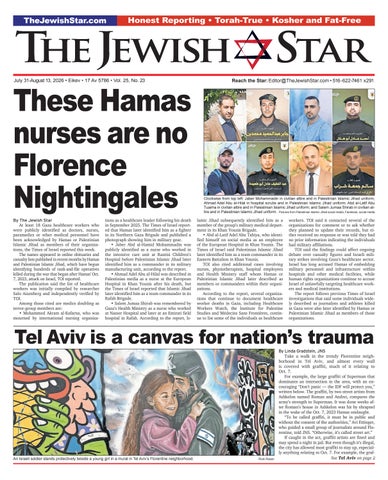
At least 18 Gaza healthcare workers who were publicly identified as doctors, nurses, paramedics or other medical personnel have been acknowledged by Hamas or Palestinian Islamic Jihad as members of their organizations, the Times of Israel reported this week.
The names appeared in online obituaries and casualty lists published in recent months by Hamas and Palestinian Islamic Jihad, which have begun identifying hundreds of rank-and-file operatives killed during the war that began after Hamas’ Oct. 7, 2023, attack on Israel, TOI reported.
The publication said the list of healthcare workers was initially compiled by researcher Salo Aizenberg and independently verified by TOI.
Among those cited are medics doubling as terror-group members are:
• Mohammed Akram al-Kafarna, who was mourned by international nursing organiza-
tions as a healthcare leader following his death in September 2025. The Times of Israel reported that Hamas later identified him as a fighter in its Northern Gaza Brigade and published a photograph showing him in military gear.
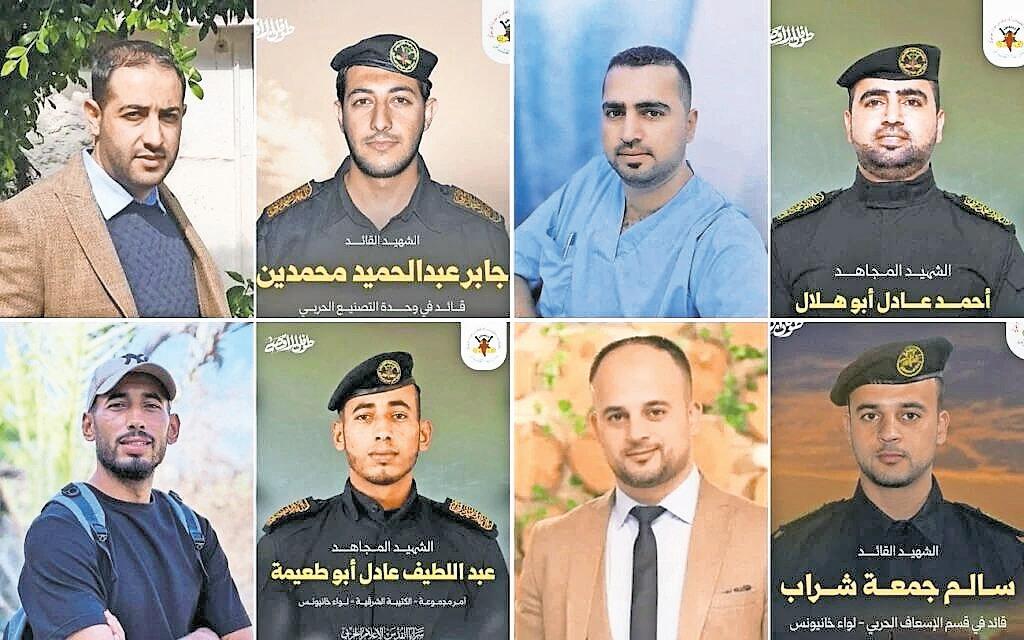
• Jaber Abd al-Hamid Mohammadin was publicly identified as a nurse who worked in the intensive care unit at Rantisi Children’s Hospital before Palestinian Islamic Jihad later identified him as a commander in its military manufacturing unit, according to the report.
• Ahmad Adel Abu al-Hilal was described in Palestinian media as a nurse at the European Hospital in Khan Younis after his death, but the Times of Israel reported that Islamic Jihad later identified him as a team commander in its Rafah Brigade.
• Salem Jumaa Shirab was remembered by Gaza’s Health Ministry as a nurse who worked at Nasser Hospital and later at an Emirati field hospital in Rafah. According to the report, Is-
lamic Jihad subsequently identified him as a member of the group’s military medical department in its Khan Younis Brigade.
• Abd al-Latif Adel Abu Tabiya, who identified himself on social media as an employee of the European Hospital in Khan Younis. The Times of Israel said Palestinian Islamic Jihad later identified him as a team commander in its Eastern Battalion in Khan Younis.
TOI also cited additional cases involving nurses, physiotherapists, hospital employees and Health Ministry staff whom Hamas or Palestinian Islamic Jihad later described as members or commanders within their organizations.
According to the report, several organizations that continue to document healthcare worker deaths in Gaza, including Healthcare Workers Watch, the Institute for Palestine Studies and Médecins Sans Frontières, continue to list some of the individuals as healthcare
workers. TOI said it contacted several of the organizations for comment or to ask whether they planned to update their records, but either received no response or was told they had no prior information indicating the individuals had military affiliations.
TOI said the findings could affect ongoing debate over casualty figures and Israeli military strikes involving Gaza’s healthcare sector. Israel has long accused Hamas of embedding military personnel and infrastructure within hospitals and other medical facilities, while human rights organizations continue to accuse Israel of unlawfully targeting healthcare workers and medical institutions.
The report follows previous Times of Israel investigations that said some individuals widely described as journalists and athletes killed in Gaza were also later identified by Hamas or Palestinian Islamic Jihad as members of those organizations.
Tel Aviv is a canvas for nation’s trauma
By Linda Gradstein, JNS
Take a walk in the trendy Florentine neighborhood in Tel Aviv, and almost every wall is covered with graffiti, much of it relating to Oct. 7.
For example, the large graffiti of Superman that dominates an intersection in the area, with an encouraging “Don’t panic — the IDF will protect you,” written below. The graffiti, by two street artists from Ashkelon named Roman and Andrei, compares the army’s strength to Superman. It was done weeks after Roman’s house in Ashkelon was hit by shrapnel in the wake of the Oct. 7, 2023 Hamas onslaught. “To be called graffiti, it must be in public and without the consent of the authorities,” Avi Ettinger, who guided a small group of journalists around Florentine, told JNS. “Otherwise, it’s called street art.” If caught in the act, graffiti artists are fined and may spend a night in jail. But even though it’s illegal, the city has allowed most graffiti to stay up, especially anything relating to Oct. 7. For example, the grafSee Tel Aviv on page 2
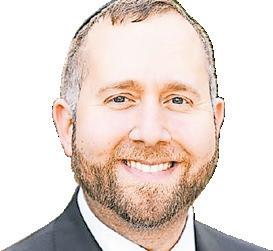
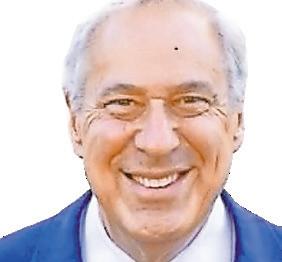
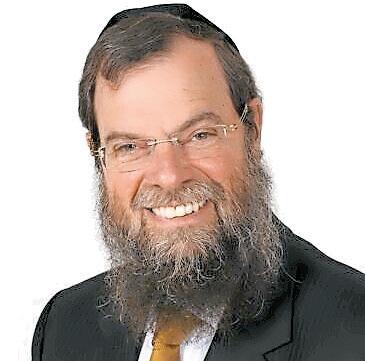
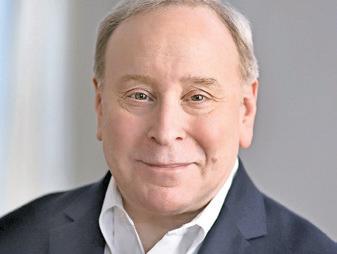
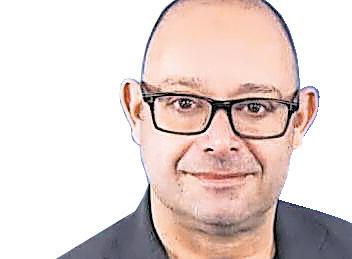
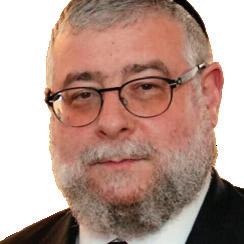
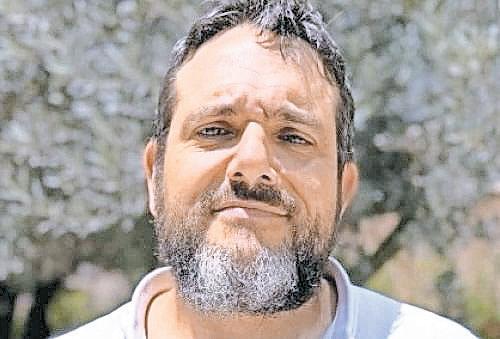
Clockwise from top left: Jaber Mohammadin in civilian attire and in Palestinian Islamic Jihad uniform; Ahmad Adel Abu al-Hilal in hospital scrubs and in Palestinian Islamic Jihad uniform; Abd al-Latif Abu Tuaima in civilian attire and in Palestinian Islamic Jihad uniform; and Salem Jumaa Shirab in civilian attire and in Palestinian Islamic Jihad uniform. Pictures from Palestinian Islamic Jihad social media, Facebook, social media
An Israeli soldier stands protectively beside a young girl in a mural in Tel Aviv’s Florentine neighborhood.
Ricki Rosen
Aids call Bibi, Don meet ‘positive, productive’
By Andrew Bernard, JNS
President Donald Trump met with Israeli Prime Minister Benjamin Netanyahu in Washington on Tuesday before the two leaders attended the funeral of former South Carolina Republican senator Lindsey Graham.
The meeting comes amid questions about the direction of the war in Iran, with Trump continuing to pursue negotiations with the Islamic Republic after suggesting last week that he was prepared to carry out a “higher level” of strikes.
White House Press Secretary Karoline Leavitt described the meeting between Trump and Netanyahu as “positive and productive.”
A senior source who accompanied Netanyahu to the White House likewise described it as “an extremely positive meeting.”
“The prime minister and president held an excellent and comprehensive discussion on the key issues of the day, first and foremost Iran,” the source said. “The leaders reaffirmed their ironclad commitment to
Tel Aviv…
ensuring that Iran never has nuclear weapons.”
The meeting did not include questions from the press, which have been a common feature of the past seven meetings between the two leaders in Trump’s second term. Netanyahu broke with custom and pointedly refused to allow Isaeli press to accompany him about his official plane from Tel Aviv to Washington.
The two sides have yet to issue a formal readout of the discussion, which lasted about an hour.
Photos released by the Israeli Prime Minister’s Office show Vice President JD Vance, Secretary of State Marco Rubio, Secretary of the Treasury Scott Bessent, Secretary of Defense Pete Hegseth and Steve Witkoff, one of the lead negotiators with the Iranians, in the Oval Office with Trump and Netanyahu, as well as Israeli Ambassador to the United States Yechiel Leiter and Caroline Glick, Netanyahu’s international affairs adviser.
With The Jewish Star. Continued from page 1
fiti depicting Rachel Edri, the hero of Ofakim, who survived more than 17 hours after five armed Hamas terrorists broke into her home. She later said that “a hungry man is dangerous” and served her attackers coffee, tea, soft drinks and even homemade Moroccan cookies, the recipe for which quickly went viral.
She engaged the attackers in conversation and bandaged one of the gunmen who was wounded. She kept asking the attackers for permission to go to the bathroom, saying that as an older woman she needed to go frequently.
But each time she went, she passed an open window and exchanged signals with the security forces stationed outside. Eventually a special forces unit stormed the house and rescued Rachel and her late husband, David.
At a time when many Israelis felt powerless after Oct. 7, Rachel came to symbolize Israeli
resilience. In the graffiti in Florentine, she is shown as Rosie the Riveter, who represented the millions of American women who came to work in factories, shipyards, and offices during World War II, while most of the men were off fighting. Edri came to see the graffiti depicting her on Tzrifin Street in Florentine.
Ettinger said that graffiti is an expensive hobby. A large piece could use 20 to 30 paint cans, meaning it could cost upwards of 800 shekels ($260). He said there is an informal community of Tel Aviv graffiti artists, some of
whom have day jobs as lawyers or dentists. If a graffiti artist dies, he said, there is an informal agreement not to paint over the work. There is friendly, and sometimes not-so-friendly rivalry between artists, many of whom work at night to minimize the risk of getting caught. The graffiti is also a mirror of Israeli society, like the picture of an IDF soldier and a young girl wearing a pink sweatshirt. In this case, the art was created by military graffiti artists Rotem Zamir and Yuval Peler, who served in the Israeli army as official military graffiti artists.
Israeli Prime Minister Benjamin Netanyahu meets with President Donald Trump at the White House on Tuesday. Ma’ayan Toaf, GPO
Leaders urge Jewish New Yorkers: Don’t flee!
By Ricki Zagelbaum, JNS
Under what circumstances, if any, will Jews leave the New York?
JNS posed this question to Jewish leaders in the city after Mayor Zohran Mamdani released a video calling the Israeli prime minister a “war criminal” who ought to be arrested.
The interviews took place before Tisha B’Av, when a 50-year-old Jewish man, who was wearing a kippah, was stabbed with a screwdriver on Manhattan’s Upper West Side
Rabbi Chaim Steinmetz of Congregation Kehilath Jeshurun, a Modern Orthodox synagogue on the Upper East Side, said that the mayor’s rhetoric, and that of his supporters, is “not unique to New York City.”
“I think it is an enormous mistake to give up on New York City because of Mamdani, just as I think it’s an enormous mistake to give up on America because of the rise in antisemitism,” Rabbi Steinmetz said.
“Everything has gone so smoothly the last couple of decades and American Jews have gotten spoiled,” he said. “Because of that, we have become passive. We need to learn once again how to stand up for ourselves.”
The recent rise in Jew-hatred is not the first in American history, according to Rabbi Steinmetz, who said the Jewish community should respond by organizing rather than retreating.
“Right now, what we need to do is organize ourselves politically,” he said. “If the Democratic Socialists of America was able to build an electoral machine, so can we. We need to reach out to allies in the non-Jewish community and work together.”
“This is not the time to quit,” he said.
Scott Bolton, spiritual leader of Congregation Or Zarua, a Conservative synagogue on the Upper East Side, said that “we cannot al-
low them to stir us into new kinds of senses that another great exile is in our sights.”
“Any serious mayor would be on a public tear about the number of serious felonies in New York City,” he said, and the NYPD needs “to be empowered to do their jobs, and prosecutors should not be held back from getting criminals off our streets.”
In a video on Tisha B’Av, Mamdani recognized the day but pointedly did so without commenting on the Temples or on Israel.
The mayor’s video is “just hitting the drums again and again and again,” Bolton said. “Our question has to be, how do we strengthen each other, how do we strengthen our community?”
Jewish New Yorkers “deserve so much more” than “a youth, who is using his plat-
form on TikTok and now has been elected to spill his Jew-hatred,” he said.
Bolton accused the mayor of using his office “in an insidious way” to continue “playing on sympathies from especially the younger crowds and antisemites in the wings, who want to use Jew-hatred to create the bogeyman for absolutely failed everything from socialist to, in his case particularly, Islamist — radical Islamist policy.”
“We need to call that out,” said.
Chaskal Bennet, a political activist and advocate on Jewish communal issues, told JNS that he is keeping an eye on “whether the rhetoric and ideology coming out of City Hall get translated into policy, policing issues or a deterioration of our ability to live and work safely in New York.”
It is “premature and counterproductive” for Jewish leaders to tell people to leave the city, he said. “There’s so much that we’ve built here: extraordinary communities, tremendous investment, shuls, yeshivas, homes, businesses and significant investment in infrastructure.”
“We shouldn’t allow one elected official or one election to chase us away,” he said. “I think we’re stronger than that.”
Rivkie Feiner, a board member of the Jewish Federation and Foundation of Rockland County, also said that Jews must not retreat from the city.
“As a lifelong Jewish New Yorker, and especially as someone visibly Orthodox, I reject the idea that the answer to antisemitism is retreat,” she said. “We will not allow hatred to dictate whether we remain in New York. Our history is defined by resilience, not surrender, and that will not change now.”
“My red line is not a single controversial statement,” she said. “It is whether the government fails in its most basic duty — to protect its citizens.”
“We are not there today, thanks to strong leadership in key areas, but that reality cannot be taken for granted,” she continued. “New York is home to one of the largest and most vibrant Jewish communities in the world, and we are not going anywhere”
Duvi Honig, founder and CEO of the Orthodox Jewish Chamber Of Commerce, told JNS that the stabbing on Thursday “changed my thinking.”
“There’s a big difference between not doing enough to stop hate and actually fueling it,” he said. “When a mayor openly supports Hamas, constantly condemns Israel but won’t equally condemn Hamas and antisemitism, it sends the wrong message and gives extremists confidence.”
It gave confidence to many Jewish New Yorkers when Jessica Tisch, who is Jewish, stayed on as commissioner of the New York City Police Department under the Mamdani administration, according to Honig.
“If she ever felt she could no longer do her job, because City Hall wasn’t backing her or giving the NYPD what it needs, that would be a huge red flag — not just for the Jewish community but for every New Yorker,” he said. “New Yorkers want leaders who bring people together, back law enforcement and make it clear that hate and violence have no place here.”
Rabbi David Katz, executive director of the Israel Heritage Foundation, told JNS that he was the “only rabbi” to welcome Mamdani into office on Jan. 1.
“As I said, when a person becomes mayor, he deserves our respect,” Rabbi Katz said. “I gave him very warm blessings, and I was very respectful. I said that I will respect him, even though I may not align with all his views.”
Even when Mamdani made statements or took actions with which he disagreed, Rabbi Katz said that he gave the mayor the benefit of the doubt.
The recent video pushed Katz to finally speak out against the mayor, he said.
“Giving a speech that does not pertain to leadership in New York, that does not pertain to anything that should be in his department, and only went and put up a fire of making people unhappy — that showed that he’s failing in his leadership,” Katz told JNS. “He’s not doing enough for his people.”
A descendant of Holocaust survivors on all four sides of his family, Katz said that he did not want to discuss what developments he would consider a “red line” that would push him to leave New York City.
“We don’t want to think that way. We truly believe Moshiach is coming,” he said, of the Messiah. “We truly believe that every minute he’s going to come, and we’re almost there.”
“I think America is here to stay, and we’ll never come to a point that we will have to leave here,” he said.
Ezra Friedlander, CEO of an eponymous firm that advises Jewish groups on government and public affairs, told JNS that it would take an event like Kristallnacht, the Nazi-organized pogrom also known as the “night of broken glass,” to convince him that Jews need to abandon the Big Apple.
“I do not believe we’re anywhere close to the point where Jews have to leave New York City,” he said. “No, no. I’m not going to say that. Those are very strong words, and the answer is absolutely not.”
Friedlander, who described himself as “an identifiable Chassidic Jew” and “let’s assume, not a card-carrying Zionist in the traditional sense of the word,” said that his concern about Mamdani’s statements about Israel and its prime minister has “nothing to do with Israel.”
He offered a hypothetical scenario, in which he stood on a subway platform beside a secular, former Israeli soldier, while a person enraged by the mayor’s remarks decided to push one of them onto the tracks.
“Who is he going to push off the platform? He’s going to push Ezra Friedlander off the platform,” he told JNS. “Why? Because that’s who he’s identifying with Israel. It’s the Jew.”
Mamdani does not “hate Jews” but “has a beef with the State of Israel,” Friedlander said. “When you’re the mayor of 8 million New Yorkers and 1 million-plus Jews, your words have ramifications beyond your intentions.”
Still, Friedlander cautioned against an alarmist response to Mamdani’s remarks and said that Jewish New Yorkers “have nowhere else to go.”
“The amount of investment in the infrastructure of Jewish life here in New York is in the untold hundreds and hundreds of millions of dollars,” he said. “It would require a Kristallnacht to have Jews leave New York City — and thank G-d we’re nowhere close to that.”
Mayor Zohran Mamdani waves from a car on June 3. Michael Appleton, Mayoral Photography Office
Walsh Ambulatory Pavilion
Episcopal Health Services is proud to introduce the Walsh Ambulatory Pavilion, a state-of-the-art outpatient center offering multispecialty care in one convenient location. Equipped with advanced technology and comprehensive treatments, EHS provides an elevated patient experience and seamless access to high-quality care.
• Primary Care
• Behavioral Health
• Obstetrics & Gynecology
• Endocrinology Services Include:
Maternal Fetal Medicine
• Endoscopy Colonoscopy
• EHS Cancer Center
Medical Oncology
Radiation Oncology
19-20 Brookhaven Avenue, Far Rockaway, NY 11691
Call 718-347-3627 or visit ehs.org/walsh to schedule an appointment today!
For the EHS Cancer Center, please email cancercenter@ehs.org.
NBN brings Zionist education fellows to Israel
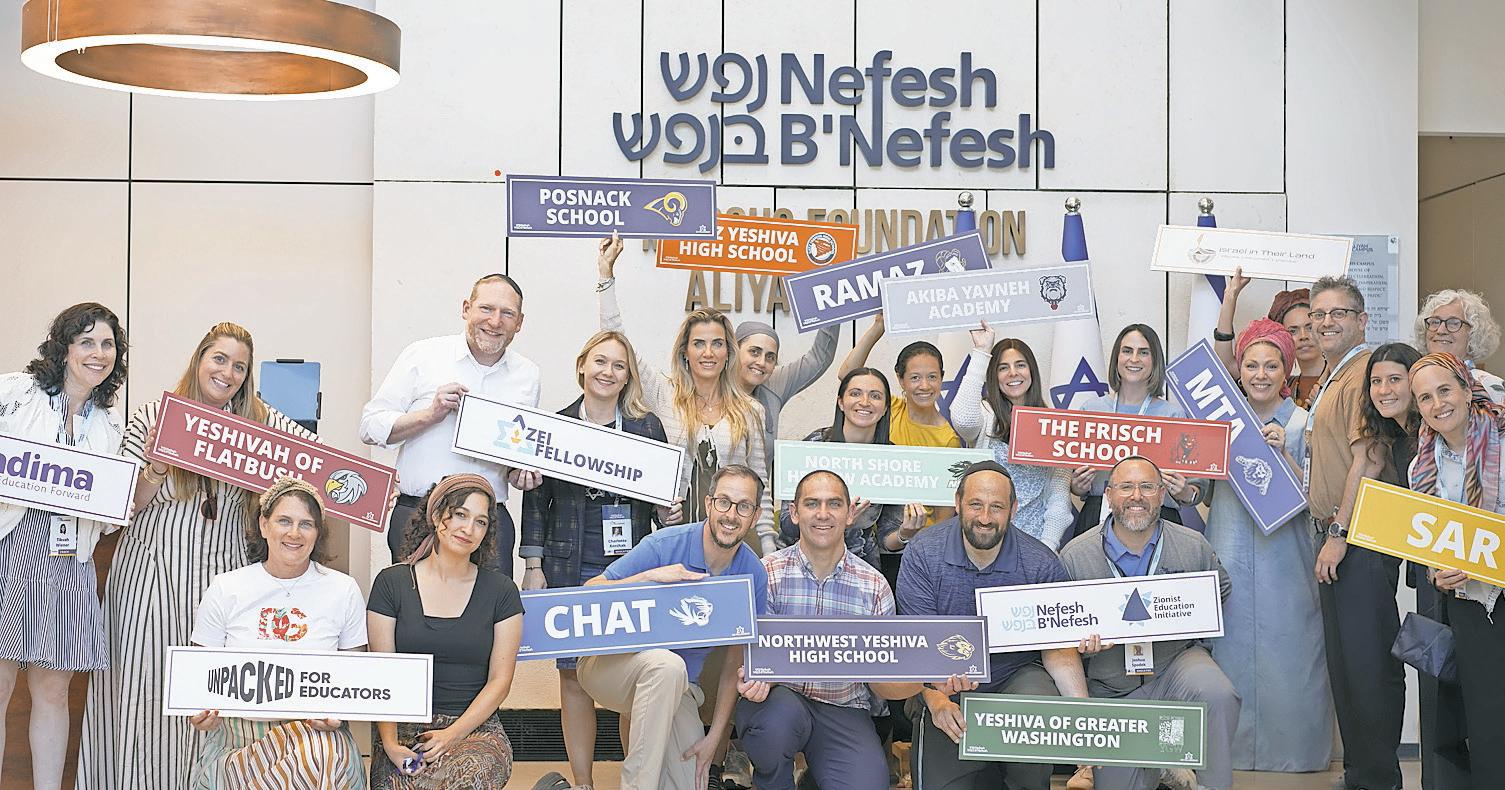
Nefesh B’Nefesh’s first Zionist Education Initiative welcomed 12 Jewish educators from schools across North America for an immersive learning experience designed to help shape the future of education about Israel.
The initiative has already taught Zionism classes to over 50,000 gap year students, and is now extending that impact into Diaspora school systems. After testing a Nefesh B’Nefesh Zionism curriculum for high schools at 10 North American schools, the organization is working in partnership with Koren Publishers to create the first-ever textbook on Zionism designed specifically for high school students in the Diaspora. The educators in this summer’s initiative plan to implement the curriculum in their classrooms starting in the fall.
Representing Jewish day schools and educational institutions from New York, New Jersey, Florida, Texas, Maryland, Washington State and Toronto, the fellows include department chairs, school administrators, veteran classroom teachers, and educational leaders who collectively influence thousands of Jewish students each year.
The educators took part in five immersive days in Israel, combining rigorous classroom learning with experiential education across some of Israel’s most significant historical, cultural and educational sites. Throughout the week, they explored foundational moments in Zionist history, Jewish peoplehood, archaeology, Israeli society and contemporary Israel education while engaging in workshops focused on curriculum design, student-centered learning and meaningful classroom engagement.
“When we invest in educators, we invest in the next generation of Jewish identity,” said Rabbi Josh Spodek, ZEI director. “The ZEI Fellowship brings together exceptional teachers who will carry what they experience here in Is-
rael and throughout the year, back to hundreds of students across North America, and that ripple effect is exactly what the Jewish people need right now.”
The initiative took participants to the National Library of Israel, where they worked with primary historical sources; to the Bible Lands Museum and the City of David, where they engaged directly with the historical and archaeological foundations of the Jewish connection to the Land of Israel.
Fellows also learned from leading educators, historians, archaeologists, and pedagogical experts while developing practical tools and classroom resources they can immediately bring back to their schools.
The fellowship, developed in partnership with Kadima Coaching and Unpacked for Educators, reflects a growing recognition that the future of Israel education depends on investing
deeply in the educators themselves.
The summer intensive serves as the launch of a year-long fellowship experience that combines monthly cohort learning, individualized coaching, curriculum development and professional collaboration, strengthening their ability to teach Israel, Zionism, Jewish history and Jewish identity. The fellowship will culminate in a Celebration of Learning in New York, where fellows will present their work and educational innovations to educators, communal leaders, and stakeholders from across North America.
“We are excited to welcome an extraordinary cohort of educators to Israel for the ZEI Fellowship, where over the coming days in Jerusalem they will immerse themselves in the history, archaeology, texts, and ideas that have shaped the Jewish story while exploring innovative, student-centered ways to bring Israel education to life in their classrooms,” said Tikvah
Wiener, founder and CEO of Kadima Coaching.
“At a time when young Jews are facing growing challenges around Israel and Jewish identity, this Fellowship aims to equip educators with the knowledge, tools, and inspiration to teach with depth, nuance, and confidence. Kadima Coaching is honored to be partnering with Nefesh B’Nefesh on this important initiative.”
The fellowship is guided by a central premise, teaching Israel and Zionism is not simply about conveying information, but about helping students understand Jewish identity, history, peoplehood and destiny. By strengthening the educators at the center of that work, the initiative aims to create lasting impact in Jewish classrooms and communities across North America.
Participating from the New York area were Heather Benjamin (Yeshiva University HS for Boys), Nina Cohen (Frisch School), Sylvia Fallas (Yeshivah of Flatbush), Miriam Kazlow (North Shore Hebrew Academy HS), Miriam Krupka Berger (Ramaz School), and Shira Schiowitz (SAR HS).
Other participants were Idit Cohen (David Posnack Jewish Day School, Florida), Amy Horowitz (Katz Yeshiva HS of South Florida), Rabbi Shaanan Scherer (TanenbaumCHAT, Toronto), Jay Schreiber (Northwest Yeshiva HS, Washington), Michal Shapiro (Akiba Yavneh Academy, Texas), and Rabbi Moshe Shields (Yeshiva of Greater Washington, Maryland).
The Zionist Education Initiative operates under the broader framework of Nefesh B’Nefesh, which works in partnership with Israel’s Ministry of Aliyah and Integration, The Jewish Agency for Israel, Keren Kayemeth LeIsrael, and Jewish National Fund-USA to strengthen Jewish connection to Israel and support the future of Zionist engagement worldwide.
Reported by Nefesh B’Nefesh.
Flamboyant Boy George posts pro-Israel anthem
Boy George is making noise with a new pro-Israel song honoring victims of Hamas’ Oct. 7, 2023, massacre.
The Culture Club frontman released “We Will Dance Again,” which quickly racked up millions of views after debuting on social media. The song backs Israel, criticizes what Boy George calls one-sided attacks on the Jewish state and declares, “If you’re ever confused, I stand with the Jews.”
The title and repeated dance references pay tribute to victims of the Nova music festival massacre, while Hebrew lyrics underscore the message of solidarity.
Thieves swipe Torah scrolls
Thieves broke into a synagogue near Paris and stole up to 15 Torah scrolls worth as much as $113,000, leaving France’s Jewish community reeling.
The burglars climbed through a window using a rope, ignored everything else inside and fled with the sacred scrolls. Surveillance cameras captured images of the suspects.
Jewish leaders called the theft a devastating spiritual blow and an antisemitic attack targeting Judaism itself. French authorities vowed to track down those responsible and recover the stolen scrolls.
Herzog pleads: Keep civil
Israeli President Isaac Herzog is urging voters to cool the rhetoric ahead of the nation’s Oct. 27 elections, warning that “elections are not a civil war.”
In a televised address, Herzog revealed he had been briefed by Israel’s election chief and Shin Bet director on threats facing the vote from inside and outside the country. He warned politicians and activists not to inflame tensions, saying social media has made the risks even greater. Invoking the eve of Tisha B’Av, Herzog said Israelis must reject baseless hatred and remember that the nation’s future matters more than political divisions.
Shoah museum expansion
Holocaust Museum LA is preparing to reopen with a stunning $70 million expansion designed to welcome up to 500,000 visitors a year.
The new Goldrich Cultural Center triples the museum’s footprint, adding classrooms, a theater, gardens and a restored World War II boxcar from near the Majdanek death camp.
CEO Beth Kean said the redesigned campus blends Holocaust education with hope, while architect Hagy Belzberg called the project a decades-long labor of love. Museum leaders say the expansion will transform how visitors confront antisemitism, history and human rights.
Brooklyn hate-crimes unit gets boost
Brooklyn prosecutors are getting a major funding boost to fight hate crimes after New York City Council Speaker Julie Menin secured another $750,000 for the borough’s specialized unit.
The funding comes as antisemitic attacks continue to dominate the city’s hate-crime statistics. Brooklyn District Attorney Eric Gonzalez had testified that his office received just a fraction of the funding allocated to similar units in other boroughs.
Menin said the money will strengthen investigations and prosecutions, while Gonzalez called it a critical investment in protecting targeted communities.
Fire rips Chabad center where founding rabbi buried
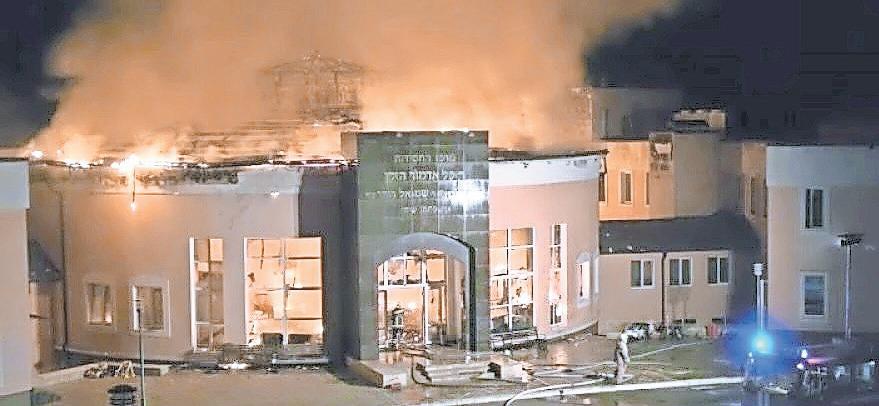
A large blaze late Friday night destroyed a visitor’s center near the grave of Shneur Zalman (the Alter Rebbe), founder of the Chabad Chassidic movement, in Hadiach, Ukraine. Initial indications are that an electrical fault may have started the fire. No injuries were reported.
“We are in total shock,” Chabad emissary Rabbi Shneur Zalman Deitsch said. “The damage is incomprehensible. This is very painful.” He said a group of Jewish visitors from Kyiv staying at the site over Shabbat managed to save the four Torah scrolls from the blaze.
Israeli teen gets math gold
An Israeli high school senior solved his way to the top of the world.
Yotam Budnik of Rehovot won a gold medal at the International Mathematical Olympiad in Shanghai after competing against more than 600 students from 117 countries.
Israel’s team also captured one silver medal and four bronze medals, prompting the country’s official X account to hail the performance as “an incredible achievement.”
The annual Olympiad is considered the world’s most prestigious mathematics competition for high school students.
Herzog hails Bahrain bond
President Isaac Herzog praised Bahrain as a key peace partner, calling its relationship with Israel a model for Jewish-Muslim coexistence.
After a lengthy phone call with Bahrain’s King Hamad bin Isa Al Khalifa, Herzog said both nations are committed to fighting terror and expanding regional stability. He also wished Prime Minister Benjamin Netanyahu success ahead of his White House meeting with President Donald Trump.
Herzog highlighted the growing impact of the Abraham Accords, which Bahrain joined in 2020. Trump has pushed to expand the landmark agreements, recently tying a proposed civilian nuclear deal with Saudi Arabia to the kingdom’s recognition of Israel.
Dutch leader Nazi outrage
A senior Dutch statesman is under fire after comparing right-wing Israelis to Nazis, triggering demands from Jewish leaders that he resign.
Former European Union official Frans Timmermans claimed Israelis who want Palestinians removed are using “exactly the same reasoning” as the Nazis. Jewish groups blasted the remarks as antisemitic and urged Prime Minister Rob Jetten to distance himself from the comments.
The Central Jewish Board of the Netherlands warned silence would undermine Holocaust re-
The complex is considered the secondlargest Jewish pilgrimage and prayer site in Ukraine, after the grave of Rabbi Nachman of Breslov in the city of Uman.
The Ukrainian city’s Jewish population was murdered during the Holocaust, and after World War II Communist rulers obstructed access to the rabbi’s grave, In the early 1990s, the Lubavitcher Rebbe, Menachem Mendel Schneerson, instructed Chabad emissaries to restore the grave, and it once again became a major pilgrimage site.
membrance, while a leading Jewish newspaper accused Timmermans of embracing the very antiZionism he once condemned.
French-Jewish DJ hits back
A French-Jewish DJ is taking legal action after anti-Israel protesters forced her off the stage during a concert in Grenoble.
Leslie Barbara “Butch” filed complaints alleging incitement to hatred, violence and assault after activists confronted her over alleged ties to Israel. Video showed protesters trying to push past security while shouting questions about Tel Aviv and proposed anti-incitement legislation.
The incident comes amid a surge in harassment of Jewish and Israeli performers across Europe since Hamas’ Oct. 7, 2023, attack on Israel.
Woman charged over slur
Australian police charged a 67-year-old woman after she allegedly shouted “evil Zionist” at Jewish leaders visiting the Bondi Beach massacre memorial.
Authorities said Francine Clough faces charges including offensive language. Jewish leader Alex Ryvchin, who was with a survivor of last year’s Chanukah terror attack, called the confrontation “inhuman.”
Clough was already on bail in another case involving an alleged bomb hoax outside a Sydney synagogue. Anti-Defamation League CEO Jonathan Greenblatt called the latest incident another example of anti-Zionism fueling anti-Jewish hatred.
Friedman rips state push
Former US Ambassador David Friedman warned Congress that creating a Palestinian state would derail the Abraham Accords and ignite more regional violence.
In prepared testimony, Friedman argued the two-state model became untenable after Hamas’ Oct. 7 attack and said linking normalization with Arab nations to Palestinian statehood is “destined for failure.”
Rather than advancing peace, he said, a Palestinian state would “destroy” the Abraham Accords by reigniting conflict across the Middle East.
Lawmakers on AMIA
Bipartisan lawmakers are demanding justice for victims of the 1994 AMIA Jewish community center bombing in Argentina.
The Congressional Latino-Jewish Caucus and Argentina Caucus introduced a resolution marking the anniversary of the Iran-backed Hezbollah attack that killed 85 people and wounded more than 300.
Rep. Debbie Wasserman Schultz said the victims deserve justice more than three decades later, while lawmakers vowed to keep pressure on Iran and Hezbollah. Argentina recently cleared the way for trials in absentia for suspects still on the run.
Herzl family returns home
The grandparents of Zionist visionary Theodor Herzl are set to be reburied beside him on Jerusalem’s Mount Herzl after their remains are brought from Serbia.
A state ceremony is planned for Aug. 5, marking 77 years since Herzl’s own reburial in Israel. Prime Minister Benjamin Netanyahu and President Isaac Herzog are expected to attend. Herzl’s grandfather, Shimon, was a Jewish community leader near Belgrade whose influence helped shape the future founder of modern Zionism. The World Zionist Organization said years of sensitive negotiations made the historic transfer possible, calling it another step in honoring Herzl’s enduring legacy.
Lod massacre terrorist dies
Kozo Okamoto, the last surviving terrorist behind the 1972 Lod Airport massacre, has died in Beirut at 78.
Okamoto and two fellow members of the Japanese Red Army opened fire with rifles and grenades after arriving on an Air France flight, killing 26 people and wounding 80 in one of Israel’s deadliest terror attacks.
Released in a 1985 prisoner swap after serving 13 years in Israel, Okamoto lived in Lebanon under the protection of the Popular Front for the Liberation of Palestine. His two accomplices died during the massacre.
Israel gears for pilgrimage
Israel is preparing for a massive wave of Christian pilgrims ahead of the 2,000th anniversary of Jesus’ baptism in the Jordan River in 2030.
The Foreign Ministry has created a special task force to coordinate with Christian leaders worldwide and prepare for millions of expected visitors.
Israeli Ambassador George Deek called the milestone deeply personal and said Israel wants pilgrims to experience the Holy Land with “dignity, safety and a true sense of welcome.” Jordan is also expanding facilities at its nearby baptism site as both countries gear up for the historic anniversary.
Korean Christians rally
Thousands of Christian pilgrims from South Korea and around the world marched through Jerusalem this week in a public show of support for Israel.
About 3,000 participants from 50 countries joined the five-day gathering, themed “Pray for the Peace of Jerusalem,” despite ongoing regional tensions.
A fire engulfs the Rabbeinu HaGadol visitors complex in the Ukrainian town of Hadiach on July 25.
HEALTH, MIND & BODY
From Vegas and LI to Israel: Docs answer call
By Judith Segaloff, JNS
I n Smithtown, Long Island, Dr. Richard Feldstein was shaken as he watched the death toll from the Hamas massacre climb on Oct. 7, 2023.
“I was speechless,” he recalled. “I couldn’t understand what was going on — how did this happen, right under everyone’s noses? Fifty dead, 100 dead, and before you knew it there were 1,200 dead Israeli souls. They killed the very people who wanted a peaceful existence and coexistence.”
More than 2,500 miles away in Las Vegas, Dr. Adam Berkovits, an emergency room physician who had not spoken a word of Hebrew for 30 years, said that “Oct. 7 changed everything for me.”
“I became a ‘born-again’ Jew,” he said. “While the attacks in Israel didn’t surprise me, the reaction on Oct. 8 by people in the United States marked a turning point for me and for everyone around me.”
The two physicians had never met. But their parallel journeys would eventually bring them together in Las Vegas in April, where they stood alongside Feldstein’s son, Jacob, who was celebrating his bar mitzvah, to dedicate a Magen David Adom ambulance funded through their combined fundraising efforts.
The two Jewish physicians, both descendants of Holocaust survivors and complete strangers to one another, would ultimately follow remarkably similar paths.
Feldstein, whose mother was from Rehovot before moving to Montreal, quickly concluded that he had something meaningful to contribute.
“I realized I have a skillset. I’m a Jew, I speak Hebrew. I grew up in a post-Holocaust household, and I felt a pull to help in any way I could,” he said.
Berkovits reached much the same conclusion.
“I knew I had something to offer as an ER doctor,” he said. “Israelis were suffering from trauma. There were people who needed medical care.”
Within an hour, Berkovits had found people online coordinating doctors to travel to Israel. Three weeks later, he was on a Zoom call with Magen David Adom.
“They asked if I could come for at least two weeks on particular days,” he said. “I emailed my colleagues at the hospital asking them to cover my shifts. Four weeks after Oct. 7, I had a flight, residence and a temporary medical license.”
He also had relatives warning him, “Don’t! You’re crazy! You’re going to die!”
He promised his wife and family that he would not go to areas still smoldering in the
south — and boarded the plane.
For Feldstein, the logistics took longer. As a private-practice gastroenterologist, he had procedures and patients to reschedule.
“I was in my office after hours and my cell rang,” he recalled. “It was not a familiar number, but I picked up anyway. A physician on the other side who works for MDA introduced himself. He asked, ‘Do you still want to volunteer?’ I said, ‘Absolutely yes, 100%.’ And he said, ‘Great — you fly on Sunday.’ It was Wednesday.”
He negotiated a two-week delay before leaving.
“I hung up and said to myself, ‘What just happened?’ But I knew it was one of the most important things for me to do — not just for me but for my children and for world Jewry.”
Expecting pushback from his family, he instead found complete support.
According to Magen David Adom, approximately 200 international doctors, along with nurses, paramedics and EMTs, volunteered on MDA ambulances from Oct. 7, 2023, through 2025. More than 90% of MDA’s workforce consists of volunteers, totaling roughly 36,000 people.
In a typical prewar year, American Friends of Magen David Adom provided about 100 ambulances. Following Oct. 7, that number tripled to 313 in 2023 and remained well above the norm at 239 in 2024.
On his first shift, Berkovits was handed a helmet and a ceramic vest and dispatched to emergencies in Petah Tikva and Bat Yam.
“There were heart attacks, seizures, trau-
matic injuries, one person fell off a roof, panic attacks — anything you might call an ambulance for,” he recalled.
After several days, he broke the promise he had made to his wife.
“I told MDA to put me in the south,” he said. “That was a much different experience. I was in a bulletproof ambulance. There, it was less about the medicine and more about bearing witness. There were bloodstains, shattered windshields, gunfire and booms coming from Gaza.”
He began documenting what he saw on social media.
“It’s important when these things happen to document and share them … so people can’t discount or downplay it and say it never happened.”
Ironically, Berkovits found himself calmer in Israel than he had been at home.
“From Oct. 7 on, I was very affected emotionally. I couldn’t sleep,” he said. “But as soon as I got to Israel, the angst went away. Being in Israel was therapy rather than having to watch from a distance.”
Feldstein described a similar sense of purpose.
“I can only describe the exhilaration and joy I felt in my MDA uniform, knowing that I’m helpful and was there to serve,” he said. “I felt more useful doing everything I did in Israel than what I do here in New York.”
His first red alert came within 45 minutes of landing.
“Suddenly the radio blares,” he recalled.
“I watched as people pulled their cars over, jumped out, lay down and put their hands on their heads.”
Calling home each night underscored the contrast between daily life in Israel and life back in New York.
“There were red alerts every single day,” he said. “Still, I felt at home in Israel.”
The two doctors eventually connected through WhatsApp after Feldstein helped his youngest son, Jacob, create a website for his bar mitzvah project through MDA.
A volunteer from the West Coast introduced him to Berkovits, who had also begun raising money for an ambulance. Together, their combined efforts funded the vehicle, which was dedicated in Las Vegas on Yom Ha’atzmaut, Israel’s Independence Day.
Berkovits described the experience as a profound awakening.
“With great-grandparents who were in the Shoah, I always wondered, what would I have done?” he said. “In my mind, I knew right away I needed to do something — anything — so I can say to my grandchildren that I at least tried.”
“After Oct. 7, we’ve seen an extraordinary outpouring of support,” said Elana Michael, director of major gifts at Magen David Adom. “Every ambulance tells a story, and this one is a reminder that the Jewish people, wherever they live, are one.”
Meanwhile, ever the volunteer, Feldstein will chair the Magen David Adom gala dinner scheduled for Oct. 27 in New York.
EHS wins ‘Get with the Guidelines’ heart prize
E piscopal Health Services received t he American Heart Association’s “Get with the Guidelines — Heart Failure Gold Plus” award for its ongoing commitment to improving outcomes for people with heart failure.
About 6.7 million US adults are living with heart failure, a number that is expected to rise to more than 8.7 million by 2030, according to the American Heart Association’s 2026 Heart Disease and
Stroke Statistics Report.
Despite the name, heart failure doesn’t mean that the heart has stopped working — it means the heart is struggling to pump enough blood and oxygen throughout the body.
While there is no cure, many people with heart failure can live a quality life by working closely with their health care team on a treatment plan that may include medi -
cation, symptom monitoring and lifestyle changes.
The guidelines put the expertise of the American Heart Association to work for hospitals nationwide, shortening hospital stays and increasing healthy days at home.
“Episcopal Health Services is committed to delivering high-quality care by following the latest evidence-based treatment guidelines,” said EHS CEO Donald
T. Morrish, MD, MMM. The Guidelines “helps our care teams put proven science into practice every day,” he said. Research shows this approach can support the ultimate goal of helping more people in Far Rockaway (where EHS’ St. John’s Hospital is located) as well as in neighboring communities including the Five Towns, live longer, healthier lives. Reported by EHS.
From left: Jacob Berkovits, Maria and Dr. Adam Berkovits and Elana Michael, director of major gifts at American Friends of Magen David Adom, at the dedication of an MDA ambulance in Las Vegas. MDA
And the Experts Agree
At Mount Sinai South Nassau, patient safety isn’t just a priority— it’s a standard, one we work on every day. And the experts agree.
We’ve earned national recognition for patient safety, including an “A” Hospital Safety Grade from The Leapfrog Group and the Healthgrades Patient Safety Excellence Award.
That means better outcomes for our patients with lower risk of infections or hospital acquired conditions.
When it comes to your health, nothing matters more than knowing you’re in a place where patient safety matters most.
Learn more at mountsinai.org/southnassau
Corning Museum exhibits Israel on broken glass
By Menachem Wecker, JNS
Nestled in upstate Corning, a picturesque city with 10,500 residents, the Corning Museum of Glass draws on 50,000 works to tell the story of 35 centuries of glassmaking on its 10-acre campus.
The museum, which is celebrating its 75th anniversary this year, displays everything from dice forerunners — called “astragali” and made in the Mediterranean between 200 BCE and 100 CE — to presidential glassware, and from church windows to paperweights.
Many of the objects on view are beautiful and delicate, and glisten in the light. Others involve looking through a glass darkly.
When the museum tells the story of religious objects, some objects are explored through rosecolored glasses, while others, including some Jewish ones, appear to hit a glass ceiling.
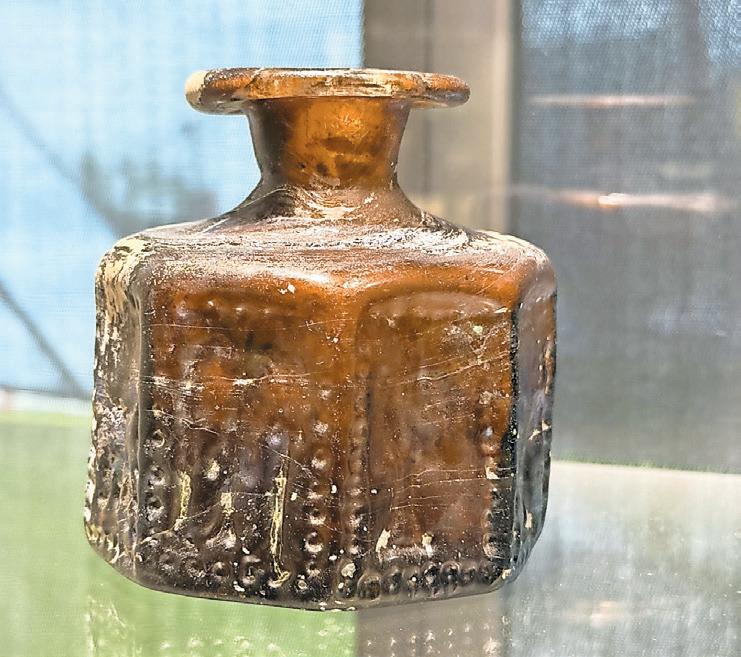
A section on Byzantine glass mixed Jewish and Christian objects in the same glass case, including a bottle with Jewish symbols that dated from the late sixth to early seventh centuries alongside several with Christian symbols.
Although the museum used dates with years in “BCE” and “CE” elsewhere, it referred to the bottle with Jewish symbols with “AD.”
A vase designed around 1914 and manufactured over the next six years by a Bohemian company is a gift to the museum from Roberta Elliott, whose paternal grandparents, Elisabet and Hugo Engel, bought it in Vienna.
“When the Nazis annexed Austria in March
1938, the Engel family was forced to flee because they were Jewish,” a label near the vase states.
“They hid their belongings with a business associate in Vienna, escaped to Italy and eventually arrived in the United States on Dec. 7, 1941.”
Francis Elliott, Roberta’s father, reclaimed the family’s property “miraculously” in Vienna after the war, according to the museum.
“The vase remained a treasured heirloom until 2017, when Roberta Elliott donated it to the Corning Museum of Glass, so that the vase and its story will be preserved and shared for generations to come,” it states.
A workshop, which costs an extra fee beyond admission, in which visitors can make their own glass includes an option to make a mezuzah. And one of the objects on view in the collection, Australian artist Blanche Tilden’s 2008 “Yom Hashoah Ritual Sash,” references Holocaust memorial day.
“Blanche Tilden creates jewelry out of such unusual materials as used gear chains and richly colored cut glass with oxidized or distressed metals,” a label states. “The museum’s long sash can be worn like a necklace or across the body.”
The museum adds that “two colors are inspired by the tallith prayer shawl, which is traditionally white with blue stripes.” Many Ashkenazi Jews have blue stripes, though many others have black ones, and Sephardic prayer shawls are often all white.
Two artists, whose works were on view when JNS visited, were identified as Israeli. Noa Hagi-
ladi, born 1978, is identified as such alongside the 2006 work, “This Is My Baby, He Used to Say.”
The glass forms, suggesting “stacked leaves,” honor the artist’s late father “and his bond with their family’s mango grove in Israel,” the museum says.
Dylan Brams, an American and Israeli born in 1979, layered 19 photos of daily attempts to blow glass to form a traditional Venetian pitcher called ampolina.
Israel is seen with something other than glassy eyes in “Ghosts,” which was designed in 2019 by Dima Srouji, identified as Palestinian and born in 1990. The Twam Family in “Jaba, Palestine” made the work in 2022.
“Glass making has been a foundation of the economy, culture and identity of people living in the area that is now Lebanon, Israel, Palestine and Egypt for thousands of years,” a label states. “Many objects in the gallery around you were made and found there. They came to Corning through the art market.”
“These wavering, ephemeral forms designed by contemporary artist Dima Srouji mimic ancient glass containers. The Twams, a Palestinian family that has been making glass in the occupied West Bank for generations, made them,” the museum states. “The transparent objects here are ghosts of the meaningful archaeological objects that have been taken from the region and from the Palestinian people.”
Jay Greene, director of research at Do No Harm, which aims to “safeguard healthcare from ideological threats,” has researched field trips and museum visits, among many other topics related to education.
“In general, the way art is selected, displayed and explained in art museums can be very important,” he told JNS. “The consumers of art museums tend to be well above average in their education and wealth, so they have disproportionate political and social influence, and their understanding of the fashionable elite opinion on issues can be shaped by what they see in museums.”
“Art museum curators, who make most of the decisions about selection, displays and explanations, tend to be far-Left and have often embraced active hostility toward Israel,” Greene said. “This is a problem all over the country.”
“There has also been a conscious strategy to claim that everything Jewish and Israeli was actually previously developed by ‘Palestinians,’” he told JNS. “There was even a recent claim that the bagel actually originated among Arabs. The goal is to deny Jews ownership over anything and to cast everything Israeli as stolen.”
Museums that intend to display works and artifacts by Israelis and Arabs “should either carefully explore the historical record before repeating these kinds of claims or simply avoid the dispute and allow people to appreciate the art without too much explanation,” he said.
Jacob Wisse, associate professor of art history at Yeshiva University’s Stern College for Women and former director of Yeshiva University Museum, told JNS that he visited the Corning Museum
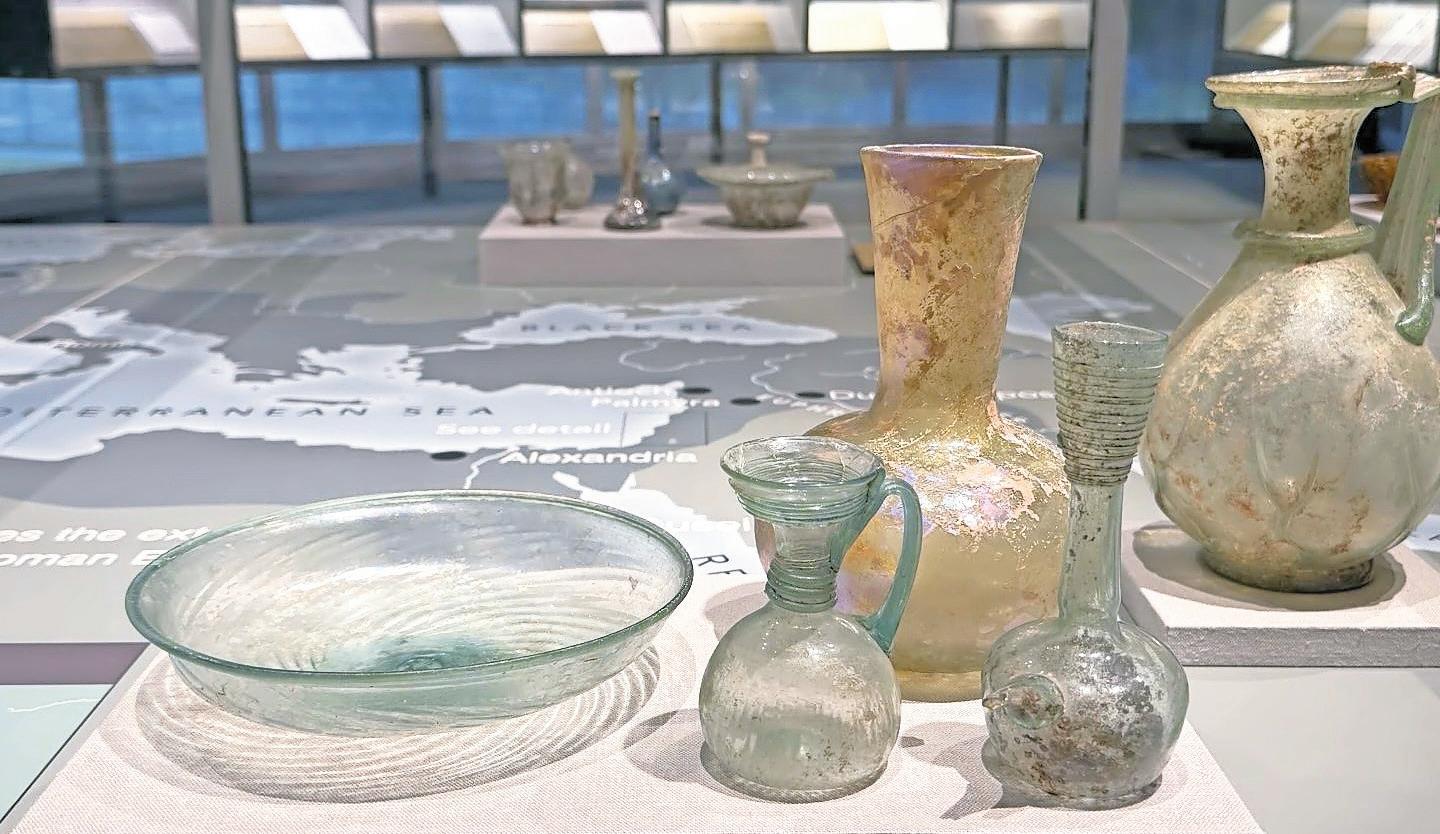
Ancient glass objects made in Israel on view at the Corning Museum of Glass. Menachem Wecker
Ancient glass jar with Jewish symbols on view at the Corning Museum of Glass. Menachem Wecker
“Yom HaShoah Ritual Sash” (2008), by Australian Blanche Tilden: cast glass, cut, ground, polished; sterling silver, stainless steel, at the Corning Museum of Glass. Menachem Wecker
Ancient glass objects made in Israel on view at the Corning Museum of Glass.
Menachem Wecker
A boy makes a glass mezuzah at a workshop at the Corning Museum of Glass. Nachama Soloveichik
We are Jews. We are Zionists.
We are the indigenous people of the land of Israel. Zionism is our national liberation movement.
Seventh Step outside the Machpelah. For 700 years, before Hebron was liberated, that’s as close as Jews got to this holy site, where our matriarchs and patriarchs are buried.
Photo by Ed Weintrob
AND DINE
Hidden communities share heritage thru food
By Linda Gradstein, JNS
Everyone knows that food is more than just fuel for the body. It is culture, memory and connection.
The ANU Museum of the Jewish People in Tel Aviv is staging a celebration of the cuisines of “hidden” Jewish communities now living in Israel, with the food of each group — including the Bnei Menashe from India, the Kaifeng Jews from China and the Subbotnikim from Russia —showcased at restaurants around the country.
“For us as Israelis, I found that our audiences are interested in these different variations of the Jewish world,” said Hagar Doron, director of the Databases Department at ANU. “We are only now discovering that the Jewish world is much bigger than we thought.”
The Subbotnikim — a group of Russian and Ukrainian peasants who converted to Judaism more than 200 years ago under the czarist regime — have immigrated to Israel from Voronezh and surrounding areas in several waves, from the early Zionist pioneering period through recent decades. An estimated 2,000 to 3,000 now live in Israel.
Their cuisine is being featured at Keton, a Tel Aviv restaurant without kosher certification that has served Ashkenazi Jewish food since 1945. Chef Orna Raskin, the restaurant’s third-generation owner, said she developed the special menu with the museum’s assistance.
“When we were preparing the dishes for
the photo shoot, Daria, one of my waitresses, smelled the sweet lokshen soup and said, ‘This is exactly like what they served us in kindergarten in Russia,’” Raskin said. “At that moment I realized that even though I didn’t know the story of the Voronezh Jews, the flavors are what connect us and open a window to a fascinating story of community.”
The menu includes pickled watermelon, pickled red onion and smoked cheese; olnik, slow-baked overnight with short ribs and egg, served with applesauce; piroshki stuffed with stewed cabbage and blueberries; and hot milk-and-noodle soup with cinnamon butter.
In Israel, the Subbotnikim are recognized
as Jewish and do not need to undergo conversion. The other communities featured in the festival, however, have faced questions about their Jewish status and generally underwent conversion after arriving in Israel.
The largest group is the Bnei Menashe, who believe they are descendants of one of the Lost Tribes of Israel. In 2005, Israel’s Chief Rabbinate recognized them as descendants of Israel, but they are still required to undergo Orthodox conversion before being fully recognized as Jewish or receiving Israeli citizenship.
Today, about 5,000 Bnei Menashe live in Israel, and a government initiative aims to
bring the remaining 5,800 members of the community from northeastern India by 2030. Originating in the border region between India and Myanmar, the Bnei Menashe have a cuisine distinct from the Indian food familiar to most Israelis. Tel Aviv’s Bollywood Café
See FOOD on page 16
Frum chef uses his noodle on Food Network show
By Alan Zeitlin, JNS
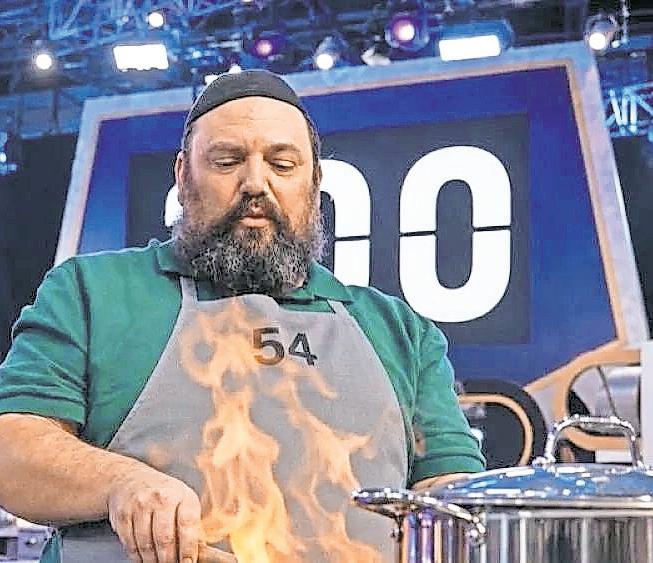
Watching television in his home in Hollywood, Calif. — a fan of “Chopped!” and “Beat Bobby Flay” — Sruly Meyer dreamed of being on the Food Network.
With word that a new show called “100 Cooks” was being cast, producers contacted him, saying they were impressed with his Instagram posts. The gist is that 100 home chefs in America enter an arena, where they are randomly selected to compete against each other to win $100,000.
While he didn’t know who the host or guest chefs would be, this was something he said he was waiting for. Meyer, 48, an Orthodox Jew who considers himself part of the Chabad movement, had to check with different rabbis to see if it was permissible to compete. It goes without saying that he would not eat anything that wasn’t kosher or cook meat with milk.
But what if he made items in ovens or with equipment certified as kosher? He was told by rabbis that he could do this — though not taste any of the food himself — and to make sure the show mentions that fact.
The idea behind it relates to the concept of marit ayin, in Hebrew, “appearance to the eye.” For example, if someone were to see a man with a yarmulke in a restaurant, even if he wasn’t eating there, a Jewish person might construe that the restaurant was kosher.
Meyer also explained that he avoids physical contact with women other than his wife, even shaking hands. The practice is known as shomer negiah (Hebrew for “observant of touching”). This alerted staff ahead of time so as to dodge a potentially awkward situation if, for example, celebrity chef and Food Network personality Alex Guarnaschelli were to greet him with an outstretched arm, where it might look rude if he didn’t respond accordingly.
And, of course, in this day and age of overt antisemitism, he wanted to evade the hot seat.
“I hoped I wouldn’t be called antisemitic or a baby-killer,” Meyer told JNS, adding that, in the end, he actually got along very well with other contestants on the show.
There was a Lebanese chef he befriended; after all, they are familiar with certain Middle Eastern flavors and ingredients. “Cooking is about cooking,” said Meyer; there is no need for politics to enter the kitchen.
In fact, the gastronome and father of four noted that he wanted his appearance to be a Kiddush Hashem, a “sanctification of God’s name,” whether he advanced to the next round or not.
He said some contestants asked him why he was nervous, adding that it shouldn’t matter what viewers think of him. He replied that a large following of Jewish clientele expected him to make a good showing.
Meyer, contestant No. 54, was tasked with making a pasta
dish in 30 minutes. That ruled out making it from scratch. He said a meat dish wouldn’t make sense because other contestants might add butter to it — something the judges were used to (and he was not).
In the end, he incorporated fish into the pasta, deciding to mix it rather than adding full pieces placed on top.
Meyer said he was happy with his Salmon Penne Vodka, receiving praise from the judges. While he didn’t come away with a prize, he noted that it was a great experience, and he hoped to return to the channel soon.
Hosted by American actor, television host and former professional football player Terry Crews, the show airs on Sunday nights at 9 pm with a grand prize of $250,000.
Meyer, who currently has 24,000 Instagram followers, is involved in kosher-food marketing and branding, advising kosher restaurants across the country. He said he hopes to appear on other cooking shows in the future.
Acknowledging that he was a bit nervous during the taping (the show aired on June 7), he also revealed that he was inspired by other contestants who afterwards mentioned that he seemed calm, with some even asking questions about his faith.
As for accoutrements, it’s well known that some Orthodox Jewish men tend to cover their kippah with a baseball cap at certain places. Not Meyer: He picked out a few different yarmulkes for the show as soon as he heard back in January that he’d be filming in Los Angeles.
“I’ve found that people respect you the most when you’re your authentic self,” he said.
Elan Kornblum, president of Great Kosher Restaurants Media Group, with a kosher Facebook Group of more than 133,000 members, said he wasn’t surprised that Meyer was chosen for the show.
“I’ve known Sruly for a long time, and I’m really happy for him,” Kornblum told JNS. “He’s worked very hard in his kitchen for many years, honing his skills. I think his biggest motivation for being on the show was not to win, but to bring positive light on the Jewish people.”
Children with a bowl of pomegranates in the ANU Museum of the Jewish People’s exhibition on the Bnei Menashe community from northeastern India. Dorit Lombroso
A dish of the Bnei Moshe Jewish community from Peru. Hagit Goren
Kosher chef Sruly Meyer knows how to handle the fire on “100 Cooks” on the Food Network. Courtesy of Food Network
The ‘Que’ stops its ‘Wandering’ after 20 years
’Side Dishes NATI BURNSIDE
For The Jewish Star
After two decades serving the kosher community, Wan dering Que has closed.
In a heartfelt message to customers, Pitmaster Ari White reflected on a journey that began 20 years ago and grew from a barbecue operation into one of the best-known names in kosher smoked meats.
Along the way, The Wandering Que became a fixture at weddings, bar mitzvahs, community events and food festivals, earning a loyal following among barbecue fans throughout the kosher community.
The farewell message thanked all those who helped make the business possible, while reflecting on the relationships built over the years.
Known for its slow-smoked brisket, ribs, pulled beef and other barbecue specialties, The Wandering Que played a significant role in introducing authentic smoked barbecue to a wider kosher audience. Its impact on the kosher food scene will not soon be forgotten.
A new Häagen-Dazs opens in Oceanside
A new kosher-certified Häagen-Dazs location has opened at 3567 Long Beach Road in Oceanside under the supervision of the Vaad of Oceanside (Rabbi Jonathan Muskat).
The location offers the brand’s familiar selection of premium ice cream and frozen desserts. Customers should note that the certification does not include gummy bear toppings, strawberries or smoothies.
The store is open daily from 11 am to 10 pm and can be reached at 516-206-3696.
Stamford Navaratna shut
After remaining closed for an extended p eriod while the owner traveled to Nepal to
care for his ailing mother, Navaratna in Stamford has officially come to an end, with the location now listed for sale.
For years, Navaratna was a destination for kosher diners throughout the Northeast, offering one of the region’s few dedicated kosher Indian restaurants under the Vaad HaKashrus of Fairfield County.
The restaurant was especially popular among travelers heading through Connecticut, as authentic kosher Indian cuisine has long been difficult to find. Its closure leaves a noticeable void for those looking for unique kosher dining options outside the major kosher population centers.
Sen Sakana De Gustibus cooking class
Fans of Sen Sakana will have the opportunity to learn from Executive Chef Mina Newman, who will be featured in an upcoming cooking class at Manhattan’s renowned De Gustibus Culinary Studio. The class will highlight the Japanese-Peruvian cuisine, known as Nikkei, that has made Sen Sakana one of New York’s most distinctive kosher restaurants.
Newman will demonstrate some of the techniques and flavors behind the restaurant’s menu while giving attendees the opportunity to sample the dishes being prepared.
Tickets are currently available for $165 through De Gustibus Culinary Studio.
Patis closes on Avenue M
Patis Bakery has closed its 1716 Avenue M location in Brooklyn, continuing a significant downsizing for what was once one of kosher dining’s fastest-growing bakery chains.
At its peak in late 2023, Patis operated 16 locations across multiple states. Following
this closure, the bakery’s remaining locations are in Teaneck, Upper East Side, Upper West Side, Crown Heights, Lawrence and a seasonal Catskills location.
While the Avenue M café is no longer operating, Patis continues to offer its signature artisan breads, pastries, cakes, sandwiches and coffee drinks at its remaining locations, maintaining a presence in several of the New York area’s largest kosher communities.
Holy Toast is expanding to Brooklyn
South Florida sandwich shop Holy Toast has expanded with the opening of its newest location at 628 Avenue U in Brooklyn. The new restaurant marks the brand’s third location, following its original locations in Surfside and Miami, with another location already planned for Teaneck.
Known for creative toasted sandwiches and late-night offerings, Holy Toast brings its menu of specialty sandwiches to Brooklyn under the supervision of the Orthodox Union (OU).
The restaurant is open Sunday through Thursday from 11 am until 2 am, Friday from 11 am to 5 pm, and Saturday beginning one hour after Shabbat until 2 am.
For more information, visit HolyToast.com or call 305-784-4116.
Tripping Kosher brings kosher food to JLTV
Kosher food lovers now have a new television series to add to their watch list.
Tripping Kosher has made its debut on Jewish Life Television (JLTV), bringing viewers on culinary road trips that explore kosher restaurants and Jewish communities across North America. Hosted by CW Silverberg, the series blends restaurant visits with local attractions, giving viewers ideas for where to eat while traveling and introducing them to the people behind each destination.
The first season features stops in Chicago,
Miami, New Jersey, Rhode Island and more, showcasing everything from neighborhood favorites to destination restaurants. Along the way, Silverberg meets with chefs, restaurant owners and community leaders, offering a behind-the-scenes look at what makes each stop unique.
Originally launched as a digital series, Tripping Kosher now reaches a national audience through JLTV, giving kosher travelers another resource for discovering food destinations across the country.
Rita’s Italian Ice opens kosher Pomona location
Frozen dessert chain Rita’s Italian Ice and Frozen Custard has opened a new kosher stire at 1581 Route 202 in Pomona, located in the Evergreen Uptown Plaza shopping center. The location offers Rita’s popular lineup of Italian ice, frozen custard, gelatis and other frozen treats, along with outdoor seating and a drive-through for added convenience. The shop is certified Cholov Yisroel under Tarnopol Kashrus and is open Sunday through Thursday from 11 am to 11 pm, Friday from 11 am to 5 pm, and Saturday beginning one hour after Shabbat until 1 am. For more information, visit RitasOfMonsey.com or call 845-406-6785.
SmokinDeal opens first restaurant in Oakhurst
After building a following since launching in 2020, SmokinDeal has opened its first storefront at 250 Norwood Avenue in Oakhurst, taking over the former location of Slices. The smokehouse had previously operated as a delivery-focused business and is now bringing its barbecue offerings to a permanent counter-service location.
SmokinDeal is under supervision of the Jersey Shore Orthodox Rabbinate (JSOR), Visit Smokin-Deal.com or call 732-757-2595.
Food: Hidden communities share heritage
Continued from page 14 (which does not have kosher certification) worked with community member Jessica Thangzom to create a special menu showcasing Bnei Menashe cuisine.
The dishes include mepoh, a traditional rice dish with greens; gotoi stew made with bamboo shoots and peas; and mai kikang, stir-fried pumpkin served with cabbage salad and black sesame butter.
Another little-known community is the Abayudaya, numbering about 2,000 to 3,000 Jews in eastern Uganda. Israel’s Interior Ministry generally classifies them as an “emerging” Jewish community, and they have historically struggled to obtain recognition under Israel’s Law of Return.
Their cuisine is vegetarian and centered on root vegetables. Balinjera, a kosher Ethiopian restaurant in Tel Aviv, has created a menu dedicated to the ingredients and flavors of the Ugandan Jewish community.
Chef and owner Fanta Prada said the dishes reflect a meeting between her Ethiopian culinary heritage and Abayudaya traditions.
The menu includes Shiro Abayudaya — Balinjera’s signature shiro served alongside a tomato, carrot, green pepper and ginger stew prepared in the Abayudaya style; an African Harvest Bowl with rice, beans, dinch alicha, gomenand chopped tomato salad; and teff mini-pancakes served with Abayudaya charoset made from bananas, apples, roasted peanuts, wine and spices.
“When I read about the cuisine of the Abayudaya community, I felt right at home — the simplicity and connection to the land reminded me of my own culinary heritage, that of the Beta Israel community,” Prada said.
“Yet, alongside that sense of familiarity, I was filled with wonder and curiosity about ingredients I hadn’t encountered before. I spent time in African markets and spoke with people from Uganda to better understand this cuisine, and the dishes I created represent a dialogue between this new culinary world and my own.”
Other communities featured at local restaurants include San Nicandro from Italy, Bnei Moshe from Peru, the Amazonos community from Brazil and the Kaifeng Jews
from China.
The special menus will be available from July 26 through July 31. The festival will conclude on July 31 with a panel discussion featuring members of the participating communities.
The project grew out of an earlier series of lectures on the foods of emerging Jewish communities.
“This is part two,” Li Gill, director of FOODISH Israel, ANU’s culinary wing, told JNS. “We spoke to community members about the dishes they remember, especially those they ate on Shabbat. What symbolic foods did they eat? We were able to collect both precise recipes and others preserved mainly through memory.”
Your Health. Your Culture. Your Parker.
Are you a journalist (or sales pro) who values truth, Torah and Israel?
News Reporter
Our team covers news that matters to Modern Orthodox communities in Metro New York (Long Island, Queens, Manhattan’s Upper East Side and Upper West Side, Riverdale and Westchester).
Assignments include community events; school, business and health news; local personalities; Jewish institutions; holidays and entertainment; antisemitism and antizionism; politics; Jewish America; the impact of developments in Israel on our local communities, and more.
Position offers expert mentoring, starting salary of $36,400 to $39,520 plus a full benefits package that includes medical, dental, 401(k) and Jewish and secular holidays — all in a supportive, collegial and kosher environment.
Reply: Candidates with reporting and news-writing experience (professional or collegiate) are invited to email a cover letter, resume and 4 to 6 clips or links to Publisher@TheJewishStar.com. Put REPORTER in subject line.
Editor
Responsibilities
•Lead a growing team of correspondents
•Initiate and refine story ideas
•Assign and write articles
•Edit staff and freelance submissions
•Verify rights to submitted art
•Organize print and web layouts, working with page designers and AI software
•Expand our digital footprint (including website, e-newsletters and social media)
•Help plan Jewish-centric events
•Work with the Publisher and the RCI team on a range of common projects
Required
•News reporting experience
•Copy editing and proofing skills
•Familiarity with and sensitivity to Jewish issues
•Experience with editorial contributors
•Ability to meet deadlines
•Attention to detail
•Familiarity with web and SM conventions
Salary: Starting at $50,960 to $62,400 plus a full benefits package that includes medical, dental, 401(k) and paid Jewish and secular holidays.
Reply: Cover letter, resume, 4 to 6 clips or links to Publisher@TheJewishStar.com.
Are you repressed in a workplace overrun by woke truthiness, debased values and Israel-hate? Is your professionalism challenged when truth falls victim to scorched earth politics?
If you’re ready to come home, consider an opportunity at The Jewish Star, where Torah-true honest reporting and ethical business practices are a priority.
Wear your Jewish Star proudly in a kosher environment and help make Jewish journalism great again.
Multimedia Sales
Selling advertising in The Jewish Star is just part of this job. Our staff’s toolkit is exceptionally broad, including
• Religious and secular publications
• Websites
• Content generation and editing services
• In-person and digital events
• Digital, email, radio and SM marketing
• Direct mail
• Commercial printing
• Local, regional, national, int’l reach
Employees are trained by the best in the business, in a supportive, collegial and kosher environment. Competitive compensation (salary and commission $45K-$90K) plus a full benefits package that includes medical, dental, 401(k) and paid Jewish and secular holidays.
Reply: Send a cover note and resume to Publisher@TheJewish Star.com.
Latch your career to a rising Star, a 24-yearold independent news operation that is part of RCI (Richner Communications Inc), a 100employee family-owned company with offices in Garden City and Riverdale. Positions are full-time in-person or hybrid (but part-time and freelance inquires may be considered).
Summer 2026 Starts Here.
2026 Summer Bucket List
❑ See a real Lunar Module
❑ Watch a Giant-Screen Movie
❑ Walk the Air & Space Trail
❑ Discover Aviation History
❑ Sit in an Airplane Cockpit
❑ Eat Astronaut Ice Cream
This year, skip the airport lines, expensive hotels, and rising travel costs. America’s 250th anniversary is happening right here in your own backyard.
Join us for a summer-long celebration of aviation, innovation, exploration, and discover with special exhibits, family events, and full-dome films on Long Island’s largest screen!
From early air fields to the Moon, Long Island helped shape America’s story. Come celebrate where history took flight. Scan the QR code or visit www.cradleofaviation.org/celebrate250
and
Jewish Star Torah columnists: Rabbi Benny Berlin, spiritual leader of BACH Jewish Center in Long Beach; Rabbi Avi Billet of Anshei Chesed, Boynton Beach, FL, mohel and Five Towns native; Rabbi Binny Freedman, rosh yeshiva of Orayta, Jerusalem; Dr. Alan A. Mazurek, former ZOA chair, retired neurologist, living in Great Neck, Jerusalem and Florida.
Contributing writers: Rabbi Sir Jonathan Sacks zt”l, former chief rabbi of United Hebrew Congregations of British Commonwealth; Rabbi Yossy Goldman, president South African Rabbinical Association; Rabbi Dr. Tzvi Hersh Weinreb, OU executive VP emeritus.
Five Towns Candlelighting: From the White Shul, Far Rockaway, NY
Scarsdale Candlelighting: From the Young Israel of Scarsdale, Scarsdale, NY
Greatness and humility of G-d and his people
RABBI SIR JONATHAN SACKS zt”l
Asequence of verses in this week’s sedra gave rise to a beautiful Talmudic passage — one that has found a place in the siddur. It is among the readings we say after the Evening Service on Saturday night as Shabbat comes to an end. Here is the text on which it is based:
“For the L-rd your G-d is G-d of gods and L-rd of lords, the great, mighty and aweinspiring G-d, who shows no favoritism and accepts no bribe. He upholds the cause of the orphan and widow, and loves the stranger, giving him food and clothing.” Deut. 10:1718
The juxtaposition of the two verses — the first about G-d’s supremacy, the second about His care for the low and lonely — could not be more striking. The Power of powers cares for the powerless. The Infinite One great shows concern for the small. The Being at the heart of being listens to those at the margins: the orphan, the widow, the stranger, the poor, the outcast, the neglected. On this idea, the third century teacher Rabbi Yochanan built the following homily: Wherever you find the greatness of the Holy One, blessed be He, there you find His humility. This is written in the Torah, repeated in the Prophets, and stated a third time in the Writings. It is written in the Torah: “For the L-rd your G-d is G-d of gods and L-rd of lords, the great, mighty and awe-inspiring G-d, who shows no favoritism and accepts no bribe.”
Immediately afterwards it is writtenm “He upholds the cause of the orphan and widow, and loves the stranger, giving him food and clothing.” It is repeated in the Prophets, as it says: “So says the High and Exalted One, who lives forever and whose name is Holy: I live in a high and holy place, but also with the contrite and lowly in spirit, to revive the spirit of the lowly, and to revive the heart of the contrite.”
It is stated a third time in the Writings: “Sing to G-d, make music for His name, extol Him who rides the clouds — G-d is His name — and exult before Him.” Immediately
One one of the great contributions of the Torah to Western civilization is set out in our sedra.
afterwards it is written: “Father of the fatherless and judge of widows, is G-d in His holy habitation.”
Babylonian Talmud, Megillah 31a
It is this passage that found its way into the (Ashkenazi) service at the end of Shabbat. Its presence there is to remind us that, as the day of rest ends and we return to our weekday concerns, we should not be so caught up in our own interests that we forget others less favorably situated. To care only for ourselves and those immediately dependant on us is not “the way of G-d”.
One of the more unusual aspects of being a Chief Rabbi is that one comes to know people one otherwise might not. These were three moments that made a deep impression on me.
From time to time, Elaine and I give dinner parties for people within, and also outside, the Jewish community. Usually, at the end, the guests thank the hosts. Only once, though, did a guest not only thank us but also ask to be allowed to go into the kitchen to thank those who had made and served the meal. It was a fine act of sensitivity. No less interesting was who it was who did so. It was John Major, a British Prime Minister. Greatness is humility.
The oldest synagogue in Britain is Bevis Marks, in the heart of the City of London. Built in 1701, it was the first purpose-built synagogue in London, created by the Spanish and Portuguese Jews who were the first to return to England (or practice their Judaism in public: some had been marranos) after Oliver Cromwell gave permission in 1656 for Jews to return after their expulsion by Edward I in 1290.
Modelled on the Great Synagogue in Amsterdam, it has stayed almost unchanged ever since. Only the addition of electric lights has marked the passing of time — and even so, on special occasions, services are candle-lit as they were in those early days.
For the tercentenary service in 2001, Prince Charles came to the synagogue. There he met members of the community as well as leaders of Anglo-Jewry. What was impressive is that he spent as much time talking to the young men and women who were doing security duty as he did to the great and good of British Jewry. For security reasons, people volunteer to stand guard at communal events — part of the work of one of our finest organizations, the Community Security Trust. Often, people walk past them, hardly noticing their presence. But Prince Charles did notice them, and he made them feel as important as anyone else on that glittering occasion. Greatness is humility.
Sarah Levene (not her real name) died
tragically young. She and her husband had been blessed by G-d with great success and they were extremely wealthy; but they did not spend their money on themselves. They gave tzedakah on a massive scale — within and beyond the Jewish community, in Britain, Israel and elsewhere. They were among the greatest philanthropists of our time.
When Sarah died, among those who felt most bereaved were the waiters and waitresses of a well-known hotel in Israel where they often stayed. It transpired that she had come to know all of them — where they came from, what their family situation was, the difficulties they were going through, the problems they faced.
She remembered not only their names but also the names of their spouses and children. Whenever any of them needed help, she made sure it came, quietly, unobtrusively. It was a habit she had wherever she went.
After her death I discovered how she and her husband came to be married. He was older than she was, a friend of her parents. She had some weeks free in the summer before the start of the academic year, and Mr Levene (not his real name) gave her a holiday job. One evening after work they were about to join her parents for a meal.
In the street they passed a beggar. Mr. Levene, punctilious about the mitzvah of tzedakah, reached into his pocket and gave the man a coin. As they were walking on, Sarah asked him to lend her some money — a fairly large sum, which she promised she would repay at the end of the week when he paid her wages.
He did so. She then ran back to the beggar and gave him the money. “Why did you
do that?” he asked, “I had already given him some money.” “What you gave him,” she said, “was enough to help him for today but not enough to make a difference to his life.” At the end of the week, Mr. Levene gave Sarah her wages. She handed him back most of the money, reminding him that she had to repay him for the sum he had lent her. “I will accept the money,” he told her, “Because I do not want to rob you of your mitzvah.” But — as he himself told me after her death, “It was then that I decided to ask her to marry me — because her heart was bigger than mine.”
Throughout their marriage they spent as much time and energy on giving their money to charitable causes as they did on earning it. They were responsible for many of the most outstanding educational, medical, and environmental projects of our time.
I have had the privilege of knowing other philanthropists — but none who knew the names of the children of the waiters at the hotel where they stayed; none who cared more for those others hardly noticed or who gave help more quietly, more effectively, more humanly. Greatness is humility.
This idea — counter-intuitive, unexpected, life-changing — is one of the great contributions of the Torah to Western civilization and it is set out in the words of our sedra, when Moses told the people about the “G-d of gods and L-rd of lords, the great, mighty, and awe-inspiring G-d” whose greatness lay not just in the fact that He was Creator of the universe and shaper of history, but that “He upholds the cause of the orphan and widow, and loves the stranger, giving him food and clothing.”
Those who do this are the true men and women of G-d.
Israeli President Isaac Herzog with then-Prince Charles at Highgrove House in Gloucestershire, England, on Nov. 22, 2021. Koby Gideon, GPO
Let us constantly be mindful what we pray for
Ah, the benefits of Google and, more recently, of AI.
I have frequently said, “Be careful what you pray for lest it come true,” attributing this advice to British playwright George Bernard Shaw. As I hope to demonstrate in this week’s column, there is much to support this counsel in traditional Jewish sources, but I wanted to first ascertain the true author of those words. Was
it really this famous but non-Jewish sceptic, or could I find some other wise individual (ideally an authoritative Jewish south) who said something similar.
As I consulted Google and AI, I discovered that the source of the saying is actually Aesop’s Fables, circa 260 BCE.
I immediately had an “aha” moment: That date coincided with the Second Temple period and the years of prominence of the Anshei Knesset HaGedolah (the Men of the Great Assembly). Perhaps Aesop’s saying had its origins, or at least some parallels, in Jewish sources dating back to late biblical or early rabbinic times.
But first, permit me to describe the roots of my fascination with the saying. I trace my fasci-
nation with the need for cautious prayer back to my high school days — specifically, to the late spring of my eleventh-grade year at Rabbi Jacob Joseph High School on the Lower East Side.
Like most of my peers, I was preoccupied with finding a summer job, preferably one with at least a modest salary and a location such as the Catskill mountains. Like a good yeshiva bachur, I incorporated my ardent desires in my three daily prayers, specifying in detail exactly what I was looking for: minimum wage, vacation days
so that I could tour the Catskills, opportunities to swim, go boating, play basketball, and friendly companions.
Of course, in my prayers I promised the Almighty that I would gratefully “compensate” Him for answering my prayers by devoting the entire next year, my senior year, to diligent Talmud study, perfect attendance, obedience to my rabbis, and impeccable conformity to every halachic stringency.
Suffice it to say that my prayers were unsuccessful.
Denied summer employment, I instead accepted an invitation from my eleventh grade rebbe, Rabbi Yitzchak Tendler, of blessed mem-
Our food’s source? Bentching breaks an illusion
Some mitzvos naturally generate excitement. Purim arrives and everyone is energized. Bedikas chametz becomes an event, something people prepare for, discuss, and even look forward to.
Bentching, however, has never enjoyed that same reputation.
I have received more halachic questions than I can count from people trying to figure out ex-
actly how many slices of pizza require bentching. More than once, after quoting the rulings of Rav Shlomo Zalman Auerbach and Rav Yosef Shalom Elyashiv that in many common situations pizza really should be eaten with netilas yadayim, someone has smiled and said, “Maybe it’s better if I just skip the pizza.”
Yet the mitzvah tucked into this week’s parashah carries a very powerful idea. The Torah says, “Ve’achalta vesavata uverachta es Hashem Elokecha (Eat, become satisfied, and bless G-d).”
At first glance, those words seem almost obvious. But if you slow down, the order is surprising. The Torah could have simply said to bless after eating. Instead, it makes satisfaction the centerpiece. First you eat. Then you become full. Only
I’ve been accused of not only looking forward to the geulah but of being obsessed by it. My columns and talks are replete with references to Moshiach and the Final Redemption.
Given the times we live in, I don’t see how one cannot be consumed with this belief. Gemara masechet Shabbat 31a tells us that when we arrive after 120 years and meet our Maker, He will ask us, ”tzipita l’yeshua? (did you look forward to the redemption?)”
When Israel and the Jewish people worldwide can see prophecy come to fruition — with the prominence and power exhibited by the small Jewish state and its influence and involvement in world affairs; when the hatred for Jews and their return to Zion has reached epic proportions; when we are still engaged in a brutal and bloody conflict that involves all the world‘s nations, including Persia (Iran), Edom (all the Western nations, including the US) and Yishmael (all the Arab and Muslim nations) in what bears an uncanny resemblance to that of the war of Gog u’Magog — how can we not desperately long for Moshiach’s arrival?
And yet we are wary, hesitant. We’ve been literally and figuratively burned before by the arrival of false messiahs (some from our own ranks,
We had a special visitor at our shul in Johannesburg this past Shabbat: Avi Kagan, the newly appointed director of the Israel Center and the Jewish Agency’s representative in South Africa. The timing was perfect, as we have just begun building a protective wall around the outer perimeter of our synagogue and nurseryschool campus, a project substantially supported by the Jewish Agency.
We aren’t the only Jewish institution that has received such assistance; the Jewish Agency is
funding similar efforts around the world. Still, we were pleased to welcome Avi and express our gratitude personally.
Indeed, Jewish communities internationally are upgrading their security. The sad reality is that we do need to protect ourselves and that Jews have become prime targets in the world once again. And when it comes to protecting ourselves from organized antisemites or lone-wolf attackers, it doesn’t matter the level of involvement or Jewish practice.
I remember my late father describing how in the early days of World War II, he was huddled inside a bunker in Poland during the Luftwaffe’s indiscriminate airstrikes. Suddenly, a bomb landed right outside their bunker. The explosion was deafening.
then do you bless.
That small detail led the Chazon Ish to ask an extraordinary question. Imagine a non-Jew sits down and eats two bagels. He finishes the meal completely satisfied. Then, while the food is still in his stomach, he goes straight to a beis din, undergoes a valid conversion, and emerges a Jew. Is he now obligated to bentch? Or imagine a 12-yearold who finishes breakfast just moments before
his 13th birthday. He is completely full when the clock strikes and he becomes bar mitzvah. Does he now have a Torah obligation to bentch? Could he even be motzi someone else?
The Chazon Ish says both questions really boil down to one question. What creates the obligation to bentch? Is it the act of eating, or is it the fact that you are now full?
Based on the Rambam in Hilchos Berachos, he explains that the obligation begins with the satisfaction, not the eating. The Torah itself says, “Ve’achalta vesavata uverachta.” The chiyuv begins when a person reaches the state of vesavata. That is why both the convert and the newly bar
some from outside) who have seduced many of our coreligionists along with the rest of the world. Nevertheless, our tradition compels us to look forward to his arrival — to expect his arrival.
How do we do that? Rabbi Shimon Schenker, in a 2019 YU Torah article, cites three approaches.
Maimonides, the Rambam cited the custom to recite daily the 13 Principles of Faith that he articulated, known colloquially as the “ani maamins.” The most famous of these is the “Ani maamin
b’emunah shelaim b’viat ha’Mos (I believe with absolute faith in the coming of the Moshiach).”
According to the Rambam, the ultimate “rationalist,” this is not a metaphysical concept but a direct fulfillment of the act of “expecting the Moshiach” as described in the Gemara Shabbat 31a. Perhaps this is why in Israel, especially in the dati Leumi community, where so many have bravely fought and fallen, this declaration is sung to an emotional tune at the end of ceremonies of both tribute and tragedy, rivaling only the Hatikvah in meaning and importance on those occasions.
Rabbi Shimon Schwab, preeminent leader of the Breuer’s Kehilas Adas Yeshurun post-WWII community in Washington Heights, notes that
Inside that bunker were all kinds of Jews — Chassidim, religious, irreligious, Bundists, Socialists and Communists who proclaimed to be atheists. But when that bomb crashed next to them, every single one shouted Shema Yisrael at the top of his lungs. Indeed, there are no atheists in a foxhole.
The late Rabbi Jonathan Sacks quotes Rabbi JB Soloveitchik, who called this phenomenon our “Covenant of Fate.”
In Israel since Oct. 7, 2023, Jews have witnessed how when the chips are down, we all re-
alize where our lives, safety and security come from. When we are under attack, we understand innately that we’re all in this together.
Israel usually has a government of national unity in times of war. But as soon as the war is over, we’re back at each other’s throats. The civil war in Israel over judicial reform before the Hamas-led terrorist attacks in southern Israel led our enemies to believe that we were vulnerable. And yet, the Jewish people — with Israel on the frontlines — responded with tremendous unity and resolve.
Of course, now that things have quieted down a bit after nearly three years of battling regional terror groups, we are again experiencing much dissension and anger, particularly regarding the draft exemptions of yeshiva students in Israel.
Honest Reporting • Torah-True • Kosher and Fat-Free • Established 2002
Published weekly except during certain religious and civil holidays by The Jewish Star LLC New York City office: 5676 Riverdale Ave Suite 311, Bronx NY 10471 • LI office: 2 Endo Blvd, Garden City NY 11530 Here’s how to reach The Jewish Star — Write: Editor@TheJewishStar.com. Call: 516-622-7461 ext 291
Editor & Publisher: Ed Weintrob
516-622-7461 ext 291
Jewish Star Associate: Nechama Bluth
516-622-7461 ext 241
Content: The Publisher endeavors to ensure that our content is within the bounds of normative halachah and hashkafah. Anyone who feels anything we publish may be inappropriate in this regard is urged to bring the item in question to the attention of the Publisher.
Advertising is accepted at the sole discretion of the Publisher and should conform to standards appropriate for distribution in an Orthodox community. Send us your news! Editor@TheJewishStar.com
Advertising: Publisher@TheJewishStar.com
Kashrut: The Jewish Star is not responsible for the
kashrut of any product or establishment featured in its pages. If you have questions regarding any establishment or product, including its supervision, please consult your rabbi for guidance.
Submissions: All submissions become the property of The Jewish Star and may be edited and used by the Publisher, its licensees and affiliates, in print, on the web and/or in any media that now exists or will exist in the future in any form, including derivative works, throughout the world in perpetuity, without additional authorization or compensation. The individual or entity submitting material affirms that it holds the copyright or otherwise has the right to authorize its use in accordance with The Jewish Star’s terms for submissions.
Opinions: Views expressed by columnists and other writers do not necessarily reflect the position of the Publisher or of The Jewish Star LLC.
Distribution: The Jewish Star is available free in kosher food establishments, stores, synagogues, and curb-side newsboxes on Long Island, in New York City and elsewhere. To request free delivery to your location, write Publisher@TheJewishStar.com.
Copyright: All content is copyright and may not be republished or otherwise reproduced without written permission by The Jewish Star; to do so without permission is against the law and halacha. For content reproduction write to Publisher@TheJewishStar.com.
The Jewish Star subscribes to JNS. It, or its contributors, own the copyrights on material attributed to them. The length and content of JNS material and all other submitted material may be edited by The Jewish Star.
Member: American Jewish Press Association. This newspaper contains words of Torah. While it is not considered shaimos, please dispose properly.
OPINION COLUMNISTS
Mitchell Bard, foreign policy analyst, authority on USIsreal relations; Ben Cohen, senior analyst, Foundation for Defense of Democracies; Stephen Flatow, president, Religious Zionists of America-Mizrachi and father of Alisa Flatow, murdered in an Iranian-sponsored Palestinian terrorist attack in 1995; Yisrael Medad, Americanborn Israeli journalist and political commentator; Rafael Medoff, founding director of David S. Wyman Institute for Holocaust Studies; Fiamma Nirenstein, Italian-Israeli journalist, author of 13 books, leading voice on Israeli affairs, Middle Eastern politics and antisemitism; Melanie Phillips, British journalist; Moshe Phillips, national chairman, Americans for a Safe Israel; Thane Rosenbaum, Distinguished University Professor at Touro University (published by Jewish Journal); Jonathan S. Tobin, editor-in-chief, Jewish News Syndicate.
Mamdani’s hand in Jew-hate violence in NYC
JONATHAN S. TOBIN JNS Editor-in-Chief
Over the course of the last few decades, as violence seemed to become an accepted fact of American society, casting blame on political opponents for incidents that could often be reasonably described as random acts of deranged persons unrelated to policy debates became a common tactic.
That’s the defense being employed by supporters of Mayor Zohran Mamdani in the wake of the stabbings on Tisha B’Av of two people on Manhattan’s Upper West Side. Only two days earlier, in a direct-to-camera video put out by his office, Mamdani had spewed forth yet another anti-Zionist tirade. In it, he recycled a compendium of blood libels about the actions of the State of Israel to back up his claim that its longtime prime minister, Benjamin Netanyahu, was a “war criminal.”
Disingenuous alibi
Coming as it did as part of a long series of such false accusations that date back to the beginning of his political career, the 34-yearold mayor’s efforts to demonize Israel and its American supporters have become part of the fabric of the city’s political discourse.
The point of this effort isn’t merely to “criticize” Netanyahu or Israel. It’s being done in the context of a boost for the cause that is at the heart of Mamdani’s political career — the eradication of the world’s one Jewish state. That this also means backing for the efforts of Hamas and other terrorists to achieve that despicable goal via their intended actual genocide of Israel’s population is left unsaid by the mayor. But it is made obvious by actions such as his wife’s open support for the atrocities of Oct. 7, as well as his specific refusal to condemn the chants heard on college campuses
Shedding Jewish blood is the goal, not a byproduct, of the rhetoric.
by his fellow anti-Zionists calling for Jewish genocide (“From the river to the sea”) and terrorism against Jews wherever they live (“Globalize the intifada”).
As far as Mamdani backers are concerned, linking Mamdani to the stabbings of a kippahwearing Jewish man outside a synagogue on the Upper West Side, along with an Asian male, by a person shouting Allahu Akbar, is unfair. The mayor claims to be against antisemitism and members of Mamdani’s Democratic Socialist faction and leftists of various stripes say that his comments are aimed solely at Netanyahu and Israel, not Jewish New Yorkers.
But their alibi for Mamdani is disingenuous. If you are part of the only international movement to target the existence of a single country and seek to deny the rights of Jews to sovereignty and self-defense in their ancient homeland, then you are a Jew-hater, not a Netanyahu critic. Add in the dishonest efforts of anti-Zionists to pretend that devotion to the land of Israel — and the necessity of ensuring the survival and thriving of Jewish life there — is not one of the core principles of Judaism, and their case collapses entirely.
Yet it’s also true that linking public figures to crimes they had no personal part in committing is a particularly nasty characteristic of modern American politics.
Such smears date back to the earliest days of the republic, when Federalists supporting President George Washington blamed Thomas Jefferson’s Republicans (ancestors of today’s Democrats) for insurrectionary violence related to tax protests.
Anti-Jewish incitement
As a general rule, a difference exists between the lamentable mainstreaming of harsh rhetoric from the governing class on both sides of the political aisle and what Mamdani has been doing in just the months he has been in office. And that is why — though it might often be wrong to blame American politicians for the bad behavior of those they influence — Mamdani cannot evade responsibility for the atmosphere of fear that pervades Jewish New York since he became mayor in January.
Blood libels against Jews and the Jewish state are not the same thing as political combat between conservatives and liberals or Republicans and Democrats. We may be living through a hyper-partisan moment in American political history where the advent of social media and the bifurcation of the media have created a spirit of heightened antagonism that pervades the public square. As troubling as that may be, the notion that violence is an expected or even regular part of electoral behavior or governing, akin to those in banana republics or dictatorships, remains beyond the pale in the United States.
Americans may be angry about many issues and increasingly given to intemperate rhetoric about each other. But during and after some of the most bitterly contested elections in US history, such as the ones we’ve seen in the last decade, no widespread political violence ensued.
Politicians high and low need to be careful about saying anything that could be interpreted as a license to attack their opponents, even though many on both sides of the aisle have been guilty of such statements during
this time. But to date (and hopefully, for the foreseeable future), US politics will remain a peaceful activity in which the rule of law prevails, even if the way people discuss it gets more hyperbolic and dangerous with each passing year.
Ideologies that justify hate
By contrast, the tradition of anti-Jewish violence, including genocidal attempts to wipe them out, dates back two millennia — and continues to this day. From ancient Roman wars and mass murder during medieval times to the pogroms of the 17th century and those of the last 150 years up to the Holocaust, antisemitic bloodshed is a historic fact.
Add to that Hamas’ genocidal cause, taped for all to see on Oct. 7.
All of this is to say that while it’s possible to assert that hyperbolic accusations against Republicans or Democrats are just political speech, credibly playing that sort of game when it comes to false accusations against Jews and the Jewish state of singular crimes against humanity is another thing entirely.
Those who seek to kill Jews have often used various pretexts to justify their murderous intentions — whether it was ideas about deicide, Nazi racism, Marxist dialectic about Jews and capitalism, “bourgeois nationalism” or Islamist ideas about wiping out resistance to the spread of their fanatical faith.
In recent years, a new “woke” variant of that same hate justifying the demonization of Jews arose under the banner of “anti-racism” as Jews and their state have been falsely accused of being “white” oppressors whose eradication will help bring on the end of oppression everywhere. This intersectional doctrine, rooted in toxic ideas about critical race theory and settler-colonialism, has gained widespread acceptance on the American left and been echoed on the extreme right as well.
The
red-green
alliance
But Mamdani’s public statements go beyond theoretical anti-racist and intersectional appeals that have become a familiar aspect of life in the American academy. Anti-Jewish violence has become more prevalent in the United States since Oct. 7, as murderous attacks in Washington, DC, and Boulder, Colo., in the
Mayor Zohran Mamdani on July 27.
Michael Appleton, Mayoral Photography Office
Mayor can still threaten Bibi without an arrest
GLOBAL FOCUS BEN COHEN
As of this week, five people died, and dozens more have fallen gravely ill from an outbreak of Legionnaires’ disease concentrated on Manhattan’s Upper East Side.
An extreme form of pneumonia, it is contracted not from contact with others but from environmental features, like cooling towers and water systems, where the lethal bacteria that cause the disease tend to flourish in warm conditions.
This is a matter, then, that is squarely inside the remit of the city government.
As New York City Council Speaker Julie Menin pointed out in an op-ed for the New York Post, those who have lost loved ones to the disease, along with New Yorkers, in general, “deserve real answers from Mayor Zohran Mamdani’s administration,” which has failed them appallingly.
For most of last week, Mamdani and his gang of Stalinist functionaries weren’t even focused on the outbreak. In parodic fashion (which would have been amusing were lives not at stake), Mamdani diverted attention to Israeli Prime Minister Benjamin Netanyahu’s forthcoming visit to New York in September for the annual UN General Assembly. A “war criminal” was coming to our city, he breathlessly warned, almost as if he expected New Yorkers to down their tools and rush into the streets in protest.
The episode demonstrates that when it comes to international politics, which are squarely out-
Belgium’s
RABBI PINCHAS GOLDSCHMIDT
Chief Rabbi
Tside the remit of the city government, Mamdani is as clueless as he is on the issues upon which he is supposed to make a difference. What it also indicates is that having performative socialists running any kind of government is dangerous to our collective health, physically and politically.
After mooting the possibility of dispatching the New York City Police Department to arrest Netanyahu, Mamdani was compelled to withdraw his threat. Releasing an explanatory video in which he amplified the blood-libel allegations against not just Netanyahu but the State
of Israel, the mayor conceded that he had no authority to incarcerate the Israeli leader. He then suggested that the federal government do so.
But this is equally fallacious. The United States never acceded to the 1998 Rome Statute of the International Criminal Court, meaning there is no jurisdiction to execute its arrest warrants for Netanyahu or anyone else in the United States. Additionally, the status of the United Nations, as an institution headquartered in New York City, is sufficiently protected to prevent arrests of leaders attending the General Assembly.
The mayor will count on a well-established playbook by anti-Israeli protesters to attempt to upend the prime minister’s visit.
That’s why, every year, New Yorkers have to put up with assorted dictators and tyrants, like Turkish President Recep Tayyip Erdoğan, snarling traffic and necessitating police checkpoints around Manhattan’s key arteries. Of course, Mamdani doesn’t complain about those leaders because he admires them; more than that, he seeks to emulate them.
Yet just because Mamdani can’t arrest Netanyahu doesn’t mean that he won’t attempt to upend the Israeli leader’s visit. This year, for the very first time, New York will have a mayor who is on the side of violent demonstrators — not the men and women in blue safeguarding law and order on city streets.
The playbook is well-established. In the past two years, Netanyahu’s attendance at the General Assembly has been marked by angry pro-Hamas protests. Additionally, in common with other cities around the country and the world, New York has regularly been the site of demonstrations where the flags of Hamas and Hezbollah have been proudly displayed alongside slogans urging Israel’s destruction, together with antisemitic chants urging “Zionists” to “go back to Poland.”
See Cohen on page 27
‘mohel’ war: Needless confrontation
here is a peculiar cruelty in watching a European government stumble into a fight it did not need to have. Across the continent, the ancient Jewish practice of brit milah has long occupied an uneasy legal space: not quite medicine, not quite mere custom, but an absolute religious obligation that predates the nation-states now asked to accommodate it.
Almost everywhere in Europe, this tension has been managed through dialogue. Health ministries have sat with rabbinic authorities, hospitals have created protocols for mohalim to work alongside or under the supervision of physicians, and communities have adapted without abandoning the core of the practice. It has not always been elegant, but it has worked.
Belgium has chosen a different path. Since May 2025, three Jewish mohalim in Antwerp — men trained over years, sometimes decades, in a discipline as old as the Jewish people itself — have lived under the shadow of a criminal investigation, their homes raided, their instruments seized like the tools of a criminal enterprise, rather than of a covenant.
Nearly a year later, Deputy Prime Minister Frank Vandenbroucke, also the country’s minister of health and social affairs, has shown no interest in resolving the matter through the kind of accommodation reached in Germany, France, the Netherlands or Britain. Instead, the prosecution grinds on, straining diplomatic relations, alarming Belgium’s Jewish community and prompting even the United States ambassador to Belgium to call the affair “ridiculous and antisemitic.”
One is entitled to ask: Why?
Belgium did not stumble into this crisis by accident. It is not as though Belgian law suddenly discovered, in 2025, that brit milah exists. The practice has been performed by Antwerp’s mohalim for generations, within a Jewish community that is among the oldest and most established in Europe.
What changed was not the practice. What changed was the willingness of the country’s political class, and Vandenbroucke in particular, to treat it as a problem requiring prosecutorial force rather than administrative accommodation.
This is the detail that should trouble anyone trying to understand Belgian politics honestly: Vandenbroucke has, in this same period, also been the minister presiding over a tightening of Belgium’s health-insurance reimbursement rules for circumcision generally. Under reforms that reached full force in 2026, Belgium’s national health insurer, INAMI, restricted reimbursement to procedures with a demonstrated medical justification, phimosis, recurrent infection and similar diagnoses, excluding religious, cultural and cosmetic circumcisions from coverage altogether.
This was, notably, a reform with the broadest practical impact not on Belgium’s small Jewish population but on its far larger Muslim community, for whom circumcision is a near-universal cultural and religious practice, and for whom the
loss of routine reimbursement represents a real financial burden on ordinary families.
It is not unreasonable to ask whether a minister facing anger from one religious constituency over a funding cut found it politically useful to demonstrate, simultaneously, that he was capable of “toughness” on circumcision more broadly. And that a minority community with far less domestic political weight than Belgium’s Muslim electorate — Belgium’s roughly 40,000 Jews — made a more convenient target for that demonstration than the community actually aggrieved by his reimbursement policy.
Confronting mohalim costs a health minister little. Confronting the far larger and more politically mobilized frustration over insurance cuts costs considerably more.
To be precise about the record: The criminal investigation into the Antwerp mohalim began in May 2025, before the reimbursement reform took full effect in January. A sceptic will rightly note that this timeline complicates any claim that the prosecution was manufactured in response to the insurance dispute. But politics is rarely so tidy as a single triggering event.
What the timeline does show is two grievances: one Muslim, over money; one Jewish, over religious liberty, maturing on parallel tracks throughout the same 18-month period, under the
The government owes its Jewish citizens a goodfaith accommodation.
authority of the same minister, who has had every opportunity since raids began to resolve the mohel case through dialogue and has instead allowed it to fester, even as controversy over the reimbursement cuts intensified.
A minister genuinely uninterested in appeasing one community at another’s expense had a full year to close this file quietly. He did not.
Belgian law, tellingly, has no formal licensing procedure for mohalim at all. This means that, as currently applied, essentially any non-physician-performed circumcision could theoretically be deemed illegal.
This is not a narrow technical loophole the prosecution stumbled into; it is a legal vacuum that Belgian authorities have had years to fill, as other European states have done, and chose not to. A government that wanted resolution would have created a licensing framework, as Rabbi Bar and others have proposed, allowing Israeli or European rabbinic certification of mohalim to be formally recognized.
A government that wanted confrontation leaves the ambiguity in place and lets prosecutors do the rest.
The human cost of this ambiguity is not abstract.
It falls on families in Antwerp who must now wonder whether performing a covenant as old as Abraham exposes them to police scrutiny. It falls on a Jewish community already reporting rising anxiety about its future in Belgium — a country now facing uncomfortable comparisons to nations where Jewish practice, kosher slaughter chief among them, has been curtailed under the banner of animal welfare or child protection, while other
Leaders of Austrian antisemitism: Prince Louis of Liechtenstein, an Austrian politician and a member of the House of Liechtenstein (left), and Karl Lueger, mayor of Vienna from 1897 until his death in 1910 (L’Antijuif, Jan. 15, 1899).
A brit milah in the Mea She’arim neighborhood of Jerusalem.
Chaim Goldberg, Flash90
What terrorists? Historian’s distorted Gaza view
In his recent Haaretz op-ed, dramatically titled
“The crimes committed in Gaza are known, but Israelis prefer to forget them: Here is a reminder,” historian Lee Mordechai attempts to position himself as the moral compass for a supposedly amnesiac Israeli public. However, what Mordechai frames as a “reminder” is, in reality, a masterclass in omission and narrative manipulation.
By laundering Hamas-supplied statistics, stripping defensive military actions of their context, and misrepresenting international judicial proceedings, the piece does not remind Israelis of the truth. Instead, it demands they forget the fundamental reality of an existential war against a terror organization that strategically weaponizes its own civilian population.
In the following lines, we will dismantle several of Mordechai’s most egregious and baseless claims.
A trial is taking place against Israel for genocide in Gaza at the International Court of Justice in The Hague.
It is worth noting the court didn’t rule (nor
Tens of thousands of operatives were eliminated, yet the historian suggests there are no combatants in Gaza.
come close to ruling) that Israel is committing genocide. Former court president Judge Joan Donoghue publicly clarified how badly the decision was distorted. She stated unequivocally: The court never found a plausible claim that Israel is committing genocide. It merely affirmed Palestinians have a “plausible right” to protection from such acts, and South Africa can assert this. Thus, the ruling concerned theoretical rights under the Genocide Convention, making no factual findings about Israel’s actions.
It is also worth noting that the court rejected South Africa’s demand to obtain an international injunction requiring Israel to immediately halt all military operations in Gaza (like the order issued against Russia upon its invasion of Ukraine).
The legal logic is clear: Had the judges genuinely feared an active genocide, they would have halted the war. Instead, they allowed military
operations to continue, merely demanding adherence to the laws of war (already mandated by orders from the Israel Defense Forces). This constitutes de facto recognition of Israel’s right to selfdefense following Oct. 7, 2023.
Writers like Mordechai, on the faculty at the Hebrew University of Jerusalem, intentionally ignore South Africa’s resounding legal defeat to obscure the court’s refusal to tie Israel’s hands in eradicating a terrorist organization.
More than 73,000 people were killed in the Gaza Strip, and more than 173,000 were injured. These numbers are accepted by former IDF Chief of Staff Herzi Halevi, who determined that more than 10% of the Strip’s population was killed or injured. The numbers include at least 20,000 children. It is clear to everyone that this is an underestimate, and it is likely that the true mortality is higher.
The numbers “more than 73,000 killed and
173,000 injured” are exactly the figures from the Hamas Ministry of Health in Gaza (as of summer 2026). Hamas controls this ministry, does not distinguish between civilians and combatants, is not transparent and does not allow independent external verification.
Mordechai asserts that “it is clear to everyone that this is an underestimate,” but critical analyses of the casualty figures in Gaza have repeatedly shown the inclusion of natural deaths; misregistration of age and gender to inflate the proportion of “civilians” and children; a complete lack of reporting on Hamas and Palestinian Islamic Jihad fatalities; and a reliance on unverified “media sources” reports at various stages of the war.
The most glaring omission in the paragraph is this: How many of the fatalities in Gaza are terrorists? The IDF has reported on tens of thousands of eliminated terror operatives, yet Mordechai gives the impression that not a single armed combatant lives in Gaza. This is deliberate factual negligence.
Using the figure “20,000 children” comes across as transparent emotional manipulation. The data adopts Hamas’s definition, according to which anyone under the age of 18 is a “child.” In practice, the terrorist organizations in Gaza systematically recruit, train and arm 15- to 17-yearolds. These “children” are often fully-fledged terror operatives.
Using former IDF Chief of Staff Herzi Halevi to validate the Gazan Health Ministry’s data is a baseless leap. Acknowledging high casualties — an inevitable consequence of fighting terrorists who use human shields — does not mean he endorses Hamas’s specific numbers or fabricated demographic breakdown.
Israel prevented the entry of food for twoand-a-half months, which led to the deaths of hundreds of Palestinians by starvation. Claims of “hundreds” starved originate from
See Ben Meir on page 27
DO YOU HAVE WHAT IT TAKES TO SUCCEED IN MULTIMEDIA SALES?
At The Jewish Star, selling advertising for the newspaper is just part of the job.
Our staff’s toolkit includes an exceptionally broad range of useful products (including both religious and secular publications and websites; digital, email, radio and social media marketing; in-person events; direct mail; commercial printing, and more) — whatever it takes to build business and raise revenue for our commercial and non-profit partners.
Employees are trained by the best in the business, in a supportive, collegial and kosher environment.
These F/T positions (P/T schedules may be arranged) offer competitive compensation ($40k-$90k) with excellent commission and bonus opportunities, paid holidays (including Jewish holidays), time off, medical and 401(k).
The IDF located an operational command center, weapons and technological assets belonging to Hamas at Shifa Hospital in the northern Gaza Strip. IDF
Mamdani walked right thru our broken windows
Mayor Zohran Mamdani is once again making news, this time for going back on his campaign promise to arrest Israeli Prime Minister Benjamin Netanyahu if he comes to New York. Jewish advocates are aghast. American patriots point out that this is yet another example of the Mamdani-supporting Democratic Socialists of America’s total rejection of American ideals.
But what did they expect?
What you are witnessing here is the broken windows theory in action because Jewish legacy and mainstream organizations have, for the most part, never dealt with anti-Zionism. It is what JNS columnist Benjamin Kerstein calls “the most racist ideology in the world … the logic of which is genocide.”
Indeed, Mamdani is not really the problem. He is the result of decades of avoiding the fight against anti-Zionism for fear of alienating progressive allies, terror of giving offense and wanting to be loved. It is the result of an American Jewish community locked into a single, outdated way of interpreting Jew-hatred and unwilling to confront, or simply not knowing how to confront, its
most lethal contemporary form: anti-Zionism.
When the Russian-speaking Jewish community in America sent emails to the Anti-Defamation League in the early 2000s ringing the alarm bells, they were ignored. When Jews mobilized against the anti-Zionist ethnic-studies curriculum in California in 2017, they were vilified as “right-wingers” by the Jewish Community Relations Council. And when many begged Jewish leaders to walk away from their venerated “seat at the table,” they promised that staying at the table would give us a voice.
It was all left for the taking. And taken it has been.
The first window broke in 1993, when Students for Justice in Palestine was founded at the University of California, Berkeley. Almost no one heard the glass shatter.
At that time, SJP was decentralized, marginal and operating on the periphery of campus political life. Zionism was not yet treated as a moral crime in academia. The libels of apartheid, settler-colonialism and intersectionality were being seeded, but they had not yet taken root as orthodoxy. In 1996, Jewish Voice for Peace emerged to provide the movement with cover as the selfdescribed “Jewish wing” of the Palestinian solidarity movement.
Still no repair.
The second window broke in 2004, with the launch of the BDS campaign, the academic and cultural boycott of Israel. This was no longer a student club tabling in the quad. It was an organized international campaign to recode the Jewish state as a pariah, modeled explicitly on the delegitimization of apartheid South Africa.
The third window broke in 2005, when Israel Apartheid Week was launched. It broke every single year afterward in an annual ritual of shattering, institutionalized on campuses across North America by SJP.
And how did the anchor institution of Jewish campus life respond to an event dedicated to the apartheid libel? With “parallel programming.” Hillels, which were never designed as advocacy or rapid-response bodies (their mission was solely to be a Jewish “home away from home”), hosted alternative events fostering positive Jewish expression.
Tellingly, it was the US Commission on Civil Rights — a federal, non-Jewish body — that noted in 2006 that campuses have an anti-Zionism problem. A government commission saw the shattered glass before the Jewish legacy organizations whose entire purpose was to see it.
Windows kept on breaking over the next two decades, as SJP chapters brought their yearly demands that universities sever ties with Israeli universities. The chapters pushed their divestment resolutions, boycott votes and campaigns to end study-abroad programs and research partnerships with ruthless persistence.
And what guidance did administrators receive from Jewish leadership? When the ADL began tracking “anti-Israel” activism in 2010, it framed anti-Zionism as something that may “cross the line into antisemitism” when it demonizes, delegitimizes or applies double standards to Israel. But that is precisely what anti-Zionism, by definition, does. There was and is no line to cross.
Yet because major Jewish organizations adopted this language, administrators who looked to them for guidance understood anti-Zionism as something that might become bigoted under
See Lekht on page 27
What will it take to finally to wake all of us up?
What will it take? What needs to happen before Jews finally take full measure of the meteoric rise in antisemitism around the world — and start taking it personally? How close to home must it hit?
Since October 7, 2023, when violence and incitement against Jews became casually accepted as a social justice prerogative, far too many, especially those umbilically attached to the Democratic Party, have responded with nonchalance. Everything occurring outside their doorposts — especially for Jews who don’t have mezuzahs affixed to them — is not their affair.
Is there a tipping point when sleeping Jews finally awaken? The time for the rallying of tribal outrage will arrive. Cue the trumpets for this burst of communal solidarity. Self-preservation kicks in. A consensus is reached that what’s befalling Jews globally is not normal. Actually, it’s quite surreal.
The mayor of New York City, home to the largest number of Jews in any city outside of Israel — many of whom, appallingly, voted for him — has proven once more that he was never running for local office. “Affordability” was his ostensible lodestar, but “genocide” has been his most consistent mantra—one that he has been chanting since his freshman year at Bowdoin, where he founded his college’s chapter of Stu-
dents for Justice in Palestine.
There was no genocide then, just as there is none now.
Municipal finance — how to pay for his socialist grab-bag of redistributed wealth — is not really the mayor’s thing. He’d prefer to conduct foreign policy from City Hall, even though he has no authority to do so.
Arresting the Israeli prime minister, Benjamin Netanyahu, was one of his campaign promises. The opening of the General Assembly for the United Nations this past week provided the perfect opportunity to make good on that pledge.
He called Netanyahu a war criminal, even though no such legal determination has ever been made. The International Criminal Court (ICC) has a warrant for the Israeli prime minister’s arrest — the only democratic leader ever to find himself wanted by this body. Israel, and the United States, are not signatories to the statute that created the ICC and do not recognize its jurisdiction. Netanyahu may be many things, but he’s not a war criminal.
Mamdani accused Netanyahu of orchestrating a genocidal campaign against the Gazan people, all the while neglecting to mention that Israel was at war with Hamas (and the “civilians” who aided and abetted them) — a war that Hamas started on October 7, 2023 with otherworldly savagery.
A mayor should not stand before his constituents with his facts so wrong or maliciously omitted.
When his legal department counseled the Jew-hating mayor that he has no authority to arrest a head of state, and that a federal statute makes it a crime to assist the ICC in its dubious indictments, he delivered a formal address replete with libels against Israel. His stewardship of the Big Apple went unmentioned.
He then challenged New Yorkers to take to the streets outside the United Nations to protest the Israeli leader’s presence in their city, to make it known that he was not welcome here.
Yes, the mayor of New York City was setting the stage for a riot.
It is fair to ask whether Mamdani suffers
from an acute case of Israel Derangement Syndrome (IDS). Given his history of pro-Hamas hysteria and anti-Israel rhetoric, in all seriousness: Is the mayor a mole, a foreign agent for Islamic extremists?
Such rabid activism against another nation — a trusted democratic ally of the United States — we have never seen from a local leader. The “dignitaries” of Iran, North Korea, Nigeria, Sudan, China, Myanmar — all hotbeds of persecution and human rights abuse — are all welcome here, but the prime minister of Israel is not?
Right from the inaugural jump, he revoked executive orders that benefitted the Jewish state. He refused to participate in the Israel Day Parade. And we have come to learn that his implacable hatred is alarmingly exceeded by his antisemitic wife.
The mayor expressed no concerns about protesters heckling and blocking Jews from entering and exiting synagogues. He vetoed a City Council bill that would have required buffer zones around houses of religious worship. He didn’t want to impede the rights of pro-Hamas fanboys screaming into the faces of Jews. The mayor castigated AIPAC, the Jewish lobbying organization, as an anti-American “monster.”
Such dangerous rhetoric comes with costs. There are causes and effects to shouting “genocide!” repeatedly. The mayor of America’s largest city is insistently giving aid, comfort and legitimacy to those who need little prompting in resorting to antisemitic violence.
On Friday a man shouting “Allahu Akbar!” stabbed two men in an unprovoked attack. One of the victims was Chinese; the other was a Jew leaving synagogue on Tisha B’Av. The police, at first, hesitated to charge the assailant with a hate crime.
All of Europe is laughing as we stumble about paying homage to political correctness.
See Rosenbaum on page 27
Israelis visit the site of the Nova music festival massacre in Re’im on Oct. 6, 2024. Yonatan Sindel, Flash90
A pro-Palestinian rally at 46th Street and Second Avenue near United Nations in 2025. SWinxy via WikiCommons
TOBIN: Mamdani’s role in Jew-hate violence…
spring of 2025, preceded by an attempted firebombing of Pennsylvania Gov. Josh Shapiro’s official residence in Harrisburg last Passover. And that’s not to mention the targeting of Jewish students and faculty on college campuses.
Mamdani’s career embodies the red-green alliance of Marxists and Islamists that has endangered Jewish life in Europe and elsewhere in a way that is far more pervasive than what has happened in the United States.
Support for his attempt to revive failed Marxist economic theories in New York reflects a profound ignorance of history and the
Weinreb...
ory, to join a study group at his home during the months of late June and July. The curriculum would focus upon the halachic disputes between two early nineteenth century Talmudic scholars, Rabbi Aryeh Leib HaCohen Heller (author of Ketzos HaChoshen), and Rabbi Yakov Loberbaum (author of Nesivos HaMishpat).
The group met twice a week for six weeks. During that time, we learned that the disputes between these two dazzling scholars were based upon fundamentally different approaches to Talmudic analysis. We were asked to choose which of the two approaches appealed to us acolytes. We were twelve students, as I recall, and we were split evenly between those who advocated the style of the author of Ketzos versus those who favored his opponent, the Nesivos.
I aligned myself with the Nesivos and continue to this very day to study the many other works that he published. One of those works is his commentary on Chumash, entitled Nachalas Yaakov. It is there that I discovered his teaching on a verse in this week’s Torah portion, Eikev (Deuteronomy 7:12-11:25), specifically the verse (ibid. 9:26) which reads, “I prayed to the L-rd and said, ‘O L-rd G-d, do not annihilate Your very own people, whom You redeemed in Your majesty and whom You freed from Egypt with a mighty hand’.”
Upon this verse, the author of Nesivos cites Berachot 32b: “Anyone who prolongs his prayer is assured that his prayer will not return unanswered. From where do we derive this? From Moses our teacher.” The passage continues to cite the very verse that we just quoted in the previous paragraph! The Talmud continues to inform us of the L-rd’s response to Moses’ prolonged prayer: “And the L-rd heard me that time as well.”
The Talmud proceeds to question the above teaching: “Is that so? Did not Rabbi Yochanan say that anyone who prolongs his prayer and expects it to be answered will ultimately come to heartache (as it will not be answered), as it is stated: ‘Hope deferred make the heart sick.’ (Proverbs 13:12)?”
The author of Nesivos suggests the following interpretation of the above passage:
“Prolonging prayer” in this context refers to one who specifies at length and in detail precisely what he is asking for, and what he is convinced is good for him. But truth to be told, no person really knows what is good for him! It is preferable to recite the standard prescribed prayer or leave it up to the Almighty to determine what is best for him. Thereby he will avoid heartache and demonstrate his trust in the L-rd. If one thinks that he knows what is good for himself, and doesn’t achieve the goals of his prayers, that is when he will suffer heartache.
disasters that led to totalitarianism and mass murder in the 20th century under the banner of that false secular faith. At the core of Mamdani’s rise has been his devotion to the cause of anti-Zionism and war against the existence of the State of Israel.
Let it be perfectly clear: Criticism of Netanyahu or his government isn’t antisemitism. Israel is a democracy; its own citizens criticize it every day, just as Americans complain about their government. But one doesn’t have to argue that Netanyahu or Israel is above criticism to comprehend that the big lie that it has carried out “genocide” against Palestinians is the justification for anti-Jewish violence.
It is in this passage in his lesser-known work, Nachalas Yaakov, that the author of Nesivos discourages the specification of particular personal requests in one’s prayers.
It must be pointed out, in all fairness, that other authorities disagree. Two examples are offered in the edition of Nachlas Yaakov published by Machon Yerushalayim. One is the is author of Chayei Adam who writes that “it is appropriate for everyone to pray daily for his personal needs and sustenance and for what he knows in his heart is good for him.”
The other, an earlier authority, is Rabbi Yonasan Eybeshutz in his Yaaros Devash, book 1, sermon 1.
I dare not intervene between these outstanding authorities, despite my personal affinity with the teachings of Rabbi Yaakov Loberbaum. After all, I discovered him during the summer that my adolescent prayers were denied, but when I was rewarded with a summer of spiritual and intellectual growth and by becoming acquainted with one of my lifelong rabbinic heroes, the author of Nesivos HaMishpat, Nachalas Yakov, and numerous other masterpieces.
I leave it up to you, dear reader, to choose the approach to prayer that appeals to you upon reflection. One way or the other, pray!
Write: Columnist@TheJewishStar.com
mitzvahed boy would be obligated. At the moment the mitzvah begins, both are already obligated Jews.
It is a fascinating halachah, but perhaps it teaches something much deeper.
Think about how we eat most of our meals. Breakfast is squeezed in while checking emails or rushing children out the door. Lunch is grabbed between meetings. Dinner often becomes another stop in an already packed day. We buy groceries, cook meals, earn paychecks, and pay the bills. Everything feels explainable. Predictable. Ordinary. We rarely stop to think about where any of it truly came from.
That is exactly the illusion Rabbi Nachman of Breslov says we spend our lives battling. The Arizal writes that before creation there was only the Ohr Ein Sof, the infinite presence of Hashem. There was no room for anything else to exist. Creation began through what he calls tzimtzum, a concealment that created the appearance of an empty space in which the world could emerge (Etz Chaim, Heichal A”K, Anaf 2).
Rabbi Nachman explains that this “empty space” is not merely a description of creation. It is something we experience every single day. We wake up to a world of jobs, bills, meals, schedules, successes, disappointments, and relationships.
The paycheck seems to come because we worked hard. Dinner appears because we stopped
Beyond hyperbolic speech
When placed in the context of woke and Marxist ideas about the downfall of Israel and Zionism being the magic key to defeating global injustice, it becomes a license for even the most murderous attacks on Jews, such as the unspeakable crimes that Rama Duwaji Mamdani openly cheered after Oct. 7. Advocating for an outcome such as the end of the Jewish state, which can only be achieved by eliminating everyone in it, such rants cannot be considered ordinary or even hyperbolic political speech.
Such speeches filled with extreme and unproven charges whose purpose is to depict Is-
at the supermarket. The roof over our heads exists because we pay the mortgage. Everything appears to operate on its own. It is remarkably easy to move through an entire day without consciously noticing Hashem at all.
Bentching interrupts that illusion. When we recite Birkas Hamazon, we are declaring that the world was never really empty. The bread we just ate, the land that produced it, the rain that nourished it, the strength to earn it, the body that digested it, every piece of it is sustained by Hashem. What appeared to be an ordinary meal was actually another encounter with the Ribbono Shel Olam.
That is why the Torah deliberately waits until we are full. When we are hungry, dependence comes naturally. We know we need something outside ourselves. Hunger reminds us of our limitations.
But fullness is dangerous. Fullness whispers that we are self-sufficient. We worked. We earned. We bought. We cooked. We accomplished.
The Torah says that is precisely the moment to bentch. The moment you feel most complete is the moment you most need to remember where that completeness came from.
Perhaps that is the deepest meaning of “Ve’achalta vesavata uverachta.” Bentching is not simply thanking Hashem for lunch. It is training ourselves to see reality correctly. It teaches us that there is no such thing as an empty space. What looks like an ordinary world, running on habit and routine, is in truth sustained every moment by the Ribbono Shel Olam.
Maybe that is why bentching has never been one of the Torah’s most popular mitzvos. It asks us to do something surprisingly difficult. It asks us to look at an ordinary meal and discover that it was never ordinary at all.
Every slice of bread, every bite of food, every feeling of satisfaction is another reminder that the world is not merely full of bread. In truth, it is full of Hashem.
Rabbi Benny Berlin is spiritual leader of BACH in Long Beach. www.bachlongbeach.com. Write: Columnist@TheJewishStar.com
rael as beyond the pale, such as the one that Mamdani made last week after admitting that he couldn’t legally arrest Netanyahu when he visits New York for the UN General Assembly in September, are not innocent expressions of opinion. They are part of a campaign of incitement whose only purpose is the delegitimizing of anyone who supports Israel, such as is the case with the overwhelming majority of Jews in New York.
Indeed, Mamdani made that clear when he justified the siege of a Manhattan synagogue in November by an anti-Zionist mob because he falsely accused those within it of violating international law by facilitating the return of
who they haven’t seen in a long time, and who is on the next incoming train. And even if their child isn’t on the train that passes by, they eagerly await, expecting him on the next train.
That’s what it means to expect, look forward to Moshiach, to redemption “v’tzipita li’shua!” We need not be embarrassed or apologetic. This is what our tradition, our belief, compels us to do. This is what Hashem expects of us!
With so many of the signs currently around us, we must dedicate all our kochot, neshamot and tefillot (our strengths, souls and prayers) to this belief so that we can make it happen, bimehaira yamenu, amen!
Shabbat shalom.
Write: Columnist@TheJewishStar.com
Goldman...
Continued from page 21
Since becoming Life Rabbi Emeritus of the Sydenham Shul, I have been able to travel extensively on speaking tours worldwide. In the last few years, when hostages were being held captive in Gaza after being dragged there by terrorists on Oct. 7, it was both beautiful and gratifying to hear prayers for them throughout the Jewish Diaspora, especially in America. Our global unity was quite inspiring.
But we dare not be a community united by pain and persecution alone. That may be fate, but it is negative. We need to be a community that sticks together by choice. We have chosen to be part of the “kingdom of priests and a holy nation” (Exodus 19:6). We’re not opting out of being Jewish, even if it is safer and more convenient to be something else.
We are together in good times and in bad. When we pray Refaeinu for our own health in the Amidah, we conclude: “Blessed are You, Hashem, who heals the sick of His people Israel.”
We don’t only pray for ourselves.
the verse from Tehillim (10:16), “Avdu goyim mei’artzo (May the nations be removed from His land),” that we recite daily in Yehi Chavod, does not mean the nations will be physically removed or destroyed but rather that the whole concept of “other nations” (nations separate from Hashem) will be removed.
At the first Knesset Hagedolah in 1923, the legendary Chafetz Chaim, asked the assembled gedolim, “when we say every Shabbat morning the kedusha in Shacharit, “mimkomcha malkenu tofia (from Your place our King, You will appear) … “v’timloch alenu ki me’chakim anachnu lach (and reign over us, for we await You!),” are we really waiting?
The Chafetz Chaim said that we must show we are waiting, like a mother and father desperately yearning and waiting for their only child
When we comfort mourners, we say: “May Hashem comfort you among the other mourners of Zion and Jerusalem.” We always include ourselves with the collective, with all our people. And we celebrate together as well.
Being proactively and positively Jewish is embracing not a “Covenant of Fate,” but what Rav Soloveitchik calls a “Covenant of Destiny.”
Now, fate and destiny are synonymous, but there is a big difference. Fate is negative — something thrust upon us against our will. Unfortunately, we must live with it. The circumstances of Jew-hatred today are frightening, but we have no choice but to hold our heads high and confront it with pride and resilience.
Yes, some people — many of them in the younger generations — have become cynical, asking about Jews being a “chosen people.”
They lament: “Chosen for what? Pain and suf-
Continued on next page
Cohen: Mayor can still threaten Bibi without...
Continued from page 23
Since Mamdani assumed office in January, these protests have become more brazen.
At least three pro-Hamas protests have been permitted outside synagogues in the boroughs of Queens, Manhattan and Brooklyn.
Rather than condemning and preventing these violations of freedom of worship — perhaps because that is a value that is too “American” for an Islamist like Mamdani to stomach — he has encouraged them, asserting that “these sacred spaces should not be used to promote activities in violation of international law.”
That, of course, applies only to Jewish institutions, not Muslim ones like the Shia Al-Khoei Islamic Center in Queens, where Mamdani has cultivated a close relationship with its Holocaust
Continued from previous page
fering?”
As the character Tevye from “Fiddler on the Roof” so famously asked G-d during a moment of personal stress: “I know, I know, we are the chosen people. But once in a while, can’t you choose someone else?”
Destiny is a choice. How does that graffiti go … the antisemite scrawled on the wall: “How odd of G-d to choose the Jews?” And the Jew responded, “No, not odd. The Jews chose G-d!” So it is. We were born Jewish; we didn’t choose it. But we did choose G-d at Sinai, and we will keep choosing Him again and again — in every generation and in every circumstance.
Write: Columnist@TheJewishStar.com
Mohel...
Continued from page 27
communal practices with comparable visibility receive gentler treatment.
Belgium has already banned shechita in Flanders and Wallonia. Jews in Antwerp are not being paranoid when they ask whether brit milah is next.
None of this needed to happen. Germany, after its own 2012 legal crisis over circumcision, resolved the matter through legislation explicitly protecting the religious right to perform the practice, developed in consultation with Jewish and Muslim communities alike. France and the Netherlands have functioning, if informal, understandings between health authorities and religious circumcisers.
These are not perfect arrangements, but they reflect a baseline commitment: that a religious minority’s core practices should not be treated as a criminal matter to be litigated in the same breath as fraud or malpractice.
Vandenbroucke had every model available to him. He chose prosecution instead. Whether that choice was driven by a genuine, if misguided, belief that medical oversight requires this degree of coercion or by a calculation that a small, lowfriction community made an easier symbolic target than the far larger constituency angered by his insurance reforms, the effect on Belgium’s Jewish community is the same: a message that their most fundamental religious obligation is, in the eyes of the state, provisional.
Belgium’s government owes its Jewish citizens more than silence and prosecutorial drift. It owes them the same good-faith accommodation that governments across the rest of Europe have managed to provide.
Frank Vandenbroucke still has the power to end this needlessly manufactured crisis. The only question is whether he has the will.
Rabbi Pinchas Goldschmidt is president of the Conference of European Rabbis and exiled chief rabbi of Moscow.
Write: Columnist@TheJewishStar.com
denying imam, Sheikh Fadhel Al-Sahlani.
When Netanyahu arrives in New York this September, protesters will be buoyed by the knowledge that they have the backing of the mayor and his administration. At a time when the pro-Hamas movement globally is training activists in the techniques of “direct action” — otherwise known as “violence” to you and me — it is reasonable to expect that these demonstrations will be the most febrile so far.
Representatives of nations like Russia, Iran, China and Turkey can nevertheless rest assured that they will not be subjected to the same treatment as the Israeli premier. Anyone attempting to interfere with the passage of their motorcades along First Avenue will surely be frowned upon by the mayor.
Ben Meir...
Continued from page 24
the Hamas Health Ministry. While severe malnutrition occurred, “mass starvation” was never proven. Investigative reports exposed the starvation figures used against Israel as inflated and baseless. Confronted with actual caloric data, U.N. agencies and UNICEF quietly admitted that there was no famine in Gaza.
Israel systematically destroyed the healthcare system in the Gaza Strip.
While many Gaza hospitals were damaged, crucial context is omitted: Hamas built headquarters, tunnels and weapons caches inside them (for example, at Shifa Hospital, Nasser Hospital). Under international law, militarized medical facilities lose their protection and become legitimate targets. Calling this “systematic destruction” ignores the fact that Hamas actively transformed these hospitals into combat infrastructure.
Gaza has been destroyed. Two years after the start of the war, 81% of all buildings in the Gaza Strip were damaged or destroyed. 90% of the energy infrastructure, 74% of the roads, and 88% of the above-ground water infrastructure have been destroyed. This is a partial list.
Mordechai presents data on the destruction of roads, buildings and infrastructure, as if Israel decided to destroy Gaza on a whim or out of a desire for revenge, without any strategic reason.
Yet he ignores a critical fact: Hamas built a massive military infrastructure beneath Gaza’s civilian areas. Its hundreds of kilometers of terror tunnels were deliberately dug under roads, homes and utilities, making surface destruction inevitable. By turning houses and intersections into combat zones, Hamas made them legal military targets under the laws of war. Ignoring their militarization of civilian infrastructure is academic and journalistic dishonesty.
Mordechai’s “reminder” provides an academic veneer for anti-Israel propaganda. By erasing Hamas’s culpability, ignoring the militarization of civilian infrastructure and distorting the laws of war, he forfeits objectivity. True historical accountability demands confronting facts, not predetermined defamatory narratives.
Shlomi Ben-Meir is editor of CAMERA Hebrew, the Hebrew site of the Committee for Accuracy in Middle East Reporting and Analysis.
Write: Columnist@TheJewishStar.com
The irony of the most Jewish city outside of Israel being run by an antisemite committed to Israel’s destruction is often commented on, and let’s also admit that part of the reason for that outcome is that a significant minority of New York Jews voted for Mamdani, just as some Jews in Vienna voted for the legendary antisemitic Mayor Karl Lueger at the beginning of the 20th century.
Like Mamdani, Lueger maintained relationships with certain prominent Jews when it was politically useful. “I decide who is a Jew,” he famously said. Mamdani is following suit.
Even so, pro-Mamdani Jews do not speak for the city’s Jewish population and certainly not for the myriad Jewish organizations based there. In their approach to Mamdani, these groups have adopted a tone implying that while he is a prob-
lem, he is still someone they can do business with. Frankly, that needs to stop. The mayor of New York City believes that Israel has no right to exist as a Jewish state and that synagogues are fair game for his pro-Hamas base whenever they host events related to Israel.
Pragmatism, which comes naturally to Jewish politicians, will fail in this case.
The only option is for New York’s Jewish leaders to boycott Mamdani and his allies while boosting his critics inside the city government, like Menin and Police Commissioner Jessica Tisch. Yes, it will be a long four years, but that is the price to be paid when dealing with a mayor and a man like this one.
Either he will be defeated or we will.
Write: Columnist@TheJewishStar.com
Lekht... Rosenbaum
certain conditions rather than as something inherently directed at Jewish collective identity.
Indeed, in 2019, even those who crafted the International Holocaust Remembrance Alliance’s (IHRA) working definition of antisemitism, which was, by design, meant to include demonization of Israel, never named the hateful ideology at the heart of this demonization: anti-Zionism.
The fifth window broke inside the faculty lounge. This one mattered more than all the student activism combined, because professors conferred intellectual legitimacy on the movement.
Anti-Zionist events came to be routinely sponsored by academic departments. AMCHA Initiative studies from 2015 and 2016 found that campuses with even one faculty boycotter were at least four times more likely to suffer incidents of anti-Jewish hostility. The escalation culminated in the founding of the Institute for the Critical Study of Zionism at the University of California, Santa Cruz in 2021, an academic body whose very premise is that Zionism and Jewish identity are an object fit for “critical study” the way one studies white supremacy.
The window-breakers no longer needed to break in. They had faculty offices, department budgets, and now, an institute.
Then came the broken door. In 2023, Faculty for Justice in Palestine was created, growing to more than 80 chapters and giving professors an organized national vehicle for the movement, followed by the encampments — the seizure of the physical campus itself. FJP and SJP chapters called for “Zionists” to be removed from campuses, the banning of Hillel and Chabad, and the harassment and vandalization of “Zionist” institutions.
The vandals had kicked in the door and occupied the house.
Even then, staring at the smashed-in door, our institutions could not name what had broken it. Even the ADL’s 2022 statement that “Anti-Zionism is antisemitic, in intent or effect” pivoted almost immediately to a discussion of political criticism, rather than defining anti-Zionism or naming its core libels.
Here lies the confusion behind every unrepaired window: The American Jewish community persistently conflates anti-Zionism with policy disagreement, debates over borders, government decisions or dissatisfaction with an Israeli leader. That is not what anti-Zionism is. Its political vocabulary is not accidental. It is a totalizing hate of the Jewish people embodied in the Jewish state.
It was all left for the taking. And taken it has been — in city halls, schools, medicine, Hollywood and the arts, media rooms.
Mamdani did not break the windows. He walked through the shattered panes because those who were supposed to protect Jews against defamation remained silent about anti-Zionism.
Write: Columnist@TheJewishStar.com
Do we not yet realize that “Allahu Akbar!” is never a message of good tidings or warm feelings of hospitality? It is simply and unequivocally a prelude to Islamic violence against Jews and infidels.
Could you imagine the same thing happening to a Baptist church in Mississippi with African-American congregants and an assailant who was a Klansman? The country would lose its collective mind. Yet, when it comes to targeting Jews, “Allahu Akbar!” is treated like a permission slip, a justified attack that all Jews deserve — no matter where they are or what they believe.
No one even questions the logic of it all — the exemption from common decency, how norms are being nullified as applied to Jews. There was a time when the Jewish people suffered from far less indifference and showed more self-respect. In ghettos, shtetls, and tenements, they seemed to possess a better grasp in distinguishing friends from foes.
One of Hollywood’s leading Jew-haters, Mark Ruffalo, announced this week that he no longer speaks with Jewish actors who support Israel — some of whom may have once been among his friends. Given his longstanding antagonism toward the Jewish state and complete lack of sympathy for Jewish lives lost to Palestinian terrorism, why are Jewish actors and industry types still talking to and doing business with him?
His open hostility to Israel should have resulted in Jews boycotting him!
But Jews have clearly lost their way — and their will. It’s a beguiling thing, social acceptance, while moral courage is difficult to muster. Jews are reverting to the era of sha shtil vulnerability. Either they see what is happening and wish it away, or are simply too obtuse to draw any connections between what is happening on the streets and what may soon enter their homes.
It doesn’t help that there is a dearth of Jewish leadership — whether in the form of elected officials or legacy organizations. Jewish politicians are largely Democrats who fear losing their seats to Squad members or newfangled jet-set socialists.
So, an open revolt for Jewish rights and protections is going to have to come from elsewhere — from Jews finally making demands and fighting back — or not at all.