
Celebrating 135 years of excellence, St. Paul’s School of Nursing is a respected, accredited institution dedicated to providing real-world healthcare training— and the support you need to launch a rewarding career close to home.
When you feel called to care for others, nursing becomes more than a career — it becomes a purpose. At SPSON’s campus in Queens, New York, the Associate Degree in Nursing (ADN) program is designed to turn that calling into a confident, career-ready skillset. Through a blend of classroom instruction and hands-on lab and clinical experience, students are prepared to pursue licensure by passing the NCLEX-RN exam after graduation.
Prefer a quicker entry into the healthcare field? Our Medical Assisting program equips you with versatile clinical and administrative skills to support care teams across a variety of settings.
We’re proud to continue a longstanding tradition of preparing students for meaningful nursing careers built on dignity, respect, and compassion. With experienced instructors and a focus on real-world learning, SPSON helps you take the first step toward a future in healthcare — right in your own community.

admissions
The impact of the high school course load on your student’s future college plans can be challenging. There’s not always a clear “right choice,” but whether your kids are just entering ninth grade or are gearing up to start their college applications, there are plenty of best practices to keep in mind as you navigate the questions that arise throughout the school year.
you can anticipate that they’ll probably never love calculus quite as much as rock climbing or learning about Greek mythology.



























Many parents and students see high school as a steppingstone to college. Take a moment to ask yourself why you take advanced courses, volunteer, or play a sport. If your answer is “to get into a good college,” you’re not alone most students have a similar response. With this mindset, it’s easy to see how a rat race develops.
Students want to have the best chance of admission, and, for many students, that seems to mean taking every advanced course possible and filling every hour with activities, regardless of whether they can handle the workload or catch a wink of sleep in between.
Some students thrive in this competitive environment, but others don’t and need to find their happy medium. If you’re asking yourself what your student should do, first consider their goals beyond just getting into a good college. Do they hope to one day work in animation or design rockets? Do they want to own a small business or even just figure out what academically or professionally interests them?
Your student will benefit from learning a variety of subjects in high school, and they might grow from a slight nudge towards activities that push them out of their comfort zone, but don’t expect the same level of enthusiasm or achievement across the board, and leave plenty of space for them to pursue their interests (even if you don’t always understand them). Slowly, but steadily, build.Challenges are a good thing. An overwhelmed, sleep-deprived student is not. Your student can strike a balance by slowly building the rigor and intensity of their academics and activities. To increase academic rigor at a steady (and manageable) pace, your student can first take advanced classes that align with their academic strengths and then, if they can handle it, add advanced classes that will require more effort.
When it comes to activities, encourage your child to take a similar approach. As they figure out what activities matter most to them, help them find ways to take on more responsibility, whether that’s by taking on leadership roles or by planning events and activities. If their schedule gets too packed, remind them that there’s no shame in stepping back from an activity that’s run its course in order to shift their focus elsewhere.




























When you focus on their goals, you can help your children navigate the resources around them without getting caught up in a one-size-fits-all solution.
No matter what your student’s goals happen to be, you can help them choose suitable extracurricular activities and academic classes by remembering a few things.
Focus on their strengths. We all want to be good at everything we do, but the reality is that few of us are. Some students are great at uncovering the mysteries of mathematics while others gravitate towards music, the written word, or aerial gymnastics.
No matter their strengths, make sure to encourage your student to develop them. They’ll be more engaged when they can focus on their specific interests. This doesn’t mean they get to skip out on math just because they don’t like it, but if they don’t take to algebra,
Don’t compare. As long as there are other students around, it will be easy to make comparisons between them and your child. Resist the urge to do so and instead focus on helping your student build their strengths. Remember that no two students are the same and that comparisons simply build up anxiety and an unhealthy sense of competition.
Comparisons can also keep your student from being able to shine in their own way. Even if every “successful” student at your child’s high school is in Model UN, joining that club won’t make your student happy or successful if they can’t stand being in the limelight and would rather paint extravagant (and probably amazing) sets for the theater department.
Photo: For those in high school and thinking about college — and you should be — you should know that the courses you take now matter. That’s because admission officers want to see a solid foundation of learning that you can build on in college.
Understanding the landscape of college admissions — and the ongoing shifts in that landscape — can help you manage your expectations and better navigate your college application experience. Many are grappling with the unpredictability of the admissions cycle, hearing stories about students with perfect grades and test scores being denied from schools while others with less traditional profiles secure coveted spots.
The process can feel frustrating and unclear, but understanding the trends shaping college admissions this year can help you navigate it with confidence. Here are some trends to keep an eye on in the coming year, according to admission experts.
Alternatives to the personal essay
With one in five teens admitting to using ChatGPT to complete schoolwork, college admissions officers are becoming more vigilant about AI-assisted essays. As a result, many colleges are looking at alternative ways for students to express their unique voices in their applications, and to ensure that those voices are authentic.
Students might see additional application requirements this year, such as portfolios of creative or academic work, interviews, and examples of graded class assignments. “We’ve noticed a trend in colleges like Princeton asking for past writing samples with teacher feedback, as evidence of students’ own writing, thinking, and synthesizing,” says Jen Turfler, a counselor with Blue Stars Admissions Consulting.
Students also might see new requirements for videos and interviews, similar to the optional “video introductions” that colleges like Bowdoin, Brown and the University of Chicago have offered for some time.“Changing the medium of delivery to audio/video ... gives a much better sense of how a student would engage in the classroom, or on campus, than the essay,” writes Rick Clark, director of admissions at Georgia Tech, in his blog.
Some students can now use video recording technology, such as InitialView’s Glimpse, to create and send video-recorded personal statements to colleges. Several colleges host these platforms on their admission websites and invite students to record themselves, sometimes answering randomly presented questions on-the-spot.
To help students prepare for their moment in the spotlight, some admissions counselors now include on-camera interviewing as part of their college prep offerings. “Part of the work we do with students, starting in the ninth grade, includes interview preparation, positioning of the camera, and how to talk to adults in professional settings,” explains Turfler.
Even with these new options, it’s unlikely that the traditional written personal essay will go away anytime soon. “Most likely, college essays will remain important, although the nature of essay prompts could change somewhat,” predicts Meredith Graham, a counselor with the college advising firm Collegewise. “Specific details of students’ stories may become more important and it’ll be noticeable if those details are missing or not aligned with the applicant.”
Colleges and students grapple with AI
As AI becomes more widely used, colleges and students are experiencing the promises

and pitfalls of this emerging technology. According to Graham, some college programs have added AI policies to their applications defining when and how AI can or can’t be used and she expects to see colleges do the same with applications.
Meanwhile, college counselors are encouraging students to be careful about how and when they use AI to apply to college. Many agree that using it for research and college list-building is fine but using it for any part of the essay-writing process is not.
“Nothing replaces the way free-writing helps a student get to know themselves, or the deep conversations students might have with teachers or mentors as they explore their writing and define their essay topics,” says Dr. Amy Morgenstern, founder and CEO of Blue Stars. “If a student skips these steps and goes right to AI, the essay will never reflect their inner life.”
Colleges, on the other hand, have been using AI to recruit students and even evaluate applications for some time. According to one survey, 50% of college admissions departments are using AI, mostly to review letters of recommendation, assess transcripts, and to communicate with applicants via chatbots or automated messages. The larger the school, the more likely the admissions professionals are to use AI. In addition, 85 percent of survey respondents said they use AI to be more efficient; 70 percent said they use it to make more informed decisions; and 56 percent said they use it to eliminate bias.
There’s no evidence, however, that colleges are currently using AI to make their final admissions decisions — at least for now.
Standardized testing returns as an important decision factor
The tide is shifting as more selective colleges reinstate standardized testing requirements. Institutions like MIT, CalTech, Ivy League schools, Purdue University, and the University of Texas have already made the

move, and more, including Stanford and Cornell, will follow suit. While test-optional policies initially aimed to benefit students, they’ve often been leveraged to inflate college selectivity metrics instead.
As standardized tests regain importance, the demand for test prep services is soaring. From private tutoring to self-study tools like Khan Academy, there’s no shortage of options to help students achieve their target scores. A strategic investment in test prep can make a significant difference in admissions outcomes.
Don’t underestimate the importance of test scores. Aim to submit scores that fall within or above the middle 50 percent range of admitted students for your target colleges.
Prioritize test prep. Consistent preparation, whether through classes, books, or private tutors, tends to yield better results.
Rising popularity of public universities
While Ivy League schools continue to capture attention, there’s growing backlash against their exclusivity and perceived elitism. Many families are now favoring large public universities. However, the rising demand has led to plummeting acceptance rates at these schools, especially for out-of-state applicants.
Treat these public universities as “selective” or even “highly selective” schools and adjust your application strategy accordingly.
With grade inflation on the rise, particularly in higher-income high schools, a high GPA alone no longer carries the weight it once did in college admissions. Many colleges are now placing greater emphasis on the rigor of a student’s coursework rather than just the grades earned. As a result, AP and IB classes are more valuable than ever, as they serve as strong indicators of a student’s academic preparedness and willingness to take on challenging material.
Beyond demonstrating rigor, AP and IB courses can also provide additional benefits
in the admissions process. Some colleges have begun allowing AP and IB exam scores to fulfill standardized testing requirements. As more schools reconsider their testing policies, this trend may expand, making strong performance in these advanced courses even more advantageous for applicants.
Colleges are abandoning legacy preferences
Legacy admissions, which gives an admission advantage to students related to an alumnus, has long been criticized for being elitist and unfair, privileging mostly white, wealthy students. In a move to make their admissions policies more transparent and equitable, several colleges ended their legacy admissions policies, including Wesleyan, Virginia Tech, Occidental College, Johns Hopkins and Carnegie Mellon. At the same time, state and federal lawmakers have written bills banning the practice, and in January, the U.S. Department of Education opened an investigation into the University of Pennsylvania’s legacy admissions policy for possible violation of the Civil Rights Act. Given these actions, it won’t be surprising if more colleges end legacy admissions this year. As some of these trends indicate, college admissions is evolving to meet the needs of both applicants and colleges. No matter how the admissions landscape may shift, it’s still important to focus on your academic goals and interests. If you keep your own college priorities in mind, you may be more likely to weather changes to the admissions landscape — and more easily find the colleges that are the best academic, social, and financial fits for you.
Photo: The application process may seem intimidating at first, but every student’s college admissions journey is an opportunity to discover more about themselves and their academic goals. With the right strategy, all students will be able to identify their own best-fit schools and showcase why they deserve a spot on campus.
“We invest in our students’ success, and we prepare them to succeed. Molloy students are committed to a value system that stresses a strong work ethic, resiliency, professionalism, service and leadership.”
- Dr. James P. Lentini
President, Molloy University
“At Molloy University, we provide an education that leads to success in areas that include the health professions, arts and sciences, education, and business. Rooted in the liberal arts, our programs are designed to develop critical thinkers who are prepared for the future,” said President Lentini.
“This is why students graduate and find success. Inspired by our Catholic, Dominican tradition, we welcome a diverse community and reach beyond the classroom to educate the whole person.”
Our small 10:1 student-to-faculty ratio ensures that professors know their students personally and serve as mentors. Molloy offers flexible pathways and support for transfer students, career changers, and veterans, making it easier than ever to earn a degree.
Students choose from outstanding undergraduate programs leading to meaningful careers in fields such as nursing, business, education, fine arts, social work, psychology, biology and computer studies. Courses are taught
by accomplished, approachable faculty who bring real-world expertise into the classroom.
Molloy also offers a wide range of graduate and doctoral programs, providing opportunities to advance or pivot professionally. Options include multiple MBA tracks, such as the new business analytics concentration, as well as programs in clinical mental health counseling, criminal justice, music therapy, speechlanguage pathology, education and nursing. Professional certificates and continuing education programs help students continue growing throughout their careers.
Across programs, students engage in internships, experiential learning, capstone projects with real-world clients, and faculty-guided research that strengthen their résumés and broaden their skills.
Molloy has earned national recognition for excellence and value, ranking far above peer Long Island institutions. The Wall Street Journal named Molloy one of the nation’s top 100 colleges and 6th in New York State. Forbes included Molloy among its Top Colleges in America (2026), while Money Magazine awarded Molloy a prestigious 4-star rating in its 2025 “Best Colleges” list.
Molloy was also ranked the #1 Safest College in New York State and #3 in the nation, and was the only Long Island institution named one of the Top 50 “Value” Colleges by Niche.
A remarkable 98% of Molloy students receive institutional aid, helping make their education more affordable. Strong retention and graduation rates mean most students finish on time.
“We provide students with the best possible value. If you come to Molloy, you graduate with a job in your field at a salary that’s significantly higher than average.”
— Dr. James Lentini
Molloy’s location is one of its greatest advantages. Situated in the Long Island suburbs just a short ride from Manhattan, Molloy leverages the largest metropolitan region in the country to offer exceptional internships and clinical placements. The NYC metro area leads globally in healthcare, business and finance, education, criminal justice, and the performing arts, giving students unparalleled access to opportunities.
In addition to the main campus in Nassau County, Molloy maintains satellite locations in Manhattan and Suffolk County. The University’s growing Communiversity initiative strengthens ties with the local community, helping students and their families feel connected and supported.
With more than 28,000 alumni living and working in the tri-state area, students benefit from a powerful network of mentors and professional connections.
Vibrant Student Life
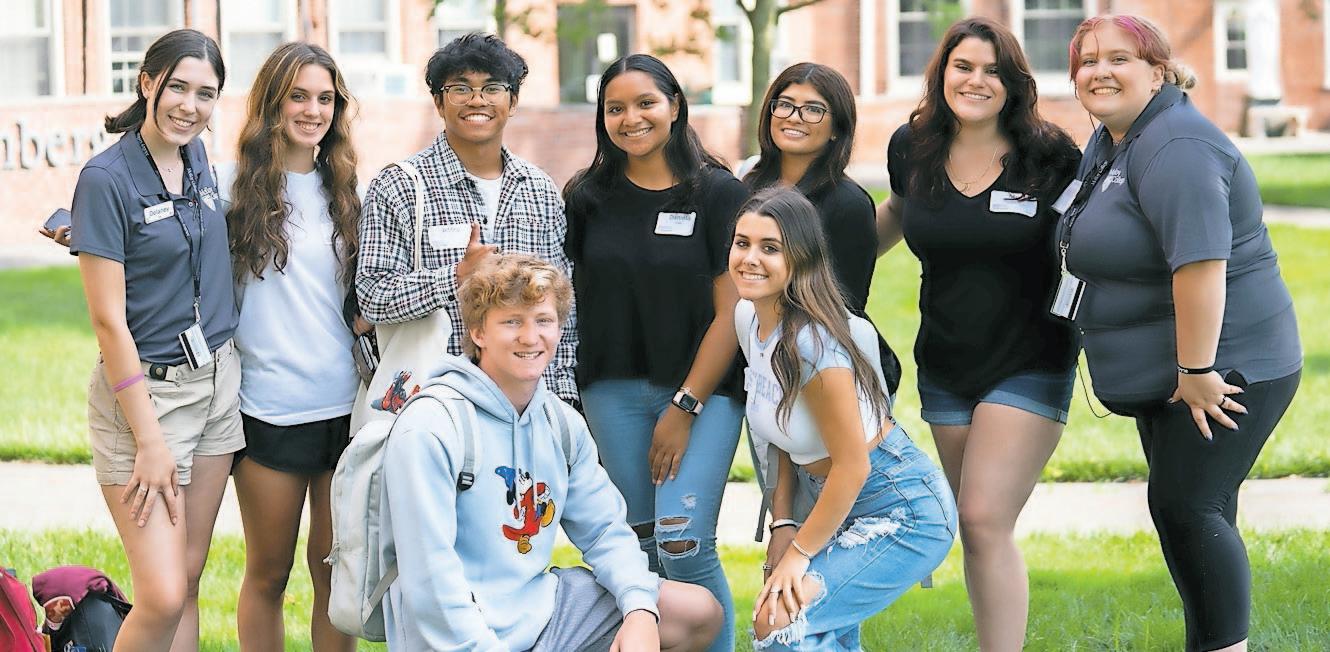
College is about more than academics, and Molloy offers a vibrant, welcoming campus experience. With 50+ clubs and organizations, evening and weekend activities, a 550-seat theatre, diverse dining options, and plenty of study and gathering spaces, there’s a place for everyone to get involved and make new friends.
Students can study abroad through international education programs that offer travel during school breaks or for full semesters, with destinations such as Spain, Italy, Ireland, and Tanzania
Molloy competes in NCAA Division II athletics and has a growing roster of club sports, including sprint football, which recently completed its second season.
Students seeking the full campus experience can live in one of three residence halls, home to approximately 350 students. Living on campus provides independence, friendship, and easy access to everything Molloy has to offer.
Don’t take our word for it—come visit! See why Molloy is Long Island’s top-ranked private university and discover where you belong.
Attend Molloy’s Open House on April 19. Learn more at molloy.edu.


College rankings, in one form or another, have influenced application, enrollment, and employment decisions for roughly 120 years. The modern parent of current rankings, U.S. News & World Report, allows its users to carefully comb through comprehensive collegerelated information. Many other rankings from the Wall Street Journal, QS, ARWU, , and Barron’s to the Economist, Forbes, the New York Times, and the Financial Times are thriving. All use their own methodology to offer a variety of ratings, measuring schools and programs in myriad ways.
You could decide to follow one ranking source or to explore all the options out there. You could also ignore them! It’s up to you. Rankings supply interesting, though often complex, information. So it’s important to make sure you understand the techniques used to evaluate it all.
Each ranking may use different and differently weighted metrics to make calculations. Take the time to investigate these methodologies. Winning the 100-meter sprint at the Olympics is a clear fact, measured by your timed performance. But who wins an Oscar, for example, is decided in a very subjective way.
College rankings can incorporate both measuring styles, so you should check out which evaluation tools are driven by hard data and which are less objective.
In addition, you may notice that the same

college may rank very differently depending on which ratings list you look at. You should also consider rankings over several years to understand the variations and fluctuations.
Look for signs of progression. Is this school on an upward trajectory?
Finally, a college ranked No. 15 may have very little separating it from another school ranked No. 35. In fact, the actual differences may be statistically insignificant. That is especially true for universities in the United States, a country with a large number of quality higher education institutions.
Why Do These Rankings Matter Then?
For colleges, competitive rankings can be reputation boosters. This is often linked to
attracting a larger volume of high-caliber students, faculty, and recruiters. Industry recognition is also a sign that things are going well. Similarly, weaker scores may spring a school into action for improvement.
Rankings are a starting point to understanding a school’s ability to meet and exceed the elements that support a good student experience.
On websites or in brochures, you may come across statements such as, “We are ranked No. 3! Yay us!” Great! But for what?
You should always look for the specifics behind the number. Is it for the engineering or
the African literature program? Is it a regional or international ranking? When evaluating rankings, always make sure to dig beyond the basic score.
Is the university’s selectiveness important to you? Are you looking for a college that offers the most generous scholarships or the best social mobility? Does the level of socioeconomic, racial, or identity diversity on campus matter to you? Is quality of student life high on your list? Let’s not forget the class size and graduation rate!
Make sure to read rankings that assess characteristics that match your own interests. Explore the data in detail. Especially if you are vacillating between a few schools.
Many applicants may be in a position to apply to a determined set of colleges. First, you must convince the people around you to support your choices. Peer pressure (“I am applying to all the top 10 schools, why aren’t you?”) may come into play. Family may demand that you only apply to schools they’ve heard of or that are ranked in the top three. Ignoring these influential opinions seems easier said than done.
But don’t forget school fit. Being the right fit for a college (and them being the right fit for you) is a big part of the selection process here, on both sides. In short, you will not be the right fit for all the schools in the top 10 of any ranking.
Photo: Don’t get caught up in the numbers. Consider college rankings as one tool in your college decision toolkit.

Sunday, April 19 at 1PM
With over 150 undergraduate, graduate and doctoral degree programs and championship NCAA Division II teams, Molloy is where you’ll learn with purpose ������������������������
Our career-focused programs in healthcare, education, business and arts and sciences
See why we’re Long Island’s top-ranked private university.









Before you can pick a specific school, you need to decide what you want from your higher education
College is one of the most important investments you will make in your future. The college search process can be both exciting and overwhelming to students, but breaking it down into steps or comparing it to a relatable process you have tackled before can make it seem manageable. Admissions officers often tell students to think about the process of picking a hairstyle, an outfit, or figuring out what group/team is right for them. While it may seem simplistic to compare it to these basic tasks, it brings it down to a level most can relate to.
Utilize your local resources
You have resources available to you at your school and in your community. Connect with your school counselor, who often has a good pulse on colleges that might be a good fit. They can be helpful in assisting you with establishing a timeline for applying and making sure you meet the requirements and deadlines.
In addition to school guidance officers, specific alumni associations often offer guidance and hold workshops for students about navigating the college search, application process, and financial aid guidelines.
Do your research
There are many tools to assist you. Use col-
lege search engines to create a profile that will find schools that are a good match. These sites can be a great way for you to start to narrow down the search by entering the criteria that are important to you in a college, like major, location, size, and academic requirements.
College websites can give you a window into the campus and a preview of what is offered at the college. Take advantage of opportunities to explore all areas of campus life, including virtual tours.
Connect with your college admissions counselor
Many colleges and universities have admissions counselors who work specifically with high schools in certain geographic areas. They are good resources because these counselors are familiar with your school’s profile, which means that you have a point person in the admissions office to help you with the admissions process and answer all of your questions.
Connecting with admission counselors also gives them a chance to get to know you beyond the application/.
See it for yourself!
Seeing the colleges you are considering is so important. While many prospective appliacants start with a virtual tour, the traditional

in-person college visit has returned as viable way to learn about a potential school.
Virtual visits are certainly here to stay and can be valuable. They can act as introductions to a school. In many ways, they open up a window to visit colleges that students may have never considered before because of their distance.
This can allow you to go outside of the original parameters you set for yourself since you can explore these schools online. Virtual visits can also give you a chance to view a college that could be close, but your schedule prohibits you from doing an in-person visit earlier on in your college search.
Make your voice heard
A school is made by the people who work there and attend it, so don’t be afraid to reach out to people! There are many people associ-
ated with a school who would be happy to help you in your college search. It can be intimidating, but do it anyway. Admission officers are always available for your questions, and most schools also have student ambassadors who can give a current student experience.
Closer to home, you might have a friend, or a sibling’s friend, or a friend of a friend who went to the college you’re looking into. You can ask them about their experience. Last but not least, try reaching out to faculty. Their whole careers tend to center around what they teach, and they are often glad to answer your questions about their department.
Photo: The college search process is a journey of selfdiscovery. Even if your student has dreamed of going to a certain school throughout their school years, not checking out other options can only do you a disservice.


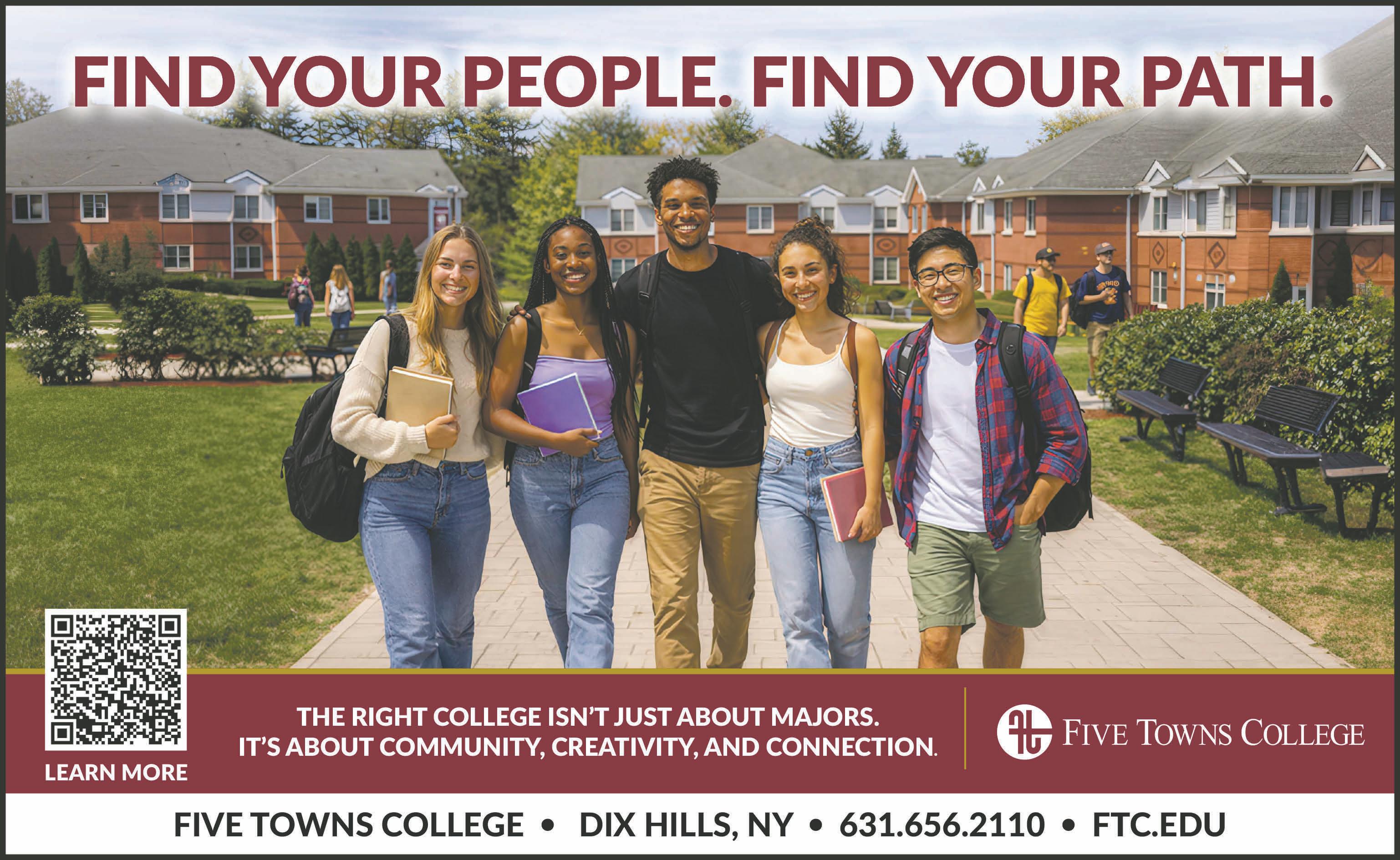
For high school seniors still weighing their college options—and juniors just beginning their search—the right college offers more than a major. It offers a pathway to explore creative interests, build skills, and connect with a community that supports professional goals.
At Five Towns College in Dix Hills, students pursue professional degrees designed for creative industries in a collaborative campus environment. Known as Long Island’s Creative College, FTC offers programs in areas including audio, film and television, business, interactive media arts, mass communication, music performance, theatre arts, and more.
At FTC, the right college isn’t just about majors. It’s about community, creativity, and connection. Students gain hands-on experience from the start, working with professional equipment and industry-standard technology. Whether producing media projects, recording in professional studios, performing on stage, or collaborating across disciplines, students build both creative portfolios and practical career skills.
Campus life also plays an important role. The award-winning FTC Sound athletics program features men’s and women’s basketball, men’s and women’s soccer, and esports, giving students opportunities to compete, represent the College, and build lasting friendships.
For high school students interested in exploring creative careers early, FTC’s Pre-College Summer Program runs July 6 – August 13, 2026, with classes held Monday through Thursday on campus in Dix Hills. Students entering 11th and 12th grade can earn up to six college credits, while 10th graders may take the same courses without receiving credit. Learn more or enroll at FTC.edu/pc.
To learn more about Five Towns College programs, and to schedule a campus visit, visit FTC.edu. Reserve your spot for the upcoming April 11 Open House at FTC.edu/rsvp

By Kirsten Clodfelter
Admissions officers may seem like the big scary gatekeepers when you’re in the middle of college applications. But, the truth is that they’re passionate about higher education and want to admit students to their university who will thrive on campus and beyond. Admissions officers actually want you to ask them questions to ensure that you’re applying to their school because it’s the right match for your educational, personal and professional goals.
Here, admissions experts share the questions potential students should be asking colleges.
What are you looking for in an applicant?
Greg Kaplan, an independent college counselor and author of Earning Admission, says, “Many students feel the need to be perfect at everything to present a ‘well-rounded’ application.” However, that’s often not what schools want.“Colleges are looking for specialists to fill niche roles at a school, which enables students to excel in a field that matters to them,” he says. Before you try to present yourself as perfect at everything (which is impossible) ask your admissions officer for their take on what they ideally want in an applicant.
If you have an idea of an intended program or major within your potential school, guidance counselor Tracy Wood says, “Ask the admissions team what makes students stand out more than others for a specific program.”
What sets your school apart from other schools?
Don’t forget that colleges should be presenting themselves as solid selections for you as much as you’re working to make yourself look like a good choice for them. John Schaffer, an assistant director of admissions suggests students dig into both the school as a whole and their potential major or program. Then, Schaffer advises, follow up by asking, “‘How will the school prepare me for my career goals?’ and ‘What are recent alumni doing with this degree?’”
What does the student debt load really look like here?
The importance of understanding the true cost of your college education before you commit can’t be overstated. Schaffer says he “always encourages students to look beyond the ‘sticker price’ of a school.”
Students can learn more about the affordability of a specific school by asking questions like, “What percentage of students receive

[financial] aid?”“What are the qualifications for academic scholarships?” and “Are there additional scholarships to apply for as an incoming student?”
Which events should I attend to learn about campus life?
One of the best ways to determine if a school’s a good fit is to spend time around campus, if possible. Of course, you’ll get the most helpful information if you know exactly when and how to spend that time on campus.
Heidi Reigel, another admissions director says, “We often have students who are overwhelmed by our offerings when it comes to visit events.”
Reigel suggests the simplest solution is to reach out to admissions and start a conversation. “Call or email [an admissions] counselor and ask for advice about which program to attend or the differences between the events. We can help students determine the best way
still matter A smart step in the search process
In an era when students can explore nearly every corner of a college online from virtual tours to course catalogs it’s fair to ask: is an in-person visit still necessary? According to higher education experts, the answer is a resounding yes.
While websites and rankings offer valuable information, they can’t replicate the experience of being on campus. A visit allows students to gauge something far more personal: whether a school feels like the right fit. That intangible sense of belonging often becomes the deciding factor in where students ultimately enroll.
College visits are probably the most fun part of the college application process. When it comes to researching potential schools, there’s no better substitute for figuring out if a campus will feel like home. For many families, campus visits are also one of the most engaging parts of the college search process. Seeing a campus firsthand can clarify priorities, challenge assumptions and, in some cases, completely change a student’s college list before applications are even submitted. No website, guidebook, or testimonial will give you a better feel for a school than you’ll get by seeing it for yourself.
Plan with purpose. Schedule your visit when classes are in session to get an authentic
sense of daily life. Visiting during the academic year offers a clearer picture than a quiet summer campus or a day dominated by special events.
Meet the experts. Talk to the current students they may soon be your peers. If they have a problem or complaint, they will probably share it with you. If they love their school, they won’t be shy about it either. Come prepared with questions specific ones will get you more interesting (and helpful) answers.
Meet the other experts. Stop by the admissions office and introduce yourself. Let them know what interests you about the school so they can direct you to the best place for further investigation. Collect contact information and send a brief, friendly email thanking them for taking the time to talk to you.
If there is a sign–up sheet, add your name! Colleges do keep track of which applicants have demonstrated genuine interest in the school. A visit is a great way to demonstrate your interest. Some schools will let you interview with an admissions rep during your campus visit.
Take the campus tour. While it’s the most obvious thing to do, the official campus tour is worth your while. It gives the school a chance to show off its best features, like the newlybuilt theater or their rooftop planetarium.
to see our campus and get their questions answered.” Admissions counselors can also provide information about virtual and online visit information if needed.
How do you support students after graduation?
College may feel like the end goal after high school, but it’s actually a stepping stone toward your career. As you consider your college journey, ask yourself what you think you’d like to do once you’ve earned your degree, and then ask your admissions officer how that school can support you. Kaplan says students should understand how a school can serve their post-graduation goals. He says it could be through “grad school admissions [support], placement in a niche field or access to a desired job market.”

While you’re walking around, check out the flyers and bulletin boards and pick up a school newspaper to get a sense of what’s going on … then venture out on your own.
The official tour will probably steer you clear of the school’s less attractive features. Take your own un-official tour by wandering around campus. If there are any facilities that are important to you, find them and have a look for yourself. Make sure your destinations include the library and the first-year dorms. Be a student for a day (or night). Some schools sponsor overnight programs in which you can stay with a current student. This is a great opportunity to get a deeper sense of campus life and interact with your potential future friends and roommates.
Even if you don’t stay over, most schools will allow you to sit in on lectures. Browse the course catalogue before arrival or ask the admissions office what classes are in session that day.
Save the best for last. You’ll get better at visiting colleges with practice. As you compare schools, you pick up on the aspects you like and the aspects you’re not so fond of. You also figure out the right questions to ask, as well as the best campus spots to gauge student life. For that reason, visit your favorite schools last, so you’ll be in the best position to make comparisons to the others on your list. Don’t rush to judgment. A single rainy day or lackluster class shouldn’t define your perception of a school. At the same time, pay attention to your overall impression. Whether it’s an immediate connection or a lingering hesitation, your instincts can be a valuable guide.
Photo: Visiting a college campus is an exciting step in choosing a college. If possible, it’s best to visit colleges before your applications are due. That way, you can be confident you’d be happy at any of the colleges you’re applying to.
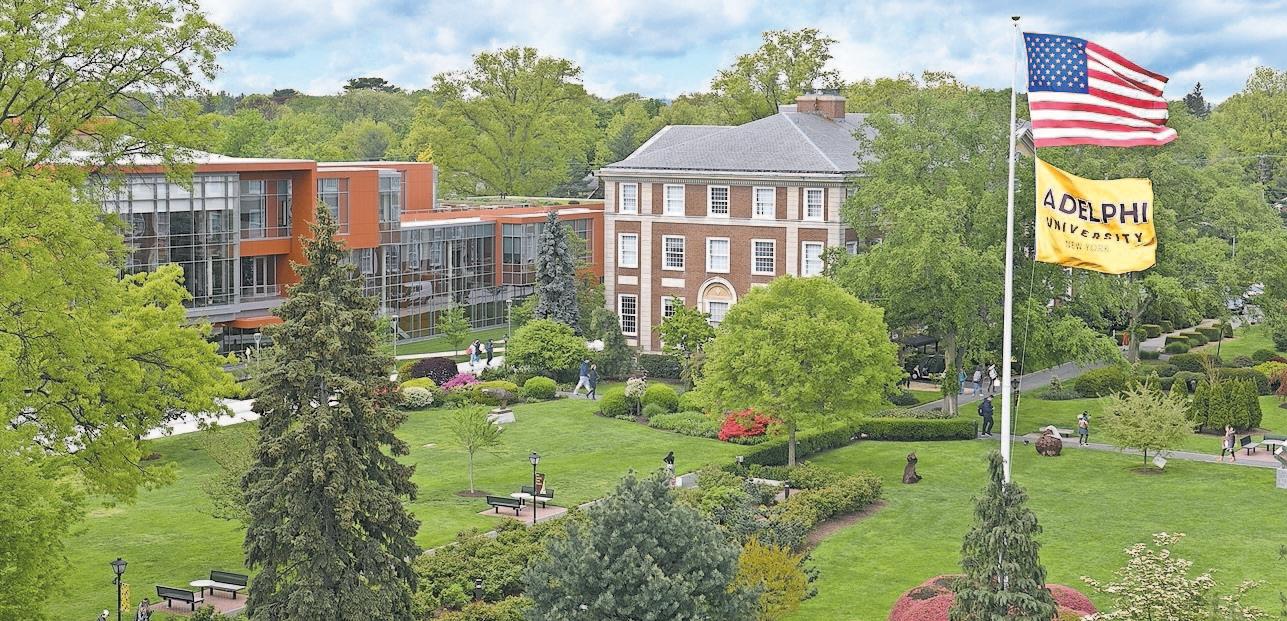
What makes Adelphi University the smart choice for students who want to make the most of their college experience? Join us at our May 2 Open House on our Garden City campus and find out.
Here are some of the reasons that Forbes has named Adelphi University the number-one private university on Long Island for three consecutive years.
the Numbers that Matter
• Average annual salary of our 2024 baccalaureate graduates: $76,451—higher than the national average
• 100% of undergraduate receive scholarships
• More than 70 undergraduate programs, from STEM to the arts
• More than 90 clubs and organizations
• Award-winning career guidance
Find Your voice at adelphi
There are no giant lecture halls here. Your professors will know your name, encourage your ideas and make sure your voice is heard.
More academic options
You’ll choose from more than 70 majors including innovative programs like an artificial intelligence degree and a scientific computing minor.
Fast-track Your Future
Our 4+1 programs allow you to earn a bachelor’s and master’s degree in just five years, saving both time and tuition. And our joint degree programs with partner universities provide direct pathways to professional careers.
Career Success Starts Here
You’ll be career-ready. You’ll gain résumé writing, LinkedIn optimization and interview skills and valuable internships through our award-winning PREP for Success program.
Come to the Spring Undergraduate open House at our Garden City Campus
Meet faculty and current students, connect with admissions counselors and financial aid advisors, and explore our beautiful campus.
Connect with admissions counselors, financial aid advisors, faculty and current students and learn about our:
• 70+ undergraduate majors
• 11:1 student-to-faculty ratio that ensures personal attention
• 90+ clubs and organizations
• Generous financial aid—100% of undergraduates receive scholarships
• Strong career outcomes: The average annual salary of our 2024 baccalaureate grads was $76,451
• Saturday, May 2, 11:00 a.m.–2:00 p.m.
Learn more at adelphi.edu/heraldoh26

Undergraduate Open House
Saturday, May 2 11:00 a.m.–2:00 p.m. Garden City Campus

Register today to reserve your spot! Visit adelphi.edu/ heraldoh26 or scan this code.
Founded in 1932, and located in New York City, Vaughn College is a private, nonprofit, four-year college that enrolls more than 1,400 students in master’s, bachelor’s and associate degree programs in engineering, technology, management and aviation. The student-faculty ratio of 16 to 1 ensures a highly personalized learning environment. Faculty and staff know students as individuals and work with them to enhance their college experience.

Ninety-seven percent of Vaughn College graduates are placed in professional positions, 77% in their field of study, or choose to continue their education within one year of graduation. More than eighty-six percent of students receive some type of financial aid. The institution serves many first-generation college students and is recognized by the US Department of Education as a Hispanic-Serving Institution.
Vaughn College was ranked number one in upward mobility among 2,137 colleges according to a study reported in 2017 in The
New York Times meaning Vaughn is fulfilling its mission by moving students from the bottom 40 percent to the top 40 percent in income. The College was recognized in the top four percent of colleges with the highest return on investment for students from under-resourced communities by a 2022 study completed by Georgetown University’s Center on Education and the Workforce. And Vaughn continues to be recognized as a top regional college in the Northeast and a top college for social mobility by US News and World Report.



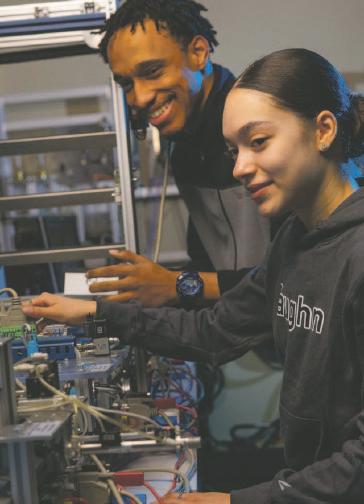


Our industry-driven programs in engineering, technology, management and aviation don’t just prepare you for a career—they help you secure one. With 97% of graduates employed or continuing their education within one year (77% landing ��������������������������������������������������������������������������������
To learn more or schedule a tour, visit vaughn.edu.



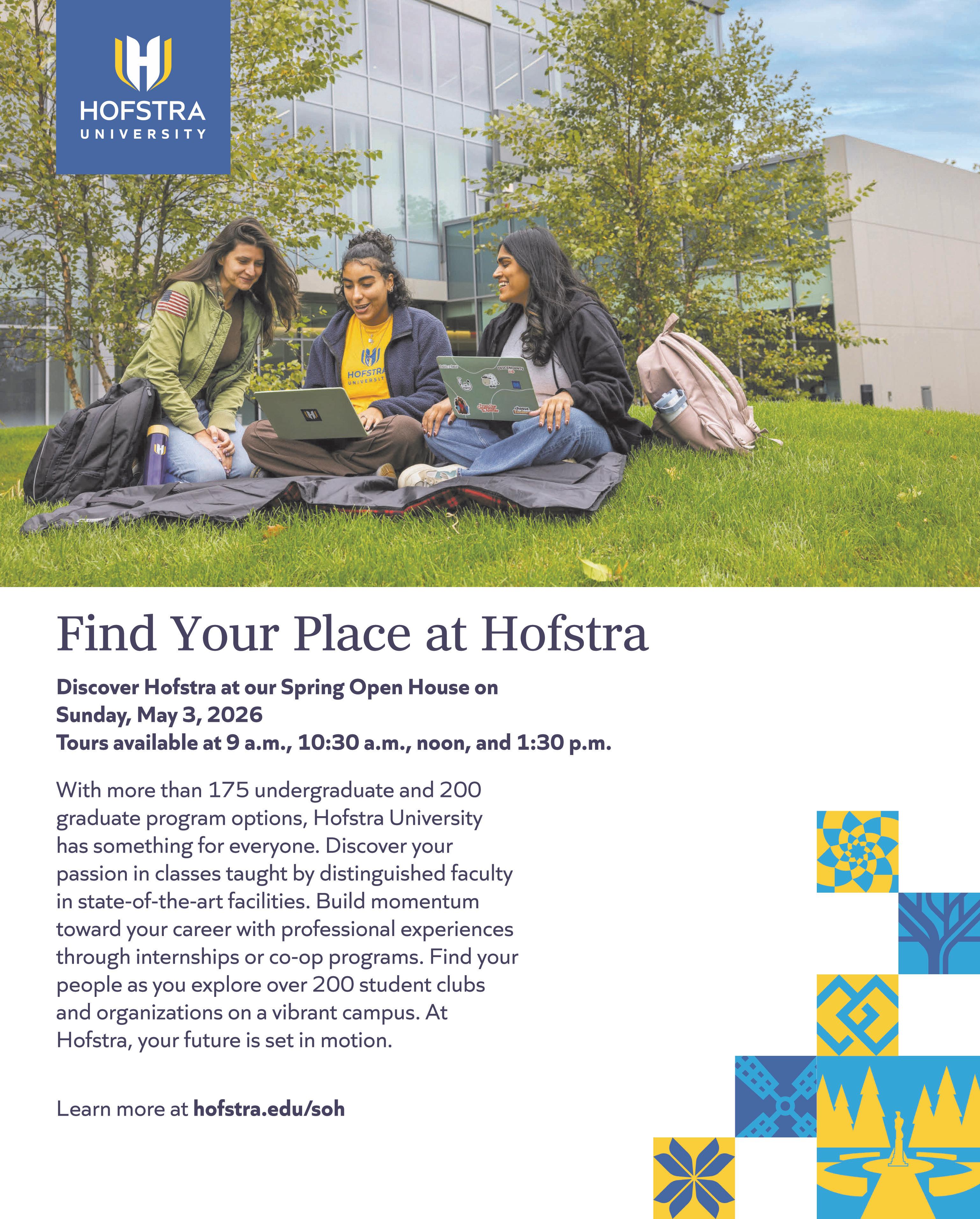
Hofstra University offers a range of academic and professional programs in an environment where students are part of a close-knit, supportive community. Students choose from more than 175 undergraduate and 200 graduate programs in areas of study such as business, health sciences, communication, education, engineering, and liberal arts and sciences, and benefit from faculty who are industry-leading professionals. And with a student-to-faculty ratio of 13:1, your professors foster a personalized learning environment.
Ranked as the No. 2 school on Long Island and a top 100 Best Value School by U.S. News & World Report, Hofstra continually invests in state-of-the-art educational facilities, including the Science & Innovation Center, a 75,000-squarefoot, high-tech facility with fully equipped medical laboratories and science labs.
Located just 12 miles from Jones Beach and 25 miles from New York City, Hofstra is at the nexus of urban, suburban, and coastal living. Students take breaks from studying to explore the rich culture of New York City or experience the beautiful waves of Long Island’s beaches. Universityprovided shuttles to entertainment and shopping centers make it easy to get around the surrounding area. Hofstra’s welcoming community is supported by year-round, school-sponsored events and over 200 clubs and organizations.
In 2024, Hofstra launched Hofstra 100, a comprehensive strategic plan
that will guide the University toward its centennial year in 2035. The plan includes investments and innovations in teaching methods and technologies, as well as a renewed commitment to advancing research that drives positive societal change. As one of the first schools in New York to provide ChatGPT Edu licenses to all students and faculty, Hofstra students are learning with tomorrow’s technology. Hofstra was also recently recognized as an R2 Research University by the Carnegie Classification of Institutions of Higher Education, indicating Hofstra’s support of faculty innovation and student participation in high-impact research.
Hofstra’s goal is to help students build momentum in their careers. With a focus on experiential learning, students gain hands-on experience from day one. And learning continues outside the classroom, with a variety of preprofessional clubs, such as The Hofstra Chronicle (student-run newspaper), HEAT Network (student-run television network), and the Zarb Store (student-run store for business students and entrepreneurs).
With robust connections to top hospitals, businesses, and organizations in New York City and on Long Island, and the support of Hofstra’s Career Center, you can jump-start your career with incredible internships and co-op experiences. Students have gone on to intern at companies and organizations such as Coca-Cola, the New York Islanders, Disney, Goldman Sachs, NASA, the United

Nations, and more! The average student completes more than two internships in their academic career, and 91% of undergraduate degree recipients are working or in graduate school within a year of graduating.
Hofstra provides academic flexibility, with programs that allow students to begin their graduate coursework as undergraduates. Accelerated and dualdegree programs provide highly motivated students with the ability to earn both a bachelor’s and a master’s degree in a shortened time frame, saving both time and tuition. Hofstra also offers generous
financial aid: 97% of students receive financial assistance, and the average firstyear student is awarded over $34,000 in scholarships.
Hofstra University’s holistic approach to student success integrates academic, social, emotional, and wellness support. With its ideal location, supportive community, and forward-thinking approach to education, Hofstra is the catalyst for your future.