



Roksana Amid/Herald Holocaust survivors and their descendants lit candles to honor those killed by the Nazis.

Roksana Amid/Herald Holocaust survivors and their descendants lit candles to honor those killed by the Nazis.
By ROKSANA AMID ramid@liherald.com
The last time Bertha Strauss saw her mother, she was given a simple instruction: Take care of your brother. She was 6 years old.
“I remember being smuggled out of the camp in a truck,” Strauss told a hushed audience on Sunday at the Holocaust Memorial and Tolerance Center in Glen Cove. “And my mother saying to me, ‘Always take care of your brother.’ That was the last time I saw my mother.”
Now 90 and living in Fresh Meadows, Strauss shared her story during the center’s annual Yom HaShoah commemoration, an
evening dedicated to remembering Holocaust victims and preserving survivor testimony.
The program, held in partnership with Congregation Tifereth Israel and North Country Reform Temple, brought together survivors, victims’ descendants and community members to reflect on the enduring responsibility of remembrance.
Strauss began by tracing the dismantling of Jewish life in her hometown of Karlsruhe, Germany, following Adolf Hitler’s rise to power. Jewish professionals were forced out of their jobs, businesses were boycotted and the 1935 Nuremberg Laws stripped Jews of citizenship and basic rights.
“Women had to put in their middle name, CONTINUED ON PAGE 7



By ROKSANA AMID & JULIA CAPITELLI jcapitelli@liherald.com
Fresh fruits, vegetables and other foods full of protein were distributed to hundreds of Glen Cove residents last week, when the Farm to Truck program stopped at the city’s Economic Opportunity Commission of Nassau County office in Glen Cove, expanding access to nutritious food as grocery costs continue to rise.
It keeps food in the house so my family doesn’t have to starve.
central resource for residents in need, offering food assistance, housing guidance, job readiness programs and other services to individuals and families. While its regular food pantry is limited to registered clients, the EOC also hosts broader community distributions and outreach initiatives intended to reach a wider population, particularly those facing financial challenges because of the region’s high cost of living.
Glen Cove
Operated by Long Island Cares, a nonprofit organization and the main food bank on Long Island, the mobile initiative delivers fresh, locally sourced produce directly to communities using a refrigerated truck designed to function like a small farmers market. The program gives residents a chance to choose their own food based on family size, rather than receiving prepacked bags.
More than 400 people attended two distributions held at the EOC site on Glen Cove Avenue. The nonprofit social services organization that serves as a
The April 10 event was divided into morning and afternoon distributions, according to Program Director Irma Jeanty.
“There were over 200 [families] that received food that morning,” Jeanty said. The event was open to all Glen Cove residents. The EOC opens its food pantry to regular clients once a month.
Residents who attended pointed to rising costs as a key factor. Stephanie Evans, of Glen Cove, said she came for vegetables.
“Everything is too expensive
CONTINUED ON PAGE 11
By CHRIS COLUCCI ccolucci@liherald.com
Nassau County Executive Bruce Blakeman, the Republican nominee for governor, held a news conference last week to laud the county’s budget surplus and financial stability. Blakeman also called for an end to the strict oversight of the Nassau Interim Finance Authority, which was created in 2000 to monitor county finances.
“We are calling on NIFA to basically transfer from being a control authority to an advisory authority,” Blakeman said on April 10. “NIFA costs county taxpayers approximately $3 million a year in administrative expenses. That money is unnecessary. It is not doing anything to help our fiscal status.”
The $3 million cost Blakeman cited is a rough estimate of the combined salaries of the five NIFA committee members. The committee has had oversight of county spending since 2011.
“We will do everything necessary to make sure that we are no longer burdened in a control period that is completely unnecessary, unwarranted and, quite frankly, not according to the law,” Blakeman added.
Richard Kessel, chairman and director of NIFA, delivered a direct rebuttal, saying, “The only reason the county budget is balanced is that it got over $200 million in federal funding during


Covid, and it’s using that money and other reserves to balance and to hide what is a deficit.” In 2024, Blakeman’s administration moved more than $220 million received from federal pandemic aid into the county’s general fund.
Blakeman noted recent county prosperity — including seven bond upgrades in the past three and a half years and gross economic output that he described as larger than that of nearly 150 mem-


bers of the United Nations — before addressing the potential for a political slant to NIFA’s financial control.
“NIFA has been a political machine, governed by [Gov.] Kathy Hochul,” he said. “She wants to control every aspect of our business here in Nassau County, just like she has throughout the state of New York.”
Blakeman said that State Comptroller Tom DiNapoli, a Democrat, has

declared that the county has no fiscal stress. And County Comptroller Elaine Phillips, a Republican, emphasized Nassau’s financial health despite rising costs statewide. “In 2024 to 2025, we saw almost a $5 million increase in health insurance costs,” Phillips said, “[and] a 23 percent increase in our pension costs.”
Phillips commended Blakeman’s decision not to raise county taxes for the entirety of his four-year tenure, and added that NIFA’s shift to an advisory role would be appropriate. “I wholly support that NIFA does not keep us in a control period,” she said.
County Treasurer David Chiang also voiced support for reduced NIFA oversight while stressing the county’s current financial position. “Nassau County is in the best fiscal shape it’s ever been in,” he said. “Without cutting services, we have maintained our service level while keeping revenues stable. Our expenses have been going down. We have budget surpluses.”
“Bruce Blakeman has no authority to decide whether there’s a control period in effect,” Kessel said. “It’s our position that a control period is absolutely necessary, and we will continue it going forward. It’s up to us to decide whether or not to decide to have a control period. If he doesn’t comply with it, we’ll take the appropriate action at the appropriate time.”










































By ROKSANA AMID ramid@liherald.com
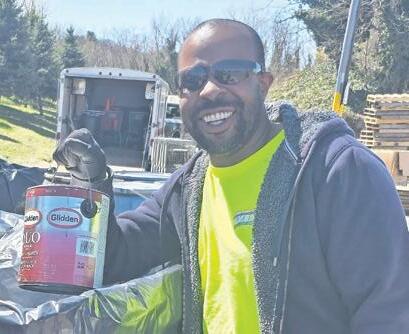
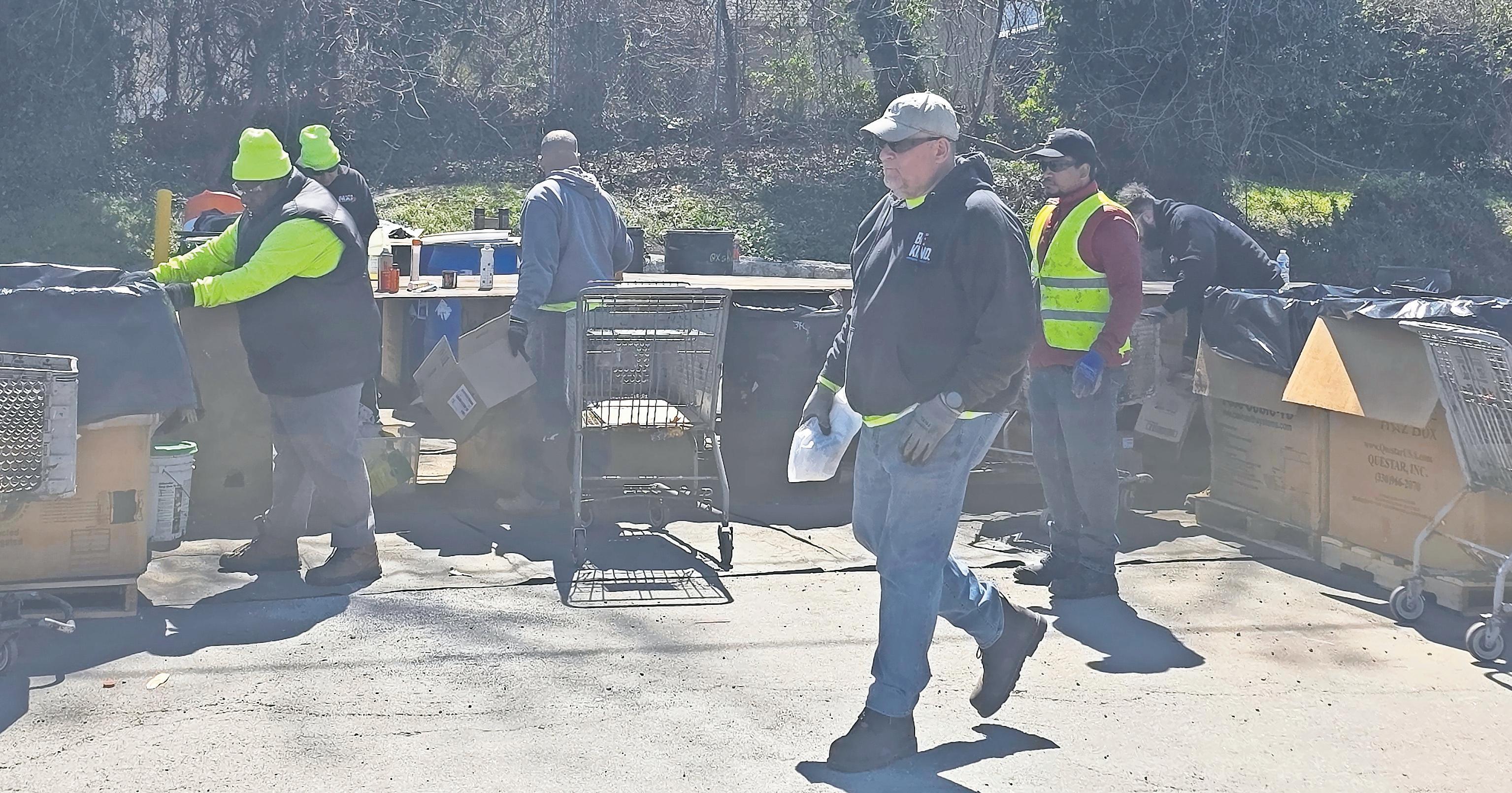
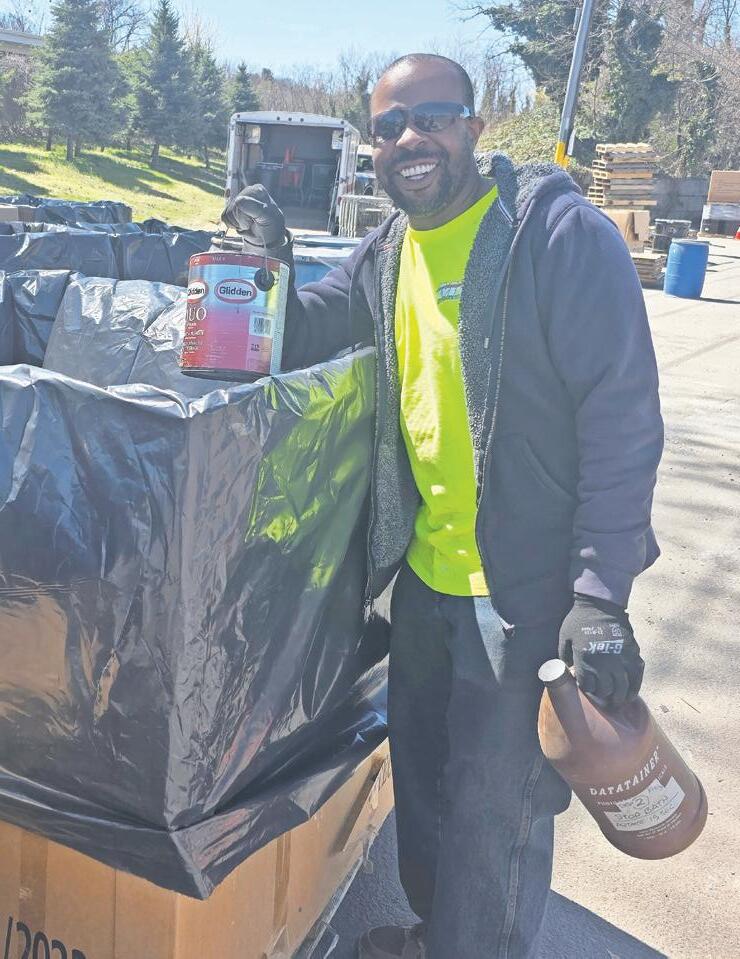
Residents lined up early Saturday morning along Morris Avenue, some arriving before 8 a.m., to safely dispose of household hazardous waste during Glen Cove’s semiannual STOP program and paper shredding event, held in partnership with Winters Bros..
Hosted at the city’s transfer station, the event gave residents an opportunity to discard items that cannot be placed in regular garbage, including paint cans, propane tanks, gasoline, batteries and cleaning fluids.
You’re risking the lives of our men by doing something you don’t have to do.
RALPH COMITINO president, CSEA
“It’s very important. We’ve been doing it for quite a while now,” said Ralph Comitino, president of the Glen Cove Civil Service Employees Association and a member of the city’s Department of Public Works. “If you throw it out in the regular garbage, it’s not being disposed the right way. It’s going to a landfill, which causes problems.”
Comitino emphasized that improperly discarded materials pose serious risks not only to the environment, but also to sanitation workers. Items like lithium batteries and pressurized containers can ignite or explode when compacted in garbage trucks — something the city has experienced firsthand.
“We had a garbage truck on fire in the back,” he said, recalling an incident last year that required emergency response from the fire department.
Such dangers are why sanitation crews are prohibited from collecting hazardous materials during routine pickup. When illegal items are found, the city leaves them behind with a notice instructing residents to dispose of them properly through programs like STOP.
“You’re risking the life of our men by doing something that you don’t have to do,” Comitino said.
The STOP program, held twice a year in partnership with the city, is designed to prevent those risks while offering a convenient, centralized solution for residents unsure how to handle hazardous waste.
“It’s an opportunity for residents to take hazardous materials and get rid of them properly,” said Dan Schaefer, manager of public affairs for Winters Bros. “We want to keep any hazardous or dangerous materials out of our waste stream.”
Schaefer said the company operates about 13 sites across Long Island, including 12 transfer stations — one in Glen Cove — and a materials recycling facility in Brookhaven that processes recyclables for reuse.
“A transfer station is handling waste,” he said, explaining that facili-

ties process municipal solid waste and construction debris, while recycling centers handle materials that can be repurposed.
Hazardous materials, he added, create risks if they enter that system.
For Christine Jenkins of the company’s customer experience team, the event reflects a broader commitment to environmental responsibility and accessibility.
“We worry about the environment, and we want to make sure that we give the community the opportunity to dispose of these things properly,” Jenkins said.
She added that the program simplifies disposal for residents who might otherwise leave items at the curb without knowing how to handle them.
“We do this for the ease of the com-
munity, so that way they can get rid of the stuff responsibly,” she said.
The response from residents has been strong, with steady traffic throughout the morning. Some participants even made multiple trips after learning more about what materials were accepted.
“The community loves it,” Jenkins said. “They ask if they can come back. People have been here twice already today.”
Beyond safe disposal, Schaefer said the larger goal is reducing waste overall. According to the New York State Department of Environmental Conservation, the average New Yorker produces about five pounds of trash per day — a figure that presents challenges on Long Island, where landfill space is limited and transporting waste off the island strains infrastructure.

Dear Great Book Guru, With the Sea Cliff Baseball/ Softball season about to beginI’m throwing out the opening pitch - I cannot contain my excitement! However, while I’m a great fan of the game, I do like to have a good book with me at all times. Do you have something to recommend for me when things slow down on the field?
Ardent Book and Baseball Fan









The 2026 edition of “Ettinger Law Firm’s Guide to Protecting Your Future”, a free download at trustlaw.com, and in hard copy on Amazon or complimentary at your no-cost consultation (by phone, Zoom or in-person), with Ettinger Law Firm provides:
Elder Law Estate Planning: Explains planning for death and disability, including avoiding probate, the five steps to an elder law estate plan, mistakes to avoid, and special situations (such as estranged children, special needs, and second marriages).
Financial and Tax Aspects of Estate Planning: Estate planning for IRA’s and other “qualified” plans, reducing or eliminating New York and Federal estate taxes, avoiding mistakes with beneficiary designations, and reducing or eliminating capital gains taxes.
The Social Side of Estate Planning: The social aspects of how and to whom to leave your estate to and whether you should discuss these matters with your adult children. Are any more deserving, more in need, your relationships with them and theirs with each other, which are most
capable, what to do with a vacation home and much more.
Medicaid Planning Strategies: With 36 years’ experience in over 5,000 Medicaid applications, we show you (a) how to protect your assets from long-term care with the Medicaid Asset Protection Trust (MAPT), (b) the seven myths surrounding the MAPT, (c) how to get home care though Medicaid while keeping your income, (d) how to apply for Medicaid, (e) Medicaid exempt assets, and (f) “spousal refusal”.
Estate Administration on Death: Executors’ and trustees’ duties, including how to settle an estate quickly, efficiently, and at least cost while avoiding misunderstandings and litigation.
Health Issues for Older Adults: “Protecting Your Future” also includes living longer and healthier lives. Here you’ll find many of the keys to successful mental and physical aging.
Well-Being for Older Adults: As we age and begin to consider our legacy, how do we learn to “accept what is”, to forgive, to become less fearful, to increase our gratitude and generosity, and to achieve peace of mind.

Dear Ardent Book and Baseball Fan, Emma Straub, one of my favorite authors and owner of my absolute favorite bookstore Books Are Magic in Brooklyn, has just come out with a new book: “American Fantasy.”
Set on a cruise ship hosting three thousand fans of a 1990’s fictional band, Boytalk, this three-hundred-page novel introduces us to the world of aging boy band fandom from the perspectives of Sarah, the cruise ship manager, Keith,
the fifty-year-old member of the band, and Annie, one of the band’s multitude of fans.
Annie is on the cruise reluctantly –her sister Katherine, a diehard fan, had convinced her to come along. Things were going badly for Annie - she was recently divorced, her daughter had moved out, and she had just learned her job of two decades had been given to a young intern influencer.
When her sister breaks her leg and is unable to go on the cruise, Annie tries desperately to get out of the trip to no avail. Very soon into the four-day voyage, her spirits lift, she relives the exuberance of her teen years, and a shipboard romance develops. This is a fun read that contains some profound insights into what it means to revisit one’s past and revive earlier passions - highly recommended!
Would you like to ask the Great Book Guru for a book suggestion? Contact her at annmdipietro@gmail.com.
Team EVA will return to Long Island roads from April 26 through May 2 for its annual “Seven Marathons in Seven Days” challenge, a weeklong effort to raise funds and awareness for veterans organizations. Led by Eva Casale, the initiative has raised more than $350,000 for local causes since 2016.
Runners will complete 26.2 miles each day — more than 184 miles total — with routes spanning communities across Long Island. Beginning April 26 at Huntington Town Hall in Huntington and continues through Farmingdale, West Sayville, East Rockaway, Middle Island and Sag Harbor before concluding May 2. The final leg starts in Bay-
ville and finishes in Glen Cove, followed by a closing ceremony at City Hall at 5 p.m.
Each day honors different groups, including Gold Star families and fallen service members, with designated points where the public can join for shorter distances or cheer along the runners. A virtual option also allows participants to complete at least one mile per day.
Registration includes a commemorative T-shirt and challenge coin. More information is available at GoTeamEva. org.
glencove.liherald.com ■ E-MAIl: Letters and other submissions: glencove-editor@liherald.com ■ EDITORIAl DEPARTMENT: Ext. 327 E-mail: glencove-editor@liherald.com ■ SUBSCRIPTIONS: Press ”7”
ADVERTISING: Ext. 249 E-mail: rglickman@liherald.com Fax: (516) 569-4643
■ PUBlIC NOTICES: Ext. 232 E-mail: legalnotices@liherald.com
By WILL SHEELINE wsheeline@liherald.com
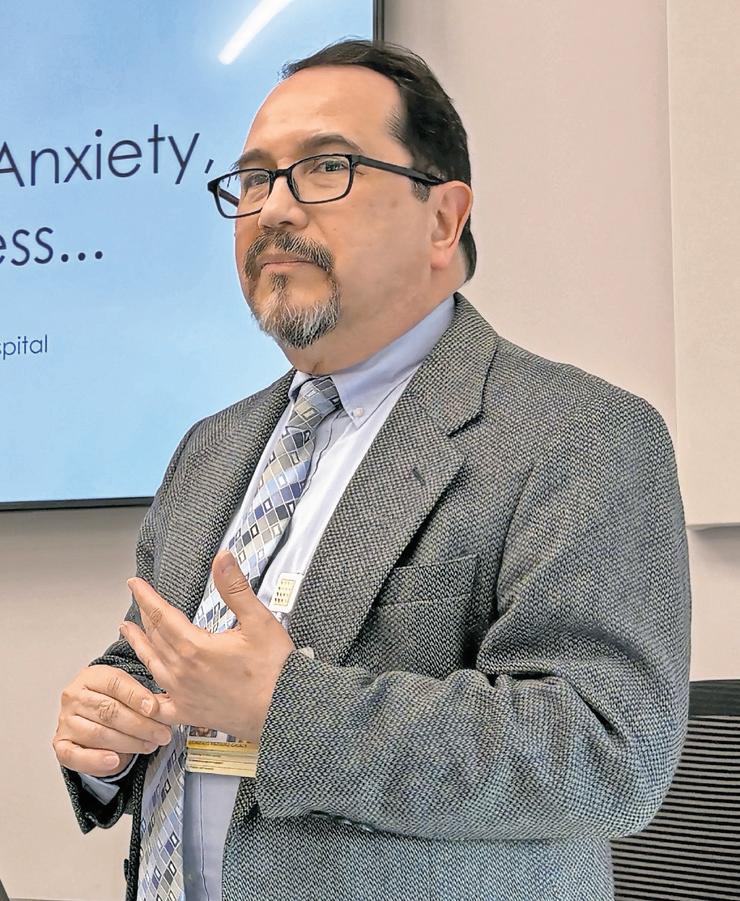
Anxiety, depression and stress touch nearly everyone at some point in life, and recognizing the warning signs early can make a critical difference. That was the message neuropsychologist Gonzalo Vazquez-Casals told attendees Tuesday evening at the Grenville Baker Boys & Girls Club of Locust Valley.
The presentation, titled “A Conversation on Anxiety, Depression and Stress,” was part of the club’s Community Cares Conversation series, held in partnership with Glen Cove Hospital.
Melissa Rhodes, the club’s executive director, opened the event by welcoming residents and thanking Vazqeuz-Casals for continuing the community health initiative.
“He is addressing a very important topic that I think we all have some kind of connection to; stress, anxiety and depression,” Rhodes said. “We’re using the acronym SAD, but I am glad that you are here with us, and we’re going to have hopefully a very engaging conversation”
Vazquez-Casals, who has a Ph.D. in counseling psychology and works in the physical medicine and rehabilitation department at Glen Cove Hospital, said the discussion is to help people better understand conditions that are often misunderstood.
“All of us have had a relationship
with any of these things; stress, anxiety or depression,” he said. “That’s part of the human experience.”
He pointed to the importance of distinguishing between healthy emotions and clinical disorders. He noted that temporary sadness or nervousness does not necessarily indicate a mental health disorder.
“There’s an emotional component that is about the nervousness, the apprehension, in some cases, a sense of impending doom,” he said. “There’s a cognitive component that is worrying about the future, catastrophizing, thinking about the worst happening.”
He added avoiding situations and physical symptoms such as sweating, palpitations and dizziness are also common features. He described anxiety as “a fact of life,” explaining that it has evolutionary roots and was essential for our distant ancestors’ survival.
Despite this, anxiety disorders are widespread in modern life.About one in five adults in the United States experiences some form of anxiety disorder.
With the lasting mental health effects of the coronavirus pandemic, rates of anxiety and depression rose significantly after 2020.
He described depression as more severe and persistent than ordinary sadness, and a major depressive episode is marked by at least a week, and more commonly two weeks, of persistent sad-
ness, loss of interest in activities, fatigue, changes in sleep or appetite, and in some cases thoughts of death.
Attendees asked questions about resolving panic attacks, and what families should do if a person is having one.
“If it’s really, really bad, for example, someone that has societal ideation, that person has to go to the emergency room immediately,” Vazquez-Casals replied. “Without any hesitation, the recommendation is go to the emergency room.”
Judith Rivera of Sea Cliff also asked about alternative coping methods, including meditation and yoga.
“Meditation and relaxation are excellent tools and things that are going to help you to be in the present moment,” Vazquez-Casals responded, though he cautioned.
Taking a walk, visiting a park, spending time with a pet or calling a close friend can also help reduce anxiety.
The talk also focused on warning signs families and friends should watch for, including persistent worry, social withdrawal, irritability, sleep disruption and physical complaints without a clear medical cause.
For depression, he pointed to “persistent sadness, emptiness and hopelessness,” as well as loss of interest in hobbies, fatigue, appetite changes and negative self-talk.
“When the person is engaging in negative talk, like talking about feeling of
solutions for
and
being of low value with low self-worth or expressing frequent guilt or self-blame,” he said, “all those things are important signs.”
Vazquez-Casals emphasized that loved ones are often the first line of support, through practices like “active listening,” being fully present, reflecting back what a person is expressing and responding without judgment.



By JULIA CAPITELLI jcapitelli@liherald.com
A fire ignited at Big Valley Nursery’s gardening supply storage building in Glen Head on April 8. It became a fouralarm fire, taking several hours to fully extinguish. The building was unoccupied. Three firefighters were treated for minor injuries.
While it is unclear what time the fire started, Glenwood Fire Company received a call at around 8:15 a.m. from Big Valley Nursery Owner Carmine Capobiano reporting the building fire. Mutual aid was automatically assigned with fire engines and trucks from other companies like Sea Cliff Fire Department, Locust Valley Fire Department and Roslyn Rescue being sent to Big Valley Nursery along with Glenwood.
According to Glenwood Fire Company Chief Donald Sinski, roughly a dozen fire companies responded with between 80 and 100 firefighters on the scene. He said it was a very hot fire with a lot of smoke, which made it difficult to put out.
“It was a metal building…and then they had some wood structure around it,” Sinski said, “so it burns hot inside.” He added that it took fire fighters roughly two hours to get the fire under control and roughly four to extinguish it entirely.
To combat the fire, firefighters used a master stream, feeding water from a fire engine to a hook and ladder truck to be sprayed at the building.
“They flow it that way to give the maximum amount of water to drown out the fire,” Sinski explained. “That’s what we were looking to do.”
Firefighters continued spraying water at the building until there was no more smoke and any residual smoldering was eliminated. After putting out the fire, firefighters opened up the storage building’s sides and parts of its roof to ensure nothing was left smoldering.
“That prevents us having to go back at a later time, because sometimes they flare up again,” Sinski said. “So, we wanted to make sure we got it all at once.”
He also said the injuries to three firefighters were minor, and no one was sent to the hospital.
Ambulances from Glen Cove, Nassau County Police Department and Port Washington Fire Department were also on scene. A five-person team whose pur-

pose is to rescue trapped firefighters during an operation was on standby but was not needed.
Fire engines and trucks from Manhassent-Lakeville Fire Department and Albertson Fire Company were sent to responding firehouses to take any calls that came in while they were fighting the fire at Big Valley Nursery.
According to Sinski, damage to the storage building was extensive, and it will have to be knocked down.
Deputy County Fire Coordinator Nick Corrado, from the Nassau County Fire Marshal’s office, said the cause of the fire is still under investigation but has been deemed not suspicious.
According to Glenwood Fire Company Chief Donald Sinski, the storage building will have to be knocked down.





























Sarah, and men had to put in their middle name, Israel,” Strauss said, describing how even names were altered to identify and isolate Jewish people.
Strauss’s father was arrested after Kristallnacht, in 1938, and sent to the Dachau concentration camp. Though he was later released, the family’s attempts to flee Germany were repeatedly blocked.
In October 1940, Strauss, her parents and her brother were deported to internment camps in southwestern France. The conditions were harsh: Food was scarce, illnesses went untreated and death was constant.
“It is terrible what we have to suffer here,” she read from a letter written by her parents. “We get 200 grams of bread daily and twice a quarter liter of turnip soup with worms.”
As conditions worsened, Strauss and her brother were separated from their parents and hidden by a Jewish aid organization, moved from place to place to evade Nazi capture. At one point, they were returned to a camp and nearly deported to another, Auschwitz, with their mother.
They were smuggled out before transport.
That moment — and her mother’s final words — stayed with her.
Strauss’s parents were later deported and killed in Auschwitz. She and her brother survived in hiding, eventually reaching Switzerland before emigrating to the United States in 1946.
Her testimony anchored the evening, which organizers said reflected the core of the center’s mission: ensuring that survivors’ stories continue to be heard.
“So what we do here is so heavy at times, and it can’t be done alone,” Bali Lerner, the center’s executive director, said. “It literally takes a village, and it
It’s not a choice.’

starts with our survivors, who come here and give all of themselves and pour their heart out.”
Alan Mindel, chair of the center’s board of directors, offered both historical and present-day context for the Holocaust, pointing to the global response during World War II and the importance of confronting modern antisemitism.
“We, the descendants of Holocaust survivors, who
have sworn the oath to never forget this unimaginable tragedy, know a simple truth,” Mindel said. “‘Never again’ can only be achieved if we have the same rights as any other people. It is as much about the present as it is about the past. But it is the lessons of the past that we must remember to protect our future.”
Educators at the center emphasized the importance of testimony in shaping understanding for younger generations.
“This is not just a history textbook lesson,” Donna Rosenblum, the center’s director of education, said. “It is the best education that we can give them.”
The center, Rosenblum said, remains committed to documenting survivors’ stories and ensuring that they are accessible for years to come.
Zachary Graulich, the assistant director of education, acknowledged the emotional weight of sharing such experiences, but said that survivors continue to do so out of a sense of duty.
“For any survivor, sharing testimony . . . is an extremely challenging thing to do,” Graulich said. “But . . . it’s an obligation. It’s not a choice.”
Rabbi Irwin Huberman, of Congregation Tifereth Israel, connected the lessons of the Holocaust to current global events, urging vigilance in the face of hatred and injustice.
“The lessons that we learn from the Holocaust is not just never again for the Jewish people,” Huberman said. “We have to stand on guard for whenever there is hatred and whenever there is injustice.”
Throughout the evening, a consistent message emerged: remembrance is not passive. It requires listening, learning and action.
And as Strauss’s story made clear, it is a responsibility that extends beyond those who lived through it, carried forward by those willing to bear witness.








Uneven investment in treatment, emerging contaminants leave many residents feeling vulnerable
By Roksana amid, stacy dRiks & Hailey FulmeR of the Herald
Sixth installment in a series about water.
Concerns about water quality remain visible and closely tied to patterns of neglect in communities across Long Island.
In the region, water problems don’t exist in isolation. Flooding, contamination and aging infrastructure are increasingly intersecting, and all of it can be traced back to a single source: the Island’s underground aquifer system. The sole-source system supplies all of the region’s drinking water, leaving little margin for error as environmental pressures intensify.
neglect beneath the surface
In Uniondale, aging infrastructure, delayed upgrades and a lack of investment are reflected in a deteriorating water tower and broader concerns about environmental health. The tower is known locally as “Old Rusty,” according to Pearl Jacobs, president of the Nostrand Gardens Civic Association, and has stood for more than three decades without proper maintenance. Experts typically recommend inspection, repainting and structural upkeep every seven years, Jacobs said.
“It’s beyond repair,” she said of the tower. “You can see the corrosion. There were reports of leaks. This is not just infrastructure; it’s a health and safety issue.”
Despite years of complaints, advocates like Jacobs say local officials initially proposed only cosmetic fixes, such as applying internal epoxy coatings to stop leaks. It was only after community pressure that roughly $10 million was allocated in 2025 for a new tower. The project is still in its early stages over a year later. The new tower is planned to be fully operational by the summer of 2027.
Residents have reported brown water in their homes, raising concerns about unsafe levels of contaminants. Water quality studies conducted one of Jacobs civic partners, Jeannine Maynard, cofounder of the Greater Uniondale Area Action Coalition and vice president of the Uniondale Community Land Trust indicated elevated levels of 1,4-dioxane, [a synthetic industrial chemical that is often found as a contaminant in water supplies, especially in places with past manufacturing or heavy chemical use], in the system.
Uniondale’s water infrastructure also includes aging pipes, with much of the system’s lead content still unknown. Maps show large portions of Uniondale untested, highlighting gaps in oversight compared with nearby communities. Advocates say these combined issues — brown water, an outdated tower, unknown lead risks and industrial contamination — reflect broader inequities.
a pattern of delays and uncertainty
The water tower is not just a one-off

issue but, for many residents, part of a broader pattern of neglect in the Town of Hempstead.
Jacobs pointed to a stark comparison: while Uniondale’s water tower deteriorated, West Hempstead received millions of dollars for a new facility. “They took taxpayer money and invested it elsewhere while our infrastructure was failing,” she said.
Uniondale residents, Jacobs said, have been diagnosed with a variety of cancers. “People start asking questions like, ‘What’s in our water?’”
reflects “a level of neglect,” leaving residents in the dark about risks.
“When things are ignored for decades, it sends a message,” Maynard said. “The question is: whose communities get prioritized and whose are left waiting?”
researchers are still working to understand the full scope.
Rising seas, stronger storms strain water supply
“We have a single-source water supply on Long Island,” Ali FarhadZadeh, an associate professor of civil engineering at Stony Brook University, said. “The water basically comes from the ground — from the aquifer.”






Residents wonder about the safety of their water because much of the community’s infrastructure has not been fully studied, said Maynard.
An interactive map from the League of Conservation Voters shows that while neighboring Hempstead has many defined lead service lines, most of Uniondale is listed as unknown, raising concerns about potential contamination.
Air studies and local health data suggest higher rates of certain conditions, such as asthma, in the community, which may be linked to environmental exposure. Experts say the lack of detailed pipe inventories and testing
She also pointed to growing concern over PFAS, short for per- and polyfluoroalkyl substances, a class of human-made chemicals often referred to as “forever chemicals” because they do not break down easily in the environment or the human body. Used for decades in products designed to resist heat, water and stains — including firefighting foam, nonstick cookware and waterproof materials — PFAS have entered groundwater through industrial processes.
And because Long Island relies on a sole-source aquifer, those contaminants can persist and circulate throughout the region, Maynard said. “These weren’t things people were even looking for,” she said. “So they built up over time.”
She added that PFAS and related contaminants have been detected widely across Long Island. Exposure has been linked in studies to increased risks of cancers, hormone disruption and other long-term health effects, though
As storms grow more frequent and sea levels rise, that system is under mounting strain. Heavier rainfall is overwhelming drainage systems and saturating the ground, increasing flooding and raising the risk of saltwater intrusion.
“We have saltwater that’s in the sediment, under the ocean on the South Shore,” Ryan Wallace, assistant professor at Adelphi University’s Department of Environmental Studies and Sciences said. “That saltwater could actually make its way to make its way into and mix with the freshwater aquifer, and that’s a lot of different towns.”
While residents are not drinking saltwater, intrusion can render wells unusable and reduce the region’s supply of clean drinking water.
New York state launched a pilot program on March 8 to help residents with private wells testing for PFAS contamination and cover cleanup costs. Suffolk is among the counties expected to be
Continued from PreViouS PAGe
included.
Eligible homeowners can receive free testing and may qualify for rebates of up to $5,000 for filtration systems or $10,000 to connect to public water companies.
“It makes infrastructure like septic systems and pipelines very vulnerable,” FarhadZadeh said of heavy rainfall. “They’re old — they’re not built for the new norm that we have with these storm patterns.”
Low-lying communities — particularly along the South Shore and in eastern Suffolk County — face more frequent flooding and infrastructure stress. Flooding is no longer limited to major storms.
When groundwater is already close to the surface, even routine rainfall can overwhelm drainage systems, creating a direct pathway between surface pollution and the aquifer.
“When it floods, water picks up and carries a lot of pollutants with it,” Robert Hayes, Environmental Advocates NY’s senior director of clean water, said. “Those pollutants might make their way into drinking water sources, whether it’s groundwater or surface water.”
Hayes said that investing in naturebased solutions such as wetlands or rain gardens could help capture water before it carries pollutants.
Aging infrastructure adds to growing risks
Many of Long Island’s water and sewer systems were built decades ago, at a time when both population and climate pressures were lower.
“The aging infrastructure is a big deal,” FarhadZadeh said. “I think it should be taken very seriously.”
Systems not designed to handle today’s volume of stormwater can quickly become overwhelmed, increasing the likelihood of overflows, leaks or system failures.
A $250 million water infrastructure funding package announced by Gov. Kathy Hochul on March 12 includes projects aimed at upgrading aging systems and improving water quality statewide. It includes $23 million for the Village of Hempstead and $5 million for PFAS treatment in Williston Park.
Hayes said that such investments are critical, but risks — and resources — vary across the region.
“Long Island has some of the most polluted drinking water in the state of New York,” he said. “But there is much more contamination still out there, and much more still to be done to make sure that no New Yorker is exposed to harmful levels of contamination when they turn on the tap.”
“Drinking water and quality issues on Long Island — we can consider them to be disproportionately affecting certain communities,” Wallace said. “Especially communities with older infrastructure, in close proximity to industrial zones or historically industrial areas.” Communities like Uniondale and Hempstead Village, which also have fewer resources to address the problem.

Exposure to contaminated drinking water, Wallace said, has been associated with increased risks of cancers including stomach, bladder, kidney, ovarian and prostate.
As flooding increases and infrastructure continues to age, the challenge for Long Island is not just protecting its water supply, but understanding how interconnected pressures are reshaping it from the ground up.
Glen Cove’s drinking water meets all state and federal safety standards, according to the city’s 2024 annual water quality report, but maintaining that standard has required years of infrastructure upgrades, careful management of its well system and, at times, reliance on neighboring communities.
In nearby Glen Head and Sea Cliff, water is supplied privately by Liberty Utilities, highlighting differences not only in cost, but in how water systems are maintained and experienced by residents.
Glen Cove relies on a network of six municipal wells, including sites at Duck Pond Road, Nancy Court, Seaman Road and Kelly Street. According to former Councilwoman Marsha Silverman, the system was under significant strain eight years ago , with only two of the six wells operational at the time.
Multiple wells were offline for different reasons — contamination, storm damage, long-term deterioration — forcing the city to act quickly to restore capacity.
“We had purchased a couple hundred thousand dollars’ worth of water from Locust Valley because we couldn’t supply Glen Cove,” Silverman said.
To stabilize the system, the city
implemented a multi-year plan that included installing temporary filtration systems at the Duck Pond Road wells to address freon contamination, repairing the Kelly Street well after a lightning strike, and fully rehabilitating the Seaman Road well.
That work is ongoing. In January, the City Council approved more than $700,000 in additional repairs to the Seaman Road well, awarding a $776,000 contract to Philip Ross Industries Inc. to upgrade its granular activated carbon system. The improvements are intended to better regulate PFAS, which have been linked to serious health risks, and ensure that the well remains in compliance with state Department of Health standards.
The investment follows a broader pattern of spending, with the city investing tens of millions of dollars in its water system in recent years, including a $5 million rehabilitation project completed in 2024 at the Seaman Road station. Those upgrades are necessary as state and federal guidelines for contaminants become increasingly strict.
“There was always talk about building a seventh well, because we really need it,” Silverman said.
Despite those infrastructure challenges, Glen Cove’s municipal system remains relatively affordable compared with neighboring communities, because it is publicly operated and not for profit.
Residents’ quarterly bills typically range from $40 to $50 in the winter to a few hundred dollars in the summer, depending on usage.
In contrast, residents of Glen Head and Sea Cliff — served by private systems — often face significantly higher costs, with some paying hundreds of
dollars per month. Those systems generally factor operational expenses, infrastructure upgrades and profit into their rate structures, contributing to higher bills.
For Glen Head resident Agatha Nadale, the cost is substantial — about $1,800 per year. Her concerns, however, extend beyond the money.
“I can remember [in the ’70s] we’d fill a pitcher of water in the summer and there were these, like, little squiggly things swimming in the water,” she said. She also recalled a strong chlorine taste, and said those early experiences continue to shape how she uses water today. Nadale said she relies on a wholehouse filtration system, and does not drink tap water.
“I have already saved a handful of families from buying homes where Liberty Utilities is,” she said.
While Glen Head’s system has undergone upgrades — including carbon filtration systems designed to remove PFAS and meet stricter standards for water quality — public perception has not always kept pace with those improvements.
Although Glen Cove’s system remains compliant, continued monitoring and investment will be necessary as environmental standards evolve.
That concern extends across Long Island, where all communities rely on the same groundwater source and face challenges not only of contamination and saltwater intrusion, but also of steadily increasing demand.
Silverman has also raised the possibility of long-term alternatives, including desalination, though no formal plans have been established.
At the federal level, U.S. Rep. Tom Suozzi said that water quality has been a longstanding priority.
“This has been a problem for a long time, and I’ve been working on improving our water quality on Long Island for over 30 years,” Suozzi said. “Dealing with aging infrastructure as mayor of Glen Cove, I realized how crucial drinking water projects were to my community. I installed one of the earliest ‘granulated activated carbon’ filtration systems on Long Island.”
“Improvements need to consistently be made to ensure our water remains safe,” he added.
For Glen Cove, the ability to draw from neighboring systems like Locust Valley provides a critical safety net. But it also highlights the importance for the city of maintaining its own infrastructure — particularly its network of wells — as demand continues to grow.
Across the North Shore, the contrast is clear: While water may come from the same aquifer, the cost, management and experience of that water can vary significantly from one community to the next.
And for residents like Nadale, of Glen Head, those differences are not abstract — they shape daily decisions about cost, safety and trust in what comes out of the tap.
By ROKSANA AMID ramid@liherald.com
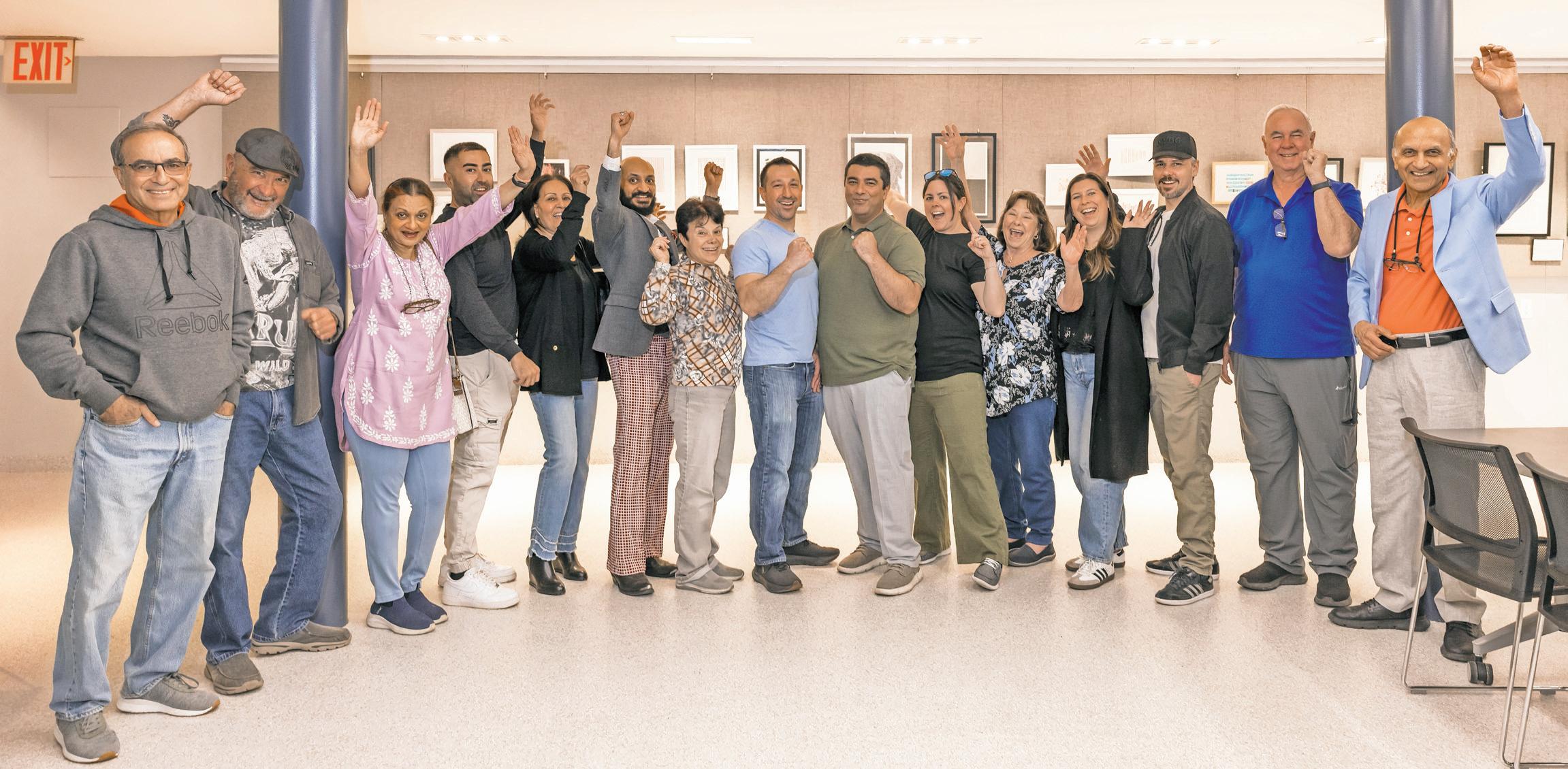
As visitors moved through the Glen Cove Public Library’s gallery earlier this month, they paused in front of swirling, ribbon-like forms—delicate lines layered in ink that looked more like abstract paintings than scientific diagrams. But for Nabil Azamy, each piece began not with a sketch, but with data.
“I’m looking to give people these individualized perspectives of their own genetic stories,” Azamy said.
Azamy, 37, is the co-founder of Genetics of Design, an art studio that transforms genetic and other datasets into visual works using custom software and pen plotters with his business partner Anthony DeSantis.
His exhibition, “The Art of Genetics,” which runs through then end of April at the Glen Cove Library, blends science, technology and personal storytelling, offering viewers a way to see biology not as charts or reports, but as something tangible.
“I think genetics has reached this ‘Pale Blue Dot’ phase,” he said, referencing Carl Sagan’s famous reflection on Earth’s image captured from deep space. “It’s informing our lives, our decisions, public health. But people are still learning how it’s meaningful to them.”
Azamy’s work aims to bridge that gap. Rather than presenting raw data, he converts complex biological information into designs that hold personal significance. One piece, created for a pet owner, visualizes a dog’s genetic background by mapping how two breeds combine at the molecular level.
“When you look at that piece, if you’re the pet owner, that can represent to you a very personal image of this animal that you love,” he said.
The process behind each artwork is both technical and deliberate. Azamy writes his own software—often in Python—using public datasets or clientprovided reports. The designs are then rendered by pen plotters, machines that draw each piece line by line.
“You can kind of see this coming together,” he said. “It’s manufactured one layer at a time, one color at a time.”
That physical process is central to his work. Unlike digital prints, the plotted pieces emphasize craftsmanship and transparency, showing viewers how data becomes art.
“If I just give them a JPEG or a PNG, it doesn’t feel real,” Azamy said. “But when you see it being made, there’s something about that that connects with people.”
Azamy’s background is rooted in science. He earned a bachelor’s degree in biochemistry from Stony Brook University and later a master’s degree in computer science and bioinformatics from Johns Hopkins University. He previously worked at Cold Spring Harbor Laboratory and now develops large-scale genetic software pipelines used to generate patient reports.
That experience has shaped both his technical approach and his understand-

ing of how deeply genetics can affect people’s lives.
“I’m on the frontier of seeing how meaningful genetic information is to people,” he said. “It informs their identity, their life choices.”
Through his studio, Azamy is exploring how that information can be expressed visually. His work ranges from general data art—such as maps or topographical designs—to deeply personal commissions tied to ancestry, health or family history.
“Some people might say, ‘I have my genome sequenced—make something that represents that,’” he said. “Others might want something connected to a loved one’s experience with illness.”
He is careful, however, about how he handles sensitive information.
“I want people to understand that their genetic information is as valuable as their phone password,” Azamy said.
“That’s something I take very seriously.”
While the subject matter can be high-
ly technical, Azamy said the final pieces are meant to stand on their own, regardless of a viewer’s scientific knowledge.
“One of the nice things about abstract art is that it can speak to you on many levels,” he said. “You don’t need to know anything about the biology behind it.”
That accessibility is intentional. He compares the experience to looking at the night sky—something that can inspire awe without requiring full understanding.
“In the same way you can look up and see the stars and still find beauty in it, I want people to feel something when they see these pieces,” he said.
“The library’s exhibit space gives local artists a unique opportunity to share their work with the community without the traditional barriers of a gallery,” Lydia Wen Rodgers, a librarian at Glen Cove Public Library,said. “It’s so important to maintain an open and welcoming environment.”


now,” Evans said. “It keeps food in the house so my family doesn’t have to starve.”
The rate of inflation rose in March, increasing 0.9 percent from the previous month and 3.3 percent compared with a year earlier, according to the latest Consumer Price Index, with energy costs driving the overall gain.
The event filled a need for many in the area, Evans said. “It’s good for the community,” she said. “There’s a lot of people out here that need help like this.”
Olga Cruz, who heard about the event from her mother, said the assistance is especially important for families trying to manage increasing expenses. “It helps out a lot for my kids, with how much my groceries cost today,” she said. “It’s really helpful for the community — there’s a lot of people struggling, and the groceries are so expensive.”
The morning distribution focused on fresh fruits and vegetables. Residents received items including sweet potatoes. The afternoon session expanded the offerings to chicken, shrimp and salmon.
Volunteers said the program’s emphasis on fresh food sets it apart from traditional pantry offerings. Greg Gelauro said that access to healthier options is a key benefit. “I love that we can offer fresh produce to people that normally get canned goods, which is really not that healthy for you,” Gelauro said. “There’s a health factor to this that I’m in love with.”
The Farm to Truck program is supported in part by a $250,000 grant from Bank of America, which funded the refrigerated vehicle that transports and distributes food. The initiative is designed to make healthy eating more accessible by bringing farm-fresh food directly to neighborhoods in Nassau and Suffolk counties.

In 2024, Long Island Cares distributed more than 16 million pounds of food to more than 330 partner sites, including food pantries, soup kitchens, shelters and senior facilities.
The need for food assistance remains significant across Long Island. According to Feeding America data, roughly 313,880 people experience food insecurity, including 71,500 children. About 40 percent of those households have incomes that are above the poverty line, but still struggle to afford food due to the region’s high cost of living.
“What I come to find out is a lot of people are work-


By Celeste Gullo – Celeste & Co. Insurance Group
ing,” Jeanty said. “However, with the inflation, with food and the way things are, I’ve seen a lot more people coming that are actually working, but with all the bills, food becomes a scarcity.”
The work, she said, is deeply personal, and despite the challenges, the response from residents reinforces the importance of the effort.
“When you’re able to give it to the client, they are so appreciative,” Jeanty said. “It really is needed in the community.”
The Glen Cove EOC plans to host another Farm to Truck event in May, with a date to be determined.
When people shop for insurance, price is often the first concern. But the real value is having the right coverage with the right carrier.
We often see claims denied because people weren’t forthcoming about where a vehicle is garaged, how it’s used, or who is driving. Even home claims can be denied when ownership or occupancy changes are not reported to the insurance company.
Taking time for an insurance review helps ensure your coverage keeps pace. The goal of insurance is simple: peace of mind and financial protection when the unexpected happens.

Reach out to us for a review of your coverage!
Celeste P. Gullo
Celeste & Co. Insurance Group
Glen Head, NY
Phone 1-516-671-0001
Email: CGullo@allstate.com


Life changes and insurance should change too. Without regular reviews, gaps in coverage can occur. Many homeowners don’t realize rebuilding costs have increased over time, and renters often underestimate the value of renters insurance.



Come learn about local disability rights pioneer Dr. Henry Viscardi, Jr. and explore over 125 artifacts highlighting the fight for equal opportunity for people with disabilities.
The museum provides an inclusive, fully accessible experience for all visitors and is the perfect place to spend a fun and educational day with your family. School field trips and group tours welcome.




First workshop, with topics ranging from billing to electric vehicles, scheduled for May 6
By ANGELINA ZINGARIELLO azingariello@liherald.com
To mark Small Business Week, May 3-9, PSEG Long Island will host a Business First Workshop to support small businesses across the region.
The workshop is scheduled for May 6, from 9 to 11 a.m., at the Nassau County Office of Emergency Management, at 510 Grumman Road West in Bethpage, commonly referred to as the old Grumman building. The event is intended to bring together business owners and PSEG Long Island representatives to share information about programs and services that can help businesses operate more efficiently and manage energy use and costs.
“PSEG Long Island is proud to support our local business community — the entrepreneurs who invest in our neighborhoods, drive local economy and create jobs,” Veronica Isaac, PSEG Long Island’s senior manager of Economic Development, said. “Our Business First Workshop on May 6 will present all of the products and services offered by our PSEG Long Island Business First program for small and medium business owners. We will also have a special recognition ceremony to honor local companies and business organizations that participate in, promote and support our programs.”

Last year’s Business First Workshop presenters offered information about programs and services that help businesses operate more efficiently.
The company’s Business First program provides businesses with dedicated support for managing electricity needs, as well as information on billing processes and energy-efficiency incentives. Other areas of focus include building and renovation services, electric vehicle infrastructure and fleet incen -
tives, and procurement-related opportunities.
The topics will include digital tools such as the utility’s app and online account management platforms, as well as economic development initiatives that offer grants and bill credit opportunities.
Presenters will include Nayan Parikh, on digital channels; Christine
Bryson, on economic development; Alex Nyilas, on the Business First program; Alexandro Campos, on billing; Brittany Degel, on energy efficiency; Nicole Jones-Cumberbatch, on building and renovation services; Paul DiBenedetto, on electric vehicles; and Jimmy Alty, on procurement.
The workshop will also provide an opportunity for attendees to connect with Business First Advocates and representatives from procurement and building and renovation services, offering direct access to support resources.
Long Island is home to more than 100,000 small businesses, according to the Long Island Association, underscoring their significance to the regional economy.
“We proudly share information about PSEG Long Island’s revitalization programs with all new businesses in our community,” Cheryl Fajardo, past president of the Greater New Hyde Park Chamber of Commerce, said. “As a strong partner in local economic development, PSEG Long Island has played a vital role in helping us improve our downtown areas through beautification projects, infrastructure support and promotional efforts.”
Pre-registration is recommended by emailing PSEGLI-Businessfirst@psegliny.com.



BUSINESS & TRANSACTIONAL
JOSEPH G. MILIZIO
Managing Partner Vishnick McGovern Milizio, LLP
RACHELLE ROSENBERG, ESQ.
Partner Abrams Fensterman
RALPH ROSELLA
Office Managing Member Bond, Schoeneck & King
COMPLEX TORT & GENERAL CASUALTY
CAV. NICHOLAS R. CAIAZZO
Partner/Trial Attorney Wilson Elser
CORPORATE & SECURITIES
DAVID F. DURSO
Partner Ruskin Moscou Faltischek, P.C.
DEBT SOLUTIONS
LESLIE H. TAYNE
Founder & Managing Director Tayne Law Group, P.C.
EMPLOYMENT & BUSINESS LITIGATION
DANIELÉ D. DE VOE
Partner
Sahn Ward Braff Coschignano, PLLC
JEFFREY BASSO
Partner Campolo, Middleton & McCormick, LLP
MICHAEL POROPAT Partner Stockman & Poropat, PPLC
ESTATE PLANNING/ ELDER LAW
BRIAN A. TULLY
Founder & Managing Partner Tully Law Group, P.C.
ROCHELLE L. VERRON, ESQ. Founder & Managing Partner Verron Law Group, P.C.
RONALD FATOULLAH, ESQ. Chair Elder Law Group & Partner Trusts & Estates Meltzer, Lippe, Goldstein & Breitstone, LLP








STEPHEN J. SILVERBERG
Founding Attorney Law Office of Stephen J. Silverberg, P.C.
WENDY K. GOIDEL, ESQ. Founder & Principal Goidel Law Group, LLC
ESTATE PLANNING/
GENERATIONAL WEALTH MANAGEMENT
RUSSEL MORGAN, ESQ. Founding Partner Morgan Legal Group, P.C.
STEPHANIE D’ANGELO, ESQ. Principal Attorney D’Angelo Law Associates, P.C.
FAMILY LAW
ALEXANDER E. SKLAVOS, ESQ. Founder & Principal Attorney Sklavos Law Group, P.C.
ARMAND J. PRISCO, ESQ. Partner Polin, Prisco & Villafane
JOSEPH TROTTI Partner Vishnick McGovern Milizio, LLP
MICHAEL ALBER, ESQ Partner The Alber Firm, P.C.
FINANCE, INSURANCE & LEGAL AFFAIRS
ALAN B. HODISH, ESQ. Founding Principal Law Offices of Alan B. Hodish, LLC
HEALTHCARE & CANNABIS LAW
ANDREW P. COOPER, ESQ., LLM
Cannabis & Psychedelics Attorney Falcon Rappaport & Berkman LLP
INJURY & CAR ACCIDENT LAW
CHRISSY GRIGOROPOULOSPELEYTAY, ESQ.
Founding Attorney Grigor Law Injury & Car Accident Lawyers
LITIGATION & DISPUTE RESOLUTION LAW


ANDREW J. TURRO Shareholder Meyer, Suozzi, English & Klein, P.C.
TOM MEALIFFE Partner Nixon Peabody, LLP
MEDICAL MALPRACTICE
JOSEPH L. CIACCIO Partner
Napoli Shkolnik, PLLC
PERSONAL INJURY
DOROTHY RENZ Partner
Duffy & Duffy, P.C. JASON A. GREENBERG Founder & Managing Attorney Law Offices of Jason Greenberg, P.C.
LEONARD J. WIENER
Associate Meyer, Suozzi, English & Klein, P.C.
ROSS L. SCHILLER
Founder & Managing Attorney Ross L. Schiller & Associates, P.C.
BRIAN S. STOLAR Partner
Harris Beach Murtha
BRYAN P. MCCROSSEN Partner
Jaspan Schlesinger Narendran REAL ESTATE
ED PUERTA Partner Nixon Peabody, LLP
GILAD ADLAD Attorney at Law Law Office of Gilad Adlad
RISING STARS
ALEXIS EPSTEIN Associate
Barket Epstein Kearon Aldea and LoTurco, LLP
BROOKE MCDONALD Associate Salenger, Sack, Kimmel & Bavaro, LLP
JACOB BLOOM, ESQ. Associate Attorney Miller & Caggiano, LLP
TAX CERTIORARI LITIGATION
ANTHONY FORZAGLIA Partner Schroder & Strom, LLP





TRUST & ESTATE LITIGATION
ANDREW P. NITKEWICZ
Partner Cullen and Dykman, LLP
TRIAL LAW
CHAD J. LAVEGLIA
CEO & Trial Lawyer
Law Office of Chad J. LaVeglia PLLC
WORKERS’ COMPENSATION
ANDREW B. WOOLF
Founding Partner
Klee Woolf Goldman & Filpi, LLP
JONATHAN R. KLEE
Managing Partner
Klee Woolf Goldman & Filpi, LLP
TIMOTHY E.T. FINNEGAN
Partner McIntyre, Donohue, Accardi, Salmonson, & Riordan, LLP
COMMUNITY CHAMPION
PHIL RIZZUTO
Trial Attorney
The Rizzuto Law Firm
TOP BOUTIQUE LAW FIRM
VISHNICK MCGOVERN MILIZIO, LLP
TOP LAW FIRM
NIXON PEABODY, LLP
TOP TAX CERTIORARI LAW FIRM
SCHRODER & STROM, LLP
TRIAL TEAM OF THE YEAR
STUART L. FINZ, CARAMIA R. HART, BRANDON S. FINZ
FINZ & FINZ, P.C.

TO
SILVERSPONSORS





By ALYSSA R. GRIFFIN agriffin@liherald.com
Rex Heuermann admitted in Suffolk County Court last week to being the Gilgo Beach serial killer, and to murdering seven women whose remains were found along Ocean Parkway between 1993 and 2011.
Heuermann said on April 8 that he strangled Melissa Barthelemy, Maureen Brainard-Barnes, Amber Lynn Costello, Sandra Costilla, Valerie Mack, Jessica Taylor and Megan Waterman. He also admitted to killing Karen Vergata, who disappeared in 1996. Her remains were found later on Fire Island and near Tobay Beach.
“When Rex decided that he wanted to accept responsibility and didn’t want to proceed the trial, from a defense standpoint, we then pivoted and did our best to protect his interest,” Michael Brown, Heuermann’s attorney, said. “That included the fact that he’s going to cooperate with the Federal Bureau of Investigation’s Behavioral Analysis Unit.”
Heuermann is expected to be sentenced to three consecutive terms of life in prison without the possibility of parole for the murders of Barthelemy, Costello and Waterman. He is also expected to receive four consecutive sentences of 25 years to life for the killings of Brainard-Barnes, Costilla, Mack and Taylor. Sentencing is scheduled for June 17.
Brown stated that with this new plea, Heuermann will face no further prosecution.
Asa Ellerup, Heuermann’s ex wife, attended the hearing with their daughter, Victoria Heuermann, and attorney Robert Macedonio.
“Rex Heuermann, and Rex Heuermann alone, is responsible for these horrific crimes,” Macedonio


said. “Any suggestion that Asa Ellerup and Victoria Heuermann were involved is irresponsible. They have no knowledge, no involvement or any connection to these heinous acts.”
“My thoughts are prayers are with the victims and their families,” Ellerup said. “Their loss is immeasurable, and the focus should be on them. I ask that you give some privacy to my family as they navigate this very difficult time.”
In January, Heuermann appeared before state Supreme Court Justice Timothy Mazzei, and his attorneys filed a 178-page omnibus motion seeking multiple forms of legal relief, including dismissal of a second-degree murder charge in the 1993 death of Costilla and a review of grand jury minutes.
He had previously pleaded not guilty, and his attorneys mounted a broad challenge to the prosecution’s case. At earlier court proceedings, the defense focused on disputing key forensic evidence, particularly DNA analysis that prosecutors said linked Heuermann to the victims.
Defense attorneys argued that the testing methods and conclusions should be closely examined, raising questions about how the evidence was collected and interpreted. They also challenged other elements of the investigation, signaling an effort to weaken the case and prepare for a potential trial.
Prosecutors maintained that the evidence was strong, citing DNA findings, cellphone data and years of investigative work that led to Heuermann’s arrest.
In September, Mazzei ruled that Heuermann would face one trial for all seven of the alleged murders.

Seven women were killed between 1993 and 2010. Their remains found near Gilgo Beach and Ocean Parkway.
Rex Heuermann admitted to killing the following women:
Melissa Barthelemy — strangled July 10, 2009.
Maureen Brainard-Barnes — strangled July 9, 2007.
Amber Lynn Costello — strangled Sept. 2, 2010.
Sandra Costilla — strangled Nov. 19, 1993.
Valerie Mack — strangled and dismembered between Sept. 1 and Nov. 1, 2000.
Jessica Taylor — strangled and dismembered around July 23, 2003.
Megan Waterman — strangled June 6, 2010.
Heuermann also admitted to killing:
Karen Vergata — disappeared in 1996; remains found later on Fire Island and near Tobay Beach.
–Heuermann allocution


























By Karen Bloom
Spring has surely sprung (at last) — and we’re very much attuned to Earth Month as we embrace the outdoors. It’s great get out and about and not feel so housebound, which leads many of us to rethink how we use our outdoor space. The season definitely invites us outside, offering a chance to reconnect with nature right at home and shape a backyard that works for everyday living.
Start by considering how your yard can better serve your household. Maybe you’re envisioning a space for easy entertaining, a safer play area for kids and pets, or simply a peaceful retreat to unwind. Increasingly, homeowners are embracing “backyarding” — bringing indoor comforts like dining, lounging and even workouts into the open air.
A little planning now can pay off all season long, with vibrant blooms, fresh herbs and a space that feels both functional and inviting.
“With the season’s first signs appearing, this is the time to prepare your garden for months of enjoyment,” garden design expert Fiona Jenkins says.
Here are her practical tips for creating a beautiful, low-maintenance yard that doesn’t demand all your free time.
When it comes to flower beds, smaller is often smarter. Narrow beds — about one to two feet wide — are easier to plant, maintain and keep looking tidy.
Limiting plant variety can also make a big difference. Sticking to a handful of dependable options helps you better handle their needs and simplifies care. Hardy perennials such as geraniums and peonies, along with evergreen shrubs, offer reliable color year after year without the need for constant replanting.
“Once established, these plants can provide lasting beauty with minimal effort,” Jenkins says. “Just be



sure you understand their watering, feeding and pruning needs before planting.”





Healthy soil is the backbone of any successful garden. Investing in rich, organic soil — and refreshing it annually with compost — helps plants thrive while reducing the necessity of frequent watering and fertilizing.
Mulch is another essential. A layer of organic material such as bark, leaves or compost helps retain moisture, regulate soil temperature and keep weeds in check — all while improving soil quality over time.
“Mulching is a great way of protecting your soil and making it last longer by helping to maintain moisture levels and prevent weeds from growing,” she explains.
Incorporating hard surfaces like decking, patios or walkways can transform a backyard into a more usable living space. These elements provide structure, define different zones and create natural gathering areas.
Composite decking remains a popular choice for its durability and low maintenance, while natural stone, concrete or porcelain pavers offer a clean, timeless look.
Thoughtful additions like built-in lighting can extend the use of your yard into the evening, adding both safety and ambiance.
For visual interest with minimal upkeep, consider a rock garden. Combining alpine plants or succulents with layered stones and pebbles creates texture and dimension — without demanding much attention.
Raised beds are a practical solution for both flowers and vegetables. They help contain plant growth, improve drainage and make gardening more accessible. Whether placed over existing soil or integrated into a patio design, they also serve as attractive focal points.
“A raised flower bed will stop them from spreading out of control and add a focal point of interest to your garden,” Jenkins says.
Let
For a softer, more natural look, consider embracing a slightly “wild” aesthetic. Swapping part of a traditional lawn for a meadow-style area can reduce maintenance while supporting pollinators.
“This isn’t to say you should let it grow completely out of control, but your garden can look beautiful with the aesthetic of a grassy meadow rather than an urban space,” she continues.
Scattering wildflower seeds introduces bursts of color and attracts bees and butterflies, creating a lively, ever-changing landscape that benefits the local ecosystem.
With thoughtful choices and a bit of early effort, your backyard can become one of your favorite places to spend time this season and throughout the year — a space that feels as welcoming and comfortable as any room inside your home.

The acclaimed national touring showcase returns with a curated showcase of standout short films — many seen by the local audience for the first time. Presented by Asbury Shorts, the New York City-based long-running short film exhibitor, the program highlights an eclectic mix, including film festival favorites and Oscar-recognized selections. The dynamic lineup spans genres, from sharp comedies like “The Tailor,” where culture and confusion collide on a Brooklyn street (pictured), to compelling dramas, inventive animation and occasional thoughtprovoking documentaries. This is a rare opportunity to experience these cinematic “hidden gems” in a true theater setting — films that often don’t reach traditional big screens. These shorts provide a window into emerging filmmakers alongside early works from directors who go on to achieve major acclaim.
Friday, April 17, 7 p.m. Madison Theatre, Molloy University, 1000 Hempstead Ave., Rockville Centre. Tickets available at madisontheatreny. org or (516) 323-4444.

Micky Dolenz celebrates the 60th anniversary of The Monkees with a special tour honoring the band’s enduring legacy and timeless sound. In this nostalgic and high-spirited performance, Dolenz takes audiences on a musical journey through The Monkees’ rise to fame, performing their biggest hits in chronological order while sharing personal stories from his decades in entertainment — as he keeps the music alive for new generations As the last surviving member of the beloved group, Dolenz brings both heart and history to the stage, paying tribute to bandmates Davy Jones, Peter Tork and Michael Nesmith, while celebrating the fans who helped transform a fictional TV band into a global sensation. This is sure to be a heartfelt, hit-filled evening that blends music, memories and a lasting connection to one of pop culture’s most iconic acts.
Sunday, April 19, 8 p.m. The Paramount, 370 New York Ave., Huntington. Tickets available at ticketmaster.com or paramountny.com.








FREE community event focused on health, wellness, and lifestyle
Meet trusted local exhibitors and service providers
Take advantage of on-site health screenings
Enjoy lively entertainment, fitness demonstrations and interactive experiences
Hear from experts during a panel discussion with Q&A
Win raffles, prizes, and giveaways
Snack station for all
*Boxed lunches for first 150 attendees
All designed to help you stay active, informed, and engaged at every stage of life.
& BEYOND
Register for this FREE event: Seaford.eventbrite.com or email rbamgbose@liherald.com or call 516.569.4000 x273 AGENDA:
PANEL + Q&A RAFFLE DRAWINGS MUST BE PRESENT TO WIN






LEGAL NOTICE AVISO DE REUNIÓN ESPECIAL DEL DISTRITO BIBLIOTECARIO DE GLEN COVE EL 2 DE JUNIO DE 2026 PARA VOTAR SOBRE EL PRESUPUESTO DE LA BIBLIOTECA PÚBLICA Y ELEGIR A UN MIEMBRO DEL CONSEJO DIRECTIVO DE LA BIBLIOTECA PÚBLICA DE GLEN COVE
POR LA PRESENTE SE NOTIFICA que se celebrará una reunión especial de los votantes calificados de la Biblioteca Pública de Glen Cove de conformidad con las disposiciones de la Sección 260 y 2007 de la Ley de Educación del Estado de Nueva York en la Biblioteca Pública de Glen Cove, 4 Glen Cove Avenue, Glen Cove, Nueva York, en dicho distrito el 2 de junio de 2026, entre las 9 a.m. y las 9 p.m. Dicha reunión se celebrará con los siguientes propósitos:
RESUELTO que el presupuesto propuesto para la Biblioteca Pública de Glen Cove, Distrito Escolar de la Ciudad de Glen Cove, preparado por los Fideicomisarios de dicha Biblioteca Pública, para el año 2026/2027, y según haya sido enmendado, queda aprobado por la presente; y que el monto del mismo, menos los ingresos, se recaude mediante la imposición de un impuesto sobre los bienes inmuebles gravables en dicho distrito escolar.
Con el propósito de elegir a un (1) Fideicomisario para la Biblioteca Pública de Glen Cove por un período de cinco (5) años.
La votación sobre los asuntos antes mencionados se realizará mediante papeleta en una urna.
POR FAVOR, TOME NOTA ADICIONAL que la Junta de la Biblioteca de conformidad con las disposiciones de las Secciones 260 y 2007 de la Ley de Educación por la presente convoca dicha reunión especial del distrito.
SE NOTIFICA LO SIGUIENTE que las peticiones que nominan al candidato para el cargo de
Fideicomisario de la Biblioteca Pública de Glen Cove deben presentarse ante el Secretario de la Biblioteca entre las 9 a.m. y las 5 p.m., a más tardar e l5 de mayo de 2026, En ese momento, el candidato nominado será elegido. Cada petición de nominación deberá dirigirse al Secretario de la Biblioteca, deberá estar firmada por al menos veinticinco (25) votantes calificados del Distrito, deberá indicar la residencia de cada firmante y deberá indicar el nombre y la residencia del candidato.
Se pueden obtener modelos de formularios de solicitud en la oficina del secretario de la Biblioteca Pública de Glen Cove, ubicada en 4 Glen Cove Avenue, Glen Cove, Nueva York.
SE NOTIFICA LO SIGUIENTEque una copia de los gastos estimados propuestos para su votación estará disponible en la Biblioteca Pública de Glen Cove, 4 Glen Cove Avenue, Glen Cove, Nueva York, entre las 9 a. m. y las 5 p. m. todos los días, excepto sábados, domingos y días festivos, durante los catorce días anteriores a dicha reunión.
SE NOTIFICA LO SIGUIENTE que la Junta Directiva de la Biblioteca Pública de Glen Cove celebrará una audiencia especial sobre el presupuesto el martes 19 de mayo de 2026, en la Biblioteca Pública de Glen Cove, 4 Glen Cove Avenue, Glen Cove, Nueva York, a las 19:00 horas.
SE NOTIFICA LO SIGUIENTE Los votantes calificados del Distrito pueden registrarse entre las 9 a.m. y las 4 p.m. en la Biblioteca de Glen Cove, 4 Glen Cove Avenue, Glen Cove, Nueva York. La fecha límite para registrarse para la reunión que se llevará a cabo el 2 de junio de 2026 es el 19 de mayo de 2026. Si un votante ha votado en alguna elección en los últimos 4 años (2022) o si es elegible para votar según el Artículo 5 de la Ley Electoral, es elegible para votar en esta elección. Todas las demás personas que deseen votar deben registrarse. La lista de registro preparada por
la Junta Electoral del Condado de Nassau se archivará en la Oficina del Secretario de la Biblioteca Pública de Glen Cove, 4 Glen Cove Avenue, Glen Cove, Nueva York, y estará disponible para su consulta por cualquier votante calificado del distrito entre las 9 a.m. y las 4 p.m., hora local, cualquier día después del martes.19 de mayo de 2026, y cada uno de los días anteriores a la fecha fijada para las elecciones de la biblioteca y la votación del presupuesto, excepto sábados, domingos o días festivos, incluida la fecha fijada para la reunión.
POR FAVOR, TOME NOTA ADICIONAL Se puede solicitar una boleta de voto en ausencia para las elecciones y la votación del presupuesto de la Biblioteca en la Oficina del Secretario de la Biblioteca Pública de Glen Cove, ubicada en 4 Glen Cove Avenue, Glen Cove, Nueva York. Dichas solicitudes deben recibirse al menos siete (7) días antes de las elecciones si la boleta se enviará por correo a los votantes, o el día anterior a las elecciones si se entregará personalmente al votante. No se contabilizará ninguna boleta de voto en ausencia a menos que se haya recibido en la Oficina del Secretario de la Biblioteca Pública de Glen Cove, ubicada en 4 Glen Cove Avenue, Nueva York, a más tardar a las 5:00 p. m., hora local, del día de las elecciones.
Ida Johnson Auxiliar de biblioteca 159571
LEGAL NOTICE NOTICE OF SPECIAL LIBRARY DISTRICT
MEETING ON JUNE 2, 2026 OF GLEN COVE PUBLIC LIBRARY TO VOTE ON THE PUBLIC LIBRARY BUDGET AND ELECT ONE TRUSTEE OF THE GLEN COVE PUBLIC LIBRARY
NOTICE IS HEREBY GIVEN that a special meeting of the qualified voters of the Glen Cove Public Library will be held pursuant to the provisions of Section 260 and 2007 of the Education Law of the State of New York at the Glen Cove Public Library, 4 Glen Cove
Avenue, Glen Cove, New York, in said district on June 2, 2026, between the hours of 9 a.m. and 9 p.m. Said meeting will be held for the following purposes:
RESOLVED that the proposed budget of the Glen Cove Public Library, Glen Cove City School District, as prepared by the Trustees of the said Public Library, for the year 2026/2027, and as the same may have been amended, by and hereby is approved; and that the amount thereof, less receipts, be raised by the levy of a tax upon the taxable real property in the said school district.
For the purpose of electing one (1) Trustee for the Glen Cove Public Library for a fiveyear (5) term.
The vote on the aforesaid matters will be cast by ballot in a ballot box.
PLEASE TAKE FURTHER NOTICE that the Library Board pursuant to the provisions of Section 260 and 2007 of the Education Law hereby call said special district meeting.
FURTHER NOTICE IS HEREBY GIVEN that petitions nominating the candidate for the office of Trustee of the Glen Cove Public Library must be filed with the Clerk of the Library between the hours of 9 a.m. and 5 p.m., no later than May 5, 2026, at which time the candidate so nominated is to be elected. Each nominating petition shall be directed to the Clerk of the Library, must be signed by at least twenty-five (25) qualified voters of the District, shall state the residence of each signer, and must state the name and residence of the candidate.
Sample forms of the petitions may be obtained from the Clerk of the Library at the Glen Cove Public Library, 4 Glen Cove Avenue, Glen Cove, New York.
FURTHER NOTICE IS HEREBY GIVEN that a copy of the proposed estimated expenditures to be voted upon shall be made available at the Glen Cove Public Library, 4 Glen Cove Avenue, Glen Cove,
The City of Glen Cove Youth Bureau and Youth Services & Recreation are now accepting applications for seasonal positions for summer 2026, offering a range of opportunities for residents to work in local recreation programs.
Open positions include summer camp counselors, lifeguards, stadium attendants, boat ramp attendants and beach attendants. Officials said the roles are designed for individuals interested in gaining hands-on experience while supporting community services during the busy summer season.
Camp counselors will work with children in grades one through eight, leading activities, supervising groups and helping create a safe and engaging envi-
ronment. Applicants for those positions must be at least 18 years old and available from late June through Aug. 7. The seasonal jobs provide an opportunity to build professional skills, work outdoors and be part of a team serving Glen Cove families.
Those interested in camp counselor positions should send a resume to Sandra Potter at spotter@glencoveny.gov or call 516-671-4600 for more information. For other seasonal positions, applicants can contact Youth Bureau Executive Director Spiro Tsirkas at stsirkas@glencoveny.gov. –Roksana Amid
The Glen Cove Beautification Commission will host its annual Garden Party fundraiser on Thursday, May 14, from 6 to 8:30 p.m. at The Metropolitan, 3 Pratt Blvd., Glen Cove.
The event, organized in partnership with the City of Glen Cove, supports the commission’s ongoing efforts to enhance public spaces and maintain the city’s visual appeal. Tickets are priced at $95 and include an assortment of small plate appetizers, along with beer, wine, soft drinks, coffee and dessert. A cash bar will be available for cocktails.
Organizers are encouraging community members and local businesses to contribute gift baskets for raffles, and sponsorship opportunities are also available to help support the fundraiser. Proceeds will go toward beautification initiatives such as seasonal plantings,
New York, between the hours of 9 am and 5 p.m. each day other than Saturday, Sunday or holidays, during the fourteen days preceding such meeting.
FURTHER NOTICE IS HEREBY GIVEN that the Board of Trustees of the Glen Cove Public Library will hold a special budget hearing on Tuesday, May 19, 2026, at the Glen Cove Public Library, 4 Glen Cove Avenue, Glen Cove, New York at 7:00 p.m.
FURTHER NOTICE IS HEREBY GIVEN that the qualified voters of the District may register between the hours of 9 a.m. and 4 p.m. at the Glen Cove Library, 4 Glen Cove Avenue,
Glen Cove, New York. The final date to register for the meeting to be held on June 2, 2026, is May 19, 2026. If a voter has voted in any election within the last 4 years (2022) or if he or she is eligible to vote under Article 5 of Election Law, he or she is eligible to vote at this election. All other persons who wish to vote must register. The registration list prepared by the Board of Elections of Nassau County will be filed in the Office of the Library Clerk of the Glen Cove Public Library, 4 Glen Cove Avenue, Glen Cove, New York and will be open for inspection by any qualified voter of the district between the hours of 9 a.m. and 4 p.m. prevailing time on
litter prevention efforts and improvements to parks and streetscapes throughout Glen Cove.
The commission, a volunteer-based group, regularly organizes cleanups and planting projects aimed at preserving and improving the city’s environment. Events like the Garden Party serve as a key source of funding for those efforts while also bringing together residents, civic leaders and supporters.
The evening is expected to offer a mix of food, socializing and community engagement in a garden-themed setting. Additional details about the event, including sponsorship information and donation opportunities, are expected to be released as the date approaches.
–Roksana Amid
any day after Tuesday May 19,2026, and each of the days prior to the date set for the Library Election and Budget Vote, except Saturday and Sunday or holiday, including the date set for the meeting.
PLEASE TAKE FURTHER NOTICE that an application for an absentee ballot for the Library election and budget vote may be applied for at the Office of the Library Clerk, of Glen Cove Public Library, 4 Glen Cove Avenue, Glen Cove, New York. Such applications must be received at least seven (7) days before the election if the ballot is to be mailed to the voters, or the day before the election if the ballot is to be
delivered personally to the voter. No absentee voter ballot shall be canvassed unless it shall have been received at the office of the Library Clerk, Glen Cove Public Library, 4 Glen Cove Avenue, New York, no later than 5:00 p.m., prevailing time, on the date of the election.
Ida Johnson Library Clerk 159569
Richner Communications, Inc. public notice rates will increase at a minimum of 9% for all notices published on or after May 1, 2026, to reflect rising production and distribution costs. To place a public notice contact 516-569-4000 x232.




















The REVIVE Act is being sold as housing reform, but it could become the law that quietly changes suburban Long Island before many residents even realize what happened. Wrapped in language about revitalization, vacant property and affordability, this bill is a wolf in sheep’s clothing, a measure that appears reasonable on the surface while giving Albany Democrats new power to override local decision making, weaken community review, and force suburban communities into a model many residents never asked for.

The act has not yet become law, but Long Islanders should understand what is in it. Albany Democrats present it as a housing solution, but the deeper reality is political: If they can force more housing into suburban communities, they believe they can slowly change the makeup, character and, ultimately, the voting patterns of places that have long resisted their agenda.
As ranking member of the Assembly’s Local Governments Committee, and after more than five decades in the construction industry, I see exactly what happens when decisions are made by
Ipeople who never have to live with the consequences.
Business districts are built deliberately. Stores, offices, restaurants and surrounding neighborhoods function together because local boards spend years carefully managing them. A healthy downtown supports the tax base that funds local services, police protection, sanitation, roads and municipal government.
I
If business districts begin converting into residential projects whenever vacancies appear, communities lose taxable revenue, business activity and commercial identity. Once a district begins shifting away from retail, it rarely comes back.
revenue while still carrying the same infrastructure burden, and homeowners are left carrying more of the cost.
Under the proposed law, if a commercial property is 50 percent vacant for a year, the state would open the door to residential conversion. One year is nothing in commercial real estate, yet one difficult year could permanently change a property and neighborhood that took decades to shape.
t sounds practical and moderate, but its long-term effects would be anything but.
Long Islanders should understand what this means in practice. Parking lots that support downtown merchants and customers can suddenly become targets for dense multifamily housing. A lot that serves local businesses today can become a large apartment project tomorrow, overwhelming infrastructure while weakening the very business district it once supported.
In some communities, tax-exempt institutions — religious, educational or otherwise — continue expanding into commercial corridors. When tax-exempt uses steadily replace taxable commercial property, local governments lose
The law would go further. If a municipality doesn’t complete a review of a project of less than 150 units within 60 days, the project would automatically be approved. That would mean drainage, sewer capacity, traffic, parking and emergency access could all be pushed aside under an artificial deadline created by Albany Democrats who wouldn’t live with the consequences.
The bill would also limit parking to one space per dwelling unit. But families often have two or three cars. Streets weren’t designed to absorb endless overflow parking from dense development.
Design hearings could still take place, but they would nonbinding. On Long Island, boards of architectural review decide what signage, awnings, storefront designs and building appearances fit a community. Without that authority, downtown character quickly
deteriorates. Anyone who has seen parts of Brooklyn knows what happens: outlandish signage and a complete free-forall that overwhelms the character of a street and strips away local identity.
Many suburban Democrats sound independent when they’re home on Long Island. Their votes tell a different story. Their leadership is driven overwhelmingly by New York City priorities. Again and again, what helps the city comes first, even when Long Island communities pay the price.
The state budget proves it year after year: top-heavy spending tilted toward the city, urban priorities funded by suburban taxpayers, and less local control. The REVIVE Act follows that same pattern. It was written to sound practical and moderate, but its long-term effect is to take more control away from local communities.
Too many elected Long Island Democrats sound suburban when they’re home in their districts, but when votes are called, they follow Albany Democrats increasingly influenced by voices openly hostile to suburban priorities, including New York City Mayor Zohran Mamdani. We Long Islanders put politics aside when Long Island itself is at stake, and we won’t stand by while bills like this threaten to erode our suburban way of life by putting the equivalent of a skyscraper in our backyards.
Ari Brown represents the 20th Assembly District.
n Glen Cove, supporting our youth is not seasonal. It is a year-round commitment.

As spring arrives, our fields, parks and programs are coming back to life. There is a renewed sense of energy across the city, and that momentum is especially clear in the opportunities we provide for our young people. Each year, more than 5,000 children take part in programs through our Youth Services and Recreation Department. These are more than activities. They help build confidence, create structure, and give young people a place where they feel they belong. Many of the programs are free or offered at a low cost to residents, making them accessible to families across our community. That support starts early. In our Youth Center after-school programs and the After 3 program, students get help with homework, strengthen their reading skills and build friendships that carry into the classroom and beyond.
Programs like these give working families peace of mind and ensure that children have a safe, supportive place to go after the school day ends.
As we look ahead to summer, our Glen Cove Youth Bureau Summer Program, our After 3 Summer Program and seasonal recreation programs offer a safe and engaging environment where children can stay active and connected. Our youth take part in daily activities, group programming, and trips that give them new experiences and lasting memories.
Tjunior basketball, a year-long cheer program, swimming lessons at Pryibil Beach and tennis at Stanco Park. We also saw strong participation this year for youth ages 5 to 16, including volunteer opportunities for teens ages 13 and up.
he city’s programs for young people make a difference in the lives of so many families.
We are also continuing to invest in the places where our young people play. Over the past year, we have upgraded batting cages, repaired backstops and improved our fields and park spaces so they are ready for the season ahead. Additional improvements to our fishing pier, tennis courts, basketball facilities and courts, Pascucci Field turned into every child’s soccer dream and futsal court are all aimed at creating safer and more enjoyable spaces for our children. Throughout the year, our Recreation Department offers programs that keep children active and involved, including
Just as important, the city works closely with many outstanding local organizations that expand opportunities for our youth. Volunteer-driven groups such as the Baseball Softball Association, the Junior Football and Cheerleading League, the Junior Soccer League, Junior Lacrosse and the Boxing Club all play an important role in our community. Their dedication, along with the support of families and coaches, helps keep youth sports strong in Glen Cove.
Our calendar is filled with events that bring families together. From the Spring Egg Hunt, which celebrated its 25th year with 15,000 eggs and hundreds of children, to the Fourth of July celebration at Morgan Park, including the children’s bike parade, the Mayor’s Snapper Derby, and Milk & Cookies with Santa, these traditions create lasting memories and strengthen our community.
We are proud to work alongside the Friends of the Glen Cove Youth Board, whose support helps expand programming and provide scholarships for our youth. Friends and the Recreation Commission recently held their fifth fundraiser, and have raised more than $150,000 over the years to support Glen Cove’s youth. In the fall, another fundraiser helps support the Youth Bureau’s Afterschool Program. That support makes a real difference in the lives of so many families.
We are also preparing our teens for the future through the Summer Youth Employment Program. This year, a number of young people are participating, gaining real-world experience and building confidence. Many of them work directly with younger children in our programs, serving as role models and mentors while learning responsibility and leadership.
When we invest in our youth, we are investing in the future of Glen Cove. As we move through this season, we remain focused on giving our kids opportunities to stay active, off screens and engaged in positive, real-world experiences. Because when our youth succeed, Glen Cove succeeds.
Established
T2 Endo Boulevard
City, NY 11530
Phone: (516) 569-4000
Fax: (516) 569-4942
Web: glencove.liherald.com
E-mail: glencove-editor@liherald.com
Twitter: @NSHeraldGazette
Copyright
here is an unwritten contract that comes with riding on the Long Island Rail Road. You buy your ticket, you find your seat and you agree — implicitly, silently, without anyone asking you to sign anything — to share a small, enclosed space with strangers for the duration of your journey. It’s not always comfortable. It’s rarely glamorous. But it works, because most people understand that shared spaces require a certain baseline of consideration for the people around you.
That contract is being violated, every day, by people who can’t be bothered to use headphones. This lack of common decency is getting worse. Perhaps it signals the erosion of pre-pandemic norms, or the proliferation of short-form video content that simply must be consumed the moment it appears. But the reason doesn’t matter. The result is the same: a train car held captive by one person’s indifference.
You know what I’m talking about. The commuter who has his phone propped against his coffee cup, watching a video at full volume like he’s in his living room — a living room, apparently, with very thick walls or no neighbors. The guy on his Bluetooth speaker. Yes, a Bluetooth. On a train. In public. Among other humans.
What is so urgent that it cannot wait — or at minimum, be routed through a pair of earbuds? If you’re going to subject your fellow passengers to unsolicit-
Turning our backs on nuclear power will cost us
To the Editor:
ed audio, the least you can do is make it enriching. Bach’s “Goldberg Variations.” A Pulitzer Prize-winner on Audible. Perhaps a documentary about the migratory patterns of the Arctic tern. Something that, when the woman across the aisle glances up from her book, she might think, “Well, I didn’t ask for this, but I’ll learn something today.”
Instead, what Long Island commuters are treated to after a long day of work is a TikTok of someone attempting to fit way too many cherry tomatoes in their mouth. Or a Twitch stream of a man dropping words that would make a sailor take notes. Or, my personal favorite, a FaceTime call conducted at a volume that suggests the party on the other end is located not in Queens but in Uzbekistan.
The headphone — wireless, wired, over-ear, in-ear, take your pick — is sold at every price point from reasonable to why-does-this-cost-more-than-my-firstcar, and is one of the great inventions of the modern age precisely because it solved this problem. It lets each of us live inside our own sonic world without inflicting it on everyone else. The technology is cheap, ubiquitous, and works perfectly well even when moving at 60 miles per hour.
And before anyone reaches for the ready-made excuse, “My AirPods died” is not quite the sympathetic defense it might seem. Yes, it’s mildly inconvenient to sit for 40 minutes without being
Karl Grossman’s op-ed critique of New York’s zeroemission credit program, “Nuclear power for $33 billion, and guess who’s paying?” (April 2-8) mischaracterizes both the program’s purpose and its value. The figure he cites is designed to alarm, but stripped of context, it obscures a central truth: New York is not subsidizing failure — it is investing in reliability, climate compliance and economic stability.
In 2016, the state Public Service Commission established zero-emissions credits as part of its Clean Energy Standard to preserve existing nuclear generation, the single largest source of zero-emission electricity in the state. At the time, upstate nuclear plants were at risk of premature closure due to distorted wholesale markets. The commission found that losing those facilities would result in “significantly increased greenhouse gas emissions,” higher capacity costs and immediate reliability risks.
Federal courts agreed. In 2018, the U.S. Court of Appeals for the Second Circuit upheld New York’s ZEC program, finding it lawful and consistent with federal energy policy. The court rejected claims that ZECs distorted markets, affirming that states retain
able to catch up on the latest episode of “Love Is Blind.” We understand. We feel for you. But that inconvenience — yours, private, manageable — pales significantly when compared with forcing the occupants of an entire train car to listen to it with you.
Charge your headphones. Toss a wired pair in your bag. The bar here is low, but it’s still worth clearing.
Long Island commuters are not a fragile lot. Anyone who has navigated Penn Station at rush hour or waited half an hour for a delayed train on an unsheltered platform in January has developed a certain resilience. We don’t need silence. We don’t need perfection. Trains are noisy — the screech of the rails, the hiss of the doors, the conductor calling out “Jamaica next!” in a voice that carries to the next car. That’s the deal. That’s ambient. That’s fine.
What isn’t fine is being forced to listen to someone else’s choice of entertainment, which, based on available evidence, is made with absolutely no one else in mind.
So here’s a modest proposal: bring your headphones, and use them. The train is a community — a rolling slice of Long Island life, hurtling toward work or home. Communities are at their best when their members extend small courtesies to one another.
And, if you absolutely must share your audio with the world, at the very minimum, make it Bach.

authority to value environmental attributes of generation. As the court noted, “States are not preempted from encouraging production of clean energy.”
Nuclear power supplies roughly 20 percent of New York’s electricity and more than 40 percent of its carbon-free
generation. Without it, emissions would spike dramatically, undoing years of progress under the Climate Leadership and Community Protection Act. As New York’s independent system operator has repeatedly warned, premature retirements of dispatchable resources, espe -
Across Long Island, families are struggling to find reliable child care. Waiting lists are growing, educators are stretched thin and communities continue to ask the same question: Why can’t we simply open more child care programs?
As an early-childhood educator and a small-business owner on Long Island, I see this challenge from both sides — as someone serving families in need of care, and as someone actively working to expand child care in our community.

Many people assume that the primary barriers to opening new programs are licensing requirements, zoning regulations or finding appropriate space. These are certainly significant hurdles. Child care providers must meet strict safety regulations, navigate local zoning rules and secure properties that meet both municipal and state requirements.
But what often goes unrecognized is what happens after those hurdles are cleared.
In some cases, providers manage to secure the property, obtain the necessary approvals and design programs that expand the number of available
spots for families with children. The plans are approved. The need in the community is clear.
Yet even at that stage, expansion can stall because of one remaining obstacle: access to capital.
Child care programs are small businesses that operate with extremely tight margins. Unlike many other industries, the cost of delivering quality care — staffing, safety requirements, training, compliance and maintaining appropriate childto-staff ratios — leaves little room for financial flexibility. At the same time, many lending institutions continue to view child care as a high-risk investment.
Ters must manage both the expense of running a small business and the rising cost of maintaining a home.
Utility costs alone can be substantial when caring for children in a program that operates for long hours each day. Heating, electricity, water, sanitation, food preparation and cleaning requirements all contribute to increased operational costs. These aren’t optional expenses; they are essential components of maintaining a safe, healthy environment for children.
he cost of delivering quality care leaves little room for financial flexibility.
The result is a troubling disconnect. Communities are asking for more child care options, providers are ready to expand, and projects may already have the proper approvals in place, but financing remains out of reach.
On Long Island, this challenge is compounded by the broader affordability crisis. The cost of operating any small business here continues to rise.
Property costs, insurance, utilities, food, supplies and maintenance expenses have increased significantly in recent years. For home-based child care providers, the financial pressures can be even more complex. Many programs operate in residential homes, meaning provid-
cially nuclear, pose “significant reliability challenges,” particularly as electrification increases demand.
Critics often invoke plant age as a proxy for danger. That is misleading. Nuclear facilities are regulated by the U.S. Nuclear Regulatory Commission under one of the most stringent safety regimes in the world. License extensions are granted only after exhaustive review of materials, systems and operational performance. Comparing a nuclear plant to a “57-year-old car” may be rhetorically effective, but it is technically unserious. Nuclear facilities are continually upgraded with the latest technology, which is often mandated by the commission.
The economic argument also collapses under scrutiny. ZECs are not a “bailout”; they are a market correction. Fossil fuel generation benefits from decades of embedded subsidies and does not pay for its environmental externalities. ZECs attempt to internalize those costs, something economists across the spectrum have long advocated. As former Energy Secretary Ernest Moniz has stated, “Retaining existing nuclear plants is one of the most cost-effective ways to prevent carbon emissions.”
As well, these facilities support thousands of high-skilled, union jobs that cannot be quickly or easily replaced. More important, they anchor local economies across upstate New York. Abrupt closures
At the same time, providers must invest in staff wages, professional development, educational materials and regulatory compliance. These costs are necessary to ensure quality care, but they also make it more difficult for programs to accumulate the capital needed to grow. When providers attempt to secure financing to expand services, many encounter lending systems that aren’t designed with childhood programs in mind. Even projects that have secured zoning approval and appropriate facilities, and demonstrated community demand, may struggle to access the financing necessary to move forward.
This gap in financing has real consequences. Families across Long Island are already experiencing the impact of limited child care availability. Parents are delaying career opportunities,
would not only destabilize the grid but devastate entire communities.
Nuclear power is not a panacea. Renewables will continue to expand, but the idea that wind and solar alone can replace firm, dispatchable baseload power in the near term is not supported by grid realities. Even the Union of Concerned Scientists acknowledges that maintaining existing nuclear capacity can play a role in reducing emissions during the transition.
The real question isn’t whether ZECs cost money. It is whether abandoning them would cost more in emissions, in reliability failures, in lost jobs and, ultimately, in higher long-term energy prices.
New York’s energy transition must be grounded in pragmatism, not ideology. Preserving zero-emission nuclear generation through ZECs isn’t a step backward. It is a necessary bridge, one that ensures we reach a cleaner future without falling into the very pitfalls critics claim to oppose.
PATRICK GUIDICE Holtsville
Patrick Guidice is the business manager of IBEW Local 1049, representing over 4,000 workers in the electrical and gas utility industry on Long Island. Karl Grossman’s column did not appear in all print editions of the Herald, but can be found at liherald. com/oped.
adjusting work schedules or leaving the workforce entirely because they cannot find reliable care for their children.
Employers also feel the effects. Businesses depend on employees who depend on child care. When their child care options are limited, workforce participation declines and productivity suffers.
Expanding child care isn’t simply about building classrooms. It’s about investing in the system that allows families, businesses and communities to function. Long Island has no shortage of educators who are committed to serving families and expanding access to early learning opportunities. What we need now is greater alignment between that commitment and the financial system that supports small businesses trying to meet this urgent need.
When approved child care projects can’t move forward due to lack of financing, it should prompt an important conversation about how we invest in one of the most essential services our communities depend on.
Child care isn’t a luxury. It is the foundation that allows families to work, businesses to operate and communities to grow. If Long Island is serious about addressing the child care shortage, we must ensure that providers who are ready to expand have a viable path to do so.
Janna Rodriguez is an early childhood educator and a small-business owner in Freeport.
















Daniel Gale Sotheby’s International Realty is proud to partner with Book Fairies, a nonprofit organization dedicated to providing children and communities with equitable access to books and learning opportunities.
We’re collecting new and gently used books for all ages—birth through adult—to be redistributed to underresourced communities across Long Island, New York City, and beyond.
If you’re clearing shelves, moving, downsizing, or simply ready to pass along books that once meant something to you, we invite you to donate and help those stories find a new home. Drop off your donations at participating Daniel Gale Sotheby’s International Realty offices.