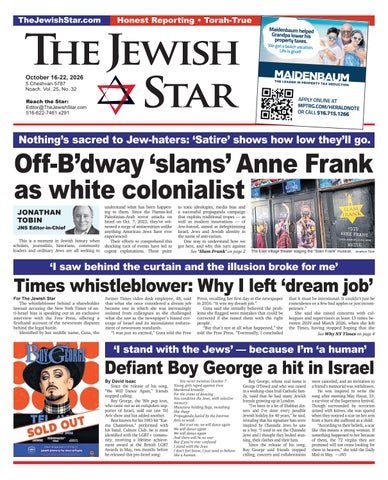
TheJewishStar.com
Honest Reporting • Torah-True
Maidenbaum helped Grandpa lower his property taxes.
We got a beach vacation. Life is good!
October 16-22, 2026 5 Cheshvan 5787 Noach. Vol. 25, No. 32
APPLY ONLINE AT MPTRG.COM/HERALDN OTE OR CALL 516.715.1266
Reach the Star: Editor@TheJewishStar.com 516-622-7461 x291
Nothing’s sacred to Jew-haters: ‘Satire’ shows how low they’ll go.
Off-B’dway ‘slams’ Anne Frank as white colonialist JONATHAN TOBIN
JNS Editor-in-Chief This is a moment in Jewish history when scholars, journalists, historians, community leaders and ordinary Jews are all seeking to
understand what has been happening to them. Since the Hamas-led Palestinian-Arab terror attacks on Israel on Oct. 7, 2023, they’ve witnessed a surge of antisemitism unlike anything American Jews have ever experienced. Their efforts to comprehend this shocking turn of events have led to cogent explanations. These point
to toxic ideologies, media bias and a successful propaganda campaign that exploits traditional tropes — as well as modern innovations — of Jew-hatred, aimed at delegitimizing Israel, Jews and Jewish identity in the name of anti-racism. One way to understand how we got here, and why this turn against See ‘Slam Frank’ on page 2
The East Village theater staging the “Slam Frank” musical.
Jonathan Tobin
‘I saw behind the curtain and the illusion broke for me’
Times whistleblower: Why I left ‘dream job’
For The Jewish Star The whistleblower behind a shareholder lawsuit accusing the New York Times of anti-Israel bias is speaking out in an exclusive interview with the Free Press, offering a firsthand account of the newsroom disputes behind the legal battle. Identified by her middle name, Guta, the
former Times video desk employee, 48, said that what she once considered a dream job became one in which she was increasingly isolated from colleagues as she challenged what she saw as the newspaper’s biased coverage of Israel and its inconsistent enforcement of newsroom standards. “I was just so excited,” Guta told the Free
Press, recalling her first day at the newspaper in 2016. “It was my dream job.” Guta said she initially believed the problems she flagged were mistakes that could be corrected if she raised them with the right people. “But that’s not at all what happened,” she told the Free Press. “Eventually, I concluded
that it must be intentional. It couldn’t just be coincidence or a few bad apples or just incompetence.” She said she raised concerns with colleagues and supervisors at least 15 times between 2019 and March 2026, when she left the Times, having stopped hoping that she See Why NY Times on page 4
‘I stand with the Jews’ — because I’m ‘a human’
Defiant Boy George a hit in Israel By David Isaac Since the release of his song, “We Will Dance Again,” friends stopped calling. Boy George, the ’80s pop icon, who came out as an outspoken supporter of Israel, sold out one Tel Aviv show and has added another. Best known for his 1983 hit “Karma Chameleon,” performed with his band, Culture Club, he is most identified with the LGBT+ community, receiving a lifetime achievement award at the British LGBT Awards in May, two months before he released this pro-Israel song:
You never mention October 7 Young girls raped against trees Murdered brutally For the crime of dancing You condemn the Jews, with selective memory Musicians holding flags, mouthing like sheep Propaganda fueled by the Internet feels so weak. But trust me, we will dancе again We will dance again We will dancе again And there will be no war But if you’re ever confused I stand with the Jews I don’t feel brave, I just need to behave like a human.
Boy George, whose real name is George O’Dowd and who was raised in a working-class Irish Catholic family, tsaid that he had many Jewish friends growing up in London. “I’ve been to a lot of Shabbat dinners and I’ve done every possible Jewish holiday for 40 years,” he said, revealing that his signature hats were inspired by Chassidic Jews he saw as a boy. “I used to see the Chassidic Jews and I thought they looked stunning, their clothes and their hats. Since the release of his song, Boy George said friends stopped calling, concerts and collaborations
were canceled, and an invitation to a friend’s memorial was withdrawn. He was inspired to write the song after meeting May Hayat, 33, a survivor of the Supernova festival. Though surrounded by terrorists armed with knives, she was spared when they noticed a scar on her arm from a burn she suffered as a child. “According to their beliefs, a scar like this means a strong woman. If something happened to her because of them, the 72 virgins they are promised will not come looking for them in heaven,” she told the Daily Mail in May. —JNS
October 16-22 • 5 Cheshvan, 5787 — THE JEWISH STAR
2
‘Slam Frank’ casts Anne as hero who betrayed her people before they could genocide the Palestinians Continued from page 1 the Jews is being committed by people who think of themselves as high-minded humanrights advocates who would never engage in bigotry, is to go to the Orpheum Theatre in the East Village where the satirical hip-hop musical “Slam Frank” is being staged.
Favorite dead Jew
Nothing I have read, heard or seen better exemplifies the erasure of Jewish life that has become ubiquitous in popular culture in the third decade of the 21st century than this minor satire. The play was first performed in 2025 to mostly glowing reviews in outlets like the New York Times and flattering profiles of its creators, Andrew Fox and Joel Sinesky (who are both Jewish), in the New Yorker and the Guardian. But it’s back for a scheduled two-month run at the Orpheum Theatre where, judging by the performance that I attended, it’s winning big laughs and loud applause from a mostly young audience eager to join in the mockery of all that the established culture holds sacred. And what better way to do that than by a new twist on the story of what Dara Horn aptly observed in her seminal book, “People Love Dead Jews,” as “everyone’s (second) favorite dead Jew” — the most favorite dead Jew being the Christian messiah. As Horn noted, the “Diary of Anne Frank” is the world’s most popular and widely read book about the Holocaust specifically because it does not describe the genocide of the Jews that less popular survivor memoirs, such as those by Elie Wiesel and Primo Levi, did. That’s because the slaughter happens outside of the pages of Anne’s diary, which ends before her family’s capture and the gruesome murder of all of the residents of the famous annex in Amsterdam other than her father, Otto. It is loved not so much because of the portrait it paints of a brilliant young writer who might have accomplished so much had she been allowed to live. Rather, it is because reading it grants the non-Jewish reader absolution for the mass murder of the Jews. eaders of the Diary, and the millions who have seen the universalized version of it presented in a hit play and movie first produced in the 1950s, love the fact that those performances ended with Anne’s famous line: “I still believe, in spite of everything, that people are truly good at heart.” As Horn wrote, “It is far more gratifying to believe that an innocent dead girl has offered us grace than to recognize the obvious: Frank wrote about people being “truly good at heart” before meeting people who weren’t. Three weeks after writing those words, she met people who weren’t.” After Anne had experienced the horrors of Auschwitz and Bergen-Belsen, she learned just how evil those who blamed Jews for everything that was wrong with their world could be. Remarkably, the authors of “Slam Frank” are after something similar to the false grace that those who have read the Diary enjoy. Their conceit lies in the work’s presentation: a play within a play performed at a “progressive” company that treats the audience to an absurd version of the familiar story of a group of Jews who spent years hiding in an attic from the Nazis. The production begins by taking a swipe at the hypocritical “land acknowledgments” about Native Americans that liberals perform at all sorts of occasions to virtue-signal their woke sympathies. It goes on to poke fun at everything
R
Anne Frank as a schoolgirl.
else one can think of. The authors claim the play was inspired by a particularly clueless social-media post asking if Anne Frank ever acknowledged her “privilege” as a white European. Of course, as a member of the most persecuted minority in history and someone who was hunted down and murdered by the German Nazis, she had no “privilege.”
An inside joke
By making fun of everything in our current society, they seem to be offering a form of absolution that enables transcending both fashionable opinion and conventional pieties — both the traditional and woke versions. By laughing along with the send-up not only of the plight of the Frank family, but of all sorts of contemporary cliches about diversity, feminism, gender identity and male chauvinism, they can claim to be innocent of the horrible crimes committed against humanity in the past and not responsible for any bad thing in the present. More than that, it sanctions their sense of themselves as superior to those who cling to identity or history and don’t get the authors’ attempt at an inside joke. Some Jewish critics have chided those who voiced outrage at the appropriation of the Anne Frank story on the grounds that they’re wrong to think the play is mocking its long dead heroine. Some even claimed it was no more offensive than Mel Brooks’s classic comedy “The Producers,” whose conceit centered on a failed scam to create a certain theatrical flop — a feel-good musical about the Nazis called “Springtime for Hitler.” Brooks’s comic masterpiece, which was first conceived at a moment in the 1960s when the notion of theatergoers enjoying a “gay romp at Berchtesgaden” truly was unthinkable, doesn’t hit audiences in quite the same manner today when antisemitism has come out of the closet in which it briefly hid after the Holocaust. But he didn’t mock the victims of the Holocaust, deny them their Jewish identity or claim that half of the Jews living in the world (a figure that still numbers millions fewer than before the murder of the six million) are evil “colonizers” who are perverting the legacy of those who died. That is what “Slam Frank” does. And it accomplishes it to the cheers of those who have been hearing similar messages in the mainstream media and at pop concerts. Brooks was making fun of the Nazis as the epitome of evil that had no place in a normal or decent society. “Slam Frank” is less funny as well as dishonest in its claim to be an equal opportunity offender. It mocks the victims of the Nazis, not their murderers. ou can laugh if you like at a show that portrays Anne as a Latina rapper (who flees the “jungles of Germany” at her father’s behest after the American CIA installed Hitler as its dictator); her mother as a black woman who never stops intoning the mantras of diversity; her father
Y
While ‘Slam Frank’ mocks theater hits and identity politics, it’s deadly serious about demonizing Jews.
as a barely repressed gay man; her sister, Margot, as a neuro-diverse mute/would-be Zionist fascist oppressor of Arabs; her friend/first love, Peter, as a gender-confused aspiring dancer; his father as a stereotypical obnoxious white “mansplainer;” and his mother as a repressed “Stepford Wife.” You can nod along to the play’s portrayal of Anne’s family as instructing her to stop speaking and writing in Spanish (her real identity) so as to ensure her book’s future popularity with a white audience along with the other flat jokes that keep the mockery flowing. And if you’re a theater buff, you can smirk at the numerous allusions to better plays such as “Hamilton” (whose famous logo is appropriated, albeit with a yellow star) and many others. Most will laugh along with this. So, too, will critics who are straining to be part of the inside joke so as to display their virtue by disdaining everything that is satirized. But what they are either deliberately ignoring, or are just too dim to understand, is that the one thing this play is not joking about is denying the Jews their story, humanity and rights.
A ‘secret’ ending
The producers of the play ask that critics not reveal the ending of the show so as to ensure that audiences fully register the “shock” of some of its denouement. But the secret ending of the play isn’t comparable to the last minutes of Agatha Christie’s “Witness For The Prosecution,” in which the true identity of the murderer and the eponymous witness is revealed. So, I don’t feel obligated to play by their rules. What those who have lauded the play as “clever, gleefully provocative” or even “the most important new show around” aren’t telling you is what happens in the play’s final scenes. Margot finally speaks, only to give an oration about the need to go to Palestine to displace and oppress its indigenous Arab population once the war ends. Anne then realizes that her family shouldn’t survive and betrays them herself, leading to their deaths. But then, after the bodies fall (they are shot on the spot rather than gassed or tortured and starved in the camps), Hitler turns up and, having shed his male identity and become a trans woman, he “cancels the Holocaust’ so the Jews don’t have to commit suicide to save humanity from the evils of Zionism. Cue the applause, and the actors all turn up for a final chorus wearing t-shirts with woke slogans, including one reading “by any means necessary,” something that is embraced by those cheering for Hamas’ efforts to slaughter the contemporary living Jews that are not as popular as the dead Anne. Sure, we’re not supposed to take any of this seriously except to embrace the notion that no one is 100% correct and that all causes are suspect. But the reaction of the audience to the mention of “Palestine” and the cheers that greeted Anne’s claim that the “seven million colonizers” currently committing crimes there are the result of the six million dead Jews told you all you need to know about the impact of this play at this moment. Despite the hopes of some who lauded the play, and believed it to be a jab at the tweet that inspired it, the audience wasn’t acknowledging that Jews don’t have “white privilege.” Rather, they were nodding along at the false claim that Jews have no right to live in Israel. And this is because Jews are now wrongly viewed as “white” oppressors. Contrary to its press clippings, “Slam Frank” is not an equal-opportunity offender. It may be poking fun at most things, but the one thing it is deadly serious about is denying the Jews their stories, as well as the right to mourn their dead with dignity and to live in freedom in their own country without being smeared as monsters and targeted for genocide.
Not to another group
Moreover, could anyone imagine someone putting on a play today in which black or Hispanic victims of racist crimes were portrayed as Jews or any identity other than their own? Would they deny them their culture and history and use them as stand-ins for more fashionable identities? Of course not. Such a play, even if it claimed to be a satire, would be denounced as racist. Even the hit musical comedy “The Book of Mormon” by the creators of the cartoon satire “South Park,” to which “Slam Frank” has been compared, is kinder to its targets — the adherents of that faith — than Fox and Sinesky are to the objects of their scorn. But you can do this to Jews with impunity and still be applauded by liberal critics as having accomplished an act of creative genius. This isn’t the first time the story of Anne Frank has been utilized to advance a non-Jewish agenda. The aforementioned play and movie adaptations of the Diary deliberately downplayed the Jewish elements of the story and sought to universalize Anne as a girl just like everyone else. That pleased Anne’s father, Otto, who had little use for Judaism or Jewish identity. It also drove writer Meyer Levin, who had worked to promote the book and wanted to write a more Jewish play, nearly out of his mind. Yet, just like those adaptations of Anne’s story that came at a time when Jews were eager to fit in and be seen as the same as everyone else, “Slam Frank” speaks just as loudly to the current desire of many, including some Jews, to erase not just Israel but also Jewish peoplehood itself. he answer to the question as to why antisemitism is flourishing in a way that it hasn’t since the Holocaust is that contemporary Western culture is willing to mock everything but not the lie that Jews, as both Hitler and woke ideologues alike have claimed, are “weaponizing antisemitism.” While some Jews thought the unspeakable atrocities of Oct. 7 against Jews by a genocidal Islamo-fascist terror group and its supporters would generate sympathy for the victims, the opposite has occurred. The shedding of their blood in the largest mass slaughter of Jews since the Holocaust didn’t shame or deter antisemites; it excited them. And though the movement to demonize and delegitimize the one Jewish state on the planet had been building toward this for several decades, the explosion of antisemitism shouldn’t have surprised anyone — since, for the chattering classes, the Jews remain a metaphor, rather than a people with rights.
T
Moment in cultural history
A world in which “Slam Frank” is acclaimed as a work of comic genius is not only one in which nothing sacred to the Jews is granted even minimal respect. It’s one in which people, including New York theater audiences who think of themselves as enlightened liberals, can believe blood libels about Jews committing “genocide,” and that the war to eradicate the sole Jewish state and to commit another Holocaust against its people is a righteous one. “Slam Frank” seems unlikely to have a long afterlife or hold the stage in the future, and not merely because it isn’t as clever as its admirers think it is. Rather, because it is a product of this particular moment in cultural history. Since Oct. 7 three years ago, it has once again become permissible to strip Jews of their past and identity and to smear them as “colonizers” and oppressors. We can only hope that this episode passes quickly, ensuring that this travesty is relegated to the trash heap of theatrical history, where it belongs. Jonathan S. Tobin is editor-in-chief of JNS.
3
Young Jews should see their homeland with their own eyes before they pass judgement on it. Please help us keep sending young Jews to Israel. Donate today at OneTripChangesEverything.org
THE JEWISH STAR — October 16-22 • 5 Cheshvan, 5787
PERHAPS A VISIT TO THE RIVER AND THE SEA WILL OPEN THEIR EYES.
October 16-22 • 5 Cheshvan, 5787 — THE JEWISH STAR
4
Hochul joins yeshiva-aiding federal program By Rikki Zagelbaum Gov. Kathy Hochul, who earlier said that she intended to opt the state into President Donald Trump’s federal tax-credit program for education, said on Friday, after program details were released, that she will formally bring the state into the program. The Orthodox Union said the program could direct more than $1.5 billion annually in the state toward educational expenses, including yeshiva tuition. “For Jewish families, this means the chance to give their children an education rooted in who they are, without being priced out,” stated Sydney Altfield, CEO of Teach Coalition, an Orthodox Union program. “We are deeply grateful to Gov. Hochul and every parent, educator and partner who helped bring us here,” Altfield stated. She said Hochul opted to prioritize New York’s children, “and families across our state have reason to celebrate.” “Behind this moment are parents, who never stopped fighting for their children, and communities who came together because they believed more was possible,” she stated. Jay Greene, a senior fellow at the Defense of Freedom Institute who focuses on education, said that Hochul’s decision is a “huge boost for families in the state, including those seeking a Jewish education.” “Especially after how New York politicians have been hassling Jewish schools over everything from Covid closures to curriculum requirements, it is gratifying to see a decision that actually helps families at Jewish schools,” Greene said.
“The scholarship tax credit will make a Jewish education much more accessible to more families,” he told JNS. “Jewish education is a key component of Jewish continuity, which will also be strengthened by this decision.” The Trump administration said in new guidance that the Education Freedom Tax Credit f
program, which is set to take effect on Jan. 1, allows taxpayers to claim dollar-for-dollar federal tax credits of up to $1,700 — or $3,400 for married couples filing jointly — for donations to organizations that provide scholarships for elementary and secondary-school expenses. The program requires governors to formally opt their states in for parents to be eligible to
All political roads lead to the Rebbe
Pols courting Jewish votes know a visit to the Lubavitcher Rebbe’s ohel in Cambria Heights guarantees a photo-op. Gov. Kathy Hochul was accompanied there last Friday by community activist Devorah Halberstam; her rival, GOP candidate Bruce Blakeman, visited before Rosh Hashana.
access the tax credits. Initially, families earning up to 300% of the area’s median income can qualify for scholarships, including those whose children already attend private schools. Scott Bessent, treasury secretary, stated that the program “marks a new chapter in educational freedom and opportunity by establishing America’s first nationwide school choice program and empowering states to give students and families more options.” Bessent said that “30 states have already opted in, and we encourage all 50 states to participate so every American student and family can benefit.” Hochul said on Friday that “I’m not going to leave money on the table when it could help our kids.” “Now the work begins,” stated Altfield, of the Orthodox Union. “We look forward to working with the governor’s office to get New York’s scholarship organizations approved and ready so families can start benefiting on day one.” Yeruchim Silber, director of New York government relations for Agudath Israel of America, thanked Hochul for “following through” on her commitment to opt into the program. “This decision opens the door to millions of dollars in additional educational resources and opportunities for students in public and nonpublic schools alike, without taking a dollar away from public education,” he stated. Agudah is “deeply grateful to the governor and her team for recognizing the importance of this opportunity and ensuring that New York’s children and families will be able to benefit,” Silber added.
Why NY Times whistleblower left her dream job… Continued from page 1 could change the institution from within. The Times has rejected the lawsuit’s claims, calling them meritless and accusing Guta of misrepresenting how its journalism and internal complaint procedures work. The Free Press said it reviewed Guta’s records of Slack conversations, internal editing histories, project databases and recordings of newsroom meetings. Her account is part of a shareholder lawsuit alleging that the Times failed to meet its obligations to readers and employees.
‘A loud Jew that nobody wants to hear’
Guta’s concerns intensified after Hamas’ Oct. 7, 2023, attack on Israel. She questioned, among other things, a video summary describing hostages in Gaza as “believed to be” captive. According to the Free Press, the wording was removed after she challenged it in an internal Slack channel. She also said she flagged a video citing journalist casualty figures without specifying how many of those killed had been identified as combatants. In November 2023, Guta met with Mike Abrams, the Times’ deputy editor of Trust, and presented a 26-slide deck containing screenshots of internal exchanges. The Free Press said it reviewed the presentation. One exchange showed a colleague accusing Israel of spreading, then retracting, claims that Hamas had beheaded babies. Another involved staffers weighing conflicting
accounts of whether Hamas was preventing civilians from evacuating Gaza. “I want some acknowledgment that there is something wrong,” Guta wrote in the presentation. “I want someone other than me to be paying attention to this.” At a newsroom meeting the following month, Executive Editor Joe Kahn acknowledged that some people believed the paper’s coverage reflected institutional bias or incompetence, according to a recording reviewed by the Free Press. Asked why the Times was perceived as “so anti-Israel,” Kahn said the newspaper would never satisfy everyone on such a divisive subject. Guta disputed the notion that criticism from both sides meant the paper was getting its coverage right. She also alleged that her efforts to raise concerns damaged her standing with colleagues. At an August 2024 meeting with her supervisor, Solana Pyne, and a human resources representative, Guta was told, according to the lawsuit, that colleagues were reluctant to work with her because of her point of view. “I often feel just like a loud Jew that nobody wants to hear,” she said, according to her affidavit. Guta said she was subsequently excluded from most team meetings.
Claims of double standard
Guta also questioned whether the Times consistently enforced its rules on political advocacy by journalists. The newspaper had warned staff against
Guta’s grandmother survived the Shoah and later worked as a copy editor at Pravda. Guta had a choice her grandmother did not: to leave a job when she no longer believed in its mission.
signing petitions, joining protests or engaging in advocacy connected to events they covered. Guta alleged that complaints about other employees’ public activism related to Israel did not receive the same attention as restrictions imposed on her. In March 2024, she filed an internal complaint about freelance journalist Matthew Cassel, arguing that his public activism violated the newspaper’s standards. The complaint was closed two days later, according to the Free Press. Cassel continued working for the Times through December 2025. Guta separately raised concerns about graphics editor Bora Erden, who she said had publicly fundraised for Gaza and signed open letters describing Israel as a “settler colony” and an “apartheid state.” A Times standards editor told Guta that publicly fundraising for one side of a conflict an employee was assigned to cover would not be acceptable, according to her account. Guta said she filed a complaint but received no follow-up that she was aware of. By contrast, when Guta asked in January 2024 whether she could privately attend an event marking 100 days since the Oct. 7 hostage-taking, she was advised against attending. The lawsuit describes this as the only instance in five years in which she saw the newspaper’s conduct rules enforced. The Times disputes Guta’s characterization. A spokesman told the Free Press that her complaints were handled respectfully, even when they were not found to have merit, and that employees’ personal views do not dictate the newspaper’s coverage.
Why she walked away
Guta’s concerns predated the Gaza war. In 2019, the Times’ international edition published a cartoon depicting Israeli Prime Minister Benjamin Netanyahu as a guide dog wearing a Star of David collar, leading a blind President Donald Trump, who wore a kippah.
The newspaper later acknowledged that the cartoon contained antisemitic tropes. Publisher A.G. Sulzberger subsequently told employees that the Times was updating its unconscious-bias training to address antisemitism. Guta said she raised the issue repeatedly but, to her knowledge, the promised training was never implemented. She also described trying to establish a Jewish employee resource group and a Slack channel where Jewish colleagues could discuss concerns. Some employees were reluctant to join a channel explicitly identifying Jewish staff, she said, because they feared being placed on a list. During a September 2024 meeting about the employee group, Sulzberger acknowledged that members of the Jewish community could feel held to a different standard, according to a recording reviewed by the Free Press. He also described receiving antisemitic hate mail and death threats. The Times spokesman said the lawsuit seeks to level false allegations and chill journalism protected by the First Amendment. Guta said her family history helped shape her decision to speak out. Her grandmother survived the Holocaust and later became a refusenik in the Soviet Union, where she worked as a copy editor at Pravda, the Communist Party newspaper. That history, she said, reinforced her belief that she had a choice her grandmother did not: to leave a job when she no longer believed in its mission. “The prestige of working at the Times lost any value it once held,” she told the Free Press. “I saw behind the curtain and the illusion broke for me.” Her account is not a legal finding of systemic bias, and the Times disputes her allegations. But the interview gives the public a closer look at the internal conflict behind a lawsuit challenging the newspaper’s editorial judgment and credibility.
5
THE JEWISH STAR — October 16-22 • 5 Cheshvan, 5787
Breast Cancer Awareness Month Event Knowing breast cancer exists is not enough. Join us for a seminar on breast health. Guest Speakers:
Christine Hodyl, Director, Breast Services
Jessica Coyer, PsyD, PMH-C Manager, Ambulatory Behavioral Health
Mindy Scheer, DO Director of Breast Imaging, Center for Women’s Imaging
Gail Crawford, MSN, RN Clinical Program Manager
Diana Tjaden, PT, DPT, CLT Clinical Director, Full Circle Ivy Rehab
Geri Barish Executive Director, Hewlett House
Joanna Formont, LMHC Executive Director, SIBSPlace
Tuesday, October 20, 2026, 10 am - 2 pm Mount Sinai South Nassau Conference Center IN-PERSON, or on ZOOM for those unable to join in person. Registration required for Zoom, please register by October 18 by scanning the QR Code, or by visiting: https://mountsinai.zoom.us/webinar/register/WN_m5v_WuUyTDSIu0HBM4RVfQ#/registration For more information, please call Camiele Ward, 516-632-3350. Early Detection Saves Lives | La Detección Temprana Salva Vidas This event designates 3 CME / CNE *None of the planners for this educational activity have relevant financial relationship(s) to disclose with ineligible companies whose primary business is producing, marketing, selling, re-selling, or distributing healthcare products used by or on patients. *The speaker has no relevant financial relationship(s) with ineligible companies to disclose. *No commercial support was received for this activity. Mount Sinai South Nassau is accredited by The Medical Society of the State of New York (MSSNY) to provide continuing medical education for physicians. Mount Sinai South Nassau designates this live activity for a maximum of (3) AMAPRA Category 1 Credits.™ Physicians should claim only the credit commensurate with the extent of their participation in the activity.
October 16-22 • 5 Cheshvan, 5787 — THE JEWISH STAR
6
Oct 7 lessons: Never forget. Never forgive. O
BEN COHEN
Global Focus
I
n his ferocious missive “J’accuse!” published at the height of the Dreyfus Affair in 1898, the great French writer Émile Zola scorned the “hunting of the ‘dirty’ Jews, which dishonors our time.” The time in which we live has been similarly dishonored. But while the Dreyfus Affair concentrated antisemitic passions onto one individual Jew, these days they are targeted against the one Jewish state, as well as those outside who identify — politically, spiritually, emotionally — with that state. Three years after the Hamas atrocities of Oct. 7, Jews are once again being hunted. Many of the hunters are communists, who have always excelled at witch hunts. Alongside them are a motley crew of Islamists, Hitler nostalgists, Third Worldists, radical environmentalists, rich kids for whom activism is a career, incels and unscrupulous influencers posing as legitimate journalists, boosted by an army of social-media bots. Their words are nothing more than a tissue of lies, advanced either by those embittered by personal failure and seeking someone to blame or working at the behest of rancid foreign regimes like Qatar. And yet they have succeeded in transforming our political culture, assisted by the weak, mealy-mouthed equivocations of mainstream political leaders. The age of empowerment enjoyed by successive generations of postwar Jews is over. Our new future may still be taking shape, but its present outlines fill us with a dread borne of historical experience.
ver three years, we have accumulated a dizzying number of examples of how this witch hunt is taking effect, so I will focus on the more recent as an illustration. In Britain, as everyone seems to know by now, the Green Party of England and Wales adopted a resolution declaring Zionism to be a form of racism, much as the UN General Assembly did back in 1975 at the bidding of the Soviet Union. Even more disturbingly, an amendment pledging that there would be no consequences for Jewish members of the party who participate in Jewish communal institutions that identify with Zionism — and that’s pretty much all of them, encompassing synagogues, schools and cultural centers — was resoundingly defeated. Supporters of Greens for Palestine, the grouping that moved the motion, left no doubt as to the implications, with the motion’s main sponsor, Lubna Speitan, warning darkly about “surrounding” synagogues and describing Jewish schools as incubators for the next generation of Israeli “war criminals.” Across the English Channel, France has been convulsed by successive days of rioting, with hundreds injured and thousands arrested. Ostensibly, the subject of this discontent has nothing to do with Jews or Israel: The poor conditions and long hours in French schools have propelled student protesters into the streets. Yet images of the demonstrations frequently feature Palestinian flags, because — and this is the one unambiguous victory that Hamas can claim in the wake of Oct. 7 — “Palestine” has become established as a universal symbol of resistance to “injustice,” eagerly adopted in the teeming suburbs of cities like Paris and Marseille, where large number of migrants, mostly from the Arab and Islamic worlds, are concentrated.
I Never Got to Say Goodbye A Memoir by Philip Kamaras
Two funerals. Two flags. Two very different worlds. In 1963, the assassination of President John F. Kennedy united a country in a singular, televised moment of mourning, as his flag-draped coffin was carried by horse-drawn caisson to the Capitol. A year later, a small Jewish family in Springfield, Massachusetts, faced their own catastrophe when their patriarch, Jacob, died in his easy chair during the evening news. There was no national broadcast for the WWII vet who started as a clothier and after the war sold whatever he could to provide for his family. There was no photographer present at the graveside to capture the moment his son received the burial flag. The task of raising the two children fell solely to their mother—a brave immigrant who worked her entire adult life as a bookkeeper. In this hauntingly honest memoir, author Philip Kamaras explores the intersection of public history and private pain, reflecting on a childhood defined by the moment his world stopped—and the many long years of learning to live with that moment.
But as Kamaras tells us, “I never really got over it. I never got to say goodbye.” Available now at Amazon.com
Gerard Bottino, Adobe
U
nderpinning the violence are the propaganda efforts of the far-left, antisemitic party La France Insoumise (“France Rising”). One of the party’s representatives in the European parliament, the notorious terrorist sympathizer Rima Hassan, deliberately threw to the ground an Israeli flag in the parliament building commemorating the Oct. 7 victims. There was a time when one could have dismissed a spectacle like this as the antics of a fringe lunatic, but no longer. LFI has pulled ahead of the centrist parties in polling ahead of next year’s presidential election, which threatens to be a contest between the extreme left and the far-right National Rally (RN). It is one of history’s grimly amusing ironies that the fate of French Jews would be more benign under a government of the RN, which started life as a neo-fascist party packed with Holocaust deniers, than under LFI. The witch hunt is felt most acutely in the worlds of music, literature, art and sport. Over in Ireland, whose political class has appropriated the Palestinian cause as a sign of its supposed moral superiority, a routine soccer match against the Israeli national team became a battleground. Ireland’s Icelandic coach, who knows nothing about Israel or the region, countered protester calls for the game to be abandoned by claiming that his players would be competing “against genocide.” But even that wasn’t enough to satisfy the legions of Irish antisemites for whom a match against Israel amounted to a pact with the devil. Yet all this opprobrium revealed is that Ireland is saturated with crude, Nazi-like Jewhatred, sparking a genuine “who knew?” moment among many unsuspecting Jews.
What values?
L
ast, but not least, there is the United States. Just as Jews began mourning the rape and murder of Oct. 7, Democratic Sen. Chris Murphy of Connecticut jetted to Qatar to brownnose the ruling Al Thani family, who openly provided a haven for Hamas leaders at the Four Seasons hotel in Doha while copiously financing the killers who crossed into Israel on that dreadful day. Over the last three years, Murphy has emerged as one of Israel’s leading foes in Congress, this month co-sponsoring the “Stop the Settlements” legislative bill. During his visit to Qatar, he met with Sheikha Hind al-Thani in the lavish surroundings of “Education City” — built, like everything else in Qatar, by slave labor — gushing that the presence of American universities in this nasty little emirate, where less than 10% of the population are full citizens, “is an important way for the United States to promote US values in the Middle East and create more
Three years after the Hamas atrocities of Oct. 7, Jews are once again being hunted.
lasting people-to-people connections.” And what values are those exactly? Pro-Hamas encampments where Jewish students are forced to run the gauntlet? Substandard academics teaching the social sciences in a framework defined by critical race theory and vulgar Marxism? Murphy may think of himself as a moderate who clings to the “two-state solution,” but by his words and actions, he legitimizes and licenses the most odious elements of our society — from keffiyeh-wearing trust fund brats to barely literate pundits who obsessively push the libel that Israel has committed “genocide” while ignoring the real examples of genocide in our world.
Shift in our psychology
I could cite other examples (and there are so many of them), but doing so would result in a book-length text. And I would prefer to focus on how Jews and their allies should respond to this latest witch hunt. Firstly, we need to adopt a helicopter view of these developments, drawing out the connections rather than appraising them individually. To my mind, there are two aspects that stand out. •Firstly, hostility to Zionism is increasingly expressed in candidly antisemitic terms as the postwar taboo against open Jew-hatred is finally excised. Secondly, and consequently, the role of Jewish anti-Zionists in providing cover from accusations of antisemitism is less and less significant. The future of pro-Palestinian activism is firmly in the hands of individuals who wish harm on Israelis and Jews in equal measure, like Laith Marouf, Rahmeh Aladwan and David Miller. •Secondly, we need to press our politicians and governments to adopt new legal measures or apply existing ones against the pro-Hamas movement. In America, the First Amendment is not in competition with anti-terrorism legislation; hence, pro-Hamas organizations like the Council on American-Islamic Relations, Within Our Lifetime and “Jewish” Voice for Peace should be continually and relentlessly subjected to scrutiny and punished harshly for every infraction. Elsewhere, and especially in Europe and Canada, a concerted push is required to crack down on pro-Hamas hate marches, reducing them to static affairs well out of the way of any Jewish communal buildings, along with lengthy — no less than two years — custodial sentences for those convicted of antisemitic hate crimes. •Thirdly, we need a shift in our own psychology. We need, frankly, to learn how to hate in a strategic sense — something that American Jews, for whom intercommunal initiatives are second nature, have been loath to do. hat doesn’t mean randomly beating up pro-Hamas activists. It does mean lasering in on as many individuals as we can who have crossed the line into supporting Hamas and its antisemitic crusade, holding them to account and ensuring as far as possible that the consequences they face are a permanent stain on them. We need, in short, to aggressively reform or even dismantle any government body or civic institution that has fallen into the clutches of the political cult of Palestinianism. It goes without saying that none of this will be easy. The coming decade, which will see a critical presidential election in the United States, will bring to the fore a new cluster of politicians who believe that their careers can be advanced by adopting the Hamas agenda and adapting it to Western conditions. The immediate task before us is to defeat them, armed with the overarching lesson of Oct. 7: Never forget. Never forgive. Ben Cohen is a senior analyst with the Foundation for Defense of Democracies.
T
7
THE JEWISH STAR — October 16-22 • 5 Cheshvan, 5787
High School
HAFTR HIGH SCHOOL
OPEN HOUSE NOVEMBER 15 • 10 AM APPLICATIONS NOW OPEN | HAFTR.ORG/HSADMISSIONS APPLY AND JOIN US FOR
HAWKS AFTER HOURS - OUR 8TH GRADE EVENT
October 16-22 • 5 Cheshvan, 5787 — THE JEWISH STAR
8
‘Lucky … and I’m grateful,’ former hostage says By Amelie Botbol “It was unbearable to watch someone you love being beaten and be unable to say a word. You don’t know if they’re going to kill her,” Aviva Siegel, a former hostage in Gaza, told JNS. Siegel was referring to Hamas terrorists’ beating of Amit Soussana, who was held alongside her for part of her captivity. She recounts the incident in her new book, “Survived to Tell: A Hostage’s True Story of October 7 and 51 Days in Captivity.” “It was terrible. I’m a human being with a heart and was not able to do anything, as if they expected me to vanish. It’s impossible not to feel,” Siegel said. “Captivity was too hard to handle, and every moment you didn’t know if it was going to get even worse,” she said. Siegel, 65, was born in South Africa and moved to Israel at a young age. She and her husband, Keith, 67, a dual U.S.-Israeli citizen, were abducted from Kibbutz Kfar Aza during the Oct. 7, 2023, massacre. She was released on Nov. 26, 2023, under a temporary ceasefire agreement. Her husband was freed after 484 days in captivity. Siegel said the hardest memories were of Oct. 7 itself, when more than 1,200 people were killed in the cross-border invasion. “To be in a situation where, in a second, Hamas terrorists open the door and stand with knives, shouting at us, it’s a difficult moment,” she said. Siegel spoke of flashbacks to when Chen Goldstein arrived in the Hamas tunnels with her daughter Agam and sons Tal and Gal, just minutes after Siegel and her husband were taken there on Oct. 7. “Their faces come back to me all the time. I remember when they told us that the children’s father, Nadav, had been murdered in front of their eyes while trying to protect them, along with their sister, Yam,” Siegel said. She also recalled the arrival of hostage Gali Berman, who was kidnapped from Kfar Aza and released in October 2025 alongside his twin brother, Ziv. Gali entered the underground tunnel covered in blood. “I remember his smell and his appearance. He was touching his head and asked me to look at the back of it to see if it was still bleeding. I had to lie to him and tell him it was OK. I kept telling myself I had to help him relax, but his wound looked terrible. I could see the inside of his head,” she said. Siegel was held with her husband for nearly all of her captivity and spent part of that time alongside the Goldstein family, Amit Soussana, Gali Berman, Liri Albag and Agam Berger. Siegel suffered from severe diarrhea at times but was afraid to ask her captors for permission to use the bathroom. “I was scared all the time, shaking. I was petrified, from beginning to end. I didn’t sleep. Maybe five minutes here, 10 minutes there at most,” she said. “I was in a terrible state, really, really bad. I’ll never forget when Agam [Goldstein], who had been afraid for the first couple of weeks, stopped being afraid. Then I was the only one who was still fearful. Keith told me to keep telling myself that I wasn’t going to die, but it didn’t really help,” she added. Siegel recounted being in a tunnel with her husband and Soussana, where they were left alone with almost no food or light and barely enough oxygen. Their captor, Jihad, rarely checked on them. “He saw us dying. He left us there, knowing that by the time he returned, we would likely be dead. How can you do that? I don’t understand what kind of people they are or what they are made of. When someone is suffering, even if you don’t know them, you feel
Released Israeli hostage Aviva Siegel (center) marches to Jerusalem from Tel Aviv, calling for the release of Israelis being held captive by Hamas, on Dec. Chaim Goldberg, Flash90 28, 2023.
Destruction caused by Hamas terrorists in Kibbutz Kfar Aza, pictured on Nov. 2, 2023. Arie Leib Abrams, Flash90
Terrorists from Hamas’s “Shadow Unit” hand over Israeli hostage Keith Siegel to the Red Cross during a propaganda ceremony in Gaza City on Feb. 1, 2025. Ali Hassan, Flash90
for them,” she said. Siegel said her separation from her husband before her release happened very quickly. “I begged them to let me see Keith after they put him in a separate room. I just wanted to give him a hug and tell him that I was
right next door, but they wouldn’t let me,” she said. Siegel recalled that one of the terrorists told her, “You, tomorrow [in] Israel,” but she said she did not believe him. “I didn’t know what would happen to me or whether they would kill me, rape me, beat
me or do whatever else they wanted,” she said. In an act of defiance, Siegel pushed past her captor and hurried to another room in the same house, where she found her husband lying on a thin, filthy mattress on the floor, staring at the ceiling. “He looked sad because he was alone. I bent down and hugged him. I said, ‘You be strong for me, and I’ll be strong for you.’ It was the only thing I could think of, and then I left.” Recalling her release, Siegel spoke about Avigail Idan, who was 3 years old when she was kidnapped on Oct. 7, after her parents were murdered. “In the Red Cross car, as we were leaving Gaza, I looked at Avigail. I could see she was crying, but nobody could hear her. She had learned how to cry without making a sound,” Siegel said. “I took her in my arms, hugged her and looked her in the eyes. I asked if she could feel my hug, and she simply nodded. Then I gave her some water and asked if she wanted something to eat. She was starving, so she said yes and took a couple of bites,” Siegel continued. “I think about her coming home and having to live without her parents. She’ll have her whole life to remember what happened. All these young children are going to carry these memories with them.” Siegel said Keith’s return was the happiest moment of her life, describing the overwhelming joy of finally being able to sit beside him again. “But something was taken away from both of us. We couldn’t really pick ourselves up at the time, and only recently have I started to feel different,” she said. The 64 people murdered in Kfar Aza included some of her closest friends and neighbors, many of whom she had known for 40 years. Their homes now stand empty, with no one left to return to them. Siegel said she stays in touch with fellow former hostages. “It’s something that we’ll always have, that special connection with everybody. It’s a different relationship than I have with anybody else in the world,” she said. “We have images that come and go, memories and difficult times when we think about or talk about our experience. But I’m lucky to have Keith with me. We’re lucky to be alive, and I’m grateful,” she added. —JNS
9
OPEN HOUSE Sunday, October 25, 2026 14 Cheshvan 5787
9:30am Doors open 9:00am 215 Oak Street Uniondale, NY 11553 Major Campus es Upgrad
RSVP hs.hanc.org
HANC
Scan to Register
makes
it
happen EXCEPTIONAL REBBEIM, MOROT & TEACHERS SINGLE GENDER LIMUDEI KODESH EXPANDED GEMARA & CHABURA PROGRAM TOURO UNIVERSITY PARTNERSHIP NEW 15 AP COURSES INCLUDING 10 IN STEM CHAMPION SPORTS TEAMS
For Admissions Inquiries contact Mrs. Kayla Kaye at hsadmissions@hanc.org
Rabbi Eli Slomnicki
Ms. Tziporah Zucker
Ms. Ariella Simpson
Menahel/Principal
Associate Principal
Assistant Principal
THE JEWISH STAR — October 16-22 • 5 Cheshvan, 5787
HANC HIGH SCHOOL
October 16-22 • 5 Cheshvan, 5787 — THE JEWISH STAR
10
USE OF MILITARY RANK, JOB TITLES, AND PHOTOGRAPHS IN UNIFORM DOES NOT IMPLY ENDORSEMENT BY THE DEPARTMENT OF DEFENSE OR ANY SERVICE BRANCH.
Marine Combat Veteran Retired NYPD Officer Domestic Violence Advocate Former Prosecutor Father of two children Husband
EXPOSE. AUDIT. REPAIR.
NO COMMUNITY LEFT BEHIND
FISCAL RESPONSIBILITY
FIGHT ANTISEMITISM & ALL FORMS OF HATE
ETHICS & ACCOUNTABILITY
PROTECT OUR HOUSES OF WORSHIP
BETTER ROADS & SERVICES
NO OVERDEVELOPMENT IN FIVE TOWNS
Audit spending, cut waste, restore reserves, and put taxpayers first. Ban campaign donations from Town employees and strengthen ethics rules. Improve snow removal, road maintenance, and pothole repair. TRANSPARENCY & GIVING COMMUNITIES VOICE
Expand town halls and give residents a direct voice in spending decisions.
REVITALIZING INWOOD Cleaning up & maintain streets. Restoring neglected parks. Bring back a modern & accessible community center.
@JoeForTownofHempstead JoeForHempsteadSupervisor.com
DON’T BUY THE LIES ON RECENT REPUBLICAN MAILERS. A FORMAL CEASEANDDESIST HAS BEEN ISSUED. WE WILL STAY FOCUSED ON THE REAL ISSUES. PAID FOR BY JOE FOR HEMPSTEAD SUPERVISOR
Oct. 7 anniversary news reports: biz as usual MSNOW’s readers found only an opinion piece by the unabashedly anti-Israel Ayman Mohyeldin titled, “Gaza became a stress test for Western democracy. And the West is failing.” The outlet’s website had no coverage of Israel, bereaved families or returned hostages, or any kind of Israeli commemoration of the third anniversary of the heinous attack.
NPR
Wire services
Palestinians inspect the damage following an Israeli airstrike in Khan Yunis, in the southern Gaza Strip, on Oct. 9, 2026. Abed Rahim Khatib, Flash90
New York Times
Gaza describing life in Gaza “nearly a year after” the ceasefire. Somehow, the paper could not wait three more days to mark the actual anniversary of the Oct. 10 ceasefire. The Times also published a video report titled, “Israel Commemorates Three Years Since Oct. 7.” Still, only a fraction of the video was devoted to Israeli commemoration. Instead, more than half highlighted the destruction in Gaza and the upcoming Israeli election. Excluding the opinion piece, it is fair to say that more than half of the Times’ reporting (including video reports) was about Gaza or politics instead of the massacre and sexual violence perpetrated by Palestinians in southern Israel.
The Associated Press “commemorated” Oct. 7 by publishing “Satellite photos show how Israeli forces have erased Gaza towns,” complete with a live webcam of Gaza City. Reuters had the same idea, publishing on X a live view not of memorials or commemorations of the Oct. 7 massacre, but a “View of Gaza City on October 7 anniversary.” Oct. 7, 2026 felt like another typical day at the New York Times or even perhaps lighter than usual in terms of how many articles mentioned Oct. 7. Excluding one opinion piece, the paper had one article about twin brothers and former Israeli hostages Gali and Ziv Berman. This and other articles used generic terms like “gunmen” and “militants” to describe the thousands of terrorists who invaded Israel that day and murdered, injured, raped and kidnapped. It also referred to hostages being killed in captivity as having “died.” But at least with this article, the Times met the low bar and centered the article on the brothers’ re-acclimation to life after captivity. So as not to focus solely on the Israeli victims, though, it placed an adjacent video report on
Washington Post
The Washington Post’s coverage was split equally between Gaza and the upcoming Israeli election. While some discussion of the election is understandable, it came entirely at the expense of reporting on how Israelis were commemorating a critical date in their recent history. This stands in marked contrast to the dearth of the Post’s coverage of Palestinian politics,
whether the Palestinian Authority’s corruption or Hamas’s violent rule. It highlights the imbalance of humanization in the paper’s coverage; the Israeli experience is usually reduced to elections and institutions, while the Palestinian experience is typically depicted in individual human terms. “Israelis scarred by Oct. 7 attack weigh Netanyahu’s political future” only briefly recalled the events of the day. The remainder of the article focused on the re-election campaign of Prime Minister Benjamin Netanyahu and how those affected by Oct. 7 viewed the elections. The other “Oct. 7” article in the Post was purely Gaza-focused. “Three years after Oct. 7, Israeli strikes in Gaza grind on and deaths climb,” was equal parts bashing of the Israeli military, highlighting death and destruction in Gaza, and refusing to acknowledge Hamas’s role. Palestinians were quoted about their lives before Oct. 7, during the war and since the ceasefire. None were asked about their attitudes towards the atrocities perpetrated by Hamas and other terrorists on Oct. 7, a day when Gazans were recorded celebrating giddily as terrorists brought back living and dead hostages from their raid into Israel.
There was whitewashing, too. For coverage of an anniversary, it would make sense to describe what happened on the day that was being commemorated. But an uninformed reader consuming NPR’s report, “3 years on, Israelis grapple with reports Netanyahu was warned before Oct. 7 attacks,” would have absolutely no idea what happened on that day. Three veteran NPR journalists simply wrote that Israel was marking three years “since Hamas launched its surprise Oct. 7 attacks.” What did the “surprise ... attacks” entail? Other than mentioning one parent whose child was killed, NPR gave no indication of the scope or number murdered, or that there was any rape or kidnapping that day. Three years after the largest massacre of Jewish people since the Holocaust — and on the first anniversary without any hostages remaining in Gaza — too many major media outlets made clear that Israeli voices and pain were not to be highlighted. Instead, coverage was marred by euphemisms and omissions or emphasized Gaza’s destruction and the upcoming Israeli elections. By treating the anniversary as anything but a moment to record Israeli grief and human loss, these outlets failed to document history accurately or empathetically. Jennifer Kouzi is a US media research analyst at CAMERA, the Committee for Accuracy in Middle East Reporting and Analysis.
UK leftist parties vie over who hates Israel more By Canaan Lidor Almost two weeks after Britain’s Labour government announced a boycott of Israeli products from Judea and Samaria, another UK left-wing party, the Greens, on Sunday passed a resolution calling Zionism a form of racism. To some analysts, the moves suggest a downward spiral that risks painting a target on the backs of ordinary British Jews. “Basically, they’re competing for Islamist votes,” Lance Forman, a Jewish business owner from London and former Brexit Party member of the European Parliament, told JNS of the Greens and Labour. “The Greens had allied with Islamists over the last couple of years and Labour realizes that it’s sort of taken a lot of votes away from them, so they’ve been showing how they can lecture Israel,” he said. Financial Times columnist Stephen Bush argued on Monday that Labour shifted its Gaza policy partly because of electoral losses to the Greens, who have now adopted a position “whose full implications are much more radical.” The resolution, passed 1,022 to 813 at the party’s conference in Brighton, says Zionism “will be treated as any other form of racism.” The party, led by Zack Polanski, who is Jewish, now backs “the establishment of a single democratic Palestinian state in all of historic Palestine.” Members defeated, 1,026 to 684, an amendment specifying that Jewish institutions should not be targeted. Dave Rich, director of policy at the Community Security Trust (CST), British Jewry’s antisemitism watchdog, warned that this would be read as license for Green activists to target “Zionist synagogues.” This “really will bring the Green Party into ac-
Green Party’s Carla Denyer and Zack Polanski in 2022.
cusations of downright racism,” Jonathan Arkush, a former president of the Board of Deputies of British Jews, told JNS. Protesters have already targeted synagogues over alleged “Zionist” activity, including a June 14 Israeli property fair at Edgware United Synagogue in northwest London, where police made 14 arrests. Last November, activists outside St. John’s Wood United Synagogue projected “Stolen Lands Sold Here” onto the building. The Board of Deputies and the Jewish Leadership Council called the resolution “an attack on the Jewish community.” Noting that Labour and the Conservatives had also condemned the resolution, the two groups said the Greens have become “an extremist party with a platform of anti-Jewish racism.” Israel’s Foreign Ministry said that with the res-
Bristol Green Party
olution, “the Green Party in Britain ceased to act as a political party and became a body that gives legitimacy to terrorism.” The Greens hold five of the 650 seats in the House of Commons. Four of the party’s MPs said they opposed the resolution, as did several Jewish party members. Polanski did not condemn it. Despite its small parliamentary presence, the party is a rising force. In May’s local elections in England, the Greens won 587 council seats, a gain of 441, many of them flipped from Labour. Former Labour leader Keir Starmer had distanced his party from the more radical policies of his predecessor, Jeremy Corbyn, whom critics accused of encouraging antisemitism. Under Starmer’s successor, Prime Minister Andy Burnham, Labour has hardened its stance on Israel. On Sept. 23, the government announced a
ban on importing products from Israeli communities in Judea and Samaria. These changes have coincided with a surge in antisemitic incidents. CST recorded 3,700 in 2025, the second-highest annual total on record — up 4% from 2024 and 123% from 2022, the last full year before Hamas’s Oct. 7 attack. Almost half showed explicitly anti-Zionist motivation. While Forman described the two parties’ antiIsrael policies as feeding off each other, Arkush said the trends are independent, with politicians in both parties using Gaza “to appeal to Muslim voters, and, sadly, in effect, to antisemitic elements and people who have an irrational hatred of Israel.” The Greens’ refusal to protect Jewish institutions shows “the majority of the Green Party members didn’t want to water down the anti-Israel policy,” he said. Arkush predicted the shift will backfire, costing the Greens support where they owe their success to environmentalism. The party is also popular in some areas with substantial Jewish communities, including Hackney, where it won control of the council from Labour in May. “I think it’s more likely that the anti-Israel shift will actually just emphasize the fact that the Greens are irresponsible, extremist and not to be trusted,” Arkush said. Forman countered that the Greens’ radical turn had already paid off at the polls, and that the new policy aims to protect those gains against Labour’s competing appeal to Muslim voters. “The Greens are now competing and they’ve gone one stage further to try and hold on to those votes,” Forman said. “It sort of worked for them because they were a tiny party. They had very, very little support until they started aligning themselves with the Islamists.” —JNS
THE JEWISH STAR — October 16-22 • 5 Cheshvan, 5787
MS NOW
Analysis by Jennifer Kouzi On Oct. 7, 2023, Hamas and other Palestinian terrorists invaded southern Israel, murdered approximately 1,200 people, wounded thousands more, and took 251 men, women and children hostage back into the Gaza Strip. The largest massacre of Jewish people since the Holocaust not only affected Israeli society dramatically, but it set off a firestorm of vitriol and violence against Jews in the Diaspora, deemed the worst wave since the conclusion of World War II. CAMERA reviewed mainstream media coverage of the third anniversary of what some experts have said could be categorized as the attempted genocide of Jews and found that with some major outlets, very little centered on Israelis.
11
October 16-22 • 5 Cheshvan, 5787 — THE JEWISH STAR
12
Did you know that regular mammography can reduce the risk of advanced breast cancer by up to 40%? Episcopal Health Services patients have access to comprehensive breast imaging and care, from screening and diagnosis to treatment and ongoing support. Take a proactive approach to your breast health by getting regular mammograms, understanding your risk and recognizing warning signs to support early detection and improve treatment outcomes.
Call 718-869-5888 to request your mammogram appointment at the Margaret O. Carpenter Women's Health Center, 105-38 Rockaway Beach Blvd, 3rd Floor, Rockaway Park, NY 11694 Call 718-869-7780 to request your mammogram appointment at St. John's Episcopal Hospital, 327 Beach 19th Street, Basement, Far Rockaway, NY 11691 Visit ehs.org/breastcancer to request your mammogram appointment and learn more.
Imaging Services •
3D Digital Mammography Technology
•
Diagnostic Ultrasound for Breast and OB/GYN Imaging
•
Ultrasound-Guided Breast Biopsy
•
Stereotactic Breast Biopsy
•
Bone Density
Additional Women’s Health Services •
Breast Surgery
•
Gynecology Services
•
Routine and High-Risk Obstetrical Care
•
Labor and Delivery and Postpartum Care
•
Maternal-Fetal Medicine
•
Family Planning
•
Reproductive Endocrinology and Infertility Services
•
Nutrition Counseling
•
Gynecological Oncology
Mount Sinai South Nassau: 5 new operating rooms By Abigail Greico, LI Herald Mount Sinai South Nassau has opened five new operating rooms in its Feil Family Pavilion, expanding the hospital’s capacity for advanced surgery and laying the groundwork for an open-heart surgery program on Nassau County’s South Shore. The new operating suites are opening in phases, with four additional rooms expected to become operational later this year. The nine-room complex features larger spaces, advanced imaging systems and robotic surgical technology designed to accommodate larger surgical teams and support more complex procedures. “The opening of the new ORs marks a major milestone in the evolution and progress of our hospital,” said Dr. Joshua Kugler, interim president of Mount Sinai South Nassau. “The spacious design and new technology incorporated into the surgical suites will allow our surgeons to operate in a setting that will maximize their expertise while enhancing patient safety, comfort, and outcomes.” The operating rooms, located on the second floor of the hospital’s four-
Mount Sinai South Nassau has opened five new operating rooms.
story Feil Family Pavilion, are double the size of some existing suites. Their open layouts, high ceilings and enhanced lighting are designed to improve working conditions for surgical teams while accommodating modern equipment. The complex also includes two hybrid operating rooms, which combine
surgical equipment with advanced imaging technology, including CT scanners, MRI equipment and portable X-ray systems. The setup allows physicians to conduct imaging, diagnostic procedures and surgery in the same room, reducing the need to move patients between suites. The hybrid rooms will primarily
support vascular surgery, but can also be used for trauma, orthopedic and gynecologic procedures. Two of the nine operating rooms were specifically designed for an advanced cardiac surgery program, including open-heart procedures. The program is expected to begin treating patients later this year and will be staffed and overseen by surgeons from the Mount Sinai Fuster Heart Hospital in Manhattan. “Our goal was to provide advanced care right on the South Shore so patients and families don’t have to travel to Manhattan, and these ORs will allow our surgeons to do just that,” said Tony Cancellieri, co-chair of the hospital’s Advisory Board and a Mount Sinai Health System board member. The cardiac surgery program is expected to bring specialized care closer to home for patients who might otherwise need to travel to Manhattan or the North Shore for treatment. The new operating rooms are connected to the Fennessy Family Emergency Department by a dedicated elevator, allowing patients who require immediate surgery to be transported
more quickly. “The new ORs provide an environment where we can expand the surgical capabilities of the hospital and enhance patient outcomes,” said Dr. Rajiv Datta, chair of the Department of Surgery and medical director of the Gertrude & Louis Feil Cancer Center. “With streamlined operating rooms and specialized equipment, we have the capacity to support larger surgical teams, improving both physician performance and patient care.” The project was more than a decade in the planning and is part of a $500 million capital improvement initiative that includes the Feil Family Pavilion, an expanded emergency department, 40 critical care suites, a power plant and a parking garage. Mount Sinai South Nassau performs more than 12,000 surgeries annually, ranging from joint replacements and cancer operations to cataract removal and neurosurgery. Hospital officials said the new suites will increase capacity for same-day, elective and emergency procedures as demand for care grows across the communities the hospital serves.
Living implant: Restoring post-paralysis action By Shimon Sherman Israeli researchers are developing a spinal-cord implant made from the patient’s own living neural tissue that could help repair the damage responsible for paralysis. The technology originated in Professor Tal Dvir’s laboratory at Tel Aviv University and is now being developed by Israeli biotechnology company Matricelf toward human testing. The goal is to restore connections that a spinal-cord injury can interrupt. The spinal cord carries signals between the brain and the body, including the commands that control voluntary movement. When an accident, fall or battlefield wound damages those pathways, the brain may still issue a command to move a leg, but the signals cannot reach the muscles needed to carry it out. “The goal is to build a small piece of spinal cord that behaves like the real thing,” Dvir explained. To achieve that, replacement cells must survive at the injury site and establish useful connections with surrounding tissue. The researchers begin that development outside the body, nurturing the cells before introducing them into the injured area. Producing each personalized implant takes several months, a process that begins with a blood sample and a small sample of abdominal tissue. The blood sample supplies cells that researchers reprogram into stem cells, returning them to a flexible state from which they can develop into many specialized cell types. The second ingredient comes from fatty tissue associated with the abdominal organs. Researchers sepa-
rate out the supporting material that surrounds its cells, including collagen and other structural molecules. They then process this material into a hydrogel, a water-rich gel that gives the developing cells a supportive environment in which to grow. With the stem cells embedded in the gel, controlled laboratory conditions mimic aspects of how the spinal cord develops in an embryo. These conditions guide the cells to become nerve cells, including motor neurons, which carry signals involved in controlling movement. As they develop, the cells extend connections to one another and reshape the surrounding supporting material, forming an interconnected network. That interaction between cells and their surroundings is central to the approach. Cells transplanted individually must establish connections and organize into tissue within the injured spinal cord, where conditions may be unfavorable to their survival and growth. Preparing the implant in advance allows some of that work to take place under controlled conditions. The resulting graft is intended for the damaged area, where it could connect with surviving nerve tissue. “The beauty of this gel is that it’s also personalized, just like the cells,” Dvir said in a university update. Using the recipient’s own cells and supporting material aims to reduce the risk that the immune system recognizes the implant as foreign. The technological innovation has already demonstrated impressive results in the lab. In a study, published in Advanced Science, mice treated with the engineered tissue walked
Playing wheelchair basketball at ADI Negev-Nahalat Eran.
with better coordination and used their affected hind leg more effectively. Researchers also found evidence of nerve fibers surviving or growing across the damaged area, linking signs of tissue repair with gains in the animals’ ability to move. “The model animals underwent a rapid rehabilitation process, at the end of which they could walk quite well,” Dvir said in the university’s announcement. Particularly significant were the improvements in animals whose injuries had already become established. Those findings suggested that the approach could support recovery beyond the immediate aftermath of an injury, an essential consideration for developing a treatment for people already living with paralysis. The experiments involved partial spinal-cord injuries, so they do not
Courtesy of JNF-USA.
establish what recovery would be possible in humans. “There are still many challenges, but we are optimistic,” Dvir observed in an interview with Ynet. The study provided a concrete foundation for that optimism: Laboratory-grown neural tissue had supported both biological repair and measurable improvements in function. More recent developments have strengthened the program’s path toward clinical testing. In June 2026, Matricelf reported completing an animal safety study with monitoring extending up to 39 weeks after implantation. According to the company, no treatment-related toxicity, tumor formation or spread of the implant to distant tissues was detected. “The results provide strong support for the safety profile of our tech-
nology,” Matricelf CEO Gil Hakim said in the announcement. Matricelf also launched a larger study examining recovery of movement and sensory responses after established injuries, with initial results expected toward the end of 2026. The research is now advancing from the original demonstration toward the evidence needed for its next major step: testing the implant in a patient. In an August update, the Ness Ziona-based company estimated that treatment of a first selected patient could begin at Sheba Medical Center in Ramat Gan in the first half of 2027, provided the remaining scientific and regulatory requirements are met. The preparations bring tissue engineering into contact with the people who would deliver the treatment. Sheba is developing the manufacturing process, while spinal-cord rehabilitation specialists at Loewenstein Rehabilitation Medical Center in Ra’anana are helping evaluate potential recipients. In September, Matricelf also reported US Food and Drug Administration feedback supporting key elements of its proposed human study, including the patient population and clinical assessments. The proposed trial would focus on adults with established, complete traumatic injuries in the chest region of the spinal cord. Alongside safety and changes in nerve function, it would assess independence in everyday life. That includes abilities such as dressing, moving between a bed and wheelchair, and managing bladder and bowel function. These are concrete measures of what recovery could mean for a patient.
THE JEWISH STAR — October 16-22 • 5 Cheshvan, 5787
HEALTH, MIND & BODY
13
October 16-22 • 5 Cheshvan, 5787 — THE JEWISH STAR
14
WINE & DINE
Welcoming fall with fresh greens and herbs Roasted squash bisque with coconut cream and candied cashews (Pareve)
Kosher Kitchen
JONI SCHOCKETT
For The Jewish Star
W
e look forward to the holidays with such joy and excitement — but by the time they are over, many of us have prepared so much food that we are ready for a break from all the special holiday cooking and baking. This month is Cheshvan. The only thing that is special about it is that it contains absolutely no holidays, in stark contrast to its predecessor, Tishri. Perhaps it was designed to give us a rest. Many call this month Mar-Cheshvan (the “bitter” month) for the same reason — there are no joyous holidays to inspire us, no sad, commemorative holidays to cause us to reflect. Except for Shabbat, there is no reason to celebrate anything this month. It’s a month of transition from the warmth of summer, the joy of the new year and the closeness of family to the chill of winter and weather that may keep us apart. We could let all that depress us. No celebrations. The month is dark. We change the clocks and create even more darkness. The weather gets colder every day and we bundle up — the gloominess of winter is on its way. But in a glass-half-full world, this can be a time to gather the family close and spend more time together before that first blizzard. Rather than focus on the dark and cold ahead, try some new recipes for your family and with your family. Family cooking is a wonderful way to encourage good nutrition, to teach children safe cooking habits, and to spend time together. You can add some sweetness to the bitterest month or celebrate the delicious bitterness of some fresh greens and herbs as we welcome this holiday-less month and the approaching winter with open arms — well, some of us anyway.
This recipe originally came from a professional chef who gives in-home lessons. I adapted it and changed it a bit to heighten the sweetness of the squashes.
Baby Kale, Apple, Walnut Salad with Maple Poppy Dressing. bettyeatz.com
ey, mustard, onion, shallot, poppy seeds, salt and pepper in a container with a tight-fitting lid. Shake well to mix all ingredients together. Set aside. Add the oil just before serving, cover and shake vigorously. Wash the kale thoroughly and cut out the stems. Discard them. Chop the kale into bite-size pieces. Place in a large bowl and add 2 tablespoons of oil. Massage the kale until it softens just a bit. Add the apples, seeds, nuts and dried cranberries and mix well. Add the dressing, toss and serve. Makes about eight servings.
Baby kale, apple, walnut salad with maple poppy dressing (Pareve) Dressing: 3 Tbsp. apple cider vinegar 2 to 3 Tbsp. pure Grade A maple syrup or honey 2 tsp. Dijon-style mustard 1/4 cup finely diced red onion 1 Tbsp. finely minced shallot 1-1/2 tsp. poppy seeds Tiny pinch kosher salt 1 turn freshly ground black pepper 2 Tbsp. canola oil SALAD: 2 Tbsp. canola oil 2 bunches baby kale, washed, dried and chopped if needed 3 to 4 apples, such as Honeycrisp, Fuji or Granny Smith (tart), thinly sliced or diced 1/3 cup sunflower seeds 1/2 cup walnuts or almonds, coarsely chopped 2/3 cup dried cranberries Place the vinegar, maple syrup or hon-
1-1/2 cups butternut squash, cubed 1 cup delicata squash, cubed 1 cup acorn squash, cubed 2 to 3 tsp. kosher salt, to taste 6 Tbsp. extra-virgin olive oil, divided 2 to 3 Tbsp. za’atar seasoning or garam masala (for a less spicy flavor, omit) 1 Spanish onion, diced 1 piece fresh ginger, 1-1/2 inches long, peeled and grated 4 cloves garlic, finely minced 1 (8-ounce) can full-fat coconut cream 3 cups vegetable stock 1 cup unsalted cashews 1/4 cup pure Grade B maple syrup 1 sprig fresh thyme or fresh thyme leaves, to taste Preheat the oven to 375 degrees. Line two rimmed baking sheets with foil and then parchment paper. Set aside. Place the squash cubes in a large bowl. Add half the olive oil, the salt and the za’atar. Toss to coat. Place in a single layer on one of the prepared pans and place in the oven for 35 to 50 minutes, until tender and golden. Remove from the oven and set aside to cool. While the squash is roasting, place the remaining olive oil in a large soup pot and warm over low heat. Add the diced onion, minced garlic and grated ginger, and stir frequently with a wooden spoon until the onions are softened and translucent, about 10 minutes. While the soup is cooking, mix the cashews with 3 tablespoons of the maple syrup and place on the remaining prepared baking sheet. Place in the oven and roast until golden. Remove from the oven before they get too dark. Add the roasted squash, coconut cream, vegetable stock and thyme sprig. Bring to a simmer, partially cover the pot and simmer for 40 to 50 minutes. Let cool, remove the thyme sprig and then use an immersion blender to puree the soup until very smooth. Taste and adjust seasonings. While the soup is cooking, mix the cashews with 3 tablespoons of the maple syrup and place on the remaining prepared baking sheet. Place in the oven and roast until golden. Remove from the oven before they get too dark. Let cool and chop coarsely for garnish. Serve the soup with a sprinkle of the chopped, candied cashews and a drizzle of maple syrup, if you like. Serves 6 to 8.
Kid-friendly squash with orange juice and honey (Pareve or dairy)
Roasted Squash Bisque with Coconut Cream and Candied Cashews. heartbeetkitchen.com
1 lb. butternut squash, diced into 1-inch cubes 2 to 3 Tbsp. honey 1 Tbsp. light brown sugar 1/2 to 1 cup water 1 cup freshly squeezed orange juice or good-quality orange juice
Kid-friendly Squash with Orange Juice and Honey. carrotsandspice.com
1 to 2 Tbsp. butter or plant-based pareve butter Place the sugar and honey in a medium, heavy saucepan. Add the water and stir to dissolve. Add the squash and bring to a boil. Reduce the heat to low, simmer and cook, stirring frequently, until the water is just about gone, but not completely. Add the orange juice, mix well, partially cover and simmer until the squash is very soft. Watch carefully. If needed, add more juice to avoid burning. When done, there should be very little liquid in the pan and the squash should fall apart. Add the butter and mash, then whisk until very smooth. Taste, adjust the sugar or honey and serve. Serves 4 to 6.
Gingered sweet potatoes and squash (Pareve) 1 lb. sweet potatoes, peeled and cubed 1 lb. butternut squash, peeled and cubed 3 Tbsp. extra-virgin olive oil or canola oil 1 Tbsp. freshly grated ginger 5 Tbsp. pure maple syrup or dark brown sugar 1/2 tsp. cinnamon 1/2 cup walnuts or pecans, coarsely chopped 3/4 cup dried cranberries Line a rimmed baking sheet with foil and add a sheet of parchment paper. Set aside. Preheat the oven to 350 degrees. Place the cubed potatoes and squash in a large bowl. Add the oil and toss to coat. Add the ginger, maple syrup and cinnamon and toss to coat. Add the cranberries and chopped nuts and toss. Pour onto the prepared baking sheet and scrape any liquid from the bowl over the vegetables. Roast for 30 to 45 minutes, until golden and easily pierced. Serves 6 to 10. See JONI on page 16
WE NOW ACCEPT WIC ORDER NOW ON
TM
Prices Good Sunday, October 18th through Friday, October 23rd, 2026
Riverhead Cholent Mix or Barley
3
3/$
Bowl & Basket Cereals
1
6
3
$ 99 32 oz
18 Pack - 20 Pack
5
4
3
2/$
19 oz
1799
$
5.2 oz
79
5
Snow White Cauliflower
2
3
2/$
2 Liter
6.1 oz - 7 oz
Good Humor or Reese’s Peanut Butter Ice Cream Bars
5
Kosherific
Best Bev Insulated Hot Cups with Lids
Hod Golan Sliced Turkey
Persian Cucumbers
Yukon Potatoes
3/$
$ 99 EA
6
4
$ 59 16.5 oz/18 oz
7
7
$ 99 12 oz
$ 99 12 oz/16 oz
Seedless Red Grapes
5 LB Bag
Package
2
$ 99 EA
Abigail’s Couscous & Rice Blends
$ 99 48 oz
3
¢ Fish Sticks $ 99 25 oz
$ 99 8.8 oz
5
$ 49 24 oz
$ 79 $ 29
2
T’nuva Light Feta Cheese
Original Only
Stok Cold Brew Coffee
18-25
13-17
14 oz
Kineret Chocolate Chip Cookie Dough
Unger’s Avocado Oil
Gefen Cucumbers in Brine
Nescafe Taster’s Choice Coffee
7
$ 99
$ 99 28 oz
Gefen Salad Croutons
$ 29 64 oz
8 Pack
15.25 oz/18.3 oz
4
$ 99 16 oz
Nature’s Own Apple Juice
Yo Crunch Yogurt
Starbuck’s Creamers
2
2/$
1599
3
2/$
Haddar Tahini Paste
Celestial Teas
3
$ 99 42 oz
Duncan Hines Yellow Cake or Brownie Mixes
Unger’s Honey
$ 99 18 oz
$
6
$ 99
$ 99 11.5 oz/16 oz
Hoffman’s Pizza Balls
Old Fashioned or Quick
12 Pack
Crisp Rice, Crunch Berry, Cocoa Treats
16 oz
Bowl & Basket Oatmeal
Osem Bissli
4
$ 49 LB
3
LB LB
1099
$
23
$
LB
Crispy Onion Schnitzel
Klein’s Sour Lips LB
8
$ 99 LB
Bits n Pieces Lox
9
$ 99 EA
|
Ground Beef
7
$ 69 LB
LB
Chicken Cutlets
Chicken Wings
7
LB
1499
1599
$
$ 99 LB
9
$
99 LB
Beef Feet
$ 99 LB Chocolate Covered Pretzels
Boneless Rib Eye Steak
Gourmet Flanken
Corned Beef Deckle
1
Untrimmed
$ 49 LB Fish Sticks
6
$ 99 LB
Cucumber Salad
6
$ 99 LB
6
$ 99 LB Buffet Hot Poppers
1499
$
LB
Savings Plaza | 11 Lawrence Lane, Lawrence, NY | (516) 371-6200 | info@kolsavemarket.com | /kolsavemarket Hours: Sunday-Tuesday: 7am-8pm | Wednesday: 7am-10pm | Thursday: 7am-11pm | Friday: 7am-5 pm We reserve the right to limit quantities. No rain checks. Not responsible for typographical errors.
THE JEWISH STAR — October 16-22 • 5 Cheshvan, 5787
KOLSAVE FRESH FLOWERS STARTING AT $5.99!
15
October 16-22 • 5 Cheshvan, 5787 — THE JEWISH STAR
16
Gingered Sweet Potatoes and Squash.
Caramel Cheesecake Bites.
frugalhausfrau.com
JONI: It’s fall, with fresh greens and herbs… Continued from page 14
Caramel cheesecake bites (Dairy) Dough base: 2 sticks (1 cup) unsalted or salted butter, softened 1 cup sugar, minus 2 Tbsp. Pinch salt 1 large egg 2 tsp. pure vanilla extract 2 cups unbleached flour Filling: 20 oz. jarred or canned dulce de leche, at room temperature 2 (8-ounce) packages brick-style cream cheese, softened 3 large eggs 2 tsp. pure vanilla extract Heat the oven to 350 degrees. Line a 9-by-13-inch baking pan with foil. Grease the foil. Leave an overhang at both ends. Bake 8 to 12 minutes. Place the softened butter, sugar and salt in the bowl of an electric mixer. Beat at medium to high speed until pale and fluffy, 3 to 4 minutes. Beat in the egg and vanilla. Reduce the speed to low, then mix in the flour. Press the dough into the pan and use a large, flat object, such as a smaller square baking pan or a large cup, to get an even, flat surface. Wash the mixing bowl and beater and dry thoroughly. Set aside. Bake in the center of the oven until golden, 25 to 30 minutes. Cool completely in the pan on a rack. Do not turn off the oven. Stir the dulce de leche sauce well, then
spread 1-1/4 cups (reserve the remaining amount) evenly over the cookie base. Place in the fridge to chill for about 30 minutes or until very cold. Place the cream cheese and [confirmed amount of sugar] in the bowl of the electric mixer and beat on medium speed for about 2 minutes, until light and fluffy. Add the vanilla and the eggs, one at a time, mixing well after each addition. Spoon the cream cheese mixture over the dulce de leche and smooth. Bake until the cheesecake is puffed and the edges are golden, 40 to 45 minutes. Cool completely in the pan on a rack, then chill until cold, about 3 hours. Use the foil ends to help lift the bars from the pan. Before serving, heat the remaining dulce de leche just until it reaches pouring consistency. Spread over the cooled bars. Or place in a plastic bag, snip a tiny corner and drizzle over the cooled bars. Chill for 30 minutes, or even overnight, before cutting. Use a long knife dipped in hot water to cut the bars as desired. Makes 24 to 32 bars. Note: You can sprinkle a tiny bit of sea salt on top of the dulce de leche drizzle. You can also drizzle white or dark chocolate.
Simple cranberry walnut bread with a hint of orange (Dairy or pareve)
You can omit the nuts for a nut-free bread. 2 cups unbleached flour 1-1/2 tsp. baking powder 1/2 tsp. baking soda 1/2 tsp. salt
1231558
Simpe Cranberry Walnut Bread with a Hint of Orange.
1 cup granulated sugar 1/2 cup chopped toasted walnuts 2 cups fresh, coarsely chopped cranberries 1/2 cup freshly squeezed orange juice Grated zest of 1 orange 1/4 cup butter, melted 1 extra-large egg, beaten Sparkling sugar for the top Preheat the oven to 350 degrees. Grease and flour a 9-by-5-inch loaf pan. Set aside. Combine the flour, baking powder, baking soda, salt, sugar, nuts and chopped cranberries in a large bowl.
tasteofhome.com
Combine the orange zest, juice and melted butter with enough water to make 3/4 cup. [Confirm when and how the beaten egg should be incorporated.] Scrape the batter into the prepared pan. Smooth the top and sprinkle generously with the sparkling sugar. Bake for 60 to 70 minutes, or until a tester inserted in the center comes out clean. Remove from the oven and cool on a rack until almost completely cool. Run a thin knife around the sides and invert onto a plate. Turn to have the top upright and serve. Joni Schochett writes for The Jewish Star from her home in New England.
1231558
17
Suozzi says he won’t bend on Israel as Democratic colleagues shift ing “Tom Suozzi has been an outstand leader in fighting antisemitism, ith supporting Israel and standing w ter American Jewry. There is no grea than friend to the Jewish community Tom Suozzi.” rector of the — Nathan Diament, Executive Di regations of Union of Orthodox Jewish Cong 6 America (Orthodox Union) - 9/16/2
ENDORSED BY:
NASSAU POLICE NYC FIREFIGHTERS Vote for Our Congressman Tom Suozzi by Nov 3 Early Voting Oct 24 - Nov 1 Paid for by Suozzi for Congress
SuozziForCongress.com
THE JEWISH STAR — October 16-22 • 5 Cheshvan, 5787
Congressman Tom Suozzi Will Always Stand with the Jewish Community
October 16-22 • 5 Cheshvan, 5787 — THE JEWISH STAR
18
NEWS BRIEFS Teen plotted massacre at Jewish-owned mall An 18-year-old Minnesota man allegedly plotted an ISIS-inspired attack on the Mall of America because its owners are Jewish, federal prosecutors say. Triple Five Group, controlled by the Jewish Ghermezian family, owns American Dream Meadowlands and the West Edmonton Mall as well as the Mall of America. Sheikhdoon Abdullahi Mohamud was arrested Oct. 6 after allegedly buying an AK-47-style rifle, four 30-round magazines and about 200 rounds of ammunition from an undercover FBI agent for $600. He allegedly planned to attack the Bloomington mall on Oct. 24 and was arrested at gunpoint after leaving a vehicle with the weapons. Court documents say Mohamud discussed killing as many as 60 people, attacking a nightclub and carrying out Christmas attacks at the mall or a nearby amusement park. He also allegedly distributed terrorist propaganda and recorded an ISIS pledge of allegiance. Mohamud faces a federal charge of acquiring a firearm and ammunition intended for use in a felony or federal terrorism crime.
Parsons sued over antisemitism
A Jewish and Israeli student who says she faced relentless antisemitic harassment at New York’s Parsons School of Design is suing the school’s parent institution, The New School. Sophie Shabot’s attorney, Ziporah Reich of the Lawfare Project, said classmates targeted her beginning Oct. 8, 2023, with verbal abuse, pushing, shoving, spitting and blocking her from entering buildings. Her desk was vandalized, Reich said, and Shabot was trapped at a Jewish event as pro-Hamas protesters tried to break in. In one incident, protesters allegedly blocked Shabot from entering a sewing studio while allowing non-Jewish students inside. One student spat on her, Reich said, as others shouted obscenities. The lawsuit was filed Oct. 7 in Manhattan federal court. Reich said Shabot is seeking compensation and significant policy changes. The school received an “F” in the Anti-Defamation League’s 2026 campus report card. The Education Department previously accused The New School of violating Title VI, which bars discrimination in federally funded programs.
Green candidate erupts at Israeli dad
A Wisconsin Green Party congressional candidate was reportedly arrested on suspicion of disorderly conduct as a hate crime after allegedly confronting an Israeli father in a Milwaukee-area suburb. Matthew Arndt, running in Wisconsin’s 6th Congressional District, allegedly shouted profanities at the man in Mequon on Oct. 8, including calling him a “traitor” and yelling “f*** Israel,” according to video of the incident. The father told the New York Post he believes he was targeted because of an anti-Hamas bumper sticker on his car. His young son was inside the vehicle. Arndt told FOX6 Milwaukee that his comments targeted Israel and its government, not Jewish people. He acknowledged he could have chosen his words better but maintained his position. The Wisconsin Green Party said it supports Palestinian rights and ending US support for the war in Gaza, while condemning parking-lot obscenities as counterproductive. Arndt has called cutting US military and other aid to Israel a campaign priority. Incumbent Rep. Glenn Grothman, a Republican, had raised nearly $930,000 by July 22, far outpacing his challengers.
Jewish engagement surge is firm
Jewish involvement that surged after the Oct. 7, 2023, Hamas massacre has settled into a “new normal,” with many American Jews maintaining stronger ties to Jewish life, a new Jewish Federations of North America survey suggests. Some 52% of respondents said they have maintained increased community involvement over the past three years. Another 23% said their engagement has declined but remains above pre-Oct. 7 levels. The survey of 2,836 American Jews, conducted by Burson from May 4 to 27, found growing awareness of security resources. Some 58% said they know where to turn if targeted by antisemitism, up from 46% in 2025. Awareness of security programs protecting Jewish institutions rose from 39% to 57%. Still, 96% said there is at least some antisemitism in the United States, while 65% said there is a lot, up from 45% in 2020. Some 34% said they are more cautious about being identified as Jewish,
while 37% said they feel more proud to be Jewish. Political tensions remain a hurdle: 88% said they are tired of debates over Israel and Jew-hatred. Many newly engaged Jews are connecting through informal settings such as Shabbat dinners and friendships.
Ed Dept. widens Swarthmore probe
The US Department of Education is expanding its investigation into alleged antisemitism at Swarthmore College in Pennsylvania to include the campus chapter of Students for Justice in Palestine. The department cited a social media video shared by the group showing people burning an Israeli soldier in effigy. The video also used “Al-Aqsa Flood,” Hamas’ name for the Oct. 7 attacks, and urged viewers to attend “all out” rallies. The agency said the phrase appeared to be a “call to violence.” Assistant Education Secretary for Civil Rights Kimberly Richey accused college leaders of allowing the material to circulate and said the department would investigate whether Swarthmore violated Title VI of the 1964 Civil Rights Act. The college said the student group deleted its repost of the video and was not publicizing campus events. JNS sought comment from the college. In March 2025, the department warned 60 schools, including Swarthmore, that they could face enforcement actions if they failed to meet their obligations to protect Jewish students.
Christian leaders rally for Israel
Some 1,200 Christian pastors and leaders from 123 countries gathered at ancient Shiloh in Samaria for the Friends of Zion Ambassador Summit, pledging support for Israel and vowing to fight antisemitism. Founder Mike Evans called the gathering a response to claims that the Jewish people are isolated. He said participants have large social media followings and can help counter anti-Israel narratives. A central event, the Oct. 7 Global Prayer Day, featured a 24hour international broadcast from Jerusalem’s Western Wall. The Brazil segment alone drew 8.5 million viewers, Evans said. Brazilian presidential candidate Flávio Bolsonaro backed the initiative and is preparing to recognize Jerusalem as Israel’s capital, Evans added. Yisrael Ganz, head of the Yesha Council, urged participants to press President Donald Trump to recognize Israeli sovereignty in Judea and Samaria, use those biblical names rather than “the West Bank,” pray for Israel and bring congregants to visit the region. The summit included visits with Israeli officials, bereaved families, released hostages, wounded Israelis and Holocaust survivors. Evans said its events reached about 120 million people on social media.
Students trample Oct. 7 memorial
A University of New Mexico student who set up an Oct. 7 memorial said he was shaken but determined to try again after other students trampled the Israeli flags and tore up the display. Lawrence Puccini, a 28-year-old Christian junior, arranged nearly 1,200 Israeli flags near a campus duck pond on the third anniversary of the Hamas-led massacre. The site had hosted an anti-Israel encampment in 2024. Puccini said students stomped on the flags, stole and ripped up the memorial’s sign, and spat on the display. A video shared with JNS showed students chanting “from the river to the sea” and “death to Israel.” He reported the vandalism to campus police and submitted photos and video to university administrators. The university said it was investigating the reported damage and would take appropriate action if it found a policy violation. “I was a little rattled afterwards,” Puccini said, but added that he was glad he had created the memorial. He hopes to organize a pro-Israel group on campus to counter what he called protests and lies.
Michigan Hillel cuts advocacy
The University of Michigan Hillel’s decision to sever formal affiliations with national advocacy groups, including pro-Israel organizations, is a local policy choice that does not bind other Hillels, Hillel International said. The Ann Arbor chapter announced in September that it would stop formal student-club affiliations with groups that lobby or organize politically. It will continue co-sponsoring programs with
pro-Israel national organizations, but not maintain formal club ties. The move initially affected J Street U, the student arm of J Street, and applies to future affiliations with national advocacy groups, according to Jewish Insider. Hillel International pointed to its Israel guidelines, which bar partnerships with groups or speakers that deny Israel’s right to exist as a Jewish and democratic state with secure, recognized borders. Rabbi Asher Lopatin of the Jewish Federation of Greater Ann Arbor said he generally favors a broad tent but leaves the decision to Hillel professionals and student leaders. Seth Mendel of CAMERA criticized the move, arguing that it leaves students facing anti-Zionist hostility to build their own advocacy support while the campus’s central Jewish institution steps back.
Oregon Hillel vows to stand firm
Anti-Israel protesters burned an American flag outside the Hillel at the University of Oregon in Eugene on Oct. 7, the third anniversary of the Hamas attack, and chanted for Hillel to be removed from campus. Video showed protesters chanting “death to the IDF,” “we will get Hillel off campus” and “glory to the martyrs of the al-Aqsa flood,” Hamas’ name for the Oct. 7 attack. The demonstration followed posters targeting Oregon Hillel executive director Lenny Steinberg, accusing him of supporting “genocide” and demanding Hillel’s removal. It also came after the theft of a newly donated sukkah at Oregon State University in late September. Steinberg called the protest “harassment and intimidation” and “clearly antisemitic,” and urged the University of Oregon to hold students, faculty and staff accountable. “Oregon Hillel is not going anywhere,” he said, adding that the organization is working with law enforcement, the university and private security to protect the community. He vowed that Hillel would continue hosting Shabbat and welcoming students.
Jerusalem student in terror plot
Israeli prosecutors indicted a 22-year-old Jerusalem pharmacy student for allegedly planning mass-casualty attacks against Jews using explosives and deadly poison. Mohammad Shalabi, from the northeastern Beit Hanina neighborhood, was charged with preparing to commit murder as a terrorist act and receiving terrorist training, the State Attorney’s Office said. Prosecutors allege Shalabi downloaded instructions for making explosives and lethal poisons because he wanted to kill “a lot of Jews.” He allegedly traveled twice to Ramallah to buy chemicals and equipment, stored them in his bedroom and conducted a chemical experiment in his bathtub. The indictment also accuses him of planning to bomb law enforcement personnel in early 2025 after becoming angry over parking tickets issued near a local mosque. That plot was abandoned after the officers stopped visiting the location, prosecutors said. The State Attorney’s Office has asked the court to keep Shalabi in custody pending trial.
Israel demolishes killer’s home
Israeli security forces demolished the home of the terrorist who killed Netanel Shukrun in a Sept. 21 shooting attack near Neve Tzuf, also known as Halamish, in Samaria, the Israel Defense Forces said. Soldiers and Border Police officers carried out the demolition Wednesday in the village of Biddu. Security forces also conducted counterterrorism operations across Judea and Samaria, arresting wanted suspects, including Hamas affiliates, and searching for weapons. The IDF said troops also demolished memorials glorifying terrorists and encouraging terrorism.
Arson charges for Palestinian teens
Two 16-year-old Palestinians could face indictment over a suspected arson attack near Homesh in Samaria, Israeli police said Thursday. Police completed questioning the teenagers after their Sept. 18 arrest, following an investigation by the Ariel police station. Prosecutors have filed a declaration of intent to indict them, with formal charges expected in the coming days.
THE JEWISH STAR — October 16-22 • 5 Cheshvan, 5787
1320400 1276675
19
300
כוכב של שבת
October 16-22 • 5 Cheshvan, 5787 — THE JEWISH STAR
20
Jewish Star Torah columnists: Rabbi Benny Berlin, spiritual leader of BACH Jewish Center in Long Beach; Rabbi Avi Billet of Anshei Chesed, Boynton Beach, FL, mohel and Five Towns native; Rabbi Binny Freedman, rosh yeshiva of Orayta, Jerusalem; Dr. Alan A. Mazurek, former ZOA chair, retired neurologist, living in Great Neck, Jerusalem and Florida.
Fri Oct 16 / 5 Cheshvan
Noach Five Towns candles: 5:55, Havdalah 7:03 Scarsdale candles: 5:55, Havdalah 6:53
Fri Oct 23 / 12 Cheshvan
Lech Lecha Five Towns candles: 5:45, Havdalah 6:53 Scarsdale candles: 5:45, Havdalah 6:44
Contributing writers: Rabbi Sir Jonathan Sacks zt”l, former chief rabbi of United Hebrew Congregations of British Commonwealth; Rabbi Yossy Goldman, president South African Rabbinical Association; Rabbi Dr. Tzvi Hersh Weinreb, OU executive VP emeritus. To submit commentary, inquire at: Editor@TheJewishStar.com. Contact our columnists at: Columnist@TheJewishStar.com.
Five Towns Candlelighting: From the White Shul, Far Rockaway, NY Scarsdale Candlelighting: From the Young Israel of Scarsdale, Scarsdale, NY
Babel’s tower: A story of heaven and earth RABBI SIR JONATHAN SACKS ZT”L
S
et between the pre-history of humanity as a whole and the particular covenant with Abraham, the story of the Tower of Babel is one of the turning points of the biblical narrative, central to its vision of what can go wrong in civilizations and societies. The story itself — told in a mere nine verses — is a compact masterpiece of literary and philosophical virtuosity. Its historical background is exceptionally precise. The tower, or ziggurat, was the great symbol of the ancient Mesopotamian city-states of the lower TigrisEuphrates valley, the cradle of civilization. It was here that human beings first settled, established agriculture and built cities. One of Mesopotamia’s great discoveries was the ability to manufacture building materials, especially bricks made by pouring clay into molds, drying it in the sun and firing it in kilns. This made possible buildings on a larger scale and reaching greater heights. From this came the ziggurat, a stepped building of many stories with profound religious significance. Essentially these towers — of which the remains of at least thirty have been discovered — were man-made “holy mountains,” the mountain being the place where heaven and earth most visibly met. Inscriptions on several refer, as does the Torah, to the idea that their top “reaches heaven.” The largest — the great ziggurat of Babylon to which the Torah refers — was a structure of seven stories, 300 feet high, on a base of roughly the same dimensions (further details can be found in Nahum Sarna, “Understanding Genesis”). he story of Babel is also shot through with literary devices: inversions, word plays, ironies and puns. One of the most masterly is that the two key words, l-v-n, “brick,” and n-v-l, “confuse,” are precise inversions of one another. As so often in the Torah, literary technique is closely related to the moral or spiritual message the Torah wishes to convey. In this case it is the phenomenon of inversion itself. The results of human behavior are often the opposite of what was intended. The builders wanted to concentrate humanity in one place (“Let us build a city … and not be scattered over the face of the whole earth”). The result was that they were dispersed (“from there the L-rd scattered them over the face of the whole earth”). They wanted to “make a name” for themselves, and they did, but the name they
T
What was the builders’ sin?
Erev in Hebrew means an undifferentiated mixture of elements. Boker comes from a root meaning “to reflect, contemplate, seek clarity.” Much recent work in physics, biology and cosmology has converged on the discovery that the birth of stars, planets and life itself is a matter of the slow emergence of ever more complex systems of order swimming, as it were, against the tide of entropy. n ordered universe is a peaceable universe in which every form of being, inanimate, animate and human, has its proper place. Violence, injustice and conflict are forms of disorder — a failure to respect the integrity of each life-form or, in the case of humanity, each person. That was the state of the universe before the Flood, when “all flesh had corrupted its way on earth.” This was not an abstract idea. The world of myth, against which Judaism is a sustained protest, was one in which boundaries were not observed. There were human beings who were like gods and gods who were like human beings. There were strange mythological hybrids — like the sphinx, half human, half animal. Religious ecstasy was often accompanied by a ceremonial breaking of boundaries. To the Judaic mind this is paganism, and it is never morally neutral. G-d creates order; man creates chaos; and the result is inevitably destructive. The most fundamental boundary is stated in the Torah’s first sentence — that between “heaven” and “earth.” Never before or since (except among religions or cultures influenced by Judaism) has G-d been conceived in so radically transcendent a way. G-d is not to be identified with anything on earth. “The heavens are the heavens of the L-rd,” says the Psalmist, “but the earth He has given to man.” This ontological divide is fundamental. G-d is G-d; humanity is humanity. There can be no blurring of the boundaries. That was the sin of the builders of the tower. Their aspiration (to “reach heaven”) was laughable, and indeed the Torah makes a joke of it. They think that their construction — 300 feet high — has reached heaven, whereas G-d has to “come down” to look at it. However, it was worse than laughable. The Netziv (R. Naftali Zvi Yehudah Berlin, 1817-1893), writing in Czarist Russia and prophetically foreseeing the worst excesses of communism, sees Babel as the world’s first totalitarianism, in which all freedom of expression is suppressed to preserve the masses as a single entity. Intoxicated by their technological prowess, the builders of Babel believe they have become like gods and could now construct their own cosmopolis, their man-made miniature universe. Not content with earth, they wanted to build an abode in heaven. It is a mistake many civilizations have made, and the result is catastrophe. See Sacks on page 26
A
made — Babel — became an eternal symbol of confusion. Their pride lay in their newfound technological ability to construct buildings of unprecedented grandeur. They did not realize that the greatest creative power is language (“And G-d said … and there was”). It was not a technical problem that caused them to abandon the project but the loss of the ability to communicate. What is holy for the Torah is not power but the use to which we put it, and this is intrinsically linked to language — the medium in which we frame our ideals, construct imaginative possibilities and call others to join us in realizing them. The word is prior to the work. hat, though, was the builders’ sin? The narrative signals this by a series of verbal cues. The first is the phrase with which the episode both begins and ends, kol ha-aretz, “the whole earth.” It begins, “And the whole earth was of one language,” and ends, “from there the L-rd scattered them over the face of the whole earth.” The phrase kol ha-aretzappears five times in the nine verses: repetitions in a biblical passage signal the presence of a key theme. A framing device of this kind is highly significant. The second is the phoneme (a basic unit of sound) sh-m, either as sham, “there,” or shem, “name.” This appears seven times in the passage. It is clearly linked to the word shamayim, “heaven” — the place the builders attempted to reach. This is a story about heaven and earth — but in what way? To understand the point at issue we must return to the opening chapter of Bereishit and its description of creation. Two words in that account are decisive. The first is tov, “good,” which appears seven times. G-d says, “Let there be,” there is, and G-d sees “that it is good.” Creation in Bereishit 1 is not primarily about the power of G-d but about the goodness of G-d and the universe He made. In historical context, this is an extraordinary statement. For the most part, the ancients saw the world as a dangerous and threatening place, full of dangers, disasters, famines and floods. There was no overarching
W
meaning to any of this. It was the result of clashing powers, personified as conflicts between the gods. Religion was either an attempt to assert human power over the elements through magic and myth, or a mystical escape from the world into a private nirvana of the soul. Against this, Judaism made the astonishing assertion that the world is good. It is intelligible. It is the result not of blind collisions and random mutations but of a single creative will. This alone is enough to set Judaism apart as the most hopeful of the world’s faiths. here is, however, another key word, the root b-d-l, “to separate, distinguish, divide.” This appears five times in Bereishit 1. The goodness of the universe is itself a matter of order, boundaries and distinctions. G-d separates the different domains — light and dark, upper and lower waters, land and sea — and fills each with its appropriate objects or lifeforms. So important was this idea to Judaism that we have a special ceremony, havdallah, to mark the end of Shabbat and the beginning of each cycle of “the six days of creation.” Like G-d, we begin creation by havdallah: making, noting and consecrating distinctions. This too is fundamental to the Judaic worldview. Goodness is order; evil is disorder, an act or person or entity in the wrong place. The word chet, sin, comes from a verb meaning “to miss the target.” The word averah, like its English equivalent “transgression,” means to stray across a border, to enter forbidden territory. Many of the chukim, or “statutes” of Judaism, are about inculcating respect for the inherent orderliness of the universe — and thus not mixing milk (life) and meat (death), wool (an animal product) and linen (a vegetable product), or sowing a field with “mixed kinds” of seed. Creation itself is seen as the slow emergence of order from chaos. This, as the physicist Gerald Schroeder points out (in “Genesis and the Big Bang”), is implicit in the Hebrew words erev and boker: “And it was evening (erev) and it was morning (boker).”
T
Even in times of grief, there’s a time to dance Jewish Star columnist BACH Long Beach
L
ast week I held a pair of scissors over my son’s head. Gavriel Asher sat on my lap, curls falling around him, as family and friends sang. It was his upsherin, his first haircut, the moment a Jewish boy begins wearing a kippah and tzitzit and starts learning the aleph-bet. Gavriel was born on October 7th, 2023. While my wife and I were counting his first breaths, the Jewish world was counting something else. From the very first day of his life, the passing of time carried another meaning,
measuring how long our brothers and sisters remained captive in Gaza. His first cry and the first reports of the massacre arrived on the same morning. I have never been able to separate the two, and I am not sure I am supposed to. Three years later, thank G-d, every hostage has come home. Some came home to embraces, and others came home to be buried with dignity. Still, the darkness does not fully lift. These past weeks, we watched the terrifying events aboard a Flydubai flight, where catastrophe was narrowly averted through extraordinary courage. We see antisemitism rising in ways that frighten us. And yet, in the very same breath, we witness nissim v’niflaos, wonders and miracles that remind us Hashem has not abandoned His people. Few people have lived this tension more painfully than Rabbi Doron Perez.
O
n October 7th, his son Daniel, an IDF tank commander, went missing during the Hamas massacre. For 163 agonizing days the family lived with uncertainty before learning that Daniel had been murdered. His brother Yonatan was shot in the leg while fighting terrorists and, thank G-d, survived. Yonatan was scheduled to be married ten days after October 7th. The family went ahead with the wedding. Yonatan, still recovering from his wound, stood beneath the chuppah with his kallah, Galya. He turned to his father and said he could not believe Daniel was not there. The rav spoke about Daniel’s absence, and together they said a perek of Tehillim for him. Then they wiped their tears and celebrated. They danced.
Not because they had forgotten Daniel. Not because the pain had disappeared. But because Yonatan was alive, and a new Jewish home was being built. Shlomo HaMelech wrote in Koheles, “Eis sefod v’eis rekod,” a time to mourn and a time to dance. We usually read this as describing different seasons of life. But what happens when the time to mourn and the time to dance arrive together? Sometimes the challenge is not knowing when to mourn and when to dance. It is learning how to do both. Our tradition builds this idea into the happiest moment of Jewish life. he Gemara in Berachos (31a) tells us that Mar, the son of Ravina, made a wedding for his son. When he saw the rabbis becoming See Berlin on page 26
T
Beautiful rainbow connection in Parshat Noach RABBI STEVEN WISEMAN
W
ithin the span of just a few verses In this week’s parsha, Noach, the Torah mentions a brit (covenant) seven times. What is the nature of this brit and who is a part of this covenant? Noach and his children had just survived an unprecedented tragedy. If we study chapter 9 we get insight into a number of the conflicts and issues the last men on earth were struggling with.
The Torah begins the chapter with the command (advice?) to be fruitful and multiply. We also read that the covenant includes the land as one of the participants as well as the rest of the animal kingdom. With the understanding that a brit is a two-way street that requires something from its participants, things start to make a lot of sense. The sons of Noach and probably Noach himself (we could study how Noach handled the trauma of the flood starting with verse 9:20) were hesitant to start a new life. Why have more children? Why raise cattle and other livestock? Why replant the world if the risk was ever present that the world could be destroyed again? Aren’t their concerns founded? Hashem responds with almost a quid pro
quo, you do your job, and I will do Mine. You take on the task of repopulating the world. Tend to the animals and let them flourish. Plant and rejuvenate a destroyed land and I will assure it does not meet the fate of the last civilization. This also helps explain the interesting inclusion of the Noachide law against murder. It is a complete abandonment of man’s part of the covenant. Anyone who destroys one soul from the Jewish people, i.e., kills one Jew, the verse ascribes him blame as if he destroyed an entire world (Mishnah Sanhedrin 4:5). Our job is to fill the world and make it blossom and Hashem has reassured man that his efforts will not be in vain.
T
he rainbow symbolizes a bow, which is traditionally a weapon of war, but when it is inverted, it is a sign of peace. When we see a rainbow it is a sign that Hashem may be expecting more from us and that we are not keeping up our end of this deal. Hashem, whose sign is Truth, will always keep His word it is for mankind who needs some occasional reminders. I saw a nice insight from Rabbi Yaakov Kaminetsky (Emet L’Yaakov); at least this is how I am choosing to interpret his words: The rainbow is symbolic of all the signs and hints in our lives that we receive, almost on a daily basis, that are gentle and sometimes not so gentle reminders of how we are doing. We See Wiseman on page 26
Discovering the ‘easy spirituality’ within Noach RABBI DR. TZVI HERSH WEINREB
Orthodox Union
T
he French poet Baudelaire once remarked that the devil’s greatest success is his ability to convince us that he does not exist. Whereas Judaism does not believe in the devil quite as Baudelaire does, it does believe that there is a “devilish” force called the yetzer hara within each of us, and that that force works in very subtle ways. At the same time, with ambivalence, we definitely do tend to believe that this yetzer does not exist. Jewish writings through the ages have de-
bated the nature of this force. All these writings ultimately trace back to a verse in this week’s Torah portion, Noach: “The devising of man’s mind are evil from his youth.” And to a similar verse in last week’s Torah portion: “The L-rd saw how great was man’s wickedness on earth, and how every plan devised by his mind was nothing but evil all the time.” (Genesis 6:5) Thus, there most assuredly is an inclination for evil in each of us. He or she who wishes to live the life of a good person is well advised to guard against this natural inclination. This yetzer-force rarely commands us directly to do what is wrong. Instead, it tries to craftily delude us into thinking that what is wrong and evil is right and good. A favorite strategy for the yetze is to persuade
us that it seeks the same ends and objectives as G-d does, but that alternate ways of achieving those ends are also legitimate. Take spirituality, for example. How does one achieve a sense of spirituality? or Judaism, spirituality and the emotions which accompany it can only be achieved through hard work: prayer, study, sacrifice, and above all, charity and compassion. No easy “grace!” The yetzer, while not denying the value of spirituality, tempts us with short cuts, and cheap and ersatz methods to achieve the same results as the more arduous methods prescribed by the Torah. A wonderful illustration of this dynamic is found in this week’s Torah portion, just after the story of the great Flood. Noah and his family are beginning anew, rebuilding their lives, rebuild-
F
ing the world. What is the first thing Noah does? He plants a vineyard. His grapes grow and ripen, he makes wine and drinks it and gets drunk. What prompted Noah to make wine his first priority? Let me suggest the following imaginary scenario to answer that question. Noah walked with G-d. He enjoyed the sense of spirituality for which many of us yearn. He experienced a spiritual “high.” In the past, he achieved that level of spirituality by virtue of hard work: obedience, construction of the Ark, gathering the animals of the world, tending to them, offering sacrifices. Along came Noah’s yetzer-force, and said, “Noah! There must be an easier way! You can achieve the same spiritual high, the same sense of wholeness and holiness without all that work. See Weinreb on page 26
Bitting the feeding hand: Noach and the lion RABBI YOSSY GOLDMAN
S. African Rabbinical Assn.
S
o you thought you knew the famous biblical story of Noach and the ark, right? Well, there is a little-known vignette most people don’t know about and is not in the story we usually tell our children. Noach was responsible for feeding every animal: the elephants, giraffes, birds, snakes, monkeys, and, of course, the lions. Each had its own diet, needs and timetable. There were no refrigerators, no automated feeding systems and no
animal-welfare department to call when things got out of hand. Noach and his family had to do it all themselves. Genesis 7:23 tells us how everything in the world was wiped out: All existence on earth was blotted out — humans, cattle, creeping things and birds of the sky … only Noach and those with him in the ark survived. In the Hebrew original, the words are ach Noach, “only” Noach (survived). Rashi, quoting the Midrash, explains that the Hebrew word ach (“only”) is a limiting word, meaning that something was lacking. Noach was left somewhat diminished from all his huge workload. One opinion is that he was coughing and spitting blood from the ordeal. Others say
that the lion once struck Noach because he was late in bringing him his food, leaving him injured and limping. Think about it. Here was a man who had devoted himself to saving the world, doing a mitzvah of the highest order. And what was his reward? A klop from the king of beasts! You would think that if anyone deserved a little appreciation, it was Noach. But the lion was unsympathetic. he Lubavitcher Rebbe draws a powerful lesson that resonates today: What do you do when you are doing the right thing, for the right reasons, and life gives you a smack anyway? It’s easy to speak about faith and dedication when everything is going well. It’s much harder
T
when you are exhausted, unappreciated and nursing a wound. There is the parent who sacrifices everything to give a child a Jewish education, only to see that child reject the values they were raised with. There is the volunteer who gives up evenings and weekends to keep a communal institution up and running, only to be criticized by the very people who benefit from such work. There is the person who tries to make peace in a family, only to end up with both sides blaming them. And there is the person who quietly helps others, but when they themselves need help, nobody seems to notice. Eventually, they question: Why bother? See Goldman on page 27
THE JEWISH STAR — October 16-22 • 5 Cheshvan, 5787
RABBI BENNY BERLIN
21
22
October 16-22 • 5 Cheshvan, 5787 — THE JEWISH STAR
TheJewishStar.com Honest Reporting • Torah-True • Kosher and Fat-Free • Established 2002 Published weekly except during certain religious and civil holidays by The Jewish Star LLC
New York City office: 5676 Riverdale Ave Suite 311, Bronx NY 10471 • LI office: 2 Endo Blvd, Garden City NY 11530
Here’s how to reach The Jewish Star — Write: Editor@TheJewishStar.com. Call: 516-622-7461 ext 291 Editor & Publisher: Ed Weintrob 516-622-7461 ext 291 Jewish Star Associate: Nechama Bluth 516-622-7461 ext 241 Advertising: Publisher@TheJewishStar.com News: Editor@TheJewishStar.com Content: The Publisher endeavors to ensure that our content is within the bounds of normative halachah and hashkafah. Anyone who feels anything we publish may be inappropriate in this regard is urged to bring the item in question to the attention of the Publisher. Advertising accepted at sole discretion of the Publisher and should conform to standards appropriate for distribution in an Orthodox community.
Kashrut: The Jewish Star is not responsible for the kashrut of any product or establishment featured in its pages. If you have questions regarding any establishment or product, including its supervision, please consult your rabbi for guidance. All submissions become the property of The Jewish Star and may be edited and used by the Publisher, its licensees and affiliates, in print, on the web and/or in any media that now exists or will exist in the future in any form, including derivative works, throughout the world in perpetuity, without additional authorization or compensation. The individual or entity submitting material affirms that it holds the copyright or otherwise has the right to authorize its use in accordance with these terms for submissions. Opinions: Views expressed by columnists and other writers do not necessarily reflect the position of the Publisher or of The Jewish Star LLC.
Distribution: The Jewish Star is available free in kosher food establishments, stores, synagogues, and curb-side newsboxes on Long Island, in New York City and Westchester. To request free delivery to your location, write Publisher@TheJewishStar.com. Copyright: All content is copyright and may not be republished or otherwise reproduced without written permission by The Jewish Star; to do so without permission is against the law and halacha. For content reproduction write to Publisher@TheJewishStar.com. The Jewish Star subscribes to JNS. It, or its contributors, own the copyrights on material attributed to them. The length and content of JNS material and all other submitted material may be edited by The Jewish Star. Member: American Jewish Press Association. This newspaper contains words of Torah. While it is not considered shaimos, please dispose properly.
OPINION COLUMNISTS
To comment on or to contact any of our columnists, write: Columnist@TheJewishStar.com Among our regular opinion columnists are: Ben Cohen, senior analyst, Foundation for Defense of Democracies; Stephen Flatow, president, Religious Zionists of America-Mizrachi and father of Alisa Flatow, murdered in an Iranian-sponsored Palestinian terrorist attack in 1995; Yisrael Medad, American-born Israeli journalist and political commentator; Fiamma Nirenstein, Italian-Israeli journalist, author of 13 books, leading voice on Israeli affairs, Middle Eastern politics and antisemitism; Melanie Phillips, British journalist; Thane Rosenbaum, Distinguished University Professor at Touro University (published by Jewish Journal); Jonathan S. Tobin, editor-in-chief, Jewish News Syndicate.
El-Sayed’s mission: Erase Jewish interests JONATHAN TOBIN
JNS Editor-in-Chief
T
he decision by Michigan Democratic Senator Elissa Slotkin to campaign on behalf of Dr. Abdul El-Sayed, her party’s candidate for Senate in her state, was, she says, a function of a desire to help someone who would be on what she calls “Team Fight” rather than “Team Flight.” By that, she meant someone who would battle President Donald Trump alongside her in the Senate, rather than seek compromises with the Republican administration like her more moderate colleague Sen. John Fetterman of Pennsylvania. In taking this stand, she has fallen in line with the rest of her party in backing El-Sayed. But in framing the question as one of “fight” or “flight,” she was deliberately avoiding the historic implications of her choice. One more Democrat in the Senate could give her party control of both houses of Congress and make it easier for them to impeach and try Trump, regardless of the partisan nature of such a procedure. Given that even under those circumstances, a conviction and his ouster from office would likely be impossible, the stakes won’t involve the future of the republic as much as handing Democrats the sinecures and power that come from being in the majority. But electing an open antisemite like ElSayed would be truly momentous not just for the Jewish community, of which Slotkin is a member, but for its implications for the future of her party and the nation. From that perspective, characterizing the decision as one of “fight” or “flight” is actually quite apt. But the truth is that what she and a host of other Jewish Democrats, including Senate Minority Leader Chuck Schumer and Michigan Attorney General Dana Nessel, are doing is engaging in “flight” rather than fighting to hold the line against antisemitism inside her party at a time when it is surging around the globe.
Abdul El-Sayed during his Democratic primary campaign, at Michigan Technological University on Oct. 22, 2025.
Jewish voters? What made her decision to join forces with El-Sayed particularly interesting was revealed during a joint interview with him on the MS NOW cable-TV channel. In it, Slotkin didn’t just play the loyal Democratic soldier swallowing the indignity of endorsing a man who seeks to drive the overwhelming majority of American Jews out of the public square. In doing so, she is supporting someone who embodies the illiberal red-green alliance of leftists and Islamists that is taking control of liberal parties around the world. When asked about the fact that most Michigan Jews, including the majority who are loyal Democrats and politically liberal, simply won’t
Electing ‘progressives’ like El-Sayed requires more than just normalizing antisemitism and antisemitic candidates. It also means telling Jews to shut up.
go along with electing an antisemite, Slotkin’s reply was succinct. She said, “There’s no such thing as the Jewish voters, just like there’s no such thing as the Muslim voters or the black voters. People have their own views, and the things that they prioritize are going to drive their vote.” In a sense, she’s right. Citizens vote as individuals and not as part of groups. And, indeed, most American Jews have not voted in lockstep on issues like Israel, even if the majority of them are supporters of the Jewish state. That is especially true of Jewish Democrats, who have always placed Israel’s security below many domestic concerns, whether it was health-care costs or legalized abortion. It’s something that has particularly frustrated Trump, whose proIsrael policies and efforts to fight antisemitism in education have not been rewarded by most Jewish voters. To some extent, that’s also true of other groups, like Muslims and African Americans, though both of those constituencies have been more likely to treat issues relating to their com-
Conlan Houston, Flickr via WikiCommons
munity’s safety as a priority. By contrast, liberal Jews tend to treat universal concerns as more important than those that personally concern them. As writer Cynthia Ozick famously said, “Universalism is the ultimate Jewish parochialism.”
Tolerating antisemitism But as Jews in Michigan and elsewhere have come to learn in the three years since the Oct. 7 Hamas-led Palestinian Arab terror attacks on Israeli communities incited an unprecedented increase in antisemitism, El-Sayed’s candidacy is not, strictly speaking, about voters’ views about the Jewish state. It’s about their willingness to tolerate the mainstreaming of Jew-hatred here in the United States. So, when Slotkin seeks to deny that there is such a thing as “Jewish voters,” she’s signaling something very different from the fact that not all Jews cast votes solely on the basis of a candidate’s views on Israel. Along with other Democrats, both Jewish and non-Jewish, she is seekSee Tobin on page 26
Mamdani’s make-believe war on Jew-hate
THE JEWISH STAR — October 16-22 • 5 Cheshvan, 5787
JEFFREY LAX CUNY CHAIR
M
ayor Zohran Mamdani rolled out a plan to fight antisemitism that never names Zionism and refuses to define anti-Jewish hate. City Hall wants applause for quoting the Talmud and spreading security dollars across houses of worship, but what it will not do is protect the majority of Jews who are being targeted in this city right now: Zionist Jews. The plan’s silence is no accident. Rejection of Zionist Jews is overt Mamdani policy. On his first day in office, Mamdani revoked the city’s use of the International Holocaust Remembrance Alliance’s (IHRA) working definition of antisemitism. His new strategy unveils why he did it. Councilwoman Inna Vernikov, a Republican, has said the Mayor’s Office to Combat Antisemitism told her that Zionism was left out because it is a “political ideology.” That claim is legally false. For Jews, Zionism is not a party platform. It is ancestry, peoplehood and, for millions, faith. A mayor who leaves those Jews unprotected is not fighting antisemitism. He is sorting Jews into those the city will defend and those it will not. American law already does the work Mamdani refuses to do. I set that out in my PRIZE framework, which maps five living forms of Jewish identity onto the protected classes that federal, New York State and New York City law already recognize. A Jew may belong to one of these groups or to all five. None of them depend on liking the Israeli government. P is Practiced Judaism: observant faith, protected as religion and creed. I is Israeli nationality, protected as national origin. E is Ethnic Jewish identity: peoplehood and ancestry, protected as race, ethnicity and national origin. Those three matter. The two (R and Z) Mamdani is determined to erase matter more in 2026 New York. R is Religious Zionism. These are Jews whose connection to the Land of Israel is an article of faith: covenant, prayer toward Jerusalem, the holiness of the land in Torah and liturgy. You can find them in Orthodox, Conservative and other communities. Their Zionism
Mayor Zohran Mamdani performs in the Annual Inner Circle Show at the Ziegfeld Ballroom in Manhattan on March 29.
is not a talking point. It is religion. Title VII of the Civil Rights Act of 1964 bars employment discrimination because of religion. Title VI bars national-origin and race discrimination in federally funded schools, including New York City’s. New York Executive Law § 296 bars discrimination because of creed. The New York City Human Rights Law, Administrative Code § 8-107, does the same for creed and religion in employment, housing, public accommodations and city services, and § 8-107(3) requires accommodation of religious practice. city strategy that treats religious attachment to Zion as “politics” tells agencies to ignore creed discrimination when the creed is Jewish and Zionist. Z is Zionist as an ethnic identity. These are Jews, religious or secular, whose peoplehood is bound up with shared history, culture and ancestry in the Land of Israel and its people.
A
Discrimination against such Jews is illegal under federal, state and municipal law.
That is ethnicity and ancestry, not a vote for a prime minister. Federal courts have long treated Jews as a protected racial and ethnic group. State law is explicit: Executive Law § 292(8) says “national origin” includes “ancestry,” and the State Division of Human Rights reads that protection to cover ethnicity. The City Human Rights Law says the same in § 8-102: “national origin” includes “ancestry.” The city’s own guidance covers birthplace, culture and ethnic identity. Title VI and Title VII cover the same ground. Targeting a Jew as a “Zionist” to exclude him from a campus club, workplace affinity group, union or city program is national-origin and ethnic discrimination under the laws of this country, New York State, and New York City. Yet Mamdani’s plan invests millions while grotesquely insisting that “those” Jews are not covered. That is not neutrality. New York City Human Rights Law binds the city itself. So does State Human Rights Law. So does Title VI wherever city schools take federal money. hen City Hall writes an official antisemitism strategy that withholds recognition from Religious Zionist and
W
Michael Appleton, Mayoral Photography Office
Zionist-ethnic Jews, it instructs investigators, principals and agency counsel to treat the dominant form of post-Oct. 7 Jew-hatred as a debate they need not police. Selective enforcement of civil-rights law, drawn along a line that tracks creed and ancestry, is itself discrimination. A mayor may criticize an Israeli government. He may not announce that Jews whose identity runs through Zion will not be treated as members of the classes his own statutes protect. Jews are about 12% of New York City and roughly half the victims of its reported hate crimes. The people driving that violence are not confused about what a Zionist is. Mamdani’s document is. Quoting scripture while carving Zionist Jews out of a protected class is a pretend campaign against hate. It is also a refusal to follow the law of the city Mamdani governs. Jeffrey Lax is a department chair and professor of law at the City University of New York and is the founder of S.A.F.E. Campus, a 501(c)3 organization that advocates for Zionist Jews on campus.
Couldn’t Zo even give us even 1 day to mourn? RABBI AVI WEISS
The Bayit
Mr. Mamdani, I have often written that your anti-Zionism is blatant antisemitism. But today, the anniversary of Oct. 7, I write about something much deeper — your lack of humanity. In your statement today, you spent far more time falsely accusing Israel of genocide than grieving the Israeli dead.
An open letter to the mayor of New York City
23
Ecclesiastes teaches that there is a time for everything. Oct. 7 is a time to mourn the Israeli victims, a time to say plainly that nothing justifies terror. Full stop. This evening, I viewed raw footage of that day — much of it filmed by the terrorists themselves — showing the brutal murders of some of the 1,200 innocent Israelis who were mercilessly slaughtered. You were personally invited to attend this viewing by Israel’s consul general in New York, Ofir Akunis, but you declined. Had you attended, you would have seen Hamas terrorists sawing off an Israeli soldier’s head. And you could not even give us this one day to mourn. You would have seen a terrorist bludgeoning an already slain Israeli civilian with a hoe over and over. And you could not even give us this one day. You would have seen a terrorist calling
his mother in Gaza, telling her, “I murdered 10 Jews with my own hands today. I’m a hero.” And you could not even give us this one day. You would have seen a lifeless, naked Israeli woman, surrounded by terrorists shouting with glee as they humiliated her body. And you could not even give us this one day. You would have seen terrorists firing into cars, murdering Israelis point-blank and then shooting them again and again. And you could not even give us this one day. You would have seen hostages loaded onto a Hamas truck, surrounded by hundreds of Gazan civilians shouting for joy at their capture. And you could not even give us this one day. You would have seen young women and men fleeing for their lives from the Nova music festival as terrorists hunted them down.
And you could not even give us this one day. Today I not only rend my garment in mourning for those 1,200 innocent souls, but I also rend it for the millions around the world who celebrate this day of bestial murder of Jews because they were Jews. And I rend it for you, Mr. Mayor, the leader of our city, who offered empty words of comfort — words dwarfed by your accusations against Israel. Today, I do not cry out against your distorted positions on Israel. No, I am crying out against your lack of humanity, your lack of decency and your failure to be a mensch. One day, Mr. Mamdani. Just one day. Rabbi Avi Weiss is the founding rabbi of the Hebrew Institute of Riverdale (The Bayit), founder of Yeshivat Chovevei Torah and Yeshivat Maharat rabbinical schools, and a co-founder of the International Rabbinic Fellowship.
October 16-22 • 5 Cheshvan, 5787 — THE JEWISH STAR
24
HELP US BRING ADVANCED CARDIAC SERVICES TO THE SOUTH SHORE, INCLUDING OPEN-HEART SURGERY
THE LANNIN EISENHOWER PARK | SATURDAY, NOVEMBER 7, 2026, 6:30 PM Mount Sinai South Nassau’s Spectacular Soirée!
Featuring a selection of fine wines and spirits, an extended cocktail hour (no formal sit-down dinner) with a wide array of hors d’oeuvres, premium seafood selections, prime cuts of beef, as well as an assortment of international dishes (and a Kosher food station). Entertainment will also include a live DJ, dancing, and a mentalist.
Masters of Ceremonies: News 12 personalities Erin Colton and Joe Arena
Book your reservation online at bringinghearthome.org, or call the Mount Sinai South Nassau Development Department at 516-377-5360.
Divide+conquer: Mamdani wants 2 kinds of Jews W
hen Mayor Zohran Mamdani released his strategy to combat antisemitism, media coverage stated that Jewish leaders were divided over it. I understand the headline, but I see something else at work: Jewish leaders share one goal, which is for Jews in New York to be safe. What we are confronting is a deliberate and consistent effort to split the Jewish people into two camps, and some of our leaders have taken the bait. I’ll begin with what the plan gets right: It puts money into security for Jewish institutions, Holocaust education and preventing hate crimes. These are worthwhile investments, and every Jewish family in this city will be grateful for them. A strategy to fight a disease, however, should be willing to name it. The mayor’s report lists several competing definitions of antisemitism and then declares that the city can fight antisemitism effectively without adopting any of them. Israel goes unmentioned throughout. This comes from a mayor who, within days of taking office, revoked the city’s adoption of the International Holocaust Remembrance Association’s (IHRA) working definition of
Unity is the only answer to our enemies’ efforts to divide the community.
Mayor Zohran Mamdani participates in a food distribution at a food pantry in Queens on Sept. 28. Ed Reed, Mayoral Photography Office
antisemitism and an order barring city agencies from boycotting Israel. he IHRA defines antisemitism as “a certain perception of Jews, which may be expressed as hatred toward Jews.” It includes 11 illustrative examples of this hatred, including: •Calling for or justifying violence; making dehumanizing allegations •Assigning collective blame for historical wrongs •Invoking blood libels; denying the Holocaust •Accusing Jews of exaggerating the Holocaust or of being more loyal to Israel than to their home nations •Denying the Jewish people’s right to self-
T
determination, claiming that the existence of the State of Israel is a racist endeavor or applying double standards to Israel •Using classic antisemitic symbols •Comparing Israel and Jews to the Nazis •Holding Jews collectively responsible for the actions of the State of Israel. By leaving Israel out of the strategy completely, Mamdani was making a choice, and a revealing one at that. Since Oct. 7, a great deal of the hatred Jews have faced on New York City streets has arrived dressed in slogans attacking Israel. Crowds have gathered outside synagogues chanting for an “intifada.” A plan that refuses to say where opposition to Zionism turns into hatred of Jews leaves the most dangerous ground completely undefended.
rom the beginning, the one constant in the mayor’s approach has been an effort to sort us. On one side stand the acceptable Jews, the ones who keep their distance from Israel. On the other side stand the rest of us, the overwhelming majority who love Israel, pray for it and see it as part of who we are. In this framework, a Jew earns legitimacy by how far he is willing to move away from the Jewish state and from his fellow Jews. We all know the “as a Jew” phenomenon. Find a Jew with little connection to Jewish life, or a leader who has decided that state funding and social service dollars matter more than the security of the Jewish people and put him in front of the cameras. His presence becomes proof that the Jews who object to a specific policy or ideology are extremists. It is an old tactic, and it works only when Jews agree to play along. Sadly, there have been quite a few of those. Jews argue with one another constantly, and that is healthy. The Talmud preserves the debates of Hillel and Shammai for a reason. We can disagree about Israeli politics, about religious practice, about almost anything and remain one people. Arguing among ourselves is a very different matter from inviting those who wish us harm to decide which of us counts. often think about the Maccabees. We celebrate their victory over the Greeks every Chanukah, but their story didn’t end there. Generations later, their descendants, Hyrcanus and Aristobulus, fought one another for the throne, and each appealed to Rome to settle the dispute. The Roman general Pompey answered the invitation, took Jerusalem, and Rome never left. The Temple the Maccabees had rededicated was eventually destroyed by the very power those brothers had called in See Burg on page 27
I
Pillay ‘peace prize’ for the vilification of Israel RUTHIE BLUM
Undiplomatic
T
here are bad decisions and disgraceful ones. And then there’s the awarding of the 2026 Nobel Peace Prize to Navi Pil-
lay. The choice is hardly out of character for an award whose history has repeatedly shown that its name guarantees nothing about its recipients’ merit. Indeed, this isn’t an aberration for the Norwegian committee. But it’s an especially egregious example of a familiar pattern: an international establishment congratulating itself for advancing peace while rewarding people whose records make a mockery of the concept. Pillay, who chaired the United Nations Commission of Inquiry that accused Israel of committing genocide in Gaza, has become a symbol of the double standards permeating the global system. The woman now being feted in the name of peace presided over a more aptly dubbed “inquisition” whose whole purpose was to brand the Jewish state with a bloody — blood libelous — stain. Like an irremovable tattoo. The term “genocide” has a specific legal definition, including the requirement to establish intent to destroy, in whole or in part, a
allegations reinforced a false narrative depicting Israel not as a country at war with sadistic barbarians — thousands of whom breached the border on Oct. 7, 2023 to rape, maim and slaughter 1,200 innocent Israelis, and abduct 251 others — but as a sexually abusive state. Nothing new about the turpitude of the UN’s endless attempts to demonize Israel. So, Pillay’s having been selected to head the commission wasn’t surprising. Ditto for her winning an award transformed long ago into a vehicle for leftist virtue-signaling. n his 1895 will, Swedish scientist/businessman Alfred Nobel, inventor of dynamite, bequeathed most of his immense fortune to establishing prizes in science, literature and peace. The latter was intended to recognize efforts toward fraternity among nations. Its subsequent history, however, has repeatedly exposed the gulf between those ideals and the eponymous committee’s selections. Rather than consistently rewarding meaningful contributions to peace, the prize has served as a platform for globalist ideology involving the inversion of right and wrong. Pillay epitomizes this moral rot. Her new laureate status is less an honor than a mark of Cain. To add to this blot, her prize was announced on Oct. 9, two days after Israel marked the third anniversary of the worst atrocities committed against Jews since the Holocaust. The timing highlights the perversity of the prize and its recipient. Ruthie Blum is a former adviser at the office of Prime Minister Benjamin Netanyahu.
I
Navi Pillay addresses a press conference.
protected national, ethnic, racial or religious group. It’s laughable to suggest that Israel’s behavior even remotely fits that description, as it took great pains to avoid civilian casualties and flooded Gaza with humanitarian aid. That Hamas kept stealing the food and medicine, and prevented anyone other than its goons from entering the hundreds of miles of tunnels, was never of interest to Pillay and her ilk. Nor did they ever note that the population in Gaza has grown in the past three years. Some genocide.
Honoring Navi Pillay highlights the moral rot of the United Nations and Nobel Committee.
Jean-Marc Ferré, UN
T
hough her commission’s report wasn’t a judicial verdict, the force of its accusation was unmistakable, and Pillay was gleefully instrumental in promoting the lie for pernicious purposes. Which we now see has paid off, big-time. This was hardly the first time her commission helped fuel the campaign to portray Israel as uniquely depraved. Pillay, a former UN High Commissioner for Human Rights (20082014), was appointed to her latest post in 2021. That was when the “Independent International Commission of Inquiry on the Occupied Palestinian Territory” was established by the U.N. Human Rights Council to concoct a report to vilify Israel. And, boy, did she ever come through for her anti-Israel colleagues, producing a mendacious paper on Israeli “crimes” in Gaza. Its
THE JEWISH STAR — October 16-22 • 5 Cheshvan, 5787
F
RABBI STEVEN BURG
25
October 16-22 • 5 Cheshvan, 5787 — THE JEWISH STAR
26
SACKS: Babel: A story of heaven and earth… Continued from page 20 n modern times, the re-enactment of Babel is most clearly associated with the name of Nietzsche (1844-1890). For the last ten years of his life, he was clinically insane, but shortly before his final breakdown he had a nightmare vision which has become justly famous: Have you not heard of that madman who lit a lantern in the bright morning hours, ran to the market place, and cried incessantly, “I seek G-d! I seek G-d!” …. “Whither is G-d? he cried. “I shall tell you. We have killed him — you and I. All of us are his murderers … G-d is dead. G-d remains dead. And we have killed him. How shall we, the murderers of all murderers,
I
comfort ourselves? What was holiest and most powerful of all that the world has yet owned has bled to death under our knives. Who will wipe this blood off us? … Is not the greatness of this deed too great for us? Must we not ourselves become G-ds simply to seem worthy of it?” As George Steiner pointed out (in his In Bluebeard’s Castle), there was less than three-quarters of a century between Nietzsche and the Holocaust, between his vision of the murder of G-d and the deliberate, systematic attempt to murder the “people of G-d” (Hitler called conscience “a Jewish invention”). When human beings try to become more than human, they quickly become less than human. As
L-rd Acton pointed out, even the great city-state of Athens, which produced Socrates, Plato and Aristotle, self-destructed when “the possession of unlimited power, which corrodes the conscience, hardens the heart, and confounds the understanding of monarchs, exercised its demoralizing influence.” What went wrong in Athens, he writes, was the belief that “there is no law superior to that of the State — the lawgiver is above the law.” Only when G-d is G-d can man be man. That means keeping heaven and earth distinct, organizing the latter only under the conscious sovereignty of the former. Without this there is little to prevent human beings from sacrificing the many for the sake of the few, or the few for the sake of
the many. Only a respect for the integrity of creation stops human beings destroying themselves. Humility in the presence of Divine order is our last, best safeguard against mankind arrogating to itself power without restraint, might without right. Babel was the first civilization, but sadly not the last, to begin with a dream of utopia and end in a nightmare of hell. A world of tov, good, is a world of havdallah, boundaries and limits. Those who cross those boundaries and transgress these limits make a name for themselves, but the name they make is Babel, meaning chaos, confusion and the loss of that order which is a precondition of both nature (the world G-d creates) and culture (the world we create).
TOBIN: The push is to erase Jewish interests… Continued from page 22 ing to establish something far more important. For them, party loyalty remains more important than opposition to antisemitism or, as Nessel said last month, the continued existence of the State of Israel. She expanded that idea and said that it was even worth it to “sacrifice the comfort, safety and security and even the very future of our own people” for the sake of a victory for the Democrats. Slotkin is not quite so explicit in her indifference to the plight of the Jewish people, either in Israel or the United States at a time when antisemitism is raging, especially among the left-wing base of the Democrats. But by declaring that there is no such thing as a Jewish vote, even when it concerns the fight for her people’s survival, Slotkin is actually going further. She is calling for the erasure of Jewish communal interests from the public square, essentially telling Jews who disagree to shut up and fall in line. While Slotkin, Nessel and Schumer claim that the real issue on the ballot in Michigan is a referendum on Trump, it’s important to point out that although El-Sayed’s implacable hostility to the president is not in question, it wasn’t the issue that carried him to victory in the Democratic primary.
Spreading blood libels El-Sayed won his party’s nomination not so much by excoriating Trump as by targeting Jewish supporters of Israel, whom he accused of seeking to purchase Congress. He portrayed his moderate Democratic opponent, Rep. Haley Stevens (D-Mich.), as a stooge of the nefarious plot to purchase and manipulate American foreign policy by AIPAC and the Jews. El-Sayed’s use of that traditional antisemitic trope — as well as his spreading of blood libels accusing Israeli of committing “genocide” in Gaza or of being an “apartheid” and illegitimate “ethno-state” that has no right to exist — should have been a deal-breaker for any decent politician who cares about the way his rise illustrates
Berlin…
Continued from page 21 carried away in their celebration, he shattered an expensive cup before them. Tosafos connects this incident to our custom of breaking a glass at a wedding, while the Rema brings this custom in the context of remembering the destruction of the Beis HaMikdash. We do not stop the wedding. We do not cancel the dancing. But we refuse to pretend that the world is whole. Rabbi Perez did not choose between grief and hope. He carried both down the aisle. I think about this every time I look at Gavriel. His life began on a day of unimaginable sorrow, yet every milestone has brought our family another reason to celebrate. Last week, as his curls fell to the floor and ev-
the mainstreaming of Jew-hatred. So, too, should his refusal to condemn or even acknowledge that the Muslim Brotherhood is an international Islamist terror movement. But for Jewish Democrats like Schumer, Slotkin and Nessel, elevating to the Senate someone who holds such views — which they would not hesitate to denounce as beyond the pale if uttered by a Republican who echoed the views of a far-right antisemite like former Fox News host and current podcaster Tucker — is not too high a price to pay for increasing their share of power in Washington. Part of that price means not just denouncing the idea of Jews voting to defend their community. It means declaring that worries about Jewish security being threatened with harassment, intimidation and violence by advocates of the “Free Palestine” movement deserve to be minimized or dismissed altogether. The evidence of the last three years contradicts that blithe assumption.
Security crisis for Jews The vast increase in anti-Jewish hate crimes throughout the country, most of which are associated with anti-Zionist and blatantly antisemitic rhetoric and positions, has created a crisis for American Jews unlike any they have ever faced in this country. While not all Americans fully comprehend what is happening, it has not escaped the notice of most Jews that every synagogue, Jewish school and institutional building now requires extraordinary security measures to ensure that advocates for “Free Palestine” and “From the river to the sea” don’t inflict harm on them. Meanwhile, neighboring churches and mosques don’t need such protection. Yet those who agree with El-Sayed and Mayor Zohran Mamdani that calls to “globalize the intifada” — a demand for terrorism against Jews, wherever they live, and Jewish genocide — are not worthy of condemnation are telling the Jews that their lives and security are unimportant when compared to the chance of adding eryone around him sang, I was as happy as I have ever been. And still, that joy will always carry the quiet awareness of the day he was born and the lives that were taken as his was just beginning. I do not expect that awareness to ever fully leave. I am no longer sure I want it to. Our enemies chose that day to bring death. Hashem chose that same day to bring my son. We will never stop mourning. And we will never stop dancing. Rabbi Benny Berlin is spiritual leader of BACH in Long Beach. www.bachlongbeach.com.
another Democrat to the Senate. This isn’t happening in isolation from what has happened elsewhere in American society. In education, the media, publishing, pop culture and the fine arts, Jews and Jewish concerns are increasingly being challenged, marginalized and even erased. This is all being done in the name of toxic left-wing ideas like critical race theory, intersectionality and settler-colonialism that divide humanity into two impermeable and permanently warring groups: “people of color,” who are always victims no matter what they do, and “white” oppressors, who are always in the wrong. Despite being the most persecuted minority in history — something that continues to this day in the form of the aforementioned surge of antisemitism — Jews are classified by left-wing ideologues as among the latter. That’s why left-wingers on college campuses or concert stages feel free to falsely accuse the Jews of committing “genocide” while ignoring the fact that the goal of the side they are supporting in the Middle East conflict — Hamas and the Palestinians — is the actual genocide of half of the Jews on the planet who live in Israel. Moreover, they do so from a sense that they are attacking bad people and helping the good guys. They spew Jew-hatred while thinking of themselves as progressive and enlightened humanitarians. That’s bad enough. But when Jews with leadership roles in our republic tell other Jews to accept antisemitism, they are effectively siding with those who accept this skewed view of the world.
Vote for Jewish survival There needn’t be such a thing as a “Jewish vote” when it comes to a host of issues on which partisans disagree — such as levels of taxation, social issues and foreign policy. But there has to be one when it comes to Jewish survival, both in Israel and the United States. Jews needn’t be fans of Trump, or any Israeli politician or political party. But those with a sliver of self-respect The rainbow is only one of many. It carries national and even global significance. But it is not the only one. Each of us has to work on being attuned to our personal rainbows and reminders, endeavoring to see the signs of how the ways that we are acting and treating others are building up the world or, G-d forbid, tearing it down. Rabbi Dr. David Wiseman has been leading a weekly Torah class at the Young Israel of Hewlett for over 30 years.
Wiseman… Weinreb… Continued from page 21 aren’t privileged to see our “heavenly report card” in this lifetime, but it doesn’t mean we don’t get progress reports.
Continued from page 21 All it will take is a few drinks of one of G-d’s own juices. Plant a vineyard, make some wine and drink it and you will feel all the good feelings
or concern for their fellow Jews and Americans, in general, should regard antisemitism as a litmus test of decency, if not self-interest. This is not about, as Slotkin insists, the idea that “people want to see a Jewish woman and a Muslim man being able to get along, debate, push and pull each other, and move the state forward.” What we expect from Jews in politics is recognition that normalizing hate isn’t about moving anything forward. It’s sacrificing a vulnerable minority on the altar of partisan politics. That isn’t progressive or pragmatic. It’s immoral. And we should treat any Jewish politician who makes that exchange as beneath contempt and unfit for the public trust. The normalization and the mainstreaming of Jew-hatred, such as what we’ve seen with the embrace of El-Sayed, isn’t about what you think about either major party, since neither can be entirely trusted on the issue. Yet at a time when security at their houses of worship is outsourced to hired armed guards, the issue of Jewish safety is one on which no Jew can remain neutral or silent. Erasure of Jewish concerns cannot be tolerated. Decent persons, Jew and non-Jew alike, must never accept the notion that they are obligated to be quiet about this or any issue relating to the safety of their families when threatened by ideologues. On such grounds, a Jewish vote must exist, but it must also be seen as part of a broader bipartisan faction, albeit one based on zero tolerance for bigotry. Politicians like Slotkin may be too cynical or tainted by toxic ideology to understand what they are doing and the consequences it will have for all Americans. Nevertheless, they shouldn’t be allowed to get away with telling the Jews to be quiet about threats to their safety any more than they would be if they told African Americans not to oppose politicians who were fine with black genocide. Jonathan S. Tobin is editor-in-chief of JNS. you felt before, and then some.” For, you see, the yetzer, or if you wish the devil, knows of the connection between addiction and spirituality. ow well I remember the 1960s, and the many gifted spiritual seekers who resorted to alcohol and more potent substances to generate moods of spirituality. Judaism cautions us not to be seduced by facile techniques, even in the service of achieving higher and holier states of conscientiousness. That is why the Torah shifts next week into the story of Abraham, whose spirituality was based on service, on the courageous search for social justice, and on compassionate concern for others in need. In short, Abraham was dedicated to the very arduous methods that Noah sought to circumvent by drink. Rabbi Dr. Tzvi Hersh Weinreb is vice president emeritus of the Orthodox Union.
H
Goldman…
T
N
27
1231558
Seeking truth. Trusting our readers.
Burg…
Continued from page 25 to judge between them. This story illustrates how, whenever we allow outsiders, especially those with no love for us, to arbitrate who the real Jews are, the outcome is the same. That is what is happening in New York today. Any Jewish leader who stands beside Mamdani and lends his name to this campaign of division may believe he is building bridges. In practice, he is helping to weaken
Making Jewish journalism great again.
THE JEWISH STAR — October 16-22 • 5 Cheshvan, 5787
Continued from page 21 I’ve seen people who dedicated decades of their lives to doing good for the community and, in the end, when they were mistreated, became disillusioned and even regretted all their good work. How sad! That is when we must remember Noach. He could have said, “Dear L-rd, I built the ark, saved the animals, and worked day and night. And now the lion attacks me?! Do I deserve this? I’m finished!” But he did not say that. He carried on doing his work faithfully, and in the end, rebuilt our world. he Rebbe’s message is not that life will always be fair, that good people will always be appreciated or that every kindness will be rewarded with gratitude. If appreciation is our only motivation, then we will inevitably be disappointed. The deeper message is that our responsibility must be stronger than our need for applause or even recognition. We do not do good to be thanked. We do not support our community only because everyone agrees with our decisions. We do these things because they are right, because we have a Neshama and because we each have our own G-d-given responsibilities in this world. Of course, there are times when we must speak up, set boundaries or ask for help. Dedication doesn’t mean accepting abuse or neglecting our own well-being. But there is a difference between addressing a problem and allowing it to destroy our purpose. The lion may have hurt Noach, but it didn’t make him stop his work. Perhaps this is the significance of the word ach (“only”). The word can mean “but” or “nevertheless.” It introduces a difficulty, a qualification, a disappointment. Life is full of ach moments. I wanted to help, but I was hurt. I tried to do the right thing, but nobody appreciated it. I gave my best, but I failed. The question is whether that “but” will end our story or strengthen our determination. Yes, I was hurt, but I have a purpose. Yes, I was disappointed, but I can still do good. That is not weakness. That is spiritual strength. oach’s work was not glamorous. He was doing the ordinary, repetitive, exhausting work of a zookeeper. Much of the greatest work in Jewish life is exactly like that: communal workers serving their people, a parent preparing another Shabbat meal, a grandparent teaching a grandchild a bracha, a volunteer making another phone call or someone visiting the sick when nobody else has the time. The world is sustained by people who keep showing up. So, should you happen to get smacked by the lion of life, take a breath. Tend to the wound. Get the help you need. And then, return to the work that matters because your mission is bigger than the lion. May G-d give us the courage to keep doing what is right, the wisdom to know when we need help and the strength not to let disappointment turn us into disappointed, bitter people. Rabbi Yossy Goldman is Life Rabbi Emeritus of the Sydenham Shul in Johannesburg, president of the South African Rabbinical Association.
the very community he claims to represent. Our answer must be unity. Unity does not demand that we agree on every question about Israel or New York politics. It demands that we refuse to be sorted. Jewish leaders across every denomination and every political stripe should say clearly that the safety of Jews in this city cannot depend on their relationship to Israel; that a Jew who prays for Jerusalem deserves the same protection as one who does not; and that any serious plan against antisemitism must say plainly where hatred of Israel becomes hatred of Jews. Our enemies have always been happy to tell us which Jews they are prepared to tolerate. The Jewish people have endured by refusing to accept their list. Rabbi Steven Burg is CEO of Aish and executive board member of the Rabbinical Council of America.
October 16-22 • 5 Cheshvan, 5787 — THE JEWISH STAR
28
? t e Y L A P A Are Y
Additional Mileage Options Available.
24 Month Deals... PALs Advantag!e Fr Delivery & NO Lease End Ravetinurgns)F ! (up $500 S
Sup Lea er 24 M se S UV onth Dea l!
2027 Hyundai Kona SE AWD
Push Button Start, LED Headlights, 12.3" Display, Wireless Apple CarPlay, Wireless Android Auto, and More!
$
n eda l! a er S Sup nth De o M 4 2
259
month* 24m lease, 7.5k miles/year
2026 Hyundai Elantra SEL Sport
Blind Spot Warning, Lane Keeping Assist, LED Headlights, Driver Attention Warning, Wireless Apple CarPlay, Wireless Android Auto, and More!
$
279
month* 24m lease, 7.5k miles/year
2 3 Ro 4 Mont w SU h V De al!
2027 Hyundai Santa FE SE AWD
Push Button Start, 12.3" Display, Power Liftgate, LED Lights, Wireless Apple CarPlay, Wireless Android Auto, and More!
an iniv ss. M eal! a P hD er 8 Sup 4 Mont 2
$
369
month* C 24m lease, 7.5k miles/year
2027 Kai Carnival LXS
Navigation, Leather, Push Button Start, Heated Front Seats, Wireless Apple CarPlay, Wireless Android Auto, and More!
$
499
month* 24m lease, 7.5k miles/year
You Know Us. Let Us Know You!
Plaza Auto Leasing & Sales
718.975.9000
WhatsApp PALS Daily Lease Deals
2753 Nostrand Avenue | Brooklyn, NY 11210 | www.PlazaAutoLeasing.com
Lowest Prices. Any Make. Any Model. Any Time. Huge Invenry. Open: Monday - Thursday - 6pm | Friday 9am - 1pm
*Expires 10/30/26 or while supplies last, whichever comes first. "Subject to tier 1+/A+ credit approval". Due at lease signing: 1st-month payment, Registration Fee and applicable taxes, and Bank Fee/CCR of $1,445. Some deals may require lease loyalty or lease conquest. Some deals may require a security deposit. Residency restrictions may apply. Car(s) pictured in this ad, are for representation purposes only. **72 Month Estimated Finance Payment. Not responsible for typographical errors.
| Plaza Auto Leasing & Sales is a dba of Crystal Motors of Bayside Ltd. | DCA Lic#: 1312589 | DMV#: 7084665 |