From Clippers to a Career: Pittsburg Barber Builds a Path for the Next Generation See Pg. 7
Community News, Youth Voices
www.ccpulse.org
September 2026
Resources Available as Family Caregivers Struggle
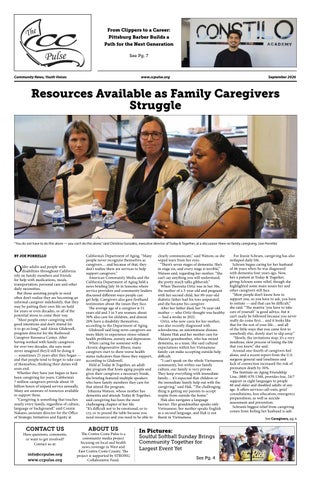
“You do not have to do this alone — you can’t do this alone,” said Christina Gonzalez, executive director of Today & Together, at a discussion there on family caregiving. (Joe Porrello) BY JOE PORRELLO
O
lder adults and people with disabilities throughout California rely on family members and friends for help with medications, meals, transportation, personal care and other daily necessities. But those assisting people in need often don’t realize they are becoming an informal caregiver indefinitely, that they may be putting their own life on hold for years or even decades, or all of the potential stress to come their way. “Most people enter caregiving with good intentions and don’t intend for it to go so long,” said Alexis Glidewell, program director for the Redwood Caregiver Resource Center. After having worked with family caregivers for over two decades, she says most never imagined they’d still be doing it — sometimes 25 years after they began — and that people tend to forget to take care of themselves, thinking their duties will soon end. Whether they have just begun or have been caregiving for years, California’s 7 million caregivers provide about 10 billion hours of unpaid service annually. Many are unaware of resources available to support them. “Caregiving is something that touches nearly every family, regardless of culture, language or background,” said Connie Nakano, assistant director for the Office of Strategic Initiatives and Equity at
CONTACT US
Have questions, comments, or want to get involved? Contact us at: info@ccpulse.org www.ccpulse.org
California’s Department of Aging. “Many people never recognize themselves as caregivers… and because of that, they don’t realize there are services to help support caregivers.” American Community Media and the California Department of Aging held a news briefing July 16 in Sonoma where service providers and community leaders discussed different ways people can get help. Caregivers also gave firsthand testimonies about the issues they face. The average age of a caregiver is 51 years old and 3 in 5 are women; about 30% also care for children, and almost 20% have a disability themselves, according to the Department of Aging. Glidewell said long-term caregivers are more likely to experience stress-related health problems, anxiety and depression. When caring for someone with a chronic degenerative illness, many caregivers start to show worse health status indicators than those they support, according to Glidewell. Held at Today & Together, an adult day program that hosts aging people and gives their caregivers a necessary break, the briefing featured multiple speakers who have family members they care for that attend the program. Johanna Watson, whose mother has dementia and attends Today & Together, said caregiving has been the most challenging chapter of her life. “It’s difficult not to be emotional, or to cry, or to pound the table because you need resources and you need to be able to
ABOUT US
The Contra Costa Pulse is a community media project focusing on local and health news coverage in West and East Contra Costa County. The project is supported by STRONG Collaborative Fund.
clearly communicate,” said Watson, as she wiped tears from her eyes. “There’s seven stages of dementia. She’s in stage six, and every stage is terrible,” Watson said, regarding her mother. “She can’t say anything you will understand; she pretty much talks gibberish.” When Theresita Ortiz was in her 30s, the mother of a 3-year-old and pregnant with her second child, her 89-year-old diabetic father had his toes amputated, and she became his caregiver. After her father died, her 76-year-old mother — who Ortiz thought was healthy — had a stroke in 2022. Ortiz, who now cares for her mother, was also recently diagnosed with scleroderma, an autoimmune disease. Maisie Hak and her mother care for Maisie’s grandmother, who has mixed dementia, as a team. She said cultural expectations within her Vietnamese family can make accepting outside help difficult. “I can’t speak on the whole Vietnamese community, but within our family culture, our family is very private. They keep everything with immediate family… it’s expected that children or the immediate family help out with the caregiving,” said Hak. “The challenging thing is getting my parents to accept respite from outside the home.” Hak also navigates a language barrier: Her grandmother speaks only Vietnamese, her mother speaks English as a second language, and Hak is not fluent in Vietnamese.
In Pictures:
Soulful Softball Sunday Brings Community Together for Largest Event Yet See Pg. 4
For Jeanie Schram, caregiving has also reshaped daily life. Schram began caring for her husband of 46 years when he was diagnosed with dementia four years ago. Now, he’s a patient at Today & Together, giving Schram some relief, though she highlighted some main issues her and other caregivers still face. “Most people don’t know how to support you, so you have to ask, you have to initiate — and that can be difficult,” she said. “The mantra ‘you have to take care of yourself ’ is good advice, but it can’t easily be followed because you never really do come first… and it looks like that for the rest of your life… and all of the little ways that you came first to somebody else, slowly start to slip away.” “Slowly, the invitations stop; it’s a very insidious, slow process of losing the life that you knew,” she said. Around one-fourth of caregivers feel alone, and a recent report from the U.S. surgeon general said loneliness and lack of connection increased the risk of premature death by 30%. The Institute on Aging Friendship Line, (888) 670-1360, provides free, 24/7 support in eight languages to people 60 and older and disabled adults of any age. It offers services call-outs, grief consultations, loss education, emergency preparedness, as well as suicide assessment and prevention. Schram’s biggest relief from caregiving comes from feeling her husband is safe See Caregivers, pg. 6