Scan the QR code above to go to our donation page.
Staff
Publisher Malcolm Marshall
Editor Danielle Parenteau-Decker Contributors
Denis Perez-Bravo
Samantha Kennedy
Jasmine Ford
Joe Porrello
Advisors
Vernon Whitmore
Sandy Close
Michael J. Fitzgerald
The Contra Costa Pulse is a community media project founded by New America Media, focusing on local and health news coverage in West and East Contra Costa County.
The project is supported by The California Endowment and the STRONG Collaborative Fund.
Inquiries
Have questions, comments, or want to get involved?
Contact The Contra Costa Pulse at info@ccpulse.org www.ccpulse..org
Approved AI Data Center Heats Up Pittsburg City Council Meeting
BY SAMANTHA KENNEDY
Pittsburg’s City Council meeting on June 15 was consumed by hours of public comment opposing a data center project approved by the city in 2024, capped off by shouting from the audience and revelations that council members had received death threats ahead of the meeting.
More than 300 people showed up to protest the nearly 350,000-square-foot AVAIO Digital facility that’s set to replace the Delta View Golf Course. The crowd, which spilled out of the chambers, was only a fraction of the more than 14,000 who are petitioning for an end to the development.
“My request tonight is simple: concerns of the residents be truly be heard, acknowledged and addressed in a transparent way,” said Amhari Perkins, who created the petition.
Council members approved the data center as one part of the Pittsburg Technology Park in 2024. The project is on 76 acres and will also include an employment center.
Residents said they weren’t adequately included in the approval process of the facility, adding that AI was not the problem then that it is today.
“For $45, I can plant a sign in a yard
and everyone who drives by knows that that house is for sale. On projects that will reshape this city, your neighbors got less notice than that,” Wolfgang Croskey said.
John DeLacio, a representative from AVAIO, said that the process included over six years of planning and community input.
Pittsburg residents are the latest in East County to fight back against the environmental and health impacts of bringing a data center into the community.
In Oakley, residents successfully pushed council members to remove the possibility of a data center in a project near the Big Break Regional Shoreline, prompting a temporary ban in the city. A permanent ban is being explored.
City officials argue Pittsburg’s data center is different from the other data centers that have brought on concerns of high energy and water usage.
“This is where it really stands apart,” said Alison Spells, Pittsburg’s senior planner, in a city-produced video released ahead of the meeting.
According to the city, the data center will draw from the Pittsburg Power Company and not PG&E, which Spells said means that any costs are not then passed on to customers. The project has also committed to using recycled water,
and Spells said it’s less than 1% of the regional water provider’s supply.
Soon after the project’s approval, the Center for Biological Diversity sued the city over environmental concerns. That resulted in a settlement last December that requires the 100% recycled water and measures to reduce excessive sound.
Vice Mayor Angelica Lopez acknowledged residents’ concerns and suggested that the city create a subcommittee with members of the community, City Council and the planning committee “because compliance and regulation is going to be key if we want to move forward.”
Attendees, shouting to interrupt Lopez, didn’t agree.
“We don’t want to move forward,” some in the audience shouted.
Lopez said that she and other council members had received death threats leading up to the meeting.
“It’s only the beginning,” an audience member shouted, prompting Mayor Dionne Adams to warn of clearing the chambers.
After Lopez, who said she wouldn’t cower to threats, continued to speak, community members began shouting again. Adams adjourned the meeting.
A day after the meeting, the city released a statement saying that the issue of data centers would come back to the
Contra Costa Supervisors to Consider ICE NonCooperation Policy
BY SAMANTHA KENNEDY
The Contra Costa County Board of Supervisors will soon get to consider an ICE non-cooperation policy, almost a year after a demand from community members.
The board’s Equity Committee, made up of Supervisors Shanelle Scales-Preston and Ken Carlson, forwarded a proposed policy at at the June 15 meeting that would bar county staff from cooperating with federal immigration authorities.
The proposal, which supervisors can turn into an ordinance if they please, comes after County Sheriff David Livingston said last year he planned to continue collaborating with immigration authorities as far as is legally allowed under state law.
California’s sanctuary law already restricts how much local jurisdictions and their law enforcement agencies can help immigration agents, banning officials from using resources to support immigration investigations. The law does allow Livingston to aid authorities
in a few cases, like when a person has allegedly committed a certain type of felony.
Roxanne Carrillo Garza said that the proposal was “not worth bringing to the Board of Supervisors.”
“Would it have the likelihood of passing? Yes. Is it a strong ordinance that would protect immigrants? No,” Carillo Garza said.
Scales-Preston and Carlson have reworked the proposal a couple of times in response to community concerns over the allowance of contractors to not follow the policy and disagreements over whether the policy should instead be an ordinance, both of which issues the two have previously diverged on. County Counsel Thomas L. Geiger said at a previous meeting that a policy is just as enforceable as an ordinance.
The original policy draft required county contractors to follow the rules, but that was taken out in the second version.
Scales-Preston pushed staff to include that portion previously, while Carlson said that the county and those it contracts
with do not share its data with ICE.
Ahead of the June 15 meeting, more than a dozen immigrant advocates rallied in support of passing protections for immigrants in the county.
Richmond City Council member and mayoral candidate Claudia Jimenez, an immigrant herself who successfully introduced a similar ICE-free zone ordinance in her city, was among them.
“Alameda, San Mateo, San Francisco, Santa Clara, Santa Cruz and Sonoma [counties] have all taken action to protect the communities. It’s time for Contra Costa to do the same,” Jimenez said, according to KRON4.
Pinole and the West Contra Costa Unified School District have also adopted ICE-free zones since the second Trump administration got underway.
At least a quarter of the county’s population is immigrants, according to a 2021 report. The county is also expected to see more immigration activity in the county, following the San Francisco immigration court operations moving to the Concord courthouse. •
Pinole Selects Former SF Administrator as New City Manager
BY SAMANTHA KENNEDY
Pinole is getting a new city manager who comes with high regard from state and local leaders, but residents aren’t so trusting.
City Council members at the June 16 meeting approved a contract with Naomi Kelly, a former city administrator for San Francisco who resigned in 2021 after her husband was named in a federal corruption scandal. Her husband, Harlan Kelly, was charged with fraud-related
crimes for acts during his time as the general manager of the city’s Public Utilities Commission.
Naomi Kelly was not charged with any wrongdoing. She defended her husband against the charges, saying at the time that her resignation was because of “false statements of an admitted liar.”
That “admitted liar” probably refers to a former contractor and permit expediter for the city, Walter Wong, who implicated Harlan Kelly in the widespread scandal when accepting a plea deal. According
to court records, Wong said that he had paid for Harlan Kelly and his family to take a trip to China because he wanted contracts with the commission.
Harlan Kelly was convicted in 2023 of charges including conspiracy and bank fraud, and found not guilty of other allegations of services paid for by Wong. At least two dozen were charged in the scandal.
Pinole residents questioned if council members had done their “due diligence.” “You used the right terminology —
See Pittsburg, pg. 6
Family of Yolanda Ramirez Marks Birthday, Continues Push for Answers
BY DENIS PEREZ-BRAVO
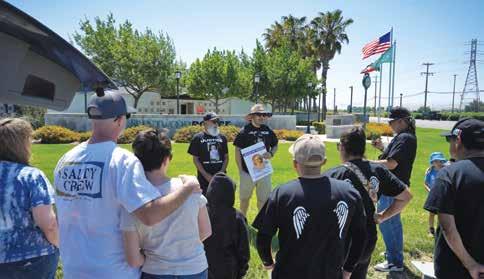
As the family of Yolanda Ramirez prepares for a rare coroner’s inquest in July, family members and supporters took to the streets of Brentwood on May 16 to honor what would have been her 73rd birthday.
Wearing shirts bearing Ramirez’s image, supporters organized by her son, Rich Ramirez, gathered at 161 Broderick Drive, the site of her fatal altercation with Brentwood police officers Danielle Tjhia and Aaron Peachman.
There, they sung “Happy Birthday” and left a poster and coffee mug before walking two miles to the Brentwood Police Department.
“I lost faith in the justice system,” Rich said. “I saw it was broken, and there was no check and balances.”
Rich said his family believes the Contra Costa County Sheriff’s Office lied and purposely deceived the community about his mother’s death in the months that followed it.
Instead of finding answers, he said, his family was met with deflection and silence.
After months of media attention and public pressure, the family announced that Contra Costa County District Attorney Diana Becton called for a coroner’s inquest from the Contra Costa Sheriff’s Department.
The sheriff’s department said it would hold the proceedings July 15 at 9 a.m. at Wakefield Taylor Courthouse at 735 Court St. in Martinez. It did not respond to a request for comment.
“There used to be a coroner’s inquest anytime someone died in custody of the county, including in-custody deaths in jail,” family attorney Melissa Nold said. “Once the inquests started exposing police murders, law enforcement compelled them to stop.”
A coroner’s inquest is a public court hearing in which a coroner or jury determines the manner of death: natural causes, suicide, accident, or at the hands of another person other than by accident.
The coroner’s inquest comes after an independent autopsy contradicted
West Contra Costa AC Transit Service Could be Reduced Next Year Without Sales Tax
BY SAMANTHA KENNEDY
Iofficial county reports overseen by the Sheriff’s Office, which ruled Ramirez’s death natural.
Nold said she hopes the coroner’s inquest would determine whether the original medical examiner was notified of Ramirez’s head injuries ahead of the examination and whether they were aware of the body cam footage showing those injuries happen.
“Usually, the pathologist isn’t told about the forces used, and it skews their finding because they’re not looking for injuries if nobody told him she was injured,” Nold said.
Recent reports have found police in-custody deaths are often wrongly classified in death investigation systems.
At the Brentwood Police Department, Rich taped up a poster of Yolanda’s face and birth date to the front entrance, a sign of protest as his family pushes for unbiased in-custody death reporting in Contra Costa County.
“We are going to tape it on there, so they remember — since they don’t know her date of birth, now they know,” Rich said.
His father, Rudy Ramirez, a Vietnam veteran, was determined to make the walk to the station despite suffering from
knee problems for many years.
“I felt Yolanda walking side by side with me all the way over here,” Rudy said at the police department.
The following Monday, a funeral mass and celebration of life were held for Ramirez in Brentwood, the city she had lived her whole life in.
“I thought it would get easier, but it’s not,” Rudy said.
The family is far from gaining closure.
On July 15, the family will have to relive the events that led to their matriarch’s death, and even if the inquest finds that the manner of death was at the hands of others, the finding would not result in immediate criminal charges because a coroner’s inquest does not determine civil or criminal responsibility.
They will then await the findings of the district attorney’s investigation and whether the office will pursue charges against Peachman and Tjhia.
According to the Mercury News, Ramirez’s case will be the first coroner’s inquest to be held in the county since October 2024.
“Going through this is tough, but our family doesn’t give up, and we are fighting for justice,” Rich said. •
t’s a plan that AC Transit hopes will never be used. But if it is, some bus lines in West Contra Costa County cities would run shorter distances or run less frequently beginning in the middle of 2027.
Under a proposed plan, which the Board of Directors on June 10 approved for further public engagement, lines 70, 71, 74 and 76 as well as the transbay L would run less frequently and the 70 would travel a shorter distance as part of a 16.4% systemwide reduction in service to help close a projected budget deficit.
The agency is expecting an annual deficit of $50 million starting in fiscal year 2027-28 and in the following years, according to staff. AC Transit says it’ll use a state loan to offset the deficit in the first year but will need additional funding to maintain service levels the following year.
That’s why AC Transit is banking on a November ballot measure that would impose a sales tax on Bay Area counties — a half-cent in Contra Costa and others, one-cent in San Francisco — to generate nearly $1 million annually for public transit agencies.
AC Transit’s plan proposes reducing weekday service frequencies to every 15 minutes on Lines 70 and 76 on Cutting Boulevard and every 40 minutes on Lines 71 and 74. The 71 and 74 would also run every 40 or 60 minutes on weekends.
Line 70 would also have part of its route eliminated. Instead of traveling through to the El Cerrito del Norte BART station, the line would only go to Richmond’s BART station.
Transbay service would see reductions as well, including the L line making fewer trips between the Richmond Parkway Transit Center and the Salesforce Transit Center in San Francisco.
BART adopted its own alternative service plan in February, which would reduce service frequencies as soon as January 2027 if the measure fails to pass.
“A lot of people talk about, well, the ridership will go up for AC from BART stations, but no matter how much it goes up, we’ll never be able to make up the deficit,” Director Harpreet Sandhu said at the June 10 board meeting.
Sandu, whose area covers West Contra Costa, also pointed to El Cerrito voters overwhelmingly appearing to shoot down a library tax during the June primary election.
“The wonderful thing for a library — didn’t pass. So let us not take it for granted,” Sandhu said. “The public needs to be informed of the necessity for this.”
El Cerrito voters weren’t the only ones who seemed fed up with taxes as costs rise. Contra Costa voters rejected a countywide sales tax to backfill federal health and food assistance cuts, and a bond measure for the community
DENIS PEREZ-BRAVO
Brentwood residents Rich and Rudy Ramirez, center facing forward, honored Yolanda Ramirez’s birthdate by walking to the Brentwood Police Department on May 16.
‘We
Have Always Been There’: Richmond Pride Celebrates Visibility, Legacy and Community
STORY AND PHOTOS • DENIS PEREZ-BRAVO
Under the banner “Richmond Unerased,” this year’s Richmond Rainbow Pride celebration centered on a simple message: LGBTQ+ people have always existed and continue to shape the community’s past, present and future.
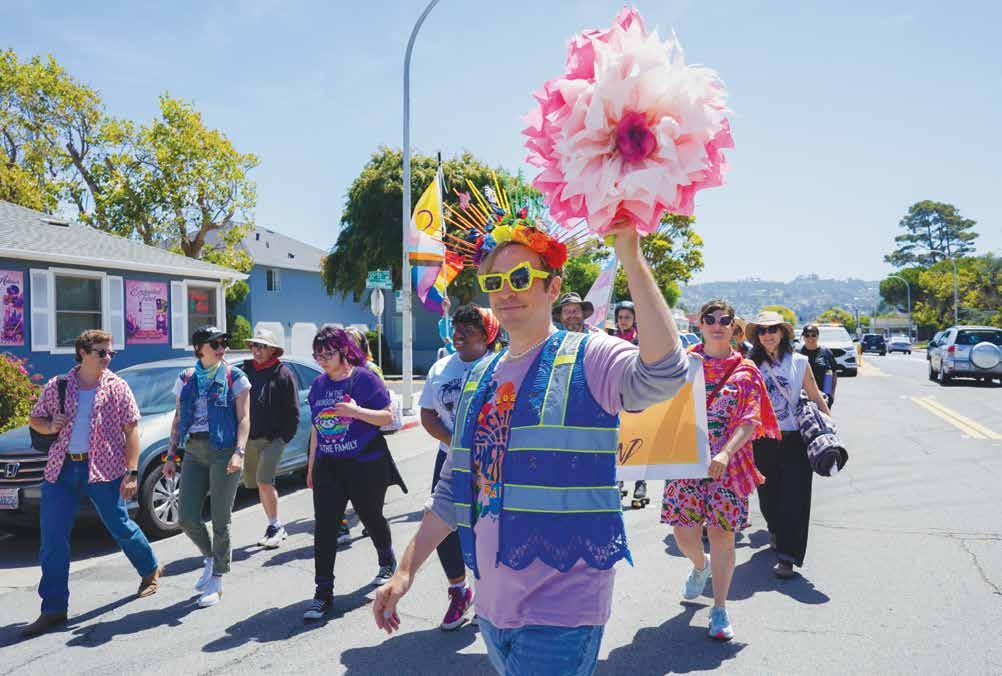
Members of the LGBTQ+ community marched down Macdonald Avenue to Civic Center Plaza during the 12th annual Richmond Rainbow Pride celebration June 7. The event featured vendors, community organizations and performances, but organizers said the theme carried particular urgency amid growing political attacks targeting LGBTQ+ communities nationwide.
“We have a national government that is currently attacking a lot of the LGBTQIA+ community,” Richmond Rainbow Pride Chairperson Jamin Pursell said. “And so we want to make sure that the LGBTQIA community is not erased from history. We have always been there. We’ve always been a part of it.”
For Pursell, honoring those who built Richmond’s LGBTQ+ community is central to that mission. He pointed to the late Duane Chapman, a Richmond nurse who helped shape local conversations around AIDS during the 1980s. Chapman co-founded Richmond Rainbow Pride alongside Cesar Zepeda, now a member of the Richmond City Council.
“All of the elders that we have to keep in our head who have made these pride parades possible,” Pursell said. “We stand on the shoulders of giants.”
That legacy continues through attendees who said Pride in Richmond provides visibility, acceptance and a reminder that they are not alone.
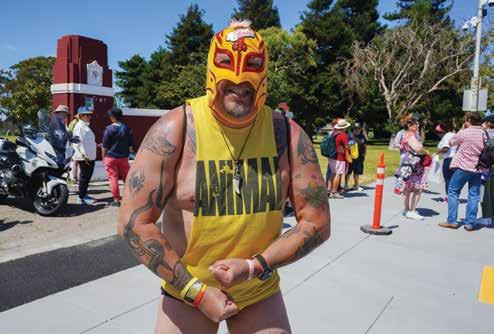
Todd Trumbull, 55, traveled from Oakland to celebrate alongside friends who live in Richmond. Wearing running gear and a bright yellow Mexican luchador mask, Trumbull said the mask reflected his own journey toward authenticity.
“It kind of hides your identity,” Trumbull said. “But it also makes me come out of my shell.”
After growing up in Sacramento’s conservative suburbs, Trumbull said moving to the Bay Area allowed him to live more openly.
“I would say there’s been a transition,” Trumbull said. “We are really lucky here in the Bay Area because there’s
already a supportive community.”
He said events like Richmond Rainbow Pride help reinforce a sense of belonging.
“Festivals like this make you feel a little bit more part of a community,” Trumbull said. “Things aren’t always perfect in the Bay Area, but this is a good place to be out and be proud.”
The event itself grew out of efforts to create a more visible and welcoming space for LGBTQ+ residents in Richmond.
Richmond Rainbow Pride was founded in response to anti-LGBTQ rhetoric directed at then-City Council member Jovanka Beckles, an Afro-Latina lesbian. Pursell said organizers wanted to create a space where LGBTQ+ residents could feel welcomed and visible.
“We initially started in Marina Bay because we were kind of afraid,” Pursell said. “We were a little afraid of what would be the response. But people were stoked. People were really, really happy.”
Following the COVID-19 pandemic, organizers moved the celebration to Richmond Civic Center to increase visibility and accessibility.
“It has to be in the center of town. It has to be most visible as possible,” Pursell said. “And we made sure that the parade started on our 10th year because we wanted to make sure that people felt like they were also a part [of] and connected to our experience because we are all in this together.”
For participants from Bay Area Derby, visibility extends beyond Pride month.
The roller derby league, which includes skaters from Oakland, Berkeley, Richmond and San Francisco, has developed strong ties to Richmond.
“We have three skaters this year,” said Open Source Nightmare, who asked to be identified by their roller derby name.
And it’s done so through events hosted at Richmond Memorial Auditorium.
“We actually just recently hosted the WFTDA playoffs, which is basically kind of like building up to the World Cup of roller derby,” Open Source Nightmare said, referring to the Women’s Flat Track Derby Association playoffs. “And we hosted it right here in Richmond.”
As a queer athlete, Open Source Nightmare said Pride events have taken on additional meaning.
“It’s really fun to just show you exist as queer athletes, as so many of us are,” they said.
“Since the election, this has taken on new meaning, because they’re coming after trans people with everything they have,” Open Source Nightmare said. “They’re already talking about coming after gay marriage. They’re coming after HIV funding.”
They said fear and misinformation have fueled opposition to transgender participation in sports despite trans athletes being part of roller derby for decades.
“We have been around for years and years and have played in some of these leagues for 50 years,” Open Source Nightmare said.
“Never caused a problem, and suddenly, they spent a billion dollars on this hate campaign to make people scared, so that they’ll focus on trans issues instead of literally anything else,” they added.
For Open Source Nightmare, simply showing up carries its own significance.
“I’m just happy to be out here representing,” they said. “‘We exist’ always implies ‘We should exist.’”
Among those attending June 7 was Nora Ponce, a Richmond Rainbow Pride board member who identifies as an ally.
“For me,” Ponce said, “it’s one of those events that’s completely inclusive. You just come out to celebrate who you are authentically.”
Ponce said Pride creates opportunities to challenge stereotypes and foster understanding.
“Unfortunately, there are still sections of the community where sexuality is still taboo,” she said.
She said many LGBTQ+ people come out later in life, often contradicting assumptions about who they are.
“Because quite honestly, I know so many people that never actually came out until much later in life,” Ponce said. “They look like your teachers, your police officers, your congressmen.”
Ponce said building inclusive communities begins by recognizing shared humanity.
“This is exposure to an entire community of just coexisting as one people,” she said. “We are all just human beings.”
For organizers and attendees alike, Richmond Rainbow Pride’s theme served as both a celebration and a declaration: LGBTQ+ people have always been part of Richmond’s story.
They are still here, and they refuse to be erased. •
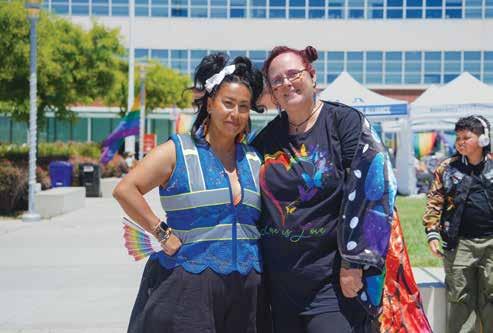
NIAD Art Center community programs director Ember Avalos, right, and another attendee enjoy the Richmond Rainbow Pride Festival on June 7 at Civic Center Plaza.
"This is exposure to an entire community of just coexisting as one people,” said Nora Ponce, left, with Sarah Thomas. “We are all just human beings.”
“It kind of hides your identity, but it also makes me come out of my shell,” said Oakland resident Todd Trumbull about the Mexican luchador mask he wore during the festival.
Richmond Rainbow Pride Chairperson Jamin Pursell dressed up as a play on the Statue of Liberty during the Richmond Pride march on June 7.
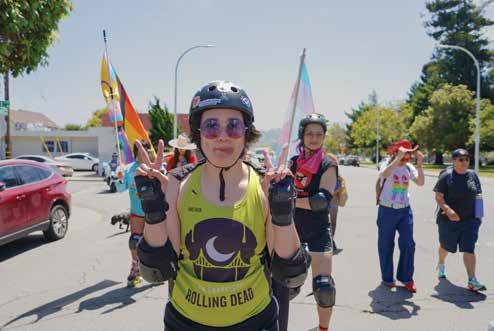
A roller derby skater known as Bad Hella Skater, center, throws up peace signs as fellow skater Open Source Nightmare, center right, holds the transgender flag during the Richmond Rainbow Pride parade.
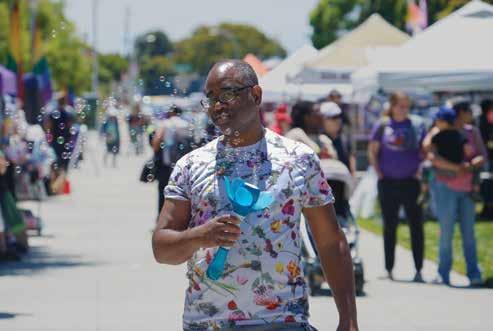
The Richmond Rainbow Pride DJ ran over to get a bubble machine during the festival at Civic Center Plaza.
Community Leaders Stress Prevention and Healing at Richmond Wear Orange Event
BY DENIS PEREZ-BRAVO
While Richmond has seen a decline in homicides in recent years, residents and anti-violence advocates say the city must continue investing in gun violence prevention efforts, youth programs, and stronger relationships between law enforcement and the community.
Keyz 2 the Future hosted a Wear Orange anti-gun violence rally June 7 at Market Square Mall, bringing together residents, nonprofit leaders, Richmond Police Chief Timothy Simmons and mayoral candidate Ahmad Anderson to honor those lost to gun violence and discuss ways to strengthen the community.
“We are finding ways to heal the community,” organizer Keycha Gallon said. “We are making sure workforce development is our main focus.”
The event featured speakers, performances, food and an awards presentation. Attendees were also given orange shirts printed on-site as part of the national Wear Orange campaign.
For Anderson, the event was a reminder that declining crime rates do not eliminate the need for continued investment in prevention efforts.
“For someone like myself, who lost my godson to gun violence, it’s important to me that we partner in this community and recognize that just because murder rates are down, doesn’t mean that we don’t have work to do,” Anderson said.
Hercules...
Continued from page1
“We’re so consumed with our phones and being on social media with our heads down, but when we are in the studio you can’t do that, so I just encourage these days — if they can’t gravitate toward a culture, do something with your bodies, do something with your minds, and eventually it will lead to your heart,” she said. •
Pittsburg...
Continued from page 2
City Council at a future meeting.
“At the direction of the Mayor and the Pittsburg City Council, a workshop on development of data centers will be placed on an upcoming regular meeting of the City Council to allow for additional public engagement,” the statement said. •
He said lasting public safety will require residents, policymakers and law enforcement to move beyond adversarial relationships, while still recognizing the trauma many communities have experienced.
Rebuilding trust through accountability and respect is essential to preventing violence, Anderson said.
The annual Wear Orange campaign began after the death of Hadiya Pendleton, a 15-year-old Chicago student who marched in President Barack Obama’s second inaugural parade in January 2013. One week later, she was shot and killed at a Chicago park.
In response, her friends and family began wearing orange to raise awareness about gun violence, a movement that grew into the national Wear Orange campaign honoring all those affected by gun violence.
“So even though it started for Hadiya, we recognized it for everyone that died by gun violence,” Gallon said. “I
lost a brother to gun violence, so it is important to me to actually get the word out and to advocate for change.”
According to its website, Keyz 2 The Future hosts a variety of workshops, classes and events to support children and families who have experienced loss due to gun violence.
Gallon said the event serves as a violence prevention tool by bringing young people together in a positive community setting.
One of those young people was her son, Nathaniel Gallon, who spoke during the event about his personal growth and academic success.
“I still retain good grades,” he said. “My teachers see positive growth in me, and I feel more confident.”
Richmond has reportedly gone from a high of 61 homicides in 1991 to a low of five last year; three homicides have been recorded in the city so far in 2026.•
AC Transit...
Continued from page 3
college district was failing at last count.
Elsewhere in the Bay Area, voters also said no to increasing taxes in Oakland and San Francisco. But some transit advocates counted themselves lucky as one of the only taxes in the region that passed was a sales tax for North Bay transit.
Sandhu and Director Sarah Syed said they would participate in public outreach as much as possible to inform the public of the board’s proposed plan and what cuts could look like.
Staff said that all of the proposed cuts would be aligned with the coverage standards it has to meet in each community.
The Board of Directors is expected to set a public hearing at their Aug. 12 meeting, which would be held Oct. 14. If the November ballot measure doesn’t pass, the agency would implement service reductions in mid-2027. •
Pinole...
Continued from page 2
EXECUTE,” wrote Cathy McFarland, referring to Naomi Kelly’s employment agreement. “This will carry out the final death sentence to what is left of Pinole…”
But Naomi Kelly also had the backing of several local and state officials, including council members and state Treasurer Fiona Ma.
Mayor Anthony Tave, who worked for the San Francisco Public Utilities Commission from 2009 to 2014, said he was supporting Naomi Kelly because of her experience.
“I know that she can ferry us through difficult times. She’s done it over and over in other agencies,” Tave said.
Mayor Pro Tem Devin Murphy and council member Maureen Toms said that the reason council members approved her for the position was that they had done their due diligence.
“Ms. Kelly is actually in the audience now and had to hear comments like that as she’s done her due diligence to really just be honest and truthful about the situations at hand. What’s in the media is not always fact,” Murphy said ahead of the vote.
Naomi Kelly served as San Francisco’s city administrator from 2012 to 2021, where she oversaw all city departments and the budget. Before that, she was a city purchaser for the city.
She holds a bachelor’s in psychology from New York University and a law degree from the University of San Francisco.
Under the agreement with Pinole, Naomi Kelly will serve a three-year term as city manager, effective July 1. •
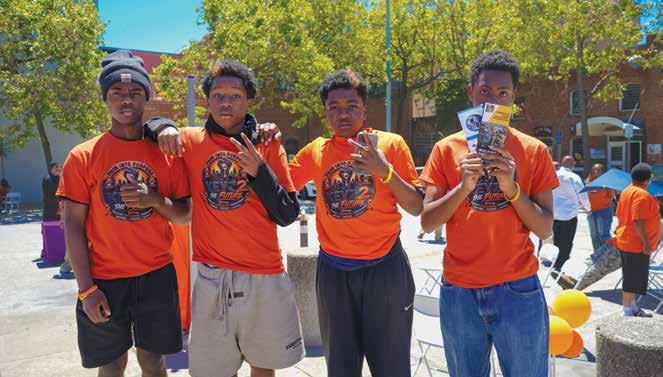
Youth speaker Nathaniel Gallon, center right, hangs out with his friends before the Wear Orange anti-gun violence rally hosted by Keyz 2 the Future at Market Square Mall in Richmond. (Denis Perez-Bravo / The CC Pulse)
Mega Hearings, Short Notices Fuel Fear and Uncertainty at Bay Area Immigration Court
BY CHRISTOPHER ALAM AMERICAN COMMUNITY MEDIA
On a hot June afternoon, Sergio Jaime Lopez, the community defense coordinator for the nonprofit Safe Center in Contra Costa County, arrives at the Concord Immigration Court.
A hearing is about to begin, and he does his rounds. He gives an update in Spanish to three women related to an asylum seeker waiting in the hallway. Then he delivers instructions to two volunteers on what resources to give people leaving the hearing. He shares hushed words with one man while handing a picture book to a child.
“They just want to be kids. And there’s not anything that they can play with so we just provide books. That way they can be a little bit distracted,” he says. For the parents, he hands out packets. They contain listings of organizations across California that provide free or lowcost legal consultation, and contacts for California Bar Association attorneys.
He finally steps inside the courtroom, where about 30 people await the judge on crowded benches.
This is a snapshot of an immigration process under siege from large asylum backlogs, too few immigration judges and mass hearings designed to speed up deportations.
Since the closing of the San Francisco Immigration Court by the Trump administration in May, roughly 100,000 cases have been transferred to a new court in the city of Concord, about 30 miles east.
The move compounded a backlog that already exceeds 58,000 cases. California’s statewide immigration case backlog now stands at 340,000. San Francisco carried 116,800 of those cases before a bulk of them were absorbed by the Concord docket.
At the same time, there has been a sharp reduction of immigration judges. Of the 21 immigration judges who staffed the two downtown San Francisco immigration courthouses at the start of the year, only two remain. Concord, meanwhile, has just eight immigration judges to absorb the surge. With far fewer judges handling far more cases, asylum seekers in the Bay Area face a dismal situation. Their cases will either not get the attention they deserve or be left in legal limbo for years, some rescheduled as far out as 2029.
To manage the volume, a new process is drastically accelerating the amount of cases a judge hears at once. Immigrants are being scheduled for massive master calendar hearings called “mega masters,” where 100 people or more are included in the courtroom at once. In the past usually up to 20 people were heard at a time. Some had their appointments suddenly rescheduled to these mega master hearings on short notice.
“This is a big change. There’s a lot of people coming and most of them had a previous hearing in 2027, 2028, 2029. And they suddenly received a notice a week ago to show in person in Concord for this hearing,” says Jaime Lopez.
The short notice has a chilling effect. “We are starting to see the numbers of people showing up decrease. Like, I can tell you on the second day, there were about 100 people requested to show for their court hearing. But around 40 people showed up,” says Lopez.
Designed for deportations
Chloe Czabaranek is the immigration legal director at the La Raza Community Resource Center in San Francisco. It’s a position she’s held since April. She says the past year has been very up in the air for clients. She reports prepping clients for every scenario, lining up witnesses, gathering family and community, only to find out at the last minute that the hearing is rescheduled, sometimes without getting a new hearing notice. That leaves her and her attorneys just as much in
the dark as their clients.
“So it’s a little frustrating, just to put it lightly,” Czabaranek says. “We just keep checking every week. We check their number and it says there are no upcoming hearings… and we have to sit there with them and just empathize because at the end of the day we don’t know, right? We’re just doing our best to keep them informed.”
“It is very disheartening,” Czabaranek adds, describing how preparing asylum seekers for their cases is not easy as it often brings up trauma during evaluations that they have to process only to let them know that the hearing has been postponed.
Czabaranek and other legal advocates say the Justice Department’s goal of accelerating and grouping up hearings is to issue more deportation orders. Many immigrants do not show up for the mega masters either because of the short notice or the worry that they will be detained or deported. Those who fail to appear are receiving removal orders. Attorneys say the mega masters largely target those without legal representation. The process has restricted due-process rights for immigrants even further.
“It’s terrible because they fired many judges in San Francisco that historically have a really high rate of approval for asylum,” Lopez notes.
Fired for doing our job
One of those judges is Jeremiah Johnson, fired last year as the San Francisco immigration court was being dismantled. Johnson, now executive vice president of the National Association of Immigration Judges — a former labor union decertified by the first Trump administration — says it was a challenging work environment from the start, but a vibrant one where the judges collaborated and mentored each other.
“The work was meaningful. We were challenged, but yet we felt that we were doing the right thing,” he says. “I think a lot of us were fired, myself included, for doing our job. What we see here is an administration that does not want to hold hearings.”
Johnson saw his caseload increase during his time in San Francisco, from a quota of two cases a day in his first year to six cases a day by the time he was fired in November. Even before mega master hearings, he was setting hearing dates as far out as December 2028..
Johnson described the effect bluntly; more time in legal limbo, and more time spent in uncertainty on whether or not one can remain in the U.S.
“It’s going to take people here in the Bay Area much longer to have their day in court … and that affects whether you buy a house or not, what school you’re gonna send your kid to. Should I get married or not? Should I have a kid? … You have uncertainty just in today’s climate of fear. Will I make it home from work to see my kid? And a lot of these people are mixed [status] as families, U.S. citizen children, U.S. citizen
spouses. Should I go to my kid’s softball game? Should I go to a medical appointment? I’m scared that I might be arrested and never see my family again. That type of uncertainty is what is being exacerbated by these closures.”
Johnson said that he began seeing people opt to selfdeport often just to escape or avoid detention.
“Conditions in detention are such that people cannot stand another day,” he said. “I took the bench once, and there was a woman who had a valid claim, who had entered the United States lawfully. She didn’t have an attorney, and the first thing she said was she wanted out, that she could not take one more day in detention. So she gave up her case that day and went back to her own country. There was no hearing that day. This is a legal strategy to keep people from having their day in court.”
Paying it forward
Born in Nicaragua, Lopez journeyed north to the U.S. border in 2019 and applied for asylum in San Diego. He wasn’t able to find an attorney, and after a few hearings, he was unexpectedly detained for six months.
“I couldn’t understand why I was detained or in jail for so long. It was terrible for me, because it’s like you’re living in limbo. So you don’t know what to do. You don’t know what the future will be. Especially because I have a family.”
While detained, he began teaching himself the basics of the U.S. immigration system in the detention center’s library. He wrote letters to legal aid organizations and eventually got his case picked up. He made his way to the Bay Area, where his wife and children eventually followed.
That’s a big reason why Sergio Jaime Lopez is at the court every day helping immigrants decipher what has become a kafkaesque immigration court system. He sees it as a way to utilize the knowledge he gained while in immigration jail – to pay it forward to others.
“When I came here to the Bay, a big community supported me, and there’s still a big, big amount of people, community, and interfaith organizations that care for immigrant communities, immigrant families, and they share many, many of the values that I also have right now. And we are really strong together,” he says.
“I’m here as a result of community, because if people didn’t support me in the past, I wouldn’t be here. My situation would be different, probably. I’m a result of my community that supports me and stands beside me.”
Chris Alam is a California Local News Fellow with the UC Berkeley Graduate School of Journalism. This story was produced as part of “Aquí Estamos/Here We Stand,” a collaborative reporting project of American Community Media and community news outlets statewide. •
Sergio Jaime Lopez is the community defense coordinator for the nonprofit Safe Center in Contra Costa County. (Photo by Peter Schurmann)
What Would Make East County Better? Students Respond
Editor’s Note: We asked students from the Los Medanos College Experience newspaper a simple question: What changes would you like to see in East County? Their responses touched on jobs, health care, housing, the environment and quality of life. Here is what they had to say.
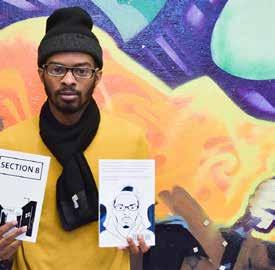
I like there to be more jobs since I am unemployed. I would also like more mental health resources since I have a history of mental health [challenges] as a young man.
— Kobe Lam, 19
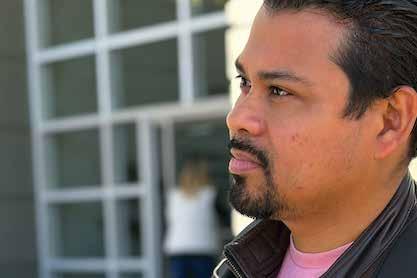
Some changes I would like to see is better healthcare support — more specifically strengthening local health services. This would be a needed and great change for East Contra Costa County.
— William Trowbridge, 20
Definitely need some better hangout spots. Brentwood is starting to understand we need places to hang out — with them improving and working on the streets of Brentwood. So I think Antioch and Pittsburg could start getting more involved in the younger community, so we don’t have to feel like we need to take BART all the way to San Francisco to have a good time. I think we don’t really have a real community here. Many young people want to grow up and get out of areas like these, so I think
our small cities need to make this a place that people wouldn’t mind living in.
— Mylia Brooks, 20
I would love to see an increased proactive approach to better our environment. I [would] love to see more concentrated efforts in conserving water, waste management, recycling, and growing more trees. There is only one Earth.
— Kendall McClure, 20
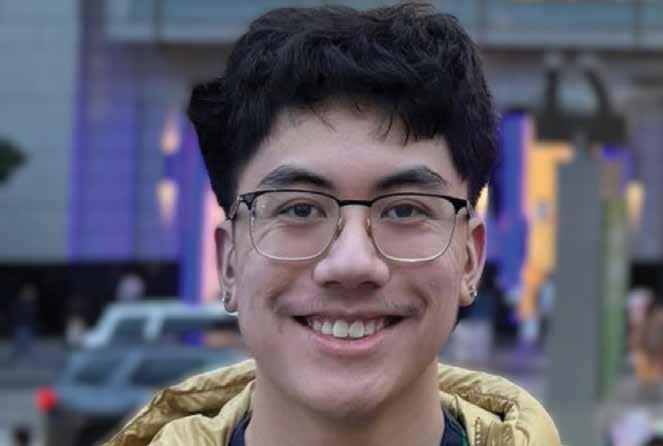
In Brentwood, they’re only building single-family homes, instead of building apartments. They should build more apartments in Brentwood. It’s a waste of resources and land to build like this.
I’ve heard that the city of Brentwood allegedly decided to build more single-family homes than apartments for better revenue. You also need a car to go almost anywhere in Brentwood.
— Josh Buenaflor, 22 •
County Breaks Ground on 1st Mental Health Rehab Center
BAY CITY NEWS
Contra Costa County broke ground June 17 on its first mental health rehabilitation center, a 45-bed facility designed to provide long-term treatment for residents with serious mental illness closer to home.
The Contra Costa Recovery Center will be built in Richmond by renovating an existing county-owned building on the Brookside Shelter campus. In a statement, county officials said the facility will offer longer-term treatment and stabilization services for adults recovering from severe psychiatric conditions. The center is expected to open in June 2027. Currently,
Contra Costa County residents who need this level of care are placed in facilities outside the county.
“This project represents a significant step forward in strengthening our local behavioral health system and ensuring residents can receive specialized care closer to home,” said Dr. Grant Colfax, CEO of Contra Costa Health.
Mental health rehabilitation centers provide sub-acute treatment for people who require extended stabilization after stays in acute care hospitals, state hospitals or detention facilities. The centers are secure, locked facilities for clients who need intensive support during recovery.
The roughly 20,000-square-foot facility will undergo a full renovation and include client care suites, sleeping rooms, medical and wellness spaces, and an outdoor recreation area. County officials said the center will provide care and rehabilitation services around the clock.
The project is being funded through an $18.6 million grant from the California Department of Health Care Services’ Behavioral Health Continuum Infrastructure Program. Contra Costa County met the required local match through equity in the property and agreed to operate the facility for behavioral health services for at
least 30 years, county officials said.
“This investment reflects Contra Costa County’s ongoing commitment to expanding access to compassionate, high-quality behavioral health care,” said Supervisor John Gioia, whose district includes the project site. “By creating local treatment capacity, we can better support some of our most vulnerable residents and improve outcomes for individuals, families, and the broader community.”
The Recovery Center is one of four state-funded behavioral health projects planned in Contra Costa County. More facilities are proposed in Pleasant Hill, Pittsburg and Antioch as part of a broader effort to expand local treatment capacity for people experiencing mental illness or substance use disorders, according to county officials.
Los Medanos College student Josh Buenaflor says “it’s a waste of resources and land [for Brentwood] to build” single-family homes rather than apartments. (LMC Experience photo)