From Beauty School to Business Owner: How ‘Woo’ Buggs-Dorsey Built a Family Legacy See Pg. 7
Community News, Youth Voices
www.ccpulse.org
August 2026
Port Chicago Sailors’ Protest Helped Pave the Way for Military Desegregation
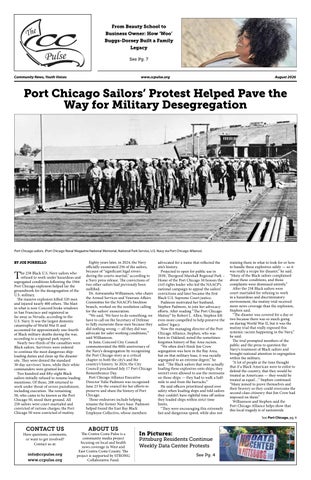
Port Chicago sailors. (Port Chicago Naval Magazine National Memorial, National Park Service, U.S. Navy via Port Chicago Alliance) BY JOE PORRELLO
T
he 258 Black U.S. Navy sailors who refused to work under hazardous and segregated conditions following the 1944 Port Chicago explosion helped lay the groundwork for the desegregation of the U.S. military. The massive explosion killed 320 men and injured nearly 400 others. The blast in what is now Concord broke windows in San Francisco and registered as far away as Nevada, according to the U.S. Navy. It was the largest domestic catastrophe of World War II and accounted for approximately one-fourth of Black military deaths during the war, according to a regional park report. Nearly two-thirds of the casualties were Black sailors. Survivors were ordered to continue the most dangerous shiploading duties and clean up the disaster site. They were denied the standard 30-day survivors’ leave, while their white commanders were granted leave. Two hundred and fifty-eight Black sailors initially refused to resume loading munitions. Of those, 208 returned to work under threat of severe punishment, including execution. The remaining 50, who came to be known as the Port Chicago 50, stood their ground. All 258 sailors were court-martialed and convicted of various charges; the Port Chicago 50 were convicted of mutiny.
CONTACT US
Have questions, comments, or want to get involved? Contact us at: info@ccpulse.org www.ccpulse.org
Eighty years later, in 2024, the Navy officially exonerated 256 of the sailors, because of “significant legal errors during the courts-martial,” according to a Navy press release. The convictions of two other sailors had previously been nullified. Dr. Antwanisha Williamson, who chairs the Armed Services and Veterans Affairs Committee for the NAACP’s Stockton branch, worked on the resolution calling for the sailors’ exoneration. “We said, ‘We have to do something; we have to call on the Secretary of Defense to fully exonerate these men because they did nothing wrong — all they did was advocate for safer working conditions,’” said Williamson. In June, Concord City Council commemorated the 80th anniversary of the Navy’s desegregation by recognizing the Port Chicago story as a critical chapter in both the city’s and the country’s history. In 2024, the City Council proclaimed July 17 Port Chicago Remembrance Day. Port Chicago Alliance Executive Director Yulie Padmore was recognized June 23 by the council for her efforts to preserve and share the history of Port Chicago. Those endeavors include helping rename the former Navy base. Padmore helped found the East Bay Black Employee Collective, whose members
ABOUT US
The Contra Costa Pulse is a community media project focusing on local and health news coverage in West and East Contra Costa County. The project is supported by STRONG Collaborative Fund.
advocated for a name that reflected the site’s history. Projected to open for public use in 2030, Thurgood Marshall Regional Park – Home of the Port Chicago 50 honors the civil rights leader who led the NAACP’s national campaign to appeal the sailors’ convictions and later became the first Black U.S. Supreme Court justice. Padmore motivated her husband, Stephen Padmore, to join her advocacy efforts. After reading “The Port Chicago Mutiny” by Robert L. Allen, Stephen felt even more compelled to help preserve the sailors’ legacy. Now the managing director of the Port Chicago Alliance, Stephen, who was born in Oakland, noted the sometimesforgotten history of Bay Area racism. “We often don’t think Jim Crow segregation was here in the Bay Area, but on that military base, it was racially segregated to an extreme degree,” he said. “The Black sailors that were actually loading these explosives onto ships, they weren’t even allowed to use the restrooms on those ships — they had to walk a halfmile to and from the barracks.” He said officers prioritized speed over safety when loading ships and told sailors they couldn’t have rightful time off unless they loaded ships within strict time limits. “They were encouraging this extremely fast and dangerous speed, while also not
In Pictures:
Pittsburg Residents Continue Weekly Data Center Protests See Pg. 4
training them in what to look for or how to handle these explosives safely — so it was really a recipe for disaster,” he said. “Many of the Black sailors complained about these conditions, and those complaints were dismissed entirely.” After the 258 Black sailors were court-martialed for refusing to work in a hazardous and discriminatory environment, the mutiny trial received more news coverage than the explosion, Stephen said. “The disaster was covered for a day or two because there was so much going on during World War II, but it was the mutiny trial that really exposed this systemic racism happening in the Navy,” he said. The trial prompted members of the public and the press to question the Navy’s treatment of Black sailors and brought national attention to segregation within the military. “A lot of people at the time thought that if a Black American were to enlist to defend the country, that they would be treated as Americans — they would be treated as equal…” Stephen continued. “Many joined to prove themselves and their bravery so they could overcome the second-class citizenry that Jim Crow had imposed on them.” Williamson and Stephen said the Port Chicago Alliance helps show that this local tragedy is of nationwide See Port Chicago, pg. 6