What Immigrant Families Should Know About the New Public Charge Rule See Pg. 5
Community News, Youth Voices
www.ccpulse.org
October 2026
November Transit Tax: What Contra Costa Voters Need to Know
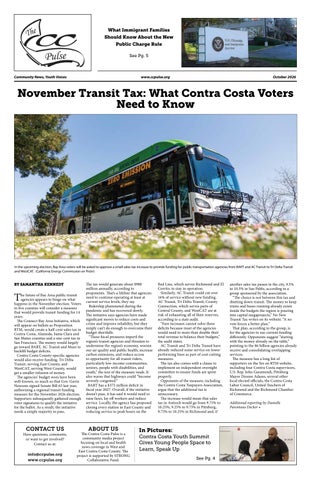
In the upcoming election, Bay Area voters will be asked to approve a small sales tax increase to provide funding for public transportation agencies from BART and AC Transit to Tri Delta Transit and WestCAT. (California Energy Commission on Flickr)
BY SAMANTHA KENNEDY
T
he future of Bay Area public transit agencies appears to hinge on what happens in the November election. Voters in five counties will consider a measure that would provide transit funding for 14 years. The Connect Bay Area Initiative, which will appear on ballots as Proposition RTM, would create a half-cent sales tax in Contra Costa, Alameda, Santa Clara and San Mateo counties and a one-cent tax in San Francisco. The money would largely go toward BART, AC Transit and Muni to backfill budget deficits. Contra Costa County-specific agencies would also receive funding. Tri Delta Transit, serving East County, and WestCAT, serving West County, would get a smaller infusion of money. The agencies’ budget woes have been well-known, so much so that Gov. Gavin Newsom signed Senate Bill 63 last year, authorizing a regional transit funding measure for the November 2026 election. Supporters subsequently gathered enough voter signatures to qualify the initiative for the ballot. As a result, the initiative needs a simple majority to pass.
CONTACT US
Have questions, comments, or want to get involved? Contact us at: info@ccpulse.org www.ccpulse.org
The tax would generate about $980 million annually, according to proponents. That’s a lifeline that agencies need to continue operating at least at current service levels, they say. Ridership plummeted during the pandemic and has recovered slowly. The initiative says agencies have made significant moves to reduce costs and crime and improve reliability, but they simply can’t do enough to overcome their budget shortfalls. “These fiscal pressures imperil the region’s transit agencies and threaten to undermine the region’s economy, worsen our air quality and public health, increase carbon emissions, and reduce access to opportunity for all transit riders, particularly low-income communities, seniors, people with disabilities, and youth,” the text of the measure reads. It also warns that highways could “become severely congested.” BART has a $375 million deficit in fiscal year 2027. Overall, if the initiative doesn’t pass, it has said it would need to raise fares, lay off workers and reduce service. Locally, the agency has proposed closing every station in East County and reducing service to peak hours on the
ABOUT US
The Contra Costa Pulse is a community media project focusing on local and health news coverage in West and East Contra Costa County. The project is supported by STRONG Collaborative Fund.
Red Line, which serves Richmond and El Cerrito, to stay in operation. Similarly, AC Transit could cut over 16% of service without new funding. AC Transit, Tri Delta Transit, County Connection, which serves parts of Central County, and WestCAT are at risk of exhausting all of their reserves, according to a state audit. “Fare increases cannot solve these deficits because most of the agencies would need to more than double their total revenue to balance their budgets,” the audit states. AC Transit and Tri Delta Transit have already reduced some service on lowerperforming lines as part of cost-cutting measures. The tax also comes with a clause to implement an independent oversight committee to ensure funds are spent properly. Opponents of the measure, including the Contra Costa Taxpayers Association, argue that the additional tax is unnecessary. The increase would mean that sales tax in Antioch would go from 9.75% to 10.25%, 9.25% to 9.75% in Pittsburg, 9.75% to 10.25% in Richmond and, if
In Pictures: Contra Costa Youth Summit Gives Young People Space to Learn, Speak Up See Pg. 4
another sales tax passes in the city, 9.5% to 10.5% in San Pablo, according to a group sponsored by the association. “The choice is not between this tax and shutting down transit. The money to keep trains and buses running already exists inside the budgets the region is pouring into capital megaprojects,” No New Transit Tax writes on its website. “A no vote forces a better plan.” That plan, according to the group, is for the agencies to use current funding differently. Opponents suggest “starting with the money already on the table,” pointing to the $6 billion agencies already receive and consolidating overlapping services. The measure has a long list of supporters on the Yes on RTM website, including four Contra Costa supervisors, U.S. Rep. John Garamendi, Pittsburg Mayor Dionne Adams, several other local elected officials, the Contra Costa Labor Council, United Teachers of Richmond and the Richmond Chamber of Commerce. Additional reporting by Danielle Parenteau-Decker •
Community News, Youth Voices
www.ccpulse.org
October 2026
2 Measures on San Pablo’s November Ballot: Sales Tax, Rent Control Initiative BY DAN MCMENAMIN BAY CITY NEWS
S
Support CC Pulse! Scan the QR code to explore our latest stories and community coverage.
Staff Publisher Malcolm Marshall Editor Danielle Parenteau-Decker
Contributors Denis Perez-Bravo Samantha Kennedy Jordyn Williams Arianna Caramagno Neha Gopal
Advisors Vernon Whitmore Sandy Close Michael J. Fitzgerald
The Contra Costa Pulse is a community media project founded by New America Media, focusing on local and health news coverage in West and East Contra Costa County. The project is supported by The California Endowment and the STRONG Collaborative Fund.
Inquiries Have questions, comments, or want to get involved? Contact The Contra Costa Pulse at info@ccpulse.org www.ccpulse..org
an Pablo voters in the November election will decide on a sales tax put on the ballot by the City Council as well as a rent control citizen initiative that the council members are opposing. Measure R would enact a half-cent sales tax for five years and then a quartercent tax for the next five years to pay for general city services and would bring in an estimated $2 million annually for those first five years. The City Council in July voted to put the tax on the Nov. 3 ballot and city officials say San Pablo faces a budget deficit for the city’s general fund, in part due to dwindling revenue from the San Pablo Lytton Casino, which accounts for nearly 59% of the city’s general fund revenue annually. City staff in a presentation to the council noted that other neighboring cities like El Cerrito and Pinole had sales tax rates of 10.25%, well above San Pablo’s current rate of 9.5%. Measure R is opposed by organizations like the Contra Costa Taxpayers Association and the Libertarian Party of Contra Costa County.
In the ballot argument opposing the measure, Sandra Kallander, chair of the local Libertarian Party, wrote that “the tax feeds the general fund spent on employee benefits and pensions” and other ongoing expenses. “They’re using the general fund to push voters to vote more funds. Is that okay? Of course not,” Kallander wrote. Measure R requires a simple majority of San Pablo voters to approve it. Measure S Local tenant advocates Rising Juntos gathered signatures to place a rent control initiative on the ballot as Measure S in the Nov. 3 election. The proposal would restrict landlords in San Pablo from increasing rent by more than 3% annually, create a cityadministered complaint process, prohibit landlords from evicting renters without a valid legal reason, and provide relocation assistance for renters, among other changes to the city’s housing laws. An independent fiscal impact report commissioned by the City Council on the measure estimated that it will cost the city between $1.08 million to $2.36 million annually if it is approved by a majority of voters.
The ballot argument in favor of Measure S submitted by leaders of Rising Juntos and the Contra Costa County chapter of the statewide Alliance of Californians for Community Empowerment, among others, said the measure “establishes reasonable limits on annual rent increases for covered units and creates clear, fair rules that help families plan for the future instead of living with constant uncertainty.” Elected officials including Mayor Elizabeth Pabon-Alvarado and Vice Mayor Rita Xavier wrote the ballot argument against Measure S, saying it “creates a new, costly regulatory program” and its “complex requirements will place a significant financial burden on small ‘mom-and-pop’ housing providers.” “San Pablo residents deserve housing policies that protect renters, support responsible housing providers, and strengthen our community. Measure S does not achieve that balance,” the opponents wrote. More information about Measures R and S can be found on the city’s website at https://www.sanpabloca.gov/2952/ November-3rd-2026-Ballot-Measures. •
Hercules Says Revenue Is ‘Barely Adequate,’ Puts Sales Tax to Voters BY SAMANTHA KENNEDY
H
ercules voters will be asked in the November election whether to raise sales tax in the city. Council members on July 28 voted 4-1, with Dilli Bhattarai abstaining, to approve an urgency ordinance that puts the proposed 1% sales tax, equal to a onecent increase, on the ballot. “There’s a lot of needs for funding and, as a public entity, we have very limited means to try and raise revenue,” said Mayor Chris Kelley. “Let’s put it on the ballot and just let the voters decide whether or not they want to do this because otherwise we’re going to be kind of strapped.” Then-interim City Manager Patrick Tang said the city’s revenues are “barely adequate” to sustain current service levels. In fiscal year 2028-29, Tang said the city is expecting a projected shortfall to begin, in part, due to rising costs. Kelley said that outsider contributions, if the tax passes, would also help the city.
The Home Depot in city limits brings in contractors from other areas, for example, which would mean that residents alone wouldn’t be on the hook for the tax. Tang said that the current retail tax base is not “robust enough” to fund more than basic service levels. Tang said officials floated the sales tax idea around earlier this year. The push received initial support from lawmakers in the state Assembly to increase the city’s sales tax. Senate Bill 762, introduced by Bay Area Sen. Jesse Arreguín, would allow Hercules to increase the current sales tax cap upon approval by voters. Carlin Shelby, a lobbyist on behalf of the city with Towsend Public Affairs, said at a January Senate committee hearing that the bill was a “narrowly tailored and constitutionally sound solution” to challenges — falling revenues — she says cities are facing across the state. “While cities are responsible for public safety, emergency response infrastructure, parks and community services, we operate within one of
the most constrained local revenue systems in the nation,” Shelby told state lawmakers. The city put out a survey to residents that Tang said found that 68% of respondents were supportive of a onecent sales tax. There were no public comments during the meeting, but Marc Joffe, president of the Contra Costa Taxpayers Association, said when SB 762 was discussed that he had some advice: “shop in El Sobrante or some other unincorporated pocket,” Joffe wrote on social media then. Hercules voters, a majority of whom live within the West Contra Costa Unified School District’s boundaries, will also vote on renewing a parcel tax to fund school services. And, alongside the rest of the county and much of the Bay Area, will decide on a half-cent tax to fund struggling public transit agencies. Other nearby jurisdictions — the cities of San Pablo and Richmond — are also asking voters to OK taxes to fund general or specific services. •
BART’s East County Future ‘to Be Determined’ as Ballot Measure Hangs in the Balance BY SAMANTHA KENNEDY
B
ART is on an upswing, but its future in East Contra Costa is still “to be determined,” according to the area representative on the agency’s Board of Directors. A November ballot measure could change how agencies like BART would largely be funded for the next several years. The future of the stations in Antioch, Bay Point and Pittsburg is resting on the measure. If it passes, the measure would impose a sales tax of 0.5% in Contra Costa and other Bay Area counties and, in San Francisco, 1% to fund BART and other public transportation agencies, including AC Transit. If not, BART could shut down every East County station as part of a plan
to continue running trains at lower frequencies, lay off 1,200 employees and increase fares. “My dedication here is to do everything we can to keep East County connected to BART and to keep folks off Highway 4,” Mark Foley, who represents the region on the agency’s Board of Directors, told Antioch City Council members at their May 12 meeting. BART directors originally suggested that 10 of the least-frequented stations, which include Pittsburg Center, be closed in a first wave of cuts if needed. But members pushed those possible station closures back to a July 2027 implementation. “Cumulatively, this can just be catastrophic to East Contra Costa if this measure doesn’t pass and if we don’t find ways of really continuing to build up
our transportation out here,” Mayor Ron Bernal said. But while BART waits for a bailout of its approximately $376 million deficit for the next fiscal year, it is making gains. Crime and fare evasion have dropped, while on-time rates have improved, according to BART data from September. BART recorded a 95% passenger ontime performance rating this quarter, the highest in over a decade, according to the agency. It also reports a 91.4% customer satisfaction rating, which it says is an agency best. Since installing its new fare gates at every station in the system, only 9% of riders have reported fare evaders in the quarter, down from 25% in 2024. The agency said in May that the gates are “responsible for revenue growing by about $10 million annually.” See BART, pg. 6
2
Community News, Youth Voices
www.ccpulse.org
October 2026
On the Campaign Trail With Richmond’s Candidates for Mayor BY DENIS PEREZ-BRAVO
W
ith Election Day approaching, Richmond mayoral candidates Claudia Jimenez and Ahmad Anderson are taking their campaigns directly to voters, knocking on doors, visiting neighborhoods, and making their case for how they would lead the city. Contra Costa Pulse followed both candidates on the campaign trail Aug. 29 to see how they are trying to win support ahead of the Nov. 3 election. Ahmad Anderson Contra Costa Pulse met Anderson at his Laurel Park home at 6 a.m. as he prepared to campaign at neighborhood dumpster day sites. Anderson, 66, runs his campaign out of his home, where he also holds meetings with volunteers. That Saturday morning, he organized campaign materials, prepared for the day, and responded to calls and emails. Inside the family home are reminders of his family’s place in Richmond history. Photographs include his mother, Irma Anderson, the first Black woman elected mayor of a major California city, and his father, the Rev. Booker T. Anderson Jr., a former Richmond mayor who worked with Martin Luther King Jr. Shelves, tables and counters hold memorabilia from his parents’ years in city government, including gifts from Richmond’s sister cities. Before he started campaigning for the day, Anderson walked two laps around his house. He greeted neighbors as he passed, some of whom smiled and waved back. Anderson then headed to the intersection of Eighth and Virginia streets. The dumpster day site there had not yet opened, so he moved on to another at West Cutting Boulevard and Wine Street in Point Richmond. There, Anderson walked down the line of cars waiting to dispose of trash and introduced himself. “Good morning, the name is Ahmad Anderson, and I am running for mayor in our city,” he told residents. Some told Anderson they already supported him. Others raised concerns about local issues, including traffic, while others listened as he talked about his background. Anderson told one resident that he has lived in Richmond for 66 years, attended Stege Elementary School, graduated from UC Berkeley, and served two years on the Economic Development Commission. A few minutes into handing out campaign pamphlets, Anderson encountered a resident who made his preference clear. “I am for your opponent,” the man told him. Anderson held out a pamphlet. “Oh, OK, well, you might want to read up on it a little bit, not just what you read in the paper,” Anderson said. The resident declined the pamphlet. “All right, thank you, sir,” Anderson replied. “Thank you for voting.” Anderson chuckled about the encounter as he continued down the line, introducing himself and handing out pamphlets. A couple of cars later, he received a much different response. “I’m already voting for you,” a resident told him. “I don’t even need to talk or see you.” Anderson looked up at the sky with a big smile. “Thank ya. Thank ya,” he said. The two laughed before Anderson continued down the line, shaking
DA Clears Officers in Arrest, Death of Yolanda Ramirez BY DENIS PEREZ-BRAVO
C
GRAPHIC BY DENIS PEREZ-BRAVO
Ahmad Anderson, left, and Claudia Jimenez are running for Richmond mayor.
hands and introducing himself to other residents. After working his way through several rounds of cars, Anderson stopped at the corner of South Garrard Boulevard and West Cutting Boulevard and talked about environmental concerns in Richmond. “As we stand here, blocks from Chevron, it’s about the environment,” Anderson said. “But it’s not just from Point Richmond. It’s all the way to Parchester. It’s all the way to our neighboring cities.” Anderson said air quality and emissions remain concerns for Richmond residents and called for the city to share environmental information with residents through community meetings and town halls. “The environment is a concern. The emissions, the quality of air is a concern,” Anderson said. “We need to be able to give reports, community meetings, town hall meetings that share the information in real time.” Anderson said those concerns are also personal. He said both of his parents had asthma and died of cancer, as did his brother. “And I grew up on South 18th Street, South 17th Street, lived blocks from the Zeneca site. So it’s personal to me,” Anderson said. “Do we chase them [Chevron] away? No, we don’t chase them away. We hold them accountable.” After several rounds through the line, Anderson returned to the cleanup site at Eighth and Virginia streets, where cars had begun arriving. He continued handing out campaign literature, spoke with workers at the site, and interacted with youth volunteers and residents in the neighborhood standing outside their homes. Anderson eventually headed back to his Laurel Park home, where a group of volunteers was scheduled to meet before heading out to canvass for him. Claudia Jimenez Jimenez, who represents District 6 on the City Council, gathered later that morning with volunteers at the Richmond Progressive Alliance office in the North & East neighborhood before heading out to canvass. “This is how we win elections, by walking and talking to people,” Jimenez said. Jimenez welcomed volunteers ranging from individual residents to organized union workers. Before the canvass began, she announced that she had turned 48 two days earlier and briefly danced in front of the room. After introductions and instructions, Jimenez divided the canvassers into groups of two and assigned them locations. Jimenez headed with a new volunteer to the Carriage Hills neighborhood,
where they began knocking on doors along Buckboard Way. For a while, no one answered. A few houses later, they reached a house with an open garage. A woman came outside and, after learning who Jimenez was, went to get her husband so they could speak with the candidate together. “We are undecided,” the woman said. “I am here to make you decide to vote for me,” Jimenez responded playfully. She began making her case, discussing her record on the City Council and her approach to Richmond’s finances. She said the city budget was one of her priorities after she was first elected to the council in 2020. “And the first thing that I decided to do was focus on the budget,” Jimenez said. “Because I can tell you, yes, we are going to do A, B and C, but what if there is no money?” Jimenez discussed what she described as predatory financial agreements the city had entered into and said Richmond saved $84 million by getting out of them. She also pointed to improvements in the city’s credit rating. After explaining her approach to the city’s finances, Jimenez turned the conversation back to the couple. “I want to hear from you,” she said. The husband then asked how Richmond increases sales tax revenue. Jimenez initially discussed Measure U and the city’s business license tax. After the resident clarified that he was specifically asking about sales tax, the conversation shifted toward economic development and attracting businesses to Richmond. The resident said many people in his neighborhood and surrounding areas leave Richmond to work, shop and find entertainment. “In any of the communities that were built out here, you probably don’t even know what downtown Richmond looks like,” the resident said. “Because they get in their car, they go out onto the [San Pablo] Dam Road, and they head either to Oakland or Walnut Creek or San Francisco.” Jimenez agreed that Richmond needed more commercial development and discussed mixed-use development as one way to bring businesses and amenities closer to where people live. The conversation continued for over 20 minutes. Jimenez said she had gotten ideas about economic development from this conversation. “We do not have a really nice grocery store,” Jimenez said. “We need to create these businesses, so people are spending their money here.” The couple did not pledge their support to Jimenez before she left to continue campaigning and later attend the Spirit & Soul Festival in downtown Richmond. •
ontra Costa County District Attorney Diana Becton’s office will not pursue criminal charges against Brentwood police officers Aaron Peachman and Danielle Tjhia in connection with the death of 72-yearold Yolanda Ramirez. Becton’s office published its report on the Sept. 26, 2025, law enforcementinvolved fatal incident involving Ramirez on Sept. 22. “Based on the aforementioned findings, no further action will be taken in this case,” the report reads. The district attorney’s office’s legal analysis found Peachman and Tjhia had the authority to detain Ramirez for vandalism of a $12 coffee mug and lawfully arrested her for obstruction of an ongoing investigation. The report found the police officers’ use of force was reasonable. It also described two instances in which Ramirez’s head struck the patrol vehicle during the arrest. The district attorney’s office said “Ramirez died from a stroke and other health related issues, as opposed to police use of force,” agreeing with the county autopsy conducted by forensic pathologist Dr. James Caruso. The report also rejected the results of the private autopsy conducted by Dr. Matthias Okoye, saying he did not receive or review body-worn camera footage worn by the police officers, the Mobile Video Audio Recording footage, the police reports, photos from the scene, the initial autopsy report by Caruso, and the photographs taken during the initial autopsy. Okoye concluded Ramirez died from “multiple blunt force trauma and asphyxiation with complications” resulting from police restraint. “The importance of these materials cannot be overstated,” the report reads. “A careful review of his report reveals that Dr. Okoye lacked the information necessary to form a credible and reliable opinion regarding Ramirez’s cause of death.” The full investigative report has been received by the California Department of Justice. Family attorney Mellisa Nold rejected the decision and calls it a cover up to protect the status quo. “As always, blue protects blue,” Nold wrote online about the decision. “Apparently Becton thinks it’s ok for a police officer to push an elder and make her hit her head, then strike her head again slamming the door on her feet and leave her face down in handcuffs, with a brain bleed,” she continued. The decision ends the district attorney’s criminal review of Peachman and Tjhia, but the Ramirez family’s broader effort to hold the officers and city accountable continues. “It is a cowardly decision,” Rich Ramirez, Yolanda’s son, said. “These cops like to use a lot of words about transparency about holding people accountable and they don’t ever hold themselves accountable.” As the first anniversary of his mother’s death approaches Oct. 3, Rich said the family is focused on being together to honor Ramirez and who she was. Rich said his family will continue their efforts to get “Justice for Yolanda” and hold Peachman accountable for what the family believes was his role in Ramirez’s death. See Ramirez, pg 6
3
Community News, Youth Voices
www.ccpulse.org
October 2026
Contra Costa Youth Summit Gives Young People Space to Learn, Speak Up
Jeremy Phillips interacts with a Youth Summit attendee during a workshop at Los Medanos College on Sept. 19. Phillips led the “Future-Proof” workshop, which focused on college, careers, trades and other pathways for young people. STORY AND PHOTOS • JORDYN WILLIAMS
Y
oung people from across Contra Costa County gathered at Los Medanos College on Sept. 19 for the annual Youth Summit, where they explored resources, career opportunities and issues affecting their lives. The summit included two workshop sessions, with attendees choosing from topics ranging from artificial intelligence and financial literacy to mental health, career planning and leadership. “AI Smarts” focused on creating content with artificial intelligence, fact-checking, spotting misinformation and protecting privacy. “Money Moves” covered financial skills like saving and credit. “Future-Proof ” explored careers, colleges, trades, certificates and apprenticeships. “Protect Your Peace” focused on stress, boundaries and healthy relationships. “Speak Up, Stand Out” covered communication, confidence, networking and leadership. For 13-year-old Pittsburg resident Amanda Hudson, the summit was an opportunity to gain information that could help her in the future. “I really just wanted to have this experience and to have the knowledge of everybody and all the wise people around me,” Amanda said. She liked the “Speak Up, Stand Out” workshop because of its focus on confidence. “I really liked that one,” Amanda said. “That one really
stood out to me because she just taught a lot about confidence.” Amanda said events like the summit can give young people a chance to express their opinions on issues that matter to them. She also pointed to mental health and feeling a sense of belonging as issues young people face today. “I think events like this definitely do give young people a voice because they can speak out and have their own opinions and things that they think matter in things that do actually matter,” she said. Contra Costa County District 5 Supervisor Shanelle Scales-Preston hosted the summit, which she said has a history stretching back more than 20 years under the late Supervisor Federal Glover. Scales-Preston attended the summit herself when she was younger and has continued the annual event since becoming the District 5 supervisor. For Scales-Preston, giving young people a space of their own is an important part of the event. “I think having something for students to feel like they belong and create their own space where there’s no adults defining them, I think that part is important,” she said. “They can feel comfortable sharing.” Organizers also sought input from young people directly when deciding what workshops and resources to offer. Scales-Preston said a survey was used to learn
what young people were interested in. She also heard directly from attendees about college, fitting in, anxiety and other concerns surrounding mental health. Those concerns were reflected in workshops such as “Protect Your Peace” and “Speak Up, Stand Out,” while other sessions focused on practical skills young people may need as they prepare to become adults. Jeremy Phillips led the “Future-Proof ” workshop, where participants discussed college, trades, apprenticeships, careers, and how artificial intelligence and automation could affect the future workforce. Phillips said he wanted attendees to start thinking seriously about their career paths and how their skills could fit into a changing workforce. Eighteen-year-old Pittsburg resident Kimberly Orencia said the summit changed her perspective on how many opportunities are available to young people. “At first, I thought there weren’t really a lot of opportunities, but now, like, after today, I thought that there’s a lot for food, for education, and just, like, job opportunities as well,” Orencia said. Fifteen-year-old Pittsburg resident Kevin Gutierrez attended the summit after a friend invited him. He participated in the workshop about artificial intelligence and said one challenge he sees among young people is putting their words into action. He also said he would like to see more opportunities involving art for young See Summit, pg. 6
Contra Costa County District 5 Supervisor Shanelle Scales-Preston speaks to attendees during the Youth Summit at Los Medanos College on Sept. 19.
4
Youth Summit attendees visit resource tables at Los Medanos College on Sept. 19. The annual event connected young people with community resources, workshops and information about education, careers and other opportunities.
Community News, Youth Voices
www.ccpulse.org
October 2026
What Immigrant Families Should Know About the New Public Charge Rule BY NEHA GOPAL
A
new federal public charge rule that took effect Sept. 18 could affect some immigrants’ green card applications if they or their family members use government-funded health care, cash assistance or other public benefits. Adriana Cadena, executive director of Protecting Immigrant Families, described public charge during an American Community Media briefing Sept. 9 as an immigration test used to determine whether someone applying for legal permanent residency, or a green card, is likely to become primarily dependent on government assistance. Historically, public charge was limited to two types of benefits: cash assistance for income maintenance, such as Temporary Assistance for Needy Families and Supplemental Security Income, and government-funded long-term institutional care. Programs including Medicaid or Medi-Cal, SNAP or CalFresh, Section 8 and other housing assistance, the Children’s Health Insurance Program, WIC and Head Start were not considered in public charge determinations, nor were benefits used by an applicant’s children or other family members. As of Sept. 18, however, many of those restrictions have disappeared. Department of Homeland Security officers now have broader discretion to consider an applicant’s use of means-tested public benefits and other individual circumstances as factors that could negatively affect a green card application. The rule also eliminates restrictions established in 2022 that limited which public benefits immigration officers could consider and generally prevented benefits received by other household members from being treated as benefits received by an applicant. More than 1 million California children are estimated to have at least one undocumented parent, according to Sarah Dar, vice president of policy and advocacy at The Children’s Partnership. Dar said a U.S. citizen child’s use of a means-tested benefit could be considered in a parent’s green card application under the new rule. However, experts and advocates emphasized that receiving public benefits does not automatically mean a green card application will be denied. “Public charge doesn’t apply to all immigrants, and it doesn’t apply to all immigration applications,” Ariel
Immigrants are urged to speak to a trusted immigration attorney or other expert to determine how recent changes to the public charge rule could affect them or their families. (Photo by Gublenk on Wikimedia Commons)
Brown of the Immigrant Legal Resource Center said. Who could be affected? The rule primarily matters for certain immigrants seeking admission to the United States or applying for legal permanent residency. Many immigrants are exempt from the public charge test, including: • Refugees • Asylees • T and U visa holders • Green card holders renewing their cards or applying for U.S. citizenship Should families stop using Medi-Cal, CalFresh or other benefits? Experts at the briefing repeatedly cautioned families against stopping benefits solely out of fear of the new rule. The public charge rule does not change whether someone is legally eligible to receive Medi-Cal, CalFresh or another public benefit. Eligibility for those programs and whether their use could affect an immigration application are separate questions. Because public charge determinations depend on an individual’s immigration circumstances, speakers recommended talking to a trusted immigration attorney or accredited representative before withdrawing from benefits. “Please provide clear information, and don’t panic,” Cadena said. Daniel Torres, California’s director of immigration policy, similarly urged families to find out whether the
policy applies to them before giving up health care or other assistance. What benefits still don’t count after Sept. 18? Earned benefits and universally available services generally remain outside the public charge test, including: • Social Security retirement benefits • Medicare • Unemployment benefits • Public schools and libraries Dar said California school meals should not be considered means-tested because they are available to all public school students, not just low-income families. But Dar cautioned that questions remain about how immigration officers will implement the new rule in practice. What did the Sept. 18 deadline mean for families? For immigrants preparing to apply for adjustment of status, the date they submitted their applications determined which public charge policy would matter. Brown said applications electronically filed or postmarked by Sept. 17 would be considered under the previous public charge policy. Speaking before the deadline, Brown urged applicants who were nearly ready to file not to delay. “If somebody has been working on their green card adjustment of status application, and they’re still getting last documents, I would say don’t sit on it,” Brown said. Neha Gopal is a California Local News Fellow covering community health for Contra Costa Pulse. •
Pt. Richmond Community Room at West Side Branch Library 135 Washington Avenue, Richmond CA 94801
5
Community News, Youth Voices
www.ccpulse.org
Race for Governor: Steve Hilton Blames Democratic Leadership for California’s High Costs
October 2026
Youth-Led, Community Media
BY DANIELLE PARENTEAU-DECKER
R
epublican entrepreneur Steve Hilton says he is running for governor of California because he believes years of Democratic leadership have failed to improve affordability and quality of life in California. Hilton, speaking from a car in Fresno on May 19, said he was “arguing for positive, practical change” during American Community Media’s California Gubernatorial Race Series, promising to reduce taxes and regulations as well as the prices of gas and electricity. “We’ve had 16 years now of one party in control of everything in California,” he said. “It’s been an experiment in a particular form of governance, progressive governance.” Hilton argued that the experiment had failed. He said that California has the highest poverty rate aong with Louisiana, the highest unemployment rate and “the highest cost of living by far” with the highest gas prices and housing costs and electric prices only behind Hawaii. His long-term economic policy to address some of those issues involves “reversing the damaging energy policies we have, so we can have $3 gas, cut your electric bills in half, reduce the cost of housing.” Hilton said that would take time, but there is more that could be done right away. “The most quick and direct way we can lower costs is through what the government charges,” he said, referring to taxes. He pledged to stop charging state income tax on incomes up to $100,000, match the federal no tax on tips policy, and eliminate the small business tax. “Every small business has to pay $800 a year just for
(
Republican Steve Hilton participated in American Community Media’s California Gubernatorial Race Series on May 19. (Screenshot captured by Danielle Parenteau-Decker / The CC Pulse)
existing,” he said. “For many small businesses, that’s very difficult.” Hilton said he really didn’t “want to weigh in on the immigration debate” because “immigration policy is not a responsibility of the governor.” “I really want to focus on my responsibilities, which is to make sure that all the laws in our state are peacefully enforced,” he said. To Hilton, that means not obstructing federal law. In fact, he argued that politicians can’t obstruct the enforcement of federal law if they believe in the Constitution. Hilton said he agrees with Democrats on respecting election results and “not undermining democracy,” essentially saying that means supporting the current federal immigration policy because it’s what people want. “One candidate, one party won all the swing states, popular vote, on a very clear platform on immigration policy,” he said. “The [Trump] administration is now implementing the verdict of the people.” Hilton, who is from the United Kingdom and whose parents were refugees there from Hungary, made it clear he believes that legal and illegal immigration are very different matters. “We are pro-immigration, but it has to be legal immigration,” he said. “I think that everybody agrees that it’s not healthy for our society to have such a large part of our society dependent on law-breaking.”
Hilton said legal immigrants are being denied “the basics of the ladder of opportunity” and accused immigrants of overwhelming hospitals and schools. “That’s a consequence of the uncontrolled immigration that we’ve seen in recent years.” He also argued that it is unreasonable both to use taxpayer money to “subsidize health care for citizens of other countries” and to say that “we can’t find Americans to do these [agricultural] jobs, so we have to import labor from other countries illegally.” Beyond illegal immigration, Hilton took a hard stance against crime. “My policy against hate crimes is my policy against crimes, which is we need to deter crime and prosecute crime very strongly,” he said when asked about hate speech and hate crimes, specifically. “We are much too soft on crime in California. That’s why we’ve had an explosion in crime.” He argued for a criminal justice system that combines punishing people for their crimes and working to rehabilitate them to prevent them from breaking the law again, saying that he agreed with a statement by former British Prime Minister Tony Blair that “we need to be tough on crime and tough on the causes of crime.” Part of his plan for punishment is reopening prisons because, he says, closing them has meant “tens of thousands of dangerous, violent criminals transferred into the community” or overcrowded county jails. •
(
for Richmond, CA
BART...
Summit...
Ramirez...
Continued from page 2
Continued from page 4
Continued from page 3
All this comes amid significant ridership gains as well. “We see progress. It’s just lots of times people don’t think it’s fast enough, right?” Bernal said. If the measure passes, Foley said the agency would use a state loan to bridge the gap until it begins receiving revenue.•
people in his community. The event ended with keynote speaker Sydney Montgomery, founder and director of Barrier Breakers, who encouraged attendees to build relationships, seek support and take action toward their goals. Growing up as a low-income student, Montgomery said she did not often see people who looked like her doing what she wanted to do. She said that experience made it important for her to return to communities where young people may feel the same way. “We just give people these platitudes that sound really nice, but without instructions, it doesn’t mean anything,” Montgomery said. She encouraged attendees to follow up with the people they met at the summit and build relationships that could help them reach their goals. “Just that they don’t have to do anything alone,” Montgomery said when asked what she most wanted attendees to remember. Scales-Preston said she hopes the conversation started at the summit will continue in schools, where students could advocate for similar workshops or programs addressing issues affecting their peers. She said the annual Youth Summit will return to LMC next September. •
“Anything to make them uncomfortable,” he said. The family is still calling for a face-toface meeting with Becton, something they requested from her office prior to the public release of the report but were not granted. Rich said Nold was made aware of the report after they received a link to it from someone at the district attorney’s office. The family also plans to continue speaking out at Brentwood City Council meetings. And the family and Nold will also plan ways to bring the case to the attention of California Attorney General Rob Bonta. “Two police officers escalated a situation that did not need to be escalated,” Rich said. “They abused their power because my mom was not submissive and lied about how they handled her.” •
Youth Voices,
Community Media
6
Community Media,
Youth Voices
for Richmond, CA
Community News, Youth Voices
www.ccpulse.org
October 2026
Race for Governor: Xavier Becerra Says California Needs Experienced Leader BY MALCOLM MARSHALL
X
avier Becerra is running for governor because he believes California needs an experienced leader who can lower costs for working families, defend the state against attacks from the Trump administration, and restore faith in the California dream. The former U.S. secretary of Health and Human Services under President Biden spoke during American Community Media’s California Gubernatorial Race Series on May 27. Throughout the briefing, Becerra leaned heavily on his record across decades in government delivering results for working families, including lowering insulin costs, negotiating Medicare drug prices, and expanding health care coverage under the Affordable Care Act. “I believe California is hungry for a governor who can reignite a sense of a possibility,” Becerra said. “That’s why this campaign has always been about one conviction: that working hard should be enough to help you build something that lasts.” Becerra contrasted his campaign with fellow Democratic candidate Tom Steyer, saying his support comes from small donors, who have given an average of $59, and organizations including Planned Parenthood. “It’s not a billionaire writing himself a check,” Becerra said. “It’s people like teachers and nurses and union workers who are supporting this campaign and helping us fuel us to victory.” Becerra said California must continue using legal challenges and state protections to push back against the federal immigration crackdown from President Trump. Drawing on his experience as California attorney general during Trump’s first term, Becerra said the state under his leadership would continue challenging what he calls illegal immigration enforcement actions by ICE. “I’ll make sure that we don’t let Donald Trump get away with illegal conduct like what we see with his ICE mercenary force, which is violating the laws of U.S. citizens and residents alike,” Becerra said. He also connected the issue to his experience as the son of immigrants. “I know what it feels like as a son of immigrants when your rights are not respected, when you’re threatened, and when it’s difficult for you, as hard as you’re working, to believe that your government is there for you,” Becerra said.
“I believe California is hungry for a governor who can reignite a sense of a possibility,” said Democrat Xavier Becerra during American Community Media’s California Gubernatorial Race Series. (Screenshot by Danielle Parenteau-Decker / The CC Pulse)
He added that California should continue resisting federal immigration raids targeting families and noncriminal immigrants. “We will do everything we can to make sure that we show the federal government that we’re not participating in their ICE raids,” he said. Becerra also rejected claims that he backed away from supporting single-payer health care, calling those criticisms “lies” and pointing to his decades long support for Medicare for All and the Affordable Care Act. “I never backed away,” Becerra said. “I’ve been consistent throughout my career in public service.” He said he supported Medicare for All, which he characterized as a form of single-payer health care, going back to 1993, the first of his 24 years in Congress. “I believe the most efficient way to deliver care is to remove as many of the middlemen, the unnecessary moving parts of the healthcare system that eat up a lot of money,” he added. Becerra also said California must be prepared to challenge the Trump administration over federal funding, immigration enforcement and states’ rights if necessary. He again pointed to his record as attorney general, including legal battles over immigration enforcement and federal funding when Trump was first in office. “We will partner with them where we must, but we will fight when it’s necessary, and we can have a relationship with the federal government as we must,” he said, “but we will not take a knee.” Becerra also defended providing Medi-Cal coverage for undocumented immigrants and said California should not roll back health care access despite federal Medicaid cuts under President Donald Trump.
“If you work hard in California — makes no difference to me where you come from, how long you’ve been here — if you’re working hard, you deserve to have access to the health care that you need,” Becerra said. Becerra argued that removing people from MediCal would ultimately increase costs for hospitals, emergency rooms and taxpayers. He said it would strain hospitals and community health centers that rely on reimbursements to continue operating. “The moment Donald Trump kicks those 3 million Californians off of their Medi-Cal, guess what? They don’t stop using health care,” he said. Instead, they’re most likely to go to the emergency room, “the most expensive place to get health care. And guess who pays? California taxpayers.” If elected, Becerra said one of his first actions would be declaring a state of emergency on housing in an effort to speed up housing construction across California. “There are currently about 40,000 housing units that are shovel ready, they’re ready to be built, they just lack the financing that’s necessary,” Becerra said. He also said he would seek to freeze utility rates and homeowners insurance premiums during the emergency declaration. “I do believe that most families in California cannot make sense of the spiraling prices of utilities and home insurance premiums and are entitled to know what they’re paying for,” he said. Becerra believes he is uniquely prepared for the moment and can deliver on the big challenges facing the state. “I am ready,” he said. “I will not need training wheels when I become governor.” •
The Contra Costa Pulse Your Ad Can Be Here! Contact us at info@ccpulse.org
7
Community News, Youth Voices
www.ccpulse.org
October 2026
At a Suicide Prevention Event, I Said My Aunt’s Name. Then I Let the Dove Go COMMENTARY • NEHA GOPAL
I
watched white doves disappear into the sky above the rolling golden hills of Contra Loma Regional Park. Each dove represented someone who was no longer there, lost to suicide. Families gathered in Antioch on a hot September morning for NAMI Contra Costa’s sixth “Know the Signs, Remembering Those We’ve Lost” event marking Suicide Prevention Month. Young people were at the center of much of the gathering, which was geared, in part, toward youth and transitional-age youth. Next to a lake of flapping swans and geese, the park was dotted with lime-green tablecloths, teal and purple balloons, and signs bearing messages like “HOPE” and “REMEMBER.” I sat among people at an event about those who were no longer there, behind a man wearing a hoodie with four words on the back: “You are not alone.” The commemoration began with a demonstration by the Deer Valley High School Army JROTC Color Guard. Then, speakers shared personal stories and information about available resources. Among them was the A3 Crisis Response team, short for “Anyone, Anytime, Anywhere,” which provides free mental health crisis support across Contra Costa County through 988. A3 workers Marianne Hardin and Sherri Fuentes said the service is often “inundated” with calls as more people across Contra Costa seek help. But Fuentes saw something hopeful in that demand: More people know the service exists, and more are willing to ask for help. “Just keep calling,” Fuentes said. “Give us the opportunity to show you that we care.” That is the strange, sticky thing about grief: Sometimes, the person you most want to call is the one who is no longer there to pick up. My aunt was a doctor. She lived with debilitating colitis for years before she died by suicide. Her suitcase was found filled with self-help books — the same kind she could never convince me to read. I still think about those books, a sad shudder of a memory. I picture her following the lines from one page to the next, as if she could center her painful world in the rhythm of pages turning, one breath and then another. I wonder what she
Harvest Time Celebrates 50 Years of Supporting East County Farms BY ARIANNA CARAMAGNO
H
arvest Time, a Brentwood-based nonprofit that helps support farms and agricultural-related businesses in East Contra Costa County, is celebrating its 50th anniversary. Over the years, Harvest Time has helped spread the word about local farms in Brentwood that offer fresh produce, wine and other products. Harvest Time was founded in 1976 by a group of Brentwood farmers who decided to form an organization with other farmers after experiencing what it describes as “unusually low farm prices.” When the organization first began, there were only 10 members. Five decades later, Harvest Time has grown to more than 45 members. Hailey Nunn, the current owner of The Farmer’s Daughter Produce Stand, said that for many familyowned farms in Brentwood, Harvest Time has helped preserve the area’s agricultural heritage via advertising. Nunn’s own family has been farming in Brentwood for almost 150 years, and Nunn’s grandfather was one of the
8
High school students Cherry Chou, left, and Lily Palombi were among those who released doves at NAMI Contra Costa’s “Know the Signs, Remembering Those We’ve Lost” event on Sept. 19 to honor those who have died by suicide.
was looking for in those words — and whether, in her own way, she had been trying to find a way through, only to get lost somewhere between the words. Another cadence pulsed across the park that morning. In the “healing” drumming circle, Lily Palombi’s hands found the beat against carved wood. The Heritage High School junior had come carrying what she describes as a “silent grief.” Her dad died by suicide in September 2023 after struggling with the effects of a traumatic brain injury. “I do miss my dad every single day,” Palombi said. “Every day I have an accomplishment, and it’s heartbreaking that I can’t share that accomplishment with the one person in my life.” Now, the 16-year-old serves as treasurer of Heritage High’s NAMI club, turning some of that grief toward helping other students. But she said the mental health support available to her peers at her school has been shrinking. Tabitha Williams, a 16-year-old senior and historian at the high school’s NAMI club, said funding cuts eliminated the “Zen Den,” a space where students could go for mental health support, as well as other mental health services at the school. Williams said the school previously had additional mental health professionals available to students. “A lot of people saw the Zen Den as a very safe place to go to at our school,” Williams said. Without it, she
said, “people just have to take on that pressure and have nowhere to put it.” There was much talk that day about reaching people before it was too late. About the resources meant to help them, and what it means when those resources disappear. I kept thinking about what happens when it’s already too late. About how many signs I might have missed. One speaker described the event as both “tragic and hopeful.” I kept wondering how grief and hope could live in the same place. My mind drifted back to the doves. The one in my hands had been so white and light, its tiny, beady eyes looking back at me. Part of me wanted to keep holding on to it, as if I could keep holding on to her. Palombi had held one for her dad too. We stood in a circle with white doves cupped in our hands, waiting for the signal to release them. Standing there, I wasn’t thinking about what might return. I was thinking about what wouldn’t. And how to let it go. When it came time to say my aunt’s name, my throat tightened. My eyes burned. I closed them. Then I let the dove go.
farmers who initially helped form Harvest Time. “I think our farming heritage is a huge part of what makes Brentwood feel so special and unique, and it has always been one of my favorite parts about living here,” said Nunn in an email. “Harvest Time is made up of small family farms, so having that marketing component is incredibly helpful. During harvest season, we are primarily out in our fields and orchards and don’t always have the time to respond to emails, return phone calls, or focus on marketing.” In addition to maintaining a database of local farms, wineries, and country stores for people to visit, Harvest Time has also created a mobile app to allow visitors to find local farms that sell seasonal produce. “I am only a very small part of my family’s farming legacy, but I think U-Pick has been such a neat way to invite people onto our farms and allow them to experience agriculture firsthand,” said Nunn. “It gives families the opportunity to see where their food comes from and connect with the land in a really special way.” Aside from helping preserve Brentwood’s rich agricultural legacy, Harvest Time has also helped support newer farmers. Cynthia Hoover, owner of Oasis Family Ranch in Knightsen and a Harvest Time member, started farming after the pandemic forced her to end her event planning business. Covid gave Hoover an opportunity to rethink the relationship she and her family had with food, inspiring her to begin growing her own fruits, vegetables and livestock despite having no prior farming experience. After buying her ranch, Hoover noticed that other farms in the area were members of Harvest Time and decided to join. “It helped us with marketing our products and services
and we wanted to provide a place for our community to learn more about farms and try it out for size just as we did,” said Hoover. Aside from helping with marketing, Hoover said that Harvest Time has also helped her connect with a community of other farmers. She said she gets to meet other local farmers and celebrate their accomplishments at the yearly Harvest Time dinner, where all the members are invited to gather and celebrate. “It was such a cool experience for my husband and I to just be able to sit in a room with all these generational farmers and new farmers,” said Hoover. The Contra Costa Board of Supervisors recognized Harvest Time’s anniversary and achievements at its Aug. 25 meeting. Supervisor Diane Burgis gave a presentation honoring the organization, with members Bryan Lucay, the owner of Serendipity Cellars, farmer Patrick Johnston who co-owns Dwelley Family Farms, and Nunn of The Farmer’s Daughter, in attendance. “All of these families have been in the area for a long time and they have helped shape a beautiful place to live,” said Burgis. “Often you go to places, and there’s the same stores everywhere. You, Harvest Time, help make this a unique and wonderful place to live.” During the meeting, Johnston explained that Harvest Time is not only an organization that supports the farmers of Brentwood but also an organization that impacts the surrounding Brentwood community. “Harvest Time is a board of volunteers, volunteer farmers, that help promote each other, not only locally but extended into the larger community,” said Johnston during the meeting. “We will continue to promote agriculture as such a vital, unique resource to Contra Costa County, and the more people we can get to come out to the east side, the better.” •
Neha Gopal is a California Local News Fellow covering community health for Contra Costa Pulse. •