Premix Feed Production Line: Understanding the Process and Key Considerations Premix is an important part of modern feed production because it allows small quantities of vitamins, minerals, amino acids, and other additives to be distributed more evenly throughout a larger feed formula. Although premix is usually produced in relatively small proportions, its processing requires considerable attention to ingredient accuracy and mixing uniformity. A premix feed production line is therefore designed differently from a conventional livestock feed line, with greater emphasis on precise dosing, controlled mixing, and protection of sensitive ingredients.
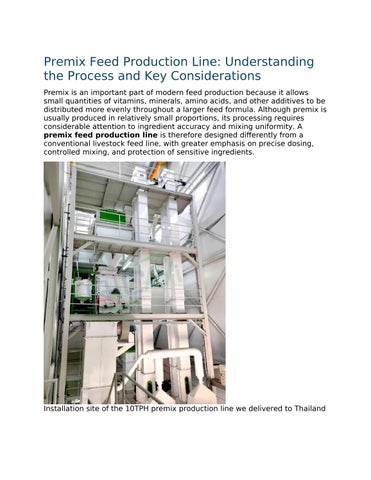
Installation site of the 10TPH premix production line we delivered to Thailand
What Is Premix Feed? Premix is generally a concentrated mixture of trace feed additives combined with a suitable carrier or diluent. The reference materials describe ingredients such as mineral elements, vitamins, synthetic amino acids, certain additives, and other trace components as common premix materials. Because these ingredients are used in relatively small quantities, distributing them directly into a large amount of feed can be difficult. The premixing process helps dilute and disperse these components before they are incorporated into compound feed. It can also help compensate for characteristics such as moisture absorption, instability, and electrostatic attraction that may otherwise make uniform distribution more difficult.
How Does Precise Batching Work? Batching is one of the most important stages in premix production because even a small weighing error can affect the concentration of the finished product. Different ingredients are therefore measured according to the formulation before entering the mixer. Automatic batching systems can be used when production requires a high degree of repeatability, while manual weighing or a combination of manual and automatic methods may also be suitable for certain smaller operations. The choice depends on the production scale, number of ingredients, formula complexity, and required accuracy. For operators evaluating a cattle feed plant price in South Africa, it is useful to distinguish between the cost of a complete cattle feed plant and the cost of a dedicated premix system. A conventional cattle feed plant may focus heavily on grinding, batching, pelleting, cooling, and screening, while a premix facility places greater emphasis on micro-ingredient dosing and highly uniform powder mixing.
Why Is Mixing So Important? Mixing is the stage where accurately measured ingredients are transformed into a homogeneous premix. The reference materials emphasize that premix requires a high degree of mixing uniformity, with the coefficient of variation generally expected to be no greater than 5%. The order in which materials enter the mixer can also influence the result. Larger quantities of carrier material may be introduced first, followed by trace ingredients in a controlled sequence. Some formulations may also use secondary premixing to distribute very small quantities of active components before they enter the main mixer.
Mixing time depends on the equipment and formulation. The reference materials note that premix mixing can require substantially longer than conventional compound-feed mixing because the ingredients need to be distributed at much smaller inclusion levels.
How Should a Premix Plant Be Planned? A practical project should begin with the formulation and raw-material characteristics rather than selecting equipment first. The number of ingredients, required batching accuracy, carrier properties, production capacity, mixing method, packaging requirements, and level of automation all influence the final layout. The process can remain relatively compact because premix production does not necessarily require the pelletizing and cooling sections found in many conventional feed plants. Instead, the core workflow is generally centered on receiving, cleaning, optional crushing and drying, accurate batching, mixing, and packaging. Readers who would like to learn more about the manufacturer’s background can use straight from the source as an anchor to the company’s About Us page, where additional information about the organization and its development can be found.
Understanding Premix Production as a Precision Process Premix production may look simple because the basic process involves powder handling and mixing, but precision is what makes the process different. Small deviations in ingredient weighing or poor mixing can affect the distribution of trace components throughout the final product. For this reason, the design of a premix facility should focus on accurate dosing, consistent particle size, appropriate moisture control, thorough mixing, dust management, and suitable storage. RICHI Pellet Mill provides feed-processing equipment and production-line configurations that can be adapted to different raw materials, production capacities, and process requirements.