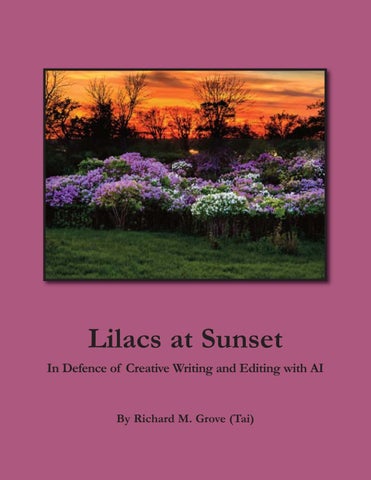
Lilacs at Sunset In Defence of Creative Writing and Editing with AI
By Richard M. Grove (Tai)
Lilacs at Sunset In Defence of Creative Writing and Editing with AI
By Richard M. Grove (Tai)
First Edition
Table of Contents
QuodSermo Publishing Mandate and Focus – p. 4 A Quick Note about the Title – p. 6 Foreword – p. 8 The Glitters that must be Carefully Weighed and Minded Prof. Miguel Ángel Olivé Iglesias
Part One — The Philosophy of AI and Human Creativity About AI Writing, Editing and Creativity – p. 10 One of the most important lesson about working with AI – p. 13 About Human Editing an AI Written Story – p. 14 Expanding Your Prompt – p. 17
Part Two — Four Story Examples of Writing with AI – p. 22 Story 1 — The Witch, the Frog and the Flying Pig – p. 23 • Prompt 1A • Written Version 1A • Written Version 1B • Prompt 1C • Written Version 1C • Written Version 1D (Human Edited)
Story 2 — The Sisters in the Lake – p. 32 • Prompt 2A • Written Version 2A • Prompt 2B • Written Version 2B • Human Edited Version: The Midnight Shore Beneath the Years
Story 3 — The Skydiver – p. 39 • Prompt 3A • Written Version 3A • Expanded Prompt • AI Version • Human Edited Version
Story 4 — Murder with AI – p. 50 • Prompt 4A • AI Version • Expanded Prompt • AI Revision • Human Edited Version
Part Three — A Different Kind of Example Expanding a Real Email into Literature – p. 65 • Original Email • First AI Expansion • Human Edit #1 • Human Edit #2 • Final Human Version
Part Four — Poetry and AI An AI Poetry Writing Project — Lilacs at Sunset – p. 72 • Original Prompt • AI Micro-prose • AI Poem • Human Edited Poem
Part Five — Closing Thoughts Previously Published Preface to Devour – p. 80 Poems and Comments from Readers: Antony Di Nardo – p. 71 Shane Joseph – p. 85 Comments on Lilacs at Sunset – Prof. Miguel Ángel Olivé Iglesias. MSc – p. 86 About the Author – p. 88
Copyright © 2026 QuodSermo Publishing – QuodSermo@gmail.com Copyright © 2026 Richard M. Grove – 905-376-9106 All rights revert to the author. All rights for book, layout and design remain with Wet Ink Books. No part of this book may be reproduced except by a reviewer who may quote brief passages in a review. The use of any part of this publication reproduced, transmitted in any form or by any means, electronic, mechanical, photocopied, recorded or otherwise stored in a retrieval system without prior permission in writing from the publisher or a license from The Canadian Copyright Licensing Agency (Access Copyright) is prohibited. For an Access Copyright license, visit: www.accesscopyright.ca or call toll free: 1.800-893-5777.
This is a PDF, First Edition, not for sale. The Second Edition will come out soon in printed book form with more added text.
Title – Lilacs at Sunset: In Defence of Creative Writing and Editing with AI by Richard M. Grove Cover Design – Richard M. Grove Layout and Design – Richard M. Grove Cover Photograph – Richard M. Grove
Typeset in Garamond This first edition is available in PDF format only. ISBN: 978-1-998324-35-4 = 9781998324354 – PDF Book
Library and Archives Canada Cataloguing in Publication Title: Lilacs at sunset : in defense of creative writing and editing with AI / by Richard M. Grove (Tai). Names: Grove, Richard M. (Richard Marvin), 1953- author Description: First edition. Identifiers: Canadiana 20260214884 | ISBN 9781998324354 (PDF) Subjects: LCSH: Creative writing. | LCSH: Authorship. | LCSH: Editing. | LCSH: Artificial intelligence. Classification: LCC PN187 .G76 2026 | DDC 808.020285/63—dc23
QuodSermo Publishing Mandate and Focus Send us your manuscript The QuodSermo Publishing mandate and focus is to publish non-fiction books on the topics of Pedagogical Science and Linguistics as well as Literary and Poetical Analyses. If you have a book on these topics please contact the publisher: QuodSermo@gmail.com
4
Dedicated to my dear late writer-wife Kimberley Sherman Grove
5
A Quick Note about the Title
At first glance one might wonder why the title, Lilacs at Sunset. It may seem like an unusual title for a book about artificial intelligence, writing and editing but the title is intentionally intentional. Artificial intelligence can analyse language, imitate style, generate metaphors, and recombine ideas in surprising ways. Yet the deepest source of literature has never been language alone. Literature begins with human experience, even the human experience of being inspired by seeing lilacs at sunset. A cluster of lilacs glowing in the fading light of sunset is not merely a visual image. It is memory, emotion, observation, and meaning. One person may see flowers or sunset. Another may remember a childhood garden. Another may think of a loved one who has passed. The image carries emotional associations that arise from a lifetime of lived experience. The central argument of this book is that AI can assist the writing process, but it cannot replace the human experiences that give writing its emotional depth, meaning, and significance. AI can help arrange words, suggest ideas, identify patterns, and even imitate certain literary styles, but human beings provide the lived experiences that make those words matter. It is people who bring to the page their memories and relationships, their triumphs and disappointments, their joys and sorrows, their hopes and fears. It is people who wrestle with grief, love, beauty, mortality, faith, purpose, and the enduring philosophical questions that have occupied humanity for centuries.A machine may be able to generate a convincing description of loss, but it has never stood at a graveside. It may compose a passage about love, but it has never held a trembling hand or felt the ache of separation. It can discuss courage, sacrifice, wonder, or regret, but it has never experienced any of them. The emotional and philosophical substance of writing originates not from algorithms but from human consciousness and lived experience.For this reason, AI should be viewed not as a replacement for writers but as a tool that can assist them. The human writer remains the source of the story, the insight, the memory, and the meaning. The technology may help shape the vessel, but the human spirit still provides the cargo. The lilacs represent the human capacity to notice beauty. The sunset represents the passage of time, mortality, and inner contemplation and reflection. Together they symbolize the uniquely human experiences that continue to lie at the heart of meaningful writing. The subtitle, In Defence of Creative Writing and Editing with AI, reflects my belief that AI should be viewed as a creative tool rather than a creative replacement. Just as a camera did not eliminate painting and the word processor did not eliminate authorship, AI does not eliminate the essentiality of the human writer. The writer remains the source of intention, judgment, meaning, and lived experience.
6
In that sense, Lilacs at Sunset is not really a title about artificial intelligence at all. It is a title about being human. The book argues that the future of writing will not be determined by machines alone, but by the continuing collaboration between human imagination and technological possibility. So in the end, we have to remember that the lilacs belong to the human writer, the sunset belongs to the human writer, and the meaning, the connotation, and the significance belong to the human writer. The machine may help describe the colour of the blossoms or the glow of the evening sky, but only a human being can bring to them a lifetime of memories, emotions, associations, and understanding. It is the writer who has loved, lost, wondered, grieved, celebrated, and reflected, and it is those experiences that transform simple words into something that resonates within the hearts and minds of other people. Richard Grove
7
The Glitters that must be Carefully Weighed and Minded Prof. Miguel Ángel Olivé Iglesias. MSc Author, Poet, Editor, Translator, Lit Reviewer General VP of the Canada Caribbean Literary Alliance
Dear Readers, The material you are about to read, Lilacs in the Sunset: In Defence of Creative Writing and Editing with AI (QuodSermo Publishing, 2026), is highly pertinent and valuable. AI has been used and abused ever since it appeared. It was about time an ad hoc book on the matter came to life to defend, explain, suggest, warn, give advice and aptly illustrate. In 2014, one third of a group of Turing Eugene Goostman Test judges believed they were talking with a thirteen-year-old boy when they were actually interacting with AI. Amazing. 2020 was a groundbreaking leap when generative AI OpenAI (GPT-3) showed off staggering capacity to generate coherent and creative text. Awesome. So, what is all this ado about AI? Let´s see what AI has to say about AI: “AI is one of the most transformative technologies of our time, and it sparks both excitement and debate” and AI adds: “AI itself isn’t inherently “good” or “bad” — it’s a tool. Its impact depends on how humans design, regulate, and use it. The most important thing is ensuring AI serves humanity responsibly, balancing innovation with ethics.” (Taken from Copilot). A few interesting words stand out. “Excitement,” “debate,” “good,” “bad,” “innovation,” “ethics.” The book you are about to read takes your hand and walks you through the semantics, rationale and marvel behind these key terms—and beyond. Thus readers, especially those resorting to AI for more reasons than I can state here, will be pleased to have a solid rule-of-thumb reference on the byways and highways of AI as a writing tool. I am a university professor. My first and foremost pointer for my students is to use AI. But, they cannot be blinded by the glitters of the tool; they cannot just lay back and let AI do the job. What AI does is assist, suggest, pave the road, etc. Far from being our replacement, the app must become our sidekick. We continue to be the authors, the true human constituent of any literary work. Hence, AI has to be weighed and minded before we render an end result of any kind. Richard Grove addresses the issue directly. Being a writer to the bone—among many other things— his immersion is deep, experience-based, explicit, to-the-point and illustrative on levels that will satisfy writers and writers-to-be. Deem it, because it is, your vade mecum.
8
Opinions will flare. I feel optimistic a vast majority will cheer in favour of a source to guide us into AI because help is always welcome, twice as much if it is supported on evidence, examples, dissection of concepts and criteria substantiated by decades of active writing, publishing, editing and, why not, of benefiting from AI to facilitate creative activity. The author presents cases of story writing and poetry produced by AI and by human writers. I ventured prompting Copilot to weave a review on a book feeding it some of the features and virtues of Lilacs in the Sunset… See what it came up with: “This book offers a fascinating exploration of artificial intelligence as both a creative partner and a disruptive force in literature. It highlights the promise of AI-generated stories: quick drafts, imaginative twists, and unexpected juxtapositions that human writers might not consider…” Impressive, isn´t it. Let´s have more AI “opinion”: “Ultimately, the book argues that AI is not a replacement for human storytellers but a tool that can spark inspiration. The “ups” lie in efficiency and novelty; the “downs” remind us that empathy, authenticity, and cultural resonance remain uniquely human strengths.” That is no thirteen-year old talking. AI can surprise us sounding like a real reviewer. Needless to say that the above criteria do apply anyway to Lilacs in the Sunset… Such sensation is good and bad. I will let the readers wonder why. Read Lilacs in the Sunset: In Defence of Writing and Editing with AI. Come back to Richard Grove with your views on the topic. Use AI if you want to, but keep your writing natural, sincere—human! Miguel Ángel Olivé Iglesias
9
About AI Writing, Editing and Creativity Let me begin by saying that I do not want my comments about AI editing and creativity to sound as though I do not believe in the importance and integrity of human-authored writing. I remain convinced that the human experience lies at the heart of meaningful literature. This book is not written as an AI promotional tool, nor is it intended to encourage writers to take up the AI gauntlet and embrace it as the saviour of their craft. The genesis of this book came about when someone sent me a series of short stories that seemed to have been written and accepted with little or no editing after a single prompt. The finished stories were of mediocre quality at best. The core ideas seemed promising, but they were missing the human touch, the human voice, and the human creativity that transform a competent draft into meaningful literature. In those stories, I noticed several AI idiosyncrasies that did not sit well with me as a reader. I responded with a long, in-depth email containing more than 1,000 words explaining how one might use AI as a creative writing tool. My comments stressed the idea that the human author needed to edit, edit, and edit again until the AI-generated story became their own. I suspect that the recipient was either offended or embarrassed by being called out for what I perceived as their overreliance on AI because, to this day, I have not heard back. That lengthy explanation ultimately became the motivation for writing this book. As you will discover while reading this book, and the follow-up volume that is already in progress, I have no problem with using AI as a writing tool. Even this chapter, “About AI Editing and Creativity,” will be edited by ChatGPT, but the concepts, the theories, and the core ideas are all mine. I do not see a fundamental difference between asking a human editor or an AI editor to look over my writing. With that in mind, I dare say that a good human editor is probably far superior to an AI editor. Human editors, however, are often difficult to find, expensive to hire, and slow to respond. Even so, I must admit that I have been impressed by the quality of the AI editing I receive from ChatGPT. One of the most common misconceptions about artificial editing and creativity is the belief that it simply stores and retrieves passages of text in the way a traditional database retrieves information. From what I understand, modern generative AI does not work in quite that way. Rather than memorizing and reproducing exact passages, AI learns patterns, structures, relationships, tones, rhythms, metaphors, and associations from the enormous amount of material on which it has been trained. When AI generates text, it does not normally search for a hidden paragraph and copy it. Instead, it predicts and assembles language based upon patterns it has learned. In a sense, it recombines ideas, styles, imagery, and narrative structures in ways that may never have existed before in that exact form. This ability can sometimes create the appearance of creativity. Whether that constitutes true creativity depends largely upon how one defines the word. If creativity simply means producing something new, then AI already demonstrates a form of creativity. It can generate unusual metaphors, combine genres, imitate styles, and create passages that no human has previously written. In that sense, AI functions as a vast mirror of human culture, endlessly rearranging fragments of language into new configurations.
10
If creativity means something deeper, however, the emergence of expression from an inner life shaped by memory, suffering, joy, love, failure, hope, mortality, and conscious intention, then AI does not yet possess creativity in the human sense. This distinction is important. AI writing is synthetic rather than experiential.
AI can: – recombine styles in surprising ways – generate unusual metaphors – imitate or hybridise voices – produce text that appears original
AI cannot: – originate from lived experience – feel consequence, grief, shame, desire, or loss – carry a personal stake in what is being expressed – write from necessity rather than possibility
The most powerful literature does not arise from novelty alone. It arises from experience transformed into meaning. A writer is not merely arranging words on a page. A writer is attempting to express something that has been lived, felt, struggled with, and understood. Every human being carries a unique history of relationships, memories, failures, triumphs, and questions. That interior life inevitably shapes the work. I readily admit that my own level of creativity may be more limited than that of many accomplished authors. Every writer has strengths and weaknesses. Every writer draws upon the books they have read, the conversations they have had, the places they have visited, and the people they have loved or even hated. Despite those limitations and influences, what I write remains my writing. No matter how much editorial assistance AI may provide, it could not independently produce the stories, essays, poems, or novels that emerge from my particular experiences and imagination. This leads to an interesting question. We often hear people refer to a novel as “AI generated,” but perhaps a more accurate description would be “human assisted by AI.” I say this with tongue-in-cheek but every so-called AI-generated work begins with human input. Someone must provide the initial idea, define the characters, establish the setting, choose the tone, determine the genre, guide the plot, evaluate the output, reject weak suggestions, revise awkward passages, and decide what ultimately remains on the page. Without human direction, AI does nothing. An AI writing program does not wake up in the morning and decide to write a novel. It does not develop ambitions, remember childhood, grieve a loss, or even dream of publication. It waits for a human being to begin the conversation. In that sense, AI is not replacing the writer but it is responding to the human writer. The quality of the final result is often closely related to the quality of the interaction. Thoughtful prompts tend to produce more useful output than vague ones. Careful editing produces stronger prose than blind acceptance. The human author remains responsible for every creative decision that shapes the finished work.
11
When readers encounter a poorly written AI-assisted novel, the problem may not be the technology itself. More often the problem lies in how the technology was used. Just as a word processor cannot be blamed for a weak manuscript, neither can AI. The responsibility still belongs to the human author. Computer scientists continue to refine these systems and will likely do so for many years. I suspect the future will not involve AI replacing human creativity so much as expanding the possibilities for collaboration between humans and machines. Writers may increasingly use AI as a brainstorming partner, a developmental editor, a generator of alternatives, or even a challenger of creative habits. The central act of authorship remains profoundly human. The human writer must still decide what matters. In fact the human writer must still decide what deserves to be said, why it needs to be said, and why it matters now. Perhaps the deepest distinction between AI-generated writing and human writing can be summarized in a single sentence: AI explores the possibilities of language but human beings create meaning within language. At least for now, that mysterious transformation of experience into meaning remains one of the defining characteristics of human creativity.
12
One of the most important lessons I have learned about working with AI in relation to creative writing is: Do not be seduced by what first appears to be a finished piece of AI generated writing. What AI produces is ALWAYS only the beginning. The real creative work still belongs to the human author who must shape, question, edit, expand, compress, redirect, and humanise the material until the story carries an authentic emotional and philosophical human fingerprint. AI can generate language, atmosphere, structure, and possibility, but it is the human writer who ultimately gives the work its deeper consciousness, the deeper thesis, the deeper lived experience, and artistic soul. The pages that follow will demonstrate this process in action. You will see the original prompts, the evolving AI responses, and the many stages of human editing and refinement that transformed an initial AI generated draft into a story the author could genuinely feel proud to call their own. The purpose of this book is not to showcase AI writing, but it is to explore the evolving relationship between human creativity and AI, and to show how thoughtful prompting, literary direction, and persistent human revision can turn raw machine AI output into meaningful literature. If you are using AI as a writing tool the first and maybe the last lesson is, edit, edit and continue editing until it becomes your writing as the human author. The First example that I will present here is the story “The Witch, the Frog and the Flying Pig”. This story came into being from a coffee chat with a friend. In defence of writing with AI as a writing tool I said the amazing thing is that if you start with AI as a writing tool it can write a story about anything. All you have to do is give it a prompt. Off the cuff I said it can write a story about a witch and a frog that know a flying pig. Sitting over coffee with my friend I gave ChatGPT the short prompt below and low and behold the story was generated. As a silly whim activity, on the surface it seemed like an interesting fun story but it was not even close to what we might call literature and was not at all worth of being published. The lesson is don’t be seduced by what AI can generate. If you are sincere about writing a story about a witch, a frog and a flying pig you have a lot of work ahead of you. As you will see below I took on the challenge of turning the AI generated text into a full and proper story. Below you will find the steps that I took from Prompt 1 all the way to Version 1D, the finished human author edited story.
13
About Human Editing an AI Written Story I asked Chat GPT about how the human editor can improve any AI written story. The below list was first written by AI and then edited and expanded by me, the human writer. Here are the most important kinds of edits you could make as the human author:
1. Add One or Two Unexpectedly Specific Human Details AI tends toward generalised literary imagery: – frost – reeds – grey skies – lantern light – snow Human writers often insert oddly specific details that feel observed rather than generated. For example: Instead of writing – People still worked and spoke and carried wood home beneath grey skies… You might write – People still carried split cedar home in crooked sleds while their boots squealed across the frozen road. That tiny specificity suddenly feels lived rather than composed.
2. Reduce a Few “Perfect” Sentences AI often creates sentences that are almost too balanced. Humans sometimes write slightly asymmetrical sentences with rougher edges. Example: Hope had grown embarrassed. Beautiful line but a human might roughen it slightly: In my home town people had almost become embarrassed by hope. Less polished. More human. More psychologically natural. A few moments like this can make the whole piece feel authored rather than orchestrated.
3. Insert At Least a Deeply Personal Observation This is where human writers become irreplaceable. AI can imitate literary philosophy. Humans contribute lived consciousness. For example, Gilbert’s reflection could include something oddly true and emotionally grounded by saying: Gilbert’s sense of despair rarely arrived dramatically. Like most people his simply grew tired a little at a time. That feels psychologically observed rather than aesthetically constructed.
14
4. Watch for “Continuous Beauty” AI literary prose sometimes remains beautiful too consistently. Human literature usually contains tonal variation of; plain moments; rough moments; practical moments; silence and understatement. Sometimes a few simpler sentences make the lyrical passages stronger. Example: After: Outside, winter deepened across the lonely fields… You could insert: “The kettle needed more wood.” That ordinary sentence suddenly grounds the whole atmosphere of loneliness and cold.
5. Remove Some of the Philosophical Commentary AI has a tendency to make sure the reader “gets the point.” It may create a strong scene, an effective piece of dialogue or a meaningful image and then add another sentence explaining what that scene, dialogue or image means. Sometimes that additional sentence is useful but just as often, it weakens what came before it. For example, imagine a scene in which two characters have finally confronted a painful truth. Neither of them knows what to say. They sit together without speaking. AI might then add: Some truths require silence around them. That is not necessarily a bad sentence. In another context it might be quite effective. The question the human editor should ask is: Do I need it? What does it add?
6. Add Slight Emotional Contradiction Humans rarely feel one thing cleanly. AI generated characters sometimes become emotionally unified. You could deepen a character by adding conflict such as: He laughed, though he appeared faintly ashamed of doing so. That contradiction creates psychological realism.
7. Add Historical or Physical Texture Classical prose becomes convincing through material reality of smells, fabrics, tools, weather textures, sounds, food, wood smoke, damp wool, rusted hinges, Example: “His coat smelled faintly of wet wool and chimney smoke.” Tiny details humanise everything.
8. Introduce Sentences That Only You Would Write This is perhaps the most important advice of pushing a story from sounding like it was written by AI into the human writers voice. In a general way AI can imitate literature. What it cannot truly imitate is your private metaphysical or metaphoric angle on existence. One sentence with your own philosophical fingerprint can change the authorship feel entirely. Something like: “People sometimes survive winter merely by remembering that light once existed.” That kind of line becomes part of the authors voice and is never written by AI.
15
9. Shorten a Few Passages Ironically, human editing often improves AI prose through compression. AI slightly over-completes emotional moments. Sometimes removing the last sentence of a paragraph strengthens the piece dramatically.
10. Protect the Mystery AI tends to resolve atmosphere and meaning too neatly. Human literary fiction often leaves some emotional residue unresolved. For example, you might never fully explain – why a character suddenly changes – whether an unusual event really happened – what a particular symbol ultimately means – whether something mysterious has a rational or supernatural explanation Not every question needs an answer. Mystery sometimes creates literary afterlife.
The Most Important Overall Insight Your strongest role as the human writer is not merely “correcting” AI. It is often to: – add lived observation – introduce psychological irregularity – decide what remains unsaid – shape rhythm intentionally – control restraint – insert authentic consciousness AI can generate literary texture but human writers decide where meaning lives.
16
Expanding Your Prompt All of the stories that you will find below are fairly well written by AI. Sometimes I am rather impressed. Even after only the first prompt, with no AI or human editing, a story can be fully engaging. However, at that stage it is still essentially AI-written and is missing the individuals human touch, judgment and perspective of the human writer. You will notice throughout the examples that I often add specific human prompt instructions asking for a philosophical or metaphorical component to be introduced into a story. I have found this to be an important part of the prompting process because it begins to move the story away from being simply an AI-generated narrative and toward something shaped by the human writer’s own intentions. Never consider your story finished after the first, second or even third prompt. You need to turn the AIwritten story into a human story by introducing your own philosophical, linguistic, emotional and stylistic slant. The story needs to reflect your personal creativity rather than merely the ability of the AI program to construct competent prose. This is where prompting begins to move beyond subject matter and simple plot narrative and into a literary style with layers of metaphoric, symbolic and allegorical meaning. A short philosophical instruction added to a prompt can profoundly alter the emotional gravity, symbolic direction and intellectual depth of a story. What appears to be a very small addition to the prompt can sometimes act like a hidden human breath beneath the narrative, quietly influencing how the characters think, how the story develops and what the reader is ultimately invited to consider. The human writer can therefore do much more than simply tell AI what characters to create, where to place them and what should happen next. The human writer can also decide what the story should wonder and be astonished about. Should it explore hope or despair, travel into mortality or immortality, search for meaning in loneliness and isolation; discover truth, veracity or authenticity in memory? A better author directed prompt can push the story to look at deep or shallow human connections of revenge or forgiveness. Should your story look at the tension between imagination and practicality or even moral responsibility let alone spiritual or metaphysical directions. There are thousands of possible directions, and choosing among them is part of the creative responsibility of the human author. The following are ten examples of philosophical directions that a human writer might add to an AI prompt. They are not quotations from literary critics, writing manuals or other outside sources. They are simply examples of instructions that a writer might give an AI program in order to influence the philosophical and emotional direction of a story. Where I present sample prompt wording, it should be understood as suggested language that might be typed into an AI prompt, not as a quotation attributed to another writer or source. There is nothing definitive about these ten examples, nor are they intended to represent the “correct” philosophical ingredients of fiction. They are simply demonstrations of how a human writer can move beyond giving AI only a plot, setting, genre and characters. The writer can also decide what questions, emotions, contradictions and ideas should exist beneath the visible surface of the story. This is one of the places where human involvement becomes especially important. AI can respond to an instruction concerning hope, mortality, loneliness or meaning, but the human writer must decide whether that idea belongs in the story, how strongly it should be expressed, whether the resulting language feels authentic, and whether the philosophical element enriches the narrative or overwhelms it.
17
The point of the following ten examples of prompt possibilities is therefore not that AI somehow supplies the thesis. The philosophical direction should originate with the human writer. AI is being employed as the editorial assistant to help explore the human writer. Make the writing your own by bringing to the prompt your own philosophical, moral, emotional and even metaphysical perspective.
Prompt Possibilities 1. Hope Emerging from Desperation A writer may want a story to acknowledge hardship without allowing despair to become its final conclusion. Sample prompt instruction: Create an underlying sense that hope can survive even when the characters have good reason to feel discouraged. Possible effect: This can give the story emotional resilience without forcing it toward an artificially cheerful ending. Hope can remain tentative, imperfect and believable.
2. Time, Ageing and Mortality A story can become more reflective when its characters are aware that their lives, relationships and opportunities are temporary. Sample prompt instruction: Allow the characters to become increasingly conscious of passing time, ageing and the limited nature of human life. Possible effect: Ordinary decisions may begin to carry greater emotional weight. Memories, missed opportunities and the value of the present moment can become part of the story without taking over the plot.
3. Discovering Value in Ordinary Life Not every meaningful story needs extraordinary events. Sometimes the smallest observations carry the greatest emotional significance. Sample prompt instruction: Give attention to quiet moments in everyday life and allow simple actions, objects or gestures to acquire emotional importance. Possible effect: The story may become more observant and intimate. A cup placed on a table, an old coat hanging by a door, or one person silently helping another can sometimes reveal more than dramatic explanation.
18
4. Loneliness and the Need for Human Connection Loneliness can exist even when a character is surrounded by other people. The desire to be understood, accepted or simply noticed can become a powerful force within a story. Sample prompt instruction: Let loneliness exist beneath the characters' behaviour while gradually revealing their desire for companionship, understanding or belonging. Possible effect: Characters may become less predictable and more emotionally vulnerable. Their conversations and actions can carry meanings that are not directly stated.
5. Imagination Versus Practicality Human beings frequently live between what appears sensible and what they secretly wish might be possible. Sample prompt instruction: Explore the tension between practical necessity and the human desire to imagine, dream, create or believe in possibilities beyond everyday usefulness. Possible effect: This can introduce conflict between characters who value security, efficiency and convention and those who value imagination, curiosity and wonder.
6. Searching for Meaning in an Uncertain World Characters do not need to find answers to life's larger questions. The search itself can become part of the story. Sample prompt instruction: Allow the characters to wrestle quietly with uncertainty and to question what gives their lives, choices and relationships meaning. Possible effect: The story can acquire greater philosophical depth while still allowing the ideas to emerge naturally through character, action and dialogue rather than through a lecture.
7. Innocence Encountering Cynicism A character who still possesses trust, curiosity or idealism can reveal much about a world that has become cynical or hardened. Sample prompt instruction: Create a tension between a character who still believes in possibility and another character, or society itself, that has learned to distrust hope and innocence. Possible effect: Neither position needs to be presented as completely right or wrong. Innocence may contain wisdom, while cynicism may have developed from painful experience. The tension between them can create emotional and moral complexity.
19
8. Learning to Live with Imperfection People, relationships and lives are rarely repaired into perfect condition. Sometimes maturity lies in recognizing what cannot be made perfect. Sample prompt instruction: Let the characters gradually discover that understanding, affection or wisdom may depend upon accepting flaws that cannot simply be corrected. Possible effect: This can prevent the story from resolving every conflict too neatly. Characters may learn to live differently with one another rather than magically solving every problem.
9. Memory Influencing the Present Memory does more than provide backstory. What a character remembers, misremembers or chooses not to remember can influence every present decision. Sample prompt instruction: Allow memories from the characters' earlier lives to quietly influence how they interpret present events and relationships. Possible effect: Past and present can begin to interact emotionally. An ordinary place, smell, photograph, phrase or object may acquire meaning because of the history the character brings to it.
10. The Human Relationship with Nature Landscape does not need to function merely as scenery. Weather, seasons, animals and the natural environment can interact with a character's awareness without becoming obvious symbols. Sample prompt instruction: Use the natural environment as an active part of the characters' experience, allowing changes in weather, season, light and landscape to influence how they perceive the world around them. Possible effect: The setting may become more deeply integrated into the story. Nature does not need to "represent" a particular emotion; it can simply exist alongside human experience and allow the reader to discover whatever relationship may be present.
Why These Prompt Additions Matter One of the first things to remember is to write your own prompt. Let me reiterate that these prompt suggestions should be thought of simply as suggestions. Reword the prompt suggestion to fit what it is you want to say in your story. A basic AI writing prompt may describe a plot, setting, genre and group of characters. Those instructions tell the AI machine what should happen in your story. Expanding your prompt gives your story meaning. The human writer can go considerably further than AI possibly can. Through these expanded prompt suggestions the human writer can direct the story and the wondrous thesis that makes it truly worth reading. Remember, there is no single correct philosophical direction because that direction should come from the human writer creating the story.
20
This is one of the places where the human writer's responsibility becomes especially important. AI can respond to an instruction about hope, mortality or loneliness, but the human writer must decide whether those ideas actually belong in the story, whether the resulting language feels genuine, and whether the philosophical element is subtle enough to enrich the story rather than overwhelm it. A prompt can point the AI machine in a particular direction. The human writer still has to decide whether that direction is worth following.
One of the Most Powerful Prompting Techniques Experienced literary prompters often combine: – a stylistic instruction – an emotional instruction – a philosophical instruction For example: Write in reflective literary prose with long meditative sentences and restrained dialogue. Include a quiet philosophical sense that hope survives even in damaged people. That single prompt sentence can dramatically reshape the thesis of the prose.
Another Important Discovery Philosophical prompting works best when: – implied rather than preached – emotionally embodied rather than explained – woven into atmosphere rather than lecture Weak prompting: – Teach readers that hope is important. Strong prompting: – Allow a quiet philosophical sense that hope survives beneath despair. The second version creates literature whereas the first creates moral instruction. That distinction matters enormously.
21
Four Story Examples of Writing with AI One of the best ways to learn is by example. It is one thing for me to explain how I use AI as a creative writing tool, but it is much more useful for you to see the process unfold from the original idea through the various stages of prompting, rewriting and human editing. In this section of the book, I will present four stories together with the actual Prompts and Written Versions that helped create them. Rather than showing you only the polished final story, I want you to see what happened along the way. You will be able to compare an early, relatively simple prompt with the writing it produced, then see how additional instructions changed the characters, atmosphere, humour, philosophical content, narrative style and emotional depth of the story. This is important because AI does not magically know the story that you have in your head. It responds to the information and direction you give it. A short vague prompt may produce a perfectly readable story, but it may not be the story you intended. As you add instructions, reject ideas, change direction, ask for rewrites and eventually edit the language yourself, you gradually take greater control of the work. I have deliberately left the stages visible. The earlier versions of a story will be weaker, more generic or less interesting than the versions that follow. That is part of the point. I want you to be able to look over my shoulder and see the interaction between the human writer and the AI writing tool, including occasions when the AI produces something useful and occasions when it needs to be pushed in an entirely different direction. Pay particular attention to the prompts. They demonstrate that prompting is not simply a matter of telling AI what to write. The human writer can use the prompt to introduce personal preferences concerning style, pacing, humour, description, dialogue, philosophy and meaning. The resulting story can then be examined, questioned and edited again and again. These four examples are not intended as formulas for how everyone should us AI as a writing assistant. They are demonstrations of one writer’s process. My hope is that by seeing the prompt that are linked to the writing you will be in a better position to decide for yourself where AI can be useful, where it falls short, and most importantly, where the human writer needs to take control.
22
Story 1 – The Witch, the Frog and the Flying Pig Prompt 1A: Write a story about a witch and a frog and they have a pet pig that can fly. Make it 300 words Written Version 1A: 300 AI generated words Deep in the crooked woods beyond the village of Thistle Down lived a peculiar witch named Morvena. Her cottage leaned sideways as if it were listening to secrets buried beneath the roots of the trees. Smoke curled from her chimney in the shape of dancing cats, and glowing blue mushrooms circled her doorstep like tiny lanterns. Morvena was not a wicked witch. She disliked curses because they gave her headaches. She preferred making cinnamon tea, collecting moonflowers, and arguing with her best friend, a frog named Barnaby. Barnaby was no ordinary frog. He wore a velvet waistcoat with brass buttons and spoke with the grumpy dignity of an old philosopher. “Rain,” Barnaby often declared while staring at the sky, “is simply the clouds feeling emotional.” Their strangest companion was a flying pig named Percival. He had tiny silver wings that fluttered furiously whenever he became excited, which was often. Percival adored pies, thunderstorms, and flying upside down over the village rooftops just to hear people scream. One autumn evening, the three friends discovered that the moon had vanished. “The moon cannot simply disappear,” Barnaby croaked nervously. “Perhaps it wandered off,” said Percival while hovering near the ceiling. Morvena stirred her cauldron thoughtfully. “No. Someone has stolen it.” So the witch, the frog, and the flying pig journeyed across the forest aboard Percival’s wobbling back. They crossed rivers glowing green with magic and climbed the Hill of Sleeping Giants until they found the moon trapped inside a glass jar belonging to a lonely giant. The giant confessed he only wanted light for his dark cave. Morvena smiled kindly. Instead of scolding him, she enchanted thousands of fireflies to live in the cave forever. The giant released the moon, Barnaby sighed with relief, and Percival performed joyful loops through the midnight sky. This version is written by AI with the same prompt without the 300 word restriction. This will show the difference between giving a word count restriction and not.
Written Version 1B: No word count restrictions The Witch, the Frog and the Flying Pig There once lived a witch named Mildred Bogthorn in a crooked little house at the edge of a foggy marsh where the reeds sang at night whenever the wind drifted in from the sea. The villagers feared her because her chimney smoked green on Tuesdays and because she kept company with unusual creatures. Children whispered that she spoke to ravens and boiled moonlight in copper pots. Most of the rumours were untrue. Mildred did not care much for ravens. They were arrogant birds and terrible listeners. Her closest companion was a frog named Gilbert who lived in a teacup beside the kitchen stove. Gilbert was old for a frog and considered himself something of a philosopher. He spent long afternoons staring thoughtfully into puddles and making observations about clouds. “Rain,” he often said wisely, “is simply the sky thinking too much.” The third member of their peculiar household was a flying pig named Clementine.
23
No one knew exactly why Clementine could fly. Mildred claimed it was an accident involving goose feathers, cinnamon, and a spell she found upside down in an ancient book. Gilbert suspected the pig had simply believed in herself more strongly than ordinary pigs did. Clementine floated rather than flew. Her little legs dangled beneath her round pink body as she drifted through the air like a cheerful balloon. Sometimes she circled the marsh at sunset while dragonflies chased behind her in glittering clouds. Every evening the three companions gathered outside the cottage to watch the stars emerge. Mildred sat in a rocking chair knitting scarves that changed colour with her moods. Gilbert rested upon the porch railing. Clementine hovered gently overhead snorting at the moon. Life in the marsh might have continued peacefully forever had it not been for the Mayor of Bellminster. Mayor Crumb was a narrow man with narrow shoulders, narrow eyes, and an even narrower imagination. He disliked unusual things because unusual things could not be measured properly or taxed efficiently. One autumn morning he arrived at Mildred’s cottage accompanied by six nervous villagers carrying butterfly nets. “You are hereby ordered,” announced the mayor, unfolding an unnecessarily long scroll, “to surrender the airborne pig immediately.” Clementine, who was floating upside down above the cabbage patch at the time, blinked in surprise. “You can’t surrender Clementine,” said Mildred calmly. “She violates the natural order,” declared the mayor. Gilbert cleared his throat. “Have you ever seen a platypus?” he asked. The mayor ignored him. “The pig will be examined by experts.” “Experts in what?” asked Mildred. The mayor hesitated. “Pig matters.” At this Clementine became terribly anxious. She sneezed nervously, which caused her to shoot thirty feet into the air like a pink cannonball. The villagers screamed. One of the butterfly nets caught fire for no obvious reason. Gilbert sighed. “This is why I dislike politics.” Mayor Crumb pointed dramatically upward. “Capture that pig!” But capturing a flying pig is much harder than one might imagine. Clementine zipped over rooftops and spun around chimneys while the villagers stumbled through mud and collided with fences. One landed in a duck pond. Another became tangled in laundry. Mayor Crumb himself was struck in the face by a dangling pair of bloomers. Meanwhile Mildred and Gilbert followed quietly behind. “You could stop this with magic,” said Gilbert. “I could,” Mildred replied. “But?” “But some lessons are better learned the long way.” At last Clementine soared high above the village square where everyone had gathered to witness the spectacle. Children pointed upward with delight. Old women abandoned their shopping baskets. Bakers emerged dusted in flour. For one brief shining moment the whole village forgot its worries and simply stared upward in wonder. Clementine floated gracefully across the golden evening sky while the church bells rang below her. Even Mayor Crumb stopped shouting. The pig looked beautiful.
24
Not useful. Not practical. Not reasonable. Simply beautiful. Gilbert noticed the mayor’s expression softening. “Ah,” the frog whispered quietly. “There it is.” “There what is?” asked Mildred. “The dangerous moment when a person begins to feel joy.” Slowly Clementine descended and landed beside the mayor with a gentle oink. The village grew silent. Mayor Crumb adjusted his crooked hat. Then, to everyone’s astonishment, he reached out and scratched the pig behind her ears. “Well,” he muttered awkwardly, “perhaps the natural order has room for one flying pig.” The villagers cheered. That night the town held a celebration in the square. Lanterns swung from trees. Musicians played fiddles. Children danced beneath the stars while Clementine gave rides through the moonlit sky. Mildred sat beside Gilbert near the fountain. “You know,” said the frog thoughtfully, “people are rather like pigs.” “How so?” “They spend most of their lives convinced they cannot fly.” Mildred smiled. Above them Clementine drifted peacefully across the night sky while the whole village watched in wonder, their faces glowing softly in the silver marsh light. *** Without any prompting AI came up with a lonely witch, a philosophical frog, and a flying pig that teach a fearful village that wonder has value beyond logic or usefulness. The story suggests that joy, imagination, and acceptance of the unusual are essential parts of being human, and that beauty often enters the world disguised as impossibility. So what is the difference between the AI results from writing a simple prompt and writing a more sophisticated creative prompt? Prompt 1C: Rewrite the story with this longer prompt: Please do not use any n-dashes or m-dashes. Please use Canadian spelling. Never starting a sentence with the words “and” or “but”. Please present this in the body of the reply with no preamble – just give me the story. Give me one response rather than two. I am fine with a bit of a philosophical and slight poetic wording. Can you write the story in the style of Hans Christian Anderson Write in an emotional prose style with a third person narration with some dialogue. Use long philosophical sentences interrupted by sudden short observations. Avoid melodrama but create the opportunity for a problem to arise and be solved. Let the setting hint at emotional states indirectly. Keep dialogue sparse.
25
Use sensory details associated with cold, silence, and fading light. Write with the psychological patience of literary fiction. Do not write with sparse cinematic pacing. Use a combination of long and short sentences. Add a philosophical component of hope overcoming desperation. Create the writing in traditional continuous prose, conventional paragraph narration, classical narrative prose, integrated paragraph structure with dense literary narration. By doing this please prioritise narrative continuity. Do not create the writing in a lyrical literary prose style with cinematic paragraphing or rhythmic paragraph fragmentation. Do not use modern literary pacing, poetic prose formatting or beat-separated prose. Do not prioritise emotional rhythm.
Written Version 1C: Expanded version with the above prompt. Remember to edit and expand your prompt. I have learned to save a file of different prompt ideas so I don’t have to reinvent my prompt. Here is the expanded version. Compare this version with the previous version and recognise the differences. The Witch, the Frog and the Flying Pig In the cold country beyond the marshlands, where the reeds bent beneath autumn winds and the ponds wore thin skins of silver ice each morning before the reluctant sun climbed into the pale sky, there stood a small crooked cottage with blue shutters and a chimney that leaned slightly to one side as though it had grown weary of staring at the same lonely horizon for too many years. The villagers believed a witch lived there. They were correct. Her name was Mildred Bogthorn, though few people spoke it aloud anymore because names, once wrapped too long in rumour, begin to feel dangerous upon the tongue. Children hurried past her lane before dusk. Farmers crossed themselves when smoke curled from her chimney at strange hours. Old women whispered that she spoke to crows and brewed storms in iron kettles. Most of this was nonsense. Mildred disliked crows intensely. They reminded her too much of politicians. Her true companions were quieter creatures. Upon the windowsill beside the kitchen stove there lived a frog named Gilbert who slept in a cracked porcelain teacup lined with moss and clover. Gilbert possessed the grave and melancholy disposition often found in old philosophers and elderly frogs. He spent long hours staring thoughtfully at rain sliding down the glass while speaking only when silence had ripened fully enough to deserve interruption. Outside in the frosted cabbage garden there lived a pig named Clementine who could fly. Not quickly. Not elegantly. She drifted through the air with the uncertain dignity of a lantern caught in gentle wind, her little legs hanging
26
beneath her round pink body while her ears fluttered softly against the fading light. Sometimes at sunset she floated above the marshes while snow geese passed overhead in solemn formation, and in those moments even the lonely fields appeared to pause in their endless sleep beneath the cold sky. No one knew exactly why Clementine could fly. Mildred herself had once attempted an explanation involving cinnamon, goose feathers, moonwater, and an old spell written backward in a mouldering book she had purchased from a travelling magician who later disappeared under mysterious circumstances somewhere near the Baltic Sea. Gilbert suspected the truth was simpler. “Perhaps she merely forgot she was not supposed to,” he once remarked quietly. The witch considered this for a long while. Such things happen. The years before this story had not been kind to the village of Bellminster. Harvests had failed twice from early frost. Several fishing boats had vanished during a violent storm upon the northern lake. Shops stood dark along the narrow streets where laughter had once spilled warmly from open doors during market evenings. People still worked and spoke and carried wood home beneath grey skies, yet a quiet desperation had settled over the town like soot upon snow, covering even ordinary joys beneath its weight. Hope had grown embarrassed there. Few mentioned it aloud anymore. During winter evenings the three companions gathered beside the fire while frost thickened upon the cottage windows like pale white flowers. Mildred knitted scarves that changed colour according to her moods. Gilbert sat upon the arm of her chair staring into the flames with ancient amphibian sorrow. Clementine floated sleepily near the ceiling where the warm air collected in gentle currents. Outside, snow fell soundlessly through the dark. Inside, time softened. One evening, near the end of November when the days had become so short that twilight seemed scarcely different from dawn, a hard knocking sounded at the cottage door. The noise startled Clementine badly enough that she rose abruptly toward the rafters with a frightened squeal. Gilbert sighed. “Only humans knock like that,” he muttered. Mildred opened the door and found Mayor Crumb standing upon the threshold wrapped in a stiff black coat dusted with snow. Behind him stood several villagers carrying lanterns whose yellow light trembled weakly in the gathering dusk. The mayor removed his hat. “There have been complaints,” he announced. “There usually are,” Mildred replied. Mayor Crumb cleared his throat with official importance. “Your pig is disturbing the natural order.” At this Gilbert blinked slowly. “The natural order appears remarkably fragile,” he observed. The mayor ignored him. He stepped inside the cottage and looked upward where Clementine floated nervously near the ceiling beams, her small eyes wide with fear. “She must be surrendered,” he declared. “Animals are not meant to fly.” Mildred studied the weary man standing before her, and for the first time she noticed not authority but exhaustion lingering beneath his sharp expression, the exhaustion of a person who had spent too many years measuring life only by hardship and practicality until wonder itself had begun to feel dangerous.
27
Outside, wind moved softly through the frozen reeds. The light faded further. Gilbert hopped down from the chair and crossed slowly toward the mayor. “When did you last feel hope?” the frog asked quietly. The villagers shifted uneasily. Mayor Crumb frowned. “Hoe does not repair roofs or fill empty cupboards.” “No,” said Gilbert, “yet desperation empties far more than cupboards.” Silence settled heavily through the room. Even the fire seemed to grow still. The frog gazed toward the frost-covered windows where darkness pressed gently against the glass. “People often believe despair arrives all at once like a storm,” he continued softly. “Most of the time it arrives silently. One disappointment at a time. One winter following another winter until the soul forgets spring is not dead but merely sleeping beneath the earth.” No one answered. Some truths require silence around them. Clementine drifted lower then, trembling slightly as she descended through the dim amber light, until at last she hovered directly before the mayor. For one uncertain moment nobody moved. Snow brushed quietly against the windows. Then the little pig stretched forward and rested her soft pink snout against the mayor’s gloved hand. Such a small thing. Yet sometimes entire lives turn upon moments no larger than this. The mayor stared downward in bewilderment. His expression altered slowly, like ice loosening upon a river at the first hidden arrival of spring. Beneath all his sternness there remained some forgotten child who had once looked upward at clouds and believed impossible things might still wander quietly through the world. Clementine gave a soft contented grunt. Mayor Crumb began to laugh. Not loudly. Not proudly. The sound emerged awkwardly, almost painfully, as though joy were an instrument he had not touched for many years and no longer remembered how to play properly. The villagers stared in astonishment. One by one their faces softened in the firelight. Someone smiled. Someone else quietly wept without fully understanding why. Outside, snow continued falling across the dark fields of Bellminster, yet for the first time in many seasons the village no longer felt entirely buried beneath winter. Gilbert nodded thoughtfully. “There now,” he whispered. “Hope is a strange creature. It survives in places where reason insists it should not.” That night the mayor remained for tea beside the fire while snow drifted silently across the sleeping marshes. No proclamations were issued. No arrests were made. Clementine floated peacefully above the table while Mildred poured steaming cups of chamomile tea into cracked blue porcelain cups. Outside, winter deepened across the lonely fields. Inside, warmth endured. Long afterward the villagers would speak softly of the strange evening when the flying pig transformed the heart of Mayor Crumb without casting a single spell at all, though Gilbert often insisted the true magic had nothing to do with flight. “Most creatures,” he said years later while watching moonlight shimmer across the frozen pond, “already possess wings of one kind or another. The tragedy is simply that they spend so much of their lives convincing themselves otherwise.” Then after a long silence he added quietly: “Hope may be the smallest wing of all. Yet it is the one that carries the greatest weight.”
28
Written Version 1D: This is the final human editor written result This next version is edited by me, the human author, that wrote the original prompt. Don’t forget to edit, edit and edit again. This human edited version was read and edited many times. It was set aside for hours, days and even months between edits so that the human editor can have a fresh perspective each time the piece is read and edited.
The Witch, The Frog and the Flying Pig In the distant countryside beyond the marshlands, where the reeds sway beneath autumn winds, beyond the ponds that wear their thin skins of silver ice that never melts stands a small crooked blue cottage with golden shutters. The chimney made of field stones leans slightly to one side as though it had grown weary of staring at the same cold lonely horizon for so many years. The villagers, off in the distance believed the seldom seen witch lived there and her name was Mildred Bogswamp. Few people spoke her name aloud in fear of being jinxed by the rumour that if anyone uttered her name they would suffer a calamity beyond imagination. Children scurried past her dark, vine covered lane at all times of the day but especially at dusk no one other than the local scruffy dog would dare pass. Farmers muttered holy prayers when they saw smoke curling from her chimney at strange hours. Old women mumbled under their breath that the old witch spoke kindly to crows and brewed crow feather tea in a large black witch’s kettles. How they knew this is a mystery but truth be told Mildred Bogswamp disliked crows intensely. She was forever shooing them away from standing on the head of her scarecrow pecking at his button eyes. Her true companions were quieter creatures. Upon the windowsill beside the kitchen stove there lived a frog named Gilbert Greenbelly who slept in a cracked porcelain teacup lined with moss and clover. Gilbert Greenbelly possessed the grave and melancholy disposition often found in old philosophers and elderly frogs. He spent long hours staring thoughtfully at rain sliding down the glass while speaking only when silence had ripened fully enough to deserve interruption. Outside in the frosted cabbage garden there lived a pig named Clementine who could fly, though neither quickly nor elegantly. She drifted through the air with the uncertain dignity of a lantern caught in gentle wind, her little pink legs hanging beneath her round pink body while her ears fluttered softly as if propelling her in the right direction. Sometimes at sunset she floated above the marshes while snow geese passed overhead in solemn formation, and in those moments even the lonely fields appeared to pause and look up in amazement as Clementine drifted by. No one knew exactly why Clementine could fly. Mildred Bogswamp herself had once attempted an incantation that might reveal the truth about Clementine’s strange ability. The incantation involving cinnamon, goose feathers, moonwater gathered during a full moon, and an old chant written backward in a moldering book she purchased from a kind old travelling salesman. The kind old man once remarked that perhaps Clementine had merely forgotten she was not supposed to fly. Mildred Bogswamp considered this possibility for a very long while because such thoughts, though simple in appearance, often contain strange depths of truth. The years before this story had not been kind to the village of Bellavilla. Harvests had failed twice from early frost and pummeling hail storms, several fishing boats had vanished during violent storms upon the northern lake, and many shops now stood dark along narrow streets where laughter had once spilled warmly from open doors during market days. People still worked and gathered and carried wood home beneath grey skies, yet a quiet desperation had settled over the town like soot upon white fresh snow. It covered even ordinary joys beneath its weight until wonder and goodwill itself seemed almost embarrassing to mention aloud.
29
During winter evenings the three companions gathered beside the fire while frost thickened upon the cottage windows like pale white feathers. Mildred Bogswamp knitted scarves that changed colour according to her moods, Gilbert Greenbelly sat upon the arm of her chair, arms and legs crossed staring into the flickering flames with ancient amphibian sorrow. Clementine floated sleepily near the ceiling where the air collected in its gentle warmth. Outside, snow fell in silence through the dark while inside the cottage time itself appeared to stand still and soften into something more gentle and less hurried. One evening near the end of November, when the days had become so short that twilight blended slowly into dawn, there was a hard knocking at the cottage door. It startled Clementine so badly that she rose abruptly toward the rafters with a frightened pink squeal. Gilbert Greenbelly sighed and muttered in an annoyed tone that only humans would dare knock at such an hour. Mildred Bogswamp shuffle to the door with annoyance, opened the door and found Mayor Grumple standing upon the threshold wrapped in a stiff black coat dusted with snow. Behind him stood several villagers carrying lanterns whose yellow light trembled weakly in the evening hour. The mayor removed his hat, introduced himself and announced that there had been complaints. Mildred Bogswamp replied calmly but she is not surprised because there were often complaints from the townspeople. After clearing his throat with official importance, Mayor Grumple declared that the pig was disturbing the natural order, at which Gilbert Greenbelly blinked slowly and observed that the natural order appeared remarkably fragile. The mayor ignored the remark and stepped inside the cottage where he looked upward at Clementine floating nervously near the ceiling beams with fear in her small dark eyes. Gazing up at the rafters Mayor Grumple grumbled, “She must be surrendered. Plump pink pigs like Clementine are not meant to fly. They are simply not meant to be in the air. The villagers all find it very disconcerting to look up and find Clementine floating over their fields with tail and ears furiously flapping propelling herself across the landscape.” Mildred Bogswamp studied the quivering weary Mayor Grumple standing before her and noticed for the first time not a sense of authority but a distinct feeling of exhaustion. This greyness lingered beneath his sharp expression exhibiting the exhaustion of a person who had spent too many years measuring life only by hardship and practicality until wonder and goodwill had begun to melt from his demeanor. Outside, wind moved softly through the frozen reeds while the last of the light faded from the sky. Gilbert Greenbelly hopped down from the chair and crossed the room slowly toward Mayor Grumple before quietly asking him when he had last felt wonder and any sense of goodwill. The villagers shifted uneasily at the question. Mayor Grumple frowned and replied that wonder and goodwill did not take care of human needs. Villagers are afraid of the pink pig floating over their livestock and humble homes. Gilbert Greenbelly answered that desperation and narrow thinking emptied far more than cupboards, and after this a heavy silence settled through the room while even the fire seemed to shrink and grow still. The frog gazed toward the frost-covered windows where darkness pressed gently against the glass. He explained calmly and softly that people often believed despair arrived all at once like a thunder storm, though in truth it usually arrived silently like heavy suffocating snow. One flake of disappointment at a time, one winter following another winter until the soul forgot that spring was not dead but merely sleeping beneath the earth. Clementine’s little legs waved frantically as she drifted lower. Trembling slightly she descended through the dim amber light until at last she hovered directly before Mayor Grumple. For one uncertain moment nobody moved while snow brushed quietly against the windows of the cottage. Clementine stretched forward and rested her
30
soft pink snout against the mayor’s gloved hand. The gesture itself was very small, though entire lives sometimes turn upon moments no larger than this. The mayor stared downward in bewilderment, his expression altered slowly like ice loosening upon a river at the first hidden arrival of spring. Beneath all his sternness there still remained some forgotten child who had once looked upward at clouds and believed impossible things might wander quietly through the world. Clementine gave a soft contented grunt, and to the astonishment of everyone present Mayor Grumple began to laugh, though not loudly or smugly. The sound emerged awkwardly, almost painfully, as though joy were an instrument he had not touched for many years and no longer remembered how to play properly. One by one the villagers’ faces softened in the firelight. The wet wool of their snow freckled coats began to thaw. Snow melted from their boots warming beside the fireplace. Someone smiled for no reason. Someone else quietly chuckled without fully understanding why. Outside, snow continued falling across the dark fields of Bellavilla, yet for the first time in many seasons the village no longer felt entirely buried beneath winter. Gilbert Greenbelly nodded thoughtfully and whispered that wonder and goodwill are strange creatures because they survived in places where reason and seasons insisted they should not. That night the mayor and the villagers remained for tea beside the fire while snow drifted silently across the sleeping marshes. No proclamations were issued, no arrests were made, and Clementine floated peacefully, snoring gently while half asleep above the table. Mildred Bogswamp poured steaming cups of chamomile tea into cracked blue porcelain cups. Outside, winter deepened across the lonely fields, though within the cottage warmth endured as the smell of cedar smoke wafted across the room. Long after this calm and blissful evening the villagers would speak softly of the strange evening when the flying pig transformed the heart of Mayor Grumple without Mildred Bogswamp casting a single spell. Gilbert Greenbelly always insisted that the true magic of the night had nothing to do with flying pigs. Years later, while watching moonlight shimmer across the frozen pond, he remarked that most creatures have wings of goodwill and that the tragedy of life was simply that they spent so much of life convincing themselves otherwise. After a long silence he added quietly that wonder and goodwill might be the smallest wings of all, yet they are ones that carried the greatest weight. Mildred Bogswamp looked quietly toward the window where snow continued drifting across the dark marshlands. “People become frightened,” she said softly, “when they give up kindness and forget how to recognise human tenderness and simple goodness from a distance.” The villager standing nearest the door lowered his lantern and nodded slowly. “Perhaps,” he admitted, “Clementine only looked frightening because we kept staring at her through the distant eyes of fear. Now that we have met in person, Clementine you are such a pretty pink pig.” Mayor Grumple continued to hold Clementine’s tiny handshake in his soft white hand. For the first time in many years the Mayor’s face no longer carried the exhausted expression of a man preparing endlessly for disaster. It was time to leave, he gave Clementine’s hoof another gentle squeeze and pulled his scarf tightly around his neck. Everyone pulled their toques down over their ears and ducked into the snow filled night with a smile. Clementine fluttered her ears and drifted back up into the rafters. Outside, the snow continued falling across Bellavilla, though somewhere beneath the frozen earth spring waited patiently for those willing to believe in wonder and goodwill once more.
31
Story 2 – Sisters in the Lake Story Prompt 2A: Can you write a short story about four sisters that go down to the lake at midnight and one starts to drown so the one sister jumps in the lake to save her and starts to drown so the third sister jumps in to save the other sister and starts to drown so the fourth sister jumps in. Do all of the sisters drown or are they all saved. Written Version 2A: AI written result after prompt 2A. No editing has been done. This is what AI gave me. The lake was black glass beneath the moon. Four sisters stood at the edge of the old wooden dock just before midnight, their sweaters pulled tight against the cool breath of October. They had walked there together every autumn since childhood, carrying lanterns and secrets and memories of the mother who once called the lake “a mirror that remembers.” Claire, the eldest, warned them not to go near the water. The stories about the lake were older than the town itself. Mira laughed first. “You still believe those stories?” Before anyone could answer, she slipped off her boots and stepped onto the wet boards at the end of the dock. The wood groaned beneath her feet. One careless step followed another until suddenly the night cracked open with a scream and a splash. “Mira!” The dark water swallowed her instantly. Without thinking, Elise dove in after her. The freezing cold seized her chest like iron. She reached for Mira’s hand but the lake pulled them both downward as if something beneath the surface had wrapped around their ankles. Claire screamed for them to swim. Then Elise vanished beneath the water too. “No!” cried Hannah, the youngest. She jumped. For a moment all three sisters surfaced together, gasping, clawing at one another, unable to stay afloat. Panic spread between them like fire. The lake became a spinning confusion of moonlight and white hands. Claire stood alone on the dock trembling. If she jumped, perhaps all four would die. If she stayed, three certainly would. She closed her eyes and heard her mother’s voice from years ago: “When people drown trying to save one another, it is usually fear that sinks them, not water.” Claire grabbed the long mooring rope tied beside the dock, wrapped one end around her waist, and leapt. The cold nearly stole her breath, but she kept hold of the rope. One by one she reached her sisters. Mira clung to her shoulder. Elise caught the rope. Hannah kicked wildly until Claire shouted at her to stop fighting. Together they drifted toward shore, coughing and crying beneath the moon. When they finally collapsed onto the sand, none of them spoke for a long time. The lake lay silent again. As though it had only wanted to know whether love was heavier than fear.
32
Prompt 2B: Please rewrite the story with this longer prompt: Please do not use any n-dashes or m-dashes. Please use Canadian spelling. Never starting a sentence with the words “and” or “but”. Please present this in the body of the reply with no preamble – just give me the story. Give me one response rather than two. I am fine with a bit of a philosophical and slight poetic wording. Can you write the story in the style of Steven King with some mystery and suspense? Write in an emotional prose style with a third person narration with some dialogue. Use long philosophical sentences interrupted by sudden short observations. Create some melodrama but create the opportunity for a problem to arise and be solved. Let the setting hint at emotional states indirectly. Keep dialogue sparse. Use sensory details associated with cold, silence, and fading light. Write with the psychological patience of literary fiction. Do not write with sparse cinematic pacing. Use a combination of long and short sentences. Add a philosophical component of The Passage of Time and Human Mortality. Introduce reflection, memory, aging, impermanence, and existential awareness. “Allow the story to reflect upon the passing of time and the fragility of human life.” Have the story become contemplative and emotionally layered. Create the writing in traditional continuous prose, conventional paragraph narration, classical narrative prose, integrated paragraph structure with dense literary narration. By doing this please prioritise narrative continuity. Do not create the writing in a lyrical literary prose style with cinematic paragraphing or rhythmic paragraph fragmentation. Do not use modern literary pacing, poetic prose formatting or beat-separated prose but prioritise emotional rhythm.
Written Version 2B: This is the AI written result after prompt 2B. No editing has been done. This is what AI gave me. The lake lay beneath the moon like a sheet of blackened glass, smooth and unmoving, as though the night itself had hardened into something cold enough to touch. Four sisters stood together at the end of the old dock with their lantern light wavering across the water in pale amber circles that seemed far too fragile against the endless dark stretching toward the opposite shore. October had nearly exhausted the last warmth from the earth. The reeds along the marsh bent softly in the wind with a dry rattling sound that reminded Claire of bones shifting beneath old skin. Somewhere deep in the forest an owl cried once and then fell silent again. Time passed strangely at the lake. Their mother had always said that certain places held years differently than ordinary ground, that memory settled there like fog over water and never truly disappeared. Before illness hollowed her voice into something thin and tired, she had brought the girls to the dock every autumn carrying blankets and lanterns and a small thermos of tea, speaking quietly about the passage of life as though it were a season no different than falling leaves or snow gathering against the windows in winter. Claire remembered those evenings with painful clarity now that all of them had crossed into middle age and begun to notice the slow betrayals of time within themselves: silver strands of hair appearing overnight, stiff joints in the morning, faces in mirrors that looked more and more like their mother’s face during her final years. Nothing prepares a person for the moment they realise their parents have become younger in memory than they themselves are in the present.
33
The thought settled heavily over Claire as she stared at the water. Mira broke the silence first with a laugh too loud for the stillness around them. “You look terrified already,” she said. “It’s only a lake.” Claire tightened her sweater against the cold wind. “You remember the stories.” “Elise remembers the stories,” Mira replied. “You turned them into religion.” Elise said nothing. She stood slightly apart from the others, her lantern held low near her knees while she watched the dark surface with the uneasy concentration of someone listening for a distant voice. Hannah, the youngest, pulled her scarf tighter and glanced toward the shoreline where the trees rose in black skeletal shapes against the fading horizon. The town had always feared the lake after midnight. Children grew up hearing stories about unseen currents beneath the surface and strange sounds carried across the water in autumn fog. One old fisherman had vanished there decades earlier. Another man had been found wandering the highway barefoot in November, muttering that something beneath the water had called his name in his dead wife’s voice. Most people dismissed such stories once daylight returned and ordinary life resumed its routines of grocery stores, taxes, aching knees, and television weather reports. Fear rarely survives the morning. Still, the lake remained. Waiting. Mira slipped off her boots and placed them carelessly on the dock. “For God’s sake,” Claire said quietly. Mira smiled over her shoulder. “You always think disaster is standing nearby.” “Sometimes it is.” The old boards creaked beneath Mira’s feet as she walked toward the far end of the dock where the moonlight shimmered brightest across the water. The sound of the wood groaning carried through the silence with unsettling sharpness. Claire suddenly remembered another October night long ago when the sisters had raced laughing across these same boards while their mother warned them to slow down before someone got hurt. Their mother had still been strong then. Her hair still dark. Her lungs still untouched by disease. People never know which ordinary evening will become sacred later. Mira reached the edge of the dock and spread her arms toward the lake. “See?” she called. “Nothing out there except old ghosts and your imagination.” Then the wood snapped beneath her foot. The scream that followed shattered the night. Mira vanished instantly into the black water. “Elise!” Hannah cried. Before Claire could move, Elise dove after her sister with desperate force, disappearing into the lake with a violent splash that sprayed freezing water across the dock. The cold smell rising from the lake carried the scent of mud, dead leaves, and something ancient resting far below the surface. Claire dropped her lantern and rushed forward just as Elise resurfaced gasping. “I can’t get hold of her!” Elise screamed. Mira’s hands burst upward from the darkness, clawing wildly at the surface before vanishing again. Hannah jumped next. Claire shouted her name, though the sound barely seemed human once it left her throat. The water erupted into chaos. Three figures surfaced and disappeared beneath the moonlight, choking and panicking, dragging one another downward in blind terror. Claire saw Hannah’s face briefly illuminated by the lantern light floating sideways near the dock. Her eyes were enormous with fear. Elise coughed violently. Mira screamed once before water filled her mouth. Then silence again. Only splashing. Only darkness. Claire stood frozen. The terror of that moment did not come from fear of death alone. Death eventually arrives for everyone with patient certainty. Age teaches this slowly through funerals and hospital corridors and empty chairs left at holiday
34
dinners. The true horror came from understanding how quickly life could vanish, how fragile the human body truly was beneath all its routines and ambitions and carefully constructed illusions of permanence. Four women who had once shared childhood bedrooms and birthday cakes and whispered conversations beneath blankets were now suspended between existence and oblivion in water black as forgotten dreams. If she jumped, she might die with them. If she did nothing, they would die without her. Claire suddenly heard her mother’s voice with startling clarity, not as memory but as presence. “Fear spreads faster than water.” The mooring rope. Claire seized it from the dock post with trembling hands. She wrapped it around her waist twice, tied the remaining length tightly around the weathered beam, then dove into the freezing darkness. The cold struck her body like a hammer. For one terrible second she could not breathe. The lake swallowed sound completely beneath the surface. Claire opened her eyes into blackness and saw only fragments of pale faces and frantic limbs twisting through clouds of disturbed silt. Mira collided with her first, nearly dragging them both under in panic until Claire caught her shoulders. “Stop fighting,” Claire gasped. “Listen to me.” Mira clung to her sobbing. Claire found Hannah next. Elise surfaced beside them choking violently while grasping blindly for the rope. Together they held one another with desperate exhaustion as Claire slowly pulled against the line leading back toward the dock. The shore seemed impossibly far away. Time stretched. Cold entered their bones. Claire thought suddenly of how human beings spend entire lives struggling against inevitable endings, clinging to one another in the darkness while the years pull steadily forward like unseen currents beneath deep water. Perhaps love itself was nothing more than this stubborn refusal to let another person disappear alone. The thought came quietly. Then passed. At last their feet touched sand. One by one the sisters collapsed onto the shoreline coughing lake water into the frozen night air. None of them spoke. Their wet clothes clung heavily to their bodies while the moon drifted silently overhead, ancient and indifferent to human terror. Far beyond the trees the faint church bell in town rang once for midnight. Claire rolled onto her back staring upward at the stars. Mira began to cry softly. Elise reached for Hannah’s hand without looking at her. The lake behind them became still once more, smooth and black beneath the moonlight as though nothing had happened there at all. Yet something had changed within the sisters forever. Each of them understood now with painful certainty that life was held together by impossibly delicate threads, that entire futures could vanish in a single misstep upon rotten boards in the dark, that mortality waited patiently beneath every ordinary moment of existence. Still, they were alive. Cold. Shaken. Breathing. For now, that was enough.
35
Written Version 2C: This is the human editor written result.
The Midnight Shore Beneath the Years The full moon lay across the lake, a sheet of blackened glass, smooth and unmoving, as though the night itself had hardened into something cold enough to touch. Four sisters stood together at the end of the old wooden dock. Their lantern light swimming across the water in pale amber circles that seemed far too fragile against the endless abyss stretching toward the opposite shore. October had nearly exhausted the last warmth from the earth. The reeds along the marsh bent softly in the wind with a dry rattling sound that reminded Claire of bones shifting beneath old skin. Somewhere deep in the forest an owl cried once and then fell silent. Time passes strangely at the lake. Their mother had always said that certain places in one’s life held years differently than ordinary ground. About the lake and cottage she said, this is a place of places, where memory settled like a heavy fog over water and never truly disappeared. She had brought the girls to the dock every autumn carrying blankets and lanterns and a small thermos of tea. She would speak quietly about the passage of time and moments of life as though it were a season no different than falling leaves or snow gathering against the windows in winter. Claire remembered those evenings with painful clarity now that they all had crossed into middle age and begun to notice the slow betrayals of time with silver strands of hair appearing overnight, faces in mirrors that looked more and more like their mother. Nothing prepares a person for the moment they realise their parents have become younger in memory than they themselves are in the present. This thought of mortality settled heavily over Claire as she stared at the stillness of the water. Mira broke the silence first with a laugh too loud for the stillness around them. “You look terrified already,” she said. “It’s only a lake Sis.” Claire tightened her sweater against the gentle breeze. “You remember the stories.” “Elise remembers the stories,” Mira replied. “You turned them into religion.” Elise said nothing. She stood slightly apart from the others, her lantern held low near her knees while she watched the dark surface with the uneasy concentration of someone listening for a distant voice. Hannah, the youngest, pulled her scarf tighter and glanced toward the shoreline where the trees rose in black skeletal shapes against the fading horizon. Most people dismissed such stories once daylight returned and ordinary life resumed its routines of grocery shopping, taxes, emails, and weather reports. Fear rarely survives until morning. Still, the lake remained. Waiting. Mira slipped off her boots and placed them carelessly on the dock. “For God’s sake, Mira what are you doing,” Claire said quietly. Mira smiled over her shoulder. “You always think disaster is standing nearby.” “Sometimes it is,” Claire whispered not wanting to tempt fate out loud.
36
The old boards creaked beneath Mira’s feet as she walked toward the far end of the dock where the moonlight shimmered brightest across the water. The sound of the wood spoke through the silence with unsettling sharpness. Claire suddenly remembered another October night long ago when the sisters had raced laughing across these same boards while their mother warned them to slow down before someone got hurt. Their mother had still been strong then as she hollered caution to the wind. People never know which ordinary evening will become sacred later. Mira reached the edge of the dock and spread her arms toward the lake. “See?” she called. “Nothing out there except old ghosts and your imagination.” In the flash of an unspoken moment the wood snapped beneath her feet. The scream that followed shattered the night and rippled across the stillness of the lake. Mira vanished instantly into the depth of the black water. “Mira!” Elise cried. Before Claire could move, Elise dove after her sister with a desperate force, disappearing into the black gulf with a violent splash that sprayed freezing water across the dock. The splash carried the scent of mud, dead leaves, and something ancient resting far below the surface. Claire dropped her lantern and rushed forward just as Elise resurfaced gasping. “I can’t see her, it is too dark!” Elise screamed with terror. “Shine the light into the water.” Elise disappeared. Claire frantically grabbed for the dropped lantern. Elise’s hands burst from the darkness into the air, clawing wildly at the surface. She gulped a lung full of air and vanished. Without hesitation Hannah screamed and jumped in after her sisters. Claire stood in petrified panic shouting their names, though the sound barely seemed human once it left her throat. The water erupted into thrashing waves that echoed across the lake. Three figures flailed to the surface and instantly disappeared beneath the moonlight, choking and panicking, dragging one another downward in blind terror. Claire saw Hannah’s face in a flash illuminated by the lantern light floating sideways near the dock. Her eyes were enormous with fear. Elise coughed violently. Mira screamed once before water filled her mouth. Then silence again. Only splashing. Only terror. Claire stood frozen. The horror of the moment did not come from fear of death alone. Death eventually arrives for everyone with patient certainty. Age teaches this slowly through funerals and hospital corridors and empty chairs left at holiday dinners. The true horror came from understanding how quickly life could vanish, how fragile the human body truly was beneath all its routines and ambitions and carefully constructed illusions of permanence. Four women who had once shared childhood bedrooms, birthday cakes and whispered conversations beneath blankets were now suspended between existence and oblivion in water black as forgotten dreams. Claire knew that if she jumped, she might die with them. If she did nothing, they would die without her. In an inner silence she heard her mother’s voice with startling clarity, not as memory but as a presence. “The mooring rope.” Claire seized it from the dock post. With trembling hands she wrapped it around her waist twice, tied the remaining length tightly around the weathered beam, and dove into the freezing darkness. The cold struck her body like a hammer. For one terrible second she could not breathe. The lake swallowed sound completely beneath the surface. Claire opened her eyes into blackness and saw only fragments of pale
37
faces and frantic limbs twisting through clouds of disturbed silt. Mira collided with her first, nearly dragging them both under in panic until Claire caught her shoulders. “Stop fighting,” Claire gasped. “Stop fighting and let me help you.” Mira clung to her sobbing as they flopped onto the shore. Without hesitation she plunged back into the frothing depth. Hannah was the next sister she found. Elise surfaced beside them choking violently while grasping blindly for the rope. Together they held one another with desperate exhaustion as Claire slowly pulled against the line leading back toward the dock. The shore seemed impossibly far away. Time stretched. Cold entered her bones as she splashed her way back into the lake. One by one the sisters collapsed onto the shoreline coughing lake water into the frozen night air. None of them spoke. Their wet clothes clung heavily to their bodies while the moon drifted silently overhead, ancient and indifferent to human terror. Far beyond the trees the faint church bell in town rang twelve hollow chimes for midnight. Claire rolled onto her back staring upward at the stars. Lying on the cold sand, Claire had the flash of a thought of how human beings spend entire lives struggling against inevitable endings, clinging to one another in the darkness while the years pull steadily forward like unseen currents beneath deep water. Perhaps love itself was nothing more than this stubborn refusal to let another person disappear alone. The thought came quietly. Then passed. Mira began to sob softly. Elise reached for Hannah’s hand without looking at her. The lake behind them became still once more, smooth and black beneath the moonlight as though nothing had happened there at all. Claire lay staring at infinity. Perhaps love itself was nothing more than this stubborn refusal to let another person disappear alone. For now, that was enough.
38
Story 3 – Sky Diving Story Prompt 3A: Write a short story about sky diving. A man over comes the fear and eventually takes the plunge. Written Version 3A: AI written result after prompt 3A. No editing has been done. This is what AI gave me. Daniel Mercer sat alone on the weathered wooden bench outside the small rural airport watching the windsock shift lazily against the pale September sky. The fabric snapped softly now and then in the cool morning wind like a quiet warning. Beyond the runway the fields stretched outward in faded gold and green beneath a drifting layer of cloud that looked close enough to touch. Small planes rose and disappeared into the distance one after another carrying strangers upward toward something Daniel could neither fully understand nor entirely explain. Fear had followed him for most of his life. Not dramatic fear. Not panic or screaming or trembling terror. His fear had always been quieter than that. It lived in hesitation. In postponement. In caution disguised as wisdom. He had spent years convincing himself that avoiding risk was the same thing as maturity. Safe decisions. Predictable routines. Familiar roads. He had once believed that life rewarded careful people. Now at fifty-eight years old, recently retired and recently alone after the slow collapse of a marriage that neither he nor his wife had possessed the courage to save, Daniel had begun to suspect that fear could become a kind of invisible prison built so gradually a person hardly noticed the walls closing around them. Three months earlier his younger brother Nathan had died unexpectedly from a heart attack while shovelling snow from his driveway. Fifty-three years old. Healthy enough. Ordinary enough. Gone within minutes. Death often arrives without ceremony. The thought had stayed with Daniel ever since. A young instructor stepped through the airport doors carrying a helmet beneath one arm. He smiled easily, the way people smile when they have not yet learned how fragile life truly is. “You Daniel?” Daniel nodded. “You ready?” No, Daniel thought. Instead he said, “I think so.” Inside the small hangar several other skydivers moved about casually checking straps and parachutes while drinking coffee as though they were preparing for an afternoon picnic instead of throwing themselves out of an aircraft thousands of feet above the earth. Their calmness unsettled him more than fear itself. The instructor introduced himself as Ryan and began explaining procedures with patient professionalism. Body position. Breathing. Landing posture. Emergency protocols. Daniel listened carefully though most of the words drifted past him like distant radio static. His attention kept returning to the open hangar doors where the sky stretched endlessly above the runway. At one point Ryan laughed softly. “You’re overthinking it.” Daniel managed a thin smile. “That obvious?” “Happens all the time. Fear’s normal.” Daniel looked toward the clouds. “Feels like more than fear.” Ryan tightened one of the harness straps. “Sometimes people aren’t afraid of falling. Sometimes they’re afraid of finally letting go.” The sentence settled heavily into Daniel’s thoughts. An hour later the plane climbed through layers of cold bright cloud while the earth slowly transformed beneath them into a patchwork of distant roads and miniature farms. Daniel sat pressed tightly against the side of the
39
aircraft feeling every vibration through the metal floor beneath his boots. The noise of the engine filled the cabin with a relentless mechanical roar. Across from him another diver grinned wildly while giving a thumbsup. Daniel could barely breathe. His mouth had gone dry. His hands felt numb inside his gloves. Somewhere far below he could see a silver river winding through the countryside like a vein through the body of the earth itself. Ten thousand feet. The instructor beside the open door shouted something Daniel could not hear. Then the door opened. The cold wind exploded into the cabin. Everything changed in that instant. The world outside no longer looked real. The sky became vast beyond comprehension. Endless. Merciless. Beautiful. Daniel stared downward into open space and felt his entire body recoil with primitive terror. Every instinct inside him screamed against stepping forward. Human beings are not meant to fall from the sky. For a moment he considered refusing. Nobody would blame him. He could simply shake his head and remain inside the plane. Safe. Protected. Alive. Then another thought emerged quietly beneath the panic. Nathan never had another chance. The realization struck him with sudden painful clarity. Life was not waiting patiently somewhere ahead for the perfect moment to begin. There would always be reasons to hesitate. Reasons to stay behind. Reasons to fear uncertainty. Time moved in only one direction. Every year narrowed the future a little more. Daniel stepped toward the open door. The wind roared around him. His heart hammered violently against his ribs. Then he jumped. The terror lasted only seconds. After that came something else. Silence inside motion. The sensation of falling transformed almost immediately into the sensation of floating. The earth rushed upward in impossible beauty while the cold air wrapped around his body with astonishing force. Clouds drifted beside him like torn white sails. Sunlight burned brilliantly across the horizon. The world below appeared vast and heartbreakingly beautiful in ways he had never truly noticed while standing safely upon it. Daniel began to laugh. Not because he was fearless. Because he finally understood fear was never the enemy. Fear was simply the edge between existence and living. When the parachute opened above him with a violent snap, the sudden stillness felt almost sacred. He drifted slowly downward beneath the enormous white canopy while the fields and roads rose gently to meet him once again. Far below, tiny people waited beside the runway. Tiny lives. Temporary lives. Precious lives. Daniel looked out across the endless afternoon sky and felt, for the first time in many years, entirely awake.
40
Prompt 3B – Please rewrite the story with this longer prompt: Please do not use any n-dashes or m-dashes. Please use Canadian spelling. Never starting a sentence with the words “and” or “but” or “because”. Please present this in the body of the reply with no preamble – just give me the story. Give me one response rather than two versions to choose from. Make this story funny and silly but with NO bathroom humour. I am fine with a bit of a philosophical and slight poetic wording. Write in an emotional prose style with a third person narration with some dialogue. Some of the dialogue should include the main character talking to himself quite a few times in a humourous way. Create some funny melodrama but create the opportunity for a problem to arise and be solved. Do not write with sparse cinematic pacing. Use a combination of long and short sentences. Introduce some humourous reflection, memory, aging. “Allow the story to reflect upon the passing of time and the fragility of human life.” Have the story become contemplative and emotionally layered but with humour. Create the writing in traditional continuous prose, conventional paragraph narration, classical narrative prose, integrated paragraph structure with dense humourous literary narration. By doing this please prioritise narrative continuity. On a philosophical level please include the Search for Meaning in an Uncertain World This will introduce some humorous existential depth without being overly philosophy. Allow the characters to quietly search for meaning within uncertainty. The narrative will gain an introspection and intellectual atmosphere.
Written Version 3B: This is the AI editor written result after prompt 3B. Daniel Mercer sat on a weathered wooden bench outside a small rural airport, watching the windsock flop about in the September breeze with all the dignity of a tired sock puppet auditioning for a weather report. Beyond the runway, fields of late summer gold stretched toward a sky so large and blue that Daniel found it personally offensive. Skies, in his opinion, had no business being that open. A ceiling was a perfectly good invention. Walls had their virtues. Floors, above all, deserved more appreciation than they received. “Well, Daniel,” he said quietly to himself, “this is how it ends. Not with a great battle, not with a dramatic speech, not even with a respectable cup of tea, but dressed like an overstuffed sausage beside a plane the size of a lawn ornament.” He looked down at the skydiving suit that clung to him in bright, humiliating fabric. At sixty-one, recently retired, recently soft around the middle, and increasingly aware that his knees made sounds like small bags of gravel, Daniel had begun to suspect that time was no longer strolling beside him politely. It was clearing its throat behind him. Life, he had come to understand, was not an endless hallway of sensible tomorrows. It was more like an airport waiting room with bad coffee, mysterious instructions, and people occasionally vanishing into the clouds.
41
He had signed up for the skydive six weeks earlier after finding an old photograph of himself at twenty-three, standing on a beach with wild hair, narrow hips, and the expression of a man who believed destiny owed him an explanation. The young man in the photograph had looked fearless, though Daniel now suspected that young men often looked fearless simply because they had not yet received enough bills, medical appointments, or notices from the city about improper recycling. “You had cheekbones once,” Daniel muttered to the photograph in his memory. “You also had no idea how mortgages worked.” A young instructor named Ryan stepped out of the hangar carrying a helmet under one arm and wearing the cheerful expression of someone who had voluntarily jumped out of airplanes so many times that gravity had probably stopped inviting him to meetings. “You must be Daniel.” “That depends,” Daniel said. “Is there another Daniel here who looks braver, taller, and less like he slept badly in a sleeping bag made of regret?” Ryan laughed. “Nervous?” “Not nervous. I am having a full philosophical disagreement with altitude.” Inside the hangar, other skydivers moved around casually, checking straps and drinking coffee as if falling from the sky were no more serious than joining a book club. Daniel watched one woman calmly adjust her goggles while humming. He admired her and resented her immediately. Ryan explained the instructions with patient good humour. Body position. Breathing. Landing posture. What to do when the parachute opened. What not to do with one’s arms. Daniel nodded earnestly, though much of the information floated past him like important mail delivered during a windstorm. “Arch your body,” Ryan said. “Arch my body,” Daniel repeated. “Excellent. I have been waiting six decades for my spine to have a dramatic role.” “Keep your chin up.” “My chin and I have had a complicated relationship since 2017.” “Most important, breathe.” Daniel looked at him. “You would think breathing would be the one part I had mastered.” Ryan grinned. “You’d be surprised.” Daniel would not be surprised. He had reached an age where almost nothing surprised him except the price of grapes, the speed of computers becoming obsolete, and the number of ways a person could injure himself while putting on socks. Aging, he had decided, was not a tragedy, exactly. It was more of a committee meeting in which every body part eventually filed a complaint. As they walked toward the small plane, Daniel paused. “This aircraft seems very committed to minimalism,” he said. “She’s perfectly safe.” “She looks like she was assembled by enthusiastic cousins.” “She’s flown thousands of jumps.” “So has a paper airplane, if one is persistent.” Ryan placed a reassuring hand on his shoulder. “You’re going to be fine.” Daniel nodded. “That is exactly what people say before events that later require plaques.” The plane lifted from the runway with a shudder that travelled through Daniel’s spine and seemed to awaken every ancestral fear stored in his bones. He sat pressed against the side of the aircraft, harnessed to Ryan, listening to the engine roar as the earth fell away beneath them. Farms became squares. Roads became threads. Cars became beetles hurrying about with tremendous self-importance. From that height, the world looked orderly, almost gentle, as if all human panic and disappointment had been arranged into neat little patterns by some patient hand. Daniel stared out the window and felt unexpectedly moved. “So that’s it,” he murmured. “All our arguments, ambitions, grocery lists, dental appointments, and unfinished novels. Little squares. Tiny roads. A few roofs. Everyone rushing somewhere, pretending they know where they
42
are going.” Ryan leaned closer. “You okay?” “I am either having a spiritual awakening or mild oxygen-related foolishness.” “Could be both.” “That feels accurate.” The higher they climbed, the quieter Daniel became. Beneath the humour, fear had settled inside him like a cold stone. He thought of his father, who had spent his last years promising to visit Ireland and never did. He thought of his mother saving good dishes for special occasions until there were more dishes than occasions left. He thought of his own life, so carefully managed, so politely postponed, filled with lists and plans and drawers of things kept just in case. Fear had worn many costumes over the years. Responsibility. Prudence. Good sense. Even dignity. Perhaps some of those costumes had been useful. Perhaps some had simply kept him seated. The side door opened. Wind thundered into the plane. Daniel’s entire soul attempted to leave without him. “Nope,” he said. Ryan shouted over the wind. “You’re doing great.” “I am not doing great. I am a man in a costume attached to a cheerful lunatic beside an open hole in the sky.” “Ready?” “Define ready in a way that includes deep regret.” They shuffled toward the door. The cold air struck Daniel’s face, sharp and bright. Below him the earth waited with excessive distance. The fields that had looked philosophical from the window now looked like a legal matter. Daniel closed his eyes for one second and spoke to himself with great seriousness. “Listen, old boy. You have survived heartbreak, taxes, three colonoscopies, a raccoon in the attic, and a dinner party where someone explained cryptocurrency for forty minutes. You can survive this.” Ryan tapped his shoulder. Daniel opened his eyes. For one absurd instant he saw everything clearly: the blue sky, the green fields, the white clouds drifting like elderly sheep, the tiny airport below, the wide mysterious world continuing without asking his permission. Life was uncertain. Meaning was uncertain. Courage did not arrive as a trumpet blast or a clean answer. Sometimes courage was merely a frightened man stepping forward while his knees filed a formal objection. “Fine,” Daniel said to the universe. “Let us be ridiculous together.” Then he jumped. The first seconds were pure astonishment. The wind seized him, spun around him, roared past him, and filled every corner of his body with a wild, impossible brightness. Daniel did not scream in terror as he had expected. He shouted something that may have been profound, though the wind tore it away so quickly that it was probably for the best. His cheeks flapped. His goggles pressed against his face. His thoughts scattered like pigeons. Then, impossibly, he laughed. He laughed so hard that Ryan tapped him as if to confirm he had not become hysterical in a medical sense. Daniel laughed at the sky, at the fields, at the young man he had been, at the old man he was becoming, at all the years he had mistaken safety for meaning. The earth rushed upward, yet he felt suspended in a strange freedom, carried not by certainty but by surrender. For once he did not need to understand life in order to inhabit it. The parachute opened with a great sudden tug. Silence arrived. They drifted beneath the canopy, floating over the countryside with the calm dignity of a confused dandelion seed. Daniel looked down at the world and felt tenderness rise in him, not grand or heroic, but humble and slightly embarrassed. He was still afraid. That was the funny part. Fear had not disappeared. It had simply failed
43
to stop him. Ryan pointed toward the landing field. “How was that?” Daniel took a breath and looked across the shining afternoon. “I believe,” he said, “that I have discovered the meaning of life.” Ryan smiled. “What is it?” Daniel considered this as they floated lower, past clouds, past birds, past the invisible border between terror and wonder. “The meaning of life,” he said at last, “is to keep going, even when your trousers are unflattering and the universe refuses to explain itself.” They landed awkwardly but safely in the grass. Daniel tumbled onto his side, then rolled onto his back, staring up at the enormous sky that had frightened him all morning. For a long moment he said nothing. Then he patted the earth affectionately. “Good floor,” he whispered. “Excellent floor.”
Written Version 3C: This is the human editor written result. The interesting thing about this example is that AI did such a good job writing that I wondered what can I possibly do to improve this story as a human editor. I did do some editing but not as much as I did with the previous stories. As I contemplated this I realized that the prompt 3C was very well and thoroughly written. This takes us to the AI writing axiom: The better the prompt the better the AI written result. Remember this axiom. It will serve you well in the end.
Written Version 3C: This is the final human editor written result
The Day Daniel Jumped Daniel Mercer sat on a weathered wooden bench outside a small rural airport, watching the orange and white windsock gently flop about in the September breeze with all the dignity of a tired sock puppet auditioning for a weather report. Beyond the runway, fields of late summer gold stretched toward the prairie sky so large and blue that Daniel found it personally invasive. As a former Rocky Mountain boy, skies, in his opinion, had no business being that expansive. Living in the shadow of a mountain or under the canopy of a forest fit his idea of how sprawling a sky should be. “Well, Daniel,” he mumbled quietly to himself, “So this is how it’s going to end. Not with a great battle, not with a dramatic speech, not even with a respectable cup of tea, but dressed like a sausage, zipped into an overstuffed parachute suite waiting to get into a plane the size of a lawn ornament.” He looked down at the skydiving suit that clung to him in bright, humiliating fabric. At sixty-one, recently retired, recently soft around the middle, and increasingly aware that his knees made sounds like small bags of gravel, Daniel had begun to suspect that time was no longer strolling beside him politely. It was clearing its throat behind him suggesting that his body had become an enthusiastic historian. Every movement was accompanied by a detailed account of previous injuries. Life, he had come to understand, was not an endless hallway of sensible tomorrows. It was more like an airport waiting room with bad coffee, mysterious instructions, and people occasionally vanishing into the clouds. At sixty-one, Daniel had painfully come to terms with the idea that he no longer joyfully bounced. He now landed with a throbbing thud.
44
He had signed up for the skydive six weeks earlier after finding an old photograph of himself at twenty-three, standing on a beach with wild hair, narrow hips, and the expression of a man who believed destiny owed him an explanation. The young man in the photograph had looked fearless, though Daniel now suspected that young men often looked fearless simply because they had not yet received enough bills, medical appointments, or notices from the city about improper recycling. “You had cheekbones once,” Daniel muttered to the photograph in his memory. “You also had no idea how mortgages worked.” A young instructor named Ryan stepped out of the hangar carrying a helmet under one arm and wearing the cheerful expression of someone who had voluntarily jumped out of airplanes so many times that gravity had probably stopped inviting him to meetings. “You must be Daniel.” “That depends,” Daniel said. “Is there another Daniel here who looks braver, taller, and less like he slept badly in a sleeping bag made of regret?” Ryan laughed. “Nervous?” “Not nervous. I am having a full philosophical disagreement with altitude.” Inside the hangar, other skydivers moved around casually, checking straps and drinking coffee as if falling from the sky were no more serious than joining a book club. Daniel watched one woman calmly adjust her goggles while humming. He admired her and resented her immediately. Ryan explained the instructions with patient good humour. Body position. Breathing. Landing posture. What to do when the parachute opened. What not to do with one’s arms. Daniel nodded earnestly, though much of the information floated past him like important mail delivered during a windstorm. Ryan reached for the tandem harness and began tightening the straps that would secure Daniel to him during the jump. Daniel looked over his shoulder. “Just so I understand the procedure correctly, I spend the next hour attached to a complete stranger?” “More or less,” Ryan said. Daniel frowned. “I usually wait until at least the second date before I get that close.” Ryan laughed while tightening another strap. Daniel glanced down at the arrangement of buckles, clips, and harnesses. “This seems like an alarming level of intimacy between two men who only met fifteen minutes ago.” “You get used to it.” Ryan smiled.
45
“I sincerely hope not.” Daniel rolled his eyes. Ryan checked the final connection. Daniel sighed. “If we survive this, please do not whisper sweet nothings into my ear or tell my wife. She might get jealous. “Ok back to serious business. Don’t forget to arch your body,” Ryan said. “Arch my body,” Daniel repeated. “Arch my body, that is easy for you to say. I have been waiting six decades for my spine to have a dramatic role called Arch your body.” “Keep your chin up.” “My chin and I have had a complicated relationship since 2015.” “Keep your legs together.” “That sounds like the advice you should have given Susie in grade six. Your instruction is arriving decades to late.” “Most important, breathe.” Daniel looked at him. “You would think breathing would be the one part I had mastered.” Ryan grinned. “You’d be surprised.” Daniel would not be surprised. He had reached an age where almost nothing surprised him except the price of grapes, the speed of computers becoming obsolete, and the number of ways a person could injure himself while putting on socks. Aging, he had decided, was not a tragedy, exactly. It was more of a committee meeting in which every body part eventually filed a complaint. As they walked toward the small plane, Daniel paused. “This aircraft seems very committed to minimalism,” he said. “She’s perfectly safe.” “It looks like it was assembled from a balsam wood kit by my enthusiastic cousin that used to make box kites.” “She’s flown thousands of jumps and we have a beautiful clear sky today so don’t worry.” “So has a paper airplane but eventually they crash and burn.” Daniel waved his hands over his head in a theatrical explosive gesture. Ryan placed a reassuring hand on Daniel’s shoulder. “Relax. If the plane explodes or crashes, you probably won’t have enough time to become properly upset about it. Besides we are fully insured.” Daniel nodded. “That is exactly what people say before events that later require a brass plaque. Can you arrange
46
for mine to say, Daniel Mercer was here but is no longer.” The plane lifted from the runway with a shudder that travelled through Daniel’s spine and seemed to awaken every ancestral fear stored in his bones. He sat pressed against the side of the aircraft, harnessed to Ryan, listening to the engine roar as the earth fell away beneath them. Farms became squares. Roads became threads. Cars became beetles hurrying about with tremendous self-importance. From that height, the world looked orderly, almost gentle, as if all human panic and disappointment had been arranged into neat little patterns by some patient hand. Daniel stared out the window and felt unexpectedly moved. “So that’s it,” he murmured. “All our arguments, ambitions, grocery lists, dental appointments, and unfinished novels. Little squares. Tiny roads. A few roofs. Everyone rushing somewhere, pretending they know where they are going.” Ryan leaned closer. “You okay?” “I am either having a spiritual awakening or mild oxygen-related foolishness.” “Could be both.” “That feels accurate.” The higher they climbed, the quieter Daniel became. Beneath the humour, fear had settled inside him like a large cold stone. He thought of his father, who had spent his last years promising to visit Ireland and never did. He thought of his mother saving good dishes for special occasions until there were more dishes than occasions left. Daniel sighed. He thought of his own life, so carefully managed, so politely postponed, filled with lists and plans and drawers of things kept just in case. Fear had worn many costumes over the years. Responsibility. Prudence. Good sense. Even dignity. Perhaps some of those costumes had been useful. Perhaps some had simply kept him seated. This is exactly the kind of emotional inventory a person should avoid conducting while trapped inside an airborne lawn mower. The side door opened. Wind thundered into the plane. Daniel’s entire soul attempted to leave without him. “Nope,” he said. Ryan shouted over the wind. “You’re doing great.” “I am not doing great. I am a man in a costume attached to a cheerful lunatic beside an open hole in the sky.” “Ready?” “Define ready in a way that includes deep regret.”
47
They shuffled toward the door. The cold air struck Daniel’s face, sharp and bright. Below him the earth waited with excessive distance. The fields that had looked philosophical from the window now looked like a legal matter. Daniel closed his eyes for one second and spoke to himself with great seriousness. “Listen, old boy. You have survived heartbreak, taxes, three colonoscopies, a raccoon in the attic, and a dinner party where someone explained cryptocurrency for forty minutes. You can survive this.” Ryan tapped his shoulder. Daniel opened his eyes. For one absurd instant he saw everything clearly: the blue sky, the green fields, the white clouds drifting like elderly sheep, the tiny airport below, the wide mysterious world continuing without asking his permission. Life was uncertain. Meaning was uncertain. Courage did not arrive as a trumpet blast or a clean answer. Sometimes courage was merely a frightened man stepping forward while his knees filed a formal objection. “Fine,” Daniel said to the universe. “Let us be ridiculous together.” Then he jumped. The first seconds were pure astonishment. The wind seized him, spun around him, roared past him, and filled every corner of his body with a wild, impossible brightness. Daniel did not scream in terror as he had expected. He shouted something that may have been profound, though the wind tore it away so quickly that it was probably for the best. His cheeks flapped. His goggles pressed against his face. His thoughts scattered like pigeons fluttering up from a grave site. Somewhere below, his dignity detached itself completely and began its own descent. As the ground got closer and closer he thought he should have gone to the bathroom before he took to the air. Then, impossibly, he laughed. He laughed so hard that Ryan tapped him as if to confirm he had not become hysterical in a medical sense. Daniel laughed at the sky, at the fields, at the young man he had been, at the old man he was becoming, at all the years he had mistaken safety for meaning. The earth rushed upward, yet he felt suspended in a strange freedom, carried not by certainty but by surrender. For once he did not need to understand life in order to inhabit it. The parachute opened with a great sudden tug. Silence arrived. They drifted beneath the canopy, floating over the countryside with the calm dignity of a confused dandelion seed. Daniel looked down at the world and felt tenderness rise in him, not grand or heroic, but humble and slightly embarrassed. He was still afraid. That was the funny part. Fear had not disappeared. It had simply failed
48
to stop him. Ryan pointed toward the landing field. “How was that?” Daniel took a breath and looked across the shining afternoon. “I believe,” he said, “that I have discovered the meaning of life.” Ryan smiled. “What is it?” Daniel considered this as they floated lower, past clouds, past birds, past the invisible border between terror and wonder. “The meaning of life,” he said at last, “is to keep going, even when your trousers are unflattering and the universe refuses to explain itself.” They landed awkwardly but safely in the grass. Daniel tumbled onto his side, then rolled onto his back, staring up at the enormous sky that had frightened him all morning. For a long moment he said nothing. Then he patted the earth affectionately. “Good ground,” he mumbled. “Excellent ground, nice to see you.” He kissed the grass the way his dog kissed him every night when he arrived from work. “We have all underestimated the importance of dependable ground.”
49
Story 4 – Murder with AI Prompt 4A Can you write a fictional short story that revolves around two detectives that are discussing the ins and outs of a murder of one man murdering a buddy and the murderer asked AI for advice on where, when and how to murder and get away with it.
Written Version 4A: Written by AI Rain drifted softly against the darkened windows of Homicide Division like fingertips tapping on old glass. Detective Walter Grady stood beside the coffee machine stirring powdered cream into a paper cup while staring across the bullpen at the evidence board covered with photographs, timelines, and printouts that looked less like a murder investigation and more like the nervous breakdown of a conspiracy theorist. At the centre of it all hung the smiling photograph of a dead man named Trevor Bell. Forty-two years old. Divorced. Amateur guitar player. Killed with a single gunshot somewhere along the shoreline outside the city before being rolled awkwardly down an embankment beside Lake Ontario like discarded furniture nobody wanted to claim anymore. Detective Lena Ortiz sat at her desk with reading glasses balanced low on her nose while scrolling through pages of printed chat logs. “You ever get the feeling,” she said quietly, “that the world became strange all at once and nobody told us officially?” Walter snorted softly. “World’s always been strange. Difference now is people leave transcripts.” Lena held up several pages. “He asked an AI chatbot how to murder his best friend.” Walter took a sip of coffee and grimaced immediately. “Christ. This tastes like somebody dissolved drywall in warm water.” “You still drink it every night.” “At my age optimism is a medical condition.” He wandered toward her desk and looked down at the pages spread beneath the lamp. The suspect, a warehouse supervisor named Colin Reeves, had apparently spent three weeks asking increasingly disturbing questions into a chatbot late at night from his apartment. Questions about gunshot residue. Questions about isolated shorelines. Questions about how police track cellphone movement. Questions about whether grief can be convincingly performed. One message stopped Walter cold. How long after somebody disappears do friends usually stop looking for them? Walter exhaled slowly. “Jesus.” Lena leaned back in her chair. “Trevor and Colin were friends since high school.” “Usually how it happens.” “What?” “The worst betrayals.” Walter shrugged tiredly. “Rarely strangers. Most people don’t get murdered by mysterious men in trench coats. Usually it’s somebody who once borrowed your lawnmower.” Rain rattled harder against the windows. Somewhere deeper in the station a printer coughed out pages while
50
an exhausted officer laughed too loudly at something unfunny. Midnight had settled heavily over the building. Everything smelled faintly of old coffee, damp wool, and exhaustion. Lena removed her glasses. “You know the weird part?” Walter looked at her. “The chatbot kept refusing some of the questions.” “What do you mean?” “It would say things like ‘I can’t help harm someone’ or ‘seek professional support.’” She tapped the papers. “Colin just kept rewording the questions until he got useful answers.” Walter nodded slowly. “Human beings are talented that way.” “Talented at what?” “Finding permission for things they already decided to do.” Silence settled between them for a moment. Walter studied Trevor’s photograph again. The man looked ordinary in the unsettling way dead people often do. Slightly crooked smile. Baseball cap. One eye squinting in sunlight. A man who probably worried about mortgage payments and back pain and whether the Blue Jays would ever stop disappointing him before another human being decided he no longer deserved to continue existing. “You know what bothers me?” Lena asked quietly. Walter glanced toward her. “I keep thinking about Colin sitting alone at night talking to a machine about murder like it was some kind of therapy session.” Walter pulled out a chair and lowered himself into it with the weary sound of a man whose knees had filed official complaints years earlier. “Loneliness does funny things to people.” “You think loneliness made him kill Trevor?” “No.” Walter stared toward the rain-dark windows. “Greed probably did that. Trevor was sleeping with Colin’s ex-wife and there was insurance money involved.” He rubbed his jaw thoughtfully. “Loneliness just gave him enough silence to hear his own worst thoughts more clearly.” Lena looked again at the transcripts. One exchange had been highlighted in yellow. Hypothetically, what mistakes do murderers usually make? The AI had responded with a long explanation about ethics, consequences, emotional crisis hotlines, and legal accountability. Below it Colin had typed: No, I mean in novels or movies. Walter laughed once without humour. “Everybody thinks they’re clever.” “The sad thing is he almost got away with it.” “Almost only counts in horseshoes and nuclear war.” She smiled despite herself. “You rehearse these old detective sayings at home?” “Absolutely. I stand in front of mirrors while jazz plays.” The humour faded quickly. Lena shuffled another page forward. “You know what finally caught him?” Walter nodded. “The birdwatcher.”
51
Three mornings earlier an elderly retired schoolteacher named Harold Simmons had been walking along the shoreline with binoculars searching for migrating warblers when he spotted something unusual near the rocks below the bluff. At first he thought it was driftwood. Then he noticed the hand. Now Trevor Bell existed mostly as photographs, evidence bags, fingerprints, and grieving phone calls. Walter stared at the evidence board again. “You know something?” he said quietly. “What?” “I don’t think the machine matters as much as everybody thinks.” Lena raised an eyebrow. “You don’t?” Walter shook his head slowly. “Thirty years ago a guy like Colin would’ve asked questions at a bar. Or read crime novels. Or watched late night detective movies. Human beings have always searched for ways around guilt.” He paused. “Difference now is the conversation leaves footprints.” Outside, thunder rolled faintly over the lake. Lena folded her arms. “Still feels different.” Walter nodded reluctantly. “Maybe it is.” He looked again at the printed conversations scattered across the desk. Something about them disturbed him beyond the murder itself. The strange politeness of the exchanges. The cold phrasing. A lonely man typing terrible questions into glowing darkness while a machine answered back with tireless patience. No face. No judgement. No interruption. Just endless response. “Imagine,” Walter murmured, “being so lost you ask a machine how to kill your friend.” Lena looked toward Trevor’s photograph. “Imagine being so lost you still do it after it tells you not to.” The station fell quiet around them. Rain drifted against the windows. Somewhere far below the city the dark lake moved endlessly against the shore, ancient and indifferent to human violence, carrying moonlight across its surface like shattered glass.
Prompt 4B: Please rewrite the story with this longer prompt: Please do not use any n-dashes or m-dashes. Please use Canadian spelling. Never starting a sentence with the words “and” or “but”. Please present this in the body of the reply with no preamble – just give me the story. Give me one response rather than two. Can you boost the philosophical wording and make it more poetic. Can you write the story in the style of a murder mystery? Write in an emotional prose style with a third person narration with some dialogue. Use long philosophical sentences interrupted by sudden short observations.
52
Create some melodrama but create the opportunity for a problem to arise and be solved. Let the setting hint at emotional states directly. Use sensory details associated with the plot and locations. Write with the psychological patience of literary fiction. Do not write with sparse cinematic pacing. Use a combination of long and short sentences. This is very important to add a philosophical component of The Search for Meaning in an Uncertain World. Add existential depth by adding overt philosophy dialogue between characters. Allow the characters to quietly search for meaning within the uncertainty and dangers of life so that the narrative gains introspection and an intellectual atmosphere. Create the writing in traditional continuous prose, conventional paragraph narration, classical narrative prose, integrated paragraph structure with dense melodramatic descriptions of the environment.
Written Version 4B: Written by AI Rain pressed against the darkened windows of Homicide Division with a soft, patient insistence, as though the city itself had come to the glass to listen. Detective Walter Grady stood beside the coffee machine stirring powdered cream into a paper cup while staring across the bullpen at the evidence board, where photographs, maps, timelines, phone records, and printed fragments of artificial conversation formed the strange architecture of a modern murder. At the centre of it all hung the smiling photograph of Trevor Bell, forty-two years old, divorced, amateur guitar player, occasional gambler, loyal friend by most accounts, and now dead by violence near a cold strip of shoreline outside the city where Lake Ontario turned black beneath November clouds. Detective Lena Ortiz sat beneath a desk lamp with reading glasses balanced low on her nose, moving slowly through the pages of transcript as though each printed line might contain not only evidence but some smaller, darker explanation of the age they were living in. The room smelled of damp wool, burnt coffee, printer toner, and the stale anxiety of people who had spent too many hours beside grief without ever being allowed to grieve. Somewhere in the hallway a phone rang unanswered for three full rings, then fell silent, and in that silence Walter heard the rain again, steady and cold, tapping its ancient question against the windows. “You ever get the feeling,” Lena said, “that the world became strange all at once and nobody issued a proper notice?” Walter took a sip of coffee and grimaced as if the cup had betrayed him personally. “The world was always strange. We just invented better ways to document the strangeness.” Lena lifted several pages from the folder. “Colin Reeves asked an AI chatbot how to kill his best friend and get away with it.” Walter set down his coffee. There it was. Not the blood, not the body, not the lake, not even the bullet recovered from the mud beneath the bluff, but the cold absurdity of a man seated alone in the blue light of his apartment, typing his intentions into a machine that did not know Trevor Bell had once taught him the first three chords of a song, that Trevor had stood beside him at his father’s funeral, that Trevor had loaned him money without writing it down because friendship, in its foolish human innocence, often pretends it is stronger than calculation. “Read me some of it,” Walter said. Lena looked down at the transcript. “He starts with vague questions. Fictional murder. Crime story research. How detectives think. What criminals misunderstand. The system keeps warning him away. It refuses the worst of it. It tells him not to hurt anyone. It tells him to contact emergency services if someone is in danger. He changes the wording. Again and again.” Walter pulled out a chair and sat heavily, his knees making a small sound of protest that seemed oddly human in the sterile office light. “People do that with conscience too.” Lena glanced at him.
53
“They reword the question until the answer feels usable,” he said. “They ask themselves if they were really insulted, really betrayed, really cheated, really left behind. By the time they reach violence, they’ve already held the trial inside their own head and appointed themselves judge.” Rain continued to pelt against the windows. Outside the police station the city lights trembled in the wet pavement like candles seen through tears. Lena spread the transcript across the desk. There were questions about alibis, questions about police suspicion, questions about how guilt shows itself after a sudden death, and questions carefully disguised as storytelling research. Some had been refused. Others had produced only general warnings or ethical cautions. That, somehow, made the whole thing worse. The machine had drawn lines. Colin had walked around them. “He knew exactly what he was doing,” Lena said. Walter looked toward Trevor’s photograph. “Men like that usually do. Not at first, maybe. At first they call it anger, then hurt, then justice, then necessity. Self-justification gives evil a place to comb its hair before it goes out in public.” Lena sat back slowly. “You always talk like that after midnight?” “Only when the coffee fails.” A faint smile touched her face and disappeared. The humour had no place to sit for long in that room. It wandered in, ashamed of itself, then left. Trevor Bell’s photograph had been taken at a summer barbecue. He wore a faded baseball cap and stood beside a smoking grill with a pair of tongs in his hand, squinting into sunlight with the happy discomfort of a man not used to being photographed. His smile was uneven, his shirt too bright, his face open in a way the dead often seem to accuse the living of having failed to protect. Walter had seen hundreds of photographs like that pinned to evidence boards across three decades of homicide work. Wedding photographs. Driver’s licence photographs. Vacation photographs. Faces lifted out of ordinary time and placed under fluorescent light for strangers to interpret after the body had become evidence and the name had become a file number. “Trevor and Colin were friends since high school,” Lena said. “Thirty years.” Walter nodded. “Time doesn’t always deepen love. Sometimes it only gives resentment a longer hallway.” “That’s bleak.” “It’s Tuesday.” “They fished together. Watched hockey together. Played in some terrible garage band in their twenties.” “Name?” “The Blue Complaints.” Walter looked at her. “That alone may explain motive.” Lena almost laughed, then covered her mouth as though laughter might disturb the dead. “Trevor had started seeing Colin’s ex-wife.” “There it is.” “There’s also money. Trevor was about to call in an old debt. Colin was drowning financially.” “Greed and humiliation,” Walter said. “The old married couple of murder.” Lena looked again at the transcript. “What bothers me is the calmness. He keeps asking like he’s ordering kitchen tiles. Where should someone meet a friend if the conversation needs privacy? How long do grief reactions usually last? What mistakes do murderers make when they try to seem normal?” Walter closed his eyes for a moment. He imagined Colin Reeves at his kitchen table after midnight, blinds drawn, refrigerator humming, a half-empty glass near the keyboard, the apartment lit by a screen that responded with infinite patience. Perhaps outside the building some neighbour walked a dog. Perhaps a siren passed several streets away. Perhaps Colin could still have stopped. There was always a moment, Walter believed, when a human being stood at the edge of himself and saw the drop below. Some stepped back. Some looked for instructions. “The search for meaning can become dangerous,” Lena said quietly, as if speaking more to herself than to him. “People think they are searching for truth, when sometimes they are only searching for permission.” Walter opened his eyes. “Meaning is not the same as justification.”
54
“No.” “Most of us live inside uncertainty. We don’t know why love ends, why illness comes, why one man dies at forty-two and another lives long enough to become a burden to himself. Decent people learn to bear the unanswered question. Dangerous people demand an answer that flatters their wound.” Lena folded her hands over the file. “Do you believe people are evil?” Walter watched rain slide down the glass in bright crooked lines. “I believe people are unfinished. Some spend their lives becoming more human. Some spend their lives becoming less.” The room grew very still. Three mornings earlier, an elderly retired schoolteacher named Harold Simmons had been walking along the shoreline with binoculars around his neck, searching for late migrating waterbirds. The morning had been grey and raw, the lake breathing cold mist against the rocks, the weeds along the embankment stiff with frost. Harold had seen something pale near the waterline and assumed it was driftwood until the shape resolved itself into a hand. The body had been lodged among stones below the bluff, coat torn, one shoe missing, face turned partly toward the lake as if listening to the waves explain what the living had done. A murder mystery begins with a body, Walter thought, but a murder begins much earlier, in small permissions granted privately over time. Lena pointed to a line in the transcript. “Here. This is where he asks whether a guilty person should attend the funeral.” Walter leaned forward. Colin’s words were ordinary on the page. Almost polite. Almost curious. Beneath them the machine’s response offered caution, emotional support, and a suggestion to seek help if the question involved real harm. Colin had replied with a single line. It is only for a novel. Walter stared at the words for a long time. “That phrase should be engraved over half the gates of hell,” he said. Lena removed her glasses and rubbed the bridge of her nose. “The machine did not kill Trevor.” “No.” “Colin did.” “Yes.” “Still, something feels different.” Walter nodded. “It is different.” “How?” He reached for the coffee, thought better of it, and let his hand fall. “In the old days, a man had to sit with his own darkness. Maybe he had a book, maybe a barstool, maybe some equally rotten friend whispering poison into his ear. Now the darkness can feel conversational. It can feel patient. It can feel like company.” Lena looked toward the evidence board. “Company without conscience.” “Perhaps. Or conscience without power. The transcript shows warnings. The problem is that warnings are only useful to people who still want to be warned.” The printer in the corner began to run again, spitting out fresh pages with mechanical indifference. Lena rose and walked to the evidence board, where a map of the shoreline was pinned beside a photograph of Colin’s truck captured by a traffic camera near the lake road at 11:48 p.m. The problem that had seemed so carefully designed by the killer had begun to collapse under ordinary human sloppiness. His phone had gone dark for two hours, which looked more suspicious than leaving it on. Mud from the bluff had lodged in the truck’s floor mat. A thread from Trevor’s jacket had caught on a cracked section of the tailgate. A receipt from a gas station placed Colin twelve kilometres from where he claimed to have been. Murderers imagined cleverness as a locked room. Reality preferred open windows. “He asked how not to be caught,” Lena said. “Still left half the world behind him.” “Everyone does.” “Even the careful ones?”
55
“Especially the careful ones. The careful ones believe life is a puzzle that will obey them if they arrange the pieces properly. They forget life is not a puzzle. It is weather.” Thunder rolled somewhere over the lake, low and distant, like furniture moving in another room of the world. Lena turned from the board. “Colin says Trevor betrayed him. That he took his wife, his money, his dignity.” “Dignity cannot be stolen by another man,” Walter said. “Only surrendered.” “That sounds almost hopeful.” “Do not spread that around. I have a reputation.” She smiled faintly, then looked again at Trevor’s photograph. “What was Trevor searching for?” Walter stood slowly and joined her at the board. “The same thing as everyone, probably. Love without humiliation. Friendship without debt. A little music. A place to stand in the world without feeling the ground move under him.” “Colin too?” “Colin too. That is the tragedy. Murderers are not monsters from outside the human family. They are human beings who refused the burden of being human.” Lena absorbed this in silence. The rain softened. The station hummed around them with exhausted electricity. In the grey light of the desk lamp, Trevor’s face seemed almost alive, and for one irrational second Walter imagined the dead man might step out of the photograph, embarrassed by all the attention, asking if anyone had seen his guitar. “The strange thing,” Lena said, “is that Colin kept asking how to make the death look meaningless.” Walter turned to her. “He wanted it to seem random. A robbery. A stranger. A bad night by the water.” Walter looked back at the board, at the phone records, the traffic camera still, the mud sample, the thread, the transcript, the smiling photograph, the terrible human need beneath all of it. “Nothing is meaningless to the dead man’s sister,” he said. “Nothing is meaningless to the mother who gets the call. Nothing is meaningless to the detective who has to look at the photograph long enough to notice the person inside the evidence. Meaning is not something the killer gets to erase.” Lena nodded slowly. “Maybe that’s our job.” “To solve the case?” “That, yes. More than that. To put meaning back where violence tried to remove it.” Walter considered this, and for once did not answer quickly. Outside, the city sat beneath rain and darkness, uncertain, wounded, unfinished, yet still carrying its small lights in windows where people read, slept, argued, loved, forgave, failed, and began again. The world had always been dangerous. It had always been uncertain. Perhaps the search for meaning was not a grand philosophical conquest but the quieter labour of refusing to let cruelty have the final interpretation of a life. At two in the morning, the warrant came through. By dawn, Colin Reeves was in custody. He did not rage. He did not weep. He sat in the interview room beneath pale institutional light and stared at the table while Lena placed the printed transcripts in front of him one by one. Walter watched from the corner, silent, patient, aware that confession sometimes began not when guilt became unbearable but when performance became exhausting. “You asked how to get away with murder,” Lena said. Colin said nothing. “You asked the wrong question.” His eyes moved slightly. Walter stepped forward. “You should have asked how to live with yourself before you became someone you could not escape.” Colin looked down at the pages. His face changed then, not dramatically, not with the theatrical collapse people
56
expect from the guilty, but with a small inward loosening, as though some private structure had finally given way. “I just wanted it to stop,” he whispered. Lena’s voice remained calm. “What?” “Feeling small.” The rain had ended by then. Morning light moved slowly across the interview room window, grey at first, then faintly silver. No answer came to rescue anyone. Trevor was still dead. Colin was still guilty. The world remained uncertain, and meaning remained difficult, and human beings continued to mistake possession for love, injury for truth, and revenge for repair. Later, after the confession was signed and the room had emptied, Walter and Lena stood outside the station watching the wet city begin another day. Traffic moved along the street. A woman hurried past holding a paper cup of coffee. Somewhere a gull cried harshly above the rooftops, making the morning sound less solemn than it wanted to be. Lena folded her arms against the cold. “Do you think there is any real meaning in all this?” Walter watched sunlight gather in the puddles. “Not the kind people want.” “What kind is there?” “The kind we make by telling the truth about what happened. The kind we protect by remembering Trevor as more than a body below a bluff. The kind we choose when we refuse to become less human after seeing what humans can do.” Lena looked toward the brightening sky. “That may have to be enough.” Walter nodded. “For now,” he said, “enough is not nothing.” Far beyond the buildings, unseen from where they stood, Lake Ontario moved against the shore with its old indifferent patience, carrying the morning light across its restless surface, not as an answer, not as forgiveness, but as proof that darkness never keeps the world entirely to itself.
Written Version 4C: This is the final human editor written result
Murder and The Long Conversation with Darkness Rain pelted against the darkened windows of Homicide Division, 43rd precinct, with drumming persistence as though the city itself had clattered at the glass to listen. Detective Walter Grady stood beside the coffee machine stirring powdered cream into his cup of gut-rot coffee. He stared across the bullpen at the evidence board, where photographs, maps, timelines, phone records, and printed fragments of artificial conversation formed the strange architecture of a modern murder. At the centre of it all hung the smiling photograph of Trevor Bell, forty-two years old, divorced, amateur guitar player, occasional gambler, loyal friend by most accounts, and now dead by violence near a cold strip of shoreline outside the city where Lake Ontario turned black beneath November clouds. Detective Lena Ortiz sat beneath a desk lamp with reading glasses balanced low on her nose, moving slowly through the pages of transcript as though each printed line might contain not only evidence but some smaller, darker explanation of the age they were living in. The room smelled of damp wool, burnt coffee, printer toner, and the stale anxiety of people who had spent too many hours beside grief without ever being allowed to grieve. Somewhere in the hallway a phone rang unanswered for three full rings, then fell silent, and in that silence Walter heard the rain again, steady and cold, tapping its ancient question against the windows.
57
“You ever get the feeling,” Lena said, “that the world became strange all at once and nobody issued a proper notice?” Walter took a sip of coffee and grimaced as if the cup had betrayed him personally. “The world has always been strange. We just invented better ways to document the weirdness.” Lena lifted several pages from the folder. “Colin Reeves asked an AI chatbot how to kill his best friend and get away with it.” Walter set down the coffee. There it was. Not the blood, not the body, not the lake, not even the bullet recovered from the mud beneath the bluff, but the cold absurdity of a man seated alone in the blue light of his apartment, typing his intentions into a machine that did not know Trevor Bell had once taught him the first three chords of a song, that Trevor had stood beside him at his father’s funeral, that Trevor had loaned him money without writing it down because friendship, in its foolish human innocence, often pretends it is stronger than calculation. “Read me some of it,” Walter said. Lena looked down at the transcript. “He starts with vague questions. Fictional murder. Crime story research. How detectives think. What criminals misunderstand. The system keeps warning him away. It refuses the worst of it. It tells him not to hurt anyone. It tells him to contact emergency services if someone is in danger. He changes the wording. Again and again.” Walter pulled out a chair and sat heavily, his knees making a small sound of protest that seemed oddly human in the sterile office light. “People do that with conscience too.” Lena glanced at him. “They reword the question until the answer feels usable,” he said. “They ask themselves if they were really insulted, really betrayed, really cheated, really left behind. By the time they reach violence, they’ve already held the trial inside their own head and appointed themselves judge.” Rain thickened against the windows, and outside the police station the city lights trembled in the wet pavement like candles seen through tears. Lena spread the transcript across the desk. There were questions about alibis, questions about police suspicion, questions about how guilt shows itself after a sudden death, and questions carefully disguised as storytelling research. Some had been refused. Others had produced only general warnings or ethical cautions. That, somehow, made the whole thing worse. The machine had drawn lines. Colin had walked around them. “He knew exactly what he was doing,” Lena said. Walter looked toward Trevor’s photograph. “Men like that usually do. Not at first, maybe. At first they call it anger, then hurt, then justice, then necessity. Language gives evil a place to comb its hair before it goes out in public.”
58
Lena sat back slowly. “You always talk like that after midnight?” “Only when the coffee fails.” A faint smile touched her face and disappeared. The humour had no place to sit for long in that room. It wandered in, ashamed of itself, then left. Trevor Bell’s photograph had been taken at a summer barbecue. He wore a faded baseball cap and stood beside a smoking grill with a pair of tongs in his hand, squinting into sunlight with the happy discomfort of a man not used to being photographed. His smile was uneven, his shirt too bright, his face open in a way the dead often seem to accuse the living of having failed to protect. Walter had seen hundreds of photographs like that pinned to evidence boards across three decades of homicide work. Wedding photographs. Driver’s licence photographs. Vacation photographs. Faces lifted out of ordinary time and placed under fluorescent light for strangers to interpret after the body had become evidence and the name had become a file number. “Trevor and Colin were friends since high school,” Lena said. “Thirty years.” Walter nodded. “Time doesn’t always deepen love. Sometimes it only gives resentment a long painful hallway of rationalisation to walk down on the say to doing something that regret can later hang his hat on.” “That’s bleak.” “It’s Tuesday.” “They fished together. Watched hockey together. Played in some terrible garage band in their twenties.” “Name?” “The Blue Complaints.” Walter looked at her. “That alone may explain motive.” Lena almost laughed, then covered her mouth as though laughter might disturb the dead. “Trevor had started seeing Colin’s ex-wife.” “There it is.” “There’s also money. Trevor was about to call in an old debt. Colin was drowning financially.” “Greed and humiliation,” Walter said. “The old married couple of murder.” Lena looked again at the transcript. “What bothers me is the calmness. He keeps asking AI like he’s ordering kitchen tiles. Where should someone meet a friend if the conversation needs privacy? How long do grief reactions usually last? What mistakes do murderers make when they try to seem normal?” Walter closed his eyes for a moment. He imagined Colin Reeves at his kitchen table after midnight, blinds drawn, refrigerator humming, a half-empty glass near the keyboard, the apartment lit by a screen that responded with infinite patience. Perhaps outside the building some neighbour walked a dog. Perhaps a siren passed several streets away. Perhaps Colin could still have stopped. There was always a moment, Walter believed, when a
59
human being stood at the edge of himself and saw the drop below. Some stepped back. Some looked for instructions. “The search for meaning can become dangerous,” Lena said quietly, as if speaking more to herself than to him. “People think they are searching for truth, when sometimes they are only searching for permission.” Walter opened his eyes. “Meaning is not the same as justification.” “No.” “Most of us live inside uncertainty. We don’t know why love ends, why illness comes, why one man dies at forty-two and another lives long enough to become a burden to himself. Decent people learn to bear the unanswered question. Dangerous people demand an answer that flatters their wound.” Lena folded her hands over the file. “Do you believe people are evil?” Walter watched rain slide down the glass in bright crooked lines, no purpose, just inevitability sliding undirected. “I believe people are unfinished. Some spend their lives becoming more human. Some spend their lives becoming less.” The room grew very still. Three mornings earlier, an elderly retired schoolteacher named Harold Simmons had been walking along the shoreline with binoculars around his neck, searching for late migrating waterbirds. The morning had been grey and raw, the lake breathing cold mist against the rocks, the weeds along the embankment stiff with frost. Harold had seen something pale near the waterline and assumed it was driftwood until the shape resolved itself into a hand. The body had been lodged among stones below the bluff, coat torn, one shoe missing, face turned partly toward the lake as if listening to the waves explain what the living had done. A murder mystery begins with a body, Walter thought, but a murder begins much earlier, in small permissions granted privately over time. Lena pointed to a line in the transcript. “Here. This is where he asks whether a guilty person should attend the funeral.” Walter leaned forward. Colin’s words were ordinary on the page. Almost polite. Almost curious. Beneath them the machine’s response offered caution, emotional support, and a suggestion to seek help if the question involved real harm. Colin had replied with a single line. It is only for a novel. Walter stared at the words for a long time. “That phrase should be engraved over the gates of hell,” he said. Lena removed her glasses and rubbed the bridge of her nose. “The machine did not kill Trevor.” “No.” “Colin did.”
60
“Yes.” “Still, something feels different.” Walter nodded. “It is different.” “How?” He reached for his now cold coffee, thought better of it, and set the mug back down. “In the old days, a man had to sit with his own darkness. Maybe he had a book, maybe a barstool, maybe some equally rotten friend whispering poison into his ear. Now the darkness can feel conversational. It can feel patient. It can feel like company.” Lena looked toward the evidence board. “Company without conscience.” “Perhaps. Or conscience without power. The transcript shows warnings. The problem is that warnings are only useful to people who still want to be warned.” The printer in the corner began to run again, spitting out fresh pages with mechanical indifference. Lena rose and walked to the evidence board, where a map of the shoreline was pinned beside a photograph of Colin’s truck captured by a traffic camera near the lake road at 11:48 p.m. The problem that had seemed so carefully designed by AI and the killer had begun to collapse under ordinary human sloppiness. Not even AI could predict all of the variables. His phone had gone dark for two hours, which looked more suspicious than leaving it on. Mud from the bluff had lodged in the truck’s floor mat. A thread from Trevor’s jacket had caught on a cracked section of the tailgate. A receipt from a gas station placed Colin twelve kilometres from where he claimed to have been. Murderers imagined cleverness as a locked room. Reality preferred open windows. “He asked how not to be caught,” Lena said. “Still left half the world behind him.” “Everyone does.” “Even the careful ones?” “Especially the careful ones. The careful ones believe life is a puzzle that will obey them if they arrange the pieces properly. They forget life is not a puzzle. It is weather.” Thunder rolled somewhere over the lake, low and distant, like furniture moving in another room of the world. Lena turned from the board. “Colin says Trevor betrayed him. That he took his wife, his money, his dignity.” “Dignity cannot be stolen by another man,” Walter said. “Only surrendered.” “That sounds almost hopeful.” “Do not spread that around. I have a reputation.” She smiled faintly, then looked again at Trevor’s photograph. “What was Trevor searching for?”
61
Walter stood slowly and joined her at the board. “The same thing as everyone, probably. Love without humiliation. Friendship without debt. A little music. A place to stand in the world without feeling the ground move under him.” “Colin too?” “Yes, Colin too. That is the tragedy. Murderers are not monsters from outside the human family. They are human beings who refuse the burden of self-control. Every person carries within them the capacity for darkness and light. Character is built in the space between impulse and action. Most people spend a lifetime learning they are not a raindrop on the window that has no choice of dripping, gathering speed as it clings to another drop until the inevitability of gravity pulls it to the bottom of no return. They have not learned that freedom is not the right to act on every impulse. It is the wisdom to choose which impulses deserve a home.” Lena absorbed this in silence. The rain continued its relentless pelting. The station hummed around them with exhausted electricity. In the grey light of the desk lamp, Trevor’s face seemed almost alive, and for one irrational second Walter imagined the dead man might step out of the photograph, embarrassed by all the attention, asking if anyone had seen his guitar. “The strange thing,” Lena said, “is that Colin kept asking how to make the death look meaningless.” Walter turned to her. “He wanted it to seem random. A robbery. A stranger. A bad night by the water.” Walter looked back at the board, at the phone records, the traffic camera still, the mud sample, the thread, the transcript, the smiling photograph, the terrible human need beneath all of it. “Nothing is meaningless to the dead man’s sister,” he said. “Nothing is meaningless to the mother who gets the call. Nothing is meaningless to the detective who has to look at the photograph long enough to notice the person inside the evidence. Meaning is not something the killer gets to erase.” Lena nodded slowly. “Maybe that’s our job.” “To solve the case?” “That, yes. More than that. To put meaning back where violence tried to remove it.” Walter considered this, and for once did not answer quickly. Outside, the city sat beneath rain and darkness, uncertain, wounded, unfinished, yet still carrying its small lights in windows where people read, slept, argued, loved, forgave, failed, and began again. The world had always been dangerous. It had always been uncertain. Perhaps the search for meaning was not a grand philosophical conquest but the quieter labour of refusing to let cruelty have the final interpretation of a life. At two in the morning, the warrant came through. By dawn, Colin Reeves was in custody.
62
He did not rage. He did not weep. He sat in the interview room beneath pale institutional light and stared at the table while Lena placed the printed transcripts in front of him one by one. Walter watched from the corner, silent, patient, aware that confession sometimes began not when guilt became unbearable but when performance became exhausting. “You asked how to get away with murder,” Lena said. Colin said nothing. “You asked the wrong question.” His eyes moved slightly. Walter stepped forward. “You should have asked how to live with yourself before you became someone you could not escape.” Colin looked down at the pages. His face changed then, not dramatically, not with the theatrical collapse people expect from the guilty, but with a small inward loosening, as though some private structure had finally given way. “I just wanted it to stop,” he whispered. Lena’s voice remained calm. “What?” “Feeling small.” The rain had ended by then. Morning light moved slowly across the interview room window, grey at first, then faintly silver. No answer came to rescue anyone. Trevor was still dead. Colin was still guilty. The world remained uncertain, and meaning remained difficult, and human beings continued to mistake possession for love, injury for truth, and revenge for repair. Later, after the confession was signed and the room had emptied, Walter and Lena stood outside the station watching the wet city begin another day. Traffic moved calmly along the street with the yawn of waking. A woman rushed up to the street vendor and asked for a cup of coffee. With half of a rushed smile she said thank you. She poured a generous river of coffee whitener, stirred, snapped on the lid and dashed off. Below the dashing woman a gull cried harshly as it stabbed at a crust of bread in the gutter, making the morning sound more solemn than it was trying to be. Lena folded her arms against the cold. “Do you really think there is any real meaning in all this? Body after murdered body we never run out of murders to solve.” Walter watched the morning sunlight shimmer in the post deluge puddles. “Not the kind of meaning people want or need.” “What kind is there?” “The kind of meaning we make by telling the truth about what happened. The kind of meaning we protect by remembering Trevor as more than a murdered cadaver found in the reeds below a bluff.”
63
Lena looked toward the brightening sky. “That may have to be enough.” Walter nodded. “For now,” he said, “that much meaning has to be enough.” The morning light carried no hidden meaning. It was simply light. The lake was simply a lake. The sky was only sky. For most of his life Walter had searched for explanations hidden behind things, as though the universe were a puzzle waiting to be solved. Age had begun teaching him a different lesson. Meaning was not buried in the sunlight or concealed beneath the surface of the water. Meaning was something human beings created while passing through a world that existed perfectly well without their interpretations. The task was not to understand everything. The task was to keep going. To pay attention. To love the people beside you. To step forward even when meaning never arrived. Perhaps that was enough. Perhaps it always had been.
64
A Different Kind of Example Expanding: A Short email from a foreign country was expanded into a story with help from AI This is a different sort of example about using AI as a writing tool. I received this short email from a friend:
Original Email – Bros, hello!!! I can confirm that. It’s so sad. It’s not our beloved homeland anymore. It’s all dark and people’s faces show something beyond sadness. However, Havana is the least affected place... We still love Home!!! Hugs
First Edit – With a little bit of understanding of what is going on in that foreign country as a human writer I edited the original email and expanded the prompt slightly by adding this text: “Can you expand this?” Bros, hello!!! I can confirm that yes it is bad in your country. It’s so sad. It’s not our beloved homeland anymore. We have 2.5 to 3 hours of electricity each day. The battery on my phone and my laptop does not last long enough between the no electricity hours. It’s all dark and people’s faces show something beyond sadness. However, my City is the least affected place. We still love Home!!! Hugs I gave this slightly expanded text to AI and asked the simple prompt: Can you expand this?
The Second Edit – This is the expanded text that AI gave me: Bros, hello!!! I can confirm that everything people are hearing is true, and it breaks my heart to say it. This no longer feels like the home country we once knew so well and loved so deeply. Life has become incredibly difficult for ordinary people. We are receiving only about 2.5 to 3 hours of electricity each day. The power disappears for long stretches and the city falls into darkness. My phone battery and laptop battery barely survive between outages, which makes even the simplest communication difficult. What is hardest to explain is the feeling in the streets. People’s faces carry something heavier than sadness. There is exhaustion, discouragement, and a quiet sense of hopelessness that hangs in the air everywhere you go. Nights feel especially difficult. Entire neighbourhoods sit in darkness and silence except for the distant sound of generators or people talking softly outside because it is too hot inside their apartments. Havana is actually one of the least affected places. Conditions in other parts of the country are even worse, which is painful to imagine. Many people are struggling just to get through each day while trying to hold onto some sense of dignity and normal life. Despite all of this, we still love Home deeply. We love its people, its spirit, its music, its warmth, and the memories that live there. Our home country is more than its hardships. That love remains, even in the middle of darkness. Hugs
65
The Third Edit – I did a quick human edit on this AI version and came up with this: Hello Dear Brothers, Yes, I can confirm that everything people are hearing on international news is true, and it breaks my heart to say it. This no longer feels like the Home we once knew so well and loved so deeply. Life has become incredibly difficult for us ordinary people. We are receiving only about 2.5 to 3 hours of electricity each day. The power disappears for long stretches and the city falls into darkness even in the middle of the day. My phone battery and laptop battery never survive between outages, which makes even the simplest communication and writing work difficult or should I say close to impossible. What is hardest to explain is the feeling in the streets. People’s faces carry something heavier than sadness. There is exhaustion, discouragement, and a quiet sense of hopelessness that hangs in the air everywhere you go. Nights feel especially difficult. Entire neighbourhoods sit in darkness and silence except for the distant sound of the occasional generators that has gasoline. Those few people have outside international help. People are talking softly outside under the stars because it is too hot inside their apartments. My city is actually one of the least affected places. Conditions in other parts of the country are even worse, which is painful to imagine. Many people are struggling just to get through each day while trying to hold onto some sense of dignity and normal life. Despite all of this, we still love Home deeply. We love its people, its spirit, its music, its warmth, and the memories that live there. We have to remember that Home is more than its hardships. That love glows even in the darkness. Hugs
Adding Another Prompt: This is the new prompt asking AI to expand: Can you edit and expand this previous version with an acceptance of imperfection. Make this a powerful emotionally mature fiction. Emphasis the idea that love and wisdom emerge through accepting imperfection.” turn the email into a fiction email with a story that becomes more humane. Can you add a character, Marie, the writer’s sister. she gave some of her rice ration to a woman with two children.
AI Result: This is what AI gave me as an expansion: A Letter from a foreign contry to friends in Canada May 17, 2026 Hello Dear Brothers, Yes, I can confirm that everything people are hearing on the international news is true, though even the news cannot fully carry the emotional weight of what daily life feels like here now. It breaks my heart to say it because this no longer feels like the Home we once knew so well and loved so deeply. Something fragile has changed. Life for ordinary people has become extraordinarily difficult in ways that slowly wear down both the body and the spirit. Most days we receive only two and a half to three hours of electricity. Sometimes the power disappears before dawn and does not return until late into the night. Entire sections of the city fall into darkness for long stretches. The elevators no longer work. Refrigerators warm. Food spoils quietly. Fans stop turning in the unbearable heat. My phone battery and laptop battery rarely survive between outages, which makes communication and writing almost impossible. Every simple task now requires patience, improvisation, and a strange acceptance that plans may collapse at any moment.
66
Still, the practical difficulties are not the hardest part. What is hardest to explain is the atmosphere that now lives in the streets. People’s faces carry something heavier than sadness. There is exhaustion there, yes, but also discouragement and a silent grief that seems to settle over the city like humidity before a storm. At night entire neighbourhoods sit in darkness except for the distant growl of the occasional generator belonging to those fortunate enough to have gasoline or family support from outside the country. The sound drifts through the blackness like some reminder that inequality has found its way into even the darkness itself. People sit outside on sidewalks and stairwells because the apartments become unbearable with the heat trapped inside the concrete walls. Conversations happen softly beneath the stars. Children lie against their mothers’ shoulders half asleep while old men stare into the night without speaking very much. Sometimes there is laughter. Human beings still reach for laughter even when life becomes difficult. Perhaps that is one of the small miracles of survival. Yesterday my sister Marie stood in line for nearly six hours to receive her rice ration. The line barely moved beneath the burning afternoon sun. A woman standing behind her had two young children beside her, both of them exhausted and hungry. At some point the woman quietly admitted that her own ration card had been delayed again and she did not know how she would feed them for the week. Marie came home with only half of her rice. When I asked her why, she shrugged in that simple way she has always had and said, “They were hungrier than I was.” Nothing about the moment was heroic. There was no grand speech, no dramatic scene, no applause. Only one tired woman quietly giving part of her survival to another tired woman because suffering had become too visible to ignore. Later that evening Marie laughed softly while eating a small piece of bread for supper and said perhaps this is what life eventually teaches us when we grow older: perfection was never the point. None of us escape hardship. None of us become untouched by disappointment, illness, aging, or fear. Wisdom comes when we stop demanding that life be fair before we allow ourselves to love one another. I have thought about her words ever since. Perhaps countries are like people. They become beautiful not because they are flawless but because they continue carrying tenderness through their brokenness. Home today is tired. Imperfect. Struggling. At times almost unbearable. Yet even now there are moments of humanity that shine with astonishing brightness precisely because everything around them has become so dark. My city is actually one of the least affected places. Conditions in other parts of the country are far worse, which is painful even to imagine. Many people are simply trying to endure one more day while holding onto some small sense of dignity and normal life. Some are leaving if they can. Others remain because they have nowhere else to go. Most continue somewhere between hope and resignation, learning to live hour by hour. Despite all of this, we still love Home deeply. We love its people, its music drifting through open windows, its old men playing dominoes beneath fading streetlights, its warm ocean air at sunset, and the memories that still breathe in every broken street and weathered balcony. Love for a place becomes more complicated with time. Mature love always does. It learns to survive disappointment. It learns to accept imperfection without surrendering tenderness. Perhaps that is the real lesson hidden inside these difficult days. Light does not become meaningful because darkness disappears. Light becomes meaningful because it continues existing despite the darkness around it. That glow still exists here. Hugs
67
NOTE: As always, the lesson is edit, edit and keep editing until your human voice is heard. This is an interesting example because there has been some human edits at every stage between prompts. This version has been edited by the human one more time. The addition of a title and a date hold it concretely into the reality of non-fiction even though these, almost 1000 word, were rooted in the original non-fiction email of only 37 words.
Human Edit #1: This is a good expanded re-write but it remains too close to reality. It needs to take another step further to be pushed into a literary format of fiction. An Email from a foreign to Friends in Canada May 17, 2026 Hello Dear Brothers, Yes, I can confirm that everything people are hearing on the international news is true, though even the news cannot fully carry the emotional weight of what daily life feels like here now. It breaks my heart to say it because this no longer feels like the Home I grew up in. It is not the Home my parents, aunts and uncles once knew so well and loved so deeply. Like a little damaged bird, something fragile has changed. Life for ordinary people has become extraordinarily difficult in ways that slowly wears down both the body and the spirit. Most days we receive only two and a half to three hours of electricity. Sometimes the power disappears before dawn and does not return until late into the night. Entire sections of the city fall into darkness for long stretches. The elevators no longer work. Refrigerators stay warm. Food spoils quietly so little is bought in advance. Fans stop turning in the unbearable heat. My phone and laptop battery rarely survive between outages, which makes communication and writing almost impossible. Every simple task now requires patience, endurance, improvisation, and a strange acceptance that daily plans may collapse at any moment. Still, the practical difficulties are not the hardest part. What is hardest to explain is the atmosphere that now lives in the streets. People’s faces carry something heavier than sadness. There is exhaustion there, yes, but also discouragement and a silent grief that seems to settle over the city like dank and clammy humidity before a storm. At night entire neighbourhoods sit in darkness except for the distant growl of the occasional generator belonging to those fortunate enough to have gasoline because of family support from outside the country. The sound drifts through the deep abyss of blackness, a reminder that inequality has found its way even into the darkness. People sit outside on sidewalks and stairwells because the apartments become unbearable with the heat trapped inside the concrete walls. Conversations happen softly beneath the stars. Children lie against their mothers’ shoulders half asleep while old men stare into the night without speaking while hope drains from their bones. To our joy there is sometimes laughter. Human beings still reaching for bliss even when life becomes difficult. Perhaps that is one of the small miracles of survival that hovers with hope. Yesterday my sister Marie stood in line for nearly four hours to receive her rice ration. The line barely moved beneath the burning afternoon sun. A woman standing behind her had two young children beside her, both of them exhausted and hungry. At some point the woman quietly admitted that her own Libreta ration card had not been updated after her brothers little boy came to live with them weeks ago. My sweet sister Marie came home with only half of her rice. When I asked her why, she shrugged with simple desperation that hovered over her generosity. “They were hungrier than I was.” She said whipping a tear from her cheek. Nothing about the moment was heroic. There was no grand speech, no dramatic scene, no applause. Only one tired angel quietly giving part of her survival to another tired angel because suffering had become too visible to ignore. Later that evening Marie laughed softly while eating a small piece of bread for supper and said, “Perhaps this is what life teaches us when we grow older. None of us escape hardship. None of us become untouched by lack of hope, illness, aging, or fear. Wisdom comes when we stop demanding that life be fair before we allow ourselves to love one another.”
68
Brothers, I have thought about her words ever since. Perhaps countries are like people. They become beautiful not because they are flawless but because they continue carrying tenderness through their brokenness. Home today is tired. Imperfect. Struggling. At times almost unbearable. Yet even now there are moments of humanity and hope that shine with astonishing brightness precisely because everything around them has become so dark. My city is actually one of the least affected places. Conditions in other parts of the country are far worse, which is painful even to imagine. Many people are simply trying to endure one more day while holding onto some small sense of dignity and normal life. Some are leaving if they can. Others remain because they have nowhere else to go. Most continue somewhere between hope and resignation, learning to live hour by hour. Despite all of this, we still love Home deeply. We love its people, its music drifting through open windows, its old men playing dominoes beneath fading streetlights, its warm ocean air at sunset, and the memories that still breathe in every broken street and weathered balcony. Love for a place becomes more complicated with time. Mature love always does. It learns to survive disappointment. It learns to accept imperfection without surrendering tenderness and hope. Perhaps that is the real lesson hidden inside these difficult days. Light does not become meaningful because darkness disappears. Light becomes meaningful because it continues existing despite the darkness around it. That glow of harmony still exists here. Hugs
Human Edit #1: This new version is further away from the original AI writing and is pushed into a existential literature or philosophical dystopian fiction rather than clinging to reality.
Hope Beyond All Hope May 30, 2045 Dear Mother and Father, I write to you again and only hope beyond hope that you receive my letter. It is smuggled out of the district by a truck driver we know. I have not heard from you in such a long time. You left twelve years ago when the crossings into different districts was expensive but possible. In part I keep telling you some of the same things because I don’t know if you got my last letters or will even get this one. Did you get my letter telling you that Aunt Esther passed on? You left me and my sister in her hands with the promise that you would save enough money to bring us all to you but that never happened. We earn just enough money to survive, never enough to save for a trip into another district. We still hope and pray that you will send word. I remember standing on the train platform watching the train disappear into the fog. You yelling from the window of the moving train that you would send for us when you got a job and saved enough money. For a long time I believed you would send for us. Eventually we lost hope and then we lost word. People always believe things will improve. Entire societies survive on that belief that change is inevitable. They repeat it at kitchen tables, in waiting lines, in government announcements, and in the quiet conversations that happen after the power fails one more time. The hope for improvement becomes a kind of secular prayer that hangs in the bare branches of a dead tree. We whisper hope to ourselves because the alternative is too difficult to carry.
69
When I was young I thought you eagerly abandoned us, I was angry and did not write. Later I thought you escaped, I was still angry and refused to write. Later I thought you were dead and I was still angry at you for dying, there was no point in writing. Later I worried about you so I wrote letter after letter. Later I forgot your voice and later your face but now I write out of cathartic curiosity. Now I am no longer certain why I write, maybe out of habit. Kiel down the street writes letters in the sand to his dead mother. I should let you know that the district no longer resembles the place you left behind. The people are different. The buildings still try to stand upright. The streets still lead where they always led from nowhere to nowhere. The towers still cast their long shadows across the residential blocks but no children play there anymore. If you are still alive you are better of where you are. Beyond those desperate words it is difficult to describe. The change did not arrive all at once. It settled gradually like dust over everything. People adapted while convincing themselves they had not changed at all. Most days we receive only two or three hours of electricity. Sometimes the power disappears for 30 hours and does not return until long after nightfall if at all. Entire district falls into darkness. Elevators remain motionless. Refrigerators become cupboards. Food spoils quietly. Fans stop turning in the unbearable heat. Phones, tablets and computers rarely stay charged between outages. Every simple task now requires patience, endurance, improvisation, and the strange acceptance that plans are merely suggestions offered to an indifferent world. The practical difficulties of food and electricity are not the hardest part. What is hardest to explain is the atmosphere that now hovers in the streets. People’s faces carry something heavier than sadness. The look of exhaustion has become a permanent expression. Discouragement settles over conversations before they even begin. At night the residential blocks sit in darkness except for the distant growl of private generators owned by those fortunate enough to receive support from beyond the district borders. The sound drifts through the blackness like a reminder that inequality eventually learns how to survive every political system. Where ever you are, no matter which district, heaven or hell you are better off than we are. People gather outside because the apartments become unbearable even after sunset. Children fall asleep against their mothers’ shoulders. Old men sit on concrete steps staring into the darkness without speaking. Desperation drift softly beneath the stars. Occasionally laughter appears unexpectedly and everyone seems surprised to hear it. Perhaps laughter survives because human beings are stubborn creatures. Hope often refuses to die even after evidence suggests it should. Yesterday Marie stood in line for nearly four hours to receive her monthly ration of rice. The line moved slower than the shadow that stretched beneath the afternoon sun. A woman standing behind her had two children clinging to her, too tired to play, exhausted and hungry. At some point the woman quietly admitted that her allocation card had not yet been updated after a brother’s child came to live with them. He escaped to a different district leaving a promise of prosperity. Marie came home carrying only half of her rice ration. When I asked why, she shrugged. “They were more hungry than I was.” Nothing about her moment of generosity was heroic. There was no speech. No applause. No witnesses. Only one tired person quietly giving half of her survival to another tired person because suffering had become too visible to ignore. Later that evening she laughed softly while eating a piece of bread and said something I have not been able to stop thinking about. “Perhaps this is what life teaches us when we grow older. None of us escape hardship. None of us become untouched by fear, disappointment, or loss. Wisdom begins when we stop demanding that life be fair before we allow ourselves to love one another.” I have carried those words with me ever since.
70
The District is tired. The people are tired. Even the silence feels tired but kindness still appears in unexpected places. Perhaps societies survive for the same reason people do. Not because they are strong. Not because they are just. Not because they deserve survival. They survive because ordinary people continue performing small acts of tenderness long after hope becomes difficult to cling to. Before you left us you asked me once whether I still believed things happen for a reason. I am no longer sure. Age has made me suspicious of meaning. The morning light does not arrive carrying answers and offers no explanations. The wind moves through the towers and offers no clarifications. The concrete beneath my feet offers no enlightenment. The world does not seem interested in explaining itself. For years I searched for meaning hidden behind events, as though suffering were a puzzle and survival a lesson. Now I wonder if meaning was never hidden there at all and there is no opportunity to understand. Perhaps the task is simply to keep moving forward even if only inch by inch and remain kind when kindness becomes difficult. To endure without becoming cruel. To notice beauty when it appears. Maybe the task is simply to love imperfectly. To keep walking even when certainty never arrives. The District may never recover. I may never leave. You may never receive this letter and I may not ever see you again but I will give it to the truck driver to take across to the other district. None of those possibilities changes what tomorrow asks of me. Tomorrow asks me to get up. Tomorrow asks me to continue. For most of my life I believed meaning was something waiting to be discovered, hidden somewhere beyond the next horizon, concealed inside suffering, history, or fate. Now I am no longer certain meaning works that way. The morning light is only light. The wind is only wind. The world does not explain itself because perhaps it was never meant to.
Perhaps meaning is not something we find. Perhaps meaning is something we bring to the table of life. A small kindness. A shared meal. A letter written to parents who may never read it. A hand offered when another person is struggling to stand. These things do not solve the world and have no meaning. They do not end suffering but somehow they push back against the darkness. The District may be failing, but tomorrow someone will still share their bread. Someone will still laugh. Someone will still fall in love. Someone will still choose compassion over indifference. Perhaps that is enough reason to continue writing to you. Perhaps that is hope beyond all hope. With love, Your son
71
An AI Poetry Writing Project Lilacs at Sunset Let me give you an important tip, never use AI to write a poem.
AI is simply a bad poet. First prompt: Can you write one paragraph about this photograph of lilacs at sunset. Can you fit some sort of mythological statement into it that talks about beauty? One Paragraph: This was written by Chat GPT The lilacs gather beneath the sunset like a forgotten kingdom of colour, their violet and white blossoms holding the last light of day as though they have stolen a handful of gold from the horizon. The ancient Greeks told of Aphrodite, goddess of beauty, rising from the sea and leaving wonder wherever her feet touched the earth. Standing before this evening garden, it is easy to believe that some trace of her passage remains here still. The sky burns softly behind the dark silhouettes of the trees while the lilacs bloom with quiet extravagance, reminding us that beauty does not ask permission to exist. It simply arrives, radiant and brief, like a myth retold by the setting sun, inviting us to pause long enough to remember that the world is far more beautiful than it needs to be. I then asked Chat GPT to turn the micro-pros into a poem
72
This is the AI generated poem:
Lilacs at Sunset The lilacs gather beneath the evening sky, their violet and white blossoms cupping the last gold of the day. Behind them, the sun slips quietly westward, setting the horizon aflame with colours too delicate to name. The ancient Greeks spoke of Aphrodite, goddess of beauty, rising from the sea, leaving wonder wherever she wandered. Standing here, it is easy to believe she once passed this way, brushing the earth with invisible hands. The trees become dark silhouettes, the sky whispers a fading tapestry of fire and light, while the lilacs bloom without apology. They ask for nothing. They simply are. For a few fleeting moments, beauty reigns over the world, and the sunset echos an old myth once more: that grace is never owned, only witnessed, before it slips beyond the distant horizon.
73
The Human edit: This is a human written poem based on the AI written micro-prose above
Lilacs at Sunset Lilacs sway gently beneath setting sun. Violet and white holding the last light of day stolen from distant horizon. Sky burns while lilacs sing with blushing extravagance, reminding us that beauty does not ask permission it simply arrives, radiant, a myth retold by sky, reinvented by light, inviting us to pause and know the world is far more beautiful than it needs to be.
74
In part this section is meant to show the divers significant level of creativity that is possible with the human writer. I sent the same photo to a few human poets and these are the results.
Miguel Ángel Olivé Iglesias cclacubanprez@gmail.com
Lilacs in the Sunset A riot of colour descends with the dusk. Silence in an image yet nightly noises are chirping in... The day's farewell fire ablaze in the horizon while the wonder of hope blossoms from the green soil that nurtures a rainbow of lilac hues. The eye perceives the beauty of the moment: lilacs in the sunset make the heart grow fonder; lilacs for a poet's sentience give birth to a poem.
75
Kate Marshall Flaherty katiemarshallflaherty@gmail.com
Lilacs at Sunset a Pantoum In gratitude for the photographer
Two worlds collide: crimson sunset silhouettes & soft spring lilacs— I look on, blinking in a profusion of periwinkle—thinking crimson sunset silhouettes & soft spring lilacs, and how our world is full of collisions. In a profusion of periwinkle— I’m thinking of colour. Our minds can see clashing tones, as our world is full of collisions, or creative compositions. Beauty. Depends on colour. Our minds can see clashing tones— depends on your lens, and on breath— or creative compositions. Depends. I look on, blinking Beauty in your lens, and one breath. Amazement: Two worlds collide. ** (Here is the pantoum process: Write 8 lines as I did here: 1 Two worlds collide: 2 sunset silhouettes & spring lilacs— 3 I look on, blinking 4 in a profusion of periwinkle—thinking 5 our world is full of collisions 6 and colour. Our minds can see clashing tones 7 or creative compositions. Depends 8 on your lens, and on breath. Then arrange them into 4 four-line stanzas, in this formula: (math meets poetry) 1234 2546 5768 7381
76
John B. Lee johnb.leejbl@gmail.com
As inspired by Tai’s photograph, these memories came to my mind because of the tall purple lilac bush thriving on the east wall of the clapboard house where I had spent the first three years of my life. I thought about Ben and Alice and their children, I thought about my early childhood, I thought about the last years of my ailing grandmother’s life, and of the eventual death of my grandfather who died at home in his bed inside that dwelling place. I thought of many years after, in that interregnum between the death of my grandfather during the long vacancy until the next owners of the farm bulldozed the building and cleared it all away. I thought of the fragrant uprooting of it all, and bald and naked ghosts upon the land.
The Poet Wept as He Wrote the lilacs bloomed by the empty house the one that was brought to the farm on a sleigh coming over the road from Gosnell land the house where my mother cured the kitchen of its rat when my older sister sitting on the floor chirped “here kitty, kitty” before my mother scooped her up in her loving arms like a ship-hold Irish peasant crossing the wide fever in older rat-infested days at sea and it was lilac fragrant caressing the clapboard clinker-built siding with its perfume cloying the yard like an elderly doyen wearing too much perfume for the world to bear with its purple blossoms remembering their purpose as the meaning of spring in bloom unsnapping a natural purse
77
and there we lived before we moved into the big house and it had been the place where the hired hand Ben and his Barnardo bride Alice had raised a brood until the widowing hour stole her husband as heaven’s hard-working groom and grandma died in a distant town and left my father’s father alone in the parlour alone in the lonesome boudoir while winter made her plans in ice and frost for May, oh May came joyfully dancing with wind at the window sweet and pure all white and purple glory to that flowering too much for the dying man to breathe and so, the house grew hollow with time like and empty shell in a robin’s nest and the lilacs bloomed, and lilacs bloomed and lilacs bloomed until a new men came to tear the rafters down and wreck the studs to break the walls and snap the builder’s will like dog-eaten bones uproot the world, uproot all remembering uproot all deracinate and time-killed things, but this this multi-coloured fragrant hallelujah this looking in with no one looking out when lilacs last in the dooryard bloomed while the poet wept as he wrote
78
Antony Di Nardo dinardoa@me.ca
Lilacs at Sunset: A Suite of Impressions Like paintbrushes stood up on end, the lilacs grab the last of what’s left of the light just to be resplendent. And the sun is a poster child for the photosynthetic happiness of such painted blooms, and as it sets you’re reminded of the scent of lilac, the colours thick and the air perfumed. * In a painter’s cabin the painter’s spirit lives on—
In The Tempest it takes magic to light the sky on fire but it takes words to put some colour in a metaphor when lilacs come to mind * Purple is the opposite of indifference and if lilacs at sunset had a way with words what would they say about you
thick-felt blooms
your purple scarves your silver hair
lilacs at sunset
*
each deep in a canvas
You fell asleep it was winter You woke up It was spring
colours resting on the last of purple light. * A golden green orange purple only you can see when the light is right Now the light is right and you can see a golden green orange purple *
Asleep, your dreams were all white Awake, you dress in purples like lilacs just before the sky goes dark *
79
A mix of magic and magenta turn the blooms purple and wooly You feel the felted colour on your hands, the scent of sweetness on release You hear the Big Band sound of trumpet blues and purples in the rustle of the lilacs when the wind begins to stir You fill your head with them to remember where you are
Previously Published Preface to the Devour: Art & Lit Canada Review Issue #023 – 2026 Some readers will find Lilacs at Sunset controversial, or at the very least provocative. Others will welcome the thoughtful discussion of how artificial intelligence can assist writers in the creative process. Still others will remain firmly convinced that AI has no legitimate place in creative writing at all. That raises an important question. At what point does AI assistance become unacceptable? Most writers already rely on tools that assist their work. Spell checkers, grammar checkers, eThesauruses, search engines, style guides, and editing software have become so commonplace that we rarely think of them as artificial intelligence, even though many now incorporate AI technologies. At the opposite end of the spectrum lies the fully AI-generated novel, poem, or essay, where the machine has effectively become the author after receiving little more than a prompt. Between those two extremes lies an enormous middle ground. As you will discover throughout Lilacs at Sunset, my argument is not that AI should or even could replace the creative writer. Quite the opposite, I believe AI is an exceptionally useful assistant, researcher, brainstorming partner, and editorial companion when used responsibly. It can help writers explore ideas, organize information, refine awkward passages, and challenge assumptions. What it cannot replace is lived experience, emotional authenticity, imagination, artistic judgment, humour, wisdom, and the uniquely human voice that gives literature its lasting value. In my own case, I first adopted AI as a practical tool for business and technical report writing in my other non-creative life. Gradually, I discovered that many of those same editorial strengths could assist my creative writing without diminishing my own voice. Over time I found a level that felt both productive and ethically comfortable. The words always remain mine. As a creative thinker the ideas remained mine. AI has simply become another tool on the writer’s desk, much like a dictionary, a thesaurus, beta reader, or a trusted human editor or feedback from a writer’s group. One conclusion I have reached after using AI since its early inception is this: AI is an excellent assistant, but it is not necessarily a good writer and, as I occasionally joke throughout Lilacs at Sunset, AI is a bad poet. Poetry, as with all creative writing, demands originality, intuition, emotional risk, and lived experience in ways that remain profoundly human. Let me expand that statement by saying that AI is also a bad writer but I will stick with the notion that it is a great assistant. Not everyone will agree with my conclusions, and that is perfectly healthy. Every significant technological change in publishing has been met with skepticism, debate, and concern. AI is proving no different. My hope is not to convince every writer to embrace artificial intelligence, but my goal is to encourage a thoughtful and honest conversation about where, how and when, AI will fit with one’s own creative writing process. Hopefully Lilacs at Sunset will help the creative writer see how AI is now and might fit into their writing process.
80
To quote Antony Di Nardo in his review, he accurately captures the current mood within the writing community: “Given the current vitriol against AI and mistrust of its unguarded role in authorship, his support of AI as a creative writing tool, is, to say the least, controversial. There’s no doubt that he’s opened up a proverbial can of worms and there are many writers at this moment wriggling in their seats.” He is right. Some writers and publishers are indeed wriggling in their seats. I hope that, after reading the essays collected in Lilacs at Sunset, they may still disagree with me, but they will also recognize that the conversation deserves far more nuance than a simple choice between embracing AI completely or rejecting it outright. The future of creative writing will almost certainly involve both human imagination and intelligent tools. The real question is not whether AI will be part of that future, but how thoughtfully, ethically, and creatively we choose to use it. After reading this First Edition I hope the reader will stay tuned for the Second Edition that includes many more thoughts on the matter, including a major dialogue about the topic of AI creative attribution scales. A declaration gap needs to be filled where an author is required to inform a publisher and reader how much AI was involved in the creation of a creative written book. One last note: I am happy to hear from anyone on this topic. I am happy to hear pros and cons of using AI. Even if you are staunchly against using AI on any level I need to hear your perspective.
81
Review of, Lilacs at Sunset: In Defense of Creative Writing and Editing with AI by Richard M. Grove (QuodSermo Publishing, 2026) Reviewed by Antony Di Nardo dinardoa@me.com “Let me give you an important tip, never use AI to write a poem. AI is simply a bad poet.” You’ll find those words in Richard (Tai) Grove’s Lilacs at Sunset: In Defense of Creative Writing and Editing with AI, an e-book intended to promote Artificial Intelligence in the role of writer’s assistant. As a poet who has no use for Artificial Intelligence in his creative work, I was both relieved and delighted when I read that “tip.” I couldn’t agree more. That said, for those of you who prefer prose to the broken line and are interested in taking advantage of AI as a writing tool, all the other sections of this book delve, with oodles of examples and suggestions, into the very mechanics needed to optimize the generative aspects of AI. As a language-user, I can’t deny that AI has made its way into my writing. I now can spell just about any word I can think of. My Word program self-corrects. I don’t suspect my grammar anymore. Thanks to the more pedestrian and “invisible” functions of AI, I can better focus my energy into churning out ideas and images into broken lines that ping. Diction that sings. I play with syntax and semantics, without the help of AI. Yet, I can search the thesaurus under Tools on my laptop for a plethora of synonyms and alternatives.
O the trials we don’t put language through asking this and that of it expecting always more another word for moon another word for you an alternate for something else a meme to catapult our voice into the memosphere words come to mind we hang them on a line stretch them on a screen pin them on a passing cloud we process language in algorithms of plus or minus, of serious or not
82
we process meaning to make more, metaphors to saw the wind in half words come in packets, in fully-formed clichés words echo words that echo other words that echo words as a language-user I write (therefore) you read * As a language-user, I have a practical, working relationship with Artificial Intelligence. Whether talking to an app, writing on a laptop, composing on my phone, creating any kind of text in any form that involves a screen, then I no doubt make some passive use of AI. In fact, for the poem you just read, I asked Siri to give me a standard dictionary definition of the words, “meme” and “memosphere,” to ascertain that I was using them correctly. The program also corrected my spelling of “algorithm.” Other than that, AI had no role whatsoever to play in the making of that poem. As a poet, I rely strictly on imagination to work experience into language and see how that plays out. Work and play. Both essential, if not synonymous, when it comes to writing poetry – and that’s something AI can’t replace or duplicate. Tai makes that clear: [This book] reflects my belief that AI should be viewed as a creative tool rather than a creative replacement. Just as a camera did not eliminate painting and the word processor did not eliminate authorship, AI does not eliminate the essentiality of the human writer. The writer remains the source of intention, judgment, meaning, and lived experience. There is no shortage of examples in this how-to manual for developing a story and capitalizing on AI in the process through the use of sophisticated prompts. Tai lays out lists of potential edits and accompanying ideas to help “humanize” an assisted narrative and expand on it. The book also comes complete with four short stories that materialize and evolve, right before your very eyes, thanks to Tai’s creative use of carefully-worded prompts and edits. Prompts, as we are reminded, are the heart and soul of any AI-assistant. Writers write because they must. Somewhere in their being there’s a narrative itch that must be scratched, a story to be told. Writer and teacher, Lorrie Moore, says “Make [storytelling] interesting and it will be true: this is what story writers live by. In the way of Flaubert, storytelling is investigative and conjectural: we tell stories to find out what we believe. In the way of Joan Didion, we tell them “in order to live.” In the way of Scheherazade, we tell them in order not to die.” Tai’s intent and purpose with this book is just that: how to make your story interesting. And make it come alive.
83
An entire section is devoted to poetry and there we find a sample poem written by ChatGPT based on the cover photo and the book’s title, Lilacs at Sunset. That poem is followed by several others whose authors were asked by Tai to respond to that photo, similar to the way he prompts his AI app. When you compare the results, AI vs human authorship, it becomes blatantly obvious that not only does AI suck at poetry, but the human imagination is by far more vast and exciting. This, for me, is proof that poetry can only ever be, uniquely in and of itself, a human thing. To conclude, I’d like to say that Tai, as writer, publisher and Poet Laureate, with dozens of titles to his name, has been a long-time advocate and champion of writing and writers. Given the current vitriol against AI and mistrust of its unguarded role in authorship, his support of AI as a creative writing tool, is, to say the least, controversial. There’s no doubt that he’s opened up a proverbial can of worms and there are many writers at this moment wriggling in their seats. It is to his credit, however, that he has not shied away from his position on the matter and I won’t be surprised if he finds converts to his side eager to experience AI-assisted writing.
84
Lilacs at Sunset Review from Shane Joseph of Blue Denim Press Hi Tai, You caught me on the wrong foot as I am deep in the throes of my BDP publishing (4 books coming out this fall, including one of mine) and I am off on vacation in Europe in two weeks for 20 days. So I won't have time to personally read, absorb, and write a thoughtful review of this First Edition. However, I took a quick scan of it and drew the conclusion that it is still missing some pieces to conclusively advance your central premise that AI is a good tool for writers but will not replace the human element in literature. So I had my trusty AI tool, Claude (actually, I have outgrown ChatGPT. Claude is the recommended tool by the Big 5 publishers for writers these days, as it has been trained on 9 million books), to write an evaluation of your book and highlight pieces that were still missing. I tend to agree with Claude's evaluation as it confirms the questions raised for me in my quick manual scan. Hopefully, this evaluation will be of use to you and you will include all or some of the recommendations in your Second Edition. Once the second edition is complete, I will be happy to review it personally (non-AI), perhaps for the Winter Devour edition. It would be a meatier piece to review than this hors-d'œuvre version. But please send it to me by early Nov the latest, as I need time to digest, especially the pros and cons of the examples you have included (in particular, the poetry, as I am not a poet and poetry does not come easy to me). However, if you are still determined to get a review published for the upcoming Summer edition, I asked Claude, after he (note: I have made Claude human and call him a "he" now!) had reviewed your first edition, to write a 600-word review of it, and I am attaching that as well. That's the best I can do for now, given my time crunch. But I am very interested in this subject and would like to be part of the ongoing conversation. Regards! Shane
Book Review Prompted by Shane Joseph and written by his trusty AI Assistant Claude.
Lilacs at Sunset: In Defence of Creative Writing and Editing with AI By Richard M. Grove (Tai) QuodSermo Publishing, First Edition, 2026. PDF, 83 pp. Richard M. Grove's Lilacs at Sunset arrives at a moment when the question of AI and authorship has moved past theory and into every working writer's daily practice, and the book's central claim is disarmingly modest: artificial intelligence can be a genuine creative tool, but it cannot supply the lived experience that gives writing
85
Comments on Lilacs at Sunset: In Defence of Creative Writing with AI (QuodSermo Publishing, 2026) When we turn the final page of Lilacs at Sunset. In Defence of Creative Writing and Editing with AI and put it down, AI’s halo lingers. It lingers because Richard Grove has written a piece that is quite comprehensive in defence of a tool both useful and unavoidable. Some might argue that a great writer does not need to fall in the AI grip. True. However, a great writer—a great anyone—will find technology saves him/her time, which is conducive to a more beneficial use of work hours. Any writer will appreciate that. Grove makes it abundantly clear along the pages. AI is here to stay. It will outlive us and, as years go by, it will occupy more and more space and will solve more and more needs for humans. As I read Lilacs in the Sunset… I cannot avoid remembering films like her or The Bicentennial Man. Will there come a leap in humanity when circuitry, tech and brain symbiotically blend and beget a higher being, one who creates and loves instead of waging war and hatred? Grove’s intention emerged as an urge to guide primarily beginner authors, yet it grew as the book took on theoretical, didactic and demonstrative proportions. May his effort and the outcome shed light on our commitment to writing or to whatever endeavor we set out to pursue and accomplish. Let it be said the author is already passionately working on a second edition. There is so much to defend and so much to point at for advice that his effort is admirable and much appreciated. Prof. Miguel Ángel Olivé Iglesias. MSc Author, Poet, Editor, Translator, Lit Reviewer General VP of the Canada Caribbean Literary Alliance
86
its weight. Grove, a longtime poet, editor, and publisher, builds his case less through argument than through demonstration, and it is in that demonstration that the book finds its real value. The opening essay sets the terms gracefully. Grove's extended metaphor, in which lilacs represent the human capacity to notice beauty and the sunset stands for mortality and reflection, does real work: it reminds us that description is not the same as meaning, and that a machine can render the colour of a blossom without ever having lost someone in a garden like it. From there, the book's strongest material follows: four extended case studies in which Grove takes a story from an initial one-line AI prompt through successive drafts, expanded prompts, and finally heavy human revision, printing each stage in full. Readers watch a whimsical tale about a witch, a frog, and a flying pig grow, prompt by prompt, into something with genuine tonal control and emotional stakes, and watch a lean AI paragraph about a foreign country's blackouts evolve, through the author's editing, into a piece of speculative epistolary fiction. This is the book's real achievement: it does not simply assert that human editing matters, it lets the reader see the difference on the page, draft against draft. The accompanying ten-point editing checklist and the list of "philosophical prompt additions" are the most immediately useful sections for working writers, offering concrete, teachable techniques for pushing generic AI prose toward something with tonal irregularity, restraint, and authorial fingerprint. The poetry section, though brief, contains one of the book's sharper and more original claims, that AI is fundamentally a poor poet, though this idea is asserted rather than explored, and a reader hungry for the reasoning behind it will come away wanting more. That hunger points to the book's central limitation. Lilacs at Sunset is a demonstration in search of an argument. Grove is clearly aware that AI has been, in his words, "used and abused," yet the manuscript never puts a genuine opposing case on the page, whether about the erosion of a writer's own skill, the unresolved questions of training-data consent, or the ethics of disclosure to agents and readers who assume a manuscript is wholly human-made. Nor does the book engage with the wider public conversation already underway around AI and authorship; it argues almost entirely from its own examples, with little reference to the debates, disputes, or institutional policies that make this such a live question. The effect is a book that will comfort readers already inclined to agree and will not do the harder work of persuading those who aren't. Still, as a craft manual disguised as a manifesto, the book succeeds. Writers curious about AI-assisted drafting will find real, usable technique here, and the promised second edition, with its expanded text, has room to become the more rigorous defence its title announces. For now, Lilacs at Sunset is best read not as the final word on its subject but as a working notebook from a writer thinking, in public, about where the human hand still belongs.
87
A Short Bio about the Author Richard Marvin Tiberius Grove, otherwise known to friends as Tai, born in Hamilton, Ontario, 1953, lives half time in Presqu’ile Provincial Park and a condo in Scarborough. He is publisher of Wet Ink Books and Devour: Art & Lit Canada and is the Poet Laureate of Brighton, Ontario. He is a Poet, Prose Writer, Editor, Publisher, Photographer, Painter and President of the CCLA – Canadian Caribbean Literary Alliance. He is the former president of the CPA – Canadian Poetry Association and the founding president of BAC – the Brighton Arts Council. He was a VP of the Toronto Chapter of the CAA – Canadian Authors Association, and a board member of IFPOR. He jokingly boasts that his only claim to fame is that he has been published with Margaret Atwood, face to face, in “Tough Times” an anthology published by Black Moss Press. His many titles of poetry, novels, YA novels and memoirs can be found at eStores around the world and at w w w. We t I n k B o o k s . c o m . He is a graduate of the Ontario College of Art, and Arts Administration at Humber College. He studied art history, religious ethics and philosophy at the University of Toronto, as well as publishing and design at George Brown College. He says about his photography, “Photography has been one of my passions since the age of thirteen. At that young age my nature loving, artist, father, paid for half of my first single-lens-reflect camera – a Praktica Super TL. Back in those dinosaur days of film I timidly, sparingly, shot one precious picture at a time. The longest moments would be spent focusing on a subject until I was convinced that I was not about to waste the costly film and processing. The valuable lesson of composition grew out of my restrained student budget. One of my jokes is that I like to take pictures of anything as long as it does not move. This assured me of a better composition.” Richard has also been a public speaker, MCing poetry readings and other literary events. He has been invited by a number of literary groups as Feature Speaker on various topics in Cuba, Germany, USA, Bangladesh, New Zealand and Canada. He was the Feature Author as publisher/poet in the October 1998 issue of "The Treasure Chest" published out of Virginia, USA and Feature Poet in "Poetry Canada" in 2004. Since graduating from OCA, Richard has exhibited in more than twenty, solo and group exhibitions in Hamilton, Toronto, Boston, Calgary, Grand Prairie and Belleville. He has his art in over thirty corporate collections across Canada, the most prominent of which are Esso Resources, Continental Insurance, Alberta Energy Corporation and Calgary District Hospital Group. These four companies alone represent a collection of almost thirty pieces of his work. Among the many corporate collections are six commissions of different styles and mediums ranging from pastel on paper to acrylic on canvas.
88