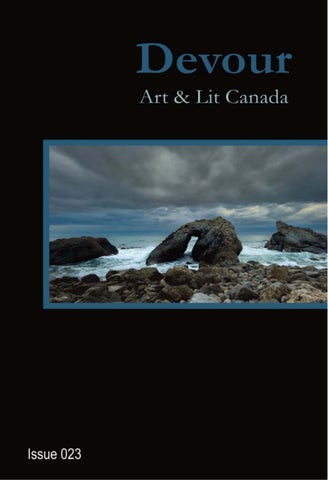
Devour: Art & Lit Canada is dedicated to the Canadian voice.
www.WetInkBooks.com ISBN – 978-1-998324-36-1 ISSN – 2561-1321 Issue 023
Devour Art & Lit Canada
Find some of Canada’s finest authors, photographers and artists featured in every issue.
Stuart Campbell – Zipolite, Mexico
Issue 023 Devour: Art and Lit Canada
4
The mission of Devour: Art and Lit Canada is to promote Canadian culture by bringing world-wide readers some of the best Canadian literature, art and photography.
Devour: Art and Lit Canada ISSN – 2561-1321 ISBN – 978-1-998324-36-1 Softcover – 6 X 9 Issue 023 5 Greystone Walk Drive, Unit 408 Toronto, Ontario, Canada, M1K 5J5 DevourArtAndLitCanada@gmail.com
Poetry Editor – Bruce Kauffman Review Editor – Shane Joseph Prose Curator – Brian Moore Photography Curator – Mike Gaudaur Editor-in-Chief – Richard M. Grove Layout and Design – Richard M. Grove
Dear Readers: Welcome to this 23nd issue of Devour: Art & Lit Canada. As usual we are bringing you some of Canada’s most talented writers, poets and photographers. As always, thank you to our ongoing faithful section editors. In no special order, thanks to Brian Moore, Bruce Kauffman, Shane Joseph and Mike Gaudaur. Thankyou to all of the contributors that make Devour a success. We hope you will let not only your Canadian but also your international readers, family, and friends know about this all-Canadian magazine. See you between the pages. Richard M. Grove otherwise known to friends as Tai.
Stuart Campbell – Isla Holbox, Mexico
Issue 023 Devour: Art and Lit Canada
6
Devour Art& Lit Canada
Content F eatur es: – Canada Coast to Coast to Coast – front and back cover Photography Curator – Mike Gaudaur – p. 8 – 15
– Feature Photographer – Stuart Campbell – Photographs on pages – 4, 6, 16 – 24
– Canada in Review –
Editor – Shane Joseph – p. 26 – 43
– Do you have TDS? – Shane Joseph – p. 38 – Poetry Canada – Editor – Bruce Kauffman – p. 44 – 95 – Canada in Prose – Prose Curator – Brian Moore T h e Re c e i p t by Jessica Wei – p. 96 – 102
– CanLit Essays on CanLit Authors and Artists – Lament for a Literature by Richard Stursberg – p. 103 – Elsewise by Allan Briesmaster – p. 109 – Art by Holly Briesmaster – p. 116 – Cannibal Rats by Richard Greene – p. 122 – Art by John Di Leonardo – p. 129
Canada Coast to Coast to Coast Photography Curator
Mike Gaudaur After more than four decades of making images that show what something looks like, I am gradually shifting towards making images that show more of what things feel like. I find that the images I capture are more graphic and minimalist. However, I think it is my processing of images that is changing even more. I am less concerned about ensuring that every little detail is clear and sharp, and more concerned about enhancing a mood and
Issue 023 Devour: Art and Lit Canada
8
guiding viewers to see just what it was that caught my eye with nothing to distract them. With this collection of images I have been experimenting with colour grading that shifts tones to enhance mood. Mike has spent the past 12 years teaching photography during school terms and photographing on safari during the term breaks. Online training and countless late nights of experimenting resulted in Mike developing a full complement of digital skills. After returning to Canada he was able to formalize his training and become an Adobe Certified Expert in Photoshop. Mike is a never ending learner, experimenter, explorer. His learning didn't stop with Photoshop. He naturally grew into working with Lightroom, On 1 Perfect Photo Suite, and the Nik Software collection. His advanced skills in the digital technology have allowed him to push his photographic style even further.
You can find Mike at: https://www.mikegaudaurphotography.com/ or contact him by email at, mike.gaudaur@gmail.com
Issue 023 Devour: Art and Lit Canada
9
Mike Gaudaur
Issue 023 Devour: Art and Lit Canada
10
Mike Gaudaur
Issue 023 Devour: Art and Lit Canada
11
Mike Gaudaur
Issue 023 Devour: Art and Lit Canada
12
Mike Gaudaur
Issue 023 Devour: Art and Lit Canada
13
Mike Gaudaur
Issue 023 Devour: Art and Lit Canada
14
Mike Gaudaur
Issue 023 Devour: Art and Lit Canada
15
Feature Photographer Stuart Campbell Born and raised in Prince Edward County, Stuart Campbell spent his working years in Toronto after graduating from the University of Guelph. After returning to the County with his wife, Debora, he accepted a role as a lead project manager working on natural history museum projects around the world. This experience that gave him a deep appreciation for paleontology while working with some of the most significant fossils ever discovered. Photography has always held a special place in Stuart’s life. His travels have allowed him to capture distinctive perspectives and memorable moments, further developing his talent and deepening his passion for visual storytelling. Alongside Debora, Stuart seeks out destinations less frequented by tourists, favouring the road less travelled and the stories found beyond familiar routes. Their journeys have taken them through Northern Iran, Yemen, Ethiopia, Zimbabwe, India, Central and South America, and many
Lo Manthang, Nepal
Issue 023 Devour: Art and Lit Canada
16
Gheralta, Ethiopia
other places, where they immerse themselves in unfamiliar cultures, landscapes, and ways of life. Stuart believes photographs represent much more than a captured moment; they can tell an entire story. Unlike some photographers, Stuart is not obsessive about always getting the picture. Some of the moments he did not photograph include being chased by a large crocodile while canoeing down the Zambezi River, being charged by a hippo, being “washing machined” while learning to surf in Nicaragua, cycling down the world’s most dangerous highway on Bolivia’s Yungas Road, and dirt biking through mine-laden areas of Northern Cambodia. A natural storyteller, Stuart shares experiences and narratives through his photographic work, creating images that invite viewers to look more closely and feel connected to the places and people he encounters. This publication marks the debut of Stuart’s photographic work in print, offering a platform to showcase his artistic vision and his dedication to capturing the wonder, character, and humanity of the world around him. Additional photos and stories can be found at:
www.stuartinpec.com or on Instagram @stuartinpec. Issue 023 Devour: Art and Lit Canada
17
Stuart Campbell – Hadibu, Socotra, Yemen
Issue 023 Devour: Art and Lit Canada
18
Stuart Campbell – Diksam plateau, Socotra, Yemen
Issue 023 Devour: Art and Lit Canada
19
Stuart Campbell
Issue 023 Devour: Art and Lit Canada
20
Stuart Campbell – Toria village, India
Stuart Campbell – Maheshwar, India
Issue 023 Devour: Art and Lit Canada
21
Stuart Campbell – Kali Gandecki Gorge, Nepal
Issue 023 Devour: Art and Lit Canada
22
Stuart Campbell – Laguardia, Spain
Issue 023 Devour: Art and Lit Canada
23
Stuart Campbell – Bateshwar, India
Stuart Campbell – Masule, Iran
Issue 023 Devour: Art and Lit Canada
24
Stuart Campbell – Agra, India at the Taj Mahal
Issue 023 Devour: Art and Lit Canada
25
Canada in Review Book Review Editor S ha n e J o se p h
Book Editor’s Note: Dear Readers, We feature five reviews of books by Canadian authors and a satirical essay in this section, to cover a wide swath of territory: geographic, psychological, political, and literary. In Lise Mayne’s novel, Time Enough, we journey in time and distance to the Isle of Man at the turn of the last century, a little island in the middle of the British Isles that belongs to no one but themselves. Lead mining imperils men’s lives, and the pressure is on to migrate to America, if only for cleaner air, a decision that threatens to split families apart. Author Elinor Florence, a card-carrying member of the Métis Nation, spins a tale in Saskatchewan in her page-turning novel, Finding Flora, in which a group of indigenous and settler women combine to defend their properties against expropriation by the authorities – a recommended slice of Canadian history with a feminist touch.
Issue 023 Devour: Art and Lit Canada
26
Former Chief Justice of Canada, Beverley McLachlin, now turned novelist in retirement, resurrects her defence lawyer protagonist, Jilly Truitt, for her third encounter against the criminal class in the new novel, Proof. The daughter of a pop star is kidnapped; pedophilia is suspected, and a negative media buzz isn’t helping the case. McLachlin brings her experience in the Supreme Court to not only reveal whodunit but also expose the challenges and flaws in our justice system. We have poetry for all seasons and all ages from one of Northumberland County’s veteran poets and ardent supporters of the arts, Felicity Sidnell Reid. In her third collection of poetry, Where Sun Meets Shadow, Felicity explores time, the world around us, the arts and artists, and finds beauty in everyday moments like a morning walk. For short literature, we have a review of Brian E. Moore’s story collection, What Happened to Us, which even acclaimed writer Nino Ricci believes is “beautiful stories, heartbreaking and hopeful, of people finding their way past the impossible.” Finally an e-mail to the publisher and an essay from me, expressing my concern with a phenomenon that is distracting us from creative work – no, it’s not AI, it’s TDS. I’m grateful for his agreement to include it in this issue. We hope the reviews inspire you to read these books, and that the essay on TDS provides food for thought. Happy reading! Shane Joseph Book Reviews Editor
Issue 023 Devour: Art and Lit Canada
27
Title: Finding Flora Author: Elinor Florence Publisher: Simon & Schuster ISBN: 9781668058916 Number of Pages: 384 Published Year: 2025 Reviewed by: Gail M. Murray The Review Florence’s background growing up Metis on a Saskatchewan farm is evident in her ethereal descriptions of the beauty of the prairies, e.g. “The wheat rustled in the breeze, their heads bending toward each other like a great multitude of fairies whispering secrets. (p189) This novel is inspired by her Scottish homesteading family, indigenous ancestors (Cree), and the unfair Dominion Lands Act of 1872, which denied single women the right to claim free homestead land, with widows as the exception. Auburn-haired Scottish Flora Craigie longs for a home of her own, so she hastily weds manipulative land agent, Hector Mackle. Later, risking death and bodily harm, Flora jumps from a moving train to escape his abuse. Tended by nurse Grace Godwin, our heroine purchases her scrip, given to Godwin for her service in the Boer War. Set in 1905 – 1908, the story follows settlers moving west in search of free land. They had three years to build a home, plough and plant crops to keep their land. Flora soon forms a bond with her nearest neighbours, also women! Across the creek is Welsh widow, Margaret (Peggy) Penrose and her three children, then there are Roberta Edgar and Henrietta Greenwood, former teachers from the USA, who are affectionately referred to as “the Chicken Ladies” and remind me of the Baldwin sisters on The Waltons and finally, introverted and skilled horsewoman, Jessie McDonald, who is Metis. Florence’s great-grandmother was called Jessie McDonald. I found Jessie to be the most intriguing of the group, and allows the author to detail how the Metis of Red River were robbed of their land by the unscrupulous federal government. Percy Buckhorn, aka Sourdough, originally from Montana, Issue 023 Devour: Art and Lit Canada
28
provides humour and often swoops in at the nick of time to help Flora and Margaret. Then there’s the handsome and educated doctor, Samuel Farrady, a romantic interest who is unaware, as are the rest, that Flora is technically married. In this engaging read, we want these women to beat the daunting odds against them: isolation, blizzards, harsh winters, back-breaking physical work, local cynicism, a syphilitic husband out for revenge, and hostile, corrupt politicians. All of these elements increase the conflict, making this novel a page-turner. The author read over forty memoirs written by pioneers to glean the challenges of homesteading, hence the authenticity. Florence seamlessly weaves in actual historical figures (see extensive notes in the back, study questions, and detailed bibliography): Frank Oliver, Alice Westhead (representing the British class system), CPR Chairman William Van Horne, and suffragette Irene Parlby. A sweet romance slowly develops between Samuel and Flora. Their prairie picnic on the hills above the Red Deer River is pure fairy tale. When the government tries to expropriate their properties, these courageous ladies fight back with petitions, lawyers and the press led by our feisty heroine. It’s an enchanting story of resilience with a slice of Canadian history. Highly recommended.
Author Bio: Elinor Florence grew up on a prairie farm and had a long career in journalism, writing for newspapers and magazines including Reader’s Digest. She published her own newspaper before turning to fiction. She has Indigenous heritage, thanks to her Cree ancestors, and is a card-carrying member of the Métis Nation of B.C. Her website is at http://www.elinorflorence.com/
Reviewer Bio: Like Keats, Gail M. Murray seeks to capture the essence of the moment. Her writing is a response to her natural and emotional environment. Her poems have been published in Reflections and Reveries, Written Tenfold, Blank Spaces, Wordscape, Arborealis, and The Banister. Her creative non-fiction has appeared in The Globe and Mail, Trellis, Heartbeats, Renaissance, Devour, The Ontario Gardener, NOW Magazine, Blank Spaces, Stony Bridges, Ottawa Review of Books, Historical Novels Review, Pure Slush and Our Canada.
Issue 023 Devour: Art and Lit Canada
29
Title: Time Enough Author: Lise Mayne Publisher: Oprelle Publications ISBN: 9798989901555 Number of Pages: 507 Published Year: 2024 Reviewed by Josée Sigouin
The Review One of the leading reasons for reading fiction is to discover new places and experience other people’s fears and desires without incurring serious consequences ourselves. Time Enough, a historical novel by Lise Mayne, is set on the Isle of Man at the turn of the last century, when lead mines employed a large portion of the male population—including Euphemia’s husband, William—with dire consequences for their well-being. Nan and Grandad love Euphemia like a daughter, a feeling warmly returned by their son’s wife. Nan fills in the gaps left by the young woman’s upbringing in a Yorkshire orphanage and lightens her load as she cares for a growing family: four boys in a row, one daughter, and now infant Hugh. They all live in a cozy cottage with a red door that signifies safety and a modicum of comfort for all who dwell inside. However, William has become cantankerous. He suffers from worsening coughing fits, and the faeries, an inescapable presence on the Isle of Man, foretell his imminent death. Nan believes her son could cheat that fate if only he worked in the fresh air. Unfortunately, the land she and Grandad own is too small to support everyone living on it. The only viable alternative is to emigrate to America, where their younger son, Thomas, has acquired farmland and built a homestead. Euphemia hesitates to put the family through the upheaval of
Issue 023 Devour: Art and Lit Canada
30
emigration, worried it will prove fatal for William. And how will she manage without Nan’s help? Moreover, unless Thomas has changed, how will she fend off his relentless advances on her? Euphemia and William’s oldest son, Henry, assist Grandad with farm work and accompany Nan to the top of the moor to hear the faeries’ daily portents. Any thought of leaving his grandparents behind, should his parents and siblings sail for America, breaks his heart. His unscrupulous uncle Thomas’s presence at the other end of the journey cements his resolve to stay. These conflicts and many more propel the expansive narrative forward at an ever-increasing pace. Throughout Time Enough, Mayne’s prose sparkles like the Irish Sea viewed from the top of Cronk Howse Mooar. The wide variety of bird sounds, bucolic sights and fragrant breezes keep readers spellbound in a world created by a fertile imagination and backed by meticulous research.
Author Bio: Lise Mayne (aka LG Pomerleau) is a retired educator who writes historical fiction and poetry from her home in Nanton, Alberta. An associate of the League of Canadian Poets and the Canadian Authors’ Association, her poetry is published in ten international literary publications and honoured by five awards. Her fascination with Canadian history inspired two novels, Becoming Sand (2012) and Time Enough (2024).
Reviewer Bio: Josée Sigouin is French Canadian and lives in Toronto/Tkaronto with her Chinese Canadian husband and two sons. Her debut novel, Our Fifth Season…where murder derails love…, was published by Blue Denim Press in 2025. Josée enjoys cycling, gardening, and welcoming birds to her tiny garden.
Issue 023 Devour: Art and Lit Canada
31
Title: What Happened to Us ~ Stories of Second Chances Author: Brian E. Moore Publisher: Blue Denim Press ISBN: 9781998494316 Number of Pages: 208 Published Year: 2026 Reviewed by Janet Trull
The Review What did happen to us? The characters in Brian Moore’s new collection of short stories struggle to answer that question. Everything goes according to plan until the car crash, the divorce, the disappointing child, the career-ending mistake, the diagnosis. The stories meander along lonely highways of interior lives with people who strive to be understood, and to understand what went wrong. Moore proves himself to be a master of developing images to reflect the losses that accumulate over an average lifetime. There is the ’69 Dodge Charger with a four-forty Magnum V8 under the hood that sits in a garage, washed and polished but no longer roadworthy. Photographs of relatives tug at unreliable memories. A piano bears the weight of dreams unrealized. Objects in Moore’s stories absorb the deepest regrets and secret hopes of his characters. After a moment of emotional clarity, a man looks up to notice the boats in the harbour, “white and clean, full of the deep, true ache of unrequited promise, returning to their moorings for the night.”
Issue 023 Devour: Art and Lit Canada
32
Brian Moore’s stories introduce us to people who spend too much time grasping for the extraordinary while ignoring those in their lives who hold the ordinary together. Characters are sometimes slow to recognize the sweetness of a hug, a shared meal, a ride home. They are all here, our friends and neighbours: the firefighter, the single mother, the ex-cop, the dutiful daughter. They inhabit places we are all too familiar with, from country kitchens to dark-panelled basement rec rooms to hospital hallways. Nostalgia has a look and a smell in these settings that yank the reader back in time to the 1970’s. When you look up from the page, you will expect to see shag carpets and ashtrays. What Happened to Us is a rare collection of stories about home. A book of longing and belonging to remind us that the past is not shaped by famous and powerful people, but by those who show up to keep families and communities together. Here is a collection to celebrate the quiet lives of unremarkable people, the ones who help us to weather the worst storms, and share with us the joy of simple pleasures.
Author Bio: Brian Moore grew up near Owen Sound, Ontario and now lives in Toronto. His short fiction has appeared in Blank Spaces, Valparaiso Review, Event Magazine, and other journals. What Happened to Us is his first short story collection.
Reviewer Bio: Janet Trull writes about people you have known all your life in her short fiction collections: Hot Town and Other Stories (At Bay Press, 2016) and Something’s Burning (CBC Recommended Read, Fall 2022). Blue Denim Press published her historical railway novel, End of the Line (2023) and Canadian Saint (2026) which examines the long shadow of a shared childhood.
Issue 023 Devour: Art and Lit Canada
33
Title: Where Sun Meets Shadow Author: Felicity Sidnell Reid Publisher: Aeolus House ISBN: 9781987872798 Number of Pages: 100 Published Year: 2026 Reviewed by: Ronald Mackay
The Review Reading each beautiful and incisive poem in Where Sun Meets Shadow sharpens my mind to details I’ve joyously but unconsciously shared in our common world. Repeated readings expand my awareness and enjoyment of experiences I have overlooked. To appreciate poetry, context helps. Felicity Sidnell Reid provides this in subtle ways. She groups her poems into: (i) Celebrations of the Ordinary; (ii) Art to Artists, Artists to Art: Conversations; (iii) Connections; (iv) The World Around Us; and (v) Past and Present. In addition, she offers a generous biographical statement and Notes on 12 of the 53 poems. In choosing a revealing quote from Seamus Heaney as an epigraph, she offers intuition as to her purpose: ‘I’ve always associated the moment of writing with a moment of life, of joy, of unexpected reward.’ So primed, I found in this collection, well-worded rewards and crisp insights gleaned from her poet’s sensibility and close observations drawn from life experience and honest, gentle reflection. In Morning Walk (section entitled Celebrations of the Ordinary), I enjoyed her skillful diction: Mist is solid in this daybreak / A white wall closes the road / Keeping a sea of secrets / Muffling sounds, absorbing scents. The group Art to Artists. Artists to Art: Conversations reminded me of Keats to the point that I sought the original work of art that inspired each of these 13 poems. Issue 023 Devour: Art and Lit Canada
34
Her third grouping, Connections, is richly imbued with history, associations, kinship, and reciprocity. Waiting for your call awakened me to how our lives are made up of fragments, surprises, and irrelevancies. Yet how rewarding, even imperative, it may be to settle for less to gain more. I smiled at Friends or Fiends. It distils the puzzlement and suspicion presented by ubiquitous social media. In The World Around Us, Felicity delights in day and night, the countryside, rain and sun— the entire natural world with all its delights, disappointments and inevitabilities. I found The Deposed King particularly moving. It captures how time inescapably, cruelly, and permanently takes its toll on all of life, ours included. The Forest Path is an intellectually subtle poem that coaxes us into surprise at how our present life can unexpectedly merge with the stylized symbolism of a medieval tapestry. Past and Present offers insights into the place where the now and the then meet, where we begin to see life, even our own, in bald perspective. They helped me see mine in truer proportion and how, though decades, I have related I to thou closely and in friendship. This perspective comes only with maturity, where the sun truly meets the inescapably approaching shadow. It is a perspective accompanied by more than a shade of healthy, consolatory nostalgia. Re-readings of Where Sun Meets Shadow, rewarded with that which I recognize as connecting my own, personal experience to the broader universal and transcendental insights Felicity Sidnell Reid captures so subtly and succinctly.
Author Bio: Felicity Sidnell Reid is the initiator, co-producer and co-host of Word on the Hills, a literary series on 89.7 FM, now in its thirteenth year. Her third collection of poetry Where Sun Meets Shadow was published by Aeolus House in March 2026. Her short work can be found in anthologies and online.
Reviewer Bio: Author of Fortunate Isle, a Memoir of Tenerife, The Kilt Behind the Curtain, and Windows On My Worlds, Ronald Mackay writes short stories and memoirs. He has been a member of Spirit of the Hills Writers Group since 2012. He and his wife now live in the Netherlands.
Issue 023 Devour: Art and Lit Canada
35
Title: Proof Author: Beverley McLachlin Publisher: Simon & Schuster ISBN: 9781668003619 Number of Pages: 480 Published Year: 2024 Reviewed by: Gail M. Murray
The Review Author Beverly McLachlin, former Chief Justice of the Supreme Court of Canada from 2000 – 20017 and the first woman to hold that position, continues to fight for justice in her latest novel, Proof. Jilly Truitt was a rising young attorney in McLachlin’s bold debut novel, Full Disclosure (2018), and a top criminal defence lawyer embroiled in a high-stakes murder trial in Denial (2021). In Proof, we find Jilly is a widow and new mother emerging from maternity leave on the insistence of crown prosecutor Cy Kenge – her one-time mentor. McLachlin’s memoir, Truth Be Told, winner of the prestigious Writers’ Trust Shaughnessy Cohen Prize for political writing, chronicles her own life as a lawyer and chief justice. They say write what you know. In this gripping legal thriller, Tess, the biracial daughter of pop star Trist Jones, is missing. Was she kidnapped as Trist slept in his deck chair while vacationing at Bowen Island, B.C.? There’s no ransom. There’s a wrecked boat, a shoe, a swimsuit, and eye witness, Dante Bocci’s hazy photo of a dark-haired woman with a child on a boat. The prosecutor’s case is all circumstantial evidence against her adoptive mother, Kate, Trist’s ex-wife, now charged with kidnapping and murder. There’s no body. Jilly experiences
Issue 023 Devour: Art and Lit Canada
36
empathy for the emotional Kate, as the theme of motherhood runs throughout the story. Kate’s instability and reputation after the divorce and custody battle are in question, leading the reader to ask how fair is a trial surrounded by negative media buzz? The best chance Jilly, our defence lawyer, has is to find the missing child. As time passes, the police lessen the search, presuming the child is no longer alive. This character-driven novel with fluid prose and urgency to find the child or the real kidnapper is a page-turner. “One woman in the boat, three candidates” (p168). They are: Las Vegas showgirl Lena, Trist’s girlfriend; Selma, the devoted nanny; and Kate, the anxious mother. Add in Dante Bocci’s portrait of Tess and his preference for child porn. Has Tess been abducted by a pedophile? Gruesome or a red herring? Jilly and her investigator, Richard, pull out all the stops. All of chapter 62 is their extensive preparations and courtroom strategy. McLachlin’s expertise is evident in the way she points out the challenges and flaws in the justice system. The final courtroom chapters tie up loose ends and reveal the guilty perpetrator.
Author Bio: Beverley McLachlin is the former Chief Justice of Canada, the first woman to hold that position. Full Disclosure is her first novel.
Reviewer Bio: Like Keats, Gail M. Murray seeks to capture the essence of the moment. Her writing is a response to her natural and emotional environment. Her poems have been published in Reflections and Reveries, Written Tenfold, Blank Spaces, Wordscape, Arborealis, and The Banister. Her creative non-fiction has appeared in The Globe and Mail, Trellis, Heartbeats, Renaissance, Devour, The Ontario Gardener, NOW Magazine, Blank Spaces, Stony Bridges, Ottawa Review of Books, Historical Novels Review, Pure Slush and Our Canada.
Issue 023 Devour: Art and Lit Canada
37
D o Yo u H a v e T D S ? Hi Tai, I am attaching a satirical piece on a phenomenon of our times TDS (Trump Derangement Syndrome). I sent it to my regular Canadian rag, to which I’ve contributed monthly articles for over a dozen years, and it was rejected. The editor even rubbed salt into the wound by attaching a picture of Trump laughing and saying, “I make stupid people angry.” I think this topic, despite its political overtones, has implications for Canadian literature, because I’m finding readers’ preoccupation with TDS has sucked out their time and patience for other forms of reading. For example, my anti-MAGA memes on Facebook get between 6K and 10K views, sometimes higher, while anything I post on CanLit, or any Lit, garners only 500-2K views, tops. Many of our mutual friends in Canadian literature take time away from their poetic musings to write lengthy, supportive comments on my TDS memes. It seems to have become our patriotic Canadian duty, nowadays, to “resist the invasion,” while fifth columnists stoke fires of division. Writers’ work is also impacted. This year, for the first time in 16 years, I rejected all submissions received by my press because they were substandard. I went back to my previously published authors for new publishable content. As a magazine of Canadian Art and Lit, I figured Devour could not stick its head in the sand and pretend that everything was hunky dory in the world; I think Canadians, in fact, the whole world, should be aware of this “new pandemic” that has overrun us, irrespective of political affiliation. TDS is fed on the growing dissatisfaction with our human condition and the feeling of powerlessness to rectify it. I hope you will publish this as a cautionary tale. I resorted to satire to make the message digestible. Regards! Shane
Issue 023 Devour: Art and Lit Canada
38
I have TDS , and so have you. b y S h a n e Jo s e p h I have a case of the latest disease that has now reached pandemic proportions – Trump Derangement Syndrome (TDS). Everyone has it – including us in the CanLit world – so I am not alone. It has sucked the air from fragile attention spans, rendering other forms of entertainment unappealing, transforming us to resemble alcoholics losing their appetite for nutritious food and fixating on the bottle. The typical AA recovery statement could be revised to, “Hi all, I have TDS, and I’m learning to take it one day at a time.” What is this disease, and what are its symptoms? Let me see if I can itemize them: — Distrust of news media while we consume it by the bucketload. The more fake, the better, and the more entertaining. — Distrust of big business, although many of us still rely on a paycheque from a large corporation or invest in retirement funds holding their stock. — Distrust of government, though we continue to elect them. Politeness died in the last century. Dinner table conversations and family get-togethers end up as barroom brawls if politics is on the menu. — A distaste and impatience with reading fiction – it’s like food without salt. Real-life is more interesting. Besides, we are too keyed up to relax into fiction. — As long as the bad things are “happening over there,” life is good. Bombs must not drop in our own backyard. Bad news helps us NIMBYs whip out our smartphones every 10 minutes to see what’s going on and comment.
Issue 023 Devour: Art and Lit Canada
39
— Focusing on the 24/7 White House Reality Show. It has helped people forget their own concerns and neglect their daily duties. We don’t know what we will do after this President exits the stage (some of us don’t want him to, because we would be lost without him and will need a nervous breakdown to fill the void). — Letting fly on social media, and wanting to be RIGHT, even when we are WRONG. Some of us never thought we could be so bold or so rude in public. But the socials (short for social media channels), those cesspits of rage, give us anonymity, because we can hide behind AI-constructed identities and let our meaner selves out. — As the affordability of living becomes more precarious – inflation, supply chain dislocations, tariffs, stranded oil supplies, et al – BLAME becomes a crutch. We focus all our frustration on the POTUS (if we are on the left or centre), or on predecessor Sleepy Joe or our incumbent Canadian Liberal Party (if we are right-wingers), and this letting off of steam alleviates stress. TDS provides a focus for BLAME. — Becoming an armchair critic, whereby we diagnose everything wrong in the world with absolute certainty, but are disempowered from implementing actual remedies, or don’t care to, because we still embrace the remnants of First-World privilege, nostalgia, and complaisance. And we have lost confidence in the democratic Vote to change anything. — Unconsciously rendering more importance to our object of ridicule (or obeisance) by piling memes into the public square and granting him free RETENTION in our mental maps, a feature that advertisers otherwise pay billions of dollars to acquire. So, if you display some, or all, of these symptoms, I have news for you – you have TDS.
Issue 023 Devour: Art and Lit Canada
40
How did we get here? Somewhere along the way, when things were humming along swimmingly in the early part of this century, we felt we were getting shafted and wanted more of the pie. The 2008 financial crisis was an early warning. It was those guys, running the show in Big Business and Big Government, who were responsible, we thought. We forgot it was our greed that caused the bubble economy to implode. Things came to a head during the pandemic when we were forced into hibernation and mandated to adopt unfamiliar hygiene practices – like taking vaccines (though many of us bore childhood vaccine scars on our persons), and wearing masks. How dare they tell us what to put into our bodies, although we blindly eat processed food injected with chemicals that produce profits and not health? When consumer prices kept going up, even after supply chains stabilized, we got angrier. And when we were asked to return to work at the office after discovering that goofing around “working at home” in our pyjamas was so much better, we reached the limit of our tolerance and went looking for another saviour. Along came King Trump II, promising to make things great again, even for us Canadians, and we rushed to believe him. Anyone but that old dodder, Biden, and that woke guy with the fancy socks, Trudeau, we thought. But #47 didn’t get the job done; at least, he hasn’t yet. The global economy was more complex than this transactional realtor could imagine. He kicked off his second (or third?) reign in bullish mode, gutting the US government, insulting allies, and raising already inflated prices with tariff wars. He graduated to snap invasions (Venezuela) and full-on wars (Iran), while he supposedly ended a bunch of other wars that we never knew existed. But the prices still kept rising. Now his popularity is in the 30s. Changing the genre of his Truth Social posts from trolling comedy to threatening farce isn’t helping, nor are the propitiously occurring assassination attempts or the forays into gold and red cards. This dial ain’t moving up, buddy! But no one
Issue 023 Devour: Art and Lit Canada
41
knows how to undo the mess, or undo Trump. Other than for a Second Coming (btw, #47 played the Jesus card too, with disastrous blowback), there is no one else to save us. No wonder TDS is broadcasting on a higher and broader band frequency now. So how do we cure TDS? It would be nice to have a quick-fix pill called Trumpenol (now that Tylenol is “outlawed”). I decided to ask my AI assistant, because I didn’t know where to start and I can’t afford a shrink who would probably ask AI anyway. Here’s what AI suggested:
— Media Diet: Reducing exposure to news coverage to decrease anxiety and emotional reactivity. — Cognitive Reappraisal: Focusing on separating internal anxieties from external realities. — Psychological Distancing: Actively managing emotions rather than magnifying them as a way to “cure” the affliction. — “Existential Digging”: An approach aimed at interpreting one’s own emotional reactions to find personal growth. — Focus on Local Community: Engaging in community work to build personal, local connections and decrease national-level political angst. I’m not sure I can implement #1 because I need to consume news as a writer; #2 and #3 will need that expensive shrink again – so scratch them too – instead, I’ll take long walks and deep breaths, and refrain from engaging in unwinnable arguments on social media. But I like the “Existential Digging,” which is what I do in writing fiction – so the next manuscript is cued up for creation, whether anyone reads my output or not in this TDS era. And Local Community makes a lot of sense – my involvement with local arts groups is a welcome relief. And I will continue to stand up to injustice with a weapon more powerful than drones, F35s, or boots on the ground – i.e., WORDS – and I
Issue 023 Devour: Art and Lit Canada
42
encourage all serious Canadian writers to do the same. And if that consigns me back to chronic TDS, so be it. So, there you are, I am a TDS sufferer, and whether I will be cured during the reign of Trump II is questionable. I thought it was my duty to share these findings with fellow Canadians, given that we sleep closest to the elephant. If you are reading this, and unless you have practiced the five remedies above provided by my friendly robot, or you have been living on a desert island, don’t kid yourself, you are infected too. Don’t feel alone though; even the Pope has TDS.
Shane Joseph is a Sri Lankan-born, Canadian novelist, blogger, reviewer, short story writer and publisher. He is the author of nine novels and three collections of short stories. His latest novel, When Sirens Beckon, will be released in October 2026. For details, visit his website at: www.shanejoseph.com
Issue 023 Devour: Art and Lit Canada
43
Poetry Canada Poetry Editor: Bruce Kauffman Photo Editor: Richard M. Grove
Bruce Kauffman “Poetry Canada” Editor
Bruce Kauffman lives in Kingston, Ontario and is a poet, editor, intuitive workshop facilitator, and promoter. His written work has appeared in journals, anthologies, two chapbooks, and six collections of poetry. His latest, ever-crossings, launched in the spring of 2026. He continues to host a monthly open mic reading series called ‘and the journey continues' that began in 2009. And, since 2010, still produces and hosts the weekly radio show called ‘finding a voice’ on CFRC 101.9fm. Bruce, in 2015, began the annual summer outdoor poetry series, Poets @ Artfest, in conjunction with Artfest Kingston, and has organized and hosted it each summer since.
Issue 023 Devour: Art and Lit Canada
44
timeless standing there not looking directly into either’s eyes but at just the right angle for a minute or two dusk
dawn look exactly the same
though their intentions are not
Issue 023 Devour: Art and Lit Canada
45
how to wait for time or how to time travel how to wait for time to arrive make sure you have a valid ticket or pass make sure you are at the right track the right station the right stop and make sure to quickly board when that almost invisible train arrives pausing for barely a millisecond to let you on board
Issue 023 Devour: Art and Lit Canada
46
and fair warning to you if you miss it you’ll have to wait seven and a half lifetimes to try to board it again
Issue 023 Devour: Art and Lit Canada
47
untitled i. they often say comes a time maybe because so very often comes a time we are here temporary creatures we do not remember another time before but still we don’t deny its possibility that time before like a day before no different yesterday we can no longer personally be but we can feel sense its scents its breath even today real as it was and is
Issue 023 Devour: Art and Lit Canada
48
ii. and tomorrow no different there in its portal its slingshot cosmic mirror
Issue 023 Devour: Art and Lit Canada
49
Margaret Liddon Thousand Island Boat Tour
Issue 023 Devour: Art and Lit Canada
50
A. F. Moritz albert.moritz@utoronto.ca Toronto, Ontario
Emma Goldman Arriving You will recall Emma, late November when you stepped down from the train into Toronto. Set in that winter, flowers of faces, warm hearted and eager, opened to your eyes and the bundle, like a new child, of the pink roses of your lover was laid in your arms. 1926. But maybe times mean nothing now in the streams of freedom, pure time, where your spirit plays, all-attaining. The pure streams of time where you encounter no police or prison of any state or all states, no guarded boundary, no absurdity of the body and indifference of the many, but your spirit accomplishes its world, its word.
Issue 023 Devour: Art and Lit Canada
51
Ana Johnson apj.ajohnson@gmail.com Kingston, Ontario
Knight The pawn, sprawled on the lawn, feels like she belongs to another’s game, waiting for the king to conquer her, so that they may reign his kingdom together. Does she not see she’s the queen of her own temple? Does she dare move onto whichever 64-checkered spot she wishes without fear of retribution for having overstepped his rules? Here, only her jewels rule. Here, she can triumph. More powerful than the mere tower of his heart. Here, she can place him behind a glass as an ethereal piece so that he merely becomes a spectator, where she decides, has power over when he will appear, speak, see the whites of her eyes and the whites of her incisors. Or is she kidding herself, also being played in the game of games? Can she hold onto her winged self, one day castle, another moat? Is she not the moat and castle as one, perched over the tower of her own dreams? Now as queen, is he not simply the projection
Issue 023 Devour: Art and Lit Canada
52
from deep inside her myriad manifestations of all the pawns she has consumed and subsumed? How will she view his frolics of dusk banish as simple apparitions? Such virtuous skips and coils. Oh no, she’ll not be devoid of splendours in the absence of him. Rooks, rooks. Her skin carries no kinsman. Only frigid wrinkles of a bishop adorning himself in black beads. Suddenly, her grin tumbles into the meadow. How can she grapple with her being and non-being, her life, her check mate, her mate of hearth and death. A mirage mired in a chest of mirrors. Will she ever be able to carry all 32 pieces in her jeans dress pocket and play at will, in the park, on Mars, on Saturn and on the mercurial tip of a pin
Issue 023 Devour: Art and Lit Canada
53
Christiane Mc Farlane - Halifax , Nova Scotia
Issue 023 Devour: Art and Lit Canada
54
Bette Caperon Arrowhead Provincial Park, Ontario
Bette Caperon Palgrave Forest, Ontario
Issue 023 Devour: Art and Lit Canada
55
Bruce Cudmore cudmorebk@gmail.com Rockport, Ontario
Fields of Barley Peace drops like grain from chaff in this breeze of unexpected quiet after doing the dinner dishes, one child in the bath, the fireplace banked, the dog at my feet. The glass of beer in my hand occasions the urge to write about fields of barley. Instead, I should just listen to “Fields of Gold” (the arc of that song is about all the time I have).
Issue 015
Devour: Art and Lit Canada
56
Telepathically, I tell the dog to stay and wait for me to get a pen and notebook, his fur a hill of ripened grain. I think he’ll be in this poem. But, as the pen’s stalk quivers over its field responsibilities come calling and the breeze fades. I swirl then swig the last ounce of beer as a harvest, and trust that somewhere fields of barley grow in a poem.
Issue 023 Devour: Art and Lit Canada
57
Dinh Le Doan dledoan67@gmail.com Beaconsfield, Québec
Fog on the Danube After a night at rest near Passau, the cruise ship awakens. Its engine rumbles and is ready to roar. But thick fog rises up from the river, squats down on the top deck and handrails of the ship, and wanders far from shore. Further inland fog devours succulent grazing pastures and tasty farmhouses in its wide open mouth of white vapour. The river’s lock upstream is awake and waiting.
Issue 023 Devour: Art and Lit Canada
58
The ship’s next destination calls. But shifting sandbars lurk like wayward whales in the shallow water ahead. The ship body’s itching to move. But would its thoughtful soul—the captain—risks hitching a ride to the ship purgatory in the thick fog on the back of a whale?
Issue 023 Devour: Art and Lit Canada
59
Mary McArthur Oak Bay, Victoria - BC
Issue 023 Devour: Art and Lit Canada
60
Mary McArthur Oak Bay, Victoria - BC
Issue 023 Devour: Art and Lit Canada
61
D. V. E. McBride dayle.mcbride@sympatico.ca Amherstview, Ontario
Daybreak March declares an early spring. A pair of starlings discover several cakes of suet at a backyard feeder; Softened by the sun, savory beef fat bursts with plump raisins, peanut butter, cranberries and seeds. The cakes soon disappear when more rapacious starlings arrive. A peregrine falcon soars overhead, attracted by the starling activity below. Response is immediate. A murmuration forms a dark undulating wave, hitting the overhead winds across a yellow-pink sky.
Issue 015
Devour: Art and Lit Canada
62
Mary McArthur Oak Bay, Victoria – BC
Issue 023 Devour: Art and Lit Canada
63
Yanlan Yu Elaine.yu@lifetech.com Toronto, Ontario
Mandarin ducks April is the cruellest. Not only the wind has freedom “Plop” “Plop” A male and a female mandarin duck break through the tense afternoon Their wings spread and down A tremor in the air gives a glance A contempt that the proud human being cannot grasp Then comes complete stillness Their bodies are surrounded by a silk-like secret realm With only the sound of water shivering gently in time
Issue 023 Devour: Art and Lit Canada
64
Gail Higenell gayleyh@gmail.com Thorold, ON
Dear Untouchable you were the first important thing I was told not to touch— long before Birmingham’s brick-grey folding fog or Toronto’s windowpanes furred with frost taught me other kinds of distance. Plain as porridge, the colour of a rule rather than an object, yet perched there with the poise of a small bird deciding whether to rise or remain. Why did you matter so much? I learned not to ask. Only to circle, my footsteps light, as if testing the air around you the way a fledgling tests the space around its wings. One touch— would it break you, or undo me for wanting what I wasn’t meant to want? So, I stepped back. The rule held me still— a kind of cage I learned without noticing the door.
Issue 023 Devour: Art and Lit Canada
65
Honey Novick creativevocalizationstudio@hotmail.com Toronto, Ontario
Etienne Brule Park (on the bank of the Humber River, Toronto) stepping out of the car placing feet on the ground I stand and observe blue skies, river calmly flowing hawks, orioles, robins, geese, cormorants, ducks all welcome my presence like the park’s namesake, Etienne Brûlé, I, too, become a pathfinder not one of land adventures but of the offerings only nature can provide solace, imagination, comfort, recognition of others while accepting, here, too, is fraught with danger speeding bicycles, dogs yet, as I open myself to receiving a poem or a thought or a song or an idea, a feeling, I am resigned to becoming happy
Issue 023 Devour: Art and Lit Canada
66
once in the 16th century, a young man left France with Samuel de Champlain – they claim to have founded new France, even though it existed as home for Indigenous people. Brule learned the language, then interpreted for the newcomers. I, too, come here, to his namesake and feel that he is interpreting for me. Not French nor an Indigenous language but the language of the spirit communing with the birds, the burdock, dandelions we all speak the language of living we all live with one another we can choose to be a free spirit we can choose to acknowledge the splendor of the water flowing to the lake the magnificent wing-span of the soaring hawk the graceful neck of the cormorant this is the path of the spirit this is the pathfinder’s mission
Issue 023 Devour: Art and Lit Canada
67
Meg Freer – Kingston, ON
Issue 023 Devour: Art and Lit Canada
68
Meg Freer Stacked, Kingston, ON
Issue 023 Devour: Art and Lit Canada
69
Isla Horvath ilhorvath@hotmail.com Cambridge, Ontario
My Aging Parent She’s old. And she’s sick. We’re back in this busy, noisy ER. I hover, my eyes searching her face as hers search mine. Each of us seeking reassurance. We wait, as we have many times, For nurses, doctors, answers. I sit in my straight-backed chair, Watching her tiny, curled, frail body. I listen to her whimpering, moaning, Asking me, “What’s wrong with me?” She’s scared, she’s sick. But she’s not alone. I am here. I watch her dozing fitfully, Furrowed brow, wrinkled face, Until she awakens suddenly, Fists grasping sheets, Eyes wide and wild, searching for me. I place my hand over hers, Unclenching tight fingers, Smoothing, soothing, Whispering, “I’m here.”
Issue 023 Devour: Art and Lit Canada
70
And this is how we spend another night. She, sick, frightened, tired of it all. Me, frustrated, helpless. And I too am frightened. So I hold her hand and wait. Wondering. Will this be the time I leave without her? Hours spent in uncomfortable limbo. Finally, tests okay. Diagnosis: aging. Days later, I take her home, Both of us exhausted, but relieved. Until the next time.
Issue 023 Devour: Art and Lit Canada
71
John B. Lee johnb.leejbl@gmail.com Port Dover, Ontario
How Does the Darkness Find its Mate think of the coupling shadows of two shade trees standing together in the sun and the wind of a summer’s day each one seeking to cool the green soul of the grass and the ground once bejeweled by morning dew now dry in the veil of the elm and the gauze of the oak somewhere deep in the ocean something is swimming below the light in the ultra-black regions of ovum and milt two lovers are greeting in the tailing away of an unseen and unseeable wake
Issue 023 Devour: Art and Lit Canada
72
with the blind consciousness of unborn life like the dimming to nothing of a waker’s dream as though lost in a cave with a lonesome companion the midnight horizon and the star eater’s dawn
Issue 023 Devour: Art and Lit Canada
73
Anna Di Nardo Saint Lawrence Estuary, Kamuraska
Issue 023 Devour: Art and Lit Canada
74
Anna Di Nardo Saint Lawrence Estuary, Kamuraska
Issue 023 Devour: Art and Lit Canada
75
Katerina Vaughan Fretwell kfretwell@cogeco.ca St. Catharines, Ontario
Balancing on Bosu World Feet riding side by side on the ball's flat top I harness my eyes, visualize finessing freestyle at former family cottage sporting just an ice box fetching water from the lake unlike today's monster mansion, matching boathouse priced beyond sight. I'm straddling half the globe beneath my teetering feet, conjuring younger days: jogging along St. Petersburg's Neva climbing the Great Wall in Badaling picnicking atop Mount Grindelwald – closed eyes guide me no contrail carbon footprint like those past ventures.
Issue 023 Devour: Art and Lit Canada
76
My elderly body bends right height and stance to calibrate ankles and feet slightly swaying four ways spinning ball's tipsy bottom like a top, trainer standing by to catch me if I topple – no fatal falls. Shutting out machines and gym rats I feel strangely safe – imagining is brighter with lids closed to bouncing screen pixels. I'm cruising Atlantic or Great Lakes slaloming at Sunapee Grey Goose – recalling tale of lovelorn maidens transported into the seven Pleiades alive in mists and myths dreaming endless flight before my body bows to eternal night.
Issue 023 Devour: Art and Lit Canada
77
K.V. Skene kv.skene@gmail.com Toronto, Ontario
Dusk and the nightwinds turn stare you in the face as soon as the first stars appear – time stretches, insomniac hours multiply behind bolted doors, blind windows blackout all the little hopes we have left lost in lockdown – our small home shivers with electric sockets light beams We can hear the silence inside/outside, feel the shift, the finality in our multitude reimaginings grimly holding on to whatever it was we once thought important.
Issue 023 Devour: Art and Lit Canada
78
Bette Caperon Christie Lake, Ontario
Issue 023 Devour: Art and Lit Canada
79
Kathy Robertson kathyrobertson0234@gmail.com Kitchener, Ontario
Musings Drivers honk their impatience as I swerve to miss your tattered form that trudges across the intersection with desperate steps— methodical, purposeful— while you drag a cart of worldly possessions oblivious to the rush hour traffic. My rear-view mirror reveals a determined gaze— survival decrees one-step-after-another— as I ponder the chance of divergent lives treading paths that converge for a brief moment in time. For who’s to say that in another life, I was the one pushing the cart while you watched in your rear-view mirror.
Issue 023 Devour: Art and Lit Canada
80
Keith Inman inman@vaxxine.com Thorold, Ontario
Firmament Waking into an edge of night I’m an old man having to go, but stay in bed a while longer as the old woman, carrying her lantern up the hill, brings the light down onto the field beyond my window. It reminds me that images in the eye are inverse. And I can’t fall back asleep with that thought in my head. So I get up and walk across the ceiling to the bathroom and pee up into the toilet, wondering whether bubbles fall or float, until it dawns on me that it’s a work day. I have to drive down, or up, into the city’s galaxy of buildings floating in ethereal space.
Issue 023 Devour: Art and Lit Canada
81
Mary McArthur Oak Bay, Victoria – BC
Issue 023 Devour: Art and Lit Canada
82
Mary McArthur Oak Bay, Victoria – BC
Issue 023 Devour: Art and Lit Canada
83
Malou Komornicka Mary.komornicka@gmail.com Kitchener, Ontario
Unbidden Memories The quick puff Appearing and dissipating A sprinkle of confusion and pleasure Embedding unfocused images The soft, gentle breeze Carrying a moment A silent, gentle fragrance Imitating a caress Gusts of energy Delivering long-neglected emotions A laugh, a shout Engulfing and soothing A whirlwind scattering all thoughts Having no direction, yet in every direction And then gone Leaving ruins The icy gale Cutting deeply and stealing any warmth All focus controlled Freezing all remains And the most dreaded Feared for its power Demanding and forcing Stillness
Issue 023 Devour: Art and Lit Canada
84
Mary Sander Ms.mary.sander@gmail.com Waterloo, Ontario
Skeletal Remains she brought me a love offering pink tulips—my favourite perfect tiny cups beautiful, fresh, vibrant, impermanent time steals away their essence drooping, fatigued petals yawning as if imploring the dim winter light one by one petals drop leaving only skeletal remains time takes too much once perfect, vibrant, life filled now drooping, fatigued no longer capturing sunlight acceding to pain, the surgeon’s knife as one by one the petals drop sunlight no longer sustains time steals life’s essence leaving only skeletal remains love offerings like winter’s light filled with hope encircle the heart, sing of joy embrace the lover with dreams of eternity resist the falling of petals attempt to negate time’s insistent march toward skeletal remains
Issue 023 Devour: Art and Lit Canada
85
Rebecca Clifford becca.clifford@gmail.com Caledonia, Ontario
Stella She bears cherries thirty-seven jewels carmine garnet vermeil amid her lush verdurous lapels enticing lavalieres a glistening welcome warm as summer sun brassy licentious mazzards set for tongue and seraglio Not yet, say I, the salivationist not Saturday I marinate my anticipation Sunday says, It is time I find Stella bare, the birds being on a different clock.
Issue 023 Devour: Art and Lit Canada
86
Robert Currie currie.robertdm@gmail.com Moose Jaw, Saskatchewan
Going For Chinese I phone in the order for pick-up: lemon chicken, sweet and sour pork, chicken fried rice. Be ready in half an hour. When I enter the Uptown Cafe, I spot a box on the counter, ask the waitress if that’s the order for Bob Currie, and it is. The waitress looks vaguely familiar, I must’ve seen her here before. Now she stares at me as if her mind is working overtime, as if she might have known me back in high school—or earlier. Her expression softens, and I know she’s got it figured out. “I remember your father,” she says, “from when I worked at Extendicare. Duncan,” she adds, the word floating in the air between us, the two syllables like notes from a favourite song. My eyes tear up. My dad’s been dead for thirty years, and yet I feel elated this woman remembers my dad after so much time and speaks his name with such affection.
Issue 023 Devour: Art and Lit Canada
87
Susan Smith essaysmith69@gmail.com St. Catharines, Ontario
Witness I drive alone across the flats. Wipers thrash. Two tipsy lanes roll out between brimming ditches. Stubble pokes through flooded fields. No signpost points toward a town yet this bygone road is mostly paved, patchwork of potholes plugged with shoveled tar. Only gap-tooth houses their slumping stoops stand for human habitation. Machinery rusts across the yards as if someone, called away, had left it running until the one or other of them died. I squint a figure through the blur — a scarecrow shivers on his post lures me toward the sodden shoulder. I lower the window and rainspray mists my face.
Issue 023 Devour: Art and Lit Canada
88
His rack of broomstick arms and meagre torso are swaddled in remains of a yellow slicker, no doubt bad news to crows. Gusts whip his string-mop hair. Unable to raise a thumb, if he could lurch a path through the lifeless stalks, where would he want to go? Maybe I don’t have exact coordinates, either. Most days it’s enough to keep on moving— and to be right here, solitary witness to the final, silent surge over the road.
Issue 023 Devour: Art and Lit Canada
89
Sheila Stewart stewartsheila@sympatico.ca Toronto, Ontario
Reach I’ve taken to wearing white cotton gloves to bed. First in winter, now expanding to the shoulder seasons. My husband appreciates the gloves, as he does the socks. I wake, reach a leg toward him but as usual he’s risen before me. I find my gloves burrowing under his pillow.
Issue 023 Devour: Art and Lit Canada
90
Teresa Hall thallartist@gmail.com Scarborough, Ontario
Two Friends As I sit upon a hill, I stare across the unending horizon. The azure blue of sky mirrors itself in a lake fluffy white clouds gracefully court their reflections below. As I watch, the lake becomes a sea and a sailboat in the distance becomes a ship, an old pirate ship on its way to a desert isle and buried treasure. My dog sits by my side, long ears flapping in the warm wind. He too gazes contentedly out to sea. His eye catches mine and for an instant our souls meet. Two friends are he and I.
Issue 023 Devour: Art and Lit Canada
91
Theresa Moritz theresa.moritz@utoronto.ca Toronto, Ontario
Galactic Velocities and Positions We have discovered what is to be learned from the statistics of galactic velocities and positions. It is that we lose ourselves as we grow larger, lose the knowledge in the hand, in the thigh, the hopes that wander in the bloodied cave of the abdomen filled with serpents the languor of the eye that thinks it might learn everything from a beetle overturned asleep in the crumbling earth with an annelid worm and a sprouted bulb. This is the message they leave us as they move away: they tell us someday here they will have no existence outside discredited books. Even now we are forgetting, but Van Gogh remembered what the sky had been and he painted it.
Issue 023 Devour: Art and Lit Canada
92
Julie Abouchar Flying into James Bay
Issue 023 Devour: Art and Lit Canada
93
Anna Di Nardo
Issue 023 Devour: Art and Lit Canada
94
Anna Di Nardo
Issue 023 Devour: Art and Lit Canada
95
Canada in Prose Prose Curator – Brian Moore
Brian Moore lives in Toronto where he worked as a project manager in the financial services industry. He has had over a dozen stories published internationally in periodicals such as Blank Spaces, The Barren, October Hill, and Event. His first short story collection, What Happened To Us, will be published Fall 2026. Dear Readers: I've been enthralled by Jessica Wei's stories for several years. She's a born storyteller with a gift for narratives that are deceptively simple but plumb deep layers of meaning about justice, fairness, and equality. Most of her fiction is set in the hotel industry. We are a nation of travellers. While on vacation or business we temporarily sleep and eat and play in buildings we never visit again. Those buildings have a web of people supporting them—cleaners, concierges, cooks, managers, suppliers— who are largely invisible to us. They clean up our messes. They know what we throw away that we don't want seen. They make our food behind closed doors and solve problems before we know they exist. But what are their lives? Their dreams? Their secret ambitions and silent demons? Read on. Brian Moore, Prose Editor
Issue 023 Devour: Art and Lit Canada
96
The Receipt by Jessica Wei Kuri had been on shift at The Maple Hotel for eleven minutes when her pager beeped. HR. She stopped beside her minibar cart. Human Resources made no sense. As a minibar attendant, she carried a master key card—access to all 380 guest rooms. Security handled problems involving those rooms.
***
The HR office door was ajar. Through the gap, Emma was already watching, her pale hands resting on a stack of papers atop the mahogany desk. “Sit down,” Emma said. Her expression held something Kuri knew well, not quite hostility, but its careful cousin. “Nika, the 29th-floor room attendant, found a book Mr. Patterson left behind yesterday,” Emma said. “She wasn’t sure whether to discard it or log it, so she left it on the minibar cabinet at the back landing.” Issue 023 Devour: Art and Lit Canada
97
Back landing? Everyone knew that service area. Linen carts, recycling bins, room-service trays and tables. All jammed there. Three staff elevators ran through it. Many hands could touch that book. “The guest called last night,” Emma continued. “When security checked, the book was gone.” A pause. Emma observed Kuri. “Nika reported seeing you put a book in your purse in the locker room at the end of your shift.” “That’s not true.” Kuri kept her voice calm. “The book in my purse is mine. I bought it last year. I read on the train.” Emma didn’t react and kept staring at Kuri. “Can you prove that?” Once a refugee from Ethiopia, Kuri recognized that look. She felt the familiar burn in her chest. “I didn’t take anything. I don’t know how to prove I didn’t do it.” Kuri’s eyes filled with tears. Emma closed the file. “You’re too upset to be on the floors. Take the day off.” “Go home? I just got here. I live in Ajax.” Emma looked at Kuri and didn’t say anything.
***
When Kuri changed in the locker room, a coworker peered in and asked, “Why leave?” “Because of a lost book,” Kuri said. The news spread quickly. By the time she reached the employee exit, whispers had already travelled through the employee quarter.
Issue 023 Devour: Art and Lit Canada
98
They knew her well. For years, Kuri had worked the executive floors, VIP rooms, special requests, and small preferences, remembered and met. Extra sparkling water. Two whisky glasses, never one. Some guests wanted conversation. Some wanted you to be invisible. Trust was the foundation of the job. She thought she had it. Outside the hotel, life was measured differently. Four kids. A trucker husband was on the road more often than at home. A mortgage in Ajax that didn’t wait. She kept things. When security cleared out the lost-and-found every three months, she would go through the bins. An umbrella, sweaters, scarves, and dolls missing a shoe or a piece of hair. She took them home the way some people clipped coupons. Shame was a luxury. She had no room for it. But she gave, too. Toasters. A juicer still in its box. An old vase with a thin crack along the rim. She brought them to the hotel’s charity sales. “Where do you get all this?” someone asked. Kuri would lift her chin and grin: “Yard sales.”
***
On the way home, Kuri tried to read her book. The morning light spilled through the GO train window like diluted honey, its warmth driving off the night’s chill. She read the same paragraph three times without taking it in. She had bought the book the previous spring at Indigo in Scarborough Town Centre, on a Saturday when all four kids were at her sister’s. A few
Issue 023 Devour: Art and Lit Canada
99
hours to herself. She remembered the quiet, standing in the aisle, no one calling her mom, no one needing anything. Then she thought about the fair-haired housekeeper. They had worked on the same floor for three years without ever having a confrontation. Nika smiled and said hello, keeping a polite distance. Guests sometimes left tips tucked under a pillow, on a desk, or with a thank-you note. Nika read the rooms, the luggage brands, the clothes on the chairs, the wine bottles on the nightstands, and more. She expected a surprise from every guest. She must forget the fact that most didn’t tip. Then came the questions: Who was here before me? Who took it? Nika couldn’t account for those who passed through a checked-out room. Supervisors inspected the conditions. Housemen removed cribs and cots. Room service cleared trays. Doormen sometimes. Front desk, occasionally. Nika only knew one thing for certain: Kuri entered every one of her rooms. Every single one. Kuri had eighty rooms a day, stepping in and out, checking and restocking minibars. Suspicion was enough. Enough to build a story on. Had Nika lost a tip and needed somewhere to put the loss? Kuri looked out the window. Beneath the story she had been told, there was probably another one, with its own logic, its own version of fairness. She followed that thought until it gave her a headache.
***
Issue 023 Devour: Art and Lit Canada
100
Kuri was back at the hotel by three that afternoon. Her breath came short as she pushed through the employee entrance, sweat at her hairline, something crumpled tight in her fist. She had gone home and torn her room apart—the shoebox on the closet shelf, stuffed with receipts. “I’ve got it,” she said to whoever was nearby, holding up the receipt. Coworkers turned. A beat of silence, then something close to laughter, not unkind, more like the release of held breath. “Who keeps a book receipt for more than a year? Only Kuri!” someone shouted. It should have felt like vindication. It didn’t. By the time HR contacted Mr. Patterson to ask his book’s title, Kuri had already proved it herself. The original book, the one that had started everything, was never found. HR issued a formal written apology, as Kuri requested. Nika was not disciplined. Nika did not apologize. In the days that followed, Kuri noticed Nika sitting alone in the cafeteria; no one spoke to her. Kuri felt no satisfaction, something closer to grief, for how this place measured fairness.
***
Issue 023 Devour: Art and Lit Canada
101
For a week, she told herself the unease would pass. But the what-if question consumed her thoughts: If she hadn’t kept the receipt, what would have happened? Then the paycheck came, one day short. Kuri went to see Emma. “You told me to go home that day.” Emma didn’t look up from her screen. “You weren’t on the floor.” “You sent me home.” Emma clicked once, as if confirming something already known. “We don’t pay for hours not worked.” That night, Kuri lay awake, doing the math, the mortgage, the kids, the threehour round-trip to work, and... Somewhere in them, the word appeared. Not a plan. Just a word she wasn’t ready to say out loud. Quit. In the morning, she took the bus, the GO train, and the subway from Ajax to the hotel in downtown Toronto. She kept every receipt.
Jessica Wei is a Toronto writer who worked in the hotel industry for more than twenty years. She is currently working on a short story collection, Tales from Hotels.
Issue 023 Devour: Art and Lit Canada
102
CanLit Essays on
CanLit Authors Lament for a Literature: The Collapse of Canadian Book Publishing by Richard Stursberg Reviewed by Shane Joseph
Publisher: Sutherland House Books (Toronto, Ontario) Publication date: January 27, 2026 ISBN (paperback): 978-1-998365-75-3 ISBN (eBook): 978-1-998365-76-0
Issue 023 Devour: Art and Lit Canada
103
This book is a must-read for those interested in the rise, plateauing, and fall of CanLit and who are looking for possible ways to resurrect this phoenix from its not-quite-extinguished ashes. According to Stursberg, the rise of McClelland and Stewart (M&S) spawned the Canadian publishing industry, setting it apart from British and American imports that dominated the literary landscape until then. CanLit, born in 1963, was boosted in 1972 by Prime Minister Pierre Trudeau with the founding of the Canada Council for the Arts and with enabling legislation like the Foreign Investment Review Act (FIRA) that established formal screening for foreign acquisitions, and the Baie Comeau Policy that required foreign-owned divestitures to be offered to Canadian companies. Literary heavyweights, Bon Cop Pierre Berton (“I write history like novels”), and Bad Cop Peter Newman (“I attack everyone”) sold books in the 80,000 – 300,000 copy range, when Canadian bestseller status required only 5,000 copies. This national literary awakening birthed other authors who became household names: Margaret Atwood, Michael Ondaatje, and Leonard Cohen, to name a few. Yet the flaw came in loose enforcement of the guardrails erected to preserve the fledgling movement. Unlike its more successful and transparent cousin, CRTC (Canadian Radio-television and Telecommunications Commission), FIRA was opaque, and the details of its investment deals were unclear. As for Baie Comeau, in over a dozen foreign divestitures, only five went to new Canadian owners, and there, too, control remained in foreign hands. Bertelsmann’s purchase of Random House Canada in 1998 was the biggest violation of Baie Comeau. The 1989 Canada-US Free Trade Deal dealt another blow when Canadian cultural industries were targeted for erecting barriers to entry. When Prime Minister Chretien complained to President Clinton, the US President told him, “No. But I won’t come after your water.” In the 90s, the focus shifted from nationalism to Franco-English relations in the country with the Second Referendum and from there to multiculturalism and identity politics. But inclusion led to exclusion
Issue 023 Devour: Art and Lit Canada
104
in literature, which we see in full force today, where writers are supposed to write only what they know and about whom they represent. The DEI expectation was that people have a right not to be offended. How could literature, which is supposed to mine the good, bad, and ugly of the human condition, be muzzled thus? Marian Engel’s Bear and Leonard Cohen’s Beautiful Losers would never be published today if that were the case. Another damning statistic: the constant apologies and revelations of cruelty to indigenous persons lowered Canadian pride in their country from 80% to 24% between 1985 and 2024. Hopefully, talk of the “51st state” has raised that a bit, if not restored it fully! One good development out of the 90s was the tax credit system, an uncapped form of cash-back on a percentage of expenses incurred by publishers. This was an improvement on the “zero-sum game” of the grant system, which had a limit for total grants and resulted in winners and losers – i.e., one got more only at the expense of another getting less. The first decade of the 21st century led to the decline of CanLit, precipitated by M&S again, with its confusing sale to Random House in the year 2000. To please the nationalists, only 25% was sold, with the balance 75% going to the University of Toronto as a gift, by which magnanimous gesture it was anticipated that Canadian content would be preserved. Yet, after a consolidation period, U of T sold its stake to Random for a dollar in 2012, leading to the outcry of “sellout!” and “betrayal.” Other Canadian publishers also fell during this period: Stoddart, Douglas & McIntyre, and Key Porter Books, between 2002 and 2012. When D&M went seeking a confirmation letter that their grant funding could continue under a new buyer, the government’s response was, “We don’t fund hypotheticals.” Compounding the exit of Canadian publishers was the advent of US multinationals under our porous free-trade legislation: Amazon in 2002, Netflix in 2011, Amazon buying Abe Books of Vancouver in 2008, and Harper
Issue 023 Devour: Art and Lit Canada
105
Collins buying Canadian staple Harlequin in 2012. Other Canadian book retailing inventions sold to foreigners were Kobo in 2012, and Wattpad in 2021 – whither FIRA? The Harper government also changed the Copyright Act in 2012, converting “fair use” into “free use,” literally. The fix was in. Canadian authors’ incomes plunged 78% between 1978 and 2023 – publishing became a cottage industry, and writing became a snobby hobby alongside a day job. Another phenomenon that emerged in light of foreign incursions into our literary landscape was, and still is, the propensity for Canadian writers to set their books in foreign locales. Bestseller, Life of Pi, was set in India, the Pacific Ocean, and Mexico. Michael Ondaatje, with the exception of In the Skin of the Lion, has set his books in international locations. Even Schitt’s Creek, shot in Canada and funded by the CBC, shows a fictional US setting. The explanation: Canada, as a setting, has low market appeal. This book is full of charts and graphs, some confusing to read, but informative to those in the industry. The common trend line in all the charts, however, is downward. It’s a serious indictment of a subsidized and cosseted industry dating back to the 1960s. Its net achievement: a paltry market share of 5.3% of books read in Canada, with 60% of Canadian publishers earning annual revenues of less than $1 million. Purists argue that the percentage market share has crept up to 6.2% since this book was published – whoopee doo! The biggest problem in gathering statistics is the fragmented nature of the collectors. The biggest player, BookNet, claims it captures 85% of the market, yet it does not cover sales of e-books, audiobooks, library and school purchases, and it does not cover short-run printing of self-published authors, of whom there are thousands. Stursberg compares the evolution of writing between the early days of CanLit and today: Yesterday’s Sellers History Non-Fiction History, Politics, Literary
Today’s Sellers Memoir Self-Help, Sports Romance, Sci-fi, Fantasy, Crime
Issue 023 Devour: Art and Lit Canada
106
The ideal author of the 21st century, he posits, should be internet-savvy, with a large social media following, and, I would add, should not be risk-averse to experimenting with AI that is permeating every industry, including publishing. That said, he makes a definitive statement (and I agree) that social media has shrunk attention spans and affected the reading of long-form literature. And, he is emphatic that those old, male, white authors like Berton and Newman are an endangered species facing extinction – no one wants to publish them anymore. Alas, Berton and Newman are dead, having achieved wealth and glory, and it is the old, white, male guys (self included) who came a generation later who have to pay the piper. But Stursberg is not all gloom and doom; he makes seven recommendations in the areas of Ownership, Publishing Support, Retailing, Discoverability of Canadian Content, Copyright, Author Support, and Research. I don’t agree that all of them are feasible. I find his recommendations for fixed book prices and rigid ownership and operating rules hard to swallow in the competitive market of today. Yet his proposals for enlarging cap-free tax credits for publishers, living-wage grants for authors, reinforcing copyright, and enhancing discoverability of Canadian content are conducive to pulling this phoenix out of the ashes. Some limitations in his study: — It would have been nice to have an index, even though this book is only 98 pages long. — He misses the large segments of non-subsidized indie publishers and self-pubbers who are out there and who cast another concentric ring of Canadian publishing to supplement the narrow inner circle of CanLit. I warrant that if this outer ring is included, the Canadian-publisher market share would be closer to 25%. I chuckled when he said the only new publisher born in the last 20 years was his publisher, Sutherland House – what about the publisher of this magazine, and my own press, Blue Denim Press, that has been chugging along for 16 unfunded years? We fall into the grey area where statisticians such as BookNet Canada, being membership based, do not reach.
Issue 023 Devour: Art and Lit Canada
107
— Instead of using only the sledgehammer fix, “let’s nationalize everything,” he does not suggest that we partner with foreign entities (I can name a few like Apple, Amazon, and Ingram and even a few smaller ones) to grow the market together for mutual benefit. These potential foreign partners are vilified today, yet they have well-established global (and local) distribution facilities compared to our more expensive and dysfunctional local ones. And why the heck did we allow Kobo to elope to Japan without a fight? — He omits to suggest that we enlist technologies such as eBooks, POD, and AI as enablers for the many mom & pop publishers and retailers, even authors, so they can cast longer footprints, without casting these tools as the enemy because they do not conform to an antiquated 20th-century publishing model that worked once upon a time. This is definitely a collector’s item for the publishing aficionado who wishes to know where we have come from and how deep we have sunk. The author’s recommendations of where we could go in future need more thought, debate and currency. At least, Stursberg has given us a baseline from which to start the discussion.
Shane Joseph is a Sri Lankan-born, Canadian novelist, blogger, reviewer, short story writer and publisher. He is the author of nine novels and three collections of short stories. His latest novel, When Sirens Beckon, will be released in October 2026. For details, visit his website at: www.shanejoseph.com.
Issue 023 Devour: Art and Lit Canada
108
A Philosophical Inner Landscape of Allan Briesmaster’s poetry,
Elsewise Reviewed by Richard M. Grove / Tai
Publisher: Ekstasis Editions Number of Pages: 83 ISBN: 978-1-77171-608-6
There are poetry collections that entertain, others that protest, and still others that seek to impress through linguistic complexity alone. Allan Briesmaster’s Elsewise belongs to another, increasingly rare tradition. As you will see this is a collection that invites readers to philosophically slow down, observe carefully and reconsider what it means to live thoughtfully in an age that rarely encourages reflection. This is not a poetry collection that shouts. It ponderously leads the reader down a deliberate path of contemplation. In doing so, it quietly achieves something well worth the reader’s attention. I have known Allan Briesmaster for more decades than I can remember. As a fellow poet and fellow publisher, we have marched together through the annals of Canadian literature. We have shared countless readings, launches and literary conversations, while accumulating many mutual friends whose names have become woven into the fabric of CanLit. Those friendships have grown into something far more enduring than occasional meetings. They have been sustained by a shared respect for language and by the enduring bond of the well-crafted written word. The bond of poetry has carried us beyond the bond that many have by raising a beer at a streamed FIFA soccer game. I joined the human raise for twenty minutes of a match of a 1 to 1 draw that was so exciting that I
Issue 023 Devour: Art and Lit Canada
109
honestly can’t remember who was playing because LOL I was editing a poem on my phone. I am sure one can be dedicated to poetry and still enjoy soccer but the next line of a poem, as is the case with this collection, often proves more compelling than the next goal on the pitch. Perhaps that lifelong devotion explains why Elsewise feels so solid. Over the course of more than a dozen collections, Allan has steadily refined a poetic voice that is unmistakably his own. Never seduced by literary fashion, he has continued to write with intellectual honesty, moral seriousness and lyrical restraint. Elsewise may well represent the fullest expression of that mature voice. It is the work of a poet who understands that wisdom rarely arrives through certainty. More often, it emerges through careful attention to ordinary experience. The title itself offers an important clue. “Elsewise” suggests another way of seeing, another possibility, another path quietly existing alongside the one we habitually follow. Throughout the collection Allan repeatedly encourages us to look beyond appearances, beyond assumptions and beyond the relentless distractions of contemporary life. The book is broken into three sections with the first section entitled, “Reaching / Received”. To use Allan’s words from his notes: “Poems in this section express a seeking for authentic connection with what is valid and good in other people and in art, ideas and the world at large.” With the theme of seeking connections this section seems to be largely outward-looking. Allan says about the second section entitled, “Anxious, Otherwise”, “Poems here are apprehensive in mood. They largely deal in, and confront, negative emotions and existential threats, though not without irony and humour and hope.” This section is built around the theme of anxiety and contemporary threats. It seems to me that this is the darkest section of the book. The third section, “To Such Extents”, Allan says, “These poems recount exploratory, sometimes speculative journeys in space and time, metaphorical more than literal, that also have spiritual aspects” It is a logical quieter selection worthy of ending the book.
Issue 023 Devour: Art and Lit Canada
110
It was only after I read most of the book that I realized that each section is asking a question that leads into the next question. There is nothing overt to this philosophical order but section 1 seems to ask the question, How do we connect with the world? Section 2 seems to follow with the question, What threatens that connection? And section 3 seems to conclude with the question, How do we live wisely after facing those challenges? Knowing Allan, as I do, I have to assume that he has organised the collection quite deliberately. Those progressions give the collection an overall narrative arc rather than simply presenting 54 unrelated poems. Let me introduce you to a few poems that I found not just interesting and stimulating but also are worthy of being called well-crafted works as the entire collection is. The first poem in the first section is a gem and is a stimulating poem to start this section with. It quietly tells the reader how the entire book wishes to be read. It seems like a humble way to start the book.
In the Mind’s Ear May my being heard resonate with the best of many listenings. And may that tone inform some harmonies beyond mine alone.
The poem could easily have opened with confidence or authority by saying: Hear me. Instead, Allan begins with a wish: May my being heard... That tiny word, “May,” establishes a tone of humility. The poet is not demanding attention or claiming wisdom. He hopes that whatever value his voice possesses will arise because it resonates with “the best of many listenings.” In other words, genuine expression begins with listening rather than speaking.
Issue 023 Devour: Art and Lit Canada
111
That idea beautifully anticipates Allan’s own description of the first section as “a seeking for authentic connection with what is valid and good in other people and in art, ideas and the world at large.” The first poem does not seek to dominate the conversation. It seeks to join it and fits with my comment that the section asks the question - How do we connect with the world? The second stanza carries the thought one step further. Allan does not hope that his poems will simply be admired. He hopes they will contribute to something larger than himself. Throughout Elsewise, Allan rarely presents himself as someone who possesses answers. The second section opens with “To be let down”. Let me quote the entire poem as it is well worth your full attention.
To be let down a gentle way by someone close is tough enough. The clever piece you trimmed and buffed now judged to be “not bad.” They must have sensed the doubt in your own mind, so took care not to sound unkind. And though it hurt, this much is true: better than if you’d been lied to.
Issue 023 Devour: Art and Lit Canada
112
Still slightly sore, near-thankful for no major setback, you now get back up.
“To be let down” immediately establishes the emotional atmosphere of the second section. It feels like it is the first indication that the authentic connections sought earlier in the book are vulnerable to disappointment, misunderstanding and self-doubt and shifts the emotional landscape. The hopeful outward-looking spirit that characterised the first section gives way to a quieter, more personal vulnerability. If the first section asked how we establish meaningful connections with other people and with the world, this poem introduces the inevitable companion question: What threatens those connections? The threat, interestingly, is not some dramatic catastrophe. Allan begins with something far more familiar and therefore more unsettling. A trusted friend offers a restrained criticism of a carefully crafted piece of writing. The verdict, “not bad,” is neither cruel nor dishonest, yet it lands with disproportionate force because it confirms the doubts the writer already harbours. Allan understands that our greatest anxieties often arise not from open hostility but from those quiet moments when our private insecurities are gently reflected back to us. The poem is remarkable for its emotional restraint. There is no melodrama and no self-pity. Instead, Allan acknowledges both sides of the exchange. The friend is trying not to wound. The criticism hurts because it is probably honest. The closing lines offer neither triumph nor despair. Those final words quietly establish one of the recurring qualities of this second section. Anxiety is never allowed the final word. While this second section confronts disappointment, alienation, technological change, and even existential uncertainty, it repeatedly leaves open the
Issue 023 Devour: Art and Lit Canada
113
possibility of resilience. The answer to discouragement is not denial but perseverance. We get back up. Let us now jump to the first poem of “To Such Extents.” the third and final section. The poem, entitled “Older Seasoned” once again establishes the philosophical direction of the entire section. At first reading the poem appears almost deceptively simple. One might say it merely contrasts two favourite seasons separated by a lifetime. Beneath those six lines Allan compresses an entire philosophy of aging. Older Seasoned Young, you liked the Autumns best, their images of a ripening sure to be in store. Decades later, favour Spring, in light of fresh reflection on a raw yet somehow finer height. When young, the speaker is drawn to autumn. Autumn traditionally symbolizes harvest, accomplishment and fulfillment. It is the season of gathering what has been earned, of ripeness and completion. Like many younger people, we often imagine life’s purpose as arriving somewhere, achieving something or accumulating experience. Decades later, however, that preference has quietly changed. Spring now becomes the preferred season, not because it represents youth, but because it represents renewal and regeneration. What once seemed complete is now seen as only another beginning. The phrase “fresh reflection” is particularly revealing. Reflection has replaced ambition. Wisdom has replaced expectation. The poem’s final words, “a raw yet somehow finer height,” contain a beautiful paradox. We usually associate maturity with polish and certainty. Allan suggests the opposite. Genuine wisdom retains a certain rawness, an openness to continued growth and discovery. One does not become finished. One becomes more receptive. That idea beautifully introduces the final movement of Elsewise. As Allan notes in his own introduction to this section, these poems recount
Issue 023 Devour: Art and Lit Canada
114
“exploratory, sometimes speculative journeys in space and time that also have spiritual aspects.” The journey is no longer outward toward connection, nor inward toward confronting anxiety, but upward toward understanding. It answers, in its own quiet way, the question I believe this final section poses: How do we live wisely after facing those challenges? Aside from the first poems in each of the three sections I am tempted to express a raving opinion about a few other poems like. But I have to admit that I have run out of time and space. Suffice it to say that you will just have to contact Allan and buy an autographed copy, put your feet up and read the poems in your own time. Before I leave you wanting more let me make a quick comment on three poems. I enjoyed so many poems that it is difficult for me to point out only three but I enjoyed Allan’s poem “Height of Music”. In this poem it feels like he transforms listening from passive hearing into spiritual participation, suggesting that profound attention dissolves the boundary between the listener, the music and silence itself. In the poem “Just Sayin’(s)” I had to chuckle at myself for being so serious. Because of the seriousness of many of the poems I had to read this poem three times before I gave myself permission to chuckle at this not so serious humour. I defy you not to chuckle as Allan takes a whole collection of familiar clichés and proverbs such as, “a bird in the hand,” “don’t put the cart before the horse,” “burning the candle at both ends,” and many others, and deliberately scrambles them into delightful nonsense. The humour comes from recognizing the original sayings while appreciating how their mixed-up forms mirror a mind trying to make sense of confusion and life itself often feels like a jumble of conflicting wisdoms. Read it, I invite you to chuckle. The title “The Reality App” caught my attention and demanded that I read it twice because of its overtly satirical nature. With not so understated sarcasm and irony, Allan exposes the seductive promise of total surveillance, questioning whether perfect behaviour is worth the quiet surrender of “the Full Monty of you”. I love this line, “of dirty laundry hung, peccadillos, and shame.” Be sure to look for this poem. Well I guess I had better stop and simply say thank you Allan for taking me on this philosophically poetic journey.
Issue 023 Devour: Art and Lit Canada
115
Holly Briesmaster: Painting Poetry into the Landscape Review Essay by Richard M. Grove
Many readers may already know Holly Briesmaster’s work without realizing it. Over the years, her paintings have graced the covers of numerous poetry collections by her husband, Allan Briesmaster, creating visual gateways into the worlds of his poetry. Those images have become part of the reading experience itself, demonstrating her rare ability to translate emotion into colour and form. It is fitting that an artist whose work so naturally complements literature should create paintings that possess a distinctly poetic voice of their own.
Palm Space 2
Issue 023 Devour: Art and Lit Canada
116
As a Canadian painter whose work has long existed at the intersection of literature and the visual arts, Holly has collaborated extensively with her husband, poet, editor, and publisher, Allan Briesmaster. While continuing to build an impressive body of landscape painting her work celebrates memory, atmosphere, and the quiet rhythms of the natural world. Rather than simply recording what she sees, Holly paints what a place feels like. Her canvases become visual memories, shaped as much by emotion as by observation. The three paintings represented here reveal an artist deeply committed to colour, movement, and the expressive possibilities of paint itself. Her work avoids postcard realism in favour of atmosphere. In the painting “St. George’s”, buildings emerge through luminous passages of colour while sweeping palm fronds move rhythmically across the composition. Architecture and vegetation merge into a single living
Rock and Wave
Issue 023 Devour: Art and Lit Canada
117
St. George’s
landscape where warm pinks, cool blues, and soft golds create an impression of tropical light rather than architectural precision. The painting captures the spirit of the island more than its geography. In Holly’s painting, “Palm Space”, she moves further toward abstraction. Layer upon layer of overlapping greens, ochres, and muted violets creates an immersive world of foliage and filtered light. Individual leaves become secondary to the sensation of standing within the dense tropical landscape itself. The brushwork is energetic and intuitive, allowing the eye to wander through the painting much as one might wander along a shaded garden path. In the painting “Rock and Wave” Holly turns the viewer’s attention to the timeless conversation between water and stone. Fluid, lyrical brushstrokes echo the movement of waves washing over weathered rock, while delicate blues, lavenders, pinks, and soft greys shimmer across the surface. The painting does not seek dramatic spectacle. Instead, it invites stillness and reflection, finding beauty in the gentle rhythm of water meeting land.
Issue 023 Devour: Art and Lit Canada
118
Issue 023 Devour: Art and Lit Canada
119
What makes Holly’s work especially engaging is her confidence in paint itself. Broad, expressive brushstrokes remain visible throughout the compositions, reminding us that these landscapes are not photographic records but deeply personal responses. Her colours are emotional rather than literal, while her compositions balance structure with spontaneity. There are echoes of Canadian modernist landscape painting, yet her voice remains unmistakably her own, favouring mood, memory, and intuition over strict representation. Holly recently described an upcoming exhibition inspired by a journey she and Allan took to Bermuda in 2018 as “a journey ongoing.” That simple phrase offers a wonderful insight into her artistic philosophy. For Holly, it seems that travel is not measured only by distance but by the memories that continue to unfold long after returning home. The landscape remains alive within the imagination, slowly revealing itself through colour, gesture, and paint. In an age when so many images are consumed in an instant, Holly Briesmaster’s paintings encourage us to linger. They remind us that the finest landscapes are never simply places on a map. They are experiences carried within us, revisited through memory, and transformed into works of enduring beauty.
Issue 023 Devour: Art and Lit Canada
120
As both an artist and a poet, it has been my privilege to watch Holly and Allan grow throughout their creative journey. Their partnership reminds us that the visual and literary arts need not exist in separate worlds. They can inspire, enrich, and illuminate one another. The paintings in these book covers are only a small selection of Holly Briesmaster’s remarkable art, each one serving not merely as an illustration, but as an invitation into the poetic landscapes that await within Allan’s books. Holly Briesmaster received her B.A. in Fine Arts from the University of Toronto and has worked as a tour guide at the Art Gallery of Ontario. Working in oil, acrylic, and watercolour, she has exhibited in numerous galleries, including solo shows at Gallery Hittite, Q Space Gallery, and Gallery 814 in Toronto. She has been a part of many group shows, including the Varley Art Gallery, the Heintzman House Art Show, and Toronto Art for Peace – Canadian Society for Art of Imagination. Her interest in painting on fans is relatively new. Part of the attraction is the changed format from the rectangular canvas to the pleated folds. The arc shape presents new challenges and opportunities for the arrangement of forms and colours—also combining aspects of decorative and formalist art to be brought into our living space.
The Other Seasons (Hidden Brook Press, 2006) Origami Paper with White Cutouts Unleaving (Hidden Brook Press, 2001) Watercolour on Arches Paper Confluences (Seraphim Editions, 2009) Four small paintings in acrylic on paper The Long Bond (Guernica Editions, 2019) Monoprint, acrylic on paper Later Findings (Ekstasis Editions, 2024) Acrylic on paper Elsewise (Ekstasis Editions, 2026) “Composition in Blue and Orange” Photograph by Holly Briesmaster
See a YouTube of poetry and paintings https://www.youtube.com/watch?v=o043hgC77cA
Issue 023 Devour: Art and Lit Canada
121
Looking Beyond the Cannibal Rats A Review of
Richard Gr eene’s
Cannibal Rats Review by Richard Grove / Tai
It was not just a pleasure to read Richard Greene’s newest poetry book “Cannibal Rats” but it was an equal pleasure to be at the launch party back in late February 2026 and chat with the author and other CanLit authors and supporters in person. With tongue in cheek and with great affectionate I will say that I have been slumming around in the Canadian poetry world for many decades and have made some good friends. I have to say that poets in general are a stimulating bunch. One of the obvious first questions, as you greet a fellow poet is, how is your writing going or congrats on your new book. With Richard Greene it was wonderful to give him a pat on the back with a sincere congratulations as I passed him a copy of his book asking for an autograph.
Issue 023 Devour: Art and Lit Canada
122
Because of the mulling throngs demanding his attention to offer well deserved congratulations I did not get a chance to ask him why the alarming and possibly shocking title “Cannibal Rats”. It did not take long after I opened the book to read that I discovered the answer. The title of the first poem is entitled “Cannibal Rats” The poem recounts the true story (or rather the media myth surrounding) the abandoned Russian cruise ship called the “Lyubov Orlova”. I looked this up on Google and the story is that the Lyubov Orlova drifted unmanned across the Atlantic after its towline broke. According to newspaper reports, the ship was supposedly inhabited by rats that had survived by eating one another. Greene writes in his poem: “The Irish papers loved the rodent fiction/ and supposed it landing soon in Galway, / full of cannibal rats looking for new prey.” The poem itself acknowledges that the cannibal rats may have been more journalistic myth than established fact. He even calls it “the rodent fiction.” So on the surface, the title is drawn from a memorable image attached to a ghost ship drifting out of Newfoundland waters. That is all good and interesting but why title an entire collection after such a ghost ship rodent fiction? The bigger answer to the question is the symbolic deeper reason. In order to unpack that one has to read further into the book and recognise that the eponymous title is a metaphor or symbol. The rats are not really the subject of the opening poem when you recognise that the poem quickly shifts away from the ship to something much more personal such as the philosophical ideas of: abandoned places, Newfoundland’s changing identity, leaving home, memory, becoming a “revenant”, a ghost returning. (LOL I only know the word “revenant” because of the 2015 Leonardo DiCaprio movie title “The Revenant”) The drifting ship becomes a metaphor for memory itself. Notice how Greene moves from describing the ship to describing himself: “Revenant myself... / ...am now a Jonah where I was born... / returning to my peculiar Nineveh.” The cannibal rats become a striking image of survival after abandonment. Here is the full poem so you understand what I am rambling on about.
Issue 023 Devour: Art and Lit Canada
123
Cannibal Rats Blue steel rusted by the sea, it was worth only its salvage, years of South and North Poles eating at her, while the rats who had run aboard on mooring ropes were eating son and daughter bred inside her bellygenerations of need in the galley and the staterooms. No one wanted to own her dereliction in this changed town so she sat there, the Lyubov Orlova. Cash from Hibernia and Terra Nova cancelled what we knew about shipwreck, green water running on the slanted deck, a wooden ship broached-to and on her beam ends, remembered, then, in song where nothing mends. Revenant myself, I may not cavil about how art and memory unravel, followed my chances on the mainland, got tenure, found the taxpayers’ open hand, and am now a Jonah where I was born confused by both the fog and the foghorn; returning to my peculiar Nineveh, I have no message: I’ve just been away. A tugboat dragged that ghost ship out to sea, lost it when a rope broke or they let it free just outside this country’s jurisdiction. The Irish papers loved the rodent fiction and supposed it landing soon in Galway, full of cannibal rats looking for new prey. It joined all that history of drowned fleets without song or poem but a million tweets.
The twelve year old boy in me loved the rat metaphor of memory feeding on memory and history consuming the present.
Issue 023 Devour: Art and Lit Canada
124
Greene makes it pretty clear about his returning home only to discover that both the place and the self have changed. Weaving in the recurring themes of memory, history, loss, place, and cultural change. So why choose such an unsettling title? This, I suspect, is rather intentional by Greene or the publisher. Nearly every poem in the book is reflective, humane, historical, or elegiac. A title could have been Memory and Place, Newfoundland Poems, or Returning Home but who would actually remember those bland titles. “Cannibal Rats” is impossible to ignore or forget. Those ideas recur repeatedly throughout the collection. The poet continually returns to people, places, and histories that seem to have been left behind by modern prosperity, yet continue to drift through memory. The ghost ship becomes the opening emblem for the entire book. Let me get unstuck from the title and look at a couple of poems. Greene’s 1,700 word poem entitled, “Thole” is the perfect poem to support the thesis of the book. It moves from a contemporary Newfoundland blizzard to family history, childhood, mortality, faith, memory, and finally reconciliation. Like the abandoned Lyubov Orlova in the opening poem, the speaker returns home only to discover that the landscape has become populated as much by memory as by the living. He has become, in his own words elsewhere in the collection, a kind of revenant—someone returning to a place that has continued to change without him. Thole follows a son’s return to Newfoundland during his mother’s final illness, weaving family history, memory, grief, faith, and endurance into a meditation on home, identity, and reconciliation. If the poem “Cannibal Rats” introduces memory through the image of a drifting ghost ship, then the poem “Thole” reveals what that metaphor ultimately means. The poem is not simply about mourning a mother but about returning to a homeland that exists simultaneously in the present and in recollection. Newfoundland becomes a place inhabited by memory as much as geography, where snow-covered streets, childhood stories, old friends, vanished industries, and family rituals coexist with the living and the dead. Greene writes not with
Issue 023 Devour: Art and Lit Canada
125
nostalgia but with remarkable emotional balance. He acknowledges loss without surrendering to sentimentality, allowing memory to become a means of understanding rather than merely remembering. The poem also embodies one of the collection’s most compelling philosophical ideas: that we eventually become strangers to the places that formed us. Returning home, the poet finds himself both insider and outsider, living and ghost, a revenant who recognizes that time has quietly transformed both the landscape and himself. In this sense, “Thole” becomes the emotional heart of Cannibal Rats. The abandoned ship of the opening poem drifts through history, while here memory itself becomes the vessel carrying the poet back across the waters of time. Greene reminds us that returning home is never simply a journey through space, but an encounter with the ghosts we have carried within us all along. This wonderful memoiresk poem will carry you on Greene’s life journey. For me I resonated with these lines. “My now went long ago to the mainland / and what of me remained in Newfoundland / was memory and disappearance.” Those three lines do more than summarize “Thole”, they summarize much of the book. They encapsulate Greene’s recurring meditation on abandoned places, Newfoundland’s changing identity, leaving home, and the strange experience of returning years later to discover that memory has become more real than the place itself. It is, in many ways, the philosophical heart of the collection. The poem took me back to my great desire to escape Hamilton, Ontario and become more what fate had lined up for me as a steel city boy. Instead of becoming slave to the steel mill, like Greene I took fate for a ride into the CanLit world of becoming a writer. Because Hamilton was in the Southern Ontario snow belt that ran all the way to Buffalo I could easily resonate with Greene’s portrayal of snow. He uses the snow almost as another character in the poem. Here are several short excerpts that are especially evocative: “Snow again. I watch the news: six-foot walls / with paths and passages dug, shovels / piling the weather back on itself.” This immediately establishes the extraordinary scale of the snowfall. Another memorable image is: “I’ve heard they are dropping / ten thousand loads of snow into the harbour.” That single image captures both the enormity of the
Issue 023 Devour: Art and Lit Canada
126
storm and Newfoundland’s resilience. Later, Greene personalises the snow through a friend’s struggle: “he’s dug a trench against the clapboard wall / to get from his parked van to the buried door, / his house just topping drifts at the second floor.” For me this is perhaps the most vivid description in the poem. It transforms statistics into a lived experience. Now that you have had a taste of Greene’s epically long poem let me share this poignant, much shorter poem, that revisits Greene’s recurring themes of leaving home, memory, belonging, and the quiet transformation that occurs when we return to places we once thought we knew. Like much of this collection, this poem “Jonah Buys a House” suggests that home is never simply a location. It is something continually reconstructed through memory, imagination, and time. Let me present the entire poem here:
Jonah Buys a House It is the pandemic year, and Jonah has bought a house on the internet, there on the corner of Gower and Cochrane in Nineveh’s historic core, streets that meet at an oblique angle so that the house filling its little lot is nothing like a square, more a rhombus of three storeys. Clapboard walls brown beside jellybean fellows—the purple, yellow, pink and pea-green—suggest sobriety, the tongue-tied dignity of a prophet between employments. Its roof-top deck shakes underfoot, looks through the Narrows to the Atlantic, where often enough a pothead or minke breaches. He waves to it for old time’s sake, finds himself forgotten
Issue 023 Devour: Art and Lit Canada
127
by a friend, perhaps ghosted, as those who go far usually come home in some kind of disgrace. There he was disgorged on the waterfront and no way of accounting for himself through all the missing years.
Though brief, “Jonah Buys a House” beautifully condenses Greene’s recurring meditation on homecoming. Jonah returns not as a triumphant survivor but almost as a revenant, finding that memory has reshaped not just place but it has reshaped self. The poem quietly reminds us that we can return home, but never to the same home we left. Time and experience are the unseen architect changing both the landscape and the traveller. Before I turn this long essay review into a PhD thesis I had better stop here with the simple encouragement to add Cannibal Rats to your CanLit library. Thank you Signal Editions for bringing this book to life. Thank you Richard Greene for your fine collection.
Issue 023 Devour: Art and Lit Canada
128
The Divergence of Parallel Paths A review of
John Di Leonardo’s drawings by Richard M. Grove
Lara 22 X 30 - 2024
It has been a delight to stay in touch with a fellow artist and fellow poet. Over the years I have discovered that John Di Leonardo and I seem to have been travelling along remarkably parallel paths. First I learned that he was born the same year as I was. Later I discovered that he studied art at the Dundas School of Art, where my mother had once studied and eventually taught. Through that publishing process I discovered that gravity kept drawing our paths together, I had the privilege of publishing his first book of poetry. It was at that time that I learned he had grown
Issue 023 Devour: Art and Lit Canada
129
up in Hamilton, where I grew up, and then I was absolutely flabbergasted to discover that we had attended Sir John A. Macdonald High School during the very same years. Even though I was in the Chemistry Department, there is no doubt, because I hung out with students of the Art Department, that I would have sat on the grass and cavorted with him and his artsy buddies. Now, how cool is that? Before I share my thoughts on John’s drawings, I should confess that although our lives have followed these strangely parallel courses, our artistic talents have taken very different directions. I have long admired John’s remarkable gifts as both an artist and a craftsman. I, on the other hand, am an artist of a different genre. At his moment of writing this essay I have a solo show hanging at the Parrott Gallery in Belleville. For that exhibition the work consists mostly of paintings and drawing done with thumb size oil sticks. The fact is that I could not draw my way out of a wet paper bag, which only deepens my admiration for the skill, patience, and precision that John brings to his visual art.
Self Portrait 22 X 30 - 2024
Issue 023 Devour: Art and Lit Canada
Sunday Morning Walk 22 X 30 - 2024
130
As you can see with these examples of John’s work there is something quietly reassuring about the drawings of this fine Canadian artist. At a time when much contemporary art often favours spectacle, irony, or conceptual distance, Di Leonardo continues to place his faith in one of the oldest traditions in Western art: the expressive power of drawing. His large-scale graphite works remind us that a sharpened pencil, guided by years of observation and discipline, can still reveal truths about humanity that no technology can imitate. Born in Pescina, Italy, in 1953, Di Leonardo immigrated to Canada with his family in 1964. He studied at the Dundas Valley School of Art, earned his Honours Bachelor of Fine Arts from McMaster University, later completed a Bachelor of Education at the University of Toronto, and devoted more than three decades to teaching visual arts before retiring to pursue his own creative practice full time. Alongside his distinguished career as a visual artist, he is also an established Canadian poet whose published collections and ekphrastic writing reveal the same careful observation and sensitivity that define his drawings. These recent graphite works demonstrate an artist who understands that technical skill is only the beginning of successful portraiture. The drawing Sunday Morning Walk captures an everyday moment with remarkable tenderness. A simple likeness becomes an intimate psychological portrait. Every line appears deliberate yet effortless, suggesting not only the sitter’s appearance but also her quiet confidence and warmth. The self-portrait offers a different emotional register. Thoughtful, reflective and almost meditative, it avoids the temptation of selfdramatisation. Di Leonardo presents himself as an observer rather than a performer, inviting viewers into the interior life of the artist. It recalls the long tradition of self-portraiture stretching from Rembrandt to Lucian Freud, where the artist becomes both subject and witness.
Issue 023 Devour: Art and Lit Canada
131
Perhaps the most surprising work in this group is the bundled winter portrait. Wrapped against the Canadian cold, the smiling figure becomes an affectionate celebration of ordinary resilience. The oversized hood, sunglasses and winter clothing create an image that feels unmistakably Canadian while retaining an almost universal humour. One senses affection rather than caricature, making the portrait immediately engaging. The two figurative works drawn from the Decameron series reveal another side of Di Leonardo’s practice. Throughout Canadian art history, the nude has often occupied an uneasy position, moving between celebration, controversy and censorship. Di Leonardo approaches the subject neither sensationally nor apologetically. His figures possess dignity, vulnerability and quiet introspection. They belong to the long humanist tradition of figure drawing where anatomy serves expression rather than provocation. The compositions balance realism with subtle abstraction, allowing contour, value and negative space to become equal participants in the visual experience.
Decameron: “Sophie” # 249 22 X 30 - 2024
Decameron: “Edith” # 215 22 X 30 - 2024
Issue 023 Devour: Art and Lit Canada
132
Within the broader context of Canadian art history, Di Leonardo occupies an interesting position. His work follows the figurative lineage established by artists such as Alex Colville and Mary Pratt, while remaining firmly contemporary in its emotional concerns. His drawings resist fashionable trends toward digital manipulation or conceptual excess. Instead, they reaffirm the enduring importance of craftsmanship, observation and human presence. Such commitment to drawing has become increasingly distinctive within Canada’s contemporary visual arts landscape. What ultimately distinguishes these works is their quiet confidence. Nothing is forced. Nothing demands attention through shock or novelty. Di Leonardo trusts the slow conversation between artist, subject and viewer. His beautifully controlled graphite surfaces invite careful looking, rewarding patience with emotional nuance and psychological depth. In an age increasingly captivated by fleeting digital images, John Di Leonardo reminds us that drawing remains one of the most direct conversations between the human hand and the human spirit. His work stands comfortably within Canada’s rich figurative tradition while continuing to expand it with grace, intelligence and compassion. For readers of Devour: Art & Lit Canada, these drawings offer something increasingly rare: a moment to slow down, look carefully, and rediscover the enduring beauty of seeing another human being with empathy. Thank you John for your contribution to the future history of Canadian Art. I look forward to seeing more of your work and discovering more about our parallel paths that we have walked. You can find John, his drawings, paintings, sculpture and poetry at:
https://www.johndileonardoart.com/
Issue 023 Devour: Art and Lit Canada
133