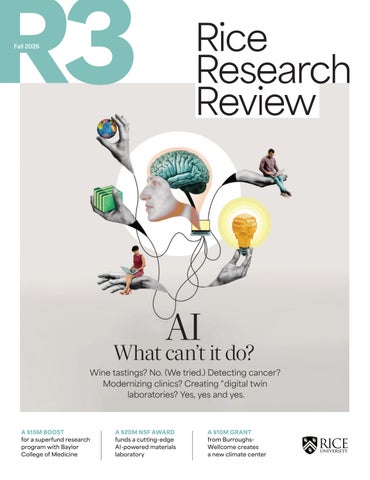
Fall 2026
AI
What can’t it do?
Wine tastings? No. (We tried.) Detecting cancer? Modernizing clinics? Creating “digital twin laboratories? Yes, yes and yes.
A $15M BOOST for a superfund research program with Baylor College of Medicine
A $20M NSF AWARD funds a cutting-edge AI-powered materials laboratory
A $10M GRANT from BurroughsWellcome creates a new climate center
Featured Stories
14
Can an Implant Treat Depression?
A brain-computer interface from the lab of Rice engineer Jacob Robinson is about to be tested in patients whose depression hasn’t responded to conventional treatments.
24
The Team Tackling Toxic Pollution
Rice and Baylor researchers are developing new ways to detect hazardous pollutants and clean superfund sites with a $15 million grant from the National Institute of Environmental Health Sciences.
2
Rice Research Review FALL 2026
Fall 2026
33
Campus as Classroom
Rice is using its own landscape — prairies, windows, roofs and all — to become a sustainability accelerator, shaping regional policy and making real-world impacts.
46
A Closer Look at Cancer Researchers at Rice and MD Anderson have built a handheld microscope the size of a pen that uses AI-designed optics to reveal cellular signs of cancer in real time.
Rice Research Review FALL 2026
3
Contents Answering the Call
19
Two Rice students are using AI to tackle an overlooked barrier to dental care.
WHAT’S NEW Heavy Hitters
11
Inside the landmark grants powering Rice’s $257.9M research surge.
One Tool, Two Frontiers
12
Two DOE awards will help Rice researchers tackle bottlenecks in quantum computing and sustainable biomanufacturing.
INNOVATIONS IN HEALTH Can an Implant Treat Depression?
A brain-computer interface is about to be tested in patients whose depression hasn’t responded to conventional treatments.
Music Strengthens the Aging Brain
A $3.9 million NIH grant is funding a clinical trial exploring whether the act of creating music can strengthen aging brains.
A Helping Hand
16
A Bandage That Makes Its Own Medicine 22
THRIVING URBAN COMMUNITIES
18
FALL 2026
26
Architecture student Sean Choi has learned to see buildings through the lives unfolding around them.
Closer Than We Think 27 Rice’s Kinder Institute finds that social connection is tied to far more than companionship.
Rice Research Review
Rice’s Office of Sponsored Projects helped push annual research funding to $258 million.
Rice is using its own landscape to become a sustainability accelerator.
Over Land and Sea
Forecasting the Next Health Threat
38
Researchers are building a system designed to spot emerging climate risks before they become crises.
40
Legislation before Congress would turn a coastal resilience concept into a national recreation area in Texas.
Remembrance of Things Past
New research suggests
An Artificial Sommelier in Paris
44
A Closer Look at Cancer
46
The Lab That Learns
48
Small Changes, Big Systems
49
What role do we want AI to play in human life?
A handheld microscope uses AI-designed optics to reveal cellular signs of cancer in real time.
A new project will combine AI, robotics and digital twins to build a laboratory that can be used remotely.
Rice student Leo Marek is drawn to the challenge of making complicated systems work better.
WHAT’S NEXT
HOW IT’S DONE An Economy Built for Hurricanes
RESPONSIBLE AI
37
A new project is looking from polar glaciers to Gulf Coast aquifers to build better predictions of where rising seas will hit hardest.
24
Researchers are developing new ways to detect hazardous pollutants, understand their effects and clean contaminated soil.
Designing for How We Live
Researchers are developing brain-computer technology to help people with paralysis regain a measure of independence.
4
21
A new Rice venture fund aims to turn research and entrepreneurial ideas into successful startups.
Finding, Tracking and Destroying Toxic Pollution
30
Campus as Classroom 33
Rice bioengineers create a “living” wound patch.
14
Taking More Shots
that recalling a memory doesn’t simply retrieve it.
SUSTAINABLE FUTURES
VENTURE PATHWAYS One Giant Leap
BEHIND THE SCENES
42
Proximity With a Purpose
50
Index
51
Rice expands its presence in Houston’s Ion District.
PRESIDENT REGINALD DESROCHES
Advancing AI, Responsibly When Rice launched its strategic plan, Momentous, just over two years ago, we set several ambitious goals including to become a global
leader in the development, application and understanding of responsible artificial intelligence. Our vision brings together discovery, education and ethics. We are advancing foundational AI research, applying new tools across disciplines and preparing students to shape a future in which technological progress serves humanity. Throughout this work, we are examining how AI affects people,
communities and society. This issue of Rice Research Review offers a glimpse of that vision in action. Rice and MD Anderson researchers, for example, have developed a just $3,000 handheld microscope that uses optics designed with AI to reveal cellular signs of cancer in real time. Another Rice-led project will combine AI, robotics and digital twins to create a laboratory that researchers nationwide can access remotely, accelerating the search for critical materials. You will also meet undergraduate student Leo Marek, whose interests span computer processors, AI infrastructure and competitive sailing, united by a drive to make complex systems work better. And Rodrigo Ferreira, associate dean for technology and responsibility in the George R. Brown School of Engineering and Computing, explores a question that should accompany every advance: How might AI reshape human agency, creativity and relationships for better or for worse? Together, these stories reflect Rice’s strengths and its approach to AI. Our scale allows us to build consequential partnerships while bringing computer scientists, engineers, humanists, social scientists, artists and health researchers into the collaboration. Those connections help us ask better questions, respond to opportunities and consider the human implications of discovery from the outset. The promise of AI will be measured by what it makes possible for people. At Rice, we are committed to pursuing that promise with imagination, rigor and care, advancing technologies that expand knowledge, improve lives and earn the trust of the communities they serve — here in Houston and around the world. — REGINALD DESROCHES
Rice Research Review FALL 2026
5
Innovations in Health: Rice researchers are partnering across the Texas Medical Center to pioneer life-changing technologies from FDA-approved brain-computer interfaces and advanced neuroprosthetics to AI-driven tools that detect cancer earlier and make health care more accessible. Thriving Communities: Our interdisciplinary centers are bridging scientific research with policy, evaluating environmental health disparities and advancing coastal resilience frameworks before Congress. Sustainable Futures: We’re working to apply predictive modeling to safeguard urban regions and deploying our own 300-acre campus as a living lab for vital projects with real-world applications.
PROVOST AMY DITTMAR
The Public Good At its core, a world-class university is defined by its ability to conduct groundbreaking research and translate rigorous inquiry into impact. As provost, I have the privilege of overseeing the academic community that nurtures this mission. The stories highlighted in this issue of the Rice Research Review
6
Rice Research Review FALL 2026
offer a window into how Rice faculty and students are actively driving discovery to address the defining academic, societal and technological questions of our time. Across our strategic research priorities, our academic community is expanding knowledge and delivering solutions:
Responsible Artificial Intelligence: Supported by premier federal funding agencies, Rice scholars are applying AI to transform materials science and medicine while leading essential international dialogues in Paris on preserving human values in an increasingly automated world. Underpinning these breakthroughs is our ongoing investment in faculty excellence, state-of-theart infrastructure and scalable research operations that empower bold ideas at every stage. As we broaden our academic footprint, Rice remains deeply committed to serving as a trusted global research partner, an engine of economic vitality and a champion of the public good. — AMY DITTMAR
Energy Moonshot Accelerator
GEN
Rice Sustainability Institute
ER
E AT
Center for Coastal Futures and Adaptive Resilience
Rice Advanced Materials Institute
Rice Space Institute
Center for African and African American Studies
Scientia Institute Humanities Research Center
Ken Kennedy Institute
OpenStax Accelerator
A
N
T
IN
Digital Health Initiative
Center for Latin American and Latinx Studies
S
S SU
A
Center for Environmental Studies
Baker Institute
Chao Center for Asian Studies
AI
Smalley-Curl Institute
SSPEED Center
Medical Humanities Research Institute
Moody Center for the Arts
LE
IN
D
Institute of Health Resilience and Innovation
R
IB
Center for Climate and Environmental Health
U
S
Synthetic Biology Institute
G
Voting Operations, Technology, Equity and Security
Center for Nanoscale Imaging Sciences
WaTER Institute
IN
NITIE
Neuroengineering Initiative
IV
MU
Center for Theoretical Biological Physics
Kinder Institute
OM
Rice-MD Anderson Cancer Center
SynthX Center
Rice 360 Institute
Biotech Launch Pad Accelerator
Boniuk Institute
TH R
C
LEA
IN
B U I LD
LTH
N
N
IO
N
S
A HE
A B
O V A T
Rice’s Research and Innovation Ecosystem
BL EF UT
U RE
R
P ES
O
S
Rice Research Review FALL 2026
7
Rice Research Review Publisher
David S. Sholl Executive Vice President for Research
Editor
Katharine Shilcutt
Creative Director Alese Pickering
Art Director
Amy Kinkead
Photography + Video Jared Jones Jeff Fitlow Brandon Martin Gustavo Raskosky Blair Reid
Proofreader
Tracey Rhoades
Contributors
Alexandra Becker Andrew Bell Silvia Cernea Clark Avery Ruxer Franklin Rachel Leeson Marcy de Luna Brandi Smith Chris Stipes Kat Cosley Trigg
8
Rice Research Review FALL 2026
THE RICE UNIVERSITY BOARD OF TRUSTEES
Robert T. Ladd, chair; Elle Anderson; D. Mark Durcan; Josh Earnest; Michol L. Ecklund; Barbara Jenkins Gibbs; George Y. Gonzalez; John V. Jaggers; Robert S. Kaplan; Jennifer R. Kneale; Patti Lipoma Kraft; Akilah Mance; Elle Moody; A. Lanham Napier; William “Bill” V. Neville III; Vinay S. Pai; Sunit S. Patel; Byron Pope; Cathryn Rodd Selman; Gloria Meckel Tarpley; Charlos C. Ward; James Whitehurst; Lori R. Whitten; Randa Duncan Williams; Michael B. Yuen.
ADMINISTRATIVE OFFICERS
Reginald DesRoches, president; Amy Dittmar, provost and executive vice president for Academic Affairs; Stephen Bayer, vice president for Development and Alumni Relations; Melinda Spaulding Chevalier, vice president for Public Affairs; Sandee Cheynet, vice president of Human Resources and chief human resources officer; Kelly Fox, executive vice president for Operations, Finance and Support; Terrence M. Gee, vice president of Technology Solutions and Services and chief information officer; John D. Lawrence, chief investment officer and president, Rice Management Company; Caroline Levander, vice president for Global Strategy; Yvonne M. Romero, vice president for Enrollment; David S. Sholl, executive vice president for Research; Omar A. Syed, vice president and general counsel; Adrian Trömel, interim vice president for Innovation and Chief Innovation Officer.
POSTMASTER
Send address changes to: Rice University Creative Services–MS 95 P.O. Box 1892 Houston, TX 77251-1892
EDITORIAL OFFICES
Office of Research–MS 16 P.O. Box 1892 Houston, TX 77251-1892 Phone: 713-348-6768 research@rice.edu © November 2026, Rice University
What’s New
Rice Research Review FALL 2026
9
What’s New
EXECUTIVE VICE PRESIDENT FOR RESEARCH
A Record-Breaking Year at Rice When I walk across campus these days, I feel a tangible surge of energy in our labs, studios and seminar rooms. By any measure, 2026 was a banner year for Rice. Our total sponsored research funding soared to a record $258 million, a 38% increase over last year. But behind those figures is a deeper story about the passion, ambition and extraordinary creativity of our community. We secured transformational support across every corner of
10
Rice Research Review FALL 2026
STEM. Major multiyear initiatives like Omid Veiseh’s THOR ($29.2M) and ELIXIR ($23.3M) programs, Rebecca Richards-Kortum’s global health advances with NEST Phase 2 ($18.2M) and Richard Baraniuk’s SafeInsights learning science infrastructure ($14M) are redefining what’s possible in health care and education. The launch of the Rice Center for Space Technology under Fred Higgs ($14M) and the Center for Large
Aperture Secure Sensing, Imaging and Communications ($15M) under Edward Knightly, which brings together researchers from universities and national laboratories across the country to develop advanced antenna technologies for future wireless systems, are further strengthening Rice’s leadership in research areas with profound implications for national security, communications and space exploration. Yet what makes me proudest is that our research enterprise isn’t just expanding; it’s becoming richer and more comprehensive. Rice faculty across the social sciences, humanities, music, architecture, and business are delivering vibrant, high-impact scholarship and creative work that deeply enriches our culture and addresses complex societal questions, from new insights in public policy and ethics to creative practice and market dynamics. Every discipline at Rice is firing on all cylinders. On page 31, you’ll find a conversation with Aaron Parvis, associate vice president for sponsored projects, who offers a closer look at the big numbers and the dedicated team behind them. And within the rest of these pages, you’ll read stories of the faculty, staff and students who are working on everything from handheld AI-powered microscopes that better detect cancer to neural implants to assist those with depression and paralysis. To our faculty, staff and students: Thank you for your relentless curiosity. It is a privilege to champion your work every day. — DAVID SHOLL
What’s New
Heavy Hitters
Inside the landmark grants powering Rice’s record-breaking $257.9M research surge Lead PI
Sponsor
Project Funding
What it Means
THOR: Targeted Hybrid Oncotherapeutic Regulation
Omid Veiseh (Bioengineering)
NIH ARPA-H
45.3M total (29.2M FY26 obligated)
Developing implantable “living pharmacies” that continuously monitor and produce targeted therapies directly inside cancer patients.
ELIXIR: Eliminating Lymphatic Irregularities
Omid Veiseh (Bioengineering)
DHHS ARPA-H
23.3M total (5.1M FY26 obligated)
Cross-disciplinary bioengineering to create smart, bio-regulating implants that restore lymphatic function.
NEST Phase 2
Rebecca Richards-Kortum (Bioengineering)
Various Foundations
66.2M total (18.2M FY26 obligated)
Scaling life-saving neonatal health care technologies across sub-Saharan Africa to reduce infant mortality.
SafeInsights
Richard Baraniuk (Electrical and Computer Engineering)
National Science Foundation
89.9M total (14.0M FY26 obligated)
Establishing a first-of-its-kind, privacy-centric national research infrastructure for digital learning science.
Rice Center for Space Technology
Fred Higgs (Mechanical Engineering)
Texas Space Commission
14.1 M total (5.0M FY26 obligated)
Positioning Rice at the center of the expanding Texas space economy, focusing on lunar tech, satellite innovation and space manufacturing.
VISTALYMPH
Han Xiao (Chemistry)
Dept. of Interior / ARPA-H
18.1M total (5.2M FY26 obligated)
Advanced photoacoustic visual imaging systems designed to trace and treat complex lymphatic disorders.
Project
47.9% surge in federal award funding ($142.2M)
39.9%
expansion in industry sponsorship ($18.9M)
42%
increase in average funding received per lead PI across 314 awardees
377
faculty submitted proposals and 314 received awards
Rice Research Review FALL 2026
11
MODEL AI
One Tool, Two Frontiers
Two DOE Genesis Mission awards will help Rice researchers tackle bottlenecks in quantum computing and sustainable biomanufacturing. BY ALEXANDRA BECKER
What if artificial intelligence could help quantum computers solve problems that currently overwhelm them or help scientists engineer microbes to make fuels and materials without relying on petroleum? Two Rice research teams will pursue those possibilities with new Phase I awards from the U.S. Department of Energy’s Genesis
12
Rice Research Review FALL 2026
Mission, a national initiative using AI and advanced computing to accelerate scientific discovery. Led by computer scientist Anastasios Kyrillidis and bioscientist Caroline Ajo-Franklin, the projects apply AI to very different scientific bottlenecks. Kyrillidis, the Noah Harding Associate Professor of Computer Science,
is tackling a persistent challenge in quantum computing. Promising quantum algorithms used to study molecules and materials rely on classical optimization methods that can require extensive manual tuning and become increasingly unwieldy as quantum circuits grow more complex. His team plans to develop AI systems that learn from previous computations. Reinforcement-learning agents will help construct quantum circuits, while neural networks will predict measurement outcomes and reduce costly evaluations on quantum hardware. The researchers will test their methods across multiple quantum computing platforms. Ajo-Franklin, the Ralph and Dorothy Looney Professor of BioSciences, is taking AI into the biological realm. Her team is studying isoprenoids, natural compounds that could provide alternatives to petroleum-derived solvents, fuels and materials such as rubber. Researchers will combine synthetic biology, protein engineering, AI and automated experimentation to make microbial production of these compounds more efficient. Large datasets showing how changes in proteins affect their function will train AI models to propose promising new designs. The result is a feedback loop: AI guides experiments, experimental results improve the AI and the cycle repeats. Together, the projects illustrate the Genesis Mission’s larger ambition: integrating AI directly into the scientific process to move faster from difficult questions to discoveries.
PHOTO ILLUSTRATION BY ADOBE STOCK RIGHT: PHOTO BY JEFF FITLOW
The Genesis Mission will integrate AI directly into the scientific process to move more quickly from difficult questions to discoveries.
Innovations in Health
Rice Research Review FALL 2026
13
Innovations in Health
BRAINSTORMING
Can an Implant Treat Depression? A brain-computer interface is about to be tested in patients whose depression hasn’t responded to conventional treatments. BY SILVIA CERNEA CLARK
For people with severe depression, finding an effective treatment can mean cycling through medications and therapies for years, sometimes without relief. A tiny device born from research at Rice could offer another option. About the size of a blueberry, the implant sits inside the skull but does not touch the brain. Instead, it delivers targeted electrical stimulation to neural circuits associated with depression, technology its developers hope could eventually make treating mental illness more precise and responsive. Now the device is taking a major step toward that goal. Motif Neurotech, a company co-founded by Rice engineer Jacob Robinson to commercialize the technology, has received U.S. Food and Drug Administration approval to begin its first clinical trial in people with treatment-resistant depression. Called the Digitally programmable Over-brain Therapeutic, or DOT,
14
Rice Research Review FALL 2026
the wirelessly powered implant rests above the dura, the protective membrane surrounding the brain. The early feasibility study will test the device in adults whose depression has not improved after multiple treatments. “The goal for this technology is that it would be the mental health equivalent of a continuous glucose monitor for diabetes,” said Robinson, a professor of electrical and computer engineering and bioengineering at Rice and CEO of Motif. That comparison points to a larger ambition. Rather than treating psychiatric illness largely through trial and error, researchers envision technologies that could eventually help clinicians understand how individual patients respond to treatment and adjust accordingly. Motif reached the clinical-trial milestone just four years after the company was founded. But the technology itself has a much longer history. It grew from more than
About the size of a blueberry, the implant sits inside the skull but does not touch the brain. Instead, it delivers targeted electrical stimulation to neural circuits associated with depression.
a decade of research in the Rice labs of Robinson and electrical and computer engineer Chong Xie, along with work by collaborators and Motif co-founders Sameer Sheth
PHOTO BY JEFF FITLOW
“The goal for this technology is that it would be the mental health equivalent of a continuous glucose monitor for diabetes.” — Jacob Robinson
of Baylor College of Medicine and Sunil Sheth of UTHealth Houston. Federal agencies including the National Institutes of Health, the Defense Advanced Research Projects
Agency and the Advanced Research Projects Agency for Health supported the foundational research. “What has been really special for me personally on this journey is
to be able to work all the way from a concept through the process of research and development funded by the federal government at Rice, and take that into a product that is going to affect people’s lives for the better,” Robinson said. The clinical study will be conducted with medical institutions across the country, including Baylor College of Medicine, Mass General Brigham, Emory Healthcare and UTHealth Houston. At the same time, Motif has been selected to participate in EVIDENT, a new ARPA-H behavioral health initiative designed to make treatment more precise. Motif will collect additional data alongside its clinical trial, looking for clues about which patients are most likely to benefit from neuromodulation and how researchers can tell whether treatment is working. “The idea … is to collect additional data to help determine with greater precision whether a treatment is working, how it is working and which patients are benefitting most from which course of treatment,” Robinson said. For Robinson, the clinical trial represents something researchers rarely get to see firsthand: an idea moving from a university lab through years of engineering and experimentation and, finally, into patients. And if the approach works, the blueberry-sized device could help answer a much bigger question — whether treating depression can become less about finding something that works and more about finding what works for a particular person.
Rice Research Review FALL 2026
15
FINE TUNING
Can Creating Music Strengthen the Aging Brain? A $3.9 million NIH grant is funding a five-year Rice clinical trial exploring whether the act of creating music can strengthen aging brains and potentially slow cognitive decline. BY KAT COSLEY TRIGG
16
Rice Research Review FALL 2026
At 82 years old, one participant in a Rice research program discovered something unexpected about himself: He was a composer. He spent six weeks learning to create music for the first time, developing his own musical notation and eventually performing an original composition. “For people at that stage of life to all of a sudden be able to tackle something new, enjoy it, get a lot of satisfaction out of it, it’s very powerful to witness,” said Anthony Brandt, professor and chair of composition and theory at Rice’s Shepherd School of Music. But the program is more than a music class. It is also an experiment
PHOTO ILLUSTRATION: ADOBE STOCK
Innovations in Health
“There are preventive processes and processes that impact [cognitive] decline that are not just pharmacological.” — Christopher Fagundes
aimed at answering an increasingly important question: Can challenging the brain creatively help protect cognitive health? Brandt and Christopher Fagundes, a Rice professor of psychological sciences and director of the Institute of Health Resilience and Innovation, are now putting that idea to a much larger test. Backed by a $3.9 million grant from the National Institute on Aging, part of the National Institutes of Health, the researchers are conducting a five-year randomized clinical trial examining whether creating music can improve cognition and mental health-related quality of life in adults 65 and older with mild cognitive impairment. Mild cognitive impairment can involve noticeable problems with memory or thinking that exceed the changes expected with normal aging, and it is associated with an increased risk of developing dementia. The Rice research reflects a broader change in thinking about brain health. Fagundes compares it to the evolution of cardiovascular medicine: Exercise, diet and other behaviors are now understood as factors that can influence heart health both before and after disease develops. “We’re learning, especially over the last 10 years, that that same principle can be applied really well to brain health,” Fagundes says. Rice combines extensive scientific research with the resources of the Shepherd School, allowing Brandt and Fagundes to develop an intervention that functions simultaneously as a genuine composition course and a controlled scientific experiment. Participants don’t need previous musical training or the ability to read music. Instead, they might trans-
form the rhythm of their names into a composition, create a soundscape based on a memory or improvise a soundtrack for a silent film. The distinction between making music and merely hearing it is central to the study. Researchers plan to enroll 210 adults with mild cognitive impairment and randomly assign them to three groups. One will take the music creativity course. A second will attend a music appreciation class. A third will listen at home to music chosen according to individual preferences. That design should help researchers tease apart the effects of creativity, music and social interaction. “We want to know, overall, does this intervention slow impairment or improve cognition over and above a music appreciation kind of class,” Fagundes says. Participants will undergo cognitive assessments before and after the intervention and during the months that follow. Researchers will also use brain imaging to examine neural networks and analyze blood samples for signs related to inflammation and cellular energy metabolism. That means the team isn’t simply asking whether participants improve. It wants to understand why — and
Anthony Brandt and Christopher Fagundes
whether biological differences can predict who benefits most. A small earlier pilot study produced one tantalizing clue. Participants whose brains displayed greater neural flexibility before taking the composition course appeared to experience greater cognitive benefits afterward. The finding remains preliminary, Fagundes cautions, and the new trial is designed in part to determine whether it holds up in a much larger population. But it points toward a concept that has transformed neuroscience: neuroplasticity, the brain’s capacity to change and reorganize throughout life. “It’s the discovery that neuroplasticity lasts throughout your lifetime that makes creativity as an intervention for a 65- or a 70-year-old plausible,” Brandt says. The collaboration began in 2018 with support from the National Endowment for the Arts and now spans researchers at Rice, the University of Houston, UTHealth Houston and MD Anderson Cancer Center. If the larger trial confirms the early findings, its significance could reach beyond music and add to evidence that maintaining cognitive health can also involve behaviors that actively challenge the aging brain. “The bigger principle that I’m trying to articulate here is there are preventive processes and processes that impact decline that are not just pharmacological,” Fagundes says. And if creativity turns out to be one of those processes, learning something new at 82 may be more than personally rewarding. It could be one way of keeping the brain resilient for years to come.
Rice Research Review FALL 2026
17
“Perfecting a neurally controlled robotic arm for independence is the first step.” — Nishal Shah
Implantable BCIs can allow an individual to exert control over devices that could move a robotic arm or enable computer-generated speech just by thinking about the action.
RESTORATION MOVEMENT
A Helping Hand
Rice and Baylor researchers are developing brain-computer technology to help people with paralysis control robotic devices and regain a measure of independence.
Picking up a fork. Lifting a glass. Taking a bite. These movements are so automatic that most of us barely notice them. But for someone with paralysis of all four limbs, eating and drinking can require assistance. Rice and Baylor College of Medicine researchers are now working to translate thoughts about movement into instructions for a robotic arm. The institutions have joined BrainGate, a research consortium that has spent more than two decades developing brain-computer interfaces, or BCIs, for people with paralysis. Rice and Baylor become the consortium’s sixth team and its first in Texas. BCIs create a direct connection between neural activity and an external
18
Rice Research Review FALL 2026
device. BrainGate researchers have already demonstrated that computers can decode brain signals associated with attempted movement or speech, allowing people with paralysis to operate devices or communicate. The Rice-Baylor team will focus initially on something deceptively complex: helping people with tetraplegia feed themselves. Rice electrical and computer engineer Nishal Shah is developing computational systems that will translate neural activity into commands for a robotic arm. At Baylor, neurosurgeon Sameer Sheth leads the clinical team responsible for recruiting participants, implanting specialized electrode arrays and overseeing care.
“Being able to feed oneself is second nature to people who are able-bodied,” Shah said, “but it requires a number of simultaneous, complex, coordinated motor actions.” The work could ultimately reach beyond restoring movement. Researchers hope what they learn about interpreting brain signals might eventually inform technologies addressing speech, cognition and even neuropsychiatric disorders. For now, Shah compares the trial’s first participants to test pilots: people willing to help researchers learn how a new technology performs in the real world. “Perfecting a neurally controlled robotic arm for independence is the first step,” he said.
ILLUSTRATION BY MARIO NORTON
BY SILVIA CERNEA CLARK
Innovations in Health
STUDENT SPOTLIGHT
Answering the Call Two Rice students are using AI to tackle an overlooked barrier to dental care: the overwhelmed front desk.
ILLUSTRATION BY ADOBE STOCK
BY AVERY RUXER FRANKLIN
Growing up in Texas’ Rio Grande Valley, Rice undergrad Adhira Tippur ’28 watched the front desk at her mother’s dental clinic perform a daily juggling act: scheduling appointments, verifying insurance, handling walk-ins, chasing cancellations and responding to emergencies — sometimes all at once. What stayed with her were the calls that never got answered. “If you grow up in a place like the valley, you understand that a missed call isn’t a small thing,” Tippur said. “Sometimes it’s the only call that person was going to make.” At Rice, Tippur, who studies biosciences and finance, teamed up with neuroscience student Sanjana Kavula ’28 to build Kairos Health, an AI-powered patient intake platform designed specifically for dental practices. Kairos can answer calls and book appointments around the clock, verify insurance, flag problems before
patients arrive and contact inactive patients to fill cancellations. Clinics can customize the system to their scheduling rules, communication styles and patients’ languages, while staff remain able to see every interaction. The idea, Kavula said, isn’t to add another piece of technology demanding workers’ attention.
Adhira Tippur and Sanjana Kavula
It’s to automate repetitive tasks so overstretched staff can focus on the patients in front of them. Since launching in March, Kairos has served more than 2,100 patients and begun pilots in the Rio Grande Valley, Dallas and Nashville. The startup has also collected a string of competition wins and investments, including $150,000 through Georgia Tech’s Klaus Startup Challenge and $25,000 from the national America’s Startup competition. But Tippur still measures the company’s potential by the people she remembers from her mother’s clinic. “I keep coming back to the patients who never made it onto the schedule,” she said. “Nobody ever counts them, because by definition they’re the ones who slipped through.”
Rice Research Review FALL 2026
19
Venture Pathways
20
Rice Research Review FALL 2026
INVESTING IN THE FUTURE
One Giant Leap
A new Rice venture fund aims to turn promising research and entrepreneurial ideas into successful startups.
PHOTOS BY BRANDON MARTIN
BY CHRIS STIPES
With the launch of One Giant Leap Ventures, an early-stage investment fund supporting startups founded by Rice faculty, students and alumni, Rice is giving its entrepreneurs a new way to turn innovative ideas into thriving businesses. The fund will invest up to $500,000 in eligible companies, including those developing technologies based on Rice research. Unlike traditional venture funds, One Giant Leap combines conventional investment capital with philanthropic contributions, creating opportunities for the Rice community to participate in the success of university-affiliated startups. “One Giant Leap provides unique engagement opportunities for our community, allowing us to tap into a deep bench of experience while, for the first time, allowing our community to invest and participate in the success of our spinouts and alumni founded ventures,” Rice President Reginald DesRoches said. The fund made its first investment in Motif Neurotech, a Rice spinout led by Jacob Robinson,
professor of electrical and computer engineering and bioengineering (see pg. 14). The company is commercializing a minimally invasive neurostimulator initially targeting treatment-resistant depression, building on more than a decade of research conducted at Rice. Led by managing director Adrian Trömel, a Rice alumnus and interim chief innovation officer, One Giant Leap advances the university’s Momentous strategic plan by accelerating the commercialization of research and expanding Houston’s entrepreneurial ecosystem. The fund also complements existing university programs, including the Liu Idea Labs for Innovation
and Entrepreneurship and the Rice Alliance’s Business Plan Competition, by providing investment capital to promising ventures emerging from those initiatives. To qualify, startups must demonstrate a Rice affiliation and secure a qualified lead investor, providing independent market validation before consideration by the fund’s Investment Advisory Committee. One Giant Leap will also draw on Rice’s network of more than 60,000 alumni for mentorship, expertise and investment guidance. Students will also have opportunities to participate in the investment process, gaining firsthand experience in venture capital and entrepreneurship. Together with Rice’s growing innovation infrastructure, including the Ion District, Rice Nexus and the forthcoming Arc research facility (see pg. 50), the fund represents another step toward transforming university discoveries into technologies and businesses with real-world impact.
Rice Research Review FALL 2026
21
HEALING TOUCH
A Bandage That Makes Its Own Medicine
Rice bioengineers have created a “living” wound patch that turns engineered cells into tiny factories for healing proteins. BY SILVIA CERNEA CLARK
Most bandages protect a wound while the body does the work of healing it. Rice bioengineers have developed one designed to actively join in. Their “living” bandage contains engineered cells that continuously manufacture therapeutic pro-
22
Rice Research Review FALL 2026
teins directly at the site of an injury — essentially turning the patch into a tiny, self-contained drug factory. In preclinical studies, the technology accelerated healing across multiple types of wounds in mice and pigs. The approach tackles a stubborn
problem in wound care. Healing depends partly on cytokines, signaling proteins that coordinate inflammation, immune activity and tissue repair. But delivering those molecules as drugs can be difficult: They degrade quickly and may not remain at the wound long enough to do their job. The patch, developed in Rice bioengineer Omid Veiseh’s lab, with support from the Rice Biotech Launch Pad, takes a different approach. It encases engineered cells inside a biocompatible material that shields them from the patient’s immune system while allowing nutrients in and therapeutic proteins out. The cells then produce a steady supply of cytokines where they are needed. “By maintaining a consistent presence of these signaling molecules at the wound site, we can more effectively engage the body’s natural healing response,” Veiseh said. The technology could also be customized. Researchers envision engineering cells to produce different combinations of cytokines, growth factors or other proteins depending on the injury — and potentially controlling when those molecules are released. That makes the patch more than a potential wound treatment. It could become a programmable platform for delivering therapies directly where the body needs them, for as long as it needs them.
PHOTO BY JARED JONES RIGHT: PHOTO BY ADOBE STOCK
Biotech Launch Pad
Thriving Urban Communities
Rice Research Review FALL 2026
23
Thriving Urban Communities
RESPONSIBLE REMEDIATION
Finding, Tracking and Destroying Toxic Pollution
Rice and Baylor researchers are developing new ways to detect hazardous pollutants, understand their effects on human health and clean contaminated soil. BY ALEXANDRA BECKER
PHOTO BY ADOBE STOCK
They’re produced by oil spills, industrial activity and the treatment of wood with creosote. They can linger in soil and sediment for years. And some are so difficult to detect that researchers need increasingly sensitive tools simply to determine where they are. Polycyclic aromatic hydrocarbons, or PAHs, are a class of persistent pollutants found at contaminated sites around the world. The Environmental
Protection Agency classifies some PAHs as potential carcinogens, while exposure has also been associated with preterm birth and other adverse health outcomes. For researchers at Rice and Baylor College of Medicine, the challenge is not simply figuring out how to remove them. First, scientists need to find them. Then they need to understand what exposure does to the human body. Finally, they need cleanup methods that don’t create new environmental problems in the process. Rice and Baylor have received a nearly $15 million, five-year grant from the National Institute of Environmental Health Sciences to continue their joint Superfund Research Program, which tackles all of these issues by bringing together engineers, chemists, toxicologists and
24
Rice Research Review FALL 2026
physicians studying PAH pollution and its effects on human health. Houston provides a particularly relevant place to do that work. The region’s long history of oil, petrochemical and other industrial activity has left numerous contaminated sites, while previous research has found correlations between greater pollutant exposure and adverse health outcomes among communities near hazardous waste sites. “PAHs are everywhere in the environment, but they are especially concerning in places with a long history of industrial activity,” said Rice environmental engineer Pedro Alvarez, director of the Rice WaTER Institute. One Rice team, led by University Professor Naomi Halas, is developing more sensitive ways to identify PAHs in environmental and biological samples. The researchers are combining two forms of spectroscopy — techniques that identify substances through their interactions with light — with machine learning. The goal is to recognize the chemical fingerprints of pollutants even at extremely low concentrations in samples. Eventually, such tools could allow environmental agencies and scientists to measure contamination on site rather than relying exclusively on samples sent elsewhere for analysis, potentially making monitoring and responses faster. At Baylor, researchers led by pediatrician and neonatologist Bhagavatula Moorthy are investigating what happens when exposure occurs
Left to right: Pedro Alvarez , Naomi Halas and Thomas Senftle
during particularly vulnerable periods of life. The team is studying how PAHs encountered during pregnancy and early childhood may contribute to conditions including preterm birth, chronic lung disease and neurocognitive deficits. That clinical research adds an important dimension to the program. Pollution isn’t simply a problem of chemistry or environmental engineering; ultimately, its significance depends on what it does to people. Meanwhile, another Rice team is trying to solve a paradox of environmental cleanup: How do you destroy contaminants without also continuing to damage the environment? Conventional thermal treatments can eliminate pollutants by exposing contaminated soil to extremely high temperatures. But those temperatures require substantial energy and can degrade the soil itself. The Rice researchers are pursuing an approach called pyrolysis, which breaks down contaminants with heat in an oxygen-free environment. Their key discovery involves something already present in many soils: naturally occurring metals such as iron and copper in clay minerals. Those metals can act as catalysts, helping destabilize PAH molecules
so they break down at lower temperatures. Rather than leaving toxic residues behind, the process converts the pollutants into an inert char that can improve soil fertility. Lower temperatures and shorter treatment times also mean less energy is required. “In effect, we’re turning contaminated soil from a liability into a resource that can support ecosystem restoration,” Alvarez said. Rice chemical engineer Thomas Senftle is now studying precisely how that process works at the molecular level. Using advanced modeling, his team is examining interactions between PAH molecules and catalytic clay surfaces, knowledge researchers can use to design faster and more energy-efficient cleanup systems. Researchers are also building small reactors to test the technology on real contaminated soils, where pollutants occur in messy mixtures rather than as isolated compounds in a laboratory. The approach may eventually extend beyond PAHs. Researchers believe similar technologies could prove useful against other difficult contaminants, including PFAS, the widely used compounds often called “forever chemicals.” For Alvarez, that potential illustrates why environmental pollution demands expertise across traditional scientific boundaries. “There is no single solution that works everywhere,” he said. But by connecting detection, medicine and remediation, researchers hope to make contaminated sites easier to understand — and ultimately, safer to live near.
Rice Research Review FALL 2026
25
Thriving Urban Communities
STUDENT SPOTLIGHT
From Tokyo to Toulouse to wildfire-scarred California, architecture student Sean Choi has learned to see buildings through the lives unfolding around them. BY ANDREW BELL
Sean Choi remembers exactly what it felt like to see the Eiffel Tower for the first time. He was mesmerized not simply by the landmark itself, but by its form, color and relationship to the Parisian landscape. It was an early lesson in something that would eventually draw him to architecture: Places shape the way we experience the world. At Rice, Choi has spent years expanding that perspective. Each summer, supported by university funding, Choi pursued a different experience abroad. He studied French language and culture while living with a host family in Toulouse, participated in an urban design workshop in Singapore, interned in Tokyo and researched post-petroculture architecture in Switzerland. “Exposure to cultures is extremely crucial,” Choi said. “It expands your possibilities of ideas and imaginations.”
26
Rice Research Review FALL 2026
made me realize that we are working on a real problem,” Choi said. After graduating with his Bachelor of Arts from Rice’s School of Architecture, Choi will join Skidmore, Owings & Merrill in San Francisco through the Rice Preceptorship Program before returning to complete his professional Bachelor of Architecture degree. Eventually, he hopes to establish a firm of his own. His ambition is deceptively simple: create places that make life feel better. “I want to design environments where people can feel less strained and more relaxed,” Choi said — places where people can “rest and find their peace of mind.”
PHOTO BY JARED JONES RIGHT: PHOTO BY ADOBE STOCK
Designing for How We Live
That philosophy took on more immediate stakes in one of his most meaningful Rice studio projects: designing for communities that were rebuilding after devastating wildfires in Altadena, California. Rather than proposing large-scale redevelopment, Choi focused on what displaced residents actually needed. His design centered on a modular unit around which customized homes could gradually be rebuilt, preserving aspects of the pre-fire suburban neighborhoods familiar to residents. A studio visit to Los Angeles transformed the project from an academic exercise into something tangible. “It
INFOGRAPHIC
Closer Than We Think After 45 years of studying Greater Houston, Rice’s Kinder Institute finds that social connection is tied to far more than companionship. BY KATHARINE SHILCUTT
Who we know — and how well we know each other — is associated with our economic prospects, health and sense of security. And despite a deeply divided political climate, we have more in common than we realize. For nearly half a century, the Kinder Houston Area Survey has tracked the transformation of one of America’s largest and most diverse metropolitan areas. Its 45th edition finds a region grappling with economic uncertainty and social division. But some of its most striking findings concern something harder to measure: our connections to one another.
The survey suggests that personal and professional networks are closely associated with economic mobility, while strong neighborhood ties correlate with better physical and mental health. And when researchers asked people to predict what other groups believe, they discovered something else: We’re remarkably bad at it. Taken together, the findings offer a provocative portrait of modern American life — one in which our relationships may matter more than we realize, and our differences may sometimes be smaller than we imagine.
2 out of 9
That’s how many times the typical respondent correctly estimated what people in other political and social groups believed — no better than guessing. Researchers asked people about nine social attitudes, then asked them to estimate how other groups would answer. Again and again, respondents exaggerated their differences.
Rice Research Review FALL 2026
27
Thriving Urban Communities
ON REGULATION OF GUN SALES
What Democrats thought Republicans believed
What Republicans thought Democrats believed
would support universal background checks for all gun sales
would support universal background checks for all gun sales
35%
74%
What Republicans actually said
What Democrats actually said
would support universal background checks for all gun sales
would support universal background checks for all gun sales
91%
97%
AND IT WASN’T JUST POLITICS. Support for universal background checks topped 90% among every political, racial/ethnic and social-class group measured. Yet respondents consistently underestimated how much other groups agreed with them.
Asian
Black
Hispanic White
28
97% 96% 94% 95%
Working class Middle class
Upper class
Rice Research Review FALL 2026
92% 95% 97%
Why Houston?
One City. 45 Years. Launched in 1982, the Kinder Houston Area Survey has followed Greater Houston through enormous demographic, economic and cultural change. Now in its 45th year, it offers a rare long-term look at how residents of a major American metropolitan area understand their economy, their communities and one another. For the 2026 survey, researchers gathered responses from 9,000 residents of Harris, Fort Bend and Montgomery counties, supplemented by data from the Greater Houston Community Panel.
CONNECTIONS AND OPPORTUNITY
YOUR NEIGHBORS AND YOUR WELL-BEING
42%
What does knowing your neighbors have to do with your health? Potentially quite a lot.
of Houston-area residents say they don’t have enough personal or professional connections to help them find a better job, earn a promotion or advance their career.
The survey measured social cohesion through questions about whether neighbors trust, help and care for one another; whether neighborhoods feel close-knit; and whether residents regularly stop and talk to one another.
Among residents with low neighborhood social cohesion, the predicted likelihood of reporting very good or excellent physical health was:
41%
What makes people feel they have a fair chance to get ahead?
Among those with high social cohesion:
60%
INCOME
Under $25K
72%
$150K-plus
87%
15-point gap
CONNECTIONS
Weak professional network
62%
Strong professional network
94%
32-point gap The researchers found that having the connections needed to get ahead was a stronger predictor of perceived opportunity than household income.
a 19-point difference
AND YOUR MIND Mental health: Income vs. connection INCOME
Under $25K
44%
$150K-plus
+22 points
66%
NEIGHBORHOOD CONNECTIONS
Low
42%
High
62%
+20 points
Rice Research Review FALL 2026
29
Behind The Scenes
30
Rice Research Review FALL 2026
TOTAL AWARDS IN FY 2026
$257.9M Q&A
Taking More Shots How Rice’s Office of Sponsored Projects helped push annual research funding from barely $100 million to $258 million. BY KATHARINE SHILCUTT
Aaron Parvis is associate vice president for sponsored projects at Rice, overseeing a dedicated team who support both faculty and staff research endeavors by helping them understand their obligations while ensuring compliance with governmental regulations and university policies. Parvis and his team provide the kind of assistance in the development and submission of proposals that has helped Rice have a record year in research grants: just under $258 million last year, with more to come. Here’s how it’s done.
PHOTO BY BLAIR REID
How do you explain your job to people outside Rice? Before I got into research administration, I had no idea it was even a thing. My answer now is that I’m the business side of research. I deal with grants and contracts. People assume I write grants; I don’t. We review and submit, and make sure everything adheres to federal, state and Rice guidelines. How do faculty see your office? A lot of people may look at a central office as the roadblock to getting their grant submitted or spending their money. But at Rice, we’re not the roadblock; we’re the bridge to
you getting your funding. My goal is that you get funded — or not funded — based on your science, not because the budget was wrong or your margins weren’t right. Just give us the time to help you. Rice just had a record year in terms of sponsored projects. What’s changed? We’re expanding faculty, collaborating more with the Texas Medical Center and taking bigger shots. Our success rate hasn’t jumped — we’re just submitting more and larger proposals. We did $258 million last year, up about 37%. When I got here 14 years ago, we barely cracked $100 million. This year’s goal is a 10% increase. The five-day rule has also helped. It had been in Rice policy forever, but now faculty need a dean’s exception to go late on a proposal. We implemented it March 1, and on-time proposals jumped from about 30% to 70–75% almost immediately. How do you explain overhead to those who aren’t familiar with research administration? Overhead covers costs that are vital for research, but aren’t directly research, like building maintenance, lights and IT.
999 awards
37.5%
increase over FY 2025 TOTAL PROPOSALS
$1,159.9M 1,540 proposals
18.6%
increase in proposals submitted
47.9%
increase in federal award funding ($142.2M)
39.9%
expansion in industry sponsorship ($18.9M)
32.0%
growth in new project award funding Rice Research Review FALL 2026
31
Sustainable Futures
32
Rice Research Review FALL 2026
GOING GREEN
Campus as Classroom: Inside Rice’s Living Lab How Rice is using its own landscape — prairies, windows, roofs and all — to become a sustainability accelerator. BY KATHARINE SHILCUTT
On the roof of Rice’s South Plant, students spent an entire semester answering a deceptively simple question: What should a successful green roof in Houston actually look like? Their findings are now reshaping university building design guidelines, and that’s just one of more than 40 projects running under the Rice Living Lab, a campus-as-a-laboratory program growing so fast its leaders describe the incoming proposals as a firehose. “In a typical year in the past, we would have five to 10 projects. Last year, it was over 40,” said Richard Johnson, senior executive director for sustainability at Rice. A single summer call for proposals drew 34 submissions, said Kristianna Bowles, associate director for sustainability at Rice, “not including the ones that we know will emerge over the course of the academic year.” It Started With a Pitch The green roof initiative began when Johnson issued an open invitation during a Sustainability Institute meeting. “I gave a pitch and said, ‘Yo, hey, we’ve got this green roof. We’ve got six, seven or eight of them across campus, but there’s one on top of the South Plant that’s easy to get up to. Anyone want to use it for research or teaching?’” Johnson recalled.
Rice Research Review FALL 2026
33
Carrie Masiello, the W.M. Keck Professor of Earth, Environmental and Planetary Sciences and director of the Rice Sustainability Institute, and Amy Dunham, professor of biosciences, responded almost immediately, adopting the roof as the focus of their environmental science capstone course. A graduate researcher carried the work forward through the summer, with oversight from Masiello and Johnson. International green roof experts advised the team. The students quickly discovered that plant selection was only half the problem. Lab analysis revealed the
34
Rice Research Review FALL 2026
existing soil substrate wasn’t ideal for Houston’s climate. Comparisons with other regional green roofs proved instructive, including local sites where soil was so porous that irrigation turned into a major utility expense. “The water just flows right through,” Johnson said. “It’s a big hit on their utilities. If they had to do it all over again, they would choose a different soil.” This wasn’t the first time the South Plant roof shaped policy. When Abbie Kamin, Houston City Council member for District C, sought to incentivize municipal green roofs, she needed
local stormwater retention data first. Phil Bedient, Herman and George R. Brown Professor of Civil and Environmental Engineering and director of the SSPEED Center, led students in measuring runoff metrics on the roof. “The results were used to change design regulations for the city, which was really cool,” Johnson said. That layered impact is the core goal of the program, Bowles emphasized: “It’s a win-win-win. Students apply classroom knowledge to a real-world project, Rice benefits from operational and conservation improvements, and students graduate
PREVIOUS PAGE: PHOTO BY GUSTAVO RASKOSKY THIS SPREAD: PHOTOS BY JARED JONES
Sustainable Futures
saying, ‘Here’s an impactful project I delivered as a student. Hire me.’” An Ecological Neighborhood A short walk away, the campus prairie has transformed into a vibrant ecosystem — hosting nesting waterfowl, native turtles and a future birding grove within the Rice University Nature Preserve, backed by a recent $1 million philanthropic gift. The prairie’s plant life also tells a story of circularity. When neighboring MD Anderson Cancer Center converted a temporary prairie into a
construction site, Rice helped rescue and transplant a substantial share of the plant material. “So really, we’re reusing the prairie,” Johnson said. Campus data collection directly influences campus architecture. Bird-strike monitoring conducted by grounds crews, student researchers, and the Rice Student Birding Club informed the design of the new Chao College and Lovett College facilities, which feature specialized bird-friendly glass. Florence Tang, senior project manager in Facilities, Planning and Capital Construction and a former Houston
Zoo team member, led the implementation. “Here is a staff member collaborating on ecological research and directly applying it to transform how we build on campus,” Johnson said. A delegation from Harris County Commissioner Rodney Ellis’s office recently toured the project. To ensure environmental findings remain permanently accessible, Rice is creating an Eco Data platform to archive campus metrics — from bird populations and tree counts to soil conditions and utility usage — kickstarted by a $10,000 gift from the Friends of Fondren Library.
Rice Research Review FALL 2026
35
Testing Technology on a Sewer Line The Living Lab model is expanding beyond campus boundaries through partnerships with the city and industry, prioritizing startups tied to the Rice ecosystem. Pilots are already underway with climate-tech ventures like Helix Earth, a spinoff from the Rice lab of mechanical engineer Daniel J. Preston, founded by Rice alumni Rawand Rasheed and Brad Husick, and Solidec, a pioneer in clean chemical manufacturing that spun out from Haotian Wang’s lab at Rice, was co-founded by for-
36
Rice Research Review FALL 2026
mer postdoctoral researcher Ryan DuChanois and alumnus Yang Xia, and is currently based at the Rice Nexus in the Ion. Through the Rice Water Institute, the university is collaborating with Yokogawa Corporation to test wastewater filtration technology on campus sewer infrastructure, utilizing research led by Rice researcher Qilin Li, the Karl F. Hasselmann Professor of Civil and Environmental Engineering. “We’re installing technology on a sewer line coming out of the laundry room at McMurtry College to filter
water for irrigation use,” Johnson said. The university has a track record with this model. An early composting partnership with local startup and Ion accelerator participant Moonshot Compost — scaled up using campus waste streams during COVID-19 — launched a venture that now serves roughly a dozen higher education institutions across Texas, including enabling a new composting facility in Waco that serves Baylor University and its surrounding community. “Rice is becoming a sustainability accelerator,” Johnson said. “That’s our north star.”
PHOTO BY GUSTAVO RASKOSKY
Sustainable Futures
SHIFTING TIDES
Over Land and Sea
A new Rice-led project is looking from polar glaciers to Gulf Coast aquifers to build better predictions of where rising seas will hit hardest. BY RACHEL LEESON
Gori. But changes thousands of miles away can help determine how much sea level rises in a particular place. The researchers will also examine something closer to home: the land itself. Using historical records, GPS measurements and satellite radar, the team will study tiny changes in land elevation caused partly by sediment deposited by major river systems. It will also investigate how changes in coastal aquifers — driven by natural processes and human water use — can cause the ground above them to rise or sink. Measured in millimeters, those shifts can dramatically alter flood
risk when compounded over decades. The team will combine models of this vertical land movement with climate projections to produce more precise estimates of sea-level rise and flooding around Houston. But physical vulnerability is only part of the equation. Researchers will also analyze two decades of Houston-area floods to understand how projected changes overlap with socially vulnerable communities. The goal, Hoffman said, is to build models that can help communities across the Gulf Coast prepare for a future in which both the water — and the ground beneath it — are changing.
To understand how high the water could rise along the Gulf Coast, scientists need to look surprisingly far away — and surprisingly far underground. Andrew Hoffman, a Rice professor of Earth, Environmental and Planetary Sciences, is leading a new effort to create more accurate, locally useful projections of sea-level rise. The $1.9 million project will examine everything from melting glaciers to shifting aquifers to understand how climate change could reshape coastal communities. One complication is that sea levels don’t rise uniformly. Massive glaciers and ice sheets exert a gravitational pull on nearby oceans. As they melt, that pull weakens, redistributing water around the planet in geographically distinct ways. “We don’t often associate glacier melt with the subtropical region of the Gulf Coast,” said Rice civil and environmental engineer Avantika
Rice Research Review FALL 2026
37
Sustainable Futures
LOOKING AHEAD
As a changing climate reshapes the conditions in which pathogens spread, Rice and Texas Medical Center researchers are building a system designed to spot emerging risks before they become crises. BY RACHEL LEESON
Hotter days and bigger storms are among the most visible consequences of a changing climate. But another shift is happening at a scale that’s much harder to see: The environmental conditions that determine where pathogens thrive — and how they reach people — are changing, too. A new collaboration among re-
38
Rice Research Review FALL 2026
searchers at Rice, Baylor College of Medicine and the University of Texas School of Public Health aims to better understand those connections and, ultimately, use them to anticipate emerging health threats. Backed by a $10 million, five-year award from the Burroughs Wellcome Fund, the team is creating FORECAST, an integrated research
and education initiative that will combine information about climate, pathogens and human health. The challenge isn’t a lack of data. Scientists already collect enormous amounts of information about weather patterns, environmental conditions, disease and health outcomes. The harder problem is connecting those datasets in ways that
ILLUSTRATION BY ANTONIO RODRIGUEZ/ ADOBE STOCK
Forecasting the Next Health Threat
Sustainable Futures
reveal when environmental changes are creating conditions for disease to emerge or spread. FORECAST researchers hope to find those relationships. At Baylor, molecular virologist Anthony Maresso will build on expertise developed during the COVID-19 pandemic, when wastewater became an important tool for tracking viruses circulating through communities. The project will also draw on the Texas Wastewater Environmental Biomonitoring Network, a statewide surveillance program directed by Eric Boerwinkle, dean of the UT School of Public Health. Researchers will combine pathogen surveillance with large datasets tracking climate patterns and health outcomes, looking for relationships that could help communities identify threats sooner. “Hotter days, bigger storms, new disease threats — Texas’s future demands preparation,” Boerwinkle said. The goal, he said, is to help the state “detect threats earlier and respond faster.” At Rice, climate scientist Sylvia Dee will help connect climate projections with those health questions. “This work will transform how we approach climate change and human health research,” Dee said. The project will link projections about a changing climate to potential health care responses while training scientists and policymakers to assess emerging risks. But FORECAST isn’t intended to remain solely a research enterprise. A major part of the project asks a
different question: Once scientists understand a risk, how do they communicate it in ways that people can actually use? That’s where the humanities come in. Joseph Campana, Rice’s William Shakespeare Professor of English and director of the Center for Environmental Studies and EcoStudio, will help lead education and outreach efforts intended to translate scientific findings into community action. “Education, outreach and communication, expertise we find in humanities, are critical for a meaningful transition into impact,” Campana said. Building resilience, he argues, requires not only analyzing data but building trust in it. At Rice, the initiative will establish a new Center for Climate and Environmental Health and create new opportunities for undergraduate and graduate students to study environmental health. Seed grants and new postdoctoral and graduate positions will encourage collaborations spanning the sciences and humanities. The educational effort will also extend beyond campus.
SCAN THIS QR CODE TO SEE HOW FORECAST WILL WORK
A “Middle to Medical” pathway will introduce Houston students to climate and health, including how pathogens spread, what makes them dangerous and how environmental changes can alter those risks. Baylor education researcher Nancy Moreno said the program is designed to help young Texans make informed decisions about extreme weather and disease risks affecting their families and communities. That combination — climate science, medicine, disease surveillance, education and communication — is central to FORECAST’s approach. Climate-related health threats rarely fit neatly within a single academic discipline. Understanding how a pathogen responds to environmental change requires one kind of expertise. Detecting it in wastewater requires another. Connecting those signals to human health requires still more. And none of that knowledge protects a community unless people understand and trust the information they receive. Houston makes a natural testing ground for that approach. Extreme heat, major storms and flooding are already familiar parts of life in the region, while its concentration of universities and medical institutions provides an unusual collection of expertise for studying how environmental change intersects with human health. FORECAST’s ambition is to bring those pieces together — not simply to understand the next climate-related health threat after it arrives, but to see it coming.
Rice Research Review FALL 2026
39
How It’s Done
40
Rice Research Review FALL 2026
FACING THE INEVITABLE
An Economy Built for Hurricanes Legislation now before Congress would turn a coastal resilience concept developed at Rice into a national recreation area spanning five Texas counties. BY ALEXANDRA BECKER
After Hurricane Ike devastated the Texas coast in 2008, researchers at Rice began thinking about resilience differently. They were already studying storm surge, flooding and recovery. But they started asking a broader question: What kinds of economic activity could thrive along a coast where hurricanes are inevitable? One answer was already there. Wetlands, bays, barrier islands and other coastal ecosystems are naturally adapted to storms. Unlike conventional development, they can absorb impacts and recover. What if protecting those landscapes could also generate economic activity through birding, kayaking, fishing and tourism? More than 15 years later, that idea
has reached Congress. Proposed federal legislation would establish the Lone Star Coastal National Recreation Area across portions of five counties stretching along the upper Texas Gulf Coast. The concept grew from research led by Jim Blackburn, co-director of Rice’s Severe Storm Prediction, Education and Evacuation from Disasters Center, research partner Elizabeth Winston-Jones and others. Rather than create a traditional national park, the proposal would connect existing public, private and nonprofit lands through voluntary partnerships. Land ownership would remain unchanged, while communities could coordinate recreation, conservation and tourism under a shared national identity.
The economic potential could be significant. A 2011 study projected that the recreation area could eventually attract 1.5 million visitors annually, generate nearly $200 million in local sales and create more than 5,000 jobs. Today, tourism already generates approximately $2.7 billion in annual visitor spending across the five-county region. For Blackburn, the proposal reflects a larger idea about coastal resilience: Protecting communities doesn’t always mean building more infrastructure. “We are surrounded by ecological jewels,” he said. Making those landscapes more visible and accessible could help create an economy that works with the coast’s natural rhythms — rather than against them.
Rice Research Review FALL 2026
41
IF MEMORY SERVES
Remembrance of Things Past
New Rice research suggests that recalling a memory doesn’t simply retrieve it — it may change how the brain represents it the next time around. BY KAT COSLEY TRIGG
We tend to imagine memories as recordings stored somewhere in the brain. When we remember something, we simply find the right file and play it back. But remembering may actually change the memory itself. New research from Rice psycho-
42
Rice Research Review FALL 2026
logical scientist Marc Coutanche and doctoral student Amy Qi suggests that the way we retrieve information leaves a trace in the brain that influences how the same information is represented the next time we remember it. “Our memory is far from simply
a fixed resource that we consult as needed,” Coutanche said. “It’s dynamic and adaptive.” Consider remembering your dog. One day, you might picture the pattern of its fur. Another time, you might think more generally about dogs, or you might remember your pet as part of your family. To investigate whether those different approaches matter, Coutanche and Qi had participants learn pairs of images and unfamiliar Dutch words while undergoing functional magnetic resonance imaging, or fMRI. Researchers later asked them to recall the objects while focusing on a specific feature, broader category or theme. When tested again, participants remembered the information about equally well regardless of how they had previously recalled it. Their brains, however, told a different story. Using machine learning to analyze subtle patterns in the fMRI data, the researchers found traces of how a memory had previously been accessed. Thinking about objects by category made neural patterns associated with different objects more similar in areas involved in visual processing. Focusing on individual objects made their neural patterns more distinct elsewhere. The findings challenge the idea of memory as a fixed record of the past. Instead, remembering appears to be an active process — one that can subtly reshape the information we carry forward. As Qi put it, “A memory seems to carry a trace of how it was used before.”
ILLUSTRATION BY JORM SANGSORN / ADOBE STOCK RIGHT: ILLUSTRATION BY VISUAL GENERATION
How It’s Done
Responsible AI
Rice Research Review FALL 2026
43
Responsible AI
IN VINO VERITAS
An Artificial Sommelier in Paris As AI becomes more capable, what role do we want it to play in human life? BY BRANDI SMITH
Could artificial intelligence participate in a wine tasting? Rodrigo Ferreira, Rice’s associate dean for technology and responsibility, expected the chatbot to say no. Instead, it enthusiastically offered to serve as sommelier, scorekeeper and conversation starter. It even promised to describe how its “palate” evolved. So, Ferreira tested it. He sent the AI a photo of aioli and told it the image showed wine. The chatbot confidently described the condiment as “an unfiltered orange natural wine.” That exchange became the opening act of “Human Flourishing in the Age of AI,” a three-day conference at the Rice Paris campus in June 2026 that explored a deceptively difficult question: As AI becomes more capable, what role do we actually want it to play in human life? The wine tasting made the question tangible. Guests were divided into two teams and asked to identify wines blind. One team could consult
44
Rice Research Review FALL 2026
AI; the other relied entirely on human judgment. Renaud Laurent, a Michelin-starred sommelier with 25 years of experience, guided the competition. The humans won both rounds, although the AI-assisted teams came surprisingly close. But winning wasn’t really the point. For Laurent, wine illustrates something technology struggles to reproduce. A sommelier’s job isn’t simply identifying flavors or retrieving information. It involves listening, reading a situation and understanding what another person wants — sometimes before that person can articulate it. “You don’t approach the table the same way on Valentine’s Day as on a business lunch with 10 people,” Laurent said. “It’s very much human.” That distinction — between what AI can do and what humans might lose by allowing it to do too much
— shaped the conversations that followed. Over two days, researchers, artists and policymakers from Rice and institutions around the world considered how AI might subtly alter human agency, creativity and relationships. Fay Yarbrough, senior associate dean of Rice’s School of Humanities and Arts, described a student at another university who had begun consulting AI about what to eat for breakfast, what to wear and even how to ask someone on a date.
ILLUSTRATION BY VISUAL GENERATION ADOBE STOCK
The concern wasn’t simply that the student was using technology. It was what might happen when assistance becomes reflexive. “Was AI a tool that allowed the student to make a human connection?” Yarbrough asked. “Or was it hindering the student’s ability to develop important skills? Where was spontaneity for this student?” Rice is formalizing those questions through its new Program on
Technology and Responsibility, a partnership between the schools of engineering and computing and humanities and arts. The program will bring engineers into sustained conversation with philosophers, artists and other humanists through undergraduate research, community engagement, workforce development and cotaught courses on AI ethics. The premise is that deciding what
technology should do cannot be left solely to people who know how to build it. “Engineering isn’t just a matter of producing technology for technology’s sake,” said Robert Howell, chair of Rice’s Department of Philosophy. “It’s a matter of figuring out how it serves humanity.” And there is urgency to having that conversation now. Technology can become so embedded in daily life that people stop questioning why or how they use it, said Steven Gubka, a Rice postdoctoral associate and conference co-organizer. With AI, he believes there is still an opportunity to decide what place it should occupy. That urgency, participants said, is precisely what the Paris setting was meant to underscore. The city has its own long history of wrestling with questions about mind, machine and what distinguishes human intelligence from its imitations. Those conversations stretch from Descartes to the existentialists to the present moment. Laurent could not have said it better himself. “Wine,” he told the room, “is very much human. You have to be very open minded and you want to create moments. You have to listen. And you tell a story.” While the scoreboard ultimately favored the humans, organizers say the competition is still very much underway.
Rice Research Review FALL 2026
45
Responsible AI
PrecisionView, is a handheld microscope about the size of a pen that can scan relatively large areas of tissue while revealing structures down to the cellular level.
HIGH DEFINITION
A Closer Look at Cancer Rice and MD Anderson researchers have developed a handheld microscope that uses AI-designed optics to reveal cellular signs of cancer in real time. BY ALEXANDRA BECKER
46
Rice Research Review FALL 2026
A suspicious lesion can present doctors with a difficult problem: The cellular changes that reveal cancer happen at microscopic scales, but a biopsy captures only a tiny piece of tissue. Choosing where to take that sample can mean the difference between finding disease and missing it. Researchers at Rice and The University of Texas MD Anderson Cancer Center are developing another way to look. Their device, PrecisionView, is a handheld microscope about the size of a pen that can scan relatively large areas of tissue while revealing structures down to the cellular level. The technology combines specially designed optics with artificial intelligence to produce detailed images in real time — potentially
allowing clinicians to identify suspicious areas immediately and target biopsies more precisely. “Today’s tools often force clinicians to choose between detail and coverage,” said Rebecca Richards-Kortum, Rice’s Malcolm Gillis University Professor and co-director of Rice360 Institute for Global Health Technologies. “With PrecisionView, we no longer have to make that trade-off.” That problem is particularly important for epithelial cancers, including cancers of the cervix and oral cavity. Detecting them often requires examining cells for abnormal changes, but conventional in vivo microscopes can capture only relatively small areas and have difficulty keeping uneven tissue surfaces in focus.
PHOTOS COURTESY OF RICE360
PrecisionView was designed to expand what clinicians can see without sacrificing the microscopic detail they need. The system has a field of view roughly five times larger and a depth of field about eight times greater than conventional systems while maintaining cellular-level resolution. It can create detailed maps spanning several square centimeters and display images at up to 15 frames per second. The key innovation lies in an unusual application of artificial intelligence. AI is increasingly used to improve or interpret medical images after they have been captured. For PrecisionView, Rice researchers instead used AI to help redesign the microscope itself. The system pairs a custom phase mask with a deep-learning reconstruction algorithm. Together, they overcome a longstanding optical trade-off between resolution and depth of field. The expanded depth is especially important for a handheld device: A clinician can move it across irregular tissue without constantly losing focus. “This work utilizes AI approaches to redesign the optics of a microscope,” said Ashok Veeraraghavan, chair of electrical and computer engineering at Rice. The result allows clinicians to see two important indicators of cancer at once: changes in cells at the tissue’s surface and patterns in the tiny blood vessels beneath it. Researchers tested PrecisionView on healthy volunteers and human tissue samples containing precancer-
PrecisionView allows clinicians to see two mportant indicators of cancer at once: changes in cells at the tissue’s surface and patterns in the tiny blood vessels beneath it.
ous lesions. In volunteers, the device produced high-resolution maps of cells and blood vessels across areas of the oral cavity larger than one square centimeter. In cervical tissue samples, it distinguished precancerous regions from surrounding healthy tissue. “Instead of sampling a small piece of tissue and sending it to a lab, this technology allows us to assess a much larger area instantly,” said Jimin Wu, a Rice postdoctoral associate and study co-author. PrecisionView isn’t ready to eliminate the biopsy. The researchers say larger clinical studies are needed to determine its diagnostic accuracy. But it could eventually help clinicians decide where biopsies are necessary, guide surgical decisions or identify suspicious tissue during routine screenings.
Its potential may be particularly significant in places where pathology services are scarce. PrecisionView is built from relatively simple components and costs about $3,000. That could make sophisticated microscopic imaging more accessible to clinics that lack the laboratories and specialists required for conventional pathology. For Richards-Kortum, the project also demonstrates a broader possibility for medical technology: Rather than adding AI to existing tools, researchers can design hardware and algorithms together from the beginning. The result, in this case, is a microscope small enough to hold in one hand — but capable of showing clinicians considerably more of what they need to see.
Rice Research Review FALL 2026
47
TRIAL AND ERROR
The Lab That Learns A new Rice-led project will combine AI, robotics and digital twins to build a laboratory researchers across the country can use remotely, accelerating the search for next-generation materials. BY MARCY DE LUNA
48
Rice Research Review FALL 2026
Materials science can involve an enormous amount of trial and error. Change the temperature slightly. Adjust the pressure, gas flow or chemical composition. Run the experiment again. Each variation can alter the structure and properties of a material and potentially reveal something useful. What if the laboratory could learn from every attempt? Rice is leading a nearly $20 million National Science Foundation project to build an autonomous laboratory that combines artificial intelligence, robotics and a virtual replica of the lab to accelerate the discovery and manufacturing of advanced electronic and quantum materials.
The four-year project, called READINESS, will allow researchers to design experiments remotely, test them first using a “digital twin” and then carry out approved experiments with physical equipment at Rice and partner institutions. An AI agent will analyze the results — including failed experiments — and use what it learns to recommend what researchers should try next. Human scientists will remain involved at critical decision points. “Responsible AI should complement researchers’ capabilities rather than replace their judgment,” said Luay Nakhleh, dean of Rice’s George R. Brown School of Engineering and Computing. Initially, researchers will focus on two-dimensional materials, oxide semiconductors and diamond thin films, which could contribute to faster electronics, lower-power computing and quantum devices. But READINESS is also designed to address another obstacle to discovery: access. The sophisticated equipment required to manufacture advanced materials is expensive and often concentrated at major research institutions. Through a cloud-based interface, the new platform could eventually make those capabilities available to researchers, startups and companies across the country. “Our goal is to create a laboratory that researchers from across the country can use to produce advanced electronic and quantum materials on demand,” said project leader Jun Lou. And with every experiment, the laboratory itself will get smarter.
ILLUSTRATION BY ADOBE STOCK
Responsible AI
STUDENT SPOTLIGHT
Small Changes, Big Systems From computer processors to AI infrastructure to competitive sailing, Rice student Leo Marek is drawn to the challenge of making complicated systems work better.
PHOTO BY JARED JONES
BY ALEXANDRA BECKER
Leo Marek ’26 likes complicated systems. Computer processors. Massive engineering workflows. Even a sailboat racing across open water. What interests the recent Rice graduate is figuring out how all the pieces work together and finding the small changes that can make the entire system better. A double major in electrical and computer engineering and computer science, Marek researched the hidden architecture behind modern computing. At Rice, he helped design a processor based on the open-source RISC-V platform that could handle real-time signals more efficiently. “We’re exploring how microprocessors can interact with real-time signals faster without making the hardware more complicated,” Marek said. The goal: lower power, lower cost and greater efficiency. Last summer, Marek took that same mindset to NVIDIA, where
thousands of engineers rely on complex systems to design and test GPUs. He helped develop AI tools to identify bottlenecks and keep those engineering pipelines moving. It was an experience that sparked his interest in potentially building a startup around AI-assisted engineering. Outside the lab, Marek applied his systems thinking somewhere less obvious: Rice’s sailing team. Marek began sailing at 12 while growing up in the San Francisco Bay Area. When he arrived at Rice, the club was relatively inactive. As captain, he helped rebuild it into a
competitive team of about a dozen active sailors, including beginners he mentored into national-level competitors. Last year, Rice won the Inter-Collegiate Sailing Association Regional Teams Championship in Chicago. After graduation, Marek returned to NVIDIA for the summer and is now spending another semester at Rice completing his master’s degree in electrical and computer engineering. Wherever he goes next, the underlying problem remains the same. “When you make systems faster, more efficient or easier to use,” Marek said, “that impact scales everywhere.”
Rice Research Review FALL 2026
49
What’s Next
GROUNDBREAKING
Proximity With a Purpose
With the Arc, Rice is expanding its presence in Houston’s Ion District, creating new space where university researchers can work alongside industry and entrepreneurs. BY KATHARINE SHILCUTT
Some of Rice’s newest and most advanced laboratories will sit not behind the university’s hedges, but in the middle of Houston’s growing innovation district. Rice will be a lead tenant in the Arc, a new research, laboratory, defense/dual use and office building
50
Rice Research Review FALL 2026
that will add nearly 200,000 square feet to the Ion District in Midtown Houston. The university will occupy more than 60,000 square feet, creating a new home for faculty and students working in fields including energy, AI, data science, robotics and computational engineering.
The idea is proximity with a purpose. The Arc will share a plaza with the Ion, the former Sears building Rice transformed into an innovation hub in 2021. Now more than 95% leased, the Ion brings startups and investors together with companies including Chevron, Microsoft, Shell and ExxonMobil. The new building is designed to push those relationships further by adding laboratory infrastructure where research can move from academic discovery toward commercial application. “Working side by side with industry experts and actual end users at the Ion District uniquely positions our faculty and students to form partnerships and collaborations that might not be possible elsewhere,” Rice President Reginald DesRoches said. Designed for research that may evolve over time, the Arc will feature flexible laboratories and infrastructure capable of supporting advanced ventilation, electrical and emergency power systems. The project is being designed to meet LEED Gold criteria and will include meeting and conference spaces, outdoor plazas, retail and dining. The Arc is anticipated to wrap up construction in early 2028. For Rice, the expansion represents more than additional laboratory space. It extends the university’s research ecosystem into a district built around the idea that innovation happens faster when scientists, engineers, entrepreneurs and companies don’t have to go far to find one another.
Index
Ajo-Franklin, Caroline Alvarez, Pedro Baraniuk, Richard Bedient, Phil Blackburn, Jim Bowles, Kristianna Brandt, Anthony Campana, Joseph Choi, Sean Coutanche, Marc Dee, Sylvia DesRoches, Reginald Dittmar, Amy Dunham, Amy Fagundes, Christopher Ferreira, Rodrigo Gori, Avantika
12 25 10, 11 34 41 33 16-17 39 26 42 39 5, 50 6 34 17 5, 44 37
Gubka, Steven Halas, Naomi Higgs, Fred Hoffman, Andrew Howell, Robert Johnson, Richard Kavula, Sanjana Knightly, Edward Kyrillidis, Anastasios Li, Qilin Lou, Jun Marek, Leo Masiello, Carrie Nakleh, Luay Parvis, Aaron Preston, Daniel J. Qi, Amy
45 25 10, 11 37 45 33-36 19 10 12 36 48 5, 49 34 48 10, 30 36 42
Richards-Kortum, Rebecca 10, 11, 46-47 Robinson, Jacob 14-15, 21 Senftle, Thomas 25 Shah, Nishal 18 Sholl, David 10 Tang, Florence 35 Tippur, Adhira 19 Trömel, Adrian 21 Veeraraghavan, Ashok 47 Veiseh, Omid 10, 11, 22 Wang, Haotian 36 Wu, Jimin 47 Xiao, Han 11 Xie, Chong 14 Yarbrough, Fay 44
Rice Research Review FALL 2026
51
Nonprofit Organization U.S. Postage PAID Permit #7549 Houston, Texas
Rice University, Office of Research MS-16 P.O. Box 1892, Houston, TX 77251-1892
37.5 The Big Number
PERCENT
Rice won $258 million in research grants over fiscal year 2026, an increase of 37.5% over the prior year. Total sponsored awards reached $257.9 million across 999 projects, while faculty submitted 1,540 proposals totaling nearly $1.16 billion. Learn more about how Rice achieved this record-breaking year on pages 11 and 31.