Maresca
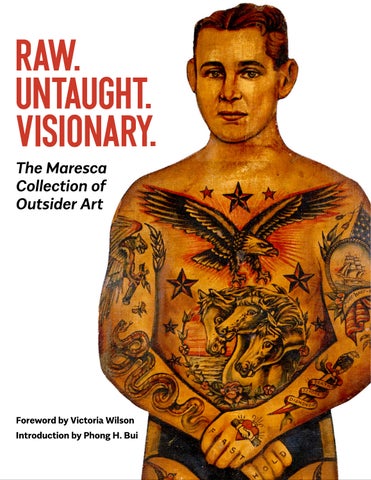
RAW. untaught. visionary. is a portal into the exquisite and often overlooked theater of the self-taught artist. Curated from Frank Maresca’s private collection, this book shatters old hierarchies with objects that hum with life, mystery, and unapologetic individuality. Here, unknown makers hold their own alongside such renowned luminaries as William Hawkins, James Castle, and Bill Traylor. The result is a soulful, subversive, visually electric manifesto that argues: art doesn’t need a name to have a voice. Enter the Vernacular Loft of Frank Maresca—where history breathes, instinct reigns, and belief begins with seeing.
The Maresca Collection of Outsider Art
The Maresca Collection of Outsider Art
Raw. Untaught. Visionary. The Maresca Collection of Outsider Art
RAW. untaught. visionary.
Foreword by Victoria Wilson Introduction by Phong H. Bui
RAW. untaught. visionary.
The Maresca Collection of Outsider Art
RAW. untaught. visionary. Frank Maresca Foreword by Victoria Wilson Introduction by Phong H. Bui Interview by Alejandra Russi
The Maresca Collection of Outsider Art
ALSO BY FRANK MARESCA
American Primitive: Discoveries in Folk Sculpture (Alfred A. Knopf, 1988) A Certain Style: The Art of the Plastic Handbag, 1949-59 (Alfred A. Knopf, 1988) Bill Traylor: His Art, His Life (Alfred A. Knopf, 1991) American Self-taught: Paintings and Drawings by Outsider Artists (Alfred A. Knopf, 1993) William Hawkins: Paintings (Alfred A. Knopf, 1997) American Vernacular: New Discoveries in Folk, Self-Taught, and Outsider Sculptures (Bulfinch Press, 2002) Black Dolls: Unique African American Dolls, 1850–1930 From the Collection of Deborah Nef (Radius Books, 2015) Evidence for Contact: Ken Grimes, 1993–2021 (Anthology Editions, 2023) SELECTED CATALOGS, PUBLISHED BY RICCO/MARESCA
Bill Traylor: Observing Life (1997) Self-Taught Outsider Art Brut: Masterpieces from The Robert M. Greenberg Collection (1998) The Intuitive Eye: The Mendelsohn Collection (2000) Shut Up: Joe Massey’s Messages from Prison (2019) Grant Wallace: Over the Psychic Radio (2022) Franne Davids (1950-2022): Paintings (2024)
FOREWORD VICTORIA WILSON
They who dance are thought mad by those who hear not the music. Old Proverb
Simplicity; style; purity . . . the line; a curve; contrast; shape. Shadow; highlight . . . Black on black; grays on gray; square next to square; color as a refined, untrained palette; a knowing eye—perhaps, the most knowing eye—this is the sensibility and the talent of Frank Maresca, whose lifelong collection of self-taught art has, piece by piece, taken shape from a seeing of what is (mostly) unseen; overlooked; passed by; invisible—and from a believing in the unheard whose created object is the result of an interior voice drilling inward, deeper; not letting up. Amidst the pages of Maresca’s splendid Raw. Untaught. Visionary. are paintings, abstractions, life-sized sculptures of salvaged materials, carved wooden figures, photographs, kaleidoscopic graphite drawings, handblown glass; utilitarian objects, pure of design and spirit. Here are a nineteenth-century wooden boardwalk wheel of chance (page 93) in a rosette of multicolored clown colors with iron nails to randomly catch the clicker (“Where the wheel stops, nobody knows. . .”); a 1930s upholsterer’s metal display sign showing a simple, worn Chesterfield chair (page 95); an early twentieth-century wooden towel holder; an advertisement—“The Holmes Gospel Train System with Sound Moving Pictures; ‘Have Faith; Have Power; Have Speed; Have Courage’ ” (page 91)—whose actual function is as a blackboard. . . . Most would pass it by, and why not—it’s a blackboard. Few would be captivated or note its inspiring, human language (“Have Faith; Have Power; Have Speed; Have Courage”). And here as well, amidst the pages of Maresca’s book, a 1920s wooden pine fragment, a painted vignette of young girls, each in the chemise of the day, white collar and
9
matching socks with pink bow to keep hair in place; a wooden piece from a doll’s bed, an object created not as art, but for decorative or functional use, whose design, shape, and resonant spirit of nonformal art reveals an American moment or age (page 58). In Maresca’s own collection, revealed in these pages: a black angular abstraction of wood and metal—a crow decoy (page 192); its metal wings in full flight; soaring; its beak angled downward and upward full force to ward off any real-life flapping, invading crows. A manufacturer’s two-pieced metal mold for a girl’s doll—each plate bronzed, buffed, rubbed smooth; a full-cheeked cupid face and pouty cupid lips; hairstyle 1940s, short curls close-cropped; rounded legs of baby fat. Its second half, the back mold plate—simple contours of a girl’s silhouette with narrow waist . . . a mold whose shapes and shadows become a sculptural form (page 194). These more than 130 pieces of American self-taught art, brought together for the first time in Raw. Untaught. Visionary., are the summation of Maresca’s decades-long gathering of the purest, unique works of the human spirit: works by unnamed, unknown outsiders whose paintings, collages, carved wood, oil enamel works, forged iron pieces, were created in obscurity; some created seeking refuge from the outside world, in the self-erected, insular-hallucinatory world of schizophrenia; others from work distinct from paying jobs; many anonymous in life, not recognized until after death, some not uncovered until decades later. Here, in this best of the best of self-taught art, are the most beautifully odd and the most oddly beautiful, the most refined, the most celebratory pieces, work by citizens led by yearning, fear, insularity; joy, will, obsession; voices coming upon an outlet of expression, some over decades of honing and elaboration; others, the result of accomplished lives—Arthur Fellig (Usher Felig) of Zolochev (Ukraine). From Ellis Island to tenement tough kid to gritty (self-publicizing) street photographer, catching mid- action via his sturdy aluminum-and-steel Speed Graphic, his “Aladdin’s lamp,” as he called it (“You push the button,” said Fellig, “and [the camera] gives you the things you want.”): the hard-core split-second real-life drama, first for Acme Newspictures (later part of UPI), then as a founding photographer of PM (the first newspaper to report the full story in images).
10
Fellig was known on the Broadway beat as Weegee (the name his own invention), for capturing the city’s grisly low life—Murder Incorporated, tenement fires, criminal arrests, and for photographing as well New York’s high life (with a twist)—dowagers in white fur, gowns of velvet, diamond tiaras, at the opening of New York’s Metropolitan Opera, oblivious to the homeless down-and-out woman inches away watching the (slightly tawdry) grand procession; and in his Hollywood distortions, society’s side life (photographs of Judy Garland, Marilyn Monroe, Dali, et al.) . . . Full disclosure, I edited and published a book of Weegee’s photographs (Knopf; 1977), considered to be the “grittiest of his work” (The New Yorker). More about that later. Another singular piece of self-taughtness from Maresca’s personal collection in the book: Nelson Patrick Viola’s, of Bridgeport, Connecticut. A bold portrait of a woman—simple, stripped down to two-dimensional shapes in colored pencil (page 76), done in one of his many 14 × 17–inch spiral sketchbooks. Viola, in his off-time as husband and father and away from his job as construction worker and auto shop salesman, drew, in privacy and obscurity, hundreds of vibrant, modern portraits of women, inspired by photographs in newspapers the work known and recognized today as Newspaper Girls. In Maresca’s Raw. Untaught. Visionary., we are given a portrait of a collector—a curator’s—sensibility. Here are detailed ink drawings by Renaldo Kuhler (pages 78–79), for thirty years scientific illustrator for the North Carolina Museum of Natural Sciences in Raleigh, son of the renowned, world-famous industrial designer of American locomotives Otto August Kuhler. Otto, an immigrant from Remscheid, Germany, was himself a renowned self-taught artist, printmaker, and expert draftsman whose family owned an ironworks in the Ruhr Valley. Otto Kuhler was obsessed with the workings of machinery and, an uncanny illustrator, created the largest and most accurate record of Pittsburgh locomotives, steelworks, and industrial landscapes. As design engineer for the American Locomotive Company, Otto Kuhler imagined the streamlined locomotive (his Hiawatha engine was the first streamlined train, advertised as the “fastest steam locomotive in the world”). It is the astonishing work of Otto’s son, Renaldo, who, as a teenager retreating into a parallel world of his own creation, sought—and found—
11
escape from solitude, abuse, bullying and neglect, to create—much like the draftsmanship of his father’s exacting illustrations—the secret, sovereign nation of Rocaterrania (the name, from his home in Rockland County, NY), an invented land, drawn in black-and-white and wondrous color, of mostly Eastern European immigrants, situated on the border of New York and Canada. Throughout his adult life Renaldo expanded Rocaterrania in the complexity of its society and its varying religions. On the opposite page, an ink-on-paper drawing of one of its citizens, Janet Lingart, preparing to open her Casino in the Park. Back to the mention of publishing, as an editor at Alfred A. Knopf, I published the work of many writers—novelists, biographers, photographers, short-story writers, politicians, historians, scientists, actors, directors, painters, a poet here and there, a cookbook writer or two (Laurie Colwin’s Home Cooking; Alon Shaya’s Shaya)—and four pathfinding books by Frank Maresca and Roger Ricco. In further full disclosure, Frank Maresca—former artist, photographer, obsessed fisherman, uncanny spotter of unrecognized art and artists with his partner, co-gallery owner, Roger Ricco—photographer, painter, graphic designer, etc.—were not my discovery. They came by way of a beloved Knopf colleague, Alice Quinn, who in her passionate meanderings of all things quilt-like and folk-inspired, spotted the Ricco/Maresca Gallery on her shopping expeditions, and seeing the extraordinary eye of the two gallery owners in the artists they championed and exhibited, determined to publish a book showing their work in the vanguard of self-taught art. Alice was whisked away from Knopf’s auspices one November day to The New Yorker by the revered Mr. Shawn, the magazine’s editor for thirty-five years, to become an editor in the fiction department and soon after became the magazine’s poetry editor (helping to shape poetry in America for the next two decades), and I, at the sign of the Borzoi, happily stepped in to bring forth the Ricco/Maresca book then under contract. Since that time, Frank, Roger, and I have had many publishing adventures, having the fun of putting together and publishing at Knopf acclaimed books showcasing the work of outsider artists, each book now
Aaron Holliday, detail, Baby Fish, ca. 1995. Graphite on paper, 21 × 18 in. (53.3 × 45.7 cm)
13
considered a classic in the field; Maresca and Ricco, the books’ gatherers and curators, I, as editor and publisher of each. The first book, American Primitive: Discoveries in Folk Sculpture (Knopf, 1988) brought together and presented objects (weather vanes and whirligigs, decoys and architectural embellishments, etc.), not as folk art, but as art. The New York Times called the book a “fascination.” American Self-Taught: Paintings and Drawings by Outsider Artists (Knopf, 1993) presented the extraordinary work of a hundred American self-taught painters in two hundred and sixty full-color illustrations. Bill Traylor (Knopf, 1991) presented for the first time the work of this self-taught artist born into slavery nine years before the Civil War, in Pleasant Hill, Lowndes County, Alabama, and who, homeless on the streets of Montgomery and in his late eighties, began to draw and paint, mostly on scraps of discarded paperboard from around the neighborhood. “One day Traylor picked up a stub of a pencil,” said Roberta Smith in the New York Times “and a scrap of cardboard and began to draw. . . He produced hundreds of drawings and paintings that rank among the greatest works of art of the twentieth century.” William Hawkins (Knopf, 1997) was another find of Ricco/Maresca. The book presented, for the first time, the work of a self-taught master who began to paint at the age of eighty. His work is now in the permanent collections of many museums, among them the Philadelphia Museum of Art, the High Museum of Art (Atlanta), the Brooklyn Museum, and the Smithsonian American Art Museum. Hawkins was from Union City, Madison County, Kentucky, born and raised on a small farm, later traveling northward to Columbus, Ohio, and finding various kinds of work, including as a truck driver. Hawkins learned to paint from illustrations of horse auction announcements, newspaper photographs, and calendar pictures, using pigment from tossed paint cans; later, ordinary house-paint enamels on plywood and Masonite board. “My manager brought me seven or eight brushes,” said Hawkins. “I ain’t gonna use but one brush. I wipe it off and put it in another color; red, blue, purple, green, or yellow. I wipe my brush off and mix my paint up. Use that same brush . . . I paint until I get sleepy . . . I lay down there and dream a while; dream about different things. I wake up . . . and jump
14
up and think about what I forgot to put in that . . . a tree, a graveyard, a fence, or something. I didn’t put that fence far enough. I better get up and straighten that fence out [“I dream of painting and then I paint my dream;” said Van Gogh] ’cause tomorrow,” said Hawkins, “I’ll be on another painting board.” [William Hawkins, Making Itself]. During these years of collaboration publishing books of discovery, Frank and I learned much from one another. He, through this editor’s eye—the instinct, art, and detail of publishing, of putting together a book of simplicity and elegance, of writing, editing, design, printing . . . I, through his eye as responder and curator, the nuanced, knowing impulse of looking at the world in a different way (the continuous gift of those who are the luckiest of editors)—and in the simplest way of doing so, hearing the music to the dance and seeing and believing the truth of what might otherwise be left unseen. And in the pages that follow of Raw. Untaught. Visionary., the unheard music awaits.
15
INTRODUCTION Embracing the Unknown PHONG H. BUI
“Music is your own experience, your own thoughts, your wisdom. If you don’t live it, it won’t come out of your horn. They teach you there’s a boundary line to music. But, man, there’s no boundary line to art.” —Charlie Parker “My formula for greatness in a human being is amor fati: that one wants nothing to be different, not forward, not backward, not in all eternity. Not merely bear what is necessary, still less conceal it—but love it.” —Friedrich Nietzsche
Frank Maresca has been a champion of the self-taught for nearly fifty years. He has worked with the estates of artists such as Martín Ramírez, Bill Traylor, William Hawkins, William Edmondson, Henry Darger, Morris Hirshfield, and James Castle. Equally central to his vision is a deep reverence for objects created by unknown makers. Maresca is, in effect, the most sensitive observer of what Barbara Novak described as the “erasure of self” so valued by early American Puritan culture—an erasure marked by the absence of the artist’s signature, allowing a larger self to emerge through the object’s function and form. This sensibility echoes the spirit of American transcendentalism and pragmatism, where meaning is found in the act of making. Although such art has been created for centuries, it has only recently been given the attention it deserves. This is because, as the culture of humanism in Europe became the center of scientific progress and
17
economic power, rationalism and empiricism came to be favored above all else. And with the growth of colonialism, Western culture and artistic practices came to be considered the apex of civilization, overshadowing other means of production and appreciation. It was not until the early twentieth century that this hegemony began to be called into question, when individual artists such as Pablo Picasso, Wassily Kandinsky, Joan Miró, Paul Klee, Hilma af Klint, Emma Kunz, and Jean Dubuffet, among others, began to explore new potential pictorial languages appropriate to modern life—and, at the same time, to value more highly other kinds of art, be it tribal art from Africa, children’s art, or art deeply engaged with Eastern philosophies or occult sciences such as Theosophy. It was only then that the art of Others gradually gained legitimacy. As a result, an alternative to the standard, chronologically linear history of art began to emerge—one which made us aware of the value of art that requires new kinds of awareness, understanding, and tolerance. In recent decades, we’ve come to acknowledge more freely that there are hidden mysteries and inexplicable powers that encourage us to value works of art by makers who did not play by the “rules,” who were not law-abiding citizens of established systems or followers of rules created by academic training. In brief, the new art was not the product of the European Enlightenment, nor was it related to the prevailing models for science, the arts, and humanities. For this new kind of art, what is of primary importance is the notion of individual expression that is profoundly tied to every human being’s innate longing to express their full nature. This, of course, has often been at odds with the Platonic conception of aesthetics, consisting of the conventional properties that would be considered beautiful—based on perfect balances of ideal forms in a particular order of harmony and symmetry. I remember the first time I heard Delta Blues—Blind Blake, Mance Lipscomb, Son House, Sister Rosetta Tharpe, Bukka White, Skip James, Memphis Minnie, just to name a few—which originated in the Delta region of Mississippi after the Civil War, along with our fellow African Americans’ work songs, spirituals, and field hollers. I immediately associated them with traditional Vietnamese music, partly because of their similar lamenting, haunting sound—the kind of emotion that radiates from simple
18
notes and lyrics, performed by self-taught musicians who intuited a sound that connected them to their inner lives while communing with their ancestors. This was music that, among other things, gave birth to jazz’s swing beat in New Orleans, including its legendary practitioners such as Louis Armstrong, Jelly Roll Morton, Duke Ellington, and Count Basie, among others. As I contemplate the way we live our lives in the fullness of time, aware of what Immanuel Kant referred to as our own “natural end”—indicative of our beings as living organisms who have internal, self-organizing means and purposes—I think of Frank Maresca, whom I’ve had the pleasure of knowing during the past decade, and who is fortunate to have surrendered to his “natural end” by being fully open to his life’s journey in four stages: First, it began with his uncle’s “combination” gift for his fifth birthday—an eighteenth-century Persian mortar and pestle—that hastened his passion for collecting objects of great curiosity and mystery. Second, having taken a photography class in his senior year of high school with an influential teacher who also introduced him to jazz launched his lifelong interest in African American culture, which in turn heightened Frank’s affection for objects made by self-taught and unknown artists as equivalents of its musical reverberation in all aspects of representation—whether direct transmutation, improvisation of spontaneity in swing rhythm, emotional yet intuitively structured call-and-response patterning, or repetition. Third, the founding of Ricco/Maresca Gallery in 1979 with one mandate: passion always comes first. Fourth, and lastly, the discovery of William Hawkins, whom I call the “one-brush master,” and who has symbolically cemented Frank’s amor fati. When I think of the evolution of modern art, I think of two seminal moments that were less canonical than, say, the genesis of Fauvism, Cubism, Futurism, and Surrealism. The first is the famous banquet Picasso organized at his studio in the Bateau-Lavoir in November 1908 in honor of his friend Henri Rousseau. In his classic volume The Banquet Years, Roger Shattuck lauded it as an evening of “spontaneity of high spirits,” with now-legendary bohemians including Guillaume Apollinaire (who had introduced Rousseau to Picasso a year earlier), Gertrude and
20
Leo Stein, Alice B. Toklas, Georges Braque, André Salmon, Juan Gris, Max Jacob, and Marie Laurencin, among others. At the tail end of the festivity, Picasso stood up and said to the crowd as he gestured toward Rousseau: “We are the two greatest painters of [our] time.” To which Rousseau unhesitatingly responded: “You in the Egyptian style and I in the modern.” The second seminal moment was when Jean Dubuffet coined the term Art Brut in 1945 at the end of World War II, as a new discovery of self-taught art, including works made by children and psychiatric patients, among other untutored artists—all of whom were uncontaminated by conformist notions of high culture, beauty, and the so-called good taste. The mainstream version of the history of modern art has been well represented by several gallerists in the U.S. who have made significant contributions to our visual culture—most notably Betty Parsons, Martha Jackson, Terry Dintenfass, Leo Castelli, Ileana Sonnabend, Phyllis Kind, Paula Cooper, Pace, Larry Gagosian, David Zwirner, and Hauser & Wirth. Alongside them, great collectors such as the Rockefellers, the Morgans, the Whitneys, the Steins, and the de Menils played a vital role in shaping public and institutional appreciation for modern art. In parallel, pioneering collectors such as Ruth Horwich and Herbert Waide Hemphill Jr. were instrumental in championing self-taught, folk, and vernacular artists long before such work entered the mainstream. Together, these gallerists and collectors created a historical continuity of American art dating from the emergence of Abstract Expressionism in the 1950s through the decades of the 1960s, 1970s, and 1980s, which gave birth to Pop Art, Minimalism, Conceptual Art, Earth Art, and Performance Art, as well as Neo-Expressionism and Neo-Geo. From the 1990s to the present—an era marked by the absence of any identifiable school or movement—this trajectory has nonetheless paved the way for global art consumption on an unprecedented scale. On the other hand, I also think of a handful of those who have equally made significant contributions to a new paradigm that is completely free from the constraints of academic training (an American equivalent of the European Counter-Enlightenment, with a natural leaning toward the non-Western and non-hierarchical vernacular tradition), including Alfred Barr, Sidney
21
Janis, and Jean Dubuffet—and I think especially of the Ricco/Maresca Gallery, a most personally invested living organism, shepherded by Frank’s vision and his love for the American vernacular tradition, which set him far apart from his peers. Whatever possesses Frank and propels his lifelong journey in search of new encounters with the endless self-taught artists he has championed, his admiration for objects made by unknown artists has remained consistently truthful to his natural end and amor fati. What is especially exciting is that half of Frank’s private collection consists of remarkable examples by well-known self-taught artists, while the other half is made up of exquisite works by many unknown makers. Frank seems to have viscerally intuited Giambattista Vico’s profound insight into the nature of knowledge and truth through human creation: Verum esse ipsum factum—“What is true is precisely what is made.” We live in the world we ourselves create, and Frank creates his. Endowed with his own OverSoul, he has always trusted what Ralph Emerson proclaimed: “The act of seeing and the thing seen, the seer and the spectacle, the subject and the object, are one.”
Franne Davids, detail, page 83
23
INTERVIEW WITH FRANK MARESCA ALEJANDRA RUSSI
AR: Let’s start at the beginning. Can you tell us about your life as a
collector, going back to your early days in Brooklyn and the influence of your Uncle Fred? Can you paint a picture of Frank as a child and trace the things you’ve collected over the years? FM: I was never a “child.” I don’t think I ever felt like one or was treated
like one. My Uncle Fred died when I was seven, but somehow, in those few years, I was imprinted. He took me to museums, zoos, and all kinds of strange places. If we were in Prospect Park, we weren’t just walking around enjoying the scenery; we were on our knees looking at bugs, worms, and leaves. The pivotal moment, though, was this one instance of the dreaded “combination gift.” My birthday is December 18th, exactly a week before Christmas, so as a result, I always received a single gift meant for both occasions. On the occasion of my fifth birthday, my Uncle Fred asked me what I wanted for my “combination gift,” and I answered: “I would like an eighteenth-century Persian mortar and pestle.” I had seen one in the window of the corner drugstore in Bensonhurst, Brooklyn. My neighborhood pharmacist had a window display of mortar and pestles, and to me, they were pure magic. I imagined myself as some kind of magician-alchemist, conjuring up secret potions. My Uncle Fred didn’t think my request was strange. He took me to a dark, dusty antique store on New York’s Lower East Side, and there on a shelf was exactly what I wanted. I think he paid $8 for the one I picked out. That was the start of the rest of my life. AR: What came next? FM: From that moment on I never stopped. I enjoyed collecting things.
Baseball cards (though I didn’t care about sports), plastic charms from
25
vending machines, smooth beach rocks from Coney Island. Then stamps, and lastly Indian Head pennies. After a pause, maybe between ages fourteen and fifteen, fossils took over. Ancient, affordable, and full of history... That passion for “old” things led me to Americana—objects, furniture, weathervanes. By my early twenties, I was furnishing my first apartment and these objects took center stage. Once my career as an advertising and beauty photographer took off, my collecting accelerated. I’d upgrade—selling lesser objects and buying better ones. One day at a small art fair, I overheard someone referring to me as an art dealer. At first, I was puzzled, thinking that I was a collector. But then it started to sink in. And I said, Well, gee, an art dealer, that sounds interesting . . . The concept of essentially buying more than I could visually consume became an interesting possibility. AR: How would you describe your taste? What makes you want to live with
a particular work of art? FM: It’s simple: does this object take me somewhere I’ve never been? Does
it teach me something I didn’t know? If the answer is yes, I want it. You can’t collect everything—you have to find your lane. For me, that became Self-Taught, Outsider, and Folk art. It spoke to me, and I believed I could make a difference in that arena. AR: Your affinity for African American art and jazz—where does that
come from? FM: Looking back, it seems like everything started with a person. By the
time I was seventeen, I had two defining moments—one was the influence of my Uncle Fred, and the other came during my senior year of high school. I wasn’t a great student, but I loved photography, and I had a choice between an extra gym class (which I had zero interest in) or an art class called Major Art, taught by Bob Burnett. Bob took a poor student with a passion for photography under his wing. I was a sheltered, conservative kid from Bensonhurst, Brooklyn, with little exposure to culture. Bob introduced me to jazz—one of the major turning points in my life. He took me to my first jazz club, the Village
26
Vanguard, the oldest in New York. The experience was transformative. I had always loved music, but up until then, my world was limited to doowop, the soundtrack of Brooklyn, and Italian opera, which my parents played nonstop at home (and which, at the time, I had no interest in). Then suddenly, there was jazz—something deeply American, often performed by African American musicians. It was a revelation. I don’t know exactly why it resonated so profoundly, maybe because it was unlike anything I had ever known. But it stuck. I found myself drawn to the broader African American cultural sphere, exploring the visual and sculptural equivalents of jazz. That curiosity—sparked in a high school art class—became the foundation for everything that followed: my work, my business, and what I’m known for today. AR: How did your art gallery days begin? FM: I was a fledgling dealer, buying from other fledgling dealers, when
I attended a small show in Princeton, New Jersey. There, I met Rob Stuart—a preacher, theology and philosophy professor at Princeton, master cabinetmaker, and a fellow emerging dealer. At that show, I bought an early nineteenth-century burl bowl for about $250, which sparked an ongoing dialogue with Rob. Over time, I purchased more from him and eventually commissioned an eighteenth-century four-poster bed, which took about nine months to complete. In the process, we became friends. Around the same time, I befriended another collector—Ron Bernstein— someone with no connection to Americana or eighteenth-century furniture but a passion for Beethoven memorabilia. Somehow, the three of us hatched the idea of opening a gallery together, and thus, Stuart Gallery was born. Ron and I ruled out using our own names—Bernstein or Maresca didn’t feel right for Americana—but Stuart had the right ring to it. We needed a space, and in my search, I encountered Roger Ricco, who specialized in sculptural restoration. I had brought him a weathervane for conservation and, in the course of conversation, mentioned our new venture. Roger had an unused storeroom in his Manhattan loft in the west 20s and proposed collaborating. We transformed the small, neglected space—about 15 feet square—into our gallery.
27
28
With the gallery ready, we faced a major hurdle: we didn’t know any collectors. That changed when I met Bert Hemphill, a renowned collector instrumental in shaping the American Folk Art Museum. When I told him about our project, he generously handed me his address book and said, “Just call and invite them.” His list was a who’s who of the field. We designed a beautiful invitation under the names “Roger Ricco and Stuart Gallery” and sent it to everyone in Bert’s book. With no idea what to expect, we stocked a barrel with beer, filled a galvanized tub with ice and shrimp, and waited. By 6:30 p.m., the place was overflowing. We had to open Roger’s living space, send people out for more shrimp and beer, and by 11:00 p.m., no one wanted to leave. To our astonishment, we had made significant sales to people we’d never met before. And just like that, we were off and running. Over the course of two and a half years that Stuart Gallery was in business, the role of my two partners became less (due to their full-time jobs and geographic constraints), while my collaboration with Roger became more. I also found that I had far more in common with him than I did with Rob and Ron. So Roger and I decided to formalize our partnership and start Ricco/Maresca Gallery. The year was 1979. AR: Can you expand on the history of Ricco/Maresca? FM: We started in Roger’s tiny 15-square-foot loft but outgrew it in
less than a year. At the time, very few people were doing what we were doing. While contemporary and modern galleries flourished worldwide, we focused on something different—what I might call tribal Americana. Much of it was raw, brut, rather than conventionally “pretty.” Roger, with his background in tribal art, and I, with my deep connection to African American art, fit together like pieces of a puzzle. It just worked—like the perfect lyrics to a song. Then, through a series of circumstances, we moved to a ground-floor space on Broome Street in Soho. This was thanks to Elizabeth Johnson, who believed in our vision and had the means to help expand it. That gallery thrived for four years before transitioning into a by-appointment space in my apartment on 22nd Street, which we quickly outgrew.
Frank Maresca and Roger Ricco, Town & Country magazine, September 1985
29
From there, we moved to a second-floor space on 19th Street, just across from my new living loft, but within a year, we had to relocate again—this time to Tribeca. No one was in Tribeca then. We found a ground-floor space in the historic Powell Building on Hudson Street, though it was a wreck—rat-infested with a flooded basement. We totally renovated it and stayed for five years, doing very well. During this five-year period, SoHo became the center of the art world, and so we felt we needed to move back. We took a ground-floor space at 152 Wooster Street, right across from Paula Cooper Gallery, and thrived there—until Paula Cooper announced she was moving to Chelsea. At the time, the idea of Chelsea as an art hub seemed inconceivable. But a few months later, as our lease was ending and rent tripled, we had to find a new space. Since Paula had moved to Chelsea, I figured something must be happening there. I found a full-floor, 10,000-square-foot space at 529 West 20th Street. The building was nearly empty and needed serious work, but the price was right. I took the leap, completely gut renovated the space, and twenty-seven years later, I’m still there. I believe we were the seventh gallery in Chelsea—long before it became what it is today. AR: If the gallery were a person, how would you describe its personality? FM: We’ve never been like other galleries. We’ve never followed
trends—just our passions. The financial side was secondary; if we loved something, we bought it, and selling it was never the primary motivation. It was about engaging with the object, learning from it, and passing that knowledge on. So in that sense, if the gallery were a person, I would describe it as an independent-minded explorer—curious, passionate, and unapologetically unconventional. This person would be a storyteller, deeply engaged with history, culture, and the raw, unfiltered beauty of self-expression. AR: At the gallery, we are all educated very specifically on the terms:
vernacular, folk, outsider, self-taught, art brut . . . Can you briefly walk us through the key distinguishing factors?
“The New Dealer: Collecting Comes Home,” Metropolitan Home magazine, August 1990
30
31
FM: Right now, things are shifting, but about thirty years ago, people
started talking about and using the term outsider art. It was a sexy term, and it stuck. It became a catchall term for works produced by self-taught, outsider, and folk artists. Self-taught art is simply art produced by people who are non-academics. In other words, who never went to art school. Outsider art—or as Europeans call it, art brut—is work produced by artists who are operating so far outside of the mainstream of society that they often need to have caregivers. Third and last, folk art comes from tradition—skills like wood carving, quilting, or blacksmithing, often passed down through generations from father to son, mother to daughter. The term outsider art became popular, even romanticized—who doesn’t secretly want to be an outsider? But the distinctions remain, even as the conversation around these categories evolves. AR: Tell us about the books that Ricco/Maresca has published over the
years and the impulse behind them. FM: Education was always important to us, and a book seemed like the
best way to educate and reach a wider audience. We began photographing and assembling sculptural objects we loved. Around the same time, we heard about the prestigious publishing house Alfred A. Knopf, so we put together a dummy for a proposed book titled American Primitive. We then secured a meeting with one of Knopf’s editors, Alice Quinn. We were so sure that Alice would reject our book that we, in advance, made up a story about a number of other large publishing houses who were interested in publishing our book. As it turned out, the proposal was enthusiastically accepted by Alice and we were off and running. After publishing American Primitive (1988), we were introduced to our new editor, Victoria Wilson. During that time, we published A Certain Style, a book about Lucite 1950s handbags as sculpture, which I coauthored with Robert Gottlieb—arguably the most famous book editor in the world at the time. We then proposed Bill Traylor: His Art, His Life, which was published in 1991. This was followed by American Self-Taught
top: “The New Dealer: Collecting Comes Home,” Metropolitan Home magazine, August 1990; bottom: Pen High Quality Magazine, Japan, 1998
33
(1993), William Hawkins: Paintings (1997), and American Vernacular (2002), the latter expanding on the themes of our earlier book on sculpture. My latest book, Black Dolls: Unique African American Dolls, 1850– 1930, from the Collection of Deborah Neff (Radius Books, 2015), showcases a remarkable selection of handmade dolls alongside vintage photographs of children engaging with them. While it may seem like a book about doll collecting, I see it as a broader exploration of cultural significance and race relations. AR: I want to highlight William Hawkins not only because his work holds
a prominent place in your collection but also because he embodies the very spirit and mission of the gallery. Can you share how and when you first discovered Hawkins and what he taught you about art and creativity? FM: Hawkins was kind of everything to me as a contemporary artist, as a
self-taught artist, as an artist without labels . . . I never saw a distinction between him and academically trained painters. Yes, he was functionally illiterate and had little formal education, but what he did have was a gift. And when it comes to art, a gift—whatever the hell that is—is a miracle. Hawkins had that miracle. He taught me more about art than anything I ever learned in a book or classroom. I remember being in Columbus, Ohio, where he lived, watching him paint. It was mesmerizing. He paid no attention to us—me and Roger. We had come to represent him, but I don’t think he ever really knew our names. He always just called us the boys. On that particular day, he had just begun a painting of an amorphous animal, pouring the paint onto the Masonite, tipping the board left and right, pushing and cajoling with just one brush the enamel paint onto the Masonite. Without looking up, Hawkins half-turned to us and said, See that, boys? The painting’s making itself. At that moment, I learned more about creative process than I was ever taught in school. You can’t force art into being. It has to make itself. And fear? Fear is a fire hose that puts out the spark of creativity. Hawkins had no fear. He just painted, and that was the miracle.
William Hawkins, detail, page 86
34
AR: Coming back to this space, when did you come to live here and when
did it become the Vernacular Loft? FM: Everyone needs a place to live, and I’ve always hated commuting—still
do. Back in the late 1980s to early 1990s, I had a photography studio on 26th Street and I wanted to find a living space nearby. Right across the street was a small loft building that I loved, and when I found out the penthouse was on the market, I went for it. I got into a bidding war—and lost. Then another unit, a half-floor on a lower level, came up. Another bidding war. Lost that one, too. Eventually, I let go of the idea of living in that building. But I kept looking, and one day, my real estate agent called. “There’s a half-floor available on the third floor. You should see it.” I wasn’t interested. I only wanted the higher floors. But she insisted. “You’ll love the building. It’s right across from your studio. Just look.” So I walked across the street. The space was a disaster—about 2,200 square feet, once used as a practice studio, even a crash pad where David Bowie occasionally stayed. But I realized its potential, so I bought it, totally renovated the space, and turned it into a home for the art that I love. Over time, it somehow became known as the Vernacular Loft as well as an adjunct space to our gallery on 20th Street. AR: Back when you bought this loft, you were actively working as both
a photographer and a gallerist. Do you see a connection between your experience in photography and your ability to design exhibitions and present objects in a space with such sensitivity? FM: I do think there’s a connection, but for me, design is design, and taste
is taste—whatever that means. Photography and spatial design both rely on composition, balance, and an instinct for what feels right. But taste itself is tricky. I’ve always been a little confused by the distinction between good and bad taste. Sometimes, something that seems tasteless is actually a kind of masterpiece—bad taste taken to such an extreme that it becomes its own aesthetic. Take John Waters, for example. I love his films, but my parents—or people like them—would be horrified, seeing them as the worst taste
36
imaginable. But is it really? The gap between “best” and “worst” taste is often smaller than we think—it’s all subjective. John Waters has great taste, in his own way, just as Martha Stewart has hers. It’s all the same. It’s all about instinct. Knowing how to create something that feels right even if the definition of right changes depending upon who’s looking. AR: John Waters actually said that bad taste is what entertainment is all
about. I believe that’s a quote. FM: Taste is hard to judge. I have whatever taste and style I have—it’s
mine, it’s me. You could walk into the Vernacular Loft and either completely hate it or totally get it. Either reaction is fine. But what should be immediately clear is that something is happening here, something outside the norm. And honestly, I might enjoy talking to someone who wants to run out of the place even more than someone who loves it. If they love it, there’s not much to discuss—just compliments. But if they hate it, well, that’s a conversation. AR: Would you agree that this space is not just about living with art, but
first and foremost a home for the art itself, where art takes precedence over everything else, including the people within it? FM: Yes, probably . . . it’s terrible. I care more about the art than I should
admit. Maybe it’s strange to say, but I never see art as inanimate. Of course, I know it doesn’t speak in a conventional way, but it speaks to me visually. Everything I bring into the loft feels real, it has presence. I love the way dissimilar works interact and speak with each other. As for my own presence, I’m fond of saying that art is the most unselfish of lovers. AR: Most of the work in the Vernacular Loft is by unknown artists, and
there’s a good deal of sculpture. This is an interesting contrast to an art world that is increasingly driven by big names and where three-dimensional work is, to some extent, less favored, especially in private collections. In that sense, both this space and this collection feel like bold, even radical statements. What are your thoughts on that? FM: I often say I have a collection of truly great objects that very few people
want—precisely because they don’t have names attached to them. When
37
an artwork has a known name, there’s usually a body of work behind it, a market, a structure—auction records, books, a system that determines its value. An anonymous object, on the other hand, exists in limbo. Either you get it, or you don’t. I might be able to share some history— whose hands it may have passed through, my best guesses about its origins—but ultimately, I don’t really know. And unless these objects start speaking to me verbally, I never will. What I do know is that they resonate with me. They transport me. They make me happy. They’re what I wake up to, what I look at before I sleep. They are, in the truest sense, companions. AR: The title of this book, Raw. Untaught. Visionary., I think implies
something simple and profound that is connected to what you just said. FM: Yes . . . What draws me in is the power of the individual, anonymous
object. Without a known biography, it exists purely on its own terms—its form, its substance, its presence. Without the weight of history or the identity of the artist attached, it becomes something deeply personal, something that belongs entirely to the viewer. AR: In your opinion, is that what separates a true collector from someone
who just buys art for decoration? FM: When you’re decorating, you fill your walls and floors with things you
enjoy, and once that’s done, it’s done. I can’t tell you how many times I’ve heard people say, I’m out of wall space. But a collector doesn’t think that way. Wall space, floor space—none of it matters. A collector will always find a way to bring something into their life. That’s the difference. AR: Yes, you will always find a place for a new head . . . Let’s talk about
your obsession with heads. I think it’s time you come clean—this might be a serious problem. FM: I don’t think I have a problem. A head sits atop a body. It’s the pin-
nacle. It holds your brain, your eyes, your nose, your mouth—everything that makes you you. It’s this compact, sculptural form perched on your shoulders that contains so much. Meanwhile, the rest of the body? Let’s be honest—it’s mostly about sex.
38
AR: Is there a work here in the collection that has an unexpected story
behind it? FM: Years ago, on one of my regular trips to the 26th Street Flea Market,
I spotted a large painting—about six feet tall by four feet wide—from across the market. It immediately called out to me. As I got closer, I saw it was a portrait of the champion roller skater Peggy Wallace captured in all her youthful glory—she was at the top of her game in the 1950s, the most incredible roller skater you could imagine. I bought the work on the spot, carried it back to my loft, and have lived with it ever since. Some years later, Architectural Digest did a story on my loft that included the painting of Peggy Wallace. A few months after the issue came out, I was checking my phone messages at the gallery when I heard a voice say, Mr. Maresca, your painting is speaking to you. It was a little eerie. I had no idea what to make of it. Long story short, the voice belonged to Peggy Wallace herself—calling me over fifty years after the painting was created in 1954. She lived on 57th Street, subscribed to Architectural Digest, and had just happened to flip through the magazine when she saw, to her complete shock, a painting of herself as a teenager—one she had never known existed. An unknown artist, completely unbeknownst to her, had been so captivated by this young, beautiful skater that he created a monumental portrait of her. And now, for the first time in her life, she was seeing it. You can imagine what that must have felt like. She asked if she could come see the painting, and of course, I said yes. A short while later, Peggy arrived at my loft with her boyfriend, both of them utterly charming—she looked about eighty, and he seemed even older. As I led them into the room where the painting hung, I was so caught up in the moment that I didn’t even notice the large scrapbook she had brought with her. We sat on the sofa across from the painting as she opened the book and took me through her life—pages filled with stunning, glamorous photos of her in her prime, a true star on wheels. And there we were, sitting together, looking at this unknown painting, signed only Captain Rudy Vigneault, an artist lost to time.
opposite and overleaf: “Celebration of Folk,” Architectural Digest magazine, May 2006
41
Her voice message had been right—the painting had been speaking to me. And now, with Peggy there, seeing it for the first time, telling her story, the painting’s mystery had finally come full circle. AR: I’ve heard many people say that you have a legendary eye, and I
thought we’d finish with that. What do you have to say about that? FM: I don’t know about this legendary eye business—it’s kind of become a
joke. My style is just my style. I like to think I have good taste, but maybe it’s just specific taste. When I think of legendary, I think of true pioneers—people like Sidney Janis, who years ago started the Sidney Janis Gallery and published the book They Taught Themselves. Janis was truly a pioneer whose vision spanned the academic and the self-taught arenas. As for me, I’ve just done what I love. It’s never been about labels. It’s all simply been about presenting and hoping that others love what I respond to.
43
46
47
Acquiring an artwork is like bringing a new guest home with you, one that perhaps will grow into a member of the family. LAURENE KRASNY BROWN Artist, Author, Educator
48
49
Acquiring a work of art is a major responsibility. But unlike caring for willful children, an uncooperative partner, or parents who’ve aged quite miserably, art doesn’t piss you off. ALEX JOVANOVICH Senior Editor, Artforum
50
51
It is the rare bird who sees the paintings in the rocks, the canyons in the cracks on sidewalks, the myriad complexities and details in the lives of objects. Frank is telepathic when it comes to understanding the nature of compacted physical space in the name of form. His eyes identify the mystical in the mundane beat of time and throw ropes to the souls lost by the side of the road. DUSTIN YELLIN Artist, Founder and Director, Pioneer Works
52
53
55
56
57
58
59
There is nothing like the thrill of finding art in the wild: opening a drawer in a junk shop, turning up something alien in a heap of miscellanea, uncovering something at a yard sale that collected dust in the barn for a century. Sometimes it feels as if it’s meant to come to you, sometimes you have to take it home to solve its mystery, sometimes it opens up a hitherto unsuspected field of research. LUCY SANTE Writer, Critic
60
61
62
63
64
65
66
69
70
71
72
73
74
75
77
78
79
82
83
I think given how continuous life truly is, we need a way to both stop the clock, and to be reminded. For some, this is through celebrations, birthdays, rites of passage, birth and especially memorializing death. For others, it includes collecting, a moment of extreme clarity where one’s viewpoint on life is forever changed by another’s vision and talent. By stewarding art as collectors do, we carry our civilization’s continuum forward. This is what collecting means for me. ELIZABETH DEE Founder, Independent & Independent 20th Century
84
86
87
88
89
To collect art is to build a temple out of personal mythologies—a humanist sanctuary that celebrates otherness and diversity, re-enchanting the world. CHRISTIAN BERST Gallerist, Galerie Christian Berst, Paris
90
92
93
I want to live with art that has a story to tell me. MARC BROWN Author, Illustrator
94
95
96
97
98
99
100
101
Some artworks are walls; you run up against them and can take or leave what you find there. Others are refuges, places of solace, restoration, and healing. The artworks I am most deeply drawn to extend invitations to look through rather than at them; they are lenses. They reward extra time and deep thinking. In such works, the visual countenance isn’t a resting place, it’s a portal into another way of seeing, experiencing, or interpreting the world—a lens that allows one to see, even if fleetingly, through the eyes of another. The objects and images I want to live or commune with offer attunement with makers and their journeys. They are experienced, distilled, and embodied, offered as urgent communiques in the favored, perhaps only, language the artist had available. These transcendent works provoke curiosity and foster empathy. They tap into the richest part of being human, make us better people, and make the world a better place for all forms of life. LESLIE UMBERGER Senior Curator of Folk and Self-Taught Art, Smithsonian American Art Museum
102
104
105
106
107
109
111
112
The murmuring conversation between gathered objects in a collection and their possessor—like that between sudden lovers, or parents and children—is voiced in a code of mutual dependency, and innocence, barely intelligible to the random listener. Like all passionate captivity, it is tragically ephemeral. ADAM HANFT Brand Strategist, Writer
114
116
125
128
130
131
Collecting for me is a way to understand the perspectives of others, past and present. My collection often functions as a research library that I can use to intimately study the progression of an artist and how their ideas and process change over time. It allows me to form dialogues and connections through repetitive viewing. BRIAN DONNELLY (KAWS) Artist
134
I love all the hats I get to wear, collecting for an institution. I start with intellectual and aesthetic evaluation of an object, which makes me feel like I am back in graduate school—in the best way! Then I switch into social director mode: How will this object fit in at the museum? What other objects will it converse with? What silences might it fill? And ultimately, I get to be a lawyer, making a case for why the museum should become the permanent steward of an object. KATHERINE JENTLESON Senior Curator American Art, Boone Curator Folk & Self‑Taught Art High Museum of Art
136
I first became aware of “outsider” art when I was in art school probably through some books and collections by a group of Chicago artists known as The Hairy Who, whose work I loved. When I eventually had a little bit of money I began to buy some of this work when it appeared in local NY galleries. Why was I attracted to this work? I suspect for a number of reasons—I possibly naively thought that these artists seemed untainted by the art market—their work felt more authentic, born out of a personal need to express something visually. I felt that these artists were exposing parts of themselves that more “professional” artists might have avoided, stuff that was too personal, shameful, dark, joyous, painful and obsessive. I recognized that we all possess those sides of ourselves, I certainly do, and I saw part of myself in their work, often parts I tend to keep hidden, often hidden from not just others but from myself. The work has a dark beauty and for me it’s inspirational, it’s a mirror that might seem frightening, but I find to be truthful and brutally honest. DAVID BYRNE Musician, Founding Member, Talking Heads
138
139
140
143
Building a world-class collection of Self-Taught, Outsider, and art brut art requires both focus and a taste for discovery, as many of its creators remain unknown. In 1985, while working in the highly collaborative world of special effects and title design, I met Frank in his loft /gallery. I was already collecting articulated “lay figures,” but was searching for something more—a true juxtaposition to my professional life. Frank shared that instinct for discovery, and when I acquired a dozen of his best works, it marked the beginning of the Greenberg/Lee Collection and a friendship grounded in a shared eye. More than forty years later, my wife, Corvova, and I still love living with the collection we’ve built. BOB GREENBERG Founder and Chairman Emeritus, R/GA
144
Even the most utilitarian of objects, if displayed correctly, can be shown alongside known masters in the art world and present as if they always belonged there. RALPH DELUCA Art Advisor
146
The first time I bought a painting, I was thrilled to discover that the excitement continued even after I had handed over a check. It was probably the only major purchase I’ve ever made that wasn’t followed by a lingering sense of regret. (Someday I hope to buy an art work again.) WILL HEINRICH Art Critic, Novelist
150
152
153
156
157
158
159
In the age of the digital museum, where thousands of pictures circle and never come to ground, I collect in order to be in the sudden presence of the thing. Only in that encounter, with size, texture, materials, odors, not to mention damages and other ravages of time, does meaning begin to emerge—and love. LYLE REXER Critic, Author
160
161
162
167
168
169
170
Without art, Life would not be worth living. MARGIT ROWELL Curator (Solomon R. Guggenheim Museum, Centre Georges Pompidou, Museum of Modern Art)
174
Art has a visceral power with humans, regardless of one’s knowledge or experience with it. This sensation manifests for me in that moment when a captivating work of art draws you in and keeps you there. The eye is rewarded through a steady gaze as the object reveals itself, seemingly pulling back the layers to find levels of interest. JASON T. BUSCH Becky and Bob Alexander Director & CEO American Folk Art Museum, New York
176
178
180
184
Before art we looked but did not see. Art became part of our world; our eyes, hearts, and minds. It opened the door to new aesthetics, cultures, beliefs, and spiritual realities. JOHN AND BARBARA WILKERSON Collectors of Self-Taught, Folk, and Australian Aboriginal Art
186
188
191
197
198
199
201
204
206
211
RAW. UNTAUGHT. VISIONARY. THE MARESCA COLLECTION OF OUTSIDER ART
page 46 Prior-Hamblin School Untitled (Portrait of a Young Lady), ca. 1840–45 Oil on paper board, 131/2 × 91/2 in. (34.3 × 24.1 cm)
page 47 Prior-Hamblin School Untitled (Portrait of a Young Lady), ca. 1835 Oil on paper board, 113/4 × 10 in. (29.8 × 25.4 cm)
page 49 Artist Unknown Untitled (Young Woman in Black), ca. 1840 Oil on panel, 231/2 × 201/4 in. (59.7 × 51.4 cm) page 51 Artist Unknown Untitled (Double-Sided Folding Checkers Game Board, Backgammon Verso), late 19th century, New England Wood with original polychrome, 153/4 × 153/4 in. (40 × 40 cm)
page 53 Artist Unknown Untitled (Parcheesi Game Board), ca. 1870–80 Pine board with original oil-based paint, 223/4 × 23 in. (57.8 × 58.4 cm) page 54 M. L. Snyder (birth and death dates unknown), American Untitled (Cake), ca. 1901–05, Pennsylvania Oil on wood panel, 15 × 151/4 in. (38.1 × 38.7 cm)
page 54 M. L. Snyder Untitled (Cake), ca. 1901–05, Pennsylvania Oil on wood panel, 11 × 15 in. (27.9 × 38.1 cm)
page 55 M. L. Snyder Untitled (Cake), ca. 1901–05, Pennsylvania Oil on wood panel , 183/4 × 151/4 in. (47.6 × 38.7 cm)
214
page 56 Artist Unknown Untitled (Paper Towel Holder), signed “J. J. Kirk.,” early 20th century, West Virginia Wood with polychrome and metal spring, 19 × 81/2 × 21/2 in. (48.3 × 21.6 × 6.3 cm) page 57 Artist Unknown Untitled (Relief Plaque from an Upstate New York Penitentiary), ca. 1925 Poplar with polychrome, 111/2 × 171/4 in. (29.2 × 43.8 cm)
page 58 Artist Unknown Untitled (Doll’s Bed Fragment), ca. 1935– 40, probably inspired by the Dionne Quintuplets Painted pine wood, 143/4 × 91/4 in. (37.5 × 23.5 cm)
page 59 Artist Unknown Untitled (Family Tree) 1846 Watercolor on paper, 93/4 × 8 in. (24.8 × 20.3 cm) page 61 Artist Unknown Untitled (Profile of a Young Woman), ca. 1845–60, New England Blank daguerreotype plate with cut paper in gutta-percha frame, 5 × 41/2 in. (12.7 × 11.4 cm)
page 62 James Castle (1899–1977), American Untitled (Red Lips), n.d. Collage and ink on paper, 63/4 × 73/4 in. (17.1 × 19.7 cm)
page 63 James Castle Untitled (Pitcher), n.d. Graphite and soot on found cardboard, string 101/4 × 7 in. (26 × 17.8 cm)
page 64 Leopold Strobl (1960–), Austrian Untitled, 2019 Graphite and colored pencils on newsprint clip mounted on paper, 4 × 4 in. (10.3 × 10.2 cm)
page 72 Eugene Von Bruenchenhein (1910–1983), American Untitled (Marie), ca. 1940s Toned gelatin silver print, 81/4 × 61/2 in. (21 × 16.5 cm)
page 65 Leopold Strobl Untitled, 2016 Graphite and colored pencils on newsprint clip mounted on paper, 31/2 × 53/4 in. (8.9 × 14.6 cm)
page 73 Eugene Von Bruenchenhein Untitled (Marie), ca. 1940s Toned gelatin silver print, 81/4 × 61/2 in. (21 × 16.5 cm)
page 66 Artist Unknown Untitled (Ball-Bearing Head), ca. 1950–60 Soldered steel ball-bearings of various sizes with weathered gold spray paint, 11 × 71/2 × 8 in. (27.9 × 19.1 × 20.3 cm)
page 74 J. V. Fuentes (birth and death dates unknown) Untitled (Nude on Black-and-White Floor), 1893, Boston Oil on canvas, 703/4 × 47 in. (179.7 × 119.4 cm)
page 68 George W. Barnes (birth and death dates unknown), American Babydoll, 1966 Oil on canvas, 35 × 17 in. (88.9 × 43.2 cm)
page 75 Captain Rudy Vigneault (birth and death dates unknown), American Untitled (Peggy Wallace, Skating Champion), 1954 Oil on canvas, 733/4 × 56 in.,(187.3 × 142.2 cm)
page 69 George W. Barnes Untitled (Green Mona Lisa), 1963 Oil on canvas, 30 × 20 in. (76.2 × 50.8 cm)
page 76 Nelson P. Viola (1910–2008), American Untitled (Brunette in Navy, Profile), 1965 Colored pencil on paper, 17 × 14 in. (43.2 × 35.6 cm)
page 70 Weegee (Arthur Fellig) (1899–1968), American Untitled (“To Bert” Distortion Series), ca. 1952–53 Gelatin silver print, 71/4 × 43/4 in. (18.4 × 12.1 cm)
page 77 Nelson P. Viola Untitled (Blonde in Blue), 1960s Colored pencil on paper, 17 × 14 in. (43.2 × 35.6 cm)
page 77 Nelson P. Viola Untitled (Brunette in White, Frontal View), ca. 1960s Colored pencil on paper, 17 × 14 in. (43.2 × 35.6 cm)
page 71 Weegee (Arthur Fellig) Untitled (Distortion Series), ca. 1952–53 Gelatin silver print, 9 × 73/4 in. (22.9 × 19.7 cm)
215
page 77 Nelson P. Viola Untitled (Blonde in Red Three-quarter View), ca. 1960s Colored pencil on paper, 17 × 14 in. (43.2 × 35.6 cm)
page 86 William Hawkins (1895–1990), American Untitled (Scales of Justice), ca. 1985 Enamel on Masonite, 60 × 36 in. (152.4 × 91.4 cm)
page 77 Nelson P. Viola Untitled (Blonde in White Three-quarter View), ca. 1960s Colored pencil on paper, 17 × 14 in. (43.2 × 35.6 cm)
page 87 William Hawkins Untitled (Monument Valley), 1985 Enamel on Masonite, 56 × 48 in. (142.2 × 121.9 cm)
page 78 Renaldo Kuhler (1931–2013), American Untitled (Janet Lingart Preparing to Open Her Casino in the Park), 1957 Ink on paper, 11 × 81/2 in. (27.9 × 21.6 cm)
page 88 William Hawkins Untitled (Yellow Buildings with Blue Trim), 1989 Enamel on Masonite, 563/4 × 48 in. (144.1 × 121.9 cm)
page 79 Renaldo Kuhler Untitled (Busy Bees Cartoon Series: Beware! Have You Seen Them!), 1950 Ink and graphite on paper, 113/4 × 83/4 in. (29.8 × 22.2 cm)
page 89 William Hawkins Untitled (Man Eaters), 1985 Enamel on Masonite, 383/4 × 47 in. (98.4 × 119.4 cm)
page 91 Artist Unknown Untitled (The Holmes Gospel Train System with Sound Moving Pictures), ca. 1932–35 Oil on wood panel with chalk markings, 50 × 38 in. (127 × 96.5 cm)
page 82 Franne Davids (1950–2022), American Untitled, 1979–2018 Oil on paper, 14 × 11 in. (35.6 × 27.9 cm)
page 92 Artist Unknown Untitled (Bacon and Eggs Diner Sign), ca. 1950, found in Connecticut Painted wood panel, 36 × 30 × 1/2 in. (91.4 × 76.2 × 1.3 cm)
page 83 Franne Davids Untitled, ca. 1979–2018 Oil on canvas, 50 × 62 in. (127 × 157.5 cm) page 85 Artist Unknown Untitled (Wig or Hat Form), ca. 1940–50 Murano glass (handblown), 15 × 61/2 × 61/2 in. (38.1 × 16.5 × 16.5 cm)
page 93 Artist Unknown Untitled (Carnival Wheel of Chance), late 19th–early 20th century Wood with original polychrome and iron nails, 39 in. (99.1 cm) diameter
Unidentified Maker Untitled (Modernist Lamp), ca. 1925–1935, France Frosted glass, hammered metal, and stacked crystal glass, 19 × 61/2 × 61/2 in. (48.3 × 16.5 × 16.5 cm)
page 95 Artist Unknown Untitled (Upholsterer’s Display Sign), ca. 1930–40 Painted sheet metal, 31 × 35 in. (78.7 × 88.9 cm)
216
page 96 Artist Unknown Untitled (Niagara Falls), ca. late 19th century Oil on fiberboard, 151/2 × 311/2 in. (39.4 × 80 cm)
page 104 Oscar W. Peterson (1894–1951), American Untitled (Bird Plaque Blue), ca. 1925–30 Relief carving on wood with original painted surface, 101/4 × 6 in. (26 × 15.2 cm)
page 97 Artist Unknown Untitled (Taku Glacier, Alaska), 1910 Oil on canvas, 15 × 36 in. (38.1 × 91.4 cm)
page 105 Oscar W. Peterson Untitled (Bird Plaque Red), ca. 1925–30 Relief carving on wood with original painted surface, 101/4 × 6 in. (26 × 15.2 cm)
page 98 James Castle (1899–1977), American Untitled (Construction Shed: Green Window), n.d. Mixed media on cardboard, red string, 163/4 × 103/4 in. (42.5 × 27.3 cm)
page 106 Domingo Guccione (1899–1966), Argentinian Untitled, ca. 1930–55 Colored pencil and graphite on paper, 251/4 × 191/2 in. (64.1 × 49.5 cm)
page 99 Bill Traylor (1853–1949), American Untitled (Man with Barking Dog / Blue and Red Construction), ca. 1939–42 Poster paint and graphite on found cardboard, 6 × 43/4 in. (15.2 × 12.1 cm)
page 107 Domingo Guccione Untitled, ca. 1930–55 Colored pencil and graphite on paper, 251/4 × 191/2 in. (64.1 × 49.5 cm)
page 100 Artist Unknown Untitled (Study in Circles), 1919 Oil on canvas, 22 × 231/4 in. (55.9 × 59.1 cm)
pages 108–9 Artist Unknown Untitled (Two German Shepherds), signed “Wally E. Hanson” on the back, 1978 Oil on wood panel, 55 × 77 in. (139.7 × 195.6 cm)
page 101 Artist Unknown Untitled (Strong Man), ca. 1915–20, found near Pittsburgh, PA Tempera on cardboard, 221/4 × 171/2 in. (56.5 × 44.5 cm)
pages 110–11 Ursula Barnes (1872–1958), German, active in the United States Untitled (I Cannot Choose), ca. 1930–40 Oil on heavy cloth, 60 × 41 in. (152.4 × 104.1 cm.) page 112 Artist Unknown Untitled (Ceremonial Figurative Pipe), ca. 1830–50, possibly Native American–Great Lakes area Carved catlinite, 21/2 × 1/2 × 3/4 in. (6.3 × 1.3 × 1.9 cm)
page 103 Artist Unknown Untitled (Vase with Calla Lilies), ca. 1930s, probably painted as a memorial Oil on tin with painted frame 191/4 × 15 in. (48.9 × 38.1 cm)
page 113 Artist Unknown Untitled (Figurative Pipe Bowl), late 19th century Carved wood with original black and red paint 3 × 31/2 × 1 in. (7.6 × 8.9 × 2.5 cm)
217
page 115 Artist Unknown Untitled (Mother and Child Scrimshaw Toothpick Holder), mid-19th century, probably sailor-made, New England Carved whale bone or walrus ivory, 23/4 × 1/2 × 1/4 in. (7 × 1.3 × 0.6 cm)
pages 126–27 Artist Unknown Untitled (Doll Eye Salesman’s Sample, Margon Corporation), ca. 1950s Lucite box with doll eyes of assorted colors, sizes, and eyelash styles, 7 × 51/4 × 2 in. (17.8 × 13.3 × 5.1 cm)
pages 116–17 Artist Unknown Untitled (Figure of a Haida Woman), ca. 1830–40, Northwest Coast / Haida Gwaii (formerly known as the Queen Charlotte Islands) Caved argillite with gilding 8 × 21/2 × 13/4 in. (20.3 × 6.3 × 4.4 cm)
page 128 Man Ray (1890–1976), American, active in the United States and France Untitled (Ex-Libris Bookplate), 1947 Ink on paper, 9 × 73/4 in. (22.9 × 19.7 cm)
page 129 Artist Unknown Untitled (Flat Mannequin Profile), ca. 1930s Wood with enamel polychrome, 141/2 × 91/4 × 1/2 in. (36.8 × 23.5 × 1.3 cm)
pages 118–19 Artist Unknown Untitled (Standing Nude), ca. 1920s Carved wood with original painted surface, 81/2 × 21/2 × 31/2 in. (21.6 × 6.3 × 8.9 cm) pages 120–21 Artist Unknown Untitled (Family of Figures), ca. 1920–1930, found in Woodbridge, NJ Wood with polychrome, from 4 × 11/2 × 1 in. (10.2 × 3.8 × 2.5 cm) to 7 × 2 × 11/2 in. (17.8 × 5.1 × 3.8 cm)
page 129 Artist Unknown Untitled (Flat Mannequin Profile), ca. 1930s Wood with enamel polychrome, 141/2 × 91/4 × 1/2 in. (36.8 × 23.5 × 1.3 cm)
page 122 Artist Unknown Untitled (Queen Anne “Bed Post” Doll), early 18th century Carved and painted wood with glass inset eyes, 14 × 6 × 31/2 in. (35.6 × 15.2 × 8.9 cm)
page 123 Artist Unknown Untitled (Articulated Doll), late 19th century Carved wood with original painted surface, 13 × 43/4 × 23/4 in. (33 × 12.1 × 7 cm) page 125 Artist Unknown Untitled (Portrait of a Gentleman), ca. 1855–70 Carved and painted wood, 31/2 × 51/2 × 1/4 in. (8.9 × 14 × 0.6 cm) pages 124–25 Artist Unknown Untitled (Portrait of a Civil War Soldier), ca. 1855–70 Carved and painted wood, 31/4 × 43/4 × 1/2 in. (8.3 × 12.1 × 1.3 cm)
218
page 130 Artist Unknown Untitled (Dog on Hind Legs), ca. 1920–30 Carved and painted wood, 51/2 × 21/2 in. (14 × 6.3 cm) page 131 Artist Unknown Untitled (Prison-Made Fish Plaque), 1905, Wethersfield, Connecticut Carved wood with original paint, 71/4 × 101/4 in. (18.4 × 26 cm) pages 132–33 E. B. Roberts (birth and death dates unknown), American Untitled (Series of Salesman’s Samples for Memorial Headstones), 1920s Enamel on board, 20 × 24 in. (50.8 × 61.0 cm) ea. 16 of 33
page 147 Artist Unknown Untitled (Golden Housewife), ca. 1950s, found in Tennessee Carved wood with life-cast metal face and original gold paint, 66 × 25 × 16 in. (167.6 × 63.5 × 40.6 cm)
page 135 Artist Unknown Untitled (Bean Bag Toss Game Board), ca. 1925–30, found in Ohio Wood with original polychrome paint 31 × 31 in. (78.7 × 78.7 cm)
page 137 Artist Unknown Untitled (Portrait of an African American Man), late 19th–early 20th century, Bloomington, IN Carved limestone, 11 × 61/4 × 9 in. (27.9 × 15.9 × 22.9 cm)
page 148 Artist Unknown Untitled (Cane), ca. late 19th century Carved maple wood with iron pipe end support, 33 × 2 × 23/4 in. (83.8 × 5 × 6.9 cm) page 149 Artist Unknown Untitled (Ceremonial Walking Stick), mid- to late 19th century, found in Southern Louisiana Carved and painted wood (probably maple) with original varnish, 351/2 × 13/4 × 13/4 in. (90.2 × 4.4 × 4.4 cm).
page 139 Artist Unknown Untitled (Bed Warmer), late 19th century Inscribed soapstone with metal handle, 8 × 123/4 × 11/2 in. (20.3 × 32.4 × 3.8 cm)
page 140 Artist Unknown Untitled (Head of a Man), date unknown, possibly Celtic Carved sandstone, 8 × 6 × 6 in. (20.3 × 15.2 × 15.2 cm)
page 151 Artist Unknown Untitled (Movable Shooting Gallery Target), American, ca. 1930–40 Cast iron, 91/2 × 41/2 in. (24.1 × 11.4 cm) pages 152–53 Artist Unknown Untitled (Double-Sided Carnival Bean Bag Toss Target), 1960–70 Wood panel, metal teeth, and original paint, 48 × 45 in. (121.9 × 114.3 cm)
page 142 Artist Unknown Untitled (Industrial Deer Mold), ca. 1955–60 Cast and bolted aluminum, 45 × 15 × 50 in. (114 × 38 × 127 cm) page 143 Artist Unknown Untitled (Machinist’s “End of Day” Nut and Bolt Whimsy), ca. late 19th–early 20th century Slate, 11/2 × 33/4 × 11/2 in. (3.8 × 9.5 × 3.8 cm)
page 154 Artist Unknown Untitled (Erotic Articulated Toy), ca. 1930–40 Carved wood with original polychrome, 8 × 41/2 × 41/2 in. (20.3 × 11.4 × 11.4 cm)
page 145 Artist Unknown Untitled (Articulated Figure), ca. 1920s Painted wood with leather joints, collaged eyes, 50 × 131/2 × 11 in. (127 × 34.3 × 27.9 cm)
page 155 Joseph Rappal (birth and death dates unknown), American Untitled (Woman Descending Stairs), ca. 1940–45) Carved wood with polychrome, 141/4 × 71/4 × 21/4 in. (36.2 × 18.4 × 5.7 cm)
219
page 156 Artist Unknown Untitled (Salesman’s Sample for Lobby Directory Signage), ca. 1920s Cast chrome plated bronze with black paint, 73/4 × 9 × 11/2 in. (19.7 × 22.9 × 3.8 cm)
page 167 Artist Unknown Untitled (Industrial Hat Form), ca. 1920 Cast aluminum, 101/2 × 6 × 8 in. (26.7 × 15.2 × 20.3 cm)
page 157 Artist Unknown Untitled (Remember Your Friend), ca. 1890–1900 Reverse painting on glass with foil, 91/2 × 131/2 in. (24.1 × 34.3 cm)
pages 168–69 Artist Unknown Untitled (Halloween Mask Molds from a Brooklyn Doll Factory), ca. 1950s Pressed iron with spray paint, 12 × 91/2 × 51/2 in. (30.5 × 24.1 × 14 cm) ea.
page 157 Artist Unknown Untitled (Abstracter Sign), 1930 Reverse painted glass and metal, 6 × 241/4 × 1/4 in. (15.2 × 61.6 × 0.6 cm)
pages 170–71 Artist Unknown Untitled (Tramp Art Chest), ca. 1920s Wood, aluminum paint, glass knobs, 34 × 401/2 × 21 in. (86.4 × 102.9 × 53.3 cm)
page 158 Artist Unknown Untitled (Frog Decoy), ca. 1900–1920 Wood with original paint and glass eyes, 111/2 × 21/4 × 13/4 in. (29.2 × 5.7 × 4.4 cm)
page 172 Artist Unknown Untitled (Crawling Toddler Trade Sign), ca. 1935–45, Midwestern U.S. Carved wood with original white paint, 23 × 31 × 43/4 in. (58.4 × 78.7 × 12.1 cm)
page 159 Artist Unknown Untitled (Sea Gull “Confidence” Decoys), ca. 1915–20, Maine Wood with original white and orange paint, Left: 17 × 5 × 131/4 in. (43.2 × 12.7 × 33.7 cm); Right: 17 × 5 × 123/4 in. (43.2 × 12.7 × 32.4 cm) page 161 Gus Wilson (1864–1950), American Untitled (Eider Decoy Head), ca. 1910–15 Wood with polychrome, 5 × 61/2 × 2 in. (12.7 × 16.5 × 5.1 cm)
page 173 Artist Unknown Untitled (Child’s High Chair), ca. 1905–10, found in California Wood, bronze Arts and Crafts hardware, and bracing, 441/2 × 191/2 × 121/2 in. (113 × 49.5 × 31.8 cm)
page 162 David Butler (1898–1997), American Untitled (Man with Three Legs), ca. 1974 Cut tin with polychrome, 27 × 23 in. (68.6 × 58.4 cm)
page 175 Calvin Black (1903–1972), American Untitled (Unfinished “Possum Trot” Head), ca. 1960s Red wood and traces of black paint, 13 × 6 × 5 in. (33 × 15.2 × 12.7 cm)
page 163 Leroy Person (1907–1985), American Untitled (Armchair/Throne), ca. 1975–79 Wood, found factory-produced Hepplewhite variation furniture parts, and red paint, 381/2 × 261/4 × 30 in. (97.8 × 66.7 × 76.2 cm)
page 177 Artist Unknown Untitled (Mangels Shooting Gallery Target, probably Coney Island), ca. 1914–15 Cast iron, 12 × 8 × 23/4 in. (30.5 × 20.3 × 7 cm)
220
page 178 Artist Unknown Untitled (Carnival Amusement Head), late 19th–early 20th century Carved wood with original paint, 131/2 × 7 × 8 in. (34.3 × 17.8 × 20.3 cm)
page 188 Artist Unknown Untitled (Beauty Shop Head), early 1960s Hard compressed foam, gesso, and oil enamel paint, 131/2 × 81/2 × 101/2 in. (34.3 × 21.6 × 26.7 cm)
page 178 Artist Unknown Untitled (Carnival Amusement Head), late 19th–early 20th century Carved wood and original paint, with movable eyes, 13 × 8 × 6 in. (33 × 20.3 × 15.2 cm)
page 188 Artist Unknown Untitled (Beauty Shop Head), early 1960s Hard compressed foam, gesso, and oil enamel paint, 111/2 × 9 × 9 in. (29.2 × 22.9 × 22.9 cm)
page 179 Artist Unknown Untitled (Fraternal Lodge Processional Head), ca. 1870–80 Carved wood with original polychrome paint, stone, and fiber hair, 11 × 8 × 7 in. (27.9 × 20.3 × 17.8 cm)
page 189 Artist Unknown Untitled (Beauty Shop Head), early 1960s Hard compressed foam, gesso, and oil enamel paint, 11 × 81/2 × 81/2 in. (27.9 × 21.6 × 21.6 cm)
page 180 Artist Unknown Untitled (Industrial Factory Form), first quarter of the 20th century Carved wood with original black paint, 501/2 × 7 × 71/2 in. (128.3 × 17.8 × 19.1 cm)
page 190 Artist Unknown Untitled (Spearfishing Lure in the Shape of a Human), ca. 1920, possibly Ojibwe Wood, lead, and original painted surface, 57/8 in. high (14.9 cm)
page 180 Artist Unknown Untitled (Hat Form), ca. 1925–28, found in Berlin, Germany Carved wood with pigment, 91/2 × 51/2 × 7 in. (24.1 × 14 × 17.8 cm)
page 191 Artist Unknown Untitled (Machine Counterweight), late 19th century Cast iron with original polychrome, 12 × 41/4 × 21/2 in. (30.5 × 10.8 × 6.3 cm)
page 181 Artist Unknown Untitled (Portrait Head of a Woman), ca. 1870–80, found in Pennsylvania Carved wood with black and white paint, 11 × 7 × 8 in. (27.9 × 17.8 × 20.3 cm)
page 192 Artist Unknown Untitled (Articulated Crow Decoy), ca. 1920–30, Midwestern U.S. Wood body with metal wings and beak, 17 × 173/4 × 21/2 in. (43.2 × 45.1 × 6.3 cm)
pages 184–85 Artist Unknown Untitled (Phrenology Head), mid-19th century Carved wood with pencil markings, 101/2 × 6 × 63/4 in. (26.7 × 15.2 × 17.1 cm)
page 193 Artist Unknown Untitled (Architectural Crow Finial), early 20th century Cast iron, 93/4 × 153/4 × 41/4 in. (24.8 × 40 × 10.8 cm)
page 187 Artist Unknown Untitled (Bust of a Woman Wearing a Liberty Cap), late 18th–early 19th century Carved and painted wood, 18 × 11 × 71/2 in. (45.7 × 27.9 × 19.1 cm)
221
page 194 Artist Unknown Untitled (Front and Back Mold for Doll Production), ca. 1940–50 Steel, 91/4 × 31/4 × 21/2 in. (23.5 × 8.3 × 6.3 cm) each
page 204 Alfred Neumayr (1958–2022), Austrian Eva and Adam, 2018 India ink on canvas, 59 × 47.3 in. (150 × 120 cm)
page 205 Hugh David Ellington (birth and death dates unknown), American Untitled (Adam and Eve?), late 19th century, Virginia Forged iron, Adam: 10 × 31/2 × 11/2 in. (25.4 × 8.9 × 3.8 cm) Eve: 101/2 × 21/2 × 11/4 in. (26.7 × 6.3 × 3.2 cm)
page 195 Artist Unknown Untitled (Child’s Clothing Pattern / Mannequin), ca. 1920–30 Pieced and laminated wood with varnished surface, 161/2 × 10 × 5 in. (41.9 × 25.4 × 12.7 cm)
page 206 Artist Unknown Untitled (Shuttle Weathervane), late 19th century, New England Original verdigris copper surface over original gold leaf, 33 × 64 × 5 in. (83.8 × 162.6 × 12.7 cm)
page 196 Artist Unknown Untitled (Bathing Beauty Carnival Banner), ca. 1920–25 Oil on canvas, 39 × 70 in. (99.1 × 177.8 cm) page 197 Artist Unknown Untitled (Swimming Demonstration Device), signed “Martin Crawl,” first quarter of the 20th century Wood and paint with handmade metal articulated figure, and repurposed metal handle, 91/2 × 121/2 × 6 in. (24.1 × 31.8 × 15.2 cm)
page 207 Artist Unknown Untitled (Thumb Plate Latch), early 18th century, found in Pennsylvania Forged iron, 51/2 × 31/4 in. (14 × 8.3 cm)
pages 198–99 Artist Unknown Untitled (Hooded Doll Cradle), 1874, found in Pennsylvania Wood with painted checkered surface, 121/2 × 103/4 × 211/2 in. (31.8 × 27.3 × 54.6 cm) pages 200–1 A. D. Eller (birth and death dates unknown), American Untitled (Balls in Cage Whimsy), late 19th century, Liberty, NY Carved from a solid block of ash burl, 81/4 × 8 × 3 in. (21 × 20.3 × 7.6 cm)
pages 208–9 Artist Unknown (possibly Ralph Johnstone [1904–1960], German, active in Chicago) Untitled (Tattoo Parlor Trade Stimulator), ca. 1935–40, found in Detroit Oil on Masonite, 671/2 × 20 × 1 in. (171.4 × 50.8 × 2.5 cm)
pages 202–3 Artist Unknown Untitled (Articulated Dancing Figure), late 19th century Wood, traces of paint, and screweye joining, 121/2 × 21/2 × 11/2 in. (31.8 × 6.3 × 3.8 cm)
222
page 210 Artist Unknown Untitled (Standing Figure), late 19th–early 20th century Forged iron, 53/4 × 13/4 × 11/4 in. (14.6 × 4.4 × 3.2 cm)
page 211 Artist Unknown Untitled (Shooting Gallery Target Prototype), ca. 1920–30 Cut iron with original surface, 13 × 113/8 in. (33 × 28.9 cm)
page 212 Artist Unknown Untitled (Portrait of a Young Girl), signed “Jos.S.Patterson. 1511 Spruce St. PHILA.,” ca. 1870–1890 Etched glass in original wood frame, 6 × 33/4 × 1 in. (15.2 × 9.5 × 2.5 cm)
page 213 Artist Unknown Untitled (Doll Torso), ca. 1920–30 Carved and painted wood, 101/4 × 41/2 × 4 in. (26 × 11.4 × 10.2 cm)
223
Published in 2026 by Ricco/Maresca Gallery 529 West 20th Street | 3rd Floor New York, NY 10011 riccomaresca.com Copyright © 2026 Ricco/Maresca Gallery Foreword copyright © 2026 Victoria Wilson Introduction copyright © 2026 Phong Bui Interview copyright © 2026 Alejandra Russi All photography by Jurate Veceraite except pages 2–3, 4, 16, 24, 44–45, 67, 80-81, 141, 164–66, 182–83, and 226–27 by Durston Saylor Magazine images: page 28 Town & Country, September 1985, pages 31 and 32 top: Metropolitan Home, August 1990; page 32 bottom: Pen High Quality Magazine (Japan), 1998; pages 40 and 42 Architectural Digest, May 2006 All rights reserved. Except for brief passages quoted in a newspaper, magazine, radio, television, or website review, no part of this publication may be reproduced or transmitted in any form or by any means, electronic or mechanical, including photocopying, recording, or information storage or retrieval systems, or be used to train generative artificial intelligence (AI) technologies or develop machine-learning language models, without permission in writing from the Publisher. Project manager: Alejandra Russi Editor, designer, and production manager: Laura Lindgren Printing and binding: Puritan Press Typeset in Alergia, Chuterolk, and Excelsior Printed on 100# Accent Opaque Super Smooth Front cover: Artist Unknown (possibly Ralph Johnstone), Tattoo Parlor Trade Stimulator, ca. 1935–40 (pages 208–9) Back cover: View of The Vernacular Loft (pages 164–65) ISBN: 979-8-9859205-4-3
George W. Barnes, detail, page 68
Maresca
RAW. untaught. visionary. is a portal into the exquisite and often overlooked theater of the self-taught artist. Curated from Frank Maresca’s private collection, this book shatters old hierarchies with objects that hum with life, mystery, and unapologetic individuality. Here, unknown makers hold their own alongside such renowned luminaries as William Hawkins, James Castle, and Bill Traylor. The result is a soulful, subversive, visually electric manifesto that argues: art doesn’t need a name to have a voice. Enter the Vernacular Loft of Frank Maresca—where history breathes, instinct reigns, and belief begins with seeing.
The Maresca Collection of Outsider Art
The Maresca Collection of Outsider Art
Raw. Untaught. Visionary. The Maresca Collection of Outsider Art
RAW. untaught. visionary.
Foreword by Victoria Wilson Introduction by Phong H. Bui