THE BUSINESS SIDE OF WOODWORKING
VOLUME 21 ISSUE 4 | WINTER 2025
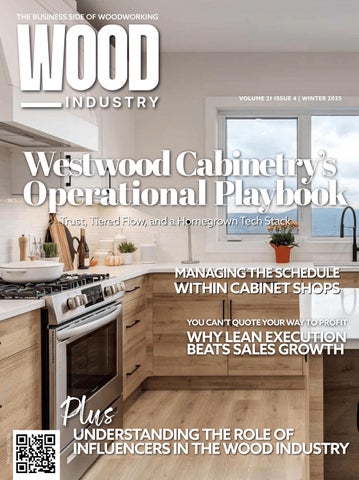
Westwood Cabinetry’s Operational Playbook Trust, Tiered Flow, and a Homegrown Tech Stack
MANAGING THE SCHEDULE
WITHIN CABINET SHOPS YOU CAN’T QUOTE YOUR WAY TO PROFIT
PM 40063056
WHY LEAN EXECUTION BEATS SALES GROWTH
Plus UNDERSTANDING THE ROLE OF
INFLUENCERS IN THE WOOD INDUSTRY
Robotics & Sorting Technology FEEDBOT D-310 & DRILLTEQ V-310
FEEDBOT D-310 & DRILLTEQ V-310 The CNC processing center with robot support forms one of the smallest possible cells of the furniture production. In this combination, the FEEDBOT D-310 increases your overall productivity. It does not have to take a break, can work around the clock on the shop floor and ensures consistently high quality. Small and medium-sized companies save a lot of time by using the robot integration FEEDBOT D-310 and reduce the workload for their staff. The resulting flexible manpower organization allows your workforce to be used more for value-added activities and production processes.
DRILLTEQ V-310 FEEDBOT D-310
Unveil your untapped manufacturing potential with Automatech Robotik solutions. Armony robotic cell with ORRA tooling and intelligence. Unload of a HOMAG nesting router & load/unload of a HOMAG dowel inserter.
AUTOMATECH ROBOTIK • Fast 4-axis robot with multipick capabilities to pick up to 4 parts at the same time • Direct interfacing with the CNC outfeed conveyor from HOMAG • Vision system to detect part shapes following the machine’s push sequence • Dowelling directly in the robotic cell on a DRILLTEQ • Automated outfeed of parts to the edgebander operator • Automatic management of off-cuts and scraps
AUTOMATECH ROBOTIK CELL
• Automatic data feeding and processing from CAD/CAM casegood solution software LEARN MORE automatechrobotik.com/en-us
YOUR SOLUTION www.homag.com | info-canada@homag.com | 1-800-797-8231
contents feature story 22
WESTWOOD CABINETRY How a Kelowna shop ties trust, tiers, strict routing, and homegrown tools to promise four-week Elements jobs, protect engineering, blend robotic finishing with handwork, and grow capacity without new space.
in this issue 32
AMBER MILLWORK AI, CNC and robotics reshape prefab manufacturing, but adoption hinges on skilled teams and training partnerships, writes Akhurst Machinery’s Jayden Campbell, outlining steps manufacturers take to align people and processes.
36
PROFIT COMES FROM EXECUTION Why faster quotes and more sales cannot fix weak processes. Focus on shop-floor execution, expose the hidden factory, and build profit through reliable, scalable flow.
40
WOOD INDUSTRY INFLUENCERS How makers, designers, and educators shape specification and sales through credible tutorials, platform-native content, and long-term partnerships that teach first, measure outcomes, and build trust.
42
SCHEDULE MANAGEMENT Turn scheduling from guesswork into a numbers-driven system. Use throughput, shifting bottleneck control, real capacity, and real-time communication to protect dates, margins, and reputation.
front to back 4
FROM THE EDITOR
36 OPERATIONS
6
FILINGS
40 MARKETING
10 ON TARIFFS
42 MANAGEMENT
14 Q3 HOUSING REPORT
44 PRODUCT SHOWCASE
22 FEATURE HIGHLIGHT
46 STATS AND FACTS
32 SHOP PROFILE
FROM THE EDITOR
BUILDING BETTER SYSTEMS
Tyler Holt
PUBLISHER
Hello Industry Partners, Winter is when Canadian shops get serious. Projects are in full swing, margins are tight, and every decision — from scheduling to quoting — can mean the difference between control and chaos. In this issue, we turn the spotlight toward systems: the structures, habits, and human choices that turn good craftsmanship into lasting businesses. At Westwood Cabinetry in Kelowna, structure isn’t just an organizational tool, but a discipline. Angie Norman’s team has refined what many manufacturers still improvise: process flow, product tiers, and the alignment between promise and delivery. Their four-tier product architecture, homegrown software, and tiered scheduling show what happens when lead time becomes a design choice rather than an accident. Structure takes a different shape at Amber Millwork. Marty and Janelle Berman’s Okanagan-based door shop blends architectural design with manufacturing discipline. Their patent-pending machining process, material climatization routines, and custom tooling turn the humble door into a case study in adaptation. For them, innovation is about building the right tool when the market doesn’t provide it. Elsewhere in the issue, Kevin Martin of Cienapps examines how scheduling defines profitability. His feature, Managing the Schedule Within Cabinet Shops, breaks production down into four controllable variables — throughput, bottlenecks, capacity, and communication. It’s a reminder that a stable schedule isn’t paperwork; it’s the backbone of reputation. When data, visibility, and conversation align, owners stop chasing deadlines and start controlling them. Profitability is also the focus of You Can’t Quote Your Way to Profit, which challenges the old reflex that more sales equal more success. Lean execution, not aggressive quoting, is what protects a shop from scaling itself into failure. In Understanding the Role of Influencers in the Wood Industry, we zoom out to look at how digital influence now moves through trade channels. From shop-floor content creators to educators and designers, a new kind of influencer is redefining credibility. Authentic voices, not algorithms, are shaping how professionals choose materials, tools, and mentors. The takeaway is clear: craftsmanship and communication are no longer separate skills. Across all these stories runs a shared current: discipline creates opportunity. As the new year approaches, consider what systems in your own shop deserve attention. The wood industry will continue to face volatility, but control is always built — never inherited. Craftsmanship endures when it’s paired with process, data, and trust. Thank you for reading, and for continuing to build that discipline — one project, one improvement, one promise at a time.
ART DIRECTOR
Jake Blanchard
Annette Carlucci
EDITOR
GRAPHIC DESIGNER
tylerh@mediaedge.ca
roxyh@mediaedge.ca
jakeb@mediaedge.ca
Tyler Holt PRESIDENT
Kevin Brown
kevinb@mediaedge.ca PRODUCTION MANAGER
Ines Louis
annettec@mediaedge.ca
Thuy Huynh-Guinane CIRCULATION circulation@mediaedge.ca
Wood Industry is published four times annually, Spring, Summer, Fall, Winter, for the secondary wood products manufacturing and marketing industries in Canada. Subscriptions are free to qualified participants in Canada’s secondary wood processing industry. Subscribe at www.woodindustry.ca. Paid subscriptions rates: $40 to Canad ian addresses, $60 U.S. and foreign, $20 student rate. Please mail payment to Wood Industry, 251 Consumers Road, Suite 1020 Toronto, Ontario M2J 4R3. For subscription inquiries, e-mail circulation@mediaedge.ca © 2025 by MediaEdge Communications All rights reserved. MediaEdge Communications and Wood Industry disclaim any warranty as to the accuracy, completeness or currency of the contents of this publication and disclaims all liability in respect to the results of any action taken or not taken in reliance upon information in this publication. The opinions of the columnists and writers are their own and are in no way influenced by or representative of the opinions of Wood Industry or MediaEdge Communications
Inesl@mediaedge.ca
Published by 251 Consumers Road, Suite 1020 Toronto, Ontario M2J 4R3
2012
ISSN 1715-507X PUBLICATIONS MAIL SALES AGREEMENT #40063056
RETURN UNDELIVERABLE CANADIAN ADDRESSES TO: WOOD INDUSTRY 251 Consumers Road, Suite 1020 Toronto, Ontario M2J 4R3
l til 26 id 20 al st r v 31 ffe y O uar n Ja
BOXFIX plus Promotion
Get the BOXFIX plus machine and its accessories now at a special discounted rate, offering savings of up to 20%. Designed to streamline assembly of Blum box systems MERIVOBOX, LEGRABOX and TANDEMBOX. BOXFIX plus speeds up production, reduces errors, and boosts output. Limited-time offer: save on your purchase and start building smarter today. Contact your distributor for more information.
www.blum.com/boxfixca
FILINGS Sames Canada Becomes Independent Subsidiary. Sames North America has announced the formation of Sames Canada Industrial Ltd., an independent subsidiary effective October 1, 2025. The new entity, based in Scarborough, Ontario, will operate autonomously to improve agility and responsiveness to Canadian market needs. The company said the
Cabico&co Names Pierre Huard as
shift will enhance local service, strengthen customer support, and promote innovation
CEO Following Leadership Transition.
tailored to domestic industries. Existing staff, products, and services remain unchanged,
Canadian cabinetry manufacturer
ensuring a seamless transition for clients. “Sames Canada Industrial Ltd. is positioned
Cabico&co has appointed Pierre Huard
to operate with greater autonomy and flexibility,” the company stated, emphasizing its
as Chief Executive Officer, succeeding
ongoing commitment to operational excellence and customer satisfaction across North
founder Alain Ouzilleau, who will remain as
America.
Executive Chair and majority shareholder. The transition, effective immediately, marks a strategic step toward the company’s next Federal Government and BDC Deploy $700M
phase of growth while ensuring continuity
to Support Softwood Lumber Sector The federal
in its leadership vision. Ouzilleau described
government and the Business Development Bank
the move as a personal decision to focus on
of Canada (BDC) are jointly deploying $700 million
long-term strategy, partnerships, and brand
in new liquidity to support softwood lumber producers struggling with U.S. tariffs and
development. Huard brings executive
weak market conditions. Announced by Industry Minister Mélanie Joly, the initiative
experience from the aeronautics, furniture,
will deliver term loans and letters of credit through private lenders, backed by BDC
and HVAC industries, with a leadership style
guarantees, to ease collateral requirements and improve access to working capital.
Ouzilleau praised for its “humility, ambition,
Developed in consultation with financial institutions, companies, and associations,
and care.” Cabico&co emphasized that
the program targets sawmills, remanufacturers, and exporters most affected by
its core values and operations remain
U.S. duties. BDC called the measure “a complementary tool” to existing federal
unchanged, with renewed energy toward
supports, including its $500 million Pivot to Grow fund. The new financing
innovation, customer experience, and
underscores Ottawa’s commitment to stabilizing Canada’s softwood sector
design excellence across North America.
and protecting jobs in forestry-dependent communities. Richelieu Reports $499.2M in Q3 Sales, Expands with Two More Acquisitions Richelieu Hardware Ltd. reported third-quarter sales of $499.2 million, a 6.7% year-over-year increase, as the company continues to expand through strategic acquisitions and organic growth. The quarter saw balanced performance across Canadian and U.S. markets, with internal growth accounting for 4.1% of gains and acquisitions contributing 2.6%. EBITDA rose 7.7% to $57 million, while net income climbed to $0.43 per diluted share. Following the quarter’s close, Richelieu acquired Ideal Security and Finmac Lumber, bringing its fiscal 2025 total to eight acquisitions across North America and adding roughly $75 million in annualized sales. CEO Richard Lord said the company remains focused on innovation, diversification, and value-added service as key growth drivers.
Pierre La Tour Rejoins Biesse as CFO and Board Member Biesse Group has reappointed Pierre La Tour as Chief Financial Officer, expanding his responsibilities to include risk management, HR planning, and indirect purchasing. La Tour, who previously served as Biesse’s CFO from 2019 to 2024, will also act as Investor Relator and Officer Responsible for Financial Reporting, overseeing both financial and sustainability disclosures. His appointment, approved by the Board of Statutory Auditors, reinforces Biesse’s focus on ESG transparency and sound governance. With extensive international experience in finance and organizational transformation, La Tour has also joined the Board of Directors, aligning executive leadership with the company’s strategic and sustainability objectives.
6 | WOOD INDUSTRY WINTER 2025
DON’T MISS
END OF YEAR SPECIALS! DEC.1-DEC. 31
Finished kitchen shown, designed using KCD Software® and manufactured by cabinotch® using CADCode® Systems
The design to manufacture software solution for every room.
Whether you’re a small traditional cabinetmaker, a boutique closet designer, or a CNC manufacturing powerhouse, we have the design to manufacture software solution made just for you. Discover a new level of efficiency with KCD Software.
Designer
Professional
Workshop
CNC Commander
Call 508.568.6272 or Visit KCDSoftware.com DESIGNER
PROFESSIONAL
WORKSHOP
CNC COMMANDER
FILINGS Uniboard Appoints Josh Ware as National Sales Manager for Ontario and Western Canada Uniboard has named Josh Ware (left) as National Sales Manager for Ontario and Western Canada, reinforcing its leadership team as the company expands its presence in key regional markets. Ware brings over a decade of experience in the wood products and components industry, including nearly seven years with Hettich Canada LP, where he advanced through multiple senior sales roles. His background also includes positions with Formica Corporation and Weston Premium Woods, providing direct expertise in decorative surfaces and engineered panels—core areas of Uniboard’s business. The company said Ware’s “leadership, strategic vision, and customer-centric approach” will support ongoing growth and strengthen client engagement across both provinces.
Ontario Invests $3.5M in Automation at Diamond CNC
CKCA Urges Ottawa to Mandate Canadian-Made Cabinetry in
and DSI Industries The Ontario government is investing over
Federal Housing Plan The Canadian Kitchen Cabinet Association
$3.5 million through its Forest Sector Investment and Innovation
(CKCA) is calling on Prime Minister Mark Carney to prioritize domestic
Program to advance automation and job growth in the province’s
manufacturers in the federal government’s national housing strategy.
secondary wood manufacturing sector. Diamond CNC in
At its national forum in Kelowna, BC, the CKCA Board passed a motion
Nanticoke will receive $1 million to install robotic material-handling
urging Ottawa to require that any business receiving public funding or
systems, boosting production by 160% and creating three new
incentives for housing and construction projects source cabinetry from
jobs. DSI Industries (OFGO STUDIO) in Concord will receive $2.5
Canadian manufacturers.
million to add automated finishing equipment, doubling plant capacity and retaining 31 positions.
“Building more homes has become increasingly important,” said Luke Elias, CKCA Vice-President. “We urge the Prime Minister to
Officials said the investments will help manufacturers remain
ensure Canadian manufacturers and builders are the driving force
competitive amid U.S. trade pressures. “We’re investing in
behind Canada’s housing program.” The association argues such
companies that are ready to grow,” said Vic Fedeli, Minister of
policies would keep taxpayer money in the country, strengthen local
Economic Development, Job Creation and Trade. The projects are
economies, and support over 25,000 workers in a sector generating
expected to generate nearly $4 million in new annual supply chain
$4.7 billion annually. The CKCA also called for federal, provincial,
activity, supporting Ontario’s broader strategy to modernize and
and municipal alignment to embed Made-in-Canada requirements
strengthen its wood manufacturing industry.
within all publicly funded housing initiatives. Wood Technologies International Acquires Norwood Sawmills to modernize Wood Technologies International (WTI), the parent company of USNR and Burton Mill Solutions, has acquired Norwood Sawmills, marking its expansion into the portable sawmill market. The acquisition brings Norwood’s well-known brand, patented innovations, and direct-to-consumer model under WTI’s umbrella, complementing its industrial woodprocessing portfolio. Norwood will retain its brand identity, product lines, and dealer network, continuing operations near Toronto, Ontario. “This acquisition launches WTI into
a new segment of the wood products industry,” said Dale Brown, WTI CEO. The addition aligns with WTI’s strategy to diversify across the wood-processing value chain, joining brands such as Mid-South Engineering and Global Tooling & Supply. Backed by One Equity Partners, WTI now comprises five business units offering integrated solutions from industrial to portable milling markets. 8 | WOOD INDUSTRY WINTER 2025
Forests Canada
AWMAC Quebec Honours
Celebrates 50
2025’s Top
Million Tree
Architectural
Milestone Forests
Woodwork
Canada has
Projects AWMAC
reached a historic
Quebec celebrated
achievement—50
excellence
million trees planted
in architectural woodwork at its 2025 Awards Gala, recognizing
nationwide since its founding in 2004. The national charity supported
outstanding projects across commercial, public, and residential sectors.
the planting of more than 4 million trees in 2025, its highest annual
In the Retail category, Boisdaction earned top honours for Silk & Snow,
total to date, surpassing the previous record of 2.7 million in 2024. CEO
while Menuiseries Mont Royal won in Restaurant and Bar for Resto
Jess Kaknevicius credited the milestone to years of collaboration with
Laurier. The company also swept the Corporate category with wins
over 100 partners, including nurseries, conservation groups, and all
for projects including Dentons Offices and Bureaux de la Nation Crie.
levels of government.
In Residential, Menuiseries Mont Royal was recognized for Penthouse
“Fifty million trees on over 10,400 project sites is an important
Sherbrooke, and Beaubois took the Hospitality award for Hochatown
part of our history, but our work is not done,” said Kaknevicius.
Choctaw Landing. Beaubois also won the Public Project over $1.5
Former CEO Rob Keen, now Executive Director of the Canadian Tree
million for Hidalgo County Courthouse, while Polybois and Cuisines
Nursery Association, joined in the celebration, calling the milestone a
GBM captured additional public sector awards. Commonwealth
testament to collective commitment and innovation in forest recovery.
Plywood received Supplier of the Year, rounding out a celebration of
Supported in part by Canada’s 2 Billion Trees Program, the initiative
craftsmanship and collaboration that reaffirmed Quebec’s leadership in
underscores the growing importance of reforestation in combating
architectural woodwork and design innovation.
biodiversity loss and climate impacts.
CELEBRATING A CENTURY Woodlore Hosts Pierre Poilievre to Highlight Canadian Cabinet
Cyclomix® Evo
Manufacturing Woodlore, a Brampton-based kitchen cabinet manufacturer, recently welcomed Pierre Poilievre, MP, for a facility
BEST CHOICE for
PRODUCTIVITY
the newest solution for mixing & dosing 2 & 3 components
and PEACE OF MIND
tour showcasing its contributions to Canadian manufacturing, job creation, and local economic growth. The visit was part of Woodlore’s
High productivity
broader effort to engage policymakers and promote awareness of the domestic cabinetry sector’s importance. “We’ve been eager to show government officials what Canadian manufacturing can achieve,” said the company’s Vice President of Operations & Business Development. During the tour, Poilievre met employees and discussed industry
Perfect dosing & mixing Optimized waste management
challenges, including foreign competition and the need for stronger domestic support. Woodlore has also hosted Maninder Sidhu, MP, as part of its outreach initiative. The Canadian Kitchen Cabinet Association (CKCA) commended Woodlore’s leadership, noting that Canada’s kitchen cabinet industry employs over 25,000 workers and generates $4.7 billion annually.
Scan to LEARN MORE!
sames.com marketing.us@sames.com 800.573.5554 USA • 800.450.0655 CAN
woodindustry.ca | 9
ON TARIFFS
On Tariffs:
How Canada’s Wood Sector Is Fighting Back : : By Tyler Holt, Editor of Wood Industry system under the guise of national security to shake down long-standing allies. And while the move may look exceptional on its face, it’s rooted in a decades-long pattern of U.S. trade aggression—particularly in softwood lumber—where punitive duties are levied first, then overturned years later by international tribunals, long after the damage is done. There may be temporary relief on the horizon. The U.S. Senate has voted to cancel the tariffs, but that move will most likely die in the House. The World Trade Organization or even the U.S. Supreme Court could rule against them, as U.S. Justices have recently characterized these tariffs as a tax on the American people, a power that belongs to the legislative and not the executive branch. But the hard truth is this: the future of Canada’s wood manufacturing sector won’t be decided in Washington or Geneva. It will be shaped here at home by our governments, our trade associations, and the thousands of small businesses that keep this industry alive. Canada has always played by the rules. That hasn’t protected us. What will protect us now is coordinated action, national resolve, and a willingness to push back hard against a system increasingly tilted to serve U.S. protectionism at Canada’s expense.
TRADE TURBULENCE RESURFACES
The news dropped just as I was flying home from the CKCA National Forum in Kelowna: Donald Trump, emboldened by another round of nationalist theatrics, had invoked Section 232 to impose new tariffs on Canadian wood products—blowing past CUSMA safeguards and treating trade law as little more than a suggestion. 10 | WOOD INDUSTRY WINTER 2025
THE SCOPE OF THE SHOCK
For anyone still clinging to the idea that this is business as usual, it’s time to recalibrate. These latest tariffs are not a quirk of election-cycle politics or a momentary flex by a failing president. They are a calculated move by a tinpot dictator who daily lives in fear of future legal consequences, hijacking the U.S. trade
The Section 232 tariffs, issued in mid-October, add new layers of cost across core wood product categories. Canadian-made kitchen cabinets, bathroom vanities, and upholstered wooden furniture are now subject to a 25 percent tariff at the U.S. border, set to rise to 50 percent and 30 percent respectively by
ON TARIFFS
“These latest tariffs are not a quirk of election-cycle politics—they are a calculated move rooted in decades of U.S. trade aggression.” January 1, 2026. Softwood lumber faces an additional 10 percent tariff on top of existing anti-dumping and countervailing duties, bringing total duties for many producers to around 45 percent. The U.S. administration claims these tariffs fall within CUSMA’s “essential security” exception, but the justification is tenuous. Article 32.2 of the agreement allows countries to act in defense of national security, yet the language is vague and largely self-judging. This leaves Canada with limited recourse in the short term, despite the fact that such tactics violate the spirit—and likely the letter—of the trade pact. American lumber lobbyists, led by the U.S. Lumber Coalition (USLC), have seized the moment to amplify claims that Canada engages in “massive subsidies” and “unfair trade practices.” Meanwhile, the National Association of Home Builders (NAHB), which represents over 140,000 U.S. contractors, has taken a sharply different stance. In a public letter, NAHB warned that tariffs on Canadian wood products will “have the opposite effect” of improving housing affordability and would act as a tax on U.S. consumers. Input costs for residential construction have already risen over 30 percent since 2021, and further tariffs could delay essential reconstruction efforts in storm-hit regions.
turing Cluster of Ontario (WMCO). “The tariffs will devastate Canadian companies exporting to the U.S., disrupt the North American housing supply chain, raise costs for American builders, and damage an integrated trade relationship built over decades.” CKCA Vice President Luke Elias described the toll more plainly. “We export about $600 million annually to the U.S. We’re already facing a soft housing market and a 20 percent annual increase in cheap imports. This will have a serious impact on our industry.” Some firms have already been pushed to the brink. Holsag Manufacturing in Lindsay, Ontario will shut its doors by March 2026, relocating production to Utah. The company directly cited the unsustainable burden of rising U.S. tariffs. In Delta, British Columbia, Prepac Manufacturing is closing its facility by May 2025, ending a 45-year manufacturing presence in Canada. Both closures are stark reminders that trade policy decisions made in Washington can have
job-killing effects in Canadian communities overnight. James McKenna, President of Glenwood Kitchen in Shediac, New Brunswick, outlined the dilemma facing many Canadian exporters. “A 25% tariff we might survive. But a 50% tariff is going to wipe out our business completely,” he told CTV News. “We’ve been dealing with our American customers for 40 years. This has just dropped a hammer on our heads.” OTTAWA’S BUDGET RESPONSE
In response, the federal government has launched a multi-pronged economic strategy, embedded in Budget 2025, that aims to stabilize demand, lower investment risk, and support export diversification. While these measures do not remove tariffs, they offer concrete tools for weathering the storm. The flagship program is Build Canada Homes (BCH), a new $13 billion housing agency designed to stimulate construction and ensure procurement favors Canadian materials and manufactur-
MANUFACTURERS SOUND THE ALARM
For Canadian secondary wood manufacturers, the implications are immediate and existential. Export-heavy businesses are facing a sudden doubling of their costs to access U.S. markets, with no meaningful workarounds. “This is a lose-lose scenario,” said Mike Baker, CEO of the Wood Manufacwoodindustry.ca | 11
ON TARIFFS ers. The first major BCH project—a 540home development at Downsview in Toronto—calls for modular, prefabricated, and mass timber components. This represents an actionable demand signal for firms producing panelized systems, cabinetry kits, and standardized millwork. Additional housing incentives include a GST exemption for first-time buyers on new homes up to $1 million, and a partial rebate for homes between $1 million and $1.5 million. These policies are designed to lift multi-unit and entry-level housing starts, pulling cabinetry, trim, and engineered wood products through the supply chain. On the cost side, the government is reinstating immediate expensing for capital equipment. Secondary wood manufacturers can now write off 100 percent of investments in CNC routers, dust collection, finishing booths, or even plant expansions in the year of purchase. This “Productivity Super-Deduction” is expected to generate up to $9 billion in economic output annually through 2030. Ottawa is also enhancing SR&ED research credits, raising the expenditure cap to $6 million and restoring eligibility for capital items. For small shops engaged in custom work, software-based nesting, or finishing process optimization, these credits provide a meaningful offset to innovation costs. Finally, the Business Development Bank of Canada (BDC) has pledged $700 million in liquidity to firms in the softwood sector, backed by guarantees to ease collateral strain. This funding targets working capital needs tied to U.S. duty payments and export-related operations. STRATEGIES FOR SHOP SURVIVAL
For small- and mid-sized firms, especially those with under 10 employees, the best response is a proactive one. A coordinated strategy should include: • Pre-qualifying for BCH supply chains: Register as a supplier of modular cabinetry or mass timber-adjacent components. 12 | WOOD INDUSTRY WINTER 2025
•
Maximizing capital expensing: Re-sequence equipment purchases to capitalize on immediate tax write-offs before phase-out begins in 2030. • Claiming updated SR&ED credits: Include tooling trials, fixture design, and software development under the expanded eligibility. • Pursuing export diversification: Use the updated Canada Tariff Finder to price risk in Gulf, Indo-Pacific, and European markets; align with association-led missions. • Preparing for domestic growth: GST relief and public housing pipelines signal steady baseline demand for cabinetry and trim in multi-unit and affordable housing builds.
tations around the 2026 CUSMA review. The goal is clear: shape the negotiations before the next round of punitive measures locks in. The CKCA has recently launched an Advocacy Tool Kit. Contact Sandra Wood (sandra@ckca.ca) to receive your toolkit and learn more. Provincial governments are also recalibrating their approach. British Columbia has dropped plans for a U.S.-focused ad campaign and joined a federal forestry working group, citing the need for unified messaging. Premier David Eby put it plainly: “This was very heartening to me. I felt like we were going it alone there for a while.” COORDINATED ACTION OR COMPOUNDED RISK
REFRAMING THE FIGHT
As the U.S. lumber lobby doubles down on rhetoric, it’s worth noting the widening gap between their claims and reality. Domestic producers accuse Canada of unfair competition, but their actions have neither rebuilt U.S. mill capacity nor lowered prices for American consumers. The biggest loser in this fight may not be Canada—it may be the American home buyer. Canadian industry leaders are increasingly calling for a more forceful and unified voice. CKCA, WMCO, and AWMAC are urging members to contact elected officials, document tariff impacts, and contribute to public consul-
The U.S. tariff strategy is not a fluke. It is a deliberate pressure tactic, rooted in political theater and trade nationalism. But Canada has tools at its disposal—fiscal, strategic, and diplomatic. What matters now is whether the sector uses them. Budget 2025 does not erase the damage. It does, however, open three viable paths forward: building resilient domestic demand, investing in productivity, and diversifying export reach. Acting on all three is no longer optional. It is essential. In the face of economic coercion masquerading as trade policy, Canada must answer with clarity, resolve, and national purpose. The stakes are too high for anything less.
Rover Rover Fin UP S
Unleash perfection: the versatile finishing solution for every process need Flexible Finishing Centre for Perfect Results. Versatile and powerful finishing centre for every process requirement. The high technological content ensures high quality of the finished product.
Discover our product range
biesse.com
Q3 HOUSING REPORT
Q3 2025 HOUSING STARTS: STRONG NUMBERS, WEAK CONFIDENCE
National starts climbed again in the third quarter, but record-low builder sentiment, layoffs, and a sharp pivot toward rentals point to a fragile pipeline for ownership housing—and a more selective outlook for wood manufacturers. : : By Tyler Holt, Editor of Wood Industry
14 | WOOD INDUSTRY WINTER 2025
Q3 HOUSING REPORT
NATIONAL PICTURE: ANOTHER SOLID QUARTER ON PAPER
In population centres of 10,000 or more, actual housing starts in Q3 2025 totalled 57,215 units, up from 51,351 a year earlier—an increase of roughly 11%. Month by month, the third quarter was consistently stronger than last year: • July: 19,970 → 20,862 (+4%) • August: 14,847 → 16,168 (+9%) • September: 16,534 → 20,185 (+22%) Every month in the quarter was up year-over-year, with the gains building as the quarter went on—modest in July, more pronounced in August, and significant by September. By dwelling type, Q3 starts were again heavily skewed toward multi-family construction. Nationally, single and semi-detached ground-breakings rose from 15,113 to 15,860 (about +5%). Over the same period, multi-family starts climbed from 47,023 to 54,026 (roughly +15%). Multi-unit projects continue to account for the bulk of new supply and most of the year-over-year growth. Completions—buttressing demand for millwork, cabinetry, and finishing products—told a slightly different story in centres over 100,000. Single/ semi completions edged down from 11,510 to 11,439 (about −0.6%), while multi-family completions rose from 42,812 to 44,894 (nearly +5%). That points to a pipeline that remains large and tilted toward apartments: work is still flowing steadily through to the finishing stages even as future sales become more uncertain. SENTIMENT AND SALES: HMI AT RECORD LOWS
Against that reasonably healthy construction backdrop, confidence has rarely looked worse. CHBA’s Housing Market Index fell to 23.3 for single-family builders in Q3, a new rewoodindustry.ca | 15
Q3 HOUSING REPORT POLICY DELAYS, TARIFFS, AND THE PIVOT TO RENTAL
cord low and down 4.1 points from a year ago. The multi-family HMI dropped to 16.8, also a record low and the first time either index has fallen below 20. Roughly 59% of single-family builders now rate current selling conditions as poor, and only 8% expect good conditions over the next six months. About 70% report low or very low sales-office traffic. That pessimism is even more acute in the condominium and stacked-townhome segment: 68% of multi-family respondents describe current selling conditions as poor, and 61% expect them to remain poor. The CMHC reports that 13% of Canadians are currently working towards the purchase of their first home, but almost no respondents expressed any certainty in ability to buy those homes within the next year. Regionally, Ontario and British Columbia are where sentiment is most fragile. Ontario’s single-family HMI is just 7.1, with multi-family at 4.4, and 64% of builders in the province report permanent layoffs. British Columbia’s multi-family HMI has also fallen sharply from a year ago, reflecting tougher conditions in key urban condo markets. Nationally, 41% of builders say they or their subcontractors have had to lay off workers with no plans to rehire—up from 27% a year ago and 35% last quarter. Residential payrolls have posted their largest 12-month decline since 2009 (outside the pandemic). For suppliers, that’s a warning: fewer active sales teams and fewer staff on sites today imply fewer new project decisions six to twelve months from now. 16 | WOOD INDUSTRY WINTER 2025
Weak sentiment is being reinforced by policy uncertainty and cost pressures. Builders continue to point to the unimplemented GST rebate for first-time buyers as a direct drag on sales. The measure has been announced but not yet brought into effect, leaving buyers unsure about their net purchase costs. Many builders report that this uncertainty weighed on summer traffic, particularly for entry-level projects where a rebate could make or break affordability. Tariffs remain a second major concern. While some counter-measures have been removed, many builders say tariffs on key metal components— doors, window casings, sinks, furnaces—are still feeding cost inflation. The broader tariff regime has hit Ontario especially hard: steel and auto tariffs undermine employment in the province’s industrial heartland, dampening job security and appetite for big-ticket purchases like new homes. At the same time, the federal Build Canada Homes initiative is releasing more public land and leaning heavily on incentives for modular construction, while Ontario’s Bill 17 delays development charges until occupancy and seeks to standardize codes. These measures should improve project economics over time, but for now they sit alongside unresolved cost and demand issues. A crucial shift for this audience is the pivot from ownership to rental. Through the first three quarters, urban starts intended for freehold or condominium ownership number fewer than last year, while purpose-built rental starts are significantly higher. Survey data show that nearly 40% of builders have either moved or are considering moving into rental development. For wood manufacturers, that means more large-scale multi-unit projects and fewer highly customized ownership homes, especially in Ontario.
Q3 HOUSING REPORT PROVINCIAL TRENDS: PRAIRIES AND QUÉBEC CARRY GROWTH
British Columbia posted Q3 housing starts of 9,965 → 11,129 (+12%). The provincial totals, however, hide a dramatic split between Lower Mainland/Island markets and the Interior. Among CMAs with 100,000+ people: • Vancouver: 6,225 → 7,602 (+22%) • Victoria: 1,160 → 1,432 (+23%) • Nanaimo: 73 → 144 (+97%) • Abbotsford–Mission: 348 → 540 (+55%) • Kamloops: 94 → 188 (+100%) • Chilliwack: 70 → 143 (+104%) In contrast, Kelowna: 953 → 318 (−67%), marking one of the sharpest declines in the country and a continuation of the correction already evident in earlier quarters. Across the Prairies, Alberta remains the standout. Q3 starts rose in: • Alberta: 12,067 → 12,812 (+6%) • Manitoba: 1,829 → 2,220 (+21%) • Saskatchewan: 1,395 → 1,517 (+9%) At the CMA level, Edmonton: 4,911 → 5,616 (+14%), Regina: 269 → 466 (+73%), Winnipeg: 1,315 → 1,882 (+43%), and Red Deer: 36 → 53 (+47%) all posted solid increases, while Saskatoon: 1,064 → 1,034 (−3%) was slightly lower. Alberta’s housing strength
sits on top of an economy still benefitting from unrestricted energy exports to the U.S., even as other sectors face tariff headwinds. That said, survey data show builder sentiment in the Prairies easing off earlier highs, particularly for large multi-family projects. Ontario remains Canada’s problem child. The single most-developed province with the Canada’s largest metropolitan area, is continuing to see contraction as a result of high construction costs and high home costs at completion. Provincial Q3 starts slipped from 19,757 → 18,743 (−5%), the only large province to post a decline. That follows earlier quarterly weakness and continued contraction in many Southern Ontario CMAs. The city-level picture is mixed: • Kitchener–Cambridge–Waterloo: 711 → 2,294 (+223%) • Brantford: 99 → 295 (+198%) • London: 1,281 → 1,622 (+27%) • Hamilton: 906 → 1,173 (+29%) • Barrie: 433 → 398 (−8%) • Guelph: 196 → 95 (−52%) • Kingston: 161 → 60 (−63%) • Peterborough: 97 → 44 (−55%) • Windsor: 664 → 456 (−31%) • Toronto: 9419 →7554 (-19.8%) Even with some Q3 rebounds in places like Kitchener–Waterloo and Brantford, the province’s pipeline for ownership
The Clean Air Company Quiet, turn-key enclosure-less dust collectors Modular baghouse central dust collectors with SmartFilter technology
Contact a clean air expert! +1 (905) 712-0722 nederman.com
woodindustry.ca | 17
Q3 HOUSING REPORT product looks thinner than it did a year ago, especially in smaller centres that saw steep declines. Québec, by contrast, has moved into a quiet leadership role. Q3 starts grew from 9,610 → 11,927 (+24%). Key CMAs show a mixed but generally expansionary picture: • Montréal: 3,116 → 6,639 (+113%) • Québec City: 1,658 → 1,822 (+10%) • Saguenay: 143 → 188 (+31%) • Trois-Rivières: 872 → 308 (−65%) • Sherbrooke: 471 → 373 (−21%)
THE QUIET EDGE SOUND SOLUTIONS FOR TRANQUILITY
JUNIOR ACOUSTICS
This low-profile hardware and retractable seal system for wood doors up to 100 kg (220 lbs) offers effective sound attenuation while blocking odours, drafts, and light. Ideal for pocket and wall-mount sliding doors, these smooth automatic seals create a quiet interior perfect for office spaces and residential kitchens. Open the door to a peaceful environment.
TALK TO AN EXPERT specs@richelieu.com 1-800-619-5446
RIC251000_WoodIndustry_DemiPageIsland_JrAcoustic_EN.indd 1 18 | WOOD INDUSTRY WINTER 2025
Much of the provincial growth is concentrated in Montréal and selected rental-heavy projects, supported by provincially aligned financing tools and, in some cases, more predictable approval processes than builders face in Ontario or BC. In Atlantic Canada, the headline is Nova Scotia. Provincial starts more than doubled (1,226 → 2,598, +112%), driven by: • Halifax: 763 → 2,020 (+165%) Elsewhere in the region, Moncton: 1,097 → 895 (−18%), Saint John: 208 → 220 (+6%), Fredericton: 292 → 412 (+41%), and St. John’s: 272 → 318 (+17%) show a mix of pullbacks and gains, but the overall Atlantic picture is one of elevated activity compared with a year ago. CITY-LEVEL SHAKE-UPS: TORONTO DETHRONED
The Q2 report already showed that Calgary, Vancouver, and Montréal were challenging Toronto’s long-standing dominance in new-home construction. Q3 data confirms that the city-level hierarchy has been thoroughly shaken up. Among CMAs with populations above 100,000, the most dramatic percentage gains between Q3 2024 and Q3 2025 were: • Kitchener–Cambridge–Waterloo: 711 → 2,294 (+223%) • Brantford: 99 → 295 (+198%) • Halifax: 763 → 2,020 (+165%) • Montréal: 3,116 → 6,639 (+113%) • Kamloops: 94 → 188 (+100%) • Belleville–Quinte West: 108 → 216 (+100%) • Chilliwack: 70 → 143 (+104%) • Nanaimo: 73 → 144 (+97%) Other notable gainers include: • Winnipeg: 1,315 → 1,882 (+43%) • Fredericton: 292 → 412 (+41%) • St. Catharines–Niagara: 416 → 556 (+34%) • Saguenay: 143 → 188 (+31%) • Hamilton: 906 → 1,173 (+29%) • Victoria: 1,160 → 1,432 (+23%) • Vancouver: 6,225 → 7,602 (+22%) • Edmonton: 4,911 → 5,616 (+14%) • Oshawa: 414 → 466 (+13%) On the other side of the ledger, the steepest declines include: 2025-10-07 13:54
• Kelowna: 953 → 318 (−67%) • Trois-Rivières: 872 → 308 (−65%) • Lethbridge: 310 → 112 (−64%) • Kingston: 161 → 60 (−63%) • Peterborough: 97 → 44 (−55%) • Guelph: 196 → 95 (−52%) • Moncton: 1,097 → 895 (−18%) • Drummondville: 415 → 340 (−18%) • Sherbrooke: 471 → 373 (−21%) The largest urban centres are also diverging. In Q3: • Toronto: 9,419 → 7,554 (−20%) • Ottawa–Gatineau: 3,893 → 2,533 (−35%) • Windsor: 664 → 456 (−31%) • Calgary: 6,236 → 6,181 (−1%) • Vancouver: 6,225 → 7,602 (+22%) • Edmonton: 4,911 → 5,616 (+14%) • Winnipeg: 1,315 → 1,882 (+43%) Many of the Ontario markets were already under pressure in previous quarters; the Q3 numbers show that the correction has not yet run its course. By contrast, Vancouver, Edmonton, Winnipeg, and much of Montréal’s market continue to build momentum. The national map now looks like a four-cornered story: strength in Alberta, Québec, and select BC and Atlantic markets; ongoing stress in much of Ontario. INTEREST RATES, COSTS, AND PROJECT ECONOMICS
The interest-rate environment has turned more supportive than it was at the peak of the tightening cycle. Policy rates are lower, and that relief is filtering into mortgage costs and construction financing. That backdrop has helped keep quarterly starts elevated despite weak sentiment. However, lower rates alone are not enough to offset other pressures. Builders consistently cite: • High land prices and municipal fees • Tariffs and supply-chain premiums on non-lumber materials • Labour costs and chronic skilledtrades shortages Industry estimates suggest that non-lumber materials now add roughly
$72,000 to the cost of a typical 2,400-square-foot home compared with 2020; including lumber, the additional materials cost approaches $99,000. With wages and financing also more expensive than pre-pandemic norms, a growing number of projects—particularly condo towers in Toronto and parts of BC—no longer pencil out without additional policy relief or deep price concessions. WHAT IT MEANS FOR SECONDARY WOOD MANUFACTURERS
For wood-products manufacturers, the Q3 data point to a selective but still sizeable opportunity set: • Multi-family dominance. With multi-unit starts outpacing singles both in new ground-breakings and completions, demand is tilting toward repeatable, specifica-
Building Trust. Creating Together.
PSA-80 PRO Panel Sanding Assistant. The fastest sanding machine on the market, now with DUAL SANDING UNITS engineered to elevate your productivity like never before. The Omnirobotic PSA-80 PRO Panel Sanding Assistant offers autonomous sanding quality and performance in its simplest form. Specially designed for kitchen cabinet manufacturers, this advanced sanding machine will help you overcome the skilled labor shortage and boost your productivity. Powered by AutonomyOS™, an AI platform for robots, it autonomously performs every sanding task with a quality that is second to none.
Delta, BC | Edmonton, AB | Mississauga, ON | Montreal, QC | Dieppe, NB
www.akhurst.com woodindustry.ca | 19
Q3 HOUSING REPORT
tion-driven products: pre-hung doors, engineered flooring systems, modular cabinetry lines, and panelized wall assemblies suited to mid- and high-rise rental apartments. • Geographic re-balancing. Growth markets for the next 12–24 months are increasingly outside the traditional GTA anchor. Suppliers with exposure to Alberta, Québec, Lower Mainland BC, and high-growth CMAs such as Halifax, Winnipeg, Kitchener–Waterloo, Montréal, and selected Interior/Island BC cities are likely to see steadier order books than those tied primarily to Southern Ontario. • Rental vs. ownership mix. The pivot toward purpose-built rental reshapes product profiles. Large-scale projects favour robust, value-oriented finishes and tight delivery schedules, but they also offer volume and repeat business. Firms that can standardize components, support modular or off-site construction, and manage installation at scale will be best positioned. • Ontario and BC caution. Record-low HMI readings, layoffs, and deep cuts in Toronto-area starts argue for a cautious stance toward speculative capacity expansion in these markets, particularly for high-end condo-oriented finishes. At the same time, a backlog of projects under construction— and an eventual policy or rate-driven rebound—mean these regions cannot be ignored. • Labour and cost pressure = opportunity for prefabrication. With builders shedding staff and material costs still elevated, there is renewed interest in labour-saving systems and factory-built components. That creates openings for firms that can offer pre-fabricated stair systems, panelized roof and wall assemblies, and integrated millwork packages that reduce on-site labour and waste.
20 | WOOD INDUSTRY WINTER 2025
A CAUTIOUS CONCLUSION
Q3 2025 extends the theme that emerged in the second quarter: headline starts are stronger than the mood on the ground. Actual quarterly and monthly numbers remain historically high, and multi-family construction in particular continues to push forward in key regions. Yet builder sentiment has sunk to record lows, permanent layoffs are rising, and policy delays— most notably around the GST rebate—are slowing sales at precisely the moment Canada needs the opposite. For the wood industry, the practical takeaway is to treat today’s strong starts as the product of yesterday’s decisions. The projects breaking ground now were financed when conditions looked better than they do today. The record-low HMI readings and layoffs of mid-2025 suggest that, without a turn in sales conditions or a faster policy response, the pipeline for ownership housing six to eighteen months out could be meaningfully thinner, especially in Ontario and some BC markets. The cost of housing to individual consumers is still drastically unaffordable, frozen in tension against builders challenged to increase supply, lower costs, and still come out in the black. Builders and property owners are understandably standoffish about constructing housing that will ultimately need to be sold for less than it costs to make. In the meantime, the market is not closing—it is re-shaping. Rental towers, Alberta and Québec growth corridors, and mid-sized CMAs gaining population will increasingly define demand. Secondary wood manufacturers that tilt their sales efforts, product designs, and logistics toward those realities will be better equipped to navigate what remains a circumspect, bifurcated housing cycle.
HOLZ-HER CANADA GLU JET 725 PUR PRO
HOLZ-HER’s Next Gen Glue Application System Same Quality Zero Joint Technology with Several Key Upgrades • • • • • WEINIG Group Canada 4317 Autoroute des Laurentides E, Laval QC H7L 5W5 Unit 4 210 Brunel Rd Mississauga, ON L4Z 1T5 holzher.ca
Vacuum-sealed PUR processing system for maximum efficiency. Swivel arm that allows the GLU JET to rotate outward for easy cleaning. New dosing sleeve for precise dosing and fast and efficient rinsing. PUR optimized pre-heating unit, allowing for higher tolerances and ensuring a clean, constant, even flow of the adhesive. DLC (Diamond-Like Coated) dispensing sleeve allowing for reduced scanning pressure of sensitive material surfaces.
FEATURE STORY
WESTWOOD C PLAYBOOK: Trust, Tiered Flow, and a Homegrown Tech Stack : : By Tyler Holt, Editor of Wood Industry
22 | WOOD INDUSTRY WINTER 2025
FEATURE STORY
CABINETRY’S
woodindustry.ca | 23
FEATURE STORY
G
rowth in secondary wood manufacturing often introduces the very constraints that eliminate speed. Shops expand catalogs, absorb custom requests, and then watch engineering become a choke point. Schedules slip. Expediting becomes a habit. Margins leak. Westwood Cabinetry in Kelowna, British Columbia, provides a counternarrative that is both practical and proven. Over five decades, the company paired a single brand promise with a tiered product architecture, carefully separated process streams, and a homegrown software backbone. The pattern is consistent: define what will ship fast, keep unnecessary hands off it, and use technology only where it shortens time or reduces errors.
HERITAGE AND THE VALUE OF TRUST
Westwood is a second-generation company foundedin1974bycabinetmakerNickGrasa, who emigrated from Yugoslavia in search of a place where, as his daughter recalls, 24 | WOOD INDUSTRY WINTER 2025
Angie Norman leads from the front door—literally—anchoring Westwood’s strategy in real-time customer signals and day-to-day demand.
FEATURE STORY “you could work hard and see the fruits of that work.” Grasa started the shop on the outskirts of Kelowna, long before the city expanded around it. The original plant now serves as the company’s showroom, and one of its ceiling beams still bears his handwritten mark—a tangible reminder of origins built on care and craftsmanship. When Angie Norman, Nick’s daughter, assumed leadership, she brought both respect for that legacy and the discipline of a modern executive, having completed an MBA at the Ivey School of Business. “Trust, in a word. Our customers trust us,” she says. “They know we’ll be here if anything happens. That’s why we see second and third generations of the same families coming back.” The company’s reputation is so entrenched that local realtors list a “Westwood kitchen” as a feature that raises home value. Trust can function as an economic asset—it shortens sales cycles and deepens loyalty. CHANNELS AND TIERS AS OPERATING CONTRACTS
Westwood’s market approach is deliberately segmented. In-house
designers handle retail consumers seeking custom spaces. A structured dealer network brings in specified work from independent showrooms across Western Canada. Multi-unit developers receive a more industrial cadence, while select commercial projects—such as cafés, cidery builds, and professional offices—fill gaps that match the company’s capacity and craftsmanship. Each stream has distinct documentation and decision rhythms, so Westwood treats them as unique operating contracts rather than a single funnel. At the product level, this segmentation takes tangible form in a four-tier architecture: Essentials, Elements, Elite, and Custom. Essentials satisfies budget and schedule constraints with in-stock or assembly-ready options. Elements promises delivery in four weeks—speed without compromise. Elite introduces painted and stained finishing steps, while Custom handles one-off designs. These tiers act as operational contracts defining not just what will be sold, but how each category flows through the plant. The segmented product tiers clarify promises
“Lead time is a design choice,”
woodindustry.ca | 25
FEATURE STORY
“We look for people who want to make sure it’s done right. It’s about pulling your weight, being part of the team, helping each other out.” and align customer expectations with operational capacity. LEAD TIME BY DESIGN, NOT ACCIDENT
Most late jobs begin upstream when work that should have moved untouched finds its way into engineering, or when unlike jobs compete in a single queue. Westwood’s response is structural in a way that dealers can anchor their own lead-time commitments and developers can scope building packages that mix Essentials for 26 | WOOD INDUSTRY WINTER 2025
secondary spaces with Elite or Custom for show suites and common areas.. The Elements line deliberately bypasses engineering—its allowed options are clear enough that orders can be validated and released directly to production. “Lead time is a design choice,” Norman emphasizes. “If a job violates those allowances, it’s not an Elements order—it’s something else, and we schedule it accordingly.” Multiple process streams reinforce that discipline. Essentials, Elements, Elite, and
Custom each have defined sequences and information sets, reducing context switching and preserving flow. The result: cleaner schedules, fewer surprises, and steady work that remains predictable even when demand spikes. The hierarchy, once defined and enforced, becomes a shared language of risk and schedule. This approach does not require a huge facility. It requires consistent definitions and the will to maintain them. Clear product rules, disciplined order entry,
FEATURE STORY and an escalation path for exceptions prevent the quiet erosion of lead time that plagues many growing shops. Over the arc of a year, the hours saved in engineering and the reduced firefighting on the floor convert to capacity without new square footage. SOFTWARE AS THE QUIET MOAT
When off the shelf software failed to match the realities of mixed model cabinet manufacturing, Westwood built its own. What began decades ago as basic reporting tools evolved into WES (Westwood Enterprise System)—a full manufacturing execution backbone. Then came WPQ, a portable quoting tool for dealers, followed by the latest evolution: Westwood Connect, a cloud-based environment launched in 2025. “Westwood Connect brings us all together,” Norman explains. “It’s an online system—we can work with our dealers in real time.” The platform allows both parties to co-edit quotes, clarify options, and resolve questions instantly, cutting order cycle times dramatically. The strength here is not a brand name or a trendy feature set. It is alignment. The system expresses the company’s real routing rules and quoting logic. It captures the difference between a four-week Elements job and a more complex Elite or Custom job. It supports a dealer network without forcing the factory to absorb uncontrolled variability. That alignment is difficult to buy off the shelf. It emerges from knowing where errors originate and designing the system to prevent them rather than correct them. The company’s technological initiative has even earned a Kelowna Chamber of Commerce nomination for technology and innovation, underscoring how a cabinetry manufacturer can belong to the same innovation conversation as the city’s software startups. FINISHING THAT BLENDS ROBOTICS AND TOUCH
A kitchen is judged by the eye and the hand. Westwood’s finishing operation
”People are our strength,” Says Angie Norman
woodindustry.ca | 27
FEATURE STORY
“Trust, service, and adaptability—that’s how we keep our promise.”
merges automation with craftsmanship. The plant’s 55,000-square-foot main facility—plus an additional 28,000 square feet next door—houses a flatline paint system with robotic arms that deliver consistent lacquer across doors and panels. Integrated dryers accelerate throughput without surface flaws. Hang lines and booths manage parts unsuited to automation, while hand sanding ensures edges and profiles feel as good as they look. Sheet goods are organized and selected by a Winstore 3D K1 material handling system and laid on the bed of a River A nested routers and then edge banders before finishing. By the time parts reach their Superfici flatline paint line, variables are reduced to finish quality alone. Robotic arms lay down a uniform film build, but the human eye still has the last say. “We sand by hand before and after,” Norman notes. “That’s what gives the edges their feel.” The company treats finishing not as decoration but as the final quality control loop. This hybrid process is no aesthetic luxury;it’sthecustomer’sdailytouchpoint. Doors open and close thousands of times over a kitchen’s lifespan, and a finish that feels right reinforces brand trust long after installation. BUILDING CAPABILITY THROUGH STRUCTURED TALENT SYSTEMS
Equipment and software can underperform without a workforce that understands both. Westwood treats talent as a system to be designed. Senior designers mentor assistants, Red Seal apprentices rotate through departments, and cross functional groups gather for whiteboard based problem solving to test fixes and follow up the next day. “Learning is visible here,” Norman notes. “It’s not an occasional project—it’s the daily posture.” The result is organizational resilience: the company adds capacity without diluting standards. When veterans take vacation, the plant runs smoothly 28 | WOOD INDUSTRY WINTER 2025
FEATURE STORY because apprentices and junior staff understand the logic behind the systems they support. Westwood also extends its learning culture to partners. Each year, the company hosts a week of dealer workshops on finishing and materials — covering stain techniques, veneer behavior, and species selection. “It’s amazing what happens when you bring people into the plant,” Norman says. “They understand what affects quality, and they sell smarter.” Their Red Seal operations manager leads wood-science sessions that demystify grain, growth rings, and finish response. For dealers, it’s both education and brand immersion. MARKET SENSING AT THE FRONT DOOR
Strategy benefits from proximity. Norman’s office remains by the front entrance, close enough to hear the rhythm of customer interactions. “After the Bank of Canada’s 50 basis point cut, the phones rang off the hook,” she recalls. “You could feel the market move.” That sensory data—tone of voice, call frequency, types of questions—helps Westwood adjust staffing and production well before metrics show the trend. Every project moves through a human chain — from showroom greeting to designer handoff, through installation and post-service calls. “It’s a journey,” Norman says. “And our strength is our people who stay with the customer the whole way.” That person-to-person continuity converts what could be a commodity purchase into a relationship business. WOMEN IN LEADERSHIP AND SUCCESSION
When Norman entered the industry, there were almost no women on job sites. Today she leads a team that includes women in operations, finance, and software development, notably Rishelle Tarr, Westwood’s Director of Business Operations and lead developer of Westwood Connect, who was recently elected to the CKCA Board of Directors.
“I want to work with people who are passionate and great at what they do,” Norman says. “Gender doesn’t define ability; commitment does.” PEER LEARNING AS CONTINUOUS R&D
In a craft-driven industry, knowledge travels through peers and suppliers. Westwood participates actively in CKCA tours and supplier visits, treating them as living laboratories. Lessons from a Thursday plant tour often become Monday’s process trials back home. This posture keeps innovation social, distributed, and refreshingly practical. Norman credits the CKCA with nurturing a culture of openness among competitors. “We’ve been lucky to visit so many plants and learn from people who are really good at what they do,” she says. Hosting the CKCA’s national convention in Kelowna let Westwood return the favor, offering transparency into its processes. “Everyone who came through had a different question, and we learned from their eyes too,” Norman adds. For her, CKCA isn’t just an association — it’s how
best practices circulate across Canada’s secondary wood industry. LESSONS FOR PEERS
Westwood’s durability stems from alignment. Trust anchors the brand. Channels are treated as distinct operating contracts. Product tiers bind sales promises to factory behavior. Lead time is designed, not improvised.Softwareexpressesrealrulesand reduces latency. Finishing blends automation with craftsmanship. Talent and leadership systems evolve alongside technology. And leadership stays close enough to the front door to feel the market shift. For small and midsized manufacturers, the path is replicable: define the promise you can keep daily, separate flows that must never mix, publish option rules that protect engineering, and build systems that reflect your shop’s own vocabulary. Visit peers, share what you learn, and return the favor. Over time, those choices turn consistency into capacity. As Norman puts it, “Trust, service, and adaptability—that’s how we keep our promise.” woodindustry.ca | 29
SHOP PROFILE
Amber Millwork Beyond the Door
How Amber Millwork marries craft, engineering, and service :: By Joy Doonan, Wood Industry Writer
THE DOOR, DEFINED
In the Okanagan’s mid to high-end residential market, Amber Millwork stands out by making interior and exterior doors that perform and present like furniture. The Kelowna shop’s focus is specialist doors, supported by design insight, precise machining, and practical jobsite awareness. That combination positions doors as visible, daily-use elements that carry both functional loads and design intent. CONVERGING PATHS
Marty Berman grew up in the Niagara region of Ontario, spending a lot of time inside the family stair plant, often sitting through customer meetings with his father. He later completed Conestoga College’s Woodworking Technology program and worked across component suppliers and hardware, eventually being recruited by Upper Canada in 2008 to move west. That role connected him to B.C. contractors and, ultimately, to Janelle. Janelle Berman, who is originally from the Okanagan, trained in Architectural Technology and worked in Alberta as a home designer before returning to Kelowna to be a site supervisor with her father’s construction firm. “As a house designer, you work very much on your own most of the time,” she explains, “and I wanted more of the hands-on, social aspect as well.” The couple’s combined experience in the industry and mutual passion for quality and innovation has made them successful both as a team and as individuals; they have each made the Wood Industry 40 Under 40 list, Marty in 2017, and Janelle in 2021. 32 | WOOD INDUSTRY WINTER 2025
SHOP PROFILE
Eventually, Janelle and Marty recognized a regional gap for higher-end door solutions, and saw it as an opening to start their own business. The company’s name nods to family and material heritage. “Amber” is derived from Marty’s father’s initials—Adrian Martin Berman—and doubles as a reference to tree sap, a symbol for preserved craft and continuity. Amber Millwork fuses architectural intent with fabrication realities. Drawing on their complementary and overlapping expertise, Marty and Janelle lead a team that closes the common gap between drawings and doors. “To be able to have that backup has been key to success; for the two of us to be able to jump into each other’s roles, but not overstep each other’s roles,” says Marty. FROM DESIGN TO PROCESS
Marty’s interest in specializing in doors sharpened while working on the construction side, where he saw small omissions and timing errors amplify into costly rework. Doors arrive early in the sequence, and specifications can drift while other trades advance. In that environment, foresight matters.
Design impact is equally central. As Janelle puts it, “when people come up to your front door, that’s where your guests are standing for a minute or more. The entrance door can create a big impression and set the tone and character of a place, so it is a real big feature of the home. For me, that’s where the design comes in; I want to make sure the entrance is representative and harmonious with the overall look a client is going for, to tie their home in with their personality.” That design thinking shows up in machining choices, sequencing, and the creation of custom tooling. The shop has a patent-pending machine built to execute multiple operations accurately on one setup, which is valuable in a product with tight tolerances and long, heavy components. As Marty explains, “the door goes on once, we can cut the door, router the bottom of the door, and do the line patterns on the door. It’s multiple functions we can do on that, the same as a CNC could at a very fraction of the price.” Amber Millwork’s drive to adapt machinery is not incidental. It reflects a formative habit. Marty recalls, “I grew up on job sites, sitting with my dad for hours in customer meetings, and I would look at
“Something my dad told me; you can learn the woodworking skills easily. It’s more how to deal with everyday people that can be a challenge, and not necessarily in a bad way.”
woodindustry.ca | 33
SHOP PROFILE him going over plans and saying ‘how can we redesign and incorporate this to work with that?” That mindset underpins Amber Millwork’s habit of modifying equipment or creating jigs to remove waste, reduce handling, and protect workers’ backs. Beyond aesthetics, the team treats performance as a lifecycle issue tied to local climate, installation timing, and serviceability. In the Okanagan, winters canbringsharptemperatureandhumidity swings, so engineered constructions, proper moisture conditioning before assembly, and disciplined resorting reduce movement-related callbacks. Thoughtful hardware selection, including concealed options that demand tight machining, supports long-term alignment and function. Finish systems and adhesives are chosen with both durability and indoor air quality in view, which keeps coatings stable and VOCs low. The result is a door package that balances energy efficiency, fit-and-finish, and maintainability, with components specified to perform together through seasonal change. TRIED AND TRUE OPERATING LESSONS
Ensure a flawless finish every time by upgrading to automation with the Cefla Prima EVO. Cefla’s Canadian Distributor:
34 | WOOD INDUSTRY WINTER 2025
Scan to Learn More:
Reflecting on the biggest learning curves across his career, Marty says, “I honestly think we need to learn more about how to deal with each other and people skills. That was something my dad told me; you can learn the woodworking skills easily. It’s more how to deal with everyday people that can be a challenge, and not necessarily in a bad way.” He extends that lesson to respect for every role on the floor and in the field. “From the guy who’s driving the truck to the guy who’s unloading the truck to the guy who’s delivering our product. All of those people are key and they all have different knowledge that brought us to where we are today.” The shop encounters “oddball scenarios,” like a 7-by-8-foot door leaning against a skid that must be unloaded safely, and the best answer can come from anywhere. “One person who’s been in the industry for 40 years might have one idea of how to do it, and
SHOP PROFILE
“From the guy driving the truck to the 21-year-old just out of school — everyone has value. The best answer can come from anywhere.”
the 21-year-old who’s been in school for six weeks. He has value.” For Marty, the operational objective is clear: build habits that surface ideas from every seat, then train supervisors to reinforce the message that contribution is not a function of tenure but of paying attention and speaking up. The second thread is structure. Building a holistic shop means translating diverse skills into consistent outcomes, then defending those outcomes at scale. As Marty notes, “we started this shop with a standard of quality. When you grow, maintaining that quality is very hard. You’re putting your trust in other people to each play their role. So, we’ve put a lot of checks and balances in place where we can have somebody with limited skills come into the shop and start working, and still feel comfortable that the quality is going to be maintained with those checks and balances in place. That’s also why we stay at the size we are at.”
Those checks include labeling and location-based estimating, material climatization and resorting, dedicated setups, and purpose-built jigs that limit variability. The result is fewer surprises on site, clearer communication with builders, and better alignment between the drawing and the door. PROOF IN USE
Amber Millwork’s approach combines an architectural perspective with fabrication discipline. The firm treats the door as a coordinated system that respects design intent, climate, code requirements, and the realities of scheduling. Methods that minimize handling and elevate accuracy are paired with client education and clear documentation, which keeps projects aligned from estimate to install. The result is a small, focused shop that has helped raise the regional baseline for doors in a market that values craft.
Joy Doonan is a writer from Ottawa. She has a degree in Sociology and a certificate in Technical Writing, and she takes a special interest in small business sustainability
woodindustry.ca | 35
OPERATIONS
You Can’t Quote Your Way to Profit: Why Lean Execution Beats Sales Growth : : By Sarah Woolverton, Director at WEB-CAB
You’ve heard the buzzwords: Lean manufacturing, continuous improvement, eliminating waste. They’re everywhere—from trade shows to YouTube channels to shop floor posters. But if you’re running a woodworking business, have you ever stopped to ask yourself what it really means for you?
36 | WOOD INDUSTRY WINTER 2025
YOUR LINK TO BUSINESS HELP Because lean isn’t just for the Toyotas of the world. It’s not a corporate philosophy—it’s a survival strategy. At its core, lean is about profit. It’s about doing more with less, reducing friction, and tightening the link between time, labor, and value. And if you’re a business owner who started this journey because you love the craft—because you wanted to build beautiful, functional things—lean might feel far removed from that passion. But here’s the truth: you can love the craft and still need the business to be viable. You still need to earn a decent living, pay your employees, and have something left at the end of the month. Passion alone doesn’t keep the lights on—profitability does. And you don’t get there by quoting faster. You get there by executing better.
SALES GROWTH IS NOT A SAFETY NET
Too many businesses fall into the trap of thinking that more sales will fix their problems. “If we just sell more, it’ll all work out.” But sales can’t fix broken processes. If your shop floor is inefficient—if workers are searching for missing parts, if assemblies are delayed, if priorities are unclear—it doesn’t matter how many orders you book. Each new job could be pushing you further away from profitability. Boosting revenue while losing control of production is like pouring water into a leaky bucket. You’re working harder but falling further behind. In many shops, that “leak” is invisible until growth exposes it. A handful of late jobs can quietly turn into chronic overtime, missed deliveries, and cash-flow strain. Lean thinking forces owners to see
CKCA membership helped us to legitimize our new business and it provided us access to a wealth of knowledge and resources that help us stay ahead in the ever-changing world of kitchen design and manufacturing. By joining CKCA, you gain knowledge, access from advocacy -- and you make new friends along the way! SIERRA AND SEBASTIEN LEVESQUE OWNERS, CNC CABINETS INC.
LEADS. OPPORTUNITIES. CONNECTIONS. LEARN MORE AT
CKCA.CA woodindustry.ca | 37
OPERATIONS
The shop floor—your workflow, your people, your systems—is where your profit is made or lost.
those hidden costs—extra handling, duplicated tasks, poor layout—not as annoyances, but as profit drainers. Once identified, they can be eliminated piece by piece, freeing up time and margin without adding staff or space.
LEVEL UP
YOUR LAMINATING LINE
evansmidwest.com | 616-546-8225 | sales@evansmidwest.com
38 | WOOD INDUSTRY WINTER 2025
THE MYTH OF THE FRONT-OFFICE FIX
Here’s what we often hear: “We need to fix our quoting process.” “Our planning isn’t working.” “Our delivery timelines are all over the place.” But those are often symptoms, not the real problem. Yes, your quoting tool might allow your team to send beautiful estimates in a few clicks. But what happens when that quote turns into a work order? • Are workers scrambling to find parts? • Are priorities changing mid-shift? • Are special instructions being missed or misunderstood? • Are jobs getting delivered on time—but at a loss?
OPERATIONS If you quote a job at $12,000 but it ends up costing you $13,500 to complete, the quote wasn’t the issue. The execution was. Lean-minded owners start tracking the “hidden factory” — all the unplanned work that happens outside the quote. Every time someone redoes a part, hunts for a jig, or stops to clarify specs, that’s waste you’re paying for. Documenting and reducing those moments is where real margin recovery begins.
• Minimal rework • Zero guesswork • And a system that scales with you, not against you That’s what lean really looks like—not a poster on the wall, but a process that works every single day. It also means measuring improvement, not just activity. Set small, visible targets: reduce travel time by 10%, cut rework hours in half, or complete one continuous improvement project per quarter. Those numbers tell the story of whether your lean efforts are actually driving profit. FINAL THOUGHTS
WHEN GROWTH BECOMES DANGEROUS
One of my colleagues recently spoke with a prospect whose story has stuck with me. Their business had grown from $400K to $12M in just a few years. On paper, it looked like a huge success. But behind the scenes, things were unraveling. Production couldn’t keep up. Systems didn’t scale. Mistakes and rework ate into margins. And despite strong sales, they had to shut down. They didn’t fail because they couldn’t sell. They failed because they couldn’t deliver profitably at scale. Growth can magnify both strengths and weaknesses. Without disciplined processes, every new customer amplifies complexity. That’s why sustainable growth demands leadership focus—not just sales ambition. Lean isn’t about slowing down expansion; it’s about making sure your foundation can carry the weight when it comes. YOUR SHOP FLOOR IS YOUR PROFIT CENTER
This isn’t to say sales and marketing aren’t important. Of course you need to feed your pipeline. But the shop floor—your workflow, your people, your systems—is where your profit is made or lost. Unless your goal is to run a not-for-profit, your real job is to make sure every order that leaves your shop does so profitably. That means: • Clear priorities • Parts where they’re needed
Quoting faster doesn’t make you more profitable. Selling more doesn’t fix your margins. What matters is what happens after the sale—when the real work begins. Take a hard look at your floor. That’s where your profit lives—or dies. And remember: lean isn’t a project with an end date. It’s a mindset of learning and adjusting—one that turns chaos into clarity and good craftsmanship into a sustainable business. When execution improves, sales growth finally becomes what it should have been all along: a reward, not a risk.
STRENGTH IN NUMBERS Our cluster thrives on the collaborative model of sharing best practices, gathering new ideas, and working together. Join us and become part of a dynamic and supportive community dedicated to helping each other succeed.
TO LEARN MORE VISIT www.wmco.ca
woodindustry.ca | 39
MARKETING
Understanding the Role of Influencers in the Wood Industry : : By Linda Farha, President and Founder of Zenergy Communications
When you hear the word influencer, your mind might jump to social media stars pushing beauty products or travel bloggers posting from remote destinations. But in recent years, the landscape has evolved — and industries like woodworking, millwork, cabinetry and manufacturing are quietly being reshaped by a different kind of influencer.
40 | WOOD INDUSTRY WINTER 2025
MARKETING
I
n the wood industry, reach and influence don’t come from flashy filters — they come from credibility, consistency and craftsmanship. So, what does “influencer marketing” actually look like in this space, and how can manufacturers, millworkers, and brands use it strategically? INFLUENCE, REFRAMED
Let’s start by redefining the term. An influencer, in the context of the wood industry, isn’t necessarily someone with a million followers. It could be: • A respected cabinetmaker who shares how-to or process videos on YouTube • An architect known for championing sustainable materials • A designer who regularly tags brands in finished project photos • A woodworking instructor who mentors the next generation These individuals have authentic access to a targeted, invested community. Their credibility comes from years of hands-on experience, not paid promotion. In a trade where trust is built through word of mouth and proven results, that authenticity translates into influence that can shape purchasing habits, training choices, and even design trends. As a younger generation of tradespeople grows its online presence, the voices they follow increasingly guide how they build, buy, and learn. WHY IT MATTERS NOW
In a world where attention spans are shrinking and supply-chain loyalty is being tested, brand visibility must meet people where they already are — and for many wood industry professionals, that’s Instagram, YouTube, LinkedIn and niche podcasts.
What used to be passed along in trade journals or lunchroom conversations is now happening online, making the content more searchable, shareable and scalable. Industry associations and trade events are catching on too. Many now invite content creators to document shop tours, cover award ceremonies, or highlight innovation booths. This organic coverage helps bridge the gap between manufacturers and end users, keeping technical topics accessible and relatable. TYPES OF INFLUENCERS TO CONSIDER
Depending on your goals, influencers can take many forms: • Craft-Based Content Creators — Woodworkers, cabinetmakers, or builders sharing tutorials, tips, or project breakdowns. • Design-Driven Specifiers — Architects and interior designers who regularly call out the materials they use. • Trade Educators — Influential voices within schools, certifications, and training programs. This isn’t just about reach — it’s about relevance. An Instagram woodworker with 10,000 engaged followers may do more for your brand than a celebrity endorsement ever could. Cross-platform presence also matters: a maker who posts short process clips on Instagram, longer demos on YouTube, and project insights on LinkedIn connects with multiple layers of the professional audience. WHAT WORKS (AND WHAT DOESN’T)
Successful influencer engagement is built on: • Authenticity — Choose voices who actually use and understand your product. • Education — Collaborative how-to con-
tent, installation demos, or material deep dives. Teach first, sell second. • Partnership — Build long-term relationships that grow over time. • Support — Provide samples, technical help, and creative freedom within brand guidelines. Measurement matters too. In B2B spaces, results might not show up as likes — but as increased dealer inquiries, specification mentions, or web traffic from referred posts. Track those outcomes to see what truly resonates. What doesn’t work? Generic scripts, over-produced ads disguised as “collabs,” and one-size-fits-all influencer lists copied from consumer marketing playbooks. INFLUENCE IN ACTION
Some of our own clients in the wood, materials, hardware and allied spaces have seen powerful results by partnering with wellaligned creators — not to “go viral,” but to foster authentic conversations within the woodworking community. The result? Increased brand recognition, product trust, and specification that lead to tangible sales. LOOKING AHEAD
Influencer marketing isn’t about chasing trends — it’s about understanding where influence naturally lives in your market and engaging with it authentically. For manufacturers and distributors, that means identifying the builders, designers, and educators already shaping perception and finding ways to support them. At its best, this approach humanizes industrial marketing. It turns products into stories, brands into collaborators, and audiences into communities — reminding everyone that even in a digital age, craftsmanship and credibility remain the strongest forms of influence. woodindustry.ca | 41
MANAGEMENT
Managing the Schedule Within Cabinet Shops
:: By Kevin Martin, Cienapps Software
SCHEDULE MANAGEMENT FOR CABINET SHOPS
Creating custom cabinetry requires not only craftsmanship but also the ability to manage a constantly shifting business environment. Material availability, customer requests, supplier lead times, and on-site logistics all fluctuate leaving many shop owners feeling like they spend their days “putting out fires.” In smaller operations, these disruptions can feel personal—every late shipment or missing part directly affects the owner’s reputation and cash flow. Scheduling, then, isn’t just an administrative function; it’s a lifeline that connects promises made in the showroom to performance on the shop floor. That’s why building and maintaining an accurate production schedule can often feel impossible. Those who manage scheduling success42 | WOOD INDUSTRY WINTER 2025
fully can seem like magicians. In reality, effective scheduling comes down to understanding key operational concepts and using the right tools to manage uncertainty. The four main pillars are throughput, bottlenecks, capacity, and communication. When combined, they turn scheduling from guesswork into a numbers-driven discipline. Digital platforms have made it easier than ever to visualize these variables in real time. A properly integrated system translates shop activity—machine uptime, purchase orders, or finishing progress— into data that drives informed scheduling decisions rather than gut instincts.
1
. Throughput: Measuring Profitability and Determining Priority
Throughput measures how efficiently your shop turns work into profit. It’s not about the size of the job—it’s about how
much value each project adds per hour or per dollar invested. A $100,000 contract can lose money if it ties up your best people for weeks, while a $10,000 project finished quickly might deliver a higher return. By performing accurate job costing and reviewing past performance, shops can identify which job types consistently produce the most profit relative to effort. Throughput should therefore guide production priorities—not prestige or order size. Modern estimating and scheduling tools can track this data automatically, flagging high-margin, low-friction projects and aligning sales goals with actual shop capacity.
2
. Bottlenecks: Finding and Managing Constraints
The concept of a bottleneck is widely known but often misunderstood. Think of your production flow like city traffic during rush hour. Congestion doesn’t always hap-
MANAGEMENT pen in the same place—some days it’s at an intersection, other days it’s near an offramp or a construction zone. The slowdown moves depending on conditions, and clearing one area often shifts the delay somewhere else. The same principle applies in a cabinet shop: production can only move as fast as its slowest stage, and that stage isn’t always the same one. Bottlenecks can appear anywhere, from the production floor to the office. A finishing-heavy project may slow in the drying booth; one with outsourced doors may hinge on supplier lead times; and a TFL job might be limited by CNC or assembly capacity. Constraints shift depending on project type, staffing, and even the day of the week, so identifying them must be a continuous habit rather than a one-time analysis. To manage them effectively, estimate the time required for each stage and work backward from the installation or delivery date to set start times. Once you’ve identified today’s “traffic jam,” pace the rest of production to match that constraint’s speed. This creates a predictable workflow where materials, people, and equipment stay in sync, and no stage overwhelms another. Modern dashboards now make it possible to see those slowdowns before the line grinds to a halt. Color-coded queues or digital work centers show where jobs are building up, helping managers redirect resources or adjust schedules proactively—much like rerouting cars before rush-hour congestion becomes gridlock.
3
. Capacity: Knowing What You Can Produce
Capacity is the real measure of how much work your shop can complete in a given time—and it shifts with your project mix. A run of painted cabinetry, for example,
won’t move through production at the same pace as a TFL or laminate job. By measuring how long it takes to build a single unit or complete a specific process, you can calculate true capacity. That data helps sales and production teams align, filling available slots strategically instead of overloading—or underloading—the system. When your bottleneck is running steadily and your workflow balanced, you generate consistent value. But when that bottleneck sits idle, you’re still paying for the overhead of every minute it isn’t producing. Idle time is invisible waste, and it quietly drains profit just as quickly as rework does. Once you understand your limits, digital scheduling and monitoring tools make capacity visible in real time. They reveal whether slowdowns stem from labor, equipment, or coordination issues— so you can invest where it matters most. Knowing your true capacity doesn’t just keep machines busy; it protects delivery dates, margins, and your reputation for reliability.
4
. Communication: The Glue That Holds It All Together
Every manufacturer knows that poor communication erodes profit faster than almost any other issue. A single missed update—whether a late delivery or a client revision—can ripple across departments from engineering to installation, turning small delays into costly setbacks. Effective communication isn’t just about passing messages; it’s about creating shared awareness. When information flows accurately and on time, teams can adjust schedules, materials, and priorities before problems escalate. Open, transparent communication turns reactive firefighting into proactive management. Technology supports that collabora-
tion by keeping everyone aligned. Centralized data sharing ensures updates happen automatically rather than through phone calls or sticky notes. Real-time alerts—“hardware delayed,” “finishing complete,” “client approval pending”—keep departments synchronized, reduce decision fatigue, and preserve momentum. When every stakeholder works from the same source of truth, the schedule becomes more stable, the shop more predictable, and profitability more consistent. CONNECTING THE DOTS
When you bring these four principles together, the picture becomes clear: your schedule is more than an administrative tool, it’s a strategic driver of growth and profitability. Understanding what generates profit, where constraints lie, and how capacity is managed allows you to build a system that consistently delivers value. When sales, production, and communication move in sync, the shop stops chasing deadlines and starts controlling them. Prioritizing high-value customers and reliable suppliers, rather than chasing the lowest material cost, creates smoother operations, steadier cash flow, and stronger relationships. In a connected, data-driven shop, visibility is everything. When owners can see the status of every order at a glance—who’s waiting on what, where delays are forming—they move from reactive management to proactive planning. Centralized information turns that visibility into action, linking departments, automating updates, and reducing costly errors. A well-managed schedule is the backbone of an efficient cabinet shop—helping you deliver more with the same resources, replacing last-minute chaos with predictable performance, and turning operational discipline into a true competitive advantage.
Kevin Martin is a Solution Advisor and subject-matter expert in the woodworking industry. Passionate about craftsmanship since age twelve, he holds a bachelor’s degree in management and has over eight years of experience in woodworking and construction project management, including three years with Cienapps Software. Founded in 2009 in Quebec, Cienapps Software was born from real-world experience in the woodworking industry. Developed alongside over a hundred manufacturers, the Cienapps solution was built to address the practical challenges faced daily by cabinetmakers. woodindustry.ca | 43
PRODUCT SHOWCASE ANDERSON | SELEXX FULL LINE CNC ROUTER The Anderson Selexx Full Line CNC Router is a fully integrated, highspeed nesting system engineered to deliver maximum throughput by automating the entire machining cycle. Designed for continuous, high-volume production, the Selexx Full Line shortens load and unload times with synchronized part labeling, automatic material handling, and seamless integration into the existing Selexx Series platform. Available as a complete turnkey line or in modular configurations, it adapts easily to diverse shop layouts and production demands. By automating repetitive transitions and improving part identification, the system minimizes idle time and accelerates assembly, enhancing both efficiency and traceability.
Finebrush 953 – Brush sanding machine Finebrush 953 – Brush sanding machine The Format4 Finebrush Series replaces costly, labour-intensive manual sanding with a compact, high-performance solution for panelled doors, profiles, frames, and textured wooden surfaces. Designed for coarse, fine, finish, and intermediate lacquer sanding, each model features three or five brush units configured with sanding, disc, or cleaning brushes to deliver consistent, top-quality finishes across all materials. Dual-grit brush heads eliminate frequent grit changes, dramatically improving efficiency and workflow continuity for workshops, trades, and industrial production lines. Engineered for universal application, the Finebrush 953 combines a small footprint with extensive functionality. Its intuitive manual control panel offers clear visualization of machine operations, while the electrically adjustable infeed table—accurate to tenths of a millimetre—ensures repeatable precision. Roller table extensions at both infeed and outfeed ends support larger workpieces with ease, making it ideal for small- to mid-scale production environments.
Vector revolution 180 contour – cnc contour edgebander The Vector Revolution 180 delivers seamless edge finishing for curved and straight panels with exceptional speed and precision. Built on a rigid steel frame with linear bearing rails, it processes materials such as PVC, ABS, and veneer in thicknesses from 16–40 mm and edge widths up to 3 mm. Its intuitive touchscreen interface requires no programming, while the continuous edgefeed and SideWinder trimming system ensure clean, consistent results. A closed cartridge glue nozzle maintains glue colour and quality, and the vacuum table with repositionable pods secures workpieces of any shape. Designed for efficiency, the Revolution 180 minimizes setup time, supports full 360° edging, and integrates a self-contained dust-extraction system. Compact yet powerful, it’s an ideal solution for shops seeking high-quality contour edgebanding in a streamlined, operator-friendly package.
44 | WOOD INDUSTRY WINTER 2025
Biesse Rover Edge Up S S 55A – Precision Edgebanding in a Compact CNC Platform The Biesse Rover Edge Up S S 55A is a singlesided CNC edgebanding centre engineered for compact performance and uncompromising precision. Designed for shops seeking high-end edge quality without a large footprint, it delivers seamless finishing on panels of varying shapes and sizes—virtually eliminating manual rework. Equipped with the AR70 corner-rounding unit, the system processes front and back edges with up to five profiles automatically, optimizing cycle times and consistency across production runs. Biesse’s integrated Edge Storage Management (ESM) system, paired with a two- or six-position edge container, keeps multiple edge materials ready for instant selection, streamlining workflow and minimizing setup downtime. NC-controlled working groups and accessible service zones simplify calibration and maintenance, while the rigid construction ensures stability during continuous operation. Compact, efficient, and intelligent, the Rover Edge Up S S 55A offers advanced edgebanding performance in a space-saving format—ideal for manufacturers aiming to elevate surface quality and production efficiency within modern CNC environments.
Ima Novimat R Edgebander The IMA Novimat R3/ L20 is a precision singlesided throughfeed edgebanding system engineered for flexible, high-volume cabinet and furniture production. Capable of processing coiled materials, pre-cut tape strips, and solid wood lippings, it delivers flawless edge quality across challenging modern materials such as high-gloss, super-matt, textured melamine, and panels with protective foils. Designed for both traditional hot-melt and PUR applications, as well as laseredgebanding technology, the Novimat R3/L20 combines superior surface finish with exceptional repeatability and uptime. Built for seamless integration into interlinked manufacturing systems, the Novimat R series offers customerspecific configurations with modular units for edge jointing, banding, finishing, and fine sanding—each designed for maximum precision and durability. The robust construction and high-torque motor drives ensure consistent performance in continuous-duty environments, supporting edging tape up to 3 mm and lippings up to 20 mm thick. Optional infeed, return, and conveyor systems enable full automation for large-scale operations.
Pillar MMTJ-24 – CNC mortise-and-tenon machines The Pillar MMTJ-24 is a redesigned threeaxis CNC machining centre engineered for fast, precise mortise-and-tenon miter joints in cabinet door production. With its new slim shaker profile package, it handles parts as narrow as ½ inch while maintaining exceptional accuracy and finish quality. The dual-zone pendulum design enables continuous operation—one zone loads while the other machines—allowing a single operator to produce 200–275 doors per shift. Compact and powerful, the new MMTJ-24 offers a 30% smaller footprint, 25% more power, and 40% greater clearance for short parts. Enhanced features include a front-access control panel, swivel touchscreen, LED lighting, and a fully enclosed rear guard system for improved safety. Table plates swivel to 90° for flexible setup, while standard pneumatic cylinders simplify clamping and positioning. Built for speed, precision, and durability, the Pillar MMTJ-24 delivers high-volume productivity in a streamlined, operator-friendly design.
PRODUCT SHOWCASE Class si 400 Blade-Off – Sliding table saw with safety system The SCM Class si 400 combines precision performance with advanced operator protection through its innovative Blade-Off safety system. Using intelligent sensors, the system detects contact and instantly retracts the blade—effective even when gloves are worn—without the need for calibration or blade replacement. Engineered for accuracy and reliability, the si 400 features a heavy-duty sliding carriage, intuitive touchscreen controls, and seamless integration with SCM’s Thundercut optimization app for streamlined cutting workflows. Ideal for panel processing, cabinetry, and custom woodworking, it delivers professional-grade results with superior safety and ease of operation.
LINEA 6015 – Automatic beam saw
INNOVATOR VeneerPlus G2 – Veneer jointing and splicing machine The INNOVATOR VeneerPlus G2 is a high-performance longitudinal veneer splicer designed to join and glue veneer strips up to 5 mm thick in a single, seamless process. Equipped with an integrated gluing system, it eliminates the need for paper taping or thread stitching, producing clean, invisible joints ideal for furniture manufacturing and high-end decorative plywood. Building on the proven G1 platform, the VeneerPlus G2 features synchronized infeed rollers that align trimmed veneer edges at a 90° jointing angle before transferring them through a precision gluing and heating section for rapid curing. Its rigid welded frame ensures stability, while SSR-controlled heating provides accurate temperature regulation from 100 to 220 °C. Designed for efficiency and safety, it includes a reflective photocell alignment sensor, pressure-regulated rollers, and a low-heat transport chain system.
Richelieu YouK Open Shelving System
The HOLZ-HER Linea 6015 redefines performance in the economy class with industrial precision and power tailored for both small workshops and production facilities. Equipped with one of the most powerful saw motors in its class and a dedicated 2.2 kW prescoring unit, the Linea 6015 delivers chip-free, high-accuracy cuts across laminated, veneered, and high-gloss materials. Its pressure beam system applies even force along the entire cutting line, ensuring smooth, damage-free processing for delicate panels. Built for speed and reliability, the Linea 6015 features air-cushioned support and machine tables for effortless material handling, linear guides on all axes, and rapid setup for minimal downtime. Optional laser cutting-line indication and grooving expand its versatility, while its heavy-duty frame and modular design enable easy integration into automated production lines. Engineered from craftsmen for craftsmen, the Linea 6015 combines robust construction, intuitive operation, and premium cut quality—making professional precision the new standard.
The Richelieu YouK Open Shelving System brings modern functionality and visual lightness to open-plan interiors. Designed for today’s trend toward accessible, minimalist living, YouK combines flexibility and durability in a sleek, powder-coated steel frame with a Teflon surface finish for superior scratch resistance. Each horizontal support holds up to 33 lb (15 kg), supporting a wide range of shelving materials. Available in six modular configurations, the system can be installed directly on the floor, wall-mounted, or combined to create custom arrangements. Assembly is quick and intuitive—simply screw shelves beneath the welded grid (hardware not included). With a 30 mm profile width and 15 mm depth, YouK’s refined design suits kitchens, bathrooms, offices, and living spaces alike. Elegant, adaptable, and built to last, Richelieu’s YouK shelving system turns everyday storage into a seamless architectural feature.
Hettich FurnSpin –TurningSwivelling Fitting for Transformative Furniture Design
Festool GRANAT PROfile – Soft Foam Abrasive for Precision Finishing on Complex Surfaces
The Hettich FurnSpin reimagines cabinet design with a patented turning-swivelling fitting that allows entire furniture elements to rotate 360° around their own axis—transforming interiors with a single, fluid motion. Inside becomes outside, open becomes closed, and one piece of furniture becomes two. Designed to merge function and artistry, FurnSpin eliminates conventional doors and flaps, freeing designers to create seamless, handle-free cabinetry with uninterrupted lines and dynamic motion. Winner of the interzum “Best of the Best” Award 2023 and the Red Dot Design Award 2024, FurnSpin exemplifies innovation in motion technology. Suitable for ceiling-height cabinets, display cases, or compact storage units, the system operates effortlessly while maintaining full stability and precision alignment.
The Festool GRANAT PROfile is the company’s first soft foam abrasive, engineered to deliver premium surface quality on intricate shapes, edges, and contours. Built on Festool’s proven GRANAT abrasive technology, PROfile combines flexibility and control with the cutting power professionals expect. Its ½” (13 mm) soft foam backing conforms effortlessly to moldings, carvings, and raised panels, ensuring smooth, consistent results without compromising precision. Ideal for painters, finishers, and woodworkers, GRANAT PROfile excels where traditional flat abrasives can’t—on spindles, trim, and decorative details. Optimized for use with power sanders, it maintains Festool’s hallmark durability across materials from hardwoods and fillers to paints, plastics, and acrylics. Available in five sizes (5”, 6”, 3 × 5” rectangle, 4 × 6” delta, and 3 × 4”), it provides a perfect fit for every tool and application.
woodindustry.ca | 45
stats and facts 15.5% – Capital outlays in manufacturing are expected to rise 15.5% in 2025 to $38.4 billion. (StatCan)
0.1% – Industrial capacity utilization rose to 80.1% in Q1 2025, highest since Q1 2023. (StatCan)
~25% – Nearly one quarter of businesses passed tariff costs to customers in the prior six months; ~2/5
62.2% – Share of Canadian businesses expecting cost-related obstacles over the next three months, Q3 2025 (inflation, inputs, debt costs, insurance, real estate, transport). (StatCan)
$20 million – NRCan support for 67 projects to boost B.C.’s forest sector competitiveness. (NRCan)
expect to pass future tariff-driven costs in the next year. (StatCan)
$13.3 million – NRCan support for 28 projects in Quebec’s forest sector . (NRCan)
14.5% – Firms planning to adopt AI in the next 12 months, up from 10.6% a year earlier. (StatCan)
3.9 - The long-term small business confidence dropped 3.9 points to 46.3 in October. The 12-month optimism in most sectors and provinces also remains below the breakeven point of 50. (CFIB)
53.0% – Majority of firms say they can operate 12+ months if current US/Canada tariffs persist; 5.8% say they cannot. (StatCan)
3.3% – Prices for furniture in Canada rose 3.3% year-over-year in June 2025, contributing to faster durable goods inflation in the period. (StatCan)
46 | WOOD INDUSTRY WINTER 2025
ADVANCED COATINGS FOR EVERY SURFACE
Canlak Coatings develops and produces advanced, high-performance coating systems by focusing on innovation, quality products, and exceptional technical service.
The highest-quality coatings and unmatched support With a legacy of excellence, a strengthened R&D team, and an integrated sales service, we provide manufacturers of kitchen cabinets, pre-finished flooring, furniture, and specialty products with the highest-quality coatings and unmatched support.
Engineered for durability, precision, and lasting protection Get to know our lineup of coatings for manufacturers today!
grasscanada.com
Movement Systems
GRASS Inset Panels for pantry drawers. Anything. Except ordinary.
The trend towards greater transparency can be seen everywhere, and new furniture concepts are emerging. As part of this trend, the impactful Crystal inset panel demonstrates a clear, timelessly minimalist design language, with the elegant integration of a large glass surface.