Canada's Premier Gaming Industry Magazine
Vol. 5 No. 5
October/November 2010
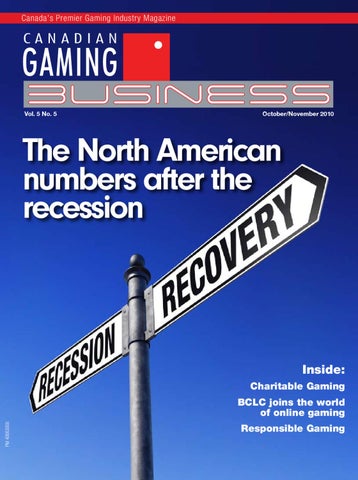
The North American numbers after the recession
Inside: Charitable Gaming
PM 40063056
BCLC joins the world of online gaming Responsible Gaming
Proven math models. We’ve been building for the future, and now we’re on our way. Aristocrat continues to deliver the pioneering math that keeps players engaged longer. Add to that our award-winning cabinets, unbeatable playability, and advanced technology. See for yourself how we’re bringing you greater innovation – and ultimately, greater profits.
It’s not just a game. It’s an Aristocrat game.
See us at booth 1210 at G2E. © 2010 Aristocrat Technologies Australia Pty Limited. All rights reserved.
October/November 2010 Volume 5 Number 5
Publisher
contents
Paul Murphy paulm@mediaedge.ca 416-512-8186 ext. 264
Advertising Sales
Paul Murphy
Senior Designer
Annette Carlucci
paulm@mediaedge.ca
5
EDITOR’S NOTE
6
MESSAGE FROM THE CGA
8 COVER STORY:
After the Impact: North America after the recession
annettec@mediaedge.ca
Designer
Rob McFaden
12 RESPONSIBLE GAMING
robm@mediaedge.ca
Production Manager
Rachel Selbie
Circulation Manager Circulation Inquiries
Cindy Youman
15
rachels@mediaedge.ca
CORPORATE PROFILE MEI
customerservice@mediaedge.ca
17
CHARITABLE GAMING: BCLC Community Gaming Centres
Proudly owned and published by:
18
CHARITABLE GAMING TRENDS:
20
MARKETING:
Supplier perspectives
President Kevin Brown
President & CEO Bill Rutsey
kevinb@mediaedge.ca
wrutsey@canadiangaming.ca
Vice President, Strategic Development Chuck Nervick
Vice President, Public Affairs Paul Burns
22
FINANCE & INVESTMENT
chuckn@mediaedge.ca
pburns@canadiangaming.ca
24
ONLINE GAMING
Canadian Gaming Business is published five times a year as a joint venture between MediaEdge Communications and The Canadian Gaming Association
26
FACILITY PROFILE:
For advertising information, Contact Paul Murphy 416-512-8186 ext. 264
28
EXECUTIVE PROFILE:
paulm@mediaedge.ca
Cloud computing
BCLC joins the world of online gaming PEI's Red Shores Paul Godfrey
30 supplier profile:
Copyright 2010 Canada Post Canadian Publications Mail Publications Mail Agreement No. 40063056 ISSN 1911-2378
Honeywell
Guest editorials or columns do not necessarily reflect the opinion of Canadian Gaming Business magazine's advisory board or staff. No part of this issue may be reproduced by any mechanical, photographic or electronic process without written permission by the publisher. Subscription rates: Canada $47.25 per year, $84.00 two years. All rates are payable in Canadian Funds only. Postmaster send address changes to: Canadian Gaming Business Magazine 5255 Yonge Street Suite 1000, Toronto, Ontario M2N 6P4
Canada's Premier Gaming Industry Magazine
Vol. 5 No. 6
October/November 2010
The North American numbers after the recession
Volume 5 No. 5 on the cover Inside:
Charitable Gaming
PM 40063056
BCLC joins the world of online gaming
Official Publication of the Canadian Gaming Summit
Advertising in the Age of Persuasion
After the Impact: North America after the recession
Responsible Gaming
Canadian Gaming Business | 3
Clint Baker
Canadian Sales Manager
“I’m sitting on a gold mine.” Trust me. I know first hand about the relationship between comfort and profit. As a table games dealer for nearly five years, I truly believe that my loyal customers would’ve stayed longer if comfort were in play. As a well-trained ergonomics consultant, I can attest that my theory holds true. That’s why I joined Gary Platt. Here, ergonomics is a real science, not simply a marketing buzz word. We design and build the most comfortable, durable, ergonomically correct performance casino seating available. So if you want the real deal, get the chairs that will sit well with your customers and your bean counters. The Gary Platt X-Tended Play Seats® are engineered to maximize players’ Time On Device and increase the return on your investment.
P E R F O R M A N C E
S L O T S
·
P O K E R
·
T A B L E
G A M E S
C A S I N O
S E AT I N G
775.824.0999 · garyplatt.com onlythebest@garyplatt.com
editor'snote
Editorial Advisory Board Howard Blank, Vice President Media & Entertainment / Marketing & Promotions Great Canadian Gaming Corporation Lynn Cassidy, Executive Director Ontario Charitable Gaming Association Robin Drummond, Vice President Spielo Paula Dyke, Director, Public Affairs and Corporate Communications Atlantic Lottery Corporation Nick Eaves, President and Chief Executive Officer Woodbine Entertainment Group Art Frank, President Niagara Casinos Brian Fraser, Marketing Manager IGT Canada Jordan Gnat, President & Chief Executive Officer Boardwalk Gaming Muriel Grimble, Executive Director Gaming Products & Services Alberta Gaming & Liquor Commission Lyle Hall, Managing Director HLT Advisory Inc. Zane Hansen, President & Chief Executive Officer Saskatchewan Indian Gaming Authority Ron Kelly, Executive Vice President Arrow Games Michael Lipton, Q.C., Past President, International Masters of Gaming Law and Partner, Dickinson Wright LLP Eric Luke Eric R. Luke and Associates Alan Lyman, Senior Regional Director Scientific Games Margaret McGee, Vice-President of Business Innovation Nova Scotia Gaming Corporation Richard Paris, Security Director, Niagara Casinos
New beginnings I have to admit; I'm a little overwhelmed. In my short time as the new editor for Canadian Gaming Business magazine, I've had the incredible opportunity to jump head first into an industry in the midst of great change, innovation and evolution. The experience has introduced me to a number of important issues and exciting developments, as well as given me the chance to speak one-on-one with gaming experts and stakeholders from across the country. It's been a dizzying couple of months, but the end result is well worth a few late nights. In this issue, you'll find a wealth of insightful and entertaining articles tackling some of the biggest issues and news affecting Canada's gaming industry. In our cover story, After the Impact: The North American Numbers After the Worst Recession in a Generation, HLT analysts Rob Scarpelli and Katia Muro lay out the facts concerning the financial health of North American gaming following recent economic turmoil. Further in, you'll read an in-depth analysis of BCLC's online gaming initiatives and different perspectives on responsible gaming. Wondering how to market your casino in the Age of Persuasion? David Bellerive from the Phoenix Group introduces us to Terry O'Reilly, a modern day ad guru with a host of modern marketing techniques and advice. In addition, Louie Velocci with KPMG takes an in-depth look at the concept of cloud computing in 'Clouds in the Forecast: Can Gaming Companies Brace for the Storm?'. Also in this issue, we are pleased to offer an in-depth discussion on the state of charitable gaming. In our gaming trends section, we discuss current charitable trends as viewed from three different manufacturers and, beyond that, we take a closer look at B.C.'s Community Gaming Centers. Lastly, we've included a bonus issue of Canadian Gaming Lawyer; covering a host of hot gaming topics as discussed by gaming law professionals from across Canada. With additional profiles of PEI's enticing Red Shores facilities and the technological milestones at MEI, this fall edition is certainly one of our most diverse yet. We hope you enjoy reading the following pages and encourage you to contact us with your feedback and ideas. Matthew Bradford Editor matthewB@mediaedge.ca
E-mails to the Editor Policy Canadian Gaming Business welcomes e-mails to the editor. E-mails should include the name of the sender, business or professional affiliation, and city and province of the sender’s office or home. A phone number should be included for contact purposes; the phone number will not be published. We reserve the right to edit e-mails for purposes of brevity and clarity. Please email matthewb@mediaedge.ca
Canadian Gaming Business | 5
messagefromCGA
Connecting with an ever-changing market By Bill Rutsey, President and CEO of the Canadian Gaming Association
There’s been a lot of attention paid to iGaming recently. This is largely due to British Columbia Lottery Corporation’s entry into the space and various announcements by other crown agencies, most prominently: Loto-Québec, Atlantic lottery Corporation and Ontario Lottery and Gaming. Notwithstanding all the heat that has been generated, we should note that online revenues are about five percent of bricks and mortar revenues and will continue to be a very junior partner in the total gaming business. The online market is a part of a much larger story that hasn’t been given much play; i.e. the changes coming to the market overall and the effects on existing product offerings. This is influenced by a myriad of forces beyond the internet, including changing demographics, players’ expectations and personal preferences, and technology (including server-based and mobile), all of which are driving change in product, delivery systems and modes of communication. Technology provides the industry with the opportunity to adapt both product and marketing approaches to reflect shifting demographics and to capitalize on the new forms of entertainment and communications being used by consumers. While we know that baby boomers (45 to 64) and those over 64, with 6 | October/November 2010
their available discretionary time and income, are the “sweet-spot” of the market, we’re also told that in Canada someone turns 50 every seven seconds and that 23 percent of the Canadian population (9.1 million people) will be over 65 by 2030. It therefore becomes very clear that the real opportunity for growth lies in the next-generation of players (44 and younger) who are pushing these trends, all of which have different lifestyles and preferences. These customers exhibit a greater comfort with technology, participate in social media (e.g. Facebook and Twitter) and increasingly seek out enriching, personalized experiences that allow them to make the most of their leisure time and provide a sense of participation and involvement. They expect real-time access to highly customized player experiences. Technological advances have made portable media devices inexpensive and widely adopted. According to the 2010 WMS Active Gambler Profile, 93 percent of active gamblers in North America have a cell phone, 27 percent of whom own a smart phone. Almost half of the smartphone users have downloaded paid applications and more than two thirds of all phone users have played a game on their phone. The WMS research also suggests that these players feel like they are always multi-tasking, cherish “me
time”, and are willing to forgo many basic gaming offerings in favour of those experiences that provide the most relevance, personalization and excitement. Operators who can deliver on these expectations by providing customers with choices and incentives customized to reflect their personal preferences will be rewarded. Peer to peer marketing (through smartphone apps and social media) provides potentially significant connection points with these customers that are, for the most part, unexplored by the gaming industry in Canada. Properly constructed and implemented social media strategies could be leveraged to cultivate player relationships and increase player loyalty through, for example, realtime comps and benefits delivered through mobile devices. When you combine the simultaneous priorities of maintaining markets and growing revenues, upholding social responsibility and guarding customer privacy, it becomes an everchallenging world for all participants in the gaming industry and especially government agencies. But then, as the ancient Chinese proverb says, “We are indeed living in interesting times.”
The Game Will Never Be The Same. BALANCE
s
CONVERGENCE
s
INTEGRITY
Game changing technology from the most trusted name in the industry.
Contact: Paul Mazzeo Director, Government Solutions Tel: 905.946.2809 Email: paul.mazzeo@gi-de.com www.gi-de.com
coverstory
After the Impact: The N American Numbers Af Worst Recession in a G By Rob Scarpelli & Katia Muro - HLT Advisory Inc.
8 | October/November 2010
North fter the Generation After 15 years of continuous growth, the Canadian gaming industry as a whole contracted in 2010 (March 31st year-end). When final data are released, HLT Advisory estimates the decrease will be in the order of 2.5%; a decline of $380.2 million. Additionally, total industry win is estimated to decline from $15.43 to $15.05 billion. The decline was widespread as all traditional gaming sectors and virtually every province contracted. Across the country, the largest decreases were experienced in Alberta and Ontario. Combined, these two provinces accounted for over $320 million of the total $380.2 million decline. The only province to post an increase was Saskatchewan. Saskatchewan increased just over $10 million - or about 1.5% - largely due to the strength of its casino sector. The remainder of Western Canada (Manitoba and British Columbia) and the two smallest provinces (Newfoundland and PEI) experienced a slight decrease (less than 1% each). Quebec and New Brunswick decreased by less than 1.5% each. After Alberta (about 7.5% decrease), Nova Scotia had the largest percentage decrease at over 3.5%, followed by Ontario at just over 2%. While every gaming sector contracted, about 80% of the $380.2 million decline was accounted for by EGDs (electronic gaming devices: VLTs and EGDs at other gaming facilities such as racetracks or bingo halls) and casinos. The VLT sector experienced the largest decline at $164.1 million, with
2010 VLT revenues in every province running below the previous year. Since 2006, Canadian VLT gaming has declined by almost $0.5 billion in the wake of most provinces restructuring their programs (e.g., less machines and/or fewer sites). Only Manitoba and New Brunswick have larger VLT sectors today (as measured by win) than in 2006. VLT gaming today accounts for 19.9% of the total Canadian gaming industry, down from 21.7% in 2006. The performance of the casino and EGD-Other (slots at other gaming facilities) sectors combined were not as uniform across the country. Aggregate win in Ontario, Alberta, Nova Scotia and British Columbia declined by just under $200 million, while aggregate win in Saskatchewan, Quebec, Manitoba and PEI increased by over $50 million, resulting in a net decrease of about $148 million or 1.9%. Ontario and Alberta experienced the largest decreases, while Quebec and Saskatchewan had the largest increases. In 2010, the combined sectors generated $7.8 billion in win and represented 51.8% of the entire Canadian gaming industry, up from 47.6% in 2006. While the lottery sector as a whole was down $10.5 million, an equal number of provinces showed positive and negative growth. This total decline only represents a 0.3% decrease. British Columbia, Saskatchewan, Manitoba, Ontario and New Brunswick had minor increases while the remaining provinces had minor decreases. Quebec had the largest decrease at $14.9 Canadian Gaming Business | 9
coverstory
million or 1.6%. The lottery sector is the second largest sector in Canada and represents 25.3% of the total industry, up slightly from 24.2% in 2006. The remaining two sectors, bingo and pari-mutuel declined by $32.5 and $24.9 million respectively. This magnitude of decline is significant as these two sectors are the smallest in Canada. Both sectors in 2010 generated about $375 million each in total win and combined account for 5% of the total Canadian gaming industry, down from 6.5% in 2006. Future growth While most agree that the worst of the recession is over, how the Canadian economy and the Canadian gaming industry will perform over the next few years is still uncertain. Unemployment is expected to remain high and the total impact of the recession on discretionary income levels, especially incomes of people over 50 years old (key gaming demographic segment), is not well understood. With that said, positive growth should come from a number of recently completed developments and planned/proposed changes in the industry: • Replacement of VLT machines in Quebec and likely machine replacements in other provinces • Increased betting limits/prize payouts (e.g. casinos and VLTs) • Increased spending and/or increased use of a greater range of marketing tools. 10 | October/November 2010
• Continued implementation of smaller gaming centres in British Columbia (i.e. Community Gaming Centres) and in New Brunswick (i.e. Coasters) • Full year of operations of a number of larger and/or recently expanded gaming facilities, such as the Moncton Casino and a number of slots at racetrack facilities in Ontario (e.g. Woodbine, Ajax, Georgian Downs) • Internet activity expansions in British Columbia and Atlantic Canada, and the introduction of internet activity in Quebec and Ontario • A full year of operation of Lotto Max In short, it will likely take two years for the industry to surpass the total win of $15.4 billion achieved in 2009. Canada vs. United States Just how did the Canadian Industry fare as compared to the United States? Much has been written about the global economic crisis and how Canada and the United States have had both similar and dissimilar experiences. A combined effort was required to bail out the auto sectors and the use of extensive government spending and interest rate intervention measures was needed to stimulate both economies. The biggest difference was that United States also had to bail out its financial
sector. In general, Canada seems to have weathered the storm better than its neighbour to the south. In the United States, the casino sector can be divided into two groups: Indian Casinos and Commercial Casinos. Indian Casino revenue numbers are released by the National Indian Gaming Commission on a broad regional breakdown annually. The latest available numbers are for fiscal year 2009. Commercial Casino revenue numbers are released by individual states. As per the American Gaming Association, there are 13 states that have Commercial Casino. Four of these states also permit racetrack casinos (similar to slots at racetracks in Canada). Revenue numbers from these racetrack casinos were included in the Commercial Casino numbers for those states that have both. For comparison purposes, monthly US data was reformatted into March 31 fiscal year ends as this is how Canadian Casino's (and EGD Other) numbers are reported. It is important to note that no attempt to convert currencies was made; Canadian figures are quoted in Canadian dollars and United States figures are reported in US dollars. Also, not all of the changes in performance can be solely attributed to the economic climate. No attempt has been made to fully qualify the list of events that had an impact on performance over the past two to three years. The total Commercial Casino sector in the United States generated win of $30.7 billion in 2010 compared to $7.8 billion in Canada. Overall, the biggest difference between the United States and Canada is that the US has experienced two years of
coverstory
decline compared to one year for Canada, and the declines in the U.S. has been far deeper. The US industry declined by 5.9% in 2009 and 4.0% in 2010, while in Canada, casino (and slots at other gaming facilities) gaming grew by 2.7% in 2009 and only declined by 1.9% in 2010. Like Canada however, a number of regional variations exist in the US. The region hit hardest by the recession seems to have been Nevada. Las Vegas experienced a gaming revenue decline of 14% in 2009, followed by a further decline of 2.7% in 2010. The rest of Nevada did not experience a similar rebound like Las Vegas in 2010. In 2009, the rest of Nevada declined by 10.8% and further declined by 9.7% in 2010. While Atlantic City has posted three straight years of declines, neighbouring Pennsylvania introduced racetrack casinos in 2007, and by end of 2010, these facilities generated $2.1 billion in win compared to $3.8 billion in Atlantic City. In 2007, win totalled $5.2 billion in Atlantic City. Mississippi and Louisiana combined were down 5.2% in 2009 and a further 8% in 2010. The past five years have not been kind to the two gulf coast states with both man- made and natural disasters taking their toll. Illinois also was hit hard (19.3% decrease in 2009 followed by 7.9% in 2010). Besides Pennsylvania, Indiana and Missouri posted positive growth over the last two years (i.e. new facilities in Indiana, and elimination of loss limits in Missouri). Both Michigan and Iowa only experienced one year of decline in 2010 (0.3% for Michigan and 2.8% for Iowa). Colorado declined by 10.4%
in 2009 and posted growth of 1.9% in 2010, largely due to increased betting limits on table games and increased hours of operation. Based on performance data, the Canadian gaming industry and especially the casino sector (including slots at racetracks and bingo halls) has weathered the economic recession
better than the Commercial Casinos in the United States. In short, the impact has been shorter in terms of time and less severe in terms of magnitude. On a-go-forward basis however, future growth in Canada is not certain and it will likely take a couple of years before the industry reaches the win levels achieved in 2009.
Canadian Gaming Business | 11
responsiblegaming
“It Pays to Know” Getting line-ups for Responsible Gaming By Paul Pellizzari, Director of policy and social responsibility OLG
Since responsible gaming programs began, operators have been challenged to spark players’ interest in key messages. This has led some to ask if a business that sells fun can help gamblers cultivate smart playing habits. OLG believed it could animate human curiosity if the facts and information were delivered in new and innovate ways. This in mind, it set out to build a communications platform based on key attributes of players and their receptivity to gaming environments and interactive experiences. In June 2010, “It Pays to Know”, a social marketing campaign created with DRAFT FCB, was launched to educate players on a matrix of core messages by engaging them while they gambled. The multi-year initiative works to not only build awareness, but ultimately to help players manage their behaviour. Efforts focus on reinforcing OLG’s priority messages, and delivering them continuously through direct channels like digital media at gaming sites and lottery points of sale. By driving players to interactive games on our KnowYourLimit. ca website, and by engaging them with kiosk promotions (provided by Endo Networks) at gaming locations, we seek maximum player engagement. “It Pays to Know” does not look or feel like typical responsible gaming (RG) campaigns, because it is premised on “what’s in it”
for the player. Its “look-and-feel” works extremely well in gaming environments, and the interactive components draw in players through prize incentives. It basically applies the approach OLG takes to market gaming experiences to RG information. Early results have exceeded expectations, with players embracing messages and promotions with an unprecedented interest. After only a few weeks on digital signs at OLG slot and casino sites, 32 percent of players surveyed had noticed the messages, and of those players, 88 percent said the ads were interesting and an effective way of engaging them in facts about gambling. OLG’s “It Pays to Know” campaign strongly aligns with the best thinking in the RG sector on the priority messages for operators to provide. Categories include how gambling works, gambling safeguards, risk factors and the availability of help. The campaign has also been designed to be data-rich, and to help OLG track improvements in awareness and behaviour over time; knowledge that will help inform priority areas for future player education.
“It Pays to Know” Campaign Campaign objectives are to improve: • message comprehension • safe play habits • traffic to KnowYourLimi.ca • data base of customers who consent to receive other RG messages Core messages: • myth debunking • cost of play • safe play habits • signs of a problem • how to get help
12 | October/November 2010
Making RG part of Player Experience: • Appeal to players’ interest • Use “smart” language, not “problem” language • Do not say “Responsible Gaming”. Player feedback: “A very good idea because it forced people to reflect on things they maybe had not considered about their gambling. It’s a great, proactive way to engage people with responsible gaming information rather than having it be passive on posters.”
Interactive Promotion (Endo Networks) How it works: • Slot players answer kiosk questions • Receive free pen • Enter draw for a $500 Cineplex gift card Participation: • Pilot at 3 sites, 4 days per site • Target: 2000 to 3000 people • Actual: 7100+ • 98.5% of people who started, completed 5 minute survey • OLG: 594.25 consumers participated per day (using 8 screens) • Industry norm: 500 consumers participate in comparable promotions for other retailers on an average day (using 16-20 screens)
responsiblegaming
The Changing Faces of Responsible Gambling By Jamie Wiebe, PhD RGC Centre for the Advancement of Best Practices
Few could deny that responsible gambling programs have progressed significantly in the past decade. Self-exclusion programs, for example, have transformed from using poorly maintained binders that hold hundreds, even thousands, of photographs to computer-based documented and monitored digital pictures. Program enrollment, which was once conducted by untrained venue security staff in a cold, unsupportive environment, is now being done by staff with training and expertise of the self-exclusion program and much better understanding of the issues that face a potential program participant. A friend who self-excluded ten years ago renewed his self exclusion this past month. Ten years ago enrollment took place at the gaming venue by security staff. He compared the experience to being arrested for a crime. Ten years later, enrollment took place in a treatment agency where he was treated with respect, provided support and information and walked away feeling good about his decision. Another example of change is in the area of responsible gambling information. Gaming providers have become increasingly diligent in providing players with information about key concepts such as probabilities, randomness and house edge. The delivery of such information has also expanded. An example of the new type of information delivery is the specialized RG information services, the on-site centres, found in many gaming venues, which include the information resources centers and kiosks. These resources offer information (e.g., gambling safety information, risks of problem gambling, how the game works, etc.), and often in varied formats (e.g., audio, visual, literature) that can broaden their appeal to wider audiences. In Canada these changes have occurred in a relatively short period of time and do not appear to be slowing down anytime soon. We are already seeing the emergence of two major trends in responsible gambling that are currently in the early stages of inception or development: Gaming Technology and Responsible Gambling Increasingly, more time and money is being invested in research and development to build responsible gambling technologies that span product lines. A growing area is play information and management systems, that is, tools that can be incorporated into electronic gaming machines and, potentially, other forms of gaming, to enable players to more easily keep track of their play and manage their gambling decisions. Other developments involve sophisticated gaming analytics software that enables more information and analysis of player gaming activity. These capacities can be used by either the players themselves or the gaming providers to “red flag” high risk behaviors. This opens up many options for the players and or the providers. One example is the delivery of personalized
and discrete feedback/ information to the player, particularly at opportune times when such information would be best received and most beneficial. The monitoring of player activity is a hallmark in internet gaming operations that rely on an electronic gaming platform to deliver gaming products. And that monitoring has led some to build in RG safeguards. As land-based venues incorporate more server based technologies that can monitor and analyze player activity, they will be able to generate much more precise player information, which in turn, can lead to more responsive and tailored responsible gambling programming. The Council recently conducted research for how to effectively provide information to gamblers to promote informed decision making, for instance, and concluded that information should be targeted at specific gambling populations based on risk and tailored according to specific population characteristics. Having said this, of course, there is much that needs to be worked out yet about the safeguards that need to be built into any new information collection process, not to mention privacy concerns. Responsible Gambling Standards The second significant trend is the development of responsible gambling standards. It is, in fact, recognition of the progress that has been made in this field that we can be talking about best practices, benchmarks and standards. While gaming operators and providers have implemented a range of responsible gambling programs designed to reduce the risk of problem gambling, there had been no independent standards by which the public, providers or operators can assess the value or merit of these programs. Standards set benchmarks for appropriate responsible gambling program design and delivery and allow operators to assess the overall quality of their RG initiatives as a program rather than viewing each initiative in isolation. In the last few years, the Responsible Gambling Council has developed responsible gambling standards for venues and internet gambling. These standards reflect best industry practices as well as those practices that exceed, or achieve excellence beyond that of current practice. RG Check, the accreditation program provides an independent assessment process based on the standards. Moving forward, the future of responsible gambling lies in identifying how current and emerging gaming technologies can be used for responsible gambling purposes. As new experience emerges from these efforts, establishing up to date standards will become increasingly important in benchmarking and evolving our understanding of best practices in responsible gambling programs. Canadian Gaming Business | 13
responsiblegaming
Responsible Gaming Case Study: Shepell•fgi Promoting responsible gambling is a critical mandate for provincial gambling bodies, casinos, and other gaming establishments across Canada. Doing so, however, can be costly, both in terms of direct operating and hiring costs and the stretching of resources to research, build, and deliver effective programs. Fortunately for gaming organizations, there are a number of companies throughout the country armed with the knowledge and expertise to aid them in this mandate. Among these is Shepell•fgi, a leader in behavioral health that has played a role in the development and implementation of responsible gaming outreach and education programs for Atlantic region organizations. Outreach, Education and Support Shepell•fgi has worked within the Atlantic region to create both Responsible Gambling Resource Centres (RGRCs) and tools that help patrons make better decisions. In 2005, they developed the RGRC for the Nova Scotia Gaming Corporation (NSGC). Responsible for staffing the RGRC, Shepell•fgi developed the process for recruiting, screening, and hiring full-time RGRC representatives who were responsible for educating casino guests and staff, providing immediate support, and continually improving the resource library through ongoing research. In 2010, they launched two additional initiatives; the opening of a similar RGRC in Moncton in partnership with the New
Brunswick Gaming and Lottery Corporation (NBGLC), and the introduction of a program to help the Atlantic Lottery Corporation (ALC) and NSGC promote the new MyPlay system being launched in Nova Scotia. MyPlay is an elective program in which guests can enrol to receive a card they insert into video lottery terminals. The cards provide patrons with real-time information that allows players to make informed decisions about the time and money they spend. Shepell•fgi provides a dedicated manager and representatives placed at 385 sites across Nova Scotia who explain the benefits of MyPlay and how the cards are used, as well as support the enrolment process. In addition to their education and outreach initiatives, the Problem Gambling Helpline Shepell•fgi built in Nova Scotia has been in place for nearly 15 years and provides supportive, counseling and triage into local community resources. Moreover, the RGRCs act as a bridge to counseling or treatment services for individuals who are ready to seek help. Responsible Gaming Training Shepell•fgi also delivers face-to-face and online training program for all video lottery and ticket lottery retailers in Atlantic Canada. On-line training allows retailers to take the training at a convenient time, and does not require them to leave the retail site which would cost both time and money. For information visit: www.shepellfgi.com
We’ve got a system. Award-winning creative plus unparalleled strategy achieves amazing results. Add 13 years in the Canadian Casino Industry, and you’ve got a hand that can’t be beat. Deal us in and find out.
Advertising • Branding • Strategy www.thephoenixgroup.ca
14 | October/November 815 CGB ad half2010 pg_jan.indd 1
19/01/10 11:49 AM
corporateprofile
MEI Celebrating Many Milestones MEI systems are relied upon for more than two billion transactions a week in over 100 countries. Through continuously redefining expectations, MEI has positioned itself as the largest worldwide installed base of unattended payment mechanisms. It reached a milestone of selling more than five million bill acceptors and six million coin mechanisms in the global vending, soft drink, gaming, amusement, transportation, retail and kiosk markets. Recently, MEI celebrated the production of its one millionth CASHFLOW® SC; a testament to how the product has established a leadership position in its core markets. MEI continues to gain momentum in the gaming market through winning more than 90 percent ship share on US casino openings, as well as more than 85 percent ship share on US upgrades and expansions. “MEI’s success can be accredited to the focus on the benefits that enhance the player experience and results in improved operator profitability; those being the highest acceptance rates, unrivalled security, best jam performance and lowest cost of ownership in the industry” says Eric Fisher, vice president Americas. There is an awareness of how those benefits impact profitability; as measured by cash in the cashbox, asset productivity and maintenance expense. In November 2009, WMS awarded MEI as its preferred supplier for bill validators, providing further proof of MEI’s position as top bill validator in the industry. Now it has achieved default status with industry leaders worldwide such as Aristocrat, Bally, Novomatic and WMS. The standard of bill validators changed dramatically in 2002 with the introduction of CASHFLOW SC bill validator with a proven field jam rate of 1:100,00 bills. This in mind, Fisher emphasizes that having the lowest jam rate in the industry results in reduced labor costs and increased machine up-time, explaining: “The reliability of MEI products allows operators to increase player experience and reduce maintenance costs. Operators know that choosing the
product with the lowest cost of ownership in the industry allows them to be more profitable.” Recently MEI announced the product enhancements of the next generation of CASHFLOW SC, MEI® SC Advance™. The enhancements on SC Advance are localized to the acceptor head and therefore work hand-in-hand with legacy CASHFLOW SC units already in the field. Intelligent support in the unit will be able to sense the product version and provide the appropriate software. Increased value created by SC Advance is highlighted by an improved recognition system, which provides proactive security by utilizing transmissive sensors to see all the way through bills in multiple wavelengths. SC Advance also offers faster bill-to-bill speed which upgrades the player experience and speeds up transactions to expand throughput. Other benefits include expanded memory, comprehensive barcode recognition and an upgrade to USB 2.0. “The benefits of SC Advance further raise the bar of performance expectations in driving improvements in both the player experience and operator profitability,” says Fisher. “SC Advance is not only compatible with legacy CASHFLOW SC units, but with product extensions that have expanded the reach of bill validators from the slot machine to the entire cash management process.”
One product extension that extended CASHFLOW security to the soft count room is EASITRAX Soft Count, an integrated software/hardware solution that places information collected in the CASHFLOW SC bill validator into a database that can be networked to multiple locations and be accessed to analyze slot floor performance through a series of instant reports. Radio Frequency Identification (RFID) technology is used to connect slot machine asset numbers and bill validator operational information to a specific cashbox. Introduced in 2008, EASITRAX Soft Count is installed in more than 30 casinos globally. A few of the most notable U.S. openings that specified EASITRAX Soft Count are Greenbrier Resort, Calder Casino, Aria and Snoqualmie Casino, while international installations have occurred in Macau, Manila, Morocco and Singapore. A total installed base of over 64,000 games in two years proves the operator’s awareness of the benefits of having MEI’s products impact profitability. MEI leverages the expertise gained from the production of over one million CASHFLOW SC bill validators. Fisher explains, “MEI continues to expand its portfolio of solutions to increase the breadth of applications in which MEI can provide operators.” MEI products are reliable – exceeding expectations on the core values that create value. Visit www.meigroup.com/canada Canadian Gaming Business | 15
charitablegaming
BCLC Community
Gaming Centres With charity gaming on the decline, it's fallen on industry stakeholders to pursue creative solutions for attracting and retaining gaming clientele. One such solution in British Columbia has been the creation of 'community gaming centres'; dramatically renovated or relocated purpose-built gaming facilities that have been repositioned to include slot machines, expanded social spaces (in addition to bingo) and better service to the communities in which they are planted. The concept for community gaming centres was introduced by the BCLC in 2004 on direction from the government and in response to a need for a revitalization of charity gaming in B.C. Working with existing bingo hall operators and local municipalities, BCLC has since facilitated the opening of 15 community gaming centres across B.C. in locations such as Dawson Creek, Kelowna and Langley. “The conversion to community gaming centres made sense because the process involved partners who were used to dealing with each other,” says Jordan Gnat, President and CEO Boardwalk Gaming & Entertainment, explaining: “The idea of moving forward on these centres was something that the stakeholders wanted to do. The provincial government provided the necessary mandate and we worked together with BCLC to get it done.” A common misconception about community gaming centres is that they are bingo halls with slot machines. This, insists Gnat, is far from the case: “It's not as simple as pulling up a truck and loading slot machines; the investment in these facilities can run anywhere from $7 to $15 million dollars. These are significant projects that require significant capitol.” Speaking to the true intent, he adds: “The idea was absolutely about repositioning the old bingo halls into 'Chances Community Gaming Centres' and give the customers a full suite of
entertainment options, including bingo, keno, slots, high quality food service and an overall fun experience.” While the concept behind community gaming centres is straightforward, the process by which they are created can be a game of chance in of itself. All totalled, it can take up to five years to see a community gaming centre through from opening negotiations, municipality proceedings, planning, building and final ribbon cutting ceremonies. While this can be daunting, Gnat notes: “If your message is right and the municipality is willing, you can be successful in getting your proposal approved. It requires tremendous patience.” One element that has proven helpful in this process is the standards set by BCLC, which were developed in consultation with local operators. Explains Darryl Schiewe, vicepresident of Casino and Community Gaming for BCLC: “BCLC has rigorous standards for both the actual facility and the operation of community gaming centres. Our view as an organization is to redevelop or, in most cases, purpose-build facilities to high standards. In many municipalities, the community gaming centre is the marquee facility offering excellent food and beverage, entertainment and gambling options.” Regarding its ongoing relationship with BCLC, Gnat adds: “They are our most important partner, and we value
the relationship. Naturally, whenever there is a new initiative there are growing pains for both parties, but we are always trying to work to improve the business together in an effort to optimize the opportunity for all stakeholders and ensure the customers continue to have the best possible experience.” And the partnership appears to be working. Community gaming centres have provided a significant increase to BCLC’s revenues over the past several years and, last year alone, Schiewe notes that local governments that host community gaming centres received over $7.6 million from the province in host local government share payments. Says Gnat: “In most cases it's been a win-win-win situation; the operator wins, BCLC wins, and the community wins.” With this in mind, BCLC expects to continue the evolution to community gaming centres at a gradual pace. “We believe we made the right move in developing the community gaming centre model,” says Schiewe, adding: “These facilities are sized right for their market and raise the bar in terms of standards and customer experience. Wi t h s o m u c h c o m p e t i t i o n f o r entertainment dollars, we feel strongly that this model will help sustain our local gaming business and, in turn, the gaming dollars that go back to communities.” Canadian Gaming Business | 17
charitablegaming
Charitable Gaming Trends Perspectives from an evolving industry Charitable gaming has seen its share of challenges in these past years, but new innovations, ideas and attitudes are starting to turn the tide. For a better look at where we're headed, Canadian Gaming Business magazine asked three manufacturer reps to share their perspective on the past, present and future of the industry and its players. Ron Kelly Executive Vice President, Arrow Games From humble beginnings in church basements to mega-sized venues, charitable gaming in Canada has become a multi-billion dollar industry, generating a net benefit of millions of dollars for charitable and non-profit organizations in communities across the country. Along with horse racing, charitable gaming is a pioneer in Canada’s gaming landscape and is an important part of the social fabric of communities across the country. This said, charitable gaming has faced significant challenges as it 18 | October/November 2010
strives to maintain its place among the myriad of gaming and other entertainment options competing for disposal income. They include: • Significant expansion of government gaming that started in the 1990s with casinos and slots/ VLTs • Internet gaming • Declining player base • Lack of new product offerings • Facilities renewal • Greater selection of entertainment options The good news is that these challenges are well-recognized and have brought about a change in
the attitudes of all stakeholders in the industry towards cooperation, consensus and building effective partnerships with all stakeholders, including regulatory agencies. This new spirit of cooperation and partnerships has enabled a revitalization of charitable gaming industry in many jurisdictions across Canada. In Ontario, charitable gaming has gone through a modernization that started in 2007, and has since created flexibility and new opportunities for the sector. New Brunswick also sought input on modernizing the framework on charitable gaming in its survey of charitable gaming licensees in
charitablegaming 2009, and has already implemented changes. In addition, other provinces including Alberta, Nova Scotia, Pr i n c e E d w a r d I s l a n d , Q u é b e c and Saskatchewan are continually providing new flexibility for new charitable gaming products. One of the recent innovations in charitable gaming has been the concept of organized product launches for new games. The industry has taken a page from other consumer products industries and the government gaming sector by taking the time and the energy to promote, plan, train and support coordinated launches of new gaming products across all markets. We are seeing the benefits of this product launch strategy in markets across Canada where new products are driving increased player enjoyment, revitalizing venues and generating new revenues for all stakeholders. Modernization of charitable gaming is driven through effective partnerships with licensees, regulators and suppliers who are all committed to growing the charitable gaming industry while, at the same time, ensuring a high degree of integrity and accountability for the sector. Public confidence in charitable gaming is critical to its continued success and all of us must work to continually enhance accountability and integrity. Wo r k i n g t o g e t h e r, c h a r i t a b l e gaming will have a distinct place in Canada’s gaming landscape. Glen Ellsworth Sales Manager, Canada, Pacific Gaming Canada The landscape of charitable gaming in Canada has changed significantly in the past 20 years, and continues to evolve. Now, however, small and large community bingos seem to be fading, with the number of player visits in decline. This decline began with the introduction of non-smoking and tougher border rules, and has continued due to the development of casinos and other forms of entertainment, as well as current economic conditions. To d a y, a l l p a p e r, B O Ts , k e n o and slot type games can be played together on handheld and tabletop
devices in a networked or wireless environment thanks to touch screens that can flip like the iPad or iPod touch devices. For bingo facilities that have embraced this new technology, player attendance and spending has increased rather than declined. It is important to make sure that as we introduce new products and upgrade facilities, we continue to analyze player spending habits. For instance, it's been noticed that as the player spend increases, the player visits also decline. Moreover, in areas where charities and operators have decreased their cost of play and gone back to the basics, they have seen a player increase. Balancing the right product mix with the correct funding formula is the key to the success of charitable gaming. Moving forward, we need to provide products that make charitable gaming in all jurisdictions across Canada both affordable and competitive so that charities, operators and all stakeholders can continue to be profitable and offer great community services, as they have in the past. The electronic bingo market is still evolving, and has the vast potential to carry charitable gaming forward for decades to come. Eric Casey General Sales Manager, Planet Bingo®/3rd Rock Gaming There is no question that charitable bingo operations are struggling in this economy, and that the problems are endemic to the industry throughout North America. The darnedest thing is that we, the industry, saw this coming 10 years ago. Time and time again, in seminars at the Bingo World Expo, the Canadian Gaming Summit, and G2E, all of the problems that we face today were predicted and discussed, but as an industry we have been unable to provide global solutions to turn the tide. There is light on the horizon, but it will take hard work and struggle to get there. We can’t go backwards on non-smoking, but we can go forwards on regulatory change. In Minnesota, for example, there are
no less than three expansions of gaming bills that might help charitable gaming. All continue to be quashed year after year, but are getting a little closer to enactment each time. In Illinois, positive regulatory changes this year include increasing the caps on prizes paid in bingo and allowing charities to share facilities; changes which reduce overhead and maximize a bingo location's potential. Further, in North Dakota, tests are underway to determine if new forms of electronic bingo are viable, and in Texas the remarkable success of pull-tab ideas like ‘holders,’ coupled with exciting and engaging visual displays of the games, have helped shore up flagging bingo revenues. While it hasn’t come to charitable gaming successfully yet, we’re seeing an incredible success story in the worldwide saga of Cosmic Bingo, which is now played in many tribal bingo halls both in America and internationally. This is bingo with lights, music, and – most of all - fun. It’s become a stable product that drives new, younger bingo players into the halls and keeps them coming back! This is not about surviving an industry ‘contraction', this is about the re-invention of charitable gaming and it demands outside-the-box thinking and innovation from all levels of industry. There can only be one bottom line to this story: we tighten our belts and fight the fight! Carla Chance Director of Marketing, Video King The devices used in charitable gaming are becoming more sophisticated, paralleling the advancements seen in consumer electronics. Individual Bingo games are increasingly “entertainment” based, including new “all electronic” gaming formats such as Video King’s Crazy Quarters™. These player enhancements are coupled with comprehensive Bingo Management systems that incorporate inventory m a n a g em e n t o f p a p e r a n d p u l l tabs, player ’s club, paymaster and vaulting, along with promotions and sales functions. The Bingo hall of the future is here. Canadian Gaming Business | 19
marketing
Casino Marketing in the Age of Persuasion By David Bellerive
What makes a great ad? Who better to ask then the man who has made some of the best in Canada. Terry O’Reilly is best known as host of The Age of Persuasion, a weekly half hour CBC radio show on advertising. In advertising circles, Terry’s better known for his award-winning advertising work as co-founder of Pirate. His long list of credits includes work for Canadian casinos like Casino Rama and Fallsview Casino which, O'Reilly admits, is work within a subject he loves: “It’s a very fun category to work in, because they’re selling fun.” Behind the fun is careful thought to developing the right strategy. Just as you have a lot of choices on how to spend your marketing dollars, the audience has a lot of choices on where to spend their entertainment dollars. As O'Reilly suggests, there’s a strong role for branding among your advertising messages, noting: “A great branding campaign will bring that casino to the forefront and get a lot of attention. If the idea is memorable, well executed and smart — if all those tumblers fall in place then at least you’re on the audience’s radar. If they think about taking a long weekend or doing something unusual, your chance to be near the top of that list is greatly enhanced.” Getting attention is what great branding can do. Advices O'Reilly: “If you subtract advertising from the mix, it’s pretty tough to get your word out there. If you’re not doing major brand advertising then you’re relegated to some of the tougher aspects of marketing, which is telemarketing or junk mail. You’re doing that kind of tough, tough legwork. Brand advertising is about trying to define your product or your offering in an unusual way to position it against other things in your category, to position it against other ways people can spend their dollar.” That difference is fun. Or put another way, the excitement of being at the table, the excitement of the crowd, the big name acts, the buzz. “It really is the excitement that you’re selling, you’re not just selling a game of blackjack you’re selling the experience of going to the casino.” So, what makes a great ad? According to O'Reilly, it is: “One that sells. Truly. First and foremost one that makes the cash register ring — that makes a great ad. And then I think if you just back up from there, you have to attach a great idea, a great selling idea to a product.” As for what that idea entails, O'Reilly adds: “A great selling 20 | October/November 2010
idea has to do a couple of things. First and foremost, it has to get attention because you can’t sell anything to anybody unless you’ve got their attention.” Surely, Getting attention is critical – but don’t stop there. Simply getting attention without tying your message back to the Casino is just a gimmick. We’ve all seen some hilarious commercials but soon afterwards, although we remember the joke, we can’t remember who the commercial was for. “Many times I feel that’s a broken strategy at work,” notes O'Reilly. “The creative is obviously doing the right thing, it’s getting a lot of attention, it’s being passed around, but an ad is only as good as its basic strategy, and the strategy has to be meaningful. Also, the strategy should give you a really good link to the product. If that link is weak, if it’s not meaningful, if it’s peripheral, if it’s just selling the category and not the product as a rule, it’s because the strategy is weak.” And the strategy is the other piece of the puzzle to creating great ads; presenting the product in a meaningful way. Says O'Reilly: “It has to frame the product or service in such a way that it’s memorable and it makes you feel there’s something unique about that brand. And lastly, it should ask for a call to action. It should very easily tell you what the next step could be, either to pick up the phone, get online or get down to the store. Those are really the steps of a great ad, a creative selling idea that gets attention, frames the product in such a way that there’s something memorable about it and lets people know how they can act on it.” So now you have the secret, all you need are ideas! You can catch Terry O’Reilly on the radio, or pick up his book, The Age of Persuasion. David Bellerive is vice president of creative, interactive and media Phonenix Group.
marketing
Q&A: Casino Marketing Attracting and retaining clientele can be difficult during the best of times. With this in mind CGB magazine asked Larry Gregson, VP Marketing, Niagara Casinos and Susan Flett, VP Marketing, Saskatchewan Gaming Corporation to share their own marketing strategies and perspectives. What are the most effective ways to market your facility to your customers? SF: There are a number of approaches, and it's all very research driven. Considering our core gaming guests, we know exactly what frequency, value and price points they respond to, so we use that information in our marketing. Then we have other guests who frequent our properties, but not necessarily as often. They respond differently, and are typically more price sensitive. For them, we listen to their feedback and try to deliver on that. LG: You have to make certain that you know your market and have a strong database that you can rely upon with accurate, up-todate information. From that point, marketing your facility begins with a strong direct mail program coupled with the ability to react quickly to the response and deliver quality offerings to your customers.
visitations. We've had to make more extensive offers than we have in the past to secure some sectors of visitation. How important is non-gaming revenue for your facility and how do you market to those groups? SF: Our show lounge is a huge draw; not just for our locals, but for the 60,000 guests from across the province who may not have come otherwise. Gaming is still our bread and butter, however the show lounge and restaurant that make us a complete entertainment facility. LG: All revenue is important to our operation; however, our focus is on gaming revenue. Everything we do is measured by what effect it will have on our gaming revenue.
What is your biggest marketing challenge and how do you try and overcome it? SF: The idea still exists with some people that maybe visiting a casino for a night out isn't a form of entertainment and it's very difficult to remove that perception. Our recent “More Fun Here” campaign is a means to combat that message. In general, we always want to be reaching out to these entertainment seekers while they're engaged in all of those other entertainment activities. LG: Being a border casino, our biggest marketing challenge What effect has the recent recession had on your operation is trying to bring more U.S. customers across the border. marketing? SF: We recognize that people's discretionary income is limited, so The issues include border crossings, lack of proper documents on the part U.S. 1citizens, the comparative rate of the Canadian and we try toCanadian position ourselves MG680 Gaming competitively. March.qxd:Layout 1 3/15/10 11:36 AM ofPage LG: The recession has caused a decrease in tourism and walk-in U.S. dollar and the reduction of tourism traffic from the U.S. We traffic (free business), and has reduced the number of American are still trying to find the magic formula to overcome these issues.
IT’S THE BEST PERFORMANCE YOU’LL EVER SEE. MEI has made more than three million note acceptors. Satisfied customers continue to ask for encore performances. Don’t get roped in to using unproven products. Stop by booth #1005 during the Canadian Gaming Summit or call Mark Staudt at 610-918-8018 to allow MEI to prove how our red carpet service can help you win over your audience.
Proven performance. Increased profits. www.meigroup.com ©2010 MEI. All rights reserved.
MEI is ISO 9001:2000 certified.
Canadian Gaming Business | 21
finance
Cloud computing Can Gaming Companies Brace for the Storm?
Faced with a pressing need to reduce IT operational costs, deal with legacy applications, and adapt to new business models and applications while simultaneously managing a talent shortage, IT departments are facing a “perfect storm.” For gaming organizations, the storm is significantly more intense and additional elements should be considered, including the highly regulated environment, the impact of grey market gaming providers, and the need to rapidly deliver “games” through new channels to their audiences, such as online gaming. This article examines some of the solutions on hand, such as virtualization, cloud computing, and continued or enhanced outsourcing models. It looks at how gaming companies can utilize these to help ensure continued operations and the efficient and effective use of technology both during and after the storm has passed. Outsourcing A well-established practice, outsourcing involves the use of a third party to host, secure, manage, and operate elements of a company’s corporate information technology (IT) needs, freeing up the organization’s resources to focus on core business needs. It allows for enhanced access to newer technologies, specialized resources, and robust disaster recovery options. The decision on what not to outsource is unique to each entity and should be carefully considered to help ensure that the resulting benefits outweigh any potential risks. Pivotal to the success of any outsourcing arrangement is a Master Service Agreement (MSA), which should provide for: • Clarity and specificity in terms of the roles and responsibilities of both vendor and purchaser • Specific supporting schedules, including service level expectations, costs, and governance, e.g., IT security • The scope of the activities to be undertaken, who is doing them, and articulation of the expected outcomes • Mechanisms that allow for periodic audits and for changes to be implemented should services not be consistent with expectations set. 22 | October/November 2010
As an example of what can go wrong, imagine that your company outsources its new online poker games to an independent organization that implements a software upgrade which then results in a loss of confidential player information. In the event that your MSA does not specifically address remedies for such a loss, your organization could face significant risks well beyond what it can manage. Another significant weakness of IT outsourcing agreements tends to be around cost containment. additional vigilance is required to ensure that there is no “over architecture” of infrastructure or processes that are not specifically provided for in the agreement. Additional costs could also arise if the outsourcing agreement ends and results in changes to the operational processes that your business is reliant upon. Virtualization Virtualization is the use of advanced software and powerful hardware that allows organizations to make more efficient use of IT infrastructure in terms of power usage, capacity, storage, etc. For example, it enables organizations to replace several older servers with one more powerful unit that runs a “virtual” copy of the old one. End users are not aware of the change and virtualization reduces the overall total cost of ownership and maintenance effort. It can be accommodated in-house or in an outsourced environment. Many companies use virtualization to minimize downtime and “maintenance windows.” They are able to migrate a virtual machine to a new host system more efficiently. While there are many uses for virtualization, organizations have to examine the impact on IT security when contemplating it. Virtual servers share a common hardware platform, thus making it possible for savvy individuals to compromise the data security. When virtualized servers are managed in-house, the risk can be mitigated by ensuring that virtual machines with highly sensitive data are not co-mingled with machines hosting less secure data.
finance
This is a particularly salient point in regards to outsourced IT environments. Unless specifically disallowed within the MSA or contract, it is possible that the outsourcer will not only mix data security levels, they may co-mingle client virtual systems with those of other companies. Take, for example, the outsourced online gaming engine and consider what would happen if the outsourcer put your lottery games on the same server as a competitor’s game. To safeguard your data, you need to know what controls are in place to ensure that your database of client transactions is not mixed with that of others, and that your player’s information is protected from unauthorized access or disclosure. Cloud Computing Cloud computing refers to the use of a connected on-demand pool of shared IT elements that includes infrastructure, software, platforms, and services. Cloud computing can be internally or externally delivered and usually also includes the use of virtualized computing. It allows organizations to meet peaks or emerging IT needs without additional capital outlays or time delays related to building the IT element in-house. Cloud computing allows users to buy access to IT resources for a set period of time in a cost-effective manner. Similar to the decision to outsourcing, there are several risk elements that should be considered in making the decision to purchase services in the cloud: • Loss of data control. Storage is often done without consideration of data classification or safeguards, and upon termination of service, the data destruction is often left to the provider’s discretion. • Loss of perimeter security. To accommodate the needs of a larger client, access controls to the cloud infrastructure is not as tightly controlled. There is no ability for individual companies to configure or control access; as a result, in this environment, blocked services can be allowed. • Lack of standards. There are no defined standards on how a cloud provider will operate or safeguard infrastructure, and, as such, there is no ability to understand how simple elements like user access, backups, disaster recovery, etc., are being undertaken. • Lack of governance and accountability. Organizations are not able to implement their normal oversight and risk management framework, and there is less opportunity to assert right-to-audit clauses into this offering. However, once these risks are properly assessed and steps undertaken to address them, significant benefits can be achieved. In the end, it comes back to ensuring you understand your risks and mitigation strategies and are undertaking appropriate due diligence before embarking on any major change to a company’s IT resources. For gaming companies, the risk is higher and the afore mentioned solutions each merit a detailed thorough examination and a clear understanding of what can go wrong in each environment in order to help ensure your risks are mitigated.
SHOW ME THE MONEY! Drive increased profits through your tables with the new e-FX Insignia winning number display. Captivate and retain player attention with spectacular winning number information. Its unique 29” screen is ideal for listing Roulette sequences and statistics without obstructing surveillance camera views. All elements of e-FX Insignia, from screen graphics and layouts to trim colours, can be cost-effectively customised to maximise player appeal. See it in action www.tcsjohnhuxley.com/insignia
Louie Velocci, CA•CISA, CISSP, CAA, GCFA, CGEIT Vice President, KPMG Forensic Inc./Senior Manager, Advisory Services Canadian Gaming Business | 23 insignia half page vert.indd 1
3/3/10 12:30:12
onlinegaming
BCLC
Joins the world of online gaming
Over the past 10 years gambling has grown in popularity, acceptance and sophistication. Regulated gaming jurisdictions world-wide are just now catching up to the technologies that are creating an entirely new gambling experience for players. Demographics and entertainment have changed and gambling online has become an accepted form of entertainment. British Columbia Lottery Corporation (BCLC) watched this evolution and recently made the decision to offer online casino games to players in B.C. through its PlayNow.com portal. The decision was based on research into player preferences and the ever increasing popularity of online gambling. BCLC has been providing gambling in British Columbia for 25 years and offering online lottery products since 2004, so offering casino games on PlayNow.com was seen as a natural next step for the organization. The online gambling industry is not new; globally, it is estimated to be more than a $20 billion dollar industry - British Columbians alone currently spend around $100 million annually on offshore ‘grey market’ sites. As it was, these revenues were going to illegal, offshore gambling sites so BCLC decided to tap into this existing market to provide a safe, secure and regulated alternative for British Columbians. The amount of money wagered online is estimated to be increasing at 11 per cent annually. This is an industry that continues to grow and ongoing advancements in gaming software and technology point to an exciting evolution in the way players gamble online. The rationale to offer online casino games on PlayNow.com was driven from consumer demand and the need for a safe and responsible online gambling alternative for British Columbians. BCLC considered a number different online business models when examining online gambling for British Columbians. This decision offered the greatest
24 | October/November 2010
ability to provide a product that is safe, responsible and accountable to the players of B.C. Indeed this was a natural step, but not one taken lightly. Being the first regulated jurisdiction in North America to offer legal, online casino games to players is new territory for the lottery corporation. For this endeavour, BCLC partnered with one of the best in the technology field OpenBet Ltd. OpenBet provides BCLC with gambling and betting software to offer one of the most competitive online products possible. “While we may have been the first government regulated corporation to launch this product, we won’t be the last. Players in B.C. can now enjoy a safe and secure playing environment where the revenues benefit British Columbians.” said Rhonda Garvey, BCLC eBusiness Director. PlayNow.com Launch The path was not without its obstacles. When PlayNow.com launched on July 15, 2010 the expectations were huge. But only a few hours into the launch a technical anomaly on a web server, created what is known as a data crossover and BCLC had to take the site down. “This was a new business venture for BCLC and our entire organization was
very excited about the launch,” explains Garvey. “It was disappointing to have to take the site down, but security and integrity must always come first.” BCLC notified all impacted players to address any privacy concerns and reconcile accounts. BCLC’s regulator, the Gaming Policy Enforcement Branch (GPEB) was informed as was British Columbia’s Office of Information and Privacy Commissioner (OIPC). “We took all the required steps to keep our regulator and the Information and Privacy Commissioner informed” says Garvey. “Ultimately, this was about doing the right thing and doing right by our players.” Between July 15 and 20, BCLC located the cause of the data crossover – a setting designed on the web server software created an issue within the server environment allowing the incorrect assignment of user information. Once the root cause was determined, technical experts identified and thoroughly tested a solution that successfully prevented the issue from occurring again. On July 27, a rigorous four-part external review began; this included an independent review and confirmation of the solution. Third-party testing was done by an independent technical testing facility for eGaming. The testing results
were then audited by Deloitte, which worked in cooperation with GPEB and the analysis of the review and confirmation of successful resolution was then received by the OIPC. Before re-launching, regulatory review and recertification was approved by GPEB. Only once the external review and regulatory approval process was complete, did BCLC bring PlayNow.com back online. The site was down for a total of 34 days while testing and regulatory re-certification was carried out. “We now know the technical reasons this happened and measures are in place to ensure it doesn’t happen again,” continued Garvey. “The fact that more than 150,000 players have now registered on PlayNow.com is a clear indicator that the internet is a key to our future. We owe it to our players to give them a safe and secure place to play.” Moving Forward As the first government-operated online gambling website to offer casino games in North America, this is a huge step forward for the regulated online gambling industry. But all those working on the project realize there is still a long way to go. Players are coming back; in fact, more players have registered since the re-launch than all of last year. They are coming to the site, trialing the games and staying to play. Since re-launching, daily registrations have increased tenfold and website usage is up with the addition of online casino games. PlayNow.com is exceeding the expectations set for it. The new games currently represent more than 44% of the revenue generated through the website. “PlayNow.com has a long track record of providing a safe
“playnow.com has a long track record of providing a safe and convenient online gaming platform for lottery players, and we will continue to provide this service to online casino players.” and convenient online gaming platform for lottery players, and we will continue to provide this service to online casino players,” added Garvey. In the coming months, BCLC and a number other Canadian gaming jurisdictions will launch online Poker, the other jurisdictions will undoubtedly benefit from the trail that’s already been blazed in B.C. For more information please visit www.playnow.com or www.BCLC.com
Proud members of:
Canadian Gaming Business | 25
facilityprofile
Playing on the Red Shores of PEI The entertainment landscape on Prince Edward Island is now as unique as the red soil that covers every square inch of Canada’s smallest province. Red Shores R acetrack & Casino at the legendary C h a r l o t t e t o w n D r i v i n g Pa r k a n d R e d S h o r e s a t Summerside offer customers and visitors a world class package complete with racing, dining and gaming; all served up by a dedicated team of professionals. Atlantic Lottery - along with the support from all levels of Government and industry stakeholders - introduced a new era of gaming on PEI when it opened its Charlottetown facility in 2005 and its Summerside facility in 2009. The state-of-the-art properties in Charlottetown and Summerside offer slot machines and live Texas Hold’em Poker tables, along with the thrill of live and simulcast horse racing from major centres throughout North America.
Regency Gaming Industries are committed to customers being completely satisfied with price, product and service. With our experience and dedication to excellence, we are confident that we can successfully meet your gaming product needs.
´5HJHQF\ *DPLQJ ,QGXVWULHV $UH 3URXG 6XSSOLHUV 7R 7KH 5HG 6KRUHV 5DFHWUDFN $QG &DVLQRµ Regency Gaming Industries 307 Jessop Avenue Saskatoon, SK.
26 | October/November 2010
Ph #: 306.652.4746 Fax #: 306.652.3648 E-Mail: moberry@regencygaming.com
Red Shores provides contemporary dining in the capital city at its Top of the Park restaurant while both facilities offer casual food and drink served at trackside patios and within a fun sports bar atmosphere. By targeting the tourism and agriculture sectors, this results in an economic impact of millions of dollars back to the local economy. The harness racing history dates back to 1886 at Summerside and 1888 in Charlottetown. The sport and the people are recognized around the world for their talent, dedication and knowledge of the industry. In addition to hosting the Lobster Carnival Week at Summerside, Red Shores also hosts Old Home Week at Charlottetown that attracts close to 100,000 visitors to the grounds and 60,000 viewers on their new in-house broadcast, which is marketed and aimed at customers all around the world looking for new customer experiential packages. On top of its first-class dining and harness racing experiences, Red Shores has gained a reputation for hosting successful gaming events including the PEI Poker Challenge and the Atlantic Canada Poker Championship. Ongoing gaming promotions also give reward club members many chances to win fabulous prizes. As part of the Atlantic Lottery brand, Red Shores puts its visitors first. Since earlier this year, the facility has been launching unique and affordable packages for the tourism season so it can continue to introduce the magic of the Island, and the Red Shores experience, to those from near and far.
Increasing the effectiveness of intercept marketing through the application of science and technology. Casinos/Gaming
Campus
Malls
Office Towers Special Events
Consumer & Trade Shows
Retail
Airports
Rental fleet includes: Over 700 touch screen kiosks
Hand-held computers
- Educate on Responsible Gaming
- Drive trial of specific gaming areas
- Increase loyalty memberships
- Enhance special events
- Capture customer feedback
- Drive new customer visits
Digital signage
Peripherals 1
For more information please contact Casey Kelneck, Endo Networks Client Solutions caseykelneck@endonetworks.com www.endonetworks.com Toll Free: 1 866 363 6638
executiveprofile
Paul Godfrey By Scott Anderson
Having been a politician, a newspaper publisher and the head of a Major League Baseball club, Paul Godfrey has been called many names in his 71 years. But one name that he cannot come by honestly, however, is “gambler”. After all, the well-seasoned Godfrey claims he has bought at the most two lottery tickets over the years and that was only to participate in a lottery pool with a group of colleagues all hoping to cash in on the big one. He also does not attest to being a card shark or a slave to the slot machines. “Am I a gambler? I do go to Vegas once or twice a year, but I wouldn’t say that the casinos in the hotels would call me a gambler,” he said in a recent interview. “There are no hotels there that would have even had 10 bricks built by me.” Still that hasn’t stopped Godfrey from taking on one of the biggest and most controversial posts of his career. It is also one that could be considered his biggest gamble to date. Late last year the Ontario government tapped Godfrey as chairman of the beleaguered Ontario Lottery and Gaming Corporation following a major shake up. This was a bold move for the Ontario Liberals to make and an even bolder one for the true-blue Tory to accept. But the Liberals, facing a ground swell surrounding years of mismanagement of the corporation felt they had nowhere else to turn. Godfrey for his part was up for the challenge. “I have followed the happenings of the OLG over the past few years and I understand that they have somewhat fallen out of favour in the eyes of the general public, which I thought was a little unfair. I do believe that the vast majority of the staff there are honest, hard working, decent people and I thought with strong leadership from the board of directors that they 28 | October/November 2010
should be able to restore an image that they rightfully should have,” Godfrey said. “The tarnishing of the image didn’t take place overnight and the restoration of it won’t take place overnight either. I do believe that in the seven or so months that I have been there, that my colleagues on the board and I have sort of pointed it in the direction which someday, hopefully in the near future, that people will applaud the great work of the OLG, and the government will recognize that it has a very valuable asset that’s being well run for the benefit of the taxpayers of the province of Ontario.” But it will be quite a task for Godfrey and the board to tackle, nonetheless. The Ontario agency has been plagued by scandal over the past few years which included accusations of questionable spending practices. The scandal led to the downfall of OLG chief executive officer Kelly McDougald and the rest of the board. A permanent CEO is a few months away from being named. It also faced concerns over insiders winning big lottery payouts and the sting of foreign-made cars being awarded as prizes while the domestic automakers were teetering on bankruptcy. “These are all things which sort of deflated the image of the OLG,” he said. “I can’t unring the bell, but what I can do is set the OLG in a new direction, which hopefully will ensure that those types of mistakes are not made in the future.” With his experience as chairman of Metropolitan Toronto, the president of the Toronto Blue Jays and head of the
executiveprofile Canwest newspaper chain, Godfrey certainly knows the virtues of spin doctoring and the benefits of a good public relations campaign. These, he concedes, are needed more than anything else to right the ship at the OLG. “I think that we have got to put a good management structure in place, which we are working on. We have to put a new CEO in there that is given the tools to do the job and also to really enunciate in a very clear way all the positive things the OLG does in this province,” he said. “It’s important that the chairman of the board and the board members help restore the image of the OLG and to make sure that the public really appreciates the work that they are doing.” Godfrey said he and his board can help shape the image of the OLG by demonstrating to the sceptical public all that it has and can do for the province. He points to the number of charitable organizations which it helps and the billions of dollars that it puts back into Ontario’s coffers each year. “I’m not sure how many taxpayers would prefer to antiup their share of roughly $2 billion more each and every year to carryout the services that the province of Ontario gives the people of Ontario.” Biggest Challenge Ahead But the biggest challenge still lies ahead for Godfrey and the rest of his board members as they get set to launch Internet gaming in the province sometime in 2012. The corporation plans to launch online gaming sites in a bid to capture some of the estimated $400 million to $500 million that Ontario residents spend annually on off-shore Internet gaming. Currently, Ontarians do not have access to online gambling websites, which are not regulated or licensed to operate in Ontario. This has been labelled by the public and opposition as a money grab. They further claim it will fuel even more cases of gambling addiction. But Godfrey argues that the residents will find ways to quench their gambling thirsts nonetheless, so the province might as well benefit from the new craze already in place in countries such as Denmark and Great Britain. “With the advent of Internet gaming, you will find opposition politicians basically ridiculing us for extending the ‘evils of gambling’ as they would say, not realizing or purposely deciding that they would rather forget the $400 million to $500 million each and every year that goes out of Ontario probably to off-shore constituencies on Internet gaming,” he said. “They go offshore with no responsible gaming plans in place and that is money that is lost to the economy of Ontario.” Godfrey, who firmly stands behind the decision of the Ontario government on this political hot potato, knows as a seasoned politician that the criticism amounts to nothing more than “political jockeying,” adding that it “makes too much commonsense to ignore.”
the organization. He knows too well that these key numbers are watched by all interested parties and failure to live up to that date would only encourage further criticism. But what he has no problem stating for the record is that there will be slow and steady change in the agency over the board’s five-year agenda. “I am there for five years. I can tell you, you will be able to take a snapshot at the end of the fifth year and a snapshot on my first day and you will notice a dramatic change at the end of the time,” he vowed. He also knows that he will not be a miracle worker that transforms the OLG into a model organization during his reign, nor will he personally attest to having cleaned up every problem attached to the corporation. “I think you will find that from time to time that we will learn about problems that took place three, four, eight years ago, that somehow suddenly come to light. That is always a possibility. But what we should be doing is learning from every mistake and building safeguards for the future,” he said. “I don’t think that I should ever be the one that judges whether it is a job well done. I think that will be done by the media, the politicians and the citizens. We will do the best job that we can. We hope that the board can breathe fresh air and a lot of light. We would rather generate light, than heat in there and I think that we are well on our way to doing that.
NO TIMEFRAME The veteran politician and experienced sportsman is also wise enough not to assign a specific date for the turn around of Canadian Gaming Business | 29
supplierprofile
INTEGRATION and IP
Those are two of the biggest buzzwords swirling about the security industry today, and therefore two words that many gaming security directors are constantly researching to determine if their facilities are up with the latest trends in the everevolving security technology space. Fo r m a n y y e a r s , Honeywell has been seen as a global leader in integration. Wi t h s u c h a w i d e array of technology in its portfolio, including Integration and IP everything from avionics to building automation t o s e c u r i t y, i t ’ s only natural that the company has become an expert in helping its customers understand how to make all that technology work together. Honeywell has also emerged as a leading manufacturer in the IP video management space (the ability to efficiently navigate through thousands of cameras and clips) and in helping companies transition from traditional analog systems to IP. The gaming industry is one of the best areas to see this advancement. One recent real-life example of these solutions at work is close to home. The Manitoba Lottery Commission’s (MLC) holistic approach to security includes Honeywell’s Enterprise NVR system integrated with IDM (Integrated Data Manager). In its casinos, cameras monitor the restaurants and are tied to a point of sale (POS) interface, which pulls transactional data from slots and POS points throughout the locations. MLC can generate real-time reports from the IDM system, including exception reports, which can quickly identify suspicious activity. The system has helped MLC curb theft. Another noteworthy real-world example can be found at Las Vegas’ newest mega facility, the MGM Mirage-owned CityCenter complex. Given its size, protecting CityCenter is a tall order, and requires a flexible, scalable system to meet its surveillance needs and requirements. The answer to the complex’s surveillance challenges came in the form of an IP-based video surveillance system from Honeywell. At CityCenter, Honeywell systems seamlessly integrate the newest IP video technology with analog video and the facility's IT systems. All the technology is managed under
30 | October/November 2010
a single software platform, Honeywell's MAXPRO® VMS (video management system). The platform allows personnel to quickly retrieve and view video from any camera to pinpoint and resolve issues as they arise. The system's distributed hardware network design allows operators to easily choose video feeds to view from the surveillance equipment room, versus pulling through all video feeds at once. The winning result is Honeywell’s IP and analog technology enhancing operations and maximizing initial investments. Of course, in order to be truly effective, today’s casinos must go beyond gaming areas to protect everything from shops and restaurants to office areas. This is where Honeywell’s integration expertise and broad offering of IP and analog technologies comes into play. Other Honeywell solutions for the gaming industry include access systems controlling back-office and other employee-only areas; visitor management systems that allow for tracking of corporate visitors; and video allowing surveillance of the floor, restaurants and shops, office areas, etc. Additionally, the company provides integrated POS video solutions. In many ways, the gaming industry is the perfect arena to see these latest advancements in security coming together. This is because of the very complex and public facilities and operations that must be protected. It’s also the perfect proving ground for emerging technologies. So as IP and integrated systems continue to become the norm, it’s fair to assume that security professionals from many different industries will have their eyes on gaming facilities to learn about the newest trends. That in mind, Honeywell is posed as one of the few companies with a wide-enough portfolio to provide these professionals the biggest picture. For more information www.honeywell.com/security
Introducing Sex and the City™ Multi-Level Progressives – featuring MultiPLAY. With four times the game play action, nine engaging bonuses and Sex and the City™ video clips, this game will be a hit among players and fans alike. Winning never looked so good. INTERACTIVE BONUSES t ENGAGING GRAPHICS M E G A F X S U R R O U N D C H A I R t S I M P LY F A B U L O U S F U N
Contact your Account Manager today at 506.858.8049 www.IGT.com
©2010 IGT. All Rights Reserved. All other trademarks are owned and/or registered by IGT and/or its licensors in the U.S. and/or other countries. Official HBO Licensed Product. Series Title, Video Clips and Photographs ©2010 Home Box Office, Inc. All Rights Reserved. HBO and related trademarks are the property of Home Box Office, Inc.
The Wheel Reinvented.
Innovation You Can Touch.
This breakthrough game, with Bally’s award-winning U-Spin™ gesture-control technology, allows players to physically spin the virtual bonus wheel on the 32-inch vertical touch-sensitive LCD screen for an intensively interactive new gaming experience never before available on a slot machine. Get your hands on Cash Spin. Contact your Bally Account Executive today.
Bally: 702.584.7700 ©2010 Bally Technologies, Inc. Images are for illustration only.
BallyTech.com/SpinNation