Be Kind and Get Involved
Taylor McCaffrey is proud to support local economic development including small business events, social causes, health and wellness initiatives, arts and culture, multiculturalism, leadership, and children and youth charities. Each year, we partner with over 100 organizations to support local businesses, important causes, and community events. We are committed to making a meaningful and lasting impact in the community we live and do business in.
tmlawyers.com
HRmatters FALL 2026, VOL. 26, NO. 2
BOARD OF DIRECTORS 2025-2026 Chair: Alison Crozier, CPHR Chair-elect: Nikolene Day, CPHR Treasurer: Grant Christensen, FCPA, FCGA Directors at Large: Dr. Robert Biscontri, PhD, FCPA, FCGA Sandra Conrad, CPHR Adrian Frost, LLB Kevin Gill, CPHR Carrie Homeniuk, CPHR Ed Keddy, CPHR Beth Millard-Hales, CPHR Vanda Racciatti, RD Susan Young, CPHR CPHR Manitoba Staff Chief Executive Officer: Ron Gauthier Vice President, Operations & Regulatory Affairs: Laura Haines-Morrissette Standards & Membership Manager: Kaylee Klaprat Marketing & Communications Specialist: Kimberly Kibsey (on leave) Stephen Burns Events Specialist: Devon Gauthier Member Engagement Lead: Emilah Laing Standards Coordinator: Eniola Adetola
Published for: CPHR Manitoba
1810 — 275 Portage Avenue Winnipeg, Manitoba R3B 2B3 Tel: 204-943-2836 hello@cphrmb.ca | www.cphrmb.ca Sales Executive: Rick Todes Production Manager: Ines Louis Senior Graphic Designer: Roxy Huynh-Guinane
CONTENTS FEATURES
6
EBUILDING TRUST AFTER A WORKPLACE R INVESTIGATION
10 BUILDING THE BUSINESS CASE FOR JOB ARCHITECTURE
12 THE PRODUCTIVE POWER OF DISCOMFORT 14 THE HUMAN LAYER 16 LOOKING BACK TO LEAD FORWARD 19 WHEN PROBLEM EMPLOYEES ARE REALLY LEADERSHIP PROBLEMS
INSIDE MATTERS
4
CPHR Manitoba Chair's Message
22 New CPHRs and CPHR Candidates 22 HR Movers & Shakers
Published by:
251 Consumers Road, Suite 1020 North York, Ontario M2J 4R3 Tel: 416-512-8186 | Fax: 416-512-8344 Email: info@mediaedge.ca President: Kevin Brown Senior Vice-President: Robert Thompson © 2026 CPHR Manitoba. All rights reserved. The contents of this publication may not be reproduced by any means, in whole or in part, without the prior written consent of the association.
Publication Mail Agreement #1682019 Please return undeliverable copies to: CPHR Manitoba
CPHR Manitoba is committed to advancing the human resource profession and helping CPHRs positively impact workplaces across Manitoba.
1810 — 275 Portage Avenue Winnipeg, Manitoba R3B 2B3
HRmatters is printed on 10% post-consumer FSC certified paper using soya based inks. When necessary to mail an issue in an enclosure, we use an environmentally-friendly, 100% oxo-degradable poly-wrap.
CPHR MANITOBA CHAIR'S MESSAGE
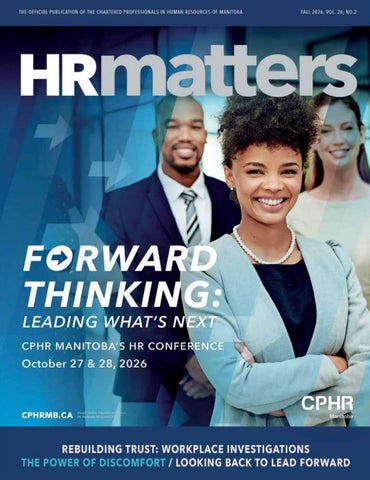
MOVING FORWARD AND LEADING WHAT’S NEXT
O
Alison Crozier, CPHR Chair, CPHR Manitoba Board of Directors
n behalf of CPHR Manitoba, I am pleased to welcome you to the fall 2026 edition of HRmatters. We look forward to the year ahead and the implementation of our new strategic plan, which includes a fresh vision and mission, as well as four strategic pillars: engage, develop, protect and advocate. This plan focuses on elevating the impact of human resources, safeguarding the public interest and supporting strategic people leadership that drives workplace success. It has been more than a year since the Chartered Professionals in Human Resources Act came into force and we became self-regulated, and this plan builds on that achievement. We enter this fiscal year with a renewed perspective on advancing the CPHR designation and HR industry as a whole, while continuing to uphold our standards and our duty to protect the public under the act. Connecting as HR professionals is so important. The year ahead will offer many opportunities to engage with our members through a variety of events, including CPHR Recognition Night, the Psychological Health & Safety in the Workplace Conference, HR Legislative Review and membership luncheons, among many others. These events provide valuable ways to stay informed about trending topics and connect with fellow professionals. A highlight of the year is our annual conference. The theme of CPHR Manitoba’s HR Conference 2026, ‘Moving Forward: Leading What’s Next,’ emphasizes HR’s leadership in defining how we work, connect and grow. I’m excited that we are focusing on this important role, particularly in these dynamic times. Be sure to check out the fantastic lineup of keynote speakers and presenters. Our most prestigious event of the year, the HR Excellence Awards, will once again celebrate the outstanding work of HR professionals across Manitoba while recognizing the evolving roles and contributions of HR within organizations. Nominations are open until Oct. 31, so if you, someone you know or an organization is doing meaningful work in HR, or implementing initiatives that are making a significant impact in the workplace, we encourage you to submit a nomination before the deadline. At CPHR Manitoba, we recognize the impact HR professionals are increasingly having at the decision-making level within organizations. CPHRs are uniquely equipped by their education, experience and expertise to not only shape the future of work but to lead it. As my term as board chair comes to an end, I want to express my heartfelt gratitude to our members and to my fellow board directors for the trust, confidence and support you have extended to me throughout this journey. I have always believed in the strength of our HR community and the positive impact we can have together on our profession, our workplaces and those we serve. I feel incredibly fortunate to have worked alongside such dedicated and talented individuals. The commitment of our board, the invaluable contributions of our committees and the leadership of CPHR Manitoba CEO Ron Gauthier and his exceptional team have made this experience both rewarding and inspiring. Looking back on the past two years, I am proud of what we have accomplished together. From strengthening relationships across our HR community, business sector and government partners to achieving self-regulation and launching our 2026-2029 strategic plan, these milestones reflect the collective dedication, vision and passion of so many people. Shortly, I will have the honour of passing the baton to incoming board chair Nikolene Day. I know the organization will thrive under her leadership, and I look forward to supporting Nikolene and the board in my new role as past chair. Thank you for the opportunity to serve. On behalf of CPHR Manitoba, I look forward to connecting at our upcoming conference and future events. I am also excited to continue working together to advance the HR profession, people leadership and HR innovation that build inclusive, future-ready workplaces.
Alison Crozier is an HR executive known for her strategic partnership with C-level leaders to drive key business objectives, implement long-term business plans and achieve measurable success through comprehensive talent strategies. With a career marked by global reach and insight, Alison has designed and delivered impactful programs for Deloitte and Fortune 100 companies, spanning across the Americas, Europe, the Middle East, Africa and Latin America.
4
HRmatters / www.cphrmb.ca
FEATURE
REBUILDING TRUST AFTER A WORKPLACE INVESTIGATION
W
By
6
Tory McNally, CPHR
HRmatters / www.cphrmb.ca
hen a workplace investigation concludes, many organizations breathe a sigh of relief. The report has been delivered, findings have been communicated and decisions have been made. It is tempting to believe the difficult part is over. In reality, the investigation itself is only the beginning. Whether allegations are substantiated, unsubstantiated or inconclusive,an investigation changes a workplace. Employees may have experienced uncertainty, stress and divided loyalties. Managers may feel scrutinized or unsure how to move forward. The individuals directly involved may be returning to work with damaged relationships, heightened emotions or concerns about retaliation. Even employees who had no direct involvement may question whether the organization handled the matter fairly.
An investigation answers questions about what happened. It does not automatically restore confidence in the workplace. That requires deliberate effort, thoughtful leadership and careful planning. Human resources professionals play a critical role in helping organizations move beyond the investigation and begin rebuilding trust. One of the most common mistakes organizations make is treating the final report as the finish line. Once findings have been shared and any disciplinary decisions have been implemented, leaders often expect employees to move on quickly. Unfortunately, workplace relationships rarely recover on their own. Trust is rebuilt through consistent actions over time rather than a single communication or meeting. Employees watch closely to see whether leaders follow-through on commitments, apply
FEATURE
EMPLOYEES WATCH CLOSELY TO SEE WHETHER LEADERS FOLLOWTHROUGH ON COMMITMENTS, APPLY BEHAVIOURAL EXPECTATIONS CONSISTENTLY AND DEMONSTRATE THAT THE ORGANIZATION HAS GENUINELY LEARNED FROM THE EXPERIENCE. behavioural expectations consistently and demonstrate that the organization has genuinely learned from the experience. Communication is often the first challenge. Confidentiality obligations limit what employers can disclose about an investigation, yet silence can easily be interpreted as inaction. Employees may not receive every detail they want, but they do need reassurance that concerns were taken seriously and addressed appropriately. Leaders should acknowledge the investigation has concluded, thank employees for their professionalism throughout the process and communicate that appropriate action has been taken where warranted. They should avoid discussing confidential details or attempting to justify every decision. Instead, the focus should remain on reinforcing the organization's commitment to respectful workplaces, fairness and accountability. The way leaders communicate is just as important as what they say. Employees often judge fairness not only by the outcome but by whether they believe the process was impartial, respectful and thorough. Tom R. Tyler, a researcher of organizational justice, has consistently demonstrated that people are more likely to accept difficult outcomes when they believe they were treated fairly throughout the process. HR professionals can help leaders understand that rebuilding confidence requires demonstrating integrity in both process and behaviour. Supporting the complainant after an investigation requires careful attention. No matter the findings, the individual may experience anxiety about returning to normal working relationships.
They may worry about being viewed differently by colleagues or fear subtle forms of retaliation. Employers should never assume that the conclusion of an investigation eliminates these concerns. Regular check-ins provide an opportunity to identify emerging issues before they become larger problems. Managers should remain attentive to changes in workplace dynamics, social isolation or shifts in workload that could suggest the employee is experiencing negative consequences after coming forward. At the same time, organizations must avoid placing complainants in the uncomfortable position of becoming symbols of the investigation.
Many simply want to return to their normal work without ongoing attention or repeated discussions about what occurred. Respecting their privacy while remaining available to provide support requires careful judgment. Respondents also require thoughtful management, regardless of the findings. When allegations are substantiated, discipline may address the misconduct but it does not automatically repair working relationships. The respondent must clearly understand behavioural expectations moving forward, including any coaching, monitoring or performance requirements that accompany the disciplinary outcome. Managers
Fall 2026 / HRmatters
7
FEATURE
should focus discussions on future behaviour rather than repeatedly revisiting past mistakes. Where allegations are not substantiated, employers should avoid implying that the complaint lacked merit or should never have been raised. An unsubstantiated finding simply means the available evidence did not establish that the alleged conduct occurred. Employees can experience workplace conflict differently without either party acting in bad faith. The respondent may also need support in re-establishing professional relationships and rebuilding credibility. Returning to work after an investigation can be uncomfortable for everyone involved, particularly when rumours have circulated or colleagues have formed opinions before the investigation concluded. Witnesses are also frequently overlooked by organizations. Employees who take part in interviews may worry about confidentiality, workplace relationships or whether they will be perceived differently because they cooperated with the investigation. Some may feel emotionally drained after discussing difficult events or concerned that tensions remain unresolved. Acknowledging their professionalism and reminding them of available support can reinforce confidence in the process.Managers should also remain alert to subtle workplace behaviours that could discourage employees from participating honestly in future investigations. Protecting employees from retaliation is not simply a legal obligation. It is essential for maintaining confidence in organizational reporting systems. Managers often need support as well. Supervisors are expected to restore team cohesion while continuing to meet operational objectives. They may be dealing with strained relationships, heightened emotions or uncertainty about what they can discuss with employees. HR professionals can help managers by providing practical guidance rather than expecting them to navigate these challenges independently. Coaching conversations about respectful com-
8
HRmatters / www.cphrmb.ca
munication, conflict resolution and consistent standards can significantly influence how quickly a team begins to recover. The broader workplace should not be forgotten. Even employees who had no direct involvement often pay close attention to how investigations are handled. They observe whether policies are followed, leaders demonstrate accountability and respectful behaviour is consistently reinforced. This is an opportunity for organizations to reaffirm workplace expectations without revisiting the specific investigation. Refresher training on respectful workplace standards, leadership responsibilities, reporting mechanisms or organizational values can reinforce positive behaviours while demonstrating a commitment to continuous improvement. Importantly, organizations should resist the temptation to introduce sweeping policy changes solely because of a single investigation unless systemic concerns have actually been identified. Effective post-investigation responses should be based on evidence rather than assumptions.
Sometimes the issue lies with one individual's behaviour. In other situations, the investigation reveals broader concerns involving leadership practices, communication, workload or organizational culture. HR's role is to distinguish between isolated incidents and systemic issues before recommending organizational change. Rebuilding trust also requires consistency. Employees quickly lose confidence when organizations respond decisively during a highly visible investigation but gradually return to old habits. Expectations emphasized during the investigation should continue to be reinforced through regular coaching, performance management, leadership development and day-to-day decision-making. Trust grows when employees see that respectful behaviour is not simply discussed during times of crisis but remains an ongoing organizational priority. Perhaps the most overlooked issue is how organizations determine whether trust has actually been restored. The absence of complaints does not
FEATURE
necessarily indicate success. Employees may simply decide that speaking up is not worthwhile. Instead, HR professionals should look for broader indicators. Are employees raising concerns earlier? Are managers addressing conflict more confidently? Has turnover stabilized? Are engagement survey results improving in areas related to trust, respect and confidence in leadership? Do employees continue to use internal reporting processes when concerns arise? These measures provide a more meaningful picture of organizational recovery than merely counting the number of formal complaints. Every workplace investigation represents an
opportunity to strengthen organizational culture, but only if leaders recognize the work continues after the findings are delivered. A fair investigation demonstrates accountability. A thoughtful recovery demonstrates leadership. Employees are unlikely to remember every detail of an investigation years later. They will, however, remember how the organization treated people throughout the process, whether leaders acted consistently with organizational values
and whether meaningful changes followed. A well-conducted investigation may resolve a complaint but it does not, on its own, rebuild a workplace. That happens through consistent leadership, thoughtful follow-through and a genuine commitment to fairness. HR's role extends beyond finding facts. It is about helping people and organizations move forward with greater confidence in one another and in the systems designed to support them.
ABOUT THE AUTHOR: Tory McNally, CPHR, BSc., is Vice-President of Professional Services at TIPI Legacy HR+
(formerly Legacy Bowes). Tory is a human resources consultant, relationship builder and problem solver. She can be reached at 204-947-5525 or tmcnally@tipipartners.com.
HR Excellence Awards 2027 BUSINESS EXCELLENCE AWARDS
Honouring HR professionals and organizations that drive strategic people leadership and create lasting impact in healthy, inclusive, and future-ready workplaces.
For more info, visit CPHRMB.CA/AWARDS
Recognizing organizations that turn leadership excellence and innovation into measurable business success.
PROFESSIONAL EXCELLENCE AWARDS
Celebrating HR professionals whose leadership goes beyond expectations to advance people, workplaces, and the profession. Nominate yourself, a colleague, or your organization today! Deadline for nominations: October 31, 2026
Presenting Sponsor _
Fall 2026 / HRmatters
9
FEATURE
BUILDING THE BUSINESS CASE FOR JOB ARCHITECTURE Ethical and operations considerations and impacts of outside employment
I
By
10
Jeremy Woo
HRmatters / www.cphrmb.ca
n an era defined by rapid change, talent scarcity and increasing demands for transparency, human resources leaders are being called to reimagine how their organizations attract, retain and develop talent. One of the most powerful tools at their disposal — yet often overlooked — is job architecture. Job architecture is the structured design of roles within an organization. It defines how jobs are grouped, levelled and organized across functions, geographies and business units. Far more than a classification or job evaluation system, job architecture creates a consistent framework for compensation, job titling, career pathways and talent management, all aligned with business priorities. When implemented effectively, it becomes the connective tissue between HR strategy and operational execution, enabling clarity, consistency and agility across the entire employee life cycle. Without a shared job architecture, HR programs can operate in silos, increasing organizational risk, administrative complexity and inconsistent employee outcomes.
Here are six reasons you need job architecture now. Facilitates open communication. Jobarchitecturegivesleadersandmanagers a common language for discussing roles, pay and careers. With clearly defined roles and levels, it becomes easier to: • Discuss compensation and career progression in a structured, equitable and transparent way. • Set realistic expectations for growth, development and advancement. • Align development plans with business needs. • Address employee questions and concerns with clarity and consistency. This transparency strengthens manager capability, improves employee understanding and reinforces a culture of trust. Drives internal consistency and external market competitiveness. A robust job architecture provides a
FEATURE
defensible framework for comparing roles internally and externally. For HR and business leaders, this means: • Consistent job levelling, titling and compensation decisions across departments, business units and geographies. • More precise benchmarking against external market data. • Greater confidence in pay transparency and disclosure initiatives. A consistent approach to job levelling, titling and benchmarking also strengthens employer branding, improves the candidate experience and supports equitable pay practices. Enables career pathing and talent mobility. Career visibility is one of the strongest drivers of employee engagement and retention. Job architecture allows organizations to: • Map clear career paths across functions and levels, including management and individual contributor pathways. • Identify both lateral and vertical mobility opportunities. • Support succession planning through a structured view of roles and capabilities. • Reinforce a culture of growth, learning and internal mobility. Clear and transparent career pathways enhance engagement, support retention, bolster commitment and help future-proof the workforce. They are a visible commitment to employee growth and development. Builds organizational trust through transparency. Employees increasingly want to understand how decisions are made, especially those related to pay and promotions. Job architecture supports this by providing: • A transparent framework for role definitions and level distinctions. • Clear criteria for advancement and development. • A foundation for skills and competency frameworks. • A consistent employee experience across teams and locations.
This transparency reduces ambiguity, reinforces perceptions of fairness and strengthens organizational culture. Unlocks the power of HR analytics. Without a consistent job framework, HR data can be fragmented and difficult to interpret, limiting insight and decision-making. Job architecture enables: • Standardized job data across the organization’s HR information system. • More accurate workforce analytics and reporting. • Deeper insights into talent gaps, turnover and performance. • Stronger alignment between HR metrics and business outcomes. • Improved agility, enabling organizations to adapt more quickly to change, emerging skills and evolving business needs. • A foundation for other key HR processes, such as job analysis, job evaluation, workforce planning and employee development. For HR leaders, this enables the shift from managing inconsistent data to leveraging it for more meaningful business analytics. Supports compliance and pay equity. In a landscape of evolving regulations and social expectations, job architecture helps organizations stay ahead by: • Providing a robust and defensible framework for pay transparency. • Supporting pay equity initiatives with a consistent, organization-wide approach to defining jobs and work. • Providing a foundation for diversity, equity and inclusion initiatives and practices. While job architecture alone does not guarantee equity, it is a critical enabler of fair, consistent and
compliant people practices. IMPLEMENTATION WITHOUT DISRUPTION One of the most compelling advantages for HR leaders is that job architecture can be implemented without a major overhaul. Existing job evaluation plans and market data can be retained, allowing for: • Immediate improvements in the clarity and consistency of job titles, levels, role expectations and career pathways. • Minimal disruption to current HR operations. • Practical integration with existing HR systems and processes. • The ability to scale the framework over time as the organization grows or evolves. This scalable approach makes job architecture a high-impact initiative with relatively low disruption, positioning it well for organizations seeking quick wins and long-term transformation. BUILDING THE FOUNDATION FOR WHAT COMES NEXT Job architecture is not just an internal HR tool. It is an employee-facing organizational framework that shapes how people experience pay, careers and growth. By embedding it at the core of your HR framework, you can lead with greater clarity, make better use of data and build a workforce that is aligned, engaged and future-ready. As pay transparency legislation expands globally, skills requirements evolve rapidly and employees demand clearer career and pay outcomes, job architecture is no longer a nice-tohave. It has become a foundational capability for organizations seeking to manage risk, build trust and scale effectively in a more transparent and dynamic labour market. If you are ready to elevate your HR strategy, job architecture provides the blueprint to build on.
This article includes contributions from Nicole Chernetz, Manager, and Arron Dobson, Partner, at Laulima Consulting. ABOUT THE AUTHOR: Jeremy Woo is a Principal with Laulima Consulting, specializing in employee rewards and executive compensation. His expertise spans a broad range of compensation matters, including external
market benchmarking, job levelling and job evaluation, compensation structure design, incentive plan design, pay equity, and total rewards philosophy and strategy development and implementation.
Fall 2026 / HRmatters
11
FEATURE
THE PRODUCTIVE POWER OF DISCOMFORT Why leadership growth starts where it gets uncomfortable
D
By
12
Tamara Kroeker
HRmatters / www.cphrmb.ca
iscomfort has a bad reputation. Most leadership advice tells you to get comfortable with it. You’ve likely heard: don't wait on a hard conversation; the sooner, the better; get it over with before it turns into something bigger. That's genuinely good advice. But in many ways, it's also telling you to grit your teeth and push through — to build a higher tolerance for the discomfort you feel in that moment, getting faster and more efficient at pushing past it without ever stopping to ask what it's telling you. Whether you deal with the discomfort now or later, it's still carrying the same information. The goal of any leadership challenge isn't tolerance. It's noticing these moments as opportunities — chances to go deeper and understand ourselves and the people in front of us a little better. We're not trying to reach some ultimate arrival point where nothing makes us uncomfortable. As long as we work with humans, discomfort isn't going away. We're not just talking about difficult discussions — terminations, performance conversations, employee disputes and the like. We're talking about the little red flag that goes up for any number of reasons because the task or person in front of us is moving us over some invisible line we
were trying to avoid. It shows up as a slight tension in the stomach or chest, right before we try to fix, avoid or explain away whatever caused it. Maybe it's a request you want to say no to but don't. Or maybe it's a colleague's tone shifting mid-conversation and you talk faster to smooth it over. Small, fast, easy to miss and full of information. It is human nature to avoid things that don't make us feel good. In fact, we've likely shaped our lives in ways that help us avoid anything that doesn't feel good: • If money stresses you out, you've built a savings plan. • If you'd rather not be alone, you've created a circle of people you can call on anytime. • If structure calms you (or cages you), you've shaped your work and home life around that need either way. None of these preferences are wrong. They're survival strategies that keep us safe, healthy and happy. But what has happened for many of us is that our survival strategies have been overused. We've planned for our financial future and still feel anxious when we think about it. We have our loyal
FEATURE
community but we worry when they don't text us. We’ve set our lives up the way we like them but those little disruptions still arise. The strategy itself isn't the issue. It’s what happens when we lean on it so hard and so automatically that we stop asking whether it's still serving us or simply keeping us from feeling something important. The truth is, we often use these strategies to avoid what makes us uncomfortable, even though those very moments hold information about how we feel, what we're afraid of, and the memories and patterns we've tried to keep beneath the surface. Any tension in your stomach or chest right now? This is the work of self-awareness. Self-awareness is about growing our understanding of all the parts of us that respond to the world around us in various ways. It means noticing our responses and strategies and beginning to understand why they're there. Self-awareness includes sitting with moments of comfort and discomfort and exploring what else they might have to teach us.
So how does this apply to our roles and our leadership? Leadership always starts with us. The more often we can sit with our own discomfort, the easier it becomes to hold space for others as they learn and grow. Try this: Think about the last time you felt uncomfortable. Instead of fixing it, reviewing it or trying to push through it, stay with the feeling as it arises. Then ask yourself: What am I not seeing? Likely, there is a feeling, thought or new perspective already emerging in your mind. There is always more happening beneath the surface than we realize and the doorway in is that little moment of tension we feel in our bodies and minds. That tension is critical to uncovering what lies beneath because, without it, we very quickly return to our well-worn patterns of coping, with lit-
tle opportunity for learning or greater awareness. Discomfort is an invitation for growth. It deepens our understanding of ourselves and others. When we become more comfortable being uncomfortable, we can bring a new level of openness to the decisions, conversations and relationships we are part of, both in and out of the workplace. When you can sit with your own discomfort for even 30 extra seconds, you create room for the people around you to be honest, admit a mistake and disagree without fear. Teams don't learn to have hard conversations by watching a leader who avoids them or pushes quickly past them. They learn by watching one who can stay in them. So, here's your challenge: next time you feel uncomfortable, stay with it a little longer. I'd love to hear what you notice.
ABOUT THE AUTHOR: Tamara Kroeker is a coach, facilitator and speaker with a passion for fostering self-
awareness and relational intelligence in the workplace. Specializing in the Enneagram, Tamara guides individuals and teams in understanding their core motivations and strengthening their interpersonal dynamics. After more than 10 years as an elementary music teacher, she shifted her focus on coaching professionals to support their personal growth and effectiveness at work.
I was able to take the program that intrigued me... and help where I’m planning to go in the future.” Shad Hofer, Graduate
Shape the future of your HR career WITH CONTINUING EDUCATION Discover everything you need to advance your HR career in one place. Bridge capability gaps, maintain your CPHR CPD, and prepare for the NKE® exam with UCalgary Continuing Education’s HR Professional Development Hub. Discover flexible online courses now at conted.ucalgary.ca/cphr Looking to train a group in your company? Courses can be tailored to your team’s needs. Visit conted.ucalgary.ca/corporatetraining for details. Explore programs at: conted.ucalgary.ca/cphr
Fall 2026 / HRmatters
13
FEATURE
THE HUMAN LAYER What HR actually owns in cybersecurity
T
By
14
Alex Zlatin
HRmatters / www.cphrmb.ca
he e-mail arrived on a Tuesday morning and looked right. It came from a real contact, referenced a real conversation and linked to a login page that matched the genuine one down to the favicon. One of our account managers — a careful, experienced professional — entered her credentials. The whole thing took less than a minute. Here is what worked that morning: the firewall, the antivirus, the spam filter and the multi-factor authentication prompts. Every technical control we had paid for did exactly what it was designed to do. The attacker simply walked past all of it because the doorway was a person. I wear two hats in my company: CEO and privacy officer. This means I sat on both sides of that incident. The lesson I took from it was not about technology. It was that the real breach surface of an organization is the people, the processes around them and the habits those processes
create. This means a large share of your organization’s security posture is owned by human resources, whether HR has been told that or not. The numbers back this up. Verizon’s 2025 Data Breach Investigations Report, which analyzed more than 22,000 security incidents worldwide, found that roughly 60 per cent of breaches involved the human element — error, social engineering or misuse — and stolen credentials were the single most common way attackers got in. Closer to home, Statistics Canada’s Canadian Survey of Cyber Security and Cybercrime found that 16 per cent of businesses were impacted by cybersecurity incidents in 2023, while total recovery spending doubled in two years to $1.2 billion. Fewer incidents, much bigger bills. Two more Canadian numbers deserve attention because they land squarely on HR’s desk. According to the same survey, only 26 per cent
FEATURE
of Canadian businesses had written cybersecurity policies in place, and just half had employees dedicated to cybersecurity — down from 61 per cent in 2021. In most Canadian workplaces, there is no security department to hand this to. There is whoever owns policies, training and people processes. That is you. So, let me walk you through the four places where, in my experience, security programs actually succeed or fail. None of them live in the server room. THE FIRST DAY Onboarding is where access is born. On day one, a new hire is granted logins, permissions, shared drives and group inboxes, and in most organizations, the scoping decision is “give them what the last person in that role had.” Nobody re-asks the question. Access accumulates the way boxes do in a garage. The question is, what does this role actually need to touch? It is not an IT ticket. It’s a job-design question and that belongs to HR. When access is defined as part of the role profile — written down and reviewed when the role changes — you have quietly eliminated a whole category of risk before anyone has clicked anything. THE LAST DAY Offboarding is onboarding’s neglected sibling. The Statistics Canada finding that 50 per cent of Canadian businesses have no dedicated security staff means that in half of those businesses, nobody’s job is to notice the account that stayed active after its owner left. Stolen and lingering credentials are precisely what attackers hunt for and a former employee’s live login is a credential nobody is watching. The fix is procedural, not technical: revocation on the same day as departure, on a written checklist, triggered by the same HR workflow that stops payroll.We stop paying people the day they leave without difficulty. Their access deserves the same punctuality. Their password, unlike their parking pass, can be used from anywhere in the world.
TRAINING THAT CHANGES BEHAVIOUR Here is the finding from the Verizon report that should reframe every training budget conversation: their researchers observed that click rates on phishing simulations were essentially unaffected by whether users had received security awareness training. Read that again. The most common intervention, the one on every compliance checklist, did not move the needle on the exact behaviour it targets. My interpretation — and this is clearly an opinion — is that most security training fails because it is designed to be completed, not used. An annual 40-minute module produces a certificate, not a reflex. What builds the reflex is frequency and relevance: short, regular exposure to what real attempts look like, discussed openly when they happen and using your organization’s actual nearmisses as the curriculum. The best training material we ever had was the Tuesday morning e-mail itself, shared with the whole team that same week. THE FIRST HOUR AFTER THE CLICK This is the one I care about most because it decided how our own story ended. When our account manager realized what had happened, she reported it within minutes. Not because a policy told her to, but because nothing in our culture made her afraid to report it. The account was locked, sessions were revoked and our monitoring showed no evidence that the access was ever used. The gap between the click and the report was measured in minutes, and that gap is everything. An attacker with stolen credentials and a twoday head start is a breach. The same attacker with a 10-minute head start is an anecdote. Now imagine the same moment in a workplace where the last person who clicked a link was disciplined or mocked in a staff meeting. The
employee hesitates, quietly checks whether anything looks wrong and hopes it was nothing. The report comes Thursday, if it comes at all. No firewall purchase can buy back those two days. Whether people report promptly is not a technical property of your organization. It is a cultural one and culture is HR’s home turf. The norm you want is simple: report first, blame never. Falling for a well-crafted phishing e-mail is not a competence failure — Verizon’s data shows it happens across every industry and at every level of seniority. Hiding it is a failure and people only hide things in cultures that punish honesty. WHERE TO START If this feels like a large mandate, it shrinks quickly in practice. Put access requirements into role profiles the next time job descriptions are reviewed. Add same-day revocation to the offboarding checklist that already exists. Replace the annual training module with short, frequent, real examples. Say out loud, before any incident, that reporting will never be punished — and then keep that promise the first time it is tested because everyone will be watching. None of this requires a security budget. All of it requires someone who owns people, policies and culture to decide it is theirs. In one in two Canadian businesses, there is no one else in the building to do the job. The firewall, for all its virtues, has never once clicked a link. People do and they always will. That is not a weakness to be engineered out of your workforce. It is the operating reality your processes should be designed around. The organizations that accept this are not necessarily the ones with the most expensive technology. They are the ones where the person who clicked picks up the phone within a minute because they know exactly what will happen next — and none of it involves shame.
ABOUT THE AUTHOR: Alex Zlatin, MBA, is CEO and the Privacy Officer of Mint Ops (Continental Assets Ltd.), a Winnipeg-based company. He is also the author of ‘Responsible Dental Ownership.’ Alex can be reached at alex@mintops.ca.
Fall 2026 / HRmatters
15
FEATURE
LOOKING BACK TO LEAD FORWARD How HR can help teams learn from experience and prepare for what comes next
A
By
16
Trevor Hubert, CPHR
HRmatters / www.cphrmb.ca
recent initiative-evaluation meeting with a group of operational leaders reminded me of the pressure frontline and middle managers face to deliver results faster with fewer resources in an environment of constant change and disruption. I am hearing similar concerns from more of my coaching and team development clients. Leaders are stretched by urgent priorities, expanding responsibilities, back-to-back meetings and increasingly flat organizational structures. They are expected to keep work moving while supporting employees, responding to new demands and helping their teams navigate change. Under these conditions, reflection can feel like a luxury. Gallup’s workplace research suggests that employees who naturally respond to pressure by taking action may be inclined to dive straight back into the work. For this group, Gallup found that pausing to reflect on the situation was associated with a substantially greater reduction in burnout symptoms. The instinct to move faster is not always the response that serves us best. Teams can move quickly from one initiative, challenge or deadline to the next without creating enough space to ask what they learned, what remains valuable and what needs to change. Yet leading what comes next may require teams to spend more time learning from what came before.
WHY REFLECTION MATTERS Researchers use the term ‘team reflexivity’ to describe the process through which team members deliberately examine their goals, strategies, results, ways of working and broader context, then adjust their approach based on what they learn. I think of team reflexivity as a collective form of metacognition. Metacognition involves stepping back to examine how we think and learn so that we can adjust our approach. Team reflexivity applies a similar discipline at the group level: teams reflect on their shared experiences, assumptions and ways of working to improve future performance. There is solid research to support the importance of helping teams pause, debrief and reflect on their work experiences. A meta-analysis published in Human Factors by Scott Tannenbaum and Christopher Cerasoli found that properly conducted individual and team debriefs improved performance by an average of 20 to 25 per cent compared with control groups, across a wide range of settings and tasks. The implication for HR is not that every team needs another lengthy meeting. A short, wellstructured reflection can be valuable when a team completes an initiative, reaches a milestone, experiences a setback or prepares for its next major priority. Leading a team through this pause and
FEATURE
reflection involves more than a general conversation about how everyone thinks things are going. An effective debrief requires leaders to prepare thoughtful questions in advance. A STRENGTHS-BASED APPROACH TO TURNING EXPERIENCE INTO ACTION When I conduct a team reflection, I like to follow a strengths-based approach. Rather than beginning by asking what’s missing, this approach first identifies what is already working and incorporates time for team recognition before examining areas of change and future action. Strengths: Teams can become so focused on transformation that they overlook the practices, partnerships and cultural strengths already supporting performance. The goal is not to preserve everything familiar. It is to recognize what continues to create value and should be carried forward. Ask: • What helped us achieve results? • Which ways of working strengthened collaboration or trust? • What do employees, customers or stakeholders continue to value? • What should we deliberately carry forward? Celebrate: Making room for recognition helps the team notice and appreciate the different contributions and strengths that supported the work.
Ask: • Who helped solve a problem along the way? • Who stepped in to provide support when it was needed? • What strengths did you see a team member demonstrate? • Where did a team member help you recognize or navigate a blind spot?
rejecting it. Ask: • What still matters but no longer works in its current form? • What needs refinement rather than replacement? • How can we preserve the value while changing the method?
Stop: Organizations frequently add priorities without removing old ones. Over time, this produces overload, duplication and frustration. Ask: • Whatconsumeseffortwithoutcreatingenough value? • Which assumptions no longer fit current conditions? • Where are our processes slowing decisions or collaboration? • What should we stop doing to create capacity?
Start: This turns reflection toward possibility and action. Starting something new does not always require a major initiative. It might mean testing a different meeting practice, involving employees earlier or gathering information the team does not have yet. Ask: • What new behaviour, capability or partnership is needed? • Which conversations are not happening? • Whose perspective should be included? • What small experiment could help us learn?
Adapt: Not every practice should be continued unchanged or eliminated completely. A leadership program may still be worthwhile but need to be better aligned with current business priorities. A team meeting may remain necessary but require a different approach to participation and decision-making. A valued part of the culture may need to be expressed differently as the organization grows. ‘Adapt’ helps teams avoid a false choice between holding onto the past and
USE FOUR TALENT LENSES A strengths-based reflection is not only about identifying what went well. It also considers the different ways team members contributed to the work and the perspectives the team may not have fully utilized. Gallup groups the 34 CliftonStrengths themes into four domains that describe broad ways people contribute when they join, create or lead
Fall 2026 / HRmatters
17
FEATURE
teams: executing, influencing, relationship building and strategic thinking. These domains can give HR professionals and team leaders practical lenses for deepening their reflection. • Executing: What did we deliver? What helped us get it done? Where did work stall? • Influencing: How effectively did we build understanding, support and momentum? • Relationship building: How well did we work together? Where was trust strengthened or strained? • Strategic thinking: What did we learn? What patterns emerged? What should shape our next move? The purpose is not to achieve equal numerical representation across the four domains or to restrict people to a single contribution. It is to ensure the team does not evaluate its experience from only one perspective. A team may focus mainly on whether deadlines were met while overlooking the relationships that made delivery possible or were strained along the way. Another may spend considerable time discussing employee experience without
establishing ownership or action. A third may generate valuable insights but struggle to build support beyond the room. Using all four lenses helps the team recognize what contributed to success, identify where it may have overrelied on familiar strengths and determine the different contributions that will be needed next. HR CAN SUPPORT THE PAUSE HR does not need to own the team’s answers. Its value lies in helping the leader create a thoughtful process through which the team can reach them. This can happen during a formal retrospective, a leadership meeting or an HR business partner’s regular check-in with a leader. These questions can help a leader prepare: • What did the team learn from this experience? • What strengths and contributions helped it succeed? • Who should be recognized?
HRmatters / www.cphrmb.ca
LEADING WHAT COMES NEXT No organization can accurately predict every disruption, workforce challenge or change it will encounter. It can, however, become better at learning and adapting. HR professionals can support teams in creating the pauses needed to reflect on experience before moving into the next plan. Looking backward is not the opposite of forward-thinking.Done well,it helps teams carry their strengths forward, learn from their blind spots and lead what comes next with greater intention.
certified strengths coach. Trevor has more than 25 years of experience in team and leadership development, employee engagement and organizational learning. He can be reached at trevorhubert@elevatestrengths.com.
Become a CPHR.
18
The private HR conversation should not replace collective team reflection. Rather, it should help the leader create the conditions for one that is honest, balanced and focused on future action.
ABOUT THE AUTHOR: Trevor Hubert, CPHR, CTDP, ACC, is the Founder of Elevate Strengths and a Gallup-
Advance your career, invest in your future. CPHRMB.CA
• What perspectives might the team be overlooking? • Given everything discussed, what should the team stop, adapt or start doing?
FEATURE
WHEN PROBLEM EMPLOYEES ARE REALLY LEADERSHIP PROBLEMS Why HR can’t build a high-performance culture alone
O
By
Tony Friesen
rganizations often think they have problem employees. More often than not, they have leadership problems. Consider a fictional but familiar morning for Priya, a human resources manager. She has only taken her first sip of coffee when the e-mails begin. A supervisor needs help with an employee who “isn’t meeting expectations.” Another manager asks HR to lead a difficult performance conversation because they do not feel confident having it themselves. An employee requests a confidential meeting after receiving feedback they felt was unfair.Two co-workers have stopped speaking to one another after weeks of unresolved tension. A formal workplace complaint lands in HR’s inbox after concerns that had been simmering for months were never addressed. By lunchtime, a high-performing employee is sitting in an exit interview. When asked why they
are leaving, they simply say, “I loved the work. I just couldn’t stand the culture.” On paper, Priya has spent the morning solving employee problems. But has she? Or has she spent it responding to the consequences of leaders who were never equipped to provide effective feedback, coach performance, hold people accountable or address conflict before those issues escalated? This is the reality for many HR professionals. Instead of focusing on strategic priorities, such as talent development, workforce planning and building healthy organizational cultures, they often find themselves acting as conflict coaches, mediators, investigators and referees. They are brought in after situations have already reached a breaking point. The employees were not necessarily the problem. The conversations that never happened, or did not happen well, were.
Fall 2026 / HRmatters
19
FEATURE
MANAGERS NEED OPPORTUNITIES TO LEARN HOW TO PROVIDE EFFECTIVE FEEDBACK, COACH PERFORMANCE, NAVIGATE CONFLICT AND HOLD PEOPLE ACCOUNTABLE IN WAYS THAT STRENGTHEN RATHER THAN DAMAGE RELATIONSHIPS. DIFFERENT PROBLEMS, ONE COMMON CAUSE At first glance, Priya’s morning appears to be a collection of unrelated issues. Yet none of them truly began in HR. Most started weeks or months earlier during everyday interactions between managers and employees. A difficult conversation was postponed. Performance expectations were never clearly communicated. Constructive feedback came too late or only after frustration had built. Conflict was ignored in the hope that it would resolve itself. An employee who needed coaching instead received criticism. By the time HR becomes involved, what could have been a five-minute coaching conversation has often become an hour-long meeting. That is not a criticism of managers. Most genuinely want their teams to succeed. The challenge is that many are promoted because they excelled in technical roles, not because they have been taught how to lead people. We would never assume someone could manage payroll without training. Yet many organizations expect managers to navigate conflict, coach performance, hold people accountable and deliver difficult feedback with little or no formal development. The influence of managers is difficult to overstate. Gallup reports that 70 per cent of the variance in team engagement is related to management. That does not mean every workplace concern is caused by a manager, but it does reinforce how strongly day-to-day leadership shapes the employee experience. When managers do not have the skills or confidence to handle important conversations, avoidance can feel safer in the moment. The cost usually appears later. Expectations become less clear, frustration grows and HR inherits a situation that is more emotional, complex and time-consuming than it needed to be. IT’S TIME TO RETHINK FEEDBACK For many managers, the word 'feedback' immediately brings to mind performance reviews,
20
HRmatters / www.cphrmb.ca
corrective conversations or addressing poor performance. It is what they give when something has gone wrong. That mindset is part of the problem. When feedback becomes synonymous with criticism, many managers naturally avoid it. They worry about upsetting employees, damaging relationships or saying the wrong thing. Ironically, avoiding the conversation often creates the very problems they hoped to prevent. Assumptions replace communication. The employee continues without a fair opportunity to adjust. By the time the issue is finally addressed, both people are entering a discussion that feels much more difficult than it should have been. Research also suggests that people may be more open to constructive feedback than others assume. In a series of studies, researchers found that people consistently underestimated how much others wanted useful feedback, particularly when it could help them improve. The challenge is not simply whether feedback is delivered, but whether it is timely, specific, respectful and useful. Effective feedback is not about pointing out mistakes. It is about reinforcing strengths and positive behaviour, creating clarity and addressing small issues before they become significant problems. It helps employees understand what success looks like, where they are succeeding, where they can improve and what support they need to get there. When feedback happens early,often and respectfully, it becomes a normal part of working together rather than a warning that someone is in trouble. ANNUAL REVIEWS SHOULD NOT CONTAIN SURPRISES The best managers do not wait for annual reviews to talk about performance.Annual reviews should rarely contain surprises. Instead, they should provide an opportunity to reflect on patterns and trends that have already been discussed throughout the year, celebrate successes and identify opportunities for growth in the year ahead.
This reflects a broader shift in performance management.TheCharteredInstituteof Personnel and Development describes performance management as a continuous cycle rather than an isolated event and recommends that feedback be regular, timely and focused on improvement. Structured reviews can still be valuable, but they work best when they summarize an ongoing relationship rather than substitute for one. Great managers build a culture where feedback is expected, welcomed and viewed as an investment in growth rather than as a signal that someone is failing. They recognize good work while it is happening. They clarify expectations before disappointment sets in. They ask questions before making assumptions. They address concerns while relationships are still intact. This does not eliminate difficult conversations. Some performance, conduct and workplace issues require formal action and HR involvement. However, a healthy feedback culture can reduce the number of avoidable issues that reach that point and make necessary conversations more grounded in clear expectations and documented dialogue. BUILDING LEADERSHIP CAPABILITY Organizations often invest heavily in developing technical expertise while assuming interpersonal leadership skills will evolve naturally over time. Unfortunately, they rarely do. Managers need opportunities to learn how to provide effective feedback, coach performance, navigate conflict and hold people accountable in ways that strengthen rather than damage relationships. Like any professional skill, these abilities are developed through learning, practice, coaching and experience. HR is often well-positioned to support that growth. Sometimes that means coaching a manager through an upcoming conversation. Other times, it means recognizing when a manager would benefit from more structured development through effective feedback, leadership, communication or conflict resolution training.
FEATURE
It also means creating opportunities for managers to practice new skills, reflect on difficult situations and continue building their capabilities over time. Developing leadership capability is ultimately an organizational responsibility. It requires clear expectations, ongoing support, practical tools and senior leaders who consistently model the behaviours they expect from others. The goal is not to turn every manager into an HR professional or mediator. It is to ensure they have the confidence and skills to handle the
everyday conversations that come with leading people. When managers strengthen those skills, employees benefit, teams become stronger and HR can spend more time focusing on strategic priorities instead of responding to preventable workplace issues.
CULTURE IS BUILT ONE CONVERSATION AT A TIME The answer is not simply hiring better employees. It is developing better-equipped leaders. Organizations that invest in leadership capability are not just teaching managers how to give feedback. They are teaching them how to build trust, create accountability, coach performance and address challenges while they are still small. HR plays an important role in shaping workplace culture; however, it cannot do it alone. Culture is not created primarily through policies, values statements or annual performance reviews. Those things matter but employees experience culture most directly through their everyday interactions with the people who lead them. Managers do not define culture once a year. They shape it through the conversations they have, the ones they avoid and how they respond when a discussion becomes difficult. Culture is created one conversation at a time.
ABOUT THE AUTHOR: Tony Friesen is the Training Coordinator at Mediation Services in Winnipeg, where he supports leadership, communication, conflict resolution and mediation training. Tony can be reached at 204-925-3427 or tony@mswpg.ca.
LEARNING OPPORTUNITIES WITH CPHR MANITOBA Our mission at CPHR Manitoba is to advance the human resources profession. One way we work to achieve that is by supporting CPHRs in their professional development. We offer a robust selection of professional development opportunities in line with timely issues and trends in the workplace. These offerings include: HR Conferences
Learning Partnerships
Attend multiple conferences focused on an array of topics.
Receive training on trending issues in the HR field.
Workshops
Pre-Approved for CPD Program
Get specialized training in various areas of HR.
Sign up for training from other organizations that deliver HR and strategic business programming and earn CPHR Continued Professional Development (CPD) Hours.
Webinars Choose from a range of topics delivered by acclaimed instructors and presenters in 9 competencies of HR. PD On-demand View a past webinar and/or attend an upcoming session.
CPHRMB.CA
Member Programs Build your network and learn from other members by taking part in our Mentorship and Walk and Talk programs. Please note: Program intake periods vary, offered once or multiple times annually.
Fall 2026 / HRmatters
21
FEATURE
CONGRATULATIONS
The following individuals have achieved HR excellence. Being a CPHR represents a commitment to a national standard of excellence and sets a benchmark for the practice of effective human resources. It emphasizes the strategic role of HR management in business and plays an important role in securing HR’s position as an equal business partner at the executive table.
CPHR MANITOBA CONGRATULATES OUR NEWEST CPHRS! Korede Adeleye Angela Omatule Aghenta Bridget Akpeokhai-Fadare Nicholas Anandranistakis Emily Anderson Papiya Banerjee Evalyne Birir Blanca Bobadilla Adele Bonkoski Lisa Borodenko Kristine Buchanan Caitlyn Buhay Pratibha Chaudhary Bem Damoslog Krista Derksen Biswajit Dey Teara Duch
Beluchi Emedosi Sara Fehr Serena Fehr Willa Frederick Shari Friesen Joepfelyn Garcinez Noreen Gladue Crystal Goodick Antoine Hanna Kristy Jamieson Kuljeet Kaur Chelsea Kostuik Kimberly Lao Oluyinka Leigh Cara Leslie Yajing Li Jesvin Lisaba
Carlo Magyani Kristine Maharaj-Napora Anelle McLaughlin Arjun Nirula Jean Pacifique Niyongabo Kehinde Ogbemudia Dare Olori Ibrahim Owolabi Daria Pakhomova Sathiyaseela Sheela Ramesh Barbara Reilly Alec Ruest Sherri-Ann Rutherford Jenn Rzesnoski Amber Samson Celeste Schiak Shanley Siemens
CPHR MANITOBA CONGRATULATES OUR NEW CPHR CANDIDATES! Ayotunde Adeniji Dolapo Ibiyemi Adeola Ano Baba-Lawal Charlene Balmores Barakat Bamidele Erica Beaupre Arth Bhatt Samantha Brennan Jenna Buchwald Amber Carriere Clarissa Castellan Shiela Castro Chisom Chinwuba Allan Cosino Kyla Mae Dacanay Rhoda Marie Daguman Natali Dibs Samuel Enikanolaye Justyna Erin Esther Faturoti
22
HRmatters / www.cphrmb.ca
Amanda Flaman-Cox Daniel Fraser Hannah Gagnon Arun Gurung Léah Hurrell Oluwasesan Ibitoye Feyikemi Ikuseedun Ashley Jeroski Katelyn Laufersweiler Andrea Levesque Tiara Lock Rick Lofto Kayley McGrath Kaitlin McPherson Adrian Mendoza Jennie Mullin Blessing Ngbeken Katherine Nicolasora Mariana Nunez Chyna Nwozor
Joselyn Lasira Obando Atencio Faith Okolie Susan Olson Juliet Opelusi Mariam Otubu Ayushi Patel Nikita Persaud Madison Petkau Sheila Riediger Elsa Ross Kellie Roulette Erin Ryan Kenneth Salazar Smera Sam Kamalpreet Singh Rose- Ann Sirjue Nnedinma Uche Dayna Waring Renée Wilkinson Jessica Wipf
Todd Slatnik Lea-Anne Stagg Krista Stewart Catherine Streeter Tariq Tariq Edom Frew Tekabe Dionne Tibay Jube Tonwe Rahul Tyagi Ejiro Ukueku Maegen Walker Dustin Welsh Steven Wong Lan Zhou
MOVERS & SHAKERS Oluwakemi Ajeigbe is the new Human Resources Advisor at Heritage Co-op. Ron Cantiveros is the new Manager of the Career Catalyst Program at Manitoba Innovates.
It’s their
COMEBACK STORY And you have an important role to play.
Having a proactive plan for injured or ill workers is a win for everyone. For you, it helps retain talent, ensures compliance and can lower costs. For them, it’s a safe path back to meaningful work, even if it includes modified duties or reduced hours. And your commitment not only maintains productivity, it builds a resilient workforce that knows they’re valued.
Start planning today at:
wcb.mb.ca
Stronger teams start here Manitoba Blue Cross’s workplace well-being services offer customizable, fee-for-service solutions that help leaders build healthier, more productive workplaces. Available support includes:
• workplace wellness assessments. • customizable group sessions. • workshops and seminars. • leadership coaching.
• critical incident stress debriefings.
Request a free initial consultation to explore the most suitable workplace well-being services for your team. workplacewellbeing@mb.bluecross.ca 204.786.8880 1.800.590.5553 (toll free)
Learn more at wellness.mb.bluecross.ca ®The Blue Cross symbol and name and Colour of Caring are registered marks of the Canadian Association of Blue Cross Plans, independently licensed by Manitoba Blue Cross. 20260812