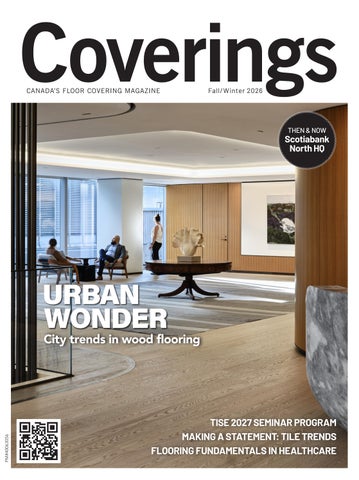
Fall/Winter 2026
THEN & NOW
Scotiabank North HQ
URBAN WONDER
PM#40063056
City trends in wood flooring
TISE 2027 SEMINAR PROGRAM MAKING A STATEMENT: TILE TRENDS FLOORING FUNDAMENTALS IN HEALTHCARE
Source Smarter. Sell Faster. Grow Stronger.
Distributors: Your
Competitive Edge Starts Here. You’re INVITED to the Exclusive Distributor Reception. Wednesday, February 3 | 4:45pm – 6:15pm
PRESENTED in partnership with NAFCD and Floor Covering Weekly. JOIN fellow distributors and manufacturers for exclusive networking . CONNECT with peers, build supplier relationships, and gain industry insights. FREE to attend, registration required.
Don’t Miss Your Competitive Advantage Your suppliers will be there. Your competitors will be there. Will you?
February 2 – 4, 2027 Mandalay Bay Convention Center Las Vegas, NV REGISTER NOW
Official SURFACES Sponsors
Vol.51, No.1 www.coveringscanada.ca
CONTENTS FALL/WINTER 2026
FEATURES
8 12 16 20
ETTING THE TONE S The next wave of tile design O SERVE AND PROTECT T Selecting the right stone, tile and grout sealer helps maintain floor’s aesthetic, long-term performance LEEK IN THE CITY S Hardwood flooring colours, finishes and patterns trending in urban dwellings ETHINKING WOOD FLOOR GAPPING R Why filling isn’t always the answer
Photo courtesy Doublespace Photography
DEPARTMENTS
4
FROM THE EDITOR Crushing on hardwood
6 22
ONTRACTOR’S CORNER C Resilient flooring an irreplaceable solution in healthcare settings HEN & NOW T Flooring at Scotiabank headquarters helps create coherence across zones
Fall/ Winter 2026
THEN & NOW
Scotiabank North HQ
URBAN WONDER
City trends in wood flooring
Cover photo by Doublespace Photography
FILLING GAPS IN WOOD JOINTS MAKING A STATEMENT: TILE TRENDS FLOORING FUNDAMENTALS IN HEALTHCARE
Canada’s floor covering magazine \\ Coverings 3
FROM THE EDITOR
CRUSHING ON HARDWOOD ONE OF THE THINGS I LOVE about my house is the thin-strip oak flooring from the 1960s. Original to the home, it was hidden beneath carpet for decades until the first owners sold the property in 2012. As a result, the flooring was in near-pristine condition when the carpet was eventually removed. Its vintage charm was then enhanced with a medium-tone stain, giving it a timeless appeal. Of course, the flooring isn’t without its flaws. There are areas where the floor squeaks and creeks. While the noise is tolerable for now — I’ve lived in the home for just over a year — I’d like to have the issue addressed at some point to quiet things down. Then there are the gaps between floorboards, which are generally more noticeable near the baseboards. The question is, to fill or not to fill? That’s the dilemma explored by Rob Johnson and Michael Dittmer, tech and training field managers with Bona, a company specializing in floor care and wood refinishing, in their article Rethinking Wood Floor Gapping. In our second wood-focused article, Sleek in the City, Tyler Jerger of Huntsville, Ont.-based Revival Flooring looks at wood flooring trends in major metropolitan areas. Tile and stone also take centre stage in this issue. Setting the Tone highlights this year’s flooring trends, as identified by three international tile associations and showcased at Coverings 2026, while To Serve and Protect offers guidance on selecting the right stone, tile and grout sealer for the job. As in previous years, we’ve included the seminar program for The International Surface Event, returning to the Mandalay Bay Convention Center in Las Vegas, Feb. 2-4, 2027. If attending, be sure to visit Coverings’ booth in the Media Village. Rounding out this issue is our Contractor’s Corner column, in which Chris Maskell, CEO of the National Wood Flooring Association of Canada, delves into the case for sheet resilient flooring in healthcare facilities at a time when organizations are questioning this flooring choice. Finally, in our Then & Now column, Rachel Cyr of KPMG Architects discusses the design vision behind Scotiabank’s new corporate headquarters in Toronto, along with the flooring selected for the 14-storey office space. Clare Tattersall
PUBLISHER Dan Gnocato dang@mediaedge.ca
SENIOR GRAPHIC DESIGNER Roxy Huynh-Guinane roxyh@mediaedge.ca
EDITOR Clare Tattersall claret@mediaedge.ca
GRAPHIC DESIGNER Amanda Spearman amandas@mediaedge.ca
PRESIDENT Kevin Brown kevinb@mediaedge.ca
PRODUCTION COORDINATOR Ines Louis Inesl@mediaedge.ca
CIRCULATION circulation@mediaedge.ca
Coverings is published semiannually — Spring and Fall — for Canada’s floor covering industry. Subscriptions are free to qualified participants in Canada’s floor covering industry. Subscribe at www.coveringscanada. ca. Readers from outside Canada may purchase subscriptions for $55 Cdn. For subscription inquiries, e-mail circulation@mediaedge.ca. Return undeliverable Canadian addresses to: Coverings 251 Consumers Road, Suite 1020, Toronto, Ontario M2J 4R3 MediaEdge Communications and Coverings disclaim any warranty as to the accuracy, completeness or currency of the contents of this publication and disclaims all liability in respect to the results of any action taken or not taken in reliance upon information in this publication. The opinions of the columnists and writers are their own and are in no way influenced by or representative of the opinions of Coverings or MediaEdge Communications. Copyright 2026 Canada Post Canadian Publications Mail Sales Product Agreement No. 40063056 ISSN 0834-3357
Published by 251 Consumers Road, Suite 1020, Toronto, Ontario M2J 4R3 © 2026 by MediaEdge Communications. All rights reserved.
4 Coverings \\ Fall/Winter 2026
This project is funded in part by the Government of Canada.
CONTRACTOR’S CORNER
DON’T BLAME THE FLOOR Resilient flooring an irreplaceable solution in healthcare settings BY CHRIS MASKELL
R
ecently, I heard that a health authority had expressed frustration with the quality of flooring installations in its hospitals and was considering removing sheet resilient products from its project requirements in favour of poured epoxy resin flooring. My first thoughts: That’s a severe reaction and this issue needs to be nipped in the bud. In this instance, the concerned health authority cited a general lack of installers capable of properly performing even basic seam work, let alone the more complex skill of flash coving. For this reason, it’s worth looking at the frustration building owners have and offering some perspective and solutions. To do that, we need to ask: Where are the skilled installation teams? How do you get them on your project? Why is there so little training and certification? What happens if sheet resilient flooring is replaced with poured epoxy resin flooring? LOW-BID IS HIGH-RISK First, there are good quality installation firms out there. The problem is 6 Coverings \\ Fall/Winter 2026
there are many more mediocre ones driving the price down to get work — companies that operate on the approach of ‘go in cheap, hope for a change order and claw your way back into the black.’ The bid system should carefully vet who ends up on-site and, in many cases, a pre-qualification process must be followed. However, the low-bid system is a big part of the problem, as well as that deadlines supersede quality, all while no one is watching. Maybe a new, smaller firm trying to establish itself in the marketplace takes on a large project on a super-thin margin just to get the work, only to realize it bit off more than it could chew. It’s going to be a rough project because the company still has to keep the constructor happy or it won’t get paid. And if it doesn’t get paid on time, it won’t be able to pay its installers, who will be gone the next day. This can cost the firm its business. In this scenario, the constructor says jump and the subcontractor asks how high. Extras for proper surface preparation? Forget it. Moisture testing? Nope. Pushing back against wet, cold site conditions that can lead to flooring failure? Not happening. It’s now all about the deadline.
CONTRACTOR’S CORNER
Smaller firms are more inclined to hire subtrades, who in turn hire subcontractors. By the time there are several layers in place, responsibility becomes diffuse and accountability is difficult to enforce if the flooring fails later on. Again, who will police this on-site? Healthcare projects are challenging for even the most experienced flooring contractors. So why risk so much for such small savings? Flooring represents a small percentage of the overall budget compared to other components, such as mechanical or concrete — typically less than one per cent. But due to its high visibility, it can account for up to 75 per cent of the complaints that trigger a holdback. The upfront savings from choosing a high-risk, low-bid flooring installation is real and, in healthcare, should be prohibited. Where I learned the trade, such decisions are called ‘penny wise, pound foolish.’ To satisfy typical bidding rules, require a minimum of three equal or similar quality firms to bid on the work, each of which has been in business for at least five years in the project’s region. Ensure the firms have a brick-and-mortar presence, solid brand and good reputation worth protecting. Confirm whether they are bondable or can provide a third-party warranty, and if they can supply qualified labour (Red Seal, INSTALL or product-certified installers). How will you know if these requirements are being followed? Use National Floor Covering Association (NFCA) specifications in the architectural documents. These are found in the association’s Floor Covering Reference Manual of Canada. Specify that only NFCA members in good standing can bid on and perform the work. (NFCA publishes its membership on its website.) All NFCA members are bondable companies — they are a good risk in the eyes of an insurance company — and they know they must provide qualified installers on projects where the association’s quality assurance program is specified. The next challenge is ensuring the constructor provides timelines and site conditions conducive to installing flooring in accordance with NFCA and manufacturer requirements. A typical example is the constructor insists on proceeding with early installation with no building heat. You cannot heat weld in 5 C. When realistic timeframes and acceptable site conditions are not provided, it can appear as though the constructor simply does not care, which in turn may lead to a similar attitude from the installer — ultimately reflected in the quality of work.
TRAINING AND CERTIFICATION ARE CRITICAL Upon hearing building owners’ frustrations around training and education, NFCA contacted member commercial flooring companies committed to delivering a quality product and investing in their installers. The association also reached out to member manufacturers to apprise them of the situation and invite them to be part of the solution. NFCA continues to engage architectural firms involved in healthcare and other large commercial projects through ‘lunch and learn’ sessions. Topics covered include concrete surface preparation, testing responsibilities, acceptable site conditions and how to achieve them, aligning expectations between concrete and flooring work, identifying quality installation firms and providing free specification resources. SWAPPING OUT IS NOT A FIX Sheet resilient and poured resin floors have their place and limitations. Switching from one to the other does not meet the needs of the client in certain settings, such as corridors, operating rooms, patient rooms and lobbies. Keep in mind that if the issue is a shortage of skilled installers, both require skilled labour, so neither has an advantage. THE BOTTOM LINE When an industry remains disconnected from itself and it prioritizes sales and margin over quality and client satisfaction, claims and lawsuits go up, while training and education tend to fall to the wayside. Over time, enhanced specifications, the right flooring contractor on the job and third-party inspections will dramatically improve the level of quality delivered to the end-user, confirming that resilient flooring is a much better choice in healthcare and other big builds. Chris Maskell is CEO of the National Floor Covering Association (NFCA) of Canada. Chris has worked in the floor covering industry for more than 30 years. During this time, he has been a flooring contractor, manufacturer’s representative and business owner. As CEO of NFCA, he works with the board of directors to promote NFCA standards and updated specifications for commercial floor covering installations. He also operates NFCA’s quality assurance program and is a certified floor covering inspector.
FLOORING COMPARISON GUIDE Sheet Resilient
Poured Epoxy Resin
Infection control
Excellent if seams welded
Good if flawless, cracks a risk
Installation downtime
Low
High
Noise levels
Quiet
Loud, reflective
Comfort
Softer, ergonomic
Hard
Maintenance
Simple, predictable
Often requires recoating, specialized
Repairs
Easy, local
Complex, may require large-area resurfacing, complex odours
Durability
High
High but installation-sensitive
Cost
Moderate
Moderate to high depending on system Canada’s floor covering magazine \\ Coverings 7
TILE & STONE
SETTING THE TONE The next wave of tile design BY CLARE TATTERSALL
C
a layered, immersive experience in which light and touch reveal subtle variations in texture and finish, bringing warmth, visual depth and understated sophistication to interiors.
ARTICULATED ACCENTS This trend celebrates the harmonious interplay of graphic precision and expressive surface design articulation, creating tiles that engage the senses. Advanced glazing and contourdetailing techniques produce tactile surfaces that evoke materials ranging from soft leather to textured sandstone, complete with stitching-like details or pitted striations. The result is
BRUTALISH SANCTUARY Stripped-back materiality meets refined restraint, reinterpreting Brutalist influences through concrete-inspired finishes, terrazzo textures and matte stone surfaces. Embracing material honesty, some tiles remain unglazed, allowing their inherent character to speak for itself. Moving beyond the predictability of all-white interiors, this trend celebrates raw textures and authentic imperfections, creating spaces that feel quiet, grounded and protective.
eramic and porcelain tile continue to evolve, pushing the boundaries of surface design and offering new ways to shape the character of interior spaces. From expressive textures to innovative finishes, here are this year’s top tile trends for flooring, unveiled at Coverings 2026.
8 Coverings \\ Fall/Winter 2026
GILDED AGE Metallic details have re-emerged as a defining feature of contemporary tile collections, elevating ceramics from functional surfaces to sophisticated focal points. Gold, bronze, copper and silver accents appear across largeand small-format pieces, creating luminous contrasts against matte finishes, textured surfaces and neutral tones. Designed to interact with light and accentuate architectural features, these details introduce visual depth and a sense of understated luxury to interior spaces. HAPTIC EXPERIENCE Ceramic surfaces are evolving beyond visual appeal into multi-sensory experiences that
TILE & STONE
invite interaction and deepen connection with materials. Textures range from subtle ridges and embossed patterns to deeply undulating surfaces, encouraging touch and adding a human dimension to interiors. Advances in glazing chemistry and digital production introduce responsive qualities, allowing finishes to shift subtly with changing light, perspective and viewing angle. The result is a dynamic, almost living quality that transforms floors into immersive sensory experiences. These tiles not only expand aesthetic possibilities but also elevate interiors through depth, movement and tactile richness. JADE TERRAIN Inspired by the precious gemstone jade, this trend captures the serenity, sophistication and luxury of jade green across ceramic and porcelain tile collections. Its diverse palette spans soft pastel greens and vibrant turquoises to earthy moss tones and deeper, saturated shades accented by subtle black undertones. From monochromatic subway tiles and two-toned mosaics to large-format surfaces with jade-inspired veining, the trend offers exceptional design versatility, lending itself equally to calming interiors and bold architectural statements. MICRO-ILLUSIONS Small-format tiles are making a big impact, delivering striking design effects through expansive visual compositions and intricate mosaic-inspired patterns. Techniques such as precision scoring, digital printing and colourmatched grout enable these tiles to create sweeping mural-like designs, optical illusions and layered dimensional effects. The result is high-impact design with remarkable versatility, offering creative possibilities for floors that call for detailed artistry, with practical benefits in both cost and installation. ORGANIC MINIMALISM Moving toward a cooler, more minimal aes-
\\ TOP: Cleve by Crossville captures the authentic character of quartzite, with its naturally split planes, crystalline sparkle, tonal depth and layered veining. BOTTOM: Curation by Marazzi pairs brick-inspired finishes with terrazzo patterns, rich colours and retro appeal. OPPOSITE PAGE: Inspired by a blend of two stones — basalt and white pin-holed limestone — Terrasale porcelain tile by Marca Corona combines matte colours, glossy glazes and graphic decorative motifs to suit a variety of installation styles.
thetic, manufacturers are placing greater emphasis on tranquility, texture and timeless stoneinspired finishes. This trend reflects a renewed appreciation for calm, structured spaces, desaturated tones and the inherent integrity of durable materials. Concrete-inspired surfaces and ivory stone finishes bring a raw, elemental quality to interiors, balancing understated textures with refined sophistication to create spaces that feel serene, grounded and enduring.
TAILORED CRAFT Function meets nostalgia in a look that is as playful as it is practical. This trend draws inspiration from fashion’s enduring motifs, blending sartorial elegance with artisanal craftsmanship. The result is a quietly luxurious aesthetic that feels curated, tactile and timeless — ideal for designers who value character, thoughtful details and consider design over fleeting trends. Canada’s floor covering magazine \\ Coverings 9
FINISHING AND CARE CLEANING AND MAINTENANCE PROMA offers a wide variety of quality cleaners, strippers and removers that dramatically ease the cleaning process, while providing outstanding results and long-lasting performance.
PROTECTION AND ENHANCEMENT PROMA offers a wide variety of quality sealers that protects the surface of your installation, while enhancing the look and providing long-lasting beauty and performance.
At PROMA, we conduct business with a goal in mind: ‘Always offer the best products, services, and value.’ It’s at the heart of everything we do, from product development to customer service, and everything in between. When you take all of what PROMA has to offer and add to that competitive pricing and unmatched dependability, you receive one of the best values available for flooring installation. Contact PROMA at 1.866.51.PROMA (77662) or visit www.proma.ca to learn more.
Long-Lasting Protection, Timeless Beauty. We understand that offering quality products is not nearly enough. You need a partner who will stand by you, before, during, and after the sale to help you achieve success. A partner with an experienced technical support team that helps every project go smoothly, and who helps protect your good reputation by offering the quality, personal service and support you need.
LONG-LASTING PERFORMANCE Proper cleaning, maintenance, and protection are essential to preserving your installation’s beauty and durability. PROMA offers a broad selection of high-quality products for cleaning, protecting, and enhancing surfaces, ensuring they remain beautiful and perform reliably for years to come.
I N N O VAT I V E S O L U T I O N S Always proactive, always listening, always moving forward. PROMA’s research and development team works closely with our customers and with the world’s top raw materials suppliers. This synergy allows PROMA to develop new and innovative products that excel beyond current industry standards and enables us to bring tomorrow’s technology to today’s products.
SUPERIOR QUALITY PROMA offers one of the broadest array of products available so you can choose the right solution for any given job. Our products have been engineered to provide user-friendly, time-saving jobsite characteristics and exceptional, long-lasting performance through strength, flexibility and durability.
ECOLOGICAL AND RESPONSIBLE Many of PROMA’s products have been formulated to have minimal impact on the environment, are safe to apply, and do not contribute to unfavorable jobsite conditions or adversely affect indoor air quality. Some also help contribute toward attaining credit requirements within the LEED® (Leadership in Environmental and Energy Design) USGBC and CAGBC Rating Systems, and WELL® (International WELL Building Institute) certification program. Products have achieved independent validation by the renowned environmental auditor Vertima.
PRODUCT INFORMATION
proma.ca
TILE & STONE
TO SERVE AND PROTECT Selecting the right stone, tile and grout sealer helps maintain floor’s aesthetic, long-term performance BY ROD SIGMAN
C
hoosing the right product to seal natural stone, tile or grout is critical to the life, longevity and overall appearance of the flooring. Sealing these surfaces helps to protect against staining and allows dirt to release easier from the surface, making floors simpler to clean and maintain. Selecting the wrong product can have both costly and even disastrous consequences, potentially causing irreparable damage. There are many factors to consider when selecting the right sealer. Understanding the type of surface, where and how the sealer will be used, and the desired performance and aesthetic will help in choosing the best sealer for the job. A good rule of thumb when selecting a seal12 Coverings \\ Fall/Winter 2026
er is to use a solvent-based product on dense surfaces. If the surface is porous, use a waterbased product. Solvent-based products have a smaller molecular construction than waterbased products and are generally preferred for use on surfaces like polished granite, marble and porcelain tile. Water-based penetrating sealers, with their larger molecules, are better suited for surfaces such as brick, clay tile, grout and slate. But this isn’t a hard and fast rule, as both types of sealers can work on the same surfaces. The choice will sometimes come down to the preference of the end-user. In years past, solvent-based products were considered superior to water-based options; however, with today’s technology, that is no longer the case. Chemistry has evolved to the
point where high-performance, water-based sealers can be formulated that are safer to use, more environmentally friendly and capable of outperforming solvent-based products, giving consumers a wider range of options. TYPES OF SEALERS Sealers are generally classified into two categories: penetrating and topical. Both types can be either water- or solvent-based and used on a variety of stone and tile surfaces, including brick, claytile,cement-basedgrouts,concretetile,pavers, granite, marble, limestone, onyx, porcelain tile, quarry tile, sandstone, slate, travertine, and more. Once fully cured, penetrating sealers leave the surface unchanged and natural in appearance, although some are also colour-enhancing.
TILE & STONE
Topical coatings change surface appearance by altering the angle at which light reflects. Lowsheen and high-gloss finishes are popular choices. HOW THEY WORK Natural-look or enhancing penetrating sealers, also known as impregnators, are designed to penetrate deep into the surface and leave the stone, tile and grout unchanged or enhanced in appearance, depending on the type of sealer chosen. Because they do not form a film, they will never peel or flake, and they do not alter the surface’s coefficient of friction or slip resistance when correctly applied. These sealers leave the surface exposed and do not protect against etching caused by acidic beverages and contaminants. This is important to know, especially when working with acid-sensitive surfaces like marble, travertine, limestone and concrete tiles. Penetrating sealers generally provide two levels of protection, standard and premium. Standard protection sealers resist staining from most water-based contaminants, beverages and dirt, and soiling caused by common accidents, such as food spills and pet stains. But they rarely guard against oil-based contaminants and provide inadequate protection in residential kitchens or commercial food service areas. Products in this category are usually less expensive than sealers formulated to protect against both water and oil-based contaminants. However, don’t assume a sealer offering only standard protection to waterborne staining is an inferior product. Although these types of sealers may not be well-suited for food service areas where resistance to grease and oil is required, they can be an excellent choice for
exterior applications, such as paver walkways and stone tile or grout where oil repellency isn’t needed. These sealers can last for years in the right environment, at a very reasonable cost to the consumer. Premium penetrating sealers offer highperformance protection by resisting oil-based contaminants, in addition to basic protection against beverages. They also typically offer higher chemical resistance and life expectancy than a standard protection sealer. These sealers are excellent for use in food preparation and service areas, or anywhere enhanced protection is desired. Products in this category usually have a higher price point than standard sealers. Topical sealers are just as the name implies — they sit on top of the surface, creating a barrier between the tile and contaminants, and are available in either a low-sheen or highgloss finish. These products are for interioruse installations only. Topical coatings can wear off with pedestrian foot traffic and require reapplication more frequently than penetrating sealers. More than one coat is usually needed to adequately protect the surface. Enhancing sealers are a type of penetrating sealer that deepen and enhance the natural colours and veining of natural stone, certain tiles and masonry materials, making the surface more vibrant without producing a gloss. Some enhancers offer premium protection and resistance to oil-based contaminants. WHEN TO REAPPLY Regardless of the surface being treated or level of protection chosen, penetrating sealers must be periodically reapplied over the life of the treated surface to maintain optimal protection. Reapplication should become part
of a regular maintenance program. Frequency is directly related to the amount of wear and tear caused by foot traffic, how often the floor is cleaned and what is used to clean the floor. A simple water droplet test will help determine if the surface needs resealing. Sprinkle a little water over an area and allow it to stand for several minutes. If it penetrates quickly and darkens, it’s probably time to reapply sealer. If the dropletspenetrateslowlyoverseveralminutesornotat all, reapplication may not beneeded. Unlike penetrating sealers, topical sealers become the walking surface and, over time, begin to visibly show wear patterns, especially in high-traffic areas. Before reapplication, make sure the area is clean and dry. Then apply a few thin coats over these areas, stopping at a common grout joint. If only half of a tile shows wear, apply sealer to the entire tile face to avoid creating a demarcation line where the old and new coats meet. There is no need to apply sealer over the entire floor, especially in areas that experience minimal traffic. It is also important not to allow the sealer to wear down to bare tile, as this would require stripping the sealer completely before rebuilding the protective coats. With all sealers, check the manufacturer’s label and technical data sheets for the best application methods and maintenance recommendations. Always test sealers and cleaners in a few small, inconspicuous areas to ensure the desired results are achieved before applying to the entire floor area. The use of strong cleaning chemicals can severely affect the performance of sealers and render them ineffective after only one cleaning. It is generally advised to maintain sealed natural stone and tile with a mild, neutral-pH cleaner.
Rod Sigman is the business development manager for Mapei’s UltraCare line of products. He has served on the technical committees of the National Tile Contractors Association and the Natural Stone Institute, and is a certified ceramic tile specialist and concrete slab moisture testing technician. Mapei is a manufacturer of products for the construction industry, including tile and stone installation systems, manufactured stone veneer systems and shower systems, among others. Canada’s floor covering magazine \\ Coverings 13
TISE 2027 SEMINARS North Convention Centre
MONDAY, FEBRUARY 1, 2027
1:00 PM – 1:50 PM | South Pacific D Profit by Design: Maximizing Financial Performance Through Cost Control, Marketing Efficiency and Team Accountability Scott Perron, Founder and President, 24-7 Floors This seminar will provide attendees with the tools to evaluate their current business performance, identify opportunities for improvement, and develop a strategic three-point action plan to increase profitability and cash flow. Attendees will learn how to analyze their current financial position, assess the effectiveness of their marketing investments, and establish accountability measures that drive employee performance and business results. 1:00 PM – 4:00 PM | Islander GH *Women’s Leadership Program Open to all attendees, this event offers an inclusive space for networking and community. Join the ladies of the industry in educational sessions and an evening meet up. 2:00 PM – 3:15 PM | South Pacific D Taking the Reins, Letting Them Go Anna McCortney, Interior Designer and Manager, All-in-One Contracting and Home Improvement Sam Robinson, Sales and Showroom Coordinator, Ultimate Flooring What really happens when the next generation is ready to step up, but the generation before them isn’t quite ready to step away? This seminar brings multiple generations of the flooring industry together for an open conversation about the part of generational turnover that rarely makes it into the succession plan. Discussion will involve responsibility versus actual authority, earning trust, knowing when someone is ready, letting go of control, carrying forward what someone else built while still making it your own, and what happens when two generations see the future of the business differently. This isn’t a young versus old debate or a seminar about estate planning and buy-sell agreements. It’s a candid conversation about the people, relationships, expectations and growing pains behind passing leadership, knowledge and responsibility from one generation to the next. Attendees should expect different perspectives, real stories, a little disagreement, and conversations about leadership and legacy that are usually happening behind closed doors.
TUESDAY, FEBRUARY 2, 2027
8:00 AM – 9:00 AM | Islander GH 2027 Manufacturer’s State of the Industry Panel Scott Humphrey, CEO, World Floor Covering Association Top executives from the flooring industry’s leading manufacturers come together to discuss the trends, challenges and opportunities defining the market. Hear directly from the decision-makers driving innovation, navigating supply chain dynamics and shaping the future of surfaces. This candid conversation will give attendees the insider perspective they need to make smarter business decisions and stay ahead of the
curve. Whether concerned about market conditions, curious about emerging technologies or planning a strategic move, this panel delivers the insights that matter most. 11:00 AM – 11:50 AM | South Pacific D Ten Ways to Disarm Your Competition Christopher Ramey, President, Affluent Insights 1:00 PM – 1:50 PM | South Pacific D Building a Three-Point Profitability Plan Scott Perron, Founder and President, 24-7 Floors Participants will develop actionable strategies focused on managing and optimizing the three critical expense categories that have the greatest impact on profitability: occupancy, personnel and marketing. This includes improving facility utilization and managing occupancy expenses, maximizing revenue per square foot, measuring labour productivity, strengthening staffing efficiency and accountability, aligning compensation with desired business outcomes, evaluating marketing effectiveness and return on investment, allocating resources to high-performing channels, and developing sustainable lead generation and customer acquisition strategies. 2:00 PM – 2:50 PM | South Pacific D 2027 Trends in Design Christopher Ramey, President, Affluent Insights 3:00 PM – 3:50 PM | South Pacific D From Profit to Enterprise Value Bill Gauthier, Senior Director of Retail Consulting, Training and Membership, CCA Global Partners Whether a transition is five months or 15 years away, the best time to prepare is now. Drawing on Certified Exit Planning Advisor (CEPA) principles, this seminar will help attendees understand the key drivers of business value and how to improve financial performance, reduce owner dependency, and create a roadmap for a successful transition. Attendees will learn the practical strategies that increase both business value and owner freedom. 4:00 PM – 4:50 PM | South Pacific D The 2027 Employee: Attract, Keep, Grow Nicole Harding, Vice-President, CCA Global University, CCA Global Partners 4:00 PM – 6:30 PM | South Pacific C *Working with Natural Stone: Architecture & Design Program Day 1 This comprehensive program, updated for 2027, brings together architects, designers and natural stone fabricators to explore the complete life cycle of natural stone projects, from initial concept to final installation. Participants will gain practical insights through sessions on sustainable stone practices, in-depth case studies of award-winning installations and techniques for translating creative vision into successful stone applications. Combining technical expertise with design
The International Surface Event | February 1 - 4, 2027
innovation, the program covers material selection, fabrication considerations, and implementation strategies to achieve both aesthetic excellence and structural integrity. A guided tour of the exhibitor show floor on Day 2 gives participants the opportunity to explore the latest technologies and materials in the natural stone industry and discover innovative products and solutions. Continuing education credits are available for qualifying professionals. An optional off-site tour on Day 3 offers hands-on insight into stone sourcing and selection. Separate registration is required. $125 to attend.
WEDNESDAY, FEBRUARY 3, 2027
8:00 AM – 9:00 AM | Islander GH Delivering Customer Experience Magic: Disney’s Secrets to Building Loyalty in a Competitive Market Duncan Wardle, Former Head of Innovation and Creativity, The Walt Disney Company In the stone and surfaces industry, competition is fierce, margins are tight and customer expectations have never been higher. How does a business stand out? And turn one-time buyers into lifelong advocates? The answer lies in something Disney has mastered for decades: innovating the customer experience. This seminar reveals the strategies Disney used to dominate every industry it entered and shows how to apply those same principles to a flooring business. Regardless of their role in the industry, attendees will be challenged to rethink how they engage with customers at every touchpoint. Specific tools and frameworks Disney uses to create unforgettable experiences that drive loyalty, increase referrals and boost profitability — without competing on price alone — will be shared. This isn’t theory. These are proven strategies from one of the most successful brands in the world and they work in any industry. Whether looking to improve a showroom experience, strengthen installer-client relationships or create a brand that customers can’t stop talking about, this seminar will provide the tools to make it happen. Come ready to think differently. Leave ready to create magic. 9:00 AM – 5:00 PM | South Pacific C *Working with Natural Stone: Architecture & Design Program Day 2 See Day 1 description and website for more information.
10:00 AM – 10:50 AM | South Pacific D How to Get the Customer that Doesn’t Ask About Price Jim Armstrong, Marketing Mastery Columnist, Floor Covering News This seminar explores the one sentence that ends more flooring sales than any price objection and why “follow up harder” is the wrong fix. Attendees will learn about the unspoken question every customer brings into the showroom and how leaving it unanswered can hurt close rates. The seminar will also examine how a new salesperson, despite having a Lowe’s and a Home Depot within walking distance, increased margins from 33 per cent to more than 40 per cent by changing what he said during the first five minutes of a customer interaction. Additional topics include how to create a “zero resistance” selling environment where customers see less value in comparison shopping without competitors ever being mentioned, what flooring retailers can put in place before a customer makes contact to establish their expertise and set expectations around higher prices, and the common sales practice that may be attracting price-focused shoppers in the first place.
1:00 PM - 1:50 PM | South Pacific D After the Vote: What the 2026 Midterms Mean for Flooring in 2027 Scott Humphrey, CEO, World Floor Covering Association The 2026 U.S. midterm elections will shift the balance of power in Washington — and with it, the rules, costs and incentives shaping the flooring industry. This seminar looks beyond the election results to what actually changes for the industry in the year ahead: trade policy and tariffs on imported materials, labour and immigration rules affecting installation crews, housing and construction incentives, and regulatory shifts tied to building codes and environmental standards. Attendees will leave with a clear picture of what to expect in 2027, and what to watch as new policies take shape. 2:00 PM - 2:50 PM | South Pacific D How to Generate Customer Trust in a Digital-first, AI-driven World Matt Spaulding, Founder and President, Spaulding Communications The rise of artificial intelligence in marketing is both a blessing and a curse. For brands and marketers, it offers the ability to do more. But for potential customers, it is eroding their trust in brands, which has serious consequences. This presents a real challenge for manufacturers and retailers in the floor covering and related industries, but also a unique opportunity. The answer? Strengthening, not replacing, marketing efforts with a trustbased thought leadership approach. Attendees will learn what thought leadership really is, why it matters more than ever in today’s marketing landscape, and how brands and individuals can build trust by focusing on five core areas: expertise, credibility, transparency, authenticity and helpfulness. They’ll also learn how to develop and sustain a thought leadership marketing program, measure its effectiveness, and use a practical 30-day checklist to get started with activities designed to build customer trust. 2:00 PM – 4:00 PM | Islander F *Stone Fabricators Alliance Roundtables Industry leaders gather to discuss fabrication techniques, business strategies, material innovations and importing dynamics. This event fosters in-depth discussions among professionals, creating a platform for networking and knowledge exchange. Discussions come from what attendees want to talk about. Ask questions and get real answers from other professionals in the industry. 3:00 PM – 4:30 PM | Islander I *TISE Retail Roundtables Join colleagues and industry leaders to discuss hot topics in the industry. This event fosters in-depth discussions among professionals, creating a platform for networking and knowledge exchange.
THURSDAY, FEBRUARY 4, 2027
8:30 AM – 1:00 PM | South Pacific C *Working with Natural Stone: Architecture & Design Program Day 3 See Day 1 description and website for more information.
*Specialty education. More info at www.intlsurfaceevent.com Seminar listings are accurate at the time of printing and are subject to change without notice.
Mandalay Bay Convention Center, Las Vegas
WOOD FLOORING
SLEEK IN THE CITY Hardwood flooring colours, finishes and patterns trending in urban dwellings BY TYLER JERGER
16 Coverings \\ Fall/Winter 2026
WOOD FLOORING
W
alking through a Toronto loft on an early morning, one can feel it underfoot. The boards warm up, the grain reveals its texture and every step becomes part of the story of the home. Hardwood has that effect. It’s not a background material; it’s a canvas that responds to light, climate and the people who live in the space. In 2026, wood flooring is doing more than covering floors — it’s becoming a defining element in urban interiors. THE RETURN OF WARMTH After years of cool minimalism, there is a growing desire for spaces that feel more inviting. Modern floors are shifting away from cold grey planks toward warm, natural tones that enhance comfort, especially during long Canadian winters. Soft neutrals like greige and light beige strike a balance between cool and warm, brightening a room without washing it out. They complement the soft whites and muted greens popular in contemporary kitchens. Shades like honey oak and chestnut bring grounded warmth. Unlike the almost-black stains of the early 2000s, mid tone browns show off grain patterns and hide wear. They’re ideal for flooring styles that need to transition smoothly between different livings spaces. While most homes lean toward neutrals, a growing number of designers are playing with
dark chocolate and espresso planks. In large, loft-style rooms, dark floors anchor the space and pair beautifully with metal fixtures and exposed brick. They require thoughtful lighting but reward with a dramatic, sophisticated feel. Scandinavian-inspired whitewashed and bleached oak still have a following, particularly among those chasing a coastal or airy look. In tight urban footprints with high ceilings, these pale planks bounce light and make a small space feel generous. What makes these colours work in 2026 is the undertone. Designers have moved away from yellow or pink stains in favour of more organic, earthy pigments. A neutral undertone allows furniture and artwork to take centre stage while the floor adds subtle warmth. FINISHES EVERYONE WANTS Colour is often the first decision customers make, but the finish determines how the floor feels underfoot and how well it wears. Highgloss planks, once a symbol of luxury, are now outdated, as every footprint and scratch is highly visible. In 2026, finishes reflect a desire for authenticity and practicality. For example, matte and textured boards help limit sound transmission, making them ideal in highrise buildings where noise reduction is as important as appearance.
Matte and low-sheen finishes let the wood’s natural grain and colour take the spotlight. They handle scratches gracefully and hide scuffs, a key feature for families with kids or pets. Satin finishes, a compromise between matte and glossy, add a hint of softness without glare. Wire brushed surfaces — created using stiff brushes to expose the harder grain and form fine lines along the board — add depth and texture while helping disguise small dents, making them ideal for urban dwellings where shoes and chairs regularly scuff the floor. Hand-scraped and distressed floors give a reclaimed, vintage feel that pairs well with industrial decor, brick walls and metal fixtures. Each board, handcrafted by artisans who use tools to replicate the irregular marks of aged wood, becomes a statement piece. Finishes with low volatile organic compound (VOC) oils and water-based polyurethanes are now the standard for those prioritizing indoor air quality (IAQ). These options quickly cure and emit fewer fumes, aligning with a broader commitment to sustainability. PATTERN PLAY Pattern and layout is where flooring styles truly become personal. Homeowners are no longer limited to straight, uniform planks. In 2026, patterns and board sizes are used to cre-
MATCHING TRENDS TO CONSUMER LIFESTYLES Lifestyle Needed
Recommended Trend
Rationale
Busy family with pets
Matte, wire-brushed mid-tone planks
Hides scratches and dirt, mid-tones mask spills
Small condo seeking spacious feel
Wide planks in greige or bleached tones
Fewer seams create openness, pale colours bounce light
Statement loft
Dark espresso herringbone or chevron
Adds drama and defines zones, pairs with industrial decor
Eco-conscious homeowners
Reclaimed wood or FSC-certified engineered boards with low-VOC finish
Reduces environmental impact, supports IAQ
Flexible live-work space
Mixed-width engineered planks with area rugs
Defines work versus living zones, stable under humidity changes Canada’s floor covering magazine \\ Coverings 17
WOOD FLOORING
namism. This is particularly effective in square condominium units where a simple shift in direction can make the space feel less boxy.
than traditional floors. Homeowners are embracing floors that tell a story. Reclaimed barn boards, antique beams and locally sourced woods not only reduce environmental impact but also add character. Certifications from organizations like the Forest Stewardship Council (FSC) assure consumers that new wood is harvested responsibly. While white oak remains a favourite, species like hickory, walnut, maple and even bamboo are becoming more common. Character-grade planks, with knots, mineral streaks and colour variation, make each board distinct and celebrate imperfections rather than hiding them. They’re perfect for creating a one-of-a-kind wood flooring design. Technology also plays a role in installation. Click-lock systems and precision milling mean elaborate patterns can be achieved without the labour costs once associated with parquet. That makes design experimentation more accessible to urban homeowners.
BEYOND SOLID WOOD Solid hardwood will always have a place in highend projects, but new materials and technologies are expanding options for modern floors. Built with a top layer of real wood bonded to plywood or high-density fibreboard, engineered hardwood planks offer stability in environments like bathrooms and kitchens that are prone to humidity changes. In urban condos with radiant heating or below-grade installations, engineered boards outperform solid wood. Many now come in extra wide widths and water-resistant constructions. Manufacturers are introducing planks that combine wood veneers with composite cores and moisture barriers. These water-resistent hybrid products give the look and feel of hardwood but stand up to spills and humidity better
BRINGING IT ALL TOGETHER The beauty of hardwood is its longevity. Trends evolve but a well chosen floor adapts to shifting decor and life stages. In urban settings, where square footage is precious and every surface works hard, combining colour, finish, pattern and material thoughtfully makes the difference between a generic home and one with character. When helping consumers with their flooring project, they shouldn’t feel constrained by a single trend. Start with what makes them feel grounded and what complements the light and architecture of their space. Then consider maintenance, durability and environmental impact. Mixing elements, such as combining a wide plank living room with a patterned entryway, can offer the best of both worlds.
\\ Herringbone and chevron wood floors add texture and interest to any space, creating a high-end bespoke look that is very distinct.
ate movement and define zones in open-plan homes. Plank boards five inches and wider continue to dominate. Fewer seams make rooms feel larger and the generous width highlights grain variation. Mixing widths — for example, alternating five and seven-inch boards — adds rhythm without feeling busy. In narrow hallways, wide boards can visually expand the space. Traditional parquet patterns have made a full comeback. Herringbone’s interlocking rectangles create subtle motion, while chevron’s angled ends make sharper zig-zags. In entryways or dining areas, these patterns become conversation pieces. When paired with mid-tone stains or whitewashed finishes, they feel both classic and fresh. Designers are blurring boundaries between rooms by transitioning from wood to tile or stone with intentional contrast. A hexagonal tile pattern near a kitchen island that fades into wide planks marks the shift from cooking to dining. Area rugs layered over hardwood add softness and define seating without hiding the floor. Placing boards on a diagonal lengthens the perceived dimension of a room and adds dy18 Coverings \\ Fall/Winter 2026
Tyler Jerger is owner of Revival Flooring in Huntsville, Ont. Established in 2002, the company serves clients across Ontario, offering unfinished hardwood flooring that can be customized to reflect each client’s unique style. Tyler can be reached at 705-990-0548 or revivalflooring@gmail.com.
KEEP YOUR FINGER ON THE PULSE OF THE CANADIAN WOODWORKING INDUSTRY WITH
THE BUSINESS SIDE OF WOODWORKING Le 28 septembre, 2025
Version en ligne
Sʼabonner | Archives | Annoncer | Facebook | Twitter | LinkedIn
Lʼaspect commercial de la menuiserie.
W E E K L Y
re nd 17 re e 6 us qu no s z kio ne au Ve ite vis
Article en vedette
Cuisine et salle de bains Chervin : 30 ans dʼexistence
Cʼest en 1991 que Kevin Bauman a transformé sa passion pour le travail du bois en une entreprise dʼébénisterie personnalisée à Waterloo, en Ontario. Des décennies plus tard, Chervin Kitchen & Bath a étendu ses racines pour ... Lire la suite. September 28, 2025
View this Online
Sign Up | Archives | Advertise | Facebook | Twitter | LinkedIn
The Business Side of Woodworking.
MERIVOBOX – une innovation de Blum
Il n’a jamais été aussi facile d’offrir de la variété. Découvrez les multiples possibilités qui s‘offrent à vous pour satisfaire pleinement vos clients – avec un unique système box. Ayez une longueur d‘avance et préparez-vous à relever les défis passionnants qui vous sont proposés.
Building Trust. Creating Together.
www.blum.com/merivobox
Message de la rédactrice Bonne fête du Canada ! La semaine dernière, nous avons publié notre numéro dʼété, et cette semaine, nous vous proposons du contenu exclusif en ligne tiré de ce même numéro. Consultez les graphiques supplémentaires pour une vue dʼensemble plus complète dans notre rapport sur le logement du premier trimestre de 2025.
Feature
re nd 17 re e 6 us qu no s z kio ne au Ve ite vis
October 18 - 22, 2022 | Mississauga, ON
– Tyler Holt, Rédactrice en chef
Chervin Kitchen & Bath: 30 Years Young
Canadian industry news Feature articles Product profiles Design and technology updates Delivered to your inbox every week!
It was 1991 when Kevin Bauman shaped his woodworking passion into a custom cabinetry business in Waterloo, Ontario. Decades later, Chervin Kitchen & Bath has spread its roots to become a reputed provider of custom, ... Read more.
ting CNC router solutions are tailored G SOLUTIONS AUSSI UNIQUES meet your production requirements. QUE VOS DÉFIS.
Machines pour lʼusinage de bois massif. matières plastiques et aluminium
www.felder-group.com
OMNITECH SELEXX SERIES MERIVOBOX – High-Performance Nesting CNC Router for Maximum Output une innovation de Blum nouvelles ystems Selexx Series CNC RouterDernières has been developed specifically for higher er requirements demanding the utmost precision and accuracy, all within a Building Trust.en Creating dewith 110 millions de vues une Together. semaine : tment. It is the ideal CNC router for nesting applications as itPlus is packed Transformer ional features to maximize output. Available as a stand-alone solution with Table Une simple vidéo montrant lʼensemble innovant table à manger automatic part offloading or integrated into a full line solution.et banc Message from extensible de Transformer Table the prend Editor le monde
bois au Québec en hnologies du bois, du O 2022 fera passer votre
SCAN HERE TO SUBSCRIBE FOR FREE!
Il n’a jamais été aussi facile d’offrir de la variété. Découvrez les multiples possibilités qui s‘offrent à vous pour satisfaire pleinement vos clients – avec un unique système box. Ayez une longueur d‘avance et préparez-vous à relever les défis passionnants qui vous sont proposés.
www.blum.com/merivobox
dʼassaut après avoir amassé 250M de vues sur ... Lire la suite. Happy Canada Day! Last week we released our Summer issue, and Over Half of SMEs Still Making Lessweʼre Than Normalweb-exclusive content from that issue. this week featuring Revenues See additional graphs for larger context in our Q1 2025 housing Avec la rentrée parlementaire, les deuxand tierssee (66the %) complete, des report, uneditorialized Q&A with Angelo petites entreprises souhaitent que le gouvernement fédéral se Gangone on AWFS October 18 du - 22,fardeau 2022 | Mississauga, ON la2025. ANDERSON STRATOS PROconcentre FULL LINEsur la réduction fiscal ... Lire suite. – Tyler Holt, Editor
Maximum Throughput, High Volume Nesting CNC Router Solution Job Vacancies Across Canada atos Pro Full Line CNC Router System is a fully integrated automatic nesting Les& employeurs de tous les secteurs au Canada ont cherché line that greatly reduces cycle times by shortening the loading unloading à combler près dʼun million de postes vacants au deuxième quipped with our unique one step loading system that cantrimestre, grab the panel soit le nombre trimestriel le plus élevé jamais and load it into the machine in a single operation.Les postes vacants ont augmenté ... Lire la suite. enregistré.
major
E - D I G E S T
SIBO_WoodIndustry_Summer_2022_FINAL.pdf
1
2022-09-08
12:59 PM
Our nestingS’inscrire CNC router solutions are tailored maintenant! Office Furniture Market – Growth, Trends, Forecasts UNIQUE Le marché canadien du AS mobilier de bureau AS devrait connaître REGISTER NOW! to meet your production requirements. une croissance de 4,2 % au cours de la période de prévision YOUR CHALLENGES www.siboexpo.ca
entre 2016 et 2026. Après une graduelle ... Lire la suite. Machines forbaisse the processing of wood, SIBO_WoodIndustry_Summer_2022_FINAL.pdf
WWW.AKHURST.COM
October 27-29, 2022 27-29 octobre, 2022 Centrexpo Cogeco Drummondville (quebec)
1
2022-09-08
12:59 PM
panel material, plastic S’inscrire and aluminium maintenant!
SIBO_WoodIndustry_Summer_2022_FINAL.pdf
1
2022-09-08
12:59 PM
S’inscrire maintenant!
REGISTER NOW! www.siboexpo.ca October 27-29, 2022 27-29 octobre, 2022 Centrexpo Cogeco Drummondville (quebec)
REGISTER NOW!
www.felder-group.com www.siboexpo.ca
OMNITECH SELEXX SERIES
2022
OCTOBER 27-29, 2022 Centrexpo Cogeco Drummondville Quebec
SIBO is back.
October 27-29, 2022 27-29 octobre, 2022 Centrexpo Cogeco Drummondville (quebec)
CO N F EREN C E SC H E D U LE High-Performance Nesting CNC Router for Maximum OCTOBER 27-29, 2022 Output Latest News The Omnitech Systems Selexx Series CNC RouterCentrexpo has been developed specifically for higher Cogeco production CNC router requirements demanding the utmost precision and accuracy, all within a 2022 2022 Drummondville Quebec cost-effective It is the ideal CNC router for nesting applications as it110M+ is packed Views with in 1 Week: The Transformer Table SIBO is investment. back. One simple video showing Transformer Table‘s innovative standard and optional toN maximize output. Available as a stand-alone solution with extendable dining table and bench set is taking the world by CArticle ON Fen Efeatures R E CE vedette automatic part offloading or integrated into a full line solution. storm after amassing 250M views across social media. In midMake plans to return to the Quebec woodworking industry’s largest event in 2022. Engage with vendors featuring the latest in woodworking technology, hardware, tooling, software, materials and much more. SIBO 2022 will take your business to a new level.
Learn from your peers and experts in educational sessions dedicated to best All sessions will be held for free at the SIBO Live stage, booth #121. practices in manufacturing, marketing, and management. SIBO partners with major industry associations and institutions to deliver a stellar line-up of curriculum.
Thursday, October 27
Le SIBO est de retour.
Friday, October 28
LEARN MORE AT woodindustry.ca lemondedubois.com
Faites des plans pour revenir à l’événement le plus important de l’industrie du bois au Québec en 11:00 -- KEYNOTE: Adoption of 11:00du -- KEYNOTE: présenteront les plus grandes technologies bois, du Roboistic’s 2022. Rencontrez des fournisseurs qui vous Industry 4.0 by Quebec Wood et bien plus encore. Le SIBO 2022 Pioneering Robot-Made matériel, de l’outillage, des logiciels, des matériaux fera passer votre Products Manufacturers Cabinetry entreprise à un niveau supérieur.
SIBO is back.
Make plans to return to the Quebec woodworking industry’s largest event in 2022. Engage with vendors featuring the latest in woodworking technology, hardware, tooling, software, materials and much more. SIBO 2022 will take your business to a new level.
Make plans to return to the Quebec woodworking industry’s largest event in 2022. Engage with vendors featuring the latest in woodworking technology, hardware, tooling, software, materials and much more. SIBO 2022 will take your business to a new level.
Learn from your peers and experts in educational sessions dedicated to best practices in manufacturing, marketing, and management. SIBO partners with major industry associations and institutions to deliver a stellar line-up of curriculum.
Le SIBO est de retour.
Apprenez de vos pairs et des experts lors de sessions éducatives consacrées aux meilleures pratiques en Presenter: Christian Galarneau, Presenter: Bastien Laroche, matière de fabrication, de marketing et de gestion. Le SIBO s’associe à des associations et institutions Sectoral Labor Committee for the Founder & President of Roboistic industrielles majeures pour proposer un programme éducatif exceptionnel. Door and Window, Furniture and RMC Kitchen Cabinet Industries
Horaire/Show Hours: -- Economic Jeudi/Thursday13:00 10:00H - 17:00H for Converting Vendredi/FridayConsiderations 10:00H - 17:00H to Water-based Finishes Samedi/Saturday 10:00H - 15:00H Presenter: Houssein Awada,
Hôtel hôte/Host Hotel: Scientific Director and Head of Hôtel Grand TimesResearch at Inovem 530, rue Saint-Amant, Drummondville (Québec) 819-474-5555 grandtimeshotel.com
Pour de plus amples renseignements For more13:00 information -- The Rules of the Art Contactez-Nous/Contact us Woodworking of Architectural Harry Urban Phone/Téléphone: 708.373.4344 Presenter: Jean Michaud, Email/Courriel: GIS Inspector, Architectural harry.urban@woodworkingnetwork.com Woodwork Manufacturers Association of Canada
www.siboexpo.ca
All sessions will be held for free at the SIBO Live stage, booth #121. September, Instagram creator Rasha Abdel Reda ... Read more. Learn from your peers and experts in educational sessions dedicated to best practices in manufacturing, marketing, and management. SIBO partners with major industry associations and institutions to deliver a stellar line-up of curriculum.
Faites des plans pour revenir à l’événement le plus important de l’industrie du bois au Québec en 2022. Rencontrez des fournisseurs qui vous présenteront les plus grandes technologies du bois, du matériel, de l’outillage, des logiciels, des matériaux et bien plus encore. Le SIBO 2022 fera passer votre entreprise à un niveau supérieur.
ébéniste soutient les femmes Thursday, OctoberUne 27 ballerine devenue Friday, October 28
Le SIBO est de retour.
de métier
Apprenez de vos pairs et des experts lors de sessions éducatives consacrées aux meilleures pratiques en matière de fabrication, de marketing et de gestion. Le SIBO s’associe à des associations et institutions industrielles majeures pour proposer un programme éducatif exceptionnel.
14:15 -- How the Internet of Things Is Changing the Woodworking Industry
A Woodworking Network event 14:15 -- Inovem’s Robotic Sanding Project
Presenter: Christopher Mancliere, Senior Software Specialist, Planit Canada
Presenter: Pierre-Luc Vallières, Productivity 4.0 Project Manager
Over Half of SMEs Still Making Less Than Normal Depuis son premier cours de danse àRevenues lʼâge de huit ans, Brandy
Horaire/Show Hours: Faites des plans pour revenir à l’événement le plus important de l’industrie du bois au Québec enJeudi/Thursday 10:00H - 17:00H 11:00 -- KEYNOTE: Adoption of 11:00du -- KEYNOTE: 10:00H - 17:00H présenteront les plus grandes technologies bois, Vendredi/Friday du Roboistic’s 2022. Rencontrez des fournisseurs qui vous Samedi/Saturday 10:00H - 15:00H Industry 4.0 by Quebec Wood et bien plus encore. Le SIBO 2022 Pioneering Robot-Made matériel, de l’outillage, des logiciels, des matériaux fera passer votre Products Manufacturers Cabinetry Hôtel hôte/Host Hotel: entreprise à un niveau supérieur.
Pour de plus amples renseignements For more information Contactez-Nous/Contact us Harry Urban Phone/Téléphone: 708.373.4344 Email/Courriel: harry.urban@woodworkingnetwork.com
Saturday, October 29
11:00 -- KEYNOTE: The Rules of the Art of Architectural Woodworking
13:00 -- Tips for Buying Your First CNC Machine
Kawulka dit quʼelle était destinée à devenir une danseuse With Parliament backde in session, two-thirds (66%) of small www.siboexpo.ca ballet. Grâce à son engagement et à businesses son ... Lire lawant suite. the federal government to focus on reducing Hôtel Grand Times
530, rue Saint-Amant, Drummondville (Québec) Apprenez de vos pairs et des experts lors de sessions éducatives consacrées aux meilleures pratiques en 819-474-5555 Presenter: Christian Galarneau, Presenter: Bastien Laroche, grandtimeshotel.com matière de fabrication, de marketing et de gestion. Le SIBO s’associe à des associations et institutions Sectoral Labor Committee for the Founder & President of Roboistic industrielles majeures pour proposer un programme éducatif exceptionnel. Door and Window, Furniture and RMC Kitchen Cabinet Industries
Presenter: Charles Besmargian, Director General, AWMAC Quebec Chapter
Presenter: Christopher Mancliere, Senior Software Specialist, Planit Canada
A Woodworking Network event
ANDERSON STRATOS PROtheFULL LINEtax burden, according to a new survey ... Read more. overall SIBO_WI_Fall_2022.indd 2-3
2022-09-08 1:00 PM
Maximum Throughput, High Volume Nesting CNC Router Solution Job Vacancies Across Canada The Anderson Stratos Pro Full Line CNC Router System is a fully integrated automatic nesting Employers CNC router line that greatly reduces cycle times by shortening the loading & unloadingacross all sectors in Canada sought to fill nearly Hôtel hôte/Host Hotel: one million vacant positions in the second quarter, the highest Hôtel Grand Times operations. It is equipped with our unique one step loading system that canquarterly grab the panel 530, rue Saint-Amant, Drummondville (Québec) www.siboexpo.ca number on record. Vacancies were up 4.7% from the 819-474-5555 and load it into the machine in a single operation. grandtimeshotel.com first quarter and 42.3% higher than in the second ... Read more. Horaire/Show Hours: -- Economic Jeudi/Thursday13:00 10:00H - 17:00H for Converting Vendredi/FridayConsiderations 10:00H - 17:00H to Water-based Finishes Samedi/Saturday 10:00H - 15:00H Presenter: Houssein Awada, Scientific Director and Head of Research at Inovem
14:15 -- How the Internet of Things Is Changing the Woodworking Industry Presenter: Christopher
Pour de plus amples renseignements For more13:00 information -- The Rules of the Art Contactez-Nous/Contact us Woodworking of Architectural Harry Urban Phone/Téléphone: 708.373.4344 Presenter: Jean Michaud, Email/Courriel: GIS Inspector, Architectural harry.urban@woodworkingnetwork.com Woodwork Manufacturers Association of Canada
A Woodworking Network event 14:15 -- Inovem’s Robotic Sanding Project
Office Furniture Market – Growth, Trends, Forecasts
Presenter: Pierre-Luc Vallières, Productivity 4.0 Project Manager
Powered by:
WOOD FLOORING
RETHINKING WOOD FLOOR GAPPING Why filling isn’t always the answer BY ROB JOHNSON & MICHAEL DITTMER
T
fill or not to fill, that is the question. And for wood flooring professionals, it’s not just a philosophical one. It directly impacts performance, longevity and customer satisfaction. Before making a decision, it’s important to assess the entire space, taking relative humidity readings, evaluating the moisture content of the hardwood, and checking the basement or crawl space to assess site conditions, among other measures. Of the many choices contractors face during sanding and refinishing, deciding whether to fill gaps between boards is one of the most nuanced. While defects like chips, dents and nail holes are straightforward candidates for filler, board seam expansion and contraction presents a more complex challenge. The key 20 Coverings \\ Fall/Winter 2026
distinction lies in whether gaps are seasonal and dynamic or permanent and structural. UNDERSTANDING WOOD MOVEMENT Wood is a hygroscopic material, meaning it naturally absorbs and releases moisture in response to its environment. As relative humidity increases, wood fibres absorb moisture and expand. When humidity drops, particularly during colder seasons when the heat is running, wood releases moisture and contracts. This continuous cycle of expansion and contraction is what creates seasonal gapping. Regional conditions play a significant role as well. In dry, high-altitude regions, minimal gapping occurs year-round. In contrast, in places with pronounced seasonal swings, such as
Eastern Canada, floors are constantly in motion as humidity levels fluctuate throughout the year, ultimately creating wide gaps. Understanding this behaviour is foundational to determining how to address gapping. Filling a gap that is destined to close can lead to unintended consequences. LEAVING SEASONAL GAPS ALONE When filler is applied to a gap that will later close, the expanding boards exert pressure on the material. This can result in cracking or crumbling filler, filler dislodging from seams, cupping and side-bonding where boards adhere to one another and restrict natural movement. In these scenarios, filler doesn’t just fail — it can actively contribute to floor damage. What
WOOD FLOORING
may have started as a cosmetic fix can evolve into a structural or aesthetic issue that requires more extensive repair. Additionally, as filler breaks down over time, it can create inconsistent visuals across the floor, especially if the material does not age or patina at the same rate as the surrounding wood. For these reasons, when gaps are undoubtedly seasonal, the best practice is often restraint. A uniform pattern of small gaps can even contribute to a floor’s character, particularly in older or wider-plank installations where a slightly rustic appearance is desirable. WHEN FILLING IS THE RIGHT CHOICE That said, not all gaps should be left untreated. There are clear scenarios where filling is both appropriate and beneficial. Permanent gaps caused by issues like board damage, improper installation or structural movement do not close with seasonal changes. These are prime candidates for filling or alternative repair methods. Filling can provide functional benefits, too, including improved surface uniformity to enhance overall appearance, prevention of debris accumulation between boards and reduced risk of finish problems. Filling can also help prevent issues such as ‘poly balls,’ when finish trapped in gaps is forced to the surface as the floor expands, and stain bleed-back, which occurs when residual stain resurfaces as the boards move. SELECTING THE BEST OPTION The effectiveness of filling depends heavily on selecting the right material and application technique. Once deemed necessary, it’s also important to decide on the best method. There are two primary approaches to filling: spot and trowel. Spot filling involves addressing individual defects, such as cracks, nail holes or isolated damage, by using a putty knife. It is precise, controlled and well-suited for both new and existing floors. Trowel filling involves spreading filler across the entire floor, similar to applying an adhesive, to fill multiple small gaps simultaneously. While efficient, trowel filling is not always appropriate, particularly for older floors with significant movement. As a rule of thumb, trowel filling is best reserved for newer, more stable floors, while spot filling offers greater control in variable conditions.
\\ The effectiveness of filling gaps in wood flooring depends heavily on selecting the right materials and application methods.
AVOIDING OTHER MISTAKES Not all fillers perform equally. Using overly rigid materials like epoxy can cause more harm than good. These products lack the flexibility needed to accommodate natural wood movement, increasing the risk of splitting or side-bonding. Equally important is colour matching. A common misconception is that filler should match the wood species. In reality, it should complement the final finished colour of the floor, including stain and finish. This ensures a more cohesive appearance over time. For improved blending, many professionals incorporate fine, clean sanding dust from the job site into the filler, creating a more natural match. ALTERNATIVES TO FILLING A consistent guideline is to never fill gaps that exceed one-quarter inch with a malleable or paste wood filler. In these cases, where gaps are too large or too dynamic for filler, alternative methods are preferred. Oneoptionisslivering.Thistechniqueinvolves inserting a thin strip of matching wood into the gap and securing it to one side of the board. Once sanded and finished, the repair becomes nearly invisible. Slivers offer several advantages. They move with the floor, reducing the risk of failure while maintaining a natural wood appearance. They also provide a more durable solution for larger gaps. Another option is full board replacement. When a single board consistently exhibits abnormal gapping or damage, replacement may be the most effective long-term solution. While more labour-intensive, it addresses the root cause rather than masking the symptom.
MANAGING EXPECTATIONS Perhaps the most critical aspect of the ‘fill or not to fill’ decision is communication. Homeowners and facility managers often view gaps as defects that need correction. Without proper context, they may expect a perfectly seamless surface — an expectation that runs counter to the natural behaviour of wood. Educating clients on the science of wood movement in certain environments helps set realistic expectations and builds trust. It also positions flooring contractors as knowledgeable professionals who prioritize long-term performance over short-term aesthetics. Explaining the trade-offs empowers customers to make informed decisions aligned with preferences, priorities and the practical realities of their environment. A BALANCED APPROACH There is no universal answer to whether gaps should be filled. The decision depends on a combination of factors, including climate, seasonal conditions, floor age, gap size and consistency, customer expectations and long-term performance goals. Successful outcomes come from evaluating each floor individually and applying a combination of technical knowledge and practical experience. So, the question isn’t simply ‘to fill or not to fill.’ It’s about understanding if, when, why and how to intervene by respecting and working with, rather than trying to eliminate, movement in floors. Rob Johnson and Michael Dittmer are tech and training field managers at Bona. Canada’s floor covering magazine \\ Coverings 21
THEN & NOW
REIMAGINING THE CORPORATE WORKPLACE Flooring at Scotiabank’s new HQ helps set the tone, create coherence across zones BY RACHEL CYR
C
orporate workplaces ask a lot of their flooring. Materials must be durable and suited to their use and traffic. Flooring also serves practical functions, from wayfinding to acoustic dampening. And, like all materials, it is a tool for communication. These considerations informed the design of Scotiabank’s new corporate headquarters in Toronto. The workplace was planned to accommodate Scotiabank’s evolving needs, while establishing a mature expression of the brand and a model for its global offices. Scotiabank North features a wide range of flooring. Client-facing spaces are lined with European white oak engineered hardwoods, marble stairs with brass inlay treads and custom broadloom carpets. More heavily trafficked areas are fitted with luxury vinyl tiles, carpet tiles and, in the staff café, terrazzo. Employee engagement and design workshops with Scotiabank staff were crucial for making informed material choices. A primary design goal was to create coherence throughout internal and client-facing zones. The bank’s previous headquarters had been renovated incrementally. Some spaces were contemporary; others more traditional. The result was a fragmented experience, with individual business lines often expressing their own identities. For Scotiabank North, a base material palette was established consisting of white oak, rich honey-coloured wood tones and cool greys that could be ‘turned up or down’ depending on context and use. The 22 Coverings \\ Fall/Winter 2026
Photos courtesy Doublespace Photography
palette creates a visual and experiential thread connecting Scotiabank’s various business lines, while still allowing for subtle differentiation. Successfully integrating a wide array of flooring across 14 storeys required careful and strategic planning. Each product has a different depth that had to be accounted for to ensure seamless and fluid transitions from one material to the next. Unlike many businesses whose budgets are allocated to clientfacing spaces, Scotiabank invested in creating an equitable experience for staff areas. While the materials required by a staff lunchroom are inevitably different than those in a less frequently used client dining room, both received similar attention. For example, the luxury vinyl tile in staff lounges was chosen for its exceptional durability and long service life, while also providing the warmth and appearance of wood. Through thoughtful material selections and careful planning, Scotiabank North illustrates how flooring can not only address functional requirements but unify disparate spaces, reflect an organization’s identity and enhance the workplace experience. Rachel Cyr is a senior associate at KPMB Architects who co-led the Scotiabank North flagship project in Toronto. Her other notable projects include serving as associate-in-charge for the design of a real estate firm’s corporate workplace in New York City, and contributing to the renovation of Robertson Hall at Princeton University.
SURFACES | STONE
Design. Innovation. Collaboration. All
Angles Covered.
Whatever Your Angle, We’ve Got You Covered
REGISTER NOW Expo: February 2-4, 2027 Education: February 1-4, 2027
Mandalay Bay Convention Center Las Vegas, NV
Official SURFACES Sponsors