FALL 2026 Vol. 23 No. 4
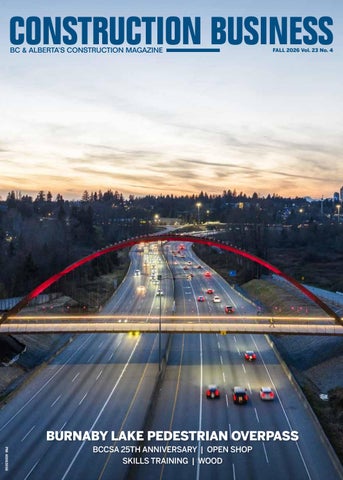
BURNABY LAKE PEDESTRIAN OVERPASS PM 40063056
BCCSA 25TH ANNIVERSARY | OPEN SHOP SKILLS TRAINING | WOOD
Stop Fragmented Workflows. Start Connecting Your Entire Business. Your projects. Your people. All in one place. Construction projects face unique challenges, but your tech stack doesn’t have to be one of them. Procore connects your people, projects, and financials on a single platform, helping you manage 49% more construction volume per person* and achieve a 16% average reduction in rework*. Stop losing time and money. Start streamlining your projects and increasing profitability with a single source of truth.
BOOK A DEMO TODAY
*Based on a Procore study of its customers. Results are not guaranteed and may vary. 2022.
Inside
Fall 2026 | Vol. 23 No. 4
06 Connections
PUBLISHER
Construction safety is one of the industry’s most important priorities. The BCCSA celebrates 25 years of construction safety associations in B.C.
MANAGING EDITOR CONTRIBUTING WRITERS
08 Feature Project The Burnaby Lake Pedestrian Overpass is the city’s first ever pedestrian and cyclist-only overpass across a major highway. Jacob Bros successfully delivered the complex steel project using innovative materials and construction methodology.
B.C./ALBERTA SALES
Dan Gnocato dang@mediaedge.ca Cheryl Mah Jordan Bateman Kourtney Blumenauer Peter Kent Anna Lary Jonathan Livingstone J. Marc MacEwing Joy Magnell Kerri Zanussi Dan Gnocato Tel: 604.549.4521
Industry Focus 19 Open Shop
Wood
The Housing Affordability Gap
Assessing Risk of Mass Timber Projects
Building Mental Health Infrastructure
Showcasing Sustainability
The Skilled People Crunch
Mass Timber and Modular Are Game-Changers
Skills Training
Departments
The Reality We Sit With
04 Message from the Editor
Mentoring Matters
22 The Legal File
Closing the Awareness Gap
Indemnities in Contracts
PUBLISHED BY
PRESIDENT Kevin Brown VANCOUVER OFFICE 105 - 1120 Westwood Street Suite 64170 Coquitlam, BC, V3B 4S4 Tel: 604.549.4521 TORONTO OFFICE 251 Consumer Road, Suite 1020 Toronto, Ontario M2J 4R3 Tel: 416.512.8186
Copyright 2026 Canada Post Canadian publications mail sales publication agreement no. 40063056 — ISSN 1710-0380 Return all undeliverable Canadian addresses to: 365 Evans Avenue, Suite L10, Toronto, Ontario M8Z 1K2
PRINTED IN CANADA
Construction Business is published four times a year by MediaEdge Communications Inc. as follows: Spring, Summer, Fall, Winter. Yearly Subscription: CANADA 1YR $35* 2YR $60* USA 1YR $60 2YR $110 INT 1 YR $85 2YR $150 *Plus applicable taxes REPRINTS: No part of this magazine may be reproduced in any form — print or electronic — without written permission from the publisher. Requests for permission to reprint any portion of this magazine should be sent to the publisher. Circulation Inquiries: 416.512.8186 ext. 232 circulation@mediaedge.ca
PROUD SPONSOR OF
Cover Photo: The Burnaby Lake Pedestrian Overpass
Construction Business is British Columbia and Alberta’s construction magazine. Each issue provides timely and pertinent information to contractors, architects, developers, consulting engineers, and municipal governments throughout both provinces. Complimentary copies are sent bi-monthly to all members of the Architectural Institute of B.C., B.C. Construction Association, B.C. Roadbuilders and Heavy Construction Association, Consulting Engineers of B.C., Construction Specifications Canada — B.C. Chapter, Greater Vancouver Home Builders’ Association, B.C. Ready-Mixed Concrete Association, Independent Contractors and Businesses Association of B.C., Urban Development Institute of B.C. and Vancouver Regional Construction Association.
Editor’s Note
All in the Family CONSTRUCTION HAS BEEN A PART OF MY LIFE for more than 20 years and it continues to grow within my family. My husband already works in the sector, and now my son is exploring a career in the industry at BCIT. (Yes, mom knows best). He is one of the many young people that the construction industry needs to attract to address the ongoing labour shortage and looming retirements. Recruiting, training and hiring the next generation of skilled-trades workers continue to be a top priority. While the residential market is currently experiencing a slowdown, the ICI sector remains busy with major projects expected to drive activity for the next five years. In B.C., there is $88 billion in proposed major projects on track to move forward. All these projects in the infrastructure, transportation, mining and energy sectors need workers. Read about the skilled labour crunch, the importance of mentorship and workplace respect in our skills training feature. A unique infrastructure project is on our cover. Jacob Bros oversaw the complex civil execution and installation of the new Burnaby Lake Pedestrian Overpass which spans over Highway 1. The $28 million overpass provides a fully accessible route separated from vehicle traffic for pedestrians and cyclists, significantly improving connectivity of key regional trail networks as well as safety. When it comes to safety, the BC Construction Safety Alliance has been making a difference in the lives of construction workers for 25 years. BCCSA marks the anniversary this year, having evolved from the Construction Safety Association of BC and the Construction Safety Network. In our open shop feature, read about the affordable housing gap, skilled trades shortage and ICBA’s ongoing commitment to supporting mental health.
Cheryl Mah Managing Editor
We Care. We Help. 4
CONSTRUCTION BUSINESS
Fall 2026
1-888-437-1100 www.wmbeck.com info@wmbeck.com
Leaders in Rebar and Post-Tensioning Fabrication and Installation Since 1987. lmsgroup.ca
Connections
CELEBRATING
WORKPLACE SAFETY The B.C. Construction Safety Alliance marks a quarter-century of construction safety associations BY PETER KENTER
T
This year marks the 25th anniversary of the establishment of construction industry safety associations in British Columbia, as the industry recognizes the merger of two founding associations: the Construction Safety Association of B.C. (CSABC) and the Construction Safety Network (CSN). In 2010, they formed the B.C. Construction Safety Alliance (BCCSA), which now provides occupational health and safety services to more than 57,000 construction companies employing approximately 220,000 workers in B.C. Creating a unified voice for worker safety in the British Columbia construction industry wasn’t easy. However, with some give and take — and assurances
6
CONSTRUCTION BUSINESS
Fall 2026
that all represented construction disciplines would continue to have a say at the table — the merger continues to pay dividends as the Alliance acts with united resolve on issues that matter to all of its members.
NEGOTIATING A MERGER Wayne Fettback, director of safety and procurement, Western Pacific Enterprises Ltd., was the BCCSA’s first chair and served on its board until 2025. He helped to negotiate the merger in his role as chair of the CSABC, working alongside his counterpart John van Dyk, chair of the CSN. “John’s side was basically road builders and independent contractors, whereas the side I worked
Connections
“...the founding organizations insisted that one of the hallmarks of a successful merger would be a commitment to maintain the individual voices of all members of the province’s construction industry.” on was mostly union contractors or larger contractors,” he says. “Prior to this, both organizations were competing and working independently to present program ideas to WorkSafeBC, so it wasn’t a very efficient way to get good results. We didn’t even know each other very well, but John and I started talks, and got boards from both sides involved to work out an agreement to form one association.” The Council of Construction Associations (COCA) — which represents all major construction associations in British Columbia and acts on behalf of the construction industry regarding WorkSafeBC matters — also supported and encouraged the drive toward a merger of construction safety associations. COCA looked, in part, to precedents set by construction safety associations already established in other provinces. “We learned a lot from similar organizations in Alberta, Nova Scotia and to some extent Ontario, where they were reducing injuries and disease,” says Grant McMillan, who has served as president of both COCA and the CSABC. “In those provinces, construction safety associations appeared to be making the difference. They were very helpful in establishing the focus for what became the BCCSA, even as the COCA board of directors contributed its time and expertise to help ensure that the new creation was successful.” Joe Wrobel, president of JPW Road & Bridge Inc., was one of the original drivers behind the CSN and the subsequent creation of the BCCSA. He recalls approaching employers and asking them to join what became the CSN. However, the idea for a construction-focused safety association was so novel that many of the contractors he approached misunderstood his pitch. “Many of them thought I was trying to recruit them to join the roadbuilders’ organization,” he recalls. “But we were able to get some traction with CSN when we explained the idea that we were building an organization that was industry-driven to share safety ideas and information for the betterment of all.” Wrobel also recalls that construction employers wanted to do the right thing, but were looking for the most effective safety programs, and assurances
that the programs and training they did choose to adopt would best satisfy provincial regulations. “That was where the Alliance could come in as an employer-oriented association that would bridge the gap between all construction employers and get them together to share and establish best practices,” he says. Jack Davidson was president of the BC Roadbuilders and Heavy Construction Association, originally represented by the CSN, from 1999 to 2017. For him, the merger was a bottom-line issue. “We felt that a single safety association would be more effective in helping employers to know they were doing everything they could to keep their workers safe,” he says.
ENSURING ALL VOICES ARE HEARD Tammy Oliver, senior director, BCCSA was part of the CSN and joined the Alliance when it was launched. She recalls that the founding organizations insisted that one of the hallmarks of a success-
ful merger would be a commitment to maintain the individual voices of all members of the province’s construction industry. “A priority was to ensure that the voices of both organizations were not lost and that the influence of the employer groups within them were distinctly recognized,” she says. “The formation of the Alliance enshrined the principle that representation of those industries would be maintained in the structure of its board of directors. In turn, the selection of those board members would always be made by the employer groups they represent.”
THE MOMENT OF TRUTH The first annual report of the BCCSA in 2010 offered a message of optimism for the future — as well as a sense of relief that both organizations had actually overcome their differences to focus on their core mission. “There were plenty of good discussions and lots of give-and-take, and even a scary moment at the
Fall 2026
CONSTRUCTION BUSINESS
7
Connections
end, when a few people got cold feet just as we were nearing the finish line,” Fettback wrote in his role as the first BCCSA board chair. “But we prevailed, and the result of our work and that of so many other groups, individuals, and organizations — including WorkSafeBC — who assisted from the sidelines, is a unified association that represents all sectors of our industry and is moving us forward.” The annual report was filled with the heartfelt messages of those who worked toward the establishment of the Alliance. Some expressed a little regret when the organizations they had worked so hard to establish closed their doors for good, but were encouraged to see that the most important contributions of these organizations would survive them 8
CONSTRUCTION BUSINESS
Fall 2026
— the services they provided and their commitment to worker safety. Mike McKenna, the first and current executive director of the BCCSA, echoed those sentiments in his written message: “We were presented with a unique opportunity in 2010 to create something from the ground up, building on the good work of the organizations that preceded us. We capitalized on that opportunity and now offer, under one roof, world-class programs and services that help give the women and men on B.C.’s construction sites the best chance of returning home uninjured at the conclusion of their workday.”
TAKING STOCK OF THE ALLIANCE Since the formation of the Alliance, another 15 years
have passed. Many of the same people who oversaw the creation of the BCCSA continue to remain active in construction as well as with the Alliance and continue to support its ongoing mission. “I think it worked out well for everyone,” says Fettback. “The BCCSA’s philosophy has evolved over the years, but it continues to provide good service to the industry and remains a respected voice for safety.” The expanding array of programs and products offered by the BCCSA also underscore the benefits of the merger, according to Wrobel. “The effort of joining the two organizations led to the Alliance bringing initiatives, such as the highly successful COR program, to B.C.,” he says. “Today, the BCCSA is highly effective, well-respected and laser-focused on improving worker safety and return-to-work outcomes. Innovations like the Silica Control Tool demonstrate how nimble the Alliance can be in responding quickly to emerging issues.” Davidson says that the united Alliance has also helped to oversee a broader cultural shift in the construction industry, from being reactive to incidents to preventive. “Today, the Alliance probably offers the most upto-date and current safety practices anywhere,” he says. “It also continues to make them better.” Ultimately, the success of the merger must be counted in lives saved and injuries prevented. McMillan says the merger is making good on that promise. “The end result of the dedicated work by contractors and the BCCSA has been a remarkable improvement in injury rates as well as costs,” he says. “The staff at the BCCSA and our contractors have consistently demonstrated their strength in turning vision into action, skillfully operationalizing programs and initiatives that deliver meaningful support to our sector.” Oliver notes that the last 25 years have passed quickly, and she’s proud of the long list of construction safety milestones achieved during that period. “It’s truly amazing what we have accomplished together over this time, from board members to our staff, alongside industry, even as all of the voices who are part of the organization continue to be heard at the table,” she says. “The growth and perception of safety in the construction industry has been incredible, and we’re excited to see what we’ll learn and accomplish in the future.” McKenna agrees. “It’s almost impossible to acknowledge the many people involved over 25 years who have gotten us this far,” he says. “That includes people from the industry, people from the original organizations that led to our founding, and members of WorkSafeBC. The spirit of their contributions continues to inform our progress as we speak in a united voice and continue on our mission to make safety simpler and keep workers safer.”
Feature Project
A UNIQUE
CIVIC LANDMARK BY CHERYL MAH
B
Building a key piece of public infrastructure crossing over eight lanes of traffic on Highway 1 was no easy feat. The Burnaby Lake Pedestrian Overpass presented a unique set of construction challenges, requiring extensive planning, precise coordination and innovative solutions to deliver a safer connection for pedestrians and cyclists while minimizing disruption to one of British Columbia’s busiest highways. The project combined an architecturally distinctive bridge with an innovative construction method to cre-
ate a new civic landmark that features a 72 metre clearspan structure that sits 5.7 metres above Highway 1. The grade-separated crossing connects Burnaby Lake to the north and Deer Lake to the south, allowing users to avoid the busy Kensington interchange. As the city’s first dedicated active-transportation crossing over the corridor, it provides an efficient and accessible route for the community, closing a longstanding gap in the regional trail network. “For decades, Highway 1 has been a major barrier for people trying to travel north–south through
Burnaby,” says Burnaby Mayor Mike Hurley. “This new overpass creates a safe, direct alternative to the Kensington crossing and makes it easier for people of all ages and abilities to walk, cycle and roll between Burnaby Lake and Deer Lake—and to the parks, trails, neighbourhoods and local destinations that make our city special.” Jacob Bros Construction began construction in 2023, reaching substantial completion in March, 2026. At peak, a crew of 80 was on site. In addition to the bridge, the scope of work included complex
Fall 2026
CONSTRUCTION BUSINESS
9
Feature Project
foundation and abutment works, structural steel fabrication and erection, multi-use pathways, and associated plaza and landscaping works. Jacob Bros was engaged early to support design development, cost planning and constructability. “Early constructability and peer reviews identified issues that required a full redesign of the bridge and its erection methodology,” says Matt Buechler, senior vice president, pre-construction at Jacob Bros. “We helped preserve the architectural vision
10
CONSTRUCTION BUSINESS
Fall 2026
while making the structure safer, more buildable and cost-effective.” The pedestrian bridge is a structural steel superstructure, fabricated by Solid Rock Steel, weighing approximately 400 tonnes. The bridge was designed and built as a prefabricated, singlespan structure featuring two inclined, intersecting unpainted weathering-steel arches, 76 hanger cables, a composite deck and a yellow Alaskan cedar ceiling. The weathering-steel construction
provides long-term durability with reduced maintenance over the lifespan of the bridge. The design by VIA — A Perksins Eastman Studio is inspired by the shape of a canoe being portaged between bodies of water. The two arches curve and interlock like rings. The complex steel geometry, connections and cable system required precise fabrication, 3D coordination, survey control and tolerance management, notes Buechler.
Feature Project
Safety features were built into the design, with careful attention to sightlines, lighting and openness to create a welcoming space. Custom architectural lighting integrated into the handrails not only provides visibility and safety to users at night but gives the crossing a visually striking nighttime character, highlighting the signature intersecting arches and intricate interwoven steel cables. One of the most challenging stages of construction was the execution of the bridge installation on a
severely constrained site. The final bridge move had to be completed within a tightly controlled 10-hour highway closure window. “This required highly accurate planning and coordination of the temporary works, traffic staging, ground preparation, transport, rotation, placement and contingency measures,” says Buechler, adding the bridge was assembled in 12 segments alongside Highway 1. During a single overnight closure of a 10-kilometre stretch of Highway 1, crews used comput-
er-controlled heavy transport platforms platforms (self-propelled modular transporters or SPMTs) to rotate the fully assembled massive structure 90 degrees directly into place. The operation required maintaining structural stability and integrity of the bridge throughout the move and achieving tight tolerances for final alignment and bearing installation. This modular, offsite approach successfully restricted total highway closure time to a matter of hours, addressing the logistical hurdles of building directly over an active high-volume highway and minimizing disruption to the public. “Closing Highway 1 and implementing a full detour was an unusual approach, but after evaluating alternatives, it was determined to be the overall safest method and the one with the least overall impact on our crews and the travelling public,” says Buechler. “Detailed planning and phasing are our specialty, and that capability was central to the project’s success.” Successfully delivering a high-profile infrastructure project in a challenging urban environment earned Jacob Bros a VRCA Silver Award. “Being selected for a VRCA Silver Award is a significant recognition,” says Buechler. “It recognizes our excellence in project delivery, safety, collaboration and construction. It also validates Jacob Bros’ ability to lead highly complex civil projects from early design and constructability planning through to safe, successful execution. The recognition is shared with the entire team. It was a true team effort.” The level of collaboration was exceptional on the project, according to president and CEO Scott Jacob. “This project came with many of the typical challenges faced by complex public infrastructure projects, but the extended project team worked through all issues in a timely and cost-efficient way, and the results were a successful project for City of Burnaby, McEllhaney, Jacob Bros and the many specialty subtrades and suppliers,” he said. Solid Rock Steel was also a VRCA Silver Award winner in the manufacturers and suppliers category. “This was a highly complex project that required our team to continually step up, work through challenges, and stay committed to delivering a successful outcome,” says Jasper Sevillano senior project manager, Solid Rock Steel. “I am incredibly grateful to have worked alongside a team that supported one another and remained focused from start to finish. This recognition belongs to everyone who contributed to making this project a success.” Officially opened in April, 2026, the $28 million overpass is both an important transportation connection and a new landmark gateway for Burnaby. “The project successfully combines complex engineering, architectural quality, precise construction planning and lasting community value,” says Buechler. Fall 2026
CONSTRUCTION BUSINESS
11
Open Shop
The Housing Affordability Gap Since 2019, the cost of building a home in Canada’s major cities has risen 70 per cent. Total inflation was about 25 per cent. That gap is the affordability crisis — and closing it should be the policy focus. BY JORDAN BATEMAN
N
obody decided to make housing unaffordable. There was no meeting, no vote, no single villain. Instead, different levels of government added a charge added here, a code change there, a permit process that took 11 months instead of four, a new regional fee that nobody at the municipal level accounted for. Each one may have been defensible on its own merits. But stack 15 years of them and you get a cumulative number that has crippled affordability in most major cities in country. Residential construction costs across Canada’s major cities are up roughly 70 per cent since 2019; economy-wide inflation is about 25 per cent. That is not greed, and it is not lumber. It is the accumulated weight of decisions made by governments that never had to add them up — and the reason a young couple in Surrey or Coquitlam cannot buy the home their parents bought at their age, on better terms, with worse jobs.
12
CONSTRUCTION BUSINESS
Fall 2026
WHO’S BUILDING? Say “developer” and most people picture a tower, a numbered company, a marketing centre with a scale model under glass. Those exist, but are not what this industry is mostly about. Homebuilding in Western Canada runs on small companies. Crews of two, five, a dozen, maybe 20. The framer who has four workers and a truck. The electrical contractor whose payroll is a relative, a high school friend, maybe a neighbour, and a couple of apprentices. The excavator who bids eight jobs to win two. It is, predominantly, an open shop industry — most of these companies operate outside the building trades union structure: workers choose, companies compete on the work. ICBA represents more than 6,000 of these companies across B.C. and Alberta. A company with 12 employees has no finance team, no government relations department, no lobbyist, no margin to absorb a code change that adds thousands to every unit. When Ottawa or Victoria adds
a cost, most builders do not write a strategy memo. They eat the cost, pass it to the buyer, or stop bidding. “Every time a government adds a new tax, fee, charge, or layer of red tape, or changes codes, the complexity and cost eventually show up in the final price, and in fewer projects getting built,” said ICBA president and CEO Chris Gardner.
WHOSE RULES? Start with the fees — the largest single lever any government holds, and the least understood. Development charges are fees which are levied at permit issuance. Not at occupancy, when there is a buyer and a mortgage and money coming in, but years earlier, when a builder’s capital is scarcest and most expensive and revenues are a distant prospect. In Metro Vancouver, regional water charges tripled and parkland charges jumped overnight, adding tens of thousands of dollars to a new apartment in Surrey or Burnaby before anyone broke ground. That
Open Shop
money is borrowed at construction-loan rates and carried for three years, so the buyer does not pay the fee. The buyer pays the fee plus interest. (The City of Delta collects at occupancy instead. Same revenue, radically different burden: this should be a model for other communities.) Then add the increasingly complex rulebook. The National Building Code and the Canadian Electrical Code are updated too often and at too high a cost. Every update is well-intentioned, but it means buildings going up next to each other are sometimes built to very different codes — and every change lands as a cost on that 12-person company. Australia has frozen its construction code until 2029; California has barred stricter residential standards until June 2031. Both decided cheaper housing was the more urgent goal. A presale is a deposit on a home that does not exist yet, and critics have never much liked them. But strip away the marketing magic, and a presale is simply a financing instrument. Lenders will not release construction money on optimism; they require a developer to sell 60 or 70 per cent of a building before the loan flows. Hit the threshold, the crane goes up. Miss it, and nothing is built at all. B.C. recorded roughly 6,000 presales in the first quarter of 2021. In the first quarter of this year: 124. Business in Vancouver reported zero concrete high-rise launches over the same stretch. Whatever you think of presales, that collapse means financing thresholds are not being met — and buildings are not starting, people are losing their jobs, and families are worried about making mortgage or rent payments.
SOLUTIONS: THE BAD (AND GOOD) In June, the federal and provincial governments announced they would buy or finance the conversion of more than 2,200 unsold B.C. condos. Not one homebuilder, contractor or developer ICBA represents asked for that. It rescues a handful of finished projects and does nothing about the reason the next project will not start. Every dollar spent buying a finished condo is a dollar not spent making the next one cheaper to build. But ICBA is touting a different path — a way to build more and to do it faster, smarter and cheaper. Cheaper. Make federal housing money permanently conditional on real, measurable cuts to municipal and regional development charges, and favour municipalities that collect at occupancy. Ottawa already runs a $3.2-billion program to reduce these charges; make it permanent and make it bite
“Make federal housing money permanently conditional on real, measurable cuts to municipal and regional development charges...” — it lowers the cost of every unit, not a select few. Then extend the GST rebate to every buyer of a new home under $1.5 million, not just first-timers. The Parliamentary Budget Officer projects the current version of the GST rebate will reach just 4.8 per cent of completions through 2030-31; Ontario’s broader version is projected to deliver 8,000 starts, 21,000 jobs and $2.7 billion in GDP. Smarter. Strip cost out of the National Building Code without stripping out safety, then freeze costadding changes to it and the Canadian Electrical Code until at least 2030. Rewrite CMHC’s apartment loan scoring, where energy efficiency alone carries up to 35 points — not one of which lowers the rent a family pays. Reserve the top scores for genuine affordability and for the two- and three-bedroom homes families can comfortably live in.
Faster. Extend the Section 44 replacement-property rollover to rental and residential construction, so an investor can move proceeds from an appreciated asset into a new project without triggering an immediate tax bill. It is a deferral, not forgiveness — the tax is collected when the money leaves the sector or the country. The 70 per cent jump in the cost to build a home is not irreversible. It was assembled, one reasonablesounding decision at a time, by people who never had to see the total. It can be disassembled the same way. Jordan Bateman is VP-communications and advocacy at the Independent Contractors and Businesses Association, Canada’s largest construction association, representing more than 6,000 member, client and affiliate companies in B.C. and Alberta.
Your partner in enhancing communities through collaborative construction.
unitechcm.ca
200 - 1530 56th St. Delta, BC V4L 2A8 Fall 2026
(604) 943 - 8845
CONSTRUCTION BUSINESS
13
Open Shop
Building Mental Health Infrastructure BY JORDAN BATEMAN
E
very jobsite has a safety culture. Hard hats, harnesses, lockout procedures, toolbox talks and much more make an entire system built on one principle: everyone goes home safe and healthy at the end of the day. For generations, that system had a blind spot. It protected workers from things like falls and equipment but said nothing about the weight so many of them were carrying inside. One in five Canadians experiences a mental health problem every year, and in an industry that runs on toughness, only a fraction ever felt safe saying so out loud. In fact, Statistics Canada found that 64 pe cent of Canadian construction workers wished their employers did more to support mental health initiatives; fully half of Nova Scotia workers don’t feel comfortable discussing mental health with their co-workers. ICBA Wellness was built to change that. And it started with the hardest sentence our own president ever had to say.
WHERE IT STARTED When ICBA launched its wellness program in 2021, Chris Gardner went public with something he had carried privately for decades: his father died by suicide when Chris was a child, at a time when help was scarce and silence was the norm. He had never shared it publicly, but he chose that moment because he understood something about this industry: nobody on a jobsite wants to open up first. Somebody has to go before them, and it might as well be the boss. What followed was a province-wide speaking tour with Corey Hirsch, the former Canucks goaltender who has become one of Canada’s most powerful voices on mental health. Packed rooms in construction shops and boardrooms. Grown men lining up afterward to say “I feel that way too.” In 2022, Gardner was named Wellness Executive of the Year in Ragan’s North American workplace awards, for his efforts launching ICBA Wellness. WHAT IT LOOKS LIKE ON SITE ICBA Wellness works because it was built for how construction actually operates. No seminar rooms or jargon. Five-minute toolbox talks a foreman can 14
CONSTRUCTION BUSINESS
Fall 2026
run at the tailgate. Posters and handouts for the site trailer. Short videos on stress, fatigue, substance use and resilience. Supervisor guides that teach the person running the crew to spot the warning signs, because on a jobsite, the first responder to a mental health crisis is usually a foreman, not a doctor. More than 7,000 workers are now connected to the program online, with another 15,000 reached through onsite content. Major employers have adopted it across their workforces; one large traffic control company rolled it out to more than 1,300 employees. From day one, the ICBA board of directors made the program free of charge to every ICBA member company. No fee, no upsell, no barrier between a worker and the help. The board, builders themselves, decided it was that important. ICBA also partners with other associations to offer the program in six provinces. “This program has been key to breaking these stigmas of mental health and has helped foster a relationship of communication,” says Jamie Cameron of Celtic Construction in Nova Scotia, where MERIT Nova Scotia partners with ICBA to offer the program. “Our team are finding this program to be excellent,” says finance coordinator Kellie Lefebvre of SCSA, a MERIT Saskatchewan participant. “In fact, a couple of our team think this is the best program they have experienced and they have taken quite a bit of training around mental health.” “I do believe we are seeing an impact from raising awareness on the importance of mental health,” says Status Electrical’s OHSE coordinator Michelle Lavoie. For employers, the business case sits beside the human one: mental health problems cost Canadian employers about $20 billion a year, part of a $51-billion annual hit to the economy.
WELLNESS 2.0 Awareness was the first job. The next one is harder: being there at 2 a.m. when the awareness kicks in. That is ICBA Wellness 2.0, currently under development. ICBA and the Canadian Men’s Health Foundation are launching the program’s next evolution, creating a comprehensive wellness ecosystem built specifically for Canada’s skilled trades and industrial sectors. Wellness 2.0 brings together educa-
tion, community and support navigation through one trusted, worker-centered model. Through practical wellness education, robust peer support, industry storytelling, and resiliencebuilding resources, Wellness 2.0 aims to help workers recognize and address challenges by connecting them with trusted support. Peer support forms a critical part of the model. Workers can connect with trained peers and mentors who understand the realities of life in the trades and can provide guidance, encouragement and trusted connection. But Wellness 2.0 goes beyond peer support alone. It helps workers understand the supports available to them and navigate pathways to benefits, counselling, treatment, recovery services and other resources when needed. Awareness campaigns end; infrastructure stays. Wellness 2.0 is infrastructure.
THE GOALIES It says something that the loudest voices in this conversation keep coming from hockey’s loneliest position. Hirsch isn’t the only goaltender to open up about mental health. This year, Carey Price — Anahim Lake, B.C.’s own, one of the greatest goaltenders of his generation, and an NHL Hall of Famer — will keynote ICBA’s Construction Innovation Summit this November in Vancouver. Western Canada’s premier construction event draws more than 1,200 industry leaders. In 2021, at the peak of his career, Price walked away from the Montreal Canadiens’ net and into a residential treatment program for substance use. “Over the last few years I have let myself get to a very dark place and I didn’t have the tools to cope with that struggle,” he said at the time. “Asking for help when you need it is what we encourage our kids to do. And it was what I needed to do.” A B.C. kid, an Indigenous athlete at the top of his sport, was bravely saying out loud that he needed help: that is exactly the conversation this industry is learning to have. In Calgary this fall, former Canucks defenceman Kevin Bieksa headlines ICBA’s 2026 Construction Leaders’ Breakfast alongside broadcaster Michael Landsberg, a longtime mental health advocate. Bieksa has spent 15 years in this fight, having helped launch hockey’s mental health movement after losing teammate and close friend Rick Rypien to death by suicide. That is the culture shift ICBA Wellness has been building toolbox talk by toolbox talk, and that Wellness 2.0 will now back with real infrastructure: an industry that has always looked after its people’s fingers and spines is learning to look after the rest of them. Everyone should go home at the end of the day safe and healthy, physically and mentally. Everyone. Jordan Bateman is VP-communications and advocacy at the Independent Contractors and Businesses Association, Canada’s largest construction association, representing more than 6,000 member, client and affiliate companies in B.C. and Alberta. Learn more at icba.ca/wellness.
Open Shop
The Skilled People Crunch
F
or once, the problem on the horizon is good news. Between them, B.C. and Alberta are carrying roughly $650 billion in potential major project inventory — pipelines, mines, LNG terminals, transit lines, data centres, hospitals, commercial buildings, and multi-family residential projects. If even half of the overall inventory gets built, it means decades of steady work, big paycheques and wealth into the hands of the people who build things. Alberta alone counts 1,023 major projects worth $318 billion, with $80 billion already under construction. Add the Pathways carbon capture project, the new oil pipeline to the coast announced by Prime Minister Mark Carney and Premier Danielle Smith, and a wave of multi-billion-dollar AI data centres, and the list keeps growing. B.C. is stacking up its fair share. Cedar LNG at $4.7 billion. The $6 billion Surrey-Langley SkyTrain line. Blackwater mine’s $1.44 billion second phase, with 1,500 construction jobs. Enbridge’s $4 billion Sunrise expansion, 2,500 more jobs. Eskay Creek, Highland Valley Copper, Mount Milligan — mines needing construction workers. So what could go wrong? Simple. There may be nobody left to tie the rebar, weld the pipe, or drive the trucks.
THE PARADOX Right now, that sounds absurd. Because housing construction has stalled and contractors are hurting, people are being laid off. “The story has radically changed in just one year. Contractors are no longer scrambling for workers, they’re scrambling for work,” ICBA president and CEO Chris Gardner said earlier this year. Both things are true at once. Today’s slowdown is real: construction job vacancy rates have fallen from 7.1 per cent in early 2022 to just over three per cent. But a workforce is not a light switch. The framer laid off this year does not sit in a truck waiting for Cedar LNG to need him in 2029. He leaves, going to another province, another industry, or into retirement. And the industry’s demographics were already working against us before the slowdown started pushing people out the door. ICBA chief economist Jock Finlayson has run the numbers, and he thinks the official forecasts are lagging behind. BuildForce Canada projects B.C. residential construction employment will drop 13 per cent by 2035, with Alberta’s down 16 per cent, offset by growing non-residential work. Finlayson’s response: “We believe their latest projections have underestimated the likely strength of construction demand.” ICBA’s view is that the coming labour supply gaps could be three to four times greater than BuildForce’s estimates. The stakes are not academic. “Labour supply constraints create a risk of cost escalation and make it less likely that proposed projects will proceed to shovels in the ground,” Finlayson says. Translation: no workers, no projects. The $650-billion board
starts shrinking before a single final investment decision is made.
THE OPEN SHOP ANSWER Here is the part governments keep missing: the workforce that will build these projects is overwhelmingly open shop. Most construction workers in B.C. (85 per cent) and Alberta (88 per cent) choose to work outside the old building trades union structure, and for companies that compete on merit. ICBA represents more than 6,000 of these contractors, and is one of the largest sponsors of trades apprentices in Canada, training thousands of construction professionals every year. If Canada wants more workers, it must include open shop, the part of the industry where the workers actually are. No serious plan to build Canada can start by excluding more than 80 per cent of the men and women working in construction. Five places to start Fix immigration. Until Carney slowed immigration, Canada was adding the population of a Calgary every year. But only two per cent of permanent immigrants pursued construction careers, and fewer than 0.4 per cent of economic immigrants arrive through the Federal Skilled Trades Program. Alberta alone needs 22,000 new construction workers through net mobility by 2033. “It is not a person’s education but the alignment of their skills with domestic economic needs that determines their contribution,” says ICBA Alberta president Mike Martens. “The federal government must adopt smarter immigration policies that prioritize construction-relevant skills and provide faster pathways to integrate new workers into the industry.” A dedicated construction stream, faster credential recognition, and more points for a trade ticket instead of a third degree. Let training dollars follow the apprentice. Too much government training money still flows through channels built for a building trades union world. Fund the apprentice — whoever trains
them, union or open shop. ICBA’s members will put every dollar to work on real people learning real trades. Keep every bidder in the game. Nothing shrinks a workforce faster than telling most of it that taxpayer-funded projects are off limits. Every qualified company, and every worker, whatever card is or is not in their wallet, should be able to bid on and build public work. Open, fair tendering delivers projects cheaper and keeps crews together between private jobs. Bridge the trough. The cruelest outcome would be losing the workforce in the two years before the boom needs it. Governments planning this pipeline of projects should sequence public work — schools, hospitals, maintenance — into today’s slowdown, so crews and apprenticeships survive to reach the other side. Sell the trades. A construction career now means technology, drones, mass timber, robotics — and six figures without student debt. Yet schools and parents still steer kids away from it. Every high school in Western Canada should treat a Red Seal the way it treats a bachelor’s degree: as a win. For two generations, we have built an education system around the premise that the path to job security and the middle-class dream ran through a four-year university degree. Today’s opportunity means that we need to turn this thinking on its head — the best path to opportunity is more often with a Red Seal designation and not an MBA. None of this requires a new bureaucracy. It requires governments to treat workforce like they treat capital, as something you attract, invest in and keep. The projects are real. The money is real. The only open question is whether the people will be there. Get the workforce right, and that $650 billion on the board in major projects becomes paycheques, careers and communities. Get it wrong, and it becomes a museum of artist’s renderings. The people who build things are ready to grow. Let them. Fall 2026
CONSTRUCTION BUSINESS
15
Skills Training
The Reality We Sit With BY KOURTNEY BLUMENAUER AND ANNA LARY
T
here is a lot of necessary talk about mental health in construction and the heartbreaking statistics around suicide and overdose. But the conversation doesn’t always connect workers’ sense of dignity and worth to the conditions they face. Safe working conditions, adequate dust control and reasonable access to bathroom facilities are all ways a workplace tells its workers they matter and are respected. Too often, the conversation becomes about technical compliance rather than worker experience. That matters when we’re talking about attracting and retaining people in the trades. Opening the door to the industry isn’t enough. It also means creating environments where workers are treated with dignity once they’re inside. It has been two years since B.C. brought in regulations requiring flushable toilets and hand-washing facilities on construction sites with 25 or more workers. That’s worth recognizing. It’s also worth asking what has changed. Twenty years ago, it wasn’t uncommon to open a toilet door and just stand there trying to process what you were looking at. Excrement piled above the seat. Who was the last person in there that was even able to do that? Someone who had no other choice. For women, there was another layer. No dedicated facilities meant sitting down with a urinal beside your face. Just throw your hair over your shoulder and hope for the best. Navigating menstruation in these conditions took care, planning and a degree of improvisation that shouldn’t have been necessary. Then came the pink porta-potties. Progress, right? In many ways, yes. But they were often locked. A bathroom break became a treasure hunt for a key that was supposed to be hanging in the same place and somehow wasn’t. Many men felt resentment because they wanted access to cleaner facilities. That 16
CONSTRUCTION BUSINESS
Fall 2026
said something about the conditions in the first place. Through her work with ConnectHER Hub, we bring people together across the trades, creating space for workers to connect, share their experiences and find support in navigating the industry. It’s the same challenges from the employer side, advocating for workers when basic needs were overlooked— and learning that advocacy doesn’t always mean having the final say. A washroom isn’t simply a box that satisfies a regulation. Clean, maintained and readily available facilities communicate employer respect. When they are dirty or inaccessible, the message is clear. Providing them isn’t always simple. Cost, schedules, changing site conditions and decisions beyond one person’s control are considerations. But what message are we sending when workers have to fight for access to something as basic as a clean, accessible washroom? One Lower Mainland project shows how complicated that can become. A beautiful new facility, nearly ready for occupancy, has stairwells that reek of urine. The first reaction is: that’s disgusting - people should stop. But what were their choices? Dehydrate? Or use portapotties four floors away and clustered in one corner of a vast parkade? The flushable toilets and hand-washing stations are there, but they are far from where people are working. Not every worker can walk these distances without consequence. Menstruation, digestive or bladder conditions, pregnancy and countless other conditions can heighten urgency. WorkSafeBC guidance says washroom facilities should be readily available, generally within 60 metres (200 feet) of the work area and no more than one floor above or below. Concerns about access at this site have been reported repeatedly, while the employer has continued to receive passing inspections.
So, what does “readily available” actually mean on an active jobsite? Workers notice when someone gets it right, too. Those sites are remembered—and missed when the next project doesn’t measure up. Flushable toilets have improved things. But they haven’t solved the problem. We see units out of service. We see facilities workers simply don’t want to use. And we’ve seen porta-potties taped off because excavation cut off access for servicing. The cleaners couldn’t get to them, so they couldn’t be maintained. They weren’t replaced; instead, they were taped off. The answer was, “It’ll only be about a week.” Don’t think about that in days. Think about it in workers. Think about it in worker hours. And then there is the apprentice with toilet paper in their back pocket. Not because somebody told them to carry it. Because they learned to. They’re covered because they’re trying to protect themselves. They’re adapting to what is there. First you live it, you adapt and carry on each day. Bringing your own toilet paper to avoid the roll sitting damply beside the seat or the empty dispenser. Then you lead, teach and mentor long enough to see somebody else doing the same things. Site work requires a Field Level Hazard Assessment to be filled out every morning, identifying hazards, checking boxes and signing your name. After decades of filling out those forms, washroom conditions still aren’t something sitting there waiting to be checked. Again and again, it takes pen to paper to make the problem visible. The same issue. The same place. Written into the box marked “Other.” Kourtney Blumenauer is a Red Seal Electrician, cofounder, writer, and mentor. Anna Lary is a Master Electrician, BCIT faculty member, and founder of the BCIT ConnectHER Hub.
Skills Training
Mentorship Matters BY JOY MAGNELL
B
ehind many successful tradespeople, supervisors, project managers, estimators, and industry leaders is someone who took the time to share knowledge, provide guidance, and help navigate the realities of a demanding and rewarding profession. Through Building Builders, a workforce development initiative of the BC Construction Association (BCCA) funded in part by the Government of Canada, mentorship creates those opportunities by helping individuals build skills, gain confidence, expand professional networks, and develop the insight needed to succeed in an industry where experience and relationships matter. As British Columbia’s construction sector continues to evolve, mentorship has become an important tool for attracting, developing, and retaining talent. The Building Builders Mentorship Program was created to strengthen the workforce by connecting experienced industry professionals with individuals entering or advancing their careers in construction. Through both virtual and in-person mentorship opportunities, the program makes meaningful connections accessible across the province, regardless of location, trade, or career stage. The recently released Building Builders Impact Report, developed by Osier Consulting, demonstrates the power of mentorship in action. As of August 31, 2026, Building Builders has facilitated more than 650 mentor and mentee matches, creating opportunities for knowledge sharing, leadership development, industry engagement, and professional growth across the province. With the dedication of the Building Builders team, the program continues to expand access to mentorship opportunities that help participants build confidence, strengthen industry connections, and develop successful careers in construction. At the heart of the program are its volunteer mentors. These dedicated construction professionals generously contribute their time, expertise, and lived experience to support the next generation of industry talent. Their guidance provides mentees with practical advice, honest feedback, and encouragement that cannot always be found through formal education alone.
The strength of Building Builders lies in the quality and diversity of its mentor network. According to the Impact Report, 47 per cent of mentors hold Red Seal certifications, and mentors represent expertise across more than 30 construction trades and occupations, including project management, site supervision, health and safety, estimation, and skilled trades leadership. Even more notably, 33 per cent of mentors have returned to mentor again, demonstrating the value they see in giving back to the industry. Many former mentees have also returned to the program as mentors themselves, creating a lasting cycle of knowledge transfer and leadership development. One volunteer mentor, Angelo Bacelic, a Red Seal certified glazier with more than 20 years of industry experience, describes mentorship as a vital bridge between learning and real-world application: “The classroom gives you theory. The field gives you reality. The gap between the two is where most people struggle, and that is exactly where a mentor adds value.” For Bacelic, mentorship is about helping others learn from experience, avoid common mistakes, and understand what it takes to build a sustainable career and strong professional reputation. “If you are a trades professional with real experience, I encourage you to consider mentoring. The knowledge you carry has value beyond your own projects. Pass it on.” The Impact Report also highlights the program’s significant support for apprentices and future trades professionals. Forty-six per cent of all mentees supported through the program to date self-identified as pre-apprentices through Level 4 apprentices. This demonstrates the important role mentorship can play in helping emerging tradespeople navigate career pathways, build workplace confidence, and develop a deeper understanding of the construction industry. As part of BCCA’s broader commitment to workforce development, Building Builders goes beyond mentorship matching by providing access to training, resources, and industry exposure opportunities. To date, 423 mentees have registered for SiteReadyBC training, while 314 mentees
have participated in volunteer work experiences, job shadows, or site visits. These experiences help participants explore career options, strengthen industry knowledge, and gain valuable exposure to construction workplaces and projects. The program is also helping foster safer and more inclusive workplaces. More than 1,110 mentees and mentors have received Builders Code information packages, supporting awareness around respectful workplace practices and helping create positive workplace cultures throughout the industry. A key success of Building Builders has been its ability to increase participation among groups that have historically been underrepresented in construction. According to the Impact Report, 23 per cent of mentees identified as youth, 26 per cent identified as women, and 41 per cent identified as newcomers to Canada. Participation has also grown among Indigenous Peoples, racialized individuals, persons with disabilities, and members of the 2SLGBTQI+ community. These outcomes reflect BCCA’s commitment to reducing barriers and helping ensure construction careers are accessible to a broader and more diverse talent pool. Accessibility remains another defining feature of the program. Through virtual mentorship, online learning opportunities, and initiatives such as the Virtual Site Visit Series, Building Builders has expanded its reach to 57 cities and towns across British Columbia. These opportunities allow participants to connect with experienced professionals, explore active construction projects, and gain valuable industry insights regardless of where they live. The success of Building Builders reinforces a simple but powerful truth: mentorship matters. It helps individuals build confidence, develop leadership skills, expand professional networks, and strengthen their connection to the construction industry. It also provides experienced professionals with an opportunity to share their knowledge, support industry growth, and help shape the future workforce. Through the dedication of its volunteer mentors, the ambition of its mentees, and the support of industry and community partners, Building Builders demonstrates something fundamental to BCCA’s approach to workforce development: investing in people builds capacity across the entire industry. Construction has always been an industry where knowledge is passed from one generation to the next. Formal training provides the foundation, but experience, relationships, and practical guidance help turn that knowledge into a career. Mentorship matters because people matter. When experience is shared, opportunities grow, leaders emerge, and the entire construction industry benefits. Joy Magnell is provincial program manager, Building Builders at BC Construction Association. Learn more about the Building Builders Mentorship Program at buildingbuilders.ca. Fall 2026
CONSTRUCTION BUSINESS
17
Skills Training
Closing the Awareness Gap A call for more women to build skilled-trade careers in fire protection systems
C
onversations about in-demand skilled trades across Canada include welders, industrial electricians, carpenters, plumbers — but certain specialized fire protection roles, such as sprinkler fitters and fire alarm technicians remain largely unmentioned. Demand for fire alarm technicians and sprinkler fitters is high due to increasingly strict building safety regulations and code mandated testing. The skilled trade plays a critical role in protecting buildings and occupants, yet relatively few are familiar with these career opportunities. A national survey commissioned by Classic Fire + Life Safety and conducted by Leger identifies a significant awareness gap specifically around fire and lifesafety trades. Only three in 10 adults are familiar with fire alarm technician as a career choice, with awareness dropping to 24 per cent among women. Awareness of sprinkler fitter careers is even lower, with only one in five Canadians familiar with the occupation, compared to 14 per cent of women. The findings come as employers across Canada continue to face the challenge of attracting workers into occupations that require technical and practical skills. That awareness gap is one of the reasons Classic Fire + Life Safety joined other industry leaders to launch the inaugural Women in Fire Protection event in Toronto this fall. The event was aimed at highlighting the skilled-trades pathways and oppor18
CONSTRUCTION BUSINESS
Fall 2026
tunities available to women across the fire and life safety sector. The company has been actively attracting women into the sector, doubling its roster of women tradespeople over the past four years, growing to 16 women sprinkler fitters and fire alarm technicians in 2026, up from eight in 2022. “We are proud of the progress we have made, but more needs to be done,” says Lucy Machado, vice president, human resources at Classic. “Our industry is growing, our company is expanding, and we are committed to encouraging more women to consider careers in fire protection and life safety. Every day, our teams help to protect people, property and communities. It is meaningful work that offers purpose, long-term opportunity and the chance to make a real difference.” BuildForce Canada estimated that in 2025 just 6 per cent of the nearly 1.25 million employed tradespeople were women, indicating there is still a lot of work to do to close the gender gap. “Fire protection is a tremendous industry,” says Kelly Parascandalo, COO of Classic. “It offers job satisfaction, career security and opportunities for advancement. Just as importantly, our culture is built around people, teamwork and supporting one another. We need more events like this to introduce women to the possibilities that exist in the skilled trades.” The annual Measuring Up The Trades survey found only one in 10 adult Canadians is currently
working in a skilled trade, and 67 per cent of adult Canadian women have never considered a career in the skilled trades. Canadians increasingly view skilled trades as attractive careers, but awareness and career-entry information remain major barriers. The survey highlights an important opportunity for employers, educators and industry organizations. Greater awareness could begin with clearer information about what these professionals do, the training and certifications required, potential career paths, compensation, job security and opportunities for advancement. Classic Fire + Life Safety believes increasing awareness is a critical first step toward attracting more women into fire protection and helping address ongoing labour shortages across the skilled trades. “We’ve seen firsthand the value that women bring to our organization and to the fire protection industry as a whole,” says Mike Farren, CEO of Classic. “We are committed to encouraging the next generation of women to explore careers that offer stability, growth and the opportunity to join us in helping to save and protect lives.” For specialized fields such as fire alarm technology and sprinkler fitting, closing that awareness gap is an important step toward attracting the next generation of skilled professionals and strengthening the workforce responsible for protecting buildings and communities.
Wood
Assessing Risk of Mass Timber Projects BY JONATHAN LIVINGSTONE
F
or developers, the appeal of mass timber is easy to understand. The material offers opportunities to reduce carbon footprints, accelerate construction schedules and create visually striking buildings that stand out in a competitive market. While mass timber is increasingly viewed as the future of sustainable construction, insurance underwriting is still largely informed by decades of experience with steel and concrete projects. This disconnect is creating new challenges for developers, as insurers work to evaluate a construction method that is advancing faster than the historical data available to assess its risks. As mass timber adoption grows across Canada, insurance considerations are becoming an increasingly important part of project planning. While coverage remains available, underwriting is often more complex, with insurers paying close attention to moisture management, repairability and construction-phase exposures.
THE INSURANCE INDUSTRY’S DATA CHALLENGE Insurance relies heavily on historical performance data to assess risk and predict loss outcomes. With steel and concrete construction, insurers have decades of claims experience to guide underwriting decisions. Mass timber, however, is still a relatively new asset class in comparison. Although mass timber has been used successfully on projects across the country, there is still limited loss history available. Insurers continue to build their understanding of how these structures perform over time and how costly losses may be to remediate. That lack of certainty often results in a more cautious approach to pricing, coverage terms and project evaluation. This means underwriting is often influenced as much by risk management practices and project execution plans as by the building design itself. WHY WATER DAMAGE HAS BECOME THE PRIMARY CONCERN While fire often dominates public conversations about mass timber, water damage is frequently the issue that receives the greatest attention from insurers. During construction, timber elements may be exposed to rain, snow or other moisture sources before the building envelope is complete. Even small amounts of water can raise questions about hidden moisture, drying requirements and the potential for future deterioration. Unlike many conventional materials, timber can absorb moisture beneath the surface, making it more difficult to assess the extent of damage. In some cases, a loss that appears manageable at first can trigger extensive investigation, testing and remediation efforts. This uncertainty around the long-term effects of water exposure is one of the primary factors influencing underwriting decisions today.
WHEN AESTHETICS AFFECTS THE CLAIM Mass timber presents an issue that is less common with steel or concrete construction. In many projects, exposed timber serves as both a structural system and a key architectural feature. As a result, damage that has little or no impact on structural performance can still lead to a significant insurance claim. Water staining, discoloration or surface imperfections may leave a component structurally sound but aesthetically no longer aligned with the intended finished design. This can lead to debates over whether affected elements should be repaired, refinished or replaced entirely. For insurers, the issue is not simply whether damage occurred, but how project stakeholders define an acceptable restoration outcome. Those decisions can have a significant impact on claim costs. Repair timelines create additional uncertainty One of the biggest challenges for insurers is understanding what happens after a loss occurs. Mass timber components are often custom designed and manufactured off-site. If replacement is required, sourcing new materials can take time, particularly for larger or more complex projects. Even when repair is possible, questions may remain around drying timelines and the effectiveness of remediation efforts. The result is a level of uncertainty that is difficult to quantify. Insurers must consider not only the direct cost of repairs, but also the potential impact on construction schedules, financing arrangements and project completion dates. This is why delay-related exposures are often a key consideration when underwriting mass timber projects. WHAT UNDERWRITERS WANT TO SEE As insurers become more familiar with mass timber, one theme continues to emerge: projects with strong
moisture management and construction controls tend to be viewed more favourably. Insurers increasingly expect to see documented moisture management plans, clearly defined responsibilities and construction sequencing designed to minimize weather exposure. Additional measures such as just-in-time delivery, temporary weather protection and moisture monitoring can further strengthen a project’s risk profile. Early engagement is also critical. Bringing insurance advisors into discussions during project planning can help identify potential concerns before they affect coverage availability, pricing or project timelines.
CLOSING THE GAP Mass timber’s growth shows no signs of slowing. Its sustainability benefits, design flexibility and construction efficiencies continue to make it an attractive option for developers across Canada. At the same time, the insurance industry is still building the experience and data needed to fully understand the risks associated with this rapidly evolving form of construction. Until that knowledge gap narrows, underwriting decisions will continue to place significant emphasis on moisture control, remediation planning and overall project risk management. The most successful projects will be those that recognize insurance as part of the design and planning process, rather than a requirement to address later. As mass timber continues to move into the mainstream, aligning innovation with insurability will be essential to unlocking its full potential. Jonathan Livingstone is a client executive at Acera Insurance who specializes in insurance placements, program design and risk management for clients across the construction, real estate development and commercial sectors. Connect with Jonathan at 604.294.3773 or jonathan.livingstone@ acera.ca Fall 2026
CONSTRUCTION BUSINESS
19
Wood
Showcasing Sustainability
T
he new Marpole Community Centre, opening by the end of 2026, is setting a new benchmark for future low-carbon civic infrastructure in Vancouver. The building will replace the city’s oldest community centre, nearly doubling its size, to better serve the community in one of Vancouver’s fastest growing neighbourhoods. It is the first new community centre commissioned by the city in about a decade. The centre will be “the most inclusive, forwardthinking, and high-performing facility that the city has ever built,” according to Vancouver city planner Forest Borch. The design aims for near-zero operational emissions, significant embodied carbon reduction, and high accessibility. Targeting Passive House and LEED Gold certification, the 42,000 square foot centre is an exposed mass timber structure located within Oak Park that will bring together community programming in a highly efficient, all-electric building. Heatherbrae Builders broke ground in 2023. The architectural design by Diamond Schmitt centres on openness, permeability, and connection to the park setting. A low, horizontal massing is articulated by three gently curving roof forms that organize the program volumes, echoing the natural character of the landscape. “Our vision for the Marpole Community Centre was to create an inclusive and welcoming high-performance facility that embodied the city’s ambitious sustainability and accessibility targets while also supporting the community’s goals for how they wanted to use the building and grow their programing,” says architect Caroline Inglis. As part of B.C.’s Mass Timber Demonstration Program, the mass timber building shapes the interior character of the facility while significantly reducing embodied carbon. The structure features glue-laminated timber (glulam) columns and beams, a crosslaminated timber (CLT) floor system, and a hybrid CLT and steel roof. Through an alternate building code solution, the extensive use of mass timber ( about 1,500 cubic metres) contributes to the building’s overall 41 per cent embodied carbon reduction while creating a warm, tactile, and human-scale environment that reflects the natural context of Oak Park. According to Inglis, all the timber was exposed in the Main Hall - which is the primary circulation spine that connects all of the program spaces in the community centre — so that users can “really appreciate the beauty of the material and see all of the joinery.” Sustainability is embedded into the project’s core design, with the centre using a highly insulated, airtight envelope, and heat-recovery ventilation to significantly reduce operational energy demand. An all-electric system supports the City of Vancouver’s climate goals, operational emissions while maintaining high levels of occupant comfort. These systems are complemented by passive design strategies including orientation, shading, and daylight optimization, which further enhance performance and reduce reliance on mechanical systems.
20
CONSTRUCTION BUSINESS
Fall 2026
Accessibility was also a key priority. Targeting Rick Hansen Foundation Accessibility Certification (Gold), the facility is organized to provide intuitive, equitable access for all users. A continuous, gently sloped approach ensures that all visitors access the building through the same shared path, reinforcing dignity and inclusion as core principles of the civic experience. The project is the first city‑owned community centre to be designed to achieve the gold certification. Inside, a central circulation spine reveals the diverse programming for interaction. Active recreation spaces connect directly to outdoor sports courts, while community-oriented spaces on the south facade maximize daylight and visibility. A central “lantern” stair acts as a visible beacon, drawing the community in and reinforcing the building’s role as an accessible social and cultural hub for Marpole’s multi-generational community. A childcare facility occupies the second level, providing a secure and independent environment while remaining integrated with the broader community centre. Transparency and visual connection are fundamental to the building’s civic role. Interior glazing and open circulation expose the diversity of programs within, encouraging interaction among visitors and reinforcing the centre’s role as a shared civic space. Positioning the building on the southwest edge of Oak Park allowed the original facility to remain operational throughout construction and estab-
lishes a clear civic presence at the intersection of Oak Street and Park Drive while maintaining a scale that respects the surrounding residential neighbourhood. To the north, basketball courts connect directly to the gymnasium and youth multipurpose room, extending activity outdoors. On the south side, a garden grounds the landscape in its cultural context. A welcome circle to the west side and a teaching circle to the east side create opportunities for community events and gatherings to spill beyond the building’s footprint. An oversized shingled cladding system inspired by cedar shingles helps modulate the building’s scale and reinforce its connection to place. Community engagement and collaboration with Indigenous partners ensured the design reflects Coast Salish perspectives. This collective process integrated spatial and artistic interventions by Musqueam artists, embedding cultural meaning throughout the site and connecting it to the landscape. This sense of belonging is reinforced by the building’s layout. As the Marpole neighbourhood continues to grow and evolve, the new community centre establishes a contemporary civic landmark that brings recreation, culture, and care within a resilient, low-carbon framework. In doing so, it offers a model for how future civic buildings can support both environmental performance and the social life of the city.
Wood
Mass Timber and Modular Are Game-Changers BY KERRI ZANUSSI modular construction a practical fit for a project with no room in its budget for schedule overruns.
T
he construction industry is under pressure to deliver projects faster, within tighter budgets, and with fewer surprises. Labour shortages, unpredictable weather, and rising costs have made conventional timelines harder to hold. Developers, architects, and builders are increasingly evaluating mass timber and modular construction as ways to reduce both schedule and cost risk. Mass timber and modular construction are often discussed separately. In practice, they are frequently combined.
REDUCING RISK THROUGH PRECISION Mass timber, particularly cross-laminated timber (CLT) and glulam, is manufactured off-site under controlled conditions using detailed digital models. Panels, beams, and columns are engineered before reaching the job site, which reduces variability in the build process. That precision is coordinated well before construction begins. Mass timber structural systems are digitally modelled and checked multiple times during design and fabrication. The version that arrives on site has already been verified, rather than adjusted for the first time in the field. Weather delays, one of the most persistent threats to any construction schedule, have less impact when a large share of the work happens indoors, and site crews spend less time waiting and more time assembling. Modular construction runs on a parallel schedule. Foundation work at the site and module fabrication at the plant happen at the same time, rather than one after the other. That timeline extends further by prefabricating entire building components, in some cases including finishes, MEP systems, wiring, and even millwork, before modules leave the plant. When mass timber and modular methods are combined, much of a project’s complexity is resolved before site work begins.
EFFICIENCY REFLECTED IN CURRENT PROJECTS Several current projects show what problem modular construction was actually solving, rather than modular being chosen as an end in itself. Railtown Flats, a 55-unit workforce housing development in Nelson faced funding timelines and occupancy targets fixed well in advance, with little room to absorb delay. The units are produced at the Kalesnikoff Modular Facility in Castlegar, using a volumetric approach. That approach let foundation work at the site and module fabrication at the plant proceed at the same time, which is what made the schedule achievable in the first place. A similar problem shaped the Langford Community Arts and Child Care Centre. Growing communities often need new licensed childcare space faster than a conventional build can deliver it, and the municipality had set a defined opening timeline. Mass timber classroom modules, fabricated off-site while site work proceeded, were the way to hit that date without compressing the schedule to a point that would compromise quality. Pine Street Place in Nelson involved a different constraint. It called for fitting a four-unit development of volumetric mass timber townhomes onto a small infill site, without a long, disruptive build in an established neighbourhood. The townhomes were manufactured in the Kootenays and assembled onsite in a short window, addressing that constraint at a much smaller scale. The same logic applies to non-profit housing, where budget certainty often matters as much as the finished building. In Cranbrook, Kalesnikoff is supplying the mass timber modular system for a side-by-side duplex being built with Habitat for Humanity Southeast BC, on land donated by the city. The duplex will house two working families through Habitat’s income-geared mortgage program. A fixed, predictable delivery timeline made
ADDRESSING COMMON MISCONCEPTIONS Several misconceptions persist around mass timber and modular construction. One is that modular mass timber construction cannot compete with steel and concrete on larger or more complex projects. The Knight Building in Big Sky, Montana, offers a relevant example. It was built using 120 CLT modules to provide workforce housing for 95 employees, and the project was completed on site in 11 months. That result indicates modular mass timber systems can be scaled to demands that would traditionally require steel-frame construction. A second misconception is that modular construction limits design flexibility. In practice, the coordination required, aligning structural, mechanical, and architectural details early in the design process, tends to produce more disciplined outcomes rather than compromised ones. Teams that address it early typically encounter fewer changes once construction begins. That coordination has to start with the building type itself. Structural systems for a townhome, a childcare centre, and a workforce housing tower are not interchangeable, and design flexibility works best when the system is chosen for the project’s actual use from the outset. A third misconception holds that mass timber is inherently more expensive than conventional materials. Material cost is only one variable. Once schedule compression, reduced site labour, and fewer weatherrelated delays are factored into total project cost, the comparison to conventional materials often looks different than the raw material price alone suggests. WHERE THE APPROACH IS HEADED Developers and public sector clients facing labour constraints and tight timelines are increasingly applying mass timber and modular methods across housing, education, and community infrastructure. Railtown Flats, the Langford Community Arts and Child Care Centre, the Pine Street Place fourplex, and the Habitat for Humanity duplex in Cranbrook are different building types. They share a common approach. Each resolves construction complexity in a controlled manufacturing environment before it reaches the job site. As more architects, engineers, and developers gain direct experience with these systems, the conversation is shifting from whether mass timber and modular construction can perform at scale to how best to apply them across different project types. Kerri Zanussi is senior marketing partner at Kalesnikoff, a fourth-generation, vertically integrated mass timber, modular, and forestry company based in Castlegar, that takes projects from seedlings to solutions. Fall 2026
CONSTRUCTION BUSINESS
21
Legal File
Indemnities in Contracts BY J. MARC MACEWING
A
n indemnity is defined as a collateral contract by which one party engages to secure another party against an anticipated loss as the legal consequence of an act on the part of the first party or of a third person. Collateral in this sense means additional to or separate from the main contract, and subservient to it. Construction contracts and design professional services agreements commonly include indemnity provisions, in some cases creating reciprocal obligations and in other cases operating unilaterally in favour one of the parties, usually the payor. Such provisions add to a contracting party’s express obligations to the other contracting party a general duty to compensate the other party for risks and costs that the other party incurs by reason of, or attributable to, the acts or omissions of the first party. That is, an indemnity typically adds to a party’s liabilities for breach of particular contractual provisions a covenant to make whole the aggrieved party for loss and damages incurred by that party due to such breach or arising from claims made against that party by third persons in connection with such breach. Indemnity provisions often include an additional obligation that the indemnitor defend and “hold harmless” the indemnified party from and against indemnified claims. Those obligations add to the duty to compensate a requirement to assume the defence of the indemnified party to a claim commenced against it by a third person. The indemnitor’s assumption of the defence will often be stated to be at the option of the indemnified party, the 22
CONSTRUCTION BUSINESS
Fall 2026
exercise of which will usually be affected by whether the indemnifying and indemnified parties have a dispute between them. If they do, then a common defence represented by a single lawyer will not be feasible, and the indemnified party will content itself with being reimbursed by the indemnitor for the legal expense incurred by the indemnified party. The main issue in assessing the reasonableness of indemnity provisions is the extent of the claims and the categories of expense for which the indemnitor is made responsible. Parties that are in a position to impose the form of a contract are prone to overreach when it comes to indemnities. This will be problematic for the other potential contracting party if it cannot negotiate a compromise of unreasonably broad indemnity obligations. A reasonable indemnity will require the indemnitor to compensate the indemnified party for additional expense and damages incurred by it as the result of breach of contract or negligence of the indemnitor, including with respect to claims made by other parties claiming under or through the indemnitor or by third parties. Objectionable indemnities go further, by in effect seeking to make the indemnitor a guarantor of the indemnified party against risk that exceeds what the indemnitor should reasonably be asked to undertake. This may arise from intentional reallocation of additional risk by the party seeking to be indemnified, but it can also be the more innocent function of simply unfocused choice of wording.
For example, the extent of an indemnity for claims “arising from or relating to” a contracting party’s act or omission may be difficult to define, if stated without also specifying the categories of persons to whose claims of that nature the indemnity will be limited. That is because a claim simply stated as arising from or relating to something may be either close to or remote from that thing, and without a defined limit. Such a generalized reference is risky to an indemnitor, because it requires the indemnitor to assume responsibilities for generically identified possible claims potentially to be made by parties over which indemnitor or has no control nor other contractual responsibility. So, the reasonableness of an indemnity provision relates to the nature and scope of risks and expenses from which the indemnified party is entitled to be protected. In practice, this translates into the extent to which the party that has more power in the contracting relationship sees fit to include in the scope of the indemnity matters that the indemnitor may not have the ability to control or limit. Unfortunately, the inclusion of wider indemnities appears to be a trend in construction contracts and design professional services agreements that originate with owners and clients, respectively. The incorporation of such provisions is particularly pronounced in contract forms used by larger institutions and in contracts originating from the United States. J. Marc MacEwing is associate counsel at Clyde & Co Canada LLP in Vancouver.
FREE HIGH IMPACT <<< On-site Safety Demonstrations •
Cutting-edge technology & visuals including fall arrest
•
Strengthen safety culture at worksites, schools, and within communities
•
Available across British Columbia year-round by request
•
Available for one-off demonstrations or all-day events
t u O k Chec r Video! Ou
BOOK YOUR FREE DEMO TODAY!
www.safetyontour.ca