Canada’s Most Widely Read Condominium Magazine
May/June 2017 • Vol. 32 #2
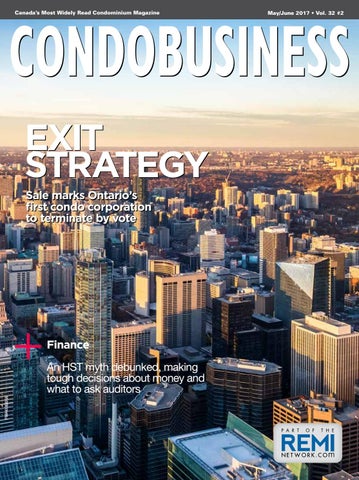
EXIT STRATEGY Sale marks Ontario’s first condo corporation to terminate by vote
An HST myth debunked, making tough decisions about money and what to ask auditors
PA R T O F T H E
PM#40063056
+
Finance
P A R T
O F
T H E
www.metrojetwash.ca • www.mjwodoursolutions.com
COMPACTOR CLEANING • CHUTE CLEANING • WASTE BIN & TOTE CLEANING MOBILE SWEEPING • UNDERGROUND & PARKING LOT SWEEPING & WASHING PIPE DUSTING & WALL WASHING • PARKING LOT LINE STRIPING & PAINTING
416-741-3999
“EXPERIENCE THE DIFFERENCE” DRAIN CAMERA INSPECTION • DRAIN CLEANING & FLUSHING CATCH BASIN & SUMP PIT CLEANING • EMERGENCY RESPONSE OIL SPILLS MJW ODOUR SOLUTIONS PRODUCTS & SERVICES
Our Business is to Make Yours Shine! Whiterose is an Industry Leader with a long list of condos in the downtown and surrounding areas Whiterose Janitorial Services Ltd. believes in servicing its customers with professionalism, communication and appreciation. The Key to our success is service, quality and value. We clean beyond the surface! Quality management begins behind the scenes prior to commencing a job all employees are evaluated and or training to the whiterose standard given special attention to health and safety policies. Whiterose Janitorial Services is a full service company and a member of ACMO and CCI. Specializing in cleaning and live in & live out Superintendents for the past 30 years. Spectrum of Cleaning Services: • Facility assessment • House keeping and general cleaning services • Customized cleaning service plan • Customized cleaning schedules • Window cleaning (Exterior high rise) • Garage cleaning • Marble restoration & Polishing • Carpet cleaning
Visit our website or call us today for your no-obligation quote! WhiteroseJanitorial.com 1-877-253-3648 / 416-850-9676
Spectrum of Superintendent Services: • Building audit • Check Hvac • Perform generator tests • Cooling towers • Chillers • Compressors • Sprinkler system • Fire pump • Hot water tanks • Booster pump • On call 24/7 for emergencies
COMMITTED TO EXCELLENCE SINCE 1986
Contents FOCUS ON: FINANCE
12
What to ask your auditor By Shlomo Sharon
21
HST misconception a sleeping giant By Stephen Chesney
24
Making tough decisions about money By Pat Crosscombe
DEPARTMENTS
28
Regulations The costs of ignoring code requirements for electrical safety By Scott Saint
FEATURE
IN EVERY ISSUE
16
10
Ask the expert
30
New and notable
Cashing out By Michelle Ervin
TRIVEST WILL MANAGE ALL THE DETAILS OF YOUR CONDOMINIUM BUILDING CUSTOMER SERVICE Make sure condo owners feel heard and supported in their living community. For more information, call 416.449.4100 TRIVESTDEV.COM
REGULAR MANAGEMENT REPORTING Accurate and timely financial statements. DETAILED OPERATIONAL UPDATES Daily maintenance, tender review and contractor management.
CONSULTING ENGINEERS
M & E Quality Services • Boiler Replacement Design • Domestic Piping • Chiller Design • Emergency Generator Design • Fire Protection Upgrade & Design • Maintenance Scheduling • Capital Planning Report • Building Audits • Project Management • Power & Lighting Design • Fire Code Compliance • Fire Safety PlanninG • Fire Alarm Design
EDITOR'S LETTER
Exit Strategy Heading into the spring real estate market, average selling prices for homes in the
GTA continued to climb by double digits year over year in the first
three months of 2017. Bullish observers contend we are coming into our own as a worldclass city, in the mould of Manhattan. There, demand has driven up prices to a point at which renting is not just a stopover on the path to home ownership, but also a final destination. Bearish observers warn we are reaching bubble territory, where prices have become detached from underlying fundamentals such as population growth. If that’s the case, prices will come back down to Earth in the course of a cyclical market. Whichever camp proves correct, average home price increases in GTA have prompted many home owners to ask themselves: Is now the time to cash out? The story of skyrocketing selling prices has focused on single-family homes, which are in high demand and low supply thanks to provincial policies promoting urban intensification over suburban sprawl. However, as single-family homes increasingly become out of reach for many prospective purchasers, these forces are spilling over into the condo market, where prices have also picked up steam in recent months. Normally, a condo unit owner would sell their suite individually. However, there is a provision in the Condominium Act that allows condo unit owners to come together to sell their property collectively, if 80 per cent of both owners and mortgage holders consent. That recently happened for the first time in Ontario. This month’s cover story looks at the process of terminating a condo corporation by vote to sell a property, and the circumstances in which it might make sense for others to do the same. Also in our finance issue, you will find articles on an HST misconception, how to make tough decisions about money and what questions to ask your auditor. Before CondoBusiness went to press, the Ontario government unveiled the Fair Housing Plan. The proposal included measures aimed at releasing steam from the hot housing market, including a nonresident speculation tax. Michelle Ervin Editor, CondoBusiness michellee@mediaedge.ca
Publisher Mitchell Saltzman Editor Michelle Ervin Advertising Sales Sean Foley, Stephanie Philbin, Melissa Valentini Senior Designer Annette Carlucci Designer Jennifer Carter Production Coordinator Nadya Domingo Contributing Writers Stephen Chesney, Pat Crosscombe, Scott Saint, Shlomo Sharon, Marko Lindhe and Noah Maislin Digital Media Director Steven Chester Subscription Rates Canada: 1 year, $60*; 2 years, $110* Single Copy Sales: Canada: $10*. Elsewhere: $12 USA: $85 International: $110 *Plus applicable taxes Reprints: Requests for permission to reprint any portion of this magazine should be sent to info@mediaedge.ca. Circulation Department Aashish Sharma circulation@mediaedge.ca (416) 512-8186 ext. 234 CONDOBUSINESS is published six times a year by
President Kevin Brown Accounting Manager Nadia Piculik, CPA, CMA 5255 Yonge Street, Suite 1000, Toronto, ON M2N 6P4 (416) 512-8186 Fax: (416) 512-8344 e-mail: info@mediaedge.ca CONDOBUSINESS welcomes letters but accepts no responsibility for unsolicited manuscripts or photographs. Canadian Publications Mail Product Sales Agreement No. 40063056 ISSN 0849-6714 All contents copyright MediaEdge Communications Inc. Printed in Canada on recycled paper.
/condomediaedge JTB_Condo_March_2017_FINAL.pdf
1
2017-02-23
11:36 AM
/condobusiness /condomediaedge
Working together – Making a difference
Residential: high-rise / low-rise ■ Residential: townhomes ■ Commercial / Industrial
■
Proudly serving Condominium Corporations since 2007
Tel: 416-663-2220 / 905-832-2220 ■ Fax: 416-663-2221 ■ www.jtbgroup.ca ■ email: info@jtbgroup.ca ■
5050 Dufferin Street, Suite 222, North York, ON M3H 5T5
KITEC REPLACEMENT Complete package available including drywall and paint.
◆
◆
Replaced with uponor which provides a 25 year warranty on pipe and remedial damage.
Complete Building Replacement Recirculation Mains Replacement
◆
Distribution Mains
◆
Valve Replacement
◆
Balancing Valve Installation
We Beat Any Written Quote!
24 HOURS
416-789-7611
PRETIUM GRG
BUILDING ENGINEERS
...The new name of
GRG Building Consultants
Same faces... Jerry Genge
Dale Kerr
Mike Tindale
Chris MacMillan
Christine Speziali Stéphanie Marcoux
Joined forces with...
Still solving your building problems... Leaking Windows... Accessibility Issues... Deteriorating Pavements...
Leaking Roofs... Spalling Balconies... Wall Deterioration... Parking Garage Deterioration... Leaning Retaining Walls... How much to put in the Reserve Fund?
Offering great services... Investigations... Litigation Support... Reserve Fund Studies...
Pretium GRG 355 Harry Walker Parkway North, Unit 6 Newmarket, ON L3Y 7B3
Proud Members of...
Repair Specifications... Expert Witness Testimony... Building Condition Assessments...
Pretium Anderson Toronto 385 The West Mall, Unit 401 Toronto, ON M9C 1E7
Pretium Anderson Burlington 4903 Thomas Alton Blvd., Suite 201 Burlington, ON L7M 0W8
www.pretiumgrg.com www.pretiumanderson.com
Construction Monitoring... Contract Administration... Accessibility Audits....
Pretium Anderson Waterloo 320 Woolwich Street South Breslau, ON N0B 1M0
Arbitech ADR 26 Hedge Road Sutton, ON L0E 1R0
Toll Free 1-800-838-8183
The view is even better, when it’s coupled with peace of mind. Ensuring open communication between unit owners and their Board of Directors is just one aspect of effectively managing condominiums. CLM’s team of professionally trained managers not only provide the highest standard of service, they ensure all aspects of accounting, site operations and physical maintenance is tailored to the needs of individual properties. If it’s time to reconsider your choice of professional management services; CLM—peace of mind, worry-free living. For competitive management rates, or to find out how CLM can be of further assistance, please contact;
Kazi Shahnewaz
Director, Business Development Office: 1.877.81CONDO (26636) x 467 Cell: 647.887.5676 k.m.shahnewaz@condominiumliving.ca www.condominiumliving.ca
Taking care of business Most board members have probably attended meetings slated to last one hour and have watched, with a sinking feeling, the clock tick past the three- or four-hour mark, with no decision or next steps in sight. Marko Lindhe and Noah Maislin of Minutes Solutions answer: How can boards run more efficient meetings? In the condominium world, meetings take place several times a year — often monthly, but sometimes more frequently if there are contentious or pressing items that require a decision. Sometimes, run-on meetings merit the time it takes to prudently discuss each topic, ensuring that everyone can share their piece and hopefully come to an agreement. However, other times, lengthy meetings are strictly the result of poor organization or an inattentive or inexperienced chair. Inefficient meetings can be costly if the corporation is paying an hourly rate for minute-takers and meeting room rentals. On top of that, there is the opportunity cost of participants’ time. Most condo board members are volunteers and often busy people: the longer the meeting, the less time they can allocate to other matters, whether personal or professional. If organized and executed correctly, condo meetings can be effectively conducted to achieve everything on the agenda. Missteps often come down to the conduct of the board, disorganization and the inability to zero in on the salient topics.
10 CONDOBUSINESS | Part of the REMI Network
This is where guidelines on facilitating organized meetings can help tremendously. Here are a few things to consider: Send the meeting package in advance Distribute the meeting package ahead of time so board members can prepare for what is to be reviewed, discussed or approved. Include the agenda and/or management report, financial statements, previous minutes and quotes from potential vendors. A well-outlined agenda will go a long way toward cutting down meeting times by setting a regimented course. Topics of discussion and amendments may arise from previous minutes; however, reviewing items in advance of the meeting allows boards members to quickly discuss potential changes and promptly issue approvals. Communicate before the meeting Send a list of approvals by email before meetings to save time when the board gathers. If everyone agrees to the approvals in advance, they can be confirmed via resolution at the meeting and adopted
ASK THE EXPERT into the minutes. This will significantly limit conversation about motions and topics on which most board members already agree. Also reconfirm the meeting with members and guests 24 hours before its start time to reduce the potential to fall short of quorum. It’s common for a board member’s availability to change right before a meeting and he or she may overlook the need to notify the rest of the board. It’s good practice to schedule board meetings at the start of the year, for the following 12 months, as this helps to reduce scrambling and rescheduling.
Stay on track with minutes and action items A good set of minutes will set boards up for success at their next meeting with clear action items that hold members accountable for any tasks they have been assigned. If members forget what their tasks are for the next meeting, they can always consult the previous minutes to see what needs to be accomplished. Showing up to a meeting without having tasks completed, or even acknowledged, can cause the meeting to veer off course before it even begins.
Boards that follow these steps will achieve a more professional discourse at their meetings and control debates in a tactful and time-effective manner. 1
Marko Lindhe and Noah Maislin are partners at Minutes Solutions, a Canadian third - p arty minute - taking c omp any established in 2014 . Marko can be reached at marko@minutessolutions.com or (647) 389-1568.
Define start and end times Everybody’s time is valuable. Although discussions may go longer than anticipated, putting a conscious timeline on the meeting encourages participants to respect the clock. Announce when there are 30 minutes left on the schedule to remind participants that a limited amount of time remains to complete any outstanding agenda items. Appoint a strong chair The chairperson is essentially the quarterback of a meeting and should possess the ability to mediate conflict and prevent dialogue from getting off course. A good chair will effectively manage the agenda, take control when necessary and steer the meeting away from potential tangents. Sometimes subsidiary topics are relevant; however, it’s up to the chair to allocate time to discuss these additional items as opposed to opening the door to a free-for-all. Anything newly posited should be put on the agenda of a subsequent meeting so that these topics can be addressed in an organized manner. After motions are passed, sometimes discussions continue due to a lack of clarity. A good chair will repeat and summarize motions to clear up confusion and to help the minute taker accurately record decisions. Avoid table talk It is human nature for people to socialize and talk about everyday topics such as the weather, family, sports, etc. However, for the sake of efficiency, these conversations should be saved for before or after the meeting. Respect fellow board members Opinions and ambitions often differ in a meeting — that is the beauty of a democracy. However, board members should respect the time and views of others and acknowledge the current tasks at hand.
Uplifting Designs, Custom Installation
At Premier Elevator, every detail counts. We custom design and manufacture our interiors to reflect the building’s décor, bringing harmony from floor to floor. Visit www.premierelevator.com for inspiring ideas just for you.
1 416 773 1400 info@premierelevator.com www.premierelevator.com
www.REMInetwork.com | May/June 2017 11
FINANCE
What to ask your auditor An independent certified public accountant prepares, audits and issues
BY SHLOMO SHARON
the financial statements of a condominium corporation. In doing so, he is reporting to the owners of the condominium units the state of the
financial position of the corporation. However, before issuing the final report, he needs the approval of the board of directors, who represent the owners. It’s important for board members to review the draft financial statements and know what questions to ask before giving their approval. The board is familiar with the financial dealings of the corporation and therefore well-positioned to detect any unusual items. This step ensures that proper financial controls have been followed. After all, the owners rely on the board members to fulfill this responsibility. The financial statements consist of three main parts: the balance sheet, the statement of general fund operations and the statement of reserve fund operations. Supplementary statements include the statement of cash flow. The balance sheet The balance sheet reflects the financial position of the corporation at a point in time, the year end of the corporation. It breaks down the financial position to the following components: assets, liabilities and fund balances (operating and reserve). When the financial statements are presented to the board for
12 CONDOBUSINESS | Part of the REMI Network
its approval, board members should ask some of the following common questions when they review the balance sheet: Is there enough operating cash to meet the immediate obligations of the corporation? In other words, the directors should ensure the operating bank account, together with any receivables, is sufficient to meet accounts payable and accrued liabilities. Are the cash reser ve and investment in line with the reserve fund balance? Remember that the reserve fund study ensures sufficient cash is available to meet anticipated capital replacement costs. What are the common element assessments receivable (better known as unpaid condominium fees)? Is any of this amount outstanding more than 30 days? And, if so, what action has been taken to collect it? If the receivable is current, was it collected after the year end? What is the breakdown of the accounts payable and the accrued liabilities? Is there any amount outstanding more than 60 days? And
“ I COULD
NEVER LIVE WITH SOMETHING HAPPENING TO MY TENANTS. Ensuring my staff and I always hire Licensed Electrical Contractors for electrical work isn’t only good for business, it’s good for my peace of mind. Hiring a ‘guy’ may seem cheaper, but doing it legally saves my tenants downtime, and saves me from sleepless nights.” -Mark Levinson Property Manager
Mark manages nine commercial properties and is considering using ESA’s time saving Continuous Safety Services. To learn more about your legal obligations and the benefits of CSS, visit esasafe.com/propertymanagers
FINANCE if so, what is the reason for not paying it? It’s important for the board to be aware of any amount that is unpaid for a long period. This will help avoid, among other things, potential lawsuits or a lien against the corporation. Does the reserve fund balance meet the reserve fund study requirement? If not, what are the reasons? What can be done about it? It’s common to see capital replacement expenses incurred earlier — or later — than expected. This should be noted and brought to the attention of the engineer who conducted the reserve fund study. The statement of general fund operations On the one hand, the balance sheet reflects the financial position of the corporation at year end. The statement of general fund operations, on the other hand, reflects the results of the 12 months before year end. It also includes, for comparison purposes, the prior year’s results and the current year’s budget. Common questions about the statement of general fund operations include: Is there any large variance compared to the prior year’s results or the current year’s budget? The answer should help the board identify any unusual fluctuations in expenses and seek out explanations. What is the reason for variances? Was it a controllable or uncontrollable expense? Controllable expenses can include hydro, repairs and maintenance. Some of the uncontrollable variances are utilities, insurance and new contracts, such as landscaping, snow removal and elevators. Has the corporation broken even, generated excess revenue or ended up in deficit? The result will influence the future condominium fee. Any deficit will have to be incorporated into the next year’s budget. A surplus may help keep the condominium fees in line or be transferred to the reserve fund if the board finds it necessary. Note: Once the funds are transferred to the reserve account, they cannot be then transferred back to the operating account, should a need arise. The statement of reserve fund operations The statement of reserve fund operations refers only to expenses that are qualified to come from the reserve account. The common questions are as follows: Was the allocation to the reserve account from the owners’ condominium fees done in accordance with the budget, which reflects the contribution required by the reserve fund study? A review of the reserve fund study will show the required yearly contribution, which should match the amount shown on the statement of reserve fund operations. Do all the expenses qualify as reserve fund expenses as defined in the Condominium Act? Section 93 (2) of the Act restricts these expenses to major repairs and replacement of the common element and assets of the corporation. Are there any reserve fund expenses that happened earlier than expected in the reserve fund study? Knowing the answer for this question will explain any variance between the reserve fund balance and the financial statement balance. Knowing and understanding the financial position of the condominium corporation is one of the most important aspects of the board’s role in governing for the corporation’s current and future strength. 1 Shlomo Sharon is the CEO of Taft Management.
14 CONDOBUSINESS | Part of the REMI Network
DelProperty_Condo_March_2017_FINAL.pdf
1
2017-02-14
1:32 PM
LEGAL
C
M
17
Y
CM
MY
CY
CMY
K
WHAT WHATARE AREPINHOLE PINHOLELEAKS LEAKS COSTING COSTINGYOU? YOU? REPAIR REPAIR COST: COST: $50,000 $50,000 PLUSPLUS $$$ $$$
Contact Contact us today us today for aforfree a free on-site on-site consultation consultation andand say say goodbye goodbye to to pinhole pinhole leaks leaks for good! for good!
REPAIR REPAIR COST: COST: $5000 $5000 - $50,000 - $50,000 $$ $$
$
416-410-3815 416-410-3815 www.rikos.com www.rikos.com
REPAIR REPAIR COST: COST: $1000 $1000 - $10,000 - $10,000 $
1 - 51 - 5
5 - 10 5 - 10
10 -10 20- 20
BUILDING BUILDING LIFESTYLE: LIFESTYLE: BARELY BARELY AFFECTED AFFECTED
BUILDING BUILDING LIFESTYLE: LIFESTYLE: MODERATELY MODERATELY AFFECTED AFFECTED
BUILDING BUILDING LIFESTYLE: LIFESTYLE: SEVERELY SEVERELY AFFECTED AFFECTED
PINHOLE PINHOLE LEAKS LEAKS / YEAR / YEAR PINHOLE PINHOLE LEAKS LEAKS / YEAR / YEAR PINHOLE PINHOLE LEAKS LEAKS / YEAR / YEAR
Untitled-3 1
Using Using certified certified German German engineering, engineering, the the Rikos Rikos pipepipe lining lining solution solution cures cures pinhole pinhole leaks leaks making making damaged damaged pipes pipes like like new,new, onlyonly better. better.
Like Like New, New, Only Only Better Better
2017-04-18 3:53 PM www.REMInetwork.com | May/June 2017 15
COVER STORY
CASHING OUT BY MICHELLE ERVIN
A recent sale marked Ontario's first condo corporation to terminate by vote. The unit owners of a boutique building in Toronto, constructed circa 1990, accepted an offer to buy their midtown property from a developer with plans to intensify the site.
COVER STORY
COVER STORY
“You need to look at whether the highest and best use — the underlying value of the land — is higher than the collective value of the units on the open market.”
The sale of a property in midtown Toronto that closed in January marks Ontario’s first case of unit owners terminating a condo corporation by vote, confirmed Greg Marley, partner at Deacon, Spears, Fedson and Montizambert, who acted as legal counsel for the corporation and owners. “Some condos have terminated through a different section of the [Condominium] Act,” said Marley. “Using this section 124, this is the first time it’s happened in Ontario, [and it’s happened] only once before in Canada, as well, through similar provisions, so it’s pretty rare.” Under section 124 of the Condominium Act, at least 80 per cent of both mortgage holders and unit owners must agree to the sale of a condo property for this type of
transaction to proceed. Most of the 27 unit owners at 39 Roehampton Ave. voted in favour of accepting an offer from a group of investors including a developer with plans to intensify the site. The transaction showed what the process of terminating a condo corporation could look like for others in the select circumstances where it might make sense for unit owners to sell collectively. Metropia is proposing to erect a 48-storey condo building on properties now occupied by the six- and eight-storey condo buildings at 39 Roehampton Ave., constructed circa 1990, as well as a two-and-a-half-storey house and a parking lot. The site is located immediately northeast of a major redevelopment occurring on the corner of Yonge Street and Eglinton Avenue.
Building Science & Restoration Consultants ■ Garage & Balcony Restoration ■ Building Envelope Assessment ■ Reserve Fund Studies ■ Technical Audits ■ Structural Engineering
Please contact: Philip Sarvinis | Bill Gladu | Michael Pond | Jeremy Horst 416-977-5335
Read Jones Christoffersen Ltd. Engineers
18 CONDOBUSINESS | Part of the REMI Network
rjc.ca
Metropia is also involved in that redevelopment, which is currently under construction. The neighbouring project, known as E condos, consists of a 58-storey condo building on the northeast corner of Yonge Street and Eglinton Avenue and a 36-storey rental building on Roehampton Avenue. The E condos project paved the way for the developer to connect any new building to a planned underground path to Eglinton subway station, making the opportunity to acquire the property at 39 Roehampton Ave. especially attractive, said David Speigel, president and chief operating officer of Metropia. But he left it up to the condo board to canvass unit owners to see if there was enough interest for the transaction to move forward. The unit owners of 39 Roehampton Ave. had fielded two offers from different prospective purchasers before receiving the third offer that ultimately succeeded, said Marley. The unit owners dismissed the first offer for being too low, after which the condo board had the property appraised to get a sense of its fair market value. The unit owners considered the second offer, which came through a cold-calling broker, but it failed to clear due diligence. Condo boards are not obligated to present unit owners with of fers to purchase their property, said Marley, but the board believed the third offer represented fair market value. The condo board notified the unit owners and hosted a series of information meetings to discuss how the process and the payout would work if the owners voted to accept the offer. Unit owners would get a share of the proceeds of the sale based on their propor tionate interest in the condo corporation, as outlined in the declaration, after closing costs, legal fees and real estate commissions, he explained. Following the information meetings, the condo board put the proposed deal to a vote of unit owners, enough of whom consented to accepting the offer for the sale to proceed.
COVER STORY In addition to seeing that the condo board had the support of 80 per cent of unit owners, the purchasers required a commitment that the property would be turned over free and clear at close. In other words, Metropia wanted to be certain that it wouldn’t face legal challenges from holdouts. “Great, you got 80 per cent; as far as we’re concerned, it should be 100 per cent,” explained Speigel, adding as an example: “We don’t want to find out later that we bought the building [and] there are 12 units that won’t move.” Before the deal closed, the condo corporation struck settlements with two unit owners who had voted against accepting the offer, said Marley. Section 125 of the Condominium Act entitles unit owners who object to selling a condo property to a mediation process to argue that an offer to purchase was below fair market value. If dissenters succeed in their argument, the condo corporation may be ordered to pay those owners their proportionate share, as set out in the declaration, of the difference between the purchase price and what has been determined to be fair market value.
Untitled-1 1
The condo corporation also had to collect written consent to the sale from mortgage holders for units in the building, with a promise that debtors would pay off their balances owing after the deal closed. This was one of the most challenging aspects of the process, said Marley, because section 124 of the Condominium Act neglects to spell out what happens to any outstanding claims against a condo property once the title changes hands. “The banks had no idea what was going to happen, and frankly we didn’t either,” he said. “It wasn’t until the day of closing when the land registrar said, ‘We’re creating a new pin, so all the mortgages are going to disappear.’” Metropia also wanted to be certain that it would be able to simultaneously close on all three properties that would be required to get the planning permissions for its proposed redevelopment, said Speigel. In order to achieve the necessary setbacks, or “elbow room,” to intensify the site, the purchasers had to acquire a neighbouring house owned by the Kohai Educational Centre and a portion of a parking lot owned by Bell. Metropia asked for a few extensions on its deadline for due diligence, as it faced the
tricky task of assembling adjacent lands, which is an exercise that would likely be a pre-requisite for the redevelopment of any existing condo building, Speigel said. Another time-consuming aspect of the due diligence process was the fact that the purchasers needed both the condo corporation and individual unit owners to sign off on certain documents, said Adam Lebow, associate at Owens Wright, which represented the purchasers. Normally, in this type of transaction a purchaser would either buy a whole building from a single owner or buy individual units from multiple owners. In a small condo corporation, with just a handful of units, a purchaser might take the latter approach, said Lebow. That’s because, in that scenario, one dissenting unit owner could be enough to scuttle a deal pursued under section 124 of the Condominium Act, which sets the 80-percent threshold for support. In the case of 39 Roehampton Ave., which proceeded under that provision, the transaction had to be approached from both angles. “We had to treat it as individual unit sales, but we also had to treat if as we’re buying the whole building at the same time,” he said.
www.REMInetwork.com | May/June 2017 19 14-10-22 10:58 AM
COVER STORY For example, the purchasers sought declarations that neither the condo corporation nor the unit owners were subject to any litigation, said Lebow. He also conducted searches to verify this fact for the condo corporation as a whole and unit owners as individuals. During this time, regular communication with the unit owners was critical, said Greg Evans, executive vice president of The Behar Group Realty, who brokered the deal. Unit owners were left in limbo during the due diligence period because the conditional sale recorded on the condo corporation’s declaration essentially prevented them from selling their units individually. “At the beginning of the process, there was real uncertainty as to why things took so long with the planning process and commercial negotiations,” said Evans. “It’s not the same as buying a house, where the negotiation starts at six o’clock and finishes at 11 o’clock that night.” Negotiated non-refundable deposits reassured the unit owners that the purchaser had an incentive to close the deal, he said. He also credited the condo board with playing a major role in effectively rallying and representing the unit owners to be able to see the transaction through to completion.
There may be some, albeit limited, opportunities in the Toronto market for other condo corporations with similarly boutiquesized, transit-proximate buildings to sell their properties as a whole, said Evans. “It fundamentally comes down to the location and the specific property,” he said. “You need to look at whether the highest and best use — the underlying value of the land — is higher than the collective value of the units on the open market.” Even under those circumstances, it takes patience from the condo corporation and transparency from the purchaser, who must work collaboratively for such a sale to succeed, said Evans. Based on his experience at 39 Roehampton Ave., he recommended that condo corporations considering this path look into what planning challenges a prospective purchaser may face upfront. The due diligence process in the sale of 39 Roehampton Ave. stretched nine months. The deal was finalized last October, after which there was a 90-day closing period. The unit owners authorized the members of the condo board to continue acting as their representatives during the closing period, from which point the condo corporation ceased to exist, said Marley. Unit owners
SEE THE DIFFERENCE WITH HEAT!
continued to pay maintenance fees to cover operating costs and reserve fund contributions for the remaining three months of their tenure in the buildings. When the sale closed this January, the remaining balances in the operating and reserve funds were transferred to a trust account, said Marley. The trust account will be paid out to the unit owners based on their proportionate interest in the condo corporation, as outlined in the declaration, after the corporation’s last utility and other bills have been settled. While the process of selling the condo property went relatively smoothly in this case, Marley predicted that the use of section 124 in the Condominium Act will remain rare. A unique set of factors facilitated this particular transaction: The more than 25 -year-old buildings at 39 Roehampton Ave. were dated, faced major upcoming expenses and surrounded by sweeping redevelopment. “You’re going to have to have a relatively small building,” Marley suggested, “because getting over 100 units would be unwieldy to try to get over 80 per cent of owners to vote in favour and all the mortgagees to consent as well.” 1
When disaster strikes call
Commercial water losses is our specialty. We dry the structure in place using a combination of assessment of building structures, hazardous material surveys and latest in drying technology.
STEAM OR DRY CLEAN, WHAT’S THE DIFFERENCE? Call us for an assessment from a certified carpet inspector! Fresh and Clean should be Fresh and Green
GREEN
Carpet, upholstery, tile, and grout cleaning. www.freshandclean.ca
Toll Free: 1-877-GREEN57
FreshClean_DryIt_FCM_JanuaryFebruary_2017.indd 20 CONDOBUSINESS | Part of the REMI1 Network
Dryit.ca has customized software that can offer our clients an emergency response system at no cost and cloud based reporting software so our clients can update themselves on a project’s status anytime 24/7 at their convenience. 24 hours a day 365 days a year. Water • Fire • Trauma • Abatement CALL us and let the pros take care of your disasters. www.dryit.ca
905-738-1759
1-877-473-3657
2017-01-13 11:25 AM
FINANCE
HST misconception a sleeping giant Income tax considerations have received a lot of attention lately in
BY STEPHEN CHESNEY
Canadian condominium corporations. Meanwhile, it looks like another type of tax has been flying under the radar and could become a potentially significant liability for condominium corporations, boards of directors and management companies who may be unaware of or even ignoring the issue.
MANAGEMENT FINANCE
HST or harmonized sales tax is a term not normally associated with condominium corporations. That may be due to some misleading articles and misinterpretations of the current law in Canada over the past decade. This article will focus on clarifying in general terms the HST rules as they relate to condominium corporations in Canada. The objective is to raise awareness so that owners, boards of directors and management can consider whether they may be affected by the issue. If so, then they should most certainly seek out professional advice. The largest source of the confusion has been with some previous pronouncements that “condominium fees in Canada are exempt from HST.” This statement is much too general: the law does exempt condominium fees, but only “residential” condominium fees. Therefore, what people often do not realize is that, generally, condominium fees on commercial units are not exempt and are in fact taxable. Complicating the matter are other types of revenues that are also taxable and have become more prominent over the past few years. Revenues such as guest suite
and party room rentals, roof rentals for tax registration number and begin to collect telecommunications equipment and certain and remit HST. While many condominium corporations types of parking rentals may also be subject to HST. This is not a complete list; there will fall well under this threshold, there is an are additional revenues that condominium exceedingly large number of condominium corporations earn and will need to be corporations that will find themselves above considered as well. These “other” or the threshold for exemption and that may “ancillary” revenues can add up to thousands have never even considered the implications. of dollars per year and are often overlooked To examine the potential tax liability, it’s when condominium corporations assess necessary to understand the system of whether they are required to collect and collecting and remitting HST. If a condominium corporation is in Ontario remit HST. So what are the rules to determine and exceeds the threshold for exemption, it whether a condominium corporation must would have to collect tax of 13 per cent HST register and charge HST on these previously on all commercial condominium fees and any mentioned sources of revenue? The other taxable supplies. However, they may legislation has a “small supplier” rule, which be able to claim “input tax credits,” which applies to non-profit organizations. Since are essentially some of the HST that they condominium corporations are generally have paid out on their expenses, such as considered non-profit organizations, they do various operating costs and other repair and not have to register and collect HST if their replacement projects. There is a lot of uncertainty as to what revenues, referred to as “taxable supplies,” are less than $50,000 for the year. Therefore, input tax credits condominium corporations each condominium corporation has to add can claim. The considerations var y up all of these taxable supplies. If the total depending on the situation. Some of the exceeds $50,000 on an annual basis the questions that arise are: What percentage TorontoDecorating_Condo_November_2016_FINAL.pdf 1 2016-11-10 be condominium corporation has to apply for a of total HST paid by the corporation can
C
M
Y
CM
MY
CY
CMY
K
22 CONDOBUSINESS | Part of the REMI Network
FINANCE
If this goes unreported the corporation could be held liable for the unreported tax as well as penalties and interest.
claimed as an input tax credit? How should expenditures such as reserve fund charges be handled when they may or may not relate directly to the taxable revenues? Where a condominium corporation has residential and commercial units or activities, it would be considered a mixed - use entit y for HST purposes. There are various rules in the law that need to be considered with respect to claiming input tax credits for mixed-use entities, so it’s critical to seek professional advice. Ultimately, the condominium corporation must remit the net HST to the government, usually on a quarterly or annual basis. So why call this a “sleeping giant” of an issue? Because it appears as if there are many
condominium corporations in Canada that are clearly well above the small supplier threshold and are not registered and are not collecting and remitting the tax. In some cases, they may have exceeded the threshold for years without considering the tax. There are also various strategies that a corporation can take to come into compliance with the law, such as making a voluntary disclosure. Therefore, if a corporation appears to be in a position where they are required to collect and remit HST they should immediately seek professional advice. W h a te v e r d i re c t i o n a b o a r d o r management chooses, continuing to ignore the issue and hoping it will go away is a risky strategy. If this goes unreported the corporation could be held liable for the
KITCHEN STACK PRESSURE CLEANING
unreported tax as well as penalties and interest. The government normally has a specific period of time to reassess a tax return, but a corporation is always liable for HST it has never reported. This could amount to many thousands of dollars and it can be resolved by registering and collecting the tax. While accounting for and collecting the HST are added burdens on management, a sudden assessment for unreported and uncollected taxes represents a much larger burden to the corporation. 1 Stephen Chesney is a Chartered Accountant and partner with the firm Parker Garber & Chesney, LLP in Richmond Hill and currently specializes in the auditing of Ontario condominium corporations.
with more than 80 years of.... owning, managing, building, and adding value THE ENFIELD GROUP INC. “ADDING VALUE AND PROFILE TO PROPERTIES DETAIL BY DETAIL”
Your plumbing & mechanical service experts Contact: Greg Fraleigh, RCM, President Tel: 905-689-7341 Fax: 905-689-7452 Toll Free: 1-800-263-6952 Email: gfraleigh@enfield.net
CALL 416-789-7611
www.enfield.net
www.REMInetwork.com | May/June 2017 23 Jermark_QP_Condo_June_2016.indd 1
2016-06-24 8:59 AM
FINANCE
Making tough decisions about money Making decisions as a condo director is part of the job. Financial decisions,
BY PAT CROSSCOMBE
especially those involving special assessments or fee increases, are tough. Making tough decisions will never be easy, but making the right tough decisions gets easier if directors follow these five principles.
24 CONDOBUSINESS | Part of the REMI Network
> SOCIAL MEDIA COLUMN Sponsored by MediaEdge
Involving your employees in your social media strategy
1
Carefully review the need for a special assessment Do not levy special assessments unless it is absolutely necessary. Owners do not like them, and their dislike often results in conflict and hard feelings between the board and the owners. Consider the following before making the decision. Some owners might have to sell their homes if they cannot pay the special assessment. This is the hardest part of the job for a director: making decisions in the best interest of the corporation knowing that the decision may negatively affect some owners. This might not be an issue for condos whose owners have higher incomes, but for many condos this consideration is vital. Also recognize that special assessments could cause a drop in property value, affecting sales in the short and long term. The effect is magnified if the corporation levies multiple special assessments. Interested buyers may back away completely if they think this means that the condo is poorly managed. Can the work be delayed or modified? A large project such as a window replacement can be spread out in stages over several years. A staged project can work well if accurate building maintance records exist. These records make it is easy to identify the oldest windows so that their replacement comes first. Another option is to modify projects, by selecting more costeffective finish options for an update of the interiors, for example. If the proposed work is going to be postponed, consider any negative effects on the property and owners. If the building looks old and worn out, this can affect the property value. Or if, for example, a roof replacement is delayed for several years, it could fail before it is replaced, causing damage that requires expensive repairs. This damage can include significant interior
damage for the unit owners. Repairs are costly, but there is also the emotional cost to the unit owner who is inconvenienced or has to move out of their home during the repair. Alternatively, can the condo borrow money? There are pros and cons. On the positive side, this eliminates the need for the assessment. On the negative side, interest rates for a loan like this will be higher than a personal mortgage or line of credit and could raise fees over the long term. Avoid special assessments by starting to plan high-cost projects at least a year ahead of time. Create a draft work plan. Get quotes and review the scope of work with the quote and the available budget. If these three items do not align well, then look at reducing the scope or quality or staging of the project. Lev ying a special assessment for unnecessary features will not go over well with the owners. That said, always aim for high quality; quality pays off over the long term, and this will result in lower maintenance costs and ultimately lower fees. If moving ahead with a special assessment, explain to the owners the rationale behind it and give them enough time to make their payments.
2
Provide detailed explanations for fee increases It is inevitable that condo fees increase every year — ideally no more than two to five per cent at a time. Sometimes an odd situation occurs that causes a larger-than-usual increase, but boards that manage and plan effectively minimize the likelihood of these situations. F in alize the new b u d g et well in advance of the start of the fiscal year to give owners as much notice as possible. No one ever complains about too much notice; everyone complains about not enough.
By Steven Chester Your company employees are often your biggest supporters. While some of your employees may be already happily snapping away and posting photos to their personal social media feeds, many may have some trepidation in crossing the personal/professional boundary. If you have someone at your office who is well-versed in social media, make them the point person. Across all platforms, a strong majority of users tend to sit back and watch the conversations rather than be vocal. With a little bit of reassurance and guidance, you may quickly turn a novice, passive user into a social media powerhouse. Make it fun. Encourage employees to take selfies at events, or develop a gamification strategy where they’re competing for the most outrageous shot via a hashtag competition. Let them show their personalities; showcasing their interests and skillsets will add a human touch to your brand. At your discretion, consider setting some guidelines of what can and cannot be posted. Rules and bureaucracy may in turn siphon away some of that fun, but a few simple guidelines as to what is and what is not acceptable may be in order. Now that your employees are involved, don’t forget about your own role. Part of your engagement strategy will be having someone keep on top of your company notifications so that you’re monitoring your employees’ efforts and making sure they’re on message.
Steven Chester is the Digital Media Director of MediaEdge Communications. With 15 years’ experience in cross-platform communications, Steven helps companies expand their reach through social media and other digital initiatives. To contact him directly, email gosocial@mediaedge.ca.
www.REMInetwork.com | May/June 2017 25
FINANCE It’s a good practice to provide a detailed explanation of the line items that increase, especially if the increase is greater than five per cent or is abnormal. For example, an unexpected and significant increase in the cost of water by the service provider needs an explanation. Do not try to be a popular board and never raise condo fees. This approach will backfire eventually when budget deficits occur.
3
Resist the temptation to play favourites “What a great idea to hire Bill’s snow removal company. Since he lives on the property, he knows exactly when to plow. He promised the best price, so how could the board say no?” As tempting as it might be, hiring owners or their companies is not always the best idea. Alw a y s g e t o t h e r p r i c e s , e v e n if the owner has promised to give the condo the best price possible. If other companies have not provided quotes, then it is impossible to know. Did any of the directors tell Bill the price he had to beat or did Bill get this information from the condo’s financial statements?
Giving Bill insider information on price is not fair to the other companies providing quotes and could definitely backfire once bidding companies find out. It’s much harder be objective when an owner is involved or when the owner is a friend of one of the directors. If the quality of the service is not acceptable, who is going to tell this owner?
4
Keep looking at the end game Condo directors have many tasks and responsibilities. It is easy to get caught up with day-to-day challenges and forget about planning for the longterm health of the corporation. Long-term p l anning is e qu all y as important as the immediate and short term. There is only one ultimate goal to keep top of mind: maintain or increase property values. Fortunately, this is an easy goal to monitor for most condos. Data from the sale of units are publicly available and easy to track in a spreadsheet. Some condos might have too few sales to get accurate data, but larger ones will have multiple sales each year.
Never keep secrets If the board automatically shares everything with the owners, then no one thinks that the board is hiding anything. A technology solution that gives the owners access to the condo’s records can help facilitate this sharing. Finance is one of those topics that never goes away. If boards rarely levy special assessments, always provide detailed explanations for increases, never p lay favourites, keep an eye o n t h e e n d g a m e a n d n eve r ke e p secrets, then tough decisions become manageable decisions. 1
5
Pat Crosscombe is the founder and CEO of BoardSpace (https://boardspace. co), a company that provides software for condo boards and property managers. She is the president of her condo board for the second time after a three-year break from a first term of five years. She can be reached at 613-790-0225 or pat@ boardspace.ca.
BrownBeattie_GTA_March_2017_FINAL.pdf
C
PRACTICAL APPROACHES ■ SENSIBLE RESULTS
M
■
Reserve Fund Studies
■
Performance Audits
■
Condition Assessments
■
Specifications & Tendering
■
Forensic Engineering
■
Roof Consulting
■
Construction Review
■
Contract Administration
Y
CM
MY
CY
CMY
K
Your plumbing & mechanical service experts
CALL 416-789-7611
www.brownbeattie.com
26 CONDOBUSINESS | Part of the REMI Network Jermark_QP_Condo_June_2016.indd 2
2017-02-01
556 Edward Avenue, Unit 71, Richmond Hill, ON L4C 9Y5 P 905 -737- 0111 F 905 -737- 4046 (Guelph) P 519 - 827-1757
BACK FLOW PREVENTERS
Testing • Design • Installation
1
2016-06-24 8:59 AM
10:36 AM
Coverage that is setting the standard in the Real Estate Management Industry. Find daily news and online exclusives on our website
May/June 2017
First condo manager licensing reg finalized
MPP proposes time limits for elevator repairs
A final version of the first set of rules under new legislation that will require condo managers to obtain licenses is now available. The rules, which were published in draft form late last year, have undergone some changes following public input, but the general system of licensing remains the same.
Han Dong, the Liberal MPP for Trinity-Spadina, is proposing to set time limits for contractors called on to fix out-ofservice elevators. Dong, whose riding is growing rapidly with the rise of new condos, introduced the Reliable Elevators Act to the Ontario legislature last week.
Reliable Elevators Act passes second reading A private member’s bill proposing time limits for elevator repairs passed second reading at the Ontario legislature last month. But its details are subject to change as it heads to the standing committee on regulations and private bills, and some MPPs are calling for building owners to share responsibility.
All the Buzz
From the Green Bin
Expert Advice
Social Media
Ontario’s Fair Housing Plan aims to stabilize market
Making bins more convenient boosts recycling rates
Opportunities through retro renovations
Connect with us on
The province is taking 16 measures to make housing more affordable for homebuyers and renters.
A new study shows that placing bins 1.5 metres away from suite doors drastically boosts recycling.
Douglas Spratt offers tips on how to achieve energy savings during planned projects.
Powered by
REGULATIONS
The costs of ignoring code requirements for electrical safety Sometimes it can seem easier to just hire someone to get a job done
BY SCOTT SAINT
fast and cheap, but when it comes to electrical work, keeping residents safe is paramount. While electricity plays an essential part in powering homes, workplaces and communities, it can also be dangerous. The Ontario Electrical Safety Code is critical in helping the Electrical Safety Authority (ESA) and property owners and managers work together to limit the risk electricity poses to residents and properties. A recent ESA survey of 350 property managers in Ontario found that close to 40 per cent didn’t realize the code applies to electrical work in their buildings. But it does; it applies to all electrical work. And the first step in abiding by the code is to hire the right professionals for the job. By law, if a property manager or owner is hiring someone to conduct electrical work in Ontario it must be a Licensed Electrical Contractor (LEC). If there is an on-staff electrician, he or she can do the work. Whether it’s an LEC or on-staff electrician, the code must be followed and the necessary electrical permits must be taken out, which means the work is subject to review by ESA. The requirements detailed in the code are meant to protect property owners, property managers and residents. In addition to the potential dangers posed by improper electrical work, such as a fire or shock hazard, there are costs associated with ignoring code requirements that can come back to haunt property owners and managers. Beyond the safety risk itself, the courts have demonstrated through increased fines and a jail sentence in 2015 that they are taking a firm stance on illegal electrical work. There can be severe legal consequences for those who put public safety at risk.
Expensive redos Imagine this scenario: A condo corporation wants to install some new energy-efficient lighting in its lobby. A friend of the property manager or one of the property owners recommends a contractor who is unlicensed. Since the job is simple enough the property manager or owner is confident this person can get it done. Five years later, after the property owners have seen the savings add up, they decide to have energy-efficient lighting installed throughout the entire parking garage to reduce energy costs. This time, an LEC is hired and the proper permits are taken out. While doing the work, the LEC notices some work that is not up to code and poses serious safety hazards. The ESA inspector notices the same. All of a sudden the entire system needs to be re-installed at a significant cost. Luckily, in this scenario, no property was damaged by the unsafe electrical installation. But what if the poor electrical work sparked a fire? Several years ago, a malfunctioning switch in the electrical room caused a fire in a high-rise apartment complex in eastern Ontario. The blaze left more than 1,000 people homeless and wrought extensive damage resulting in multimillion-dollar repairs. This fire was so severe that the building remained unoccupied four weeks later. This example may be extreme, but with an LEC and proper permitting, it’s possible to identify risks before they become serious hazards. Unpaid claims Between 2011 and 2015, there was an average of 651 fires per year in Ontario caused by electrical wiring and outlets, according to the Office of the Fire Marshal and Emergency Management
28 CONDOBUSINESS | Part of the REMI Network
(OFMEM). If a property owner is found to have breached the law, an insurance company could decide to deny a claim and the property owner could be on the hook for repairs. Not only could they lose their own property due to damage or overwhelming rebuilding costs, they could be held liable for third-party damages to neighbouring properties as well. All of which could mean the property manager loses his or her job. Safety risks The OFMEM also found that, between 2006 and 2015, there were 26 fatal fires in Ontario caused by faulty electrical wiring. The financial risk associated with using an unlicensed contractor is clear, but it’s the safety risk to residents that should worry property owners and managers most. No matter how much it might save the budget to use an unlicensed contractor, it’s not worth risking residents’ lives. Ontarians rarely worry about appliances catching on fire or getting electrocuted by light switches thanks to a century of work developing and improving safety standards. But each time someone circumvents the law by ignoring these standards, it makes everyone less safe. Ultimately the goal of ESA and the property manager is to ensure all buildings are safe — for the public and for residents. 1 Scott Saint is Chief Public Safety Officer of the Electrical Safety Authority (ESA). The ESA is responsible for public electrical safety in Ontario. Part of ESA’s role is to work together with Ontarians to help them understand the requirements of law for the province.
Øh me, øh my.
Albion Golf Cars of Toronto is proud to announce exclusive Canadian distribution for the new line of electric Garia Utility mini-trucks. Manufactured in Denmark, the Garia combines four-season reliability, ergonomics, and zero emissions – with comfort, functionality and ‘Øh me, øh my’ design. Enhance your property with Garia’s 620kg load capacity and up to 60km on a single charge. (Øh my!)
905.629.7000
Arrange a test drive at: info@albiongolfcars.com 416.236.1001 For full specifications visit: gariautility.com
Untitled-1 1
2017-04-19 12:35 PM
KITCHEN STACK PRESSURE CLEANING Full Project Management $5M Insurance with WSIB Coverage Licensed and Certified Professionals team
• Full Building Renovations • Everyday Property Maintenance • 24 Hour Emergency Services • Flooring/ Painting/ Carpentry and much more...
Your plumbing & mechanical service experts
CALL 416-789-7611
www.FINAConstruction.ca Phone: 289 800 1234
Email: info@finaconstruction.ca
www.REMInetwork.com | May/June 2017 29 Jermark_QP_Condo_June_2016.indd 1
2016-06-24 8:59 AM
NEW AND NOTABLE
Online shopping reaches new heights Buyers can purchase pre-construction condos digitally for first time in Canada Units in Richmond Hill’s Yonge & King Urban Towns were expected to become Canada’s first pre-construction condos available for purchase digitally when sales began last month. Casalova, a brokerage and real estate marketplace, partnered with Dream Maker Developments to offer the online buying option. Digitizing this process tackled some of the potential pitfalls of purchasing pre-construction condos, such as getting to the front of the line at a sales centre and learning that a sought-after unit has already been snapped up. “Buying a condo, or even looking for a rental unit, is incredibly stressful and time-consuming,” said Ray Taaeb, CEO and co-founder of Casalova. “We want to remove the legwork and make it as easy as possible to make the purchase. “This feature will give homebuyers the opportunity to research and compare all units without any pressure before making an informed decision.” Condo features, floor plans and square footage will be accessible online to prospective purchasers, who will also be able to file paperwork and make deposits using credit cards digitally. After the sale goes through, buyers are entitled to the same 10-day cooling off period as they would be if the sale occurred in person. “This digital approach appeals to a huge market of potential buyers and also saves resources that would otherwise be invested in model suites and sales centres,” said Isaac Olowolafe, CEO of Dream Maker Developments. “Developers are always looking for new ways to reach more homebuyers and this offering modernizes how people purchase a pre-construction condo.” For more information, visit Casalova.com.
30 CONDOBUSINESS | Part of the REMI Network
KITEC REPLACEMENT Complete package available including drywall and paint.
◆
◆
Replaced with uponor which provides a 25 year warranty on pipe and remedial damage.
Complete Building Replacement Recirculation Mains Replacement
◆
Distribution Mains
◆
Valve Replacement
◆
Balancing Valve Installation
We Beat Any Written Quote!
24 HOURS
416-789-7611
You Can Suite Meter Electricity Water Natural Gas Thermal Solutions that will save you time and money.
1-866-836-3837 info@prioritymeter.com prioritymeter.com
Submetering. Good For You.