Canadian
&
Winter
2019/2020
Restaurant Foodservice News Official Magazine of the Culinary Federation
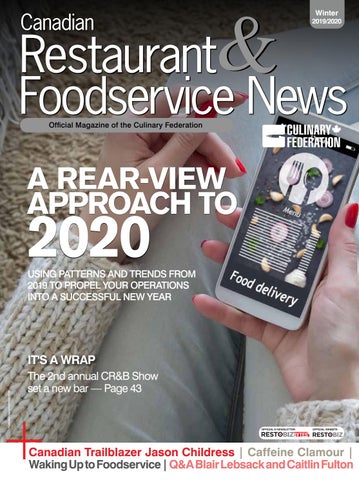
A REAR-VIEW APPROACH TO
2020
USING PATTERNS AND TRENDS FROM 2019 TO PROPEL YOUR OPERATIONS INTO A SUCCESSFUL NEW YEAR
Publication Agreement #40033126
IT'S A WRAP The 2nd annual CR&B Show set a new bar — Page 43
+
OFFICIAL E-NEWSLETTER:
OFFICIAL WEBSITE:
Canadian Trailblazer Jason Childress | Caffeine Clamour | Waking Up to Foodservice | Q&A Blair Lebsack and Caitlin Fulton
OUR PRODUCT CATALOGUE IS NOW
Online
olymelfoodservice.com
contents Winter 2019/2020 VOL. 10 NO. 4
14 COVER STORY
FEATURES
SPECIAL SUPPLEMENT
24 A Rear-View Reflection for Forward Motion Year-end is an opportunity to reflect and plan for a more successful New Year
14 Beverage Feature Caffeine Clamour
31 The Culinary Federation’s À LA MINUTE
DEPARTMENTS
23 Tools of the Trade At Your Service
4 Editor’s Note Hindsight Is the Year 2020 6 Canadian Trailblazer Breaking With Tradition 10 Chef Q&A Blair Lebsack and Caitlin Fulton: “There has to be passion at the heart of it” 46 Crunching Numbers In With the Old
19 Mealtime Supplement Waking Up to Foodservice
43 CR&B Show Wrap-Up Setting a New Bar
ADVERTISER FEATURES (FROM OUR PARTNERS)
8 There's an App for That By Reuven International Ltd.
40 A Cut Above By Flanagan Foodservice
45 Cacio e Pepe By McCormick
“
It’s trying to create an elevated experience with the VIP experience specifically that’s trying to meet [customer needs].
”
-— Jason Childress, executive director of foodservice at Cineplex
EDITOR'S NOTE
HINDSIGHT IS THE
YEAR 2020 Breaking old traditions, making new ones: 2019 has been grand, but it's time to look to the future
T
he year’s end is a curious juxtaposition: it’s a time of reflection – Auld Lang Syne and all – but also of looking forward; nostalgia, and anticipation. It’s particularly curious for me, in this context, to be writing my Editor’s Note for this issue, having come so recently to the Canadian Restaurant & Foodservice News table. In some ways, it’s a welcome return to my own roots, having begun my editorial career as an intern for a magazine in a similar space, while also representing the beginning of what is sure to be an exciting new chapter. It’s a similar position to that of many of the companies, consultants and chefs found within the pages of this issue as they reflect back upon 2019 while also looking forward into 2020, to new opportunities and challenges that await. In fact, it is this topic exactly that our cover story, “A rear-view reflection for forward motion,” (page 24) puts under the microscope, analyzing patterns and trends from this past year to provide foodservice operators with concrete tools for ensuring success in the year to come. Third-party delivery, labour costs and labour shortages – hospitality leadership coach Matt Rolfe takes 2019 in stride and lays out concise, actionable exercises foodservice leaders can take to identify their strengths and areas for improvement, and set intentions for future success. Themes of new beginnings and forward momentum are also addressed in our other feature stories, including: • A post-event wrap-up and reflection on how the second-annual Canadian Restaurant & Bar Show not only met expectations set by its 2018 debut, but surpassed them (page 43); • How breakfast can still be the most important meal of the day, even as it increasingly becomes the one most-skipped, in Asad Amin’s “Waking Up to Foodservice” (page 19); • A deep dive into how Cineplex’s executive director of foodservice, Jason Childress, is forging a new foodie future for the franchise, including fully-licensed bars and restaurants for clients seeking more than just a movie, in “Breaking with Tradition” (page 6). From thoughtful reflection to forward-thinking foodservice strategy, CRFN’s Winter 2019 edition helps readers face the New Year with their best foot forward. I’m incredibly excited to meet you there.
Sara Burnside Menuck Managing Editor
4 Winter 2019/2020 | Canadian Restaurant & Foodservice News
&
Canadian
Restaurant Foodservice News The official publication of the Culinary Federation, RestoBiz.ca, RestoBizBYTES and RestoBizGuide. PUBLISHER: Chuck Nervick chuckn@mediaedge.ca ASSOCIATE PUBLISHER: Nick Nervick nickn@mediaedge.ca MANAGING EDITOR: Sara Burnside Menuck sarab@mediaedge.ca DIGITAL MEDIA DIRECTOR: Steven Chester stevenc@mediaedge.ca ART DIRECTOR: Annette Carlucci WEB DESIGNER: Rick Evangelista PRODUCTION MANAGER: Rachel Selbie rachels@mediaedge.ca CIRCULATION INQUIRIES: Anthony Campbell 416.512.8186 ext. 234 circulation@mediaedge.ca
Magazine Editorial Advisory Board Jason Bangerter
Ryan Marquis
Executive Chef, Langdon Hall Country House Hotel and Spa
Corporate Chef, CW Shasky
Donna Bottrell, RD Owner, Donna Bottrell Food Consulting
National Director of Culinary Services, Amica Mature Lifestyles Inc.
Andrea Carlson
Brent Poulton
Chef/Owner, Burdock and Co.
CEO, St. Louis Bar and Grill
Connie DeSousa and John Jackson
Doug Radkey
Gary McBlain
Co-owners/chefs, Charcut/Charbar
Owner and Director of Operations Key Restaurant Group
Jeff Dover
Matt Rolfe
Principal, fsSTRATEGY
CEO and Hospitality Leadership Coach/Speaker, Results Hospitality
PRESIDENT:
Kevin Brown
SENIOR VICE PRESIDENT:
Chuck Nervick
Published by: MediaEdge Communications Inc. 5255 Yonge Street, Suite 1000 Toronto, Ontario M2N 6P4 Tel: 1-866-216-0860 Fax: 416-512-8344 E-mail: info@mediaedge.ca • Website: www.restobiz.ca Copyright 2019 Subscription Rates: Canada: 1 year, $50*, 2 years, $90*, US $75, International $100 Single Copy Sales: Canada: $12* * Plus applicable taxes Publications Mail Agreement No: 40033126 PAP Registration No. 10983 ISSN 1494-7625. We acknowledge the financial support of the Government of Canada through the Publications Assistance Program towards our mailing costs. Views expressed are not necessarily those of Canadian Restaurant & Foodservice News or the editorial staff. Although every care will be taken of material submitted for publication, Canadian Restaurant & Foodservice News, its servants or agents accept no responsibility for their loss, damage or destruction arising while in its offices, in transit or otherwise.
BREAKING WITH TRADITION
Everyone has a favourite movie snack. Get ready to have a favourite meal By Gregory Furgala
6 Winter 2019 | Canadian Restaurant & Foodservice News
CANADIAN TRAILBLAZER
P
op, popcorn and candy: It wasn’t long ago that foodservice at movie theatres was limited to that simple holy trinity. It was tradition, and children who grew up pouring a box of Milk Duds into their popcorn and washing down the salty-sweet combination with a Coke became adults who did the same. Snacking at the movie theatre was tradition, attested to by the lineups before the various screenings and quick dash back into the theatre to catch the previews. Now, that holy trinity has a sizable supporting cast that includes everything from pulled pork tacos to old fashioneds — at least it does at Cineplex Odeon, which now boasts in-theatre franchises, fully licensed bars and menus that cater to customers looking for more than just a movie. “We know there’s that iconic mealand-movie experience that’s happening naturally,” says Jason Childress, executive director of foodservice at Cineplex Entertainment. “It’s trying to create an elevated experience with the VIP experience specifically that’s trying to meet that need.” Like everyone else, Childress stuck to popcorn, candy and pop when he went to the theatre as a child. Unlike most kids, though, Childress grew up in the foodservice business. As a child in B.C., he’d help his grandmother run a concession stand during the summer, and as a teenager, he helped her run restaurants in Yellowknife. His parents met in the ‘70s while working at KFC, where Childress later worked himself. Foodservice was his professional life growing up, and in 1998, he started working at Cineplex Entertainment, where he’s been ever since. Childress’s timing was auspicious. At the time, Cineplex was just starting to explore other foodservice options — call it the start of the theatre-foodservice reformation — and was entering into franchise agreements with food-court staples like New York Fries, Burger King and KFC. That first foray into genuine menu expansion was successful, and it demonstrated the impact that offering more than just the classics could have on Cineplex’s bottom line. It became an avenue for Cineplex to claim its share of a meal occasion, and it has underwritten the development of Cineplex’s foodservice operation ever since. “Looking at where VIP is today versus where it was 10 years ago, it’s significant,” says Childress, referring Cineplex’s program of in-seat dining. “But it was the first dipping of the toe in that created the realization that there was a greater demand for that.”
Restaurant operators are no strangers to a customer rush, but the sheer demographic diversity of the theatre rush makes it something else entirely. Meeting that demand isn’t as simple as opening a restaurant, bar or service counter, though. Despite the increasing importance of foodservice at Cineplex, the main draw is still the films — it’s what gets customers in the door, and it’s what their night at the theatre revolves around, and the rhythm of the VIP lounges, bars and in-theatre QSRs are subject to masses of people they bring in at the same time. Restaurant operators are no strangers to a customer rush, but the sheer demographic diversity of the theatre rush makes it something else entirely. Like going to restaurants, theatre-going is a common experience, but unlike the innumerable local pubs and bistros people self-sort into, most of us end up at theatres like Cineplex to catch new releases. “We have such a wide breadth of guests that are coming into our buildings that are really being driven by the content on a week-over-week basis,” Childress says. “Unlike a traditional restaurant that has, for the most part, the same sort of guest coming in every week, within our space, it varies wildly. The biggest Marvel movie that’s out on a given week is a different demographic is a very different demographic than say, the Downton Abbey movie.” The scale of those rushes complicates things further. Concessions has long been accustomed to dealing with it, but providing a full sit-down-meal experience takes longer than passing over a bag of popcorn (even with extra butter). Technology, thankfully, has caught up with the crowds. “Depending on the theatre, you could have a thousand, multiple thousand guests, coming in a very short window — typically people are coming in 15 to 30 minutes before the movie — and they’re looking to have that meal occasion in that window while they’re there,” Childress says. “You have these real peaks and valleys. You have to develop menu items that are easy to execute, appealing and reach a quality that we want to have.” Perhaps more than in traditional restaurants, meeting these customers’ expectations of quality, speed and selection is critical. The dinner-and-a-movie experience that Childress has brought in-house directly competes with restaurants — many of which surround movie theatres
— upsetting an unofficial relationship that has long supported both. When Cineplex made those initial forays into branded QSRs back when Childress first started, and especially when it started offering its own restaurant experience in-house, it started a turf war. And while most Canadians have some sort of relationship with Cineplex — it has 164 theatres, 1,674 screens and caters to 77 million customers every year — most of them are still on popcorn, Milk Duds and Coke. But Childress sees that changing. Larger VIP auditoriums that have upward of 130 seats typically see around 100 people partake in the menu. By and large, people are still forming their initial impression of Cineplex’s upscale foodservice. Even with that initial risk, Cineplex has everything to gain from its entry into conventional foodservice. Before, seeing a movie was a snacking occasion. With burgers, pizzas and tacos, it’s getting into the lunch and dinner dayparts. It’s not replacing concessions, though; it’s adding to it. Childress says the theatres to which Cineplex adds these menu options see an incremental increase in revenue. “Even myself as a guest, when I go with my wife, you go for a meal, but you’ve got to have popcorn, right?” Childress says. “You can’t go to the movies without a small bag of popcorn. And we see that play out a lot, where we’ll see someone consume even a full meal that’s consumed prior, maybe in the lounge or restaurant space, but they’re grabbing the popcorn on their way into the actual movie.” When Childress first started working at Cineplex Entertainment, the company was just starting to take on a challenging task. Incorporating traditional foodservice into the theatre experience wasn’t just about adding a new service; it was about taking on tradition. But two decades later, that effort has borne fruit, and it will likely become normalized as children’s early experiences going to the theatre are shaped by the food around them. “We’re happy with how the menu has developed, but it’s constant evolution,” Childress says. “It’s about trying to make sure we’re appealing to guests as they age into VIP.” All traditions start somewhere. At Cineplex, they’re starting with a meal. www.restobiz.ca | Winter 2019 7
ADVERTISING FEATURE FOUR IN A FOUR-PART SERIES
Chef David Cocker
THERE’S AN APP FOR THAT
Corporate Research Chef & Business Development Manager Reuven International Ltd.
Demand for shareable small plates is ever increasing. Reuven International helps restaurants meet that demand with a tantalizing lineup of appetizer-friendly products Appetizers and small plates are on the rise! Consumers are ordering appetizers as a way to try something new, share with a friend or control portion size. As eating habits shift more toward snacking, dishes such as starters, small plates and sides provide the flexibility needed to meet these evolving consumer needs. Today’s consumers are looking for appetizers that are flavourful, valuable and shareable. Fifty-five per cent of appetizer consumers typically share appetizers with others in their dining party, giving restaurants a great opportunity to dramatically increase their average seated bill. The top growing categories of appetizers have been protein-focused (such as chicken wings with a 29-per-cent rise in demand) and dippers (such as spinach and artichoke dip, with a 33-per cent rise in demand). At the same time, 41 per cent of consumers would like restaurants to offer more appetizers featuring new or unique ingredients and flavours. FAVOUR THE FLAVOUR This gives restaurants a great opportunity to add unique ingredients and flavours to their appetizers and separate themselves from other tired appetizer offerings. Reuven International offers a great lineup of appetizer friendly products such as our Battered Chicken Breast Chunks (10500), Chicken Bites Stuffed with Cheese (49710), Chicken Karaage and Plain Steamed Chicken Wings. All of these offerings are great additions to any appetizer menu as they’re neutral in flavor, allowing your culinary specialists to add their own personality to the dish with innovative glazes, ingredients and flavours. For example, taking Reuven’s fully cooked plain steamed chicken and marinating it overnight in a in house special jerk marinade can give a basket of wings a new, flavourful life.
No matter what apps or small plates operators choose to offer, pricing can be tricky. With consumers’ desire for higher quality and premium ingredients, food costs for many appetizers and small plates can come in about the same as an entrée — on average, about 31 per cent. That said, paying close attention to food costs as well as ensuring consistent portion control are key to maximizing profits. There is a growing preference for meals that include bundling several smaller portioned or shareable dishes instead of your typical single plated entrée offering. Small plate and appetizer bundles, samplers and more innovative side dishes are trending as consumers increasingly decide on meals that feature a variety of flavors. ADDED VALUE To today’s consumer, the term “value” doesn't only mean low price. What they are really looking for is great taste and quality for the price. Revamping the way we think about appetizers could be a great opportunity for restaurants to capture this growing market. Focusing on craveable items that can be executed at a high level while hitting a target price point can give guests the opportunity to try some new creations. Using Reuven’s new Chicken Bites Stuffed with Cheese can be easily served in the typical way, using eight pieces in basket with a flavourful dipping sauce. But executed at a high level – for example, serving six pieces with a rich marinara sauce, garlic aioli drizzle, fried sage leaves and grated parmesan – can elevate an appetizer, making it more enjoyable and shareable for the table.
CARING IS SHARING With about a third of consumers saying they typically order their restaurant meals with some sort of customization, restaurants are now at the cusp of being able to offer smallerportioned appetizers, while giving the consumer the option to bundle and customize their appetizer offerings. With multiple items, the plates also have the bonus of being shareable. When your consumers want appetizers, they reach for easily shareable fingers foods such as French fries, chicken wings, onion rings, fried cheese bites and chicken tenders Also popular are classic finger foods that are familiar but feature a fresh twist. Some examples of these are bacon-stuffed tater tots, chicken parmesan bites, hot and honey chicken wings, mini chicken ‘n’ waffles and chicken avocado spinach dip. Asthedemandforfoodie-centricappetizers grows, this is a great opportunity to be at the forefront of this demand, gaining recognition for outrageously delicious appetizer offerings that your guests will see as valuable options. Reuven International provides a fantastic lineup of products to help you create innovative menu applications utilizing innovative poultry products.
Chef David Cocker is the Corporate Research Chef at Reuven International, the global poultry experts. With a wealth of culinary creativity, industry expertise and a unique culinology research chef background, he helps create innovative recipes, does detailed product analysis and leads customer ideation sessions from their state-of-the-art test kitchen. For more information about the latest trends in the poultry industry call 416-929-1496 or visit www.reuven.com.
8 Winter 2019 | Canadian Restaurant & Foodservice News
new
DusteD ChiCken Wings Lightly dusted in seasoned flour... Ready to dip, dunk & disappear. Our tender juicy fully cooked Dusted Chicken Wings are lightly coated in seasoned flour. They’re perfect for dipping or tossed in your signature sauces and provide you with:
> Quick and easy preparation - freezer to fryer ready in minutes > Use only what you need - individually quick frozen > Fully cooked - just heat and serve > Consistent piece weight and serving costs > Halal certified
For more information please visit Reuven.com www.restobiz.ca | Winter 2019 9
Q&
BLAIR LEBSACK AND CAITLIN FULTON “THERE HAS TO BE PASSION AT THE HEART OF IT” Named for quiet stretches of road running through rural Alberta, Edmonton’s RGE RD (pronounced Range Road) lives up to its farm-focused namesake Blair Lebsack and Caitlin Fulton, partners in business and life, didn’t want to wait around to open their restaurant, so they didn’t. Instead, they launched a series of seasonal, pop-up farm dinners while they searched. They found it in 2013, and with Lebsack running the kitchen and Fulton running the front of house, the duo have made RGE RD one of Edmonton’s best spots to experience local cuisine, and have even expanded it, added a private dining, events and sometime-retail space called the Butchery. CRFN chatted with Lebsack and Fulton about the challenge of a farm-to-table approach, running a restaurant with your significant other and where RGE RD is heading next.
10 Winter 2019 | Canadian Restaurant & Foodservice News
photo credit: Theresa Tayler
FOODSERVICE EQUIPMENT PARTS EVERY COMMERCIAL KITCHEN
YOUR POCKET-SIZE PARTS EXPERT
This interview has been edited for length and clarity. CRFN: Tell me about your backgrounds in hospitality. Blair Lebsack: I’ve been cooking now for over 20 years, and I’m pretty much an Alberta
boy. I started out doing food and beverage management with Red Deer College and enjoyed the cooking side a bit more, so I decided to take on an apprenticeship. I’ve worked in Banff, Bright Creek, Canmore, went to Saskatoon, then found a home in Edmonton.
Caitlin Fulton: I have worked in restaurants since I was 20 years old. I started working in
restaurants as a server while putting myself through university, so I have an undergraduate degree in drama and comparative literature from the University of Alberta. But I moved around quite a bit in my twenties. I initially started going to theatre school in Toronto, and then I went to Vancouver for most of my 20s, and performing in theatre and always supplementing my income by working in restaurants. After awhile, it became clear that restaurants were more of a career and a passion, so that took over.
BL: And you love wine. You did a lot of wine research — we travelled a lot before we opened up RGE RD, and I think Caitlin’s wine knowledge is unbelievable. We have an outstanding wine and drink list at the restaurant because of that. CF: Yeah, we ended up really being inspired by travel. I’ve been an avid traveller and spent time living in Bordeaux. CRFN: RGE RD started as a pop-up, outdoor dinner series. What made you two decide to transition to a brick-and-mortar restaurant space?
The best OEM parts app in food service GET THE APP
CF: We were actually in the process of looking for a restaurant space when the farm dinners began. We hadn’t quite found a permanent space, but that didn’t stop us from wanting to create meals, create experiences. But the plan was always to find a brick-andmortar location. BL: And we really wanted to prove to the farmers that we wouldn’t just talk about using the term “local.” We’d sleep overnight on farms and wake up in the morning and do chores with them. The two years of farm dinners before we opened our restaurant really solidified the way we wanted to take. Now when we ask a farmer to raise 100 pigs for the www.restobiz.ca | Winter 2019 11
CF: We’ve actually got a complete circle, a feedback loop. We’re not saving vegetables scraps from the restaurant that go back to feed the pigs, so they’re dropping a carcass and picking up some food for the week to supplement their feed. CRFN: Blair, you were instructing at NAIT before opening. What made you go from the stability of a teaching job to opening a new restaurant? BL: Where you have holidays off, two months off in the summer and benefits and all those sorts of things to a restaurant? Honestly, I just love restaurants. It’s one of those things that, when first got into cooking, it was the feel of a restaurant that got me into cooking. It has turned into food, but a lot of it was hospitality, and I absolutely loved the feel of restaurants, and they took me to a different world when I visited different restaurants and got taken with what they’re doing. That’s just what I wanted to create. With starting this whole project — the pop-up, the restaurant — you’re a pair in business, but also in life. Was there any nervousness with working so closely together? CF: Yeah, for sure. I would never out-and-out recommend people go into business with their husband or wife, but I think in the case of Blair and I, we actually met working, so we had a very strong basis in terms of respect for one another as professionals. That’s always been present in our relationship. But definitely for us, starting a restaurant 12 Winter 2019 | Canadian Restaurant & Foodservice News
photo credit: Dong Kim
Q& year, they don’t question us. They know we’re going to purchase those 100 pigs. We have a bit more of that one-on-one connection with them that allows us to really be right at the beginning of the process of our food. We convinced one farm to raise lamb for us so we can get lamb. We specifically get duck and geese breeds for us from another farm. It allows us to take our restaurant to the next level because we have that close connection with them.
is as much an emotional process as anything. When you give up stability, when you give up all the comforts of a union job with benefits and all of that safety and go into the entrepreneurial realm, it has to be a labour of love, there has to be passion at the heart of it. BL: I never would’ve wanted to do it with anyone other than Caitlin. I just trust her side of hospitality and knowing how to run that whole front of house side, it’s just amazing. We knew that going in. CRFN: How does managing all those different relationships with farmers at that granular level change the day-to-day of the restaurant? BL: From the kitchen perspective, it makes you be creative. One of our things is that the farm dictates the menu, so it really helps you to focus on things that are from this area. We ask the farmers what’s going to be best on a weekly basis. Like right now, one of the best things is kale that’s been frozen once. Frozen kale is just so sweet and beautiful, so we’re getting this kale that’s fresh out of the field, but it’s been frozen once, and I’ll tell you, people should always want their kale to be frozen once. For ordering, it’s a lot of individual text messages and emails, so it’s not hard, but it is time consuming. CRFN: And on the front of house side? BL: From the front of house side, our servers are always really excited to see what comes through the door. Their primary job is to relay that story of how it gets to the farm to the plate. They’ll always say, time and time again, they’ve never worked at a restaurant where they’re constantly learning about new things, and then there’s also just the breadth of information that they have to communicate every night. It keeps everyone really engaged. Going back to my background as a storyteller, that’s now creating a unique experience for the guest and the dining room. We kind of have to bring people
CRFN: What was the thought process behind adding the Butchery? CF: It acts as an open kitchen and a
dining room, so we can do private events and regular dining. And then we thought, how else can we engage with our community? Maybe they’re not coming in for dinner but use all these cuts of meat, so we started doing a pop-up shop. It happened once a month, just on Thursday, Friday, Saturday, we opened up to the public during the day, and we sell all of our — what would you say our butchery items are? BL: Our butchery items are those valueadded prepared foods, so pates, riettes, terrines, sausages, smoked meat... CF: ...ground meat. And we do bread. We have two wood-burning ovens in house and bake all of our own bread. For us, it was a way of using the whole animal because, once again, we work so closely with the farmers and don’t want to waste a thing. CRFN: How does that commitment to seasonality and boom-bust cycle affect operations at the restaurant? CF: Oh, we are boom and bust. BL: Really, that’s one of the fun things we’ve learned over the years. But we know the cycles. Root vegetables store well, and we have one farm, Prairie Gardens, that keeps their greenhouse open year-round for us now, so they grow us herbs and lettuces and flowers and stuff like that year-round. We get a lot of sunlight in the winter here.
CF: Also, we’ll leave certain root vegetables in the ground over the winter, so we’re picking these beautiful sweet root vegetables in the early spring that have been overwintered, so all that sugar is concentrated, which is great for culinary applications. But asparagus, you’ll never see it on our menu during winter.
FOODSERVICE EQUIPMENT PARTS EVERY COMMERCIAL KITCHEN
CRFN: What’s next for RGE RD? BL: We’re opening a full-time retail butcher shop, hopefully by March. We’re taking 4,000 square feet and we’re doing everything. We’re going to be cutting steaks to order, if people want schnitzel we’ll be pounding that out. It’ll be that oldschool butcher shop that’s heavy on customer service and knowledge, and we’ll direct people to what’s going to work for them. We’ll be making our own smoked wieners, smoked sausages, pastrami, hams; we’ll be doing pates, riettes and terrines, and full-animal butchery to have what we’re going to call our weekday steaks and our special occasion steaks, and I guess we’re also doing a bit of sandwich service.
YOUR POCKET-SIZE PARTS EXPERT
CF: Yeah, a little grab-and-go lunch counter. During the day, people can get their lunch fix — we’ve always only been open for dinner. BL: And we’re going to be fully licensed, so if we want to showcase something, we can let them sample a steak we cook up for them, and try it with a beer or wine. CF: It’s adjacent to the restaurant in the same building, so we’re slowly taking over a corner. We’re not on a hot strip downtown. We’re across from a pawnshop, and we still manage to get customers to come visit us regularly. We’re hoping to be part of a real revitalization of this corner of the city.
Share photos and videos with parts experts GET THE APP
photo credit: Dong Kim
in. We’re welcoming them into a farmhouse every night, and we’re greeting them with a warm hug and a story.
www.restobiz.ca | Winter 2019 13
BEVERAGES
Caffeine CLAMOUR While coffee and tea are Canadians’ go-to pick-meups, why, when and how people consume them is constantly changing By Samantha Biljan
14 Winter 2019 | Canadian Restaurant & Foodservice News
BEVERAGES If breakfast is the most important meal of the day, does that mean a.m. staples like coffee and tea are the most important beverages of the day? If our research proves right, the answer is yes. Because when it comes to beverages and caffeinated habits, nearly half of consumers are drinking brewed coffee on a regular basis, trailing only tap water in incidence and remaining consistent over the past five years according to Datassential’s BUZZ 2019 Report. However, what consumers put in their morning brew has been moving for some time. Flavoured creamers and regular sugar are by far the most favoured, but consumers are reaching for more alternative milk and sweetener options as items continue to expand and call out health and wellness claims. Using Datassential’s BUZZ 2019 Report, as well as MenuTrends, which tracks more than 500 Canadian menus and nearly 5,000 U.S. operators, we’re taking a look at what’s happening in the coffee space, including the latest trends with taste, origins and craft, as well as what types of milk and sugar consumers are reaching for when adding to their brewed coffee or tea. TRENDING COFFEE TASTES AND ORIGINS
Morning coffee has become a key part of consumers’ daily routines, providing a necessary (some might say, required) power boost throughout the day. Gone are the days, however, when just about anything would do. When it comes to roast type, consumers are discerning of both taste and country of origin. Perhaps surprisingly, unflavoured coffee beans are not only the most common, but also the most appealing to consumers. What’s more, interest in coffee from African and Latin American countries like Kenya, Ethiopia, Mexico, Nicaragua and Costa Rica is growing. Medium and dark roasts are the most appealing (with medium resulting in a more acidic taste, and the latter imparting a toasted, slightly burnt flavor), while Colombia is the mostdesired brewed coffee site. Take note, operators: you may want to consider dark roast innovation and calling out Colombian coffee origins where possible. Attributes like customization options and claims (fair trade, sustainable, etc.) are
also appealing, but they don’t improve the perception of coffee unless it’s also fresh and has good flavour. One Toronto-based coffee shop and roastery that hits the mark is De Mello Palheta Coffee Roasters, which has an origin-based roasting approach and aims to purchase from a broad array of regions at a basic minimum price that’s at least 20 per cent above local levels or Fair Trade Organization prices. The result is an ethical, artisanally-crafted cup of joe.
FOODSERVICE EQUIPMENT PARTS EVERY COMMERCIAL KITCHEN
YOUR POCKET-SIZE PARTS EXPERT
THE CRAFT (COFFEE) OF THE MATTER
According to our BUZZ report, most U.S. coffee drinkers are not clear about what “craft coffee” means, and many associate ubiquitous name brands with craft, including Dunkin’, Starbucks and Folgers. This means educating consumers by distinguishing roasts would be beneficial for operators — consider calling out artisanal craftsmanship processes such as small batching, single-estate/selection criteria, and creating background stories that emphasize their specialty nature. Of those consumers who are aware of craft coffee, they associate it with great taste, uniqueness and high quality, and 44 per cent are very or extremely interested. Trendiness itself is less of a factor for those who know about and drink craft coffee: interest is expected to carry over and translate into more purchases in the coming years, and operators can assume those that know of craft coffee are coming back for more.
Access manuals offline GET THE APP
www.restobiz.ca | Winter 2019 15
BEVERAGES
THE COLDER SIDE OF COFFEE
A best-enjoyed-cold darling of third wave coffee shops is nitro coffee, the überpremium product infusing cold brew coffee with nitrogen gas. Since being introduced to Starbucks in 2016, nitro coffee has seen rocketing growth (increasing over 2,000 per cent over four years, according to Datassential’s U.S. MenuTrends database). Still, most consumers cannot identify what makes it different from other coffees, and some education may be necessary for the beverage to have the same menu presence as iced coffee or cold brew. It seems that the colder side of coffee is here to stay. The introduction of cold brew to Canadian Starbucks’ menu way back in 2015 was met with a strong response, fueling over 65 per cent of cold coffee growth at launch time as reported by Starbucks Stories and News. The beverage has yet to stop growing, too, having increased 118 per cent over the past year
across Canadian menus according to Datassential’s MenuTrends. Cold brew is particularly appealing to younger consumers, mainly Gen Z and Millennials, however, operators should take note that 46 per cent of consumers who haven’t had it before would be willing to try according to BUZZ 2019. Now, the coffee giant has stepped up its chilly game with the inclusion of various cold foams, which are strikingly similar to the burgeoning trend of cheese teas (tea with a savory-sweet foam crown top) that have popped up across North America after boba tea shops in Asia first popularized them a few years prior. CREAM OF THE CROP
While coffee aficionados may continue to insist that black is the best way to taste the origin of the bean, most consumers are not willing to forgo a little something extra to tame its acidic bite. Flavoured liquid creamer provides an opportunity to whiten,
16 Winter 2019 | Canadian Restaurant & Foodservice News
sweeten and flavour coffee in one easy step. Traditional flavours like vanilla and French vanilla, hazelnut and caramel are leading creamer choices, offering an easy innovation area for operators. When it comes to using unique animal-derived milks (such as yak or goat milk) as a creamer, consumers are unfamiliar with most and find the concept generally unappealing. For now, at least, operators should avoid menuing a golden goat milk latte. Non-dairy alternative creamers and milks are continuing to undergo a prolonged renaissance, supported by operators crafting beverages around them, enabling diet-conscious and socially-driven consumers to partake. In Canada alone, people consume about 20 per cent less dairy milk than they did a decade ago, according to CBC News. Health is the primary reason consumers use plant-based milk in their beverages, and as awareness continues to grow, consumers are expecting to find it when dining out and shopping for groceries. Of the most mainstream plant-based creamers, almond milk is the most used, while almond, soy, and coconut milk are the most well-known creamers among the general population. Similar to dairy-based flavored creamers, consumers also gravitate to vanilla, hazelnut and caramel flavours. Oat milk mimics fat-rich dairy with its thicker consistency and ability to hold foam well, and CBC News reports that it has experienced some major sales growth in Canada at over 250 per cent. Another newcomer (well, new to this side of the pond) making waves in the alternative milk category is tiger nut milk, made from a tuber native to Spain and northern Africa that’s hydrated and ground up. Traditionally in Spain, the milk is used for a cooling beverage called horchata de chufa, consisting of tiger nut milk, cinnamon and a dash of sugar. Now that the health world has caught wind of the lactose-free, nutrient-rich, prebiotic milk’s existence, it’s starting to make its way into the mainstream with cold brew horchata mashups that capitalize on its subtle nutty flavour. For the lactose-intolerant but not nut-averse, cashew milk is a more premium alternative offered among operators that craft specific lattes to pair with its creamy notes. Take, for instance, health-forward Toronto chain Revitasize, which serves ready-to-drink Coffee Cashew made with activated cashews, cold brew, cacao, and maple syrup at various locations and through a subscription plan.
www.restobiz.ca | Winter 2019 17
BEVERAGES
NATURAL SUGARS
TEA WITH A (HEALTHY) PURPOSE
The leading coffee sweetener type is regular sugar, but usage has been declining on Canadian menus (-15 per cent over the past year). Natural alternatives, such as stevia, are growing and, along with other flavoured additives, are likely replacing regular sugar for some. Recent health trends that encourage cutting out refined sugars completely and switching to ones that are more readily processed by the body have contributed to some more obscure sweeteners popping up across specialty coffee and tea menus. These shifts in coffee sweetener preferences follow the efforts of many consumers to make choices that are perceived to be healthier and more natural, though ultimately taste still matters. Operators that can offer more natural sweeteners and keep well-liked specialty drinks slightly less sweet may find a new customer in this healthier set.
While coffee is still favoured by consumers, tea is making some headway in the artisanal wellness space. There is widespread interest in tea with health and functional benefits, with a majority of tea drinkers willing to pay more for at least one added claim, according to BUZZ 2019. Immune system health, all-natural and calming/ relaxing benefits are of the highest interest. Tea drinkers are most likely to pay for benefits that have a direct impact on their physical and mental health, whether it’s a boosted immune system of a better sleep. Traditional types of tea (hot and fresh brewed iced tea) are where consumers are most comfortable and willing to pay for additional functional health benefits. On the flip side, claims around allergies and dietary restrictions like gluten-free, dairy-free and kosher-certified have low interest compared to other claims, and few are willing to pay more for tea that makes these claims. Similar to coffee, operators steeping specialty crafted teas would do well to communicate the regions where the leaves were grown and any particularly unique processing styles that produce certain flavour profiles (hand-rolled oolong, shaded, fermented, etc.). One example comes from Canadian chain Serious Coffee, which menus a stone-ground London fog latte, taking care to describe the artisanal process, natural sourcing and flavour profile of the drink on its menu.
Less than half of tea drinkers have tried innovative tea beverages, proving that specialty tea — or specialtea, shall we say — may be an untapped market for operators to expand on. COFFEE AND TEA: THE MAIN TAKEAWAYS
Coffee and tea aren’t going anywhere. They’re morning staples and afternoon pick-me-ups, and millions of adults regularly consume both. But consumers have an eye for particular roasts and regions along with expanding palates (medium roast, from Columbia, and so on). Craft-intensive cold coffees like cold brew and nitro are still gaining traction, and likely to continue growing among consumers. What’s more, though consumers prefer standard adds such as milk, cream and regular sugar, there is a growing market for natural and healthfocused alternatives (think metabolicallyfriendly alternative sugars, like stevia, or lesser-known luo han guo/monkfruit, and nutrient-dense alternative milks such as tiger nut, or rich and creamy macadamia). Operators have a wide playing field when it comes to coffee and tea, and more than enough ingredients to menu specialty drinks that can entice the most traditional coffee lovers to try something new, whether it be a roast from a country they’ve not tried before, or a timeintensive nitro cold brew and macadamia milk mashup. Samantha Biljan is an Analyst on the Product Excellence team at Datassential, the leading supplier of trends, analysis, and concept testing for the food industry. For more information about any of the data or reports mentioned in this article, contact Dave Jenkins at 847-903-5744 or dave@datassential.com
18 Winter 2019 | Canadian Restaurant & Foodservice News
WAKING UP TO
foodservice One of the biggest casualties of time-crunched contemporary life is breakfast, which has become one of the most-skipped meals in Canada. However, for the savvy foodservice operator, the first meal of the day offers fresh opportunities By Asad Amin
Exclusive Category Sponsor
A Special Supplement to
MEALTIME SUPPLEMENT MODERN-DAY BREAKFAST
“Eat breakfast like a king, lunch like a prince and dinner like a pauper,” or so the saying goes. But how realistic is this statement in today’s age, particularly with the foodservice industry in mind? Considering the time-crunched nature of contemporary life, putting this statement into practice is easier said than done. Our mornings in particular increasingly feel rushed as we try to juggle multiple tasks before we even have a chance to properly wake up. And for those of us with kids, preparing their meals for the day, getting them ready and dropping them off at school only adds to the morning chaos. With all of this in mind, who has time for having breakfast, let alone feasting like a king? According to recent Ipsos FIVE data, there has been steady growth over the past three years in the number of Canadians skipping breakfast. Currently, one in four Canadians skip miss breakfast, a marked increase from 2015, when only one in five reported that they forego the meal. This is more common among adults with kids, as compared with their children. Canada’s parents are rightly prioritizing the nutritional needs of their children in the morning, but this is coming at the expense of their own morning nutritional needs (and, perhaps, their sanity). However, while we see some softening of breakfast over all, this is not the case when it comes to foodservice. The growing popularity of breakfast outside the home continues slowly but surely, particularly among adults aged 18-49. This increase has undoubtedly contributed to the declining ‘eat rates’ of traditional breakfast foods such as ready-to-eat cereal and toast. Despite this, the foodservice industry has benefited as a result of these trends The Ipsos Foodservice Monitor shows breakfast foodservice traffic has grown by 2 per cent to a total of $9.8-billion over the past year. This growth is largely driven by QSRs, including coffee shops. A big contributor to this increased traffic is via
“While we see some softening of breakfast over all, this is not the case when it comes to foodservice. The growing popularity of breakfast outside the home continues slowly but surely.” the drive-thru channel, which accounts for 36 per cent of traffic at QSRs. And as expected, off-premise occasions account for the largest share of traffic in the morning (two-thirds). In Canada, breakfast consumption at home may have declined, but increasing numbers of Canadians are eating breakfast during their commute or at work or school. This is good news for foodservice operators: The slowdown we see in home breakfast consumption is likely to result in steady growth in morning business for foodservice. THE 5 HS
The confluence of needs surrounding “the 5 Hs” still applies at breakfast: Hunger, Health, Hurry, Habit and Hearty remain the key drivers of morning consumption. Operators and manufacturers alike need to ensure a steely-eyed focus to cater to these needs in order to optimally tap in to breakfast occasions. Satiating hunger and having something hearty are obvious drivers for the morning – after all, most consumers have not eaten anything for at least eight hours when considering their breakfast. However, health and hurry drivers offer unique twists on what propels consumption behaviour during breakfast at foodservice. We see that health drivers are more aligned with mental uplift as opposed to nutritional wellness. Similarly, hurry drivers are more aligned with breakfast being portable for on-the-go consumption as
opposed to something to be eaten quickly. Building on all of this, the habit driver points to what consumers are accustomed to doing, underscoring the importance of offering consumers something reliable, uncomplicated and consistent day-to-day. Understanding the subtleties within each of the 5 Hs and how they interact is extremely important for successfully catering to Canadians’ breakfast preferences and driving true growth. MENU CHOICE
There are more occasions with beverages consumed in the morning than the rest of the day. In fact, 80 per cent of foodservice traffic at breakfast includes some type of beverage, indicating the importance of a beverage offering for your patrons. It should come as no surprise that coffee is the single mostordered foodservice beverage at breakfast. After all, it is by far the mostordered morning item irrespective of food or beverage. In line with the need for portable food options, the brea k fast sa ndwich maintains the lead as the most popular food item consumed at breakfast. The Canadian egg craze remains a morning force, and bagel consumption rates have also increased. Bakery items also tend to skew higher toward breakfast occasions, driven by coffee shops and bakeries in the QSR channel. It should come as no surprise that they are especially popular when paired with a coffee.
LIQUID-FUELLING MILLENNIALS
In recent years, it seems the topic of millennials increasingly creeps in to discussions on just about any subject, especially in business. And this is for a good reason when it comes to foodservice. Many millennial behaviours align with the key factors driving the continued success of breakfast in foodservice. Not only are they the driving force of change and growth for our industry, but they also represent a growing foodservice target during breakfast occasions – specifically, at QSR and coffee shops. We dubbed this cohort the “Liquid-Fuelling Generation” several years ago owing to their preference for a wide variety of beverage types, from cortados to kombucha. It is little wonder that an occasion so dependent on beverages will see strong growth from millennials. Their preference for specialty (espressobased) and iced/cold coffee are primary reasons for driving the growth of these categories. In line with this trend, we see breakfast occasions at foodservice skew higher in urban centres, which have higher concentrations of younger Canadians relative to the rest of the country. Adding to the above, our data also validates that leading millennials are also more likely to have breakfast/brunch on weekends at restaurants compared with other demographics. FOODSERVICE LOOKING FORWARD
There are few innovations that marry the convenience of pre-ordering quick pick-up, takeout and pre-payment better than a mobile app. Albeit still relatively small, you could not find a better platform to tap into the needs of Canadians surrounding convenience. Offering customers the option to pre-order food via mobile or to set and forget a regular order are just some of the vast opportunities for foodservice. More Canadians are ordering food via restaurant mobile apps in the morning as compared with other meals. And of course, this is clearly more popular among millennials. If you want a piece of this target (as well as the Gen Z cohort), then ensuring you play in the digital channel is critical. YEMPs, or Young Educated Millennial Parents, are becoming a force to be reckoned with in foodservice. Millennial parents now represent 12 per cent of the population (up 4 per cent from 2014), and their size and sphere of influence is expected to more than double over the next decade. As a growing segment of millennials approach parenthood, their
eating and drinking decisions for their family will be critical to the future of food. There is no doubt that embarking on parenthood affects needs, priorities and food choices. Therefore, YEMPs cannot be ignored in any breakfast strategy, as they are time-crunched and more likely to already have the tendency to eat out. Catering to healthier fare while demonstrating value will be the sweet spot in targeting this group. Although not focused solely to the morning hours, all-day breakfast is also an important area to consider. While its success over all is still under evaluation, it has undeniably still struck a chord among the masses. With the continued blurring of the lines between occasions, the opportunity is ripe for offering nontraditional breakfast items in the morning, but only as long as it strikes the right mix on the 5 Hs. For example, how would Canadians respond to something specifically marketed as a breakfast burger? Foodservice innovations in this regard could also extend quite well in fulf illing morning-snack occasions beyond just breakfast. CONCLUDING REMARKS
A new level of decision-making engagement is emerging as Canadians increasingly search for higher-quality experiences, characterized by heightened focus on more fresh, whole foods, fewer processed options, simpler ingredients and a wider array of authentic solutions that are conveniently available. As engaged consumers become more purposeful in their choices, the gap between aspiration and action narrows. Although we are increasingly focused on
health and wellness, transparency and expanding variety, the need for enjoyment should not be ignored, particularly when sourcing breakfast from foodservice. Our data indicates that while consumers are driven by healthier consumption drivers during the day, motivations related to satiating cravings and seeking indulgent items are still more developed in foodservice relative to breakfast at home. While operators, manufacturers and retailers should innovate solutions targeted to individuals' specific needs as they relate to the 5 Hs in the morning, it is important to recognize the need to fulfill experiential and pleasurable consumer expectations for pu r cha si ng t hei r br e a k fa st at restaurants. Consumers are still opting for convenience, but they will not compromise the taste of their breakfast. METHODOLOGY
These findings are sourced from two studies within the Ipsos Food and Beverage Group. The primary source was The Ipsos Foodservice Monitor (FSM) consumption tracker; a continuous diary that tracks what Canadians ate and drank yesterday at any foodservice establishment. A sample of 36,500 Canadians are interviewed online annually using a 15-minute device agnostic questionnaire. The study reports on industry size and channels, visit details, party dynamics, menu choice, visit motivations and demographics, among many other metrics. Data was also sourced from the FIVE consumption study, which captures consumption across all venues, including in-home. FIVE is also an online tracker in field every day of the year with an annual sample size of 20,000 individuals.
Asad Amin is a Vice President with Ipsos and leads the Foodservice Monitor (FSM) and FIVE studies as part of the Ipsos Food and Beverage Group. The Group employs 13 fulltime researchers. Based in Toronto, Asad leads the team of experts dedicated to serving the market research needs of Canada’s food and beverage industry. Asad can be contacted at asad.amin@ipsos.com or 647-292-1748. www.restobiz.ca | Winter 2019 21
A R E L I A BL E FAMILY
since 1951
TASTE THE INN VATION C LEAN LABEL | GLUTEN FREE | IN STANT
luda.ca
ADVERTISING FEATURE
AT YOUR
SERVICE The Need for Food Equipment Technicians By Heritage Parts
Service technicians are a critical piece of the foodservice puzzle. From troubleshooting issues and conducting planned maintenance to making time-sensitive repairs, they help keep kitchens running smoothly. With demand for service increasing, and as older techs retire, it raises the question: What does the future look like for bringing in young new talent to foodservice service? Challenges with recruiting service techs Those of us in the foodservice industry are aware of the importance of quality service, but outside the industry, it’s a different story. Students may think of only restaurant roles such as cashiers, wait staff or line cooks when they think of foodservice, unaware of the entire industry — both commercial and noncommercial — that is supported by service technicians. Furthermore, there is still an association between a lucrative career and a college degree, but that is not necessarily the case. Service technicians, although a trained, skilled craft, do not need to have a college degree. Many service companies will even pay trainees, offering them the opportunity to learn a skilled trade that is in high demand and has great earning potential.
Making the case for careers in service Service technicians find fulfilling careers in the foodservice industry, understanding the work as challenging but rewarding as they address immediate issues and anticipate future problems. As the field evolves, it becomes more nuanced and requires technical savvy to grasp concepts — putting technicians at the forefront of what’s next. Additionally, industry professionals note numerous other advantages to a foodequipment service career, including the opportunity to learn transferrable skills, and job stability, growth and benefits. Industry leaders also note that foodservice is a tight-knit community that builds relationships and problem solves together by sharing insights and best practices. Many food equipment service techs connect through the Commercial Food Equipment Service Association (CFESA).
Service and parts supplier partnerships Service techs are well connected to other entities in the foodservice industry, such as end users, manufacturers and parts distributors. Heritage Parts has long-standing relationships with food-equipment service providers and is committed to providing techs with tools to make their jobs easier. In addition to connecting with Heritage Parts Experts via phone, email, text and chat, service agents also have convenient 24/7 access to parts with the Heritage mobile app. With the app, they can quickly reference parts diagrams and equipment manuals and use Heritage’s Expert ID360 with state-ofthe-art viewing technology that provides 360 degrees of rotation. This technology enhances the efficiency of repairs and the accuracy of part identification, providing a more seamless repair process. To hear more on this subject, listen to a Special Edition of the Heritage Partscast, where CFESA leaders discuss all things foodservice hiring and training — from attracting and retaining top tech talent to how to approach the educational requirements needed to set techs up for a lifetime of success. This feature was first published on the Heritage Parts Canada blog at heritageparts.ca. www.restobiz.ca | Winter 2019 23
24 Winter 2019 | Canadian Restaurant & Foodservice News
COVER STORY
A REAR-VIEW REFLECTION FOR FORWARD MOTION Year-end is often a time of introspection and reminiscence, but for business leaders, it’s also a chance to learn from the recent past and identify important patterns and goals to move their operations forward into a bigger, brighter and more successful New Year By Matt Rolfe
www.restobiz.ca | Winter 2019 25
COVER STORY
For many foodservice operators and owners, 2019 has brought more challenge and change to their options than ever before. A simple Google search about the health of our industry will yield dozens of articles referencing the restaurant apocalypse. In times of extreme flux, some operators and leaders adapt and change, while others do their best to hold on and ride the wave – which, in today’s market conditions, can be extremely risky. Here, I provide you with a framework to reflect on the past year and identify goals and patterns that, when acted upon, will allow you to move your business forward in 2020. There is a saying that what got us here won’t get us where we want to go, and I could not agree more: Whether you are a single operation or a multisite national chain, the fact is that you cannot make the all changes your business requires to grow and thrive happen on your own. We need to create clarity in the direction of our goals and focus on designing a plan for 2020 that is focused on results, not activity – on strategy execution, not just strategy creation. “Strategy execution” might sound complex, but for most leaders reading this article, it’s the most impactful exercise you can do for yourself, your people and your operation this year. But before we get into that, let’s reflect a little on 2019. LOOKING IN THE REAR-VIEW
This year brought some massive change to our industry, and while we could not predict the significance of these changes, we were able to see it coming based on the patterns that were emerging in 2018. Competition continues to increase in every major market; costs continue to rise across the board; there is an extreme talent shortage when it comes to leadership and staff; and then there’s the rise of third-party delivery services such as Uber Eats, Skip the Dishes and Door Dash. These companies have the potential for the same impact Groupon had on so many other product and service providers in the very recent past – or they could be the catalyst for change your business needs today. LET’S BREAK DOWN THESE TRENDS FOR 2019. Third-party delivery: Before we get started on this topic, let’s be clear that the
growth of third-party delivery is still on the rise, and I doubt it has come close to hitting its peak. Uber owner Travis Kalanick just raised $400-million to invest in his “ghost kitchen” concept, and others are sure to follow, driving further innovation and change within this space. If many operators in 2018 were still deciding whether to play in this space or not, 2019 saw the bulk of the industry dive right in, signing on with one or several third-party delivery partners. This is a hot topic for industry leaders across the globe, and one that’s being closely watched – and through that observation, it’s become clear that the success patterns for those thriving with the addition of third-party delivery to their business are influenced more by execution mindsets applied to several areas of the planning and execution process rather than a singular focus on the new technology itself. Everything begins and ends with intention: Successful operators know precisely what their intention in the third-party-delivery space is, in addition to why and how consistent execution of that strategy brings them that success. Most operators jumped on board the trend because they 26 Winter 2019 | Canadian Restaurant & Foodservice News
Strategy execution Can you answer all the questions below, and, more importantly, are your managers and/or staff aware of your strategy? • What menu items are you offering? • How do you ‘upsell’ or increase ‘cart’ size? • Does your packaging allow you to achieve your quality standards when being delivered? • What are offering guests to entice them to order from you again? • How are you enticing guests to visit your location(s)?
COVER STORY
felt they had to. Those using third-party delivery to create a sustainable revenue stream, however, were clear on what menu items to offer, how to upsell those items, the importance of packaging, how to incentivize customers to return and order delivery again and how to use the platform to drive people back into restaurants.
Approach to labour cost: In
2017, a n at i o n a l r e s t a u r a n t a s s o c i at i o n surveyed its members and found that, based on the continued increases in wages, 98 per cent of operators planned on decreasing their labour coverage, while 99 per cent planned on increasing their menu prices. To be clear: Many operators planned on
charging more for what was bound to lead to a diminished guest experience. Putting these words on paper is hard, and I’m sure many readers won’t believe the stats, but what I learned through 2018 – and what was clearly evident in 2019 – is that there are two competing beliefs when it comes to the critical topic of labour cost.
Belief #1: To maintain profit, we must cut labour costs. In some cases, cutting labour costs is the right decision. But in my experience, this rarely drives the results you want, as the ability to properly serve your guests has a direct impact on guest satisfaction, cheque averages and return guest frequencies. We learned that, in most cases in 2019, reducing staff coverage led to managers covering staff responsibilities in the front and back of house, and cheque averages declined along with guest-satisfaction scores. The underlining effect of reducing coverage was a burnt-out staff led by managers who were no longer acting solely as managers – which led in turn to higher turnover rates as employees left to seek other opportunities.
Labour Can you answer all the questions below, and, more importantly, are your managers and/or staff aware of your strategy? • Have you defined your desired guest experience in a simple and clear way? • Do you have the processes and tools to measure your guest experience? • Could your staff share your desired guest experience with me if I picked up the phone and called them today? • Most importantly: Do your staff know why it is important to consistently deliver your ideal experience to every guest?
www.restobiz.ca | Winter 2019 27
COVER STORY
Belief #2: Many operators have taken the opposite approach, and rather than cut labour, they have done the math and determined what days, and parts of days, of the week that increasing labour would allow them to deliver their desired guest experience, achieve their guest cheque average while allowing themselves or their leaders to lead the business rather than continuously operate in the business. Winning the fight for quality leadership: It is clear, based on the
number of new locations that have opened and rising competition in every market, that there is a shortage of leaders to effectively operate these locations – and you can’t do it all yourself. It is unsustainable for a single-outlet operator to be at their location during all operating hours; for a multisite operator, no matter how great your concept is, your vision cannot be executed without strong leaders who believe in and support the consistent execution of that vision. It hurts me to say, but hundreds of operations will close this year – not because they didn’t have a great concept, location, menu or financial management, but because the people leading the employees were not doing so in a way that created a consistent experience for their managers and staff.
focus to ensure you achieve the results you are after in the 2020. Where are you winning? Identify three areas in which your team was able to win in 2019. These can be big wins, but over huge shifts, I recommend identifying the three things that you did consistently that led to great staff, guest and financial results. What’s working vs. what’s not: Identify five things that are currently working for the team and operation along with five things that are not. Rank them in order of impact and then commit to a plan to do more of your top thing that is currently working, along with a plan to remove or reduce the activity that is not. LOOKING FORWARD TO 2020
HOW TO REFLECT ON YOUR RESULTS IN 2019
Here are some simple exercises that you can go through on your own – or, ideally, with your partners and/or team – to review your 2019 and provide you with clarity on where to
Every year will present its own patterns and come with significant change. My hope for you is to have a process in place to ensure your business has a clear, focused direction, supported by behaviours that will deliver you, your leaders,
Leadership • Do you have a strategy to attract leaders to come and work for your operation? (Hint: Your attraction strategy cannot be based on compensation only.) • What is your promise to leaders who commit to joining your team? Aside from compensation, what experience, recognition and/or opportunity for growth will they receive for investing their time into your vision? One of the biggest patterns emerging in 2019 is that top performing operations have to attract, retain and develop their leadership teams to support their operations. Strategy focused on people development has been part of almost every other industry but hospitality. To retain, engage and inspire your people, investing in their development is no longer an option. You either have a strategy and commit to it, or your leaders over time will leave and find someone else who will support their growth.
28 Winter 2019 | Canadian Restaurant & Foodservice News
COVER STORY
How We Win • Create a 1-2 sentence statement that clearly describes how your team wins in 2020. • Create a single-sentence statement on why achieving this goal is so important to the business. • Create a single-sentence statement on why achieving this goal is so important to your guest. • Create a single-sentence statement on why achieving this goal is so important to your managers and staff. Share your goal and ‘why’ statement with everyone on your team. your managers and your staff the results you desire and deserve. Whether your decide to double down on third-party delivery as a solution, engage your entire team in a cheque-average strategy that ensures enough staff coverage to deliver every guest a great experience or commit to a people-development strategy that allows you to attract, retain and develop the people needed to support the growth of your operation, the exercise outlined below will help you create the clarity you need and that your managers and staff deserve. How Do You Win in 2020? I encourage all
operators to have a clear and grounded definition on how you and your team wins in 2020. What goal, once achieved, will allow you to celebrate with your team? Too often, the definition of success is connected only to revenue, profit and cost of goods. One of these might be your main goal for 2020, but if it is, you must be able to tell your team why achieving that goal is so important to the business.
Three critical drivers of success: To achieve
your goals, there are certain things your team must do to drive their focus and their results toward those goals. These are often activities that fall outside your managers’ core day-to-day operational responsibilities. Some of my clients have had focuses such as: • Updating and executing our new manager- and staff-attraction strategy • Implementing a celebration and recognition strategy • Dominating third-party delivery within our competitive set
help the leader stay accountable for achieving the goal. Keep it simple, and then discuss your progress in each of your weekly meetings. Identify and clarify job responsibilities: Every time I ask an owner if their managers and staff know what is expected of them, the answer is yes. Every time I ask managers and staff if they know what is expected of them, the answer is hardly ever strongly affirmative. I encourage you to make sure managers and staff are 100-per-cent clear on what you expect of them each day, week and/or month to be successful in their positions. To help you communicate your expectations, I recommend following the steps below. • For each manager position, identify the top 3-5 outcomes you expect from them each week. • Rank your list of 3-5 in order of priority. • For each item on the list, identify the ideal number of hours you feel they should spend on each priority each week. Note: Completing these 3-5 outcomes should not take more than 8-13 hours a week. • Book a meeting to share your list with your managers and ask for their feedback.
The key to achieving results for any leader or team is focused energy in the direction of their goals. This exercise is not only important, but it often is the linchpin for a leader and, ultimately, the team in achieving their goals this year. Whatever your takeaway is from this article, remember this: Book 60 minutes to reflect on 2019 and to think deeply about where you want to go in 2020. Many of the exercises in this article will help you work through this process. If you’d like clarification regarding any of what I’ve covered here, or if you’d like help working through your reflection process, feel free to contact me for further information to help ensure that you and your team achieve the results you deserve in 2020. Matt Rolfe – matt.rolfe@westshorehospitalitygroup.com Westshore Hospitality Group
Whatever your goals, I encourage you to identify the three critical drivers – or consistent focuses and/or activities – that will help you achieve them. For each driver, you need to be clear on what the end goal is, assign one person to be accountable for that goal and confirm who will be responsible to www.restobiz.ca | Winter 2019 29
WE DON’T BREW OUR BEER FOR THE AWARDS. BUT HE DOES! Our brewmaster, Andrew Kohnen, threw away a successful career in logistics to pursue his dream of reconnecting with the brewing roots of his family. This carried him to the UK’s prestigious Brewlab in Sunderland, England, where he procured the alchemy that would drive his signature brewing style. He took what he could from there and ventured to Scotland, Cornwall, and ultimately to Krefeld, Germany, working in the same brewery that had belonged to his ancestors. He came home to Canada for Hockley. You could call it dumb, but we call it destiny.
Andrew Kohnen Brewmaster
HOCKLEYBEER.CA
THE CULINARY FEDERATION’S
À LA MINUTE THE CF WOULD LIKE TO THANK AND RECOGNIZE OUR 2019 NATIONAL PARTNERS PLATINUM
BRONZE
GOLD
CORPORATE PARTNERS
+NEW DECADE, NEW FEDERATION | COOKING UP COMPETITION OUT OF THE WEEDS | THE SPICE OF LIFE | NEXT GEN CHEFS
PRESIDENT’S MESSAGE
NEW DECADE, NEW FEDERATION The 2020s are kicking off with warm camaraderie and fierce competition — just the way we like it DEAR CF MEMBERS, COLLEAGUES AND FRIENDS, I’m excited to once again take on the presidency of the Culinary Federation, if only in an interim capacity. I’ve been here before, and I’d like to thank my fellow board and chef members for once again putting their trust in me. It will be a short, sweet ride, and I intend to make a positive impact. But enough about me. There’s plenty to be excited about as we head into 2020, and nothing more so than the Culinary Olympics in Stuttgart, Germany. This year, we’ll be sending both senior and youth teams to take on the world’s best chefs, and they won’t be alone. A handful of regional teams are stepping up as well, giving Canada plenty of representation overseas. In case you didn’t realize it, it’s a good time to be a chef in Canada. Next year won’t be all fierce competition, though. In 2020, the Federation is heading to Saskatoon for its National Conference. While it’ll be tough to top Niagara in 2019, we’re in the midst of putting together a fantastic slate of speakers, education sessions and activities, and we couldn’t ask for a better setting. Saskatoon is Western Canada’s underrated culinary gem, and its relaxed atmosphere and convenient access to the outdoors is the perfect setting to learn, network and, of course, enjoy plenty of great food. However, we need our members to help the Federation take its next steps. As I said, I’m only the interim president, so start thinking about who you’d like to nominate and vote for to lead our association over the long term — the same goes for the National Secretary position, as well as the Chair of the Canadian Culinary Institute. Change is good, and fresh faces will help the Federation thrive. Until then, though, I’d like to thank our sponsors and industry partners for their continued support – the association is only possible with your collaboration. And with it, I look forward to steering the Culinary Federation into 2020. . Sincerely, Donald A. Gyurkovits Interim President, Culinary Federation
32 Winter 2019 | Canadian Restaurant & Foodservice News
UPDATES
SYSCO CULINARY CHALLENGE ASPIRING CHEFS went head-to-head in a live cook-off at the second-annual CR&B Show in November. Competitors David Pyper, Lei Dai, Muralitharan Thambapillai, Ronald Hart, Steven Benns and Stephen Prevedel faced off on the Culinary Main Stage, using supplied ingredients, their imaginations and their expertise over three qualifying rounds, in which they were awarded points based on cooking skill, presentation and taste. The esteemed panel of judges included CF Central Region Vice-President David Franklin (Competition Chair and Kitchen Judge), Kitchen Judge John Barreda, and Tasting Judges Paul Hoag and Tony Fernandes.
THE FINAL RESULTS: FIRST PLACE: Chef Steven Benns, culinary program co-ordinator, Fleming College (CF Oakville) Chef Steven will represent Central Region at the National Culinary Challenge (2020 CF National Conference in Saskatoon, SK – May 31 to June 3, 2020). SECOND PLACE: Chef Ronald Hart, retired culinary arts instructor (CF Windsor) THIRD PLACE: Chef Muralitharan Thambapillai, sous chef, Hilton Garden Inn Toronto/Ajax (CF Toronto)
Foreground, L-R: Ron Hart, Steve Benns, Muralitharan Thambapillai
CULINARY TEAM CANADA THE COUNTDOWN IS ON! On Feb. 16, 2020, Canada will proudly be represented on the world stage at the 25th annual IKA/Culinary Olympics in Stuttgart, Germany. The event is the oldest, largest and most diverse international culinary arts competition in the world, where more than 20 teams of chefs from Canada to Croatia will compete for the prestigious top medal. Canada’s team is comprised of a lineup of volunteer chefs from across the country tasked with presenting our diverse culture and delicious cuisine to the world – and to bring home the gold. Team Captain Rahil Rathod heads an impressive lineup of professionals, under the guidance of Team Coach Olaf Mertens, Team Manager Ryan Marquis, Team Support Manager Paul Hoag and Pastry Coach Catherine O’Donnell and assisted by Logistics Managers Carmelo Vadacchino and Tony Fernandes.
TEAM MEMBERS: Annaleisa Scigliano Chang Long Yue Daley Solomon Ian Fletcher Jacob Lee Jason Wang
Jonathan Thauberger Phil Cameron Rebecca van Bommel Robert Graveline Thushara Mihindukulasuriya
UPDATES
CELEBRATING THE SPICE OF LIFE CF Oakville Vice-President Chef Paul Hoag wins Best "Blend" Dish in 2019 Spiceology competition
SPECIAL CONGRATULATIONS are in order for Chef Paul Hoag, CF Oakville Vice President, who took home the prize for Best “Blend” Dish in the 2019 Spiceology Experiment With Flavour Competition. A North America-wide contest sponsored by Chef’s Roll, contestants were tasked with letting their creativity run wild with Spiceology ingredients. Paul’s Spiced Cauliflower 4 Ways, incorporating Spiceology’s Vadouvan Curry spice, impressed the judges, combining it with imaginative applications, including roasting and sous-vide.
WINNER, WINNER, NOBEL DINNER 45 chefs, 1,350 guests and 6,500 wine glasses: Pulling off the Nobel Prize banquet is an award-worthy affair By Paul Hoag, executive chef, McMaster University THE NOBEL PEACE PRIZE is the most prestigious award in the world. The banquet event is always December 10 in Stockholm, Sweden, in City Hall’s Blue Hall. Among the approximately 1,350 guests in attendance will be the Swedish royal family, as well as movie stars, music icons and VIPs from across the world. The menus are top secret and are not released until the day of. There is a Nobel culinary committee that decides, along with the chefs, what will be served. There are trial menus tested and tasted to see if they are good enough. The theme is always heavily Swedish influenced. McMaster University, where I am an executive chef, has seen four Nobel winners since its establishment; this year, I have the honour of being invited to cook for the Nobel banquet. My director and the higher senior staff are very excited about this opportunity for me, which is a rare honour, especially here in Canada. Much of the food will be paraded out of the kitchen, French service-style due to the lack of space in the Hall; the building was not built for 1,350 seated guests. To give you a taste of the scale of the event, there will be 450 yards of linen, 6,500 wine glasses and 25,000 flowers. There will approximately 45 chefs in the kitchen, 150 service staff comprising local students and City Hall staff, and some ringers like myself. I have cooked for royalty before. There’s lots of stress, heavy security and protocol that must be followed: For every item that goes on a royal plate, a sample must go into a seal bag for the Health Department, who are there watching you. With more than 1,300 people in attendance, there will also be allergies and dietary restrictions to accommodate. We will have just four days to do all the work needed to pull this event off, but it promises to be a splendid one. 34 Winter 2019 | Canadian Restaurant & Foodservice News
UPDATES
HELPING CHEFS OUT OF THE WEEDS Since its launch in 2019, In The Weeds YEG has fostered conversations about mental health and wellness in the foodservice and hospitality industries IT’S NO SECRET the foodser vice and hospitalit y industry can be tough on its workers. Chefs tend to wear their long hours and stressful conditions as a badge of honour, taking pride in the difficult conditions they withstand, and sharing boastful stories of being “in the weeds.” We are immensely proud to be skilled members of an important trade. Outwardly, we try to be the pillars who guard our impenetrable fortresses, but inside, many of us are also struggling. Walk through any kitchen and you’re likely to encounter someone experiencing addiction, depression or overwhelming stress behind a confident chef façade. The loss of culinary icons such as Anthony Bourdain seems to have triggered a period of reflection among many lifelong members of our trade. At the same time, a new generation of cooks is joining our field with far different attitudes toward mental health, workplace culture and work-life balance. It has become clear that our industry must change. In The Weeds YEG is a group of Edmonton hospitality professionals and supporters who have come together to start a conversation about mental health and wellness. We’ve all experienced the highs and lows of the business and have made a commitment to provide whatever support we can to our colleagues. “Our vision is to help create a healthy and safe working environment for all members of the Edmonton food and beverage communit y,” says committee founder and chef Paul Shufelt. “We want to provide the tools to support and educate those at the helm, while also offering resources and assistance to anyone who needs it.” We’ve kickstarted this journey by connecting with local industry leaders and hosting two events to gather changemakers, share our vision and listen to their needs and ideas. The goal is to educate and empower from the top down. We’ve also gathered information, tools and resources to reach a broader community of hospitality workers online. We are currently setting up a partnership with a local walk-in mental-health clinic and creating a program to subsidize treatment for industry staff in need. It has been inspiring to witness the outpouring of co m m u n it y s u p p o r t f ro m l o c a l b u s i n e s s e s a n d individuals who want to help make a difference. We hope they will use our sessions and resources to start conversations in their workplaces and professional networks, acknowledging the challenges that exist and listening to the needs of their employees and peers. Since launching in early 2019, the committee has been contacted by several other groups from across
“OUR VISION IS TO HELP CREATE A HEALTHY AND SAFE WORKING ENVIRONMENT FOR ALL MEMBERS OF THE EDMONTON FOOD AND BEVERAGE COMMUNITY.” -CHEF PAUL SHUFELT, IN THE WEEDS YEG FOUNDER
Western Canada who are working on similar initiatives in their own communities. Wherever there are restaurants and bars, there are hardworking folks who may be struggling – and it’s time to change that. We (along with partners such as Culinary Federation) hope to support other groups forming across the country as they tackle these issues in their own unique ways. We are passionate about growing the movement. We hope you’ll join us at the Culinary Federation National Conference in Saskatoon this spring to continue this important discussion. Peter Keith Board member, Culinary Federation Edmonton Board member, In The Weeds www.restobiz.ca | Winter 2019 35
UPDATES
JOIN ME IN SASKATOON! The Paris of the Prairies has a lot to offer — the least of which being the Federation’s 2020 conference By Anthony McCarthy I LOOK FORWARD to welcoming you to Saskatoon for the 2020 conference. But I can hear you asking from here: Saskatoon? Well, here’s my answer: Saskatoon! While you weren’t looking, the Paris of the Prairies has become culinary hub. But if you don’t believe me, read on for three great reasons — not counting the National Conference — why you should come to Saskatoon: 1. According to a July article in Forbes Magazine, Saskatoon is Canada’s hottest new foodie destination. “The unassuming metropolis,” the writer says, “has attracted a bevy of enthusiastic chefs, bakers and all-around food connoisseurs who are transforming the town into a gastronomic jewel.” 2. Saskatoon is the bread basket of Canada, home to agricultural abundance and a tradition of warm Prairie welcomes. Our Saskatoon branch will roll out the red carpet and make you feel welcome. 3. Saskatoon in June is a beautiful city full of youthful potential. In fact, Saskatoon has one of the youngest populations — the median age is just
35 years old. It’s located along the South Saskatchewan River and is an outdoor destination, featuring several park and kilometres of walking and biking trails. We’ll incorporate into our programming the importance of work-life balance and getting the most out of your city — regardless of where you live and work. This is your conference and we want to make sure we are meeting your expectations. Please let me know what your ideal conference looks like. The best ideas will be polled by the conference committee, and prizes will be awarded to the top three, with the winner receiving a Champagne and Charcuterie upgrade for the 2020 Conference — just another reason to visit Saskatoon. All the best, Anthony McCarthy Culinary Federation Saskatoon Executive Chef, Saskatoon Club anthonym@saskatoonclub.com
AN EVENING OF EXCELLENCE The CF Windsor Chapter hosts an evening of awards, entertainment and culinary delights CF WINDSOR, in conjunction with ORHMA Windsor, recently hosted their annual Gala Evening of Excellence at the prestigious Essex Golf & Country Club. Chefs and industry leaders from Canada and the U.S. were treated to beautiful musical entertainment by Annessa DeBlasis and hors d’ouevres and dinner featuring a number of sponsors including Sysco, Mortons, Colonial Coffee, Gastronomia, Wolfhead Distillery, Sleeman Brewery, Pelee Island Winery, Stonecroft Inn and Fresh Start Produce, to name a few. The evening was filled with awards, special guests and amazing culinary delights created by chef John Kukucka, his Essex team and talented CF Windsor members, some of the best of the best in the culinary industry! CF Windsor was also honoured to award the CF Windsor’s Chef Excellence Award to chef Carmelo Vadacchino in
36 Winter 2019 | Canadian Restaurant & Foodservice News
recognition of his ongoing commitment to excellence in the culinary profession and his unwavering support of the Culinary Federation Windsor Branch. This past October, CF Windsor members teamed up with Essex Golf & Country Club members and their families to celebrate International Chef’s Day. The chefs demonstrated a plethora of information around the theme “How Healthy Food Works” and spent the afternoon teaching how to produce basic recipes and fun, healthy food options to children and adult food enthusiasts. Chef Adelina Sisti-DeBlasis, president of CF Windsor and WORLDCHEFS , Canada Representative Member~International Chef’s Day, even showed the kids how to make pizza healthy!
RUSSIAON ONAAPLATE PLATE RUSSIA RUSSIA ON A PLATE GETREADY READYFOR FOR GET GET READY FOR WORLDCHEFS WORLDCHEFS WORLDCHEFS CONGRESS&&EXPO EXPO CONGRESS CONGRESS & EXPO 2020 29 JULY - 1 AUGUST 29 JULY - 1 AUGUST 2020 REGIS
TER N
OW EARLY REG BIRD I DISSCTOER NOW EAR UNT LY BIR DEAD LINED D I S C 31 DE OUNT C 2019 DEAD LINE 31
DEC 2
019
www.restobiz.ca | Winter 2019 37 WORLDCHEFSCONGRESS.ORG WORLDCHEFSCONGRESS.ORG
UPDATES
THE KIDS ARE ALL RIGHT This country will be in good, kind hands, if the student chefs at Monarch Park are anything to judge by By Martin Aller-Stead, teaching chef and co-op teacher, Monarch Park Collegiate, Toronto THE STUDENT CHEFS at Monarch Park have been learning and cooking up a storm all fall and early winter! We recently enjoyed a two-day workshop with Chef Silke Dorego, a professional chocolatier. Our teaching kitchen became Truffle Heaven. Students learned to fill, roll and present five types of truffle, then were given instructions to take some home and share (fat chance that happened!). The young student chefs coming up the line are going to be simply wonderful: This group proves it every single day. We also cooked and served Christmas dinner for about 120 people for HOTT (Houses Open Toronto Today, which provides services for
38 Winter 2019 | Canadian Restaurant & Foodservice News
difficult-to-house persons), as well as returning to our perch at The Good Shepherd to make and serve Christmas dinner to their guests. (Last month, we served just more than 500 people in two hours – that’s one guest every 14 seconds, non-stop.) Whenever I hear anyone disparage young people as being lazy, illinformed, uncaring or disrespectful, I always think, “No parent has ever sent me their second-best kid. Every one of these young people is the very best they can be, and that their parents can support. Grumbler, you have NO idea!” These kids are all heart, and when I am too old to find my teeth, this country of ours will be in good, kind hands.
Signature all day Your
breakfast dish
Eggs Benedict including RWA Cooked Pork Chorizo Sausage Rounds and avocado
Elevate the breakfast experience for your guests. Include Maple Leaf fully cooked Pork Chorizo Sausage Rounds in your next specialty breakfast dish. Made from quality cuts of 100% Canadian RWA Pork they deliver an on trend flavour profile, and a consistent texture and appearance. Also available in original and RWA round formats.
For more information or recipe ideas visit: mapleleaffoodservice.com or call 1 800 567 1900
ADVERTISING FEATURE
A
above
With Carve, Flanagan Foodservice is bringing chefs the local Ontario beef they want, the quality assurance they need and the customized specs they never knew they could have by Sara Burnside Menuck
We live and operate in a global marketplace: almost everything we own and consume comes from somewhere else. That’s why local, sustainable products have become such a prized commodity – something Flanagan Foodservice has tapped into in a unique way with its popular Carve Premium Ontario Beef. The program provides clients with great-tasting beef that supports the communities in which foodservice operators and their customers live, work and enjoy sensational meals. “It’s one of the best programs we ever put together,” says Jim Patterson, territory manager with Flanagan. There is an increasing consumer demand for local products. With Carve, Flanagan is filling that gap by tapping into its extensive network of suppliers in Ontario to promote local producers to restaurants. Part of doing it right, for Flanagan, is ensuring a quality that not only competes, but surpasses its competition. Carve products consist of AAA-grade beef or higher, aged a minimum of 21 days for maximum tenderness, raised locally by Ontario farmers who follow a documented Quality Assurance Program. The program ensures that each cow is raised in a healthy, safe environment, on a mandatory feeding program prescribed by animal nutritionists. Pasture-raised and finished on a highenergy, grain-based diet for the final 150 days, Carve Premium Ontario Beef is designed “to give our customers the best quality at the highest end,” Patterson says, “so that when we go up against brands from the States or wherever it’s coming from, we’re not only competing with them: We’re winning.” “The quality is there,” fellow Flanagan territory manager Woody Darling agrees, “and the brand, I think, really reflects that.” What truly sets the Carve program apart for chefs, however, is its customized cuts. Clients can choose from a range of sizes to specifically meet their needs. A smaller striploin, for example, cuts nicely into eight- or 10-ounce portions; for roasting or other 40 Winter 2019 | Canadian Restaurant & Foodservice News
applications, chefs can select a larger size. In addition, excess fat is pre-trimmed from the product, meaning less labour and higher yields: simply portion and grill. “That’s the one thing that’s unique about Carve,” Darling says. “We can direct our customer to a product that will give them a higher yield, better plate presentation and will just be overall more effective.” Essentially, Carve meets customers where they are with products that fit their needs. For chefs faced with increasingly tight time, space and budget demands, those specifications can make all the difference. “I mean, you lose half an ounce when you’re paying $20 a kilogram for something, that adds up pretty quick,” Patterson points out. “When a chef cuts our striploin into steaks, he’s getting way better yields at pretty much the same pricing.” And even though those products are coming through a distributor, “the nice thing about Carve is that it still has that family business attached to it,” Darling adds. “It ticks a lot of the boxes of what chefs want to use.”
#SHAREWORTHY Support Ontario Farmers
TM
5 AAA or higher 5 Quality Assurance 5 Aged a minimum of 21 days Enjoy great tasting beef that is produced right here at home and supports the communities in which we live, work and enjoy sensational meals.
Available exclusively at
w w w.c a r ve b e e f.c a www.restobiz.ca | Winter 2019 41
•Re f r i g e r a t i o n •Co o k i n g •Mi x e r s •Ap p l i a n c e s •Sma l l wa r e •Ba k i n g
•Wo r k t a b l e s •Wi r eSh e l v i n g •St a i n l e s sSi n k s •Di s h wa s h e r s •I c eMa c hi ne s •Wa r mi n g
Ge t5 %o f fy o u ro r d e r wi t hPROMOc o d e CRF N5
Pr ouds uppl i ert ot her es t aur ant ,hos pi t al i t yandgr ocer yi ndus t r i es
Ca l l usa t : T o l l f r e e : 1 8 4 4 7 4 8 8 7 8 7 L o c a l : 4 1 6 7 4 8 8 7 8 7
Vi s i to u rs h o wr o o m: 5 0 0No r f i n c hDr i v e T o r o n t o , On t a r i oM3 N1 Y4
Vi s i to u rwe b s i t ea twww. o mn i f e . c o m 42 Winter 2019 | Canadian Restaurant & Foodservice News
CR&B WRAP-UP
Setting a New Bar In its second year out, the CR&B Show met old expectations, and set new ones By Gregory Furgala
The main goal of the CR&B Show is no secret: create the most unique and interactive trade show for Canadian foodservice industry professionals. And while launching a new trade show is a challenge, the first year always has one saving grace: there’s nothing to directly compare it to. There’s no getting better, but there’s no getting worse, either. That changes for Year 2, though. The bar has been set, and leading up to the day of the show, everyone — show staff included — wonders whether the lessons they learned will have been put to good use, or whether attendees will walk away with better things to say. Everything might look good on paper the day before, but you don’t really know. Now, with the second CR&B Show finished, we do. By every metric, the 2019 CR&B Show was bigger and better. Over 2018, there was a 33-per-cent increase in delegates registered, 40 per cent more attendees and a 52-per-cent increase in exhibitors and sponsors. The trade show floor was bigger too, with 35 per cent more space dedicated to commerce, culinary competitions, bartending
demonstrations and education sessions. Even with that added space, the floor was still packed. And what a difference a year makes! Since our inaugural show, it has become clear that plant-based proteins are no passing fad. Beyond Meat was a notable addition to the exhibitor lineup, and it was joined by several other plant-based start-ups, including Chic Peas Veg, Choose Life Foods and NONA Vegan, amongst others, showing just how much this segment has grown. New challengers to old industries were everywhere, from tonic water by small-batch producers like Double Dutch and Fever Tree, to tech start-ups like Lightspeed, which is upending the POS game. It took some adjusting to push it in the right direction. In 2018, education sessions were held in a separate space, while this year, they were right on the floor in the thick of the action. On Day 1, the show kicked off early with the Canadian Women in Food’s Full Tilt Conference, a peer-led discussion about the advancement of women in the foodservice industry. And at the
end, exhibitors donated excess food to Second Harvest, a food rescue nonprofit and show sponsor. There were countless other adjustments as well, many the result of conversations with industry partners. For their help, the CR&B Show wants to thank the Culinary Federation, the aforementioned Canadian Women in Food, the Foodservice Consultants’ Society International, the Manufacturers’ Agents Association for the Foodservice Industry, the Nightclub & Bar Show, Ontario Independent Meat Processors and the Ontario Hotel, Motel and Restaurant Association. The CR&B Show sponsors were also a huge help, as well, so special thanks goes including Heritage Parts, Kraft Heinz, Rational, American Beverage Marketers, Flanagan Foodservice and too many others to mention here. The 2019 show was a big improvement over last year’s, but it was only possible with their help. There is some bad news, though: It’s going to be a tough show to top for 2020. The 2020 CR&B Show will take place on Nov. 1-2, 2020. www.crbshow.ca www.restobiz.ca | Winter 2019 43
CR&B WRAP-UP
EDUCATION SESSIONAL HIGHLIGHT: Heritage Parts’ Erik Koenig on the Need for Speed If there is one mantra foodservice operators must live by in today’s time-crunched world, it’s this: Customers want what they want, when they want it — and QSR leaders must figure out how to provide it. The complicated part is doing so while balancing smaller kitchen footprints and industry innovations, including third-party delivery. Heritage Foodservice Group’s vice-president of strategic marketing & product content, Erik Koenig, addressed these issues in depth at the 2019 CR&B Show, as part of an educational session titled “It’s A Speed Game.” In it, he pointed to recent stats from the National Restaurant Association: 60 per cent of restaurant consumer experiences are now offpremise, with 34 per cent of consumers using delivery more often than they did a year ago. While third-party delivery
is certainly not the only challenge restaurants are facing today, it speaks to the larger trend of consumers wanting more, better and faster. Whether a customer is ordering in-store or off-premise, Koenig says, “those individuals both want the same thing: They want to be able to show up and get their stuff.” So how can we, as foodservice operators and leaders, adapt to this changing landscape? The first, and most critical, step is to really evaluate your kitchen equipment, Koenig said. Is that equipment built for speed? This is an important consideration for kitchens that must operate in increasingly smaller spaces. Automation is another important piece of the puzzle. Kiosk ordering reduces wait times and streamlines the flow of orders from customer to kitchen — extending the service of your frontline staff without increasing labour costs. Once you’ve optimized your staff and kitchen to match customer
44 Winter 2019 | Canadian Restaurant & Foodservice News
demand, there remains one critical step: keeping your equipment running at optimum performance to ensure fast and efficient production. As a leading provider of replacement parts for commercial and institutional kitchen equipment, Heritage Parts plays a key role in helping ensure those simple things that keep operations running as fast as possible. The company’s experts are always ready to answer questions and track down tricky components — no small task, considering their catalogue comprises over 800 OEM partners. Foodservice operators must ensure their kitchens and staff are equipped with the right tools of the trade, and that those tools are kept in top order. Because, as Koenig says, “If you’re not able to meet their speed demands, they will move on. We’re finicky creatures when it comes to things: We want what we want, when we want it.” — Sara Burnside Menuck
Cacio e Pepe Bellissima! Montreal Chef Michele Forgione brings the true taste of Italia to your tables with a peppercorn-perfected take on the Cacio e Pepe pasta dish. Grab the Pecorino! Yield: 4 Servings
Ingredients • 3 qt Water • 1 tsp Club House Sea Salt, French Mediterranean • 6 oz Pasta (egg tagliolini, bucatini, or spaghetti) • 3 tbsp Unsalted butter, cubed and divided • 1 tsp Club House Peppercorn Mélange • ¾ c Grana Padano, finely grated • 1/3 c Pecorino, finely grated TM
TM
Instructions
1. Bring three quarts of water to a boil in a 5-qt. pot. Season with Club House Sea Salt, French Mediterranean. Add pasta and cook, stirring occasionally, for about two minutes. Drain, reserving ¾ cup pasta cooking water. 2. Melt butter (2 tbsp) in a large heavy skillet over medium heat. Add Club House Black Pepper and cook, swirling pan, until toasted, for about one minute. 3. Add ½ cup reserved pasta water to skillet and bring to a simmer. Add pasta and remaining butter (1 tbsp). 4. Reduce heat to low and add Grana Padano, stirring and tossing with tongs until melted. Remove pan from heat. Add Pecorino, stirring and tossing until the cheese melts, sauce coats pasta, and pasta is al dente. 5. Transfer pasta to a warm bowl and serve. TM
TM
Born, raised and trained in Montreal, Quebec, Chef Michele Forgione has dedicated his life, style and ever-expanding business platforms to providing people with authentic Italian cuisine experiences, both in his restaurants and at home. With his business partner Stefano Faita, Forgione operates 4 restaurants - Impasto, Pizzeria GEMA, Chez Tousignant and Vesta - while also producing quality Italian retail products, acting as Food Editor for Panoram Italia and is the author of best-selling book ‘Montréalissimo.’
SPONSORED BY MCCORMICK CANADA TM
Photos by: Curtis Comeau Photography
CRUNCHING NUMBERS
In With the Old TASTES CONTINUE TO EVOLVE, BUT DON’T FORGET ABOUT THE CLASSICS
By Scott Stewart Looking ahead to 2020, Canadian menu trends will continue to follow the trajectory of recent years. Specifically, demand for global flavours will further evolve on restaurant menus. Not only are they an increasingly important part of the overall food market, but restaurants are the tip of the spear when it comes to trial: according to Mintel’s research, 65 per cent of consumers say that they like to try internationally-inspired foods at restaurants before making them at home. When it comes to what particular Asian-inspired menu trends to expect in the year ahead, Mintel’s Flavour and Ingredient Trends insights suggest that we will start to see more from the countries that consumers are already familiar with. For instance, North American consumers have embraced Japanese cuisine in the form of sushi, matcha and ramen, but there is much more to Japanese food than those mainstream dishes. Soufflé pancakes or katsu sandos (breaded chicken or pork cutlet sandwiches) are examples of Japanese foods that consumers are now more willing to try because the country’s cuisine has established itself in the Canadian marketplace. The same is true of Indian food. Staples like curry and masala have become so popular that they are even available in nonIndian restaurants today. As a result of a general familiarity with Indian food, North Americans are more open to trying more regionally-specific Indian dishes, such as kati rolls, a popular sandwich sold as street food. Further west, the success of Mediterranean cuisine has created an interest in what other flavours can be found in that region. Expect the Eastern Mediterranean to become more
relevant as consumers look to countries like Israel, Lebanon, Syria and Turkey for inspiration now that hummus and tzatziki have become mainstream products. Yet despite these exciting trends in the restaurant industry, it is important not to lose sight of the importance of current favourites. According to Mintel’s research, the majority of restaurant consumers say that seeing bacon, mushrooms or garlic in a menu item description would make them more likely to order that dish. In comparison, a popular Mediterranean product like feta cheese only makes 42 per cent of consumers more likely to order a dish, and it actually makes a third of consumers (32 per cent) less likely to order. This means that while the restaurant industry is always looking to evolve and proactively offer the latest flavour trends, it cannot forget that many consumers still simply want the classics they’ve been ordering for most of their lives. Even though restaurateurs may wish to inspire their patrons with regionally specific dishes, the reality is that a feature item with a bacon topping is much more likely to resonate and motivate customers to order it. The key for stakeholders in the industry is to be open to change and innovation on their menu, but also keep themselves rooted in the foods that Canadians have been eating for decades. In 2020, expect that consumers will become more interested in trying new flavours from international cuisines with which they are already familiar, but at the same time, recognize that more often than not, they will opt for what they know and love.
Ingredient/topping/flavour that makes consumers more likely to order a dish
55%
55%
54%
44%
43%
Bacon
Mushrooms
Garlic
Avocado
Spicy
42%
36%
32%
28%
25%
Feta cheese
Chipotle
Jalapeños
Kale
Aioli Source: Lightspeed POS
Scott Stewart, Mintel Senior Research Analyst, Tech & Media 46 Winter 2019 | Canadian Restaurant & Foodservice News
ternut Squash
st But ar ve
eH
tur na
THAT’S WHY IT’S AN IDEAL ADDITION TO YOUR DELIVERY MENU.
s® S ig Ca
b mp
el
Soup delivers quality, taste & convenience.
l’
Who’s ordering off premise? MO
delivery iS perfect for every SeaSon
RE THAN
1 10 in
Canadians order delivery from a full-service restaurant at least once per week1
®
® Verve bell’s Camp Thai Style d n e k ic W hicke with C Soup
®
and
why are they ordering off premise? life is getting busier 1
technology makes it easier 1
37% 31% 31% to satisfy a craving
® Ver ve bell’s Camp Thai Style d n e Wick ith Chicke w Soup
So iS Soup
When soup is included in a meal, the eater cheque increases by
11%
3
1
consumers reported a higher satisfaction with
mealS including Soup3
©2019 Campbell Company of Canada
delivery drives buSineSS
33%
of industry growth comes from delivery 2
NPD Canada FSR Report, 2018 The NPD Group CREST®, year ending June 2019 3 The NPD Group, June 2019 1 2
tips Boost off-premise sales with seasonal flavours Make craveable soups a core item on delivery menus
Soup maintains its quality when reheated
and offers easy transport and variety
Visit campbellsfoodservice.ca for more information. www.restobiz.ca | Winter 2019 47
48 Winter 2019 | Canadian Restaurant & Foodservice News