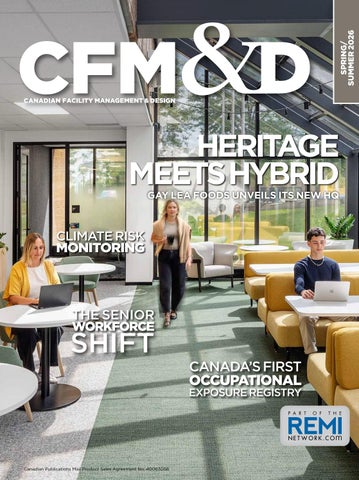
SPRING/ SUMMER 2026
HERITAGE MEETS HYBRID GAY LEA FOODS UNVEILS ITS NEW HQ
CLIMATE RISK MONITORING
THE SENIOR WORKFORCE
SHIFT
PA R T O F T H E
CANADA’S FIRST OCCUPATIONAL
EXPOSURE REGISTRY
P A R T
Canadian Publications Mail Product Sales Agreement No. 40063056
O F
T H E
Spring/Summer 2026 CFM&D / 1
Secure Your Workplace with Day Use Lockers
H&S
Easy to manage and use
Ideal for employees and visitors
Customizable and durable, Day Use Lockers deliver flexible, secure storage for the unique demands of your workplace.
Keep personal belongings safe
Consult With Our Storage Design Specialists Today hicube.com | 604.946.4838
22
PHOTO BY STEVE TSAI PHOTOGRAPHY
[ contents ]
19 Inside the new office lobby at Gay Lea Foods.
12 RECRUITING WOMEN TO SKILLED TRADES
Untapped talent is limiting the pool of specialized skills in facility management.
16 E XPOSURE TRAIL
Canada’s first occupational exposure registry will create a long-term record for medical assessments and compensation.
26
19 RURAL ROOTS
Gay Lea Foods relocates its headquarters to a repurposed building in Etobicoke, Ontario.
22 INCLUSIVE WAYFINDING ON TRACK
The Toronto Transit Commission kickstarts a signage overhaul and introduces Canada’s first alphanumeric exit wayfinding system.
26 CLIMATE CRACKS
The Auditor General of Canada uncovers gaps in climate risk monitoring within a portfolio of federal assets.
columns 7 8 10 24 30
MANAGEMENT MEMO FM LEGAL FM TECH FM EDUCATION LAST WORD
department
focus on
4 OBSERVATIONS 6 FOUNDATIONS
29 LIGHTING
Spring/Summer 2026 CFM&D / 3
[ observations ]
UNIVERSAL ACCESS
A
lthough accessibility is frequently viewed as a compliance measure, many facilities across Canada are reframing it as a responsibility rather than a checklist. An emerging approach to the design of barrier-free facilities is grounded in the lived experience of people with disabilities. Building projects that incorporate universal design principles and actively consult with user groups are setting new standards by honouring diverse bodies, minds, and perspectives from the start. While contemplating inclusion, the Toronto Transit Commission has been directly incorporating ideas from people with disabilities in their long-term wayfinding strategy. Those inputs were mapped into a detailed customer journey framework that shows how various riders move through the system from their home to their final destination. That map now functions as a diagnostic and design tool to better understand where and why information is needed. A new wayfinding pilot launched this summer, and you can find more about that on page 24. More Canadians are choosing to delay retirement and this will evidently impact workplace policies and design. There are implications related to avoiding such accommodations, but a legal expert offers great proactive advice on page 8. The workplace is evolving and so is the transparency around employee health and safety. This year, Canada launched a new occupational exposure registry to help Ontario-based workers track and record incidents with 11 hazardous substances. Employers are responsible for ensuring such exposure does not go above certain limits, but unfortunately there are many cases proving otherwise. Turning back to design, we go inside Gay Lea Foods’ new headquarters that was designed with a hybrid schedule in mind — one that values social connection during in-person days. The property had sat vacant for a long time until Crown Realty Partners and design firm Figure3 brought it back to life. As the cover image displays, there was a large emphasis on nature-inspired colours to highlight the co-op’s agricultural heritage. You can find more images of the modern farm aesthetic on page 19. More importantly, this was yet another project where inclusivity shaped the workplace at every scale to ensure dignity and choice for everyone. Wishing you a happy summer and, as always, check out the REMI Network website for ongoing news! EBECCA MELNYK R EDITOR, CANADIAN FACILITY MANAGEMENT & DESIGN REBECCAM@MEDIAEDGE.CA
SPRING/SUMMER 2026 Volume 41, Issue No.1 PUBLISHER: Ron Guerra rong@mediaedge.ca EDITOR: Rebecca Melnyk rebeccam@mediaedge.ca SENIOR GRAPHIC DESIGNER: Roxy Guinane roxyh@mediaedge.ca GRAPHIC DESIGNER: Amanda Spearman amandas@mediaedge.ca PRODUCTION MANAGER: Ines Louis inesl@mediaedge.ca CONTRIBUTORS: Barbara Carss, Marcia O’Connor and Kelly Widger. CIRCULATION: Adrian Holland circulation@mediaedge.ca PRESIDENT: Kevin Brown kevinb@mediaedge.ca GROUP PUBLISHER: Sean Foley seanf@mediaedge.ca
Canadian Facility Management & Design (CFM&D) magazine is published two times a year by MediaEdge Communications Inc., 251 Consumers Road, Suite 1020, Toronto, Ontario M2J 4R3 Tel (416) 512-8186; Fax 416-512-8344 Email: circulation@mediaedge.ca SUBSCRIPTIONS Canada 1 yr $25* 2 yr $45* USA 1 yr $40* 2 yr $70* Int 1 yr $50* 2 yr $90* Single Copy Sales Canada $15* * Plus applicable taxes. Authors: CFM&D magazine accepts unsolicited query letters and article suggestions. Manufacturers: Those wishing to have their products reviewed should contact the publisher or send information to the attention of the editor. Sworn Statement of Circulation: Available from the publisher upon written request. Although Canadian Facility Management & Design makes every effort to ensure the accuracy of the information published, we cannot be held liable for any errors or omissions, however caused. Printed in Canada. Copyright 2026 Canada Post Canadian Publications Mail Sales Product Agreement no. 40063056 ISSN 1193-7505 Return undeliverable Canadian addresses to: MediaEdge Communications Inc. 251 Consumers Road, Suite 1020 Toronto, Ontario M2J 4R3
4 / CFM&D | Part of the REMI network | www.REMInetwork.com
PERFORMANCE BEYOND THE SURFACE
ASPHALT PAVING SNOW REMOVAL SERVICE LANDSCAPE CONSTRUCTION estimating@forestgroup.ca service@forestgroup.ca
SITE SERVICING BUILDING RESTORATION CONCRETE CONSTRUCTION 24 Hour Emergency Service 416.524.3000
forestgroup.ca
[ foundations ] AI DATA CENTRE GUIDANCE A new online resource offers technical direction for optimizing the energy performance of data centres employed for artificial intelligence (AI) computing. ASHRAE and the U.S. National Electrical Manufacturers Association have partnered to produce guidance on the design, commissioning, operation and retrofit of AI data centres, which addresses thermal management, system integration, energy and water use with recommendations geared to varying climates, load densities and operating circumstances.
DESIGNING FOR DEMENTIA A newly redesigned shower room at the University Health Network’s Toronto Rehab University Centre is improving care for people living with dementia. The space is a collaboration between OCAD University student research, Kasian Architecture, and individuals with lived experience. Located within the specialized dementia unit, the room responds to a common challenge in care environments, where showering can be disorienting and stressful due to unfamiliar surroundings, noise, and limited privacy. Wood finishes, natural colours, and a spa-inspired aesthetic transform the patient experience. Seamlessly integrated accessibility features, such as soft lighting, reduced glare, clear spatial organization, and slip-resistant surfaces, promote comfort, dignity, and independence.
SMART SUPPORT Researchers at the University of Waterloo have developed new healthcare technology that facilitates the deployment of cloud-based autonomous robots to perform routine tasks, such as moving equipment and supplies in hospitals and long-term care facilities. Dr. Amir Khajepour, professor of mechanical and mechatronics engineering, says the system will allow health-care workers to focus more on medical responsibilities and reduce the risk of workplace injuries. The team began working on the proposed framework about five years ago to help address anticipated worldwide shortages of nurses and other staff. They tested the infrastructure in a lab with a retrofitted, robotic hospital bed capable of autonomously moving itself and supplies to a specified location.
6 / CFM&D | Part of the REMI network | www.REMInetwork.com
According to Bill McQuade, ASHRAE’s 2025–26 president, the guidance helps operators improve performance, manage costs and strengthen reliability. The online document covers eight topic areas, from site selection to retrofits, and includes a library of tools, standards and resources.
CLEAN POWER PIVOT Science World is undergoing a major energy overhaul. In partnership with BC Hydro, the non-profit’s $39‑million retrofit is designed to reduce the building’s energy use by more than 40 per cent and greenhouse gas emissions by about 75 per cent. The retrofit includes three solar arrays — the first-of-its kind vertical installation system in B.C. These 76 panels, in addition to the 298 solar photovoltaic panels, have been added to the roof. Aging fixtures are being swapped with LED lighting. New air‑source heat pumps and electric chillers are replacing older heating and cooling systems, and the windows and insulation are also being upgraded to improve efficiency.
[ management memo ] BY MARCIA O’CONNOR
QUIET LEADERSHIP IN FACILITIES Many managers underestimate how they directly influence organizational success.
F
acility managers often work behind the scenes to protect occupants, safeguard budgets and ensure business continuity. They anticipate risks, prevent disruptions, and maintain complex operations without seeking the spotlight. As a result, their contributions are often underestimated — even though every successful organization depends on their judgment. In many ways, the true measure of FM is invisibility: when systems perform seamlessly, people rarely notice the work that made it possible. But make no mistake: the work they do is not simply operational. It is strategic, human-centred, and essential to organizational resilience. Facility managers balance physical assets, financial realities, and the lived experience of the people who occupy our spaces. That is leadership: quiet, steady, and deeply impactful. Yet many professionals underestimate their own influence. They see themselves as problem-solvers, fixers, or technical experts, when in reality they are strategic partners shaping the long-term health of their organizations. It’s time to celebrate these leader-
ship qualities that define the role. Here are some hidden strengths that elevate FMs far beyond the “fix-it” stereotype: Great FMs don’t wait for things to break: They anticipate issues, interpret early warning signs, and act before disruptions occur. This foresight protects operations, budgets, and reputations — often without anyone knowing how close the organization came to a crisis. Invisible crisis manager: When emergencies arise, FMs are the calm in the storm. They coordinate, communicate, and resolve issues with such steadiness that most people never know how serious the situation was. Their leadership is measured, not in applause, but in continuity. Working within tight budgets: FMs
make sophisticated financial decisions every day. They use lifecycle costing, ROI, and NPV to advocate for long-term value rather than short-term fixes. This is strategic leadership, not maintenance management. Facility Managers bridge the gap between organizational strategy and dayto-day reality. They adapt to new technologies, regulations, and expectations with agility. They see the whole system, not just the task in front of them. Saying “no” is part of the job, but great FMs do it with diplomacy and clarity: They protect safety, compliance, and budgets while maintaining relationships. They are persuasive advocates for what is right, not just what is easy. Seasoned FMs lift others up: They share knowledge, build capacity, and strengthen the profession by investing in the next generation. Their leadership is measured in the confidence and competence of the people they support. As FMs, we generate great value within our organizations and that work deserves recognition. At times, it can feel as though few people truly understand the breadth and complexity of what we do. Colleagues, friends, and even family members may never fully appreciate the decisions we make, the risks we manage, or the crises we quietly prevent. Yet our impact is real. Our role matters, our expertise matters, and our contributions to the industry are significant. | CFM&D
Marcia O’Connor is president of AM FM Consulting Group, Chair of Membership & Education for IFMA’s Greater Toronto and South Central Ontario and lead instructor for the University of Toronto School of Continued Studies, Facility Management Certificate Program. She is a strategic-minded leader with more than 20-plus years of progressive experience in corporate real estate, asset management, and integrated facilities management. Marcia has a passion for mentoring young professionals and helping people, teams, and organizations see their potential.
Spring/Summer 2026 CFM&D / 7
[ fm legal ] BY SHANNON BAKER
THE SENIOR WORKFORCE SHIFT Employers that proactively accommodate an older generation of workers can help prevent costly disputes and human rights complaints in the future.
M
ore Canadians over the age of 65 are continuing to work, whether full time, part time, or through multiple jobs. For employers, this is no longer a temporary trend; it is a workforce shift that is reshaping hiring, workplace policies, accommodations, benefits, and long-term planning. It is also an opportunity to re-think workplace design to ensure facilities provide safety and functionality for older workers. Statistics Canada reports that 2025 marked the fifth consecutive year of increasing workforce participation among seniors. Participation rates now exceed pre-pandemic levels and are the highest recorded since tracking began in 1976. Approximately two out of five working seniors logged
an average of 16 hours per week, and many worked more than one job. The reasons behind this shift are complex. Older Canadians continue to face rising costs of living, food insecurity, personal debt, and declining access to pension plans. For many, working beyond age 65 is less about choice and more about financial stability. The Government of Canada’s 2025 Economic Scan for Ontario noted that labour force participation among workers aged 65 and over has risen in recent years as the cost of living has increased. It also highlighted that the proportion of seniors is projected to rise from 18.8 per cent in 2025 to 22.5 per cent in 2035. For employers, this means older workers will increasingly remain part of the
8 / CFM&D | Part of the REMI network | www.REMInetwork.com
workforce for longer periods of time. Businesses that proactively review their employment practices now will be better positioned to reduce legal risk, support retention, and create stronger workplace cultures moving forward. This area of employment law can be nuanced because it often requires employers to balance employment standards obligations, human rights protections, benefits considerations, accommodations, and workplace policies simultaneously. KEY CONSIDERATIONS WHEN EMPLOYING OLDER WORKERS
Age Discrimination Remains Prohibited
Age discrimination is not permitted in hiring, promotions, training opportunities,
workplace treatment, or terminations. As older workers remain active in the workforce longer, employers should ensure workplace decisions are based on legitimate business considerations rather than assumptions connected to age. Mandatory Retirement is Largely Gone
Mandatory retirement has mostly disappeared in Ontario workplaces, subject to limited exceptions that can be difficult to establish legally. The Ontario Human Rights Commission has confirmed that employees over the age of 65 who believe they lost employment because of age may pursue human rights claims based on age discrimination. Benefits Plans Require Careful Review
Benefits and health insurance programs involving employees over age 65 remain legally complex. Differential treatment in benefits plans may create tensions between legislation, insurance structures, and evolving human rights tribunal decisions. Employers should carefully review how their current plans apply to older workers and seek legal advice where needed. Practical Steps Employers Can Take Now
One of the best places to start is with a policy review. Employers should ensure workplace policies: • avoid age-based assumptions or language;
• are written clearly; • align with current legal requirements; and • reflect how the workplace actually operates today. Policies worth reviewing may include:
• anti-discrimination and human rights policies; • recruitment and hiring policies; • pay equity policies; • accommodation and accessibility policies; • health and safety policies; • leave of absence policies; • training, development, and performance policies; • flexible work and part-time employment policies; and • termination policies.
Workplace Culture Matters Too
Legal compliance is important, but workplace culture also plays a significant role in reducing risk and improving employee experience. Employers should consider: • encouraging intergenerational collaboration;
• addressing ageism proactively; • supporting knowledge sharing between employees; and • ensuring older workers feel included and respected. Accommodation also remains an important consideration. Appropriate ergonomics, flexible scheduling, technology support, and accessible workplace practices can help employees continue working safely and effectively. Whether or not your business actively hires employees over 65, there is a growing likelihood that existing employees may continue working beyond traditional retirement age. With Canada’s aging population and increasing financial pressures on seniors, employers who proactively assess their workplace policies, benefits structures, accommodations, and employment practices now will be far better positioned to reduce risk and support a stable workforce moving forward. A proactive review today can help prevent costly disputes, human rights complaints, and policy gaps tomorrow. | CFM&D
Shannon Baker is a Litigation Law Clerk at SpringLaw with 20-plus years of experience, specializing in employment law. An early adopter in virtual law clerking, she previously ran her own business supporting international lawyers. Her expertise in legal tech and writing contributed to a company’s IPO. Shannon is also a visual artist who combines analytical precision with creativity. She holds an ILCO certification, an Honours B.A. in Art History and a Diploma in Interior Design. This article originally appeared on the SpringLaw Blog on May 13, 2026, and includes minor updates.
CREATING WORKSPACES FOR AN OLDER LABOUR FORCE When designing for older adults, incorporating principles from inclusive and neurodiversity-focused design is a great starting point. It is essential to get a good brief from your clients or the buildings’ potential tenants, so you understand what is unique to their workplaces and the relevant design demands. For starters, your facility can provide: • variable lighting, allowing for brighter spaces when eyesight diminishes; • wide traffic areas, free of clutter and accessible design to allow for mobility aids; • different workspaces and furniture that allow for postural changes, such as standing, sitting and comfort;
• assistive technology that provides voice options or alternatives to traditional keyboards, and mouse setups for computers with appropriate acoustic controls in office spaces; • private bathrooms; • break rooms; and • high contrast markings along stairs.
Spring/Summer 2026 CFM&D / 9
[ fm technology ] BY KELLY WIDGER
HOW UNIFIED DATA IS TRANSFORMING P3 FACILITY MANAGEMENT
I
n many P3 environments, facilities already contain huge amounts of operational data. The problem is that it’s trapped in digital pockets around the building. Connected buildings and digital twin environments are increasingly helping bridge the gap between static building information and live operational data. Here’s how. THE COST OF SILOED SYSTEMS
For FM teams managing complex P3 infrastructure, even routine tasks can become unnecessarily time-consuming when critical information is spread across multiple systems, spreadsheets and departments. A study from the International Data Corporation found that “data professionals are losing 50% of their time every week” – 30 per cent of the time searching for, governing and preparing data, and 20% duplicating work.
While FMs may not describe themselves as ‘data professionals’, access to accurate operational data increasingly defines service performance. As teams spend more time pursuing information, the limitations of siloed data become harder to ignore. Maintenance records sit in a CMMS, performance data lives in a BAS, contractors store compliance documents in SharePoint, and building floor plans remain tucked away in a drawer – meaning fast, informed decision-making becomes almost impossible. Often, it’s easier to duplicate the data – manually take the reading, repeat the measurement or carry out the inspection again – rather than waste time and mental energy in jumping through hoops to get it from the source. This is why more FMs are embarking upon a digitalization journey, aiming to make an integrated, accurate single source of truth for all their
10 / CFM&D | Part of the REMI network | www.REMInetwork.com
building data. A rip-and-replace approach to upgrade existing systems to communicate with each other can be prohibitively expensive (and often unrealistic mid-contract) so many FMs are instead looking for best-of-breed integrations. FROM REACTIVE MAINTENANCE TO PREDICTIVE INSIGHT
Time sensitive environments like P3s or healthcare FM contracts mean there is no slack when it comes to resourcing. According to the US Department of Energy, reported by IFMA, reactive maintenance costs around 20% more than preventative maintenance, and the National Institute of Standards Technology found that those relying on reactive maintenance experienced 3.3 times more downtime and 16 times more defects. But planned preventative maintenance (PPM) also comes with its own problems.
Regular PPM schedules are more reliable than waiting for a fault to develop but they can use spares unnecessarily and waste engineering time where maintenance is not required. Over-maintaining can also shorten asset life, such as over-lubricating a bearing in a pump. This is where connected sensors and real-time operational data are starting to change the picture. By monitoring factors such as vibration, temperature, energy consumption and runtime hours, facility teams can gain a far clearer understanding of how assets are performing, rather than relying solely on fixed maintenance intervals. Combined with AI-driven analytics, this data can help identify patterns and early warning signs that would be almost impossible to spot manually across large estates or multiple buildings. REDUCING RISK IN PERFORMANCEBASED P3 CONTRACTS
Service providers are often penalized with deductions because they cannot adequately monitor or measure what they are doing. In the past, facility managers used off-theshelf software to manage all the operational contract elements. Now, a combination of building information modeling, the emergence of digital twins, and sophisticated CMMS, which offer in-built payment mechanism capabilities, provide extra layers of data integrity and auditability. Integrated with BIM, organizations can streamline the transition from construction to building operation, with a wealth of asset and building lifecycle data as well as an intelligent 3D model. This allows contractors to remotely visit the site before arrival to assess what resources they may need, any permits required, and verify part serial numbers to check inventory. For large sites such as hospitals or universities, the model can even be used for wayfinding so tight SLAs are not failed due to contractors getting lost. FROM BUILDING DATA TO OPERATIONAL INTELLIGENCE
Unlike static BIM models, digital twins ingest live operational data from con-
nected systems and sensors to create a real-time representation of building performance. This allows operators to move beyond simply viewing building information towards actively monitoring and analysing how facilities are functioning day-to-day. While AI is still sometimes viewed as experimental within FM, adoption is accelerating quickly. By combining lifecycle, maintenance and live operational data into a unified platform, AI tools can dramatically reduce the time spent searching for information or compiling reports manually. Instead of navigating multiple systems, FM teams can query the data conversationally to identify trends, investigate recurring faults or generate operational insights in seconds. Questions could be strategic – such as “which assets are developing faults most often and who is servicing them?” – or more operational, such as “the lift door won’t close properly, show me the steps to resolve this.” Across large estates, AI can also detect recurring failures in the same asset type, potentially identifying defective components or systemic operational issues much earlier. It may even identify that mean time between failures consistently drops after a particular contractor services an asset category, helping operators uncover supplier quality issues that would otherwise remain hidden. THE SUSTAINABILITY CHALLENGE NO SINGLE SYSTEM CAN SOLVE
Sustainability is now a top priority for Canadian P3 operators, but fragmented data is making it difficult to manage. Increasingly, facility teams must demonstrate measurable improvements in energy use, carbon emissions and asset performance while maintaining ageing estates and delivering against long-term contracts that predate today’s sustainability targets.
This is where digital twin environments and integrated lifecycle platforms are starting to provide significant value. Rather than replacing every existing system, more organizations are creating integrated data environments that bring operational, asset and energy information together into a single view. By connecting live IoT sensor data with BIM and maintenance systems, facility teams can better understand how buildings are performing in real time. For Canadian healthcare estates, campuses and civic infrastructure operating across multiple buildings and regions, this visibility is particularly important. Digital twin technology can help operators identify underperforming HVAC assets, ensure occupancy comfort, compare energy performance across similar facilities and model how operational changes may affect carbon reduction targets before implementation. AI-driven analytics can also help uncover patterns that would otherwise remain hidden, such as ventilation systems operating inefficiently during low occupancy periods. CONNECTED DATA. BETTER DECISIONS
The organizations seeing the greatest success are not necessarily those replacing every legacy system, but those finding ways to connect the data already available to them. Bringing together BIM, IoT sensors, CMMS platforms and digital twin environments into a unified operational view, can help facility teams move beyond reactive decision-making towards more predictive, informed and proactive management. Whether improving maintenance strategies, reducing payment disputes or supporting sustainability goals, connected data is becoming the foundation of smarter P3 facility management. | CFM&D
Kelly Widger is General Manager (North America) at Service Works Global, international provider of CMMS, building lifecycle management and P3 payment mechanism software. Kelly is responsible for managing key customer accounts and overseeing P3 project delivery throughout Canada and North America. She has a background in FM with extensive experience working at leading FM service providers.
Spring/Summer 2026 CFM&D / 11
SPONSORED CONTENT
Photo courtesy of HIAA
A SOARING SUCCESS IN HALIFAX Engineering Precision in a Live Airport Environment
A
s Halifax Stanfield International Airport continues to grow as a key Atlantic gateway, its infrastructure must evolve to meet rising passenger expectations and international travel demands. Black & McDonald (B&M) recently played a central role in that evolution, completing major upgrades that modernize the airport experience while showcasing the company’s ability to self perform complex, multidisciplinary work across mechanical and electrical systems. According to Division Manager Blair Nickerson, B&M delivered the full mechanical and electrical scope of the
project, working in close coordination with general contractor Pomerleau Construction. The team executed electrical & mechanical demolition, isolations, and HVAC disconnections before transitioning into new construction, with peak staffing reaching 5 electricians and 6–8 mechanical team members on site. At the heart of the upgrade is the airport’s new International Connections Facility — a transformation that fundamentally reshapes how international passengers move through Halifax. Previously, travellers arriving from abroad had to clear customs, collect their baggage, and re-enter security
before catching a connecting flight. The new system allows baggage to be checked through to the final destination, enabling passengers to proceed directly to their next gate after clearing Canada Border Services Agency (CBSA). This streamlined-process brings Halifax in line with major Canadian hubs such as Toronto. NAVIGATING A LIVE AIRPORT ENVIRONMENT For the B&M team, working inside active international airports isn’t unusual, but it does introduce a unique set of challenges — challenges that reinforce the company’s
SPONSORED CONTENT
safety-first culture and its ability to adapt in real time. In this case, operating in secure, high-traffic zones meant every task required careful coordination, precise timing, and constant communication with airport authorities. Secure zone access was tightly controlled by CBSA, and fluctuating flight schedules dictated when crews could enter restricted areas. The team often had to adjust plans on the fly as aircraft movements, passenger volumes, and security requirements shifted throughout the day. “There were days when we mobilized the crews, only to be told a flight was arriving
and everything had to stop,” Nickerson said. “Plan A rarely survived the day.” These unpredictable conditions demanded flexibility and discipline. Crews needed to be ready to pivot instantly — finding productive work elsewhere, reorganizing tasks, or resequencing activities to maintain progress without compromising safety or airport operations. Despite the constant changes, the team maintained both schedule momentum and financial performance. Nickerson credits this to the professionalism and adaptability of everyone involved, noting
that the project also highlighted Black & McDonald’s ability to self-perform across multiple disciplines — a capability he described as “one of our greatest strengths.” A VISUALLY STRIKING NEW SPACE Beyond its technical complexity, the completed facility stands out for its striking design. The interior features Indigenousthemed elements and aviation-inspired motifs, creating a bright, colourful, and welcoming environment. “The lighting really brings the space to life,” Nickerson noted. “You don’t see the HVAC or mechanical systems — they’re hidden — but the finished look highlights the quality of the work.” A TRUSTED PARTNER IN COMPLEX INFRASTRUCTURE Now complete, the Halifax Airport project reinforces Black & McDonald’s reputation as a trusted provider of integrated mechanical and electrical services — particularly in environments where precision, safety, and adaptability are non-negotiable. From navigating secure airport operations to coordinating multidisciplinary teams, the company proudly demonstrated the depth of its in-house expertise and its commitment to delivering high quality results under demanding conditions. As airports and other critical facilities continue to modernize, B&M’s proven ability to self-perform complex work positions the company as a reliable partner for infrastructure owners seeking efficiency, craftsmanship, and long term-value.
Visit blackandmcdonald.com for more information.
[ workplace ] BY REBECCA MELNYK
RECRUITING WOMEN TO SKILLED TRADES Canada’s skilled trades shortage is limiting the supply of specialized talent in the facility management industry.
R
ecruiting more women into the skilled trades could help close a growing labour gap that is disrupting building projects across Canada. Despite ongoing demand for workers, women make up just 7.9 per cent of the country’s tradespeople. This untapped talent directly limits the pool of specialized skills in the facility management industry. “The majority of FMs don’t have technical expertise and are fully reliant on the few people who have that knowledge within their organization,” says Marcia
O’Connor, lead instructor for the University of Toronto School of Continued Studies, Facility Management Certificate Program and Chair of Membership & Education for IFMA’s Greater Toronto and South Central Ontario. According to Statistics Canada, nearly one in five tradespeople will retire by 2028, further exacerbating the skills gap. O’Connor, who is also president of AM FM Consulting Group, says fewer seasoned professionals are entering the field with in-depth knowledge about mechanical, electrical, and plumbing systems.
14 / CFM&D | Part of the REMI network | www.REMInetwork.com
Angela Coldwell, founder of Honour the Work, a charity that advocates for skilled trades careers beginning in elementary school, says pervasive stereotypes and a lack of female role models make the trades appear less accessible for women. “There’s a societal bias that this has been men’s work, which doesn’t make a lot of sense because in World War II, when men were fighting, women were the ones in factories using the tools,” she says. When girls express interest in skilled trades, guidance counselors and families continue to steer them away from job sites
says Coldwell. “There is nothing saying they cannot do these jobs. And on a modern job site, no one should be lifting heavy equipment independently anyway.” RETAINING THROUGH MENTORSHIP
and toward traditionally “female” roles. “It’s something that has to be explicitly called out,” urges Coldwell. “You can’t get more women in if they’re not given the opportunity. And it’s not just women, but underrepresented individuals across the board.” Skilled trades offer wages and stability, yet the work is not always presented as a viable option despite evidence that women are well suited for these careers. “Women have excellent tactile skills. They’re strong in hand-eye coordination. They listen carefully and can take complex design patterns and execute them,”
An Ontario Building and Construction Tradeswomen (OBCT) survey in 2025 found that the majority of tradeswomen see a future for themselves in the industry over the next two to five years. Yet according to a 2025 BuildForce Canada report, women comprise only 5 per cent of the tradespeople employed in construction in Ontario. Ontario’s Pay Equity Office recently scrutinized the issues preventing women from succeeding in skilled trades. Building a respectful, safe workplace tops the list. The OBCT further found the majority of tradeswomen were dissatisfied with how their harassment complaints were handled. “Having a female mentor or very supportive men that are going to advocate is essential,” says Coldwell. “Because we are a very male-dominated industry, we need the fathers, the uncles, and the brothers to step up. This has to be collective across the industry, with unions and general contractors saying ‘we’re not going to tolerate this’.” Last month, Karen Pullen, chair of OBCT, said leadership in the trades doesn’t always come with a title. “It can mean speaking up on a job site, mentoring an apprentice, demanding safer work, or simply showing up for one another when it matters most,” she stated. “These everyday acts of leadership are what change workplaces and industries.” Visible representation in leadership roles also demonstrates the trades as a viable career progression. Coldwell says the trades have been framed as a backup plan rather than a first-choice pathway that
builds communities and offers people the pride of craftsmanship while using critical thinking skills. Many tradeswomen are known to refuse jobs due to incompatibility with childcare arrangements. According to the Canadian Labour Congress, caring for family members, including children and elderly parents, more often falls to women. “In construction, workers begin early on a job site until a certain hour and it’s very difficult to accommodate shift work if you don’t have someone to take care of your children,” says Coldwell. “It would be a game-changer for both women and men, but it needs to be something close to the job site with extended hours.” MAKING HEADWAY TOWARD INCLUSION
Governments and non-profits have been forming active pathways and support systems to build a more inclusive workforce. Organizations such as Women Building Futures, Honour the Work, Techsploration, the BC Centre for Women in the Trades, the Career Lab and Skills Ontario’s Young Women’s Initiatives are helping women enter skilled trades careers through training, mentorship, education and support programs. Trade skills can also be a launchpad into careers like facility management. When O’Connor is counseling students pursuing the FM sector, she encourages those with mechanical, electrical and plumbing knowledge to showcase that on their resumes. “If you look at ROIs, it would be more effective to hire somebody with that expertise versus trying to get it outsourced,” she says. “We need to find these skilled tradespeople to join our organizations or think about it as part of their career path.” | CFM&D Spring/Summer 2026 CFM&D / 15
[ risk management ] BY REBECCA MELNYK
EXPOSURE TRAIL Canada’s first occupational exposure registry will offer long-term documentation to help with diagnosis and compensation. Jeff Lang, president of WSIB, said the new registry will create more data, which in turn could expedite access to services. The tool can also generate meaningful discussions with employers who, under occupational health and safety legislation, are required to identify the presence of hazardous substances, assess exposure risks, and implement appropriate control measures. To support the effort, workers can now anonymously submit information about how incidents occurred and what protective measures were in place, such as ventilation, training or personal protective equipment. They can record exposures to asbestos, lead, mercury, silica, arsenic, ethylene oxide, acrylonitrile, benzene, vinyl chloride, isocyanates, or coke oven emissions. EXPOSURE RISKS FUEL DELAYED CONSEQUENCES
O
ntario-based workers can now track their exposure to 11 hazardous substances through Canada’s firstever occupational exposure registry (OER). The province’s newly launched online portal is designed to prevent workplace-related diseases and provides users with a long-term record for medical assessments and future compensation. The OER follows legislative changes introduced through Ontario’s Working for Workers Act, 2023, and responds to recommendations from the 2023 Occupational Disease Landscape Review. A 2020 government-commissioned study, published by epidemiologist Dr. Paul De-
mers, revealed that fewer than 10 per cent of Ontarians with occupational cancers receive compensation because proving workplace attribution is challenging. Occupational illnesses are caused by onthe-job contact with physical, chemical or biological agents, but they are frequently underreported and often difficult to diagnose due to long latency periods between exposure and the onset of symptoms. The most current data reveals they accounted for roughly 76 per cent of workplace fatalities between 2010 and 2019. In addition, there were 20,886 approved occupational disease claims in 2025, according to the Workplace Safety and Insurance Board (WSIB), however, the real toll is believed to be higher.
16 / CFM&D | Part of the REMI network | www.REMInetwork.com
Asbestos poses the most significant risk in the mechanical insulation trade. Although Canada banned asbestos-containing products in 2018, many existing buildings still harbour the known carcinogen in their floors, ceilings, pipes and insulation. There is no safe level of exposure, but inhaling or ingesting the fibres over time increases the risk of lung cancer. Mesothelioma, an aggressive cancer often caused by asbestos, can take 20 to 60 years to develop, making early diagnosis difficult. The most recent mortality data states that 472 Canadians died from the disease in 2022. “For workers in trades like ours, exposure doesn’t always show its impact right away,” says David Gardner, business manager of Ontario Insulators Local 95. “Sometimes it takes decades. This registry is about accountability, transparency, and making sure no worker’s history is lost. But strong enforcement and ongoing health monitoring must continue to be part of the solution.”
Ontario Insulators, Local 95 is the provincial representative for the International Association of Heat and Frost Insulators, which played a key role in advocating for the registry. Many of its members, who are also exposed to silica, face serious risks during asbestos abatement and redevelopment work in aging industrial, commercial, and institutional facilities. Tasks such as removing pipe insulation, boiler coverings, fireproofing materials, and spray applied products are dangerous if not properly controlled. Yet even with rigorous safety training, advanced PPE, and strict procedures, exposure can still occur. Some variables like undocumented materials or inconsistent employer compliance, remain outside a worker’s control. The sector believes centralized exposure tracking is crucial for health and safety because its members often move between employers and projects. Without a registry, exposure histories can become fragmented or lost. While the new platform isn’t intended
“For workers in trades like ours, exposure doesn’t always show its impact right away.” as an enforcement tool, Ontario Insulators Local 95 say health and safety obligations are non-negotiable. “Stronger oversight, consistent inspections, and meaningful penalties for non-compliance are critical to ensuring standards are upheld across all jobsites,” it stated over an email. “Expanded presumptive disease coverage and continued research into occupational illnesses are also necessary to protect workers long term.” This concern resonates across other industries. Last year, there were close to 580,000 construction workers in Ontario, all of whom were at risk of occupational
exposures. In late February, Adam Melnick, executive director of the Construction Employers Coordinating Council of Ontario, agreed that a clear understanding of exposure history will strengthen prevention efforts. “A well-designed registry can support better clinical communication and longterm health monitoring,” he maintained. “CECCO looks forward to working closely with the Ministry to ensure the registry’s implementation is transparent, avoids unnecessary duplication, and provides clarity for both workers and employers on how information will be used in practice.” | CFM&D
The occupational exposure self-tracker can be accessed at: https://www.ontario.ca/page/ occupational-exposure-registry
Spring/Summer 2026 CFM&D / 17
FACILITY DESIGN
RURAL ROOTS Gay Lea Foods repurposes a long-vacant property into a hybrid headquarters that blends agricultural heritage with modern workplace design. BY REBECCA MELNYK
PHOTO BY STEVE TSAI PHOTOGRAPHY
18 / CFM&D | Part of the REMI network | www.REMInetwork.com
I
nside the reception area of Gay Lea Foods’ new headquarters in Etobicoke, Ontario, a large wall installation of black-and-white photographs immediately comes into view. Images of dairy cows, farming families, and workers in vintage factory uniforms trace the lineage of the 68-year-old Canadian co-operative. Relocating from an owned facility to 22,000 square feet of leased office space at 10 Carlson Court marks a new chapter for the farmer-owned organization. The property had sat vacant for 15 years. At one point, it served as a gym and restaurant until it was stripped to base condition and deemed “unleasable”. A tenant inducement allowance from Crown Realty Partners and the creative vision of interior design firm, Figure 3, enabled Gay Lea to cost-effectively double its footprint and transform the space into a collaborative workplace that supports a community of more than 1,200 dairy farms. All employees are asked to come into the office three days a week on a hybrid schedule. One designated “hub day” brings everyone in for social encounters, while individual teams determine other in-person days. “This wasn’t meant to be a space where you do your day-to-day tasks,” says Katherine Egenberger, creative lead at interior design firm Figure3. “A large emphasis was placed on non-traditional work-points. About 50 to 60 per of the spaces are collaboration zones defined by soft seating, large communal tables, and meeting rooms.” Egenberger was one of the designers behind the two-storey build-out, which was substantially completed between December 2024 and May 2025. Her team was engaged from the beginning, alongside the broker and a team of consultants. “That was really key — oftentimes, we get brought on after a space is already selected and we have to figure out how to make it work,” she says. “Once Gay Lea understood their goals we could make sure it was possible.” That enabled the team to create a dynamic workplace, with double-height ceilings, a mezzanine, and a solarium with access to outdoor patios — `features that visually represented the project’s guiding principles, such as nurturing connections, idea exchange and giving every employee a meaningful experience.
Reusing an existing structure also aligned with sustainability goals. Abundant natural light, ESG lease clauses, SMART HVAC automation, occupancy-based lighting, and ENERGY STAR appliances further contribute to reduced energy use. The agricultural narrative weaves through the space in the form of greenery, environmental graphics, and wood finishes. The furniture is sourced from local Canadian companies. Material colour choices such as yellows, greens, purples and blues echo what is found in nature. By the mezzanine staircase, a full-sized interior tree symbolizes renewal. Biophilic design carries over to a large
collaboration area and lunchroom that doubles as a 1,000 square-foot town hall. This is strategically located by an existing solarium that was elevated for year-round comfort and reduced heat gain. Angled floor-to-ceiling glazing maximizes outdoor views of the landscape. Built-in banquette seating in warm mustard upholstery, integrated shelving, and muted green cafe-style tables add a hospitality-style quality that makes the space feel more relaxed. MODERN FARM AESTHETIC
There was a conscious effort to ensure the materials and lay-out were both humble
PHOTOS BY STEVE TSAI PHOTOGRAPY.
Spring/Summer 2026 CFM&D / 19
FACILITY DESIGN
PHOTOS BY STEVE TSAI PHOTOGRAPY.
and authentic. “We learned a lot about the traditional red barn versus what actual modern farming is,” says Egenberger. “It’s much more industrial, metal, more technical and innovative.” An existing metal pan deck ceiling, an uncommon feature in a typical commercial office, turned out to be a defining architectural element. Exposed concrete
block walls and black-painted structural steel reinforce the industrial look in the executive leadership area, which is nestled in a corner by the elevator. This zone was intentionally designed as an open, visible space, reflecting the organization’s leadership transition and its renewed emphasis on employee empowerment and connection-building.
20 / CFM&D | Part of the REMI network | www.REMInetwork.com
A communal table anchors the space, rather than enclosed private offices. Adjacent glazed meeting rooms provide quiet areas without disconnecting executives from the rest of the office. Frosted glass panels offer both transparency and privacy, while planter-topped storage lockers create subtle spatial separation. The entire office breaks away from traditional hierarchy in favour of a more team-oriented environment.“Even the board room has a higher-end look than some of the other spaces, but it’s not intentionally showing its status,” says Egenberger. Above that, the mezzanine overlooks the open workspace below and supports large team meetings, press announcements, and employee training. Pastoral images and grass-like carpeting bring an agricultural identity to the second floor, while additional touchdown zones further cement the influence workplaces can have in shaping how people connect socially. “I think it plays such a crucial role in the culture of a company,” adds Egenberger. “You can have a lot of staff, but feel very disconnected and isolated if you don’t have a great office space where people can come to. Gay Lea had a clear mandate about what the purpose of the new office would be and why people would be asked to come in. “Too often, organizations approaching hybrid work focus primarily on reducing square footage. In reality, it’s not always about less space, it’s about creating different kinds of spaces that are intentionally designed around how people work today and what their teams truly need.” | CFM&D
Validate your FM skills and mastery with the CFM® Stand out as an industry leader with the Certified Facility Manager® (CFM®) credential, the gold standard of FM.
Showcase your mastery of the globally recognized FM body of knowledge
Gain credibility in your professional network Empower your career Did you know that no coursework is required to take the CFM? Because you're tested on your ability to apply FM knowledge, your eligibility is based on your experience and education. Everything you need to prep for the exam is available through IFMA’s learning portal, fm.training:
Take a practice exam and experience the methodology
Brush up on a specific subject with our Core Competency Courses
Check your knowledge with our exam prep resource
Enroll in one of our exam prep workshops • Offered virtually and in-person
Prepare, apply, pass and get recognized for your expertise. Learn more and prep:
ANSI-ACCREDITED PROGRAM Materials offered by IFMA to prepare for the CFM Exam, such as the CFM Exam Prep Workshop, the FM Learning System and CFM practice exams, are optional study resources and are not a requirement of eligibility, nor are they endorsed by the IFMA Certification Commission.
[ accessibility ] BY REBECCA MELNYK
INCLUSIVE WAYFINDING ON TRACK The Toronto Transit Commission pilots inclusive alternatives to static signage.
T
ourists visiting Toronto for the FIFA World Cup may find transit facilities more accessible to navigate through a newly launched wayfinding project. The Toronto Transit Commission (TTC), in collaboration with design firm Arcadis, is piloting two different systems across six high-traffic subway stations, including an exit strategy that is a first-of-its-kind in Canada. An alphanumeric identification system is being integrated into digital transit apps and rolled out at Bathurst, Dufferin, BloorYonge, Union, St Andrew, and King stations. The NaviLens app, which enables smartphone-based navigation and real-time transit information, will be piloted solely at Dufferin station. Together, the systems will help people quickly access soccer destinations and other above-ground facilities, while supporting those who are visually impaired, low-vision users, multilingual visitors, and neurodivergent riders who often encounter cognitive overload. The pilot will remain active until September 2026 and aligns with the TTC’s long-term wayfinding strategy that sets out to transform traditional static signage into a dynamic, multi-sensory and integrated experience. In a 2025 report by the TTC, an audit revealed that while 39 per cent of signage reflects current standards, 61 per cent still uses legacy formats. “Over the years, projects were designed and rolled out by need, often one sign at a time, rather than through upgrading an entire station,” the report states. “This highlights the significant work ahead to achieve consistency system-wide and bring all stations, loops and surface network to 100% alignment with updated standards.” In addition to a signage overhaul, which requires an estimated $140 million in funding, the TTC is prioritizing a digital revamp. Modern-day wayfinding now integrates both physical and digital tools
22 / CFM&D | Part of the REMI network | www.REMInetwork.com
across various platforms and agencies and incorporates elements such as personal devices, audio cues, and architecture. “We want everything to feel integrated and purposeful as we go through any updates, making sure that our systems, whether digital or static, work all together,” says Laura Lehming, director of customer experience at the TTC. “It’s like a puzzle — you’ve got all of these pieces that need to work in order to see and understand the whole picture.” EXIT STRATEGY A FIRST IN CANADA
To glean international best practices, Lehming’s team engaged with various transit agencies around the globe and were inspired by large-scale cities such as Paris and Tokyo that are successfully connecting wayfinding with different formats. In the TTC pilot, alphanumeric codes are currently assigned to the station exits, transfer points, and other key locations. Each exit will now be marked with a simple code — such as “A”or “A 1,”which also incorporates high-contrast pedestrian icons to help customers pinpoint their street-level destinations. For example, at Bathurst Station, the Bathurst Street side becomes Zone A, while the Markham St. side becomes Zone B. Each zone is linked to nearby landmarks, street corners, and transit connections, making it easier for customers to choose the most appropriate exit. Julian Lum-Smith is a transit facilities studio manager at Arcadis, the firm that designed the TTC version of the wayfinding system. He says this specific exit strategy is widely used across transit networks in Asia, where some stations have hundreds of exits. Cities in Europe are gradually adopting it, but this is Canada’s first application. “Systems where you’re trying to find your way above ground can be really challenging underground,” says Lehming. “When you’re unfamiliar with a station, you really need something to help orient yourself, which might not use cardinal directions.” Alphanumeric codes are designed to reduce that confusion for anyone who is new to the TTC, but also for Toronto’s multicultural community of English language learners. Rather than relying on long route names, these short identifiers are easier to recognize and remember. As an example, instead of processing “King
504 Streetcar Eastbound,” riders could simply follow a code, such as “B2,” which becomes the only reference they need throughout their journey. TURN-BY-TURN INCLUSION
Another wayfinding technology aimed to empower people is NaviLens, which is widely used in Europe and currently operating in Vancouver. The app translates visual signage into audio messages, and is especially geared to travelers who are blind or have low vision. With a smartphone, users can scan colourful QR codes from 40 to 65 feet away, depending on the size. The codes prompt the phone to deliver information about a nearby point of interest and offer turn-byturn directions. “Vision impaired users are able to listen to an audio guide, one they would almost get in a museum, but also with music and cues to turn left, turn right, turn around,” explains Lum-Smith. “If you’re trying to get the southbound bus to Toronto Stadium, the audio will take you there — to the elevator, through the stairs, up the concourse.” As well, the app automatically detects the language on a user’s phone and translates support in up to 42 languages. Neurodivergent riders will also experience less cognitive demand and more reassurance through an app setting that displays picograms, which are similar to MagnusCards — a digital life skills guide that helps autistic adults in real-world situations such as using public transit. “We also try to have progressive disclosure so you only get the information you need where you need to make the decision,” says Lum-Smith. “If you are on the platform, does it matter when the next bus is coming? Some users might find that information too much.”
SETTING STANDARDS IN PERMANENT MOTION
As the TTC moves forward with the trial, public feedback will inform necessary improvements. The hope is that it will eventually inspire permanent signage renewals and upgrade new subways like the 15.5 kilometre Ontario Line. Wayfinding upgrades during high-profile events are not new to Toronto. In 2015, the city completed a pilot project in conjunction with the PanAm Games, consisting of 21 different signs in the downtown core. The project became successful and prompted a city-wide rollout. More recent solutions explore vehicle arrival information. The TTC is also piloting E-link displays at 75 stops, in time for the World Cup. “As well, we are looking at ways of fully updating stations,” says Lehming. “St. George is one pilot we want to start with first because it’s a major interchange.” Plans are in place for a potential entire revamp, where every single sign would be upgraded to current TTC standards to enhance transfers between Line 1 and Line 2 and boost access to the Royal Ontario Museum and the Bata Shoe Museum. The team will also explore how to apply customer feedback from the alphanumeric identification strategy. Once these projects come to fruition, they will showcase a more innovative and intuitive approach to wayfinding, one that is rooted in universal design principles that make all riders feel safer and more comfortable. “I think that makes a big difference when you’re out on public transportation — feeling like somebody has taken care of you and is thinking about the customer-first approach,” explains Lehming. “It’s a great way to see the city, and as we’re gearing up for the World Cup, we want to make sure everyone has that same perception.” | CFM&D Spring/Summer 2026 CFM&D / 23
[ fm education ] BY BARBARA CARSS
TACKLING WASTE DATA MANAGEMENT The Open Standards Consortium for Real Estate’s in-progress standard is envisioned as a building block for integrating governance.
A
standardized waste data map is expected to provide consistent direction for users on multiple paths. The Open Standards Consortium for Real Estate (OSCRE) is developing the third of its trio of environmental data standards in sync with mounting pressure on various industry players to accurately report the volume of waste they produce, disseminate and divert from landfill. Proponents of OSCRE’s in-progress waste data management standard are working to categorize the myriad inputs that flow into the waste stream, and wrestle them into a framework that enables credible analytics and performance comparisons. That would underpin the collection and retrieval of information that’s increasingly in demand from: • retailers and other corporate/institutional players that may be accountable under extended producer responsibility (EPR) or product stewardship schemes; • firms with voluntary commitments and/or looming regulatory requirements to disclose Scope 3 greenhouse gas (GHG) emissions; • participants in other certification and benchmarking programs; and • property/facility managers looking for operational cost savings.
“What’s going to be great about a data model is it will give us visibility of what’s pushing waste into the supply chain,” Stephen Weir, chief executive officer of the sustainability consulting firm, Radar 2030, observed during a recent OSCRE webinar. “Then we can look at the massive pile of waste that’s at the end and see where it was inserted, how it was inserted and what we can do to remove it.” EPR MOTIVATION
EPR compliance has emerged as a major
motivator for the project. In Canada, all provinces/territories except Prince Edward Island, Newfoundland and Labrador, Nunavut and Northwest Territories compel those who convey designated products into the marketplace to cover at least a portion of the costs of collecting and recovering or disposing of those materials, while many jurisdictions throughout North America have been ramping up obligations in recent years. In Ontario, for example, Jan. 1, 2026 marked the full implementation of a 100 per cent producer-funded system for managing Blue Box materials after a three-year, phase-in period. Designated producers of six types of materials collected from residential and specified institutional properties — paper, rigid plastic, flexible plastic, glass, metal and beverage containers — pay their share based on the amount of those commodities they delivered to the Ontario marketplace during the previous calendar year. Since 2024, program rules require producers to report those tallies to the provincial registry, known as the Resource Productivity and Recovery Authority (RPRA), by May 31 each year and pay their fees at that time. This year, producers with annual revenue in excess of $2
24 / CFM&D | Part of the REMI network | www.REMInetwork.com
million can expect to pay $9.70 per tonne if they generated more than 50 tonnes of Blue Box materials in 2025. Those that generated less than 50 tonnes, but more than the threshold for exemption (9 tonnes of paper; 2 tonnes of plastic; or 1 tonne of glass, metal or beverage containers) will be charged a flat fee of $95. Depending on where they fall on that scale, designated producers could face steeper costs for failing to register or submit required information to the RPRA. For corporations, neglecting to file “complete and accurate” information carries a base fine of up to $50,000 along with a supplemental fee reflective of the costs they avoided or benefits they gained by evading the mandate. Ongoing non-compliance triggers further penalties. Additional reporting requirements kick in next year. That’s when producers will have to submit a data verification report for their 2026 numbers and the first triennial audit report, covering the years 2024, 2025 and 2026. The latter tracks whether they’ve fulfilled material recovery targets (i.e. 80 per cent of paper or 50 per cent of rigid plastic delivered into the Ontario marketplace) and related promotion/education obligations.
Looking to examples in the United States, panellists participating in the OSCRE webinar speculate EPR uptake at the state level is approaching a tipping point toward widescale adoption. Jim Owens, president of Marrad, a service provider for materials management, and Joshua Witte, director of energy, sustainability and ESG with the U.S.-based national retailer, Dollar Tree, identified Oregon, Colorado and California — where levies have recently been introduced or are looming — as early attention-getters. “In Oregon, I think there were many organizations that were caught off guard, not only by the fees, but by the magnitude of the fees. When it gets to California, which is coming up soon, I think that’s when you’re going to see a seismic shift,” Owens predicted. “This is a cost that is, in some cases, tremendous, and it’s hitting large organizations and mid-sized organizations particularly hard.” Dollar Tree estimates indicate it will cost the company more than $15 million to comply with EPR requirements coming into force in Colorado and California. Witte confirms the calculation engendered dismay in the finance department, which had neither anticipated nor budgeted for it and did not have a line item to expense it against. “I would say this would be a perfect example of data gaps and the impact of not having that data readily available,” he said. “Unless you can put together solid estimates on the weight of your packaging and how much you’re bringing in, it’s incredibly challenging to put together proper reporting. We have hundreds of different vendors that supply our products, and we do not have good visibility into the data around that packaging as far as amounts and weights. It’s very, very disjointed and trying to get that data has been very, very problematic.” DATA DEMANDS AND GAPS
OSCRE delineates five stages of progress in the collection, management and practical application of waste data, ranging from initial estimates to a yet-to-be-realized “pioneering” level. Ian Cameron, OSCRE’s chief innovation officer, suggests the majority of companies are still
at stage two with fairly basic data that’s sourced from waste haulers and largely held within one department’s systems. The data management standard is tapped as a vehicle for getting to the next level so that waste data could be integrated into the general ledger, tied to circularity metrics and accommodate diagnostic analysis. “That’s what we need to do, but many organizations struggle to make that leap,” Cameron said. Owens acknowledged “it’s not uncommon to see data capture on clipboards” among his client base, while few have tracking capabilities more sophisticated than spreadsheets. Elsewhere, waste data coverage has consistently lagged energy, water and GHG emissions in the annual results of the GRESB global benchmark for ESG performance of commercial real estate portfolios. The assessment asks for an asset-level tally of the total amount of waste generated and a percentage breakdown of its disposal outcome through recycling, reuse, composting, incineration or landfill. In 2025, participants reported waste data for 58 per cent of assets across the total database, while providing energy data for nearly 79 per cent of assets, water-use data for 77.5 per cent of assets and GHG emissions for 79.5 per cent of assets. Within the database for the Amercias region, which largely represents portfolios based in the U.S. and Canada, waste data was reported for just 50 per cent of assets. Nevertheless, GRESB administrators express enthusiasm for this highest to-date response. “With this strong baseline in place, the GRESB Foundation will aim to support clearer connections between waste management practices and emissions outcomes to help reward best practices in reduction, diversion and circularity,” states the overview of the 2025 results. That comes as many firms grapple with measuring their Scope 3 GHG emissions, either to meet voluntary commitments or as real estate entities of federally regulated financial institutions, which will be required to report beginning with the 2028 fiscal year. For the latter group, instructions
from Canada’s Office of the Superintendent of Financial Institutions (OSFI) also require disclosure of the industry-based metrics that underpin their reporting. Speaking earlier this winter at a seminar sponsored by the Canada Green Building Council, Melissa Menzies, director of sustainable finance with Scotiabank, noted a “spectrum on the maturity scale in terms of disclosure” even among large publicly traded real estate owners and operators. “I’d say most of my clients are regularly reporting and having verified Scope 1 and 2 emissions. On Scope 3, it’s about starting to focus on what are the most material categories and beginning to report that on a staged approach over their portfolio,” she related. “It might be waste collection, for example — taking a staged approach and being transparent on where they’re at with data gathering, what they expect to do in the next one to three years. That’s a common theme that I’ve seen.” The OSCRE webinar presented a sample structure for data capture with five broad elements that can be further refined into subsets where needed: • waste category (landfill, recycling, organics, etc.); • material type (cardboard, plastics, food waste, etc.); • destination (recycling, reuse, compost, landfill, etc.); • cost elements (hauling, disposal fees, revenue, etc.); and • source and location (site, building, tenant, department). “What we care about is information capture and integrating systems of governance,” Cameron advised. “It doesn’t have to be complex. While a data model might sound like a grand thing, it’s actually just going to be using IT to gather existing data and present it in a useful format,” Weir affirmed. “I would encourage people to start mapping data, even if it’s on a spreadsheet or even on a clipboard, but then to look at how the OSCRE tools in this data model can help and get some benchmarks around that visibility.” | CFM&D
Barbara Carss is the editor-in-chief of Canadian Property Management.
Spring/Summer 2026 CFM&D / 25
[ energy & sustainability ]
CLIMATE CRACKS Inadequate resilience efforts are exposing federal assets and services to extreme weather risks.
K
ey federal departments are scrambling to catch up with climate risk assessments and response plans after the Auditor General of Canada uncovered a dearth of understanding and preparation within government operations and a portfolio of physical assets valued at $113 billion. The audit subjects — Treasury Board of Canada Secretariat, Public Services and Procurement Canada (PSPC), National Defence and Fisheries and Oceans Canada — have unanimously agreed with the recommendations in a newly released audit report, which reveals extensive gaps in risk monitoring and a slow rollout of adaptive actions. “The lack of progress in this area undermines the protection of federal assets, such as bridges, roads, buildings, harbours and other assets and services under federal control, jeopardizing the nation’s ability to safeguard essential services in the face
of accelerating climate change,” the report states. “Immediate and ongoing action is imperative to increase the resilience of federal assets and services.” The investigative team, under the direction of principal auditor, Marie-Pierre Grondin, examined roughly five years’ worth of documentation tied to the federal government’s climate resiliency specifications and targets, covering the period from Nov. 1, 2020 to Dec. 1, 2025. Treasury Board Secretariat was scrutinized in its role as lead agency for the government’s green operations strategy, while the other three departments’ holdings collectively represent about two-thirds of the value of federal physical assets. PSPC oversees the largest share of the federal real property portfolio, including office space, highways, bridges and heritage sites; National Defence counts a vast range of military equipment along with buildings and infrastructure on its bases;
26 / CFM&D | Part of the REMI network | www.REMInetwork.com
and the Fisheries and Oceans portfolio encompasses research stations, wharves and lighthouses. As well, the three departments each provide services that could be called upon in a climate-triggered event, including property management/maintenance, emergency response for domestic security and scientific research. A requirement to assess and respond to climate-related risks was established in the government’s operations strategy in 2020. Departments were initially instructed to determine potential risks by 2021 and begin taking actions to reduce them by 2022. A 2024 update imposed new deadlines to mitigate “significant” risks to assets deemed to be critical to human health, safety, security or economic well-being by 2035, and improve climate risk resilience for other high-value assets by 2040. The auditors characterize this is as a “concerning” shift from short-term to longer term expectations, which could stretch the
schedule out by 18 years in some cases. “It did not convey a sense of urgency in line with Canada’s commitment under the Paris Agreement to undertake ambitious efforts to adapt to climate change and reduce vulnerability to climate change,” they maintain. DEPARTMENTAL DELIVERY ON EXPECTATIONS
In any case, Treasury Board Secretariat has not been a hands-on taskmaster in driving envisioned outcomes thus far. The auditors highlight slack guidance and monitoring, demonstrated in a lack of interim targets, incomplete data collection, weak quality assurance processes and absence of public disclosure. Departments have been given few resources for executing their obligations, and there has been little effort to map out the “value of money” in terms of the paybacks on resilience measures versus the costs of climate change. “We found that the Treasury Board of Canada Secretariat had not developed a
TRACKING FLOOD RISK
The federal government has launched Canada’s first publicly available Flood Risk Finder. Once provinces and territories join the platform, people will be able to search and find information about the risk in their jurisdiction, rated on a four-point scale from low to extreme. Public Safety Canada will advance rollout over the summer. The government department collaborated with Statistics Canada and Natural Resources Canada to develop the tool’s data and usability testing.
comprehensive measuring and monitoring framework to track progress toward the climate-resilience objective and commitments of the greening government strategy,” the auditors affirm. “We found that the reporting template for climate resilience results was not designed to track progress effectively.” Theoretically, every federal department and agency must implement the government’s sustainability and resilience directives (outlined in the greening government strategy) within their operations. That requires them to designate senior officials who are responsible for ensuring that real
property, projects, procurement and materials align with those objectives. From there, Treasury Board Secretariat has established four performance criteria related to climate resilience. In the near-term, all department and agencies are expected to: • complete three separate assessments of how chronic and severe climate-related impacts could affect their critical assets, real property portfolios and service provision functions; and • develop resilience plans for critical assets, with priority given to those that have been deemed vulnerable to significant risks.
26_000613_CN_Facility_Management_Design_Spring_Summer_CN Mod: January 15, 2026 3:40 PM Print: 02/20/26 page 1 v2.5
π
ORDER TODAY – GET IT TOMORROW THE BEST SELECTION AND SERVICE IN CANADA
METRO OFFICE COLLECTION
ORDER BY 6 PM FOR SAME DAY SHIPPING
1-800-295-5510
uline.ca Spring/Summer 2026 CFM&D / 27
[ energy & sustainability ]
However, follow up monitoring has been more narrowly scoped. In 2024-25, Treasury Board Secretariat searched out progress reports from just 27 of 100 departments/agencies, focusing on those that have real property portfolios. As well, three other departments voluntarily reported. Those results show that 16 of 27 reporting entities had completed climate risk assessments of their property portfolios as of 2025, but just nine had completed a resiliency plan. Details about critical assets were sketchier, as six of 30 reporting agencies did not provide any information. The remaining 24 identified 1,623 critical assets among them, of which 275 were considered at significant risk. “Only two departments had developed climate plans to reduce climate risks, covering 3 per cent of the critical assets known to be at significant risk,” the auditors note. Meanwhile, the auditors are critical of both the extensive omissions from the survey base and the basic “yes-no” format of the reporting template, which does not allow for contextual explanations or tracking of incremental progress. They also uncovered “inaccuracies and deficiencies” in submitted data that leads to the conclusion quality assurance is “not robust”. All three of the audited departments have completed resilience plans for their real property portfolios. The auditors pulled a representative sample of 43 assets within their holdings to gauge progress on adaptive actions and found most were still at the
planning stages within the National Defence and Fisheries and Oceans holdings, while PSPC had implemented some measures. As well, they note that some improvements have occurred through other types of projects “driven by retrofits to address infrastructure repair needs” that aren’t directly linked to climate resilience plans or captured in the reporting. RESPONSES TO RECOMMENDATIONS
In response to the auditors’ recommendations, PSPC has pledged to complete climate risk assessments of its real property portfolio by the fall of 2027 and establish a portfolio-level monitoring framework by the spring of 2028. It has also committed to conduct facility-level and site-specific climate risk and vulnerability assessments (CRiVAs) for the Crown-owned assets it oversees by the spring of 2029, and to develop asset-level implementation and monitoring plans for improving resilience of critical assets by the 2035 deadline. National Defence and Fisheries and Oceans have both agreed to update climate risk assessments of their real property portfolios and broader departmental operations by the spring of 2028. National Defence also plans to conduct site-specific assessments of critical and high-value assets and develop an implementation plan for required resilience upgrades by that date. Fisheries and Oceans does not commit to a precise date for completing the latter activities, but confirms it will meet
28 / CFM&D | Part of the REMI network | www.REMInetwork.com
the 2035 and 2040 deadlines specified in the federal green operations strategy. The auditors call out the department for initially omitting small craft harbours from its list of critical assets to be assessed, and Canada’s Commissioner of the Environment and Sustainable Development, Jerry DeMarco, pointed to the issue when the audit report was released. “Some small craft harbours, which directly support more than 45,000 jobs, are vulnerable to the impacts of climate change and require immediate repairs and reinforcement,” he said. “Accelerating efforts to protect federal assets and services will sustain communities and save taxpayers’ money over time.” For its part, Treasury Board Secretariat has outlined several measures it plans to implement, including: • updating guidance and creating additional issue-specific guidance by March 31, 2027; • establishing the means for departments to report climate resilience results via RETscreen, to improve data consistency and enable automated year-over-year comparisons, by June 30, 2027; and • publishing a summary of annual data on climate resilience progress on the Treasury Board Secretariat website by March 31, 2027. The auditors also noted the absence of funding for either Treasury Board Secretariat or departments/agencies to deliver on the expectations in the federal green operations strategy. “Since its inception in 2017, no funding was provided through the strategy to the Treasury Board of Canada Secretariat and other departments and agencies to support the achievement of the climate-resilience commitments. In contrast, the strategy had a dedicated fund since 2019 to support projects aimed at reducing greenhouse gas emissions from federal operations,” they state. “The three selected departments told us that having no dedicated funding for enhancing climate resilience created barriers in implementing actions to enhance climate resilience, such as infrastructure upgrades involving significant investments.” | CFM&D
FOCUS ON LIGHTING
GLOW UP Sculptural luminaires, acoustic solutions and illuminated signage transform function into architectural expression.
Eureka just released its River luminaires.. The line features a range of pendant and surface-mount fixtures in multiple shapes. River is made with a transparent 3D-printed polymer that creates a signature ridged body. Inside, an LED tube provides continuous illumination of up to 400 lumens per foot. Thirteen sizes and shapes may be selected, including linear, square, oblong, ring, lagoon, or freeform. Potential applications include large retail areas, shared amenity spaces, boardrooms, or office receptions.
Koncept’s new Ramen Mini Wall Sconce integrates lighting, branding, and navigation into a single architectural detail. Measuring just six inches in diameter, the fixture combines soft indirect illumination with customizable laser cut faceplates that can display room numbers, logos, accessibility symbols, and wayfinding graphics. It eliminates the need for separate signage and decorative lighting elements, while creating a cleaner and more cohesive built environment
Focal Point introduced Lia Cloche and Lia Facet into its Lia family. These acoustic pendants offer sophisticated, high-performance solutions that bring flexibility into a variety of spaces, from lounges, to lobbies with high ceilings where they can be clustered. They are crafted from fully recyclable PET felt that comes in 23 hues and feature bidirectional or direct only illumination with independently controlled outputs, up to 9,000 direct lumens and 5,000 indirect lumens.
BuzziSpace introduced five new acoustic wall ceiling solutions, including BuzziTent Light, which won Gold at NeoCon. Inspired by the soft overhead structures of French guinguettes, the product reimagines the ceiling as a source of warmth, shelter, and sensory comfort. Its sculptural PET felt form creates a tent-like silhouette to manage noise.
SoundForm by Arktura is a modular acoustic wall system that brings depth, rhythm, and optional lighting to interiors. It transforms flat surfaces into striking architectural statements and comes in three sculptural profile geometries: curved, rectangular, and V-shape fluted panels.
Spring/Summer 2026 CFM&D / 29
[ last word ]
CAGBC APPLAUDS MARKET TRANSFORMATION
M
arket transformation paragons in both built and human form were held up for acclaim as the Canada Green Building Council (CAGBC) announced a slate of 2026 award winners during its annual national conference, Building Lasting Change. Four buildings received plaudits for delivering high performance through design, construction and retrofit, while four individuals and two organizations were honoured for leadership within the green buildings sector. “The projects and leaders receiving CAGBC Awards demonstrate how their commitment to sustainability drives innovation in the industry and strong performance outcomes that translate into clear business benefits,” maintains Thomas Mueller, president and chief executive officer of the CAGBC. “What stands out is the level of practical implementation and how these approaches are replicated and adapted across markets, asset classes and climates.” A 30-plus-year career advancing sustainable development and green building practices within the City of Montreal earns André Cazelais CAGBC’s lifetime achievement award for the broad impact of his contributions as a professional and a mentor. A longtime champion of green building policies and a facilitator of their implementation, he currently leads efforts to decarbonize Montreal’s municipal real estate portfolio. He actively promotes zero-carbon pathways and shares his expertise throughout Quebec and Canada. Ryan Zizzo, founder and chief executive officer of Mantle Climate is this year’s green building champion for his contributions to the industry’s understanding of embodied carbon. Zizzo served on CAGBC’s zero carbon steering committee from 2018 to 2023, and he has committed his time and expertise to: CAGBC’s organizing committee for its embodied carbon summit; technical committees advising development of the National Building
Code and CSA standard for circular construction; and the Carbon Leadership Forum’s Toronto chapter. Callista Permana, a sustainability analyst with EQ Building Performance is the 2026 emerging green leader, recognizing a young professional at an early career stage. Permana conducts life cycle assessments (LCAs) for LEED, Zero Carbon Building Standards, and Toronto Green Standards certifications, and is a co-author of peer-reviewed research on low-carbon sheathing alternatives which was presented at the 9th International Building Physics Conference. She has also recently been appointed co-lead of the Emerging Green Professionals network. Adam Stoker, a sustainable infrastructure engineer with the City of Calgary, is the recipient of the 2026 Ed Lim technical volunteer award, bestowed to an individual who freely provides expertise to support the development and industry uptake of green building standards. Stoker is a longtime participant on CAGBC technical committees and currently fills a key role as chair of the U.S. Green Building Council’s (USGBC) consensus committee on design
30 / CFM&D | Part of the REMI network | www.REMInetwork.com
and construction. He previously served as vice-chair of the USGBC committee overseeing the development of LEED version 5 for building design and construction. At the organizational level, Royal Bank of Canada received this year’s green building visionary award for its commitment to decarbonizing its retail and corporate office space. The Business Development Bank (BDC) of Canada is recognized for government leadership for its policies and financing products to promote sustainability in small and medium-sized enterprises (SMEs). WINNERS OF THIS YEAR’S BUILDING PROJECT AWARDS INCLUDE:
• Rayside Labossière office expansion in Montreal, recognized for zero-carbon design; • Hôtel de ville/City Hall, Montreal, in the deep carbon retrofit category; • təməseẂtxw Aquatic and Community Centre in New Westminster, B.C., in the new construction category; and • GEOpark at 485 Albert Street in Kingston, ON, in the inspiring home category. | CFM&D
MAINTENANCE • REPAIRS • OPERATIONS • RENOVATIONS
1,700+ Properties Served
ONTARIO'S FACILITY MAINTENANCE SUPPLY PARTNER
240,000+ Units Served
8,500+
SKUs Across 10 Product Categories
Supporting maintenance, repairs, renovations, and day-to-day building operations.
200+
Canadian Suppliers
H&S Building Supplies Ltd. provides MRO and renovation products for multi-residential, commercial, institutional, and industrial facilities across Ontario. We support facility managers, property managers, maintenance teams, and contractors with the inventory, delivery, and supply solutions required to keep building operations running efficiently.
JANITORIAL
HARDWARE
PAINT
BUILDING
FLOORING
33+
Supporting Building Operations
PLUMBING
ELECTRICAL
HVAC
SAFETY
SEASONAL
As building portfolios continue to grow, standardization, inventory control, and procurement visibility become critical to operational efficiency. H&S provides the MRO products, inventory, and supply infrastructure organizations need to standardize purchasing and keep building operations running efficiently.
CONSISTENT PRODUCTS
ALWAYS IN STOCK
Standardized products and approved specifications help maintain consistency across buildings and maintenance operations.
Inventory forecasting and proactive purchasing help ensure critical maintenance products are available when needed.
1.800.207.8325
DELIVERED TO SITE Dedicated fleet delivery across Ontario keeps maintenance teams on-site and focused on building operations.
sales@hsbuild.com
VISIBILITY & CONTROL Track purchasing activity, order history, and operational spend across your portfolio.
hsbuild.com
A SPRAY PAINT AS
FLEXIBLE & VERSATILE AS YOU ARE. One can. Five ways to spray.
TU
UNLOCK THE 5-IN-1 ADVANTAGE
RN DIAL