VOLUME 23 / NUMBER 4 / AUGUST/SEPTEMBER 2026
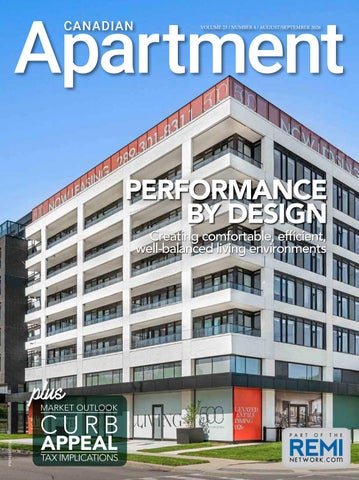
PERFORMANCE BY DESIGN Creating comfortable, efficient, well‑balanced living environments
PA R T O F T H E
plus
MARKET OUTLOOK
PM#40063056
CURB APPEAL
TAX IMPLICATIONS
P A R T
O F
T H E
Over 25 30 Years’ Years’ Experience Experience in in Renovating Renovating Apartments and Condominiums
COMMERCIAL •• INDUSTRIAL INDUSTRIAL •• RESIDENTIAL RESIDENTIAL •• INSTITUTIONAL INSTITUTIONAL COMMERCIAL General Renovations Renovations General
Kitchen Renovations Renovations Kitchen
Painting Painting
Cleaning of of Units Units Cleaning
Plumbing* Plumbing*
Flooring Flooring
Bathroom Renovations Renovations Bathroom
Electrical* Electrical*
Fire and and Flood Flood Restoration Restoration Fire
Custom Cabinetry Cabinetry Custom
Drywall and and Crown Crown Molding Molding Drywall
Fencing Fencing
UseaaLicenced LicencedPlumber Plumberand andLicenced LicencedElectrician Electrician(ESA) (ESA) * *Use
91Pippin PippinRoad, Road,Concord, Concord,ON ONL4K L4K4J9 4J9 91 Tel:905-660-2353 905-660-2353//905-669-8888 905-669-8888 Tel: TollFree: Free:1-888-660-2353 1-888-660-2353 Toll Fax:905-660-8390 905-660-8390//1-888-660-8390 1-888-660-8390 Fax: sales@multitech2000.com sales@multitech2000.com
www.multitech2000.com www.multitech2000.com
MunicipalLicence LicenceNo. No.T85-4186258 T85-5441962 Municipal
EDITOR’S NOTE>>
Editor
Erin Ruddy
Senior Graphic Designer
Roxy Huynh-Guinane
Graphic Designer
Amanda Spearman
Production Manager
Ines Louis
National Sales
Andrea Almeida Ron Guerra
Digital Media Director
Steven Chester
Circulation
Adrian Holland
DESIGN THAT DRIVES PERFORMANCE
For sales information call (416) 512-8186 Canadian Apartment Magazine is published six times a year by:
251 Consumers Road, Suite 1020, Toronto, Ontario M2J 4R3 E-mail: info@mediaedge.ca
President Kevin Brown Group Publisher Sean Foley Copyright 2026 Canada Post Canadian Publications Mail Sales Product Agreement No. 40063056 ISSN 1712-140X Circulation 416-512-8186 ext. 234 circulation@mediaedge.ca Subscription Rates: Canada: 1 year, $50*, 2 years, $90*, US $75 International $100, Single Copy Sales: Canada: $12* * Plus applicable taxes Requests for permission to reprint any portion of this magazine should be sent to Erin Ruddy. Authors: Canadian Apartment Magazine accepts unsolicited query letters and article suggestions. Manufacturers: Those wishing to have their products reviewed should contact the publisher or send information to the attention of the editor. The opinions expressed are those of the authors of articles and do not necessarily reflect the views of Canadian Apartment Magazine. This information is general and is not a substitute for legal advice. Sworn Statement of Circulation: Available from the publisher upon written request. Although Canadian Apartment Magazine makes every effort to ensure the accuracy of the information published, we cannot be held liable for any errors or omissions, however caused. Printed in Canada.
Canada’s rental housing market in the back half of 2026 is entering a more stable, predictable phase. Rent growth is moderating, household formations are shifting, and tech‑savvy renters are scrutinizing livability in ways that directly influence leasing velocity. For owners, operators, and developers, design is no longer a finishing consideration; it’s a business strategy that shapes performance, retention, and long‑term asset value. High‑performing buildings work best when the design matches how /cammediaedge they’re actually used. They focus on practical layouts that make turnover /cdnapartmentmag easier and keep residents satisfied over the long haul. In‑suite features that make daily life easier — from storage that eliminates clutter to im‑ /mediaedgecam proved acoustic performance now that hybrid work has cemented itself — carry as much weight as amenities and access to usable outdoor space. Tenants expect spaces that feel intuitive, efficient, and adaptable, and operators increasingly recognize that these choices directly influence service demands, renewal behaviour, and overall building reputation. Fengate Communities exemplifies this approach with the launch of 500 Upper Wellington in Ham‑ ilton, Ontario. Designed around a clear operational philosophy to “build homes that are modern, at‑ tainable, and aligned with long‑term performance,” the project — featured in our cover story — offers a detailed look at the decisions that shaped its design. From unit layouts to amenity programming, it reflects a growing industry emphasis on thoughtful, future‑proofed choices that support both resi‑ dent experience and operational efficiency. This issue also explores the latest housing data, newsworthy announcements, and the tax impli‑ cations of capital vs. current expenses — how borderline repair decisions affect annual returns, and what operators should consider when documenting and defending their positions. In a sector where margins are tightening and expectations are rising, these decisions matter. As Canada’s rental market normalizes, design becomes a competitive lever. Buildings that invest in smart, durable, resident‑focused choices will lease faster, retain longer, and outperform in every cycle. Sincerely, Erin Ruddy
Return Undeliverable Canadian Addresses to Circulation Dept: 365 Evans Avenue, Suite L10, Toronto, Ont. M8Z 1K2
rent trends OPERATIONAL BENEFITS OF SMART DESIGN: FUNCTIONAL LAYOUTS • Faster turns • Lower service calls • Higher resident satisfaction
SMART BUILDING TECH • Lower utilities • Predictive maintenance • Better comfort and air quality
DURABLE, SUSTAINABLE MATERIALS • Lower long‑term maintenance • Fewer major repairs • Improved environmental metrics
ACOUSTIC PERFORMANCE • Fewer complaints • Better renewals • Stronger reputation
PURPOSE‑BUILT AMENITIES • Faster leasing • Higher utilization • Clear market differentiation
SMART STORAGE • Less clutter • Better use of space • Higher perceived value
USABLE OUTDOOR SPACE • Year‑round engagement • Wellness appeal • Stronger curb appeal
VOLUME 23 / NUMBER 4 / AUGUST/SEPTEMBER 2026
FEATURE 12 REPAIR OR IMPROVEMENT? The call that shapes this year’s deduction by Bashar Qawas
28 DESIGNING FOR DENSITY Small-space solutions that make a big impact by Daniel Kocur
COLUMNS 6 Transactions A Market Rebalancing 8 CMHC Report Muted Demand Shapes 2026 20 Ask the Expert Fire Safety Tips for Landlords 32
Newsworthy Industry Hot Topics
COVER STORY
DEPARTMENTS
24 A PLATFORM BUILT FOR PROGRESS Fengate Communities comes to life in Hamilton, Ontario
2
by Erin Ruddy
ON THE COVER:
VOLUME 23 / NUMBER 4 / AUGUST/SEPTEMBER 2026
500 Upper Wellington in Hamilton, ON
Editor’s Note PERFORMANCE BY DESIGN
38 Smart Ideas
Creating comfortable, efficient, well‑balanced living environments
PA R T O F T H E
PA R T O F T H E
plus
MARKET OUTLOOK
PM#40063056
CURB APPEAL
P A R T
O F
T H E
P A R T
O F
T H E
TAX IMPLICATIONS
Garbage Chute & Waste System Experts CANADIAN-BUILT. FAMILY-OWNED.
Compactors, Sorters & Waste Containers | Power Washing & Odour Control | Preventive Maintenance, Repairs & Emergency Service
Rick@yorkchutes.com | 905-850-3500 | www.yorkchutes.com
SCAN TO SUBSCRIBE TO THE AWARD-WINNING REAL ESTATE MANAGEMENT NETWORK REMI
JOIN THE COMMUNITY. Receive industry news that tackles prominent and emerging topics of interest and provides practical advice from a wide variety of industry experts.
Visit us at: www.reminetwork.com
Powered by:
A Market Rebalancing Rental demand normalizes as new supply rises Rental demand in Canada is shifting into a more measured period, moving away from the immigration‑fuelled surge that defined the past few years and toward a steadier, more predictable baseline. Economic caution, demographic changes, and a substantial pipeline of new supply are all contributing to this recalibration. Conditions remain uneven across the country, but the broader pattern is unmistakable: the rental market is levelling out rather than accelerating. After several years of extraordinary population growth, rental demand has cooled. Leasing activity has stabilized at levels well below the highs seen during the immigration surge of 2022–2024. This moderation is being felt most acutely in major urban centres, where vacancy rates have begun to edge upward and landlords are adjusting expectations accordingly.
Downward pressure on asking rents persists, though it is far from uni‑ form. Established neighbourhoods with strong transit access or limited new construction continue to see relatively stable rents. But in markets where supply has surged, landlords are increasingly turning to incentives to stay competitive.
New & Notable Transactions Address
Source: Morguard
Market
Sale Price (millions)
No. of Units
Sale Price/ Unit
Sub-Type
Purchaser
1.
21 Lexington Ave
Toronto
$20.7
72
$287,500
Townhomes
Group Lande
2.
Domaine Louis-Pare – 2730-2930 Louis-Pare St
Montreal
$25.1
144
$174,583
Low Rise
Lifa
3.
50 Driftwood Ave, 797 Jane St
Toronto
$57.2
201
$284,428
Portfolio
Peakhill Opportunity REIT
4.
Wellington Towers – 145, 147 Wellington St W
Aurora
$85.5
204
$419,118
High Rise
Realstar Group
5.
Place Charles Albanel – 40, 45, 50, 55 Charles St, 8209 Albanel St
Gatineau
$35.8
226
$158,186
Low Rise
Akelius Canada
6.
Oaks on the Green – 160, 170, 180 200 Chalkfarm Dr
Toronto
$265.0
1,212
$218,647
High Rise
Groupe Dumont
7.
Lash Group Portfolio – 775 Steeles Ave W, 8 Godstone Rd, 640 Lauder Ave
Toronto
$143.8
487
$295,329
Portfolio
BST Canada
6 | Canadian Apartment | Part of the REMI Network
TRANSACTIONS >> One‑ to three‑month free‑rent offers remain common in the country’s most expensive cities, a direct response to elevated vacancy stemming from the heavy delivery of new purpose‑built and investor‑owned units over the past few years.
Economic crosscurrents shaping demand
Canada’s broader housing market slump is playing a subtle but important role in stabilizing rental demand. With resale activity subdued and afford‑ ability still strained, some households are delaying ownership and remain‑ ing in rental housing longer. At the same time, high youth unemployment and “doubling up” be‑ haviour — young adults sharing units to manage costs — continue to weigh on demand. These factors have softened leasing activity even as rents have become more accessible in some markets. “We’re seeing a return to more typical demand patterns after several years of exceptional growth,” observed Keith Reading, Director of Market‑ ing at Morguard. “The fundamentals remain sound, but renters today are more cautious, and landlords are adjusting to a landscape where incentives and competitive pricing matter again.”
Investor outlook
Despite the moderation in demand, Reading noted that investor senti‑ ment remains surprisingly resilient. Many continue to point to the long‑term health of the rental sector — driven by structural undersupply, demographic stability, and the enduring appeal of multifamily assets — as justification for continued acquisitions. Acquisition pricing has stabilized, with premiums still being paid for new
builds and well‑located concrete high‑rises. Several large‑scale transactions have closed in recent months, reinforcing confidence in the apartment mar‑ ket’s long‑term performance outlook.
Rising vacancy, limited rent growth
Looking forward, vacancy is expected to rise over the next one to two years. A combination of steady new supply deliveries and moderate demand will keep upward pressure on availability. As a result, rent growth is likely to re‑ main limited, particularly in markets with substantial construction pipelines. Still, the sector’s long‑term fundamentals remain intact. Canada’s rental housing market is entering a period of recalibration — one where investors, renters, and developers alike are adjusting to a more balanced, less over‑ heated environment.
ARE YOU CONTEMPLATING THE SALE OF YOUR APARTMENT PROPERTY/PORTFOLIO?
For more info, please contact:
Consider the following: • Who will represent your best interests? • Who will give your property maximum exposure? • Who will deliver the highest value for your Property/Portfolio? With over 35 years of experience, tens of thousands of units sold, and hundreds of clients represented, we have consistently delivered superior results. Through our local and national coverage, we create maximum exposure, ensuring maximum value for your property. For more information on recent transactions and active listings, please reach out to a member of our team.
Tom Schuster
±$11.6B
Sales Volume
±69,600
Suites Sold
±35 Years
David Montressor Vice Chairman Sales Representative (416) 815-2332 david.montressor@cbre.com Director Sales Representative (416) 847-3257 tom.schuster@cbre.com
of Experience
Scan to receive Apartment Listings and Market Research
SOLD FOR $24,750,000
SOLD FOR $40,000,000
UNDER CONTRACT
ACTIVE LISTING
85 Wellesley Avenue E Toronto, ON 88 Suites
London Apartment Portfolio London, ON 201 Suites
Ottawa Apartment Portfolio Ottawa, ON 826 Suites
233 Dunlop Street W Barrie, ON 93 Suites
This disclaimer shall apply to CBRE Limited, Real Estate Brokerage, and to all other divisions of the Corporation (“CBRE”). The information set out herein, including, without limitation, any projections, images, opinions, assumptions and estimates obtained from third parties (the “Information”) has not been verified by CBRE, and CBRE does not represent, warrant or guarantee the accuracy, correctness and completeness of the Information. CBRE does not accept or assume any responsibility or liability, direct or consequential, for the Information or the recipient’s reliance upon the Information. The recipient of the Information should take such steps as the recipient may deem necessary to verify the Information prior to placing any reliance upon the Information. The Information may change and any property described in the Information may be withdrawn from the market at any time without notice or obligation to the recipient from CBRE. CBRE and the CBRE logo are the service marks of CBRE Limited and/or its affiliated or related companies in other countries. All other marks displayed on this document are the property of their respective owners. All Rights Reserved.
www.REMInetwork.com | August/September 2026 | 7
Q3 housing market outlook Economic uncertainty continues to restrain housing activity nationwide Canada’s housing market is expected to remain subdued through the remainder of 2026 as economic uncertainty, slow‑ er population growth, high borrowing costs, and modest income gains continue to limit demand across the country. 8 | Canadian Apartment | Part of the REMI Network
CMHC REPORT >>
R
eleased in late-July, CMHC’s 2026 Hous‑ ing Market Outlook – Mid‑Year Update and its Summer 2026 Housing Observer both point to a year defined by weak sales, de‑ clining prices, and a pullback in new construction. Canada’s economy is projected to grow only 0.7 per cent in 2026, supported by consumer spending, government investment, and a re‑ bound in exports. But uncertainty remains ele‑ vated. The U.S.–Iran conflict is expected to tem‑ porarily push inflation higher, while Canada–U.S. trade tensions will weigh heavily on business in‑ vestment for the foreseeable future. As a result, housing demand is expected to stay soft, with average home prices declining in 2026 before returning to modest growth in 2027 and 2028. Sales are expected to recover gradually through 2028 but remain below the levels typical of the past decade. “Price reductions have not yet been enough to bring demand back into the market as eco‑ nomic uncertainty, income growth and borrow‑ ing conditions all have played a role in sidelining buyers,” said Kevin Hughes, CMHC Deputy Chief Economist. “We expect conditions to im‑ prove over the medium term; however, housing construction should remain suppressed as the in‑ dustry factors in today’s elevated inventories and weaker demand.”
Housing starts
Housing starts are projected to continue falling in the coming months, reflecting elevated invento‑ ries, high construction costs, and cautious build‑ er sentiment. Condominium construction will be particularly weak in Ontario and B.C., while activ‑ ity in the Prairies and Quebec moderates from recent highs. CMHC notes that despite expec‑ tations of declining starts, 2026 construction has been more resilient than anticipated, though still well below historical norms.
Federal funding fuels Toronto’s rental build‑out Toronto’s apartment sector is poised for another wave of new supply, supported by $2.7 billion in federal funding to accelerate housing delivery and expand purpose-built rental stock. The City is adding $703.7 million in funding and incentives, bringing the combined investment to support 5,600 rental homes in neighbourhoods across Toronto. The federal contribution includes more than $1.8 billion in low‑cost financing through the Apartment Construction Loan Program, backing nine projects that will deliver over 3,700 rental units. A further $310 million through Build Canada Homes will advance nine additional projects on City‑owned land, producing roughly 1,800 homes across a mix of affordable, rent‑geared‑to‑in‑ come, rent‑controlled and supportive housing. These City‑led developments will be delivered with public, non‑profit and Indigenous housing partners. Prime Minister Mark Carney framed the announcement as evidence that intergovernmental collaboration can meaningfully shift rental supply: “Toronto is becoming a model for how a great city can build its way forward… This is what is possible when governments build together.” Mayor Olivia Chow echoed the affordability focus, noting that the investment “means more people will have the opportunity to find a home they can afford, stay close to their communities and build a future in the city they love.” The funding arrives as Toronto continues to roll out policy tools aimed at lowering project costs and accelerating timelines. Earlier this year, the City, Province and federal government intro‑ duced the Development Charge Reduction Program, a $1.5‑billion initiative that cuts develop‑ ment charges by 40–60% for more than three years. Toronto is also launching a new phase of its Purpose‑Built Rental Housing Incentives Stream, allowing development charges to be deferred indefinitely for projects that include at least 20 per cent affordable units.
www.REMInetwork.com | August/September 2026 | 9
CMHC REPORT >>
Tariffs, delays, and the deepening housing crunch
Rental construction
Coming off a historic peak in 2025, rental con‑ struction is expected to ease gradually, though it will remain an important source of new supply. Rental market conditions are expected to con‑ tinue easing as new supply reaches the market, especially in major centres. Vacancy rates in
10 | Canadian Apartment | Part of the REMI Network
Toronto, Vancouver, and Montréal are projected to rise, slowing rent growth — particularly for asking rents. Prairie markets will likely see mod‑ est rent increases supported by stronger de‑ mand. Still, affordability challenges will persist nationwide, with rents remaining high relative to incomes.
The brewing tension between Canada and the United States has escalated into a full‑blown trade war, disrupting cross‑border supply chains, driving up the cost of construction ma‑ terials, and threatening to throw the timelines of major housing projects into disarray. After negotiations between the two countries col‑ lapsed on August 22, Prime Minister Carney warned that Canada “will not allow its econo‑ my — or its workers — to be destabilized by sudden, unilateral trade actions,” emphasizing that the government is prepared to defend Canadian industries while working to restore predictability at the border. Developers already grappling with labour shortages, high interest rates, and soaring land costs, now face a destabilizing force that could impact every aspect of the construction process. According to Richard Lyall, President of RESCON, the U.S.-imposed 50 per cent
CMHC REPORT >>
Section 338 tariff on $20–28 billion (USD) of Cana‑ dian goods — layered on top of Canada’s 25 per cent counter‑tariff on U.S. steel and aluminum in effect since March 2025 — will have significant consequences. “Earlier estimates already put the tariff‑driven cost‑load on new Ontario homes at $15,000 to $25,000 per unit,” he said. “With Canada retal‑ iation adding costs on appliances, electronics, pulp and paper, among other products, that number will be pushed even higher, especially for high‑rise projects, where structural steel, me‑ chanical systems, and elevator packages com‑ pound every increase.” Before the current U.S. administration with‑ drew from key CUSMA obligations and sus‑ pended major provisions, the Canada–U.S. con‑ struction supply chain operated as a seamless, high‑volume machine. Lumber, steel, aluminum, prefabricated components, and energy inputs moved across the border daily — often multiple times — with virtually no friction. That reliability has evaporated. What was once a predictable two‑day delivery window now routinely stretches
to five or six, according to cross‑border freight carriers and customs brokers who cite routine secondary inspections, slowed paperwork, and clearance delays as the new norm. “Canadian softwood lumber already faces combined U.S. duties and Section 232 tariffs exceeding 45 per cent,” said Kim Haakstad, in‑ terim President of the BC Lumber Trade Council. “Section 338 now extends this high-tariff envi‑ ronment to a much broader range of Canadian forest products and building materials, including
plywood, engineered wood products, pulp, paper and other value-added products.” Haakstad added that the tariffs don’t just raise costs on both sides of the border — they actively destabilize an integrated North American supply chain. Canadian lumber and forest products underpin jobs and com‑ munities across Canada while supplying U.S. builders and consumers with the essential materials they depend on to build and reno‑ vate homes.
Connected Laundry.
Better Performance. The exclusive Coinamatic connected laundry platform provides real-time visibility, maximizes uptime, and creates a premium experience for both property owners/managers and residents.
Full Service Laundry Solutions for Property Managers
Simple & Convenient Laundry Experience for Residents
Fully managed and maintained laundry rooms with zero upfront costs
Faster and better laundry with real-time cycle notifications and personalized laundry tips
Earn money for your laundry room without the headaches of machine maintenance
Residents pay for laundry & report service request via WASH-Connect App
Modern Laundry Amenities coinamatic.com | 1-800-361-2646 www.REMInetwork.com | August/September 2026 | 11
Repair or Improvement? The call that shapes this year’s deduction by Bashar Qawas A building needs work. You approve it, the invoice arrives, and someone decides whether it is a current expense or a capital expenditure. That distinction determines whether the expense reduces this year’s rental income or is pushed into a capital cost allowance class and recovered gradually. CCA is discretionary, generally available only once the asset is in use, and cannot be used to create or deepen a rental loss. 12 | Canadian Apartment | Part of the REMI Network
FEATURE >>
S
ame cheque, different tax treatment. And in multi‑residential, the bor‑ derline cases aren’t rare — they’re the bulk of what a building actually needs.
The CRA’s published criteria
One point first, because it governs everything that follows. No single guide‑ line decides the issue. The CRA’s position is that all relevant guidelines must be weighed together, along with the practical and business purpose of the expenditure, so what follows is a set of considerations — not a decision tree. With that said, three questions do most of the work. 1. Does the expense provide a lasting benefit? Capital generally gives a lasting benefit or advantage. A current expense usually recurs after a short period. The CRA’s own illustration is vinyl siding on the exterior walls of a wooden house, which is capital, against painting the exterior of that house, which is current. 2. Does it maintain the property or improve it? An expense that only restores a property to its original condition is one indication it is current. A repair that improves it beyond original condition points to capital. Repair‑ ing or replacing wood steps with wood steps is typically current mainte‑ nance. Replacing wood steps with concrete is capital. 3. Is it a part of the property, or a separate asset? Repairing a property by replacing one of its parts is usually current. Replacing a separate as‑ set within a property is capital, and the CRA’s example is a refrigerator used in the rental operation, which is a separate asset rather than part of the building. Electrical wiring is part of the building, so rewiring is usually current, provided it does not improve the property beyond its original condition. The folio recognizes that something arguably separate can still be current depending on how integrated it is and its relative value.
value of the property, where considerable relative value points to cap‑ ital. The CRA is explicit that it applies only if the first three do not re‑ solve the question, and that it is not determinative by itself. Its example is useful: a large amount spent at once on ordinary maintenance that was not done when it should have been is a maintenance expense, deducted as current. Deferred maintenance does not become capital by piling up. 2. Repairs to acquired property. The cost of repairing used property you acquired, to put it in suitable condition for use, is capital, even though the identical work would otherwise be current. The focus is whether the work was undertaken to ready newly acquired property for use. Where the repairs are ordinary maintenance on a property already in the business, the expense is usually current. 3. Repairs to sell. Repairs made in anticipation of selling, or as a con‑ dition of sale, are generally regarded as capital. But where the re‑ pairs would have been made anyway and a sale was negotiated during or after the work, the expense is considered current. Purpose is an important factor under this criterion.
Applying it to real decisions
A repair often involves some degree of improvement in technology, materi‑ als or workmanship, and the CRA states plainly that this does not necessarily make it capital. Its own example: replacing a window with one that has a higher insulation value may still be a current expense if it otherwise qualifies. A replacement component will often outperform what it replaced simply by being current‑generation, and that alone does not convert the expendi‑ ture. Relatedly, whether market value increases as a result is not a major factor. There is also a published practice worth knowing, set out in the same folio. Where an expenditure contains identifiable current and capital ele‑ ments, an appropriate allocation is required. But where only a minor part of the expenditure is capital in nature, the CRA’s stated practice is to treat the whole amount as current.
None of the following has a categorical answer. Each depends on the facts. A roof. Repairing a failed section points toward current. Full replace‑ ment does not by itself establish capital treatment, since a like‑for‑like re‑ placement of an integral building component can still be a repair. One important question is whether the new roof is substantially different from what it replaced, considered alongside the other criteria. Windows on one elevation. The CRA’s example concerns a single replacement window with a higher insulation value, which it says may still be current. Extending that to a whole elevation is not something the CRA addresses, and scope is itself a relevant fact. One important question is whether the work restored the building envelope or genuinely improved it beyond its original condition, weighed with the remaining criteria. A kitchen between tenants. Patching, reglazing and repainting point toward restoration. Replacing cabinetry and appliances raises different questions, and appliances such as refrigerators are generally separate as‑ sets rather than part of the building. Whether the building was acquired with that unit requiring work to put the property into suitable condition for use is also relevant. A furnace. Repair points toward current, replacement raises the sepa‑ rate‑asset question, and the answer turns on the specific system and how it integrates with the building.
Three further criteria
Making a position supportable
Improved materials aren’t automatically capital
1. Value, but only as a tiebreaker. A criterion compares the cost to the
The determination turns on the facts of each expenditure, so the record www.REMInetwork.com | August/September 2026 | 13
FEATURE >>
reports are among the most useful things to have two years later, when no‑ body remembers what failed. Where a project genuinely contains both current and capital work, get a breakdown at the time that reflects a reasonable allocation of the actu‑ al work. A contemporaneous split is far stronger than one reconstructed afterward. Record the reasoning. A short note setting out why a position was taken, and against which criteria, is worth having.
The takeaway
needs to capture them. Ask for invoices that describe the work rather than the trade. “Re‑ placed 14 failed window units, like for like” tells you something. “Win‑ dow work” does not. Keep evidence of the prior condition. Photographs and condition
14 | Canadian Apartment | Part of the REMI Network
There is no list that resolves this by category, and anyone offering one is oversimplifying. A roof is not always capital. An upgrade is not automatically an improvement beyond original condition. What exists is a defined set of questions, with the value test expressly re‑ served for cases the first three do not settle. Work through them on the facts of the specific job and write down what you concluded and why. Deciding by the size of the invoice is not a position. Bashar Qawas is a partner at Better Books Canada and a former Canada Revenue Agency auditor.
Yes, we can! Since MetCap Living established itself as a leader in property management, we have routinely been asked one, simple question; “Can you help us run our property more effectively?” And, for 38 years, the answer has remained — Yes, we can! Our managers are seasoned professionals, experienced in every detail of the day to day operations and maintenance of multi-unit rental properties. From marketing, leasing, finance and accounting, to actual physical, on-site management, we oversee everything. We concentrate on revenue growth, controlling expenses, and strategic capital investment in your property to maximize your profitability over the long term — when you’re ready to discuss a better option; we’ll be there. You can count on it.
Kazi Shahnewaz
Director, Business Development Office: 416.340.1600 Cell: 647.887.5676 k.m.shahnewaz@metcap.com www.metcap.com
A PLATFORM B FOR PROGRESS Fengate Communities comes to life in Hamilton, Ontario
BUILT SS
BY ERIN RUDDY When Fengate Asset Management cut the ribbon on 500 Upper Wellington in July 2026, the moment represented far more than the opening of a new Hamilton rental community. It marked the first public expression of Fengate Communities, the company’s newly launched residential brand — and a clear demonstration of how Fengate and the LiUNA Pension Fund of Central and Eastern Canada (LPFCEC) are positioning themselves as long‑term leaders in Canada’s purpose‑built rental sector.
COVER STORY >>
T
he 260‑unit community sits along the Hamilton Escarpment, offering panoram‑ ic views and a mix of modern, family‑ori‑ ented suites. Its design reflects a clear opera‑ tional focus: creating comfortable, efficient, and well‑balanced living environments through sys‑ tems that support cleaner air, lower energy use, and technology that enhances daily life without drawing attention to itself. The result is a for‑ ward‑looking asset defined by family‑friendly lay‑ outs, low‑carbon building systems, energy‑effi‑ cient features, smart metering, EV‑ready parking, and a commitment to nature and active living. Adding additional value for residents, the build‑ ing connects directly to Hamilton’s parks, play‑ grounds, tree‑lined streets, and neighbourhood
18 | Canadian Apartment | Part of the REMI Network
Hamilton Rental Market Snapshot
Hamilton’s rental landscape is currently defined by scarcity, momentum and steady upward pressure. Tight availability keeps units competitive, while strong demand fuelled by population growth, shifting affordability across the GTA and a slow‑moving development pipeline, continues to shape a market where well‑located rentals lease quickly and pricing power remains firmly on the landlord side. • Vacancy rate: 1.7% (CMHC, 2025) • Rent growth: 7–9% year‑over‑year in purpose‑built rentals (Urbanation, CMHC) • Demand drivers: Population growth, affordability pressures, limited new supply
amenities. In other words, it’s a location that sup‑ ports long‑term livability and steady demand, grounded in a neighbourhood with history, cre‑ ativity, and a strong sense of place.
But behind the architecture is a deeper story: a partnership with decades of history, a pipeline built for scale, and a shared belief that profes‑ sionally managed rental housing is essential
COVER STORY >>
infrastructure for Canada’s future. “LiUNA has been helping build Hamilton and communities across Canada for generations, and our investment in 500 Upper Wellington reflects that long-standing commitment,” said Joseph Mancinelli, Chair of LPFCEC, LiUNA Internation‑ al Vice President and Regional Manager for Cen‑ tral and Eastern Canada. “As demand continues to outpace supply, projects like this represent meaningful action toward increasing housing availability, creating opportunities for our mem‑ bers, and helping build stronger, more vibrant communities for today, and for the future.” His message highlights a key point: LiUNA’s in‑ vestments extend beyond financial returns. They are structured to support city building, broaden opportunity, and reinforce the role of workers in shaping Canada’s built environment — contribut‑ ing to long‑term community resilience and future growth. The group is involved in dozens of pur‑ pose‑built rental projects across Ontario, with a pipeline that reaches into the thousands of units. Meanwhile for Fengate, 500 Upper Welling‑ ton is the first community to begin leasing under Fengate Communities, a brand launched earlier this year to unify its residential portfolio under a single, resident‑focused identity. As new residen‑ tial construction starts decline nationally, Fengate has moved in the opposite direction. Last year, the company broke ground on five communi‑ ties that will deliver 1,915 new homes, with more scheduled for 2026. These projects are support‑ ed by strong partnerships — including LPFCEC — and trusted investor relationships that have re‑ mained resilient in a challenging housing market. “As our residential portfolio continues to grow rapidly, Fengate Communities has emerged as a natural evolution of our business,” said Jaime McKenna, President of Fengate Real Estate. “Through one unified brand, we’re delivering a consistent and connected living experience for our residents no matter which community they call home, from the first leasing touchpoint to ev‑ eryday living. This resident-first focus will continue to guide how we invest in and deliver much-need‑ ed homes for Canadians, and how we build longterm value for the communities we serve.”
Modern attainable housing
According to the Fengate team, 500 Upper Wellington is designed with a clear operation‑ al philosophy: build homes that are modern, attainable, and aligned with long‑term perfor‑ mance. More than 40 per cent of suites are two‑ and three‑bedroom layouts — an intentional
response to shifting household needs. Ameni‑ ties such as a double‑height lobby, fitness cen‑ tre, resident lounge, outdoor terrace, children’s playroom, pet run, and indoor pet wash station reflect a focus on livability rather than luxury. Sustainability features — including geother‑ mal technology, heat‑recovery systems, ener‑ gy‑efficient ventilation, smart in‑suite metering, and EV‑ready parking — support both environ‑ mental goals and long‑term asset value. And, according to McKenna, the market has responded. Within three months of occupancy, the building reached approximately 30 per cent lease‑up, providing a strong early indicator of the demand for professionally managed rentals in Hamilton. “500 Upper Wellington is exactly the kind of community we are focused on delivering through our residential platform: high quality, thoughtful‑ ly designed rental housing in well connected neighbourhoods where people and families can build their lives,” she said. “Together with LiUNA, we are responding to Canada’s housing supply challenge with communities that create enduring value for residents and investors.”
A brand with ambition
Over the coming months, Fengate will be rolling out the Fengate Communities brand across its existing residential portfolio, accompanied by resident events to celebrate its launch. Built on the premise that every neighbourhood has the potential to be something special, the platform has already delivered thousands of rental homes,
Ontario’s Purposebuilt Pipeline Ontario’s purpose‑built rental pipeline re‑ mains active but increasingly shaped by caution. Developers are still advancing large projects across the province, yet the broad‑ er national slowdown in multi‑unit starts is beginning to temper momentum. In Hamil‑ ton, investment continues to cluster around mid‑rise rental communities near transit corridors and major healthcare anchors — areas where demand remains resilient and long‑term fundamentals are strongest. CMHC’s 2026 data indicates more than 120,000 units are under construction or pro‑ posed across Ontario.
with more than ten new communities on the way. “500 Upper Wellington is the first community to carry the Fengate Communities identity, and it gives residents a clear sense of what they can expect from our platform: modern, well-con‑ nected homes, a thoughtful leasing experience, and professionally managed communities de‑ signed to support everyday life,” said Carolyn Poirier, Vice President, Sales and Leasing, Fen‑ gate Communities. “The way our residents have embraced the brand has been encouraging and speaks to the demand for quality rental housing in neighbourhoods where people and families can put down roots.” www.REMInetwork.com | August/September 2026 | 19
ASK THE EXPERT >>
Your Fire Safety Plan Is Approved But does anyone know what it says? by Matt Merkley A small test for tomorrow morning: ask your building staff who would meet the fire department if the alarm went off. Ask who has the keys to the service rooms, and who can explain which part of the building is in alarm. These are basic questions, yet if the answers aren’t immediate, the building may have an approved fire safety plan without having a plan anyone actually understands. 20 | Canadian Apartment | Part of the REMI Network
ASK THE EXPERT >>
I
n many apartment buildings, the fire safety plan is treated as a finished product—prepared, reviewed, approved, and filed. Once it’s in the right binder, everyone moves on. But does anyone truly know what the plan says? In my work with apartment buildings, the issue is rarely a lack of con‑ cern. Property managers, supers, and building staff care deeply about safety. The problem is that the information in the plan doesn’t always make its way into day‑to‑day operations. A fire safety plan isn’t meant to be a binder that only comes out during inspections. It should tell staff what’s expected of them during an emergency, where critical fire and life‑safety equipment is located, and who needs to be contacted when something goes wrong. And that applies to more than fires. A sprinkler pipe may leak. A fire alarm system may be shut down for repairs. An elevator may fail. A con‑ tractor may flag a deficiency during an annual inspection. In each case, someone needs to know what happens next. A property manager may know the building has a fire alarm system but not what occurs when it activates. A superintendent may know where the plan is stored but not who meets responding firefighters. Staff may know to call 911 but not where the sprinkler valves are, wheth‑ er an occupant needs assistance, or where inspection records are kept. That doesn’t make anyone careless — it simply means the plan hasn’t been translated into usable knowledge. Staff don’t need to become fire protection technicians. They do need enough understanding to spot a problem, make the right calls, and give clear information when help arrives. A review can start with a few straightforward questions: • Fire department liaison — Who meets firefighters, and how will they access locked service rooms? • Alarm panel awareness — Do staff know where the fire alarm panel is and how to identify the area in alarm? • System accessibility — Are sprinkler valves, standpipe connections, the fire department connection, and main service rooms accessible? • Assistance lists — Is current information available for occupants who may need help during an emergency?
• Fire watch procedures — If a fire protection system is out of ser‑ vice, do staff know whether a fire watch is required and who must be notified? • Recordkeeping — Where are monthly checks, annual inspection reports, fire drill records, and repair documents kept? The answers can be revealing. One person may know where the fire alarm panel is, while someone else has the keys. The emergency con‑ tact list may include an employee who left years ago. An inspection report may be filed away, but nobody knows whether the deficiencies were repaired. The simplest way to find these gaps is to walk the building with the plan open. Show staff the fire alarm panel, sprinkler room, fire depart‑ ment connection, emergency contacts, and inspection records. Review what should happen when the alarm sounds and who is responsible for each step.
CON ERRA RESTORATION LTD.
Parking Structure & Building Repair Specialist
TEL: 905-848-2992 | WWW.CONTERRA.CA 54 NUGGETT CT, BRAMPTON, ON L6T 5A9
Conterra_CAM_Jan-Feb_2026.indd 1
PARKING STRUCTURE REHABILITATION
TRAFFIC DECK WATERPROOFING SYSTEMS
BALCONY, MASONRY & CAULKING REPAIRS
SPECIALIZED CONCRETE REPAIRS
EXPANSIONS JOINTS
2026-02-11 2:12 PM www.REMInetwork.com | August/September 2026 | 21
ASK THE EXPERT >>
“STAFF DON’T NEED TO BECOME FIRE PROTECTION TECHNICIANS. THEY DO NEED ENOUGH UNDERSTANDING TO SPOT A PROBLEM, MAKE THE RIGHT CALLS, AND GIVE CLEAR INFORMATION WHEN HELP ARRIVES.” It’s also important to discuss what staff should not do. Silencing or re‑ setting an alarm without authorization can erase critical information or create confusion. Assuming an alarm is false because there’s no visible smoke can delay the response to a real emergency. This doesn’t require a full‑day training session. A short review with new staff, a quick refresher after an alarm, or a few minutes spent dis‑ cussing an inspection report can make the plan far more useful. The plan also needs to match the building as it exists today. Staff and tenants change. Contact numbers change. Systems are upgraded,
22 | Canadian Apartment | Part of the REMI Network
rooms renovated, and contractors identify new deficiencies. A plan that was accurate when approved can gradually become outdated. Approval confirms that required procedures have been document‑ ed. But approval alone doesn’t prepare the people who operate the building. When staff understand the fire safety plan, they’re more confident in their responsibilities. Managers and contractors communicate more clearly. Firefighters receive better information when time matters. And residents are better protected. The next time you look at your fire safety plan, don’t just check that it’s approved and in the right place. Ask the people responsible for the building what it says. Their answers will tell you whether you have a working fire safety plan — or simply an approved binder. Matt Merkley is a professional firefighter with over 20 years of expe‑ rience in fire safety consulting and fire safety plan development. He is the founder of Fire Safety Handbook, an educational resource help‑ ing apartment‑building owners, property managers, building manag‑ ers, and onsite staff better understand the fire and life‑safety systems in the buildings they operate. Learn more at firesafetyhandbook.com.
PERFORMANCE BEYOND THE SURFACE
ASPHALT PAVING SNOW REMOVAL SERVICE LANDSCAPE CONSTRUCTION estimating@forestgroup.ca service@forestgroup.ca
SITE SERVICING BUILDING RESTORATION CONCRETE CONSTRUCTION 24 Hour Emergency Service 416.524.3000
forestgroup.ca
NEWSWORTHY >>
Industry hot topics 199 new rental homes coming to Edmonton
E
dmonton’s rental supply is set to grow with the launch of Gilbertson Block, a six‑storey, 199‑unit project now under construction at 210 Lakewood Road East NW. The federal government, Rohit Group, and Covenant have announced over $56 million in funding for the development, including $51.2 million in low‑cost financing through the Apartment Construction Loan Program (ACLP). Gilbertson Block is part of the emerging Cov‑ enant Wellness Community, an integrated model that brings housing, health care, and community supports together on one campus. The building will sit adjacent to Covenant’s new Stelmach Com‑ munity Health Centre, which offers a range of out‑ patient and specialized health services. Residents will have access to in‑suite laundry, an onsite gym, heated underground parking, air conditioning, and tenant lounges, with schools, recreation facili‑ ties, retail, restaurants, and transit all within walking distance. Construction is underway and expect‑ ed to be completed in late 2027. “Canada’s housing needs requires strong ideas and strong partnerships,” said Caroline Desrochers, Parliamentary Secretary to the Minister of Housing and Infrastructure. “By
working alongside the private sector, we can help bring forward new approaches to hous‑ ing to deliver more homes. This partnership is a great example of what we can achieve when governments and industry work together.” According to Rohit Group CEO Rohit Gupta, the development reflects a model that “brings hous‑ ing and health care together in a way that benefits
residents and strengthens the broader health system.” The ACLP, a $55‑billion national program, is supporting more than 131,000 new rental homes across Canada by 2031–32. For Gilbertson Block, Rohit Group and Covenant are contributing an additional $5.1 million, helping bring new secure rental homes to market in a growing, service‑rich community.
B.C. sets 2027 rent increase limit at 2.2%
B
ritish Columbia has set the maximum allow‑ able rent increase for 2027 at 2.2 per cent, keeping the cap tied to inflation and offering landlords early clarity for planning. The limit, slightly below the 2.3 per cent permitted in 2026, takes effect on Jan. 1, 2027. “At a time when many people are feeling the impact of rising costs, linking rent increases to inflation helps renters, including seniors and families, meet their housing expenses, while also 24 | Canadian Apartment | Part of the REMI Network
ensuring landlords can continue providing sta‑ ble, well-maintained homes for renters for years to come,” said Christine Boyle, Minister of Hous‑ ing and Municipal Affairs said. “Our focus from the start has been on helping people across B.C. find housing that fits their needs and budgets. Thanks to our work to increase housing supply, crack down on illegal short-term rentals and limit foreign investment in the housing market, B.C. has seen a 4.5 per cent decrease in overall
average rents.” Prior to 2019, landlords could apply an ad‑ ditional 2 per cent increase on top of inflation. Without that policy change, allowable increases would have climbed to 5.4 per cent in 2023 and 5.6 per cent in 2024. The announcement comes as new data from Rentals.ca shows average asking rents in B.C. have declined 4.5 per cent year‑over‑year, with purpose‑built rentals and apartments down 4.1 per cent. Several cities recorded some of the largest rent decreases in the country within pur‑ pose‑built rentals, including Abbotsford, Langley, Coquitlam, New Westminster and Richmond. The maximum allowable rent increase is de‑ termined by the 12‑month average change in B.C.’s all‑items Consumer Price Index ending in July of the previous year. The cap does not apply to commercial tenancies, rent‑geared‑to‑income units, co‑operative housing or certain assisted‑liv‑ ing facilities.
NEWSWORTHY >>
Canada boosts EV infrastructure funding
T
he federal government announced a $10.9million investment to complete 22 electric vehi‑ cle (EV) infrastructure and education projects, accel‑ erating the transition to zero-emission transportation for Canadians living in various types of housing. “Driving electric can save a Canadian house‑ hold between $23,000 and $32,000 over 10 years, but for the nearly one in three Canadian families who live in condominiums, stratas, and apartments, those savings can be out of reach,” said Travis Allan, president and CEO of the Cana‑ dian Charging Infrastructure Council. “ Every day, condo boards, property managers, and land‑ lords ask our members the same question: What do we do when a resident wants to install electric vehicle charging? This guide, funded by the Gov‑ ernment of Canada, will give them clear, practical answers, and help ensure the benefits of low-cost electric driving reach every Canadian, not just those with a driveway.”
The funding includes almost $9 million to in‑ stall nearly 400 chargers through nine projects funded by the Zero Emission Vehicle Infrastruc‑ ture Program. Additionally, around $2 million in funding will support 13 education and awareness
initiatives about EV charging. In British Columbia, these investments build on electrification efforts in the province, where there are now more than 8,900 public charging ports– an increase of 87 per cent since 2023.
Don’t let your mechanical room control your capital plan. Aging boilers, HVAC, and water heating systems need more maintenance, repairs, and may need replacing. Enercare Advantage® lets you upgrade your equipment for $0 upfront* while providing ongoing service and maintenance.
$0 Upfront Repairs & maintenance Same-day service**
Plan your next equipment upgrade.
enercare.ca/commercial 800-321-1508
*Terms and conditions and certain exceptions apply. See rental agreement for details. **Available to Enercare’s Heating/Cooling protection plan customers, rental water heater customers and/or rental HVAC customers whose equipment is not operational (for example – no heat, no cooling or no hot water). On average, Enercare attends to furnace/boiler, central air conditioner, or water heater non-operational calls 80% of the time the same day. Subject to exclusions in accordance with the terms and conditions of the applicable protection plan or rental agreement. ®Enercare, Enercare Advantage and the design are trademarks of Enercare Inc., used under license.
ECH3989_EnercareAdvantageAd_7_125x4_75_Apt_d2.indd 1
www.REMInetwork.com | August/September 25 2026-08-28 2026 11:18|AM
NEWSWORTHY >>
AI adoption surges among Canadian renters
A
rtificial intelligence has officially entered the Canadian rental search, according to a recent survey from Rentals.ca. Of the 1,194 re‑ spondents, 28.5 per cent said they have used AI tools such as ChatGPT or Google Gemini to help them find an apartment, marking the first time the platform has tracked this behaviour in its national renter survey. Conducted between May 5 and June 14, 2026, the survey findings show that AI has moved well beyond early adopters. Among renters who used these tools, 72.6 per cent described the ex‑ perience as helpful, citing faster searches, clearer comparisons, and easier-to-understand explana‑ tions of rental rules. The most common uses include: • Finding listings and neighbourhoods — 57.7% • Comparing rental prices — 45.5% • Understanding lease terms — 40.2% • Getting budgeting advice — 38.1% • Writing messages to landlords — 33.3% The new data suggests renters are increasing‑ ly comfortable using AI as a research assistant
— one that can summarize neighbourhood pros and cons, flag price anomalies, or help decode legal language that often feels opaque. Adop‑ tion is highest among renters aged 25 to 34, at 35.5 per cent though renters 65 and over report‑ ed adoption at 22.8 per cent, nearly matching the 45 to 54 cohort. Higher-income renters are more likely to use AI, with adoption reaching 37.9 per cent among those earning $125,000 or more, compared to 23.8 per cent among those earning under $25,000. Higher-income renters appear more likely to ex‑ periment with digital tools, but the generational spread shows AI is no longer a niche technology.
Regional adoption
AI use varies across the country, with Canada’s largest markets leading the way: • Toronto/Ontario: 29.9% • BC/Vancouver: 27.2% • Alberta: 25.4% • Atlantic Canada: 25.0% • Manitoba/Winnipeg: 23.0% • Quebec/Montreal: 22.7%
“Still limitations”
While most users found AI helpful, 21.2 per cent said it wasn’t — a reminder that the technology has still has real limitations, with renters citing is‑ sues such as: outdated or inaccurate listing data, missed local nuance in neighbourhood descrip‑ tions, and lease guidance that felt too general or not legally reliable. In short, AI can streamline the search, but it can’t replace professional advice or real-time market expertise.
CAPREIT names James Lawrence new Chief Operating Officer
C Affordable rental homes announced for Hamilton
T
he federal government has committed $31.8 million through the Af‑ fordable Housing Fund (HAF) to support the construction of 107 new rental homes in Hamilton, Ontario. The eight‑storey development at 525 Stone Church Road East will offer a mix of bachelor, one‑bedroom, and two‑bedroom units, including both market‑rate and rent‑geared‑to‑in‑ come homes delivered in partnership with Victoria Park Homes. The fund‑ ing is part of a broader federal effort to accelerate homebuilding, strength‑ en supply chains, and create jobs across the construction sector. “We need more homes in Hamilton, and we need housing that people can afford,” said Mayor Andrea Horwath. “These 107 new rental homes, including rent‑geared‑to‑income options, will make a real difference for Hamiltonians looking for a place to call home. This is what partnership looks like — working with the federal government and housing providers like Victoria Park Homes to increase supply and build the range of housing our growing city needs.” 26 | Canadian Apartment | Part of the REMI Network
anadian Apartment Properties REIT (CAPREIT), the country’s largest residential landlord, has announced the appointment of James Law‑ rence as Chief Operating Officer, effective September 1, 2026. The move marks a significant leadership shift for the REIT as it continues to navigate tightening rental markets, elevated construction costs, and sustained de‑ mand for professionally managed multi‑residential housing across Canada. Lawrence, who previously served as CAPREIT’s Senior Vice President of Operations, brings more than two decades of experience in property management, asset optimization, and operational strategy. His promotion signals CAPREIT’s intention to strengthen operational efficiency and port‑ folio performance at a time when the REIT is managing both aging stock and a growing pipeline of intensification projects. In his new role, Lawrence will oversee national operations, resident ser‑ vice delivery, maintenance programs, and digital transformation initiatives aimed at improving building performance and tenant experience. CAPRE‑ IT has emphasized that Lawrence’s track record in modernizing operational systems and driving cost efficiencies positions him well to support the REIT’s long‑term growth strategy. The appointment follows a period of executive transition at CAPRE‑ IT, including the retirement of long‑time CEO Mark Kenney earlier this year and the subsequent appointment of Brad Cutsey as his successor. With Lawrence stepping into the COO role, CAPREIT’s senior leadership team is now largely refreshed, reflecting a broader organizational focus on modernization, sustainability, and operational resilience.
NEWSWORTHY >>
Saskatoon eyes utility-funded model for multi-unit garbage
Practical engineering guidance for complex communities • Building Envelope and Structural Restoration • Mechanical and Electrical Engineering • Condition Assessments and Capital Planning • Energy and Carbon Reduction Planning • New Construction Design Consulting and Third-Party Review
S
askatoon may switch to a utility-funded model for multi-unit residential garbage service. Cur‑ rently, all property taxpayers contribute to the ser‑ vice regardless of whether they receive it. “Transitioning to a utility-funded model is an important step toward a more transparent and equitable waste management system,” says Brock Storey, environmental operations manager. “Un‑ der the proposed approach, properties would pay directly for the garbage services they receive, based on bin size and collection frequency.” Saskatoon currently provides weekly garbage collection to over 80 per cent of Saskatoon’s multiunit properties. Under the proposed model, the costs of collection, disposal and program admin‑ istration would be recovered through utility fees, rather than through property taxes. This change would align multi-unit properties with the curbside collection program which shifted to a utility-funded model for garbage in 2024. A report from administration will be presented to City Council’s Standing Policy Committee on Environment, Utilities and Corporate Services (EU‑ &CS) on Tuesday, August 4. If the committee endorses the recommenda‑ tions, they will be presented to City Council at its meeting on August 26. If approved, administration will begin developing the utility framework, billing systems and customer communications required to support the transition. The new funding model is recommended to take effect in January 2028.
Built on trust. Powered by evidence. Focused on you.
pretiumengineering.com
Better Performance Protected Asset Value Elevated Resident Experience Third-Party Management Solutions for Nearly 50,000 Homes Across Canada. Multi-Family Rentals • Individual Property Rentals Affordable Community Housing • Student Housing Condo/Strata • Commercial • Capital Project Management
TribeMgmt.com www.REMInetwork.com | August/September 2026 | 27
FEATURE >>
Designing for Density Small‑space solutions that make a big impact by Daniel Kocur Demand for compact, well‑located rentals — both long‑term and short‑term — continues to rise as renters in‑ creasingly prioritize lifestyle flexibility over square footage. Floor plans may be shrinking, but expectations cer‑ tainly aren’t. Today’s renter wants a space that feels intentional, livable, and thoughtfully designed.
S
mart, multi‑functional layouts have shifted from trend to requirement, becoming a decisive factor in where people choose to live or stay. For operators, the opportunity is clear: with the right small‑space strategies, even modest footprints can become standout offer‑ ings that elevate satisfaction and profitability. This article explores the design principles and practi‑ cal applications that transform compact suites into desirable, high‑performing assets across rental and hospitality sectors.
Multi‑functional furniture
Adaptable furniture that serves multiple purposes minimizes clutter and maximizes comfort. High‑impact solutions include: 28 | Canadian Apartment | Part of the REMI Network
• Sofa beds — Modern models with memory foam and streamlined silhouettes offer com‑ fort and versatility, making them a strong long‑term investment in guest experience. • Nesting tables and stackable stools — Flex‑ ible pieces that adapt to changing needs while maintaining a minimal footprint. • Murphy beds — Often available with inte‑ grated desks, these double a room’s pur‑ pose and support work‑from‑home needs in studio layouts. • Storage ottomans — A single piece that delivers seating, style, and concealed stor‑ age. • Extendable tables — Ideal for hosting while preserving floor space when not in use.
As urbanization accelerates and more com‑ pact rentals enter the market, multi‑functional furniture becomes essential. Research consis‑ tently shows that flexible furnishings improve comfort, productivity, and overall satisfaction — small changes that deliver outsized impact.
Creating the illusion of space
Perceived spaciousness directly influences com‑ fort and guest satisfaction. Effective design strat‑ egies include: • Light colour palettes that create an airy, cohesive feel. • Strategic mirror placement to reflect natu‑ ral light and visually expand the room. • Elevated window treatments — such as
FEATURE >>
floor‑length drapery hung high — to en‑ hance ceiling height and window scale. Cool tones like soft blues and greens can make a room feel lighter, while neutrals such as white, beige, and gray enhance symmetry and openness. Warmer hues add coziness but can visually narrow a space if overused. Starting with light walls and layering subtle accent colours strikes the ideal balance.
“MINIMALIST DESIGN ALIGNS WITH WHAT RENTERS WANT: A SPACE THAT FEELS FRESH, UNCLUTTERED, AND EASY TO PERSONALIZE.”
Maximizing walls and ceilings
Vertical design expands perceived height and adds valuable storage without sacrificing floor area. Key upgrades include: • Floating shelves — Functional storage that keeps surfaces clear and allows curated display. • Tall built‑ins — Closet and kitchen systems that reduce clutter and increase usability. • Vertical artwork — Pieces that draw the eye upward, enhancing height and visual cohesion. In compact suites, every inch matters. Thought‑ ful vertical design balances storage, aesthetics, and lighting to create a space that feels both efficient and inviting.
Tech‑enabled minimalism
Minimalist design aligns with what renters want: a space that feels fresh, uncluttered, and easy to per‑ sonalize. Technology‑supported simplicity delivers both style and convenience: • Integrated smart features — Wireless charging, app‑controlled lighting, and smart thermostats reduce visual clutter while enhancing functionality. • Hidden storage — Under‑bed bins, built‑ins, and streamlined closet systems make tidiness effortless. • Intentional décor — A restrained approach to furnishings prevents small spaces from feeling overfilled.
CHOOSE EXPERIENCE EXPECT RESULTS The Neutral Group is a fully insured, full-service interior renovation general contractor. We specialize in multi-residential suite upgrades and common area renovations. Our innovative suite turnover process, dedicated project management staff and facilities produce outstanding savings with time and money.
PROUDLY SERVING THE GTA FOR 10+ YEARS!
1
RELIABLE
On time and budget. Neutral Group has a proven track record.
2 3 DEDICATED TAILORED SERVICES
INNOVATIVE
Neutral Group provides bespoke solutions to Individual clients needs
Neutral group employees best in class products and services and ESG driven.
Designing beyond the square foot
Exceptional small‑space design is less about size and more about strategy. By prioritizing multifunc‑ tionality, thoughtful colour use, vertical storage, and tech‑enabled minimalism, compact rentals can feel expansive, comfortable, and intentional. For renters and guests, these choices elevate daily living. For operators, they create visually com‑ pelling listings, stronger reviews, and long‑term val‑ ue. When approached with intention, small‑space design becomes an advantage — turning modest floor plans into sought‑after residences and mem‑ orable stays. Daniel Kocur brings 10 years of experience as an Interior Designer to his role as Capital Projects Manager at InterRent.
Neutral Contracting Group Inc. Unit 6 -31 Railside Rd, Toronto ON M3A 1B2 416 292 2600 | admin@neutralgroup.ca www.neutralgroup.ca
www.REMInetwork.com | August/September 2026 | 29
Smart Ideas
FIVE FALL CURB APPEAL TIPS … Because cooler weather demands cozier vibes
A strong first impression matters even more in fall, when shorter days, shifting weather, and seasonal maintenance-needs shape how residents and pros‑ pects experience a building. Thoughtful, well-timed updates signal professionalism, care, and readiness for winter — all of which support retention and leasing momentum. • Seasonal Entry Refresh — Swap summer planters for cool weather arrangements (ornamental kale, mums, grasses). Add warm tone doormats and fall appropriate décor to create an immediate sense of welcome. • Leaf & Debris Management — Increase sweeping frequency, clear gutters, and keep walkways spotless. Clean, hazard-free paths matter even more as temperatures drop and freeze–thaw cycles begin. • Warm Tone Lighting — Replace harsh bulbs with warmer LEDs and check all exterior fixtures. Soft, amber lighting boosts perceived safety and makes the building feel more inviting as days shorten. • Fall Landscaping Tune Up — Trim back overgrowth, edge garden beds, remove dying annuals, and mulch high-visibility areas. A tidy landscape signals strong maintenance heading into winter. • Cold Weather Readiness Signals — Ensure handrails are secure, repair uneven pavement, and place salt bins or snow prep stations discreetly near entrances. Residents notice when operators prepare early.
30 | Canadian Apartment | Part of the REMI Network
MAINTENANCE • REPAIRS • OPERATIONS • RENOVATIONS
1,700+ Properties Served
CANADIAN OWNED & OPERATED SINCE 1993
BEHIND EVERY WELL-MANAGED PROPERTY IS A SUPPLY PARTNER YOU CAN COUNT ON
240,000+ Rental Units Supported
8,500+
SKUs Across 10 Product Categories
200+
Canadian Suppliers
From everyday maintenance to large-scale renovations, H&S Building Supplies helps keep multi-residential properties operating efficiently with dependable products, responsive service, and reliable supply.
+
33+
Years Supporting Multi-Residential Operations
The H&S Advantage in Action CONSISTENT PRODUCTS
ALWAYS IN STOCK
EXPANDED COVERAGE
VISIBILITY & CONTROL
Curated, pre-approved products ensure consistent finishes building-to-building.
Proactive inventory management ensures the right products are available when needed.
Now supporting more properties across Ontario.
Full procurement visibility, spend tracking, and operational support.
JANITORIAL
HARDWARE
PAINT
1.800.207.8325
BUILDING
FLOORING
PLUMBING
ELECTRICAL
sales@hsbuild.com
HVAC
SAFETY
SEASONAL
hsbuild.com