In this issue
ANDY FERRIER
AFFORDABLE
WARSOP
AN INTERVIEW WITH
Talks Healthy Futures
without Compromise
Case Study
Julie Russell
Page.2
Page.4
Page.5
Page.7
ALLIANCE GAZETTE
AUTUMN 2026
A statutory read you actually don’t want to skip
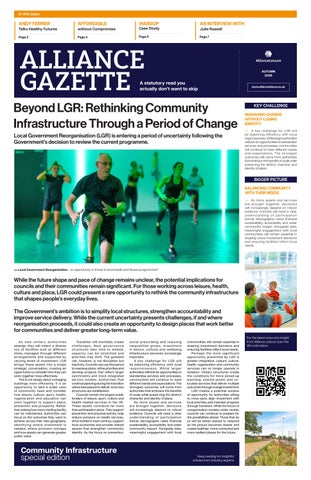
Beyond LGR: Rethinking Community Infrastructure Through a Period of Change Local Government Reorganisation (LGR) is entering a period of uncertainty following the Government’s decision to review the current programme.
www.allianceleisure.co.uk
KEY CHALLENGE MANAGING CHANGE WITHOUT LOSING IDENTITY >> A key challenge for LGR will be balancing efficiency with local responsiveness. While larger authorities will look for opportunities to standardise services and processes, communities will continue to have different needs and expectations. The strongest outcomes will come from authorities that embrace the benefits of scale while preserving the distinct character and identity of place.
BIGGER PICTURE BALANCING COMMUNITY WITH THEIR NEEDS >> As more assets and services are brought together, decisions will increasingly depend on robust evidence. Councils will need a clear u n d e rs ta n d i n g of p a r t i c i p at i o n trends, demographic need, financial sustainability, accessibility and wider community impact. Alongside data, meaningful engagement with local communities will remain essential in shaping future investment decisions and ensuring facilities reflect local needs.
>> Local Government Reorganisation - an opportunity or threat to local health and fitness programmes?
While the future shape and pace of change remains unclear, the potential implications for councils and their communities remain significant. For those working across leisure, health, culture and place, LGR could present a rare opportunity to rethink the community infrastructure that shapes people’s everyday lives. The Government’s ambition is to simplify local structures, strengthen accountability and improve service delivery. While the current uncertainty presents challenges, if and where reorganisation proceeds, it could also create an opportunity to design places that work better for communities and deliver greater long-term value. A s n ew u n i t a r y au t h o r i t i e s emerge, they will inherit a diverse mix of facilities built at different times, managed through different arrangements and supported by varying levels of investment. LGR brings these assets into a single strategic conversation, creating an opportunity to consider how they can work together more effectively. This is not simply about managing buildings more efficiently. It is an opportunity to take a wider view of community need and consider how leisure, culture, sport, health, regeneration and education can work together to support place, prevention and prosperity. Rather than asking how every existing facility can be maintained, authorities can focus on the outcomes they want to achieve across their new geography, identifying where investment is needed, where provision overlaps and how assets can generate greater public value.
Transition will inevitably create c h a l l e n g e s . N e w g ove r n a n c e structures take time to embed, capacity can be stretched and priorities may shift. The greatest risk, however, is not disruption but inactivity. Councils can use this period to reassess plans, refine priorities and develop projects that reflect larger catchments and more integrated service models. Authorities that continue planning during the transition will be best placed to deliver once new structures are established. Councils remain the largest public funders of leisure, sport, culture and health-related services in the UK. These assets contribute far more than participation alone. They support prevention and physical activity, help reduce pressure on health services, drive footfall in town centres, support local economies and provide shared spaces that strengthen community identity. As the focus on prevention,
Community Infrastructure special edition
social prescribing and reducing inequalities grows, investment in leisure, cultural and wellbeing infrastructure becomes increasingly important. A key challenge for LGR will be balancing efficiency with local r e s p o n s i ve n e s s . W h i l e l a r g e r authorities will look for opportunities to standardise services and processes, communities will continue to have different needs and expectations. The strongest outcomes will come from authorities that embrace the benefits of scale while preserving the distinct character and identity of place. As more assets and services are brought together, decisions will increasingly depend on robust evidence. Councils will need a clear understanding of par ticipation trends, demographic need, financial sustainability, accessibility and wider community impact. Alongside data, meaningful engagement with local
communities will remain essential in shaping investment decisions and ensuring facilities reflect local needs. Perhaps the most significant opportunity presented by LGR is greater integration. Leisure, culture, health, regeneration and community services can no longer operate in isolation. Unitary structures create the conditions for more joined-up planning, shared assets and colocated services that deliver multiple outcomes through a single investment. LGR creates a potential window of opportunity for authorities willing to move early, align investment with local priorities and maintain progress through transition. While the future of reorganisation remains under review, councils can continue to prepare for the possibilities ahead. Those that do so will be better placed to respond as the picture becomes clearer and create healthier, more connected and more resilient places for the future.
Keep reading for insightful articles from industry experts
For the latest news and insight from Alliance Leisure scan the QR code below
ALLIANCE GAZETTE
2
News in Brief
Padel Comes to Scotstoun
Studio Transformation Completed
Three new indoor padel courts have opened at Glasgow Club Scotstoun following a project delivered by Alliance Leisure in partnership with Glasgow Life. The development expands access to one of the world's fastest-growing sports, supports year-round participation, and enhances the venue's racquet sports offer while retaining six indoor tennis courts.
Alliance Leisure supported West Lancashire Borough Council to deliver a £300,000 transformation at Burscough Wellbeing and Leisure Hub, conver ting a n underused squash court into a modern fitness studio.
The project increased class capacity, improved customer experience, embedded sustainable design measures, and strengthened the hub’s long-term operational and financial sustainability.
Welcome to the Gazette The leisure sector continues to evolve at pace. Communities are looking for more than traditional sports facilities; they want welcoming spaces that support healthier lifestyles, stronger social connections and improved wellbeing for people of all ages. Sarah Watts CEO ALLIANCE LEISURE
L
ocal authorities and leisure op erators a re navigating a challenging landscape. Financial pressures, growing demand for services and the need to decarbonise ageing facilities mean investment decisions have never been more important. Securing the right funding and making every pound work harder is essential if we are to create sustainable, future-ready places that deliver meaningful impact. Throughout this edition, we explore the opportunities shaping the future of leisure and active wellbeing. From innovative funding routes and successful regeneration projects to emerging trends in facility design, sustainability and community engagement, we showcase how investment in leisure can drive wider social, economic and health outcomes.
I hope these stories, insights and examples provide inspiration and practical ideas as we work together to create healthier, more >> Sarah has championed community based leisure spaces for many years. active communities for generations to come. Sign up for the Alliance Leisure newsletter by scanning the QR code below
How to Create a Healthy Future for Leisure Services and People Wellbeing | Andy Ferrier CHIEF EXECUTIVE TEST VALLEY BOROUGH COUNCIL
A KEY INSIGHTS Local government reorganisation and wider system reform are not challenges, but opportunities to reset how services are designed and delivered. Reform provides a chance to align services more effectively around prevention and take a more strategic, place-based approach. Leisure centres, libraries, parks and community spaces all have a role to play, but their impact is maximised when they are considered as part of a wider system rather than in isolation. The “test, learn, grow” approach reflects a move towards more iterative, evidence-led service design
s t h e d i r e c t i o n o f t rave l fo r p u b l i c s e r vi ce refo r m becomes clearer, one thing is increasingly beyond doubt: the current model and ways of working is unsustainable. Rising demand in adult social care, continued pressure on the NHS, and the scale of long-term health challenges mean that prevention is no longer a desirable ambition- it is a necessity. The government’s 10-year health plan reinforces this shift, with a growing emphasis on community-based support and earlier intervention. Leisure centres are no longer simply spaces for sport and fitness, they are becoming multi-purpose wellbeing hubs bringing together physical activity, social connection and, increasingly, health services. Examples shared included co-located facilities integrating libraries and community services, as well as spaces designed to support clinical delivery such as health checks and rehabilitation.
This reflects a broader shift. Leisure is moving from an operational service offer to something more fundamental: a form of community wellbeing infrastructure. Crucially, this is not just about buildings, but about how services are designed, who they are designed for, and the outcomes they are expected to deliver. If leisure is to play a central role in prevention, partnership working is essential. There are clear examples of stronger collaboration with NHS partners, the voluntary sector and public health teams. However, these relationships are still developing. Structural complexity within the N HS combine d with reforms of their own and differing organisational priorities can make alignment challenging.
Successful partnerships are grounded in shared outcomes - whether reducing falls, supporting active ageing, or improving mental wellbeing. And for too long, leisure services have been measured primarily through participation. While important, this is no longer sufficient. If leisure is to be embedded within preventative systems, it must demonstrate its contribution to health outcomes, its impact on demand elsewhere in the system, and its wider social value. In these contexts, the question shifts from “how do we run a leisure service?” to “how do we improve outcomes for our communities?” This represents a significant cultural change. It requires shared ownership of outcomes, a willingness to work across organisational boundaries, and a focus on long-term impact rather than shortterm outputs.
Fundamentally a systems leadership approach will enable public sector organisations to use scarce resources more effectively by focusing on better outcomes for the community rather than individual organisations. Leisure services are already evolving. Partnerships are strengthening. And there is growing recognition that health outcomes are shaped far beyond the walls of hospitals and care settings. If local government – in close collaboration with local partners – can demonstrate impact, lead across systems and embrace new ways of working, leisure services can become a cornerstone of a preventative, place-based approach to health and wellbeing. The prize is significant. Not just in terms of financial sustainability, but in improving the quality of life for communities now and into the future.
ALLIANCE GAZETTE
3
Delivering Active Wellbeing with Confidence: The Role of the UK Leisure Framework Delivering projects like these requires a joined-up approach. Early decisions around design, cost and scope have long-term implications, particularly in a market affected by inflation, supply chain challenges and changing regulations. Treating development stages as separate exercises can create inefficiencies and increase risk, while an integrated approach provides greater control and better outcomes. The benefits extend beyond leisure. Investment in facilities is increasingly linked to regeneration objectives, supporting town centre renewal, housing growth and community development. The SC2 waterpark on Rhyl seafront demonstrates this impact. Nearly a decade after completion, it remains a catalyst for a thriving visitor economy. T h e re i s n o o n e - s i ze - fi t s - a l l solution. Every authority faces different challenges, from ageing stock and operational sustainability to population health and regeneration priorities.
The language has changed too. We now talk about active wellbeing rather than simply sport or fitness. That reflects a broader ambition to improve health outcomes, reduce pressure on public services and create places that bring people together in ways that feel accessible and relevant.
The UKLF enables projects to be shaped around local needs while benefiting from shared expertise and proven delivery Fo r m a ny p ro c u re m e nt a n d regeneration teams, the ambition is experience. not the challenge. The real question After attending a number of sector events this year, including UKREiiF, it is clear there has been a shift in how local authorities view leisure. What was once seen as a discretionary service is increasingly recognised as an important contributor to healthier, more resilient communities.
is how to deliver projects that meet these expectations while navigating financial pressures, governance requirements and limited internal capacity. This is where the UK Leisure Framework (UKLF) becomes far more than a procurement route. Through the Framework, we have spent years
How Modern Leisure Facilities are Fundamental to Creating Health, Economic Growth and Deep Social Value By Julie Russell, Convenor of the Active Wellbeing Leadership Network & Immediate Past Chair of CLOA The role of modern ‘leisure’ facilities (or active wellbeing hubs) must be reimagined as a fundamental driver of health, social value and local economic growth, moving far beyond outdated perceptions of discretionary services. As we look toward a landscape shaped by the 2025 Devolution Bill and neighbourhood health reforms, we must recognise that healthy, active citizens are the engine of a thriving economy. The two Marmot reviews issued in 2010 and 2020, showed a persistent health inequality gap: Further the Office for National of Statistics showed that for 2022-2024, healthy life expectancy had dropped by seven months, it’s lowest since 2013. Indeed, across the UK, residents in our most deprived communities spend over a decade longer in poor health than their more affluent neighbours. This represents a deteriorating position for health, and a profound social injustice, fuelling economic inactivity, straining families and communities, and driving pressure on public resources, which remain overly focused on reactive care rather than prevention. It is vital that places are designed to support active living for all communities, from housing, safe play and green spaces to walking, scooting and cycling infrastructure. Many civic spaces can act as powerful enablers of connection, citizenship and healthier communities. Within this system, leisure facilities, now increasingly described as ‘Active Wellbeing Hubs’, play a unifying role. However, their position within the public offer requires a clear focus on purpose: tackling inequalities. This demands a reset in how they are designed, staffed, programmed, and how charges are applied, reflecting Marmot’s principle of proportionate universalism. By p o s i t i o n i n g Ac t i ve We l l b e i n g H u b s a s e s s e nt i a l p reve nt i o n infrastructure, we can help address these disparities. The greatest health and economic returns come from supporting people to move from inactivity to even low activity, particularly in mission-critical neighbourhoods. This shift is already emerging in some places and can also strengthen economic inclusion, supporting regeneration and creating workforce
transforming ageing leisure facilities into welcoming destinations that serve communities for the long term. The UKLF was designed to help local authorities move from idea to delivery with greater confidence. It provides a compliant route to appoint a specialist development partner and supports projects from feasibility through to completion. That continuity is increasingly important as schemes become more complex and expectations around outcomes continue to grow. In April, we hosted a roundtable with Solace and more than 20 senior local authority leaders. A clear theme emerged: leisure facilities are no longer
viewed as standalone buildings. They are increasingly seen as part of wider community infrastructure, supporting health improvement, social connection and local economic activity. Active wellbeing hubs reflect this shift. By bringing together physical activity, health services and community provision, they create environments that fit more closely with how people live their lives. The aim is not simply to provide somewhere to exercise, but to support wider wellbeing. Clay Cross Active is a good example, integrating leisure provision with NHS services and Citizens Advice.
pathways, including new careers in community-focused preventative health. It also changes the nature of the workforce, extending its reach beyond the hub to engage communities and support prevention and care in trusted settings. In turn, this underpins a new social contract that treats active wellbeing as a necessity rather than a luxury, establishing career pathways within a growing prevention economy. Modern Active Wellbeing Hubs create social value as the physical expression of this contract, providing safe environments where community resilience can be strengthened. To maximise impact, we must move from service delivery to a more holistic approach that listens to and works with communities to enable healthier lives. Delivering this vision requires leadership that connects strategic devolution priorities with everyday community realities across parks, halls and hubs. I have advocated for mechanisms such as a dedicated prevention precept to secure sustained investment, shifting from maintaining the world as it is, to actively practising the world we want to see. When we invest in Active Wellbeing Hubs, refurbished or new, we are not simply maintaining buildings. We are investing in the social and economic fabric of our communities, creating a legacy of fewer preventable deaths, more lives lived with purpose, and new roles in preventative, communitybased health rooted locally but connected to wider systems.
Ultimately, the Framework is about more than simplifying procurement. It enables local authorities to take a confident, strategic approach to delivering projects that support active wellbeing, maximise value and create lasting benefits for communities. As expectations continue to evolve, the opportunity is to make the most of public assets and investment. The UKLF provides the structure, support and expertise to help achieve that ambition.
News in Brief:
Doncaster Dome Lagoons Reopen Following Major Redevelopment Visitors are once again making a splash at Doncaster Dome following the completion of a major redevelopment of the iconic Lagoons attraction. Delivered through the UK Leisure Framework, the project has transformed the facility with new racer slides, an interactive splash play area, upgraded glazing, a redesigned entrance and new energyefficient plant systems. Completed on behalf of Doncaster Culture and Leisure Trust and funded by City of Doncaster Council, the investment modernises one of the city's most popular leisure attractions while safeguarding the future of the Grade II listed venue for generations to come.
Recognition Across the Sector Alliance Leisure's commitment to delivering outstanding community infrastructure continues to be recognised at the highest level. Ove r t h e p a s t 1 2 m o nt h s , the team secured an Investors in the Environment Award (iiE) for Low Carbon Transport, while the redevelopment of Clay Cross Active earned national recognition at the ukactive Awards. Alliance was also named a finalist in the GO Awa rds for excellence in public sector procurement and delivery, and received a Highly Commended accolade in the Supply Chain Collaboration category at
the Construction News Awards. Together, these achievements reflect the strength of partnership
working, innovation and a shared commitment to creating lasting community impact.
ALLIANCE GAZETTE
4
Social Value In 2025, Warsop Health Hub generated almost £488,000 in social value and created employment and training opportunities for local people
Case Study: Warsop Health Hub A new model for community health and wellbeing Health & Community WARSOP
W
arsop Health Hub is a modern, accessible community facility created to tackle health inequalities, inactivity and limited access to physical activity services in Warsop, North Nottinghamshire. Delivered by Alliance Leisure on behalf of Mansfield District Council, the £9.1 million development provides residents with a welcoming place to be active, access wellbeing support and connect with their community.
"Working with Alliance Leisure through the UK Leisure Framework allowed us to move at pace while complying with procurement rules. We were able to bring in a construction contractor at a very early stage and get spades in the ground much faster. Ultimately, their expertise saved us a lot of money, delivering the project below budget and ahead of schedule." Marie Clay, Leisure & Community Wellbeing Manager, Mansfield District Council
The project was the first facility delivered using Sport England's Leisure Local concept, promoting smaller, community-based activity facilities located close to where people live. Since opening, it has exceeded participation targets and won Build, Design or Refurbishment of the Year at the ukactive Awards 2025. The Hub was developed in response to a clear local need. Following the closure of Meden Sports Centre in 2018, residents were left without local opportunities to swim, exercise or take part in organised activity. Consultation identified a demand for affordable activities, accessible spaces, health and wellbeing services and opportunities to socialise. Local partners including Warsop Parish Council, Active Notts and Vibrant Warsop helped ensure the project reflected community priorities from the outset. The vision was to create much more than a leisure centre. Alongside physical activity facilities, the Hub was designed to support social prescribing, community learning, digital inclusion and wider wellbeing services, helping to reduce social isolation and improve quality of life. At the heart of the facility is a 15m four-lane swimming pool, splash play area, gym, multipurpose activity space, community room, café and IT suite. The Leisure Local model enabled the council to provide these facilities in a way that remains affordable and financially sustainable over the long term. Procured through the UK Leisure Framework, the project brought
More Than Buildings: Supporting the Causes That Matter
>> Warsop Health Hub - First Sport England Leisure Local facility delivered in the UK together an experienced delivery team including Alliance Leisure, Abacus, Pellikaan Construction, Roberts Limbrick and Strategic Leisure. Construction began in June 2023 and completed in April 2024, two and a half months ahead of schedule and within budget. The final construction cost matched the original RIBA Stage 3 cost plan, providing cost certainty throughout delivery. Accessibility and inclusion were central to the design. Step-free access, accessible changing facilities, a Changing Places suite, pool hoist and inclusive layout help ensure the building caters for people of all ages and abilities. The impact has been immediate. Year 6 school swimming attainment has doubled from 40 per cent to 80 per cent, while membership and usage levels significantly exceeded initial projections. Between April 2025 and March 2026, the Hub welcomed almost 96,000 gym visits, more than 18,000 swim lesson attendances and almost 18,000 casual swimming visits. Today, 16 per cent of local residents hold a membership.
Beyond physical activity, the Hub has become a focal point for community life. Local organisations use the facility for classes, health programmes, family activities and community events. Walking programmes, wellbeing initiatives and training opportunities have helped residents improve their health, confidence and social connections. Sustainability was embedded throughout the project, with the allelectric facility featuring air source heat pumps, solar photovoltaic panels, LED lighting and high-performance building fabric. The result is an EPC A-rated building designed to reduce both environmental impact and long-term operating costs. In 2025, Warsop Health Hub generated almost £488,000 in social value and created employment and training opportunities for local people. The result is a thriving community asset that demonstrates how partnership working, local engagement and innovative delivery can transform health and wellbeing outcomes while creating lasting value for residents.
"This has been a project you can only dream of. It was delivered below budget and earlier than expected. Alliance and the project team were an absolute pleasure to work with; we can't recommend them highly enough." David Evans, Assistant Director of Health, Communities and Insight Mansfield District Council Scan to read the full case study
WARSOP HEALTH HUB AT A GLANCE
Creating positive change is at the heart of what we do. While Alliance Leisure is best known for helping local authorities deliver facilities that improve lives, our commitment to community extends far beyond the projects we deliver. Ove r t h e p a s t ye a r, A l l i a n ce employees, partners and friends have raised more than £20,000 for a range of charitable causes, supporting organisations including the British Heart Foundation, Cancer Research UK, Brain Tumour Focus, CALM and Longfield Community Hospice. Many of these causes have a personal connection to members of the Alliance team, making every fundraiser far more than just an event in the calenda r. Whether supporting mental health services, funding cancer research or helping fa m i l i e s fa c i n g l i f e's t o u g h e s t challenges, the motivation is rooted in helping others.
One of the year's standout events was the annual Alliance Charity Fivea-Side Tournament, which brought together supply chain par tners, consulta nts a nd colleagues for a d ay o f fr i e n d l y c o m p e t i t i o n , fundraising and networking. The event has become a popular fixture, strengthening relationships across the leisure sector while generating vital support for charitable causes. Another highlight was the Public Sector Challenge Walk, which saw 20 members of the Alliance team take to the hills of Shropshire, raising funds and awareness while tackling a challenging route together. These efforts reflect the values that underpin Alliance Leisure. Partnership, teamwork and community are central to our business and, whether we're delivering a new leisure centre or supporting a charitable cause, the goal remains the same: creating a positive and lasting impact for the people and communities we serve.
INVESTMENT
DELIVERY
TIMESCALE
£9.1m total project investment
Delivered through the UK Leisure Framework
Completed two and a half months ahead of programme
BUDGET
AWARDS
SWIMMING
Delivered within budget
Winner of Build, Design or Refurbishment of the Year, ukactive Awards 2025
Year 6 swimming attainment increased from 40% to 80%
FITNESS
SWIM LESSONS
SOCIAL VALUE
95,981 gym visits in 2025/26
18,335 swim lessons delivered in 2025/26
£487,950 annual social value generated
SOCIAL VALUE
SKILLS
SUSTAINABILITY
75% of staff recruited from Warsop
66 residents trained through Shared Prosperity Funding programmes
EPC A-rated all-electric facility
ALLIANCE GAZETTE
5
Delivering Meaningful Community Impact Through Affordable Facilities James Foley
News in Brief
COMMERCIAL DIRECTOR AT ALLIANCE LEISURE
Community Effort Helps Secure Future of Rural Swimming Pool
A
cross the UK, the narrative around ‘leisure’ is undergoing a quiet but profound shift. Recognised for what they truly are, essential social infrastructure, leisure services sit at the heart of public health. They help people stay active, support prevention, improve physical and mental wellbeing and ease pressure on stretched health systems. They also bring communities together and support local economies.
Redefining “Affordable” At the same time, councils face continued pressure when resources are tight, expectations are rising and demand for community interventions continues to rise. So, the question sharpens: How do we shape leisure, health, sport and cultural services that are affordable, improve wellbeing and deliver real impact for people and places? The answer lies in redefining what “affordable” really means. Too often, affordability is equated with minimising upfront capital cost. In reality, it is about maximising long-term value. This means designing facilities that are efficient to operate, inclusive in their appeal and flexible enough to evolve with changing community needs. It also means aligning investment decisions with measurable social and health outcomes, rather than focusing solely on traditional metrics such as footfall or membership numbers.
>> Cath Thom Leisure Centre | An Investment in Sustainable Leisure
Investing in leisure is investing in healthier, more connected and more resilient communities Design plays a pivotal role in achieving this. The most effective facilities are those that are accessible by design, co-located with wider community services and built with sustainability in mind. Early and meaningful stakeholder engagement is essential, ensuring that facilities reflect genuine local need rather than assumptions. Understanding how spaces will be used day-to-day enables
smarter design decisions, improving operational efficiency and ensuring every element serves a clear purpose. Equally important is adopting a whole-life approach to delivery. Earlystage decisions have the greatest influence on both cost and long-term performance. Prioritising experience, collaboration and alignment between design, cost and delivery teams helps reduce risk and improve outcomes. The lowest capital cost is rarely the most economical option over time; instead, value is created through informed decision-making, strong partnerships and a clear focus on long-term impact.
This approach is illustrated by the Cath Thom Leisure Centre which shows how a needs-based approach can deliver both social and environmental benefits. Designed as an all-electric, accessible facility integrated within a wider sports village, it prioritises what matters most to the community while supporting long-term operational efficiency and sustainability. Ultimately, the future of leisure is not just about buildings, it is about creating lasting impact. Successful leisure developments are no longer defined by how little they cost to build, but by the value they generate over time.
Denbighshire Leisure: Reinvestment, Regeneration and Coastal Community Impact
A major £1.15 million refurbishment has reopened the SpArC swimming pool in Bishop’s Castle, Shropshire, safeguarding a vital community facility that has served local residents since 1974. Delivered by Alliance Leisure on behalf of Shropshire Council, the project modernised the pool, improved accessibility and replaced ageing infrastructure. Supported by significant local fundraising, the improvements are expected to reduce operating costs, increase participation and help secure the long-term sustainability of the centre.
By Jamie Groves, Managing Director, Denbighshire Leisure Ltd (DLL)
A
t Denbighshire Leisure Ltd ( D L L ) , o u r r o l e g o e s fa r beyond operating facilities. As a not‑for‑profit leisure company, we exist to reinvest, regenerate and support the social and economic we l l b e i n g o f o u r c o m m u n i t i e s. Nowhere is this more evident than i n h ow we u s e t h e U K Le i s u re F r a m e w o r k t o d r i ve f i n a n c i a l resilience, coastal regeneration and measurable local impact across Denbighshire. The UK Leisure Framework is a central pillar of our approach. Owned and managed by DLL and delivered by Alliance Leisure as development partner, the framework provides a compliant and specialist route for leisure development that is designed around outcomes, not transactions. It enables local authorities and trusts to move at pace while maintaining transparency, accountability and long‑term value for money. For us, it has also created a sustainable commercial model that generates surplus which is directly reinvested back into local services and neighbourhoods. This alignment between national delivery and local benefit is critical. Framework income is not extracted fr o m t h e s ys t e m b u t r e t a i n e d within it, allowing us to continually i m p r ove fa c i l i t i e s t h a t m a t t e r most to residents and visitors. In Denbighshire, this has translated into
targeted reinvestment at centres such as Rhyl and Prestatyn, ensuring our coastal communities benefit tangibly from national success. Coastal regeneration is a key priority for the county, and leisure plays a vital enabling role within the wider tourism economy. Our investments a t P r e s t a t y n a n d R hy l L e i s u r e Centres, as well as our attractions, were carefully designed to enhance everyday local provision while also improving the destination offer for visitors. At Prestatyn, digital fitness a n d i m m e rs i ve a c t i v i t y s p a c e s have been introduced to engage younger users, suppor t schools and create a vibrant community hub. At Rhyl, under‑used areas have been transformed into high‑value fitness and group exercise spaces, increasing participation and improving the overall customer experience. Beyond the core leisure footprint, UK Leisure Framework reinvestment has supported food and beverage d eve l o p m e n t s t h a t c o n t r i b u t e directly to the regeneration of the North Wales coast. Projects such as the expansion of the outdoor area at the Beach Hut in Prestatyn and the introduction of the 1891 outdoor terrace have increased dwell time, strengthened the visitor experience and suppor ted year‑round economic activity. These are modest but meaningful interventions that
demonstrate how leisure can support place‑making and destination growth. Strong governance underpins this model. The UK Leisure Framework is overseen by a joint management board, bringing together DLL officers and Alliance Leisure colleagues. This structure balances public sector accountability with private sector delivery expertise, ensuring decisions are robust, transparent and focused on long‑term outcomes. Crucially, it also enables rapid and collaborative responses when challenges arise, protecting projects, clients and communities alike.
Our operating model enables us to deliver measurable participation and engagement outcomes. Framework projects begin with needs analysis and stakeholder engagement, ensuring facilities respond to local priorities around health, inclusion and wellbeing. This focus has supported increased participation across all age groups, improved accessibility and enhanced user experience. Social value is not treated as an add‑on but is built into delivery, measured and reported alongside financial performance. What the UK Leisure Framework has demonstrated is that all sorts of leisure operating models can be both financially resilient and socially
impactful. By owning our framework, partnering with Alliance Leisure as delivery partner and reinvesting surplus locally, we have created a virtuous circle where national delivery strengthens local outcomes. For our coastal communities in particulara, this has meant better facilities, stronger community hubs and leisure assets that actively support regeneration and economic vitality. Th i s a p p r o a c h r e f l e c t s o u r core belief that leisure, when wellp l a n n e d a n d we l l g ove r n e d , i s a catalyst fo r healt hier p e o ple, stronger places and more resilient communities.
ALLIANCE GAZETTE
6
Case Study: Clay Cross Active
Scan to read the full case study
Transforming Health, Wellbeing and Community Life
month from the centre, while NHS community midwifery services provide approximately 425 appointments monthly. By bringing together health services and leisure opportunities, the centre encourages residents to engage with physical activity in a welcoming, non-clinical environment.
Case Study
C
lay Cross Active is a landmark £26.3 million leisure and wellbeing hub that is helping to reshape health, wellbeing and community life across North East Derbyshire.
The impact has been immediate. Within the first eight months of operation, membership had grown to 3,447 compared with just 725 members at the previous facility. Participation has increased dramatically, with more than 42,000 visits recorded in a single month, almost three times higher than usage levels at the former centre.
Owned and operated by North East Derbyshire District Council and delivered through the UK Leisure Framework, the facility was designed to replace the ageing Sharley Park Leisure Centre while supporting the wider regeneration of Clay Cross. More than a leisure centre, the development brings together sport, physical activity, health services and community support under one roof, creating a destination that reflects the changing role of local authority leisure provision.
Programming has also helped attract new audiences. TAGactive activities are drawing families, children and young adults, while exercise referral programmes have already generated more than 400 referrals from local GPs and health professionals. Specialist initiatives including cardiac rehabilitation and falls prevention programmes are helping residents build confidence and adopt healthier lifestyles.
The project emerged from extensive consultation with more than 850 local residents, which highlighted the community's desire for modern, accessible and affordable facilities. Research also identified barriers preventing people from being active, including cost, lack of confidence, limited awareness of opportunities and concerns about accessibility.
"Clay Cross Active has been a huge community success story. The uplift in visits, especially from groups in the community who were previously disengaged, demonstrates that we are creating a space where everyone feels welcome, supported and able to build healthier habits." Michael Price CENTRE MANAGER, NORTH EAST DERBYSHIRE DISTRICT COUNCIL
Aquatics provision has expanded significantly, with more than 800 learners now enrolled in swimming l e s s o n s a f t e r ye a r s o f u n m e t demand. Local schools, clubs and community groups regularly use the pools, supporting everything from swimming development programmes to therapeutic health activities. >> Award-winning Leisure Project Working alongside North East Derbyshire District Council, Alliance Leisure led the development process through the UK Leisure Framework, coordinating a specialist team to create a facility that would encourage participation from all sections of the community, particularly those who were traditionally least likely to engage in physical activity. The result is a comprehensive health and wellbeing destination featuring a 100-station gym, immersive cycling studio, four-court sports hall, 25-metre swimming pool, learner pool, wellness suite, TAGactive adventure zone, soft play facilities, community rooms, café and floodlit 3G football pitch.
Ac c e s s i b i l i t y wa s a c e n t ra l consideration from the outset. Inclusive changing facilities, a Changing Places suite, pool hoist, lift access and accessible parking help ensure the centre can be used comfortably by people of all ages and abilities. The dedicated wellness suite, featuring power-assisted exercise equipment, has proved particularly popular with older adults, people recovering from illness and individuals living with longterm health conditions. A defining feature of Clay Cross Active is the integration of community and health services within the building. Citizens Advice now delivers around 150 face-to-face appointments each
"The success of Clay Cross Active demonstrates the power of effective partnership working. Through close collaboration with Alliance Leisure, we've delivered a high-quality, accessible facility that reflects what our communities want and need, and which is already making a positive difference to health, wellbeing and local pride." Cllr Kathy Rouse PORTFOLIO HOLDER FOR L E I S U R E , N O RT H E AST D E R BYS H I R E D I ST R I C T COUNCIL Sustainability has also been embedded throughout the development. The all-electric facility incorporates air source heat pumps, solar photovoltaic panels, energyefficient lighting and smart building controls, achieving an EPC A rating while helping to minimise future operating costs. Today, Clay Cross Active stands as a powerful example of how investment in leisure infrastructure can deliver far more than sport and physical activity. By bringing together health, wellbeing, advice services and community support, the centre is helping local people become more active, more connected and healthier, while supporting the long-term regeneration ambitions of North East Derbyshire.
Beyond the building itself, Clay Cross Active is contributing to wider regeneration across the town. The floodlit 3G football pitch attracts around 4,000 visits each month during peak periods, while the café has become an important social space, encouraging new visitors to engage with the centre and its broader wellbeing offer. Despite facing a major challenge during construction when the original contractor entered administration, the project team acted swiftly to protect progress. Working through the UK Leisure Framework, Alliance Leisure secured a replacement contractor and helped keep the project on track, demonstrating the resilience and flexibility of the delivery model.
>> Combines leisure, health, wellbeing and community services under one roof
CLAY CROSS ACTIVE AT A GLANCE
>> EPC A-rated facility with low-carbon technologies
INVESTMENT
DELIVERY
REGENERATION
£26.3 million leisure and wellbeing investment
Opened June 2025
Replaced the ageing Sharley Park Leisure Centre
SPORTS
NHS SERVICES
SWIMMING
3G football pitch attracting around 4,000 visits monthly during peak
Approximately 425 NHS midwifery appointments each month
More than 800 swimming lesson participants
FITNESS
ATTENDANCE
HEALTH REFERRALS
3,447 members within the first eight months
42,562 visits recorded in February 2026 alone
Over 400 GP and health professional exercise referrals
ENGAGEMENT
ENGAGEMENT
LOCAL SERVICES
Integral part of the Clay Cross regeneration programme
More than 850 residents engaged during consultation
Around 150 Citizens Advice appointments per month
ALLIANCE GAZETTE
7
Case Study: Grantham Meres Setting a New Standard for Low-Carbon Leisure Environment
When a Brand Becomes Bigger Than a Logo
Case Study
G
A successful brand should do more than identify a service. It should connect places, communications and experiences, while giving people a reason to engage.
rantham Meres Leisure Centre is demonstrating how existing community leisure facilities can play a major role in the transition to a low-carbon future
That thinking has shaped the development of thrive by Alliance Leisure's Insight & Engagement team in partnership with Durham County Council.
"Grantham Meres Leisure Centre is now the benchmark for net zero leisure facilities, with the installation of a Net Zero Pod to reduce operational costs, boost efficiency and cut carbon emissions." Councillor Rhys Baker, Cabinet Member for Environment and Waste, South Kesteven District Council Delivered through a partnership between South Kesteven District Council, Alliance Leisure and renewable energy specialist Leisure Energy, the £4 million decarbonisation project has transformed the centre's energy infrastructure, significantly reducing operating costs and carbon emissions while safeguarding the future of the facility for local residents. The scheme was developed in response to the significant contribution leisure centres make to local authority carbon emissions. As one of three South Kesteven District Counciloperated leisure centres, Grantham Meres formed part of a wider strategy to reduce emissions and improve operational efficiency across the council's estate. Collectively, the leisure facilities accounted for 41 per cent of the council's operational carbon emissions, largely due to the energy demands associated with heating swimming pools, hot water systems and internal spaces. At the heart of the project is an innovative Net Zero Pod, designed specifically for leisure and swimming pool environments. The system replaces traditional gas boilers and combined heat and power plant with advanced air source heat pump technology capable
>> Winner of 2026 APSE award for Best Climate Action or Decarbonisation Initiative of delivering efficient, low-carbon heating throughout the centre. The installation is supported by an adjacent evaporator fan deck and integrated renewable energy systems, enabling the facility to respond efficiently to changing demand and operating conditions. The project also incorporates 574 solar photovoltaic panels, helping to generate renewable electricity on site and further reduce reliance on grid energy. Together, the technologies have eliminated the centre's gas consumption and are expected to reduce annual carbon emissions by more than 550 tonnes. Annual energy savings are forecast to exceed £170,000, providing significant longterm financial benefits alongside environmental gains.
Support Fund supported the solar panel installation. Beyond the environmental benefits, the project helps to secure the longterm sustainability of a facility that plays an important role in supporting health and wellbeing within the community. By significantly reducing operating costs and future energy price exposure, the investment creates a more resilient leisure centre capable of serving residents for many years to come. The project also demonstrates the value of collaborative partnership working. Lessons learned reviews highlighte d strong co op eration
DELIVERY
Alliance's Insight & Engagement tea m has b e en central to that evolution, combining audience insight, creative development and ongoing performance analysis to understand not simply what people respond to, but how the brand can remain relevant to different communities.
ENVIRONMENT
£3.59 million secured through the Public Sector Decarbonisation
574 solar photovoltaic panels installed
RENEWABLES
ENVIRONMENT
CARBON REDUCTION
£399,000 Sport England grant supporting renewable energy
Gas consumption reduced by 100%
More than 550 tonnes of carbon emissions saved annually
CARBON REDUCTION
NEW TECHNOLOGY
DELIVERY
Innovative Net Zero Pod and air source heat pump technology installed
Delivered while maintaining operations in a live leisure environment
Procurement Priorities Continue to Evolve Insights from ProcureX suggest public sector procurement is increasingly focused on delivering outcomes rather than simply achieving compliance. Key themes included
What began as an identity for the county's leisure service has grown into a complete platform for communicating with residents. thrive now connects major campaigns, digital advertising, social media, websites, apps and customer communications, while giving individual facilities and services the flexibility to promote their own offers within one recognisable brand.
Celebrating Success Together
£4 million total decarbonisation investment
Predicted annual energy cost savings of £170,000
Today, Grantham Meres is being recognised as an example of how local authorities can modernise existing leisure assets, tackle carbon emissions and improve financial sustainability simultaneously. The project provides a practical blueprint for other councils looking to balance environmental ambition with the ongoing need to provide high-quality community facilities.
Funding for the project was secured through Phase 3c of the Public Sector Decarbonisation Scheme, administered by the Department for Energy Security and Net Zero and delivered by Salix Finance. The council received £3.59 million in grant funding, supported by additional investment to bring the total project value to just over £4 million. A further £399,000 grant from Sport England's Swimming Pool
GRANTHAM MERES AT A GLANCE INVESTMENT
b e t we e n p a r t n e r s , r e s p o n s i ve communication and the successful delivery of a complex programme within a live operational leisure environment, ensuring services could continue throughout much of the work.
social value, community impact, artificial intelligence, value for money and collaborative delivery models. The event highlighted a growing emphasis on long-term public benefit, with
procurement teams placing greater importance on regeneration, wellbeing and sustainable outcomes alongside affordability.
That approach came to life through Together We Move. Rather than leading with facilities or traditional fitness messages, the campaign used real people and lived experiences to show the many different reasons people choose to be active. The flexible platform could become Together We Swim, Together We Play or Together We thrive, allowing individual services to speak directly to their audiences without losing the connection to the wider brand. At A l l i a n c e L e i s u r e , s t r o n g relationships and teamwork sit at the heart of everything we do, so it's important to take time to celebrate together too. This summer, colleagues from across the business came together at Treehouse Manchester for our annual summer party, bringing the team together away from project meetings and construction sites. The day featured a city-centre treasure hunt, a friendly padel tournament and plenty of opportunities to catch up with colleagues from across the business. It was a chance to reflect on another successful year, welcome newer team members and celebrate the people behind our projects. As Alliance continues to grow, maintaining a strong, connected culture remains a priority. Events like these help strengthen relationships, reinforce our team spirit and remind us that our greatest asset is our people.
The results provide strong evidence of its impact. thrive active membership increased by 11%, more than 4,000 new Leisure users were welcomed and overall visits increased by more than 366,000. Soft play visits increased by 17% and casual swimming by 31%. thrive shows what is possible when insight, creativity and consistent delivery turn a visual identity into something much bigger: a brand people recognise, understand and increasingly choose to be part of.
Could your brand be doing more? Download our free marketing guide here.
GAZETTE
Today 22
Tomorrow 23 High Low
11°C 7°C
High Low
Feel Like 8°
UK Edition | Autumn 2026
www.allianceleisure.co.uk
After Tomorrow
21°C 18°C
High Low
Feel Like 20°
Brighter days ahead for the industry
22°C 19°C
Feel Like 21°
Clear skies for a brighter future
Fine to good conditions for the foresable future
Paying for Prevention: Reframing Leisure Investment in a Constrained Funding Environment Used selectively, this type of funding can help unlock progress, either by contributing directly to delivery or by acting as match funding that strengthens bids to national programmes and external partners. For finance officers and members, it also provides a clear and defensible link between development, infrastructure and tangible community benefit.
John Leaver MARKETING & FRAMEWORKS DIRECTOR
L
o ca l au t h o r i t i e s a re ta ki n g funding decisions under intense and persistent pressure. Rising demand for adult social care, increasing complexity within local health systems and limited room for manoeuvre in capital programmes mean that investment is increasingly judged on long‑term value rather than short‑term affordability. In that context, the way leisure is funded and prioritised is beginning to change. Rather than competing with statutory services for diminishing resources, leisure is increasingly being considered through a different lens: as infrastructure that can support prevention, place‑based regeneration and system resilience over time.
News in Brief
The direction of public service reform is well established. National policy and funding signals consistently point towards early intervention, community‑base d supp or t a nd reducing avoidable demand on acute services. The difficulty for councils has been translating these ambitions into investable projects that align with available funding mechanisms.
Most authorities operate within a complex funding environment made up of local contributions, developer funding, time‑limited government programmes and partner investment. To o o f t e n , t h e s e s t r e a m s a r e considered in isolation, with leisure projects struggling to secure a foothold unless they sit squarely within the capital programme.
Leisure sits at the intersection of health, place and community life. When designed and positioned well, it offers a rare combination of visibility, accessibility and scale. That makes it particularly suited to funding approaches that prioritise prevention, even where the money itself does not sit within traditional leisure budgets.
In practice, however, there are multiple routes through which leisure and wellbeing schemes can be supported. Developer contributions intended to fund growth‑related infrastructure, for example, can legitimately be used for community buildings, health and wellbeing hubs, outdoor recreation and the upgrading of existing leisure assets. In many areas, significant balances have accumulated over time, some appropriately earmarked for future infrastructure, others unallocated and awaiting prioritised projects.
Making sense of a fragmented funding landscape
Trowbridge Pupils Create Time Capsule
P Green Goals Conference Highlights
upils from schools across Trowbridge have helped create a lasting legacy at the site of the town's new leisure centre by burying a time capsule filled with letters, drawings, photographs and memories of life in 2026. The capsule, which will remain buried until at least 2056, marks another milestone in the development of Wiltshire Council's new leisure centre and reflects the project's strong connection with the local community.
Key themes emerging from the Green Goals Conference 2026 included the growing link between climate action, public health, community wellbeing and local regeneration. Sector leaders highlighted the importance of creating resilient, low-carbon facilities that support physical activity, inclusion and biodiversity. The event reinforced the need for practical delivery, collaborative partnerships and long-term investment to ensure leisure facilities play a central role in healthier, more sustainable communities.
A l o n g s i d e t h i s, g ove r n m e n t investment is increasingly focused on the quality of everyday places. Initiatives such as Pride in Place are explicitly concerned with restoring civic confidence and improving local environments, where leisure facilities often act as anchors for town centres and neighbourhoods. Similarly, the government’s £400 million commitment to grassroots sport reflects growing recognition of the role that accessible local facilities play in participation, health and social connection.
From “can we afford it?” to “what does it prevent?” W h a t u n i t e s t h e s e fu n d i n g opportunities is a shift in how value is assessed. Decision‑makers are moving beyond questions of immediate cost and asking whether investment can reduce future pressure elsewhere in the system. For leisure, this represents both an opportunity and a challenge. Business cases based solely on income generation or subsidy reduction are rarely sufficient. Instead, successful projects are those that clearly articulate how leisure investment contributes to outcomes such as reduced inactivity, improved mental wellbeing, active ageing and stronger community connection.
Puzzle Time
1
4
3
This does not require overstating leisure’s role. Rather, it demands clarity about contribution, supported by evidence and realistic assumptions about long‑term impact.
Designing for financial resilience Funding scrutiny does not end at approval. Rising energy costs and operational pressures mean that long‑term affordability is now a central concern for funders, members and finance officers alike. Projects that demonstrate lower lifecycle costs, flexibility of use and the ability to adapt as community needs change are increasingly favoured. This places greater emphasis on design decisions, operating models and partnership working from the outset. Leisure developments that are resilient by design are more likely to retain political and financial support over time.
A more strategic funding conversation The most forward‑looking authorities are moving beyond asking how to fund a leisure centre, and instead asking how leisure can help them use scarce resources more effectively. In that context, local funding mechanisms, place‑based government programmes and national investment in grassroots activity become complementary tools rather than competing options. Leisure investment will not resolve the structural challenges facing local government finance. But when aligned with prevention and backed by a credible funding strategy, it offers a practical way to invest limited resources in outcomes that matter both now and in the future.
2
5
Across 1.A key outcome supported by active places (6)
6
6.The company delivering projects through the UK Leisure Framework (8,7)
7
7.Ambition to eliminate or offset carbon emissions (3,4)
8
8 . Lo n g - t e r m fu n d i n g used to improve local infrastructure (10) 9.The people who benefit from local services and facilities (9) 10.What councils plan for when making strategic decisions (6)
8
10
Down 2.Facilities and activities such as pools, gyms and sport (7)
3.A broader measure of physical, mental and social health (9)
4.Wider benefits created through projects beyond the physical building (6,5)
5 . A fo c u s t h at h e l p s reduce pressure on health and public services (10)
6.A valuable property or facility owned by an organisation (5)
"To reveal the answers to our crossword visit www.allianceleisure.co.uk/crossword
GAZETTE.
More Info at www.allianceleisure.co.uk
A statutory read you actually don’t want to skip