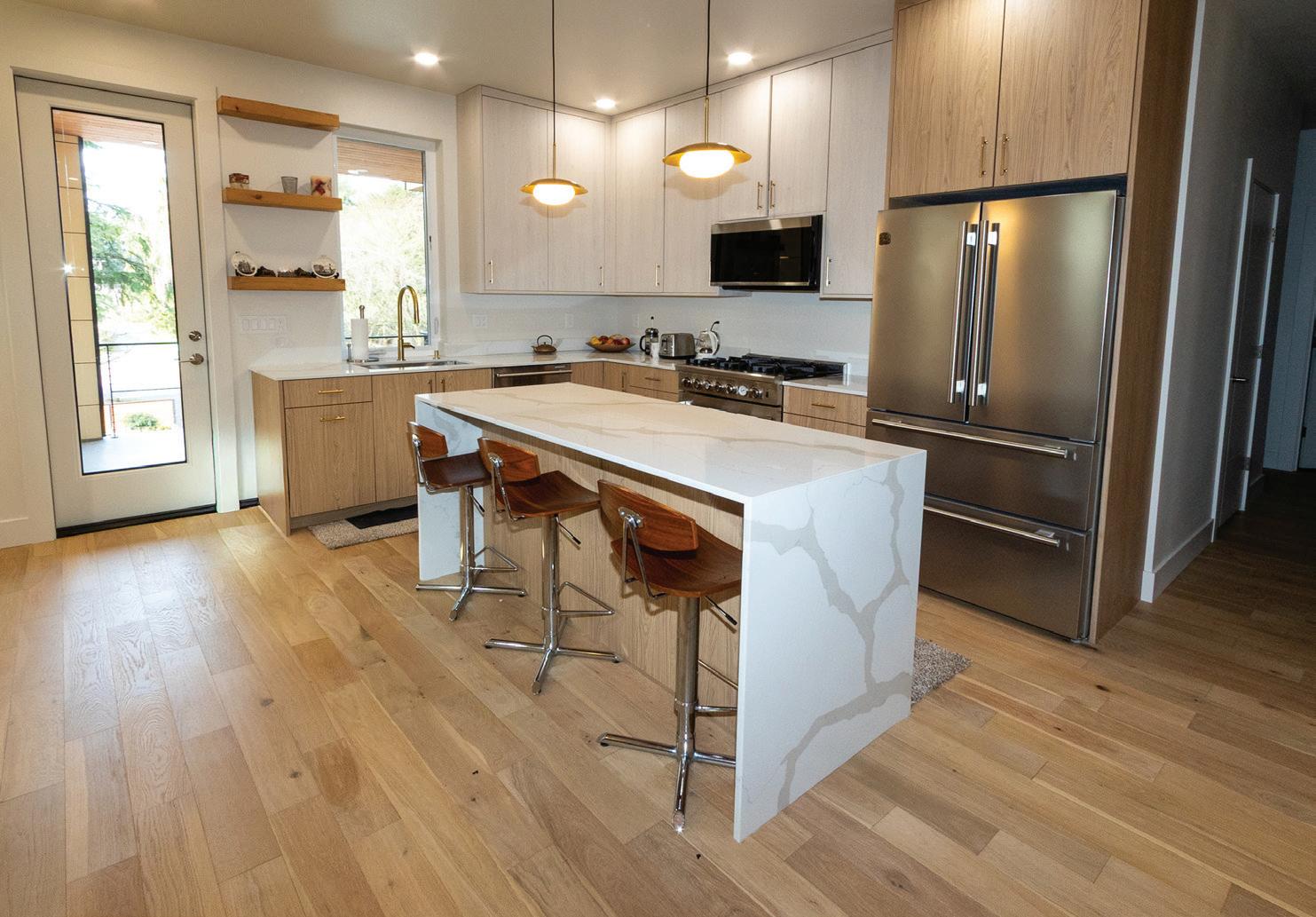
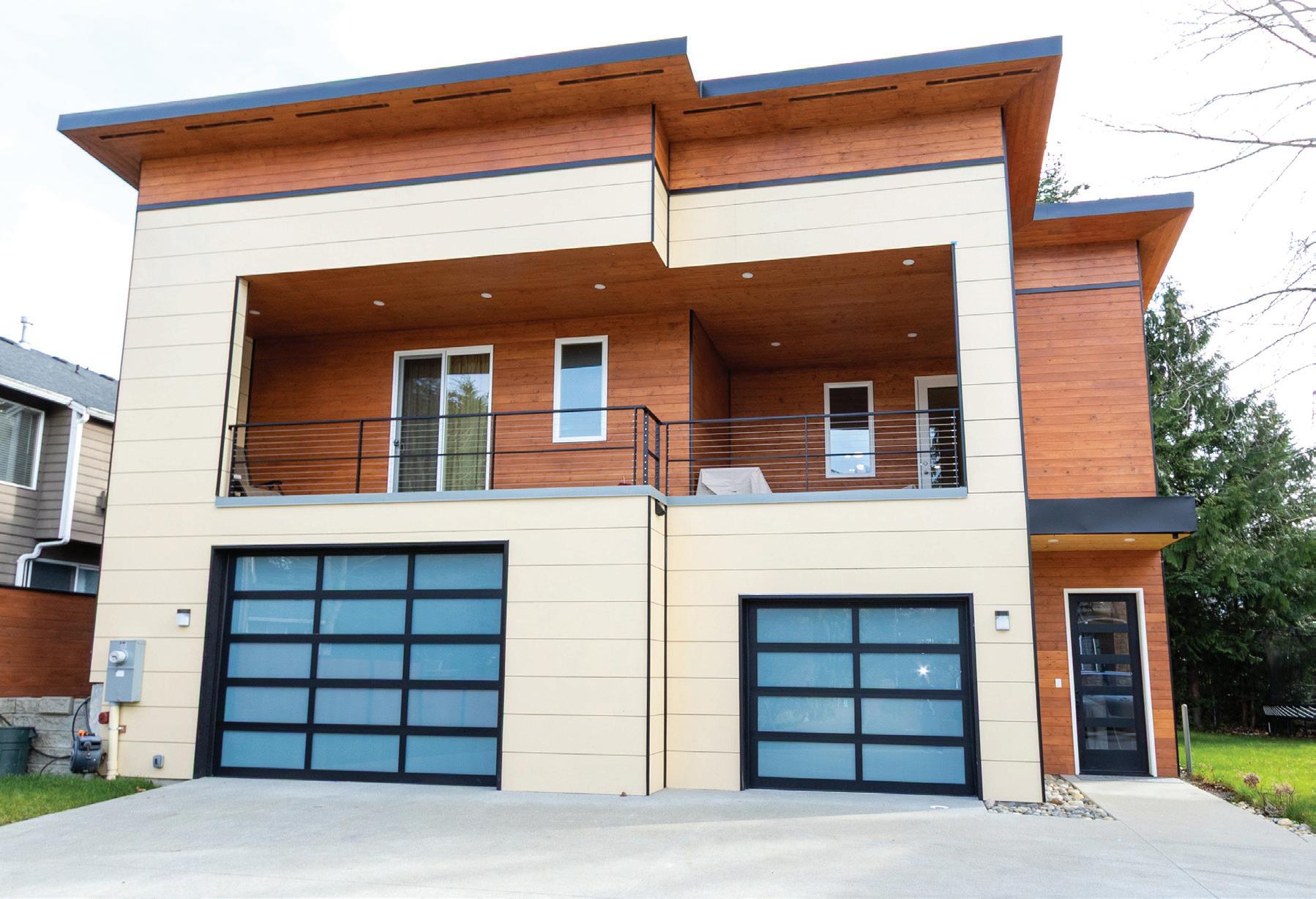
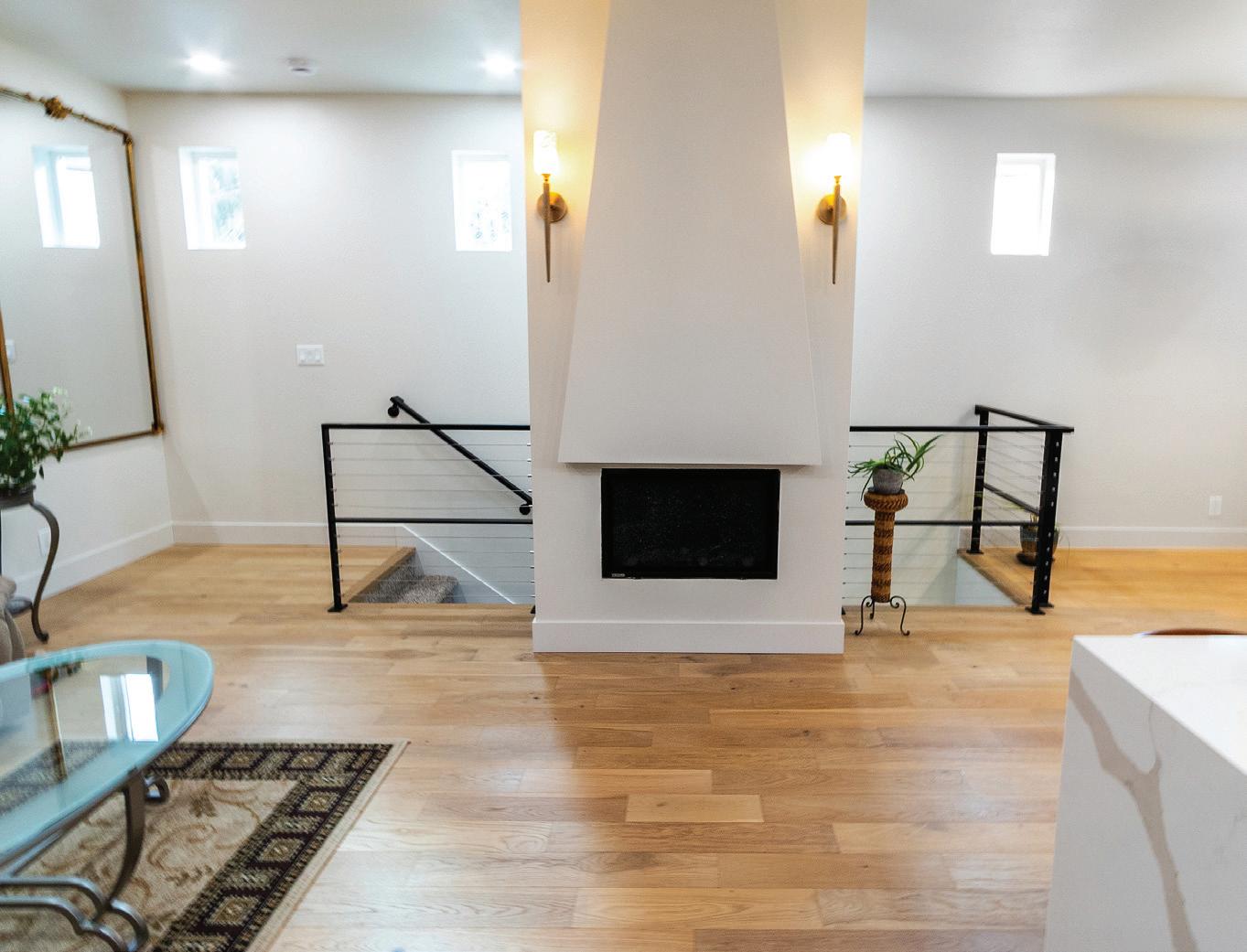
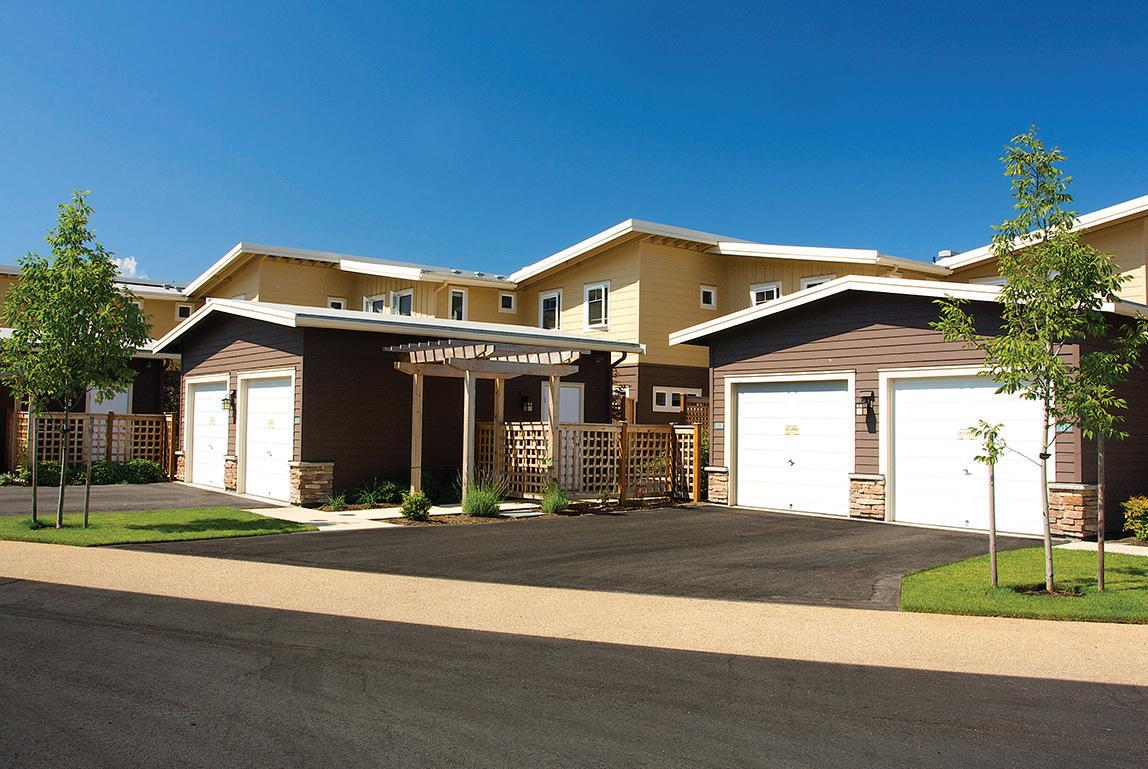
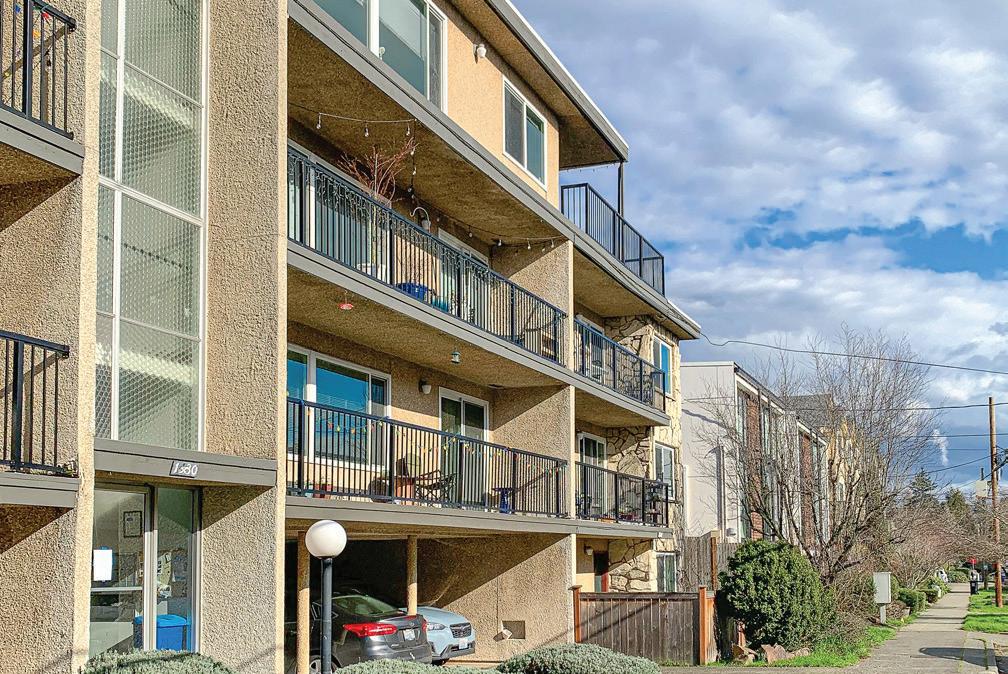
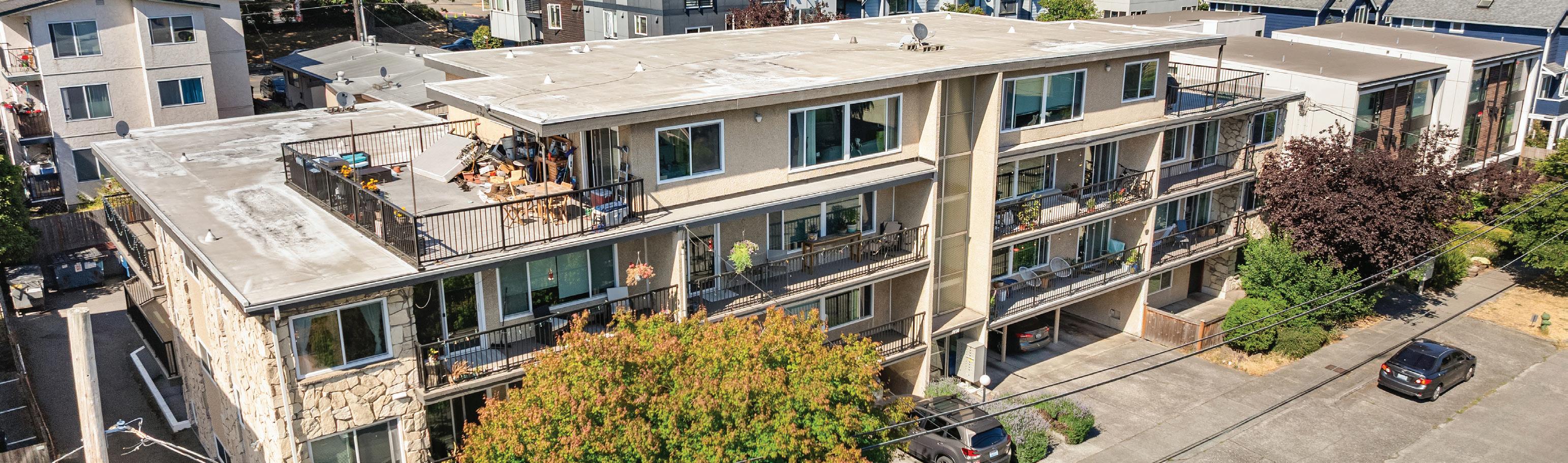
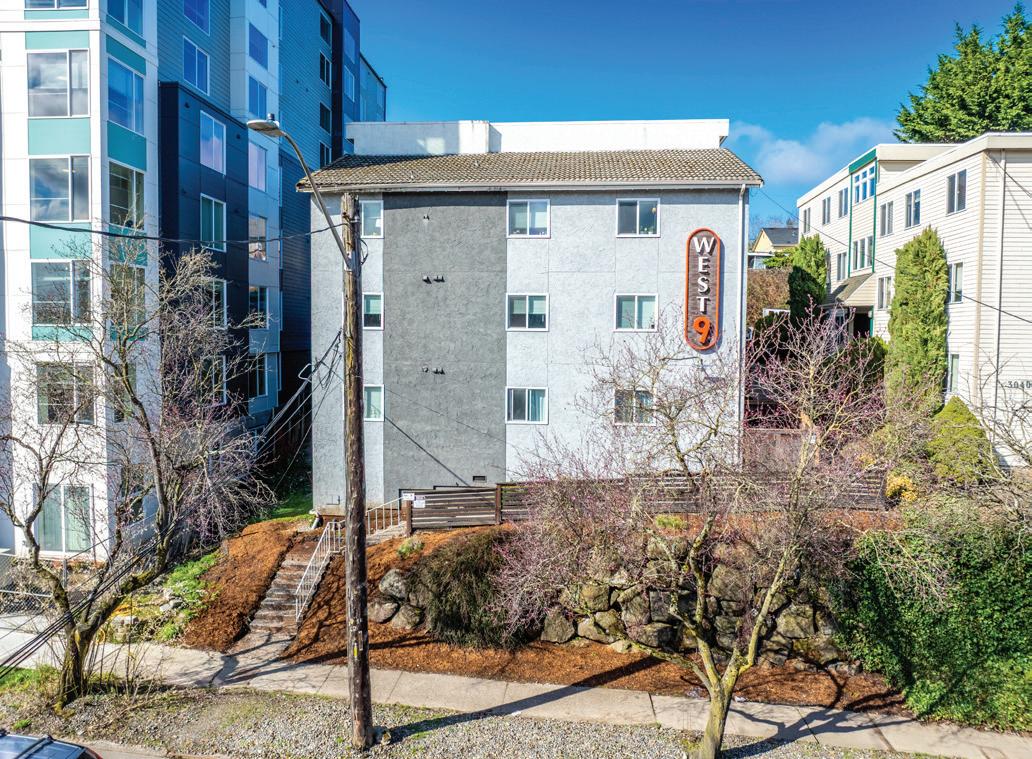
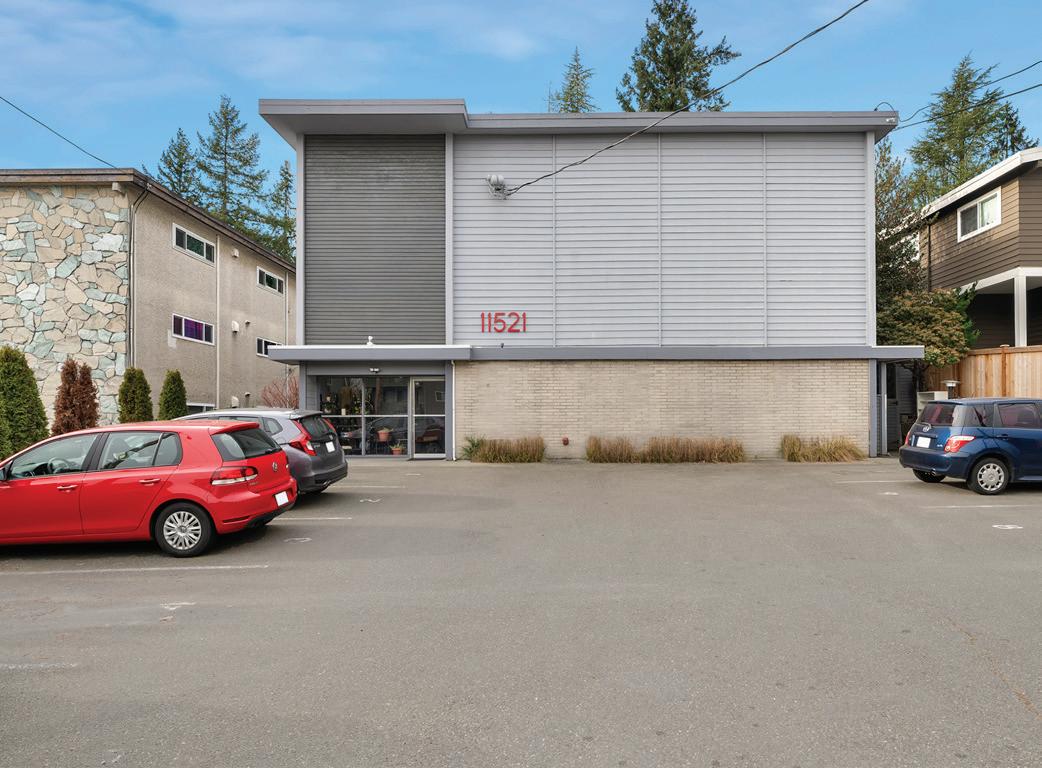
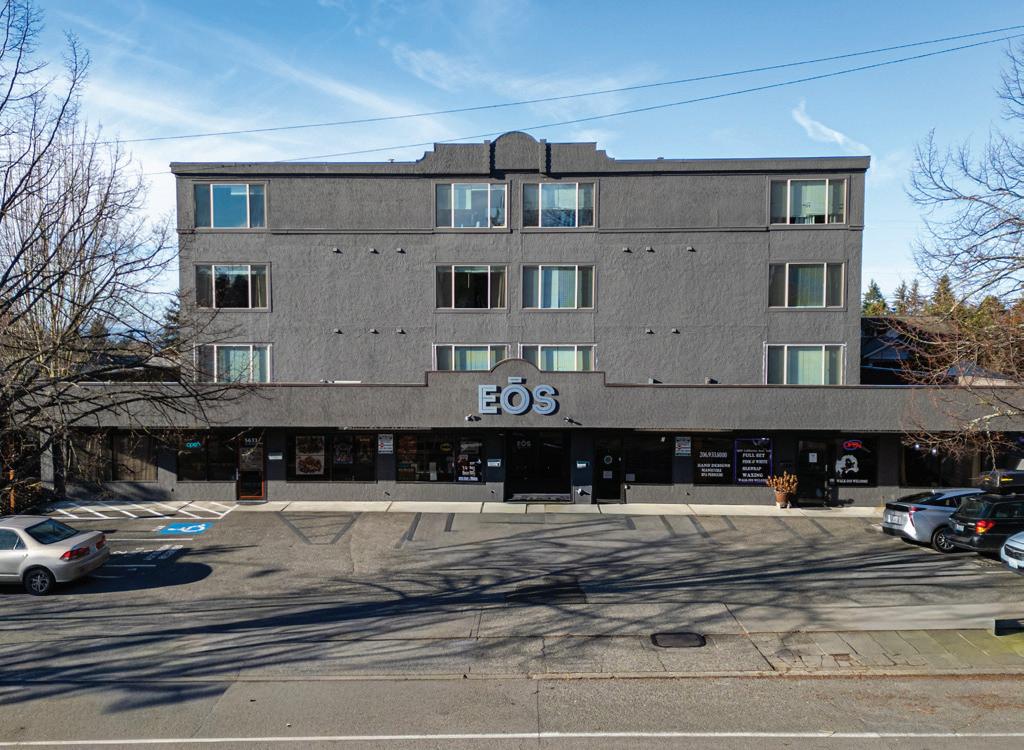
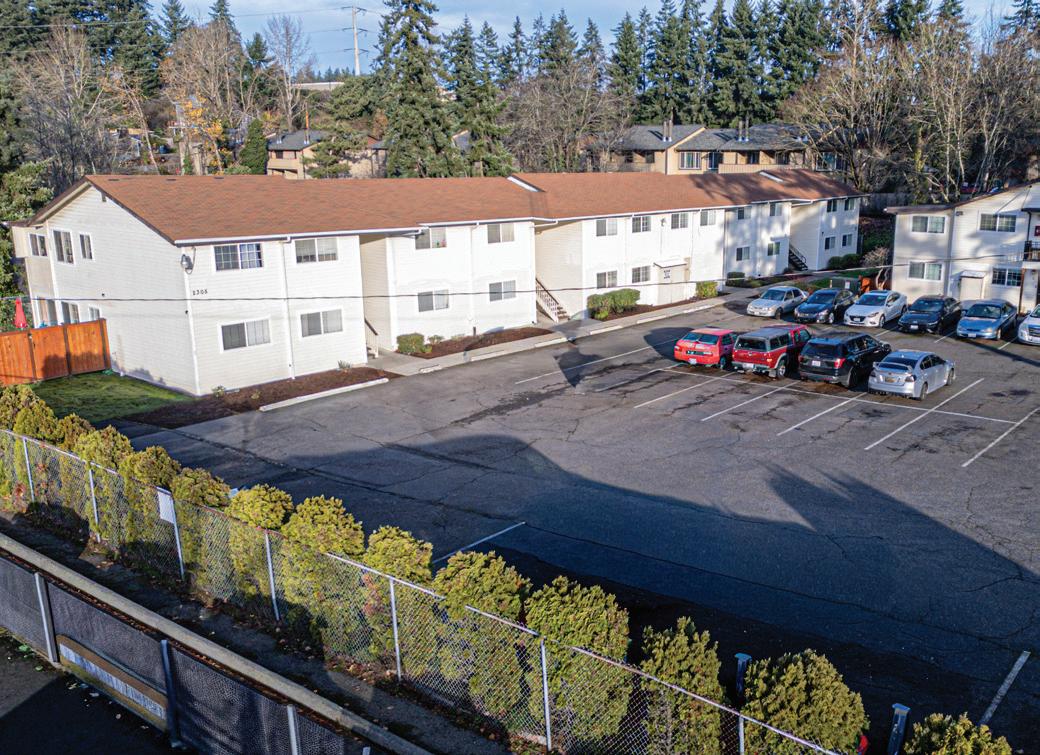
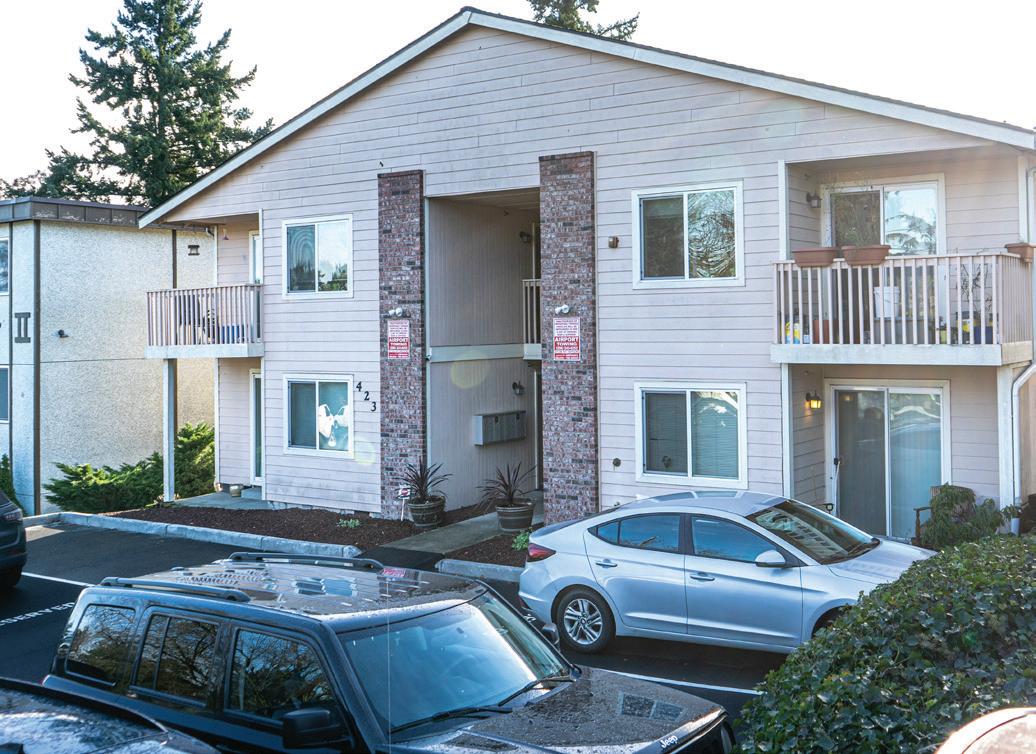
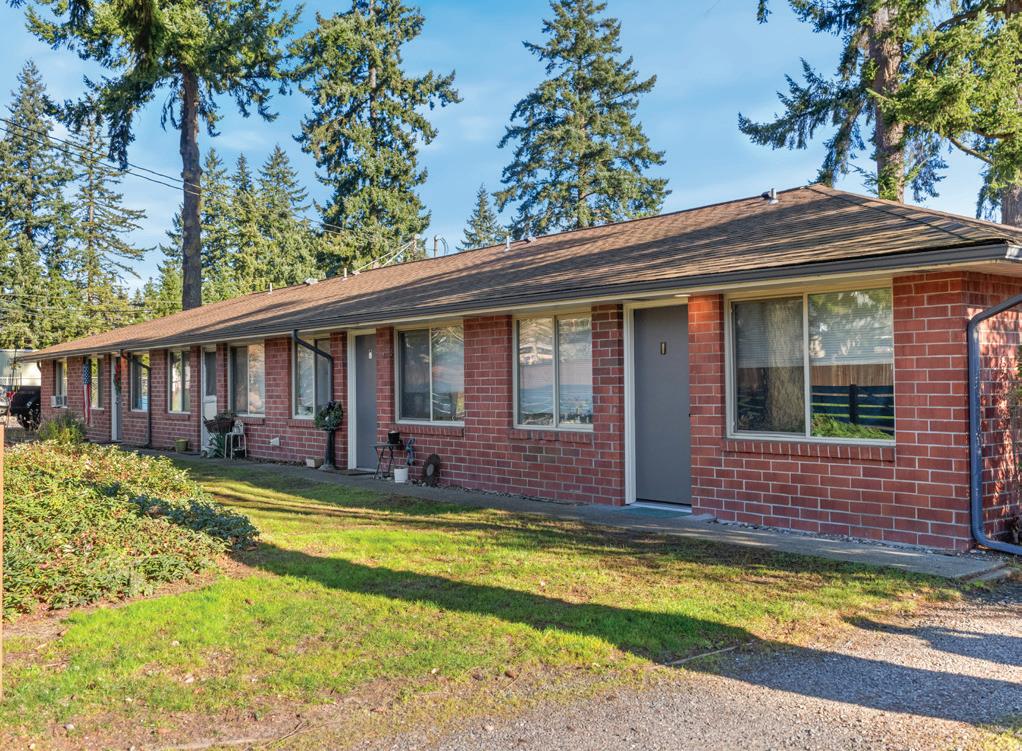
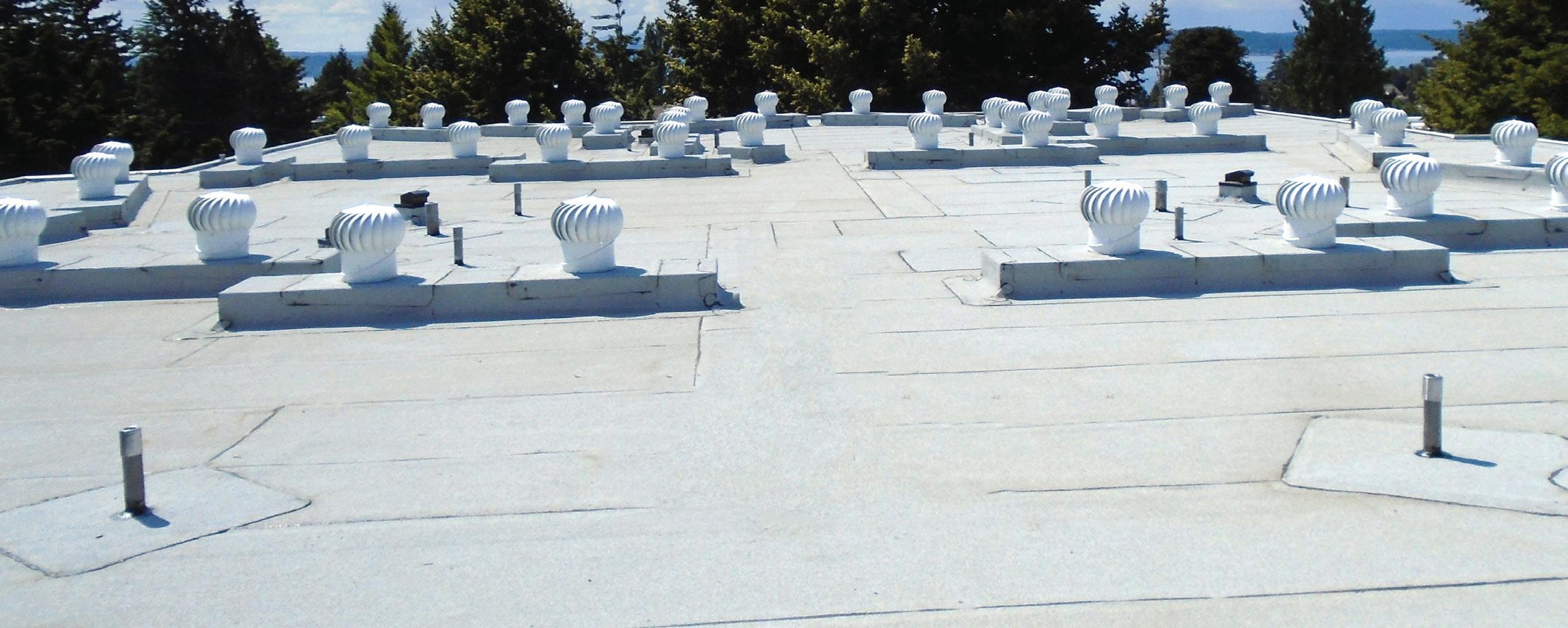
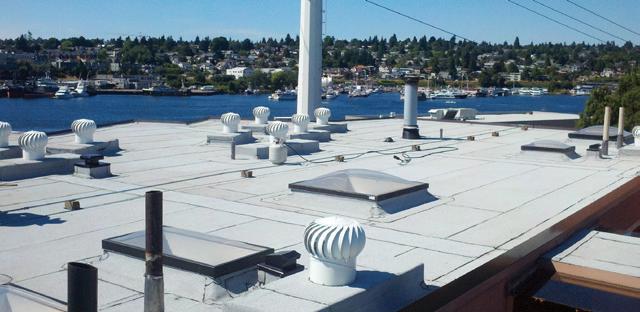
ADUs are one of the most effective ways to increase rental income in the Puget Sound— but only when they’re planned and built with ROI in mind. Construction Expeditors guides property owners from design and permitting through construction, creating attractive, durable, low-maintenance units that rent quickly and perform long-term. Known for finishing on time and on budget, we deliver high-performing ADUs that maximize your return.
Detached ADU with garage + storage below
Modern, durable finishes that attract quality tenants
RHAWA Team Transition: Luke Brown Departs for MBA, Daniel Klemme Steps into Sales & Sponsorship Role
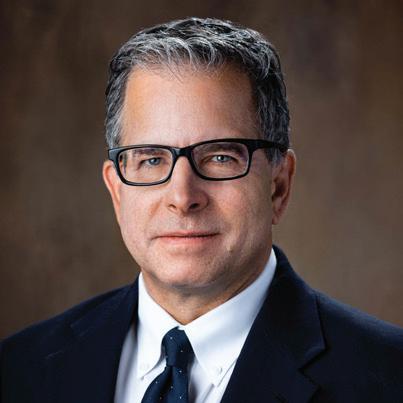
Melissa Canfield | RHAWA Deputy Director
The Rental Housing Association of Washington (RHAWA) bids a fond farewell to Luke Brown, our Marketing & Sales Associate, as he prepares to embark on an exciting new chapter—pursuing an MBA at UC San Diego. Luke’s last day will be June 30, 2026, marking the close of nearly four dynamic years with RHAWA since joining in November 2022.
A California native with a Bachelor’s in Economics from the University of Washington, Luke brought fresh energy and relentless dedication to his role. What began as his first professional step post-college quickly evolved into a tenure marked by growth—both for RHAWA and for Luke himself. His sharp instincts in business development, honed through early experiences in property management and retail, helped expand our membership base and forge lasting partn
“Working at RHAWA has been an incredible journey,” Luke shared. “I’ve learned so much from this team and our members, and I’m excited to take these lessons with me as I move forward. While I’ll miss the daily grind here, I’m eager to dive into this next challenge.”
Stepping into Luke’s role is Daniel Klemme, RHAWA’s Policy & Partnership Coordinator since the 2024 merger with the Landlord Association of the Inland Northwest. A veteran advocate, Daniel’s work spans nonprofit housing solutions for Veterans to systemic homelessness strategies on Spokane’s Continuum of Care board. His dual expertise in policy and grassroots engagement makes him uniquely suited to advance RHAWA’s vendor and sponsorship outreach.
“Luke’s contributions have been invaluable,” Daniel said. “I’m energized to deepen the relationships he’s built.”
While Luke’s departure is bittersweet, the transition underscores RHAWA’s strength: a team where passion and expertise intersect. Vendors are encouraged to reach out to Daniel at dklemme@RHAwa.org for collaboration opportunities.
Join us in wishing Luke the very best as he embarks on this exciting new chapter. As we bid Luke farewell with gratitude, we welcome Daniel’s vision— proving RHAWA’s legacy thrives in capable hands.
CONTACT US
Administrative Director
Chloe Moser: cmoser@RHAwa.org
Board Administrator
Jim Nell: jnell@RHAwa.org
Communication & Advocacy Manager
Daniel Bannon: (206) 905-0609
Creative Director
Sisi Mereness: (206) 905-0605
Deputy Director
Melissa Canfield: (206) 905-0615
Engagement & Government Affairs
Daniel Klemme: (206) 905-0611
Marketing & Sales Associate
Luke Brown: (206) 905-0610
Program Director
Denise Myers: (206) 905-0614
Support Services Administrator
Val Kushi: (206) 283-0816
Support Services Specialist (Resource Desk)
Sue Lewis: RHAwa.org/supportcenter
Support Services Specialist (Eastern WA Desk)
Steve Wareham: (509) 535-1018
CONNECT WITH US
Facebook: Like us at facebook.com/RHAofWA
Instagram: Follow us at @RHAofWA
LinkedIn: Follow us at linkedin.com/company/ rental-housing-association-of-washington
Twitter: Follow us at @RHAofWA
YouTube: Watch us at youtube.com/@RHAofWA
BOARD OF DIRECTORS
COUNCIL OF REGENTS
Audrey Riddle
Barbara Carson
Cathy Jeney
Chris Dobler
Chris Gurdjian
Constance
Submit Educational articles featured in Current must be between 500 and 1500 words, include an author bio, professional headshot and contact information. High-resolution (300 dpi) graphics and photos should be sent separately. Deadlines are generally 30 days before the issue date, which is the first of each month. The editors reserve the right to edit, revise, or reject any submitted material. Submit to publications@RHAwa.org.
Advertise For
LEGAL COUNSEL
Christopher
JUNE CALENDAR
Denise Myers | RHAWA Member Programs Director
|
dmyers@RHAwa.org
| (206) 905-0614
All class sessions are presented ONLINE only unless otherwise specified.
For all ONLINE classes, 30-day access to a recording of the session is included. Upgrade your membership to include a premium dues package. The Weekly ONLINE Session Package includes 12-months' access to live weekly ONLINE educational sessions for $250/person/year. The ONDEMAND Library Package provides full access to over one hundred recorded educational sessions for $120/person/year.
GETTING READY TO RENT
When: Thursday, June 3 | 1-3pm
Cost: $35 Members | $200 Guests
Learn everything you need to know about renting out a home in Washington, including new State laws, Federal laws, how to ensure you are following any local laws, and best practices for efficient operations. Attorney Christopher Cutting and Property Management Professional, Cory Brewer will discuss registration and inspection requirements, fair and effective advertising and tenant selection, proper procedures for collecting a security deposit, and selection of rental agreement terms.
LINK MEETINGS
Casual member meetings with topical discussions. No fee, simply order and pay for food at restaurant venues. June topic is RHAWA ATLAS: Using Add/Remove Resident Tool
• Birch Conference Room, Vancouver | Tuesday, June 9, 6-7:30pm
• The Onion Bar & Grill, Spokane | Tuesday, June 9, 6-7:30pm
• TBD, Seattle | Tuesday, June 9, 6-8pm
• Dimension Law, South King County | Thursday, June 11, 6:30-8pm
• Darcy’s, Spokane Valley | Monday, June 15, 12-1:30pm
• TBD, Bellevue | Tuesday, June 16, 6-8pm
• Ben Dews Clubhouse Grill, Tacoma | Thursday, June 18, 6-7:30pm
• Bob’s Burgers, Everett | Thursday, June 18, 6:30-8pm
• LINK Meeting | ONLINE | Tuesday, June 23, 6-7:30pm
*Meeting time and subject may change. Please check the calendar at RHAwa.org/events.
RHAWA MEMBERSHIP PREVIEW & ORIENTATION
When: Wednesday, June 10 | 12-1pm
Cost: Free
Please join our team for an overview of member benefits and services offered by RHAWA. Participants will receive a tour of the RHAWA website and tools and are encouraged to ask questions relating to member benefits throughout the meeting. This meeting is designed for new members and those considering membership with RHAWA. Specific property management and legal questions can not be addressed during this meeting. Seats are limited to 25 participants and registration is required.
DIVERSIFY YOUR REAL ESTATE PORTFOLIO
When: Wednesday, June 10 | 3-4pm
Cost: $35 Members | $200 Guests
In today’s uncertain economic climate, it’s difficult to know how to plan for the future. If you already own investment property, that’s a great start. But what else can you do to manage risk while improving growth on your investments? Certified Financial Planning practitioner and rental owner, John Kapelac shares from his personal and professional experience how to balance investment property ownership with other investments to achieve a well-balanced portfolio for wealth management.
JUNETEENTH – OFFICE CLOSED
When: Friday, June 19 | All day
LEGAL
FORUM
2026 LEGAL FORUM
When: Wednesday, June 17 | 3-5:30pm
Cost: $55 Members | $240 Guests
Last year's legislative session introduced Rent Control and complex rent increase notice service requirements to an already baffling matrix of state and local rental regulations plaguing Washington's housing providers over the last several years. Thankfully, this year has been much kinder so far, but it’s still difficult to understand the regulatory requirements for the simplest of tasks or predict the outcomes of routine decisions. This is your chance to hear three attorneys, currently practicing landlord-tenant, real estate and business law across Washington, discuss your most difficult questions. Moderator: Audrey Riddle, Attorney Panelists: Eric Steven, Julie Martiniello, Max Glasson
WORKING WITH TENANTS
When: Wednesday, June 24 | 1-3pm
Cost: $35Members | $200 Guests
Once you offer tenancy to a prospect, your landlord-tenant relationship is set to begin. Attorney Christopher Cutting and Property Management Professional, Cory Brewer will discuss best practices for general communications and use of legal forms to encourage compliance with terms, manage rents, handle repairs and maintenance, change rules, and enforce compliance with terms of your agreement. We will review new laws on serving notices and managing rent increases.
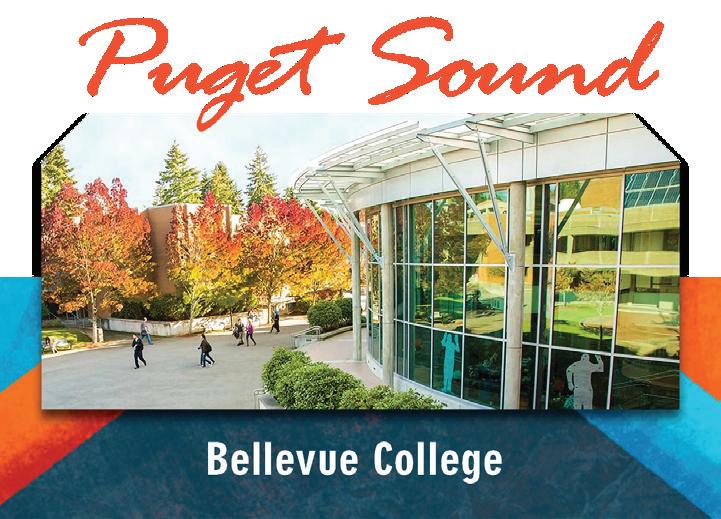
CORE SERIES: PUGET SOUND | SUMMER
When: Saturday, Jun 27 | 8:30am-12pm
Where: Bellevue College
Cost: $50 Members | $200 Guests
Sharpen your systems and strengthen your bottom line. Learn proven strategies to streamline operations, control costs, improve tenant retention, and reduce day-to-day friction. This CORE Series session offers 2.5 hours of practical, in-person education with time for questions, a convenient Saturday morning schedule, opportunities to connect with peers, flexible registration options, and light refreshments to make learning easy and accessible.
Speaker: Constance Nelson
New State Laws Take Effect June 11
The 2026 legislative session wrapped up far kinder to housing providers than the last few have been, and the proof shows up on the calendar this month. Thursday, June 11 is the standard 90-day effective date for most bills passed during this year's short session, RHAWA is here to keep you up to date with all relevant changes. Changes to RHAWA forms are already well under way and will be completed well in advance of the compliance dates of these policies.
Taking Effect on June 11, 2026
HB 2664 – Fixing Service of Process in RCW 59.12.040
• Removes the certified mail requirement that was added last year
• Restores standard service “through the mail” with postage prepaid
• Keeps existing personal service and posting-plus-mailing options
• Preserves the added time rule when service is made by mail
• Requires clear termination notice language stating the vacate or comply-by date
HB 2452
– Changing Service of Process for Rent
Increase Notices For MHC
• Ensures that Manufactured/Mobile Home Community service is in line with HB 2664.
SB 6091 – Prohibiting Exclusive Marketing of Residential Real Estate
• Prohibits a real estate broker from marketing a sale or lease of residential real estate to an exclusive group of buyers without concurrently marketing to the general public.
SB
6200
– Allowing Renters to Install Portable Cooling Devices
• Restricts residential housing providers and owners of mobile home parks from prohibiting or restricting tenants from installing a portable cooling device of the tenant's choosing, with certain exceptions.
• Creates exceptions to allow a housing provider to prohibit instillation of window mounted portable cooling devices.
• Provides immunity to housing providers if damage, injury or death is caused by a portable cooling device.
SB
6237
– Flooding Disclosure for Rental Housing
*The disclosures required by the act only apply to leases entered into after December 31, 2026.*
• Adds flood-risk disclosures to duties of housing provider (hazard area, known flooding/drainage issues).
• Housing Provider must inform tenants that housing provider insurance does not cover tenant belongings; suggests renters/flood insurance.
• Requires notice that local governments have hazard and flood info about the property.
• No penalties unless the housing provider is aware of the hazard and fails to inform the tenant.
Taking Effect after June 11, 2026
SB 5937 – Smart Access System in a Residential Property – Effective January 1, 2027
• Requires a privacy policy for electronic entry systems.
o Does not include keypad or similar device that utilizes the manual entering of a coded sequence of numbers, letters, or both.
o Allows the housing provider to provide a link to the developer's privacy policy.
• For app based or biometric forms of entry, must allow for alternative form of entry such as keycard or fob.
The Takeaway:
June 11 brings real, beneficial changes to our current rental housing laws. Make sure to update your procedures, brief your team or property manager, and make sure anyone serving notices on your behalf knows the certified mail requirement is gone. RHAWA has already updated several of its forms to comply with these new regulations. As soon as these law changes pass the state legislature RHAWA begins its work to update all of our forms and Support Center information.
For deeper discussion of how these changes fit into the broader regulatory picture bring your questions to the 2026 Legal Forum on June 17, just six days after these laws take effect.
Daniel Bannon | RHAWA Communication & Advocacy Manager | dbannon@RHAwa.org | (206) 905-0609
What Spokane’s Cooling Ordinance Means for Housing Providers
The Spokane City Council is considering an ordinance, the proposed Renters’ Right to Cooling (SMC 10.57.175), that would require landlords to maintain bedroom temperatures at or below 80°F in every rental unit in the city by January 1, 2031, with non-compliance classified under state law as “imminently hazardous to life.” That is the same legal category as gas leaks and structural collapse. The first reading is scheduled for May 18. By the time this issue of Current reaches members, that hearing may or may not have happened, and the ordinance may have been passed, deferred, or amended beyond recognition.
What members across the state should understand is what this ordinance would actually do, what RHAWA and our coalition partners have done in response, and why we chose to lead.
What Is Actually Being Proposed
The ordinance is not an update to existing law. It would repeal Spokane’s existing portable cooling ordinance, which the same Council passed unanimously in 2024, and replace it with a far broader retrofit mandate. The compliance obligation is per bedroom, not per unit. Spokane has roughly 41,000 renter-occupied housing units; at a median of two bedrooms each, the proposed standard covers more than 80,000 individual bedrooms.
The 80°F standard would be stricter than major cities in the desert Southwest. Every jurisdiction cited in the draft ordinance’s supporting materials sits in the desert Southwest, the Gulf Coast, or applies only to vulnerable populations in institutional settings. No Pacific Northwest city appears anywhere on the list.
Meanwhile, ESSB 6200, the statewide right to portable cooling, passed both chambers of the Washington Legislature with strong bipartisan support (65-28 in the House, 37-12 in the Senate) and was signed by the Governor in March. It takes effect June 11. It guarantees every renter in Washington the right to install and use a portable cooling device of their choosing, without landlord permission and without retrofit. The state framework was built to be operational well before peak summer heat, and it addresses the underlying access problem at zero capital cost to housing providers and zero passthrough cost to tenants.
The proposed ordinance would override that.
What Have We Done?
On April 9, RHAWA delivered a coalition letter to the Spokane City Council
co-signed by ten Spokane housing and real estate organizations. The signatories include builders, realtors, multifamily operators, property managers, brokerages, and downtown business leaders, collectively representing tens of thousands of rental units in the city.
The coalition advocacy included:
• Asking the Council to allow ESSB 6200 to take effect before layering a separate local mandate.
• Offering a constructive alternative: a city-funded subsidy to help residents purchase portable cooling devices.
• Delivering comprehensive economic and technical analysis, including climate comparison data, housing stock breakdowns, compliance cost estimates by retrofit scenario, and a structural review of enforcement provisions.
• Leveraging sector-specific expertise
from builders, realtors, and tradespeople.
Why We Chose to Lead
RHAWA’s leadership knows when to lead, when to fight from a supporting position, and when to get out of the way. Each posture is appropriate in different circumstances, and using the wrong one is its own kind of failure.
On the Spokane cooling ordinance, we chose to lead. The reason is straightforward: a substantial number of our Spokane members would be directly and materially harmed by this ordinance if it passed. Retrofit costs that older buildings cannot economically absorb. New private rights of action and licensure exposure. Pressure that would push marginal properties out of the rental market entirely. When the impact on members is that direct, leading is the responsibility, not the option.
We are also grateful to the partners across the industry who joined the coalition letter, contributed expertise, and helped shape the response. Coalition work is collaborative by definition. RHAWA can lead and still owe thanks to every organization that put a name on the line.
The Lesson for All Members
The case against this ordinance is specific to Spokane, but the pattern repeats. Local habitability mandates layered on top of state law tend to produce three predictable harms: 1. They create compliance conflicts between codes.
Continued on page 28
Klemme
Daniel Klemme
Send Deposit Accounting & Refund at Move Out
One of the most common missteps for inexperienced housing providers is the handling of the deposit at move-out. A recent state law passed in 2023 changed some of the policy and clarified what types of damages you can deduct from a refundable deposit.
1. Do Not Access the Deposit During Tenancy
The deposit must only be accessed by the housing provider in compensation for legitimate damages after the tenant moves out. Do not access the funds for any reason during the tenancy, even if the tenant requests it. If the tenant owes you money for a repair during tenancy, simply send them an invoice. If one resident moves out and others remain, they need to work out transferring their share of the deposit on their own. The deposit refund accounting must be handled in a very specific way under the law, and it is best not to complicate matters.
2. Make Expectations Clear Before Move Out
Use the Move-Out Instructions to make sure the tenant understands they will be charged for any cleaning that is not done per your specifications. This is also a good way to clarify the move-out timeline, return of keys, the designated tenant if there are unrelated roommates, and getting their forwarding address.
3. Begin Counting 30-Day Refund Period the Day After Move Out
If you do not mail the deposit accounting and any refund by 30 days of moveout (or a shorter period if specified by the lease or local law), you will lose the full deposit, and a judge could award double damages to the tenant. Therefore, it is important to establish the day when the tenant relinquishes the premises back to you. RCW 59.18.280 (see HB 1074 2023) states “Within 30 days after the termination of the rental agreement and vacation of the premises or, if the tenant abandons the
premises as defined in RCW 59.18.310, within 30 days after the landlord learns of the abandonment, the landlord shall give a full and specific statement of the basis for retaining any of the deposit, and any documentation required by (b) of this subsection, together with the payment of any refund due the tenant under the terms and conditions of the rental agreement.” In most cases, the first day of the 30-day period is the day after the last day of the rental term, and the tenant moves out and returns keys as planned. Here are some other examples that would count as your first day of the 30-day period:
• The tenant tells you they need two extra days to move out after the end of the term or rental period, and you agree to allow it with a prorated rent charge. Begin counting the day after they are moved out and have returned the keys.
• The tenant moves out at some point before the end of the term or rental period, but has not notified you or returned the keys, and does not answer emails. Once you confirm they have moved out (serve abandonment notice and inspect if necessary), begin counting the day after you confirm the move out.
• The tenant communicates that they are breaking a lease and moving out early. Even though their rental term legally continues until you find a new tenant, begin counting the day after they move out and turn in the keys.
4. Document “Before & After” Condition of the Property
In order to complete the property condition report, you must have a copy of the Property Condition Checklist signed by the tenant at move-in. If you do not have this report, you cannot legally retain any of the deposit for property damages. (Note: if you realize you are missing this report mid-tenancy, inspect and complete the form, noting that the deposit will only be used for damage between the inspection and move-out.) Once the tenant moves
out, complete a thorough inspection of the property and document all changes in condition by completing the move-out section of the Property Condition Checklist started at move-in. Take photos of any damaged areas.
5. Only Charge Tenant When They Are Responsible
Go through the property condition list and indicate where there is damage that was the fault of the tenant due to accident, negligence, or inappropriate use. Do not charge the tenant for wear resulting from ordinary use, or damages that resulted from a maintenance issue that was your responsibility. Also, do not charge them for damage to something that you needed to replace anyway (e.g., a 12-year-old carpet).
New law effective 7/23/2023 prohibits landlords from routinely charging for professional carpet cleaning at move-out unless the carpet is in poor condition resulting from the tenant’s treatment of the carpet that was outside of ordinary use.
Read more about how to determine responsibility in the article: Determine Responsibility for Repairs.
6. Complete the Work Within the 30-Day Window
Make every effort to complete all repairs and cleaning that will be charged to the tenant within the 30-day period. Only after failing to remedy damages within the 30 days while making every conceivable effort, you may mail a preliminary deposit refund statement showing all charges to date, along with a letter explaining the remaining damages which have not been completed, and an estimated date for their completion. Issue the final deposit refund statement based on final charges as soon as possible.
Denise Myers | RHAWA Member Programs Director | dmyers@RHAwa.org |
7. Charge Outstanding Rent or Utilities
If the deposit is not limited in some way to repairs, cleaning, pets, etc., the deposit may be applied toward unpaid rent. Rent is defined as all recurring charges, including utilities, and any monthly fees for parking, storage, pets, etc.
8. Thoroughly Document All Charges
Keep all communications and receipts related to work completed. As of 2023, the law requires you to provide a full and specific statement of all charges to the tenant along with copies of receipts, invoices, estimates, labor log or other documentation of repair and cleaning related costs. If you are charging for work you did yourself, use the hourly rate you listed in your lease under section 3.E. of the RHAWA lease form and include a detailed log of your time. Assemble the completed Deposit Refund Statement, all documentation, and refund payment, then make a copy of everything for your files before mailing to the tenant.
9. Mail Statement and Refund to Tenant at Last Known Address by the Due Date
The law requires that you mail the statement, documentation, and any refund to the tenant’s forwarding address or their last known address via USPS First Class Mail within 30 days of moveout. If you do not mail the statement on time, you cannot legally keep any of the deposit, and a judge may award the tenant double damages, requiring
you to return the full deposit and pay the tenant additional funds equal to the full deposit amount.
If you have sent the refund digitally or using another method with the tenant’s agreement, include a statement to that effect.
If you choose to send an additional copy using another method, such as registered mail or a delivery service such as FedEx, you still must send a copy via USPS First Class Mail to fulfill your duty under the law.
If you have multiple unrelated tenants on the same lease, the best practice is to provide one Deposit Refund Statement and a check payable to all persons who signed the lease and mailed to a designated address.
If you have not established a designated forwarding address and cannot get this information from the tenant prior to the due date, list all tenant names and mail to the rental property address using regular USPS First Class Mail. If they have completed the mail forwarding instructions for the post office, it will be forwarded to them. If not, at least you have documentation that you did everything in your power to deliver the statement on time and have fulfilled your duty under the law.
In all cases, document that you mailed the statement
and any refund by taking pictures and/or by asking the post office for a certificate of mailing. If the deposit does not cover all the charges, list the amount owed on the Deposit Refund Statement. If they do not pay, you may send follow-up letters and then handle it through Small Claims Court or collections as needed.
10. Respond to Disputes Fairlyand Thoughtfully
If a tenant disputes any charges, address their concern carefully. Make sure to investigate anything they call into question, such as a claim that they reported a leak or that something broke because it was old and worn out, not due to misuse by them. Make any adjustments to the statement and send any additional refund as soon as possible.
Deposit return issues are the most common landlord-tenant dispute. Keep in mind that it is your responsibility to maintain your property under normal use by a tenant. That means you will need to replace major appliances, carpet, paint, etc. on a regular basis at your own expense. Also, remember that a deposit by definition is always fully refundable and that most tenants rely upon the return of the deposit in order to secure their next residence. If they have obviously made a good effort to return the home in good, clean condition, do not charge them unnecessarily. A dispute is likely to end in the tenant’s favor and will only cause additional strain on your valuable time and resources.
A Tale of Two Lawsuits
For years, independent housing providers across Washington State have absorbed the financial consequences of aggressive rental legislation; lost rent, skyrocketing operating costs, and properties that once served vulnerable residents now struggling to survive. That era of quiet suffering is over. Two active lawsuits are making the case in Washington’s courts that what the local and state government have done to housing providers was not just bad policy - it was unconstitutional. GRE Downtowner v City of Seattle and Cedarland Homes v the State of Washington are both taking the legal battle to our local governments in order to prove when government regulations have gone too far. The cornerstone of both of these cases is inherently based on the same legal principle, known as the takings clause.
The Takings Clause: The Government Cannot Take What is Yours Without Paying for it
The Fifth Amendment of the United States Constitution (mirrored in Washington’s own State Constitution) is clear: private property shall not be taken for public use without
just compensation. Typically people associate this with physical seizure, like eminent domain. But the courts have long recognized a second category, known as a regulatory taking, which occurs when government regulation so thoroughly strips an owner of the ability to use their property that it becomes functionally equivalent to a seizure even if the government never formally takes title. When the government forces you to continue housing tenants against your will, prohibits you from removing dangerous or non-paying occupants, all while leaving you fully responsible for the mortgage, the taxes, and the upkeep, that is no longer within the bounds of typical regulation. In these instances, the Constitution says there must be compensation.
GRE Downtowner v. City of Seattle: A Building Destroyed by a Thousand (or Six) Cuts
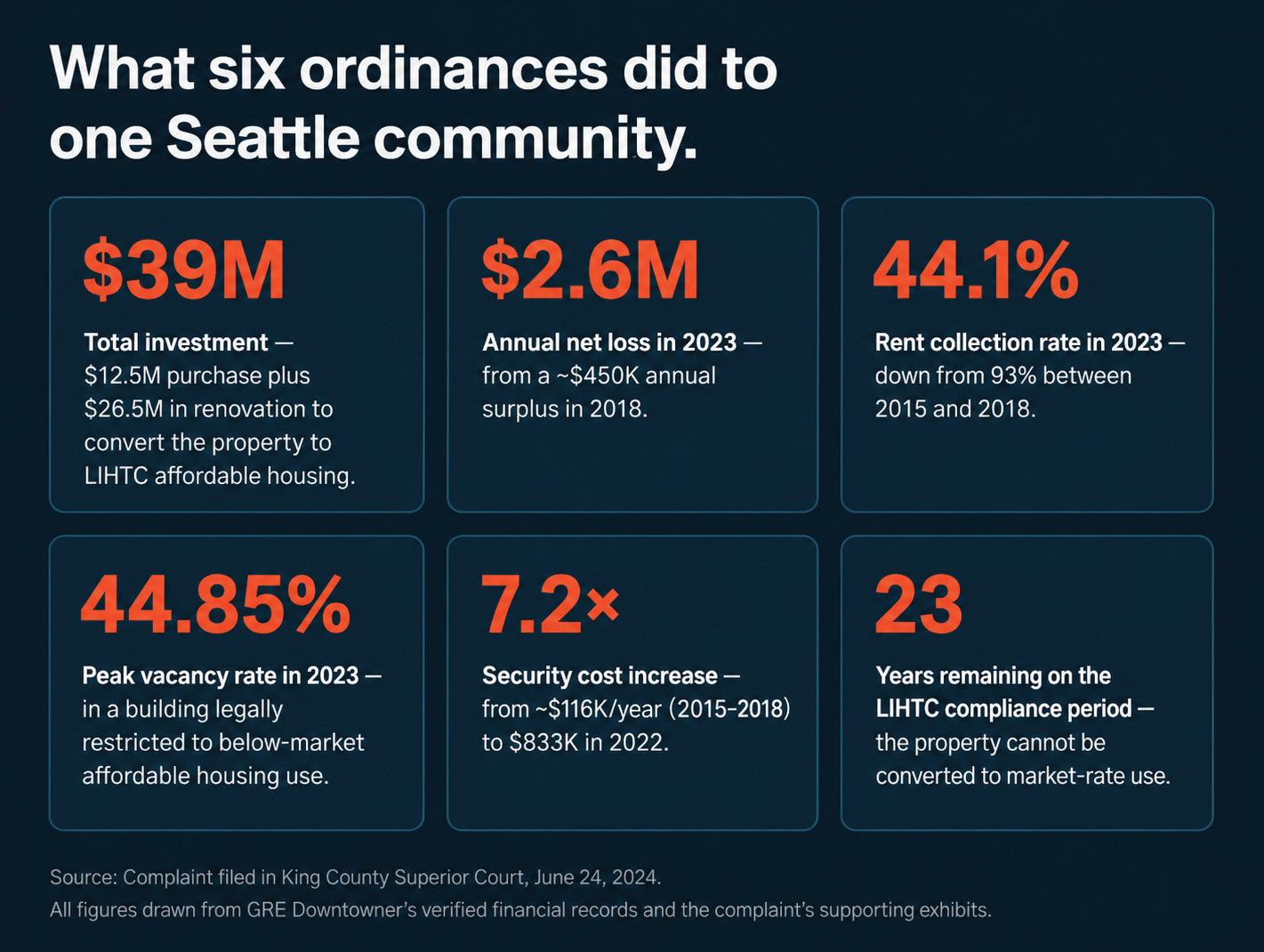
GRE Downtowner invested $26.5 million to renovate the Addison on Fourth in Seattle’s Chinatown-International District into 254 units of affordable housing. For several years, the building ran successfully as the public-private partnership it was designed to be. Then Seattle’s City Council passed six tenant protection ordinances between 2018 and 2022: the Fair Chance Housing Ordinance, the Roommate Ordinance, the Winter
Eviction Ban, the COVID-19 Eviction Moratorium, and accompanying rent increase and relocation assistance mandates. The cumulative effect was devastating. Security costs quintupled. Vacancy climbed to nearly 45%. Rent collections fell from 93% to below 45%. The Addison lost over $2.7 million per year and defaulted on its mortgage.
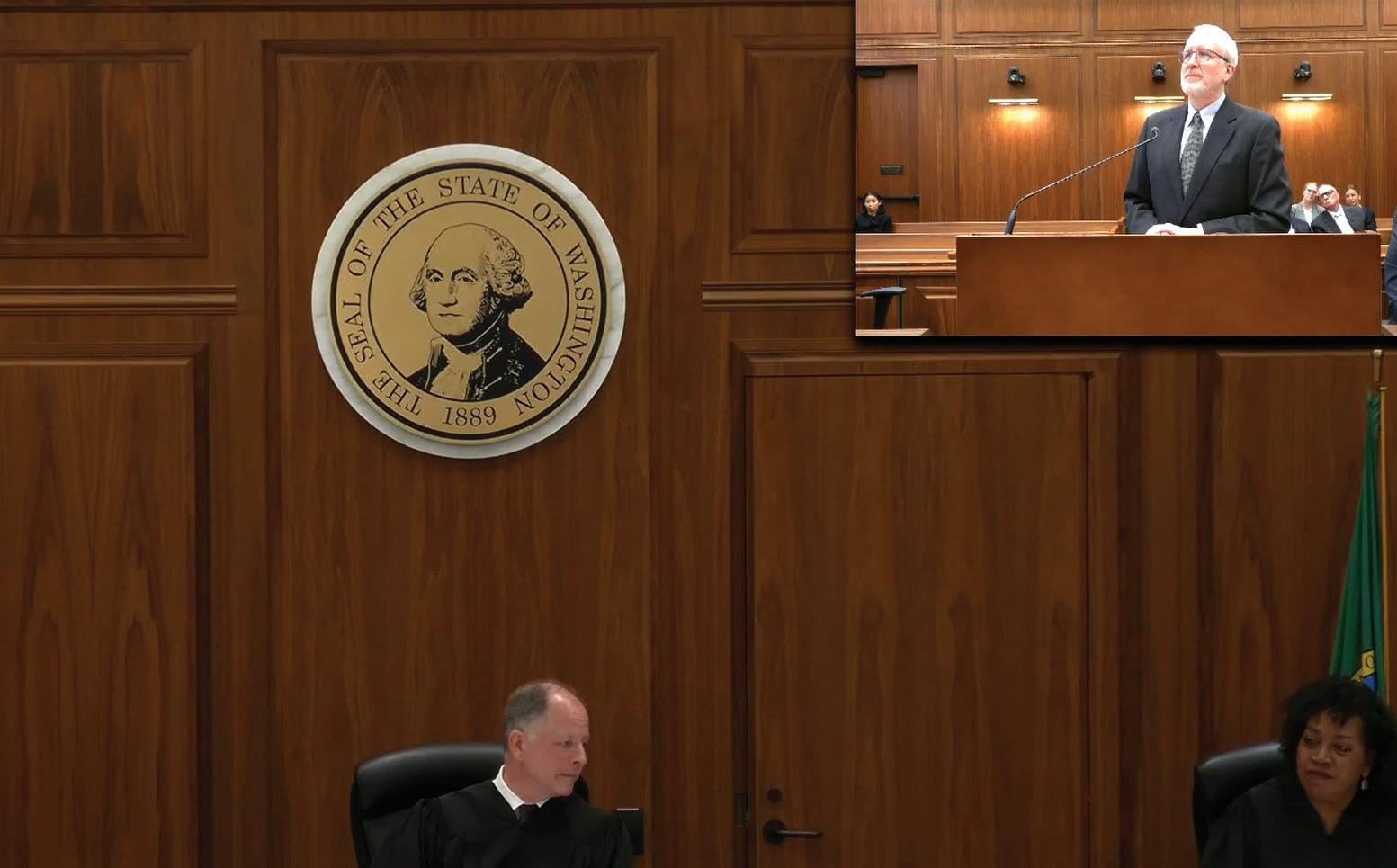
GRE filed suit in October 2024, arguing the ordinances amounted to a per se taking - a functional commandeering of private property so pervasive it was akin to physical occupation. A King County judge dismissed the case in early 2025, leaning on the Penn Central balancing test and the broad public interest framing that courts have historically used to shield housing legislation from constitutional challenge. But that was not the end of the road. GRE appealed, and the case has since proceeded to oral argument at the Washington Court of Appeals, where counsel compellingly argued that the six ordinances operated together to destroy the value of the Addison. The responses from the Court of Appeals and questions from the judges’ bench seem encouraging for the perspectives of small housing providers.
At one point, Judge Lori Smith asked City of Seattle Assistant Attorney
Roger Wynne “Is there a point at which there could just be too many ordinances? Like here, we have six, lets say there’s 25, 50, 150; is there some point where that number matters?” To which Wynne responded “Not to this case your honor. It might matter to the City Council and perhaps the city council will be looking and readjusting what it’s done with landlord-tenant regulations. But here, no.”
Clearly, from the perspective of housing providers in City of Seattle, this is an incredibly worrying perspective to hear from a legal representative of the city. This communicates that unless there is reevaluation championed by the council itself, there is no point at which there should be a reevaluation of whether policies are proving to be beneficial. Hopefully the courts find this response as concerning as we do. A decision from the appellate court is pending, and RHAWA will keep members informed as it comes down.
Cedarland Homes v. Ferguson: Our Members’ Fight
If the GRE case is the story of one company’s battle with one city, Cedarland Homes v. Ferguson is something much more broad across our membership. Filed in December 2025 in Thurston County Superior Court, this class action lawsuit was brought on behalf of housing providers
Daniel Bannon
who were never fairly compensated for non-payment of rent and property value diminution suffered during Washington’s COVID-19 eviction moratorium. The case is being litigated by Davis Wright Tremaine - spearheaded by seasoned attorney John DiLorenzo — and it names Governor Bob Ferguson, the State of Washington, and nine local municipalities that enacted their own copycat moratoriums.
The lawsuit argues that government entities compelled plaintiffs to allow “tenants-turned-trespassers” to occupy their properties without compensation, while landlords remained liable for all property taxes, mortgage payments, maintenance costs, and utility charges for property they no longer controlled — and that this government-compelled physical occupation constituted a per se taking under the Fifth Amendment. The
state did offer a mitigation program, but it capped reimbursements at just $15,000 — far short of the tens if not hundred of thousands of dollars in losses many providers experienced. For a member who owns a duplex or a single-family rental, two and a half years of compelled occupancy with no real avenue for recovery was not a footnote. It was a financial crisis.
The case is still in its early stages,
but it is exactly the kind of bold, member-driven legal action that our industry has needed. The plaintiff class is made up of the small and mid-sized housing providers who bore the brunt of the moratorium — all members of RHAWA.
Change is in The Air
The road ahead is not without obstacles. Takings doctrine has long favored governments, and courts have been reluctant to second-guess legislative housing decisions framed as responses to crisis. But the legal landscape is shifting. The arguments being advanced in both cases are sophisticated, the legal teams are exceptional, and the facts are on our side in a way that is increasingly difficult to ignore. Every hearing, every brief, and every appellate argument builds the record that will shape how courts in Washington and across the country think about the relationship between rental regulation and property rights.
RHAWA is proud to stand behind both of these efforts. Our hope it to that the results of this work will not only benefit the parties involved in the lawsuit, but also our entire membership. Members who want to stay engaged, learn more either of these cases, or support RHAWA’s advocacy work can donate to the RHA PAC online at RHAwa.org/pac or reach out to us if you have any questions. These cases are your cases. The fight is worth having.
Schaller, CEO | RentalRiff | RHAWA Vendor Member
In a crowded rental landscape, your listing often gets one shot to capture a high-quality tenant. While many landlords rely on polished photos and catchy descriptions, the most persuasive marketing tool is far simpler: the physical condition of the property itself.
Shifting your mindset to treat maintenance as a core marketing strategy can significantly reduce vacancy and attract tenants who value and take care of their living environment.
The Psychological
Impact
of Property Condition
Prospective tenants don’t just see a unit; they see a reflection of how it’s managed. Signs of neglectchipped paint, worn fixtures, or overgrown landscaping - signal that future maintenance requests may go unanswered. That uncertainty creates friction that no rent discount can fully overcome.
On the other hand, a well-maintained property communicates professionalism, stability, and care. High-quality tenants aren’t just looking for a place to live - they’re looking for a reliable partner. When a home is in peak condition, it builds trust before a conversation even starts and positions you to command stronger rent and better applicants.
What Tenants Notice First
Renters quickly pick up on subtle cues that reveal how a property is cared for:
• Clean siding, clear gutters, and maintained entryways signal safety and weather protection
• Serviced HVAC systems and reliable water heaters reduce the fear of emergencies
• Updated lighting and hardware suggest ongoing investment in the property
• Trimmed landscaping reinforces pride of ownership and neighborhood quality
These details don’t just improve aesthetics; they shape perception.
Attract Tenants
Maintenance as Marketing: Use Property Care to
Proactive Maintenance as a Competitive Edge
Most rental properties are reactive: fixed just enough to pass inspection. Proactive maintenance flips that model. By maintaining systems before they fail, you offer something objectively better.
When you can point to recent furnace servicing, plumbing checks, or roof inspections, you’re no longer just marketing a unit - you’re marketing reliability. This appeals to renters on a rational level, giving them confidence that their daily life won’t be interrupted by avoidable issues.
It also creates tangible benefits tenants care about:
• Lower utility costs from efficient systems
• Safer living conditions through tested equipment and secure fixtures
• Healthier air quality and moisture control
• Consistent comfort year-round
These are invisible advantages that become powerful differentiators when communicated clearly.
Maintenance Doesn’t Stop After Move-In
Marketing doesn’t end when the lease is signed; it continues through every interaction. How you handle maintenance requests directly shapes your reputation.
In today’s review-driven environment, one ignored issue can damage your ability to attract future tenants. Conversely, responsive, professional support becomes a long-term marketing engine. Tenants who feel respected are more likely to renew and refer others.
Providing a clear, reliable system for handling maintenance (especially one that doesn’t rely solely on your availability) signals that you take both the property and your tenants seriously.
Turnovers Are Your Biggest Opportunity
The period between tenants is where maintenance-as-marketing has the most impact. Rushing a turnover to minimize vacancy often leads to lower-quality applicants and higher long-term costs.
A fully rent-ready unit attracts tenants who are equally prepared and committed. Achieving that standard requires more than a basic cleaning - it demands a full inspection of systems, fixtures, and functionality.
High-impact turnover strategies include:
• Standardized paint and flooring for faster, consistent refreshes
• Low-cost fixture upgrades that improve visual appeal
• Deep cleaning of appliances and overlooked areas
• A full functional audit to ensure everything works flawlessly
When done correctly, turnovers allow you to capture high-quality marketing photos and justify stronger rent pricing.
Repairs as a Branding Moment
Even with proactive care, issues will arise. How you handle them defines your brand.
Treating repairs as a nuisance leads to declining property quality and tenant satisfaction. Treating them as an opportunity to protect the asset and serve the resident builds long-term value.
Fast, professional responses reinforce your positioning as a high-quality operator. This consistency drives renewals, which are ultimately more profitable than constantly finding new tenants.
Building a Reputation for Excellence
At its core, rental ownership is as much a hospitality business as it is a financial one. Your property is the product, and its condition is your most honest form of advertising.
When you prioritize upkeep and maintain a high standard of service, you create a reputation that attracts better tenants and supports premium pricing. Maintenance stops being a cost to minimize and becomes an investment in marketability and long-term performance.
A clean, safe, and professionally supported home removes the barriers that keep units vacant. Over time, this approach leads to stronger returns and a more stable portfolio.
Phil Schaller
Phil
ENGAGE26: You Don’t Have to
Ways
ENGAGE26 is shaping up to be the biggest rental housing event Washington has seen. On October 14–15 at the Meydenbauer Center in Bellevue, hundreds of housing providers, property managers, policymakers, investors, and legal professionals will gather for two packed days of keynotes, breakout sessions, and networking. For businesses that serve this industry, the sponsorship opportunities this year go well beyond a booth and a banner — and some of them don’t even require you to be there.
First, the headline: Spark Sessions are brand new to ENGAGE, and they’re already turning heads. For the first time ever, select sponsors can take the stage for a ten-minute, TED Talk–style presentation — not a sales pitch, but a genuine thought-leadership moment. Share your expertise, educate the audience, and walk away positioned as an authority in the rental housing space. Spark Sessions are available at the Silver tier ($3,500) and above, and the slots are limited. If your company has real knowledge to offer this community, this is the kind of visibility that money usually can’t buy.
But here’s what might surprise you: several of this year’s branding-only packages let you put your logo and name in front of every attendee without ever setting foot in Bellevue. Options like the Hydration Stations ($4,000), Box Lunch Supporter ($1,500), Charging Stations ($1,275), Emergency Kits ($1,275), and Refreshment Stands ($1,000) embed your brand directly into the conference experience through signage, branded products, and high-touch moments that attendees interact with all day long. That means whether your business is based in Bellingham, Vancouver, Spokane, or anywhere else in the state, you can still make a memorable impression on the decision-makers who matter most to your bottom line.
The full tiered sponsorship packages — from Bronze at $1,000 up to a single remaining Platinum at $15,000 — offer escalating booth space, digital visibility, program advertising, and stage time. But the branding opportunities are designed for businesses that want impact without logistics. Your name on a
charging hub. Your logo on every water bottle. Your brand greeting people in the restroom. These are the touchpoints that stick.
The deadline for logo inclusion in printed materials is
home page carousel (RHAwa.org), logo on promotions, linked 30-second promo + logo (engageWA.com)
• Perks: 8ft powered booth, 4 registrations, 2 VIP passes, half-page program ad, attendee list (opt-ins)
Daniel Klemme | RHAWA Membership Development & Government Affairs
Daniel Klemme
The Power of Showing Up
Daniel Bannon | RHAWA Communication & Advocacy Manager | dbannon@RHAwa.org | (206)
There is something that happens when a room full of RHAWA members sit down together. The conversation starts with a question about a notice requirement or a tricky tenant situation, and within minutes it has turned into something bigger a shared recognition that the challenges each person in that room is facing are not unique to them, and that the people sitting across the table might just have the answer, the connection, or the perspective they have been looking for. That is the power of showing up.
The landscape for independent housing providers in Washington State has never been more complex. The 2025 Legislative Session delivered some of the most sweeping changes to landlord-tenant law in state history. New tenant protection initiatives are gathering signatures in cities across the state. If there has ever been a moment to be plugged in, engaged, and connected to the broader RHAWA community, this is it. The good news is that we have more ways than ever to make that easy for you.
For members who have never attended a LINK Meeting, I want to make a simple case: go to one. Just one. I am confident you will not regret it. LINK Meetings are RHAWA's free, recurring regional gatherings where housing providers come together to share knowledge, discuss local issues, and build relationships with the people operating in the same market they are. There is no fee to attend and the value you could receive from the perspectives of seasoned members in attendance is likely to prove invaluable. These are member-driven conversations, and the value comes entirely from the people in the room.
Over the last year our LINK Meeting lineup has expanded significantly. We now have meetings running across the greater Puget Sound region, Clark County, downtown Spokane, Spokane Valley, and online, meaning that no
905-0609
and I cannot recommend them highly enough. Whether you are a seasoned housing provider or newer to the business, there is always something to learn, and the connections you make over breakfast before the session be-
“EVERY LINK MEETING YOU JOIN, EVERY CORE SERIES CLASS YOU ATTEND, AND EVERY MESSAGE YOU SEND TO YOUR LEGISLATOR IS A SMALL INVESTMENT THAT COMPOUNDS OVER TIME INTO SOMETHING MUCH LARGER.”
matter where in Washington you operate, there is a seat at the table with your name on it. If you have been attending the same local meeting for years, I encourage you to look at what else is available. LINK Meetings are intentionally staggered throughout the month to allow for attendees in-between regions to attend any meeting location that may be relevant to them.
If you have never attended one at all, there has never been a better time to start. You can find the full schedule and registration links at rhawa.org/events.
The CORE Series: In-Person Education That Pays for Itself
Knowledge is one of the most effective tools a housing provider has, and the CORE Series exists to make sure our members have it. Our 2026 spring CORE Series got off to a tremendous start, with and outstanding instruction on leasing compliance, rent increases, and notice requirements from the sharpest legal minds in the business. Members who attended walked away with practical, actionable guidance they could apply to their rental operations immediately.
Upcoming CORE Series sessions are scheduled throughout the summer,
gins are worth the drive on their own. Registration fills up, so I encourage you to get signed up early. Check RHAwa. org/core-series-2026 for all upcoming
Legislative Engagement: Making Your Voice Heard
The 2026 session has wrapped, but advocacy never really stops. Local ballot initiatives, city council decisions, and regulatory proposals are happening year-round across Washington, and RHAWA's ability to respond effectively depends on members who are engaged, informed, and ready to act when the moment calls for it. The best way to make sure you are never caught flat-footed is to stay connected through LINK Meetings, through CORE Series events, and through our communications channels including Call to Action emails, the RHAWA blog, and CURRENT.
Especially if you live in a smaller city, showing up to a City Council meeting can be the difference in lawmakers understanding the impact of their policy proposals. Contrary to what some members may believe, elected officials want to hear from you directly and do take your feedback into account. The 2026 Legislative Session displayed this fact clearly, as member testimony shaped several policies into much more workable laws. I have witnessed this at the local level countless times as well, an extremely onerous policy proposal will arise, some members will throw up their hands and think all is lost and others will develop a well thought out response, show up in person to city council and help shape the final policy with their feedback. We are stronger when we work together on a united message and RHAWA staff is here to help you craft your testimony and get over your stage fright when approaching a city council meeting.
The Bottom Line
Every LINK Meeting you join, every CORE Series class you attend, and every message you send to your legislator is a small investment that compounds over time into something much larger. RHAWA's strength as an organization is entirely dependent on the engagement of its members because at the end of the day, we are not a faceless institution. We are a community of housing providers who have decided that showing up, staying informed, and working together is the most effective way to protect the industry we have all built our livelihoods around.
So come to a meeting. Bring a fellow housing provider who has never been to one. Sign up for a CORE Series session. And when the call to action arrives in your inbox, answer it. The power of this organization lives in your participation, and right now, we need all of it.
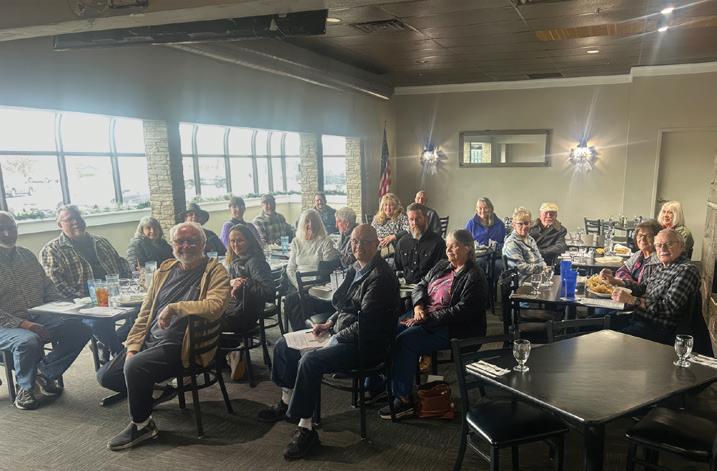
Spokane Link Meeting, 3/16/2026
LINK Meetings: Your Local Home Base
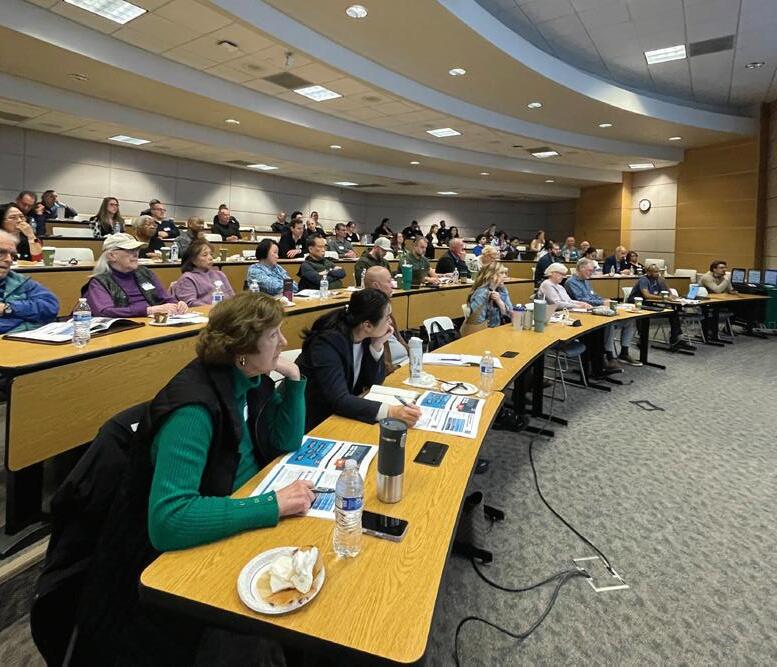
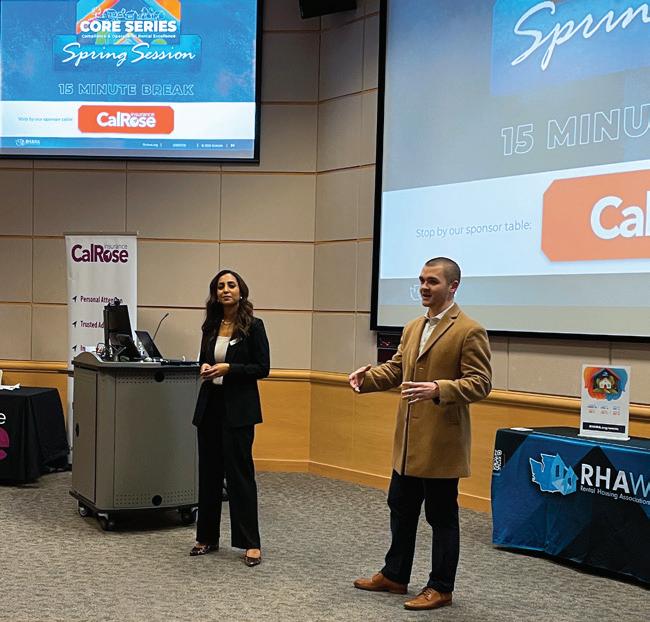
Bellevue Spring CORE Series, 3/28/2026
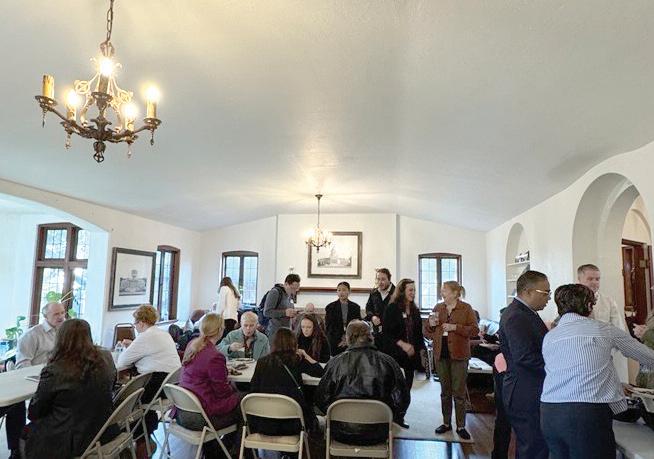
Olympia, The Castle: Legislative Session, 2/4/2026
Bring Your Hardest Questions to the Annual Legal Forum
If the last few years have left you scratching your head over Washington's rental housing rules, you're not alone and you're not wrong to feel that way. Between the recent rent control law, the layered notice requirements for rent increases, and the growing patchwork of city ordinances stacked on top of state code, even routine decisions have started to feel like legal puzzles. The 2026 Legal Forum is your chance to get straight answers from attorneys who navigate these problems every day.
Mark your calendar for Wednesday, June 17, from 3:00 to 5:30 PM. The forum is online only, so you can join from your office, your kitchen table, or between unit turns; no commute or parking required. Three attorneys currently practicing landlord-tenant, real estate, and business law across Washington will be on the panel to take on the questions you've been losing sleep over, with a moderator keeping the conversation focused and moving.
be kinder to housing providers than the last few have been, but make no mistake — the rules already on the books are still creating real confusion in real properties. Rent control changed how and when you can adjust rents. Local jurisdictions across the state, from Seattle to Tacoma to Bellingham, continue to layer their own rules on top of state law, and those rules don't always agree with each other. For the average housing provider trying to do everything by the book, the question isn't whether you want to comply — it's whether you can even tell what compliance looks like.
That's exactly the gap this forum is built to close. This isn't a generic compliance lecture or a one-way slideshow. It's a working session where you can hear how experienced attorneys interpret the contradictory and unclear corners of the law. These attorneys will explain the kinds of grey areas where a single misstep can cost you thousands in damages, attorney fees, or worse. Whether you own a single rental, manage a small portfolio, or handle prop-
erties on behalf of others, you'll walk away with a clearer read on what's actually required of you in 2026 and what to watch for as the year unfolds.
Still not convinced? Lets break it down:
• Direct access to legal expertise at a fraction of what an hour of one-onone attorney time would cost. For most members, the registration fee pays for itself the first time the forum keeps you out of a single avoidable dispute.
• Real answers to real questions, including rent increase notice service, rent control compliance, the rules around screening and tenancy decisions, and the local ordinances that keep shifting under our feet.
• 30 days of on-demand access to the recording, plus downloadable materials, so you can revisit anything you missed and reference the discussion when a similar situation comes up at your property later in the year.
• Member pricing keeps it accessible: $55 for RHAWA members, free for Class Pass subscribers,
compared to $240 for non-members. (If you're not a member yet, this is one of the clearest examples of what membership pays back.)
If you've been putting off getting clarity on a tough situation at one of your properties, this is the forum to bring it to. The attorneys on this panel have heard nearly everything Washington's rental landscape can throw at them, and the format is designed to give you usable, plain-language answers rather than legal hedging.
Beyond the immediate value, showing up to events like this is part of how our community stays informed and protected. Every housing provider who walks away from this forum with a sharper understanding of the rules is one more person making better decisions for their residents, their properties, and their business
Register today at RHAwa.com/events and we'll see you ONLINE June 17.
LEGAL FORUM
WELCOME TO Summer!
Summer in Washington State brings longer days, warmer weather, and— when you’re a rental housing provider—one of the busiest and most opportunity-filled seasons of the year. Many of our members run into unexpected turnover-related issues this time of year and come to the Support Center seeking information.
Turnover tends to peak between late spring and early fall, as tenants take advantage of school breaks, job changes, and better moving conditions. While turnover can feel like a disruption, seasoned owners and managers know it’s also a strategic window to strengthen their business.
Handled thoughtfully, a summer vacancy isn’t just a gap in income—it’s a chance to reposition your property, improve its condition, and place a responsible tenant who will contribute to long-term stability.
A PRIME OPPORTUNITY TO REPOSITION RENT
One of the most immediate advantages of a turnover is the ability to bring your rent in line with current market rates. Rental markets shift continuously, and long-term tenants—while valuable—can sometimes leave rents trailing below what comparable units are achieving.
Summer demand often gives you the strongest footing to make adjustments. More renters are actively searching, and well-presented properties tend to lease quickly. Before setting your new rate, take time to:
• Review comparable listings in your area
• Assess how your property stacks up in condition and amenities
• Factor in recent upgrades or deferred maintenance
• Balance maximizing rent with minimizing vacancy time
It’s not always about pushing to the absolute highest number. A well-priced unit that rents quickly to a qualified tenant often outperforms a higher-priced unit that sits vacant.
REFRESH, REPAIR, AND REINVEST
Turnover is also your best opportunity to get inside the unit and take a clear-eyed look at its condition. Even responsible tenants leave behind wear and tear. Addressing it now protects your asset and enhances your property’s appeal.
Focus on improvements that deliver both durability and visual impact:
• Fresh paint in neutral, modern tones
• Flooring repairs or upgrades where needed
• Deep cleaning, especially kitchens and bathrooms
• Updated fixtures (lighting, hardware, faucets)
• Landscaping touch-ups for curb appeal
Beyond cosmetics, this is the time to tackle planned maintenance that’s difficult to perform while a unit is occupied:
• HVAC servicing
• Gutter cleaning and roof inspections
• Plumbing checks for leaks or aging components
• Safety items like replacing expired smoke and CO detectors
Think of this phase as both preservation and positioning. A well-main-
tained property not only commands better rent, it attracts tenants who value and respect a well-cared-for home.
SET THE STAGE FOR A BETTER TENANCY
Every turnover is also a reset. It’s your chance to place a tenant who aligns with your expectations and business practices.
That starts before you ever post a listing—with clearly defined screening criteria. Use RHAWA’s Application Criteria Guidelines to ensure compliance with all state and local laws.
Take time to revisit and refine your standards:
• Income requirements
• Credit thresholds
• Rental history expectations
• Policies on pets, occupancy limits, and other key terms
Consistency is critical. Applying your criteria uniformly helps you stay compliant with fair housing laws while also improving the quality of your applicant pool.
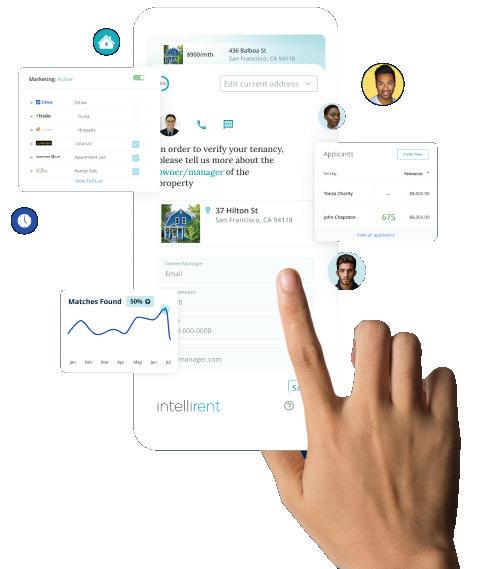
When applications start coming in, resist the urge to rush. Summer demand can create a sense of urgency, but careful screening pays dividends over the life of the tenancy. Use Intelligent to verify income, verify prior landlords, and review credit and background information thoroughly.
A little time upfront can save months— or years—of avoidable issues.
THE POWER OF THE IN-PERSON CONNECTION
Once you’ve selected a qualified applicant, don’t underestimate the value of a
proper move-in meeting. This is more than a key handoff—it’s your opportunity to set expectations and establish a professional relationship.
• Explain how to submit requests or communicate concerns
• Let them know you inspect the property at least once a year to check for any maintenance issues.
• Clarify payment procedures and timelines
This conversation sets the tone. Tenants who understand expectations from day one are far more likely to meet them.
It also gives you a chance to reinforce that this is a professionally managed home—not just a casual arrangement.
Handling Deposits the Right Way
Amid the flurry of turnover activity, security deposits deserve careful attention. Missteps here are one of the most common—and avoidable—sources of disputes.
For outgoing tenants, the process should be methodical:
• Conduct a thorough move-out inspection using the Property Condition Checklist from their move-in to document all changes in condition.
• Document any damage or excessive wear with photos and notes
• Distinguish clearly between wear from ordinary use and tenantcaused damage
• Provide the completed Property
Denise Myers | RHAWA Member Programs Director | dmyers@RHAwa.org |
A SEASON OF OPPORTUNITY
Condition Checklist and Deposit Refund Statement within 30 days of move out.
Transparency and documentation are your best protection. Even when deductions are justified, how you communicate them matters. Remember, under state law, you cannot charge the deposit for cleaning a carpet where the condition is in tune with “ordinary use.”
For incoming tenants, clarity is equally important:
• Clearly state the deposit amount and what it covers
• Document the property’s condition at move-in (a checklist with photos is ideal)
• Ensure the tenant understands their role in maintaining the property
This creates a shared baseline. When expectations are documented at both ends of the tenancy, misunderstandings are far less likely. Review RHAWA Support Center articles, Send Deposit Accounting and Refund at Move Out, and Collect a Security Deposit for more detailed information.
REDUCE RISK THROUGH PREPARATION
Turnover season can feel fast-paced, but the most successful housing providers rely on systems—not speed.
A few best practices to keep things running smoothly:
• Use the Property Condition Checklist so nothing is missed
• Schedule vendors early (painters, cleaners, maintenance) to avoid delays
• Keep detailed records of inspections, repairs, and communications
• Avoid cutting corners on screening, even when demand is high
Efficiency doesn’t come from rushing—it comes from preparation.
TURNING TURNOVER INTO LONG-TERM VALUE
It’s easy to view tenant turnover as a cost center: lost rent, repair expenses, time investment. But reframed correctly, it’s one of the most valuable tools you have to improve your portfolio.
Each transition gives you the chance to:
• Adjust pricing to reflect the current market
• Upgrade and protect your physical asset
• Strengthen your tenant selection process
• Reinforce professional standards and expectations
Over time, these incremental improvements compound. Properties perform better. Tenancies last longer. Problems become less frequent and less severe.
A SEASON OF OPPORTUNITY
Summer in Washington isn’t just peak moving season—it’s peak opportunity for those who approach it with intention.
By combining smart pricing, thoughtful property improvements, careful screening, and clear communication, you can turn each turnover into a step forward for your rental business.
Handled well, the busy season doesn’t just fill vacancies—it builds a stronger, more resilient operation for the years ahead.
Wednesday, June 3, 1-3pm
Wednesday, June 24, 1-3pm
Don't Miss the Deadline — or the Money: Washington's Clean Buildings Performance Standard What multifamily
owners and operators need to know
This article focuses on Washington state requirements that are relevant to multifamily rental housing properties.
In 2019, Washington state enacted what is known as the Clean Buildings Performance Standard (CBPS), which was the first statewide building performance standard in the country.
In 2022, SB 5722, also known as the “expansion law,” was enacted, which, relevant to this article, expanded the scope of the CBPS to include any multifamily residential building with a gross floor area that exceeds 20,000 square feet, excluding parking garages and individual dwelling units in condominiums.
As of May, 2026, the Department of Commerce is updating the rules for the CBPS, and some updates may impact multifamily properties. Be sure to check the CBPS website for current information and requirements: commerce.wa.gov/cbps/.
COMPLIANCE REQUIREMENTS
The legal obligations of the CBPS fall to the “building owner,” defined as the individual or entity possessing title. Notice letters from the Department of Commerce were mailed to building owners in 2025.
There are various potential exemptions that building owners can apply for, including (among others) buildings with reduced physical occupancy, buildings that are mainly manufacturing or industrial, agricultural structures, those pending demolition, and buildings that meet various conditions of financial hardship. The burden is on building owners to determine if an exemption may apply and to submit documentation no later than 180 days (approximately six months)
prior to the compliance date.
Multifamily buildings that do not qualify for an exemption must complete three key tasks by July 1, 2027:
- Benchmark at least 12 consecutive months of building energy use data (using Energy Star Portfolio Manager).
- Create an energy management plan (EMP).
- Develop and implement an operations and maintenance program (O&M).
Compliance will be on a five-year cycle.
Unlike larger commercial buildings that also fall within the scope of the CBPS, multifamily buildings are not, for this first compliance cycle, required to meet an Energy Use Intensity (EUI) target, though they may be for future compliance cycles. Recent updates to the CBPS allow utilities to provide aggregate energy use for covered buildings.
Failure to comply with CBPS requirements can result in fines of no more than $0.30 per square foot. Commerce has produced numerous support tools and resources, including a penalties calculator, which can be accessed via Commerce’s Document Library: commerce.wa.gov/ cbps/cbps-support-and-resources/ cbps-documents/. Penalties may not be passed along to tenants, as long as tenants are providing access to utility usage data, physical spaces in the buildings, and being responsive to needs from building owners to facilitate compliance with the standard.
DON’T LEAVE MONEY ON THE TABLE
Tier 2 buildings are eligible for the
Early Adopter incentive, which has a base rate of $0.30 per square foot of covered gross floor area. The base rate Early Adopter Incentive only requires early compliance with CBPS requirements – nothing extra. Subsequently, an Enhanced Incentive of up to $0.75 per square foot was added for multifamily building owners who commit to anti-displacement measures (sign an Anti-Displacement Agreement).
Other incentives and grants may be available to eligible properties. Building owners can review the CBPS Grants and Incentives website for more information, including the Tier 2 Incentive Guidebook: commerce. wa.gov/cbps/cbps-grants-incentives/
TENANT ENGAGEMENT AND LEASES ARE KEY TO COMPLIANCE
For multifamily apartment rental units, floor area calculations for purposes of CBPS compliance include the living space in each individual rental unit. This means that compliance with the CBPS presents an opportunity for owners and tenants to work together.
To facilitate compliance, building owners should educate tenants on the legal requirements and how sustainability can produce healthier environments and reduced utility costs. Building owners may also want to consider updating their lease language to include key compliance and sustainability aspects, such as data confidentiality, unit access, updated rules and regulations, etc. Building owners may also want to update their standard processes for turnover of individual rental units to include efficiency upgrades that support current and expected future CBPS requirements.
HOW TO GET STARTED
The first compliance deadline is July 1, 2027 – and it can take time to complete the necessary steps. Don’t delay!
Building owners who did not receive a notification letter from Commerce, or those who are unable to locate their letter, can fill out the appropriate Customer Support Form via this webpage: commerce.wa.gov/cbps/portal. Building owners need the unique code from the letter to access the Clean Buildings Portal, which is where owners can confirm or deny ownership and confirm or correct information regarding their building(s). Given the potential impacts of non-compliance, it is important that owners timely correct any inaccuracies.
Disclaimer: this article is for educational and informational purposes only; it is not legal advice and does not create an attorney-client relationship.
Need support with compliance? At Climate Aligned Law PLLC, we help building owners assess their options, including analysis of whether buildings are in scope and any potentially applicable exemptions; identification of relevant timelines and documentation requirements; and guidance regarding paths to compliance and related strategic decisions. We also revise and update leases to align with Clean Building Performance Standard requirements.
Continued on page 29
Nicole DeNamur | Attorney | Climate Aligned Law
Nicole DeNamur
VENDOR LISTINGS
We encourage you to consider the vendors found within these listings for your rental business needs. When seeking competitive bids, be sure to mention your RHAWA membership as many offer member discounts. RHAWA does not specifically endorse any business listed herein. References are always recommended. If you would like to submit a customer testimonial for our records, please submit to publications@RHAwa.org. Please note that changes made to a vendor member profile will not be reflected in the CURRENT Vendor Listings unless the change is also sent to publications@RHAwa.org.
Klemme | RHAWA Membership Development & Government Affairs | dklemme@RHAwa.org | (206) 905-0611
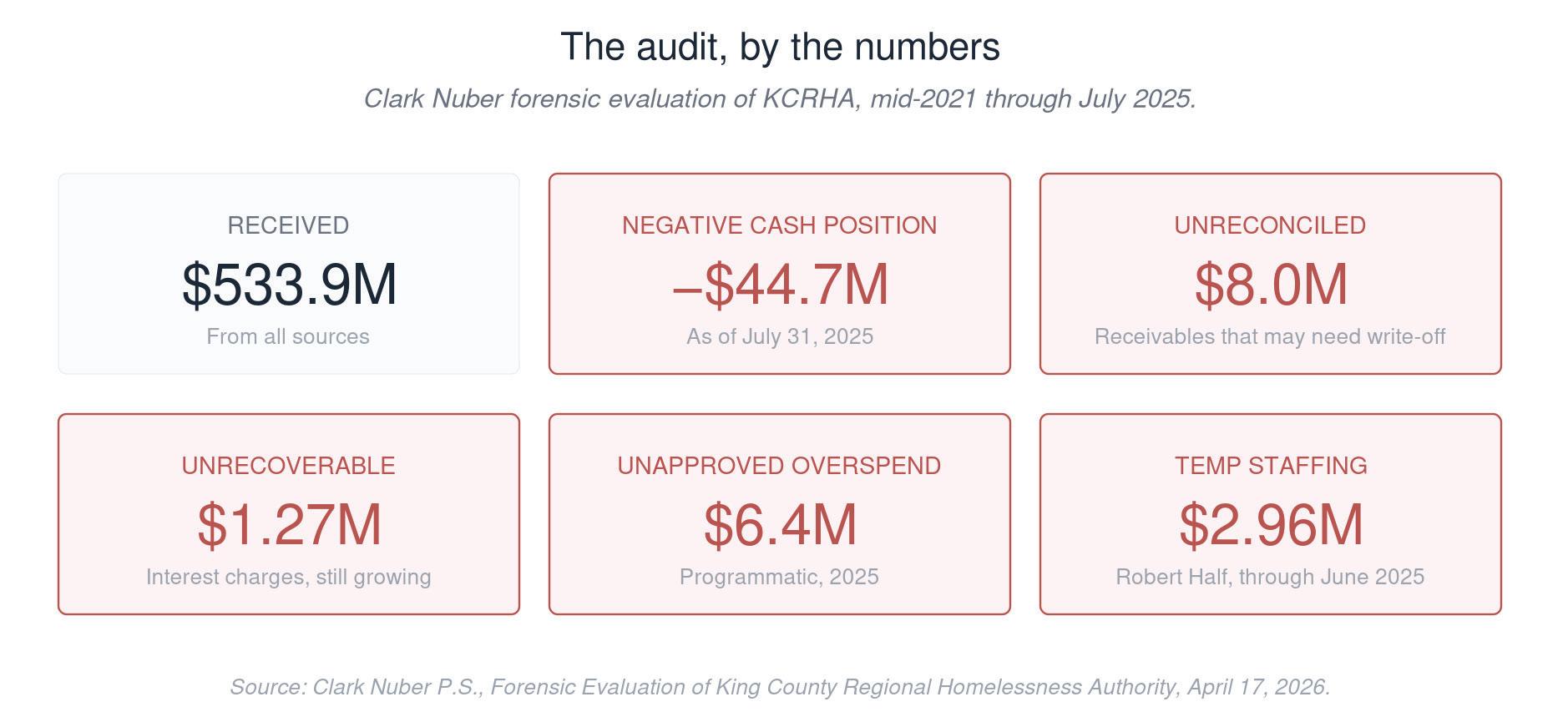
The King County Regional Homelessness Authority, or KCRHA, received $533.9 million between mid-2021 and July 2025. This has come to light due to a recent audit, in which the KCRHA could not, in the auditors' own words, “reliably trace where most of it went”, and is now being dismantled.
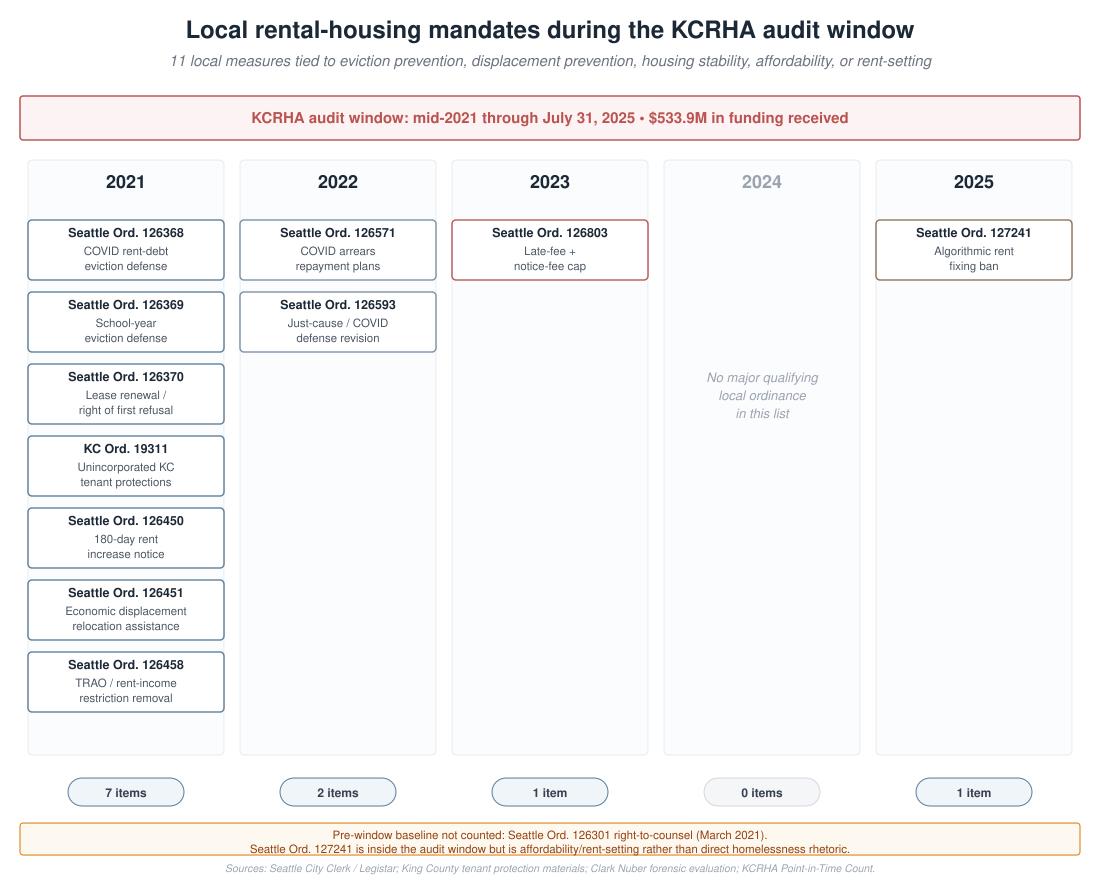
During the same window, Seattle and King County passed eleven local rental-housing measures justified by some combination of homelessness, displacement, housing instability, or affordability rhetoric. The agency is being dissolved on the evidence that the premise of pooled resources and unified funding streams failed.
But this was just one side of the coin for homelessness prevention and intervention. The other side of the holistic approach was the legislative side. And while the funding schemes are now, under intense internal and external scrutiny, forced to recall their efforts and start over, however the ordinances and legislation are not under those same calls.
That asymmetry is this article.
The Premise
For nearly a decade, Seattle and King County built a regulatory framework on a simple argument: eviction leads to displacement, displacement leads to homelessness, therefore restricting the legal tools available to housing providers prevents homelessness. Many of us recall the “eviction causes homelessness” catch phrase from that time period. For those who don’t it appears, repeatedly, in the legislative findings of the ordinances themselves.
Some ordinances invoked homelessness directly. Others used adjacent language about housing stability, eviction-prevention, or anti-displacement. Together, they formed the same policy frame: housing providers as the front line of homelessness prevention.
The legislative record is plain. The question is what the public system on the receiving end of all that prevention rhetoric actually looked like.
The Receiving System
KCRHA was formed in December 2019 through an interlocal agreement between the City of Seattle and King County. It became operational in mid-2021. This was the same start line as the regulatory wave above. From inception through July
Daniel
Daniel Klemme
2025, it received $533.9 million in funding from all sources. Its mission was to operate the regional homelessness support system throughout King County.
In April 2026, Clark Nuber P.S. completed a forensic evaluation of the agency on behalf of the City and County. The findings are public.
The most important finding is structural. The auditors stated that KCRHA's accounting records prior to late 2024 were not functionally traceable or reconcilable because of extensive batch journal entry accounting and the absence of an accounts receivable module. Substantial rework would be required to follow the money. Traceability limitations remained as of July 31, 2025.
In plain language: hundreds of millions of dollars moved through the system, and the records were not maintained in a way that allowed the auditors to follow them without rebuilding the books.
KCRHA had not formally adopted the comprehensive internal control framework the report identifies as required under federal Uniform Guidance. Of 24 sampled disbursements, 79% were approved by individuals whose roles did not match the documented approval authority. Of 14 sampled P-Card transactions, 100% contained internal control compliance exceptions. The P-Card policy itself remained in draft from 2021. Five years unfinalized.
The auditors did not identify specific evidence of large-scale fraud. That sentence is not a clean bill of health. The same report states that, because of internal control limitations, the risk of fraud, waste, and abuse remains, with elevated risk in cash-equivalent areas.
In plain English, the tools to prevent and detect fraud don't exist, and therefore none has been currently found.
The Mission NOT accomplished:
The audit answers one question: whether the money was well managed. It does not
answer the question that follows — whether the mission was accomplished.
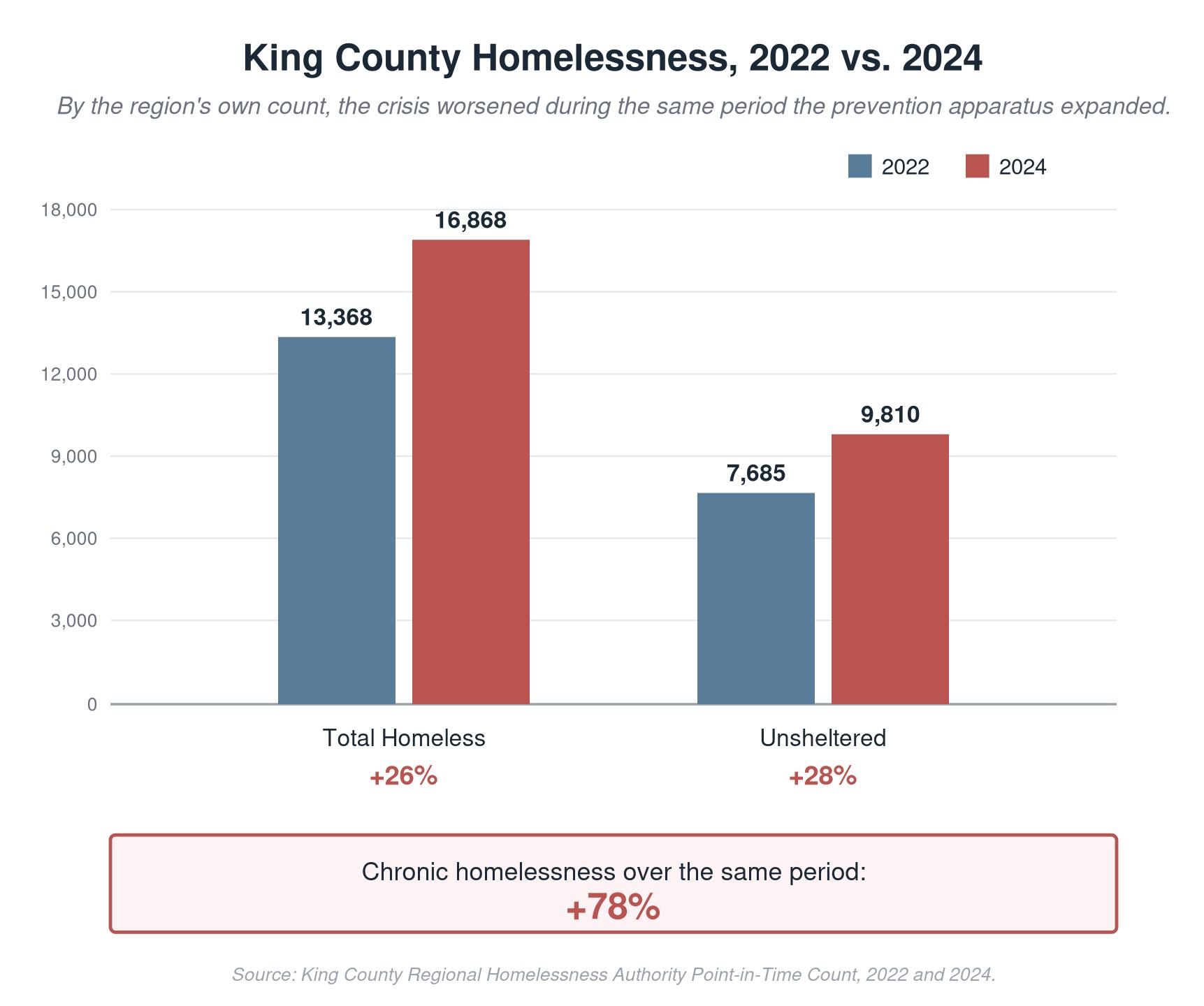
For that, the most visible public outcome indicator is the King County Point-inTime count. Between 2022 and 2024, using comparable KCRHA methodology, total homelessness in King County rose from 13,368 to 16,868 — a 26% increase. Unsheltered homelessness rose from 7,685 to 9,810. KCRHA's own reporting documents a 78% increase in chronic homelessness over the same period.
During the same period that public money flowed into the regional homelessness system, and during the same period local governments imposed new obligations on housing providers in the name of homelessness prevention, the region's visible crisis worsened sharply. The prevention premise did not deliver the outcome its rhetoric promised.
The Asymmetry
Rental housing providers operate under a regime of procedural exactitude. A defective notice creates legal exposure. A missed deadline can forfeit a remedy. A documentation error can derail an otherwise valid process. That standard exists because housing matters and residents' homes are at stake.
The Clark Nuber evaluation shows that the public homelessness authority, entrusted with hundreds of millions of dollars to address homelessness, was not held to a comparable standard. Records were not functionally traceable. Internal controls were not in place. The 2024 internal financial statements differed from the audited financials by approximately $1.3 million.
Can you imagine if KCRHA were held to a standard of accountability that was even close to the standard of accountability private housing providers are held to?
A private housing provider can be penalized for failing to use the proper font size on a notice, meanwhile KRHA spent 533.4 million, fails the most basic of audits and somehow increased homelessness?!
The Addison
The asymmetry is not theoretical. It has a Seattle address.
The Addison on Fourth is a ten-story affordable housing building on the edge of Chinatown-International District. In 2012, Goodman Real Estate purchased it for $12.5 million and invested another $26.5 million in renovation. The building qualified for the federal Low-Income Housing Tax Credit program, meaning the property is legally required to operate as affordable housing for decades.
From 2015 through 2018, the Addison ran the way affordable housing is supposed to. Rent collections averaged 93% of gross potential rent. Vacancy was low. Evictions were rare. Long-term residents knew each other.
Then Seattle began layering ordinances. Six measures between 2018 and 2022 — Fair Chance Housing, the Roommate Ordinance, the Winter Eviction Ban, the
COVID-19 moratorium, the 180-day notice requirement, and EDRA — fundamentally changed what it meant to operate the building.
By 2023, the building's operating reality had collapsed across every dimension at once.
As of November 2023, GRE Downtowner is in default on its mortgage. In June 2024, GRE sued the City of Seattle, alleging that the cumulative effect of the six ordinances amounted to a constitutional taking. The Superior Court dismissed the case in February 2025. GRE appealed. The case is now at the Washington Court of Appeals as GRE Downtowner LLC v. City of Seattle, COA No. 87886-7.
Counsel for GRE argued the six ordinances "operated together to destroy the value of the Addison." The City argued business losses do not convert routine regulation into a taking. No ruling has been issued as of the date of this article’s draft.
GRE Downtowner is a RHAWA member. RHAWA has publicly supported the litigation since its filing. A city cannot preserve affordable housing by making affordable housing impossible to operate.
The Pending Dissolution
On April 28, 2026 — eleven days after the Clark Nuber audit was published — King County Councilmember Rod Dembowski and Seattle City Councilmember Maritza Rivera introduced a joint resolution to dissolve KCRHA over a 90-to-120day winddown.
Dembowski's framing was direct: "The problem of unsheltered people has gotten twice as bad in the six years they've been around. So it's not working. And I think when something isn't working, you're in a hole. Stop digging."
A separate proposed ordinance fast-tracks the creation of a new King County Inspector General office with subpoena power and the authority to recover misspent public funds. The IG office is expected to be operational within 45 days.
It is also worth naming what the regional authority structure was always good at. KCRHA was chaired by elected officials but not directly run by them — close enough to take credit, far enough to assign blame. The audit did not catch the elected officials who designed and funded the system. It caught the agency built to absorb the consequences.
The political response to the audit, in other words, is straightforward: the agency that managed the money has lost the confidence of the elected officials who funded it. The political response to the ordinances passed under the same prevention premise is silence.
What's Being Reconsidered, and What Isn't
Both halves of Seattle and King County's homelessness strategy were sold under the same premise: the prevention frame would reduce homelessness if the public system had the resources and housing providers absorbed the regulatory burden. The audit and the Point-in-Time count have now tested both halves.
The agency is being dissolved.
The ordinances are not currently under review.
This is the asymmetry RHAWA members should be paying attention to. The same elected bodies that are willing to look at the audit and conclude the agency cannot continue in its current form have not extended that review to the ordinances enacted alongside it. The regulatory stack that hit the Addison, the rules that converted ordinary housing operations into procedural minefields, the mandates passed in the name of preventing exactly the deterioration the Point-in-Time count documents. None of those are on any agenda for reconsideration.
Either there is a holistic strategy being employed here, or there is not. If the agency failed because the prevention premise was wrong, the ordinances passed under the same premise deserve the same scrutiny. If the ordinances are sound policy on their own merits, the elected officials who passed them should defend them on those merits, not on a homelessness-prevention rationale the audit and
the PIT count have refuted.
What we have instead is a one-sided unwinding. The public side gets dismantled. The private side keeps the rules.
Time for a Reboot
Housing providers have done their part. They have absorbed the mandates, complied with the timelines, carried the procedural risk, and remained the practical backstop for a public crisis they did not create, even when it has led to ruin for their ability to operate and invest in their community. The accountability they have been asked to embody is not, by any honest accounting, the accountability the public system has demonstrated in return.
KCRHA took years to build. The dissolution motion arrived eleven days after the audit was published. That speed itself is informative. It suggests the political read on this audit was settled before the audit landed. Bad audits have a way of resolving institutional ambiguity quickly when the evidence has been accumulating for a while.
But if the prevention premise has failed badly enough to dissolve the agency built on it, it has failed badly enough to revisit the ordinances built on it.
It’s time that policy makers admit what is plainly obvious to anyone paying attention. The legislative and funding solutions have failed. Eviction didn’t cause homelessness but it sure looks like KCHRA did. Evictions didn’t cause homelessness but it sure looks like the layering of regulations did.
EDUCATION & EVENTS
RHAWA Launches New
CORE SERIES
Compliance & Operational Rental Excellence
If you own or manage rental property in Washington, you already know this isn’t a passive business—it’s an operational one. Every lease signed, maintenance request handled, or screening decision made directly affects your bottom line. That’s exactly why the second session in our CORE Series on OPERATIONAL EXCELLENCE is designed to help you move from reactive management to intentional, streamlined operations.
Offered on Saturday mornings from 8:30 AM to 12:00 PM, these focused, half-day sessions are built for busy housing providers who want practical, actionable strategies they can put to work immediately. With sessions scheduled across three convenient regional hubs—Bellevue, Spokane, and Vancouver—you can attend close to home while still gaining statewide insight.
A STRONG START IN BELLEVUE
The second part of this series kicks off at the end of this month on June 27th in Bellevue, in an interactive workshop led by Constance Nelson , member of the RHAWA Board of Regents. As the president of her multi-generational family rental property business,
Constance Nelson
Constance brings both strategic insight and real-world experience to the table. Her ability to connect high-level operational thinking with day-to-day property management realities makes this session especially valuable for both newer and seasoned rental owners. She will share several practical tools you can take home and begin using to streamline your rental operations.
Expect a collaborative, engaging environment where your questions are welcomed—not rushed—and where discussion is just as valuable as presentation.
WHY OPERATIONAL EXCELLENCE MATTERS NOW
Summer is a natural inflection point in the rental calendar. Turnovers increase, market rents shift, and maintenance needs become more visible. It’s also the perfect time to pause and ask: Are my systems actually working for me?
This workshop is designed to help you answer that question honestly—and then fix what isn’t.
Rather than offering generic advice, OPERATIONAL EXCELLENCE dives into the mechanics of running rentals as a business. The focus is on helping you build repeatable systems that reduce stress, improve consistency, and ultimately increase profitability.
WHAT YOU’LL LEARN
After having a little time to greet your fellow rental operators, we’ll get started with a rapid-fire game to see what you remembered from the first session. Then we’ll dive right into the fundamentals of daily operations and learn about…
• Streamlining Your Systems
Disorganized workflows cost time and money. You’ll learn how to create clear, repeatable operating procedures for leasing, maintenance, communication, and recordkeeping. The goal isn’t complexity— it’s clarity. When your systems are tight, decisions become easier and costly errors become less frequent.
• Controlling Costs Without Cutting Corners
From vendor management to preventative maintenance planning, you’ll explore ways to reduce unnecessary expenses while protecting the long-term value of your property. Smart cost control isn’t about doing less—it’s about doing things more efficiently.
• Managing Finances to Strengthen Cash Flow
Cash flow improves when you truly understand your numbers. You’ll learn simple, effective ways to track income and expenses so you can spot trends, control costs, and make confident decisions that improve your property’s financial performance.
After a short break we’ll go beyond day-to-day operations and take a deeper dive into the financial and legal structure of your rental business.
• Structuring LLCs for Protection and Growth
You’ll learn how to use LLCs as a strategic tool to separate and protect your assets. We’ll walk through practical approaches to grouping properties, limiting risk exposure, and setting up a structure that supports partnerships, scalability, and long-term portfolio growth.
• Designing Insurance Coverage That Works
Not all insurance strategies are created equal. You’ll gain insight into how to align property, liability, and umbrella coverage with your actual risk profile—helping you avoid costly gaps while ensuring you’re not overpaying for unnecessary coverage.
• Simplifying Taxes Through Better Organization
Tax season doesn’t have to be stressful. You’ll learn how to organize your financial records throughout the year so filing becomes faster, cleaner, and more accurate—while also ensuring you capture every deduction you’re entitled to.
These aren’t abstract concepts— they’re practical frameworks that can make a measurable difference in how your business performs over the rest of 2026 and beyond.
PART OF A POWERFUL TWO-PART SERIES
OPERATIONAL EXCELLENCE is the second half of a thoughtfully designed two-part series covering the core knowledge required to successfully operate a rental property in Washington State.
The first session, CRITICAL COMPLIANCE, focused on navigating the complex legal landscape that
Denise Myers | RHAWA Member Programs Director | dmyers@RHAwa.org | (206) 905-0614
Summer OPERATIONAL
EXCELLENCE: Summer Sessions for Rental Property Owners (June–July 2026)
housing providers face. Led by experienced landlord-tenant attorneys, that workshop unpacked the most common—and costly—legal pitfalls, from notice requirements to fair housing compliance.
Attendees walked away with:
• Clear explanations of complicated state and local regulations
• Practical examples of where housing providers often get tripped up
• Printed reference materials they could use long after the session
• A robust Q&A session that addressed real-world scenarios
Together, these two sessions form a complete foundation: Compliance keeps you protected. Operational excellence makes you profitable.
WHO SHOULD ATTEND?
This workshop is designed specifically for:
• Independent housing providers
• Small to mid-sized rental portfolio owners
• Property managers seeking more efficient systems
• Anyone looking to run their rentals more like a business—and less like a side project
Whether you own a single rental home or a growing portfolio, the principles covered in this session scale with you.
A PRACTICAL, NO-FLUFF EXPERIENCE
One of the defining features of these workshops is their focus on usability. This isn’t theory-heavy or jargon-filled. It’s built around real operational challenges and real solutions.
You’ll leave with:
• Actionable checklists and process ideas
• Clear frameworks for improving efficiency
• Better clarity on financial and legal structure
• Confidence in your ability to implement changes quickly
And just as importantly, you’ll gain perspective from others in the room who are navigating similar challenges.
WHY SATURDAY MORNING?
For most of our members, operating rental property is not their full-time job, but an additional responsibility
that needs to be squeezed in along with a busy career and family responsibilities.
By concentrating the session into a focused Saturday morning block, you get high-value learning without disrupting your entire week. When you walk out at noon, you’ll still have time to do some rental-related work and immediately begin applying what you’ve learned—while it’s still fresh.
RESERVE YOUR SPOT
With limited seating and high interest following the CRITICAL COMPLIANCE sessions, early registration is strongly encouraged—especially for
the initial event in
Choose the location that works best for you—Bellevue on June 27, Spokane on July 11, or Vancouver on July 18—and commit to building a more efficient, profitable, and resilient rental business.
See RHAwa.org/core-series-2026 for more information and registration.
Because in today’s environment, success isn’t just about owning property. It’s about operating it well.
June 27 July 11 July 18
Bellevue on June 27th.
What Spokane’s Cooling
Ordinance Means for Housing
Providers
2. They impose retrofits on buildings that cannot economically absorb them.
3. They accelerate the loss of the very units policymakers say they want to preserve.
Local ordinances can do real damage even when they are well-intentioned. Sometimes especially when they are well-intentioned. This is why RHAWA fights at the state level and the local level. A bipartisan state law can still be undermined by a single city council in a single jurisdiction, and the cost of that undermining falls on the housing providers and the tenants in that jurisdiction.
It is genuinely disappointing to see an issue resurface on something that members of both parties, working together, thought was settled at the state level. ESSB 6200 was the product of careful legislative work. It deserves the chance to do its job.
What Comes Next
The first reading is expected on May 18, but the real outcome is uncertain. The ordinance may be deferred, which we believe best serves Spokane residents and housing providers alike. It may be significantly amended. It may pass in something close to its current form. We do not know which.
What we do know is that the work continues regardless. ESSB 6200 will take effect on June 11. Other cities will watch what Spokane does. RHAWA and our coalition partners will continue to engage on the next ordinance, the next session, the next jurisdiction where local layering threatens the housing stock our members provide and our communities depend on.
No matter the outcome, we will not stop fighting.
Maintenance
as Marketing: Use Property Care to Attract Tenants
Maintenance as Your Marketing Engine
Markets will fluctuate, but demand for well-maintained housing remains constant. By focusing on property care as your primary marketing tool, you position yourself to outperform regardless of conditions.
Let the quality of your property speak for itself. When it does, attracting great tenants becomes less about selling and more about simply showing up.
Here at RentalRiff, we provide an ongoing property maintenance and support service. A rental owner or manager can hire one of our "property specialists", a licensed/insured general contractor, or maintenance pro, to be on-call for their property. Tenants simply reach out directly to their property specialist for any property-level need - this could be to fix the leaking sink, program the thermostat, or head over because the basement is flooding. The property specialist will receive that communication, head over to the property, and fix the issue.
Not only do we help with ad hoc maintenance and repairs, but we also set a preventative maintenance plan, complete turnovers, help with showings, and more.
Phil Schaller is the CEO of RentalRiff. RentalRiff provides an ongoing property maintenance and tenant support solution for small rental properties. A property owner or manager can hire a RentalRiff “property specialist” (licensed/insured general contractor or maintenance pro) to be on-call for their property. Tenants simply reach out to their property specialist for any property-level needs - the specialist will then head to the property and fix the issue. Routine preventative maintenance, emergencies, and turnovers are all included.
Continued from page 18
Money: Washington's Clean Buildings Performance Standard
Find us at www.climate-alignedlaw. com or nicole@climate-alignedlaw. com.
RESOURCES:
Department of Commerce, CBPS Tier 2 compliance website: commerce. wa.gov/cbps/tier-2-compliance/
Smart Buildings Center, Clean Buildings Performance Standard Helpdesk: smartbuildingscenter.org/resources/ clean-buildings-performance-standard-2/
The City of Seattle has enacted a Building Emissions Performance Standard, not covered in this article. More information here: seattle. gov/environment/climate-change/ buildings-and-energy/building-emissions-performance-standard
Nicole DeNamur, J.D., WELL AP and Faculty, Hon. AIA, LEED Green Associate, LFA. Nicole is the owner of Climate Aligned Law, a climate-focused law firm with a built environment focus — from design and construction through development. Her practice combines deep technical fluency in sustainability with hands-on legal experience, bringing both dimensions into alignment to drive sustainable outcomes while managing risk. Contact Nicole at: nicole@climate-alignedlaw.com and climate-alignedlaw.com
in Motion
ANNOUNCEMENTS
Interested in Submitting Your Annoucement?
We welcome information about industry job postings, new employee and location information, and more.
If you have questions, or would like to submit an item for consideration, email publications@RHAwa.org.
What Actually Moves the Needle Before Selling a Multifamily Property
Puget Sound multifamily fundamentals have stabilized, but the transaction environment remains disciplined. Buyers are active, though more selective than in previous cycles. As a result, how a property is positioned today has a direct impact on execution, pricing, and overall deal certainty.
One of the most common misconceptions among owners is that capital improvements will automatically translate into higher values. While strategic upgrades can enhance performance, not all improvements are viewed equally by buyers. In many cases, extensive interior renovations or high-end finishes do not meaningfully change underwriting assumptions unless they are directly supported by increased rents or improved operational efficiency.
In todays market, buyers are placing greater emphasis on clarity and predictability. Clean financials, consistent expense history, and a well-documented rent roll often carry more weight than cosmetic upgrades. Properties that present clear operating story, with minimal unknowns around utilities, deferred maintenance, or future capital needs, tend to generate stronger interest and more competitive offers.
This shift has practical implications for owners considering a sale. Efforts are often better spent organizing trailing financials, addressing visible deferred maintenance, and clearly outlining expense structures rather than pursuing large-scale renovations. In particular, items such as roofing, plumbing, or systems with obvious near-term replacement needs can influence buyer
perception more than aesthetic improvements.
Conversely, over improving a property prior to sale can dilute returns. Capital projects with longer payback periods or upgrades that do not materially increase income are often undervalued by buyers. In these situations, the next owner may ultimately benefit from the upside, while the current owner absorbs the cost.
In the current market environment, value is less a function of how much has been invested into a property and more a reflection of how clearly it can be evaluated. Owners who take a strategic approach to positioning, focusing on transparency, operational stability, and risk reduction, are seeing more success in today’s market.
On the Platt-Urquhart-Douglas team at Paragon, our expertise goes beyond just a listing. We work close-
ly with owners to identify where targeted efforts can have the greatest impact on value and marketability, helping position properties effectively before going to market. If you are considering a sale or would like to better understand how your property would be viewed in today’s environment, give us a call and we are happy to strategize what the next 12-36 months could look like for your investment property
If you would like to know more about 1031 exchanges, want to know the market value of your investment property or would like a referral to a tax, legal or 1031 exchange professional, please feel free to reach out to anyone on their team. Brian Platt at Brian@ ParagonREA.com (206) 251-8483, Michael Urquhart at Michael@ParagonREA.com (425) 999-6650, Ben Douglas at Ben@ParagonREA.com (206) 658-7247, or Rowan Davis at Rowan@ParagonREA.com (206) 406-9105.
Ben Douglas Rowan Davis
Brian Platt
Michael Urquhart
Brian Platt, Michael Urquhart, Ben Douglas & Rowan Davis | Paragon Real Estate Advisors | Vendor Member
PENDING - 9 UNITS
AVAILABLE - 8 UNITS
- 19 UNITS
AVAILABLE - 21 UNITS
PENDING - 8 UNITS
For the past 30 years Paragon Real Estate Advisors has been the premier commercial real estate brokerage firm in the Puget Sound. When our expert knowledge of the greater Seattle area is paired with our targeted marketing strategies, our contract negotiation skills, and our vast network of contacts; it is easy to see why we are experts in our market.
AVAILABLE - 8 Units
With the recent interest rate drop the market is starting to move! If you have any questions or would like to speak about your personal investment properties and projected market trends, we would be happy to help you. Call us today to speak with one of our specialized commercial brokers to start a free property evaluation.
One Bedroom Apt ............................................. From $100
Two Bedroom Apt ............................................. From $110
Three Bedroom Apt ........................................... From $120
Houses/Townhouses Bid Only
Vinyl Plank Floor Cleaning
Studio Apt ........................................................... From $90
One Bedroom Apt .............................................. From $100
Two Bedroom Apt ............................................. From $11 0
Three Bedroom Apt ....................................... From $120
Houses/Townhouses ............................................ Bid Only
Vinyl Plank Clear Coat Finish
Studio Apt ........................................................... From $90
One Bedroom Apt .............................................. From $100
Two Bedroom Apt ......................................
Three Bedroom Apt ....................................
Houses/Townhouses
From $11 0
Apartment Painting
Coat Labor Only. Customer to Supply Paint Walls Only* Ceilings Only
Apartment Cleaning
WHERE YOUR ROOF IS OUR ROOF
About Us
We are very proud to be a family owned and operated company. John, Barry and Jill have been serving RHA Members for over 22 years. Our focus is to solve customers’ roof problems and concerns with a reliable, high-quality roof system. Our dedicated crews take pride in their craftsmanship and treat our customers roofs as if it were our own.
We Stand by Stability
Polyflex G (torch down) provides an exceptionally durable roofing product and provides long-term weathering performance. With a granulated surface, Polyflex G exceeds all minimum ASTM standards for tensile strength, puncture resistance and flexibility. This torch down roof membrane is ideal for Northwest roofs; where common branches sometimes fall or residents want a roof-top patio. We stand behind Ployglass APP Membranes with the most reliable warranties in the industry. Their warranty provides extended protection, assuring the optimum system performance is guaranteed.
About Elizabeth Gregory Home (EGH)
EGH inspires homeless women to transform their lives. Through services offered, women can meet immediate needs, as well as long-range goals to break the cycle of homelessness.
Learn more about EGH and how you can help at eghseattle.org. Thank you.
Contact John Paust for more information:
Special pricing for RHAWA members AND $100 donation toward EGH with paid re-roof contract!