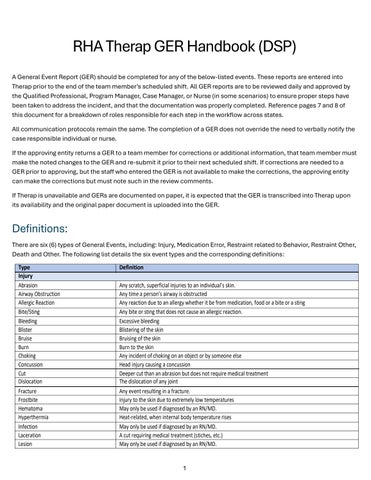
RHA Therap GER Handbook (DSP) A General Event Report (GER) should be completed for any of the below-listed events. These reports are entered into Therap prior to the end of the team member’s scheduled shift. All GER reports are to be reviewed daily and approved by the Qualified Professional, Program Manager, Case Manager, or Nurse (in some scenarios) to ensure proper steps have been taken to address the incident, and that the documentation was properly completed. Reference pages 7 and 8 of this document for a breakdown of roles responsible for each step in the workflow across states. All communication protocols remain the same. The completion of a GER does not override the need to verbally notify the case responsible individual or nurse. If the approving entity returns a GER to a team member for corrections or additional information, that team member must make the noted changes to the GER and re-submit it prior to their next scheduled shift. If corrections are needed to a GER prior to approving, but the staff who entered the GER is not available to make the corrections, the approving entity can make the corrections but must note such in the review comments. If Therap is unavailable and GERs are documented on paper, it is expected that the GER is transcribed into Therap upon its availability and the original paper document is uploaded into the GER.
Definitions: There are six (6) types of General Events, including: Injury, Medication Error, Restraint related to Behavior, Restraint Other, Death and Other. The following list details the six event types and the corresponding definitions: Type Injury Abrasion Airway Obstruction Allergic Reaction Bite/Sting Bleeding Blister Bruise Burn Choking Concussion Cut Dislocation Fracture Frostbite Hematoma Hyperthermia Infection Laceration Lesion
Definition Any scratch, superficial injuries to an individual’s skin. Any time a person’s airway is obstructed Any reaction due to an allergy whether it be from medication, food or a bite or a sting Any bite or sting that does not cause an allergic reaction. Excessive bleeding Blistering of the skin Bruising of the skin Burn to the skin Any incident of choking on an object or by someone else Head injury causing a concussion Deeper cut than an abrasion but does not require medical treatment The dislocation of any joint Any event resulting in a fracture. Injury to the skin due to extremely low temperatures May only be used if diagnosed by an RN/MD. Heat-related, when internal body temperature rises May only be used if diagnosed by an RN/MD. A cut requiring medical treatment (stiches, etc.) May only be used if diagnosed by an RN/MD. 1
Loss of Consciousness Pain Poisoning Pressure Ulcer Puncture Rash/Hives Redness Scrape Scratch Sprain/Strain Sunburn Swelling/Edema Injury Causes Abuse Accident Motor Vehicle Accident Other Adaptive Equipment Assault Bumped Into Eating Behavior Emergency/Natural Disaster Environmental Hazard Exposure Fall Ingestion of Foreign Material (Pica) Insect Medical Condition Medical Procedure Restraint Seizure Self-Injurious Behavior
Undetermined Medication Error Charting Error
Medication Count Discrepancy Omission Order Expired Transcription Omission Transcription Wrong Dose Transcription Wrong Individual Transcription Wrong Medication Transcription Wrong Route Transcription Wrong Time Wrong Dose
When a person is observed to have lost consciousness Minor pain reported by an individual (joint pain, stomach pain, headache) Ingestion of poison or other chemical May only be used if diagnosed by an RN/MD. Any event when an individual’s skin is punctured by an object. Rash or hives on skin not caused by allergic reaction Skin redness due to irritation or soreness Slight tearing of the skin due to scraping a surface Superficial scratch that does not fully break the skin May only be used if diagnosed by an RN/MD. Redness of the skin due to exposure to the sun Swelling of an area on the body due to trapped fluid Injury was due to abuse Injury occurred because of a motor vehicle accident An accidental injury An injury caused by adaptive equipment An injury occurred during an assault Individual has injury due to bumping into an object Injury caused because of an eating behavior Injury caused by an Emergency or Natural Disaster A hazard in the environment is the cause of the injury Exposure to heat, cold, chemical, sun, etc. Injury due to an individual falling Injury from ingesting non-food material Any injury caused by an insect (i.e. bite or sting) Injury due to a medical condition May only be used if diagnosed by an RN/MD. Any injury that is caused by or occurred during the use of a restraint; usually applies to damage inflicted on the body by an external force. An injury occurred during a seizure An occurrence when an individual is being deliberate, repetitive, or impulsive, but having a non-lethal result in the harming of themselves. Self-injurious Behavior is also termed Self-mutilation, Self-Harm, or SelfAbuse. Cause of injury is unknown A documentation error occurs when a MAR is not initiated after medication assistance is provided to an individual. Evidence of a documentation error is denoted by a blank space(s) on the MAR following the scheduled administration time for medication(s). Any discrepancy in med counts Any event when a medication is not given as ordered. Medication order has expired Did not document medication administration Documented incorrect medication dose Documented medication administration for the wrong individual Documented the administration of the wrong medication Documented the incorrect route of medication administration Documented the incorrect time of medication administration Individual was given the incorrect dose of medication
2
Wrong Individual Wrong Medication Wrong Route Wrong Time Medication Error Causes Forgot to Send to Program Forgot to Take on Activity Medication Refused Medication not Available Omission Unavoidable Pharmacy Error Staff Action/Inaction Restraint Related to Behavior Other Other Accident no apparent injury Altercation Allegation of Abuse, Neglect, & Exploitation
Assault AWOL/Missing Person Behavior Issue Change of Condition
Medication was administered to the incorrect individual The incorrect medication was administered Medication was given via the incorrect route Medication was administered at the incorrect time Medication was not sent to program outside of the facility Medication was not taken while out of facility for an activity Individual refused to take medication Medication prescribed was not available Individual did not receive medication and was unavoidable Pharmacy made an error dispensing medication Team member made an error in regard to medication administration Any event where a negative behavior results in the use of a restraint/therapeutic hold. Any event other than behavior resulting in a restraint/therapeutic hold. An accident occurred with no reported injury Any event when an individual causes injury to or attempts to cause injury to another. This includes individual/individual; individual/staff; or individual/other. Alleged or suspected Abuse/Neglect/Exploitation Abuse: Abuse is defined as the inflection of mental (verbal or psychological abuse) or physical pain or injury (physical abuse) upon a person by other than accidental means, or the reasonable confinement of a person. Neglect: Neglect is defined as the failure to provide services and support necessary to protect a person from serious physical and/or psychological harm. Exploitation: Exploitation is defined as the illegal or unauthorized use of a person or his/her resources for another person’s profit, business, or advantage. Any event when an individual intentionally engages with another individual with the purpose to cause injury, to include sexual assault. Aggressor, Victim, and type of assault will need to be included. Any event when an individual leaves the premises without informing the program staff. Anyone who has disappeared or whereabouts are unknown for a period beyond their current level of clinical supervision. Any other behavior such as aggression by individual, peer aggression, & threatening behavior.
Fall Without Injury
Any event in which an individual’s verbal or non-verbal cues or staff observation of a symptom that Newly diagnosed conditions, skin breakdowns, infections, recurrent vomiting/diarrhea, health complaints (headaches, stomach aches and/or changes in behavior requiring follow-up). Any event where an individual possesses items not allowed in the program (i.e., drugs, alcohol, weapons, pornography) Individual fell but no reported injury present and no medical treatment provided
Fire
Any occurrence of a fire that affects an individual. This could also include fire-setting behaviors.
Hospital (non-injury)
An individual has been hospitalized due to medical issues.
Inappropriate Alcohol/Drug Use Infestation
Possession and/or consumption of drugs and/or alcohol by individuals on the premises or off-grounds while in treatment. An unusually large number of insects or animals in a place, typically to cause damage or disease
Law Enforcement Involvement
All 911 calls and any event resulting in law enforcement assistance.
Misconduct/Possible Criminal Activity
Any misconduct or criminal activity on the part of the team member towards an individual or conducted by an individual
Contraband
3
Out of Home Placement
Property Damage
Any event requiring the individual to change their service location from the primary service during treatment to a long-term location/service including Detention/Jail. In specific response to an event, any occurrence that required the use of a prescribed psychotropic medication. Escalated behavior resulting in property destruction regardless of damage or severity.
Privacy Concern
Any concern regarding an unauthorized disclosure of PHI.
Seizure
Sensitive Situation
A seizure is a sudden uncontrolled electrical disturbance in the brain. It can cause changes in behavior, movement or feeling, and in level of consciousness. There are many types of seizures which range in severity. Most seizures last from 30 seconds to two minutes. Seek ER services immediately if a seizure lasts longer than five minutes, breathing or consciousness doesn’t return after the seizure stops, a second seizure follows immediately, has a high, experiencing heat exhaustion, is pregnant, has diabetes, or the individual injured oneself during the seizure. Situations that could be sensitive to the individual and requires extra attention due to the nature.
Serious Illness
When an individual is diagnosed by a medical professional with a serious illness.
Suicide Theft/larceny Attempt
Any attempts to commit suicide. Any attempt or actual occurrence of taking the property of other individuals, visitors, and/or staff on the program grounds or within the community.
Vehicle Accident
A vehicle accident where individuals were involved
PRN Psychotropic Use
Notification Levels: Each GER is assigned a notification level based on the severity of the event. Notification Levels are identified as: • LOW: Low incidents are events that do not significantly threaten the health or safety of an individual but could indicate systematic problems if they occur frequently. Low incidents may signal a need for the unit and/or organization to review its clinical care and practices, including supervision and training. • MEDIUM: Includes any incident which involves a person supported death due to natural causes or terminal illness, or results in a threat to a person supported health or safety or a threat to the health or safety of others due to person supported behavior. • HIGH: Includes any incident that results in a unexpected death, sexual assault or permanent physical or psychological impairment to a person supported, a substantial risk of death, or permanent physical or psychological impairment to a person supported, a death, sexual assault or permanent physical or psychological impairment caused by a person supported, a substantial risk of death or permanent physical or psychological impairment caused by a person supported or a threat caused by a person supported to a person's safety. The following incident types will automatically default to the notification level identified: High
• Injury: Severity: Severe (Hospital, ER/Admission) • Injury: Severity: Death • Injury: Type: Fracture • Medication Error: Treatment By: Immediate Physician’s Visit • Medication Error: Treatment By: Immediate Emergency Room Visit • Restraint Other: Type: Mechanical • Restraint Other: Type: Chemical
4
• Restraint Other: Type: Physical • Death: Cause: Accident • Death: Cause: Unknown • Death: Cause: Homicide/Violence • Death: Cause: Sudden/Unexpected
Medium • Injury: Severity: Moderate (Nurse/Physician treatment) • Medication Error: Treatment By: Consult with Nurse • Medication Error: Treatment By: Consult with Physician • Medication Error: Treatment By: Consult with Poison Control Center • Death: Cause: Natural/Expected For Incidents that do not automatically default to a notification level, please refer to the following crosswalk:
Notification Level
Low
Medium
NC
NJ
TN
GA
PA
Examples
All Level 1 Non-reportable All nonAll non-critical incidents Non-reportable Any planned use of restrictive intervention which incidents incidents as reportable should be leveled as incidents as was administered appropriately and without should be described under incidents should low Notification. described under complaint, discomfort, or injury; Any injury that leveled as low Example. be leveled as low Example. requires basic first aid only, Medication Errors Notification. Notification. that do not threaten the person’s health or safety; Suicide threat or verbalization that indicates new, different, or increased behavior; Aggressive or destructive behavior that does not involve law enforcement or complaint to an oversight agency and is not address though BSP (throwing chair, smashing window, etc.).
All Level 2 incidents
All Level B incidents.
All Tier 2 reportable incidents
All reportable Injury to the person that requires treatment by a Incidents that require follow-up by incidents, not licensed health professional (such as MD, RN or requiring LPN) beyond basic first aid; Allegation of abuse by the Program investigation by anyone, including caretaker, friend, relative, or Manager and/or an a Certified stranger; any emergency or unplanned use of a internal Investigator restrictive intervention; Any medication error investigation to that threatens the individual’s health or safety as determine if the risk determined by the physician or pharmacist level rises to the notified of the error; Suicide behavior that does High Notification not result in death or permanent physical or Level." psychological impairment; Aggressive or Examples: destructive behavior that involves a report to law enforcement/oversight entity; any absence medication error, greater than 3 hours specified in the person’s property damage, plan or any absence that requires police contact. etc.
5
Notification Level
High
NC
NJ
TN
All Level 3 All Level A incidents in NC incidents should be leveled as high Notification.
All Tier 1 incidents
GA Deaths or incidents investigated by DBHDD or HFR
6
PA
Examples
Sentinel events Unexpected death due to suicide, violence, involving people accident, deaths occurring within 7 days of a supported and seclusion or restraint, any restrictive intervention Incidents that results in permanent or physical or requiring psychological impairment, serious physical or investigation by psychological injury, i.e., loss of limb, allegation certified of sexual assault, allegation of abuse by staff, investigator. medication errors that result in permanent physical or psychological impairment or death; any absence that results in Amber or Silver Alerts.
Appendix C: DSP GER Workflows Creating a GER Incident Creating a Med Error GER
Entering a GER Incident •
Once log into Therap, navigate to the “Individual Tab” on the left-hand side. Scroll over to the “Care” section and look for “General Event Reports (GER)” and select “New”.
•
If you are working from the “Individual Home Page”, search for your supported Individual and navigate to the left side of the page under “Modules” and select the arrow next to “General Event Reports” and select “New”.
•
After selecting “New”, the “Select Program For GER” page will populate, and you will have to select the program that the supported individual is enrolled in.
7
•
After selecting the “Program”, the Individual List of GER page will populate, and the supported individual should be listed for you to select. (Note: If the individual is not available for you to select, please reach out to your Admin or Program Manager).
After selecting the correct supported individual, Therap will take you to the General Event Reports (GER) Page. On this page is where you will start documenting the Incident. •
Under Basic Information, the individual’s name, program site and reported by will automatically be populated (Please double check that the submitter’s name is populated in “Reported By”. “Event Date”, “Report Date”, “Reporters Relationship to Individual” are mandatory fields that should be completed by the DSP.
•
Under Event Basics, “Event Type”, “Notification Level”, “Location” and “Describe what happened before the event “should all be completed as well.
8
•
Under Abuse/Neglect/Exploitation, either yes or no must be selected for each question.
•
If “yes” is selected next to each question, a drop down will appear and ask for the “Type of abuse”, “Type of neglect” and “Exploitation Suspected” that must be answered. Please see below:
•
After all questions have been answered, select “Next” at the bottom of the page.
9
•
After selecting “Next”, Therap will direct you to the “Event Injury” page. On this page, all items marked with an asterisk (*) are required and must be completed.
•
Once the data has been entered, select “Next” at the bottom of the page and the event information will be added to the GER form. It will give you the option to edit the event, remove it or add another event.
•
After selecting “Next” at the bottom of the “Event Information” screen. Therap will direct you to the “Actions Taken” screen. On this screen, you have the option to state who you notified of the incident under the “Notifications” section. Select “Person/Entity” and select the person notified from the drop-down menu and select the check-box next to “Notified?”.
10
•
Once the box has been checked next to “Notified”. “Name of person”, “Notification Date and Time”, “Notified By” and “Method of Notification” must be completed.
•
Once the individual has been selected, scroll down to the bottom of the page and select “Preview”.
•
After “Preview” has been selected, the very next page will be the GER with all data included with the ability to edit any section. Once you have reviewed the GER for reporting accuracy, scroll down to the bottom of the page and select “Submit”.
•
You will then receive a notification that the GER has been submitted successfully.
11
12