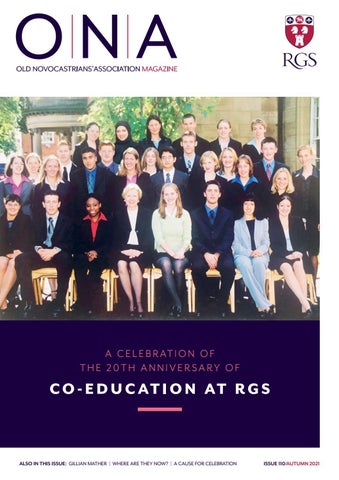
A C E L E B R AT I O N O F T H E 2 0 T H A N N I V E R S A RY O F
C O - E D U C AT I O N AT R G S
ALSO IN THIS ISSUE: GILLIAN MATHER | WHERE ARE THEY NOW? | A CAUSE FOR CELEBRATION
ISSUE 110/AUTUMN 2021
ONA MAGAZINE ISSUE 110 AUTUMN 2021
ONA is the magazine for the Old Novocastrians’ Association All correspondence should be addressed to: The Development Office Royal Grammar School Eskdale Terrace Newcastle upon Tyne NE2 4DX Telephone Development Office: 0191 212 8909 email: development@rgs.newcastle.sch.uk Guest Editor: Dr Hazel Jones-Lee The Editor reserves the right to edit, alter or omit all submissions to the magazine. Copy may be carried over to the next edition. The Editor’s decision is final. Contribute! We are always looking for articles and news from Old Novos to include in the magazine, so send your contributions, via email (if possible) to: development@rgs.newcastle.sch.uk or by posting to the Development Office at the school. Please include relevant pictures if possible. They will be returned as soon as the magazine has been printed. The deadline for acceptance of copy for the Spring 2022 Issue 111 is Friday 7 January 2022. Copy may be carried over to a future issue. The ONA Magazine is available online Please note that the magazine is circulated in hard copy and is available on the RGS website shortly after circulation. By submitting an article or news for inclusion, the contributor is accepting that it will be available through both formats and will also be accessible beyond the Association membership through internet search engines or any member of the public viewing the RGS website. www.rgs.newcastle.sch.uk/ rgs-family/ON Please note that the ONA Magazine content does not necessarily reflect the views of the school or the ONA and is based on personal experiences, recollections and memories of its contributors. www.infinitedesign.com
Above: Congratulations to current Y13 students, Elyse Feenan and Jake Bradbury, appointed as ONA Sixth Form Ambassadors for 2021/2022.
FROM THE GUEST EDITOR It has been a privilege to be invited to guest edit this edition of the ONA Magazine, focusing on RGS’s move to co-education which has been such an important part of my life. I could not have done it without the support of Simon Barker, who frequently challenged some of my ideas and did the nasty bits of editing as well as suggesting names of superb students to write some of the articles I wanted to include; of Susan Beck and her willing team, who between them organised the standing features; of David Goldwater with his matchless knowledge of ONs, and of course, the wonderful girls of the class of 2001, who were brave enough to take that leap of faith with us and make it possible. It has been a joy to hear from so many of them again.
IN THIS ISSUE 1 3 4 6 8 10 12 16 17 20 21 22 23 24 26 27 28 30 32 33
ONA PRESIDENT’S AND HEAD’S WELCOME PAUL HAGGIE & GEOFFREY STANFORD REFLECTIONS SIR NIGEL SHERLOCK 2001: PRINCIPLES & NEGOTIATIONS JFX MILLER FIRST THE SCHOOL SONG AND NOW THIS! 2001: THE IMPLEMENTATION HAZEL JONES-LEE A LOOK BACK AT 2001: HOPE OR ILLUSION? JOE WRIGHT SCHOOLS ARE FOR COLLECTIVE LEARNING WHAT THE BOYS THOUGHT WHERE ARE THEY NOW? RAISING MY VOICE AND CHALLENGING THE STATUS QUO ANNSLEY WARD IN THE PRESS MY BURSARY STORY CHLOE WARD A FANTASTIC JOURNEY OF LEARNING, PERSONAL DEVELOPMENT AND DISCOVERY SARAH BRUMBY INTERVIEW WITH GILLIAN MATHER HAZEL JONES-LEE WE PUNCHED ABOVE OUR WEIGHT SOPHIE DE LA HUNT A CAUSE FOR CELEBRATION HANNAH CHANDY A HISTORY OF THE RGS IN ITS PEOPLE DAVID GOLDWATER NEWS & CONGRATULATIONS OUR BURSARY STORY SARAH BANNISTER OBITUARIES
WELCOME BY PAUL HAGGIE (60-67) ONA PRESIDENT AND GEOFFREY STANFORD HEAD
t gives us great pleasure to welcome readers to this latest edition of the ONA Magazine, which celebrates the 20th anniversary of the first girls joining the RGS. Given that we jointly launched our recent ONA Survey, it felt fitting for the President of the ONA and Head to co-author this introduction. If you have not received the survey, it means that we do not hold a valid email address for you so please do visit www.rgs.newcastle.sch.uk/rgs-family/ON to register and receive the link.
I
The standout feedback of the survey was the immense satisfaction which the great majority of Old Novos feel about their time at school, and the transformational impact that RGS has played in their subsequent lives. There are stunning anecdotes about the knowledge, skills, confidence and opportunities RGS has afforded so many decades of ONs. It was especially heartening to read about the role that Direct Grants, Assisted Places and Bursaries have played in affecting the trajectory of Old Novos’ lives – and often those of their families.
Of the Old Novos we contacted, an impressive 480 (12%) responded. The oldest respondent joined the school in 1936, the youngest left in Summer 2021, with strong participation across all decades. We were overwhelmed by the amount of time Old Novos invested in completing the survey. Many included rich narrative about their experiences at school and what each has gone on to achieve in life. Every response has been read with care and will directly inform school and ONA activities in the future.
While the responses are as varied as the wonderfully diverse community of ONs, a common theme threaded through the narrative is the immense influence that teachers and contemporaries can have in a young person’s formative years. You told us in great detail about the incredible interactions with inspiring teachers or peers which made profound and indelible impressions. We read about the enlightenment, enrichment and passion which comes from being amongst the most talented teachers and brightest peers.
ONA | OLD NOVOCASTRIANS’ ASSOCIATION MAGAZINE | ISSUE 110 | AUTUMN 2021
1
Our current Upper Sixth Form is the first RGS year group to comprise marginally more girls than boys, and girls now make up 46% of the overall school.”
This interplay between the sharpest minds and most open of hearts so often created the foundation for rewarding careers, inspired enduring involvement in hobbies and crucially, sparked lifelong friendships. However, we also read with deep sorrow about times when our school community has not got things right. We specifically asked about ONs’ experiences of discrimination in all its forms; only by asking can we understand, confront and act upon uncomfortable truths. Although the challenging experiences that were shared in the survey came from a minority of respondents, your voices have our attention and we are committed to ensuring that the RGS family of current students, staff and Old Novos is fully inclusive, educated, tolerant and completely representative of the rich diversity of modern Britain. Back to the subject of this magazine. It is clear that the first girls to join RGS who are featured in this magazine were trailblazers. Joining what had been a boys’ school for almost five centuries could not have been an easy transition. Dr Hazel Jones-Lee, who has been a formidable Guest Editor of this magazine, has shared in these pages the many views of the RGS community at that time, from incredulity that Newcastle’s oldest learning institution should make such a profound change, through to those passionate that RGS and its highly academic education ought to be accessible to anyone. Looking back, we are grateful to the then Chairman of Governors John Fenwick, who had the original vision, and to his successor, Sir Nigel Sherlock
2
who implemented it. Under the leadership of Headmaster JFX Miller, aided by countless staff champions and student ‘buddies’ and not least, the families and first girls themselves, we embarked on the journey to co-education which today is so fundamental to the character and success of the school. Fast forward to 2021/2022. Our current Upper Sixth Form is the first RGS year group to comprise marginally more girls than boys, and girls now make up 46% of the overall school. We have no target; we simply admit the brightest applicants, regardless of their gender identity. Looking to the future we share a vision that those amongst the current student or ON community who have in the past been considered on the margins— whether due to gender, race, religion, social background or any other reason—are in fact considered mainstream at RGS. It is our determination that uniqueness, in all its glory, should not only be tolerated but embraced and celebrated; it is the diversity of our community, our variety of perspectives, ideas and backgrounds that is our strength. We appreciate every member of our community’s commitment to championing individuality. In the meantime, we hope that you enjoy this overview of the journey to co-education, the stories of just some of the first girls and those who shepherded their introduction. With best wishes.
REFLECTIONS BY NIGEL SHERLOCK CHAIRMAN OF GOVERNORS (00-05) Looking back I am immensely proud of the decision which we took to introduce girls into the school. It was a brave decision at the time, and came after much preparatory work.
O
explore the requirements in more detail with a view to possible implementation, and to consult the stakeholders, particularly our staff and parents, to ascertain their views. In the event it transpired that there was considerable support for such a development, with well argued, vociferous, but minority dissent. All this involved a huge amount of time, thought and effort.
ver its long history the school had developed a most enviable academic reputation, guided by talented and committed headmasters, appointed by successive governing bodies who wished to keep the school in the forefront of education. When I became a governor in 1998, a very low key discussion had already begun about the possible merits of coeducation, reflecting the ongoing changes in society. It was to become a challenging debate because of the school’s preeminence, and the wish not to jeopardise its reputation. My predecessor, John Fenwick, as a governor of a well-known girls’ day school in the south of England, was aware of developments in this area of education. His knowledge and experience was no doubt taken into account when he and the then Governing Body appointed as Headmaster James Miller, who had previously been headmaster of a co-educational school in East Anglia. The Governors’ continuing aim was to ensure that the school’s academic, cultural and sporting reputation was maintained, indeed enhanced, and also that the school kept abreast of developments in the wider educational world. Shortly after his appointment James Miller, on his own initiative, produced a paper for the Chairman giving the pros and cons of introducing girls into the school. Subsequently, informal discussions were begun amongst a small
When I became a governor in 1998, a very low key discussion had already begun about the possible merits of co-education, reflecting the ongoing changes in society.”
group at the highest level. Being such a sensitive issue, the work progressed slowly and with discretion, so as not to raise emotions before the basic facts could be ascertained on which a prima facie case might possibly be based. The findings in favour of co-education were then put before the full Governing Body which gave its unanimous approval, and work then began in earnest. The next step was to agree to the setting up of working groups from amongst the senior teaching and administrative staff to
ONA | OLD NOVOCASTRIANS’ ASSOCIATION MAGAZINE | ISSUE 110 | AUTUMN 2021
Together with the Headmaster, we consulted Old Novos and parents. The principal concern of some Old Novos was that the introduction of girls might adversely affect the school’s academic record and sporting achievements. This appears not to have been borne out. When talking to parents, the point was made that having selected the school particularly because of its single-sex status, they would feel betrayed. Indeed one father stated that he would withdraw his son from the school. However in the event, he changed his mind and indeed later as a result of his son’s favourable experience, he sent his daughter to the school! I consider that the introduction of girls into the school has been one of the most far-reaching decisions in the school’s history and has played a part in further enhancing the school’s all round reputation, as well as better preparing our young people for the wider world. I believe that the culture has changed in a positive way but the essential ethos remains.
3
I
2001: PRINCIPLES & N E G O T I AT I O N S BY JFX MILLER HEADMASTER (94-08) ‘I am therefore delighted to announce that the RGS has approached the relevant government authorities for permission to admit girls into the school. We are looking for a formal start date for the admission of girls into the Sixth Form of September 2002 but all the necessary arrangements and facilities should be in place for September 2001. We hope eventually to extend the co-educational principle to the whole school, though that would clearly need wide consultation, time and investment.’
4
t was thus that, at Prize Giving in November 2000, I announced one of the most significant and, I would argue, most beneficial changes in the RGS’ history. This was very far from a sudden decision. I had raised the possibility with John Fenwick (Chairman up to 2000) before I was even appointed; I drafted my first paper for Governors in 1996; the Governors decided in early 1999 that they favoured the principle. It had been a long time in the planning. So what were the reasons? I stand by those I presented in 2000. Part of our job is to prepare our pupils for university; all universities are coeducational; no Oxbridge colleges are male-only; a single-sex education is not a very good preparation. I would go further: for some boys and, yes, for some girls, a single-sex educational background can mean that they are at sea for some considerable time. Our single-sex environment here means that we are failing our pupils in a critical way. Part of our job is also to prepare our pupils for the world of employment, where RGS old boys increasingly find that they will be working with women and for women. A male only education may (and I do stress ‘may’) have been acceptable when professional and managerial jobs were largely the preserve of men; it now makes no sense. More generally, we need to counteract the sexism that tends to emanate from male-only environments, where the opposite sex is frequently seen as sex objects and where boys (and girls in girls only schools) can find it difficult to relate to the opposite sex purely as friends. A boys only environment can produce a laddish element. The experience of other schools, which have admitted girls, is that the move immediately counteracts that and leads to a significant improvement in behaviour and general sensitivity. There are good straightforwardly educational reasons too. Some subjects, for example, clearly benefit from a wider range of perspectives than is possible in a male only environment. A male-only set studying Sylvia Plath is surely missing something; the same is true of a girls-only set studying Ted Hughes, and indeed of much advanced level study in the arts.. Co-education, certainly in the Sixth Form, tends to produce a much better working environment, with a much better work ethic for some and less of a pressure cooker atmosphere for others.
BREAKDOWN OF CORRESPONDENCE PARENTS
ONs
EX-PARENT/ EX-STAFF
TOTAL
PRO
56
45
7
101
ANTI
23
19
-
37
1
3
-
4
DON’T KNOW/ NOT KNOWN
Totals do not add up because some respondents were in more than one category. Extra-curricular drama and music also benefit greatly from a mixed environment. We do, of course, already benefit from girls joining us for such activities; we could benefit much more. More generally, the RGS benefits from the fresh impetus of bright entrants into the Sixth Form. A significantly larger number would be of major benefit. Furthermore, a larger Sixth Form would make it easier for us to increase the already wide range of options on offer. Why should half the population be automatically deprived of the best Sixth Form education in the North East? As I also stressed from the outset, we wanted the outcome to be at least as good for the girls as for the boys. (In fact, experience suggests that the girls benefited even more than the boys.) Secondly, the decision was based wholly on the educational and social benefits of going co-ed; it was not driven by economic factors. That said, the financial gains from a very significant increase in the size of the Sixth Form (where the economies of scale are large) were considerable and enabled the school to invest in vastly improved facilities. Indeed, the school’s finances were transformed. The reaction to the announcement was not as vociferous as I had expected, and the biggest clamour was not about the principle but about the lack of consultation. We had deliberately kept our lengthy discussions and investigations under wraps to avoid destabilising the whole independent sector in Newcastle, though some broad hints had been dropped in the
latter stages. We did, however, arrange a special meeting for parents and the minutes of that meeting and all correspondence from parents went to a special meeting of governors held on 19 December. I had expected that those opposed to the change would be more vocal than those in favour and so was very happy that the meeting was much more evenly split, while the breakdown of correspondence is shown in the table above. When the Governors came to their special meeting, they noted that the decision to admit girls into the Sixth Form had the unanimous support of the school’s senior management team and of the Governors at their last meeting; the support of the ONA Committee and the vast majority of the senior school teaching staff and the school doctor, and the majority support among parents and old boys who had explicitly made their views known. They confirmed the decision to go ahead. We still did not have the final legal authority from government to go ahead and frustratingly it bounced between the Charity Commissioners and the DfEE. That authority came through in March. You will have noticed that my announcement said: ‘We are looking for a formal start date for the admission of girls into the sixth form of September 2002 but all the necessary arrangements and facilities should be in place for September 2001’. As I had hoped and expected, girls started approaching us about the possibility of joining in 2001 and by the start of February
ONA | OLD NOVOCASTRIANS’ ASSOCIATION MAGAZINE | ISSUE 110 | AUTUMN 2021
25 had applied. The final outcome was that 22 girls joined the Sixth Form in September. Sixth Form numbers were 45 the following year and 62 the year after. The whole process went far more smoothly than I had a right to expect. This was largely down to Hazel Jones-Lee and some other members of staff who ensured that all the procedures and human relations were well sorted, and to the Bursar, Richard Metcalfe, who made sure that the relevant facilities were in place. Far more development followed, of course, a few years later. The strong lead of John Armstrong and the Senior Management Team and the very positive response of the staff were critical. The Governors were tremendous, asking very searching questions and keeping all discussion ad rem rather than ad hominem in debates of a very high level. The two Chairmen, John Fenwick and then Nigel Sherlock (who took over on the day of the famous Prize Giving – what an introduction!), were strongly supportive while ensuring open and calm debate. They were both outstanding Chairmen, as was my third, Louis Taylor. I was very lucky and remain eternally grateful; much more important, the whole RGS community was very lucky. There must be some people who think that we did the wrong thing but I did not come across any in my last few years as HM. For my part, I am convinced that both the initial move and the later move to extend co-ed throughout the school were transformationally beneficial. My only regret was that we were unable to do it earlier.
5
FIRST THE SCHOOL SONG AND NOW THIS! ON AND PARENTAL RESPONSES TO THE ANNOUNCEMENT OF 14 NOVEMBER 2000
‘I am very glad that the courage and conviction have been found to take this bold step into a new era … arguments from opponents seem to suggest a blind fear of what is in store, and a stubborn refusal to face up to reality: instead, there is a desire to believe that we can serve pupils best by maintaining a “traditional” boys own school while still playing a part in the life of a city which currently prides itself on looking forward to a new era. Such a belief is not only fantasy, it is also harmful’ ON
‘The only reservation I have ever had about the RGS was its single sex status’ Parent
‘My husband, our sons and I are all delighted’ Parent
‘I look forward to the day when RGS is fully co-educational’
‘I fully endorse the arguments in favour of mixed education, the benefits of which are, in my experience, clearly evident at university and afterwards’ ON and former Oxford Admissions Tutor
Parent
‘First the school song and now this! I can no longer identify with the school at which I was educated’ ON
6
‘You are, at a stroke, removing the only choice available to parents in the north who wish to select a single-sex environment for their sons to study in. This is particularly annoying to parents who took time to make this choice and now find their decision has been disregarded by the RGS governors’ Parent
‘But they [parents] are consumers, just as we are of a shop like Fenwick’s. Just because we shop there, we do not expect to tell them how to run their business … in the same way, it is the job of you and the Governors to run the RGS’ Parent
‘…so pleased you want to progress into the 21st century rather than lie down and let it happen’
‘I owe a great debt of loyalty to the RGS, but, if the North East’s brightest girls schools choose eventually to remain on the other side of Eskdale Terrace, not only will I not blame them: I will cheer’ ON
Parent
‘There is no evidence to show that RGS boys experience any problems at university or within the workplace’ Parent
‘I am appalled at the way the whole situation has been handled’ Parent
‘I sent my son to the RGS because it is a single sex school’ Parent
‘…we are extremely disappointed and concerned by the lack of parental consultation’ Parent
In the event, the overall response was significantly supportive of co-education.
ONA | OLD NOVOCASTRIANS’ ASSOCIATION MAGAZINE | ISSUE 110 | AUTUMN 2021
7
2001: T H E I M P L E M E N TAT I O N BY HAZEL JONES-LEE (84-09)
E
ducated happily and variously at a large state primary school, a co-ed direct grammar school and then university, I had never been into a single-sex school until my first school teaching job at a quite famous girls’ boarding school. Its pedagogy, its support for staff and dedication to nurturing whatever were the real strengths of its pupils were magnificent, but there was a tension amongst the staff and pupils, both there and at my subsequent girls’ school, which I had never encountered before and which I can only attribute to its single-sex constitution. For several years during the later 1990s, there was co-ed discussion amongst the Governors at RGS, but gradually, some staff were drawn into what were still very tentative and confidential soundings. Some time during 1998, Liz Radice, then Director of Studies, organised a small group of staff to explore ‘the feasibility of introducing girls into the Sixth Form at RGS’. Its recommendations ranged widely and became the basis for future discussions. In March 1999, after Liz Radice left to become Headmistress of Channing School, I was invited to join a working party of three governors, James Miller and John Armstrong to explore the pros and cons of the status quo, a co-ed Sixth Form and a co-ed school and soon after, to present my paper supporting the introduction of coeducation to RGS, beginning with the Sixth Form.
8
Some time between then and November 2000, James Miller asked me to take on what became the role of Senior Mistress, initially to organise the internal process of entry and thereafter to be responsible for new Sixth Form entrants. It was my dream job. However, the appointment was not announced until some time later when James called a meeting to prepare staff for the press announcement on 14 November that RGS was due to welcome girls, in September 2002. I was aware of staff hurt at what had been considered their necessary exclusion from the process up to that point and felt strongly that from this point on, there must be as much staff involvement in decisions for its roll-out as possible. In addition, I was not persuaded by the arguments of many similar schools which had gone co-ed before us that the process was easy. I do not believe that anything is easy by chance. Consequently at the usual start of term staff meeting I invited any colleague who wished, to become involved in a series of small staff committees to discuss and suggest solutions to the many practical considerations: any impact on the syllabus, pastoral support, games, a code of conduct, extra-curricular, dress code, Sixth Form Supervision and preparation of both new girls and current boys. In the event, some 30 colleagues were involved and their recommendations contributed considerably to the success of what was to follow. The Open Day in November revealed significant interest and at this stage, events overtook us with the immediate request by some girls for admission in September 2001, a year earlier than planned. Whilst we welcomed this response and began interviewing candidates, any offers of places could only be conditional until Governors received the final stage of approval from the Department for Education and Employment. We felt that any boy or girl coming into the Sixth Form from outside should have as much familiarity as possible with the school before we and they made the decision that they should join us, so the Open Day was followed by individual tours of the school with or without parents, by interviews, to which parents were welcomed for an initial few minutes to ask questions, by a later Open Day with Heads of Department to discuss subject options and finally by an invitation to come into school after exams to have lunch and the
opportunity to meet each other before the summer holidays. We also appointed a boy buddy to each girl, although, in practice, their success was varied. I have vivid memories of some of those interviews, at which we were always more concerned to discern potential and inquisitive minds, than achievement to date, although that of course was important: they had to meet the same requirements as our own boys for entry. I remember well one girl’s being so overcome by nerves that we told her to forget the interview altogether and we talked about her day so far, starting with the trivia of the breakfast until we could
We had expected interest from girls at the nearby independent schools, but were delighted to see an increase in applications from state schools, not only from girls, but from boys who would not have countenanced applying to a single-sex school.” work our way into what we really wanted to ask. There were incidental benefits: one girl asked whether we did LAMDA. Puzzled, we asked for clarification and the name of her teacher, as a result of which the wonderful Jo Quilliam joined us, first as an occasional and then more or less permanent peripatetic teacher of Speech and Drama. We had expected interest from girls at the nearby independent schools, but were delighted to see an increase in applications from state schools, not only from girls, but from boys who would not have countenanced applying to a single-sex school. We had thought originally that co-ed was just about possible with 12 girls, though better with more, and were delighted when we started the September term with 22 girls. In the interim, there were changes planned to the fabric, in the conversion of a cloakroom for girls, with its small seating area, which probably caused more reaction from the boys than anything else: a small, padded bench was elevated in folk-myth to a jealously regarded ‘sofa’.
ONA | OLD NOVOCASTRIANS’ ASSOCIATION MAGAZINE | ISSUE 110 | AUTUMN 2021
There was a make-over of the Sixth Form Common Room with the inclusion of a coffee bar, and also an extension to the medical facilities, so that Gillian Mather, the school nurse, could have her own room in which to see the both boys and girls who often came to her with as many personal as physical problems. After the final approval came from the DfEE in March-April 2001, I visited Bradford Grammar School, which had gone co-ed several years earlier and was, and am, most grateful to the generosity of their welcome and advice, although more than a little alarmed when their formidable school nurse told me of the range of challenging pastoral situations we were likely to encounter. When we opened on 6 September for Lower Sixth Induction Day, there was huge press interest, with representatives from The Journal, BBC and Tyne Tees as well as a few free distribution newspapers and a demand to see ‘a lesson’. Scooping up copies of Othello, which I was to teach that term, a small group of former Year 11 boys and new girls known to be doing English, we went to an upstairs classroom where I delivered an impromptu introductory lesson on Shakespearean Tragedy, which appeared on Tyne Tees News that night as a brief clip. We were in business. Did I ever have second thoughts? No. Rather, there were lots of individual small moments of real pleasure such as the very hard-working girl who learned to apply strategy, rather than excessive hours, to her work preparation; of the mother who told me of her daughter’s delight in being able to play in a school team, having been rejected in her previous single-sex school; of a shy, but quick-tempered male tutee who had told me during the second year that he had dreaded co-ed, but that one of the girls had become his best friend. There were also the times of mutual support when I saw how boys and girls came together to comfort each other in times of distress. When invited to a debate on local radio with the Head of one of the nearby schools, in which she was unable to participate at the last moment, the show’s host asked me whether I thought there was any case for single-sex education. My answer then was that there may be some few instances when parents might want single-sex education on religious or other grounds, but that for the vast majority of students, co-education was the most beneficial. I have not changed my mind.
9
A L O O K B A C K AT 2 0 0 1
HOPE OR ILLUSION? BY JOE WRIGHT (18–)
When I asked my Mum what she remembers about 2001, she said ‘Optimism’. So I shall start there.
A
t the start of 2001, there were several good reasons to be hopeful. The news at the beginning of the year told us that scientific innovations showed we were learning more about ourselves than ever before. In February of 2001 the first draft of the complete human genome was published, and in July the first AbioCor self-contained artificial heart was implanted. These two landmarks are often overlooked but they signify a huge leap in how science could be used to affect people’s lives: we now had the tools to create the organ of life itself, shattering the age-old assumption that death was unbeatable.
10
Anyone you ask will tell you that they know exactly where they were, and what they were doing, on the 11th of September 2001. One year and nine months after the turn of the millennium filled the world with hope, Mum was teaching in school all day, isolated from the news. However she knew from hushed whispers of colleagues that something terrible had happened. That evening she drove up to London where she met my father and grandfather for dinner, and my parents announced their engagement. She remembers that journey as the radio drilled out the incomprehensible story, and sobbing all the way to the restaurant, where the happy news of a new life beginning was drowned by the hundreds who had had theirs cut short. After 11 September 2001, there were another four major disasters involving planes in the subsequent months of that year. Is there any explanation for how, in just a few months, disasters on airplanes
(accidental or engineered) could snatch so many lives from the world? Sometimes the human mind has to find a reason for things that seem too terrible to explain, and so, for want of a better cliché, maybe the year 2001 was when the soaring hopes of the new millennium plummeted tragically back to earth. Aside from the tragedies that shattered the general feeling at the latter end of the year, 2001 was littered with smaller incidences that seemed to feed the growing sense that post-millennium optimism was a sham. The Millennium Dome was the perfect focal point for such sentiment. Although Tony Blair’s New Labour comfortably won the 2001 general election, the sunny optimism which powered them to the 1997 landslide was starting to wane, and the public saw the Dome as an embodiment of how empty such wild hopes were. By 2001, Blair’s great monument appeared a purposeless homage to the age of ‘Cool Britannia’ which was already showing cracks.
New York, 9/11: the attacks on the World Trade Center
The New Labour government was brilliantly satirised by Armando Iannucci’s TV series The Thick Of It, the nineties’ and noughties’ answer to how Yes Minister ridiculed the governments of the 80s. Peter Capaldi’s swearing Scotsman was the centre of the show, a lampoon of the infamous ‘master of spin’ Alastair Campbell, who was, in the public imagination, the shadowy puppet-master at the centre of Downing Street, a perfect bogeyman for fears that Blair’s bright blue eyes and perpetual smile masked something darker. 2001 also saw the release of the film adaptation Bridget Jones’ Diary. Some people (often men) dismiss the book’s importance outright, but although the books were a playful satire at face value, Bridget Jones’ character became an important cultural icon, as her books reflected with perfect relatability the experience of being a working woman in the 90s and early 2000s.
If many people who were hooked on those books came back to them now, they would be shocked to see some of the accepted, everyday norms in Bridget’s life. The author, Helen Fielding, felt much the same way when revisiting her work in the age of #MeToo. The casual sexism, aggressive flirtation and discrimination depicted in the books, which feels deeply uncomfortable in this day and age, was deemed normal ‘office banter’ for the time. Furthering the cause of feminism in 2001 had even less coverage than it has today. In politics, New Labour had committed to positive action policies but progress seemed to fizzle out. There were no really major laws as a consequence, or serious policy shift. It seemed that politicians and the media simply weren’t committed enough. In the arts there was a similar story. The Hollywood titans were fixated on their blockbuster franchises such as Harry Potter and Lord Of The Rings, and very little media with women in the leading roles, on and off camera, were given exposure and recognition by industry juggernauts who didn’t think a ‘women’s film’ could rake in the viewers.
One year before 9/11, a financial crash burst the silicon valley tech bubble. One company that survived was forced by wealthy shareholders to mould their early idealistic vision of digital capitalism into a profit-making machine. That small company was called Google, and they soon came up with a new way of using their revolutionary search engine. Google began collecting data on what users where searching, giving a complete and accurate picture of any person’s behavioural patterns. This information could be sold for vast amounts of money. Suddenly companies could see inside their customers’ heads. Richer entities could outbuy all their competitors for space online. But in early 2001, lawmakers realised that Google’s system was an infringement of individual rights, and so laws were prepared which would stop search engines harvesting data. But then 9/11 happened. Afterwards, the Bush administration passed the Patriot Act, which allowed the data of every individual to be scrutinised on security grounds. The phrase ‘we couldn’t join the dots’ was on the lips of every government official, and Google had the green light. It was only a matter of time before data harvesting started to enter politics. Politicians could now control the information received by their voters, and mould their pithy messages to whatever the public wants to hear. Fifteen years on, and Google’s data revolution had propelled Trump to the Presidency. In 2001, those in power used manufactured optimism to cover their faults, but tragedy showed that the passage of time cannot fix the world alone. The struggle for peace and equality is long, and does not obey the ticking of a clock. For a fuller article from Joe Wright, please visit www.rgs.newcastle.sch.uk/rgsfamily/ona-magazine.
Left: Conservative party Campaign poster for the 1997 General Election Below: The Millennium Dome, 2001
ONA | OLD NOVOCASTRIANS’ ASSOCIATION MAGAZINE | ISSUE 110 | AUTUMN 2021
11
SCHOOLS ARE FOR COLLECTIVE LEARNING SOME REFLECTIONS FROM 2001 STAFF
12
DAVE MERRITT (63-74; STAFF: 78-20)
A
year before girls entered the RGS, a new social sciences department was born at the request of James Miller. One novice Psychology teacher and 13 students set out on a pioneering journey towards the new AS Levels. New century, new department, new exam style and new horizons. It sounds exciting, exhilarating, fresh, fun and challenging and so it was. Eight of the first Sixth Form girls chose to study Psychology and their input to such a person-centred subject proved most valuable. By 2004 over 40 were studying Psychology in the Lower Sixth, a base was established in a classroom at the far end of the balcony and Catherine Stewart (04-09) joined the teaching team.
Two of our early Psychologists capture the spirit of the subject and those early days in ways which will be recognisable to the pioneers. Sandy Radford (99-04): ‘My strongest memories are of the lessscripted lessons, where we’d have a discussion on the psychological issues of the day, whether that be the conformity of politicians voting for the Iraq War, or a Freudian analysis of Madonna’s Die Another Day. My overwhelming memories are of laughing and learning, often at the same time’. And Fran Wilkins (née Proudfoot, 04-06): ‘I remember finding Psychology seemed to attract a great mix of students, which made for some really diverse and interesting discussions and dynamics in the lessons. For me, it was something that
just really ‘clicked’. I enjoyed learning and understanding more about the human mind and behaviour, and seeing the theories play out in front of me everywhere I turned’. Interestingly, neither Sandy nor Fran picked Psychology as their first subject choice let alone intended it to become a career. But having become passionate for it at RGS, Sandy is now teaching Modern Studies and Psychology at Holy Rood High School in Edinburgh and Fran is a Clinical Psychologist at the RVI! More than a few students over the last two decades have, like them, been grateful for two of JFXM’s many innovations, Psychology and co-education.
CHRISTINE EGAN-FOWLER with KEVIN EGAN-FOWLER (76-13) the new dynamics. Diversity always brings with it a sense of a prevailing spirit of the here and the now, it felt momentous, a cherishing of history.
M
y memories of the girls coming to RGS are from two perspectives: I resolved never to teach in a single-sex school, after attending one myself; and I also resolved never to send my child to a single-sex school either! I know that RGS changed for the better when the girls came in. Co-ed signals that schools are for collective learning; about ourselves and how we as people can function in an equal society. In Art lessons, and indeed throughout the school, there were new perspectives and opinions to be shared, new ways of thinking, socialising and learning that had to be thought about to make classrooms and studios embrace
It took the brave genius of the first James Miller to make the change work; a determination carried ably by Hazel Jones-Lee and the staff collective. It was a visionary change. The pace of being in this collective genius was thrilling for me as a teacher and it felt then, as it does now, like teaching in a university Art School. The first cohort of girls were just amazing, so ambitious, courageous and open to learning but not open to being categorised; the boys certainly had their stereotypes challenged! Their work was intuitive, intelligent and ambitious, they knew the value of everything and made the boys realise the specialness of our Art studios and the specialist teaching we offered; from spectacular five- hour Saturday life class sessions and collaborative workshops in different media; from plaster, printmaking to painting fish from life—paintings that were the size of a real tuna! Looking at the
ONA | OLD NOVOCASTRIANS’ ASSOCIATION MAGAZINE | ISSUE 110 | AUTUMN 2021
photos from that time has made me smile and I can assure the girls who read this that RGS is still that community, that ‘collective’ that they were such an ‘asset’ to!
13
WENDY COLLINS (89-07)
It took a little time but I felt the addition of girls to the school affected the culture in the school with a softening of the atmosphere creating a more considerate and less macho environment.”
F
rom memory, quite distant now after nearly 20 years, co-education at RGS appeared to be relatively easy, as significant thought had been given by our senior management and staff to the process needed to introduce girls into a basically male environment. The first cohort of girls, a small, select group who entered the Sixth Form, made the transition relatively easily as they were an exceptional group of bright, wellmotivated strong-willed girls that really paved the way for other girls entering the school. I hope they know what an important role they had in making co-ed at RGS a success – it was a real privilege to watch these intelligent girls integrate so well (despite being so outnumbered) with our equally talented boys. It took a little time for some of them to adapt to the school and for some of the boys to get used to them, but overall, it went very smoothly. As a science department I feel the only issues relating to co-ed were administrative rather than educational; like ensuring separate toilets for the girls in the STC, checking that worksheets, notices etc. were not male orientated – easily overcome by using generic words. Teaching a mixed class made no difference in terms of content or delivery but initially some of the girls were reluctant to ask or answer questions in class or sit and mix with the boys (and vice versa) but that soon changed as they got used to their classmates, school and staff. I noticed little difference in the standard of work in class apart from the fact the girls tended to be neater, use many different coloured highlighters and sticky labels on notes and generally have really tidy files (the fact that this wasn’t true in general of the boys never seemed to cause any problems for them
14
Students in the Science and Technology Centre (STC)
academically as they were well focused themselves and were just as good at handing homework in)! After the first few weeks there was no difference in class between the boys and girls apart from the girls asking more questions on difficult topics during, or after, lessons. It took a little time but I felt the addition of girls to the school affected the culture in the school with a softening of the atmosphere creating a more considerate and less macho environment. As a Sixth Form Tutor having girls in the group was a real bonus and apart from having the regular ‘is this the correct uniform?’ chats with some of them there was a more friendly and chatty environment and different opinions and perspective on topics.
As to any negatives in the initial co-ed period, I don’t really have any – I know there were worries that the rugby would suffer and there would possibly be fewer places for boys at the school, but even before the girls entered the school there were many things that involved a mixed group – ski trips, school plays and CCF being a few examples. If I had to recall just one significant but trivial memory of co-ed at RGS it would have to be my typically sporty Year 11 class of boys smelling so much more pleasant as they tried to impress the Sixth Form girls who were waiting to go for a lesson in another lab – a real bonus of having girls in the school!
SIMON BARKER alienation of parents and staff who were wholly disposed to the move but were made to feel as if their opinion counted for nothing.
C
o-education was not an imposition but an historical necessity. The poet RS Thomas (he was also talking about evolution) wrote: ‘I am like a tree,/From my top boughs I can see/The footprints that led up to me’. From the moment I arrived at the school in 1985 I was constantly aware of the presence of girls in it—most of all in drama, directed primarily by my two predecessors as Head of English; in debating societies; in Art. The first thing I did when I became Head of English in January 1996 was to start a Sixth Form Reading Group, meeting weekly for 90 minutes after school for a year to read above the A Level syllabus (the first regular, sustained high-level academic mixing of the two genders?). From the first year, girls from Church and/or Central joined us each week. From 2000, a reading weekend on Holy Island was added as the climax of the year. The three photographs here of the first mixed RGS Holy Island weekend have acquired something of a symbolic significance too: that was the best ever GCSE year group; there is an easy integration visible in it; it communicates resilience and support. Most of all the students exude a sense of happiness.
There was some consternation at the time that girls would be given special treatment and get-in through the back door. Not a bit of it: both academically and personally, the new entrants were of the highest calibre. As an English teacher I had always believed it would great to have a distinctively male and a distinctively female perspective in the classroom. No such thing happened because it doesn’t exist. It didn’t take long for the frisson within the school to subside into a norm.
There was some consternation at the time that girls would be given special treatment and get-in through the back door.”
‘All this pitting of sex against sex,’ wrote Virginia Woolf in A Room of One’s Own (1929): ‘The normal and comfortable state of being is that when [male and female parts of the brain] live in harmony together, spiritually cooperating. Coleridge perhaps meant this when he said that a great mind is androgynous. Perhaps a mind that is purely masculine cannot create, any more than a mind that is purely feminine’. Telescoping down the years into my own Year 7 class (the best I have ever had): there is a 50/50 gender split but we are a school whose consciousness is gender-free. Virginia Woolf would be proud of that!
Right and below: First co-ed reading weekend on Holy Island.
There was of course a frisson when ‘our’ first girls arrived in 2001. There were two things I found especially insulting, to both genders: that girls would be a ‘distraction’; and that we needed girls ‘to make the place more sensitive’. (One of my happiest experiences of teaching at the RGS has been teaching Jane Austen’s Pride and Prejudice to an all-male group of Year 11 rugby players, all of whom began by thinking it was ‘a girl’s book’ but ended up convinced that there is no such thing, this one being a piece of biting social satire.) Secondly, there was the unfortunate
ONA | OLD NOVOCASTRIANS’ ASSOCIATION MAGAZINE | ISSUE 110 | AUTUMN 2021
15
W H AT T H E B OY S T H O U G H T REACTIONS OF SOME CONTEMPORARIES IN 2001
JONNY CATTO (96-03) When word broke that girls would be joining our Lower Sixth year group it quickly became talk of the playground. Aside from the laddish bravado one would expect of 15-year-old boys, conversation usually included an element of debate: ‘for’: existing female friends joining; new friendships; and a positive influence in the classroom. ‘against’: talks of tradition and worries about longer-term impacts on boys’ sports teams. Within my immediate circle opinions tended towards the latter, although this quickly changed as the reality brought all of the positives, few negatives and the realisation that a change in future direction need not detract from the past.
LIAM BEADLE (95-02) A phrase the Headmaster used before a mixed group of parents and other interested parties remains with me to this day: ‘We all want what is best for the RGS’. I wasn’t so sure. Partly because of my formation at the school, I believed then as I believe now that institutions exist for the benefit of people, not vice versa. The arrival of girls to the school was a boon in so many ways, as the school’s life was enhanced. But at what cost to the boys of the city of Newcastle, for whom the number of places at the RGS inevitably fell? Pragmatism triumphed over principle, perhaps rightly, and I am sure we boys benefited as much as the girls; and even perhaps as much as the school.
MAX KRAMER (96-03) I suppose 20 years ago my main feeling was nervousness. I’d found RGS a place where I was comfortable just being me, and I was worried this would change things and make us all terribly selfconscious and conformist. In retrospect I think I was half right. It did change things, but by making us more humane—a wonderful development! 16
LUKE ROBERTS (96-03) My memory is of the RGS being quite a macho and competitive environment, of not really liking it, and of hoping going co-ed would change it. That was probably too much expectation to lay on the shoulders of the 20 or so young women who joined in my year, but I can only assume that by now it is an egalitarian utopia.
MATTHEW LLOYD (96-03) I could not quite believe it when we were told that a group of girls would be joining us in Sixth Form. Already the ascent to Lower Sixth symbolised the arrival of previously unknown freedoms. Now girls were coming to enjoy those freedoms with us. I remember quite a lot of hoo-ha about it: would they distract us, would we distract them, would anyone get any work done? In the end, 22 individuals, with great poise and inner strength, joined our community and brought with them fresh voices, energy and ideas. It was a remarkable breath of fresh air.
WHERE ARE THEY NOW? SOME OF THE 31 WONDERFUL NEW ENTRANTS FROM 2001
HELENA AHMED After RGS, I completed my BSc. Neuroscience and worked in Biotech for several years, before changing course into early years education. Currently residing in Cambridgeshire with my husband, and focusing on home educating my three children.
HARRIET BAKER Since graduating from the University of Edinburgh, my career has been in arts marketing: at Bonhams Auctioneers, National Galleries of Scotland and now at Creative Scotland, the national funding body for arts, screen and creative industries. I also volunteer for Comann nam Pàrant (the national advocacy group for Gaelic Medium Education), enjoy drawing and painting, and spend a lot of time playing football with my son Hamish.
SARAH (BRUMBY) VARGERSON After studying Fashion and Design and Technology, I worked as a clothes designer for 15 years and am now setting up my own retail business supplying sustainably packaged groceries, whilst living in London with my husband and two children.
BETHAN (GHOLKAR) HARRISON I studied Medicine at Bristol University and qualified as a doctor in 2009. I am now working as a GP and Occupational Physician in the South West. I enjoy the variety of my work and in particular my work in supporting employees with their health and wellbeing in the workplace. I married my husband, John, in 2014 and we have two children called Isabella (five years) and Hugo (three years). We have recently moved rurally and are enjoying living on a smallholding. I usually visit the North East regularly (when we are not in a pandemic) and I have made firm friends as a result of my time at RGS. I have fond memories of my time at the school.
ONA | OLD NOVOCASTRIANS’ ASSOCIATION MAGAZINE | ISSUE 110 | AUTUMN 2021
CHARLOTTE (GIBBS) KIDD A lot has passed since I left school! I studied English Literature MA at Edinburgh, then completed a PGCE at Durham and started teaching straight after that. I’m currently Deputy Head of English at St. Mary’s Catholic High School in Benton, although I also have pastoral experience as a Head of Year. I absolutely love my job and there’s no doubt that my experience at RGS has helped me to become the teacher that I am today. I hope to climb the career ladder further once my children are a little more self-sufficient. I live in Holystone with my partner, Chris and I am currently on maternity leave. I have a son and daughter; Arlo who is four, and Annie who is five months. They keep me very busy but they really are my world. We have a really happy household and I am very lucky indeed. I can’t help thinking that I dodged a bullet by not teaching in school this year, but having a baby in a pandemic has not exactly been easy, either! It’s been really lovely to get out and about with Annie over the last few weeks and to meet with other mums.
17
JONATHAN LIND After leaving RGS, I went on to read Genetics at Leeds University, then Law at Newcastle University, followed by a Master’s in Medical Ethics and Law at King’s College London. I am currently living in Islington, London, and working at the Medicines and Healthcare products Regulatory Agency.
CATHERINE McKIE I enjoyed completing my A Levels at RGS Sixth Form, alongside my twin brother Christopher. I went on to study Dentistry at Newcastle Dental School and qualified in 2008. I now work as a dentist in the North East. My partner and I have a beautiful three year old daughter Holly, whom we enjoy spending our spare time with.
CLARE (PEARSON) BERGERSON I studied Law at Leeds University and am now a solicitor specialising in commercial litigation, living and working in Leeds. I am married to Simon, and we have a little boy, Theo.
SAM LOWERSON Following my undergraduate degree I completed the GDL and LPC and worked as a solicitor in private practice before taking a break from the Law. During this period I worked in the charity sector, primarily for a charity which aims to advance social mobility in the UK by supporting young people from lowincome backgrounds into universities and a range of professions.
LUCY MILNER I studied Medicine at Newcastle University and stayed in the region for junior doctor training, before working in Australia for two years in Emergency Medicine, which is where I met my husband.
HARRIET PEARSON My undergraduate degree was in the History of Art at Leeds University, and my postgrad was in the Conservation of Easel Paintings at The Courtauld Institute of Art. I now work as a Paintings Conservator at Tate where I focus on the examination and treatment of paintings being acquired into the collection. I also work as an independent conservator for commercial galleries and private clients.
18
After some debate with my Australian husband we moved back to the UK and I completed GP training and now work as a GP in Edinburgh. There are definitely some advantages in being so far from the in-laws! We live in East Lothian with our 3 children, Toby 4, Archie 3 and Poppy 10 months, and love having the country and beach lifestyle while being so close to the city of Edinburgh.
TARA (PITMAN) PENFOLD Following RGS I studied Medicine at the University of Glasgow. After qualifying I moved back to the North East to complete my junior doctor training and am now working as a General Practitioner at a busy practice in Newcastle. I am very happily married and live with my husband and our two sons (age 1 and 3) in the Tyne Valley. I look back on my time at RGS fondly and hope to send my boys there when the time comes!
NICOLA ROBINSON I studied Medicine at Edinburgh University and then returned to the region for my postgraduate training, including a year working in New Zealand. James (93-03) and I married after a long friendship; you can’t predict at 18 who you will marry! We recently moved to Cullercoats with our two sons, Joshua 3 and Matthew 1 and are loving costal living, especially paddleboarding in the bay! I have been appointed as a Consultant Obstetrician and Gynaecologist specialising in laparoscopic surgery at South Tyneside and Sunderland Foundation Trust. It’s amazing how much of the local NHS is staffed by old-Novos!
HELENA STRETTLE-DAVIES Having been at CNHS in an all-girl environment from the age of four, moving to RGS was a daunting but exciting prospect. I knew in myself I needed a change and a challenge to get me through A Levels and I certainly found that at RGS. The natural competition with the boys coupled with the strong encouragement and opportunity at RGS meant that I was able to get the best out of myself and I thoroughly enjoyed my time there. After finishing my A Levels, I went on to study Economics at Homerton College, Cambridge. After three fantastic years there, I moved to London and gained my Chartered Accountancy qualification (ACA) in Audit with KPMG. After the best part of ten years at KPMG and a brief Management Accountant role at De Beers Diamonds, I moved to AB Bernstein in Mayfair to work in Equity Research, covering the European Food & HPC stocks and still work for them now, on a parttime/Consultancy basis. In the meantime, after a number of years of friendship stemming from our time together at RGS, I married Jeff Davis (9703) in Spain in 2012. We now live together in Islington with two sons, Charlie (4) and Alfred (2). Jeff’s work (Partner at a Hedge Fund) keeps us in London for the time being, but we look forward to relocating back to Newcastle one day! I have very fond memories of my time at RGS and made friends (and met a husband!) for life.
ONA | OLD NOVOCASTRIANS’ ASSOCIATION MAGAZINE | ISSUE 110 | AUTUMN 2021
ANNSLEY WARD I am now an intellectual property litigator, specialising in patent and trade secret litigation, living in London, but working across Europe, the United States and Asia.
Sadly, we have not been able to contact all 22 girls and 9 boys from 2001, whilst some of them wish to remain private. However, one of them has allowed us to print this comment:
I want to take the time to thank all the teachers at RGS for making those two years some of the best education I ever had. At RGS I was taught to think critically and learn for the pleasure of learning and debate. It was scary at first, but I’m so glad that I had that experience as I’ve carried it with me all through my adult life’.
19
RA I S I N G M Y VO I C E AND CHALLENGING T H E S TAT U S Q U O BY ANNSLEY WARD (01-02) I did not want to be a lawyer. Returning to the US after my time at RGS in 2002 at the age of 16, I started studying chemical engineering at the University of New Mexico with the aim of then going to med school in New York to become a surgeon.
B
ut at that time in the early noughties, something else was going on that diverted my intended path. When we were children, my parents indoctrinated my sister and me into the music of their Northern California youth – Janis Joplin, Jimi Hendrix, Jefferson Airplane, the Stones. Music was an essential part of our family life, with our subscription to Rolling Stone’s being pawed over every month. In the early-2000s, with rise of the internet, file-sharing services like Napster and LimeWire were increasingly popular and in demand as consumers wanted immediate access to digital music (yes, there was a time before iTunes and Spotify). These services, however, infringed copyright. The music industry’s response was to sue those who were providing and using such services; not to create a business supply to the demand from which they could profit. Rolling Stone’s reports of the pending litigation fascinated me. With that spark and the growing realization that I didn’t want to learn, study or be just one thing for the rest of my life, my mother suggested I go to law school, instead of med school, and become an intellectual property (IP) lawyer. I never had any interest in becoming a lawyer. Indeed, it was at the bottom of my list. However, I saw that IP would afford me a career that meant I could continue learning about issues in science and
20
medicine and in the arts. I could become a mini expert on various ‘left brain’ and ‘right brain’ topics and continue learning. And, sure enough, after a law degree and Master of Laws at the University of Bristol and UCL, respectively, I embarked on my career in IP in London. In 14 years, I have acted for clients in cases relating to molecular diagnostics, mobile technology, COPD, pain medication, arthritis and blood pressure medicines, algorithmic trading, MRI/radiotherapy devices, fashion and jewellery design, museum exhibitions and musical performances from first instance, to the UK Supreme Court and
CJEU. My work takes me across the world – from Korea, Australia, the US, Brazil and across Europe learning about people’s inventions, creations and different court systems. I have now returned a bit to my US roots, by joining the London office of the US firm Wilmer, Cutler Pickering Hale and Dorr LLP as Counsel. The field of IP litigation where I now spend most of my time, patent litigation and, in particular, telecommunications patent litigation (think mobile phone wars), is a highly male dominated field. There is still no woman specialized Patents Court Judge (and has never been one) and often, I am the only woman in meetings and in the Court room. Being one of the first girls at RGS prepared me for ‘being the odd one out’ in a room full of men (history lessons with Dr Mains being a particular example), but equipped me with the ability not to be afraid to raise my voice, contribute and challenge. It also gave me invaluable insight in how men communicate and interact with each other and the world, which has been useful in how I interact and communicate in an environment where I am usually one of the few women. Importantly, my time at RGS has meant that I value the collegiately and support of my colleagues – men and women – and want to ensure that I leave the legal profession in a better state which affords equal access to opportunity to all. It is with this goal, that I have become deeply involved in creating and championing initiatives that can improve diversity, inclusion and opportunity for women in STEM, law and policy though my work as the Chair of the UK and Europe chapters of the ChIPs Network (an industry-led network founded by the Chiefs of IP at companies like Google, Apple, eBay). In this role, I connect women (and the men who support them) together to push initiatives which encourage the promotion of women to the senior ranks of the profession, provide more opportunities for junior advocates to get on their feet in Court earlier and encourage more girls and women to enter STEM subjects. Although the path took me somewhere I didn’t think to expect when I left RGS, the foundation was already there to steer me to where I am now. My time at RGS gave me the confidence to tackle challenges, to walk into rooms that could be intimidating and raise my voice and to challenge the status quo to benefit everyone. I would not have changed one moment of it.
IN THE PRESS MEDIA REACTION TO CO-EDUCATION AT RGS IN 2001
Articles selected by ONA Ambassadors, Elyse Feenan and Jake Bradbury and reproduced with the kind permission of the Newcastle Evening Chronicle and Journal
ONA | OLD NOVOCASTRIANS’ ASSOCIATION MAGAZINE | ISSUE 110 | AUTUMN 2021
21
T
MY B U R SA RY STO RY BY CHLOE WARD (17-19)
My name is Chloe, I am currently reading English at the University of Cambridge, and I was a bursary student at the RGS for Sixth Form between 2017-2019. Before Sixth Form, I attended my local state school and applied to RGS without much confidence in my academic abilities. While education is about so much more than finances, I’m keenly aware of the fact that I would not be where I am today without the opportunities provided to me in receiving a bursary to the RGS.
22
he greatest shock I experienced in coming to the RGS was the sheer number of resources available to me. In Spanish, I was used to learning set phrases in a crowded class to prepare for my exam, while at A Level, I had weekly one-to-one speaking sessions. The English Department completely broadened my horizons and gave me access to any and all reading materials I needed for both my A Level, and eventually my Cambridge application. In both of these subjects I had been used to sitting in classes of up to 33 students, whereas the small group teaching in Sixth Form allowed for teachers to give each student detailed feedback. Outside of my English Literature classes, I was a member of the Reading Group, in which I engaged in critical discussions about literature, fostering a passion for English that led me to apply to read it at undergraduate level. In Art, it was astounding to have an entire department’s worth of resources and space at my disposal. I quickly developed enthusiasm for performance art, creating unique sculptural costumes with which to perform dances, and learning to edit videos for my final coursework piece. At first, having no oil painting experience, I tentatively took life classes in the hope of developing a new skill. I loved taking these classes, and through experimenting and painting anatomy I even used oil paint for my final exam piece. I never imagined I would be able to paint, let alone for my A Level exam. Some of the highlights have to include the times I performed in the theatre. I was part of four productions over the two years – Fiddler on the Roof, Arcadia, and Coram Boy as dancer and actress, Addams Family as co-choreographer. The latter was performed in the same week as my Cambridge interview – it was certainly a stressful one! I also received tailored advice on my university application, something which simply was not available at my old school. In applying to Oxbridge, a student needs to be completely prepared for entrance exams and interviews as well as submitting a personal statement. The English Department gave me the courage not only to apply in the first place, but also to have confidence in myself through the application process. I am part of the first generation in my family to attend university, and am the first person to attend Oxbridge, something which I still cannot quite get my head around even now. When I first arrived at the RGS, I was so grateful for these opportunities that I knew I had to dedicate every moment I had to making use of absolutely everything on offer. But I think it became so much more than that. Each time I walked through the RGS reception in Year 12, I would always look at the display showing all of the bursary donors, just to remind myself of how lucky I was to be there, but one day I realised that I had forgotten. This was not because I appreciated the bursary any less, but because I knew that the RGS had become somewhere that I genuinely belonged. I was part of an academic community filled with like-minded students who each had their own ambitions and were driven to achieve whatever goals they set. It is in this environment that I felt myself truly thrive. I walked away from the RGS with a place at Cambridge and 2A*s and an A in my exams (one mark off a perfect set unfortunately). More importantly, I was equipped with the skills I needed to succeed: confidence in myself, critical thinking, creativity, and a desire to learn.
A FA N TA S T I C J O U R N E Y OF LEARNING, PERSONAL D E V E L O P M E N T A N D D I S C O V E RY BY SARAH BRUMBY (01-03) After leaving RGS Sixth Form I went on to study Fashion Design and Technology at Manchester Metropolitan University. The Art department still holds a special place in my heart, where I spent Saturday mornings developing life drawing skills, developing photos in the dark room, spending many hours painting and sculpting alongside my peers.
I
have always been at my happiest when I am being creative and making things, I spend more time restoring a period house than painting still life these days, but I always have a craft project on the go. The skills that I developed in my teenage years enabled me to produce a diverse portfolio which enabled me to get on to a university course with a year in industry, which set me up for a career in the clothing industry after graduating. For 15 years I have worked as a clothing designer in busy design studios for high street retailers, small startup brands and manufacturers worldwide. Travelling and working with colleagues all over the world has been a fantastic journey of learning, personal development and discovery. During my time in Sixth Form, I volunteered with a team of peers at a primary school, which I found very rewarding. Aged 21, after finishing university, I travelled to India where I spent time volunteering teaching arts and crafts at various children’s NGOs in India. These experiences volunteering led on to being a Girl Guiding leader and mentor for over ten years. Being part of and running volunteer leadership teams in the East End of
ONA | OLD NOVOCASTRIANS’ ASSOCIATION MAGAZINE | ISSUE 110 | AUTUMN 2021
London has challenged me in new ways, taught me invaluable life skills and been thoroughly rewarding. I feel fortunate to have made what I didn’t know at the time would end up being some of my lifelong friends while at RGS. I moved to East London in 2010 where my school friends found me somewhere to live and welcomed me into their social lives. Many of these friends attended my wedding; of whom Helen and Harriet were my bridesmaids in 2019. They have all been a fantastic support to me, my husband and our two children for many years. 2021 has been the start of a new project as Director of my own retail business. I hope to take the skills that I have developed so far in my life and career, applying them in a different direction. Skills in product design, retailing, CAD, sourcing & self-employment have given me the confidence to embark on this new chapter of my creativity. Since having children, I have become increasingly aware of the impact we all have on the world around us. By launching a brand supplying sustainably packaged groceries, I hope to make a positive difference by helping people to create less waste. I hope to inspire the next generation to follow their own exciting new paths ahead of them, however unconventional they might be.
23
I N T E RV I E W W I T H
G I L L I A N M AT H E R SCHOOL NURSE, 2001 IN CONVERSATION WITH HAZEL JONES-LEE
24
HJL: You came to RGS in 1991, as its first Nurse. What led you to apply for the post? GM: When my children had grown up and my husband was working abroad a lot of the time, I had more time and wanted something which was mine, so I applied. I was interviewed by John Armstrong, the Bursar and Dr Borthwick and I remember being told ‘not to be too soft with them’. That wasn’t my practice. HJL: What then were your duties? GM: My official duties were to deliver on the spot First Aid for the boys, previously administered by Paul Ponton in the Sports Department, and then if further treatment was needed, I phoned the parents, took the boy to the hospital and waited with them until one or other of them arrived. Other duties were medical record keeping and arranging medical appointments for Dr Borthwick, keeping the school registers and recording attendance details. Those were my official duties, but in practice, some of the physical presenting symptoms disguised their need to talk and I was amazed at what came out at some of those sessions. I always advised them that what they told me could not always be confidential if they were under 16 and some of them had to be referred, in the first instance to Dave Smith. Very soon after starting work, I did a one year counselling course to give me some strategies to help these boys. HJL: What preparations did you make for the arrival of the girls in 2001? I remember the fight we had to get a separate room in which you could see the girls. GM: Yes, you and I had to fight for the extra room needed so that girls and boys could be seen separately, but there were not any other huge changes. HJL: How did you deal with some of the more difficult cases? GM: Dr Borthwick was always my first line of contact if I needed advice. I developed good friendships with the school nurses at CNHS and Dame Allan’s in particular, but also links with those at King’s and
Most of the girls in the early years who had problems entered the school with them, often with parents hoping that a change of environment would help.”
Church High. In addition, I had good contacts with the local health authorities. The other school nurses and I could get views from each other about problem areas, although of course we never referred to specific cases. There were also some cases which I discussed with James Miller, who was sympathetic and knowledgeable. HJL: What changes were there to your routines? For example, were you involved in any classes or talks with the girls? GM: No HJL: I’m not sure whether or not the school counsellor was in place by then but did you find yourself involved in a lot of listening?
the usual injuries to deal with, but not huge changes otherwise. As before, they simply wanted someone to talk to. At some lunchtimes, four or five girls would come along and sit on the bed in my room and pour their hearts out. Sometimes it was ‘boys being horrible’ but more often than not a question of their wanting to fit in. HJL: Without identifying individuals, is there any one person you can remember and think that you were very glad to have been able to help? GM: Two. One a girl and one a boy, both Sixth Form. One was coming to understand that they were gay and was distressed because they had told their parents, who had reacted very badly and refused to discuss the matter further. The other was someone who had problems which simply could not be discussed with their parents, but needed outside help. HJL: How did you help? GM: Both cases needed external, expert help and so I gave them the number and my phone so that they could speak to people who could provide this in confidence. HJL: I remember our going to some INSET on eating disorders and hearing some horrendous stories from other schools. I know that there would be some cases.
HJL: You were always referred to as Mrs. Mather, not Nurse or Sister Mather: was that your choice? Why?
GM: Most of the girls in the early years who had problems entered the school with them, often with parents hoping that a change of environment would help. There were also cases of self-harm, but this was more often with students in years 10-11, boys as well as girls, but boys could disguise it more easily under long sleeves and trousers.
GM: It just happened. Alister Cox wanted me to be called ‘Matron’, but Dr Borthwick and I said ‘No’!
HJL: Looking back on it, is there anything which you wish you had been able to do differently?
HJL: What were the main problems you encountered?
GM: Not really.
GM: Yes, but to boys as well as girls.
GM: Once the girls arrived, there were some different medical problems as well as
ONA | OLD NOVOCASTRIANS’ ASSOCIATION MAGAZINE | ISSUE 110 | AUTUMN 2021
HJL: Gillian, thank you for this interview and for all the years as a wonderful colleague and friend.
25
WE PUNCHED A B OV E O U R WEIGHT BY SOPHIE DE LA HUNT (04-06)
In the end, my decision to ‘cross the road’ to RGS for Sixth Form was a straightforward one, despite having been very happy at Central High. Academically, the RGS economics department was outstanding and further maths was a normal(-ish) subject choice, and I was keen for a culture change both in and out of the classroom.
R
GS certainly didn’t disappoint in either regard. Intellectually the school challenged and inspired me in new ways. I found others with an even more nerdy interest in numbers than I (who armed me with a rarely required set of maths jokes) and I found my niche in economics where we were taught to read and think far beyond the requirements of the syllabus. The annual economics trip to London and the opportunity to represent the school in the Bank of England’s interest rate challenge were two particular highlights. Culturally, RGS provided a refreshing change. It still had a strong ‘Boys’ School’ culture and I loved it. Teachers were straight-talking and well respected, but at
the same time supported open and entertaining class banter. This was epitomized during one economics class, made up of all boys besides me, when another economics teacher—many of you will be able to guess who—walked into the room and pointed at me and publicly asked ‘What’s the girl like?’. It turned out I was let off lightly versus some of my classmates who had their haircuts, tie choices and performance critiqued! While girls were still very much a minority, we punched above our weight. Selection bias meant RGS girls were far from shrinking violets and frankly I think our arrival caused more of a culture shock to the school than to us. Most teachers and students were delighted to welcome girls, but there was an understandable hesitancy about how we might change the fabric and ethos of the school. I hope any change has been minimal and positive. Besides social adjustments, we caused some more tangible challenges, such as how exactly to translate the Sixth Form dress code for girls, and how to preserve the poor wooden floors in the main hall when hit by an army of stiletto shoes. There was a strong camaraderie between the girls and friendships formed quickly and easily. Despite our small number, we put together some decent sports teams— the netball team held its own against local schools and we were very proud of ourselves for ‘only’ losing 1-0 to Central High’s hockey team. Girls’ House Sports competitions were a good laugh given nearly every girl, including some of the female teachers, needed to join in to be able to field four teams. House volleyball was especially ambitious and entertaining, with few of us having ever played before and very limited collective knowledge of the rules. The boys who came to watch were not impressed. RGS inspired me to go on to study economics at LSE, and from there start a career in strategy with McKinsey. RGS helped me understand that I liked analytics, interesting problems and change, which have been my only constants since leaving the school. I moved to the United States nearly six years ago after meeting my husband, David, a U.S. Special Operations Army Officer. His job has taken us to four states and we have just welcomed our fourth child into the world. I am now working for a U.S. healthcare consultancy firm where I am fortunate to be able to work part time and remotely to accommodate our family.
26
A C AU S E FO R C E L E B R AT I O N BY HANNAH CHANDY (05-07; STAFF 2019-)
Recently I wandered into what I thought would be an empty classroom, only to find I had stumbled right into the middle of the Year 9 weekly meeting of FemSoc. The meeting consisted of a large group of unsupervised, Having experienced both predominantly female single-sex and co-ed schools students maturely debating as a student and teacher current issues surrounding I am convinced that a gender and equality. co-ed environment is undoubtedly the best ncidents such as this remind me that, since joining the teaching staff at RGS model for education.”
I
two years ago, I have been thoroughly impressed and delighted by the students’ courage in taking initiative and their willingness to tackle different challenges. In many ways, the school is unrecognisable from when I arrived as a Sixth Former in one of the first cohorts of girls. As well as now being fully co-ed the facilities include a huge sports centre and a beautifully modern new library as well as the refurbished Sixth Form centre. At that time RGS was a single-sex school making a very gradual transition into co-education. For the small number of girls in the Sixth Form dealing with boisterous teenage boys (who were somewhat unprepared for the presence of girls), the girls’ toilets offered a haven in moments of despair! Of course I have many great memories from my two years as a student at RGS. Highlights include taking part in the production of Guys and Dolls just as the
Performing Arts Centre opened, a trip to Holy Island for the atmospheric Reading Group weekend away and numerous exciting theatre visits. In fact it was the academic reputation of the school and particularly the English Department that attracted me to apply to RGS for Sixth Form. I found the classroom environment stimulating and intellectually challenging and the co-curricular opportunities on offer were endless. It is a privilege to now be a part of that staff team striving to deliver the education that I am so grateful to have received. Through chatting to some of the female students in my classes about their experiences, I’ve realised that many of the current students appreciate the environment for similar reasons. Sixth Former Fran confirms what I have observed about the culture of the school:
ONA | OLD NOVOCASTRIANS’ ASSOCIATION MAGAZINE | ISSUE 110 | AUTUMN 2021
‘The ethos of RGS encourages you not to fear challenge but to embrace it as a chance to further your own skills and understanding. This approach has been invaluable to me as I progress to university’. However, developing an atmosphere conducive to co-education has not been without challenge. Rather pragmatically, Fran describes some of her classroom experiences to have been ‘quite a male environment’ but she feels that ‘the role of individual teachers became most important in allowing equal opportunity in class and for every girl’s opinion to be valued’. Fran’s perspective supports my own view that teachers are essential in encouraging a climate of equality and diversity. Year 9 student Katie explains why she chose RGS: ‘I felt it was important that I attend a school where I could collaborate with both girls and boys and prepare myself for university and the workplace, which are mixed gender’. It is clear that she feels that RGS has now completely adapted to being coed as she comments, ‘Writing this after 20 years of co-ed in RGS, I cannot imagine anything different from school as I know it now. This in itself is extraordinary; the environment in which I learn everyday is inclusive and feels very natural’. Having experienced both single-sex and co-ed schools as a student and teacher I am convinced that a co-ed environment is undoubtedly the best model for education. Individual students learn in different styles regardless of gender and I see no reason for segregating girls and boys during those formative years. RGS has provided both girls and boys with the opportunity to obtain a top class education for twenty years, and it will continue to do so for many more, and to me this is certainly a cause for celebration.
27
A H I STO RY OF THE RGS IN ITS PEOPLE BY DAVID GOLDWATER (51-62)
F
or the first centuries of the RGS’s existence, its main impetus was to educate boys. Masters – a term which was to last well into the 20th Century—guided boys along the paths of literacy, numeracy and of course, righteousness. Co-education was not to flourish until well into the 20th Century, although there were some exceptions. The world’s oldest co-educational school is thought to be Archbishop Tenison’s Church of England High School, Croydon, established in 1714. The world’s oldest co-educational both day and boarding school is Dollar Academy in Scotland. From its opening in 1818 until now, the school has admitted both boys and girls. Two women should be especially noted as having a crucial role in the establishment of our School as we know it. In 1525 Thomas Horsley made provision in his will that upon the death of his wife Johanna, the income from a trust should to be paid to the city for part of the stipend of a grammar school master. Around two generations after the establishment of the School, on March 22nd 1600, Queen Elizabeth I granted the burgesses of Newcastle upon Tyne a new ‘Great Charter’, part of which bestowed its Royal status on the Grammar School. The names of the female domestic and catering staff have gone unrecorded, but like Barrie Bulch of today, iconic Catering Superintendents, are remembered by the many thousands of willing recipients of jam roly-poly and lashings of ice-cream. Ma Stevens (31-56), Clara Teunon (57-72), who was Jack
28
Wolstenholme’s (48-75) cousin and Jenny Sims (72-98) helped the regiments of RGS students to sustain their studies well into the afternoon and without selfservice, or industrial ovens. Long before the momentous millennial move into co-education, relations with the nearby girls’ schools The Great Charter of 1600
were warm and close, despite the Debating Society in June 1907 opposing the view that women should be included in the electorate and in March 1909 upholding the motion ‘Women were not to be allowed into the professions’. By 1936, Novo was reporting that an interdebate took place with members of the Central High School. A record 163 attended and there was a high standard of speaking from both schools on the subject: ‘That the Arts are more important in education than Science’. Through the decades, Novo records very many examples of warm inter-school relations, particularly with CHS and CNHS. April 1952 Astronomical Society meetings invited members of the Science Society of the NCHS. In Spring 1953,
a Sixth Form Club was formed in conjunction with the Central and Church High Schools and a Country Dance was held on 19 March. It was in 1960 that the Scottish Country Dancing Society was formed. The Committee included Joy Knowles (52-84) and John Douglas (5694). Novo reported that ‘warm thanks went to the girls of NCHS and CNHS ‘who grace our meetings with their presence’. As an all-male school for the major part of its history, the RGS as far as we know, did not employ women teachers until the 20th Century, when the First World War deprived the School of many of its staff. Succeeding a Miss Jackson, Mrs M Akhurst arrived in the Junior School for four years, but left as the men returned from the trenches. She went on to found Akhurst Boys Preparatory School, from which very many future RGS boys ‘graduated’. A Mrs Burns also left in 1924. Many of the female staff particularly in the Junior School were featured in the last issue 109, but it is good to remind ONs and other readers of the dedicated work in boys’ formative years by Miss Snowball, Brenda Joy, Patsy Gordon, Mrs Crocker, Mrs Bainbridge, Miss Watson and Miss Joy Patterson (later Knowles).
Val James (83-05), who sadly passed away in 2010, was a person of rare quality, talented, determined, kind and generous. In charge of art in the Junior School from 1983, she inspired very many students to progress their talents in the Seniors and beyond. After retirement in 2005, she continued to support the School as a supply teacher until illness overtook her. The Senior School was considerably slower in recognising the enormous variety of talent that female staff could offer. Wendy Williams (76-99), Art, was the first of what was to become a steady stream of women teachers, followed closely by Sue Rodgers (78-89) who
answered an unusual search for a combined Biologist-Geographer and who developed Orienteering to championship level. Pauline Perella (82-04) joined the Mathematics team, teaching across all age groups at a time of vast change in the subject. She worked with Frank Budden (63-82) and ONs will recall her distinctive multi-orientated problem sheets or her meticulously produced Maths entrance papers. She applied an all pervading enthusiasm in all her enterprises which included a thriving Bridge Club.
Pat Sainsbury’s (80-05) career spanned 25 years from 1980 till 2005. ‘A bit of a fairy godmother really…’; ‘A generously supportive colleague…’; ‘…most importantly a fantastically positive person’: some of the accolades accorded to Pat by colleagues on her retirement. She will be remembered primarily as a teacher of French, but added to this were Comparative Religion, MFL Drama productions, French Exchanges, overseas trips and more. To quote Camus: ‘Là était la certitude, dans le travail de tous les jours……L’éssential etait de bien faire son metier’. (‘There was the certainty…the main thing was to do your job well.’) Lavinia Wilson (82-84), as a Queen’s Guide, became enthusiastically involved in School Camps, Drama, Debating and Chess. A conscientious teacher of English, she left to be married and work in the Midlands, when she was followed by Hazel Jones-Lee (84-09), who came to the RGS to teach English as one of only five full-time members of staff (8%). At her retirement, there were 31 (34%). Her keen involvement in School Drama, particularly through the XXl Club with John Armstrong, led to many marvels of school theatre. She was Head of General Studies and Voluntary Service and in 2001, by then Senior Mistress, orchestrated the School’s welcoming its first girls into the Sixth Form and becoming fully co-educational in 2006.
ONA | OLD NOVOCASTRIANS’ ASSOCIATION MAGAZINE | ISSUE 110 | AUTUMN 2021
As an all-male school for the major part of its history, the RGS as far as we know, did not employ women teachers until the 20th Century, when the First World War deprived the School of many of its staff.” Wendy Collins (89-07), might have followed her first instincts to become a doctor, but came to RGS to teach Chemistry. On Neil Goldie’s tragic death in 2003, she was the natural choice to become Head of Science. A member of the CCF’s Navy section, she organised many watersports trips to France and Spain. Her subject expertise, dynamism and warmth made her equally popular with colleagues and students alike.
Liz Radice joined RGS in 1993 and although she stayed for just over five years, Liz was to contribute a real sense of academic charge in the English Department. An HMC inspector described the Department as ‘vibrant and scholarly’, which she certainly epitomized. But as Liz was to retort, ‘vibrant and scholarly are all very well but there’s got to be that primal imaginative sympathy too’. After leaving RGS in 1999, Liz moved on to be Headmistress at Channing School in Highgate and later, Haberdashers’ Aske’s in Elstree. As is evident in this brief overview, the predominantly masculine nature of the RGS lasted until the latter part of the 20th Century. In the last 20 years, the picture has changed dramatically and now the School more properly reflects society at large, celebrated in this ONA Magazine.
29
NEWS & CONGRATULATIONS LUX IN TENEBRIS, A MYSTERY SOLVED...
S
imon Bradley (80-83) sheds some light on the area of darkness that surrounds the RGS architectural relief, the designs of which were those of Albert H Hodge (1875-1917). The RGS relief can be found in the 1907 volume of Academy Architecture which showed designs exhibited annually at the Royal Academy in London. A plaster model of the school’s relief was depicted likely on a smaller scale than the carved stone and can only have been made as the necessary prelude to carving the finished work. For a fuller article from Simon Bradley, please visit www.rgs.newcastle.sch.uk/rgs-family/ ona-magazine.
QUEEN’S HONOUR
RGS CRICKET
C
Chris Lightfoot (59-64) remembers RGS Cricket, Cambridge Tours 1958 and 1959.
ongratulations to Iain Nairn MBE (88-98) (pictured above) who has been awarded an MBE for services to physical disabilities. Iain joined the England Physical Disabilities squad in 2012 and as Captain from 2014 he led the team to victory in the first global physical Disabilities Tournament the following year, lifting the trophy in the T20 World Series. Since retirement he has been a tireless ambassador for the sport. Iain’s story can be found here www.rgs.newcastle.sch.uk/rgsfamily/ona-magazine.
CCF CHANGES
C
aroline Hutton-Stott (17—) has been appointed as the new, and first female, RGS CCF Lead. Caroline previously served for 20 years in the RAF, retiring as Squadron Leader from her final role as flight operations information manager at Air Command, High Wycombe.
30
There is a house in Cambridge, They call it Castle Bray And if you’re feeling thirsty, come to Castle Bray They bring the beer in barrels, they bring it on a tray And if you’re feeling thirsty Come to Castle Bray. Chris says, ‘These were some of the words of a song sung by a Mrs Lawrie (our landlady) as she sat at the piano in the accommodation allotted to the members of the RGS cricket team on the two Cambridge tours that I went on. There were I recall more verses, long forgotten’.
NEW ARCHIVIST
W
elcome to Louise Piffero, (21–) new Archivist for RGS. Louise will be working with us Tuesday to Thursday each week, and can be contacted at archive@rgs. newcastle.sch.uk.
RUGBY NEWS
W
ell done to Phil Brantingham (13-20) (pictured below) on being named in England’s squad for the U20s Six Nations! Colin Chater (73-83) is the new President of Novos RFC, succeeding Graham Ward (74-81) at the AGM in December 2020. Graham has also been elected President of Northumberland Rugby Union for the 202122 season, at the County AGM, the first President of the County with an RGS connection since John Elders in 1976-7.
CLASS OF 2021
VALETE
Judith Pringle (08-21) retires this summer after 13 years as Exams Officer. Judith will be remembered by generations of Old Novos whom she ably and calmly supported through the GCSE and A Level award processes. Though not retiring, we couldn’t miss saying a fond farewell to two colleagues known to the whole Old Novo community; Zlatan Fazlic, Director of Music (12-21) is leaving us to take up the role of Director of the Qatar Music Academy, and Richard Chadwick (17-21), Assistant Director of Sport will become Head of Academic PE at RGS. Lancaster. Richard…fixtures!
Zlatan Fazlic and Richard Chadwick
W
elcome to the Old Novocastrians’ Association, Class of 2021! Your year group has shown amazing strength and resilience, despite having both Sixth Form years disrupted by Covid-19. You will always occupy a special place in the heart of the school.
I
n a full article at www.rgs.newcastle.sch.uk/rgs-family/ona-magazine Alistair Crinson (55-65) shares his memories with us of changing the Universities Athletic Union’s thoughts on student golf and changing the status of it. From writing the rules, to deciding that girls should be allowed to play, to establishing the first championship in October 1971, to getting a cup for the new championship Alistair certainly was an advocate for the sport.
CORRECTIONS FROM ISSUE 109 It has been brought to our attention that: The caption to a photograph on p.32 of the magazine is incorrect. The building under construction in 1993 is the Sports Hall, and not the PAC and Miller Theatre, which were built over a decade later. On p.15, the top picture shows boys in the hall of the old Junior School. The Headmaster, John Jones, is not present in the picture. The older male teacher in the background is Hugh Patterson (45-68), who was the Deputy Head.
The younger male teacher on his left is Alan James. The teacher in the photo below is Derek Gibson.
STAY CONNECTED
P.6 from Junior School Memories has photographs of the various hostels used in Penrith; the top left-hand corner photo was of Hazel Bank.
Please join us by becoming a fan of the Old Novocastrians Association Facebook page and LinkedIn Group – Old Novocastrians’ Association (RGS Newcastle)
The Junior School teacher of J3A was not Mrs Bainbridge but ‘Hank’ Johnson.
RGS TWITTER HANDLES
The death notices should have read ‘Kenneth Mewett (46-54)’ rather than Keith.
@RGSNewcastle @RGSOldNovos @RGSpac @RGSNewMusic
ONA | OLD NOVOCASTRIANS’ ASSOCIATION MAGAZINE | ISSUE 110 | AUTUMN 2021
@RGSEnglishNews @RGS_Library @NRGS_History
31
Here Sarah Bannister, a District Nursing Sister in the East of Newcastle and RGS bursary parent, talks about what a bursary meant to her daughter Ella Bannister (19-21).
I
OUR B U R SA RY STO RY BY SARAH BANNISTER
32
t all came from Ella: it was her dream, her desire, her wish to come to RGS. As a single parent I’d always told her that she was bright, and empowered her to believe she could do anything, but she also knew that the transformational opportunities at RGS were beyond my financial reach. When she realised the bursary programme existed and this was her chance, she came home and thrust those details in my hand, determined she’d win her place at the school on her own merit. I knew Ella had talent, but perhaps her work ethic is her most inspiring characteristic; she’s always reading, studying and making revision cards and her efforts have been rewarded with stellar results. She’s super-headstrong so I was surprised when she shifted her lifelong dream to be a Dentist, to follow her love of English, Art and History and – at the direct encouragement of RGS to follow her heart – she’s successfully pursued her dream of reading History at Oxford. I was blown away, when I realised that her education has been funded by so many small donations, mostly from Old Novos – individual gifts that have collectively funded her phenomenal journey at RGS. I am so humbled and indebted to those who have invested in my daughter’s future. If I can ever repay RGS then I will, and I know Ella will honour our family’s gratitude by making an indelible mark on the world. Ella and Chloe (see page 22) are just two of over 400 bursary students we’ve supported since the scheme opened in 2002. If you are able to make any size of donation, or legacy pledge, to support other young people just like her then please contact Susan Beck, Director of Development at development@rgs. newcastle.sch.uk. We really would appreciate hearing from you.
OBITUARIES ANDREA GOODWIN (09-20) DIED 16 JANUARY 2020, AGED 57
A
ndrea Goodwin joined the RGS in June 2009 as Bursar’s Assistant following the retirement of long-serving Valerie Armstrong. Coming from Newcastle Legal Centre, she clearly possessed the requisite skills to support Bursar Richard Metcalfe in meeting the ever-increasing demands from government that the school prove itself compliant, by means of a mountain of paperwork (much of it via the Bursar’s Office), covering a wide range of activities including safety on school trips, Safer Recruitment of staff, Health and Safety and the rest. Richard and I can boast that our judgement of Andrea’s skills was accurate! Indeed, so precise was her attention to detail and her insistence (of herself, as well as of others) that things be done right, that we soon wondered how we had coped before she came. Meanwhile, the Independent School Standards against which the school was inspected (over 400 by this point) and, still more exigent, the labyrinthine and exponentially-growing requirements of Safeguarding regulations with regard not only to the appointment of staff but even to the approval and monitoring of visitors to the school made us realise that, like most independent schools, we should appoint a dedicated Compliance Officer. Andrea was the natural, indeed the obvious, choice. And she rose to the challenge. With tactful but indomitable
firmness, essential when colleagues understandably resented the imposition of additional paperwork, she made sure that, among many other things, every school trip (by then, approaching 300 a year) was fully documented and signed off; that every staff appointment (teaching and support staff alike) and even the admission of visiting coaches or speakers was accompanied by the required criminal record checks and verified references; and that all the myriad school policies (too many to count) were published and updated as required. If you haven’t worked in a modern independent school office, you may find it hard to comprehend the enormity of this burden: but it’s broken many a school administration. Not the RGS, however. In December 2015 the Independent Schools Inspectorate announced that they would be arriving in a few days’ time—when, by unfortunate coincidence, Andrea was on jury service. However, every document demanded as evidence was immediately located and made available, and she even managed to chide one inspector (who had kindly delayed his meeting with her and the Bursar until she had returned from a day in court) who had somehow got hold of an outdated version of a policy. His criticisms evaporated as soon as he was presented with the correct, compliant version. The process of independent school inspection is a hard grind: though, arguably, not as hard as the task of being constantly prepared for it (I can say these things from the safety of retirement!). But my memory of that inspection, from which the school emerged triumphant, with the highest possible grades in every aspect, centres on that scene, Andrea serenely unflappable, the inspector quickly moving into reverse gear. Normally modest almost to a fault, Andrea did manage a smile of satisfaction! Notwithstanding the need for her role to be implacably demanding at times,
ONA | OLD NOVOCASTRIANS’ ASSOCIATION MAGAZINE | ISSUE 110 | AUTUMN 2021
Andrea was a team-player, a huge asset to the good-natured, hard-working atmosphere in our newly created openplan school office. She loved the school and paid it the compliment of entrusting her much-loved son Harry to the Sixth Form: he thrived, excelling academically and on the hockey pitch, and added joy and pride to her experience of the school. Alas, shortly after I retired, Andrea’s illness returned: tragically, this time even her indomitable spirit could not defeat it. The huge crowd at her funeral, held just before lockdown prohibited such tributes, bore testament to the esteem and affection in which she was held. The school owes her a great debt, misses her hugely, and offers its love and sympathy to Harry, husband David and all her family. By Bernard Trafford Headmaster (08-17)
DF ‘FRASER’ DENMARK (55-65) DIED 29 JANUARY 2021, AGED 73
F
raser died peacefully, but suddenly, in Melton Park Nursing Home after stoically enduring Parkinson’s Disease for a number of years. Fraser represented the school at swimming and tennis, once competing at Wimbledon. He was a lifelong frustrated supporter of Newcastle United, his father having been a former club captain shortly after the Second World War. From leaving school Fraser went to St Hild & St Bede College, Durham, before entering the teaching profession and devoting most of his career to Walbottle & Blakelaw Schools. He leaves behind a widow, Jill, a daughter and son, their respective spouses, and four grandchildren. By Gordon Pargeter (55-63)
33
OBITUARIES
DAVID RAINBIRD (56-63) DIED 20 MAY 2021, AGED 75
ALAN SIMPSON (66-89) DIED 15 MARCH 2021, AGED 94
He oversaw the expansion of the Department from a one-man-show to one that (almost) matched its science sisters at the north end of the school with three labs, three full-time teachers, a lab assistant and one part-time teacher.
A
lan Simpson was only the second Biology Master in the history of the RGS. His predecessor, George Pallister had been in post for the previous 40 years. There was one Biology lab, situated on the Pinfold which is now under the motorway. A Mancunian proud of his heritage, Alan began his teaching career at Lancaster Grammar School but came to the RGS from Preston Grammar School. His daughter Anne remembers visiting the old Biology department as a fouryear-old and witnessing her father release a bird that was trapped in the rooftop greenhouse. When the City Council placed a compulsory purchase order on the Pinfold, the School opted to have the building replaced in kind, so the South Block was planned. Using his connections with Manchester Grammar School, where he had been a pupil, Alan’s design for the new RGS Biology lab was modelled on the MGS Sixth Form format, since Biology at RGS was then only taught at A Level. Hardly had Alan settled into his new realm when the appointment of a new Headmaster, Alister Cox, brought Biology into the main school curriculum. An Assistant Biology Master was appointed in 1974 and Alan became Head of Biology.
34
Alan was easy-going as a Head of Department and encouraged his staff to develop the teaching syllabus and Department facilities. He held a few strong views which could sometimes be expressed quite vehemently but his approach was generally restrained and professional. He was a genial figure in the Common Room—but I’ve never seen anyone else put so much sugar into a cup of coffee! Alan regularly contributed poems to Novo using the nom de plume Asymptote and sang in the RGS choir. Outside school he sang with Cappella Novocastriensis, went Scottish Country dancing with his wife Nina and grew prize-winning cacti. Alan was a devoted family man and celebrated his Golden Wedding before Nina’s death. His last years were blighted by vascular dementia but he remained cheerful and continued to interact with his family. He is survived by his son, Christopher (69-79), daughters Anne and Rosemary, grand-daughters Rachel and Lily and great-grandson Gabriel. By Tim Bolton-Maggs (STAFF, 74-04) A longer version of Alan’s obituary is available at www.rgs.newcastle.sch.uk/ rgs-family/ona-magazine
D
avid Rainbird, universally known as Dave, died suddenly and peacefully at his home in Wallasey in May this year. After leaving the RGS, where he held a scholarship, he attended St Catherine’s College, Oxford, graduating in History in 1967. After that he completed teacher training, also in Oxford, before joining the staff of Croxteth Comprehensive in Liverpool, the city where he spent the vast majority of his teaching career, ending at the Bluecoat School. A dedicated Geordie, sometime supporter of the old Gateshead FC and then Newcastle United, Dave also had longstanding left-wing convictions which he expressed in school debates, student societies and in local political organisations. Widely travelled and widely read, he maintained an extensive circle of friends drawn from his school, university, social and professional environments, and he spent his retirement in an enviably sited flat overlooking the Wirral coastline, model location for someone with a lifelong interest in the maritime world. Talkative, affable, well informed and responsive to others, Dave was the ideal conversationalist, dinner guest and drinking companion. He is survived by his sister Ann, her husband and her son Christopher, to whom we offer condolences. By John Parkin (53-63)
PAULINE PERELLA (STAFF 82-03) DIED 26 JANUARY 2021, AGED 80
disability. She was a great friend, colleague and teacher and has enhanced the learning of so many pupils. Her five children had a wonderful mother and Malcolm a wonderful wife. Our sympathies go to them all.
DR GEORGE DAVID HURRELL (44-50) BORN 1932, DIED 22 MARCH 2021, AGED 89
By Peter Mitchell (STAFF, 80–03)
P
auline Perella joined the Maths team in 1982. She soon proved herself an able teacher, popular with boys and staff alike. Equally and imperceptibly she soon became a mother figure to us all. Gifted with unlimited patience, she was constantly in demand by pupils. One of her specialities was worksheets, personally prepared to address some point. They appeared as a collage of photocopied questions, orientated in all ways to cover the page. Pauline impressed too by her breadth of outlook. Conversation with her would range over history and other humanities, Geology and Sciences. Along with Dr Geoff Swinden (69-98), she ran the Bridge Club every Friday night after school; under her leadership, RGS was represented at competitions around the country. She thoroughly enjoyed the drama productions and music concerts. She was immensely hard-working and never seemed to lack time to cope.
A longer version of Pauline’s obituary is available at www.rgs.newcastle.sch.uk/rgsfamily/ona-magazine
ROGER A PATTIE (56-66) BORN 1947, DIED 15 JUNE 2020, AGED 73
R
oger A Pattie, son of Gladys Pattie (née Lidington) and Robert Pattie, was born in 1947 and lived in Jarrow, joining J2a in the Junior School in 1956. His older brother, Ian Pattie (53-63), was also an RGS student. In School, Roger showed a talent for technical subjects and so it was no surprise that on leaving School, he went on to study Production Engineering at the Nottingham College of Technology before serving in the Armed Forces as Senior First Officer on Tridents. He spent his later life in Whitchurch-onThames in Oxfordshire. A loyal supporter of the Bursary Campaign, on his death Roger left a significant gift to support talented students without the means to attend the school, to have the opportunity to join RGS. By Louise Piffero, (STAFF, 21–)
She carried responsibility for the organisation of the 11+ entry examination. Her challenge was to assess the mathematical potential of children at that formative age, a role to which she was instinctively well suited! The Maths’ team had an annual get-together. Pauline embraced the role of hostess at her turn and we had many happy gatherings at her house. Hospitality, human warmth, empathy and generosity seemed to be hers in the most natural way.
G
eorge David Hurrell, known as David, was the son of chest physician, George Hurrell. He began his career as a houseman at Royal Victoria Infirmary Newcastle then completed National Service largely in Troon on the Ayrshire coast. After a year at Dilston Maternity Hospital he spent a year as a trainee GP with Dr Wilfred Hall in Embleton on the north Northumberland coast. He entered General Practice at Prospect House in the west end of Newcastle, where he remained for the rest of his career. He was held in the highest regard by his patients and colleagues and was a conscientious and committed doctor. In retirement he undertook regular medical boards and took up golf to go along with his passion for music, walking, gardening and DIY. He is survived by his wife of 64 years, Joan, four children and eight grandchildren. By Professor Sir Alan Craft, Emeritus Professor of Child Health at Newcastle University
Pauline retired from RGS in 2003. She has had a long retirement, though sadly marred in recent years by ill health and
ONA | OLD NOVOCASTRIANS’ ASSOCIATION MAGAZINE | ISSUE 110 | AUTUMN 2021
35
OBITUARIES DR GEOFFREY NORMAN MARSH MBE (38-40 & 44-48) DIED 1 FEBRUARY 2021, AGED 90
PAUL FRANCIS McCOMBIE (70-77) DIED 24 DECEMBER 2020, AGED 61
G
eoffrey attended the RGS from 1938 until evacuation to Penrith in 1940.
He was unhappy away from home so he returned to attend school in Heaton until 1944 when he rejoined the RGS until 1948. In 1948 he entered Newcastle Medical School which led to a 34 year career as a GP in Norton, Stockton on Tees during which he took a national role in helping to transform General Practice from its 1950s pattern of doctors working independently to its
current pattern of multidisciplinary teams and targeted preventive work. In the 1970s a sabbatical in Burlington, Ontario followed by Visiting Professorial posts at the University of Iowa and McGill University, Montreal gave him the opportunity to study primary care organisation in Canada and America and stimulated his work in researching and developing British general practice. In 30 papers in the BMJ and three books he contributed to many developments, including targets for vaccination as a means of raising the standard of preventive care provided to more deprived communities. He was on the editorial board of the BMJ and Oxford University Press. In 1989 he was appointed MBE for services to medicine. On retirement in 1994, he and Jean moved to Darlington where he pursued his life-long enthusiasms for gardening, (exhibiting Old Roses), the theatre, travelling, learnt Italian and published a collection of poetry and memoirs. Geoffrey leaves his wife, Jean, two daughters, a son and six grandchildren. By Chris Marsh and David White (65-74)
MARIE ADAIR (STAFF 15-21) DIED 15 MARCH 2021, AGED 61
FY RYLE (32-35) DIED 23 JULY 2021, AGED 101
PETER ANGUS ALLAN (49-60) DIED 9 JULY 2021, AGED 79
FE SMITH (41-46) DIED 8 MARCH 2021, AGED 91
DG BULLEN (38-48) DIED 27 JULY 2021, AGED 90
CLIVE SMITHERS (73-80) DIED 15 JULY 2021, AGED 59
LG BURNEY (50-57) DIED 22 APRIL 2021, AGED 82
GRAEME TWADDLE (66-76) DIED 22 JULY 2021, AGED 63
ALAN DODD (49-54) DIED 8 APRIL 2021, AGED 81
TF WALTON (52-59) DIED 22 JULY 2021, AGED 78
JAMES HOWIE (44-48) DIED 4 JANUARY 2021, AGED 88
DEREK WILLIAMS (39-48) DIED 2 AUGUST 2021 AGED 92
DR W O ORD (46-53) DIED 30 APRIL 2021, AGED 86
Obituaries for IAN JAMIESON (45-54), PETER ANGUS ALLAN (49-60) and DEREK WILLIAMS (39-48) will appear in the next issue
36
P
aul died very suddenly while he was out running. He was brought up in Whitley Bay and Gosforth, Newcastle upon Tyne. After leaving the RGS he joined the Royal Navy and was sent to Cambridge to study Engineering. He resigned from the Navy whilst at Fitzwilliam College and went on to read for a Masters in Geotechnical Engineering at Imperial College, London. He later worked for Brian Colquohoun and Partners and Netlon Ltd (now Tensar International) before being awarded a Lectureship at the University of Bath in 1989. He remained at Bath until his retirement in 2019, and was always an enthusiastic advocate of the joint teaching of architecture and engineering. He is fondly remembered by generations of students. After retirement he continued to develop geotechnical engineering software for Tensar, and this is used all over the world. He was a keen bellringer and photographer, and leaves a wife, Heather, and four grown up children. By Heather McCombie
DR MATTHEW JAMES LEACH (76-83) DIED 10 MAY 2021, AGED 56
REX GASKIN TATE (40-47) BORN 7 AUGUST 1931, DIED 31 MARCH 2020, AGED 88
R
ex was born in Low Fell, Gateshead. The family moved from Low Fell to the leafy suburb of Jesmond Park West. At the outbreak of World War II, Rex was evacuated with his RGS contemporaries to Penrith. Time here at Hazelbank, surrounded by beautiful countryside with glorious flora and fauna, helped to reinforce Rex’s love of nature and the great outdoors.
On leaving school Rex went to study at Durham University where he gained an Honours degree in Agriculture. During holidays he worked on local farms, Dipton Mill, Hexham, being one of them. Rex’s age group was to be the last to register for National Service. Paperwork shows that Rex was to present himself in November 1953 at the Royal Northumberland Fusiliers’ Fenham Barracks. Rex was sent to army barracks in York and spent a year there before returning to Newcastle. His first posting as an agricultural advisor with the Ministry of Agriculture, Fisheries and Food began in November 1955 in Taunton, and the county of Somerset was to be home for the next ten years. The next move through Rex’s work took the family to Warkworth, Northumberland, a final move took the family to Rosemount, Blairowrie. He accepted an opportunity to work as a senior advisor for the East of Scotland College of Agriculture, covering Fife, Perth, Kinross and Angus. Rex passed away on 31 March 2020 aged 88. By Julie Hamilton
Returning from being evacuated during the war. Rex Tate is first boy on left holding his pet jackdaw, which he took with him to Penrith.
A
fter leaving RGS, Matthew studied Chemistry at Lincoln College, Oxford, which is where he met his wife, Alison, who was reading English. They married in 1987 and returned to the North East where Matthew completed a PhD at Durham University. In 1990 he joined Unilever, at Port Sunlight on the Wirral, as a Research Scientist. His love of music found expression through the Chester Bach Singers, where he became a mainstay of the tenor section for more than 25 years. From 1998 to 2001, Matthew was seconded to Unilever Italia, and the family (now with three small children) relocated to Milan. He embraced the Italian experience with characteristic energy and positivity, enthusiastically developing his language skills at every opportunity. In 2008 he left the corporate world to start a second career in education, and he quickly progressed from science teacher to head of department, and then assistant head. His warmth, intelligence, sense of humour and commitment were valued by colleagues and pupils alike, and he was an inspiration to many students. In December 2019 Matthew was diagnosed with an aggressive type of brain tumour which forced him to give up the job he loved. He underwent surgery, radiotherapy and chemotherapy, but then the cancer began to spread again earlier this year, and further treatment proved ineffective. He passed away peacefully at home on 10 May with his family at his side. By Alison Leach
ONA | OLD NOVOCASTRIANS’ ASSOCIATION MAGAZINE | ISSUE 110 | AUTUMN 2021
37
20245 RGS ONA Issue 110.qxp_Layout 1 17/09/2021 13:39 Page 38
ONA DIARY DATES After two years away, events are BACK and we cannot wait to see our community of Old Novos reunite in person! To reserve your place at any of these special events, please visit www.rgs.newcastle.sch.uk/rgs-family or email development@rgs.newcastle.sch.uk. THE ONA 95TH NEWCASTLE DINNER
THE ONA 2022 LONDON DINNER
JOHN ELDERS MEMORIAL MATCH
Friday 15 October 2021 6.15pm-11pm Royal Grammar School, Newcastle upon Tyne
Thursday 17 March 2022 6.30pm-11pm The Royal Automobile Club, Pall Mall, London
Monday 27 December 2021 Kick-off 2pm, bar open from 12pm-11pm Novos RFC v ONA, Sutherland Park
The guest speaker for the evening is Alastair Leithead (80-90), award winning journalist, former BBC foreign correspondent and virtual reality film maker.
The guest speaker for the evening is Leo Pearlman (87-97), award winning International film producer and co-founder of Fulwell 73.
Tickets £49.50 (£39.50 for ONs aged 25 or under).
Tickets £95 (£75 for ONs aged 25 or under).
Please note that all events are subject to the latest Government guidance. Full refunds are available if any event cannot proceed due to restrictions.
Kindly sponsored by UBS Wealth Management.
ONA SHOP RGS SENIOR SCHOOL CAROL SERVICE Monday 13 December 2021 6pm-7pm followed by mince pies and mulled wine in the Church Hall, St George’s, Jesmond
We have a range of wonderful RGS merchandise on our website, please visit www.rgs.newcastle.sch.uk/rgsfamily/merchandise to order. Below are the new items, recently added to our range: Mug Full of History A quirky and beautiful china mug featuring the words dear to Old Novocastrians. Handmade in England, from the Susan Rose pottery in Northamptonshire. RGS Logo Silk Tie A new design 100% pure silk, slip stitched and fully lined tie in school colours and featuring the RGS logo. RGS Teddy Bear Collection only
PERSONAL DETAILS AND DATA PROTECTION
£20
The school has a very special relationship with its former students. In order to keep in touch we would like your contact details and consent. Please do complete your details at www.rgs.newcastle.sch.uk/rgs-family/on. Alternatively to unsubscribe or change your preferences please contact us at development@rgs.newcastle.sch.uk or on 0191 212 8909.
£20
£23