. . ONA Ol d N o v o c a s t r i a n s A s s o c i at io n M a g a z i n e Issue 76 | Summer 2009
In this issue:
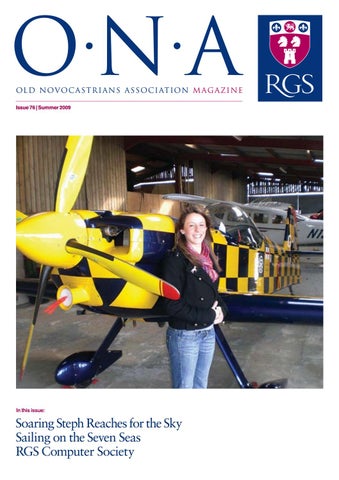
Soaring Steph Reaches for the Sky Sailing on the Seven Seas RGS Computer Society
ONA — Old Novocastrians Association Magazine
1 2–4 5 6–7 8–9 10 11 12–13
14–15 16
President’s Welcome News and Events Who? What? Where? Retirements Soaring Steph Reaches for the Sky Sailing on the Seven Seas ONA Merchandise RGS Computer Society: The very beginning Obituaries Penrith Reunion 09
8
10
12 ONA Magazine Issue 76 | Summer 2009
Contribute! We are always looking for articles and news from Old Novos to include in the magazine, so send your contributions, via email (if possible) to: ona@rgs.newcastle.sch.uk or to the ONA Office at the school. Please include relevant pictures if possible. They will be returned as soon as the magazine has been printed. The deadline for acceptance of copy for the Autumn 2009 issue is: Monday 10 August 2009. Copy may be carried over to a future issue.
ONA magazine is the magazine for the Old Novocastrian Association Editor: Tove Elander All correspondence should be addressed to: The ONA Office Royal Grammar School Eskdale Terrace Newcastle upon Tyne NE2 4DX Telephone, ONA office: 0191 212 8924 email: ona@rgs.newcastle.sch.uk The Editor reserves the right to edit, alter or omit all submissions to the magazine. Copy may be carried over to the next edition. The Editor’s decision is final. Designed and produced by www.infinitedesign.com
ONA — Old Novocastrians Association Magazine
Welcome
1
Welcome to the latest edition of our magazine Much has happened since the last issue of the magazine. A meeting of the merchandising sub-committee in the Collingwood moved matters forward rapidly, and items are now available for purchase. You will find them listed on page 11. Thanks are due in particular to the newer members of the committee for this. Their energy and enthusiasm has carried this through, and I hope you like the items that are currently available. The list is not exhaustive, and other items are likely to be added as time progresses. We now have a group of volunteers interested in the ONA who are in their last year at school, and the hope is that we can keep in touch with them throughout their university careers and beyond. There is enthusiasm, too, from members of staff and ONs to explore the possibility of restarting ON matches against the school in those sports where the current regulations allow it. In particular we have arranged a fixture with the Cricket First XI at Jesmond on 26 June. The facilities now available at what many of us knew as “The County Ground” have improved tremendously since the school took over the lease, and the idea is to have the match followed by a function in the evening. As these plans are developing rapidly details will be posted on the website when the format of the day is decided. Another committee member is hopeful that a football match will be possible. Also on the agenda, but a little further down the line, are celebrations to mark the Centenary of the CCF in 2011. As much of the archive was damaged or destroyed in the flood of last September, could I ask those of you who were in the OTC/JTC/CCF and continued into the forces to send me a brief resume of your career. Please email it to m.barlow@rgs.newcastle.sch.uk. We hope to be able to put together a list, and to publish a brief history of the Unit. I would like to finish with advance notice that this year’s ONA Annual Dinner is being held on Friday 16 October. Details to follow.
Mike Barlow (53-64) ONA President
2
ONA — Old Novocastrians Association Magazine
News and Events The London ONA dinner, held at the RAF Club in March
Reunion for 1990 Leavers Next year it will be 20 years since this group passed through the doors of the School for the final time. Some will have returned since but others may never have been back and have yet to witness the huge changes that have taken place during that period.
ON elected President of the Oxford Union I have been involved in the Oxford Union for two years, and was recently elected President. I managed to overcome a large favourite to win President and am extremely honoured to be one in a line of Presidents that have included Tony Benn, Benazir Bhutto, and William Hague. In my time, I have debated against figures ranging from Justice Antonia Scalia on constitutional interpretation to RGS’ Headmaster Dr Trafford on positive discrimination. It is a remarkable institution, which has hosted Presidents, Prime Ministers, the Dalai Llama and the Queen alongside more traditional celebrities such as Pierce Brosnan and Michael Jackson. It is a fantastic role – as an entirely student run society I have responsibility for an organisation with over £750k turnover – a challenge certainly! The union committee has already confirmed that during my term we will hear from amongst others, Sir Ian Blair, Chief Justice Roberts and Stephen Hawking. We will also debate motions ranging from ‘THB that Israel is a rogue state’ to ‘THB Thatcher saved Britain’. My time at RGS was broadly spent participating in debating, and it was there I began to learn how to participate effectively in the cut and thrust of a debate. I had a thoroughly enjoyable time at RGS, thanks to the wide range of opportunities and the excellent teaching staff. In Oxford, I’ve been involved in many aspects of Oxford Life. I row for my college (Oriel) 1st VIII, help organise development organisations such as AIESEC, and represent students to governing bodies on academic disciplinary matters. I have been very lucky to have experienced a wide range of internships, and at the moment I am a tutor in economics. Last summer I worked in the US Congress on behavioural economics application to healthcare policy. I hope to go on and become a professional economist with the ultimate aim of being involved in politics either elected or in policy advice. Corey Dixon (99-05)
Autumn 2010 will give an opportunity for us all to get together. We have yet to pick a date, but it is likely that the reunion will be held on a Saturday in mid to late September, or early October. At this stage, please make a note in your diary and email either me or Tove Elander in the ONA Office to express your interest. Further details will be announced in due course. If you are in contact with contemporaries from this year group then please also pass their details on to us so that we can contact them with information. We look forward to hearing from you. Rod Etherington (80-90) Contact emails: rodney@rodney1.orangehome.co.uk ona@rgs.newcastle.sch.uk
News and Events
Rugby update Success across the board!
3
Football Honours even
The rugby teams completed a very successful season with impressive wins for the U18 Sevens Squad beating Robert Gordon’s College in the final of the Edinburgh Sevens, followed by an impressive win in the County Sevens, against Gosforth High School, the following day. The U15 Sevens team also won the cup for their age group. The 1st XV team completed their season with an impressive win, 40-0 against Dame Allan’s in the final of the County Cup.
Old Novo Cricket Match Old Novo versus RGS 1st XI Friday 26 June 1pm (time to be confirmed)
The 1st XI put their name on the City Cup final for the second time when they shared the trophy with Heaton Manor School in a 1-1 stalemate at the University of Newcastle sports grounds.
At the County Ground, Osborne Avenue, Jesmond. If you would like to play, please email Master i/c of Cricket Alex Brown: a.brown@rgs.newcastle.sch.uk The RGS Cricket fixture for 2009 will be available on the ONA website after the Easter Holidays – ona.rgs.newcastle.sch.uk If you would like a copy sent in the post, contact the ONA office on 0191 212 8924.
An outstanding 30 yard volley from Dan Ward gave the side the lead, but Heaton Manor equalised from a corner after the goalkeeper looked to have been fouled. They nearly won it in the last minute when Martin Bagnall almost scored from close range. Both teams looked tired in extra time, after what has been a long but very successful season for the team, who are currently second in the County League Division 1. In true Corinthian spirit the authorities decided that 17 and 18 years olds couldn’t possibly face the prospect of losing on a penalty shoot-out, so (disappointedly, for both sides) dispensed with the quintessential part of all modern cup finals!
Girls’ hockey success Congratulations to the U14 Hockey Team who ended a successful season by winning the County League Final. They beat King Edward’s Morpeth 6-0.
4
ONA — Old Novocastrians Association Magazine
News and Events RGS Art Department Private View Thursday 14 May 4.15–6.30pm
Art work from our GCSE, AS and A2 students will be on display all around the school. All Old Novos, families and friends are welcome. Refreshments will be available.
Mock trial win A team of Lower Sixth students recently won the Independent Schools’ Law Mock Trial Competition, held at Moot Hall. The barristers and witnesses were: Rory Allan, Thomas Beckwith, Alistair Bolger, Adam Heardman, Will Jackson, Ed Johnson, Saimon Mills and Hugo Wallis. The RGS jurors were: Max Jones, Andrew Lloyd, Lakshmi Quigley, Andrew Russell, Abishek Sekhar, Tim Short and Josh Taylor. The Judges said this was the strongest team ever fielded in the 11 years of this competition.
Who? What? Where?
5
Who? What? Where? RGS welcomed back Nick Miller
Nick Miller (80-87) General Manager New Model Launch for Aston Martin returned to RGS to offer expert information and advice about careers in engineering and design. To the delight of students and teachers(!) he showed up in an Aston Martin DBS!
Adam Parnaby (85-92) lives in Paris where he works for Pfizer International Operations in the field of oncology. Robin Wilson (72-79) is a database security and inventory officer with HSBC Global Banking & Markets. He is also an active member of the BBC Symphony Chorus. Philip Creed (96-03) graduated MSc in Corporate and International Finance from University of Durham in September 2007, and is now working at Dresdner Kleinwort as an analyst in strategic advisory. Mike Harle (66-76) I am in training for ordination to the Church of England. I will serve in my home parish of Claygate in Surrey, where I am already working full-time since retiring from Shell on my 50th birthday. I am involved in all aspects of Christian mission: particularly discipleship and pastoral care. I was widowed in 2004 and look after our 13
year old son, Thomas. He goes to school in Wimbledon, loves a challenge and follows Derby County. I would be interested to hear from other ONs involved in the ministry; you can contact me via the ONA office.
I occasionally see Roger Tarry, my coach from the RGS, on the towpath when he is on training camp with his current school in Worcester. Maziar Mahmid (95-02) I am working in broadcast design, specializing in broadcast branding, and recently I won the PROMAX GOLD award for ‘Best On-Air brand in the UK’ for a promo that I made which is currently airing all over Europe on the Jetix channel (this is the new ‘Fox Kids’ channel) available internationally on Sky. The promo itself was up against stiff competition from the BBC and E4 to name a few, with the award ceremony held at the Grosvenor Hotel in London’s Park Lane. The PROMAX awards are the most sought after within my field, they are held on national, European and international levels. The same promo has been entered for the European PROMAX award, the nominations are still to be named (fingers crossed!). You can see my work on my employer’s website www.lighttv.co.uk which will also give you an idea of the different types of work that I help output in the broadcast industry, for example, the Bafta Awards title sequence, the ChannelBee.com brand, Disney promo, and the Autotrader animation. Anthony McKay (74-81) is co-founder and CEO for Telephonetics PLC. Anthony would like to hear from anyone who knows him from RGS. He can be contacted via the ONA office. David Carnegie (74-81) is the owner and manager of Whitelow House Nursing Home in Morecambe.
Reverend Neil Watkinson (72-82) My wife and I have moved from Berkshire to Singapore – I’m now working as Assistant Minister at St George’s Church for half of my time, and the other half is with Crosslinks. My wife Debbie has taken up a post as a consultant in palliative medicine at the National Cancer Centre of Singapore (part of Singapore General Hospital). We’d be delighted to see any Old Novos who are located in Singapore at St George’s!
Edmund Gregory (81-86) qualified as a solicitor in September 2007 having left Northumbria Police due to a knee injury, and is now practicing law in Leeds.
Dan Sadler (74-81) I am currently deputy head teacher in Maidenhead, but from September will be Headteacher at Chiltern Edge School near Reading. I am Captain of Upper Thames Rowing Club in Henley.
Stuart Bage (80-90) after two years in Italy and 15 years away from North East, Stuart has now returned to Newcastle to manage the global expats for General Electric’s oil and gas business.
Fraser McFarlane (82-89) is Vice President of GlaxoSmithKline R & D. He is married with one daughter, and lives in St Albans
6
ONA — Old Novocastrians Association Magazine
Retirements Soon we will be saying goodbye to Norman Baker, Paul Ponton, Hazel Jones-Lee and Derick Lawson, who all retire at the end of the academic year
Norman Baker
Ponton at various championships (when John Armstrong was not available) so was privileged to watch this race from the press box. Of course Steve went on to be a world class middle distance runner. I’ve put together the school calendar since Spring Term 1979. This summer edition will be no. 92 and the last for me. Also I still have an input to the Senior School Entrance Examination… I set Paper 1. I have been a Physics Examiner since 1984 for OCR, or MEG as it was, and I am looking forward to continuing with this provided the old brain will let me.
What year did you start at RGS? I started RGS in September 1976 after 1 year at Rannoch School, Perthshire (now closed), having been in electrical engineering for 3 years before that. As well as teaching your subject, what else have you been involved with at RGS? I’ve been involved with rugby – I was in charge of the U13 for about 10 years in the 1980s, and continued to help with U12 XVs up to 2 years ago. I coached athletics and was in charge of the junior teams in the 1980s, and was amazed to watch Steve Cram as an U15 competitor win the City 400m by over 25 metres! I regularly did ‘announcing’ for Paul
Paul Ponton
What year did you start at RGS? September 1971.
I started the Amateur Radio Club after gaining my own licence in 1995 and have seen over 40 pupils pass their Foundation Amateur Radio Exam. As with many such ventures the younger boys tend to discover girls and spend more time on sport, so fewer and fewer continued with the interest after becoming qualified! What will you miss about RGS? I shall clearly miss the tremendous support we all give each other and the high standards our students achieve. One of the most satisfying aspects of working here is that the students can keep us on our toes; I even say to the
As well as teaching your subject, what else have you been involved with at RGS? Rugby: ran the U14 team 1971–1982. I have been Master in charge of rugby since 1982: 1st XV 1982–2008, U16 XV 2008–09. I’ve organised rugby tours every year from 1983 – the swan-song being the New Zealand tour in summer 2008. I’ve been Master in charge of Athletics, Gymnastics, Fencing, Swimming, Basketball, Life Saving Club, and have coached many teams. I’ve run ski trips, alpine treks, kayak tours to Cornwall in the mid -70s; I was in charge of running the Eskdale camp for many years. I ran the First Aid until RGS employed a school nurse. I was also in charge of the Sixth Form and the Prefects Dance for many years.
Sixth Form that I feel I have done the job well if they can be one (but not two!) steps ahead of me in class. I shall not miss driving up the awful coast road everyday at 7am. I have always been in school, circumstances permitting, by 07:30, finding this time of day ideal to mark, prepare etc. As a result I can’t remember the last time I took a cumbersome set of books home. I would thoroughly recommend it to colleagues, although it does have the disadvantage of you being utterly whacked by the end of a long Parents’ Conference day. What are you planning to do when you retire? What shall I do after retirement? The one thing about the staff at the RGS is that they all, whilst being fully committed to the school, also have a wide diversity of interests out of school. As a result I shall be doing what I normally do in holidays, hill-walking, cycling, photography, chasing steam trains (yes, you’ll probably think of me as being an anorak, but I firmly believe in preserving our nation’s heritage in all its glorious forms!), but more often. Two years ago I started to learn to play a clarinet and hope to do more with this in retirement, perhaps even try to join the Cobwebs Orchestra. Many Old Novos will know of this splendid group.
What will you miss about RGS? The students…particularly the sporting ones! What are you planning to do when you retire? Continue as National Coordinator for the ESAA Track & Field Schools’ Cup, and in 2010 organize the National T& F Championships at Gateshead International Stadium, and the Schools’ Cross Country Cup Final at Kirkley Hall. I’m also planning to complete ski mountaineering routes in the Alps which l have not done yet, and take a look at mountain ranges beyond Europe, possibly swim the English Channel, and get to the top of the Matterhorn (on the fourth attempt!) Who knows, I might even be rugby refereeing on a Saturday!
ONA Feature: Retirements
Hazel Jones-Lee
7
Armstrong. I went to the Swaledale camp in the first year – which promptly folded! I was Head of General Studies from about 1990 to 2001, and held a cookery over-spill class in my home for many years. Until about 1995 did a lot of the Oxbridge teaching in English. I started Charities Week in 1989 and VS in its present form at the same time, introducing Sixth Form placements as an alternative to Games and a supplement to General Studies. I did the practical part of introducing co-ed to RGS pre-2001 and took over pastoral responsibility for all new Sixth Form entrants.
What year did you start at RGS? I started in 1984. As well as teaching your subject, what else have you been involved with at RGS? For 13 years I co-directed XXI Club with John
Derick Lawson
What year did you start at RGS? I started in the January of 1984 as my previous school (St Edmund Campion RC Comprehensive) would not release me to start teaching in the autumn term of 1983. As well as teaching your subject, what else have you been involved with at RGS? In addition to Chemistry, I have taught ICT from Junior School level upwards. As Head of ICT from 1997 to 2003 I introduced the ECDL course and have maintained the school as a Test Centre since September 2002. From 1984 through to 1997 I was one of the staff
What will you miss about RGS? I will miss the people: colleagues who have never taught anywhere else don’t know how lucky they are in their colleagues here! I’ll miss the students a lot. We have just come to the end of the interview season for the new Lower
members running the year 8 camp in the Borders at Attonburn, just outside Yetholm. I also joined the Naval Section of the CCF in September 1984, taking over as Officer in charge in 1986 and remaining so until 1997 when I retired from CCF. However I returned to service in 2004 when the Section was in danger of closing due to lack of Officers. I have been a member of the Senior School Choir since the early 1990s taking part in the choir excursions to Germany, Italy and Spain. What will you miss about RGS? The early morning swim with the staff, especially those who gave tremendous support and encouragement after my double cabbage (CABG – coronary artery by-pass graft) so that I am now probably fitter than at any other time at the RGS. I suspect that I will miss the students – I know it sounds corny but after all it is they with whom I have the greatest contact during the day. I know we sometimes complain about them but they are generally well behaved, have a good sense of humour and I can still
Sixth and I’m very sad not to be seeing those students into the school. I’ll also specially miss my tutor group. What are you planning to do when you retire? Good question. I was going to retire when I had identified the next project, but the trouble is that we are too busy to be able to give much thought to the next stage. I’m thinking, in a very sketchy way at the moment, of co-coordinating some adult VS teams in a few of the schools in which RGS now operates, but that’s still at the very early stages of pre-planning. In the short term, I’ll settle for getting up a bit later in the morning.
What are you planning to do when you retire? Play more golf and try to get my handicap down, or even get my game to the level of my handicap. What is my handicap? 3 – hitting the ball, finding the ball and getting round the course without running out of balls! I’ll do some hill walking, and I am looking forward to be able to go on holiday when I want to – i.e. during term time. We want to tour the continent with the caravan a bit more and intend going to Oberammergau in 2010. I might try to learn to play a musical instrument and perhaps a foreign language. I was rubbish at French at school and never had the confidence to try using it, but during the visits to Brittany and Normandy with the Junior School it was frightening how much came back, and that when I used it, I was understood!
I would like to complete the suite of ECDL advanced modules by passing the Advanced Database module and may offer my services as a part-time tutor for ECDL at the local college. I do not want to plan too much and so remember what it was like teaching elsewhere and what the students could be like – the names leave a degree of freedom in case something Diana and Alyson still bring memories which I’d else unexpected crops up. rather forget!
8
ONA — Old Novocastrians Association Magazine
Soaring Steph Reaches for the Sky Flying has always been my passion since a young age. I began gliding at the age of 14, and whilst at RGS, with Mr Miller’s permission, I was able to head to the gliding club rather than take part in traditional games on Wednesday afternoons. Steph Burn (04-06)
I’m studying Aviation Technology at Leeds University, and in 2007 I was awarded one of only 15 national GE Scholar Leader Programme bursaries to assist me in my dream of becoming a pilot. The £6,000 bursary helped me to combine my studying with training for my Private Pilots Licence at Teesside Airport, which I gained in May 2008. I have also completed the Bronze and Cross Country endorsements in gliding and a solo height gain of 8,000ft and am now one step closer to becoming an instructor! The award also provided me with a work shadowing placement with the UK GE Aviation Systems Leader, Simon Linacre. The day was fantastic and I learnt about Electrical Power Distribution Systems (part of my course), and how an airline typically operates.
The GE Scholar Leader Programme encourages active support in the community, and expects leaders to complete at least 50 hours voluntary work every year whilst at university; this is alongside my current job, working 16 hours a week in Thornton’s. In my first year I helped a charity raise awareness about Sudden Adult Death syndrome, and I also worked in a school in Leeds. Last year I worked alongside Access Academy with young people in public care. There I worked with a 14-year-old boy who lived with his granddad. His lack of communication skills and serious behavioural issues didn’t stop me covering topics with him such as finding employment and work experience, how to write a CV, interview techniques and helping him with personal and academic problems. Last summer I was chosen by Leeds University’s Student Associates Scheme to work in an underprivileged school for three weeks; helping out mostly in IT and PE. I felt so
welcome in the school and enjoyed it so much I’m returning this year to do the same again, only this time voluntarily. The knowledge and work ethic I got from RGS has taught me to work hard and given me the confidence to know that I can succeed. I can still remember how delighted I was when I was offered a 100% bursary to study at RGS. However, during my first term in the Sixth Form it dawned on me that my knowledge from my previous comprehensive school was not as complete as I’d originally thought, and the idea of RGS began to feel like a bad one. But I persevered, got my A-levels and a place on the university course of my choice. I’ve brought my university grades up from 48% in the first year to 76%, an almost three grade boundary, and my average university grade is short of a first class by only 2%. My experience as House Secretary and Prefect at RGS has given me the confidence to represent my university
ONA Feature: Soaring Steph Reaches for the Sky
9
course on the staff-student committee, where my contributions have played a role towards substantial changes such as the demolition of the old café and a new one being built with easy-access computers and a separate group-study room.
apply for jobs. I want to work in the Aviation Industry as a private charter pilot or behind the scenes; my aim is to fly lighter aircraft and gain hours and experience for a couple of years before applying for a scholarship to train to fly for a commercial airline.
I’m also trying to fit as much flying into my spare time as possible. Earlier this year I completed a conversion to Self Launching Motor Gliders and also a conversion to a more powerful aircraft. Currently I’m taking private aerobatic flying lessons with Tom Cassells, Top Gear’s CAP 232 Race Pilot and UK Champion aerobatic pilot for three years running. My intention is to complete ten hours training and then to compete. These aerobatic flying lessons are teaching me extreme accuracy and precision, and are more advanced than those my fellow students are currently doing. It will I hope, give an extra dimension to my CV, and stand me in good stead for when I start to
I could have done all this by myself, but it has certainly been easier to pursue my dream with the help of the GE Scholar Leader bursary and the RGS Sixth Form bursary together with the support of all the fantastic teachers at RGS, who consider you as an individual, and push you to succeed. I’m hoping that one day, when I’m earning a salary, I will be able to pay for a bursary for someone in a similar position to me, so that they can experience the fantastic schooling at RGS that I was lucky to have! Steph Burn (04-06)
Steph and Instructor Tom Cassells with the Slingsby Firefly
10
ONA — Old Novocastrians Association Magazine
Sailing on the Seven Seas
HMS Monmouth in Sydney
Remembrance Service at USS Arizona led by the CO
Tim Peacock (78-84) has completed 28 months in command of HMS Monmouth, a Type 23 Frigate. Tim, whose previous naval experience includes appointments as a Navigating Officer, front line helicopter pilot and Warfare Officer, joined the ship in 2006.
During this time in command HMS Monmouth carried out a number of high profile tasks, including operations as diverse as command of a multi-national task group, leading destroyers from Russia, France and the United States on exercise or demonstrating his ship handling as the display ship for Plymouth’s Navy Days. In addition he was lucky enough to have the opportunity to moor in the shadow of the Tyne Bridge for a thoroughly enjoyable five day home town visit to Newcastle, which included a visit to RGS. The highlight of Tim’s period in command however, was a nine and a half month deployment which circumnavigated the world, as a trial to confirm that the Royal Navy could continue to demonstrate global reach using one single warship, without additional support from home. By the time she returned to the UK, HMS Monmouth had steamed over 44,000 miles, visiting 28 ports in 19 countries.
Operational duties included anti-terrorism and anti-piracy patrols in varied operating areas, including the Malacca straits, Indonesia, Philippines and the Horn of Africa. In the latter region HMS Monmouth was the first major British warship to visit Aden since the bombing of the US destroyer Cole in that port in 2000; here HMS Monmouth provided a full training package for the nascent Yemeni Coastguard. As flagship to the First Sea Lord in Singapore and to Commander in Chief Fleet in Jakarta, HMS Monmouth supported British Government objectives in South East Asia, before ranging further a field to areas of the globe rarely visited by the Royal Navy. Here visits to far flung places, including the Andaman Islands, New Zealand, Australia, Japan, and Hawaii serve as a reminder of how much effect can be achieved through a British military presence across the globe. Tim left HMS Monmouth in August 2008 and is now on the Directing Staff of the Advanced Command and Staff Course at the Defence Academy, before hopefully returning to further operational duties in the autumn.
HMS Monmouth had steamed over 44,000 miles, visiting 28 ports in 19 countries.
ONA Merchandise
11
ONA Merchandise Cufflinks £10 Enamelled cufflinks (presentation box included)
Polo Shirt £18 Canterbury polo shirt with embroidered crest. 100% cotton. Available in black, red or blue.
Wall Plaque £25
Tie £10 Polyester tie, striped with crest.
Hooded Sweatshirt £35 Canterbury Hooded Sweatshirt with embroidered crest. 60% cotton 40% polyester. Available in black, red or blue.
The new ONA merchandise is now for sale To order any of the items, please send a cheque (payable to ONA) to: ONA Office Royal Grammar School Eskdale Terrace Newcastle upon Tyne NE2 4DX
Remember to include your name, address, phone number and/or email, and to indicate which item you are ordering. Please include phone number and/or email so we can contact you if delivery is likely to be delayed.
The ONA accepts no responsibility for nondelivery via standard post. If you would like your order to be sent by special delivery, please contact the ONA office for a price list. All goods are sold subject to availability.
12
ONA — Old Novocastrians Association Magazine
The RGS Computer Society: The very beginning In issue 75 of the ONA magazine, we printed an article called The RGS Computer Society: Early Days by David Franks (65-72). Unfortunately, we inadvertently attributed the wrong author to the article. The author of the article was, in fact Bob Bramwell (66-71), and NOT David Franks. We would like to apologise to all concerned for the confusion. Below is David Franks’ recollection of the RGS Computer Society:
In 1968 Practical Electronics published the designs for an analogue computer – something that caught the imagination of the RGS Electronics society of which I was an enthusiastic member. By the end of the year we had persuaded the school to buy the parts we needed and had over many lunch hours successfully built RGS’s very first computer. Although it was not particularly pretty and was somewhat limited in what it could do, an article appeared in the Evening Chronicle about our exploits and caught the attention of someone at British Paints where they had just installed the very latest IBM computer – a System 360 Model 25.
Programming in assembler was a challenge for all of us, but a great grounding in how to manage with very limited memory and disk resources. 4k (4048 bytes) of core memory was not a huge amount to work in – a typical laptop today will have 500,000 times this much memory. If the 4k that Terry and I used to program in was equivalent to the two pints of Watney’s Red Barrel we used to treat ourselves to in celebration of programs that ran first time without errors, then today’s laptop has the equivalent of an Olympic swimming pool of memory.
As we found evermore complex problems that we could program solutions to, we progressed through Fortran and PL/1 to British Paints (which soon afterwards became Cobol – the language that businesses still use in some of their legacy systems. The 400 line Berger Chemicals) offered the school two per minute printer (which had an unhelpful hours free computing time per week (5pm to tendency to rock the building) meant that no 6pm each Monday and Friday) – an other processing could be done until the unbelievably generous gift. Terry Ellison and I printing had finished. Terry got bored were the two founding members of what repeatedly waiting for the printer to finish and became the Computer Society when we enthusiastically took up the offer. Many others wrote a program (that he later sold to IBM) soon followed and the computer operators at which is what we now know as a Print Spooler – a program that enables other processing to British Paints were very patient with our be done in the gaps waiting for the printer to inexperience and our incessant questions – be ready for the next bit of data. Our often pointing us to huge banks of IBM manuals when we asked questions about how enthusiasm led Terry and I to holiday jobs as to do things that they hadn’t yet tried (or when computer operators – sometimes working late shifts and running stock update programs they just wanted to get rid of us for a while).
where nothing seemed to happen for hours. All programs and data had to be punched onto cards to be fed into the card reader – a process which required dexterity both in the typing and in the feeding. I’ll never forget spilling the entire master file of stock codes (2000 cards or so in total) and having to sort them by hand back into the correct order. I think one of our next projects was an automated sorting program! David Franks (65-72)
How the relationship between RGS and British Paints began Keith Jewitt (70-77) writes: I was really delighted to see the article about the early days of the Computer Society. The relationship between the RGS and British Paints was the result of informal contact between the late Frank Budden and my late father Bob Jewitt. Dad met Mr Budden while my elder brother Rob Jewitt (64-70) was at RGS. Mr Budden was a maths teacher and his interest in Data Processing (as it was then called) was largely maths-driven. Dad, by contrast, had come into DP from management accounting and his dream was that computing would one day be an indispensable part of running a business.
ONA Feature: RGS Computer Society: The very beginning
“I’ll never forget spilling the entire master file of stock codes (2000 cards or so in total) and having to sort them by hand back into the correct order. I think one of our next projects was an automated sorting program!” David Franks (65-72)
Dad’s offer of the British Paints machine was entirely gratuitous, and was founded on the respect he had for the RGS. There was no “funding”, no “risk assessment” and as far as I know no formalities of any sort. Looking back from 2009, it’s difficult to appreciate now how unusual it was at that time for business to cultivate links with formal education. It’s even more difficult to appreciate how esoteric electronic data processing was in the 1960s. Most people in those days had never seen a computer, except on TV during coverage of NASA space shots, and for most of the 1960s the forward-lookers like dad were regarded as cranks. It’s marvellous to hear that his vision is still recognised forty years on.
13
14
ONA — Old Novocastrians Association Magazine
Obituaries John Walkinshaw Osselton (36-46) Died on February 7 2009 in Wales, after a long illness. He was 80. Sandy, as he was known to his parents and friends entered the School in Sept 1936 in Stoker Meaken’s form J1B. Rodney Turner (36-46) writes: “There he met for the first time boys with whom he formed friendships that proved closer and longer lasting than is usual between schoolboys. Largely because of the war and the evacuation to Penrith: living with other families and lacking much contact with local children of our age we met not only every day at School, but relied on each other for company and amusement at all times.” David Middlebrook (36-47) writes from California: “After the first day in J1B his personality must have instantly impressed me, because (so I am told) I showed up on his doorstep at 7am the next morning, wanting to be friends! We spent much time together prior to the Penrith departure.
Sandy enjoyed a very large playroom furnished with a Hornby train on its linoleum floor, where I discovered the elements of electricity and electric motors, and lined the track with flashlight bulbs connected with bare copper wire obtained from Boots.” As David went on to become an eminent Professor of Electrical Engineering at Caltech this early influence of Sandy’s is perhaps significant. After the war Sandy built Goodman speakers into the ceiling of that room, long before stereo recording became the norm. There Rodney Turner, Bobby Little, Alwyn Sharples, Ian Ward, John Winterburn and others including the writer gathered to listen to classical music. Rodney Turner continues: “Sandy’s time at School was remarkable not only because of his scholastic ability and the breadth of interests but also because of the influence he had on others. I do not think he
had any enemies, which in it self is unusual, but he was respected by everyone.” He was active in many aspects of School life: a Prefect, a stalwart of the Debating Society, in the chorus of Murder in the Cathedral, scorer for the First XI in 1945 and in the Science Society where Michael Ryle recalls, as the only member from the Arts Sixth, Sandy gave a lecture on how television worked. This at a time when there was no transmission in this country. Sandy’s interest in music was wide ranging. He was an accomplished flautist in the First Orchestra, in the Northumbrian Junior Orchestra and in chamber groups. Michael remembers him playing with David Corlett, the Bach Cantata Jesu Joy of Man’s Desiring in the Wordsworth Street Methodist Hall. Exempt from National Service because of asthma, Sandy initially decided on a medical career but changed and read Electrical Engineering at Kings College. His subsequent career, in Newcastle was in the field of Electroencephalography where he contributed much to its development over very many years, continuing to edit a textbook on the subject long after his retirement and despite the frustration his European colleagues caused him by their failure to submit contributions on time or in intelligible English.
In 1978 Sandy came up the idea of a Class Reunion. After considerable research into addresses he organised a Dinner in Newcastle of those who took School Certificate in 1944. It was well attended and another one was held five years later. Five years on wives were included at the Corbridge home of Fiona and Robert Waddell and they have gone on every five years since. Sadly Sandy was too ill to attend the last one held at Donald Gascoigne’s house last year. He retired to Wales where he had inherited a run down Mill House near Machynlleth. There he and his wife rebuilt the house, cleared the ground and created a superb garden, which was in recent years open to the public every year as part of the National Garden Scheme. Rodney Turner: “Sandy was eccentric, a characteristic he must have inherited from his parents. He was unique: I have never known anyone quite like him. He was funny, witty, kind and knew such a lot about so many things. He was always interested in other people, and we respected and admired him. He was a true friend and we loved him for it.”
He married Marian in 1963 and he leaves her, a son Stephen (75-82), and a daughter Rebecca. Chris Emmerson (36-47)
Rodney Turner, Sandy Osselton and David Middlebrook listening to music in Sandy’s home circa 1946.
Obituaries
Patsy Gordon Junior School Teacher (59-85) My wife Patsy taught at the Junior School for 26 years before retiring in July 1985. She loved her job, indeed loved the whole school. The boys whom she taught had, from the earliest days, nicknamed her “Ma Gordon”and they were constantly in her mind being “ever so well behaved and so enthusiastic”. In her retirement she enjoyed nothing more than to learn of their progress and to recall the various occasions in which they had been implicated. Patsy and Joy Knowles, close friend and colleague throughout all her time at the RGS, together attended the annual Governors’ lunch right up to her final year thus maintaining as close a link as possible with the ever changing scene at the school. Alan Gordon
Neil Arthur Robinson (46-54) Born 9 May 1935. He died on 7 October 2008, aged 73. Stuart Armstrong (46-54) writes: I met Neil when we both entered Form II(I) in September 1946, as “scholarship boys”. He had a distinguished school career, regularly appearing in the prize lists, and was made a prefect in 1952. He became Head Prefect in 1953 – at the time an unusual appointment as he was in neither the First XV nor the First XI. He was tall, quiet, calm and caring, with an innate dignity. To us boys he was known as “Prof” – although I think he was glad to leave that title behind in adult life. His school life was broadly based – he played the bassoon in the orchestras, and sang in the (male voice) choir. He was prominent in the negotiations which led to the formation of the Scottish Country Dance Society – remarkably (for those days) involving girls from the Central High and Church High.
A deep knowledge and love of nature was a particular characteristic throughout his life. After reading natural sciences at King’s College, Cambridge, he taught biology for eight years at Lancaster Royal Grammar School, but then made a career change to
15
Joy Knowles writes: Patsy Gordon was a colleague and friend of mine for over 25 years and together we witnessed amazing changes at the RGS from the 50s to the 80s. In the early 1970s the glass ceiling for women members of staff was shattered... an event much appreciated by us.
headmasters, thus providing a sense of continuity and purpose. After retirement we kept in contact and I last visited her just weeks before the onset of her final illness. She was as optimistic and forward looking as ever. Some months later she telephoned and said “I can no longer communicate.” A sad finale to a life spent relating to others.
Pat was lively and innovative, dedicated but Goodbye, Ma Gordon. May you rest in peace. firm and she genuinely loved teaching. I recall spending many windswept days in the Pinfold where we supervised Junior School football; excursions to local places of interest... “will there be a shop there Miss?”... and memorable trips to London, with a regiment of over 50 nine year old boys in our sole charge! As the years passed, we wrestled with the intricate mechanisms of the Junior School TV and video recorder but never really mastered the technology, to the disbelief and despair of the legendary JHJ (John Jones the Junior School headmaster). One young member of staff subsequently labelled us “the Chalky Talky Sisters.” Pat served under three Senior School headmasters and three Junior School
work for the Nature Conservancy (later English Nature). He was initially based at Ainsdale, near Southport, and then worked from the Regional Office at Grange over Sands (later Bowness). He was deeply involved in the work which led to the Government’s acquisition of the Ribble Estuary, and the fight to save Gaitbarrows, near Silverdale, for the nation. He regarded himself as a confirmed bachelor, but that changed when he met Judith, through their shared love of nature. They married in Kendal in 1976, and had three lovely daughters, Astri, Elva, and Iona. He wrote to me to say “I still cannot quite get over having such a happy marriage and three such daughters.” In retirement Neil maintained his study of bees, wasps, and ants, about which he wrote articles and scientific papers. Living in Natland, near Kendal, Neil and Judith produced for several years “Wildlife News”, a beautifully illustrated section of the attractive village website “Natland News”. Neil retained his affection for the School, and attended a Jubilee reunion in 1997. He had planned to attend a 60th reunion in October 2007, but had to accept that his health wasn’t up to it. He suffered from increasing heart problems and, while in hospital for monitoring, had a heart attack from which he did not recover. I salute a fine man and a good friend.
Leslie Norman Black (33-36) Died 15 December 2008, aged 86, after a debilitating illness fought over many years with courage and determination. An enthusiastic player and follower of rugby throughout his life he joined Old Novos RFC in 1941 enjoying a long association with the club. He was elected President in 1976 and was asked to continue for a second season. During his career in insurance he moved around the UK but was always proud of his geordie roots, association with the school and valued highly the enduring friendships made. His wife Sheila, who died in November 2008, was also brought up in Newcastle, and attended Dame Allan’s School. They enjoyed a marriage of 58 years. Richard Black A Whillis (49-59) Died 23 October 2008, aged 69. J V S Harrison (41-48) Died 4 November 2008, aged 78. W T Jobson (42-47) Died 6 November 2008, aged 78. John A Orde (38-47) Died 27 January 2009, aged 80. F John Curtis (43-49) Died 18 January 2009, aged 73.
16
ONA — Old Novocastrians Association Magazine
Penrith Reunion 09 The very last Penrith Reunion! 1–3 September 2009 1 September Arrive and meet for Supper 2 September Coach trip to Keswick and boat trip on Derwentwater, dinner at the George Hotel 3 September Depart To confirm your place, please return the below form as soon as possible to Geoff Orde, Whiteside House, Whiteside Bank, Riding Mill, NE46 6DT, with a deposit of £30 per person. Cheques payable to ‘GTO No2 Account’, and postdated 1st August 2009. Please reserve
place(s)
I enclose a cheque (payable to ‘GTO No2 Account’) of £ and Please reserve
place(s) on the coach trip and boat trip
Name: Address:
Please photocopy this form
Telephone: Any dietary requirements: Please reserve your own accommodation, and let me know where you are staying. THIS WILL BE THE ABSOLUTE LAST PENRITH REUNION! For more information, contact me on 01434 682 233. I look forward to seeing you in September. Geoff Orde (40-49)
RGS Arts Diary Summer Term 2009
Listings overleaf