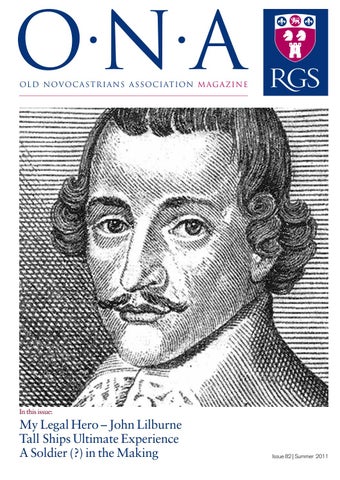
In this issue:
My Legal Hero – John Lilburne Tall Ships Ultimate Experience A Soldier (?) in the Making
Issue 82 | Summer 2011
ONA Magazine Issue 81 Spring 2011
Contents
ONA magazine is the magazine for the Old Novocastrian Association Editor: Tove Elander All correspondence should be addressed to: The ONA Office Royal Grammar School Eskdale Terrace Newcastle upon Tyne NE2 4DX Telephone, ONA office: 0191 212 8924 email: ona@rgs.newcastle.sch.uk The Editor reserves the right to edit, alter or omit all submissions to the magazine. Copy may be carried over to the next edition. The Editor’s decision is final.
14
Contribute! We are always looking for articles and news from Old Novos to include in the magazine, so send your contributions, via email (if possible) to: ona@rgs.newcastle.sch.uk or to the ONA Office at the school. Please include relevant pictures if possible. They will be returned as soon as the magazine has been printed. The deadline for acceptance of copy for the Autumn 2011 issue is Monday 8 August 2011. Copy may be carried over to a future issue.
5
1 2
The ONA Magazine is now available online Please note that the magazine is now circulated both in hard copy and by email to many members of the Association. Each edition is added to the ONA website shortly after circulation. By submitting an article or news for inclusion the contributor is accepting that it will be available through both formats and will also be accessible beyond the Association membership through internet search engines or any member of the public viewing the ONA website.
4 5 6 8 10 11 12 14
Design www.infinitedesign.com
16
12
President’s Welcome News RGS Day 2011 Postcard from Hong Kong My Legal Hero A History of the RGS in Ten Objects Retirement Old Novos v RGS Football Match Tall Ships Ultimate Experience A Soldier (?) in the Making Obituaries
Welcome
It is with great pleasure that I am able to introduce this edition with the news that the distinguished John Fenwick has accepted the position of Patron of the Old Novocatrians’ Association. John has contributed significantly to the life and development of the school over many years. The RGS is very close to his heart so he was extremely flattered and honoured to have received this new title. I am also delighted that Richard Metcalfe (Bursar and Clerk to the Governors), Crispian Strachan (former Chair of the Bursary Campaign) Jane Medcalf (Bursary Campaign Manager) and Tove Elander (Alumni Manager) have accepted a newly introduced title of Associate Membership. Each has contributed to the excellent work of the RGS and they continue to work hard fostering close relations between the ONA and the school. The latest instalment of A History of the RGS in 10 Objects, is on page 8. This engaging project has attracted great interest from Old Novos right across the world, as well as current pupils and staff at the school, and has prompted a new enthusiasm for uncovering some of the secrets of the school’s long and illustrious history. Old Novo John Lilburne features on page 6 – a forgotten hero according to Sir Geoffrey Bindman (45-50), the article’s author. This might well open (or reopen) the debate about who should hold the title of the ‘greatest ever’ Old Novocastrian. A history of the RGS in 10 people? Sounds like a great follow up to 10 objects! Send your nominations to the ONA office and we will explore this over the next few issues. Read about Jenni McDermott’s (08-10) fascinating account of her participation in the Tall Ships Challenge on page 10; an experience supported by the Old Novos Gap Fund. There’s also an invite to this year’s RGS Day from the Headmaster on page 4. I’m looking forward to the day and hope to see many Old Novos there. A particular highlight last term was attending the London ONA Dinner where Max Hill (72-82) gave an enlightening speech. Thanks to the London ONA President Leon Heyward-Mills (77-84) for organising the event, and for making the ‘delegation’ from Newcastle feel most welcome. Finally I would like to thank the outgoing Head Prefects, Jamie Robson and Caitlin Jenkins. They have been fantastic ambassadors for the school at various ONA events over the last year. We have thoroughly enjoyed their participation and I wish them well in their upcoming exams. I am certain they will become great advocates for the Association as they go on to university and beyond. Enjoy the magazine!
Adam Goldwater (87-97) ONA President
1
ONA – Old Novocastrians Association Magazine Spring 2011
News and Events
Join us on Facebook There are plenty of Old Novos Facebook groups around, but we have our own (official) group. Join us by becoming a fan of the Old Novocastrians Association page on Facebook.
Robert Peter Finlayson
2011 Old Novos Cricket Match Friday 1st July, 1pm, at the Jesmond Cricket Ground The annual Old Novos versus RGS 1st XI Cricket Match is taking place on Friday 1st July. We’re looking for as many ON cricketers as possible to play and also to celebrate a special occasion. If you would be interested in playing in the game or simply in coming along to share in what will be a fantastic occasion, please get in touch with Alex Brown, Master i/c cricket at RGS. Hopefully we can put together a strong team who will contribute to an event to be enjoyed by all involved. If you would like to play, please email Alex Brown: a.brown@rgs.newcastle.sch.uk
Old Novos Golf Until very recently an ad hoc grouping calling itself the Old Novocastrians Golfing Society (ONGS) participated in the prestigious annual Queen Elizabeth Coronation Schools Tournament (QECST), held at the Royal Burgess Golfing Society in Edinburgh. This tournament takes place over three days in the last weekend in September. The format is a knockout foursomes tournament with each team consisting of three pairs. Though never rising to the ultimate heights the ONGS have made a very respectable showing, once reaching the semi-finals. Off the course, the ONGS were noted for their bonhomie so that no longer did other participants say “Old who?” when ONGS was mentioned. So well respected were the ONGS that at the Golden Jubillee Dinner the reply on behalf of the guests was given by John Knighting (48-57). Sadly due to lack of opportunity/commitment/interest, the ONGS has not participated in this tournament for the last few years. Is there any interest in reviving the ONGS to play in an outing at a local course and/or resume its participation in the QECST? If you’re interested, please contact the ONA office for more information. Tel: 0191 212 8924, email: ona@rgs.newcastle.sch.uk
2
(56-60) After spending almost five years with the Metropolitan Police I emigrated to the USA, marrying a teacher from Milwaukee, Wisconsin and entered the insurance business. I spent 25 years with Royal Insurance and then a few other companies, becoming a Senior Vice President before I retired last August. I have four children and three grandchildren, one of whom is currently at St Andrew’s University. I now live in California, and I still play cricket, as well as regular tennis. I also cycle, swim read, and travel. Eric Aynsley (50-59) I studied chemical engineering at Birmingham University for a BSc and then a PhD. While there I spent many happy times rock climbing and flying in the University Air Squadron.
On graduating I worked for a few years in the north east, including Newcastle University, but finally succumbed to joining the “brain drain” and moved with wife and two young children to America for “just a few years”, returning to the UK 35 years later! I’m working mainly with my own business, performing air pollution emission audits for mostly industrial clients, principally in the US but also for subsidiaries and others throughout the world. My family include two sons: Angus who resides in London with my two grandchildren (he recently received an Oscar
nomination for Best Documentary Feature!), and Nick who still lives in Pennsylvania (our last US home), but works between Kendal, Cumbria and China. Congratulations to Laura Clarke (04-06) who has completed an intercalated degree in Immunology between her second and third years of medical studies, graduating with a 2:1. Laura is studying at Bristol University. Congratulations also to Tom Rowley (01-08) on landing a reporting job on the Daily Telegraph. Tom will be graduating from Oxford in History and Politics this summer and starts the job in October.
Martin Stanley (60-66) recently visited the school and gave a talk to sixth form economists from RGS and other local schools about competition policy in the UK. Prior to retirement, Martin was the chief executive of the UK Competition Commission, widely regarded as one of the best in the world. Varun Chandra (91-03)
works for Tony Blair Associates.
ONA Membership – Standing Orders If you still have a standing order set up to pay the ONA subscription fee, please cancel it as soon as possible. ONA membership is FREE to all Old Novos and former members of staff.
Chris Balfour (75-80) after
Michael Young (65-72)
a long and enjoyable career in banking across the UK and in the Middle East, my wife and I elected to take a complete change of direction by combining our love of travel and cycling. We now own and operate PyrActif (www.pyractif.com), a specialist cycling holiday provider, based in the French Pyrenees, but also offering tours and training camps in the Alps, the Dolomites, Spain, Belgium and Holland. The lifestyle and job content are very different to the ‘corporate’ world of one of the world’s biggest banks, but the intensity of ‘being your own boss’ can be just as demanding. That said, it’s difficult to find ‘highs’ from my time in banking to match the buzz provided as I climb and descend some of the most iconic mountain passes in the world of cycling.
Michael’s book, Managing a Dental Practice – The Genghis Khan Way was recently awarded the Diagram Prize for the oddest book title 2010. He is currently co-writing a second book on dental practice with fellow Old Novo Alan Suggett (6470), who is a specialist dental accountant.
Nigel Wilkes (69-79) I left school and accidentally became an accountant. After three years in Northumberland I moved to London, and then spent two years working in Papua New Guinea and Japan. I came back to London in 1989 and got married to Elena from Siberia in 1991, and also spent some time in Russia. I came back to the UK (Edinburgh) and started a company specialising in news information on Russia. I am now a non-exec of the company. In 1997 I started Iain Watson (80-90) working for Bakkavor as a I taught International Politics at Durham University temporary accountant; they sent me out to South Africa and worked for voluntary organisations in Newcastle in 2001, where I am still living and working. organising community projects for refugees. In 2008 I moved to Korea Emma Morton (04-06) where I teach International graduated from Northumbria Politics to overseas graduate University in 2009 with students. I’m married and a BSc in Software expecting our first child in Engineering and is now a August this year. computer games software programmer at CCP Games in Gateshead.
The RGS Arts Diary The summer term arts diary can be found on the ONA and RGS websites: http://ona.rgs.newcastle.sch.uk or www.rgs.newcastle.sch.uk or by phone: 0191 212 8930.
L to R, Tony Coulson, George Whales, Oz Watt, Ken Warren, Bryan Wallace, Brian Briscoe, Ian Lee, Tim Linton, Colin Ions, Bert Entwistle. Keith Purves, who was there, is mysteriously missing from the photo.
Whatever Happened…? The prodigal is found! Thanks to the ONA Magazine (Autumn 2010) and a chain of unlikely events, Ian Lee (56-63) was found! Lost in the late ’60s, but regularly toasted as an absent friend at every reunion for four decades, Ian reappeared on 27 November 2010. He joined the ten UK based ONs for drinks, snooker and dinner in London. The photo shows Ian, identifying himself with a raised finger. He had learnt of the search for him through the friend of a friend’s son (and reader of the ONA Magazine) and came out of hiding from his Buckinghamshire cave at Great Missenden. His arrival was greeted with particular warmth by his fellow Sunderland supporters in the aftermath of the Tyne/Wear derby when Sunderland suffered their greatest defeat since before we started at RGS. Oh, happy days! Sir Brian Briscoe (56-63)
CCF Centenary Mess Dinner Saturday 25th June Tickets are selling well. If you want to come and have lost your application form you will find one on the ONA website, or email m.barlow@rgs.newcastle.sch.uk Last date for applications is 17th June.
3
ONA – Old Novocastrians Association Magazine Spring 2011
RGS Day 2011 Saturday 2nd July
Bursaries and the politics of privilege
Dear Old Novo, I write to invite you most warmly to join us on RGS Day 2011, Saturday 2nd July. This new tradition, all of a year old(!), combines formal prizegivings in the manner of a traditional Speech Day with an opportunity to meet old friends, catch up and have some fun. The schedule of prizegivings and formal events, all held in the Main Hall, can be found on RGS and ONA websites from mid-June. Do join us for any or all of that long morning, if you would like to. Please bring any children or grandchildren: the junior school is holding its summer fair on the same morning, so there should be lots of fun and games, with free refreshments in the marquee – planted (carefully) on the hallowed turf of the 1st XV pitch. There is a particular invitation to all ONs who left RGS in 2006, 2007 and 2008 to join us from 2.30pm onwards for an open-air rock concert, featuring both acoustic and electric performances. Refreshments will be available. We would love to see ONs of all ages throughout the occasion, and hope you can join us on this special occasion Bernard Trafford, Headmaster
You may have read about the coalition’s plans to allow universities to charge the top rate of tuition fees of £9,000. This will be dependent on them meeting defined quotas of, and giving bursaries to pupils from state schools and certain postcodes. I am not alone in finding this social engineering at the age of 18 debasing to the meritocracy that is the cornerstone of our higher education system. 7% of UK pupils attend independent schools and take about half of all Oxbridge places. The gap between private and state schools is a disgrace in the UK, but is no reason to penalise those that have benefitted from attendance at the former.
Postcard From Hong Kong Kung Hei Fat Choi ! From mid-June, the RGS Day programme can be downloaded from www.rgs.newcastle.sch.uk or http://ona.rgs.newcastle.sch.uk If you would like a copy of the programme by post, please phone the RGS reception on 0191 281 5711.
Due in a large part to our successful Bursary Scheme, the RGS remains representative of the overall social mix of the North East. The RGS is neither elitist nor socially imbalanced. It supports the aspirations of those students with the aptitude to benefit from all it has to offer. For the second year running, we have had twice as many applicants for bursaries at RGS as we can fund. Although we sadly had to disappoint some very able boys and girls, we nonetheless expect to support 23 new students in September 2011. Fundraising is tough this year and we will be dipping into the reserves we have built up over previous years to support our investment. This year more than ever is the one to turn the positive thoughts about the Campaign into tangible action. Please support us. Andrew Major (86-90)
Chair, RGS Bursary Campaign Committee Find us at www.rgs.newcastle.sch.uk/bursarycampaign/
4
Kung Hei Fat Choi! It’s the year of the Rabbit and the traditional Chinese themes of happiness, wealth and longevity are aplenty. I hope the year of the Rabbit is a good one for my family and all current and Old Novos in the UK and all around the world. Carl Watson (89-94)
My new home, for at least the next four years, is Hong Kong. After “UK departure admin” in the form of renting our house out, selling our car and extraneous possessions and satisfying those friendly people at HMRC, my family and I moved out to Hong Kong in late November last year. I had arrived as a one-man advance party in midOctober to get settled into the Hong Kong office and to attend to “Hong Kong arrival admin” in the form of new bank accounts, accommodation, schooling, tax/immigration and maid recruitment. In the first month or so I met all my new colleagues in the Pinsent Masons’ Hong Kong office who made me very welcome. I also attended all of the training and social events that came around including the Bledisloe Cup rugby match at HK Stadium and a charity sedan chair race on The Peak (which we won the best decorated chair award, very prestigious!). Our office in Hong Kong has a large Projects and Construction team and is a very close knit group with all the teams regularly interacting for office events and socials. I am starting to make my own local network of contacts and also pick up some interesting new work advising on infrastructure issues and contracts across Asia Pacific. I am also working in the new nuclear power sector in China and across the region which is both exciting and a little daunting.
Postcard from Hong Kong
5
ONA – Old Novocastrians Association Magazine Spring 2011
Out of the office my wife and two young children are settling in remarkably well, having left our friends and established life behind in the UK. Our apartment complex has a lot of geilo (western) families and we are starting to make new friends from places as far flung as New Zealand and Australia to Russia and Canada. We’ve also recently joined the nearby Aberdeen Boat Club which has family friendly facilities and means that we can invite guests and make friends with like minded folk. As for the water-based activities, they are thankfully optional! I have also met up with a fellow Old Novo, Rob Fox (84-94). He is currently working for UBS out here and is married with lovely twin girls. I would be very keen to establish an Old Novos social group here in Hong Kong/Asia Pacific. If there are any Old Novos in the region reading this, please get in touch if that would be of interest. Also, if any Old Novos are planning to visit Hong Kong over the next few years, please just drop me a line, it would be great to catch up. Email me on: carl.watson@pinsentmasons.com
My Legal Hero: John Lilburne I was recently asked by the Guardian to contribute to a series of articles for its legal website with the title “my legal hero”. I chose John Lilburne. Sir Geoffrey Bindman (45-50)
The Lilburnes were originally a Northumberland family but later settled at Thickley, near Bishop Auckland. John was born at Sunderland in 1615. Although he is believed to have first attended the grammar school at Bishop Auckland, in his teens he attended the Royal Grammar School under the mastership of Francis Grey. When I was at the school between 1945 and 1950 I knew nothing of Lilburne, and for many years later was unaware of his link with the school. Every day we sang the school song which listed those most famous Old Novos: “Collingwood, Armstrong, Eldon and Bourne, Akenside, Stowell and Brand.” Why leave out John Lilburne, who, apart from his pivotal role in the development of our legal system, was one of our most important constitutional thinkers? The reason, I suspect, is that until recently he was perceived and dismissed as a dangerous radical hothead whose democratic aspirations were not to be taken seriously. His name would not have fitted well with the conventionally respectable figures featured in a song composed in the Victorian era. I am glad that modern historians have begun to recognise his significance and that his name has now been commemorated in his old school.
6
J
ohn Lilburne’s courage and passion for justice led to the establishment in law of some of our most cherished liberties. He was not a lawyer, but his courage and passion for justice established key reforms in the criminal law which are now among our most cherished liberties.
In his early 20s, Lilburne, the “Leveller”, was brought before the Star Chamber accused of “sending of factious and seditious libels out of Holland into England”. When questioned he refused to answer, saying: “I know it is warrantable by the law of God, and I think by the law of the land, that I may stand on my just defence, and not answer your interrogatories, and that my accusers ought to be brought face to face, to justify what they accuse me of.” He was whipped and pilloried, but he persisted in claiming his right to remain silent and to hear and challenge the evidence against him. In 1641 he was vindicated by the House of Commons, which resolved that: “The sentence of the Star Chamber given against John Lilburne is illegal and against the liberty of the subject: and also bloody, cruel, barbarous, and tyrannical.” Later, however, he accused the Commons of reviving the practices of the Star Chamber when he was arrested for publishing pamphlets advocating religious toleration and attacking suppression of dissent. Again he refused to answer incriminating questions, condemned the secrecy of the proceedings, and cited the authority of Magna Carta. He also refused to kneel before the House of Lords – the first to reject this humiliating practice. Lilburne described the Levellers as “the middle sort of people” and “the hobnails, clouted shoes, the private soldiers, the leather and woollen aprons and the laborious and industrious people of England”. He had massive support among Cromwell’s New Model Army, in which Cromwell had made him a colonel. With others he produced the first draft of a written constitution – the “Agreement of the People”. Its ideas were debated in Putney church in 1647, when Cromwell himself presided. There, Lilburne’s fellow colonel Rainborough uttered his memorable appeal to democracy: “For really I think that
7
ONA – Old Novocastrians Association Magazine Spring 2011
the poorest he that is in England hath a life to live, as the greatest he; and therefore, truly, Sir, I think it’s clear that every man that is to live under a government ought first by his own consent to put himself under that government.” Lilburne fell out with the increasingly despotic Cromwell and was put on trial at Guildhall for high treason in 1649. Again he challenged an unfair process. He refused to plead without seeing the indictment against him and without legal advice, neither of which were at that time routinely allowed. As before, he refused to answer incriminating questions. By sheer force of argument he persuaded the court to give in to his demands. The jury declared him not guilty. The report of the trial ends: “No being pronounced with a loud voice, immediately the whole multitude of people in the hall, for joy of the Prisoner’s acquittal, gave such a loud and unanimous shout as is believed was never heard in Guildhall, which lasted for about half an hour without intermission: which made the judges for fear turn pale and hang down their heads.” Lilburne’s willingness in the cause of justice to face violence and death at the hands of a cruel and overwhelmingly powerful state should be an inspiration to all lawyers as it has been to me. He reminds us of the nobility of which our vocation is capable and which is so often overlooked in an environment dominated by crude materialism. In 1961 the late Michael Foot asked the government whether, “in view of recent historical evidence of the part played by the Levellers in the establishment of parliamentary freedom and democracy in this country”, a suitable memorial to Lilburne could be erected in the Palace of Westminster. It does not seem to have happened, but it is not too late to honour a great civil libertarian. Now would be an appropriate time, when we face repeated challenges to our hard-won heritage of liberty and equal justice. Sir Geoffrey Bindman QC founded Bindmans LLP in 1974 and has specialised in civil liberties and human rights issues for more than 40 years. He was knighted in 2007 and is a trustee of the British Institute of Human Rights. He was appointed Queen’s Counsel honoris causa in 2011. First published in the The Guardian on Wednesday 15 December 2010. (c) Guardian News & Media Ltd 2010
A HISTORY OF THE RGS IN TEN OBJECTS 2
The article in issue 81 of ONA Magazine has proved to be of considerable interest across our membership. Here are some further notes... David Goldwater (51-62)
1
The Royal Charter is in the safe hands of Tyne and Wear Archives within the Discovery Museum in Newcastle. I was able to examine it there as Accession number 574/13 in 2000, 400 years after the school was incorporated under Royal Charter on 22 March 1600. With the fading benefit of a Latin O Level gained not 400, but 40 years before in 1960, I was able to locate the significant phrase: Magiftri et Scholiarum libere Schole Grammaticalis Regine Elizabethe in Novo Caftro fuper Tinam – the Master and Scholars of the Free Grammar School in Newcastle upon Tyne’.
3
4
The Pillar stood at the entrance to the Virgin Mary Hospital, the home of the school from 1611-1844. It still stands next to what used to be the Express Hotel, now the (re-born) Long Bar. Another gate post is still visible, built into the wall of a building opposite St John’s Churchyard. I am grateful to Bryan Stevens (44-49) for a very detailed letter in which he provided much information on all of our Objects including the pillar. Also to the former Bursary Campaign Chairman Crispian Strachan for his enthusiastic identification of the pillar’s whereabouts and pictures.
The Oak Table at the front of the hall is possibly older than the school itself. It stood in the Virgin Mary Hospital and when the Lord Mayor was elected (in the hospital), he took up the symbol of office from this table. However, the names carved on its surface all date between 1839 and 1895. The most recent date is 1907 and, despite popular myth, Lord Eldon’s (John Scott’s) name does not appear. Part of historical research involves a degree of de-bunking!
8
The Stained Glass Window was a feature of the Rye Hill building which served as the school’s home from 1870 until 1906. The late Lionel Markham launched an appeal to the ONA to transfer the window as the RGS was moving to Jesmond. The window was saved, but hidden for many years behind the changing rooms built in 1957, only to be revealed in more recent times. We still do not know whose design and manufacture it was. Dave Webster’s (64-74) e-mail (see No. 7, Organ) was helpful in mentioning some early Newcastle stained glass manufacturers.
Novo Magazine was founded in 1885. Early editions show a huge interest in cricket and after 1911, with war clouds gathering, in the newly formed Officer Training Corps. In a strange way, the new clock was counting down to the ‘War to end all Wars’. Only a very few years later, young ONs who had fallen in this brutal conflict were to be commemorated on our next Object, the great organ in the school hall. A strange symmetry. An interesting letter from Dennis Jones (44-51), now an architect in Durham, records how the linocut of Eskdale Terrace, which had graced pre-1950 covers of NOVO was replaced by an image of the Oak Table. Dennis won the competition for the best design and was awarded a prize by O W Mitchell. This cover was in turn replaced by the ‘contemporary’ ’60s cover illustrated here.
5 6
7 The Organ is, without doubt, the most central feature of the latest of the RGS’s many homes and was donated by Sir Arthur and Lady Sutherland as a War Memorial after the First World War. Dave Webster (64-74) directed me to the National Pipe Organ Register, which records the casework as the work of architects Dunn, Hansome and Fenwick in 1929. On it are inscribed the 162 names of those who fell in the Great War. This company was generally known for Roman Catholic Church architecture and added the spire to A W N Pugin’s St Mary’s Cathedral in Newcastle. The organ itself was the work of J J Binns of Leeds, whose work also included the organs of St Thomas’s and Jesmond Parish Churches. Christopher Judson (60-69) recalled his classmates scepticism on the organ’s inscription ‘Dulce et Decorum Est Pro Patria Mori’, after studying Wilfred Owen’s War Poetry where he refers to Horace’s phrase as ‘The Old Lie’. Many will recall Jack Wolstenholme playing at daily assembly. It was Jack who inspired very many pupils to take up the organ and Mike Barlow (5364) is at the forefront of a move to bring this wonderful centrepiece of the school into regular use once again.
The School Clock was similarly funded by an appeal amongst Old Novos. As described in the School History by B.Mains and A.Tuck: a magnificent clock, costing 150 guineas, subscribed by old boys, was to be placed… upon the building, and was, in 1911, exactly 100 years ago. I decided to request access to the clock tower to investigate further, and some photographs of the clock motor were taken. Incidentally, the mechanism has just been replaced, but the original remains and the photo here are evidence of this.
Now on to Objects 8, 9 and 10. After discussing the project with Simon Tilbrook, Head of History, he and his history students will be concentrating on these at the beginning of the Summer term. We look forward to the results of their efforts, whilst bearing in mind that this is a very busy term at a very busy school.
A number of ONs were quick to point out my sloppy mistake in referring to the motorway sweeping away the Pinfold in the 1950s. Quite correct, it was begun in 1972 and completed in 1975. Must do better!
All ten Objects will feature in a display at the forthcoming RGS Day on Saturday 2 July. The ONA are also considering further prizes for outstanding contributions by students to this Project. Old Novocastrians will have to be contented with an honourable mention! Please note all ONs and their families are also invited to RGS Day as the ONA is an integral part of this great event.
9
ONA – Old Novocastrians Association Magazine Spring 2011
8, 9, 10...
Retirement And so we say farewell to Senior Master and PE teacher Dave Smith, who is retiring this summer. Below are some facts you might not know about Dave, aka the Sheriff What year did you start at RGS? I started in January 1980 as my previous school, Dryden Senior High in Gateshead, would not release me for a September start. Before Gateshead I taught at West Denton High. As well as teaching your subject, what else have you been involved with at RGS? Teaching PE full time in its many guises does not leave a lot of free time but in between being in charge of cricket and running the 1st XI for 20 years, running all the basketball teams which competed, with some success, in both the Newcastle and Tyneside leagues in the 1980s and early 1990s and of course the obligatory rugby team, I’ve led ski trips and was a regular on the exhausting Eskdale camp. I’ve also helped to organise and lead the walks for Friends of the RGS. I played hockey for Swalwell but the school Saturday commitment to rugby made this impracticable so I changed to playing league basketball on midweek evenings. Later I changed to league volleyball and throughout this period kept up a decent level of fitness, regularly running in local races such as the Blaydon and the Great North Run. I’ve also been a member of the Northumberland Referees Society. Less pressured has been the Wednesday night fitness and volleyball slot with the group “The Elders”. Although I took the group over from the legendary John Elders apparently the name is a reference to the age of the clientele. The group is made up of Old Novos, friends, relations and business acquaintances. Colin Peacock (53-61) is the man in charge and we are always looking for new members so you might like to talk to Nick Muse (60-70) Ali Graham (59-68) and David Graham (55-64) who still grace the court as well as the younger upstarts of David Westwood (95-02) and Jamie Hansell (95-02). I cannot say that the volleyball has improved over the years but the fact that many of these stalwarts continue to attend and move around the court is a great reason to continue with the group in my retirement. The rest of the time I’ve been doing my job as Senior Master with overall responsibility for discipline.
10
Dave Smith and Maths Teacher Steve Watkins taking a break from teaching.
My nickname of “The Sheriff” was originally instigated by Barrie Bulch, the catering manager, and I believe it is still widely used, behind my back, today. The job has changed and grown over the years with too much time wasted on the never-ending form-filling and box-ticking which afflicts us all, but the upside is that I have worked with a strong and dedicated pastoral team which plays an integral part in the development of all our students. What will you miss about RGS? A difficult question because we take an awful lot of things for granted and it’s only when they are not there you tend to appreciate them. You would have to have a very strong constitution to put up with a place for 32 years if you didn’t enjoy it! Serving my apprenticeship in the comprehensive sector I realised early on how lucky and privileged I am to be a member of the RGS community. The staff are special and the kids are great – most of them! What are you planning to do when you retire? This question could probably be answered better by my wife but apparently re-landscaping the garden and complete redecoration and updating of the house figure prominently. On cold winter days the lathe will be in action in the workshop where large pieces of timber will be reduced to small household items and a large pile of shavings. All this manual work will be balanced by completing the Wainwright’s walks again, and a fair amount of time will be taken up by cycling and walking in the beautiful countryside of the northeast. We also hope to do a bit of foreign travel so I think the question is not so much what am I going to do but more how am I going to fit it all in. The Sheriff in his bouncer’s outfit, ready to patrol the Prefects’ Dance.
Old Novos v RGS Football Match ONA FC 2-2 RGS XI ONA FC Win 4-1 on penalties after extra time
on the planet because of the unexpected and, boy, did we see the unexpected: RGS made the breakthrough when a mis-cued cross looped over the head of Simon Irving, dropped to the back post, ricocheting off the back post and out. The referee had seen something and gave the goal. Replays showed that the ball had in fact hit the wheel used to move the net and it was a goal. 2-1 to RGS. ON heads dropped temporarily, but eventually the equaliser came, from the most un-likeliest of sources: centre-back Iain Fraser chased down a lost cause deep in the opposition’s box, and threw his body at an attempted clearance. The ball struck his knee, looped over the goalkeeper’s head and into the net: 2-2. ONA FC saw out the end of the game bravely, with the defence finding a new resolve. Neil Reekie (95-02) excelled at left back and the wounded duo of Ollie Currie (9502) and Mike Brett (95-00) swapped duties at right back. The game finished and extra time beckoned. It was age before beauty as the ONA footballers laced up their boots to face the latest crop of youngsters currently plying their trade for the RGS first XI. The main news was that two of last year’s heroes, and ON stalwarts, had to miss the game through injury; David Westwood (95-02) because of a knee strain and last year’s penalty hero, Sam Moore (97-02) because of reconstructive knee surgery. Both took on management positions instead, with Elliott Fulton (98-08) and Richard Bissessur (05-07) replacing them in the squad. Once fresh tattoos had been securely protected, the match kicked off with the ONs looking to repeat last year’s success. The first half started slow, with most of the ONs chances coming from the skill and guile of Collins brothers, Patrick and Christian, pulling the strings in the middle of the park. But it was the introduction of Richard Bissessur that helped the ON team break the deadlock. Looking lively from his first touch, he helped Christian Collins (97-07) win a corner. The resulting kick was flicked on by Iain Fraser (95-02) and buried at the back post by Jamie Hansell (95-02). 1-0. This seemed to galvanize the RGS, and they came back strong, exposing the frailties of the ON defence. RGS used their pace to get in behind the defence to pull the ball back to the edge of the box where a surface-to-air missile was launched that goalkeeper Simon Irving (98-08) had little chance of stopping. It was 1-1 at half time. In the second half Hugh Morgan (94-04) used his pace to cause all kinds of problems for the RGS defence and chances were spurned by both Patrick Collins (93-01) and Greg Applegarth (98-05). But football will always be the finest game
11
ONA – Old Novocastrians Association Magazine Spring 2011
For the second year in a row the match went to penalties. Patrick Collins stepped up first and stroked his kick into the bottom corner. RGS’s first taker did not place his kick so well and Simon Irving dived to his left and smothered the ball. Richard Bissessur and Jamie Hansell held their nerve and scored. RGS scored once and then missed again, leaving Christian Collins the chance to seal victory. Which he did, with aplomb. The ball nestled in the top corner as the players celebrated. Christian then received the trophy from Head of Economics, Peter Shelley, the teacher who started many of us on our journey into football at RGS. The post-match talk was mainly about the future. There are calls for the ONA team to go professional, or at least semi-professional. The skill is there, and with training there is a real sense that this team can go on to great things. Hopefully, graduates of the RGS will join the ONA team, resulting in more matches and closer relationships between the two. Sam Moore (97-02) Stretching at half time
Lord Nelson, the Jubilee Sailing Trust’s tall ship.
Jenny at the helm of the Lord Nelson.
Last year, a donation from the ONA Fund ensured that Jenni McDermott (08-10), a Young Guides and Brownies Leader, could take part in the Centenary Tall Ships Challenge 2010, as a crew member.
12
Tall Ships Ultimate Experience 2010
I
n June I travelled to Aberdeen to meet the Jubilee Sailing Trust’s tall ship, The Lord Nelson, with no sailing experience but full of excitement for what was to come. The Jubilee Sailing Trust allows disabled and able-bodied people to sail and learn together. I had been promised a challenging, active and fun ten days, and I wasn’t disappointed. I learnt so much, met so many people and finished up exhausted but happy! On the ship we were instantly supplied with harnesses, wet weather gear and sorted into ‘watch’ groups of about ten people who would work together throughout the trip. I was also participating in the JST’s buddying scheme, where an able-bodied person buddies someone who has a disability, helping them to get the most out of the experience. My buddy, Lucy, who has mobility and learning difficulties, and I were quickly up on deck learning how to set sails and coil rope - harder than it sounds! I was initially slightly nervous about my ability as a buddy as I had no previous experience, but my watch group gelled well and we all helped each other out in times of tiredness or impatience, and settled down for our first watch on deck, until midnight. Whilst still in port, I had the opportunity to climb the mast, a terrifying yet invigorating experience. The first forty feet are free climbing before your harness is clipped on; needless to say I was clinging on very tightly! The next day was special. While on watch, my buddy spotted dolphins, majestically following our ship. I also got to climb to a higher sail to set the sails again, which was scary but I was very proud of myself, having promised I’d make the most of every opportunity I was given. We also did the assisted climbs, for those who were less able and hadn’t yet been able to go aloft, which was so inspiring. The volunteer crew attached a rope to their harnesses, and helped them climb. Seeing Lucy climbing I felt so emotional, realising how great our friendship had grown in a matter of days. I knew she was scared, and that made me all the more proud when she reached the top. We docked in Leith the next day, and found we had lost our land legs! We swayed around the lock, and clung onto escalators. Setting sail again, I went aloft to stow the sails
and went right out onto the Flemish horse, a separate rope at the very end of the yard, to tie the cluline. It was very scary, but when I had finished the captain said it was the neatest she’d seen, so my determination paid off. We learnt all the instruments used for tracking and about the history of the boat; it was really good to know what the many technical looking machines actually do, and I then watched them all intently on my next watch, hoping something exciting would happen! We also learnt knots, which, despite being in the guiding movement since the age of two, I am still awful at, so I vowed to practise when I got home. Just off Holy Island we were caught in a huge gale, which I found really exciting. Some of the crew chose to stay firmly below deck, while some us loved being blown around above. With no sight of land, the sun setting and the wind so strong, it really highlighted the power of nature, and was a wonderful memory which will stay with me a long time. The next day we were due in port. During breakfast we were told you could see land so I rushed onto deck and there was my very own Cullercoats, the piers and streets that meant home, complete with our commissioners standing waving on land. I’ve never been so excited to see it. I was lucky to be able to go out in the small boat to help bring her in, so my parents first sight of me was speeding up the Tyne on the side of a motor boat, clinging on for dear life. Once we’d docked I was the first crew member to climb right to the top of the main mast, around 100 feet up. That night I was on watch from midnight until 4am, then whisked off to a BBC interview at 6am, exhausted but still on a high from a fantastic day! My amazing trip ended with a fantastic event at the Baltic, where thousands of Rainbows, Brownies and Guides visited the boat. The highlight that day came when I was allowed to help the Chief Guide operate the Millennium Bridge controls! It was hard to say goodbye, not only to the friends I’d made, but also to the ship, on which I learnt so much about working as a team, identifying everyone’s strengths, and of course sailing! Thank you ONA for enabling me to be a part of such a wonderful trip. Your kind support is so sincerely appreciated.
“
The next day was special. While on watch, my buddy spotted dolphins, majestically following our ship. I also got to climb to a higher sail to set the sails again, which was scary but I was very proud of myself, having promised I’d make the most of every opportunity I was given.
13
ONA – Old Novocastrians Association Magazine Spring 2011
”
Amid all the current excitement surrounding the centenary of the Corps, I shouldn’t like my undistinguished part in its development to be overlooked. Many ONs will no doubt identify with what follows. Bryan Stevens (44-49)
A Soldier (?) in the Making 14
The training on Saturday mornings included fieldcraft, map-reading, weapon training, some very elementary tactics, and, of course, drill, during which a certain amount of guying was apt to go on, depending on who was in charge. We would affect not to hear the word of command (“Halt!” etc) and disappear around a corner. There was a regular turnover of Platoon Sergeants as they left school. One I remember particularly was George Gale (39-46), later an eminent journalist immortalised by Private Eye as “Lunchtime O’Booze”. His practice was to march us out of the school gates and along a neighbouring back lane, at one end of which he would post a sentry “to keep a lookout for The Man” before lighting a cigarette and addressing himself to the topic of the day. A small perk of belonging to the Corps was an occasional day off school, for the Annual Inspection, a Field day, some shooting on Ponteland ranges, or for the Cert. ‘A’ examination itself. In preparation for the Inspection, the small Corps band – drums and bugles (drums and fifes before 1939 apparently) marched up and down the field behind the drum major, practising its limited repertoire, the big drummer resplendent in his moth-eaten leopard skin. In fairness, I should say that the corps in general, and also the band, seemed to become more professional and smarter about the time I left – there may well have been a connection.
I
In 1945 the Corps was mainly Army-based, but there was also a very small RAF section. Pre-war it had been an OTC but in 1940 became the Junior Training Corps (JTC), probably on the reasonable ground that participation had never guaranteed a commission later. Membership was not compulsory, but the Headmaster was firmly in favour, especially as National Service would claim nearly all of us sooner or later. There was a rumour, which I fancy originated from above, that those who held “Cert A” (a two-part proficiency test), wouldn’t have to serve the full period of basic training when they got into the Army. Another was that those who didn’t join would be made to clean the rifles of those who did. These rumours turned out to be baseless, but they had their effect, hence most of us signed on, and were issued with ill-fitting and unflattering uniforms and a shapeless khaki tam o’shanter. On the march we looked like slave workers being transferred from one gulag to another. For most of our training we wore khaki denim overalls which only served to reinforce this image. The Commanding Officer was H M Owen, whose task in the classroom was to drum Latin into the skulls of boys who mostly showed little aptitude for it. He was known as “Slinker” (no-one knew why) but in his role as CO he was referred to simply as “The Man”, and he was sufficiently intimidating to command respect. His second-in-command was “Jimmie” Herdman, an unmilitary figure held in widespread affection, very much in the background. I suppose he took some part in the training programme, but details are elusive.
15
ONA – Old Novocastrians Association Magazine Spring 2011
For field days we were usually bussed to Shaftoe Crags to take part in exercises which were no doubt carefully planned by our superiors, though we squaddies usually had little idea of what was going on, and not all of us treated the proceedings with becoming gravity. I remember one P M Taylor (38-49), whose portrait now hangs in the School hall, not only turning up without his boots, but also behaving with deplorable immaturity. In July 1946 “The Man” relinquished his command, and “Jimmie” Herdman also melted away, though they remained on the staff for many years. He was succeeded by G L Beach, teacher of woodwork. Soon afterwards I passed Cert. A Part II, not without difficulty, and as I was by then playing in school matches on Saturdays, the time had come to return to civilian life, so I simply handed in my uniform and my resignation, to be told that I needed permission to resign. Captain Beach protested feebly, but it was a case of fait accompli. When I finally found myself in the Army, one of the first things the squad sergeant told us was “you can forget all that **** you were taught in the ******* cadets”, an unnecessary injunction, since it was by then six years since I had left the ******* cadets, and most of the **** had evaporated. Despite that I was commissioned into the West Yorkshire Regiment. Was this because (a) of my Corps training, or (b) I was identified as a born soldier, or (c) the West Yorks. were hard up at the time? Your guess is as good as mine.
Obituaries
Derek Elliott Brown (29-38) Born 1921, died 4 December 2010, aged 89. Derek was brought up in Monkseaton. Whilst he was a pupil at RGS he represented the school at running. After leaving school he went to King’s College, Newcastle reading law, but his training was interrupted by seven years service in the Army. In 1939 aged 18 he joined the Territorial Army. He had finished training for the summer and joined his parents in Scotland for the family holiday where he met Audrey who was on holiday with her family. Throughout the holiday they became great friends, enjoying Scottish and ballroom dancing together. After ten days Derek got a telegram calling him back to his unit of the Royal Artillery and from then on he was in the Army. In 1942 he was re-assigned from search light duty in the UK for North West India in order to train Indian army recruits for the North African campaign. This was the first time he had experienced life overseas.
The following year he qualified as a Solicitor and joined a private practice in Newcastle. For many years Derek was the Chief Prosecuting Solicitor for the Northumbria Police Authority, covering many important cases, a job he thoroughly enjoyed until his retirement. He was a member of two Jesmond Tennis Clubs and was a Past President of the Northumberland Lawn Tennis Association. He was also a member of the Northumbria Golf Club. Derek’s chief hobby was as an amateur filmmaker. He got his first cine-camera at 13 and made small movies with his friends. He won many awards throughout the country for his film making and he travelled all over the north east showing his films. Recently some of his war and early films have been seen on BBC and ITV. He loved anything to do with science and technology and was the first in the family to have a computer. Derek and Audrey celebrated their 65th wedding anniversary in October 2010.
Audrey M Brown, Diana Morgan and Derek was passionate about film-making Hilary Dawe but when he left for India, he acidentally left his camera behind. Luckily he found an old 16 millimetre camera in a bazaar and bought it for 200 rupees. He was re-deployed yet again, this time to support a renewed allied offensive against the Japanese in Burma to shore up the supply route over the India-Burma border, and used his camera to record events.
On his return home in 1945 he married Audrey whom he had not seen since their engagement in 1942. In 1947 Derek travelled to Singapore to assist in the preparation of evidence to prosecute former Japanese forces in war crimes trials.
16
John Arundel Clemo
(33-45) born 1926, died 9 July 2010, aged 83. Robin Kumar (68-78)
born 1959, died 23 October 2010, aged 51. Peter C Dawe (56-58)
born 1943, died 5 December 2010, aged 67. Robert A Lewis (59-69)
born 1951, died 8 December 2010, aged 59. Michael Dodd (47-53)
born 1937, died 13 December 2010, aged 76. Angus Earnshaw (35-40) born 1924, died 15 December 2010, aged 86. Ian Todd (37-46) born
1928, died 12 February 2011, aged 83. George Holloway (36-44) Died 27 March 2011, aged 84. Francis (Frank) Turnbull Bell (29-35)
Died 27 March 2011, aged 92.
Matthew Gordon Forster (Rocky) RGS Master 1961-1975 Died 21 January 2011, aged 74. Rocky was head of PE at RGS but left in 1975 to become the gymnastics national coach to Scotland, and lived in Edinburgh from that date. As well as gymnastics, Rocky was an outstanding athlete, and won the Northern Counties Triple Jump championship. A tough-tackling rugby player he played for County Durham and once scored a try against the All Blacks.
Thomas Brighton Thompson (23-28) Born 1912, died February 2011, aged 98. For many years Thomas Brighton Thompson represented Bibby’s supplier to the catering industry in the Northern area. Flying officer “Tommy” Thompson had a very distinguished war record. He was flight engineer with Bomber Command Squadron No 195 based at Wratting Common Airfield, Cambridge, flying Lancaster Bombers. In the months up to VE Day No 195 flew a total of 1,384 sorties against the enemy and dropped 6,144 tons of bombs. Following its final bombing mission they helped to drop food supplies to liberated Holland and ferry British ex-POWs home from France, and British troops home from Italy. Tommy completed 31 bombing missions deep into Germany, a truly remarkable feat as the losses of air crew were horrendous. His death saddens all who knew him. He is survived by daughter Gill and family. M H Rutherford (45-51)
David Layton RGS Master 1949-1960 Born 1925, died December 2010, aged 85. David Layton was emeritus professor and former professor of science education at Leeds University. In 1949 David arrived at RGS where, as well as teaching science, he was master in charge of rugby. He distinguished himself in both capacities. In 1957 he was appointed director of general studies, and one of his responsibilities was to look after the interests of pupils applying for university entrance. He left RGS in 1960 to take up a post as lecturer in the education department at Leeds University.
17
ONA – Old Novocastrians Association Magazine Spring 2011
John Scaife (67-77) writes: Rocky was a popular, respected and distinctive character who understood that for some (myself included) selfconfidence from sport could run on into the classroom and in life. A superb command of a large number of disciplines, not just the main stream, and exceptional physical dynamism enabled him to teach and demonstrate techniques across a wide variety of activities, from a handstand on the rings, to less pursued endeavours like pole vaulting. These spectacles in turn inspired determination to ‘have a go’. Ever willing to help and explain to those prepared to dedicate time and effort, boys were encouraged to push themselves, set aside physical fear and take risks, knowing they were being watched over by a man they could trust. He also supervised the school gymnastics team and U16 rugby, as well as 4th form Whit camp.
Emma (Pip) Thornton Died 4 January 2011, aged 88. ‘Pip’ Thornton was the widow of English Master William (Spike) Thornton. I conducted the funeral service for Mrs Thornton and both her elder daughter, Trish, and myself were able to offer recollections which placed Pip, not merely as Spike’s wife, but as a person in her own right in relation to the RGS. Trish recalled the long hours her mother spent making ‘props’ for the various plays her father produced in the school theatre. A particular high point in Pip’s production of props came when she managed to manufacture a paste and paper replica of a roast chicken from which the legs were torn during a feast, only to be relocated for the next performance! My rather more prosaic recollection was of the kind and uncomplaining lady who took on the task of cooking over an open coal fire to keep us well fed at Littondale camp circa 1961. Reverend Michael Thompson (58-64)
ONA Merchandise Cufflinks £10 Enamelled cufflinks (presentation box included)
Polo Shirt £18 Canterbury polo shirt with embroidered crest. 100% cotton. Available in black or royal blue, in sizes M and XL.
Tie £10 Polyester tie, striped with crest.
Hooded Sweatshirt £35 Canterbury hooded sweatshirt with embroidered crest. 60% cotton 40% polyester. Available in grey only, in sizes M and XL.
Wall Plaque £25
The new ONA merchandise is now for sale To order any of the items, please send a cheque (payable to ONA) to: ONA Office Royal Grammar School Eskdale Terrace Newcastle upon Tyne NE2 4DX
Remember to include your name, address, The ONA accepts no responsibility for non-delivery via standard post. If you phone number and/or email, and to would like your order to be sent by special indicate which item you are ordering. delivery, please contact the ONA office for a price list. Please include phone number and/or email so we can contact you if delivery is All goods are sold subject to availability. likely to be delayed.