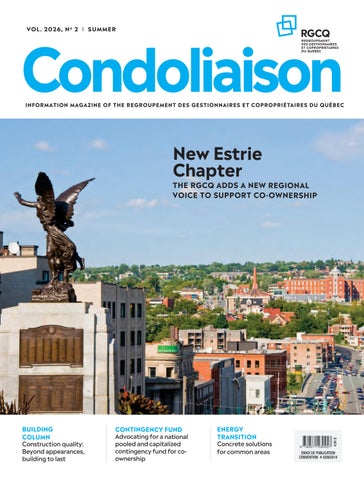
VOL. 2026, N o 2 I SUMMER
Condoliaison
INFORMATION MAGAZINE OF THE REGROUPEMENT DES GESTIONNAIRES ET COPROPRIÉTAIRES DU QUÉBEC
New Estrie Chapter
BUILDING COLUMN Construction quality: Beyond appearances, building to last
CONTINGENCY FUND Advocating for a national pooled and capitalized contingency fund for coownership
ENERGY TRANSITION Concrete solutions for common areas
4,95 $
THE RGCQ ADDS A NEW REGIONAL VOICE TO SUPPORT CO-OWNERSHIP
ENVOI DE PUBLICATION CONVENTION # 42063014
Depuis 1957
SERVICE Chez Desjardins Sécurité du Bâtiment, notre mission est d’assurer votre protection!
24/7
ALARME INCENDIE • INTERCOM • GICLEURÊ DÉTECTEUR CO • CONTRÔLE D’ACCÈS • CAMÉRA
Desjardins Sécurité du Bâtiment vous offre une vaste gamme de services pour vous assurer une protection optimale en tout temps. Vente et service : 514 768-6315 www.dsL ÌÀi> °V Distributeur autorisé
RBQ 2733-8649-71
Condoliaison
Contents
V O L 2 0 2 6 , No2 I S U M M E R
National Editorial Governance becomes an essential asset
4
by Yves Joli-Coeur, Ad. E., president of the RGCQ – Provincial
6
Executive Director’s Editorial Co-ownership undergoing change: supporting a sector in the midst of transformation by Yves Nadon
8
New Estrie Chapter of the RGCQ
16
Bill 20 Two steps forward, one step sideways…
36
Building Column Construction quality: beyond appearances, building to last by Caroline Martel
42
46
Management Accessibility of buildings for people with disabilities Legal Questions and Answers to Avoid Disputes Burden of proof in the event of a loss
Info
RGCQ 60
by Richard Dubé
In partnership with Condolegal.com
Yves Joli-Coeur
Info-Management Column Your questions, answers from our team of expert advisors
62
RGCQ – Montréal Chapter Finding the right information on co-ownership by Yves Papineau, Ad. E.
63
FONDS DE
PRÉVOYANCE
RGCQ – Québec Chapter The dangers of using artificial intelligence by co-owners in conflict with the syndicate’s administration by Michel Paradis, Ad. E.
ET GOUVERNANCE PRÉVOIR I ENTRETENIR I ATTESTER
20
Administration What if contingency funds finally worked for co-owners? Advocating for a national pooled and capitalized contingency fund for co-ownership
64 50
by Yves Papineau, Ad. E.
26
Energy Transition in co-ownership Concrete solutions for common areas
54
New Reference Book by Me Yves Joli-Cœur Contingency Fund and Governance: Plan, Maintain, Certify A new culture of governance is emerging in co-ownership
by Roch St-Jacques
65
Co-ownership Register: The end of “flying blind”? The missing link in Québec’s reform
Management Column When can a provisional administrator be appointed? by Richard LeCouffe
58
What to do when co-owners leave their belongings lying around? A short guide to managing abandoned items in common areas
RGCQ – Estrie Chapter Directors of co-ownership properties: between burnout, recognition and the need for support by Stéphanie Caron
in collaboration with Hydro-Québec
32
RGCQ – Outaouais Chapter What if co-ownership became an opportunity rather than a concern?
66
Final Word Advocating, educating, supporting: the RGCQ’s latest initiatives
Condoliaison I SUMMER 2026
3
N A T I O N A L
Condoliaison
E D I T O R I A L
Regroupement des gestionnaires et copropriétaires du Québec Provincial — RGCQ Provincial
Governance Becomes an Essential Asset
1200, avenue McGill College, bureau 1500 Montréal (Québec) H3B 4G7 T : 514 916-7427 www.rgcq.org Executive Director RGCQ Yves Nadon Magazine Direction Gabrielle Tournier
by Yves Joli-Coeur, Ad. E.,
president of the RGCQ Provincial
Q
uébec divided co-ownership is currently undergoing a period of transformation. The new governance rules require syndicates to plan better, manage better and protect their immovables more effectively. The maintenance logbook, contingency fund study and certificate attesting to the condition of the immovable have become essential tools. The new obligations may seem highly technical, but their impact remains very concrete. They will transform the way immovables are managed and, above all, the way they are perceived on the market. In the long term, the quality of a co-ownership property’s management will increasingly be reflected in the value of its units. A wellmanaged immovable, with a complete and upto-date maintenance logbook and a properly planned and funded contingency fund, will inspire confidence. Conversely, a poorly managed property, where work is constantly postponed and finances remain uncertain, will increasingly be perceived as a risk factor. A risk for buyers, financial institutions and insurers will ultimately be reflected in their decisions. In this context, the role of real estate brokers will become even more important. They will no longer be able to simply sell a co-ownership property by highlighting its location or appearance. They will also have to understand these governance rules and explain to their clients the actual situation of the co-ownership property they are considering: the quality of its management, planned work, level of funding in the contingency fund. This is a significant responsibility, as their 4
Condoliaison I SUMMER 2026
Coordination Jade Serbah
advice directly influences transaction security and buyer protection. The same applies to co-ownership managers. Their role of demanding rigour has become more important than ever. They must master all of these new governance tools and understand their impact on board decisions. Management based on guesswork is no longer acceptable today. It must now be structured, rigorous and informed. Why such increased requirements? Because the decisions made by directors of syndicates have long-term consequences. Poor planning can lead to accelerated deterioration of building components, unforeseen costs and conflicts among co-owners, and even a loss in the value of units. Conversely, sound governance protects the collective building stock and ensures greater financial stability. It is in this spirit that our new books are being published this fall. They are intended to provide practical tools for governance. One addresses the maintenance logbook, contingency fund study and other governance measures in order to better understand how they work and plan more responsibly. The second is a third edition, in the Tout ce qu’il faut savoir series, dealing with work in co-ownership. Its concrete approach is intended to better guide their execution. The objective of these publications is simple: to help stakeholders adapt to the new reality of divided co-ownership. The message is clear: the value of a coownership unit is no longer determined solely by what can be seen. Its governance also matters in the background.
Editoriale Board Me Michel Paradis Gabrielle Tournier Jade Serbah Hélène Joli-Coeur Richard LeCouffe, révision juridique Caroline Martel Véronique Martel Editorial team Caroline Martel Véronique Martel Jade Serbah Richard LeCouffe Linguistic Editing and Layout Proofeading Frédérique LeBlanc Advertising Diane Ménard – d.menard@rgcq.org Graphic Production Bernard Lamy – blamylamy@gmail.com Sophie Bellemare Translation Laurent Dion Printing and distribution Imprimerie Solisco inc. Scott (Québec) Deposit: Bibliothèque et archives nationales du Québec et du Canada Envoi de publication convention # 42063014
Gestion et réalisation de projets complexes en copropriété Newsam Construction accompagne les syndicats de copropriétaires et leurs gestionnaires dans la gestion et la réalisation de projets structurants, notamment en contexte de sinistres ou de travaux majeurs. Ces mandats exigent une coordination rigoureuse des intervenants, une maîtrise des coûts et des échéanciers, ainsi qu’une exécution conforme aux attentes des copropriétaires. Notre approche repose sur une expertise technique éprouvée et une communication claire avec les divers intervenants. Nos champs d’intervention comprennent notamment : La gestion de sinistres majeurs (dégâts d’eau et incendies) La réalisation de projets majeurs en copropriété La coordination avec les assureurs et les autorités compétentes La gestion des budgets, des échéanciers et des exigences réglementaires Notre division extérieure chez Newsam est également experte en projets extérieurs pour les copropriétés et les toits-terrasses. Nous sélectionnons et distribuons des solutions de protection solaire ainsi que des structures architecturales adaptées aux condos, tout en accompagnant nos clients de manière rigoureuse, du permitting jusqu’à l’installation finale.
Par une approche rigoureuse et transparente, Newsam Construction contribue à protéger les intérêts du syndicat, à soutenir les gestionnaires de copropriété et à accompagner les conseils d’administration dans leurs responsabilités.
Contactez Paul Schapira paul@newsam.ca 514 969-8757 Newsam Contruction 316, avenue Victoria, Westmount (Québec) H3Z 2M8 514 484-5020 www.newsam.ca
E X E C U T I V E
D I R E C T O R ’ S
E D I T O R I A L
Co-ownership in Transition:
Supporting a Market Undergoing Major Transformation by Yves Nadon,
Executive Director, RGCQ Provincial
Québec’s co-ownership market is currently undergoing a pivotal period.
L
ong perceived as a simple and accessible form of housing, co-ownership is now facing increasingly complex issues that affect both directors and volunteers, managers, co-owners and the professioals who work with them. In recent years, several regulatory and legislative changes have transformed syndicate management practices. The gradual introduction of obligations related to the maintenance logbook, contingency fund study, transparency and sound financial governance reflects a significant step forward in protecting the collective building stock. However, these new requirements also bring their share of challenges. Throughout Québec, we have observed that several syndicates, particularly smaller co-ownership properties, have limited resources to meet these new responsibilities. Issues related to aging buildings, rising maintenance costs, insurance and the shortage of specialized labour create significant pressure on boards of directors and co-owners. In this context, the RGCQ’s role has never been more essential. Our vision is clear: to support all of our members, regardless of their circumstances, the size of their building or their level of knowledge of co-ownership.
6 Condoliaison I SUMMER 2026
Whether we are speaking to a small syndicate, a residential tower, a professional manager or a coowner seeking to better understand their rights and obligations, we believe everyone deserves reliable information, training and quality support. The RGCQ also seeks to actively contribute to discussions on the future of co-ownership in Québec. Today’s challenges require greater collaboration among the various stakeholders in the sector, including syndicates, professionals, municipalities, governments and economic partners. Our objective is to participate in developing a sustainable co-ownership model that is transparent and better equipped for the decades ahead. Beyond legal obligations, we believe above all that coownership must remain a healthy and well-managed living environment. This requires prevention, education, long-term planning and the development of a responsible governance culture. The coming years will be decisive for the future of co-ownership in Québec. The RGCQ intends to continue its mission with rigour, openness and proximity in order to support its members through this important transition. Because ultimately, a well-supported coownership property is a stronger, more stable property that is better prepared for the future.
VOTRE GUICHET UNIQUE POUR TOUT BESOIN JURIDIQUE EN MATIÈRE DE COPROPRIÉTÉ
Votre déclaration de copropriété est-elle devenue désuète? Par Me Chloé Gélinas-Forster et Me Clarisse Menassa, notaires La déclaration de copropriété constitue la pierre angulaire de toute copropriété. Elle encadre les droits et obligations des copropriétaires, les pouvoirs du conseil d'administration ainsi que les règles de fonctionnement de l'immeuble. Or, de nombreuses déclarations ont été rédigées il y a plusieurs décennies et n'ont jamais été révisées malgré les importantes réformes qu'a connues le droit de la copropriété.
Pourquoi mettre à jour ma déclaration de copropriété? Parce que le droit de la copropriété a connu une véritable transformation au cours des dernières années. Depuis 2018, pas moins de huit modifications législatives et deux règlements majeurs sont venus modifier les règles applicables aux syndicats de copropriétaires.
Me Chloé Gélinas-Forster cgelinasforster@duntonrainville.com 450 686-8683
Dans bien des cas, les déclarations de copropriété rédigées avant ces réformes ne reflètent plus adéquatement les obligations actuelles du syndicat ni les réalités modernes de gestion. Une mise à jour permet donc d'intégrer ces changements et d'assurer une meilleure cohérence avec le cadre juridique actuel.
Faut-il nécessairement réécrire toute la déclaration? Elle permet notamment :
de supprimer les clauses devenues désuètes, abusives ou incompatibles
Me Clarisse Menassa cmenassa@duntonrainville.com
avec la législation actuelle;
450 686-8683
et facile à consulter.
Votre déclaration de copropriété a-t-elle besoin d'être révisée… ou ignorez-vous simplement si elle devrait l'être?
de moderniser la terminologie et la rédaction; d'intégrer les nouvelles dispositions législatives; d'incorporer les modifications et les règlements adoptés au fil des années; de regrouper l'ensemble des règles dans un document unique, cohérent
Bon à savoir Une déclaration de copropriété est un document évolutif. Même lorsqu'elle demeure conforme à la loi, il peut être opportun de la mettre à jour afin d'intégrer les nouvelles réalités de gestion de l'immeuble ou les orientations souhaitées par les copropriétaires. Toute modification doit toutefois être approuvée selon les majorités prévues par la loi.
Plus que jamais, Dunton Rainville est LE cabinet de confiance pour tout service juridique en matière de copropriété.
L'équipe de Dunton Rainville accompagne les syndicats de copropriétaires dans la révision, la modification et la réécriture de leurs déclarations de copropriété. Communiquez avec Me Chloé Gélinas-Forster ou Me Clarisse Menassa afin d'obtenir une évaluation de votre déclaration de copropriété.
RGCQ I Association Life
New RGCQ Estrie Chapter
A New Regional Voice to Support Coownership by Caroline Martel
The Regroupement des gestionnaires et copropriétaires du Québec is continuing its regional development with the official opening of its new Estrie Chapter (RGCQ – Estrie Chapter). Officially launched on October 17 in Bromont before more than 120 participants, this new chapter aims to better support the region’s co-owners, directors and managers, while taking into account the specific realities of Estrie’s building stock.
8
Condoliaison I SUMMER 2026
Estrie: a new chapter to support the evolution of co-ownership This highly anticipated event created an ideal opportunity for discussion, networking and training devoted to the current challenges facing coownership, in a context marked by the coming into force of several new legislative and regulatory obligations. At the helm of the chapter, Me Alexandre Dumas expressed his desire to build an organization rooted in the local community, attentive to needs on the ground and focused on providing information, raising awareness and support. “Our first role will be, above all, to disseminate information and support co-owners in understanding the challenges of co-ownership,” he emphasizes.
DU CONSEIL À LA COUR
Me Yves Papineau
Me Maxime Laflamme-Leblond
Me Karl Michel
Me Philippe Gagnon-Marin
Me Olivier Charbonneau
Consultation et formation | Médiation et arbitrage | Représentation devant les tribunaux Présidence d’assemblées | Recouvrement des charges communes | Assemblées de transition Modification de la déclaration de copropriété
L’équipe LJT a le plaisir de vous présenter la 4e édition du Manuel de gestion d’un syndicat de copropriété divise au Québec de Me Yves Papineau Cette 4e édition contient tous les articles du Code civil à jour au 1er janvier 2026 et les autres lois applicables en plus de la réglementation en vigueur depuis le 14 août 2025 quant au carnet d’entretien, de l’étude du fonds de prévoyance et de l’attestation du syndicat.
Pour commander utilisez ce code «QR»
514 842-8891
LJT.CA
LJT-AVOCATS-LAWYERS
LJTAVOCATS
Development
A NEW REGIONAL VOICE TO SUPPORT CO-OWNERSHIP
New Estrie Chapter of the RGCQ
A REFORM THAT IS TRANSFORMING PRACTICES
EXPERTISE IN THE SERVICE OF CO-OWNERSHIP
The launch of the chapter comes at a time of significant transformation in Québec co-ownership law. Discussions held in Bromont largely focused on the new requirements surrounding the certificate attesting to the condition of the immovable, the maintenance logbook and the contingency fund study. These tools, now at the heart of building management in divided co-ownership, are intended in particular to ensure better planning of major repairs, greater transparency for co-owners and improved financial predictability for syndicates. For Me Dumas, these changes make the RGCQ’s information and support mission more necessary than ever. “Managing a co-ownership property is not the same as managing a house,” he points out. “You have to understand everyone’s rights and obligations.” According to him, several difficulties arise because some coowners perceive their unit as an entirely independent property, without fully grasping the collective responsibilities that come with co-ownership. This dimension of education and support also extends to financial issues, particularly the contingency fund, which is still perceived by some as an unnecessary expense. “A contingency fund does not constitute an expense. It is an investment in the immovable and in the value of everyone’s units.”
A lawyer since 1999, Me Dumas began his career with a small firm in Thetford Mines before joining Dunton Rainville in 2007 to specialize further in litigation, particularly labour and municipal law. Over the years, his practice naturally led him toward real estate and, progressively, co-ownership law. “Through the circumstances of life, with my files ranging from construction defects and real estate disputes to neighbourhood disturbances, co-ownership law gradually became an important part of my practice,” he explains. The publication of a book on short-term rentals in Québec in 2017 helped raise his profile and expertise in the public sphere. Then, in 2019, following the merger of his firm with Sherbrookebased Therrien Couture Joli-Cœur, he decided to settle in Estrie, a region with which he already had strong personal ties. It was following his collaboration with Me Yves Joli-Cœur, who had become a partner in Dunton Rainville a few years later, that he became more directly involved with the RGCQ and helped create the new regional chapter.
Although the major challenges facing co-ownership remain similar throughout Québec, their application takes on a different character in Estrie. The region has a particularly large number of small co-ownership properties, often consisting of ten to fifteen units, far removed from the large complexes found in Montréal or Québec City. “There is a large proportion of these small co-ownership properties,” notes Me Dumas. “Very large towers, like those found in downtown Montréal or Île-des-Sœurs, are virtually nonexistent here.” Another important characteristic is that many Estrie co-ownership properties originated as vacation or resort properties, particularly during the 1980s and 1990s. Today, this reality is rapidly evolving. “At the time, many people came here for a condo or a cottage. Now, many people live here year-round. Owners have aged, lifestyles have changed, and this sometimes creates very different realities between those who live here permanently and those who are here only on weekends.”
Me Alexandre Dumas Lawyer, President of the RGCQ - Estrie Chapter
10
Condoliaison I SUMMER 2026
A DISTINCTLY ESTRIE REALITY
New Estrie Chapter of the RGCQ
Development
A NEW REGIONAL VOICE TO SUPPORT COOWNERSHIP
This transformation brings its share of challenges: shared responsibilities, building maintenance, financial management and the adaptation of declarations of coownership that are sometimes poorly suited to today’s realities. In a region where many buildings date from the 1980s and 1990s, issues related to building maintenance and insurance are also becoming increasingly important. “There are many older co-ownership properties, and insurance issues are becoming significant. Plumbing problems or a lack of maintenance can have major consequences.”
A CHAPTER FOCUSED ON PROXIMITY AND COLLABORATION In the short term, the Estrie Chapter intends above all to raise awareness among co-owners, managers and professionals working in the co-ownership sector. “We are really in a mode where we first want people to know that we exist,” explains Me Dumas. The chapter also intends to highlight the many resources already offered by the RGCQ: training sessions, conferences, webinars, practical tools and specialized content. For small coownership properties, which are often more isolated or less structured, access to this information can be particularly valuable. “Our added value is to be a source of information and a reference for co-owners.” The chapter’s current board of directors is made up of ten directors from a variety of professional backgrounds, and recruitment is continuing to ensure an even broader representation of the sector. “We do not want to be just a group of lawyers discussing legal concepts,” Me Dumas jokes.
On change le monde un syndicat à la fois
The chapter already includes expertise in law, management, real estate brokerage and notarial law. The team would also like to welcome professionals from the insurance, building inspection and real estate maintenance sectors. This desire for collaboration is also reflected in Me Dumas’s preferred leadership style. “I see myself more as a coordinator or conductor. I want everyone to have a concrete role and to contribute according to their strengths and interests.”
A NETWORK SET TO GROW Founded more than 30 years ago, the RGCQ now represents nearly 100,000 housing units across Québec and acts as an important voice with public authorities on co-ownership issues. The creation of the Estrie Chapter will help bring the organization closer to regional realities and foster the sharing of expertise among directors, managers and industry professionals. The strong turnout at the Bromont launch demonstrated the growing interest in these issues. Directors of syndicates, managers, lawyers, building professionals, architects and insurance brokers gathered to discuss the very concrete challenges posed by changes to the regulatory framework. Although the Estrie Chapter is only in its early stages, Me Dumas already sees strong potential for development in the region. “A well-run and well-understood co-ownership property has a very promising future.” With this official launch, the RGCQ’s Estrie Chapter aims to become a local regional resource capable of supporting coowners through a rapidly changing environment, one in which information, prevention and collaboration will be more essential than ever.
Rapports explicatifs envoyés aux administrateurs lors des déplacements de nos gestionnaires Communications constantes avec les copropriétaires et les administrateurs Rédaction d’études de fonds de prévoyance et de carnets d'entretien avant-gardiste
12
Condo Stratégis inc. 514. 508-6987 samuel.grondin@condostrategis.ca
Culture d'entreprise de perfectionnement continu Nous remettons en question le statu quo
82, rue de Brésoles, Montréal (Québec) H2Y 1V5
www.condostrategis.ca
Condoliaison I SUMMER 2026
PROTECTION CONTRE LES DÉGÂTS D’EAU
IL N'Y A PAS DE MEILLEURE ASSURANCE QUE VIGILANCE Ce ne sont pas des mots en l’air. Nous nous appuyons sur plus de 20 ans d’expérience en protection contre les dégâts d’eau pour recommander le système NOWA 4S, le plus fiable sur le marché, et vous garantir une expérience d’installation absolument sans faille.
10 000 valves installées 75 000 détecteurs Prise en charge totale Expérience client 5 étoiles Une entreprise qui regroupe trois générations
Installateur certifié
Demandez une soumission gratuite. 1-866-522-7911 | legroupevigilance.com
Meet the inspiring new directors of the Estrie Chapter
et
Stéphanie Caron
Francine Poirier
Director, Project Management and Client Experience Proximmo
Real Estate Broker RE/MAX
An associate at Gestion Proximmo for more than three years, Stéphanie has been based in Bromont since 2007. With a certificate and diploma in Business Administration from the Université de Sherbrooke, she draws on a diverse background, including work in event management in Montréal before holding the position of Director of Human Resources for a regional SME. Today, a professional co-ownership manager and member of the board of directors of the RGCQ – Estrie Chapter, she is recognized for her people-oriented approach and rigorous client service. She favours listening, transparency, challenging the status quo and simple solutions to ensure sound management of your co-ownership property.
Me Stéphanie Sherrer Independent Notary
Me Stéphanie Sherrer has been a notary since 2018 and an accredited mediator since 2021. She completed her law studies at the Université de Sherbrooke and holds a master’s degree in law from the Université de Montréal, where she focused her research on mediation in the context of divided co-ownership. Since 2021, she has taught divided coownership in the Eastern Townships as part of the notarial innovation hub at the Université de Sherbrooke’s Faculty of Law. She will begin her doctoral studies this fall.
Hugues Ouellette
Hélène Vallerand
Me Corinne Lepage
Director, Financial and Technical Management Proximmo
President and Executive Director Laucandrique
Notary Therrien Couture JoliCœur
Hugues stands out for the in-depth expertise he has acquired over many years in the real estate sector. A graduate of HEC Montréal in 2004, he has managed a wide range of residential, commercial and institutional properties, both on his own behalf and for major developers in the Montréal area. His career has led him to design, build and manage complex real estate projects, making him a valuable resource in both technical and administrative matters. A Certified Co-ownership Manager with the RGCQ-OQAM designation and a member of the Ordre des administrateurs agréés du Québec (Adm.A.), Hugues brings rigour and exceptional professionalism to every mandate.
14
Francine Poirier has been a real estate broker under the RE/MAX Estrie banner since 2007. A member of the RGCQ, she is actively involved on the board of directors of the Chambre immobilière Estrie – Mauricie – Centre du Québec, where she has served for three years. Committed and rigorous, she puts her expertise at the service of advancing the profession. Her primary objective is to contribute to ethical practices, better inform consumers and protect the public. Through her involvement, she seeks to strengthen trust in real estate brokerage and support a solid and sustainable professional framework in a constantly evolving market.
New Estrie Chapter of the RGCQ
Condoliaison I SUMMER 2026
A real estate manager specializing in co-ownership for nearly 40 years, Hélène Vallerand has been co-founder and president of Gestion immobilière Laucandrique since 1996. Throughout her career, she has favoured innovative management methods focused on the shared interests of co-owners. She is also actively involved with various organizations dedicated to improving industry standards and governance rules.
Since 2023, in Sherbrooke, she has advised a diverse clientele on real estate transactions, commercial matters, financing and corporate law. Driven by a spirit of collaboration and commitment to her community, Me Mélanie Lepage wishes to contribute actively to the development and influence of the RGCQ – Estrie Chapter. Rigorous and approachable, she places great importance on supporting her clients in their projects with determination, clarity and humanity. A graduate of the master’s program in notarial law at the Université de Sherbrooke, she is also involved with the next generation of professionals, notably as a volunteer supervising notarial trainees.
2026G288
Jusqu’à
6 700 $
de subvention
Augmentez la valeur de votre propriété et votre confort avec le programme LogisVert. Découvrez les mesures admissibles à : hydroquebec.com/logisvert
Économisez argent et énergie à l’achat d’une thermopompe efficace.
Bill 20
TWO STEPS FORWARD, ONE STEP SIDEWAYS… Martin Lirette Chargé de Projet et copropriétaire
by Richard LeCouffe
S Téléphone : 418-847-5556 p104 Cellulaire : 418-953-0612 martin@ventilation-ncv.com Sans frais : 1 800 567-5557
VOTRE PARTENAIRE DE CONFIANCE
Danielle Macpherson présidente
70, de la Barre Bureau 114, Longueuil QC J4K 5J3 Tél.: 450 444-2868 Fax : 450 674-5826 dmac@gestior.com www.gestior.com
16 Condoliaison I SUMMER 2026
ix months after the coming into force of thegovernment regulation making the maintenance logbook and contingency fund studies mandatory for syndicates of cownership, a new bill has disrupted the universality of these newly introduced measures. A degree of disbelief was therefore understandable when Bill 20, An Act to promote access to home ownership by amending various provisions concerning the residential sector, was introduced in the National Assembly of Québec by the Minister responsible for Housing, Caroline Proulx, on February 11, 2026. The bill would, in effect, amend sections 1070.2 and 1071 of the Civil Code of Québec so that a syndicate of coownership could be exempted from maintaining a maintenance logbook or obtaining a contingency fund study “in the cases prescribed by government regulation.” Although no details are currently available regarding the characteristics of the co-ownership properties that would be exempted, there is every reason to believe that smaller properties would be targeted. But how many private portions would these exemptions apply to? What other criteria might be used to justify an exemption? During the special consultations and public hearings of the Committee on Planning and the Public Domain, held on March 26 and 31, 2026, the RGCQ argued that Bill 20 was taking the wrong approach. By exempting certain types of immovables from the asset preservation principle established by Bill 16 and its implementing regulation, through the maintenance logbook and contingency fund study requirements, the legislator risks creating two categories of co-ownership properties, thereby compromising both the uniformity of the regulatory framework and the protection of certain buyers and co-owners. Co-ownership properties come in a wide variety of configurations, ranging from paired houses, ranging from simple duplex-type structures with two private portions to large complexes comprising dozens of storeys. However, even smaller co-ownership properties may include common components that are essential to the building’s maintenance and are preserved by the syndicate. In the case of paired houses, for example, these may include exterior parking areas, drainage systems, water service entrances, or even roofs,
La nouvelle référence en prévention de dégâts d'eau pour les syndicats de copropriété
Inspection en 20 points essentiels pour chaque unité de la copropriété
Identification rapide
des unités nécessitant une intervention corrective immédiate Rapport individuel envoyé
à l'intérieur de 48 heures
Inspectez. Prévenez. Protégez Pour informations infos@vigilo-inspection.ca
438 507-8239 www.vigilo-inspection.ca
Programme d’inspection préventif aux dégâts d’eau
Bill 20
TWO STEPS FORWARD, ONE STEP SIDEWAYS...
including whose repair cannot be left to the discretion of each co-owner without risking the integrity of the building, its watertightness, or its architectural consistency. In such a context, the ability of the regulatory authority to clearly define, in a general and abstract manner, one or more categories of immovables that would justify an exemption remains highly uncertain. The risk is significant that exemptions designed in this way would be based on artificial distinctions, disconnected from reality, thereby undermining the fundamental mission of the syndicate. Moreover, by exempting certain co-ownership properties (yet to be determined) from the obligation to maintain a maintenance logbook or obtain a contingency fund study, Bill 20 would establish a two-tier contingency fund system, since all syndicates, “based on the estimated cost of major repairs and replacement of common portions,” must make contributions to that fund. For which types of co-ownership properties could syndicates set the required contributions to ensure the preservation of the immovable without a contingency fund study and a maintenance logbook providing a reliable picture of the condition of the immovable?
AN OPENNESS TO CONSIDERING CERTAIN EXEMPTIONS The RGCQ is not opposed to some flexibility in these obligations. However, we believe that the principle of a maintenance logbook and a contingency fund study must be preserved. The legislation could, however, allow an exemption in certain cases based on an individualized and justified professional assessment. Of course, such cases should first be governed by very strict criteria and concern only coownership properties with the simplest configurations, with very little, if any, common infrastructure. Moreover, the very principle of preserving the immovable and protecting buyers and co-owners would be maintained.
WHAT’S NEXT FOR BILL 20?
18 Condoliaison I SUMMER 2026
Following the departure of Premier François Legault and the extension of the parliamentary session at the National Assembly of Québec, Bill 20 is currently on hold as of April. It was nevertheless placed back on the Order Paper on May 6, 2026, by the new Minister responsible for Housing, Karine Boivin-Roy, and may therefore be abandoned by the government and ultimately die on the Order Paper in June. The idea of exempting certain categories of co-ownership properties from the obligation to maintain a maintenance logbook or obtain a contingency fund study may therefore be postponed. However, this would only be a temporary reprieve. The legislator could choose to revisit the issue in the future. In such a case…
Vous gérez beaucoup de portes ? Profitez d’une équipe dédiée pour une vrai tranquilité. RABAIS ENTENTES GROUPÉES* À partir de 6 unités.
Membres RGCQ
Équipez-vous d’un détecteur de fuites d’eau AKWA Technologies.
Coupure automatique de la valve d’eau Notification immédiate par courriel ou texto Rabais accordé sur certaines primes ou assurances
Contactez notre équipe d’experts
Membre
1 877 326-0606 poste 4228 ententegroupee@hydrosolution.com *Sur les territoires desservis par HydroSolution seulement. Ne peut être jumelée à aucune autre offre. RBQ : 8324-3550-12
Remplacez votre vieux chauffe-eau par un modèle plus durable qui réduit les risques de fuites d’eau.
Administration
What if contingency funds finally worked for coowners? ADVOCATING FOR A NATIONAL POOLED AND CAPITALIZED CONTINGENCY FUND FOR CO-OWNERSHIP By Me Yves Papineau, Ad. E.,
Lawyer emeritus and partner at LJT Avocats Director of the RGCQ – Provincial and Montréal Chapter
T
he reform of co-ownership law is no longer a distant prospect. It is now part of the daily reality of syndicates of co-ownership. With the coming into force of the regulation implementing Bill 16, boards of directors must now have a maintenance logbook and obtain a contingency fund study in order to plan major repairs and the replacement of common portions over a 25-year period. This is no small matter. It is, in itself, a major financial challenge for many co-ownership properties. However, this observation raises another issue that has received little attention to date: the financial management of the amounts allocated to co-owners’ contingency funds. Indeed, for many years, the investments in which contingency fund amounts are deposited have offered only very limited returns, which do not even offset the cost of inflation. Syndicates therefore cannot benefit from the fruits of their capital, sometimes considerable, on the pretext that a legal or moral person cannot be entrusted with such responsibility because they had no choice, as the law required it. 20 Condoliaison I SUMMER 2026
POSSIBILITIES OPENED UP BY BILL 16 From now on, the contingency fund must be “partly liquid, available in the short term, and its capital must be guaranteed.” These words are of considerable importance. “Partly liquid, available in the short term” makes it possible to spread the amounts held in the contingency fund over the period covered by the contingency fund study. Since certain replacements may only become necessary after five, ten, fifteen, or twenty years, investments can therefore be made over relatively long periods, while maintaining a safety margin to cover major repairs or unexpected replacements. It is well known that the longer the investment horizon, the greater the potential for higher returns, and therefore the more profitable the investment generally is than a short-term investment. “The capital must be guaranteed” reflects the legislator’s intention to protect the amounts by requiring that no investment place the coowners’ collective funds at risk. This new element complicates the issue of investments, which guarantee very rarely both the capital invested and a potentially high return. These requirements would therefore appear to be difficult to reconcile, and it is worth examining the issue of this requirement more closely: what exactly is the required guarantee?
Administration
WHAT IF CONTINGENCY FUNDS FINALLY WORKED FOR CO-OWNERS?
To date, deposit protection also has its limits. The Canada Deposit Insurance Corporation and the Autorité des marchés financiers du Québec guarantee deposits only up to $100,000 per accredited institution. If this is the only guarantee that satisfies this obligation, syndicates would be forced to limit not only the size of each financial institution they deal with, since no case law or judicial interpretation confirms that funds deposited with financial institutions would be protected up to $1,000,000 in the event of fraud, bankruptcy, or otherwise. In such cases, directors could be held personally liable for a poor investment. In the absence of clear judicial interpretation of the capital guarantee requirement, directors must therefore act prudently, diversify the financial institutions used, and document their decisions. However, this requirement for prudence should not condemn syndicates to inefficiency.
AMOUNTS TO BE PAID INTO THE CONTINGENCY FUND For too long, many syndicates believed that a contribution equal to 5% of common expenses was sufficient, even though this was merely a minimum and certainly not a serious planning method. We can no longer ask benevolent directors to become investment specialists. Bill 16 now requires syndicates to face reality. How much will the work cost? When will it have to be carried out? How much must be billed, year after year, so that tomorrow’s co-owners do not bear the accumulated wear and tear of yesterday? This represents a necessary step forward. But this is where a problem arises. If syndicates are required to accumulate more money in their contingency funds, we must also consider what will be done with those amounts between the time they are deposited and the time they must be used. In reality, contingency fund studies will reveal significant needs, often greater than co-owners had imagined. Contributions will therefore have to increase. Syndicates will accumulate more money. And if we do nothing other than leave these amounts in low-yield accounts, we are once again imposing on financial institutions a privilege that this law does not give them, without syndicates, co-owners, or the Québec economy receiving their fair share.
POOLING ALL CONTINGENCY FUNDS AND MAKING THEM GROW This leads to the idea, which deserves serious consideration, of a national, pooled and capitalized contingency fund.. The principle is simple. Rather than leaving each syndicate to act alone, with limited resources, varying levels of knowledge, and often 22 Condoliaison I SUMMER 2026
little bargaining power, the amounts allocated to contingency funds could be invested in a collective vehicle, regulated by the government and managed by professionals, expressly structured to comply with the obligations of the Civil Code of Québec: guaranteed capital, partial liquidity, and availability based on the foreseeable needs for work, with funds allocated exclusively to major repairs and the replacement of common portions. Taken separately, each syndicate has limited bargaining power. However, once pooled, the amounts contained in the contingency funds of Québec co-ownership properties would constitute considerable capital. The purpose of creating a national pooled fund would be precisely to transform this dispersion into collective strength, whether in terms of professional management, greater bargaining power, an investment policy tailored to syndicates’ legal obligations and, ultimately, better potential returns than those a syndicate can generally obtain on its own. This would not mean confiscating syndicates’ money. Nor would it mean creating a tax or a new government program financed by co-owners. The contingency fund would remain the property of each syndicate. The board of directors would retain responsibility for determining how it is used in accordance with the law. The capital would simply be managed within a common framework that is more robust, more professional, and likely to provide returns that the majority of syndicates cannot obtain individually. In practical terms, a syndicate whose contingency fund study provides for work in three, ten, and fifteen years would not invest all its money in the same way. The liquidity required and the amounts needed in the short term would remain readily accessible. Amounts intended for more distant work could be invested over a longer horizon, within a collective framework and under an investment policy tailored to syndicates’ obligations. This is precisely where the value of a pooled approach lies. mutualisée. UA syndicate acting alone, even with sound advice, remains a small institutional investor. It must maintain multiple accounts, verify guarantees, understand the limits of applicable deposit protection, monitor maturity dates, compare products, negotiate terms, explain its choices to co-owners, and bear the risk of a poor decision. Volunteer directors are not investment professionals. A national pooled fund would reverse this logic. Syndicates would no longer have to improvise. They would benefit from a structure designed specifically for them, with governance rules, periodic reporting, accountability mechanisms, fees that are known in advance, an investment policy tailored to the legal framework governing co-ownership, and professional risk management. The impact would be considerable. For syndicates, a better return could reduce pressure on coowners’ contributions, or at least prevent them from increasing unnecessarily.
LA RÉFÉRENCE POUR LES RECOURS EN VICES CACHÉS ET VICES DE CONSTRUCTION
POUR OBTENIR L’HEURE JUSTE.
www.lanelegal.com
Administration
ÉVALUATEURS AGRÉÉS Valeur assurable (LOI 141) Étude de fonds de prévoyance et carnet d’entretien (LOI 16)
ÉVALUATEURS AGRÉÉS
COMPTEZ SUR UNE ÉQUIPE MULTIDISCIPLINAIRE DYNAMIQUE ET INTÈGRE Laval
Ville de Québec
400 # 204, boul. du Curé-Labelle 1020 #400 rue Bouvier Laval (Québec) H7V 2S7 Québec (Québec) G1X 0K9 514 840-9710 581 502-3265
24 Condoliaison I SUMMER 2026
WHAT IF CONTINGENCY FUNDS FINALLY WORKED FOR CO-OWNERS?
We should not promise miracles, because the work will still have to be paid for and co-owners will still have to contribute. But every dollar earned by the fund is one dollar that will not have to be collected later through additional contributions. For co-owners, the effect would also be psychological. It is easier to accept an increased contribution when one can see that the money is actually working for the immovable, rather than lying dormant for the benefit of the banking system. The contingency fund would then cease to be perceived as a burdensome obligation. It would become a tool of prudent asset protection. For directors, pooling would also reduce the temptation, which is still common, to dip illegally into the contingency fund to cover a shortfall in the operating account. When the fund produces an identifiable return, when it is monitored and structured, and when it is allocated to planned work and presented as genuine collective capital, it becomes more difficult to treat it as a mere reserve of liquid assets.
A PROMISING VISION FOR QUÉBEC Finally, for Québec, the issue goes beyond the management of a few buildings. Co-ownership has become a major form of housing in Québec. It can no longer be managed using financial tools designed for another era. If the government requires syndicates to plan more effectively, it should also provide them with a mechanism to help the money they are required to accumulate work more effectively. We have been able to create collective institutions to manage significant capital, finance economic development, and protect the future. There is no serious reason why co-ownership properties should be excluded from this discussion. Just consider the Québec Pension Plan, pension funds, the Québec deposit and investment system, or even the FTQ Solidarity Fund, all of which offer returns far exceeding the rates currently available to co-ownership properties. The contingency funds of Québec co-ownership properties collectively amount to hundreds of millions of dollars, and possibly more as the new studies become mandatory. This money already exists. It belongs to syndicates. It is intended to maintain an important part of Québec’s real estate stock. Why not allow it, in the meantime, to also contribute to Québec’s economy within a prudent, guaranteed, and sustainable framework? A national pooled contingency fund would not solve every problem, but it would address a major issue: why leave hundreds of millions of dollars inactive when they could be pooled, secured, better managed, and used for the benefit of co-owners and Québec’s economy? These questions, it seems to me, answer themselves.
Assurance Condo Un programme d’assurance de copropriété exclusif Nouveau programme disponible pour les syndicats de copropriété de 25 unités et moins En tant que chef de 昀le en courtage d’assurance condo, BFL CANADA propose un programme d’assurance spécialement conçu pour répondre aux besoins des syndicats de copropriétés, o昀rant des couvertures d’assurance uniques et exclusives. Adhérez à ce programme et pro昀tez gratuitement de nombreux services exclusifs : — Prix avantageux; — Courtiers spécialisés en assurance de la copropriété; — Remboursement des frais du gestionnaire lors des sinistres couverts; — Service d’accompagnement par un expert en sinistre pour vos réclamations et sinistres sous franchise, incluant un suivi personnalisé de vos droits et obligations, une assistance dans vos démarches auprès des assureurs, et un suivi de l’évolution du règlement a昀n de réduire les délais; — Optimisation des chances pour le syndicat de recouvrer la franchise auprès de la partie fautive; — Participation aux rencontres virtuelles avec les copropriétaires.
On vous assiste au-dessus et en-dessous de votre franchise dans les règlements des sinistres.
Pour plus d’information, communiquez avec : Patrick Beauvais Courtier en assurance de dommages Vice-président, directeur d’unité – Immobilier Québec T. (514) 904-4434 pbeauvais@b昀canada.ca
BFL CANADA services de risques et assurances inc. | b昀canada.ca |
The energy transition can seem vast, technical, and sometimes even abstract
F
Energy transition in co-ownership: concrete solutions for common areas Article in collaboration with Hydro-Québec by Véronique Martel First article in a two-part series, this one focuses on common areas. The next article will focus on private portions.
26
Condoliaison SUMMER 2026
or syndicates of co-ownership, however, it becomes very concrete as soon as it comes time to replace a heating system, rethink the ventilation of a garage, modernize lighting in common areas, or plan work included in the maintenance logbook. It is with this in mind that Hydro-Québec and the RGCQ have established an initial collaboration aimed at better promoting programs, tools, and services available to coownership properties. “The objective is to raise awareness of the programs offered by Hydro-Québec among RGCQ members, inform people about the subsidies available to co-owners and syndicates of co-ownership,” explains François Baron, Business Development and Partnerships Delegate with Hydro-Québec’s Business Client Relations and Energy Expertise Division. This approach is all the more relevant given the size and longevity of the co-ownership housing stock. According to François Baron, the average age of coownership buildings is approximately 30 years. Several syndicates must therefore replace equipment. “As long as they have to do it, they might as well take advantage of the available subsidies, adopt more efficient equipment, and optimize occupant comfort,” he summarizes. On the RGCQ side, the objective of this partnership is clear: to facilitate access for syndicates of co-ownership to concrete solutions adapted to their needs in order to optimize their energy consumption and improve the management and long-term value of their buildings.
FOCUSING ON COMMON AREAS Of course, Hydro-Québec distinguishes between private portions and common portions. For private portions, the LogisVert residential program applies. For common areas, it is the Solutions efficaces program that becomes the preferred tool. This program is designed to help clients modernize or replace their equipment and systems in order to reduce energy consumption and recurring costs. Hydro-Québec states that certain measures may qualify for financial assistance covering up to 90% of eligible costs, depending on the program’s conditions. In co-ownership properties, the aspects on which efficiency gains can be made are numerous, including heating, air conditioning, ventilation, domestic hot water production, building automation, power demand management, equipment for indoor garages, swimming pools, entrance halls, and other shared spaces. Generally speaking, efficiency gains are concentrated primarily around four elements: heating, air conditioning, air treatment, and lighting.
Protégez votre immeuble, sans même y penser! Ne laissez pas un dégât d’eau mettre en péril votre investissement! Offrez-vous une protection 24/7, même en cas de panne de courant*, avec Sedna Mesh.
Adieu les dégâts d’eau! Sécurité totale Protège l’ensemble des unités et les espaces communs, sans intervention manuelle
Gestion simplifiée Contrôle et suivi en temps réel avec la plateforme Sinopé Smart Systems
Tranquillité assurée Un système fiable et certifié, qui vous aide à préserver votre couverture d’assurance
*Jusqu’à 24 heures d’autonomie en cas de panne de courant, grâce au système d’alimentation sans coupure.
ventes@sinopetech.com Contactez nos experts dès maintenant pour une présentation et une soumission gratuites!
1 855-741-7701, poste 2. sinopetech.com/sedna
Économisez sur votre assurance
Energy transition in co-ownership ARTICLE IN COLLABORATION WITH HYDRO-QUÉBEC
La référence en réfection d’enveloppe de bâtiment. Spécialiste en réfection de maçonnerie et autres travaux de réparation de l’enveloppe de bâtiment.
“Thanks to the simplified offer under the Solutions efficaces program, more than 200 predefined measures can qualify for financial assistance,” emphasizes François Baron. A syndicate can submit a subsidy application using Hydro-Québec’s Solutions efficaces calculation tool (OSE), with or without the assistance of a specialized professional.
THE BUILDING ENVELOPE: AVOID WASTING THE ENERGY YOU SAVE Hydro-Québec also emphasizes an aspect that is sometimes overlooked: the building envelope. “It is probably the area where there are the greatest gains to be made in reducing the building’s footprint,” François Baron notes. There is little point in improving a building’s heating system if, after all, the heat escapes almost immediately. We are then no further ahead. Windows, roofs, walls, penetrations, and other components of the envelope can therefore become strategic elements to incorporate into work planning. For syndicates, the benefit is twofold: reducing energy losses while taking advantage of subsidies and aligning these interventions with the planning obligations arising from Bill 16, particularly the maintenance logbook and contingency fund study. This reflection also takes place within an evolving regulatory context. The Regulation respecting the environmental performance of buildings, sanctioned on March 27, 2024, provides in particular for the possibility of determining which buildings must obtain an environmental performance rating, the applicable calculation methods, and the information that must be disclosed. The regulation also specifies that a divided co-ownership property, the coowner of a building, and the syndicate of co-ownership are themselves subject to the regulation.
ELECTRIC VEHICLES: PLAN BEFORE INSTALLING
Pisciniste spécialisé en copropriétés Odyssée Aquatique vous offre une gammes complète de services pour vos piscines, spas et bassins décoratifs •Entretien •Réparations •Analyses chimiques et bactériologiques •Produits chimiques •Consultation et Formation •Automatisation du traitement d’eau •Rénovations RBQ: 5742-3287-01
28
Condoliaison I SUMMER 2026
CONTACTEZ-NOUS
Charging electric vehicles is another unavoidable reality. Needs are increasing, but installing charging stations in a co-ownership property cannot be improvised. Electrical capacity, power management, cost allocation, compliance of installations, and the syndicate’s responsibilities must all be assessed. Hydro-Québec’s program to support the deployment of charging infrastructure in multi-unit buildings can cover up to 50% of eligible expenses, up to $5,000 per parking space or charging port, with annual limits varying according to the size of the building. Eligible expenses may include electrical infrastructure, professional fees, certain software or energy management systems, as well as the required permits.
CABINET D'AVOCATS ET DE NOTAIRES EN DROIT IMMOBILIER À MONTRÉAL / LAVAL SUCCURSALE MONTRÉAL 1175 Avenue Bernard O, Bureau 301 Outremont (QC), H2V 1V5 T. 514 277-1175 • Fax. 514 277-1172
• Droit de la copropriété • Droit notarial • Droit de la construction • Litige civil et commercial • Arbitrage et médiation • Vices cachés • Baux commerciaux
SUCCURSALE LAVAL 4670 Desserte Sud (A-440), Bureau 130 Laval (QC), H7T 2Z8 T. 450 499-4909 • Fax. 450 499-4399
FISETLEGAL.COM info@fisetlegal.com
Energy transition in co-ownership NOUS SOMMES
ARTICLE IN COLLABORATION WITH HYDRO-QUÉBEC
LES EXPERTS
EN COPROPRIÉTÉS Rapport d’état d’immeuble Plan de gestion de l’actif FonÂs de prévoyance Carnet d’entretien
François Baron nevertheless emphasizes the importance of having proper support: “There are firms specializing in this field. Several of them can guide you in the right direction.”
Taking advantage of Hydro-Québec subsidies for common areas. Where to start? 1. Identify the equipment to be modernized
Cossette & Touchette inc. 5170, rue de Verdun Montréal (Québec) H4G 1N6 514 519-1573 514 768-8141 info@cossettetouchette.com
www.cossettetouchette.com
Heating, ventilation or lighting systems, water heaters, the building envelope, or common-area control systems.
2.
Consult Solutions efficaces
The OSE tool can be used to calculate the financial assistance available for several eligible measures.
3. Seek professional assistance An engineering firm, a master electrician, or an EV charging specialist can help identify the right solutions.
4.
Communicate with co-owners
The energy transition also depends on buy-in, understanding, and collective planning.
Pour les administrateurs, gestionnaires de copropriété et courtiers d’assurances
Formation sur la prévention des dégâts d’eau • Apprenez à identi昀er les sources potentielles de dégâts d’eau • Voyez comment un système de détection peut les prévenir • Découvrez quelles caractéristiques rechercher • Durée de 3 heures (en ligne et en différé) • En anglais ou en français • Formation reconnue par la CHAD, la RBQ, la CMMTQ et la CMEQ • Prix : 120 $
Information : 514 375-4004 ou info@prevcan.org 30
Condoliaison I SUMMER 2026
For François Baron, the course of action is simple: “For common areas, the Solutions efficaces program is available now. Don’t wait!”
FOR RGCQ MEMBER SYNDICATES, PERSONALIZED SUPPORT Hydro-Québec’s teams work with various stakeholders in the real estate sector, including engineering firms, financial institutions, and partners such as the RGCQ, to share information and direct clients toward the right programs. “We have a team in place. Within my team, we are all in contact with the various stakeholders in the real estate sector,” explains François Baron. The partnership with the RGCQ fits directly within this approach of outreach and support. Webinars, conferences, and meetings can be organized to inform members, while syndicates seeking to go further can communicate directly with HydroQuébec. “Customer service is available at all times. If it is for a common area, syndicates, which are business customers, can communicate with their account representative to follow up on their project,” concludes François Baron.
Nettoyage Maxi Clean votre spécialiste du nettoyage des conduits de ventilation!
Conduits et système de ventilation Chauffage et air climatisé Échangeur d’air Tout type de systèmes d’évacuation Conduits de sécheuses et plus !
Service complet sur unité de climatisation mural
Service complet sur système de ventilation
Nettoyage de conduits de sécheuses
Confiez le nettoyage et la décontamination de vos conduits des systèmes de chauffage, de ventilation et de climatisation à une équipe d’experts.
RÉSIDENTIEL - COMMERCIAL - INDUSTRIEL
514 815.6102 - contact@maxiclean.ca www.maxiclean.ca
Management Column
WHEN CAN A PROVISIONAL ADMINISTRATOR BE APPOINTED? A board of directors is mandatory in every divided co-ownership. It is the decision-making body that manages the affairs of the syndicate on an ongoing basis.
by Richard LeCouffe
32
Condoliaison I SUMMER 2026
S
Some co-ownership properties are also managed by a sole director where the declaration of co-ownership so provides, as is the case in many small co-ownership properties. The sole
director then constitutes the board of directors. However, it happens fairly often that no one puts their name forward for a director position at the meeting of co-owners. Situations of deadlock and dysfunction can also arise within certain boards of directors. What should be done when no one volunteers? How can deadlock situations be resolved? Can a provisional administrator be appointed?
WHEN NO ONE VOLUNTEERS It should first be noted that the appointment or election of a director requires that the person agree to hold the position. Such a responsibility cannot be imposed on anyone without their express consent (art. 338 C.C.Q.). There are therefore few options when no one wishes to put their name forward. Hiring a manager, on its own, would not solve the problem. A manager cannot act independently, as decision-making authority necessarily rests with the board of directors. This is unavoidable. Moreover, hiring a manager does not fall within the powers of the meeting of co-owners; doing so would therefore be highly questionable. Article 1084, second paragraph, C.C.Q. provides that a co-owner may apply to the court to appoint or replace a director and determine the terms and conditions of the director’s office where the by-laws are silent or where it is impossible to proceed in the manner prescribed in the declaration of co-ownership. This provision could therefore apply when there is no candidate for the position. However, it makes no reference whatsoever to the concept of a “provisional” administrator. Furthermore, such an application necessarily involves legal costs. The appointed director would also likely have to be remunerated. This is therefore not the best solution. Situations where no one puts their name forward usually arise in the context of the annual meeting of co-owners. This means that one or more directors are still in office. In the absence of candidates, those directors could first insist, in the hope that someone changes their mind and volunteers. They could also remind those present that it is not mandatory to be a co-owner to be appointed as a director, unless the declaration of coownership expressly requires it. The meeting could therefore be adjourned in the hope of finding a candidate, whether a co-owner or not. Failing that, there would need to be a sufficient number of votes to adjourn the meeting so that there is no longer a quorum, if a co-owner requests it (art. 1089, third paragraph, C.C.Q.).
In the event that all the directors resign, it would first be advisable for at least one of them to remain in office for a certain period of time. That person could convene a special meeting for the election or appointment of a new board of directors (or a sole director). This is part of the conservatory acts that a director may carry out after the end of their term of office (art. 341 C.C.Q.). Another possibility is for co-owners representing at least 10% of the votes to appoint one of the directors still in office to convene a special meeting for the purpose of appointing new directors. Article 340 C.C.Q. provides that vacancies on the board of directors do not prevent the remaining directors from acting, provided there is a quorum, and that those directors may validly convene the co-owners. The same could therefore be contemplated for a special meeting. However, the current directors must be sufficient in number, since a lack of quorum on the board of directors would be problematic. In any event, this approach would need to be provided for in advance, such as through an amendment to the building’s by-laws. Otherwise, the declaration of co-ownership could be amended to provide for a mechanism for appointing a new director if the position remains vacant following the meeting of co-owners. The co-owners could be required to make such an appointment at the meeting (art. 352 C.C.Q.). To our knowledge, there is no court decision appointing a provisional administrator under article 1086.4 C.C.Q. in order to resolve a situation where there are no candidates. This article has been used to date in the context of disputes between co-owners. In Danfair v. Kvestanova-Tremblay, 2023 QCCS 2823, the judge rejected the proposal of the commission parlementaire leading to its adoption. It is therefore difficult to justify relying on this provision to resolve situations where there are no candidates for the board of directors. The wording “where circumstances warrant” found in article 1086.4 C.C.Q. applies to situations of deadlock or blockage within the board of directors that lead to serious dysfunction in the coownership. In parliamentary proceedings leading to its adoption, Minister Andrée Laforest also mentioned situations involving exceptional circumstances or an internal conflict. The judges’ discretion, as well as the power to appoint an administrator, must therefore be exercised only in exceptional circumstances. It is not a remedy for a one-time and unique situation.
SITUATIONS OF MAJOR DYSFUNCTION The Civil Code also contains certain provisions aimed at resolving situations of deadlock or blockage within a board of directors.
However, in addition to mediation and arbitration (where applicable), all of these solutions necessarily require the intervention of the court. Art. 341, first paragraph: if an impediment or systematic opposition by certain directors prevents the board of directors from acting in accordance with the rules of management of a legal person, the other directors may act alone for conservatory acts. They may also, if they are so authorized by the court, act alone for acts requiring prompt action. Art. 341, second paragraph: where the situation persists and the administration is seriously hindered, the court may, at the request of an interested person, exempt the directors from acting in the proportion provided for, divide their duties, grant a casting vote to one of them, or make any order it considers appropriate in the circumstances. Art. 1086.3: in addition to the rules set out in article 341, if the directors are prevented from acting as a majority or in the required proportion because of the systematic opposition of some of them, the court may, at the request of a director or co-owner, make any order it considers appropriate in the circumstances. Art. 1086.4: where circumstances warrant, the court may replace the board of directors with a provisional administrator and determine the terms and conditions of the administrator’s office. As such, only this last article expressly provides for the appointment of a provisional administrator. It should be understood and considered together with the preceding article, which specifies that the words “where circumstances warrant” mean that the court’s power must be used with caution and restraint. It is a remedy equivalent to placing the syndicate under trusteeship. Of course, such a procedure before the court involves costs. The purpose of appointing a provisional administrator is to resolve dysfunction temporarily, giving the situation time to settle, after which the coowners must resume control. In short, in cases where there are no candidates for the board of directors or situations of systematic deadlock, coowners must take responsibility and act. While the advantage of co-ownership administration is that it is based on the strength of numbers, this also creates a degree of collective responsibility. After all, it is their investment.
Condoliaison I SUMMER 2026
33
NOUS GÉRONS LES GRANDES COPROPRIÉTÉS (GC) DANS LA GRANDE RÉGION DE MONTRÉAL (25 UNITÉS ET PLUS)
Forfait
gc
GRANDES COPROPRIÉTÉS PREMIER MOIS DE GESTION GRATUIT PAS DE HAUSSE ANNUELLE DE VOS HONORAIRES DE GESTION (GEL DE PRIX TANT QUE VOUS ÊTES GÉREÉS PAR A1 CONDO) PAS DE FRAIS D'INTÉGRATION LORS DU DÉBUT DE NOTRE MANDAT (TRANSFERT DE VOS ARCHIVES ET DE VOS DOSSIERS) TRÈS BON RAPPORT QUALITÉ/PRIX ET EXCELLENT SERVICE À LA CLIENTÈLE 7 JOURS SUR 7 POUR TOUS VOS COPROPRIÉTAIRES
ANS
Service 24/7
DEPUIS 2004
NOUS GÉRONS LES PETITES COPROPRIÉTÉS (PC) PARTOUT AU QUÉBEC (25 UNITÉS ET MOINS)
Forfait
pc
PETITES COPROPRIÉTÉS PREMIER MOIS DE GESTION GRATUIT PAS DE HAUSSE ANNUELLE DE VOS HONORAIRES DE GESTION (GEL DE PRIX TANT QUE VOUS ÊTES GÉRÉS PAR A1 CONDO) PAS DE FRAIS D'INTÉGRATION LORS DU DÉBUT DE NOTRE MANDAT (TRANSFERT DE VOS ARCHIVES ET DE VOS DOSSIERS) TRÈS BON RAPPORT QUALITÉ/PRIX ET EXCELLENT SERVICE À LA CLIENTELE 7 JOURS SUR 7 POUR POUR TOUS VOS COPROPRIÉTAIRES
A1 CONDO
GESTION DE COPROPRIÉTÉS
3235, Avenue de la Gare, Mascouche (Québec) J7K 3C1 www.a1condo.ca | 514 666-0222 | info@a1condo.ca
Building Column
CONSTRUCTION QUALITY :
BEYOND APPEARANCES, BUILDING TO LAST In Québec, the pace of construction has never been so intense. Between the housing crisis and urban densification, the industry is operating at full capacity. by Caroline Martel
Y
et an alarm bell has sounded: the Ordre des architectes du Québec (OAQ) has launched the Chantier Qualité initiative, a construction quality initiative aimed at mobilizing three years of efforts to identify weaknesses in a system that seems to have sacrificed long-term durability for speed. For co-owners, this issue is not merely architectural or financial. It is structural and directly affects buildings’ ability to withstand increasingly complex conditions.
HOW SHOULD WE DEFINE “BUILDING BETTER” TODAY? For André Bourassa, retired architect, director of the RGCQ – Montréal Chapter and seasoned observer of the industry, “building better” does not mean chasing technological innovation, but rather fostering a culture of sobriety and simplicity: “Buildings that are simpler to manage often age better, properties are designed around realistic characteristics that are adapted to the site, simple solutions, sound design principles, and technical choices made without always measuring their long-term impact on maintenance. These choices become costly over time, but they also shift risks toward the future.” This excessive complexity turns buildings into financial time bombs. By way of example, flat roofs, although regulated, are exposed to ecological challenges that can turn a simple repair into a nightmare. This vulnerability affects basements as well, once simple technical spaces that have now been transformed into living spaces. The expert also denounces certain breaches of building codes, such as basement projections, used to increase building density without taking into account the requirements of neighbouring buildings. In the SaintLaurent plain, where the soil is clayey and subject to shrinkage, these choices can prove disastrous. In Canada, compensation for damage caused by soil subsidence totals $400 million annually, and more than 50% comes from cases involving collapsible soil beneath basements. “In the 1940s, basements generally contained mechanical equipment. Today, they sometimes contain garden-level units, such as those in certain homes,” illustrates Mr. Bourassa. For a co-ownership property, a design flaw in these areas or a failing retaining membrane may not only result in repairs, but also in a special assessment for all members.
GOVERNANCE AND EXPERTISE: THE KEY TO SUCCESS Mr. Bourassa’s assessment is uncompromising: Québec has long favoured “administrative paperwork at the expense of actual oversight in the field.” He illustrates this contradiction with a striking example: although some people claim that Québec’s rules are equivalent to those in Alberta or other regions requiring rigorous inspections that may involve as many as 17 site visits, Québec has sometimes limited itself to monitoring sporadically. 36
Condoliaison I SUMMER 2026
/ ! Ή ´
˔˹̆˹̃˹˿˾ Calfeutrage
˞˿̃ ̃˵̂̆˹˳˵̃ Commercial industriel Co-propriété Résidentiel
˓˱˼˶˵̅̄̂˱˷˵ ˔˵ ˡ̅˱˼˹̄͘ ˠ˱̂ ˥˾˵ ̸́̅˹̀˵ ˕̈̀̂͘˹˽˵˾̄͘ + Ή Ή Ή·Ή Ή Ή Ή Ή Ή è èΉ·Ή Ή Ή Ή NΉ Ή Ή Ή T Ή ·Ή Ή Ή Ή Ή è Ή Ή ° èKΉ+ Ή
Contactez-nous
Ή Ή è Ή Ή Ή ĸ Ή Ή Ή NΉ Ή Ή è Ή Ή è Ή Ή Ή Ή Ή Ή Ή KΉ Ή Ή Ή=?Ή Ή T è NΉ T Ή Ή Ή F Ή è èNΉ Ή Ή
MΉ<;Ή Ή/ F)è Ή
è è Ή Ή Ή Ή Ή Ή NΉ
0 F/è NΉ. Ή'8)Ή<)8
NΉ è Ή Ή Ή è ° Ή Ή Ή K
1è è MΉ?;>FB<CF=>8C Ή"F MΉ E K
Building Column
CONSTRUCTION QUALITY : BEYOND APPEARANCES, BUILDING TO LAST
At the same time, the Régie du bâtiment du Québec (RBQ) and the Garantie de construction résidentielle (GCR) have gradually strengthened oversight and inspection mechanisms for residential construction sites, particularly through the application of the Regulation respecting the guarantee plan for new residential buildings. This framework provides for mandatory inspections at various critical stages of construction for buildings subject to it. Despite these advances, regulatory compliance does not always guarantee the actual quality of completed buildings. This situation places syndicates in a precarious position. The decision-making process in co-ownership is slow and democratic, unlike that of a sole owner, which slows down responsiveness to technical emergencies. For Mr. Bourassa, quality is not limited to the absence of defects, but rests on two pillars that the OAQ’s Chantier Qualité initiative aims to rehabilitate: the quality of processes (planning and clarity of mandates) and the quality of “on paper” compliance, without necessarily ensuring actual performance or durability.
THE MANAGEMENT CHALLENGE: SMALL VS. LARGE CO-OWNERSHIP PROPERTIES There is a significant distinction between different building sizes. While large buildings often have professional management resources, small co-ownership properties frequently rely on selfmanagement. André Bourassa warns that if this latter approach fails, several options could arise from co-ownership or rental property management. To simplify management and pool resources, he suggests sharing services and certain forms of collaboration among small co-ownership properties in order to compensate for the lack of resources available to some syndicates. The objective is to move from reactive management to strategic planning for asset maintenance.
DIRECTORS’ SKILLS: UNDERSTANDING THE “OPERATING MANUAL” A maintenance logbook is useful only if directors understand the technical scope of its contents. Mr. Bourassa emphasizes the importance of documentation that is rigorous enough to avoid costly mistakes. One such example is the use of unsuitable landscaping materials that cause damage, particularly when tree roots penetrate buried pipes. “A poor understanding of existing construction can lead to interventions that may damage the timber-framed wall behind the brick,” he warns. The advice is clear: syndicates must rely on and seek guidance from specialists to understand the complex interactions among the building’s systems. 38
Condoliaison I SUMMER 2026
AN EVOLVING LEGISLATIVE FRAMEWORK: THE LAU TURNING POINT A major change has strengthened the responsibilities of property owners. Since April 1, 2026, municipalities have had new powers regarding building maintenance under sections 145.41 to 145.41.7 of the Act respecting land use planning and development (LAU). They can now intervene directly if work related to safety or appearance is not carried out and charge the costs back to the owners. “This is a major change. If work related to safety or appearance is not carried out, the municipality can intervene and charge the costs to the owners,” warns André Bourassa. Maintenance is therefore becoming an unavoidable legal obligation.
LAU: ENHANCED MUNICIPAL POWERS Since April 1, 2026, all Québec municipalities must adopt a by-law governing the occupancy and maintenance of buildings pursuant to sections 145.41 to 145.41.7 of the Act respecting land use planning and development (LAU). This new framework allows municipalities, in particular, to: require work to ensure safety, appearance, and structural integrity; intervene in cases of negligence by a syndicate; carry out work at the owners’ expense; register a notice of deterioration in the land register; impose fines of up to $250,000. For syndicates of co-ownership, maintenance thus becomes a regulatory obligation with significant financial consequences in the event of inaction.
THE SHIFT TOWARD SIMPLICITY AND ENHANCEMENT Rather than systematically aiming for reconstruction, Mr. Bourassa, who is also the author of Valoriser les bâtiments existants, advocates intelligent management of existing assets. Each renovation, whether replacing a deteriorated cladding or otherwise, should be viewed as an opportunity to better adapt to energy requirements or incorporate solar panels, the cost of which has fallen in recent years. However, challenges remain. For example, the double-majority requirement for improvement work “blocks many projects that would nevertheless be relevant in the long term.” Mr. Bourassa encourages syndicates to move beyond this legal distinction and invest in the resilience of their assets.
Building Column
CONSTRUCTION QUALITY : BEYOND APPEARANCES, BUILDING TO LAST
REBUILDING TRUST: A COLLECTIVE EFFORT FOR REAL ESTATE GOVERNANCE The Construction Quality Forum, held on May 26, 2026, in Montréal by the OAQ, is part of a broader collective effort to establish a shared vision of building quality. The objective is not to identify those at fault, but rather to rebuild a common vision in which performance throughout a building’s entire life cycle takes precedence over immediate profit. By simplifying design and strengthening on-site oversight, the industry can restore confidence among buyers and co-owners. As André Bourassa points out, it is time to design and sell units not only for their appearance, but also for their ability to age well and remain easy to manage over time. From this perspective, quality can no longer be limited to administrative compliance: it must be a concrete, verifiable, and lasting reality. For developers and contractors, the message is clear: we must move from a culture of looks to a culture of long-term performance. For co-owners, the issue is just as critical: demanding today simplicity, durability, and quality in order to preserve peace of mind tomorrow.
The four phases of the Construction Quality Initiative (2026-2028) 1. Documentation (2026) — Collection of field data, surveys, and the Quality Forum. 2. Analysis — Establishment of a common reference framework for the concept of quality. 3. Recommendations — Identification of concrete and cross-cutting courses of action. 4. Dissemination — Submission of a final report containing formal recommendations to the government.
TO LEARN MORE Construction Quality Initiative [in French] : https://www.oaq.com/ordre/salle-de-presse/ dossiers/chantier-qualite/ grands-
i
Forum Qualité de la construction de l’OAQ [in French] : https://www.oaq.com/forum-qualite/
VOIR L'INVISIBLE, UN PLUS !
Experts en thermographie et Maîtres Inspecteurs - Détection d’infiltration d’eau - Condensation - Problème de moisissures - Perte de chaleur
514-718-8440 | 819-631-1010 admin@inspection-eb.com www.inspection-eb.com
40 Condoliaison I SUMMER 2026
Détection d'eau
Évaluation des pertes de chaleur
Détection d’eau mur de briques
INSPECTION SPÉCIALISÉE D’IMMEUBLES SERVICES DE THERMOGRAPHIE ET D'INSPECTION par drone / par caméra Bilan de Santé Immobilier • Inspection de façades Inspection de toiture • Inspection intérieure Détection d'eau dans les revêtements Inspection d'équipements électriques pour assurance
La recharge des véhicules électriques en copropriété a changé. Fini l’installation de bornes au cas par cas : le Code électrique du Québec exige désormais une planification globale pour l’ensemble des places de stationnement. Planifiez intelligemment avec l'étude de faisabilité globale de Murbly. Évaluation de la capacité énergétique du bâtiment Recommandations et conceptions de solutions de recharge adaptées à votre immeuble Conseils pour maximiser les subventions disponibles Service couvert à 75 % (maximum de 5 000$) par le programme gouvernemental Écorecharge
Balayez le code QR pour plus d’information
Ou consultez le lien suivant : murbly.com/fr/etude-faisabilite-globale/
Management
ACCESSIBILITY OF BUILDINGS FOR PEOPLE WITH DISABILITIES The Office des personnes handicapées du Québec, in collaboration with the Régie du bâtiment du Québec (RBQ) and the Société d’habitation du Québec (SHQ), has been developing an action plan for several years aimed at reducing barriers to access to businesses, services and other places open to the public for people with disabilities. by Richard LeCouffe
T
his plan aims to harmonize, throughout Québec, building and fire safety codes, including requirements relating to accessibility and the promotion of universal design, in order o support construction, renovation or change-of-use work intended to improve accessibility to buildings. This harmonization effort is being carried out in consultation with the municipal sector in order to clarify the standards to be followed within their respective areas of responsibility. A gradual implementation is planned over a 2026–2027 horizon. Although this harmonization plan primarily targets small buildings open to the public, it will nevertheless have repercussions within certain divided co-ownership properties, including mixed-use properties with businesses located on the ground floor and residential units on the upper floors. Such buildings are found on commercial thoroughfares in many Québec municipalities. 42 Condoliaison I SUMMER 2026
THE DUTY TO ACCOMMODATE Beyond this harmonization of building and safety codes, it should be recalled that section 10 of the Charter of human rights and freedoms guarantees everyone the right to recognition and exercise, in full equality, of human rights and freedoms, without distinction, exclusion or preference based in particular on a disability or the use of any means to palliate a disability. The section specifies that discrimination exists where such a distinction, exclusion or preference has the effect of nullifying or impairing this right to full and equal recognition and exercise. “Discrimination based on disability” therefore means any distinction, exclusion or restriction based on disability that has the purpose or effect of impairing or nullifying accessibility to buildings. Disability-based discrimination includes all forms of discrimination, including the refusal to provide reasonable accommodation. We are referring here to a fundamental right, meaning that accommodation measures may be required of the owners of buildings, up to the point of undue hardship. This concept of undue hardship is defined as the limit beyond which the party concerned, in this case a person, including a legal person such as a syndicate of co-ownership, would no longer be required to take adaptation measures to accommodate access and use by a person with a disability.
Pour en 昀nir avec les dégâts d’eau Un seul contrat, zéro casse-tête Systèmes, plomberie et électricité : nous nous occupons de tout ! Protégez vos investissements et évitez les sinistres coûteux. Noti昀cations en temps réel Application gratuite perme琀ant de contrôler facilement votre système et de recevoir des alertes en temps réel sur votre cellulaire Condo sécurisé, esprit en paix Protection de votre investissement immobilier grâce au système installé par AquaDétect
Présence 昀able Soutien technique par téléphone 24/7 Neuf années de spécialisation Entreprise exclusivement consacrée aux immeubles à condos depuis 2016 Appelez-nous ! • Soumission détaillée sans frais • Possibilité de 昀nancement
Saviez-vous que vous pourriez pro昀ter de RABAIS sur certaines polices d’assurance ?
securiteaquadetect.com info@securiteaquadetect.com
514 375-5678, poste 4
RBQ
Entrepreneur général 5725-6638-01
Membre installateur certi昀é
Entrepreneur en plomberie
Management
ACCESSIBILITY OF BUILDINGS FOR PEOPLE WITH DISABILITIES
This means that accommodation measures must remain within the bounds of reasonableness. When faced with a request for accommodation, the syndicate’s directors must carefully review the matter, taking into account costs, of course, but also the repercussions or consequences for the building and the community of co-owners. They must seek solutions that, insofar as they are structurally, economically, or otherwise reasonable, will minimize (or completely eliminate) the inconvenience for the person with a disability. Undue hardship exists when reasonable accommodation measures have all been exhausted and only unreasonable or unrealistic options remain. It goes without saying that the Québec Charter will always take precedence over a declaration of coownership. The syndicate must therefore ensure that its provisions are applied in compliance with the fundamental rights of persons with disabilities provided for in the Charter. In short, reasonable accommodation involves, in a given situation, adjustments that do not
Parce que la copropriété, c'est aussi une question de chiffre!
514 437-8800 info@dpcpa.ca www.dpcpa.ca
44
Condoliaison I SUMMER 2026
impose a disproportionate burden in relation to the needs while ensuring the enjoyment or exercise, on an equal basis, of the person’s fundamental rights and freedoms. The Construction Code of Québec already requires compliance with certain accessibility and barrier-free design obligations in buildings, such as the installation of automatic door openers in new buildings accessible to the public. These requirements do not necessarily apply to all existing buildings intended to receive the public or to existing buildings held in co-ownership that are intended for private residential use. This is why work to harmonize and clarify these obligations is currently underway, in consultation with the municipal sector. The exact outcome remains unknown for the time being, but the objective is very clear: to reduce the barriers encountered by people with disabilities in accessing businesses, services, and other places open to the public throughout Québec. We should therefore expect that some co-ownership properties will be directly affected by the measures that may eventually be implemented.
- Certification d'états financiers (mission d'audit et d'examen) - Mission de compilation (avis au lecteur) - Déclarations fiscales - Préparation de budget (incluant l'analyse de la déclaration de copropriété afin d'établir les clés de répartition - Tenue de livre et gestion financière - Consultations diverses
EXPERTS EN RÉPARATION
PORTES et FENÊTRES
ÉVITEZ LE REMPLACEMENT complet de vos fenêtres Pourquoi les syndicats de copropriété choisissent Basco ? · Économies importantes vs remplacement complet
PROLONGEZ LEUR DURÉE DE VIE... à moindre coût !
· Travaux rapides adaptés aux immeubles multilogements · Coordination simple avec votre conseil d’administration · Plus de 20 ans d’expertise
membre
REMPLACEMENT DE VITRES THERMOS
CALFEUTRAGE
MOUSTIQUAIRES
COUPE-FROID ET MÉCANISMES
RÉPARATION DE SOLARIUM
RÉPARATION DE RAMPES DE VERRE
1 888 668•0880 info@bascoworld.com bascoworld.com | RBQ 5590-6192-01
SOUMISSION GRATUITE
Partnership
BURDEN OF PROOF IN THE EVENT OF A LOSS In divided co-ownership, losses are unfortunately common.
W
hether the issue involves a fault related to the maintenance of property, a defective installation or a failure to comply with the declaration of co-ownership, the syndicate must often take steps to obtain compensation, particularly with regard to the insurance deductible. Whether liability is contractual or extracontractual, the coowner’s liability is presumed to exist only if it has been proven. This proof must establish fault, damage and a causal link between the fault and the damage caused.
CONTRACTUAL LIABILITY Contractual liability arises from an obligation between the coowner and the syndicate. Therefore, pursuant to article 1458 of the Civil Code of Québec, a person who fails to perform an obligation or who performs it improperly is required to make reparation for the injury caused. In divided co-ownership, this obligation arises from the declaration of co-ownership. Thus, a co-owner who fails to replace their water heater in accordance with the time limits prescribed by the building by-laws, or who carries out work without authorization that causes damage, may incur contractual liability.
EXTRACONTRACTUAL LIABILITY Extracontractual liability, on the other hand, applies where the damage does not arise directly from an obligation set out in the declaration of co-ownership, but from negligent, reckless or careless
46 Condoliaison I SUMMER 2026
conduct on the part of the co-owner. In divided co-ownership, there is indeed a contractual relationship between the syndicate and each co-owner, but this does not exclude all extracontractual liability. This may arise in particular: between co-owners, where damage is caused to another co-owner without any contractual relationship between them; toward the syndicate, where the wrongful conduct does not constitute a breach of a specific obligation under the declaration, but rather a civil fault within the meaning of article 1457 of the Civil Code of Québec. For example, a co-owner who leaves the bath running unattended or forgets to turn off a faucet may incur extracontractual liability toward the syndicate or another co-owner, even without having breached the declaration of co-ownership. Based on article 1457 C.C.Q., this liability is founded on the general principle that every person has a duty to abide by the rules of conduct incumbent on them.
PRESUMPTION OF FAULT OF THE CUSTODIAN OF PROPERTY Article 1465 of the Civil Code of Québec establishes a presumption of fault against the custodian of property. In co-ownership, this applies when equipment located in a private portion, such as a water heater, dishwasher or air conditioner, causes damage to the common portions or another private portion. This presumption remains rebuttable, since the coowner may prove that they maintained the property with diligence or that the property became inaccessible within a wall or beneath the bathtub. Thus, the mere occurrence of a loss is not always sufficient to conclude that there was a breach or negligence.
VOICI POURQUOI FAIRE APPEL À INSTALTECH POUR LES PORTES ET FENÊTRES DE VOTRE IMMEUBLE
Produits de qualité supérieure Durabilité à long terme Entente d'escompte de volume pré-négociée avec les fabricants Équipe d'installation expérimentée en règle avec la CCQ Scellant extérieur avec les produits Adfast garanti 50 ans Planification des horaires d'installation faite directement avec les locataires et copropriétaires Chantier laissé propre tous les jours
Garantie sans tracas de 10 ans (pièces et main-d'œuvre)
Instaltech 133, Ch. des Anglais, Mascouche QC J7L 3N8
450.417.7889 instaltech.ca
RBQ 5612-4811-01
Division immeuble multi-logements
Partnership BURDEN OF PROOF IN THE EVENT OF A LOSS
THE BURDEN OF PROOF: A CRITICAL ISSUE When the syndicate of co-ownership takes action against a co-owner whom it believes to be at fault, it has every interest in building solid evidence regarding the occurrence of the loss. This burden generally involves three essential components: 1. Origin of the loss: identify the precise location and starting point of the damage (e.g., the riser, a joint in the dishwasher, a broken pipe); 2. Cause of the loss: determine the cause of the failure (e.g., negligent maintenance, age, human error, manufacturing defect) 3. Imputability: link the cause to the coowner concerned, thereby demonstrating that the damage originated within their sphere of responsibility. Without this demonstration, no finding of fault can be made. The courts apply these principles, particularly in SDC du 200 Ouest c. Sarhan, 2025 QCCS 434, SDC des lofts d’artistes du 5960 Hochelaga c. Di Tomasso, 2025 QCCQ 1221, Kettani c. SDC Les Panoristes du Plateau, 2026 QCCQ 364, SDC du 550-560 de la Métairie c. Gestion Marc Daigle ltée, 2026 QCCQ 1661 and SDC de la copropriété CoToit c. Sauvé, 2026 QCCQ 1767.
THE ROLE OF THE LOSS EXPERT When a loss occurs, the syndicate has every interest in retaining an independent loss expert, particularly where the damage is substantial. This expert’s mandate is to document the scene and establish the facts. The expert collects technical data, takes photographs, interviews witnesses and, where necessary, obtains reports from specialists (plumber, electrical engineer). The expert’s involvement is essential in establishing the link between the damage and its cause, while documenting the evidence needed to demonstrate fault or negligence.
PHYSICAL EVIDENCE AND DOCUMENTARY RECORDS In the event of a loss in a divided co-ownership property, rigorous evidence management is essential. The syndicate must intervene quickly, but in a methodical manner, in order to clearly establish the causes, responsibilities and rights to compensation. 48
Condoliaison I SUMMER 2026
1. Preserve the scene of the loss: Before any repairs are carried out, the scene should be photographed and, where possible, appraised in order to identify the exact cause of the loss and the responsible parties. 2. Document each intervention: Photographing, dating and recording observations and interventions is essential to demonstrate the syndicate’s diligence and establish a complete record. 3. Retain experts: A loss expert should be retained promptly to determine the origin, extent and cause of the loss. 4. Formalize communications: Communications with the co-owner concerned should be made in writing in order to clarify each party’s obligations and ensure traceability within the file. 5. Send a formal notice: A formal notice should be documented and sent to the co-owner concerned, unless there is a demonstrated emergency, so that the co-owner can remedy the situation, particularly to contain the damage. 6. Report the loss to the insurer: The syndicate must promptly report the loss to its insurer in order to preserve its rights and allow for an independent assessment. It may then, in light of the findings and the amount of the deductible, decide whether to bring a claim against the insurer (article 1074.1 of the Civil Code of Québec).
GOOD TO KNOW! The burden of proof lies with the party alleging fault. The syndicate must therefore establish that the loss resulted from a failure by the coowner to meet their obligations or duty of diligence. Rigorous proof of the origin and cause of the loss is often decisive before the courts.
KEY TAKEAWAY: In divided co-ownership, liability for a loss is not always presumed. It must generally be demonstrated through rigorous evidence establishing the origin, cause and imputability of the damage. CAUTION! The syndicate, when making a claim, must preserve the scene of the loss, document the facts, retain experts and, above all, send a formal notice to the co-owner concerned before undertaking repairs, except in cases of a genuine and demonstrated emergency.
Reference
CONTINGENCY FUND AND GOVERNANCE :
Yves Joli-Coeur
PLAN, MAINTAIN, CERTIFY
A NEW CULTURE OF GOVERNANCE IS EMERGING IN CO-OWNERSHIP
FONDS DE
PRÉVOYANCE
On September 11, 2026, in Montréal, during the annual conference of the Regroupement des gestionnaires et copropriétaires du Québec (RGCQ), followed by a launch event on September 22 in Paris in collaboration with the École supérieure des professions immobilières, a new book by Me Yves Joli-Cœur entitled Contingency Fund and Governance: Plan, Maintain, Certify will be launched.
I
n this book, Me Joli-Cœur, lawyer emeritus and president of the RGCQ, offers an in-depth examination of the new obligations imposed on syndicates of co-ownership following the coming into force, in August 2025, of the Regulation to establish various rules concerning divided co-ownership. This new regulatory framework introduces, in particular, rules governing the maintenance logbook, the contingency fund study and the certificate attesting to the condition of the immovable held in co-ownership. “For a long time, many co-ownership properties operated according to an essentially reactive, sometimes improvised, approach,” he explains. “Decisions were often made in the short term, without any real vision for asset preservation.” According to him, the new regulatory framework is precisely intended to transform this management culture. 50 Condoliaison I SUMMER 2026
ET GOUVERNANCE PRÉVOIR I ENTRETENIR I ATTESTER
GOVERNING MEANS PLANNING AHEAD For Me Joli-Cœur, the three pillars introduced by the reform, namely the maintenance logbook, the contingency fund study and the certificate attesting to the condition of the immovable held in co-ownership, now form a coherent whole. “Governing means planning ahead,” he summarizes. “Planning the work, planning the necessary investments, planning the maintenance of the building’s components.” The maintenance logbook, the contingency fund study and the certificate attesting to the condition of the immovable held in coownership now require structured planning for the maintenance of assets, while creating a new mechanism for transparency regarding the quality of syndicates’ management. “The certificate becomes, in a way, the co-ownership property’s report card,” says Me Joli-Cœur. “It will make it possible to determine whether the co-ownership property is adequately planning its work, whether it is properly maintaining its components and whether it has the necessary financial resources.” This new reality also transforms the role of directors, managers and professionals working with syndicates. “We are moving from a culture of reaction to a culture of proactive governance,” he emphasizes.
LES DÉGÂTS D’EAU N’ATTENDENT JAMAIS. NOUS NON PLUS. Intervention rapide, assèchement, réparation — nous réduisons les dommages et accélérons le retour à la normale pour votre immeuble. Pour un protocole d’intervention adapté à votre résidence, contactez: Valérie Bouchard, Directrice principale du développement des affaires
vbouchard@firstonsite.ca
800.867.6726
|
514 831-8203
FIRSTONSITE.CA/FR
Reference
CONTINGENCY FUND AND GOVERNANCE: PLAN, MAINTAIN, CERTIFY
MANAGERIAL RISK BECOMES ASSET RISK In his book, Me Joli-Cœur extensively develops the concept of “managerial risk,” a concept that, according to him, will become increasingly central to the valuation of coownership properties. “For a long time, the value of a building was based primarily on physical criteria: location, area, finish or view. Today, that is no longer enough.” Two physically similar co-ownership properties may now present very different economic realities depending on the quality of their governance. A syndicate that is unable to plan its work, adequately capitalize its contingency fund or ensure transparent management now represents a genuine economic risk. “A governance deficit becomes an asset risk,” he says. “The insurer will want to know the risk it is insuring. The lender will want to know what it is investing in. A co-ownership property that is unable to demonstrate that it adequately manages its assets will become increasingly difficult to insure and finance.”
TRANSPARENCY THAT WILL CHANGE THE MARKET For Me Joli-Cœur, the certificate attesting to the condition of the immovable held in co-ownership is probably “the most transformative element of the reform.” “For a long time, many buyers were purchasing almost blindly,” he recalls. “Information was fragmented, sometimes nonexistent or difficult to access.” The certificate will now provide a much clearer picture of the syndicate’s financial, technical and legal situation. In the long term, this transparency will exert positive pressure on syndicates to improve their governance. “A dysfunctional co-ownership property will become much more visible on the market,” he explains. “If a buyer finds that a syndicate has failed to carry out work provided for in the maintenance logbook because of a lack of funds, this will inevitably affect the perception of risk and the value of the units.”
LESSONS FROM SURFSIDE AND MARSEILLE The book also refers to certain tragedies abroad, including the collapse of the Surfside condominium tower in Florida and the collapse on rue d’Aubagne in Marseille. Without resorting to alarmism, Me Joli-Cœur believes these events highlight a fundamental reality: a building is never a static asset.
52
Condoliaison I SUMMER 2026
“These tragedies demonstrate the consequences that can result from a culture of under-maintenance and delayed decisionmaking,” he emphasizes. “Maintenance must be viewed as an investment in the protection of collective assets.” According to him, the real challenge now lies in changing mindsets so that co-owners understand the direct link between building maintenance, the insurability of the immovable and the market value of the units.
A COLLECTIVE RESPONSIBILITY Despite the challenges raised by the reform, Me Joli-Cœur remains very optimistic about the future of co-ownership. “A well-governed co-ownership property will probably remain one of the principal forms of housing of the future,” he says. In a context of increasing urban densification, co-ownership is an essential means of providing access to property. However, this accessibility must be accompanied by a genuine culture of building preservation. “A well-maintained, adequately capitalized and wellgoverned building remains an extraordinarily strong collective asset from an economic, social and patrimonial standpoint.” The author also emphasizes the intergenerational dimension of this reflection. “Even if, legally speaking, a building belongs to us, it also belongs to future generations. We have a responsibility to pass on durable real estate assets rather than impose the consequences of our negligence on those who come after us.” This reflection also extends far beyond the technical issues surrounding buildings. For Me Joli-Cœur, co-ownership also represents a genuine school for community living and collective responsibility. “Governance is not only about preserving buildings. It is also about preserving the communities that live in them.”
“WE NEED TO PROFESSIONALIZE THE CULTURE OF CO-OWNERSHIP” Asked about the future of the sector, Me Joli-Cœur also believes that several stakeholders will need to develop new skills in the coming years, particularly real estate brokers involved in co-ownership transactions. “We can no longer simply sell a location or a floor area. Brokers will need to understand governance issues, the capitalization level of the contingency fund, the quality of the maintenance logbook and the risks associated with special assessments.” The same observation applies to managers and building professionals. “We are entering an era in which documentary transparency and the competence of the professionals involved will have a direct impact on the stability of the real estate market.”
Me Joli-Cœur hopes above all that, beyond the regulatory framework itself, his book will help broaden the collective discussion on the future of co-ownership, the aging of the building stock and the long-term preservation of collective assets. “Co-ownership is destined to play a major role in the future of our cities. But for this model to remain viable, we must develop a genuine culture of governance, foresight and collective responsibility.” Yves Joli-Coeur
TRAVAUX EN CONDO TOUT CE QU’IL FAUT SAVOIR
e
Rissue
ÉDITION MISE MISE ÀÀ JOUR JOUR 3e ÉDITION
CONDO RENOVATIONS: EVERYTHING YOU NEED TO KNOW Alongside the release of Contingency Fund and Governance: Plan, Maintain, Certify, a new (3rd) edition of Condo Renovations: Everything You Need to Know has been published by Wilson & Lafleur. Presented as an essentially practical guide, the book is intended to assist directors, managers and co-owners in planning and carrying out work in divided co-ownership properties, in a context of an aging building stock. “You cannot undertake work without a methodology,” Me Joli-Cœur points out. The book addresses, in particular, the role of the board of directors, required authorizations, the applicable voting majorities depending on the nature of the work, and the importance of consulting the appropriate professionals before undertaking major work. This new edition also updates the content to reflect the regulatory framework that came into force in 2025. The books will be available fromWilson & Lafleur : https://www.librairiewilsonlafleur.com/
%
!"#"$"
"
mmeubles inc
Georges Fallah, Architecte
(514) 946 8807 Expert en Enveloppe du Bâtiment !"#$%&'(
)"%"*"&++,-.',/01&2,34536"7%
Condoliaison I SUMM ER 2026
53
Management
CO-OWNERSHIP REGISTER:
THE END OF “FLYING BLIND”? THE MISSING LINK IN QUÉBEC’S REFORM
As co-ownership occupies an increasingly important place in Québec’s real estate landscape, the lack of reliable data remains a blind spot in its governance and limits the government’s ability to plan housing policy.
by Caroline Martel
A RAPIDLY EXPANDING SECTOR, BUT DIFFICULT TO ASSESS Co-ownership has become an essential component of Québec’s real estate market, particularly in major urban centres. Although this form of housing continues to grow, this knowledge gap persists. It remains difficult to draw a precise and structured picture of the sector. How many syndicates actually exist in Québec? What is the condition of the collective building stock? The answers to these fundamental questions remain fragmented. For several stakeholders in the sector, this lack of data is no longer merely a statistical issue. It limits both the governance of syndicates themselves and the ability of public authorities to adequately plan housing development. “Québec continues to fly blind,” summarizes Me Richard M. LeBlanc, lawyer specializing in co-ownership law, president 54
Condoliaison I SUMMER 2026
of the RGCQ – Outaouais Chapter and provincial secretary of the organization. “We modernized several rules with Bill 16, but we still do not have the basic tool needed to understand the collective building stock.”
QUÉBEC DOES NOT KNOW ITS CO-OWNERSHIP STOCK For the past two decades, co-ownership has established itself as a central component of real estate development, particularly in Montréal and the surrounding suburbs. According to available estimates, there are now more than 400,000 co-ownership units in Québec, a figure confirming that this is no longer a marginal phenomenon but a pillar of the residential market. Yet despite this growth, there is still no register that can reliably and consistently track the evolution of the co-ownership stock. In recent correspondence from the RGCQ – Outaouais Chapter to the Minister of Employment, the organization also raised the absence of a “distinct, accessible register adapted to the needs of co-ownership properties.” Moreover, the Minister responsible for Housing at the time, in response to representations made by the Outaouais Chapter, fully acknowledged the concerns raised, which could lead to a legislative amendment, at the very least as part of a future reform of the sector. In practice, even industry stakeholders are working with incomplete data.
IMMOP L E X Gestion de copropriété, locatif, commercial
Votre solution en gestion imobilière
Un moment festif organisé dans le cadre du vingtième anniversaire de Immoplex
Éric Pierre pdg & fondateur accompagné de Stéphanie Doyon-Dubois vice-présidente et développement des affaires
Une équipe complète pour mieux vous servir depuis vingt ans! Une équipe administrative qui répond rapidement aux demandes
Des gestionnaires professionnels d’expérience
Équipe spécialisée en comptabilité immobilière
Gestion efficace des assurances et des sinistres
ANS
450 619-6174
Depuis 2005
Management
CO-OWNERSHIP REGISTER: THE END OF “FLYING BLIND”?
A REGISTER THAT DOES NOT TELL THE WHOLE STORY Syndicates of co-ownership are indeed registered in Québec with the Registraire des entreprises du Québec (REQ). However, in 2004, the Québec government abandoned the former declaration system and implemented the Registre des entreprises du Québec (REQ) under the Act respecting the legal publicity of enterprises. Co-ownership was then, by default, placed in the register of business corporations, since syndicates of co-ownership had acquired legal-person status in 1994. In the absence of a distinct framework adapted to coownership, syndicates were therefore grouped together with all Québec businesses operating in a commercial form. Unfortunately, Québec lawmakers did not follow the changes introduced by Ontario lawmakers, who created, a few years later, a separate condominium registry managed by the Condominium Authority of Ontario (CAO), better known by the acronym OOSC in French. In theory, the information is public. In practice, it is difficult to use and, above all, poorly adapted to the realities of the sector, if not incomplete. The problem is structural: the REQ was designed in the 1990s for commercial enterprises, well before the massive growth of co-ownership. “The current register was designed for commercial enterprises, not for syndicates of coownership,” explains Me LeBlanc. “Even the categories used do not reflect the reality on the ground. Among other things, managers are still often treated as ‘attorneys,’ a legal concept that does not correspond at all to their actual role.” The available data therefore remains fragmented: directors are difficult to identify; managers are poorly categorized; the number of units is often incomplete; administrative information is unreliable; a very high percentage of syndicates of co-ownership are not registered. The result: it is impossible to obtain a consolidated picture of the building stock. 56
Condoliaison I SUMMER 2026
LEGAL MODERNIZATION… WITHOUT A DATA BACKBONE This disconnect has become even more striking since the adoption of Bill 16. Québec has modernized several aspects of co-ownership, particularly obligations related to governance and building maintenance. In practice, however, these obligations rely on a data infrastructure that has not evolved at the same pace. This imbalance limits the ability to connect regulatory obligations with genuine knowledge of the building stock. Résultat : un encadrement modernisé, mais une vision d’ensemble toujours fragmentaire. The result: a modernized regulatory framework, but an overall picture that remains fragmented. “We are strengthening obligations, but not our ability to monitor the actual condition of the building stock,” summarizes Me LeBlanc.
WHEN OTHER JURISDICTIONS HAVE TAKEN A DIFFERENT APPROACH Where Québec relies on a general administrative register, other jurisdictions have created distinct, purpose-built tools. In Ontario, as noted above, condominium governance relies on the CAO, which centralizes data from condominium corporations in a specialized registry. In France, the national condominium register follows a similar approach based on knowledge and prevention regarding the building stock. In both cases, the register is no longer merely an administrative tool. It serves as a foundation for transparency, planning and governance of the sector. “In Ontario, the register is not merely an administrative tool. It makes it possible to quickly identify the person responsible for management and greatly facilitates communication and follow-up. In fact, the modernization of the register represents a much more structured and continuous approach to condominium governance,” emphasizes Me Richard M. LeBlanc.
The Ontario exemple: transparency as a governance tool In Ontario, every condominium corporation must provide the CAO with detailed information, which is recorded in a public online registry, including: the number of units; directors’ contact information; the manager’s complete information and contact details; essential administrative and regulatory information. According to the CAO, the province had more than 13,300 condominium corporations in 2025, representing approximately 1.82 million residents. The mandatory system, backed by penalties, achieved a compliance rate of more than 95% within the first few years of implementation. This type of registry constitutes a genuine tool for public governance and real estate planning. Directors must also complete mandatory training within six months of their appointment. The objective is clear: professionalize management and make the sector more transparent.
Québec and Ontario: two approaches to co-ownership Québec
Ontario (OOSC)
Registry integrated into the REQ
Separate registry
Governed under the framework for business corporations Fragmented and incomplete data
Created for condominium corporations
Limited monitoring of directors Incomplete picture of the building stock Construction contractors, among others, as well as several Québec suppliers, regularly complain about the difficulty of quickly identifying their cocontracting parties when dealing with a syndicate of co-ownership, due to the absence or outdated nature of the data available in the registry. AN ISSUE THAT GOES BEYOND ADMINISTRATION Beyond the administrative dimension, the absence of a separate registry adapted to co-ownership raises public governance issues. It limits housing planning capacity, complicates the identification of coownership properties in difficulty and reduces the flow of information among stakeholders in the sector. A recurring observation emerges from discussions within the sector: the available data remains fragmented and is still largely based on estimates. This gap illustrates the scale of the problem. Even public institutions and specialized organizations have difficulty finding consolidated data on Québec’s coownership building stock. Above all, this absence prevents a comprehensive view of a sector that has become central to Québec’s residential market.
TOWARD A QUÉBEC REFORM The RGCQ is now advocating for the creation of a separate and autonomous registry, ideally under the responsibility of the Ministère des Affaires municipales et de l’Habitation. Such a tool would make it possible, in particular, to:
TOUT CE QU’UN SYNDICAT DE COPROPRIÉTÉ RECHERCHE AU MÊME ENDROIT
Centralized data and direct contact information Mandatory training under penalty of removal Complete and structured data
obtain a reliable and up-to-date picture of the building stock; support public housing policies; improve transparency and governance; facilitate communication among syndicates, co-owners and public authorities; identify vulnerable co-ownership properties more quickly.
FROM AN ADMINISTRATIVE REGISTRY TO A GENUINE GOVERNANCE TOOL Today, Québec has a registry that essentially serves an administrative registration function. While useful for identifying the legal existence of a syndicate, it remains limited when it comes to understanding, monitoring and analyzing the actual evolution of the co-ownership building stock. Yet in a context where co-ownership has become a pillar of the residential market, with the growth of the building stock, increasingly complex obligations and multiplying governance issues, this framework is showing its limitations. The legislative framework has been modernized and obligations have been strengthened. What remains is to complete the architecture. “We began building the tools with Bill 16,” says Me LeBlanc. “But without a modern, coherent registry adapted to the realities of the sector, under the responsibility of the Ministère de l’Habitation rather than the Ministère de l’Emploi, a key piece of Québec’s co-ownership reform puzzle is still missing.” The debate therefore extends beyond a simple administrative issue. It concerns Québec’s ability to develop a clear and continuously updated picture of its collective building stock.
Évaluateurs Agréés LOI 16 Fonds de prévoyance Carnet d’entretien Attestation du syndicat LOI 141 Valeur assurable (coût de reconstruction)
depuis 1983
418 877-7777 info@aubertsylvain.com www.aubertsylvain.com 5075, boul. Wilfrid-Hamel bureau 230 Québec, QC G2E 5G3
Condoliaison I SUMMER 2026
57
Administration
WHAT TO DO WHEN COOWNERS LEAVE THEIR BELONGINGS LYING AROUND? A SHORT GUIDE TO MANAGING ABANDONED ITEMS IN COMMON AREAS
Un vélo rouillé dans l’aire d’entrée. Un colis esseulé près des boîtes à lettres. Des meubles poussiéreux dans un espace de stationnement. Des chaussures amoncelées devant une unité. Quoi faire, quand et comment, pour éviter que la situation et les relations ne s’enveniment? by Véronique Martel A SHARED RESPONSIBILITY “From the outset, regardless of where the item is located, it still belongs to its owner, who remains responsible for it,” explains Me Camille Joli-Cœur, a lawyer specializing in co-ownership law with Dunton Rainville. That said, even if an item has been left lying around, its owner is responsible for complying with the rules and regulations applicable to safety, municipal standards, circulation, aesthetics or the value of the immovable, among other things. “Repeatedly appropriating a common space is often characterized as abusive use. In any event, even without serious nuisance, occupying a common portion may be sufficient to trigger action by the syndicate,” she adds. The syndicate’s responsibility is to act in a neutral manner, without animosity, in order to determine whether the presence of the item constitutes excessive or unreasonable abuse of rights or is detrimental to others. 58
Condoliaison I SUMMER 2026
Me Camille Joli-Coeur, Lawyer in co-ownership law, with Dunton Rainville
THE DECLARATION OF CO-OWNERSHIP… AS ALWAYS The management of items left by co-owners in the common portions (CP) or in common portions for restricted use (CPRU) must be based on these documents or draw on them where specific provisions on the matter are not clearly set out. “We can never say it enough: before taking action, the declaration of co-ownership must be consulted. It is the basic principle, the most important reflex to develop. Moreover, this document normally provides that any violation is subject to a fine. There is also the clause stating that common areas must not be obstructed. That is often enough to take action,” notes Me Camille Joli-Cœur.
PROCEED WITH CAUTION AND DILIGENCE “Let’s take the example of a collection of old items left in a unit’s storage locker. The syndicate might consider them to be ‘of little value’ and leave them in place rather than having them removed. Eventually, it turns out that the collection of antiques has enormous market value. The syndicate would then find itself in a very uncomfortable situation, probably facing a lawsuit,” the lawyer explains.
The best practice is to keep the item in a safe place and document each step of a clear and transparent process. “It is important to take photographs before moving anything and to continue documenting the file so that there is evidence of good faith. Notices should then
be sent and, above all, any penalties and fines should be clearly communicated.” The syndicate must be able to demonstrate that it acted impeccably in preserving someone else’s property and made the necessary efforts to locate the owner so that the item could be returned.
CLEAR QUESTIONS, PRACTICAL ANSWERS Me Camille Joli-Coeur offers practical advice on how to handle these situations effectively.
VOTRE PARTENAIRE EN GESTION DE COPROPRIÉTÉ -25 unités
+ 25 unités
What should be done when an item obstructs passage? Safety and compliance with standards come first. The syndicate may move the item, but it does not have the right to throw it away. It must keep it in a secure location. In addition, most declarations of co-ownership prohibit leaving private property in common areas. The owner is unknown. The syndicate sends a notice to all co-owners.
The owner is known. The syndicate sends a written notice to the co-owner.
Can penalties or fines be imposed Of course. They remain one of the most effective deterrents. Basic penalties are usually set out in the declaration of co-ownership, but they may also be established through a subsequent by-law validly adopted at a meeting of co-owners.
Depuis plus de 35 ans, nous accompagnons les syndicats de copropriété avec une approche rigoureuse, humaine et structurée. Notre objectif : assurer une gestion efficace et durable afin de préserver et valoriser votre immeuble à long terme.
DÉCOUVREZ NOS SERVICES
How much time should a co-owner be given to retrieve their property? If the declaration of co-ownership, or a subsequent by-law, does not contain specific provisions, it is recommended that a ten-day period be given, after which the item may be considered “lost or abandoned property.”
How long should the item be kept? Despite the ten-day period, it is recommended that the item be kept in a secure location for 60 days. Mitigating circumstances may explain the lack of response, such as travel abroad or a hospital stay. Once this claim period has expired, the syndicate would legally be entitled to dispose of the property in accordance with the Civil Code of Québec, without incurring any liability.
GESTION
ADMINISTRATIVE
GESTION
OPÉRATIONNELLE
Can preventive action be taken to avoid potential problems? Absolutely. The recommendations presented here can be incorporated into the building by-laws. However, to amend the declaration of co-ownership to include specific provisions, it is essential to work with a lawyer or notary, since every document and situation is unique. In short, discussing issues related to the management of a co-ownership property is also a way to educate co-owners and raise awareness within the community about the realities of this form of housing and their shared obligations.
GESTION
FINANCIÈRE
CONTACTEZ-NOUS DÈS AUJOURD’HUI
Info@laucandrique.ca
Condoliaison I SUMMER 2026
59
Info-management
UNLIMITED ADVICE ON COOWNERSHIP MANAGEMENT When it comes to co-ownership in Québec, it is best to rely on real experts. The RGCQ has brought together 13 experienced advisors whose mission is to answer members’ questions, free of charge. Here are some of the questions our team is asked most frequently, along with their answers.
? I am considering running for a position on the board of directors of my syndicate of co-ownership, but I am worried that I do not have the time or skills to live up to the standards of those who have been involved for a long time. What should I expect, and how should I prepare? This hesitation is common and very understandable. Getting involved on the board of directors of your co-ownership property can seem demanding, especially when you see directors who have been in place for a long time or files that appear complex. However, becoming a director does not mean having to know everything, do everything or handle everything alone. Quite the opposite!
Richard Dubé Info-Management Advisor since 2018 Experience: Professional coownership manager for 15 years. Education: Bachelor’s degree in Business Administration, HEC Montréal. Strengths: His professional background in sales and marketing has allowed him to refine his customer service skills and accounting knowledge. Richard is fully bilingual. Other involvement: Speaker and trainer for the RGCQ, director of the Association québécoise des gestionnaires de copropriétés (AQGC), and contributor to Condolegal.com.
60
Condoliaison I SUMMER 2026
“I’m afraid it will take too much time.” This is the most common concern: the amount of time we imagine the role of director requires. In reality, the first question to ask is about expectations: those of the people who currently sit on the board of directors. There is no single answer. It all depends on the size of the building, whether or not there is a manager, the status of ongoing files and how the existing board operates, for example. Before putting your name forward, the best thing to do is therefore to speak with a current director. What are the expectations? Is the role mainly about attending meetings and responding to a few emails? Will you be expected to take responsibility for certain files? Are tasks already well distributed? Each board operates differently, and this conversation will help you assess the level of commitment expected. The next question to ask yourself is: “How much time do I want to devote to this role?”
“I’m afraid it will change my relationship with the other co-owners.” This is another significant concern. Managing your building sometimes means dealing with complaints, criticism or unpleasant comments from neighbours you see every day. This interpersonal aspect can be intimidating. A certain degree of detachment is useful. The board’s role is not to please everyone, but to ensure the preservation of the immovable, compliance with the rules and the collective quality of life. Well-documented decisions, supported by experts, made as a team and explained respectfully are essential to the proper functioning of the co-ownership property.
“I’m afraid I don’t know enough.” Do you need to have all the necessary skills? No. A volunteer director does not have to know everything or have all the answers. Their role is to participate in sound decision-making in the best interests of the immovable and the co-owners. For almost every decision, you can, and should, rely on the recommendations of an expert, such as a manager, lawyer, accountant, engineer, specialized contractor, plumber, electrician, etc. This approach also makes it easier to respond to criticism or disagreement. A decision based on expert recommendations is more solid than one made randomly or under pressure. This approach also helps create some distance when co-owners criticize a decision. The board does not make decisions at random. It relies on professional advice and the needs of the immovable.
mlevesque@levesquenotaires.com
“I’m afraid I won’t find my place within the syndicate.” The value of a fresh perspective should not be underestimated. A board of directors benefits from bringing together people with diverse profiles: some are comfortable with numbers, others with communications, organization, interpersonal relations, work, or simply the day-to-day realities of the immovable. Even without prior experience, there can be “something to do” for anyone who wants to get involved: asking questions, expressing a point of view, following up on a file, supporting discussions with co-owners. The important thing is to approach the process seriously, with curiosity and a desire to do your part for the co-ownership property. Getting involved on the board also means helping protect an important asset: your unit, but also the immovable as a whole. The board’s decisions have a direct impact on the preservation of the building, the value of the units, compliance with the rules and everyday quality of life.
www.couvreurscoulombe.com
Problème de toiture ? Nous avons la solution! Tél: 450 838-9310 Fax: 450 838-7766 SPÉCIALITÉ BARDEAUX D'ASPHALTE ET TOIT PLAT Ventilation de toitures - infiltration d’eau - Problème d’humidité Banc de glace - Déneigement et déglaçage
Don’t forget! On the RGCQ website, you can access the Info-Management line, a support and advisory service providing practical management guidance, as well as activities and training available to everyone, not to mention the Documentation Centre. Visit the RGCQ website so you don’t miss anything, and subscribe to the newsletter!
Condoliaison I SUMMER 2026
61
Info
Editorial | RGCQ – Montréal Chapter
Finding the Right Information on Coownership I am regularly surprised to hear stakeholders, co-owners, directors, managers or other professionals involved in co-ownership say that “there is no information available on co-ownership.” For matters specific to a particular syndicate, the government has established, through regulations in force since last October, obligations relating to the certificate attesting to the condition of the immovable, the maintenance logbook and the contingency fund study. These documents will provide a buyer with the information needed to understand the situation of the syndicate of the immovable in which they are considering purchasing a fraction. As for general information on co-ownership, there is a wealth of websites, books, articles and other resources available to the public, either free of charge or at little cost. There is therefore no reason not to become sufficiently familiar with co-ownership to understand its basic principles and be able to ask specific questions.
ARTIFICIAL INTELLIGENCE The famous artificial intelligence (AI), which is poorly named in my opinion, can be useful, BUT it must be verified. On several occasions, this AI has provided references to sections of legislation and court decisions that were incorrect or nonexistent, which are known as “hallucinations.” When it does not know, it makes things up…
by Me Yves Papineau, Ad. E., avocat Lawyer emeritus and partner at LJT Avocats Director of the RGCQ – Provincial and Montréal Chapter
Newspapers have reported on certain judgments dismissing claims and ordering those who misled the court with these AI “hallucinations” to pay damages. Among other examples, a Superior Court judgment and an arbitration decision were identified as containing these “hallucinations.” A loss of time, money and, above all, credibility. We must nevertheless know how to use this powerful resource that is AI safely. Make sure you formulate your question properly and verify the answer before taking any action in order to avoid unpleasant surprises.
i BOOKS AND PUBLICATIONS: Wilson & Lafleur éditeur et libraire, wilsonlafleur.com Regroupement des gestionnaires et copropriétaires du Québec rgcq.org/livres Condolegal, legal reference condolegal.com For Québec statutes and the Code civil du Québec legisquebec.gouv.qc.ca/fr
Médiateur et arbitre accrédité C. 514 608.9405 / T. 450 634.2364 graymond@deveaudm.com
62
Condoliaison I SUMMER 2026
For court decisions and other legal information canlii.org educaloi.qc.ca caij.qc.ca
Info
Editorial | RGCQ – Québec Chapter
The Dangers of Using Artificial Intelligence by Co-owners in Conflict with the Syndicate’s Administration Artificial intelligence (AI) is now accessible to everyone. In just a few seconds, it can draft legal-style documents, letters resembling formal notices, threats of legal action, which are then sometimes shared on social media. While this tool can be useful when used with caution and critical judgment, its use by co-owners seeking to challenge the administration or manager of their syndicate carries significant risks. One of the main dangers of AI lies in its ability to produce texts that appear legally sound without actually being so. AI does not understand the Civil Code of Québec, the declaration of co-ownership or the specific factual context of a building. It may cite nonexistent provisions, misinterpret majority rules or confuse the respective roles of the meeting of co-owners, the board of directors and the manager. A co-owner who relies on such content therefore risks adopting completely erroneous positions. AI operates on linguistic probabilities rather than verification of facts. It can therefore produce inaccurate statements regarding the syndicate’s obligations, the personal liability of directors, often raised by co-owners, or possible legal remedies. When a co-owner shares this information on social media, in collective emails or during meetings, they contribute to the spread of harmful misinformation that undermines both the syndicate and their fellow co-owners. This dynamic fuels mistrust toward directors and thereby weakens the syndicate’s volunteer governance. It also discourages directors from getting involved, often leading to resignations and a lack of candidates to replace them on the board, even though co-owners are already not exactly lining up to administer their syndicate... Used without discernment, AI can also become a catalyst for the spread of defamatory statements. By reformulating accusations, amplifying an accusatory tone or suggesting malicious intentions, it can lead a co-owner to make false accusations against directors or the manager. Unfounded accusations, particularly when publicly disseminated, can expose their author to civil liability and embroil the syndicate in costly legal disputes.
by Me Michel Paradis, Lawyer emeritus and partner at Therrien Couture Joli-Coeur S.E.N.C.R.L., president of the RGCQ — Québec Chapter
Artificial intelligence is neither a lawyer, nor an arbitrator, nor a guarantor of the truth. When used irresponsibly in the context of coownership, it can become a tool of misinformation, division and excessive litigation. Co-owners have every reason to prioritize the mechanisms provided for by law and the declaration of co-ownership, ask questions in good faith and seek constructive solutions. Technology should serve co-ownership, not become a weapon against those who administer it.
Gestion de Copropriété de la Capitale inc.
Ghislaine Thériault Présidente info@gestiondelacapitale.com www.gestiondelacapitale.com
804-2854 Wilfrid Légaré QC G1V 2H2 418 624-1991
Condoliaison I SUMMER 2026
63
Info
Editorial | RGCQ – Outaouais Chapter
What if co-ownership became an opportunity rather than a concern? AN EVOLVING REALITY Co-ownership occupies an increasingly important place in the Outaouais real estate landscape. Whether for living, investing or planning for the future, it is now an essential option for many households. This growth is accompanied by an evolving framework. Requirements are becoming clearer, practices more structured and expectations regarding building management are increasing, all of which represent positive progress for the market as a whole.
by Roch St-Jacques, Real estate broker withCENTURY 21 Élite Director of the RGCQ – Outaouais Chapter
TRANSPARENCY AS A DRIVER OF CONFIDENCE We sometimes hear that these new realities may make decisions more complex. In practice, however, wellorganized, well-documented and well-managed co-ownership properties clearly stand out. Accessible and up-to-date information makes it possible to make better-informed decisions. It also fosters a climate of confidence for both co-owners and prospective buyers.
THE POWER OF COLLABORATION In this context, collaboration becomes essential. Managers, directors, co-owners and industry professionals all have a role to play. When they work toward the same goal, the results are tangible: healthier management, more predictable costs and better-maintained buildings, providing genuine peace of mind for everyone.
GESTIONNAIRE DE COPROPRIÉTÉS
Bureau 450.635.9082 Télécopieur 450.396.9082 Courriel info@tapama.ca
A TOOL FOR BUILDING WEALTH 3472 Des Fadets Longueuil (St-Hubert) (Qc) J3Y 0H3
Beyond its role as a form of housing, co-ownership is a strategic tool. When properly understood and regulated, it allows many people to structure their financial future and build lasting wealth. It helps create value, both individually and collectively, whether by facilitating access to property or by providing a simpler, more flexible lifestyle at different stages of life.
AN OPPORTUNITY OUTAOUAIS
64
Condoliaison I SUMMER 2026
TO
SEIZE
FOR
THE
The Outaouais stands out for the quality of its projects and the commitment of industry stakeholders. This dynamic provides a solid foundation for continuing to improve practices. Collectively, we have an opportunity to turn challenges into opportunities. By focusing on transparency, rigour and collaboration, co-ownership can continue to evolve in a positive and sustainable manner. What if co-ownership became an opportunity rather than a concern? So… when is the next new condo project coming to the Outaouais?
Info
Editorial | RGCQ – Estrie Chapter
New RGCQ Estrie Chapter
Directors of co-ownership properties: between burnout, recognition and the need for support Behind the stability of co-ownership properties are volunteer directors who are increasingly called upon, sometimes to the point of exhaustion. Faced with regulatory complexity, high expectations from co-owners and the invisible burden of day-today responsibilities, their role has evolved into a genuine governance challenge. Recognizing this reality and providing better support have now become essential to the long-term sustainability of co-ownership communities.
A VOLUNTEER ROLE THAT HAS BECOME HIGHLY DEMANDING
by Stéphanie Caron, Associate Manager at Gestion Proximmo and Director of the RGCQ - Estrie Chapter
Above all, there is a persistent belief that directors are the building’s concierges or employees. They are not. They perform an essential governance function, often behind the scenes, and contribute directly to the financial and organizational stability of co-ownership properties. In small co-ownership properties, which are particularly common in Estrie, the situation is even more fragile. Many are left to manage on their own because of a lack of resources or interest from managers in supporting them. Yet the obligations remain the same, whether it is a small syndicate or a large building.
THE MANAGER AS A “BUFFER” AND STABILIZING FORCE
There is currently genuine burnout among directors of coownership properties. In recent years, their role has become considerably more complex: increased legal obligations, stricter compliance requirements, more technical follow-ups, management of work and growing expectations from co-owners. In this context, and in the vast majority of cases, these are volunteers from all professional backgrounds with no training in co-ownership management. Yet they are expected to navigate an increasingly demanding and constantly evolving legal and financial environment, while balancing work, family and personal responsibilities.
In this context, the manager’s role becomes central. The manager acts as a genuine buffer between co-owners and directors, filtering requests, defusing tensions and allowing boards of directors to focus on their decisions rather than on managing day-to-day emergencies. Beyond administrative tasks, the manager also acts as a mediator, and sometimes even as a psychologist, in situations where interpersonal issues quickly take over. Without replacing directors, the manager helps prevent overload, reduce daily pressure and restore a certain balance to governance.
WHEN BURNOUT BECOMES A REALITY
BETTER SUPPORT FOR DIRECTORS: A COLLECTIVE ISSUE
In practice, it manifests itself in very concrete ways. Some directors feel constantly called upon, sometimes even in their personal lives. Others eventually withdraw and, in some cases, go so far as to sell their units because they can no longer cope with the constant pressure. Some are also no longer able to fully enjoy their own building, to the point of avoiding the pool to escape constant requests. This reality is not unique to co-ownership. The Institut national de santé publique du Québec points out that work overload, lack of recognition, decision-making complexity and insufficient organizational support are among the main psychosocial risk factors that can lead to burnout. These factors are frequently found, in one form or another, in the daily lives of volunteer directors of co-ownership properties, who are required to make significant decisions without always having the necessary resources or support.
This reality is particularly pronounced in small co-ownership properties, especially in Estrie, where resources are sometimes limited and support is less accessible. It is in this context that the RGCQ’s Estrie Chapter takes on its full meaning: better representing these realities and providing support that is better adapted to conditions on the ground. Recognizing the limits of volunteer involvement, better equipping directors and strengthening the support available to them is not incidental. It is an essential condition for the stability and sustainability of co-ownership properties. Sound governance depends on a clear balance: committed but supported directors, so that their role remains sustainable and, above all, personally manageable. A well-supported co-ownership property is, above all, one in which those who govern it can carry out their role without burning out and continue to find meaning in their involvement. Condoliaison I SUMMER 2026
65
Info
Final Word
Advocating, educating, supporting: the RGCQ’s latest initiatives
The RGCQ continues its advocacy efforts with the governmentt In recent months, the RGCQ has stepped up its efforts to defend the interests of syndicates of co-ownership and co-owners and to contribute to the evolution of Québec’s regulatory framework. In particular, the RGCQ submitted a brief as part of the consultations surrounding Bill 20, which proposes certain amendments affecting co-ownership. In its brief, the RGCQ expressed several concerns regarding the potential impact of exemptions contemplated for the maintenance logbook and contingency fund study. The organization reiterated the importance of maintaining rigorous mechanisms to ensure the longterm preservation of buildings and sound financial planning by syndicates. The RGCQ also participated in consultations on a draft regulation aimed at creating a specialized residential coownership title for real estate brokers. This initiative represents an important step toward better recognition of the expertise required in co-ownership, a sector that has become increasingly complex as legislative reforms have multiplied. Through this initiative, the RGCQ reaffirms its commitment to actively contributing to improved practices and better protection for co-owners. To learn more about the RGCQ’s representations to the government, consult the full briefs using this QR code..
A thoroughly updated reference guide In a context where the obligations of syndicates of co-ownership continue to evolve, the fourth edition of the Management Manual for a Syndicate of Divided Co-ownership comes at the right time to assist directors, managers and coowners. Written by Me Marie Trudel, André Benoît and Me Yves Papineau, this reference guide provides a comprehensive update on the rules and best practices applicable to co-ownership in Québec. This new edition incorporates, in particular, recent obligations related to the maintenance logbook, the contingency fund study and the syndicate’s certificate. 66
Condoliaison I SUMMER 2026
The manual also covers several topics essential to the day-to-day management of co-ownership properties: governance, finances, insurance, directors’ responsibilities, meetings of co-owners and document management. Accessible and practical, it is a valuable tool for both volunteer directors and professional managers seeking a better understanding of the requirements set out in the Civil Code of Québec.
To obtain your copy of the Management Manual for a Syndicate of Divided Coownership, use this QR code.
One training season comes to an end… and another is on the horizon As the 2025–2026 activities calendar gradually comes to a close, the RGCQ would like to thank the many participants who attended the conferences, training sessions and events organized throughout Québec this year. The topics covered throughout the season addressed several current concerns in the co-ownership sector, including new regulatory obligations, management of work, syndicate finances, governance, insurance, electric vehicles and dispute prevention. Members and participants who may have missed certain training sessions can nevertheless continue to expand their knowledge through the RGCQ’s library of on-demand activities. This platform provides access to several recorded conferences and training sessions, helping users stay informed about issues affecting co-ownership. The RGCQ is also actively preparing its 2026–2027 program, which will be unveiled very soon. This new season will continue the organization’s mission of providing information, training and support to directors, managers and co-owners throughout Québec. Access the RGCQ webinar library and continue your co-ownership training by using this QR code.
In a constantly evolving regulatory environment, the RGCQ remains more committed than ever to providing practical tools, relevant training and strong representation to support all stakeholders in the co-ownership sector.
Problèmes de fenêtres ? Ne les remplacez pas !
Services Remise à neuf et réparation
de tous types de portes et fenêtres Remplacement de thermos et rampe de verre Amélioration performance par insertion
de thermos à la place de verre simple Recherche et correction
de problème complexe de l’enveloppe du bâtiment Service spécialisé,
solution et expertise unique (usinage pièce, impression 3D)
514 993-3333 groupefenestra.com Montréal - Québec - Ottawa - Toronto RBQ : 8203 2476-53