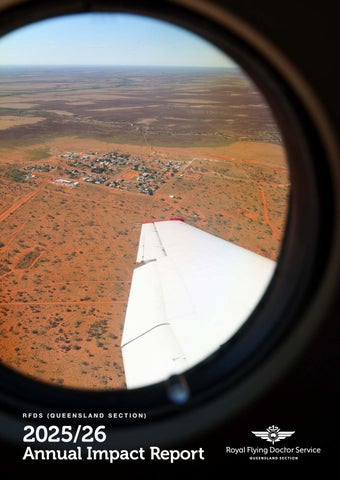
The furthest corner. The finest care.
RFDS (QUEENSLAND SECTION)
2025/26
Annual Impact Report
Our story
The
furthest corner. The finest care.
In much of Queensland, the nearest hospital is not down the road. It can be hundreds of kilometres away, across country with no sealed roads and often no mobile phone signal. For almost 100 years, the Flying Doctor has existed to close that distance. Our story began with Reverend John Flynn, who dreamed of creating a ‘mantle of safety’ for people who live and work in the outback. In 1928 that dream took flight, when pilot Arthur Affleck lifted off in a single-engine biplane named Victory and launched the Australian Inland Mission Aerial Medical Service. It relied on supporters from the very beginning. Hugh Victor McKay, a long-time advocate, left a gift in his Will to fund the ‘aerial experiment’, and a year later engineer Alfred Traeger built the pedal-operated radio giving remote families a way to call for help. Today, the Flying Doctor has grown into one of the largest and most comprehensive aeromedical and primary health care organisations in the world. In Queensland, we employ more than 670 people, from pilots, doctors and nurses to mental health clinicians, engineers, dentists and support staff. We have a fleet of 26 aircraft and operate across nine bases, at Brisbane, Bundaberg, Cairns,
ii
The furthest corner. The finest care.
Charleville, Longreach, Mount Isa, Rockhampton, Roma, and Townsville, reaching properties, clinics and communities across some of the most remote regions. Distance changes everything. In the bush, a stockyard accident or a difficult birth carries a weight it would not carry in the city. Every minute matters when help is far away. Our services extend beyond emergency aeromedical retrievals. We run GP and nurse clinics, bring dental care to towns that have never had a dentist, keep more than 1,320 medical chests stocked in homesteads and roadhouses, and provide mental health and telehealth support around the clock. On an average day, our teams deliver more than 220 occasions of care across Queensland. None of it happens alone. It is made possible by our people and the communities they serve, by our partners in government and industry, and by supporters, like you, who have believed in this work for generations. This report is the story of what that shared effort made possible in 2025/26, and where it will carry us as we approach our centenary in 2028.
Contents
Contents Our story
The people behind every mission
From the Chair ............................................................. 2
The people behind the promise ................................. 26
From the CEO .............................................................. 3
Thirty-five years of service ......................................... 27
Our strategy .............................................................. 4-5
The team you support ............................................... 28
Our year in numbers 2025/26 ....................................6-7
Gold standard, in every sense.................................... 29
Services that deliver impact
A mission shared across Queensland
The backbone of care across Queensland .................. 8
Almost a hundred years, built together ..................... 30
Patient story: We can be here, because the RFDS is here.................. 9
Our supporters in a snapshot .................................... 30
Changing the trajectory of health in the bush ............. 10
Sustaining our future
New models of Primary Health Care tackling chronic disease ............................................. 11
From the Foundation Chair ........................................ 32
Twenty million reasons to smile .................................. 12
Built to last ................................................................. 34
A new era of care ........................................................ 13 When the water recedes, we’re still there ................... 14
Testimonials: Supporting Queensland communities together ......... 35
Your support helps us respond ................................... 15
Collaborating to provide the finest care ..................... 36
Asking the people who know us best.......................... 16
Celebrating our partners ............................................. 37
Supporter story: A lifetime of service, a lasting gift ..... 33
Patient story: A mother’s fight for survival .................. 17
Infrastructure that makes care possible A new era for North West Queensland ....................... 18 Patient story: A lasting legacy .................................... 19 Highlights .............................................................. 20-21 Strong foundations, further reach ......................... 22-23 The next aircraft, ordered and on the way.................. 24 Flying high: Our fleet in action ................................... 25
ABN 80 009 663 478
RFDS (Queensland Section)
1
Our story
From the Chair As the Royal Flying Doctor Service (Queensland Section) (RFDS) approaches its centenary, we are reminded that our greatest achievement is not measured in years of service, but in the lives improved, communities strengthened and care delivered where it is needed most. This Annual Impact Report reflects the tangible difference the RFDS continues to make for Queenslanders living in regional, rural and remote communities. Behind every statistic, program and service highlighted in these pages are people, families and communities who have been supported through changing circumstances and increasing challenges. Their stories remind us why our work matters and why our commitment to delivering meaningful impact remains as important today as it was nearly a century ago. As community needs continue to evolve, so too must the way we respond. Alongside delivering services, we have a responsibility to ensure the organisation remains strong, sustainable and equipped to meet future challenges. This year, we strengthened the foundations that will enable the RFDS to continue delivering essential services to Queensland communities for decades to come. Guided by our Towards 100 Strategy, we invested in our people, community, service delivery, innovation and organisation, ensuring we can continue delivering high-quality services to Queensland communities wherever and whenever they are needed.
Our impact is made possible through strong and enduring partnerships. I extend my sincere thanks to the Commonwealth Government, Queensland Government and local councils for their ongoing support and investment in communities across Queensland. I also acknowledge our Principal Partners, Ergon Energy Retail, Hancock Prospecting & Rinehart Medical Foundation, Brisbane Airport, QCoal, Woolworths and Rio Tinto. Finally, thank you to our supporters, stakeholders and community partners whose shared commitment creates lasting positive change. I would like to acknowledge Deputy Chair Ivan Frkovic, my fellow Directors and committee members, for their leadership, expertise and dedication throughout the year. I also thank Chief Executive Officer Meredith Staib and the entire team, whose professionalism, compassion and commitment continue to bring our strategic priorities to life and deliver lasting benefits for the people and communities we serve. As we celebrate 98 years of service and look towards our centenary, we do so with confidence in the strength of our people, partnerships and purpose. Together, we will continue to innovate, adapt and deliver vital care that ensures Queensland communities are supported for generations to come.
Georgie Somerset AM Chair RFDS (Queensland Section)
2
The furthest corner. The finest care.
Welcome
From the CEO In a state as vast and diverse as Queensland, access to healthcare should never be determined by distance. Every day, the RFDS works to ensure people living in regional, rural and remote communities can receive the care they need when they need it. Over the past year, we have reached more Queenslanders than ever before, delivering critical aeromedical and healthcare services where they were needed most. As we continue to deliver on our Towards 100 Strategy, we responded to growing community needs through innovation, strategic partnerships and the dedication of our people, while continuing to improve access to care across the state. I am incredibly proud of what our people have achieved. Through their professionalism, expertise and compassion, we delivered a record year of aeromedical activity while continuing to expand primary health care services, including mental health, oral health, and GP and nurse clinics. Every mission, consultation and patient interaction reflects our commitment to ensuring Queenslanders can access vital healthcare services, regardless of geography. This year saw important milestones that will strengthen our ability to serve communities well into the future. The opening of the new Mount Isa Base represents a significant investment in healthcare delivery across North West Queensland, while the Aeromedical Training Academy completed its first year supporting pilot training and aviation workforce development. Both investments strengthen our capacity to meet the evolving healthcare needs of Queensland communities.
Partnership remains central to our success. This year, we celebrated 30 years of partnership with the Queensland Government through our inter-facility transfer service, helping connect patients with critical care across the state. We also continued to work with organisations such as Rio Tinto to explore innovative models of healthcare delivery and expand access to care in remote communities. Innovation is helping transform healthcare access across Queensland. Through initiatives such as the Medical Chest augmentation project and expanded telehealth support, we are connecting more people with expert clinical advice and treatment, regardless of where they live. None of this would be possible without the generosity and trust of the communities we serve. This year, Queenslanders once again demonstrated their incredible support for the RFDS. From a record-breaking Giving Day to the renewal and growth of valued partnerships across the state, this support allows us to invest in new services, embrace innovation and continue delivering care where it is needed most. As we reflect on another year, I extend my sincere thanks to our Board, Executive Leadership Team, staff, partners and supporters. Together, we are delivering meaningful impact across Queensland today while building a stronger future for the communities we serve.
Meredith Staib Chief Executive Officer RFDS (Queensland Section)
RFDS (Queensland Section)
3
Our story
Our strategy This five-year growth strategy represents the next chapter of our Towards 100 journey— and you’re helping us write it. With your help, we’re delivering real impact across Queensland. We’re enhancing the care we provide, strengthening our connections with the communities who rely on us, and embracing innovation to meet tomorrow’s challenges today. We’re also investing in our people and building stronger foundations for the future, making sure we’re equipped, supported and prepared as we move towards our centenary.
RFDS(Queensland (Queensland Section) RFDS Section) 2023-2028 Strategy 2023–2028 Strategy Safety and sustainability
Partnerships and collaboration
Strengthen our presence, reputation and support at the heart of the communities we serve.
Com m un
d e live r y
Our promise Our promise
ic e
s at
The furthest corner. The furthest corner. The finest care. The finest care.
n
Se
io
rv
O rga ni
Grow and invest in our organisation, operations and infrastructure.
e pl eo
ity
P
Create the best, future-ready workplace and culture for our people to grow.
Support the health and wellbeing of our communities anywhere, anytime.
I n n ov a ti o n Patients, families and community
4
The furthest corner. The finest care.
Embrace our culture of innovation to drive growth, create value and lead the future of virtual health delivery.
Equity, culture and diversity
Our strategy
Growth has always been at the heart of the RFDS story. Together, we’ll keep doing what we do best while finding new and innovative ways to reach further into regional, rural and remote Queensland. Five key principles guide everything we do as we deliver on our Towards 100 Strategy. They shape our decisions, strengthen our purpose, and ensure we stay true to the communities we serve.
Every step forward is possible because of your belief in our mission.
Live our promise Everything starts with our promise
Partnership and collaboration Working hand in hand
Patients, families and community Patient and family-centred care at the heart
Safety and sustainability Pursuing our purpose into the future
Equity, culture and diversity Celebrating our unique culture and individual differences
Our values Safety and quality
Mutual care and respect
Commercially astute
Open and transparent
Collaborative
Proud and passionate
RFDS (Queensland Section)
5
Our story
2025/26
Our
year in numbers
The RFDS continues to provide vital emergency medical and primary health care services to regional, rural and remote communities across Queensland.
More than
220
1,940
13,410
1,320
occasions of care across Queensland each day
immunisations administered
consultations conducted by RFDS mental health clinicians and headspace Cairns
medical chests in rural and remote locations
13,900 22,210 27,230 patients transferred
6
consultations were conducted at RFDS GP and nurse clinics
The furthest corner. The finest care.
calls through our telehealth service
2,510 consultations by our RFDS Dental Service
Our year in numbers
RFDS (Queensland Section)
7
Services that deliver impact
backbone
The of care across Queensland On 3 July 1995, a Flying Doctor aircraft carried a patient from Mundubbera to Brisbane. It was the first flight of a partnership with Queensland Health that has since become the backbone of aeromedical care across the state.
of the most critically unwell patients in Queensland: newborns needing intensive care, patients awaiting organ transplants, and people requiring extracorporeal membrane oxygenation (ECMO) transfers, where the heart and lungs are supported by machine in flight.
Thirty years on, that partnership works at a scale few could have imagined at the time. Through our inter-facility transfer service, the Flying Doctor has now carried more than 270,000 patients between hospitals, connecting people in regional, rural and remote communities with the emergency and specialist care that is not available where they live.
In 2022, the Flying Doctor and Queensland Health entered a new 10-year agreement, strengthening a relationship that already reached across emergency evacuation, primary health care, telehealth, dental, mental health, health education, patient transfers and research. The agreement gave our communities a certainty that’s rare in remote health. It also lets us plan ahead, invest in our people and keep improving, knowing the foundation beneath the work will hold.
Last year, we flew more than 13,900 patients, more than in any year in the history of the Service. The work is closely integrated. Our Operations Control Centre (OCC) works continuously with Retrieval Services Queensland (RSQ), supporting the aviation and clinical logistics of every transfer. As one part of a single state-wide aeromedical network, we can move some
8
The furthest corner. The finest care.
The partnership has also led to practical improvements in patient safety, including a redesigned loading system with stretchers that are interchangeable with the Queensland Ambulance Service. It removes a handling step when a patient is at their most vulnerable. As we look towards our centenary in 2028, and the next 30 years, this partnership remains focused on a shared ambition for equitable health outcomes for every Queenslander, wherever they live. Together with Queensland Health, and our community of supporters, we are creating a more connected, healthier and resilient Queensland.
Patient story
“We can be here, the RFDS is here.”
because
Oliver Zimmerman had worked hard for his school eisteddfod in Goondiwindi. He was nervous walking onto the stage, but he knew every line. Partway through his performance, an asthma attack took hold. His mother, Laura, a nurse practitioner, had slipped out briefly to see a patient. By the time she got the call, Oliver had collapsed and was at Goondiwindi Hospital. At Goondiwindi Hospital, Oliver was in severe bronchospasm. He needed one magnesium infusion, then another. When he still required a higher level of care, the decision was made to transfer him to Queensland Children’s Hospital in Brisbane.
“That’s postcode equity. My son is still alive.” Oliver is now back at school and starting sport again. His family is still raising their children in Goondiwindi. For Laura, that is what the RFDS makes possible. It does not simply get rural Australians out when something goes wrong. It helps make it possible for them to stay. “We can be here,” Laura said, “because the RFDS is here.” The RFDS (Queensland Section) gratefully acknowledges the generous funding support from Queensland Health to deliver essential inter-facility patient transfers.
Laura understood what that meant in a way no parent wants to.
“I was his mum, but I am also a nurse practitioner. I knew how sick he was. I knew he could die. And I knew I couldn’t safely put him in a car and drive him to Brisbane.” Brisbane was hours away, with long stretches of road without mobile coverage. Geography had become part of Oliver’s clinical risk. Then the RFDS arrived. The crew spoke directly to Oliver, who is autistic, and quickly understood how he communicated and adjusted without Laura needing to explain. “They could have acted about 10 different ways,” Laura said. “They were so gracious. I must have looked like a frazzled something, but they were so kind.” But kindness was only part of what the RFDS gave them that night. In the aircraft, Oliver had a doctor and nurse beside him. The distance to Brisbane had not changed. What changed was the risk that distance created. “My son wasn’t a second-class citizen in Australia anymore,” Laura said.
Top left: Laura and Oliver. Top right: Oliver. Bottom: Oliver with his dog, Phoenix.
RFDS (Queensland Section)
9
Services that deliver impact
Changing the trajectory of health in the bush The Flying Doctor has always been a collective endeavour. Behind every aircraft, clinician and service is a community of people and organisations who share a belief that where you live should not determine the care you receive. Rio Tinto has been part of that community since 2020. What began with support for our COVID-19 telehealth response grew to include investment in bases and patient transfer facilities, as well as dedicated donations following ex-Tropical Cyclone Jasper and severe flooding across Queensland. In August 2025, Rio Tinto chose to deepen that commitment through a new five-year, $15.2 million social impact partnership. Shaped by shared priorities and local insight, the partnership is investing not simply in more services, but in the people, capability and systems the RFDS needs to improve health access and outcomes over the long term. Together, we are focusing on four areas where that support can make a lasting difference.
Enhancing telehealth Rio Tinto’s support is helping the RFDS strengthen triage across our 24/7 virtual healthcare service, so callers can be prioritised and directed according to clinical need. As General Manager Virtual and Digital Health Dr Shaun Francis said, “The ability to more effectively triage telehealth calls will be a game changer for the RFDS as it will give us the ability to deliver more services to the patients that need it most.”
Evolution of care The partnership introduces podiatry services into primary health care clinics across North West Queensland, creating more opportunities to manage diabetes-related complications earlier and closer to home.
10 The furthest corner. The finest care.
Expanding services Rio Tinto’s investment is supporting the expansion of mental health services across the North West and Far North Queensland, placing clinicians in high-need communities so that individuals and families can find quality psychological care closer to home.
Growing a workforce The partnership is also supporting the growth of the Aboriginal and/or Torres Strait Islander health workforce serving the Gulf and Cape York, strengthening culturally appropriate care, relationships and trust. That matters because nearly 35 per cent of the patients and clients our clinicians see identify as Aboriginal and/or Torres Strait Islander, and the health outcomes gap remains stark. Behind these initiatives is more than a funding agreement. It is a shared commitment to changing the trajectory of health in regional, rural and remote Queensland. Rio Tinto’s support is also helping the RFDS strengthen how we measure impact—moving beyond counting services delivered to understanding whether people can access care more easily, receive support earlier and experience better outcomes. For the communities at the end of the flight path, the impact is clear. It means earlier intervention, better management of complex and chronic conditions, and care delivered closer to home.
The partnership is investing not simply in more services, but in the people, capability and systems the RFDS needs to improve health access and outcomes over the long term.
Primary Health Care
New models of Primary Health Care tackling chronic disease A small clinic making a big difference Dajarra sits 150 kilometres south of Mount Isa, at the end of a single-lane road. It’s a community of around 190 people, 71 per cent of whom identify as Aboriginal and/or Torres Strait Islander. For people living in remote communities like Dajarra, distance and limited access to health services can make it harder to access regular care and manage chronic health conditions.
The clinic has also built something durable: proactive, coordinated care on Dajarra’s terms, and a working relationship between three organisations that the community can rely on.
The Chronic Conditions Clinic set out to change that. Co-designed and funded by Western Queensland Primary Health Network (WQPHN) and delivered in collaboration with the North West Hospital and Health Service (NWHHS) and the Flying Doctor, the clinic pairs face-to-face appointments with structured RFDS follow-up consultations. These are facilitated at three, six and nine months, with notes shared securely between the two services so no patient or client falls through the gap. In its first six months from July 2025, the clinic revealed just how deep the need ran. Most patients were managing six to nine chronic conditions at once. Across the community, clinicians encountered 70 distinct chronic condition types and managed more than 150 conditions in total, including several children living with chronic disease.
Most patients were managing six to nine chronic conditions at once.
The Care Collective Pilot in action For South West Queensland communities like Thargomindah, Eulo, Yowah, Cunnamulla and Quilpie, getting to a doctor can mean hours on the road. The community asked for something which was simple to say but hard to build: better healthcare access with “no wrong door”. The Care Collective Pilot answered with a registered nurse working as a clinical care coordinator. Running regular clinics across South West Queensland and working closely with a nurse navigator to keep each person’s care coordinated and connected. Across the pilot’s tracked communities, 371 client referrals were made to 42 different providers, acute hospital presentations fell as care shifted to the right setting, and an independent evaluation found that every $1 invested returned $5 in benefit.
Behind the figures are people who feel supported. Many are older, most manage two or more chronic conditions, and they describe care that finally feels seamless. When floods closed the Thargomindah airstrip, telehealth kept the clinics running. When transport was the barrier, the community and Bulloo Shire Council put on a bus so people from Yowah could reach a health expo, and then again for optometry visits. Transport and an ageing population remain real challenges. The pilot has shown what coordinated, locally tailored primary health care can do, and how much a community stands to lose if it goes.
Better healthcare access with “no wrong door”.
RFDS (Queensland Section) 11
Services that deliver impact
Twenty million reasons to For a lot of Queenslanders in the bush, a dentist has always been something you drive hundreds of kilometres to find. Or worse, go without. Since 2013, the RFDS Dental Service has been rewriting that, one visit at a time. This year it passed $20 million in oral health services delivered. Behind that figure are thousands of Queenslanders who have kept their health, and their smiles, because of the Flying Doctor. It is the child who has their teeth checked for the first time. It is the family of six who, in one visit, all received preventive care and saved thousands of dollars they would have spent travelling. It is the older patient in Winton who has kept on top of their oral health for years because the service keeps coming back. The RFDS Dental Service grew from a shared belief that where someone lives should not determine whether they can access quality dental care. QCoal Foundation backed that belief from the beginning, providing the philanthropic support, long-term commitment and vision to help establish and prove a new model of mobile care. Together with the support of QCoal Group, QCoal Foundation and the Australian Government, that early investment helped turn an ambitious idea into an enduring service for rural and remote Queensland.
12 The furthest corner. The finest care.
smile
Twenty million dollars of care. Thousands of Queenslanders supported to look after their health closer to home. And 20 million reasons to believe in what is possible when people come together behind the bush.
From our patients “I, and the people from Tara, can’t express how much it helps us to get such treatment out here. If you didn’t come, we would be so much worse off.” “This is a wonderful service to the people of Winton. Dental care to your doorstep. Excellent service, with excellent dentists and efficient treatment. You are all appreciated for the exceptional care and professional service you provide to the citizens of these isolated areas. Thank you all.” “Please never stop coming out to help us out, your efforts are very appreciated by our little community.”
Virtual Health
A
new era of care
On a remote property, the RFDS Medical Chest Service is often the first line of care. It’s a locked box of medicines and supplies that, guided by a doctor on the phone, has treated wounds, calmed emergencies and bought time until help arrives. More than 1,320 of them sit in homesteads, roadhouses and communities across Queensland. For the families who hold one, and the communities who share the benefits, it is the difference between coping and being caught out. Telehealth is the thread that ties it all together. Last financial year, the Flying Doctor conducted more than 27,230 telehealth calls, turning a phone and a chest of supplies into a functioning clinic wherever a person happens to be. In the bush, where the nearest doctor can be hundreds of kilometres away, that is the connective tissue of the whole health system.
The portal is undergoing further testing with users and an early-adopter group, whose feedback informs everything from day-to-day usability to the governance behind each chest. Finishing that work before full roll-out means the Flying Doctor can deliver a portal that is built to last. Progress like this is made possible when others share the belief that distance should not stand between people and the care they need. The Kinghorn Foundation’s support is helping the RFDS build on a service remote Queenslanders have trusted for generations, while preparing it for the needs of the generations to come. Just as the pedal radio helped launch the Flying Doctor nearly a century ago, the Medical Chest Portal is keeping remote Queenslanders connected to care, no matter the distance.
This year, that system took a significant step forward. With a major grant from The Kinghorn Foundation, work began on modernising the medical chest, starting with a web-based portal that lets chest holders manage their chest online. The portal brings everything into one place: reordering medicines and supplies, reporting usage, receiving stock and tracking expiry dates, all digitally. That means fewer errors and less time lost to paperwork for the people who rely on them. RFDS Medical Chest.
RFDS (Queensland Section) 13
Services that deliver impact
When the water recedes, we’re there
still
A flood does not end when the water recedes. For communities across Western and Far North Queensland, the hardest part often comes afterwards, during the long months of rebuilding when the exhaustion has settled in. When disaster strikes, the RFDS works closely with local communities and providers to ensure support is not a one-off visit but a sustained presence people can count on. We are equipped to help communities hold together during an emergency and to keep going once it passes. In the Gulf, that work took shape through the Flood Recovery Program and a partnership with the Carpentaria Land Council Aboriginal Corporation. What started as a request to upskill Gulf-based rangers in Mental Health First Aid grew into something more substantial. RFDS clinicians delivered culturally respectful
14 The furthest corner. The finest care.
Mental Health First Aid and Psychological First Aid training across Burketown and Normanton, working alongside rangers who hold strong family ties, and in some cases are recognised Elders, across Doomadgee, Mornington Island, Mount Isa, Dajarra, Boulia and beyond. Clinicians came to understand local support systems and referral pathways. Communities came to know the faces behind the Flying Doctor.
Mental health is where a disaster does its slowest damage, and where the Flying Doctor's presence makes a lasting difference.
Mental Health and Wellbeing
Your support us respond
helps
Wellbeing in the outback Further south and west, the Wellbeing Out West (WOW) Program keeps clinicians on the ground across the Central West, South West, North West, Central Highlands and Maranoa delivering mental health consultations, running Mental Health First Aid training in towns like Barcaldine, Blackall, Emerald and Winton, attending agricultural and community events, and handing out practical resources written for life on the land. Our Wellbeing Out West Program runs on the generosity of RideWest. In 2026, 38 riders and 15 support crew rode 1,311 kilometres from Brisbane to Longreach over eight days and raised a record $800,000 for Wellbeing Out West, taking RideWest's total past $3.1 million since the first ride in 2010. Thanks to the support of RideWest, its donors and our kind and compassionate supporters across Queensland who chose to donate to the RFDS, the WOW team delivered 1,434 counselling sessions, exceeding its annual target by 23 per cent, and participated in community events across 14 Queensland communities, strengthening relationships and increasing access to support services.
RideWest riding from Longreach to Brisbane to support the Flying Doctor.
A gift that keeps watch Reconciliation is not a statement for the Flying Doctor. It is a practice, worked out in the communities we serve, where nearly 35 per cent of the patients our clinicians see identify as Aboriginal and/or Torres Strait Islander. Our Reconciliation Action Plan commits us to building culturally safe care, growing an Aboriginal and/or Torres Strait Islander workforce, and listening first. At the Longreach Mental Health and Wellbeing Service, that commitment has a visible centrepiece. Respected Aboriginal Elder and artist Aunty Joyce Crombie donated one of her artworks to the Service, where it now hangs as a spiritual symbol of connection, healing and community strength. The artwork has since become part of the Service itself. To draw out its connection to mental health and mindfulness, Aunty Joyce's work was turned into a jigsaw puzzle for staff to complete at each base, providing a moment for staff to pause.
Manager - Central West and Outback Mental Health Donna Ross, Board Member and Ambassador Hon Bruce Scott AM, Aboriginal Elder and artist Aunty Joyce Crombie and General Manager - Mental Health Dr Tim Driscoll accepting this gift in Longreach.
RFDS (Queensland Section) 15
Services that deliver impact
know us best
Asking the people who Every day, RFDS teams provide healthcare, support and reassurance to people living, working and travelling across regional, rural and remote Queensland. But the most important measure of our impact comes from the people who experience our services firsthand.
82%
said RFDS aeromedical services make them more likely to live, work or travel in remote communities. “Living in regional and remote areas, having you as a medical lifeline brings so much peace of mind.”
In 2025/26, patients and clients across our aeromedical retrieval, primary health care, oral health, mental health and telehealth services shared their experiences through our annual Patient and Client Experience Survey.
89% said that RFDS dental services reduced their out-of-pocket expenses. “Being an aged pensioner the RFDS [makes] it possible for me and others like me to get dental care that normally we would have to forgo.”
Their feedback reinforces the role the RFDS plays in making healthcare easier to access, reducing the burden of travel and cost, building confidence in accessing quality care, strengthening trust in RFDS services, and supporting the sustainability of rural and remote communities.
90% trust RFDS to provide high-quality
Across every service area, respondents described our care as professional, compassionate and highly valued, demonstrating that our impact extends far beyond the moment of care.
100% of mental health clients said they
primary health care and advice. “RFDS doctors hold such a high standard of care, every concern raised is listened to and investigated.”
feel more confident in accessing the healthcare they need. “My counsellor has been instrumental in my healing from trauma journey.”
80%
said the RFDS Telehealth Service reduced their need to travel. “Great care and only a phone call away.”
Patients and clients reported that overall the quality of the treatment and care they received was: Very Good
4%
Good
Average
5%
6%
Poor
Very Poor 3% 1% 1%
3% 3% 14%
96%
89%
95%
80%
Aeromedical
Mental Health
Dental
Telehealth
16 The furthest corner. The finest care.
Patient story
A mother’s
fight for survival
Jess Mackenzie was penning up cattle when a cow turned on her. Her family had all gathered that day to help her parents recover after the April floods—counting stock and inducting newly arrived cattle. She had stepped up onto the rail, expecting the animal to brush past. Instead, it threw her against the timber and came down on top of her.
Jess’ injuries were severe: fractured vertebrae, broken ribs, a smashed scapula, a fractured orbital bone and a punctured lung her surgeon described as the most badly damaged he had ever seen still working.
Her father, along with her husband, Colin, cleared the rails and drove it back. Jess laid in the dirt of her parents' property in Western Queensland and felt her breathing start to shorten. Colin was up the front with their 10-month-old son, Hayes. Her sister sat down in the dirt beside her and held her arm.
Today, Jess and Colin are back on the family properties, still using the Flying Doctor's primary health care clinics and their RFDS Medical Chest.
Around her, Jess could hear the phone calls. The ambulance was an hour and a half away.
She was flown to Toowoomba, placed in an induced coma overnight, then transferred to Brisbane where two ribs were plated with titanium. She spent around two weeks in hospital.
The RFDS (Queensland Section) gratefully acknowledges the generous funding support from Queensland Health to deliver essential inter-facility patient transfers.
“If I can just keep breathing till the plane gets here,“ she told herself, “I'm going to be okay.“ They were working from a RFDS Medical Chest they had sourced from a nearby town, brought out by the clinic nurse who reached Jess before the ambulance and took her failing vital signs. When the RFDS flew in from Charleville, they arrived with Flight Nurse Izzy Graham and two doctors. Jess's sister tracked the RFDS aircraft online from the road and watched them land. “Izzy just had pockets full of stuff,” she told Jess later. The doctors would ask, and the right thing would appear.
Aeromedical retrieval of Jess following the accident.
Jess with her son Hayes.
Colin, Hayes and Jess.
RFDS (Queensland Section) 17
Infrastructure that makes care possible
A
new era for North West Queensland
In March 2026, the RFDS officially opened our new base at Mount Isa Airport, sharing it for the first time with LifeFlight. The two organisations can now coordinate directly, respond faster and cover a vast region from a single location. For communities across North West Queensland, this is about much more than a new building. It means better-coordinated care, crews working closer together and a facility built to last. The opening was marked with an RFDS Picnic with the Planes community open day, giving local families a rare behind-the-scenes look at our operations and the impact of their support. The RFDS facility is funded by the Queensland Government, in partnership with participating mineral resources industry parties, the Queensland Resources Council and its members ($6.9 million), the Australian Government ($6.8 million) and additional funding from Queensland Airports Limited ($600,000), owner and operator of Mount Isa Airport.
to our Founding Supporter North Australian Pastoral Company (NAPCo), as well as Stanbroke, the Goldburg Family Foundation, and Nev Power and family. For every supporter who chose to be part of this project, that is the legacy of their support: stronger healthcare for North West Queensland, not just today, but for the generations who will call this region home in the years ahead.
The Drover comes home Long before King Airs, it was the de Havilland Drover that carried the Flying Doctor across Queensland. This year, a lovingly restored Drover returned to public display at the new RFDS Mount Isa Base as a reminder of the organisation’s connection to communities in North West Queensland. We thank the Mount Isa City Council for kindly donating the aircraft to the RFDS, and the Mount Isa community whose support helped restore the Drover so it could again take pride of place as a beacon of hope for all to see.
And our community chose to be part of making it possible too. We are also grateful for the additional $11 million contributed by donors, with a special thanks
RFDS Mount Isa team celebrating the opening of our Mount Isa Base.
18 The furthest corner. The finest care.
Patient story
A lasting
legacy
Ollie Davidson was just five years old when he got sick. He went off to school on a Monday morning in April 2024 without anything to suggest what was coming. He came home tired, with a mild temperature. His Mum, Courtney, gave him some pain relief and put him on the couch. He ate; he drank. It seemed like a normal virus that most kids pick up.
Ollie fought for a full month. His liver and kidneys failed. Surgery would almost certainly be fatal, so Joel and his wife chose to let their son pass with his parents holding his hand.
By the next morning, something was wrong. Ollie was drinking a lot but not going to the toilet. His dreams were vivid and strange. He kept talking about sharks chasing him. His breathing was getting fast. His dad, Joel, knew it was something more serious.
In October that year, Joel created a team called Running for Ollie and entered the RFDS Oceans to Outback event. His goal was to raise $5,000. One hundred and fifty people joined him, most of them from the policing community Joel had worked in across Mount Isa and Townsville. They raised an incredible $66,000 in support of the RFDS, and in memory of Ollie.
He got Ollie up, threw on some clothes, and they drove 15 minutes to Townsville Hospital's Emergency Department. By the time they arrived, Ollie had blotchy skin. The triage nurse saw it was serious straight away. They bypassed the queue and went to a resuscitation bay. Within the hour, Joel was calling his wife: Ollie was being put into an induced coma. It was life-threatening. Doctors weren't sure he'd survive the afternoon. “Just having your five-year-old boy holding your hand and telling him it's going to be okay and that he's just going to have a little sleep while the doctors fix his tummy,” Joel said. “And knowing they'd already told me it was life-threatening.” That moment, he says, is the hardest thing he has had to carry.
“The night Ollie passed away was extremely peaceful. It was filled with love.” Ollie passed on 21 May 2024.
A second campaign followed. Thirty for Ollie, named for the 30 days between when Ollie first got sick and when he passed away, raised a further $24,000. Families have since contacted the Davidsons to say that knowing Ollie's story made them act faster when their own children showed similar symptoms. Some of those children survived. At the new RFDS Mount Isa Base, Ollie’s legacy lives on near the entrance, where a bench bearing his name offers a lasting reminder of his story. “His name will be on that bench forever,” Joel said. “If we can just keep that story going, keep his name out there—that's everything to us.”
Ollie had developed sepsis. An infection had crept into his kidneys and flooded into his blood without a single sign of pain. Dr Anna at the Townsville Paediatric Intensive Care Unit worked around the clock. When a window appeared to transfer Ollie to Brisbane for more advanced care, the RFDS was tasked by Retrieval Services Queensland, through our partnership with Queensland Health. On the flight, while the doctors worked up front to keep Ollie stable, Joel slept for the first time in three days. Left: Courtney, Kai, Harry and Joel. Right: Ollie.
"I knew we were in good hands. It was beyond my control, and there was nothing else I could have done. That was enough for me to switch off." RFDS (Queensland Section) 19
2025/26
Highlights
JULY
SEPTEMBER
Launched the Chronic Conditions Clinic, in collaboration with North West Hospital and Health Service, funded by Western Queensland Primary Health Network
JULY
Implemented The Care Collective – South West Primary Care Pilot across our South West Queensland clinics
Marked 25 years of support and $20 million raised by Ergon Energy Retail
JULY
JULY
AUGUST
Celebrated the 30-year milestone for the RFDS Rockhampton Base
Marked 30 years of Inter-Facility Transfer (IFT) partnership with the Queensland Government
Announced Rio Tinto’s social impact partnership, contributing $15.2 million over five years
20 The furthest corner. The finest care.
NOVEMBER
MARCH
Rockhampton Auxiliary 30-year milestone
Raised more than $720,000 through RFDS Giving Day
MARCH
MAY
Opened the RFDS and LifeFlight Mount Isa Aeromedical Hub
Launched the Circle of Security Parenting Program across Central Queensland
OCTOBER
MARCH
M ARCH
MAY
Aeromedical Training Academy in Bundaberg one-year anniversary
Achieved Stage three re-accreditation under the International Standard for Business Aircraft Operations (IS-BAO)
Renewed the three-year partnership with Hancock Agriculture
Delivered $20 million in oral health care through the RFDS Dental Service
RFDS (Queensland Section) 21
Infrastructure that makes care possible
Strong foundations, Behind every retrieval and every clinic are people working around the clock, supported by a network of bases, hangars, and patient transfer facilities. As a leading healthcare provider, we’re investing in infrastructure that will protect continuity of care today and build the capability we need to serve communities for generations to come—a shared investment—made possible by supporters whose compassion lays foundations for the future of healthcare in Queensland.
Aeromedical Training Academy RFDS has established one of Australia's most advanced aeromedical aviation training environments through the development of our Aeromedical Training Academy in Bundaberg. The Academy is home to the only Beechcraft King Air Pro Line Fusion full-flight simulator in the Southern Hemisphere, providing an unmatched platform for pilot training, assessment and capability development. This facility enables us to deliver highly realistic missionbased training aligned to the operational demands of aeromedical flying. Pilots are exposed to complex operational scenarios that strengthen technical proficiency, decision-making, crew resource management and risk management skills in a controlled environment. While the Academy was established to support our own operational requirements, it also positions us as
22 The furthest corner. The finest care.
further reach a specialist training provider for government, aviation and commercial organisations operating the King Air platform. More broadly, it reflects our belief that aviation safety and operational excellence are achieved through continuous investment in people, training and professional development. In the Academy's first year, RFDS had 74 pilot attendances, completing 574 hours of training (283 simulator sessions), and agreements have been secured with external government and commercial organisations who operate the King Air platform, providing 90 external pilot attendances, and completing 411 hours of training (206 simulator sessions). The facility was made possible thanks to the shared commitment of the Australian Government, the QCoal Foundation, and many caring corporate and philanthropic supporters. The RFDS extends a heartfelt thanks to John Santalucia, and to the Bundaberg Regional Council, which generously donated the land—helping turn a shared vision into a facility that is strengthening aviation capability and the future of the Flying Doctor.
Brisbane Base The new Aeromedical Precinct—home to our new Brisbane Base—continues to take shape, with construction nearing 50 per cent completion. Expected to be complete in late 2027, ahead of our centenary in 2028, the facility, which is funded by the Queensland
Investing in infrastructure
Government, will bring key aeromedical operations together in a purpose-built home, strengthening how we coordinate and deliver services across the state.
Cairns Base The rebuild of the Cairns Base was completed after it was affected by significant flooding following ex-Tropical Cyclone Jasper. During the repairs, operational staff worked temporarily from the hangar and portable offices, while administration staff relocated to the Cairns Domestic Terminal. The team moved back into the refurbished base in October 2025.
Charleville Accommodation The Flying Doctor’s ability to recruit skilled clinicians, and keep them safe, rested and well, depends on having somewhere for them to stay. Thanks to significant philanthropic support from the James Frizelle Charitable Foundation, we plan to build up to 14 staff accommodation units beside our Charleville Base. The subdivision and development application have been approved, and initial designs for a mix of one and two-bedroom units are being considered by the Charleville team.
Emerald Patient Transfer Facility Emerald sees between 40 and 60 medevac flights every month, and around 80 per cent of them are flown by the Flying Doctor. A new patient transfer facility, scheduled
for completion in 2026, will make patient transfers faster and more comfortable in all weather conditions, with an extended tarmac to a new aeromedical transfer shelter, covered ambulance parking and connected services. Funding for this facility has been secured from the Queensland Government, in partnership with participating mineral resources industry parties, the Queensland Resources Council and its members with additional funding support from the Central Highlands Regional Council, the Rotary Club of Emerald and Suncorp Bank. We honour the late Ian Burnett, President of the Rotary Club of Emerald, and his family for their unwavering support of this facility and the lasting legacy it leaves.
Townsville Base The Townsville Base redevelopment will provide a welcome upgrade to our current facilities. This includes new state-of-the-art training facilities and a new patient transfer area with direct access to an undercover hangar, ensuring that exposure to the elements for patients is limited. The RFDS (Queensland Section) will receive $15 million in Australian Government funding, which has been matched by $15 million from the Queensland Government. A location for the Townsville Base has been selected, and the site plans are underway.
Below: Representatives from the Queensland Government, Brisbane Airport, LifeFlight, Retrieval Services Queensland and Queensland Police Service Aviation Capability Group met with our CEO Meredith Staib to celebrate the halfway milestone for the new Aeromedical Precinct.
RFDS (Queensland Section) 23
Infrastructure that makes care possible
next
The aircraft, ordered and on the way The Flying Doctor is only ever as capable as the aircraft, people and infrastructure that support our life-saving work. Queensland presents some of the most challenging aeromedical operating conditions in Australia, including vast distances, remote terrain, tropical weather systems and isolated communities.
fleet renewal program. The first aircraft is scheduled for delivery from Textron in late 2027 before undergoing a specialised aeromedical fit-out to create a purpose-built flying intensive care unit. Once complete, the first KA260C is expected to enter service, delivering enhanced capability designed to support the evolving healthcare needs of Queensland for decades to come.
As the needs of remote Queenslanders continue to evolve, so must our fleet. Our 10-year Fleet Strategy provides a clear roadmap to renew and modernise our fleet, ensuring we continue to deliver safe, reliable and high-quality care wherever it is needed.
The KA260C offers more than a newer airframe. It brings improved performance and a cabin designed around contemporary aeromedical care, ensuring the clinical environment keeps pace with the expertise of our crews. Each new aircraft is a long-term investment in the same promise the Flying Doctor has kept since 1928: to bring the finest care to the furthest corner, and to adapt to meet the changing needs of the communities that we are able to serve because of the people who invest in us.
The King Air 260C (KA260C) is replacing our ageing Beechcraft B200 aircraft, the workhorses that have served Queensland faithfully for years. As of June 2026, six KA260Cs have been ordered as part of our long-term
24 The furthest corner. The finest care.
Our fleet
Flying high: Our fleet in Registration Description
Year of manufacture
action
Date acquired Dedications
VH-FDZ
Beechcraft King Air B200
2004
December 2004
VH-VJU
Beechcraft King Air B200
2004
December 2004
VH-VQD
Beechcraft King Air B200
2004
December 2004
VH-VOQ
Beechcraft King Air B200
2007
April 2007
VH-VAQ
Beechcraft King Air B200
2007
July 2007
VH-FDT
Beechcraft King Air B200
2007
October 2007
VH-FDG
Beechcraft King Air B200
2009
July 2009
VH-FDS
Beechcraft King Air B200C
2010
September 2010
VH-FDM
Beechcraft King Air B200C
2010
November 2010
VH-FDI
Beechcraft King Air B200C
2010
November 2010
VH-FDL
Beechcraft King Air B200
2014
July 2014
VH-FDO
Beechcraft King Air B200
2014
July 2014 Cooee – named by Ergon Energy Retail
VH-FDN
Beechcraft King Air B350C
2014
March 2015
VH-FDF
Beechcraft King Air B350C
2015
August 2015 Roderick J Bowe, John D Bowe and Anne J Carne
VH-FDC
Beechcraft King Air B350C
2016
August 2016 Ray Grace
VH-FDD
Beechcraft King Air B350C
2017
VH-VJZ
Beechcraft King Air B200
2006
January 2019 Geoffrey Carrick
VH-VJX
Beechcraft King Air B200
2006
January 2019 Bevan Jibson
VH-VJW
Beechcraft King Air B200
2006
February 2019
VH-VJY
Beechcraft King Air B200
2006
February 2019
VH-FDW
Beechcraft King Air B360C
2021
December 2021 Charles Goode AC
VH-FDA
Beechcraft King Air B360C
2022
September 2022 John and Vicki Williams
VH-FDB
Beechcraft King Air B360C
2022
December 2022
VH-FDR
Beechcraft King Air B360C
2021
VH-8FQ
Beechcraft King Air B360C
2023
VH-8FD
Beechcraft King Air B360C
2023
July 2017
Drover – named through public vote by Brisbane Airport
Outback Angel – unveiled by HRH Prince Charles, now King Charles
Hancock Prospecting and Rinehart Medical Foundation
July 2023 Clive Berghofer October 2023 March 2024 Cornelia Goode
RFDS (Queensland Section) 25
The people behind every mission
behind the promise
The people
Across Queensland, our people bring our mission to life every day. Guided by our Towards 100 Strategy, we are working to build the best, most future-ready workplace and culture we can. NUMBER OF STAFF BY LOCATION
175
2
Corporate Office (Brisbane)
STAFF PROFILE
2
Dubbo
17
headspace Cairns
Roma
61
1
Mount Isa
Surry Hills
671+ employees
1
126
Normanton
Cairns
30
Rockhampton
12
Longreach
25
41
Bundaberg
60% of employees in full-time roles
Townsville
1
Broken Hill
59
1
117
Emerald
Brisbane
Charleville
4.75 average years of service
ORGANISATION ENGAGEMENT SCORES As part of our One Promise – One Team culture program we conducted our Employee Engagement Survey for the fourth consecutive year. Our engagement score was 69 per cent, a five per cent increase from the previous year.
71 69% 2025
64% 2024
26 The furthest corner. The finest care.
59% 2023
57% 2022
women in leadership positions
Staff profile
Thirty-five years of On 4 February 1991, six nurses officially joined RFDS (Queensland Section) for the very first time. Until that moment, nurses had been commissioned from Queensland Health's Division of Maternal and Child Health to assist RFDS doctors on emergency retrievals and remote clinic runs. The day that changed marked a turning point in how the Flying Doctor would care for the bush. Maree Cummins and Susan Markwell were two of those six. Thirty-five years on, they are still here. Maree joined the Mount Isa Base as a child health nurse. Since then, her career has taken her from Mount Isa clinics to critical care study in Brisbane, and some of the most challenging retrievals Queensland has ever seen, including the response to the Bali bombings and a middle-of-the-night call to a critically burned patient at a remote camp in far North West Queensland.
service Susan, a flight nurse specialising in midwifery, built her passion for remote nursing in Charleville before moving to Cairns, where she has spent decades serving Cape York Peninsula and Far North Queensland communities where, on some clinic days, she would see mothers line up with their babies to meet the RFDS aircraft. “Some days we would see up to 30 to 40 babies,” Susan recalls. “The mothers always felt very comfortable with us.” What has kept them both going, across half a lifetime of shifts, is not the challenge that comes with serious cases—it is the knowledge that the Service matters in ways that are hard to overstate. “To be able to pick up the phone and speak to a doctor is very important to them,” Susan says of the communities she serves. Together they have watched the organisation grow from three bases and six nurses to nine bases and approximately 100 nurses working across aeromedical, primary health care, mental health, telehealth and beyond. They’ve seen new aircraft, new equipment, new roles which neither could ever have imagined in 1991. Through all of it, the RFDS has backed its people.
Maree Cummins (left) and Susan Markwell (right).
Susan Markwell
Maree Cummins
"There's a great sense of satisfaction working for the RFDS— and the view from your office window changes every day." SUSAN MARKWELL, FLIGHT NURSE (MIDWIFERY)
RFDS (Queensland Section) 27
The people behind every mission
The team
you support Where aviation meets innovation Many people in aviation grow up around aircraft. Mercedes Aras did not. With no family in the industry, she followed a childhood fascination with flight all the way to a Bachelor of Aviation, a Graduate Diploma of Flight Operations and a pilot licence with a multi-engine instrument rating.
Jacob Levin
Helping nurses to become midwives Jacob Levin has come a long way to sit in the back of a Flying Doctor aircraft. He grew up in Western Australia and was working emergency nursing shifts when he started studying midwifery on the side. That study was paid for by the RFDS Midwifery Scholarship, with generous support from the Dalara Foundation and Maureen Stevenson. It is open to registered nurses with critical care backgrounds who need the extra qualification to fly, and it comes with a job at the end: a flight nurse position with the Flying Doctor in Queensland. Eighty per cent of retrievals have just a pilot and a single flight nurse. Whatever the flight brings, the nurse in the back is the one who deals with it. “I've learnt so much from the extra study and I'm super stoked to have had the opportunity to do it,” Jacob said. He joined the Rockhampton team in December and started with five weeks of aviation training, groundbased learning and supernumerary shifts alongside experienced flight nurses.
Although she still flies for the joy of it on weekends, it was the world behind the cockpit that pulled her in next. Curious about how aircraft are maintained, regulated and operated, she moved into technical services and process improvement. Last year she joined the Flying Doctor in the newly created role of Training Officer and Technical Writer at the Cairns Base. There is, she says, no typical day. She develops training for engineers and pilots, writes procedures, and redesigns the forms and workflows the technical operations team relies on. Her job is to take complex aviation regulations and turn it into clear, practical documentation so engineers spend less time deciphering and more time keeping aircraft in the air. Mercedes’ essential work keeps a Flying Doctor aircraft compliant, ready and flying.
"I was out in the hangar and saw them bring someone in on a stretcher. That was my proud moment. I fit in this puzzle to make sure this can happen." MERCEDES ARAS, TRAINING OFFICER & TECHNICAL WRITER
“I'm excited to explore all of Queensland and gain a different perspective on healthcare,” he said.
"The RFDS is a pretty amazing service, the work is so dynamic, and there is not really any other job like it." JACOB LEVIN, FLIGHT NURSE (MIDWIFERY) Mercedes Aras
28 The furthest corner. The finest care.
Staff profile
Gold standard, in
every sense
Every year, the RFDS Spirit Awards provide the whole organisation a chance to recognise their colleagues who go above and beyond, on the frontline and behind the scenes. Nominations come from across the Service, and every one is a small act of gratitude for the people who make sure the finest care reaches the furthest corner, day in and day out. The awards span three categories: Delivering Excellence in Healthcare, for frontline staff; Enabling Excellence in Healthcare, for the teams who support them; and the Spirit Leadership Award, for those who lead through our values. In 2025, the RFDS Spirit Award for Delivering Excellence in Healthcare went to Tracey Edwards and Kaycee Slipais from headspace Cairns. As the lead agency of headspace Cairns, our clinicians provide vital mental health and counselling services to youth across Far North Queensland. Together, Tracey and Kaycee were recognised for delivering a gold-standard Dialectical Behaviour Therapy (DBT) Program, the only one in Cairns and the only DBT program running from a headspace centre anywhere in the country.
Below: The RFDS Spirit Award for Delivering Excellence in Healthcare went to Kaycee Slipais (left) and Tracey Edwards (right) from headspace Cairns.
Between them, Tracey and Kaycee bring more than 17 years of combined experience, supporting upwards of 30 young people at a time through intensive, evidencebased therapy: weekly skills groups, individual sessions, family support, consultation teams and after-hours coaching. More than 250 young people and their families have been through the program, and the feedback speaks for itself. What sets them apart is the commitment they show every young person who walks through the door.
RFDS Spirit Award winners > Change Manager, Katie Theofanes, was recognised with the Enabling Excellence in Healthcare Award for her key role in implementing our new Human Resources Information System (HRIS), Dayforce. > Our Cairns Base Support Manager, Bill Spriggs, received the Spirit Leadership Award for his steadfast support of the Cairns Base throughout its flood recovery and rebuild.
Awards like these are a way of saying thank you to people who dedicate their working lives to helping others.
RFDS (Queensland Section) 29
A mission shared across Queensland
Almost a hundred years, built The Flying Doctor has never flown alone. For almost 100 years, our Service has responded to Queenslanders because of the commitment of many: governments and businesses. Communities and local fundraisers. Donors and regular givers who stand by us, year after year. Different people, many kinds of support, but a shared belief that where you live shouldn’t determine the healthcare you access. It’s what makes it possible for an aircraft to reach a property at 2:00am. For a dentist to arrive in a town without one. And for the Flying Doctor to keep showing up, whenever we’re needed.
Auxiliaries in action This year showed that spirit at full strength. Our RFDS auxiliaries, the volunteers, who are the Flying Doctor's heart in their own communities, raised more than $372,000 across the state, and our Rockhampton Auxiliary celebrated 30 years of service.
Coming together to make an impact Across the state, community fundraisers turned local traditions into life-changing support for the Flying Doctor. In September, the Birdsville Races raised more than $41,000 with a special visit from our Joint Patrons, the Governor of Queensland, Her Excellency the Honourable Dr Jeannette Young AC PSM and Professor Graeme Nimmo RFD. Then, in November, the annual Nindigully Pig Races raised more than $100,000 through a weekend of community fun, including pay-to-play games, auctions, raffles and, of course, the pig races. Then in March, over 2,500 Queenslanders participated in our Fit to Fly fundraising challenge raising $216,545. Together, events like these, show what is possible when communities rally behind the Flying Doctor.
Vale Ian and Hannah Campbell: Champions of the Queensland Spirit RFDS Ambassadors Ian and Jane Campbell share a passion for aviation and the Service. As longtime friends of the RFDS, they participated in the 2022 and 2025 Outback Air Races, raising more than $100,000. Together, with their daughter, Hannah, they also completed the Kokoda Track in 2026. Ian and Hannah tragically lost their lives in a light plane crash in September 2026. Their generosity, commitment and support for the RFDS will never be forgotten.
30 The furthest corner. The finest care.
together
Helping us Take to the Skies Our community of supporters came together for the second Take to the Skies Giving Day raising more than $720,000, with every donation doubled by our Flying High partners. Hundreds of supporters gathered at King George Square in Brisbane to showcase the heart of the outback to the city.
A heartfelt thank you And through Thankathon, staff from every base and team across Queensland picked up the phone for the simplest, most powerful reason: not to ask for anything, but to say thank you to the supporters who, together, give close to $40 million each year. Every one of those gifts, and every hand that raised them, becomes care: a stocked medical chest, a telehealth consultation at midnight, a life-saving retrieval. As we approach our centenary in 2028, we know the next 100 years will be built the same way the first were: together. We rely on that support to keep bringing the finest care to the furthest corner of the state. It was our privilege and delight to share our personal thanks and connect with so many compassionate supporters.
OUR SUPPORTERS IN A SNAPSHOT
Like the people we serve across Queensland, our supporters come from all walks of life. United by a shared commitment to improving health outcomes in rural and remote communities, they play a vital role in helping us deliver care where it's needed most. In the last year, we welcomed 8,035 new Support Crew members and 3,960 new donors. 233 RFDS Auxiliary members 12,677 Donors
28,517 Support Crew members
54 Corporate Partners and Supporters
5,814 Oceans to Outback Queensland participants 1,292 Fundraisers and community groups
Celebrating our supporters
Left to right: RFDS Rockhampton Auxiliary celebrates 30th anniversary, the Governor‑General, as Patron of the Royal Flying Doctor Service, visited the Brisbane Base, RFDS Take to the Skies Giving Day soars with community support, the Noon Family named the Outback Explorer Competition winner, launch of the RFDS Mixed-Reality Project, RFDS celebrates supporter Clive Berghofer AO's birthday, our annual International Women's Day Reception, communities enjoy RFDS Picnic with the Planes, RideWest in Charleville and the Mount Isa Base open day.
RFDS (Queensland Section) 31
Sustaining our future
From the Foundation Chair A gift that leads, in perpetuity
The RFDS Foundation plays a vital role in supporting the long-term sustainability and growth of the Flying Doctor, enabling innovation and investment that strengthens healthcare delivery across Queensland. During 2025/26, Foundation funding enabled two important initiatives focused on improving health outcomes and service delivery. The AI Clinical Scribe Scoping Review explored how emerging technologies can streamline clinical documentation, improve efficiency, and enhance patient care. We also invested in the Youth Mental Health Peer Work Pilot at headspace Cairns, an innovative program designed to strengthen support for young people through lived-experience peer workers and inform future service models. These projects reflect our commitment to investing in initiatives that deliver meaningful impact today while helping shape the healthcare services of tomorrow. I thank my fellow Directors for their continued leadership, commitment and stewardship. Together, we are helping ensure resources are directed to initiatives that deliver the greatest benefit for the communities we serve. As we look ahead, our focus remains clear: to strengthen the Flying Doctor's legacy, support its long-term sustainability, and help ensure this essential service continues to deliver life-changing care and connection to Queensland communities.
32 The furthest corner. The finest care.
Some gifts change an organisation for good. Dr Laurie Cowled AM’s in-perpetuity gift secures the future of the Dr Laurie Cowled AM Leadership Program, an investment not in a building or a single aircraft, but in the people who will lead the Flying Doctor for decades to come. Since 2021, the Program has given RFDS leaders the rare chance to step back from the demands of their daily work, reflect on how they lead, and return with practical tools they can use straight away. To date, 124 leaders from every corner of the organisation have taken part, from aviation, engineering and clinical services to corporate and fundraising teams. In November 2025, Laurie attended the course in Brisbane, meeting the very people her generosity supports. For a service that operates across distance, complexity and constant need, good leadership is essential. It shapes how teams work together, how decisions are made, and ultimately how our patients and communities are cared for. By endowing the Program in perpetuity, Laurie has ensured that every future group of RFDS leaders will inherit the same space to learn, connect and grow. It is a generous and far-reaching gift to the Flying Doctor, and a model of how philanthropy can build capability that lasts.
Nigel Alexander Nigel Alexander Chair RFDS Foundation
Supporter story
A lifetime of service, a
lasting gift
For more than 30 years, Ben Visser met the Flying Doctor on the tarmac at Brisbane Airport. He was a paramedic. His job was to have the stretcher ready, take the handover from the flight nurse, and get the patient to hospital. Some of those patients had woken that morning hundreds of kilometres from the nearest doctor. Ben came to Australia from the Netherlands with his parents in 1956. He spent about 10 years in the automotive trade and another 10 in hospitality before he saw an advertisement for trainee ambulance officers. They were taking applicants up to the age of 35. Ben was 36. He rang anyway, and they gave him an interview. He stayed almost 33 years. He had first heard about the Flying Doctor not long after arriving in Australia, from people heading out to Mount Isa and Longreach. An aircraft that would come for you, hundreds of kilometres from anywhere, was not something he had encountered before. “I thought, well, this is fantastic,” he said. Ben has given to the RFDS every month since 2016 and has chosen to leave a gift in his Will to the Flying Doctor, alongside a handful of causes he has supported for decades. He knows what that kind of support holds up over time. The ambulance service he joined was itself built on subscriptions, donations and gifts left in wills, and he watched what it could do once the money was there. “Aircraft have got to be serviced and they have to be replaced after a certain period of time,” he said. “You employ people that have got to be paid.” In 2026, Ben accepted an invitation to tour our Brisbane Base and brought eight mates from the coffee club of retired ambulance officers he has met with since 2011. They went inside an aircraft, and a flight nurse walked them through it. Most of the group had done an RFDS handover at some point in their careers. None of them, Ben says, had known how much sat behind it.
Ben Visser touring our Brisbane Base.
"I'm very happy to include the RFDS in my Will when the time comes, so that they can benefit and continue the work that they are doing."
“I admire the staff, the pilots and the flight nurses, you do a wonderful job.”
Ben Visser
RFDS (Queensland Section) 33
Sustaining our future
Built to
last
An organisation that plans to serve Queensland for another 100 years has to be built to last, in the air and on the ground: in how it is governed, how it manages risk, how it treats the environment, and how it protects the people who trust it. For the Flying Doctor, sustainability and responsibility are not a separate agenda. They are embedded in how we make decisions, plan operations and build future capability. Our work is structured around four pillars: governance, strategy, risk management and metrics.
Governance Accountability at the top, with a sustainability champion on the Executive Leadership Team.
Strategy Our Decarbonisation Action Plan sets the roadmap for the year ahead, across electricity, aviation, vehicles, water, waste, buildings and purchasing.
Risk management Climate risk sits on our enterprise risk register and is managed like any other threat to the Service.
Metrics A defined set of ESG targets, measured and reported, so progress is visible and honest.
34 The furthest corner. The finest care.
That discipline extends to risk and assurance more broadly, through the Climate Opportunities and Risk Assessment (CORA) project and continued external audit, including an ISO 14001:2015 Environmental Management audit. It reflects a simple principle: preparedness and continuous improvement are how a critical health service earns the right to be relied upon. Responsibility today also means protecting data. Over the past year, the Flying Doctor has continued to mature its cyber security, strengthening governance, lifting workforce awareness through mandatory training and phishing simulations, and enhancing how we protect sensitive information. Data Loss Prevention controls now cover outbound email for all staff, with USB and cloud monitoring to follow; email filtering has been hardened against business email compromise; cyber incident response is embedded in our Incident Response Plan with dedicated playbooks; ransomware readiness planning is complete; and our alignment to the Australian Cyber Security Centre Essential Eight continues to strengthen. Guided by our Privacy 101 approach, this work protects the staff, patient and supporter data at the heart of everything we do. Much of this work happens behind the scenes. Yet all of it makes the Flying Doctor an organisation Queenslanders can keep counting on, long into the next century.
Testimonials
Supporting Queensland communities
together
The RFDS (Queensland Section) proudly partners with health services, networks and community organisations to improve health access and outcomes across the state. These testimonials reflect the value of those partnerships and the impact of working together to deliver essential healthcare to Queenslanders, no matter where you live. “ Aeromedical services delivered under the current 10-year contract between Queensland Health and the RFDS (Queensland Section) provide equitable access to essential healthcare and support better health outcomes for people living in some of the state's most geographically isolated areas. Nearly 14,000 patients were moved for Queensland Health by the RFDS (Queensland Section) in the 2025/26 financial year, an increase of nearly 1,000 patients from the prior financial year.” DR MARK ELCOCK PSM, RETRIEVAL SERVICES QUEENSLAND EXECUTIVE DIRECTOR
“ Covering the largest geographical footprint of any Queensland Primary Health Network, Western Queensland PHN relies on strong partnerships to meet the needs of our communities. The Royal Flying Doctor Service (Queensland Section) is a valued partner whose reach, expertise and commitment to rural and remote healthcare has helped ensure Western Queenslanders can access quality care, regardless of distance. Together, we have spent the past decade building Healthier Western Queensland Communities and improving health outcomes across the region through our genuine partnership.” SANDY GILLIES, WESTERN QUEENSLAND PRIMARY HEALTH NETWORK CHIEF EXECUTIVE OFFICER
“ In the 2025/26 financial year, Torres and Cape Hospital and Health Service (TCHHS) reinforced its close partnership with RFDS (Queensland Section) to deliver critical healthcare services to people and families living in remote and isolated communities across our region. This partnership is a key enabler for our health service and has contributed to the expansion of TCHHS outreach services and improved access to care. This work is made possible by the dedicated staff of both organisations, who work closely together to provide coordinated and compassionate care for patients and their families. Through our shared commitment to rural and remote health, we bring together the clinical expertise of both organisations, TCHHS’s local knowledge and strong community relationships, and RFDS’s aeromedical capabilities to help patients access the care they need, when and where they need it. Together, our organisations are improving equitable access to safe, high-quality care for communities in some of Queensland’s most isolated locations.” REX O’ROURKE, TORRES AND CAPE HOSPITAL AND HEALTH SERVICE CHIEF EXECUTIVE
“ Northern Aboriginal and Torres Strait Islander Health Alliance (NATSIHA) values its partnership with the RFDS (Queensland Section) and our shared commitment to improving health outcomes for First Nations peoples. Together, we work to ensure communities across rural, regional, remote and island Queensland can access the care they need, when they need it.” ALLAS LEON, NORTHERN ABORIGINAL D AND TORRES STRAIT ISLANDER HEALTH ALLIANCE (NATSIHA) CHIEF EXECUTIVE OFFICER
RFDS (Queensland Section) 35
Sustaining our future
Collaborating to provide the finest care The RFDS acknowledges our strong working relationships with health service providers, universities and other organisations. These partnerships are essential in providing the finest care to the furthest corner. Working with key partners in communities ensures the Flying Doctor can provide quality aeromedical retrieval services, as well as essential primary and preventative healthcare to regional, rural and remote Queenslanders.
Hospital and Health Services
Other organisations
Cairns and Hinterland Hospital and Health Service
Apunipima Cape York Health Council
Central Queensland Hospital and Health Service
CheckUP
Central West Hospital and Health Service
Department of Defence
Children’s Health Queensland
Department of Social Services
Darling Downs Hospital and Health Service
Department of Treaty, Aboriginal and Torres Strait Islander Partnerships, Communities and the Arts
Gold Coast Hospital and Health Service Mackay Hospital and Health Service Metro North Hospital and Health Service Metro South Hospital and Health Service
Gidgee Healing headspace National Youth Mental Health Foundation Ltd
North West Hospital and Health Service
Ngarnal Aboriginal Community Controlled Health Service (NACCHS)
South West Queensland Hospital and Health Service
Queensland Local Governments
Sunshine Coast Hospital and Health Service
RHealth
Torres and Cape Hospital and Health Service Townsville Hospital and Health Service West Moreton Hospital and Health Service
Universities Australian Catholic University Ltd
Wide Bay Hospital and Health Service
Bond University
Primary Health Networks
Charles Darwin University
Central Queensland University
Brisbane North
Charles Sturt University
Brisbane South
Griffith University
Country to Coast, QLD
James Cook University
Darling Downs and West Moreton
La Trobe University
Gold Coast
Queensland University of Technology
Northern Queensland
Southern Cross University
Western Queensland
TAFE Queensland The University of Queensland University of Southern Queensland University of the Sunshine Coast
Government Partners The RFDS of Australia is supported with funding from the Australian Government Department of Health, Disability and Ageing.
36 The furthest corner. The finest care.
Acknowledgements
Celebrating our partners Thanks to our passionate and committed partners the RFDS (Queensland Section) can provide the finest care to the furthest corner.
Principal Partners
Major Corporate Supporters
Community Partners
Major National Partners
National Partners
2025/26 Supporters
Major Trust and Foundation Supporters
The RFDS (Queensland Section) would like to thank some of our most significant supporters in 2025/26.
APS Foundation Aurizon Collier Charitable Fund Dalara Foundation Gambling Community Benefit Fund Goldburg Family Foundation Humpty Dumpty Foundation
Clive Berghofer AO Charles Goode AC & Cornelia Goode James Frizelle Charitable Foundation John Santalucia Dr Laurie Cowled AM
Mazda Foundation Morgans Foundation Queensland Mental Health Commission St John’s Grace Fund The John Waller Foundation The E Robert Hayles & Alison L Hayles Charitable Trust
RFDS (Queensland Section) 37
Location: Windorah, Queensland
Royal Flying Doctor Service acknowledges the Aboriginal and Torres Strait Islander peoples as the first inhabitants of the nation and the Traditional Custodians of the land.
For more information visit flyingdoctor.com.au/qld