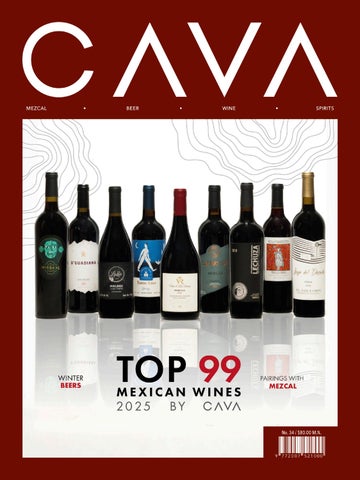
CAVA MAGAZINE Year 10 • No. 34 • December 2025-January 2026 San Luis Potosí, SLP. EDITORIAL TEAM: Cecilia Valtierra - Deputy Director Katia Hernández - Editor Andrea Méndez- Writing Jocelyn Leyva- Copy-editor and proofreading Ismael Posadas - Editorial Design Carla Montiel - Advertising Director Carlos Arellano - Marketing Axel Moreno - Advertising Monica Velazco , Alejandro Lopez - Correspondents EDITORIAL BOARD: Macaria Rodríguez, Salim Gutiérrez, Fernando Ramos, Ernesto Bravo, Irasema López, Roberto Montiel, Regina Alfaro, Eduardo Gonzalez, Carlos Bailleres CONTACT: cavarevista@gmail.com
Editorial
Guide for beginners
Ellian Reyes PARTIAL OR TOTAL REPRODUCTION IS PROHIBITED WITHOUT THE STRICT AUTHORIZATION OF THE PUBLISHER. THE CONTENT OF THE ARTICLES IS THE SOLE RESPONSIBILITY OF THE AUTHOR. CAVA MAG- AZINE IS NOT RESPONSIBLE FOR THE INFORMATION CONTAINED IN COMMERCIAL AND/OR NON-COMMERCIAL ADVERTISEMENTS. CAVA Magazine, year 10, Issue 34, December 2025-January 2026, is a quarterly publication edited by Ariana Toscani, located at Calle 5 de Mayo #1035, Barrio de San Miguelito, C.P. 78339, cavarevista@ gmail.com www.revistacava. com. Editor-in-chief: Ariana Toscani. Rights reserved for exclusive use granted by the National Copyright Institute: pending. ISSN granted by the National Institute of Copyright: pending. Legality of title and content: pending. This issue was printed in December 2025 with a circulation of Col. Jardines del Sol, C.P. 27014, Torreón, Coah. The opinions expressed by the authors
Mezcalería
The Importance of Aging and Storing Mezcal
10
Mezcal Fairs and Festivals in Mexico
16
Mezcalería
Mezcals Mx
Puebla Mezcal: A Spirit That Springs forth Amidst Hills and Agaves
20
Pairings With Mezcal
24
Aboute Mezcal
WINE
Wine Strain
Types Of Viticulture: Science, Tradition, and Sustainability
28
The Wine Snob
32
Sparkling Wine: The Art of Cultivating Bubbles
36
Mexican Wines 2025 by CAVA
42
Wines that do not Come from Grapes
56
The Ideal Cup: Cuick Guide
60
Wine Strain Wine Strain
TOP
About Wine
BEER
Brewery
Winter Beers
64
Corn Beers: A Liqauid Legacy
70
St. Patrick's Day and Green Beer
74
Beer Abbreviations
78
Brewery Brewery
About Beer
DESTILLATES Distillery
do not necessarily reflect the position of the publisher. The total or
The Blue Agave of Chiapas: Between Plant Nobility and a
partial reproduction of the contents and images of the publica- tion
New Agricultural Horizon
without prior authorization is strictly prohibited.
Distillery Mx
The Soul Of The Agave: A Journey Through the History of Tequila
—www.revistacava.com
7
MEZCAL
TOP 99 COVER PHOTO:
6
GASTRONOMY
82
88
—Facebook: /cavarevista
Mexican Cuisine: The Magic of Underground Ovens
94
—Instagram: revistacava
DIRECTORY
98
—cavarevista@gmail.com
EDITORIAL Winter is approaching, bringing with it the spirit of
the art of producing sparkling wines, the different
celebration and festive cheer that characterizes the
methods of grape cultivation, and the importance
end of the year. At CAVA, we want to accompany
of enjoying wine with knowledge, but also with au-
you through this season with a special edition that
thenticity and simplicity.
brings together topics inspired by togetherness,
In the beer section, we align ourselves with the
tradition, and the pleasure of sharing. And, as we
winter season to review the history and meaning
do every year, we present our eagerly awaited TOP
of St. Patrick's Day, as well as the characteristics of
99 Mexican Wines 2025, a tribute to the excellence
corn beers and those with more complex and spicy
of Mexican wine.
flavors, perfect for cold days.
In the section dedicated to mezcal, we discuss
We also dedicate a section to the blue agave
best practices for storing bottles and keeping the
of Chiapas, which is beginning to occupy a prom-
character of this great spirit intact. We also delve
inent place alongside the agaves of Jalisco, and
into the relevance of Puebla mezcal, now ranked
we review the evolution of the country's most em-
as the second most produced in the country after
blematic distillate: tequila.
Oaxaca mezcal. We complete this tour with a guide
Finally, we invite you to discover the tradition
to the main national mezcal fairs, spaces where
of underground ovens, one of the oldest and most
producers and the public come together to ex-
fascinating techniques in Mexican cuisine, which
change knowledge and strengthen mezcal culture.
continues to offer authentic and memorable fla-
Wine takes center stage in this edition. Our TOP
vors.
99 Mexican Wines 2025 is the result of a blind tast-
So, like a good dish cooked patiently under-
ing held in Mexico City during the month of Oc-
ground, take your time to read, savour, and enjoy
tober, whose purpose is to offer readers a reliable
the pages of this last issue of the year, prepared
guide to learning about, appreciating, and enjoy-
especially for you.
ing wine made in Mexico. In addition, we explore
Cheers!
GUIDE FOR BEGINNERS IF YOU ARE TAKING YOUR FIRST STEPS IN THE WORLD OF WINE, MEZCAL, SPIRITS, BEER, AND GASTRONOMY, THIS BEGINNER'S GUIDE WILL HELP YOU UNDERSTAND SOME TERMS YOU MAY NOT HAVE BEEN FAMILIAR WITH AND ENJOY THE READINGS YOU WILL FIND IN THE FOLLOWING PAGES EVEN MORE.
Vinasse Liquid waste resulting from the distillation process in the production of tequila, mezcal, or other distillates. It contains organic matter, minerals, and compounds that, if not properly treated, can have a high environmental impact by contaminating soil and water bodies. Agavos A term of Greek origin from which the word “agave” derives. It means ‘admirable’ or “noble,”and refers to the qualities attributed to this plant for its resistance, usefulness, and natural beauty. Enzymatic activity The ability of a grain or ingredient to produce enzymes that convert starches into fermentable sugars during the brewing of beer or other fermented beverages. High enzymatic activity facilitates the conversion of starch into sugars, while low activity may require adjustments to the process. Calcareous soils Soils rich in calcium carbonate, characterized by their good drainage and ability to retain minerals. In viticulture, they promote the acidity and freshness of the grapes, contributing
to the balance and mineral character of the wines, especially in the production of sparkling wines. Grape variety The variety or type of grape used in the production of a wine. Knowing the grape variety helps to identify characteristics of flavor, aroma, and body, and is a key term in the evaluation and appreciation of wine. Mucbipollo A traditional dish from southeastern Mexico made with meat (usually pork or chicken) and other ingredients, which is cooked underground in a pit with hot stones, firewood, and leaves, allowing the flavors to slowly concentrate. It is an example of the region's ancestral cuisine, similar to cochinita pibil. Monoculture An agricultural practice consisting of the extensive and repeated cultivation of a single plant species in the same area. In the case of tequila agave, monoculture can reduce biodiversity, deplete soil nutrients, and increase the ecosystem's vulnerability to pests, diseases, and climate change.
Mezcalería
THE IMPORTANCE OF AGING AND STORING MEZCAL WITH ITS CHARACTERISTIC SMOKY FLAVOR AND AROMATIC COMPLEXITY, MEZCAL CAN BE ENJOYED FOR YEARS IF PROPERLY STORED. KNOWING HOW TO STORE, SEAL, AND SERVE IT IS KEY TO ENSURING THAT EACH SIP REVEALS THE RICHNESS OF ITS NUANCES AND ALLOWS YOU TO FULLY EXPERIENCE THE ARTISANAL MAGIC THAT SURROUNDS IT.
L
ike any liquid treasure, mezcal deserves our attention: how long does it last? How can we preserve its aromas and flavors intact? In this article, we will explain a little about the fascinating world of mezcal care so that every tasting you do from your private collection is a memorable experience. THE SECRET LIFE OF MEZCAL Mezcal is a unique spirit, born from the noble agave plant and artisanal techniques passed down from generation to generation. Its rich flavors, ranging from smoky notes to hints of fruit, honey, and spices, come not only from the plant, but also from the care with which it is crafted. Unlike other perishable liquids, such as milk or even some wines, mezcal does not spoil due to its high alcohol content. This means that, technically, it has no expiration date. However, the real challenge lies in keeping its complexity of flavor and aroma intact, especially after the bottle has been opened.
FACTORS AFFECTING THE LONGEVITY OF MEZCAL Not all mezcals age the same, and several factors influence how the drink holds up over time: 1.
Production process and agave quality The secret to long-lasting mezcal begins with the agave. Mature, high-quality plants, such as blue agave, produce a more stable distillate with greater preservation capacity. The cooking of the agave, controlled fermentation, and artisanal distillation Whether in clay pots or copper stills, these processes define not only its flavor, but also its resistance to the passage of time. Some aged mezcals are stored in barrels to further develop their notes, ensuring that each sip has depth and character. 2. Storage and sealing conditions Even the best mezcal can suffer if it is exposed to inappropriate factors. Sunlight,
11
Mezcalería
“ MEZCAL, THANKS TO ITS ALCOHOL CONTENT AND PRODUCTION PROCESSES, COMBINES STABILITY WITH COMPLEXITY. THIS MAKES IT A DISTILLATE THAT NOT ONLY CAN BE ENJOYED IMMEDIATELY, BUT CAN ALSO ACCOMPANY A COLLECTION OF WELLPRESERVED BOTTLES FOR YEARS.”
12
heat, and sudden changes in temperature can alter its flavor. Therefore, it is best to keep bottles in cool, dark places, away from direct sunlight and heat. In addition, a good cork or cap is vital: it minimizes exposure to air, prevents oxidation, and preserves delicate flavors such as the sweetness of agave, herbal touches, or coffee notes that some mezcals develop. 3. Oxidation: the silent enemy When mezcal is exposed to oxygen, its flavors can change subtly. It's not that it “goes bad,” but rather that the more delicate notes are attenuated, leaving a less intense profile. This is especially important in flavored mezcals or unfiltered bottled mezcals, where the aromatic complexity is more pronounced. Keeping the bottle tightly closed helps preserve these characteristics for years.
ate and nose: if the flavors feel flat or lacking in nuance, perhaps the bottle has been open or exposed for too long. In terms of longevity, mezcal shares certain advantages with other high-proof spirits such as tequila, whiskey, and rum. All of them can be preserved for decades if stored properly. On the contrary, wines, with lower alcohol content, are more delicate and require stricter conditions to prevent deterioration. In contrast, wines, with lower alcohol content, are more delicate and require stricter conditions to prevent them from deteriorating. Thanks to its alcohol content and production processes, mezcal combines stability with complexity. This makes it a spirit that is not only enjoyable immediately, but can also be kept in a collection of well-preserved bottles for years.
DOES MEZCAL GO BAD? The short answer is no: mezcal does not sour or develop mold like other liquids. However, over time and with exposure to air, the flavors can soften or lose intensity. An open and poorly stored bottle An opened and poorly stored bottle may end up with a less vibrant aroma and flavor, while a wellsealed bottle can remain virtually the same as the first day for years. If you notice drastic color changes, unusual sediment, or strange aromas, this may be a sign that something has affected the mezcal; however, most well-preserved mezcals do not show major alterations visuals. The real test is on the pal-
A DISTILLATE THAT LIVES IN MEMORY Mezcal is a silent witness to centuries-old traditions and the careful work of artisans who respect every step of the process. By learning how to store and serve it correctly, you are not only protecting a liquid: you are protecting an experience, a story that deserves to be enjoyed with every toast. Opening a bottle of mezcal means consuming a spirit that preserves the traces of the earth and memory. Storing it properly not only prolongs its life, but also ensures that every sip transports you to the heart of Mexico, where mezcal is born from the earth and fire to give you a unique experience.▼
Mezcalería
MEZCAL FAIRS AND FESTIVALS IN MEXICO MEZCAL FAIRS IN MEXICO DON'T JUST EXHIBIT DISTILLATES; THEY ARE SHOWCASE OF IDENTITY, LEARNING, AND COLLECTIVE CELEBRATION.
W
ithout a doubt, mezcal fairs are unmissable experiences that will make you appreciate the process of this magical distillate even more, and how it ends up in your hands to become your favorite bottle. For decades, states such as Oaxaca have hosted fairs dedicated to mezcal, bringing together producers, artisans, and national and international visitors. For decades, states such as Oaxaca have hosted fairs dedicated to mezcal, bringing together producers, artisans, and national and international visitors. At these types of fairs, exhibitors display their mezcals at stand after stand: attendees can taste young, reposadas, and añejo varieties, learn about the production process, see the master mezcalero live, and understand the link between the land and the agave. WHAT HAPPENS AT A MEZCAL FAIR? Imagine arriving at the venue where one is being held: the tables display glass bottles that capture the sunlight; the exhibitors tell stories about their agaves, the countryside, the grinding at ground level, the distillation that sometimes precedes the dawn harvest. At the same time, there is traditional music, folk dances, regional cuisine, and a festive atmosphere that blends knowledge with community. It certainly makes you want to attend one, doesn't it? Trade shows often have spaces for commercial networking: producers looking
to export, specialized buyers, emerging brands that want to show themselves to the world. At the Mezcal Fair in Oaxaca, for example, there is a business pavilion to connect producers with value chains. Also there are contests, such as the “heaviest maguey pineapple,” which honors the key plant of mezcal with pride and tradition. A PLATFORM FOR LEARNING Despite the festive atmosphere, mezcal fairs also reflect tensions. Growing demand for agave has raised questions about sustainability, fair prices for producers, and the conservation of wild varieties. Fair organizers have begun to include panels and educational activities to address these challenges. For example, the fair in Zapotitlán Salinas (Puebla) is presented as an event that not only celebrates the drink, but also includes environmental education, traditional medicine, and local culture. This shows the evolution: it is no longer just about drinking mezcal, but about understanding the ecosystem that produces it. Here are some iconic mezcal fairs in Mexico that you are sure to enjoy. Oaxaca Mezcal Fair Organized in the state capital of Oaxaca de Juárez, this edition takes place from July 18 to 29 at the Cultural and Convention Center. The fair has established itself as a
17
Mezcalería
“ IN ADDITION TO BEING CELEBRATIONS OR SHOWCASES FOR MEZCAL, THESE FAIRS ARE BRIDGES BETWEEN PRODUCERS AND CONSUMERS, BETWEEN COMMUNITIES AND MARKETS.”
sensory encounter with mezcal: tastings, talks, craft exhibitions, live music, and more. In 2025, for example, more than 17,000 visitors were registered in a single day, which gives an idea of its magnitude. Atlixco Mezcal and Pulque Fair In the state of Puebla, the city of Atlixco is hosting the fourth edition of this fair from June 13 to 15. It is not just another fair: it is a celebration of regional identity that brings together mezcal, pulque, community tradition, and tourism. This event shows how fairs can also strengthen communities, raise the profile of local producers, and spread knowledge about agave beyond the major production centers. Caltepec Mezcal Fair Also in Puebla, the municipality of Caltepec organizes this fair on September 14. There, the artisanal tradition of mezcal, local culture, and a community-based tourism approach come together. Some 60 local producers participate, many with national medals, and it attracts a large number of visitors. This fair is a good example of how mezcal can empower rural areas, promote sustainable tourism,and preserve ancestral knowledge. Boca del Río Mezcal Festival Although Veracruz is not a mezcal-producing state, the city of Boca del Río celebrates this festival for eleven days, usually in June, at the Expo Feria Ganadera Ylang Ylang venue. Here, mezcal is mixed with Veracruz seafood, coastal cuisine, craft exhibitions,
18
and live music, demonstrating how agave distillation can interact with various regional traditions and become a cultural and economic driver. Mezcalfest MX 2025 A more recent fair, but with international reach, held in Mexico City and connected to events in the United States. For example, this year it was held in June. Although it is not linked to a single producing region, its focus on mezcal culture, promotion, and connecting brands with global consumers makes it a phenomenon that reflects the growing internationalization of agave distillates. WHY ARE THESE FAIRS IMPORTANT? In addition to being celebrations or showcases for mezcal, these fairs are bridges between producers and consumers, between communities and markets. They allow mezcal to cease being merely a “trendy drink” and become an experience, a conversation, a gateway to learning and the cultural richness of agave. In addition, they boost the regional economy: local producers showcase their work, distribution networks and tourism are generated, and the drink becomes an engine of development beyond the bottle. In Cava, we recommend that if you attend one of these fairs, it is important to go beyond the toast, listen to the master mezcalero, ask about the agave, and learn about the production process. And witness a tradition that seeks to be a bridge between those who produce and those who taste this magical distillate that we all love.▼
Mezcals Mx
PUEBLA MEZCAL: A SPIRIT THAT SPRINGS FORTH AMIDST HILLS AND AGAVES HAVE YOU EVER WONDERED WHAT MAKES POBLANO MEZCAL UNIQUE? IN THIS ARTICLE, WE WILL TELL YOU WHY MEZCAL IN PUEBLA IS A LIVING TESTAMENT TO AGRICULTURAL RESILIENCE, NATIONAL COMPETITIVENESS, ARTISANAL TALENT, AND CULTURAL RENEWAL.
I
n the lofty mountains of Puebla, where the wind draws silhouettes among the agaves and the sun, the hearts of the plants slowly mature until a distillate is produced that bears the mark of the land, the pulse of communities, and the echo of ancient traditions. Although the best-known narrative of mezcal is associated with Oaxaca, Puebla has been forging its own legacy. In 2015, the designation of origin for mezcal was formally recognized for 116 municipalities in Puebla, most of them located in the Mixteca, Atlixco, and Sierra Norte regions. In these complex landscapes, where the soil is rough and water is scarce, the agave finds its niche: “where other crops succumb, the agave thrives.” The cult of the maguey plant has deep roots in the region. Towns such as San Diego La Mesa Tochimiltzingo and Caltepec are home to centuries-old palenques where cooking, grinding, fermentation, and distillation continue to follow methods that date back to the mothers and fathers of the family. Today, Puebla mezcal has become a strong element of identity for those who live in these towns.
CHARACTERISTICS AND FLAVOR OF POBLANO MEZCAL When tasting a Poblano mezcal, you should look for these nuances: on the nose, perhaps a hint of smoke. Gentle smoke, followed by the sweetness of cooked agave, wild herbs, and perhaps a hint of red berries. On the palate, it has a smooth texture, moderate heat, notes of damp earth, and a long finish in which the carácter of the fire and the valley persists. Agave diversity While many regions specialize in a single variety of agave, Puebla cultivates a plurality that includes espadilla, papalometl, pichomel, and other endemic species. This botanical richness translates into more complex flavors: herbal notes, tropical fruits, subtle wood, and wet earth intertwine in the glass. Terroir and altitude The palenques are located in areas as diverse as the Mixteca and the Sierra Norte, where the dry climate, intermittent rainfall,
21
Mezcals Mx
“CERTIFIED MEZCAL PRODUCTION IS ON TRACK TO EXCEED ONE MILLION LITERS PER YEAR, PLACING PUEBLA IN SECOND PLACE NATIONALLY AFTER OAXACA. ”
and calcareous soils create unique conditions for agave and fermentation. The result: mezcals that speak of the place where they were grown. Artisanal process Despite modernization, much of the production continues to be done “the old-fashioned way”: wood fires, minimal mechanical grinding, spontaneous fermentation. This combination of ancient techniques with contemporary requirements (such as traceability and designation of origin) is what keeps Puebla mezcal among the greats. FROM THE AGAVE TO THE PALENQUE The journey of mezcal begins with the pineapple of the agave, whether it be espadilla, papalometl, or picho mel, which must mature for several years before harvesting. In Puebla, this wait is endured with patience under the sun, with a sharp machete and the knowledge accumulated over generations. A recent study by the Autonomous University of Chapingo found that mezcals from Puebla are distinguished by their territorial diversity, sensory complexity, and strong cultural ties. Cooking, often done in buried stone ovens or rustic pits, gives the distillate its characteristic smoky-earthy flavor. Next comes grinding, fermentation in wooden or leather vats, and distillation in traditional stills. In Puebla, many palenques still work “at ground level,” with care that transcends the technical and enters the realm of ritual.
22
However, the path is not without challenges. Growing global demand for mezcal has triggered an expansion in agave cultivation that, in some cases, threatens local ecosystems: the proliferation monoculture farming, the use of firewood for cooking, and interference with natural pollination sites are causes for concern. In addition, many small producers face barriers to meeting certification requirements and accessing international markets. The challenge now is to balance tradition and scale, quality and volume, identity and globalization. A PRODUCTION ON THE RISE Puebla not only champions tradition; it also achieves impressive figures. In 2024, the state registered more than 19,000 hectares of agave, with more than 12 million plants annually and around 250 active palenques. Certified mezcal production is on track to exceed one million liters per year, placing Puebla in second place nationally after Oaxaca. This increase in quality has also been notable in the annual TOP 99 Mezcals competition, where Puebla brands have won 40 medals, proving that Puebla mezcal is now playing in the big leagues. Puebla, with its blend of tradition and drive, is moving toward a future where mezcal is no longer just “from Oaxaca,” but “from all of Mexico.” May its name be pronounced with pride in every corner of the world, where each sip is slow, conscious, and savored, because Puebla mezcal deserves to be understood and recognized.▼
About Mezcal
PAIRINGS WITH
MEZCAL
One of the great virtues of being a mezcal lover is its versatility in pairing it with different types of foods or dishes. In this infographic, we share some appealing combinations depending on the type of mezcal you are tasting.
MEZCAL TOBALÁ:
Due to its aromatic, citrusy, herbal profile, which is sweeter than other mezcals, it is recommended to pair it with mild cheeses such as brie, camembert, or goat cheese; fresh fruits such as mango, pear, green apple; and seafood such as shrimp ceviche or scallops.
MEZCAL ESPADÍN:
the most versatile and common mezcal of all, with its smoky and earthy tones, it is recommended to pair it mainly with grilled meats such as arrachera, barbacoa, cochinita pibil, and charcoal-grilled ribs, as well as semi-cured cheeses such as Manchego, Gouda, and Provolone; or with dark and bitter chocolates.
MEZCAL PECHUGA: With its smooth, spicy flavor, it pairs well with festive dishes such as chiles en nogada, romeritos, mushroom and turkey enmoladas, as well as figs, almonds, and dates.
MEZCAL ENSAMBLE:
Due to its combination of different types of agave, it can be perfectly paired with more complex dishes such as mole, pipián, or adobos, meats such as duck and wild boar, as well as salads, truffle dishes, and wild mushrooms.
About Mezcal
Wine Strain
TYPES OF VITICULTURE: SCIENCE, TRADITION, AND SUSTAINABILITY GRAPE GROWING IS MORE THAN JUST AN AGRICULTURAL ACTIVITY; IT IS AN EXPRESSION OF ADAPTATION, CREATIVITY, AND CULTURE. HOWEVER, NOT ALL VINES GROW UNDER THE SAME CONDITIONS: CLIMATE, ALTITUDE, SOIL, TRADITIONS AND LOCAL TECHNIQUES HAVE GIVEN RISE TO DIFFERENT TYPES OF VITICULTURE AROUND THE WORLD. LEARNING ABOUT THEM HELPS US UNDERSTAND WHY A FRENCH WINE DOESN'T TASTE THE SAME AS A CHILEAN OR MEXICAN WINE
T
o understand why the wines we usually taste have different flavors, it is important to delve into the classification, production approaches, and traditions in viticulture (grape growing) that exist today. Broadly speaking, we can find three main types according to climatic conditions: temperate viticulture, subtropical viticulture, and tropical viticulture. Temperate viticulture is the most traditional and dominates the global landscape. It is practiced in regions such as France, Spain, Italy, Chile, Argentina, and California. There, the seasons are well defined: cold winters allow the vines to rest, and warm summers ripen the grapes. In these climates some of the most famous wines are produced in these climates because the natural conditions balance the sugar, acidity, and aromas of the fruit. In contrast, subtropical viticulture occurs in areas with mild winters, where the vine barely enters dormancy. This occurs in regions of southern Brazil, Uruguay, South Africa, and parts of Australia. Here, the main challenge is to control plant growth and
pro-tect them from diseases that thrive in humid conditions. Winegrowers must apply strategic pruning, regulate irrigation, and choose varieties adapted to heat. Finally, there is tropical viticulture, the most challenging, since in places such as Brazil, India, or Thailand, the climate does not have clearly defined seasons, forcing growers to “trick” the vines into resting and sprouting again. Farmers achieve this through pruning and water control, even obtaining two harvests per year. Although this sounds ideal, producing wine in the tropics requires enormous precision because any excess heat or humidity can ruin the grapes. PRODUCTION APPROACHES IN VITICULTURE Essentially, viticulture is the art and science of growing grapes to make wine. However, beyond the technical aspects, we can discover that each type of viticulture reflects a philosophy of rural life. In recent years, international research, from the Organisation Internationale de la Vigne et du Vin (OIV) to
29
Wine Strain
“ SCIENCE AND TRADITION MEET ON THE SAME PATH: THE NEED TO PRODUCE QUALITY WINES WITHOUT DEPLETING THE RESOURCES OF THE ENVIRONMENT.”
studies published in Oeno One or Agriculture, have described several main trends also called “vine production approaches,” these being conventional, integrated, organic, biodynamic, and precision. The conventional approach is the most Conventional viticulture is the heir to modern agriculture. It relies on chemical fertilizers, herbicides, and rigorous pest control. Its goal is to ensure stable harvests and high yields. In contrast, integrated viticulture emerged, seeking a middle ground: it allows the use of synthetic products but in a limited way, prioritizing the health of the soil and the environment. On the fringes of this modernity, more romantic but no less scientific approaches are emerging. Organic viticulture prohibits chemical inputs and relies on compost, biological control, and biodiversity. Biodynamics, inspired by the ideas of philosopher Rudolf Steiner, conceives of the vineyard as a living organism, sensitive to the cycles of the moon and the rhythms of nature. Biodynamics, inspired by the ideas of philosopher Rudolf Steiner, conceives of the vineyard as a living organism, sensitive to the cycles of the moon and the rhythms of the cosmos. Its advocates claim that the energy of the place is reflected in the wine; its critics ask for more evidence. But in both cases, there is a common quest: to listen to the earth again. Finally, precision viticulture represents the technological future of vineyards: drones, sensors, satellite images, and rhythms allow each vine to be observed under a magnifying glass: measuring its water stress, the number of leaves, and vigor. All this to use less water, less fertilizer, and produce more balanced grapes. In this case, technology does not replace the
30
winegrower; it makes them more aware of each decision. SOIL HEALING: REGENERATIVE VITICULTURE A more recent approach is regenerative viticulture. Its main focus is soil health through practices such as minimum or no tillage, the use of cover crops, and animal rotation. It seeks to restore soil biodiversity and organic matter, reversing environmental degradation. More than simply sustaining, this model aims to actively improve the vineyard ecosystem, turning it into an ally against climate change. BETWEEN SCIENCE AND SUSTAINABILITY Each type of viticulture reflects a different relationship between humans and their environment. In temperate climates, farmers cooperate with nature; in the tropics, science and technology compensate for its excesses. In Mexico, the combination of traditional craftsmanship and modern technology gives rise to a unique form of viticulture, which is growing in diversity and international recognition. The valleys of Baja California, Querétaro, and Coahuila are experimenting with sustainable viticulture to cope with droughts and extreme temperatures. Resistant rootstocks, controlled drip irrigation systems, and ecological soil management are being tested. Science and tradition come together in the same furrow: the need to produce quality wines without depleting the environment's resources; because beyond science, viticulture is also an art: the art of listening to the land, the climate, and the weather, and transforming that conversation into a wine that reflects the spirit of its place of origin.▼
Wine Strain
THE WINE SNOB THE RITUAL OF UNCORKING A BOTTLE, THE CLINKING OF GLASSES, THE MURMUR OF A TOAST: WINE CAN BE AN INTIMATE BRIDGE BETWEEN PEOPLE. BUT IT CAN ALSO BECOME A SHOWCASE, WHERE WHAT MATTERS IS NO LONGER CULTURE BUT BOASTING. THAT BORDERLINE BETWEEN PLEASURE AND POSING IS WHERE THE PHENOMENON OF WINE SNOBBERY FLOURISHES.
WHAT DOES “SNOBISM” MEAN? When you order wine, do you usually order the most expensive one because you think it's the best or because it's the rarest? Maybe you're a wine snob, but what does that mean? The word snob evokes someone who believes themselves to be superior because of their taste or knowledge. Originally, in the 19th century, it was used to refer to people who pretended to belong to high society without truly coming from that background. Today, in the wine world, the term describes the behavior of those who drink certain brands considered to be the best because of their high cost, mention technical terms, and flaunt all of this as a sign of status. In this context, we can see that wine snobs not only consume wine for pleasure but, to a large extent, to show off and be seen. It is not enough to enjoy a glass; you have to know how to talk about it, show that you understand the subject, that you belong to a different circle, etc. In the sociology of taste, this relates to concepts such as cultural capital: having knowledge of grape varieties, vintages, and terroirs becomes a social marker. Wine, therefore, is not just a drink, but a symbol.
WHY DOES WINE LEND ITSELF TO SNOBBERY? There are at least three ingredients that make wine an ideal vehicle for social distinction: • Complexity and specialization, talking about wine requires (or seems to require) technical vocabulary: tannins, acidity, oak, terroir, etc. • Price and rarity: an expensive or hardto-find bottle automatically tells us about access to products that are not suitable for all economic sectors, thus creating an aura of exclusivity. • Ritual and social visibility: drinking wine often takes place in certain social contexts, and therefore the act of drinking becomes an act of exhibition. WHAT ABOUT THE TASTE? WHAT ABOUT THE AUTHENTICITY? Ultimately, the dilemma of wine snobbery is this tension between authentic taste and performative taste. Am I choosing this wine because I really like it, or because it communicates something about me? Is the glass for tasting or for being seen? Some authors argue that wine is no longer the exclusive heritage
33
Wine Strain
“THE CONVERSATION MUST SHIFT FROM WHO KNOWS MORE TO WHO FEELS MORE, FROM WINE AS A TROPHY TO WINE AS A LIVING TERRITORY. ”
of the upper classes and that today it is becoming a more democratic drink. But this shift does not eliminate the dimension of distinction. The ability to talk about wine, choose rare brands, or attend exclusive events remains a status marker. In a world where consumer culture blends with personal identity, wine acts as a social mirror. Wine snobbery shows us how our choices, which we believe to be intimate, are colored by the desire to be seen, recognized, and included. Understanding this phenomenon gives us back a power: to choose with our own criteria, to enjoy without complexes, to recognize distinction without letting it speak for us, because in the end, the best drink is the one you enjoy without explanation, the one you share without showing off, the one that connects people to people. REDEFINING THE NARRATIVES OF WINE Perhaps the time has come to redefine the narratives surrounding wine, that is, to cultivate a positive wine culture. For centuries, another version has been told by the elite: as a symbol of refinement, hierarchy, and reserved knowledge. However, new generations of producers, educators, sommeliers, and consumers are beginning to write a different story, where value is no longer measured by rarity or price, but by the authenticity of origin, the ethics of cultivation, and the shared emotion of the moment when a bottle is uncorked. The conversation must shift from who knows more to who feels more, from wine as a trophy to wine as a living territory. Breaking with snob-
34
bery does not mean abandoning wine culture, knowledge, or the science behind it, but rather restoring its human simplicity, its power to bring people together. If you are interested in learning more about this topic, we recommend reading The Social Meaning of Taste, in which sociologist Pierre Bourdieu explores how cultural preferences, such as music, food, art, or fashion, are not simply personal choices, but reflections of each individual's social position. Taste functions as a marker of class, a form of “distinction” that reproduces social inequalities by legitimizing certain tastes as “superior” or ‘cultured’ and others as “vulgar.” Following Pierre Bourdieu's perspective, our consumption choices, including wine, are not isolated decisions, but acts laden with social meaning. Taste functions as an instrument of distinction that reflects and reproduces cultural and economic hierarchies; by preferring certain wines, styles, or labels, individuals not only express their personal preferences, but also communicate their position within a social framework. In this sense, wine snobbery can be understood as a form of cultural capital: knowing about grape varieties, vintages, or terroirs allows one to make symbolic distinctions and legitimize a certain status. Recognizing this dynamic invites us to look beyond the surface and consume consciously, enjoying wine for its sensory and cultural value, without reducing it to a simple social marker. But if you don't have time to delve into Bourdieu's ideas, you can always continue reading our CAVA articles, where we strive to bring wine to all audiences and tastes.▼
Wine Strain
SPARKLING WINE: THE ART OF CULTIVATING BUBBLES SPARKLING WINE, WHETHER IT BE CHAMPAGNE, CAVA, PROSECCO, OR ITS MEXICAN VERSIONS, IS NOT JUST A FESTIVE DRINK: IT IS THE RESULT OF CAREFUL CULTIVATION OF GRAPES AND VARIETIES SPECIALLY ADAPTED TO ACHIEVE FRESHNESS, ACIDITY, AND ELEGANCE.
F
ew things evoke celebration like the sound of a cork popping out of a bottle of sparkling wine. Behind those bubbles we see dancing in the glass lie centuries of history, science, and precision agriculture. A DELICATE BALANCE Sparkling wine is not produced with just any grape, unlike still wines, where concentration and ripeness are sought. Sparkling wines require grapes with high acidity and low sugar content, which allows for a second fermentation that generates the carbon dioxide responsible for the bubbles we see in our glasses. To achieve the right balance in sparkling wine production, winegrowers must harvest before the grapes are fully ripe. The exact moment depends mainly on the climate: if harvested too early, the wine will be overly acidic; if harvested too late, it will lose its freshness. Therefore, temperate and cool climates are ideal for this type of wine. In places such as the Champagne region of France, northern Italy, and central Mexico, grapes ripen slowly, retaining their natural acidity. Calcareous soils and altitude also help maintain the balance that all sparkling wines need.
CLASSIC GRAPE VARIETIES: THE GRAPES THAT MADE HISTORY In the world of sparkling wine, certain grape varieties called vines or cepages have become symbols of quality. For example, Champagne, the most famous of sparkling wines, can only be produced in its namesake region in northeastern France. There, we find that three vines predominate: • • •
Chardonnay: white, delicate, and aromatic, it brings freshness, floral notes, and longevity. Pinot Noir: red, provides structure, body, and aromas of red fruits. Pinot Meunier: also red, it adds roundness and smoothness to the blend.
These grapes are grown in chalky soils and in a cold, humid climate, which requires winegrowers to take extreme care. The second fermentation takes place in the bottle, following the traditional method perfected by Dom Pérignon in the 17th century. In Spain, the sparkling wine par excellence is Cava, originating in the Penedés region of Catalonia. Although it is also made using the traditional method, it uses local
37
Wine Strain
“ THE SECRET OF SPARKLING WINE LIES IN ITS SECOND FERMENTATION, WHERE YEAST TRANSFORMS SUGAR INTO ALCOHOL AND CARBON DIOXIDE.”
grape varieties adapted to the Mediterranean climate: • • •
Macabeo: produces aromatic and balanced wines. Xarel·lo: adds body and structure. Parellada: adds acidity and floral notes.
In recent years, many producers have also incorporated Chardonnay or Pinot Noir to modernize their style. Prosecco, from Italy, is mainly produced in Veneto and Friuli from the Glera grape. Unlike Champagne or Cava, its second fermentation takes place in pressurized steel tanks (Charmat method), which preserves its fruity and light character. The result is fine bubbles, aromas of pear and green apple, and a more accessible style. BEYOND EUROPE The passion for sparkling wine has spread far beyond the Old World; today it is produced in South America, Oceania, and North America. In Chile and Argentina, for example, the cool valleys of Casablanca or the Upper Río Negro Valley produce Chardonnay and Pinot Noir with excellent acidity. Here, producers have adapted the traditional French method to local conditions, creating sparkling wines with their own identity. Meanwhile, in Australia and New Zealand, the maritime climate and moderate altitudes allow for the production of vibrant sparkling wines, using a blend of traditional and modern techniques.
38
In Mexico, sparkling wine has become a symbol of high-altitude areas. Regions such as Queretaro and Zacatecas are also notable for their calcareous soils and cold nights, ideal conditions for growing grapes for sparkling wines. Chardonnay, Macabeo, Xarel·lo, and, more recently, Sauvignon Blanc and Syrah for rosé versions predominate there. Mexican wineries have demonstrated that the Mexican highlands can produce bubbles of international quality. THE SCIENCE OF BUBBLES The secret of sparkling wine lies in its second fermentation, where yeast transforms sugar into alcohol and carbon dioxide. This gas, trapped inside the bottle or tank, dissolves into the wine and creates bubbles. In the traditional method, the bottles rest for months or years on their lees (the remains of dead yeast), which adds notes of toasted bread and complexity. In the Charmat method, fermentation takes place in large tanks, resulting in a fresher, fruitier wine. The world of sparkling wine reflects the diversity of the planet. From the cold vineyards of Champagne to the sunny fields of Querétaro, each bubble tells a story of soil, climate, and tradition. Science, art, and patience are found in every bottle. The next time you raise a glass of sparkling wine, consider that those bubbles are not just air and wine: they are the result of centuries of experimentation, the work of winegrowers and winemakers, and the natural miracle that transforms a simple grape into a feast for the senses.▼
To talk about Mexican wine is to talk about a story that ferments between tradition and reinvention. Mexican wine no longer seeks to imitate foreign accents; now it speaks with its own voice, each bottle telling a story of resilience, experimentation, respect for the land, and local pride. In just a few years, Mexican winemaking has gone from being a secret known only to connoisseurs to a cultural phenomenon, combining agricultural science, gastronomy, art, and emotion. That is why, to close another great year, CAVA magazine presents the 10th edition of the TOP 99 MEXICAN WINES 2025, which continues to consolidate itself as an exercise that seeks above all to guide consumers, who have to choose from an ever-increasing variety of Mexican wines, available in both specialty stores and general retailers. At a meeting held on October 21, 2025, at the Bankers Club in Mexico City, with nearly 72 expert wine judges from different states of the country and different parts of the world, such as Spain, Italy, France, Chile, the United States, and Argentina, including renowned sommeliers such as Don Pedro Poncelis Brambila, a blind tasting of hundreds of competing wines representing various states of the country was held. Aguascalientes, Baja California, Chihuahua, Coahuila, Guanajuato, Hidalgo, Jalisco, Michoacán, Nayarit, Nuevo León, Puebla, Querétaro, San Luis Potosí, Sonora, and
Zacatecas sent us their finest bottles to be evaluated by a group of experts. Groups of eight judges blind tasted more than 600 samples, covering different types of wine such as whites, late harvest, sparkling, fortified, rosés, and reds. This exercise provided a fairly comprehensive overview of current wine production in Mexico. The vast majority of the wines evaluated received very good scores, which speaks to the positive and healthy state of wine production in Mexico. Of the more than 600 labels received for tasting, from 15 wine-producing states in the country, only the 99 wines that received the highest scores during the tasting are published. The tasting was conducted transparently to achieve objective results. For this purpose, the international tasting sheet of the Spanish Wine Tasters' Union was used for blind evaluation. In it, the score is divided into aspects: 15 points for appearance (clarity and color), 30 for aroma (intensity, frankness, and quality), 44 for taste (frankness, quality, and persistence), and 11 points for overall appreciation. The TOP 99 is made up of the labels that obtained between 89 and 99 points in the sum of the averages and tabulation of the individual results of the tasters. The maximum score awarded in our competition is 99 points, because for us, you are the most important judge, so the final point is awarded by you.
Top 99
44
The medals of recognition are divided as follows: bronze (80 to 84 points), silver (85 to 89 points), gold (90 to 94 points), and grand gold (95 to 100 points). The results obtained recognize the value of Mexican wine and demonstrate its high quality. Cava magazine presents this year's winning wines below, hoping you will enjoy them. Special thanks to maître sommelier Pedro Poncelis Brambila, who presided over the tasting alongside Salim Gutiérrez (Director of the competition), as well as to the sommeliers who supported us in each group: Alberto Cervantes Castañeda, Aldo Guerra Siesto, Alejandra, Maldonado, Ana María Appendini, Armando Hernández Loyola, Brandon Flores Cruz, Carla Montiel, Claudia Vázquez Salgado, Dafne Traconis, Daniela Ortega Orozco, Daniel Valadez, Daniel Sada Marroquín, Diana Débora Mora Martínez, Diana Aurora Rivas Sánchez, Eduardo Zarate Trejo, Elías Chequer, Ernesto Lovio, Ernesto Javier Garza López, Georgina Quiroz, Guadalupe Sánchez, Guillermo Rodríguez, Iván Galván, Ivonne Lastra, Ivonne Soto, Jaime Girones Victoria, Jannet Ochoa Armendáriz, Juan Diego
Velásquez, Juan José Gómez Díaz, Jonathan Robles, Jonathan Ramos, José Luis Martínez, José Ortiz, Josefina Fernández, Jorge Muro, Juan Efrén Balbuena Rebollar, Karla Escalante, Leticia Luna, María Elena López, Marissa Ramos Abascal, Martha Márquez, Marcela Zapata Meza, María Cristina Zepeda Muñoz, Miguel Jauregui, Miguel de Ita Caro, Mirell Riviello, Miroslava Aguilar, Miriam Nájera, Nora Benavides, Nubia Montes Flores, Olavi Luna Núñez, Patricia Chávez Nava, Pedro Poncelis, Pilar Álvarez, Pilar Meré, Raúl Vega, Raúl Juárez, Raymundo Monreal, Rocío Boullosa, Rodrigo Valadez, Reynaldo Alcántara, Salim Gutiérrez Rosales, Sam Cepeda, Xavi Tourón, Ximena Zamudio Yarto. Special thanks to the team at Cava magazine for making this tasting possible.
We would like to thank the following for their support: Club de Banqueros de México, located at 16 de Septiembre 27, Historic Center, Cuauhtémos District, Mexico City. Tel (55) 5722 4211, 4251, 4252 y 4255
Top 99
CAVALL 3, 2023
VIÑEDOS DE LA REINA NEBBIOLO, 2022
LUKA MALBEC, 2021
Variety: Shiraz
Variety: Nebbiolo
Variety: Malbec
Winery: Viñedos de la Reina T
PTS.
M
A LL A D E O R
Medal: Grand Gold
Winery: Luka R 9 PO P9 O
95
M
O
20
Medal: Silver
PTS.
ED
A LL A
GRAN
OR
Region: Guanajuato
O
R 9 PO P9 O
89
M
20
PTS.
ED
A A LL A D E PL AT
VIÑA SECRETA GRAN RESERVA MALBEC, 2021
ÍMPETU, 2023
EL GRAN VINO TINTO, 2019
Variety: Malbec
Variety: Syrah
Variety: Cab. Sauv., Cab. Franc, Merlot
Winery: El Secreto
Winery: Fraternidad
ED
A LL A
GRAN
OR
O
Medal: Gold
M
ED
A LL A D E O R
Region: Baja California Medal: Grand Gold
PTS.
O
O POSITIVO, 2022
D´GUADIANA, 2023
VINO GENEROSO PARA CONSAGRAR
Variety: Cabernet Sauvignon, Syrah
Variety: Cabernet Franc, Merlot
Variety: Moscatel
Winery: Solar Fortún
Winery: Frutícola de la Vega
Medal: Gold
PTS.
ED
A LL A
GRAN
OR
PTS.
ED
90 20
PTS.
M
O
ED
A LL A D E O R
Region: Estado de México Medal: Silver
O
M
AFRODITA, 2022
Variety: Sauv. Blanc, Chardonnay, Semillón
Variety: Pinot Noir
Variety: Chardonnay, Chenin Blanc
Winery: SM
Winery: Santa Clara
A LL A D E O R
O
PTS.
M
ED
A LL A D E O R
O
Region: Baja California Medal: Gold
EL FORTÍN MALBEC, 2022
GRECO, 2020
Variety: Merlot
Variety: Malbec
Variety: Malbec
Winery: Praön de María
Winery: El Fortín
ED
A LL A D E O R
O
Medal: Gold
20
92 PTS.
M
ED
A LL A D E O R
O
Winery: Hacienda de Letras R 9 PO P9 O
T
T
A A LL A D E PL AT
20
94 PTS.
M
ED
A LL A D E O R
O
Region: Aguascalientes Medal: Silver
R 9 PO P9 O
89
M
20
25
PTS.
M
Region: Coahuila
25
92
20 25
Medal: Gold
R 9 PO P9 O
20
PTS.
ED
R 9 PO P9 O
T
T
T
Medal: Gold
93
20
PETRICOR, 2024
Region: Aguascalientes
O
Winery: La Trinidad R 9 PO P9 O
T
ED
OR
25
PTS.
M
Region: Chihuahua
25
25
Medal: Grand Gold
95 20
GRAN
89
MIMUS, 2022
R 9 PO P9 O
A LL A
R 9 PO P9 O
BLANCS
Region: Guanajuato
20
Winery: Ucero R 9 PO P9 O
T
T
M
Region: Coahuila
M
95
25
97
20
25
Medal: Grand Gold
R 9 PO P9 O
25
Region: Baja California
R 9 PO P9 O
T
90
T
T
Region: Baja California
20
T
PTS.
Winery: Château Camou R 9 PO P9 O
25
M
96 20
25
Medal: Grand Gold
R 9 PO P9 O
25
Region: Aguascalientes
50
ED
Region: Baja California
T
92
25
Medal: Gold
20
25
R 9 PO P9 O
25
Region: Chihuahua
T
Winery: Cavall 7
PTS.
ED
A A LL A D E PL AT
Top 99
CAVA 105, 2023
VIÑA VERRACO ROSÉ, 2023
ALABARDERO, 2023
Variety: Nebbiolo
Variety: Syrah
Variety: Tempranillo, Cabernet Sauvignon
A LL A D E O R
Medal: Gold
T
90
20
PTS.
M
O
ED
A LL A D E O R
Region: Baja California Medal: Gold
IL NONNO, 2022
TOMO UNO SHIRAZ, 2023
Variety: Nebbiolo
Variety: Syrah
Variety: Shiraz
Winery: Nativo
Winery: Femminart
ED
A LL A D E O R
Medal: Silver
O
T
T
PTS.
M
PTS.
ED
A LL A D E O R
89
M
20
PTS.
ED
A A LL A D E PL AT
Region: Baja California
R 9 PO P9 O
Medal: Gold
92 ED
A LL A D E O R
K´ANEL BLACK LABEL, 2020
TRASIEGO SELECCIÓN BLANCA, 2023
Variety: Tempranillo
Variety: Tempranillo, Merlot
Variety: Viognier, Arneis, Marsanne
Winery: Alex Sotelo
Winery: G&P
Medal: Silver
M
PTS.
ED
A A LL A D E PL AT
Region: Baja California Medal: Gold
RAYÉNARI, 2024
SAN JUANITO ROSADO
HASEN BLANCO, 2022
Variety: Chardonnay, Macabeo, Malvasia
Variety: Malbec
Variety: Sauvignon Blanc
Winery: La Turbina
Winery: San Juanito
ED
A LL A D E O R
T
T
90 20
PTS.
M
O
ED
A LL A D E O R
Region: Aguascalientes
WEST SOUL BRUT
Variety: Syrah
Variety: Marselan
Variety: Blanc de Blanc
Winery: Meseta del Cielo
Winery: SV
ED
A LL A D E O R
O
Medal: Gold
T
O
20
PTS.
ED
A LL A D E O R
O
Winery: West Soul T
R 9 PO P9 O
91
20
PTS.
M
ED
A LL A D E O R
O
Region: Baja California Medal: Gold
R 9 PO P9 O
93 20
25
PTS.
M
Region: Querétaro
25
90
25
Medal: Gold
20
A LL A D E O R
90
M
O
SV MARSELAN
R 9 PO P9 O
ED
R 9 PO P9 O
Medal: Gold
GRAN POETA, 2024
Region: Nayarit
PTS.
M
Winery: Hasen R 9 PO P9 O
Medal: Gold
PTS.
M
Region: Querétaro
20
90
25
91
Medal: Gold
20
25
R 9 PO P9 O
25
Region: Chihuahua
R 9 PO P9 O
T
T
T
89 20
T
A A LL A D E PL AT
Winery: Trasiego R 9 PO P9 O
T
PTS.
ED
O
25
M
Region: Nuevo León
25
89 20
25
Medal: Silver
R 9 PO P9 O
20
PTS.
M
ALEX SOTELO TEMPRANILLO, 2023
Region: Zacatecas
O
25
Medal: Gold
Region: Baja California
20
Winery: Vinícola Total R 9 PO P9 O
25
92
25
Region: Baja California
20
93
M
O
KURI-KURI, 2021
R 9 PO P9 O
R 9 PO P9 O
T
ED
Winery: La Nuestra R 9 PO P9 O
25
PTS.
M
Region: Baja California
25
93
Medal: Gold
20
T
Winery: Vinícola Os R 9 PO P9 O
25
Region: Baja California
T
Winery: Rolu
PTS.
M
ED
A LL A D E O R
O
51
Top 99
THOMAS CHARDONNAY, 2024
TIERRA MARÍA TEMPRANILLO, 2024
NEBBIOLO BUHLER, 2020
Variety: Chardonnay
Variety: Tempranillo
Variety: Nebbiolo
92
Medal: Silver
PTS.
ED
A LL A D E O R
VECINO, 2023
¼ DE SIGLO, 2022
Variety: Cabernet Sauvignon, Malbec
Variety: Syrah
Winery: Cland
Winery: Viñedos de la Reina
Winery: Hacienda San Francisco
A LL A D E O R
ED
A LL A D E O R
T
BESO DE MIEL, 2018
XOLO ROSÉ, 2024
Variety: Syrah
Variety: Mosc., Rosa Peru., Rub. Seed., Card.
Variety: Grenache
Winery: Balero
Winery: Cavas Manchón
Winery: Itzcuintle
A LL A
GRAN
OR
O
T
T
R 9 PO P9 O
M
98 20
A LL A
GRAN
OR
RESERVA MERLOT, 2020
Variety: Syrah, Cab.t Sauvi., Pet. Verd., Cabernet Franc
Variety: Shira, Chenin Blanc
Variety: Merlot
Winery: Guidova
Winery: San Jose Lavista
A LL A
GRAN
OR
O
T
T
M
98
20
A LL A
GRAN
OR
Variety: Chardon., Pinot Noir, Uning Blanc
Variety: Merlot
Winery: Hilo Negro
Winery: Sala Vivé
Winery: Labevid
ED
A LL A D E O R
O
Medal: Gold
T
T
O
20
93 PTS.
M
ED
A LL A D E O R
O
Region: Baja California Medal: Gold
20
PTS.
ED
A LL A D E O R
R 9 PO P9 O
O
94
20 25
PTS.
M
R 9 PO P9 O
25
25
Medal: Gold
93
A LL A D E O R
94
M
Variety: Primitivo
Region: Querétaro
ED
R 9 PO P9 O
O
LABEVID MERLOT RESERVA, 2021
20
PTS.
Medal: Gold
PTS.
ED
Region: Baja California
SALA VIVÉ ESPUMOSO SECO
R 9 PO P9 O
20
Winery: Mundano R 9 PO P9 O
TRICOT, 2024
Region: Baja California
O
25
Medal: Grand Gold
PTS.
ED
Region: Guanajuato
25
M
97
20 25
Medal: Grand Gold
R 9 PO P9 O
A LL A D E O R
91
M
LAVISTA ROSÉ, 2024
ED
R 9 PO P9 O
O
GUIDOVA 30, 2020
Region: Coahuila
PTS.
Medal: Gold
PTS.
ED
Region: Jalisco
20
25
Medal: Grand Gold
PTS.
ED
Region: Guanajuato
25
M
95
20 25
Medal: Grand Gold
R 9 PO P9 O
A A LL A D E PL AT
91
M
O
BALERO ROSADO ESPUMOSO, 2023
Region:Querétaro
PTS.
ED
R 9 PO P9 O
Medal: Gold
PTS.
M
O
Region: Coahuila
T
ED
T
Medal: Gold
PTS.
M
94
20
20
25
25
Medal: Gold
Region: Baja California
R 9 PO P9 O
25
92
20
89
M
O
Variety: SB
R 9 PO P9 O
R 9 PO P9 O
T
M
A A LL A D E PL AT
Region: Baja California
T
Medal: Gold
20
CRIS. 2024
Region: Guanajuato
52
PTS.
ED
Winery: Pasatiempo R 9 PO P9 O
T
T
M
Region: Coahuila
25
89
25
Medal: Silver
20
25
R 9 PO P9 O
T
Winery: Tierra María
Region: Aguascalientes
T
Winery: Vinícola Sarmiento
PTS.
M
ED
A LL A D E O R
O
Top 99
ROGANTO CABERNET SAUVIGNON, 2020
POZO DE LUNA MERLOT, 2018
TRIB.
Variety: Cabernet Sauvignon
Variety: Merlot
Variety: Cab., Mer, Tem.
OR
O
QUINTA TINTO BLANCO, 2023 Variety: Xarel-lo Winery: Quinta Tinto
M
ED
A LL A D E O R
O
Variety: Syrah
Winery: Centro Polivalente Region: Aguascalientes
R 9 PO P9 O
MAGISTER Variety:
Winery: Quinta Monasterio
Winery: Sintonía de Tintos
ED
A LL A D E O R
O
O
89
M
20
Winery: Casa Caamal
A A LL A D E PL AT
Variety: Pinot Noir
ED
A LL A D E O R
O
Medal: Gold
PTS.
M
ED
A LL A D E O R
O
Winery: Gravitas
MONTE ROJO ENSAMBLE, 2022
T´IXU, 2022
LECHUZA NEBBIOLO, 2019
Variety: Temp.,Cab. Sauvignon, Merlot
Variety: Syrah
Variety: Nebbiolo
Winery: Monte Rojo
Winery: San Bernardino
ED
A LL A D E O R
O
20
Winery: Lechuza
M
Medal: Gold
ED
A LL A D E O R
O
ESPUMA DEL VALLE DE BERNAL ROSÉ, 2023
ALTOTINTO MERLOT, 2023
Variety: Malbec
Variety: Malbec
Variety: Merlot
Winery: Cava Zaragoza
Winery: San Juanito
ED
A LL A D E O R
O
Medal: Gold
T
A A LL A D E PL AT
94
20
M
ED
A LL A D E O R
O
Winery: Altotinto T
R 9 PO P9 O
92
20
PTS.
M
ED
A LL A D E O R
O
Region: Baja California Medal: Gold
R 9 PO P9 O
91
20
25
PTS.
M
Region: Querétaro
25
90
20
25
Medal: Gold
R 9 PO P9 O
20
PTS.
Medal: Gold
DON FLAVIO, 2023
Region: Baja California
O
PTS.
ED
R 9 PO P9 O
Region: Baja California
PTS.
PTS.
M
Medal: Gold
92
M
T
T
25
T
R 9 PO P9 O
Region: Guanajuato
A LL A D E O R
25
93
20
25
R 9 PO P9 O
Region: Coahuila
20
89
Region: Jalisco Medal: Silver
ED
R 9 PO P9 O
T
90 20
25
T
R 9 PO P9 O
PTS.
M
Medal: Gold
O
25
25
T
Winery: Tierra de Luz Hacienda Vinícola Region: Guanajuato y Jalisco
A LL A D E O R
PTS.
GRAVITAS PINOT NOIR, 2024
90
20
90
M
Medal: Gold
Variety: Merlot
Region: Hidalgo
ED
R 9 PO P9 O
PTS.
ED
ESPUMOSO DE MERLOT SEMI
20
M
Region: Baja California
Variety: Grenache, Malbec R 9 PO P9 O
91 PTS.
Medal: Gold
JÄMADI ROSADO, 2022
Winery: El Refugio
R 9 PO P9 O
O
Variety: Grenache R 9 PO P9 O
T
Medal: Silver
A LL A D E O R
A LL A D E O R
MIXBA´AL, 2021
Region: Baja California
PTS.
M
Medal: Gold
ED
ED
25
25
T
20
M
M
Region: Guanajuato
25
92
Region: Baja California
PTS.
Medal: Gold
Variety: Cabernet Sauvignon, Merlot
94
Winery: Vinícola El Paraíso
20
20
PTS.
Medal: Gold
Variety: Syrah, Merlot
QUINTA MONASTERIO CABERNET-MERLOT, 2021
R 9 PO P9 O
O
AURORA, 2023
PTS.
Medal: Gold
A LL A D E O R
TRES LUNAS-LUNA LLENA, 2024
25
T
20
ED
25
92
Region: Querétaro
M
92
25
R 9 PO P9 O
PTS.
Medal: Gold
R 9 PO P9 O
T
GRAN
Region: Baja California
T
A LL A
20
T
PTS.
ED
91
T
T
M
Winery: Pal. R 9 PO P9 O
25
Medal: Grand Gold
Region: San Luis Potosí
25
95 20
T
Winery: Pozo de Luna R 9 PO P9 O
25
Region: Baja California
T
Winery: Roganto
PTS.
M
ED
A LL A D E O R
O
53
Top 99 UNO SAUVIGNON BLANC, 2024
MORADOR, 2022
COLIBRÍ, 2023
Variety: Sauvignon Blanc
Variety: Petite Sirah, Mourvedre
Variety: Grenache
Winery: Cavas Uno
Winery: Rondo del Valle
ED
A LL A D E O R
O
ED
A LL A D E O R
O
94
T
T
R 9 PO P9 O
Medal: Gold
PTS.
M
Region: Querétaro
20
PTS.
M
ED
A LL A D E O R
O
ROLU CABERNET SAUVIGNON, 2023
TIARA, 2023
FAUNO, 2021
Variety: Cabernet Sauvignon
Variety: Petit Verdot
Variety: Nebbiolo, Cabernet Sauvignon
ED
A LL A D E O R
20
M
ED
A LL A D E O R
R 9 PO P9 O
T
94
Region: Baja California
PTS.
Medal: Gold
O
Winery: La Trinidad
92
Region: Baja California
PTS.
M
R 9 PO P9 O
T
25
Medal: Gold
Winery: Hilo Negro
20
PTS.
Medal: Gold
O
20 25
91
Region: Baja California
25
R 9 PO P9 O
T
Winery: Rolu
M
ED
A LL A D E O R
O
ROGANTO SYRAH, 2018
HAMSA, 2022
CHÂTEAU CAMOU CABERNET SAUVIGNON, 2019
Variety: Syrah
Variety: Tempranillo
Variety: Cabernet Sauvignon
Winery: Roganto
Winery: Ojo Azul
Medal: Gold
O
ED
A LL A D E O R
O
ENTRE DOS VALLES GRENACHE-SYRAH, 2023
BESO TINTO, 2017
EL SECRETO MALBEC, 2024
Variety: Grenache, Syrah
Variety: Shiraz
Variety: Malbec
Winery: Entre Dos Valles
Winery: Cavas Manchón
Medal: Grand Gold
PTS.
ED
A A LL A D E PL AT
M
20
97 A LL A
GRAN
OR
O
APIS BLANCO, 2024
I. MALBEC ROSE
Variety: Verdejo
Variety: Moscatel
Variety: Malbec
Winery: San Juan de la Vaquería
Winery: Bodegas Capellanía
ED
A LL A D E O R
O
Medal: Gold
T
T
90
20
PTS.
M
ED
A LL A D E O R
O
Region: Aguascalientes Medal: Gold
ESPONTÁNEO ANARANJADO, 2023
FUERTE DE GUADALUPE, 2024
DON LEO CAMESH, 2022
Variety: Moscato Giallo
Variety: Chardonnay
Variety: Camesh
PTS.
M
ED
A LL A D E O R
O
T
Region: Baja California Medal: Gold
93 20
PTS.
M
ED
A LL A D E O R
O
R 9 PO P9 O
91
20
PTS.
M
ED
A LL A D E O R
O
Winery: Don Leo R 9 PO P9 O
92
20
PTS.
M
ED
A LL A D E O R
O
Region: Coahuila Medal: Gold
R 9 PO P9 O
94
20 25
91
20
25
Medal: Gold
Winery: Entrevéz R 9 PO P9 O
25
Region: Guanajuato
T
Winery: Dos Búhos
O
25
PTS.
M
Region: Coahuila
A LL A D E O R
Winery: Rena. R 9 PO P9 O
25
Medal: Gold
93
25
Region: Coahuila
20
ED
R 9 PO P9 O
Medal: Gold
PTS.
ED
Region: Aguascalientes
SAN JUAN DE LA VAQUERÍA, 2023
R 9 PO P9 O
PTS.
M
Winery: El Secreto R 9 PO P9 O
T
T
M
Region: Guanajuato
20
91
25
Medal: Silver
89 20
25
R 9 PO P9 O
25
Region: Baja California
T
Medal: Gold
PTS.
M
R 9 PO P9 O
T
A LL A D E O R
Region: Baja California
T
ED
93
20
T
PTS.
M
Winery: Château Camou R 9 PO P9 O
T
T
Region: Baja California
25
Medal: Gold
93 20
25
R 9 PO P9 O
25
Region: Baja California
54
T
Medal: Gold
PTS.
M
90 20
25
Region: Baja California
Winery: Viñedos Azteca R 9 PO P9 O
25
Medal: Gold
90 20
25
Region: Baja California
R 9 PO P9 O
PTS.
M
ED
A LL A D E O R
O
Top 99 JOYA DEL DESIERTO, 2022
IMPRUDENTE, 2022
NYX, 2023
Variety: Syrah
Variety: Shi., Malb., Cab. Sauvignon
Variety: Malbec
Winery: El Polvorín
Winery: Parras de la Vega
O
Medal: Gold
ED
A LL A D E O R
O
SANTO DOMINGO NEBBIOLO, 2023
ESPUMOSO DE BARBERA, 2024
VIÑA GAMAR PINOT NOIR, 2022
Variety: Nebbiolo
Variety: Barbera
Variety: Pinot Noir
Winery: Gassol
A LL A D E O R
O
DON LEO SAUVIGNON BLANC, 2023 Variety: Sauvignon Blanc
PTS.
Medal: Gold
M
ED
Medal: Gold
SAN MIGUEL CABERNET SAUVIGNON, 2021
C. DE T. SYRAH
Variety: Cabernet Sauvignon
Variety: Syrah
Winery: San Miguel
A LL A D E O R
O
PTS.
M
ED
A LL A D E O R
R 9 PO P9 O
Region: Guanajuato Medal: Grand Gold
M
96
Winery: C. de T.
20
A LL A
GRAN
OR
Variety: Malbec
Winery: Entreerres
Winery: San Patricio
Winery: Cuna de Plata
A A LL A D E PL AT
T
Region: Querétaro
91
20
ED
A LL A D E O R
O
Medal: Silver
NEGOCIANTE, 2019
DISTINTO SAUVIGNON BLANC, 2024
Variety: Malbec
Variety: Petite Sirah, Grenache
Variety: Sauvignon Blanc
Winery: San Jose Lavista
Winery: Hablador T
Medal: Gold
ED
A LL A D E O R
O
T
92 PTS.
Medal: Gold
M
ED
A LL A D
O E OR
Region: Baja California
JUEGO DE PELOTA BLANCO, 2021
SWEET MERLOT, 2024
Variety: Riesling
Variety: Merlot
Winery: Cavall 7
Winery: Juego de Pelota
ED
A LL A D E O R
O
Medal: Gold
T
O
89
M
20
PTS.
ED
A A LL A D E PL AT
R 9 PO P9 O
94
20
PTS.
M
ED
A LL A D E O R
O
Winery: Medora T
R 9 PO P9 O
91
20
PTS.
M
ED
A LL A D E O R
O
Region: Chihuahua Medal: Silver
R 9 PO P9 O
89
M
20
25
PTS.
M
Region: Querétaro
25
25
Medal: Gold
93
20
R 9 PO P9 O
Medal: Gold
Variety: Cab. Sauv., Mer., Malb., Cab. Franc, Pet. Verdot
R 9 PO P9 O
A LL A D E O R
20
CAVALL 7, 2021
Region: Chihuahua
ED
25
PTS.
M
Region: Baja California
20
Winery: Distinto
R 9 PO P9 O
25
94
25
Region: Guanajuato
O
92
M
Region: Zacatecas
PTS.
M
Medal: Gold
20
R 9 PO P9 O
T
T
R 9 PO P9 O
LAVISTA GRAN RESERVA, 2021
R 9 PO P9 O
A LL A D E O R
25
PTS.
ED
ED
CUNA DE PLATA MALBEC, 2022
25
M
25
Medal: Silver
PTS.
Medal: Gold
Variety: Rubí., Globo, Rosa Perú, Mosc., Ugni Blanc
89
20
PTS.
O
JEREZ UVA DE ORO, 2023
20
O
93
M
PTS.
ED
Variety: Syrah R 9 PO P9 O
A LL A D E O R
R 9 PO P9 O
Region: Guanajuato
S1, 2021
Region: Puebla
ED
25
93
20
O
25
Region: Coahuila
Medal: Gold
Region: Guanajuato
25
R 9 PO P9 O
T
Winery: Don Leo
93 20
T
ED
PTS.
M
Winery: Viña Gamar R 9 PO P9 O
T
T
PTS.
M
Region: Baja California
20
93
25
Medal: Gold
90
20
25
R 9 PO P9 O
25
Region: Baja California
T
Winery: Santo Domingo
T
Medal: Gold
PTS.
M
T
OR
R 9 PO P9 O
T
GRAN
Region: Jalisco
T
A LL A
T
T
PTS.
ED
94
20
25
M
Region: Coahuila
Winery: Cava Nimue R 9 PO P9 O
25
Medal: Grand Gold
97
20 25
Region: Coahuila
R 9 PO P9 O
PTS.
ED
A A LL A D E PL AT
55
Top 99
FRUIT WINES JUST LIKE GRAPE WINE, THESE WINES ARE THE PRODUCT OF THE MACERATION AND FERMENTATION OF FRUIT, WHETHER PLUMS, BANANAS, STRAWBERRIES, OR COCOA... MEXICAN PRODUCERS HAVE A UNIQUE PROFESSION, HALFWAY BETWEEN FRUIT GROWING AND WINE MAKING!
F
56
ruit wines are fermented alcoholic beverages made from fruits (other than grapes) that may be enhanced with other products to improve flavor, such as flowers and herbs. A broader definition includes all fermented beverages except beer. For historical reasons, mead and cider are also excluded from the definition of fruit wines. These wines have traditionally been popular among winemakers in cold climates such as North America and Scandinavia, and in subtropical regions such as East Africa, India, and the Philippines, where wine is made from bananas. This is because the climates in those regions are not as favorable for growing grapes. Fruit wine can be made from any plant capable of fermenting, although most fruits require some adjustments to achieve the right balance. Unlike grapes, few fruits naturally contain optimal levels of sugar, acidity, and nutrients essential for fermentation. To compensate, it is common to add sugar or honey to improve the flavor and increase the alcohol content. A process called chaptalization, which involves adding fermentable sugar, is also often necessary to obtain a satisfactory alcohol content. In addition, some overly acidic fruits (such as strawberries, cherries, and raspberries) are diluted with water to soften the must. However, this can reduce the flavor, so sugar is added after fermentation (post-sweeten-
ing) to enhance the flavor without too much acidity. Producers may also add nitrogen, phosphorus, and potassium to balance the fruit's composition and improve fermentation. Of course, the diversity of fruit wines is as vast as the fruits and products that can be fermented. Some of the most representative and exotic fruit wines are: • Orange, tejocote, and herb wine: Made with seasonal fruits from the Sierra Norte de Puebla, it is macerated with a mixture of fennel, wormwood, chamomile, rue, and lemon tea—herbs known for their properties in treating stomach pain. • Guava wine: Rare outside tropical regions, it has an exotic, sweet, and slightly tart flavor. • Mango wine: Also originating in tropical regions, this wine is sweet and intensely flavored, with a slightly creamy texture. • Cocoa wine: Made from ripe cocoa beans. Cocoa wine is quite easy to drink and has a tart, sweet flavor. It can be drunk on its own, mixed, or used in cooking and baking. • Walnut wine: Popular in France and some other parts of Europe, it is made from green walnuts harvested in early summer, when they are still soft and milky inside. The green walnuts are macerated in red wine (or sometimes white wine) with alcohol, sugar, and spices.▼
Top 99
CATEGORY: WINES THAT DO NOT COME FROM GRAPES 1
5. CAMILA V, VINO BLANCO ESPUMOSO DE CACAO
Wine: Jamaica
Wine: Cacao Winery: Casa Oro Negro T
R 9 PO P9 O
Medal: Gold
90 20
25
Region: Tabasco
ED
A LL A D E O R
Region: Tabasco Medal: Silver
PTS.
M
R 9 PO P9 O
T
Winery: Casa Oro Negro
O
89
M
20
25
2
1. SOFIA V, VINO ESPUMOSO DE JAMAICA
PTS.
ED
A A LL A D E PL AT
3 2. WIXARICO-MARACUYÁ
6. MAYADI, VINO ROSADO ESPUMOSO DE MATALI
Wine: Maracuyá
Wine: Matali Winery: Casa Oro Negro
92
20
Medal: Gold
ED
A LL A D E O R
Region: Tabasco
R 9 PO P9 O
T
PTS.
M
Medal: Silver
O
88
M
3. SANTA SIRENA
7. SANTA SIRENA
Wine: Flor de Jamaica Blanca
Wine: Flor de Jamaica
7
Medal: Silver
89
M
Region: Nayarit Medal: Silver
A A LL A D E PL AT
4. WIXARICO-JAMAICA
8. VICTORIAN
Wine: Jamaica
Wine: Jamaica R 9 PO P9 O
Medal: Silver
88
M
Winery: Casa Oro Negro Region: Tabasco
PTS.
ED
A A LL A D E PL AT
Medal: Silver
M
87
20
PTS.
ED
A A LL A D E PL AT
R 9 PO P9 O
86
M
20
25
Region: Nayarit
20
25
T
Winery: Wixarico
A A LL A D E PL AT
R 9 PO P9 O
T
PTS.
ED
PTS.
ED
25
6
Winery: Meseta del Cielo
20
25
Region: Nayarit
R 9 PO P9 O
T
Winery: Meseta del Cielo
T
5
20
25
4
R 9 PO P9 O
25
Region: Nayarit
T
Winery: Wixarico
PTS.
ED
A A LL A D E PL AT
8
57
About Wine
THE IDEAL CUP: QUICK GUIDE SPARKLING WINES
To best preserve the bubbles, choose thin, tall glasses. Flutes are perfect for slender sparkling wines, while tulip glasses are more suitable for fuller-bodied or fruity wines such as Prosecco. Although not the best vessel for preserving quality, Pompadour glasses are more aesthetically pleasing. Pompadour Cup
Wide Tulip
Tulip
Flute
WHITE/ROSÉ WINES
In glasses with smaller bowls, whites retain their freshness better and the nose can appreciate the aromas more. Large bowls are more suitable for white wines aged in oak, such as Chardonnay. Light-Bodied White
Aromatic White/Rosé
Full-Bodied Aromatic White/Rosé
RED WINES
Aromas are best perceived in wide, round-bowled glasses, which are perfect for Pinot Noir. Medium-sized glasses for red wines go very well with spicy wines such as Sangiovese or Zinfandel. Large glasses are used to perceive large amounts of tannins with a wider rim, for example Cabernet or Bordeaux blends.
Aromatic Red/Rosé
Light-Bodied Red
MediumBodied Red
Full-Bodied Red
About Wine
MOUTH
CALICE
OTHER TYPES OF GLASSES
Port
STEM
BASE
Sherry
Sweet White Wine /Sauternes
Glass
Brewery
WINTER BEERS WINTER BEERS ARE NOT JUST A MATTER OF CALENDAR, BUT A LIQUID TRADITION THAT EMBRACES THE SEASON, CHANGES THE TEXTURE OF THE MALT, ADDS SPICES, INCREASES THE BODY, AND TURNS EVERY SOCIAL GATHERING INTO A WARM MOMENT.
THE SPIRIT OF THE SEASON In the last few months of the year, we notice that life shifts into fast mode, where it seems that we no longer have much time for what is important or to achieve the goals we set at the beginning of the year. However, there are moments we can take to celebrate something we sometimes forget: the patience of rest and the art of drinking slowly. We can find those moments in winter beers, also known as winter ales, winter warmers, or simply seasonal winter beers, which arise from the same place: the need for something richer, denser, and more rounded when temperatures drop. According to the American style guide, we can find an example of this in the “American Winter Warmer,” a beer that ranges in color from reddish-brown to almost black. It has aromas of caramel and ripe fruit, spices such as cinnamon, ginger, and nutmeg, a medium to full body, and that “warmth” of alcohol that invites quiet gatherings and long conversations. Many of these beers have an alcohol content of between 5.5% and 8%, a percentage that maintains the spirit of the season's festivities.
CHARACTERISTICS THAT EMBRACE US The first thing we notice about winter beers is their colors: deep copper, dark amber, brick red, or toasted brown. The malt has been worked more, the residual sugars may be higher, and the result is a warmer body. As for the aroma and flavor: caramelized malts, toasted malts, nuts, winter spices, and cocoa. Hops tend to take a back seat: it's not about brutal bitterness, but balance, warmth, and texture. The body and mouthfeel seek density without excessive heaviness, and the serving temperature tends to be slightly higher than that of a light summer lager, so that the complex aromas can express themselves better. These beers also stand out for their gradual complexity. As they warm up in the glass, notes of freshly baked bread, brown sugar, molasses, and even hints of smooth liqueur typical of a more robust fermentation emerge. An essential part of their charm is precisely this slow sensory evolution that invites contemplation. Moderate but efficient carbonation sustains the aromas without overshadowing the smoothness. Added to this is a pleasant sweetness balanced by a deep, sub-
65
Brewery
“ THE NEXT TIME YOU DRINK A BEER LABELED ‘WINTER BEER,’ THINK OF IT AS AN INVITATION TO SLOW DOWN A LITTLE, SHARE THE WARMTH, AND REFLECT. ”
tle bitterness that provides structure. In some variants, seasonal ingredients such as pure cocoa, vanilla, orange peel, coffee, or cinnamon add additional aromatic layers without overshadowing the malty identity. WHY DO WE LIKE BEER IN WINTER? The psychology of taste also plays a role. When it's cold outside, our palates seek something else. We gravitate toward foods that are tastier, more textured, and denser, and beer is no exception. Furthermore, culturally, these beers are linked to celebration, to pause, to festivity: posadas, Christmas, New Year's Eve, etc. And then there is the seasonal factor: the ephemeral beer that appears only once a year generates desire, becomes a ritual. Seeing the Winter Ale label appear in October or November signals the beginning of the winter season for many. TRADITION VS INNOVATION While many winter beers follow traditional guidelines (dark, malty, spicy), there are also more creative offerings: less conventional beers, exotic hops, barrel blends, light or non-alcoholic versions. For example, a low-alcohol (0.5%) British seasonal beer with cinnamon, ginger, and nutmeg shows that the “winter beer” format is not reserved only for its more alcoholic versions. WINTER PAIRINGS A winter beer deserves a pairing that is up to the task: slow-cooked stews, roasted
66
meats, strong cheeses, winter desserts, but it also goes very well with dark chocolate, candied red berries, or simply good conversation. And don't forget to serve it at the right temperature: too cold and the nuances are “numb”; too warm and it can feel very alcoholic. The key is to allow the flavors to “open up.” SOME TIPS TO ENJOY IT • Look for them between November and February: many winter beers are only available during this seasonal window. • Read the profile: crystal malts, chocolate, caramel, and spices are usually present. • Serve in a tulip glass or beer glass: this allows the aromas to develop. Allow it to rest for a while after serving: these nuances appear over time. • And above all: enjoy it slowly. Like any good winter beer, it calls for contemplation, not speed. A BEER FOR INNER REFLECTION Deep down, these beers not only combat the cold, but also invite us to take a break from our busy year-round schedules, to savor the moment, our friends, conversation, and festivities. So, the next time you drink a beer labeled “winter,” think of it as an invitation to slow down a little, share some warmth, and reflect. And remember: it's not about “the strongest” or “the rarest,” but about what surrounds the moment.▼
Brewery
CORN BEERS: A LIQUID LEGACY WHEN WE THINK OF BEER, PERHAPS THE FIRST THING THAT COMES TO MIND IS MALTED BARLEY, HOP, AND THOSE NOTES OF TOASTED MALT OR CITRUS THAT WE IDENTIFY ON THE PALATE, BUT THERE IS ANOTHER GRAIN THAT HAS BEEN FERMENTING STORIES FOR CENTURIES: THE GOLDEN GRAIN, CORN. CORN BEER, WHETHER AS A COMPLEMENT OR AS THE MAIN INGREDIENT, IS A BRIDGE BETWEEN THE ANCESTRAL AND THE ARTISANAL, A LIQUID PROPOSAL THAT REWRITES THE BEER TRADITION WITH A DISTINCT FLAVOR.
WHAT IS CORN BEER? In its simplest form, corn beer incorporates corn grain, either as the main cereal or as an adjunct, which contributes fermentable sugars, aromas, and/or flavors characteristic of the cereal to the mashing process. Recent studies indicate that corn has potential as a raw material for brewing, although it presents technical challenges: its enzymatic activity is lower than that of malted barley, and its structure does not include a husk (which affects wort filtration). In practice, corn can be used as malted grain, in flakes, in the form of starch or syrup, depending on the style. In some cases, it is a minor part of the recipe (as in many modern American or Mexican lagers); in others, it is the main ingredient. Sensorially, the use of corn can contribute a mild sweetness, notes of toasted cereal, or even hints of “tortilla” or “cooked corn,” which are present in the grain. WHY RETURN TO CORN IN BEER? Several reasons have driven its revitalization:
•
•
•
Cultural: to recover indigenous traditions, to pay tribute to stories of ancestral fermentation (as in Mexico with Tesgüino made by the Tarahumaras). Technique: corn is a highly adaptable cereal that can be grown in a variety of climatic conditions, opening up possibilities for local breweries. Sensory/artisan: artisan brewers explore different flavors, innovate with grains other than barley, and highlight local identity. Some articles in the foreign press note that corn is no longer just afiller ingredient, but is beginning to be portrayed as a valued raw material. In this way, corn beer becomes a symbol of identity, of the cereal's terroir, of a link to the land.
To imagine a corn beer is to imagine land and culture in a glass: the grain that fed civilizations, the plow that traced furrows, the fermentation that brought communities togeth-
71
Brewery
“ “IF WE MANAGE TO FOCUS OUR FULL ATTENTION WHEN TRYING A CORN BEER, WE MAY BE SURPRISED TO FIND A TOUCH OF SWEET CEREAL, PERHAPS LESS BITTERNESS, GREATER CLARITY OR LIGHTNESS, AND THAT SENSATION OF ‘ANOTHER GRAIN’ THAT ACCOMPANIES IT. ”
er. That is why it is also an invitation to listen to the grain, to value local varieties, to recognize that ingredients matter as much as hops or yeast.
the tribe. At the same time, in export and craft beer markets, blue corn, creole corn, and local corn are appearing as part of the exploration of native grains.
HOW DOES IT TASTE? A beer with corn in it can be surprising: the body may be lighter than a robust stout, but rounder than an ultra-light lager. The malt notes may blend with the mild sweetness of the cereal, perhaps with a hint of cooked corn or crackers. In traditional corn beers, such as some chichas, the turbidity can be high and the fermentation shorter. For those looking for something more modern, many corn beers incorporate corn flakes or corn syrup, mostly from barley, which mitigates certain technical challenges (filtration, enzymatic efficiency). If we pay close attention when tasting a corn beer, we may be surprised to find a hint of sweet cereal, perhaps less bitterness, greater clarity or lightness, and that accompanying sensation of “another grain.”
TIPS FOR ENJOYING A CORN BEER • Read the label: look for corn, maize, blue corn, adjunct, and find out what part of the grain is behind it. • Serve at a moderate temperature: (warmer than an ultra-light lager) so that the nuances can be expressed. • Enjoy the light, round body: the sweetness of the cereal, the clean profile, and the identity of the grain. • Pair it with corn dishes: (blue corn tacos, tamales), or with foods that gently echo the cereal: young cheeses, light toasts, sweet corn preparations. • And above all: allow your palate to notice the difference without judgment. This is not a common lager, it is another way of drinking.
WHERE CAN WE FIND IT TODAY? Although in some countries it is part of the usual inventory of commercial beers (such as certain Mexican lagers that commonly use corn), the craft trend is reviving corn for more expressive formulas. For example, a California brewery collaborated with an indigenous tribe to launch a “Maize Goddess Ale” made with corn grown by
72
The next time you find a corn beer at your favorite brewery, think about the grain that traveled through the centuries, the hands that germinated it, the barns that stored the harvest. And raise a toast to the cereal that gives flavor, history, and identity. Because there is more than foam in that beer: there are roots.▼
Brewery
ST. PATRICK'S DAY AND GREEN BEER EVERY MARCH 17, BREWERIES AROUND THE WORLD DRESS UP IN GREEN, THE STREETS ARE FILLED WITH CLOVERS, PARADES, BAGPIPES, AND, OF COURSE, MUGS OVERFLOWING WITH BEER THAT LOOK LIKE THEY CAME OUT OF AN ALCHEMICAL EXPERIMENT. WE ARE TALKING ABOUT ST. PATRICK'S DAY, A DATE THAT BEGAN AS A RELIGIOUS CELEBRATION IN IRELAND AND HAS NOW BECOME ONE OF THE MOST JOYFUL AND FOAMY FESTIVALS ON THE GLOBAL CALENDAR.
THE SAINT WHO WAS NOT IRISH (NOR WAS HIS NAME PATRICK) Saint Patrick, the figure after whom the holiday is named, died on March 17, 461, and is widely revered as the patron saint of Ireland, but the first surprise we will reveal in this brief article is that he was not born there. In fact, he was Scottish and his name was Maewyn Succat. At the age of 16, he was kidnapped by Irish pirates and sold into slavery. For six years he tended sheep on foreign soil until, according to legend, a divine voice told him how to escape. Maewyn returned home, trained as a priest, adopted the name Patricius, and, with epic fervor, returned to Ireland to convert his former oppressors to Christianity. His story is a mixture of faith, resilience, and destiny, with all the ingredients of a great Celtic legend. FROM THE FIELDS OF IRELAND TO THE AVENUES OF AMERICA For centuries, St. Patrick's Day was a modest religious commemoration in Ireland. However, it was Irish immigrants in the United
States who, in the 18th century, transformed the date into a celebration of national pride. In cities such as New York, Boston, and Chicago, parades grew year after year, green became the official color, evoking the endless meadows of Ireland, the three-leaf clover that, according to legend, St. Patrick used to explain the Holy Trinity, and the playful spirit of the leprechauns of Celtic folklore. Thus, the celebration crossed oceans, mixing religion, nostalgia, and joy in a single toast. THE BIRTH OF GREEN BEER The big color change happened in 1962, when the leader of the Chicago plumbers' union (because every good beer story needs a touch of creativity) decided to dye the Chicago River green for the occasion. What started as a prank ended up becoming a global icon. From then on, brewers on both continents began experimenting with greendyed beers, seeking to capture the spirit of the holiday in a glass. Some achieve this with natural extracts, others with food color-
75
Brewery
“ALTHOUGH GREEN BEER HAS BECOME THE VISUAL STAR OF ST. PATRICK'S DAY, TRUE HOP LOVERS KNOW THAT IRISH TRADITION OFFERS MUCH DEEPER FLAVORS.”
ing, and a few with secret recipes worthy of alchemists. The result: a range of emerald hues that seem to glow under the lights of every pub on March 17. There is no single formula, and that's part of the charm, because what matters is not the color, but the festive spirit that accompanies it. BEERS TO CELEBRATE LIKE A TRUE CELT Although green beer has become the visual star of St. Patrick's Day, true hop lovers know that Irish tradition offers much deeper flavors. If you want to celebrate authentically (and tastefully), here are some suggestions to fill your mug with history: •
•
•
Kilkenny: the essence of Irish red beer. With a smooth body and creamy head, it combines notes of caramel and toasted malt with a subtle herbal bitterness. Heather Ales Ebulum: a nod to the Scottish origins of St. Patrick himself. This Old Ale revives a 9th-century recipe, with hints of oats and forest berries that awaken nostalgia for the highlands. Californian Downtown Brown: to honor the country that popularized the holiday. An American-style brown ale with notes of cocoa, coffee, and dark chocolate that embrace the palate.
Each tells its own story: Ireland, Scotland,
76
and the United States intertwined in a single global toast. GREEN AS A UNIVERSAL SYMBOL Today, St. Patrick's Day is much more than an Irish holiday, as it is celebrated in more than 50 countries, from Mexico to Japan, and in every corner of the planet at least one green-dyed beer is raised. The color no longer represents only Ireland, but the shared joy of those who find in beer an excuse to get together, laugh, and celebrate life. Because, beyond the foam and the dyes, this holiday reminds us of something essential: that traditions are kept alive not because of their solemnity, but because of their ability to unite us around a glass, a story, and a good laugh. A TOAST TO MYTH AND FOAM St. Patrick probably never imagined that his name would end up printed on millions of beer labels and glasses around the world. But if his story (that of a slave who became a symbol of hope) teaches us anything, it is that great transformations can arise in the most unexpected places. So now you know, this March 17, when you raise your beer (green, red, or brown), remember that each bubble carries a bit of history: a journey of faith, migration, ingenuity, and celebration. And while the whole world turns green for a day, perhaps the real magic is not in the color, but in that shared moment where, for a moment, we are all a little bit Irish.▼
About Beer
BEER ABBREVIATIONS Have you ever wondered what the acronyms IBU, SRM, and ABV mean on the menu at your favorite brewery? In this infographic, we explain the meanings of each one, along with some others you may not have known.
SRM/EBC IBUs (International Bitterness Units): This is the measurement that
allows us to evaluate the bitterness of a beer in a uniform way throughout the world. The higher the IBU value, the more intense the bitterness.
IBUs
SRM/EBC (Standard Reference Method): used mainly in the United
States, and the EBC (European Brewing Convention) in the rest of the world. Both are scales that classify beers according to their color. The darker the beer, the higher its SRM/EBC.
About Beer
ABV (Alcohol by Volume):
is the international unit of measurement for the amount of alcohol present in a beer. It is expressed as % ABV, where the percentage is equivalent to the alcohol content.
IPA (India Pale Ale): is an Ale-type beer
made with pale malt. An IPA is a top-fermented beer with lightly roasted malt and lots of hops. It has been the big trend in recent years (and even decades in the United States) among amateur brewing communities.
ABV
IPA
BA
DDH
BA (Barrel Aged):
these beers spend the winter (or longer) in barrels or casks to obtain a delicious sweetness.
DDH (Double Dry Hopping):
craft brewers who are passionate about hops use this technique to add a significant dose of aromatic hops without increasing the bitterness of their final product.
Distillery
THE BLUE AGAVE OF CHIAPAS: BETWEEN PLANT NOBILITY AND A NEW AGRICULTURAL HORIZON WHEN WE IMAGINE AGAVE LANDSCAPES, PROBABLY THE FIRST THING THAT COMES TO MIND IS THE HIGHLANDS OF JALISCO, WHERE THE CHARACTERISTIC BLUE-GRAY OF THE LEAVES CREATES AN ENDLESS CARPET UNDER THE MEXICAN SUN. BUT IN THE SOUTHEAST OF THE COUNTRY, IN THE STATE OF CHIAPAS, A VARIETY OF THAT SAME NOBLE PLANT (THE BLUE TEQUILANA AGAVE) IS AWAKENING A NEW AGRICULTURAL AND ENVIRONMENTAL DREAM.
T
he name “agave” derives from the Greek agavos, which means ‘admirable’ or “noble.” And this meaning is fitting for the genus: the blue agave is a perennial succulent plant with broad rosettes of long, lanceolate leaves and a bluish-green hue that gives it its name. Inside, the pineapple (the heart of the plant) accumulates sugars that, after years of maturation, can be transformed into juice, syrup, or even agave liqueur. Although blue agave is a symbol of the landscapes of Jalisco (and the basis of the distillate known as tequila), its cultivation began to expand to other regions to take advantage of its adaptability and resistance. CHIAPAS: A TERRITORY READY TO REINVENT ITSELF In Chiapas, where corn and beans no longer yield as much as they used to, producers and specialists have turned to agave as a promising option. According to a recent report, the blue tequilana variety adapts well even in arid areas of the state, consumes very little water, and helps regenerate de-
graded soils. Thus, this plant, which seemed reserved for western Mexico, is paving the way to a new horizon. More than 800 hectares have already been planted in various municipalities in Chiapas, with the aim of tripling that figure in the coming years. Donations of up to four million blue agave plants have even been received from Jalisco to accelerate this process. In addition to its resilience in adverse conditions (poor soil, water scarcity, changing climates, etc.), blue agave cultivation offers both productive and ecological benefits. The soil is regenerated, erosion is prevented, and moisture is retained. In a region where many traditional crops are struggling, agave offers a viable alternative. From a botanical point of view, this agave has leaves 90 to 120 cm long, small terminal spines, and a rosette that matures in approximately 7 to 10 years. Its status as a “noble” plant is not only symbolic: it means that with proper care it can produce quality pineapples, useful for distillates or agave syrups.
83
Distillery
“ "THE CULTIVATION OF BLUE AGAVE IN CHIAPAS IS THEREFORE A COMMITMENT TO RURAL INNOVATION, SUSTAINABILITY, AND IDENTITY, WHICH GO BEYOND AGRICULTURAL TRENDS.”
FROM THE EARTH TO THE HORSE AND BEYOND Although Chiapas does not yet have the same tradition as Jalisco in producing tequila (due to the designation of origin that limits the name “tequila” to five states), the cultivation of blue agave in Chiapas opens doors to other products: agave syrups, agave honey, and even regional distillates that can obtain their own certifications. This shift not only diversifies the local economy, but also contributes to conserving the plant and giving it added value from the source. For example, on a well-managed hectare, hundreds of tons of agave can be harvested and then transported for processing, as in the municipality of Soyaló, where six hectares produced 500 tons. But not everything is blue agave. The expansion of cultivation brings with it significant challenges: the lack of research on other local agave varieties in Chiapas demonstrates this. A study on agaves endemic to the region revealed that species such as Agave chiapensis and Agave grijalvensis are at risk or poorly documented. In addition, bringing a plant that is suited to the arid soils of the west to more humid and diverse areas may require careful
84
agronomic adaptations. The price of blue agave has also fluctuated: between 2001 and 2006, it fell significantly, raising concerns about long-term economic viability. A PROMISING FUTURE WITH DEEP ROOTS The cultivation of blue agave in Chiapas is thus a commitment to rural innovation, sustainability, and identity that goes beyond agricultural trends. But like any commitment, it requires patience. The plants must grow for years before producing pineapples suitable for processing, the roots must take hold in new soils, and producers must learn new practices. Every time you think of tequila or agave distillates, imagine not only Jalisco but also the fields of Chiapas, where new agave landscapes rise like a promise. While that promise is commercial, it is above all cultural. It seeks to reconnect the farmer with the land, the soil with the product, and the plant with the community. When the blue agave pineapple is finally cut, when the earth trembles slightly under the jimador's machete, it gives way to a story that began thousands of years ago withwild magueys, traveled through time, and today finds a new chapter in beautiful southeastern Mexico. ▼
Distillery Mx
THE SOUL OF THE AGAVE: A JOURNEY THROUGH THE HISTORY OF TEQUILA TEQUILA, THAT EMBLEMATIC DRINK OF OUR COUNTRY THAT WE ENJOY SAVORING IN THE FAMOUS “CABALLITOS,” WITH ROOTS THAT RUN AS DEEP AS THE HEART OF THE BLUE AGAVE, HAS GONE FROM BEING A PEASANT ELIXIR TO A GLOBAL GEM FACING SIGNIFICANT CHALLENGES.
L
ike a growing plant, the origins of tequila are green. In times more ancient than we can remember, the peoples who inhabited the center of what is now Mexico already knew about agave. This robust plant, which seems to rise like a petrified palm tree, served as a source of food, fiber, and fermented beverages. Pulque, fermented agave, was a sacred drink for the Aztecs and other Mesoamerican peoples, but tequila did not yet exist. Distillation would come later, that act of fire and glass that turns simple fermentation into a stronger spirit. Experts point out that the technique may have been introduced by the influence of the Spanish, accompanied by Filipino sailors during the era of the Manila Galleon in the 16th century. Thus, in the fields of Jalisco (and other parts of western Mexico), the experiment began: wild agave plants, rustic ovens, simple stills, and the formula for tequila was in the making. FROM THE RANCH TO THE NEIGHBORHOOD: THE BIRTHOF MODERN TEQUILA The name “tequila” comes from the town of Tequila, in Jalisco, not by chance, but because a more organized production of agave liquor was established there. In 1758, the famous tequila house José Cuervo received a license to officially produce tequila, marking a milestone in the industrialization of the spirit. During the
19th and early 20th centuries, the drink continued to be consumed mainly within the country, but its export began to take off. Legal protection of the name “tequila” came into force in 1974, when the Denomination of Origin was established, defining the regions and varieties of agave. Today, the agave landscape of Tequila (Jalisco, Amatitán, Magdalena) is a UNESCO World Heritage Site, a living witness to the history and industry of tequila. FIELD, OVEN, AND STILL: THE ART OF PRODUCING TEQUILA Behind every bottle is a process that resembles a choreography between nature and human capabilities. First, blue agave pineapples mature patiently for 7 to 10 years (yes, years) under the Mexican sun. Then, the pineapples are cooked, the sugars are released, fermentation becomes an art, and distillation defines the character of the product. A detailed study on distillation points out that tequila is made through two distillations in copper stills: the first “start-up” and the second to obtain the “heart” of the distillate, approximately 55% alcohol by volume. It has also been proven that wild yeast strains, native to the agave and the region, directly influence the volatile compounds that contribute to the softer or more intense aromas of tequila. Each
89
Distillery Mx
“ A WELL-DISTILLED TEQUILA, MADE FROM RIPE AGAVE, FROM THE LAND THAT SAW IT BORN, HAS A GREAT SOUL: IN EVERY SIP, IT IS POSSIBLE TO RECOGNIZE THE JOURNEY FROM THE FIELD A GREAT SOUL: IN EVERY SIP IT IS POSSIBLE TO RECOGNIZE THE JOURNEY FROM THE FIELD TO THE DISTILLER, THE WOOD OF THE BARREL, THE WORK OF THE TEQUILA MASTER AND THE PATIENCE OF THE PROCESS.”
choice is fundamental and translates into a specific flavor: how to cook the agave, what type of yeast to use, whether to distill slowly or quickly, etc. Between traditional stone ovens and modern autoclaves, tequila continues to walk the line between tradition and modernity. IN WHAT FORMS CAN WE FIND IT? Tequila comes in various “ages” and styles: blanco or silver, reposado, añejo, and extra añejo, each telling a different story: • • •
Blanco: no barrel aging, pure agave, straight to the palate. Reposado: rested for a few months in barrels, acquiring smoothness. Añejo and extra añejo: decades in barrels, tones of wood, vanilla, and time. The brand and label are, in reality, a map to the flavor.
And it's not just about drinking: it's about tasting history. Today, tasting tequila is also about celebrating rituals and accompanying all our celebrations. IDENTITY AND GLOBALIZATION Tequila is not just a liquor, it is a symbol of nationhood. It represents our great country around the world, and the world recognizes it: approximately 70% of the tequila produced in Mexico is exported, and almost 80% of those exports go, with devotion, to the United States. That's a lot of margaritas! But the international boom has brought opportunities and challenges. Small agave producers face price volatility, imbalances between supply and demand, and debates about the sustainability of the crop. For example, a recent analysis showed that blue agave
90
prices have been controlled by large tequila companies, impacting rural producers. In addition, today, tequila coexists with tourism: agave routes, distillery tours, visits to the agave landscape, and many other activities. Thus, it has gone from being a ranch drink to a cultural icon and gourmet product. The industry faces challenges that deserve reflection agave monoculture, crop sustainability, the ecological impact of vinasse, and climate change threaten tradition. Recent studies review technological innovation in the tequila industry, from controlled fermentation to satellite techniques for monitoring agave cultivation. In addition, social debates about who controls production and how much farmers earn are at the forefront. Regulation and designation of origin ensure quality, but also create tensions between large industries and local producers. At the heart of the world of tequila are the land, the agave, and time: three forces that do not yield to immediacy. And so, as the world moves forward, tequila continues to wait for its moment to shine. THE FINAL TOAST A well-distilled tequila, made from mature agave grown in the land that saw it born, has a great soul: in every sip, you can recognize the journey from the field to the still, the wood of the barrel, the work of the master tequila maker, and the patience of the process. So the next time you raise a glass of tequila, do so with respect for the land, because inside that bottle is much more than alcohol: it is a piece of history, of Mexico, of its multiculturalism, and of fire. "Tequila is not drunk: it is listened to." Each drop holds the echo of the wind among the agaves, the murmur of the stone ovens, and the pulse of a tradition that never ceases to reinvent itself.▼
91
Gastronomy
MEXICAN CUISINE: THE MAGIC OF UNDERGROUND OVENS COOKING UNDERGROUND IS NOT JUST A GASTRONOMIC WHIM: IT IS AN ANCESTRAL TRADITION THAT HAS FED ENTIRE CIVILIZATIONS AND THAT, TODAY, CONTINUES TO GIVE LIFE TO SOME OF THE MOST EMBLEMATIC DISHES OF MEXICO AND THE WORLD.
D
id you know that some of Mexico's most iconic dishes only see the light of day after spending hours underground? Cooking in underground ovens is an ancient ritual that transforms simple ingredients into tender, aromatic delicacies steeped in history. The key lies in constant heat, patience, and the earth itself, which acts as an invisible ingredient, infusing every bite. Imagine digging a hole, placing hot stones and firewood inside, wrapping the food in leaves, and sealing everything with mud. The technique may seem strange or “primitive” to you, but it is an ancient, meticulous art, and the results are definitely a feast for the palate: the constant heat allows slow cooking to transform simple ingredients into mellow, aromatic delicacies. In addition, each element, from the wood to the leaves that wrap the food, contributes its essence, creating flavors that are impossible to reproduce with a modern oven. Historians and archaeologists have traced these practices back to the earliest discoveries of fire. From Mesopotamia to America, humans learned to master the
earth and heat, and some of those secrets have remained intact to this day. MEXICO: A FEAST UNDERGROUND In the southeast of the country, cochinita pibil is cooked in a pit with hot stones and firewood, covered with banana leaves and mud. The meat absorbs the earthy aroma and the juices slowly concentrate, resulting in a succulent dish full of nuances. Mucbipollo, another dish that uses the same ancient alchemy, is also prepared in the region. In Hidalgo, the preparation of barbacoa de borrego (lamb barbecue) is considered a ritual. A circular pit more than a meter deep, with water bubbling at the bottom, agave leaves, and firewood create an aromatic steam that deliciously cooks the meat for approximately eight hours. The result: tender, juicy, and flavorful meat, ready to accompany a traditional pulque or mezcal. The Huasteca region boasts the texcal, a long oven where the traditional zacahuil is cooked, a tamale that can reach up to five meters in length. Covered with banana and
95
Gastronomy
“ WHETHER IT'S A DELICIOUS ZACAHUIL HUASTECO, A BARBECUE TACO, OR A SMOKY MEZCAL, THEY ALL HAVE SOMETHING IN COMMON: THE FIRE HIDDEN UNDER THE EARTH REMINDS US THAT COOKING CAN BE A PATIENT ART, ONE THAT TRANSCENDS GENERATIONS AND CONNECTS THOSE WHO PARTICIPATE IN IT. ”
palm leaves, the constant heat transforms the ingredients into a tender and flavorful dough over more than ten hours. DRINKS ARE ALSO BAKED Underground ovens are also used for drinks. Agave pineapples destined for mezcal, tequila, or bacanora are slowly cooked in buried stone ovens, absorbing the smoke from the wood and developing their characteristic smoky aroma. More than 24 hours of patience result in a distillate with a deep and complex flavor that cannot be reproduced in any other way. UNDERGROUND OVENS AROUND THE WORLD Mexico does not have a monopoly on underground cooking. We can find this practice in other parts of the world (which makes it even more interesting). In Greece, for example, farmers prepared Kleftiko, a dish of sheep meat and vegetables cooked underground to protect it from thieves. In Chile, curanto de Chiloé mixes seafood, meat, and vegetables on hot stones covered with leaves, cooking slowly and creating an aroma that defines Patagonian cuisine. In Peru, the Andes boast huatia and pachamanca, where sweet potatoes, potatoes, corn, and meat are cooked under stones or banana leaves in rituals that bring entire families together around the underground heat. In Hawaii, kalua involves wrapping a whole pig in banana and cabbage leaves, cooked underground until the meat falls off
96
the bone and is mixed with pineapple slices in a tropical feast. Even in India, the tandoor, and its versions in Mtcco and Turkey, called tandir, allow bread, meat, and vegetables to be cooked in underground clay ovens, preserving the essence of an ancient technique that has traveled from culture to culture. THE ALCHEMY OF EARTH AND FIRE What makes these ovens unique is not only the technique, but the philosophy behind them: patience, respect for the ingredients, and respect for the earth. Celebrating cooking as a collective act, each dish cooked underground carries with it history, culture, and, above all, flavor. Whether it's a delicious Huastecan zacahuil, a barbacoa taco, or a smoked mezcal, they all share something in common: the fire hidden underground reminds us that cooking can be a patient art, transcending generations and connecting those who participate in it. Cooking underground is more than a technique: it is a sensory journey that unites history, tradition, and flavor. In every hole, in every hot stone, a piece of our cultural identity is hidden. Enjoying each of the dishes cooked in an underground oven reminds us of centuries of history, patience, and love for the land. And perhaps, closing your eyes and breathing in that smoky aroma will transport you to the heart of Mexico and the world, where fire and earth meet to create culinary magic.▼
Directory
WINE CASA CAAMAL Address: C. Guadalupe Victoria No.14, Campeche, Campeche Phone: 981 818 2369 Email: vinosrcaamal@gmail.com Instagram: @vinoscasacaamal Facebook: vinoscasacaamal Web: www.casacaamal.com EL POLVORÍN Address: Carretera Parras Viesca Kilometro 6 Ejido Cerro Colorado Parras de la Fuente, Coahuila, CP 27993 Phone: 811 786 9003 Email: hola@elpolvorin.com Instagram: @elpolvorinmx Facebook: elpolvorinmx Web: www.elpolvorin.com FRUTÍCOLA DE LA VIGA Address: Calle Europa No. 986 Interior 1, Colonia Virreyes Residencial, Saltillo Coahuila de Zaragoza, CP. 25230. Phone: 844 419 0558 Email: mandujano_flores@hotmail.com Instagram: @vinosdguadiana LABEVID Address: Eje El Porvenir, Valle de Guadalupe, Ensenada, Baja California Phone: 686 223 0347, 686 158 4252 Email: tomavinomexicano@labevid.com Instagram: @labevid Facebook: LABEVID Vinos Mexicanos Web: labevid.com LA NUESTRA Address: Avenida Felix Parra No. 12424, Colonia Libertad, Tijuana Baja California, CP. 22400 Phone: 664 484 0514 Email: vinicolalanuestra@gmail.com Instagram: @vinolanuestra Facebook: @vinicolalanuestra Web: www.vinicolalanuestra.com
LECHUZA Address: Carretera Tecate-Ensenada Kilómetro 82.5, Valle de Guadalupe, Francisco Zarco, Baja California CP. 22750 Phone: 646 256 4437 Email: vinoslechuza@gmail.com Instagram: @vinoslechuza LUKA Address: Avenida Paseo de la Reforma No. 1515, Lomas de Chapultepec. CP. 11000 Phone: 559 197 0919 Email: luka@xv-xv.com Instagram:@luka_xvxv TOTAL Address: Berilio 212, San Antonio de las Minas, Ensenada, Baja California. Phone: 646 147 8180 y 646 159 9386 Email: vinicolatotal@gmail.com Instagram: @vinicolatotal Facebook: @vinicolatotal Web: vinicolatotal.com VIÑEDOS DE LA REINA Address: Kilometro 71, Carretera Ensenada Tecate, Baja California, CP. 22034 Phone: 558 178 0702 Email: ltellez@vinodelareina.com Instagram: @vinedosdelareina Facebook: vinodelareina.com Web: www.viñedosdelareina.com
BEER ALTOS REYES Address: Av. Lerma Mz. No. 83 lote 1a. Valle de los reyes Phone: 556 655 3798 Email: altosreyescervveza@gmail.com Instagram: @altosreyescerveceria
CASIMIRO Address: Enrique Colunga No. 488, Col. Pedro Moreno, Zapopan, Jal. CP. 45180 Phone: 331 741 2451 Email: direccion@casimirocerveceria.com Instagram: casimirocerveceria Facebook: Casimiro Cervecería Artesanal Web: casimirocerveceria.com CERVECERÍA ALLENDE Address: Calzada de la Estación No. 19, Estación F.F.C.C., San Miguel de Allende, Gto. México C.P. 37759 Email: info@cerveceriaallende.com Instagram: cerveceriaallende Facebook: Cervecería Allende CERVECERÍA DEL LLANO Address: Tultitlán, Estado de México Phone: 551 353 4102 Email: jeovanni.mendoza@gmail.com Instagram: cerveceriadelllano Facebook: CerveceriaDelLlano DE BOCA EN BOCA Address: Prolongación 15 Sur, No. 2317 A Interior. 3, Fraccionamiento Club de Golf La Huerta CP. 72760. Phone: 222 964 8388, 553 506 1263 Email: Ctorres@gccinternational.mx. Instagram: @debocaenbocamezcal Web: www.mezcaldebocaenboca.com
TENEK Address: Calle 2 Oriente No. 414 B, Colonia Centro, San Andrés Cholula ,Puebla Phone: 222 598 7597 Email: contacto@cerveceriatenek.com Instagram: cerveceriatenek Facebook: Cervecería Tenek X: CerveceriaTenek Web: cerveceriatenek.com XELHUA Address: Revolución Pte. No. 71, Santiago Momoxpan, CP. 72775 Cholula de Rivadavia, Pue. Phone: 555 252 9381 Email: toma@xelhua.mx Instagram: cervezaxelhua
MEZCAL MEZCALES DE CALIDAD DON AURELIO LAMAS S.A. DE C.V. Address: Calle México S/N Phone: 467 952 7745 WhatsApp 467 100 9248 Web: donaurelio.com.mx Instagram: Mezcal Don Aurelio Facebook: Mezcal Don Aurelio
FILOBOBOS Address: Calle 5 de Mayo No. 202 Col. Centro CP. 93650 Phone: 225 113 0125 Email: cervecerafilobobos@gmail.com Facebook: Cervecería Filobobos Instagram: cerveceriafilobobos
CASA PEDRERO S.A DE C.V. Planta: Carretera Internacional Esq. Trujano S/N, Santiago Matatlan Oaxaca, Mexico. CP. 70440 Cedis: Calle Mimiapan No. 14 Col. La Paz. Puebla, Puebla. CP. 72160 Phone: 222 242 4497 Web: www.mezcalelremedio.com Instagram: mezcalelremedio Facebook: el remedio mezcal artesanal
REY ÁRBOL Address: Avenida Paraísos No. 26A, Colonia Ciudad Granja, Zapopan, Jalisco CP. 45010 Phone: 333 362 9970 Email: hola@reyarbol.com Instagram: reyarbol Facebook: Rey Árbol
MEZCAL EL RONDEÑO Address: Emilio Pinentel 1, Villa de Etla, Oaxaca. CP. 68200 Phone: 221 657 2739 Web: www.elrondeño.com Instagram: el_rondeno Facebook: El Rondeño