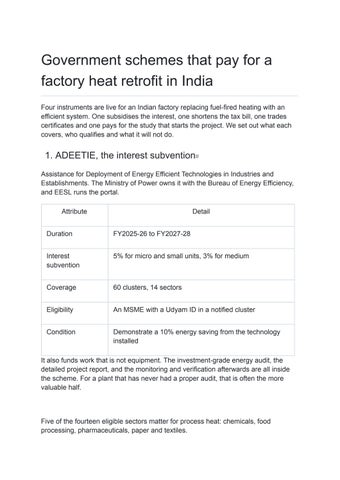
Government schemes that pay for a factory heat retrofit in India Four instruments are live for an Indian factory replacing fuel-fired heating with an efficient system. One subsidises the interest, one shortens the tax bill, one trades certificates and one pays for the study that starts the project. We set out what each covers, who qualifies and what it will not do.
1. ADEETIE, the interest subvention# Assistance for Deployment of Energy Efficient Technologies in Industries and Establishments. The Ministry of Power owns it with the Bureau of Energy Efficiency, and EESL runs the portal. Attribute
Detail
Duration
FY2025-26 to FY2027-28
Interest subvention
5% for micro and small units, 3% for medium
Coverage
60 clusters, 14 sectors
Eligibility
An MSME with a Udyam ID in a notified cluster
Condition
Demonstrate a 10% energy saving from the technology installed
It also funds work that is not equipment. The investment-grade energy audit, the detailed project report, and the monitoring and verification afterwards are all inside the scheme. For a plant that has never had a proper audit, that is often the more valuable half. Five of the fourteen eligible sectors matter for process heat: chemicals, food processing, pharmaceuticals, paper and textiles.
One caution. The scheme publishes an approved technology list, and it is worth reading that list for your own equipment before assuming coverage. Write the scheme into a business case as available to your sector. Do not write it in as confirmed for a specific machine until you have checked. A second caution, from history. Around 71% of the funds under the predecessor TEQUP scheme went unused. A subsidy is a reason to start the conversation. It is not a reason to buy.
2. Accelerated depreciation at 40%# The Income Tax rules allow 40% depreciation in the first year on qualifying energy-saving equipment. The rate has stood at 40% since the Finance Act 2017. Heat pumps are named explicitly in Appendix I, item 8(ix). This is the most reliable of the four. It needs no application, no cluster and no Udyam ID. It reduces taxable profit in the year of installation, so the cash benefit depends on the tax the unit pays. How much a unit can actually claim is worked through under government incentives for heat pumps in India. Two errors are common in vendor material. The first is quoting 80%, which was the older rate and is wrong. The second is treating depreciation as a subsidy. It moves tax forward in time. It does not reduce the price of the machine.
3. PAT and energy saving certificates# Perform, Achieve and Trade sets energy consumption targets and issues tradable certificates against overperformance. It applies only above the Designated Consumer threshold, which is 30,000 metric tonnes of oil equivalent a year for most sectors. That threshold puts most of Indian manufacturing outside the scheme. If your plant is not a notified Designated Consumer, PAT is not a route to money. It is worth knowing about because your large customers are inside it, and their supplier audits increasingly ask about your energy source.
4. The BEE energy audit route# An investment-grade energy audit by an accredited auditor is the document a lender and a scheme both want. ADEETIE funds it. Without one, a retrofit proposal rests on the vendor's own arithmetic, which is the weakest possible position in a capital approval.
The audit also settles the question that decides everything else. Which duty, at what temperature, for how many hours, on which fuel, at what price.
What none of these do None reduce the running cost of the plant. That comes from the efficiency of the equipment and the price of the energy it uses. Over a ten-year life, it dwarfs every grant here. For process heat, the arithmetic runs like this. A gas-fired boiler at 85% efficiency burning PNG at ₹68 a standard cubic metre delivers heat at about ₹7.24 a useful kilowatt hour. A heat pump at COP 3.5 on the Maharashtra HT-I tariff delivers the same heat at about ₹2.41. That difference is the project. The schemes above change when it pays back, not whether. A caution on that comparison. It holds against gas, LPG, furnace oil, light diesel oil and diesel. It does not hold against coal. Delivered coal at ₹6,000 a tonne lands near ₹1.94 a useful kilowatt hour, which a heat pump does not beat on grid power. Against solid fuel the case is compliance, air quality, labour and customer audit. It is not cost, and any proposal that says otherwise will not survive a competent energy manager.
Where to start Work out the saving on one duty before applying for anything. That number is what a scheme application has to be built around. With the duty defined, a supplier figure for it can be requested through Tetra Heat Pump's customised quote form.