Aluminium in Pharmaceutical Primary Packaging: The Recyclability Question
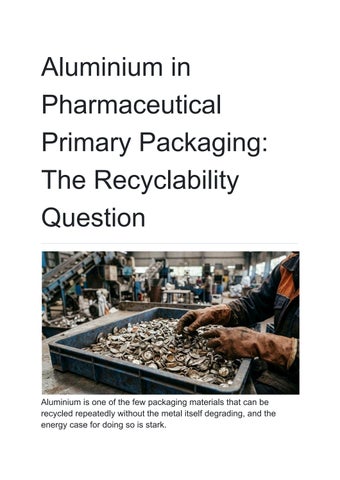
Aluminium is one of the few packaging materials that can be recycled repeatedly without the metal itself degrading, and the energy case for doing so is stark.
The International Aluminium Institute puts the energy required to produce recycled aluminium at around five percent of the energy needed for primary production, with a comparable saving in greenhouse gas emissions. Primary smelting is electricity-hungry in a way that few industrial processes are. Remelting scrap is not. That is the headline property, and it is true. It also tells you almost nothing about what happens to the aluminium seal on a used vaccine vial. That seal is a fraction of a gram of thin, lacquered, printed metal, frequently bonded to a moulded plastic top, still crimped to a glass vial with a rubber stopper inside it, part of an assembly that holds drug residue even though the seal itself is not normally a product-contact surface, and leaving the building inside a regulated clinical waste stream whose entire design purpose is to destroy infectious and pharmaceutical hazards rather than to recover materials. Every one of those attributes works against recovery. The gap between what the material can do and what actually happens to the object is where the honest version of this conversation lives.
The object defeats the system before the material gets a chance Start with mass. Closure stock is a thin strip, not sheet. The European specification covering rolled aluminium for cans, closures, and lids runs from 0.150 mm to 0.500 mm, and vial seal stock generally sits in the lower part of that band. A finished seal is therefore a very small quantity of metal in a very small object. Recovery of non-ferrous items in a materials recovery facility depends on eddy-current separation, and separation efficiency falls as particle size falls. Small, light items are precisely the ones that ride out with the residual fraction.
Then the coating. Cap aluminium is almost never used bare. It is lacquered on both faces and often printed before forming, because the coating has to be cured flat and then survive being drawn and crimped without cracking or shedding particles. That is the right engineering decision for an injectable line, where a loose coating fragment is a particulate contamination risk. It is an inconvenient one for a remelt furnace, where organic coatings need a decoating or thermal pre-treatment step, or they burn off, generate emissions, and cost metal to oxidation. Coated scrap is recyclable. It is not free to recycle, and the economics of that treatment are set by the volume you can feed the process. Then the mixed construction. A flip-off vial seal is an aluminium shell with a moulded polypropylene button on top, so the finished article is two materials joined by the forming process rather than by a fastener anyone can undo. The contrast worth noting is that not every aluminium closure is like this. An all-aluminium pilfer-proof cap carries no plastic component at all: its tamper evidence is a band formed into the metal shell itself, and the only non-metal element is the lacquer lining. As a candidate for recovery, a mono-material closure is a straightforwardly better object than a mixed one. That is a design fact, not a marketing one, and it is one of the few genuine levers in this whole picture. Finally, the assembly. Nobody at a bedside is going to separate an aluminium seal from a rubber stopper from a glass vial. The unit that enters the waste stream is the whole closed container, three materials in one object, and any recovery scheme has to start by dismantling something that was deliberately engineered not to come apart.
The waste stream is regulated before it is economic Even if the object were easy to sort, it would not reach a sorter by the usual route. Used primary packaging from a clinical setting is clinical waste, and clinical waste law is written around infection control and pharmaceutical destruction. India's framework is a useful example because it is explicit about the material question. Under the Bio-Medical Waste Management Rules, 2016, contaminated glassware including medicine vials and ampoules falls into the blue category, and the prescribed handling is disinfection, autoclaving, microwaving, or hydroclaving, after which the material is sent for recycling. So a recycling route does exist on paper, and it is a real one for the glass fraction. Whether the aluminium fraction of a crimped closure is separated out and recovered within that route is a different question, and it depends on the capability of the individual common treatment facility rather than on the rule. The rules also draw a line that no amount of design work can cross. Items contaminated with cytotoxic drugs are excluded from the blue category and go to incineration. An oncology vial's aluminium seal has no recycling route at all, and that is the correct outcome. Where material recovery and hazard destruction conflict in a healthcare setting, hazard destruction should win, and in every jurisdiction that has written rules on this, it does. Any circularity claim about pharmaceutical primary packaging that does not acknowledge that ordering is not being honest about the constraint.
Where recovery actually happens The part of the aluminium closure lifecycle where recycling genuinely works is upstream of the patient, and it is rarely the part anyone talks about. Stamping and drawing shells from coil generates a skeleton of offcut metal. That scrap is single-alloy, of known provenance, generated continuously at one address in tonnage quantities, and clean apart from its lacquer. It is close to the ideal input for a remelt operation, and it is dealt with as a matter of routine industrial practice rather than as an environmental initiative. Rejected shells, coil ends, and set-up waste fall into the same category. For a closure plant, the numbers that matter to material circularity are yield and process-scrap recovery, and they are numbers the plant can actually influence. The alloy choices behind that scrap also matter. Closure stock draws from a narrow set of families, principally the commercially pure 1xxx alloys and the aluminium-iron-silicon alloy 8011, chosen for how they deep-draw and how the skirt behaves under a crimping head. Because the alloy, temper, and gauge of closure stock are held constant for a qualified product rather than substituted lot to lot, the scrap stream from a given line is compositionally consistent, which is worth more to a recycler than volume alone. The honest framing, then, is that a closure manufacturer's real material story is a pre-consumer one. It is about how much of the coil ends up in a finished seal and what happens to the rest. Presenting that as evidence about post-consumer recovery would be a straightforward misrepresentation, and it is a common one.
What would actually change the picture? None of the following is a solved problem. All of them are more useful than restating the material's headline property. ● Take gauge out where the crimp allows it. Thinner metal is less metal. It is also a change to the capping recipe, because gauge drives crimp force and springback, so it is a re-qualification exercise rather than a specification edit. That cost is why it does not happen casually, and it is a legitimate reason for caution. ● Prefer mono-material formats where the application permits. A closure that is metal and lacquer is a better end-of-life object than one that is metal, lacquer, and moulded plastic. This is only available where the container and the clinical use case allow it, which for stoppered injectable vials they often do not. ● Specify coatings with remelt in mind. Lacquer systems are chosen for adhesion, formability, and product compatibility, which is right. Decoating behaviour is not usually in the specification at all. ● Segregate where the volume is concentrated. A fill-finish plant, a large hospital pharmacy, or a vaccination campaign generates closures in one place in quantity. That is a more plausible collection point than a distributed clinical waste stream, and it is where a pilot would have to start. ● Distinguish recyclable from recycled, in writing. This is the cheapest change available and the one most often skipped. India's Central Consumer Protection Authority notified guidelines on greenwashing and misleading environmental claims in October 2024, requiring environmental claims to carry adequate qualifiers and verifiable substantiation, and comparable rules are tightening in the European Union and
the United Kingdom. A claim that a component is made from an infinitely recyclable material is defensible. A claim that implies it is recovered in practice is not, unless you can show the recovery.
The takeaway Aluminium's recyclability is real, and it is one of the better reasons to use it in primary packaging. It is not the same thing as a used vial seal being recycled, and treating the two as interchangeable is the specific failure mode this industry should avoid, because the people reading packaging sustainability claims in pharma are technical buyers who will check. The defensible position for anyone making or buying these components is narrower and more useful than the headline. Say what the material is. Say what the object is: small, coated, often mixed, and attached to a container it was designed never to release. Say where the constraint actually binds, which is a clinical waste system that correctly prioritises hazard destruction over material recovery. Then report on the part you control, which is upstream, and let the number be what it is.