LOOK
FORWARD
ISSUE 169
WINTER 2019
INSIDE: CELEBRATING YOUR FUNDRAISING ACHIEVEMENTS
/RetinaUKcharity
@RetinaUK
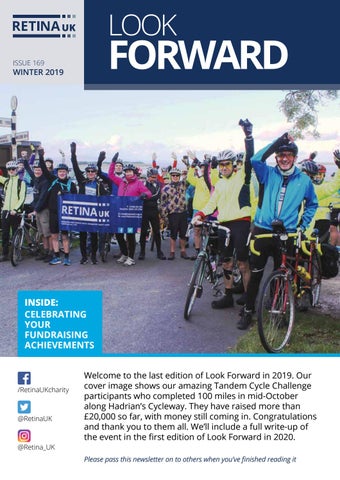
Welcome to the last edition of Look Forward in 2019. Our cover image shows our amazing Tandem Cycle Challenge participants who completed 100 miles in mid-October along Hadrian’s Cycleway. They have raised more than £20,000 so far, with money still coming in. Congratulations and thank you to them all. We’ll include a full write-up of the event in the first edition of Look Forward in 2020.
@Retina_UK
Please pass this newsletter on to others when you’ve finished reading it
NEWS
Reflections on 2019 As I write this I can hardly believe it has been one year since our re-brand to Retina UK; what a year 2019 has been. Our Annual Conference and Professionals’ Conference were a great success (see pages 4-5 and 7). Thank you to everyone who came along. It was great to meet so many of you. We hope to announce the full programme for 2020 events soon. This is also the first edition of Look Forward since the announcement that NICE has recommended that Luxturna (a treatment for LCA2) is made available on the NHS (see page 8). This is really encouraging news and will, we hope, further motivate the scientific research community to get treatments to patients. It’s that time of year again and Christmas cards are available from our online shop at £2.50 for a pack of six
(plus P&P). See page 19 for more information and other Retina UK branded gifts. Finally, you’ll read on page 18 about the Big Give Christmas Challenge which takes place from 3-10 December. This is a fantastic opportunity to double your donation to Retina UK at no cost to you. You have always been incredibly generous to Retina UK; we really do appreciate your support. I always welcome comments and feedback about our charity. Please get in touch with me on email at chiefexec@RetinaUK.org.uk if you have something you would like to share. You can also phone our team on 01280 821334.
Tina Houlihan, Chief Executive
Retina UK funds medical research into inherited sight loss and offers a range of information and support services to those affected. Retina UK, Wharf House, Stratford Road, Buckingham MK18 1TD E: info@RetinaUK.org.uk · T: 01280 821334 (Office) · T: 0845 123 2354* (Helpline) *
Calls cost 2ppm plus your phone company’s access charge
Do you follow us on Facebook and Twitter? Search for Retina UK on Facebook to find our page and various groups, and follow us on Twitter at @RetinaUK for the latest news and updates about the charity. Retina UK is a Charitable Incorporated Organisation (CIO), registered charity number: 1153841
2
GET INVOLVED
Represent our community Our sight loss survey has highlighted that you have a real appetite to get involved in representing the inherited sight loss community through activities like focus groups, surveys and research projects. We need to know a bit more about you to help us make this happen. Knowing more about you also helps us to provide better information and support via the services we offer and put you in touch with medical researchers. We have therefore set up a new (optional) form on our website www.RetinaUK.org.uk/more-info. It asks the following questions: • Your name, address, postcode and email – which allows us to crossreference your entry on our database.
• Whether you are the parent of someone living with a condition or if you are living with a condition yourself (or both). • Your year of birth (so that we can identify those in a certain age range). • Whether you would like to represent the sight loss community.
• Your genetic diagnosis (if known).
We encourage you to complete the questions you are comfortable with on the form. We will always contact you to ask if you’d like to be involved in a specific project and we will never pass your details to a third party without your consent.
• Your Visual Impairment Category (Visually Impaired or Severely Visually Impaired).
Alternatively you can call our friendly team who will take your details over the phone, 01280 821334.
• Your diagnosed condition (if known).
3
CONFERENCES
More than 230 gather at our
We welcomed old friends, made new ones and enjoyed a packed day of talks at the Retina UK Annual Conference 2019. Pete Coffey from University College London talked about the development of a cell-based therapy for agerelated macular degeneration and the potential applications it could have for inherited sight loss conditions. Michael Gilhooley, University of Oxford, spoke about optogenetics and how skin, blood or even urine can be turned back into a stem cell and then turned into the cell that is relevant to his research. This means that scientists can create a “disease in a dish” and have an endless supply of cells to test different drugs and therapies on. We were delighted to be joined by soprano and All Together Now judge Lizzie Capener, our Inspirational Speaker. Avril Daly from Retina 4
International gave an update on the IRD COUNTS project, which has recently reported on the impact of inherited sight loss on wellbeing and productivity (see page 6). Professor Susan Downes told delegates that, by the end of the year, everybody should have access to genetic testing in the UK. She encouraged all members of our community to ask for a genetic test, which will build on data that already exists and ensure that people will be able to access potential future treatments. The delegates then split into groups for a series of workshops on ‘Transforming Lives Through Technology’, ‘Adjusting to life-changes caused by progressive sight loss’ and ‘Solutions Through Technology’.
Annual Conference
“I really appreciate these days. Thank you for organising them and for all the work that they take.” Dr Rachel Taylor, from the University of Manchester, was presented with the John Marshall Award for the best scientific paper from a UK-based research group (see pages 20-21). This was followed by a special award for the Colin McArthur Community Champion. Colin has been a Trustee for Retina UK for the past 11 years and we said farewell, thanking him for his fantastic service. The Award was won by Colin Hetherington, a tireless fundraiser and active community member. Our Ask the Experts Medical Question Time included all of our medical
speakers. There were some very specific questions, the answers to which will, we hope, offer an insight into the latest research. Thank you to all of our speakers, exhibitors and our sponsors OXSIGHT, Novartis, Roche, ProQR and Meira GTx for their support. Most of all, thank you to our 230 delegates for joining us in Milton Keynes. Audio recordings of all of the presentations will be available on www.retinauk.org.uk/informationsupport/recordings. “Excellent event which was informative and inspirational. A really good experience.” 5
RESEARCH
Study reveals impact of inherited sight loss on wellbeing and productivity The findings of a pilot study into the burden of Inherited Retinal Disease (IRD) on wellbeing and productivity have been published. The report was commissioned by IRD COUNTS, a patient-led multistakeholder consortium, initiated by Retina UK and managed by Retina International. The study set out to estimate, via a cost-of-illness approach, the disease burden and economic impact of IRDs in the Republic of Ireland and United Kingdom (UK) from a societal perspective. Tina Houlihan said: “Retina UK and our collaborators are concerned that the prevalence and impact of IRDs at a national and global level is largely undocumented. The lack of data in this area hinders the development and commissioning of clinical services, treatments, and the planning and implementation of clinical treatment trials. This is why this pilot study is so important.” This pilot relates to ten forms of IRDs including: retinitis pigmentosa, Usher syndrome and Stargardt disease. The findings show that in both the Republic of Ireland and UK the impact on the wellbeing and productivity of the affected individual and their families was significant. Wellbeing costs, which refer to the years of 6
quality of life lost due to IRDs, were responsible for 38.4% (£196.1million) of total IRD costs in the UK. Productivity costs, which refer to reduced workforce participation, absenteeism and presentism, were the second highest cost burden due to IRDs in the UK amounting to £114.1million. People living with an IRD in the UK were 40.2% less likely to be in paid employment than the general population and IRDs resulted in a 9.6% reduction in productivity while at work. The cost attributed to healthcare was relatively low, suggesting that those with a vision impairment do not engage as frequently with health care professionals as they do with those providing social and psychosocial supports. Tina Houlihan commented: “Most Health Technology Assessments (HTA) that determine the cost-effectiveness of new treatments do not take these complex factors into consideration, making it difficult to incorporate the true cost of these diseases into decisions around reimbursement. IRD COUNTS aims to remove this potential barrier to treatment availability.” The consortium is considering its next steps. The full report is available on the Retina International website.
CONFERENCES
Informative and positive – our first Professionals’ Conference Overwhelming positive feedback has been received from the 180 delegates who joined us for our first Professionals’ Conference.
The education, health and social-care professionals who attended the event on Friday 27 September included Eye Clinic Liaison Officers, Qualified Teachers of the Visually Impaired and Rehabilitation Officers. The focus was on making difficult conversations about sight loss more positive and how to provide high quality information and support, as well as an update on research. Comments from professionals attending included “Very well organised. Good support from staff”, “The Panel was one of the best I’ve seen in any of the VI community” and “Samantha de Silva did an excellent job of simplifying complex medical terminology.” “Retina UK and the professionals who support people with inherited sight loss conditions in a health, education or social care setting are all striving to do the best we can for our community.” Tina Houlihan said the event had been a huge success. “Retina UK and the professionals who support people with inherited sight loss conditions in a health, education or social care setting are all striving to do the best we can for our community. This is a fantastic example of the difference we can make when we work together.” 7
NEWS
NICE recommends first treatment on the The National Institute for Health and Care Excellence (NICE) has recommended Luxturna (voretigene neparvovec) for use in the NHS in England, making it the first available treatment for an inherited retinal dystrophy. Luxturna, a gene therapy, is only for the treatment of Leber congenital amaurosis type 2 (LCA2) and severe early-onset RP caused by mutations in a specific gene called RPE65. Retina UK had been actively involved throughout the NICE decision-making process and worked hard to ensure its community’s voice was heard. Retina UK Chief Executive Tina Houlihan welcomed the news and described the decision as a pivotal moment. “The progressive and debilitating nature of this rare genetic condition places a life-long physical, emotional and financial burden on patients and their families,” she said. “NICE’s recommendation marks a pivotal moment as, for the first time, children and adults born with this condition have a much needed treatment option. “We very much hope this is just the start and that other therapies will soon be discovered for a wide range of inherited retinal dystrophies and made available on the NHS.” 8
Ms Houlihan said the Retina UK community has played a critical role in influencing NICE’s decision. “We were able to present the decision-making committee with a number of findings on the burden of disease from our recent Sight Loss Survey, completed by almost 1,000 of our community. The committee’s evaluation document specifically quotes our survey’s findings on mental health impact and concludes: ‘The committee acknowledged that RPE65mediated IRD is a rare, serious and debilitating condition that severely affects the lives of patients, families and carers.’” The news has been welcomed by those living with LCA. Robert Johnson, a 35-year-old civil servant, said: “I know all too well the personal impact of gradual sight loss experienced by thousands of people who, like me, live with an inherited retinal dystrophy. Yesterday, many of us could realistically expect to lose our sight completely. Today, for the first time, we have hope that such loss is no longer inevitable. “Having participated in the first clinical trial of gene therapy for inherited retinal dystrophies, I am delighted that the dedication of so many people, over several decades, has finally resulted in the first treatment of its kind being approved for use on the NHS.”
NHS for an inherited retinal dystrophy Who will be able to access the treatment? People must have two faulty copies of RPE65, confirmed by genetic testing, as well as reasonable numbers of remaining viable retinal cells, in order to benefit from this treatment. Due to the severe, early-onset nature of this type of inherited retinal disease, eligible patients are likely to be children and young adults. The NHS in England and Wales is legally obliged to fund medicines and treatments NICE recommends. We expect the treatment to be available from early 2020 in three treatment centres around the UK. What about Scotland, Wales and Northern Ireland? The NHS in Wales will follow the NICE recommendation and will also be making Luxturna available at the beginning of 2020. We understand Northern Ireland is also likely to follow England’s lead and also that Luxturna will be made available in Scotland in 2020. How can I find out if my child or I am eligible for treatment with Luxturna? You will need to see your ophthalmologist in the first instance; if you don’t currently have an ophthalmologist, your GP can refer you. The ophthalmologist may refer you for tests to check whether you
have sufficient healthy retinal cells for the treatment to work. Luxturna provides healthy copies of the RPE65 gene but relies on retinal cells using their own molecular machinery to use these new genetic instructions; it won’t help in cells that have already degenerated. Your ophthalmologist will also need to arrange for you to have a genetic test if you don’t already know which gene is causing your sight loss, and the results for this may take some time. The test must show that you have two faulty copies of RPE65. Around 86 people are likely to be eligible for treatment in England. If I’m eligible, what happens next? Your ophthalmologist will refer you to a treatment centre – there will be three of these in the UK. Luxturna is administered via an injection into the retina, which takes place under general anaesthetic. The treatment only needs to be given once but each eye is treated separately, with at least a week between the two operations. You will then need several follow up appointments at the treatment centre. There is a risk of side effects, including further sight loss. These will be explained to you at the treatment centre. 9
FUNDRAISING
The Vitality Big Half Articles for the Blind Did you know we can post this newsletter to you with no postage costs to our charity under Royal Mail’s Articles for the Blind (AFB) scheme?
JOIN TEAM RETINA UK The Vitality Big Half is a half marathon on 1 March 2020 in London. It is part of the Marathon route in reverse, and starts at Tower Bridge and finishes at Greenwich. It also features a one day festival to celebrate the cultural diversity of the city. There’s no registration fee to join the team, you just need to pledge to raise a minimum of £400 for Retina UK. To find out more please visit www.RetinaUK.org.uk/BigHalf. 10
All you need do is notify us that you are blind or visually impaired – we cannot make that assumption – and you are happy for us to send Look Forward to you under this scheme. Please email info@ RetinaUK.org.uk or call us on 01280 821334 and ask us to record this information on our database. If you already receive this newsletter from us marked Articles for the Blind, there is no need to do anything. The money we save on postage costs will be invested in our information and support services and research projects.
GET INVOLVED
Meet others affected by inherited sight loss Our recent sight loss survey identified that those who have engaged with Retina UK are less likely to say they’ve experienced isolation or loneliness, compared with those who have not engaged.
Can you help us? We need volunteers to facilitate the groups. Would you be available a couple of times a year to welcome and support others with an inherited retinal condition? For more information please contact Clair, our Volunteer Coordinator on 01280 821334 or by email volunteering@RetinaUK.org.uk. Is your area not on the list? If you would like to assist us with a group in your area then let us know local@RetinaUK.org.uk.
Local Peer Support Groups Spring Meeting Dates East of Scotland – Saturday 21 March Glasgow – Saturday 7 March We also know that our community benefit from informal meetings with others affected by sight loss, and support from other national sight loss charities. Because of this we plan to organise new peer support groups in the following areas during 2020: • • • • • •
Northern Ireland Manchester Milton Keynes & North Bucks Birmingham Cardiff Kent
Hampshire – Monday 30 March Isle of Wight – Monday 13 January, Monday 10 February and Monday 9 March London – Saturday 28 March Merseyside – Monday 27 January and Monday 30 March Milton Keynes – Saturday 8 February Somerset – Saturday 28 March All dates are subject to change. For more information please email local@RetinaUK.org.uk. 11
VOLUNTEERING
Do something new Our wonderful volunteers have welcomed, guided, cheered, encouraged, listened, informed and supported our community this year. We simply couldn’t achieve all we do without them – and you could join the team! In 2019 volunteers supported our staff at our Information Days and Conferences; cheered on our London Marathon runners and tandem cyclists; welcomed our Hope to Seaview walkers; assisted our office team; collected on the London Underground; and provided essential support for our helpline, talk & support and local peer support groups. Short of time? Whether you have one day a year or a few hours each month - your time is valuable to us. One day a year? Join us at one of our information days to ensure our community have the best experience. Something local? Become a Retina UK volunteer representative to collect cheques or take part in local sight loss events. 12
Something from home? Are you a good listener, with experiences to share to support others? Be part of our telephone talk & support team. Skills to share? We are looking for photographers to volunteer to record our events; social media facilitators to help build our Facebook Local Group pages; a technical whizz to provide helpful hints and tips; a personal story to share to support our funding applications - the list is endless! We’re ready for you – come and join us! Contact Clair, our Volunteer Coordinator, on 01280 821334 or email volunteering@RetinaUK.org.uk.
“If you want an opportunity to make a difference to an amazing community, have a great experience and support a fantastic charity, I would highly recommend Retina UK.”
13
FUNDRAISING
Thanks to you Andrew completed the Lands End to John O’Groats cycle in July, along with five friends all raising money for different charities. Andrew raised over £500 for Retina UK.
Luke took on an epic 600mile walk along the South West Coast Path. The walk took around 30 days to complete, and he has raised £250 for Retina UK.
Tom completed the double Across Wales walk which is a continuous 90-mile walk. He had attempted the challenge twice before and this time succeeded. He has raised £3,100! Elaine puts on golf days every couple of years in aid of Retina UK, and this year raised a brilliant £832!
Lucy and Jo formed Team Retina UK for this year’s Great North Run and have raised over £1,000 between them so far. The photo is of Jo with her guide Michael.
Janine and Shaun ran the Ikano Bank Robin Hood Half Marathon and raised £970!
Thank you to James at the Thales Group. The company donated £1,000 after a nomination from James in support of his nephew Jacob.
We love to hear about all of the great fundraising that goes on up and down the 14
Alex, Shannon, James, Michael and Stuart were the team representing Retina UK at the Royal Parks Half Marathon. Between them they have raised around £2,000 so far! Amelie and Pierre-Jean took on the South Coast Ultra Challenge, walking 100km. They have raised £1,312 between them.
Dr John Davis is kindly donating 50% of profits from the sale of his book “A Foot in Both Camps: Defying the Odds”. You can buy his book on www.lulu.com.
On 12-13 October, a team of 36 took on the Retina UK Tandem Cycle Challenge. They cycled 100 miles over the two days along Hadrian’s Cycleway and have raised over £20,000 so far between them. Amazing! The weekend was a great success, with many friendships made, a lot of laughs and a great sense of achievement at the end. Thank you to everyone who took part and all our volunteers too. Registration is open for next year’s tandem cycle, a Devon Coast to Coast challenge. Find out more at www.RetinaUK.org.uk/ TandemCycle.
country. Please send your pictures and stories to fundraising@RetinaUK.org.uk 15
EVENTS
Bringing our community Our programme of Information Days for 2019 has now ended and what a year it has been. We’d like to say thank you to all of our speakers, volunteers and guests for making these events so interesting and informative.
Our first event was the North West Family Fun and Information Day in Liverpool in March in collaboration with Henshaws, Royal Society for Blind Children and St Vincent’s School for the Blind. More than 50 people joined us for a fun day of crafts, story-telling, talks and hands-on demonstrations of technology. May saw our first Information Day of the year in Newcastle. We were joined by more than 60 guests, along with some great exhibitors. Guest speakers included Dr Valeria Chichagova and Dr Darin Zerti from the Institute of Genetic Medicine at Newcastle University. They were followed in the
afternoon by a great talk from Phillipa Taylor from Newcastle Vision Support. In June more than 60 guests enjoyed talks from Dr Arjuna Ratnayaka from the University of Southampton and Dr Mariya Moosajee from Moorfields Eye Hospital at our Brighton Information Day. June also saw the first family event from Usher Kids UK in Birmingham which was supported by Retina UK and Sense. For many of our attendees, this was the first time they had met another family living with Usher
16
together “It was fantastic to see so many people attend our professionals’ conference. We were specifically asked by the community for a dedicated conference, and we have listened. We all play a huge part in supporting people living with progressive inherited sight loss. By working together, learning from each other and sharing best practice we will continue to improve the services that we offer.” Matt Carr, Regional Service Manager
Silvestri from the Belfast Health and Social Care Trust.
syndrome and the opportunity to share experiences and support each other made this an incredibly successful day. September saw our first Professionals’ Conference and our popular Annual Conference. See pages 4, 5 and 7 for more information about these. Our final Information Day in October was held in Belfast (Northern Ireland). Over 80 guests joined us, which made this our most popular Information Day of 2019. Our guests heard from Professor Peter Humphries from Trinity College, Dublin and Miss Julie
Our plans for next year include Information Days in Reading, Cardiff, Manchester and Glasgow. We’re also planning to hold events for children and young people in Merseyside in the spring and Birmingham in the summer. If you can’t make it to an Information Day, you can meet us at Sight Village events throughout the year. We’ll be in Cardiff (April), Birmingham (July), Leeds (September) and London (November). If you would like to know more about our events, please visit our website www.RetinaUK.org.uk, call our office on 01280 821334 or email info@RetinaUK.org.uk. 17
FUNDRAISING
Double your donation to research with the Big Give Christmas Challenge!
For the third time, Retina UK is taking part in the Big Give Christmas Challenge. Every year we raise more and more to invest in pioneering research and we want to do the same this time!
If you want to donate to our medical research this Christmas then make sure you put a note in your diary to visit: www.RetinaUK.org.uk/biggive between midday on Tuesday 3 December and midday on Tuesday 10 December. If you make a donation via the Big Give Christmas Challenge, your donation will be doubled* at no cost to you, helping you make twice the difference to some of the most promising research into inherited sight loss taking place in the UK and beyond, including retinitis pigmentosa (RP), Usher syndrome, Leber congenital amaurosis and Stargardt disease. *whilst match funds last
18
If you have any questions about the campaign or experience difficulties making your donation please contact the Fundraising Team on 01280 815900 or email fundraising@RetinaUK.org.uk. “The Big Give Christmas Challenge is a smart, good value way of fundraising for research. I took part last year, and will be doing so again this year so that my donation can be doubled.� Martin, Big Give Christmas Challenge donor
SHOP
Shopping for festive gifts Visit the Retina UK online shop at www.RetinaUK.org.uk/ Christmas shop today to buy Retina UK cards £2.50 merchandise such as t-shirts, per pack of 6 coffee cups, tea towels and pin badges! Great for stocking fillers, this is an easy way to let everyone know that you support our charity!
Reusable coffee cup £7
Tea towel £5
Car stickers £1
Pin badge £2
T-shirt £10 19
RESEARCH
Harnessing cutting-edge technology
The UK Inherited Retinal Dystrophy Consortium (UKIRDC) is a unique collaboration of leading researchers, whose combined expertise provides an unprecedented opportunity to put together more pieces of the inherited sight loss puzzle by identifying causative genes and gaining insight into their function. 20
The programme, which has received significant funding from Retina UK, is intended to facilitate greater collaboration between the four centres – Leeds, London, Manchester and Oxford - and the sharing of patient data which is essential in the development of clinical trials and future access to treatments.
to improve diagnosis Dr Rachel Taylor is part of the team at the University of Manchester. “It’s a really exciting time to be involved, since our understanding of genes involved in eye development and function has progressed so much in the last decade due to advances in DNA sequencing technologies. The UKIRDC team is harnessing this cutting-edge technology to further improve our ability to diagnose retinal disease and extend access to genetic testing for patients and their families, allowing them to make better informed choices and prepare them for the impact their diagnosis may have on their vision. “Our work will also enable better understanding of the genes and pathways involved in retinal health and disease. The project will increase our knowledge of how all of these processes interact, giving a more complete picture of what’s happening in the retina and improving our ability to interpret the changes in a range of retinal dystrophy genes. Gaining insight into the function of a group of genes, or even just one, can lead us to identify patterns that apply to other retinal conditions. Ultimately, this provides a really strong basis for the development of more effective treatments for the whole community. “I really do hope to continue my work in this area as my career progresses. This project would not be possible without
the participation of people living with inherited retinal disease, and their courage is a constant reminder to me of why our efforts are so important.” “It’s a really exciting time to be involved, since our understanding of genes involved in eye development and function has progressed so much in the last decade due to advances in DNA sequencing technologies.”
The John Marshall Award 2019 Many congratulations to Rachel, who won the John Marshall Award 2019 for her paper ‘Loss-of-function mutations in the CFH gene affecting alternatively encoded Factor H-like 1 protein cause dominant early-onset macular degeneration’. The paper describes seven families with multiple generations affected by early-onset macular degeneration (EOMD). This work enabled them to define an important genetic mechanism underlying the development of EOMD. It could also lead to a better understanding of AMD and how genetic factors play a role in its onset – an area that is currently poorly understood – as well as treatment strategies. This work has relevance for all inherited sight loss conditions. 21
RESEARCH
EURetina 2019 Paul Sladen, a final year PhD student at University College London Institute of Opthamology, represented Retina UK at EURetina 2019, the annual conference for European retinal specialists, in Paris in September. He reports back on his experiences: “The conference opened my eyes to the diverse community throughout Europe working to improve the lives of people living with inherited retinal degenerations (IRDs). The development and progress of retinal gene therapy, with a special emphasis in the use of viruses to inject the retina with healthy copies of genes to prevent further degeneration of retinal cells was a key element on the first day. “Sandwiched in the middle of the gene therapy focused days was a very thought provoking session on IRD epidemiology. A great talk by Caroline Klaver, University Medical Centre Rotterdam, focused on the increased risk of retinal disease associated with smoking. This was followed by Cecile Delcourt from the French Institute of Health and Medical Research. She focused her talk on the effects of nutrition on retinal health. Cecile showed that basic nutrition (such as vitamin intake) is crucial for retinal health, and demonstrated that a simple Mediterranean diet (high in plant foods, oily fish and limited red meat) can often 22
reduce, or help, with retinal disease symptoms. “Although the majority of studies presented by Caroline and Cecile focused on age-related conditions, it is interesting to see the impacts that lifestyle choices can have on disease progression. On my return to London I did some extra research. Studies of retinitis pigmentosa suggest certain nutritional supplements can reduce visual decline in non-smoking patients. However, you should always check with your ophthalmologist before taking supplements. “Hopefully further research will be conducted on a greater range of diseases, with greater focus on IRDs, to determine the effects fairly simple changes can make on disease progression. “The conference really emphasised the huge amount of time, effort, care and money being invested into treatment for a whole range of IRDs.”
FUNDRAISING
Don’t forget to return your raffle stubs!
PRIZES: • 1st Prize: £500 • 2nd Prize: Afternoon Tea for two at the Taj Hotel in London • 3rd Prize: Amazon Echo • 4th Prize: £100 voucher towards a Traveleyes accessible holiday • 5th Prize: A mini Christmas hamper
This year’s Retina UK Christmas Raffle gives you the chance to win £500 or one of our other fantastic prizes. You should have received your raffle tickets in the post – make sure you return your stubs by Monday 16 December to be in with a chance of winning! The draw takes place on Wednesday 18 December. If you didn’t receive tickets, or would like some more, just let us know! Contact our friendly fundraising team on 01280 815900 or email fundraising@RetinaUK.org.uk. You can also request tickets and view full terms and conditions at www.RetinaUK.org.uk/Raffle. Huge thanks to the Taj Hotel, Amazon and Traveleyes for supporting this year’s raffle.
ADVERTISEMENT
Do you have tunnel vision? Then come and see us. Yes, actually come and see us. We understand everyone’s eye conditon is different but if our glasses suit your eyes then the experience will be...well, an eye opener. With OXSIGHT glasses you’ll be able to see much more of the world around you, so you can enjoy social situations, exhibitions, read books, watch cinema, TV...
If we can see you, we’ll help you to see us.
care@oxsight.co.uk 01865 580 255
oxsight.co.uk
A window back to the visual world
23
We are so grateful for all donations to our work Please make your selections below and post the form back to Retina UK, Wharf House, Stratford Road, Buckingham, MK18 1TD, or, if you prefer, call 01280 821334 or donate online at www.RetinaUK.org.uk. Thank you.
I enclose my cheque for £
payable to Retina UK.
I would like to make my donation of £
by debit/credit card.
Card Holder Name: Card Type: Mastercard
Visa
Start Date:
Expiry Date:
Maestro
Delta
Issue Number (Switch only):
Last three numbers on the reverse of the card: If you would like to set up a Direct Debit, please visit our website www.RetinaUK.org.uk or call the office on 01280 821334.
Contact details Title: Mr/Mrs/Miss/Other (please specify) Name: Address: Postcode:
Telephone:
Email: If you gift aid your donation, the charity will receive an extra 25p for every £1 that you give! I confirm that I have paid or will pay an amount of Income Tax and/or Capital Gains Tax for each tax year (6 April to 5 April) that is at least equal to the amount of tax that all the charities or Community Amateur Sports Clubs (CASCs) that I donate to will reclaim on my gifts in that tax year. I understand that other taxes such as VAT and Council Tax do not qualify. I understand that the charity will reclaim 25p of tax on every £1 that I give. Signature:
Start date:
Should you wish to opt out of some or all communications from us, you can do so at any time. Just call us on 01280 821334 or email info@RetinaUK.org.uk Retina UK is a Charitable Incorporated Organisation (CIO), registered charity number: 1153851