LOOK ISSUE 171
SUMMER 2020
FORWARD
INSIDE:
WATCH OUR BBC LIFELINE APPEAL
/RetinaUKcharity
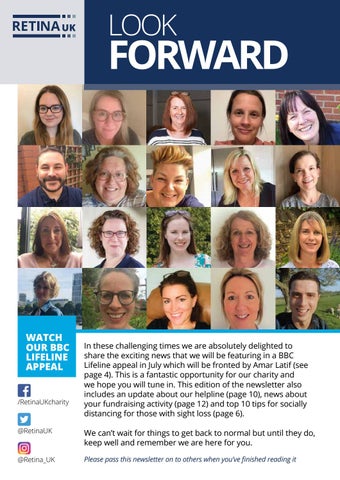
In these challenging times we are absolutely delighted to share the exciting news that we will be featuring in a BBC Lifeline appeal in July which will be fronted by Amar Latif (see page 4). This is a fantastic opportunity for our charity and we hope you will tune in. This edition of the newsletter also includes an update about our helpline (page 10), news about your fundraising activity (page 12) and top 10 tips for socially distancing for those with sight loss (page 6).
@RetinaUK
We can’t wait for things to get back to normal but until they do, keep well and remember we are here for you.
@Retina_UK
Please pass this newsletter on to others when you’ve finished reading it
NEWS
Doing things differently Way back in February I wrote about ‘Exciting times ahead’. None of us could have imaged what was to come. As I write this (in late June) we hope we are over the worst here in the UK. In true British spirit our community have hunkered down and remained fantastically upbeat and optimistic throughout. Spirits have been lifted by the smallest of things. The sound of birds singing, the warmth of the sun on our faces and a kind word or gesture from another person. I would particularly like to thank all our volunteers, we simply couldn’t do what we do without you and that has been even more apparent through this pandemic. I now dare to look to the future with cautious hope and optimism. The world may not ever be quite the same again, but our aim here at Retina UK remains, to provide the very best information and support for today and hope for tomorrow. Research
scientists are starting to go back to their labs and continue to look for treatments; our Annual Conference has been tentatively rescheduled to April 2021 and we are working with a few local groups on pilot ‘virtual’ meetings. We hope to start up face-to-face local groups later in the year (see page 15). We have been successful in our application for a BBC Lifeline appeal (see page 4). It will air on Sunday 26 July and I urge you to watch it and to ask your friends, family and colleagues to get involved too. Spreading the word will not only potentially result in muchneeded financial support, it will also raise awareness of the work we do and the conditions we support to a much bigger audience. Keep safe and well. I look forward to seeing you all again soon.
Tina Houlihan, Chief Executive
Retina UK funds medical research into inherited sight loss and offers a range of information and support services to those affected. Retina UK, Wharf House, Stratford Road, Buckingham MK18 1TD E: info@RetinaUK.org.uk · T: 01280 821334 (Office) · T: 0300 111 4000 (Helpline)
This newsletter has been funded through sponsorship by Janssen. Janssen has not been involved in the production, review or distribution of this material. Retina UK is a Charitable Incorporated Organisation (CIO), registered charity number: 1153851
2
NEWS
Chairman’s update When we started 2020, it was with great expectations. We had ended the previous year in good shape and had bold, achievable plans to grow our income significantly and widen the scope of the research and support which we fund. Then the coronavirus arrived and had an extraordinary effect on all our lives. It has caused us to make some dramatic changes. Staff moved to working from home, some needed to be furloughed and our plans for various gatherings had to be cancelled or rescheduled. But that has not stopped us working harder than ever to find ways to raise funds and to manage our resources to continue to fund the research projects to which we are already committed. Some of these projects have, of course, fallen victim to the virus. Labs are challenging places in which to work at the best of times, with social distancing and PPE, the challenge is often insuperable. In times so difficult, our helpline has been even more important and it is wonderful that our volunteers have kept that all working so well. Equally, the ‘Retina UK community’ has pulled together by supporting each other and inspiring virtual events to ensure that we continue to be a community - one without which we won’t achieve our objectives. May I, on behalf of the
Board of Trustees, thank the Retina UK community for all you do and for your unfailing support. Our principal aim for the last few months has been to ensure that the charity survives. That may sound dramatic but with much reduced income we could run out of cash. Through the swift action of Tina, our CEO, supported by the staff and very fully by the Trustees, we are going to come through. There have been sacrifices and tough consequences for staff. We are very grateful for their cheerful acceptance of the challenges. I am also very grateful to the Board for their positive help. We now meet online monthly to ensure that all that is possible is being done to achieve the objectives set for the charity. So what now? We must all do even more to raise funds. Even in lockdown there have been some extraordinary efforts. Please do all you can to help fundraising, it is more important now than ever. Remember, we are not out of the woods yet and still have the prospect of a second wave of the virus with another lockdown. One very big fundraising opportunity is coming up: the BBC appeal. Do please watch this and encourage all your friends, colleagues and family to do the same. It could make a very real difference. Meanwhile, please accept my best wishes. Stay safe! Don Grocott 3
FUNDRAISING
Tune in to our BBC Lifeline appeal We are super excited to announce that Retina UK will be featured in a BBC Lifeline appeal. The appeal will be broadcast on BBC TV on Sunday 26 July (the time has not yet been finalised) and will then run for one month on the Lifeline website: www.bbc.co.uk/lifeline.
Our target is ÂŁ10,000. Please help us to reach it. If you have any questions about the appeal, please call Deborah Laing, Head of Fundraising, on 07841 004564. 4
The BBC appeal gives us an amazing opportunity to not only raise vital funds – particularly important during these challenging times – but also to raise awareness and to highlight the challenges faced by the inherited sight loss community and the vital work that Retina UK does. The appeal will be hosted by Amar Latif who has long been a supporter of the charity. Amar lives with retinitis pigmentosa but hasn’t let it stop him travelling the world and founding Traveleyes. He will be appearing in Celebrity MasterChef 2020 due to be broadcast this month (July 2020). Our appeal focuses on the immediate need for information and support for those living with inherited sight loss conditions. Some of you reading this newsletter will have had a long relationship with us but others may be new and more still may not have heard of us at all. It references the practical and emotional support we offer, which brings people together to share information, hints and tips and to offer a supportive listening ear. These connections are invaluable. Some members of our community choose to give back by becoming helpline volunteers, peer support group leaders and completing fundraising challenges. The appeal will also demonstrate the importance of research. It is terrible
that just one percent of national funding is invested in eye research. We know that 260 faulty genes have been identified and yet there is currently only one treatment available for one of these faulty genes. Research is enormously expensive and Retina UK has committed £16.5 million into cutting-edge projects since we were founded in 1976. There is so much more to do and we hope that other therapies will soon be discovered for a range of inherited retinal dystrophies and made available on the NHS. This is only possible if we continue to fund this vital work.
How can I help? Put the date in your diary, watch the appeal on Sunday 26 July (we will publish the time on our website as soon as we know it) and ask all your friends, family and colleagues to tune in. The appeal will be available on the Lifeline website immediately following the broadcast: www.bbc. co.uk/lifeline – you can share this link with anyone who’s not been able to catch it on TV. Watch out for our social media posts about the appeal and like, share and spread the word! 5
INFORMATION
Top 10 tips for social distancing if
Senior Rehabilitation Officer Simon Merrils from Henshaws shares these top social distancing tips
Don’t be put off letting people know you have a visual impairment. Sometimes we keep it quiet and don’t want others to know. Well now it’s time for a change, let it out of the bag! It took me ages to be comfortable letting others know, from admitting it to family all the way to long caning it through Piccadilly Station. The difference it makes when people know is amazing.
TIP
1
6
If you’ve got a cane, use it, keep it in view at all times (we tend to fold them away as soon as we can!) I know not everyone knows what a white cane is, but most do. It makes you noticeable, that’s why a symbol cane is called “symbol”, to let others know. Even if it’s still in the drawer (you know the one in the kitchen with all the other stuff in, elastic bands, Sellotape etc.) – get it out!
TIP
2
you are blind or visually impaired Take your cane if you’re with someone; hold it to the side and make it obvious you’re together and being guided. You could fold your long cane in half, so you don’t get tangled or kick it up into your face.
TIP
3
If you’re using your long cane, make it obvious you’re using it. Keep your starting sweep obvious, make sure your arc is wide enough. Sometimes we keep it tight as we learn to use a cane more efficiently. Using a bit of three-point touch keeps it noisy. This is where you add an extra tap to check your shoreline, it will help people hear you coming. You could increase your arc width as long as you don’t compromise your safety, for example in a shop.
TIP
4
Keep to the inner shoreline, away from the kerb, let others step out into the road, make your path definite and confident.
TIP
5
If you think someone is too close, tell them you have a visual impairment and ask them are they at the correct distance. It’ll help you test the distance when they answer. If they are not it may prompt them to move away.
TIP
6
If you don’t have a symbol cane (the short one) you could buy one from the RNIB, or you could ask your local sensory team to supply you with one.
TIP
7
If you’re using public transport, ring for and book assistance if possible. Ring the bus company and ask: “What can I expect on the bus such as layout, etc?” I will certainly be ringing up to find out the system and what to expect, if I go to any appointments etc. in the future.
TIP
8
One thing I’ll be doing is assuming my hands need washing the minute I leave the door. I’ve really tried to get out of the habit of touching my face, that’s easier said than done! If you can get the correct hand wipes or sanitiser, put it in your pocket.
TIP
9
Disinfect your cane handle and the end - if it’s been on the ground it could have all the usual things on it you find on a pavement! Disinfect what you feel needs it, and when you’ve done wash your hands.
TIP
10
ABOVE ALL, STAY SAFE
Please remember to keep up-to-date with current social distancing guidelines, which can be found on the Government website www.gov.uk/coronavirus.
7
SUPPORT
Ask the Expert Consultant Ophthalmologist and friend of Retina UK Dr Mariya Moosajee offered a series of 1-1 informal phone calls with our community recently.
Mariya is a Consultant Ophthalmologist at Moorfields Eye Hospital and Great Ormond Street Hospital for Children in London. She is also an Associate Professor leading a research group at UCL Institute of Ophthalmology and the Francis Crick Institute. She specialises in Genetic Eye Disease. Mariya said “For five weeks over lockdown I offered to speak to patients with inherited sight loss from all over the country to answer their questions and concerns over their conditions. It was heart-warming to be able to help these individuals and families. Every single person I spoke to had a genuine reason for getting in touch and I hope I was able to help them with guidance and an action plan. I “I felt relieved that I was on the right track to getting genetically tested. Although it will take a lot longer than normal because of Covid-19 I still know it’s at the starting gate.” Emma Reed
8
think most of the patients have sought referrals to my clinic at Moorfields for further assessment, so I look forward to meeting them in person once we return to the clinics. “If any of you need further input, or want to have genetic testing to find out the cause of your condition and potentially access clinical trials or treatments, please ask your GP to refer you to see me at Moorfields. One other very important aspect of the
“It was such a privilege to speak to Mariya and I am so very grateful to Retina UK for this opportunity. The whole experience was so uplifting for me and Mariya was so compassionate, a wonderful lady, it felt like I had known her for years. A big big thank you to you all”. Ron Rose
sessions that emerged was the effect of Charles Bonnet syndrome, where patients who are losing their vision can develop visual hallucinations. These can range from simple geometric shapes, landscapes, small figures, distorted faces or people and can in some cases be quite scary or sinister. If you are experiencing any unusual visual phenomenon that is worrying you, please contact Esme’s Umbrella on esmesumbrella@gmail.com or on their helpline 0207 391 3299.
If you would like to speak with somebody who has experienced visual hallucinations Retina UK offer a Charles Bonnet syndrome buddy service, please contact the Retina UK helpline on 0300 111 4000 or email helpline@RetinaUK.org.uk “This was one of the most rewarding things I could have done over the Covid-19 period. So thrilled to have helped so many people, and a personal thank you to Retina UK for being there for those in need during these difficult times.” 9
HELPLINE
Got a question? Call our helpline Our helpline has been a source of information and support for our community for a number of years. Prior to the Covid-19 pandemic it received around 1,000 calls per year.
We had already planned to update the functionality of our helpline system in 2020 but the pandemic compelled us to prioritise it. We knew we were likely to see an increase in calls due to loneliness, fear and confusion caused by the fact that our community were not able to access their usual support systems because of social distancing. The helpline has now been upgraded to the latest technology and at the same time we were able to introduce a new local rate number 0300 111 4000. The helpline is available Monday to Friday 9.30am to 9.30pm, or you can email helpline@RetinaUK.org.uk at any time. In the six weeks after launching the new system we had taken more than 129 calls compared to our normal call rates of between 50 – 75 per month. All of our fully trained helpline volunteers have experience of inherited sight loss and can offer practical information, signposting and emotional support. The type of calls they receive are broad ranging and include research and genetic testing, 10
information about different types of sight loss conditions, daily living and emotional support. Meet a helpline volunteer Intisar Shah has been volunteering on the helpline since summer 2019. He was diagnosed with retinitis pigmentosa in 1992 at the age of 30 and was put in touch with Retina UK (then the British Retinitis Pigmentosa Society) shortly afterwards via a recommendation from Moorfield’s Eye Hospital. In 2018 he left full-time employment with BT (after 28 years) and found himself with a lot of spare time. He decided he wanted to use this time to help others in the same position as himself and applied for a role as a helpline volunteer. He volunteers once a week for four hours and is there for anyone with inherited sight loss who may be feeling isolated and in need of someone to talk to who understands the condition.
“Retina UK can offer something that patients need which I can’t provide – being able to talk to someone else living with the condition. It’s invaluable to me to know I can give your number and whenever they need it, they know someone is there.” Eye Clinic Liaison Officer
“Elizabeth on the helpline was my first point of contact with Retina UK. Finally after several calls with various charities after the diagnosis I could find somebody loving and empathetic to talk to. She has made such an impact on me without even realising it.” A mother whose daughter is living with Leber congenital amaurosis
It was a great opportunity to raise money and meet people as part of a team, whilst riding through the lovely countryside. It was a very well run event and well supported. It raised over £21,000.”
Intisar said: “Volunteering for the helpline provides a sense of being useful, particularly helping someone at the start of their journey with inherited sight loss. It is devastating news to be told that you are going blind and there is no current treatment. They may be feeling anxious and can be reassured by someone who has been through a similar experience and who can provide coping tips going forward. “I took part in the Retina UK Tandem Cycle challenge last year which was hard work but a great experience.
Retina UK would like to thank all of our volunteers for their commitment and hard work. It is only through your support that we can offer this amazing service.
HELPLINE:
0300 111 4000 Available Monday to Friday 9.30am to 9.30pm, or you can email helpline@RetinaUK.org.uk
11
FUNDRAISING
Innovative fundraising Our Virgin Money London Marathon runners have been getting creative with their fundraising – here’s what a few of them have been up to and how you can get involved too.
Lucy
“I’ve seen the impact sight loss has had on my mum’s confidence and general livelihood, and want to help people in similar situations. I was set to run the London Marathon in 2019 but I fractured my back in a horse riding accident and it all went out the window! Having to start training all over again for 2020 was really difficult but with a lot of advice and physio sessions I was able to get back on track. “When this year’s marathon was postponed, having trained for two years and after all the support I’d had, I wasn’t going to let lockdown be a barrier. Daily exercise has been encouraged by the government so there was nothing to hold me back - I decided to run a solo virtual marathon in my local park. “The initial feeling when I crossed that 26.2-mile finish line was relief. However, it was not long until I started to feel human again and it dawned on me what an incredible goal I had achieved. I’d also raised a further £260 towards my fundraising total. “There are not many people who can say that they have run a marathon, but I can now. To anyone wanting to 12
do a virtual challenge, I’d say ‘just do it.’ It is an incredible feeling to not only personally achieve a goal but also to do it in aid of a great cause.”
David
“I’m honoured to be running the London Marathon later this year as close friends of mine have retinitis pigmentosa and I’ve witnessed firsthand the amazing work Retina UK does to fund ground-breaking research. “Social distancing has impacted on my training but luckily I have a small garden so I signed up to the 10 for 10 Virtual Challenge and committed to clocking up 50 miles in my garden that’s over 8,000 lengths!
“I really enjoyed taking part and with everyone confined to their houses it was a great way to fundraise by using social media. My family and friends were extremely supportive, despite many a joke that I’d get dizzy! I completed the challenge in time for my birthday in May and raised over £1,000.”
Amelia
“Retina UK is close to my heart as members of my family including my granny, uncle and two cousins have been affected by retinitis pigmentosa. I previously ran the Paris Marathon and now I’m fundraising again by taking on the London Marathon. “Back in March, before the social distancing measures, I organised a Curry & Quiz night at Aladin’s in Brick Lane for around 50 people. It was a fantastic evening enjoyed by everyone, in which I managed to raise just over £1,000 and I even learnt a lot of new
facts! Hosting a quiz is a great way to raise money, whilst having a brilliant time with all your friends and family.” Take on 10 miles in your own way with the 10 for 10 Virtual Challenge. Whether you walk or run, your fundraising page will track your miles on our leaderboard. There’s no registration fee or minimum fundraising amount. To join in, visit: www.RetinaUK.org.uk/10for10 Know your facts from your fiction? Host a fun-filled virtual quiz with your family and friends. We’ve put together a 50 question quiz for you and don’t worry we’ve included the answers too! To find out more and get your pack visit: www.RetinaUK.org.uk/quiz
13
VOLUNTEERS
Thank you to our wonderful volunteers We once again celebrated Volunteers Week in early June. Our team of volunteer Trustees each called one or more of our volunteer community to personally thank them. In true lockdown style our staff team also thanked our volunteer team via a short Zoom video.
More than 100 volunteers support our work here at Retina UK. This includes our helpline; talk & support service; local peer support groups; information and fundraising events; on our Board of Trustees and in our office. Their dedication and contribution is appreciated, recognised, cherished and valued.
The Covid-19 pandemic has sadly meant that our face-to-face events have had to be cancelled or postponed until 2021. We simply could not do what we do without our volunteers. Look out for the winter edition of Look Forward later this year for details about how you can get involved.
“Our volunteers are so upbeat, cheerful and hard working. We couldn’t wish for a better group of people to support us during these incredibly challenging times. From the very bottom of my heart, thank you.” Tina Houlihan, CEO
14
GET INVOLVED
Local peer support groups We are so disappointed to have had to cancel many of our local peer support groups this year.
We know how important these face-toface connections are to our community and we’re keen to get them up and running again as soon as it is safe to do so. This is likely to be in the autumn. Updates will be posted on our website: www.RetinaUK.org.uk/peer-support as soon as we have any news. London Peer Support Group Virtual Meeting At the time of going to print we are supporting a virtual meeting for the London Peer Support Group on Saturday 18 July. This is the first time
we have trialled this format and if it is successful then we hope to make it available more widely. Other ways to stay in touch Don’t forget that our helpline is available from 9.30am – 9.30pm. See page 10 for details and for the new number. We post regularly on Facebook, Twitter and Instagram and have a number of Facebook Groups where you can connect with others, ask questions and support each other.
15
RESEARCH
Sorsby disease and night blindness Postdoctoral researcher, Jenny Dewing is working with Dr Arjuna Ratnayaka of the University of Southampton on a Retina UK funded project. Their work on Sorsby fundus dystrophy (SFD) involves changes in the protein TIMP3, which cause patients to lose night vision and eventually go blind. She tells us more about her work, her motivations, and challenges.
“When I saw the advert for Dr Ratnayaka’s post-doc position, I was very excited as it felt like the perfect project for me, making use of all the skills I had developed through my PhD in stem cell biology and two subsequent research assistant posts. The Vision group at the University of Southampton has an excellent reputation and collaboration between clinical and laboratory-based team members makes for exciting research that is extremely valuable to patients. “The cell-based model we have designed provides a scalable system to help us understand the causes of SFD at a molecular level. It has some key advantages over animal models, including the increased range and ease of control we have over the levels of normal or faulty TIMP3 in the retinal pigment epithelium cells. Whilst animal models still have an important role in research, they are sometimes limited by how comparable they are to the human system. For example, the mouse 16
retina does not have a macula, which in humans is the part of the retina responsible for central, high-resolution colour vision, and is the site of key disease processes in many conditions, including SFD. “The first year of the project has been focused on laying some groundwork, developing the system for generating the cell model and creating a packaging system (also known as a vector) to carry the faulty gene into the cells. Fortunately, I really enjoy this part of
in retinal dystrophies the work and I find it very satisfying to come into the lab and see that the bacterial colonies containing my vectors have successfully grown overnight. “I also really enjoy microscopy work, as this is really the only time that you can actually ‘see’ what you are working on. Lots of laboratory work involves carefully mixing and pipetting colourless solutions and therefore all the science is in your head, but when you use a microscope, especially when you have stained the cells with antibodies that have fluorescent tags, you remember that you are working with a living entity that has its own goals and functions. “I really hope that my work will contribute valuable information to the field, with other scientists using the information I obtain to gain further insights into the molecular causes of SFD as well as other retinal diseases.” “The biggest frustration, of course, is when experiments do not work, and the biggest challenge is trying to not get too discouraged when that happens. Science is a continuous cycle of peaks and troughs, with the peaks being when you get some really exciting and interesting data, and the troughs being when nothing works and you feel like you’ve wasted a lot of time. However, I think if you can see value in your failures by learning from them, it makes
the process much easier and more enjoyable. “I really hope that my work will contribute valuable information to the field, with other scientists using the data I obtain to gain further insights into the molecular causes of SFD as well as other retinal diseases. The retinal pigment epithelium is critical in maintaining the health of the overlying light-sensitive cells, so our model may help us to better understand how RPE cell death impacts other parts of the retina; this learning could be useful for those investigating retinitis pigmentosa and other conditions. “Importantly, I hope that families with retinal diseases, and SFD in particular, will have increased optimism that our research is making progress towards finding treatments for their condition. We have a unique link with a Southampton family affected by SFD and we are extremely grateful to them for providing us with tissue samples and financial support. In addition, I would like to say a huge thank you to the supporters of Retina UK who donate their time and money so that researchers like me can receive funding. Their generosity allows me to work on this project and also pays for essential laboratory equipment, all of which is critical to gaining new insights into the development and progression of diseases like SFD.” 17
RESEARCH
Retinal structure in RPE65-associated retinal dystrophy A recent study of 26 patients with genetically confirmed RPE65-RD, has confirmed that spectral domain optical coherence tomography can accurately and reliably measure the rate and magnitude of photoreceptor cell loss. Children with two faulty copies of the RPE65 gene are known to develop progressive visual loss (often from birth but usually before five years of age) known as Leber congenital amaurosis (LCA). The retina contains a huge number of highly specialised light sensitive cells called photoreceptors (rod and cone cells). In RPE65-RD it showed that photoreceptor cell loss occurs over many years. The loss of these cells can predict deterioration of eyesight, specifically distance reading vision (visual acuity) and peripheral vision (visual field). Spectral domain optical coherence tomography (SD-OCT) can take crosssectional images of the multiple layers of the retina and its cells. Fundus autofluorescence (FAF) imaging provides both direct structural and indirect functional information on the architecture of cells and also how well those cells are working. In half of the patients in the study, FAF showed the cells to be actively dying. 18
The figure above shows symmetry between eyes in patients with RPE65-RD. The orange bars mark the width of the remaining photoreceptor cells and the blue arrows indicate the borders of where it is lost.
Detailed measurement using SD-OCT and FAF can be used to measure the structural integrity of photoreceptor cells which will be important to monitor the effect of recently approved treatments like Luxturna™ and possible future treatments. The study was undertaken as part of a larger study to learn more about those affected by RPE65-RD (ClinicalTrials.gov number NCT02714816: https://clinicaltrials. gov/ct2/show/NCT02714816.) Thank you to Neruban Kumaran and Michel Michaelides for writing this article.
NEWS
Did you know… Did you know… we can post this newsletter to you with no postage costs to our charity under Royal Mail’s Articles for the Blind (AFB) scheme?
Did you know… about AmazonSmile? It’s a website run by Amazon, where you’ll find all the same products at the same prices as Amazon.co.uk. With every eligible purchase, you can raise money for Retina UK at no extra cost. Visit www.smile.amazon.co.uk, log in with your normal Amazon account and select Retina UK as your chosen charity.
All you need do is notify us that you are blind or visually impaired – we cannot make that assumption – and you are happy for us to send Look Forward to you under this scheme. Please email info@RetinaUK.org.uk and ask us to record this information on our database. If you already receive this newsletter from us marked Articles for the Blind, there is no need to do anything. The money we save on postage costs will be invested in our information and support services and research projects.
Did you know… you can raise money for Retina UK as you shop online at no extra cost? Our community has already raised over £1,000 through easyfundraising. That’s enough to fund over 100 calls to our helpline! Help us when you shop with 4,000 shops and sites. Join now. www.easyfundraising.org.uk/causes/retinauk 19
FUNDRAISING
Our 10 for 10 Virtual Challenge team have grabbed their trainers and clocked up almost 900 miles! With over ÂŁ2,300 already raised, we would like to say a massive thank you to David, Phill, Yvonne, Alice, Judy, Erica, Ed, Delma, Jacqui and Jess!
The Sharrier family raised ÂŁ1,247 in memory of Thomas Sharrier. This wonderful tribute to Thomas will support our work on inherited sight loss and we would like to express our heartfelt thanks to the whole family.
We love to hear about all of the great fundraising that goes on up and down the 20
The 2.6 Challenge raised over £2,600 for Retina UK! Here’s just some of what you’ve been up to…
Carol took on a 2.6 hour virtual workout with help from 26 of her family and friends, raising a fantastic £775!
Jake challenged himself to run 26km over three weeks. He met his distance and smashed his fundraising goal – raising £375. Janet gave up alcohol and chocolate for 26 days raising £860! Janet is photographed with the star chart that kept her going throughout the challenge.
country. Please send your pictures and stories to fundraising@RetinaUK.org.uk 21
Advertisement
E s t. 1 9 7 9
Best in portable magnification Simple to use with unrivalled clarity
If you are among the growing numbers of people with low vision, you may find that a low vision magnifier can assist with reading recipes, books and newspapers to everyday tasks like sewing, even hobbies such as cross-stitch. Our complete range of video magnifiers brings you crystal-clear high-definition images and customisable high-contrast colour modes to minimise eye fatigue.
Sight and Sound Technology are celebrating over 40 years of supporting independence and inclusion for people who are blind or partially sighted. To help us celebrate, we have 4 great offers on our popular RUBY® range of handheld video magnifiers. • • • •
RUBY at RUBY HD at RUBY XL HD at RUBY 7 HD at
£199.00 £275.00 £399.00 £499.00
Call us on 01604 798070 and select Option 1 to arrange an online demonstration or by emailing info@sightandsound.co.uk
See all of our current offers by visiting www.sightandsound.co.uk/offers.html
info@sightandsound.co.uk | 01604 798070 | www.sightandsound.co.uk
22
CONFERENCES
Save the date for rescheduled conferences
It will probably come as no great surprise to you that we have taken the difficult decision to postpone our Professionals’ and Annual Conferences, due to be held in September this year. We are however delighted to tell you that arrangements are tentatively in place to hold the conferences in April 2021 instead. The location remains the same, The Macdonald Burlington Hotel in Birmingham (just across from New Street Station). Our Professionals’ Conference is planned for Friday 16 April and is aimed at the professionals who support our community in many different ways. They include Eye Clinic Liaison Officers (ECLOs), Qualified Teachers
“Organisation brilliant, staff and volunteers amazing. Well done and thank you.”
of the Visually Impaired (QTVIs) and Rehabilitation Officers. Our Annual Conference will take place on Saturday 17 April. In 2019 we welcomed more than 230 people to a day packed with interesting and informative speakers and we hope that 2021 will be equally successful. You can register your interest in attending and receive an update when registration opens by visiting: Professionals’ Conference www.RetinaUK.org.uk/prof-conf Annual Conference www.RetinaUK.org.uk/annualconference
“This was my first conference and we learnt a lot. We found the information on research particularly interesting.”
“Great event, we will definitely attend again. Very well organised, volunteers and staff go above and beyond.” 23
We are so grateful for all donations to our work Please make your selections below and post the form back to Retina UK, Wharf House, Stratford Road, Buckingham, MK18 1TD, or, if you prefer, call 01280 821334 or donate online at www.RetinaUK.org.uk. Thank you.
I enclose my cheque for £
payable to Retina UK.
I would like to make my donation of £
by debit/credit card.
Card Holder Name: Card Type: Mastercard
Visa
Start Date:
Expiry Date:
Maestro
Delta
Issue Number (Switch only):
Last three numbers on the reverse of the card: If you would like to set up a Direct Debit, please visit our website www.RetinaUK.org.uk or call the office on 01280 821334.
Contact details Title: Mr/Mrs/Miss/Other (please specify) Name: Address: Postcode:
Telephone:
Email: If you gift aid your donation, the charity will receive an extra 25p for every £1 that you give! I confirm that I have paid or will pay an amount of Income Tax and/or Capital Gains Tax for each tax year (6 April to 5 April) that is at least equal to the amount of tax that all the charities or Community Amateur Sports Clubs (CASCs) that I donate to will reclaim on my gifts in that tax year. I understand that other taxes such as VAT and Council Tax do not qualify. I understand that the charity will reclaim 25p of tax on every £1 that I give. Signature:
Start date:
Should you wish to opt out of some or all communications from us, you can do so at any time. Just call us on 01280 821334 or email info@RetinaUK.org.uk Retina UK is a Charitable Incorporated Organisation (CIO), registered charity number: 1153851