LOOK
FORWARD
ISSUE 170
SPRING 2020
INSIDE: FIRST PATIENT RECEIVES GROUNDBREAKING TREATMENT
/RetinaUKcharity
@RetinaUK
@Retina_UK
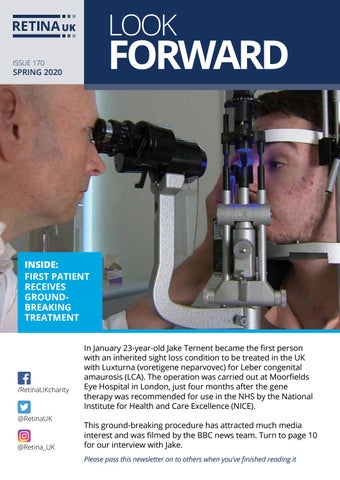
In January 23-year-old Jake Ternent became the first person with an inherited sight loss condition to be treated in the UK with Luxturna (voretigene neparvovec) for Leber congenital amaurosis (LCA). The operation was carried out at Moorfields Eye Hospital in London, just four months after the gene therapy was recommended for use in the NHS by the National Institute for Health and Care Excellence (NICE). This ground-breaking procedure has attracted much media interest and was filmed by the BBC news team. Turn to page 10 for our interview with Jake. Please pass this newsletter on to others when you’ve finished reading it
NEWS
Exciting times ahead Welcome to the first edition of Look Forward in 2020. Inside you’ll find details of our Information Days, Family events and our Conferences this year. Do come along and find out about the latest developments. You will be most welcome. As I write this, the first patient with Leber congenital amaurosis (LCA2) here in the UK has been treated with Luxturna. This exciting news has brought real hope to our community that treatments for other inherited sight loss conditions can be developed in the future and we will be continuing to fund and facilitate as much research as we can in the hope of making this a reality. On page 21 you’ll see an update from our fundraising team for 2019. Your support has allowed us to fund research and to deliver our valuable Information Days and Conferences. Bringing people together to share
experiences and expertise is a fundamental part of who we are. No one should ever feel alone, particularly those living with inherited sight loss and those affected by it. If you didn’t see Call the Midwife on Sunday 16 February, I’d encourage you to watch it on BBC iPlayer. It featured a young woman called Marion who is living with retinitis pigmentosa. Programmes like this can really help to raise awareness of inherited sight loss. You can read an interview with the actress who played Marion on page 16. If you have any thoughts to share about our charity, please email me at chiefexec@RetinaUK.org.uk. I really value your ideas and feedback.
Tina Houlihan, Chief Executive
Retina UK funds medical research into inherited sight loss and offers a range of information and support services to those affected. Retina UK, Wharf House, Stratford Road, Buckingham MK18 1TD E: info@RetinaUK.org.uk · T: 01280 821334 (Office) · T: 0845 123 2354* (Helpline) *
Calls cost 2ppm plus your phone company’s access charge
Do you follow us on Facebook and Twitter? Search for Retina UK on Facebook to find our page and various groups, and follow us on Twitter at @RetinaUK for the latest news and updates about the charity. Retina UK is a Charitable Incorporated Organisation (CIO), registered charity number: 1153851
2
NEWS
Artificial intelligence technology Exciting technological advances to support people living with sight loss are being made in the field of artificial intelligence (AI). One of the leading scientists in this area is Chieko Asakawa. Originally from Japan, she now works for IBM in the USA. Chieko is blind following a swimming pool accident in her early teens, she says she understands the challenges of wanting to be independent and not having to rely on others. She developed the IBM Home Page Reader in 1997 which was the first practical voice browser in the world. Her latest research has led to the development of other innovative technology, including NavCog and the AI suitcase. NavCog NavCog uses an app-based system that links to Bluetooth beacons to give navigation instructions to visually impaired users. It is currently in use in a number of locations, including Carnegie Mellon University and Pittsburgh International Airport. It allows users with little or no vision to navigate to a specific location without needing a sighted guide. The user simply selects their destination on the app by using voice search and NavCog guides them to that location in a similar way to SatNav in a car. Chieko says: “Imagine entering a completely unfamiliar building with multiple floors and being able to find
your way to a single location without relying on others.” The number of beacons needed and the corresponding cost and complexity may mean this technology will not be commonplace in the short term, but the pace of technological advances could mean an easier and more cost effective solution is developed. AI Suitcase The AI Suitcase acts as a travel companion. A little like a virtual guide dog, but one which can understand complex voice commands such as ‘take me to Gate A6’ at an airport. It can detect hazards and speak to the user to let them know that there are stairs ahead or to board a train. It is designed to be lightweight and be self-propelling (with its own motor) and to be able to communicate visual information like delays to a flight or changes to boarding information. These examples are just two of the innovative AI projects being developed. As technology advances, so will the ways in which it can support those with sight loss to lead more independent lives. A fascinating TED talk featuring Chieko Asakawa talking about her innovations is available on YouTube: www.youtube.com/watch?v=fmQIWnO3Ag. 3
RESEARCH
‘Our goal is always to find a
Hajrah Sarkar is a PhD student whose project is funded by Retina UK. Working with Dr Mariya Moosajee at the UCL Institute of Ophthalmology, Hajrah is studying a protein called RDH12, which plays an essential role in the cycle of processes that convert light into nerve signals at the back of the eye. In particular, she is looking at how RDH12 is affected by inherited mutations in the RDH12 gene, which cause Leber congenital amaurosis (LCA), a severe form of childhood-onset sight loss. Hajrah took some time out of her busy day in the lab to show us around and tell us about her work. “I am really fascinated by the structure 4
of protein molecules – how they fold to create their unique shape and how this influences their interaction with other substances. This was the focus of my Master’s degree at Imperial College, and I was keen to undertake the PhD project here in Dr Moosajee’s lab because it fits exactly with my scientific interests. “When the gene providing the instructions for building RDH12 has mistakes in it, the resulting protein can end up being the wrong shape, so I am investigating the mechanics of how this affects the visual cycle and,
treatment’ ultimately, how we might rectify the problem with future treatments. It was really important to me when choosing this project that I would be working in a team focused on translational research – that is, research that aims to translate increased scientific understanding into potential therapies. “There is really no such thing as a typical day in the lab. In order to study disease processes, we use intricate procedures to convert skin or blood cells from people affected by RDH12 mutations back into stem cells, and from there into retinal cells. This allows us to create models of human retinal disease called eye cups, which we can study and use to screen potential treatments. I spend quite a bit of time looking after the cells, feeding them and checking that they’re growing. “I am really fascinated by the structure of protein molecules – how they fold to create their unique shape and how this influences their interaction with other substances.” “I also read lots, keeping up to date with the latest papers and looking for new ideas. These might come from researchers looking at other types of inherited sight loss or completely different conditions; we can all learn from each other and I hope that our work here might help scientists working on other retinal diseases to find pieces of their own puzzles.
“I love the practical work in the lab, finding new ways to solve problems and trying to understand why things are going wrong in disease. There are always a few setbacks here and there, our experiments need a lot of optimisation and often need to be rerun several times but we learn from all of it. “Because Dr Moosajee is a clinician, we get lots of opportunities to meet people affected by inherited sight loss, and this really motivates me – it really puts into perspective the importance of the work we’re doing in the lab. Our goal is always to find a treatment; we know that families affected by sight loss are coping with such a lot. My ultimate hope for this project is to identify a potential therapy, whether that be through gene therapy or a more traditional drug. “Skin and blood cells donated by Dr Moosajee’s patients at Moorfields are essential for my work. When patients donate cells, they are helping us get one step closer to the answers – it might take a long time but we will get there. Every piece of information matters.” With your support, we can continue to help scientists like Hajrah look for treatments for inherited sight loss. For more information about Dr Moosajee’s RDH12 work and other studies funded by Retina UK, visit www.RetinaUK.org. uk/research/research-we-fund/. 5
FUNDRAISING
Support us by fundraising at work We have ambitious plans for 2020 to grow the Information and Support we provide and to invest in more pioneering research. Could your employer and colleagues help us by fundraising for Retina UK?
Fundraising at work is a brilliant way to improve morale and develop teamwork. It also allows your employer to demonstrate their commitment to Corporate Social Responsibility (CSR). Some companies provide match funding, where they match the amount raised by a staff member, so it’s worth asking if your employer offers this. The early part of the year is a great time to plan your workplace fundraising, whether you start with a team ‘bake off’ or lunch-time yoga. You can find lots of fundraising ideas,
6
tips and advice in our workplace fundraising pack, available to download from our website or by post. We can also supply fundraising materials and help with any questions you may have. To find out more about fundraising at work, or to request a copy of our workplace fundraising pack, please contact Fiona in the Fundraising Team on 01280 815900, fiona.leahy@RetinaUK.org.uk.
VOLUNTEERING
Try something new in 2020 and volunteer for Retina UK We have a number of opportunities to get involved in volunteering for Retina UK. Whether you can spare a few hours as a one off or you’re able to commit more time, we’d love to hear from you. We simply couldn’t do what we do without our dedicated volunteers so you can be sure that your contribution is tremendously valued by us.
Cheerers for the London Marathon – 26 April 2020
Retina UK Information Days • Reading (21 April) • Cardiff (23 April) • Manchester (23 June) • Glasgow (25 June) We always need extra hands at these events to help guide our delegates and assist at break and lunch times. You are more than welcome to join in the sessions during the day.
Come join us and provide encouragement to our team of 17 London Marathon runners as they complete the 26.2 mile route. It is an amazing day to be part of.
CBS Telephone Buddy Do you have experience of visual hallucinations Charles Bonnet Syndrome (CBS)? We are recruiting volunteers who have experienced visual hallucinations to join us as part of our CBS Buddy Service Team. As a Buddy you will provide a supportive telephone call to people experiencing visual hallucinations.
For more information on these roles, or other volunteering opportunities, please email Clair Pudaruth on volunteering@RetinaUK.org.uk or call the office on 01280 821334. 7
GET INVOLVED
Use your knowledge to be an expert People living with inherited sight loss are ‘experts by experience’, and that expertise is priceless to academic researchers and pharmaceutical industry partners looking for insights into life with retinal degeneration.
In 2019 we were able to put three biotechnology and pharmaceutical companies in touch with people affected by various inherited sight loss conditions. These people then went on to take part in focus groups and telephone interviews, which delved into topics such as ‘the hidden costs to families of living with inherited retinal disease’ and ‘the impact of these conditions on day-to-day life’. One of the companies has gone on to recruit two members of our community to an international patient steering
committee, which will provide ongoing guidance on clinical trial participation, patient-facing information and the needs of affected families.
“I found the gene.vision focus group very interesting. Everyone involved was very friendly and the website will be a massive step forward in terms of knowledge available to both professionals and newly diagnosed patients as well as people looking for more information on their condition. I find focus groups a great way to get involved in how these types of projects get off the ground.”
Four people joined a focus group to help specialist ophthalmologists develop and refine an online information resource for people with inherited sight loss and their doctors, which will be available later this year.
Emma Reed, Focus group participant 8
We connected over 60 members of our community with researchers studying topics such as mental health, wellbeing, and the support and information needs of friends and family; participation in these studies took place online or over the phone.
Whilst reviewing the use of accessible forms on the Retina UK website, our communications team asked for feedback using different device types
by experience WANTED: Information reviewers We are looking to recruit a number of people from across our community to review and comment on different pieces of information we are producing.
and with different levels of sight loss. This means that we are clear that the changes we plan to introduce work well for those who are going to be using them. How can I get involved? If you are interested in getting involved by taking part in questionnaires, online testing, surveys and more, we need to know more about you. We often get asked for representatives with a specific condition, a certain age range or a specific location in the country. Please complete the form on our website: www.RetinaUK.org.uk/ more-info or call us on 01280 821334. We will always contact you to ask if you’d like to be involved in a specific project and we will never pass your details onto a third party without your consent.
We have some really exciting plans for new online content, information sheets and video clips and we want to know what you think we could improve, before we make a final product. Whether you have sight loss yourself, support somebody who does, or work in a professional capacity, we value your experiences and opinions. We don’t want to take up huge amounts of your time, so for each piece of information we produce, we will have a small number of reviewers who will be asked a set of questions about what they have read or seen so we can gather feedback. If you are interested in supporting the team in producing the best information possible, please register your interest by emailing services@RetinaUK.org.uk or calling the team on 01280 821334.
9
NEWS
“I’m so glad to have been the The operation was carried out at Moorfields Eye Hospital in London, just four months after the gene therapy was recommended for use in the NHS by the National Institute for Health and Care Excellence (NICE).
“I never imagined in my lifetime there would be a treatment available on the NHS.” So says Jake Ternent, 23, the first person with an inherited sight loss condition in the UK to be treated with Luxturna (voretigene neparvovec) for Leber congenital amaurosis (LCA) caused by two faulty copies of the RPE65 gene. Since then a small number of other patients have received the treatment at all four of the treatment centres. Jake, from County Durham, was a baby when researchers started developing the treatment back in 1997. Jake says he was only told about the surgery two weeks before it happened. He said: “I’ve been taking part in research at Moorfields for 15 years. At first they were a little bit worried I wouldn’t have enough retinal cells left to have the treatment but luckily I did. “I was really shocked when I got the 10
phone call. They said to take the weekend to think about it and let them know on the Monday. I just thought they were having me on, it was mad. “To have this treatment free on the NHS is mindblowing. My consultant told me this is groundbreaking, a new generation of gene treatment.” While it is too early to say how successful the operation has been, medical professionals are happy with Jake’s progress. He said: “I really hope this will stabilise my condition and that I’ll experience some improvement in night vision as it was terrible.” Newcastle United season ticket holder Jake loves his football and wants to be a football coach. “I can’t see much of the football but I go for the atmosphere and listen to the commentary using jacks provided for headphones,” he said. In the meantime Jake is enthusiastic about having the other eye treated. “I’ll go back to Moorfields in March for a check up and will probably find out about the left eye then. I’m definitely keen to go ahead with having the other eye treated. I’m so glad to have been the first to be treated.”
first to be treated” How do I get referred? Your ophthalmologist can refer you to a treatment centre if you meet the eligibility criteria. If you don’t know which gene is causing your sight loss, your ophthalmologist will first need to make arrangements for genetic testing; the results of this can take some time. The test must show that you have two faulty copies of RPE65.
Frequently asked questions Where are the treatment centres? There are four treatments centres in the UK. These are based at: • Great Ormond Street (for children) • Moorfields Eye Hospital • Manchester Royal Eye Hospital • Oxford Eye Hospital Who is eligible for treatment with Luxturna? People must have two faulty copies of the RPE65 gene, confirmed by genetic testing, as well as reasonable numbers of remaining viable retinal cells, in order to benefit from this treatment. Luxturna provides healthy copies of the RPE65 gene but relies on retinal cells using their own molecular machinery to use these new genetic instructions; it won’t help in cells that have already completely degenerated.
Your ophthalmologist may also need to carry out some tests to check whether you have enough viable retinal cells for the treatment to work, especially if it’s been some time since your last ophthalmology appointment. What’s involved Luxturna is administered via an injection into the retina, which takes place under general anaesthetic. The treatment only needs to be given once but each eye is treated separately, with at least a week between the two operations. You will then need several follow up appointments at the treatment centre. To find out more, visit our website www.RetinaUK.org.uk/general-news or call our Helpline on 0845 123 2354 – calls cost 2ppm plus your phone company’s access charge. Lines are open 9.30am – 9.30pm, Monday to Friday. 11
NEWS
No need to miss out on the joy of reading
Reading a book is a pleasurable experience for many, providing adventure, empathy and enjoyment. But for some people living with sight loss, accessing print is not possible.
Reading helps reduce stress, as well as giving your mental health a boost and tackling loneliness. Calibre Audio Library offers a service that provides everyone the opportunity to live a life filled with stories. Calibre has over 11,000 audiobooks, including multiple copies for audio book clubs; all are unabridged and available for unlimited borrowing. Books are available on MP3 CD or memory stick. They can also be streamed online. Some people may be “It’s a marvellous service. I have read more books since I couldn’t read to see print than I ever did before.” 12
“Being unable to read books was devastating. Calibre has enabled me to continue to read and enjoy books which I thought I’d never be able to do again. The service is fabulous and it’s opened a door for me which I thought had been closed.” eligible to receive a memory stick player on free loan from British Wireless for the Blind. Calibre also sells them. Lifetime membership of Calibre is £35 for adults and £20 for under 16s, with no monthly subscription fee or additional costs. Call 01296 432 339 or visit www.calibre.org.uk to join or for more information.
GET INVOLVED
Meet others in your local area Our Retina UK Peer Support Groups meet regularly to provide information and support. They are an opportunity for individuals and families affected by inherited sight loss to engage with Retina UK, and get to know each other, in their local area.
Our March Peer Support Group meetings are in: • Glasgow 7 March • Isle of Wight 9 March • East of Scotland 21 March • London 28 March • Somerset 28 March • Hampshire 30 March • Merseyside 30 March For more information about our Peer Support Group network or to be added to the mailing list please email local@RetinaUK.org.uk or call the office on 01280 821334.
“After being seen by my ophthalmologist and told that I had retinitis pigmentosa (RP) 20 years ago, I was scared of my future. There weren’t any eye clinic liaison officers at that time. I was so thankful that there was a West of Scotland Retina UK group and I contacted them; what a lot of support I got. It is a lifeline! “I am now coordinator for the Glasgow group, we have two meetings a year and have a good attendance. Over the last few years people that have been newly diagnosed with RP have come to the meeting very upset and looking for support. There is nothing better than having that support from people who are going through what you are, especially in a face-to-face setting. “Retina UK has been a good support for the local groups, enabling us to be there for that person who needs it most. I am so thankful I was able to contact a local group and get the support I needed when I was at a low ebb.” Lynn Barr, Glasgow Peer Support Group
13
EVENTS
We’re coming to a town Our events calendar for this year has been finalised and we’re delighted to be visiting many different parts of the country. Whatever your plans are for 2020, we’d love to see you.
technology, learn about specialist holidays or hear about education provision.
• Birmingham 14 and 15 July • Cardiff 22 April
Information Days Our Information Days include presentations from leading medical professionals and our partners within the sight loss sector. They are free of charge to attend and there will be the opportunity to meet other local sight loss organisations. A sandwich lunch will be provided. These are taking place as follows: Cardi 23 April – 10.00am–3.00pm: School of Optometry and Vision Sciences (CF24 4HQ) Manchester 23 June – 10.00am– 4.00pm: St Thomas Centre (M12 6FZ) Reading 21 April – 10.00am–3.00pm: Reading Association for the Blind (RG1 7JS) Sight Village We will be exhibiting at the following, free to attend, events which showcase the latest technology, products and support services available to those who are visually impaired. As well speaking with charity representatives, you can find out and try the latest 14
• Leeds 30 September • London 3 and 4 November Family events We are holding two Family events, the first on Saturday 14 March at St Vincent’s School for the Blind in Liverpool. This is being run in collaboration with St Vincent’s; Henshaws; RSBC and Victa. There will be talks around education; employability; supporting independence from an early age; grants and benefits and parent and carer support. There will be a range of activities for youngsters of all ages. The second is the Usher Kids Family Event on Saturday 4 July at The Sense Touchbase Pears Centre in Birmingham with Usher Kids UK and Sense. This was incredibly popular in 2019 and we encourage early registration as space is limited. Annual Conference Our Annual Conference will be held on Saturday 26 September at the Macdonald Burlington Hotel in Birmingham (just across from New
near you Street Station). We are putting together a packed agenda of interesting speakers and useful workshops for you to attend. If you would like us to email you when registration is open, please complete our online form at: www.RetinaUK.org.uk/info-events or call us on 01280 821334. We will also be attending the See Hear Exhibition in Shrewsbury, Shopshire on Wednesday 13 May. See and Hear is a free event open to everyone to try out equipment and learn more about the support on offer to help improve the quality of life for those with sensory impairment, such as hearing or sight loss. More information is available on our website www.RetinaUK.org.uk/infoevents.
Register in advance: • Visit: www.RetinaUK.org.uk/ info-events • Email info@RetinaUK.org.uk • Phone 01280 821334
Diary dates: • North West Visual Impairment Family Day (Liverpool): Saturday 14 March • Retina UK Reading Information Day: Tuesday 21 April • Sight Village Cardiff: Wednesday 22 April • Retina UK Cardiff Information Day: Thursday 23 April • See Hear Exhibition, Shropshire: Wednesday 13 May • Retina UK Manchester Information Day: Tuesday 23 June • Usher Kids Family Event (Birmingham): Saturday 4 July • Sight Village, Birmingham: Tuesday 14 and Wednesday 15 July • Retina UK Professionals’ Conference (Birmingham): Friday 25 September • Retina UK Annual Conference (Birmingham): Saturday 26 September • Sight Village, Leeds: Wednesday 30 September • Sight Village, London: Tuesday 3 and Wednesday 4 November
15
NEWS
Popular historic drama features We were delighted to support the BBC1 drama Call the Midwife production team with their historical research for an episode featuring a character living with retinitis pigmentosa (RP). Professor John Marshall MBE, one of our medical trustees, kindly shared his experience to ensure that the programme was as realistic as possible and reflected patient care at the time. Look Forward editor, Jane Russell, caught up with Ellie Wallwork, who plays Marion, a young mother living with RP, in the episode that aired on Sunday 16 February. Are you living with sight loss? I’ve been almost completely blind since shortly after birth; I live with a condition called Retinopathy of Prematurity (a condition that can affect premature babies) and can only see light, dark and a few contrasts. I have very little useable vision and certainly not enough to get around an unfamiliar place by myself. Had you heard of RP before the show? A few of my friends have RP and some of the charities I’ve worked with before have supported people with the condition. 16
What level of vision does your character have in the show? I played Marion as if she had no vision whatsoever. Realistically this could have occurred; it’s likely that she used Braille and I did not play her as if she had more vision than I myself have. What research did you do to help you to understand the character? I researched the differences between support that new mothers (and those with sight loss in general) had now and in the 1960s. I also made sure to understand RP as an eye condition, due to the fact that those with my condition (Retinopathy of Prematurity) would not have survived so many years ago. Do you think your character was supported by the ‘system’ of the time?
retinitis pigmentosa I do not think there was enough help in the system to support Marion with what she went through. Though midwives and those around her could help, there was very little in the way of structural and ongoing support for a woman living with sight loss. In addition, disabled people were often treated with stigma and awareness around the needs of those with disabilities was sparse. The show has done an incredible job though in presenting Marion as independent and the nurses as understanding and willing to learn. What did it feel like for your character – how would you describe how she lives with RP? As Marion lost her vision early on in life, by the time she becomes pregnant she is used to the struggles of living with RP in a society which is not made for those with her condition. Though there are many frustrations surrounding her search for independence, she has an admirable strength of character which sees her through the worst of her troubles. She is resilient, stubborn and will do anything in her power to ensure that she, and those around her, are not held back by disability. What do you think the character’s fears were? Marion is prepared to be a mother and is excited about the prospect. However, it would have been natural
for her to feel a little uncertain at the changes ahead. She must also rely on new people such as Trixie; as her last doctor treated her poorly. Marion must trust that those at the new clinic will treat her with fairness as opposed to patronising her. What did you learn about the impact of sight loss at that time as a result of playing this role? I realised how difficult it must have been even to acquire basic support. I am incredibly lucky that I was born into a time of greater acceptance and resources for those living with sight loss. I now have a more developed understanding of the challenges people like Marion faced and can only hope to apply this empathy to others still going through difficulties. Has it changed your understanding/ perspective of those living with sight loss at that time? I have a deep admiration for people with sight loss who have had to survive in a world which does not understand how to support them. Saying this, the episode shows that the kindest people existed not only at the time but also in the present day. Marion went out of her comfort zone to rely on the unfamiliar, which has taught me that the unknown is not so scary after all. This episode of Call the Midwife is available on demand via the BBC iPlayer. 17
FUNDRAISING
Tanya Rickard and her five year old son are both living with RP. She raised £9,536 with a Winter Wonderland Ball to raise awareness of the condition and celebrate the fact that it’s OK to be different.
Eileen Till, along with six of her clog dancing friends and Frank, their musician, got together in November to dance at Whitby Pavilion for the town’s annual Winterfest. They followed this up with an open mic session, where Eileen sold a number of her Ukulele Fun Books. £303 was raised to support our work.
The Ladies section of the Wycombe Heights Golf Club chose to support Retina UK as their charity of the year in 2019 by holding an afternoon tea. They raised an incredible £1,697 to help fund one of our current research projects exploring the genetic mutations which lead to Stargardt disease.
Ottilia and Peregrine sold homemade blackberry and plum jam to raise money for Retina UK. Their babysitter Finn has RP and they wanted to help – they raised £10.
We love to hear about all of the great fundraising that goes on up and down the 18
Barnsley-based trade fabricating company, Euroglaze, has chosen to support Retina UK during their 40th anniversary year, and have so far raised an impressive £6,095 through activities including a virtual cycle ride!
Another successful Worksop’s Got Talent event, organised by our supporter James Clarke, took place in November. To date, this event has raised an incredible £37,200 to support our work
Andrew completed the Lands End to John O’Groats cycle in July, along with five friends all raising money for different charities. Andrew raised over £500 for Retina UK.
Louise and Adam ButlerSmith completed the Milton Keynes Winter Half Marathon, raising £710 in the process. What a fantastic achievement!
country. Please send your pictures and stories to fundraising@RetinaUK.org.uk 19
FUNDRAISING
Rise to a challenge and raise money Is running not for you? There are plenty more options to explore, such as:
• Join the Retina UK Tandem Cycle Challenge (see page 22) taking place 9 to 11 October
We have five places available in this year’s spectacular Royal Parks Half Marathon in central London on 11 October. The stunning 13.1 mile route takes in the capital’s world-famous landmarks on closed roads, and four of London’s eight Royal Parks – Hyde Park, Green Park, St James’s Park and Kensington Gardens. There’s no registration fee to take part – all we ask is that you aim to raise a minimum of £500 for Retina UK, and we’ll support you all the way! To register, visit our website: www.RetinaUK.org.uk/RoyalParks or contact the Fundraising Team on 01280 815900, fundraising@RetinaUK.org.uk. 20
• Tackle a sponsored walk in any of a number of locations in the UK, including the Jurassic Coast, Thames Path or Lake District • Sign up for the ever popular Hope to Seaview walk on the Isle of Wight taking place on 7 June • Take to the air on a Wing Walk, or launch yourself out of a plane and Sky Dive!
You can find out more about all of these events on our website: www.RetinaUK.org.uk/ FundraisingEvents or by contacting the Fundraising Team on 01280 815900, fundraising@RetinaUK.org.uk.
FUNDRAISING
Your donations make a difference!
Thanks to everyone who gave so generously last year to a number of key appeals and campaigns. Our Research Appeal in June raised £20,988 to fund research into inherited retinal conditions such as retinitis pigmentosa, Usher syndrome and Stargardt disease. This was further boosted by yet another successful Big Give Christmas Challenge. Our supporters’ donations were matched from a pot provided by Retina UK’s major donors, trust funders and our Big Give Christmas Challenge Champion, Candis Magazine. Our community was so generous that the match funding ran out within a couple of days! This campaign raised a further £32,783 for investment in research. Our Christmas Raffle raised £15,000 this year and five lucky winners received prizes including £500 cash and an Amazon Echo.
Head of Fundraising, Deborah Laing, said: “We are so grateful to everyone who contributed to one or more of these campaigns, and to those who supported us in many other ways including membership, direct debits, and a range of fundraising events and activities. Thanks to your support, we were able to commit to £551,000 of medical research last year, as well as maintaining and developing our Information and Support Services.” Our plans for 2020 include a BBC Lifeline Appeal on television in the summer. More information will be available in the coming months. Thanks to you: • Research Appeal: £20,988 • Big Give Christmas Challenge: £32,783 • Christmas Raffle: £15,000 21
FUNDRAISING
Jump in the saddle for our T
The Retina UK Tandem Cycle Challenge was launched in 2019 with 37 intrepid cyclists tackling 100 miles along Hadrian’s Cycleway. The first day’s route took the group 44 miles from Bowness-on-Solway to the lovely town of Haltwhistle, passing many miles of beautiful coastline, sections of Hadrian’s Wall and the historic town of Carlisle. There were some steep hills in the second half of the day, so the team were relieved to finish with a lovely descent to the finish point! That evening, Paralympic gold medallist Steve Bate, who was completing the challenge along with the group, gave a talk about his many adventures, which was a great way to follow a delicious meal at the Centre of Britain Hotel. The second day saw the biggest hills at the beginning of the day, as the 22
group sped on towards the finish on the coast at Tynemouth Priory via Newbrough and Newcastle-upon-Tyne. The rain started to come down heavily, which added an extra element to the challenge, but it didn’t dampen spirits! The team were met at the end with cheers, medals and a well-earned glass of prosecco to celebrate their amazing achievement, which raised more than £21,000 to support our work. “This was a marvellous event to be part of. At times it was exhilarating, at times it was tough. My sense of achievement at the end was fantastic.”
Tandem Cycle Challenge
Join us for the next challenge – Friday 9 to Sunday 11 October 2020 We’re looking for another fantastic team of cyclists to join us for the 2020 challenge. This year we’re visiting the West Country, taking on the Devon Coast to Coast route from Ilfracombe to Plymouth. The route follows many old railway lines, passing over viaducts and through tunnels, as well as taking in Dartmoor National Park. Registration for the challenge costs £75, with a minimum fundraising target of £375. Two nights accommodation and vehicle backup is included, and a team of Retina UK staff and volunteers will be
“It was fantastic being part of a team of people determined to complete the challenge no matter what the terrain or weather threw at them! Everyone supported one another and it was great to know that we were raising funds for Retina UK with every pedal.” manning rest stops along the route to cheer you on! You can find out more about the 2020 challenge on our website here: www.RetinaUK.org.uk/DevonCycle, or contact Deborah in the Fundraising Team on 01280 815900, deborah.laing@RetinaUK.org.uk. 23
We are so grateful for all donations to our work Please make your selections below and post the form back to Retina UK, Wharf House, Stratford Road, Buckingham, MK18 1TD, or, if you prefer, call 01280 821334 or donate online at www.RetinaUK.org.uk. Thank you.
I enclose my cheque for £
payable to Retina UK.
I would like to make my donation of £
by debit/credit card.
Card Holder Name: Card Type: Mastercard
Visa
Start Date:
Expiry Date:
Maestro
Delta
Issue Number (Switch only):
Last three numbers on the reverse of the card: If you would like to set up a Direct Debit, please visit our website www.RetinaUK.org.uk or call the office on 01280 821334.
Contact details Title: Mr/Mrs/Miss/Other (please specify) Name: Address: Postcode:
Telephone:
Email: If you gift aid your donation, the charity will receive an extra 25p for every £1 that you give! I confirm that I have paid or will pay an amount of Income Tax and/or Capital Gains Tax for each tax year (6 April to 5 April) that is at least equal to the amount of tax that all the charities or Community Amateur Sports Clubs (CASCs) that I donate to will reclaim on my gifts in that tax year. I understand that other taxes such as VAT and Council Tax do not qualify. I understand that the charity will reclaim 25p of tax on every £1 that I give. Signature:
Start date:
Should you wish to opt out of some or all communications from us, you can do so at any time. Just call us on 01280 821334 or email info@RetinaUK.org.uk Retina UK is a Charitable Incorporated Organisation (CIO), registered charity number: 1153851