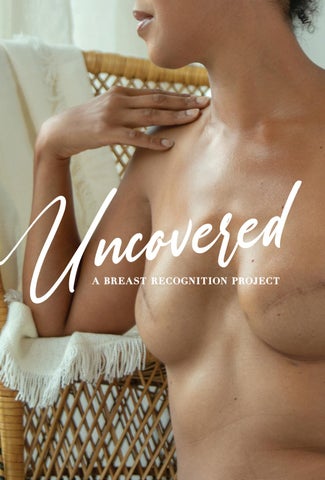
d e r e v o c n U A BR E A ST RECOGN I T ION PROJECT
Uncovered A BR E A ST RECOGN I T ION PROJECT
Rethink Breast Cancer would like to thank Pfizer Canada for its funding of Uncovered: A Breast Recognition Project. Rethink would also like to thank the eight brave women who courageously jumped on board for this project. Through your contributions, we will be improving the lives of young women with breast cancer.
Uncovered: A Breast Recognition Project, is more than images and stories of a few women at varying stages of their breast cancer journeys. Uncovered has been a cathartic means for me to express, in the most empowering way possible, what has been a long and frustrating part of my breast cancer journey. This project is my way of uncovering the voices of women of colour who are left in the dark when looking to see themselves represented in the cancer community. In the spring of 2017, I was diagnosed with breast cancer. Immediately, I began enquiring about my surgical options. I attended seminars, looked at brochures, and I even did my own research online. The one thing that became abundantly clear was that images of women who looked like me were nowhere to be found. It was distressing to have to make a life-altering decision and not have any visuals to help guide me through the process. In October 2018, over a year after my bilateral mastectomy, I was still unable to make a decision. I attended an educational event on breast reconstruction, eager to connect with other women, visit the education tables, and walk through the Show and Tell Lounge. I left feeling even more discouraged and alone. To my dismay, there was nothing and nobody representing women of colour. I’m grateful that 2020 has allowed me to reflect on my experiences and find the courage to shine a light on the need for diverse representation in the cancer community. I am touched by the stories and images of the beautiful souls who not only uncovered their own scars for the photos, but also exposed their experiences to make this project happen. A sincere thanks to everyone who helped bring Uncovered to light. It has been a profound and comforting experience to see myself represented in the stories and images of the women who helped make this possible.
I believe in the power of a simple idea. When I was starting Rethink Breast Cancer back in 2001, my simple idea was to show that breast cancer wasn’t just a grandmother’s disease, that young people were affected by breast cancer too. Young women weren’t being represented in the breast cancer cause, so we created our movement to include them. We are living through a year when much of the world is reflecting and exploring what inclusivity and belonging means and how important a sense of belonging is to one’s identity. Up until now, there has been significant underrepresentation of, and support for, Black women and women of colour in the breast cancer community. So, when Michelle Audoin came to us with her simple, yet powerful idea: to put a spotlight on Black women’s stories of breast reconstruction surgery, we jumped at the chance to get involved. While I believe in the power of a simple idea, I know they often take the most courage. To Michelle, and to all the women featured in Uncovered: A Breast Recognition Project, thank you for your bravery and vulnerability in showing and sharing your physical and emotional scars. Uncovered will serve both as a practical resource and also as inspiration to the broader Black breast cancer community. And we will do everything we can to get it into the hands of cancer care teams, so they are better equipped to support all the woman they care for. I am honoured that Michelle trusted Rethink Breast Cancer with her idea and that we’ve been able to collaborate with her to create Uncovered. Thank you to everyone who has been involved in bringing it to life. We are grateful for your part in helping Black women with breast cancer be seen, heard and understood.
MICHELLE AUDOIN
MJ DECOTEAU Founder and Executive Director, Rethink Breast Cancer
M
Boob Bio // Name: Michelle Audoin Age When Diagnosed: 40 Breast Cancer Type: Metastatic ER+ breast cancer and thyroid cancer I Am An: MBC Advocate, Rethinker, Changemaker
MY BREAST CANCER journey has been a long one. In fact, I had my first benign breast tumour removed from my right breast when I was only 14. As a result, I had a raised scar on my right nipple, which was a constant reminder that something was wrong with my breasts. Sadly, I never felt that I had a place to speak up. And there were always other lumps. I had learned to do self-exams from magazines, and I felt comfortable asking my family doctor to make referrals. One breast specialist had told me that I just had lumpy breasts and that there was nothing to worry about. When I started breastfeeding, I thought somehow that would give me immunity. I was diagnosed with ER+ breast cancer in the left breast in April 2017. By this time, I already had a history of breast biopsies, ultrasounds and exams. Following my diagnosis, I had a lumpectomy followed by a mastectomy with a sentinel node biopsy on the cancerous left side and a prophylactic mastectomy on the right side. Nipple preservation on the left side was not possible, however, both my nipples were removed. Tissue expanders
were put in. Eventually, the expanders were replaced with implants. I also had a bilateral salpingo-oophorectomy to reduce the amount of estrogen in my body that was feeding my tumours. Growing up, I feared and loathed my breasts. They were small. I was told they were lumpy. And they were scarred. That all changed when I became a mother. I had made the choice to breastfeed my babies and my breasts were no longer scary to me. They were a source of nourishment and comfort to my two children during the first two years of their lives. I was still nursing my son to sleep when I lost my breasts to cancer. I miss the shape of my old breasts. Though they were small, they had a natural sag from having nursed two children. I took pride in this. I miss my nipples, too.
“NO ONE HAS BEEN ABLE TO SHARE IMAGES OF WOMEN WHO LOOK LIKE ME” I have yet to accept my implants. Their shape is different from my natural breasts. Three years later, I am still having a hard time accepting my body with its scars because I wasn’t prepared for them. I wish I had images of women of colour so that I could feel more confident about moving forward. Three years is a long time of living with indecision and despair. The medical community could be doing a lot more to serve the Black breast cancer community. From the start of my breast cancer journey to this very day, I have felt alone. No one has been able to share images of women who look like me and who have had surgeries like mine. No one has really taken the time to hear my pain and sadness of having to abruptly wean a child and lose their breasts. I felt pressure to be optimistic about my implants because somehow they looked bigger and better than what I previously had. I often felt like I didn’t matter because I didn’t fit the bill of what they already had on file, which was often images of older white women. I think that the medical community could do a better job at letting Black women know more about their risks and outcomes. We need more race-based data and equal representation in the images and stories of women with breast cancer. My message to other Black women going through breast cancer is to look for support and to tell your story.
I
I HAVE BEEN LIVING with stage IV metastatic breast cancer since I fractured my spine while pregnant in 2008. My cancer has spread to my bones, lungs and liver. I have had chemo twice, a mastectomy and radiation four times. I have had 12 surgeries for reconstruction as well as removal of a ruptured implant and a collapsed implant. I just underwent chemo and lost my hair for the second time. I’m currently on hormone therapy as well as natural treatments. Prior to breast cancer, I took my breasts for granted, never being happy with what I had. Now, I feel pretty disconnected from my breasts. They don’t have much feeling and my scars make it difficult to feel comfortable wearing certain clothes. I miss a lot about my pre-diagnosed self. I miss living pain-free (my spinal fusion caused a lot of nerve pain and a foot drop). I miss being able to walk with ease and having balance. I miss being carefree.
“TRY TO FIND SUPPORT THROUGH OTHER BLACK WOMEN LIVING WITH CANCER”
Boob Bio // Name: Faith Walker Age When Diagnosed: 26 Breast Cancer Type: Stage IV metastatic HR+ I Am A: Mother, Thriver, Singer
My advice to newly-diagnosed Black women is to advocate for yourself. Bring a support person to your appointments. I record most of my doctor’s appointments to make sure I don’t miss anything and also to protect myself. Healthcare professionals often don’t take Black women seriously and we are often not given the medication and support we need. Do your research and know that it’s your body and you can decide your course of treatment. Try to find support through other Black women living with cancer, even if it’s through social media. There are very few, if any photos of Black women’s reconstruction, so I was compelled to be part of this resource. I really hope this project is a step in the right direction and allows us to be seen and help many women of colour on their cancer journeys.
I
I WAS DIAGNOSED in 2018 and completed treatment (chemo and radiation) in the summer of 2019. Since then I’ve had reconstruction surgery to put in an implant that later had to be removed because it failed. I’m currently awaiting my next reconstruction, which will be Diep reconstruction. Before being diagnosed, I loved my breasts and enjoyed my showing cleavage from time to time. I wore whatever I wanted without having to worry about how my chest looked. Now, I miss feeling attractive and also having the energy I used to as I’m still battling fatigue. I also have the feeling that I can no longer trust my breasts.
“OUR CONCERNS ARE NOT AT THE FOREFRONT” My advice to other Black women who have just been diagnosed? Try to find other Black women in the community to connect with as they may have specific experiences that can better help and inform you. And always always advocate for yourself! Our concerns are not at the forefront and often have to be brought to people’s attention. This could be simple as products (cosmetics/lymphedema sleeves) that are not geared towards us or the lack of images that look like us. I didn’t see myself when going through my breast cancer experience, and I don’t want other Black women to have that type of isolating experience. This project is a great initiative and I hope to see more like it.
Boob Bio // Name: Indira Age When Diagnosed: 34 Breast Cancer Type: DCIS I Am A: Sister, Warrior, Goddess
I
I WAS DIAGNOSED in November 2019 and had a left breast mastectomy in December 2019. I started radiation in February 2020 and finished at the end of March 2020. The connection I had with my breasts was strong. I always had larger breasts and they were very much a part of who I was as a woman. My breasts were part of all the stages of life from my teenage years when I was wearing outfits that were way too tight to show them off, all the way to the role my breasts played in motherhood, which helped create a special bond with my children.
“I GET TO SHOW MY DAUGHTER I’M STILL A STRONG BLACK WOMAN WITH OR WITHOUT MY BREAST”
Boob Bio // Name: Tonia Age When Diagnosed: 41 Breast Cancer Type: Invasive ductal carcinoma (IDC), Stage 3 I Am A: Daughter, Warrior, Faithful
Pre-diagnosis I was comfortable in my own skin. l worried less about how my clothing fit and how it made me feel so I had to adjust to my new body. It has taken a lot of work on myself to realize I am so much more than just what I look like on the outside. I get to show my daughter I’m still a strong Black woman with or without my breast. This is one of the hardest journeys to go through and sadly one you would never choose. Being a young woman diagnosed with breast cancer can be very isolating. Imagine going to every appointment and seeing no one that looks like you. You may be afraid to speak up for yourself, but don’t be because it’s important to be your own advocate in both the mental and physical parts of your treatment. I think that as Black women, we want support groups, advertising, breast prosthesis, wigs and all stages of breast cancer treatment to reflect us. Black women dealing with breast cancer just want to be seen, heard and valued in all parts of our cancer journey.
S
SINCE MY DIAGNOSIS in May 2018, I did six rounds of intravenous chemotherapy, which lasted 18 weeks, plus a few extra weeks due to delayed treatments because of low white blood counts. I had a very favourable response to the chemo and my tumours shrunk so significantly that the doctors could barely detect the once-hard-and-distinctive-ball-like lump in my left breast and the other mass in my armpit. I had a few months to regain my strength before going in for surgery days before Christmas of that year. I was utterly deflated when my oncologist recommended another course of chemotherapy in February of 2019. This time, an oral dosage of chemo taken twice daily for another eight months. Finally, I began radiation in November 2019 and completed my final radiation session a week before Christmas in 2019. Then, another six months of what I call “post-treatment” treatment, which consisted of physio and rehab for range of motion in my arm, lymphedema education and treatment for this side effect I will have to manage for the rest of my life, and an endless amount of ongoing emotional self-care.
“YOU NEED TO DIG DEEP INTO THE WELL OF STRENGTH, THAT WE AS BLACK WOMEN HAVE HAD TO DO FOR CENTURIES” Before being diagnosed, I was always slightly self-conscious about my too small, or dare I say, flat breasts, which is such a loaded term having gone through this experience. I had a lumpectomy, which means I got to keep my breasts but so many women have to, or choose to - depending on their situation, have one or both completely removed. Post-diagnosis, I now have a whole new respect for my body and breasts. I’m here because my body got me through this and my breasts put up a good fight, dents, scars and all. Breast cancer is an isolating diagnosis to begin with. It marginalizes you as you suddenly become a statistic. Add to
Boob Bio // Name: Laura Age When Diagnosed: 44 Breast Cancer Type: Stage 3, triple negative, invasive ductal carcinoma I Am A: Survivor, Educator, Friend
that the layer of being a minority and not really fitting into the system of supports. You are a margin within the margin. You need to dig deep into the well of strength, that we as Black women have had to do for centuries and harness every ounce of attitude and sass that you have ever been accused of having and use it in your fight. You are stronger than you think.
“I’M HERE BECAUSE MY BODY GOT ME THROUGH THIS” The Eurocentric bias that is built into the healthcare and support systems is a disservice to the Black breast cancer community. The lack of research, information and communication regarding how certain medications affect Black patients uniquely is frustrating and disheartening. I am grateful for the Black nurses who could give me the inside scoop and prepare me for some of the very unexpected side effects such as extreme changes in skin pigmentation. What happens to all the Black women who do not by chance get those experienced Black nurses who can help you brace yourself and know what to expect? My experience with a program intended to build my
self-esteem, left me feeling more marginalized and de-valued than when I went into the program because they did not have appropriate products for Black women. Did they not anticipate that a Black woman would want to look and feel good, too? I needed to be a part of this amazing resource because Black women need to see themselves represented in this challenging breast cancer journey, which is isolating enough, in and of itself. We don’t deserve to be in the margins of the margins. We deserve to be recognized, acknowledged and supported too.
I
I WAS DIAGNOSED with TNBC on May 17th, 2018, on my second son’s first birthday. I was 36, a mom of two small children, my oldest son being four years old. When I felt my bump just two weeks earlier, I had said to myself, “Well, if they (my boobies) gotta go, they gotta go.” After attending all the hospital’s educational sessions, along with my husband at my side, I decided to have a double mastectomy with immediate implants. Having the BRCA1 genetic marker means I am also at-risk for ovarian cancer, so after much reflection, my decision was to have both of my ovaries removed after I completed my six rounds of chemotherapy (FEC-D). The images I saw of women’s scarring were primarily of those who were white/light skinned, so it was hard for me to gauge what my body might look like post-surgery.
“THE IMAGES I SAW OF WOMEN’S SCARRING WERE PRIMARILY OF THOSE WHO WERE WHITE/LIGHT SKINNED”
Boob Bio // Name: Kristal Age When Diagnosed: 36 Breast Cancer Type: Triple Negative I Am An: Educator, Human Rights Activist, Rethinker
The night before my mastectomy surgery, I had a “Farewell to Kristal’s boobies” party (it was fun and light-hearted). Postsurgery, even though I got to keep my nipples, sensation was significantly reduced but I am much more ok with it now and I even enjoy the sensation that I do have. My biggest advice is to listen to yourself, always. Give yourself time to investigate what you think is important. For me, I chose to opt for prophylactic surgery with my ovaries. I chose to have chemotherapy. Growing up in my homeland of Trinidad & Tobago, I knew what it was to live a third world life. I am so thankful for the excellent healthcare and options I had throughout my whole cancer experience here in Canada. Even though at every step, each decision was not an easy one, I did it with a light heart and with gratitude that I had excellent doctors at my side.
B
Boob Bio // Name: Vivene Age When Diagnosed: 41 Breast Cancer Type: Inflammatory, invasive ductal carcinoma, HER 2 Positive I Am A: Fighter, Breastie, Advocate
BEFORE BREAST CANCER, I had a positive relationship with my breasts. They were part of my identity and the way I viewed myself as a woman. I swam a lot, so I had strong pectoral muscles and firm tissue; I thought they were pretty good and in proportion to my body. After diagnosis my relationship was negative and I thought the full, dense tissue might have hidden the cancer. I felt my breasts were a source of trauma and pain and that breast cancer ruined my life. I felt men would no longer be attracted to me because of physical changes in the way I looked (shallow, I know). Really, it’s taken two years to reconnect with my breasts and see them positively again. I had a strong attachment to my hair. People would stop me on the street and compliment it. I was an early adopter of wearing natural hair for social and political reasons and it was a big part of my identity as a Black woman. Losing it was extremely traumatic and it definitely impacted my sense of self. My hair has grown back, but it is completely different and super straight so I’m struggling a little to know what hairstyle to have.
The surgeon did a really excellent job (for having gone through invasive surgery, I felt the scarring could have been way worse and I was mentally trying to prepare for the worst scenario). What I really don’t like is my port-a-cath scar (my breast surgeon told me that he thought the surgeon who did the port-a-cath did a poor job and I agree!). I wasn’t a fan of the radiation tattoos and I really question whether this is necessary—to me it seems it is not patient-centric, it benefits the radiation professionals saving time to constantly take measurements. When I was first diagnosed, I felt I couldn’t
“I DON’T THINK THERE IS A LOT OF EDUCATION ABOUT THE CANCERS THAT AFFECT BLACK WOMEN MORE” think clearly. I went along with things at the beginning because I thought the experts knew best. I didn’t take active control and advocate for myself the way I do now. For example, I was referred to a hospital for treatment, that in hindsight, I would not have picked for several reasons. In the beginning everything moves so fast, but I would like other woman to know that the system is not necessarily patient-focused, so advocate for yourself strongly.
I don’t think there is a lot of education about the cancers that affect Black women more; I don’t think there is understanding about the trauma and scarring that can occur through surgery and radiation. It’s been two years and every time people see my port-a-cath scar, they think I had the surgery last week! My radiation burns have still not fully healed and again, it’s been close to two years. I think we are not heard and many times our pain is not taken seriously—we are often prescribed drugs without being properly told about alternatives or side effects. In general, I think we can be excluded from the discussion about breast cancer, it’s not necessarily deliberate but I think it is critical that be changed.
Boob Bio // Name: Keisha Age When Diagnosed: 42 Breast Cancer Type: Triple Negative I Am: Strength, Resiliency, Courage
I
I FEEL LIKE I am at a crossroads so to speak. I can’t say honestly I don’t live in fear but with my treatment now in the rear-view mirror, sometimes I get scared and feel it will creep back in. Some days are easier, and I now have immense appreciation for life. Before I was diagnosed, I didn’t have much of a connection to my breasts other than when I was younger and nursing my children, as it was important for me to provide them with nourishment. I don’t regret losing my breast. In turn, I have my life and I can enjoy watching my girls grow up and spend time with friends and family. I do miss feeling even. Right now, I feel lopsided because even if I wear a padded bra, it is still obvious that there’s an empty area. Lately, I’ve been wearing a sports bra, which helps minimize the look.
“I FEEL THIS INITIATIVE IS A STEP FORWARD TO BRINGING AWARENESS AND SUPPORT FOR WOMEN OF COLOUR” If you’ve been newly diagnosed, be easy on yourself. Nothing you did caused cancer. Don’t feel shy to ask questions because it will enable you to get the best care. Try to have a family member or friend attend appointments with you, especially during chemo when your brain may not be as sharp and physically you may feel like you’ve collided with a Mack truck. When you can, journal your feelings. I feel this initiative is a step forward to bringing awareness and support for women of colour. I want to be part of the change and advocate for more research, data (including risk reduction) and more transparency within the oncology sector for women of colour as it has not been a priority for the healthcare sector.
In This Skin
From radiation, port, surgery scars and nipple tattoos to all shades, shapes and sizes, Black bodies affected by breast cancer are beautiful and deserve to be visible. Black breast cancer representation matters.
Contributors // JASMINE MERINSKY found that her calling was to help make the world a better place, through the beauty industry. Jasmine has over 10 years of experience working as a hair and makeup pro and has worked with celebrities like Samira Wiley, Elaine Welteroth and Tia Mowry.
NICOLE SIMMONS is a visual artist and creative collaborator based out of Toronto. With a love for striking imagery, and proven experience in art direction, styling and design, she is an active participant in the creative process from conception to final stages. “I wanted to be involved in this project to honour my Aunt Beverly who passed away from breast cancer but was also one of the strongest people I’ve ever known. Representation matters and makes us feel seen and heard. I am honoured that Rethink, and the women who were involved in this project, put their trust in me to capture the beauty and strength of not only their scars but their stories.”
“Breast cancer runs in my family and took my grandma away from me as a teenager. She too lacked support, understanding and had healthcare workers that didn’t do right by her. Being a part of this project was my chance to honour my grandma, shed light, and help capture the beauty and resiliency of these wonderful women of colour.”
RAHNELLE BRANTON is a Toronto-based professional makeup artist with experience surrounding the music, fashion and film industries. Whether it’s working on creatives, photoshoots, videos, films, weddings, Rahnell is always able to bring skill and personality. “I’ve lost family to cancer and I’ve never really heard their experiences, so this project was enlightening and fulfilling, and seeing the women’s reactions to their faces was heartwarming.”
Acknowledgements // CREATOR Michelle Audoin Jasmine Merinsky for P1M (P1M.CA); Ashley Iris Gill image by Reid Marshall
ASHLEY IRIS GILL is a queer Cinematographer from Toronto, Canada. She has worked on projects ranging from music videos, documentaries, shorts and commercials. Ashley plans to continue capturing the world through her emotive and unique gaze.
“The women’s stories that were shared with me while getting glam were so powerful and reminded me of why I do what I do.”
FOUNDER + EXECUTIVE DIRECTOR, RETHINK MJ DeCoteau PROJECT DIRECTOR Tania Kwong ART DIRECTOR Leanna Ruggiero MANAGING EDITOR Emily Piercell PROJECT MANAGER Kendra Hinds PHOTOGRAPHY Nicole Simmons LIGHTING Fatima Camara MAKEUP Rahnelle Branton HAIR Jasmine Merinsky CINEMATOGRAPHY Ashley Iris Gill VIDEO EDITOR Elyse Waslat SOUND MIXING Nathaniel Lingard Special thank you to Ūnika Swim for generously outfitting the participants of Uncovered: A Breast Recognition Project and gifting each participant with a suit to take home.
About // Rethink Breast Cancer is the young people’s breast cancer movement. Our mission is to empower young people worldwide who are concerned about and affected by breast cancer by taking a breakthrough approach to education, advocacy, support, community building and fundraising initiatives. Rethink is changing the breast cancer conversation to make real change. You aren’t average and we aren’t your average breast cancer charity. We’re here to uplift, inspire and most importantly, rethink breast cancer to help young women live better and live longer. For more information on Uncovered: A Breast Recognition Project, visit rethinkbreastcancer.com/ breastrecognitionproject WEBSITE rethinkbreastcancer.com INSTAGRAM RethinkBreastCancer FACEBOOK Rethink Breast Cancer TWITTER RethinkTweet RethinkTweet YOUTUBE Rethink Breast Cancer
Join Our Movement // Are you a young woman with breast cancer looking to connect with others? Rethink Young Women’s Network (RYWN) is a community of young women that have personal experience with breast cancer at any stage. It is a place to get support, have your questions answered and engage in meaningful conversations with other women. rethinkbreastcancer.com/RYWN